People management
Group 1
1- Nancy
2- yassim
3- mohammed abdulwahab
4- ahmed moustafa
5- rasha
6- ayatollah
7- mohammed Abdallah
8- aya gaber
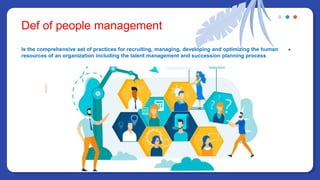
Def of people management
●
Is the comprehensive set of practices for recruiting, managing, developing and optimizing the human
resources of an organization including the talent management and succession planning process
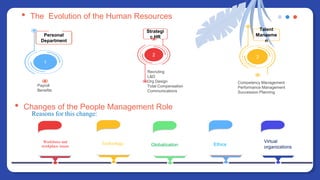
• The Evolution of the Human Resources
2
Strategi
c HR
Recruting
L&D
Org Design
Total Compensation
Communications
Personal
Department
1
Payroll
Benefits
3
Talent
Manaeme
n
Competency Management
Performance Management
Succession Planning
• Changes of the People Management Role
Reasons for this change: PLAN
Jupiter is a gas
giant and the
biggest planet
02
DEVELOP
MENT
Saturn is a gas
giant and has
several rings
03
LAUNCH
Mercury is the
closest planet to
the Sun
05
ANALYSIS
Neptune is the
farthest planet
from the Sun
04
Workforce and
workplace issues
Technology Globalization Ethics
Virtual
organizations
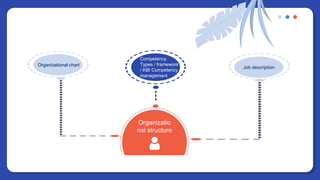
Organizatio
nal structure
Job description
Organizational chart
Competency
Types / framework
/ KBI Competency
management
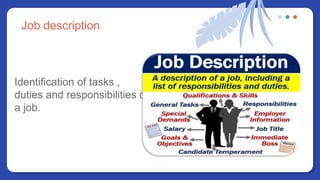
Job description
Identification of tasks ,
duties and responsibilities of
a job.
The most critical components of a good job
description.
Heading information:
This includes job title, salary, reporting line and main worn condition.
Summary objective of the job.
Qualifications:
education, experience, certificates and technical skills.
Special demands:
This includes any extraordinary skills or specifications needed in the job.
Job duties and responsibilities.
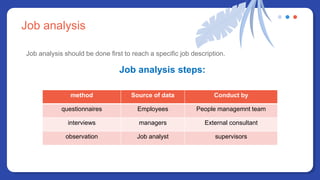
Job analysis
Job analysis should be done first to reach a specific job description.
Job analysis steps:
Conduct by
Source of data
method
People managemnt team
Employees
questionnaires
External consultant
managers
interviews
supervisors
Job analyst
observation
Aim of job description:
 Recruiting
 Selecting the proper new candidates
 Training needs
 Setting expectations for the new
employees
 Evaluation for existing employees
 Development plans
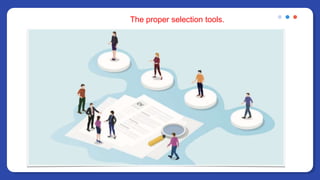
The proper selection tools.
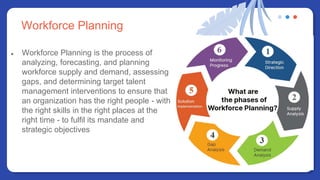
Workforce Planning
● Workforce Planning is the process of
analyzing, forecasting, and planning
workforce supply and demand, assessing
gaps, and determining target talent
management interventions to ensure that
an organization has the right people - with
the right skills in the right places at the
right time - to fulfil its mandate and
strategic objectives
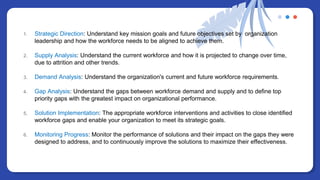
1. Strategic Direction: Understand key mission goals and future objectives set by organization
leadership and how the workforce needs to be aligned to achieve them.
2. Supply Analysis: Understand the current workforce and how it is projected to change over time,
due to attrition and other trends.
3. Demand Analysis: Understand the organization's current and future workforce requirements.
4. Gap Analysis: Understand the gaps between workforce demand and supply and to define top
priority gaps with the greatest impact on organizational performance.
5. Solution Implementation: The appropriate workforce interventions and activities to close identified
workforce gaps and enable your organization to meet its strategic goals.
6. Monitoring Progress: Monitor the performance of solutions and their impact on the gaps they were
designed to address, and to continuously improve the solutions to maximize their effectiveness.
Sourcing
● Sourcing is an activity under the umbrella of talent acquisition that involves proactively
identifying, contacting, and engaging qualified candidates for an organization rather than
waiting for candidates to apply on their own.
● Many consider the primary goal of sourcing to be getting qualified candidates into the
hiring funnel, especially passive candidates.
● A recruiter may use a variety of sourcing channels to accomplish this goal, such as
phone calls, emails, and social networking.
● More and more, sourcing is becoming a digital activity, with talent acquisition
professionals using Boolean search techniques on search engines or combing through
profiles on LinkedIn to identify potential candidates
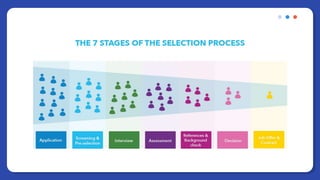
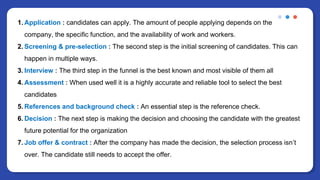
1. Application : candidates can apply. The amount of people applying depends on the
company, the specific function, and the availability of work and workers.
2. Screening & pre-selection : The second step is the initial screening of candidates. This can
happen in multiple ways.
3. Interview : The third step in the funnel is the best known and most visible of them all
4. Assessment : When used well it is a highly accurate and reliable tool to select the best
candidates
5. References and background check : An essential step is the reference check.
6. Decision : The next step is making the decision and choosing the candidate with the greatest
future potential for the organization
7. Job offer & contract : After the company has made the decision, the selection process isn’t
over. The candidate still needs to accept the offer.
congratulation you signed contract
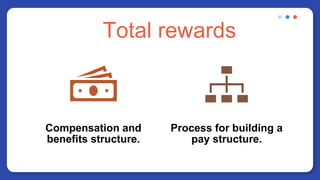
Total rewards
Compensation and
benefits structure.
Process for building a
pay structure.
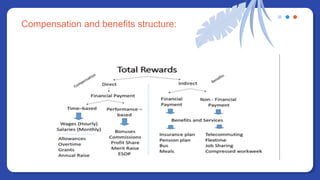
Compensation and benefits structure:
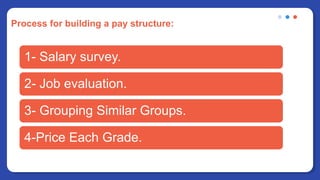
Process for building a pay structure:
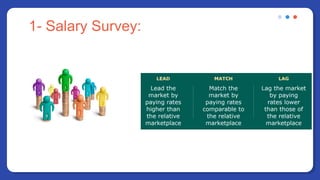
1- Salary survey.
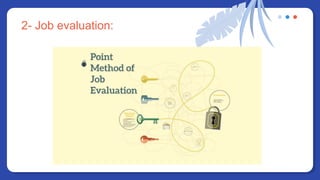
2- Job evaluation.
3- Grouping Similar Groups.
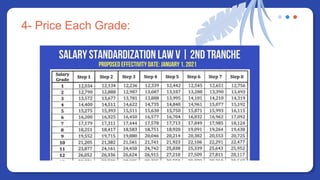
4-Price Each Grade.
1- Salary Survey:
2- Job evaluation:
3- Grouping Similar Jobs:
4- Price Each Grade:
Learning & Development
● Top Trends
● Top Challenges
● ADDIE Model
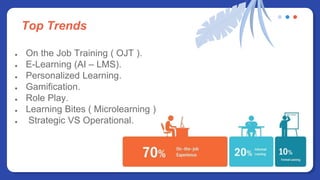
Top Trends
● On the Job Training ( OJT ).
● E-Learning (AI – LMS).
● Personalized Learning.
● Gamification.
● Role Play.
● Learning Bites ( Microlearning )
● Strategic VS Operational.
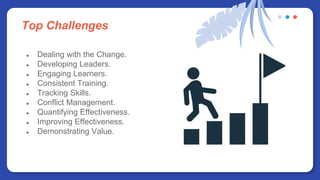
Top Challenges
● Dealing with the Change.
● Developing Leaders.
● Engaging Learners.
● Consistent Training.

● Tracking Skills.
● Conflict Management.
● Quantifying Effectiveness.
● Improving Effectiveness.
● Demonstrating Value.
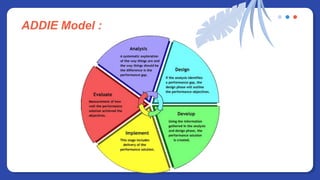
ADDIE Model :
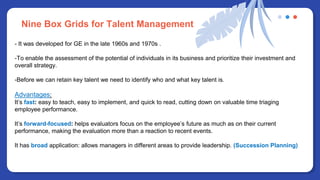
- It was developed for GE in the late 1960s and 1970s .
-To enable the assessment of the potential of individuals in its business and prioritize their investment and
overall strategy.
-Before we can retain key talent we need to identify who and what key talent is.
Advantages:
It’s fast: easy to teach, easy to implement, and quick to read, cutting down on valuable time triaging
employee performance.
It’s forward-focused: helps evaluators focus on the employee’s future as much as on their current
performance, making the evaluation more than a reaction to recent events.
It has broad application: allows managers in different areas to provide leadership. (Succession Planning)
Nine Box Grids for Talent Management
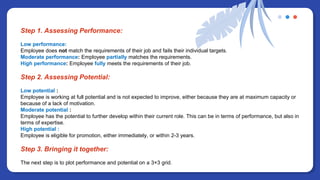
Step 1. Assessing Performance:
Low performance:
Employee does not match the requirements of their job and fails their individual targets.
Moderate performance: Employee partially matches the requirements.
High performance: Employee fully meets the requirements of their job.
Step 2. Assessing Potential:
Low potential :
Employee is working at full potential and is not expected to improve, either because they are at maximum capacity or
because of a lack of motivation.
Moderate potential :
Employee has the potential to further develop within their current role. This can be in terms of performance, but also in
terms of expertise.
High potential :
Employee is eligible for promotion, either immediately, or within 2-3 years.
Step 3. Bringing it together:
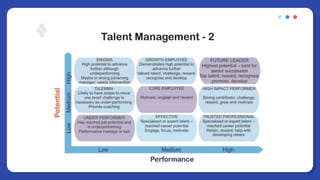
The next step is to plot performance and potential on a 3×3 grid.
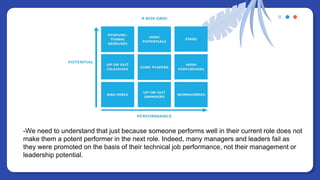
-We need to understand that just because someone performs well in their current role does not
make them a potent performer in the next role. Indeed, many managers and leaders fail as
they were promoted on the basis of their technical job performance, not their management or
leadership potential.
Def: It is a strategy for passing on leadership roles—often the ownership of a company—
to an employee or group of employees. Also known as "replacement planning," it ensures
that businesses continue to run smoothly after a company's most important people move
on to new opportunities, retire, or pass away.
Why is succession management important?
1-Strong leadership is a competitive advantage
Strong leaders will tackle challenges, navigate obstacles that arise in the future, and get
ahead of the competition. They have the specific competencies to identify and respond to
the future needs of their organization.
2-Build critical skills required to successfully lead and grow the business.
3-Reach business objectives with the right talent
When you know your key goals and objectives, you can strategically hire and develop the
right people with the right skills to help you achieve these goals in the most efficient way.
Succession Planning
… Succession Planning
4-Knowledge transfer
A successful succession management model ensures a smooth transition in times of leadership changes.
5-Provide a liquidity event enabling the transfer of ownership in a going concern to rising employees.
6-Having the right people in the right position improves lead times and decision making
Delays can arise in projects and goals if senior leaders unexpectedly become sick or die or leave for one of your
competitors.
7-Reduce turnover by filling positions internally
Internal candidates are more likely to succeed and remain in your organization than external hires.
According to Wharton management professor Matthew Bidwell
External hires are 61% more likely to be laid off or fired. They’re also 21% more likely to leave their job than internal
hires. Overall, investing in employee career development and succession management programs help you improve
employee retention.
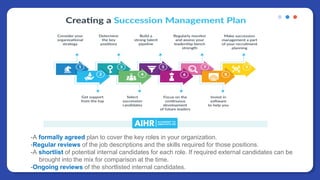
-A formally agreed plan to cover the key roles in your organization.
-Regular reviews of the job descriptions and the skills required for those positions.
-A shortlist of potential internal candidates for each role. If required external candidates can be
brought into the mix for comparison at the time.
-Ongoing reviews of the shortlisted internal candidates.
Common mistakes Of Succession
Planning
1-Focusing exclusively on the executive level
This approach can lead to detrimental gaps in important non C-suite roles,
particularly when individuals in lynchpin roles suddenly leave
the company.
2-Using a one-size-fits-all competency framework
Don’t let the convenience of ready-to-use competency models lead you to
overlook characteristics that are important to your organization.
3-Describing an idealized version of the role
When identifying which competencies are needed for a given role, there can
be a tendency to describe those qualities you’d like to see of the individual in
the focal role, rather than the actual requirements. Remember to focus on
what is essential to success in that position.
4-Underestimating the changing nature of work
An important part of succession planning is anticipating future needs. Part of this means taking time to
reflect on the future of the focal role.
5-Keeping the succession plan a secret
Communicating to employees that these opportunities exist is likely to have a positive impact on their
motivation to pursue developmental goals, and to remain with the organization long-term.
6-Relying on only one successor per role
Having a talented pool of candidates gives you options when it comes to filling a focal role, and
ensures you’ve developed sufficient talent to fill vacancies as they arise.
7-Failing to update the succession plan regularly
Succession planning is a dynamic process. You should never go more than 6 months without
reviewing your succession plan. As individuals undergo professional development, their readiness to
move into new roles should be re-evaluated.
People management.pptx

People management.pptx

  • 1.
    People management Group 1 1-Nancy 2- yassim 3- mohammed abdulwahab 4- ahmed moustafa 5- rasha 6- ayatollah 7- mohammed Abdallah 8- aya gaber
  • 2.
    Def of peoplemanagement ● Is the comprehensive set of practices for recruiting, managing, developing and optimizing the human resources of an organization including the talent management and succession planning process
  • 3.
    • The Evolutionof the Human Resources 2 Strategi c HR Recruting L&D Org Design Total Compensation Communications Personal Department 1 Payroll Benefits 3 Talent Manaeme n Competency Management Performance Management Succession Planning • Changes of the People Management Role Reasons for this change: PLAN Jupiter is a gas giant and the biggest planet 02 DEVELOP MENT Saturn is a gas giant and has several rings 03 LAUNCH Mercury is the closest planet to the Sun 05 ANALYSIS Neptune is the farthest planet from the Sun 04 Workforce and workplace issues Technology Globalization Ethics Virtual organizations
  • 4.
    Organizatio nal structure Job description Organizationalchart Competency Types / framework / KBI Competency management
  • 5.
    Job description Identification oftasks , duties and responsibilities of a job.
  • 6.
    The most criticalcomponents of a good job description. Heading information: This includes job title, salary, reporting line and main worn condition. Summary objective of the job. Qualifications: education, experience, certificates and technical skills. Special demands: This includes any extraordinary skills or specifications needed in the job. Job duties and responsibilities.
  • 7.
    Job analysis Job analysisshould be done first to reach a specific job description. Job analysis steps: Conduct by Source of data method People managemnt team Employees questionnaires External consultant managers interviews supervisors Job analyst observation
  • 8.
    Aim of jobdescription:  Recruiting  Selecting the proper new candidates  Training needs  Setting expectations for the new employees  Evaluation for existing employees  Development plans
  • 9.
  • 10.
    Workforce Planning ● WorkforcePlanning is the process of analyzing, forecasting, and planning workforce supply and demand, assessing gaps, and determining target talent management interventions to ensure that an organization has the right people - with the right skills in the right places at the right time - to fulfil its mandate and strategic objectives
  • 11.
    1. Strategic Direction:Understand key mission goals and future objectives set by organization leadership and how the workforce needs to be aligned to achieve them. 2. Supply Analysis: Understand the current workforce and how it is projected to change over time, due to attrition and other trends. 3. Demand Analysis: Understand the organization's current and future workforce requirements. 4. Gap Analysis: Understand the gaps between workforce demand and supply and to define top priority gaps with the greatest impact on organizational performance. 5. Solution Implementation: The appropriate workforce interventions and activities to close identified workforce gaps and enable your organization to meet its strategic goals. 6. Monitoring Progress: Monitor the performance of solutions and their impact on the gaps they were designed to address, and to continuously improve the solutions to maximize their effectiveness.
  • 12.
    Sourcing ● Sourcing isan activity under the umbrella of talent acquisition that involves proactively identifying, contacting, and engaging qualified candidates for an organization rather than waiting for candidates to apply on their own. ● Many consider the primary goal of sourcing to be getting qualified candidates into the hiring funnel, especially passive candidates. ● A recruiter may use a variety of sourcing channels to accomplish this goal, such as phone calls, emails, and social networking. ● More and more, sourcing is becoming a digital activity, with talent acquisition professionals using Boolean search techniques on search engines or combing through profiles on LinkedIn to identify potential candidates
  • 14.
    1. Application :candidates can apply. The amount of people applying depends on the company, the specific function, and the availability of work and workers. 2. Screening & pre-selection : The second step is the initial screening of candidates. This can happen in multiple ways. 3. Interview : The third step in the funnel is the best known and most visible of them all 4. Assessment : When used well it is a highly accurate and reliable tool to select the best candidates 5. References and background check : An essential step is the reference check. 6. Decision : The next step is making the decision and choosing the candidate with the greatest future potential for the organization 7. Job offer & contract : After the company has made the decision, the selection process isn’t over. The candidate still needs to accept the offer.
  • 15.
  • 16.
    Total rewards Compensation and benefitsstructure. Process for building a pay structure.
  • 17.
  • 18.
    Process for buildinga pay structure: 1- Salary survey. 2- Job evaluation. 3- Grouping Similar Groups. 4-Price Each Grade.
  • 19.
  • 20.
  • 21.
  • 22.
  • 23.
    Learning & Development ●Top Trends ● Top Challenges ● ADDIE Model
  • 24.
    Top Trends ● Onthe Job Training ( OJT ). ● E-Learning (AI – LMS). ● Personalized Learning. ● Gamification. ● Role Play. ● Learning Bites ( Microlearning ) ● Strategic VS Operational.
  • 25.
    Top Challenges ● Dealingwith the Change. ● Developing Leaders. ● Engaging Learners. ● Consistent Training. ● Tracking Skills. ● Conflict Management. ● Quantifying Effectiveness. ● Improving Effectiveness. ● Demonstrating Value.
  • 26.
  • 27.
    - It wasdeveloped for GE in the late 1960s and 1970s . -To enable the assessment of the potential of individuals in its business and prioritize their investment and overall strategy. -Before we can retain key talent we need to identify who and what key talent is. Advantages: It’s fast: easy to teach, easy to implement, and quick to read, cutting down on valuable time triaging employee performance. It’s forward-focused: helps evaluators focus on the employee’s future as much as on their current performance, making the evaluation more than a reaction to recent events. It has broad application: allows managers in different areas to provide leadership. (Succession Planning) Nine Box Grids for Talent Management
  • 28.
    Step 1. AssessingPerformance: Low performance: Employee does not match the requirements of their job and fails their individual targets. Moderate performance: Employee partially matches the requirements. High performance: Employee fully meets the requirements of their job. Step 2. Assessing Potential: Low potential : Employee is working at full potential and is not expected to improve, either because they are at maximum capacity or because of a lack of motivation. Moderate potential : Employee has the potential to further develop within their current role. This can be in terms of performance, but also in terms of expertise. High potential : Employee is eligible for promotion, either immediately, or within 2-3 years. Step 3. Bringing it together: The next step is to plot performance and potential on a 3×3 grid.
  • 30.
    -We need tounderstand that just because someone performs well in their current role does not make them a potent performer in the next role. Indeed, many managers and leaders fail as they were promoted on the basis of their technical job performance, not their management or leadership potential.
  • 31.
    Def: It isa strategy for passing on leadership roles—often the ownership of a company— to an employee or group of employees. Also known as "replacement planning," it ensures that businesses continue to run smoothly after a company's most important people move on to new opportunities, retire, or pass away. Why is succession management important? 1-Strong leadership is a competitive advantage Strong leaders will tackle challenges, navigate obstacles that arise in the future, and get ahead of the competition. They have the specific competencies to identify and respond to the future needs of their organization. 2-Build critical skills required to successfully lead and grow the business. 3-Reach business objectives with the right talent When you know your key goals and objectives, you can strategically hire and develop the right people with the right skills to help you achieve these goals in the most efficient way. Succession Planning
  • 32.
    … Succession Planning 4-Knowledgetransfer A successful succession management model ensures a smooth transition in times of leadership changes. 5-Provide a liquidity event enabling the transfer of ownership in a going concern to rising employees. 6-Having the right people in the right position improves lead times and decision making Delays can arise in projects and goals if senior leaders unexpectedly become sick or die or leave for one of your competitors. 7-Reduce turnover by filling positions internally Internal candidates are more likely to succeed and remain in your organization than external hires. According to Wharton management professor Matthew Bidwell External hires are 61% more likely to be laid off or fired. They’re also 21% more likely to leave their job than internal hires. Overall, investing in employee career development and succession management programs help you improve employee retention.
  • 33.
    -A formally agreedplan to cover the key roles in your organization. -Regular reviews of the job descriptions and the skills required for those positions. -A shortlist of potential internal candidates for each role. If required external candidates can be brought into the mix for comparison at the time. -Ongoing reviews of the shortlisted internal candidates.
  • 34.
    Common mistakes OfSuccession Planning 1-Focusing exclusively on the executive level This approach can lead to detrimental gaps in important non C-suite roles, particularly when individuals in lynchpin roles suddenly leave the company. 2-Using a one-size-fits-all competency framework Don’t let the convenience of ready-to-use competency models lead you to overlook characteristics that are important to your organization. 3-Describing an idealized version of the role When identifying which competencies are needed for a given role, there can be a tendency to describe those qualities you’d like to see of the individual in the focal role, rather than the actual requirements. Remember to focus on what is essential to success in that position.
  • 35.
    4-Underestimating the changingnature of work An important part of succession planning is anticipating future needs. Part of this means taking time to reflect on the future of the focal role. 5-Keeping the succession plan a secret Communicating to employees that these opportunities exist is likely to have a positive impact on their motivation to pursue developmental goals, and to remain with the organization long-term. 6-Relying on only one successor per role Having a talented pool of candidates gives you options when it comes to filling a focal role, and ensures you’ve developed sufficient talent to fill vacancies as they arise. 7-Failing to update the succession plan regularly Succession planning is a dynamic process. You should never go more than 6 months without reviewing your succession plan. As individuals undergo professional development, their readiness to move into new roles should be re-evaluated.