 Value analysis: Based on the elementary
principles of right quality of material to be
supplied.
 Lead time: Time lag between the placement
of an order & receipt of the goods ordered.
 Buffer stock: Emergency stock for meeting
demand during unforeseen situations (undue
extension of lead time or increase in
consumption).
 Supplies/ consumables: item those used up or
consumed.
› Medical/ non medical
 Equipment: movable item used by personnel
which last for many years like desks, tables,
beds, refrigerator & vehicles.
 Facilities: non movable items used by
personnel for many years like building, wells,
fencings etc..
 To get
1. The Right quality
2. Right quantity of supplies
3. At the Right time
4. At the Right place
5. For the Right cost
 To gain economy in purchasing
 To satisfy the demand during period of
replenishment
 To carry reserve stock to avoid stock out
 To stabilize fluctuations in consumption
 To provide reasonable level of client services
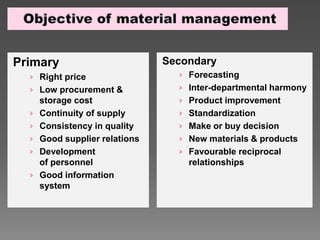
Primary
› Right price
› Low procurement &
storage cost
› Continuity of supply
› Consistency in quality
› Good supplier relations
› Development
of personnel
› Good information
system
Secondary
› Forecasting
› Inter-departmental harmony
› Product improvement
› Standardization
› Make or buy decision
› New materials & products
› Favourable reciprocal
relationships
 Traditionally, various activities related to managing
materials were looked after by various departments.
In this process:
 purchases were generally arranged by top management
with the assistance of a Purchase Agent or Purchase
Officer.
 store keeping and stock control was the responsibility
of the production head with the assistance of a store
keeper or Stores Officer.
 Apart from these two main activities, distribution of
materials (mostly finished goods) was the responsibility
of marketing.
 In the traditional set up one person could
not be held responsible for all the
functions of materials management to
achieve overall economy.
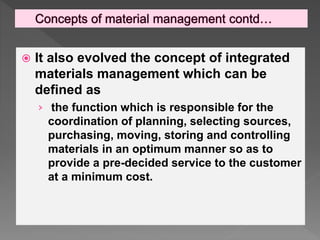
 It also evolved the concept of integrated
materials management which can be
defined as
› the function which is responsible for the
coordination of planning, selecting sources,
purchasing, moving, storing and controlling
materials in an optimum manner so as to
provide a pre-decided service to the customer
at a minimum cost.
 Containing the costs
 Instilling efficiency in all activities
 Buying material of right quantity at right
price & right time.”
 Better control over material management.
 Less overlapping & duplication.
 Ensure high quality and quantity.
1. Effective management & supervision It depends on managerial
functions of
 Planning
 Organizing
 Staffing
 Directing
 Controlling
 Reporting
 Budgeting
2. Sound purchasing methods
3. Skilful & hard poised negotiations
4. Effective purchase system
5. Should be simple
6. Must not increase other costs
7. Simple inventory control programme
 Demand estimation
 Identify the needed items
 Calculate from the trends in Consumption
during last 2 years.
 Review with resource constraints
1. Purchasing
2. Central service supply
3. Central stores
4. The print shops
5. The pharmacy
6. Dietary& Linen services
Raw
material
Process /
manufacture
Goods /
service
Input Output
Suppliers Consumers
Selection of items
& demand
estimation
Procurement
Receipts &
inspection
Storage
Issue for
consumption
Maintenance
& repair
Disposal or
condemnation
Accounting & information
system
 Estimation of right amount of each material
is the most crucial factors for maximizing
availability within minimum wastage.
 The greater the crisis situation and exigency
for an item and smaller the quantity required
, the greater will be the procurement price
and incidental cost of purchase.
 Therefore, necessary to anticipate the need
for the item ensuring that bulk purchases can
be affected by maximum price discount.
 So, anticipation is done through demand
estimation.
 Important things to keep in mind are:
› Arithmetic average-average of all past demand
› Objectives of the organization
› Changing clientele.
› Changing emphasis on various programmes &
activities in health field.
 Trend line
 Semi average method
 Moving average method
 Weighting through exponential smoothing
 Application of trends and seasonality indices.
 Moving average method:
› most widely used.
› Involves summating past consumption values for
a defined period of time, dividing this sum by
number of values used so as to obtain a forecast
of the next period.
Important areas:
1.Directorate general of supply &
disposal(DGS & D, Govt. Of India]
2. Medical stores depot (M. S.D. Government
of India, Ministry of H & FW]
3. Private or public sector undertakings.
4. Receiving donations.
 An effective purchasing system aims at
procurement of items of acceptable quality,
in appropriate quantities, at the minimum
price and within the available time.
 Acquire needed supplies as inexpensively as
possible
 Obtain high quality supplies
 Assure prompt & dependable delivery
 Distribute the procurement workload to avoid
period of idleness & overwork
 Optimize inventory management through
scientific procurement procedures
 Decentralized purchasing: large purchases
to be made by the individual department of
the hospital
 Centralized purchasing: purchases to be
made by the general stores-purchase,
pharmacy& dietary department etc.
 Centralized purchasing is most advisable
than Decentralized purchasing
Advantages of Centralized purchasing:
 Possible Quantity discount through
standardization and bulk order.
 Decreased purchasing cost through
consolidation and non duplication of orders.
 Lower inventory cost because centralization
makes possible a lower safety stock.
 Enhance better management control.
Different systems of procurement:
 Fixed quantity contract- define quantity of
supplies by a specified date.
 Running contract: approximate quantity of
stores at a specified price during certain period
of time.
 Rate contract: supply stores at specified rates
during the period covered by the contract. No
fixed quantities are specified.
Different systems of procurement:
 Differed payment: involved a commitment on
the part of hospital to pay a portion of the
costs immediately, the balance amount being
payable at the define period of time.
 Leasing: enables a hospital to make use of
an equipment without actually owning it,
though rent is payable by the lessee to the
lessor as per the contractual term.
Value analysis:
The process of analyzing of the intrinsic
value of the material for achieving the
objectives of the organization is termed as
value analysis.
 Review selection
 Determine needed quantities
 Reconcile needs & funds
 Choose procurement method
 Select suppliers
 Specify contract terms
 Monitor order status
 Receipt & inspection
1. Maintain vendor list for each group of item;
each vendor should be known for his
capabilities and reputation.
2. Forecast requirement and plan purchase
3. Draw up product specification to ensure clarity,
to avoid mistakes & rejection because of wrong
supplies
4. Invite quotations
› Commonly open tenders as it ensure transparency
and minimize buyer-vendor collusion.
•Public bidding, resulting in low prices
•Published in newspapers
•Term - 4 weeks
•Quotations must be sent in the specific forms
that are sold, before the time &date mentioned in
the tender form
•In technical items, ‘two packets or two bins’
system is followed. Offers are given in two
separate packets.
•Technical bid
•Financial bid
Cont……
Open tender
 First technical bid is opened & short listed.
 Then financial bid of selected companies are opened &
lowest is selected
 Delayed tenders & late tenders are not accepted. But if, in
case of delayed tenders, if the rate quoted is very less, then
it can be accepted.
 Quotations are opened in presence of indenting department,
accounts & authorized persons of party.
 Validity of tenders – generally 90 days
5. Prepare a comparison statement of offers based on
basic price, freight and insurance charges, taxes and
levies, quantity and payment discount etc…
6. Short list the offer. The final selection should preferably
be by the committee/ authority, possibly after
negotiating the price and terms of first order of choice.
Earnest money
 2 % of the tender amount or as decided has
to be paid along with all quotations. In case
of default 1/5 is withheld.
Restricted or limited tender
 From limited suppliers (about 10)Lead-time
is reduced Better quality
Negotiated procurement
 Buyer approaches selected potential
Suppliers & bargain directly Used in long
time supply contracts.
Direct procurement
 Purchased from single supplier, at his quoted
price. Prices may be high Reserved for
proprietary materials, or low priced, small
quantity & emergency purchases
Rate contract
Firms are asked to supply stores at specified Rates
during the period covered by the Contract
Spot purchase
It is done by a committee, which includes an officer
from stores, accounts & purchasing departments
Risk purchase
If supplier fails, the item is purchased from other
agencies & the difference in cost is recovered from
the first supplier
CALL FOR
OFFERS
CALL FOR
OFFERS
YES
YES
DETERMINE DRUGS & DRUG
REQUIREMENTS
DETERMINE DRUGS & DRUG
REQUIREMENTS
DRUG REQUIREMENTS
DRUG REQUIREMENTS
DONATION
SOURCE
DONATION
SOURCE
GOVERNMENT
PRODUCTION
GOVERNMENT
PRODUCTION
DETERMINE DRUGS & DRUG
REQUIREMENTS
DETERMINE DRUGS & DRUG
REQUIREMENTS
PURCHASE
REQUIREMENTS
PURCHASE
REQUIREMENTS
OPEN TENDER
OPEN TENDER RESTRICTED
TENDER
RESTRICTED
TENDER
NEGOTIATED
TENDER
NEGOTIATED
TENDER
DIRECT
PURCHASE
DIRECT
PURCHASE
REQUEST OFFERS FROM
ELIGIBLE SUPPLIERS
REQUEST OFFERS FROM
ELIGIBLE SUPPLIERS
LOCATE
RELIABLE
SUPPLIERS
LOCATE
RELIABLE
SUPPLIERS
CONTACT
RELIABLE
SUPPLIER
CONTACT
RELIABLE
SUPPLIER
EVALUATE &
SELECT SUPPLIER
EVALUATE &
SELECT SUPPLIER
EVALUATE OFFERS
& SELECT
SUPPLIERS
EVALUATE OFFERS
& SELECT
SUPPLIERS
NEGOTIATE PRICE &
SUPPLY CONDITIONS
NEGOTIATE PRICE &
SUPPLY CONDITIONS
ESTABLISH
PRICE
ESTABLISH
PRICE
PURCHASE ORDER
/ CONTRACT
PURCHASE ORDER
/ CONTRACT
PURCHASE ORDER /
CONTRACT
PURCHASE ORDER /
CONTRACT
PURCHASE
ORDER /
CONTRACT
PURCHASE
ORDER /
CONTRACT
PURCHASE
ORDER /
CONTRACT
PURCHASE
ORDER /
CONTRACT
DRUGS RECEIVED, CHECKED AGAINST PURCHASE ORDER / CONTRACT SPECIFICATIONS & CLEARED
FOR DISTRIBUTION
DRUGS RECEIVED, CHECKED AGAINST PURCHASE ORDER / CONTRACT SPECIFICATIONS & CLEARED
FOR DISTRIBUTION
ADJUST
QUANTITIES
ADJUST
QUANTITIES
ADJUST
QUANTITIES
ADJUST
QUANTITIES
YES
NO
YES
NO
NO NO NO
YES YES
FLOW OF PROCUREMENT DECISIONS
 Proper specification
 Invite quotations from reputed firms
 Comparison of offers based on basic price,
freight & insurance, taxes and levies
 Quantity & payment discounts
 Payment terms
 Delivery period, guarantee
 Vendor reputation(reliability, technical
capabilities, Convenience, Availability, after-
sales service, sales assistance)
 Short listing for better negotiation terms
 Seek order acknowledgement
 The stores ordered are received in the store.
 The lot picked up by a random sampling method
be subjected to physical & chemical inspection.
 Basic facilities for such examination be created in
the organization itself depending upon the size of
stores turnover, governmental & commercial
chemical laboratories should also made use of
for analysis of chemical composition of drugs
etc..
 Investment made in sound sampling policy &
procedure will assure the right quality of
materials supplied to the organization.
 Intended items after receiving from the
suppliers should be checked for deficiency
and damage.
 Check the items for discrepancy in quantity &
quality, product specification & outdated
supplies.
 Necessary documentation should be done on
purchase register & stock register before it is
stored & issued to the department.
 The store department should be conveniently
located to facilitate easy receipt of material
from suppliers and easy dispatch of supplies
to the wards and departments.
 Location of the store will be guided by the flow
of activity of the stores.
 Store should be of adequate size to
accommodate all the drugs, instruments,
appliances etc.
 Required to have steel racks with shelves.
 Refrigeration should be provided for storage of
thermo labile items.
 Graded temperature zone concept in essential
medical stores.
 Separations of the stores of various types i.e.
injections, tablets, local use agents from others,
poisons from non-poisonous, inflammable from
non inflammable.
 Drugs & medicines should be grouped
according to the pharmacological actions & in
accordance with the classification adopted in the
formulary.
 Alphabetical arrangement group wise enable
easy identification & retrieval.
 Principles of FIFO should be adopted.
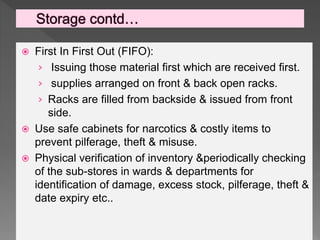
 First In First Out (FIFO):
› Issuing those material first which are received first.
› supplies arranged on front & back open racks.
› Racks are filled from backside & issued from front
side.
 Use safe cabinets for narcotics & costly items to
prevent pilferage, theft & misuse.
 Physical verification of inventory &periodically checking
of the sub-stores in wards & departments for
identification of damage, excess stock, pilferage, theft &
date expiry etc..
 Use safe cabinets for narcotics & costly items to
prevent pilferage, theft & misuse.
 Physical verification of inventory &periodically
checking of the sub-stores in wards & departments
for identification of damage, excess stock, pilferage,
theft & date expiry etc..
 Can be centralized or decentralized
 Items held in inventory by the stores may
be issued through indents to user
departments on
› a periodical basis (once a week/fortnight).
› or when necessary on replacement basis.
 The latter is preferable for expensive drugs and
consumables, especially if the cost are to be
debited to patient.
 System of stock replenishment to ward/
department are:
› Requisition or drug basket system
› Par level or top-up system
› Exchange cart system.
 Done at a defined intervals or as and when
the departmental stock level gets low.
 a requisitions countersigned by higher
official is required to summit.
 The “drug basket” includes sending an
empty container/trolley with requisition.
 The maximum stock level for each
ward/department is predetermined according
to usage rate and frequency of
replenishment.
 At a periodic intervals, stores personnel visit
the ward/department & carry out a physical
inventory of what is available & arrange to
replenish the stock to predetermined
maximum level.
 Similar to the par-level system.
 The departmental stock is stored in a
cart/trolley and a similar/duplicate cart is kept
by the stores.
 The full cart from the store is exchanged with
the ward cart at a regular intervals.
 Economical and efficient use of materials can
bring about substantial savings in material cost
relatively larger than inventory control.
 Effort must be made to utilize the supplies in the
most conscientious manner avoiding any form
of wastage.
 Over preparation of items which have limited
shelf life should be avoided.
 Proper maintenance of equipment, furniture
& fixtures not only ensures their almost
continuous availability for use but also an
extended life and productivity for the items,
thus resulting in lower material cost.
 Durability
 Periodical disinfection
 Repairability
 Spare parts availability
 Operation and service manuals
 Service contract
 Standby units.
•Purchase with warranty & spares.
•Safeguard the electronic equipments with: (as per guidelines)
•Voltage stabilizer, UPS
•Automatic switch over generator
•Requirement of electricity, water, space, atmospheric
conditions, etc. Must be taken into consideration
•Well equipped maintenance cell must be available
•All equipment must be operated as per instructions with
trained staff
•Monitoring annual maintenance contracts. (AMC)
•Maintenance cell
•Communications between maintenance cell & suppliers of
the equipment.
•Follow-up of maintenance & repair services
•Repair of equipment
•Outside agencies
•In-house facility
PREVENTIVE MAINTENANCE
Criteria for condemnation:
The equipment has become:
1. Non-functional & beyond economical repair
2. Non-functional & obsolete
3. Functional, but obsolete
4. Functional, but hazardous
5. Functional, but no longer required
CONDEMNATION & DISPOSAL
1. Verify records.
2. History sheet of equipment
3. Log book of maintenance & repairs
4. Performance record of equipment
5. Put up in proper form & to the proper authority
PROCEDURE FOR CONDEMNATION
1. Circulate to other units, where it is needed
2. Return to the vendor, if willing to accept
3. Sell to agencies, scrap dealers, etc.
4. Auction.
5. Local destruction
DISPOSAL

powerpoint presentation material management.pptx

  • 4.
     Value analysis:Based on the elementary principles of right quality of material to be supplied.  Lead time: Time lag between the placement of an order & receipt of the goods ordered.
  • 5.
     Buffer stock:Emergency stock for meeting demand during unforeseen situations (undue extension of lead time or increase in consumption).  Supplies/ consumables: item those used up or consumed. › Medical/ non medical
  • 6.
     Equipment: movableitem used by personnel which last for many years like desks, tables, beds, refrigerator & vehicles.  Facilities: non movable items used by personnel for many years like building, wells, fencings etc..
  • 7.
     To get 1.The Right quality 2. Right quantity of supplies 3. At the Right time 4. At the Right place 5. For the Right cost
  • 8.
     To gaineconomy in purchasing  To satisfy the demand during period of replenishment  To carry reserve stock to avoid stock out  To stabilize fluctuations in consumption  To provide reasonable level of client services
  • 9.
    Primary › Right price ›Low procurement & storage cost › Continuity of supply › Consistency in quality › Good supplier relations › Development of personnel › Good information system Secondary › Forecasting › Inter-departmental harmony › Product improvement › Standardization › Make or buy decision › New materials & products › Favourable reciprocal relationships
  • 10.
     Traditionally, variousactivities related to managing materials were looked after by various departments. In this process:  purchases were generally arranged by top management with the assistance of a Purchase Agent or Purchase Officer.  store keeping and stock control was the responsibility of the production head with the assistance of a store keeper or Stores Officer.  Apart from these two main activities, distribution of materials (mostly finished goods) was the responsibility of marketing.
  • 11.
     In thetraditional set up one person could not be held responsible for all the functions of materials management to achieve overall economy.
  • 12.
     It alsoevolved the concept of integrated materials management which can be defined as › the function which is responsible for the coordination of planning, selecting sources, purchasing, moving, storing and controlling materials in an optimum manner so as to provide a pre-decided service to the customer at a minimum cost.
  • 13.
     Containing thecosts  Instilling efficiency in all activities
  • 14.
     Buying materialof right quantity at right price & right time.”  Better control over material management.  Less overlapping & duplication.  Ensure high quality and quantity.
  • 15.
    1. Effective management& supervision It depends on managerial functions of  Planning  Organizing  Staffing  Directing  Controlling  Reporting  Budgeting 2. Sound purchasing methods 3. Skilful & hard poised negotiations 4. Effective purchase system 5. Should be simple 6. Must not increase other costs 7. Simple inventory control programme
  • 16.
     Demand estimation Identify the needed items  Calculate from the trends in Consumption during last 2 years.  Review with resource constraints
  • 17.
    1. Purchasing 2. Centralservice supply 3. Central stores 4. The print shops 5. The pharmacy 6. Dietary& Linen services
  • 18.
  • 19.
    Selection of items &demand estimation Procurement Receipts & inspection Storage Issue for consumption Maintenance & repair Disposal or condemnation Accounting & information system
  • 20.
     Estimation ofright amount of each material is the most crucial factors for maximizing availability within minimum wastage.
  • 21.
     The greaterthe crisis situation and exigency for an item and smaller the quantity required , the greater will be the procurement price and incidental cost of purchase.  Therefore, necessary to anticipate the need for the item ensuring that bulk purchases can be affected by maximum price discount.  So, anticipation is done through demand estimation.
  • 22.
     Important thingsto keep in mind are: › Arithmetic average-average of all past demand › Objectives of the organization › Changing clientele. › Changing emphasis on various programmes & activities in health field.
  • 23.
     Trend line Semi average method  Moving average method  Weighting through exponential smoothing  Application of trends and seasonality indices.
  • 24.
     Moving averagemethod: › most widely used. › Involves summating past consumption values for a defined period of time, dividing this sum by number of values used so as to obtain a forecast of the next period.
  • 25.
    Important areas: 1.Directorate generalof supply & disposal(DGS & D, Govt. Of India] 2. Medical stores depot (M. S.D. Government of India, Ministry of H & FW] 3. Private or public sector undertakings. 4. Receiving donations.
  • 26.
     An effectivepurchasing system aims at procurement of items of acceptable quality, in appropriate quantities, at the minimum price and within the available time.
  • 27.
     Acquire neededsupplies as inexpensively as possible  Obtain high quality supplies  Assure prompt & dependable delivery  Distribute the procurement workload to avoid period of idleness & overwork  Optimize inventory management through scientific procurement procedures
  • 28.
     Decentralized purchasing:large purchases to be made by the individual department of the hospital  Centralized purchasing: purchases to be made by the general stores-purchase, pharmacy& dietary department etc.  Centralized purchasing is most advisable than Decentralized purchasing
  • 29.
    Advantages of Centralizedpurchasing:  Possible Quantity discount through standardization and bulk order.  Decreased purchasing cost through consolidation and non duplication of orders.  Lower inventory cost because centralization makes possible a lower safety stock.  Enhance better management control.
  • 30.
    Different systems ofprocurement:  Fixed quantity contract- define quantity of supplies by a specified date.  Running contract: approximate quantity of stores at a specified price during certain period of time.  Rate contract: supply stores at specified rates during the period covered by the contract. No fixed quantities are specified.
  • 31.
    Different systems ofprocurement:  Differed payment: involved a commitment on the part of hospital to pay a portion of the costs immediately, the balance amount being payable at the define period of time.  Leasing: enables a hospital to make use of an equipment without actually owning it, though rent is payable by the lessee to the lessor as per the contractual term.
  • 32.
    Value analysis: The processof analyzing of the intrinsic value of the material for achieving the objectives of the organization is termed as value analysis.
  • 33.
     Review selection Determine needed quantities  Reconcile needs & funds  Choose procurement method  Select suppliers  Specify contract terms  Monitor order status  Receipt & inspection
  • 34.
    1. Maintain vendorlist for each group of item; each vendor should be known for his capabilities and reputation. 2. Forecast requirement and plan purchase 3. Draw up product specification to ensure clarity, to avoid mistakes & rejection because of wrong supplies 4. Invite quotations › Commonly open tenders as it ensure transparency and minimize buyer-vendor collusion.
  • 35.
    •Public bidding, resultingin low prices •Published in newspapers •Term - 4 weeks •Quotations must be sent in the specific forms that are sold, before the time &date mentioned in the tender form •In technical items, ‘two packets or two bins’ system is followed. Offers are given in two separate packets. •Technical bid •Financial bid Cont…… Open tender
  • 36.
     First technicalbid is opened & short listed.  Then financial bid of selected companies are opened & lowest is selected  Delayed tenders & late tenders are not accepted. But if, in case of delayed tenders, if the rate quoted is very less, then it can be accepted.  Quotations are opened in presence of indenting department, accounts & authorized persons of party.  Validity of tenders – generally 90 days
  • 37.
    5. Prepare acomparison statement of offers based on basic price, freight and insurance charges, taxes and levies, quantity and payment discount etc… 6. Short list the offer. The final selection should preferably be by the committee/ authority, possibly after negotiating the price and terms of first order of choice.
  • 38.
    Earnest money  2% of the tender amount or as decided has to be paid along with all quotations. In case of default 1/5 is withheld. Restricted or limited tender  From limited suppliers (about 10)Lead-time is reduced Better quality
  • 39.
    Negotiated procurement  Buyerapproaches selected potential Suppliers & bargain directly Used in long time supply contracts. Direct procurement  Purchased from single supplier, at his quoted price. Prices may be high Reserved for proprietary materials, or low priced, small quantity & emergency purchases
  • 40.
    Rate contract Firms areasked to supply stores at specified Rates during the period covered by the Contract Spot purchase It is done by a committee, which includes an officer from stores, accounts & purchasing departments Risk purchase If supplier fails, the item is purchased from other agencies & the difference in cost is recovered from the first supplier
  • 41.
    CALL FOR OFFERS CALL FOR OFFERS YES YES DETERMINEDRUGS & DRUG REQUIREMENTS DETERMINE DRUGS & DRUG REQUIREMENTS DRUG REQUIREMENTS DRUG REQUIREMENTS DONATION SOURCE DONATION SOURCE GOVERNMENT PRODUCTION GOVERNMENT PRODUCTION DETERMINE DRUGS & DRUG REQUIREMENTS DETERMINE DRUGS & DRUG REQUIREMENTS PURCHASE REQUIREMENTS PURCHASE REQUIREMENTS OPEN TENDER OPEN TENDER RESTRICTED TENDER RESTRICTED TENDER NEGOTIATED TENDER NEGOTIATED TENDER DIRECT PURCHASE DIRECT PURCHASE REQUEST OFFERS FROM ELIGIBLE SUPPLIERS REQUEST OFFERS FROM ELIGIBLE SUPPLIERS LOCATE RELIABLE SUPPLIERS LOCATE RELIABLE SUPPLIERS CONTACT RELIABLE SUPPLIER CONTACT RELIABLE SUPPLIER EVALUATE & SELECT SUPPLIER EVALUATE & SELECT SUPPLIER EVALUATE OFFERS & SELECT SUPPLIERS EVALUATE OFFERS & SELECT SUPPLIERS NEGOTIATE PRICE & SUPPLY CONDITIONS NEGOTIATE PRICE & SUPPLY CONDITIONS ESTABLISH PRICE ESTABLISH PRICE PURCHASE ORDER / CONTRACT PURCHASE ORDER / CONTRACT PURCHASE ORDER / CONTRACT PURCHASE ORDER / CONTRACT PURCHASE ORDER / CONTRACT PURCHASE ORDER / CONTRACT PURCHASE ORDER / CONTRACT PURCHASE ORDER / CONTRACT DRUGS RECEIVED, CHECKED AGAINST PURCHASE ORDER / CONTRACT SPECIFICATIONS & CLEARED FOR DISTRIBUTION DRUGS RECEIVED, CHECKED AGAINST PURCHASE ORDER / CONTRACT SPECIFICATIONS & CLEARED FOR DISTRIBUTION ADJUST QUANTITIES ADJUST QUANTITIES ADJUST QUANTITIES ADJUST QUANTITIES YES NO YES NO NO NO NO YES YES FLOW OF PROCUREMENT DECISIONS FLOW OF PROCUREMENT DECISIONS
  • 42.
     Proper specification Invite quotations from reputed firms  Comparison of offers based on basic price, freight & insurance, taxes and levies  Quantity & payment discounts
  • 43.
     Payment terms Delivery period, guarantee  Vendor reputation(reliability, technical capabilities, Convenience, Availability, after- sales service, sales assistance)  Short listing for better negotiation terms  Seek order acknowledgement
  • 44.
     The storesordered are received in the store.  The lot picked up by a random sampling method be subjected to physical & chemical inspection.  Basic facilities for such examination be created in the organization itself depending upon the size of stores turnover, governmental & commercial chemical laboratories should also made use of for analysis of chemical composition of drugs etc..
  • 45.
     Investment madein sound sampling policy & procedure will assure the right quality of materials supplied to the organization.  Intended items after receiving from the suppliers should be checked for deficiency and damage.
  • 46.
     Check theitems for discrepancy in quantity & quality, product specification & outdated supplies.  Necessary documentation should be done on purchase register & stock register before it is stored & issued to the department.
  • 47.
     The storedepartment should be conveniently located to facilitate easy receipt of material from suppliers and easy dispatch of supplies to the wards and departments.  Location of the store will be guided by the flow of activity of the stores.
  • 48.
     Store shouldbe of adequate size to accommodate all the drugs, instruments, appliances etc.  Required to have steel racks with shelves.
  • 49.
     Refrigeration shouldbe provided for storage of thermo labile items.  Graded temperature zone concept in essential medical stores.  Separations of the stores of various types i.e. injections, tablets, local use agents from others, poisons from non-poisonous, inflammable from non inflammable.
  • 50.
     Drugs &medicines should be grouped according to the pharmacological actions & in accordance with the classification adopted in the formulary.  Alphabetical arrangement group wise enable easy identification & retrieval.  Principles of FIFO should be adopted.
  • 51.
     First InFirst Out (FIFO): › Issuing those material first which are received first. › supplies arranged on front & back open racks. › Racks are filled from backside & issued from front side.  Use safe cabinets for narcotics & costly items to prevent pilferage, theft & misuse.  Physical verification of inventory &periodically checking of the sub-stores in wards & departments for identification of damage, excess stock, pilferage, theft & date expiry etc..
  • 52.
     Use safecabinets for narcotics & costly items to prevent pilferage, theft & misuse.  Physical verification of inventory &periodically checking of the sub-stores in wards & departments for identification of damage, excess stock, pilferage, theft & date expiry etc..
  • 53.
     Can becentralized or decentralized  Items held in inventory by the stores may be issued through indents to user departments on › a periodical basis (once a week/fortnight). › or when necessary on replacement basis.  The latter is preferable for expensive drugs and consumables, especially if the cost are to be debited to patient.
  • 54.
     System ofstock replenishment to ward/ department are: › Requisition or drug basket system › Par level or top-up system › Exchange cart system.
  • 55.
     Done ata defined intervals or as and when the departmental stock level gets low.  a requisitions countersigned by higher official is required to summit.  The “drug basket” includes sending an empty container/trolley with requisition.
  • 56.
     The maximumstock level for each ward/department is predetermined according to usage rate and frequency of replenishment.  At a periodic intervals, stores personnel visit the ward/department & carry out a physical inventory of what is available & arrange to replenish the stock to predetermined maximum level.
  • 57.
     Similar tothe par-level system.  The departmental stock is stored in a cart/trolley and a similar/duplicate cart is kept by the stores.  The full cart from the store is exchanged with the ward cart at a regular intervals.
  • 58.
     Economical andefficient use of materials can bring about substantial savings in material cost relatively larger than inventory control.  Effort must be made to utilize the supplies in the most conscientious manner avoiding any form of wastage.  Over preparation of items which have limited shelf life should be avoided.
  • 59.
     Proper maintenanceof equipment, furniture & fixtures not only ensures their almost continuous availability for use but also an extended life and productivity for the items, thus resulting in lower material cost.
  • 60.
     Durability  Periodicaldisinfection  Repairability  Spare parts availability  Operation and service manuals  Service contract  Standby units.
  • 61.
    •Purchase with warranty& spares. •Safeguard the electronic equipments with: (as per guidelines) •Voltage stabilizer, UPS •Automatic switch over generator •Requirement of electricity, water, space, atmospheric conditions, etc. Must be taken into consideration •Well equipped maintenance cell must be available •All equipment must be operated as per instructions with trained staff •Monitoring annual maintenance contracts. (AMC) •Maintenance cell •Communications between maintenance cell & suppliers of the equipment. •Follow-up of maintenance & repair services •Repair of equipment •Outside agencies •In-house facility PREVENTIVE MAINTENANCE
  • 62.
    Criteria for condemnation: Theequipment has become: 1. Non-functional & beyond economical repair 2. Non-functional & obsolete 3. Functional, but obsolete 4. Functional, but hazardous 5. Functional, but no longer required CONDEMNATION & DISPOSAL
  • 63.
    1. Verify records. 2.History sheet of equipment 3. Log book of maintenance & repairs 4. Performance record of equipment 5. Put up in proper form & to the proper authority PROCEDURE FOR CONDEMNATION
  • 64.
    1. Circulate toother units, where it is needed 2. Return to the vendor, if willing to accept 3. Sell to agencies, scrap dealers, etc. 4. Auction. 5. Local destruction DISPOSAL