Superior Vena Cava Syndrome
Ranjita Pallavi,MD
Internal Medicine
PGY-2
Case Presentation
 58 yo female presented with cough productive of yellow sputum, sore
throat and fever with chills for 1 week.
 She was seen earlier in clinic with similar complaints and given a course of
Zithromax.
 She was using her Albuterol pump more often.
 PMHx:
-HIV dx 2007: CD4 284 in 8/2012, VL undetectable in
8/2012, Bactrim, Zithromax ppx dced 6/2012 as CD4 consistently elevated.
-Asthma since childhood, never intubated, non steroid dependent
-Thyrotoxicosis with crisis in 2008, Multinodular goitre-bx benign in 9/2008
-Parotid cyst and masses 9/2008
-Seizure disorder
-Migraine, Chronic Low back pain, Severe OA of knees
-Anxiety, Depression with Psychosis
Case Presentation
 PSHx:
-Partial hysterectomy 1979 for fibroids
-Tonsillectomy 1992
 Allergies: None
 Medications at Home:
Advair 100/50 BID
Albuterol prn
Reyataz 300 mg daily
Truvada 1 tab po daily
Abilify 2 mg daily
Paroxetine 30 mg daily
Baclofen 10 mg bid
Neurontin 400 mg tid
Lyrica 100 mg bid
Keppra 750 mg bid
Ferrous Sulphate
Trazadone 25 prn insomnia
Docusate 100 mg daily
Case Presentation
 Family Hx: Mother with heart disease, Breast ca-died of breast ca, father
with DM, died of complications
 Social Hx: lives by herself in Harlem in apt with elevator, has HHA, smokes
2 cigarettes/day ( previously ½ PPD X 20 years), No ETOH, no drugs
 VS in the ER: T 98.9 F HR 110 BP 129/74 RR 20 Sat 94-97% RA, Wt 115
kg( Baseline)
 Physical Exam:
 Gen:Obese, AAF, not in acute distress, alert and oriented X3
 HEENT: Icteric sclera, No thrush
 Neck: +symmetrical fullness at base of neck, bilateral cervical and
supraclavicular LAD
 Lymph: mildly tender submandibular LAD
 Cardiac: Normal
 Pulm: Symmetrically reduced breath sounds b/l, no wheezes/rales/rhonchi
 Abd: soft, non tender, no organomegaly, BS+
 Skin: Normal
 Extr:1+ B/l pitting edema.
Case Presentation
 Labs:
 Initial: WBC 9.5, H/H 8.4/24.8 (<- 12/35.3 in 8/2012 baseline), PLT 277
 BMP: K 3, CO2 29, BUN/Creat 9/0.8
 LFT: ALP 141( elevated since8/2012), T Bili 3.2, D Bili 1.1
 Pro BNP 43.3
 INR 1.18
 Troponins negative
 CDX: new RML opacification, left hilar fullness, widened mediastinum
 EKG: Sinus tachycardia, No ST-T wave changes
 CT PE Protocol :RUL segmental arterial filling defects c/w PE, main PA
normal, heterogenous enhancing mass in right side of thyroid extending
into the mediastinum: multinodular goitre vs malignancy, bulky mediastinal
and Left hilar LAD.
 Positive for PE: patient started on heparin drip
 CT abdomen non-contrast: cholelithiasis, rest normal
Case Presentation
Further Hospital Course:
 Patient responded to antibiotic treatment with Ceftriaxone. Since the CT
showed bilateral cervical LAD, she underwent Biopsy of the left cervical
anterior LN. She was then later swtiched to Arixtra and discharged home
after 10 days of IV antibiotics to follow up as outpatient for results of the
biopsy.
 She however returned 2 weeks later with persistent symptoms of cough
with yellowish sputum production and worsening sob. She also reported
significant weight loss unintentional 10 pounds along with night sweats.
 Repeat Chest CT showed worsening clot burden in the previous areas of
PE and new PE in the left upper lobe. Also noted was interval increase in
the left hilar mass and mediastinal LAD.
 She received an IVC filter and was continued on anticoagulation.
Case Presentation
 Results of the Left Cervical LN FNA were consistent with poorly
differentiated metastatic ca. She later underwent Left Cervical LN excision
biopsy which confirmed the previous finding. The repeat CT also showed
worsening infiltrates in both lungs and patient was then treated for HCAP.
In view of her HIV status, she was also started on Bactrim for suspected
PCP and Zithromax to cover for atypicals. These were later discontinued
due to negative workup.
 Patient then had worsening sob, became increasingly dyspnoeic and
orthopnoiec when she was transferred to MHC for further management.
 On initial evaluation, patient was noted with facial edema, b/l UE edema
R> L and collateral veins on upper chest. No stridor.
 Repeat Chest and Neck CT were done, however in view of AKI, without
contrast. It showed: b/l cervical and supraclavicular LAD with necrotic
nodes left hilar mass and left hilar LAD with marked narrowing of theleft
upper and lower lobe bronchi, bulky right hilar and mediastinal LAD
causing significant narrowing of the trachea,b/l retropectoral and axillary
LAD,enlarged Pulmonary arteries, moderate pleural effusions.
 Patient was taken to Lincoln Hospital for RT. Received 1 session. However
expired next day. Patient not resuscitated as she was DNR/DNI.
Introduction
 SVC Syndrome : A medical entity where compression of SVC by various causes
brings clinical symptoms and signs of facial, upper body edema, formation of
collateral circulations, and causes cyanosis and dyspnea.
 Affects 15,000 people in the US every year.
 Symptoms develop over a period of 2 weeks in approx. a third of patients, and
over longer periods in other cases.
Anatomy and Physiology
n engl j med 356;18 www.nejm.org may 3, 2007
Etiologies
n engl j med 356;18 www.nejm.org may 3, 2007
Clinical Features
n engl j med 356;18 www.nejm.org may 3, 2007
Imaging
 CDX: Mediastinal widening, Pleural Effusions
 CT Chest with Contrast
 Venography
 MRI
 PET
 Tissue Biopsy
 Bronchoscopy
 Transthoracic Needle Biopsy
 Sputum Cytology
 Thoracentesis
 Mediastinoscopy and Mediastinotomy
Venographic Classification of SVC
Syndrome
AJR 148:259-262, February 1987STANFORD ET AL.
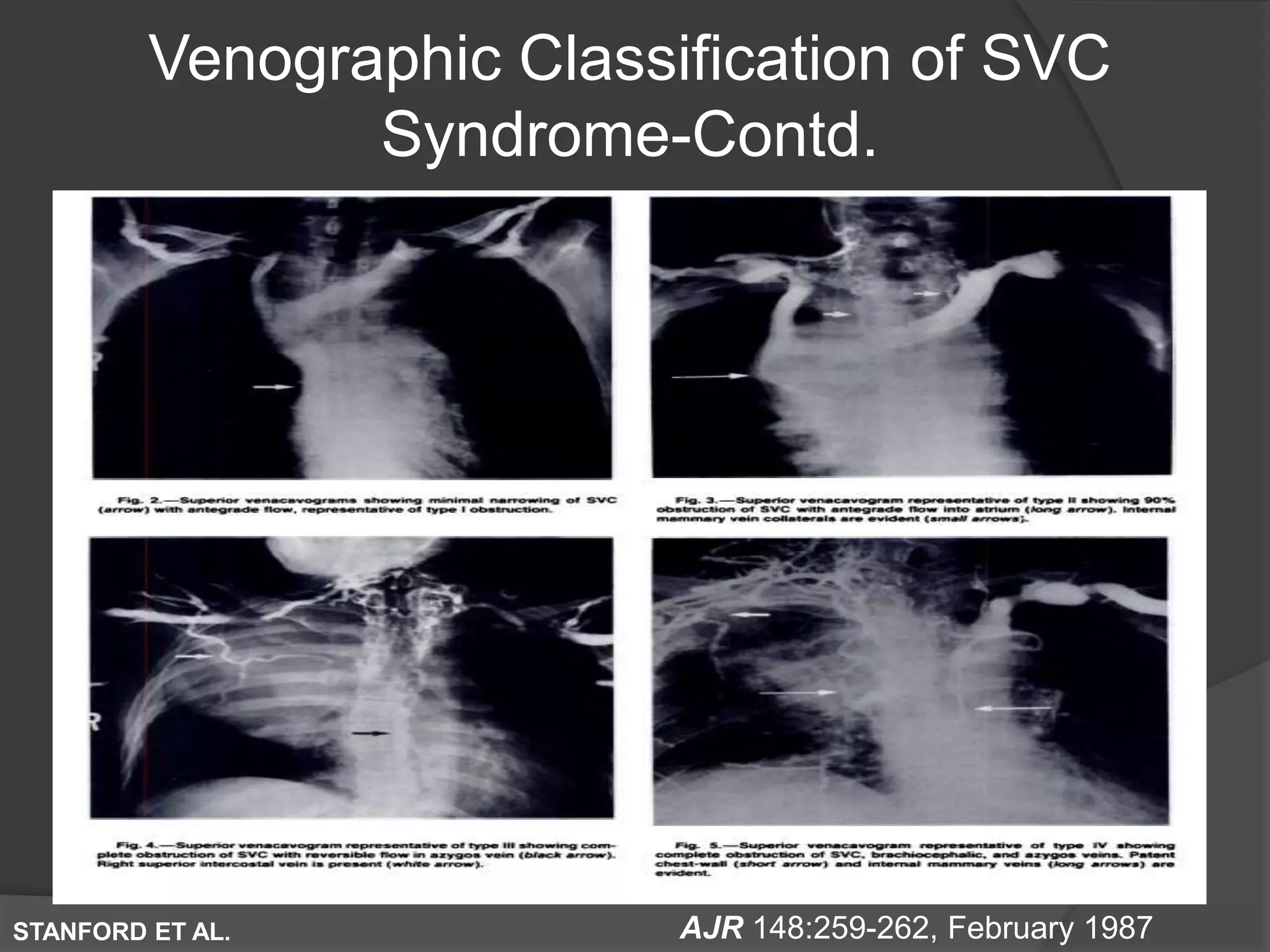
Venographic Classification of SVC
Syndrome-Contd.
STANFORD ET AL. AJR 148:259-262, February 1987
CT Diagnosis of Superior Vena
Cava Syndrome: Importance of
Collateral Vessels
 It was believed at that time that CT diagnosis of obstruction of the superior
vena cava (SVC) or its major tributaries required at least two findings:
 One was lack of (or decreased) opacification of central venous structures
distal to the site of obstruction.
(This may be associated with a visible, obstructing lesion or intraluminal
filling defects.)
 The other CT finding was opacification of collateral venous vessels. The
fulfillment of either criterion alone was insufficient for an accurate CT
diagnosis of venous obstruction.
 Results of their study: The presence of collateral vessels, regardless of
the number and location of the vessels shown on CT scans, was highly
accurate as a predictor of superior vena cave syndrome, with a
sensitivity of 96% and a specificity of 92%.
 The most common site of venous obstruction seen on CT scans was
the SVC (n = 41), followed by the brachiocephalic vein (n = 20) and the
jugular vein (n = 2).
KIM ET AL. AJA:161, September1993
CT Diagnosis of Superior Vena
Cava Syndrome: Importance of
Collateral Vessels-Contd.
KIM ET AL. AJA:161, September1993
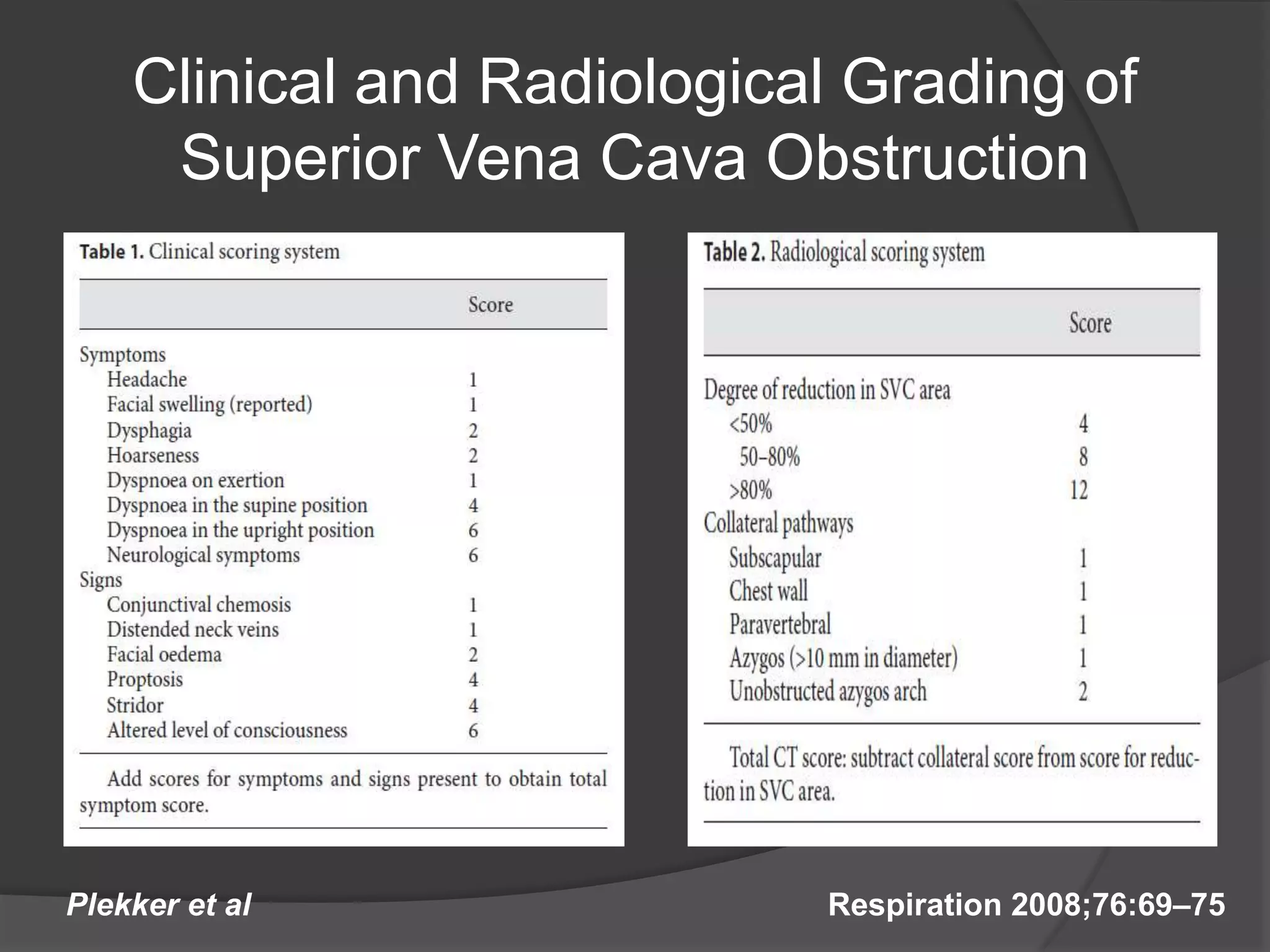
Clinical and Radiological Grading of
Superior Vena Cava Obstruction
Respiration 2008;76:69–75Plekker et al
Clinical and Radiological Grading of
Superior Vena Cava Obstruction-Contd.
Respiration 2008;76:69–75Plekker et al
Clinical and Radiological Grading of
Superior Vena Cava Obstruction-
Contd.
Respiration 2008;76:69–75Plekker et al
Clinical and Radiological Grading of
Superior Vena Cava Obstruction-
Contd.
Results of their study:
Thirty-four cases of SVCO were evaluated: 8 (23.5%) were
clinicallymild,16 (47%) moderate and 10 (29.5%) severe.
Lung cancer was the underlying histological diagnosis in 94% of
cases.
Radiologically,53% had complete SVCO. A well-developed collateral
system was found in 14 (41%).
A scoring system subtracting a ‘collateral score’ from an ‘obstruction
score’ showed a significant correlation with the clinical score (r =
0.75, p <0.01).
Conclusions:
Clinical severity of SVCO depends upon the degree of SVCO and is
ameliorated by collateral formation.
The novel clinical scoring system can predict the underlying CT
features in SVCO and may be valuable in the bedside assessment
of SVCO severity.
Respiration 2008;76:69–75Plekker et al
Grading System for SVC Syndrome
Treatment Algorithm for Malignant
Causes
Radiation Therapy
 Effective modality for malignancy related SVCO.
 Relative Contraindications to RT:
 Previous RT in same area
 Certain Connective Tissue Disorders like Scleroderma
 Known radioresistant tumor types eg Sarcoma
 Response rates in literature clinical: Significant discordance with objective
response rates measured by imaging.
 RT treatment can vary based on tumor histology and intent of treatment.
 RT involves CT Based simulation for designing RT fields: should
encompass gross tumor volume and involved nodal regions and shield
normal organs particularly lungs and esophagus.
 Field size may be altered during treatment course.
 Monitor for progression of radioresistant tumors requiring alternative treatment.
 Occasionally, symptom worsening may be due to thrombus.
Radiation Therapy-Contd.
 As per a systematic review done by Rowell and Gleeson: RT provided relief
in ¾ ths of SVCO in SCLC and 2/3 rds of SVCO in NSCLC
 Rapidity of response ranges from 7-15 days, may be seen as early as 72
hours.
 Chemotherapy and radiotherapy are effective in relieving SVCO in a
proportion of patients whilst stent insertion may provide relief in a
higher proportion and more rapidly.
 The effectiveness of steroids and the optimal timing of stent insertion
(whether at diagnosis or following failure of other modalities) remain
uncertain.
Radiation Therapy
 In SCLC chemotherapy and/or radiotherapy relieved SVCO in 77%.
 17% of those treated had a recurrence of SVCO.
 In NSCLC, 60% had relief of SVCO following chemotherapy
and/or radiotherapy
 19% of those treated had a recurrence of SVCO.
 Insertion of an SVC stent relieved SVCO in 95%.
 11% of those treated had further SVCO but recanalization was
possible in the majority resulting in a long-term patency rate of
92%.
 Morbidity following stent insertion was greater if thrombolytics were
administered.
Chemotherapy
 Lymphomas, SCLS, Germ Cell Tumors: Highly chemosensitive.
 RT may be used but poorer long term results; used for failed
chemotherapy.
 Chemotherapy can relieve SVCO symptoms in 80% of NHL and
77% of SCLC.
 Response rates similar to RT: 7-15 days.
 Addition of chemotherapy to RT: No significant benefit.
Endovascular Stenting
 Relief may be immediate but most often between 24-72 hours.
 Useful for:
○ Patients without a tissue diagnosis
○ Previously treated with RT
○ Known Chemotherapy and RT resistant tumors.
 Stent placement needs to be followed up by other
treatment modalities.
 Use of thrombolytics.
 Prophylactic anticoagulation advocated.
 Comparison of outcomes limited due to absence of randomized
controlled trials: Reasons for the same include:
○ One treatment more easily available than the other.
○ Clinical reason to favor one modality over another.
Comparison of RT, Stent Insertion and
Chemotherapy
Benign SVC Syndrome
 Most commonly due to chronic hemodialysis catheters and post
transvenous Pacemaker implantation.
 Stenting for benign disease not recommended due to longer life
expectancy, lack of long term follow up and possibility of stent fracture,
migration or thrombosis.
 Surgery is effective.
 PTFE good prosthetic device with good short term patency rates: may be
related to intimal irregularity and stenosis making it prone to thrombosis.
 Autogenous vein grafts have a higher patency rate.
 Femoral, Subclavian and Jugular veins have been used: disadvantage of
impaired venous return at the site of harvesting.
 Spiral vein graft created from saphenous vein to form a venous conduit is
the preferred graft now.
 Disadvantages: long suture line: more thrombogenic, more time consuming
to construct.
 Another autologous technique: Pericardial tube graft replacement.
Thank You
?

Superior vena cava syndrome

  • 1.
    Superior Vena CavaSyndrome Ranjita Pallavi,MD Internal Medicine PGY-2
  • 2.
    Case Presentation  58yo female presented with cough productive of yellow sputum, sore throat and fever with chills for 1 week.  She was seen earlier in clinic with similar complaints and given a course of Zithromax.  She was using her Albuterol pump more often.  PMHx: -HIV dx 2007: CD4 284 in 8/2012, VL undetectable in 8/2012, Bactrim, Zithromax ppx dced 6/2012 as CD4 consistently elevated. -Asthma since childhood, never intubated, non steroid dependent -Thyrotoxicosis with crisis in 2008, Multinodular goitre-bx benign in 9/2008 -Parotid cyst and masses 9/2008 -Seizure disorder -Migraine, Chronic Low back pain, Severe OA of knees -Anxiety, Depression with Psychosis
  • 3.
    Case Presentation  PSHx: -Partialhysterectomy 1979 for fibroids -Tonsillectomy 1992  Allergies: None  Medications at Home: Advair 100/50 BID Albuterol prn Reyataz 300 mg daily Truvada 1 tab po daily Abilify 2 mg daily Paroxetine 30 mg daily Baclofen 10 mg bid Neurontin 400 mg tid Lyrica 100 mg bid Keppra 750 mg bid Ferrous Sulphate Trazadone 25 prn insomnia Docusate 100 mg daily
  • 4.
    Case Presentation  FamilyHx: Mother with heart disease, Breast ca-died of breast ca, father with DM, died of complications  Social Hx: lives by herself in Harlem in apt with elevator, has HHA, smokes 2 cigarettes/day ( previously ½ PPD X 20 years), No ETOH, no drugs  VS in the ER: T 98.9 F HR 110 BP 129/74 RR 20 Sat 94-97% RA, Wt 115 kg( Baseline)  Physical Exam:  Gen:Obese, AAF, not in acute distress, alert and oriented X3  HEENT: Icteric sclera, No thrush  Neck: +symmetrical fullness at base of neck, bilateral cervical and supraclavicular LAD  Lymph: mildly tender submandibular LAD  Cardiac: Normal  Pulm: Symmetrically reduced breath sounds b/l, no wheezes/rales/rhonchi  Abd: soft, non tender, no organomegaly, BS+  Skin: Normal  Extr:1+ B/l pitting edema.
  • 5.
    Case Presentation  Labs: Initial: WBC 9.5, H/H 8.4/24.8 (<- 12/35.3 in 8/2012 baseline), PLT 277  BMP: K 3, CO2 29, BUN/Creat 9/0.8  LFT: ALP 141( elevated since8/2012), T Bili 3.2, D Bili 1.1  Pro BNP 43.3  INR 1.18  Troponins negative  CDX: new RML opacification, left hilar fullness, widened mediastinum  EKG: Sinus tachycardia, No ST-T wave changes  CT PE Protocol :RUL segmental arterial filling defects c/w PE, main PA normal, heterogenous enhancing mass in right side of thyroid extending into the mediastinum: multinodular goitre vs malignancy, bulky mediastinal and Left hilar LAD.  Positive for PE: patient started on heparin drip  CT abdomen non-contrast: cholelithiasis, rest normal
  • 6.
    Case Presentation Further HospitalCourse:  Patient responded to antibiotic treatment with Ceftriaxone. Since the CT showed bilateral cervical LAD, she underwent Biopsy of the left cervical anterior LN. She was then later swtiched to Arixtra and discharged home after 10 days of IV antibiotics to follow up as outpatient for results of the biopsy.  She however returned 2 weeks later with persistent symptoms of cough with yellowish sputum production and worsening sob. She also reported significant weight loss unintentional 10 pounds along with night sweats.  Repeat Chest CT showed worsening clot burden in the previous areas of PE and new PE in the left upper lobe. Also noted was interval increase in the left hilar mass and mediastinal LAD.  She received an IVC filter and was continued on anticoagulation.
  • 7.
    Case Presentation  Resultsof the Left Cervical LN FNA were consistent with poorly differentiated metastatic ca. She later underwent Left Cervical LN excision biopsy which confirmed the previous finding. The repeat CT also showed worsening infiltrates in both lungs and patient was then treated for HCAP. In view of her HIV status, she was also started on Bactrim for suspected PCP and Zithromax to cover for atypicals. These were later discontinued due to negative workup.  Patient then had worsening sob, became increasingly dyspnoeic and orthopnoiec when she was transferred to MHC for further management.  On initial evaluation, patient was noted with facial edema, b/l UE edema R> L and collateral veins on upper chest. No stridor.  Repeat Chest and Neck CT were done, however in view of AKI, without contrast. It showed: b/l cervical and supraclavicular LAD with necrotic nodes left hilar mass and left hilar LAD with marked narrowing of theleft upper and lower lobe bronchi, bulky right hilar and mediastinal LAD causing significant narrowing of the trachea,b/l retropectoral and axillary LAD,enlarged Pulmonary arteries, moderate pleural effusions.  Patient was taken to Lincoln Hospital for RT. Received 1 session. However expired next day. Patient not resuscitated as she was DNR/DNI.
  • 8.
    Introduction  SVC Syndrome: A medical entity where compression of SVC by various causes brings clinical symptoms and signs of facial, upper body edema, formation of collateral circulations, and causes cyanosis and dyspnea.  Affects 15,000 people in the US every year.  Symptoms develop over a period of 2 weeks in approx. a third of patients, and over longer periods in other cases.
  • 9.
    Anatomy and Physiology nengl j med 356;18 www.nejm.org may 3, 2007
  • 10.
    Etiologies n engl jmed 356;18 www.nejm.org may 3, 2007
  • 11.
    Clinical Features n englj med 356;18 www.nejm.org may 3, 2007
  • 12.
    Imaging  CDX: Mediastinalwidening, Pleural Effusions  CT Chest with Contrast  Venography  MRI  PET  Tissue Biopsy  Bronchoscopy  Transthoracic Needle Biopsy  Sputum Cytology  Thoracentesis  Mediastinoscopy and Mediastinotomy
  • 13.
    Venographic Classification ofSVC Syndrome AJR 148:259-262, February 1987STANFORD ET AL.
  • 14.
    Venographic Classification ofSVC Syndrome-Contd. STANFORD ET AL. AJR 148:259-262, February 1987
  • 15.
    CT Diagnosis ofSuperior Vena Cava Syndrome: Importance of Collateral Vessels  It was believed at that time that CT diagnosis of obstruction of the superior vena cava (SVC) or its major tributaries required at least two findings:  One was lack of (or decreased) opacification of central venous structures distal to the site of obstruction. (This may be associated with a visible, obstructing lesion or intraluminal filling defects.)  The other CT finding was opacification of collateral venous vessels. The fulfillment of either criterion alone was insufficient for an accurate CT diagnosis of venous obstruction.  Results of their study: The presence of collateral vessels, regardless of the number and location of the vessels shown on CT scans, was highly accurate as a predictor of superior vena cave syndrome, with a sensitivity of 96% and a specificity of 92%.  The most common site of venous obstruction seen on CT scans was the SVC (n = 41), followed by the brachiocephalic vein (n = 20) and the jugular vein (n = 2). KIM ET AL. AJA:161, September1993
  • 16.
    CT Diagnosis ofSuperior Vena Cava Syndrome: Importance of Collateral Vessels-Contd. KIM ET AL. AJA:161, September1993
  • 17.
    Clinical and RadiologicalGrading of Superior Vena Cava Obstruction Respiration 2008;76:69–75Plekker et al
  • 18.
    Clinical and RadiologicalGrading of Superior Vena Cava Obstruction-Contd. Respiration 2008;76:69–75Plekker et al
  • 19.
    Clinical and RadiologicalGrading of Superior Vena Cava Obstruction- Contd. Respiration 2008;76:69–75Plekker et al
  • 20.
    Clinical and RadiologicalGrading of Superior Vena Cava Obstruction- Contd. Results of their study: Thirty-four cases of SVCO were evaluated: 8 (23.5%) were clinicallymild,16 (47%) moderate and 10 (29.5%) severe. Lung cancer was the underlying histological diagnosis in 94% of cases. Radiologically,53% had complete SVCO. A well-developed collateral system was found in 14 (41%). A scoring system subtracting a ‘collateral score’ from an ‘obstruction score’ showed a significant correlation with the clinical score (r = 0.75, p <0.01). Conclusions: Clinical severity of SVCO depends upon the degree of SVCO and is ameliorated by collateral formation. The novel clinical scoring system can predict the underlying CT features in SVCO and may be valuable in the bedside assessment of SVCO severity. Respiration 2008;76:69–75Plekker et al
  • 21.
    Grading System forSVC Syndrome
  • 22.
    Treatment Algorithm forMalignant Causes
  • 23.
    Radiation Therapy  Effectivemodality for malignancy related SVCO.  Relative Contraindications to RT:  Previous RT in same area  Certain Connective Tissue Disorders like Scleroderma  Known radioresistant tumor types eg Sarcoma  Response rates in literature clinical: Significant discordance with objective response rates measured by imaging.  RT treatment can vary based on tumor histology and intent of treatment.  RT involves CT Based simulation for designing RT fields: should encompass gross tumor volume and involved nodal regions and shield normal organs particularly lungs and esophagus.  Field size may be altered during treatment course.  Monitor for progression of radioresistant tumors requiring alternative treatment.  Occasionally, symptom worsening may be due to thrombus.
  • 24.
    Radiation Therapy-Contd.  Asper a systematic review done by Rowell and Gleeson: RT provided relief in ¾ ths of SVCO in SCLC and 2/3 rds of SVCO in NSCLC  Rapidity of response ranges from 7-15 days, may be seen as early as 72 hours.  Chemotherapy and radiotherapy are effective in relieving SVCO in a proportion of patients whilst stent insertion may provide relief in a higher proportion and more rapidly.  The effectiveness of steroids and the optimal timing of stent insertion (whether at diagnosis or following failure of other modalities) remain uncertain.
  • 25.
    Radiation Therapy  InSCLC chemotherapy and/or radiotherapy relieved SVCO in 77%.  17% of those treated had a recurrence of SVCO.  In NSCLC, 60% had relief of SVCO following chemotherapy and/or radiotherapy  19% of those treated had a recurrence of SVCO.  Insertion of an SVC stent relieved SVCO in 95%.  11% of those treated had further SVCO but recanalization was possible in the majority resulting in a long-term patency rate of 92%.  Morbidity following stent insertion was greater if thrombolytics were administered.
  • 26.
    Chemotherapy  Lymphomas, SCLS,Germ Cell Tumors: Highly chemosensitive.  RT may be used but poorer long term results; used for failed chemotherapy.  Chemotherapy can relieve SVCO symptoms in 80% of NHL and 77% of SCLC.  Response rates similar to RT: 7-15 days.  Addition of chemotherapy to RT: No significant benefit.
  • 27.
    Endovascular Stenting  Reliefmay be immediate but most often between 24-72 hours.  Useful for: ○ Patients without a tissue diagnosis ○ Previously treated with RT ○ Known Chemotherapy and RT resistant tumors.  Stent placement needs to be followed up by other treatment modalities.  Use of thrombolytics.  Prophylactic anticoagulation advocated.  Comparison of outcomes limited due to absence of randomized controlled trials: Reasons for the same include: ○ One treatment more easily available than the other. ○ Clinical reason to favor one modality over another.
  • 28.
    Comparison of RT,Stent Insertion and Chemotherapy
  • 29.
    Benign SVC Syndrome Most commonly due to chronic hemodialysis catheters and post transvenous Pacemaker implantation.  Stenting for benign disease not recommended due to longer life expectancy, lack of long term follow up and possibility of stent fracture, migration or thrombosis.  Surgery is effective.  PTFE good prosthetic device with good short term patency rates: may be related to intimal irregularity and stenosis making it prone to thrombosis.  Autogenous vein grafts have a higher patency rate.  Femoral, Subclavian and Jugular veins have been used: disadvantage of impaired venous return at the site of harvesting.  Spiral vein graft created from saphenous vein to form a venous conduit is the preferred graft now.  Disadvantages: long suture line: more thrombogenic, more time consuming to construct.  Another autologous technique: Pericardial tube graft replacement.
  • 30.