Super Insulated Building Enclosures – 
Balancing Energy, Durability, and Economics 
in the Pacific Northwest 
! Graham Finch, MASc, P.Eng 
RDH Building Sciences Inc. 
Vancouver, BC/Seattle, WA 
May 21, 2013 – SEABEC - Zen and the Art of Building Enclosure Design
Presentation Outline 
! What are “Super-Insulated” 
buildings and what are the 
drivers? 
! Thermal bridging – 
problems and solutions 
! Designing of highly 
insulated walls – insulation 
placement & durability 
considerations 
! Super-Insulated wood-frame 
building enclosure 
design guide
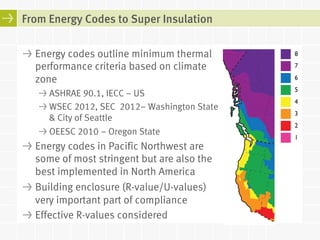
From Energy Codes to Super Insulation 
! Energy codes outline minimum thermal 
performance criteria based on climate 
zone 
! ASHRAE 90.1, IECC – US 
! WSEC 2012, SEC 2012– Washington State 
& City of Seattle 
! OEESC 2010 – Oregon State 
! Energy codes in Pacific Northwest are 
some of most stringent but are also the 
best implemented in North America 
! Building enclosure (R-value/U-values) 
very important part of compliance 
! Effective R-values considered
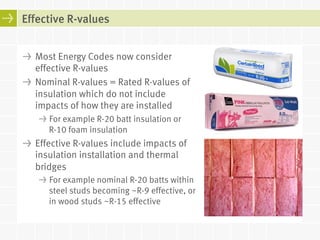
Effective R-values 
! Most Energy Codes now consider 
effective R-values 
! Nominal R-values = Rated R-values of 
insulation which do not include 
impacts of how they are installed 
! For example R-20 batt insulation or 
R-10 foam insulation 
! Effective R-values include impacts of 
insulation installation and thermal 
bridges 
! For example nominal R-20 batts within 
steel studs becoming ~R-9 effective, or 
in wood studs ~R-15 effective
From Energy Codes to Super-Insulation 
! In Pacific Northwest - minimum energy code R-value 
targets generally in range of: 
! R-15 to R-25 effective for walls 
! R-25 to R-50 effective for roofs 
! R-2 to R-4 for windows 
! Green or more energy efficient building programs 
including Passive House - R-value targets in range of: 
! R-30 to R-50+ effective for walls 
! R-40 to R-60+ effective for roofs 
! R-6+ for windows 
! Other drivers – comfort, passive design, mold-free 
! What does Super Insulation mean?
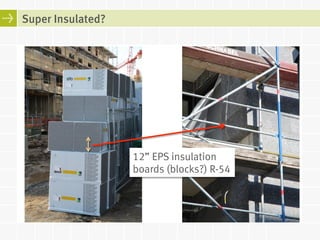
Super Insulated? 
12” EPS insulation 
boards (blocks?) R-54
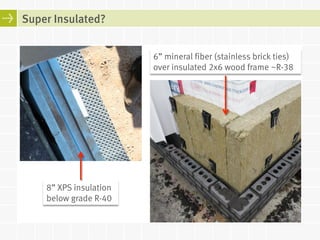
Super Insulated? 
8” XPS insulation 
below grade R-40 
6” mineral fiber (stainless brick ties) 
over insulated 2x6 wood frame ~R-38
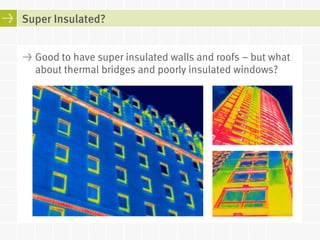
Super Insulated? 
! Good to have super insulated walls and roofs – but what 
about thermal bridges and poorly insulated windows?
Energy Codes and Thermal Bridging – A Balancing Act 
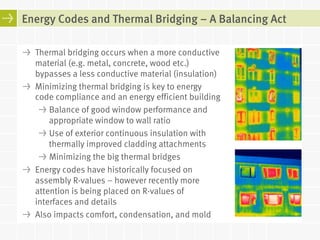
! Thermal bridging occurs when a more conductive 
material (e.g. metal, concrete, wood etc.) 
bypasses a less conductive material (insulation) 
! Minimizing thermal bridging is key to energy 
code compliance and an energy efficient building 
! Balance of good window performance and 
appropriate window to wall ratio 
! Use of exterior continuous insulation with 
thermally improved cladding attachments 
! Minimizing the big thermal bridges 
! Energy codes have historically focused on 
assembly R-values – however recently more 
attention is being placed on R-values of 
interfaces and details 
! Also impacts comfort, condensation, and mold
Building and Energy Codes and Airtightness 
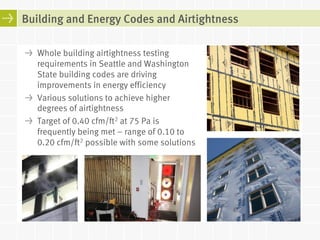
! Whole building airtightness testing 
requirements in Seattle and Washington 
State building codes are driving 
improvements in energy efficiency 
! Various solutions to achieve higher 
degrees of airtightness 
! Target of 0.40 cfm/ft2 at 75 Pa is 
frequently being met – range of 0.10 to 
0.20 cfm/ft2 possible with some solutions
Challenges to Energy Efficiency – Windows 
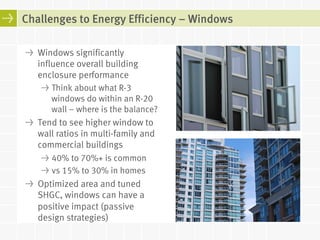
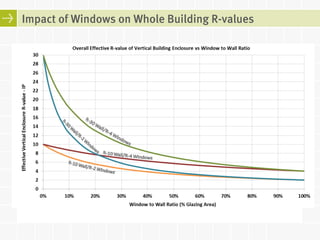
! Windows significantly 
influence overall building 
enclosure performance 
! Think about what R-3 
windows do within an R-20 
wall – where is the balance? 
! Tend to see higher window to 
wall ratios in multi-family and 
commercial buildings 
! 40% to 70%+ is common 
! vs 15% to 30% in homes 
! Optimized area and tuned 
SHGC, windows can have a 
positive impact (passive 
design strategies)
Impact of Windows on Whole Building R-values
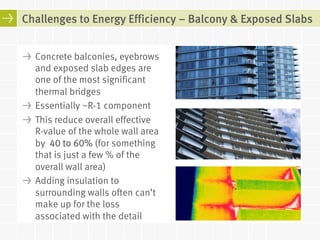
Challenges to Energy Efficiency – Balcony & Exposed Slabs 
! Concrete balconies, eyebrows 
and exposed slab edges are 
one of the most significant 
thermal bridges 
! Essentially ~R-1 component 
! This reduce overall effective 
R-value of the whole wall area 
by 40 to 60% (for something 
that is just a few % of the 
overall wall area) 
! Adding insulation to 
surrounding walls often can’t 
make up for the loss 
associated with the detail
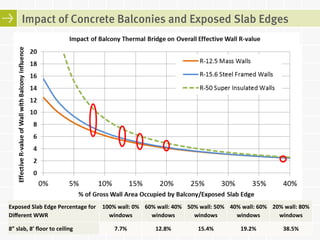
Impact of Concrete Balconies and Exposed Slab Edges 
! Example of slab/balcony impact: 
! Slab edge typically occupies ~8% of the 
gross wall area (8” slab in 8’8” high wall) 
! Balconies may occupy 1-2% of the gross 
wall area 
! Window to wall ratio affects opaque wall 
area 
Exposed 
Slab 
Edge 
Percentage 
for 
Different 
WWR 
100% 
wall: 
0% 
windows 
60% 
wall: 
40% 
windows 
50% 
wall: 
50% 
windows 
40% 
wall: 
60% 
windows 
20% 
wall: 
80% 
windows 
8” 
slab, 
8’ 
floor 
to 
ceiling 
7.7% 
12.8% 
15.4% 
19.2% 
38.5% 
Exposed 
Slab 
Edge 
Percentage 
for 
Different 
WWR 
100% 
wall: 
0% 
windows 
60% 
wall: 
40% 
windows 
50% 
wall: 
50% 
windows 
40% 
wall: 
60% 
windows 
20% 
wall: 
80% 
windows 
8” 
slab, 
8’ 
floor 
to 
ceiling 
7.7% 
12.8% 
15.4% 
19.2% 
38.5%
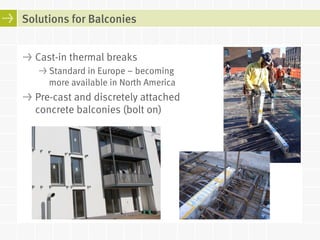
Solutions for Balconies 
! Cast-in thermal breaks 
! Standard in Europe – becoming 
more available in North America 
! Pre-cast and discretely attached 
concrete balconies (bolt on)
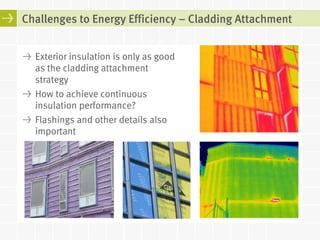
Challenges to Energy Efficiency – Cladding Attachment 
! Exterior insulation is only as good 
as the cladding attachment 
strategy 
! How to achieve continuous 
insulation performance? 
! Flashings and other details also 
important
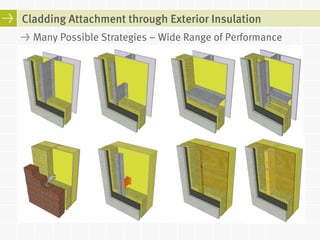
Cladding Attachment through Exterior Insulation 
! Many Possible Strategies – Wide Range of Performance
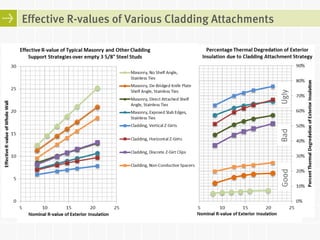
Effective R-values of Various Cladding Attachments 
Good Bad Ugly
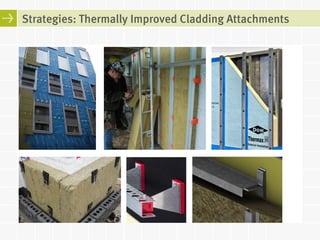
Strategies: Thermally Improved Cladding Attachments
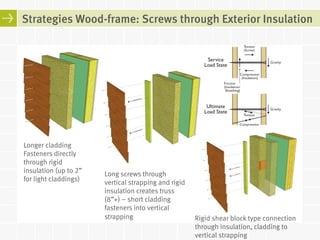
Strategies Wood-frame: Screws through Exterior Insulation 
Longer cladding 
Fasteners directly 
through rigid 
insulation (up to 2” 
for light claddings) 
Long screws through 
vertical strapping and rigid 
insulation creates truss 
(8”+) – short cladding 
fasteners into vertical 
strapping Rigid shear block type connection 
through insulation, cladding to 
vertical strapping
Challenges to True Energy Efficiency – R-value Claims 
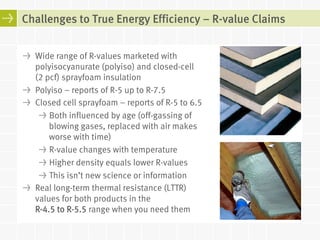
! Wide range of R-values marketed with 
polyisocyanurate (polyiso) and closed-cell 
(2 pcf) sprayfoam insulation 
! Polyiso – reports of R-5 up to R-7.5 
! Closed cell sprayfoam – reports of R-5 to 6.5 
! Both influenced by age (off-gassing of 
blowing gases, replaced with air makes 
worse with time) 
! R-value changes with temperature 
! Higher density equals lower R-values 
! This isn’t new science or information 
! Real long-term thermal resistance (LTTR) 
values for both products in the 
R-4.5 to R-5.5 range when you need them
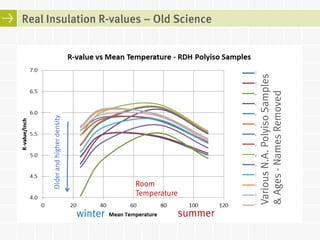
Real Insulation R-values – Old Science 
Various N.A. Polyiso Samples 
& Ages - Names Removed 
From: 
Canadian 
Building Digest 
#149, 1972 
Older and higher density 
Room 
Temperature 
winter summer
Challenges to True Energy Efficiency – To Good to be True! 
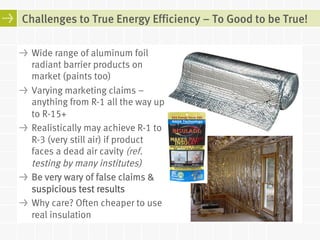
! Wide range of aluminum foil 
radiant barrier products on 
market (paints too) 
! Varying marketing claims – 
anything from R-1 all the way up 
to R-15+ 
! Realistically may achieve R-1 to 
R-3 (very still air) if product 
faces a dead air cavity (ref. 
testing by many institutes) 
! Be very wary of false claims & 
suspicious test results 
! Why care? Often cheaper to use 
real insulation
New and Upcoming Challenges to Energy Efficiency? 
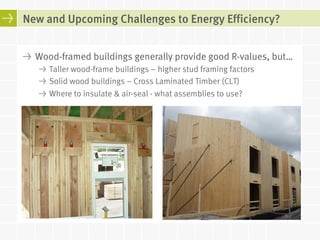
! Wood-framed buildings generally provide good R-values, but… 
! Taller wood-frame buildings – higher stud framing factors 
! Solid wood buildings – Cross Laminated Timber (CLT) 
! Where to insulate & air-seal - what assemblies to use?
Moving Towards Super Insulated Enclosures 
! Trend towards more highly insulated building enclosures 
due to higher energy code targets and uptake of passive 
design strategies 
! Often means new enclosure assemblies (mainly walls) and 
construction techniques 
! Higher R-value windows (triple glazing and less conductive 
window frames) 
! Reduction of thermal bridging, more structural analysis of 
façade components, balconies etc. 
! Super insulation achieved with proper balance! 
! Long-term performance of new assemblies (particularly 
wood frame) can be a challenge in our wet environment
Energy Efficient Building Enclosure Design Fundamentals 
! Thermal insulation continuity & effectiveness – energy 
code driven 
! Airflow control/airtightness – energy code and building 
code driven 
! Control of condensation and vapor diffusion – building 
code driven 
! Control of exterior moisture/rainwater & detailing – 
building code driven 
! More insulation = less heat flow to dry out moisture 
! Amount, type and placement of insulations matters 
! Greater need to more robust and better detailed assemblies 
! Potentially more sensitive to vapor, air & moisture issues
What about the Pacific Northwest
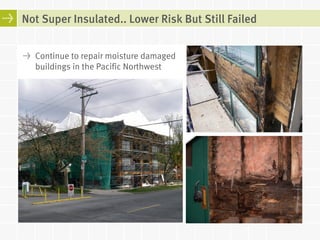
Not Super Insulated.. Lower Risk But Still Failed 
! Continue to repair moisture damaged 
buildings in the Pacific Northwest
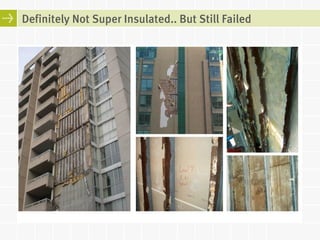
Definitely Not Super Insulated.. But Still Failed
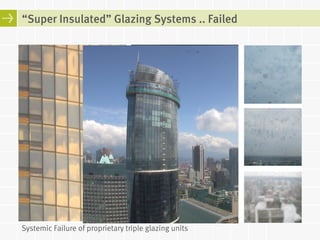
“Super Insulated” Glazing Systems .. Failed 
Systemic Failure of proprietary triple glazing units
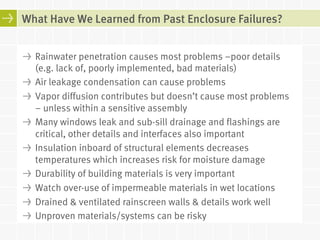
What Have We Learned from Past Enclosure Failures? 
! Rainwater penetration causes most problems –poor details 
(e.g. lack of, poorly implemented, bad materials) 
! Air leakage condensation can cause problems 
! Vapor diffusion contributes but doesn’t cause most problems 
– unless within a sensitive assembly 
! Many windows leak and sub-sill drainage and flashings are 
critical, other details and interfaces also important 
! Insulation inboard of structural elements decreases 
temperatures which increases risk for moisture damage 
! Durability of building materials is very important 
! Watch over-use of impermeable materials in wet locations 
! Drained & ventilated rainscreen walls & details work well 
! Unproven materials/systems can be risky
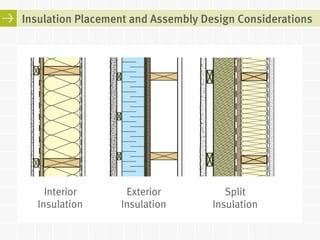
Insulation Placement and Assembly Design Considerations 
Interior 
Insulation 
Exterior 
Insulation 
Split 
Insulation
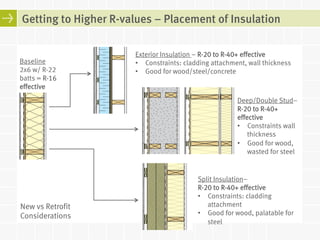
Getting to Higher R-values – Placement of Insulation 
Baseline 
2x6 w/ R-22 
batts = R-16 
effective 
Exterior Insulation – R-20 to R-40+ effective 
• Constraints: cladding attachment, wall thickness 
• Good for wood/steel/concrete 
Deep/Double Stud– 
R-20 to R-40+ 
effective 
• Constraints wall 
thickness 
• Good for wood, 
wasted for steel 
Split Insulation– 
R-20 to R-40+ effective 
• Constraints: cladding 
attachment 
• Good for wood, palatable for 
steel 
New vs Retrofit 
Considerations
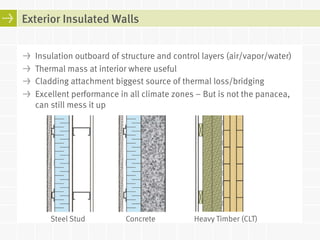
Exterior Insulated Walls 
! Insulation outboard of structure and control layers (air/vapor/water) 
! Thermal mass at interior where useful 
! Cladding attachment biggest source of thermal loss/bridging 
! Excellent performance in all climate zones – But is not the panacea, 
can still mess it up 
Steel Stud Concrete Heavy Timber (CLT)
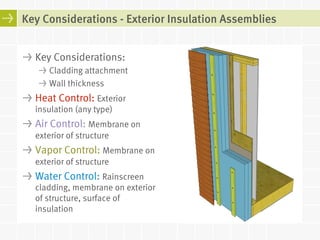
Key Considerations - Exterior Insulation Assemblies 
! Key Considerations: 
! Cladding attachment 
! Wall thickness 
! Heat Control: Exterior 
insulation (any type) 
! Air Control: Membrane on 
exterior of structure 
! Vapor Control: Membrane on 
exterior of structure 
! Water Control: Rainscreen 
cladding, membrane on exterior 
of structure, surface of 
insulation
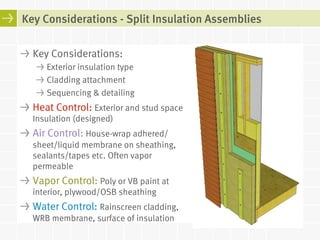
Key Considerations - Split Insulation Assemblies 
! Key Considerations: 
! Exterior insulation type 
! Cladding attachment 
! Sequencing & detailing 
! Heat Control: Exterior and stud space 
Insulation (designed) 
! Air Control: House-wrap adhered/ 
sheet/liquid membrane on sheathing, 
sealants/tapes etc. Often vapor 
permeable 
! Vapor Control: Poly or VB paint at 
interior, plywood/OSB sheathing 
! Water Control: Rainscreen cladding, 
WRB membrane, surface of insulation
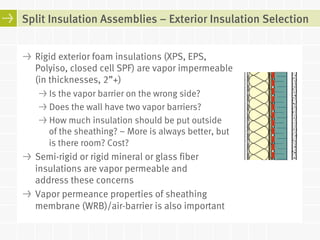
Split Insulation Assemblies – Exterior Insulation Selection 
! Rigid exterior foam insulations (XPS, EPS, 
Polyiso, closed cell SPF) are vapor impermeable 
(in thicknesses, 2”+) 
! Is the vapor barrier on the wrong side? 
! Does the wall have two vapor barriers? 
! How much insulation should be put outside 
of the sheathing? – More is always better, but 
is there room? Cost? 
! Semi-rigid or rigid mineral or glass fiber 
insulations are vapor permeable and 
address these concerns 
! Vapor permeance properties of sheathing 
membrane (WRB)/air-barrier is also important
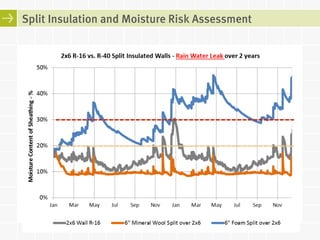
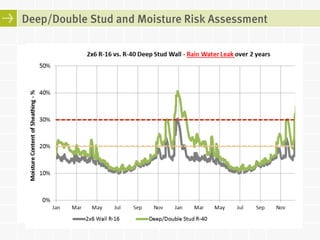
Split Insulation and Moisture Risk Assessment 
Insulation Ratio Here is over 2/3 to the exterior of 
the sheathing 
Careful with lower ratios with foam
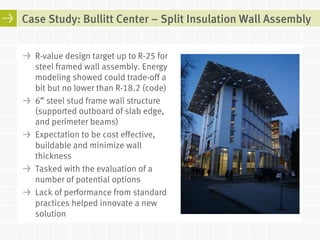
Case Study: Bullitt Center – Split Insulation Wall Assembly 
! R-value design target up to R-25 for 
steel framed wall assembly. Energy 
modeling showed could trade-off a 
bit but no lower than R-18.2 (code) 
! 6” steel stud frame wall structure 
(supported outboard of slab edge, 
and perimeter beams) 
! Expectation to be cost effective, 
buildable and minimize wall 
thickness 
! Tasked with the evaluation of a 
number of potential options 
! Lack of performance from standard 
practices helped innovate a new 
solution
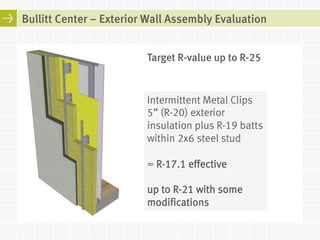
Bullitt Center – Exterior Wall Assembly Evaluation 
Target R-value up to R-25 
Intermittent Baseline: Horiz. Vertical Z-Z-Girts Girts R-19 Metal (24” (batts 
16” oc) 
Clips 
oc) 
5” within (R-20) 2x6 exterior 
steel stud with 
insulation exposed slab plus edges R-19 = 
batts 
within R-6.4 effective 
2x6 steel stud 
= Considered R-11.0 14.1 17.1 effective 
2x8 and 2x10 
studs - still less than R-8 
Crossing up to R-21 Z-with girts some 
also 
modifications 
evaluated <R-16 effective
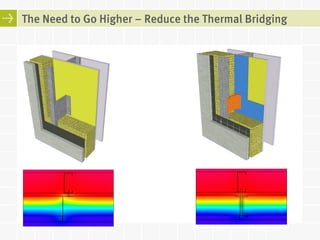
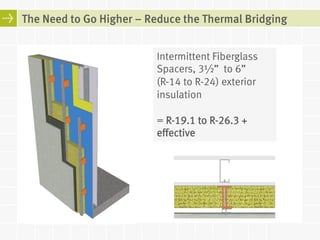
The Need to Go Higher – Reduce the Thermal Bridging
The Need to Go Higher – Reduce the Thermal Bridging 
Intermittent Fiberglass 
Spacers, 3½” to 6” 
(R-14 to R-24) exterior 
insulation 
= R-19.1 to R-26.3 + 
effective
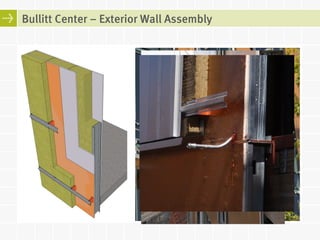
Bullitt Center – Exterior Wall Assembly 
! Metal panel 
! 1” horizontal metal hat tracks 
! 3 ½” semi-rigid mineral fiber (R-14.7) 
between 3 ½” fiberglass clips 
! Fluid applied vapor permeable WRB/ 
Air barrier on gypsum sheathing 
! 6” mineral fiber batts (R-19) between 
6” steel studs 
! Gypsum drywall 
! Supported outboard slab edge 
(reduce thermal bridging) 
! Effective R-value R-26.6
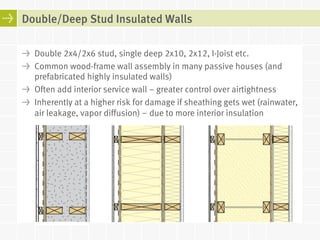
Double/Deep Stud Insulated Walls 
! Double 2x4/2x6 stud, single deep 2x10, 2x12, I-Joist etc. 
! Common wood-frame wall assembly in many passive houses (and 
prefabricated highly insulated walls) 
! Often add interior service wall – greater control over airtightness 
! Inherently at a higher risk for damage if sheathing gets wet (rainwater, 
air leakage, vapor diffusion) – due to more interior insulation
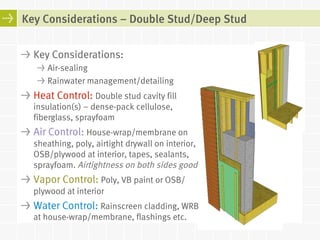
Key Considerations – Double Stud/Deep Stud 
! Key Considerations: 
! Air-sealing 
! Rainwater management/detailing 
! Heat Control: Double stud cavity fill 
insulation(s) – dense-pack cellulose, 
fiberglass, sprayfoam 
! Air Control: House-wrap/membrane on 
sheathing, poly, airtight drywall on interior, 
OSB/plywood at interior, tapes, sealants, 
sprayfoam. Airtightness on both sides good 
! Vapor Control: Poly, VB paint or OSB/ 
plywood at interior 
! Water Control: Rainscreen cladding, WRB 
at house-wrap/membrane, flashings etc.
Deep/Double Stud and Moisture Risk Assessment
Further Guidance on Highly Insulated Walls & Details 
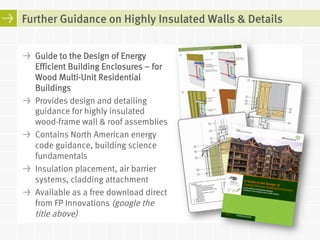
! Guide to the Design of Energy 
Efficient Building Enclosures – for 
Wood Multi-Unit Residential 
Buildings 
! Provides design and detailing 
guidance for highly insulated 
wood-frame wall & roof assemblies 
! Contains North American energy 
code guidance, building science 
fundamentals 
! Insulation placement, air barrier 
systems, cladding attachment 
! Available as a free download direct 
from FP Innovations (google the 
title above)
Final Thoughts – Super-Insulation Retrofit Case Study 
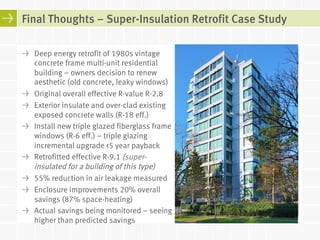
! Deep energy retrofit of 1980s vintage 
concrete frame multi-unit residential 
building – owners decision to renew 
aesthetic (old concrete, leaky windows) 
! Original overall effective R-value R-2.8 
! Exterior insulate and over-clad existing 
exposed concrete walls (R-18 eff.) 
! Install new triple glazed fiberglass frame 
windows (R-6 eff.) – triple glazing 
incremental upgrade <5 year payback 
! Retrofitted effective R-9.1 (super-insulated 
for a building of this type) 
! 55% reduction in air leakage measured 
! Enclosure improvements 20% overall 
savings (87% space-heating) 
! Actual savings being monitored – seeing 
higher than predicted savings
Final Thoughts – “The Art and Balance” 
! Super-Insulated building enclosures require careful 
design and detailing to ensure durability 
! Balancing materials, cost, and detailing considerations 
! Cladding attachment detailing – minimize loss of R-value of 
exterior insulation 
! Shifting insulation to the outside the structure improves 
performance and durability – balance is often cost 
! Super-Insulated buildings require balancing thermal 
performance of all components & airtightness 
! No point super-insulating walls/roofs if you have large thermal 
bridges or poor performing windows - address the weakest 
links first 
! Opportunities for both new and existing buildings
Questions 
! Graham Finch – gfinch@rdhbe.com 
! Highly Insulated Wood-frame Enclosure Guide 
– FP Innovations

Super Insulated Building Enclosures (SEABEC 2013)

  • 1.
    Super Insulated BuildingEnclosures – Balancing Energy, Durability, and Economics in the Pacific Northwest ! Graham Finch, MASc, P.Eng RDH Building Sciences Inc. Vancouver, BC/Seattle, WA May 21, 2013 – SEABEC - Zen and the Art of Building Enclosure Design
  • 2.
    Presentation Outline !What are “Super-Insulated” buildings and what are the drivers? ! Thermal bridging – problems and solutions ! Designing of highly insulated walls – insulation placement & durability considerations ! Super-Insulated wood-frame building enclosure design guide
  • 3.
    From Energy Codesto Super Insulation ! Energy codes outline minimum thermal performance criteria based on climate zone ! ASHRAE 90.1, IECC – US ! WSEC 2012, SEC 2012– Washington State & City of Seattle ! OEESC 2010 – Oregon State ! Energy codes in Pacific Northwest are some of most stringent but are also the best implemented in North America ! Building enclosure (R-value/U-values) very important part of compliance ! Effective R-values considered
  • 4.
    Effective R-values !Most Energy Codes now consider effective R-values ! Nominal R-values = Rated R-values of insulation which do not include impacts of how they are installed ! For example R-20 batt insulation or R-10 foam insulation ! Effective R-values include impacts of insulation installation and thermal bridges ! For example nominal R-20 batts within steel studs becoming ~R-9 effective, or in wood studs ~R-15 effective
  • 5.
    From Energy Codesto Super-Insulation ! In Pacific Northwest - minimum energy code R-value targets generally in range of: ! R-15 to R-25 effective for walls ! R-25 to R-50 effective for roofs ! R-2 to R-4 for windows ! Green or more energy efficient building programs including Passive House - R-value targets in range of: ! R-30 to R-50+ effective for walls ! R-40 to R-60+ effective for roofs ! R-6+ for windows ! Other drivers – comfort, passive design, mold-free ! What does Super Insulation mean?
  • 6.
    Super Insulated? 12”EPS insulation boards (blocks?) R-54
  • 7.
    Super Insulated? 8”XPS insulation below grade R-40 6” mineral fiber (stainless brick ties) over insulated 2x6 wood frame ~R-38
  • 8.
    Super Insulated? !Good to have super insulated walls and roofs – but what about thermal bridges and poorly insulated windows?
  • 9.
    Energy Codes andThermal Bridging – A Balancing Act ! Thermal bridging occurs when a more conductive material (e.g. metal, concrete, wood etc.) bypasses a less conductive material (insulation) ! Minimizing thermal bridging is key to energy code compliance and an energy efficient building ! Balance of good window performance and appropriate window to wall ratio ! Use of exterior continuous insulation with thermally improved cladding attachments ! Minimizing the big thermal bridges ! Energy codes have historically focused on assembly R-values – however recently more attention is being placed on R-values of interfaces and details ! Also impacts comfort, condensation, and mold
  • 10.
    Building and EnergyCodes and Airtightness ! Whole building airtightness testing requirements in Seattle and Washington State building codes are driving improvements in energy efficiency ! Various solutions to achieve higher degrees of airtightness ! Target of 0.40 cfm/ft2 at 75 Pa is frequently being met – range of 0.10 to 0.20 cfm/ft2 possible with some solutions
  • 11.
    Challenges to EnergyEfficiency – Windows ! Windows significantly influence overall building enclosure performance ! Think about what R-3 windows do within an R-20 wall – where is the balance? ! Tend to see higher window to wall ratios in multi-family and commercial buildings ! 40% to 70%+ is common ! vs 15% to 30% in homes ! Optimized area and tuned SHGC, windows can have a positive impact (passive design strategies)
  • 12.
    Impact of Windowson Whole Building R-values
  • 13.
    Challenges to EnergyEfficiency – Balcony & Exposed Slabs ! Concrete balconies, eyebrows and exposed slab edges are one of the most significant thermal bridges ! Essentially ~R-1 component ! This reduce overall effective R-value of the whole wall area by 40 to 60% (for something that is just a few % of the overall wall area) ! Adding insulation to surrounding walls often can’t make up for the loss associated with the detail
  • 14.
    Impact of ConcreteBalconies and Exposed Slab Edges ! Example of slab/balcony impact: ! Slab edge typically occupies ~8% of the gross wall area (8” slab in 8’8” high wall) ! Balconies may occupy 1-2% of the gross wall area ! Window to wall ratio affects opaque wall area Exposed Slab Edge Percentage for Different WWR 100% wall: 0% windows 60% wall: 40% windows 50% wall: 50% windows 40% wall: 60% windows 20% wall: 80% windows 8” slab, 8’ floor to ceiling 7.7% 12.8% 15.4% 19.2% 38.5% Exposed Slab Edge Percentage for Different WWR 100% wall: 0% windows 60% wall: 40% windows 50% wall: 50% windows 40% wall: 60% windows 20% wall: 80% windows 8” slab, 8’ floor to ceiling 7.7% 12.8% 15.4% 19.2% 38.5%
  • 15.
    Solutions for Balconies ! Cast-in thermal breaks ! Standard in Europe – becoming more available in North America ! Pre-cast and discretely attached concrete balconies (bolt on)
  • 16.
    Challenges to EnergyEfficiency – Cladding Attachment ! Exterior insulation is only as good as the cladding attachment strategy ! How to achieve continuous insulation performance? ! Flashings and other details also important
  • 17.
    Cladding Attachment throughExterior Insulation ! Many Possible Strategies – Wide Range of Performance
  • 18.
    Effective R-values ofVarious Cladding Attachments Good Bad Ugly
  • 19.
    Strategies: Thermally ImprovedCladding Attachments
  • 20.
    Strategies Wood-frame: Screwsthrough Exterior Insulation Longer cladding Fasteners directly through rigid insulation (up to 2” for light claddings) Long screws through vertical strapping and rigid insulation creates truss (8”+) – short cladding fasteners into vertical strapping Rigid shear block type connection through insulation, cladding to vertical strapping
  • 21.
    Challenges to TrueEnergy Efficiency – R-value Claims ! Wide range of R-values marketed with polyisocyanurate (polyiso) and closed-cell (2 pcf) sprayfoam insulation ! Polyiso – reports of R-5 up to R-7.5 ! Closed cell sprayfoam – reports of R-5 to 6.5 ! Both influenced by age (off-gassing of blowing gases, replaced with air makes worse with time) ! R-value changes with temperature ! Higher density equals lower R-values ! This isn’t new science or information ! Real long-term thermal resistance (LTTR) values for both products in the R-4.5 to R-5.5 range when you need them
  • 22.
    Real Insulation R-values– Old Science Various N.A. Polyiso Samples & Ages - Names Removed From: Canadian Building Digest #149, 1972 Older and higher density Room Temperature winter summer
  • 23.
    Challenges to TrueEnergy Efficiency – To Good to be True! ! Wide range of aluminum foil radiant barrier products on market (paints too) ! Varying marketing claims – anything from R-1 all the way up to R-15+ ! Realistically may achieve R-1 to R-3 (very still air) if product faces a dead air cavity (ref. testing by many institutes) ! Be very wary of false claims & suspicious test results ! Why care? Often cheaper to use real insulation
  • 24.
    New and UpcomingChallenges to Energy Efficiency? ! Wood-framed buildings generally provide good R-values, but… ! Taller wood-frame buildings – higher stud framing factors ! Solid wood buildings – Cross Laminated Timber (CLT) ! Where to insulate & air-seal - what assemblies to use?
  • 25.
    Moving Towards SuperInsulated Enclosures ! Trend towards more highly insulated building enclosures due to higher energy code targets and uptake of passive design strategies ! Often means new enclosure assemblies (mainly walls) and construction techniques ! Higher R-value windows (triple glazing and less conductive window frames) ! Reduction of thermal bridging, more structural analysis of façade components, balconies etc. ! Super insulation achieved with proper balance! ! Long-term performance of new assemblies (particularly wood frame) can be a challenge in our wet environment
  • 26.
    Energy Efficient BuildingEnclosure Design Fundamentals ! Thermal insulation continuity & effectiveness – energy code driven ! Airflow control/airtightness – energy code and building code driven ! Control of condensation and vapor diffusion – building code driven ! Control of exterior moisture/rainwater & detailing – building code driven ! More insulation = less heat flow to dry out moisture ! Amount, type and placement of insulations matters ! Greater need to more robust and better detailed assemblies ! Potentially more sensitive to vapor, air & moisture issues
  • 27.
    What about thePacific Northwest
  • 28.
    Not Super Insulated..Lower Risk But Still Failed ! Continue to repair moisture damaged buildings in the Pacific Northwest
  • 29.
    Definitely Not SuperInsulated.. But Still Failed
  • 30.
    “Super Insulated” GlazingSystems .. Failed Systemic Failure of proprietary triple glazing units
  • 31.
    What Have WeLearned from Past Enclosure Failures? ! Rainwater penetration causes most problems –poor details (e.g. lack of, poorly implemented, bad materials) ! Air leakage condensation can cause problems ! Vapor diffusion contributes but doesn’t cause most problems – unless within a sensitive assembly ! Many windows leak and sub-sill drainage and flashings are critical, other details and interfaces also important ! Insulation inboard of structural elements decreases temperatures which increases risk for moisture damage ! Durability of building materials is very important ! Watch over-use of impermeable materials in wet locations ! Drained & ventilated rainscreen walls & details work well ! Unproven materials/systems can be risky
  • 32.
    Insulation Placement andAssembly Design Considerations Interior Insulation Exterior Insulation Split Insulation
  • 33.
    Getting to HigherR-values – Placement of Insulation Baseline 2x6 w/ R-22 batts = R-16 effective Exterior Insulation – R-20 to R-40+ effective • Constraints: cladding attachment, wall thickness • Good for wood/steel/concrete Deep/Double Stud– R-20 to R-40+ effective • Constraints wall thickness • Good for wood, wasted for steel Split Insulation– R-20 to R-40+ effective • Constraints: cladding attachment • Good for wood, palatable for steel New vs Retrofit Considerations
  • 34.
    Exterior Insulated Walls ! Insulation outboard of structure and control layers (air/vapor/water) ! Thermal mass at interior where useful ! Cladding attachment biggest source of thermal loss/bridging ! Excellent performance in all climate zones – But is not the panacea, can still mess it up Steel Stud Concrete Heavy Timber (CLT)
  • 35.
    Key Considerations -Exterior Insulation Assemblies ! Key Considerations: ! Cladding attachment ! Wall thickness ! Heat Control: Exterior insulation (any type) ! Air Control: Membrane on exterior of structure ! Vapor Control: Membrane on exterior of structure ! Water Control: Rainscreen cladding, membrane on exterior of structure, surface of insulation
  • 36.
    Key Considerations -Split Insulation Assemblies ! Key Considerations: ! Exterior insulation type ! Cladding attachment ! Sequencing & detailing ! Heat Control: Exterior and stud space Insulation (designed) ! Air Control: House-wrap adhered/ sheet/liquid membrane on sheathing, sealants/tapes etc. Often vapor permeable ! Vapor Control: Poly or VB paint at interior, plywood/OSB sheathing ! Water Control: Rainscreen cladding, WRB membrane, surface of insulation
  • 37.
    Split Insulation Assemblies– Exterior Insulation Selection ! Rigid exterior foam insulations (XPS, EPS, Polyiso, closed cell SPF) are vapor impermeable (in thicknesses, 2”+) ! Is the vapor barrier on the wrong side? ! Does the wall have two vapor barriers? ! How much insulation should be put outside of the sheathing? – More is always better, but is there room? Cost? ! Semi-rigid or rigid mineral or glass fiber insulations are vapor permeable and address these concerns ! Vapor permeance properties of sheathing membrane (WRB)/air-barrier is also important
  • 38.
    Split Insulation andMoisture Risk Assessment Insulation Ratio Here is over 2/3 to the exterior of the sheathing Careful with lower ratios with foam
  • 39.
    Case Study: BullittCenter – Split Insulation Wall Assembly ! R-value design target up to R-25 for steel framed wall assembly. Energy modeling showed could trade-off a bit but no lower than R-18.2 (code) ! 6” steel stud frame wall structure (supported outboard of slab edge, and perimeter beams) ! Expectation to be cost effective, buildable and minimize wall thickness ! Tasked with the evaluation of a number of potential options ! Lack of performance from standard practices helped innovate a new solution
  • 40.
    Bullitt Center –Exterior Wall Assembly Evaluation Target R-value up to R-25 Intermittent Baseline: Horiz. Vertical Z-Z-Girts Girts R-19 Metal (24” (batts 16” oc) Clips oc) 5” within (R-20) 2x6 exterior steel stud with insulation exposed slab plus edges R-19 = batts within R-6.4 effective 2x6 steel stud = Considered R-11.0 14.1 17.1 effective 2x8 and 2x10 studs - still less than R-8 Crossing up to R-21 Z-with girts some also modifications evaluated <R-16 effective
  • 41.
    The Need toGo Higher – Reduce the Thermal Bridging
  • 42.
    The Need toGo Higher – Reduce the Thermal Bridging Intermittent Fiberglass Spacers, 3½” to 6” (R-14 to R-24) exterior insulation = R-19.1 to R-26.3 + effective
  • 43.
    Bullitt Center –Exterior Wall Assembly ! Metal panel ! 1” horizontal metal hat tracks ! 3 ½” semi-rigid mineral fiber (R-14.7) between 3 ½” fiberglass clips ! Fluid applied vapor permeable WRB/ Air barrier on gypsum sheathing ! 6” mineral fiber batts (R-19) between 6” steel studs ! Gypsum drywall ! Supported outboard slab edge (reduce thermal bridging) ! Effective R-value R-26.6
  • 44.
    Double/Deep Stud InsulatedWalls ! Double 2x4/2x6 stud, single deep 2x10, 2x12, I-Joist etc. ! Common wood-frame wall assembly in many passive houses (and prefabricated highly insulated walls) ! Often add interior service wall – greater control over airtightness ! Inherently at a higher risk for damage if sheathing gets wet (rainwater, air leakage, vapor diffusion) – due to more interior insulation
  • 45.
    Key Considerations –Double Stud/Deep Stud ! Key Considerations: ! Air-sealing ! Rainwater management/detailing ! Heat Control: Double stud cavity fill insulation(s) – dense-pack cellulose, fiberglass, sprayfoam ! Air Control: House-wrap/membrane on sheathing, poly, airtight drywall on interior, OSB/plywood at interior, tapes, sealants, sprayfoam. Airtightness on both sides good ! Vapor Control: Poly, VB paint or OSB/ plywood at interior ! Water Control: Rainscreen cladding, WRB at house-wrap/membrane, flashings etc.
  • 46.
    Deep/Double Stud andMoisture Risk Assessment
  • 47.
    Further Guidance onHighly Insulated Walls & Details ! Guide to the Design of Energy Efficient Building Enclosures – for Wood Multi-Unit Residential Buildings ! Provides design and detailing guidance for highly insulated wood-frame wall & roof assemblies ! Contains North American energy code guidance, building science fundamentals ! Insulation placement, air barrier systems, cladding attachment ! Available as a free download direct from FP Innovations (google the title above)
  • 48.
    Final Thoughts –Super-Insulation Retrofit Case Study ! Deep energy retrofit of 1980s vintage concrete frame multi-unit residential building – owners decision to renew aesthetic (old concrete, leaky windows) ! Original overall effective R-value R-2.8 ! Exterior insulate and over-clad existing exposed concrete walls (R-18 eff.) ! Install new triple glazed fiberglass frame windows (R-6 eff.) – triple glazing incremental upgrade <5 year payback ! Retrofitted effective R-9.1 (super-insulated for a building of this type) ! 55% reduction in air leakage measured ! Enclosure improvements 20% overall savings (87% space-heating) ! Actual savings being monitored – seeing higher than predicted savings
  • 49.
    Final Thoughts –“The Art and Balance” ! Super-Insulated building enclosures require careful design and detailing to ensure durability ! Balancing materials, cost, and detailing considerations ! Cladding attachment detailing – minimize loss of R-value of exterior insulation ! Shifting insulation to the outside the structure improves performance and durability – balance is often cost ! Super-Insulated buildings require balancing thermal performance of all components & airtightness ! No point super-insulating walls/roofs if you have large thermal bridges or poor performing windows - address the weakest links first ! Opportunities for both new and existing buildings
  • 50.
    Questions ! GrahamFinch – gfinch@rdhbe.com ! Highly Insulated Wood-frame Enclosure Guide – FP Innovations