
Dr. Helen Lang
Dept. of Geology & Geographyp gy g p y
West Virginia University
SPRING 2009
GEOLOGY 585:
Optical Mineralogy & PetrologyOptical Mineralogy & Petrology
Overview of Igneous
Rocks
Igneous rocks crystallize from magmas
d iliand most magmas are silicate magmas
(containing 40 to 75 wt.% SiO2)
• Felsic (silicic or sialic) magmas are high in
SiO2 and Al2O3 and low in MgO and FeOSiO2 and Al2O3 and low in MgO and FeO
• Intermediate magmas are between Felsic
and Mafic magmasand Mafic magmas
• Mafic magmas contain less than 50 wt.%
SiO d hi h M O F O d F OSiO2 and higher MgO, FeO and Fe2O3
• Ultramafic magmas are even more SiO2
poor and MgO/FeO rich
Classification and Naming ofClassification and Naming of
Igneous Rocks
• Based on Felsic Mineral Content
QAPF or Streckeisen Diagram– QAPF or Streckeisen Diagram
• For fine-grained volcanic rocks, naming is
b d h i l iti ( l tbased on chemical composition (plot
Na2O+K2O vs. SiO2)
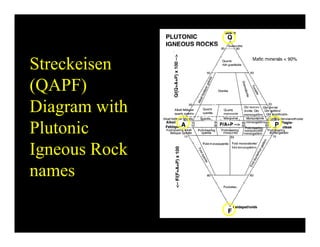
Streckeisen
(QAPF)
Diagram withDiagram with
Plutonic
Igneous Rock
namesnames
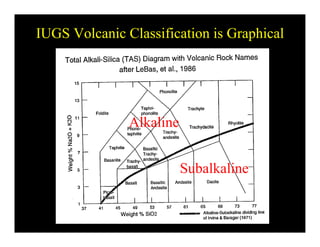
IUGS Volcanic Classification is Graphical
Alkaline
SubalkalineSubalkaline
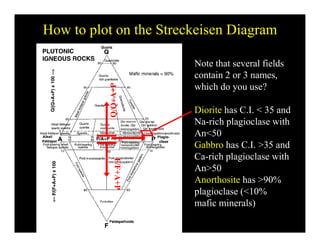
How to plot on the Streckeisen Diagram
Note that several fields
contain 2 or 3 names
Q+A+P
contain 2 or 3 names,
which do you use?
Di it h C I < 35 dQ/Q Diorite has C.I. < 35 and
Na-rich plagioclase with
An<50
F/F
Gabbro has C.I. >35 and
Ca-rich plagioclase with
An>50
+A+P
An>50
Anorthosite has >90%
plagioclase (<10%
fi i l )mafic minerals)
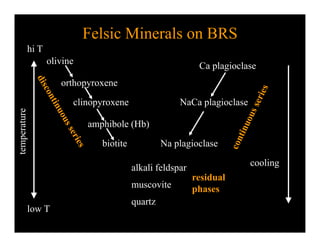
Bowen’s Reaction SeriesBowen s Reaction Series
• Idealized model for crystallization of magmasIdealized model for crystallization of magmas
• Shows order in which minerals crystallize
from a typical mafic or basaltic magmafrom a typical mafic or basaltic magma
• Left side is called Discontinuous Side
– Mafic minerals change abruptly
• Right side is called Continuous Side
– Plagioclase changes composition gradually
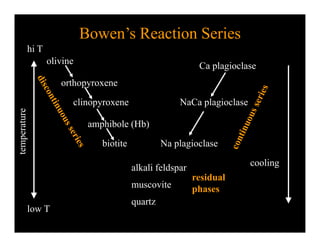
Bowen’s Reaction Series
hi T
olivine
Ca plagioclase
hi T
orthopyroxene
clinopyroxene NaCa plagioclase
amphibole (Hb)
perature
biotite Na plagioclase
alkali feldspar
cooling
temp
alkali feldspar
muscovite
quartz
residual
phases
quartz
low T
We’ll start with OlivineWe ll start with Olivine
• Formula: (Mg Fe)2SiO4Formula: (Mg, Fe)2SiO4
• An Isolated Tetrahedral Silicate
• complete solid solution with two end-
bmembers:
Mg SiO Forsterite (Fo) and–Mg2SiO4 Forsterite (Fo) and
–Fe2SiO4 Fayalite (Fa)2 4 y ( )
Olivine PropertiesOlivine Properties
• Vitreous luster
• Olive green color• Olive-green color
• No good cleavagesg g
• H=6.5 G=3.2
• Optical: high relief, moderately
high birefringencehigh birefringence
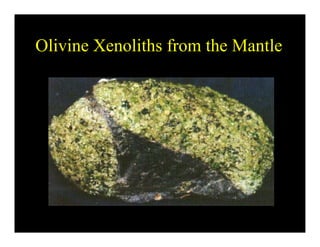
Olivine Xenoliths from the MantleOlivine Xenoliths from the Mantle
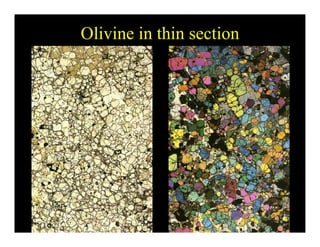
Olivine in thin section
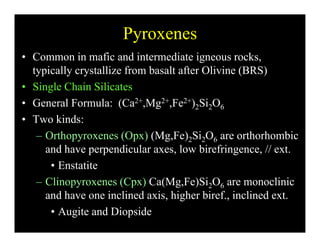
Pyroxenes
• Common in mafic and intermediate igneous rocks,
typically crystallize from basalt after Olivine (BRS)
• Single Chain Silicates
• General Formula: (Ca2+,Mg2+,Fe2+)2Si2O6( , g , )2 2 6
• Two kinds:
– Orthopyroxenes (Opx) (Mg,Fe)2Si2O6 are orthorhombicOrthopyroxenes (Opx) (Mg,Fe)2Si2O6 are orthorhombic
and have perpendicular axes, low birefringence, // ext.
• Enstatite
– Clinopyroxenes (Cpx) Ca(Mg,Fe)Si2O6 are monoclinic
and have one inclined axis, higher biref., inclined ext.
• Augite and Diopside
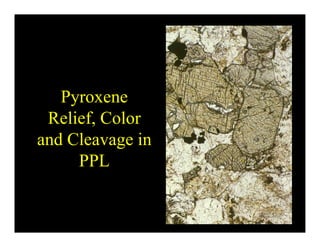
Pyroxene
Relief, Color
and Cleavage inand Cleavage in
PPL
Orthopyroxene Properties
• Orthopyroxenes (enstatite, hypersthene,
bronzite)bronzite)
– Color gray, bronze, brown
– Colorless to tan in thin section
– High relief
– Low birefringence
– Parallel extinctionParallel extinction
Clinopyroxene Properties
• Diopside (more likely in metamorphic rocks)
Ca Mg Si O– Ca~1Mg~1Si2O6
– Color light green
– Colorless in thin section
– Moderate birefringence, inclined extinctiong ,
• Augite Ca~1(Mg,Fe)~1Si2O6 (typical igneous Cpx)
Dark green to black– Dark green to black
– Tan, light brown or green in thin section
– Moderate birefringence, inclined extinction
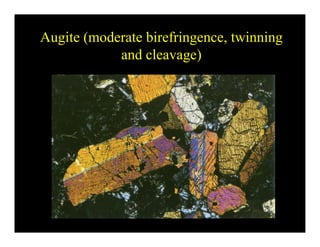
Augite (moderate birefringence, twinning
and cleavage)
Hornblende (Hb)
• is the main amphibole in igneous rocks
• crystallizes after olivine and pyroxenes• crystallizes after olivine and pyroxenes
from mafic magmas, and at lower
temperature
• is most common in intermediate
composition igneous rocks
d bl h i ili t• double-chain silicate
HornblendeHornblende
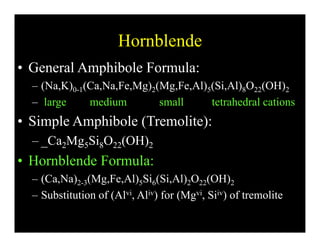
• General Amphibole Formula:
– (Na,K)0-1(Ca,Na,Fe,Mg)2(Mg,Fe,Al)5(Si,Al)8O22(OH)2
– large medium small tetrahedral cationsg
• Simple Amphibole (Tremolite):
Ca Mg Si O (OH)– _Ca2Mg5Si8O22(OH)2
• Hornblende Formula:
– (Ca,Na)2-3(Mg,Fe,Al)5Si6(Si,Al)2O22(OH)2
– Substitution of (Alvi, Aliv) for (Mgvi, Siiv) of tremolite
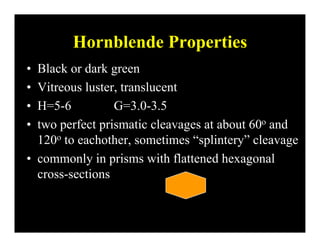
Hornblende PropertiesHornblende Properties
• Black or dark green
• Vitreous luster, translucent
• H=5-6 G=3 0-3 5H 5 6 G 3.0 3.5
• two perfect prismatic cleavages at about 60o and
120o to eachother sometimes “splintery” cleavage120o to eachother, sometimes splintery cleavage
• commonly in prisms with flattened hexagonal
icross-sections
Hornblende’s Optical PropertiesHornblende s Optical Properties
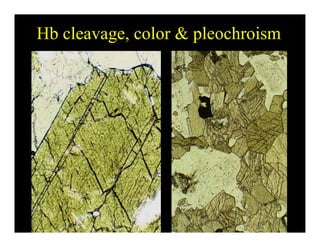
• Various shades of brown, red-brown, green,
bl i hi iblue-green or tan in thin section
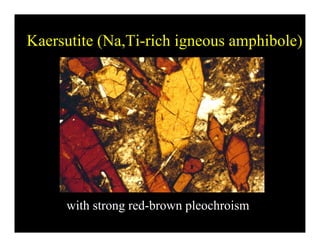
• Moderate to strong pleochroism is typical
• Moderate birefringence, commonly
obscured by its color
• Two good cleavages at ~60o and 120o to
eachother
• You have to be looking down the prism to
see 2 crossing sets of cleavages, in many
i ill l t f lviews you will see only one set of cleavages
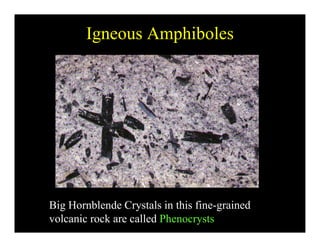
Igneous Amphiboles
Bi H bl d C l i hi fi i dBig Hornblende Crystals in this fine-grained
volcanic rock are called Phenocrysts
Hb cleavage, color & pleochroism
Kaersutite (Na,Ti-rich igneous amphibole)Kaersutite (Na,Ti rich igneous amphibole)
i h d b l h iwith strong red-brown pleochroism
Biotite is the lowest Mafic Mineral on
Di ti Sid f B ’ S iDiscontinuous Side of Bowen’s Series
I lli l f f i d fi• It crystallizes very late from fractionated mafic
magmas and is only common in intermediate to
f l i H O b f Bi ifelsic magmas, H2O must be present for Biotite
to crystallize
• Biotite is a trioctahedral, t-o-t (or 2:1) sheet
silicate
• Biotite’s properties: it’s strongly pleochroic,
has cleavage, parallel extinction, bird’s-eyeg , p , y
extinction and pleochroic haloes around zircon
Muscovite is a Residual Phase on BRSMuscovite is a Residual Phase on BRS
• Crystallizes only from felsic magmas withCrystallizes only from felsic magmas with
H2O in the liquid
• Structure and properties are similar to• Structure and properties are similar to
biotite, except for color and pleochroism
C i G i d P i• Common in Granites and Pegmatites
Felsic Minerals on BRS
hi T
olivine
Ca plagioclase
hi T
orthopyroxene
clinopyroxene NaCa plagioclase
amphibole (Hb)
perature
biotite Na plagioclase
alkali feldspar
cooling
temp
alkali feldspar
muscovite
quartz
residual
phases
quartz
low T
Quartz PropertiesQuartz Properties
• H=7 G=2 65H 7, G 2.65
• Generally clear and glassy, may have a
variety of colors (clear smoky brown rose;variety of colors (clear, smoky, brown, rose;
it’s allochromatic)
C h id l f l• Conchoidal fracture, no cleavage
• Habit: hexagonal (6-sided prisms) or
massive
• Optical: low relief and low birefringencep g
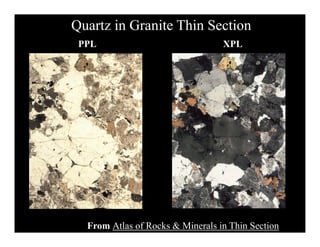
Quartz in Granite Thin Section
PPL XPLPPL XPL
From Atlas of Rocks & Minerals in Thin Section
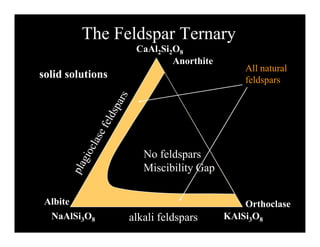
The Feldspar Ternary
C Al Si OCaAl2Si2O8
Anorthite
solid solutions
All natural
f ld
solid solutions feldspars
No feldspars
Miscibility Gap
Albite O th l
Miscibility Gap
NaAlSi3O8 KAlSi3O8
Albite Orthoclase
alkali feldspars
Alkali Feldspar (esp Orthoclase)Alkali Feldspar (esp. Orthoclase)
Properties
• H=6, G=2.56
• Generally turbid (cloudy); color white pinkGenerally turbid (cloudy); color white, pink
or flesh-colored
• 2 Perfect to good perpendicular cleavages• 2 Perfect to good perpendicular cleavages
• Habit: stubby prisms, simple twins common
• Optical: low relief and low birefringence
• Commonly Perthitic (micro and macro)y ( )
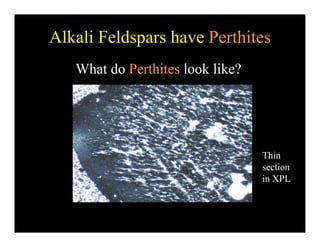
Alkali Feldspars have Perthitesp
What do Perthites look like?
Thin
sectionsection
in XPL
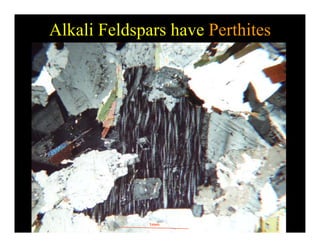
Alkali Feldspars have Perthites
What do Perthites look like?
1mm
What causes Perthites?
• Caused by un-mixing, exsolution or
separation of Na+ (diameter~1.1Å) and K+p ( )
(diameter~1.6Å) as the feldspar cools
• At low temperatures, there is a miscibility
gap between NaAlSi O and KAlSi Ogap between NaAlSi3O8 and KAlSi3O8
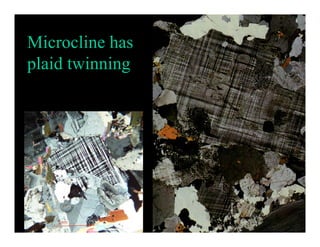
Microcline hasMicrocline has
plaid twinning
1mm
Plagioclase PropertiesPlagioclase Properties
• H=6-6 5 G=2 62-2 76 (Or H=6 G=2 56)H 6-6.5, G 2.62-2.76 (Or H=6, G=2.56)
• Luster pearly, vitreous/translucent
C l hi• Color white to gray
• One perfect, one good cleavage
• Optical: low relief and low birefringence
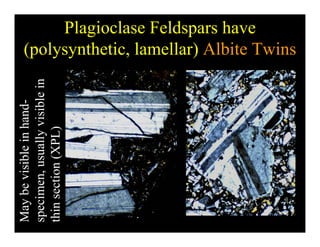
• Polysynthetic albite twinning usually presentPolysynthetic albite twinning usually present
• Not Perthitic!
C l d• Commonly zoned
Plagioclase Feldspars have
( l th ti l ll ) Albit T i(polysynthetic, lamellar) Albite Twins
d-
blein
inhand
lyvisi
PL)
isiblei
usuall
on(XP
ybevi
cimen,
sectio
May
spec
thin
Minerals of PegmatitesMinerals of Pegmatites
Large crystals of Quartz,
Alkali Feldspar andAlkali Feldspar and
Muscovite
(which are low on Bowen’s
Reaction Series)Reaction Series)
Pegmatites are rich in IncompatiblePegmatites are rich in Incompatible
Elements and Volatiles
• Incompatible Elements – those elements
that don’t fit well in common igneousthat don t fit well in common igneous
minerals (Li, B, Be)
V l il h l h h• Volatiles – those elements that have a
strong preference for the gaseous phase
(H O CO Cl F S)(H2O, CO2, Cl, F, S)
Phase Diagrams tell MUCH more
about Crystallization and Melting
than Bowen’s Reaction Seriesthan Bowen s Reaction Series
• What follows is just a quick preview of
some of the things phase diagrams can beg p g
used for
• We’ll look at two really simple examplesWe ll look at two really simple examples
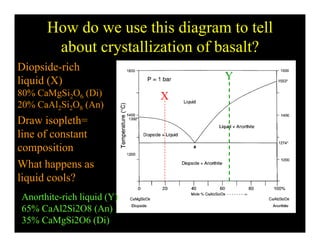
How do we use this diagram to tell
about crystallization of basalt?about crystallization of basalt?
Diopside-rich
li id (X) Yliquid (X)
80% CaMgSi2O6 (Di)
20% CaAl2Si2O8 (An)
X
Y
% 2 2 8 ( )
Draw isopleth=
line of constant
composition
What happens as
liquid cools?
Anorthite-rich liquid (Y)q ( )
65% CaAl2Si2O8 (An)
35% CaMgSi2O6 (Di)
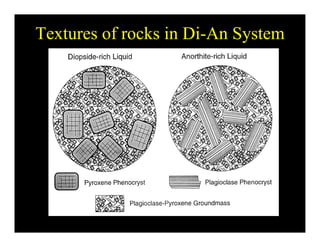
Textures of rocks in Di-An System
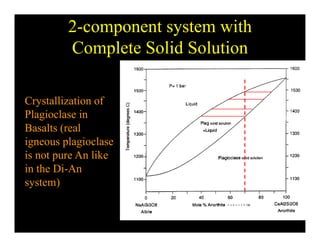
2-component system with
Complete Solid SolutionComplete Solid Solution
Crystallization of
Plagioclase in
Basalts (real
i l i ligneous plagioclase
is not pure An like
in the Di-Anin the Di An
system)
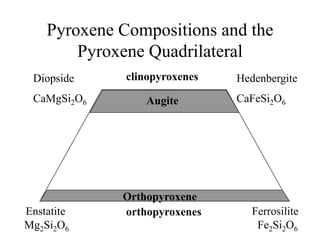
Pyroxene Compositions and the
P Q d il lPyroxene Quadrilateral
Diopside Hedenbergiteclinopyroxenes
CaFeSi2O6CaMgSi2O6
Diopside Hedenbergiteclinopyroxenes
Augite
Orthopyroxene
Mg2Si2O6 Fe2Si2O6
FerrosiliteEnstatite orthopyroxenes
py

Igneous rock overview

  • 1.
    Dr. Helen Lang Dept.of Geology & Geographyp gy g p y West Virginia University SPRING 2009 GEOLOGY 585: Optical Mineralogy & PetrologyOptical Mineralogy & Petrology
  • 2.
  • 3.
    Igneous rocks crystallizefrom magmas d iliand most magmas are silicate magmas (containing 40 to 75 wt.% SiO2) • Felsic (silicic or sialic) magmas are high in SiO2 and Al2O3 and low in MgO and FeOSiO2 and Al2O3 and low in MgO and FeO • Intermediate magmas are between Felsic and Mafic magmasand Mafic magmas • Mafic magmas contain less than 50 wt.% SiO d hi h M O F O d F OSiO2 and higher MgO, FeO and Fe2O3 • Ultramafic magmas are even more SiO2 poor and MgO/FeO rich
  • 4.
    Classification and NamingofClassification and Naming of Igneous Rocks • Based on Felsic Mineral Content QAPF or Streckeisen Diagram– QAPF or Streckeisen Diagram • For fine-grained volcanic rocks, naming is b d h i l iti ( l tbased on chemical composition (plot Na2O+K2O vs. SiO2)
  • 5.
  • 6.
    IUGS Volcanic Classificationis Graphical Alkaline SubalkalineSubalkaline
  • 7.
    How to ploton the Streckeisen Diagram Note that several fields contain 2 or 3 names Q+A+P contain 2 or 3 names, which do you use? Di it h C I < 35 dQ/Q Diorite has C.I. < 35 and Na-rich plagioclase with An<50 F/F Gabbro has C.I. >35 and Ca-rich plagioclase with An>50 +A+P An>50 Anorthosite has >90% plagioclase (<10% fi i l )mafic minerals)
  • 8.
    Bowen’s Reaction SeriesBowens Reaction Series • Idealized model for crystallization of magmasIdealized model for crystallization of magmas • Shows order in which minerals crystallize from a typical mafic or basaltic magmafrom a typical mafic or basaltic magma • Left side is called Discontinuous Side – Mafic minerals change abruptly • Right side is called Continuous Side – Plagioclase changes composition gradually
  • 9.
    Bowen’s Reaction Series hiT olivine Ca plagioclase hi T orthopyroxene clinopyroxene NaCa plagioclase amphibole (Hb) perature biotite Na plagioclase alkali feldspar cooling temp alkali feldspar muscovite quartz residual phases quartz low T
  • 10.
    We’ll start withOlivineWe ll start with Olivine • Formula: (Mg Fe)2SiO4Formula: (Mg, Fe)2SiO4 • An Isolated Tetrahedral Silicate • complete solid solution with two end- bmembers: Mg SiO Forsterite (Fo) and–Mg2SiO4 Forsterite (Fo) and –Fe2SiO4 Fayalite (Fa)2 4 y ( )
  • 11.
    Olivine PropertiesOlivine Properties •Vitreous luster • Olive green color• Olive-green color • No good cleavagesg g • H=6.5 G=3.2 • Optical: high relief, moderately high birefringencehigh birefringence
  • 12.
    Olivine Xenoliths fromthe MantleOlivine Xenoliths from the Mantle
  • 13.
  • 14.
    Pyroxenes • Common inmafic and intermediate igneous rocks, typically crystallize from basalt after Olivine (BRS) • Single Chain Silicates • General Formula: (Ca2+,Mg2+,Fe2+)2Si2O6( , g , )2 2 6 • Two kinds: – Orthopyroxenes (Opx) (Mg,Fe)2Si2O6 are orthorhombicOrthopyroxenes (Opx) (Mg,Fe)2Si2O6 are orthorhombic and have perpendicular axes, low birefringence, // ext. • Enstatite – Clinopyroxenes (Cpx) Ca(Mg,Fe)Si2O6 are monoclinic and have one inclined axis, higher biref., inclined ext. • Augite and Diopside
  • 15.
  • 16.
    Orthopyroxene Properties • Orthopyroxenes(enstatite, hypersthene, bronzite)bronzite) – Color gray, bronze, brown – Colorless to tan in thin section – High relief – Low birefringence – Parallel extinctionParallel extinction
  • 17.
    Clinopyroxene Properties • Diopside(more likely in metamorphic rocks) Ca Mg Si O– Ca~1Mg~1Si2O6 – Color light green – Colorless in thin section – Moderate birefringence, inclined extinctiong , • Augite Ca~1(Mg,Fe)~1Si2O6 (typical igneous Cpx) Dark green to black– Dark green to black – Tan, light brown or green in thin section – Moderate birefringence, inclined extinction
  • 18.
    Augite (moderate birefringence,twinning and cleavage)
  • 19.
    Hornblende (Hb) • isthe main amphibole in igneous rocks • crystallizes after olivine and pyroxenes• crystallizes after olivine and pyroxenes from mafic magmas, and at lower temperature • is most common in intermediate composition igneous rocks d bl h i ili t• double-chain silicate
  • 20.
    HornblendeHornblende • General AmphiboleFormula: – (Na,K)0-1(Ca,Na,Fe,Mg)2(Mg,Fe,Al)5(Si,Al)8O22(OH)2 – large medium small tetrahedral cationsg • Simple Amphibole (Tremolite): Ca Mg Si O (OH)– _Ca2Mg5Si8O22(OH)2 • Hornblende Formula: – (Ca,Na)2-3(Mg,Fe,Al)5Si6(Si,Al)2O22(OH)2 – Substitution of (Alvi, Aliv) for (Mgvi, Siiv) of tremolite
  • 21.
    Hornblende PropertiesHornblende Properties •Black or dark green • Vitreous luster, translucent • H=5-6 G=3 0-3 5H 5 6 G 3.0 3.5 • two perfect prismatic cleavages at about 60o and 120o to eachother sometimes “splintery” cleavage120o to eachother, sometimes splintery cleavage • commonly in prisms with flattened hexagonal icross-sections
  • 22.
    Hornblende’s Optical PropertiesHornblendes Optical Properties • Various shades of brown, red-brown, green, bl i hi iblue-green or tan in thin section • Moderate to strong pleochroism is typical • Moderate birefringence, commonly obscured by its color • Two good cleavages at ~60o and 120o to eachother • You have to be looking down the prism to see 2 crossing sets of cleavages, in many i ill l t f lviews you will see only one set of cleavages
  • 23.
    Igneous Amphiboles Bi Hbl d C l i hi fi i dBig Hornblende Crystals in this fine-grained volcanic rock are called Phenocrysts
  • 24.
    Hb cleavage, color& pleochroism
  • 25.
    Kaersutite (Na,Ti-rich igneousamphibole)Kaersutite (Na,Ti rich igneous amphibole) i h d b l h iwith strong red-brown pleochroism
  • 26.
    Biotite is thelowest Mafic Mineral on Di ti Sid f B ’ S iDiscontinuous Side of Bowen’s Series I lli l f f i d fi• It crystallizes very late from fractionated mafic magmas and is only common in intermediate to f l i H O b f Bi ifelsic magmas, H2O must be present for Biotite to crystallize • Biotite is a trioctahedral, t-o-t (or 2:1) sheet silicate • Biotite’s properties: it’s strongly pleochroic, has cleavage, parallel extinction, bird’s-eyeg , p , y extinction and pleochroic haloes around zircon
  • 27.
    Muscovite is aResidual Phase on BRSMuscovite is a Residual Phase on BRS • Crystallizes only from felsic magmas withCrystallizes only from felsic magmas with H2O in the liquid • Structure and properties are similar to• Structure and properties are similar to biotite, except for color and pleochroism C i G i d P i• Common in Granites and Pegmatites
  • 28.
    Felsic Minerals onBRS hi T olivine Ca plagioclase hi T orthopyroxene clinopyroxene NaCa plagioclase amphibole (Hb) perature biotite Na plagioclase alkali feldspar cooling temp alkali feldspar muscovite quartz residual phases quartz low T
  • 29.
    Quartz PropertiesQuartz Properties •H=7 G=2 65H 7, G 2.65 • Generally clear and glassy, may have a variety of colors (clear smoky brown rose;variety of colors (clear, smoky, brown, rose; it’s allochromatic) C h id l f l• Conchoidal fracture, no cleavage • Habit: hexagonal (6-sided prisms) or massive • Optical: low relief and low birefringencep g
  • 30.
    Quartz in GraniteThin Section PPL XPLPPL XPL From Atlas of Rocks & Minerals in Thin Section
  • 31.
    The Feldspar Ternary CAl Si OCaAl2Si2O8 Anorthite solid solutions All natural f ld solid solutions feldspars No feldspars Miscibility Gap Albite O th l Miscibility Gap NaAlSi3O8 KAlSi3O8 Albite Orthoclase alkali feldspars
  • 32.
    Alkali Feldspar (espOrthoclase)Alkali Feldspar (esp. Orthoclase) Properties • H=6, G=2.56 • Generally turbid (cloudy); color white pinkGenerally turbid (cloudy); color white, pink or flesh-colored • 2 Perfect to good perpendicular cleavages• 2 Perfect to good perpendicular cleavages • Habit: stubby prisms, simple twins common • Optical: low relief and low birefringence • Commonly Perthitic (micro and macro)y ( )
  • 33.
    Alkali Feldspars havePerthitesp What do Perthites look like? Thin sectionsection in XPL
  • 34.
    Alkali Feldspars havePerthites What do Perthites look like? 1mm
  • 35.
    What causes Perthites? •Caused by un-mixing, exsolution or separation of Na+ (diameter~1.1Å) and K+p ( ) (diameter~1.6Å) as the feldspar cools • At low temperatures, there is a miscibility gap between NaAlSi O and KAlSi Ogap between NaAlSi3O8 and KAlSi3O8
  • 36.
  • 37.
    Plagioclase PropertiesPlagioclase Properties •H=6-6 5 G=2 62-2 76 (Or H=6 G=2 56)H 6-6.5, G 2.62-2.76 (Or H=6, G=2.56) • Luster pearly, vitreous/translucent C l hi• Color white to gray • One perfect, one good cleavage • Optical: low relief and low birefringence • Polysynthetic albite twinning usually presentPolysynthetic albite twinning usually present • Not Perthitic! C l d• Commonly zoned
  • 38.
    Plagioclase Feldspars have (l th ti l ll ) Albit T i(polysynthetic, lamellar) Albite Twins d- blein inhand lyvisi PL) isiblei usuall on(XP ybevi cimen, sectio May spec thin
  • 39.
    Minerals of PegmatitesMineralsof Pegmatites Large crystals of Quartz, Alkali Feldspar andAlkali Feldspar and Muscovite (which are low on Bowen’s Reaction Series)Reaction Series)
  • 40.
    Pegmatites are richin IncompatiblePegmatites are rich in Incompatible Elements and Volatiles • Incompatible Elements – those elements that don’t fit well in common igneousthat don t fit well in common igneous minerals (Li, B, Be) V l il h l h h• Volatiles – those elements that have a strong preference for the gaseous phase (H O CO Cl F S)(H2O, CO2, Cl, F, S)
  • 41.
    Phase Diagrams tellMUCH more about Crystallization and Melting than Bowen’s Reaction Seriesthan Bowen s Reaction Series • What follows is just a quick preview of some of the things phase diagrams can beg p g used for • We’ll look at two really simple examplesWe ll look at two really simple examples
  • 42.
    How do weuse this diagram to tell about crystallization of basalt?about crystallization of basalt? Diopside-rich li id (X) Yliquid (X) 80% CaMgSi2O6 (Di) 20% CaAl2Si2O8 (An) X Y % 2 2 8 ( ) Draw isopleth= line of constant composition What happens as liquid cools? Anorthite-rich liquid (Y)q ( ) 65% CaAl2Si2O8 (An) 35% CaMgSi2O6 (Di)
  • 43.
    Textures of rocksin Di-An System
  • 44.
    2-component system with CompleteSolid SolutionComplete Solid Solution Crystallization of Plagioclase in Basalts (real i l i ligneous plagioclase is not pure An like in the Di-Anin the Di An system)
  • 45.
    Pyroxene Compositions andthe P Q d il lPyroxene Quadrilateral Diopside Hedenbergiteclinopyroxenes CaFeSi2O6CaMgSi2O6 Diopside Hedenbergiteclinopyroxenes Augite Orthopyroxene Mg2Si2O6 Fe2Si2O6 FerrosiliteEnstatite orthopyroxenes py