THE WORLD OF VLSI
               &
             VHDL


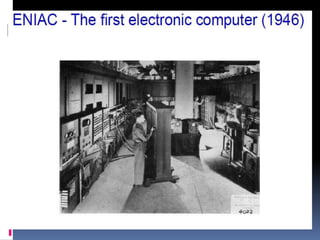
Yesterday, Today
       &
   Tomorrow
The World of VLSI
• History of the Integrated Circuit (IC) design

• The IC Technologies
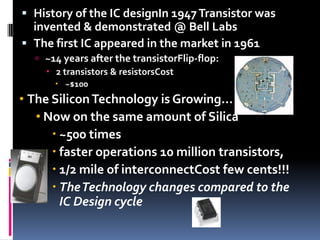
 History of the IC designIn 1947 Transistor was
  invented & demonstrated @ Bell Labs
 The first IC appeared in the market in 1961
   ~14 years after the transistorFlip-flop:
     2 transistors & resistorsCost
       ~$100
• The Silicon Technology is Growing...
   • Now on the same amount of Silica
       ~500 times
       faster operations 10 million transistors,
       1/2 mile of interconnectCost few cents!!!
       The Technology changes compared to the
        IC Design cycle
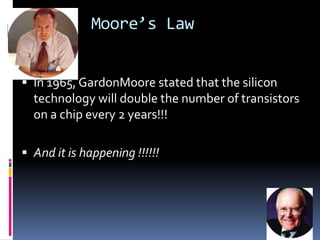
Moore’s Law


 In 1965, GardonMoore stated that the silicon
  technology will double the number of transistors
  on a chip every 2 years!!!

 And it is happening !!!!!!
The Search of products
 “How to reduce the high designing cost for
  future success of this technology ??? ”:
 1968 Noyce
   Reduce the cost of design process
   Find product with large market-Regular structure,
  Many applications
  1968 :Noyce, Moore & Grove Forms Intel
    !!SemiconductorMemory Chip
Microprocessor Technology

 Microprocessor = IC Tech +SoftwareProcessor


 Power+Memory capacity     Software market
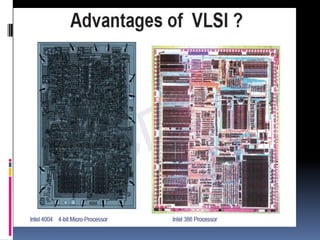
Advantages of VLSI ?
 Less AREA (compactness at system levels)
 Less POWERConsumption
 Less TESTING(more complex testing)
 Higher RELIABILITY
(due to improved on-chip interconnects)
 Higher SPEED(due to reduced interconnect
  length)
 Significant COST SAVINGS
The goal of the IC designer
 Meet the market requirements
   Satisfying customers need
   Beating the competition
 Increasing performance or functionality of the product
  Reducing cost compared to the available solutions
 Achieved by:
   Using next generation Silicon technologies
   New design concepts & tools
   High level of integration


 The Design is an optimization problem with
  parameters as Technology, Time, Cost and Customer
  requirements
Design Approaches
 Custom
   full control of design
   best results, slowest design time.
 Semi-custom (std cell)
   use Cell libraries from vendor
   cad tools, faster design time
 EPLA/EPLD -FPGA
   Electrically Programmable (in the Field)
ASIC(Application Specific Integrated Circuit)
  Implements custom functions according to description
    Not off-the-shelf
  Can be described in HDL (Verilog,VHDL)
    in an abstract technology Independent fashion
  Verified using a simulator
    Analogous to software debugger
  Constructed out of logical function cells
    (AND,OR) and Re-Usable Macro
  Building blocks (ADDERs, REGISTERs)
  Mapped or translated using Synthesis products
   Implemented in
    Field Programmable, Standard Cell or Gate Array families
  For high volume production
    Designers pay CAD vendors ~$50K -$500K for Design tools
    Designer pay foundry( ~ $200K -.5M) and per part agreement
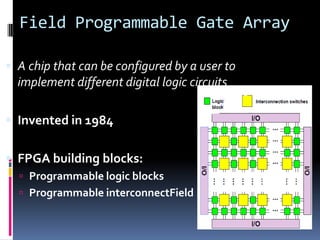
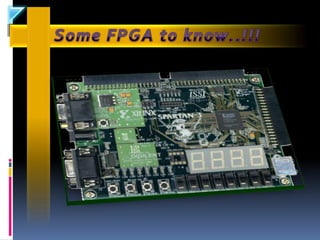
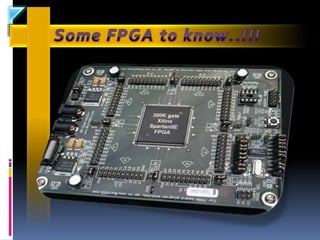
Field Programmable Gate Array

 A chip that can be configured by a user to
  implement different digital logic circuits

 Invented in 1984


 FPGA building blocks:
   Programmable logic blocks
   Programmable interconnectField
To compress the digital world.
To explore the hidden perfection and create
 the brain of a machine.


*The above two are considered as a very difficult
tasks in the field of electronics engineering, where
in fact it’s a very simple technology.
 VHDL is for coding models of a digital system.
 Reasons for modeling:
  ◦   Requirements specification
  ◦   Documentation
  ◦   Testing using simulation
  ◦   Formal verification
  ◦   Synthesis
 Goal:
  ◦ Most ‘reliable’ design process, with minimum cost
    and time
  ◦ Avoid design errors!
 VHDL is a programming language that allows one
 to model and develop complex digital systems in a
 dynamic environment.

 Object Oriented methodology for you C people
 can be observed -- modules can be used and
 reused.

 Allows you to designate in/out ports (bits) and
 specify behavior or response of the system.
 C is procedural language whereas VHDL is semi
  concurrent & semi sequential language.

 C is    Case Sensitive whereas VHDL is case
  insensitive.

 There    are some similarities, as with any
  programming language, but syntax and logic are
  quite different.
• Interfaces (PORTS)
• Behavior
• Structure
• Test Benches
• Simulation
• Synthesis
Dataflow
Behavioral
Structural


Kind of BORING sounding huh??
Well, it gets more exciting with the details !!
              :)
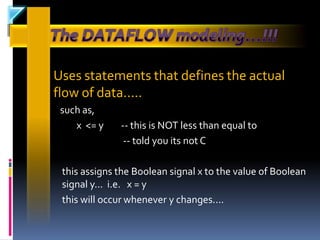
Uses statements that defines the actual
flow of data.....
 such as,
    x <= y    -- this is NOT less than equal to
               -- told you its not C

 this assigns the Boolean signal x to the value of Boolean
 signal y... i.e. x = y
 this will occur whenever y changes....
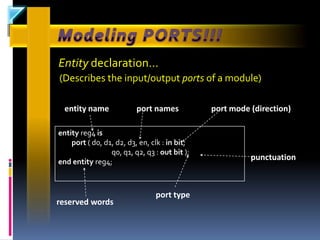
Entity declaration…
(Describes the input/output ports of a module)

  entity name             port names           port mode (direction)

entity reg4 is
    port ( d0, d1, d2, d3, en, clk : in bit;
                 q0, q1, q2, q3 : out bit );
end entity reg4;
                                                         punctuation


                                port type
reserved words
 Architecture body
   Describes an implementation of an entity
   May be several per entity
 Behavioral architecture
   Describes the algorithm performed by the module
   Contains
    Process statements, each containing
       Sequential statements, including
        Signal assignment statements and
        Wait statements
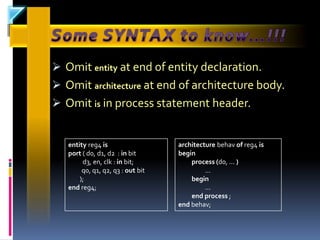
 Omit entity at end of entity declaration.
 Omit architecture at end of architecture body.
 Omit is in process statement header.


   entity reg4 is                  architecture behav of reg4 is
   port ( d0, d1, d2 : in bit      begin
        d3, en, clk : in bit;          process (d0, ... )
        q0, q1, q2, q3 : out bit            ...
       );                              begin
   end reg4;                                ...
                                       end process ;
                                   end behav;
 Structural architecture
   implements the module as a composition of
    subsystems
   contains
    ○ signal declarations, for internal interconnections
       the entity ports are also treated as signals
    ○ component instances
       instances of previously declared entity/architecture
        pairs
    ○ port maps in component instances
       connect signals to component ports
 An architecture can contain both behavioral
  and structural parts
   Process statements and component instances
    ○ Collectively called concurrent statements
   Processes can read and assign to signals
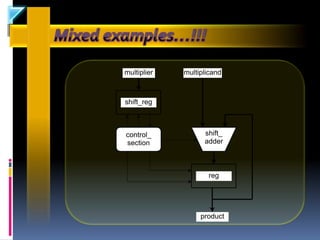
 Example: register-transfer-level (RTL) model
   Data path described structurally
   Control section described behaviorally
multiplier   multiplicand


shift_reg


control_           shift_
section            adder


                    reg


                  product
 Testing a design by simulation
 Use a test bench model
   A model that uses your model
   Apply test sequences to your inputs
   Monitors values on output signals
     Either using simulator.
     Or with a process that verifies correct operation
     Or logic analyzer.
 Discrete event simulation
   Time advances in discrete steps.
   When signal values change—events occur.
 A processes is sensitive to events on input
  signals
   Specified in wait statements.
   Resumes and schedules new values on output
    signals.
    ○ Schedules transactions.
    ○ Event on a signal if value changes.
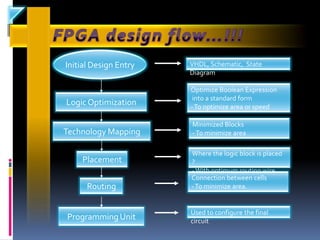
Initial Design Entry   VHDL, Schematic, State
                       Diagram

                       Optimize Boolean Expression
                        into a standard form
Logic Optimization     - To optimize area or speed

                       Minimized Blocks
Technology Mapping     - To minimize area

                       Where the logic block is placed
    Placement          ?
                       - With optimum routing wire
                       Connection between cells
      Routing          - To minimize area.


                       Used to configure the final
Programming Unit       circuit
 Implement the VHDL portion of coding for synthesis.
 Identify the differences between behavioral and
    structural coding styles.
   Distinguish coding for synthesis versus coding for
    simulation.
   Use scalar and composite data types to represent
    information.
   Use concurrent and sequential control structure to
    regulate information flow.
   Implement common VHDL constructs (Finite State
    Machines [FSMs], RAM/ROM data structures).
• Executable specification.
• Functionality separated from implementation.
• Simulate early and fast (Manage complexity)
• Explore design alternatives.
• Get feedback (Produce better designs)
• Automatic synthesis and test generation (ATPG for
  ASICs)
• Increase productivity (Shorten time-to-market)
• Technology and tool independence.
• Portable design data (Protect investment)
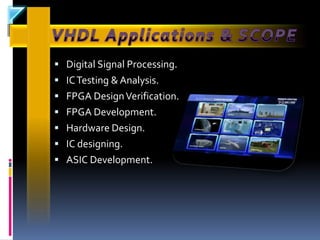
 Digital Signal Processing.
 IC Testing & Analysis.
 FPGA Design Verification.
 FPGA Development.
 Hardware Design.
 IC designing.
 ASIC Development.
• THANK YOU
          E-Mail
    Gaurav_rai@live.com


•

Summer training vhdl

  • 1.
    THE WORLD OFVLSI & VHDL Yesterday, Today & Tomorrow
  • 2.
    The World ofVLSI • History of the Integrated Circuit (IC) design • The IC Technologies
  • 3.
     History ofthe IC designIn 1947 Transistor was invented & demonstrated @ Bell Labs  The first IC appeared in the market in 1961  ~14 years after the transistorFlip-flop:  2 transistors & resistorsCost  ~$100 • The Silicon Technology is Growing... • Now on the same amount of Silica  ~500 times  faster operations 10 million transistors,  1/2 mile of interconnectCost few cents!!!  The Technology changes compared to the IC Design cycle
  • 4.
    Moore’s Law  In1965, GardonMoore stated that the silicon technology will double the number of transistors on a chip every 2 years!!!  And it is happening !!!!!!
  • 5.
    The Search ofproducts  “How to reduce the high designing cost for future success of this technology ??? ”:  1968 Noyce  Reduce the cost of design process  Find product with large market-Regular structure, Many applications 1968 :Noyce, Moore & Grove Forms Intel !!SemiconductorMemory Chip
  • 6.
    Microprocessor Technology  Microprocessor= IC Tech +SoftwareProcessor  Power+Memory capacity Software market
  • 10.
    Advantages of VLSI?  Less AREA (compactness at system levels)  Less POWERConsumption  Less TESTING(more complex testing)  Higher RELIABILITY (due to improved on-chip interconnects)  Higher SPEED(due to reduced interconnect length)  Significant COST SAVINGS
  • 11.
    The goal ofthe IC designer  Meet the market requirements  Satisfying customers need  Beating the competition  Increasing performance or functionality of the product Reducing cost compared to the available solutions  Achieved by:  Using next generation Silicon technologies  New design concepts & tools  High level of integration  The Design is an optimization problem with parameters as Technology, Time, Cost and Customer requirements
  • 12.
    Design Approaches  Custom  full control of design  best results, slowest design time.  Semi-custom (std cell)  use Cell libraries from vendor  cad tools, faster design time  EPLA/EPLD -FPGA  Electrically Programmable (in the Field)
  • 13.
    ASIC(Application Specific IntegratedCircuit)  Implements custom functions according to description  Not off-the-shelf  Can be described in HDL (Verilog,VHDL)  in an abstract technology Independent fashion  Verified using a simulator  Analogous to software debugger  Constructed out of logical function cells  (AND,OR) and Re-Usable Macro  Building blocks (ADDERs, REGISTERs)  Mapped or translated using Synthesis products Implemented in  Field Programmable, Standard Cell or Gate Array families  For high volume production  Designers pay CAD vendors ~$50K -$500K for Design tools  Designer pay foundry( ~ $200K -.5M) and per part agreement
  • 14.
    Field Programmable GateArray  A chip that can be configured by a user to implement different digital logic circuits  Invented in 1984  FPGA building blocks:  Programmable logic blocks  Programmable interconnectField
  • 17.
    To compress thedigital world. To explore the hidden perfection and create the brain of a machine. *The above two are considered as a very difficult tasks in the field of electronics engineering, where in fact it’s a very simple technology.
  • 18.
     VHDL isfor coding models of a digital system.  Reasons for modeling: ◦ Requirements specification ◦ Documentation ◦ Testing using simulation ◦ Formal verification ◦ Synthesis  Goal: ◦ Most ‘reliable’ design process, with minimum cost and time ◦ Avoid design errors!
  • 19.
     VHDL isa programming language that allows one to model and develop complex digital systems in a dynamic environment.  Object Oriented methodology for you C people can be observed -- modules can be used and reused.  Allows you to designate in/out ports (bits) and specify behavior or response of the system.
  • 20.
     C isprocedural language whereas VHDL is semi concurrent & semi sequential language.  C is Case Sensitive whereas VHDL is case insensitive.  There are some similarities, as with any programming language, but syntax and logic are quite different.
  • 21.
    • Interfaces (PORTS) •Behavior • Structure • Test Benches • Simulation • Synthesis
  • 22.
    Dataflow Behavioral Structural Kind of BORINGsounding huh?? Well, it gets more exciting with the details !! :)
  • 23.
    Uses statements thatdefines the actual flow of data..... such as, x <= y -- this is NOT less than equal to -- told you its not C this assigns the Boolean signal x to the value of Boolean signal y... i.e. x = y this will occur whenever y changes....
  • 24.
    Entity declaration… (Describes theinput/output ports of a module) entity name port names port mode (direction) entity reg4 is port ( d0, d1, d2, d3, en, clk : in bit; q0, q1, q2, q3 : out bit ); end entity reg4; punctuation port type reserved words
  • 25.
     Architecture body  Describes an implementation of an entity  May be several per entity  Behavioral architecture  Describes the algorithm performed by the module  Contains Process statements, each containing  Sequential statements, including Signal assignment statements and Wait statements
  • 26.
     Omit entityat end of entity declaration.  Omit architecture at end of architecture body.  Omit is in process statement header. entity reg4 is architecture behav of reg4 is port ( d0, d1, d2 : in bit begin d3, en, clk : in bit; process (d0, ... ) q0, q1, q2, q3 : out bit ... ); begin end reg4; ... end process ; end behav;
  • 27.
     Structural architecture  implements the module as a composition of subsystems  contains ○ signal declarations, for internal interconnections  the entity ports are also treated as signals ○ component instances  instances of previously declared entity/architecture pairs ○ port maps in component instances  connect signals to component ports
  • 28.
     An architecturecan contain both behavioral and structural parts  Process statements and component instances ○ Collectively called concurrent statements  Processes can read and assign to signals  Example: register-transfer-level (RTL) model  Data path described structurally  Control section described behaviorally
  • 29.
    multiplier multiplicand shift_reg control_ shift_ section adder reg product
  • 30.
     Testing adesign by simulation  Use a test bench model  A model that uses your model  Apply test sequences to your inputs  Monitors values on output signals  Either using simulator.  Or with a process that verifies correct operation  Or logic analyzer.
  • 31.
     Discrete eventsimulation  Time advances in discrete steps.  When signal values change—events occur.  A processes is sensitive to events on input signals  Specified in wait statements.  Resumes and schedules new values on output signals. ○ Schedules transactions. ○ Event on a signal if value changes.
  • 32.
    Initial Design Entry VHDL, Schematic, State Diagram Optimize Boolean Expression into a standard form Logic Optimization - To optimize area or speed Minimized Blocks Technology Mapping - To minimize area Where the logic block is placed Placement ? - With optimum routing wire Connection between cells Routing - To minimize area. Used to configure the final Programming Unit circuit
  • 35.
     Implement theVHDL portion of coding for synthesis.  Identify the differences between behavioral and structural coding styles.  Distinguish coding for synthesis versus coding for simulation.  Use scalar and composite data types to represent information.  Use concurrent and sequential control structure to regulate information flow.  Implement common VHDL constructs (Finite State Machines [FSMs], RAM/ROM data structures).
  • 36.
    • Executable specification. •Functionality separated from implementation. • Simulate early and fast (Manage complexity) • Explore design alternatives. • Get feedback (Produce better designs) • Automatic synthesis and test generation (ATPG for ASICs) • Increase productivity (Shorten time-to-market) • Technology and tool independence. • Portable design data (Protect investment)
  • 37.
     Digital SignalProcessing.  IC Testing & Analysis.  FPGA Design Verification.  FPGA Development.  Hardware Design.  IC designing.  ASIC Development.
  • 38.
    • THANK YOU E-Mail Gaurav_rai@live.com •