 Introduction
Historical perspective
Global & Indianscenario
Etiology
Risk factors
Protective factors
Common methods
Stages
Warning signs
Treatment
Prevention
Recommendations 12/03/14 2
 Suicide – defined as an act with a
fatal outcome that is deliberately
initiated and performed by the person
in the knowledge or expectation of its
fatal outcome.
12/03/14 3
It’s a complex phenomenon
Insurmountable disparity between expectations and
outcomes, real or imagined – tremendous pressure on
mind, blinding its logic, forcing it a conclusion of escape
Derived from Latinword
 sui = oneself , cidium = akilling
Primary emergency for mental health professional
Major public healthproblem
12/03/14 4
 The story of suicide is probably as old
as that of man himself
12/03/14 5
Suicide has variously been glorified,romanticized,
bemoaned, and even condemned
 I n ancient Athens, a person who
committed suicide without the approval
of the state was denied the honours of
a normal burial
12/03/14 6
 I n ancient Greece & Rome suicide was deemed to be an
acceptable method to deal with military defeat
ISLAM: suicide is PROHIBITED
12/03/14 7
CHRISTIANITY: suicide is considered a sin
 I n 19th-century in Europe the act of suicide shifted
from being viewed as caused by sin to being caused
by insanity.
Hinduism:
When Lord Sri Ram died, there was an
epidemic of suicide in his kingdom,
Ayodhya
12/03/14 8
 The Bhagavad Gita - condemnssuicide
Upanishads, the Holy Scriptures - condemn suicide
‘he who takes his own life will enter the sunless
areas covered by impenetrable darkness after
death’
Vedas - permit suicide for religious
reasons consider that the best sacrifice
was that of one's own life - ‘sallekhana’
12/03/14 9
Sati, where a woman immolated herself on the pyreof
her husband rather than live the life of a widow
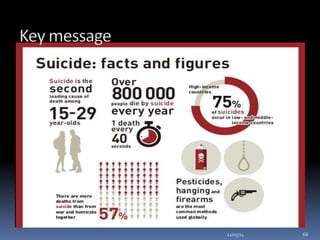
More than 8,00,000 people die bysuicide every year
Estimated annual mortality is 14·5 deaths per
1,00,000 people
Around one person every 40seconds
 75% of suicides occur in low- andmiddle-income
countries
12/03/14 10
Suicide worldwide was estimated to
represent 1.8% of the total global burden
of disease in 1998
12/03/14 11
 By 2020 - projected to be 2.4%
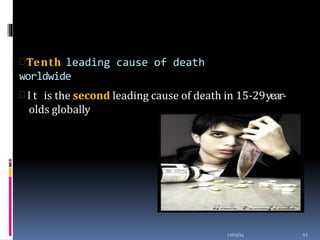
Tenth leading cause of death
worldwide
12/03/14 12
 I t is the second leading cause of death in 15-29year-
olds globally
12/03/14 13
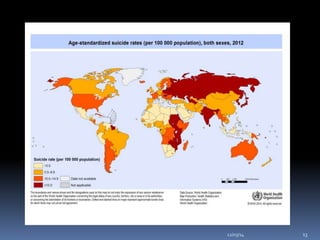
Suicide belt – (25 per 100,000)
Scandinavia, Switzerland, Germany,
Austria, eastern European
countries (Belarus, Estonia,
Lithuania, and the Russian
Federation) and Japan
12/03/14 14
Prime suicide site of the world – Golden Gate Bridge in
San Francisco
Japan- reported to have highest number of cases
India ranks 43rdin descending order of rates ofsuicide
with a rate of 10.6/100,000 reported in 2009
About one-third of suicides over the world happenin
India
According to 2012 WHO data –
males -25.8/100,000population/year
females- 16.4/100,000
12/03/14 15
According to NCRB : In 1989-8.47/100,000
population/year
1999 – 11.21
2006 – 10.5
Under-reporting
• Pondicherry, Andaman & Nicobar Islands –
30/100,000
• Kerala, Sikkim, Tripura, Karnataka also have reported
high rates of suicide
12/03/14 16
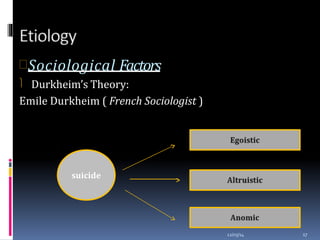
Sociological Factors
12/03/14 17
 Durkheim’s Theory:
Emile Durkheim ( French Sociologist )
suicide
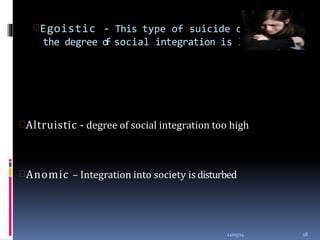
Egoistic - This type of suicide occurs when
the degree of social integration is low
12/03/14 18
Altruistic - degree of social integration too high
Anomic – Integration into society isdisturbed
Psychological Factors
 Freud’s theory: “ Mourning and Melancholia”
 Menninger’s theory: suicide as inverted homicide
12/03/14 19
Biological Factors
 Serotonergic system: low
concentration of5-HIAA (metabolite of serotonin)
 Nonadrenergic system: stress-diathesis model
 HPA axis: Dexamethasone suppression test- non-
suppressors
( suicide is more common in groups with low cholesterol
levels) 12/03/14 20
Genetic factors
12/03/14 21
Molecular biology – polymorphism in TPH gene
(tryptophan hydroxylase enzyme)
Gender differences- Men 4 times >Women
Exceptions – India and China , ratio is 1.3:1
Age- Increase withage
men peak age- after 45 years
women – 55years
Race- Two out of every three suicides are Whitemales
12/03/14 22
Religion- degree of orthodoxy and integration
Marital status- lessens therisk
Occupation- higher social status greater the risk
unemployed > employed
Physician suicides - physicians particularly females are
at greater risk
12/03/14 23
Climate – no significantvariation
Physical health- loss of motility
disfigurement
chronic intractable pain
patients on hemodialysis
alcohol related illnesses
Drugs : Reserpine, corticosteroids, anti-canceragents
12/03/14 24
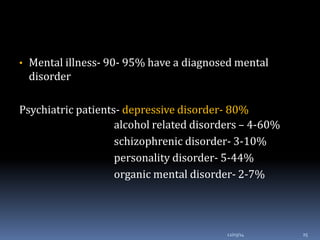
• Mental illness- 90- 95% have a diagnosed mental
disorder
Psychiatric patients- depressive disorder- 80%
alcohol related disorders – 4-60%
schizophrenic disorder- 3-10%
personality disorder- 5-44%
organic mental disorder- 2-7%
12/03/14 25
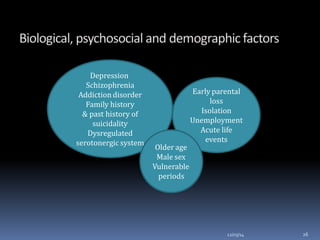
Depression
Schizophrenia
Addiction disorder
Family history
& past history of
suicidality
Dysregulated
serotonergic system
Early parental
loss
Isolation
Unemployment
Acute life
events
Older age
Male sex
12/03/14 26
Vulnerable
periods
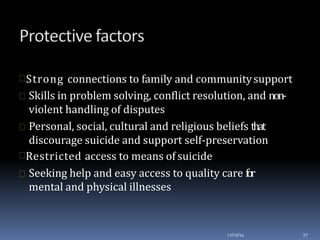
Strong connections to family and communitysupport
 Skills in problem solving, conflict resolution, and non-
violent handling of disputes
 Personal, social, cultural and religious beliefs that
discourage suicide and support self-preservation
Restricted access to means of suicide
 Seeking help and easy access to quality care for
mental and physical illnesses
12/03/14 27
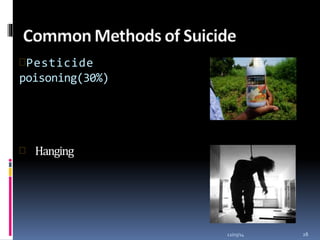
Pesticide
poisoning(30%)
12/03/14 28
 Hanging
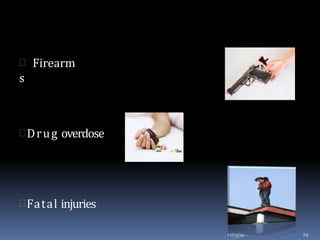
 Firearm
s
Drug overdose
Fatal injuries
12/03/14 29
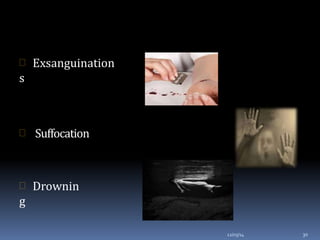
 Exsanguination
s
 Suffocation
 Drownin
g
12/03/14 30
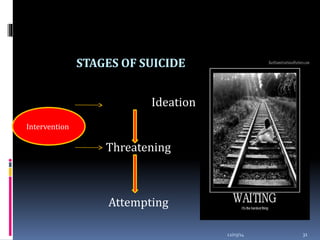
STAGES OF SUICIDE
12/03/14 31
Ideation
Threatening
Attempting
Intervention
Parasuicide : injures themselves by self
mutilation but do not wish to die
Cyber-suicide : suicide pact made between
individuals who meet on the internet
Copycat suicide : a suicide within a peer
group/publicized suicide can serve as a model for
next suicide in absence of sufficient protective
factors (Werther syndrome)
Anniversary suicide: persons take their lives on
the day a member of their family did
12/03/14 32
 IPC S. 309 Attempt to Commit Suicide
S.306 Abetment ofSuicide
• S.305 Abetment in Special Cases
12/03/14 33
Suicide in adolescents:
Highly vulnerablegroup
Living in violent & abusiveenvironment
Lack of supportnetwork
They are usually successive in their attempt tosuicide
Male : female ratio almostequal
12/03/14 34
 Causes-
12/03/14 35
mental illness
school difficulties
broken romance
separation
rejection
physical/ sexual abuse
Children –bullying /being bullied
(NOTE: Direct questioning about suicidal thoughts is
necessary)
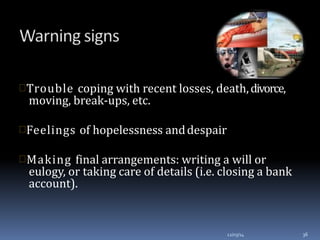
Trouble coping with recent losses, death,divorce,
moving, break-ups, etc.
Feelings of hopelessness anddespair
Making final arrangements: writing a will or
eulogy, or taking care of details (i.e. closing a bank
account).
12/03/14 36
Gathering of lethalweapons
Giving away prizedpossessions
Preoccupation with death, such as death and/or
'dark' themes in writing, art, music lyrics, etc.
Sudden changes in personality or attitude,
appearance, chemical use, or school behavior.
12/03/14 37
 “ I can't go on anymore"
 " I wish I was never born"
 " I wish I were dead"
 " I won't need this anymore"
12/03/14 38
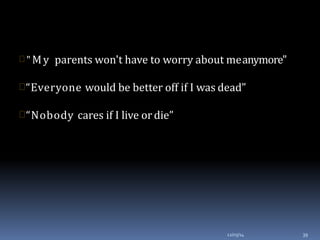
 " My parents won't have to worry about meanymore"
“Everyone would be better off if I was dead”
“Nobody cares if I live ordie”
12/03/14 39
Treatment of suicideattempters
For every completed case of suicide there are about 20
non fatal attempts
Repetition – 15-25% within a year
Poor problem solving skills
12/03/14 40
Psychosocial treatment
a)Problem-solving
b)Psychotherapy
c) Distress-tolerance skills
d)Outreach
e)Provision of emergency cards
f) Family therapy
12/03/14 41
Pharmacological treatment
a)Antidepressants- fluoxetine, should be always
combined with other therapies
b)Neuroleptics- flupenthixol 20mg for 6 months
c) Lithium
12/03/14 42
1) Assessment- ( SAD PERSON’S scale – high specificity
but low sensitivity so not used anymore)
2) Treatment:
a)Psychiatric disorders to be treated
b)Community therapy- problem solving and outreach
c) Adolescents – family therapy, group therapy
12/03/14 43
12/03/14 44
General principles
 Populationstrategies
 High-riskstrategies
12/03/14 45
Population strategies
Intervention at community level:
1. Increasing public awareness
2. Campaign to reduce stigma
3. Guidelines for the mass media
4. Regulating formulations, packaging and sale of
pesticides
5. Regulation of over-the-counter medication
6. Gender-related legislation and action
7. Introducing alcohol policies
12/03/14 46
Interventions at institutional and organizational
levels:
1. Establishing sentinel centres and developing an
information system
2. Training of personnel working in high risk settings
3. Establishing crisis intervention and counselling centres
and telephone hotlines
4. Increase in specific clinical training programmes for lay
counsellors
5. Redesigning the curriculum for medical and nursing
personnel
6. Intervention programmes for high schools
12/03/14 47
High-risk strategies
1. Patients with psychiatric disorder
a) Risk identification
b)Preventive strategies- active treatment of individuals
and psychological therapy
2. Elderly people- care and support
12/03/14 48
3. Suicide attempters
4.High-risk occupational groups- all these groups have
easy access to methods of suicide – removing the
access
5. Prisoners- young males held at remand
Ensuring that prison cells are safe in terms of absence of
structures favorable for suicide
12/03/14 49
12/03/14 50
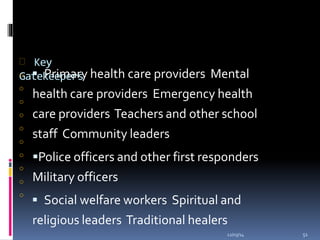
 Key
Gatekeepers Primary health care providers Mental
health care providers Emergency health
care providers Teachers and other school
staff Community leaders
Police officers and other first responders
Military officers
 Social welfare workers Spiritual and
religious leaders Traditional healers
12/03/14 51
o
o
o
o
o
o
o
o
o
o
12/03/14 52
12/03/14 53
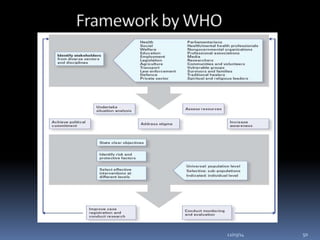
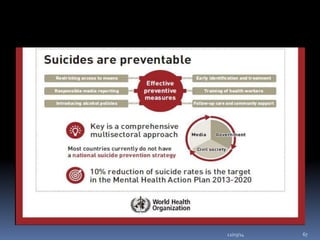
 I n the WHO Mental Health Action Plan 2013-2020 - the
global target of reducing the suicide rate in countries
by 10% by 2020.
WHO’s Mental Health Gap Action Programme,
launched in 2008, includes suicide prevention as a
priority and provides evidence-based technical
guidance to expand service provision in countries
12/03/14 54
12/03/14 55
Model for developing countries in publichealth
low IMR
MMR
High life expectancy
Marched forward in physical health, neglected mental
health
12/03/14 56
Evidenced by high
suicide rates 32/100,000
population/ year
12/03/14 57
KRISIS (Kerala Integrated Scheme for Intervention in
Suicide)- launched in 2004
In 2008- 26/100,000 population/yr
Public awareness
Integration of mental health and general health in
suicide prevention approaches
 A t MBBS level – making it a compulsory subject of
study and a examination paper
12/03/14 58
Foundations providing services in prevention of suicide
Prerana group-Mumbai
Sneha NGO – Chennaibased
Maithri -Ernakulam
12/03/14 59
When someone is suicidal , he or she will always
remain suicidal
Heightened suicide risk is often short-term and
situation-specific.
While suicidal thoughts may return, they are not
permanent and individual with previously suicidal
thoughts and attempts can go on to live a long life
12/03/14 60
Talking about suicide is a bad idea and can be
interpreted as encouragement
12/03/14 61
Given the widespread stigma around suicide,most
people who are contemplating suicide do not know
who to speak to.
Rather than encouraging suicidal behaviour, talking
openly can give an individual other options or the time
to rethink his/her decision, thereby preventing
suicide.
Only peoplewith mental disordersare suicidal
12/03/14 62
Suicidal behaviour indicates deep unhappiness but not
necessarily mental disorder.
Most suicides happen suddenly without warning
12/03/14 63
 The majority of suicides have been precededby
warning signs, whether verbal or behavioural.
 Of course there are some suicides that occur without
warning
Someone who is suicidal is determined to die
12/03/14 64
 O n the contrary, suicidal people are often ambivalent
about living or dying
 Someone may act impulsively by drinking pesticides,
and die a few days later, even though they would have
liked to live on
12/03/14 65
PEOPLE WHO TALKS ABOUT
SUICIDE DO NOT MEAN TO DO
IT
People who talk about suicide may be reaching out for
help or support
12/03/14 66
12/03/14 67
12/03/14 68

Suicide ppt

  • 2.
     Introduction Historical perspective Global& Indianscenario Etiology Risk factors Protective factors Common methods Stages Warning signs Treatment Prevention Recommendations 12/03/14 2
  • 3.
     Suicide –defined as an act with a fatal outcome that is deliberately initiated and performed by the person in the knowledge or expectation of its fatal outcome. 12/03/14 3 It’s a complex phenomenon Insurmountable disparity between expectations and outcomes, real or imagined – tremendous pressure on mind, blinding its logic, forcing it a conclusion of escape
  • 4.
    Derived from Latinword sui = oneself , cidium = akilling Primary emergency for mental health professional Major public healthproblem 12/03/14 4
  • 5.
     The storyof suicide is probably as old as that of man himself 12/03/14 5 Suicide has variously been glorified,romanticized, bemoaned, and even condemned
  • 6.
     I nancient Athens, a person who committed suicide without the approval of the state was denied the honours of a normal burial 12/03/14 6  I n ancient Greece & Rome suicide was deemed to be an acceptable method to deal with military defeat
  • 7.
    ISLAM: suicide isPROHIBITED 12/03/14 7 CHRISTIANITY: suicide is considered a sin  I n 19th-century in Europe the act of suicide shifted from being viewed as caused by sin to being caused by insanity.
  • 8.
    Hinduism: When Lord SriRam died, there was an epidemic of suicide in his kingdom, Ayodhya 12/03/14 8  The Bhagavad Gita - condemnssuicide Upanishads, the Holy Scriptures - condemn suicide ‘he who takes his own life will enter the sunless areas covered by impenetrable darkness after death’
  • 9.
    Vedas - permitsuicide for religious reasons consider that the best sacrifice was that of one's own life - ‘sallekhana’ 12/03/14 9 Sati, where a woman immolated herself on the pyreof her husband rather than live the life of a widow
  • 10.
    More than 8,00,000people die bysuicide every year Estimated annual mortality is 14·5 deaths per 1,00,000 people Around one person every 40seconds  75% of suicides occur in low- andmiddle-income countries 12/03/14 10
  • 11.
    Suicide worldwide wasestimated to represent 1.8% of the total global burden of disease in 1998 12/03/14 11  By 2020 - projected to be 2.4%
  • 12.
    Tenth leading causeof death worldwide 12/03/14 12  I t is the second leading cause of death in 15-29year- olds globally
  • 13.
  • 14.
    Suicide belt –(25 per 100,000) Scandinavia, Switzerland, Germany, Austria, eastern European countries (Belarus, Estonia, Lithuania, and the Russian Federation) and Japan 12/03/14 14 Prime suicide site of the world – Golden Gate Bridge in San Francisco Japan- reported to have highest number of cases
  • 15.
    India ranks 43rdindescending order of rates ofsuicide with a rate of 10.6/100,000 reported in 2009 About one-third of suicides over the world happenin India According to 2012 WHO data – males -25.8/100,000population/year females- 16.4/100,000 12/03/14 15
  • 16.
    According to NCRB: In 1989-8.47/100,000 population/year 1999 – 11.21 2006 – 10.5 Under-reporting • Pondicherry, Andaman & Nicobar Islands – 30/100,000 • Kerala, Sikkim, Tripura, Karnataka also have reported high rates of suicide 12/03/14 16
  • 17.
    Sociological Factors 12/03/14 17 Durkheim’s Theory: Emile Durkheim ( French Sociologist ) suicide
  • 18.
    Egoistic - Thistype of suicide occurs when the degree of social integration is low 12/03/14 18 Altruistic - degree of social integration too high Anomic – Integration into society isdisturbed
  • 19.
    Psychological Factors  Freud’stheory: “ Mourning and Melancholia”  Menninger’s theory: suicide as inverted homicide 12/03/14 19
  • 20.
    Biological Factors  Serotonergicsystem: low concentration of5-HIAA (metabolite of serotonin)  Nonadrenergic system: stress-diathesis model  HPA axis: Dexamethasone suppression test- non- suppressors ( suicide is more common in groups with low cholesterol levels) 12/03/14 20
  • 21.
    Genetic factors 12/03/14 21 Molecularbiology – polymorphism in TPH gene (tryptophan hydroxylase enzyme)
  • 22.
    Gender differences- Men4 times >Women Exceptions – India and China , ratio is 1.3:1 Age- Increase withage men peak age- after 45 years women – 55years Race- Two out of every three suicides are Whitemales 12/03/14 22
  • 23.
    Religion- degree oforthodoxy and integration Marital status- lessens therisk Occupation- higher social status greater the risk unemployed > employed Physician suicides - physicians particularly females are at greater risk 12/03/14 23
  • 24.
    Climate – nosignificantvariation Physical health- loss of motility disfigurement chronic intractable pain patients on hemodialysis alcohol related illnesses Drugs : Reserpine, corticosteroids, anti-canceragents 12/03/14 24
  • 25.
    • Mental illness-90- 95% have a diagnosed mental disorder Psychiatric patients- depressive disorder- 80% alcohol related disorders – 4-60% schizophrenic disorder- 3-10% personality disorder- 5-44% organic mental disorder- 2-7% 12/03/14 25
  • 26.
    Depression Schizophrenia Addiction disorder Family history &past history of suicidality Dysregulated serotonergic system Early parental loss Isolation Unemployment Acute life events Older age Male sex 12/03/14 26 Vulnerable periods
  • 27.
    Strong connections tofamily and communitysupport  Skills in problem solving, conflict resolution, and non- violent handling of disputes  Personal, social, cultural and religious beliefs that discourage suicide and support self-preservation Restricted access to means of suicide  Seeking help and easy access to quality care for mental and physical illnesses 12/03/14 27
  • 28.
  • 29.
  • 30.
  • 31.
    STAGES OF SUICIDE 12/03/1431 Ideation Threatening Attempting Intervention
  • 32.
    Parasuicide : injuresthemselves by self mutilation but do not wish to die Cyber-suicide : suicide pact made between individuals who meet on the internet Copycat suicide : a suicide within a peer group/publicized suicide can serve as a model for next suicide in absence of sufficient protective factors (Werther syndrome) Anniversary suicide: persons take their lives on the day a member of their family did 12/03/14 32
  • 33.
     IPC S.309 Attempt to Commit Suicide S.306 Abetment ofSuicide • S.305 Abetment in Special Cases 12/03/14 33
  • 34.
    Suicide in adolescents: Highlyvulnerablegroup Living in violent & abusiveenvironment Lack of supportnetwork They are usually successive in their attempt tosuicide Male : female ratio almostequal 12/03/14 34
  • 35.
     Causes- 12/03/14 35 mentalillness school difficulties broken romance separation rejection physical/ sexual abuse Children –bullying /being bullied (NOTE: Direct questioning about suicidal thoughts is necessary)
  • 36.
    Trouble coping withrecent losses, death,divorce, moving, break-ups, etc. Feelings of hopelessness anddespair Making final arrangements: writing a will or eulogy, or taking care of details (i.e. closing a bank account). 12/03/14 36
  • 37.
    Gathering of lethalweapons Givingaway prizedpossessions Preoccupation with death, such as death and/or 'dark' themes in writing, art, music lyrics, etc. Sudden changes in personality or attitude, appearance, chemical use, or school behavior. 12/03/14 37
  • 38.
     “ Ican't go on anymore"  " I wish I was never born"  " I wish I were dead"  " I won't need this anymore" 12/03/14 38
  • 39.
     " Myparents won't have to worry about meanymore" “Everyone would be better off if I was dead” “Nobody cares if I live ordie” 12/03/14 39
  • 40.
    Treatment of suicideattempters Forevery completed case of suicide there are about 20 non fatal attempts Repetition – 15-25% within a year Poor problem solving skills 12/03/14 40
  • 41.
    Psychosocial treatment a)Problem-solving b)Psychotherapy c) Distress-toleranceskills d)Outreach e)Provision of emergency cards f) Family therapy 12/03/14 41
  • 42.
    Pharmacological treatment a)Antidepressants- fluoxetine,should be always combined with other therapies b)Neuroleptics- flupenthixol 20mg for 6 months c) Lithium 12/03/14 42
  • 43.
    1) Assessment- (SAD PERSON’S scale – high specificity but low sensitivity so not used anymore) 2) Treatment: a)Psychiatric disorders to be treated b)Community therapy- problem solving and outreach c) Adolescents – family therapy, group therapy 12/03/14 43
  • 44.
  • 45.
  • 46.
    Population strategies Intervention atcommunity level: 1. Increasing public awareness 2. Campaign to reduce stigma 3. Guidelines for the mass media 4. Regulating formulations, packaging and sale of pesticides 5. Regulation of over-the-counter medication 6. Gender-related legislation and action 7. Introducing alcohol policies 12/03/14 46
  • 47.
    Interventions at institutionaland organizational levels: 1. Establishing sentinel centres and developing an information system 2. Training of personnel working in high risk settings 3. Establishing crisis intervention and counselling centres and telephone hotlines 4. Increase in specific clinical training programmes for lay counsellors 5. Redesigning the curriculum for medical and nursing personnel 6. Intervention programmes for high schools 12/03/14 47
  • 48.
    High-risk strategies 1. Patientswith psychiatric disorder a) Risk identification b)Preventive strategies- active treatment of individuals and psychological therapy 2. Elderly people- care and support 12/03/14 48
  • 49.
    3. Suicide attempters 4.High-riskoccupational groups- all these groups have easy access to methods of suicide – removing the access 5. Prisoners- young males held at remand Ensuring that prison cells are safe in terms of absence of structures favorable for suicide 12/03/14 49
  • 50.
  • 51.
     Key Gatekeepers Primaryhealth care providers Mental health care providers Emergency health care providers Teachers and other school staff Community leaders Police officers and other first responders Military officers  Social welfare workers Spiritual and religious leaders Traditional healers 12/03/14 51 o o o o o o o o o o
  • 52.
  • 53.
  • 54.
     I nthe WHO Mental Health Action Plan 2013-2020 - the global target of reducing the suicide rate in countries by 10% by 2020. WHO’s Mental Health Gap Action Programme, launched in 2008, includes suicide prevention as a priority and provides evidence-based technical guidance to expand service provision in countries 12/03/14 54
  • 55.
  • 56.
    Model for developingcountries in publichealth low IMR MMR High life expectancy Marched forward in physical health, neglected mental health 12/03/14 56
  • 57.
    Evidenced by high suiciderates 32/100,000 population/ year 12/03/14 57 KRISIS (Kerala Integrated Scheme for Intervention in Suicide)- launched in 2004 In 2008- 26/100,000 population/yr
  • 58.
    Public awareness Integration ofmental health and general health in suicide prevention approaches  A t MBBS level – making it a compulsory subject of study and a examination paper 12/03/14 58
  • 59.
    Foundations providing servicesin prevention of suicide Prerana group-Mumbai Sneha NGO – Chennaibased Maithri -Ernakulam 12/03/14 59
  • 60.
    When someone issuicidal , he or she will always remain suicidal Heightened suicide risk is often short-term and situation-specific. While suicidal thoughts may return, they are not permanent and individual with previously suicidal thoughts and attempts can go on to live a long life 12/03/14 60
  • 61.
    Talking about suicideis a bad idea and can be interpreted as encouragement 12/03/14 61 Given the widespread stigma around suicide,most people who are contemplating suicide do not know who to speak to. Rather than encouraging suicidal behaviour, talking openly can give an individual other options or the time to rethink his/her decision, thereby preventing suicide.
  • 62.
    Only peoplewith mentaldisordersare suicidal 12/03/14 62 Suicidal behaviour indicates deep unhappiness but not necessarily mental disorder.
  • 63.
    Most suicides happensuddenly without warning 12/03/14 63  The majority of suicides have been precededby warning signs, whether verbal or behavioural.  Of course there are some suicides that occur without warning
  • 64.
    Someone who issuicidal is determined to die 12/03/14 64  O n the contrary, suicidal people are often ambivalent about living or dying  Someone may act impulsively by drinking pesticides, and die a few days later, even though they would have liked to live on
  • 65.
    12/03/14 65 PEOPLE WHOTALKS ABOUT SUICIDE DO NOT MEAN TO DO IT People who talk about suicide may be reaching out for help or support
  • 66.
  • 67.
  • 68.