By/ Dr. Inas Ebeid
Faculty of nursing
Taibah university
LEARNING OBJECTIVES
Upon completion of this lecture the audience will be able to:
1- Define suicide
2- Determine the incidence of suicide
3- Identify the factors that affect suicide rates
4- List modes of suicide
5- Recognize the measures of prevention for suicide
6- Assess patient with suicidal ideation
6- Identify nursing interventions for suicide
OUTLINES
1- Definition of suicide
2- Incidence of suicide
3- Risk factors of suicide
4- Modes of suicide
5- Measures of prevention for suicide
6- Assessment of patient with suicidal ideation
6- Nursing interventions for suicide
INTRODUCTION
Every year more than 800 000
people take their own life and there
are many more people who attempt
suicide. Every suicide is a tragedy
that affects families, communities
and entire countries and has long-
lasting effects on the people left
behind.
INTRODUCTION
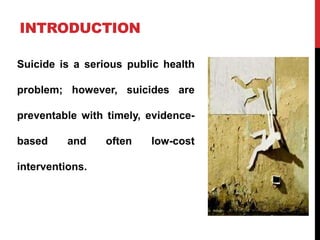
Suicide is a serious public health
problem; however, suicides are
preventable with timely, evidence-
based and often low-cost
interventions.
DEFINITION OF SUICIDE
Originally, the word suicide, founded on Latin language
‘sui’ (oneself) and ‘caedes’ (killing)
suicide constitutes all cases of death directly or indirectly
resulting from act of a person who is aware of the consequences
of the behavior.
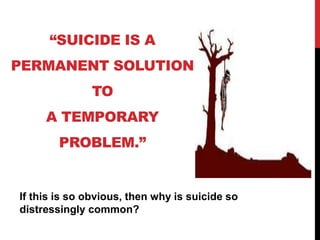
“SUICIDE IS A
PERMANENT SOLUTION
TO
A TEMPORARY
PROBLEM.”
If this is so obvious, then why is suicide so
distressingly common?
PREVALENCE OF SUICIDE
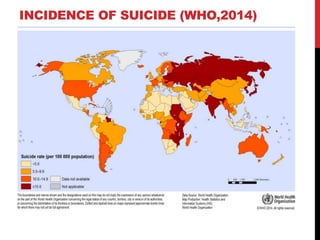
•Over 800 000 people die due to suicide every year.
•Stigma surrounding suicide leads to underreporting of data
•75% of global suicides occur in low- and middle-income countries.
•Ingestion of pesticide, hanging and firearms are the most common
methods of suicide globally.
•Reviewed September 2016
INCIDENCE OF SUICIDE (WHO,2014)
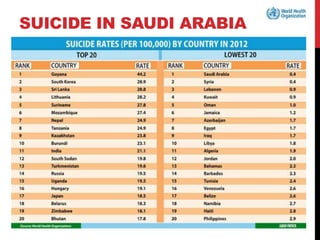
SUICIDE IN SAUDI ARABIA
.
WHAT FACTORS AFFECT SUICIDE
RATES?
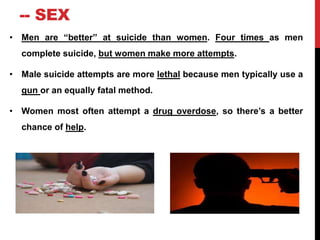
-- SEX
• Men are “better” at suicide than women. Four times as men
complete suicide, but women make more attempts.
• Male suicide attempts are more lethal because men typically use a
gun or an equally fatal method.
• Women most often attempt a drug overdose, so there’s a better
chance of help.
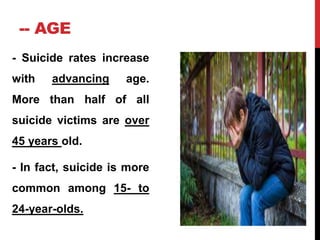
-- AGE
- Suicide rates increase
with advancing age.
More than half of all
suicide victims are over
45 years old.
- In fact, suicide is more
common among 15- to
24-year-olds.
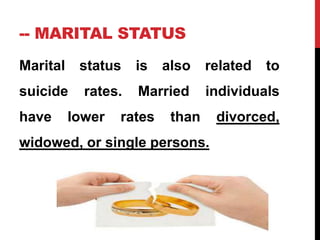
-- MARITAL STATUS
Marital status is also related to
suicide rates. Married individuals
have lower rates than divorced,
widowed, or single persons.
-- HEALTH FACTORS
Mental health conditions
• Depression
• Bipolar (manic-depressive) disorder
• Schizophrenia
• Borderline or antisocial personality
disorder
• Anxiety disorders
• Substance abuse disorders
Serious or chronic health condition
and/or pain
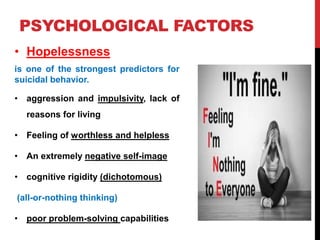
PSYCHOLOGICAL FACTORS
• Hopelessness
is one of the strongest predictors for
suicidal behavior.
• aggression and impulsivity, lack of
reasons for living
• Feeling of worthless and helpless
• An extremely negative self-image
• cognitive rigidity (dichotomous)
(all-or-nothing thinking)
• poor problem-solving capabilities
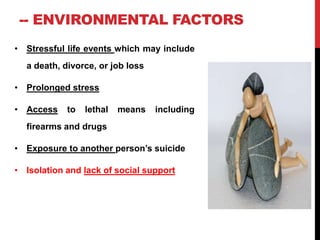
-- ENVIRONMENTAL FACTORS
• Stressful life events which may include
a death, divorce, or job loss
• Prolonged stress
• Access to lethal means including
firearms and drugs
• Exposure to another person’s suicide
• Isolation and lack of social support
-- HISTORICAL FACTORS
Previous suicide attempts
A history of a suicide attempt is a major risk factor for both
repeated nonfatal suicidal behavior and suicide.
Family history of suicide attempts
FORMS OF SUICIDE
1- depressive ( planned).
2- impulsive .
3- away of attracting attention.
MODES OF SUICIDE
BLEEDING
WRIST CUTTING
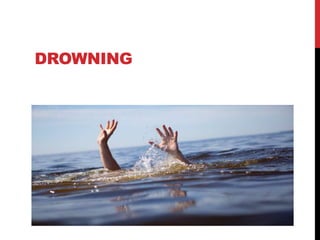
DROWNING
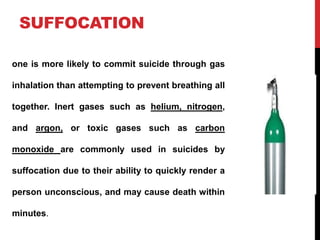
SUFFOCATION
one is more likely to commit suicide through gas
inhalation than attempting to prevent breathing all
together. Inert gases such as helium, nitrogen,
and argon, or toxic gases such as carbon
monoxide are commonly used in suicides by
suffocation due to their ability to quickly render a
person unconscious, and may cause death within
minutes.
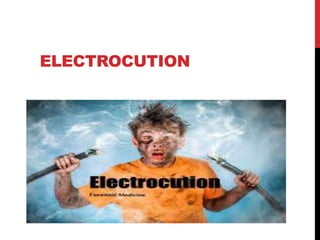
ELECTROCUTION
JUMPING FROM HEIGHT
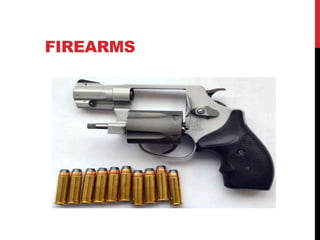
FIREARMS
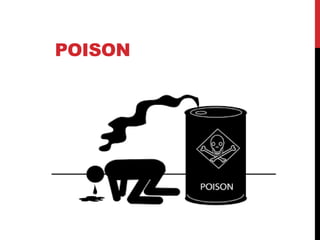
POISON
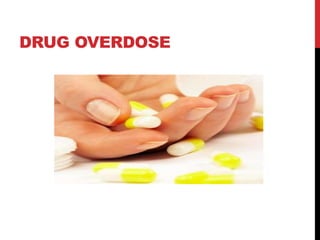
DRUG OVERDOSE
SUICIDE WARNING SIGNS
-- SUICIDE WARNING SIGNS
Talk
•Direct statements (I will end my life)
•I can't go on," "Nothing matters anymore," "I wish I
were dead"
•Being a burden to others
•Experiencing unbearable pain
•Having no reason to live
-- SUICIDE WARNING SIGNS
Behavior
•Looking for a way to kill themselves
•Acting recklessly
•Isolating from family and friends
•Sleeping too much or too little
•Visiting or calling people to say goodbye
•Giving away his own possessions
-- SUICIDE WARNING SIGNS
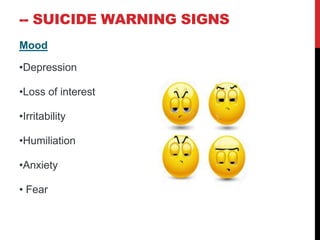
Mood
•Depression
•Loss of interest
•Irritability
•Humiliation
•Anxiety
• Fear
PREVENTION
PREVENTION
Universal prevention strategies include:
• generally improving the quality of people’s lives thereby
reducing stress
• decreasing the availability of lethal means, such as control
of guns.
• Selective strategies include in schools and institutions so
that depressed and suicidal individuals can be identified and
treated before they harm themselves
• focusing on high-risk groups those already diagnosed as
depressed
• Assert religious and cultural believes that discourage it.
ASSESSMENT
PSYCHIATRIC ASSESSMENT
Suicidal behaviors are frequently symptoms of underlying
mental health problems. Therefore, a suicide risk assessment
cannot be undertaken in isolation from an overall mental health
assessment.
INTERVIEW PROCESS
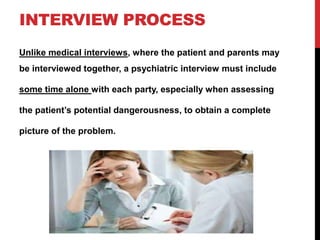
Unlike medical interviews, where the patient and parents may
be interviewed together, a psychiatric interview must include
some time alone with each party, especially when assessing
the patient’s potential dangerousness, to obtain a complete
picture of the problem.
DIRECT QUESTION …???
Contrary to popular myth, children and adolescents do not
become suicidal when asked about suicidal thoughts. It is
extremely important that the physician ask about suicidal
ideation, plans, or attempts openly and frankly:
A patient who answers no to these questions is probably not
telling the full story.
HISTORY OF SUICIDAL BEHAVIORS
• Has the person harmed himself or herself before?
• What were the details and circumstances of the
• previous attempt/s?
• Is there a history of suicide of a family member
or friend?
CURRENT SUICIDAL THOUGHTS
• Are suicidal thoughts and feelings present?
• What are these thoughts (determine the content, eg guilt or
delusions)?
• When did these thoughts begin?
• How frequent are they?
• How persistent are they?
• What has happened since these thoughts started?
• Can the person control them?
• What has stopped the person from acting on their thoughts so
far?
LETHALITY/INTENT
• What is the person’s degree of suicidal intent?
• Was their attempt carefully planned or impulsive?
• Has the person finalized personal business, eg
given away their possessions and said their
goodbyes?*
PRESENCE OF A SUICIDE PLAN
• How far has the suicide planning process
proceeded?
• Specific method, place, time?
• How long has the person had the plans?
• How realistic are the plans?
ACCESS TO MEANS AND KNOWLEDGE
• Has the person made a special effort to find out
information about methods of suicide or do they have
particular knowledge about using lethal means?
• Is there any item or aspect of the in-patient environment
that may be used as a means to self-harm?
• Type of occupation? For example, police officer (access
to gun), health worker (access to drugs).
SAFETY OF OTHERS
• Have the person’s thoughts ever included harming
someone else as well as himself or herself?
• Has the person harmed anyone else?
• What is the person’s rationale for harming another
person?
• Is there a risk of murder-suicide?
COPING POTENTIAL OR CAPACITY
• Does the person possess the capacity to enter into
a therapeutic alliance?
• personal strengths or effective coping strategies:
How have they managed previous life events and
stressors?
• Are there social or community supports (eg family,
friends, church, general practitioner)?
nursing observation
during hospitalization
NURSING OBSERVATION LEVELS
• On admission, the doctor, in consultation with the senior nurse,
is to determine the category of nursing observation.
• A clear explanation is to be given to the patient about the
reason for the particular observation level.
• Levels are to be reviewed throughout each shift by the treating
team & report to senior nurse to minimize the level of
unnecessary restriction to the patient’s rights
-- HIGH LEVEL OF IMMEDIATE RISK
Patient is to be contained in a locked facility.
■ Patient is to be nursed on a 1:1 basis.
■ Nurse is to be in close proximity to patient .
■ Patient is to be checked for signs of life (eg respiration) each
10 minute interval throughout the night and these are to be
documented.
■ There is no leave to be granted.
■ Individual observations chart kept as part of patient’s medical
record.
PATIENT IS ASSESSED AS A LOWER LEVEL OF
RISK OF SUICIDE OR SELF-HARM.
• Patient is checked every 30 minutes throughout
the day and night.
• Patient is confined to the ward.
• Patient must be with a member of staff when out of
the unit.
• Individual observations chart kept as part of
patient’s medical record.
PATIENT IS NOT CURRENTLY IN SELF-HARM
RISK.
Patient is checked every 2 hours and at change of
shift.
NURSING INTERVENTION
• The client’s room should be near the nurses’ station and
within view of the staff, not near to an exit, elevator, or stairs.
• Be alert to the possibility of the client saving up his or her
medications or obtaining medications or dangerous objects
from other clients or visitors. You may need to check the
client’s mouth after medication administration or use liquid
medications to ensure that they are ingested.
• Convey that you care about the client and that you believe the
client is a worthwhile human being.
• Give the client support for efforts to remain out of his or her
room, to interact with other clients, or to attend activities.
• Encourage and support the client’s expression of anger.
(Remember: Do not take the anger personally.)
• Involve the client as much as possible in planning his or her
own treatment.
Examine with the client his or her home environment and
relationships outside the hospital.
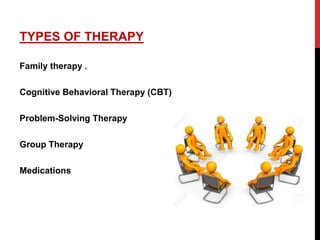
TYPES OF THERAPY
Family therapy .
Cognitive Behavioral Therapy (CBT)
Problem-Solving Therapy
Group Therapy
Medications
Suicide

Suicide

  • 1.
    By/ Dr. InasEbeid Faculty of nursing Taibah university
  • 2.
    LEARNING OBJECTIVES Upon completionof this lecture the audience will be able to: 1- Define suicide 2- Determine the incidence of suicide 3- Identify the factors that affect suicide rates 4- List modes of suicide 5- Recognize the measures of prevention for suicide 6- Assess patient with suicidal ideation 6- Identify nursing interventions for suicide
  • 3.
    OUTLINES 1- Definition ofsuicide 2- Incidence of suicide 3- Risk factors of suicide 4- Modes of suicide 5- Measures of prevention for suicide 6- Assessment of patient with suicidal ideation 6- Nursing interventions for suicide
  • 4.
    INTRODUCTION Every year morethan 800 000 people take their own life and there are many more people who attempt suicide. Every suicide is a tragedy that affects families, communities and entire countries and has long- lasting effects on the people left behind.
  • 5.
    INTRODUCTION Suicide is aserious public health problem; however, suicides are preventable with timely, evidence- based and often low-cost interventions.
  • 6.
    DEFINITION OF SUICIDE Originally,the word suicide, founded on Latin language ‘sui’ (oneself) and ‘caedes’ (killing) suicide constitutes all cases of death directly or indirectly resulting from act of a person who is aware of the consequences of the behavior.
  • 7.
    “SUICIDE IS A PERMANENTSOLUTION TO A TEMPORARY PROBLEM.” If this is so obvious, then why is suicide so distressingly common?
  • 8.
    PREVALENCE OF SUICIDE •Over800 000 people die due to suicide every year. •Stigma surrounding suicide leads to underreporting of data •75% of global suicides occur in low- and middle-income countries. •Ingestion of pesticide, hanging and firearms are the most common methods of suicide globally. •Reviewed September 2016
  • 9.
  • 10.
  • 11.
    WHAT FACTORS AFFECTSUICIDE RATES?
  • 12.
    -- SEX • Menare “better” at suicide than women. Four times as men complete suicide, but women make more attempts. • Male suicide attempts are more lethal because men typically use a gun or an equally fatal method. • Women most often attempt a drug overdose, so there’s a better chance of help.
  • 13.
    -- AGE - Suiciderates increase with advancing age. More than half of all suicide victims are over 45 years old. - In fact, suicide is more common among 15- to 24-year-olds.
  • 14.
    -- MARITAL STATUS Maritalstatus is also related to suicide rates. Married individuals have lower rates than divorced, widowed, or single persons.
  • 15.
    -- HEALTH FACTORS Mentalhealth conditions • Depression • Bipolar (manic-depressive) disorder • Schizophrenia • Borderline or antisocial personality disorder • Anxiety disorders • Substance abuse disorders Serious or chronic health condition and/or pain
  • 16.
    PSYCHOLOGICAL FACTORS • Hopelessness isone of the strongest predictors for suicidal behavior. • aggression and impulsivity, lack of reasons for living • Feeling of worthless and helpless • An extremely negative self-image • cognitive rigidity (dichotomous) (all-or-nothing thinking) • poor problem-solving capabilities
  • 17.
    -- ENVIRONMENTAL FACTORS •Stressful life events which may include a death, divorce, or job loss • Prolonged stress • Access to lethal means including firearms and drugs • Exposure to another person’s suicide • Isolation and lack of social support
  • 18.
    -- HISTORICAL FACTORS Previoussuicide attempts A history of a suicide attempt is a major risk factor for both repeated nonfatal suicidal behavior and suicide. Family history of suicide attempts
  • 19.
    FORMS OF SUICIDE 1-depressive ( planned). 2- impulsive . 3- away of attracting attention.
  • 20.
  • 21.
  • 22.
  • 23.
    SUFFOCATION one is morelikely to commit suicide through gas inhalation than attempting to prevent breathing all together. Inert gases such as helium, nitrogen, and argon, or toxic gases such as carbon monoxide are commonly used in suicides by suffocation due to their ability to quickly render a person unconscious, and may cause death within minutes.
  • 24.
  • 25.
  • 26.
  • 27.
  • 28.
  • 29.
  • 30.
    -- SUICIDE WARNINGSIGNS Talk •Direct statements (I will end my life) •I can't go on," "Nothing matters anymore," "I wish I were dead" •Being a burden to others •Experiencing unbearable pain •Having no reason to live
  • 31.
    -- SUICIDE WARNINGSIGNS Behavior •Looking for a way to kill themselves •Acting recklessly •Isolating from family and friends •Sleeping too much or too little •Visiting or calling people to say goodbye •Giving away his own possessions
  • 32.
    -- SUICIDE WARNINGSIGNS Mood •Depression •Loss of interest •Irritability •Humiliation •Anxiety • Fear
  • 33.
  • 34.
    PREVENTION Universal prevention strategiesinclude: • generally improving the quality of people’s lives thereby reducing stress • decreasing the availability of lethal means, such as control of guns. • Selective strategies include in schools and institutions so that depressed and suicidal individuals can be identified and treated before they harm themselves • focusing on high-risk groups those already diagnosed as depressed • Assert religious and cultural believes that discourage it.
  • 35.
  • 36.
    PSYCHIATRIC ASSESSMENT Suicidal behaviorsare frequently symptoms of underlying mental health problems. Therefore, a suicide risk assessment cannot be undertaken in isolation from an overall mental health assessment.
  • 37.
    INTERVIEW PROCESS Unlike medicalinterviews, where the patient and parents may be interviewed together, a psychiatric interview must include some time alone with each party, especially when assessing the patient’s potential dangerousness, to obtain a complete picture of the problem.
  • 38.
    DIRECT QUESTION …??? Contraryto popular myth, children and adolescents do not become suicidal when asked about suicidal thoughts. It is extremely important that the physician ask about suicidal ideation, plans, or attempts openly and frankly: A patient who answers no to these questions is probably not telling the full story.
  • 39.
    HISTORY OF SUICIDALBEHAVIORS • Has the person harmed himself or herself before? • What were the details and circumstances of the • previous attempt/s? • Is there a history of suicide of a family member or friend?
  • 40.
    CURRENT SUICIDAL THOUGHTS •Are suicidal thoughts and feelings present? • What are these thoughts (determine the content, eg guilt or delusions)? • When did these thoughts begin? • How frequent are they? • How persistent are they? • What has happened since these thoughts started? • Can the person control them? • What has stopped the person from acting on their thoughts so far?
  • 41.
    LETHALITY/INTENT • What isthe person’s degree of suicidal intent? • Was their attempt carefully planned or impulsive? • Has the person finalized personal business, eg given away their possessions and said their goodbyes?*
  • 42.
    PRESENCE OF ASUICIDE PLAN • How far has the suicide planning process proceeded? • Specific method, place, time? • How long has the person had the plans? • How realistic are the plans?
  • 43.
    ACCESS TO MEANSAND KNOWLEDGE • Has the person made a special effort to find out information about methods of suicide or do they have particular knowledge about using lethal means? • Is there any item or aspect of the in-patient environment that may be used as a means to self-harm? • Type of occupation? For example, police officer (access to gun), health worker (access to drugs).
  • 44.
    SAFETY OF OTHERS •Have the person’s thoughts ever included harming someone else as well as himself or herself? • Has the person harmed anyone else? • What is the person’s rationale for harming another person? • Is there a risk of murder-suicide?
  • 45.
    COPING POTENTIAL ORCAPACITY • Does the person possess the capacity to enter into a therapeutic alliance? • personal strengths or effective coping strategies: How have they managed previous life events and stressors? • Are there social or community supports (eg family, friends, church, general practitioner)?
  • 46.
  • 47.
    NURSING OBSERVATION LEVELS •On admission, the doctor, in consultation with the senior nurse, is to determine the category of nursing observation. • A clear explanation is to be given to the patient about the reason for the particular observation level. • Levels are to be reviewed throughout each shift by the treating team & report to senior nurse to minimize the level of unnecessary restriction to the patient’s rights
  • 48.
    -- HIGH LEVELOF IMMEDIATE RISK Patient is to be contained in a locked facility. ■ Patient is to be nursed on a 1:1 basis. ■ Nurse is to be in close proximity to patient . ■ Patient is to be checked for signs of life (eg respiration) each 10 minute interval throughout the night and these are to be documented. ■ There is no leave to be granted. ■ Individual observations chart kept as part of patient’s medical record.
  • 49.
    PATIENT IS ASSESSEDAS A LOWER LEVEL OF RISK OF SUICIDE OR SELF-HARM. • Patient is checked every 30 minutes throughout the day and night. • Patient is confined to the ward. • Patient must be with a member of staff when out of the unit. • Individual observations chart kept as part of patient’s medical record.
  • 50.
    PATIENT IS NOTCURRENTLY IN SELF-HARM RISK. Patient is checked every 2 hours and at change of shift.
  • 51.
    NURSING INTERVENTION • Theclient’s room should be near the nurses’ station and within view of the staff, not near to an exit, elevator, or stairs. • Be alert to the possibility of the client saving up his or her medications or obtaining medications or dangerous objects from other clients or visitors. You may need to check the client’s mouth after medication administration or use liquid medications to ensure that they are ingested.
  • 52.
    • Convey thatyou care about the client and that you believe the client is a worthwhile human being. • Give the client support for efforts to remain out of his or her room, to interact with other clients, or to attend activities. • Encourage and support the client’s expression of anger. (Remember: Do not take the anger personally.) • Involve the client as much as possible in planning his or her own treatment.
  • 53.
    Examine with theclient his or her home environment and relationships outside the hospital.
  • 54.
    TYPES OF THERAPY Familytherapy . Cognitive Behavioral Therapy (CBT) Problem-Solving Therapy Group Therapy Medications