By,
Dr Amina Khan
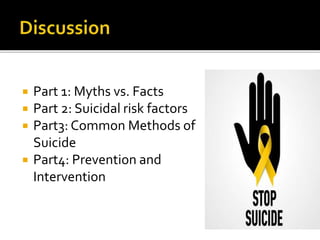
 Part 1: Myths vs. Facts
 Part 2: Suicidal risk factors
 Part3: Common Methods of
Suicide
 Part4: Prevention and
Intervention
 In the last 45 years suicide rates have increased
by 60% worldwide.
 Suicide is tenth leading cause of death
worldwide, among the three leading causes of
death among those aged 15-44 years in some
countries, and the second leading cause of
death in the 10-24yearsage group; these
figures do not include suicide attempts which
are up to 20 times more frequent than
completed suicide.
 Suicide can be a taboo topic in society. Often,
people feeling suicidal don’t want to worry or
burden anyone with how they feel and so they
don’t discuss it. By asking directly about suicide
you give them permission to tell you how they
feel. People who have felt suicidal will often say
what a huge relief it is to be able to talk about
what their experiencing. Once someone starts
talking they’ve got a better chance of
discovering other options to suicide.
 Suicidal behaviour indicates deep
unhappiness but not necessarily mental
disorder. Many people living with mental
disorders are not affected by suicidal
behaviour, and not all people who take
their own lives have a mental disorder.
 Although traditionallysuicide rates have
been highest among the male elderly, rates
among young people have been increasing to
such an extent that they are now the group
at highest risk in a third of countries, both
developed and developing.
 75%of global suicides occur in low-and
middle-income countries.
 Availability to means of suicide and the
lethality of those methods;
 Person’s place of residence, immigration
status;
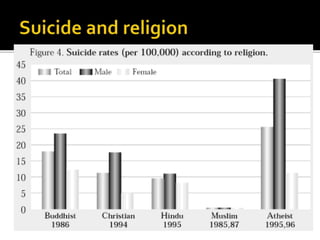
 Affiliation with religion;
 Economic andemployment conditions;
 Broken/disturbed relationship;
 Level of education;
 Acute life events;
 Marital problems, family pathology.
 General psychological risk factors are:
 Depressive disorder and certain other mental disorders;
 anxiety disorders;
 impulsivity , Aggressiveness and risk-taking behavior;
 sense of hopelessness, feeling trapped, cognitive
rigidity;
 Social withdrawal, isolation, living alone, loss of
support.
 Interpersonal conflict (bullying);
 Comorbidity;
 Abuse(physical or sexual abuse, especially in childhood)
 Personal loss (Early parental loss, divorce, separation,
death);
 (25 per 100,000) Scandinavia, Switzerland,
Germany, Austria, eastern European countries
(Belarus, Estonia, Lithuania, and the Russian
Federation) and Japan
 Japan-reported to have highest number of
cases.
 About one-third of suicides over the world
happen in India.
 Prime suicide site of the world –Golden Gate
Bridge in San Francisco.
 Life isn’t worth living
 My family would be better off without me
 Next time I’ll take enough pills to do the job right
 Giving away articles of either personal or ˆ
Take
my (prized collection, valuables) i don’t
need this stuff anymore ˆ
 Signs of planning a suicide.
 ˆI won’t be around to deal with that
 writing a suicide note ˆ
 You’ll be sorry when I’m gone
 ˆWithdrawal from family and friends ˆ
 Fatigue or loss of energy ˆ
 Diminished ability to think or concentrate,
slowed thinking or indecisiveness ˆ
 Feelings of worthlessness, self‐reproach, or
guilt ˆ
Thoughts of death, suicide, or wishes to
be dead .
 Restricting access to the means for suicide works.
restricting access to the most common means,
including pesticides, firearms and certain
medications.
 Health-care services need to incorporate suicide
prevention as a core component.
 Communities play a critical role in suicide prevention
specially in Mental disorders and harmful use of
alcohol.
 Providing social support to vulnerable individuals
and engage in follow-up care, fight stigma and
support those bereaved by suicide by Personal,
social, cultural and religious beliefs that discourage
suicide and support self-preservation
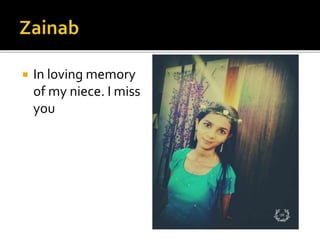
 In loving memory
of my niece. I miss
you

Suicide ppt

  • 1.
  • 2.
     Part 1:Myths vs. Facts  Part 2: Suicidal risk factors  Part3: Common Methods of Suicide  Part4: Prevention and Intervention
  • 4.
     In thelast 45 years suicide rates have increased by 60% worldwide.  Suicide is tenth leading cause of death worldwide, among the three leading causes of death among those aged 15-44 years in some countries, and the second leading cause of death in the 10-24yearsage group; these figures do not include suicide attempts which are up to 20 times more frequent than completed suicide.
  • 5.
     Suicide canbe a taboo topic in society. Often, people feeling suicidal don’t want to worry or burden anyone with how they feel and so they don’t discuss it. By asking directly about suicide you give them permission to tell you how they feel. People who have felt suicidal will often say what a huge relief it is to be able to talk about what their experiencing. Once someone starts talking they’ve got a better chance of discovering other options to suicide.
  • 6.
     Suicidal behaviourindicates deep unhappiness but not necessarily mental disorder. Many people living with mental disorders are not affected by suicidal behaviour, and not all people who take their own lives have a mental disorder.
  • 7.
     Although traditionallysuiciderates have been highest among the male elderly, rates among young people have been increasing to such an extent that they are now the group at highest risk in a third of countries, both developed and developing.  75%of global suicides occur in low-and middle-income countries.
  • 8.
     Availability tomeans of suicide and the lethality of those methods;  Person’s place of residence, immigration status;  Affiliation with religion;  Economic andemployment conditions;  Broken/disturbed relationship;  Level of education;  Acute life events;  Marital problems, family pathology.
  • 9.
     General psychologicalrisk factors are:  Depressive disorder and certain other mental disorders;  anxiety disorders;  impulsivity , Aggressiveness and risk-taking behavior;  sense of hopelessness, feeling trapped, cognitive rigidity;  Social withdrawal, isolation, living alone, loss of support.  Interpersonal conflict (bullying);  Comorbidity;  Abuse(physical or sexual abuse, especially in childhood)  Personal loss (Early parental loss, divorce, separation, death);
  • 10.
     (25 per100,000) Scandinavia, Switzerland, Germany, Austria, eastern European countries (Belarus, Estonia, Lithuania, and the Russian Federation) and Japan  Japan-reported to have highest number of cases.  About one-third of suicides over the world happen in India.  Prime suicide site of the world –Golden Gate Bridge in San Francisco.
  • 12.
     Life isn’tworth living  My family would be better off without me  Next time I’ll take enough pills to do the job right  Giving away articles of either personal or ˆ Take my (prized collection, valuables) i don’t need this stuff anymore ˆ  Signs of planning a suicide.  ˆI won’t be around to deal with that  writing a suicide note ˆ  You’ll be sorry when I’m gone
  • 13.
     ˆWithdrawal fromfamily and friends ˆ  Fatigue or loss of energy ˆ  Diminished ability to think or concentrate, slowed thinking or indecisiveness ˆ  Feelings of worthlessness, self‐reproach, or guilt ˆ Thoughts of death, suicide, or wishes to be dead .
  • 14.
     Restricting accessto the means for suicide works. restricting access to the most common means, including pesticides, firearms and certain medications.  Health-care services need to incorporate suicide prevention as a core component.  Communities play a critical role in suicide prevention specially in Mental disorders and harmful use of alcohol.  Providing social support to vulnerable individuals and engage in follow-up care, fight stigma and support those bereaved by suicide by Personal, social, cultural and religious beliefs that discourage suicide and support self-preservation
  • 16.
     In lovingmemory of my niece. I miss you