POSTURAL DRAINAGE
Definitio
nPostural drainage (bronchial drainage), is an
intervention for airway clearance by mobilizing
secretions in one or more lung segments to the
central airway by placing the patient in various
positions so gravity assists in the drainage process.
It is effective in cystic fibrosis, bronchiectasis, & other
pulmonary diseases.
Goals & indications
Prevent accumulation of secretions in patients at risk of
pulmonary complications :-
Diseases with increased production or viscosity of
mucus
Prolonged bed rest
Who has received generalanaesthesia
Painful incision causing restricted deep breathing &
coughing
Patients on ventilator
Remove accumulated secretions from the lung :-
Acute or chronic lung disease
Generally weak or elderlypeople
Patients with artificial airways
Contraindications
Severe hemoptysis
Untreated acute conditions
Severe pulmonary edema
Congestive heart failure
Large pleural effusion
Pulmonary embolism
pneumothorax
Cardiovascular instability
Cardiac arrhythmias
Severe hypertension or hypotension
Recent MI
Unstable angina
Recent neurosurgery
Head down position may cause increased ICP – use
modified positions
Preparation
All the patients do not require postural drainage
for all the lung segments. So the procedure must
be based on the clinical findings.
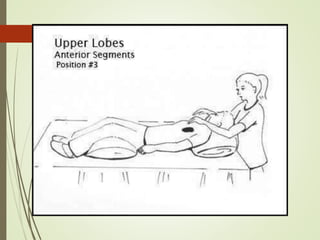
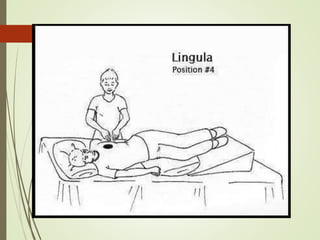
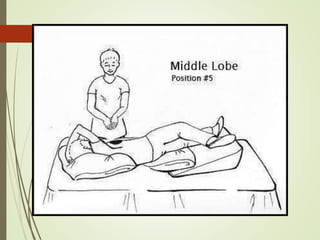
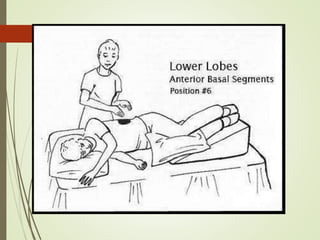
In postural drainage, the person is tilted or propped
at an angle to help drain secretions from the
lungs.
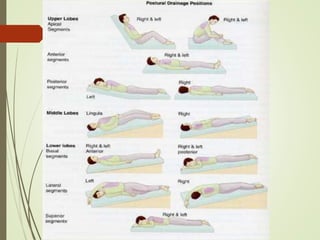
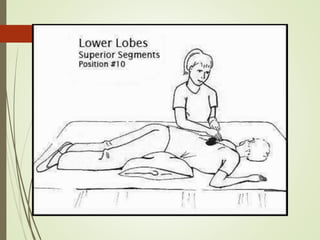
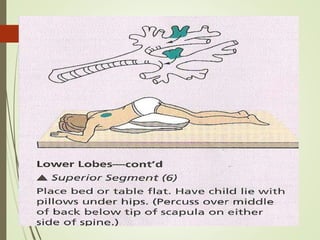
The lower lobes require drainage most frequently
because the upper lobes drain by gravity.
Before postural drainage, the client may be given
a bronchodilator medication or nebulization
therapy to loosen secretions.
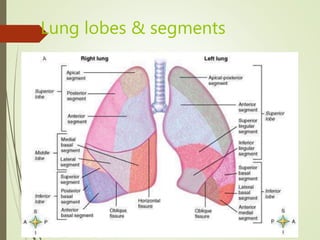
Lung lobes & segments
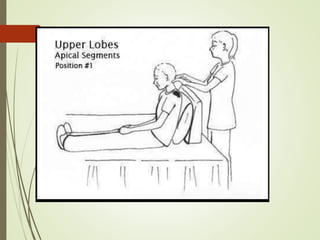
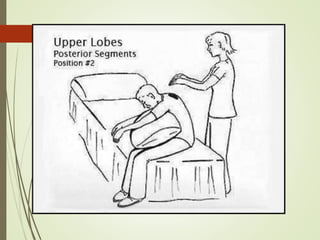
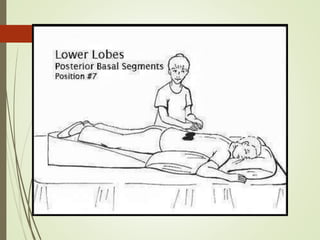
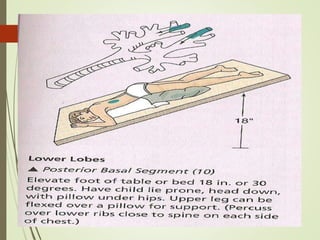
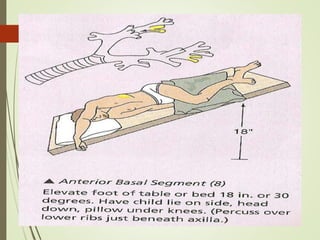
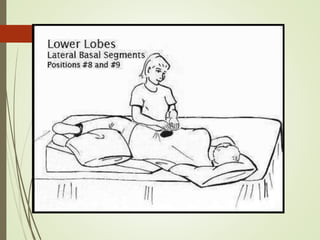
Position for chest
physiotherapy
Manual techniques
Percussion
Chest clapping
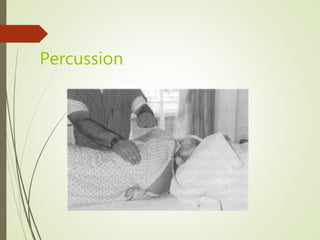
Rhythmical force is applied with the cupped hands
against the thorax, over the involved lung
segment, trapping air between patient’s thorax &
caregiver’s hands.
Aim – dislodging or loosening bronchial secretions
from airways.
Performed during both inspiratory & expiratory
phase of breathing.
Sound of percussion should be hollow.
Even & steady rhythm – 100 – 480 times/min.
Force should be equal B/L & to the patient’s comfort.
Infants – use 4 fingers cupped, 3 fingers with middle
finger tented or thenar & hypothenar surface of hand.
Should not be done on bony prominences, breast
tissue – discomfort & reduce effectiveness of treatment.
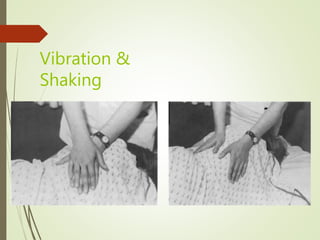
Vibration &
Shaking
Opposite ends of spectrum.
Vibration –
Gentle high frequencyforce
Delivered through sustained co-contraction of
caregiver’s to apply vibratory force.
Shaking –
Vigorous
Similar to vibration but is a bouncing maneuver, also
referred as rib springing – supplying concurrent
compressive force to chest wall.
Performed only during expiration.

Postural drainage

  • 1.
  • 2.
    Definitio nPostural drainage (bronchialdrainage), is an intervention for airway clearance by mobilizing secretions in one or more lung segments to the central airway by placing the patient in various positions so gravity assists in the drainage process. It is effective in cystic fibrosis, bronchiectasis, & other pulmonary diseases.
  • 3.
    Goals & indications Preventaccumulation of secretions in patients at risk of pulmonary complications :- Diseases with increased production or viscosity of mucus Prolonged bed rest Who has received generalanaesthesia Painful incision causing restricted deep breathing & coughing Patients on ventilator Remove accumulated secretions from the lung :- Acute or chronic lung disease Generally weak or elderlypeople Patients with artificial airways
  • 4.
    Contraindications Severe hemoptysis Untreated acuteconditions Severe pulmonary edema Congestive heart failure Large pleural effusion Pulmonary embolism pneumothorax Cardiovascular instability Cardiac arrhythmias Severe hypertension or hypotension Recent MI Unstable angina Recent neurosurgery Head down position may cause increased ICP – use modified positions
  • 5.
    Preparation All the patientsdo not require postural drainage for all the lung segments. So the procedure must be based on the clinical findings. In postural drainage, the person is tilted or propped at an angle to help drain secretions from the lungs. The lower lobes require drainage most frequently because the upper lobes drain by gravity. Before postural drainage, the client may be given a bronchodilator medication or nebulization therapy to loosen secretions.
  • 6.
    Lung lobes &segments
  • 8.
  • 21.
  • 22.
  • 23.
    Chest clapping Rhythmical forceis applied with the cupped hands against the thorax, over the involved lung segment, trapping air between patient’s thorax & caregiver’s hands. Aim – dislodging or loosening bronchial secretions from airways. Performed during both inspiratory & expiratory phase of breathing.
  • 24.
    Sound of percussionshould be hollow. Even & steady rhythm – 100 – 480 times/min. Force should be equal B/L & to the patient’s comfort. Infants – use 4 fingers cupped, 3 fingers with middle finger tented or thenar & hypothenar surface of hand. Should not be done on bony prominences, breast tissue – discomfort & reduce effectiveness of treatment.
  • 25.
  • 26.
    Opposite ends ofspectrum. Vibration – Gentle high frequencyforce Delivered through sustained co-contraction of caregiver’s to apply vibratory force. Shaking – Vigorous Similar to vibration but is a bouncing maneuver, also referred as rib springing – supplying concurrent compressive force to chest wall. Performed only during expiration.