Successfully Implementing an
  Aggregate Spend Solution

     February 19, 2013
Agenda

   Understanding the Current Environment - Survey
   Implementation Case Study
   Approach for Implementing Aggregate Spend Solutions
   Key Takeaways
Understanding the Current Environment - Survey
AGGREGATE SPEND SOLUTION/SYSTEM EFFECTIVENESS


 My Company is Live on an Aggregate Spend Solution
   • The system optimally supports the business process
   • Not all processes are automated but the solution is functional
 My Company is Currently Implementing an Aggregate Spend
  Solution
   • First Implementation
   • Implementing upgrades or improvements to the existing solution
   • Replacing Existing Solution
 My Company is Currently Considering a new Aggregate
  Spend Solution
Understanding the Current Environment - Survey
IMPLEMENTATION EFFORT


 My Implementation was completed on time, within budget
  and encountered minimal issues
 Experienced Issues implementing the Aggregate Spend
  Systems
   • Experienced difficulties implementing business/functional
     requirements
   • Not all data elements captured in the source systems
   • Encountered delays integrating spend reporting system
 Will need to make modifications based on release of final
  rule
Implementation Case Study
REQUIREMENT


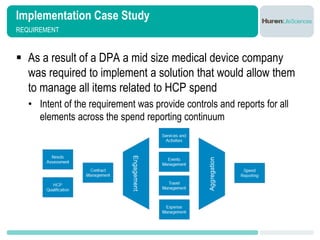
 As a result of a DPA a mid size medical device company
  was required to implement a solution that would allow them
  to manage all items related to HCP spend
   • Intent of the requirement was provide controls and reports for all
     elements across the spend reporting continuum
Implementation Case Study
SELECTED SOLUTION


 Without understanding business requirements or determining
  required functions, executive management selected a
  software solution to address DPA requirements
 “Ready, Fire, Aim….” approach resulted in the following
  gaps:
   • Business Process was not identified
   • Data requirements were not identified
   • Users were not involved in the solution/software selection
Implementation Case Study
RESULTS


 After 1 year of attempting to implement the solution, the
  manufacturer abandoned the effort to implement the
  selected solution
 Resulted in:
   • Loss of confidence in attempted solution by the business users
   • Loss of confidence by the Federal Monitors
   • Significant budget overrun
 Manufacturer revised approach
                           Select     Develop
Determine      Determine              Functional and               Test and
                           Software                    Implement
Requirements   Business               Technical                    Rollout
               Process     Solution
                                      Specs
Approach for Implementing
Aggregate Spend Solutions
Implementing an Aggregate Spend Solution
APPROACH


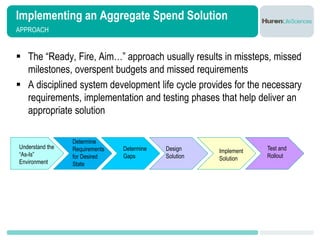
 The “Ready, Fire, Aim…” approach usually results in missteps, missed
  milestones, overspent budgets and missed requirements
 A disciplined system development life cycle provides for the necessary
  requirements, implementation and testing phases that help deliver an
  appropriate solution

                 Determine
Understand the   Requirements   Determine   Design                 Test and
                                                       Implement
“As-Is”          for Desired    Gaps        Solution               Rollout
                                                       Solution
Environment      State
Implementing an Aggregate Spend Solution
UNDERSTAND THE “AS-IS” ENVIRONMENT


 Step 1: Assess Current Landscape
    Document the “as-is” process for capturing all spend data across
     the spend reporting continuum
    Create an inventory of existing master data elements (i.e. HCP
     master data, natures, purposes, product, etc.)
    Create an inventory of systems to capture and manage HCP master
     and spend data
 Challenges
   o   Processes are not fully developed or integrated
   o   Different business units are involved and priorities differ
   o   Managing Uncertainty
   o   Organization may not be aware of all necessary reporting elements
Implementing an Aggregate Spend Solution
DETERMINE REQUIREMENTS FOR DESIRED STATE

 Step 2: Develop a functional vision for the “to-be” state
    Develop process/work flow descriptions that describe/illustrate how the
     “to-be” process should function
    Identify all functional processes, regulatory requirements, work flow
     requirements and interdepartmental dependencies
    Identify required data elements to satisfy process, regulatory, work flow
     and interdepartmental requirements
    Identify technology touch points or system interactions throughout the
     business process
    Identify control points or items
    Ensure an ability to produce required reports
    Ensure an ability to produce an audit trail
Implementing an Aggregate Spend Solution
DETERMINE REQUIREMENTS FOR DESIRED STATE


 Step 2: Challenges
   o Planning/Implementing for regulatory changes
      – Requirements recently published in the Final Rule
         o   Data Collection beginning 1 August 2013
         o   Disclosures must be reported to CMS by March 31, 2014
         o   Data published for public on Sept 20, 2014
         o   45-day “review and correction” period to ensure accuracy of disclosures
         o   15-day post-review period
   o Resistance to change
   o Looking for technology solutions before completely identifying
     desired processes, or functions or approaches
Implementing an Aggregate Spend Solution
DETERMINE GAPS


 Step 3: Identify gaps that exist between the existing
  environment and desired “to-be” state
    Determine gaps for:
      ‐   Business processes,
      ‐   Functional requirements, and
      ‐   Data elements
    Identify root cause for gaps identified – not all gaps are system
     related
    Identify approach for closing identified gaps
 Challenges
   o Gaps in data collection can be result of gaps in policy or result from
     business processes not being followed
Implementing an Aggregate Spend Solution
DESIGN SOLUTION


 Step 4: Design solution that will support the desired “to-be”
  state
    Determine system requirements that support business process,
     functional requirements, regulatory requirements, workflow,
     reporting requirements
    Incorporate all design elements in a specification document
    Select system components for the solution that satisfy functional
     and business requirements
      ‐   Balance Processes with Technology

      ‐   Consider a Heterogeneous Solution
Implementing an Aggregate Spend Solution
DESIGN SOLUTION


 Step 4 Challenges
   o Teams shift focus to technology features instead of satisfying
     business requirements
   o Ensure solution is scalable and can adapt to a changing business
     and regulatory environment
   o Balance solution design with what’s “doable”
      ‐   Budget
      ‐   Time
      ‐   Resources
      ‐   Regulatory requirements
      ‐   Mandatory Milestones
Implementing an Aggregate Spend Solution
IMPLEMENT SOLUTION


 Step 5: Implement design and prepare for process changes
    Implement selected vendor solutions
    Develop data extraction and load routines
    Begin developing system and user acceptance test plans and
     scripts
    Ensure that implemented functionality developed is cross
     referenced to functional requirements and is operational in
     accordance with the specification
Implementing an Aggregate Spend Solution
IMPLEMENT SOLUTION


 Step 5: Challenges
   o Business users want to change requirements during implementation
     phase
      ‐   “Lock Down” requirements and minimize scope creep during the
          implementation phase
   o Not enough time is allocated to the implementation and unit test
     phase
      o Time for testing is usually the first area “squeezed” when other issues arise
        and milestones aren’t adjusted
   o Ensure sufficient unit testing is conducted by vendor and internal
     resources
Implementing an Aggregate Spend Solution
TEST AND ROLLOUT

 Step 6: Conduct System Test and User Acceptance Test
  (UAT) - Deploy Solution to the Production Environment
    Conduct full end to end testing and ensure that all functions operate
     as specified in the requirements documents
    Ensure full participation by the User Community during UAT
    Ensure proper training is conducting
    Implement support infrastructure sufficient enough to address on
     going business needs
 Step 6 Challenges:
   o Business users have other commitments
   o Support infrastructure must be established before the solution is
     deployed
Implementing an Aggregate Spend Solution
PROJECT MANAGEMENT


 Good project management is key to ensuring that the
  solution implementation is successfully deployed on-time
  and within budget
    Ensure structure/procedures established to proactively manage:
      –   Project Schedule
      –   Project Budget
      –   Issues – technical, compliance and business
      –   Risk
 Challenges
   o Importance of assigning a skilled project manager full-time is
     sometimes overlooked
   o Project manager must have understanding of the subject matter,
     compliance requirements and has IT PM skills
Implementing an Aggregate Spend Solution
RESOURCES AND STAFFING

 Sufficient number of project resources should be assigned, roles
  clearly defined and oversight structure must be maintained
  Role                             Responsibilities
  Executive                        • Provide Executive leadership and guidance
  Management/Steering              • Resolve issues/ “sticking points”
  Committee
  Project Core Working Team/ IT,   • Overall responsibility for Quality Assurance
  Compliance and Business          • Content expert subject matter, regulatory requirements, business functional
  Sponsors                           requirements, IT interactions
                                   • Provide independent review of all deliverables generated by the project team
                                   • Work closely with the project team to ensure total quality in all project activities
  Project Manager                  • Manage day to day activities of the project team
                                   • Lead and manage project activities and resolve issues
                                   • Verify the completion of milestones and deliverables
                                   • Work with the project team to develop project deliverables
  Business Analysts                • Create all project deliverables
  IT team                          • Performs business, process, and data analysis
                                   • Evaluate/assess technical and data components of solution architecture
                                   • Complete application configuration
                                   • Develop data analysis models
                                   • Conduct system/integration tests
                                   • Conduct UAT
Key Takeaways
Recap and Key Takeaways


 Mistakes are made when companies select software
  solutions prior to understanding the business needs,
  processes and requirements.
  • Avoid the “Ready, Fire, Aim…” approach at all costs
 Implement solutions using a disciplined system development
  life cycle
  • Implementation cannot always be rushed to meet an established
    milestone without introducing risk
 Ensure that the project is staffed appropriately with enough
  resources that have the necessary skill sets
Thank you!

Mark Linver
Managing Director
mlinver@huronconsultinggroup.com
312.515.1677

Suj Patel
Director
sujpatel@huronconsultinggroup.com
312.833.2635

Successfully Implementing an Aggregate Spend Solution

  • 1.
    Successfully Implementing an Aggregate Spend Solution February 19, 2013
  • 2.
    Agenda  Understanding the Current Environment - Survey  Implementation Case Study  Approach for Implementing Aggregate Spend Solutions  Key Takeaways
  • 3.
    Understanding the CurrentEnvironment - Survey AGGREGATE SPEND SOLUTION/SYSTEM EFFECTIVENESS  My Company is Live on an Aggregate Spend Solution • The system optimally supports the business process • Not all processes are automated but the solution is functional  My Company is Currently Implementing an Aggregate Spend Solution • First Implementation • Implementing upgrades or improvements to the existing solution • Replacing Existing Solution  My Company is Currently Considering a new Aggregate Spend Solution
  • 4.
    Understanding the CurrentEnvironment - Survey IMPLEMENTATION EFFORT  My Implementation was completed on time, within budget and encountered minimal issues  Experienced Issues implementing the Aggregate Spend Systems • Experienced difficulties implementing business/functional requirements • Not all data elements captured in the source systems • Encountered delays integrating spend reporting system  Will need to make modifications based on release of final rule
  • 5.
  • 6.
    Implementation Case Study REQUIREMENT As a result of a DPA a mid size medical device company was required to implement a solution that would allow them to manage all items related to HCP spend • Intent of the requirement was provide controls and reports for all elements across the spend reporting continuum
  • 7.
    Implementation Case Study SELECTEDSOLUTION  Without understanding business requirements or determining required functions, executive management selected a software solution to address DPA requirements  “Ready, Fire, Aim….” approach resulted in the following gaps: • Business Process was not identified • Data requirements were not identified • Users were not involved in the solution/software selection
  • 8.
    Implementation Case Study RESULTS After 1 year of attempting to implement the solution, the manufacturer abandoned the effort to implement the selected solution  Resulted in: • Loss of confidence in attempted solution by the business users • Loss of confidence by the Federal Monitors • Significant budget overrun  Manufacturer revised approach Select Develop Determine Determine Functional and Test and Software Implement Requirements Business Technical Rollout Process Solution Specs
  • 9.
  • 10.
    Implementing an AggregateSpend Solution APPROACH  The “Ready, Fire, Aim…” approach usually results in missteps, missed milestones, overspent budgets and missed requirements  A disciplined system development life cycle provides for the necessary requirements, implementation and testing phases that help deliver an appropriate solution Determine Understand the Requirements Determine Design Test and Implement “As-Is” for Desired Gaps Solution Rollout Solution Environment State
  • 11.
    Implementing an AggregateSpend Solution UNDERSTAND THE “AS-IS” ENVIRONMENT  Step 1: Assess Current Landscape  Document the “as-is” process for capturing all spend data across the spend reporting continuum  Create an inventory of existing master data elements (i.e. HCP master data, natures, purposes, product, etc.)  Create an inventory of systems to capture and manage HCP master and spend data  Challenges o Processes are not fully developed or integrated o Different business units are involved and priorities differ o Managing Uncertainty o Organization may not be aware of all necessary reporting elements
  • 12.
    Implementing an AggregateSpend Solution DETERMINE REQUIREMENTS FOR DESIRED STATE  Step 2: Develop a functional vision for the “to-be” state  Develop process/work flow descriptions that describe/illustrate how the “to-be” process should function  Identify all functional processes, regulatory requirements, work flow requirements and interdepartmental dependencies  Identify required data elements to satisfy process, regulatory, work flow and interdepartmental requirements  Identify technology touch points or system interactions throughout the business process  Identify control points or items  Ensure an ability to produce required reports  Ensure an ability to produce an audit trail
  • 13.
    Implementing an AggregateSpend Solution DETERMINE REQUIREMENTS FOR DESIRED STATE  Step 2: Challenges o Planning/Implementing for regulatory changes – Requirements recently published in the Final Rule o Data Collection beginning 1 August 2013 o Disclosures must be reported to CMS by March 31, 2014 o Data published for public on Sept 20, 2014 o 45-day “review and correction” period to ensure accuracy of disclosures o 15-day post-review period o Resistance to change o Looking for technology solutions before completely identifying desired processes, or functions or approaches
  • 14.
    Implementing an AggregateSpend Solution DETERMINE GAPS  Step 3: Identify gaps that exist between the existing environment and desired “to-be” state  Determine gaps for: ‐ Business processes, ‐ Functional requirements, and ‐ Data elements  Identify root cause for gaps identified – not all gaps are system related  Identify approach for closing identified gaps  Challenges o Gaps in data collection can be result of gaps in policy or result from business processes not being followed
  • 15.
    Implementing an AggregateSpend Solution DESIGN SOLUTION  Step 4: Design solution that will support the desired “to-be” state  Determine system requirements that support business process, functional requirements, regulatory requirements, workflow, reporting requirements  Incorporate all design elements in a specification document  Select system components for the solution that satisfy functional and business requirements ‐ Balance Processes with Technology ‐ Consider a Heterogeneous Solution
  • 16.
    Implementing an AggregateSpend Solution DESIGN SOLUTION  Step 4 Challenges o Teams shift focus to technology features instead of satisfying business requirements o Ensure solution is scalable and can adapt to a changing business and regulatory environment o Balance solution design with what’s “doable” ‐ Budget ‐ Time ‐ Resources ‐ Regulatory requirements ‐ Mandatory Milestones
  • 17.
    Implementing an AggregateSpend Solution IMPLEMENT SOLUTION  Step 5: Implement design and prepare for process changes  Implement selected vendor solutions  Develop data extraction and load routines  Begin developing system and user acceptance test plans and scripts  Ensure that implemented functionality developed is cross referenced to functional requirements and is operational in accordance with the specification
  • 18.
    Implementing an AggregateSpend Solution IMPLEMENT SOLUTION  Step 5: Challenges o Business users want to change requirements during implementation phase ‐ “Lock Down” requirements and minimize scope creep during the implementation phase o Not enough time is allocated to the implementation and unit test phase o Time for testing is usually the first area “squeezed” when other issues arise and milestones aren’t adjusted o Ensure sufficient unit testing is conducted by vendor and internal resources
  • 19.
    Implementing an AggregateSpend Solution TEST AND ROLLOUT  Step 6: Conduct System Test and User Acceptance Test (UAT) - Deploy Solution to the Production Environment  Conduct full end to end testing and ensure that all functions operate as specified in the requirements documents  Ensure full participation by the User Community during UAT  Ensure proper training is conducting  Implement support infrastructure sufficient enough to address on going business needs  Step 6 Challenges: o Business users have other commitments o Support infrastructure must be established before the solution is deployed
  • 20.
    Implementing an AggregateSpend Solution PROJECT MANAGEMENT  Good project management is key to ensuring that the solution implementation is successfully deployed on-time and within budget  Ensure structure/procedures established to proactively manage: – Project Schedule – Project Budget – Issues – technical, compliance and business – Risk  Challenges o Importance of assigning a skilled project manager full-time is sometimes overlooked o Project manager must have understanding of the subject matter, compliance requirements and has IT PM skills
  • 21.
    Implementing an AggregateSpend Solution RESOURCES AND STAFFING  Sufficient number of project resources should be assigned, roles clearly defined and oversight structure must be maintained Role Responsibilities Executive • Provide Executive leadership and guidance Management/Steering • Resolve issues/ “sticking points” Committee Project Core Working Team/ IT, • Overall responsibility for Quality Assurance Compliance and Business • Content expert subject matter, regulatory requirements, business functional Sponsors requirements, IT interactions • Provide independent review of all deliverables generated by the project team • Work closely with the project team to ensure total quality in all project activities Project Manager • Manage day to day activities of the project team • Lead and manage project activities and resolve issues • Verify the completion of milestones and deliverables • Work with the project team to develop project deliverables Business Analysts • Create all project deliverables IT team • Performs business, process, and data analysis • Evaluate/assess technical and data components of solution architecture • Complete application configuration • Develop data analysis models • Conduct system/integration tests • Conduct UAT
  • 22.
  • 23.
    Recap and KeyTakeaways  Mistakes are made when companies select software solutions prior to understanding the business needs, processes and requirements. • Avoid the “Ready, Fire, Aim…” approach at all costs  Implement solutions using a disciplined system development life cycle • Implementation cannot always be rushed to meet an established milestone without introducing risk  Ensure that the project is staffed appropriately with enough resources that have the necessary skill sets
  • 24.
    Thank you! Mark Linver ManagingDirector mlinver@huronconsultinggroup.com 312.515.1677 Suj Patel Director sujpatel@huronconsultinggroup.com 312.833.2635