ANNUAL LEADERSHIP CONFERENCE 
October 12-14, 2014 • Palm Desert, California
Texas Children’s Hospital 
Transforming Operational Throughput – 
The Journey Toward Value-Based Care
Agenda 
• Learning Objectives 
• Background: A Changing Industry, About TCH 
• Opportunities and Challenges at TCH 
• Where We Began 
• Work to Date/Results: Care Management, Care 
Progression, Patient Placement, and Care Variation 
• Strategies for Improvement 
• Lessons Learned 
• Next Steps 
• A Sustainable Approach/Conclusion 
2014 ANNUAL LEADERSHIP CONFERENCE 
AND MEETING OF THE MEMBERSHIP 
3
Learning Objectives 
• Identify strategies to enhance integrated care 
across the delivery system 
• Learn specific initiatives to drive improvement in 
throughput efficiencies 
• Understand outcomes from a financial, clinical, 
and operational perspective 
2014 ANNUAL LEADERSHIP CONFERENCE 
AND MEETING OF THE MEMBERSHIP 
4
Background: A Changing Industry 
Dynamics in health care are driving unprecedented 
change: 
2014 ANNUAL LEADERSHIP CONFERENCE 
AND MEETING OF THE MEMBERSHIP 
5 
Bottom Line: 
A Challenging 
Fiscal 
Environment 
• Shifting from volume-based to 
value-based purchasing 
• Shifting from experience-based to 
evidence-based care delivery 
• Focusing on eliminating waste
Background: About Texas Children’s Hospital 
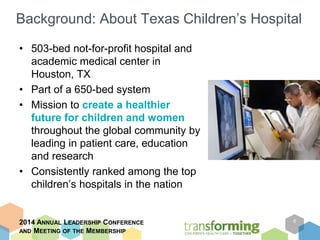
• 503-bed not-for-profit hospital and 
academic medical center in 
Houston, TX 
• Part of a 650-bed system 
• Mission to create a healthier 
future for children and women 
throughout the global community by 
leading in patient care, education 
and research 
• Consistently ranked among the top 
children’s hospitals in the nation 
2014 ANNUAL LEADERSHIP CONFERENCE 
AND MEETING OF THE MEMBERSHIP 
6
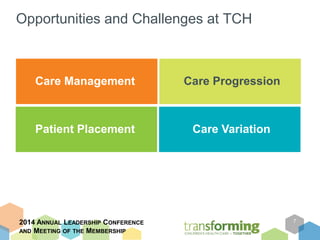
Opportunities and Challenges at TCH 
2014 ANNUAL LEADERSHIP CONFERENCE 
AND MEETING OF THE MEMBERSHIP 
7 
Care Management 
Patient Placement 
Care Progression 
Care Variation
Where We Began 
• Transactional approach to care management 
– Operational inefficiencies in utilization management 
– Lack of integration of care management functions 
– Under-resourced, both in terms of people and tools 
• Need for care progression 
– Above average severity-adjusted Length of Stay (LOS), compared to 
risk-adjusted benchmarks 
– Lack of consistent, coordinated interdisciplinary rounds 
– Spending significant hours on census alerts and unable to 
accommodate outside transfers 
• Inadequate or insufficient tools to support patient placement 
– Inefficient bed turnaround, including environmental services support 
– Delays in placing patients from the ED and PACU 
• Challenges in care variation 
– Payers shifting to DRG-based payment structure 
– Lack of consistency in utilization of evidence-based standards 
2014 ANNUAL LEADERSHIP CONFERENCE 
AND MEETING OF THE MEMBERSHIP 
8
Work to Date: Care Management 
• Restructured Care Management department and recommended case 
loads in line with national Care Management standard 
• Engaged over 20 Care Managers in weekly Clinical High Risk meetings 
to collaboratively resolve barriers to efficient patient flow, efficient care, 
transitions to the next level of care and hospital reimbursement 
• Redefined roles and responsibilities of department personnel, including 
utilization review, discharge/transition planning, avoidable day 
documentation, interaction with multidisciplinary team and utilization 
management 
• Initiated a Care Management Medical Director to provide physician 
leadership and expertise related to Care Management practice 
• Initiated an Access Care Manager role to increase the number of patients 
who are screened for appropriate status and level of care at the time of 
admission 
• Implemented Morrisey, a Care Management software tool for 
discharge planning, utilization review and other work flow 
management 
2014 ANNUAL LEADERSHIP CONFERENCE 
AND MEETING OF THE MEMBERSHIP 
9
Results: Care Management 
2014 ANNUAL LEADERSHIP CONFERENCE 
AND MEETING OF THE MEMBERSHIP 
10 
• Prioritizing patient load 
• Proactively anticipating and planning for discharge 
• Facilitating interdepartmental communication 
• Managing high-risk patients 
• Improving utilization management 
• Engaging physicians
Work to Date: Care Progression 
• Established 11 daily multidisciplinary Care Progression Rounds (CPR) 
across 35 services to proactively plan for patient’s discharge with the care 
team and the patient/family 
• Conducted over 1,500 CPRs (and counting) since project start with 
participation by over 500 physicians, nurses, and supporting care team 
members 
• Created Epic Care Progression Rounds flow sheet to facilitate timely 
and efficient documentation of anticipated discharge dates and barriers to 
discharge (i.e., education, prescriptions, transportation) 
• Increased effectiveness of Care Progression Rounds by leveraging a 
new Quality Review process and garnering timely feedback from 
participants 
2014 ANNUAL LEADERSHIP CONFERENCE 
AND MEETING OF THE MEMBERSHIP 
11
Results: Care Progression 
• Improving interdisciplinary communication and 
collaboration 
• Improving patient and family involvement 
• Improving ability to proactively anticipate and 
communicate discharge dates 
• Increasing patient, staff and physician satisfaction 
2014 ANNUAL LEADERSHIP CONFERENCE 
AND MEETING OF THE MEMBERSHIP 
12
Work to Date: Patient Placement 
• Redesigned patient placement department and recommended caseloads to 
support responsibilities that include bed assignment, level of care assessment 
prior to admission, and timely interaction with nursing units, nursing supervisors 
and physician advisors 
• Centralized patient placement process, which allows resource nurses to 
spend more time assisting with patient care, reduces avoidable patient delays, 
and maximizes the space/beds available – including a process for nursing units 
to provide placement input to inform placement decisions 
• Created a patient placement matrix to assist in identifying the appropriate unit 
for each patient based on services required 
• Initiated Level of Care Reviews at admission, reducing denials and ensuring 
beds are available for the patients that need them most 
• Upgraded to TeleTracking XT™ platform, which streamlines communication 
between the nursing units, Bed Management, EVS, and Patient Escort and 
improves our ability to proactively place patients in the right bed 
• Trained over 600 TCH nurses, unit clerks, EVS, and Patient Escort staff on 
the TeleTracking system 
2014 ANNUAL LEADERSHIP CONFERENCE 
AND MEETING OF THE MEMBERSHIP 
13
Results: Patient Placement 
• Improved ability to ensure patients are placed 
into the right bed at the right time 
• Instituted new process for census management 
• Consistent “Bed Turnaround Time” below 50 min 
– Efficient housekeeping responses to high priority requests 
• Use of PatientONTRAC Summary and Detail reports 
by clinical leadership to: 
– Drive staff performance 
– Share successes 
– Review areas of opportunity 
2014 ANNUAL LEADERSHIP CONFERENCE 
AND MEETING OF THE MEMBERSHIP 
14
Work to Date: Care Variation 
• Worked with physicians, nurses, and ancillary providers in 
select DRGs to: 
– Streamline care 
– Reduce variation 
– Enhance existing evidence-based standards of care 
• Used lean methodology and processes as the structure to 
perform this work 
• Developed future state vision of care processes for Diabetes and 
Pneumonia patients at TCH that align care with IOM dimensions of 
quality and safety 
• Developed Pneumonia multidisciplinary care pathway to be 
integrated into Care Progression Rounds 
2014 ANNUAL LEADERSHIP CONFERENCE 
AND MEETING OF THE MEMBERSHIP 
15
Results: Care Variation 
• Developed interdisciplinary Care 
Pathway for patient care 
• Implemented vision for Diabetes Center 
of Excellence 
2014 ANNUAL LEADERSHIP CONFERENCE 
AND MEETING OF THE MEMBERSHIP 
16
Organizational Results 
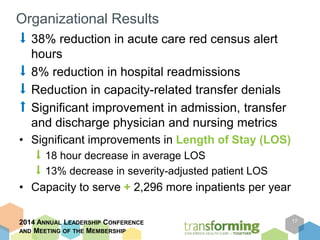
⬇ 38% reduction in acute care red census alert 
hours 
⬇ 8% reduction in hospital readmissions 
⬇ Reduction in capacity-related transfer denials 
⬆ Significant improvement in admission, transfer 
and discharge physician and nursing metrics 
• Significant improvements in Length of Stay (LOS) 
⬇ 18 hour decrease in average LOS 
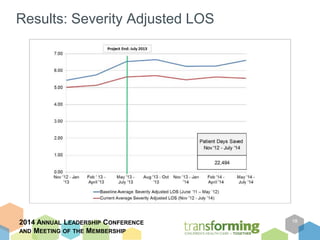
⬇ 13% decrease in severity-adjusted patient LOS 
• Capacity to serve + 2,296 more inpatients per year 
2014 ANNUAL LEADERSHIP CONFERENCE 
AND MEETING OF THE MEMBERSHIP 
17
Results: Severity Adjusted LOS 
2014 ANNUAL LEADERSHIP CONFERENCE 
AND MEETING OF THE MEMBERSHIP 
18
Strategies for Improvement 
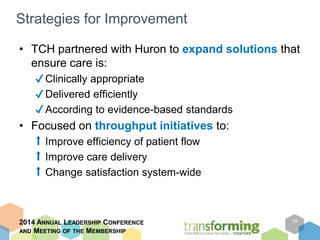
• TCH partnered with Huron to expand solutions that 
ensure care is: 
✔ Clinically appropriate 
✔Delivered efficiently 
✔According to evidence-based standards 
• Focused on throughput initiatives to: 
⬆ Improve efficiency of patient flow 
⬆ Improve care delivery 
⬆ Change satisfaction system-wide 
2014 ANNUAL LEADERSHIP CONFERENCE 
AND MEETING OF THE MEMBERSHIP 
19
Lessons Learned 
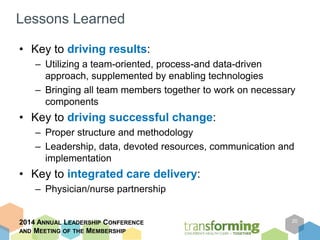
• Key to driving results: 
– Utilizing a team-oriented, process-and data-driven 
approach, supplemented by enabling technologies 
– Bringing all team members together to work on necessary 
components 
• Key to driving successful change: 
– Proper structure and methodology 
– Leadership, data, devoted resources, communication and 
implementation 
• Key to integrated care delivery: 
– Physician/nurse partnership 
2014 ANNUAL LEADERSHIP CONFERENCE 
AND MEETING OF THE MEMBERSHIP 
20
Next Steps 
– Formal Patient Flow meetings 
– Clinical High Risk meetings, focusing 
on patients with outlier LOS 
– Focus on specific patient populations 
where variation is high 
– Extending the Care Management 
model beyond hospital walls 
2014 ANNUAL LEADERSHIP CONFERENCE 
AND MEETING OF THE MEMBERSHIP 
21 
Continuing to build upon Huron engagement:
A Sustainable Approach 
• Huron’s tools and processes have enabled 
TCH to build on recent improvements 
• TCH and Huron worked to create a 
sustainable solution 
- TCH has seen additional improvements since 
the engagement and continues on a positive 
trajectory 
2014 ANNUAL LEADERSHIP CONFERENCE 
AND MEETING OF THE MEMBERSHIP 
22
Contact Information 
2014 ANNUAL LEADERSHIP CONFERENCE 
AND MEETING OF THE MEMBERSHIP 
Presentations 
www.childrenshospitals.net 
Larry Burnett, RN, MSN 
Managing Director, Huron Healthcare 
Phone: (480) 892-2511 
Email: lburnett@huronconsultinggroup.com 
Tabitha Rice, MBA 
Senior Vice President, Texas Children’s Hospital 
Email: tlrice@texaschildrens.org 
Jackie Ward, MSN, RN 
Assistant Vice President of Nursing, Texas Children’s Hospital 
Email: jaward@txch.org

Webinar: Transforming Operational Throughput – The Journey Toward Value-Based Care

  • 1.
    ANNUAL LEADERSHIP CONFERENCE October 12-14, 2014 • Palm Desert, California
  • 2.
    Texas Children’s Hospital Transforming Operational Throughput – The Journey Toward Value-Based Care
  • 3.
    Agenda • LearningObjectives • Background: A Changing Industry, About TCH • Opportunities and Challenges at TCH • Where We Began • Work to Date/Results: Care Management, Care Progression, Patient Placement, and Care Variation • Strategies for Improvement • Lessons Learned • Next Steps • A Sustainable Approach/Conclusion 2014 ANNUAL LEADERSHIP CONFERENCE AND MEETING OF THE MEMBERSHIP 3
  • 4.
    Learning Objectives •Identify strategies to enhance integrated care across the delivery system • Learn specific initiatives to drive improvement in throughput efficiencies • Understand outcomes from a financial, clinical, and operational perspective 2014 ANNUAL LEADERSHIP CONFERENCE AND MEETING OF THE MEMBERSHIP 4
  • 5.
    Background: A ChangingIndustry Dynamics in health care are driving unprecedented change: 2014 ANNUAL LEADERSHIP CONFERENCE AND MEETING OF THE MEMBERSHIP 5 Bottom Line: A Challenging Fiscal Environment • Shifting from volume-based to value-based purchasing • Shifting from experience-based to evidence-based care delivery • Focusing on eliminating waste
  • 6.
    Background: About TexasChildren’s Hospital • 503-bed not-for-profit hospital and academic medical center in Houston, TX • Part of a 650-bed system • Mission to create a healthier future for children and women throughout the global community by leading in patient care, education and research • Consistently ranked among the top children’s hospitals in the nation 2014 ANNUAL LEADERSHIP CONFERENCE AND MEETING OF THE MEMBERSHIP 6
  • 7.
    Opportunities and Challengesat TCH 2014 ANNUAL LEADERSHIP CONFERENCE AND MEETING OF THE MEMBERSHIP 7 Care Management Patient Placement Care Progression Care Variation
  • 8.
    Where We Began • Transactional approach to care management – Operational inefficiencies in utilization management – Lack of integration of care management functions – Under-resourced, both in terms of people and tools • Need for care progression – Above average severity-adjusted Length of Stay (LOS), compared to risk-adjusted benchmarks – Lack of consistent, coordinated interdisciplinary rounds – Spending significant hours on census alerts and unable to accommodate outside transfers • Inadequate or insufficient tools to support patient placement – Inefficient bed turnaround, including environmental services support – Delays in placing patients from the ED and PACU • Challenges in care variation – Payers shifting to DRG-based payment structure – Lack of consistency in utilization of evidence-based standards 2014 ANNUAL LEADERSHIP CONFERENCE AND MEETING OF THE MEMBERSHIP 8
  • 9.
    Work to Date:Care Management • Restructured Care Management department and recommended case loads in line with national Care Management standard • Engaged over 20 Care Managers in weekly Clinical High Risk meetings to collaboratively resolve barriers to efficient patient flow, efficient care, transitions to the next level of care and hospital reimbursement • Redefined roles and responsibilities of department personnel, including utilization review, discharge/transition planning, avoidable day documentation, interaction with multidisciplinary team and utilization management • Initiated a Care Management Medical Director to provide physician leadership and expertise related to Care Management practice • Initiated an Access Care Manager role to increase the number of patients who are screened for appropriate status and level of care at the time of admission • Implemented Morrisey, a Care Management software tool for discharge planning, utilization review and other work flow management 2014 ANNUAL LEADERSHIP CONFERENCE AND MEETING OF THE MEMBERSHIP 9
  • 10.
    Results: Care Management 2014 ANNUAL LEADERSHIP CONFERENCE AND MEETING OF THE MEMBERSHIP 10 • Prioritizing patient load • Proactively anticipating and planning for discharge • Facilitating interdepartmental communication • Managing high-risk patients • Improving utilization management • Engaging physicians
  • 11.
    Work to Date:Care Progression • Established 11 daily multidisciplinary Care Progression Rounds (CPR) across 35 services to proactively plan for patient’s discharge with the care team and the patient/family • Conducted over 1,500 CPRs (and counting) since project start with participation by over 500 physicians, nurses, and supporting care team members • Created Epic Care Progression Rounds flow sheet to facilitate timely and efficient documentation of anticipated discharge dates and barriers to discharge (i.e., education, prescriptions, transportation) • Increased effectiveness of Care Progression Rounds by leveraging a new Quality Review process and garnering timely feedback from participants 2014 ANNUAL LEADERSHIP CONFERENCE AND MEETING OF THE MEMBERSHIP 11
  • 12.
    Results: Care Progression • Improving interdisciplinary communication and collaboration • Improving patient and family involvement • Improving ability to proactively anticipate and communicate discharge dates • Increasing patient, staff and physician satisfaction 2014 ANNUAL LEADERSHIP CONFERENCE AND MEETING OF THE MEMBERSHIP 12
  • 13.
    Work to Date:Patient Placement • Redesigned patient placement department and recommended caseloads to support responsibilities that include bed assignment, level of care assessment prior to admission, and timely interaction with nursing units, nursing supervisors and physician advisors • Centralized patient placement process, which allows resource nurses to spend more time assisting with patient care, reduces avoidable patient delays, and maximizes the space/beds available – including a process for nursing units to provide placement input to inform placement decisions • Created a patient placement matrix to assist in identifying the appropriate unit for each patient based on services required • Initiated Level of Care Reviews at admission, reducing denials and ensuring beds are available for the patients that need them most • Upgraded to TeleTracking XT™ platform, which streamlines communication between the nursing units, Bed Management, EVS, and Patient Escort and improves our ability to proactively place patients in the right bed • Trained over 600 TCH nurses, unit clerks, EVS, and Patient Escort staff on the TeleTracking system 2014 ANNUAL LEADERSHIP CONFERENCE AND MEETING OF THE MEMBERSHIP 13
  • 14.
    Results: Patient Placement • Improved ability to ensure patients are placed into the right bed at the right time • Instituted new process for census management • Consistent “Bed Turnaround Time” below 50 min – Efficient housekeeping responses to high priority requests • Use of PatientONTRAC Summary and Detail reports by clinical leadership to: – Drive staff performance – Share successes – Review areas of opportunity 2014 ANNUAL LEADERSHIP CONFERENCE AND MEETING OF THE MEMBERSHIP 14
  • 15.
    Work to Date:Care Variation • Worked with physicians, nurses, and ancillary providers in select DRGs to: – Streamline care – Reduce variation – Enhance existing evidence-based standards of care • Used lean methodology and processes as the structure to perform this work • Developed future state vision of care processes for Diabetes and Pneumonia patients at TCH that align care with IOM dimensions of quality and safety • Developed Pneumonia multidisciplinary care pathway to be integrated into Care Progression Rounds 2014 ANNUAL LEADERSHIP CONFERENCE AND MEETING OF THE MEMBERSHIP 15
  • 16.
    Results: Care Variation • Developed interdisciplinary Care Pathway for patient care • Implemented vision for Diabetes Center of Excellence 2014 ANNUAL LEADERSHIP CONFERENCE AND MEETING OF THE MEMBERSHIP 16
  • 17.
    Organizational Results ⬇38% reduction in acute care red census alert hours ⬇ 8% reduction in hospital readmissions ⬇ Reduction in capacity-related transfer denials ⬆ Significant improvement in admission, transfer and discharge physician and nursing metrics • Significant improvements in Length of Stay (LOS) ⬇ 18 hour decrease in average LOS ⬇ 13% decrease in severity-adjusted patient LOS • Capacity to serve + 2,296 more inpatients per year 2014 ANNUAL LEADERSHIP CONFERENCE AND MEETING OF THE MEMBERSHIP 17
  • 18.
    Results: Severity AdjustedLOS 2014 ANNUAL LEADERSHIP CONFERENCE AND MEETING OF THE MEMBERSHIP 18
  • 19.
    Strategies for Improvement • TCH partnered with Huron to expand solutions that ensure care is: ✔ Clinically appropriate ✔Delivered efficiently ✔According to evidence-based standards • Focused on throughput initiatives to: ⬆ Improve efficiency of patient flow ⬆ Improve care delivery ⬆ Change satisfaction system-wide 2014 ANNUAL LEADERSHIP CONFERENCE AND MEETING OF THE MEMBERSHIP 19
  • 20.
    Lessons Learned •Key to driving results: – Utilizing a team-oriented, process-and data-driven approach, supplemented by enabling technologies – Bringing all team members together to work on necessary components • Key to driving successful change: – Proper structure and methodology – Leadership, data, devoted resources, communication and implementation • Key to integrated care delivery: – Physician/nurse partnership 2014 ANNUAL LEADERSHIP CONFERENCE AND MEETING OF THE MEMBERSHIP 20
  • 21.
    Next Steps –Formal Patient Flow meetings – Clinical High Risk meetings, focusing on patients with outlier LOS – Focus on specific patient populations where variation is high – Extending the Care Management model beyond hospital walls 2014 ANNUAL LEADERSHIP CONFERENCE AND MEETING OF THE MEMBERSHIP 21 Continuing to build upon Huron engagement:
  • 22.
    A Sustainable Approach • Huron’s tools and processes have enabled TCH to build on recent improvements • TCH and Huron worked to create a sustainable solution - TCH has seen additional improvements since the engagement and continues on a positive trajectory 2014 ANNUAL LEADERSHIP CONFERENCE AND MEETING OF THE MEMBERSHIP 22
  • 23.
    Contact Information 2014ANNUAL LEADERSHIP CONFERENCE AND MEETING OF THE MEMBERSHIP Presentations www.childrenshospitals.net Larry Burnett, RN, MSN Managing Director, Huron Healthcare Phone: (480) 892-2511 Email: lburnett@huronconsultinggroup.com Tabitha Rice, MBA Senior Vice President, Texas Children’s Hospital Email: tlrice@texaschildrens.org Jackie Ward, MSN, RN Assistant Vice President of Nursing, Texas Children’s Hospital Email: jaward@txch.org