SUCCESSFUL MANAGEMENT OF CHANGE PROGRAMMES
This presentation is designed to introduce the management
of change within large, complex programmes
Topics covered:
 Why manage change at all?
 Being successful at change
 Overcoming common problems
 The change project lifecycle
CHANGEMANAGEMENT–ANINTRODUCTION
WHYMANAGECHANGEATALL?
The purpose of change is to solve business problems and
deliver benefits to the organisation e.g.
- Reduced costs
- Increased revenues
- Increased profits & increased shareholder value
- Move ahead of the competition
Delivery of a system (or any other type of business change)
without achieving any benefits to the organisation is not a
successful change
CHANGEISRARELYONE-DIMENSIONAL
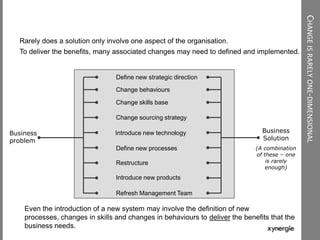
Define new strategic direction
Change behaviours
Change skills base
Change sourcing strategy
Define new processes
Restructure
Introduce new products
Refresh Management Team
Introduce new technologyBusiness
problem
Rarely does a solution only involve one aspect of the organisation.
To deliver the benefits, many associated changes may need to defined and implemented.
Business
Solution
(A combination
of these – one
is rarely
enough)
Even the introduction of a new system may involve the definition of new
processes, changes in skills and changes in behaviours to deliver the benefits that the
business needs.
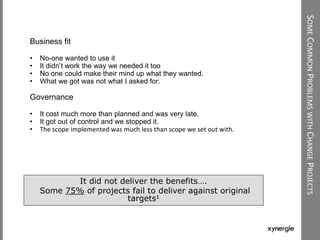
SOMECOMMONPROBLEMSWITHCHANGEPROJECTS
Business fit
• No-one wanted to use it
• It didn‟t work the way we needed it too
• No one could make their mind up what they wanted.
• What we got was not what I asked for.
Governance
• It cost much more than planned and was very late.
• It got out of control and we stopped it.
• The scope implemented was much less than scope we set out with.
It did not deliver the benefits….
Some 75% of projects fail to deliver against original
targets1
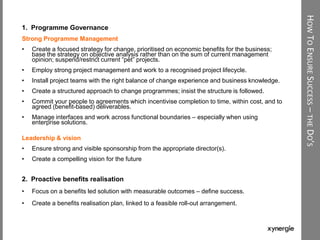
HOWTOENSURESUCCESS–THEDO’S
1. Programme Governance
Strong Programme Management
• Create a focused strategy for change, prioritised on economic benefits for the business;
base the strategy on objective analysis rather than on the sum of current management
opinion; suspend/restrict current “pet” projects.
• Employ strong project management and work to a recognised project lifecycle.
• Install project teams with the right balance of change experience and business knowledge.
• Create a structured approach to change programmes; insist the structure is followed.
• Commit your people to agreements which incentivise completion to time, within cost, and to
agreed (benefit-based) deliverables.
• Manage interfaces and work across functional boundaries – especially when using
enterprise solutions.
Leadership & vision
• Ensure strong and visible sponsorship from the appropriate director(s).
• Create a compelling vision for the future
2. Proactive benefits realisation
• Focus on a benefits led solution with measurable outcomes – define success.
• Create a benefits realisation plan, linked to a feasible roll-out arrangement.
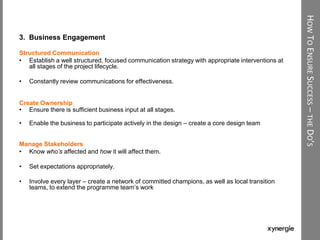
HOWTOENSURESUCCESS–THEDO’S
3. Business Engagement
Structured Communication
• Establish a well structured, focused communication strategy with appropriate interventions at
all stages of the project lifecycle.
• Constantly review communications for effectiveness.
Create Ownership
• Ensure there is sufficient business input at all stages.
• Enable the business to participate actively in the design – create a core design team
Manage Stakeholders
• Know who’s affected and how it will affect them.
• Set expectations appropriately.
• Involve every layer – create a network of committed champions, as well as local transition
teams, to extend the programme team‟s work
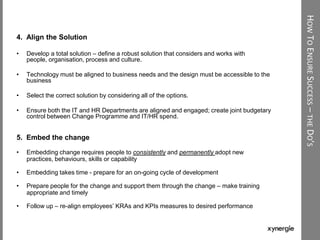
HOWTOENSURESUCCESS–THEDO’S
4. Align the Solution
• Develop a total solution – define a robust solution that considers and works with
people, organisation, process and culture.
• Technology must be aligned to business needs and the design must be accessible to the
business
• Select the correct solution by considering all of the options.
• Ensure both the IT and HR Departments are aligned and engaged; create joint budgetary
control between Change Programme and IT/HR spend.
5. Embed the change
• Embedding change requires people to consistently and permanently adopt new
practices, behaviours, skills or capability
• Embedding takes time - prepare for an on-going cycle of development
• Prepare people for the change and support them through the change – make training
appropriate and timely
• Follow up – re-align employees‟ KRAs and KPIs measures to desired performance
HOWTOENSURESUCCESS–THEDON’TS
• Focus on the technology and ignore the people that will use it
• Hope that staff will make the solution work, even if it isn‟t up to the job
• Over communicate when there is nothing to say
• Assume people will find out what is happening and when
• Forget the business until it‟s time to implement the system
• Put inexperienced staff in project leadership roles
• Forget to plan and cost for resources in the business for essential preparation activities such
as data migration, testing, pilots etc.
• Cave in to constant changes and allow the scope to creep
• Fail to review the programme in the light of emerging findings, economics, changing market
conditions.
• Disband successful change teams and discard methodologies; ignore the necessity to build
and maintain effective change capability.
PROGRAMMEGOVERNANCE:STRONGPROGRAMMEMANAGEMENT
Work to a recognised project lifecycle
• Projects & programmes are high risk activities – prepare for risk
• Change is the biggest and most disruptive risk of all – change must be resisted where possible and
managed in a structured way where absolutely necessary
• Create baselines and manage changes in performance against them
• Use an honest and appropriate reporting process that shows progress, milestones, risks & issues
• Regularly report status of anticipated benefits and how they are being realised
• Log and control all inter-dependencies
Experienced project team
• The team must be led by experienced Project Professionals - resist using too many rising stars from the
business in lead roles.
• The team should have significant representation from the Business Units affected to provide current
business knowledge, ensure solutions fit to the business and to become experts in the new solution.
• The team needs to be augmented with change professionals to ensure the project really changes the
business
• Ensure the team has strong project management skills with project management disciplines such as
Base-lining, Process Mapping, Business Case preparation, Planning, Risk Management, Reporting and
Cost Control
PROGRAMMEGOVERNANCE:LEADERSHIPANDVISION
Sponsorship should be strong and visible from an appropriate Director
• Director who manages the Business Unit; usually Board Director or CEO
• Directors must commit to agreed changes to their businesses; If the Director is not passionate about
change then DO NOT DO IT
• Director must „WALK THE TALK‟ .
• Director must find time to provide guidance to team, lead communications activity and manage key
stakeholders.
• Staff take their lead from the top – if passionate and articulate they will follow.
Senior Management Support
• Support from Senior Management will be critical – especially with regard to the business case and
ensuring continuity of the programme
• Gain support to secure involvement of critical business resources
Compelling vision
• The programme needs a vision that is compelling for the business
• The vision has to be clearly and simply articulated
• The programme should have a common picture that can be understood by all
PROACTIVEBENEFITSREALISATION
Identify benefits from the beginning
• Clear business objectives and outcomes for the programme should be identified from the
start
• Use root cause analysis to help identify possible benefits and link elements of the solution
to solving root causes
• Ensure all solution elements are linked to specific benefits
Develop a realistic approach to measuring benefits
• Identify measures to prove/disprove benefits; keep it simple where possible - don‟t make
KPI measurement into a cottage industry.
• Determine when to start collecting data – baseline measures before implementation
• Collect performance data at an appropriate time after implementation – don‟t expect all
benefits immediately
Benefits driven solution
• Any activity not linked to benefits should be stopped
• Any change requests must also pass this test
BUSINESSENGAGEMENT:STRUCTUREDCOMMUNICATION
Manage a well structured Communications Strategy & Plan
• All affected staff must know what is happening and be prepared for change – no-one likes
surprises, or being told to commit significant efforts without justification.
• Staff must be enthused to support what‟s happening. This comes from providing a vision and
clear leadership as well as from good communication.
• Know the audience and have clear, simple objectives for every communication.
• Plan communication in advance and keep up the momentum
• Co-ordinate simple messages using a variety of communication channels. The more impact
the message has on the audience, the more personal the communication should be.
Examples include:
• Articles in staff magazines
• Web site on company intranet
• News Sheets/Fact sheets
• Cascade packs
• 1:1 briefings for senior staff
• Road Shows/Fairs
• Technology demonstrations
• Craft the communications to the effect you are trying to achieve within the programme life
cycle; – timing is everything
• Your people need facts and guidance, not high-level platitudes or vacuous repetition.
• Continually review communications and adapt the plan throughout the programme
BUSINESSENGAGEMENT:CREATEOWNERSHIP
Significant input is required from the business at all stages
• The solution must be owned by the business – otherwise it won‟t be used nor the benefits
fully achieved
• Appropriate staff members must have input to the solution design – use the best and well
respected staff to help shape the solution – the core design team
• Empower core team members to be able to make informed choices – ensure they can
understand the impact of any choices they make, especially if it involves technology
• Widen the numbers of people involved through review teams – use them to review the
design and test for robustness
• Walk through the solution design with all affected staff – allow them to ask questions and
understand fully what the impact will be
BUSINESSENGAGEMENT:MANAGESTAKEHOLDERS
Know who the stakeholders are
• Who will be affected by the change and how will the change may affect them
• Establish early where the cultural hurdles lie (Know whether they are positive, neutral or
negative towards the change)
Manage expectations
• Be realistic and truthful about what the change will involve,.
• Air difficult subjects early especially in terms of large changes in job content and
headcount reduction/migration– it gives people time to adjust. If swept under the carpet it
becomes a bigger problem later
Build a network of people to help with the change
• Identify „champions‟ for change across the business – they will extend the reach of the
programme team
• Identify local transition teams
• Make them an extension of the project team, who share intimate knowledge of the
solution
ALIGNTHESOLUTION
Designing technology is very difficult and detailed
• Visualising the client need is challenging for IT staff.
• Understanding what the designers are saying is challenging for business staff.
• Actively seek out “hybrid” skills to manage the interface between the Business and Technology
Change Teams.
Avoid written specifications for Business users
• Start by articulating business process and mock this up in the system.
• Use an interactive process.
• Go round the loop 2 or 3 times.
Avoid bespoking
• Use packages wherever possible & resist changing them.
In a large programme deliver useful functionality regularly in a sequenced roll-
out plan.
• Do not wait 5 years for a big bang
• Allows time to ensure solutions can work
• Allows lessons to be learnt
• Releases benefits more effectively by taking into account the rate at which the workforce can
absorb change.
EMBEDDINGTHECHANGE
Change needs to be embedded to achieve the benefits
• The toughest challenge may be the organisational and behavioural change to your workforce.
This means:-
• Headcount reduction; ensuring the “leavers” area as far as possible the ones you want to
shed
• Transformation (often radical) of job content and skill requirements, particularly at
supervisory level. This implies re-selection of managers.
• Documentation and consistency of job descriptions, KRAs, KPIs with heavy reliance on
your HR function.
• A tough series of decisions from your Directors and senior managers.
• Use a maturity model to determine what capability is required for functions or processes.
• Develop a route map to build competence initially, develop capability over time and finally to
aim for excellence
• Plan reviews – test progress against the maturity model and route map
• Cultural change needs to managed with resolve – management must lead by example
EMBEDDINGTHECHANGE
Provide support initially to help people ‘get it right’
Develop work instructions – work through how each job role can do their job with a
new system in detail - this will help to reinforce good practice and avoid going back
to old ways and old systems
Provide appropriate and timely training so that staff can use what they‟ve learnt
immediately
„Floorwalkers‟ provide on the spot help in the early days of implementation to avoid
frustration
Use coaching to praise new behaviours observed and to address old behaviours
Provide adequate IT and process support
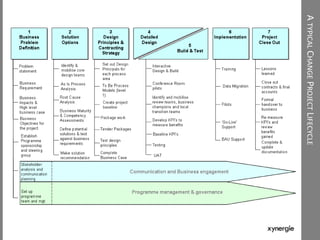
ATYPICALCHANGEPROJECTLIFECYCLE
CONTACT US
xynergie Limited
Blackburn Business Centre, Davyfield Road, Blackburn, BB1
Tel: +44 (0) 845 1309031 Email: enquiries@xynergie.co.uk
Web: www.xynergie.co.uk

Successful Management of Change

  • 1.
    SUCCESSFUL MANAGEMENT OFCHANGE PROGRAMMES
  • 2.
    This presentation isdesigned to introduce the management of change within large, complex programmes Topics covered:  Why manage change at all?  Being successful at change  Overcoming common problems  The change project lifecycle CHANGEMANAGEMENT–ANINTRODUCTION
  • 3.
    WHYMANAGECHANGEATALL? The purpose ofchange is to solve business problems and deliver benefits to the organisation e.g. - Reduced costs - Increased revenues - Increased profits & increased shareholder value - Move ahead of the competition Delivery of a system (or any other type of business change) without achieving any benefits to the organisation is not a successful change
  • 4.
    CHANGEISRARELYONE-DIMENSIONAL Define new strategicdirection Change behaviours Change skills base Change sourcing strategy Define new processes Restructure Introduce new products Refresh Management Team Introduce new technologyBusiness problem Rarely does a solution only involve one aspect of the organisation. To deliver the benefits, many associated changes may need to defined and implemented. Business Solution (A combination of these – one is rarely enough) Even the introduction of a new system may involve the definition of new processes, changes in skills and changes in behaviours to deliver the benefits that the business needs.
  • 5.
    SOMECOMMONPROBLEMSWITHCHANGEPROJECTS Business fit • No-onewanted to use it • It didn‟t work the way we needed it too • No one could make their mind up what they wanted. • What we got was not what I asked for. Governance • It cost much more than planned and was very late. • It got out of control and we stopped it. • The scope implemented was much less than scope we set out with. It did not deliver the benefits…. Some 75% of projects fail to deliver against original targets1
  • 6.
    HOWTOENSURESUCCESS–THEDO’S 1. Programme Governance StrongProgramme Management • Create a focused strategy for change, prioritised on economic benefits for the business; base the strategy on objective analysis rather than on the sum of current management opinion; suspend/restrict current “pet” projects. • Employ strong project management and work to a recognised project lifecycle. • Install project teams with the right balance of change experience and business knowledge. • Create a structured approach to change programmes; insist the structure is followed. • Commit your people to agreements which incentivise completion to time, within cost, and to agreed (benefit-based) deliverables. • Manage interfaces and work across functional boundaries – especially when using enterprise solutions. Leadership & vision • Ensure strong and visible sponsorship from the appropriate director(s). • Create a compelling vision for the future 2. Proactive benefits realisation • Focus on a benefits led solution with measurable outcomes – define success. • Create a benefits realisation plan, linked to a feasible roll-out arrangement.
  • 7.
    HOWTOENSURESUCCESS–THEDO’S 3. Business Engagement StructuredCommunication • Establish a well structured, focused communication strategy with appropriate interventions at all stages of the project lifecycle. • Constantly review communications for effectiveness. Create Ownership • Ensure there is sufficient business input at all stages. • Enable the business to participate actively in the design – create a core design team Manage Stakeholders • Know who’s affected and how it will affect them. • Set expectations appropriately. • Involve every layer – create a network of committed champions, as well as local transition teams, to extend the programme team‟s work
  • 8.
    HOWTOENSURESUCCESS–THEDO’S 4. Align theSolution • Develop a total solution – define a robust solution that considers and works with people, organisation, process and culture. • Technology must be aligned to business needs and the design must be accessible to the business • Select the correct solution by considering all of the options. • Ensure both the IT and HR Departments are aligned and engaged; create joint budgetary control between Change Programme and IT/HR spend. 5. Embed the change • Embedding change requires people to consistently and permanently adopt new practices, behaviours, skills or capability • Embedding takes time - prepare for an on-going cycle of development • Prepare people for the change and support them through the change – make training appropriate and timely • Follow up – re-align employees‟ KRAs and KPIs measures to desired performance
  • 9.
    HOWTOENSURESUCCESS–THEDON’TS • Focus onthe technology and ignore the people that will use it • Hope that staff will make the solution work, even if it isn‟t up to the job • Over communicate when there is nothing to say • Assume people will find out what is happening and when • Forget the business until it‟s time to implement the system • Put inexperienced staff in project leadership roles • Forget to plan and cost for resources in the business for essential preparation activities such as data migration, testing, pilots etc. • Cave in to constant changes and allow the scope to creep • Fail to review the programme in the light of emerging findings, economics, changing market conditions. • Disband successful change teams and discard methodologies; ignore the necessity to build and maintain effective change capability.
  • 10.
    PROGRAMMEGOVERNANCE:STRONGPROGRAMMEMANAGEMENT Work to arecognised project lifecycle • Projects & programmes are high risk activities – prepare for risk • Change is the biggest and most disruptive risk of all – change must be resisted where possible and managed in a structured way where absolutely necessary • Create baselines and manage changes in performance against them • Use an honest and appropriate reporting process that shows progress, milestones, risks & issues • Regularly report status of anticipated benefits and how they are being realised • Log and control all inter-dependencies Experienced project team • The team must be led by experienced Project Professionals - resist using too many rising stars from the business in lead roles. • The team should have significant representation from the Business Units affected to provide current business knowledge, ensure solutions fit to the business and to become experts in the new solution. • The team needs to be augmented with change professionals to ensure the project really changes the business • Ensure the team has strong project management skills with project management disciplines such as Base-lining, Process Mapping, Business Case preparation, Planning, Risk Management, Reporting and Cost Control
  • 11.
    PROGRAMMEGOVERNANCE:LEADERSHIPANDVISION Sponsorship should bestrong and visible from an appropriate Director • Director who manages the Business Unit; usually Board Director or CEO • Directors must commit to agreed changes to their businesses; If the Director is not passionate about change then DO NOT DO IT • Director must „WALK THE TALK‟ . • Director must find time to provide guidance to team, lead communications activity and manage key stakeholders. • Staff take their lead from the top – if passionate and articulate they will follow. Senior Management Support • Support from Senior Management will be critical – especially with regard to the business case and ensuring continuity of the programme • Gain support to secure involvement of critical business resources Compelling vision • The programme needs a vision that is compelling for the business • The vision has to be clearly and simply articulated • The programme should have a common picture that can be understood by all
  • 12.
    PROACTIVEBENEFITSREALISATION Identify benefits fromthe beginning • Clear business objectives and outcomes for the programme should be identified from the start • Use root cause analysis to help identify possible benefits and link elements of the solution to solving root causes • Ensure all solution elements are linked to specific benefits Develop a realistic approach to measuring benefits • Identify measures to prove/disprove benefits; keep it simple where possible - don‟t make KPI measurement into a cottage industry. • Determine when to start collecting data – baseline measures before implementation • Collect performance data at an appropriate time after implementation – don‟t expect all benefits immediately Benefits driven solution • Any activity not linked to benefits should be stopped • Any change requests must also pass this test
  • 13.
    BUSINESSENGAGEMENT:STRUCTUREDCOMMUNICATION Manage a wellstructured Communications Strategy & Plan • All affected staff must know what is happening and be prepared for change – no-one likes surprises, or being told to commit significant efforts without justification. • Staff must be enthused to support what‟s happening. This comes from providing a vision and clear leadership as well as from good communication. • Know the audience and have clear, simple objectives for every communication. • Plan communication in advance and keep up the momentum • Co-ordinate simple messages using a variety of communication channels. The more impact the message has on the audience, the more personal the communication should be. Examples include: • Articles in staff magazines • Web site on company intranet • News Sheets/Fact sheets • Cascade packs • 1:1 briefings for senior staff • Road Shows/Fairs • Technology demonstrations • Craft the communications to the effect you are trying to achieve within the programme life cycle; – timing is everything • Your people need facts and guidance, not high-level platitudes or vacuous repetition. • Continually review communications and adapt the plan throughout the programme
  • 14.
    BUSINESSENGAGEMENT:CREATEOWNERSHIP Significant input isrequired from the business at all stages • The solution must be owned by the business – otherwise it won‟t be used nor the benefits fully achieved • Appropriate staff members must have input to the solution design – use the best and well respected staff to help shape the solution – the core design team • Empower core team members to be able to make informed choices – ensure they can understand the impact of any choices they make, especially if it involves technology • Widen the numbers of people involved through review teams – use them to review the design and test for robustness • Walk through the solution design with all affected staff – allow them to ask questions and understand fully what the impact will be
  • 15.
    BUSINESSENGAGEMENT:MANAGESTAKEHOLDERS Know who thestakeholders are • Who will be affected by the change and how will the change may affect them • Establish early where the cultural hurdles lie (Know whether they are positive, neutral or negative towards the change) Manage expectations • Be realistic and truthful about what the change will involve,. • Air difficult subjects early especially in terms of large changes in job content and headcount reduction/migration– it gives people time to adjust. If swept under the carpet it becomes a bigger problem later Build a network of people to help with the change • Identify „champions‟ for change across the business – they will extend the reach of the programme team • Identify local transition teams • Make them an extension of the project team, who share intimate knowledge of the solution
  • 16.
    ALIGNTHESOLUTION Designing technology isvery difficult and detailed • Visualising the client need is challenging for IT staff. • Understanding what the designers are saying is challenging for business staff. • Actively seek out “hybrid” skills to manage the interface between the Business and Technology Change Teams. Avoid written specifications for Business users • Start by articulating business process and mock this up in the system. • Use an interactive process. • Go round the loop 2 or 3 times. Avoid bespoking • Use packages wherever possible & resist changing them. In a large programme deliver useful functionality regularly in a sequenced roll- out plan. • Do not wait 5 years for a big bang • Allows time to ensure solutions can work • Allows lessons to be learnt • Releases benefits more effectively by taking into account the rate at which the workforce can absorb change.
  • 17.
    EMBEDDINGTHECHANGE Change needs tobe embedded to achieve the benefits • The toughest challenge may be the organisational and behavioural change to your workforce. This means:- • Headcount reduction; ensuring the “leavers” area as far as possible the ones you want to shed • Transformation (often radical) of job content and skill requirements, particularly at supervisory level. This implies re-selection of managers. • Documentation and consistency of job descriptions, KRAs, KPIs with heavy reliance on your HR function. • A tough series of decisions from your Directors and senior managers. • Use a maturity model to determine what capability is required for functions or processes. • Develop a route map to build competence initially, develop capability over time and finally to aim for excellence • Plan reviews – test progress against the maturity model and route map • Cultural change needs to managed with resolve – management must lead by example
  • 18.
    EMBEDDINGTHECHANGE Provide support initiallyto help people ‘get it right’ Develop work instructions – work through how each job role can do their job with a new system in detail - this will help to reinforce good practice and avoid going back to old ways and old systems Provide appropriate and timely training so that staff can use what they‟ve learnt immediately „Floorwalkers‟ provide on the spot help in the early days of implementation to avoid frustration Use coaching to praise new behaviours observed and to address old behaviours Provide adequate IT and process support
  • 19.
  • 20.
    CONTACT US xynergie Limited BlackburnBusiness Centre, Davyfield Road, Blackburn, BB1 Tel: +44 (0) 845 1309031 Email: enquiries@xynergie.co.uk Web: www.xynergie.co.uk