PROCESS RELATED
CHANGES
CHANGE MANAGEMENT
Introduction : The Change Process
o Industries activities are shifting from manufacturing to service, globalization of market, political
realignment, technical advances in management information system.
o The competition become more and more obvious in automobile manufacturing, consumer electronics,
computers and communication and house hold manufacturing.
o There is a global market and competition for most product and services
o The emergence of these global organizations creates pressure on domestic organizations and projects to
Restructure and internationalization their outlook and operations.
o In order to effectively compete in it, organizations must use a creativity and transform their cultures,
Structure and operations.
o Modern change management process showed that change management starts with a redefining of the
Current enterprises strategy :
o Deciding upon the right business strategy stands therefore at the beginning of every change process.
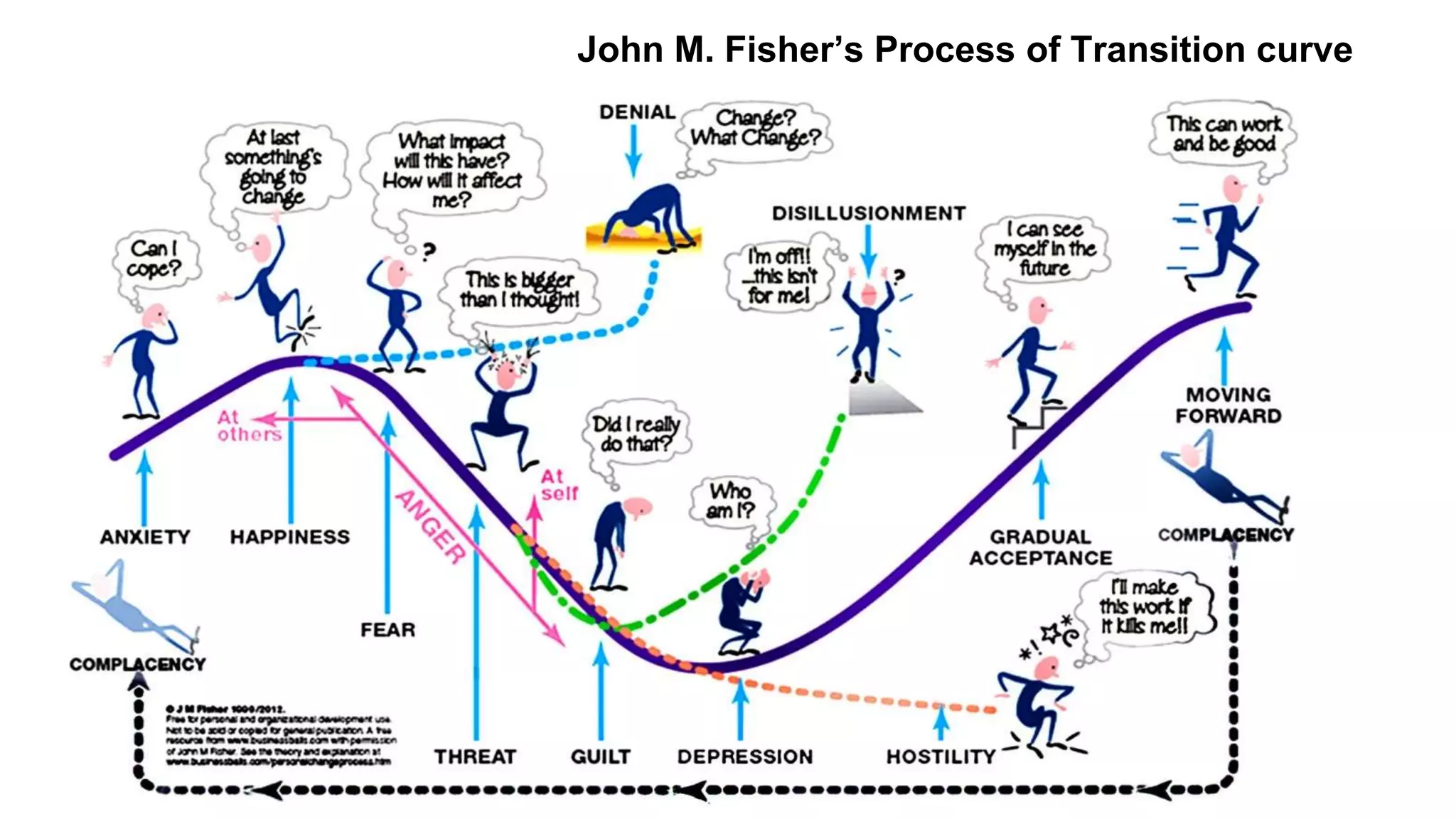
John M. Fisher’s Process of Transition curve
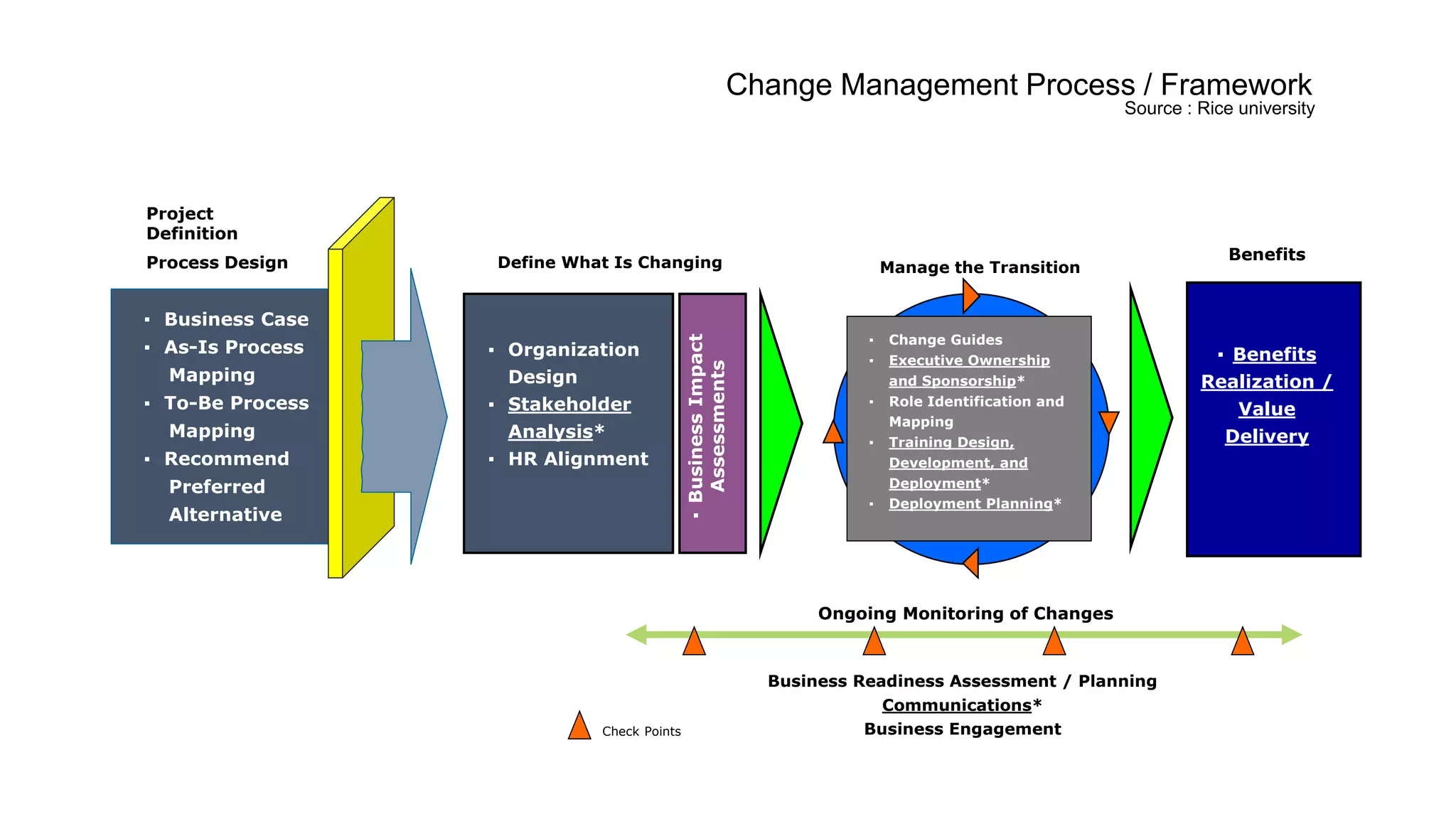
▪ Business Case
▪ As-Is Process
Mapping
▪ To-Be Process
Mapping
▪ Recommend
Preferred
Alternative
Project
Definition
Process Design Define What Is Changing
▪ Organization
Design
▪ Stakeholder
Analysis*
▪ HR Alignment
▪
Business
Impact
Assessments
Manage the Transition
▪ Change Guides
▪ Executive Ownership
and Sponsorship*
▪ Role Identification and
Mapping
▪ Training Design,
Development, and
Deployment*
▪ Deployment Planning*
▪ Benefits
Realization /
Value
Delivery
Benefits
Business Readiness Assessment / Planning
Communications*
Business Engagement
Ongoing Monitoring of Changes
Check Points
Change Management Process / Framework
Source : Rice university
5
Components:
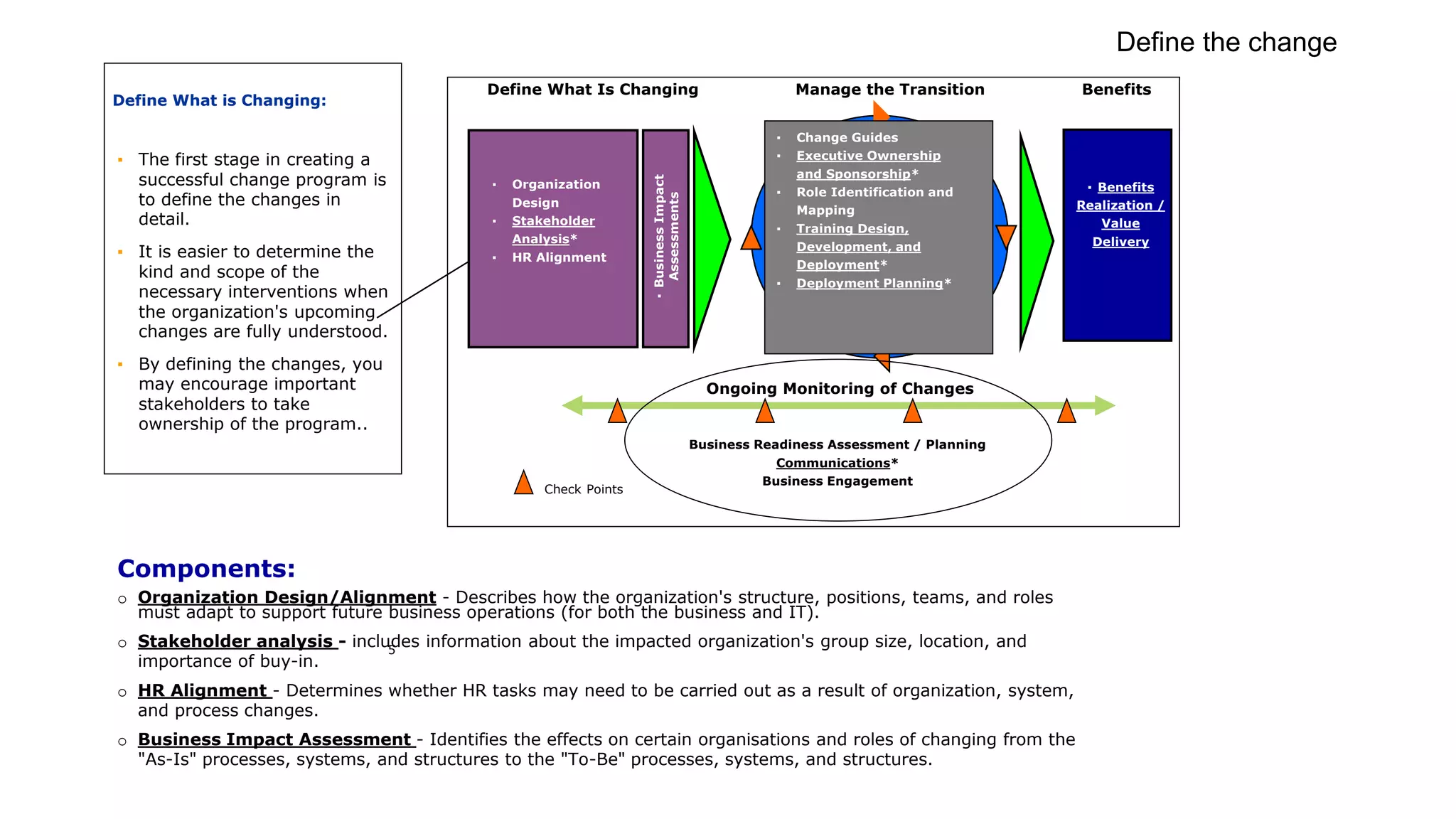
o Organization Design/Alignment - Describes how the organization's structure, positions, teams, and roles
must adapt to support future business operations (for both the business and IT).
o Stakeholder analysis - includes information about the impacted organization's group size, location, and
importance of buy-in.
o HR Alignment - Determines whether HR tasks may need to be carried out as a result of organization, system,
and process changes.
o Business Impact Assessment - Identifies the effects on certain organisations and roles of changing from the
"As-Is" processes, systems, and structures to the "To-Be" processes, systems, and structures.
Define What is Changing:
▪ The first stage in creating a
successful change program is
to define the changes in
detail.
▪ It is easier to determine the
kind and scope of the
necessary interventions when
the organization's upcoming
changes are fully understood.
▪ By defining the changes, you
may encourage important
stakeholders to take
ownership of the program..
Define What Is Changing
▪ Organization
Design
▪ Stakeholder
Analysis*
▪ HR Alignment
▪
Business
Impact
Assessments
Business Readiness Assessment / Planning
Communications*
Business Engagement
Ongoing Monitoring of Changes
Check Points
▪ Benefits
Realization /
Value
Delivery
Benefits
Manage the Transition
▪ Change Guides
▪ Executive Ownership
and Sponsorship*
▪ Role Identification and
Mapping
▪ Training Design,
Development, and
Deployment*
▪ Deployment Planning*
Define the change
6
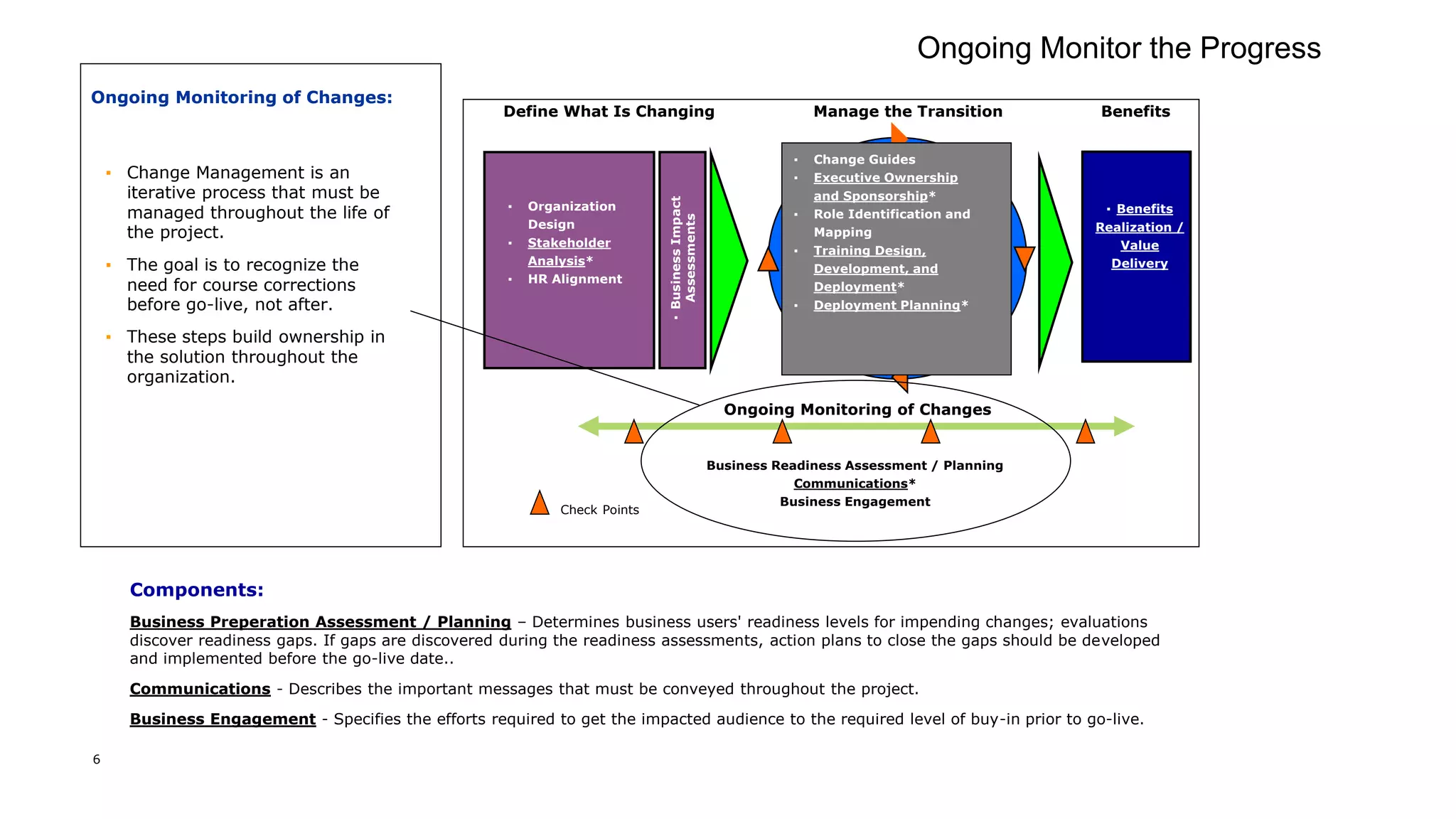
Components:
Business Preperation Assessment / Planning – Determines business users' readiness levels for impending changes; evaluations
discover readiness gaps. If gaps are discovered during the readiness assessments, action plans to close the gaps should be developed
and implemented before the go-live date..
Communications - Describes the important messages that must be conveyed throughout the project.
Business Engagement - Specifies the efforts required to get the impacted audience to the required level of buy-in prior to go-live.
Ongoing Monitoring of Changes:
▪ Change Management is an
iterative process that must be
managed throughout the life of
the project.
▪ The goal is to recognize the
need for course corrections
before go-live, not after.
▪ These steps build ownership in
the solution throughout the
organization.
Define What Is Changing
▪ Organization
Design
▪ Stakeholder
Analysis*
▪ HR Alignment
▪
Business
Impact
Assessments
Business Readiness Assessment / Planning
Communications*
Business Engagement
Ongoing Monitoring of Changes
Check Points
▪ Benefits
Realization /
Value
Delivery
Benefits
Manage the Transition
▪ Change Guides
▪ Executive Ownership
and Sponsorship*
▪ Role Identification and
Mapping
▪ Training Design,
Development, and
Deployment*
▪ Deployment Planning*
Ongoing Monitor the Progress
7
Components:
Change Guides – Package the consequences uncovered by Business Impact Assessments and distribute them to impacted
users prior to formal training to ensure they are properly prepared and oriented to the key changes.
Executive Ownership and Sponsorship – Identifies activities and behaviors that executive leadership must engage in to
provide navigation towards the future environment, lead the organization in that direction, and build a sense of ownership
over time.
Role Identification and Mapping - Divides the organisation into roles that will be targeted for change management
interventions.
Training Design, Development, and Deployment - Describes how the project will develop the required process and
system capabilities in the impacted user groups through performance support (job aids, coaching, knowledge systems,
practise scenarios, and simulations).
Deployment Planning – Aligns agreement around all relevant pieces of the deployment which need to be considered,
defined, resolved, or require action to enable implementation.
Manage the Transition:
▪ Once the changes are
defined, specific action is
required to move the
organization from the “As-
Is” to the “To-Be” state.
▪ These tasks help enable the
organization with the skills
to work in the future
environment.
▪ These tasks also help build
ownership for the program
among the user base.
Manage the Transition
Define What Is Changing
▪ Organization
Design
▪ Stakeholder
Analysis*
▪ HR Alignment
▪
Business
Impact
Assessments
Business Readiness Assessment / Planning
Communications*
Business Engagement
Ongoing Monitoring of Changes
Check Points
▪ Benefits
Realization /
Value
Delivery
Benefits
Manage the Transition
▪ Change Guides
▪ Executive Ownership
and Sponsorship*
▪ Role Identification and
Mapping
▪ Training Design,
Development, and
Deployment*
▪ Deployment Planning*
Components:
Benefits Realization/Value Delivery - Defines and manages the activities to ensure achievement of the business case after go-live.
Benefits:
▪ Ensuring that the business value
outlined in the business case is the
key measure of a project’s success.
▪ Value delivery is focused on point
solutions that deliver best practice
post implementation to improve
absorption within the business, or
ensure that processes or
procedures are adhered to in the
most effective and efficient
manner.
Define What Is Changing
▪ Organization
Design
▪ Stakeholder
Analysis*
▪ HR Alignment
▪
Business
Impact
Assessments
Business Readiness Assessment / Planning
Communications*
Business Engagement
Ongoing Monitoring of Changes
Check Points
▪ Benefits
Realization /
Value Delivery
Benefits
Manage the Transition
▪ Change Guides
▪ Executive Ownership and
Sponsorship*
▪ Role Identification and
Mapping
▪ Training Design,
Development, and
Deployment*
▪ Deployment Planning*
Focus on Benefits Realization
In 1997
In 2010
Rakuten wants to go global and wants to expend its company to
USA, India and many more countries.
Problems faced by Rakuten
• Since Rakuten is a Japanese company, Every employees of
rakuten only understand Japanese and can’t communicatite with
foriegner.
• And also they were not able to hire international talent just
because of communication gap
• In order to expand, Rakuten wants to minimize the
communication gap
• Hiroshi Mikitani (at rakuten event)
• Source: Rakuten Global
Rakuten Group
Tokyo, Japan
Rakuten Group, Inc. is a Japanese electronic commerce and online
retailing company based in Tokyo, founded by Hiroshi Mikitani in 1997
In 2010
To raise the English level of its employees Rakuten has asked
them to achieve a TOEIC score of 800
since then the average TOEIC score has increased by more than
280 points to 814,
In 2015,
81% of newly hired engineers hailed from outside of Japan
representing 45 different nationalities
In 2022
Rakuten hire employee with nationality over 70 different countries,
Every employee has TOEIC score over 800 and Rakuten is
functioning in more than 30 countries
• Mikitani &Professor Tsedal Neeley
• Source: Rakuten Global
Rakuten Group
Englishnization
Benefits of Englization in Rakuten Global Inc.
THANK YOU

Change management ppt.pptx

  • 1.
  • 2.
    Introduction : TheChange Process o Industries activities are shifting from manufacturing to service, globalization of market, political realignment, technical advances in management information system. o The competition become more and more obvious in automobile manufacturing, consumer electronics, computers and communication and house hold manufacturing. o There is a global market and competition for most product and services o The emergence of these global organizations creates pressure on domestic organizations and projects to Restructure and internationalization their outlook and operations. o In order to effectively compete in it, organizations must use a creativity and transform their cultures, Structure and operations. o Modern change management process showed that change management starts with a redefining of the Current enterprises strategy : o Deciding upon the right business strategy stands therefore at the beginning of every change process.
  • 3.
    John M. Fisher’sProcess of Transition curve
  • 4.
    ▪ Business Case ▪As-Is Process Mapping ▪ To-Be Process Mapping ▪ Recommend Preferred Alternative Project Definition Process Design Define What Is Changing ▪ Organization Design ▪ Stakeholder Analysis* ▪ HR Alignment ▪ Business Impact Assessments Manage the Transition ▪ Change Guides ▪ Executive Ownership and Sponsorship* ▪ Role Identification and Mapping ▪ Training Design, Development, and Deployment* ▪ Deployment Planning* ▪ Benefits Realization / Value Delivery Benefits Business Readiness Assessment / Planning Communications* Business Engagement Ongoing Monitoring of Changes Check Points Change Management Process / Framework Source : Rice university
  • 5.
    5 Components: o Organization Design/Alignment- Describes how the organization's structure, positions, teams, and roles must adapt to support future business operations (for both the business and IT). o Stakeholder analysis - includes information about the impacted organization's group size, location, and importance of buy-in. o HR Alignment - Determines whether HR tasks may need to be carried out as a result of organization, system, and process changes. o Business Impact Assessment - Identifies the effects on certain organisations and roles of changing from the "As-Is" processes, systems, and structures to the "To-Be" processes, systems, and structures. Define What is Changing: ▪ The first stage in creating a successful change program is to define the changes in detail. ▪ It is easier to determine the kind and scope of the necessary interventions when the organization's upcoming changes are fully understood. ▪ By defining the changes, you may encourage important stakeholders to take ownership of the program.. Define What Is Changing ▪ Organization Design ▪ Stakeholder Analysis* ▪ HR Alignment ▪ Business Impact Assessments Business Readiness Assessment / Planning Communications* Business Engagement Ongoing Monitoring of Changes Check Points ▪ Benefits Realization / Value Delivery Benefits Manage the Transition ▪ Change Guides ▪ Executive Ownership and Sponsorship* ▪ Role Identification and Mapping ▪ Training Design, Development, and Deployment* ▪ Deployment Planning* Define the change
  • 6.
    6 Components: Business Preperation Assessment/ Planning – Determines business users' readiness levels for impending changes; evaluations discover readiness gaps. If gaps are discovered during the readiness assessments, action plans to close the gaps should be developed and implemented before the go-live date.. Communications - Describes the important messages that must be conveyed throughout the project. Business Engagement - Specifies the efforts required to get the impacted audience to the required level of buy-in prior to go-live. Ongoing Monitoring of Changes: ▪ Change Management is an iterative process that must be managed throughout the life of the project. ▪ The goal is to recognize the need for course corrections before go-live, not after. ▪ These steps build ownership in the solution throughout the organization. Define What Is Changing ▪ Organization Design ▪ Stakeholder Analysis* ▪ HR Alignment ▪ Business Impact Assessments Business Readiness Assessment / Planning Communications* Business Engagement Ongoing Monitoring of Changes Check Points ▪ Benefits Realization / Value Delivery Benefits Manage the Transition ▪ Change Guides ▪ Executive Ownership and Sponsorship* ▪ Role Identification and Mapping ▪ Training Design, Development, and Deployment* ▪ Deployment Planning* Ongoing Monitor the Progress
  • 7.
    7 Components: Change Guides –Package the consequences uncovered by Business Impact Assessments and distribute them to impacted users prior to formal training to ensure they are properly prepared and oriented to the key changes. Executive Ownership and Sponsorship – Identifies activities and behaviors that executive leadership must engage in to provide navigation towards the future environment, lead the organization in that direction, and build a sense of ownership over time. Role Identification and Mapping - Divides the organisation into roles that will be targeted for change management interventions. Training Design, Development, and Deployment - Describes how the project will develop the required process and system capabilities in the impacted user groups through performance support (job aids, coaching, knowledge systems, practise scenarios, and simulations). Deployment Planning – Aligns agreement around all relevant pieces of the deployment which need to be considered, defined, resolved, or require action to enable implementation. Manage the Transition: ▪ Once the changes are defined, specific action is required to move the organization from the “As- Is” to the “To-Be” state. ▪ These tasks help enable the organization with the skills to work in the future environment. ▪ These tasks also help build ownership for the program among the user base. Manage the Transition Define What Is Changing ▪ Organization Design ▪ Stakeholder Analysis* ▪ HR Alignment ▪ Business Impact Assessments Business Readiness Assessment / Planning Communications* Business Engagement Ongoing Monitoring of Changes Check Points ▪ Benefits Realization / Value Delivery Benefits Manage the Transition ▪ Change Guides ▪ Executive Ownership and Sponsorship* ▪ Role Identification and Mapping ▪ Training Design, Development, and Deployment* ▪ Deployment Planning*
  • 8.
    Components: Benefits Realization/Value Delivery- Defines and manages the activities to ensure achievement of the business case after go-live. Benefits: ▪ Ensuring that the business value outlined in the business case is the key measure of a project’s success. ▪ Value delivery is focused on point solutions that deliver best practice post implementation to improve absorption within the business, or ensure that processes or procedures are adhered to in the most effective and efficient manner. Define What Is Changing ▪ Organization Design ▪ Stakeholder Analysis* ▪ HR Alignment ▪ Business Impact Assessments Business Readiness Assessment / Planning Communications* Business Engagement Ongoing Monitoring of Changes Check Points ▪ Benefits Realization / Value Delivery Benefits Manage the Transition ▪ Change Guides ▪ Executive Ownership and Sponsorship* ▪ Role Identification and Mapping ▪ Training Design, Development, and Deployment* ▪ Deployment Planning* Focus on Benefits Realization
  • 9.
    In 1997 In 2010 Rakutenwants to go global and wants to expend its company to USA, India and many more countries. Problems faced by Rakuten • Since Rakuten is a Japanese company, Every employees of rakuten only understand Japanese and can’t communicatite with foriegner. • And also they were not able to hire international talent just because of communication gap • In order to expand, Rakuten wants to minimize the communication gap • Hiroshi Mikitani (at rakuten event) • Source: Rakuten Global Rakuten Group Tokyo, Japan Rakuten Group, Inc. is a Japanese electronic commerce and online retailing company based in Tokyo, founded by Hiroshi Mikitani in 1997
  • 10.
    In 2010 To raisethe English level of its employees Rakuten has asked them to achieve a TOEIC score of 800 since then the average TOEIC score has increased by more than 280 points to 814, In 2015, 81% of newly hired engineers hailed from outside of Japan representing 45 different nationalities In 2022 Rakuten hire employee with nationality over 70 different countries, Every employee has TOEIC score over 800 and Rakuten is functioning in more than 30 countries • Mikitani &Professor Tsedal Neeley • Source: Rakuten Global Rakuten Group Englishnization
  • 11.
    Benefits of Englizationin Rakuten Global Inc.
  • 12.