Give your organisation
the ability to achieve
results and realise
benefits

                         1
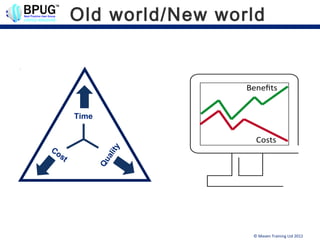
Old world/New world


        Time


Co
                   y t


   st
                  ali
               Qu


                         © Maven Training Ltd 2012
Change is a core
               competency
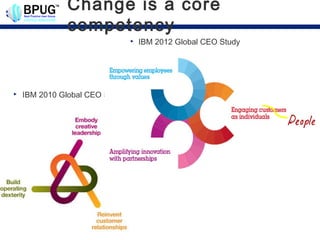
                                    IBM 2012 Global CEO Study


   IBM 2010 Global CEO Study:
Change is a core
   competency


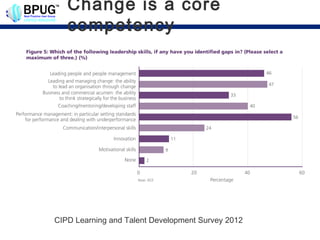
CIPD Learning and Talent Development Survey 2012
Change is a core
                      competency
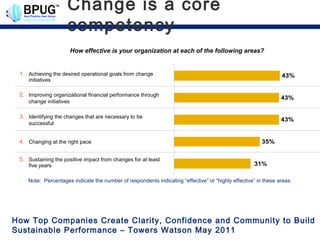
                          How effective is your organization at each of the following areas?


 1. Achieving the desired operational goals from change from
                      Achieving the desired operational goals
                                                                                                                43%
     initiatives                      change initiatives


 2. Improving organizational financial performance through
                    Improving organizational financial performance
                                 through change initiatives                                                     43%
     change initiatives

 3. Identifying the changes that are necessary to necessary to be
                     Identifying the changes that are be
                                        successful                                                              43%
     successful


 4. Changing at the right pace             Changing at the right pace                                   35%

 5. Sustaining the positive impactpositive impact fromat least for
                    Sustaining the from changes for changes
     five years                     at least five years                                             31%

    Note: Percentages indicate the number of respondents indicating “effective” or “highly effective” in these areas.


How Top Companies Create Clarity, Confidence and Community to Build
Sustainable Performance – Towers Watson May 2011
Change is a core
        competency
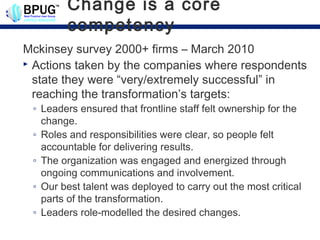
Mckinsey survey 2000+ firms – March 2010
 Actions taken by the companies where respondents

  state they were “very/extremely successful” in
  reaching the transformation’s targets:
 ◦ Leaders ensured that frontline staff felt ownership for the
   change.
 ◦ Roles and responsibilities were clear, so people felt
   accountable for delivering results.
 ◦ The organization was engaged and energized through
   ongoing communications and involvement.
 ◦ Our best talent was deployed to carry out the most critical
   parts of the transformation.
 ◦ Leaders role-modelled the desired changes.
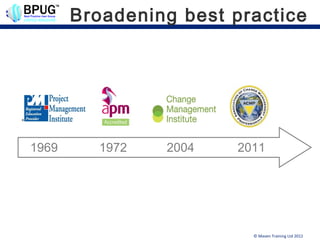
Broadening best practice


1969     1972   2004   2011


                         © Maven Training Ltd 2012
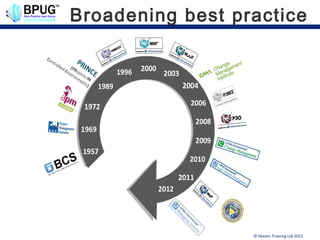
Broadening best practice


                  © Maven Training Ltd 2012
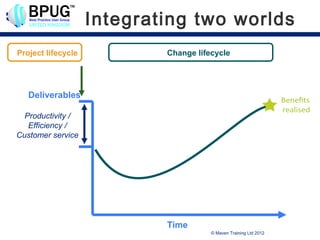
Integrating two worlds
Project lifecycle           Change lifecycle


   Deliverables

  Productivity /
   Efficiency /
Customer service


                            Time
                                       © Maven Training Ltd 2012
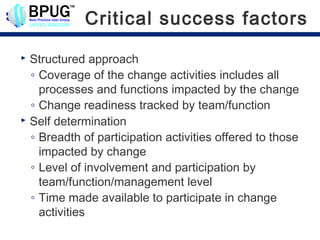
Critical success factors
 Structured approach
  ◦ Coverage of the change activities includes all
    processes and functions impacted by the change
  ◦ Change readiness tracked by team/function
 Self determination

  ◦ Breadth of participation activities offered to those
    impacted by change
  ◦ Level of involvement and participation by
    team/function/management level
  ◦ Time made available to participate in change
    activities
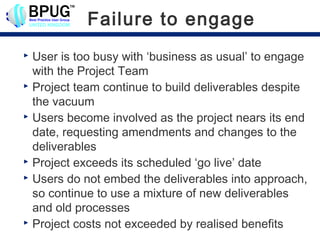
Failure to engage
 User is too busy with ‘business as usual’ to engage
  with the Project Team
 Project team continue to build deliverables despite

  the vacuum
 Users become involved as the project nears its end

  date, requesting amendments and changes to the
  deliverables
 Project exceeds its scheduled ‘go live’ date
 Users do not embed the deliverables into approach,

  so continue to use a mixture of new deliverables
  and old processes
 Project costs not exceeded by realised benefits
Activity

 What  is the biggest change that you
 will need to make to improve your
 business value in this new world?
 ◦ Do things differently
 ◦ Learn something new
 ◦ Work with different people
Vision for the CMO

Portfolio/Programme Office (P3O definition)
Support the definition and delivery of a portfolio of
 programmes and projects within a department,
 division, geographical region or business unit.
Change Management Office (Maven definition)
Provide the organisation with a focal point for
 governing, structuring and implementing change
 initiatives, ensuring each is delivered effectively
 through the application of a consistent methodology
 and performance metrics.
Answers from the CMO
   Are the changes planned and underway capable of
    achieving the strategic objectives?
   What other initiatives should be added to fill any gaps
    between strategic ambition and current changes?
   What initiatives are failing to deliver expected
    improvements?
   Should they be prematurely terminated or a task force
    be assigned to their repair?
   How can we filter initiatives at the ideas stage to prevent
    authorisation of the 'wrong‘ initiatives
   What steps in the decision making process can we
    remove or amend to increase the speed of decision
    making?
Activity
   Who are the sponsors of a CMO and what do they
    need to know from the CMO?
   Who are the customers of a CMO and what support
    do they need?
   What are the key elements of the methods and
    processes that the CMO adheres to?
   What key metrics should the CMO be tracking
    regarding change initiatives
   What behaviour changes should the CMO be
    encouraging in the project community and the
    business as a whole?
Conclusion
Change must be incorporated in our best practice:
 Change awareness – understanding the components of

  change and the cultural factors that lead to an environment
  where change is normal
 Change readiness – understanding the extent to which

  these components are currently deployed
 Change capability – building an organisation that is

  accomplished in deploying these components to achieve its
  strategic objectives
 Change effectiveness – speed at which an organisation

  realises the benefits from change, the level of engagement
  and participation with change and minimum levels of
  resistance to change
Additional resources

The purpose of a Change Management Office
 http://www.maventraining.co.uk/media/06/1206-the-pur


Project Management becomes mainstream
 http://www.maventraining.co.uk/media/72/1572-project
For more information
 E: info@maventraining.co.uk
    T: 020 7403 7100
  www.maventraining.co.uk


        Facebook: MavenTraining
        Linkedin: Melanie Franklin
        SlideShare: Maven
        YouTube: MaventrainingLtd
     Scribd: MavenTraining
       Twitter: @MavenMelanie
                @Maventraining

Bpug conference november 2012

  • 1.
    Give your organisation theability to achieve results and realise benefits 1
  • 2.
    Old world/New world Time Co y t st ali Qu © Maven Training Ltd 2012
  • 3.
    Change is acore competency  IBM 2012 Global CEO Study  IBM 2010 Global CEO Study:
  • 4.
    Change is acore competency CIPD Learning and Talent Development Survey 2012
  • 5.
    Change is acore competency How effective is your organization at each of the following areas? 1. Achieving the desired operational goals from change from Achieving the desired operational goals 43% initiatives change initiatives 2. Improving organizational financial performance through Improving organizational financial performance through change initiatives 43% change initiatives 3. Identifying the changes that are necessary to necessary to be Identifying the changes that are be successful 43% successful 4. Changing at the right pace Changing at the right pace 35% 5. Sustaining the positive impactpositive impact fromat least for Sustaining the from changes for changes five years at least five years 31% Note: Percentages indicate the number of respondents indicating “effective” or “highly effective” in these areas. How Top Companies Create Clarity, Confidence and Community to Build Sustainable Performance – Towers Watson May 2011
  • 6.
    Change is acore competency Mckinsey survey 2000+ firms – March 2010  Actions taken by the companies where respondents state they were “very/extremely successful” in reaching the transformation’s targets: ◦ Leaders ensured that frontline staff felt ownership for the change. ◦ Roles and responsibilities were clear, so people felt accountable for delivering results. ◦ The organization was engaged and energized through ongoing communications and involvement. ◦ Our best talent was deployed to carry out the most critical parts of the transformation. ◦ Leaders role-modelled the desired changes.
  • 7.
    Broadening best practice 1969 1972 2004 2011 © Maven Training Ltd 2012
  • 8.
    Broadening best practice © Maven Training Ltd 2012
  • 9.
    Integrating two worlds Projectlifecycle Change lifecycle Deliverables Productivity / Efficiency / Customer service Time © Maven Training Ltd 2012
  • 10.
    Critical success factors Structured approach ◦ Coverage of the change activities includes all processes and functions impacted by the change ◦ Change readiness tracked by team/function  Self determination ◦ Breadth of participation activities offered to those impacted by change ◦ Level of involvement and participation by team/function/management level ◦ Time made available to participate in change activities
  • 11.
    Failure to engage User is too busy with ‘business as usual’ to engage with the Project Team  Project team continue to build deliverables despite the vacuum  Users become involved as the project nears its end date, requesting amendments and changes to the deliverables  Project exceeds its scheduled ‘go live’ date  Users do not embed the deliverables into approach, so continue to use a mixture of new deliverables and old processes  Project costs not exceeded by realised benefits
  • 12.
    Activity  What is the biggest change that you will need to make to improve your business value in this new world? ◦ Do things differently ◦ Learn something new ◦ Work with different people
  • 13.
    Vision for theCMO Portfolio/Programme Office (P3O definition) Support the definition and delivery of a portfolio of programmes and projects within a department, division, geographical region or business unit. Change Management Office (Maven definition) Provide the organisation with a focal point for governing, structuring and implementing change initiatives, ensuring each is delivered effectively through the application of a consistent methodology and performance metrics.
  • 14.
    Answers from theCMO  Are the changes planned and underway capable of achieving the strategic objectives?  What other initiatives should be added to fill any gaps between strategic ambition and current changes?  What initiatives are failing to deliver expected improvements?  Should they be prematurely terminated or a task force be assigned to their repair?  How can we filter initiatives at the ideas stage to prevent authorisation of the 'wrong‘ initiatives  What steps in the decision making process can we remove or amend to increase the speed of decision making?
  • 15.
    Activity  Who are the sponsors of a CMO and what do they need to know from the CMO?  Who are the customers of a CMO and what support do they need?  What are the key elements of the methods and processes that the CMO adheres to?  What key metrics should the CMO be tracking regarding change initiatives  What behaviour changes should the CMO be encouraging in the project community and the business as a whole?
  • 16.
    Conclusion Change must beincorporated in our best practice:  Change awareness – understanding the components of change and the cultural factors that lead to an environment where change is normal  Change readiness – understanding the extent to which these components are currently deployed  Change capability – building an organisation that is accomplished in deploying these components to achieve its strategic objectives  Change effectiveness – speed at which an organisation realises the benefits from change, the level of engagement and participation with change and minimum levels of resistance to change
  • 17.
    Additional resources The purposeof a Change Management Office  http://www.maventraining.co.uk/media/06/1206-the-pur Project Management becomes mainstream  http://www.maventraining.co.uk/media/72/1572-project
  • 18.
    For more information E: info@maventraining.co.uk T: 020 7403 7100 www.maventraining.co.uk Facebook: MavenTraining Linkedin: Melanie Franklin SlideShare: Maven YouTube: MaventrainingLtd Scribd: MavenTraining Twitter: @MavenMelanie @Maventraining