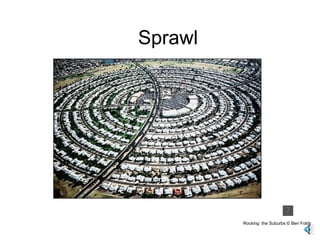
Sprawl Rocking  the Suburbs © Ben Folds
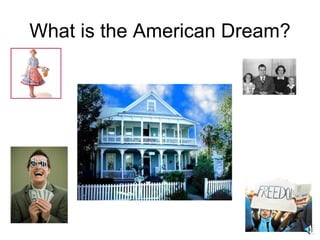
What is the American Dream?
Sprawl General definition of term:  “To spread out in an awkward or uneven way, esp. so as to take up more space than is necessary” 1
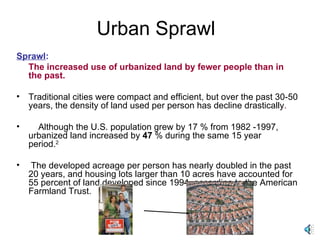
Urban Sprawl Sprawl :   The increased use of urbanized land by fewer people than in the past.   Traditional cities were compact and efficient, but over the past 30-50 years, the density of land used per person has decline drastically .   Although the U.S. population grew by 17 % from 1982 -1997, urbanized land increased by  47  % during the same 15 year period. 2    The developed acreage per person has nearly doubled in the past 20 years, and housing lots larger than 10 acres have accounted for 55 percent of land developed since 1994, according to the American Farmland Trust.
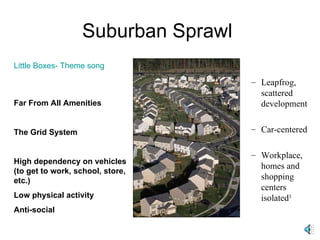
Suburban Sprawl  Little Boxes- Theme song Far From All Amenities The Grid System High dependency on vehicles (to get to work, school, store, etc.) Low physical activity Anti-social Leapfrog, scattered development Car-centered Workplace, homes and shopping centers isolated 3
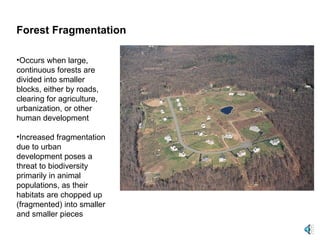
Occurs when large, continuous forests are divided into smaller blocks, either by roads, clearing for agriculture, urbanization, or other human development Increased fragmentation due to urban development poses a threat to biodiversity primarily in animal populations, as their habitats are chopped up (fragmented) into smaller and smaller pieces Forest Fragmentation
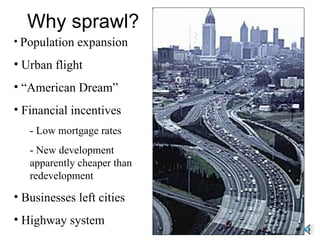
Why sprawl? Population expansion Urban flight “ American Dream” Financial incentives - Low mortgage rates - New development apparently cheaper than redevelopment Businesses left cities Highway system
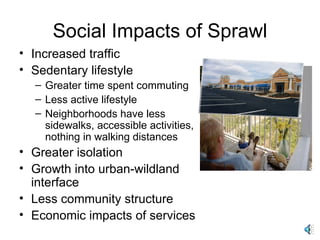
Social Impacts of Sprawl Increased traffic Sedentary lifestyle Greater time spent commuting  Less active lifestyle Neighborhoods have less sidewalks, accessible activities, nothing in walking distances Greater isolation Growth into urban-wildland interface Less community structure Economic impacts of services
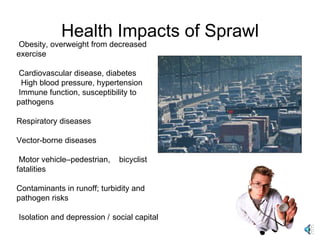
Health Impacts of Sprawl Obesity, overweight from decreased exercise  Cardiovascular disease, diabetes High blood pressure, hypertension  Immune function, susceptibility to pathogens Respiratory diseases Vector-borne diseases Motor vehicle–pedestrian,  bicyclist fatalities  Contaminants in runoff; turbidity and pathogen risks  Isolation and depression /  social capital
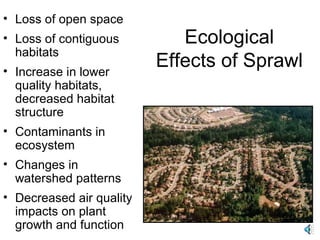
Ecological Effects of Sprawl Loss of open space Loss of contiguous habitats Increase in lower quality habitats, decreased habitat structure Contaminants in ecosystem Changes in watershed patterns Decreased air quality impacts on plant growth and function
Financial Impacts of Sprawl Existing residents subsidize new development and growth Expansion beyond planning capacity (schools, roads, emergency, utilities, water and sewer lines, infrastructure) Costs of maintenance Developers benefit
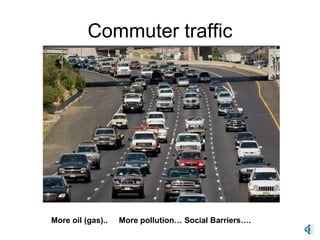
Commuter traffic More oil (gas)..  More pollution… Social Barriers….
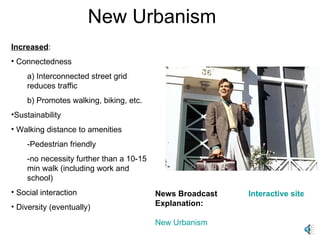
New Urbanism News Broadcast Explanation: New Urbanism Interactive site for kids Increased : Connectedness a) Interconnected street grid reduces traffic b) Promotes walking, biking, etc. Sustainability Walking distance to amenities  -Pedestrian friendly -no necessity further than a 10-15 min walk (including work and school) Social interaction Diversity (eventually)
SimCity http://simcity.ea.com/play/classic/index.html http://www.download.com/Sim-City-2000/3000-7480_4-10246048.html http://www.download.com/SimCity-Societies-demo/3000-7480_4-10853476.html
Sources 1  &quot;Sprawl.&quot;  YourDictionary.com . 2009 . LoveToKnow, Corp.. 9 Mar 2009 <http://www.yourdictionary.com/sprawl>.  2  LaGro, James A. Jr.. &quot;Population growth beyond the urban fringe: implications for rural land use policy.&quot;  Elsevier Science B.V  Vol 28, issue 2-302 July 2002 143-158 . 9 Mar 2009.  3  Pallant, Eric. “Impacts of Sprawl.” Allegheny College, Meadville,  PA. Fall 2008. <http://webpub.allegheny.edu/dept/envisci/ES110/archives/ppts/ES110_08F_ImpactsOfSprawl.ppt>

Sprawl

  • 1.
    Sprawl Rocking the Suburbs © Ben Folds
  • 2.
    What is theAmerican Dream?
  • 3.
    Sprawl General definitionof term: “To spread out in an awkward or uneven way, esp. so as to take up more space than is necessary” 1
  • 4.
    Urban Sprawl Sprawl: The increased use of urbanized land by fewer people than in the past.  Traditional cities were compact and efficient, but over the past 30-50 years, the density of land used per person has decline drastically .  Although the U.S. population grew by 17 % from 1982 -1997, urbanized land increased by 47 % during the same 15 year period. 2    The developed acreage per person has nearly doubled in the past 20 years, and housing lots larger than 10 acres have accounted for 55 percent of land developed since 1994, according to the American Farmland Trust.
  • 5.
    Suburban Sprawl Little Boxes- Theme song Far From All Amenities The Grid System High dependency on vehicles (to get to work, school, store, etc.) Low physical activity Anti-social Leapfrog, scattered development Car-centered Workplace, homes and shopping centers isolated 3
  • 6.
    Occurs when large,continuous forests are divided into smaller blocks, either by roads, clearing for agriculture, urbanization, or other human development Increased fragmentation due to urban development poses a threat to biodiversity primarily in animal populations, as their habitats are chopped up (fragmented) into smaller and smaller pieces Forest Fragmentation
  • 7.
    Why sprawl? Populationexpansion Urban flight “ American Dream” Financial incentives - Low mortgage rates - New development apparently cheaper than redevelopment Businesses left cities Highway system
  • 8.
    Social Impacts ofSprawl Increased traffic Sedentary lifestyle Greater time spent commuting Less active lifestyle Neighborhoods have less sidewalks, accessible activities, nothing in walking distances Greater isolation Growth into urban-wildland interface Less community structure Economic impacts of services
  • 9.
    Health Impacts ofSprawl Obesity, overweight from decreased exercise Cardiovascular disease, diabetes High blood pressure, hypertension Immune function, susceptibility to pathogens Respiratory diseases Vector-borne diseases Motor vehicle–pedestrian, bicyclist fatalities Contaminants in runoff; turbidity and pathogen risks Isolation and depression / social capital
  • 10.
    Ecological Effects ofSprawl Loss of open space Loss of contiguous habitats Increase in lower quality habitats, decreased habitat structure Contaminants in ecosystem Changes in watershed patterns Decreased air quality impacts on plant growth and function
  • 11.
    Financial Impacts ofSprawl Existing residents subsidize new development and growth Expansion beyond planning capacity (schools, roads, emergency, utilities, water and sewer lines, infrastructure) Costs of maintenance Developers benefit
  • 12.
    Commuter traffic Moreoil (gas).. More pollution… Social Barriers….
  • 13.
    New Urbanism NewsBroadcast Explanation: New Urbanism Interactive site for kids Increased : Connectedness a) Interconnected street grid reduces traffic b) Promotes walking, biking, etc. Sustainability Walking distance to amenities -Pedestrian friendly -no necessity further than a 10-15 min walk (including work and school) Social interaction Diversity (eventually)
  • 14.
  • 15.
    Sources 1 &quot;Sprawl.&quot; YourDictionary.com . 2009 . LoveToKnow, Corp.. 9 Mar 2009 <http://www.yourdictionary.com/sprawl>. 2 LaGro, James A. Jr.. &quot;Population growth beyond the urban fringe: implications for rural land use policy.&quot; Elsevier Science B.V Vol 28, issue 2-302 July 2002 143-158 . 9 Mar 2009. 3 Pallant, Eric. “Impacts of Sprawl.” Allegheny College, Meadville, PA. Fall 2008. <http://webpub.allegheny.edu/dept/envisci/ES110/archives/ppts/ES110_08F_ImpactsOfSprawl.ppt>