Stage 2 – Posterior Tibial
Tendon Dysfunction
Selene G. Parekh, MD, MBA
Associate Professor of Surgery
Partner, North Carolina Orthopaedic Clinic
Department of Orthopaedic Surgery
Adjunct Faculty Fuqua Business School
Duke University
Durham, NC
919.471.9622
http://seleneparekhmd.com
Twitter: @seleneparekhmd
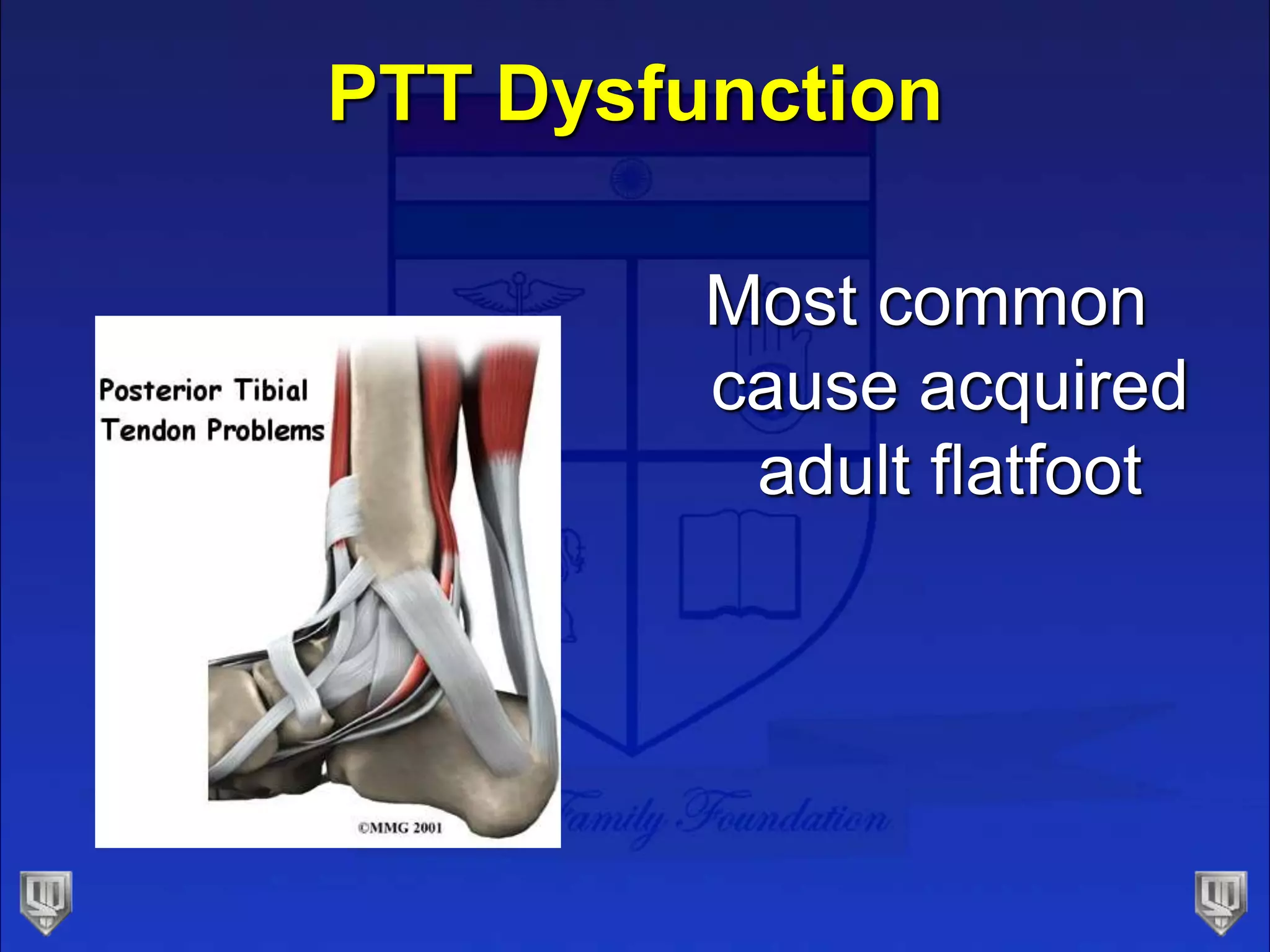
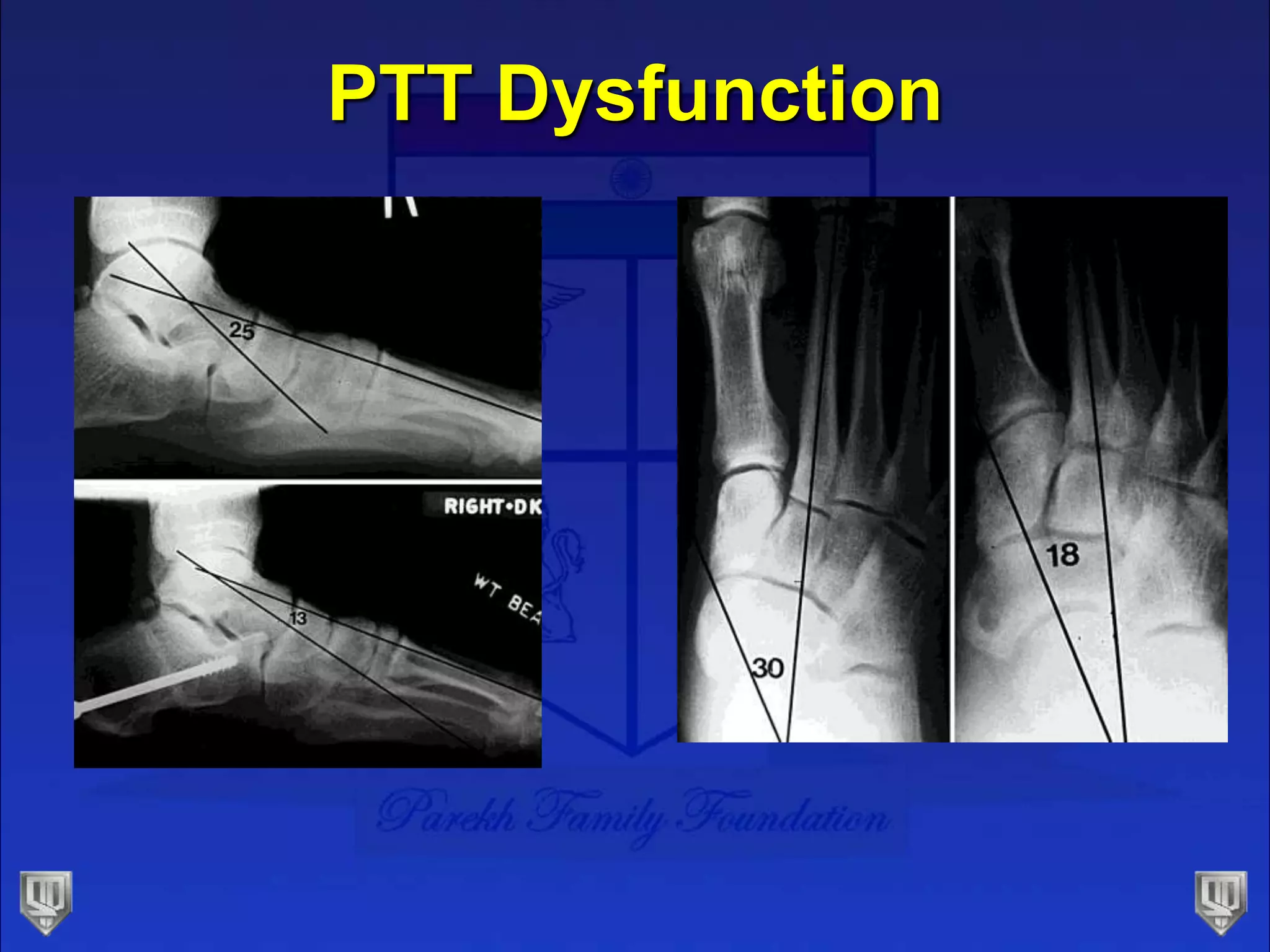
PTT Dysfunction
Most common
cause acquired
adult flatfoot
Adult Acquired Flatfoot
Classification
Stage Tendon Deformity
I Degenerated None (mild)
II Elongated,
partial tear
Flexible, ↑heel valgus, possible
forefoot abduction
III Elongated,
Partial tear
Stiff/fixed: minimal heel
inversion
IV Elongated,
partial tear
Valgus ankle tilt
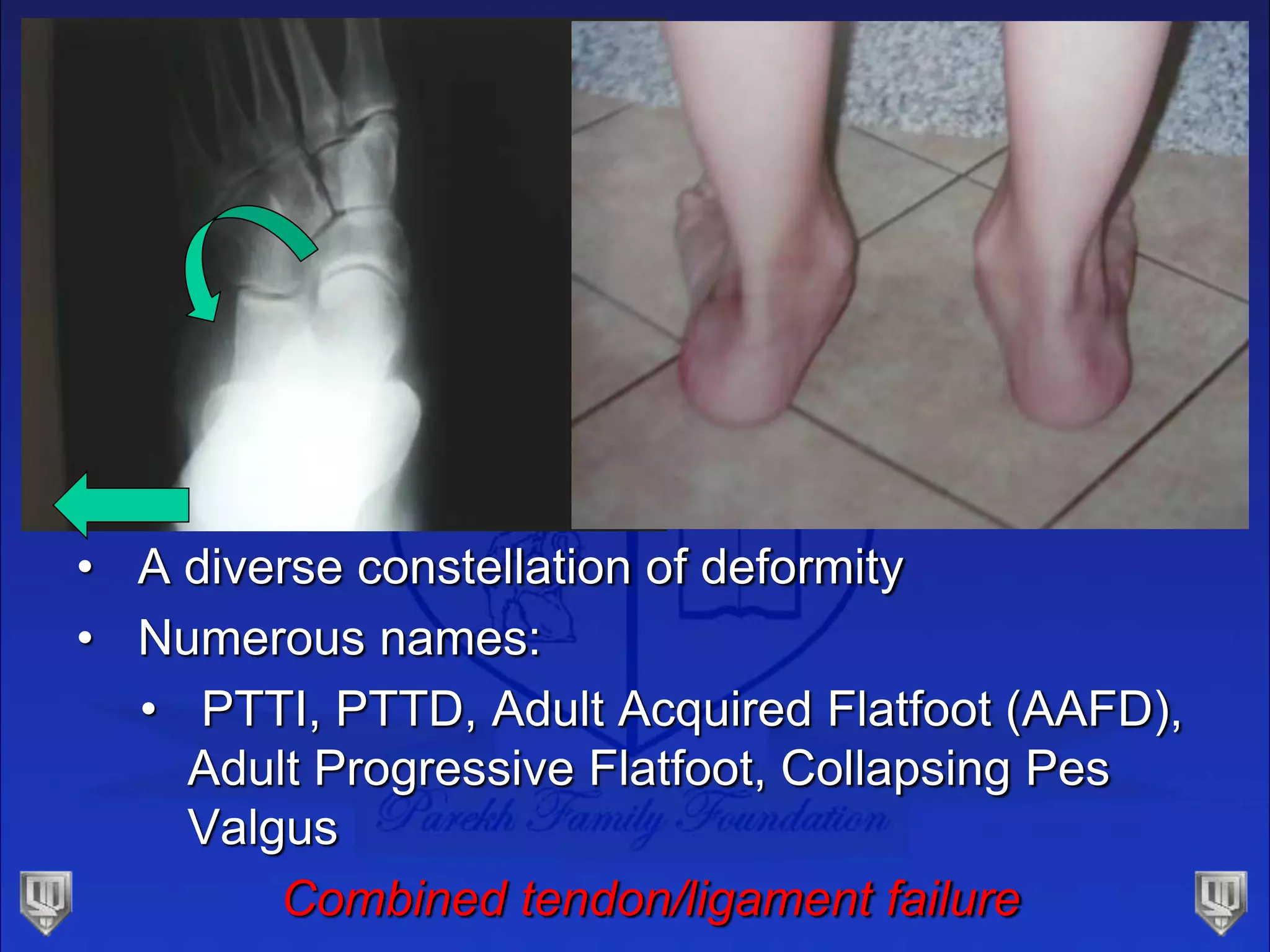
• A diverse constellation of deformity
• Numerous names:
• PTTI, PTTD, Adult Acquired Flatfoot (AAFD),
Adult Progressive Flatfoot, Collapsing Pes
Valgus
Combined tendon/ligament failure
Stage II
• Variability in amount and types of
flexible deformity
• Two groups
• IIa
• IIb
_________________________________
*J.T. Deland, et al. HSS Journal (2006) 2:157–160
*Vora, et al. JBJS Am.,2006; 88:1726 - 1734
*Bluman EM, et al. Foot Ankle Clin. 2007 Jun;12(2):233-49, v. Review.
IIa
• Less than 30% medial talar head uncoverage
(or no lateral incongruence)
• No clinical forefoot abduction
IIb
• More than 30% medial talar head uncoverage
or lateral incongruence
• Significant clinical forefoot abduction
Lateral Incongruence
Congruent
IIa
Incongruent
IIb
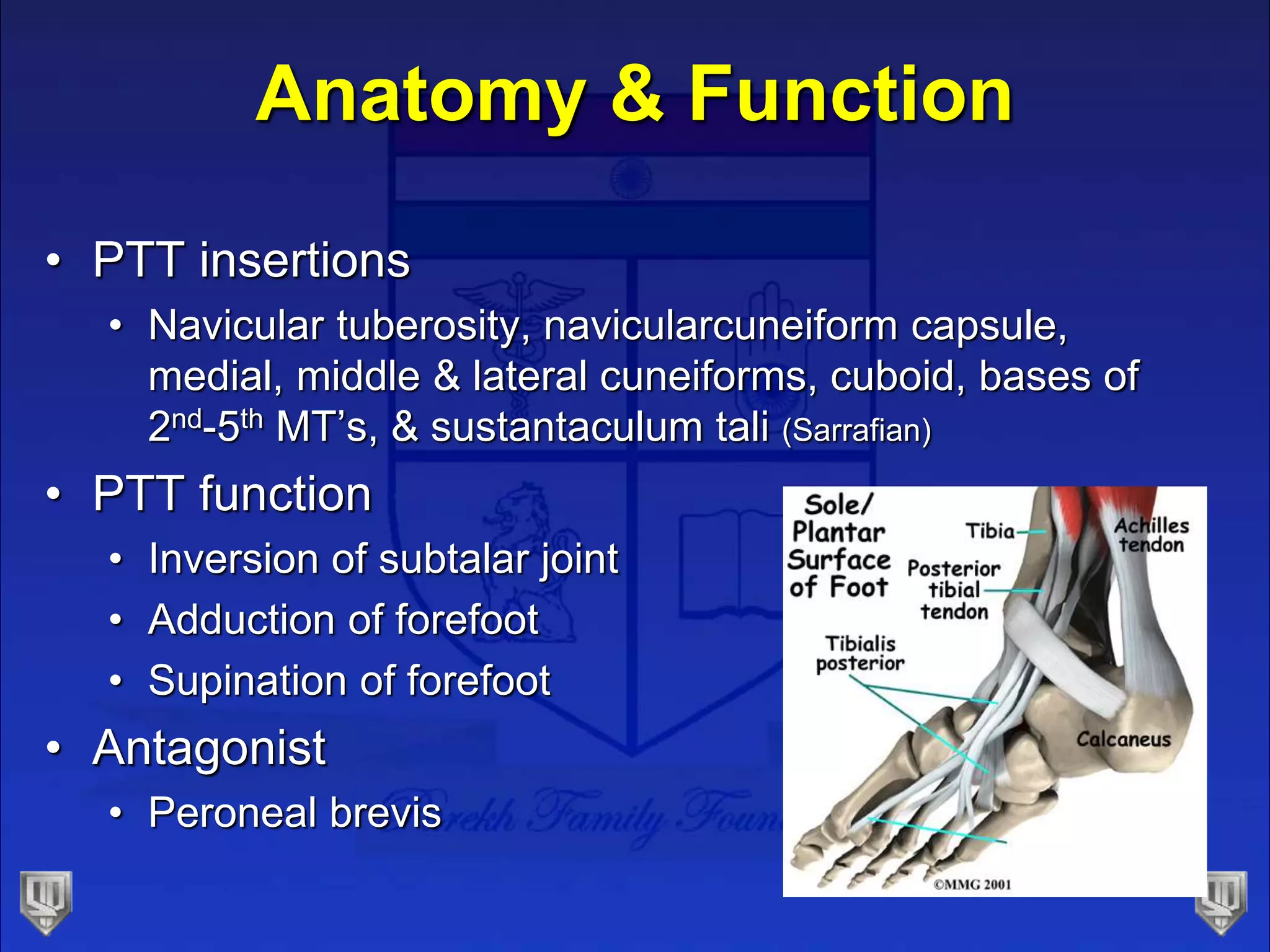
Anatomy & Function
• PTT insertions
• Navicular tuberosity, navicularcuneiform capsule,
medial, middle & lateral cuneiforms, cuboid, bases of
2nd-5th MT’s, & sustantaculum tali (Sarrafian)
• PTT function
• Inversion of subtalar joint
• Adduction of forefoot
• Supination of forefoot
• Antagonist
• Peroneal brevis
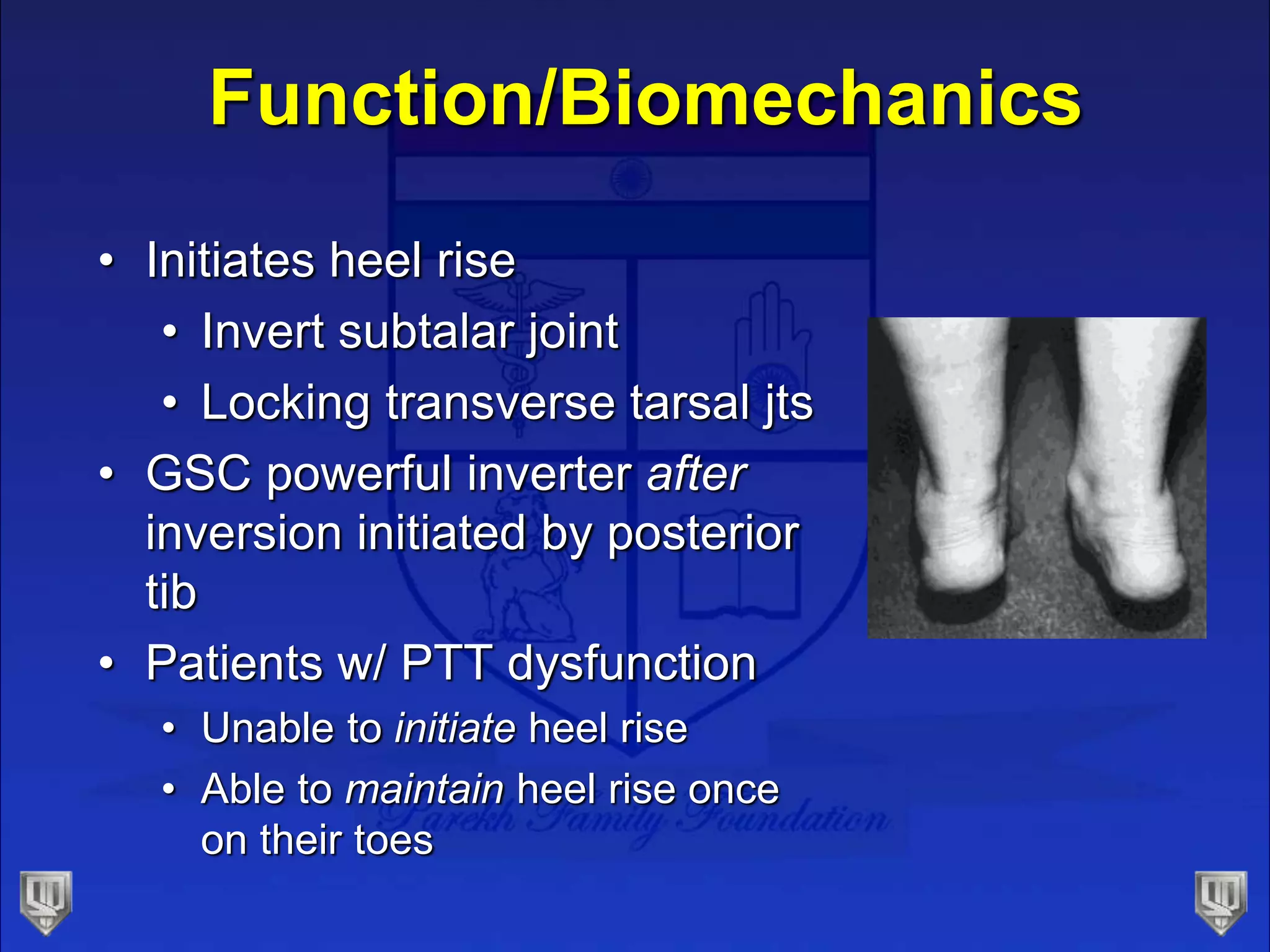
Function/Biomechanics
• Initiates heel rise
• Invert subtalar joint
• Locking transverse tarsal jts
• GSC powerful inverter after
inversion initiated by posterior
tib
• Patients w/ PTT dysfunction
• Unable to initiate heel rise
• Able to maintain heel rise once
on their toes
Pathophysiology
• Unopposed pull of peroneal brevis
•  forefoot abduction
• Attenuation in medial ligamentous structures
• Progressive collapse of arch
• End stage
• Marked calcaneal valgus
• Talus PF
• Forefoot abduction
Pathophysiology
• Spring Ligament
Complex
• Integrity of TN joint
• Superior medial
calcaneonavicular
ligament
• Inferior
calcaneonavicular
ligament
• Forefoot abd 
attenuation of spring
ligament
• Talus PF & equinus
contracture
Etiology
• “Critical zone of hypovascularity”
• Medial malleolus to navicular
• Diabetes
• Hypertension
• Obesity
• Trauma
Clinical Presentation
• Stage II: Flexible deformity
• Postural changes
• Heel valgus
• Loss of arch
• Forefoot abduction/varus
• Tendinosis
• Weakness
• Normal subtalar motion
• Pain
• Initially medial  lateral pain later
• Able to perform single toe rise early
• Unable to perform single toe rise late
Physical Exam
• Observation (front & behind)
• Deformity
• Fullness behind medial malleolus
• Single toe raise
• Evaluate TMT joints for
arthrosis/hypermobility (can mimic
PTT dysfunction)
Physical Exam
• Range of motion
• Muscle strength testing
• Swelling @ PTT
• Tenderness @
PTT/sinus tarsi
X-rays
• WB AP Foot
• Talo-2nd MT angle
• Lateral subluxation of
TN joint
X-rays
• WB Lateral Foot
• Sag of TN joint
• Talo-1st MT angle (Meary’s angle)
• Height of medial cuneiform or MT overlap
X-rays
• WB Ankle Series
• Hindfoot alignment view
• MRI
• Controversial in its role
Conservative Treatment
• Orthotic w/ medial heel lift, longitudinal
arch, medial forefoot post
• MAFO/Arizona brace
• For more severe flexible deformities
• UCBL to block abduction of forefoot
• Difficult to make
Chao & Wapner, CORR, 1999
Surgical Treatment
• Stage II: controversial
• Early
• FDL transfer
• Medial displacement calcaneal osteotomy
• Late
• Add
• Lateral column
• Lengthening/Evans
• CC fusion
• TAL
• Medial column procedure
• Cotton, Lapidus, PF osteotomy
• Spring ligament
• Repair vs reconstruction vs TN fusion
Equinus
Strayer
• Gastroc
• Sural nerve
• Larger incision
• More time
TAL
• Quick
• Atrophy of gastroc
• Loss strength
FDL Transfer
• Medial midline incision
• Retract addHal
• Knot of Henry
• Formal tenodesis
• Transfer through drill hole in navicular
• Tie at end of case
• Foot maximal inversion
FDL Transfer
FDL Only
• Stage II (flexible deformity)
• FDL transfer
• Results (Mann & Thompson)
• 88% satisfied
• 7/11 not satisfied had fixed hindfoot or forefoot
deformity
• No significant improvement in arch height
radiographically
Medial Displacement
Calcaneal Slide
• Theory
• Change the mechanical axis of the Achilles
• Improves inversion power
• Shifts weight bearing axis towards long axis of
tibia
• Usage
• Hindfoot valgus deformity
Medial Displacement
Calcaneal Slide
•Supine
•Incision
•1cm posterior to
peroneals
•Through skin only
•SURAL
•Mosquito to bone
•Score periosteum
•TPS saw
•Bounce blade
•Osteotome
MCO
MCO
MCO
MCO
MCO
Medial Displacement
Calcaneal Slide
• Shift in plantar flexion, lock in dorsiflexion
• 5-10mm
• Fixation options
• 6.5, 7.0 screws
• 1 or 2
• Edgelock
• IO Fix
PTT Dysfunction
Failure Spring Ligament
• Superomedial Component
• Abduction through
talonavicular joint
• Inferior Component
• Plantar sag of
talonavicular joint
LCL/ Evans Osteotomy
• Theory
• Lateral column shortened
• Usage
• Anterolateral impingement
• Forefoot abduction
• TN subluxation > 30-50%
LCL/ Evans Osteotomy
•Supine
•Incision
•Lateral over ant process
•SURAL, PERONEALS
•Find CC joint
•Retract peroneals
inferiorly
•Measure 1.5cm proximal
to CC joint
•Score periosteum
•TPS saw
•Bounce blade
LCL
LCL
LCL
LCL
LCL
LCL
LCL
LCL/ Evans Osteotomy
• Distract
• Lamina spreader
• Hintermann distractor
• Check TN reduction
• Distract and measure
• Autograft, allograft, biofoam wedges
• Fixation options
• > 4.0 screws
• Laterally, axially
• Plates
• Biofoam wedges
Lateral Column Procedures
• Lateral column lengthening
• Restores arch height & talar head
coverage
• Evans procedure
• Opening wedge calcaneal
osteotomy
• CC joint fusion
• Loss 30-50% subtalar motion
• Complete loss transverse tarsal
motion
Courtesy of Chi, et. al., CORR, 1999
Lateral Column Pain
• Thomas RL, et al. Preliminary results comparing
two Methods of lateral column lengthening. Foot
Ankle Int. 2001; 22(2):107-19.
• 3/34 (9%) feet w persistent lateral pain
• J.T. Deland, et al. Posterior Tibial Tendon
Insufficiency Results at Different Stages. HSSJ
(2006) 2:157–160
• 8% w pain
• 45% (10 feet of 22) w discomfort
Other Ligaments
• Other ligaments/joints likely fail: may be
combination
• Flatfoot variants:
• Collapse through TMT joints
• Collapse through TN joints
Medial Column Procedures
• Stage II
• Medial column procedures
• Correct forefoot supination
• Options
• PF cuneiform/Cotton osteotomy
• PF 1st MT-cun arthrodesis
• Nav-cun arthrodesis
Pictures courtesy of Chi, et. al., CORR,
Spring Ligament Tear
• Repair – primary
• Reconstruction
• PTT
• Allograft/Autograft
• TN fusion
Spring Ligament Tear
Surgical Treatment
• Stage II
• Correct all deformity
• FDL transfer
• Medial displacement calcaneal osteotomy
• Add
• Lateral column
• Lengthening/Evans
• CC fusion
• TAL
• Medial column procedure
• Cotton, Lapidus, PF osteotomy
• Spring ligament
• Repair vs reconstruction vs TN fusion
RE
ECT
the ankle
the foot

Lecture 26 parekh pttd2

  • 1.
    Stage 2 –Posterior Tibial Tendon Dysfunction Selene G. Parekh, MD, MBA Associate Professor of Surgery Partner, North Carolina Orthopaedic Clinic Department of Orthopaedic Surgery Adjunct Faculty Fuqua Business School Duke University Durham, NC 919.471.9622 http://seleneparekhmd.com Twitter: @seleneparekhmd
  • 2.
    PTT Dysfunction Most common causeacquired adult flatfoot
  • 3.
    Adult Acquired Flatfoot Classification StageTendon Deformity I Degenerated None (mild) II Elongated, partial tear Flexible, ↑heel valgus, possible forefoot abduction III Elongated, Partial tear Stiff/fixed: minimal heel inversion IV Elongated, partial tear Valgus ankle tilt
  • 4.
    • A diverseconstellation of deformity • Numerous names: • PTTI, PTTD, Adult Acquired Flatfoot (AAFD), Adult Progressive Flatfoot, Collapsing Pes Valgus Combined tendon/ligament failure
  • 5.
    Stage II • Variabilityin amount and types of flexible deformity • Two groups • IIa • IIb _________________________________ *J.T. Deland, et al. HSS Journal (2006) 2:157–160 *Vora, et al. JBJS Am.,2006; 88:1726 - 1734 *Bluman EM, et al. Foot Ankle Clin. 2007 Jun;12(2):233-49, v. Review.
  • 6.
    IIa • Less than30% medial talar head uncoverage (or no lateral incongruence) • No clinical forefoot abduction
  • 7.
    IIb • More than30% medial talar head uncoverage or lateral incongruence • Significant clinical forefoot abduction
  • 8.
  • 9.
    Anatomy & Function •PTT insertions • Navicular tuberosity, navicularcuneiform capsule, medial, middle & lateral cuneiforms, cuboid, bases of 2nd-5th MT’s, & sustantaculum tali (Sarrafian) • PTT function • Inversion of subtalar joint • Adduction of forefoot • Supination of forefoot • Antagonist • Peroneal brevis
  • 10.
    Function/Biomechanics • Initiates heelrise • Invert subtalar joint • Locking transverse tarsal jts • GSC powerful inverter after inversion initiated by posterior tib • Patients w/ PTT dysfunction • Unable to initiate heel rise • Able to maintain heel rise once on their toes
  • 11.
    Pathophysiology • Unopposed pullof peroneal brevis •  forefoot abduction • Attenuation in medial ligamentous structures • Progressive collapse of arch • End stage • Marked calcaneal valgus • Talus PF • Forefoot abduction
  • 12.
    Pathophysiology • Spring Ligament Complex •Integrity of TN joint • Superior medial calcaneonavicular ligament • Inferior calcaneonavicular ligament • Forefoot abd  attenuation of spring ligament • Talus PF & equinus contracture
  • 13.
    Etiology • “Critical zoneof hypovascularity” • Medial malleolus to navicular • Diabetes • Hypertension • Obesity • Trauma
  • 14.
    Clinical Presentation • StageII: Flexible deformity • Postural changes • Heel valgus • Loss of arch • Forefoot abduction/varus • Tendinosis • Weakness • Normal subtalar motion • Pain • Initially medial  lateral pain later • Able to perform single toe rise early • Unable to perform single toe rise late
  • 15.
    Physical Exam • Observation(front & behind) • Deformity • Fullness behind medial malleolus • Single toe raise • Evaluate TMT joints for arthrosis/hypermobility (can mimic PTT dysfunction)
  • 16.
    Physical Exam • Rangeof motion • Muscle strength testing • Swelling @ PTT • Tenderness @ PTT/sinus tarsi
  • 17.
    X-rays • WB APFoot • Talo-2nd MT angle • Lateral subluxation of TN joint
  • 18.
    X-rays • WB LateralFoot • Sag of TN joint • Talo-1st MT angle (Meary’s angle) • Height of medial cuneiform or MT overlap
  • 19.
    X-rays • WB AnkleSeries • Hindfoot alignment view • MRI • Controversial in its role
  • 20.
    Conservative Treatment • Orthoticw/ medial heel lift, longitudinal arch, medial forefoot post • MAFO/Arizona brace • For more severe flexible deformities • UCBL to block abduction of forefoot • Difficult to make Chao & Wapner, CORR, 1999
  • 21.
    Surgical Treatment • StageII: controversial • Early • FDL transfer • Medial displacement calcaneal osteotomy • Late • Add • Lateral column • Lengthening/Evans • CC fusion • TAL • Medial column procedure • Cotton, Lapidus, PF osteotomy • Spring ligament • Repair vs reconstruction vs TN fusion
  • 22.
    Equinus Strayer • Gastroc • Suralnerve • Larger incision • More time TAL • Quick • Atrophy of gastroc • Loss strength
  • 23.
    FDL Transfer • Medialmidline incision • Retract addHal • Knot of Henry • Formal tenodesis • Transfer through drill hole in navicular • Tie at end of case • Foot maximal inversion
  • 24.
  • 25.
    FDL Only • StageII (flexible deformity) • FDL transfer • Results (Mann & Thompson) • 88% satisfied • 7/11 not satisfied had fixed hindfoot or forefoot deformity • No significant improvement in arch height radiographically
  • 26.
    Medial Displacement Calcaneal Slide •Theory • Change the mechanical axis of the Achilles • Improves inversion power • Shifts weight bearing axis towards long axis of tibia • Usage • Hindfoot valgus deformity
  • 27.
    Medial Displacement Calcaneal Slide •Supine •Incision •1cmposterior to peroneals •Through skin only •SURAL •Mosquito to bone •Score periosteum •TPS saw •Bounce blade •Osteotome
  • 28.
  • 29.
  • 30.
  • 31.
  • 32.
  • 33.
    Medial Displacement Calcaneal Slide •Shift in plantar flexion, lock in dorsiflexion • 5-10mm • Fixation options • 6.5, 7.0 screws • 1 or 2 • Edgelock • IO Fix
  • 34.
  • 35.
    Failure Spring Ligament •Superomedial Component • Abduction through talonavicular joint • Inferior Component • Plantar sag of talonavicular joint
  • 36.
    LCL/ Evans Osteotomy •Theory • Lateral column shortened • Usage • Anterolateral impingement • Forefoot abduction • TN subluxation > 30-50%
  • 37.
    LCL/ Evans Osteotomy •Supine •Incision •Lateralover ant process •SURAL, PERONEALS •Find CC joint •Retract peroneals inferiorly •Measure 1.5cm proximal to CC joint •Score periosteum •TPS saw •Bounce blade
  • 38.
  • 39.
  • 40.
  • 41.
  • 42.
  • 43.
  • 44.
  • 45.
    LCL/ Evans Osteotomy •Distract • Lamina spreader • Hintermann distractor • Check TN reduction • Distract and measure • Autograft, allograft, biofoam wedges • Fixation options • > 4.0 screws • Laterally, axially • Plates • Biofoam wedges
  • 46.
    Lateral Column Procedures •Lateral column lengthening • Restores arch height & talar head coverage • Evans procedure • Opening wedge calcaneal osteotomy • CC joint fusion • Loss 30-50% subtalar motion • Complete loss transverse tarsal motion Courtesy of Chi, et. al., CORR, 1999
  • 47.
    Lateral Column Pain •Thomas RL, et al. Preliminary results comparing two Methods of lateral column lengthening. Foot Ankle Int. 2001; 22(2):107-19. • 3/34 (9%) feet w persistent lateral pain • J.T. Deland, et al. Posterior Tibial Tendon Insufficiency Results at Different Stages. HSSJ (2006) 2:157–160 • 8% w pain • 45% (10 feet of 22) w discomfort
  • 48.
    Other Ligaments • Otherligaments/joints likely fail: may be combination • Flatfoot variants: • Collapse through TMT joints • Collapse through TN joints
  • 49.
    Medial Column Procedures •Stage II • Medial column procedures • Correct forefoot supination • Options • PF cuneiform/Cotton osteotomy • PF 1st MT-cun arthrodesis • Nav-cun arthrodesis Pictures courtesy of Chi, et. al., CORR,
  • 50.
    Spring Ligament Tear •Repair – primary • Reconstruction • PTT • Allograft/Autograft • TN fusion
  • 51.
  • 52.
  • 53.
  • 54.
  • 55.
    Surgical Treatment • StageII • Correct all deformity • FDL transfer • Medial displacement calcaneal osteotomy • Add • Lateral column • Lengthening/Evans • CC fusion • TAL • Medial column procedure • Cotton, Lapidus, PF osteotomy • Spring ligament • Repair vs reconstruction vs TN fusion
  • 56.