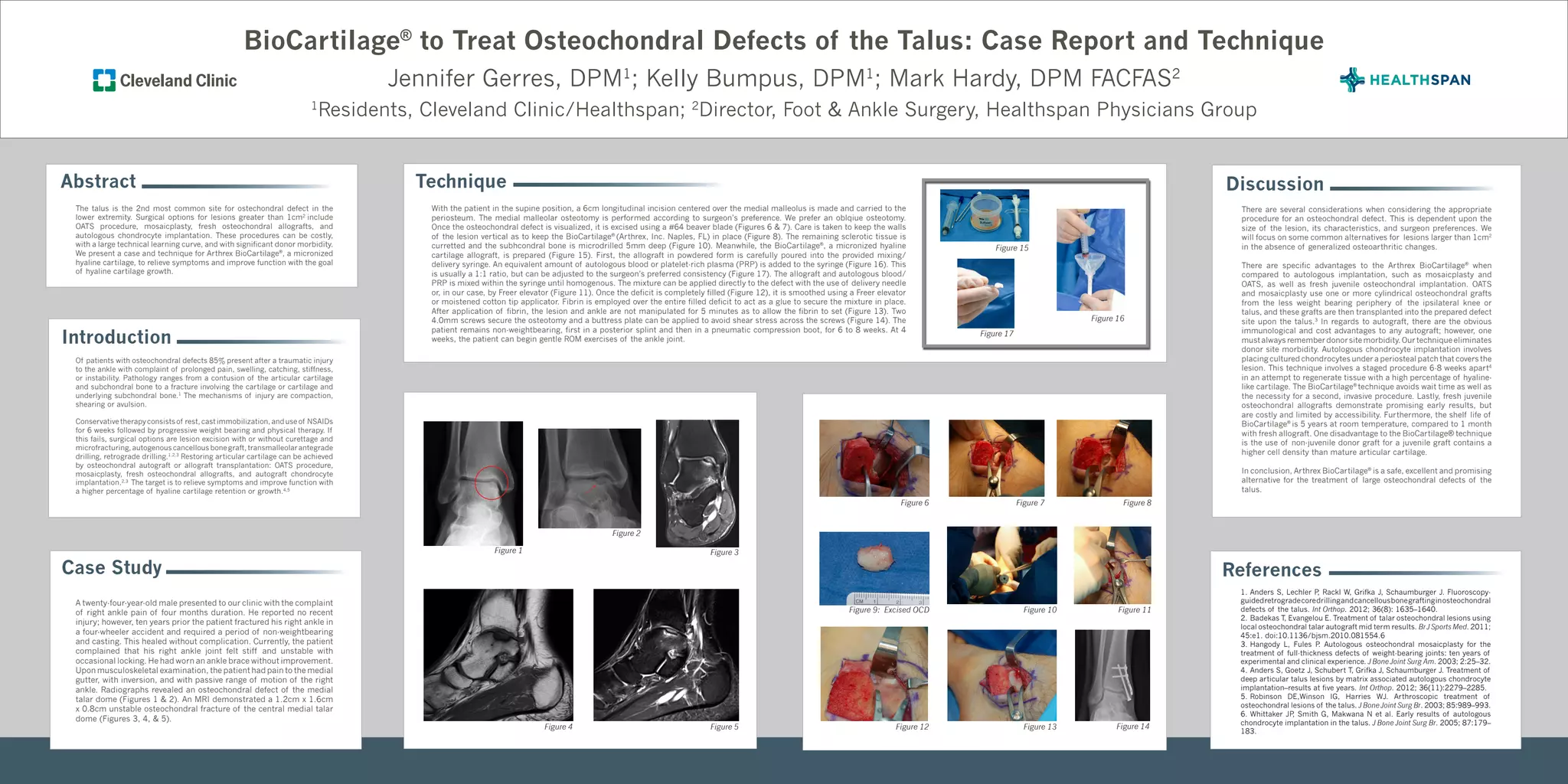
BioCartilage to Treat Osteochondral Defects of the Talus: Case Report and Technique
®

Jennifer Gerres, DPM ; Kelly Bumpus, DPM ; Mark Hardy, DPM FACFAS
1

1

2

Residents, Cleveland Clinic/Healthspan; Director, Foot & Ankle Surgery, Healthspan Physicians Group

1

Abstract
The talus is the 2nd most common site for ostechondral defect in the
lower extremity. Surgical options for lesions greater than 1cm2 include
OATS procedure, mosaicplasty, fresh osteochondral allografts, and
autologous chondrocyte implantation. These procedures can be costly,
with a large technical learning curve, and with significant donor morbidity.
We present a case and technique for Arthrex BioCartilage®, a micronized
hyaline cartilage, to relieve symptoms and improve function with the goal
of hyaline cartilage growth.

Introduction

2

Technique

Discussion

With the patient in the supine position, a 6cm longitudinal incision centered over the medial malleolus is made and carried to the
periosteum. The medial malleolar osteotomy is performed according to surgeon’s preference. We prefer an oblqiue osteotomy.
Once the osteochondral defect is visualized, it is excised using a #64 beaver blade (Figures 6 & 7). Care is taken to keep the walls
of the lesion vertical as to keep the BioCartilage® (Arthrex, Inc. Naples, FL) in place (Figure 8). The remaining sclerotic tissue is
curretted and the subhcondral bone is microdrilled 5mm deep (Figure 10). Meanwhile, the BioCartilage®, a micronized hyaline
cartilage allograft, is prepared (Figure 15). First, the allograft in powdered form is carefully poured into the provided mixing/
delivery syringe. An equivalent amount of autologous blood or platelet-rich plasma (PRP) is added to the syringe (Figure 16). This
is usually a 1:1 ratio, but can be adjusted to the surgeon’s preferred consistency (Figure 17). The allograft and autologous blood/
PRP is mixed within the syringe until homogenous. The mixture can be applied directly to the defect with the use of delivery needle
or, in our case, by Freer elevator (Figure 11). Once the deficit is completely filled (Figure 12), it is smoothed using a Freer elevator
or moistened cotton tip applicator. Fibrin is employed over the entire filled deficit to act as a glue to secure the mixture in place.
After application of fibrin, the lesion and ankle are not manipulated for 5 minutes as to allow the fibrin to set (Figure 13). Two
4.0mm screws secure the osteotomy and a buttress plate can be applied to avoid shear stress across the screws (Figure 14). The
patient remains non-weightbearing, first in a posterior splint and then in a pneumatic compression boot, for 6 to 8 weeks. At 4
weeks, the patient can begin gentle ROM exercises of the ankle joint.

There are several considerations when considering the appropriate
procedure for an osteochondral defect. This is dependent upon the
size of the lesion, its characteristics, and surgeon preferences. We
will focus on some common alternatives for lesions larger than 1cm2
in the absence of generalized osteoarthritic changes.

Figure 15

Figure 16
Figure 17

Of patients with osteochondral defects 85% present after a traumatic injury
to the ankle with complaint of prolonged pain, swelling, catching, stiffness,
or instability. Pathology ranges from a contusion of the articular cartilage
and subchondral bone to a fracture involving the cartilage or cartilage and
underlying subchondral bone.1 The mechanisms of injury are compaction,
shearing or avulsion.
Conservative therapy consists of rest, cast immobilization, and use of NSAIDs
for 6 weeks followed by progressive weight bearing and physical therapy. If
this fails, surgical options are lesion excision with or without curettage and
microfracturing, autogenous cancellous bone graft, transmalleolar antegrade
drilling, retrograde drilling.1,2,3 Restoring articular cartilage can be achieved
by osteochondral autograft or allograft transplantation: OATS procedure,
mosaicplasty, fresh osteochondral allografts, and autograft chondrocyte
implantation.2,3 The target is to relieve symptoms and improve function with
a higher percentage of hyaline cartilage retention or growth.4,5

There are specific advantages to the Arthrex BioCartilage® when
compared to autologous implantation, such as mosaicplasty and
OATS, as well as fresh juvenile osteochondral implantation. OATS
and mosaicplasty use one or more cylindrical osteochondral grafts
from the less weight bearing periphery of the ipsilateral knee or
talus, and these grafts are then transplanted into the prepared defect
site upon the talus.3 In regards to autograft, there are the obvious
immunological and cost advantages to any autograft; however, one
must always remember donor site morbidity. Our technique eliminates
donor site morbidity. Autologous chondrocyte implantation involves
placing cultured chondrocytes under a periosteal patch that covers the
lesion. This technique involves a staged procedure 6-8 weeks apart4
in an attempt to regenerate tissue with a high percentage of hyalinelike cartilage. The BioCartilage® technique avoids wait time as well as
the necessity for a second, invasive procedure. Lastly, fresh juvenile
osteochondral allografts demonstrate promising early results, but
are costly and limited by accessibility. Furthermore, the shelf life of
BioCartilage® is 5 years at room temperature, compared to 1 month
with fresh allograft. One disadvantage to the BioCartilage® technique
is the use of non-juvenile donor graft for a juvenile graft contains a
higher cell density than mature articular cartilage.
In conclusion, Arthrex BioCartilage® is a safe, excellent and promising
alternative for the treatment of large osteochondral defects of the
talus.

Figure 6

Figure 7

Figure 8

Figure 2
Figure 1

Figure 3

Case Study
A twenty-four-year-old male presented to our clinic with the complaint
of right ankle pain of four months duration. He reported no recent
injury; however, ten years prior the patient fractured his right ankle in
a four-wheeler accident and required a period of non-weightbearing
and casting. This healed without complication. Currently, the patient
complained that his right ankle joint felt stiff and unstable with
occasional locking. He had worn an ankle brace without improvement.
Upon musculoskeletal examination, the patient had pain to the medial
gutter, with inversion, and with passive range of motion of the right
ankle. Radiographs revealed an osteochondral defect of the medial
talar dome (Figures 1 & 2). An MRI demonstrated a 1.2cm x 1.6cm
x 0.8cm unstable osteochondral fracture of the central medial talar
dome (Figures 3, 4, & 5).

References
Figure 9: Excised OCD

Figure 4

Figure 5

Figure 10

Figure 11

Figure 12

Figure 13

Figure 14

1.	Anders S, Lechler P Rackl W, Grifka J, Schaumburger J. Fluoroscopy,
guided retrograde core drilling and cancellous bone grafting in osteochondral
defects of the talus. Int Orthop. 2012; 36(8): 1635–1640.
2.	 Badekas T, Evangelou E. Treatment of talar osteochondral lesions using
local osteochondral talar autograft mid term results. Br J Sports Med. 2011;
45:e1. doi:10.1136/bjsm.2010.081554.6
3.	Hangody L, Fules P Autologous osteochondral mosaicplasty for the
.
treatment of full-thickness defects of weight-bearing joints: ten years of
experimental and clinical experience. J Bone Joint Surg Am. 2003; 2:25–32.
4.	Anders S, Goetz J, Schubert T, Grifka J, Schaumburger J. Treatment of
deep articular talus lesions by matrix associated autologous chondrocyte
implantation–results at five years. Int Orthop. 2012; 36(11):2279–2285.
5.	
Robinson DE,Winson IG, Harries WJ. Arthroscopic treatment of
osteochondral lesions of the talus. J Bone Joint Surg Br. 2003; 85:989–993.
6.	Whittaker JP Smith G, Makwana N et al. Early results of autologous
,
chondrocyte implantation in the talus. J Bone Joint Surg Br. 2005; 87:179–
183.

Biocartilage to Treat Osteochondral Defects of the Talus: Case Report and Technique

  • 1.
    BioCartilage to TreatOsteochondral Defects of the Talus: Case Report and Technique ® Jennifer Gerres, DPM ; Kelly Bumpus, DPM ; Mark Hardy, DPM FACFAS 1 1 2 Residents, Cleveland Clinic/Healthspan; Director, Foot & Ankle Surgery, Healthspan Physicians Group 1 Abstract The talus is the 2nd most common site for ostechondral defect in the lower extremity. Surgical options for lesions greater than 1cm2 include OATS procedure, mosaicplasty, fresh osteochondral allografts, and autologous chondrocyte implantation. These procedures can be costly, with a large technical learning curve, and with significant donor morbidity. We present a case and technique for Arthrex BioCartilage®, a micronized hyaline cartilage, to relieve symptoms and improve function with the goal of hyaline cartilage growth. Introduction 2 Technique Discussion With the patient in the supine position, a 6cm longitudinal incision centered over the medial malleolus is made and carried to the periosteum. The medial malleolar osteotomy is performed according to surgeon’s preference. We prefer an oblqiue osteotomy. Once the osteochondral defect is visualized, it is excised using a #64 beaver blade (Figures 6 & 7). Care is taken to keep the walls of the lesion vertical as to keep the BioCartilage® (Arthrex, Inc. Naples, FL) in place (Figure 8). The remaining sclerotic tissue is curretted and the subhcondral bone is microdrilled 5mm deep (Figure 10). Meanwhile, the BioCartilage®, a micronized hyaline cartilage allograft, is prepared (Figure 15). First, the allograft in powdered form is carefully poured into the provided mixing/ delivery syringe. An equivalent amount of autologous blood or platelet-rich plasma (PRP) is added to the syringe (Figure 16). This is usually a 1:1 ratio, but can be adjusted to the surgeon’s preferred consistency (Figure 17). The allograft and autologous blood/ PRP is mixed within the syringe until homogenous. The mixture can be applied directly to the defect with the use of delivery needle or, in our case, by Freer elevator (Figure 11). Once the deficit is completely filled (Figure 12), it is smoothed using a Freer elevator or moistened cotton tip applicator. Fibrin is employed over the entire filled deficit to act as a glue to secure the mixture in place. After application of fibrin, the lesion and ankle are not manipulated for 5 minutes as to allow the fibrin to set (Figure 13). Two 4.0mm screws secure the osteotomy and a buttress plate can be applied to avoid shear stress across the screws (Figure 14). The patient remains non-weightbearing, first in a posterior splint and then in a pneumatic compression boot, for 6 to 8 weeks. At 4 weeks, the patient can begin gentle ROM exercises of the ankle joint. There are several considerations when considering the appropriate procedure for an osteochondral defect. This is dependent upon the size of the lesion, its characteristics, and surgeon preferences. We will focus on some common alternatives for lesions larger than 1cm2 in the absence of generalized osteoarthritic changes. Figure 15 Figure 16 Figure 17 Of patients with osteochondral defects 85% present after a traumatic injury to the ankle with complaint of prolonged pain, swelling, catching, stiffness, or instability. Pathology ranges from a contusion of the articular cartilage and subchondral bone to a fracture involving the cartilage or cartilage and underlying subchondral bone.1 The mechanisms of injury are compaction, shearing or avulsion. Conservative therapy consists of rest, cast immobilization, and use of NSAIDs for 6 weeks followed by progressive weight bearing and physical therapy. If this fails, surgical options are lesion excision with or without curettage and microfracturing, autogenous cancellous bone graft, transmalleolar antegrade drilling, retrograde drilling.1,2,3 Restoring articular cartilage can be achieved by osteochondral autograft or allograft transplantation: OATS procedure, mosaicplasty, fresh osteochondral allografts, and autograft chondrocyte implantation.2,3 The target is to relieve symptoms and improve function with a higher percentage of hyaline cartilage retention or growth.4,5 There are specific advantages to the Arthrex BioCartilage® when compared to autologous implantation, such as mosaicplasty and OATS, as well as fresh juvenile osteochondral implantation. OATS and mosaicplasty use one or more cylindrical osteochondral grafts from the less weight bearing periphery of the ipsilateral knee or talus, and these grafts are then transplanted into the prepared defect site upon the talus.3 In regards to autograft, there are the obvious immunological and cost advantages to any autograft; however, one must always remember donor site morbidity. Our technique eliminates donor site morbidity. Autologous chondrocyte implantation involves placing cultured chondrocytes under a periosteal patch that covers the lesion. This technique involves a staged procedure 6-8 weeks apart4 in an attempt to regenerate tissue with a high percentage of hyalinelike cartilage. The BioCartilage® technique avoids wait time as well as the necessity for a second, invasive procedure. Lastly, fresh juvenile osteochondral allografts demonstrate promising early results, but are costly and limited by accessibility. Furthermore, the shelf life of BioCartilage® is 5 years at room temperature, compared to 1 month with fresh allograft. One disadvantage to the BioCartilage® technique is the use of non-juvenile donor graft for a juvenile graft contains a higher cell density than mature articular cartilage. In conclusion, Arthrex BioCartilage® is a safe, excellent and promising alternative for the treatment of large osteochondral defects of the talus. Figure 6 Figure 7 Figure 8 Figure 2 Figure 1 Figure 3 Case Study A twenty-four-year-old male presented to our clinic with the complaint of right ankle pain of four months duration. He reported no recent injury; however, ten years prior the patient fractured his right ankle in a four-wheeler accident and required a period of non-weightbearing and casting. This healed without complication. Currently, the patient complained that his right ankle joint felt stiff and unstable with occasional locking. He had worn an ankle brace without improvement. Upon musculoskeletal examination, the patient had pain to the medial gutter, with inversion, and with passive range of motion of the right ankle. Radiographs revealed an osteochondral defect of the medial talar dome (Figures 1 & 2). An MRI demonstrated a 1.2cm x 1.6cm x 0.8cm unstable osteochondral fracture of the central medial talar dome (Figures 3, 4, & 5). References Figure 9: Excised OCD Figure 4 Figure 5 Figure 10 Figure 11 Figure 12 Figure 13 Figure 14 1. Anders S, Lechler P Rackl W, Grifka J, Schaumburger J. Fluoroscopy, guided retrograde core drilling and cancellous bone grafting in osteochondral defects of the talus. Int Orthop. 2012; 36(8): 1635–1640. 2. Badekas T, Evangelou E. Treatment of talar osteochondral lesions using local osteochondral talar autograft mid term results. Br J Sports Med. 2011; 45:e1. doi:10.1136/bjsm.2010.081554.6 3. Hangody L, Fules P Autologous osteochondral mosaicplasty for the . treatment of full-thickness defects of weight-bearing joints: ten years of experimental and clinical experience. J Bone Joint Surg Am. 2003; 2:25–32. 4. Anders S, Goetz J, Schubert T, Grifka J, Schaumburger J. Treatment of deep articular talus lesions by matrix associated autologous chondrocyte implantation–results at five years. Int Orthop. 2012; 36(11):2279–2285. 5. Robinson DE,Winson IG, Harries WJ. Arthroscopic treatment of osteochondral lesions of the talus. J Bone Joint Surg Br. 2003; 85:989–993. 6. Whittaker JP Smith G, Makwana N et al. Early results of autologous , chondrocyte implantation in the talus. J Bone Joint Surg Br. 2005; 87:179– 183.