Subsystems of Radar and Signal Processing
And ST Radar
Ronak Vyas

Abstract—The paper covers all the aspects of the research paper albeit in a more concise and brief manner. The paper
starts with a brief discussion of the first and initial goal of understanding the basic concepts of radar systems. Then it
proceeds with the second goal which is the study of ST (Stratosphere Troposphere) radar. The final goal of the paper is
then achieved by applying the basic concepts of the radar system, which was the initial goal of the project, in order to
describe a small radar prototype. Thus, the final goal of the paper aims at better understanding both the basics of the
radar as well as the process of designing a small radar system. The paper in its entirety provides a holistic approach of
studying the basics of radar, applying it in order to design a radar prototype and understanding the working and
application of a radar in real life circumstances in order to gather valuable data.
Keywords—FMCW RADAR,ST RADAR,Signal Processing

I.

Introduction

The first thing is the understanding of the basic concepts of radar and its various subsystems like the antenna,
transmitter, duplexer, receiver and signal processing.
Radar is an acronym for Radio Detection and Ranging. It is a device which is used to determine the location of
objects. Depending on the type of the radar, it can also be used to determine the range, altitude, direction, or speed
of objects.
It operates by transmitting a particular type of waveform and detecting the nature of the echo signal. It is basically a
means of gathering information about distant objects, or targets by sending electromagnetic (EM) waves at them and
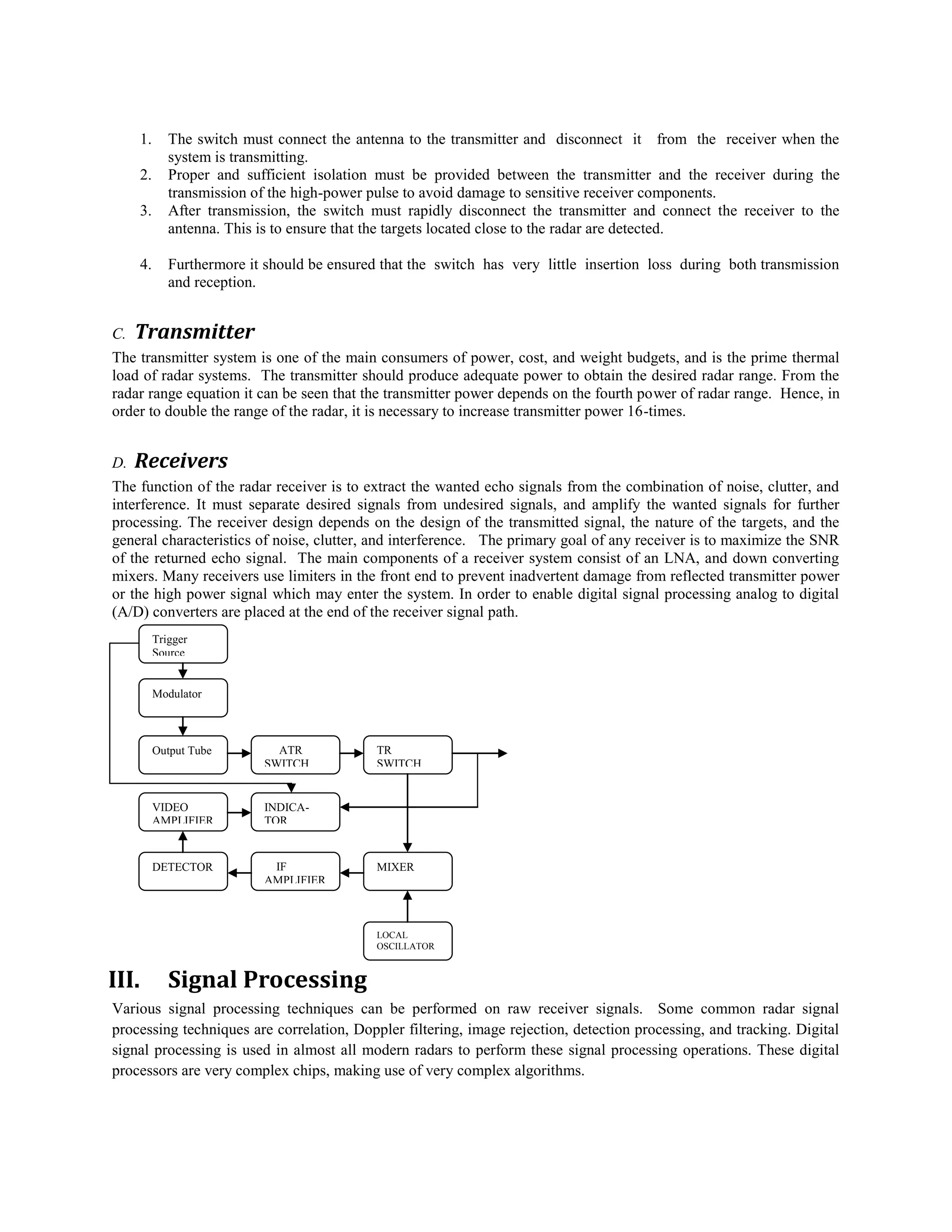
analyzing the echoes. It was RADAR which gave birth to microwave technology. Various blocks in the transmitter
subsystem are the trigger source, modulator, the output tube, the duplexer (ATR-Anti transmit receive and TR –
Transmit receive). It then proceeds on to the next stage of the paper that is the study of an ongoing interest of the
paper, which is ST (Stratosphere Troposphere) radar. It first starts with the use and the proposed location of the ST
radar and then proceeds to cover its various parts and its overall application as a wind profiler.

II.
A.

Subsystems of radar:

Antennas

The radar antenna acts as an interface between the radar system and free space through which radio waves are
transmitted and received. The main purpose of the radar antenna is to transduce free space propagation to guided
wave propagation during reception and vice versa during transmission. During the transmission of the signals, the
radiated energy is concentrated into a beam which points in the desired direction in space. During the reception of
the backscattered signals, the antenna collects the energy contained in the echo signal and delivers it to the receiver.
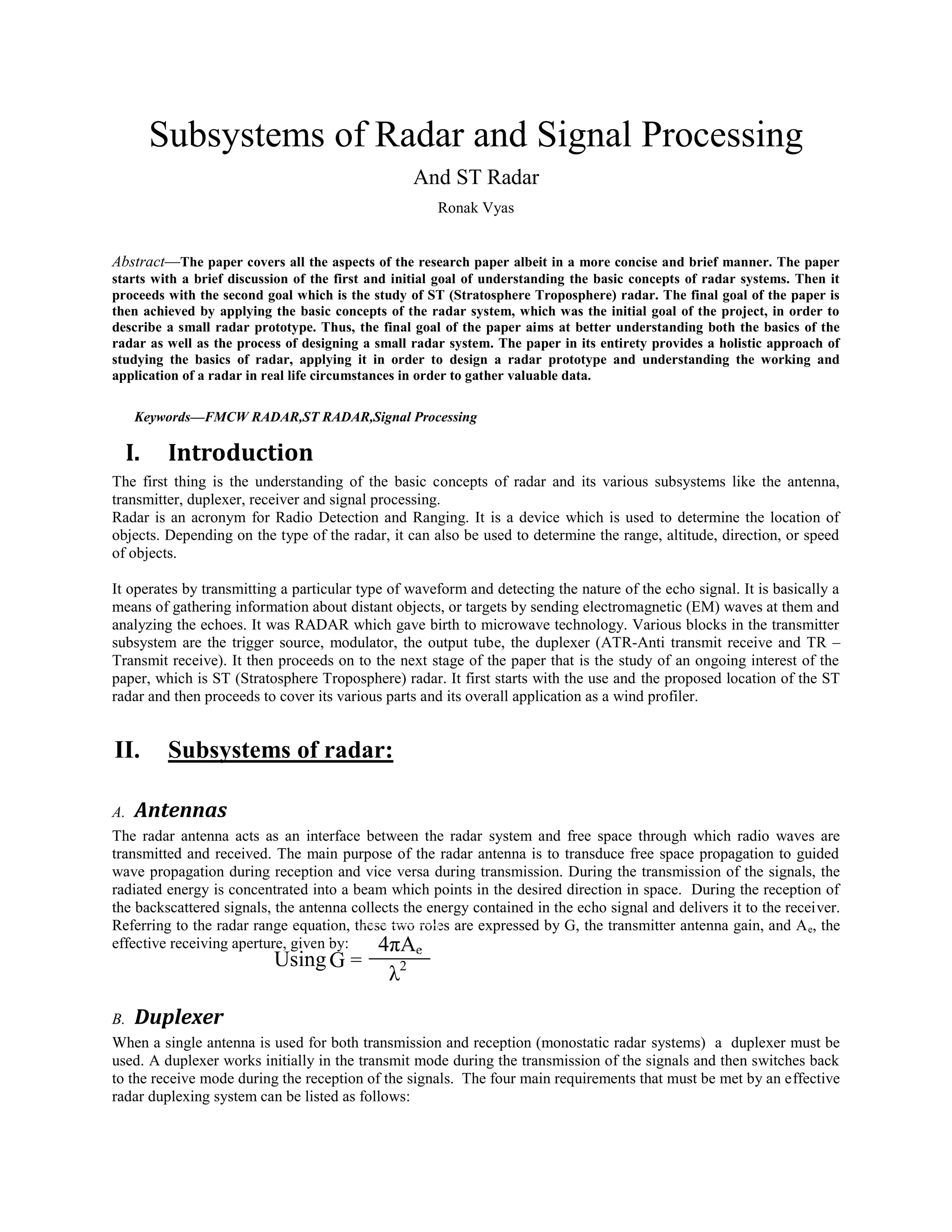
Referring to the radar range equation, these two roles are expressed by G, the transmitter antenna gain, and A e, the
effective receiving aperture, given by:
4πAe

Using G =

B.

λ2

Duplexer

When a single antenna is used for both transmission and reception (monostatic radar systems) a duplexer must be
used. A duplexer works initially in the transmit mode during the transmission of the signals and then switches back
to the receive mode during the reception of the signals. The four main requirements that must be met by an effective
radar duplexing system can be listed as follows:
1.
2.
3.

4.

C.

The switch must connect the antenna to the transmitter and disconnect it from the receiver when the
system is transmitting.
Proper and sufficient isolation must be provided between the transmitter and the receiver during the
transmission of the high-power pulse to avoid damage to sensitive receiver components.
After transmission, the switch must rapidly disconnect the transmitter and connect the receiver to the
antenna. This is to ensure that the targets located close to the radar are detected.
Furthermore it should be ensured that the switch has very little insertion loss during both transmission
and reception.

Transmitter

The transmitter system is one of the main consumers of power, cost, and weight budgets, and is the prime thermal
load of radar systems. The transmitter should produce adequate power to obtain the desired radar range. From the
radar range equation it can be seen that the transmitter power depends on the fourth power of radar range. Hence, in
order to double the range of the radar, it is necessary to increase transmitter power 16-times.
D.

Receivers

The function of the radar receiver is to extract the wanted echo signals from the combination of noise, clutter, and
interference. It must separate desired signals from undesired signals, and amplify the wanted signals for further
processing. The receiver design depends on the design of the transmitted signal, the nature of the targets, and the
general characteristics of noise, clutter, and interference. The primary goal of any receiver is to maximize the SNR
of the returned echo signal. The main components of a receiver system consist of an LNA, and down converting
mixers. Many receivers use limiters in the front end to prevent inadvertent damage from reflected transmitter power
or the high power signal which may enter the system. In order to enable digital signal processing analog to digital
(A/D) converters are placed at the end of the receiver signal path.
Trigger
Source

Modulator

Output Tube

ATR
SWITCH

VIDEO
AMPLIFIER

INDICATOR

DETECTOR

IF
AMPLIFIER

TR
SWITCH

MIXER

LOCAL
OSCILLATOR

III.

Signal Processing

Various signal processing techniques can be performed on raw receiver signals. Some common radar signal
processing techniques are correlation, Doppler filtering, image rejection, detection processing, and tracking. Digital
signal processing is used in almost all modern radars to perform these signal processing operations. These digital
processors are very complex chips, making use of very complex algorithms.
These data processors convert data produced by the signal processor into a form that is readily interpretable by radar
operators. They implement Human machine interface (HMI) designs that are used to process inputs received from
the operator. Often tactical information is stored and used by the data processing system
B.

Time delay estimation method
For detection echoes in noisy signals and estimation of their delay cross-correlation method is widely
used. In this method the cross-correlation function between the two digital sequences xT(nT) and xE(nT),
representing the transmitted and echo signals is calculated [9]:
where T is the sampling interval, s(nT) is the geneted and n(nT) are uncorrelated noises,  is the
coefficient of estimating signal attenuation, D is
the determined delay time. This method is in
(1)
pulse-echo measurements used.
The correlation of the two sequences is given by:

The statistical expectation of this sequence is:
(2)

where Css(kT) is the sampled auto-correlation
function of the signal s(t). For a finite energy
signal equation (4) have a peak for k=kD. In
practice the delay time D can be estimated by
(3)
finding the peak of the correlation (3).

In NDT applications very often the delay of the signal and distance till defect is found from the peak value
of the signal envelope. The envelope of the narrowband signals may be determined using the Hilbert
transform. In the case of narrowband signals it is a fast and simple method to estimate small time delays.
The Hilbert transform of the reference echo signal r(t) is defined as:

(5)

Where the integral is a Cauchy Principal Value (CPV); * denotes convolution. The Hilbert kernel is
denoted by

and the received echo signal is

s(t)= r(t - where  is the delay time.
),
The cross correlation between s(t) and r(t) will not have maximum at the time lag  but a zero crossing. It
is necessity of this method that it is easier to find a zero crossing than a peak in a noisy signal. Assuming
that r(t) is narrowband, e.g., its energy is concentrated in frequency intervals B around ±f0 and that B
<<1
the cross correlation Rsr(0) can be approximated as
(6)

where

is the energy of r(t) and

w0=2 0.
f
(6)

The cross-correlation method is combined with co
method of digital Windows. In this method ultrasonic
segmented at different depths by partially overlapping
C.

called
signals are
windows.

De-Convolution in samples
In thin samples the reflected signals are overlapping thus making detection of defects in the sample and
accurate measurements impossible. For improvement of spatial resolution various filtering techniques
known as the inverse filtering (de-convolution), usually in the frequency domain, are used: homomorphic
(cepstrum) processing and parametric identification. For example, the power cepstrum has been proposed
for detecting echoes in thin composite materials and noisy seismic signals. These techniques can be used
for relatively low signal-to-noise ratios and high echo distortion.
In the power cepstrum method [12] the convolution is represented by the product of their respective Fourier
transforms S( and H( where S( and H( is the Fourier transformed ultrasonic signal and noise.
)
),
)
)
The system response h(t) can be separated from the signal by simply dividing X( by S( and taking the
)
)
inverse transform of it. The inverse Fourier transform is defined of the log-normalized Fourier transform:
(4)

where q is called the frequency and x(t) is the obtained waveform. The low-frequency ripples can be
reduced by low-pass filtering:
(5)

Where, qc is a cut-off frequency which may be determined for a given measurement system and the material
configuration.
Homomorphic de-convolution method enables to reduce the pulse width for imaging of defects in thin laminates of
composite. The core idea of this method is to convert the product S(
)H( into a sum by applying a logarithmic
)
function. The complex spectrum is defined as the inverse Fourier transformation of the log-normalized Fourier
transform of the input signal, which is reverted to the time or the frequency domain.

IV.

Stratosphere troposphere Radar (ST radar)

This would lead to prediction of accurate weather patterns and provide warning of severe climatic conditions like
torrential rains, cloud bursts etc. It would provide better information about agriculture, civil aviation and disaster
management and recovery. In general, it would provide information about wind dynamics and atmospheric activity
of the country.
A. Operation
It is basically a monostatic radar which would use the Doppler beam swinging technique (DBS) and spaced antenna
drift (SAD) technique. It will be developed as an Active Aperture Distributed Circular Phased Array using solid
state modules and Digital Signal processing techniques. It would cover a height region from 1 to 20 Km covering
the troposphere slightly beyond the tropopause into the lower stratosphere. It is a wind profiler that has its center
frequency in the WPC band with a bandwidth of 190-210 MHz having minimum bandwidth of 5 MHz.
B.Wind Profiler: A wind profiler is a type of weather observing equipment that uses radar or sound waves
(SODAR) to detect the windspeed and direction at various elevations above the ground. It is used to find the speed
with which wind is propagating and the altitude of atmospheric irregularities with respect to the radar. A typical
wind profiler works in the frequency ranges of 45-65MHz, 404-482MHz, 915-924MHz, 1280– 1357.5MHz. The
following section discusses the radar based wind profiler. The targets of the wind profiler are the irregularities in the
refractive index

A wind profiler is a type of weather observing equipment that uses radar or sound waves (SODAR) to detect the
windspeed and direction at various elevations above the ground. It is used to find the speed with which wind is
propagating and the altitude of atmospheric irregularities with respect to the radar. A typical wind profiler works in
the frequency ranges of 45-65MHz, 404-482MHz, 915-924MHz, 1280– 1357.5MHz. Another important point to
note is that the scale of the target should be about half of the wavelength of the transmitted radiation. This is the
necessary condition which ensures the scattering of the incident wave. The larger the target the greater is the
strength of the scattered signal.

References
[1]
[2]
[3]
[4]
[5]
[6]
[7]
[8]
[9]

www.sameer.gov.in
Introduction to Radar systems 2nd edition by Merill Skolnik
NEETS module – Navy electronics and electrical Training Module
Report and materials provided by the organisation
ocw.mit.edu
http://www.turnpoint.net/wireless/cantennahowto.html
http://www.radartutorial.eu/08.transmitters/tx01.en.html
http://www.minicircuits.com/pdfs/D17I+.pdf
http://ocw.mit.edu/resources/res-ll-003-build-a-small-radar-system-capable-of-sensing-range-doppler-and-synthetic-aperture-radar-imagingjanuary-iap-2011/lecture-notes/MITRES_LL_003IAP11_lec02.pdf

Subsystems of radar and signal processing

  • 1.
    Subsystems of Radarand Signal Processing And ST Radar Ronak Vyas Abstract—The paper covers all the aspects of the research paper albeit in a more concise and brief manner. The paper starts with a brief discussion of the first and initial goal of understanding the basic concepts of radar systems. Then it proceeds with the second goal which is the study of ST (Stratosphere Troposphere) radar. The final goal of the paper is then achieved by applying the basic concepts of the radar system, which was the initial goal of the project, in order to describe a small radar prototype. Thus, the final goal of the paper aims at better understanding both the basics of the radar as well as the process of designing a small radar system. The paper in its entirety provides a holistic approach of studying the basics of radar, applying it in order to design a radar prototype and understanding the working and application of a radar in real life circumstances in order to gather valuable data. Keywords—FMCW RADAR,ST RADAR,Signal Processing I. Introduction The first thing is the understanding of the basic concepts of radar and its various subsystems like the antenna, transmitter, duplexer, receiver and signal processing. Radar is an acronym for Radio Detection and Ranging. It is a device which is used to determine the location of objects. Depending on the type of the radar, it can also be used to determine the range, altitude, direction, or speed of objects. It operates by transmitting a particular type of waveform and detecting the nature of the echo signal. It is basically a means of gathering information about distant objects, or targets by sending electromagnetic (EM) waves at them and analyzing the echoes. It was RADAR which gave birth to microwave technology. Various blocks in the transmitter subsystem are the trigger source, modulator, the output tube, the duplexer (ATR-Anti transmit receive and TR – Transmit receive). It then proceeds on to the next stage of the paper that is the study of an ongoing interest of the paper, which is ST (Stratosphere Troposphere) radar. It first starts with the use and the proposed location of the ST radar and then proceeds to cover its various parts and its overall application as a wind profiler. II. A. Subsystems of radar: Antennas The radar antenna acts as an interface between the radar system and free space through which radio waves are transmitted and received. The main purpose of the radar antenna is to transduce free space propagation to guided wave propagation during reception and vice versa during transmission. During the transmission of the signals, the radiated energy is concentrated into a beam which points in the desired direction in space. During the reception of the backscattered signals, the antenna collects the energy contained in the echo signal and delivers it to the receiver. Referring to the radar range equation, these two roles are expressed by G, the transmitter antenna gain, and A e, the effective receiving aperture, given by: 4πAe Using G = B. λ2 Duplexer When a single antenna is used for both transmission and reception (monostatic radar systems) a duplexer must be used. A duplexer works initially in the transmit mode during the transmission of the signals and then switches back to the receive mode during the reception of the signals. The four main requirements that must be met by an effective radar duplexing system can be listed as follows:
  • 2.
    1. 2. 3. 4. C. The switch mustconnect the antenna to the transmitter and disconnect it from the receiver when the system is transmitting. Proper and sufficient isolation must be provided between the transmitter and the receiver during the transmission of the high-power pulse to avoid damage to sensitive receiver components. After transmission, the switch must rapidly disconnect the transmitter and connect the receiver to the antenna. This is to ensure that the targets located close to the radar are detected. Furthermore it should be ensured that the switch has very little insertion loss during both transmission and reception. Transmitter The transmitter system is one of the main consumers of power, cost, and weight budgets, and is the prime thermal load of radar systems. The transmitter should produce adequate power to obtain the desired radar range. From the radar range equation it can be seen that the transmitter power depends on the fourth power of radar range. Hence, in order to double the range of the radar, it is necessary to increase transmitter power 16-times. D. Receivers The function of the radar receiver is to extract the wanted echo signals from the combination of noise, clutter, and interference. It must separate desired signals from undesired signals, and amplify the wanted signals for further processing. The receiver design depends on the design of the transmitted signal, the nature of the targets, and the general characteristics of noise, clutter, and interference. The primary goal of any receiver is to maximize the SNR of the returned echo signal. The main components of a receiver system consist of an LNA, and down converting mixers. Many receivers use limiters in the front end to prevent inadvertent damage from reflected transmitter power or the high power signal which may enter the system. In order to enable digital signal processing analog to digital (A/D) converters are placed at the end of the receiver signal path. Trigger Source Modulator Output Tube ATR SWITCH VIDEO AMPLIFIER INDICATOR DETECTOR IF AMPLIFIER TR SWITCH MIXER LOCAL OSCILLATOR III. Signal Processing Various signal processing techniques can be performed on raw receiver signals. Some common radar signal processing techniques are correlation, Doppler filtering, image rejection, detection processing, and tracking. Digital signal processing is used in almost all modern radars to perform these signal processing operations. These digital processors are very complex chips, making use of very complex algorithms.
  • 3.
    These data processorsconvert data produced by the signal processor into a form that is readily interpretable by radar operators. They implement Human machine interface (HMI) designs that are used to process inputs received from the operator. Often tactical information is stored and used by the data processing system B. Time delay estimation method For detection echoes in noisy signals and estimation of their delay cross-correlation method is widely used. In this method the cross-correlation function between the two digital sequences xT(nT) and xE(nT), representing the transmitted and echo signals is calculated [9]: where T is the sampling interval, s(nT) is the geneted and n(nT) are uncorrelated noises,  is the coefficient of estimating signal attenuation, D is the determined delay time. This method is in (1) pulse-echo measurements used. The correlation of the two sequences is given by: The statistical expectation of this sequence is: (2) where Css(kT) is the sampled auto-correlation function of the signal s(t). For a finite energy signal equation (4) have a peak for k=kD. In practice the delay time D can be estimated by (3) finding the peak of the correlation (3). In NDT applications very often the delay of the signal and distance till defect is found from the peak value of the signal envelope. The envelope of the narrowband signals may be determined using the Hilbert transform. In the case of narrowband signals it is a fast and simple method to estimate small time delays. The Hilbert transform of the reference echo signal r(t) is defined as: (5) Where the integral is a Cauchy Principal Value (CPV); * denotes convolution. The Hilbert kernel is denoted by and the received echo signal is s(t)= r(t - where  is the delay time. ), The cross correlation between s(t) and r(t) will not have maximum at the time lag  but a zero crossing. It is necessity of this method that it is easier to find a zero crossing than a peak in a noisy signal. Assuming that r(t) is narrowband, e.g., its energy is concentrated in frequency intervals B around ±f0 and that B <<1 the cross correlation Rsr(0) can be approximated as
  • 4.
    (6) where is the energyof r(t) and w0=2 0. f (6) The cross-correlation method is combined with co method of digital Windows. In this method ultrasonic segmented at different depths by partially overlapping C. called signals are windows. De-Convolution in samples In thin samples the reflected signals are overlapping thus making detection of defects in the sample and accurate measurements impossible. For improvement of spatial resolution various filtering techniques known as the inverse filtering (de-convolution), usually in the frequency domain, are used: homomorphic (cepstrum) processing and parametric identification. For example, the power cepstrum has been proposed for detecting echoes in thin composite materials and noisy seismic signals. These techniques can be used for relatively low signal-to-noise ratios and high echo distortion. In the power cepstrum method [12] the convolution is represented by the product of their respective Fourier transforms S( and H( where S( and H( is the Fourier transformed ultrasonic signal and noise. ) ), ) ) The system response h(t) can be separated from the signal by simply dividing X( by S( and taking the ) ) inverse transform of it. The inverse Fourier transform is defined of the log-normalized Fourier transform: (4) where q is called the frequency and x(t) is the obtained waveform. The low-frequency ripples can be reduced by low-pass filtering: (5) Where, qc is a cut-off frequency which may be determined for a given measurement system and the material configuration. Homomorphic de-convolution method enables to reduce the pulse width for imaging of defects in thin laminates of composite. The core idea of this method is to convert the product S( )H( into a sum by applying a logarithmic ) function. The complex spectrum is defined as the inverse Fourier transformation of the log-normalized Fourier transform of the input signal, which is reverted to the time or the frequency domain. IV. Stratosphere troposphere Radar (ST radar) This would lead to prediction of accurate weather patterns and provide warning of severe climatic conditions like torrential rains, cloud bursts etc. It would provide better information about agriculture, civil aviation and disaster management and recovery. In general, it would provide information about wind dynamics and atmospheric activity of the country.
  • 5.
    A. Operation It isbasically a monostatic radar which would use the Doppler beam swinging technique (DBS) and spaced antenna drift (SAD) technique. It will be developed as an Active Aperture Distributed Circular Phased Array using solid state modules and Digital Signal processing techniques. It would cover a height region from 1 to 20 Km covering the troposphere slightly beyond the tropopause into the lower stratosphere. It is a wind profiler that has its center frequency in the WPC band with a bandwidth of 190-210 MHz having minimum bandwidth of 5 MHz. B.Wind Profiler: A wind profiler is a type of weather observing equipment that uses radar or sound waves (SODAR) to detect the windspeed and direction at various elevations above the ground. It is used to find the speed with which wind is propagating and the altitude of atmospheric irregularities with respect to the radar. A typical wind profiler works in the frequency ranges of 45-65MHz, 404-482MHz, 915-924MHz, 1280– 1357.5MHz. The following section discusses the radar based wind profiler. The targets of the wind profiler are the irregularities in the refractive index A wind profiler is a type of weather observing equipment that uses radar or sound waves (SODAR) to detect the windspeed and direction at various elevations above the ground. It is used to find the speed with which wind is propagating and the altitude of atmospheric irregularities with respect to the radar. A typical wind profiler works in the frequency ranges of 45-65MHz, 404-482MHz, 915-924MHz, 1280– 1357.5MHz. Another important point to note is that the scale of the target should be about half of the wavelength of the transmitted radiation. This is the necessary condition which ensures the scattering of the incident wave. The larger the target the greater is the strength of the scattered signal. References [1] [2] [3] [4] [5] [6] [7] [8] [9] www.sameer.gov.in Introduction to Radar systems 2nd edition by Merill Skolnik NEETS module – Navy electronics and electrical Training Module Report and materials provided by the organisation ocw.mit.edu http://www.turnpoint.net/wireless/cantennahowto.html http://www.radartutorial.eu/08.transmitters/tx01.en.html http://www.minicircuits.com/pdfs/D17I+.pdf http://ocw.mit.edu/resources/res-ll-003-build-a-small-radar-system-capable-of-sensing-range-doppler-and-synthetic-aperture-radar-imagingjanuary-iap-2011/lecture-notes/MITRES_LL_003IAP11_lec02.pdf