SUBMARINE CABLE
Name: Subrata Paul
Roll: 13015411
Year:3rd
Sem:1st
Computer Science and Engineering
Rajshahi University
Submarine cable
A submarine communications cable is a
cable laid on the sea bed between land-
based stations to carry telecommunication
signals across stretches of ocean. The first
submarine communications cables, laid in
the 1850s, carried telegraphy traffic.
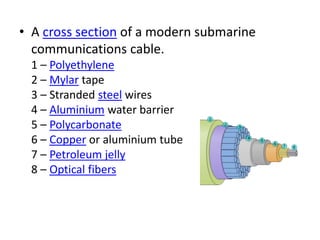
• A cross section of a modern submarine
communications cable.
1 – Polyethylene
2 – Mylar tape
3 – Stranded steel wires
4 – Aluminium water barrier
5 – Polycarbonate
6 – Copper or aluminium tube
7 – Petroleum jelly
8 – Optical fibers
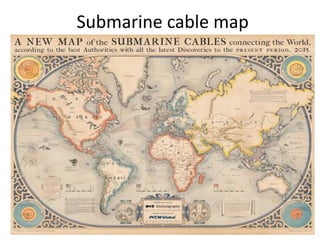
Submarine cable map
• TeleGeography’s Submarine Cable Map has
been updated for 2015. The latest edition
depicts 299 cable systems that are currently
active, under construction, or expected to be
fully-funded by the end of 2015.
Submarine cable map
Cables under the PACIFIC OCEAN:
ALASKA UNITED EAST
NORTHSTAR
ACS ALASKA-OREGON
PACIFIC CROSSING-1
TATA TGN-PACIFIC
TRANS-PACIFIC EXPRESS
NEW CROSS PACIFIC[2017]
FASTER[2016]
CHINA-U.S
JAPAN-U.S
UNITY/EAC-PACIFIC
SOUTHERN CROSS
ASIA-AMERICA GATEWAY
Cables under the ATLANTIC OCEAN:
GREENLAND CONNECT AP0LLO
HIBERNIA ATLANTIC FLAG ATLANTIC-I
TAT-I4 YELLOW
ATLANTIC CROSSING-I SAM-I
HIBERNIA EXPRESS SAC
TATA TGN-ATLANTIC AMERICAS-II
FARICE-I GLOBENET
CANTAT-3 NORWEGIAN ( SOUTH
DANICE SEA ATLANTIC CABLE
SHEFA-2 SYSTEM[2016])
ACE
TAGIDE 2
Cable under the INDIAN OCEAN:
EASSY
SEACOM/TATA TGN-EUROPE
TEAMS ARABIAN
AAE-I SEA
GBI/MENA
IMEWE
DHIRAAGU GABLE NETWORK
BBG[2015]
I2ICN
TATA TGN-TATA INDICOM BAY OF
SEAMEWE-4 BANGAL
SEAMEWE-5
FLAG EUROPE-ASIA
SEAMEWE-3
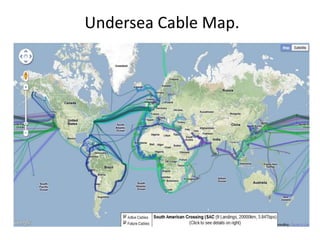
Undersea Cable Map.
SEA-ME-EU 4 SUBMARINE CABLE
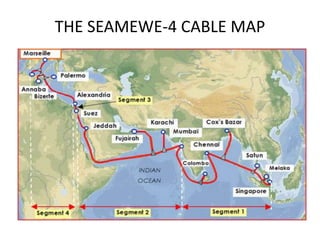
The submarine cable system with which
Bangladesh is currently connected through BSCCL is
a high capacity optical fiber Submarine Cable System
linking 16 companies of 14 countries. It is called the
South East Asia-Middle East-Western Europe- 4
(SEA-ME-WE-4) cable network and is under an
International Consortium. It has a total length of
20,000 km with 1.28 Terabit/Sec capacity.
THE SEAMEWE-4 CABLE MAP
SEA-ME-WE 5 Secures Bangladesh
Landing
• According to Bangladesh's bdnews24.com, the
Ministry of Posts and Telecommunications
and Bangladesh Submarine Cable Company
Limited (BSCCL) have both confirmed to
connect with SEA-ME-WE-5 (SMW5). SMW5 is
expected to land at Kuakata in Patuakhali
district in the first quarter of 2016. SMW5 will
be the second submarine cable system landing
SEA-ME-WE 5 Secures Bangladesh Landing
in Bangladesh. Bangladesh will invest a total of US$ 70
million on SEA-ME-WE 5, of which US$ 40 million
would be managed from the Islamic Development Bank
(IDB) as loan.
• In 2005, Bangladesh was connected with the first
submarine cable at a cost of US$ 35.2 million that
took 18 months for installation.
SEA-ME-WE 5 Secures Bangladesh Landing
• In December 2011, Submarine Cable Company, a
state-run operator, signed an agreement with the
SEA-ME-WE 5 consortium to lay a new undersea
cable by 2014.
• Monwar Hossain, Managing Director of
Bangladesh Submarine Cable Company
Limited, said the country was currently
consuming only 40 Gbps while the capacity of
the cable was 200 Gbps.
SEA-ME-WE 5 Secures Bangladesh Landing
• Bangladesh will be connected with the second
submarine cable SEA-ME-WE-5 (South East
Asia-Middle East-Western Europe 5) by the
first quarter of 2016, which will help the
country get an additional bandwidth of 140
Gbps, officials said.
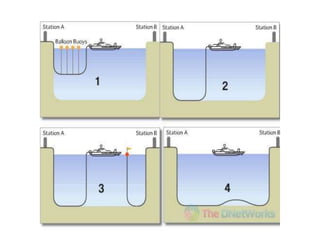
Process of laying submarine cable
Submarine cable laying process starts from
the Landing Station, where a long cable section
is connected to the landing-point and then
extended out to a few kilometers in the sea. This
end is connected to the cable on the ship and
then the ship starts its cable laying process.
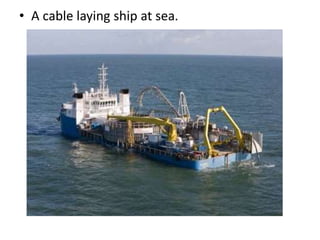
• A cable laying ship at sea.
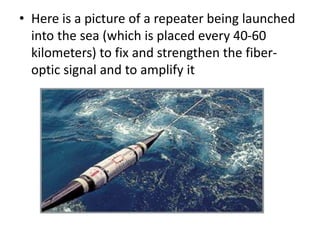
• Here is a picture of a repeater being launched
into the sea (which is placed every 40-60
kilometers) to fix and strengthen the fiber-
optic signal and to amplify it
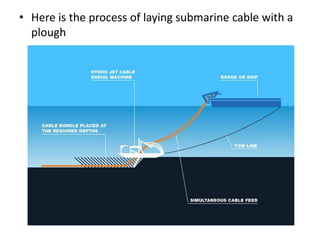
• Here is the process of laying submarine cable with a
plough
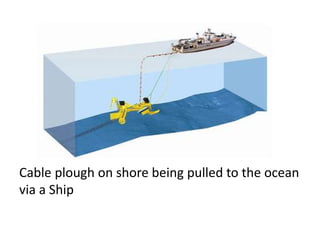
Cable plough on shore being pulled to the ocean
via a Ship
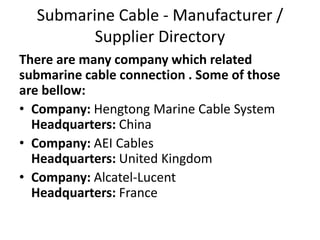
Submarine Cable - Manufacturer /
Supplier Directory
There are many company which related
submarine cable connection . Some of those
are bellow:
• Company: Hengtong Marine Cable System
Headquarters: China
• Company: AEI Cables
Headquarters: United Kingdom
• Company: Alcatel-Lucent
Headquarters: France
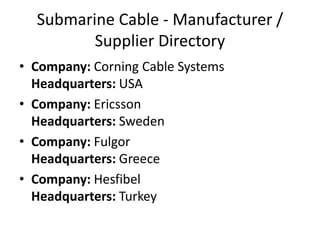
Submarine Cable - Manufacturer /
Supplier Directory
• Company: Corning Cable Systems
Headquarters: USA
• Company: Ericsson
Headquarters: Sweden
• Company: Fulgor
Headquarters: Greece
• Company: Hesfibel
Headquarters: Turkey
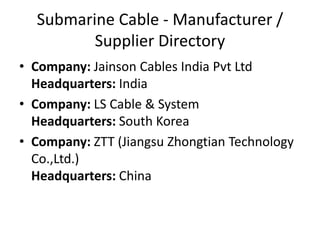
Submarine Cable - Manufacturer /
Supplier Directory
• Company: Jainson Cables India Pvt Ltd
Headquarters: India
• Company: LS Cable & System
Headquarters: South Korea
• Company: ZTT (Jiangsu Zhongtian Technology
Co.,Ltd.)
Headquarters: China
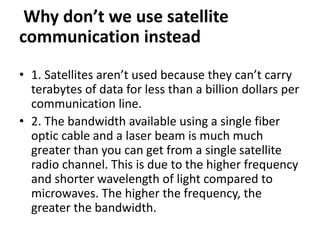
Why don’t we use satellite
communication instead
• 1. Satellites aren’t used because they can’t carry
terabytes of data for less than a billion dollars per
communication line.
• 2. The bandwidth available using a single fiber
optic cable and a laser beam is much much
greater than you can get from a single satellite
radio channel. This is due to the higher frequency
and shorter wavelength of light compared to
microwaves. The higher the frequency, the
greater the bandwidth.
Why don’t we use satellite communication
instead
• 3. An undersea cable is a bundle many fiber
optic cables. Consider each fiber cable as a
channel. You can have more channels, each
with a higher capacity, than you can build
radio channels into a satellite.
• 4. The uplinks and downlinks cost and putting
the satellite in space is a huge ask and far
more risky.
Why don’t we use satellite communication instead
• 5. The delay for satellite communications would
be around 255ms both uplink and downlink. For
continuous traffic this not to a bad price to
pay. But for burst traffic (like voice) you pay for
the delay at each pause. The Rule of Thumb is
10MS per 1000 miles so Rule of Thumb to Europe
on say TAT-8 would be about 75MS vs 510MS for
satellite.
• 6. Finally, we can fix a broken cable. Once we
launch the satellite we don’t get a chance to fix it
if it gets broke.

Submarine cable

  • 1.
  • 2.
    Name: Subrata Paul Roll:13015411 Year:3rd Sem:1st Computer Science and Engineering Rajshahi University
  • 3.
    Submarine cable A submarinecommunications cable is a cable laid on the sea bed between land- based stations to carry telecommunication signals across stretches of ocean. The first submarine communications cables, laid in the 1850s, carried telegraphy traffic.
  • 4.
    • A crosssection of a modern submarine communications cable. 1 – Polyethylene 2 – Mylar tape 3 – Stranded steel wires 4 – Aluminium water barrier 5 – Polycarbonate 6 – Copper or aluminium tube 7 – Petroleum jelly 8 – Optical fibers
  • 5.
    Submarine cable map •TeleGeography’s Submarine Cable Map has been updated for 2015. The latest edition depicts 299 cable systems that are currently active, under construction, or expected to be fully-funded by the end of 2015.
  • 6.
  • 7.
    Cables under thePACIFIC OCEAN: ALASKA UNITED EAST NORTHSTAR ACS ALASKA-OREGON PACIFIC CROSSING-1 TATA TGN-PACIFIC TRANS-PACIFIC EXPRESS NEW CROSS PACIFIC[2017] FASTER[2016] CHINA-U.S JAPAN-U.S UNITY/EAC-PACIFIC SOUTHERN CROSS ASIA-AMERICA GATEWAY
  • 8.
    Cables under theATLANTIC OCEAN: GREENLAND CONNECT AP0LLO HIBERNIA ATLANTIC FLAG ATLANTIC-I TAT-I4 YELLOW ATLANTIC CROSSING-I SAM-I HIBERNIA EXPRESS SAC TATA TGN-ATLANTIC AMERICAS-II FARICE-I GLOBENET CANTAT-3 NORWEGIAN ( SOUTH DANICE SEA ATLANTIC CABLE SHEFA-2 SYSTEM[2016]) ACE TAGIDE 2
  • 9.
    Cable under theINDIAN OCEAN: EASSY SEACOM/TATA TGN-EUROPE TEAMS ARABIAN AAE-I SEA GBI/MENA IMEWE DHIRAAGU GABLE NETWORK BBG[2015] I2ICN TATA TGN-TATA INDICOM BAY OF SEAMEWE-4 BANGAL SEAMEWE-5 FLAG EUROPE-ASIA SEAMEWE-3
  • 10.
  • 11.
    SEA-ME-EU 4 SUBMARINECABLE The submarine cable system with which Bangladesh is currently connected through BSCCL is a high capacity optical fiber Submarine Cable System linking 16 companies of 14 countries. It is called the South East Asia-Middle East-Western Europe- 4 (SEA-ME-WE-4) cable network and is under an International Consortium. It has a total length of 20,000 km with 1.28 Terabit/Sec capacity.
  • 12.
  • 13.
    SEA-ME-WE 5 SecuresBangladesh Landing • According to Bangladesh's bdnews24.com, the Ministry of Posts and Telecommunications and Bangladesh Submarine Cable Company Limited (BSCCL) have both confirmed to connect with SEA-ME-WE-5 (SMW5). SMW5 is expected to land at Kuakata in Patuakhali district in the first quarter of 2016. SMW5 will be the second submarine cable system landing
  • 14.
    SEA-ME-WE 5 SecuresBangladesh Landing in Bangladesh. Bangladesh will invest a total of US$ 70 million on SEA-ME-WE 5, of which US$ 40 million would be managed from the Islamic Development Bank (IDB) as loan. • In 2005, Bangladesh was connected with the first submarine cable at a cost of US$ 35.2 million that took 18 months for installation.
  • 15.
    SEA-ME-WE 5 SecuresBangladesh Landing • In December 2011, Submarine Cable Company, a state-run operator, signed an agreement with the SEA-ME-WE 5 consortium to lay a new undersea cable by 2014. • Monwar Hossain, Managing Director of Bangladesh Submarine Cable Company Limited, said the country was currently consuming only 40 Gbps while the capacity of the cable was 200 Gbps.
  • 16.
    SEA-ME-WE 5 SecuresBangladesh Landing • Bangladesh will be connected with the second submarine cable SEA-ME-WE-5 (South East Asia-Middle East-Western Europe 5) by the first quarter of 2016, which will help the country get an additional bandwidth of 140 Gbps, officials said.
  • 17.
    Process of layingsubmarine cable Submarine cable laying process starts from the Landing Station, where a long cable section is connected to the landing-point and then extended out to a few kilometers in the sea. This end is connected to the cable on the ship and then the ship starts its cable laying process.
  • 19.
    • A cablelaying ship at sea.
  • 20.
    • Here isa picture of a repeater being launched into the sea (which is placed every 40-60 kilometers) to fix and strengthen the fiber- optic signal and to amplify it
  • 21.
    • Here isthe process of laying submarine cable with a plough
  • 22.
    Cable plough onshore being pulled to the ocean via a Ship
  • 23.
    Submarine Cable -Manufacturer / Supplier Directory There are many company which related submarine cable connection . Some of those are bellow: • Company: Hengtong Marine Cable System Headquarters: China • Company: AEI Cables Headquarters: United Kingdom • Company: Alcatel-Lucent Headquarters: France
  • 24.
    Submarine Cable -Manufacturer / Supplier Directory • Company: Corning Cable Systems Headquarters: USA • Company: Ericsson Headquarters: Sweden • Company: Fulgor Headquarters: Greece • Company: Hesfibel Headquarters: Turkey
  • 25.
    Submarine Cable -Manufacturer / Supplier Directory • Company: Jainson Cables India Pvt Ltd Headquarters: India • Company: LS Cable & System Headquarters: South Korea • Company: ZTT (Jiangsu Zhongtian Technology Co.,Ltd.) Headquarters: China
  • 26.
    Why don’t weuse satellite communication instead • 1. Satellites aren’t used because they can’t carry terabytes of data for less than a billion dollars per communication line. • 2. The bandwidth available using a single fiber optic cable and a laser beam is much much greater than you can get from a single satellite radio channel. This is due to the higher frequency and shorter wavelength of light compared to microwaves. The higher the frequency, the greater the bandwidth.
  • 27.
    Why don’t weuse satellite communication instead • 3. An undersea cable is a bundle many fiber optic cables. Consider each fiber cable as a channel. You can have more channels, each with a higher capacity, than you can build radio channels into a satellite. • 4. The uplinks and downlinks cost and putting the satellite in space is a huge ask and far more risky.
  • 28.
    Why don’t weuse satellite communication instead • 5. The delay for satellite communications would be around 255ms both uplink and downlink. For continuous traffic this not to a bad price to pay. But for burst traffic (like voice) you pay for the delay at each pause. The Rule of Thumb is 10MS per 1000 miles so Rule of Thumb to Europe on say TAT-8 would be about 75MS vs 510MS for satellite. • 6. Finally, we can fix a broken cable. Once we launch the satellite we don’t get a chance to fix it if it gets broke.