Communication Media
OPTICAL FIBER, SUBMARINE CABLE, WIRELESS
NETWORK
HASANUZZAMAN
EAST WEST UNIVERSITY
DHAKA ,BANGLADESH
SUBMITTED TO :
SARWAR JAHAN
Associate Professor , Dept. of ECE
Optical fiber :
1. Optical fiber is start researching
since (1962-1965).
2.Modern world start using optical
fiber as a communication media after
1997.
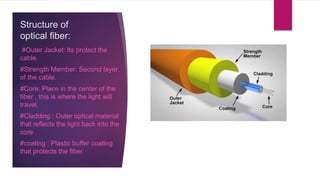
Structure of
optical fiber:
#Outer Jacket: Its protect the
cable.
#Strength Member: Second layer
of the cable.
#Core: Place in the center of the
fiber , this is where the light will
travel.
#Cladding : Outer optical material
that reflects the light back into the
core .
#coating : Plastic buffer coating
that protects the fiber.
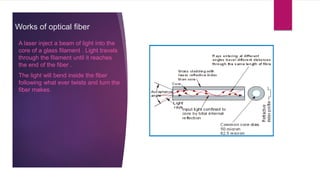
Works of optical fiber
A laser inject a beam of light into the
core of a glass filament . Light travels
through the filament until it reaches
the end of the fiber .
The light will bend inside the fiber
following what ever twists and turn the
fiber makes.
Submarine Cable
communications
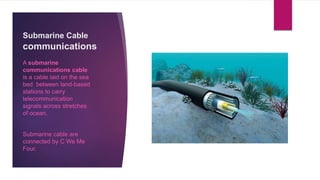
A submarine
communications cable
is a cable laid on the sea
bed between land-based
stations to carry
telecommunication
signals across stretches
of ocean.
Submarine cable are
connected by C We Me
Four.
First commercial cables
Having earlier obtained a concession from the French Government, in August 1850
John Watkins Brett's Anglo-French Telegraph Company laid the first line across the
English Channel, using the converted tug Goliath. It was simply a copper wire
coated with gutta-percha, without any other protection, and was not successful. The
experiment served to secure renewal of the concession, and in September 1851, a
protected core, or true, cable was laid by the reconstituted Submarine Telegraph
Company from a government hulk, the Blazer, which was towed across the Channel.
Structure of
Submarine Cable
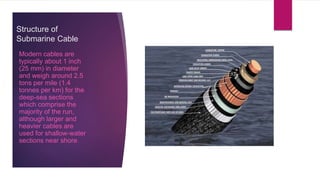
Modern cables are
typically about 1 inch
(25 mm) in diameter
and weigh around 2.5
tons per mile (1.4
tonnes per km) for the
deep-sea sections
which comprise the
majority of the run,
although larger and
heavier cables are
used for shallow-water
sections near shore.
Submarine Cable
Map
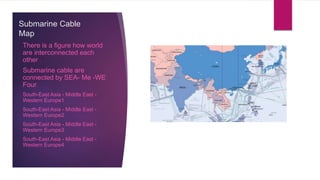
There is a figure how world
are interconnected each
other .
Submarine cable are
connected by SEA- Me -WE
Four.
South-East Asia - Middle East -
Western Europe1
South-East Asia - Middle East -
Western Europe2
South-East Asia - Middle East -
Western Europe3
South-East Asia - Middle East -
Western Europe4
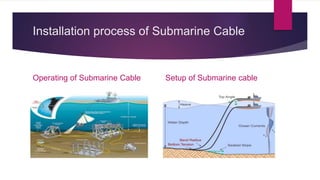
Installation process of Submarine Cable
Operating of Submarine Cable Setup of Submarine cable
Importance of submarine cables
 As of 2006, overseas satellite links accounted for only 1 percent of international traffic,
while the remainder was carried by undersea cable. The reliability of submarine cables
is high, especially when (as noted above) multiple paths are available in the event of a
cable break. Also, the total carrying capacity of submarine cables is in the terabits per
second, while satellites typically offer only 1000 megabits per second and display
higher latency. However, a typical multi-terabit, transoceanic submarine cable system
costs several hundred million dollars to construct.
Importance of submarine cables
As a result of these cables' cost and usefulness, they are highly valued not only by the
corporations building and operating them for profit, but also by national governments. For
instance, the Australian government considers its submarine cable systems to be "vital to the
national economy". Accordingly, the Australian Communications and Media Authority (ACMA)
has created protection zones that restrict activities that could potentially damage cables linking
Australia to the rest of the world. The ACMA also regulates all projects to install new
submarine cables.
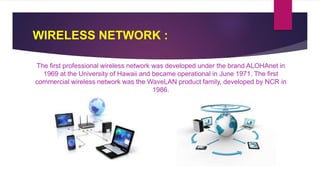
WIRELESS NETWORK :
The first professional wireless network was developed under the brand ALOHAnet in
1969 at the University of Hawaii and became operational in June 1971. The first
commercial wireless network was the WaveLAN product family, developed by NCR in
1986.
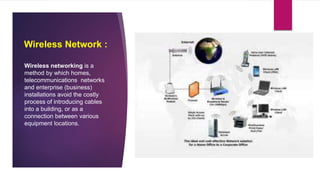
Wireless Network :
Wireless networking is a
method by which homes,
telecommunications networks
and enterprise (business)
installations avoid the costly
process of introducing cables
into a building, or as a
connection between various
equipment locations.
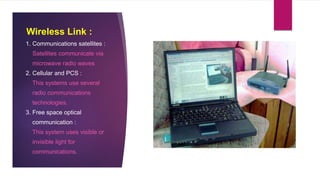
Wireless Link :
1. Communications satellites :
Satellites communicate via
microwave radio waves
2. Cellular and PCS :
This systems use several
radio communications
technologies.
3. Free space optical
communication :
This system uses visible or
invisible light for
communications.
Types of Wireless
Newtork :
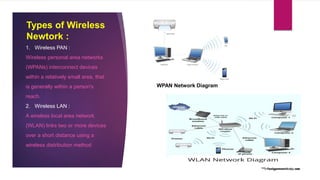
1. Wireless PAN :
Wireless personal area networks
(WPANs) interconnect devices
within a relatively small area, that
is generally within a person's
reach.
2. Wireless LAN :
A wireless local area network
(WLAN) links two or more devices
over a short distance using a
wireless distribution method
WPAN Network Diagram
Types of Wireless
Newtork :
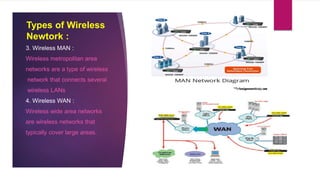
3. Wireless MAN :
Wireless metropolitan area
networks are a type of wireless
network that connects several
wireless LANs
4. Wireless WAN :
Wireless wide area networks
are wireless networks that
typically cover large areas.
Types of Wireless
Newtork :
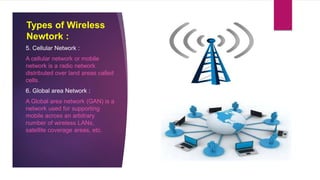
5. Cellular Network :
A cellular network or mobile
network is a radio network
distributed over land areas called
cells.
6. Global area Network :
A Global area network (GAN) is a
network used for supporting
mobile across an arbitrary
number of wireless LANs,
satellite coverage areas, etc.
Communications media

Communications media

  • 1.
    Communication Media OPTICAL FIBER,SUBMARINE CABLE, WIRELESS NETWORK HASANUZZAMAN EAST WEST UNIVERSITY DHAKA ,BANGLADESH SUBMITTED TO : SARWAR JAHAN Associate Professor , Dept. of ECE
  • 2.
    Optical fiber : 1.Optical fiber is start researching since (1962-1965). 2.Modern world start using optical fiber as a communication media after 1997.
  • 3.
    Structure of optical fiber: #OuterJacket: Its protect the cable. #Strength Member: Second layer of the cable. #Core: Place in the center of the fiber , this is where the light will travel. #Cladding : Outer optical material that reflects the light back into the core . #coating : Plastic buffer coating that protects the fiber.
  • 4.
    Works of opticalfiber A laser inject a beam of light into the core of a glass filament . Light travels through the filament until it reaches the end of the fiber . The light will bend inside the fiber following what ever twists and turn the fiber makes.
  • 5.
    Submarine Cable communications A submarine communicationscable is a cable laid on the sea bed between land-based stations to carry telecommunication signals across stretches of ocean. Submarine cable are connected by C We Me Four.
  • 6.
    First commercial cables Havingearlier obtained a concession from the French Government, in August 1850 John Watkins Brett's Anglo-French Telegraph Company laid the first line across the English Channel, using the converted tug Goliath. It was simply a copper wire coated with gutta-percha, without any other protection, and was not successful. The experiment served to secure renewal of the concession, and in September 1851, a protected core, or true, cable was laid by the reconstituted Submarine Telegraph Company from a government hulk, the Blazer, which was towed across the Channel.
  • 7.
    Structure of Submarine Cable Moderncables are typically about 1 inch (25 mm) in diameter and weigh around 2.5 tons per mile (1.4 tonnes per km) for the deep-sea sections which comprise the majority of the run, although larger and heavier cables are used for shallow-water sections near shore.
  • 8.
    Submarine Cable Map There isa figure how world are interconnected each other . Submarine cable are connected by SEA- Me -WE Four. South-East Asia - Middle East - Western Europe1 South-East Asia - Middle East - Western Europe2 South-East Asia - Middle East - Western Europe3 South-East Asia - Middle East - Western Europe4
  • 9.
    Installation process ofSubmarine Cable Operating of Submarine Cable Setup of Submarine cable
  • 10.
    Importance of submarinecables  As of 2006, overseas satellite links accounted for only 1 percent of international traffic, while the remainder was carried by undersea cable. The reliability of submarine cables is high, especially when (as noted above) multiple paths are available in the event of a cable break. Also, the total carrying capacity of submarine cables is in the terabits per second, while satellites typically offer only 1000 megabits per second and display higher latency. However, a typical multi-terabit, transoceanic submarine cable system costs several hundred million dollars to construct.
  • 11.
    Importance of submarinecables As a result of these cables' cost and usefulness, they are highly valued not only by the corporations building and operating them for profit, but also by national governments. For instance, the Australian government considers its submarine cable systems to be "vital to the national economy". Accordingly, the Australian Communications and Media Authority (ACMA) has created protection zones that restrict activities that could potentially damage cables linking Australia to the rest of the world. The ACMA also regulates all projects to install new submarine cables.
  • 12.
    WIRELESS NETWORK : Thefirst professional wireless network was developed under the brand ALOHAnet in 1969 at the University of Hawaii and became operational in June 1971. The first commercial wireless network was the WaveLAN product family, developed by NCR in 1986.
  • 13.
    Wireless Network : Wirelessnetworking is a method by which homes, telecommunications networks and enterprise (business) installations avoid the costly process of introducing cables into a building, or as a connection between various equipment locations.
  • 14.
    Wireless Link : 1.Communications satellites : Satellites communicate via microwave radio waves 2. Cellular and PCS : This systems use several radio communications technologies. 3. Free space optical communication : This system uses visible or invisible light for communications.
  • 15.
    Types of Wireless Newtork: 1. Wireless PAN : Wireless personal area networks (WPANs) interconnect devices within a relatively small area, that is generally within a person's reach. 2. Wireless LAN : A wireless local area network (WLAN) links two or more devices over a short distance using a wireless distribution method WPAN Network Diagram
  • 16.
    Types of Wireless Newtork: 3. Wireless MAN : Wireless metropolitan area networks are a type of wireless network that connects several wireless LANs 4. Wireless WAN : Wireless wide area networks are wireless networks that typically cover large areas.
  • 17.
    Types of Wireless Newtork: 5. Cellular Network : A cellular network or mobile network is a radio network distributed over land areas called cells. 6. Global area Network : A Global area network (GAN) is a network used for supporting mobile across an arbitrary number of wireless LANs, satellite coverage areas, etc.