DATA MINING
LECTURE 8
Clustering Validation
Minimum Description Length
Information Theory
Co-Clustering
Subrata Kumer Paul
Assistant Professor, Dept. of CSE, BAUET
sksubrata96@gmail.com
CLUSTERING VALIDITY
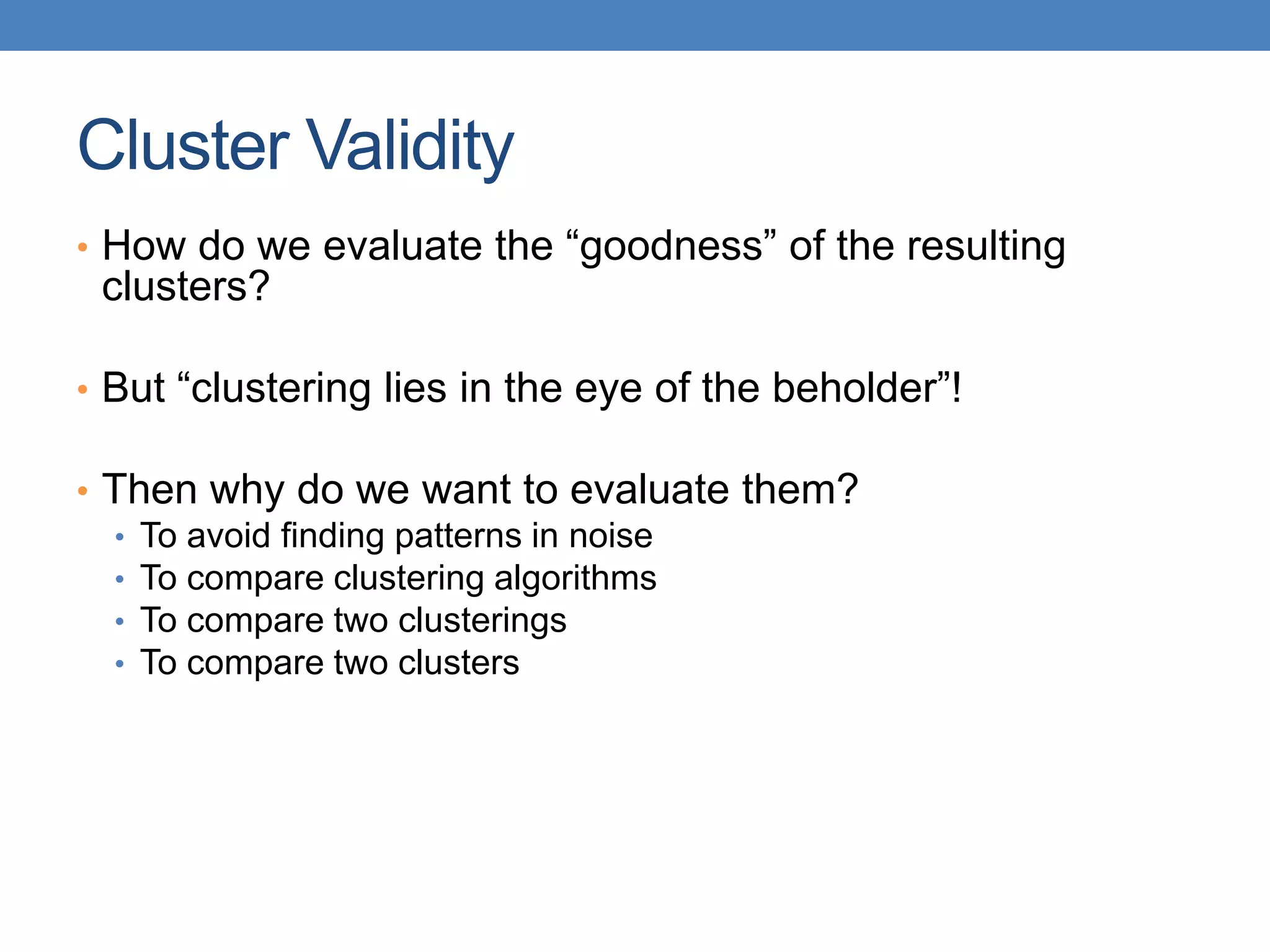
Cluster Validity
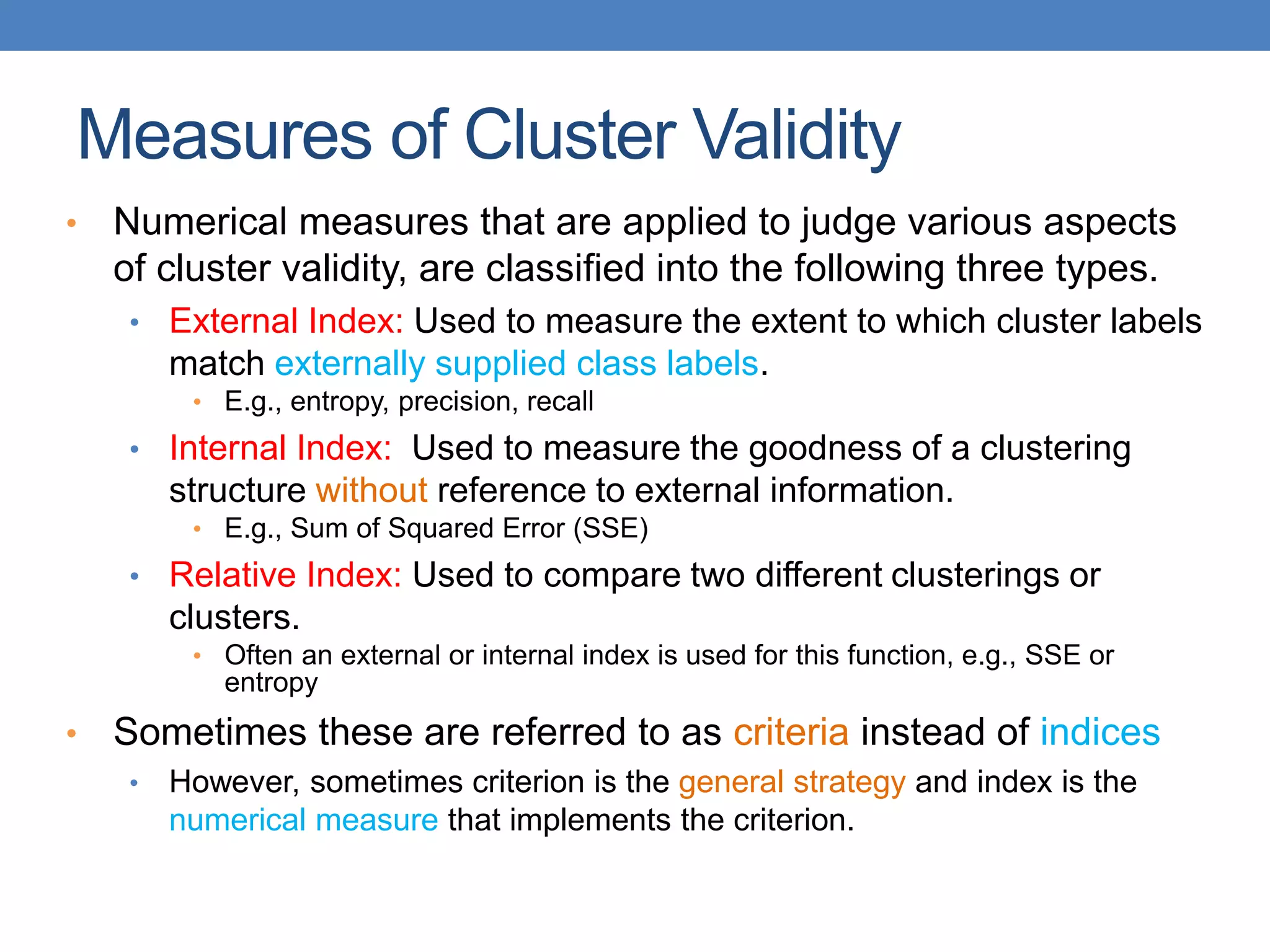
• How do we evaluate the “goodness” of the resulting
clusters?
• But “clustering lies in the eye of the beholder”!
• Then why do we want to evaluate them?
• To avoid finding patterns in noise
• To compare clustering algorithms
• To compare two clusterings
• To compare two clusters
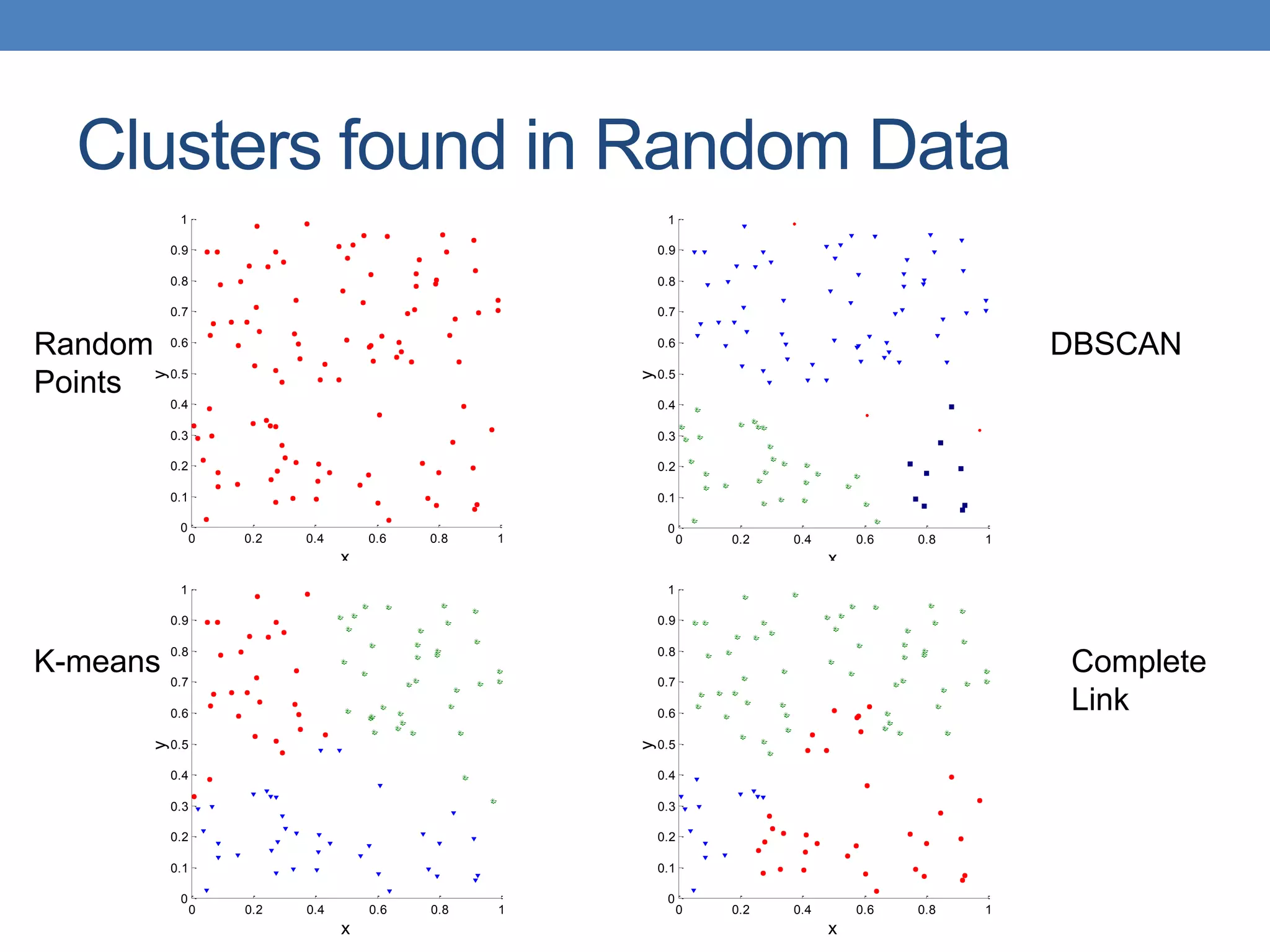
Clusters found in Random Data
0 0.2 0.4 0.6 0.8 1
0
0.1
0.2
0.3
0.4
0.5
0.6
0.7
0.8
0.9
1
x
y
Random
Points
0 0.2 0.4 0.6 0.8 1
0
0.1
0.2
0.3
0.4
0.5
0.6
0.7
0.8
0.9
1
x
y
K-means
0 0.2 0.4 0.6 0.8 1
0
0.1
0.2
0.3
0.4
0.5
0.6
0.7
0.8
0.9
1
x
y
DBSCAN
0 0.2 0.4 0.6 0.8 1
0
0.1
0.2
0.3
0.4
0.5
0.6
0.7
0.8
0.9
1
x
y
Complete
Link
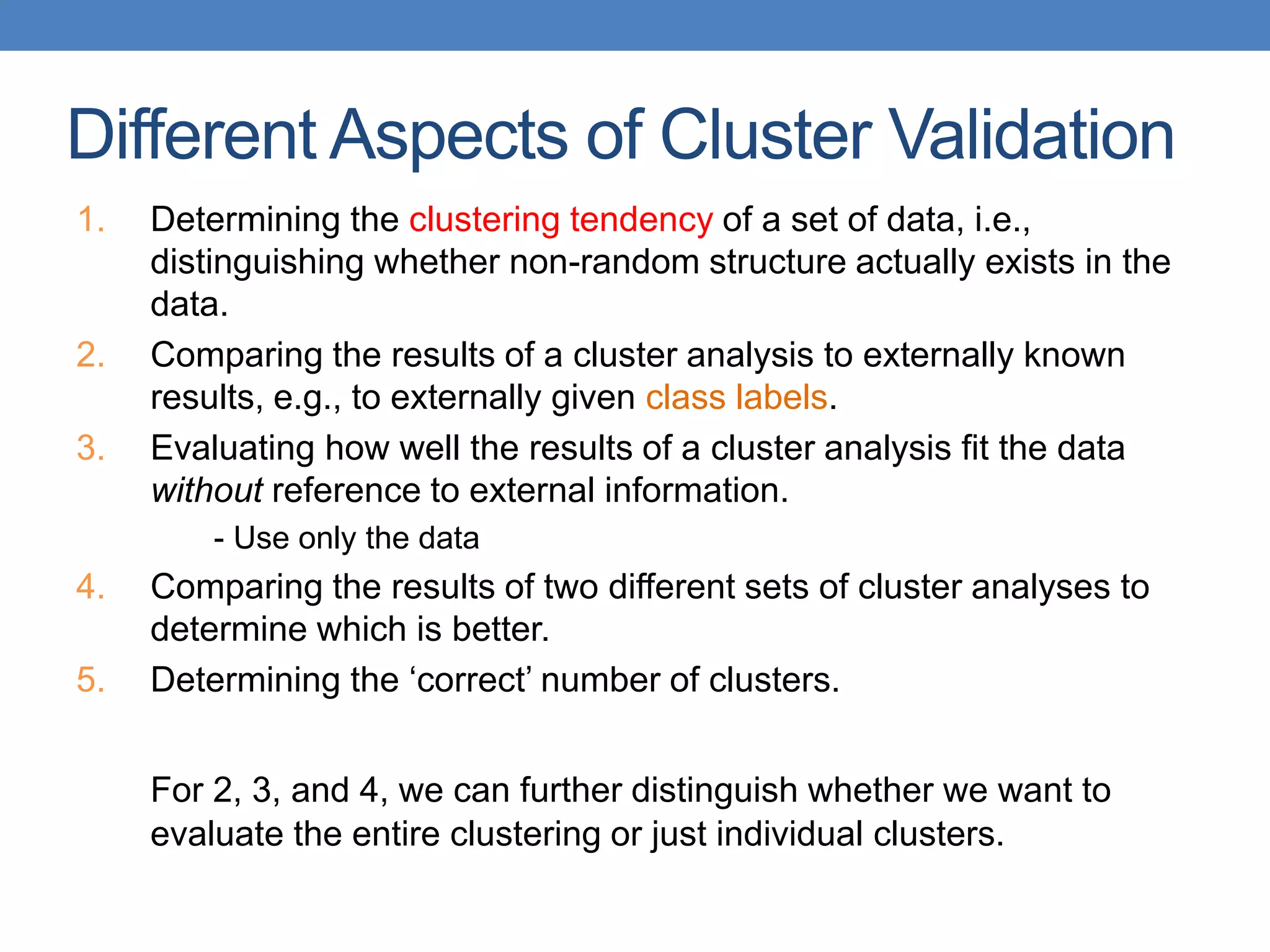
1. Determining the clustering tendency of a set of data, i.e.,
distinguishing whether non-random structure actually exists in the
data.
2. Comparing the results of a cluster analysis to externally known
results, e.g., to externally given class labels.
3. Evaluating how well the results of a cluster analysis fit the data
without reference to external information.
- Use only the data
4. Comparing the results of two different sets of cluster analyses to
determine which is better.
5. Determining the ‘correct’ number of clusters.
For 2, 3, and 4, we can further distinguish whether we want to
evaluate the entire clustering or just individual clusters.
Different Aspects of Cluster Validation
• Numerical measures that are applied to judge various aspects
of cluster validity, are classified into the following three types.
• External Index: Used to measure the extent to which cluster labels
match externally supplied class labels.
• E.g., entropy, precision, recall
• Internal Index: Used to measure the goodness of a clustering
structure without reference to external information.
• E.g., Sum of Squared Error (SSE)
• Relative Index: Used to compare two different clusterings or
clusters.
• Often an external or internal index is used for this function, e.g., SSE or
entropy
• Sometimes these are referred to as criteria instead of indices
• However, sometimes criterion is the general strategy and index is the
numerical measure that implements the criterion.
Measures of Cluster Validity
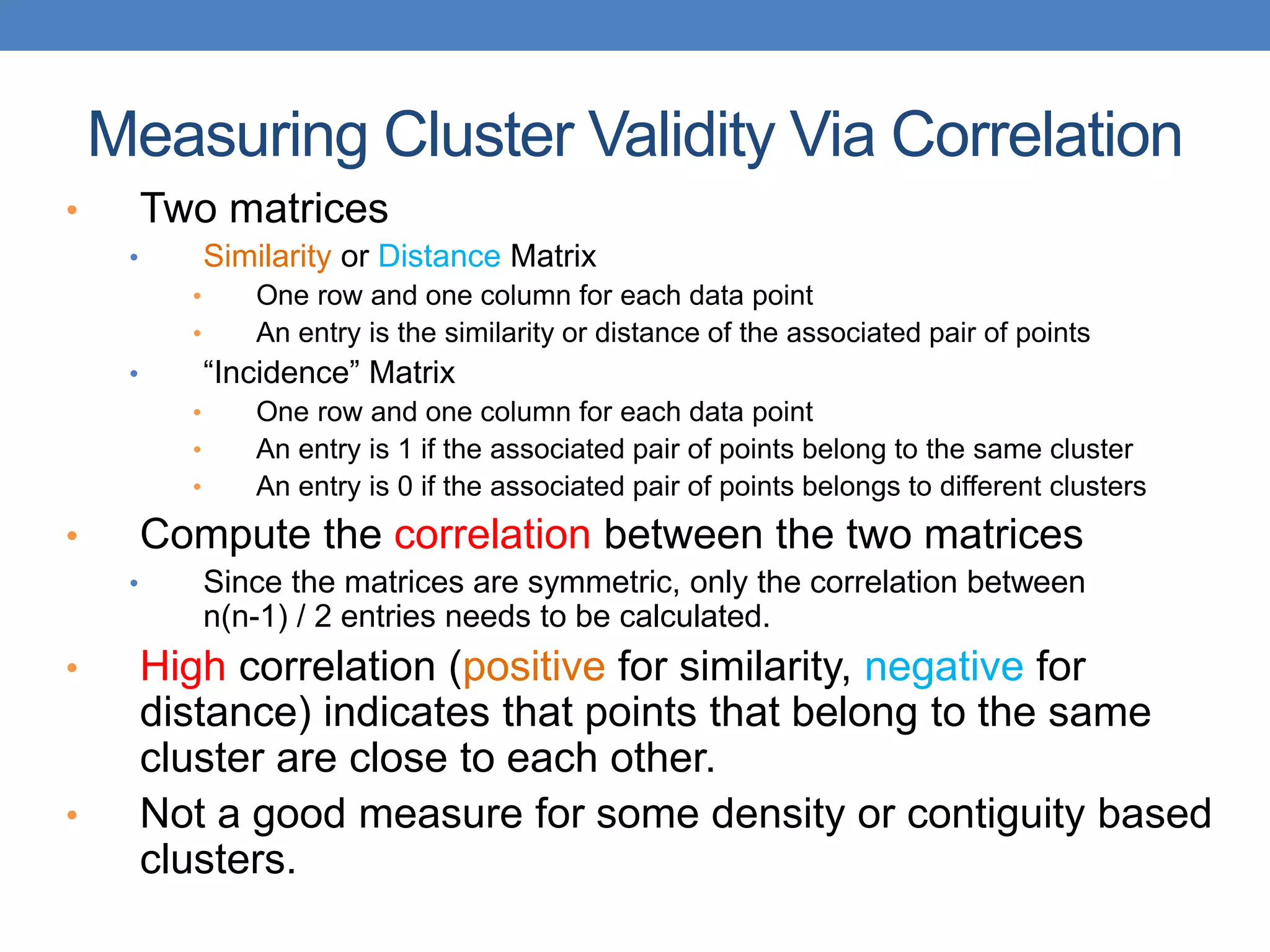
• Two matrices
• Similarity or Distance Matrix
• One row and one column for each data point
• An entry is the similarity or distance of the associated pair of points
• “Incidence” Matrix
• One row and one column for each data point
• An entry is 1 if the associated pair of points belong to the same cluster
• An entry is 0 if the associated pair of points belongs to different clusters
• Compute the correlation between the two matrices
• Since the matrices are symmetric, only the correlation between
n(n-1) / 2 entries needs to be calculated.
• High correlation (positive for similarity, negative for
distance) indicates that points that belong to the same
cluster are close to each other.
• Not a good measure for some density or contiguity based
clusters.
Measuring Cluster Validity Via Correlation
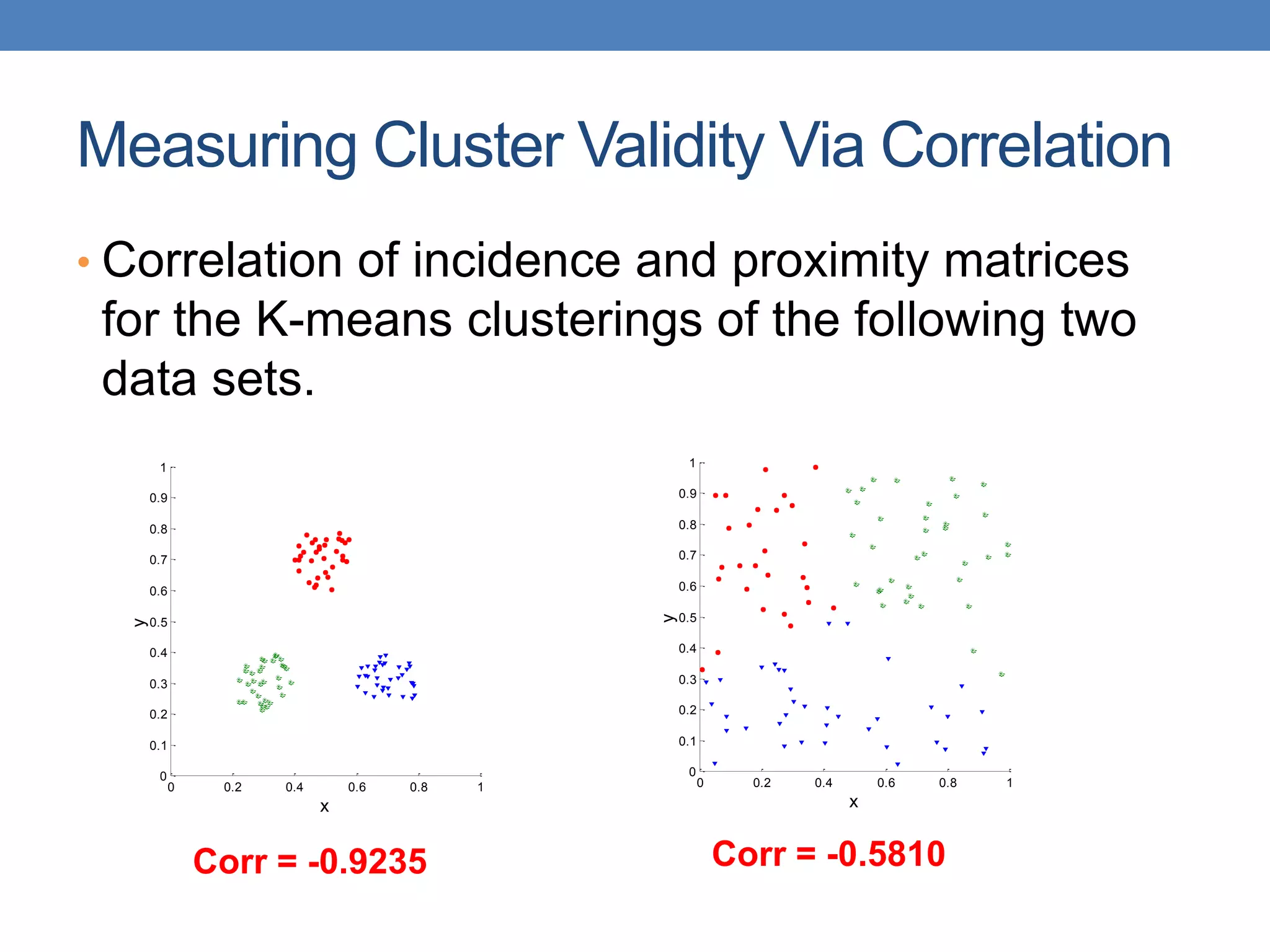
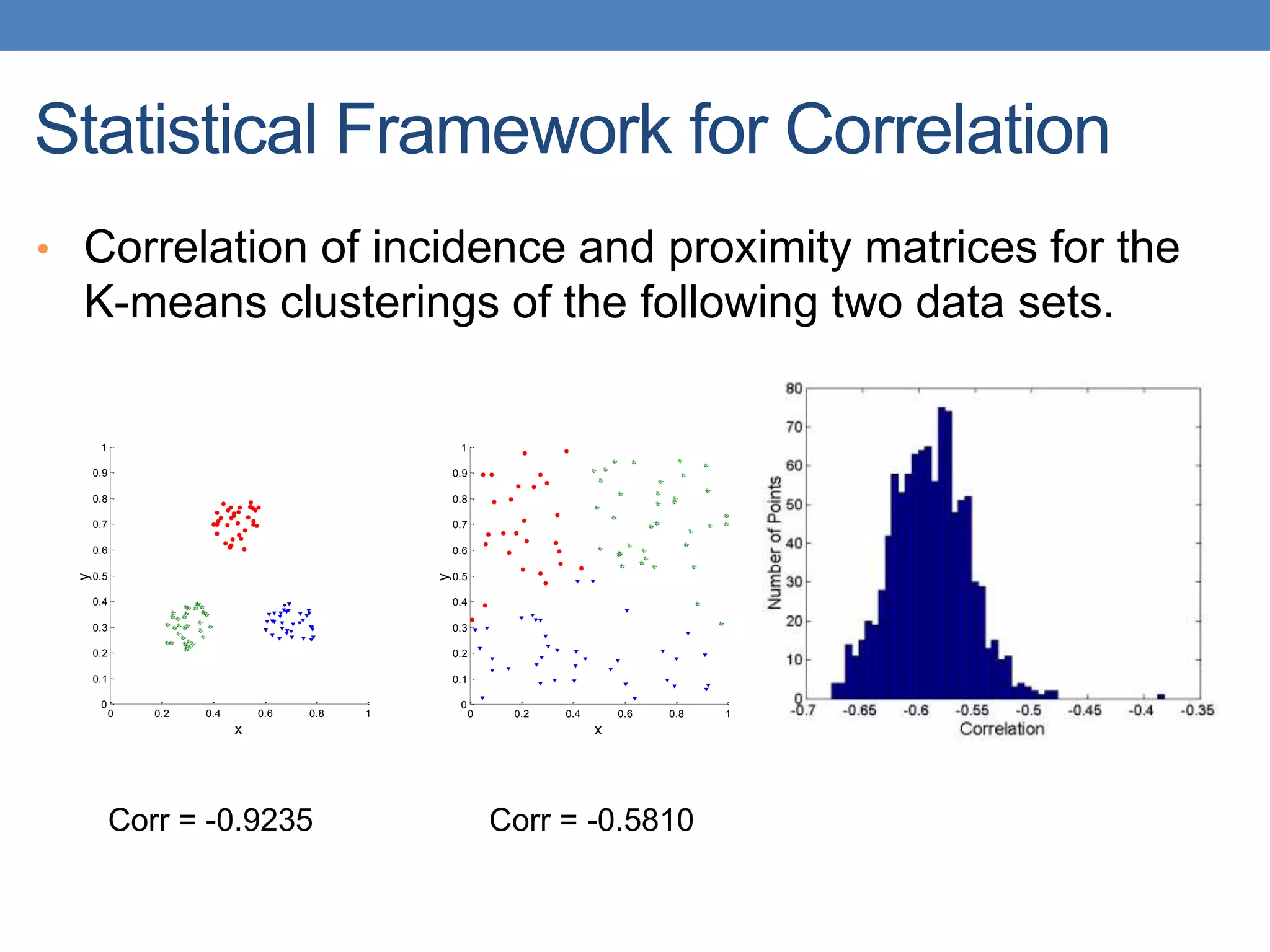
• Correlation of incidence and proximity matrices
for the K-means clusterings of the following two
data sets.
0 0.2 0.4 0.6 0.8 1
0
0.1
0.2
0.3
0.4
0.5
0.6
0.7
0.8
0.9
1
x
y
0 0.2 0.4 0.6 0.8 1
0
0.1
0.2
0.3
0.4
0.5
0.6
0.7
0.8
0.9
1
x
y
Corr = -0.9235 Corr = -0.5810
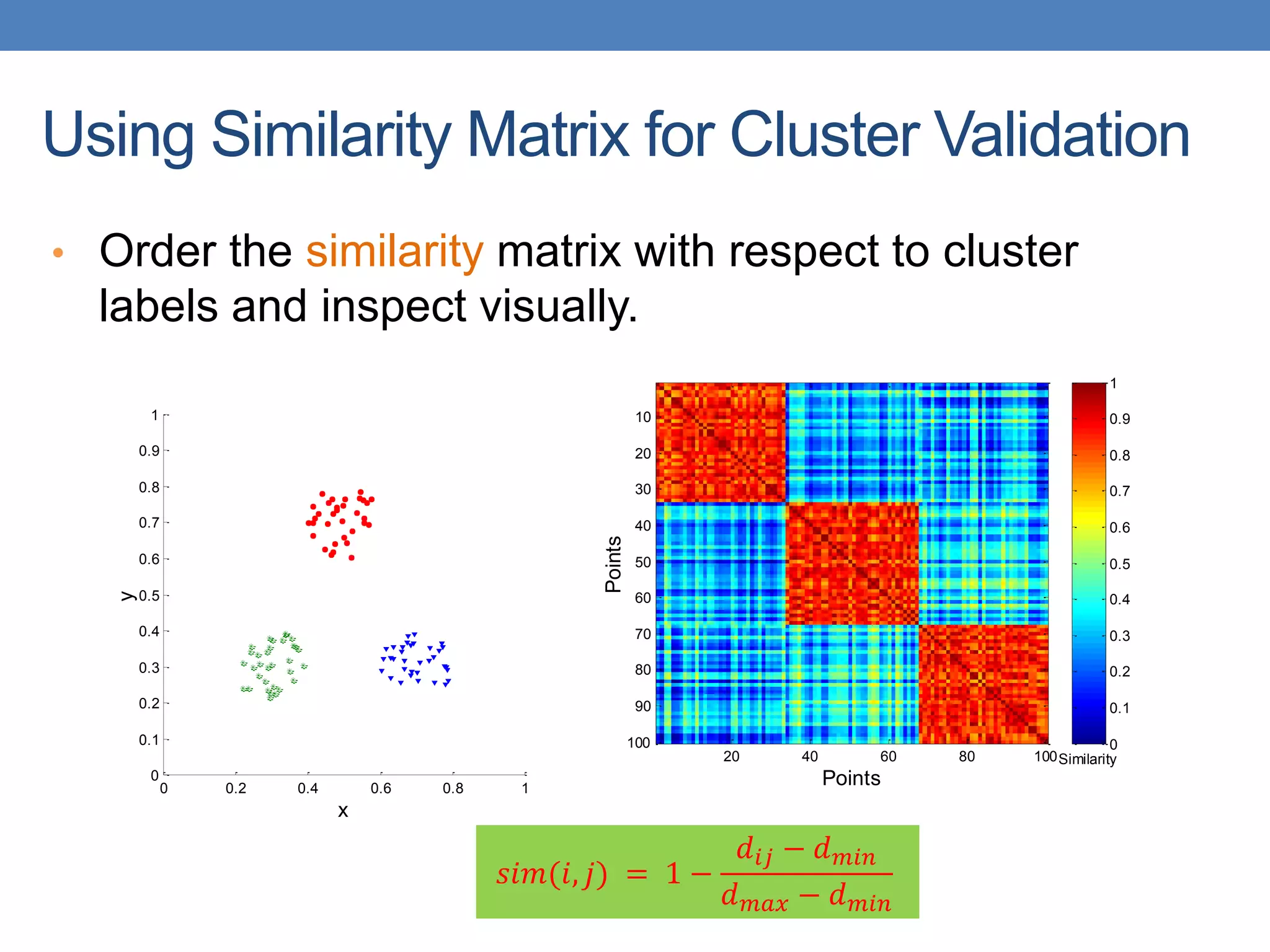
• Order the similarity matrix with respect to cluster
labels and inspect visually.
Using Similarity Matrix for Cluster Validation
0 0.2 0.4 0.6 0.8 1
0
0.1
0.2
0.3
0.4
0.5
0.6
0.7
0.8
0.9
1
x
y
Points
Points
20 40 60 80 100
10
20
30
40
50
60
70
80
90
100
Similarity
0
0.1
0.2
0.3
0.4
0.5
0.6
0.7
0.8
0.9
1
𝑠𝑖𝑚(𝑖, 𝑗) = 1 −
𝑑𝑖𝑗 − 𝑑𝑚𝑖𝑛
𝑑𝑚𝑎𝑥 − 𝑑𝑚𝑖𝑛
Using Similarity Matrix for Cluster Validation
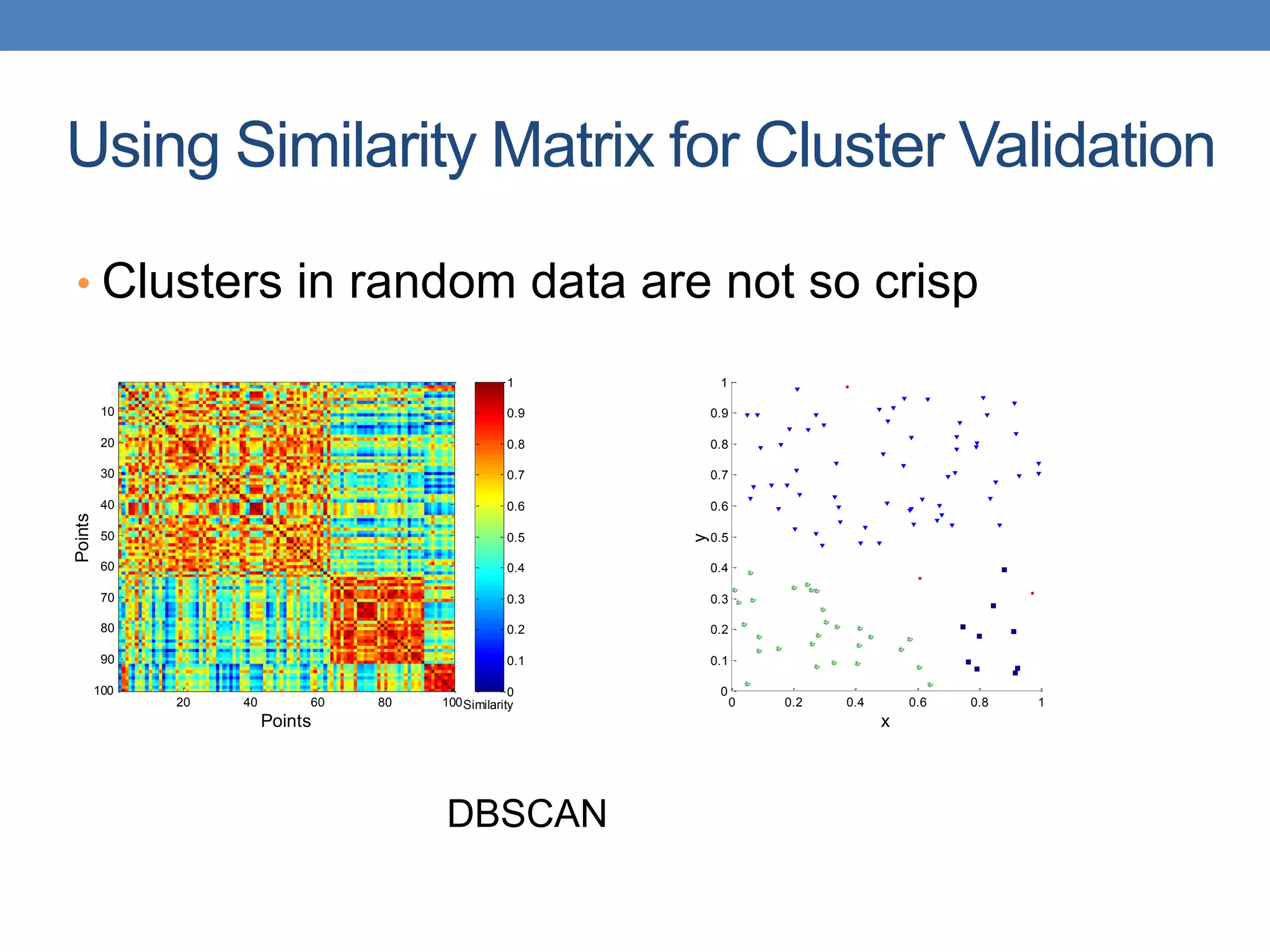
• Clusters in random data are not so crisp
Points
Points
20 40 60 80 100
10
20
30
40
50
60
70
80
90
100
Similarity
0
0.1
0.2
0.3
0.4
0.5
0.6
0.7
0.8
0.9
1
DBSCAN
0 0.2 0.4 0.6 0.8 1
0
0.1
0.2
0.3
0.4
0.5
0.6
0.7
0.8
0.9
1
x
y
Points
Points
20 40 60 80 100
10
20
30
40
50
60
70
80
90
100
Similarity
0
0.1
0.2
0.3
0.4
0.5
0.6
0.7
0.8
0.9
1
Using Similarity Matrix for Cluster Validation
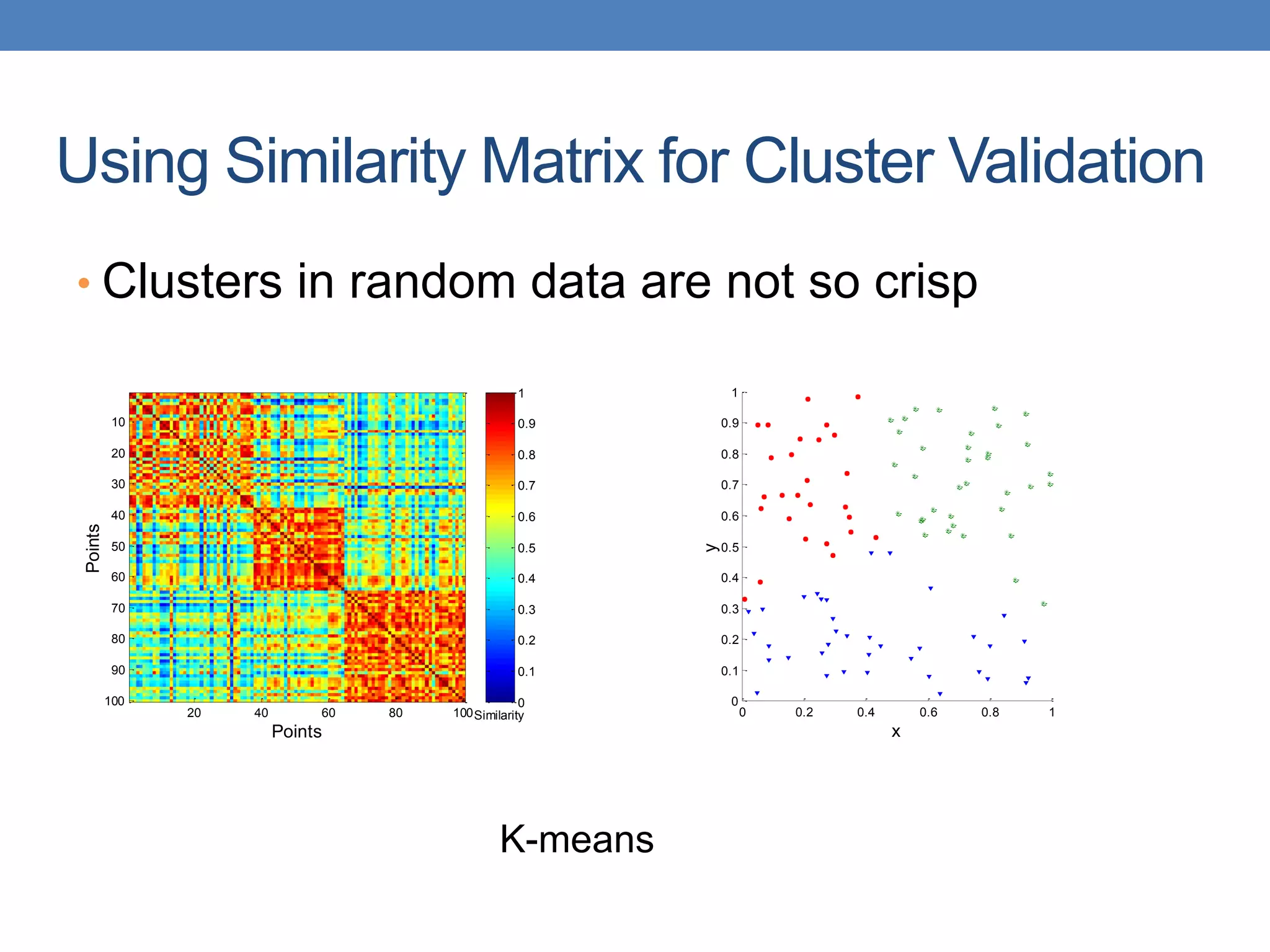
• Clusters in random data are not so crisp
K-means
0 0.2 0.4 0.6 0.8 1
0
0.1
0.2
0.3
0.4
0.5
0.6
0.7
0.8
0.9
1
x
y
Using Similarity Matrix for Cluster Validation
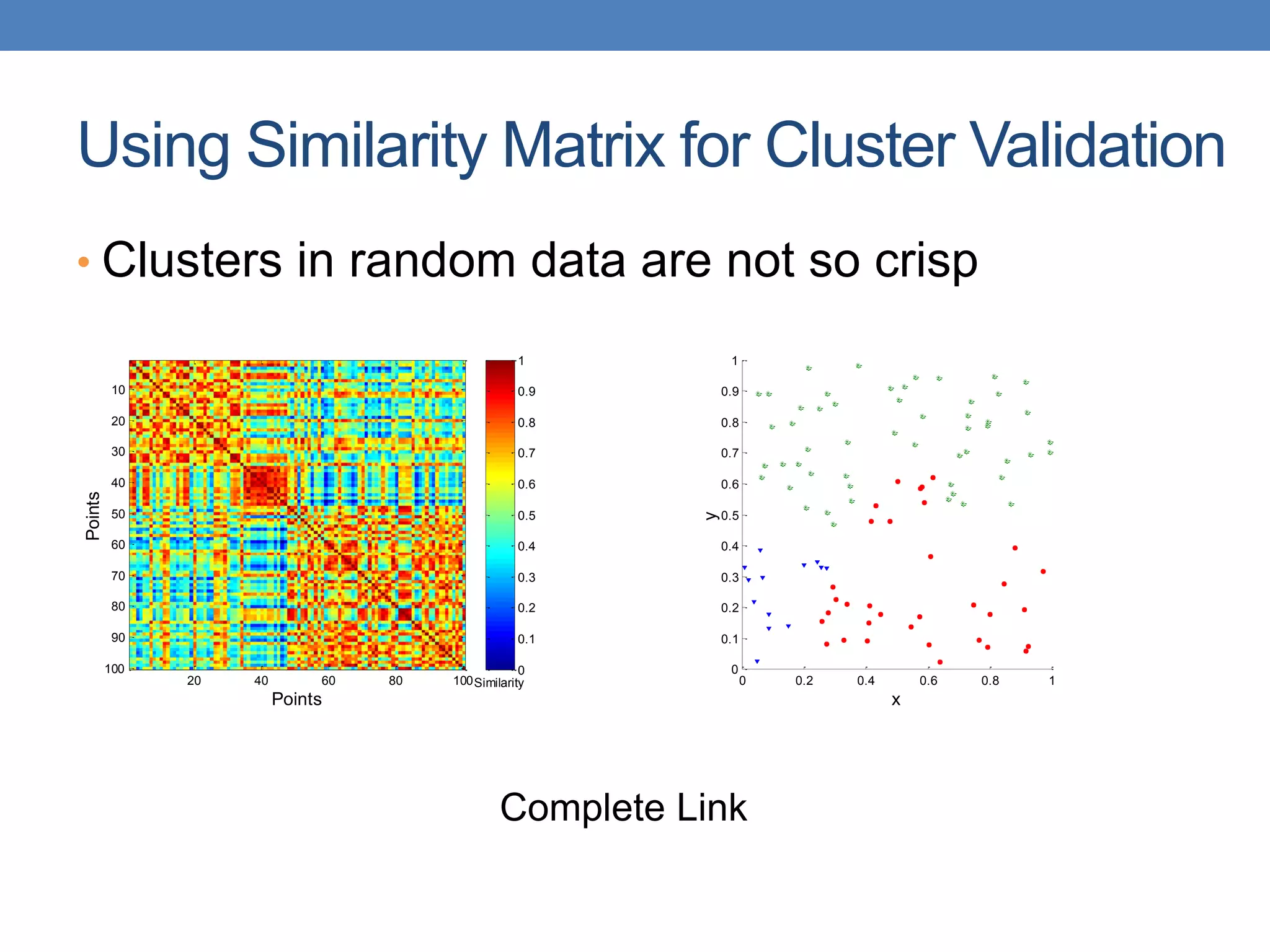
• Clusters in random data are not so crisp
0 0.2 0.4 0.6 0.8 1
0
0.1
0.2
0.3
0.4
0.5
0.6
0.7
0.8
0.9
1
x
y
Points
Points
20 40 60 80 100
10
20
30
40
50
60
70
80
90
100
Similarity
0
0.1
0.2
0.3
0.4
0.5
0.6
0.7
0.8
0.9
1
Complete Link
Using Similarity Matrix for Cluster Validation
1
2
3
5
6
4
7
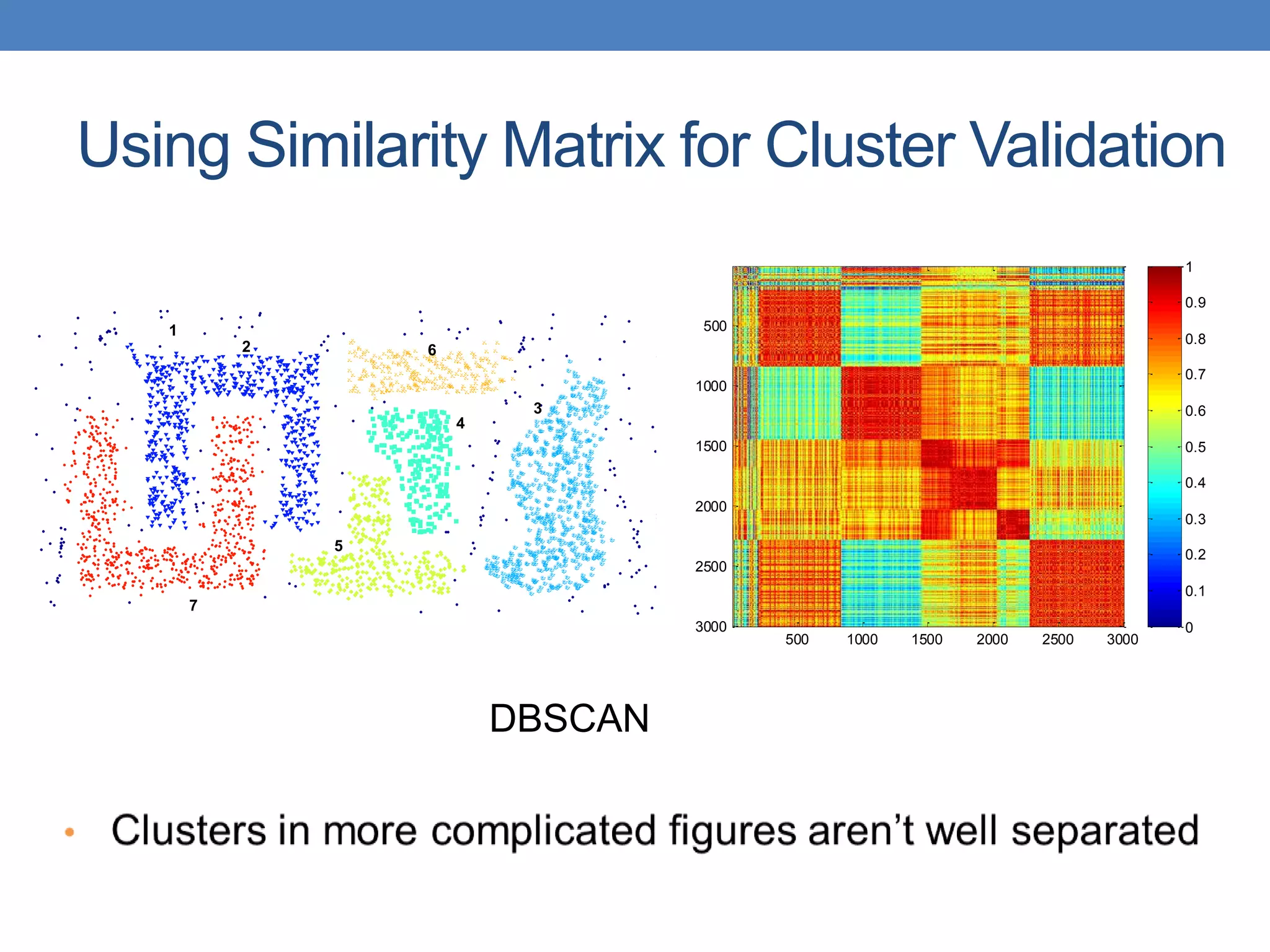
DBSCAN
0
0.1
0.2
0.3
0.4
0.5
0.6
0.7
0.8
0.9
1
500 1000 1500 2000 2500 3000
500
1000
1500
2000
2500
3000
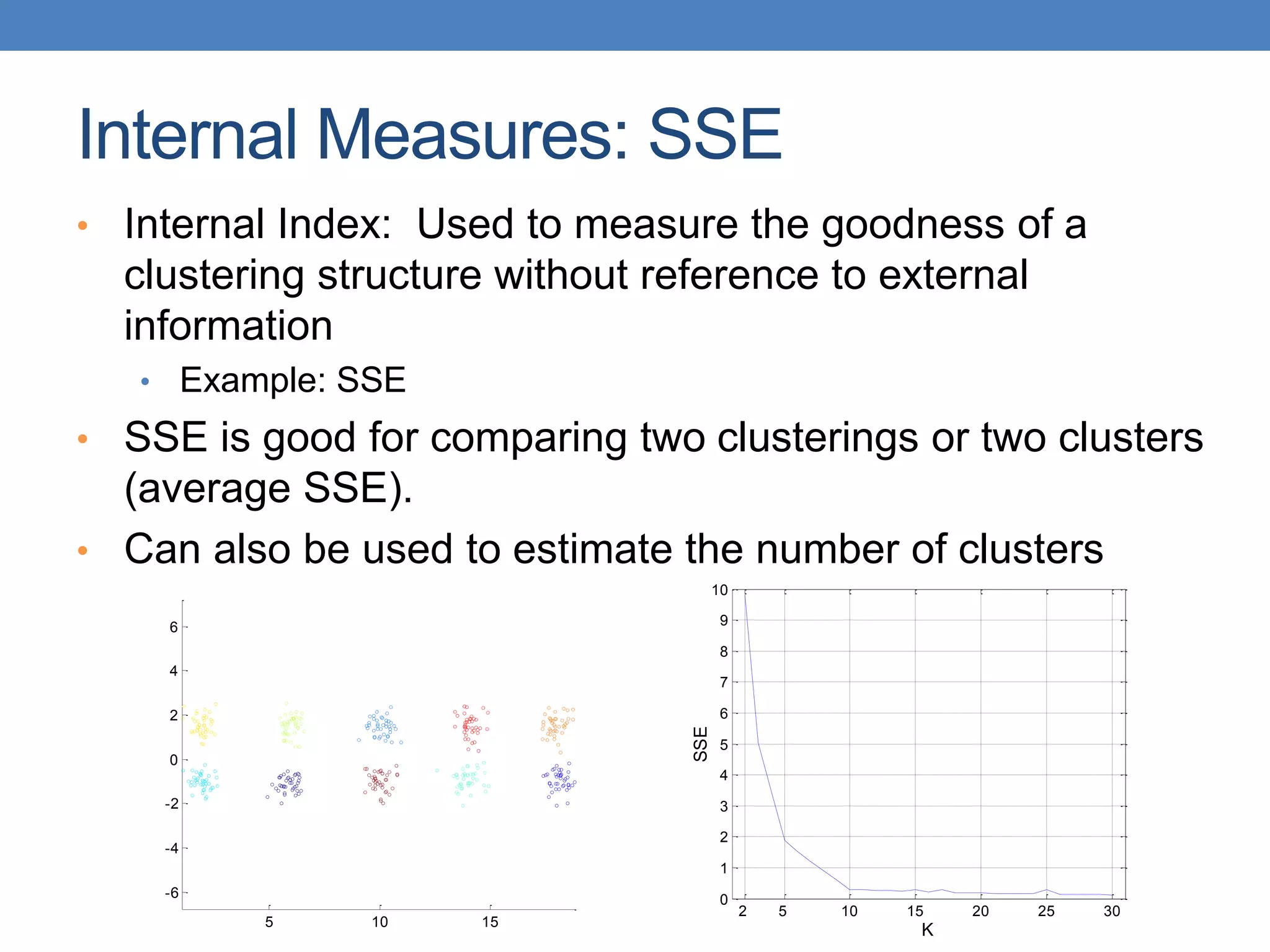
• Internal Index: Used to measure the goodness of a
clustering structure without reference to external
information
• Example: SSE
• SSE is good for comparing two clusterings or two clusters
(average SSE).
• Can also be used to estimate the number of clusters
Internal Measures: SSE
2 5 10 15 20 25 30
0
1
2
3
4
5
6
7
8
9
10
K
SSE
5 10 15
-6
-4
-2
0
2
4
6
Estimating the “right” number of clusters
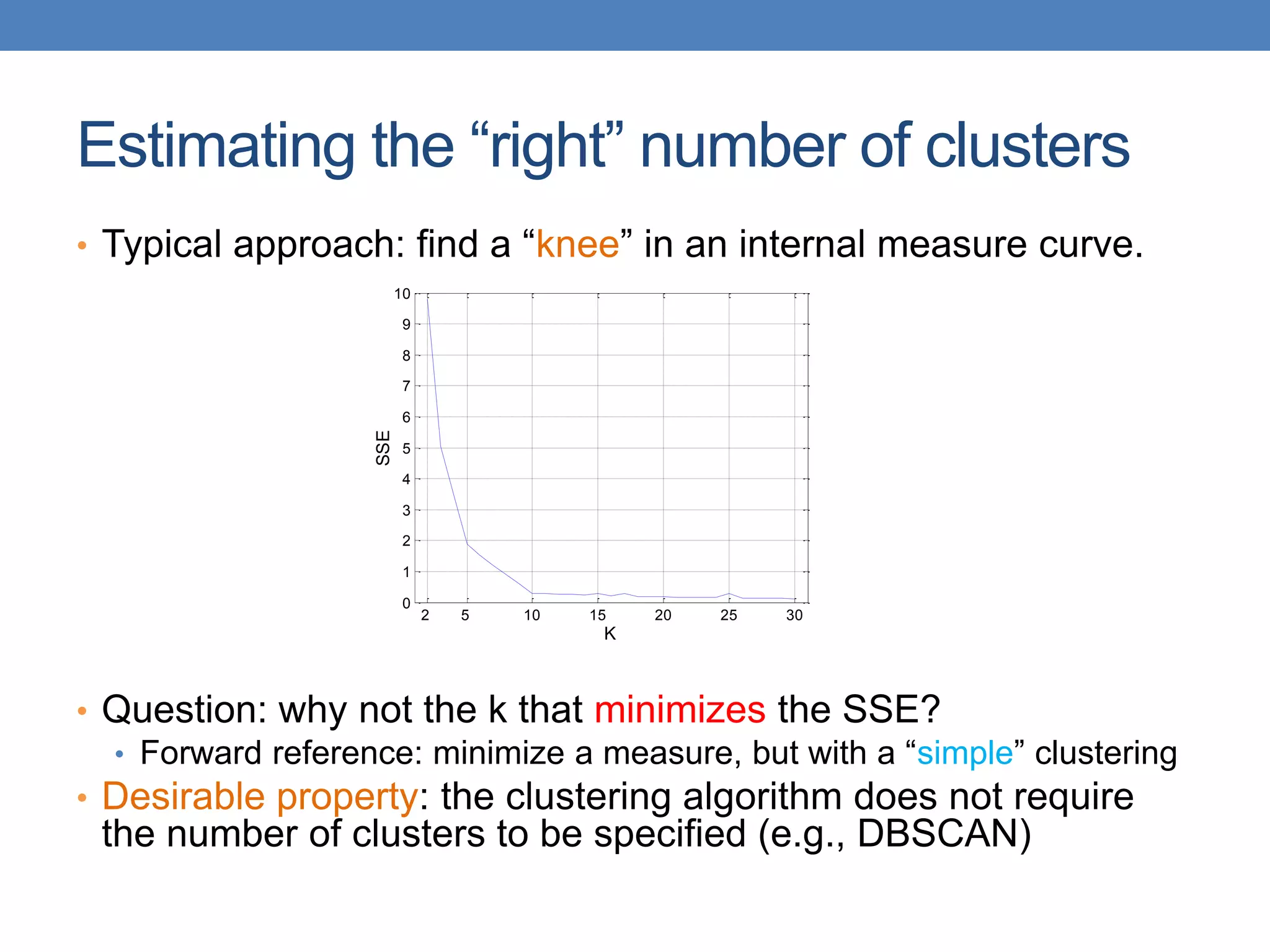
• Typical approach: find a “knee” in an internal measure curve.
• Question: why not the k that minimizes the SSE?
• Forward reference: minimize a measure, but with a “simple” clustering
• Desirable property: the clustering algorithm does not require
the number of clusters to be specified (e.g., DBSCAN)
2 5 10 15 20 25 30
0
1
2
3
4
5
6
7
8
9
10
K
SSE
Internal Measures: SSE
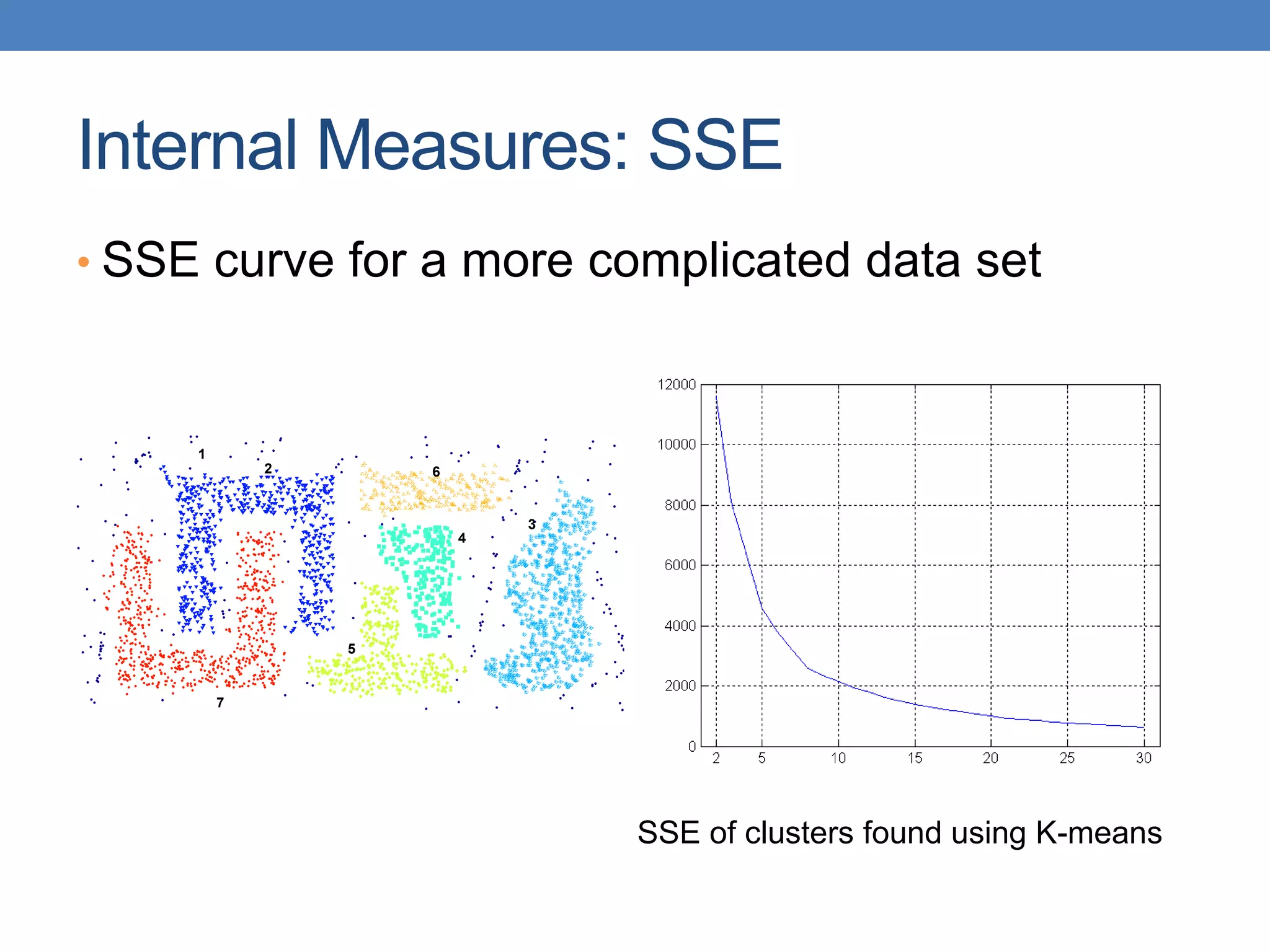
• SSE curve for a more complicated data set
1
2
3
5
6
4
7
SSE of clusters found using K-means
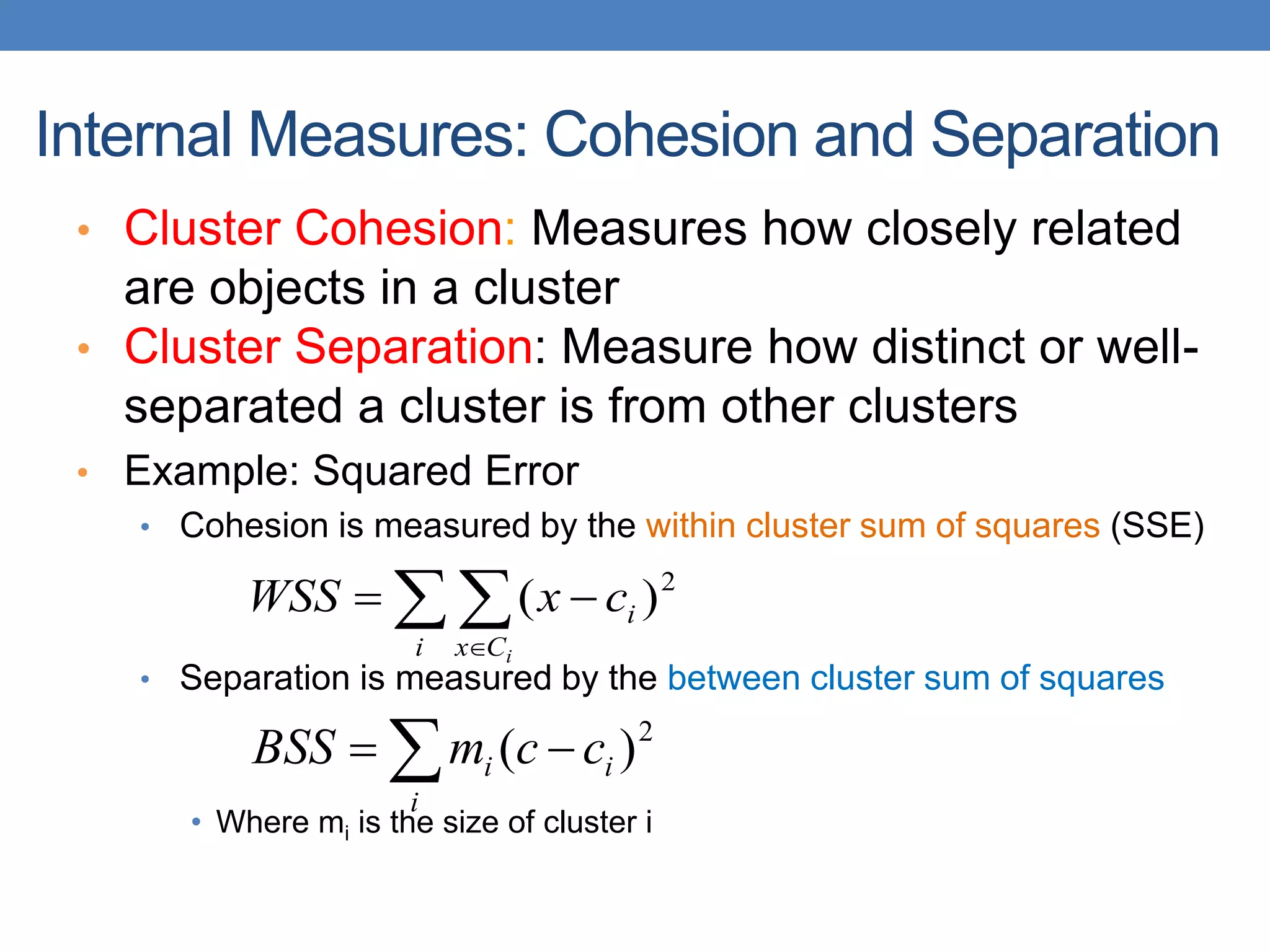
• Cluster Cohesion: Measures how closely related
are objects in a cluster
• Cluster Separation: Measure how distinct or well-
separated a cluster is from other clusters
• Example: Squared Error
• Cohesion is measured by the within cluster sum of squares (SSE)
• Separation is measured by the between cluster sum of squares
• Where mi is the size of cluster i
Internal Measures: Cohesion and Separation
 



i C
x
i
i
c
x
WSS 2
)
(
 

i
i
i c
c
m
BSS 2
)
(
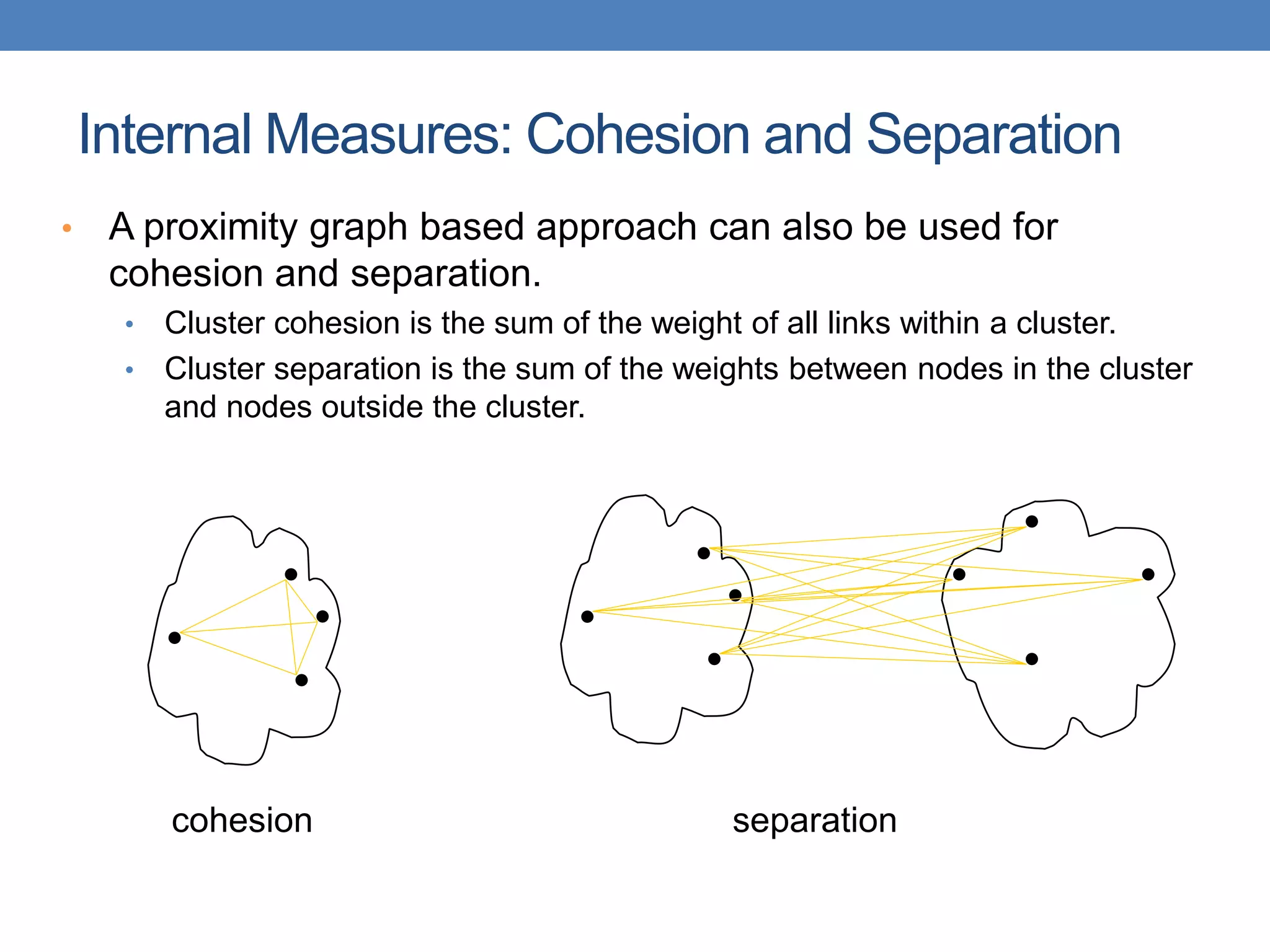
• A proximity graph based approach can also be used for
cohesion and separation.
• Cluster cohesion is the sum of the weight of all links within a cluster.
• Cluster separation is the sum of the weights between nodes in the cluster
and nodes outside the cluster.
Internal Measures: Cohesion and Separation
cohesion separation
Internal measures – caveats
• Internal measures have the problem that the
clustering algorithm did not set out to optimize
this measure, so it is will not necessarily do well
with respect to the measure.
• An internal measure can also be used as an
objective function for clustering
• Need a framework to interpret any measure.
• For example, if our measure of evaluation has the value, 10, is that
good, fair, or poor?
• Statistics provide a framework for cluster validity
• The more “non-random” a clustering result is, the more likely it
represents valid structure in the data
• Can compare the values of an index that result from random data or
clusterings to those of a clustering result.
• If the value of the index is unlikely, then the cluster results are valid
• For comparing the results of two different sets of cluster
analyses, a framework is less necessary.
• However, there is the question of whether the difference between two
index values is significant
Framework for Cluster Validity
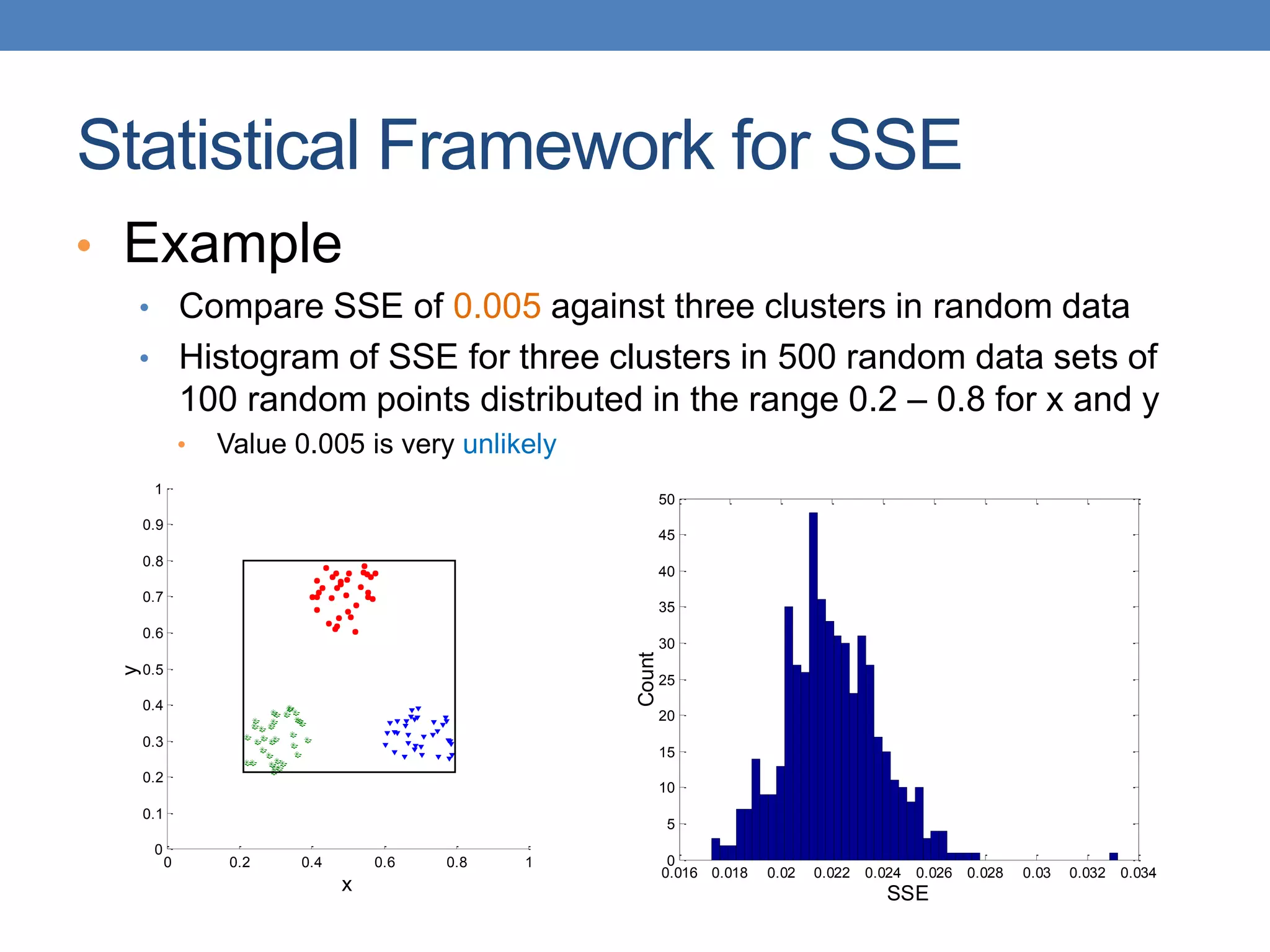
• Example
• Compare SSE of 0.005 against three clusters in random data
• Histogram of SSE for three clusters in 500 random data sets of
100 random points distributed in the range 0.2 – 0.8 for x and y
• Value 0.005 is very unlikely
Statistical Framework for SSE
0.016 0.018 0.02 0.022 0.024 0.026 0.028 0.03 0.032 0.034
0
5
10
15
20
25
30
35
40
45
50
SSE
Count
0 0.2 0.4 0.6 0.8 1
0
0.1
0.2
0.3
0.4
0.5
0.6
0.7
0.8
0.9
1
x
y
• Correlation of incidence and proximity matrices for the
K-means clusterings of the following two data sets.
Statistical Framework for Correlation
0 0.2 0.4 0.6 0.8 1
0
0.1
0.2
0.3
0.4
0.5
0.6
0.7
0.8
0.9
1
x
y
0 0.2 0.4 0.6 0.8 1
0
0.1
0.2
0.3
0.4
0.5
0.6
0.7
0.8
0.9
1
x
y
Corr = -0.9235 Corr = -0.5810
Empirical p-value
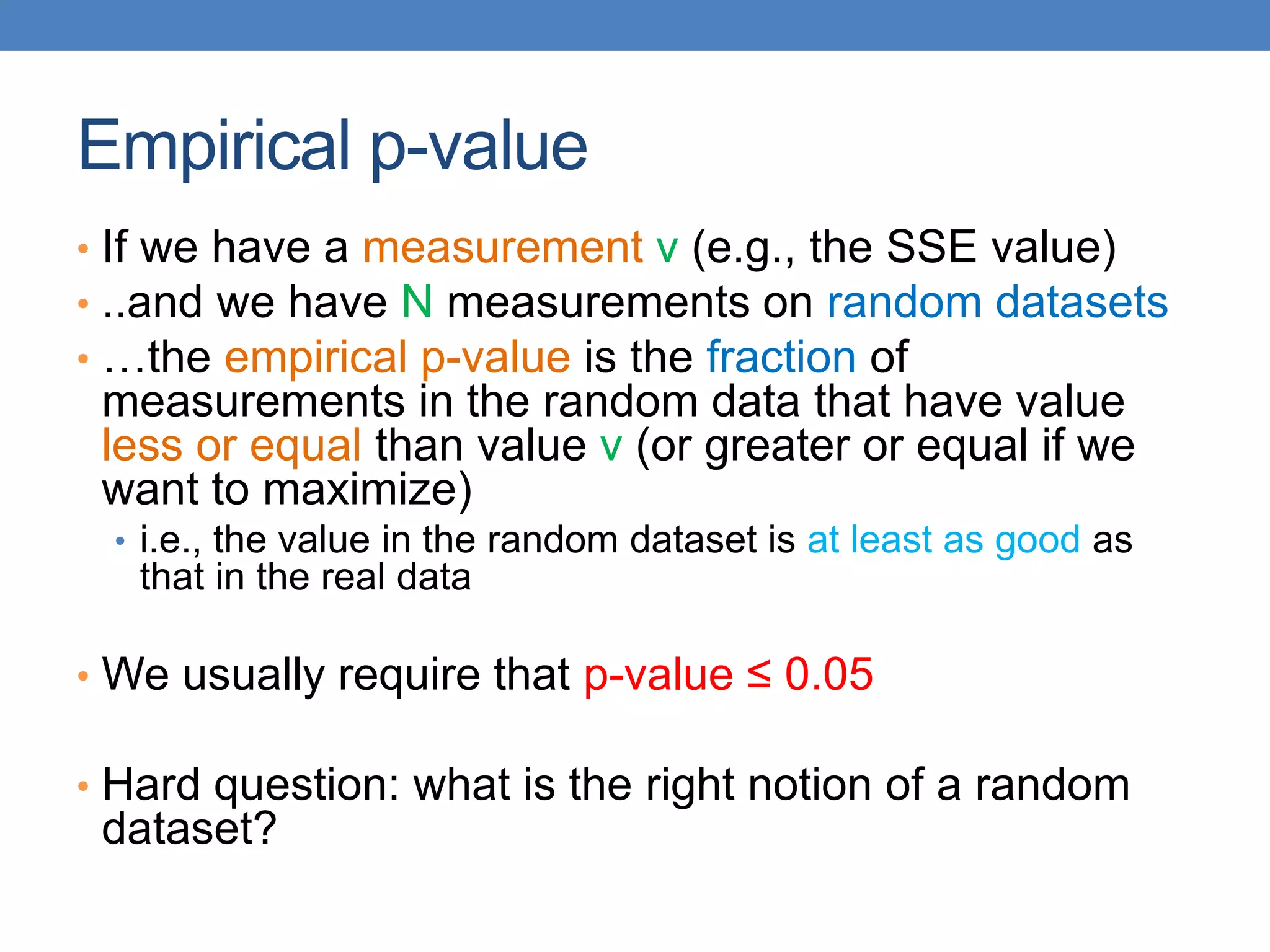
• If we have a measurement v (e.g., the SSE value)
• ..and we have N measurements on random datasets
• …the empirical p-value is the fraction of
measurements in the random data that have value
less or equal than value v (or greater or equal if we
want to maximize)
• i.e., the value in the random dataset is at least as good as
that in the real data
• We usually require that p-value ≤ 0.05
• Hard question: what is the right notion of a random
dataset?
External Measures for Clustering Validity
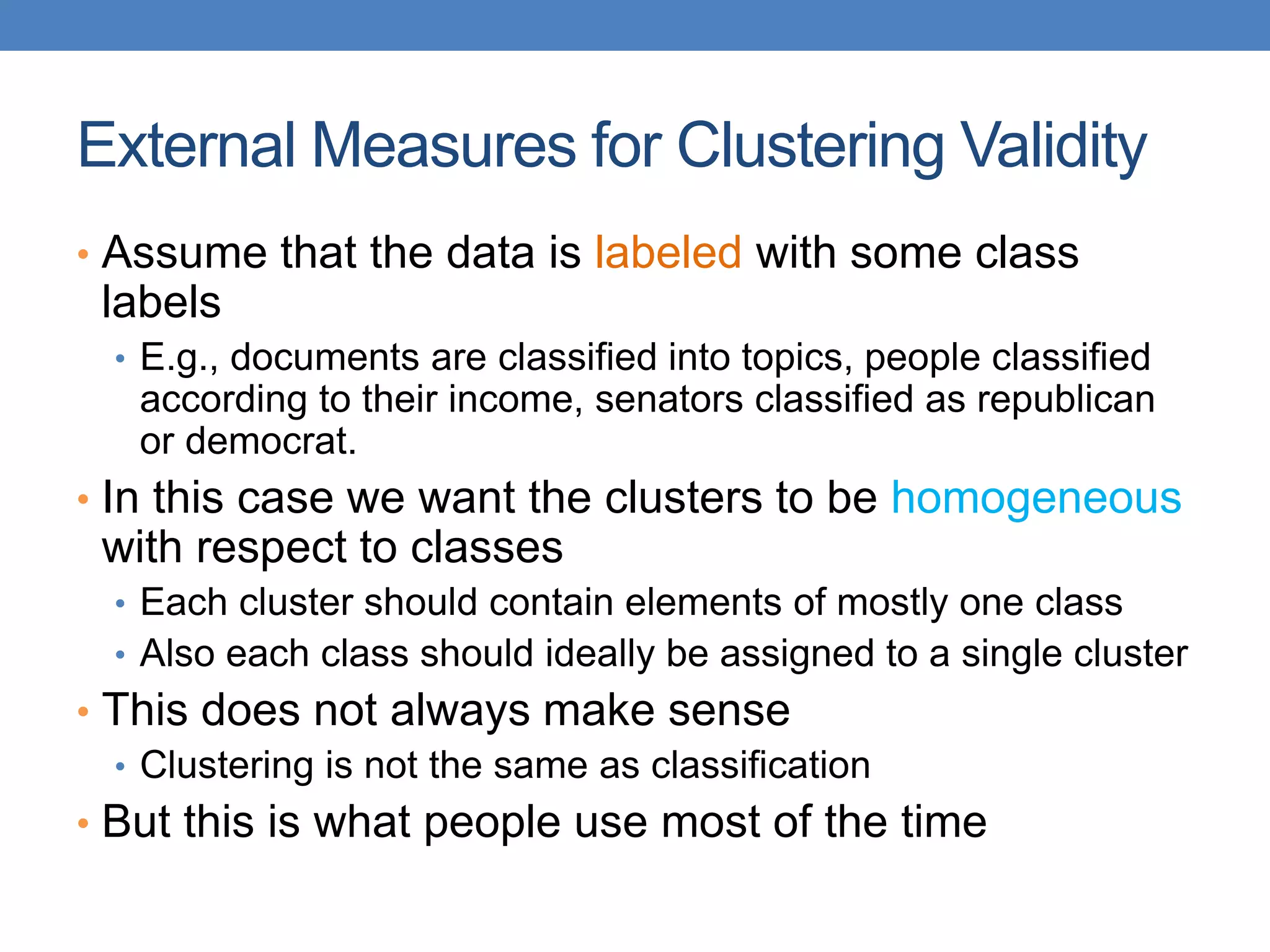
• Assume that the data is labeled with some class
labels
• E.g., documents are classified into topics, people classified
according to their income, senators classified as republican
or democrat.
• In this case we want the clusters to be homogeneous
with respect to classes
• Each cluster should contain elements of mostly one class
• Also each class should ideally be assigned to a single cluster
• This does not always make sense
• Clustering is not the same as classification
• But this is what people use most of the time
Measures
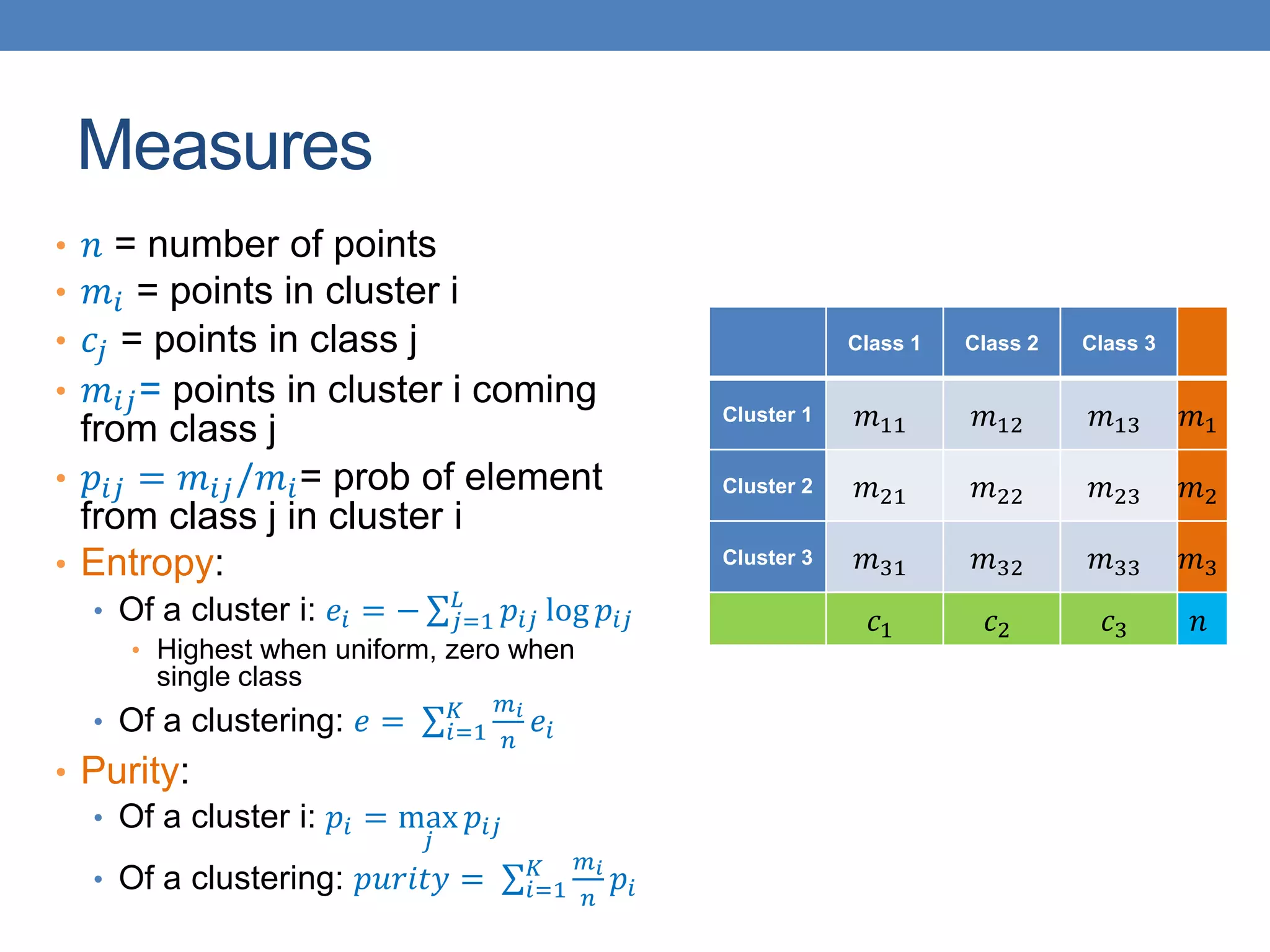
• 𝑛 = number of points
• 𝑚𝑖 = points in cluster i
• 𝑐𝑗 = points in class j
• 𝑚𝑖𝑗= points in cluster i coming
from class j
• 𝑝𝑖𝑗 = 𝑚𝑖𝑗/𝑚𝑖= prob of element
from class j in cluster i
• Entropy:
• Of a cluster i: 𝑒𝑖 = − 𝑗=1
𝐿
𝑝𝑖𝑗 log 𝑝𝑖𝑗
• Highest when uniform, zero when
single class
• Of a clustering: 𝑒 = 𝑖=1
𝐾 𝑚𝑖
𝑛
𝑒𝑖
• Purity:
• Of a cluster i: 𝑝𝑖 = max
𝑗
𝑝𝑖𝑗
• Of a clustering: 𝑝𝑢𝑟𝑖𝑡𝑦 = 𝑖=1
𝐾 𝑚𝑖
𝑛
𝑝𝑖
Class 1 Class 2 Class 3
Cluster 1 𝑚11 𝑚12 𝑚13 𝑚1
Cluster 2 𝑚21 𝑚22 𝑚23 𝑚2
Cluster 3 𝑚31 𝑚32 𝑚33 𝑚3
𝑐1 𝑐2 𝑐3 𝑛
Measures
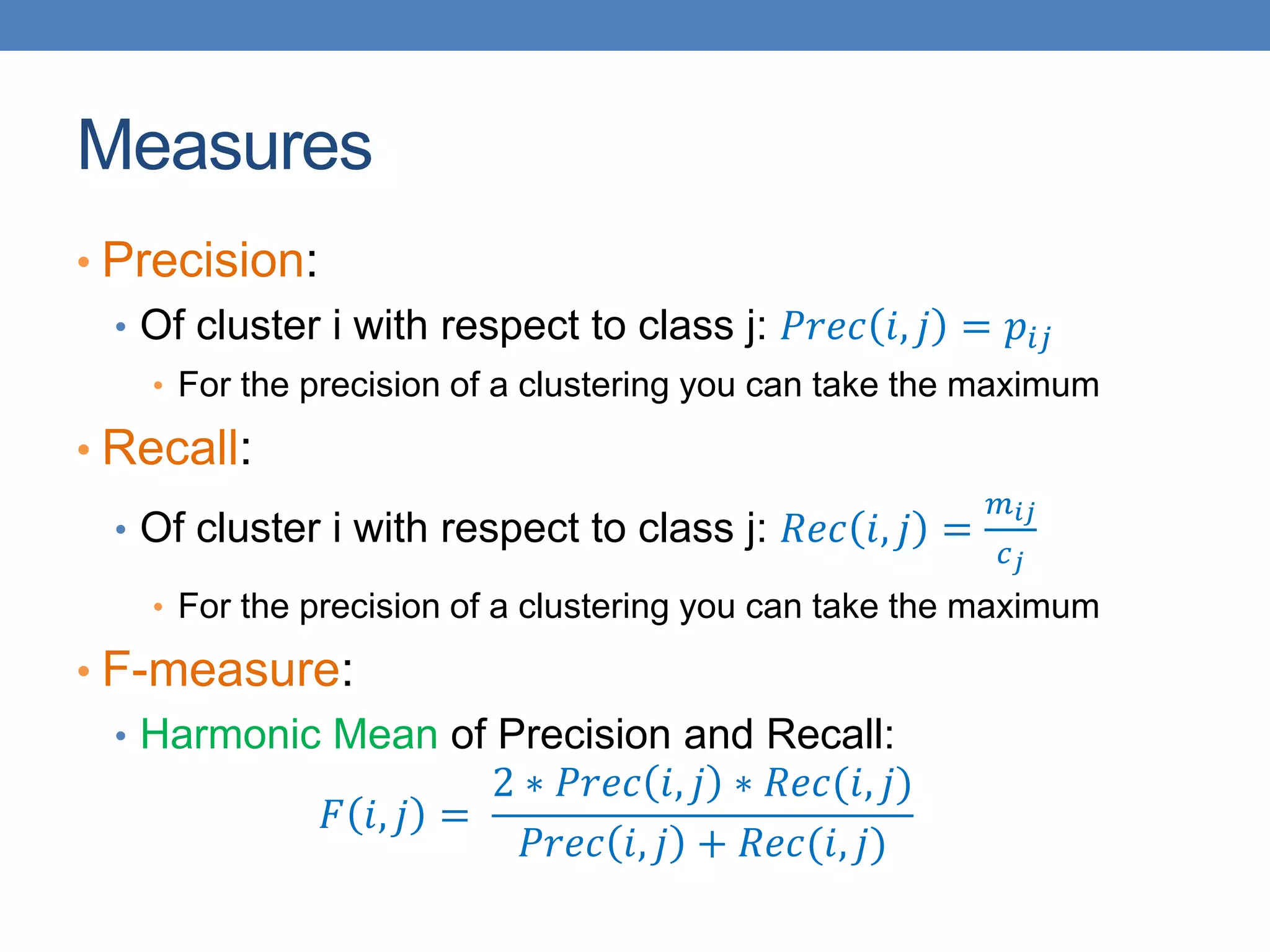
• Precision:
• Of cluster i with respect to class j: 𝑃𝑟𝑒𝑐 𝑖, 𝑗 = 𝑝𝑖𝑗
• For the precision of a clustering you can take the maximum
• Recall:
• Of cluster i with respect to class j: 𝑅𝑒𝑐 𝑖, 𝑗 =
𝑚𝑖𝑗
𝑐𝑗
• For the precision of a clustering you can take the maximum
• F-measure:
• Harmonic Mean of Precision and Recall:
𝐹 𝑖, 𝑗 =
2 ∗ 𝑃𝑟𝑒𝑐 𝑖, 𝑗 ∗ 𝑅𝑒𝑐(𝑖, 𝑗)
𝑃𝑟𝑒𝑐 𝑖, 𝑗 + 𝑅𝑒𝑐(𝑖, 𝑗)
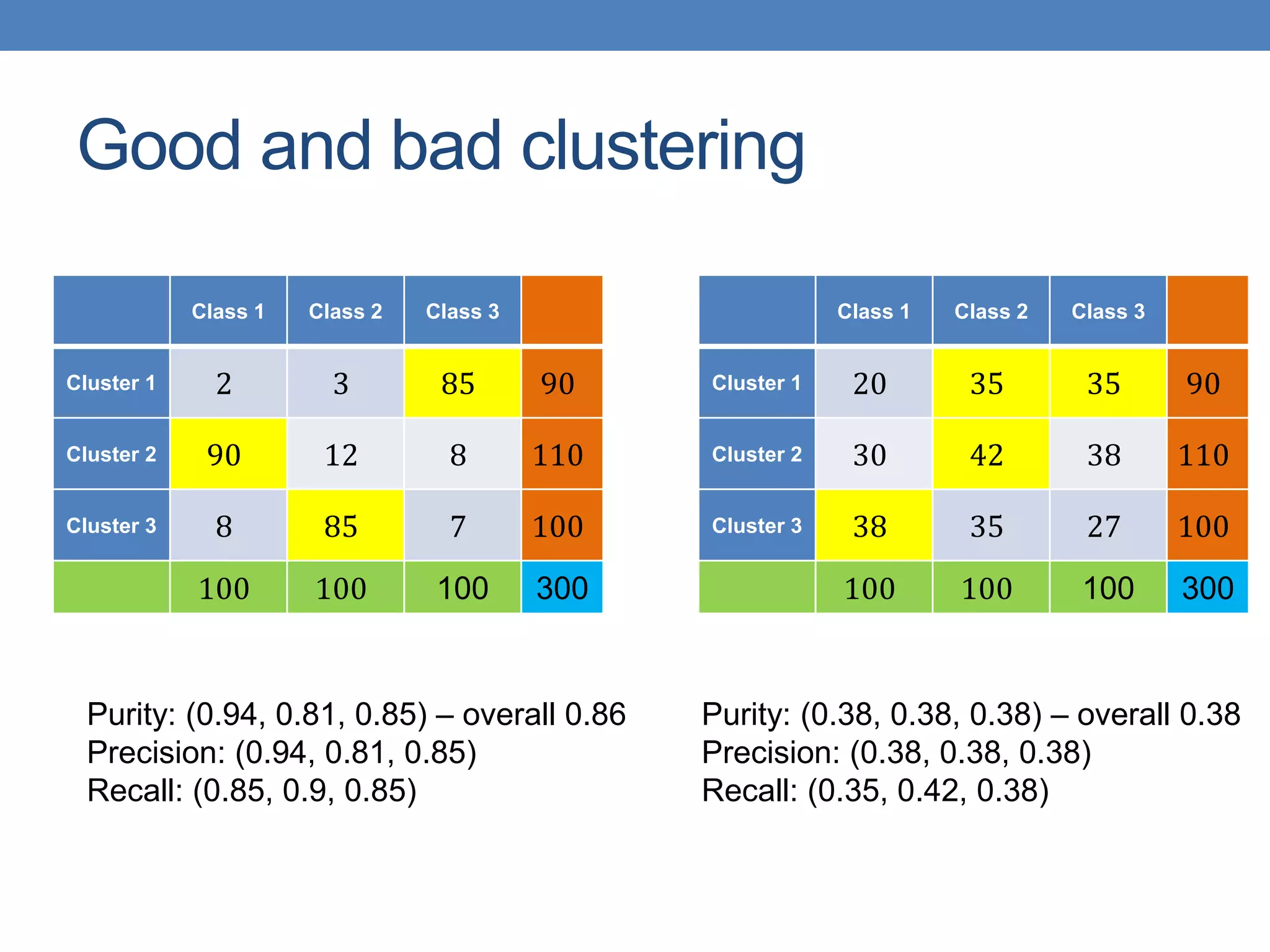
Good and bad clustering
Class 1 Class 2 Class 3
Cluster 1 20 35 35 90
Cluster 2 30 42 38 110
Cluster 3 38 35 27 100
100 100 100 300
Class 1 Class 2 Class 3
Cluster 1 2 3 85 90
Cluster 2 90 12 8 110
Cluster 3 8 85 7 100
100 100 100 300
Purity: (0.94, 0.81, 0.85) – overall 0.86
Precision: (0.94, 0.81, 0.85)
Recall: (0.85, 0.9, 0.85)
Purity: (0.38, 0.38, 0.38) – overall 0.38
Precision: (0.38, 0.38, 0.38)
Recall: (0.35, 0.42, 0.38)
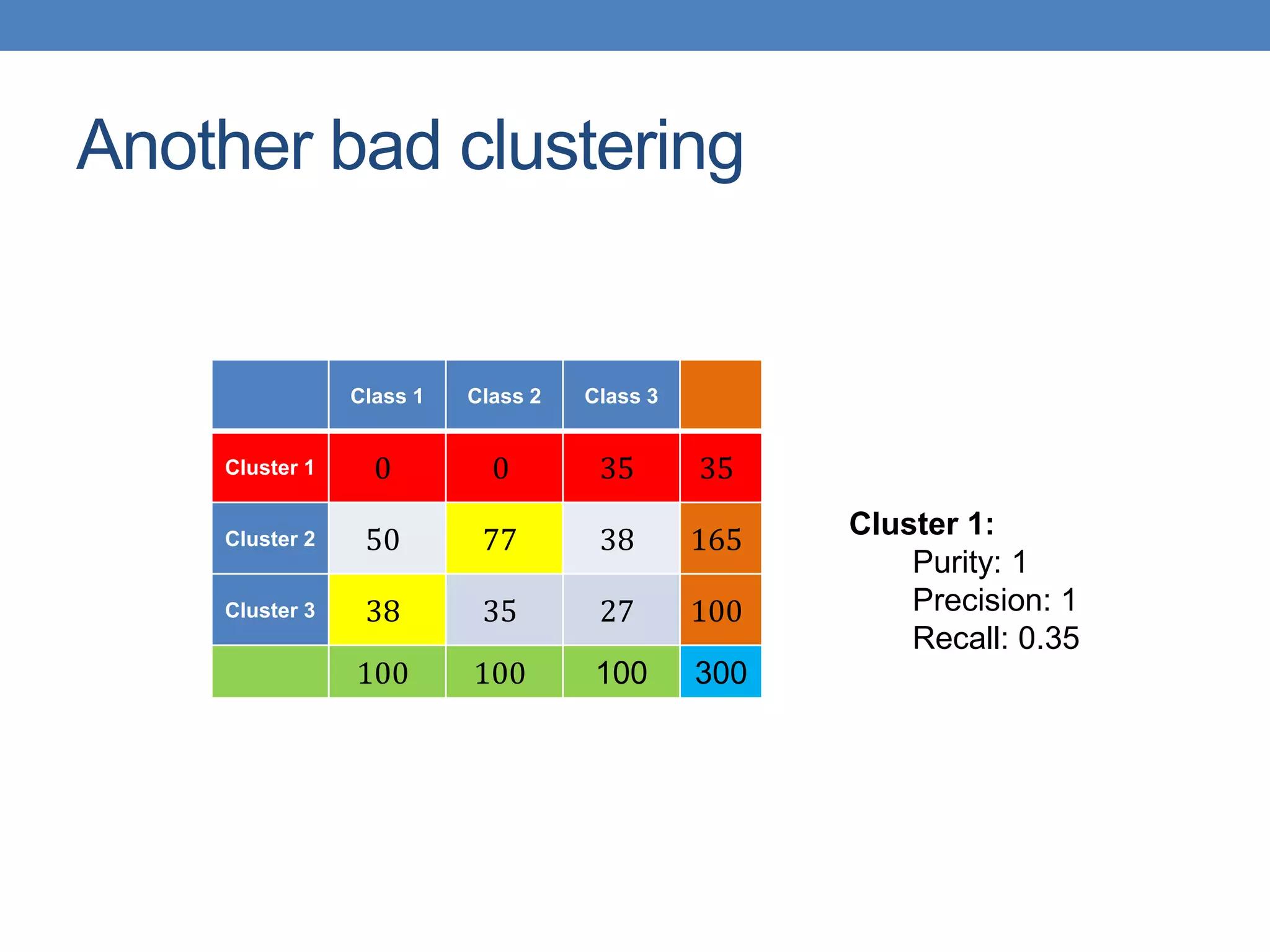
Another bad clustering
Class 1 Class 2 Class 3
Cluster 1 0 0 35 35
Cluster 2 50 77 38 165
Cluster 3 38 35 27 100
100 100 100 300
Cluster 1:
Purity: 1
Precision: 1
Recall: 0.35
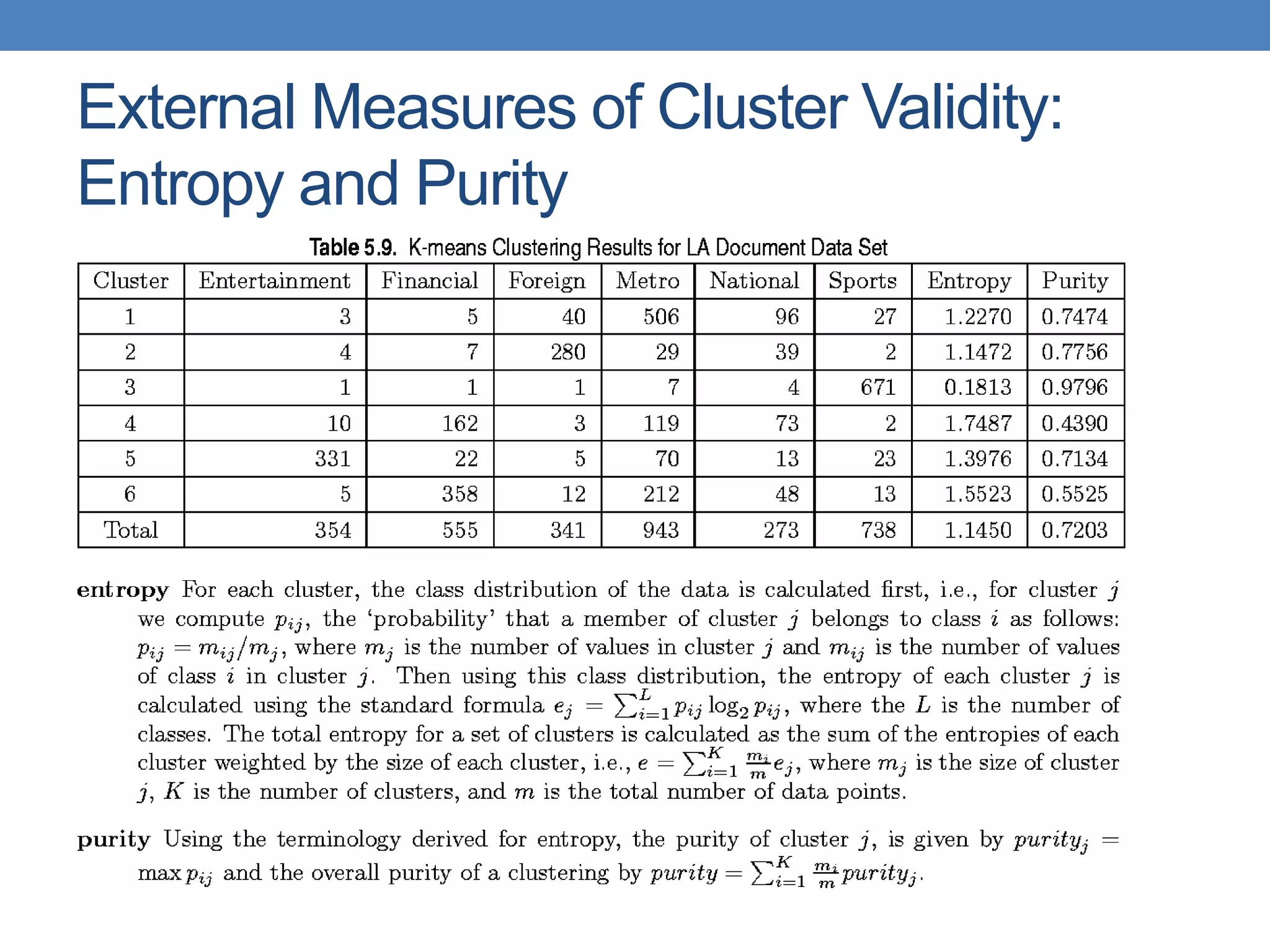
External Measures of Cluster Validity:
Entropy and Purity
“The validation of clustering structures is the most
difficult and frustrating part of cluster analysis.
Without a strong effort in this direction, cluster
analysis will remain a black art accessible only to
those true believers who have experience and
great courage.”
Algorithms for Clustering Data, Jain and Dubes
Final Comment on Cluster Validity
MINIMUM DESCRIPTION
LENGTH
Occam’s razor
• Most data mining tasks can be described as
creating a model for the data
• E.g., the EM algorithm models the data as a mixture of
Gaussians, the K-means models the data as a set of
centroids.
• What is the right model?
• Occam’s razor: All other things being equal, the
simplest model is the best.
• A good principle for life as well
Occam's Razor and MDL
• What is a simple model?
• Minimum Description Length Principle: Every
model provides a (lossless) encoding of our data.
The model that gives the shortest encoding (best
compression) of the data is the best.
• Related: Kolmogorov complexity. Find the shortest
program that produces the data (uncomputable).
• MDL restricts the family of models considered
• Encoding cost: cost of party A to transmit to party B the
data.
Minimum Description Length (MDL)
• The description length consists of two terms
• The cost of describing the model (model cost)
• The cost of describing the data given the model (data cost).
• L(D) = L(M) + L(D|M)
• There is a tradeoff between the two costs
• Very complex models describe the data in a lot of detail but
are expensive to describe the model
• Very simple models are cheap to describe but it is expensive
to describe the data given the model
• This is generic idea for finding the right model
• We use MDL as a blanket name.
35
Example
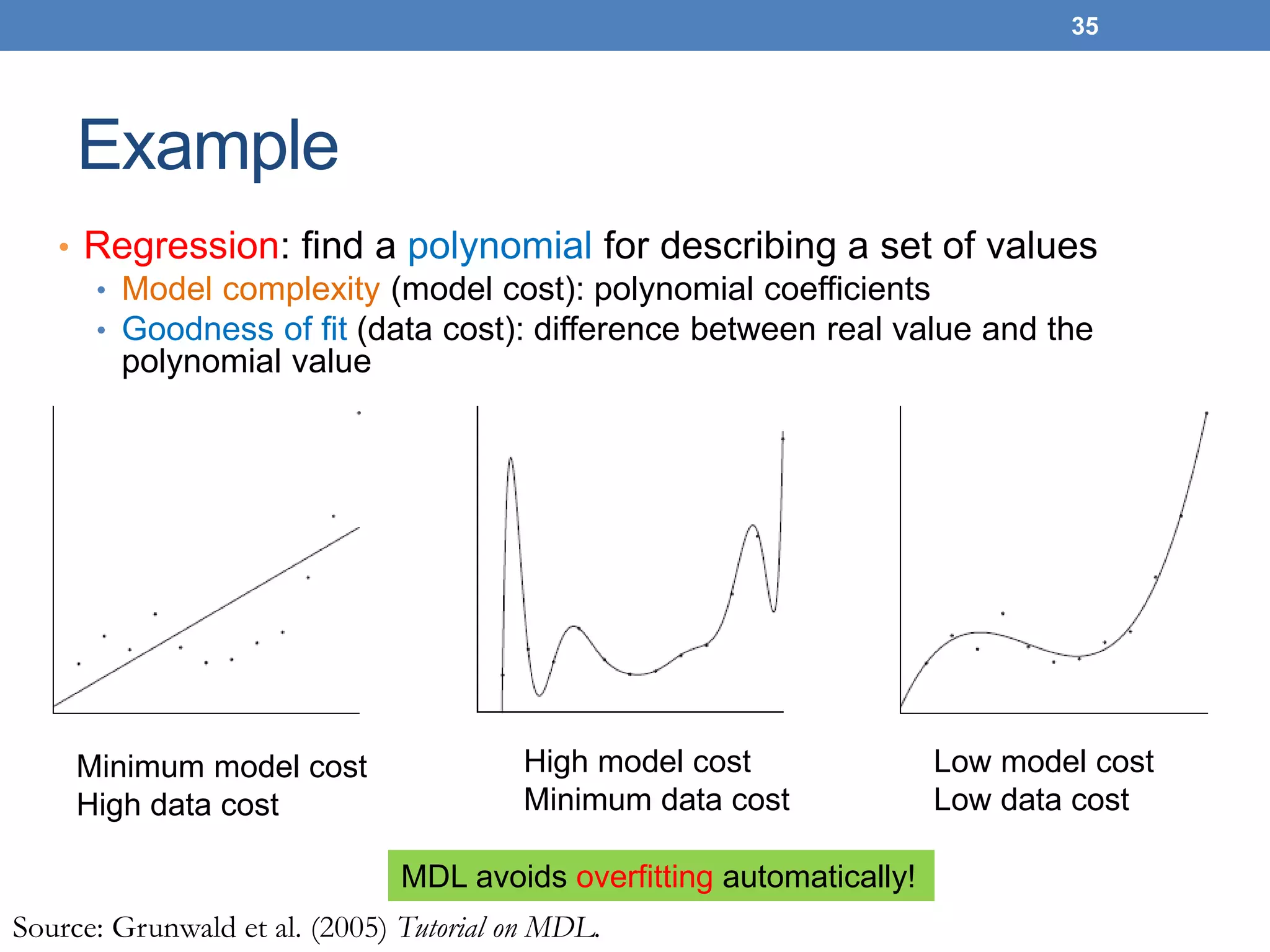
• Regression: find a polynomial for describing a set of values
• Model complexity (model cost): polynomial coefficients
• Goodness of fit (data cost): difference between real value and the
polynomial value
Source: Grunwald et al. (2005) Tutorial on MDL.
Minimum model cost
High data cost
High model cost
Minimum data cost
Low model cost
Low data cost
MDL avoids overfitting automatically!
Example
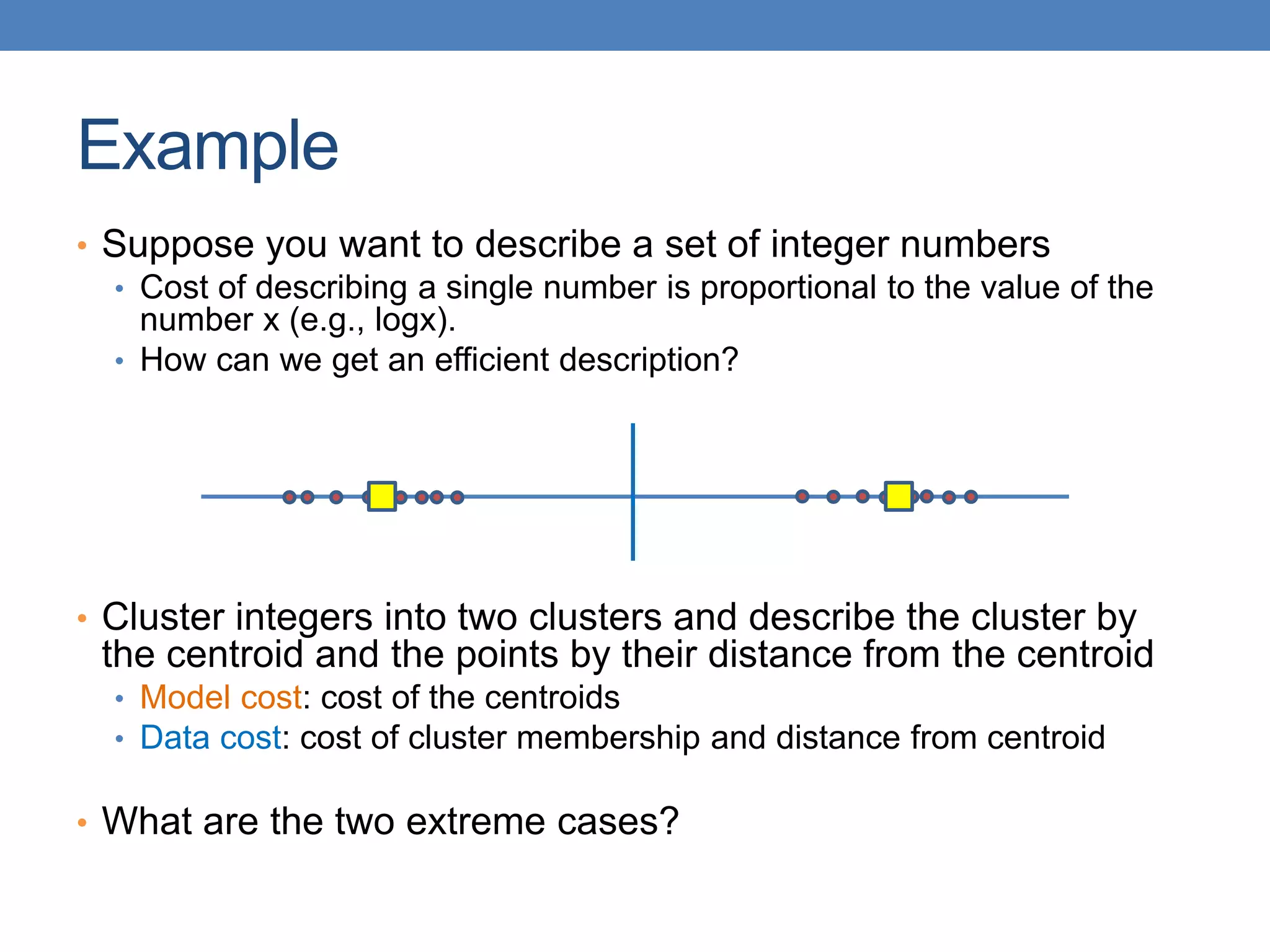
• Suppose you want to describe a set of integer numbers
• Cost of describing a single number is proportional to the value of the
number x (e.g., logx).
• How can we get an efficient description?
• Cluster integers into two clusters and describe the cluster by
the centroid and the points by their distance from the centroid
• Model cost: cost of the centroids
• Data cost: cost of cluster membership and distance from centroid
• What are the two extreme cases?
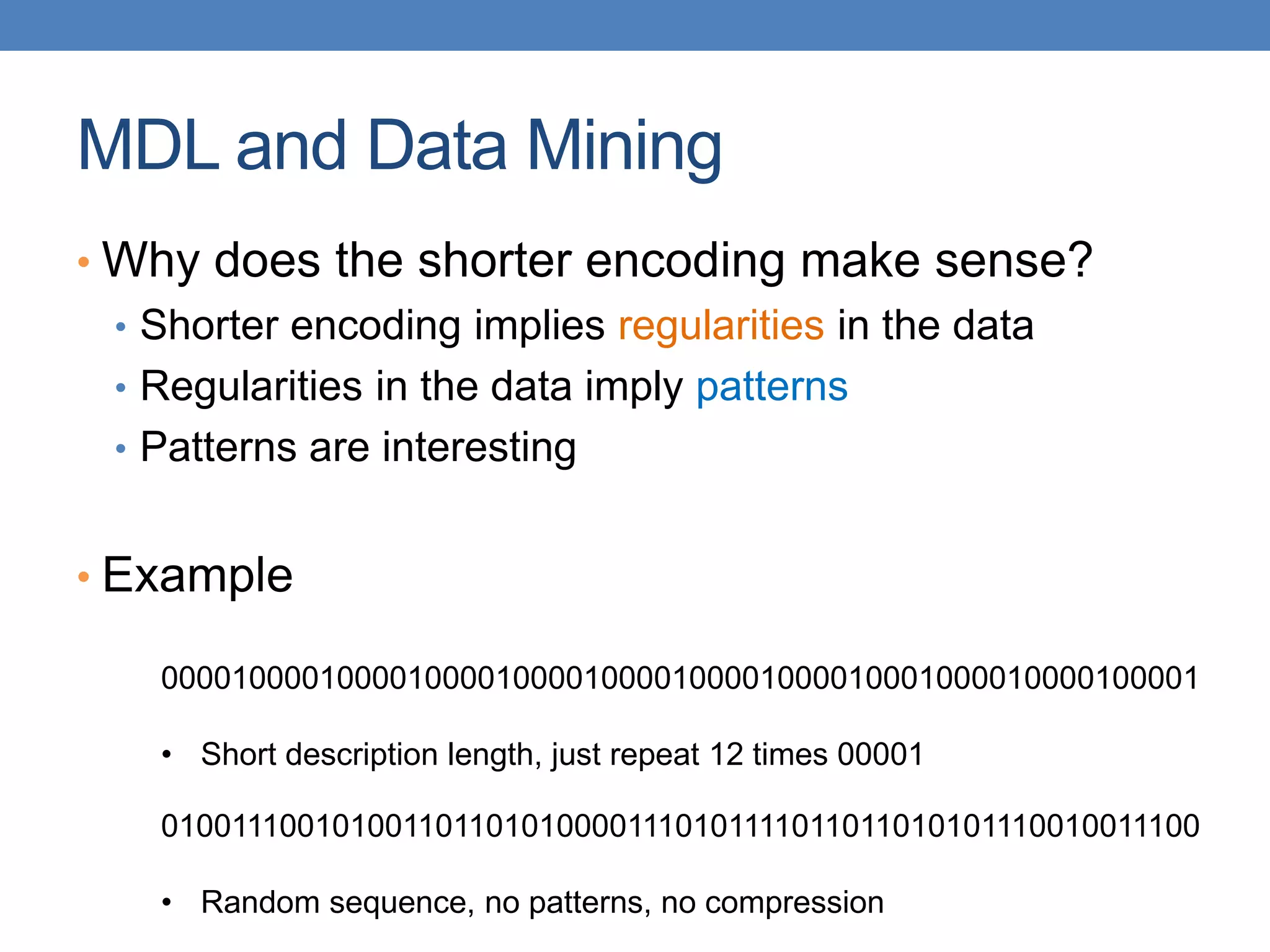
MDL and Data Mining
• Why does the shorter encoding make sense?
• Shorter encoding implies regularities in the data
• Regularities in the data imply patterns
• Patterns are interesting
• Example
00001000010000100001000010000100001000010001000010000100001
• Short description length, just repeat 12 times 00001
0100111001010011011010100001110101111011011010101110010011100
• Random sequence, no patterns, no compression
Is everything about compression?
• Jürgen Schmidhuber: A theory about creativity, art
and fun
• Interesting Art corresponds to a novel pattern that we cannot
compress well, yet it is not too random so we can learn it
• Good Humor corresponds to an input that does not
compress well because it is out of place and surprising
• Scientific discovery corresponds to a significant compression
event
• E.g., a law that can explain all falling apples.
• Fun lecture:
• Compression Progress: The Algorithmic Principle Behind
Curiosity and Creativity
Issues with MDL
• What is the right model family?
• This determines the kind of solutions that we can have
• E.g., polynomials
• Clusterings
• What is the encoding cost?
• Determines the function that we optimize
• Information theory
INFORMATION THEORY
A short introduction
Encoding
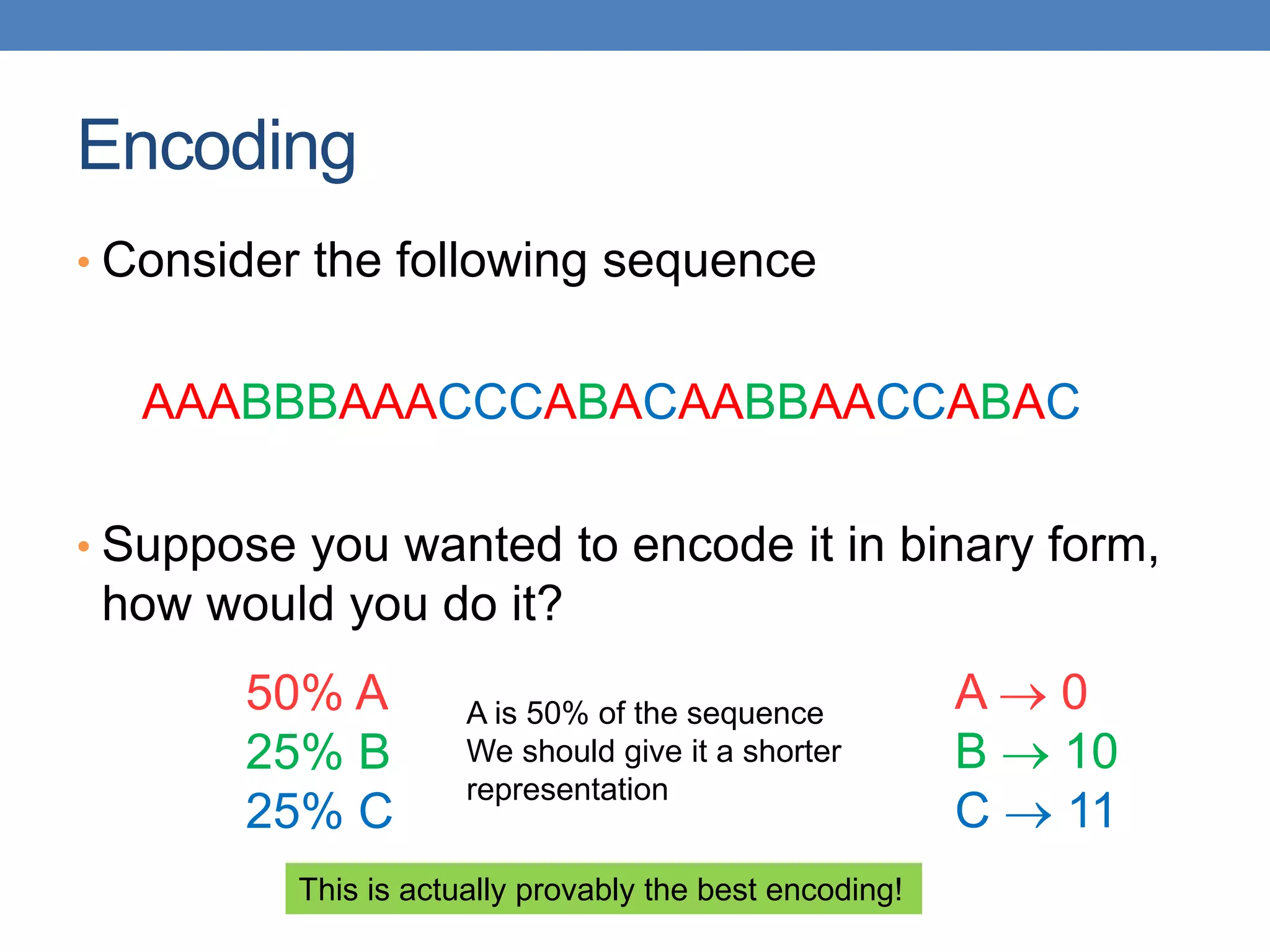
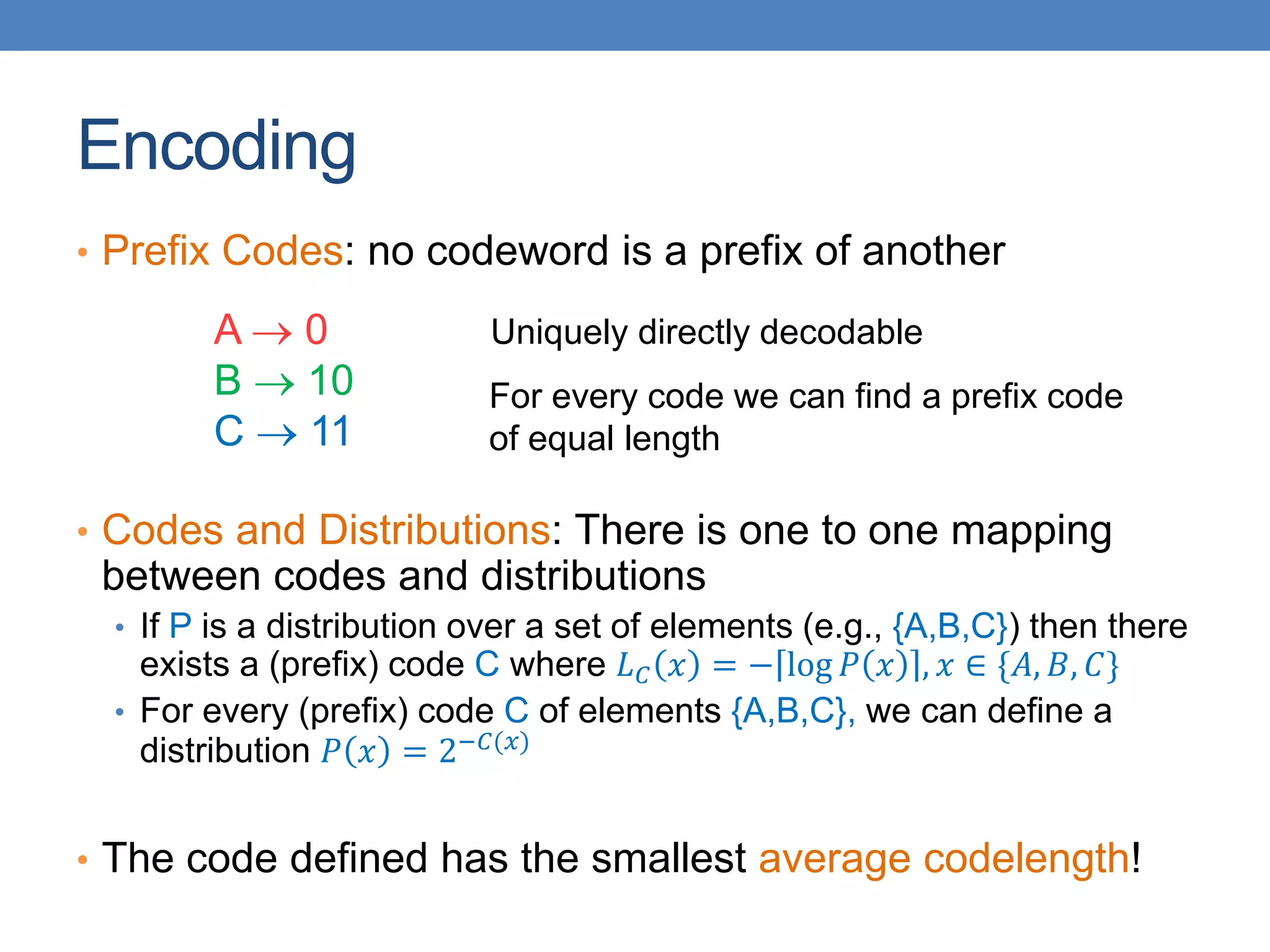
• Consider the following sequence
AAABBBAAACCCABACAABBAACCABAC
• Suppose you wanted to encode it in binary form,
how would you do it?
A  0
B  10
C  11
A is 50% of the sequence
We should give it a shorter
representation
50% A
25% B
25% C
This is actually provably the best encoding!
Encoding
• Prefix Codes: no codeword is a prefix of another
• Codes and Distributions: There is one to one mapping
between codes and distributions
• If P is a distribution over a set of elements (e.g., {A,B,C}) then there
exists a (prefix) code C where 𝐿𝐶 𝑥 = − log 𝑃 𝑥 , 𝑥 ∈ {𝐴, 𝐵, 𝐶}
• For every (prefix) code C of elements {A,B,C}, we can define a
distribution 𝑃 𝑥 = 2−𝐶(𝑥)
• The code defined has the smallest average codelength!
A  0
B  10
C  11
Uniquely directly decodable
For every code we can find a prefix code
of equal length
Entropy
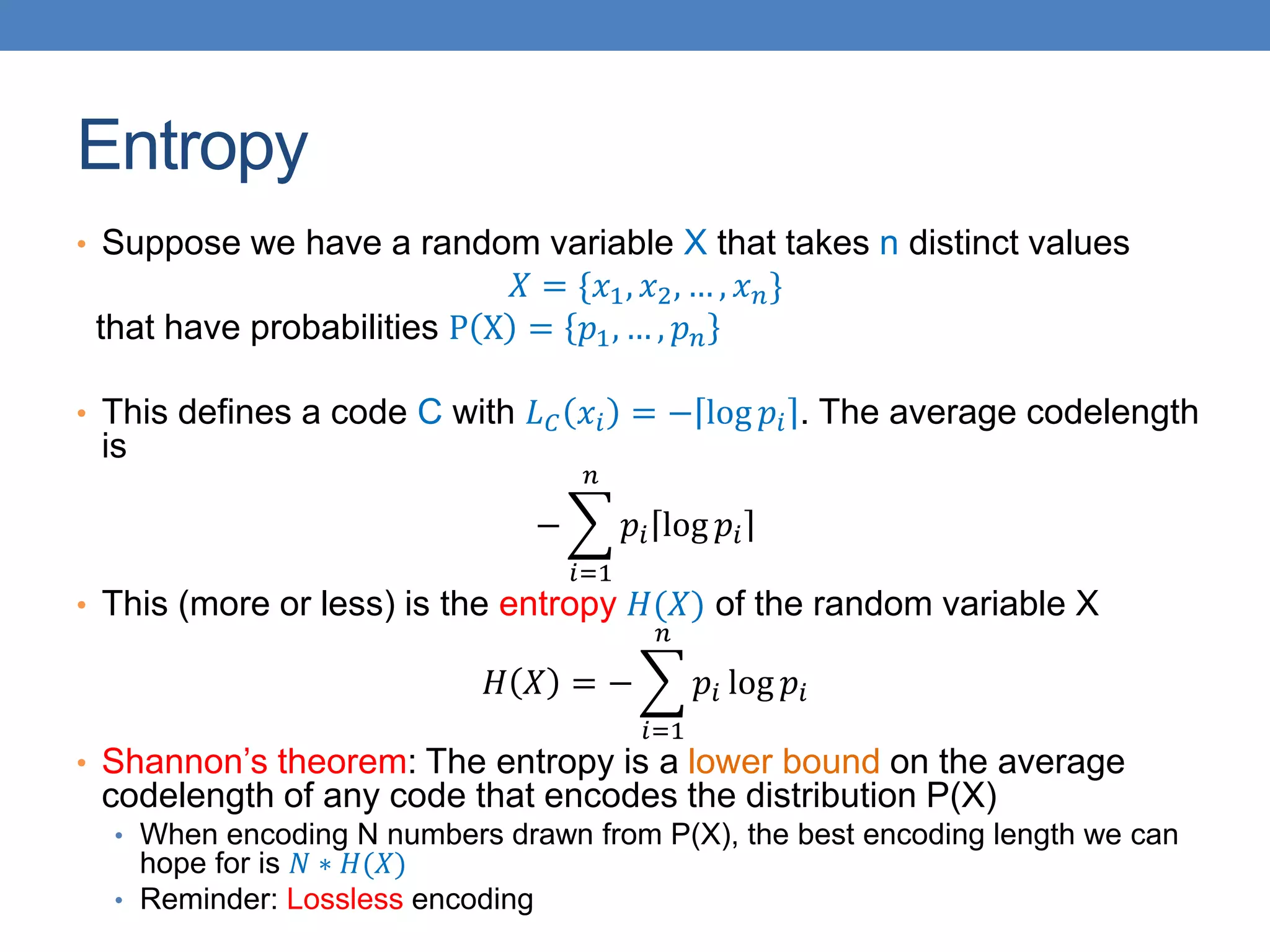
• Suppose we have a random variable X that takes n distinct values
𝑋 = {𝑥1, 𝑥2, … , 𝑥𝑛}
that have probabilities P X = 𝑝1, … , 𝑝𝑛
• This defines a code C with 𝐿𝐶 𝑥𝑖 = − log 𝑝𝑖 . The average codelength
is
−
𝑖=1
𝑛
𝑝𝑖 log 𝑝𝑖
• This (more or less) is the entropy 𝐻(𝑋) of the random variable X
𝐻 𝑋 = −
𝑖=1
𝑛
𝑝𝑖 log 𝑝𝑖
• Shannon’s theorem: The entropy is a lower bound on the average
codelength of any code that encodes the distribution P(X)
• When encoding N numbers drawn from P(X), the best encoding length we can
hope for is 𝑁 ∗ 𝐻(𝑋)
• Reminder: Lossless encoding
Entropy
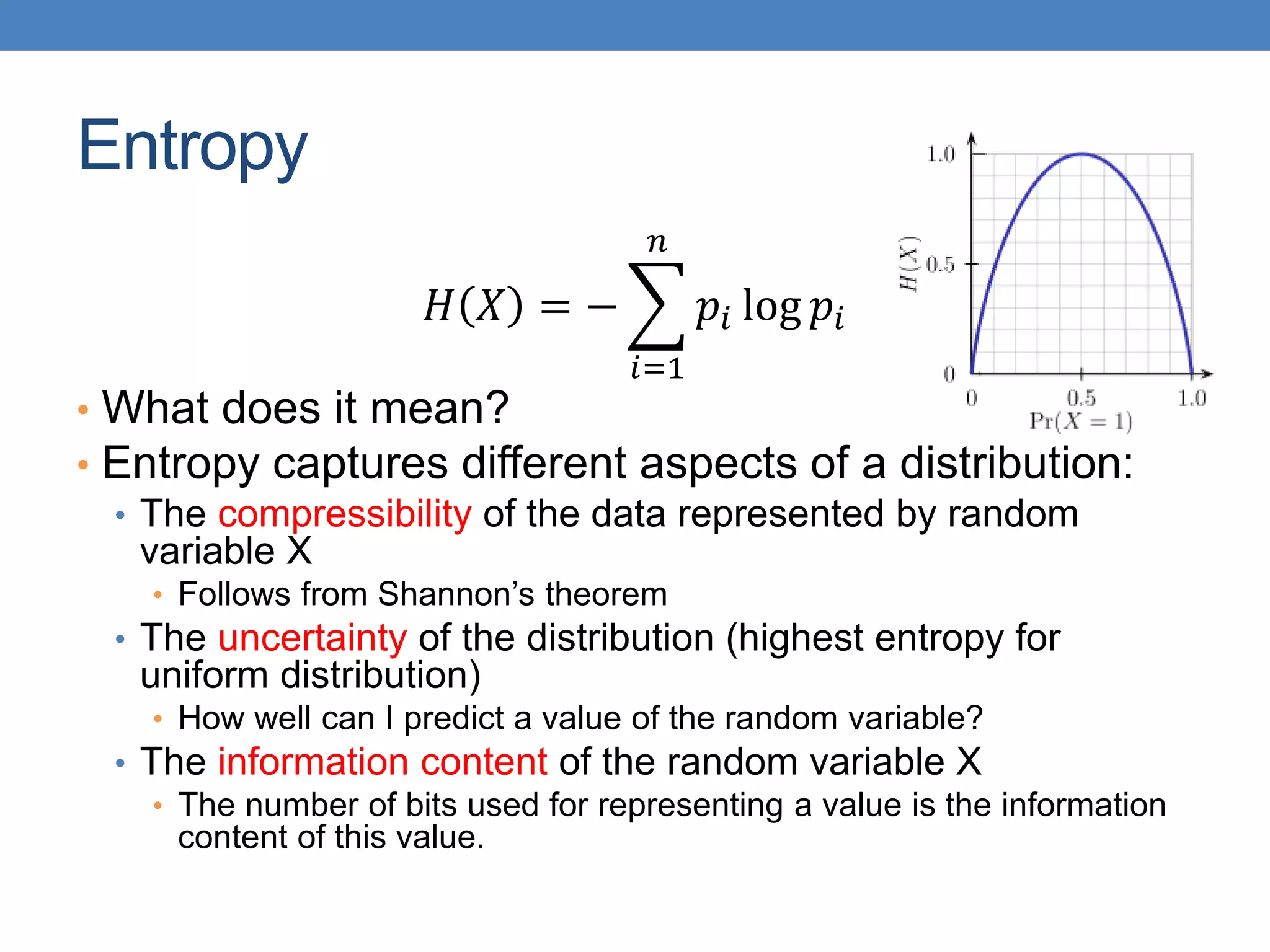
𝐻 𝑋 = −
𝑖=1
𝑛
𝑝𝑖 log 𝑝𝑖
• What does it mean?
• Entropy captures different aspects of a distribution:
• The compressibility of the data represented by random
variable X
• Follows from Shannon’s theorem
• The uncertainty of the distribution (highest entropy for
uniform distribution)
• How well can I predict a value of the random variable?
• The information content of the random variable X
• The number of bits used for representing a value is the information
content of this value.
Claude Shannon
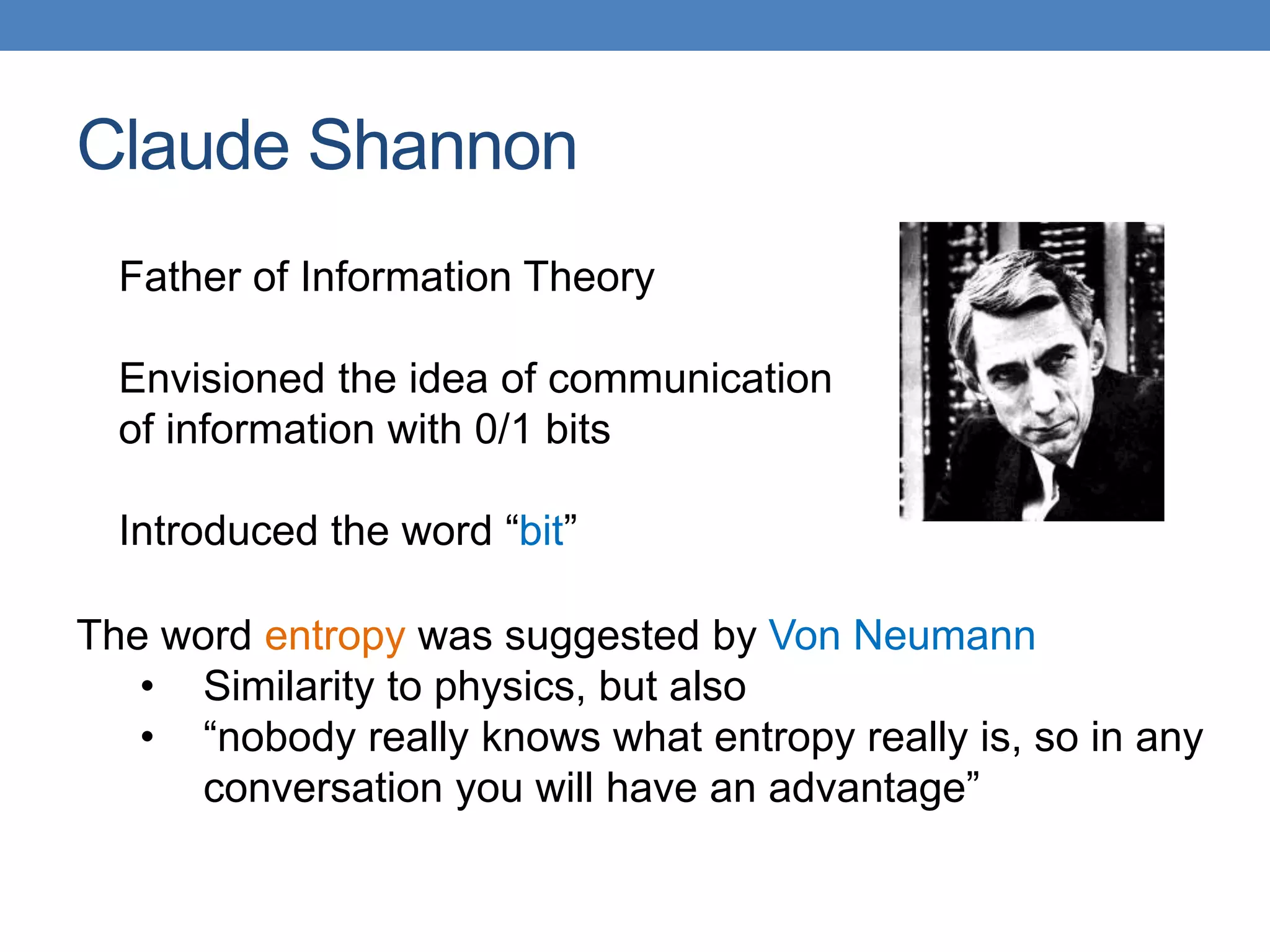
Father of Information Theory
Envisioned the idea of communication
of information with 0/1 bits
Introduced the word “bit”
The word entropy was suggested by Von Neumann
• Similarity to physics, but also
• “nobody really knows what entropy really is, so in any
conversation you will have an advantage”
Some information theoretic measures
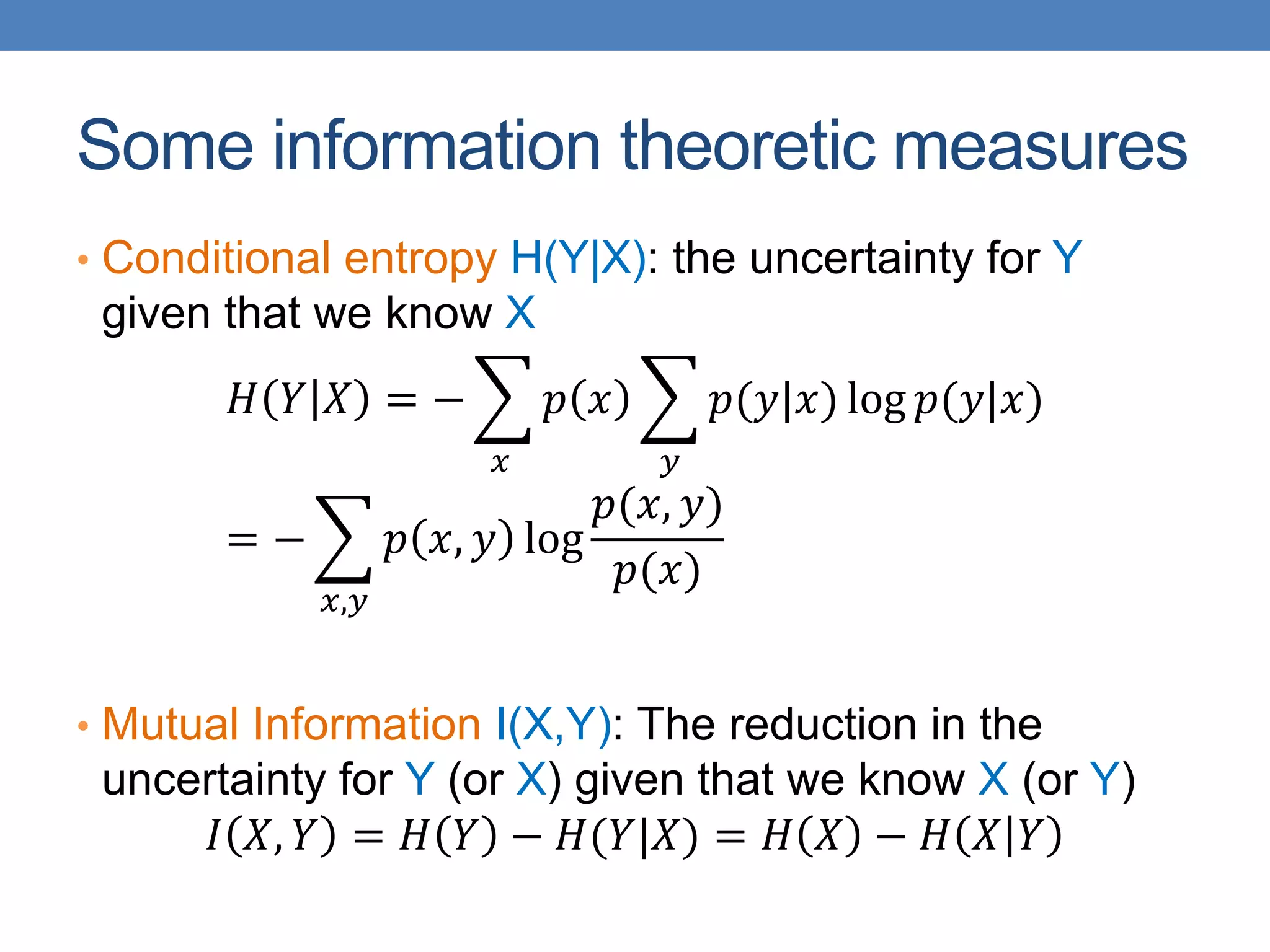
• Conditional entropy H(Y|X): the uncertainty for Y
given that we know X
𝐻 𝑌 𝑋 = −
𝑥
𝑝 𝑥
𝑦
𝑝(𝑦|𝑥) log 𝑝(𝑦|𝑥)
= −
𝑥,𝑦
𝑝 𝑥, 𝑦 log
𝑝(𝑥, 𝑦)
𝑝(𝑥)
• Mutual Information I(X,Y): The reduction in the
uncertainty for Y (or X) given that we know X (or Y)
𝐼 𝑋, 𝑌 = 𝐻 𝑌 − 𝐻(𝑌|𝑋) = 𝐻 𝑋 − 𝐻 𝑋 𝑌
Some information theoretic measures
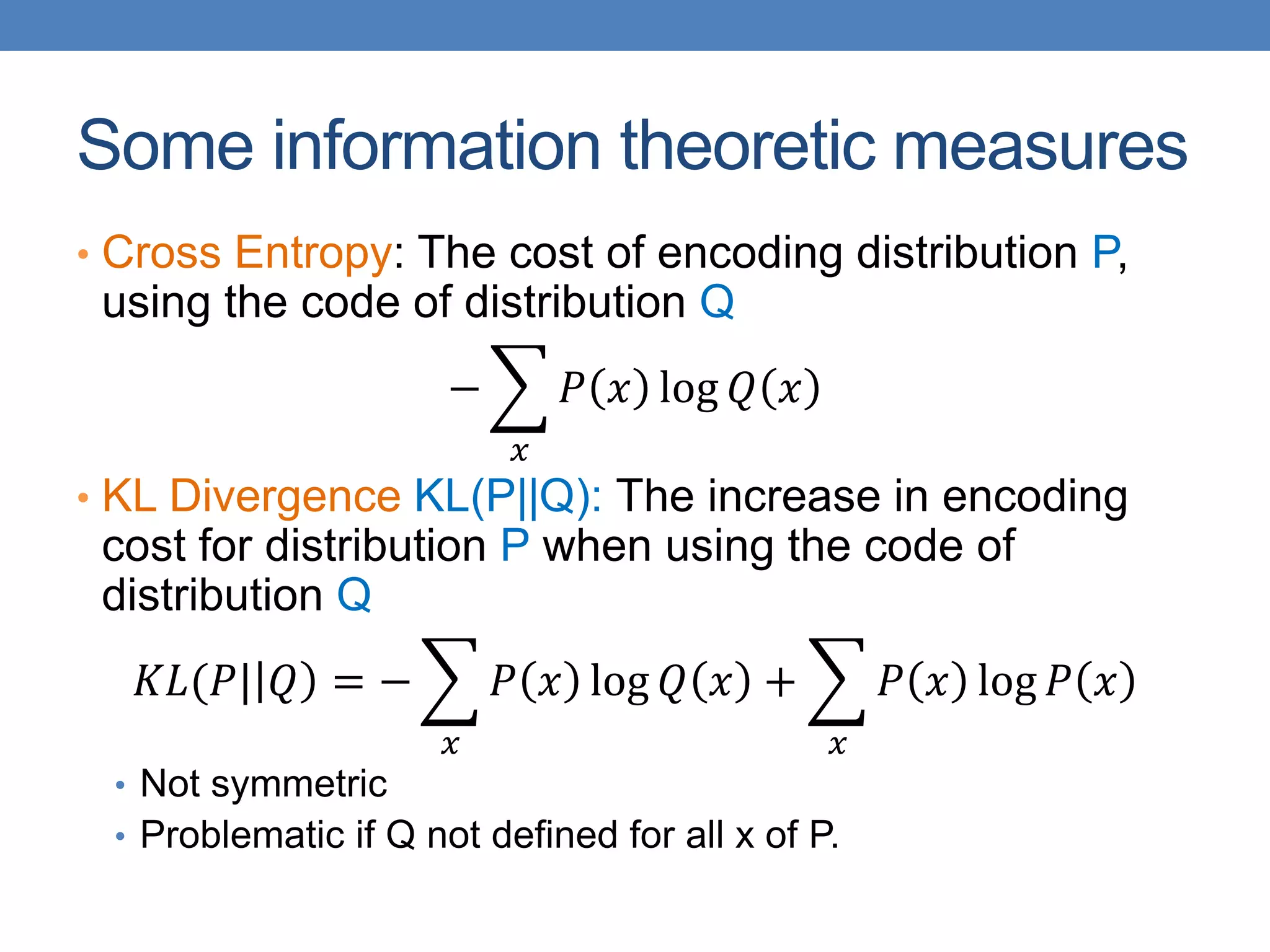
• Cross Entropy: The cost of encoding distribution P,
using the code of distribution Q
−
𝑥
𝑃 𝑥 log 𝑄 𝑥
• KL Divergence KL(P||Q): The increase in encoding
cost for distribution P when using the code of
distribution Q
𝐾𝐿(𝑃| 𝑄 = −
𝑥
𝑃 𝑥 log 𝑄 𝑥 +
𝑥
𝑃 𝑥 log 𝑃 𝑥
• Not symmetric
• Problematic if Q not defined for all x of P.
Some information theoretic measures
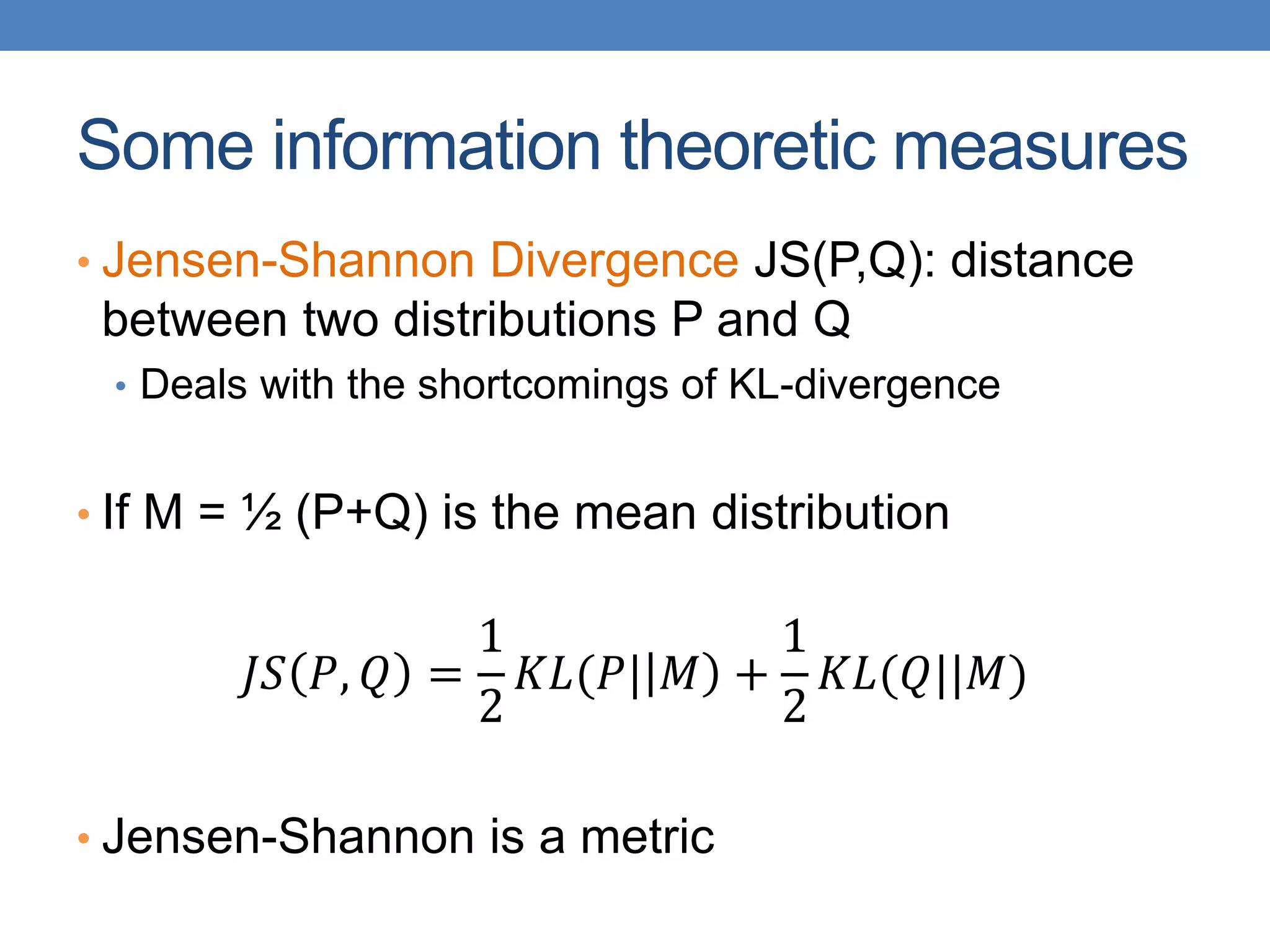
• Jensen-Shannon Divergence JS(P,Q): distance
between two distributions P and Q
• Deals with the shortcomings of KL-divergence
• If M = ½ (P+Q) is the mean distribution
𝐽𝑆 𝑃, 𝑄 =
1
2
𝐾𝐿(𝑃| 𝑀 +
1
2
𝐾𝐿(𝑄||𝑀)
• Jensen-Shannon is a metric
USING MDL FOR
CO-CLUSTERING
(CROSS-ASSOCIATIONS)
Thanks to Spiros Papadimitriou.
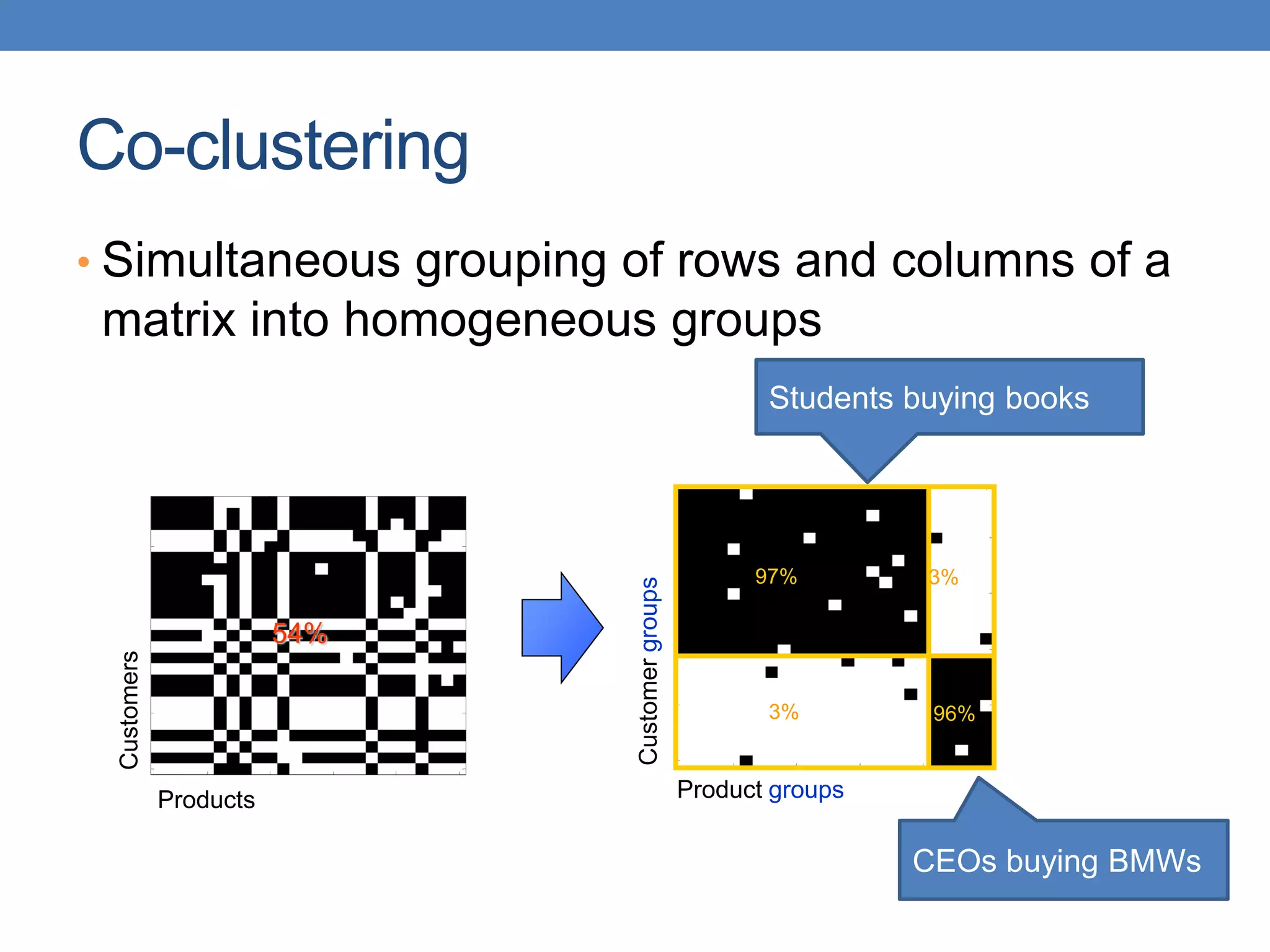
Co-clustering
• Simultaneous grouping of rows and columns of a
matrix into homogeneous groups
5 10 15 20 25
5
10
15
20
25
97%
96%
3%
3%
Product groups
Customer
groups
5 10 15 20 25
5
10
15
20
25
Products
54%
Customers
Students buying books
CEOs buying BMWs
Co-clustering
• Step 1: How to define a “good” partitioning?
Intuition and formalization
• Step 2: How to find it?
Co-clustering
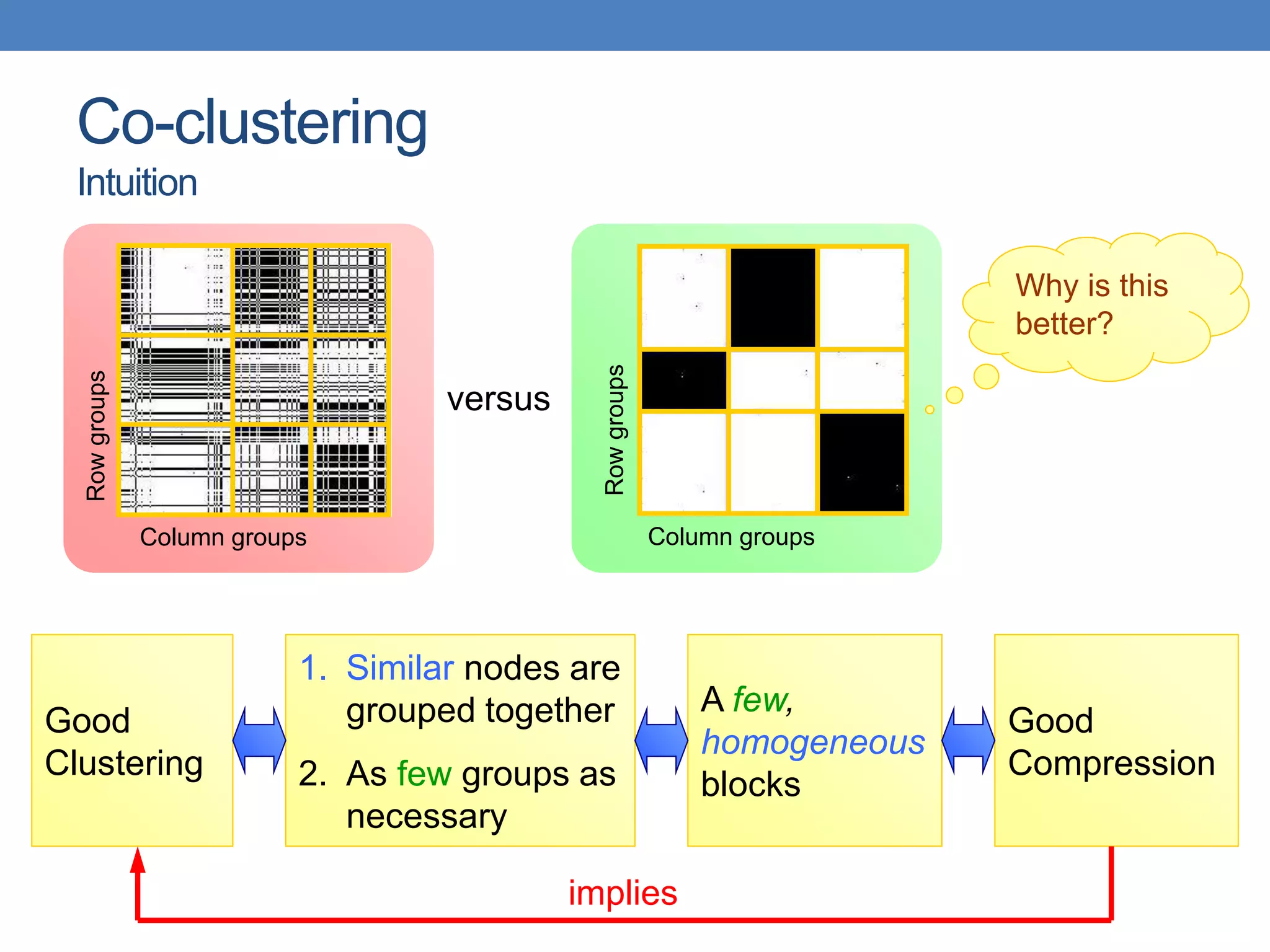
Intuition
versus
Column groups Column groups
Row
groups
Row
groups
Good
Clustering
1. Similar nodes are
grouped together
2. As few groups as
necessary
A few,
homogeneous
blocks
Good
Compression
Why is this
better?
implies
log*k + log*ℓ log nimj
i,j nimj H(pi,j)
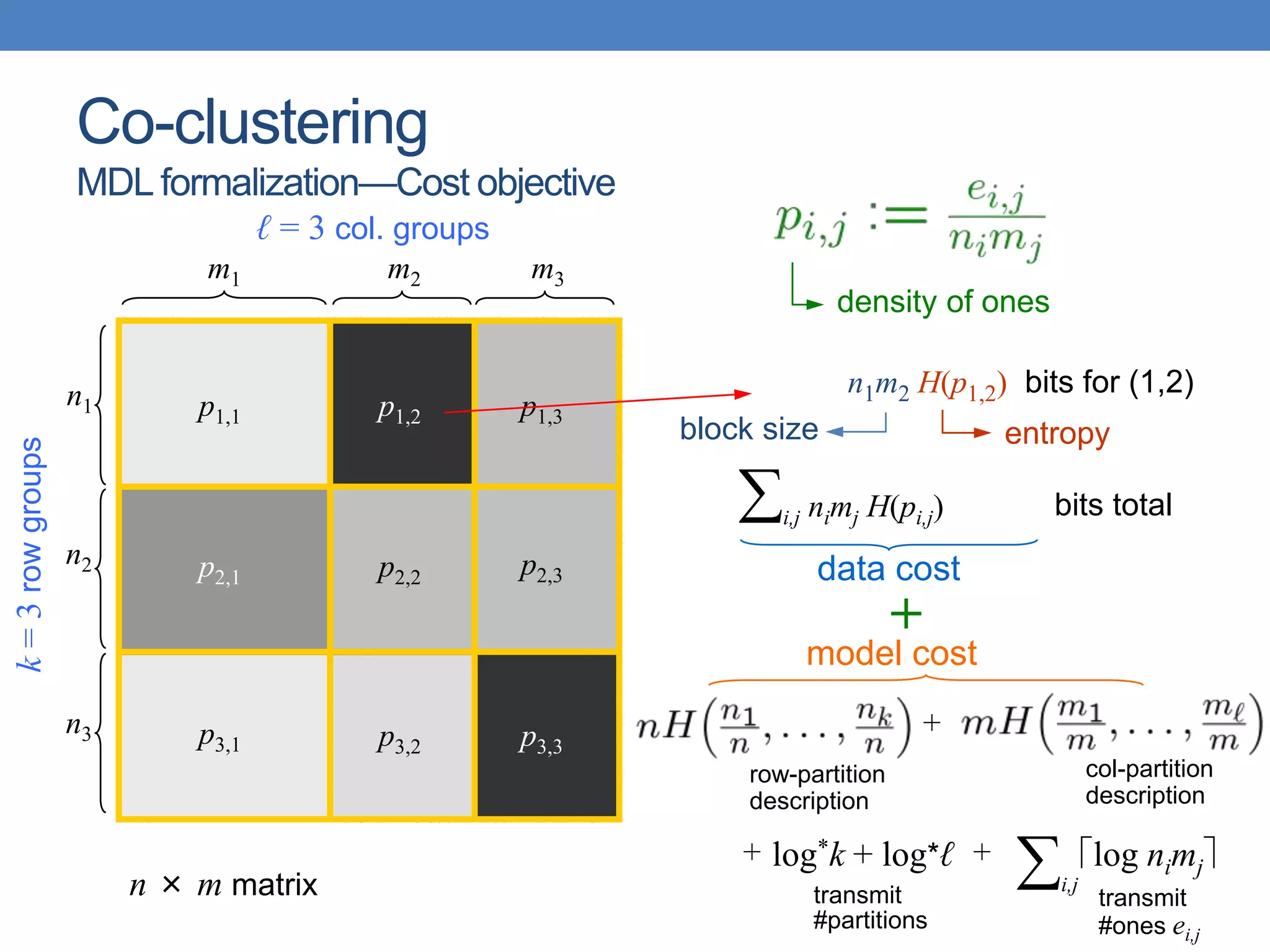
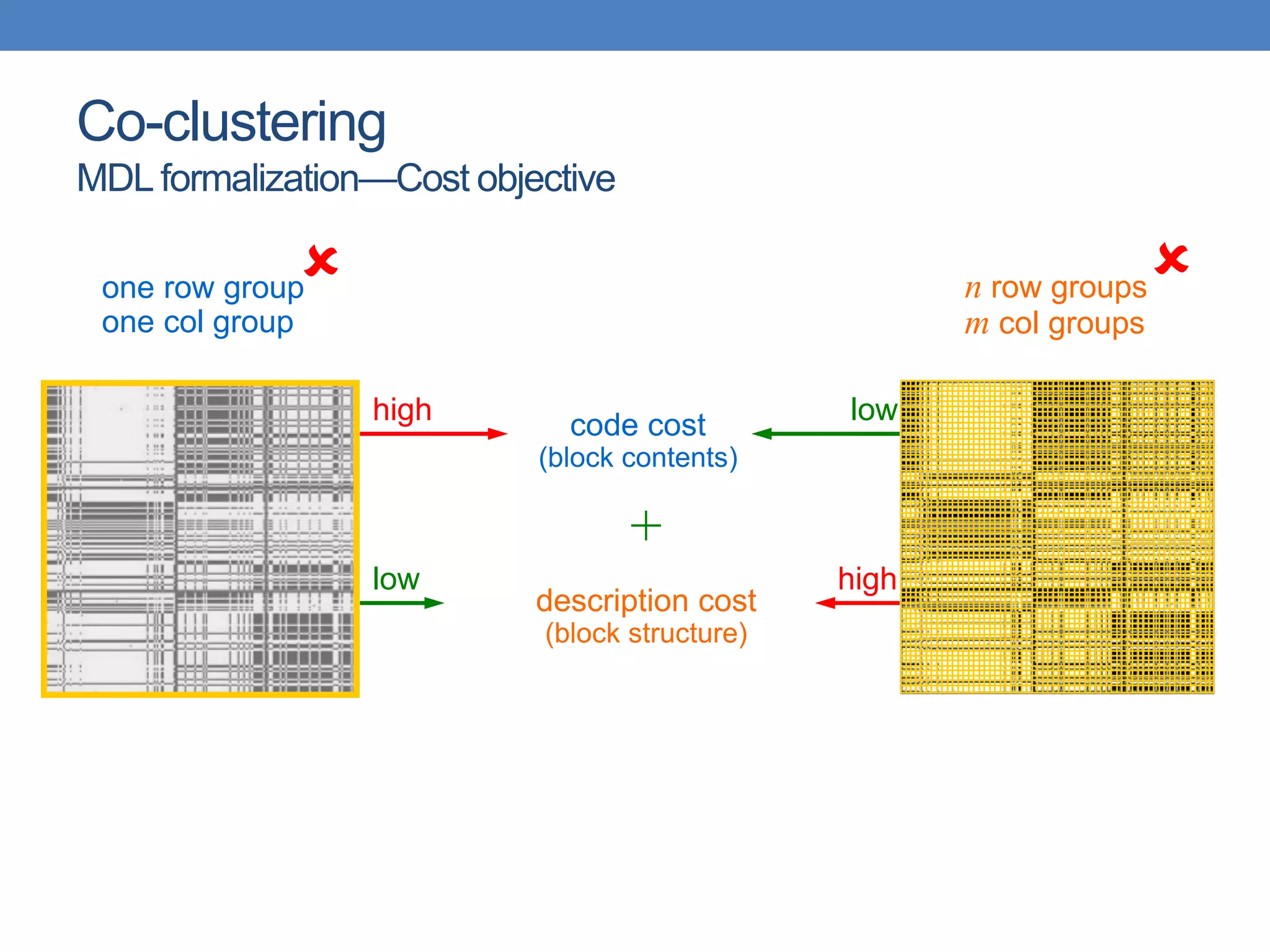
Co-clustering
MDL formalization—Cost objective
n1
n2
n3
m1 m2 m3
p1,1 p1,2 p1,3
p2,1 p2,2 p2,3
p3,3
p3,2
p3,1
n × m matrix
k
=
3
row
groups
ℓ = 3 col. groups
density of ones
n1m2 H(p1,2) bits for (1,2)
data cost
bits total
row-partition
description
col-partition
description
i,j
transmit
#ones ei,j
+
+
model cost
+
block size entropy
+
transmit
#partitions
Co-clustering
MDL formalization—Cost objective
code cost
(block contents)
description cost
(block structure)
+
one row group
one col group
n row groups
m col groups
low
high low
high
 
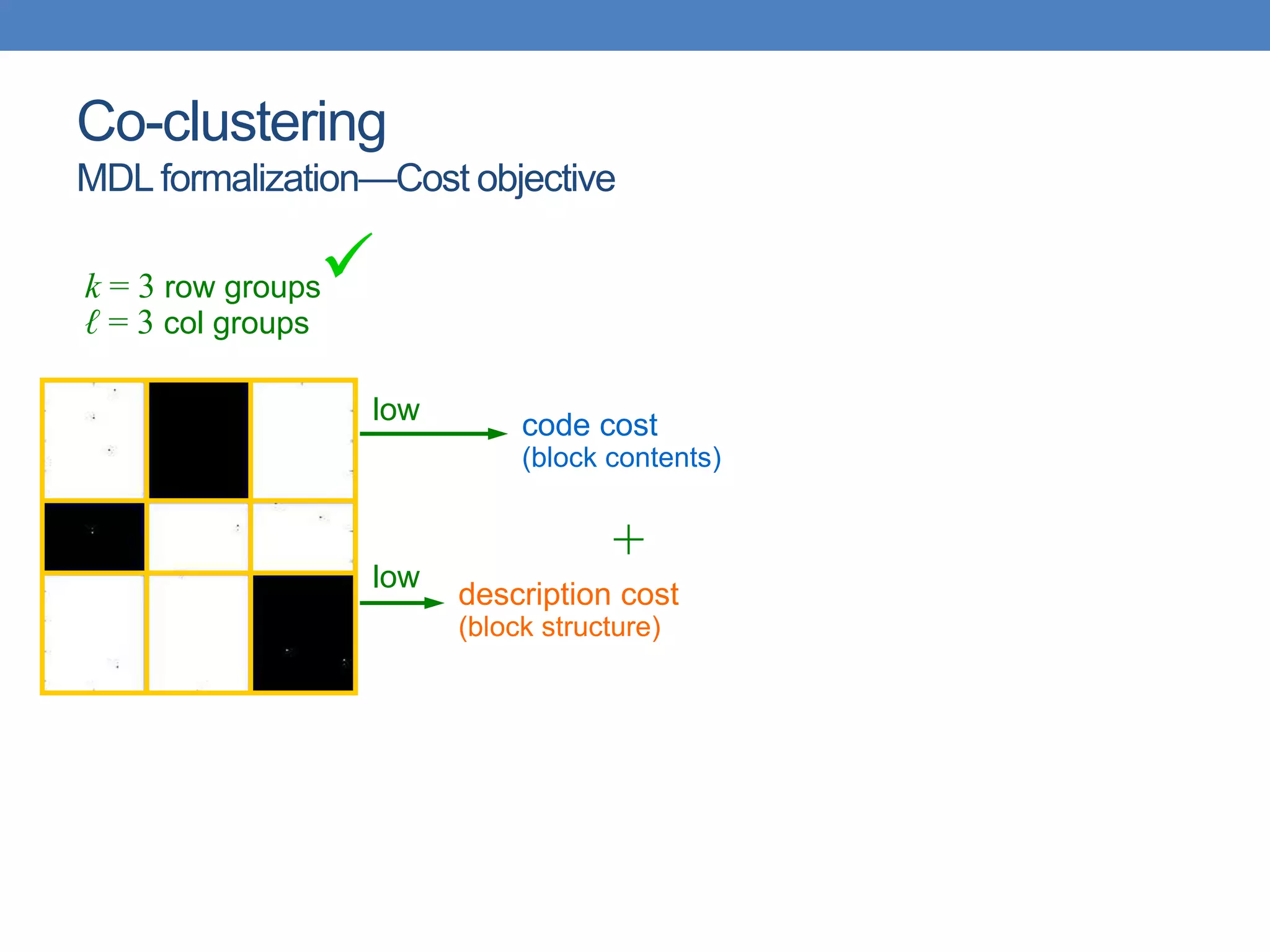
Co-clustering
MDL formalization—Cost objective
code cost
(block contents)
description cost
(block structure)
+
k = 3 row groups
ℓ = 3 col groups
low
low

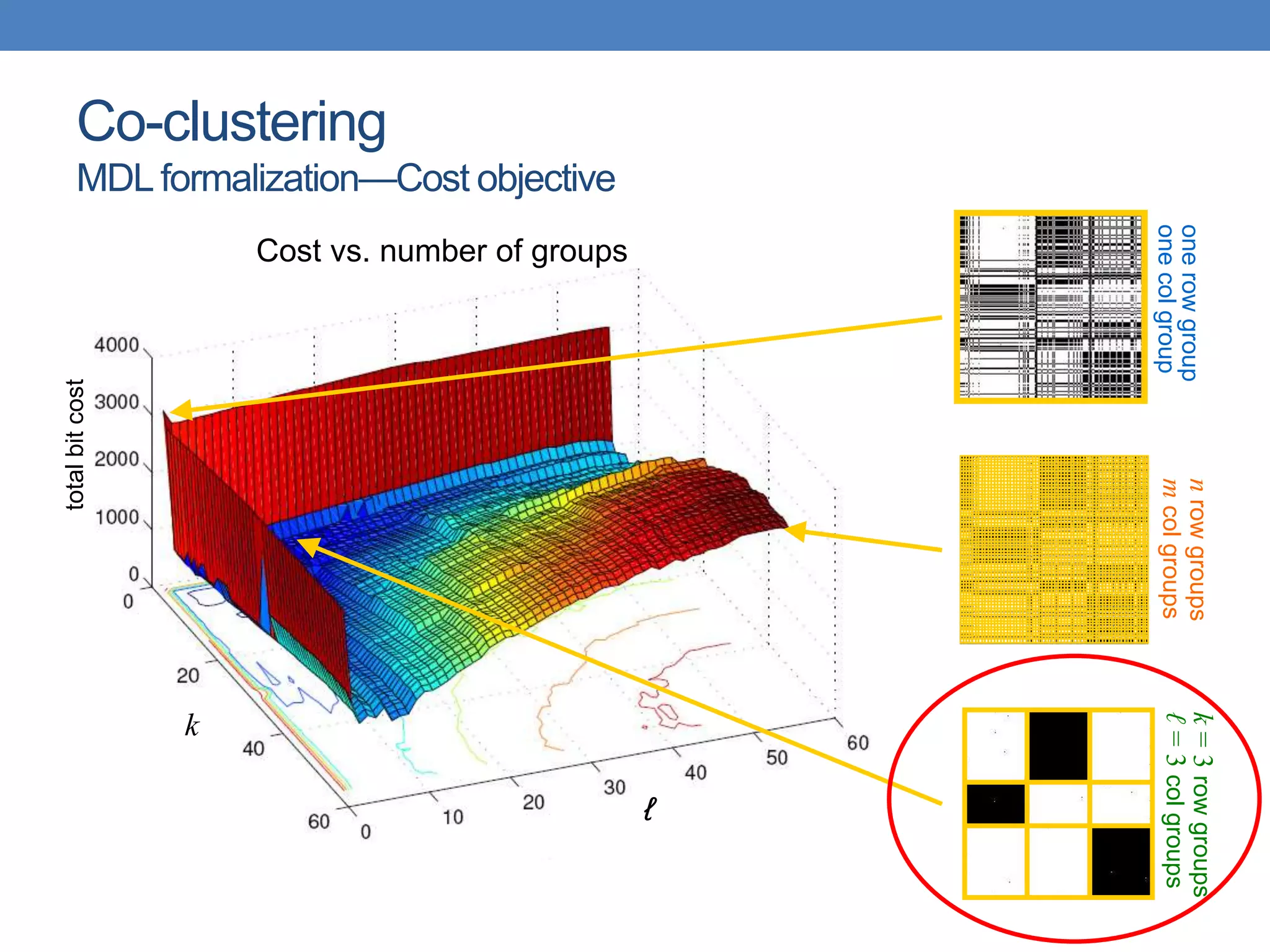
Co-clustering
MDL formalization—Cost objective
k
ℓ
total
bit
cost
Cost vs. number of groups
one
row
group
one
col
group
n
row
groups
m
col
groups
k
=
3
row
groups
ℓ
=
3
col
groups
Co-clustering
• Step 1: How to define a “good” partitioning?
Intuition and formalization
• Step 2: How to find it?
Search for solution
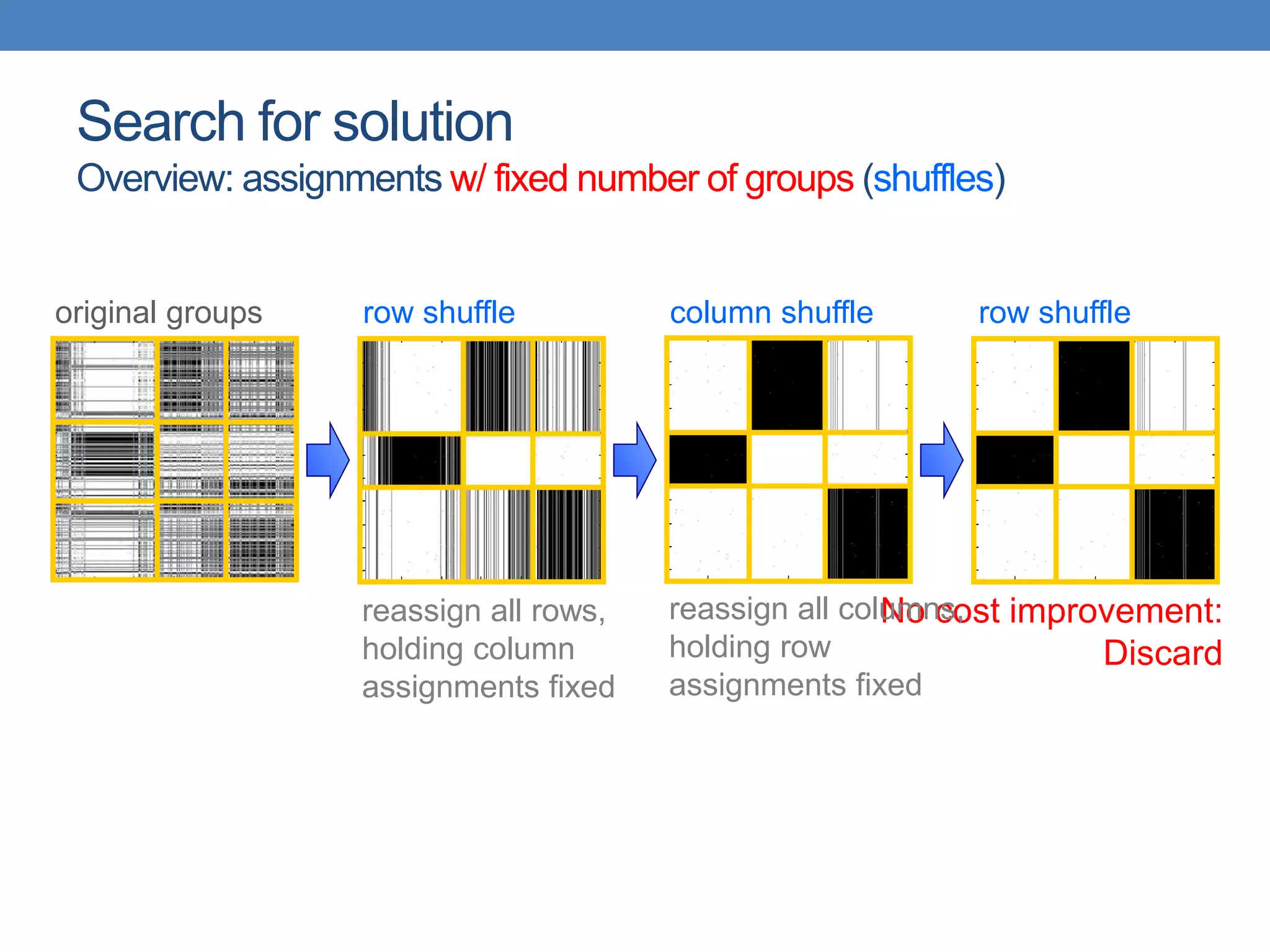
Overview: assignments w/ fixed number of groups (shuffles)
row shuffle column shuffle row shuffle
original groups
No cost improvement:
Discard
reassign all rows,
holding column
assignments fixed
reassign all columns,
holding row
assignments fixed
Search for solution
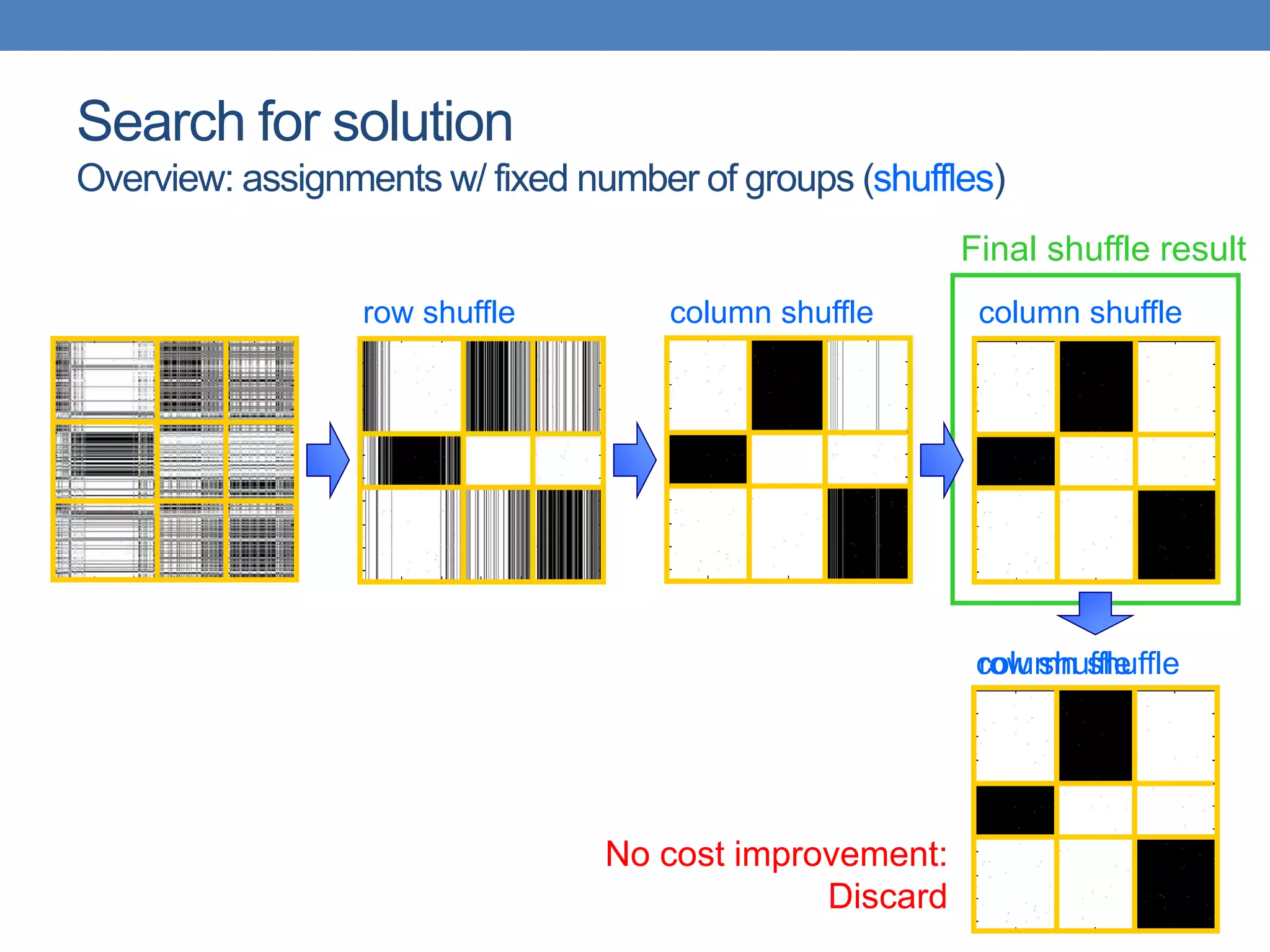
Overview: assignments w/ fixed number of groups (shuffles)
row shuffle column shuffle column shuffle
row shuffle
column shuffle
No cost improvement:
Discard
Final shuffle result
Search for solution
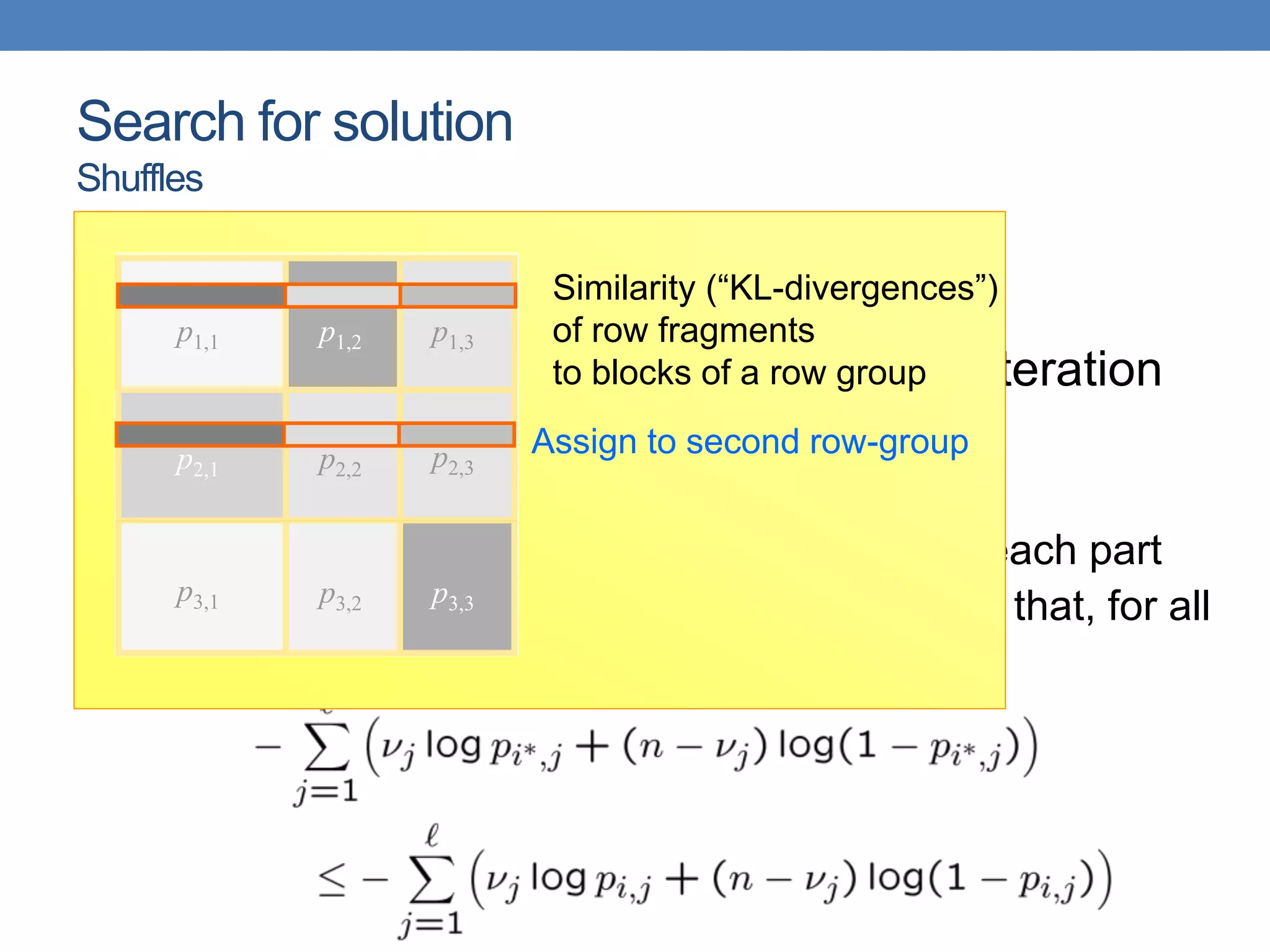
Shuffles
• Let
denote row and col. partitions at the I-th iteration
• Fix I and for every row x:
• Splice into ℓ parts, one for each column group
• Let j, for j = 1,…,ℓ, be the number of ones in each part
• Assign row x to the row group i¤  I+1(x) such that, for all
i = 1,…,k,
p1,1 p1,2 p1,3
p2,1 p2,2 p2,3
p3,3
p3,2
p3,1
Similarity (“KL-divergences”)
of row fragments
to blocks of a row group
Assign to second row-group
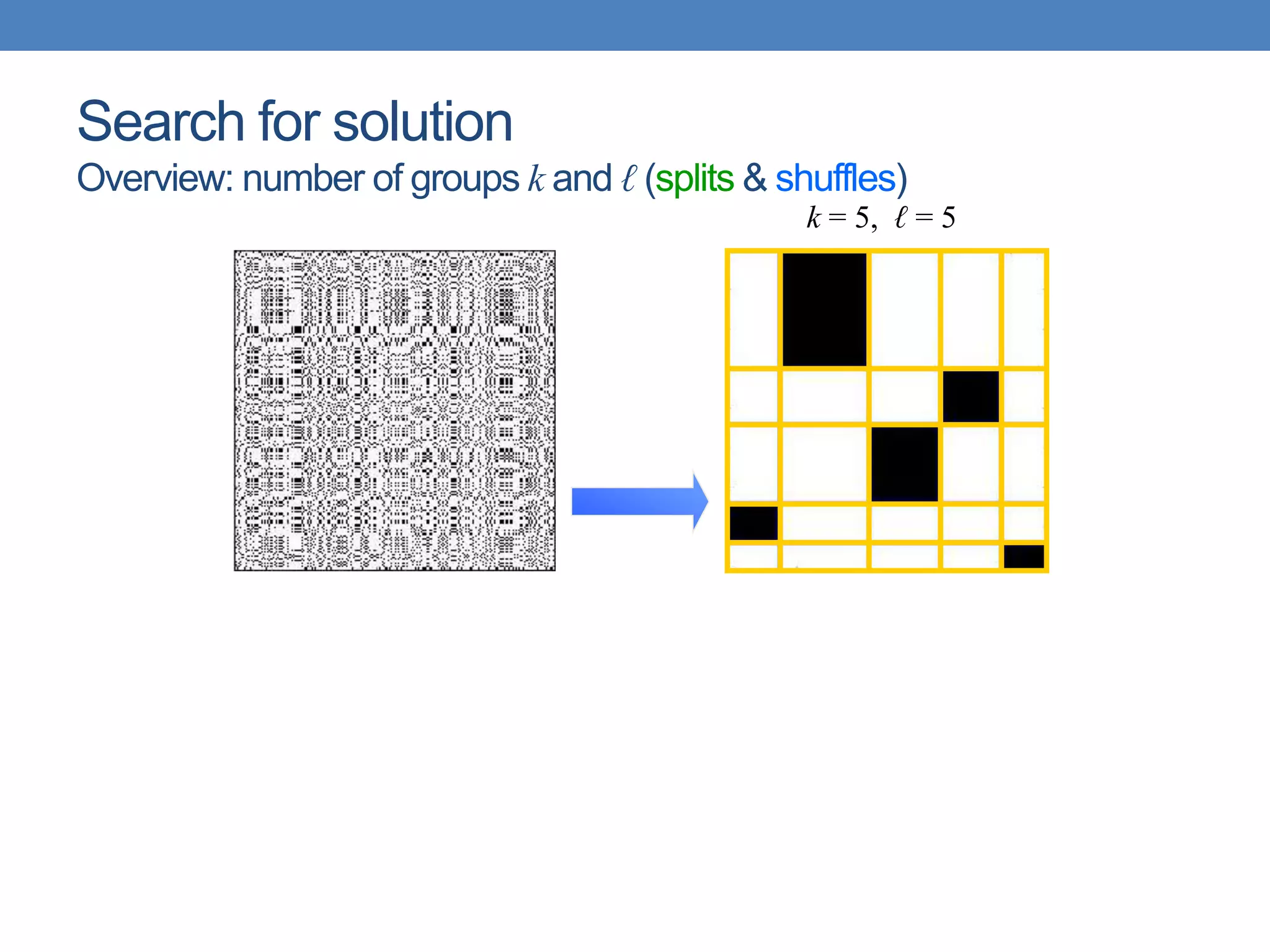
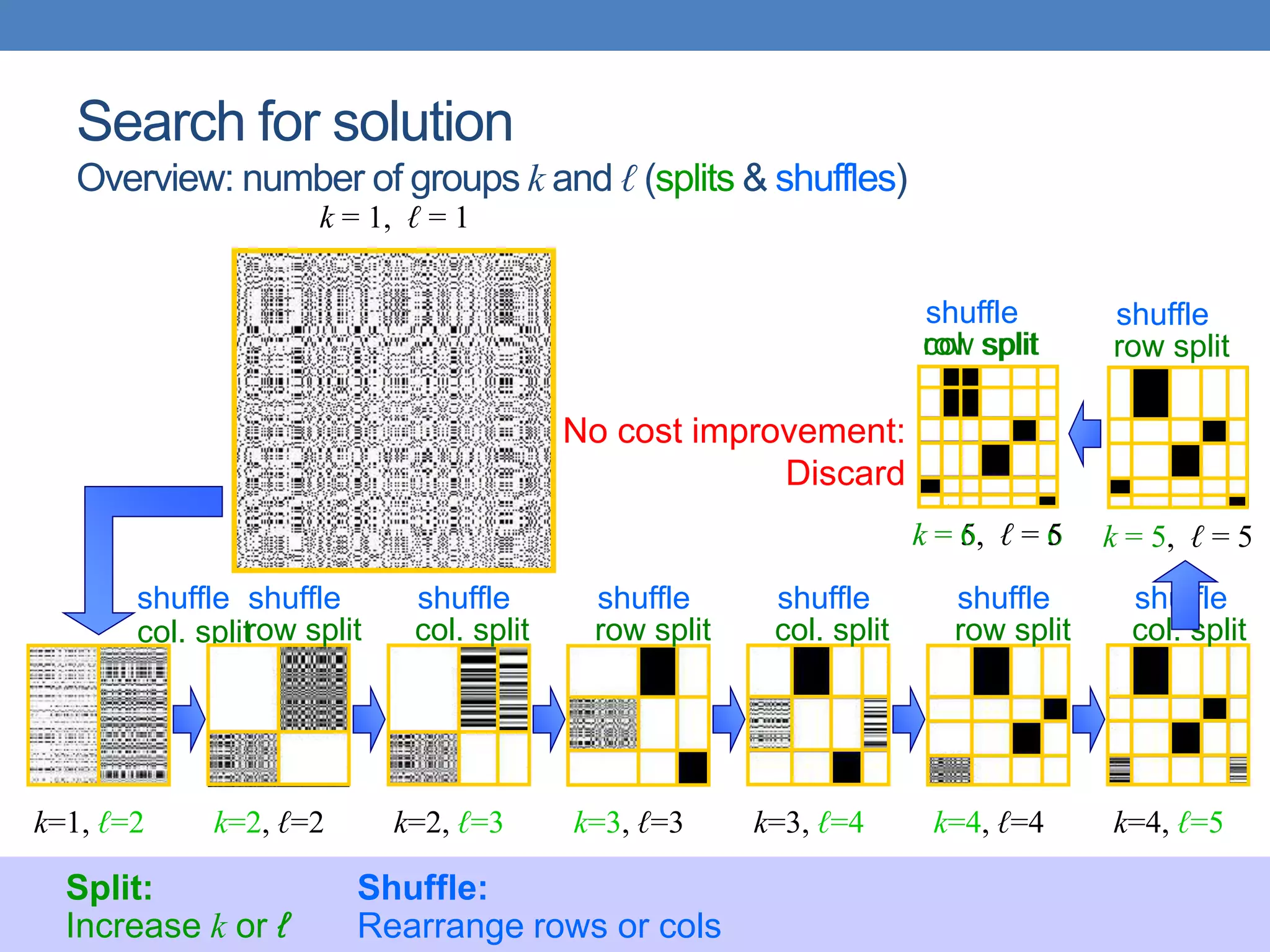
k = 5, ℓ = 5
Search for solution
Overview: number of groups k and ℓ (splits & shuffles)
col. split
shuffle
Search for solution
Overview: number of groups k and ℓ (splits & shuffles)
k=1, ℓ=2 k=2, ℓ=2 k=2, ℓ=3 k=3, ℓ=3 k=3, ℓ=4 k=4, ℓ=4 k=4, ℓ=5
k = 1, ℓ = 1
row split
shuffle
Split:
Increase k or ℓ
Shuffle:
Rearrange rows or cols
col. split
shuffle
row split
shuffle
col. split
shuffle
row split
shuffle
col. split
shuffle
k = 5, ℓ = 5
row split
shuffle
k = 5, ℓ = 6
col. split
shuffle
No cost improvement:
Discard
row split
k = 6, ℓ = 5
Search for solution
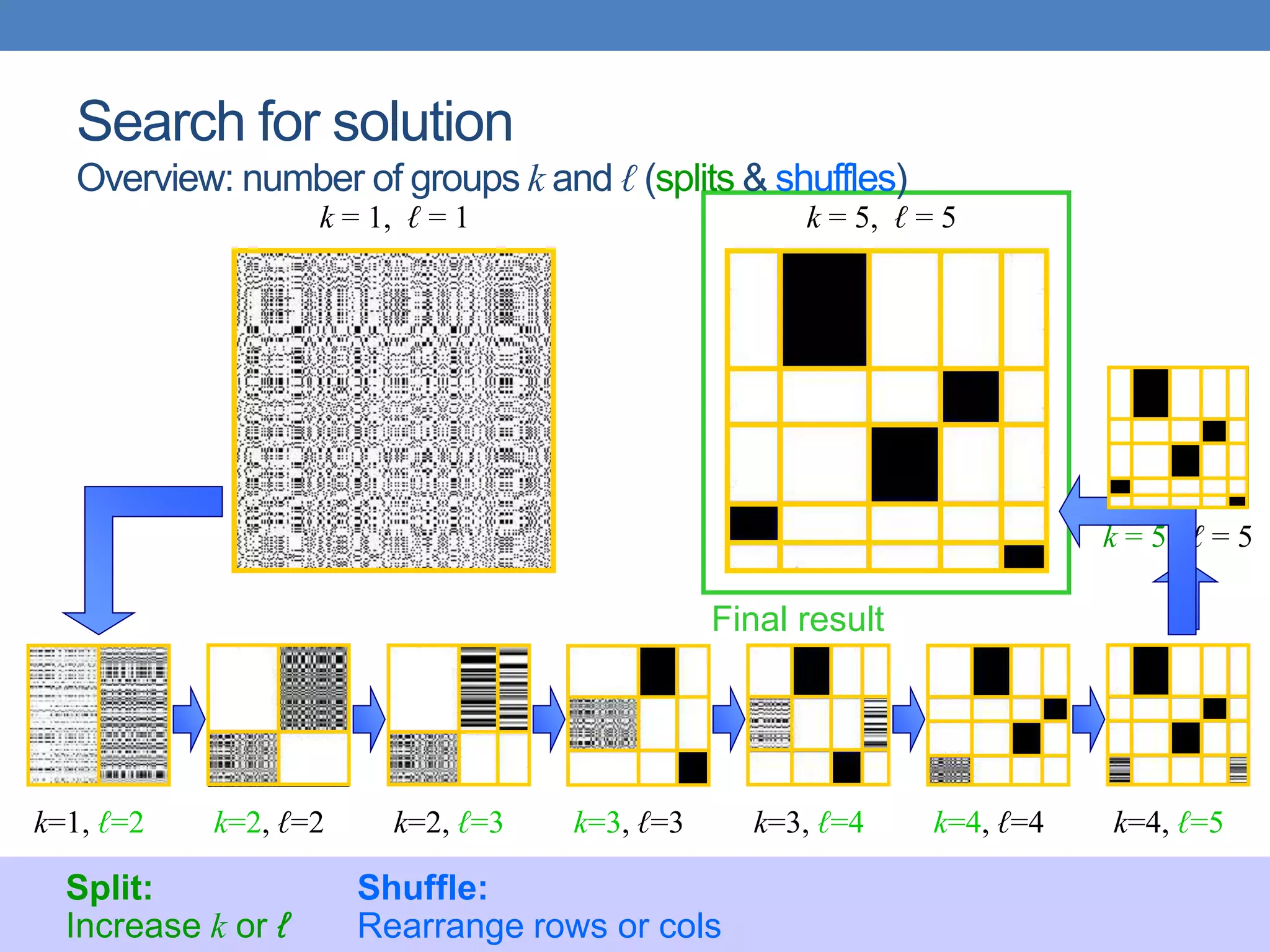
Overview: number of groups k and ℓ (splits & shuffles)
k=1, ℓ=2 k=2, ℓ=2 k=2, ℓ=3 k=3, ℓ=3 k=3, ℓ=4 k=4, ℓ=4 k=4, ℓ=5
k = 1, ℓ = 1
Split:
Increase k or ℓ
Shuffle:
Rearrange rows or cols
k = 5, ℓ = 5
k = 5, ℓ = 5
Final result
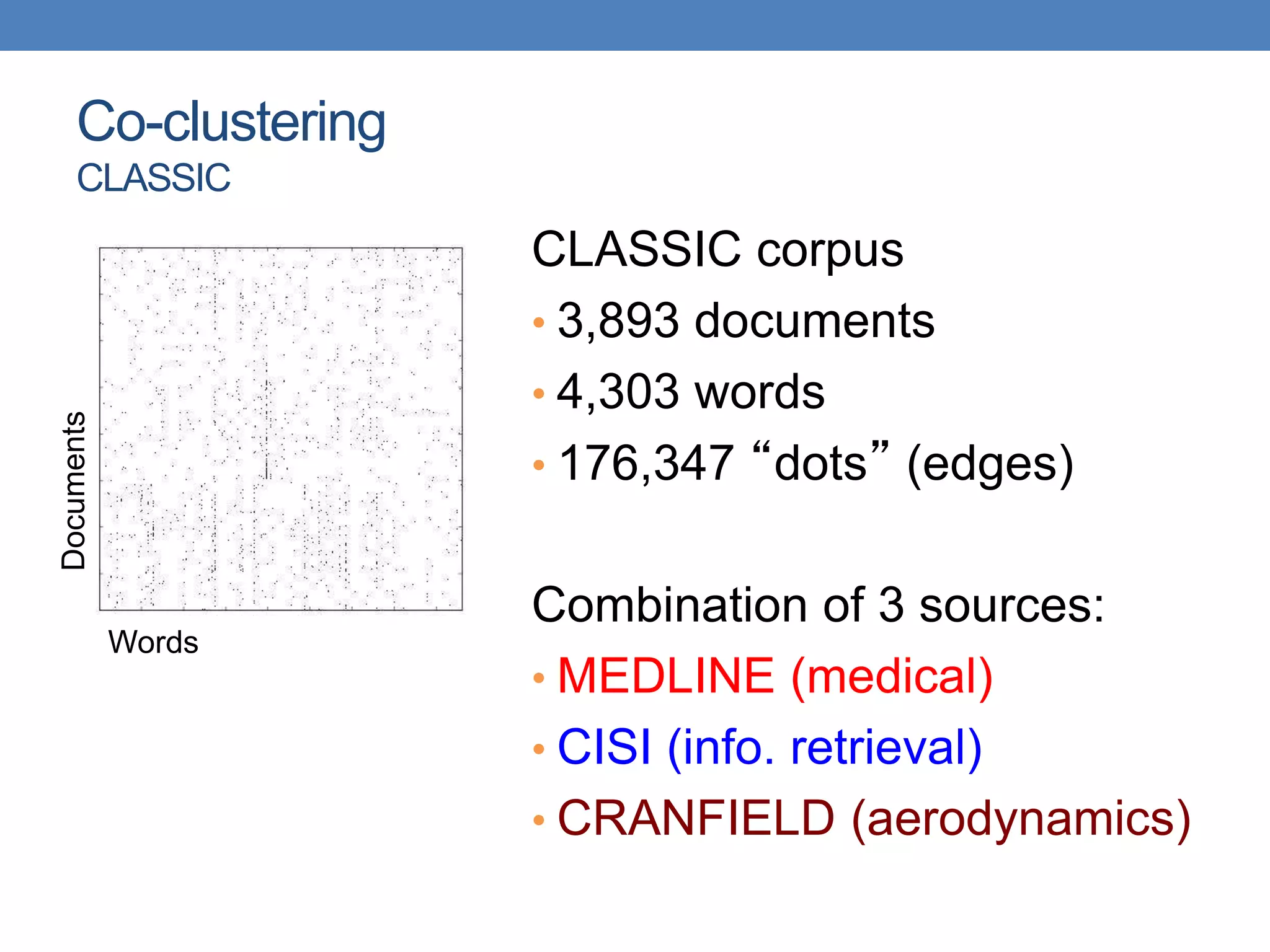
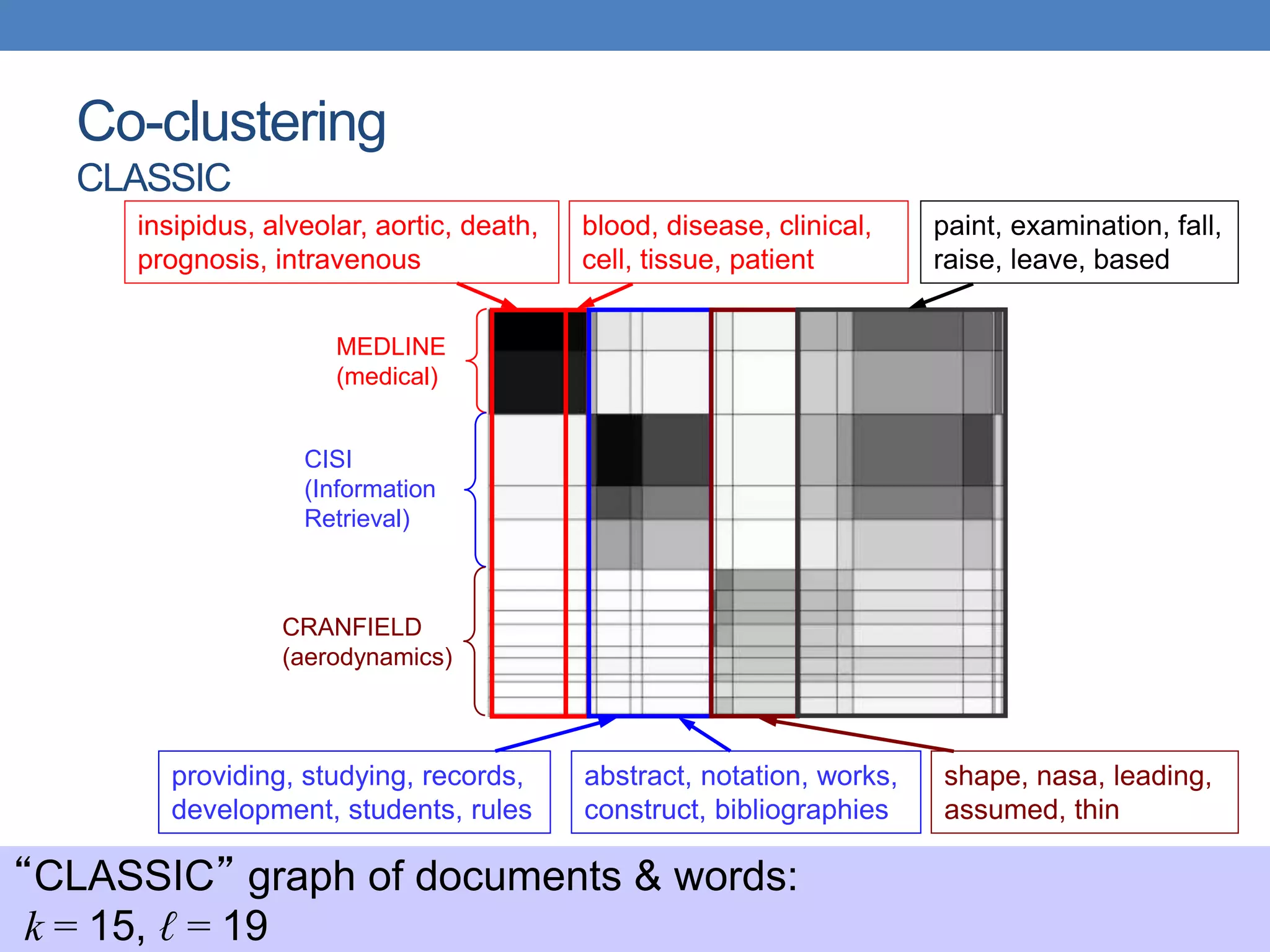
Co-clustering
CLASSIC
CLASSIC corpus
• 3,893 documents
• 4,303 words
• 176,347 “dots” (edges)
Combination of 3 sources:
• MEDLINE (medical)
• CISI (info. retrieval)
• CRANFIELD (aerodynamics)
Documents
Words
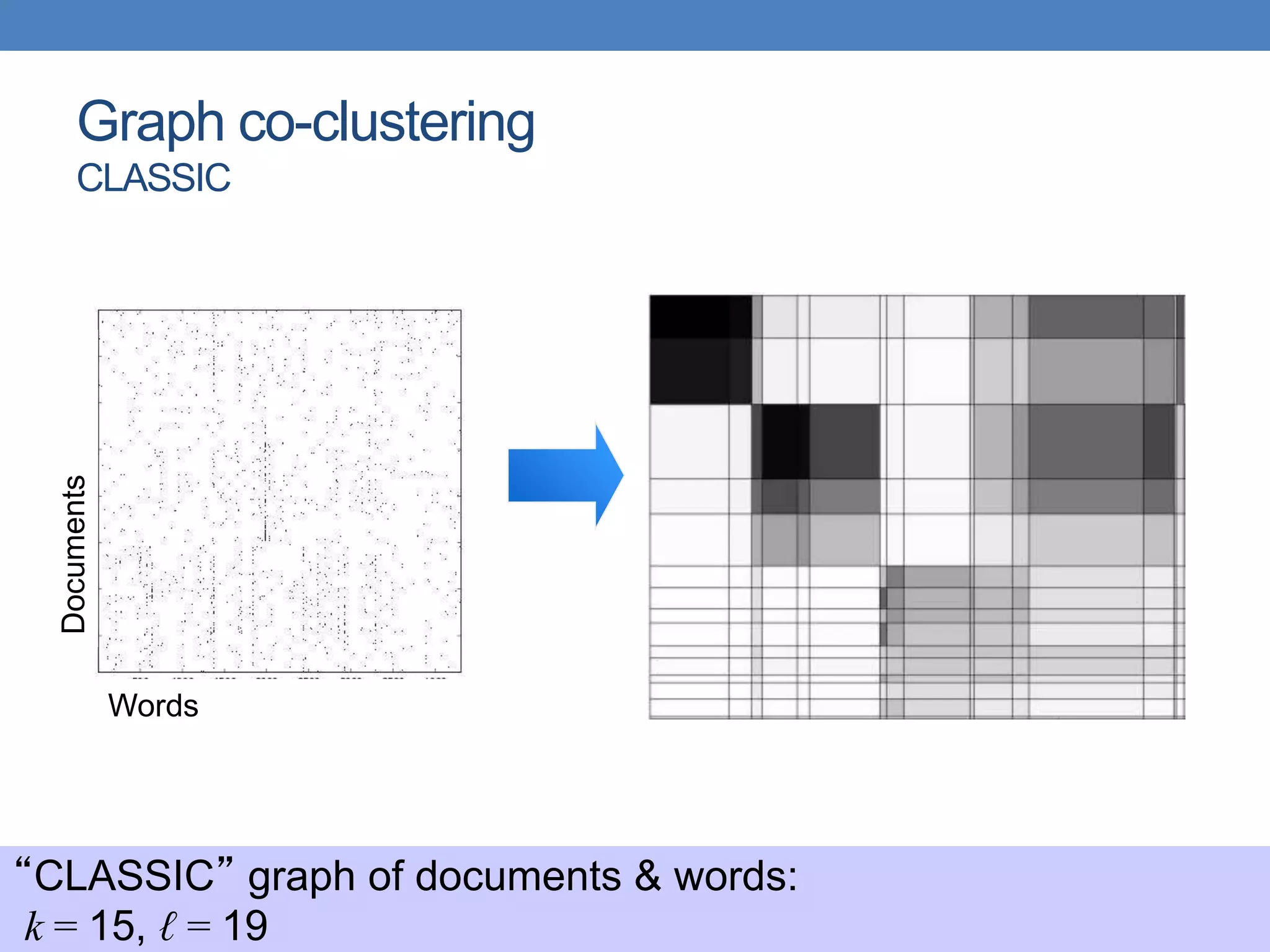
Graph co-clustering
CLASSIC
Documents
Words
“CLASSIC” graph of documents & words:
k = 15, ℓ = 19
Co-clustering
CLASSIC
MEDLINE
(medical)
insipidus, alveolar, aortic, death,
prognosis, intravenous
blood, disease, clinical,
cell, tissue, patient
“CLASSIC” graph of documents & words:
k = 15, ℓ = 19
CISI
(Information
Retrieval)
providing, studying, records,
development, students, rules
abstract, notation, works,
construct, bibliographies
shape, nasa, leading,
assumed, thin
paint, examination, fall,
raise, leave, based
CRANFIELD
(aerodynamics)
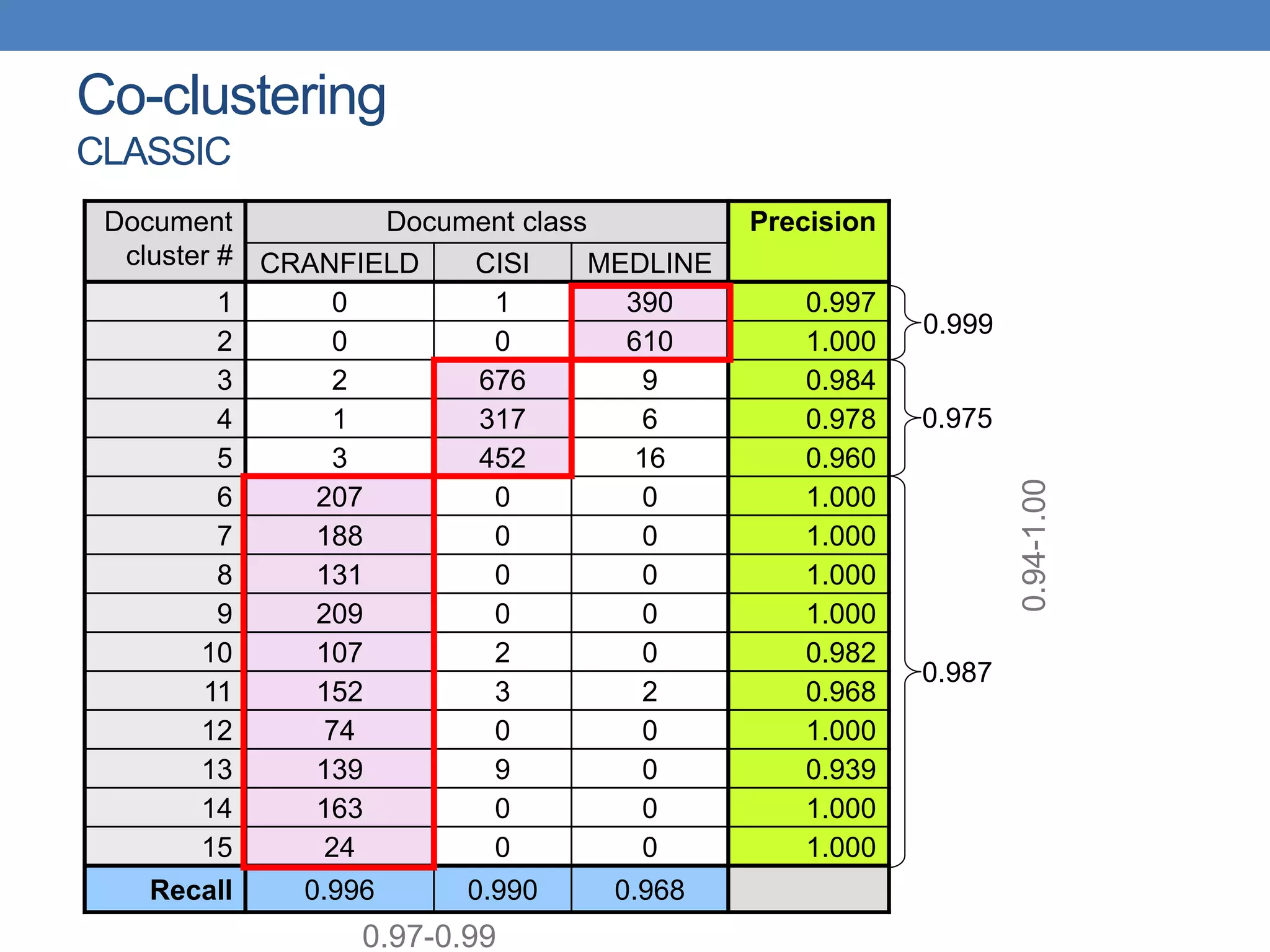
Co-clustering
CLASSIC
Document
cluster #
Document class Precision
CRANFIELD CISI MEDLINE
1 0 1 390 0.997
2 0 0 610 1.000
3 2 676 9 0.984
4 1 317 6 0.978
5 3 452 16 0.960
6 207 0 0 1.000
7 188 0 0 1.000
8 131 0 0 1.000
9 209 0 0 1.000
10 107 2 0 0.982
11 152 3 2 0.968
12 74 0 0 1.000
13 139 9 0 0.939
14 163 0 0 1.000
15 24 0 0 1.000
Recall 0.996 0.990 0.968
0.94-1.00
0.97-0.99
0.999
0.975
0.987

Data Mining Lecture_8(a).pptx

  • 1.
    DATA MINING LECTURE 8 ClusteringValidation Minimum Description Length Information Theory Co-Clustering Subrata Kumer Paul Assistant Professor, Dept. of CSE, BAUET sksubrata96@gmail.com
  • 2.
  • 3.
    Cluster Validity • Howdo we evaluate the “goodness” of the resulting clusters? • But “clustering lies in the eye of the beholder”! • Then why do we want to evaluate them? • To avoid finding patterns in noise • To compare clustering algorithms • To compare two clusterings • To compare two clusters
  • 4.
    Clusters found inRandom Data 0 0.2 0.4 0.6 0.8 1 0 0.1 0.2 0.3 0.4 0.5 0.6 0.7 0.8 0.9 1 x y Random Points 0 0.2 0.4 0.6 0.8 1 0 0.1 0.2 0.3 0.4 0.5 0.6 0.7 0.8 0.9 1 x y K-means 0 0.2 0.4 0.6 0.8 1 0 0.1 0.2 0.3 0.4 0.5 0.6 0.7 0.8 0.9 1 x y DBSCAN 0 0.2 0.4 0.6 0.8 1 0 0.1 0.2 0.3 0.4 0.5 0.6 0.7 0.8 0.9 1 x y Complete Link
  • 5.
    1. Determining theclustering tendency of a set of data, i.e., distinguishing whether non-random structure actually exists in the data. 2. Comparing the results of a cluster analysis to externally known results, e.g., to externally given class labels. 3. Evaluating how well the results of a cluster analysis fit the data without reference to external information. - Use only the data 4. Comparing the results of two different sets of cluster analyses to determine which is better. 5. Determining the ‘correct’ number of clusters. For 2, 3, and 4, we can further distinguish whether we want to evaluate the entire clustering or just individual clusters. Different Aspects of Cluster Validation
  • 6.
    • Numerical measuresthat are applied to judge various aspects of cluster validity, are classified into the following three types. • External Index: Used to measure the extent to which cluster labels match externally supplied class labels. • E.g., entropy, precision, recall • Internal Index: Used to measure the goodness of a clustering structure without reference to external information. • E.g., Sum of Squared Error (SSE) • Relative Index: Used to compare two different clusterings or clusters. • Often an external or internal index is used for this function, e.g., SSE or entropy • Sometimes these are referred to as criteria instead of indices • However, sometimes criterion is the general strategy and index is the numerical measure that implements the criterion. Measures of Cluster Validity
  • 7.
    • Two matrices •Similarity or Distance Matrix • One row and one column for each data point • An entry is the similarity or distance of the associated pair of points • “Incidence” Matrix • One row and one column for each data point • An entry is 1 if the associated pair of points belong to the same cluster • An entry is 0 if the associated pair of points belongs to different clusters • Compute the correlation between the two matrices • Since the matrices are symmetric, only the correlation between n(n-1) / 2 entries needs to be calculated. • High correlation (positive for similarity, negative for distance) indicates that points that belong to the same cluster are close to each other. • Not a good measure for some density or contiguity based clusters. Measuring Cluster Validity Via Correlation
  • 8.
    Measuring Cluster ValidityVia Correlation • Correlation of incidence and proximity matrices for the K-means clusterings of the following two data sets. 0 0.2 0.4 0.6 0.8 1 0 0.1 0.2 0.3 0.4 0.5 0.6 0.7 0.8 0.9 1 x y 0 0.2 0.4 0.6 0.8 1 0 0.1 0.2 0.3 0.4 0.5 0.6 0.7 0.8 0.9 1 x y Corr = -0.9235 Corr = -0.5810
  • 9.
    • Order thesimilarity matrix with respect to cluster labels and inspect visually. Using Similarity Matrix for Cluster Validation 0 0.2 0.4 0.6 0.8 1 0 0.1 0.2 0.3 0.4 0.5 0.6 0.7 0.8 0.9 1 x y Points Points 20 40 60 80 100 10 20 30 40 50 60 70 80 90 100 Similarity 0 0.1 0.2 0.3 0.4 0.5 0.6 0.7 0.8 0.9 1 𝑠𝑖𝑚(𝑖, 𝑗) = 1 − 𝑑𝑖𝑗 − 𝑑𝑚𝑖𝑛 𝑑𝑚𝑎𝑥 − 𝑑𝑚𝑖𝑛
  • 10.
    Using Similarity Matrixfor Cluster Validation • Clusters in random data are not so crisp Points Points 20 40 60 80 100 10 20 30 40 50 60 70 80 90 100 Similarity 0 0.1 0.2 0.3 0.4 0.5 0.6 0.7 0.8 0.9 1 DBSCAN 0 0.2 0.4 0.6 0.8 1 0 0.1 0.2 0.3 0.4 0.5 0.6 0.7 0.8 0.9 1 x y
  • 11.
    Points Points 20 40 6080 100 10 20 30 40 50 60 70 80 90 100 Similarity 0 0.1 0.2 0.3 0.4 0.5 0.6 0.7 0.8 0.9 1 Using Similarity Matrix for Cluster Validation • Clusters in random data are not so crisp K-means 0 0.2 0.4 0.6 0.8 1 0 0.1 0.2 0.3 0.4 0.5 0.6 0.7 0.8 0.9 1 x y
  • 12.
    Using Similarity Matrixfor Cluster Validation • Clusters in random data are not so crisp 0 0.2 0.4 0.6 0.8 1 0 0.1 0.2 0.3 0.4 0.5 0.6 0.7 0.8 0.9 1 x y Points Points 20 40 60 80 100 10 20 30 40 50 60 70 80 90 100 Similarity 0 0.1 0.2 0.3 0.4 0.5 0.6 0.7 0.8 0.9 1 Complete Link
  • 13.
    Using Similarity Matrixfor Cluster Validation 1 2 3 5 6 4 7 DBSCAN 0 0.1 0.2 0.3 0.4 0.5 0.6 0.7 0.8 0.9 1 500 1000 1500 2000 2500 3000 500 1000 1500 2000 2500 3000
  • 14.
    • Internal Index:Used to measure the goodness of a clustering structure without reference to external information • Example: SSE • SSE is good for comparing two clusterings or two clusters (average SSE). • Can also be used to estimate the number of clusters Internal Measures: SSE 2 5 10 15 20 25 30 0 1 2 3 4 5 6 7 8 9 10 K SSE 5 10 15 -6 -4 -2 0 2 4 6
  • 15.
    Estimating the “right”number of clusters • Typical approach: find a “knee” in an internal measure curve. • Question: why not the k that minimizes the SSE? • Forward reference: minimize a measure, but with a “simple” clustering • Desirable property: the clustering algorithm does not require the number of clusters to be specified (e.g., DBSCAN) 2 5 10 15 20 25 30 0 1 2 3 4 5 6 7 8 9 10 K SSE
  • 16.
    Internal Measures: SSE •SSE curve for a more complicated data set 1 2 3 5 6 4 7 SSE of clusters found using K-means
  • 17.
    • Cluster Cohesion:Measures how closely related are objects in a cluster • Cluster Separation: Measure how distinct or well- separated a cluster is from other clusters • Example: Squared Error • Cohesion is measured by the within cluster sum of squares (SSE) • Separation is measured by the between cluster sum of squares • Where mi is the size of cluster i Internal Measures: Cohesion and Separation      i C x i i c x WSS 2 ) (    i i i c c m BSS 2 ) (
  • 18.
    • A proximitygraph based approach can also be used for cohesion and separation. • Cluster cohesion is the sum of the weight of all links within a cluster. • Cluster separation is the sum of the weights between nodes in the cluster and nodes outside the cluster. Internal Measures: Cohesion and Separation cohesion separation
  • 19.
    Internal measures –caveats • Internal measures have the problem that the clustering algorithm did not set out to optimize this measure, so it is will not necessarily do well with respect to the measure. • An internal measure can also be used as an objective function for clustering
  • 20.
    • Need aframework to interpret any measure. • For example, if our measure of evaluation has the value, 10, is that good, fair, or poor? • Statistics provide a framework for cluster validity • The more “non-random” a clustering result is, the more likely it represents valid structure in the data • Can compare the values of an index that result from random data or clusterings to those of a clustering result. • If the value of the index is unlikely, then the cluster results are valid • For comparing the results of two different sets of cluster analyses, a framework is less necessary. • However, there is the question of whether the difference between two index values is significant Framework for Cluster Validity
  • 21.
    • Example • CompareSSE of 0.005 against three clusters in random data • Histogram of SSE for three clusters in 500 random data sets of 100 random points distributed in the range 0.2 – 0.8 for x and y • Value 0.005 is very unlikely Statistical Framework for SSE 0.016 0.018 0.02 0.022 0.024 0.026 0.028 0.03 0.032 0.034 0 5 10 15 20 25 30 35 40 45 50 SSE Count 0 0.2 0.4 0.6 0.8 1 0 0.1 0.2 0.3 0.4 0.5 0.6 0.7 0.8 0.9 1 x y
  • 22.
    • Correlation ofincidence and proximity matrices for the K-means clusterings of the following two data sets. Statistical Framework for Correlation 0 0.2 0.4 0.6 0.8 1 0 0.1 0.2 0.3 0.4 0.5 0.6 0.7 0.8 0.9 1 x y 0 0.2 0.4 0.6 0.8 1 0 0.1 0.2 0.3 0.4 0.5 0.6 0.7 0.8 0.9 1 x y Corr = -0.9235 Corr = -0.5810
  • 23.
    Empirical p-value • Ifwe have a measurement v (e.g., the SSE value) • ..and we have N measurements on random datasets • …the empirical p-value is the fraction of measurements in the random data that have value less or equal than value v (or greater or equal if we want to maximize) • i.e., the value in the random dataset is at least as good as that in the real data • We usually require that p-value ≤ 0.05 • Hard question: what is the right notion of a random dataset?
  • 24.
    External Measures forClustering Validity • Assume that the data is labeled with some class labels • E.g., documents are classified into topics, people classified according to their income, senators classified as republican or democrat. • In this case we want the clusters to be homogeneous with respect to classes • Each cluster should contain elements of mostly one class • Also each class should ideally be assigned to a single cluster • This does not always make sense • Clustering is not the same as classification • But this is what people use most of the time
  • 25.
    Measures • 𝑛 =number of points • 𝑚𝑖 = points in cluster i • 𝑐𝑗 = points in class j • 𝑚𝑖𝑗= points in cluster i coming from class j • 𝑝𝑖𝑗 = 𝑚𝑖𝑗/𝑚𝑖= prob of element from class j in cluster i • Entropy: • Of a cluster i: 𝑒𝑖 = − 𝑗=1 𝐿 𝑝𝑖𝑗 log 𝑝𝑖𝑗 • Highest when uniform, zero when single class • Of a clustering: 𝑒 = 𝑖=1 𝐾 𝑚𝑖 𝑛 𝑒𝑖 • Purity: • Of a cluster i: 𝑝𝑖 = max 𝑗 𝑝𝑖𝑗 • Of a clustering: 𝑝𝑢𝑟𝑖𝑡𝑦 = 𝑖=1 𝐾 𝑚𝑖 𝑛 𝑝𝑖 Class 1 Class 2 Class 3 Cluster 1 𝑚11 𝑚12 𝑚13 𝑚1 Cluster 2 𝑚21 𝑚22 𝑚23 𝑚2 Cluster 3 𝑚31 𝑚32 𝑚33 𝑚3 𝑐1 𝑐2 𝑐3 𝑛
  • 26.
    Measures • Precision: • Ofcluster i with respect to class j: 𝑃𝑟𝑒𝑐 𝑖, 𝑗 = 𝑝𝑖𝑗 • For the precision of a clustering you can take the maximum • Recall: • Of cluster i with respect to class j: 𝑅𝑒𝑐 𝑖, 𝑗 = 𝑚𝑖𝑗 𝑐𝑗 • For the precision of a clustering you can take the maximum • F-measure: • Harmonic Mean of Precision and Recall: 𝐹 𝑖, 𝑗 = 2 ∗ 𝑃𝑟𝑒𝑐 𝑖, 𝑗 ∗ 𝑅𝑒𝑐(𝑖, 𝑗) 𝑃𝑟𝑒𝑐 𝑖, 𝑗 + 𝑅𝑒𝑐(𝑖, 𝑗)
  • 27.
    Good and badclustering Class 1 Class 2 Class 3 Cluster 1 20 35 35 90 Cluster 2 30 42 38 110 Cluster 3 38 35 27 100 100 100 100 300 Class 1 Class 2 Class 3 Cluster 1 2 3 85 90 Cluster 2 90 12 8 110 Cluster 3 8 85 7 100 100 100 100 300 Purity: (0.94, 0.81, 0.85) – overall 0.86 Precision: (0.94, 0.81, 0.85) Recall: (0.85, 0.9, 0.85) Purity: (0.38, 0.38, 0.38) – overall 0.38 Precision: (0.38, 0.38, 0.38) Recall: (0.35, 0.42, 0.38)
  • 28.
    Another bad clustering Class1 Class 2 Class 3 Cluster 1 0 0 35 35 Cluster 2 50 77 38 165 Cluster 3 38 35 27 100 100 100 100 300 Cluster 1: Purity: 1 Precision: 1 Recall: 0.35
  • 29.
    External Measures ofCluster Validity: Entropy and Purity
  • 30.
    “The validation ofclustering structures is the most difficult and frustrating part of cluster analysis. Without a strong effort in this direction, cluster analysis will remain a black art accessible only to those true believers who have experience and great courage.” Algorithms for Clustering Data, Jain and Dubes Final Comment on Cluster Validity
  • 31.
  • 32.
    Occam’s razor • Mostdata mining tasks can be described as creating a model for the data • E.g., the EM algorithm models the data as a mixture of Gaussians, the K-means models the data as a set of centroids. • What is the right model? • Occam’s razor: All other things being equal, the simplest model is the best. • A good principle for life as well
  • 33.
    Occam's Razor andMDL • What is a simple model? • Minimum Description Length Principle: Every model provides a (lossless) encoding of our data. The model that gives the shortest encoding (best compression) of the data is the best. • Related: Kolmogorov complexity. Find the shortest program that produces the data (uncomputable). • MDL restricts the family of models considered • Encoding cost: cost of party A to transmit to party B the data.
  • 34.
    Minimum Description Length(MDL) • The description length consists of two terms • The cost of describing the model (model cost) • The cost of describing the data given the model (data cost). • L(D) = L(M) + L(D|M) • There is a tradeoff between the two costs • Very complex models describe the data in a lot of detail but are expensive to describe the model • Very simple models are cheap to describe but it is expensive to describe the data given the model • This is generic idea for finding the right model • We use MDL as a blanket name.
  • 35.
    35 Example • Regression: finda polynomial for describing a set of values • Model complexity (model cost): polynomial coefficients • Goodness of fit (data cost): difference between real value and the polynomial value Source: Grunwald et al. (2005) Tutorial on MDL. Minimum model cost High data cost High model cost Minimum data cost Low model cost Low data cost MDL avoids overfitting automatically!
  • 36.
    Example • Suppose youwant to describe a set of integer numbers • Cost of describing a single number is proportional to the value of the number x (e.g., logx). • How can we get an efficient description? • Cluster integers into two clusters and describe the cluster by the centroid and the points by their distance from the centroid • Model cost: cost of the centroids • Data cost: cost of cluster membership and distance from centroid • What are the two extreme cases?
  • 37.
    MDL and DataMining • Why does the shorter encoding make sense? • Shorter encoding implies regularities in the data • Regularities in the data imply patterns • Patterns are interesting • Example 00001000010000100001000010000100001000010001000010000100001 • Short description length, just repeat 12 times 00001 0100111001010011011010100001110101111011011010101110010011100 • Random sequence, no patterns, no compression
  • 38.
    Is everything aboutcompression? • Jürgen Schmidhuber: A theory about creativity, art and fun • Interesting Art corresponds to a novel pattern that we cannot compress well, yet it is not too random so we can learn it • Good Humor corresponds to an input that does not compress well because it is out of place and surprising • Scientific discovery corresponds to a significant compression event • E.g., a law that can explain all falling apples. • Fun lecture: • Compression Progress: The Algorithmic Principle Behind Curiosity and Creativity
  • 39.
    Issues with MDL •What is the right model family? • This determines the kind of solutions that we can have • E.g., polynomials • Clusterings • What is the encoding cost? • Determines the function that we optimize • Information theory
  • 40.
  • 41.
    Encoding • Consider thefollowing sequence AAABBBAAACCCABACAABBAACCABAC • Suppose you wanted to encode it in binary form, how would you do it? A  0 B  10 C  11 A is 50% of the sequence We should give it a shorter representation 50% A 25% B 25% C This is actually provably the best encoding!
  • 42.
    Encoding • Prefix Codes:no codeword is a prefix of another • Codes and Distributions: There is one to one mapping between codes and distributions • If P is a distribution over a set of elements (e.g., {A,B,C}) then there exists a (prefix) code C where 𝐿𝐶 𝑥 = − log 𝑃 𝑥 , 𝑥 ∈ {𝐴, 𝐵, 𝐶} • For every (prefix) code C of elements {A,B,C}, we can define a distribution 𝑃 𝑥 = 2−𝐶(𝑥) • The code defined has the smallest average codelength! A  0 B  10 C  11 Uniquely directly decodable For every code we can find a prefix code of equal length
  • 43.
    Entropy • Suppose wehave a random variable X that takes n distinct values 𝑋 = {𝑥1, 𝑥2, … , 𝑥𝑛} that have probabilities P X = 𝑝1, … , 𝑝𝑛 • This defines a code C with 𝐿𝐶 𝑥𝑖 = − log 𝑝𝑖 . The average codelength is − 𝑖=1 𝑛 𝑝𝑖 log 𝑝𝑖 • This (more or less) is the entropy 𝐻(𝑋) of the random variable X 𝐻 𝑋 = − 𝑖=1 𝑛 𝑝𝑖 log 𝑝𝑖 • Shannon’s theorem: The entropy is a lower bound on the average codelength of any code that encodes the distribution P(X) • When encoding N numbers drawn from P(X), the best encoding length we can hope for is 𝑁 ∗ 𝐻(𝑋) • Reminder: Lossless encoding
  • 44.
    Entropy 𝐻 𝑋 =− 𝑖=1 𝑛 𝑝𝑖 log 𝑝𝑖 • What does it mean? • Entropy captures different aspects of a distribution: • The compressibility of the data represented by random variable X • Follows from Shannon’s theorem • The uncertainty of the distribution (highest entropy for uniform distribution) • How well can I predict a value of the random variable? • The information content of the random variable X • The number of bits used for representing a value is the information content of this value.
  • 45.
    Claude Shannon Father ofInformation Theory Envisioned the idea of communication of information with 0/1 bits Introduced the word “bit” The word entropy was suggested by Von Neumann • Similarity to physics, but also • “nobody really knows what entropy really is, so in any conversation you will have an advantage”
  • 46.
    Some information theoreticmeasures • Conditional entropy H(Y|X): the uncertainty for Y given that we know X 𝐻 𝑌 𝑋 = − 𝑥 𝑝 𝑥 𝑦 𝑝(𝑦|𝑥) log 𝑝(𝑦|𝑥) = − 𝑥,𝑦 𝑝 𝑥, 𝑦 log 𝑝(𝑥, 𝑦) 𝑝(𝑥) • Mutual Information I(X,Y): The reduction in the uncertainty for Y (or X) given that we know X (or Y) 𝐼 𝑋, 𝑌 = 𝐻 𝑌 − 𝐻(𝑌|𝑋) = 𝐻 𝑋 − 𝐻 𝑋 𝑌
  • 47.
    Some information theoreticmeasures • Cross Entropy: The cost of encoding distribution P, using the code of distribution Q − 𝑥 𝑃 𝑥 log 𝑄 𝑥 • KL Divergence KL(P||Q): The increase in encoding cost for distribution P when using the code of distribution Q 𝐾𝐿(𝑃| 𝑄 = − 𝑥 𝑃 𝑥 log 𝑄 𝑥 + 𝑥 𝑃 𝑥 log 𝑃 𝑥 • Not symmetric • Problematic if Q not defined for all x of P.
  • 48.
    Some information theoreticmeasures • Jensen-Shannon Divergence JS(P,Q): distance between two distributions P and Q • Deals with the shortcomings of KL-divergence • If M = ½ (P+Q) is the mean distribution 𝐽𝑆 𝑃, 𝑄 = 1 2 𝐾𝐿(𝑃| 𝑀 + 1 2 𝐾𝐿(𝑄||𝑀) • Jensen-Shannon is a metric
  • 49.
  • 50.
    Co-clustering • Simultaneous groupingof rows and columns of a matrix into homogeneous groups 5 10 15 20 25 5 10 15 20 25 97% 96% 3% 3% Product groups Customer groups 5 10 15 20 25 5 10 15 20 25 Products 54% Customers Students buying books CEOs buying BMWs
  • 51.
    Co-clustering • Step 1:How to define a “good” partitioning? Intuition and formalization • Step 2: How to find it?
  • 52.
    Co-clustering Intuition versus Column groups Columngroups Row groups Row groups Good Clustering 1. Similar nodes are grouped together 2. As few groups as necessary A few, homogeneous blocks Good Compression Why is this better? implies
  • 53.
    log*k + log*ℓlog nimj i,j nimj H(pi,j) Co-clustering MDL formalization—Cost objective n1 n2 n3 m1 m2 m3 p1,1 p1,2 p1,3 p2,1 p2,2 p2,3 p3,3 p3,2 p3,1 n × m matrix k = 3 row groups ℓ = 3 col. groups density of ones n1m2 H(p1,2) bits for (1,2) data cost bits total row-partition description col-partition description i,j transmit #ones ei,j + + model cost + block size entropy + transmit #partitions
  • 54.
    Co-clustering MDL formalization—Cost objective codecost (block contents) description cost (block structure) + one row group one col group n row groups m col groups low high low high  
  • 55.
    Co-clustering MDL formalization—Cost objective codecost (block contents) description cost (block structure) + k = 3 row groups ℓ = 3 col groups low low 
  • 56.
    Co-clustering MDL formalization—Cost objective k ℓ total bit cost Costvs. number of groups one row group one col group n row groups m col groups k = 3 row groups ℓ = 3 col groups
  • 57.
    Co-clustering • Step 1:How to define a “good” partitioning? Intuition and formalization • Step 2: How to find it?
  • 58.
    Search for solution Overview:assignments w/ fixed number of groups (shuffles) row shuffle column shuffle row shuffle original groups No cost improvement: Discard reassign all rows, holding column assignments fixed reassign all columns, holding row assignments fixed
  • 59.
    Search for solution Overview:assignments w/ fixed number of groups (shuffles) row shuffle column shuffle column shuffle row shuffle column shuffle No cost improvement: Discard Final shuffle result
  • 60.
    Search for solution Shuffles •Let denote row and col. partitions at the I-th iteration • Fix I and for every row x: • Splice into ℓ parts, one for each column group • Let j, for j = 1,…,ℓ, be the number of ones in each part • Assign row x to the row group i¤  I+1(x) such that, for all i = 1,…,k, p1,1 p1,2 p1,3 p2,1 p2,2 p2,3 p3,3 p3,2 p3,1 Similarity (“KL-divergences”) of row fragments to blocks of a row group Assign to second row-group
  • 61.
    k = 5,ℓ = 5 Search for solution Overview: number of groups k and ℓ (splits & shuffles)
  • 62.
    col. split shuffle Search forsolution Overview: number of groups k and ℓ (splits & shuffles) k=1, ℓ=2 k=2, ℓ=2 k=2, ℓ=3 k=3, ℓ=3 k=3, ℓ=4 k=4, ℓ=4 k=4, ℓ=5 k = 1, ℓ = 1 row split shuffle Split: Increase k or ℓ Shuffle: Rearrange rows or cols col. split shuffle row split shuffle col. split shuffle row split shuffle col. split shuffle k = 5, ℓ = 5 row split shuffle k = 5, ℓ = 6 col. split shuffle No cost improvement: Discard row split k = 6, ℓ = 5
  • 63.
    Search for solution Overview:number of groups k and ℓ (splits & shuffles) k=1, ℓ=2 k=2, ℓ=2 k=2, ℓ=3 k=3, ℓ=3 k=3, ℓ=4 k=4, ℓ=4 k=4, ℓ=5 k = 1, ℓ = 1 Split: Increase k or ℓ Shuffle: Rearrange rows or cols k = 5, ℓ = 5 k = 5, ℓ = 5 Final result
  • 64.
    Co-clustering CLASSIC CLASSIC corpus • 3,893documents • 4,303 words • 176,347 “dots” (edges) Combination of 3 sources: • MEDLINE (medical) • CISI (info. retrieval) • CRANFIELD (aerodynamics) Documents Words
  • 65.
  • 66.
    Co-clustering CLASSIC MEDLINE (medical) insipidus, alveolar, aortic,death, prognosis, intravenous blood, disease, clinical, cell, tissue, patient “CLASSIC” graph of documents & words: k = 15, ℓ = 19 CISI (Information Retrieval) providing, studying, records, development, students, rules abstract, notation, works, construct, bibliographies shape, nasa, leading, assumed, thin paint, examination, fall, raise, leave, based CRANFIELD (aerodynamics)
  • 67.
    Co-clustering CLASSIC Document cluster # Document classPrecision CRANFIELD CISI MEDLINE 1 0 1 390 0.997 2 0 0 610 1.000 3 2 676 9 0.984 4 1 317 6 0.978 5 3 452 16 0.960 6 207 0 0 1.000 7 188 0 0 1.000 8 131 0 0 1.000 9 209 0 0 1.000 10 107 2 0 0.982 11 152 3 2 0.968 12 74 0 0 1.000 13 139 9 0 0.939 14 163 0 0 1.000 15 24 0 0 1.000 Recall 0.996 0.990 0.968 0.94-1.00 0.97-0.99 0.999 0.975 0.987