06/09/2020
1
COMMUNICATIONS
Prepared by: Demy F. Gabriel DEngg Info
History
Long before the discovery of
image and data, the
following are forms of
communications.
Telephone System
Some communications before the telephone system
Pony Express
06/09/2020
2
Telephone System
Some communications before the telephone system
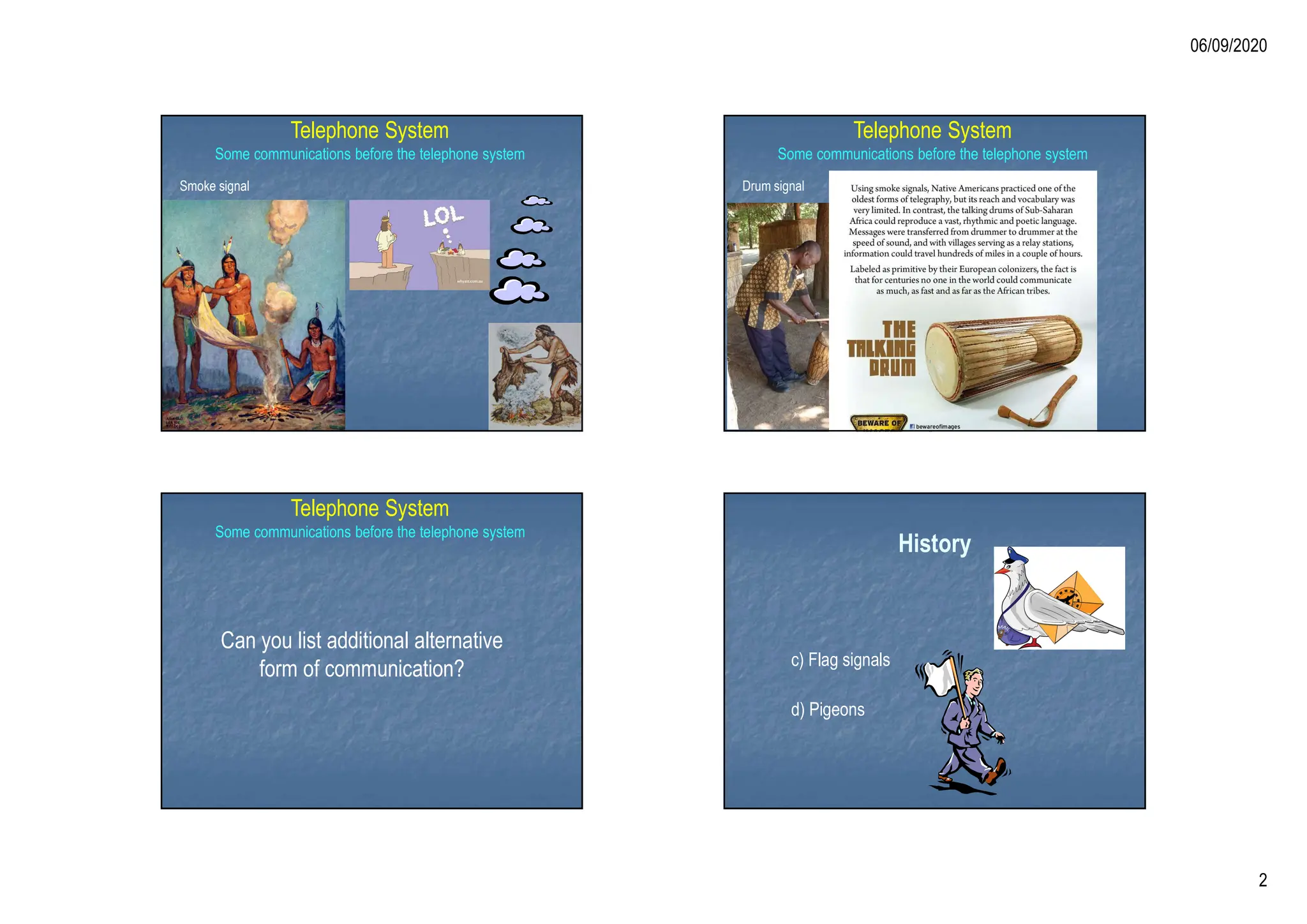
Smoke signal
Telephone System
Some communications before the telephone system
Drum signal
Telephone System
Some communications before the telephone system
Can you list additional alternative
form of communication?
History
c) Flag signals
d) Pigeons
06/09/2020
3
History
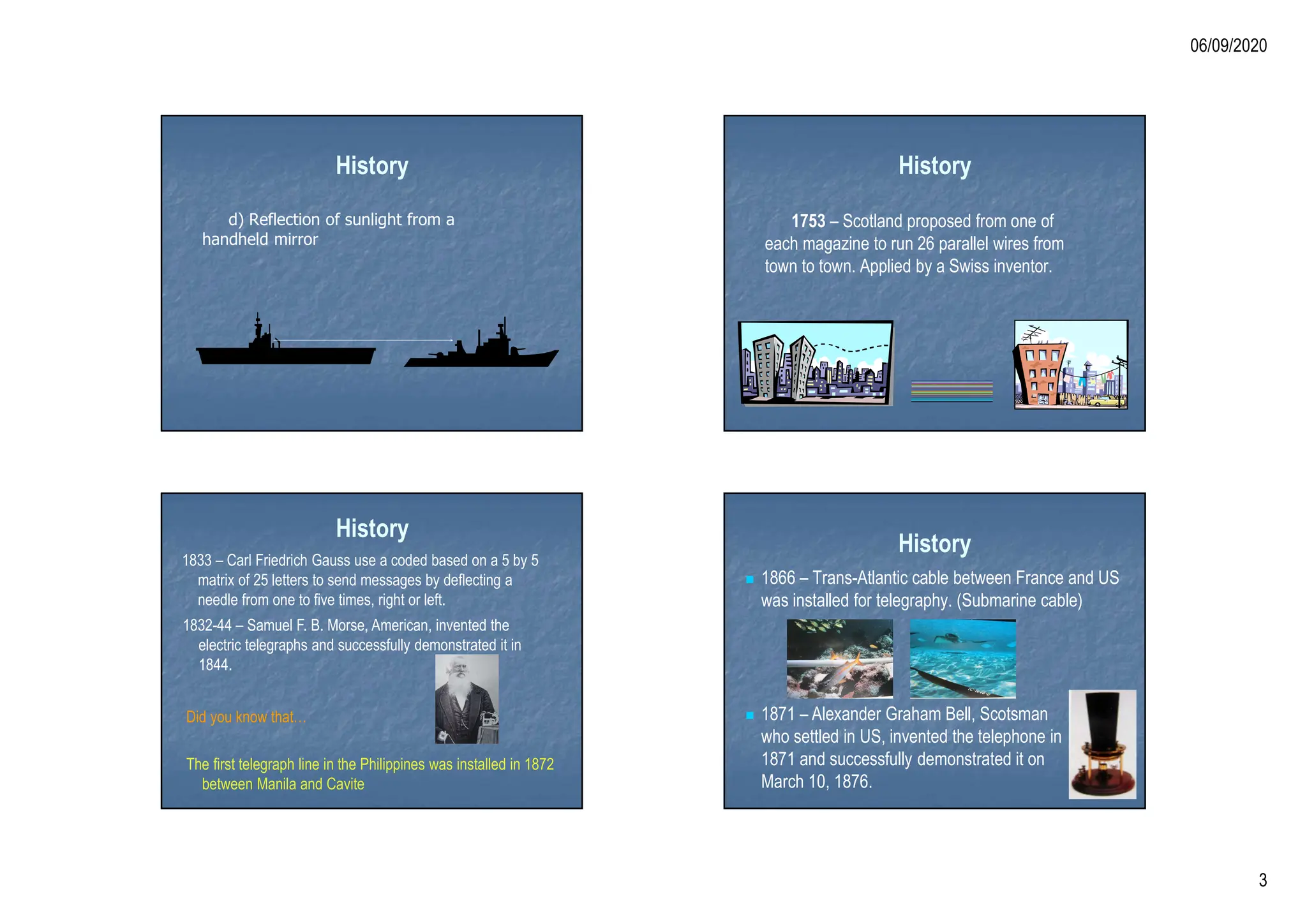
d) Reflection of sunlight from a
handheld mirror
History
1753 – Scotland proposed from one of
each magazine to run 26 parallel wires from
town to town. Applied by a Swiss inventor.
History
1833 – Carl Friedrich Gauss use a coded based on a 5 by 5
matrix of 25 letters to send messages by deflecting a
needle from one to five times, right or left.
1832-44 – Samuel F. B. Morse, American, invented the
electric telegraphs and successfully demonstrated it in
1844.
Did you know that…
The first telegraph line in the Philippines was installed in 1872
between Manila and Cavite
History
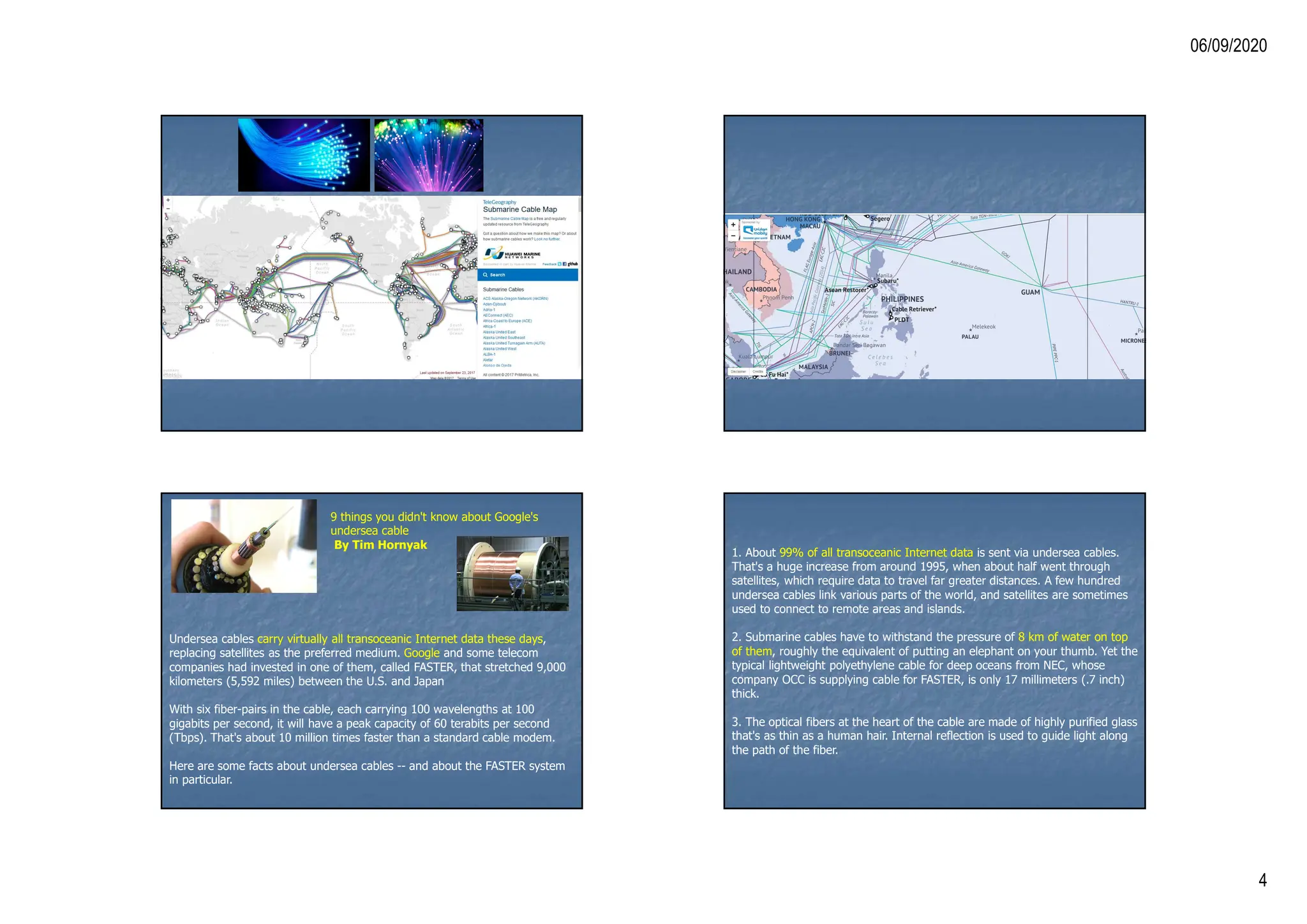
 1866 – Trans-Atlantic cable between France and US
was installed for telegraphy. (Submarine cable)
 1871 – Alexander Graham Bell, Scotsman
who settled in US, invented the telephone in
1871 and successfully demonstrated it on
March 10, 1876.
06/09/2020
4
9 things you didn't know about Google's
undersea cable
By Tim Hornyak
Undersea cables carry virtually all transoceanic Internet data these days,
replacing satellites as the preferred medium. Google and some telecom
companies had invested in one of them, called FASTER, that stretched 9,000
kilometers (5,592 miles) between the U.S. and Japan
With six fiber-pairs in the cable, each carrying 100 wavelengths at 100
gigabits per second, it will have a peak capacity of 60 terabits per second
(Tbps). That's about 10 million times faster than a standard cable modem.
Here are some facts about undersea cables -- and about the FASTER system
in particular.
1. About 99% of all transoceanic Internet data is sent via undersea cables.
That's a huge increase from around 1995, when about half went through
satellites, which require data to travel far greater distances. A few hundred
undersea cables link various parts of the world, and satellites are sometimes
used to connect to remote areas and islands.
2. Submarine cables have to withstand the pressure of 8 km of water on top
of them, roughly the equivalent of putting an elephant on your thumb. Yet the
typical lightweight polyethylene cable for deep oceans from NEC, whose
company OCC is supplying cable for FASTER, is only 17 millimeters (.7 inch)
thick.
3. The optical fibers at the heart of the cable are made of highly purified glass
that's as thin as a human hair. Internal reflection is used to guide light along
the path of the fiber.
06/09/2020
5
4. At OCC, the fiber is first embedded in a jelly compound to keep water out
in case the cable is damaged. It is then encased in a steel tube to protect it
from the water pressure. Then it's wrapped in steel wire for overall strength,
followed by a copper tube to hold the wires together and transmit electricity
to the repeater units along the cable that amplify the data signals. The final
wrap is usually a polyethylene sheath to make it water resistant.
5. Closer to shore along continental shelves, submarine cable is usually
armored. OCC manufactures it in versions including single armor and double
armor. The single-armor version involves taking the lightweight cable, then
adding more steel wires for strength, an asphalt coating to prevent corrosion,
plastic strings to cover the asphalt and chalk powder to prevent the cable
from sticking to itself. The process is repeated for the double-armor version.
6. Submarine cables can carry up to 80 Tbps, a capacity that's equivalent to
transmitting 2,100 DVDs (4.7 GB each) in one second, according to NEC.
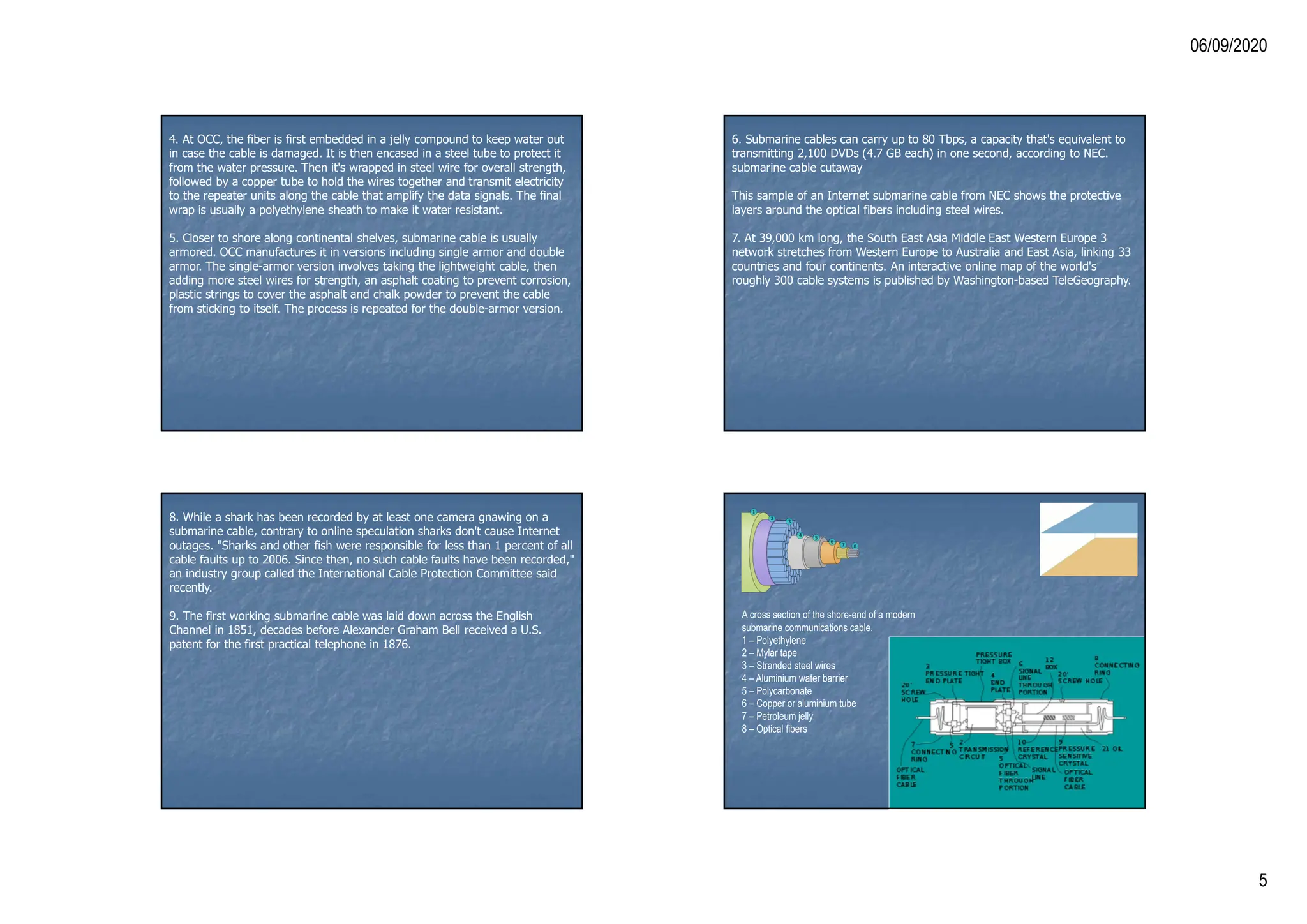
submarine cable cutaway
This sample of an Internet submarine cable from NEC shows the protective
layers around the optical fibers including steel wires.
7. At 39,000 km long, the South East Asia Middle East Western Europe 3
network stretches from Western Europe to Australia and East Asia, linking 33
countries and four continents. An interactive online map of the world's
roughly 300 cable systems is published by Washington-based TeleGeography.
8. While a shark has been recorded by at least one camera gnawing on a
submarine cable, contrary to online speculation sharks don't cause Internet
outages. "Sharks and other fish were responsible for less than 1 percent of all
cable faults up to 2006. Since then, no such cable faults have been recorded,"
an industry group called the International Cable Protection Committee said
recently.
9. The first working submarine cable was laid down across the English
Channel in 1851, decades before Alexander Graham Bell received a U.S.
patent for the first practical telephone in 1876.
A cross section of the shore-end of a modern
submarine communications cable.
1 – Polyethylene
2 – Mylar tape
3 – Stranded steel wires
4 – Aluminium water barrier
5 – Polycarbonate
6 – Copper or aluminium tube
7 – Petroleum jelly
8 – Optical fibers
06/09/2020
6
Communication
Communication was one of the first applications of
electrical technology. Today, in the age of fiber optics
and satellite television, facsimile machines, Internet and
cellular phones, communication systems remains at the
leading edge of electronic.
Probably no other branch of electronics has as
profound an effect on people’s everyday lives.
Communication
What is communication?
Movement of information
from a source
through a medium
to a receiver
What are the types of information?
Voice – telephone, talking, cellphone
Message – telex, letters, memo, messenger, internet
Image/video – TV, videophone, chat, meet, Netflix, cable
Sign – deaf sign, body language, flag signals, etc.
Data – internet, computer, cellphone, fax, etc.

1. Introduction to communication for print.pdf

  • 1.
    06/09/2020 1 COMMUNICATIONS Prepared by: DemyF. Gabriel DEngg Info History Long before the discovery of image and data, the following are forms of communications. Telephone System Some communications before the telephone system Pony Express
  • 2.
    06/09/2020 2 Telephone System Some communicationsbefore the telephone system Smoke signal Telephone System Some communications before the telephone system Drum signal Telephone System Some communications before the telephone system Can you list additional alternative form of communication? History c) Flag signals d) Pigeons
  • 3.
    06/09/2020 3 History d) Reflection ofsunlight from a handheld mirror History 1753 – Scotland proposed from one of each magazine to run 26 parallel wires from town to town. Applied by a Swiss inventor. History 1833 – Carl Friedrich Gauss use a coded based on a 5 by 5 matrix of 25 letters to send messages by deflecting a needle from one to five times, right or left. 1832-44 – Samuel F. B. Morse, American, invented the electric telegraphs and successfully demonstrated it in 1844. Did you know that… The first telegraph line in the Philippines was installed in 1872 between Manila and Cavite History  1866 – Trans-Atlantic cable between France and US was installed for telegraphy. (Submarine cable)  1871 – Alexander Graham Bell, Scotsman who settled in US, invented the telephone in 1871 and successfully demonstrated it on March 10, 1876.
  • 4.
    06/09/2020 4 9 things youdidn't know about Google's undersea cable By Tim Hornyak Undersea cables carry virtually all transoceanic Internet data these days, replacing satellites as the preferred medium. Google and some telecom companies had invested in one of them, called FASTER, that stretched 9,000 kilometers (5,592 miles) between the U.S. and Japan With six fiber-pairs in the cable, each carrying 100 wavelengths at 100 gigabits per second, it will have a peak capacity of 60 terabits per second (Tbps). That's about 10 million times faster than a standard cable modem. Here are some facts about undersea cables -- and about the FASTER system in particular. 1. About 99% of all transoceanic Internet data is sent via undersea cables. That's a huge increase from around 1995, when about half went through satellites, which require data to travel far greater distances. A few hundred undersea cables link various parts of the world, and satellites are sometimes used to connect to remote areas and islands. 2. Submarine cables have to withstand the pressure of 8 km of water on top of them, roughly the equivalent of putting an elephant on your thumb. Yet the typical lightweight polyethylene cable for deep oceans from NEC, whose company OCC is supplying cable for FASTER, is only 17 millimeters (.7 inch) thick. 3. The optical fibers at the heart of the cable are made of highly purified glass that's as thin as a human hair. Internal reflection is used to guide light along the path of the fiber.
  • 5.
    06/09/2020 5 4. At OCC,the fiber is first embedded in a jelly compound to keep water out in case the cable is damaged. It is then encased in a steel tube to protect it from the water pressure. Then it's wrapped in steel wire for overall strength, followed by a copper tube to hold the wires together and transmit electricity to the repeater units along the cable that amplify the data signals. The final wrap is usually a polyethylene sheath to make it water resistant. 5. Closer to shore along continental shelves, submarine cable is usually armored. OCC manufactures it in versions including single armor and double armor. The single-armor version involves taking the lightweight cable, then adding more steel wires for strength, an asphalt coating to prevent corrosion, plastic strings to cover the asphalt and chalk powder to prevent the cable from sticking to itself. The process is repeated for the double-armor version. 6. Submarine cables can carry up to 80 Tbps, a capacity that's equivalent to transmitting 2,100 DVDs (4.7 GB each) in one second, according to NEC. submarine cable cutaway This sample of an Internet submarine cable from NEC shows the protective layers around the optical fibers including steel wires. 7. At 39,000 km long, the South East Asia Middle East Western Europe 3 network stretches from Western Europe to Australia and East Asia, linking 33 countries and four continents. An interactive online map of the world's roughly 300 cable systems is published by Washington-based TeleGeography. 8. While a shark has been recorded by at least one camera gnawing on a submarine cable, contrary to online speculation sharks don't cause Internet outages. "Sharks and other fish were responsible for less than 1 percent of all cable faults up to 2006. Since then, no such cable faults have been recorded," an industry group called the International Cable Protection Committee said recently. 9. The first working submarine cable was laid down across the English Channel in 1851, decades before Alexander Graham Bell received a U.S. patent for the first practical telephone in 1876. A cross section of the shore-end of a modern submarine communications cable. 1 – Polyethylene 2 – Mylar tape 3 – Stranded steel wires 4 – Aluminium water barrier 5 – Polycarbonate 6 – Copper or aluminium tube 7 – Petroleum jelly 8 – Optical fibers
  • 6.
    06/09/2020 6 Communication Communication was oneof the first applications of electrical technology. Today, in the age of fiber optics and satellite television, facsimile machines, Internet and cellular phones, communication systems remains at the leading edge of electronic. Probably no other branch of electronics has as profound an effect on people’s everyday lives. Communication What is communication? Movement of information from a source through a medium to a receiver What are the types of information? Voice – telephone, talking, cellphone Message – telex, letters, memo, messenger, internet Image/video – TV, videophone, chat, meet, Netflix, cable Sign – deaf sign, body language, flag signals, etc. Data – internet, computer, cellphone, fax, etc.