ECCE PREPARATION COURSE

                      Conducted by:

             Marco A:. Loyola Florián

            Centro Peruano Americano – El Cultural
                        Trujillo – Perú

                 mloyola@elcultural.com.pe
                 loyolamarco@hotmail.com


                      www.ecceloyola.pbworks.com
   A singular subject demands a singular verb; a
    plural subject demands a plural verb. That is the
    simple principle behind subject-verb agreement.

   However, in some case it might be difficult to tell
    the difference. Explore this presentation to learn
    more about these cases.
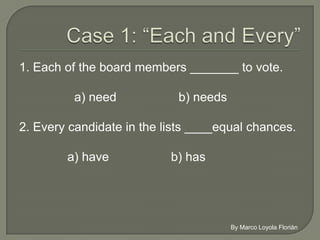
1. Each of the board members _______ to
 vote.

          a) need             b) needs

2. Every candidate in the lists ____equal
 chances.

         a) have            b) has
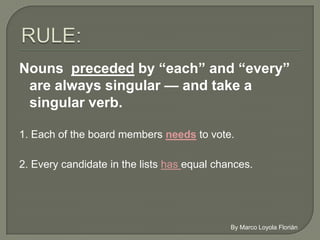
Nouns preceded by “each” and “every” are
 always singular — and take a singular verb.

1. Each of the board members needs to vote.

2. Every candidate in the lists has equal chances.
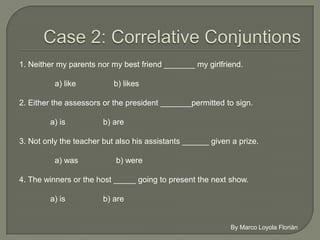
1. Neither my parents nor my best friend _______ my girlfriend.

          a) like           b) likes

2. Either the assessors or the president _______permitted to sign.

         a) is           b) are

3. Not only the teacher but also his assistants ______ given a prize.

          a) was            b) were

4. The winners or the host _____ going to present the next show.

         a) is           b) are
When we have subjects with correlative conjunctions (“neither- nor”,
“either-or”, “not only - but also”, or “or”), the noun CLOSER to the verb
determines its number.


 1. Neither my parents nor my best friend likes my girlfriend.


 2. Either the assessors or the president is permitted to sign.


 3. Not only the teacher but also his assistants were given a prize.


 4. The winners or the host is going to present the next show.
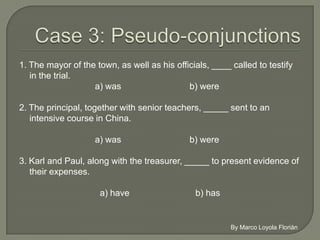
1. The mayor of the town, as well as his officials, ____ called to
  testify in the trial.
                        a) was                b) were

2. The principal, together with senior teachers, _____ sent to an
  intensive course in China.

                     a) was                    b) were

3. Karl and Paul, along with the treasurer, _____ to present
  evidence of their expenses.

                      a) have                   b) has
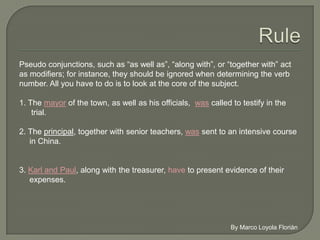
Pseudo conjunctions, such as “as well as”, “along with”, or “together
with” act as modifiers; for instance, they should be ignored when
determining the verb number. All you have to do is to look at the core
of the subject.

1. The mayor of the town, as well as his officials, was called to testify
   in the trial.

 2. The principal, together with senior teachers, was sent to an
    intensive course in China.


 3. Karl and Paul, along with the treasurer, have to present evidence of
    their expenses.
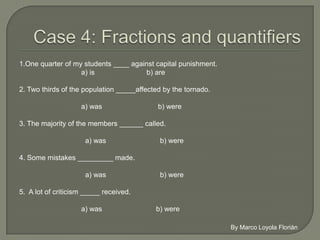
1.One quarter of my students ____ against capital punishment.
                   a) is                b) are

2. Two thirds of the population _____affected by the tornado.

                     a) was                 b) were

3. The majority of the members ______ called.

                      a) was                 b) were

4. Some mistakes _________ made.

                      a) was                 b) were

5. A lot of criticism _____ received.

                     a) was                b) were
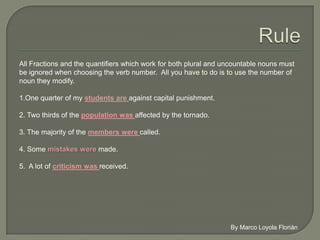
All Fractions and the quantifiers which work for both plural and uncountable
nouns must be ignored when choosing the verb number. All you have to do is to
use the number of noun they modify.

 1.One quarter of my students are against capital punishment.

 2. Two thirds of the population was affected by the tornado.

 3. The majority of the members were called.

 4. Some mistakes were made.

 5. A lot of criticism was received.
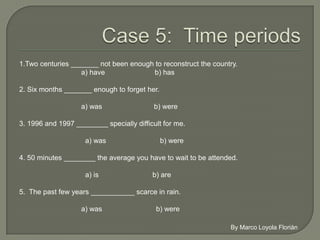
1.Two centuries _______ not been enough to reconstruct the country.
                    a) have               b) has

2. Six months _______ enough to forget her.

                    a) was                 b) were

3. 1996 and 1997 ________ specially difficult for me.

                     a) was                    b) were

4. 50 minutes ________ the average you have to wait to be attended.

                     a) is                 b) are

5. The past few years ___________ scarce in rain.

                    a) was                    b) were
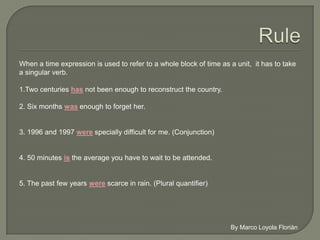
When a time expression is used to refer to a whole block of time as a unit, it has
to take a singular verb.

 1.Two centuries has not been enough to reconstruct the country.

 2. Six months was enough to forget her.


 3. 1996 and 1997 were specially difficult for me. (Conjunction)


 4. 50 minutes is the average you have to wait to be attended.


5. The past few years were scarce in rain. (Plural quantifier)
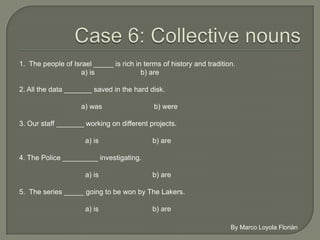
1. The people of Israel _____ rich in terms of history and tradition.
                    a) is                b) are

2. All the data _______ saved in the hard disk.

                     a) was                  b) were

3. Our staff _______ working on different projects.

                      a) is                  b) are

4. The Police _________ investigating.

                      a) is                  b) are

5. The series _____ going to be won by The Lakers.

                      a) is                  b) are
A Collective noun such as “The Police”, or “The staff” take s a PLURAL verb if it is meant to highlight the
actions of discrete individuals who are all doing different things. If the collective noun is acting as a single
unit, use the singular verb.

“People” takes a plural verb ,except when it means “Nation”, in this case it is singular (and its plural is
“PEOPLES” believe it or not!)

“Data” , “Men”, or “Women” always take a plural verb.

Be careful with words which are singular but happen to finish in “s”, like “series”, “Logics”, or “Economics”,
they are all singular and take singular verbs.


1. The people of Israel is rich in terms of history and tradition.

 2. All the data were saved in the hard disk.

 3. Our staff are working on different projects.

 4. The Police are investigating.

5. The series is going to be won by The Lakers.
Ready for a challenge on subject-verb
              agreement?

      Click on the links below!

             Exercise 1
             Exercise 2
             Exercise 3
“ECCE Preparation Course”


                Conducted by:
    Marco A:. Loyola Florián
   Centro Peruano Americano – El Cultural
               Trujillo – Perú

        loyolamarco@hotmail.com

 This presentation can be downloaded from
 www.ecceloyola.pbworks.com

Subject verb agreement

  • 1.
    ECCE PREPARATION COURSE Conducted by: Marco A:. Loyola Florián Centro Peruano Americano – El Cultural Trujillo – Perú mloyola@elcultural.com.pe loyolamarco@hotmail.com www.ecceloyola.pbworks.com
  • 2.
    A singular subject demands a singular verb; a plural subject demands a plural verb. That is the simple principle behind subject-verb agreement.  However, in some case it might be difficult to tell the difference. Explore this presentation to learn more about these cases.
  • 3.
    1. Each ofthe board members _______ to vote. a) need b) needs 2. Every candidate in the lists ____equal chances. a) have b) has
  • 4.
    Nouns preceded by“each” and “every” are always singular — and take a singular verb. 1. Each of the board members needs to vote. 2. Every candidate in the lists has equal chances.
  • 5.
    1. Neither myparents nor my best friend _______ my girlfriend. a) like b) likes 2. Either the assessors or the president _______permitted to sign. a) is b) are 3. Not only the teacher but also his assistants ______ given a prize. a) was b) were 4. The winners or the host _____ going to present the next show. a) is b) are
  • 6.
    When we havesubjects with correlative conjunctions (“neither- nor”, “either-or”, “not only - but also”, or “or”), the noun CLOSER to the verb determines its number. 1. Neither my parents nor my best friend likes my girlfriend. 2. Either the assessors or the president is permitted to sign. 3. Not only the teacher but also his assistants were given a prize. 4. The winners or the host is going to present the next show.
  • 7.
    1. The mayorof the town, as well as his officials, ____ called to testify in the trial. a) was b) were 2. The principal, together with senior teachers, _____ sent to an intensive course in China. a) was b) were 3. Karl and Paul, along with the treasurer, _____ to present evidence of their expenses. a) have b) has
  • 8.
    Pseudo conjunctions, suchas “as well as”, “along with”, or “together with” act as modifiers; for instance, they should be ignored when determining the verb number. All you have to do is to look at the core of the subject. 1. The mayor of the town, as well as his officials, was called to testify in the trial. 2. The principal, together with senior teachers, was sent to an intensive course in China. 3. Karl and Paul, along with the treasurer, have to present evidence of their expenses.
  • 9.
    1.One quarter ofmy students ____ against capital punishment. a) is b) are 2. Two thirds of the population _____affected by the tornado. a) was b) were 3. The majority of the members ______ called. a) was b) were 4. Some mistakes _________ made. a) was b) were 5. A lot of criticism _____ received. a) was b) were
  • 10.
    All Fractions andthe quantifiers which work for both plural and uncountable nouns must be ignored when choosing the verb number. All you have to do is to use the number of noun they modify. 1.One quarter of my students are against capital punishment. 2. Two thirds of the population was affected by the tornado. 3. The majority of the members were called. 4. Some mistakes were made. 5. A lot of criticism was received.
  • 11.
    1.Two centuries _______not been enough to reconstruct the country. a) have b) has 2. Six months _______ enough to forget her. a) was b) were 3. 1996 and 1997 ________ specially difficult for me. a) was b) were 4. 50 minutes ________ the average you have to wait to be attended. a) is b) are 5. The past few years ___________ scarce in rain. a) was b) were
  • 12.
    When a timeexpression is used to refer to a whole block of time as a unit, it has to take a singular verb. 1.Two centuries has not been enough to reconstruct the country. 2. Six months was enough to forget her. 3. 1996 and 1997 were specially difficult for me. (Conjunction) 4. 50 minutes is the average you have to wait to be attended. 5. The past few years were scarce in rain. (Plural quantifier)
  • 13.
    1. The peopleof Israel _____ rich in terms of history and tradition. a) is b) are 2. All the data _______ saved in the hard disk. a) was b) were 3. Our staff _______ working on different projects. a) is b) are 4. The Police _________ investigating. a) is b) are 5. The series _____ going to be won by The Lakers. a) is b) are
  • 14.
    A Collective nounsuch as “The Police”, or “The staff” take s a PLURAL verb if it is meant to highlight the actions of discrete individuals who are all doing different things. If the collective noun is acting as a single unit, use the singular verb. “People” takes a plural verb ,except when it means “Nation”, in this case it is singular (and its plural is “PEOPLES” believe it or not!) “Data” , “Men”, or “Women” always take a plural verb. Be careful with words which are singular but happen to finish in “s”, like “series”, “Logics”, or “Economics”, they are all singular and take singular verbs. 1. The people of Israel is rich in terms of history and tradition. 2. All the data were saved in the hard disk. 3. Our staff are working on different projects. 4. The Police are investigating. 5. The series is going to be won by The Lakers.
  • 15.
    Ready for achallenge on subject-verb agreement? Click on the links below! Exercise 1 Exercise 2 Exercise 3
  • 16.
    “ECCE Preparation Course” Conducted by: Marco A:. Loyola Florián Centro Peruano Americano – El Cultural Trujillo – Perú loyolamarco@hotmail.com This presentation can be downloaded from www.ecceloyola.pbworks.com