Subject-Verb
Agreement
Rules
Agreement Rule for Positive and Negative Subjects
• If the sentence compounds a positive and a negative subject, and one is plural, the
other singular, the verb should agree with the positive subject
Examples:
– The department members but not the chairperson have decided to stand up
against the new regulation.
– It is not the faculty members but the Head of Department who takes this decision.
Positive subject Negative subjectVerb
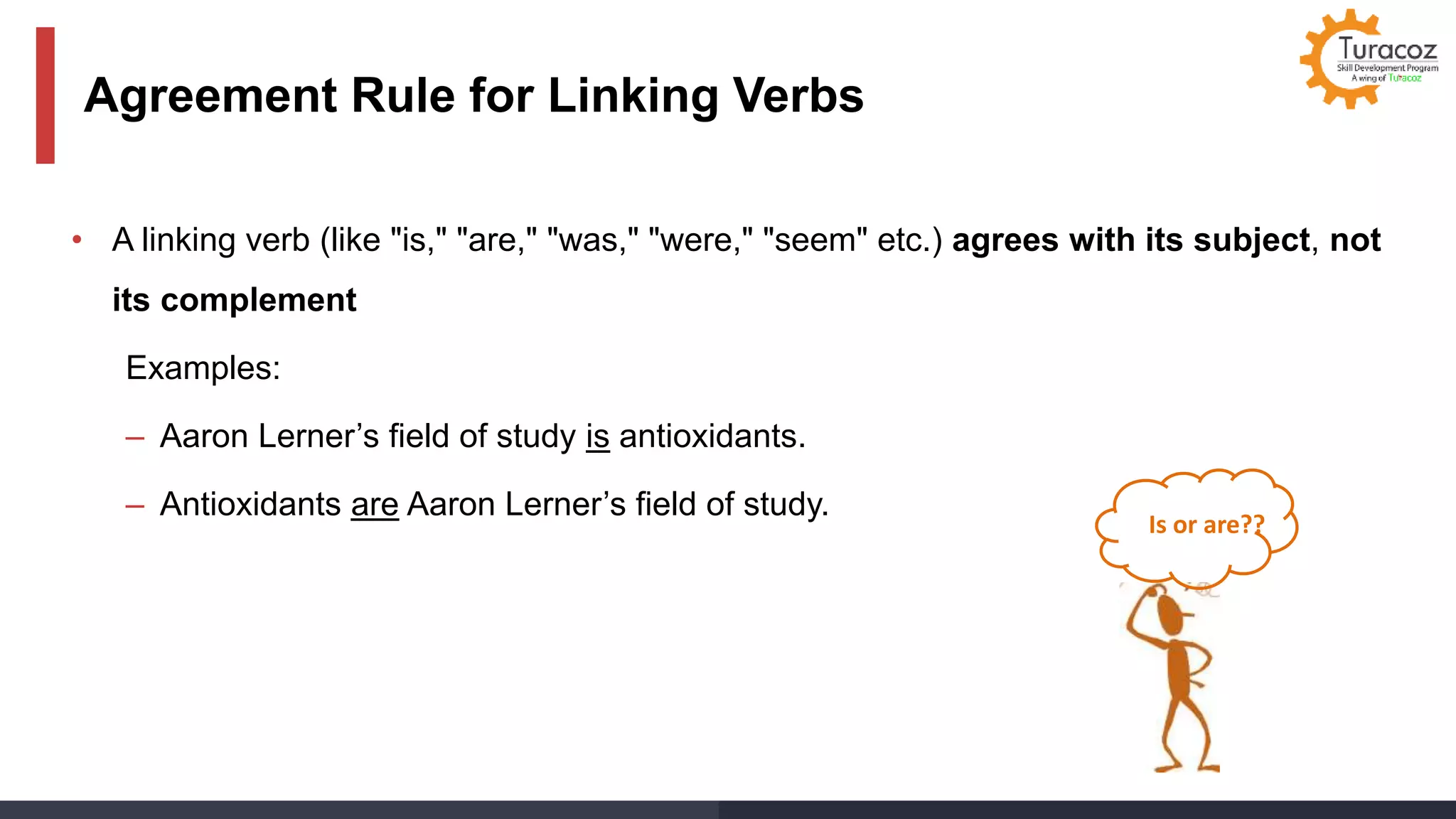
Agreement Rule for Linking Verbs
• A linking verb (like "is," "are," "was," "were," "seem" etc.) agrees with its subject, not
its complement
Examples:
– Aaron Lerner’s field of study is antioxidants.
– Antioxidants are Aaron Lerner’s field of study.
Is or are??
Agreement Rule for Plural Verbs
• Verbs in the present tense for third-person, singular subjects (he, she, it, and anything
these words can stand for) are “singular” (s-endings)
Examples:
– He holds expertise in statistics.
– The diagram is well-labelled. It reveals all the parts of a microscope.
• Verbs for third person, plural subjects are “plural” in nature
Examples:
– They hold expertise in statistics.
– The diagrams are well-labelled. They reveal all the parts of a microscope.
Agreement of Phrases With Verb
• When using as well as, except, in addition to, no less than, and with, the
noun before these phrases determines the nature of verb (singular/plural)
Examples:
– The problem with this document is that it has exceeded the word limit.
– Lifestyle modification, in addition to insulin therapy, is essential for controlling
blood sugar level in diabetes.
– All the articles, except the last one, are published in international journals with
good impact factor.
Agreement Rule for Modifiers
• Modifiers are words, phrases, or clauses that describe (modify) other words or
groups of words
• Can be adverbs or adjectives preceding a verb or a noun, respectively
Examples:
– She delivered a good lecture on nutrition.
– He presented an organized and informative poster on protein supplements.
– The students worked diligently on the new project.
– The discussion on Human Gene Editing Project will be conducted here.
Agreement Rule for Modifiers: Adjectives and Adverbs
Adjectives, as modifiers, will
answer the following questions:
• What color?
• What size?
• How many?
• What condition?
• What emotion?
• What kind?
Adverbs, as modifiers, will answer
the following questions:
• When?
• Where?
• How?
Agreement Rule for Modifiers (contd.)
Sometimes, modifiers will get in-between a subject and its verb, but these modifiers
must not disturb the agreement between the subject and its verb
Example:
The book, that was co-authored by three authors, is likely to be published this year.
Turacoz Skill Development Program
973, H-block First Floor Sector-7,
Dwarka, New Delhi-110075.
+91 – 9810036125
011 – 47039856
hello@turacoz.in
www.tmedicalwritingtraining.com
Thank you
Subject – Verb Agreement

Subject Verb Agreement Rules

  • 1.
  • 2.
    Agreement Rule forPositive and Negative Subjects • If the sentence compounds a positive and a negative subject, and one is plural, the other singular, the verb should agree with the positive subject Examples: – The department members but not the chairperson have decided to stand up against the new regulation. – It is not the faculty members but the Head of Department who takes this decision. Positive subject Negative subjectVerb
  • 3.
    Agreement Rule forLinking Verbs • A linking verb (like "is," "are," "was," "were," "seem" etc.) agrees with its subject, not its complement Examples: – Aaron Lerner’s field of study is antioxidants. – Antioxidants are Aaron Lerner’s field of study. Is or are??
  • 4.
    Agreement Rule forPlural Verbs • Verbs in the present tense for third-person, singular subjects (he, she, it, and anything these words can stand for) are “singular” (s-endings) Examples: – He holds expertise in statistics. – The diagram is well-labelled. It reveals all the parts of a microscope. • Verbs for third person, plural subjects are “plural” in nature Examples: – They hold expertise in statistics. – The diagrams are well-labelled. They reveal all the parts of a microscope.
  • 5.
    Agreement of PhrasesWith Verb • When using as well as, except, in addition to, no less than, and with, the noun before these phrases determines the nature of verb (singular/plural) Examples: – The problem with this document is that it has exceeded the word limit. – Lifestyle modification, in addition to insulin therapy, is essential for controlling blood sugar level in diabetes. – All the articles, except the last one, are published in international journals with good impact factor.
  • 6.
    Agreement Rule forModifiers • Modifiers are words, phrases, or clauses that describe (modify) other words or groups of words • Can be adverbs or adjectives preceding a verb or a noun, respectively Examples: – She delivered a good lecture on nutrition. – He presented an organized and informative poster on protein supplements. – The students worked diligently on the new project. – The discussion on Human Gene Editing Project will be conducted here.
  • 7.
    Agreement Rule forModifiers: Adjectives and Adverbs Adjectives, as modifiers, will answer the following questions: • What color? • What size? • How many? • What condition? • What emotion? • What kind? Adverbs, as modifiers, will answer the following questions: • When? • Where? • How?
  • 8.
    Agreement Rule forModifiers (contd.) Sometimes, modifiers will get in-between a subject and its verb, but these modifiers must not disturb the agreement between the subject and its verb Example: The book, that was co-authored by three authors, is likely to be published this year.
  • 9.
    Turacoz Skill DevelopmentProgram 973, H-block First Floor Sector-7, Dwarka, New Delhi-110075. +91 – 9810036125 011 – 47039856 hello@turacoz.in www.tmedicalwritingtraining.com Thank you Subject – Verb Agreement