EUROPEAN COURSE IN ENTREPRENEURSHIP FOR THE CREATIVE INDUSTRIES                                                              
 
1 
 
   
THE
ENTERTAINMENT
ECONOMY


 EUROPEAN COURSE IN ENTREPRENEURSHIP FOR THE CREATIVE INDUSTRIES                                                              
 
2 
 
The entertainment economy 
Sources:  
 Michael J. Wolf, “The Entertainment Economy – How Mega‐Media Forces are 
Transforming our Lives”, Three Rivers Press, New York, 1999 
 Michael R. Solomon et al., “Consumer Behaviour – a European Perspective”, 
Prentice Hall, 2010 
 The  Economist,  “The  lazy  medium,  How  people  really  watch  television”,  a 
special report on television”, April 29th 2010 
 The Economist, “The international film industry: Avatar 2 Made in China?”, 
April 24th 2012 
 The Economist, “The film industry: China’s film market is proving tough for 
foreign studios to crack”, April 28th
 2012 
 Financial Times, “Iroko Partners: Demand proves insatiable for Nollywood on 
the net” November 22 2011  
 Broadband TV News, “NCIS was Europe’s top drama show in 2011”, May 30 
2012 
 Richard  Broughton,  Daniel  Knapp,    “A  Future  for  TV:  IP‐delivered  video 
advertising in a connected world”, IHS Screen Digest, 2012 
 Ofcom, “TV‐Like qualitative research report”, 2009 
 
Screen Digest Insight Report 
 
Entertainment – not autos, not steel, not financial services – is fast becoming 
the driving wheel of the new world economy 
                                                                                                                                                           Wolf 
(1999) 


 EUROPEAN COURSE IN ENTREPRENEURSHIP FOR THE CREATIVE INDUSTRIES                                                              
 
3 
 
The great influencer 
 
Entertainment is increasingly influencing every choice that each of us makes every day. 
Multiply that by the billions of choices that, collectively, all of us make each day and 
you  have  a  portrait  of  a  society  in  which  entertainment  is  one  of  its  leading 
institutions. The United Kingdom now employs more workers in entertainment (films, 
music,  video  games,  television,  software,  theater,  etc…)  than  it  ever  did  in  its  coal 
mines in the heyday of its empire. 
 
Entertainment as an act Every year, people spend billions of hours on legal forms of 
entertainment. Globally, total annual spending is approaching $1 trillion (Vogel, 2007). 
Entertainment  is  the  act  of  diverting,  amusing,  or  causing  someone´s  time  to  pass 
agreeably. Or entertainment can be defined as anything that stimulates, encourages or 
generates a condition of pleasurable diversion. “But entertainment can be much more 
than  mere  diversion.  It  is  something  that  is  so  universally  interest  and  appealing 
because,  when  it  does  what  it  is  intended  to  do,  it  moves  you  emotionally  (…)  It 
touches your soul.” (Vogel, 2007) 
 
Entertainment as an effect Entertainment is also defined through its effect: a satisfied 
and happy psychological state. Entertainment means so many different things to so 
many  different  people  that  an  analysis  of  entertainment  industry  makes  us  look  to 
many different topics. From  movies, television, music, cable industry and all the pay 
services  that  are  related,  multimedia,  toys  and  games,  live  entertainment  (horse 
racing, lotteries, casinos, different sports, …), performing arts and culture (orchestras, 
opera,  dance,…)  to  amusement  theme  parks,  all  this  is  entertainment.  A  sharper 
analysis  of  entertainment  industry  requires  classifying  entertainment  activities  into 
industry  segments,  that  is,  enterprises  or  organizations  of  significant  size  that  have 
similar  technological  structures  of  production  and  that  produce  or  supply  goods, 
services or sources of income that are substitutable. 
 
Economic  forces  The  study  of  entertainment,  media  and  communication  has 
traditionally been dominated by non‐economic disciplines. Analysis of entertainment 
content, for example, can provide a means of understanding the societies we live in 
and our value systems. But economics is also a valuable subject area for entertainment 
students. Most of the decisions taken by those who run entertainment organizations 
are, to a greater or lesser extent, influenced by resource and financial issues (Doyle, 
2003).  Economic  forces  and  profit  motives  are  always  behind  the  entertainment 
industry. Those are the forces that shape the relative popularity and growth patterns 
of  competing,  usually  interdependent,  entertainment  activities  and  products.  So 


 EUROPEAN COURSE IN ENTREPRENEURSHIP FOR THE CREATIVE INDUSTRIES                                                              
 
4 
 
economics,  as  a  discipline,  is  highly  relevant  to  understanding  how  entertainment 
industry operates. 
 
Entertainment  economics.  Combines  the  study  of  economics  with  the  study  of 
entertainment.  It  is  concerned  with  the  changing  economic  forces  that  direct  and 
constrain the choices of managers, practitioners and other decision‐makers across the 
industry.  Entertainment  economics  is  concerned  with  how  entertainment  operators 
meet the informational and entertainment wants and needs of audiences, advertisers 
and society with available resources or, using a definition of media economics: “how 
media industries use scare resources to produce content (…) to satisfy various wants 
and needs.” (Albarran, 1996)1
 
 
Macro and micro Economics is traditionally studied in terms of macroeconomic and 
microeconomics perspectives. The field of entertainment industry has tended to follow 
suit. The distinction between macro and microeconomics is about whether that which 
is being studied involves large groups and broad economic aggregates or small well‐
defined groups and individual firms and sectors. Macroeconomics examines the whole 
economic system, and is usually studied at a national or a global level. It includes topics 
such  as  economic  growth  indices,  political  economy,  and  national  production  and 
consumption measures by gross domestic product (GDP) and gross national product 
(GNP).  Microeconomics  takes  a  more  narrow  view  by  examining  the  activities  of 
specific  aspects  of  the  economic  system,  such  as  individual  markets,  firms  or 
consumers. It examines topics like market structure, and firm conduct and behavior. 
 
Types of firms Entertainment firms represent individual companies or entities that are 
incorporated through their respective domestic country, that operate for a profit. They 
can be publicly held firms (owned by stockholders or shareholders) or privately held 
firms (also owned by stakeholders but not listed on any stock exchange). Examples of 
publicly held media firms include large conglomerates such as Time Warner, Disney, 
Sony  and  News  Corporation,  or  companies  that  operate  in  only  one  or  two  media 
markets such as Gannet (publishing and television) or Saga Communications (radio). 
Privately held media firms include such companies as Bertelsmann (book publishing, 
Univision, and Clear Channel (Albarran, 2010). 
 
Industries  Economists  define  an  industry  as  a  group  of  sellers  offering  the  same  or 
similar products. Companies that are engaged in cable television, like Comcast, Time 
Warner, and Cablevision, are members of the cable television industry. Direct TV and 
                                                            
1
  Albarran,  A.B.,  &  Dimmck,  J.  (1996).  Concentration  and  economies  of  multiformity  in  the 
communication industries. Journal of Media Economics, 9(4), 41‐50. 


 EUROPEAN COURSE IN ENTREPRENEURSHIP FOR THE CREATIVE INDUSTRIES                                                              
 
5 
 
Echostar  (owner  of  the  Dish  Network)  compete  in  the  satellite  industry.  AT&T  and 
Verizon  are  two  leaders  in  the  telecommunications  industry,  and  also  offer 
multichannel television services similar to cable and satellite known as IPTV (Internet 
Protocol Television). A unique feature of the evolving media industries is the changing 
nature  of  their  markets  and  industries.  Companies  now  compete  with  one  another 
across markets and in different industries in the media economy. 
 
Competition levels An important aspect of the media economy is the concept of levels, 
used to describe where activity among media firms and industries actually takes place 
(Albarran,  2010).  Competing  on  a  global  level,  offering  their  media  products  and 
services throughout the world, are many large companies like Viacom, Disney, Time 
Warners, News Corporation, Bertelsmann and Sony. At the national level, companies 
focus on their domestic boundaries, and attempt to cover the entire country.  
 
Examples  at  the  national  level  include  the  broadcast  networks,  satellite  delivered 
channels  and  magazines.  At  a  household  level,  households  have  access  to  multiple 
devices or platforms capable of receiving content from a number of media firms and 
industries. These devices include television and radio receivers, DVD and DVR players 
desktop and laptop computers, and wired and wireless household networks.  
 
This level is important for tracking not only household media usage but also media –
related  expenditures  and  various  subscriptions  for  media  content.  Finally,  the 
individual level is becoming even more important in the media economy. In a nuclear 
family  household  there  are  differences  in  the  way  parents  use  the  media  in 
comparison to their youngsters. How we choose to spend our time in media‐related 
activities represents an economic action: allocation.  
 
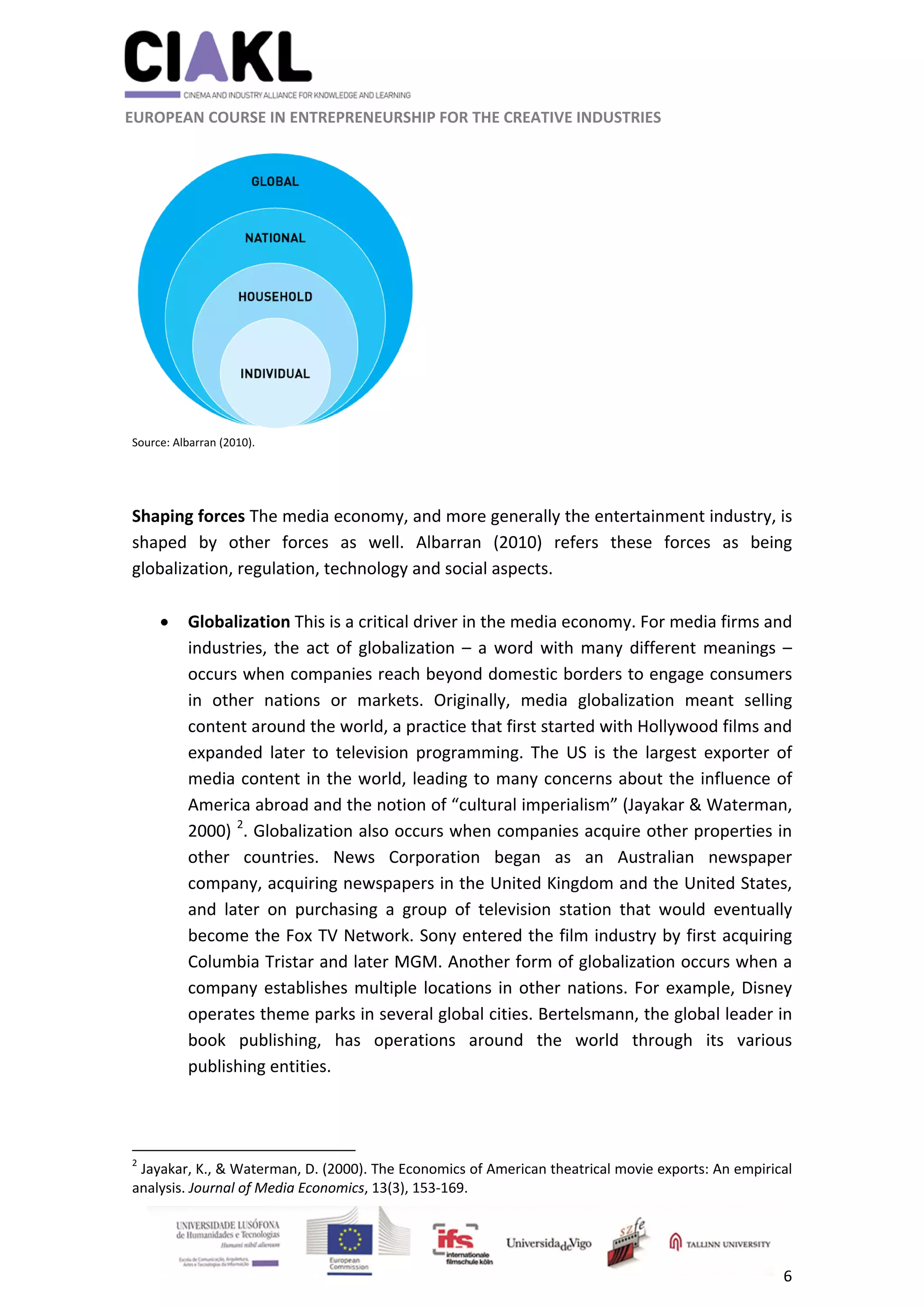
These levels of activity are constantly ongoing in the media economy and in all the 
entertainment industry. A big challenge for media firms is how to develop as multi‐
platform entities that can reach consumers at all levels of activity (see figure 3.1). 
Figure 3.1. 
Multiple Levels of Analysis 


 EUROPEAN COURSE IN ENTREPRENEURSHIP FOR THE CREATIVE INDUSTRIES                                                              
 
6 
 
 
Source: Albarran (2010). 
 
 
Shaping forces The media economy, and more generally the entertainment industry, is 
shaped  by  other  forces  as  well.  Albarran  (2010)  refers  these  forces  as  being 
globalization, regulation, technology and social aspects.  
 
 Globalization This is a critical driver in the media economy. For media firms and 
industries, the act of globalization – a word with many different meanings – 
occurs when companies reach beyond domestic borders to engage consumers 
in  other  nations  or  markets.  Originally,  media  globalization  meant  selling 
content around the world, a practice that first started with Hollywood films and 
expanded  later  to  television  programming.  The  US  is  the  largest  exporter  of 
media content in the world, leading to many concerns about the influence of 
America abroad and the notion of “cultural imperialism” (Jayakar & Waterman, 
2000) 2
. Globalization also occurs when companies acquire other properties in 
other  countries.  News  Corporation  began  as  an  Australian  newspaper 
company, acquiring newspapers in the United Kingdom and the United States, 
and  later  on  purchasing  a  group  of  television  station  that  would  eventually 
become the Fox TV Network. Sony entered the film industry by first acquiring 
Columbia Tristar and later MGM. Another form of globalization occurs when a 
company establishes multiple locations in other nations. For example, Disney 
operates theme parks in several global cities. Bertelsmann, the global leader in 
book  publishing,  has  operations  around  the  world  through  its  various 
publishing entities. 
 
                                                            
2
 Jayakar, K., & Waterman, D. (2000). The Economics of American theatrical movie exports: An empirical 
analysis. Journal of Media Economics, 13(3), 153‐169. 


 EUROPEAN COURSE IN ENTREPRENEURSHIP FOR THE CREATIVE INDUSTRIES                                                              
 
7 
 
 Regulation Another predominant force is regulation and regulatory practices 
that  differ  from  country  to  country.  Through  policy  and  regulation,  business 
and industry are required to follow certain rules and guidelines. Regulation is 
important in establishing and maintaining competition, to protect workers and 
consumers, and to generate government revenues through taxation. 
 
 Technology Has both enhanced and disrupted the media economy. Innovations 
in technology with distribution and reception technologies continue at a rapid 
pace. The wide range of technological advances has forced media companies to 
try  to  keep  up  with  one  another.  The  digital  environment  has  disrupted 
traditional  business  models  (Downes,  2009)3
.  For  media  companies,  finding 
new business models and revenue streams is a major priority. For consumers, 
today´s technological device is likely to be either limited or obsolete in just a 
few months, replaced by another innovation. 
 
 Social aspects Are also important in the media economy. The audience is no 
longer a mass entity, but an aggregate of many different demographic groups 
and  lifestyles  with  different  interests  that  evolve  through  the  life  cycle 
(Albarran, 2010). The composition of the audience is changing almost on a daily 
basis: societies are becoming much more ethnically diverse and multicultural; 
people  are  living  longer  and  working  longer;  younger  people  are  more 
technologically savvy and prefer to access content differently than adults. 
 
Market structures Accordingly to Microeconomic theory, industries can be categorized 
according  to  how  firms  make  price  and  output  decisions  in  response  to  prevailing 
market conditions. In the model assuming perfect competition, firms all make identical 
products,  and  each  firm  is  so  small  in  relation  to  total  industry  output  that  its 
operations  have  a  negligible  effect  on  price  or  on  quantity  supplied.  At  the  other 
idealized extreme is a monopoly structure, in which there are no close substitutes for 
the  single  firm´s  output,  the  firm  sets  prices,  and  there  are  barriers  that  prevent 
potential competitors from entry. 
 
In the real world, however, the structure of most industries cannot be characterized as 
being perfectly competitive or as monopolistic but as somewhere in between. One of 
those in‐between structures is known as monopolistic competition, in which there are 
many sellers of somewhat differentiated products and in which some control of pricing 
and competition through advertising is seen. In an oligopoly structure there are close 
substitutes and pricing decisions may affect the pricing and output decisions of other 
                                                            
3
Downes, L. (2009). The laws of disruption: Harnessing the new forces that govern life and business in the digital age. New York: 
Basic Books. 


 EUROP
 
firms
acco
 
In  m
struc
 
 
Activ
unde
focus
acco
persp
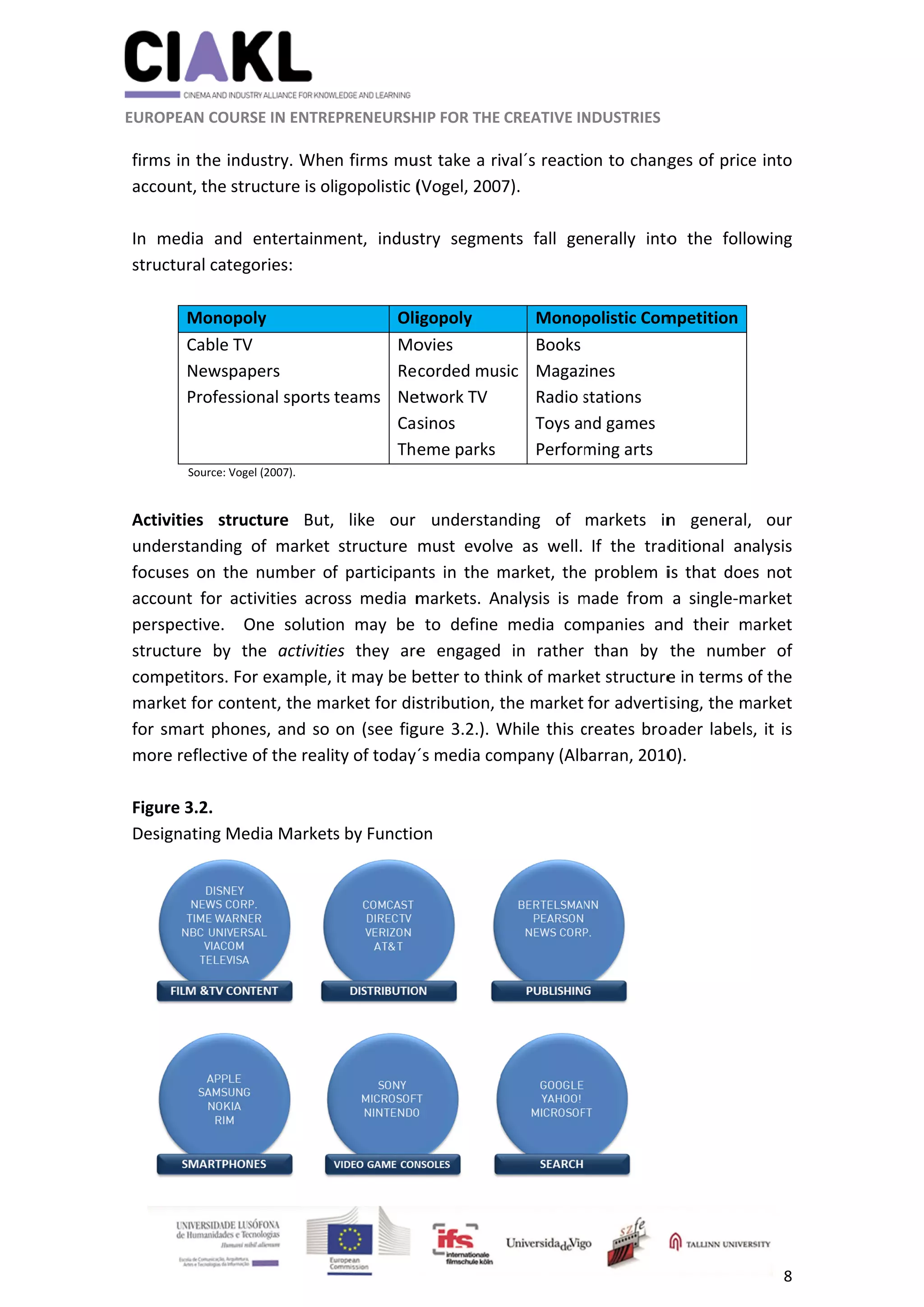
struc
comp
mark
for s
more
 
Figur
Desig
                     
 
PEAN COURS
s in the ind
unt, the str
media  and 
ctural categ
Monopo
Cable TV
Newspap
Professio
Source: Voge
vities  struc
erstanding 
ses  on  the 
unt  for  act
pective.    O
cture  by  th
petitors. Fo
ket for cont
smart phon
e reflective 
re 3.2. 
gnating Me
                      
SE IN ENTRE
ustry. Whe
ructure is ol
entertainm
gories: 
oly 
V 
pers 
onal sports 
el (2007). 
cture  But,
of  market 
number  of
tivities  acro
One  solutio
he  activitie
or example, 
tent, the ma
es, and so 
of the reali
dia Markets
          
EPRENEURSH
n firms mu
igopolistic (
ment,  indus
Oli
teams 
Mo
Re
Ne
Cas
The
  like  our 
structure 
f  participan
oss  media  m
on  may  be 
es  they  are
it may be b
arket for dis
on (see fig
ty of today´
s by Functio
	
HIP FOR THE 
 
ust take a ri
(Vogel, 200
stry  segme
igopoly 
ovies
corded mus
etwork TV 
sinos 
eme parks
understan
must  evolv
nts  in  the  m
markets.  A
to  define 
e  engaged
better to th
stribution, t
gure 3.2.). W
´s media co
on 
CREATIVE IN
val´s reacti
7). 
nts  fall  ge
Monop
sic
Books
Magaz
Radio s
Toys a
Perfor
nding  of 
ve  as  well. 
market,  the
nalysis  is  m
media  com
  in  rather 
ink of mark
the market 
While this c
ompany (Alb
NDUSTRIES  
on to chang
nerally  into
polistic Com
ines 
stations 
nd games 
ming arts 
markets  in
If  the  trad
e  problem  i
made  from 
mpanies  an
than  by 
ket structure
for adverti
creates bro
barran, 2010
 
                      
ges of price
o  the  follo
mpetition 
n  general,
ditional  an
is  that  doe
a  single‐m
nd  their  m
the  numb
e in terms o
ising, the m
oader labels
0). 
                     
8 
e into 
owing 
  our 
alysis 
es  not 
market 
market 
er  of 
of the 
market 
s, it is 


 EUROPEAN COURSE IN ENTREPRENEURSHIP FOR THE CREATIVE INDUSTRIES                                                              
 
9 
 
Locally,  globally,  internationally,  we 
are  living  in  a  digital  entertainment 
economy 
 
The Hollywood Studio System under challenge At the heart of the economic structure 
of the film business lie the Hollywood Studios. These are the six major distributors, 
based in Los Angeles but with worldwide exploitation systems that consistently hold 
the  greatest  share  of  the  world  film  market.  However,  only  two  of  the  Studios  are 
today  wholly  owned  by  American  interests.  This  means  that  the  business  is  truly 
global.  The  Studios  utilize  the  vertical  economic  approach  by  releasing  the  films 
theatrically  first,  and  ensuring  increased  revenues  and  profits  through  creating  a 
system of “windows” where the film is not released onto the next form of media until 
the exploitation in its previous one has been exhausted. They also strategically apply 
the  horizontal  approach  acquiring  rights  to  any  possible  territories  in  which  a  film 
could  be  exploited.  Increasingly,  over  the  last  decade  the  Studios  have  seen  their 
dominance over both conduits of exploitation under increasing pressure and, in certain 
cases,  market  erosion.  This  model  is  being  challenged  by  the  Internet.  New 
technologies have shrunk and opened up the vertical chain model. Increasingly, films 
are distributed at different stages of the old value chain, and move on from there. The 
windows system is breaking up.  
 
Sturm und CSI However, Europeans still love American television series, albeit not at 
prime‐time. The value of imported drama series for European broadcasters was $5,990 
million in 2011, with the top 200 titles supplying 81% ($4,829 million) of that total. The 
Imported Drama Series in Europe report estimated that the top 10 titles accounted for 
23 per cent ($1,400 million) of the 2011 total value, with the top 50 taking 55% ($3,268 
million). CBS distributed the top three titles in 2011, with NCIS leading the pack by 
generating $210 million. The three CSI franchises appear in the top 10. Only one of the 
top 10 titles (Sturm der Liebe) originated from outside the US. Only 22% of the hours 
screened for the top 200 titles appeared in primetime [20,507 hours from 94,638 in 
total]. However, 69 per cent [$3,337 million] of the value created for these titles was in 
primetime. 
The top six US distributors dominate the top 200, creating nearly three‐quarters of the 
value and 56 per cent of the titles. CBS is the clear leader, with second‐placed Warner 
Bros some way behind. However, these six companies are probably not as dominant as 


 EUROPEAN COURSE IN ENTREPRENEURSHIP FOR THE CREATIVE INDUSTRIES                                                              
 
10 
 
many people would have guessed. Indeed, seventh‐placed ZDF [$183 million, 12 titles] 
was pretty close to Sony in 2011. ITV was next with $116 million [9 titles]. Ninth place 
(and the only other distributor to record more than $100 million from Europe’s top 
200  titles)  went  to  Bavaria  Media  [$113  million],  but  this  was  solely  for  Sturm  der 
Liebe. 
The Internet renaissance The wider entertainment industry is growing at a rapid pace 
(contrary  to  doom  &  gloom  messages).  Furthermore,  more  content  creators  are 
producing more content than ever before ‐‐ and are more able to make money of their 
content than ever before. On top of that, consumers are living in a time of absolute 
abundance and choice ‐‐ a time where content is plentiful in mass quantities, leading 
to  a  true  renaissance  for  them.  This  does  present  a  unique  challenge  for  some 
companies used to a very different market, but it’s a challenge filled with opportunity: 
the overall market continues to grow, and smart businesses are snapping up pieces of 
this larger market. The danger is in standing still or pretending the market is shrinking.  
 
Don’t miss the opportunity Data from PricewaterhouseCoopers (PwC) and iDATE show 
that from 1998 to 2010 the value of the worldwide entertainment industry grew from 
$449  billion  to  $745  billion.  That’s  quite  a  leap  for  a  market  supposedly  being 
decimated  by  technological  change.  Of  course,  the  world  economy  grew  over  this 
period  of  time,  but  a  particularly  compelling  bit  of  data  shows  that,  in  the  US 
specifically,  consumer  spending  on  entertainment  as  a  percentage  of  income  has 
continued to rise significantly over the last decade. According to the Bureau of Labor 
Statistics, in 2000, 4.9 per cent of total household spending went to entertainment. 
That number gradually increased over the decade ‐‐ and by 2008, it was up to 5.62 per 
cent,  an  increase  of  nearly  15  per  cent  in  the  same  decade  as  the  internet  went 
mainstream.  
 
More independent jobs Similarly, reports of job losses in the sector are equally hard to 
square  with  reality.  Once  again,  looking  at  the  Bureau  of  Labor  Statistics  data, 
employment in the entertainment sector grew nicely in the decade from 1998 to 2008 
‐‐ rising by nearly 20% over that decade. The BLS continues to predict similar growth 
for the next decade as well. Perhaps even more importantly, during that same period 
of time, BLS data shows that the number of people who were independent artists grew 
at an even faster rate – over 43 per cent growth in that same decade. In fact, this may 
be a strong hint as to why you hear reports of industry "demise" from certain legacy 
players: because new technologies and services have made it much easier for content 
creators to find success without going through the traditional gatekeepers.  


 EUROPEAN COURSE IN ENTREPRENEURSHIP FOR THE CREATIVE INDUSTRIES                                                              
 
11 
 
Massive  output  The  amount  of  new  content  being  produced  has  grown  at  a 
tremendous rate. In 2002, less than a quarter of a million new books were available on 
the market. By 2010 that number was over 3 million. In 2001, the Gracenote database 
had data showing just about 11 million song tracks. By 2010, that number had passed 
100  million.  According  to  the  UN,  in  1995,  there  were  about  1,700  films  produced 
worldwide. By 2009, it was more than 7,000. Meanwhile, during this same period of 
time, the video game industry ballooned massively, leaving its niche status behind, and 
becoming  a  major  part  of  the  wider  entertainment  industry.  By  any  measure,  it 
appears that we are living in a true Renaissance era for content. More money is being 
spent overall. Households are spending more on entertainment. And a lot more works 
are being created. 
 
European flavour Leading European film production and distribution companies offer 
significant  challenge  to  the  Hollywood  Studios’  traditional  hegemony.  On  the  last 
decade, the change across Europe is most marked in domestic films attracting local 
audiences. Often times one local blockbuster is enough to tip the balance in favour of 
the local film. However, the American television products have conquered the lion’s 
share of the European audiences taste for series.  
 
Key cinema data in European countries 2010 – 2011 (provisional)  
 
News source: Press release – European Audiovisual Observatory 


 EUROPEAN COURSE IN ENTREPRENEURSHIP FOR THE CREATIVE INDUSTRIES                                                              
 
12 
 
 
Bollywood  to  the  next  level  India  is  the  largest  producer  of  films  in  the  world  by 
quantity. But Bollywood’s low revenues reflect the shortage of screens in India relative 
to the huge population; and low ticket prices, on average less than a $1 a seat. Yet the 
industry  has  reason  for  optimism:  prices  are  rising,  with  the  development  of  urban 
multiplexes that charge about $3 for a seat and up to $7 at weekends. KPMG forecasts 
revenues will rise by about 30 per cent by 2015, buoyed by higher ticket sales and 
more expensive television rights, amid an insatiable demand for entertainment from 
an increasingly affluent population. Yet foreign sales remain a tempting target.  
 
“Ra.One” costing more than $30m is by far the most expensive Bollywood picture ever 
made. Packed with slick, high‐technology visual effects of a quality never before seen 
in an Indian film, the film is a classic Hindi tale of good versus evil. Bollywood and other 
Indian  regional  cinema  appeals  to  audiences  in  many  countries  outside  the  west, 
where  it  is  already  a  competitor  with  Hollywood.  “Indian  films  have  as  much  of  a 
chance there as anyone else, as long as we make films that have some universal truths 
and compelling characters,” Indian film makers say. Most insiders,  owever, are more 
cautious on whether Bollywood can make serious inroads into western markets.  
 
As  Bollywood  evolves,  its  assault  on  Hollywood’s  hegemony  will  intensify.  Reliance 
plans an English version of its forthcoming film Kites, about a conman in Las Vegas. In 
recent years, Bollywood films have found favour in eastern Europe, Germany, east Asia 
and other non‐English‐speaking countries where audiences are already accustomed to 
watching dubbed Hollywood movies. Among mainstream audiences in the Anglophone 
world,  however,  success  has  been  elusive.  India’s  emerging  middle‐class  enjoys 
watching  its  favourite  beautiful  stars  cavort  in  exotic  locales  such  as  Thailand, 
Singapore, Australia, the US and Europe. That trend has been facilitated by tax breaks 
and other production incentives from foreign countries, which see Bollywood films as a 
way to grab a slice of the fast‐growing Indian outbound tourism market. This year’s 
coming‐of‐age movie, Zindagi Na Milegi Dobara, about three friends on a pre‐marriage 
road  trip,  was  produced  in  close  collaboration  with  the  Spanish  tourism  promotion 
agency. 


 EUROPEAN COURSE IN ENTREPRENEURSHIP FOR THE CREATIVE INDUSTRIES                                                              
 
13 
 
 
Nollywood goes to the Internet The Nigerian film industry turns out more than 2,000 
films a year, making it the world’s second‐biggest film industry by output after India’s 
Bollywood. Nollywood sprang up in the 1990s as home video cameras allowed films to 
be produced at lower cost. A typical budget is only $30,000. In 2006 Nigeria made 872 
films  (in  video  format,  with  about  half  of  them  in  English),  about  200  less  than 
Bollywood  and  roughly  400  more  than  Hollywood.  Already  massive  in  Africa, 
Nollywood is now gaining a reputation elsewhere. Copies of the movies are on offer at 
markets throughout the continent. Most of these are illegal copies, however, meaning 
most  Nigerian  film‐makers  derive  little  financial  benefit  from  their  international 
popularity.  Most  of  these  are  illegal  copies,  however,  meaning  most  Nigerian  film‐
makers derive little financial benefit from their international popularity. 
 
Yet  the  internet  is  beginning  to  change  that,  says  Jason  Njoku,  a  London‐born  web 
entrepreneur who has attracted a worldwide monthly audience of more than 1m to his 
Nollywood streaming service.  His company, Iroko Partners, is racing to keep up: it has 
bought  the  online  distribution  rights  to  1,600  films  since  November  2010.  The 
fragmented  nature  of  the  industry,  with  more  than  500  production  businesses,  is  a 
boon for the digital distribution business, whose experience has been unlike that of 
Netflix, the US film streaming site, which has faced tough negotiations with five or six 
big Hollywood studios. Much of this demand from the Nigerian diaspora has been filled 
by pirate videos. New York authorities, for instance, seized more than 10,000 bootleg 
Nollywood films in November 2010. While slow download speeds and limited internet 
penetration  meant  online  distribution  in  Africa  was  restricted,  there  is  a  vast, 
untapped market among African Nollywood fans in North America, Europe and other 
developed  regions.  The  proposition  was  also  bound  to  be  attractive  to  the  film 
producers, who had previously gained almost no income from foreign sales of their 
films. 
 
China’s pull The Middle Kingdom is now the world’s second‐biggest film market after 
America. It  has a booming home‐grown film industry, making historical dramas and 
romantic  comedies,  but  foreign  blockbusters  are  the  big  money‐earners.  Although 
most films are pirated on release and viewed online and on dodgy DVDs, the rising 
middle classes are increasingly willing to fork out for a night at the cinema. In 2011 
China’s box‐office take rose by more than 30 per cent, to over $2 billion, according to 
the Motion Picture Association of America. The number of cinema screens in China has 
doubled in five years, to nearly 11,000 —again, second only to America.  
 
The gravitational pull of the Chinese movie market, nonexistent less than a generation 
ago,  is  now  an  undeniable  force,  sucking  in  all  Hollywood  blockbusters  (and  lesser 


 EUROPEAN COURSE IN ENTREPRENEURSHIP FOR THE CREATIVE INDUSTRIES                                                              
 
14 
 
projects)  that  venture  within  its  event  horizon.  Hollywood  studios,  independent 
producers and directors regularly cycle through Beijing in search of partnerships with 
Chinese production houses—often seeking money to finance their movies, as well as 
access to a suddenly lucrative market. In 2012 China will surpass Japan as the world’s 
second‐largest  movie  market,  after  America.  Chinese  box‐office  takings  totalled  13 
billion yuan ($2.06 billion) in 2011, an increase of 30 per cent from 2010, which in turn 
had  been  more  than  60%  higher  than  in  2009.  The  number  of  movie  screens  has 
doubled in five years to more than 10,000 (and is projected to reach 15,000 in speedy 
fashion), and the new screens are mostly digital and 3D‐capable. Meanwhile America’s 
market  is  stagnating.  Takings  in  North  America  (America  and  Canada  combined) 
declined  by  4%  in  2011,  to  $10.2  billion.  China’s  box‐office  revenues  may  overtake 
America’s by 2020. 
 
Brand Empires  
 
Disney  is  not  animation  In  today´s  environment,  mind  share  –  how  well  the  public 
knows your brand and cares about it – often precedes market share. A brand that has 
the trust and allegiance of the consumer and that puts forward a simple, direct “high 
concept” idea, is positioned to survive in an increasingly crowded marketplace. To cut 
through the daily clutter of messages and products, a brand needs to do more than 
identify a product, it must give it a personality. By our allegiance to certain brands, we 
say something about ourselves. Brands transcend particular products and carry with 
them a whole cultural statement. 
 
Entertainment companies, whose products are purely cultural, have long recognized 
this trend and, acting on it, have not merely created strong brands; they have built 
brand empires.  They have carved out pieces of our collective psyche that transcend 
any single product. We have a relationship with these companies that disposes us to 
accepting,  or  at  least  giving  a  courtesy  look  at,  any  product  with  their  brand  on  it. 
Disney  doesn´t  simply  mean  animated  features  or  theme  parks  anymore:  it  means 
family. Bloomberg is not just a terminal on a trader´s desk; it is instantaneous financial 
news and analysis. The NBA isn´t about watching tall men put the ball in the basket 
with a high degree of accuracy; it´s about a fast, urban, street lifestyle, whit all the glitz 
and glamour of showbiz. 
 
Through  brands,  consumers  can  gain  entrance  to  a  world  that  embodies  a  simple, 
powerful idea: family, taste, money, or fun. The old definition of a brand carrying a 
product´s  attributes  has  become  secondary  to  the  way  a  brand  makes  a  lifestyle 


 EUROPEAN COURSE IN ENTREPRENEURSHIP FOR THE CREATIVE INDUSTRIES                                                              
 
15 
 
statement.  Consumption  of  a  brand´s  products  empowers  the  consumer  with  the 
qualities of the brand. The base principle remains the same: consume and become. 
 
Entertainment franchises Consumers like the endorsement of a company name they 
recognize, but the new offerings of the brand have to fill a need or supply a distinct 
pleasure of their own. Entertainment brands have had to compete in an increasingly 
crowded  marketplace,  where,  though  the  pie  keeps  growing,  the  slices  are  getting 
smaller as more products compete for audiences. It is no longer sufficient merely to 
turn out a hit movie, television show, magazine, or book, because in many cases these 
products cannot be profitable on their own. A hit must become a franchise and, in so 
doing, become the hub from which a wide‐reaching variety of products emanates. Hits 
and,  even  more  so,  phenomena,  behave  like  brands.  By  occupying  every  available 
niche in popular culture, hits become long‐lived, wide‐reaching brands.  
 
Multiple revenue streams The choice is not whether or not a hit should be leveraged; 
a  hit  product  that  doesn´t  move  out  into  the  wider  economy  and  cultural  realm  is 
doomed to be a flash in the pan. For the period of time that The X‐Files occupied its 
favored place in the cultural spectrum, it was as a real brand like many others. As a 
television show, books, movies, a traveling road show, home videos, hats, t‐shirts, and 
other merchandising, we watched a brand with revenues in excess of more than $1 
billion.  And  what  about  Lara  Croft?  She  wasn´t  a  TV  show,  she  became  by  being  a 
heavily  armed  digital  figure  who  was  the  main  character  in  the  Tomb  Raider  video 
games.  With  millions  games  sold,  several  books,  a  best‐selling  action  figure,  high‐
priced fashion gear, and films where she became Angelina Jolie, her revenues were 
tremendous. Jurassic Park was a hit book, but Universal and Steven Spielberg built a 
brand  empire.  Jurassic Park  became  a  brand  that  meant dinosaurs.  The  big cultural 
concept is that we are all fascinated by dinosaurs. 
 
Granted, all this marketing and leveraging is a far cry from the primal entertainment 
experience  of  sitting  in  a  darkened  room  and  watching  a  projected  image,  but 
increasingly,  without  multiple  revenue  streams  there  would  ultimately  be  no  profit, 
and no profit means no long‐term business. 


 EUROPEAN COURSE IN ENTREPRENEURSHIP FOR THE CREATIVE INDUSTRIES 
1 
 
 
CONSUMER
BEHAVIOUR


 EUROPEAN COURSE IN ENTREPRENEURSHIP FOR THE CREATIVE INDUSTRIES 
2 
 
Consumer behaviour 
Sources:  
 Nuno  Cintra  Torres,  “A  Model  to  Improve  Pay  TV  Subscriber  and  Viewer 
Experience, The seamless integration of complex technologies, processes and 
contents are the key to achieve customer satisfaction and improve loyalty”, 
University of Liverpool, 2006 
 The  Economist,  “The  lazy  medium,  how  people  really  watch  television”,  a 
special report, April 29, 2010 
 Michael J. Wolf, “The Entertainment Economy – How Mega‐Media Forces are 
Transforming our Lives”, Three Rivers Press, New York, 1999 
 
 
«Although life is full of constraints and disciplines, responsibilities and chores, 
and a host of things disagreeable, entertainment, in contrast, encompasses activities 
that people enjoy and look forward to doing, hearing, or seeing. This is the basis for 
the demand for – or the consumption of entertainment of products and services».  
Vogel (2001)  
 
Experimental possession 
 
Audiovisual entertainment: non‐goods services Audiovisual entertainment falls within 
the  experimental  possession  type  of  non‐goods  services.  In  the  case  of  pay  TV,  the 
subscriber pays a monthly fee for the right to “experimental possession” of television 
programming, a non‐goods service. When consumers go to the movies they “own” the 
film  for  the  performance’s  duration.  A  (re)definion  of  services  is  provided  by  Judd 
(1964):  
 
 The right to possess and use a product (Rented Goods Services) 
 The customer creation of, repair, or improvement of a product (Owned Goods 
Services) 
 No  product  element  but  rather  an  experience  or  what  might  be  termed 
experimental possession (Non‐Goods Services) 
 
Intangibility  Grönroos  (1978)  addresses  the  difficulty  in  developing  a  concrete, 
tangible service offering because «the most important characteristic of a service is its 
intangibility».  In fact, the service concept is itself confusing: the customer does not 
own anything when a service is purchased, but is only given the right to use. The lack 


 EUROPEAN COURSE IN ENTREPRENEURSHIP FOR THE CREATIVE INDUSTRIES 
3 
 
of ownership and transaction of ownership when dealing with services results from the 
intangibility of services. 
 
Service  is  all  Some  authors,  like  Chase  et  al.  (1973‐2006),  argue  that  the  emerging 
model is that every organization is, in fact, in the service business. Services encompass 
manufacturing  and  the  services  provided  to  the  firm’s  internal  customers. 
Parasumaran  et.  al  (1985)  define  three  characteristics  of  services  that  must  be 
acknowledged for a full understanding of service quality.  
 Intangibility: they are performances rather than objects 
 Heterogeneity: their performance often varies from producer to producer, from 
customer  to  customer,  and  from  day  to  day;  consistency  of  behaviour  from 
service personnel (i.e., uniform quality) is difficult to assure  
 Inseparability: production and consumption of many services are inseparable  
 
Expectations/performance  According  to  Parasumaran  et  al.  (1985)  «quality  is  a 
comparison  between  expectations  and  performance».  Lewis  and  Booms  (1983) 
describe service quality as «a measure of how well the service level delivered matches 
customer  expectations.  Delivering  quality  service  means  conforming  to  customer 
expectations  on  a  consistent  basis».    Other  authors  (Gronröos  1982)  contend  that 
consumers  compare  the  service  they  expect  with  perceptions  of  the  service  they 
receive  in  evaluating  service  quality.  Parasumaran  et  al.  recall  that  much  the  same 
reasoning was developed by Smith and Houston (1982) who claimed that satisfaction 
with services is related to confirmation or disconfirmation of expectations.  
 
Types  of  customer  satisfaction  Anderson  et  al.  (1994)  conceptualize  customer 
satisfaction  as  transaction‐specific  or  cumulative.  From  the  behaviour  transaction‐
specific  perspective,  it  is  viewed  as  a  post‐choice  evaluative  judgment  of  a  specific 
purchase occasion. Cumulative satisfaction is an overall evaluation based on the total 
purchase  and  consumption  experience  with  a  good  or  service  over  time.  The 
cumulative satisfaction is a more fundamental indicator of the firm’s past, current, and 
future performance. In fact, these authors argue that «it is cumulative satisfaction that 
motivates a firm’s investment in customer satisfaction».  
 
Quality/Satisfaction conceptualisations A review by Johnson et al. (2002) of relevant 
literature  establishing  the  difference  between  quality  and  customer  satisfaction 
produced the following conceptualisations: 
 Behaviour:  Perceived  quality  is  the  consumer’s  judgement  about  a  product’s 
overall excellence or superiority 
 Marketing  and  economics:  Quality  as  dependent  on  the  level  of  product 
attributes  


 EUROPEAN COURSE IN ENTREPRENEURSHIP FOR THE CREATIVE INDUSTRIES 
4 
 
 
 Operations management: Quality is defined as having two primary dimensions: 
Fitness for use and Reliability  
 Services:  Quality  is  an  overall  assessment;  service  quality  in  this  context  is 
believed  to depend  on gaps  between  delivered  and  desired  service on  certain 
dimensions. 
 
Price  and  value  Often,  in  the  absence  of  tangible  evidence  on  which  to  evaluate 
quality,  consumers  must  depend  on  other  cues.  Price  becomes  a  pivotal  quality 
indicator.  However,  some  authors,  like  Rhodes  (2001),  consider  that  the  new 
consumer  is  not  driven by  price.  It is  just  one early  filter  that  may  not  be  decisive. 
Modern  consumers  demand  better  value  for  their  money.  Other  product 
characteristics then gain greater relevance and provide a basis for real differentiation 
based on delivering emotional benefits. Marn et al. (2002) argue that marketers view 
pricing  in  the  context  of  determining  the  overall  price  premium  that  the  product 
deserves in the market place. Thus, these authors claim, «the primary force in play is 
customer  perception,  or,  more  to  the  point,  how  customers  weigh  their  product’s 
benefits against a competitor’s offerings». In fact, when a supplier is better at meeting 
the needs of a particular market segment, they become the preferred alternative for 
which  customers  will  pay  some  premium,  as  noted  by  Johnson  et  al.  (2002).  Some 
authors, like Kotler and Anderson (1994), claim that «there is ample empirical support 
for quality as an antecedent of customer satisfaction». 
 
The  “new  consumer”  The  prevailing  understanding  today  is  that  nobody  owns  the 
customer, rather, the customer owns the firm. Customers no longer are seen just as 
consumers. They are now also experience seekers. Furthermore, the customer is no 
longer  “king”.  According  to  some,  like  McKinsey  and  Company  (2006),  at  a  time  of 
exigent  customers,  fragmenting  segments,  burgeoning  products  and  services  the 
customer has become a tyrant. The nature of the consumer as the key protagonist was 
highlighted by Braudillard (1971) in works like «The Consumer Society». According to 
this view, from a production‐driven we’ve moved to a consumption‐led economy in 
which  value  is  created not  at  the  point  of  value  exchange  but  during  consumption, 
thereby defining not only the nature of what has to be produced but also the identity 
of the consumer. The experience‐seeking consumer is an important notion according 
to  Holbrook  and  Hirschman  (1982),  quoted  by  Stuart‐Menteth,  Wilson  and  Baker 
(2006), who define the consumption experience as «a personal occurrence, often with 
important emotional significance, founded on the interaction with stimuli which are 
the products or services consumed».   


 EUROPEAN COURSE IN ENTREPRENEURSHIP FOR THE CREATIVE INDUSTRIES 
5 
 
 
These authors provide the following “new consumer” classifications based on several 
authors: 
  Cynical → Integrity 
  Knowledgeable → Meaningfulness  
  Time Constrained → Relevance   
  Tribal → Tribal valida on 
  Individual → Customisa on 
  Demandingness → Excellence in Expecta on 
  Active → Par cipa on   
 
Design, deliver, develop To achieve an integrated consumer experience, Allen et al. 
(2005) consider the adoption of three necessary steps, the “The Three D’s of Customer 
Experience”: 
 Design the right offers and experiences for the right customers  
 Deliver  these  propositions  by  focusing  the  entire  company  on  them  with  an 
emphasis on cross‐functional collaboration 
 Develop capabilities to repeatedly please customers by revamping the planning 
process,  training  people  in  how  to  create  new  customer  propositions,  and 
establishing direct accountability for the customer experience 
 
A  new  differentiator  In  a  world  of  commoditizing,  customer  experience  is  the  new 
differentiator.  Shaw  et  al.  (2002)  reveal  that  85  per  cent of  senior  business  leaders 
agree  that  differentiating  solely  on  the  traditional  physical  elements  such  as  price, 
delivery, availability and lead times is no longer a sustainable business strategy. These 
authors define customer experience as an interaction between an organization and a 
customer.  It  is  a  blend  of  an  organization’s  physical  performance,  the  senses 
stimulated  and  emotions  evoked,  each  intuitively  measured  against  customer 
expectations across all moments of contact. Five stages of customer experience can be 
considered:  
 Expectations  setting:  brand  image,  advertising,  what  people  say,  own 
experience with similar company, own experience with similar markets, own 
imagination 
 Pre‐purchase  interactions:  information  gathering,  environment  and  local 
assessment 
 Purchase  interactions:  starts  with  decision  to  buy,  the  heart  of  customer 
experience 
 Product or service consumption: may occur in minutes or in years 
 Post‐experience review: Intuitive review of performance against expectations 


 EUROPEAN COURSE IN ENTREPRENEURSHIP FOR THE CREATIVE INDUSTRIES 
6 
 
 
The experience value chain To address the introduction of an organizational culture 
and  process  for  consistently  delivering  superior  customer  experiences,  Forrester 
proposes that firms develop what it calls the Customer Experience Value Chain (CxVC) 
that combines two major components:  
 Customer‐centric DNA, consisting of two elements: 
 
 Customer  familiarity,  to  design  a  persona,  a  composite  description  of  real 
people who represent a primary customer segment 
 Organizational  engagement  to  create  the  change  necessary  across  the 
company  and  to  engage  in  companywide  efforts  that  demonstrate  a  clear 
commitment to serving customer needs 
 Experience design process, to enable interactions that connect emotionally with 
target customers at key moments 
 Define  interaction  personality  to  bridge  the  chasm  that  exists  between 
marketing messages and the interactive experiences delivered by the rest of 
the firm 
 Identify high‐impact moments, companies need to identify which interactions 
have the largest impact on users 
 Enable the experience by creating a feeling of excitement 
 Measure and refine 
 
The  experience  economy  Experiences  provide  sensory,  emotional,  cognitive, 
behavioural and relational values that replace functional values, leading to what Pine 
and  Gilmore  (1998)  define  as  the  “experience  economy”.  The  implications  of  this 
experience‐seeking consumer reinforces the necessity of a coordinated or integrated 
set of actions, including brand communication and delivery, to highlight what is unique 
about the product. 
These are considered the primary tools for building emotional ties. 
Furthermore, as argued by Coyles et al. (2005), the importance of emotion is relevant 
in the context of loyalty, because, of three basic customer attitudes – emotive, inertial, 
and deliberative – emotive customers are the most loyal. Feeling strongly that their 
current purchases are right for them and that their chosen product is the best, emotive 
customers,  rarely  reassess  purchasing  decisions.  Deliberative  and  inertial  customers 
represent, on average, more than half the total. But the Coyles et al. study argues that, 
although  emotionally  loyal  customers  often  constitute  a  relatively  small  segment, 
«building emotional ties should be a long‐term goal for most companies». Emotionally 
loyal customers are the most valuable because of their higher spending and lower rate 
of downward migration.  


 EUROPEAN COURSE IN ENTREPRENEURSHIP FOR THE CREATIVE INDUSTRIES 
7 
 
 
Emotions lead to loyalty Loyalty is an emotion that addresses the fundamental human 
need of belonging – to a family, a tribe, a social group, argue Shaw et al. This feeling 
provides a sense of security because people like to be loyal to winners as a result of 
the association with success it brings. Reichheld (2006) considers emotions as one of 
the two conditions necessary for customers to make a personal referral. Not only they 
must  believe  that  the  company  offers  superior  value  (price,  features,  quality, 
functionality, ease of use, and all the other practical factors), but they also must feel 
good about their relationship with the company. On the first dimension, a company is 
engaging the customer’s head. On the second, it is engaging the heart. 
 
Promoters, passives, detractors The business goal isn’t merely to delight customers 
but to turn them into promoters, argues Reichheld (2006). These customers are loyal 
enthusiasts who keep buying from a company and urge their friends to do the same. 
They account for 80 per cent of the referrals. Passives are satisfied but unenthusiastic 
customers  who  can  be  easily  wooed  by  the  competition.  Referrals  are  50  per  cent 
lower  than  those  from  promoters.  For  the  average  firm,  more  than  two  thirds  of 
customers are passives, bored, or detractors. The latter are unhappy, angry customers 
trapped  in  a  bad  relationship.  Together  they  account  for  80  per  cent  or  more  of 
negative  word‐of‐mouth  comments.    In  The  Ultimate  Question  (2006)  Reichheld 
proposes asking “How likely is it that you would recommend this company to a friend 
or colleague?” and correlate it to the number of years the customer has been with the 
firm.  The  equation  will  provide  a  reliable  customer  satisfaction  score.  This  single 
question purportedly allows companies to track promoters and detractors, producing a 
clear measure of an organization’s performance through its customers’ eyes — the Net 
Promoter® Score.  
 
Segmentation, malleability and collaboration Today, different customers want to do 
business differently, and being profitable means having the capabilities that allow for 
malleability. The key is to understand that a value proposition is not merely a product 
or  service;  it  includes  the  entire  customer  experience.  The  psychographic  and 
behavioural variables are particularly relevant to provide the data necessary to target 
each  segment  by  a  different  and  appropriate  experiential  marketing  mix.  To  create 
unique customer experiences for selected segments or to respond quickly to shifts in a 
segment's value becomes the objective. But most companies lack the planning systems 
necessary to establish the pertinent roles and processes, argue Collins et al. (2006). 
Understanding and acting on segment‐ or customer‐level information often requires 
collaboration among a number of functions that interact with customers across the 
organization, something that may prove to be difficult to achieve. In fact, according to 
Temkin (2004), only 24 per cent of American firms have a single person responsible for 
customer experience. 


 EUROPEAN COURSE IN ENTREPRENEURSHIP FOR THE CREATIVE INDUSTRIES 
8 
 
 
The emotional consumer of the emotive industry Audiovisuals operate in a strongly 
motivated  emotional  environment.  During  the  last  decades  TV  and  pay  TV  became 
central to the way of life of hundreds of millions of persons. Furthermore, the pay TV 
subscriber is a multifaceted persona: as a passive viewer, as an active participant, as a 
user of technologies, as a paying customer of a subscription service, as an individual, as 
a family member, as a member of an interest group. 
 
The  E‐factor  The  means  of  distributing  television  are  now  ubiquitous.  «It's  TV  that 
people  want,  however  it  is  delivered»,  writes  journalist  Chris  Forrester  (2006). 
However,  just  as  any  other  industry,  television  is  not  entertaining  per  se.  It  is 
entertainment  that  must  remain  entertaining  in  order  to  capture  audiences  and 
subscribers,  an  ever  more  complex  congregation.  Companies  need  to  provide 
entertainment experiences that engage the consumers, what Wolf (1999) calls the E‐
Factor,  that  is,  entertainment  contents  and  experiences.  The  personalization  of  the 
contents, either via the internet or the DVR, should provide a tool to differentiate, at 
least temporarily. But the most effective instrument to improve loyalty should reside 
in service personalization, according to Ball et al. (2006) who studied its effects in the 
banking  sector.  The  authors  argue  that  personalized  services  may  encourage  the 
customer  to  believe  that  the  firm  is  benevolent,  increasing  trust,  which  is  an 
antecedent  of  loyalty.  The  extra  effort  involved  in  personalization  may  thus  be 
attributed to benevolent motives to the firm. Besides, the consumers show a tendency 
to  view  personalized  services  as  difficult  to  replace  with  another  provider.  In  fact, 
while  service  differentiation  is  hard  to  copy,  price  differentiation  is  short  lived  and 
product differentiation is quickly copied. 
 
Passives  and  anytime,  anywhere  consumers  IBM  (2006)  argues  that  the  television 
market evolution hinges on two key market drivers: openness of access channels and 
levels  of  consumer  involvement  with  media.  In  the  near  future,  there  will  be  a 
coexistence of two types of users with disparate channel requirements. The IBM study 
“The  End  of  Television  as  We  Know  It”  argues  that  while  one  consumer  segment 
remains  largely  passive  in  the  living  room,  the  other  will  force  radical  change  in 
business models in a search for anytime, anywhere content through multiple channels. 
The tech‐ and fashion‐forward consumer segment will lead us to a world of platform‐
agnostic content, fluid mobility of media experiences, individualized pricing schemes 
and an end to the traditional concept of release windows. With the advent of video‐
on‐demand and the possibility to personalize the consumption of television through 
the DVR, the TV channel is now being remodelled around the concept of the channel‐
as‐show window of a main brand supported by several sub‐ and sub‐sub‐brands. These 
brands are no longer confined to a specific medium.  


 EUROPEAN COURSE IN ENTREPRENEURSHIP FOR THE CREATIVE INDUSTRIES 
9 
 
 
High  involvement  Cinema  and  television  can  be  classified  as  high‐involvement 
categories,  according  to  the  Fishbein  and  Ajzen  theory  of  reasoned  action  for 
predicting  purchase  behaviour,  cited  by  Jobber  (2004).  The  theory  postulates  that 
«consumers are highly involved in the purchase to the extent that they evaluate the 
consequence  of  the  purchase  and  what  others  will  think  about  it». 
The  decision  to 
subscribe is in general taken within the family. Applying the Blackwell, Miniard and 
Engel (2006) five roles in the purchase decision‐making process (initiator, influencer, 
decider, buyer, user), the home is the buying centre, dominated by the mother, who is 
in general the final decider, with the husband acting as buyer and, together with the 
children, as initiator and influencer and the whole family is the user.  
 
The central role of the family and of family centred entertainment has been reinforced 
in  recent  years.  Forrester  research  by  Charron  et  al.  (2006),  from  1998  to  2003, 
revealed  that  family  and  entertainment  motivations  jumped  in  2000.  American 
consumers are more likely to agree with the statements “Family is the most important 
thing  in  my  life”  and  “I  am  always  looking  for  ways  to  entertain  myself”  than  with 
career motivations. Three years later the trend continued. The September 11, 2001 
terrorist attacks led many consumers to re‐evaluate their priorities, pledging to focus 
more on family and friends. 
 
 
Television, still the ultimate unifier 
 
The lure of the sofa A change in expectations is not quite the same as a change in 
behaviour. Although It may seem dated, but the image of the family clustered around 
the living‐room set is an accurate depiction of how most people watch television in 
most countries. Live television is not just the most popular way of watching video; it 
also influences the way people watch shows on all devices. It is easier than ever to 
watch programmes at a time and on a device of one’s choosing, and people expect to 
be able to do so, nearly all TV is nonetheless watched live on a television set. Even in 
British homes with a Sky+ box, which allows for easy recording of programmes, almost 
85 per cent of television shows are viewed at the time the broadcasters see fit to air 
them.  
“People want to watch ‘Pop Idol’ when everyone else is watching it,” says Mike Darcey 
of BSkyB. If that is not possible, they watch it as soon as they can afterwards. Some 
60% of all shows recorded on Sky+ boxes are viewed within a day. Often the delay is 
only a few minutes—just enough to finish the washing up or to make a phone call.  


 EUROP
 
 
For t
a vid
that 
 
 
Attit
what
what
ease
prog
sofa.
recog
scree
thou
beha
peop
hous
 
The 
degr
be pa
                     
 
PEAN COURS
the most pa
deo‐streami
programme
udes towar
t  “TV‐like” 
t television 
,  passivity 
rammes via
.  This  was 
gnized that
en  househo
ght that TV
aviour. TV w
ple  in  touc
sehold, freq
rising popu
ee of contr
art of this s
                      
SE IN ENTRE
art, internet
ng website
e airing on T
rds TV Rese
meant  to 
was. The tr
and  familia
a a traditio
the  scenar
 viewing be
olds  and  th
V represente
was felt to p
h  with  the
quently bein
ularity of tim
ol and flexi
hift toward
          
EPRENEURSH
t video is us
, says onlin
TV.  
earch carrie
participants
raditional T
arity.  The  m
onal TV scre
rio  most  pa
ehaviour wa
he  rise  of  i
ed societal 
provide new
e  wider  wo
ng switched
me‐shifting 
bility into h
s more pers
	
HIP FOR THE 
sed in the s
ne viewing o
ed out by Of
s.  The  rese
TV viewing e
most  comm
een in the 
articipants 
as increasin
nternet‐bas
shared valu
ws and infor
orld.  It  was
 on even w
TV viewing
households,
sonally tailo
CREATIVE IN
same way. M
of a progra
fcom, the U
earch  explo
experience 
mon  viewing
living room
had  grown
gly changin
sed  progra
ues and ref
rmation, off
s  also  a  co
hen no one
g was recog
, and VOD s
ored viewin
NDUSTRIES 
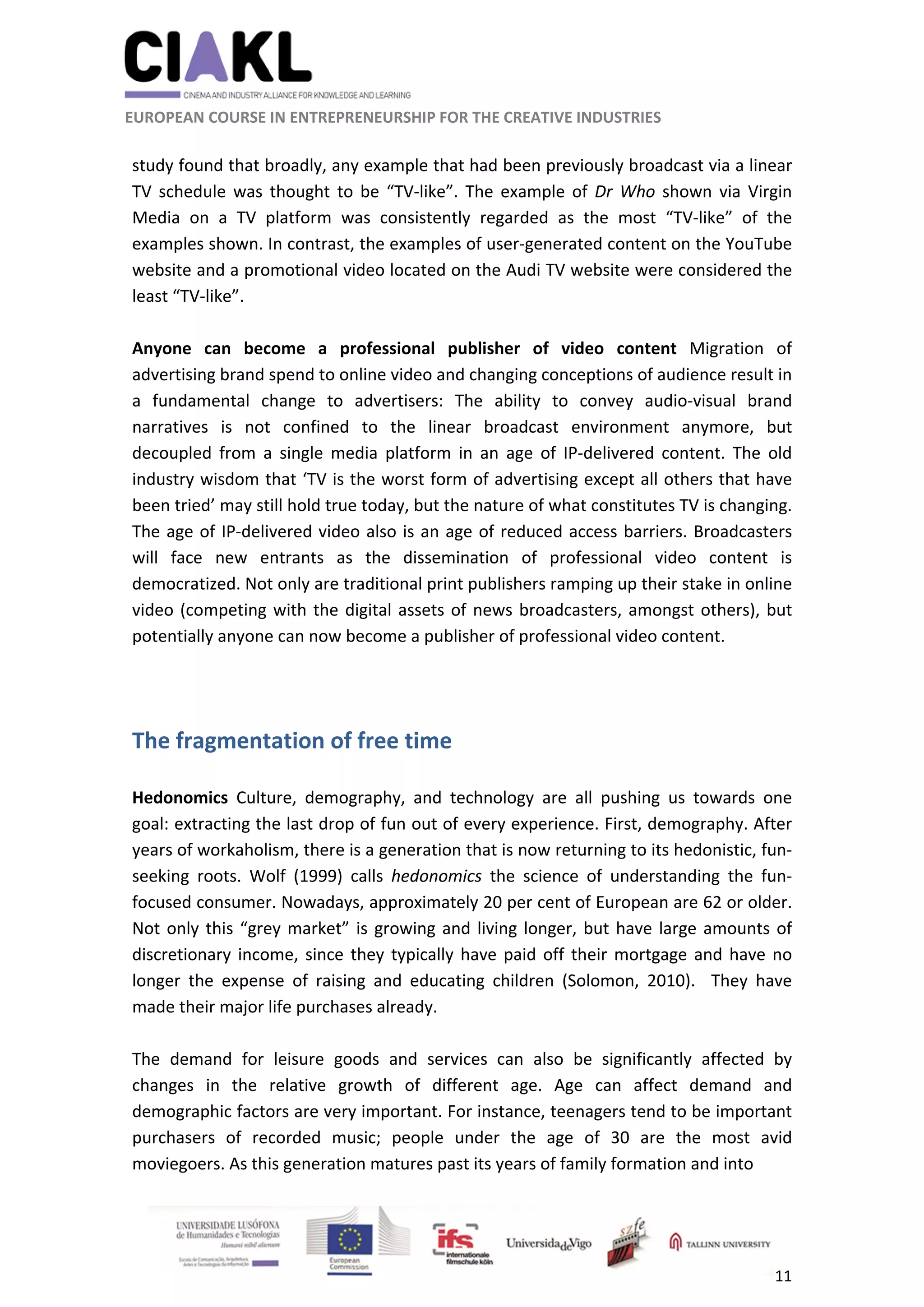
Matthias Bü
mme peaks
UK regulato
red  sponta
was widely
g  context  w
m, from the
n  up  with, 
g over time
mme  servic
lected gene
fer entertai
omforting  p
e was watch
gnised as br
services we
g schedules
üchs of RTL
s within a d
r, set out to
aneous  view
y associated
was  watchin
e comfort o
although  it
e due to mu
ces.  Partici
erally accep
nment and
presence  in
hing. 
ringing a gr
re consider
s. The resea
10 
LNow, 
day of 
o find 
ws  on 
d with 
ng  TV 
of the 
t  was 
ultiple 
pants 
ptable 
keep 
n  the 
reater 
red to 
arch  


 EUROPEAN COURSE IN ENTREPRENEURSHIP FOR THE CREATIVE INDUSTRIES 
11 
 
 
study found that broadly, any example that had been previously broadcast via a linear 
TV  schedule  was  thought  to  be  “TV‐like”.  The  example  of  Dr  Who  shown  via  Virgin 
Media  on  a  TV  platform  was  consistently  regarded  as  the  most  “TV‐like”  of  the 
examples shown. In contrast, the examples of user‐generated content on the YouTube 
website and a promotional video located on the Audi TV website were considered the 
least “TV‐like”. 
 
Anyone  can  become  a  professional  publisher  of  video  content  Migration  of 
advertising brand spend to online video and changing conceptions of audience result in 
a  fundamental  change  to  advertisers:  The  ability  to  convey  audio‐visual  brand 
narratives  is  not  confined  to  the  linear  broadcast  environment  anymore,  but 
decoupled  from  a  single  media  platform  in  an  age  of  IP‐delivered  content.  The  old 
industry wisdom that ‘TV is the worst form of advertising except all others that have 
been tried’ may still hold true today, but the nature of what constitutes TV is changing. 
The age of IP‐delivered video also is an age of reduced access barriers. Broadcasters 
will  face  new  entrants  as  the  dissemination  of  professional  video  content  is 
democratized. Not only are traditional print publishers ramping up their stake in online 
video (competing with the digital assets of news broadcasters, amongst others), but 
potentially anyone can now become a publisher of professional video content. 
 
 
The fragmentation of free time 
 
Hedonomics  Culture,  demography,  and  technology  are  all  pushing  us  towards  one 
goal: extracting the last drop of fun out of every experience. First, demography. After 
years of workaholism, there is a generation that is now returning to its hedonistic, fun‐
seeking  roots.  Wolf  (1999)  calls  hedonomics  the  science  of  understanding  the  fun‐
focused consumer. Nowadays, approximately 20 per cent of European are 62 or older. 
Not only this “grey market” is growing and living longer, but have large amounts of 
discretionary income, since they typically have paid off their mortgage and have no 
longer  the  expense  of  raising  and  educating  children  (Solomon,  2010).    They  have 
made their major life purchases already.   
 
The  demand  for  leisure  goods  and  services  can  also  be  significantly  affected  by 
changes  in  the  relative  growth  of  different  age.  Age  can  affect  demand  and 
demographic factors are very important. For instance, teenagers tend to be important 
purchasers  of  recorded  music;  people  under  the  age  of  30  are  the  most  avid 
moviegoers. As this generation matures past its years of family formation and into  


 EUROPEAN COURSE IN ENTREPRENEURSHIP FOR THE CREATIVE INDUSTRIES 
12 
 
 
years  of  peak  earnings  power  and  then  retirement,  spending  may  be  naturally 
expected  to  collectively  shift  to  areas  as  casinos,  cultural  events,  and  tourism  and 
travel, and away from areas that are usually of the greatest interest to people in their 
teens or early twenties. This is part of a larger cultural shift in the perception of time: 
how we conceptualize it, commoditize it, quantify it, and deal with it. 
 
A multitasking generation Whereas the older generations grew up with television, the 
actual new generations are growing up with television, computer, smart phones, the 
internet, the Facebook, etc. Young people become acculturated and socialized through 
the internet, or at least entertainment content, on their computers. Eyeballs glued to a 
screen are audiences; where there are audiences, there is advertising; and where there 
is advertising, there is commerce. As children of the media, actually multimedia, this 
generation more than any other has learned to multitask, its media experience. In the 
same way that their computers can be opened to multiple applications, today´s young 
consumers can be watching something on TV, have a CD playing in the background, 
texting  in  a  smart  phone,  and  be  surfing  the  Net.  While  it  is  true  that  all  young 
consumers still have the same number of hours in the day that their parents, they are 
learning  to  divide  them  up  in  new  ways.  Furthermore,  as  entertainment  content 
becomes  more  and  more  integral  to  none  entertainment  business,  time  is 
paradigmatically of the essence. 
 
Paying for free time Nowadays, it seems that there´s not enough time to do things. 
Even though we have the same hours per week, we feel busier, with less time. This 
subjective  reality  is  the  basis  of  the  push  for  more  entertainment  product.  For  a 
minute, five minutes, two days, whatever time is allotted, it help us escape from the 
pressures of the daily grind. 
Consumers  are  willing  to  spend  money  to  gain  free  time.  Once  people  start  buying 
time with money, they are going to demand more intense, more concentrated, more 
satisfying returns on their entertainment investment. Entertainment can be seen as 
commercial  leisure  time.  All  consumers  need  to  buy  food.  We  want  to  buy 
entertainment, so we make our entertainment choices on the basis of how they excite 
our desires. Furthermore, modern life creates emotional needs that the marketplace 
can  best  help  assuage  through  entertainment  or  entertainment‐enhanced  products. 
Fulfilling our wants and desires has become an emotional necessity. Are people more 
emotionally  needy  than  they  were  in  the  past?  Probably  not.  What  is  true  is  that 
modern  life  has  piled  on  a  number  of  emotional  stress  factors  that  have,  in  recent 
decades, reached a cultural critical mass and, in doing so, have rewritten the rules of 
the economy. 


 EUROPEAN COURSE IN ENTREPRENEURSHIP FOR THE CREATIVE INDUSTRIES 
13 
 
 
Reorientation  of  leisure  patterns  Fundamental  to  this  is  the  notion  that  society´s 
concept of time has changed. The pressure of work, family, social obligations, etc. have 
forced  us  to  compartmentalize  our  lives  into  a  series  of  highly  segmented  boxes  of 
time. So we turn to entertainment to fill those boxes, the unscheduled portions of our 
day. This societal change and all the technological innovations have fuelled the growth 
of the entertainment industry. 
 
Time  fragmentation  and  the  resulting  reorientation  of  leisure  patterns  are  leading 
consumers to choose recreation that can be enjoyed intermittently. In the past, leisure 
time meant big blocks of free time, free in the sense that you could choose to do it for 
an  extended  period  of  time  and  free  in  the  sense  that  it  cost  nothing,  or  next  to 
nothing. You could work in the garden, go bird‐watching, catch a fish, read a book. 
Enjoying leisure did not mean paying every time you did something. That has changed. 
As time has become segmented and broken into variable‐length blocks, it has become 
commoditized.  
 
The  entertainment  marketplace  allows  us  to  recapture  some  of  the  pleasure 
associated with free time by offering fun in big and small doses, as stand‐alone fun, or 
as part of a more utilitarian activity, and it charges us as it does so. Furthermore, once 
people get used to treating the enjoyment of free time as a commodity, not only will 
they spend their money on video games, movies, theme parks, and so on; Formerly 
low‐cost or no‐cost activities such as gardening, flower arranging, or riding a bicycle 
now  come  with  an  attendant  range  of  goods  and  services  that  you  pay  for:  do‐it‐
yourself kits, rose‐pruning lessons, bicycle tours, cooking schools, etc. 
 
A shift to quality People are compressing fun into more concentrated doses whether 
short vacations or short internet sessions. Furthermore, they are showing a willingness 
to spend money to ensure that those concentrated doses are of the highest quality. 
Increasingly, consumers must plan their free time. Not only a bad movie perceived as a 
waste of time, it also represents a major opportunity cost in terms of other fun one 
might  have  had.  The  value  of  each  leisure  moment  is  increasing,  and  with  it  the 
consumer´s demand that time spent be high‐quality time. 
 
These  shifts  in  consumer  behavior  are  responsible  for  the  tremendous  glut  of 
information  and  products  vying  for  our  attention.  Businesses  now  understand  that 
consumers are seeking out fun and engagement in just about every buying decision 
and, furthermore, that they are seeking guidance in finding the products that meet 
their needs most enjoyably. The result is more products clamoring for their attention, 
more advertising touting those products, more internet pages. It´s hard to know which 
way to turn or how to focus on anything long enough to make an informed decision. 


 EUROPEAN COURSE IN ENTREPRENEURSHIP FOR THE CREATIVE INDUSTRIES 
14 
 
 
Diffusion of innovations 
Innovation is an idea, practice, or object that is perceived as new by an individual or 
unit of adoption. Everett Rogers formulated an explanation of the process by which 
innovations are adopted and implemented within a society. Diffusion is the process in 
which an innovation is communicated through certain channels over time among the 
members of a social system. This type of communication is concerned with new ideas. 
This involves uncertainty, information that seeks to reduce the uncertainty, and social 
change.  He  proposed  that  the  characteristics  of  an  innovation,  as  perceived  by 
members  of  a  society,  determine  its  rate  of  adoption.  The  five  attributes  of  an 
innovation are: (1) relative advantage, (2) compatibility, (3) complexity, (4) reliability, 
and (5) observability. 
 
 
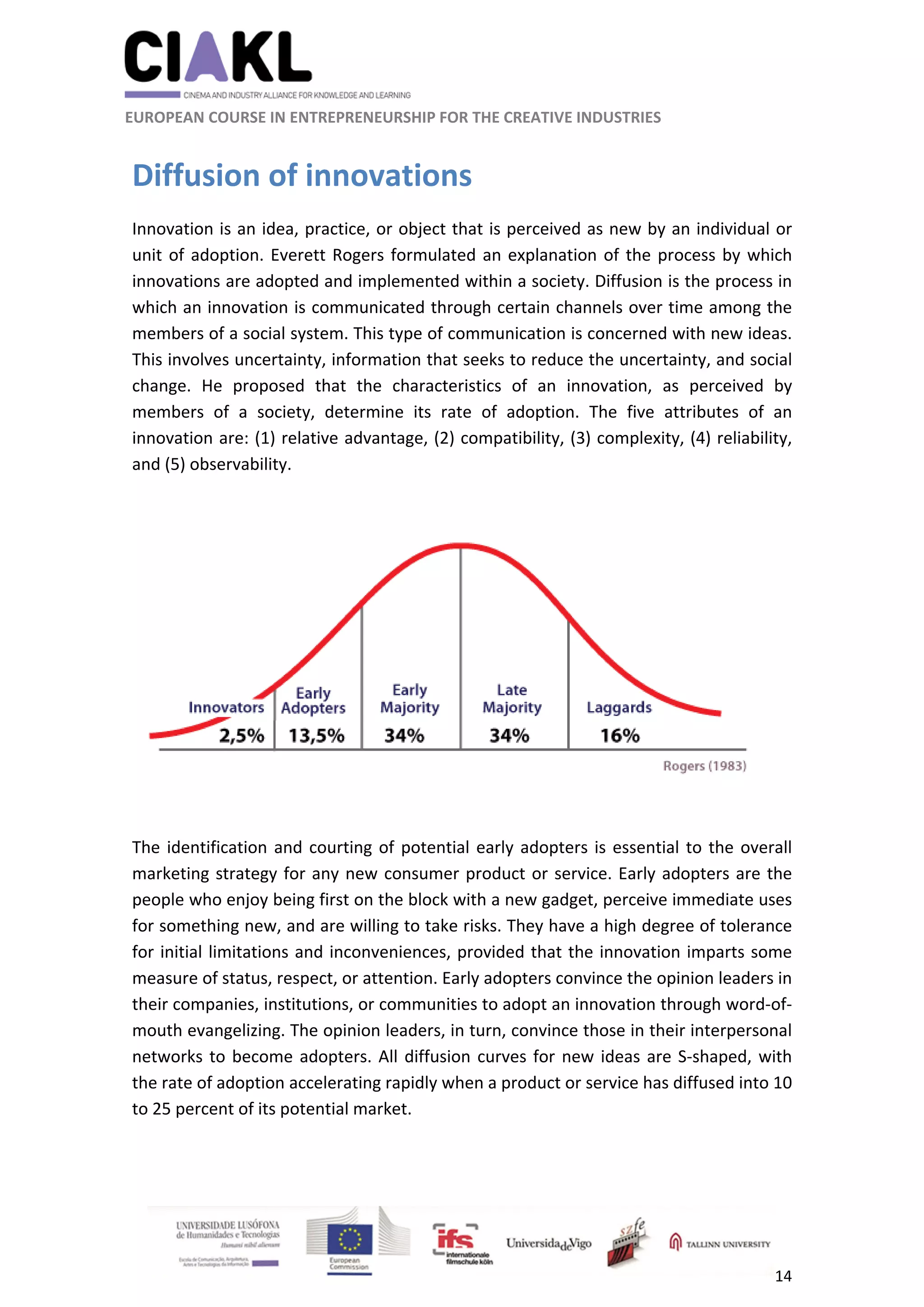
The identification and courting of potential early adopters is essential to the overall 
marketing strategy for any new consumer product or service. Early adopters are the 
people who enjoy being first on the block with a new gadget, perceive immediate uses 
for something new, and are willing to take risks. They have a high degree of tolerance 
for initial limitations and inconveniences, provided that the innovation imparts some 
measure of status, respect, or attention. Early adopters convince the opinion leaders in 
their companies, institutions, or communities to adopt an innovation through word‐of‐
mouth evangelizing. The opinion leaders, in turn, convince those in their interpersonal 
networks to become adopters. All diffusion curves for new ideas are S‐shaped, with 
the rate of adoption accelerating rapidly when a product or service has diffused into 10 
to 25 percent of its potential market. 


 EUROPEAN COURSE IN ENTREPRENEURSHIP FOR THE CREATIVE INDUSTRIES 
15 
 
 
Bridges  of  familiarity  Modern  forms  of  communication  media  have  demonstrated 
similar patterns. Photography was readily adopted because it was based on familiar 
ways of seeing and of representing vision.  More creative uses had to wait until the 
bridge  of  familiarity  had  been  crossed.  Silent  films  owed  their  quick  acceptance  to 
familiarity  with  photography  and  vaudeville  shows.  The  recording  of  images  and 
mechanical  music  boxes  provided  the  familiar  bridges  for  the  phonograph  and 
recorded  sound.  Radio  and  audio  recordings,  in  turn,  provided  the  connections  for 
rapid acceptance of the "talkies". Television was anticipated and quickly accepted as 
radio with moving pictures. 
 
Complex, adaptive systems Over time, each new form of communication has evolved 
from its origins as a recognizable extension of an earlier form into a distinct form all its 
own. This continuum of transformations and adaptations is actually a complex process 
comparable in  many ways to the evolution of species. Successful forms of new media, 
just  as  new  species,  do  not  emerge  spontaneously  from  nowhere.  They  have  all 
required links with the past. Scientists studied the behavior of complex systems and 
discovered that the richness of the interactions that occur within living systems allows 
them  to  undergo  spontaneous  self‐organization  in  response  to  changing  conditions. 
Complex systems are adaptive in that they don't just passively respond to events the 
way  a  rock  might  roll  around  in  an  earthquake.  They  actively  try  to  turn  whatever 
happens to their advantage.  
By recognizing that the human communication system is, in fact, a complex, adaptive 
system, we can see that all forms of media live in a dynamic, interdependent universe. 
When external pressures are applied and new innovations are introduced, each form 
of communication is affected by an intrinsic self‐organizing process that spontaneously 
occurs  within  the  system.  Just  as  species  evolve  for  better  survival  in  a  changing 
environment, so do forms of communication and established media enterprises.  
 
Supervening  social  necessities  Social,  political,  and  economic  forces  play  powerful 
roles  in  the  development  of  new  technologies.    Inventions  and  innovation  are  not 
widely  adopted  on  the  merits  of  a  technology  alone.  There  must  always  be  an 
opportunity  as  well  as  a  motivating  social,  political,  or  economic  reason  for  a  new 
technology  to  be  developed.  The  accelerators  that  push  the  development  of  new 
media technologies are supervening social necessities, the interfaces between society 
and  technology.  They  derive  from  the  needs  of  companies,  requirements  of  other 
technologies, regulatory or legal actions, and general social forces. On the other hand, 
the law of suppression of radical potential applies the brakes that slow the disruptive 
impact of a new technology upon the social or corporate status quo. Brakes arise from 
the same four broad categories identified with supervening social necessity. 


 EUROPEAN COURSE IN ENTREPRENEURSHIP FOR THE CREATIVE INDUSTRIES 
16 
 
 
Convergence In 1979, when Nicholas Negroponte began popularizing the concept of 
convergence few people had any comprehension of the notion. Audiences were often 
astonished  by  Negroponte's  revelation  that  all  communication  technologies  are 
suffering a joint metamorphosis, which can only be understood properly if treated as a 
single  subject.  He  drew  three  overlapping  circles  labeled  "broadcast  and  motion 
picture industry," "computer industry," and "print and publishing industry". Since then, 
the  notion  that  these  industries  are  coming  together  to  create  new  forms  of 
communication has shaped much of the thinking about the future of mass media and 
human communications. 


 EUROPEAN COURSE IN ENTREPRENEURSHIP FOR THE CREATIVE INDUSTRIES 
1 
 
   
CLUSTERS &
ENTREPRENEURIAL
ECOSYSTEMS


 EUROPEAN COURSE IN ENTREPRENEURSHIP FOR THE CREATIVE INDUSTRIES 
2 
 
Entrepreneurial ecosystems 
Sources:  
 Michael  Porter,  “Clusters  and  the  New  Economics  of  Competition”,  Harvard  Business 
Review, 1998 
 Marco Ansiti and Roy Levin, “Strategy as ecology”, Harvard Business Review, 2004 
 Richard Florida, “Who’s Your City? How the Creative Economy Is Making Where to Live 
the Most Important Decision of Your Life”, Basic Books, 2008 
 Martin Prosperity Institute, “Creative Potential, Straddling Two Mega Regions”, Rotman 
School of Management, University of Toronto, 2010 
http//martinprosperity.org/media/Southwestern_Ontario_Report.pdf 
 Ivan Turok, “Cities, Clusters and Creative Industries: The Case of Film and Television in 
Scotland”,  European  Planning  Studies,  Vol.  11,  No.  5,  July  2003,  Carfax  Publishing 
http://nknu.pbworks.com/f/Cities,%2BClusters%2Band%2BCreative%2BIndustries.pdf 
 Christina Kukenshoner et. Al, “Bollywood – Maharashtra and India’s Film Cluster”, 2008 
 
Clusters 
 
What  Is  a  Cluster?  Clusters  are  geographic  concentrations  of  interconnected  companies  and 
institutions in a particular field. Clusters encompass an array of linked industries and other entities 
important  to  competition.  They  include,  for  example,  suppliers  of  specialized  inputs  such  as 
components,  machinery,  and  services,  and  providers  of  specialized  infrastructure.  Clusters  also 
often  extend  downstream  to  channels  and  customers  and  laterally  to  manufacturers  of 
complementary  products  and  to  companies  in  industries  related  by  skills,  technologies,  or 
common  inputs.  Finally,  many  clusters  include  governmental  and  other  institutions  –  such  as 
universities,  standards‐setting  agencies,  think  tanks,  vocational  training  providers,  and  trade 
associations  –  that  provide  specialized  training,  education,  information,  research,  and  technical 
support. 
 
Why Clusters Are Critical to Competition Modern competition depends on productivity, not on 
access  to  inputs  or  the  scale  of  individual  enterprises.  Productivity  rests  on  how  companies 
compete, not on the particular fields they compete in. Clusters affect competition in three broad 
ways: first, by increasing the productivity of companies based in the area; second, by driving the 
direction  and  pace  of  innovation,  which  underpins  future  productivity  growth;  and  third,  by 
stimulating the formation of new businesses, which expands and strengthens the cluster itself. A 
cluster allows each member to benefit as if it had greater scale or as if it had joined with others 
formally – without requiring it to sacrifice its flexibility. 


 EUROPEAN COURSE IN ENTREPRENEURSHIP FOR THE CREATIVE INDUSTRIES 
3 
 
Clusters  and  Innovation  In  addition  to  enhancing  productivity,  clusters  play  a  vital  role  in  a 
company’s  ongoing  ability  to  innovate.  Some  of  the  same  characteristics  that  enhance  current 
productivity have an even more dramatic effect on innovation and productivity growth. Because 
sophisticated buyers are often part of a cluster, companies inside clusters usually have a better 
window on the market than isolated competitors do. Computer companies based in Silicon Valley 
and  Austin,  Texas,  for  example,  plug  into  customer  needs  and  trends  with  a  speed  difficult  to 
match by companies located elsewhere. The ongoing relationships with other entities within the 
cluster also help companies to learn early about evolving technology, component and machinery 
availability, service and marketing concepts, and so on. Such learning is facilitated by the ease of 
making site visits and frequent face‐to‐face contact. Clusters do more than make opportunities for 
innovation more visible. They also provide the capacity and the flexibility to act rapidly. A company 
within  a  cluster  often  can  source  what  it  needs  to  implement  innovations  more  quickly.  Local 
suppliers and partners can and do get closely involved in the innovation process, thus ensuring a 
better match with customers’ requirements. 
 
Clusters and New Business Formation It is not surprising, then, that many new companies grow 
up  within  an  existing  cluster  rather  than  at  isolated  locations.  New  suppliers,  for  example, 
proliferate within a cluster because a concentrated customer base lowers their risks and makes it 
easier  for  them  to  spot  market  opportunities.  Moreover,  because  developed  clusters  comprise 
related industries that normally draw on common or very similar inputs, suppliers enjoy expanded 
opportunities.  Clusters  are  conducive  to  new  business  formation  for  a  variety  of  reasons. 
Individuals working within a cluster can more easily perceive gaps in products or services around 
which they can build businesses. Beyond that, barriers to entry are lower than elsewhere. Needed 
assets,  skills,  inputs,  and  staff  are  often  readily  available  at  the  cluster  location,  waiting  to  be 
assembled into a new enterprise. 
 
Regions with clusters are innovative leaders The basic coherence between cluster existence and 
economic advantages can be derived from the “Redbook” by the European Cluster Observatory: 
“Today, there is substantial evidence that suggests that innovation and economic growth is heavily 
geographically concentrated. Clusters provide an environment that is conducive to innovation and 
knowledge creation. Regions with strong cluster portfolios are innovative leaders, while regions 
with no clusters or isolated research facilities fall behind.” The cluster policy has to address  all 
clusters and has therefore a national, international and sectoral focus. 


 EUROPEA


The Bol
about $
cluster. 
and is a
Mumba
Bollywo
share o
early 20
migrant
entrepr
Mumba
called “
                      
AN COURSE I
llywood clu
$1 trillion. M
It is India’s
also India’s 
ai  (populatio
ood is just o
of films (40%
0th century
ts with adva
reneurs  em
ai market b
masala”, w
                     
IN ENTREPRE
uster India 
Maharashtr
s largest sta
second ric
on  13  milli
one of them
%) mostly i
. The cluste
anced film 
merged  and
ecame quic
which system
    
ENEURSHIP 
is a rising 
a is the eco
ate econom
chest state 
on).  Indian
m. Bollywoo
n Hindi. Bo
er became c
technology
  disintegra
ckly saturat
matically co
	
FOR THE CR
star as the
onomic pow
my GSDP ab
in terms o
n  film  indus
od is the clu
ollywood is 
competitive
y from Laho
ated  the  p
ted in late 4
mbined sto
EATIVE INDU
e world’s 12
werhouse o
bout $ 110 
f GDP per 
stry  consist
uster locate
the oldest 
e after recei
ore after pa
roduction 
40s, Bollyw
ory genres li
USTRIES 
2th largest 
of India and
billion com
capita. Hom
s  of  multip
ed in Mumb
film cluster
ving a large
rtition of P
system  int
wood came 
ke comedy
economy w
d home to t
mparable to
me to India
ple  regional
bai, produci
r in India, d
e inflow of H
Pakistan. A l
to  multiple
up with an
y and roman
with a GDP
the Bollywo
 Kansas (US
a’s largest c
l  clusters,  a
ing the larg
dating back
Hindi speak
large group
layers.  Af
n original st
nce along w
4 
 
P of 
ood 
SA) 
city 
and 
gest 
k to 
king 
p of 
fter 
tyle 
with 


 EUROPEAN COURSE IN ENTREPRENEURSHIP FOR THE CREATIVE INDUSTRIES 
5 
 
symbol‐driven  song  and  dance  in  order  to  attract  viewers  across  regions.  Because  of  wide 
popularity of “masala” style, Bollywood today still dominates segments like music and TV across 
regions  in  India.  Other  film  clusters  in  India  such  as  one  in  Hyderabad,  called  “Tollywood” 
produces second largest number of films mostly in Telugu. Other clusters produce films mainly in 
their regional language.  
 
Business ecosystems 
 
Business  networks  In  the  boom  years  of  the  Internet,  there  was  an  almost  universal  euphoria 
about the potential of business networks. Vas, connected communities of companies would enjoy 
unheard of efficiencies in operations and innovation. New technologies would disrupt traditional 
companies and create unprecedented opportunities for innovation, as well as for the growth of 
new companies. Networks effects – the increasing value of a product or service as the number of 
people using it grows – would create enormous value and remove barriers to entry in different 
businesses. But things were not so simple as the disastrous failures of companies like Webvan 
made clear. The implosion of the Internet bubble made it obvious that members of a network 
share a common fate, meaning that they could rise and fall together. The stunning reversal of the 
virtuous circle left many question the power of business networks. The analogy between business 
networks  and  biological  ecosystems  can  aid  this  understanding  by  highlighting  certain  pivotal 
concepts about the health of business ecosystems. 
 
Productivity The ability to convert nonbiological outputs, such as sunlight and mineral nutrients 
into living outputs – populations or organisms or biomass. One business equivalent is the return 
on invested capital.  
 
Robustness To provide durable benefits to the species that depend on it, a biological ecosystem 
must  persist  in  the  face  of  environmental  changes.  Similarly,  a  business  ecosystem  should  a 
business ecosystem should be capable of surviving disruptions such as unforeseen technological 
change. 
 
Niche creation It is also important for ecological systems to exhibit variety, the ability to support a 
diversity  of species.  In  the  business  equivalent is  the  ability  to  absorb  external  shocks  and  the 
potential for productive innovation. This is the capacity to increase meaningful diversity through 
the creation of valuable new functions, or niches.  


 EUROPEAN COURSE IN ENTREPRENEURSHIP FOR THE CREATIVE INDUSTRIES 
6 


Creative mega regions 
 
Clustering  force  Today’s  key  economic  factors—talent,  innovation,  and  creativity—are  not 
distributed evenly across the global economy. They concentrate in specific locations. It’s obvious 
how  major  new  innovations  in  communications  and  transportation  allow  economic  activity  to 
spread out all over the world. What’s less obvious is the incredible power of the clustering force. 
In today’s creative economy, the real source of economic growth comes from the clustering and 
concentration of talented and productive people. New ideas are generated and our productivity 


 EUROPEAN COURSE IN ENTREPRENEURSHIP FOR THE CREATIVE INDUSTRIES 
7 
 
increases when we locate close to one another in cities and regions. The clustering force makes 
each of us more productive, which in turns makes the places we inhabit much more productive, 
generating great increases in output and wealth. 
 
 
The central axis Because of the clustering force, cities and regions have become the true engines 
of economic growth. Today, more than half the world’s population lives in urban areas. In the 
United States, more than 90 percent of all economic output is produced in metropolitan regions, 
while  just  the  largest  five  metro  regions  account  for  23  percent  of  it.  And  cities  and  their 
surrounding  metropolitan  corridors  are  morphing  into  massive  mega‐regions,  home  to  tens  of 
millions of people producing hundreds of billions and in some cases trillions of dollars in economic 
output. Place remains the central axis of our time—more important to the world economy and our 
individual lives than ever before. 
 
Bundles of “public goods” The economist Charles Tiebout argued that communities specialize in 
the bundles of services or “public goods” they offer—such as education, police, fire, parks, and 
what not. Different bundles of services and different qualities of services come with a price, paid 
as  taxes.  So  when  we  choose  a  place,  we’re  not  only  selecting  a  physical  location—we’re  also 
picking the bundle of goods and services that will be available to us there. People will “vote with 
their feet,” selecting the particular community which offers goods and services compatible with 
their particular preferences and needs. Some people prefer great schools and are prepared to pay 
for them. Single people, or those whose kids are out of the house, will value schools much less: 
They are more likely to desire nice restaurants, world‐class beaches, great golf courses, and lower 
taxes. Tiebout’s model provides a basic logic for thinking about what we value in our communities. 
When given a wide range of choices, we need to identify our key needs and priorities and then 
find a place that meets them at a price we are willing and able to pay. 


 EUROPEA
 
 
What is
innovat
potters,
agnostic
manufa
bounda


AN COURSE I
s the Creat
ion  ‐ by pe
, bohemian
c  and  emp
cturing  an
ries; creativ
                     
IN ENTREPRE
ive Econom
eople paid 
ns as broker
ploys  creativ
nd  agricultu
ve occupati
    
ENEURSHIP 
my? The cre
to think; it
rs, entertai
ve  workers
ure.  The  C
ons have in
	
FOR THE CR
eative econ
t is as muc
ners as ent
s  who  work
Creative  Ec
nfiltrated ev
EATIVE INDU
nomy is an 
h about ar
trepreneurs
k  across  all
conomy  is 
very part of 
USTRIES 
 
economy d
chitects as 
s. The creat
  industries 
industry 
the econom
driven by k
artists, pro
tive econom
  and  secto
neutral  an
my. 
nowledge a
ogrammers
my is indust
rs  –  includ
nd  knows 
8 
and 
s as 
try‐
ing 
no 


 EUROPEAN COURSE IN ENTREPRENEURSHIP FOR THE CREATIVE INDUSTRIES 
9 
 
Creative industries 


Cultural  and  commercial  Creative  industries  can  be  defined  as  the  area  of  overlap  between 
cultural and commercial activities. They involve the supply of goods and services that contain a 
substantial element of artistic, imaginative or intellectual effort, or that are associated with and 
play a vital role in sustaining cultural activities.  
The boundary is a matter of debate; for example, what forms of entertainment are included. They 
typically  include  film,  television,  video,  music,  the  visual  and  performing  arts,  advertising, 
publishing,  design  activity,  software  and  new  digital  media.  Creative  activities  have  distinctive 
properties that affect their organization, economic impact and geography.  
 
Uncertainty  How  consumers  will  value  a  new  product  because  of  its  original,  often  unique 
character  ?  This  makes  communication  between  producers  and  consumers  important  and 
encourages  sophisticated  intermediaries,  such  as  commissioning  agents  and  distributors.  Their 
powerful  position  in  understanding  and  shaping  consumer  preferences  makes  access  vital  for 
producers.  The  uncertainty  of  consumer  reaction  also  means  a  high  risk  of  product  failure,  so 
attracting investment is difficult and ways of sharing risk are important. This helps to explain the 
common ownership and alliances that exist between producers, distributors and cinema owners in 
the film industry. This vertical integration gives market power to control what films are shown. 
Source: Martin Prosperity Institute 
Source: Martin Prosperity Institute


 EUROPEA
 
Internal
failure. 
 
Centred
involved
consum
integrity
objectiv
make in
individu
 
Diverse
dramas
tempor
for new
such as 
location
 
Heterog
and  cha
organiza
teams 
facilitat
coordin
 
                      
AN COURSE I
l  economie
 
d on the ind
d.  Creative
mers  do  no
y  or  techn
ves, especia
ncome gene
ual, cultural 
e and speci
)  require  v
arily. This c
w producers
film, televi
n of product
geneous  an
aracter,  wh
ational arra
and  freela
e  essential
ation that r
                     
IN ENTREPRE
es  of  scale 
dividual Th
e  producers
t  notice  or
ical  proficie
ally  for  ‘hig
eration and 
 and politic
alized skills
very  divers
complicates
s. The public
ision and po
tion. 
nd  irregular
hich  create
angements 
ncers.  Soc
  exchange 
result from 
    
ENEURSHIP 
also  reduce
ere is often
s  may  care
r  value  as 
ency.  This 
gh’  or  ‘alter
business vi
al values do
s Some cre
se  and  spe
s their orga
c profile of 
op music st
r  Creative  p
es  awkward
and labour
ial  networ
of  ideas  a
fragmentat
	
FOR THE CR
e  the  cost 
n a high deg
e  deeply  a
much,  suc
can  create
rnative’  cul
iability mor
o not featur
eative produ
ecialized  sk
nization an
popular en
tars. Celebr
products  ar
d  and  inef
r markets ca
rks  among 
and  informa
tion. 
EATIVE INDU
of  product
gree of indi
bout  attrib
ch  as  origi
e  a  tension 
tures  rathe
re difficult t
re as promi
ucts (such a
kills  and  kn
d can be ve
ntertainmen
rities may e
re  often  he
fficient  disc
an assist th
individuals
ation,  and 
Source
USTRIES 
tion  and  he
ividual skill,
butes  of  th
nality,  puri
between  c
er  than  ‘po
than in man
nently. 
as feature 
nowledge  t
ery costly, c
nt can creat
xert a stron
eterogeneo
continuities
e process, 
s  and  asso
reduce  som
e: Martin Prospe
elp  to  spre
, talent and
heir  produc
ity,  meanin
cultural  an
pular’  form
ny other ind
films or ma
to  be  brou
creating ba
te powerful
ng pull on t
us  and  irre
s  in  produc
including p
ociated  ins
me  of  the 
 
erity Institute 
ad  the  risk
d commitme
cts  that  m
ng,  aesthet
d  commerc
ms.  It  tends
dustries whe
ajor televis
ught  togeth
rriers to en
 personaliti
the timing a
egular  in  sc
ction.  Flexi
project—bas
titutions  m
difficulties
10 
k  of 
ent 
ost  
ics, 
cial 
  to 
ere 
ion 
her 
ntry 
ies, 
and 
cale 
ble 
sed 
may 
  of 

Subject Module - Elective CIAKL II - Class 02

  • 1.
  • 2.
                                                                          EUROPEAN COURSE IN ENTREPRENEURSHIP FOR THE CREATIVE INDUSTRIES                                                                 2    The entertainment economy  Sources:    Michael J. Wolf, “The Entertainment Economy – How Mega‐Media Forces are  Transforming our Lives”, Three Rivers Press, New York, 1999   Michael R. Solomon et al., “Consumer Behaviour – a European Perspective”,  Prentice Hall, 2010  The  Economist,  “The  lazy  medium,  How  people  really  watch  television”,  a  special report on television”, April 29th 2010   The Economist, “The international film industry: Avatar 2 Made in China?”,  April 24th 2012   The Economist, “The film industry: China’s film market is proving tough for  foreign studios to crack”, April 28th  2012   Financial Times, “Iroko Partners: Demand proves insatiable for Nollywood on  the net” November 22 2011    Broadband TV News, “NCIS was Europe’s top drama show in 2011”, May 30  2012   Richard  Broughton,  Daniel  Knapp,    “A  Future  for  TV:  IP‐delivered  video  advertising in a connected world”, IHS Screen Digest, 2012   Ofcom, “TV‐Like qualitative research report”, 2009    Screen Digest Insight Report    Entertainment – not autos, not steel, not financial services – is fast becoming  the driving wheel of the new world economy                                                                                                                                                             Wolf  (1999)       
  • 3.
                                                                          EUROPEAN COURSE IN ENTREPRENEURSHIP FOR THE CREATIVE INDUSTRIES                                                                 3    The great influencer    Entertainment is increasingly influencing every choice that each of us makes every day.  Multiply that by the billions of choices that, collectively, all of us make each day and  you  have  a portrait  of  a  society  in  which  entertainment  is  one  of  its  leading  institutions. The United Kingdom now employs more workers in entertainment (films,  music,  video  games,  television,  software,  theater,  etc…)  than  it  ever  did  in  its  coal  mines in the heyday of its empire.    Entertainment as an act Every year, people spend billions of hours on legal forms of  entertainment. Globally, total annual spending is approaching $1 trillion (Vogel, 2007).  Entertainment  is  the  act  of  diverting,  amusing,  or  causing  someone´s  time  to  pass  agreeably. Or entertainment can be defined as anything that stimulates, encourages or  generates a condition of pleasurable diversion. “But entertainment can be much more  than  mere  diversion.  It  is  something  that  is  so  universally  interest  and  appealing  because,  when  it  does  what  it  is  intended  to  do,  it  moves  you  emotionally  (…)  It  touches your soul.” (Vogel, 2007)    Entertainment as an effect Entertainment is also defined through its effect: a satisfied  and happy psychological state. Entertainment means so many different things to so  many  different  people  that  an  analysis  of  entertainment  industry  makes  us  look  to  many different topics. From  movies, television, music, cable industry and all the pay  services  that  are  related,  multimedia,  toys  and  games,  live  entertainment  (horse  racing, lotteries, casinos, different sports, …), performing arts and culture (orchestras,  opera,  dance,…)  to  amusement  theme  parks,  all  this  is  entertainment.  A  sharper  analysis  of  entertainment  industry  requires  classifying  entertainment  activities  into  industry  segments,  that  is,  enterprises  or  organizations  of  significant  size  that  have  similar  technological  structures  of  production  and  that  produce  or  supply  goods,  services or sources of income that are substitutable.    Economic  forces  The  study  of  entertainment,  media  and  communication  has  traditionally been dominated by non‐economic disciplines. Analysis of entertainment  content, for example, can provide a means of understanding the societies we live in  and our value systems. But economics is also a valuable subject area for entertainment  students. Most of the decisions taken by those who run entertainment organizations  are, to a greater or lesser extent, influenced by resource and financial issues (Doyle,  2003).  Economic  forces  and  profit  motives  are  always  behind  the  entertainment  industry. Those are the forces that shape the relative popularity and growth patterns  of  competing,  usually  interdependent,  entertainment  activities  and  products.  So 
  • 4.
                                                                          EUROPEAN COURSE IN ENTREPRENEURSHIP FOR THE CREATIVE INDUSTRIES                                                                 4    economics,  as  a discipline,  is  highly  relevant  to  understanding  how  entertainment  industry operates.    Entertainment  economics.  Combines  the  study  of  economics  with  the  study  of  entertainment.  It  is  concerned  with  the  changing  economic  forces  that  direct  and  constrain the choices of managers, practitioners and other decision‐makers across the  industry.  Entertainment  economics  is  concerned  with  how  entertainment  operators  meet the informational and entertainment wants and needs of audiences, advertisers  and society with available resources or, using a definition of media economics: “how  media industries use scare resources to produce content (…) to satisfy various wants  and needs.” (Albarran, 1996)1     Macro and micro Economics is traditionally studied in terms of macroeconomic and  microeconomics perspectives. The field of entertainment industry has tended to follow  suit. The distinction between macro and microeconomics is about whether that which  is being studied involves large groups and broad economic aggregates or small well‐ defined groups and individual firms and sectors. Macroeconomics examines the whole  economic system, and is usually studied at a national or a global level. It includes topics  such  as  economic  growth  indices,  political  economy,  and  national  production  and  consumption measures by gross domestic product (GDP) and gross national product  (GNP).  Microeconomics  takes  a  more  narrow  view  by  examining  the  activities  of  specific  aspects  of  the  economic  system,  such  as  individual  markets,  firms  or  consumers. It examines topics like market structure, and firm conduct and behavior.    Types of firms Entertainment firms represent individual companies or entities that are  incorporated through their respective domestic country, that operate for a profit. They  can be publicly held firms (owned by stockholders or shareholders) or privately held  firms (also owned by stakeholders but not listed on any stock exchange). Examples of  publicly held media firms include large conglomerates such as Time Warner, Disney,  Sony  and  News  Corporation,  or  companies  that  operate  in  only  one  or  two  media  markets such as Gannet (publishing and television) or Saga Communications (radio).  Privately held media firms include such companies as Bertelsmann (book publishing,  Univision, and Clear Channel (Albarran, 2010).    Industries  Economists  define  an  industry  as  a  group  of  sellers  offering  the  same  or  similar products. Companies that are engaged in cable television, like Comcast, Time  Warner, and Cablevision, are members of the cable television industry. Direct TV and                                                               1   Albarran,  A.B.,  &  Dimmck,  J.  (1996).  Concentration  and  economies  of  multiformity  in  the  communication industries. Journal of Media Economics, 9(4), 41‐50. 
  • 5.
                                                                          EUROPEAN COURSE IN ENTREPRENEURSHIP FOR THE CREATIVE INDUSTRIES                                                                 5    Echostar  (owner  of the  Dish  Network)  compete  in  the  satellite  industry.  AT&T  and  Verizon  are  two  leaders  in  the  telecommunications  industry,  and  also  offer  multichannel television services similar to cable and satellite known as IPTV (Internet  Protocol Television). A unique feature of the evolving media industries is the changing  nature  of  their  markets  and  industries.  Companies  now  compete  with  one  another  across markets and in different industries in the media economy.    Competition levels An important aspect of the media economy is the concept of levels,  used to describe where activity among media firms and industries actually takes place  (Albarran,  2010).  Competing  on  a  global  level,  offering  their  media  products  and  services throughout the world, are many large companies like Viacom, Disney, Time  Warners, News Corporation, Bertelsmann and Sony. At the national level, companies  focus on their domestic boundaries, and attempt to cover the entire country.     Examples  at  the  national  level  include  the  broadcast  networks,  satellite  delivered  channels  and  magazines.  At  a  household  level,  households  have  access  to  multiple  devices or platforms capable of receiving content from a number of media firms and  industries. These devices include television and radio receivers, DVD and DVR players  desktop and laptop computers, and wired and wireless household networks.     This level is important for tracking not only household media usage but also media – related  expenditures  and  various  subscriptions  for  media  content.  Finally,  the  individual level is becoming even more important in the media economy. In a nuclear  family  household  there  are  differences  in  the  way  parents  use  the  media  in  comparison to their youngsters. How we choose to spend our time in media‐related  activities represents an economic action: allocation.     These levels of activity are constantly ongoing in the media economy and in all the  entertainment industry. A big challenge for media firms is how to develop as multi‐ platform entities that can reach consumers at all levels of activity (see figure 3.1).  Figure 3.1.  Multiple Levels of Analysis   
  • 6.
                                                                          EUROPEAN COURSE IN ENTREPRENEURSHIP FOR THE CREATIVE INDUSTRIES                                                                 6      Source: Albarran (2010).      Shaping forces The media economy, and more generally the entertainment industry, is  shaped  by  other forces  as  well.  Albarran  (2010)  refers  these  forces  as  being  globalization, regulation, technology and social aspects.      Globalization This is a critical driver in the media economy. For media firms and  industries, the act of globalization – a word with many different meanings –  occurs when companies reach beyond domestic borders to engage consumers  in  other  nations  or  markets.  Originally,  media  globalization  meant  selling  content around the world, a practice that first started with Hollywood films and  expanded  later  to  television  programming.  The  US  is  the  largest  exporter  of  media content in the world, leading to many concerns about the influence of  America abroad and the notion of “cultural imperialism” (Jayakar & Waterman,  2000) 2 . Globalization also occurs when companies acquire other properties in  other  countries.  News  Corporation  began  as  an  Australian  newspaper  company, acquiring newspapers in the United Kingdom and the United States,  and  later  on  purchasing  a  group  of  television  station  that  would  eventually  become the Fox TV Network. Sony entered the film industry by first acquiring  Columbia Tristar and later MGM. Another form of globalization occurs when a  company establishes multiple locations in other nations. For example, Disney  operates theme parks in several global cities. Bertelsmann, the global leader in  book  publishing,  has  operations  around  the  world  through  its  various  publishing entities.                                                                 2  Jayakar, K., & Waterman, D. (2000). The Economics of American theatrical movie exports: An empirical  analysis. Journal of Media Economics, 13(3), 153‐169. 
  • 7.
                                                                          EUROPEAN COURSE IN ENTREPRENEURSHIP FOR THE CREATIVE INDUSTRIES                                                                 7     Regulation Another predominant force is regulation and regulatory practices  that  differ from  country  to  country.  Through  policy  and  regulation,  business  and industry are required to follow certain rules and guidelines. Regulation is  important in establishing and maintaining competition, to protect workers and  consumers, and to generate government revenues through taxation.     Technology Has both enhanced and disrupted the media economy. Innovations  in technology with distribution and reception technologies continue at a rapid  pace. The wide range of technological advances has forced media companies to  try  to  keep  up  with  one  another.  The  digital  environment  has  disrupted  traditional  business  models  (Downes,  2009)3 .  For  media  companies,  finding  new business models and revenue streams is a major priority. For consumers,  today´s technological device is likely to be either limited or obsolete in just a  few months, replaced by another innovation.     Social aspects Are also important in the media economy. The audience is no  longer a mass entity, but an aggregate of many different demographic groups  and  lifestyles  with  different  interests  that  evolve  through  the  life  cycle  (Albarran, 2010). The composition of the audience is changing almost on a daily  basis: societies are becoming much more ethnically diverse and multicultural;  people  are  living  longer  and  working  longer;  younger  people  are  more  technologically savvy and prefer to access content differently than adults.    Market structures Accordingly to Microeconomic theory, industries can be categorized  according  to  how  firms  make  price  and  output  decisions  in  response  to  prevailing  market conditions. In the model assuming perfect competition, firms all make identical  products,  and  each  firm  is  so  small  in  relation  to  total  industry  output  that  its  operations  have  a  negligible  effect  on  price  or  on  quantity  supplied.  At  the  other  idealized extreme is a monopoly structure, in which there are no close substitutes for  the  single  firm´s  output,  the  firm  sets  prices,  and  there  are  barriers  that  prevent  potential competitors from entry.    In the real world, however, the structure of most industries cannot be characterized as  being perfectly competitive or as monopolistic but as somewhere in between. One of  those in‐between structures is known as monopolistic competition, in which there are  many sellers of somewhat differentiated products and in which some control of pricing  and competition through advertising is seen. In an oligopoly structure there are close  substitutes and pricing decisions may affect the pricing and output decisions of other                                                               3 Downes, L. (2009). The laws of disruption: Harnessing the new forces that govern life and business in the digital age. New York:  Basic Books. 
  • 8.
                   EUROP   firms acco   In  m struc     Activ unde focus acco persp struc comp mark for s more   Figur Desig                         PEAN COURS s in the ind unt, the str media  and  ctural categ Monopo Cable TV Newspap Professio Source: Voge vities struc erstanding  ses  on  the  unt  for  act pective.    O cture  by  th petitors. Fo ket for cont smart phon e reflective  re 3.2.  gnating Me                        SE IN ENTRE ustry. Whe ructure is ol entertainm gories:  oly  V  pers  onal sports  el (2007).  cture  But, of  market  number  of tivities  acro One  solutio he  activitie or example,  tent, the ma es, and so  of the reali dia Markets            EPRENEURSH n firms mu igopolistic ( ment,  indus Oli teams  Mo Re Ne Cas The   like  our  structure  f  participan oss  media  m on  may  be  es  they  are it may be b arket for dis on (see fig ty of today´ s by Functio HIP FOR THE    ust take a ri (Vogel, 200 stry  segme igopoly  ovies corded mus etwork TV  sinos  eme parks understan must  evolv nts  in  the  m markets.  A to  define  e  engaged better to th stribution, t gure 3.2.). W ´s media co on  CREATIVE IN val´s reacti 7).  nts  fall  ge Monop sic Books Magaz Radio s Toys a Perfor nding  of  ve  as  well.  market,  the nalysis  is  m media  com   in  rather  ink of mark the market  While this c ompany (Alb NDUSTRIES   on to chang nerally  into polistic Com ines  stations  nd games  ming arts  markets  in If  the  trad e  problem  i made  from  mpanies  an than  by  ket structure for adverti creates bro barran, 2010                          ges of price o  the  follo mpetition  n  general, ditional  an is  that  doe a  single‐m nd  their  m the  numb e in terms o ising, the m oader labels 0).                        8  e into  owing    our  alysis  es  not  market  market  er  of  of the  market  s, it is                   
  • 9.
                                                                          EUROPEAN COURSE IN ENTREPRENEURSHIP FOR THE CREATIVE INDUSTRIES                                                                 9    Locally,  globally,  internationally, we  are  living  in  a  digital  entertainment  economy    The Hollywood Studio System under challenge At the heart of the economic structure  of the film business lie the Hollywood Studios. These are the six major distributors,  based in Los Angeles but with worldwide exploitation systems that consistently hold  the  greatest  share  of  the  world  film  market.  However,  only  two  of  the  Studios  are  today  wholly  owned  by  American  interests.  This  means  that  the  business  is  truly  global.  The  Studios  utilize  the  vertical  economic  approach  by  releasing  the  films  theatrically  first,  and  ensuring  increased  revenues  and  profits  through  creating  a  system of “windows” where the film is not released onto the next form of media until  the exploitation in its previous one has been exhausted. They also strategically apply  the  horizontal  approach  acquiring  rights  to  any  possible  territories  in  which  a  film  could  be  exploited.  Increasingly,  over  the  last  decade  the  Studios  have  seen  their  dominance over both conduits of exploitation under increasing pressure and, in certain  cases,  market  erosion.  This  model  is  being  challenged  by  the  Internet.  New  technologies have shrunk and opened up the vertical chain model. Increasingly, films  are distributed at different stages of the old value chain, and move on from there. The  windows system is breaking up.     Sturm und CSI However, Europeans still love American television series, albeit not at  prime‐time. The value of imported drama series for European broadcasters was $5,990  million in 2011, with the top 200 titles supplying 81% ($4,829 million) of that total. The  Imported Drama Series in Europe report estimated that the top 10 titles accounted for  23 per cent ($1,400 million) of the 2011 total value, with the top 50 taking 55% ($3,268  million). CBS distributed the top three titles in 2011, with NCIS leading the pack by  generating $210 million. The three CSI franchises appear in the top 10. Only one of the  top 10 titles (Sturm der Liebe) originated from outside the US. Only 22% of the hours  screened for the top 200 titles appeared in primetime [20,507 hours from 94,638 in  total]. However, 69 per cent [$3,337 million] of the value created for these titles was in  primetime.  The top six US distributors dominate the top 200, creating nearly three‐quarters of the  value and 56 per cent of the titles. CBS is the clear leader, with second‐placed Warner  Bros some way behind. However, these six companies are probably not as dominant as 
  • 10.
                                                                          EUROPEAN COURSE IN ENTREPRENEURSHIP FOR THE CREATIVE INDUSTRIES                                                                 10    many people would have guessed. Indeed, seventh‐placed ZDF [$183 million, 12 titles]  was pretty close to Sony in 2011. ITV was next with $116 million [9 titles]. Ninth place  (and the only other distributor to record more than $100 million from Europe’s top  200  titles)  went to  Bavaria  Media  [$113  million],  but  this  was  solely  for  Sturm  der  Liebe.  The Internet renaissance The wider entertainment industry is growing at a rapid pace  (contrary  to  doom  &  gloom  messages).  Furthermore,  more  content  creators  are  producing more content than ever before ‐‐ and are more able to make money of their  content than ever before. On top of that, consumers are living in a time of absolute  abundance and choice ‐‐ a time where content is plentiful in mass quantities, leading  to  a  true  renaissance  for  them.  This  does  present  a  unique  challenge  for  some  companies used to a very different market, but it’s a challenge filled with opportunity:  the overall market continues to grow, and smart businesses are snapping up pieces of  this larger market. The danger is in standing still or pretending the market is shrinking.     Don’t miss the opportunity Data from PricewaterhouseCoopers (PwC) and iDATE show  that from 1998 to 2010 the value of the worldwide entertainment industry grew from  $449  billion  to  $745  billion.  That’s  quite  a  leap  for  a  market  supposedly  being  decimated  by  technological  change.  Of  course,  the  world  economy  grew  over  this  period  of  time,  but  a  particularly  compelling  bit  of  data  shows  that,  in  the  US  specifically,  consumer  spending  on  entertainment  as  a  percentage  of  income  has  continued to rise significantly over the last decade. According to the Bureau of Labor  Statistics, in 2000, 4.9 per cent of total household spending went to entertainment.  That number gradually increased over the decade ‐‐ and by 2008, it was up to 5.62 per  cent,  an  increase  of  nearly  15  per  cent  in  the  same  decade  as  the  internet  went  mainstream.     More independent jobs Similarly, reports of job losses in the sector are equally hard to  square  with  reality.  Once  again,  looking  at  the  Bureau  of  Labor  Statistics  data,  employment in the entertainment sector grew nicely in the decade from 1998 to 2008  ‐‐ rising by nearly 20% over that decade. The BLS continues to predict similar growth  for the next decade as well. Perhaps even more importantly, during that same period  of time, BLS data shows that the number of people who were independent artists grew  at an even faster rate – over 43 per cent growth in that same decade. In fact, this may  be a strong hint as to why you hear reports of industry "demise" from certain legacy  players: because new technologies and services have made it much easier for content  creators to find success without going through the traditional gatekeepers.    
  • 11.
                                                                          EUROPEAN COURSE IN ENTREPRENEURSHIP FOR THE CREATIVE INDUSTRIES                                                                 11    Massive  output  The amount  of  new  content  being  produced  has  grown  at  a  tremendous rate. In 2002, less than a quarter of a million new books were available on  the market. By 2010 that number was over 3 million. In 2001, the Gracenote database  had data showing just about 11 million song tracks. By 2010, that number had passed  100  million.  According  to  the  UN,  in  1995,  there  were  about  1,700  films  produced  worldwide. By 2009, it was more than 7,000. Meanwhile, during this same period of  time, the video game industry ballooned massively, leaving its niche status behind, and  becoming  a  major  part  of  the  wider  entertainment  industry.  By  any  measure,  it  appears that we are living in a true Renaissance era for content. More money is being  spent overall. Households are spending more on entertainment. And a lot more works  are being created.    European flavour Leading European film production and distribution companies offer  significant  challenge  to  the  Hollywood  Studios’  traditional  hegemony.  On  the  last  decade, the change across Europe is most marked in domestic films attracting local  audiences. Often times one local blockbuster is enough to tip the balance in favour of  the local film. However, the American television products have conquered the lion’s  share of the European audiences taste for series.     Key cinema data in European countries 2010 – 2011 (provisional)     News source: Press release – European Audiovisual Observatory 
  • 12.
                                                                          EUROPEAN COURSE IN ENTREPRENEURSHIP FOR THE CREATIVE INDUSTRIES                                                                 12      Bollywood  to  the next  level  India  is  the  largest  producer  of  films  in  the  world  by  quantity. But Bollywood’s low revenues reflect the shortage of screens in India relative  to the huge population; and low ticket prices, on average less than a $1 a seat. Yet the  industry  has  reason  for  optimism:  prices  are  rising,  with  the  development  of  urban  multiplexes that charge about $3 for a seat and up to $7 at weekends. KPMG forecasts  revenues will rise by about 30 per cent by 2015, buoyed by higher ticket sales and  more expensive television rights, amid an insatiable demand for entertainment from  an increasingly affluent population. Yet foreign sales remain a tempting target.     “Ra.One” costing more than $30m is by far the most expensive Bollywood picture ever  made. Packed with slick, high‐technology visual effects of a quality never before seen  in an Indian film, the film is a classic Hindi tale of good versus evil. Bollywood and other  Indian  regional  cinema  appeals  to  audiences  in  many  countries  outside  the  west,  where  it  is  already  a  competitor  with  Hollywood.  “Indian  films  have  as  much  of  a  chance there as anyone else, as long as we make films that have some universal truths  and compelling characters,” Indian film makers say. Most insiders,  owever, are more  cautious on whether Bollywood can make serious inroads into western markets.     As  Bollywood  evolves,  its  assault  on  Hollywood’s  hegemony  will  intensify.  Reliance  plans an English version of its forthcoming film Kites, about a conman in Las Vegas. In  recent years, Bollywood films have found favour in eastern Europe, Germany, east Asia  and other non‐English‐speaking countries where audiences are already accustomed to  watching dubbed Hollywood movies. Among mainstream audiences in the Anglophone  world,  however,  success  has  been  elusive.  India’s  emerging  middle‐class  enjoys  watching  its  favourite  beautiful  stars  cavort  in  exotic  locales  such  as  Thailand,  Singapore, Australia, the US and Europe. That trend has been facilitated by tax breaks  and other production incentives from foreign countries, which see Bollywood films as a  way to grab a slice of the fast‐growing Indian outbound tourism market. This year’s  coming‐of‐age movie, Zindagi Na Milegi Dobara, about three friends on a pre‐marriage  road  trip,  was  produced  in  close  collaboration  with  the  Spanish  tourism  promotion  agency. 
  • 13.
                                                                          EUROPEAN COURSE IN ENTREPRENEURSHIP FOR THE CREATIVE INDUSTRIES                                                                 13      Nollywood goes to the Internet The Nigerian film industry turns out more than 2,000  films a year, making it the world’s second‐biggest film industry by output after India’s  Bollywood. Nollywood sprang up in the 1990s as home video cameras allowed films to  be produced at lower cost. A typical budget is only $30,000. In 2006 Nigeria made 872  films  (in  video format,  with  about  half  of  them  in  English),  about  200  less  than  Bollywood  and  roughly  400  more  than  Hollywood.  Already  massive  in  Africa,  Nollywood is now gaining a reputation elsewhere. Copies of the movies are on offer at  markets throughout the continent. Most of these are illegal copies, however, meaning  most  Nigerian  film‐makers  derive  little  financial  benefit  from  their  international  popularity.  Most  of  these  are  illegal  copies,  however,  meaning  most  Nigerian  film‐ makers derive little financial benefit from their international popularity.    Yet  the  internet  is  beginning  to  change  that,  says  Jason  Njoku,  a  London‐born  web  entrepreneur who has attracted a worldwide monthly audience of more than 1m to his  Nollywood streaming service.  His company, Iroko Partners, is racing to keep up: it has  bought  the  online  distribution  rights  to  1,600  films  since  November  2010.  The  fragmented  nature  of  the  industry,  with  more  than  500  production  businesses,  is  a  boon for the digital distribution business, whose experience has been unlike that of  Netflix, the US film streaming site, which has faced tough negotiations with five or six  big Hollywood studios. Much of this demand from the Nigerian diaspora has been filled  by pirate videos. New York authorities, for instance, seized more than 10,000 bootleg  Nollywood films in November 2010. While slow download speeds and limited internet  penetration  meant  online  distribution  in  Africa  was  restricted,  there  is  a  vast,  untapped market among African Nollywood fans in North America, Europe and other  developed  regions.  The  proposition  was  also  bound  to  be  attractive  to  the  film  producers, who had previously gained almost no income from foreign sales of their  films.    China’s pull The Middle Kingdom is now the world’s second‐biggest film market after  America. It  has a booming home‐grown film industry, making historical dramas and  romantic  comedies,  but  foreign  blockbusters  are  the  big  money‐earners.  Although  most films are pirated on release and viewed online and on dodgy DVDs, the rising  middle classes are increasingly willing to fork out for a night at the cinema. In 2011  China’s box‐office take rose by more than 30 per cent, to over $2 billion, according to  the Motion Picture Association of America. The number of cinema screens in China has  doubled in five years, to nearly 11,000 —again, second only to America.     The gravitational pull of the Chinese movie market, nonexistent less than a generation  ago,  is  now  an  undeniable  force,  sucking  in  all  Hollywood  blockbusters  (and  lesser 
  • 14.
                                                                          EUROPEAN COURSE IN ENTREPRENEURSHIP FOR THE CREATIVE INDUSTRIES                                                                 14    projects)  that  venture within  its  event  horizon.  Hollywood  studios,  independent  producers and directors regularly cycle through Beijing in search of partnerships with  Chinese production houses—often seeking money to finance their movies, as well as  access to a suddenly lucrative market. In 2012 China will surpass Japan as the world’s  second‐largest  movie  market,  after  America.  Chinese  box‐office  takings  totalled  13  billion yuan ($2.06 billion) in 2011, an increase of 30 per cent from 2010, which in turn  had  been  more  than  60%  higher  than  in  2009.  The  number  of  movie  screens  has  doubled in five years to more than 10,000 (and is projected to reach 15,000 in speedy  fashion), and the new screens are mostly digital and 3D‐capable. Meanwhile America’s  market  is  stagnating.  Takings  in  North  America  (America  and  Canada  combined)  declined  by  4%  in  2011,  to  $10.2  billion.  China’s  box‐office  revenues  may  overtake  America’s by 2020.    Brand Empires     Disney  is  not  animation  In  today´s  environment,  mind  share  –  how  well  the  public  knows your brand and cares about it – often precedes market share. A brand that has  the trust and allegiance of the consumer and that puts forward a simple, direct “high  concept” idea, is positioned to survive in an increasingly crowded marketplace. To cut  through the daily clutter of messages and products, a brand needs to do more than  identify a product, it must give it a personality. By our allegiance to certain brands, we  say something about ourselves. Brands transcend particular products and carry with  them a whole cultural statement.    Entertainment companies, whose products are purely cultural, have long recognized  this trend and, acting on it, have not merely created strong brands; they have built  brand empires.  They have carved out pieces of our collective psyche that transcend  any single product. We have a relationship with these companies that disposes us to  accepting,  or  at  least  giving  a  courtesy  look  at,  any  product  with  their  brand  on  it.  Disney  doesn´t  simply  mean  animated  features  or  theme  parks  anymore:  it  means  family. Bloomberg is not just a terminal on a trader´s desk; it is instantaneous financial  news and analysis. The NBA isn´t about watching tall men put the ball in the basket  with a high degree of accuracy; it´s about a fast, urban, street lifestyle, whit all the glitz  and glamour of showbiz.    Through  brands,  consumers  can  gain  entrance  to  a  world  that  embodies  a  simple,  powerful idea: family, taste, money, or fun. The old definition of a brand carrying a  product´s  attributes  has  become  secondary  to  the  way  a  brand  makes  a  lifestyle 
  • 15.
                                                                          EUROPEAN COURSE IN ENTREPRENEURSHIP FOR THE CREATIVE INDUSTRIES                                                                 15    statement.  Consumption  of a  brand´s  products  empowers  the  consumer  with  the  qualities of the brand. The base principle remains the same: consume and become.    Entertainment franchises Consumers like the endorsement of a company name they  recognize, but the new offerings of the brand have to fill a need or supply a distinct  pleasure of their own. Entertainment brands have had to compete in an increasingly  crowded  marketplace,  where,  though  the  pie  keeps  growing,  the  slices  are  getting  smaller as more products compete for audiences. It is no longer sufficient merely to  turn out a hit movie, television show, magazine, or book, because in many cases these  products cannot be profitable on their own. A hit must become a franchise and, in so  doing, become the hub from which a wide‐reaching variety of products emanates. Hits  and,  even  more  so,  phenomena,  behave  like  brands.  By  occupying  every  available  niche in popular culture, hits become long‐lived, wide‐reaching brands.     Multiple revenue streams The choice is not whether or not a hit should be leveraged;  a  hit  product  that  doesn´t  move  out  into  the  wider  economy  and  cultural  realm  is  doomed to be a flash in the pan. For the period of time that The X‐Files occupied its  favored place in the cultural spectrum, it was as a real brand like many others. As a  television show, books, movies, a traveling road show, home videos, hats, t‐shirts, and  other merchandising, we watched a brand with revenues in excess of more than $1  billion.  And  what  about  Lara  Croft?  She  wasn´t  a  TV  show,  she  became  by  being  a  heavily  armed  digital  figure  who  was  the  main  character  in  the  Tomb  Raider  video  games.  With  millions  games  sold,  several  books,  a  best‐selling  action  figure,  high‐ priced fashion gear, and films where she became Angelina Jolie, her revenues were  tremendous. Jurassic Park was a hit book, but Universal and Steven Spielberg built a  brand  empire.  Jurassic Park  became  a  brand  that  meant dinosaurs.  The  big cultural  concept is that we are all fascinated by dinosaurs.    Granted, all this marketing and leveraging is a far cry from the primal entertainment  experience  of  sitting  in  a  darkened  room  and  watching  a  projected  image,  but  increasingly,  without  multiple  revenue  streams  there  would  ultimately  be  no  profit,  and no profit means no long‐term business.       
  • 16.
  • 17.
                                                                          EUROPEAN COURSE IN ENTREPRENEURSHIP FOR THE CREATIVE INDUSTRIES  2    Consumer behaviour  Sources:    Nuno  Cintra Torres,  “A  Model  to  Improve  Pay  TV  Subscriber  and  Viewer  Experience, The seamless integration of complex technologies, processes and  contents are the key to achieve customer satisfaction and improve loyalty”,  University of Liverpool, 2006   The  Economist,  “The  lazy  medium,  how  people  really  watch  television”,  a  special report, April 29, 2010   Michael J. Wolf, “The Entertainment Economy – How Mega‐Media Forces are  Transforming our Lives”, Three Rivers Press, New York, 1999      «Although life is full of constraints and disciplines, responsibilities and chores,  and a host of things disagreeable, entertainment, in contrast, encompasses activities  that people enjoy and look forward to doing, hearing, or seeing. This is the basis for  the demand for – or the consumption of entertainment of products and services».   Vogel (2001)     Experimental possession    Audiovisual entertainment: non‐goods services Audiovisual entertainment falls within  the  experimental  possession  type  of  non‐goods  services.  In  the  case  of  pay  TV,  the  subscriber pays a monthly fee for the right to “experimental possession” of television  programming, a non‐goods service. When consumers go to the movies they “own” the  film  for  the  performance’s  duration.  A  (re)definion  of  services  is  provided  by  Judd  (1964):      The right to possess and use a product (Rented Goods Services)   The customer creation of, repair, or improvement of a product (Owned Goods  Services)   No  product  element  but  rather  an  experience  or  what  might  be  termed  experimental possession (Non‐Goods Services)    Intangibility  Grönroos  (1978)  addresses  the  difficulty  in  developing  a  concrete,  tangible service offering because «the most important characteristic of a service is its  intangibility».  In fact, the service concept is itself confusing: the customer does not  own anything when a service is purchased, but is only given the right to use. The lack 
  • 18.
                                                                          EUROPEAN COURSE IN ENTREPRENEURSHIP FOR THE CREATIVE INDUSTRIES  3    of ownership and transaction of ownership when dealing with services results from the  intangibility of services.    Service  is  all Some  authors,  like  Chase  et  al.  (1973‐2006),  argue  that  the  emerging  model is that every organization is, in fact, in the service business. Services encompass  manufacturing  and  the  services  provided  to  the  firm’s  internal  customers.  Parasumaran  et.  al  (1985)  define  three  characteristics  of  services  that  must  be  acknowledged for a full understanding of service quality.    Intangibility: they are performances rather than objects   Heterogeneity: their performance often varies from producer to producer, from  customer  to  customer,  and  from  day  to  day;  consistency  of  behaviour  from  service personnel (i.e., uniform quality) is difficult to assure    Inseparability: production and consumption of many services are inseparable     Expectations/performance  According  to  Parasumaran  et  al.  (1985)  «quality  is  a  comparison  between  expectations  and  performance».  Lewis  and  Booms  (1983)  describe service quality as «a measure of how well the service level delivered matches  customer  expectations.  Delivering  quality  service  means  conforming  to  customer  expectations  on  a  consistent  basis».    Other  authors  (Gronröos  1982)  contend  that  consumers  compare  the  service  they  expect  with  perceptions  of  the  service  they  receive  in  evaluating  service  quality.  Parasumaran  et  al.  recall  that  much  the  same  reasoning was developed by Smith and Houston (1982) who claimed that satisfaction  with services is related to confirmation or disconfirmation of expectations.     Types  of  customer  satisfaction  Anderson  et  al.  (1994)  conceptualize  customer  satisfaction  as  transaction‐specific  or  cumulative.  From  the  behaviour  transaction‐ specific  perspective,  it  is  viewed  as  a  post‐choice  evaluative  judgment  of  a  specific  purchase occasion. Cumulative satisfaction is an overall evaluation based on the total  purchase  and  consumption  experience  with  a  good  or  service  over  time.  The  cumulative satisfaction is a more fundamental indicator of the firm’s past, current, and  future performance. In fact, these authors argue that «it is cumulative satisfaction that  motivates a firm’s investment in customer satisfaction».     Quality/Satisfaction conceptualisations A review by Johnson et al. (2002) of relevant  literature  establishing  the  difference  between  quality  and  customer  satisfaction  produced the following conceptualisations:   Behaviour:  Perceived  quality  is  the  consumer’s  judgement  about  a  product’s  overall excellence or superiority   Marketing  and  economics:  Quality  as  dependent  on  the  level  of  product  attributes  
  • 19.
                                                                          EUROPEAN COURSE IN ENTREPRENEURSHIP FOR THE CREATIVE INDUSTRIES  4       Operations management: Quality is defined as having two primary dimensions:  Fitness for use and Reliability    Services: Quality  is  an  overall  assessment;  service  quality  in  this  context  is  believed  to depend  on gaps  between  delivered  and  desired  service on  certain  dimensions.    Price  and  value  Often,  in  the  absence  of  tangible  evidence  on  which  to  evaluate  quality,  consumers  must  depend  on  other  cues.  Price  becomes  a  pivotal  quality  indicator.  However,  some  authors,  like  Rhodes  (2001),  consider  that  the  new  consumer  is  not  driven by  price.  It is  just  one early  filter  that  may  not  be  decisive.  Modern  consumers  demand  better  value  for  their  money.  Other  product  characteristics then gain greater relevance and provide a basis for real differentiation  based on delivering emotional benefits. Marn et al. (2002) argue that marketers view  pricing  in  the  context  of  determining  the  overall  price  premium  that  the  product  deserves in the market place. Thus, these authors claim, «the primary force in play is  customer  perception,  or,  more  to  the  point,  how  customers  weigh  their  product’s  benefits against a competitor’s offerings». In fact, when a supplier is better at meeting  the needs of a particular market segment, they become the preferred alternative for  which  customers  will  pay  some  premium,  as  noted  by  Johnson  et  al.  (2002).  Some  authors, like Kotler and Anderson (1994), claim that «there is ample empirical support  for quality as an antecedent of customer satisfaction».    The  “new  consumer”  The  prevailing  understanding  today  is  that  nobody  owns  the  customer, rather, the customer owns the firm. Customers no longer are seen just as  consumers. They are now also experience seekers. Furthermore, the customer is no  longer  “king”.  According  to  some,  like  McKinsey  and  Company  (2006),  at  a  time  of  exigent  customers,  fragmenting  segments,  burgeoning  products  and  services  the  customer has become a tyrant. The nature of the consumer as the key protagonist was  highlighted by Braudillard (1971) in works like «The Consumer Society». According to  this view, from a production‐driven we’ve moved to a consumption‐led economy in  which  value  is  created not  at  the  point  of  value  exchange  but  during  consumption,  thereby defining not only the nature of what has to be produced but also the identity  of the consumer. The experience‐seeking consumer is an important notion according  to  Holbrook  and  Hirschman  (1982),  quoted  by  Stuart‐Menteth,  Wilson  and  Baker  (2006), who define the consumption experience as «a personal occurrence, often with  important emotional significance, founded on the interaction with stimuli which are  the products or services consumed».       
  • 20.
                                                                          EUROPEAN COURSE IN ENTREPRENEURSHIP FOR THE CREATIVE INDUSTRIES  5      These authors provide the following “new consumer” classifications based on several  authors:    Cynical → Integrity    Knowledgeable → Meaningfulness    Time Constrained → Relevance      Tribal → Tribal valida on    Individual → Customisa on    Demandingness → Excellence in Expecta on    Active → Par cipa on      Design, deliver, develop To achieve an integrated consumer experience, Allen et al.  (2005) consider the adoption of three necessary steps, the “The Three D’s of Customer  Experience”:   Design the right offers and experiences for the right customers    Deliver  these  propositions  by  focusing  the  entire  company  on  them  with  an  emphasis on cross‐functional collaboration   Develop capabilities to repeatedly please customers by revamping the planning  process,  training  people  in  how  to  create  new  customer  propositions,  and  establishing direct accountability for the customer experience    A  new  differentiator  In  a  world  of  commoditizing,  customer  experience  is  the  new  differentiator.  Shaw  et  al.  (2002)  reveal  that  85  per  cent of  senior  business  leaders  agree  that  differentiating  solely  on  the  traditional  physical  elements  such  as  price,  delivery, availability and lead times is no longer a sustainable business strategy. These  authors define customer experience as an interaction between an organization and a  customer.  It  is  a  blend  of  an  organization’s  physical  performance,  the  senses  stimulated  and  emotions  evoked,  each  intuitively  measured  against  customer  expectations across all moments of contact. Five stages of customer experience can be  considered:    Expectations  setting:  brand  image,  advertising,  what  people  say,  own  experience with similar company, own experience with similar markets, own  imagination   Pre‐purchase  interactions:  information  gathering,  environment  and  local  assessment   Purchase  interactions:  starts  with  decision  to  buy,  the  heart  of  customer  experience   Product or service consumption: may occur in minutes or in years   Post‐experience review: Intuitive review of performance against expectations   
  • 21.
                                                                          EUROPEAN COURSE IN ENTREPRENEURSHIP FOR THE CREATIVE INDUSTRIES  6      The experience value chain To address the introduction of an organizational culture  and  process  for consistently  delivering  superior  customer  experiences,  Forrester  proposes that firms develop what it calls the Customer Experience Value Chain (CxVC)  that combines two major components:    Customer‐centric DNA, consisting of two elements:     Customer  familiarity,  to  design  a  persona,  a  composite  description  of  real  people who represent a primary customer segment   Organizational  engagement  to  create  the  change  necessary  across  the  company  and  to  engage  in  companywide  efforts  that  demonstrate  a  clear  commitment to serving customer needs   Experience design process, to enable interactions that connect emotionally with  target customers at key moments   Define  interaction  personality  to  bridge  the  chasm  that  exists  between  marketing messages and the interactive experiences delivered by the rest of  the firm   Identify high‐impact moments, companies need to identify which interactions  have the largest impact on users   Enable the experience by creating a feeling of excitement   Measure and refine    The  experience  economy  Experiences  provide  sensory,  emotional,  cognitive,  behavioural and relational values that replace functional values, leading to what Pine  and  Gilmore  (1998)  define  as  the  “experience  economy”.  The  implications  of  this  experience‐seeking consumer reinforces the necessity of a coordinated or integrated  set of actions, including brand communication and delivery, to highlight what is unique  about the product.  These are considered the primary tools for building emotional ties.  Furthermore, as argued by Coyles et al. (2005), the importance of emotion is relevant  in the context of loyalty, because, of three basic customer attitudes – emotive, inertial,  and deliberative – emotive customers are the most loyal. Feeling strongly that their  current purchases are right for them and that their chosen product is the best, emotive  customers,  rarely  reassess  purchasing  decisions.  Deliberative  and  inertial  customers  represent, on average, more than half the total. But the Coyles et al. study argues that,  although  emotionally  loyal  customers  often  constitute  a  relatively  small  segment,  «building emotional ties should be a long‐term goal for most companies». Emotionally  loyal customers are the most valuable because of their higher spending and lower rate  of downward migration.        
  • 22.
                                                                          EUROPEAN COURSE IN ENTREPRENEURSHIP FOR THE CREATIVE INDUSTRIES  7      Emotions lead to loyalty Loyalty is an emotion that addresses the fundamental human  need of belonging – to a family, a tribe, a social group, argue Shaw et al. This feeling  provides a sense of security because people like to be loyal to winners as a result of  the association with success it brings. Reichheld (2006) considers emotions as one of  the two conditions necessary for customers to make a personal referral. Not only they  must  believe  that the  company  offers  superior  value  (price,  features,  quality,  functionality, ease of use, and all the other practical factors), but they also must feel  good about their relationship with the company. On the first dimension, a company is  engaging the customer’s head. On the second, it is engaging the heart.    Promoters, passives, detractors The business goal isn’t merely to delight customers  but to turn them into promoters, argues Reichheld (2006). These customers are loyal  enthusiasts who keep buying from a company and urge their friends to do the same.  They account for 80 per cent of the referrals. Passives are satisfied but unenthusiastic  customers  who  can  be  easily  wooed  by  the  competition.  Referrals  are  50  per  cent  lower  than  those  from  promoters.  For  the  average  firm,  more  than  two  thirds  of  customers are passives, bored, or detractors. The latter are unhappy, angry customers  trapped  in  a  bad  relationship.  Together  they  account  for  80  per  cent  or  more  of  negative  word‐of‐mouth  comments.    In  The  Ultimate  Question  (2006)  Reichheld  proposes asking “How likely is it that you would recommend this company to a friend  or colleague?” and correlate it to the number of years the customer has been with the  firm.  The  equation  will  provide  a  reliable  customer  satisfaction  score.  This  single  question purportedly allows companies to track promoters and detractors, producing a  clear measure of an organization’s performance through its customers’ eyes — the Net  Promoter® Score.     Segmentation, malleability and collaboration Today, different customers want to do  business differently, and being profitable means having the capabilities that allow for  malleability. The key is to understand that a value proposition is not merely a product  or  service;  it  includes  the  entire  customer  experience.  The  psychographic  and  behavioural variables are particularly relevant to provide the data necessary to target  each  segment  by  a  different  and  appropriate  experiential  marketing  mix.  To  create  unique customer experiences for selected segments or to respond quickly to shifts in a  segment's value becomes the objective. But most companies lack the planning systems  necessary to establish the pertinent roles and processes, argue Collins et al. (2006).  Understanding and acting on segment‐ or customer‐level information often requires  collaboration among a number of functions that interact with customers across the  organization, something that may prove to be difficult to achieve. In fact, according to  Temkin (2004), only 24 per cent of American firms have a single person responsible for  customer experience. 
  • 23.
                                                                          EUROPEAN COURSE IN ENTREPRENEURSHIP FOR THE CREATIVE INDUSTRIES  8      The emotional consumer of the emotive industry Audiovisuals operate in a strongly  motivated  emotional  environment. During  the  last  decades  TV  and  pay  TV  became  central to the way of life of hundreds of millions of persons. Furthermore, the pay TV  subscriber is a multifaceted persona: as a passive viewer, as an active participant, as a  user of technologies, as a paying customer of a subscription service, as an individual, as  a family member, as a member of an interest group.    The  E‐factor  The  means  of  distributing  television  are  now  ubiquitous.  «It's  TV  that  people  want,  however  it  is  delivered»,  writes  journalist  Chris  Forrester  (2006).  However,  just  as  any  other  industry,  television  is  not  entertaining  per  se.  It  is  entertainment  that  must  remain  entertaining  in  order  to  capture  audiences  and  subscribers,  an  ever  more  complex  congregation.  Companies  need  to  provide  entertainment experiences that engage the consumers, what Wolf (1999) calls the E‐ Factor,  that  is,  entertainment  contents  and  experiences.  The  personalization  of  the  contents, either via the internet or the DVR, should provide a tool to differentiate, at  least temporarily. But the most effective instrument to improve loyalty should reside  in service personalization, according to Ball et al. (2006) who studied its effects in the  banking  sector.  The  authors  argue  that  personalized  services  may  encourage  the  customer  to  believe  that  the  firm  is  benevolent,  increasing  trust,  which  is  an  antecedent  of  loyalty.  The  extra  effort  involved  in  personalization  may  thus  be  attributed to benevolent motives to the firm. Besides, the consumers show a tendency  to  view  personalized  services  as  difficult  to  replace  with  another  provider.  In  fact,  while  service  differentiation  is  hard  to  copy,  price  differentiation  is  short  lived  and  product differentiation is quickly copied.    Passives  and  anytime,  anywhere  consumers  IBM  (2006)  argues  that  the  television  market evolution hinges on two key market drivers: openness of access channels and  levels  of  consumer  involvement  with  media.  In  the  near  future,  there  will  be  a  coexistence of two types of users with disparate channel requirements. The IBM study  “The  End  of  Television  as  We  Know  It”  argues  that  while  one  consumer  segment  remains  largely  passive  in  the  living  room,  the  other  will  force  radical  change  in  business models in a search for anytime, anywhere content through multiple channels.  The tech‐ and fashion‐forward consumer segment will lead us to a world of platform‐ agnostic content, fluid mobility of media experiences, individualized pricing schemes  and an end to the traditional concept of release windows. With the advent of video‐ on‐demand and the possibility to personalize the consumption of television through  the DVR, the TV channel is now being remodelled around the concept of the channel‐ as‐show window of a main brand supported by several sub‐ and sub‐sub‐brands. These  brands are no longer confined to a specific medium.    
  • 24.
                                                                          EUROPEAN COURSE IN ENTREPRENEURSHIP FOR THE CREATIVE INDUSTRIES  9      High  involvement  Cinema and  television  can  be  classified  as  high‐involvement  categories,  according  to  the  Fishbein  and  Ajzen  theory  of  reasoned  action  for  predicting  purchase  behaviour,  cited  by  Jobber  (2004).  The  theory  postulates  that  «consumers are highly involved in the purchase to the extent that they evaluate the  consequence  of  the  purchase  and  what  others  will  think  about  it».  The  decision  to  subscribe is in general taken within the family. Applying the Blackwell, Miniard and  Engel (2006) five roles in the purchase decision‐making process (initiator, influencer,  decider, buyer, user), the home is the buying centre, dominated by the mother, who is  in general the final decider, with the husband acting as buyer and, together with the  children, as initiator and influencer and the whole family is the user.     The central role of the family and of family centred entertainment has been reinforced  in  recent  years.  Forrester  research  by  Charron  et  al.  (2006),  from  1998  to  2003,  revealed  that  family  and  entertainment  motivations  jumped  in  2000.  American  consumers are more likely to agree with the statements “Family is the most important  thing  in  my  life”  and  “I  am  always  looking  for  ways  to  entertain  myself”  than  with  career motivations. Three years later the trend continued. The September 11, 2001  terrorist attacks led many consumers to re‐evaluate their priorities, pledging to focus  more on family and friends.      Television, still the ultimate unifier    The lure of the sofa A change in expectations is not quite the same as a change in  behaviour. Although It may seem dated, but the image of the family clustered around  the living‐room set is an accurate depiction of how most people watch television in  most countries. Live television is not just the most popular way of watching video; it  also influences the way people watch shows on all devices. It is easier than ever to  watch programmes at a time and on a device of one’s choosing, and people expect to  be able to do so, nearly all TV is nonetheless watched live on a television set. Even in  British homes with a Sky+ box, which allows for easy recording of programmes, almost  85 per cent of television shows are viewed at the time the broadcasters see fit to air  them.   “People want to watch ‘Pop Idol’ when everyone else is watching it,” says Mike Darcey  of BSkyB. If that is not possible, they watch it as soon as they can afterwards. Some  60% of all shows recorded on Sky+ boxes are viewed within a day. Often the delay is  only a few minutes—just enough to finish the washing up or to make a phone call.  
  • 25.
                   EUROP     For t a vid that      Attit what what ease prog sofa. recog scree thou beha peop hous   The  degr be pa                         PEAN COURS the most pa deo‐streami programme udes towar t  “TV‐like”  t television  ,  passivity  rammes via . This  was  gnized that en  househo ght that TV aviour. TV w ple  in  touc sehold, freq rising popu ee of contr art of this s                        SE IN ENTRE art, internet ng website e airing on T rds TV Rese meant  to  was. The tr and  familia a a traditio the  scenar  viewing be olds  and  th V represente was felt to p h  with  the quently bein ularity of tim ol and flexi hift toward            EPRENEURSH t video is us , says onlin TV.   earch carrie participants raditional T arity.  The  m onal TV scre rio  most  pa ehaviour wa he  rise  of  i ed societal  provide new e  wider  wo ng switched me‐shifting  bility into h s more pers HIP FOR THE  sed in the s ne viewing o ed out by Of s.  The  rese TV viewing e most  comm een in the  articipants  as increasin nternet‐bas shared valu ws and infor orld.  It  was  on even w TV viewing households, sonally tailo CREATIVE IN same way. M of a progra fcom, the U earch  explo experience  mon  viewing living room had  grown gly changin sed  progra ues and ref rmation, off s  also  a  co hen no one g was recog , and VOD s ored viewin NDUSTRIES  Matthias Bü mme peaks UK regulato red  sponta was widely g  context  w m, from the n  up  with,  g over time mme  servic lected gene fer entertai omforting  p e was watch gnised as br services we g schedules üchs of RTL s within a d r, set out to aneous  view y associated was  watchin e comfort o although  it e due to mu ces.  Partici erally accep nment and presence  in hing.  ringing a gr re consider s. The resea 10  LNow,  day of  o find  ws  on  d with  ng  TV  of the  t  was  ultiple  pants  ptable  keep  n  the  reater  red to  arch  
  • 26.
                                                                          EUROPEAN COURSE IN ENTREPRENEURSHIP FOR THE CREATIVE INDUSTRIES  11      study found that broadly, any example that had been previously broadcast via a linear  TV  schedule  was thought  to  be  “TV‐like”.  The  example  of  Dr  Who  shown  via  Virgin  Media  on  a  TV  platform  was  consistently  regarded  as  the  most  “TV‐like”  of  the  examples shown. In contrast, the examples of user‐generated content on the YouTube  website and a promotional video located on the Audi TV website were considered the  least “TV‐like”.    Anyone  can  become  a  professional  publisher  of  video  content  Migration  of  advertising brand spend to online video and changing conceptions of audience result in  a  fundamental  change  to  advertisers:  The  ability  to  convey  audio‐visual  brand  narratives  is  not  confined  to  the  linear  broadcast  environment  anymore,  but  decoupled  from  a  single  media  platform  in  an  age  of  IP‐delivered  content.  The  old  industry wisdom that ‘TV is the worst form of advertising except all others that have  been tried’ may still hold true today, but the nature of what constitutes TV is changing.  The age of IP‐delivered video also is an age of reduced access barriers. Broadcasters  will  face  new  entrants  as  the  dissemination  of  professional  video  content  is  democratized. Not only are traditional print publishers ramping up their stake in online  video (competing with the digital assets of news broadcasters, amongst others), but  potentially anyone can now become a publisher of professional video content.      The fragmentation of free time    Hedonomics  Culture,  demography,  and  technology  are  all  pushing  us  towards  one  goal: extracting the last drop of fun out of every experience. First, demography. After  years of workaholism, there is a generation that is now returning to its hedonistic, fun‐ seeking  roots.  Wolf  (1999)  calls  hedonomics  the  science  of  understanding  the  fun‐ focused consumer. Nowadays, approximately 20 per cent of European are 62 or older.  Not only this “grey market” is growing and living longer, but have large amounts of  discretionary income, since they typically have paid off their mortgage and have no  longer  the  expense  of  raising  and  educating  children  (Solomon,  2010).    They  have  made their major life purchases already.      The  demand  for  leisure  goods  and  services  can  also  be  significantly  affected  by  changes  in  the  relative  growth  of  different  age.  Age  can  affect  demand  and  demographic factors are very important. For instance, teenagers tend to be important  purchasers  of  recorded  music;  people  under  the  age  of  30  are  the  most  avid  moviegoers. As this generation matures past its years of family formation and into  
  • 27.
                                                                          EUROPEAN COURSE IN ENTREPRENEURSHIP FOR THE CREATIVE INDUSTRIES  12      years  of  peak earnings  power  and  then  retirement,  spending  may  be  naturally  expected  to  collectively  shift  to  areas  as  casinos,  cultural  events,  and  tourism  and  travel, and away from areas that are usually of the greatest interest to people in their  teens or early twenties. This is part of a larger cultural shift in the perception of time:  how we conceptualize it, commoditize it, quantify it, and deal with it.    A multitasking generation Whereas the older generations grew up with television, the  actual new generations are growing up with television, computer, smart phones, the  internet, the Facebook, etc. Young people become acculturated and socialized through  the internet, or at least entertainment content, on their computers. Eyeballs glued to a  screen are audiences; where there are audiences, there is advertising; and where there  is advertising, there is commerce. As children of the media, actually multimedia, this  generation more than any other has learned to multitask, its media experience. In the  same way that their computers can be opened to multiple applications, today´s young  consumers can be watching something on TV, have a CD playing in the background,  texting  in  a  smart  phone,  and  be  surfing  the  Net.  While  it  is  true  that  all  young  consumers still have the same number of hours in the day that their parents, they are  learning  to  divide  them  up  in  new  ways.  Furthermore,  as  entertainment  content  becomes  more  and  more  integral  to  none  entertainment  business,  time  is  paradigmatically of the essence.    Paying for free time Nowadays, it seems that there´s not enough time to do things.  Even though we have the same hours per week, we feel busier, with less time. This  subjective  reality  is  the  basis  of  the  push  for  more  entertainment  product.  For  a  minute, five minutes, two days, whatever time is allotted, it help us escape from the  pressures of the daily grind.  Consumers  are  willing  to  spend  money  to  gain  free  time.  Once  people  start  buying  time with money, they are going to demand more intense, more concentrated, more  satisfying returns on their entertainment investment. Entertainment can be seen as  commercial  leisure  time.  All  consumers  need  to  buy  food.  We  want  to  buy  entertainment, so we make our entertainment choices on the basis of how they excite  our desires. Furthermore, modern life creates emotional needs that the marketplace  can  best  help  assuage  through  entertainment  or  entertainment‐enhanced  products.  Fulfilling our wants and desires has become an emotional necessity. Are people more  emotionally  needy  than  they  were  in  the  past?  Probably  not.  What  is  true  is  that  modern  life  has  piled  on  a  number  of  emotional  stress  factors  that  have,  in  recent  decades, reached a cultural critical mass and, in doing so, have rewritten the rules of  the economy.     
  • 28.
                                                                          EUROPEAN COURSE IN ENTREPRENEURSHIP FOR THE CREATIVE INDUSTRIES  13      Reorientation  of  leisure patterns  Fundamental  to  this  is  the  notion  that  society´s  concept of time has changed. The pressure of work, family, social obligations, etc. have  forced  us  to  compartmentalize  our  lives  into  a  series  of  highly  segmented  boxes  of  time. So we turn to entertainment to fill those boxes, the unscheduled portions of our  day. This societal change and all the technological innovations have fuelled the growth  of the entertainment industry.    Time  fragmentation  and  the  resulting  reorientation  of  leisure  patterns  are  leading  consumers to choose recreation that can be enjoyed intermittently. In the past, leisure  time meant big blocks of free time, free in the sense that you could choose to do it for  an  extended  period  of  time  and  free  in  the  sense  that  it  cost  nothing,  or  next  to  nothing. You could work in the garden, go bird‐watching, catch a fish, read a book.  Enjoying leisure did not mean paying every time you did something. That has changed.  As time has become segmented and broken into variable‐length blocks, it has become  commoditized.     The  entertainment  marketplace  allows  us  to  recapture  some  of  the  pleasure  associated with free time by offering fun in big and small doses, as stand‐alone fun, or  as part of a more utilitarian activity, and it charges us as it does so. Furthermore, once  people get used to treating the enjoyment of free time as a commodity, not only will  they spend their money on video games, movies, theme parks, and so on; Formerly  low‐cost or no‐cost activities such as gardening, flower arranging, or riding a bicycle  now  come  with  an  attendant  range  of  goods  and  services  that  you  pay  for:  do‐it‐ yourself kits, rose‐pruning lessons, bicycle tours, cooking schools, etc.    A shift to quality People are compressing fun into more concentrated doses whether  short vacations or short internet sessions. Furthermore, they are showing a willingness  to spend money to ensure that those concentrated doses are of the highest quality.  Increasingly, consumers must plan their free time. Not only a bad movie perceived as a  waste of time, it also represents a major opportunity cost in terms of other fun one  might  have  had.  The  value  of  each  leisure  moment  is  increasing,  and  with  it  the  consumer´s demand that time spent be high‐quality time.    These  shifts  in  consumer  behavior  are  responsible  for  the  tremendous  glut  of  information  and  products  vying  for  our  attention.  Businesses  now  understand  that  consumers are seeking out fun and engagement in just about every buying decision  and, furthermore, that they are seeking guidance in finding the products that meet  their needs most enjoyably. The result is more products clamoring for their attention,  more advertising touting those products, more internet pages. It´s hard to know which  way to turn or how to focus on anything long enough to make an informed decision. 
  • 29.
                                                                          EUROPEAN COURSE IN ENTREPRENEURSHIP FOR THE CREATIVE INDUSTRIES  14      Diffusion of innovations  Innovation is an idea, practice, or object that is perceived as new by an individual or  unit of adoption. Everett Rogers formulated an explanation of the process by which  innovations are adopted and implemented within a society. Diffusion is the process in  which an innovation is communicated through certain channels over time among the  members of a social system. This type of communication is concerned with new ideas.  This involves uncertainty, information that seeks to reduce the uncertainty, and social  change.  He  proposed that  the  characteristics  of  an  innovation,  as  perceived  by  members  of  a  society,  determine  its  rate  of  adoption.  The  five  attributes  of  an  innovation are: (1) relative advantage, (2) compatibility, (3) complexity, (4) reliability,  and (5) observability.      The identification and courting of potential early adopters is essential to the overall  marketing strategy for any new consumer product or service. Early adopters are the  people who enjoy being first on the block with a new gadget, perceive immediate uses  for something new, and are willing to take risks. They have a high degree of tolerance  for initial limitations and inconveniences, provided that the innovation imparts some  measure of status, respect, or attention. Early adopters convince the opinion leaders in  their companies, institutions, or communities to adopt an innovation through word‐of‐ mouth evangelizing. The opinion leaders, in turn, convince those in their interpersonal  networks to become adopters. All diffusion curves for new ideas are S‐shaped, with  the rate of adoption accelerating rapidly when a product or service has diffused into 10  to 25 percent of its potential market.     
  • 30.
                                                                          EUROPEAN COURSE IN ENTREPRENEURSHIP FOR THE CREATIVE INDUSTRIES  15      Bridges  of  familiarity Modern  forms  of  communication  media  have  demonstrated  similar patterns. Photography was readily adopted because it was based on familiar  ways of seeing and of representing vision.  More creative uses had to wait until the  bridge  of  familiarity  had  been  crossed.  Silent  films  owed  their  quick  acceptance  to  familiarity  with  photography  and  vaudeville  shows.  The  recording  of  images  and  mechanical  music  boxes  provided  the  familiar  bridges  for  the  phonograph  and  recorded  sound.  Radio  and  audio  recordings,  in  turn,  provided  the  connections  for  rapid acceptance of the "talkies". Television was anticipated and quickly accepted as  radio with moving pictures.    Complex, adaptive systems Over time, each new form of communication has evolved  from its origins as a recognizable extension of an earlier form into a distinct form all its  own. This continuum of transformations and adaptations is actually a complex process  comparable in  many ways to the evolution of species. Successful forms of new media,  just  as  new  species,  do  not  emerge  spontaneously  from  nowhere.  They  have  all  required links with the past. Scientists studied the behavior of complex systems and  discovered that the richness of the interactions that occur within living systems allows  them  to  undergo  spontaneous  self‐organization  in  response  to  changing  conditions.  Complex systems are adaptive in that they don't just passively respond to events the  way  a  rock  might  roll  around  in  an  earthquake.  They  actively  try  to  turn  whatever  happens to their advantage.   By recognizing that the human communication system is, in fact, a complex, adaptive  system, we can see that all forms of media live in a dynamic, interdependent universe.  When external pressures are applied and new innovations are introduced, each form  of communication is affected by an intrinsic self‐organizing process that spontaneously  occurs  within  the  system.  Just  as  species  evolve  for  better  survival  in  a  changing  environment, so do forms of communication and established media enterprises.     Supervening  social  necessities  Social,  political,  and  economic  forces  play  powerful  roles  in  the  development  of  new  technologies.    Inventions  and  innovation  are  not  widely  adopted  on  the  merits  of  a  technology  alone.  There  must  always  be  an  opportunity  as  well  as  a  motivating  social,  political,  or  economic  reason  for  a  new  technology  to  be  developed.  The  accelerators  that  push  the  development  of  new  media technologies are supervening social necessities, the interfaces between society  and  technology.  They  derive  from  the  needs  of  companies,  requirements  of  other  technologies, regulatory or legal actions, and general social forces. On the other hand,  the law of suppression of radical potential applies the brakes that slow the disruptive  impact of a new technology upon the social or corporate status quo. Brakes arise from  the same four broad categories identified with supervening social necessity.   
  • 31.
                                                                          EUROPEAN COURSE IN ENTREPRENEURSHIP FOR THE CREATIVE INDUSTRIES  16      Convergence In 1979, when Nicholas Negroponte began popularizing the concept of  convergence few people had any comprehension of the notion. Audiences were often  astonished  by  Negroponte's revelation  that  all  communication  technologies  are  suffering a joint metamorphosis, which can only be understood properly if treated as a  single  subject.  He  drew  three  overlapping  circles  labeled  "broadcast  and  motion  picture industry," "computer industry," and "print and publishing industry". Since then,  the  notion  that  these  industries  are  coming  together  to  create  new  forms  of  communication has shaped much of the thinking about the future of mass media and  human communications.       
  • 32.
  • 33.
                                                                          EUROPEAN COURSE IN ENTREPRENEURSHIP FOR THE CREATIVE INDUSTRIES  2    Entrepreneurial ecosystems  Sources:    Michael  Porter, “Clusters  and  the  New  Economics  of  Competition”,  Harvard  Business  Review, 1998   Marco Ansiti and Roy Levin, “Strategy as ecology”, Harvard Business Review, 2004   Richard Florida, “Who’s Your City? How the Creative Economy Is Making Where to Live  the Most Important Decision of Your Life”, Basic Books, 2008   Martin Prosperity Institute, “Creative Potential, Straddling Two Mega Regions”, Rotman  School of Management, University of Toronto, 2010  http//martinprosperity.org/media/Southwestern_Ontario_Report.pdf   Ivan Turok, “Cities, Clusters and Creative Industries: The Case of Film and Television in  Scotland”,  European  Planning  Studies,  Vol.  11,  No.  5,  July  2003,  Carfax  Publishing  http://nknu.pbworks.com/f/Cities,%2BClusters%2Band%2BCreative%2BIndustries.pdf   Christina Kukenshoner et. Al, “Bollywood – Maharashtra and India’s Film Cluster”, 2008    Clusters    What  Is  a  Cluster?  Clusters  are  geographic  concentrations  of  interconnected  companies  and  institutions in a particular field. Clusters encompass an array of linked industries and other entities  important  to  competition.  They  include,  for  example,  suppliers  of  specialized  inputs  such  as  components,  machinery,  and  services,  and  providers  of  specialized  infrastructure.  Clusters  also  often  extend  downstream  to  channels  and  customers  and  laterally  to  manufacturers  of  complementary  products  and  to  companies  in  industries  related  by  skills,  technologies,  or  common  inputs.  Finally,  many  clusters  include  governmental  and  other  institutions  –  such  as  universities,  standards‐setting  agencies,  think  tanks,  vocational  training  providers,  and  trade  associations  –  that  provide  specialized  training,  education,  information,  research,  and  technical  support.    Why Clusters Are Critical to Competition Modern competition depends on productivity, not on  access  to  inputs  or  the  scale  of  individual  enterprises.  Productivity  rests  on  how  companies  compete, not on the particular fields they compete in. Clusters affect competition in three broad  ways: first, by increasing the productivity of companies based in the area; second, by driving the  direction  and  pace  of  innovation,  which  underpins  future  productivity  growth;  and  third,  by  stimulating the formation of new businesses, which expands and strengthens the cluster itself. A  cluster allows each member to benefit as if it had greater scale or as if it had joined with others  formally – without requiring it to sacrifice its flexibility.   
  • 34.
                                                                          EUROPEAN COURSE IN ENTREPRENEURSHIP FOR THE CREATIVE INDUSTRIES  3    Clusters  and  Innovation In  addition  to  enhancing  productivity,  clusters  play  a  vital  role  in  a  company’s  ongoing  ability  to  innovate.  Some  of  the  same  characteristics  that  enhance  current  productivity have an even more dramatic effect on innovation and productivity growth. Because  sophisticated buyers are often part of a cluster, companies inside clusters usually have a better  window on the market than isolated competitors do. Computer companies based in Silicon Valley  and  Austin,  Texas,  for  example,  plug  into  customer  needs  and  trends  with  a  speed  difficult  to  match by companies located elsewhere. The ongoing relationships with other entities within the  cluster also help companies to learn early about evolving technology, component and machinery  availability, service and marketing concepts, and so on. Such learning is facilitated by the ease of  making site visits and frequent face‐to‐face contact. Clusters do more than make opportunities for  innovation more visible. They also provide the capacity and the flexibility to act rapidly. A company  within  a  cluster  often  can  source  what  it  needs  to  implement  innovations  more  quickly.  Local  suppliers and partners can and do get closely involved in the innovation process, thus ensuring a  better match with customers’ requirements.    Clusters and New Business Formation It is not surprising, then, that many new companies grow  up  within  an  existing  cluster  rather  than  at  isolated  locations.  New  suppliers,  for  example,  proliferate within a cluster because a concentrated customer base lowers their risks and makes it  easier  for  them  to  spot  market  opportunities.  Moreover,  because  developed  clusters  comprise  related industries that normally draw on common or very similar inputs, suppliers enjoy expanded  opportunities.  Clusters  are  conducive  to  new  business  formation  for  a  variety  of  reasons.  Individuals working within a cluster can more easily perceive gaps in products or services around  which they can build businesses. Beyond that, barriers to entry are lower than elsewhere. Needed  assets,  skills,  inputs,  and  staff  are  often  readily  available  at  the  cluster  location,  waiting  to  be  assembled into a new enterprise.    Regions with clusters are innovative leaders The basic coherence between cluster existence and  economic advantages can be derived from the “Redbook” by the European Cluster Observatory:  “Today, there is substantial evidence that suggests that innovation and economic growth is heavily  geographically concentrated. Clusters provide an environment that is conducive to innovation and  knowledge creation. Regions with strong cluster portfolios are innovative leaders, while regions  with no clusters or isolated research facilities fall behind.” The cluster policy has to address  all  clusters and has therefore a national, international and sectoral focus.                 
  • 35.
                          EUROPEA           The Bol about $ cluster.  and is a Mumba Bollywo share o early 20 migrant entrepr Mumba called “                        AN COURSE I llywood clu $1 trillion. M It is India’s also India’s  ai  (populatio ood is just o of films (40% 0th century ts with adva reneurs  em ai market b masala”, w                       IN ENTREPRE uster India  Maharashtr s largest sta second ric on 13  milli one of them %) mostly i . The cluste anced film  merged  and ecame quic which system      ENEURSHIP  is a rising  a is the eco ate econom chest state  on).  Indian m. Bollywoo n Hindi. Bo er became c technology   disintegra ckly saturat matically co FOR THE CR star as the onomic pow my GSDP ab in terms o n  film  indus od is the clu ollywood is  competitive y from Laho ated  the  p ted in late 4 mbined sto EATIVE INDU e world’s 12 werhouse o bout $ 110  f GDP per  stry  consist uster locate the oldest  e after recei ore after pa roduction  40s, Bollyw ory genres li USTRIES  2th largest  of India and billion com capita. Hom s  of  multip ed in Mumb film cluster ving a large rtition of P system  int wood came  ke comedy economy w d home to t mparable to me to India ple  regional bai, produci r in India, d e inflow of H Pakistan. A l to  multiple up with an y and roman with a GDP the Bollywo  Kansas (US a’s largest c l  clusters,  a ing the larg dating back Hindi speak large group layers.  Af n original st nce along w 4    P of  ood  SA)  city  and  gest  k to  king  p of  fter  tyle  with 
  • 36.
                                                                          EUROPEAN COURSE IN ENTREPRENEURSHIP FOR THE CREATIVE INDUSTRIES  5    symbol‐driven  song  and dance  in  order  to  attract  viewers  across  regions.  Because  of  wide  popularity of “masala” style, Bollywood today still dominates segments like music and TV across  regions  in  India.  Other  film  clusters  in  India  such  as  one  in  Hyderabad,  called  “Tollywood”  produces second largest number of films mostly in Telugu. Other clusters produce films mainly in  their regional language.     Business ecosystems    Business  networks  In  the  boom  years  of  the  Internet,  there  was  an  almost  universal  euphoria  about the potential of business networks. Vas, connected communities of companies would enjoy  unheard of efficiencies in operations and innovation. New technologies would disrupt traditional  companies and create unprecedented opportunities for innovation, as well as for the growth of  new companies. Networks effects – the increasing value of a product or service as the number of  people using it grows – would create enormous value and remove barriers to entry in different  businesses. But things were not so simple as the disastrous failures of companies like Webvan  made clear. The implosion of the Internet bubble made it obvious that members of a network  share a common fate, meaning that they could rise and fall together. The stunning reversal of the  virtuous circle left many question the power of business networks. The analogy between business  networks  and  biological  ecosystems  can  aid  this  understanding  by  highlighting  certain  pivotal  concepts about the health of business ecosystems.    Productivity The ability to convert nonbiological outputs, such as sunlight and mineral nutrients  into living outputs – populations or organisms or biomass. One business equivalent is the return  on invested capital.     Robustness To provide durable benefits to the species that depend on it, a biological ecosystem  must  persist  in  the  face  of  environmental  changes.  Similarly,  a  business  ecosystem  should  a  business ecosystem should be capable of surviving disruptions such as unforeseen technological  change.    Niche creation It is also important for ecological systems to exhibit variety, the ability to support a  diversity  of species.  In  the  business  equivalent is  the  ability  to  absorb  external  shocks  and  the  potential for productive innovation. This is the capacity to increase meaningful diversity through  the creation of valuable new functions, or niches.                 
  • 37.
                                                                          EUROPEAN COURSE IN ENTREPRENEURSHIP FOR THE CREATIVE INDUSTRIES  6                                                        Creative mega regions    Clustering  force Today’s  key  economic  factors—talent,  innovation,  and  creativity—are  not  distributed evenly across the global economy. They concentrate in specific locations. It’s obvious  how  major  new  innovations  in  communications  and  transportation  allow  economic  activity  to  spread out all over the world. What’s less obvious is the incredible power of the clustering force.  In today’s creative economy, the real source of economic growth comes from the clustering and  concentration of talented and productive people. New ideas are generated and our productivity 
  • 38.
                                                                          EUROPEAN COURSE IN ENTREPRENEURSHIP FOR THE CREATIVE INDUSTRIES  7    increases when we locate close to one another in cities and regions. The clustering force makes  each of us more productive, which in turns makes the places we inhabit much more productive,  generating great increases in output and wealth.      The central axis Because of the clustering force, cities and regions have become the true engines  of economic growth. Today, more than half the world’s population lives in urban areas. In the  United States, more than 90 percent of all economic output is produced in metropolitan regions,  while  just  the largest  five  metro  regions  account  for  23  percent  of  it.  And  cities  and  their  surrounding  metropolitan  corridors  are  morphing  into  massive  mega‐regions,  home  to  tens  of  millions of people producing hundreds of billions and in some cases trillions of dollars in economic  output. Place remains the central axis of our time—more important to the world economy and our  individual lives than ever before.    Bundles of “public goods” The economist Charles Tiebout argued that communities specialize in  the bundles of services or “public goods” they offer—such as education, police, fire, parks, and  what not. Different bundles of services and different qualities of services come with a price, paid  as  taxes.  So  when  we  choose  a  place,  we’re  not  only  selecting  a  physical  location—we’re  also  picking the bundle of goods and services that will be available to us there. People will “vote with  their feet,” selecting the particular community which offers goods and services compatible with  their particular preferences and needs. Some people prefer great schools and are prepared to pay  for them. Single people, or those whose kids are out of the house, will value schools much less:  They are more likely to desire nice restaurants, world‐class beaches, great golf courses, and lower  taxes. Tiebout’s model provides a basic logic for thinking about what we value in our communities.  When given a wide range of choices, we need to identify our key needs and priorities and then  find a place that meets them at a price we are willing and able to pay.             
  • 39.
                          EUROPEA     What is innovat potters, agnostic manufa bounda                              AN COURSE I s the Creat ion  ‐ by pe , bohemian c  and emp cturing  an ries; creativ                       IN ENTREPRE ive Econom eople paid  ns as broker ploys  creativ nd  agricultu ve occupati      ENEURSHIP  my? The cre to think; it rs, entertai ve  workers ure.  The  C ons have in FOR THE CR eative econ t is as muc ners as ent s  who  work Creative  Ec nfiltrated ev EATIVE INDU nomy is an  h about ar trepreneurs k  across  all conomy  is  very part of  USTRIES    economy d chitects as  s. The creat   industries  industry  the econom driven by k artists, pro tive econom   and  secto neutral  an my.  nowledge a ogrammers my is indust rs  –  includ nd  knows  8  and  s as  try‐ ing  no 
  • 40.
                                                                          EUROPEAN COURSE IN ENTREPRENEURSHIP FOR THE CREATIVE INDUSTRIES  9    Creative industries                                Cultural  and  commercial Creative  industries  can  be  defined  as  the  area  of  overlap  between  cultural and commercial activities. They involve the supply of goods and services that contain a  substantial element of artistic, imaginative or intellectual effort, or that are associated with and  play a vital role in sustaining cultural activities.   The boundary is a matter of debate; for example, what forms of entertainment are included. They  typically  include  film,  television,  video,  music,  the  visual  and  performing  arts,  advertising,  publishing,  design  activity,  software  and  new  digital  media.  Creative  activities  have  distinctive  properties that affect their organization, economic impact and geography.     Uncertainty  How  consumers  will  value  a  new  product  because  of  its  original,  often  unique  character  ?  This  makes  communication  between  producers  and  consumers  important  and  encourages  sophisticated  intermediaries,  such  as  commissioning  agents  and  distributors.  Their  powerful  position  in  understanding  and  shaping  consumer  preferences  makes  access  vital  for  producers.  The  uncertainty  of  consumer  reaction  also  means  a  high  risk  of  product  failure,  so  attracting investment is difficult and ways of sharing risk are important. This helps to explain the  common ownership and alliances that exist between producers, distributors and cinema owners in  the film industry. This vertical integration gives market power to control what films are shown.  Source: Martin Prosperity Institute  Source: Martin Prosperity Institute
  • 41.
                          EUROPEA   Internal failure.    Centred involved consum integrity objectiv make in individu   Diverse dramas tempor for new such as  location   Heterog and  cha organiza teams  facilitat coordin                          AN COURSE I l  economie   d on the ind d. Creative mers  do  no y  or  techn ves, especia ncome gene ual, cultural  e and speci )  require  v arily. This c w producers film, televi n of product geneous  an aracter,  wh ational arra and  freela e  essential ation that r                       IN ENTREPRE es  of  scale  dividual Th e  producers t  notice  or ical  proficie ally  for  ‘hig eration and   and politic alized skills very  divers complicates s. The public ision and po tion.  nd  irregular hich  create angements  ncers.  Soc   exchange  result from       ENEURSHIP  also  reduce ere is often s  may  care r  value  as  ency.  This  gh’  or  ‘alter business vi al values do s Some cre se  and  spe s their orga c profile of  op music st r  Creative  p es  awkward and labour ial  networ of  ideas  a fragmentat FOR THE CR e  the  cost  n a high deg e  deeply  a much,  suc can  create rnative’  cul iability mor o not featur eative produ ecialized  sk nization an popular en tars. Celebr products  ar d  and  inef r markets ca rks  among  and  informa tion.  EATIVE INDU of  product gree of indi bout  attrib ch  as  origi e  a  tension  tures  rathe re difficult t re as promi ucts (such a kills  and  kn d can be ve ntertainmen rities may e re  often  he fficient  disc an assist th individuals ation,  and  Source USTRIES  tion  and  he ividual skill, butes  of  th nality,  puri between  c er  than  ‘po than in man nently.  as feature  nowledge  t ery costly, c nt can creat xert a stron eterogeneo continuities e process,  s  and  asso reduce  som e: Martin Prospe elp  to  spre , talent and heir  produc ity,  meanin cultural  an pular’  form ny other ind films or ma to  be  brou creating ba te powerful ng pull on t us  and  irre s  in  produc including p ociated  ins me  of  the    erity Institute  ad  the  risk d commitme cts  that  m ng,  aesthet d  commerc ms.  It  tends dustries whe ajor televis ught  togeth rriers to en  personaliti the timing a egular  in  sc ction.  Flexi project—bas titutions  m difficulties 10  k  of  ent  ost   ics,  cial    to  ere  ion  her  ntry  ies,  and  cale  ble  sed  may    of