EUROPEAN COURSE IN ENTREPRENEURSHIP FOR THE CREATIVE INDUSTRIES 
1 
 
   
ANALYSING
THE
OPPORTUNITY


 EUROPEAN COURSE IN ENTREPRENEURSHIP FOR THE CREATIVE INDUSTRIES 
2 
 
 
Analysing the opportunity 
Sources:  
 Howard  H.  Stevenson  and  David  E.  Gumpert,  “The  Heart  of 
Entrepreneurship”, HBR 1985 
 Francois	Colbert,	“Entrepreneurship	and	Leadership	in	Marketing	and	
Arts”,	International	Journal	of	Arts	Management,	Vol6,	Number	1,	2003	
 Michael	 Porter,	 “Competitive	 Strategy	 ‐‐	 Techniques	 for	 Analysing	
Industries	and	Competitors”,	The	Free	Press,	1980	
 
 
Opportunistic, creative and innovative 
 
The first step is to identify the opportunity, which entails an external (or market) orientation 
rather than an internal (or resource) orientation. The promoter type is constantly attuned to 
environmental changes that may suggest a favorable chance, while the trustee type wants to 
preserve resources and reacts defensively to possible threats to deplete them. Entrepreneurs 
are not just opportunistic; they are also creative and innovative. The entrepreneur does not 
necessarily want to break new ground but perhaps just to remix old ideas to make a seemingly 
new  application.  Many  of  today’s  fledgling  microcomputer  and  software  companies,  for 
example,  are  merely  altering  existing  technology  slightly  or  repackaging  it  to  accommodate 
newly perceived market segments. 
 
External pressures For the entrepreneurial mentality external pressures stimulate opportunity 
recognition. These pressures include rapid changes in: 
 Technology,  which  opens  new  doors  and  closes  others.  The  minicomputer  posed 
problems for those producers that failed to perceive the change quickly.  
 Consumer  economics,  which  alters  both  the  ability  and  willingness  to  pay  for  new 
products  and  services.  The  sharp  rise  in  energy  costs  during  the  mid‐1970s  made 
popular  the  wood  burning  stove  and  chain  saw,  and  spawned  the  solar  energy 
industry, among others. But these same pressures set back those huge sectors of our 
industrial economy that thrived on the belief in cheap energy forever. 
 Social values, which define new styles and standards of living. The 1980s interest in 
physical  fitness  opened  up  markets  for  special  clothing,  “natural”  food,  workout 
centers, and other businesses. 
 Political  action  and  regulatory  standards,  which  affect  competition.  Deregulation  of 
airlines and telecommunications has sparked opportunities for assorted new products 
and services while at the same time disrupting the economics of truckers, airlines, and 
many concerns in other sectors. 


 EUROP
 
 
PES
 
Macr
make
There
Techn
attrac
collec
also t
 



PEAN COURS


STEL 
ro Analysis u
e  a  market 
efore, the en
nological  En
ctiveness of 
ct a set of in
to select the 
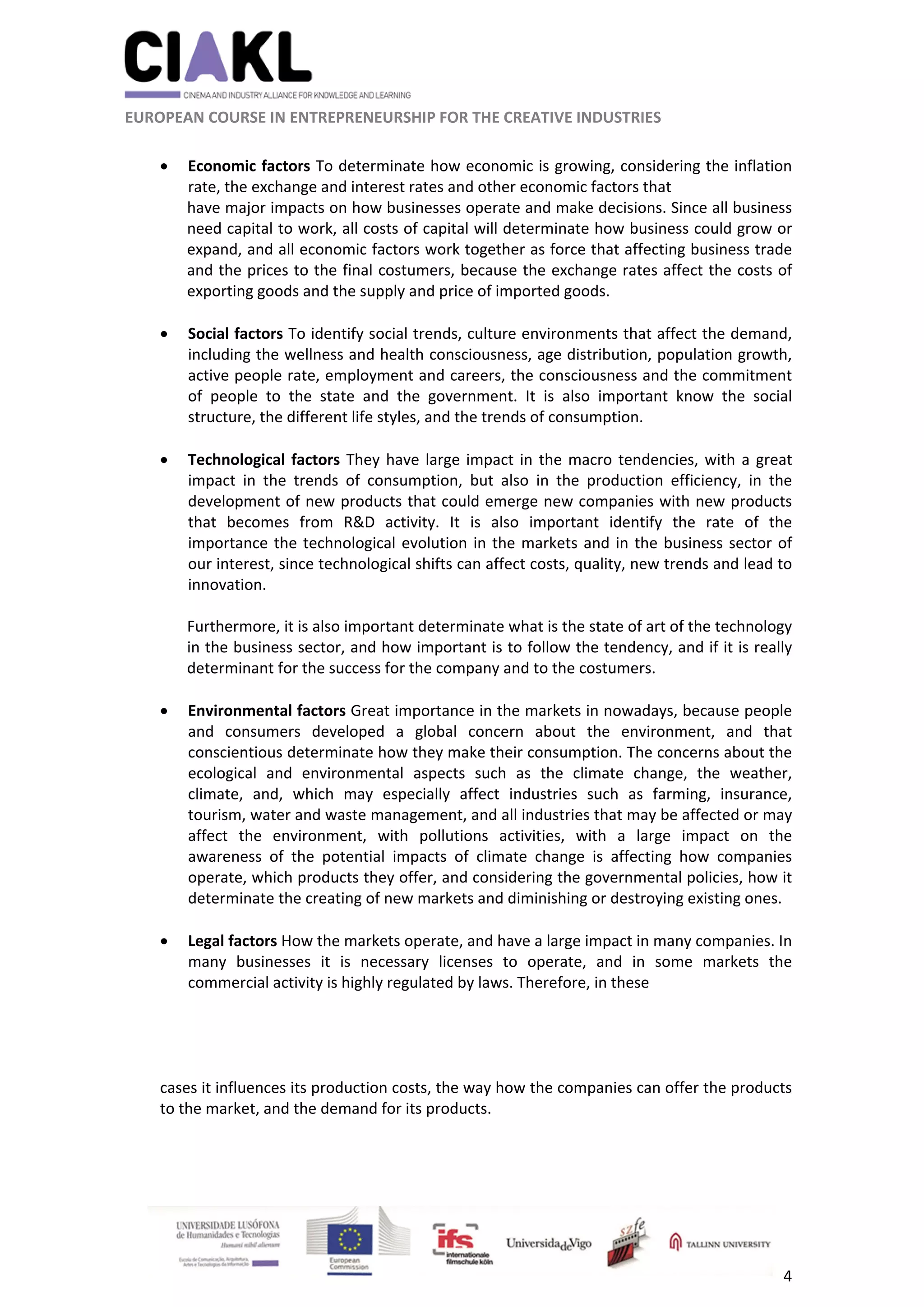
Political f
who  dep
strategic 
include a
and envir
in the eco
or  be  pr
provide, a


SE IN ENTRE
using PESTE
analysis  to
ntrepreneur 
nvironment 
the market,
nformation t
most attrac
factors Gove
end  for  exa
areas  in  a  c
areas such as
ronmental la
onomy, it’s i
rovided,  and
and find how
          
EPRENEURSH
L From an e
o  identify  po
could use a 
and  Legal 
, according t
that allows h
tive markets
ernments ha
mple  ‐  the 
country.  The
s trade restr
aws. To ident
mportant an
d  those  tha
w and to wha
	
HIP FOR THE 
existing busi
otential  bar
technique c
analysis,  t
to macro iss
him to make
s for its imple
ave great inf
health,  educ
e  political  fa
rictions, tarif
tify how and
nalyze which
t  the  gover
at degree thi
CREATIVE IN
ness idea, t
rriers  and  o
called PESTE
to  identify 
ues. Using t
e strategic d
ementation.
fluence on th
cation,  cultu
actors  define
ffs, tax polic
d to what deg
 goods and s
rnment  have
is is attractiv
Source: H
NDUSTRIES 
 
he entrepre
opportunities
L – Political, 
and  define
his tool the 
ecisions for 
he economy 
ure,  infrastru
e  the  politica
cy, labor and
gree a gover
services they
en’t  strategi
ve to implem
oward H. Steve
neur will ne
s  in  the  m
 Economic, S
e  the  degre
entrepreneu
his business
of a nation,
uctures  and 
al  stability, 
d commercia
rnment inter
y wants to pr
ic  interests 
ment  a busine
enson 
3 
eed to 
arket. 
Social, 
ee  of 
ur can 
s, and 
, from 
other 
which 
al law, 
rvenes 
rovide 
in  to 
ess. 


 EUROPEAN COURSE IN ENTREPRENEURSHIP FOR THE CREATIVE INDUSTRIES 
4 
 
 Economic factors To determinate how economic is growing, considering the inflation 
rate, the exchange and interest rates and other economic factors that 
have major impacts on how businesses operate and make decisions. Since all business 
need capital to work, all costs of capital will determinate how business could grow or 
expand, and all economic factors work together as force that affecting business trade 
and the prices to the final costumers, because the exchange rates affect the costs of 
exporting goods and the supply and price of imported goods. 
 
 Social factors To identify social trends, culture environments that affect the demand, 
including the wellness and health consciousness, age distribution, population growth, 
active people rate, employment and careers, the consciousness and the commitment 
of  people  to  the  state  and  the  government.  It  is  also  important  know  the  social 
structure, the different life styles, and the trends of consumption. 
 
 Technological factors They have large impact in the macro tendencies, with a great 
impact  in  the  trends  of  consumption,  but  also  in  the  production  efficiency,  in  the 
development of new products that could emerge new companies with new products 
that  becomes  from  R&D  activity.  It  is  also  important  identify  the  rate  of  the 
importance the technological evolution in the markets and in the business sector of 
our interest, since technological shifts can affect costs, quality, new trends and lead to 
innovation. 
 
Furthermore, it is also important determinate what is the state of art of the technology 
in the business sector, and how important is to follow the tendency, and if it is really 
determinant for the success for the company and to the costumers. 
 
 Environmental factors Great importance in the markets in nowadays, because people 
and  consumers  developed  a  global  concern  about  the  environment,  and  that 
conscientious determinate how they make their consumption. The concerns about the 
ecological  and  environmental  aspects  such  as  the  climate  change,  the  weather, 
climate,  and,  which  may  especially  affect  industries  such  as  farming,  insurance, 
tourism, water and waste management, and all industries that may be affected or may 
affect  the  environment,  with  pollutions  activities,  with  a  large  impact  on  the 
awareness  of  the  potential  impacts  of  climate  change  is  affecting  how  companies 
operate, which products they offer, and considering the governmental policies, how it 
determinate the creating of new markets and diminishing or destroying existing ones. 
 
 Legal factors How the markets operate, and have a large impact in many companies. In 
many  businesses  it  is  necessary  licenses  to  operate,  and  in  some  markets  the 
commercial activity is highly regulated by laws. Therefore, in these  


cases it influences its production costs, the way how the companies can offer the products 
to the market, and the demand for its products. 


 EUROP


Mark
launc
strate
vision
impo
                     
 
PEAN COURS
ket players f
ch  a  new  pr
egic perspec
n of the mar
rtant inform
                      
SE IN ENTRE
framework T
roduct  or  se
ctive of most
ket and is a 
mation to deli
          
EPRENEURSH
To take decis
ervice,  it  is  i
t important a
resume to ta
ineate a stra
	
HIP FOR THE 
sions and cre
mportant  h
actors in the
ake in consid
ategy. 
CREATIVE IN
eate a strate
ave  a  globa
e market. Th
deration the 
NDUSTRIES 
egy to get in 
l  view  of  th
he next graph
vital informa
 
the market,
he  market,  w
hic, is a simp
ation to gath
5 
, or to 
with  a 
plified 
hering 


 EUROP
 
 
SW
The  S
facto
of his
This 
objec
and W
relati


 

 



PEAN COURS
OT 
SWOT  analy
rs in the ma
s business, a
tool    is  he
ctives of the 
Weaknesses 
ive to the ma
Strengths
over othe
 
Weaknes
relative t
Opportun
the envir
Threats: 
business 
                      
SE IN ENTRE
ysis  This  an
arket. The en
nd also iden
lpful  to  ana
organization
are relative
arket. 
s: characteri
ers 
sses (or Limit
o others 
nities: extern
onment 
external elem
or project 
          
EPRENEURSH
nother  popu
ntrepreneur 
tify the main
alyze  the  m
n. When usin
e to the orga
istics of the 
tations): are
nal chances t
ments  in  th
	
HIP FOR THE 
lar  techniqu
should try to
n Opportuni
arket,  to  de
ng this tool 
anization/bu
business, o
e characterist
to improve p
he  environm
CREATIVE IN
ue  for  evalu
o identify th
ities and Thr
efine  the  st
it is importa
siness and O
or project te
tics that plac
performance
ment  that  c
NDUSTRIES 
uating  existi
e Strengths,
reats that he
rategic  plan
nt to consid
Opportunitie
am that give
ce the team 
e (e.g. make 
could  cause 
ng  element
, and Weakn
e will have to
nning,  and  t
der that  Stre
es and Threa
e it an adva
at a disadva
greater prof
  trouble  fo
6 
s  and 
nesses 
o face. 
to  set 
engths 
ts are 
antage 
antage 
fits) in 
or  the 


 EUROP


Ident
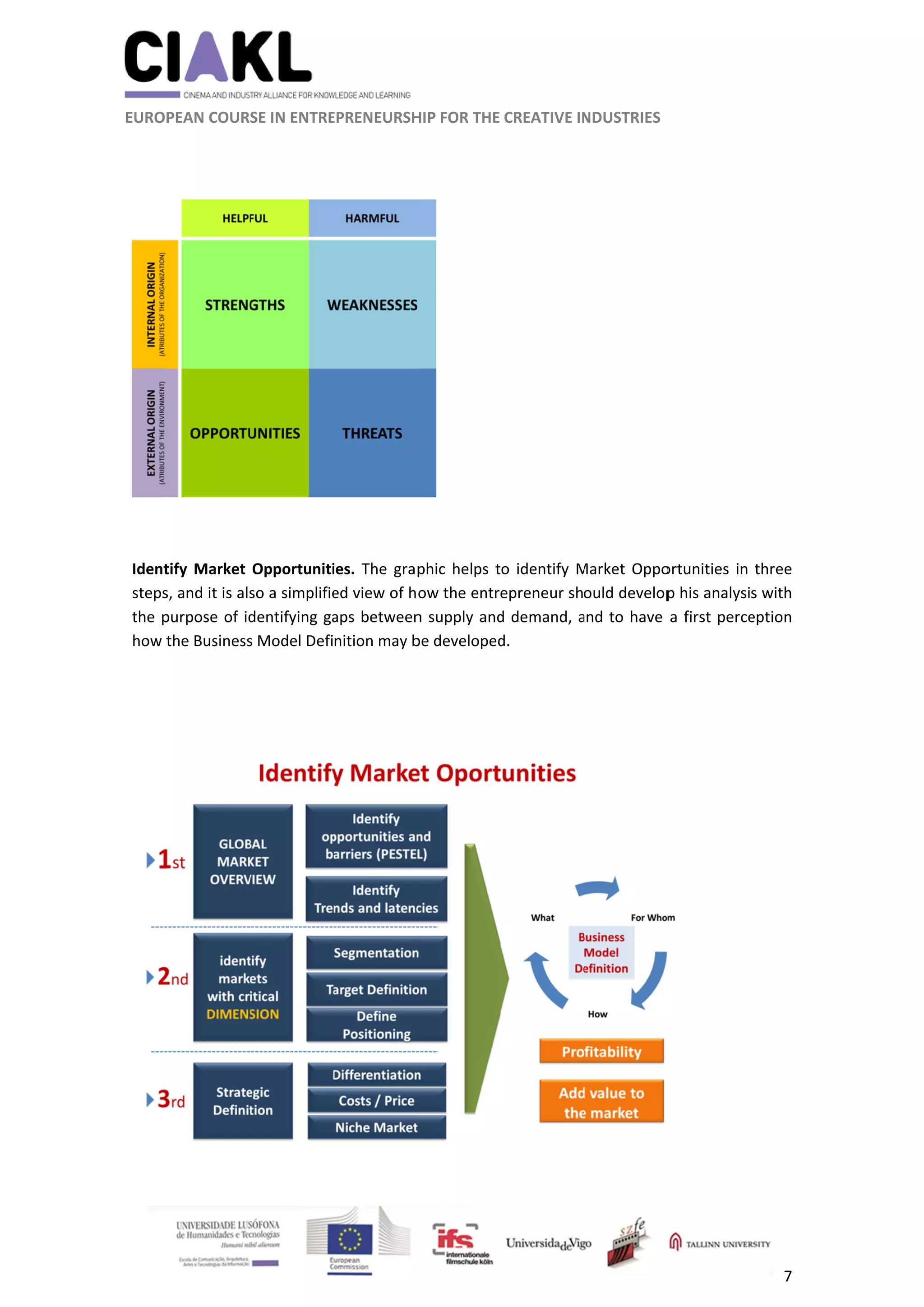
steps
the p
how t


PEAN COURS
tify Market 
s, and it is als
purpose of id
the Business
                      
SE IN ENTRE
Opportuniti
so a simplifie
dentifying ga
s Model Defi
          
EPRENEURSH
ies.  The grap
ed view of h
aps between
nition may b
	
HIP FOR THE 
 
phic helps t
ow the entre
n supply and
be developed
CREATIVE IN
o identify  M
epreneur sh
d demand, a
d. 
NDUSTRIES 
Market Oppo
ould develop
nd to have 
ortunities in 
p his analysi
a first perce
 
7 
three 
s with 
eption 


 EUROPEAN COURSE IN ENTREPRENEURSHIP FOR THE CREATIVE INDUSTRIES 
8 


Strategy and implementation 
Sources:  
 Robert  M. Grant,  “Contemporary Strategy  Analysis”  Fifht  Edition,  Blackwell 
Publishing, 2005 
 Michael Porter, “Competitive Strategy ‐‐ Techniques for Analysing Industries 
and Competitors”, The Free Press, 1980 
 Francois Colbert, “Entrepreneurship and Leadership in Marketing and Arts”, 
International Journal of Arts Management, Vol6, Number 1, 2003 
 Philip  Kotler  and  Kevin  Keller,  “Marketing  Management”,  12th
  edition, 
Prentice Hall, 2006 
 Regis McKenna, “Marketing Is Everything”, Harvard Business Review, 1991 
 Kevin Roberts, “Lovemarks, The Future Beyond Brands”, Powerhouse Books, 
205 
 
 
Tools for strategic planning 
 
Business strategy is a long term plan designed to achieve a particular goal or a set of goals.  
The  entrepreneur  should  gather  as  much  information  as  possible  about  external  conditions 
and opportunities, as well as internal attributes, so that his decisions are valuable, feasible and 
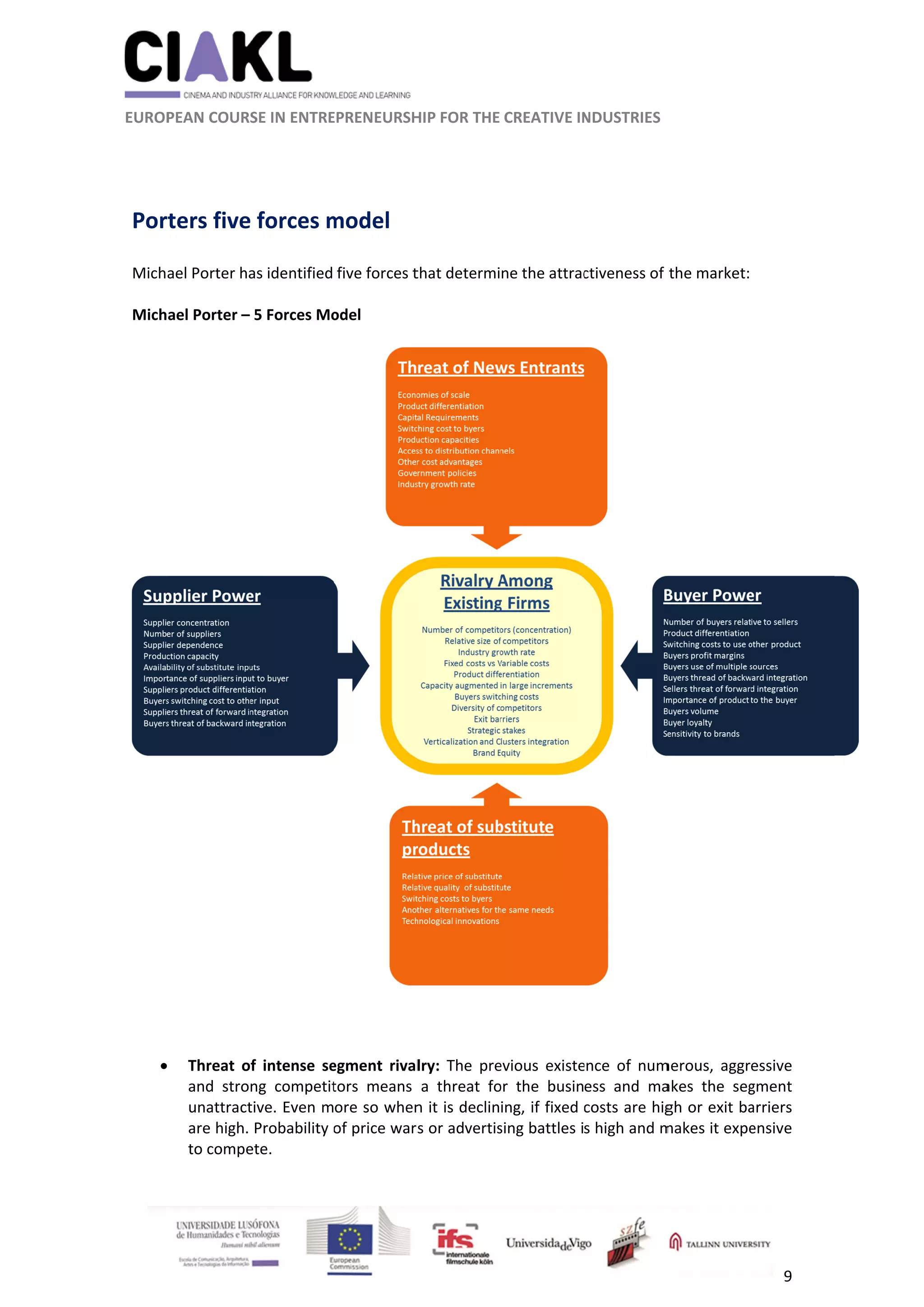
maximise value. Porter’s five forces model determines attractiveness of market segments the 
company is interested in, and helps determining what should be its competitive advantages to 
reach the objectives.   
 
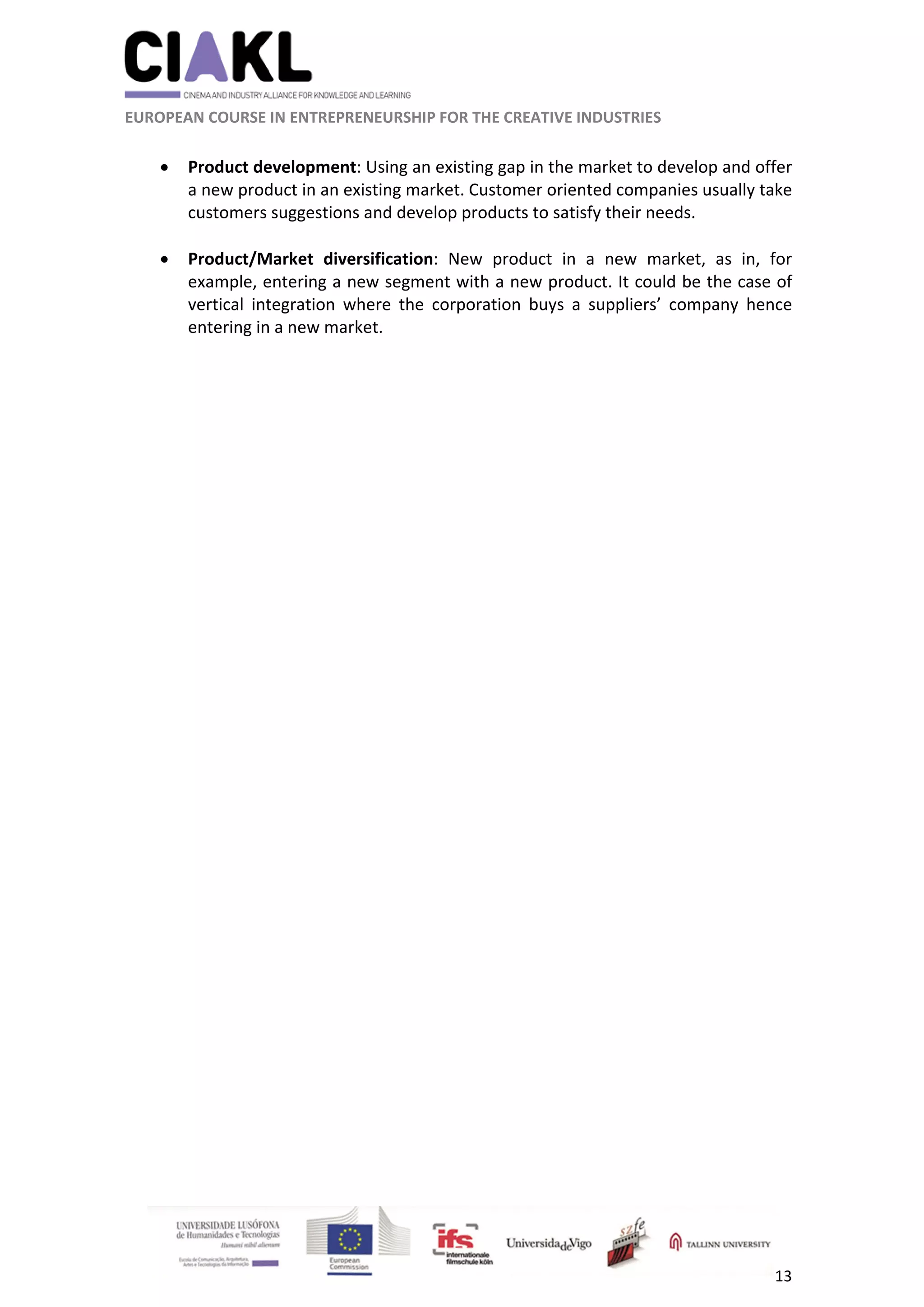
The  Ansoff  matrix  is  a  valuable  tool  that  helps  decision  making  for  growth  strategy. 
Implementing strategy means firstly defining the marketing mix also known as the  4P’s ‐ which 
products,  where  they  should  be  placed,  at  what  price  and  how  they  should  be  promoted. 
Secondly, to develop or to create the most efficiently organized internal processes, attributes 
and resources required to achieve the purposed objectives. This includes investment decisions, 
namely the acquisition of fixed assets, as shown in the next chapter. 


 EUROP
 
 
Por
 
Mich
 
Mich





PEAN COURS
rters five
ael Porter ha
ael Porter – 
Threat  o
and  stro
unattract
are high. 
to compe
                      
SE IN ENTRE
 forces m
as identified 
5 Forces Mo
f  intense  se
ng  competit
tive. Even m
Probability o
ete. 
          
EPRENEURSH
model 
five forces t
odel 
egment  rival
tors  means 
ore so when
of price wars
	
HIP FOR THE 
that determi
lry:  The  pre
a  threat  fo
n it is declin
s or advertis
CREATIVE IN
ne the attrac
evious  existe
or  the  busin
ing, if fixed 
sing battles i
NDUSTRIES 
ctiveness of 
ence  of  num
ess  and  ma
costs are hig
s high and m
the market: 
merous,  aggr
akes  the  seg
gh or exit ba
makes it expe
9 
essive 
gment 
arriers 
ensive 


 EUROPEAN COURSE IN ENTREPRENEURSHIP FOR THE CREATIVE INDUSTRIES 
10 
 
 Threat of new entrants: The most attractive segment is one in which entry barriers are 
high and exit barriers are low. There will be few new entrants and many leaving the 
segment. The worst case scenario is when entry barriers are low and exit barriers are 
high since firms enter with a good economy and face high costs if they want to leave 
during a bad economy. 
 
 Threat  of  substitute  products:  A  segment  is  unattractive  when  there  are  actual  or 
potential substitutes for the product. Price competition is high and profits are low. 
 
 Threat of buyers’ power: When the buyers have many alternatives and switching costs 
are low, their bargaining power rises and the segment is unattractive. 
 
 Threat  of  suppliers’  power:  Reduction  of  market  attractiveness  is  also  caused  by 
powerful, concentrated and organized suppliers which can easily raise prices or reduce 
quantity supplied, or when the suppliers’ input is important and switching costs are 
high. 
 
However,  when  we  are  analysing  the  creative  industries  market,  it’s  important  to  consider 
other forces in the market, since this is a market with some specificities, and is depending of 
many interlocutors and stakeholders. 
  
Like Michael Porter has identified 5 big forces in the market, for general markets, the same 
process inspired a new perspective and market analysis. Considering multiple intervenients in 
creative industries projects, it seems very important to include others groups of stakeholders 
as forces into the market, once that can be determinate to the project success. They usually 
are a concern to project promoters and they are referenced as strategic elements, and that’s 
why  it’s  possible  and  important  to  define  a  strategy  of  how  to  involve  all  of  them  in  the 
development and implementation of the project. 
 
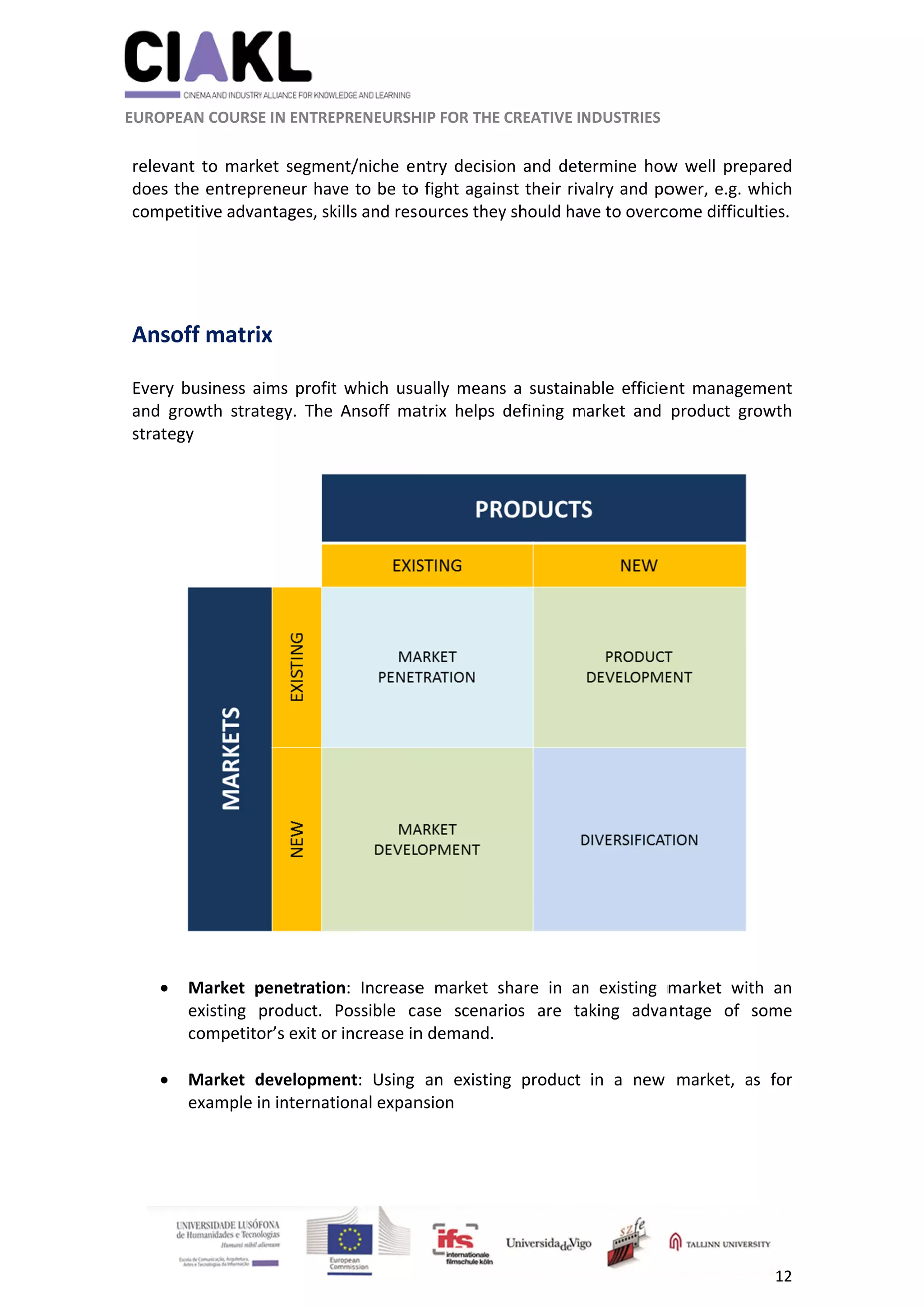
Beyond  suppliers  and  buyers  power,  threats  of  substitute  products  and  threats  of  new 
entrants, we have also for the  creative industries, as stakeholders: the investors, the state, 
sponsors and the place agents, all of them as forces in the market.  
 
Investors – usually, the initial investment in creative industries projects is quite large which 
leads  to  seeking  intensive  capital,  where  investors  will  be  an  answer  and  an  alternative  to 
finance the projects, instead of using banks. At the same time, they also have great power and 
the possibility to make pressure. 
 
State ‐ can be seen as a partner, as an investor, as a promoter or even a direct customer to 
certain cultural and economic activities, which may involve the creative industries. Through its 
ministries and its social responsibility network, can also be seen as a network of contacts and 
as a distribution channel for products and services. 
 
That  is  why  we  may  consider  the  State  as  a  force  in  the  market,  because  through  specific 
policies, it can finance or subsidize some areas and sectors of the economy that could make a 
greater or lesser impact in production and create opportunities to the creative industries. 


 EUROP
 
Spon
altern
same
draw
an ex
the re
cond
form 
 
Place
great
is a p
in  th
chann
who 
time 
pene
 
 
Using
e.g. 
                     
 
PEAN COURS
sors  –  Since
natives to fin
e time provid
w a strategic 
xclusive, or t
eason why t
itions which
to commun
e Agents – E
t distribution
principal part
e  market  an
nel we must
are in conta
as the sales
tration in th
g this mode
informatio
                      
SE IN ENTRE
e  most  of  th
nance the pr
ding high vis
approach to
they don’t w
they must be
 could have 
icate their b
very comme
n channel. In
t of success.
nd  for  big  p
t choose and
act with the 
s force. Wor
e market and
el provides 
n  about  co
          
EPRENEURSH
he  projects 
rojects, and 
sibility to spo
o the sponso
want to be sh
e seen as a f
great impac
rands, and ra
ercial activity
n competitive
 Considering
players  in  th
d at the sam
market. The
rking with th
d a better in
informatio
ompetitors,
	
HIP FOR THE 
needs  inten
the sponsor
onsors and t
ors, consider
haring the sa
force in the 
ct in the mar
arely as a ph
y needs a st
e markets th
g that some 
he  market,  i
me time, ide
ey must be s
he right plac
ternationaliz
on about wh
,  suppliers 
CREATIVE IN
sive  capital,
rship can be 
their brands.
ing that all o
ame space w
market, bec
rket. The size
hilanthropic v
rong sales d
he access to 
channels be
it  is  very  im
entify the im
een as strat
ce agents, w
zation proce
hat Porter c
and  custo
NDUSTRIES 
  the  promo
strategically
. In all case, 
of them will 
with their co
cause they ca
e matters an
view. 
epartment w
the right dis
ecome exclus
mportant  to 
portance of
egic partner
we will also 
ss. 
calls marke
omers.  This
oters  need  to
y used, and 
it is importa
want to be 
ompetitors. T
an require c
nd they see 
which also n
stribution ch
sive to big b
determine 
f the place a
r, and most o
promote a b
et attractive
s  informati
11 
o  find 
at the 
ant to 
alone 
This is 
ertain 
it as a 
need a 
hannel 
brands 
which 
agents 
of the 
better 
 
eness, 
on  is 


 EUROP
 
relev
does
comp
 
 
Ans
 
Every
and 
strat
 

 



PEAN COURS
vant to mar
s the entrep
petitive adv
soff matr
y business 
growth  str
egy 
Market 
existing 
competi
Market 
example
                      
SE IN ENTRE
rket segme
preneur hav
vantages, sk
rix 
aims profit
rategy.  The 
penetratio
product. 
tor’s exit or
developme
e in internat
          
EPRENEURSH
ent/niche en
ve to be to
kills and res
t which usu
Ansoff  ma
on:  Increase
Possible  ca
r increase in
ent:  Using 
tional expan
	
HIP FOR THE 
ntry decisio
o fight again
sources they
ually means
atrix  helps 
e  market  s
ase  scenar
n demand.
an  existin
nsion  
CREATIVE IN
on and det
nst their riv
y should ha
s a sustaina
defining  m
share  in  an
rios  are  ta
ng  product 
NDUSTRIES 
ermine how
valry and po
ve to overc
able efficie
market  and 
n  existing  m
aking  adva
in  a  new 
w well prep
ower, e.g. w
come difficu
ent manage
product  gr
market  wit
ntage  of 
market,  a
12 
pared 
which 
ulties.  
ement 
rowth 
 
th  an 
some 
as  for 


 EUROPEAN COURSE IN ENTREPRENEURSHIP FOR THE CREATIVE INDUSTRIES 
13 
 
 Product development: Using an existing gap in the market to develop and offer 
a new product in an existing market. Customer oriented companies usually take 
customers suggestions and develop products to satisfy their needs. 
 
 Product/Market  diversification:  New  product  in  a  new  market,  as  in,  for 
example, entering a new segment with a new product. It could be the case of 
vertical  integration  where  the  corporation  buys  a  suppliers’  company  hence 
entering in a new market. 

Subject Module - Elective CIAKL II - Class 06