Mass Communication & Media
        Literacy 11
The business of media

 Do Coca Cola, Gap, HSBC produce their advertising
    copy directly or do they employ somebody to do it for
    them?
   Who do they employ?
   Who made the radio programmes and music that
    you listen to?
   Who owns the Sun, the Guardian, Le Figaro, El Pais?
   What kind of organisation lie behind them?
   How can you find out?
   Who paid for the music playing on the radio?
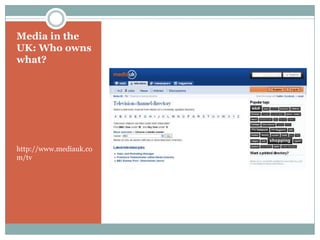
Media in the
UK: Who owns
what?


http://www.mediauk.co
m/tv
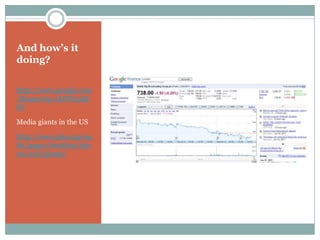
And how’s it
doing?


http://www.google.com
/finance?q=LON%3AB
SY

Media giants in the US

http://www.pbs.org/wg
bh/pages/frontline/sho
ws/cool/giants/
The business of media

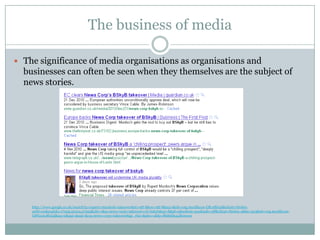
 The significance of media organisations as organisations and
  businesses can often be seen when they themselves are the subject of
  news stories.


    http://www.google.co.uk/search?q=rupert+murdock+takeover&ie=utf-8&oe=utf-8&aq=t&rls=org.mozilla:en-GB:official&client=firefox-
    a#hl=en&expIds=17259,22104,27955&xhr=t&q=news+corp+takeover+of+bskyb&cp=8&pf=p&sclient=psy&safe=off&client=firefox-a&hs=5u3&rls=org.mozilla:en-
    GB%3Aofficial&aq=0&aqi=&aql=&oq=news+corp+takeover&gs_rfai=&pbx=1&fp=f8d6fd944fbe01e9
The business of media

 The current organisation of the media is neither obvious
 nor inevitable
    There’s substantial variety in the nature of the organisations that
     produce media
    It’s not always clear who made what

 But all media organisations are businesses involved in a
  commercial sphere of exchange – of income generation,
  of profit and loss.
 The economics of media applies as much to not-for profit
  media organisations as it does to for profit organisations
 We MUST think about the economic environment in
  which media are produced
Studying media organisations


     1. Political economy
   2. Organisation approach
     3. Cultural approach
Political economy

 The nature of production and the conditions under
 which it takes place

    Where does economic value lie?
    Where is value generated?

    How are economic markets managed
    Are markets regulated?
    How do the vested interests of individuals impact?
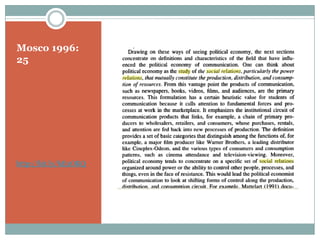
Mosco 1996:
25


http://bit.ly/hE2OKQ
Political economy

 What is the relationship between a range of meanings
 available in media and the underpinning economic
 interests and ownership patterns across different media
 spheres:

    The press, Music, TV, Film, Radio, Advertising, The internet


 Who pays for media at the point of production?
 What is the primary commodity of any medium?
 How do consumers pay for this commodity and for the
 different economic activities of the media?
Critical political economy


                   Power
 How do government oversee media management and
  regulation?
 How does a capitalist economy underwrite the profit
  impulse of media businesses?
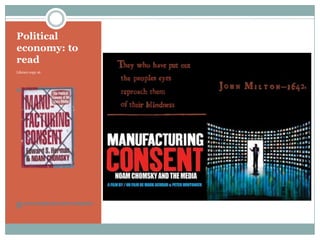
Political
economy: to
read
Library copy at:


http://bit.ly/h28Q5J


http://www.youtube.com/watch?v=OJuqoDvyX
Ok
Media and the free market


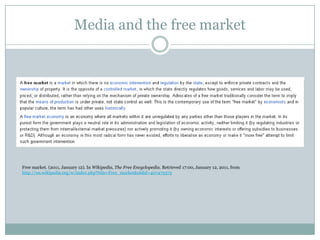
Free market. (2011, January 12). In Wikipedia, The Free Encyclopedia. Retrieved 17:00, January 12, 2011, from
http://en.wikipedia.org/w/index.php?title=Free_market&oldid=407475375
Media and the free market

 Sir Richard Branson's Virgin media empire has
 helped to make him Britain's wealthiest television
 and film entrepreneur, with a fortune of £2,600m,
 according to The Sunday Times Rich List 2010.

 How does the free market explain such wealth?
Economic value

 Media products differ from other products because
  of the combination of the way they generate revenue
  and in the ways they are consumed
 Revenue can come from:
    The final consumer in the form of some kind of payment
    Selling space in the artefact to advertisers
Audiences as commodity

 Media do not produce ‘products’
 Media produce audiences


 The pessimistic view – we’re included in a group
  whose interests we don’t share or we get nothing
  because we are not attractive enough to advertisers
 The optimistic view – we get products and
  experiences that are sharply targeted to our tastes
  and interests
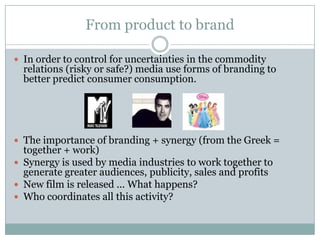
From product to brand

 In order to control for uncertainties in the commodity
  relations (risky or safe?) media use forms of branding to
  better predict consumer consumption.


 The importance of branding + synergy (from the Greek =
  together + work)
 Synergy is used by media industries to work together to
  generate greater audiences, publicity, sales and profits
 New film is released ... What happens?
 Who coordinates all this activity?
Costs

 Traditionally, high fixed costs and low marginal costs
  (music studio + repeated prints)
 Economies of scale are vital


 Now ... New publishing paradigm


    New production technologies
    New distribution technologies
Size and concentration

 Concentration
   Measures the degree to which control of a particular sector of
    media is in the hands of the most dominant firms. It is usually
    measured as the percentage of the revenue received by the
    largest 5 or 10 firms
 Monopoly and Oligopoly
   Monopoly describes a condition in which one company or
    seller has control over the entire market. An oligopoly
    describes a condition in which sellers are few. This results in
    the actions of any one of them affecting the market price as
    well as their competitors.
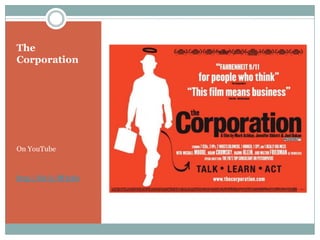
The
Corporation


On YouTube


http://bit.ly/ffO2Dc
Models of distribution


   Vertical integration

            V

     Net Neutrality

Mass Communication & Media Literacy 11

  • 1.
    Mass Communication &Media Literacy 11
  • 2.
    The business ofmedia  Do Coca Cola, Gap, HSBC produce their advertising copy directly or do they employ somebody to do it for them?  Who do they employ?  Who made the radio programmes and music that you listen to?  Who owns the Sun, the Guardian, Le Figaro, El Pais?  What kind of organisation lie behind them?  How can you find out?  Who paid for the music playing on the radio?
  • 3.
    Media in the UK:Who owns what? http://www.mediauk.co m/tv
  • 4.
    And how’s it doing? http://www.google.com /finance?q=LON%3AB SY Mediagiants in the US http://www.pbs.org/wg bh/pages/frontline/sho ws/cool/giants/
  • 5.
    The business ofmedia  The significance of media organisations as organisations and businesses can often be seen when they themselves are the subject of news stories. http://www.google.co.uk/search?q=rupert+murdock+takeover&ie=utf-8&oe=utf-8&aq=t&rls=org.mozilla:en-GB:official&client=firefox- a#hl=en&expIds=17259,22104,27955&xhr=t&q=news+corp+takeover+of+bskyb&cp=8&pf=p&sclient=psy&safe=off&client=firefox-a&hs=5u3&rls=org.mozilla:en- GB%3Aofficial&aq=0&aqi=&aql=&oq=news+corp+takeover&gs_rfai=&pbx=1&fp=f8d6fd944fbe01e9
  • 6.
    The business ofmedia  The current organisation of the media is neither obvious nor inevitable  There’s substantial variety in the nature of the organisations that produce media  It’s not always clear who made what  But all media organisations are businesses involved in a commercial sphere of exchange – of income generation, of profit and loss.  The economics of media applies as much to not-for profit media organisations as it does to for profit organisations  We MUST think about the economic environment in which media are produced
  • 7.
    Studying media organisations 1. Political economy 2. Organisation approach 3. Cultural approach
  • 8.
    Political economy  Thenature of production and the conditions under which it takes place  Where does economic value lie?  Where is value generated?  How are economic markets managed  Are markets regulated?  How do the vested interests of individuals impact?
  • 9.
  • 10.
    Political economy  Whatis the relationship between a range of meanings available in media and the underpinning economic interests and ownership patterns across different media spheres:  The press, Music, TV, Film, Radio, Advertising, The internet  Who pays for media at the point of production?  What is the primary commodity of any medium?  How do consumers pay for this commodity and for the different economic activities of the media?
  • 11.
    Critical political economy Power  How do government oversee media management and regulation?  How does a capitalist economy underwrite the profit impulse of media businesses?
  • 12.
    Political economy: to read Library copyat: http://bit.ly/h28Q5J http://www.youtube.com/watch?v=OJuqoDvyX Ok
  • 13.
    Media and thefree market Free market. (2011, January 12). In Wikipedia, The Free Encyclopedia. Retrieved 17:00, January 12, 2011, from http://en.wikipedia.org/w/index.php?title=Free_market&oldid=407475375
  • 14.
    Media and thefree market  Sir Richard Branson's Virgin media empire has helped to make him Britain's wealthiest television and film entrepreneur, with a fortune of £2,600m, according to The Sunday Times Rich List 2010.  How does the free market explain such wealth?
  • 15.
    Economic value  Mediaproducts differ from other products because of the combination of the way they generate revenue and in the ways they are consumed  Revenue can come from:  The final consumer in the form of some kind of payment  Selling space in the artefact to advertisers
  • 16.
    Audiences as commodity Media do not produce ‘products’  Media produce audiences  The pessimistic view – we’re included in a group whose interests we don’t share or we get nothing because we are not attractive enough to advertisers  The optimistic view – we get products and experiences that are sharply targeted to our tastes and interests
  • 17.
    From product tobrand  In order to control for uncertainties in the commodity relations (risky or safe?) media use forms of branding to better predict consumer consumption.  The importance of branding + synergy (from the Greek = together + work)  Synergy is used by media industries to work together to generate greater audiences, publicity, sales and profits  New film is released ... What happens?  Who coordinates all this activity?
  • 18.
    Costs  Traditionally, highfixed costs and low marginal costs (music studio + repeated prints)  Economies of scale are vital  Now ... New publishing paradigm  New production technologies  New distribution technologies
  • 19.
    Size and concentration Concentration  Measures the degree to which control of a particular sector of media is in the hands of the most dominant firms. It is usually measured as the percentage of the revenue received by the largest 5 or 10 firms  Monopoly and Oligopoly  Monopoly describes a condition in which one company or seller has control over the entire market. An oligopoly describes a condition in which sellers are few. This results in the actions of any one of them affecting the market price as well as their competitors.
  • 20.
  • 21.
    Models of distribution Vertical integration V Net Neutrality