Gülseren Adaklı  Tables of the Paper presented in ESRC Conference  Oxford, Hugh College 8 September 2006
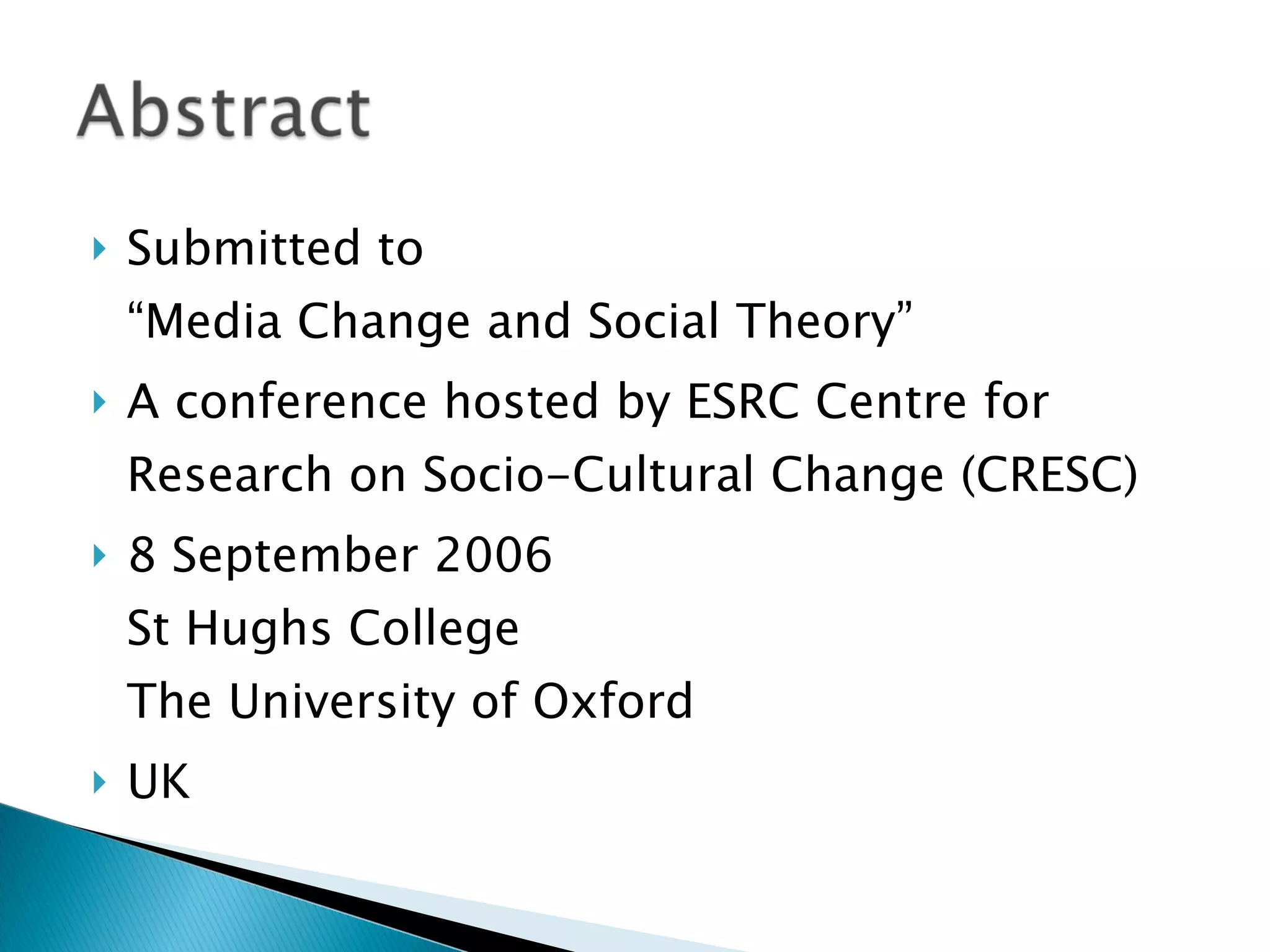
Submitted to “Media Change and Social Theory” A conference hosted by   ESRC Centre for Research on Socio-Cultural Change (CRESC)   8 September 2006 St Hughs College The University of Oxford UK
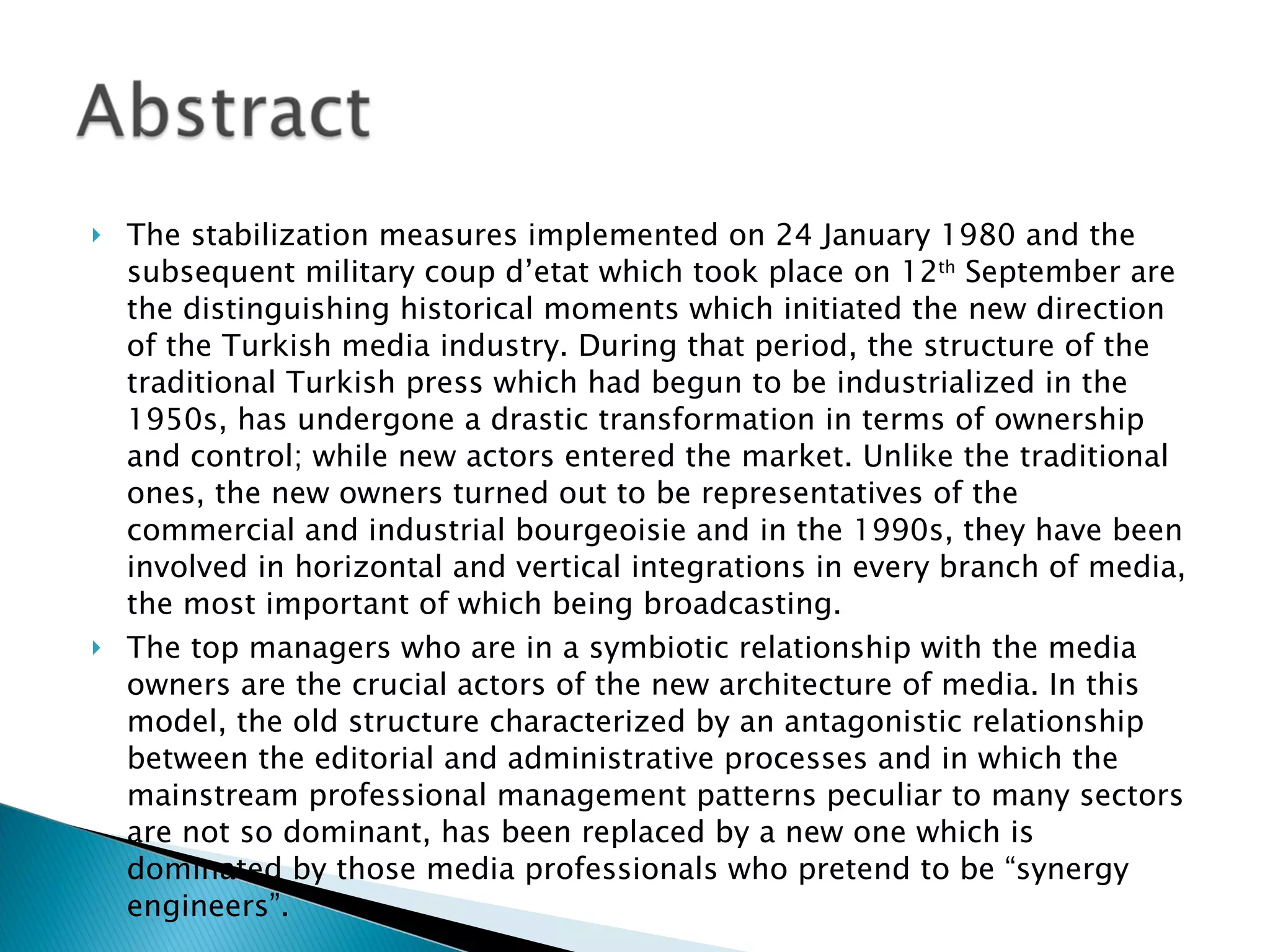
The stabilization measures implemented on 24 January 1980 and the subsequent military coup d’etat which took place on 12 th  September are the distinguishing historical moments which initiated the new direction of the Turkish media industry. During that period, the structure of the traditional Turkish press which had begun to be industrialized in the 1950s, has undergone a drastic transformation in terms of ownership and control; while new actors entered the market. Unlike the traditional ones, the new owners turned out to be representatives of the commercial and industrial bourgeoisie and in the 1990s, they have been involved in horizontal and vertical integrations in every branch of media, the most important of which being broadcasting. The top managers who are in a symbiotic relationship with the media owners are the crucial actors of the new architecture of media. In this model, the old structure characterized by an antagonistic relationship between the editorial and administrative processes and in which the mainstream professional management patterns peculiar to many sectors are not so dominant, has been replaced by a new one which is dominated by those media professionals who pretend to be “synergy engineers”.
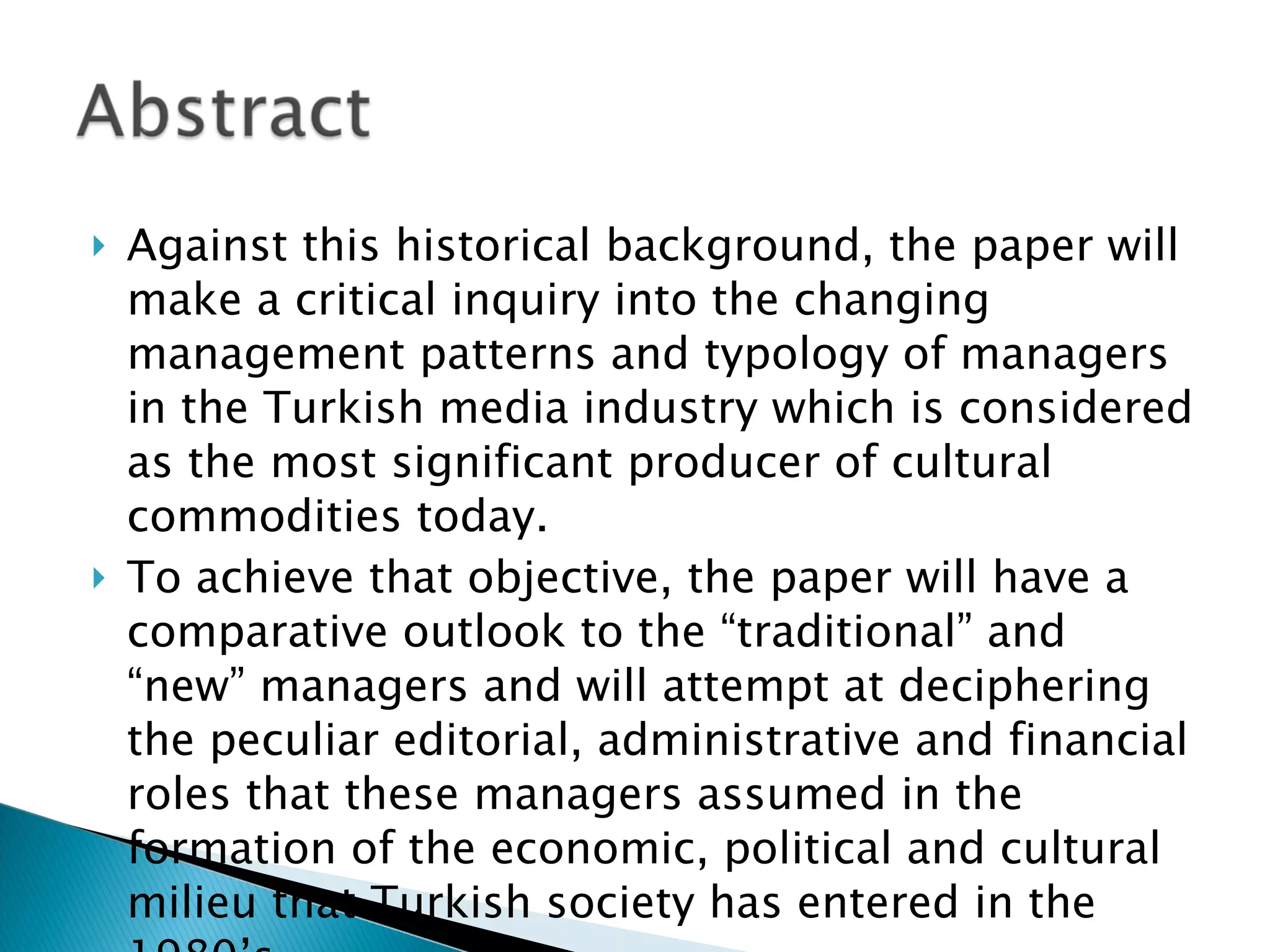
Against this historical background, the paper will make a critical inquiry into the changing management patterns and typology of managers in the Turkish media industry which is considered as the most significant producer of cultural commodities today.  To achieve that objective, the paper will have a comparative outlook to the “traditional” and “new” managers and will attempt at deciphering the peculiar editorial, administrative and financial roles that these managers assumed in the formation of the economic, political and cultural milieu that Turkish society has entered in the 1980’s.
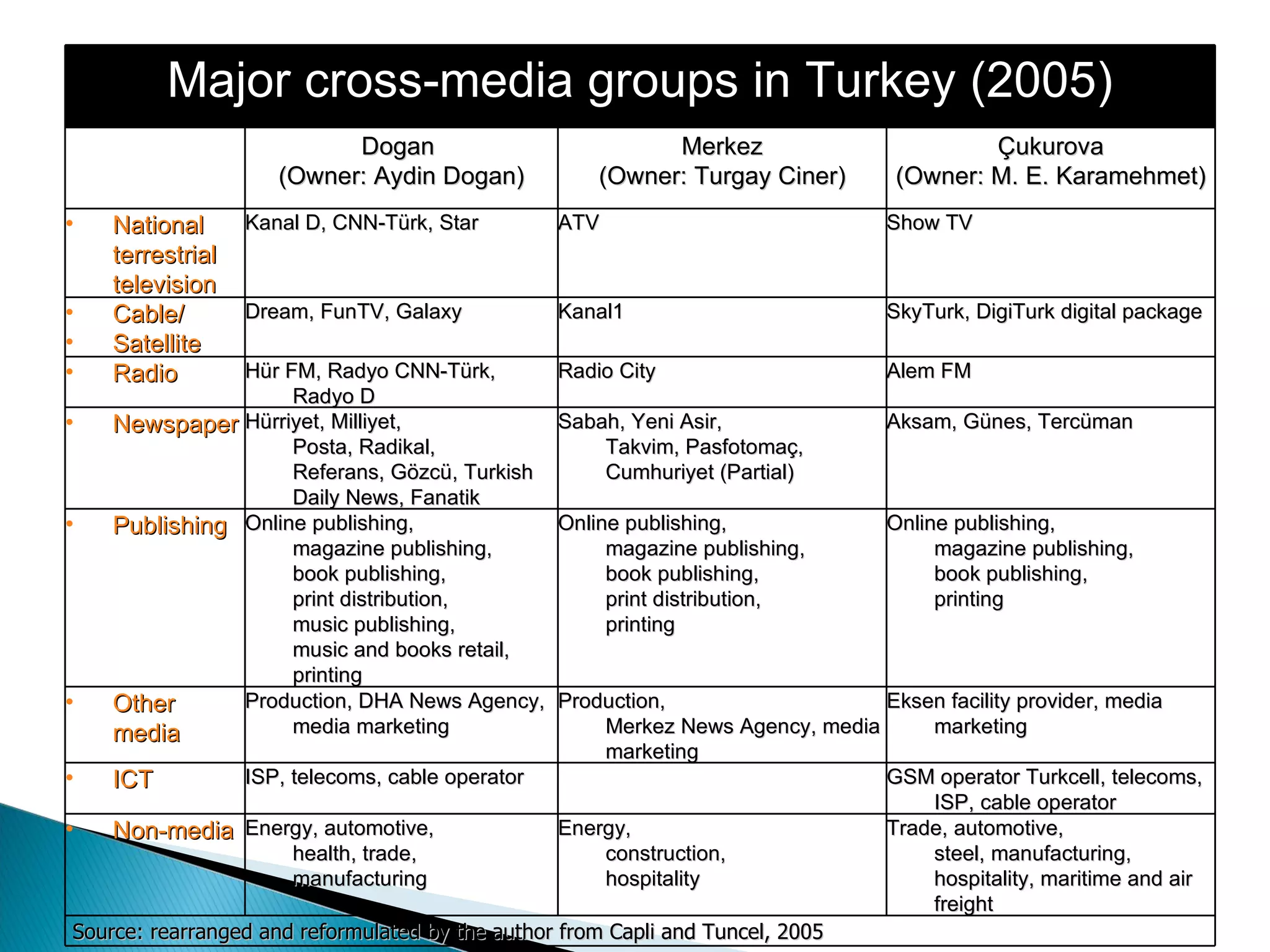
Major cross-media groups in Turkey (2005) Dogan  (Owner: Aydin Dogan) Merkez (Owner: Turgay Ciner) Çukurova (Owner: M. E. Karamehmet) National terrestrial television Kanal D, CNN-Türk, Star ATV Show TV Cable/ Satellite Dream, FunTV, Galaxy Kanal1 SkyTurk, DigiTurk digital package Radio Hür FM, Radyo CNN-Türk, Radyo D Radio City Alem FM Newspaper Hürriyet, Milliyet, Posta, Radikal, Referans, Gözcü, Turkish Daily News, Fanatik Sabah, Yeni Asir, Takvim, Pasfotomaç, Cumhuriyet (Partial) Aksam, Günes,   Tercüman Publishing Online publishing, magazine publishing, book publishing, print distribution, music publishing, music and books retail, printing Online publishing, magazine publishing, book publishing, print distribution, printing Online publishing, magazine publishing, book publishing, printing Other media Production, DHA News Agency, media marketing Production, Merkez News Agency, media marketing Eksen facility provider, media marketing ICT ISP, telecoms, cable operator GSM operator Turkcell, telecoms, ISP, cable operator Non-media Energy, automotive, health, trade, manufacturing  Energy, construction, hospitality Trade, automotive, steel, manufacturing, hospitality, maritime and air freight Source: rearranged and reformulated by the author from Capli and Tuncel, 2005
1)  Traditional distinction of operational and allocational control has gradually become insignificant.  2)  The professional managers started to exert their control over the content and capital by controlling three main areas: a) media workers/professionals’ b) production, distribution, advertising’ c) capital/cost 3)  “[S]ynergy and related strategies have become major building blocks of the global mass media system, used to optimize their presence across many media channels as possible, and to organize cross-media activities across national borders.” 4)  In the new media architecture the managers are rather partners with the owners. This new alliance is reflecting a new “collective capitalist class” position which is composed of the managers and the owner. 5)  A dramatic rise in the number of media firms working on every sub sector. They refrained from the full-time employees, in favour of freelances The trade unions in media sectors have been liquidated by the labour laws and by other “neoliberal” instruments, thus union membership ratios dramatically decreased
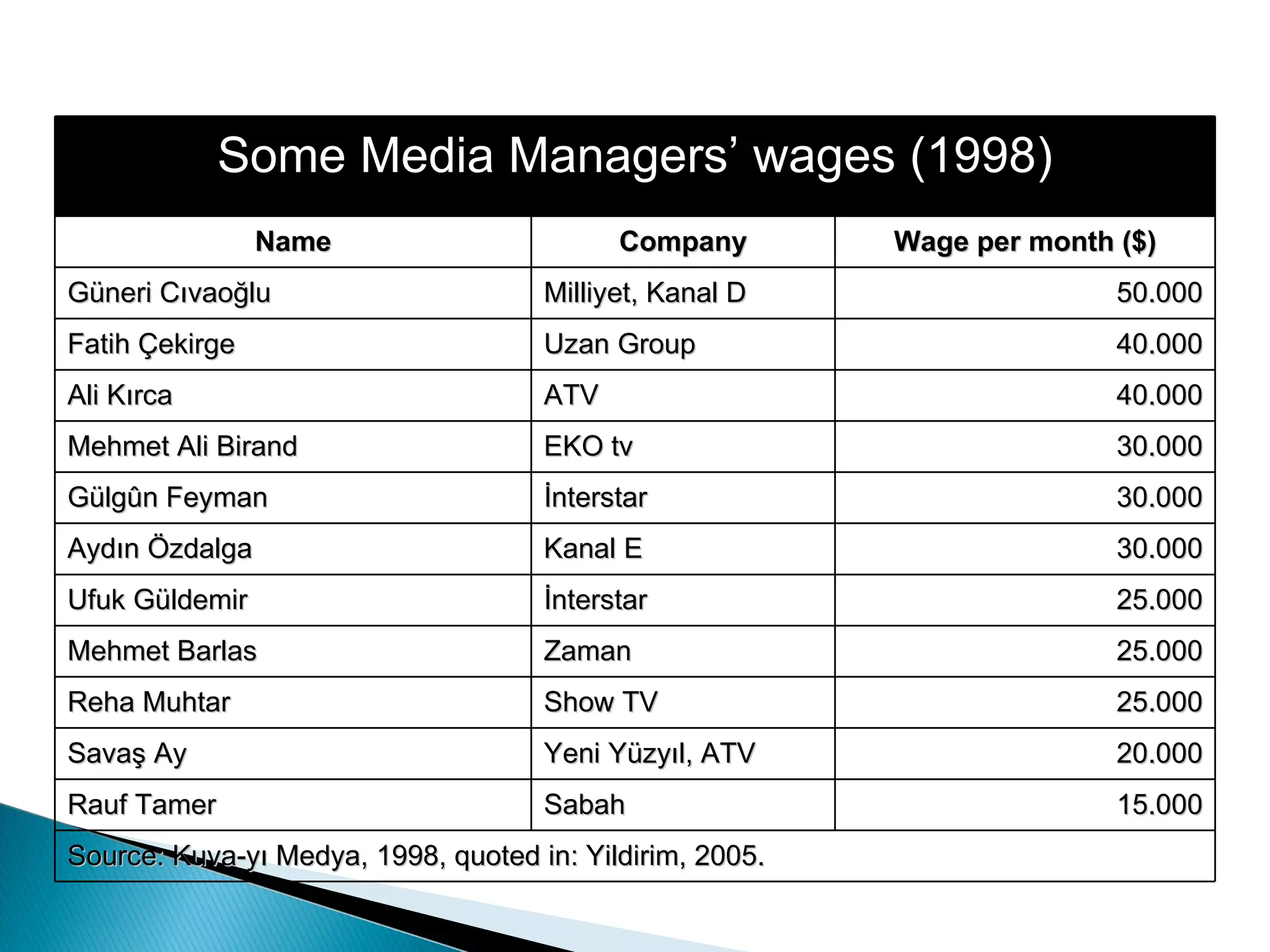
Some Media Managers’ wages (1998) Name Company Wage per month ($) Güneri Cıvaoğlu Milliyet, Kanal D 50.000 Fatih Çekirge Uzan Group 40.000 Ali Kırca ATV 40.000 Mehmet Ali Birand EKO tv  30.000 Gülgûn Feyman İnterstar 30.000 Aydın Özdalga Kanal E 30.000 Ufuk Güldemir  İnterstar 25.000 Mehmet Barlas Zaman 25.000 Reha Muhtar Show TV 25.000 Savaş Ay Yeni Yüzyıl, ATV 20.000 Rauf Tamer Sabah 15.000 Source: Kuva-yı Medya, 1998, quoted in: Yildirim, 2005.
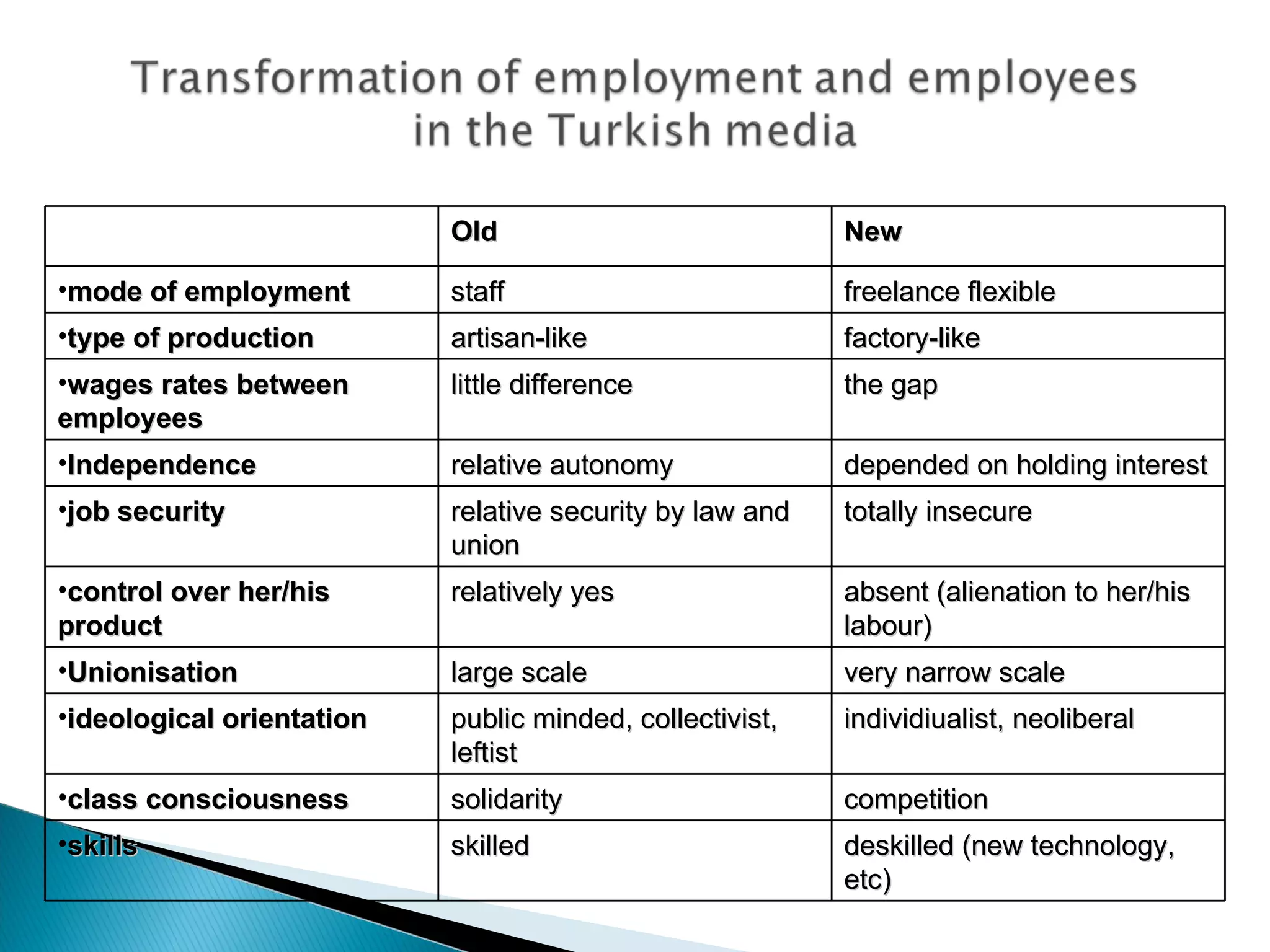
Table 3: Transformation of employment and employees in Turkish media Old New mode of employment staff freelance flexible type of production artisan-like factory-like wages rates between employees little difference the gap Independence relative autonomy depended on holding interest job security relative security by law and union totally insecure control over her/his product r elatively yes a bsent (alienation to her/his labour) Unionisation large scale very narrow scale i deological orientation public minded, collectivist, leftist individiualist, neoliberal c lass consciousness solidarity c ompetition s kills skilled deskilled (new technology, etc)
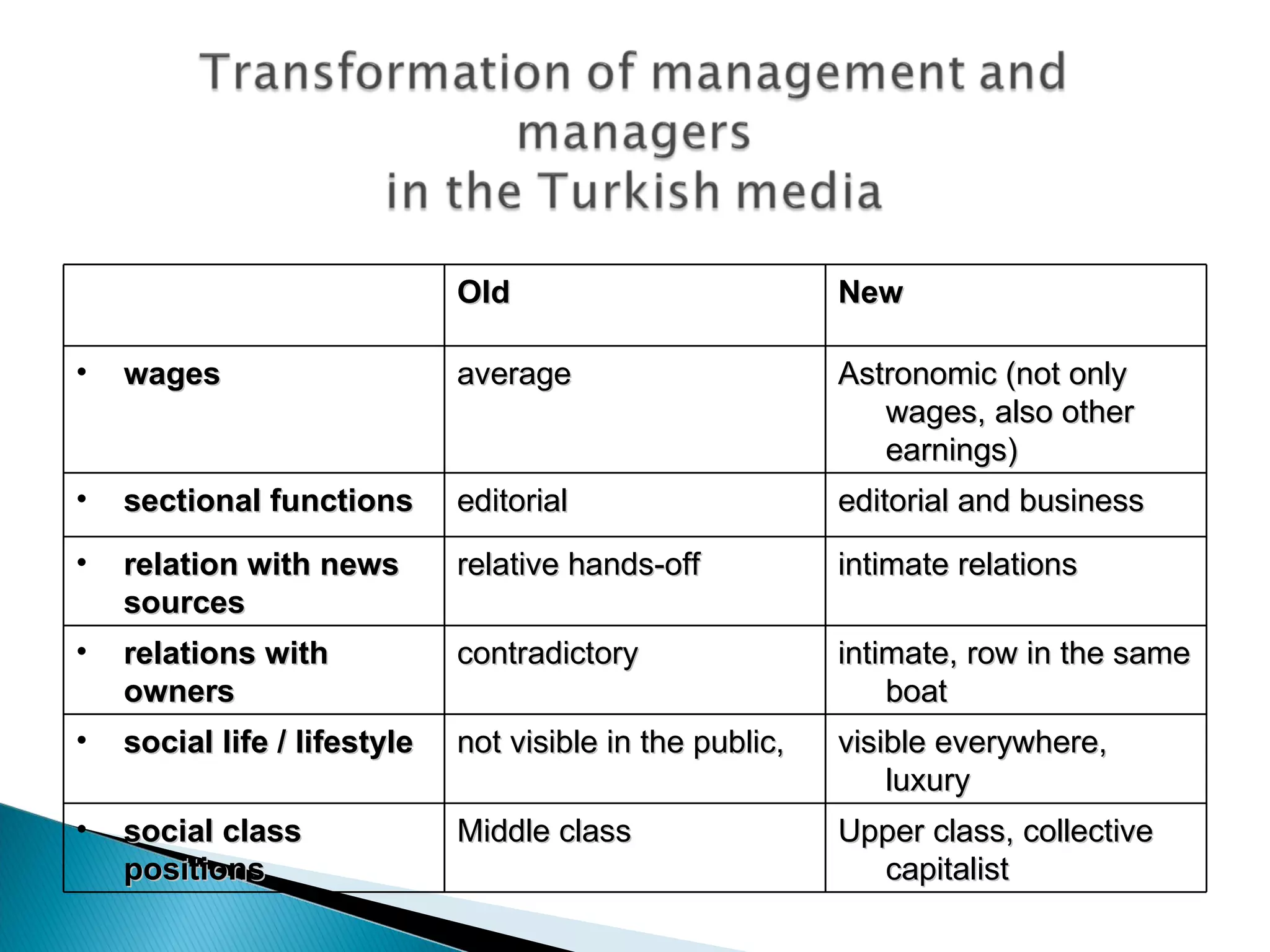
Old New w ages average Astronomic (not only wages, also other earnings) sectional functions editorial editorial and business relation with news sources relative hands-off intimate relations relations with owners contradictory intimate, row in the same boat social life / lifestyle not visible in the public,  visible everywhere, luxury s ocial class position s Middle class Upper class, collective capitalist
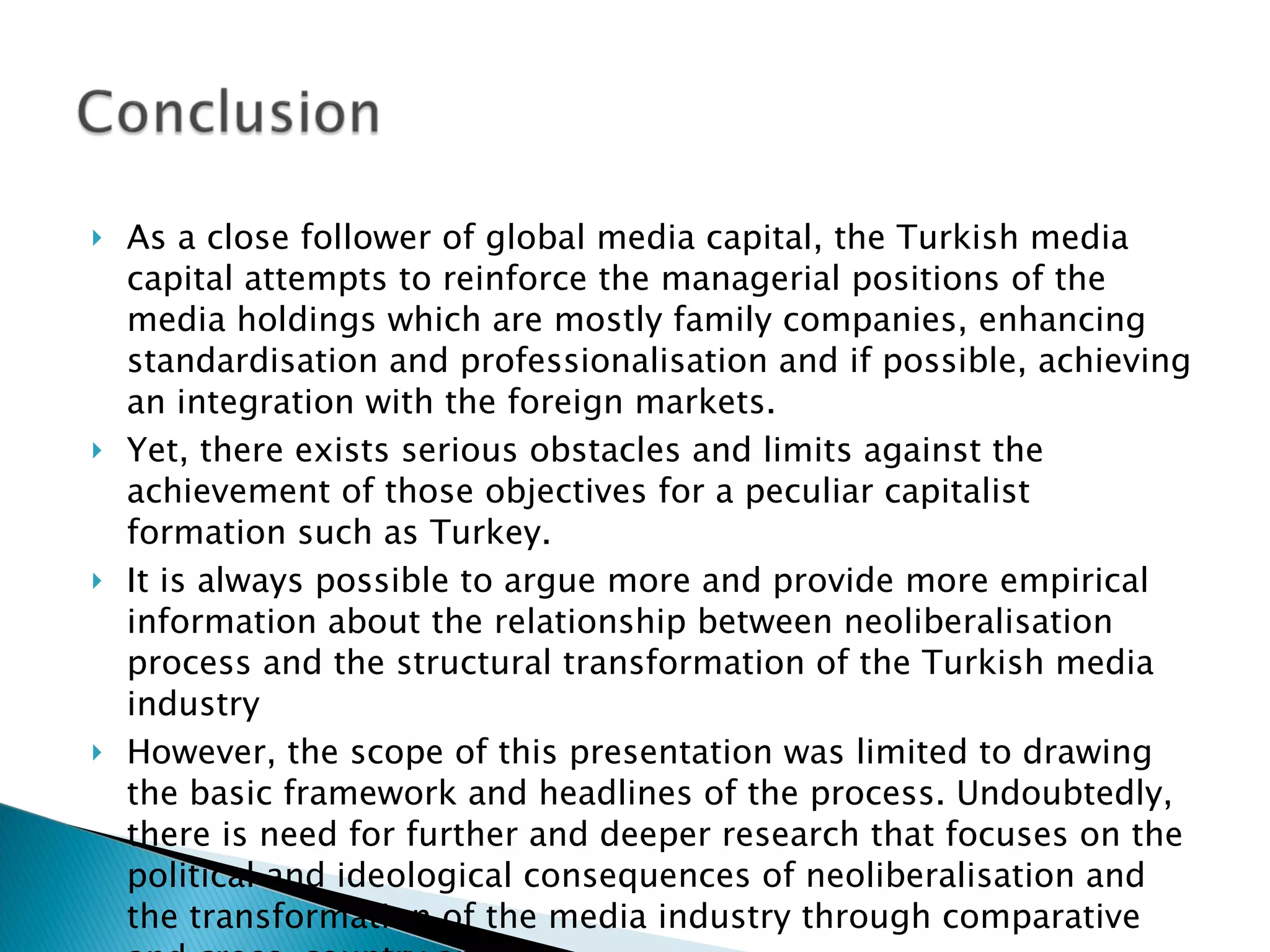
As a close follower of global media capital, the Turkish media capital attempts to reinforce the managerial positions of the media holdings which are mostly family companies, enhancing standardisation and professionalisation and if possible, achieving an integration with the foreign markets.  Yet, there exists serious obstacles and limits against the achievement of those objectives for a peculiar capitalist formation such as Turkey. It is always possible to argue more and provide more empirical information about the relationship between neoliberalisation process and the structural transformation of the Turkish media industry  However, the scope of this presentation was limited to drawing the basic framework and headlines of the process. Undoubtedly, there is need for further and deeper research that focuses on the political and ideological consequences of neoliberalisation and the transformation of the media industry through comparative and cross-country analysis.

Charts and tables, oxford

  • 1.
    Gülseren Adaklı Tables of the Paper presented in ESRC Conference Oxford, Hugh College 8 September 2006
  • 2.
    Submitted to “MediaChange and Social Theory” A conference hosted by ESRC Centre for Research on Socio-Cultural Change (CRESC) 8 September 2006 St Hughs College The University of Oxford UK
  • 3.
    The stabilization measuresimplemented on 24 January 1980 and the subsequent military coup d’etat which took place on 12 th September are the distinguishing historical moments which initiated the new direction of the Turkish media industry. During that period, the structure of the traditional Turkish press which had begun to be industrialized in the 1950s, has undergone a drastic transformation in terms of ownership and control; while new actors entered the market. Unlike the traditional ones, the new owners turned out to be representatives of the commercial and industrial bourgeoisie and in the 1990s, they have been involved in horizontal and vertical integrations in every branch of media, the most important of which being broadcasting. The top managers who are in a symbiotic relationship with the media owners are the crucial actors of the new architecture of media. In this model, the old structure characterized by an antagonistic relationship between the editorial and administrative processes and in which the mainstream professional management patterns peculiar to many sectors are not so dominant, has been replaced by a new one which is dominated by those media professionals who pretend to be “synergy engineers”.
  • 4.
    Against this historicalbackground, the paper will make a critical inquiry into the changing management patterns and typology of managers in the Turkish media industry which is considered as the most significant producer of cultural commodities today. To achieve that objective, the paper will have a comparative outlook to the “traditional” and “new” managers and will attempt at deciphering the peculiar editorial, administrative and financial roles that these managers assumed in the formation of the economic, political and cultural milieu that Turkish society has entered in the 1980’s.
  • 5.
    Major cross-media groupsin Turkey (2005) Dogan (Owner: Aydin Dogan) Merkez (Owner: Turgay Ciner) Çukurova (Owner: M. E. Karamehmet) National terrestrial television Kanal D, CNN-Türk, Star ATV Show TV Cable/ Satellite Dream, FunTV, Galaxy Kanal1 SkyTurk, DigiTurk digital package Radio Hür FM, Radyo CNN-Türk, Radyo D Radio City Alem FM Newspaper Hürriyet, Milliyet, Posta, Radikal, Referans, Gözcü, Turkish Daily News, Fanatik Sabah, Yeni Asir, Takvim, Pasfotomaç, Cumhuriyet (Partial) Aksam, Günes, Tercüman Publishing Online publishing, magazine publishing, book publishing, print distribution, music publishing, music and books retail, printing Online publishing, magazine publishing, book publishing, print distribution, printing Online publishing, magazine publishing, book publishing, printing Other media Production, DHA News Agency, media marketing Production, Merkez News Agency, media marketing Eksen facility provider, media marketing ICT ISP, telecoms, cable operator GSM operator Turkcell, telecoms, ISP, cable operator Non-media Energy, automotive, health, trade, manufacturing Energy, construction, hospitality Trade, automotive, steel, manufacturing, hospitality, maritime and air freight Source: rearranged and reformulated by the author from Capli and Tuncel, 2005
  • 6.
    1) Traditionaldistinction of operational and allocational control has gradually become insignificant. 2) The professional managers started to exert their control over the content and capital by controlling three main areas: a) media workers/professionals’ b) production, distribution, advertising’ c) capital/cost 3) “[S]ynergy and related strategies have become major building blocks of the global mass media system, used to optimize their presence across many media channels as possible, and to organize cross-media activities across national borders.” 4) In the new media architecture the managers are rather partners with the owners. This new alliance is reflecting a new “collective capitalist class” position which is composed of the managers and the owner. 5) A dramatic rise in the number of media firms working on every sub sector. They refrained from the full-time employees, in favour of freelances The trade unions in media sectors have been liquidated by the labour laws and by other “neoliberal” instruments, thus union membership ratios dramatically decreased
  • 7.
    Some Media Managers’wages (1998) Name Company Wage per month ($) Güneri Cıvaoğlu Milliyet, Kanal D 50.000 Fatih Çekirge Uzan Group 40.000 Ali Kırca ATV 40.000 Mehmet Ali Birand EKO tv 30.000 Gülgûn Feyman İnterstar 30.000 Aydın Özdalga Kanal E 30.000 Ufuk Güldemir İnterstar 25.000 Mehmet Barlas Zaman 25.000 Reha Muhtar Show TV 25.000 Savaş Ay Yeni Yüzyıl, ATV 20.000 Rauf Tamer Sabah 15.000 Source: Kuva-yı Medya, 1998, quoted in: Yildirim, 2005.
  • 8.
    Table 3: Transformationof employment and employees in Turkish media Old New mode of employment staff freelance flexible type of production artisan-like factory-like wages rates between employees little difference the gap Independence relative autonomy depended on holding interest job security relative security by law and union totally insecure control over her/his product r elatively yes a bsent (alienation to her/his labour) Unionisation large scale very narrow scale i deological orientation public minded, collectivist, leftist individiualist, neoliberal c lass consciousness solidarity c ompetition s kills skilled deskilled (new technology, etc)
  • 9.
    Old New wages average Astronomic (not only wages, also other earnings) sectional functions editorial editorial and business relation with news sources relative hands-off intimate relations relations with owners contradictory intimate, row in the same boat social life / lifestyle not visible in the public, visible everywhere, luxury s ocial class position s Middle class Upper class, collective capitalist
  • 10.
    As a closefollower of global media capital, the Turkish media capital attempts to reinforce the managerial positions of the media holdings which are mostly family companies, enhancing standardisation and professionalisation and if possible, achieving an integration with the foreign markets. Yet, there exists serious obstacles and limits against the achievement of those objectives for a peculiar capitalist formation such as Turkey. It is always possible to argue more and provide more empirical information about the relationship between neoliberalisation process and the structural transformation of the Turkish media industry However, the scope of this presentation was limited to drawing the basic framework and headlines of the process. Undoubtedly, there is need for further and deeper research that focuses on the political and ideological consequences of neoliberalisation and the transformation of the media industry through comparative and cross-country analysis.