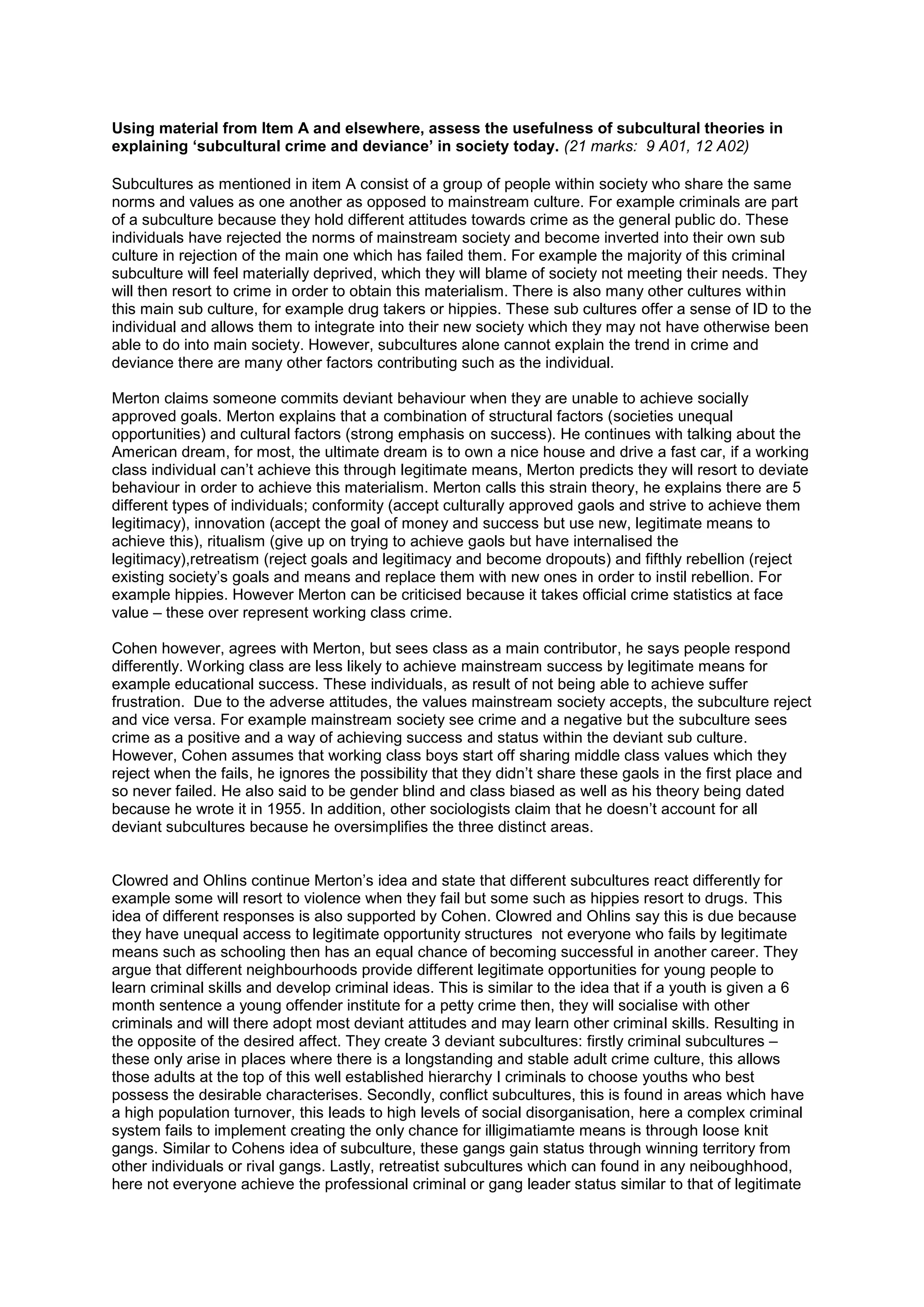
Using material from Item A and elsewhere, assess the usefulness of subcultural theories in
explaining ‘subcultural crime and deviance’ in society today. (21 marks: 9 A01, 12 A02)
Subcultures as mentioned in item A consist of a group of people within society who share the same
norms and values as one another as opposed to mainstream culture. For example criminals are part
of a subculture because they hold different attitudes towards crime as the general public do. These
individuals have rejected the norms of mainstream society and become inverted into their own sub
culture in rejection of the main one which has failed them. For example the majority of this criminal
subculture will feel materially deprived, which they will blame of society not meeting their needs. They
will then resort to crime in order to obtain this materialism. There is also many other cultures within
this main sub culture, for example drug takers or hippies. These sub cultures offer a sense of ID to the
individual and allows them to integrate into their new society which they may not have otherwise been
able to do into main society. However, subcultures alone cannot explain the trend in crime and
deviance there are many other factors contributing such as the individual.
Merton claims someone commits deviant behaviour when they are unable to achieve socially
approved goals. Merton explains that a combination of structural factors (societies unequal
opportunities) and cultural factors (strong emphasis on success). He continues with talking about the
American dream, for most, the ultimate dream is to own a nice house and drive a fast car, if a working
class individual can’t achieve this through legitimate means, Merton predicts they will resort to deviate
behaviour in order to achieve this materialism. Merton calls this strain theory, he explains there are 5
different types of individuals; conformity (accept culturally approved gaols and strive to achieve them
legitimacy), innovation (accept the goal of money and success but use new, legitimate means to
achieve this), ritualism (give up on trying to achieve gaols but have internalised the
legitimacy),retreatism (reject goals and legitimacy and become dropouts) and fifthly rebellion (reject
existing society’s goals and means and replace them with new ones in order to instil rebellion. For
example hippies. However Merton can be criticised because it takes official crime statistics at face
value – these over represent working class crime.
Cohen however, agrees with Merton, but sees class as a main contributor, he says people respond
differently. Working class are less likely to achieve mainstream success by legitimate means for
example educational success. These individuals, as result of not being able to achieve suffer
frustration. Due to the adverse attitudes, the values mainstream society accepts, the subculture reject
and vice versa. For example mainstream society see crime and a negative but the subculture sees
crime as a positive and a way of achieving success and status within the deviant sub culture.
However, Cohen assumes that working class boys start off sharing middle class values which they
reject when the fails, he ignores the possibility that they didn’t share these gaols in the first place and
so never failed. He also said to be gender blind and class biased as well as his theory being dated
because he wrote it in 1955. In addition, other sociologists claim that he doesn’t account for all
deviant subcultures because he oversimplifies the three distinct areas.
Clowred and Ohlins continue Merton’s idea and state that different subcultures react differently for
example some will resort to violence when they fail but some such as hippies resort to drugs. This
idea of different responses is also supported by Cohen. Clowred and Ohlins say this is due because
they have unequal access to legitimate opportunity structures not everyone who fails by legitimate
means such as schooling then has an equal chance of becoming successful in another career. They
argue that different neighbourhoods provide different legitimate opportunities for young people to
learn criminal skills and develop criminal ideas. This is similar to the idea that if a youth is given a 6
month sentence a young offender institute for a petty crime then, they will socialise with other
criminals and will there adopt most deviant attitudes and may learn other criminal skills. Resulting in
the opposite of the desired affect. They create 3 deviant subcultures: firstly criminal subcultures –
these only arise in places where there is a longstanding and stable adult crime culture, this allows
those adults at the top of this well established hierarchy I criminals to choose youths who best
possess the desirable characterises. Secondly, conflict subcultures, this is found in areas which have
a high population turnover, this leads to high levels of social disorganisation, here a complex criminal
system fails to implement creating the only chance for illigimatiamte means is through loose knit
gangs. Similar to Cohens idea of subculture, these gangs gain status through winning territory from
other individuals or rival gangs. Lastly, retreatist subcultures which can found in any neiboughhood,
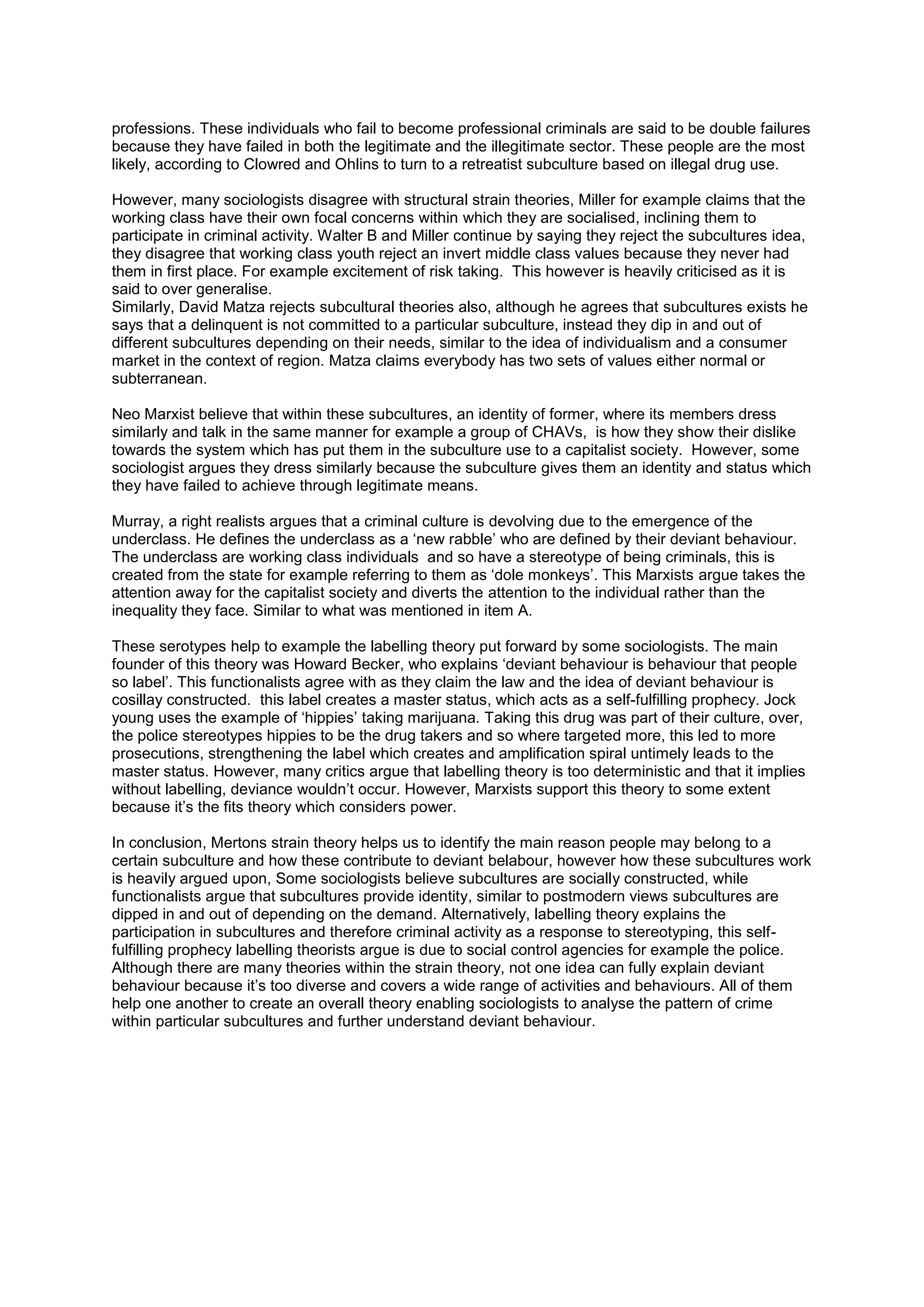
here not everyone achieve the professional criminal or gang leader status similar to that of legitimate
professions. These individuals who fail to become professional criminals are said to be double failures
because they have failed in both the legitimate and the illegitimate sector. These people are the most
likely, according to Clowred and Ohlins to turn to a retreatist subculture based on illegal drug use.
However, many sociologists disagree with structural strain theories, Miller for example claims that the
working class have their own focal concerns within which they are socialised, inclining them to
participate in criminal activity. Walter B and Miller continue by saying they reject the subcultures idea,
they disagree that working class youth reject an invert middle class values because they never had
them in first place. For example excitement of risk taking. This however is heavily criticised as it is
said to over generalise.
Similarly, David Matza rejects subcultural theories also, although he agrees that subcultures exists he
says that a delinquent is not committed to a particular subculture, instead they dip in and out of
different subcultures depending on their needs, similar to the idea of individualism and a consumer
market in the context of region. Matza claims everybody has two sets of values either normal or
subterranean.
Neo Marxist believe that within these subcultures, an identity of former, where its members dress
similarly and talk in the same manner for example a group of CHAVs, is how they show their dislike
towards the system which has put them in the subculture use to a capitalist society. However, some
sociologist argues they dress similarly because the subculture gives them an identity and status which
they have failed to achieve through legitimate means.
Murray, a right realists argues that a criminal culture is devolving due to the emergence of the
underclass. He defines the underclass as a ‘new rabble’ who are defined by their deviant behaviour.
The underclass are working class individuals and so have a stereotype of being criminals, this is
created from the state for example referring to them as ‘dole monkeys’. This Marxists argue takes the
attention away for the capitalist society and diverts the attention to the individual rather than the
inequality they face. Similar to what was mentioned in item A.
These serotypes help to example the labelling theory put forward by some sociologists. The main
founder of this theory was Howard Becker, who explains ‘deviant behaviour is behaviour that people
so label’. This functionalists agree with as they claim the law and the idea of deviant behaviour is
cosillay constructed. this label creates a master status, which acts as a self-fulfilling prophecy. Jock
young uses the example of ‘hippies’ taking marijuana. Taking this drug was part of their culture, over,
the police stereotypes hippies to be the drug takers and so where targeted more, this led to more
prosecutions, strengthening the label which creates and amplification spiral untimely leads to the
master status. However, many critics argue that labelling theory is too deterministic and that it implies
without labelling, deviance wouldn’t occur. However, Marxists support this theory to some extent
because it’s the fits theory which considers power.
In conclusion, Mertons strain theory helps us to identify the main reason people may belong to a
certain subculture and how these contribute to deviant belabour, however how these subcultures work
is heavily argued upon, Some sociologists believe subcultures are socially constructed, while
functionalists argue that subcultures provide identity, similar to postmodern views subcultures are
dipped in and out of depending on the demand. Alternatively, labelling theory explains the
participation in subcultures and therefore criminal activity as a response to stereotyping, this self-
fulfilling prophecy labelling theorists argue is due to social control agencies for example the police.
Although there are many theories within the strain theory, not one idea can fully explain deviant
behaviour because it’s too diverse and covers a wide range of activities and behaviours. All of them
help one another to create an overall theory enabling sociologists to analyse the pattern of crime
within particular subcultures and further understand deviant behaviour.
Assessment Criteria
A – B
grade
Higher in the band, answers will show a thorough, accurate and conceptually detailed
knowledge of a wide range of empirical and theoretical material on the set question and
a sophisticated understanding of the question and of the issues that it raises.
C - D Answers in this band will show reasonable sociological knowledge and understanding,
including knowledge of the synoptic elements of the question.
Higher in the band, knowledge will be somewhat broader and/or deeper and there will
be a somewhat more focused understanding of the question.
E - U Answers in this band will show limited sociological knowledge and understanding,
Higher in the band, there will be a few brief, superficial sociological points, possibly
with significant errors or misunderstandings.
Teacher’s Comments
Mark scheme
21 A*
18-20 A
15-17 B
11-14 C
8-10 D
6-7 E
Below 5 U
GOOD POINTS: Things you are doing well:
1 Strong introduction – unpacked subcultures, set up the debate...Excellent conclusion.
2 Included at least 6 named sociologists, and appropriate studies – fab Myrtal
3 Included some strong evaluation and analysis for your A02 marks.
4 Used the perspectives, Marxism, Functionalism, Labelling, Right Realism – good.
5 Good interpretation (A02) of the question – you selected appropriate material, good.
6 Used Item A well and included some contemporary examples of subcultural crime.
TARGETS FOR IMPROVEMENT : What to do in future to achieve, maintain or
better your target grade:
1 Keep thinking PEEEL. Point – explain/elaborate – evidence - evaluate – link back to the
question. You are doing the PEEE well (although you need a wee bit more explanation on
some of the points you make), but you need to link back to the question more to win all of the
APPLICATION (A02) marks in the exam – do the theories explain subcultural crime and
deviance in society today, or not? So Cohen for example – does status frustration explain
drug-taking, joy-riding, happy-slapping.......I think it may well do – so say this.
2 Miller, expand a bit– he argues that far from accepting then rejecting the American Dream,
the working class have their own 6 focal concerns which they are socialised into which can
incline them to criminal activity e.g. excitement, toughness... Link the working class focal
concerns to contemporary types of crime. For example – excitement (rioting, joy-riding) and
toughness (fighting, gang culture, football hooliganism).
3 Add in some more contemporary evidence - what about the riots of Aug 2011? Could
have linked them back to any or all of the theories. What about chavs with their distinctive
subcultural values? Product of labelling? Product of status frustration? The underclass???
4 Say a bit more on Mike Brake’s theory. Does the nature of capitalism explain the existence
of subcultures or not? Brake suggests that subcultures develop in response to young people,
especially working class youth, who are faced with few opportunities and dead-end jobs – that
is the capitalist system is only offering them a life of drudgery and exploitation. Brake has
been widely criticised, for example it has been noted that youth subcultures are very good
business because they need to kit themselves out in the clothes of the subculture and the
other material goods which go with it, for example mods rode scooters. Therefore far from
challenging capitalism they are simply feeding it by consuming the materialist goods it sells.
5 Evaluate Cloward & Ohlin with South’s research into criminal subcultures in Nottingham to
add some contemporary relevance to your essay. South found that Cloward & Ohlin
overgeneralised and – yes the 3 criminal subcultures described by Cloward & Ohlin existed,
but they existed in the SAME areas and overlapped. So people were selling drugs in
Nottingham in organised criminal subcultures, but they were also at war with other drug
gangs leading to killings (conflict subcultures) and also they were selling drugs on their
doorsteps to people who existed in retreatist subcultures.
Overall Mark/Grade Achieved: 18/21 A grade
Name: Myrtal Potter Date Due: 28-09-13
Date Submitted: 28-09-13
Assignment 1:
Using material from Item A and elsewhere, assess the usefulness of
subcultural theories in explaining ‘subcultural crime and deviance’ in
society today (21 marks: 9 A01, 12 A01)

Subculture Essay: ASSIGNMENT 1: A grade essay with feedback commentary

  • 1.
    Using material fromItem A and elsewhere, assess the usefulness of subcultural theories in explaining ‘subcultural crime and deviance’ in society today. (21 marks: 9 A01, 12 A02) Subcultures as mentioned in item A consist of a group of people within society who share the same norms and values as one another as opposed to mainstream culture. For example criminals are part of a subculture because they hold different attitudes towards crime as the general public do. These individuals have rejected the norms of mainstream society and become inverted into their own sub culture in rejection of the main one which has failed them. For example the majority of this criminal subculture will feel materially deprived, which they will blame of society not meeting their needs. They will then resort to crime in order to obtain this materialism. There is also many other cultures within this main sub culture, for example drug takers or hippies. These sub cultures offer a sense of ID to the individual and allows them to integrate into their new society which they may not have otherwise been able to do into main society. However, subcultures alone cannot explain the trend in crime and deviance there are many other factors contributing such as the individual. Merton claims someone commits deviant behaviour when they are unable to achieve socially approved goals. Merton explains that a combination of structural factors (societies unequal opportunities) and cultural factors (strong emphasis on success). He continues with talking about the American dream, for most, the ultimate dream is to own a nice house and drive a fast car, if a working class individual can’t achieve this through legitimate means, Merton predicts they will resort to deviate behaviour in order to achieve this materialism. Merton calls this strain theory, he explains there are 5 different types of individuals; conformity (accept culturally approved gaols and strive to achieve them legitimacy), innovation (accept the goal of money and success but use new, legitimate means to achieve this), ritualism (give up on trying to achieve gaols but have internalised the legitimacy),retreatism (reject goals and legitimacy and become dropouts) and fifthly rebellion (reject existing society’s goals and means and replace them with new ones in order to instil rebellion. For example hippies. However Merton can be criticised because it takes official crime statistics at face value – these over represent working class crime. Cohen however, agrees with Merton, but sees class as a main contributor, he says people respond differently. Working class are less likely to achieve mainstream success by legitimate means for example educational success. These individuals, as result of not being able to achieve suffer frustration. Due to the adverse attitudes, the values mainstream society accepts, the subculture reject and vice versa. For example mainstream society see crime and a negative but the subculture sees crime as a positive and a way of achieving success and status within the deviant sub culture. However, Cohen assumes that working class boys start off sharing middle class values which they reject when the fails, he ignores the possibility that they didn’t share these gaols in the first place and so never failed. He also said to be gender blind and class biased as well as his theory being dated because he wrote it in 1955. In addition, other sociologists claim that he doesn’t account for all deviant subcultures because he oversimplifies the three distinct areas. Clowred and Ohlins continue Merton’s idea and state that different subcultures react differently for example some will resort to violence when they fail but some such as hippies resort to drugs. This idea of different responses is also supported by Cohen. Clowred and Ohlins say this is due because they have unequal access to legitimate opportunity structures not everyone who fails by legitimate means such as schooling then has an equal chance of becoming successful in another career. They argue that different neighbourhoods provide different legitimate opportunities for young people to learn criminal skills and develop criminal ideas. This is similar to the idea that if a youth is given a 6 month sentence a young offender institute for a petty crime then, they will socialise with other criminals and will there adopt most deviant attitudes and may learn other criminal skills. Resulting in the opposite of the desired affect. They create 3 deviant subcultures: firstly criminal subcultures – these only arise in places where there is a longstanding and stable adult crime culture, this allows those adults at the top of this well established hierarchy I criminals to choose youths who best possess the desirable characterises. Secondly, conflict subcultures, this is found in areas which have a high population turnover, this leads to high levels of social disorganisation, here a complex criminal system fails to implement creating the only chance for illigimatiamte means is through loose knit gangs. Similar to Cohens idea of subculture, these gangs gain status through winning territory from other individuals or rival gangs. Lastly, retreatist subcultures which can found in any neiboughhood, here not everyone achieve the professional criminal or gang leader status similar to that of legitimate
  • 2.
    professions. These individualswho fail to become professional criminals are said to be double failures because they have failed in both the legitimate and the illegitimate sector. These people are the most likely, according to Clowred and Ohlins to turn to a retreatist subculture based on illegal drug use. However, many sociologists disagree with structural strain theories, Miller for example claims that the working class have their own focal concerns within which they are socialised, inclining them to participate in criminal activity. Walter B and Miller continue by saying they reject the subcultures idea, they disagree that working class youth reject an invert middle class values because they never had them in first place. For example excitement of risk taking. This however is heavily criticised as it is said to over generalise. Similarly, David Matza rejects subcultural theories also, although he agrees that subcultures exists he says that a delinquent is not committed to a particular subculture, instead they dip in and out of different subcultures depending on their needs, similar to the idea of individualism and a consumer market in the context of region. Matza claims everybody has two sets of values either normal or subterranean. Neo Marxist believe that within these subcultures, an identity of former, where its members dress similarly and talk in the same manner for example a group of CHAVs, is how they show their dislike towards the system which has put them in the subculture use to a capitalist society. However, some sociologist argues they dress similarly because the subculture gives them an identity and status which they have failed to achieve through legitimate means. Murray, a right realists argues that a criminal culture is devolving due to the emergence of the underclass. He defines the underclass as a ‘new rabble’ who are defined by their deviant behaviour. The underclass are working class individuals and so have a stereotype of being criminals, this is created from the state for example referring to them as ‘dole monkeys’. This Marxists argue takes the attention away for the capitalist society and diverts the attention to the individual rather than the inequality they face. Similar to what was mentioned in item A. These serotypes help to example the labelling theory put forward by some sociologists. The main founder of this theory was Howard Becker, who explains ‘deviant behaviour is behaviour that people so label’. This functionalists agree with as they claim the law and the idea of deviant behaviour is cosillay constructed. this label creates a master status, which acts as a self-fulfilling prophecy. Jock young uses the example of ‘hippies’ taking marijuana. Taking this drug was part of their culture, over, the police stereotypes hippies to be the drug takers and so where targeted more, this led to more prosecutions, strengthening the label which creates and amplification spiral untimely leads to the master status. However, many critics argue that labelling theory is too deterministic and that it implies without labelling, deviance wouldn’t occur. However, Marxists support this theory to some extent because it’s the fits theory which considers power. In conclusion, Mertons strain theory helps us to identify the main reason people may belong to a certain subculture and how these contribute to deviant belabour, however how these subcultures work is heavily argued upon, Some sociologists believe subcultures are socially constructed, while functionalists argue that subcultures provide identity, similar to postmodern views subcultures are dipped in and out of depending on the demand. Alternatively, labelling theory explains the participation in subcultures and therefore criminal activity as a response to stereotyping, this self- fulfilling prophecy labelling theorists argue is due to social control agencies for example the police. Although there are many theories within the strain theory, not one idea can fully explain deviant behaviour because it’s too diverse and covers a wide range of activities and behaviours. All of them help one another to create an overall theory enabling sociologists to analyse the pattern of crime within particular subcultures and further understand deviant behaviour.
  • 3.
    Assessment Criteria A –B grade Higher in the band, answers will show a thorough, accurate and conceptually detailed knowledge of a wide range of empirical and theoretical material on the set question and a sophisticated understanding of the question and of the issues that it raises. C - D Answers in this band will show reasonable sociological knowledge and understanding, including knowledge of the synoptic elements of the question. Higher in the band, knowledge will be somewhat broader and/or deeper and there will be a somewhat more focused understanding of the question. E - U Answers in this band will show limited sociological knowledge and understanding, Higher in the band, there will be a few brief, superficial sociological points, possibly with significant errors or misunderstandings. Teacher’s Comments Mark scheme 21 A* 18-20 A 15-17 B 11-14 C 8-10 D 6-7 E Below 5 U GOOD POINTS: Things you are doing well: 1 Strong introduction – unpacked subcultures, set up the debate...Excellent conclusion. 2 Included at least 6 named sociologists, and appropriate studies – fab Myrtal 3 Included some strong evaluation and analysis for your A02 marks. 4 Used the perspectives, Marxism, Functionalism, Labelling, Right Realism – good. 5 Good interpretation (A02) of the question – you selected appropriate material, good. 6 Used Item A well and included some contemporary examples of subcultural crime. TARGETS FOR IMPROVEMENT : What to do in future to achieve, maintain or better your target grade: 1 Keep thinking PEEEL. Point – explain/elaborate – evidence - evaluate – link back to the question. You are doing the PEEE well (although you need a wee bit more explanation on some of the points you make), but you need to link back to the question more to win all of the APPLICATION (A02) marks in the exam – do the theories explain subcultural crime and deviance in society today, or not? So Cohen for example – does status frustration explain drug-taking, joy-riding, happy-slapping.......I think it may well do – so say this. 2 Miller, expand a bit– he argues that far from accepting then rejecting the American Dream, the working class have their own 6 focal concerns which they are socialised into which can incline them to criminal activity e.g. excitement, toughness... Link the working class focal concerns to contemporary types of crime. For example – excitement (rioting, joy-riding) and toughness (fighting, gang culture, football hooliganism). 3 Add in some more contemporary evidence - what about the riots of Aug 2011? Could have linked them back to any or all of the theories. What about chavs with their distinctive subcultural values? Product of labelling? Product of status frustration? The underclass??? 4 Say a bit more on Mike Brake’s theory. Does the nature of capitalism explain the existence of subcultures or not? Brake suggests that subcultures develop in response to young people, especially working class youth, who are faced with few opportunities and dead-end jobs – that is the capitalist system is only offering them a life of drudgery and exploitation. Brake has been widely criticised, for example it has been noted that youth subcultures are very good business because they need to kit themselves out in the clothes of the subculture and the other material goods which go with it, for example mods rode scooters. Therefore far from challenging capitalism they are simply feeding it by consuming the materialist goods it sells. 5 Evaluate Cloward & Ohlin with South’s research into criminal subcultures in Nottingham to add some contemporary relevance to your essay. South found that Cloward & Ohlin overgeneralised and – yes the 3 criminal subcultures described by Cloward & Ohlin existed, but they existed in the SAME areas and overlapped. So people were selling drugs in Nottingham in organised criminal subcultures, but they were also at war with other drug gangs leading to killings (conflict subcultures) and also they were selling drugs on their doorsteps to people who existed in retreatist subcultures. Overall Mark/Grade Achieved: 18/21 A grade Name: Myrtal Potter Date Due: 28-09-13 Date Submitted: 28-09-13 Assignment 1: Using material from Item A and elsewhere, assess the usefulness of subcultural theories in explaining ‘subcultural crime and deviance’ in society today (21 marks: 9 A01, 12 A01)