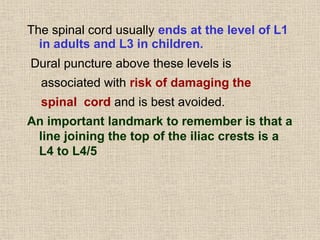
The spinal cordusually ends at the level of L1
in adults and L3 in children.
Dural puncture above these levels is
associated with risk of damaging the
spinal cord and is best avoided.
An important landmark to remember is that a
line joining the top of the iliac crests is a
L4 to L4/5
6.
The Advantages ofSpinal Anaesthesia
1. ↓Cost..
2.Patient satisfaction.
3.Respiratory disease.
4.Patent airway.
5.Diabetic patients.
6.Muscle relaxation.
7.Blood loss during operation is less.
7.
Indications for SpinalAnesthesia.
Spinal anesthesia is best reserved for
operations below the umbilicus e.g. hernia
repairs, gynecological and urological
operations and any operation on the perineum
or genitalia.
All operations on the leg are possible, but
amputation, though painless, may be
unpleasant experience for awake patient.
8.
Older patients andthose with systemic
disease such as chronic respiratory disease,
hepatic, renal and endocrine disorders
(diabetes).
It is suitable for managing patients with trauma
if they have been adequately resuscitated
and are not hypovolemic.
In obstetrics, it is ideal for manual removal of
a retained placenta (again, provided there is
no hypovolemia).
9.
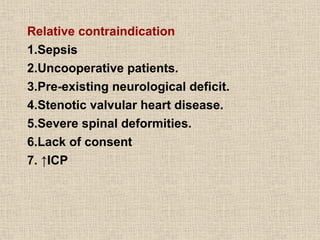
Contra-indications to SpinalAnesthesia.
Absolute:
1.Inadequate resuscitative drugs and equipment.
2.Coagulopathy or other bleeding disorders.
3.Severe hypovolemia.(Shock)
4.Patient refusal.
5.Severe aortic stenosis.
6.Severe Mitral stenosis.
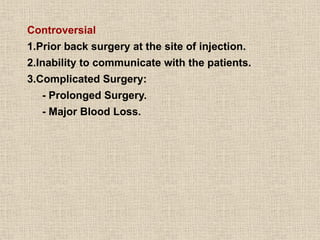
Controversial
1.Prior back surgeryat the site of injection.
2.Inability to communicate with the patients.
3.Complicated Surgery:
- Prolonged Surgery.
- Major Blood Loss.
12.
Local Anesthetics forSpinal Anesthesia.
Local anesthetic agents are either heavy
(hyperbaric), light (hypobaric), or have the
same specific gravity (isobaric) as the
CSF.
Hyperbaric solutions tend to spread below the
level of the injection, while isobaric solutions
are not influenced in this way. It is easier to
predict the spread of spinal anesthesia when
using a hyperbaric agent. Isobaric preparations
may be made hyperbaric by the addition of
dextrose.
Hypobaric agents are not generally Used.
13.
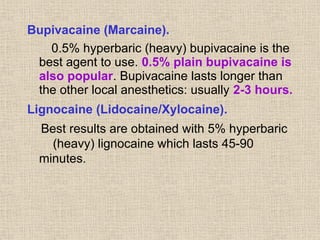
Bupivacaine (Marcaine).
0.5% hyperbaric(heavy) bupivacaine is the
best agent to use. 0.5% plain bupivacaine is
also popular. Bupivacaine lasts longer than
the other local anesthetics: usually 2-3 hours.
Lignocaine (Lidocaine/Xylocaine).
Best results are obtained with 5% hyperbaric
(heavy) lignocaine which lasts 45-90
minutes.
14.
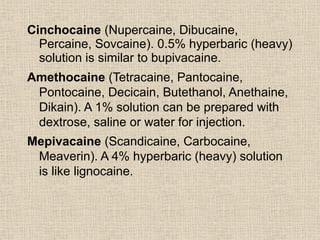
Cinchocaine (Nupercaine, Dibucaine,
Percaine,Sovcaine). 0.5% hyperbaric (heavy)
solution is similar to bupivacaine.
Amethocaine (Tetracaine, Pantocaine,
Pontocaine, Decicain, Butethanol, Anethaine,
Dikain). A 1% solution can be prepared with
dextrose, saline or water for injection.
Mepivacaine (Scandicaine, Carbocaine,
Meaverin). A 4% hyperbaric (heavy) solution
is like lignocaine.
15.
Pre-operative Visit.
Patients shouldbe told about their
anesthesia during the pre-operative visit.
It is important to explain that although spinal
anesthesia abolishes pain, they may be
aware of some sensation in the relevant
area, but it will not be uncomfortable and is
quite normal.
They must be reassured that, if they feel pain
they will be given a general anesthetic.
16.
Premedication is notalways necessary, but
if a patient is apprehensive,
a benzodiazepine such as 5-10 mg of
diazepam may be given orally.
Other sedative or narcotic agents may also
be used. Anticholinergics such as
atropine or scopolamine (hyoscine) are
unnecessary
17.
Pre-loading
All patients havingspinal anesthesia must have
a large intravenous cannula inserted and be given
intravenous fluids immediately before the spinal.
The volume of fluid given will vary with the age of the
patient and the extent of the proposed block.
A young, fit man having a hernia repair may only
need 500 ml. Older patients are not able to
compensate as efficiently as the young for spinal -
induced vasodilation and hypotension and may need
1000ml for a similar procedure. If a high block is
planned, at least a 1000 ml should be given to all
patients. Caesarean section patients need at least
1500 ml.
18.
The fluid shouldpreferably be normal saline or ringer
lactate. 5% dextrose is readily metabolized and so is
not effective in maintaining the blood pressure.
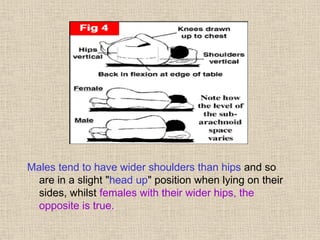
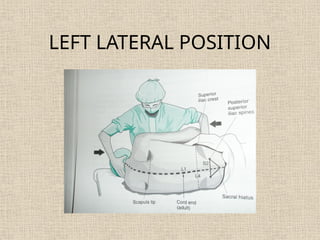
Males tend tohave wider shoulders than hips and so
are in a slight "head up" position when lying on their
sides, whilst females with their wider hips, the
opposite is true.
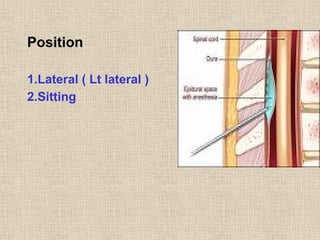
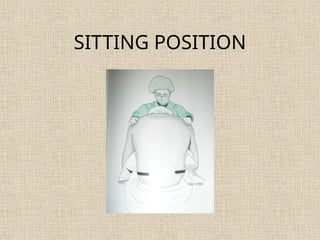
The sitting positionis preferable in the obese
whereas the lateral is better for uncooperative or
sedated patients.
24.
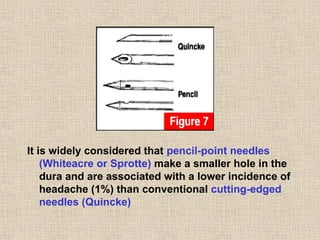
It is widelyconsidered that pencil-point needles
(Whiteacre or Sprotte) make a smaller hole in the
dura and are associated with a lower incidence of
headache (1%) than conventional cutting-edged
needles (Quincke)
26.
Factors Affecting thelevel of Spinal anesthesia
The baricity of the local anesthetic
solution.
Dosage , concentration and volume
injected .
Site of injection.
Position of the patient.
-During Injection.
-Immediately after injection.
• Patient Height.
27.
complication
1.Immediate complication
- Hypotensionand Cardiac arrest.
- Total spinal block leading to respiratory arrest.
- Urinary retention.
- Epidural hematoma, Bleeding.
2.Late complication
- Post dural puncture headache (PDPH)
- Backache
- Focal neurological deficit
- Bacterial meningitis
28.
Treatment of Hypotension.
Hypotensionis due to vasodilation and a functional
decrease in the effective circulating volume.
1.vasoconstrictor drugs eg. Ephedrine
2.All hypotensive patients should be given OXYGEN by
mask until the blood pressure is restored.
3. Raising their legs thus increasing the return of
venous blood to the heart.
4.Increase the speed of the intravenous infusion to
maximum until the blood pressure is restored to
acceptable levels.
5. pulse is slow, give atropine intravenously.
29.
Treatment of spinalheadache PDPH
1.Remain lying flat in bed as this relieves the
pain.
2.They should be encouraged to drink freely or,
if necessary, be given intravenous fluids to
maintain adequate hydration.
3.Simple analgesics such as paracetamol,
aspirin or codeine may be helpful
30.
5.Caffeine containing drinkssuch as tea, coffee
or Coca-Cola are often helpful.
6. Prolonged or severe headaches
may be treated with epidural blood patch
performed by aseptically injecting 15-20ml of
the patient's own blood into the epidural
space. This then clots and seals the hole and
prevents further leakage of CSF.
It used to be thought that bedrest for 24 hours
following spinal anesthetic would help reduce
the incidence of headache.










![CTEV [ clubfoot] DR ARUN LAL ,DR MOHAMED ASHRAF travancore medical college k...](https://cdn.slidesharecdn.com/ss_thumbnails/ctevclubfootdrarunlaldrmohamedashraftravancoremedicalcollegekollamkeralaindia-260208063247-18fc466c-thumbnail.jpg?width=640&height=640&fit=bounds)


![PERI-PROSTHETIC FRACTURE NAIL-PLATE CONSTRUCT [NPC].pptx](https://cdn.slidesharecdn.com/ss_thumbnails/drarunkumardrmohamedashrafperiprostheticfrasturenail-plateconstructnpc-260209164459-7e9d15a1-thumbnail.jpg?width=640&height=640&fit=bounds)


