

Stylistic Approach
 In the words of Halliday: We can define
linguistic stylistics as the description of literary
texts by methods derived from general linguistic
theory, using the categories of the description of
language as a whole.
Sonnet?
o Two types of Sonnet : Petrarchan and
Shakespearean.
o A sonnet is a 14 line lyric poem that
conforms to strict patterns of rhythm and
rhyme.
o Written in Iambic Pentameter.
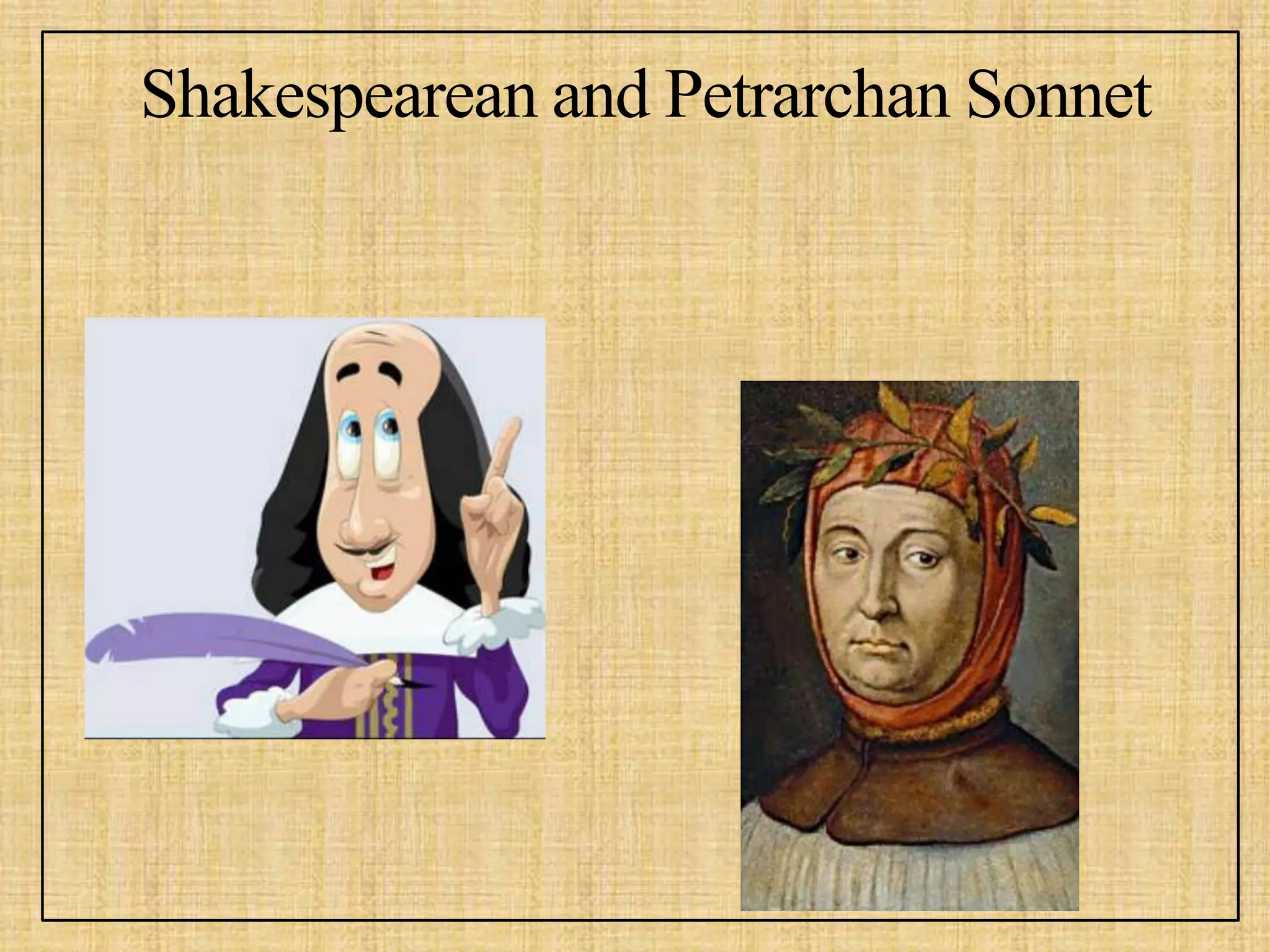
Shakespearean and Petrarchan Sonnet
Scansion
o What is it?
o What are Structural Devices and Literary
Devices?
Structure vs Literary Devices
Structural Elements Literary Devices
 Rhythm
 Meter
 Rhyme
 Similes and Metaphors
 Imagery
 Alliteration
 Symbolism
 Parallelism
 Personification
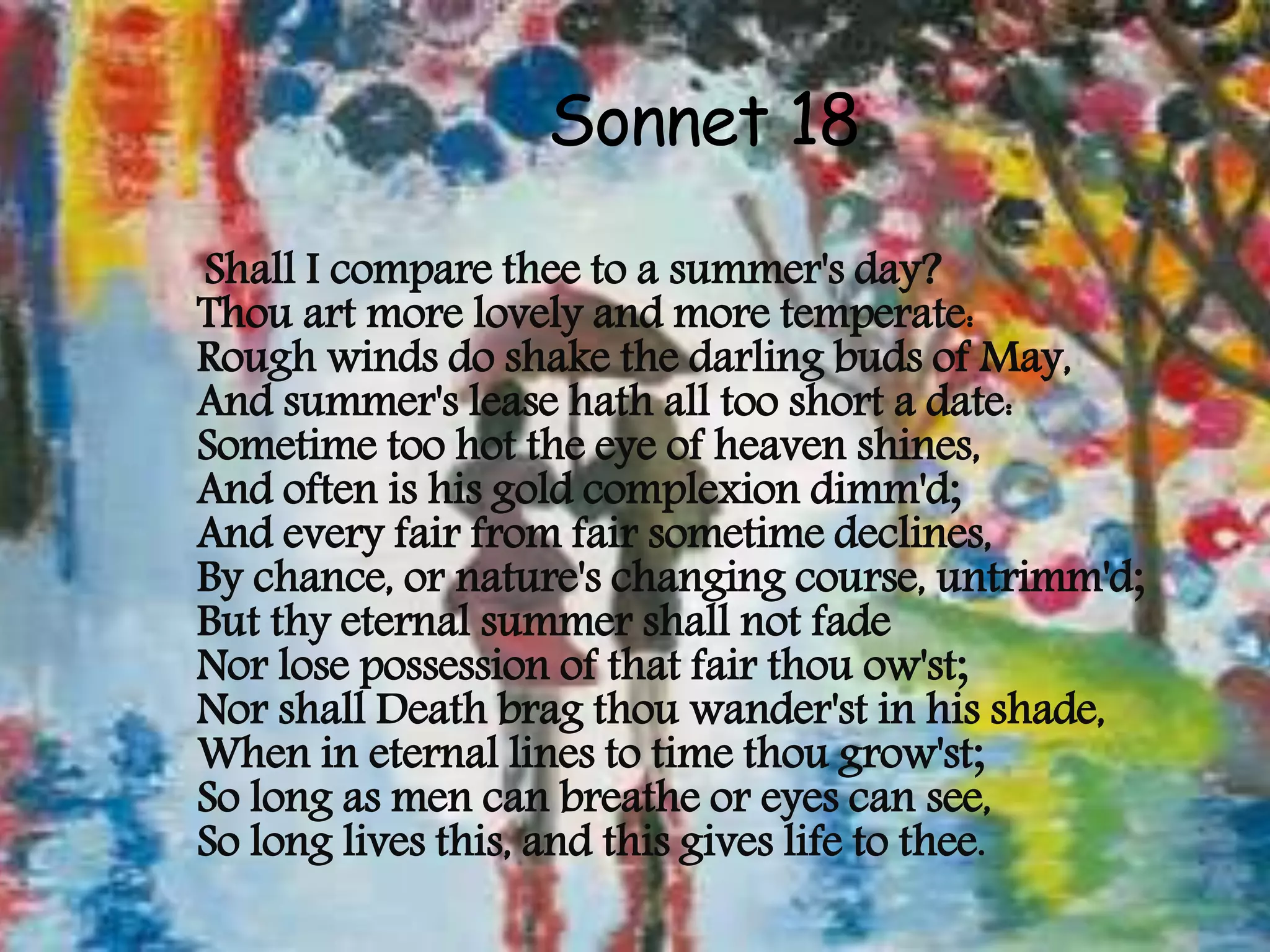
Sonnet 18
Shall I compare thee to a summer's day?
Thou art more lovely and more temperate:
Rough winds do shake the darling buds of May,
And summer's lease hath all too short a date:
Sometime too hot the eye of heaven shines,
And often is his gold complexion dimm'd;
And every fair from fair sometime declines,
By chance, or nature's changing course, untrimm'd;
But thy eternal summer shall not fade
Nor lose possession of that fair thou ow'st;
Nor shall Death brag thou wander'st in his shade,
When in eternal lines to time thou grow'st;
So long as men can breathe or eyes can see,
So long lives this, and this gives life to thee.
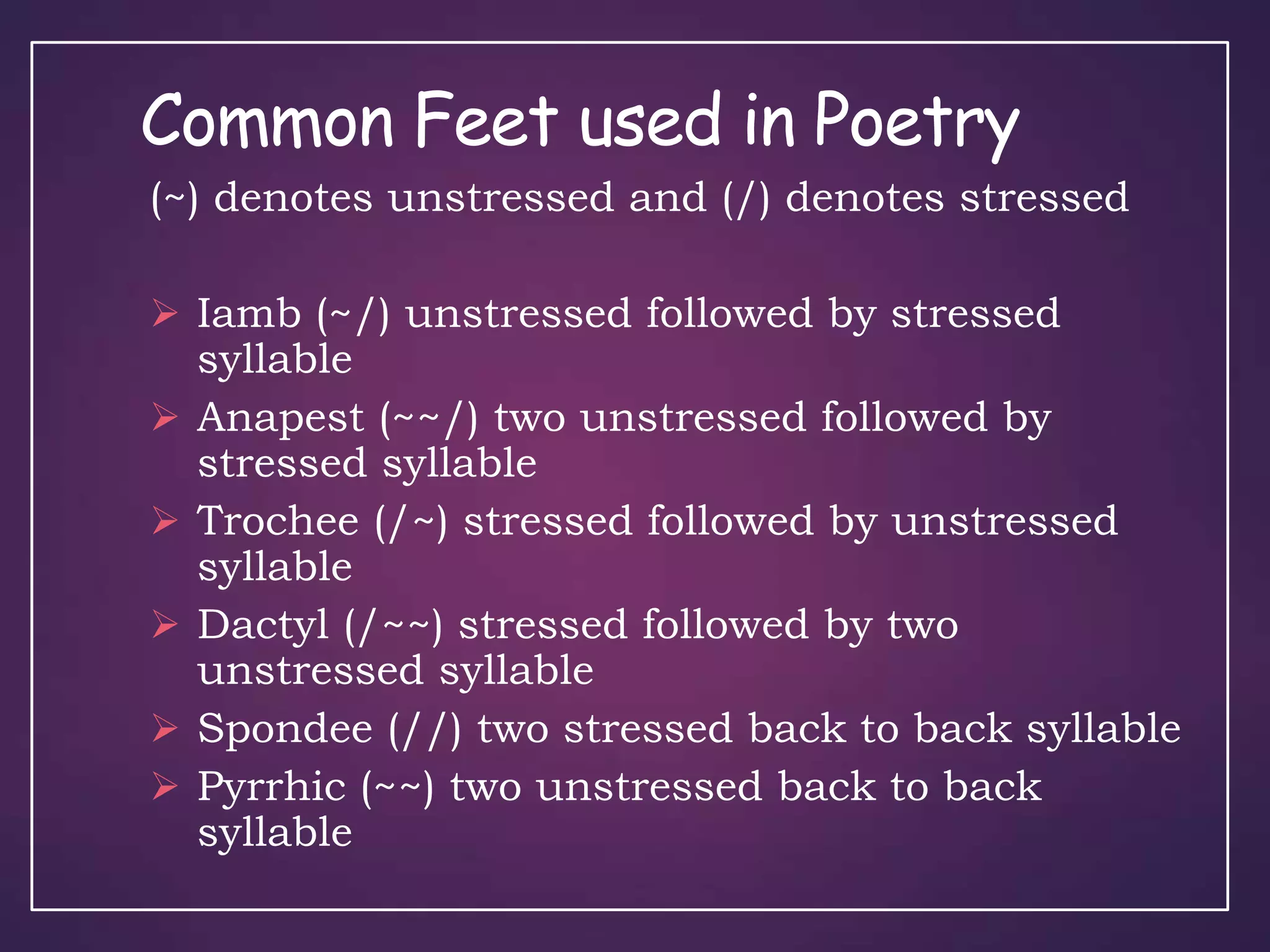
Common Feet used in Poetry
(~) denotes unstressed and (/) denotes stressed
 Iamb (~/) unstressed followed by stressed
syllable
 Anapest (~~/) two unstressed followed by
stressed syllable
 Trochee (/~) stressed followed by unstressed
syllable
 Dactyl (/~~) stressed followed by two
unstressed syllable
 Spondee (//) two stressed back to back syllable
 Pyrrhic (~~) two unstressed back to back
syllable
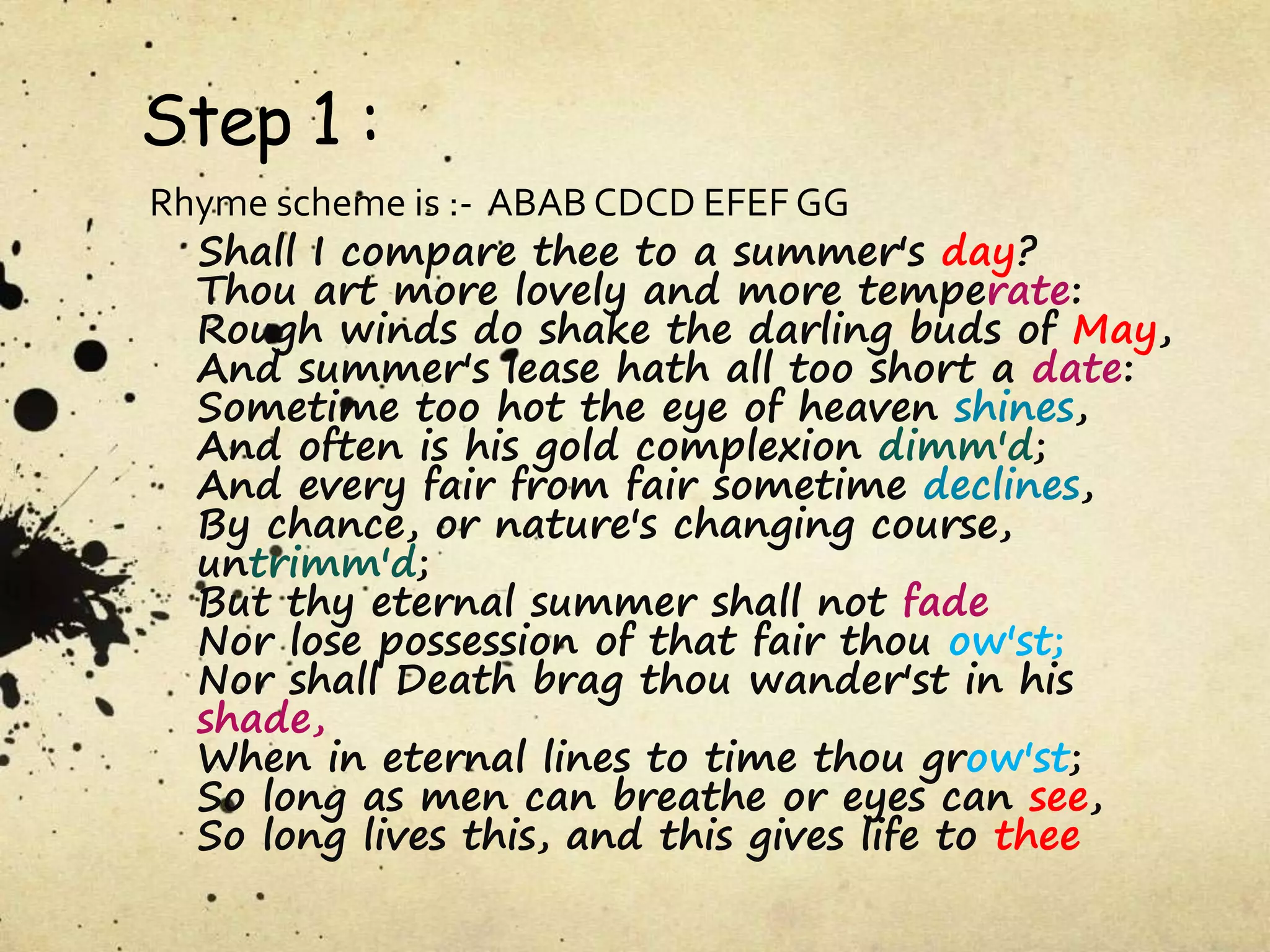
Step 1 :
Rhyme scheme is :- ABAB CDCD EFEF GG
Shall I compare thee to a summer's day?
Thou art more lovely and more temperate:
Rough winds do shake the darling buds of May,
And summer's lease hath all too short a date:
Sometime too hot the eye of heaven shines,
And often is his gold complexion dimm'd;
And every fair from fair sometime declines,
By chance, or nature's changing course,
untrimm'd;
But thy eternal summer shall not fade
Nor lose possession of that fair thou ow'st;
Nor shall Death brag thou wander'st in his
shade,
When in eternal lines to time thou grow'st;
So long as men can breathe or eyes can see,
So long lives this, and this gives life to thee
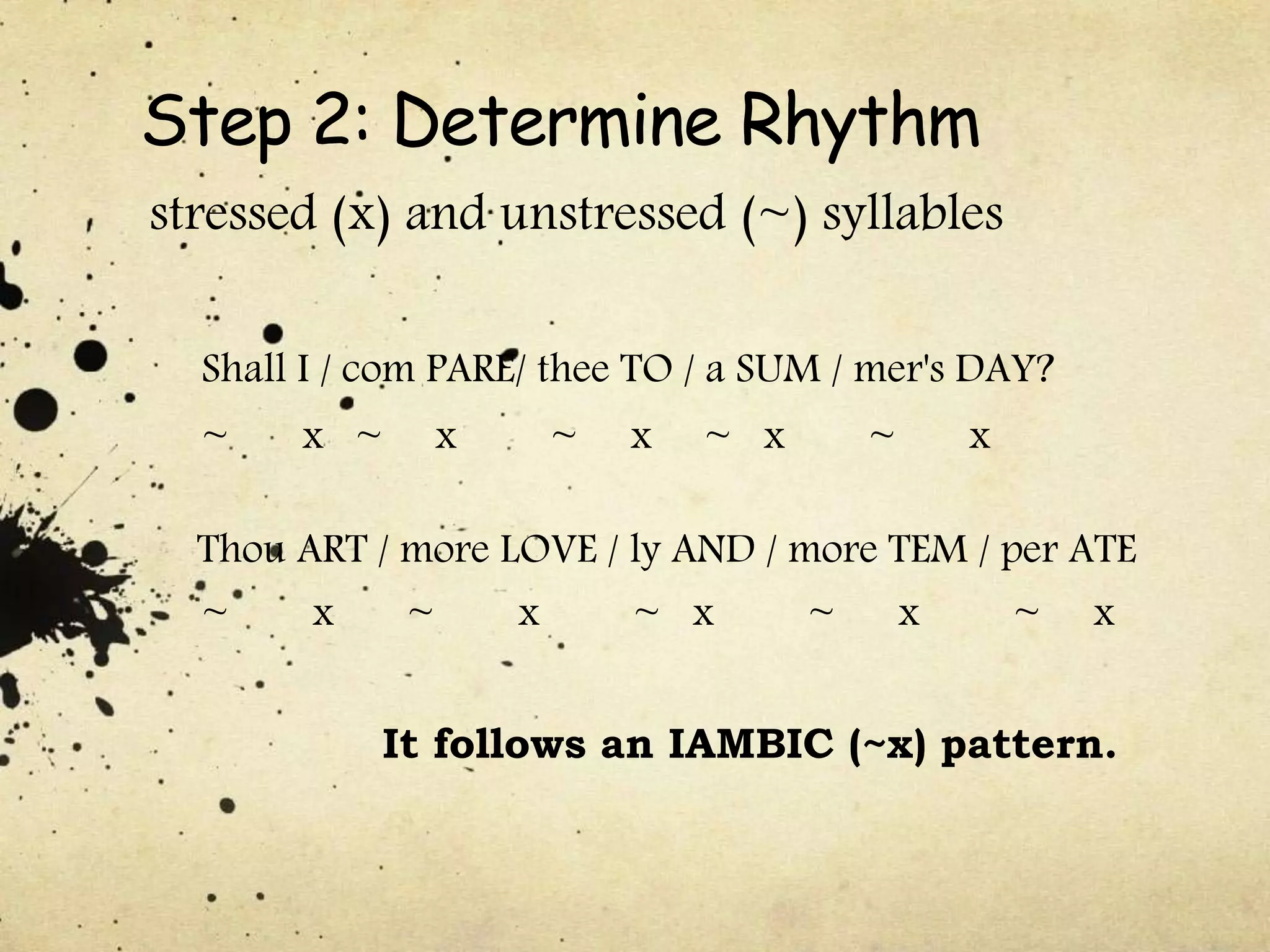
Step 2: Determine Rhythm
stressed (x) and unstressed (~) syllables
Shall I / com PARE/ thee TO / a SUM / mer's DAY?
~ x ~ x ~ x ~ x ~ x
Thou ART / more LOVE / ly AND / more TEM / per ATE
~ x ~ x ~ x ~ x ~ x
It follows an IAMBIC (~x) pattern.
Step 3: Meter
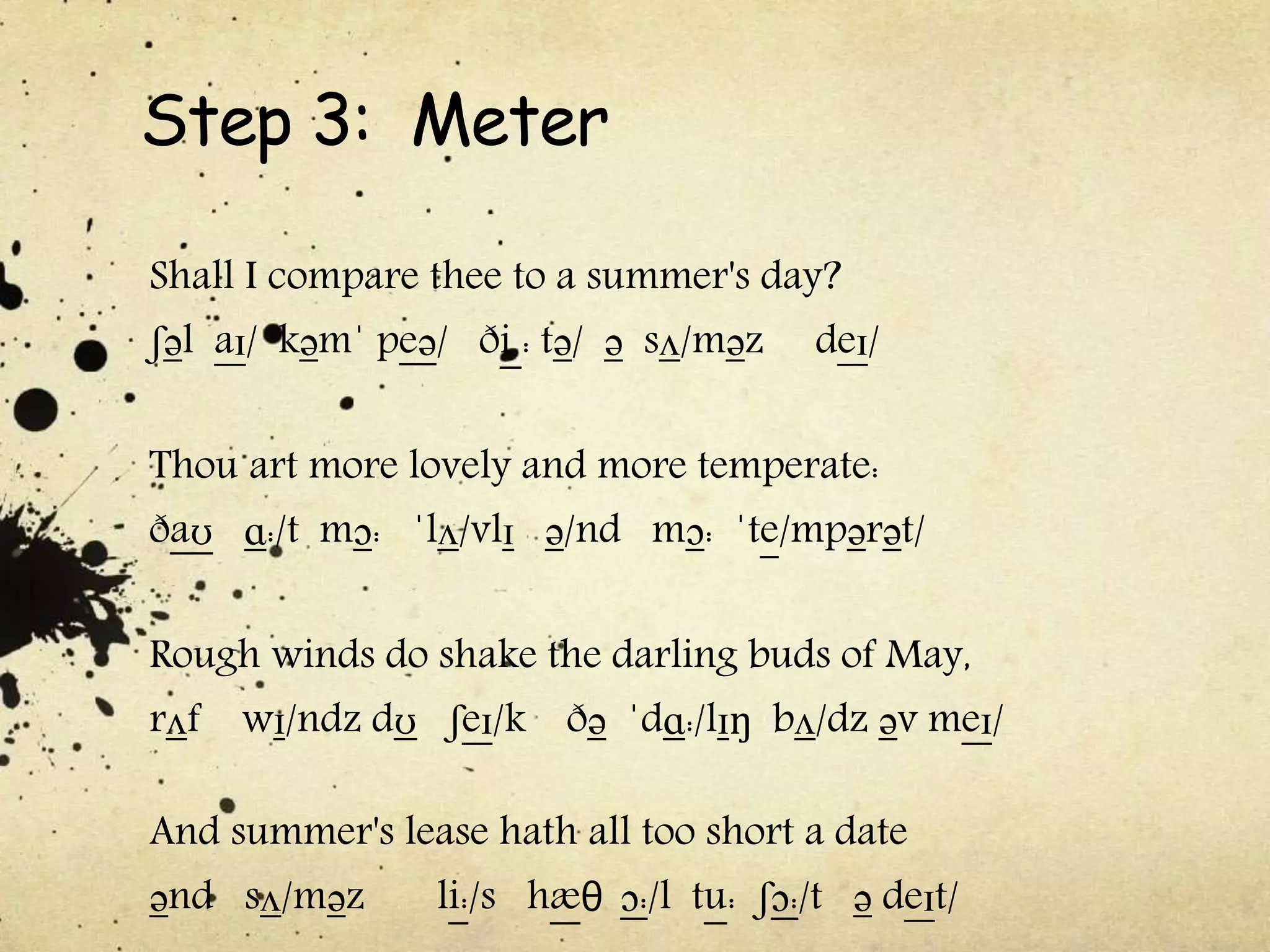
Shall I compare thee to a summer's day?
ʃəl aɪ/ kəmˈ peə/ ði : tə/ ə sʌ/məz deɪ/
Thou art more lovely and more temperate:
ðaʊ ɑ:/t mɔ: ˈlʌ/vlɪ ə/nd mɔ: ˈte/mpərət/
Rough winds do shake the darling buds of May,
rʌf wɪ/ndz dʊ ʃeɪ/k ðə ˈdɑ:/lɪŋ bʌ/dz əv meɪ/
And summer's lease hath all too short a date
ənd sʌ/məz li:/s hæθ ɔ:/l tu: ʃɔ:/t ə deɪt/
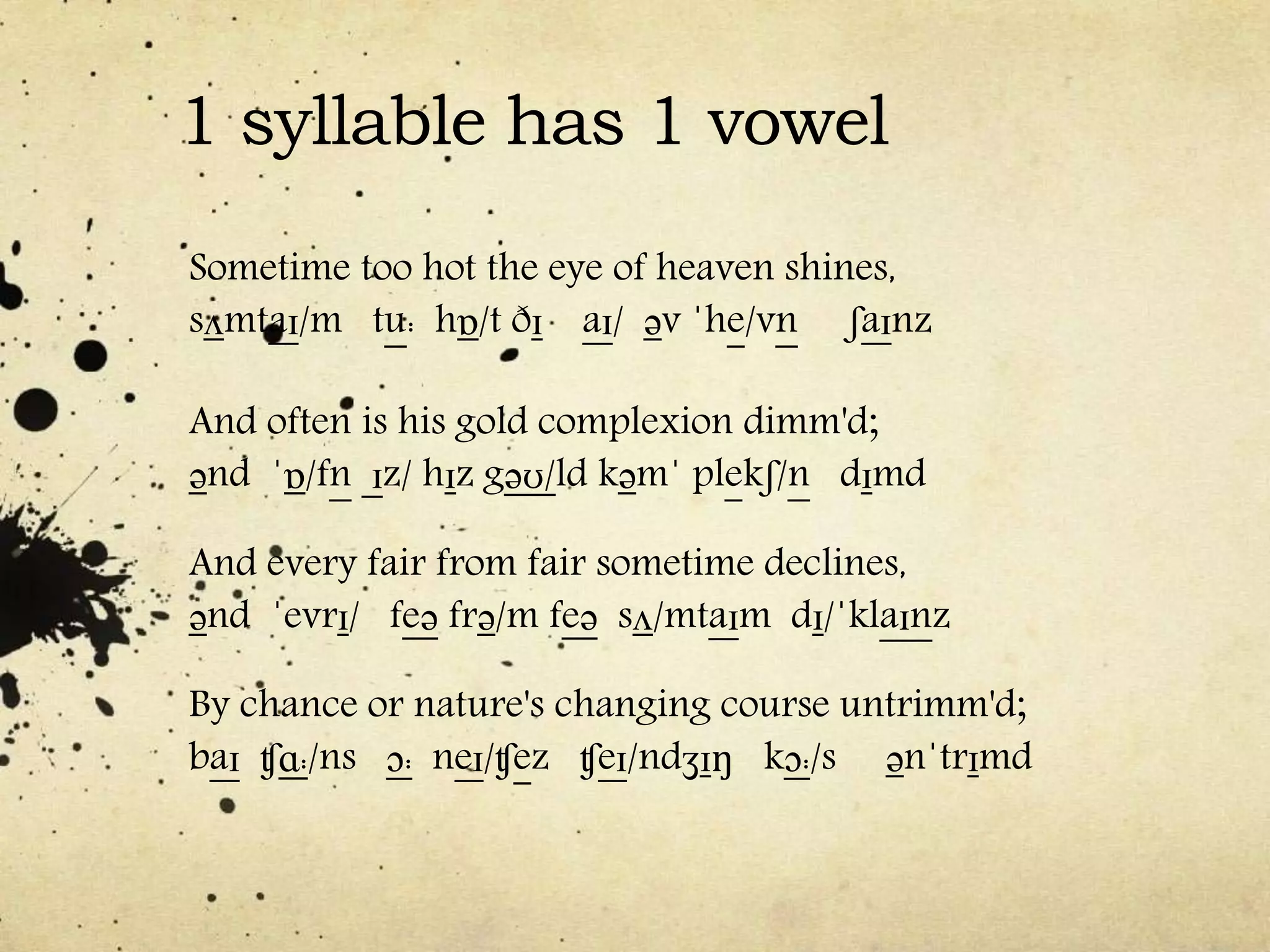
1 syllable has 1 vowel
Sometime too hot the eye of heaven shines,
sʌmtaɪ/m tu: hɒ/t ðɪ aɪ/ əv ˈhe/vn ʃaɪnz
And often is his gold complexion dimm'd;
ənd ˈɒ/fn ɪz/ hɪz gəʊ/ld kəmˈ plekʃ/n dɪmd
And every fair from fair sometime declines,
ənd ˈevrɪ/ feə frə/m feə sʌ/mtaɪm dɪ/ˈklaɪnz
By chance or nature's changing course untrimm'd;
baɪ ʧɑ:/ns ɔ: neɪ/ʧez ʧeɪ/ndʒɪŋ kɔ:/s ənˈtrɪmd
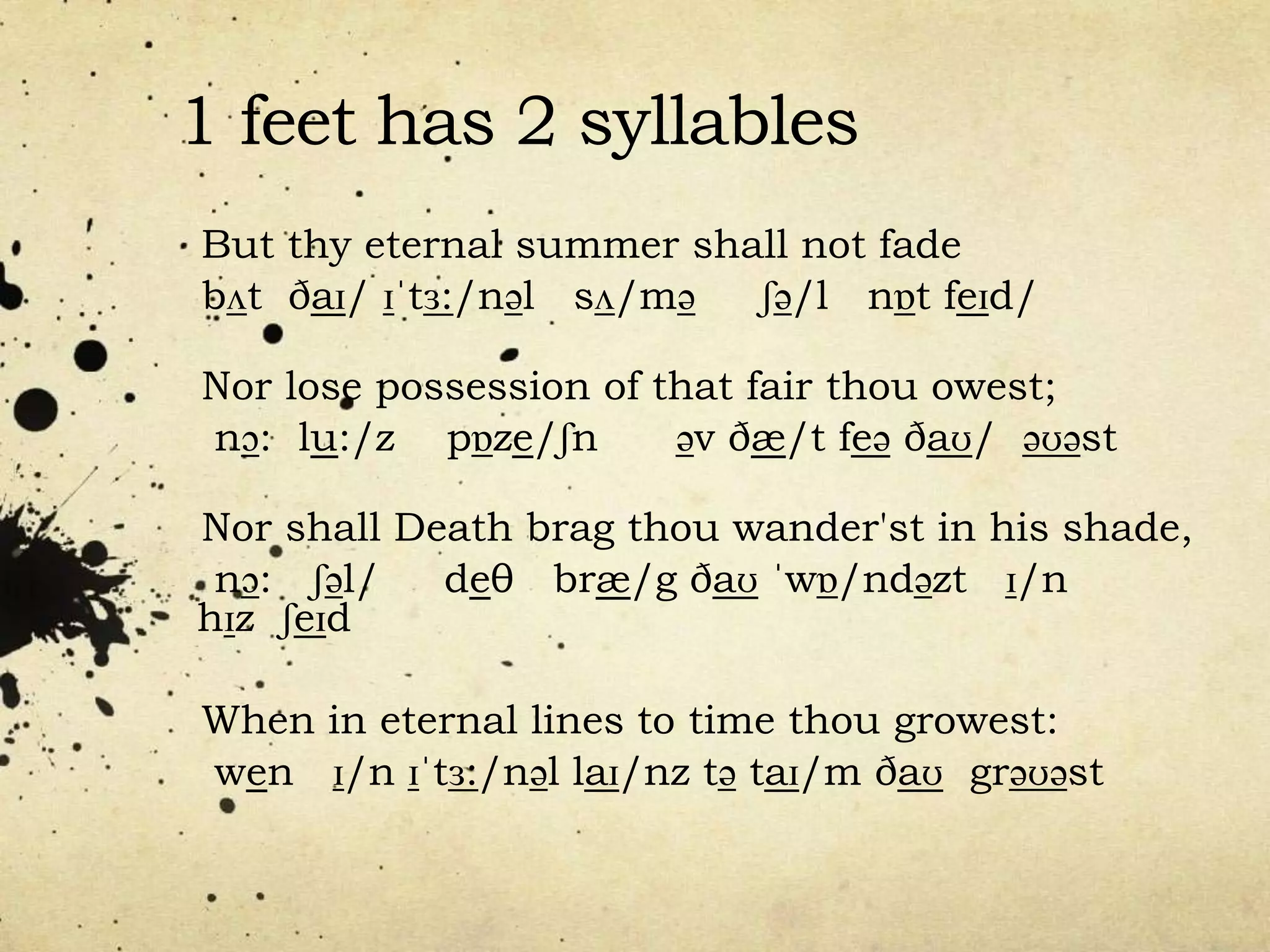
1 feet has 2 syllables
But thy eternal summer shall not fade
bʌt ðaɪ/ ɪˈtɜ:/nəl sʌ/mə ʃə/l nɒt feɪd/
Nor lose possession of that fair thou owest;
nɔ: lu:/z pɒze/ʃn əv ðæ/t feə ðaʊ/ əʊəst
Nor shall Death brag thou wander'st in his shade,
nɔ: ʃəl/ deθ bræ/g ðaʊ ˈwɒ/ndəzt ɪ/n
hɪz ʃeɪd
When in eternal lines to time thou growest:
wen ɪ/n ɪˈtɜ:/nəl laɪ/nz tə taɪ/m ðaʊ grəʊəst
5 feet is a Penta
So long as men can breathe or eyes can see,
səʊ lɒ/ŋ əz me/n kæn bri:/ð ɔ: aɪ/z kæn si:
So long lives this and this gives life to thee.
səʊ lɒ/ŋ lɪvz ðɪ/s ən ðɪ/s gɪvz laɪ/f tə ði:
It has 5 feet per line i.e Pentameter.
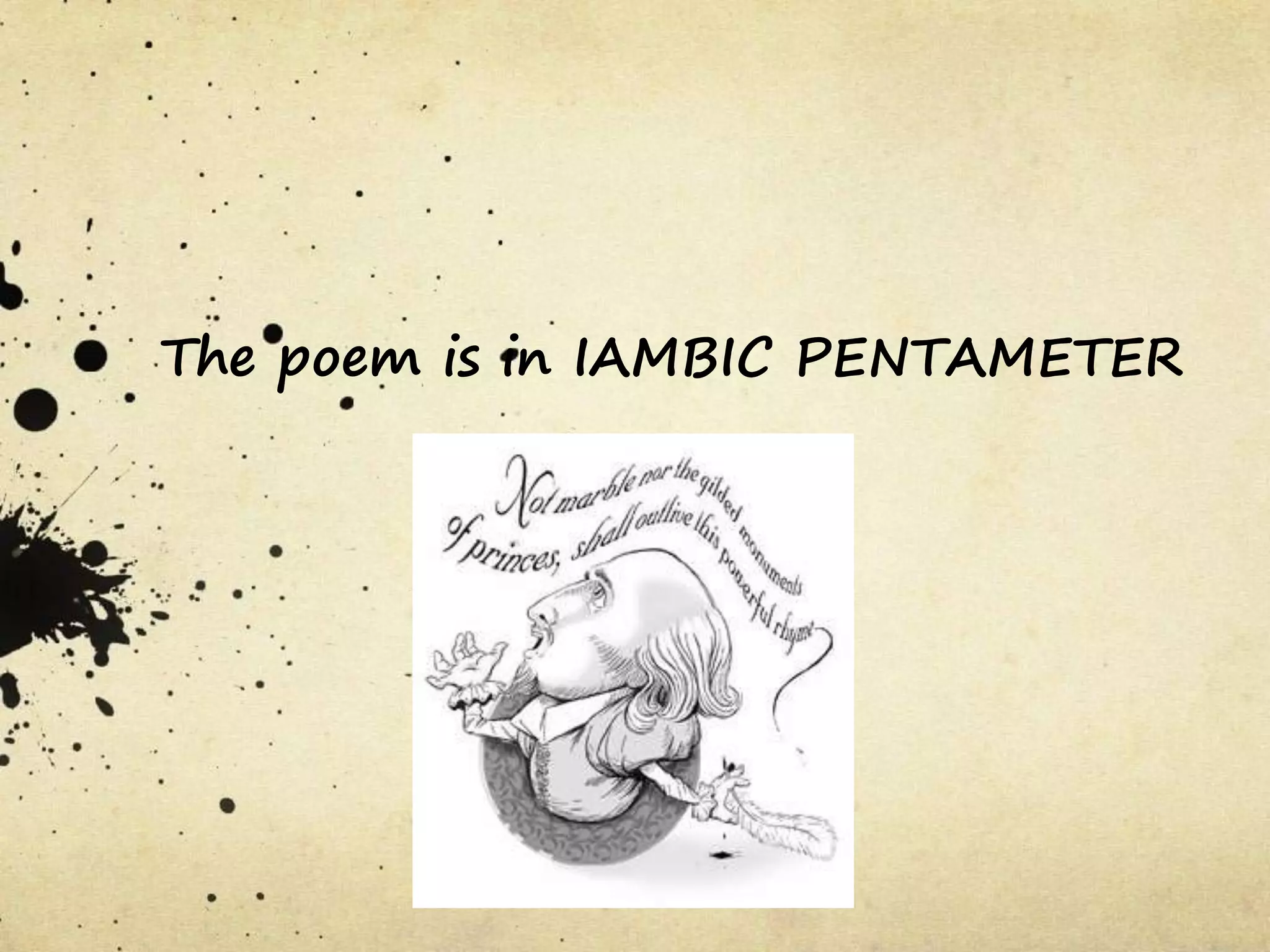
The poem is in IAMBIC PENTAMETER
Meaning
Shall I compare thee to a summer's day?
This question is flattering in itself as a
summer’s day is often associated with
beauty.
Thou art more lovely and more temperate:
Shakespeare, however, explains that his
love’s beauty exceeds that of the summer
and does not have its tendency towards
unpleasant extremes:
Rough winds do shake the darling buds of May,
And summer's lease hath all too short a date:
It should be noted that at the time the sonnet
was written, England had not yet adopted the
Gregorian calendar and May was considered a
summer month. In the above quote, Shakespeare
describes the fragility and short duration of
summer’s beauty. The use of the word ‘lease’
reminds us of the fact that everything beautiful
remains so for a limited time only and after a
while its beauty will be forcibly taken away.
Sometime too hot the eye of heaven shines,
And often is his gold complexion dimmed,
Shakespeare states that the sun, which he
personifies and refers to as ‘the eye of heaven’,
can be too hot or blocked from view by the
clouds unlike his ‘more temperate’ love.
And every fair from fair sometime declines,
By chance, or nature's changing course untrimmed:
The repetition of the word ‘fair’ highlights the
fact that this fate is inescapable for everything
that possesses beauty.
“But thy eternal summer shall not fade,
Nor lose possession of that fair thou ow’st,”
Suddenly (though it was foreshadowed a bit in line
8), the tone and direction of the poem changes
dramatically. Moving on from bashing summer and
the limitations inherent in nature, the speaker
pronounces that the beloved he’s speaking to isn’t
subject to all of these rules he’s laid out.
“Nor shall death brag thou wander’st in his shade
When in eternal lines to time thou grow’st”
Shakespeare, however, states that his love will
not lose their beauty to death or time but will be
preserved through his poetry:
So long as men can breathe, or eyes can see,
So long lives this, and this gives life to thee.
(As long as there are humans alive on this
planet Your life and beauty will live on through
this sonnet)
Shakespeare’s self-assured claim makes it
possible to argue that the purpose of the poem
was not actually to pay a beloved person a
compliment but rather to praise oneself for
poetic skill.
Metaphor:
“Shall I compare thee to a summer’s
day?”
"Thou art more lovely and more
temperate”
“But thy eternal summer shall not
fade”
Symbolism:
• “The darling buds of May” – the
beautiful, much loved buds of
the early summer
• “The eye of heaven” – Sun
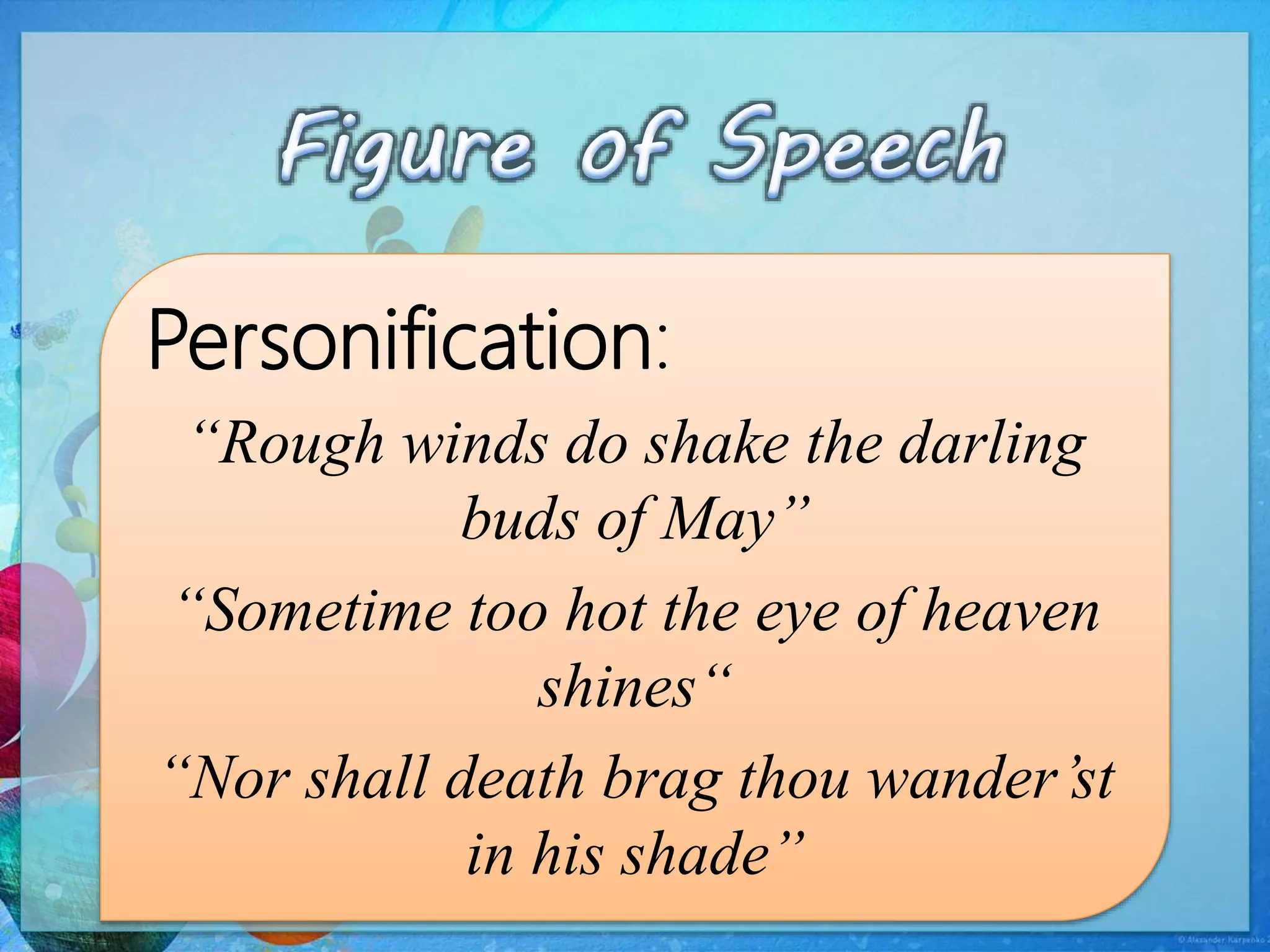
Personification:
“Rough winds do shake the darling
buds of May”
“Sometime too hot the eye of heaven
shines“
“Nor shall death brag thou wander’st
in his shade”
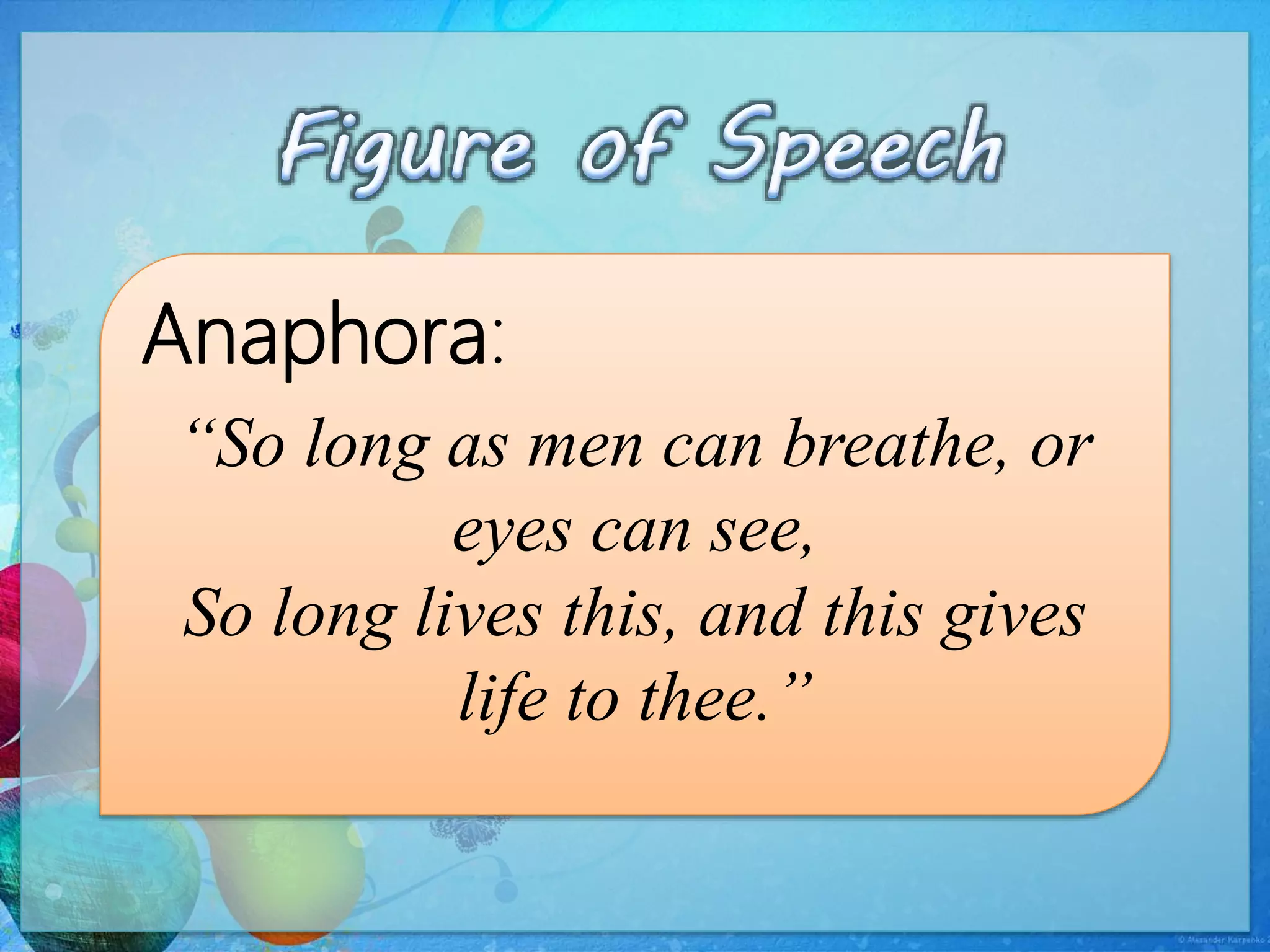
Anaphora:
“So long as men can breathe, or
eyes can see,
So long lives this, and this gives
life to thee.”
Interlink b/w FORM and
CONTENT
 Rhetoric tradition of Italian sonnet.
The three quatrain plus couplet form of
Shakespeare’s sonnets also allow the
speaker to use a dominant metaphor or
image for each quatrain as he leads to his
resolution in the concluding couplet.
Stylistic analysis of a shakespearean sonnet

Stylistic analysis of a shakespearean sonnet

  • 2.
    Stylistic Approach  Inthe words of Halliday: We can define linguistic stylistics as the description of literary texts by methods derived from general linguistic theory, using the categories of the description of language as a whole.
  • 3.
    Sonnet? o Two typesof Sonnet : Petrarchan and Shakespearean. o A sonnet is a 14 line lyric poem that conforms to strict patterns of rhythm and rhyme. o Written in Iambic Pentameter.
  • 4.
  • 5.
    Scansion o What isit? o What are Structural Devices and Literary Devices?
  • 6.
    Structure vs LiteraryDevices Structural Elements Literary Devices  Rhythm  Meter  Rhyme  Similes and Metaphors  Imagery  Alliteration  Symbolism  Parallelism  Personification
  • 7.
    Sonnet 18 Shall Icompare thee to a summer's day? Thou art more lovely and more temperate: Rough winds do shake the darling buds of May, And summer's lease hath all too short a date: Sometime too hot the eye of heaven shines, And often is his gold complexion dimm'd; And every fair from fair sometime declines, By chance, or nature's changing course, untrimm'd; But thy eternal summer shall not fade Nor lose possession of that fair thou ow'st; Nor shall Death brag thou wander'st in his shade, When in eternal lines to time thou grow'st; So long as men can breathe or eyes can see, So long lives this, and this gives life to thee.
  • 8.
    Common Feet usedin Poetry (~) denotes unstressed and (/) denotes stressed  Iamb (~/) unstressed followed by stressed syllable  Anapest (~~/) two unstressed followed by stressed syllable  Trochee (/~) stressed followed by unstressed syllable  Dactyl (/~~) stressed followed by two unstressed syllable  Spondee (//) two stressed back to back syllable  Pyrrhic (~~) two unstressed back to back syllable
  • 9.
    Step 1 : Rhymescheme is :- ABAB CDCD EFEF GG Shall I compare thee to a summer's day? Thou art more lovely and more temperate: Rough winds do shake the darling buds of May, And summer's lease hath all too short a date: Sometime too hot the eye of heaven shines, And often is his gold complexion dimm'd; And every fair from fair sometime declines, By chance, or nature's changing course, untrimm'd; But thy eternal summer shall not fade Nor lose possession of that fair thou ow'st; Nor shall Death brag thou wander'st in his shade, When in eternal lines to time thou grow'st; So long as men can breathe or eyes can see, So long lives this, and this gives life to thee
  • 10.
    Step 2: DetermineRhythm stressed (x) and unstressed (~) syllables Shall I / com PARE/ thee TO / a SUM / mer's DAY? ~ x ~ x ~ x ~ x ~ x Thou ART / more LOVE / ly AND / more TEM / per ATE ~ x ~ x ~ x ~ x ~ x It follows an IAMBIC (~x) pattern.
  • 11.
    Step 3: Meter ShallI compare thee to a summer's day? ʃəl aɪ/ kəmˈ peə/ ði : tə/ ə sʌ/məz deɪ/ Thou art more lovely and more temperate: ðaʊ ɑ:/t mɔ: ˈlʌ/vlɪ ə/nd mɔ: ˈte/mpərət/ Rough winds do shake the darling buds of May, rʌf wɪ/ndz dʊ ʃeɪ/k ðə ˈdɑ:/lɪŋ bʌ/dz əv meɪ/ And summer's lease hath all too short a date ənd sʌ/məz li:/s hæθ ɔ:/l tu: ʃɔ:/t ə deɪt/
  • 12.
    1 syllable has1 vowel Sometime too hot the eye of heaven shines, sʌmtaɪ/m tu: hɒ/t ðɪ aɪ/ əv ˈhe/vn ʃaɪnz And often is his gold complexion dimm'd; ənd ˈɒ/fn ɪz/ hɪz gəʊ/ld kəmˈ plekʃ/n dɪmd And every fair from fair sometime declines, ənd ˈevrɪ/ feə frə/m feə sʌ/mtaɪm dɪ/ˈklaɪnz By chance or nature's changing course untrimm'd; baɪ ʧɑ:/ns ɔ: neɪ/ʧez ʧeɪ/ndʒɪŋ kɔ:/s ənˈtrɪmd
  • 13.
    1 feet has2 syllables But thy eternal summer shall not fade bʌt ðaɪ/ ɪˈtɜ:/nəl sʌ/mə ʃə/l nɒt feɪd/ Nor lose possession of that fair thou owest; nɔ: lu:/z pɒze/ʃn əv ðæ/t feə ðaʊ/ əʊəst Nor shall Death brag thou wander'st in his shade, nɔ: ʃəl/ deθ bræ/g ðaʊ ˈwɒ/ndəzt ɪ/n hɪz ʃeɪd When in eternal lines to time thou growest: wen ɪ/n ɪˈtɜ:/nəl laɪ/nz tə taɪ/m ðaʊ grəʊəst
  • 14.
    5 feet isa Penta So long as men can breathe or eyes can see, səʊ lɒ/ŋ əz me/n kæn bri:/ð ɔ: aɪ/z kæn si: So long lives this and this gives life to thee. səʊ lɒ/ŋ lɪvz ðɪ/s ən ðɪ/s gɪvz laɪ/f tə ði: It has 5 feet per line i.e Pentameter.
  • 15.
    The poem isin IAMBIC PENTAMETER
  • 16.
    Meaning Shall I comparethee to a summer's day? This question is flattering in itself as a summer’s day is often associated with beauty.
  • 17.
    Thou art morelovely and more temperate: Shakespeare, however, explains that his love’s beauty exceeds that of the summer and does not have its tendency towards unpleasant extremes:
  • 18.
    Rough winds doshake the darling buds of May, And summer's lease hath all too short a date: It should be noted that at the time the sonnet was written, England had not yet adopted the Gregorian calendar and May was considered a summer month. In the above quote, Shakespeare describes the fragility and short duration of summer’s beauty. The use of the word ‘lease’ reminds us of the fact that everything beautiful remains so for a limited time only and after a while its beauty will be forcibly taken away.
  • 19.
    Sometime too hotthe eye of heaven shines, And often is his gold complexion dimmed, Shakespeare states that the sun, which he personifies and refers to as ‘the eye of heaven’, can be too hot or blocked from view by the clouds unlike his ‘more temperate’ love.
  • 20.
    And every fairfrom fair sometime declines, By chance, or nature's changing course untrimmed: The repetition of the word ‘fair’ highlights the fact that this fate is inescapable for everything that possesses beauty.
  • 21.
    “But thy eternalsummer shall not fade, Nor lose possession of that fair thou ow’st,” Suddenly (though it was foreshadowed a bit in line 8), the tone and direction of the poem changes dramatically. Moving on from bashing summer and the limitations inherent in nature, the speaker pronounces that the beloved he’s speaking to isn’t subject to all of these rules he’s laid out.
  • 22.
    “Nor shall deathbrag thou wander’st in his shade When in eternal lines to time thou grow’st” Shakespeare, however, states that his love will not lose their beauty to death or time but will be preserved through his poetry:
  • 23.
    So long asmen can breathe, or eyes can see, So long lives this, and this gives life to thee. (As long as there are humans alive on this planet Your life and beauty will live on through this sonnet) Shakespeare’s self-assured claim makes it possible to argue that the purpose of the poem was not actually to pay a beloved person a compliment but rather to praise oneself for poetic skill.
  • 24.
    Metaphor: “Shall I comparethee to a summer’s day?” "Thou art more lovely and more temperate” “But thy eternal summer shall not fade”
  • 25.
    Symbolism: • “The darlingbuds of May” – the beautiful, much loved buds of the early summer • “The eye of heaven” – Sun
  • 26.
    Personification: “Rough winds doshake the darling buds of May” “Sometime too hot the eye of heaven shines“ “Nor shall death brag thou wander’st in his shade”
  • 27.
    Anaphora: “So long asmen can breathe, or eyes can see, So long lives this, and this gives life to thee.”
  • 28.
    Interlink b/w FORMand CONTENT  Rhetoric tradition of Italian sonnet. The three quatrain plus couplet form of Shakespeare’s sonnets also allow the speaker to use a dominant metaphor or image for each quatrain as he leads to his resolution in the concluding couplet.