Creating By
Naimur Rahman (16116026)
Rifat Al Noman (16116019)
Mahzabin Bipasha (15116018)
Sofed Mahmud (15216003)
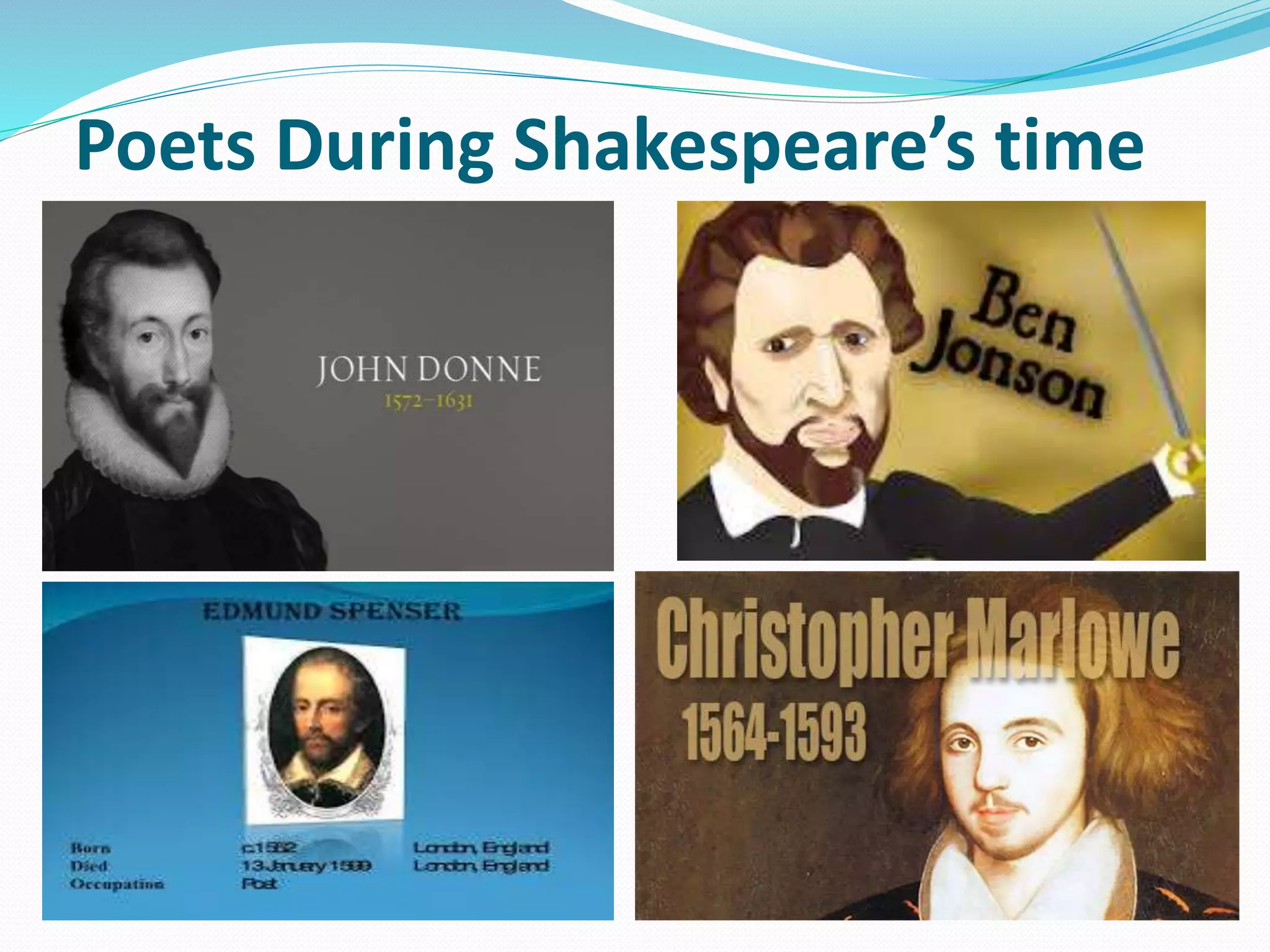
Poets During Shakespeare’s time

1.Backgrouond of The Author
2.Background of The Work
3.Analysis of The Poem
4.Speaker
5.Addresse
6.Tone
7.Symbolism
8.Figure of Speech
9.Stracture
10.Theme
11.Title Implication
 Within the class system of Elizabethan
England, William Shakespeare did not
seem destined for greatness. He was
not born into a family of nobility or
significant wealth. He did not continue
his formal education at university, nor
did he come under the mentorship of a
senior artist, nor did he marry into
wealth or prestige. His talent as an
actor seems to have been modest, since
he is not known for starring roles. His
success as a playwright depended in
part upon royal patronage. Yet in spite
of these limitations, Shakespeare is
now the most performed and read
playwright in the world.
 Born to John Shakespeare, a glove maker and tradesman,
and Mary Arden, the daughter of an affluent farmer,
William Shakespeare was baptized on April 26, 1564, in
Stratford-upon-Avon. At that time, infants were baptized
three days after their birth, thus scholars believe that
Shakespeare was born on April 23, the same day on which
he died at age 52. As the third of eight children, young
William grew up in this small town 100 miles northwest
of London, far from the cultural and courtly center of
England. He was a poet of English Renaissance and
Elizabethan era.
His Masterpieces
 Shall I compare Thee
 As You Like It
 Helmet
 King Lear
 Antony and Cleopatra
 The Tempest
 Shakespeare wrote 154 Sonnets, 38 Plays and 2 narrative
Poems. Ben Jonson wrote of Shakespeare, “He was not of
an age, but for all time.”
 Many of his plays were published in editions of varying
quality and accuracy during his lifetime. In 1623, two of
his former theatrical colleagues published the First
Folio, a collected edition of his dramatic works that
included all but two of the plays now recognized as
Shakespeare's.
 Shakespeare was a respected poet and playwright in his
own day, but his reputation did not rise to its present
heights until the 19th century.
 The Romantics, in particular, acclaimed Shakespeare's
genius, and the Victorians worshipped Shakespeare
with a reverence that George Bernard Shaw called
"bardolatry".
 In the 20th century, his work
was repeatedly adopted and
rediscovered by new
movements in scholarship and
performance. His plays remain
highly popular today and are
constantly studied, performed
and reinterpreted in diverse
cultural and political contexts
throughout the world.
Shakespeare’s sonnets were composed
between 1593 and 1601, though not published
until 1609. That edition, The Sonnets of
Shakespeare, consists of 154 sonnets, all
written in the form of three quatrains and a
couplet that is now recognized as
Shakespearean. The sonnets fall into two
groups: sonnets 1-126, addressed to a beloved
friend, a handsome and noble young man,
presumably the author’s patron, and sonnets
127-152, to a malignant but fascinating “Dark
Lady," who the poet loves in spite of himself.
Nearly all of Shakespeare’s sonnets examine
the inevitable decay of time, and the
immortalization of beauty and love in poetry.
Shall I compare thee to a summer's day?
Thou art more lovely and more temperate:
Rough winds do shake the darling buds of May,
And summer's lease hath all too short a date:
Sometime too hot the eye of heaven shines,
And often is his gold complexion dimmed,
And every fair from fair sometime declines,
By chance, or nature's changing course untrimmed:
But thy eternal summer shall not fade,
Nor lose possession of that fair thou ow'st,
Nor shall death brag thou wander'st in his shade,
When in eternal lines to time thou grow'st,
So long as men can breathe, or eyes can see,
So long lives this, and this gives life to thee.
Shall I compare thee to a summer's day?
This question is flattering in itself as a
summer’s day is often associated with
beauty.
Thou art more lovely and more temperate:
Shakespeare, however, explains that his
love’s beauty exceeds that of the summer
and does not have its tendency towards
unpleasant extremes:
Rough winds do shake the darling buds of May,
And summer's lease hath all too short a date:
It should be noted that at the time the sonnet
was written, England had not yet adopted the
Gregorian calendar and May was considered a
summer month. In the above quote, Shakespeare
describes the fragility and short duration of
summer’s beauty. The use of the word ‘lease’
reminds us of the fact that everything beautiful
remains so for a limited time only and after a
while its beauty will be forcibly taken away.
Sometime too hot the eye of heaven shines,
And often is his gold complexion dimmed,
Shakespeare states that the sun, which he
personifies and refers to as ‘the eye of heaven’,
can be too hot or blocked from view by the
clouds unlike his ‘more temperate’ love.
And every fair from fair sometime declines,
By chance, or nature's changing course untrimmed:
The repetition of the word ‘fair’ highlights the
fact that this fate is inescapable for everything
that possesses beauty.
“But thy eternal summer shall not fade,
Nor lose possession of that fair thou ow’st,
Nor shall death brag thou wander’st in his shade
When in eternal lines to time thou grow’st”
Suddenly (though it was foreshadowed a bit in line
8), the tone and direction of the poem changes
dramatically. Moving on from bashing summer and
the limitations inherent in nature, the speaker
pronounces that the beloved he’s speaking to isn’t
subject to all of these rules he’s laid out.
“But thy eternal summer shall not fade,
Nor lose possession of that fair thou ow’st,
Nor shall death brag thou wander’st in his shade
When in eternal lines to time thou grow’st”
Shakespeare, however, states that his love will
not lose their beauty to death or time but will be
preserved through his poetry:
So long as men can breathe, or eyes can see,
So long lives this, and this gives life to thee.
(As long as there are humans alive on this
planet Your life and beauty will live on through
this sonnet)
Shakespeare’s self-assured claim makes it
possible to argue that the purpose of the poem
was not actually to pay a beloved person a
compliment but rather to praise oneself for
poetic skill.
Speaker:
The Author
Addressee:
The young man
Tone:
Endearing, deep
devotion for a lover
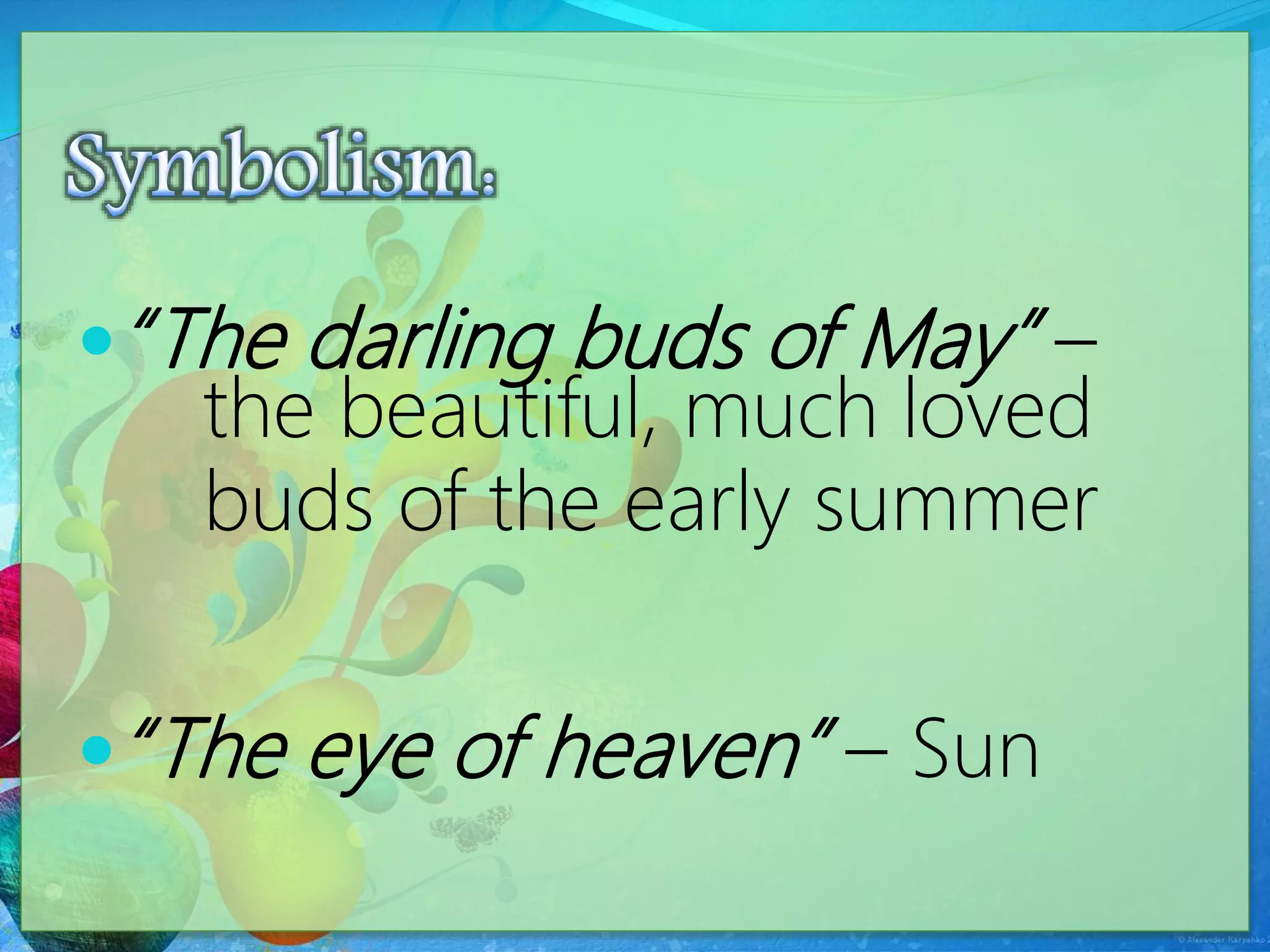
“The darling buds of May” –
the beautiful, much loved
buds of the early summer
“The eye of heaven” – Sun
Metaphor:
“Shall I compare thee to a
summer’s day?”
Metaphor:
"Thou art more lovely and more
temperate”
Personification:
“Rough winds do shake the
darling buds of May”
“Sometime too hot the eye of
heaven shines“
Personification:
“Nor shall death brag thou
wander’st in his shade”
Anaphora:
“So long as men can breathe, or
eyes can see,
So long lives this, and this gives
life to thee.”
Iambic pentameter
 the most common metrical pattern in poetry written
English, alternates weak unstressed and strong
stressed syllables to make a ten-syllable line (weak
strong/weak strong/weak strong/weak strong/weak
strong).
 Love
 Literature and Writing
 Time
 Man and the Natural World
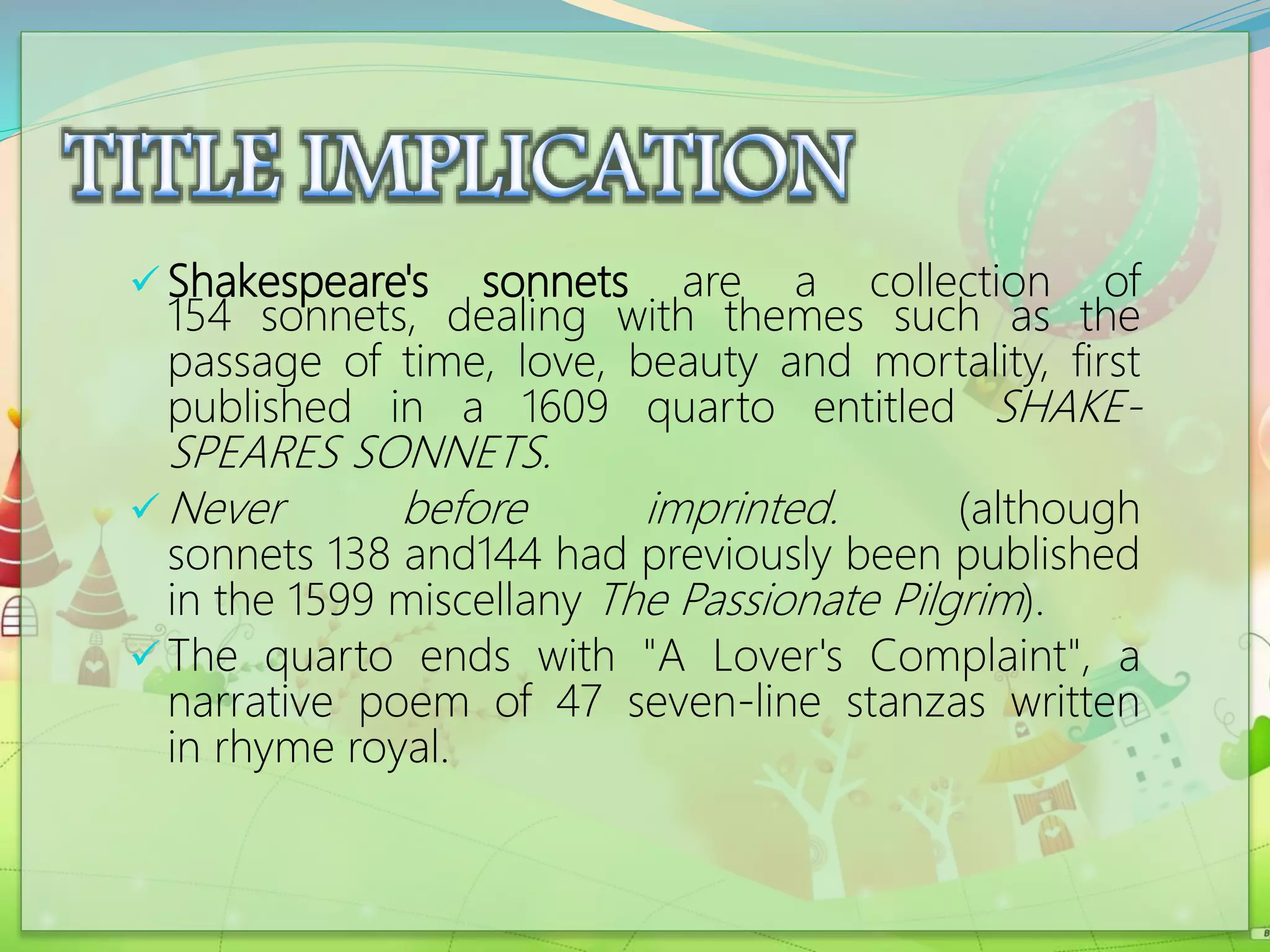
 Shakespeare's sonnets are a collection of
154 sonnets, dealing with themes such as the
passage of time, love, beauty and mortality, first
published in a 1609 quarto entitled SHAKE-
SPEARES SONNETS.
 Never before imprinted. (although
sonnets 138 and144 had previously been published
in the 1599 miscellany The Passionate Pilgrim).
 The quarto ends with "A Lover's Complaint", a
narrative poem of 47 seven-line stanzas written
in rhyme royal.
Sonnet 18 final

Sonnet 18 final

  • 2.
    Creating By Naimur Rahman(16116026) Rifat Al Noman (16116019) Mahzabin Bipasha (15116018) Sofed Mahmud (15216003)
  • 3.
  • 4.
    1.Backgrouond of TheAuthor 2.Background of The Work 3.Analysis of The Poem 4.Speaker 5.Addresse 6.Tone 7.Symbolism 8.Figure of Speech 9.Stracture 10.Theme 11.Title Implication
  • 5.
     Within theclass system of Elizabethan England, William Shakespeare did not seem destined for greatness. He was not born into a family of nobility or significant wealth. He did not continue his formal education at university, nor did he come under the mentorship of a senior artist, nor did he marry into wealth or prestige. His talent as an actor seems to have been modest, since he is not known for starring roles. His success as a playwright depended in part upon royal patronage. Yet in spite of these limitations, Shakespeare is now the most performed and read playwright in the world.
  • 6.
     Born toJohn Shakespeare, a glove maker and tradesman, and Mary Arden, the daughter of an affluent farmer, William Shakespeare was baptized on April 26, 1564, in Stratford-upon-Avon. At that time, infants were baptized three days after their birth, thus scholars believe that Shakespeare was born on April 23, the same day on which he died at age 52. As the third of eight children, young William grew up in this small town 100 miles northwest of London, far from the cultural and courtly center of England. He was a poet of English Renaissance and Elizabethan era.
  • 7.
    His Masterpieces  ShallI compare Thee  As You Like It  Helmet  King Lear  Antony and Cleopatra  The Tempest  Shakespeare wrote 154 Sonnets, 38 Plays and 2 narrative Poems. Ben Jonson wrote of Shakespeare, “He was not of an age, but for all time.”
  • 8.
     Many ofhis plays were published in editions of varying quality and accuracy during his lifetime. In 1623, two of his former theatrical colleagues published the First Folio, a collected edition of his dramatic works that included all but two of the plays now recognized as Shakespeare's.  Shakespeare was a respected poet and playwright in his own day, but his reputation did not rise to its present heights until the 19th century.  The Romantics, in particular, acclaimed Shakespeare's genius, and the Victorians worshipped Shakespeare with a reverence that George Bernard Shaw called "bardolatry".
  • 9.
     In the20th century, his work was repeatedly adopted and rediscovered by new movements in scholarship and performance. His plays remain highly popular today and are constantly studied, performed and reinterpreted in diverse cultural and political contexts throughout the world.
  • 10.
    Shakespeare’s sonnets werecomposed between 1593 and 1601, though not published until 1609. That edition, The Sonnets of Shakespeare, consists of 154 sonnets, all written in the form of three quatrains and a couplet that is now recognized as Shakespearean. The sonnets fall into two groups: sonnets 1-126, addressed to a beloved friend, a handsome and noble young man, presumably the author’s patron, and sonnets 127-152, to a malignant but fascinating “Dark Lady," who the poet loves in spite of himself. Nearly all of Shakespeare’s sonnets examine the inevitable decay of time, and the immortalization of beauty and love in poetry.
  • 11.
    Shall I comparethee to a summer's day? Thou art more lovely and more temperate: Rough winds do shake the darling buds of May, And summer's lease hath all too short a date: Sometime too hot the eye of heaven shines, And often is his gold complexion dimmed, And every fair from fair sometime declines, By chance, or nature's changing course untrimmed: But thy eternal summer shall not fade, Nor lose possession of that fair thou ow'st, Nor shall death brag thou wander'st in his shade, When in eternal lines to time thou grow'st, So long as men can breathe, or eyes can see, So long lives this, and this gives life to thee.
  • 13.
    Shall I comparethee to a summer's day? This question is flattering in itself as a summer’s day is often associated with beauty.
  • 14.
    Thou art morelovely and more temperate: Shakespeare, however, explains that his love’s beauty exceeds that of the summer and does not have its tendency towards unpleasant extremes:
  • 15.
    Rough winds doshake the darling buds of May, And summer's lease hath all too short a date: It should be noted that at the time the sonnet was written, England had not yet adopted the Gregorian calendar and May was considered a summer month. In the above quote, Shakespeare describes the fragility and short duration of summer’s beauty. The use of the word ‘lease’ reminds us of the fact that everything beautiful remains so for a limited time only and after a while its beauty will be forcibly taken away.
  • 16.
    Sometime too hotthe eye of heaven shines, And often is his gold complexion dimmed, Shakespeare states that the sun, which he personifies and refers to as ‘the eye of heaven’, can be too hot or blocked from view by the clouds unlike his ‘more temperate’ love.
  • 17.
    And every fairfrom fair sometime declines, By chance, or nature's changing course untrimmed: The repetition of the word ‘fair’ highlights the fact that this fate is inescapable for everything that possesses beauty.
  • 18.
    “But thy eternalsummer shall not fade, Nor lose possession of that fair thou ow’st, Nor shall death brag thou wander’st in his shade When in eternal lines to time thou grow’st” Suddenly (though it was foreshadowed a bit in line 8), the tone and direction of the poem changes dramatically. Moving on from bashing summer and the limitations inherent in nature, the speaker pronounces that the beloved he’s speaking to isn’t subject to all of these rules he’s laid out.
  • 19.
    “But thy eternalsummer shall not fade, Nor lose possession of that fair thou ow’st, Nor shall death brag thou wander’st in his shade When in eternal lines to time thou grow’st” Shakespeare, however, states that his love will not lose their beauty to death or time but will be preserved through his poetry:
  • 20.
    So long asmen can breathe, or eyes can see, So long lives this, and this gives life to thee. (As long as there are humans alive on this planet Your life and beauty will live on through this sonnet) Shakespeare’s self-assured claim makes it possible to argue that the purpose of the poem was not actually to pay a beloved person a compliment but rather to praise oneself for poetic skill.
  • 21.
  • 22.
  • 23.
  • 24.
    “The darling budsof May” – the beautiful, much loved buds of the early summer “The eye of heaven” – Sun
  • 25.
    Metaphor: “Shall I comparethee to a summer’s day?”
  • 26.
    Metaphor: "Thou art morelovely and more temperate”
  • 27.
    Personification: “Rough winds doshake the darling buds of May” “Sometime too hot the eye of heaven shines“
  • 28.
    Personification: “Nor shall deathbrag thou wander’st in his shade”
  • 29.
    Anaphora: “So long asmen can breathe, or eyes can see, So long lives this, and this gives life to thee.”
  • 30.
    Iambic pentameter  themost common metrical pattern in poetry written English, alternates weak unstressed and strong stressed syllables to make a ten-syllable line (weak strong/weak strong/weak strong/weak strong/weak strong).
  • 31.
     Love  Literatureand Writing  Time  Man and the Natural World
  • 32.
     Shakespeare's sonnetsare a collection of 154 sonnets, dealing with themes such as the passage of time, love, beauty and mortality, first published in a 1609 quarto entitled SHAKE- SPEARES SONNETS.  Never before imprinted. (although sonnets 138 and144 had previously been published in the 1599 miscellany The Passionate Pilgrim).  The quarto ends with "A Lover's Complaint", a narrative poem of 47 seven-line stanzas written in rhyme royal.