The Lotus-Eaters
Task One
• Read the extract from the Odyssey you’ve
  been given.
• Ask yourself: how might the sailors feel
  about what has happened?
• I will ask you to prepare a short
  monologue in the voice of a sailor…
“I was carried by the wind from Troy
to Ismarus, land of the Cicones.
I destroyed the city there, killed the men,              [40]
seized their wives, and captured lots of treasure
which we divided up. I took great pains
to see that all men got an equal share.
Then I gave orders we should leave on foot—                     60
and with all speed. But the men were fools.
They didn’t listen. They drank too much wine
and on the shoreline slaughtered many sheep,
as well as shambling cows with twisted horns.
Meanwhile the Cicones set off and gathered up
their neighbours, tribesmen living further inland.
There are more of them, and they are braver men,
skilled at fighting enemies from chariots
and also, should the need arise, on foot.        [50]
They reached us in the morning, thick as leaves       70
or flowers growing in season. Then Zeus
brought us disaster—he made that our fate,
so we would suffer many casualties.
They set their ranks and fought by our swift ships.
We threw our bronze-tipped spears at one another.
While morning lasted and that sacred day
gained strength, we held our ground and beat them back,
for all their greater numbers. But as the sun
moved to the hour when oxen are unyoked,
the Cicones broke through, overpowering                         80
Achaeans. Of my well-armed companions, [60]
six from every ship were killed. The rest of us
made our escape, avoiding Death and Fate.
“We sailed away from there, hearts full of grief
at losing loyal companions, though happy
we had eluded death ourselves. But still,
I would not let our curved ships leave the place
until we’d made the ritual call three times
for our poor comrades slaughtered on that plain,
killed by the Cicones. Cloud-gatherer Zeus               90
then stirred North Wind to rage against our ships—
a violent storm concealing land and sea,
as darkness swept from heaven down on us.
The ships were driven off course, our sails [70]
ripped to shreds by the power of that wind.
We lowered the masts into the holds and then,
fearing for our lives, quickly rowed the ships
toward the land. For two whole days and nights
we lay there, hearts consumed with sorrow
and exhaustion. But when fair-haired Dawn                100
gave birth to the third day, we raised the masts,
hoisted white sails, and took our place on board.
Wind and helmsman held us on our course,
and I’d have reached my native land unharmed,
but North Wind, sea currents, and the waves
pushed me off course, as I was doubling back      [80]
around Malea, driving me past Cythera.
”Nine days fierce winds drove me away from there,
across the fish-filled seas, and on the tenth
we landed where the Lotus-eaters live,               110
people who feed upon its flowering fruit.
We went ashore and carried water back.
Then my companions quickly had a meal
by our swift ships. We had our food and drink,
and then I sent some of my comrades out
to learn about the men who ate the food
the land grew there. I chose two of my men
and with them sent a third as messenger.
They left at once and met the Lotus-eaters,
who had no thought of killing my companions,        120
but gave them lotus plants to eat, whose fruit,
sweet as honey, made any man who tried it
lose his desire ever to journey home
or bring back word to us—they wished to stay,
to remain among the Lotus-eaters,
feeding on the plant, eager to forget
about their homeward voyage. I forced them,
eyes full of tears, into our hollow ships,
dragged them underneath the rowing benches,
and tied them up. Then I issued orders                130
for my other trusty comrades to embark
and sail away with speed in our fast ships,
in case another man might eat a lotus
and lose all thoughts about his journey back.
They raced on board, went to their places,
and, sitting in good order in their rows,
struck the grey sea with their oar blades.
“We sailed away from there with heavy hearts
and reached the country of the Cyclopes,

From ‘Odyssey’, book 9
Context
• Written after a visit to Spain in 1829 with Arthur
  Hallam
• A recreation of an episode in Book 9 of the
  ‘Odyssey’
• More Tennysonian allusion to classical myth…
• in Homer, The Odyssey IX, Odysseus finally
  prevails upon the mariners (but only he survives
  their wanderings)
• Initially written in the Spenserian stanza…
   – Analyse the stanza form…
The Lotos-Eaters: form, structure
• This allusion to Greek classical myth is presented initially
  in five Spenserian stanzas.
   – a fixed verse form invented by Edmund Spenser (1552-1599) for
     his epic C16 poem The Faerie Queene.
   – Each stanza contains nine lines in total: eight lines in iambic
     pentameter followed by a single 'alexandrine' line in
     iambic hexameter.
   – The rhyme scheme of these lines is "ababbcbcc."
   – Note the paired couplets, one in the middle and one at the end
     of the verse.
• Why would Tennyson choose to use such a form?
• How are the opening five stanzas structured? (What
  happens in them?)
Voice and setting:
• narrative perspective/ voices: first person
  unspecified narrators (Odysseus’s mariners), or
  omniscient narrator – hard to tell
• self-dramatising, use of first person plural for the
  choric song  uses dramatic chorus
• setting: the Lotos Land, seaside setting, rural
  inland landscape, seascape
• Time: classical Greece, with increasing sense of
  timelessness
Language: The Lotos-Eaters,
         first two stanzas
• vigorous trochaic opening: ‘Courage’ …breaks
  down into sloth
• Soon becomes somnambulistic, trance-like
  – Enjambment = slow lines: ‘the slender stream/Along
    the cliff to fall and pause and fall did seem.’
• The land of streams seems lifeless, fading
  – it is ‘always afternoon’ – late, towards sunset
  – things ‘ripen towards the grave / In silence’.
Investigative tasks: Language
1. formal elevated diction;
2. use of repetition;
3. use of figurative language;
     1. echoes of the Garden of Eden, classical imagery
     2. other figurative language: natural imagery, dream imagery,
4.   significant use of verbs;
5.   sensuous detail;
6.   long rolling lines;
7.   significant use of references to time and death;
8.   use of contrasts.
Form and Structure:
                The Choric Song
• the mariners sing it: it can be seen as an answer to
  Ulysses’ exhortations:
• a looser structure than the first five stanzas
   –   but lines bound together by rhyme and rhythm
   –   use of verse paragraphs/stanzas which get longer
   –   imitation of speaking rhythms
   –   sense of song
• why are there are different verse structures and line
  lengths to the stanzas, particularly towards the end?
• Task: what is the topic of each stanza? Consider what
  the voice of each stanza mostly concerns itself with.
Language: Choric Song
•   In the first stanza of the choric song, note the long vowels, the
    sibilance and the anaphora – what effect results?
•   In the fourth stanza of the choric song, why are there caesuras
    (pauses in the middle of lines) plosives and stops (p,b,t,d,k,g
    sounds)
•   What use of half-rhyme does the fifth stanza make?
•   What is the impact of the rhyme scheme in stanza six?
•   Why are there so many rhyming couplets in stanza seven?
•   Identify where the rhythm becomes less tense.
•   Find examples of word repetition and consider the reasons for them.
•   Consider the use of rhyme, particularly in verse 8.
    – Why are there so many rhyming triplets at the end?
Overall themes: The Lotos-Eaters,
           the Choric Song
• Is Odysseus one with his men, or cut off from them?
• How does the poem seem to view social engagement?
• What contrasts are there? Consider:
   – heroic action & golden restful retreat.
   – active & passive.
   – utility & the value of the imagination.
• Find where the poem describes
   – indolent ease and the delight in the senses
   – self absorption and yet paradoxically also communality.
• There is a separation of the poet from man and society.
   – In what other poems by Tennyson does this separation occur?
Theme
• Do you feel the last line is an appeal to
  readers? If not, what is it? If so, why?
• What does the poem conclude about the
  conflict between social responsibility and
  ethical detachment?
Exam question
• 1 3 How does Tennyson tell the story in
  lines 99 – 144 of ‘The Lotos-Eaters and
  Choric Song’? (21 marks)

Tennyson the lotus-eaters

  • 1.
  • 2.
    Task One • Readthe extract from the Odyssey you’ve been given. • Ask yourself: how might the sailors feel about what has happened? • I will ask you to prepare a short monologue in the voice of a sailor…
  • 3.
    “I was carriedby the wind from Troy to Ismarus, land of the Cicones. I destroyed the city there, killed the men, [40] seized their wives, and captured lots of treasure which we divided up. I took great pains to see that all men got an equal share. Then I gave orders we should leave on foot— 60 and with all speed. But the men were fools. They didn’t listen. They drank too much wine and on the shoreline slaughtered many sheep, as well as shambling cows with twisted horns. Meanwhile the Cicones set off and gathered up their neighbours, tribesmen living further inland. There are more of them, and they are braver men, skilled at fighting enemies from chariots and also, should the need arise, on foot. [50] They reached us in the morning, thick as leaves 70 or flowers growing in season. Then Zeus brought us disaster—he made that our fate, so we would suffer many casualties. They set their ranks and fought by our swift ships. We threw our bronze-tipped spears at one another. While morning lasted and that sacred day gained strength, we held our ground and beat them back, for all their greater numbers. But as the sun moved to the hour when oxen are unyoked, the Cicones broke through, overpowering 80 Achaeans. Of my well-armed companions, [60] six from every ship were killed. The rest of us made our escape, avoiding Death and Fate.
  • 4.
    “We sailed awayfrom there, hearts full of grief at losing loyal companions, though happy we had eluded death ourselves. But still, I would not let our curved ships leave the place until we’d made the ritual call three times for our poor comrades slaughtered on that plain, killed by the Cicones. Cloud-gatherer Zeus 90 then stirred North Wind to rage against our ships— a violent storm concealing land and sea, as darkness swept from heaven down on us. The ships were driven off course, our sails [70] ripped to shreds by the power of that wind. We lowered the masts into the holds and then, fearing for our lives, quickly rowed the ships toward the land. For two whole days and nights we lay there, hearts consumed with sorrow and exhaustion. But when fair-haired Dawn 100 gave birth to the third day, we raised the masts, hoisted white sails, and took our place on board. Wind and helmsman held us on our course, and I’d have reached my native land unharmed, but North Wind, sea currents, and the waves pushed me off course, as I was doubling back [80] around Malea, driving me past Cythera.
  • 5.
    ”Nine days fiercewinds drove me away from there, across the fish-filled seas, and on the tenth we landed where the Lotus-eaters live, 110 people who feed upon its flowering fruit. We went ashore and carried water back. Then my companions quickly had a meal by our swift ships. We had our food and drink, and then I sent some of my comrades out to learn about the men who ate the food the land grew there. I chose two of my men and with them sent a third as messenger. They left at once and met the Lotus-eaters, who had no thought of killing my companions, 120 but gave them lotus plants to eat, whose fruit, sweet as honey, made any man who tried it lose his desire ever to journey home or bring back word to us—they wished to stay, to remain among the Lotus-eaters, feeding on the plant, eager to forget about their homeward voyage. I forced them, eyes full of tears, into our hollow ships, dragged them underneath the rowing benches, and tied them up. Then I issued orders 130 for my other trusty comrades to embark and sail away with speed in our fast ships, in case another man might eat a lotus and lose all thoughts about his journey back. They raced on board, went to their places, and, sitting in good order in their rows, struck the grey sea with their oar blades. “We sailed away from there with heavy hearts and reached the country of the Cyclopes, From ‘Odyssey’, book 9
  • 10.
    Context • Written aftera visit to Spain in 1829 with Arthur Hallam • A recreation of an episode in Book 9 of the ‘Odyssey’ • More Tennysonian allusion to classical myth… • in Homer, The Odyssey IX, Odysseus finally prevails upon the mariners (but only he survives their wanderings) • Initially written in the Spenserian stanza… – Analyse the stanza form…
  • 11.
    The Lotos-Eaters: form,structure • This allusion to Greek classical myth is presented initially in five Spenserian stanzas. – a fixed verse form invented by Edmund Spenser (1552-1599) for his epic C16 poem The Faerie Queene. – Each stanza contains nine lines in total: eight lines in iambic pentameter followed by a single 'alexandrine' line in iambic hexameter. – The rhyme scheme of these lines is "ababbcbcc." – Note the paired couplets, one in the middle and one at the end of the verse. • Why would Tennyson choose to use such a form? • How are the opening five stanzas structured? (What happens in them?)
  • 12.
    Voice and setting: •narrative perspective/ voices: first person unspecified narrators (Odysseus’s mariners), or omniscient narrator – hard to tell • self-dramatising, use of first person plural for the choric song  uses dramatic chorus • setting: the Lotos Land, seaside setting, rural inland landscape, seascape • Time: classical Greece, with increasing sense of timelessness
  • 13.
    Language: The Lotos-Eaters, first two stanzas • vigorous trochaic opening: ‘Courage’ …breaks down into sloth • Soon becomes somnambulistic, trance-like – Enjambment = slow lines: ‘the slender stream/Along the cliff to fall and pause and fall did seem.’ • The land of streams seems lifeless, fading – it is ‘always afternoon’ – late, towards sunset – things ‘ripen towards the grave / In silence’.
  • 14.
    Investigative tasks: Language 1.formal elevated diction; 2. use of repetition; 3. use of figurative language; 1. echoes of the Garden of Eden, classical imagery 2. other figurative language: natural imagery, dream imagery, 4. significant use of verbs; 5. sensuous detail; 6. long rolling lines; 7. significant use of references to time and death; 8. use of contrasts.
  • 15.
    Form and Structure: The Choric Song • the mariners sing it: it can be seen as an answer to Ulysses’ exhortations: • a looser structure than the first five stanzas – but lines bound together by rhyme and rhythm – use of verse paragraphs/stanzas which get longer – imitation of speaking rhythms – sense of song • why are there are different verse structures and line lengths to the stanzas, particularly towards the end? • Task: what is the topic of each stanza? Consider what the voice of each stanza mostly concerns itself with.
  • 16.
    Language: Choric Song • In the first stanza of the choric song, note the long vowels, the sibilance and the anaphora – what effect results? • In the fourth stanza of the choric song, why are there caesuras (pauses in the middle of lines) plosives and stops (p,b,t,d,k,g sounds) • What use of half-rhyme does the fifth stanza make? • What is the impact of the rhyme scheme in stanza six? • Why are there so many rhyming couplets in stanza seven? • Identify where the rhythm becomes less tense. • Find examples of word repetition and consider the reasons for them. • Consider the use of rhyme, particularly in verse 8. – Why are there so many rhyming triplets at the end?
  • 17.
    Overall themes: TheLotos-Eaters, the Choric Song • Is Odysseus one with his men, or cut off from them? • How does the poem seem to view social engagement? • What contrasts are there? Consider: – heroic action & golden restful retreat. – active & passive. – utility & the value of the imagination. • Find where the poem describes – indolent ease and the delight in the senses – self absorption and yet paradoxically also communality. • There is a separation of the poet from man and society. – In what other poems by Tennyson does this separation occur?
  • 18.
    Theme • Do youfeel the last line is an appeal to readers? If not, what is it? If so, why? • What does the poem conclude about the conflict between social responsibility and ethical detachment?
  • 19.
    Exam question • 13 How does Tennyson tell the story in lines 99 – 144 of ‘The Lotos-Eaters and Choric Song’? (21 marks)

Editor's Notes

  • #4 Odyssey, Book 9 – what happens before the ‘Lotos-Eaters’ episode
  • #5 Odyssey, Book 9 – what happens just prior to the Lotos-Eaters episode
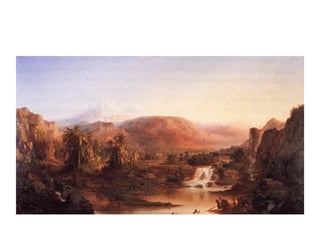
  • #7 The Land of the Lotus-Eaters - Robert Duncanson (1871-1872) – African-American painter – exhibited this painting during the civil war
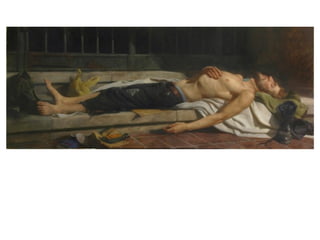
  • #8 Carl Dobksy, The Lotus Eater, 24 x 60 inches, 2009
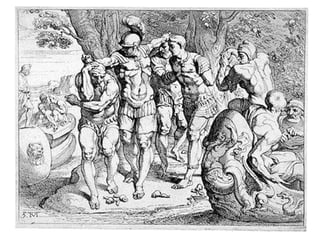
  • #9 C18 French etching of the Lotus-Eaters
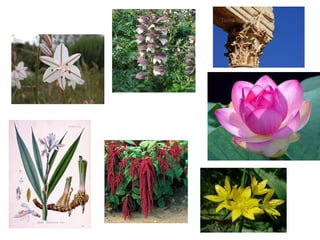
  • #10 Clockwise: asphodel – also said to grow in Elysian Fields, acanthus + acanthus relief at top of Corinthian column, lotus blossom, moly – small lily, also flower given to Ulysses by Hermes/Apollo to ward off Circe ’s spells, amaranth – deep reddish/purple flower a.k.a ‘love lies bleeding’, thought eternal, galingale – aromatic sedge
  • #12 Others in the C19 did resurrect it – Byron etc