



Social Science- Sociology
Introduction to Sociology
Sociology
Theories
Medical sociology
By C Settley
OUTCOMES
• Define Sociology
• Describe the importance of Sociology in nursing
• Describe the contributions made by the following theorists
 -Auguste Comte
 -Herbert Spencer
 -Karl Marx
 -Emile Durkheim
 -Max Weber
• Define the concept medical sociology
• Explore the difference between the following:
• Sociology in medicine
• Sociology of medicine
Sociology
• Q: What is Sociology?
• A tool towards understanding the world and confronting
its problems
• Sociology therefore focuses on social order and the
analyses of social groups in particular and society in
general.
• Sociology is interested in analyzing how human beings
interact with one another and the forces that determine
social order or harmony in human interactions. Sociology
studies behavioural patterns, be they rational, non-
rational or irrational in its quest for understanding human
behaviour
Importance of Sociology to
Nursing
• Sociology is the study and knowledge of human
groupings and societies and the manner in
which this affects people’s social behaviour.
• Nurses should have knowledge of sociology as
they are members of society.
• They have social relationships in their lives and
occupations.
• They work with others in various nursing settings
in which they find themselves.
Importance of Sociology to
Nursing
• Modern client care means total, inclusive care.
• Nursing professionals interact with the ill, the not- ill and
also healthy individuals in a great variety of settings.
• The nursing professional must therefore know the
individuals she nurses; care for them in the true sense of
the word, in his totality.
• An ill person is, after all, also a member of some family
or social structure, and not just the difficult case in room
3.
• Nurses perform their duties in different settings but the
most common is the formal organisations such as
hospitals and clinics
Importance of Sociology to
Nursing
• Another important reason for the nursing professional to study
sociology is that it provides much scientific knowledge about
different cultures.
• In a country such as South Africa, where we call ourselves the
rainbow nation- signifying a wide variety of cultures determined by
different rules or norms of behaviour and traits, living and working
together- an understanding of the client or user of the health care
system is essential.
• A knowledge of other societal realities and ways of living particular
to our country, such as an informal living settings, e.g squatter
camps, and in the very rural areas, informal and underdeveloped
settlements (with sometimes limited facilities), is necessary for
making a correct nursing diagnosis in order to draw up a nursing
care plan.
Importance of Sociology to
Nursing
• The health care setting in general, irrespective
of whether it is state owned and funded, or
privately owned, is a highly complex, intricate
setting in which the nursing professional is also
a part.
• Nursing professionals sometimes have
accumulate from the various disciplines in their
curriculum, including sociology, the better they
will be able to fulfil their role in one of the finest
professions in the world.
Contributions made by theorists:
Auguste Comte (1798-1857)
• Auguste Comte was born in Paris, France, on January 19, 1798. Although the
French monarchy had been drived out, his parents maintained their devotion both to
the royals and the Catholic Church. But when he attended college, Comte deviated
from his family's ideals and began to identify with the republicans on French
Revolution.
• Although he was brilliant in his math and science classes, Comte decided to leave
school before he graduated. He returned to Paris but had a hard time, making a little
money teaching. Meanwhile, he was personally studying economics, history, and
philosophy.
• In 1826, he held a series of lectures about the social doctrine (beliefs) he was
developing. However, after he had delivered about a third of the lectures, he had a
nervous breakdown. In between various stints in the hospital over the next 15 years,
he finished his major work, the 5-volume The Course in Positive Philosophy. In this
work, Comte presented his primary doctrine: society, like nature, operated under its
own set of laws. In the first volumes of the work, Comte deals with existing sciences
like mathematics, astronomy, physics, chemistry, and biology. He then shifts to
exploring a new kind of science, social science, that, he believes, will inevitability
follow the physical sciences.
Contributions made by theorists:
Auguste Comte
• Philosophical Views
• Comte developed two words that are still important today - sociology
and positivism (a philosophical system recognizing only that which
can be scientifically verified or which is capable of logical or
mathematical proof)
• Comte is often cited as the father of sociology because he coined
the term and held the belief that this new, special science could
combine the findings of other sciences to form more whole ideas
about the world.
• Comte's positivism, then, came out of this belief that human
society could be studied scientifically. The theory of positivism holds
that there is only real truth in scientific knowledge. However,
sensory experiences, gathered by humans about the world, are
included in this category. Things like intuition are not considered
scientifically derived and, therefore, not valid truths
Contributions made by theorists:
Auguste Comte
• He believed the study of social phenomena should employ scientific
techniques. But Comte was disturbed by the chaos of French
society and was critical of the Enlightenment and the French
Revolution. Comte developed an evolutionary theory of social
change in his law of the three stages. He argued that social disorder
was caused by ideas left over from the idea systems of earlier
stages. Only when a scientific footing for the governing of society
was established would the social upheavals of his time cease.
Contributions made by theorists:
Auguste Comte
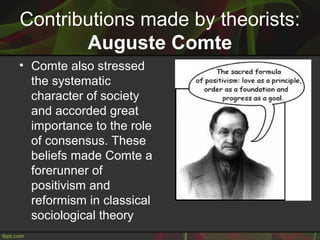
• Comte also stressed
the systematic
character of society
and accorded great
importance to the role
of consensus. These
beliefs made Comte a
forerunner of
positivism and
reformism in classical
sociological theory
Contributions made by theorists:
Herbert Spencer (1829-1903)
• Although the sociological theory of Herbert Spencer (1820-1902) has but a
small following today, his work was quite popular during his lifetime,
particularly in America. Spencer's theory of society does represent an
advance over Comtian theory, even though Spencer, like Comte,
characterized himself as a positivist and derived his concepts of structure
and function from the field of biology. Spencer used the Comtian terms of
social statics and social dynamics, but not in a descriptive way as Comte did
to refer to all types of societies, but rather in a normative way to describe his
version of the future ideal society. Furthermore, Spencer was more
interested in studying the progress of the external world or objectivity, while
Comte focused more on the subjective nature of the progress of human
conceptions. Finally, there are important political differences between
Spencer and Comte. Spencer had little regard for centralized political
control and believed that the government should allow individuals the
maximum freedom to pursue their private interests. Comte, on the other
hand, desired society to be led by the high priests of positivistic religion
Contributions made by theorists:
Herbert Spencer
• Spencer defined sociology as the study of societal
evolution and believed that the ultimate goal of societal
evolution is complete harmony and happiness. Spencer's
theory of evolutionary change is built upon three basic
principles:
• 1) integration (the bringing of people of different racial or
ethnic groups into unrestricted and equal association, as
in society or an organization);
• 2) differentiation (to form or mark differently from other
such things; distinguish);
• 3) definiteness (considerable variation in the expression)
Contributions made by theorists:
Herbert Spencer
• Spencer argued that homogenous phenomena are inherently
unstable, which makes them subject to constant fluctuations. These
fluctuations force homogeneous systems to differentiate, which
results in greater multiformity. In other words, homogeneous
systems grow to become heterogeneous
• Spencer focused much of his energy on trying to legitimize
sociology as a scientific discipline. He argued that people might
think they deal with the same issues as sociologists do; however,
they are not trained to adequately comprehend these issues. One of
the ways that Spencer believed sociology could become more
legitimate was for sociologists to study other disciplines, especially
biology and psychology. Biology could be linked to sociology
through the search for the basic "laws of life," understanding society
as a "living body" and focusing on human beings as the starting
point of sociological inquiries. Psychology is useful to sociology
because it helps to show that emotions or sentiments are linked to
social action.
Contributions made by theorists:
Herbert Spencer
• According to Spencer,
individuals are the
source of all social
phenomena, and the
motives of individuals
are key to
understanding society
as a whole
Contributions made by theorists:
Karl Marx (1818-1884)
• Karl Marx (1818-1883) followed Ludwig Feuerbach
(1804-1872) in criticizing Hegel for favoring abstract
ideas over real people. Marx adopted a materialist
orientation that focused on real material entities like
wealth and the state. He argued that the problems of
modern society could be traced to real material sources
like the structures of capitalism
(an economic system in which investment in and owners
ofthe means of production, distribution, and exchange of 
wealthis made and maintained chiefly by private individu
als orcorporations, especially as contrasted to cooperativ
ely orstate-owned means of wealth)
Contributions made by theorists:
Karl Marx
• He maintained Hegel's
emphasis on the dialectic,
forging a position called
dialectical materialism
that held that material
processes, relationships,
conflicts, and
contradictions are
responsible for social
problems and social
change
Contributions made by theorists:
Emile Durkheim (1857-1917)
• Emile Durkheim (1858-1917) legitimized sociology in
France and became a dominant force in the
development of the discipline worldwide. Although he
was politically liberal, he took a more conservative
position intellectually, arguing that the social disorders
produced by striking social changes could be reduced
through social reform. Durkheim argued that sociology
was the study of structures that are external to, and
coercive (to make (someone) do something by using 
force or threats) over, the individual; for example, legal
codes and shared moral beliefs, which he called social
facts.
Contributions made by theorists:
Emile Durkheim
• In Suicide he made his case for the importance of
sociology by demonstrating that social facts could cause
individual behavior. He argued that societies were held
together by a strongly held collective morality called the
collective conscience. Because of the complexity of
modern societies, the collective conscience had become
weaker, resulting in a variety of social pathologies.
Contributions made by theorists:
Emile Durkheim
• In his later work,
Dukheim turned to the
religion of primitive
societies to
demonstrate the
importance of the
collective
consciousness (is the set
of shared beliefs, ideas and moral
attitudes which operate as a
unifying force within society)
Contributions made by theorists:
Max Weber (1864-1920)
• The theories of Max Weber (1864-1920) can be seen as
the fruit of a long debate with the ghost of Marx. While
Weber was not familiar with Marx's writings, he viewed
the Marxists of his day as economic determinists who
offered single-cause theories of social life.
• Rather than seeing ideas as simple reflections of
economic factors, Weber saw them as autonomous
forces capable of profoundly affecting the economic
world.
Contributions made by theorists:
Max Weber
• Weber can also be
understood as trying
to round out Marx's
theoretical
perspective; rather
than denying the
effect of material
structures, he was
simply pointing out
the importance of
ideas as well
Video
Why is sociology important?
What is medical sociology?
• Medical sociology is
the sociological analysis of medical
organizations and institutions; the
production of knowledge and selection of
methods, the actions and interactions of
healthcare professionals, and the social or
cultural (rather than clinical or bodily)
effects of medical practice.
What is medical sociology?
• Medical sociology (sociology of health &
illness) is concerned with all those aspects
of contemporary social life which impinge
upon well-being throughout the life-course
Sociology of Medicine
• Theory orientated research
• Examines medicine with sociological questions and uses sociological
concepts
• E.g. studies of institutions, health inequalities, professions
• - research and analysis of the medical environment from a sociological
perspective
• - concerned with factors such as institutions and organization, relationships,
obligations, roles, norms, values, habits as components of human behavior
in medical practice
• - medical world from the outside
• - information obtained is stored for sociological knowledge rather than
medical knowledge or purposes
Facets of the sociology of medicine by Kendall & Reeder, (1972: 8-25) Read
page 15 in Du Toit & Van Staden
• The need for and recruitment of physicians, through whom
sociological research can contribute to the planning and evaluation
of appropriate programmes.
• Training of medical and paramedical personnel in the field of
sociology, the application of sociological perspectives in appropriate
courses and the presentation of courses in medical sociology.
• The study and definition of social relationships between medical,
paramedical and other auxiliary personnel, and also between these
and patients, their families and the public, i.e. the analysis and
definition of the social behaviour and roles of, as well as the
interaction between, doctors, patients, and nursing professionals,
and the study of the organisational structure within which this
interaction takes place
Facets of the sociology of medicine by Kendall & Reeder, (1972: 8-25) Read
page 15 in Du Toit & Van Staden
•The analysis of medical institutions and organisations (such as the
hospital) as specific and unique bureaucratic structures with an equally
unique composition and function; changes which occur and the
identification of problems at a sociological level; a comparison with the
structure and functioning of other bureaucratic institutions and
organisations such as factories.
•The development of community health services, particularly because
of the rising costs of medical treatment.
Sociology in Medicine
• Problem orientated research
• Uses sociological perspectives and
knowledge to investigate medically
orientated questions
• That is, solve medical problems and
improve medical care
• E.g. doctor/patient relationships, social
epidemiology of disease, social factors
affecting delivery of health services
Differences between sociology in
medicine and sociology of medicine
• There are differences between the sociology of medicine
and the sociology of medicine. Sociology in medicine
refers to the more sociological study of medicine. In
other words it can be said that the medicine can be
better studied from the sociological perspective.
• This perspective focus on the variations in the attitude
and behaviours regarding health and illness.
• Variation in the sense that society is stratified in terms of
caste , ethnicity, religion ,occupation, age,
sex,education, class,etc .
Differences between sociology in
medicine and sociology of medicine
• Different societies has different views on how to treat diseases.
• Similarly they also have different attitudes to perceive and
understand the illness and diseases. For instance , disease also
categorise high status of disease and low status of disease . TB and
is considered as low status of disease whereas Diabetes is
considered as high status of disease .
• WHY????
Differences between sociology in
medicine and sociology of medicine
• At the same time sociology in medicine looks at the how people are
oriented towards the specific diseases ;
• how they use language to term the disease in past and how they
term at present time ? for example 'Disability ' was considered social
stigma but at present time the same term disability is considered
people are differently able and they can participate in every social
and cultural events and activities
Differences between sociology in
medicine and sociology of medicine
• So , the sociology in medicine attempts to explore and
explain these things .
• The sociology of medicine is quite different than the
sociology in medicine .
• It is basically focus on how the health organisation runs,
what is the training system and criteria of health
professionals and their relations are- inter professional-
and intra professionally
References
• http://www.answers.com/Q/What_is_the_differ
• Du Toit, D.A. & Van Staden S.J. (2009).
Nursing Sociology. 4th Edition. Pretoria:
Van Schaik

Study unit 1.1,1.2,1.3 copy

  • 1.
    Social Science- Sociology Introductionto Sociology Sociology Theories Medical sociology By C Settley
  • 2.
    OUTCOMES • Define Sociology •Describe the importance of Sociology in nursing • Describe the contributions made by the following theorists  -Auguste Comte  -Herbert Spencer  -Karl Marx  -Emile Durkheim  -Max Weber • Define the concept medical sociology • Explore the difference between the following: • Sociology in medicine • Sociology of medicine
  • 3.
    Sociology • Q: Whatis Sociology? • A tool towards understanding the world and confronting its problems • Sociology therefore focuses on social order and the analyses of social groups in particular and society in general. • Sociology is interested in analyzing how human beings interact with one another and the forces that determine social order or harmony in human interactions. Sociology studies behavioural patterns, be they rational, non- rational or irrational in its quest for understanding human behaviour
  • 4.
    Importance of Sociologyto Nursing • Sociology is the study and knowledge of human groupings and societies and the manner in which this affects people’s social behaviour. • Nurses should have knowledge of sociology as they are members of society. • They have social relationships in their lives and occupations. • They work with others in various nursing settings in which they find themselves.
  • 5.
    Importance of Sociologyto Nursing • Modern client care means total, inclusive care. • Nursing professionals interact with the ill, the not- ill and also healthy individuals in a great variety of settings. • The nursing professional must therefore know the individuals she nurses; care for them in the true sense of the word, in his totality. • An ill person is, after all, also a member of some family or social structure, and not just the difficult case in room 3. • Nurses perform their duties in different settings but the most common is the formal organisations such as hospitals and clinics
  • 6.
    Importance of Sociologyto Nursing • Another important reason for the nursing professional to study sociology is that it provides much scientific knowledge about different cultures. • In a country such as South Africa, where we call ourselves the rainbow nation- signifying a wide variety of cultures determined by different rules or norms of behaviour and traits, living and working together- an understanding of the client or user of the health care system is essential. • A knowledge of other societal realities and ways of living particular to our country, such as an informal living settings, e.g squatter camps, and in the very rural areas, informal and underdeveloped settlements (with sometimes limited facilities), is necessary for making a correct nursing diagnosis in order to draw up a nursing care plan.
  • 7.
    Importance of Sociologyto Nursing • The health care setting in general, irrespective of whether it is state owned and funded, or privately owned, is a highly complex, intricate setting in which the nursing professional is also a part. • Nursing professionals sometimes have accumulate from the various disciplines in their curriculum, including sociology, the better they will be able to fulfil their role in one of the finest professions in the world.
  • 8.
    Contributions made bytheorists: Auguste Comte (1798-1857) • Auguste Comte was born in Paris, France, on January 19, 1798. Although the French monarchy had been drived out, his parents maintained their devotion both to the royals and the Catholic Church. But when he attended college, Comte deviated from his family's ideals and began to identify with the republicans on French Revolution. • Although he was brilliant in his math and science classes, Comte decided to leave school before he graduated. He returned to Paris but had a hard time, making a little money teaching. Meanwhile, he was personally studying economics, history, and philosophy. • In 1826, he held a series of lectures about the social doctrine (beliefs) he was developing. However, after he had delivered about a third of the lectures, he had a nervous breakdown. In between various stints in the hospital over the next 15 years, he finished his major work, the 5-volume The Course in Positive Philosophy. In this work, Comte presented his primary doctrine: society, like nature, operated under its own set of laws. In the first volumes of the work, Comte deals with existing sciences like mathematics, astronomy, physics, chemistry, and biology. He then shifts to exploring a new kind of science, social science, that, he believes, will inevitability follow the physical sciences.
  • 9.
    Contributions made bytheorists: Auguste Comte • Philosophical Views • Comte developed two words that are still important today - sociology and positivism (a philosophical system recognizing only that which can be scientifically verified or which is capable of logical or mathematical proof) • Comte is often cited as the father of sociology because he coined the term and held the belief that this new, special science could combine the findings of other sciences to form more whole ideas about the world. • Comte's positivism, then, came out of this belief that human society could be studied scientifically. The theory of positivism holds that there is only real truth in scientific knowledge. However, sensory experiences, gathered by humans about the world, are included in this category. Things like intuition are not considered scientifically derived and, therefore, not valid truths
  • 10.
    Contributions made bytheorists: Auguste Comte • He believed the study of social phenomena should employ scientific techniques. But Comte was disturbed by the chaos of French society and was critical of the Enlightenment and the French Revolution. Comte developed an evolutionary theory of social change in his law of the three stages. He argued that social disorder was caused by ideas left over from the idea systems of earlier stages. Only when a scientific footing for the governing of society was established would the social upheavals of his time cease.
  • 11.
    Contributions made bytheorists: Auguste Comte • Comte also stressed the systematic character of society and accorded great importance to the role of consensus. These beliefs made Comte a forerunner of positivism and reformism in classical sociological theory
  • 12.
    Contributions made bytheorists: Herbert Spencer (1829-1903) • Although the sociological theory of Herbert Spencer (1820-1902) has but a small following today, his work was quite popular during his lifetime, particularly in America. Spencer's theory of society does represent an advance over Comtian theory, even though Spencer, like Comte, characterized himself as a positivist and derived his concepts of structure and function from the field of biology. Spencer used the Comtian terms of social statics and social dynamics, but not in a descriptive way as Comte did to refer to all types of societies, but rather in a normative way to describe his version of the future ideal society. Furthermore, Spencer was more interested in studying the progress of the external world or objectivity, while Comte focused more on the subjective nature of the progress of human conceptions. Finally, there are important political differences between Spencer and Comte. Spencer had little regard for centralized political control and believed that the government should allow individuals the maximum freedom to pursue their private interests. Comte, on the other hand, desired society to be led by the high priests of positivistic religion
  • 13.
    Contributions made bytheorists: Herbert Spencer • Spencer defined sociology as the study of societal evolution and believed that the ultimate goal of societal evolution is complete harmony and happiness. Spencer's theory of evolutionary change is built upon three basic principles: • 1) integration (the bringing of people of different racial or ethnic groups into unrestricted and equal association, as in society or an organization); • 2) differentiation (to form or mark differently from other such things; distinguish); • 3) definiteness (considerable variation in the expression)
  • 14.
    Contributions made bytheorists: Herbert Spencer • Spencer argued that homogenous phenomena are inherently unstable, which makes them subject to constant fluctuations. These fluctuations force homogeneous systems to differentiate, which results in greater multiformity. In other words, homogeneous systems grow to become heterogeneous • Spencer focused much of his energy on trying to legitimize sociology as a scientific discipline. He argued that people might think they deal with the same issues as sociologists do; however, they are not trained to adequately comprehend these issues. One of the ways that Spencer believed sociology could become more legitimate was for sociologists to study other disciplines, especially biology and psychology. Biology could be linked to sociology through the search for the basic "laws of life," understanding society as a "living body" and focusing on human beings as the starting point of sociological inquiries. Psychology is useful to sociology because it helps to show that emotions or sentiments are linked to social action.
  • 15.
    Contributions made bytheorists: Herbert Spencer • According to Spencer, individuals are the source of all social phenomena, and the motives of individuals are key to understanding society as a whole
  • 16.
    Contributions made bytheorists: Karl Marx (1818-1884) • Karl Marx (1818-1883) followed Ludwig Feuerbach (1804-1872) in criticizing Hegel for favoring abstract ideas over real people. Marx adopted a materialist orientation that focused on real material entities like wealth and the state. He argued that the problems of modern society could be traced to real material sources like the structures of capitalism (an economic system in which investment in and owners ofthe means of production, distribution, and exchange of  wealthis made and maintained chiefly by private individu als orcorporations, especially as contrasted to cooperativ ely orstate-owned means of wealth)
  • 17.
    Contributions made bytheorists: Karl Marx • He maintained Hegel's emphasis on the dialectic, forging a position called dialectical materialism that held that material processes, relationships, conflicts, and contradictions are responsible for social problems and social change
  • 18.
    Contributions made bytheorists: Emile Durkheim (1857-1917) • Emile Durkheim (1858-1917) legitimized sociology in France and became a dominant force in the development of the discipline worldwide. Although he was politically liberal, he took a more conservative position intellectually, arguing that the social disorders produced by striking social changes could be reduced through social reform. Durkheim argued that sociology was the study of structures that are external to, and coercive (to make (someone) do something by using  force or threats) over, the individual; for example, legal codes and shared moral beliefs, which he called social facts.
  • 19.
    Contributions made bytheorists: Emile Durkheim • In Suicide he made his case for the importance of sociology by demonstrating that social facts could cause individual behavior. He argued that societies were held together by a strongly held collective morality called the collective conscience. Because of the complexity of modern societies, the collective conscience had become weaker, resulting in a variety of social pathologies.
  • 20.
    Contributions made bytheorists: Emile Durkheim • In his later work, Dukheim turned to the religion of primitive societies to demonstrate the importance of the collective consciousness (is the set of shared beliefs, ideas and moral attitudes which operate as a unifying force within society)
  • 21.
    Contributions made bytheorists: Max Weber (1864-1920) • The theories of Max Weber (1864-1920) can be seen as the fruit of a long debate with the ghost of Marx. While Weber was not familiar with Marx's writings, he viewed the Marxists of his day as economic determinists who offered single-cause theories of social life. • Rather than seeing ideas as simple reflections of economic factors, Weber saw them as autonomous forces capable of profoundly affecting the economic world.
  • 22.
    Contributions made bytheorists: Max Weber • Weber can also be understood as trying to round out Marx's theoretical perspective; rather than denying the effect of material structures, he was simply pointing out the importance of ideas as well
  • 23.
  • 24.
    What is medicalsociology? • Medical sociology is the sociological analysis of medical organizations and institutions; the production of knowledge and selection of methods, the actions and interactions of healthcare professionals, and the social or cultural (rather than clinical or bodily) effects of medical practice.
  • 25.
    What is medicalsociology? • Medical sociology (sociology of health & illness) is concerned with all those aspects of contemporary social life which impinge upon well-being throughout the life-course
  • 26.
    Sociology of Medicine •Theory orientated research • Examines medicine with sociological questions and uses sociological concepts • E.g. studies of institutions, health inequalities, professions • - research and analysis of the medical environment from a sociological perspective • - concerned with factors such as institutions and organization, relationships, obligations, roles, norms, values, habits as components of human behavior in medical practice • - medical world from the outside • - information obtained is stored for sociological knowledge rather than medical knowledge or purposes
  • 27.
    Facets of thesociology of medicine by Kendall & Reeder, (1972: 8-25) Read page 15 in Du Toit & Van Staden • The need for and recruitment of physicians, through whom sociological research can contribute to the planning and evaluation of appropriate programmes. • Training of medical and paramedical personnel in the field of sociology, the application of sociological perspectives in appropriate courses and the presentation of courses in medical sociology. • The study and definition of social relationships between medical, paramedical and other auxiliary personnel, and also between these and patients, their families and the public, i.e. the analysis and definition of the social behaviour and roles of, as well as the interaction between, doctors, patients, and nursing professionals, and the study of the organisational structure within which this interaction takes place
  • 28.
    Facets of thesociology of medicine by Kendall & Reeder, (1972: 8-25) Read page 15 in Du Toit & Van Staden •The analysis of medical institutions and organisations (such as the hospital) as specific and unique bureaucratic structures with an equally unique composition and function; changes which occur and the identification of problems at a sociological level; a comparison with the structure and functioning of other bureaucratic institutions and organisations such as factories. •The development of community health services, particularly because of the rising costs of medical treatment.
  • 29.
    Sociology in Medicine •Problem orientated research • Uses sociological perspectives and knowledge to investigate medically orientated questions • That is, solve medical problems and improve medical care • E.g. doctor/patient relationships, social epidemiology of disease, social factors affecting delivery of health services
  • 30.
    Differences between sociologyin medicine and sociology of medicine • There are differences between the sociology of medicine and the sociology of medicine. Sociology in medicine refers to the more sociological study of medicine. In other words it can be said that the medicine can be better studied from the sociological perspective. • This perspective focus on the variations in the attitude and behaviours regarding health and illness. • Variation in the sense that society is stratified in terms of caste , ethnicity, religion ,occupation, age, sex,education, class,etc .
  • 31.
    Differences between sociologyin medicine and sociology of medicine • Different societies has different views on how to treat diseases. • Similarly they also have different attitudes to perceive and understand the illness and diseases. For instance , disease also categorise high status of disease and low status of disease . TB and is considered as low status of disease whereas Diabetes is considered as high status of disease . • WHY????
  • 33.
    Differences between sociologyin medicine and sociology of medicine • At the same time sociology in medicine looks at the how people are oriented towards the specific diseases ; • how they use language to term the disease in past and how they term at present time ? for example 'Disability ' was considered social stigma but at present time the same term disability is considered people are differently able and they can participate in every social and cultural events and activities
  • 34.
    Differences between sociologyin medicine and sociology of medicine • So , the sociology in medicine attempts to explore and explain these things . • The sociology of medicine is quite different than the sociology in medicine . • It is basically focus on how the health organisation runs, what is the training system and criteria of health professionals and their relations are- inter professional- and intra professionally
  • 35.
    References • http://www.answers.com/Q/What_is_the_differ • DuToit, D.A. & Van Staden S.J. (2009). Nursing Sociology. 4th Edition. Pretoria: Van Schaik

Editor's Notes

  • #26 Where you are born; access to services; beliefs about health and illness held by own peers; contact with health professionals; self-identity may be shaped by our experiences with illness and our interactions with health services; attitudes to our bodies shaped by the discourse of health promotion, consumer culture and media