THE HEALTH-
ILLNESS
CONTINUUM
BY
RAJAH AMINA SULEIMAN
(RN, RM, RNE, BNSc., MSc)
LEARNING
OBJECTIVES
At the end of this lesson, the student should be
able to:
 Define the concepts of health, illness, wellness
and continuum
 Explain the health-illness continuum
 Enumerate the determinants of health
 Outline the stages of illness behaviour
 Critically appraise the role of the nurse in
achieving health.
INTRODUCTION
 The individual’s state of health is one of
continual change.
 An individual moves back and forth from health
to illness and back to health again.
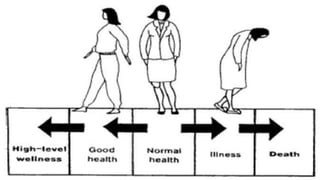
 The health-illness continuum illustrates this
process of change, in which the individual
experiences various states of health and illness
(ranging from extremely good health to death)
that fluctuate throughout his life.
DEFINITIONOF
TERMS
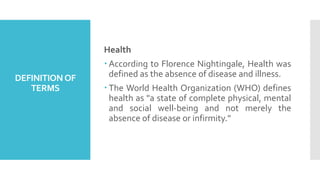
Health
 According to Florence Nightingale, Health was
defined as the absence of disease and illness.
 The World Health Organization (WHO) defines
health as "a state of complete physical, mental
and social well-being and not merely the
absence of disease or infirmity."
DEFINITIONOF
TERMS
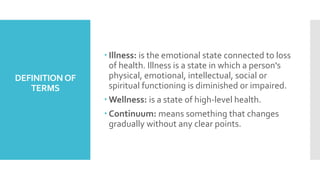
 Illness: is the emotional state connected to loss
of health. Illness is a state in which a person's
physical, emotional, intellectual, social or
spiritual functioning is diminished or impaired.
 Wellness: is a state of high-level health.
 Continuum: means something that changes
gradually without any clear points.
THE HEALTH-ILLNESS
CONTINUUM
THE HEALTH-
ILLNESS
CONTINUUM
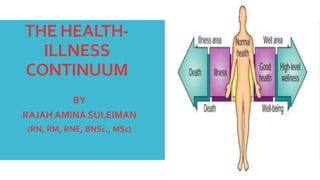
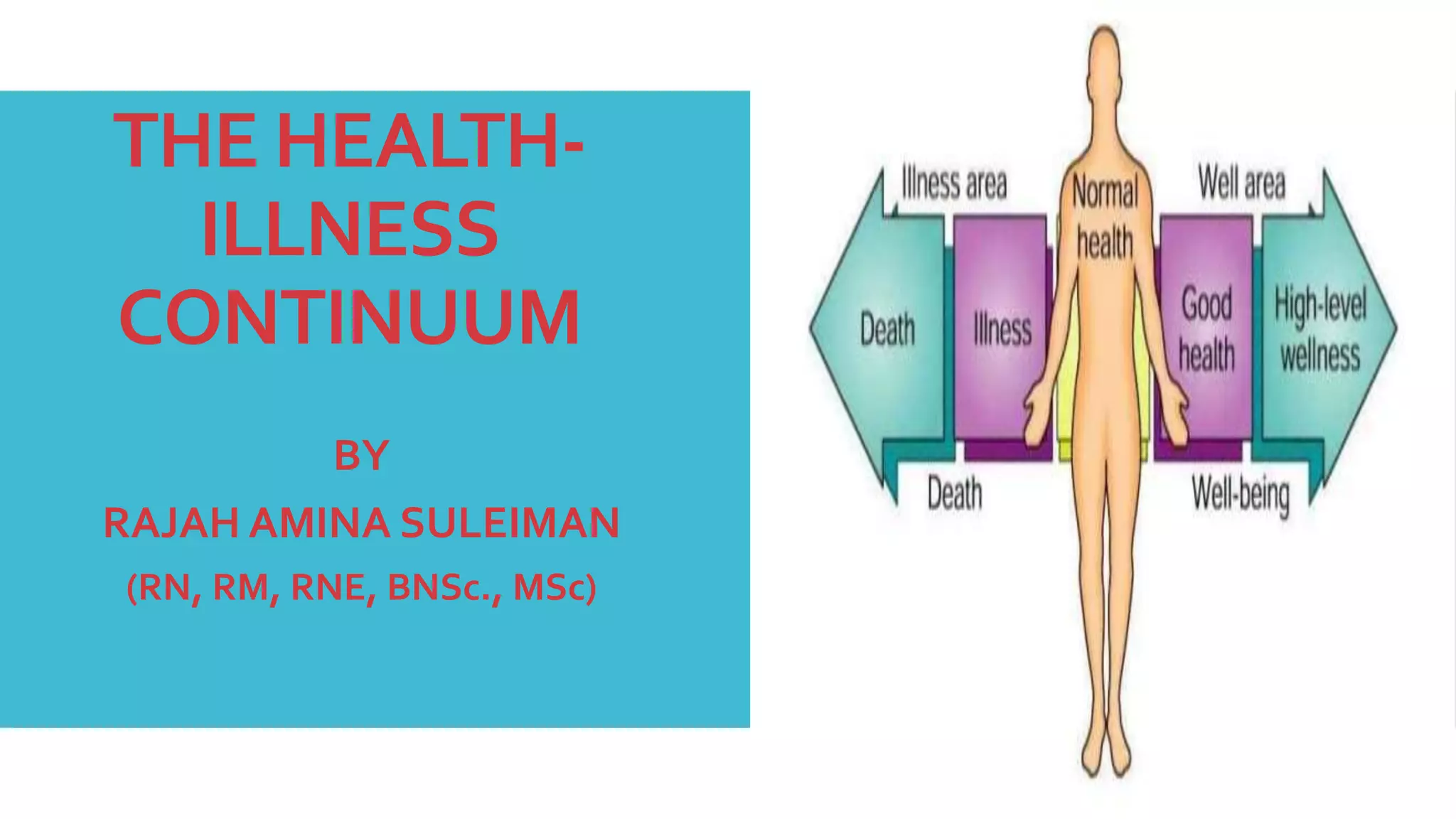
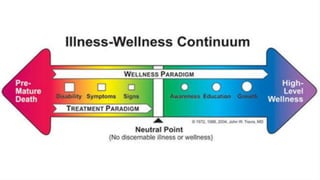
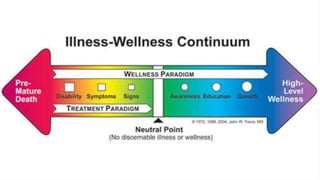
 The Health illness continuum is a graphic
representation of the wellness of an individual.
This concept was first proposed by John W.
Travis in 1972.
 It is an illustration that draws a connection
between the treatment paradigm and the
wellness paradigm.
THE HEALTH-
ILLNESS
CONTINUUM
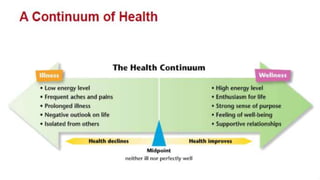
 Moving from the center to the left shows a
progressively worsening state of health.
 Moving to the right of center indicates
increasing levels of health and wellbeing.
 The treatment paradigm (drugs, herbs,
surgery, psychotherapy, acupuncture, and so
on) can bring you up to the neutral point, where
the symptoms of disease have been alleviated.
THE HEALTH-
ILLNESS
CONTINUUM
 The wellness paradigm directs the individual
beyond neutral and encourages him/her to
move as far to the right as possible.
 It is not meant to replace the treatment
paradigm on the left side of the continuum, but
to work in harmony with it.
 If a person is ill, then treatment is important,
but don't stop at the neutral point.
 Use the wellness paradigm to move toward
high-level wellness.
THE HEALTH-
ILLNESS
CONTINUUM
 According to Newman (1990), health on a
continuum is the degree of client wellness that
exists at any point in time, ranging from
optimal wellness condition with available
energy at its maximum to death which
represent total energy depletion.
THE HEALTH-
ILLNESS
CONTINUUM
 The Health-illness continuum also known as
Wellness-illness continuum is a dichotomous
depiction of the relationship between the
concepts of health and illness.
COMPONENTS
OF
HEALTH
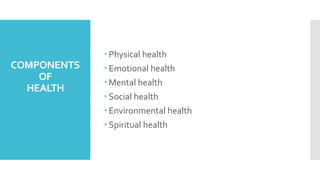
 Physical health
 Emotional health
 Mental health
 Social health
 Environmental health
 Spiritual health
DETERMINANTS
OF
HEALTH
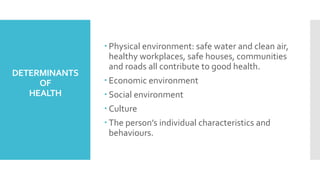
 Physical environment: safe water and clean air,
healthy workplaces, safe houses, communities
and roads all contribute to good health.
 Economic environment
 Social environment
 Culture
 The person’s individual characteristics and
behaviours.
DETERMINANTS
OF
HEALTH
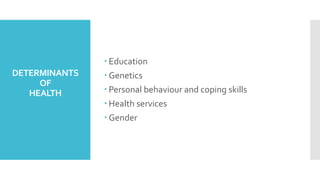
 Education
 Genetics
 Personal behaviour and coping skills
 Health services
 Gender
ILLNESS
BEHAVIOUR
THE ROLEOFTHE
NURSE IN
ACHIEVING
HEALTH
 Nurse can determine clients stage of health
and position at health-illness continuum.
 Nurse can also recognize risk factors that are
causing degradation in health of client, it may
be genetics, or physiological.
 She can also prevent the illness through
awareness, educating the client.
CONCLUSION
 Nurses need to utilize the health-illness
continuum for the prevention and maintenance
of public health.
 Nurses can identify the stage of the health of
the person and then find out the solution. It
may through awareness or education or
providing physical treatment.
REFERENCES
 Rovesti, M., Fioranelli, M., Petrelli, P., Satolli, F., Roccia,
M. G., Gianfaldoni, S.,Tchernev, G.,Wollina, U., Lotti, J.,
Feliciani, C., & Lotti,T. (2018). Health and Illness in
History, Science and Society. Open access Macedonian
journal of medical sciences, 6(1), 163–165.
https://doi.org/10.3889/oamjms.2018.056
 WHO 2013.What are social determinants of health?
Geneva:WHO.Viewed 6 December 2013.
 https://study.com/academy/course/nursing-101-
fundamentals-of-nursing.html
 http://www.thewellspring.com/wellspring/introduction
-to-wellness/357/key-concept-1-the-illnesswellness-
continuum.cfm.html
The health illness continuum

The health illness continuum

  • 1.
    THE HEALTH- ILLNESS CONTINUUM BY RAJAH AMINASULEIMAN (RN, RM, RNE, BNSc., MSc)
  • 2.
    LEARNING OBJECTIVES At the endof this lesson, the student should be able to:  Define the concepts of health, illness, wellness and continuum  Explain the health-illness continuum  Enumerate the determinants of health  Outline the stages of illness behaviour  Critically appraise the role of the nurse in achieving health.
  • 3.
    INTRODUCTION  The individual’sstate of health is one of continual change.  An individual moves back and forth from health to illness and back to health again.  The health-illness continuum illustrates this process of change, in which the individual experiences various states of health and illness (ranging from extremely good health to death) that fluctuate throughout his life.
  • 5.
    DEFINITIONOF TERMS Health  According toFlorence Nightingale, Health was defined as the absence of disease and illness.  The World Health Organization (WHO) defines health as "a state of complete physical, mental and social well-being and not merely the absence of disease or infirmity."
  • 6.
    DEFINITIONOF TERMS  Illness: isthe emotional state connected to loss of health. Illness is a state in which a person's physical, emotional, intellectual, social or spiritual functioning is diminished or impaired.  Wellness: is a state of high-level health.  Continuum: means something that changes gradually without any clear points.
  • 7.
  • 9.
    THE HEALTH- ILLNESS CONTINUUM  TheHealth illness continuum is a graphic representation of the wellness of an individual. This concept was first proposed by John W. Travis in 1972.  It is an illustration that draws a connection between the treatment paradigm and the wellness paradigm.
  • 10.
    THE HEALTH- ILLNESS CONTINUUM  Movingfrom the center to the left shows a progressively worsening state of health.  Moving to the right of center indicates increasing levels of health and wellbeing.  The treatment paradigm (drugs, herbs, surgery, psychotherapy, acupuncture, and so on) can bring you up to the neutral point, where the symptoms of disease have been alleviated.
  • 11.
    THE HEALTH- ILLNESS CONTINUUM  Thewellness paradigm directs the individual beyond neutral and encourages him/her to move as far to the right as possible.  It is not meant to replace the treatment paradigm on the left side of the continuum, but to work in harmony with it.  If a person is ill, then treatment is important, but don't stop at the neutral point.  Use the wellness paradigm to move toward high-level wellness.
  • 12.
    THE HEALTH- ILLNESS CONTINUUM  Accordingto Newman (1990), health on a continuum is the degree of client wellness that exists at any point in time, ranging from optimal wellness condition with available energy at its maximum to death which represent total energy depletion.
  • 13.
    THE HEALTH- ILLNESS CONTINUUM  TheHealth-illness continuum also known as Wellness-illness continuum is a dichotomous depiction of the relationship between the concepts of health and illness.
  • 16.
    COMPONENTS OF HEALTH  Physical health Emotional health  Mental health  Social health  Environmental health  Spiritual health
  • 17.
    DETERMINANTS OF HEALTH  Physical environment:safe water and clean air, healthy workplaces, safe houses, communities and roads all contribute to good health.  Economic environment  Social environment  Culture  The person’s individual characteristics and behaviours.
  • 18.
    DETERMINANTS OF HEALTH  Education  Genetics Personal behaviour and coping skills  Health services  Gender
  • 19.
  • 20.
    THE ROLEOFTHE NURSE IN ACHIEVING HEALTH Nurse can determine clients stage of health and position at health-illness continuum.  Nurse can also recognize risk factors that are causing degradation in health of client, it may be genetics, or physiological.  She can also prevent the illness through awareness, educating the client.
  • 21.
    CONCLUSION  Nurses needto utilize the health-illness continuum for the prevention and maintenance of public health.  Nurses can identify the stage of the health of the person and then find out the solution. It may through awareness or education or providing physical treatment.
  • 22.
    REFERENCES  Rovesti, M.,Fioranelli, M., Petrelli, P., Satolli, F., Roccia, M. G., Gianfaldoni, S.,Tchernev, G.,Wollina, U., Lotti, J., Feliciani, C., & Lotti,T. (2018). Health and Illness in History, Science and Society. Open access Macedonian journal of medical sciences, 6(1), 163–165. https://doi.org/10.3889/oamjms.2018.056  WHO 2013.What are social determinants of health? Geneva:WHO.Viewed 6 December 2013.  https://study.com/academy/course/nursing-101- fundamentals-of-nursing.html  http://www.thewellspring.com/wellspring/introduction -to-wellness/357/key-concept-1-the-illnesswellness- continuum.cfm.html

Editor's Notes

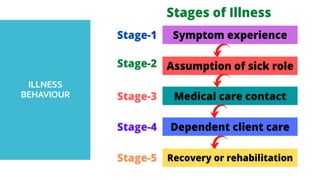
  • #20 Stage-1: Symptom experience: The person is aware that something is wrong. A person usually recognizes a physical sensation or a limitation in functioning but does not suspect a specific diagnosis. Stage-2: Assumption of sick role: If symptom persist and become severe, clients assume the sick role. At this point, the illness becomes a social phenomenon, and sick people seek confirmation from their families and social groups that they are indeed ill and that they be excused from normal duties and role expectations. Stage-3: Medical care contact: If symptoms persist despite the home remedies, become severe or require emergency care, the person is motivated to seek professional health services. In this stage the client seeks expert acknowledgement of the illness as well as the treatment. Stage-4: Dependent client care: The client depends on health care professionals for the relief of symptoms. The client accepts care, sympathy and protection from the demands and stresses of life. A client can adopt the dependent role in a health care institution, at home, or in a community setting. The client must also adjust to the disruption of a daily schedule. Stage-5: Recovery and rehabilitation: This stage can arrive suddenly, such as when the symptoms appeared. In the case of chronic illness, the final stage may involve in an adjustment to a prolong reduction in health and functioning.