Students working Collaboratively
Why small group collaboration?


Research shows that it has positive
effects on learning



As long as there are:
– Shared goals
– Individual accountability
2
Why small group collaboration?


Transmission teaching styles have
reduced:
–
–



Quality
Quantity of student discussion

Sometimes, groupwork might not
profit student learning (depending
on the type of talk in the groups).
3
This unit will help you to:






List characteristics of discussions
that benefit learning
Recognise teacher concerns
Understand techniques for
promoting effective discussion
Understand the teacher’s role in
discussion management
Plan discussion based lessons
4
A. Experiencing a discussion




Read problem 4 on handout 1
individually and write down your
own response for it
Work as a group, compare your
responses and try to refine your
answers until you feel you have
reached a consensus
5
Some points for reflection


Did you find it helpful to have a chance
to think about the question yourself
before it was discussed in your group?



How far did you really think together, or
did you tend to follow independent lines
of thought?
6
Some points for reflection


Did someone 'take over'? Was someone
a 'passenger'?



Did you listen to, share ideas with and
consider the alternative views of
everyone in the group?
7
Some points for reflection


Did you build on each others' ideas to
construct chains of coherent reasoning?



Did you feel able to share your ideas
without fear of embarrassment of being
wrong? Did anyone feel uncomfortable
or threatened? If so, why?
8
Some points for reflection


Did your discussion stay 'on task' or were you
'wandering'?

9
Some points for reflection


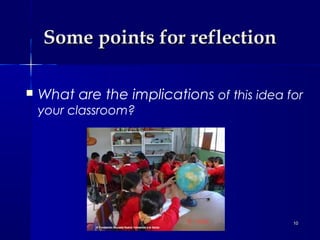
What are the implications of this idea for
your classroom?

10
Some points for reflection


Most of the problems do not have one
‘definitive’ answer.



Students must think for themselves first.
– Quick thinking and confident students are
more likely to dominate discussion.
11
Types of student talk
Working in a group
VS
Working as a group
What’s the difference?

12
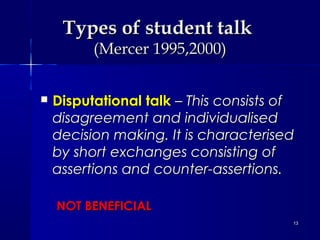
Types of student talk
(Mercer 1995,2000)



Disputational talk – This consists of
disagreement and individualised
decision making. It is characterised
by short exchanges consisting of
assertions and counter-assertions.
NOT BENEFICIAL
13
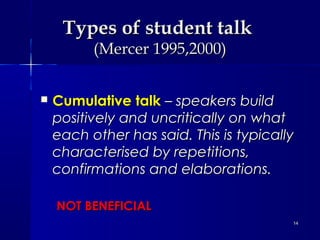
Types of student talk
(Mercer 1995,2000)



Cumulative talk – speakers build
positively and uncritically on what
each other has said. This is typically
characterised by repetitions,
confirmations and elaborations.
NOT BENEFICIAL
14
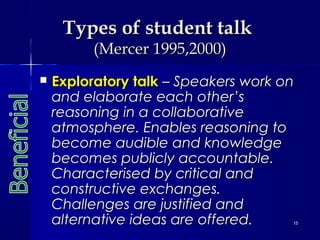
Types of student talk
(Mercer 1995,2000)



Exploratory talk – Speakers work on
and elaborate each other’s
reasoning in a collaborative
atmosphere. Enables reasoning to
become audible and knowledge
becomes publicly accountable.
Characterised by critical and
constructive exchanges.
Challenges are justified and
alternative ideas are offered.

15
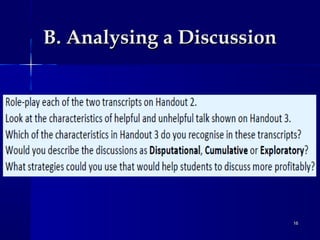
B. Analysing a Discussion

16
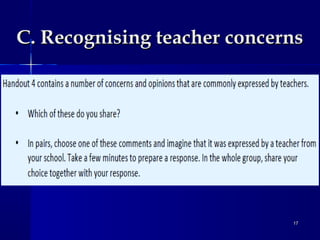
C. Recognising teacher concerns

17
D. Ground Rules

18

Students working collaboratively

  • 1.
  • 2.
    Why small groupcollaboration?  Research shows that it has positive effects on learning  As long as there are: – Shared goals – Individual accountability 2
  • 3.
    Why small groupcollaboration?  Transmission teaching styles have reduced: – –  Quality Quantity of student discussion Sometimes, groupwork might not profit student learning (depending on the type of talk in the groups). 3
  • 4.
    This unit willhelp you to:      List characteristics of discussions that benefit learning Recognise teacher concerns Understand techniques for promoting effective discussion Understand the teacher’s role in discussion management Plan discussion based lessons 4
  • 5.
    A. Experiencing adiscussion   Read problem 4 on handout 1 individually and write down your own response for it Work as a group, compare your responses and try to refine your answers until you feel you have reached a consensus 5
  • 6.
    Some points forreflection  Did you find it helpful to have a chance to think about the question yourself before it was discussed in your group?  How far did you really think together, or did you tend to follow independent lines of thought? 6
  • 7.
    Some points forreflection  Did someone 'take over'? Was someone a 'passenger'?  Did you listen to, share ideas with and consider the alternative views of everyone in the group? 7
  • 8.
    Some points forreflection  Did you build on each others' ideas to construct chains of coherent reasoning?  Did you feel able to share your ideas without fear of embarrassment of being wrong? Did anyone feel uncomfortable or threatened? If so, why? 8
  • 9.
    Some points forreflection  Did your discussion stay 'on task' or were you 'wandering'? 9
  • 10.
    Some points forreflection  What are the implications of this idea for your classroom? 10
  • 11.
    Some points forreflection  Most of the problems do not have one ‘definitive’ answer.  Students must think for themselves first. – Quick thinking and confident students are more likely to dominate discussion. 11
  • 12.
    Types of studenttalk Working in a group VS Working as a group What’s the difference? 12
  • 13.
    Types of studenttalk (Mercer 1995,2000)  Disputational talk – This consists of disagreement and individualised decision making. It is characterised by short exchanges consisting of assertions and counter-assertions. NOT BENEFICIAL 13
  • 14.
    Types of studenttalk (Mercer 1995,2000)  Cumulative talk – speakers build positively and uncritically on what each other has said. This is typically characterised by repetitions, confirmations and elaborations. NOT BENEFICIAL 14
  • 15.
    Types of studenttalk (Mercer 1995,2000)  Exploratory talk – Speakers work on and elaborate each other’s reasoning in a collaborative atmosphere. Enables reasoning to become audible and knowledge becomes publicly accountable. Characterised by critical and constructive exchanges. Challenges are justified and alternative ideas are offered. 15
  • 16.
    B. Analysing aDiscussion 16
  • 17.
  • 18.