Motivating Learning in
teens.
Sue Naylor
March 2015
Teens can suffer lack motivation and
engagement in the language learning
classroom. This workshop explores the notion
of a learner centred classroom and gives tips on
how to promote learner self-confidence and
increase motivation with learner centred
classroom activities and ICT use.
Teens
• Low self-esteem and confidence.
• High levels of social anxiety.
• Preoccupied with identity development.
• All kinds of…..changes.
Hostility towards the language classroom.
The need to feel valued.
The need to feel accepted.
We’ve all been there….
Develop initial relationships
Talk to your partner for 2 minutes
Say “hello” -Introduce yourselves – answer the questions:
• Do you have a teenage (Junior or senior level class) class?
• Where do you teach them?
• What is the classroom / school like?
• What is your teenage class like ?
• What do you think is the biggest challenge teaching in
teaching teenagers?
Etc.
Who in this class?
Sue
• Interesting fact:
• Teaches classes throughout the Barcelona
area.
Who in this class?
Seating
Arrange pupils into learning groups
• Avoid arguments about student seats
• Minimise behaviour issues in the classroom
• Ensure peer-peer learning occurs
• Remember names of pupils and use often in
the class
• Facilitate activities where students use each
others names
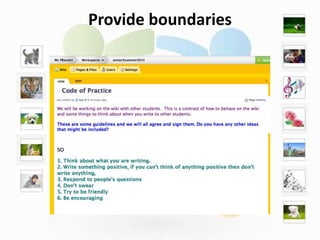
Provide boundaries
Think - Pair – Share
Kagan (1994)
Fisher, R. Teaching children to learn 2005 p.96
Stages:
• 1. Students Listen while the teacher (or
another) poses the question or problem.
• 2. Students are then given time to think
• 3. Students then collaborate
• 4. Students share their work with the rest of
the group.
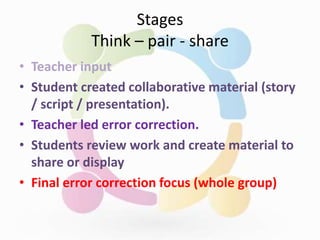
Stages
Think – pair - share
• Teacher input
• Student created collaborative material (story
/ script / presentation).
• Teacher led error correction.
• Students review work and create material to
share or display
• Final error correction focus (whole group)
Online tools
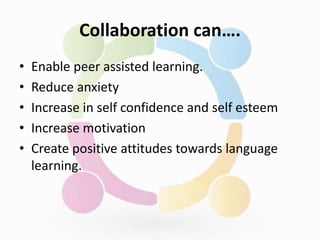
Collaboration can….
• Enable peer assisted learning.
• Reduce anxiety
• Increase in self confidence and self esteem
• Increase motivation
• Create positive attitudes towards language
learning.
Questions

Motivating learning with teens march 2015

  • 1.
  • 2.
    Teens can sufferlack motivation and engagement in the language learning classroom. This workshop explores the notion of a learner centred classroom and gives tips on how to promote learner self-confidence and increase motivation with learner centred classroom activities and ICT use.
  • 3.
    Teens • Low self-esteemand confidence. • High levels of social anxiety. • Preoccupied with identity development. • All kinds of…..changes. Hostility towards the language classroom. The need to feel valued. The need to feel accepted.
  • 4.
  • 5.
    Develop initial relationships Talkto your partner for 2 minutes Say “hello” -Introduce yourselves – answer the questions: • Do you have a teenage (Junior or senior level class) class? • Where do you teach them? • What is the classroom / school like? • What is your teenage class like ? • What do you think is the biggest challenge teaching in teaching teenagers? Etc. Who in this class?
  • 6.
    Sue • Interesting fact: •Teaches classes throughout the Barcelona area. Who in this class?
  • 7.
    Seating Arrange pupils intolearning groups • Avoid arguments about student seats • Minimise behaviour issues in the classroom • Ensure peer-peer learning occurs • Remember names of pupils and use often in the class • Facilitate activities where students use each others names
  • 8.
  • 9.
    Think - Pair– Share Kagan (1994) Fisher, R. Teaching children to learn 2005 p.96 Stages: • 1. Students Listen while the teacher (or another) poses the question or problem. • 2. Students are then given time to think • 3. Students then collaborate • 4. Students share their work with the rest of the group.
  • 10.
    Stages Think – pair- share • Teacher input • Student created collaborative material (story / script / presentation). • Teacher led error correction. • Students review work and create material to share or display • Final error correction focus (whole group)
  • 11.
  • 12.
    Collaboration can…. • Enablepeer assisted learning. • Reduce anxiety • Increase in self confidence and self esteem • Increase motivation • Create positive attitudes towards language learning.
  • 13.