WELCOME
Week 5
Reading Instruction and
Resources
Housekeeping
• Marking
• Affect/Effect
• Professional Learning Opportunity:
Reading Strand Focus Looking ahead
• Week 5 – Reading Part 1 (Theory)
• The importance of reading
• Reading behaviors
• Teaching strategies
• Week 6 – Reading Part 2 (Practice)
• ReadingAssessment
• Struggling Readers
• Growth Mindset
Review of Assignment
• Introduction:
• Read the information on the Reading Strand (pp. 10-11 in hard copy) of the
Ontario Curriculum Language linked below.
• What are the essential principles provided in this passage regarding the
teaching of reading?
• Exploring Resources:
• Peruse each resource listed below, remembering to click on the “information”
icon for specific directions. In each case, look for specific resources that will
help teachers to implement the Reading Strand of the Ontario Curriculum –
Language.
Forum
• Resource Critique:
• Choose one resource or idea that you explored above (not the entire website or
platform, but a specific resource or idea within it). Consider how it could
address a key principle in teaching reading or a specific curriculum expectation
for Reading. Create a Forum post that answers the “3 Ws”:
• What is the resource? Provide a link and basic information about your
selection.
• Why? What principles of teaching reading or specific expectation(s) could be
addressed though this resource? What features make this resource useful for
teachers of literacy.
• What now? How could you anticipate using this idea in your upcoming literacy
placement?
Professional Learning Conversations
• 15 minutes
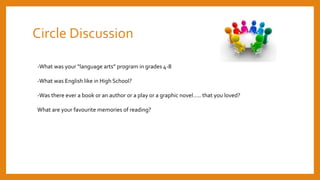
Circle Discussion
-What was your “language arts” program in grades 4-8
-What was English like in High School?
-Was there ever a book or an author or a play or a graphic novel….. that you loved?
What are your favourite memories of reading?
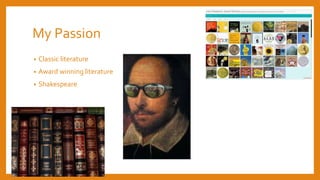
My Passion
• Classic literature
• Award winning literature
• Shakespeare
Today’s Big Questions
•Why do we teach reading?
• The Friembly Bog & other reading challenges
• Communication Landscapes Popcorn
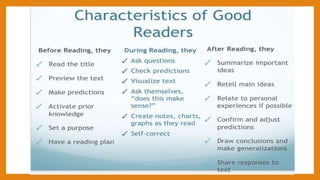
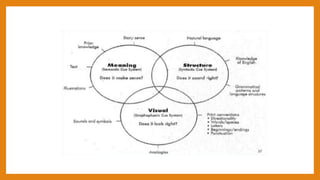
•What are the characteristics of good readers?
• Before, During, and After reading Strategies
• Assessment challenges Discussion
•What is the Gradual Release of Responsibility Model?
• What each stage looks like for reading instruction
The Importance of Literacy
(From the Ontario Curriculum, Grades 1-8, Language [revised] 2006, p.4)
Literacy is about more than reading or writing – it is about how we
communicate in society. It is about social practices and relationships, about
knowledge, language and culture.
Those who use literacy take it for granted – but those who cannot use it
are excluded from much communication in today’s world. Indeed, it is the
excluded who can best appreciate the notion of “literacy as freedom”.
UNESCO, Statement for the United Nations Literacy Decade, 2003–2012
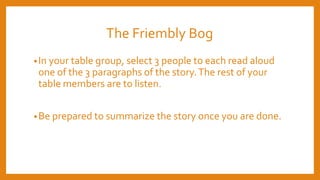
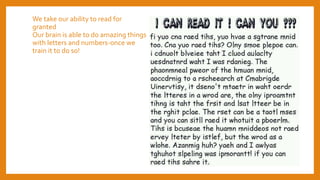
The Friembly Bog
•In your table group, select 3 people to each read aloud
one of the 3 paragraphs of the story.The rest of your
table members are to listen.
•Be prepared to summarize the story once you are done.
Activity Sheet
• The Friembly Bog
• How did you feel when you saw the story?
• How did you feel having to read it aloud?
• How did you feel as you heard your classmate read?
• How would you feel if all your school work looked this way to you?
• Using this experience as a guide, discuss with your group how it might feel to
struggle with these challenges, daily, and brainstorm what you might do, as an
educator, to help alleviate your students’ anxieties.
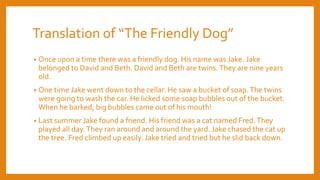
Translation of “The Friendly Dog”
• Once upon a time there was a friendly dog. His name was Jake. Jake
belonged to David and Beth. David and Beth are twins.They are nine years
old.
• One time Jake went down to the cellar. He saw a bucket of soap.The twins
were going to wash the car. He licked some soap bubbles out of the bucket.
When he barked, big bubbles came out of his mouth!
• Last summer Jake found a friend. His friend was a cat named Fred.They
played all day.They ran around and around the yard. Jake chased the cat up
the tree. Fred climbed up easily. Jake tried and tried but he slid back down.
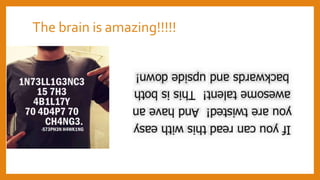
We take our ability to read for
granted
Our brain is able to do amazing things
with letters and numbers-once we
train it to do so!
The brain is amazing!!!!!
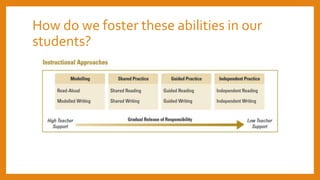
How do we foster these abilities in our
students?
Comprehensive Literacy -
The Gradual Release of Responsibility
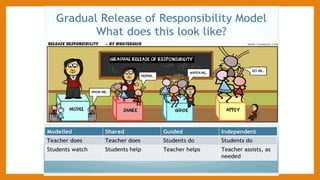
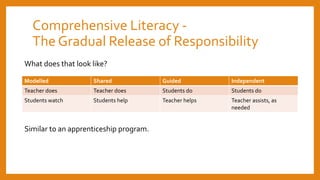
Modelled Shared Guided Independent
Teacher does Teacher does Students do Students do
Students watch Students help Teacher helps Teacher assists, as
needed
What does that look like?
Similar to an apprenticeship program.
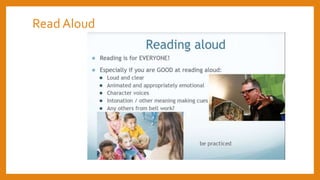
Read Aloud
Modelled Reading in a nutshell
• MODELLED =TEACHER DOES, STUDENTS WATCH/LISTEN
•
Modelled Reading can be done at any grade.
• It is a chance for you to “model” the behaviours and thoughts of ‘good’ or
‘proficient’ readers.
• Also called “Think Alouds”
•
Students need to see examples of you reading:
• For enjoyment, and for other purposes
• With fluency and expression
• To see how you solve problems (reading new words, finding meaning)
• To see how you gain deeper understanding of texts (comprehension)
• To see an example of what you expect from them
Shared Reading in a Nutshell
• SHARED =TEACHER DOES, STUDENTS HELP
•
A chance for students to participate in the reading process
• Usually whole class instruction, where students are invited to read the words,
think about meaning, and discuss their thoughts with teacher prompts and
guidance.
•
Allows students to take risks and test out reading skills
Guided reading in a nutshell
• GUIDED – STUDENTS DO,TEACHER HELPS
• Small group instruction (usually 4-6 students)
• Strategically created groups based on skill development needs
• Word recognition, identifying important ideas, summarizing, other comprehension strategies
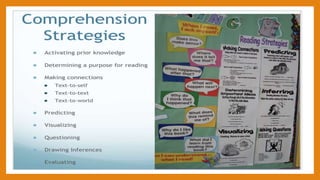
(predicting, inferring, connecting, visualizing, evaluating, questioning).
• Groups are fluid and constantly changing
• Assessment takes place each meeting on both fluency and comprehension for
each student.This assessment helps teachers create new groups for future
meetings
• Usually 15-20 minutes in length
• Lesson planned: introduce book, independent reading, stopping point with
question/activity, sharing and consolidation, extension activity/follow-up
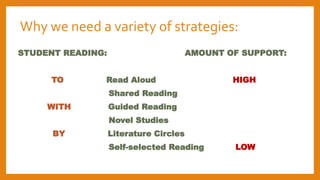
Why we need a variety of strategies:
STUDENT READING: AMOUNT OF SUPPORT:
TO Read Aloud HIGH
Shared Reading
WITH Guided Reading
Novel Studies
BY Literature Circles
Self-selected Reading LOW
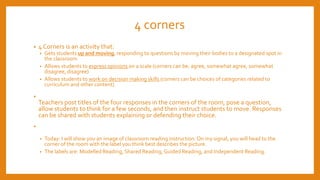
4 corners
• 4 Corners is an activity that:
• Gets students up and moving, responding to questions by moving their bodies to a designated spot in
the classroom
• Allows students to express opinions on a scale (corners can be: agree, somewhat agree, somewhat
disagree, disagree)
• Allows students to work on decision making skills (corners can be choices of categories related to
curriculum and other content)
•
Teachers post titles of the four responses in the corners of the room, pose a question,
allow students to think for a few seconds, and then instruct students to move. Responses
can be shared with students explaining or defending their choice.
•
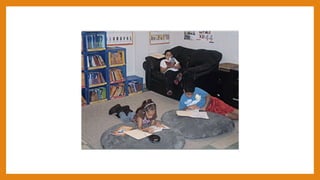
• Today: I will show you an image of classroom reading instruction. On my signal, you will head to the
corner of the room with the label you think best describes the picture.
• The labels are: Modelled Reading, Shared Reading, Guided Reading, and Independent Reading.
Break
• 10 min
Social Justice Picture Book Presentations
Erin is presenting today
On your paper, please put the presenters name in the top left-hand
corner and your name on the top right-hand corner.
Complete the following sentences.
During the presentation,
I noticed…
I felt…
I learned…
One thing I’d like to incorporate into my teaching would be…
Social Justice Presentations
• Kimi andVanessa  Sarah and Brittany
• On your card, please put the presenters name in the top left-hand corner and your
name on the top right-hand corner.
• Complete the following sentences.
• During the presentation,
• I noticed…
• I felt…
• I learned…
• One thing I’d like to incorporate into my teaching would be…
Looking ahead
• We will continue on the reading strand with a closer look at curriculum, assessment, and
goal setting
• HOMEWORK:
• Professional Reading on 21st century Reading Responses
• 3R Forum Post
• PBP by Natassja

Bc week 5

  • 1.
  • 2.
    Housekeeping • Marking • Affect/Effect •Professional Learning Opportunity:
  • 3.
    Reading Strand FocusLooking ahead • Week 5 – Reading Part 1 (Theory) • The importance of reading • Reading behaviors • Teaching strategies • Week 6 – Reading Part 2 (Practice) • ReadingAssessment • Struggling Readers • Growth Mindset
  • 4.
    Review of Assignment •Introduction: • Read the information on the Reading Strand (pp. 10-11 in hard copy) of the Ontario Curriculum Language linked below. • What are the essential principles provided in this passage regarding the teaching of reading? • Exploring Resources: • Peruse each resource listed below, remembering to click on the “information” icon for specific directions. In each case, look for specific resources that will help teachers to implement the Reading Strand of the Ontario Curriculum – Language.
  • 5.
    Forum • Resource Critique: •Choose one resource or idea that you explored above (not the entire website or platform, but a specific resource or idea within it). Consider how it could address a key principle in teaching reading or a specific curriculum expectation for Reading. Create a Forum post that answers the “3 Ws”: • What is the resource? Provide a link and basic information about your selection. • Why? What principles of teaching reading or specific expectation(s) could be addressed though this resource? What features make this resource useful for teachers of literacy. • What now? How could you anticipate using this idea in your upcoming literacy placement?
  • 6.
  • 7.
    Circle Discussion -What wasyour “language arts” program in grades 4-8 -What was English like in High School? -Was there ever a book or an author or a play or a graphic novel….. that you loved? What are your favourite memories of reading?
  • 8.
    My Passion • Classicliterature • Award winning literature • Shakespeare
  • 9.
    Today’s Big Questions •Whydo we teach reading? • The Friembly Bog & other reading challenges • Communication Landscapes Popcorn •What are the characteristics of good readers? • Before, During, and After reading Strategies • Assessment challenges Discussion •What is the Gradual Release of Responsibility Model? • What each stage looks like for reading instruction
  • 10.
    The Importance ofLiteracy (From the Ontario Curriculum, Grades 1-8, Language [revised] 2006, p.4) Literacy is about more than reading or writing – it is about how we communicate in society. It is about social practices and relationships, about knowledge, language and culture. Those who use literacy take it for granted – but those who cannot use it are excluded from much communication in today’s world. Indeed, it is the excluded who can best appreciate the notion of “literacy as freedom”. UNESCO, Statement for the United Nations Literacy Decade, 2003–2012
  • 11.
    The Friembly Bog •Inyour table group, select 3 people to each read aloud one of the 3 paragraphs of the story.The rest of your table members are to listen. •Be prepared to summarize the story once you are done.
  • 12.
    Activity Sheet • TheFriembly Bog • How did you feel when you saw the story? • How did you feel having to read it aloud? • How did you feel as you heard your classmate read? • How would you feel if all your school work looked this way to you? • Using this experience as a guide, discuss with your group how it might feel to struggle with these challenges, daily, and brainstorm what you might do, as an educator, to help alleviate your students’ anxieties.
  • 13.
    Translation of “TheFriendly Dog” • Once upon a time there was a friendly dog. His name was Jake. Jake belonged to David and Beth. David and Beth are twins.They are nine years old. • One time Jake went down to the cellar. He saw a bucket of soap.The twins were going to wash the car. He licked some soap bubbles out of the bucket. When he barked, big bubbles came out of his mouth! • Last summer Jake found a friend. His friend was a cat named Fred.They played all day.They ran around and around the yard. Jake chased the cat up the tree. Fred climbed up easily. Jake tried and tried but he slid back down.
  • 14.
    We take ourability to read for granted Our brain is able to do amazing things with letters and numbers-once we train it to do so!
  • 15.
    The brain isamazing!!!!!
  • 18.
    How do wefoster these abilities in our students?
  • 20.
    Comprehensive Literacy - TheGradual Release of Responsibility Modelled Shared Guided Independent Teacher does Teacher does Students do Students do Students watch Students help Teacher helps Teacher assists, as needed What does that look like? Similar to an apprenticeship program.
  • 21.
  • 22.
    Modelled Reading ina nutshell • MODELLED =TEACHER DOES, STUDENTS WATCH/LISTEN • Modelled Reading can be done at any grade. • It is a chance for you to “model” the behaviours and thoughts of ‘good’ or ‘proficient’ readers. • Also called “Think Alouds” • Students need to see examples of you reading: • For enjoyment, and for other purposes • With fluency and expression • To see how you solve problems (reading new words, finding meaning) • To see how you gain deeper understanding of texts (comprehension) • To see an example of what you expect from them
  • 23.
    Shared Reading ina Nutshell • SHARED =TEACHER DOES, STUDENTS HELP • A chance for students to participate in the reading process • Usually whole class instruction, where students are invited to read the words, think about meaning, and discuss their thoughts with teacher prompts and guidance. • Allows students to take risks and test out reading skills
  • 24.
    Guided reading ina nutshell • GUIDED – STUDENTS DO,TEACHER HELPS • Small group instruction (usually 4-6 students) • Strategically created groups based on skill development needs • Word recognition, identifying important ideas, summarizing, other comprehension strategies (predicting, inferring, connecting, visualizing, evaluating, questioning). • Groups are fluid and constantly changing • Assessment takes place each meeting on both fluency and comprehension for each student.This assessment helps teachers create new groups for future meetings • Usually 15-20 minutes in length • Lesson planned: introduce book, independent reading, stopping point with question/activity, sharing and consolidation, extension activity/follow-up
  • 26.
    Why we needa variety of strategies: STUDENT READING: AMOUNT OF SUPPORT: TO Read Aloud HIGH Shared Reading WITH Guided Reading Novel Studies BY Literature Circles Self-selected Reading LOW
  • 27.
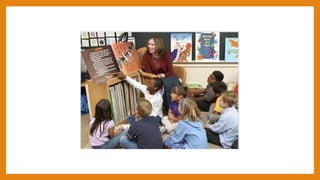
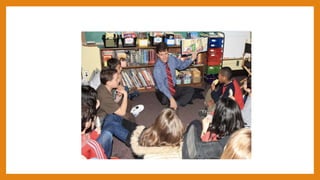
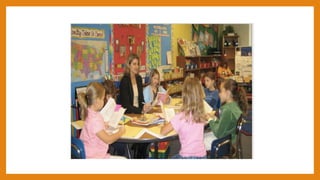
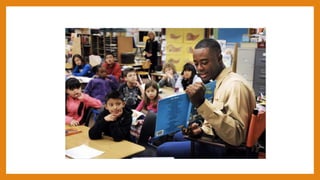
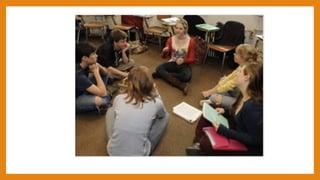
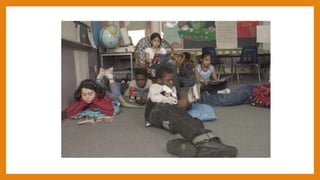
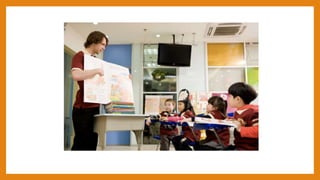
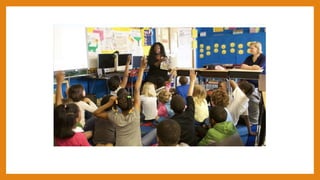
    4 corners • 4Corners is an activity that: • Gets students up and moving, responding to questions by moving their bodies to a designated spot in the classroom • Allows students to express opinions on a scale (corners can be: agree, somewhat agree, somewhat disagree, disagree) • Allows students to work on decision making skills (corners can be choices of categories related to curriculum and other content) • Teachers post titles of the four responses in the corners of the room, pose a question, allow students to think for a few seconds, and then instruct students to move. Responses can be shared with students explaining or defending their choice. • • Today: I will show you an image of classroom reading instruction. On my signal, you will head to the corner of the room with the label you think best describes the picture. • The labels are: Modelled Reading, Shared Reading, Guided Reading, and Independent Reading.
  • 37.
  • 38.
    Social Justice PictureBook Presentations Erin is presenting today On your paper, please put the presenters name in the top left-hand corner and your name on the top right-hand corner. Complete the following sentences. During the presentation, I noticed… I felt… I learned… One thing I’d like to incorporate into my teaching would be…
  • 39.
    Social Justice Presentations •Kimi andVanessa Sarah and Brittany • On your card, please put the presenters name in the top left-hand corner and your name on the top right-hand corner. • Complete the following sentences. • During the presentation, • I noticed… • I felt… • I learned… • One thing I’d like to incorporate into my teaching would be…
  • 40.
    Looking ahead • Wewill continue on the reading strand with a closer look at curriculum, assessment, and goal setting • HOMEWORK: • Professional Reading on 21st century Reading Responses • 3R Forum Post • PBP by Natassja