EVALUATION
OR
ASSESSMENT
SPEAKING
OR
TRAINING
Three Roles of an
Evaluator
 Motivator
 Facilitator
 Counselor
5
FROM: The Art of Effective Evaluation
11
Pathways Evaluation
11
Pathways
Evaluation
1. Developing
2. Emerging
3. Accomplished
4. Excels
5. Exemplary
Ten Behaviors of an
Effective Evaluator
1. Show that you care
2. Suit your evaluation to the speaker
3. Learn the speaker’s objectives
4. Listen actively
5. Personalize your language
11
FROM: The Art of Effective Evaluation
Ten Behaviors of an
Effective Evaluator
6. Give positive reinforcement
7. Build a motivational climate
8. Evaluate behavior – not people
9. Nourish self-esteem
10. Show the speaker how to improve
11a
FROM: The Art of Effective Evaluation
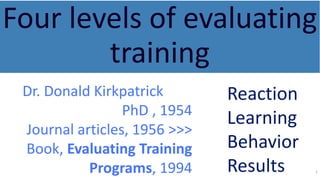
Four levels of evaluating
training
1
Dr. Donald Kirkpatrick
PhD , 1954
Journal articles, 1956 >>>
Book, Evaluating Training
Programs, 1994
Reaction
Learning
Behavior
Results
Evaluating Training - reaction
Was it interesting?
Participant feedback
Was it interesting?
Something new I realised or learnt about for the first time today
Something I will do differently as a result of today
How I will describe today to those who are coming later
How I will describe today to those who are not coming
Final thoughts
Evaluating Training - learning
Assessment
Can you apply it?
Assessment
Formative
Assessment
Wholistic
Can you apply it?
Public Speaking (0)
Speech (1)
Speak (0)
Deliver (55)
Present (58)
CPPREP4504 - Deliver presentations to clients in real estate
Search for
Units of Competency
On
www.training.gov.au
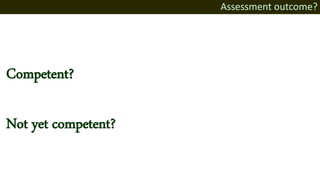
Assessment outcome?
Competent?
Not yet competent?
CPPREP4504 - Deliver presentations to clients in real estate
Search for
Units of Competency
On
www.training.gov.au
Evaluating Training - behavior
On the job observation
Are you
using it?
Evaluating Training - results
Does it make any
difference?
Change in Key
Performance Indicators
How much of this did you already know?
How much can you use?
What will you do with this information?
What could I have done differently?
It’s your turn

Evaluation or assessment