Reading Poetry with Middle
School Students
•Mary Ann Reilly
•Blueprints for Learning
• Pause for a moment and reflect: What words or phrases
come to mind when you think about the teaching of
writing?
• Working individually and as quickly as you can for the next
five (5) minutes, write each item you think of on a
separate sticky-note and stick each note on your group’s
(blank) poster.
• You should have a pile of sticky notes
spread randomly across your poster.
• Work together to sort all the notes
into appropriate groupings.
• Label each grouping.
For something to be a
masterpiece,
you have to have enough time to
talk
when you have nothing to say.
– John Cage, Lecture on Nothing
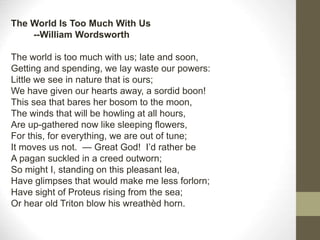
The World Is Too Much With Us
--William Wordsworth
The world is too much with us; late and soon,
Getting and spending, we lay waste our powers:
Little we see in nature that is ours;
We have given our hearts away, a sordid boon!
This sea that bares her bosom to the moon,
The winds that will be howling at all hours,
Are up-gathered now like sleeping flowers,
For this, for everything, we are out of tune;
It moves us not. — Great God! I’d rather be
A pagan suckled in a creed outworn;
So might I, standing on this pleasant lea,
Have glimpses that would make me less forlorn;
Have sight of Proteus rising from the sea;
Or hear old Triton blow his wreathèd horn.
How do you eat an elephant?
• Let’s start with a basic understanding of what the poem
might be talking about.
• Re-read the poem and circle all the words (including
references) that are unfamiliar or that you are unsure of.
• Use a dictionary and look up all the circled words and
write the definitions next to the appropriate lines in the
poem.
• Re-read the poem (again), substituting the definitions you
just wrote for the words in the poem.
• Write a brief (2-3 sentences) paraphrase of what the
poem is about. Share your paraphrase with a partner.
What changed?
What content is (re)visited
over the next week(s)?
• metaphor, simile, onomatopoeia
• assonance, consonance, alliteration
• denotation/connotation
• rhyme scheme
• meter
• sonnet form
And now we go back to the
poem...
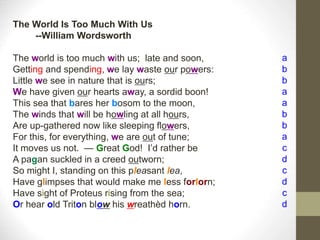
The World Is Too Much With Us
--William Wordsworth
The world is too much with us; late and soon,
Getting and spending, we lay waste our powers:
Little we see in nature that is ours;
We have given our hearts away, a sordid boon!
This sea that bares her bosom to the moon,
The winds that will be howling at all hours,
Are up-gathered now like sleeping flowers,
For this, for everything, we are out of tune;
It moves us not. — Great God! I’d rather be
A pagan suckled in a creed outworn;
So might I, standing on this pleasant lea,
Have glimpses that would make me less forlorn;
Have sight of Proteus rising from the sea;
Or hear old Triton blow his wreathèd horn.
a
b
b
a
a
b
b
a
c
d
c
d
c
d
After all this work, what happens when
students are asked to respond to a
question like this:
How does Wordsworth’s use of
figurative language extend the meaning of
the poem “The World is Too Much With
Us”?
And how does the depth of that response
temper the way in which you might
respond to students’ writing?
For example...
Salman Rushdie’s Haroun
and the Sea of Stories
12 chapters in 12 weeks
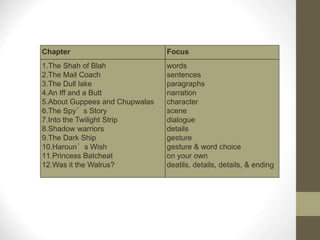
Chapter Focus
1.The Shah of Blah
2.The Mail Coach
3.The Dull lake
4.An Iff and a Butt
5.About Guppees and Chupwalas
6.The Spy’s Story
7.Into the Twilight Strip
8.Shadow warriors
9.The Dark Ship
10.Haroun’s Wish
11.Princess Batcheat
12.Was it the Walrus?
words
sentences
paragraphs
narration
character
scene
dialogue
details
gesture
gesture & word choice
on your own
deatils, details, details, & ending

Reading Poetry with Middle School Students

  • 1.
    Reading Poetry withMiddle School Students •Mary Ann Reilly •Blueprints for Learning
  • 2.
    • Pause fora moment and reflect: What words or phrases come to mind when you think about the teaching of writing? • Working individually and as quickly as you can for the next five (5) minutes, write each item you think of on a separate sticky-note and stick each note on your group’s (blank) poster.
  • 3.
    • You shouldhave a pile of sticky notes spread randomly across your poster. • Work together to sort all the notes into appropriate groupings. • Label each grouping.
  • 4.
    For something tobe a masterpiece, you have to have enough time to talk when you have nothing to say. – John Cage, Lecture on Nothing
  • 5.
    The World IsToo Much With Us --William Wordsworth The world is too much with us; late and soon, Getting and spending, we lay waste our powers: Little we see in nature that is ours; We have given our hearts away, a sordid boon! This sea that bares her bosom to the moon, The winds that will be howling at all hours, Are up-gathered now like sleeping flowers, For this, for everything, we are out of tune; It moves us not. — Great God! I’d rather be A pagan suckled in a creed outworn; So might I, standing on this pleasant lea, Have glimpses that would make me less forlorn; Have sight of Proteus rising from the sea; Or hear old Triton blow his wreathèd horn.
  • 6.
    How do youeat an elephant? • Let’s start with a basic understanding of what the poem might be talking about. • Re-read the poem and circle all the words (including references) that are unfamiliar or that you are unsure of. • Use a dictionary and look up all the circled words and write the definitions next to the appropriate lines in the poem.
  • 7.
    • Re-read thepoem (again), substituting the definitions you just wrote for the words in the poem. • Write a brief (2-3 sentences) paraphrase of what the poem is about. Share your paraphrase with a partner.
  • 8.
  • 9.
    What content is(re)visited over the next week(s)? • metaphor, simile, onomatopoeia • assonance, consonance, alliteration • denotation/connotation • rhyme scheme • meter • sonnet form
  • 10.
    And now wego back to the poem...
  • 11.
    The World IsToo Much With Us --William Wordsworth The world is too much with us; late and soon, Getting and spending, we lay waste our powers: Little we see in nature that is ours; We have given our hearts away, a sordid boon! This sea that bares her bosom to the moon, The winds that will be howling at all hours, Are up-gathered now like sleeping flowers, For this, for everything, we are out of tune; It moves us not. — Great God! I’d rather be A pagan suckled in a creed outworn; So might I, standing on this pleasant lea, Have glimpses that would make me less forlorn; Have sight of Proteus rising from the sea; Or hear old Triton blow his wreathèd horn. a b b a a b b a c d c d c d
  • 12.
    After all thiswork, what happens when students are asked to respond to a question like this: How does Wordsworth’s use of figurative language extend the meaning of the poem “The World is Too Much With Us”?
  • 13.
    And how doesthe depth of that response temper the way in which you might respond to students’ writing?
  • 14.
  • 15.
    Salman Rushdie’s Haroun andthe Sea of Stories 12 chapters in 12 weeks
  • 16.
    Chapter Focus 1.The Shahof Blah 2.The Mail Coach 3.The Dull lake 4.An Iff and a Butt 5.About Guppees and Chupwalas 6.The Spy’s Story 7.Into the Twilight Strip 8.Shadow warriors 9.The Dark Ship 10.Haroun’s Wish 11.Princess Batcheat 12.Was it the Walrus? words sentences paragraphs narration character scene dialogue details gesture gesture & word choice on your own deatils, details, details, & ending