1 
Polinukleotida(StrukturDNA) 
copyright cmassengale
DNA 
•Material genetik pada mahluk hidup adalah Asam nukleat (DNA atau RNA) yaitu suatu polimer nukleotidayg berperanan dlm penyimpanan serta pemindahan informasi genetik
Bukti bahwa DNA adalah material genetik
Transformation 
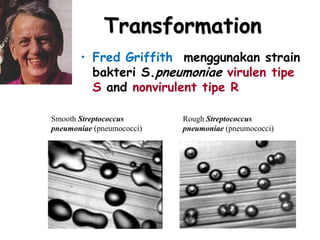
•Fred Griffith menggunakan strain bakteri S.pneumoniaevirulen tipe Sand nonvirulent tipe R 
Smooth Streptococcuspneumoniae(pneumococci) 
Rough Streptococcuspneumoniae(pneumococci)
台大農藝系遺傳學 601 20000 
Chapter 2 slide 5Peter J. Russell, iGenetics: Copyright © Pearson Education, Inc., publishing as Benjamin Cummings. 
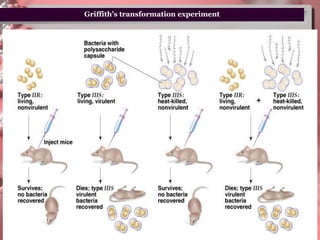
Griffith’s transformation experiment
6Transformation 
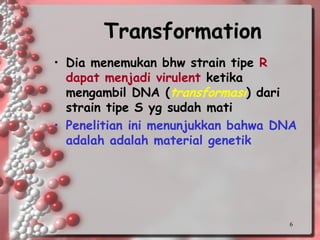
•Dia menemukan bhw strain tipe R dapat menjadi virulentketika mengambil DNA (transformasi) dari strain tipe S yg sudah mati 
•Penelitian ini menunjukkan bahwa DNA adalah adalah material genetik
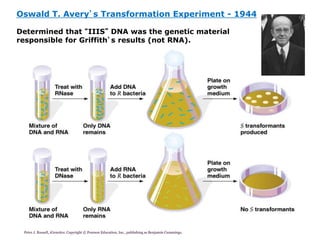
Peter J. Russell, iGenetics: Copyright © Pearson Education, Inc., publishing as Benjamin Cummings. Oswald T. Avery’s Transformation Experiment -1944Determined that “IIIS”DNA was the genetic material responsible for Griffith’s results (not RNA).
Support for Avery 
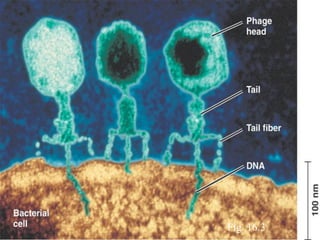
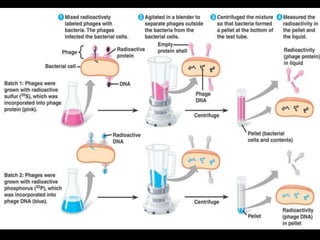
•Alfred Hershey and Martha Chase-in 1952, used bacteriophage (T2) as a model.
Fig. 16.3
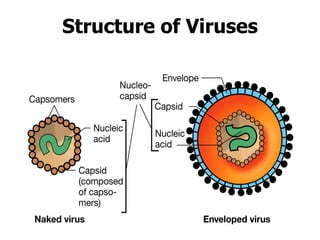
Structure of Viruses 
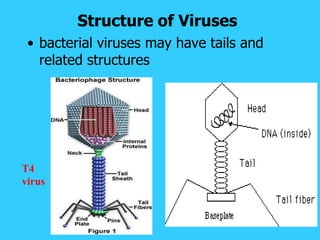
•bacterial viruses may have tails and related structures 
T4 virus
Structure of Viruses
Support for Avery 
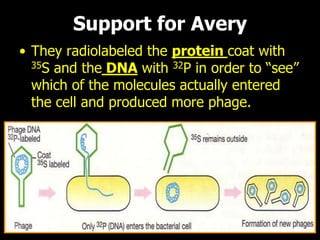
•They radiolabeled the protein coat with 35S and theDNAwith 32P in order to “see” which of the molecules actually entered the cell and produced more phage.
Fig. 16.4: Hershey-Chase Exp.
DNA/RNA 
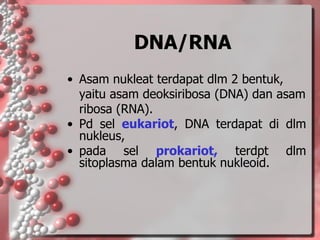
•Asam nukleat terdapat dlm 2 bentuk, yaitu asam deoksiribosa (DNA) dan asam ribosa (RNA). 
•Pdseleukariot,DNAterdapatdidlmnukleus, 
•padaselprokariot,terdptdlmsitoplasmadalambentuknukleoid.
StrukturDNA
DNA 
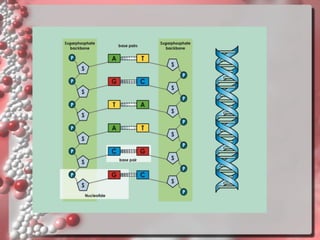
Tersusunatassubunit ygdisebutnukleotida 
Nukleotidaterdiriatas: 
Gugusphosphate 
Gulaberkarbon-5 
BasaNitrogen
DNA 
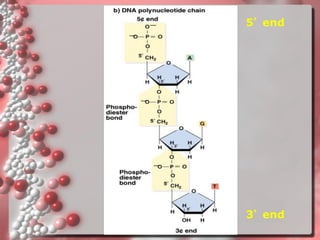
•Gula pentose (Deoxyribose) terikat ke gugus phosphat (PO4) groups melalui ikatan phosphodiester 
•Ikatan antara molekul deoxiribosa dengan basa-basa nitrogen disebut ikatan glikosida
18 
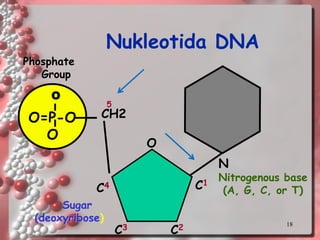
Nukleotida DNA 
O=P-O 
OPhosphateGroup 
NNitrogenous base(A, G, C, or T) CH2OC1 
C4 
C3 
C2 
5Sugar(deoxyribose) O
19 
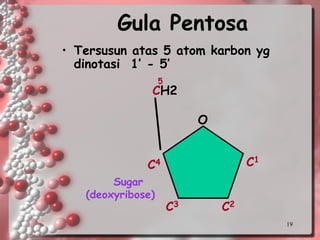
Gula Pentosa 
•Tersusun atas 5 atom karbon yg dinotasi 1’ -5’ 
CH2OC1C4C3 
C2 
5Sugar(deoxyribose)
20 
Basa2 Nitrogen 
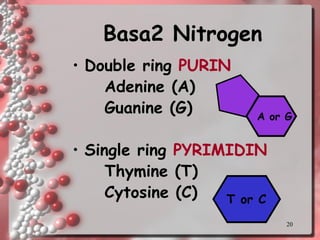
•Double ring PURIN 
Adenine (A) 
Guanine (G) 
•Single ring PYRIMIDIN 
Thymine (T) 
Cytosine (C) 
T or CA or G
Pasangan-basa 
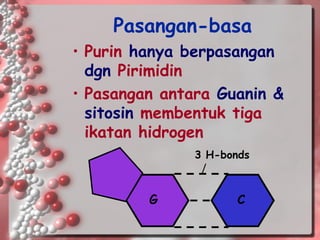
•Purin hanya berpasangan dgnPirimidin 
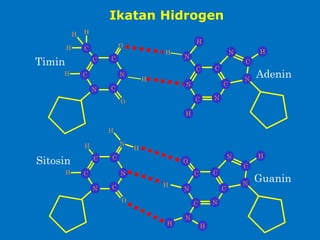
•Pasangan antara Guanin & sitosinmembentuk tiga ikatan hidrogen 
C 
G 
3 H-bonds
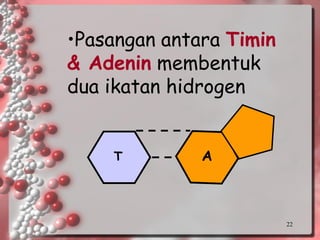
22TA 
•Pasangan antara Timin & Adeninmembentuk dua ikatan hidrogen
Ikatan Hidrogen 
HHH 
H 
O 
O 
HC 
CCC 
NN 
C 
TiminHNHH 
NC 
C 
CCNNH 
NC 
AdeninH 
O 
N 
H 
C 
CCNNCSitosinH 
HHNC 
CCC 
N 
NH 
NCGuaninNHO 
H
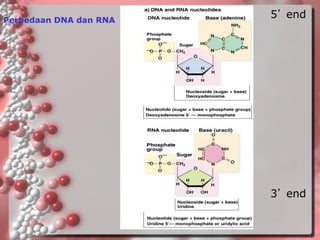
5’end3’end 
Perbedaan DNA dan RNA
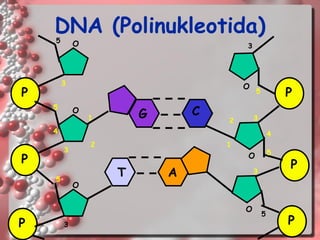
25DNA (Polinukleotida) 
P 
PPOOO 
1 
23 
4 
5 
5 
3 
35PPPO 
O 
O1 
2 
3 
4 
5 
5 
3 
53G 
CTA
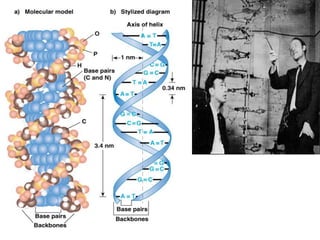
Three Dimensional Structure of DNA 
•Rosalind Franklin-X-ray crystallography of DNA-showed that DNA was in a helix with PO4and sugars to the outside. 
•James Watson and Francis Crick- took Franklin’s data-in April 23, 1953, and deduced the structure of DNA. Won the Nobel Prize along with Maurice Wilkins.
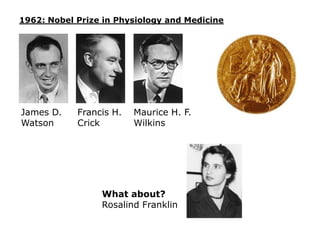
1962: Nobel Prize in Physiology and Medicine 
James D. WatsonFrancis H. Crick 
Maurice H. F. 
Wilkins 
What about? 
Rosalind Franklin
29 
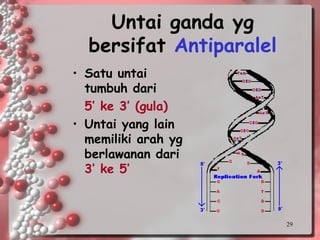
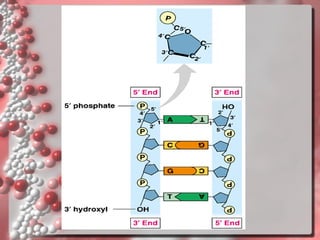
UntaigandaygbersifatAntiparalel 
•Satu untai tumbuh dari 
5’ ke 3’ (gula) 
•Untai yang lain memiliki arah yg berlawanan dari 3’ ke 5’
5’end 
3’end
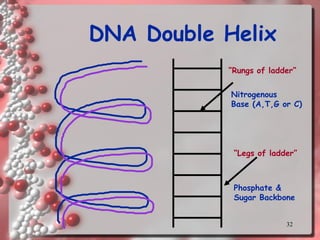
32DNA Double Helix 
Nitrogenous 
Base (A,T,G or C) “Rungs of ladder” “Legs of ladder” Phosphate & Sugar Backbone
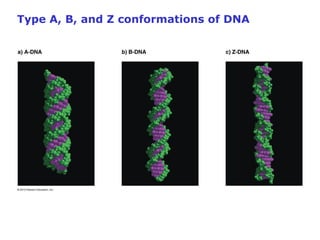
Type A, B, and Z conformations of DNA
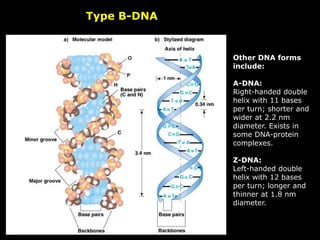
Type B-DNA 
Other DNA forms include: A-DNA: Right-handed double helix with 11 bases per turn; shorter and wider at 2.2 nm diameter. Exists in some DNA-protein complexes. Z-DNA: Left-handed double helix with 12 bases per turn; longer and thinner at 1.8 nm diameter.
Characteristics of DNA 
•All chains of DNA and RNA have a 5’ PO4end and a 3’ OH end. 
•Base sequences are written in a 5’ to 3’ direction. 
•Ex. 5’ pGpTpCpCpApT-OH 3’ or 
-GTCCAT -
Characteristics of DNA 
•Base pairs stabilize the molecule by forming H-bonds. 
•Antiparallel Strands- 
5’----------------3’ 
3’----------------5’ 
•Strands are complementary.
Discovery of DNA Structure 
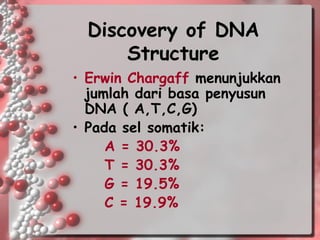
•Erwin Chargaffmenunjukkan jumlah dari basa penyusun DNA ( A,T,C,G) 
•Pada sel somatik: 
A = 30.3% 
T = 30.3% 
G = 19.5% 
C = 19.9%
Genome: 
Keseluruhan gen/DNA yang ada di dalam sel hidup. 
Gene: 
Urutan nukleotida yang mengkode suatu protein.
Two types of organism: 
Eukaryotes; 
cells contain membrane-bound 
compartments, including a nucleus and organelles. 
Eukaryotes include: animals, plants, fungi, and 
protozoa. 
Prokaryotes:Lack internal compartments extensively. 
Divided into two groups: bacteria and archaea.]
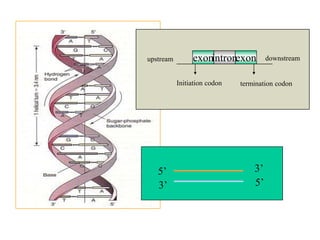
5’ 5’ 
3’ 
3’ exonexon 
intron 
upstream 
downstreamInitiation codon 
termination codon
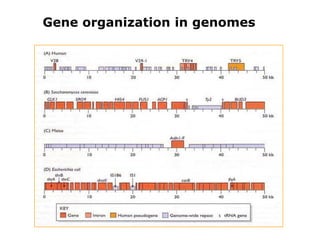
Gene organization in genomes
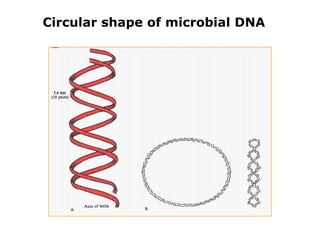
Circular shape of microbial DNA
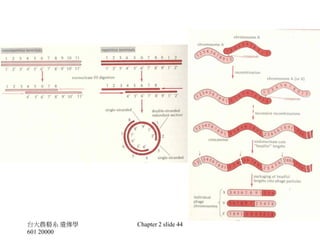
台大農藝系遺傳學 601 20000 
Chapter 2 slide 44
•Terima kasih

Struktur dna

  • 1.
  • 2.
    DNA •Material genetikpada mahluk hidup adalah Asam nukleat (DNA atau RNA) yaitu suatu polimer nukleotidayg berperanan dlm penyimpanan serta pemindahan informasi genetik
  • 3.
    Bukti bahwa DNAadalah material genetik
  • 4.
    Transformation •Fred Griffithmenggunakan strain bakteri S.pneumoniaevirulen tipe Sand nonvirulent tipe R Smooth Streptococcuspneumoniae(pneumococci) Rough Streptococcuspneumoniae(pneumococci)
  • 5.
    台大農藝系遺傳學 601 20000 Chapter 2 slide 5Peter J. Russell, iGenetics: Copyright © Pearson Education, Inc., publishing as Benjamin Cummings. Griffith’s transformation experiment
  • 6.
    6Transformation •Dia menemukanbhw strain tipe R dapat menjadi virulentketika mengambil DNA (transformasi) dari strain tipe S yg sudah mati •Penelitian ini menunjukkan bahwa DNA adalah adalah material genetik
  • 7.
    Peter J. Russell,iGenetics: Copyright © Pearson Education, Inc., publishing as Benjamin Cummings. Oswald T. Avery’s Transformation Experiment -1944Determined that “IIIS”DNA was the genetic material responsible for Griffith’s results (not RNA).
  • 8.
    Support for Avery •Alfred Hershey and Martha Chase-in 1952, used bacteriophage (T2) as a model.
  • 9.
  • 10.
    Structure of Viruses •bacterial viruses may have tails and related structures T4 virus
  • 11.
  • 12.
    Support for Avery •They radiolabeled the protein coat with 35S and theDNAwith 32P in order to “see” which of the molecules actually entered the cell and produced more phage.
  • 13.
  • 14.
    DNA/RNA •Asam nukleatterdapat dlm 2 bentuk, yaitu asam deoksiribosa (DNA) dan asam ribosa (RNA). •Pdseleukariot,DNAterdapatdidlmnukleus, •padaselprokariot,terdptdlmsitoplasmadalambentuknukleoid.
  • 15.
  • 16.
    DNA Tersusunatassubunit ygdisebutnukleotida Nukleotidaterdiriatas: Gugusphosphate Gulaberkarbon-5 BasaNitrogen
  • 17.
    DNA •Gula pentose(Deoxyribose) terikat ke gugus phosphat (PO4) groups melalui ikatan phosphodiester •Ikatan antara molekul deoxiribosa dengan basa-basa nitrogen disebut ikatan glikosida
  • 18.
    18 Nukleotida DNA O=P-O OPhosphateGroup NNitrogenous base(A, G, C, or T) CH2OC1 C4 C3 C2 5Sugar(deoxyribose) O
  • 19.
    19 Gula Pentosa •Tersusun atas 5 atom karbon yg dinotasi 1’ -5’ CH2OC1C4C3 C2 5Sugar(deoxyribose)
  • 20.
    20 Basa2 Nitrogen •Double ring PURIN Adenine (A) Guanine (G) •Single ring PYRIMIDIN Thymine (T) Cytosine (C) T or CA or G
  • 21.
    Pasangan-basa •Purin hanyaberpasangan dgnPirimidin •Pasangan antara Guanin & sitosinmembentuk tiga ikatan hidrogen C G 3 H-bonds
  • 22.
    22TA •Pasangan antaraTimin & Adeninmembentuk dua ikatan hidrogen
  • 23.
    Ikatan Hidrogen HHH H O O HC CCC NN C TiminHNHH NC C CCNNH NC AdeninH O N H C CCNNCSitosinH HHNC CCC N NH NCGuaninNHO H
  • 24.
  • 25.
    25DNA (Polinukleotida) P PPOOO 1 23 4 5 5 3 35PPPO O O1 2 3 4 5 5 3 53G CTA
  • 26.
    Three Dimensional Structureof DNA •Rosalind Franklin-X-ray crystallography of DNA-showed that DNA was in a helix with PO4and sugars to the outside. •James Watson and Francis Crick- took Franklin’s data-in April 23, 1953, and deduced the structure of DNA. Won the Nobel Prize along with Maurice Wilkins.
  • 27.
    1962: Nobel Prizein Physiology and Medicine James D. WatsonFrancis H. Crick Maurice H. F. Wilkins What about? Rosalind Franklin
  • 29.
    29 UntaigandaygbersifatAntiparalel •Satuuntai tumbuh dari 5’ ke 3’ (gula) •Untai yang lain memiliki arah yg berlawanan dari 3’ ke 5’
  • 30.
  • 32.
    32DNA Double Helix Nitrogenous Base (A,T,G or C) “Rungs of ladder” “Legs of ladder” Phosphate & Sugar Backbone
  • 34.
    Type A, B,and Z conformations of DNA
  • 35.
    Type B-DNA OtherDNA forms include: A-DNA: Right-handed double helix with 11 bases per turn; shorter and wider at 2.2 nm diameter. Exists in some DNA-protein complexes. Z-DNA: Left-handed double helix with 12 bases per turn; longer and thinner at 1.8 nm diameter.
  • 36.
    Characteristics of DNA •All chains of DNA and RNA have a 5’ PO4end and a 3’ OH end. •Base sequences are written in a 5’ to 3’ direction. •Ex. 5’ pGpTpCpCpApT-OH 3’ or -GTCCAT -
  • 37.
    Characteristics of DNA •Base pairs stabilize the molecule by forming H-bonds. •Antiparallel Strands- 5’----------------3’ 3’----------------5’ •Strands are complementary.
  • 38.
    Discovery of DNAStructure •Erwin Chargaffmenunjukkan jumlah dari basa penyusun DNA ( A,T,C,G) •Pada sel somatik: A = 30.3% T = 30.3% G = 19.5% C = 19.9%
  • 39.
    Genome: Keseluruhan gen/DNAyang ada di dalam sel hidup. Gene: Urutan nukleotida yang mengkode suatu protein.
  • 40.
    Two types oforganism: Eukaryotes; cells contain membrane-bound compartments, including a nucleus and organelles. Eukaryotes include: animals, plants, fungi, and protozoa. Prokaryotes:Lack internal compartments extensively. Divided into two groups: bacteria and archaea.]
  • 41.
    5’ 5’ 3’ 3’ exonexon intron upstream downstreamInitiation codon termination codon
  • 42.
  • 43.
    Circular shape ofmicrobial DNA
  • 44.
  • 45.