Structure of Indian Economy
Anjani Antony
Assistant Professor
Department of Commerce
St. Mary’s College Thrissur
Structure of Indian Economy,Anjani Antony,St.Mary’s College
Economic System
 It refers to the organizational arrangements and process through which
a society makes its production and consumption decisions.
 It is the system of production, distribution and consumption of goods
and services of an economy.
 It is the set of principles and techniques by which problems of
economics are addressed.
 It maybe prescribed in terms of economic relationship which arises in
the community from the organizations or the mode of production,
consumption, distribution and exchange.
 The economic system is composed of people and institutions,
including their relationships to productive resources.
Structure of Indian Economy,Anjani Antony,St.Mary’s College
Types of Economic System
There are mainly three types of Economic system
 Free market economic system or Capitalist economic system
 Centrally planned economies or socialist economy
 Mixed economy
Structure of Indian Economy,Anjani Antony,St.Mary’s College
Free market economic system
 It is also known as capitalist economy
 The private enterprise has the greatest freedom in the free market
economy.
 The factors of production are privately owned.
 Income is received in monetary forms by the sale of services of the
factors of production and from the profits of private enterprise.
 Members of free market economy have freedom of choice in so far as
consumptions, occupation, savings and investment are concerned.
 Free market economy is not planned, controlled or regulated by the
government.
 The government satisfies community or collective wants, but does not
compete with private firms nor does it tell the people where to work or
what to produce.
Structure of Indian Economy,Anjani Antony,St.Mary’s College
Fundamental feature of capitalism is the right of individuals to own
tangible and intangible property.
Little or no interference by the government in business run by private
or individual institutions.
There is hardly any country to day has a pure free market economy.
So called free market economy is subject to numerous government
contols and regulations
Structure of Indian Economy,Anjani Antony,St.Mary’s College
Centrally planned economies
It is also known as socialist economy.
State or government to one degree or another manages the
economy.
Its most extensive form is referred to as a command economy,
centrally planned economy or command and control economy.
State and govt. controls all major sectors of the economy.
Govt. formulates all decisions about the distribution of income.
Planners decide what should be produced and direct enterprises to
produce those goods.
A planned economy is an economic system in which the
government controls and regulates production, distribution, prices etc.
Structure of Indian Economy,Anjani Antony,St.Mary’s College
Mixed economy
It includes elements of both capitalism and socialism.
It is flexible
It is decentralized in nature.
More apt to cope up with ever-changing market trends, making it faster
and more reactive.
Role of the national and state govt. in the market economy is debatable.
Govt. mainly deals with the formation and implementation of rules and
regulations.
It ensures that monopolistic behavior does not obstruct competition in
the marketplace.
Govt. – “invisible hand” of market forces
Structure of Indian Economy,Anjani Antony,St.Mary’s College
National Institution For Transforming India
It is a think-tank policy.
Established by Prime Minister Narendra Modi.
Set up on 1st january 2014
It replaced the 65 year old planning commission.
Structure of Indian Economy,Anjani Antony,St.Mary’s College
Nithi, means “policy” and Aayog means “commission”
It will provide governments at the central and state levels with
relevant strategic and technical advice across the spectrum of key
elements of policy.
Help to develop a shared vision of national development priorities.
Promotes cooperative federalism.
It recognize that strong states make a strong nation
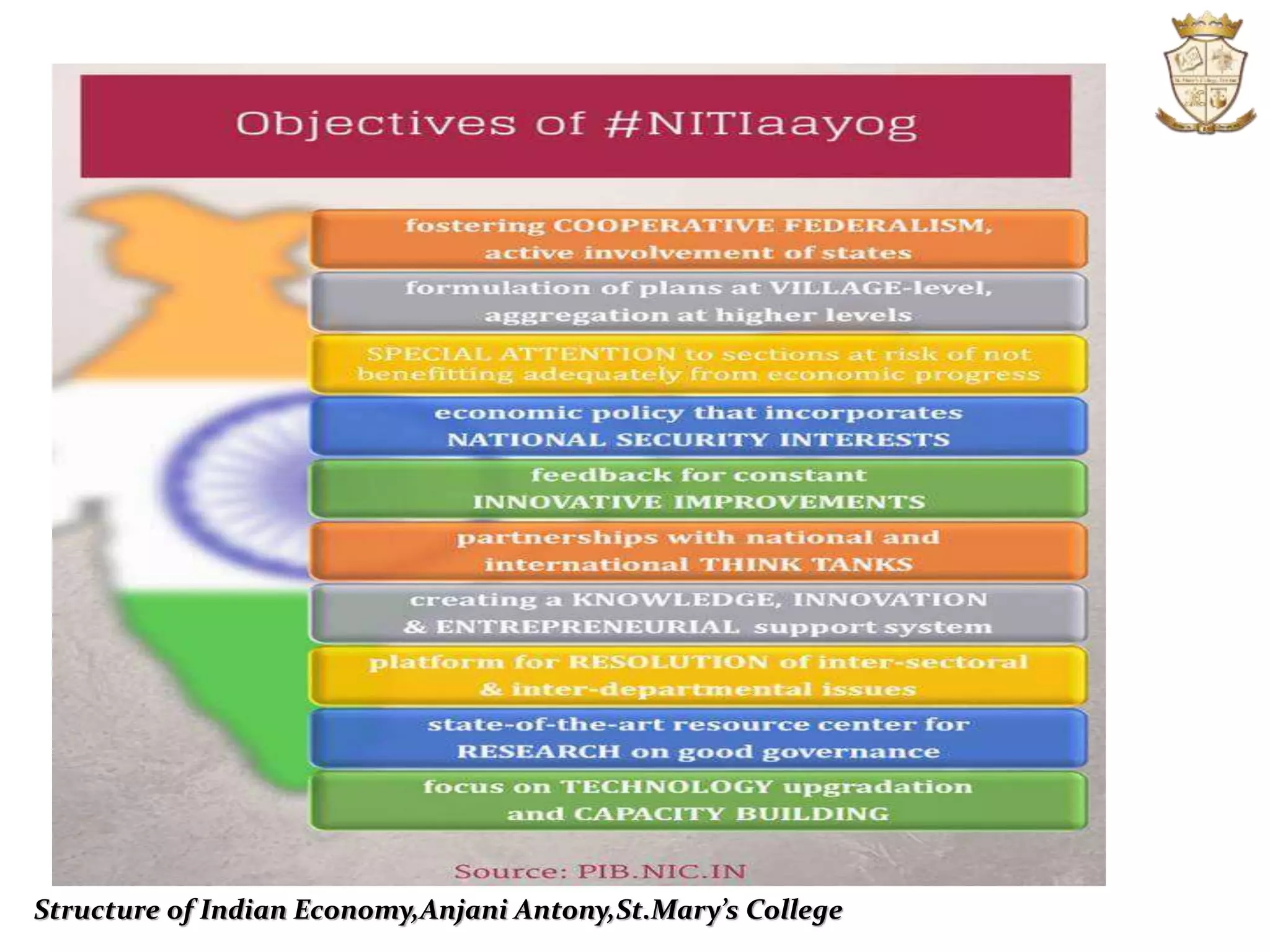
 It develop mechanism to formulate credible plans to the village
level and aggregate at higher levels of government.
 It ensure special attention to the sections of society.
 Platform for resolution of inter- sectoral and inter-departmental
issues.
Structure of Indian Economy,Anjani Antony,St.Mary’s College
 Government is an “enabler” rather than a “provider of first and last
resort”
 Progress from “food security” to focus on a mix of agricultural
production, as well as actual returns that farmers get from their
produce.
 Ensure that India is an active player in the debates and deliberations on
the global commons.
 Ensure that the economically vibrant middle-class remains engaged,
and its potential is fully realized.
 Leverage India’s pool of entrepreneurial, scientific and intellectual
human capital.
Objectives of NITI Aayog
Structure of Indian Economy,Anjani Antony,St.Mary’s College
 Incorporate the significant geo-economic and geo-political strength of
the Non resident Indian community.
 Use urbanization as an opportunity to create a wholesome and secure
habitat through the use of modern technology.
 Use technology to reduce capacity and potential for misadventures in
governance
Structure of Indian Economy,Anjani Antony,St.Mary’s College
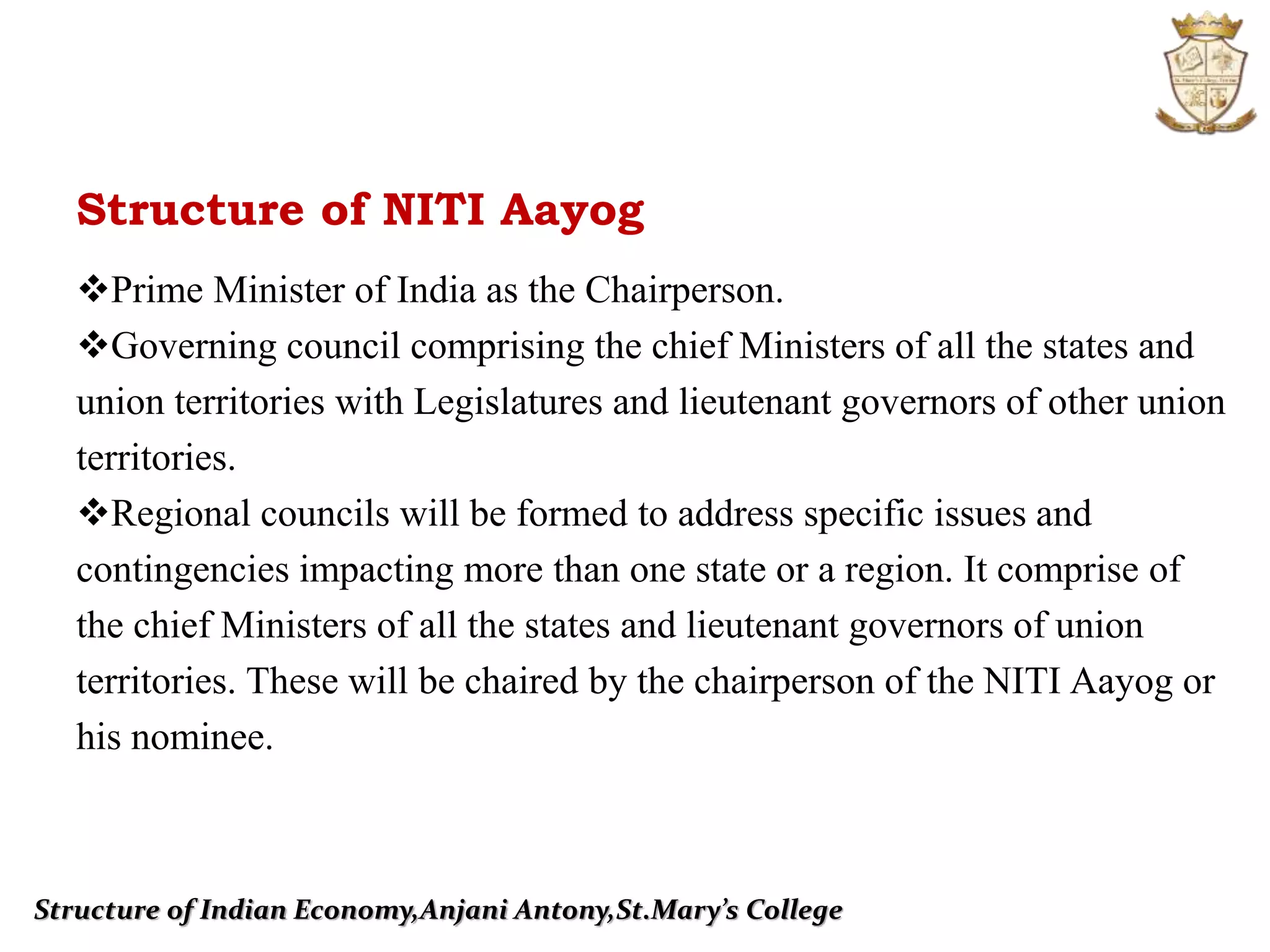
Prime Minister of India as the Chairperson.
Governing council comprising the chief Ministers of all the states and
union territories with Legislatures and lieutenant governors of other union
territories.
Regional councils will be formed to address specific issues and
contingencies impacting more than one state or a region. It comprise of
the chief Ministers of all the states and lieutenant governors of union
territories. These will be chaired by the chairperson of the NITI Aayog or
his nominee.
Structure of NITI Aayog
Structure of Indian Economy,Anjani Antony,St.Mary’s College
 Experts, specialists and practitioners with relevant domain knowledge
as special invitees nominated by the Prime Minister.
 Full-time organizational framework
Structure of Indian Economy,Anjani Antony,St.Mary’s College
 Cooperative and competitive federalism
 Shared national Agenda
 State’s best friend at the centre
 Decentralized planning
 Vision and scenario planning
 Domain strategies
 Network of expertise
 Knowledge and innovation hub
 Harmonization
 Conflict resolution
 Coordinating interface with the world
 Internal consultancy, Capacity building
 Monitoring and evaluation
Functions of NITI Aayog
Structure of Indian Economy,Anjani Antony,St.Mary’s College
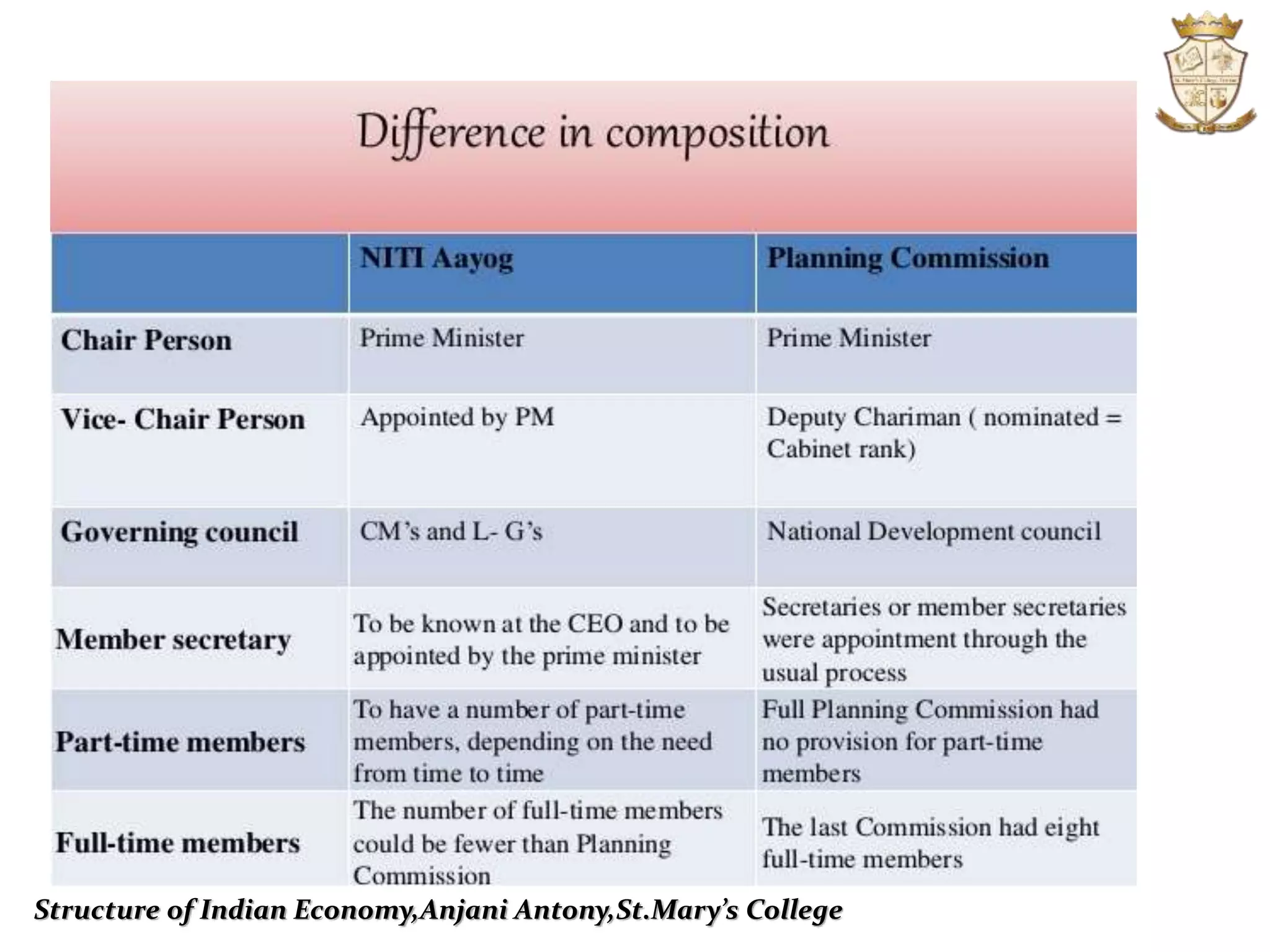
Planning commission and NITI Aayog
Structure of Indian Economy,Anjani Antony,St.Mary’s College
Planning Commission NITI Aayog
Enjoyed the powers to allocate funds to ministries and state governments. To be an advisory body, or a think-tank. The powers to allocate funds might be
vested in the finance ministry.
The last Commission had eight full-time members The number of full-time members could be fewer than Planning Commission
States' role was limited to the National Development Council and annual
interaction during Plan meetings.
State governments are expected to play a more significant role than they did in
the Planning Commission.
Secretaries or member secretaries were appointment through the usual process Secretaries to be known as the CEO and to be appointed by the prime minister.
Full Planning Commission had no provision for part-time members. To have a number of part-time members, depending on the need from time to
time.
The commission reported to National Development Council that had state chief
ministers and lieutenant governors.
Governing Council has state chief ministers and lieutenant governors.
Had deputy chairperson, a member secretary and full-time members New posts of CEO, of secretary rank, and Vice-Chairperson. Will also have five
full-time members and two part-time members. Four cabinet ministers will serve
as ex-officio members.
Policy was formed by the commission and states were then consulted about
allocation of funds.
Consulting states while making policy and deciding on funds allocation. Final
policy would be a result of that.
Had power to decide allocation of government funds for various programmes at
national and state levels.
No power to allocate funds
Imposed policies on states and tied allocation of funds with projects it
approved.
NITI is a think-tank and does not have the power to impose policies.

Structure of indian economy

  • 1.
    Structure of IndianEconomy Anjani Antony Assistant Professor Department of Commerce St. Mary’s College Thrissur
  • 2.
    Structure of IndianEconomy,Anjani Antony,St.Mary’s College Economic System  It refers to the organizational arrangements and process through which a society makes its production and consumption decisions.  It is the system of production, distribution and consumption of goods and services of an economy.  It is the set of principles and techniques by which problems of economics are addressed.  It maybe prescribed in terms of economic relationship which arises in the community from the organizations or the mode of production, consumption, distribution and exchange.  The economic system is composed of people and institutions, including their relationships to productive resources.
  • 3.
    Structure of IndianEconomy,Anjani Antony,St.Mary’s College Types of Economic System There are mainly three types of Economic system  Free market economic system or Capitalist economic system  Centrally planned economies or socialist economy  Mixed economy
  • 4.
    Structure of IndianEconomy,Anjani Antony,St.Mary’s College Free market economic system  It is also known as capitalist economy  The private enterprise has the greatest freedom in the free market economy.  The factors of production are privately owned.  Income is received in monetary forms by the sale of services of the factors of production and from the profits of private enterprise.  Members of free market economy have freedom of choice in so far as consumptions, occupation, savings and investment are concerned.  Free market economy is not planned, controlled or regulated by the government.  The government satisfies community or collective wants, but does not compete with private firms nor does it tell the people where to work or what to produce.
  • 5.
    Structure of IndianEconomy,Anjani Antony,St.Mary’s College Fundamental feature of capitalism is the right of individuals to own tangible and intangible property. Little or no interference by the government in business run by private or individual institutions. There is hardly any country to day has a pure free market economy. So called free market economy is subject to numerous government contols and regulations
  • 6.
    Structure of IndianEconomy,Anjani Antony,St.Mary’s College Centrally planned economies It is also known as socialist economy. State or government to one degree or another manages the economy. Its most extensive form is referred to as a command economy, centrally planned economy or command and control economy. State and govt. controls all major sectors of the economy. Govt. formulates all decisions about the distribution of income. Planners decide what should be produced and direct enterprises to produce those goods. A planned economy is an economic system in which the government controls and regulates production, distribution, prices etc.
  • 7.
    Structure of IndianEconomy,Anjani Antony,St.Mary’s College Mixed economy It includes elements of both capitalism and socialism. It is flexible It is decentralized in nature. More apt to cope up with ever-changing market trends, making it faster and more reactive. Role of the national and state govt. in the market economy is debatable. Govt. mainly deals with the formation and implementation of rules and regulations. It ensures that monopolistic behavior does not obstruct competition in the marketplace. Govt. – “invisible hand” of market forces
  • 8.
    Structure of IndianEconomy,Anjani Antony,St.Mary’s College National Institution For Transforming India It is a think-tank policy. Established by Prime Minister Narendra Modi. Set up on 1st january 2014 It replaced the 65 year old planning commission.
  • 9.
    Structure of IndianEconomy,Anjani Antony,St.Mary’s College Nithi, means “policy” and Aayog means “commission” It will provide governments at the central and state levels with relevant strategic and technical advice across the spectrum of key elements of policy. Help to develop a shared vision of national development priorities. Promotes cooperative federalism. It recognize that strong states make a strong nation  It develop mechanism to formulate credible plans to the village level and aggregate at higher levels of government.  It ensure special attention to the sections of society.  Platform for resolution of inter- sectoral and inter-departmental issues.
  • 10.
    Structure of IndianEconomy,Anjani Antony,St.Mary’s College  Government is an “enabler” rather than a “provider of first and last resort”  Progress from “food security” to focus on a mix of agricultural production, as well as actual returns that farmers get from their produce.  Ensure that India is an active player in the debates and deliberations on the global commons.  Ensure that the economically vibrant middle-class remains engaged, and its potential is fully realized.  Leverage India’s pool of entrepreneurial, scientific and intellectual human capital. Objectives of NITI Aayog
  • 11.
    Structure of IndianEconomy,Anjani Antony,St.Mary’s College  Incorporate the significant geo-economic and geo-political strength of the Non resident Indian community.  Use urbanization as an opportunity to create a wholesome and secure habitat through the use of modern technology.  Use technology to reduce capacity and potential for misadventures in governance
  • 12.
    Structure of IndianEconomy,Anjani Antony,St.Mary’s College
  • 13.
    Structure of IndianEconomy,Anjani Antony,St.Mary’s College Prime Minister of India as the Chairperson. Governing council comprising the chief Ministers of all the states and union territories with Legislatures and lieutenant governors of other union territories. Regional councils will be formed to address specific issues and contingencies impacting more than one state or a region. It comprise of the chief Ministers of all the states and lieutenant governors of union territories. These will be chaired by the chairperson of the NITI Aayog or his nominee. Structure of NITI Aayog
  • 14.
    Structure of IndianEconomy,Anjani Antony,St.Mary’s College  Experts, specialists and practitioners with relevant domain knowledge as special invitees nominated by the Prime Minister.  Full-time organizational framework
  • 15.
    Structure of IndianEconomy,Anjani Antony,St.Mary’s College
  • 16.
    Structure of IndianEconomy,Anjani Antony,St.Mary’s College
  • 17.
    Structure of IndianEconomy,Anjani Antony,St.Mary’s College  Cooperative and competitive federalism  Shared national Agenda  State’s best friend at the centre  Decentralized planning  Vision and scenario planning  Domain strategies  Network of expertise  Knowledge and innovation hub  Harmonization  Conflict resolution  Coordinating interface with the world  Internal consultancy, Capacity building  Monitoring and evaluation Functions of NITI Aayog
  • 18.
    Structure of IndianEconomy,Anjani Antony,St.Mary’s College Planning commission and NITI Aayog
  • 19.
    Structure of IndianEconomy,Anjani Antony,St.Mary’s College
  • 20.
    Structure of IndianEconomy,Anjani Antony,St.Mary’s College
  • 21.
    Structure of IndianEconomy,Anjani Antony,St.Mary’s College Planning Commission NITI Aayog Enjoyed the powers to allocate funds to ministries and state governments. To be an advisory body, or a think-tank. The powers to allocate funds might be vested in the finance ministry. The last Commission had eight full-time members The number of full-time members could be fewer than Planning Commission States' role was limited to the National Development Council and annual interaction during Plan meetings. State governments are expected to play a more significant role than they did in the Planning Commission. Secretaries or member secretaries were appointment through the usual process Secretaries to be known as the CEO and to be appointed by the prime minister. Full Planning Commission had no provision for part-time members. To have a number of part-time members, depending on the need from time to time. The commission reported to National Development Council that had state chief ministers and lieutenant governors. Governing Council has state chief ministers and lieutenant governors. Had deputy chairperson, a member secretary and full-time members New posts of CEO, of secretary rank, and Vice-Chairperson. Will also have five full-time members and two part-time members. Four cabinet ministers will serve as ex-officio members. Policy was formed by the commission and states were then consulted about allocation of funds. Consulting states while making policy and deciding on funds allocation. Final policy would be a result of that. Had power to decide allocation of government funds for various programmes at national and state levels. No power to allocate funds Imposed policies on states and tied allocation of funds with projects it approved. NITI is a think-tank and does not have the power to impose policies.