St. Anne’s School
SUBJECT: POLITICAL SCIENCE
CLASS: XI-C
SUMBITTED BY: VINEET DETHA
SUBMITTED TO: MRS. POOJA
UPADHYAYA
Acknowledgement
● I would like to present my heartful gratitude to so many people who
have helped in this project.Firstly I would like to thank my friends for
contributing in this project and helping me in research, decoration
and content (Girisha, Garvit, Jiya, etc.) Then I would like to thank
my teacher Ms. Pooja upadhyay for giving me this topic which
helpede to advance it’s understanding. I would also like to thank my
family for providing all the resources needed. In the end, I would
like to present my gratitude to CBSE for this wonderful opportunity.
NITI
AAYOG
National
Institution for
Transforming
India
INTRODUCTION
The NITI AAYOG (Policy Commission) is a
policy think tank of the Government of India,
established with the aim to achieve sustainable
development goals with cooperative federalism
by fostering the involvement of State
Governments of India in the economic policy-
making process using a bottom-up approach.
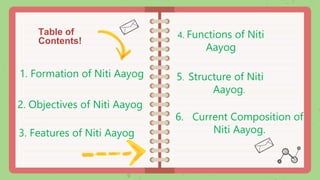
Table of
Contents!
5. Structure of Niti
Aayog.
3. Features of Niti Aayog
6. Current Composition of
Niti Aayog.
4. Functions of Niti
Aayog
2. Objectives of Niti Aayog
1. Formation of Niti Aayog
01
FORMATION
1. 29 May 2014 Independent
Evaluation Office submitted
an assessment report to
Prime Minister Narendra Modi
with the recommendation to
replace the Planning
Commission with a "control
commission."
History
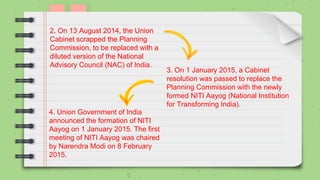
2. On 13 August 2014, the Union
Cabinet scrapped the Planning
Commission, to be replaced with a
diluted version of the National
Advisory Council (NAC) of India.
3. On 1 January 2015, a Cabinet
resolution was passed to replace the
Planning Commission with the newly
formed NITI Aayog (National Institution
for Transforming India).
4. Union Government of India
announced the formation of NITI
Aayog on 1 January 2015. The first
meeting of NITI Aayog was chaired
by Narendra Modi on 8 February
2015.
02
OBJECTIVES
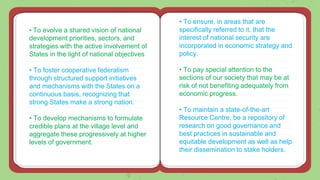
• To evolve a shared vision of national
development priorities, sectors, and
strategies with the active involvement of
States in the light of national objectives
• To foster cooperative federalism
through structured support initiatives
and mechanisms with the States on a
continuous basis, recognizing that
strong States make a strong nation.
• To develop mechanisms to formulate
credible plans at the village level and
aggregate these progressively at higher
levels of government.
• To ensure, in areas that are
specifically referred to it, that the
interest of national security are
incorporated in economic strategy and
policy.
• To pay special attention to the
sections of our society that may be at
risk of not benefiting adequately from
economic progress.
• To maintain a state-of-the-art
Resource Centre, be a repository of
research on good governance and
best practices in sustainable and
equitable development as well as help
their dissemination to stake holders.
03
FEATURES
* Design Policy &
Programme Framework
* Foster Cooperative
Federalism
* Think Tank and Knowledge
& Innovation Hub
* Monitoring & Evaluation
NITI AAYOG’S entire gamut of
activities can be divided into
four main heads:
04
FUNCTIONS
● Niti Aayog makes the future plan ,
initiatives and implementation,
progress, monitoring to every plan for
the development of the nation.
● Niti Aayog focuses on technology
upgradation and capacity building for
implementation of programmes and
initiatives.
● Niti Aayog works for SGDs,
environmental development and
disaster management too.
● Niti Aayog upgrades all plans and
programmes on the basis of need
and identification of the resources.
● Niti Aayog ensures national security for
every people of India and works on
economic policy too.
● Niti Aayog coordinates with the state
government for the implementation of
the plan and policy.
● Niti Aayog pays attention to the section
of our society which are standing on any
risk and not having any benefit from
economic progress.
● Niti Aayog creates a knowledge,
innovation and entrepreneurial support
system through a collaborative
community of national and international
experts.
05
STRUCTURE
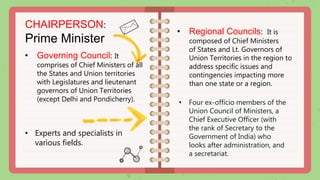
• Regional Councils: It is
composed of Chief Ministers
of States and Lt. Governors of
Union Territories in the region to
address specific issues and
contingencies impacting more
than one state or a region.
• Four ex-officio members of the
Union Council of Ministers, a
Chief Executive Officer (with
the rank of Secretary to the
Government of India) who
looks after administration, and
a secretariat.
• Governing Council: It
comprises of Chief Ministers of all
the States and Union territories
with Legislatures and lieutenant
governors of Union Territories
(except Delhi and Pondicherry).
CHAIRPERSON:
Prime Minister
• Experts and specialists in
various fields.
06
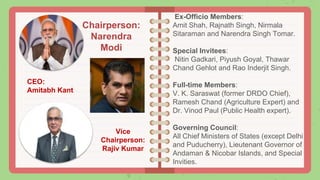
CURRENT
COMPOSITION
Vice
Chairperson:
Rajiv Kumar
Chairperson:
Narendra
Modi
Ex-Officio Members:
Amit Shah, Rajnath Singh, Nirmala
Sitaraman and Narendra Singh Tomar.
Special Invitees:
Nitin Gadkari, Piyush Goyal, Thawar
Chand Gehlot and Rao Inderjit Singh.
Full-time Members:
V. K. Saraswat (former DRDO Chief),
Ramesh Chand (Agriculture Expert) and
Dr. Vinod Paul (Public Health expert).
Governing Council:
All Chief Ministers of States (except Delhi
and Puducherry), Lieutenant Governor of
Andaman & Nicobar Islands, and Special
Invities.
CEO:
Amitabh Kant
Bibliography
● https://byjus.com
● https://www.niti.gov.in
● https://en.m.wikipedia.org
● Indian constitution at work – 11

POLITICAL SCIENCE PROJECT final.pptx

  • 1.
    St. Anne’s School SUBJECT:POLITICAL SCIENCE CLASS: XI-C SUMBITTED BY: VINEET DETHA SUBMITTED TO: MRS. POOJA UPADHYAYA
  • 2.
    Acknowledgement ● I wouldlike to present my heartful gratitude to so many people who have helped in this project.Firstly I would like to thank my friends for contributing in this project and helping me in research, decoration and content (Girisha, Garvit, Jiya, etc.) Then I would like to thank my teacher Ms. Pooja upadhyay for giving me this topic which helpede to advance it’s understanding. I would also like to thank my family for providing all the resources needed. In the end, I would like to present my gratitude to CBSE for this wonderful opportunity.
  • 3.
  • 4.
    INTRODUCTION The NITI AAYOG(Policy Commission) is a policy think tank of the Government of India, established with the aim to achieve sustainable development goals with cooperative federalism by fostering the involvement of State Governments of India in the economic policy- making process using a bottom-up approach.
  • 5.
    Table of Contents! 5. Structureof Niti Aayog. 3. Features of Niti Aayog 6. Current Composition of Niti Aayog. 4. Functions of Niti Aayog 2. Objectives of Niti Aayog 1. Formation of Niti Aayog
  • 6.
  • 7.
    1. 29 May2014 Independent Evaluation Office submitted an assessment report to Prime Minister Narendra Modi with the recommendation to replace the Planning Commission with a "control commission." History
  • 8.
    2. On 13August 2014, the Union Cabinet scrapped the Planning Commission, to be replaced with a diluted version of the National Advisory Council (NAC) of India. 3. On 1 January 2015, a Cabinet resolution was passed to replace the Planning Commission with the newly formed NITI Aayog (National Institution for Transforming India). 4. Union Government of India announced the formation of NITI Aayog on 1 January 2015. The first meeting of NITI Aayog was chaired by Narendra Modi on 8 February 2015.
  • 9.
  • 10.
    • To evolvea shared vision of national development priorities, sectors, and strategies with the active involvement of States in the light of national objectives • To foster cooperative federalism through structured support initiatives and mechanisms with the States on a continuous basis, recognizing that strong States make a strong nation. • To develop mechanisms to formulate credible plans at the village level and aggregate these progressively at higher levels of government. • To ensure, in areas that are specifically referred to it, that the interest of national security are incorporated in economic strategy and policy. • To pay special attention to the sections of our society that may be at risk of not benefiting adequately from economic progress. • To maintain a state-of-the-art Resource Centre, be a repository of research on good governance and best practices in sustainable and equitable development as well as help their dissemination to stake holders.
  • 11.
  • 12.
    * Design Policy& Programme Framework * Foster Cooperative Federalism * Think Tank and Knowledge & Innovation Hub * Monitoring & Evaluation NITI AAYOG’S entire gamut of activities can be divided into four main heads:
  • 13.
  • 14.
    ● Niti Aayogmakes the future plan , initiatives and implementation, progress, monitoring to every plan for the development of the nation. ● Niti Aayog focuses on technology upgradation and capacity building for implementation of programmes and initiatives. ● Niti Aayog works for SGDs, environmental development and disaster management too. ● Niti Aayog upgrades all plans and programmes on the basis of need and identification of the resources. ● Niti Aayog ensures national security for every people of India and works on economic policy too. ● Niti Aayog coordinates with the state government for the implementation of the plan and policy. ● Niti Aayog pays attention to the section of our society which are standing on any risk and not having any benefit from economic progress. ● Niti Aayog creates a knowledge, innovation and entrepreneurial support system through a collaborative community of national and international experts.
  • 16.
  • 17.
    • Regional Councils:It is composed of Chief Ministers of States and Lt. Governors of Union Territories in the region to address specific issues and contingencies impacting more than one state or a region. • Four ex-officio members of the Union Council of Ministers, a Chief Executive Officer (with the rank of Secretary to the Government of India) who looks after administration, and a secretariat. • Governing Council: It comprises of Chief Ministers of all the States and Union territories with Legislatures and lieutenant governors of Union Territories (except Delhi and Pondicherry). CHAIRPERSON: Prime Minister • Experts and specialists in various fields.
  • 18.
  • 19.
    Vice Chairperson: Rajiv Kumar Chairperson: Narendra Modi Ex-Officio Members: AmitShah, Rajnath Singh, Nirmala Sitaraman and Narendra Singh Tomar. Special Invitees: Nitin Gadkari, Piyush Goyal, Thawar Chand Gehlot and Rao Inderjit Singh. Full-time Members: V. K. Saraswat (former DRDO Chief), Ramesh Chand (Agriculture Expert) and Dr. Vinod Paul (Public Health expert). Governing Council: All Chief Ministers of States (except Delhi and Puducherry), Lieutenant Governor of Andaman & Nicobar Islands, and Special Invities. CEO: Amitabh Kant
  • 20.
    Bibliography ● https://byjus.com ● https://www.niti.gov.in ●https://en.m.wikipedia.org ● Indian constitution at work – 11