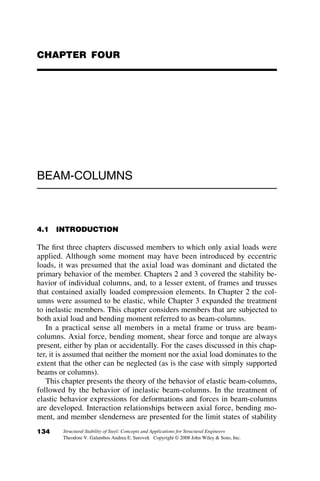
STRUCTURAL STABILITY OF STEEL:
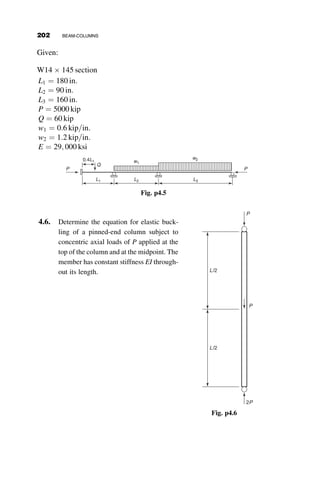
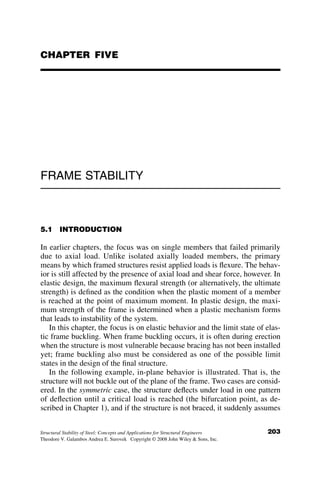
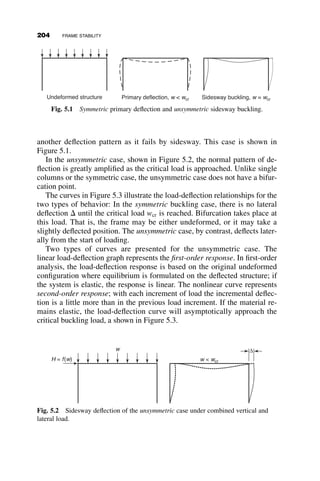
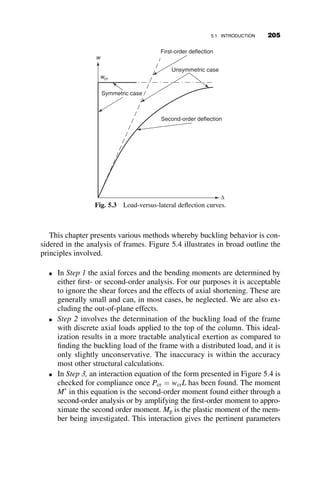
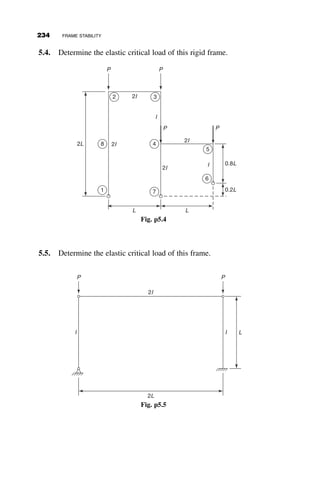
CONCEPTS AND APPLICATIONS
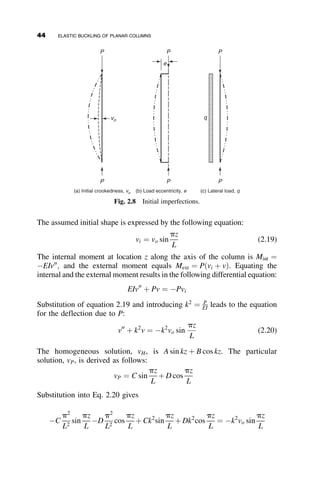
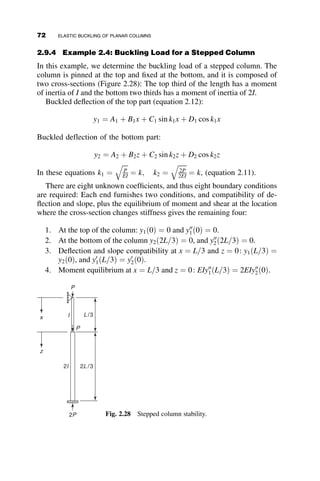
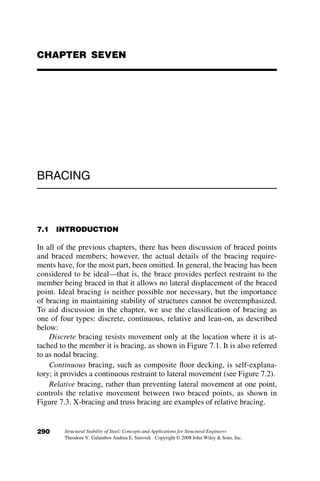
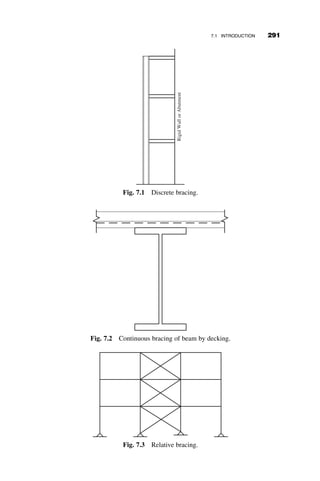
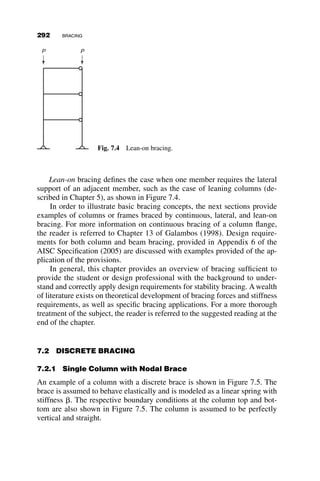
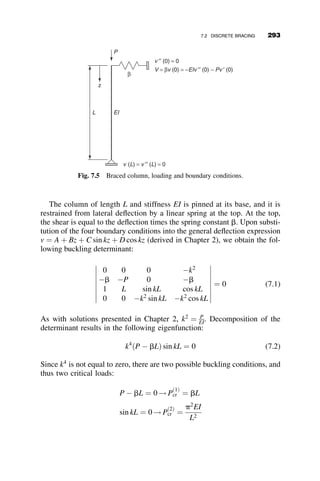
FOR STRUCTURAL ENGINEERS
Structural Stability of Steel: Concepts and Applications for Structural Engineers
Theodore V. Galambos Andrea E. Surovek Copyright © 2008 John Wiley & Sons, Inc.
STRUCTURAL STABILITY OF
STEEL: CONCEPTS AND
APPLICATIONS FOR
STRUCTURAL ENGINEERS
THEODORE V. GALAMBOS
ANDREA E. SUROVEK
JOHN WILEY & SONS, INC.
This book is printed on acid-free paper. 
1
Copyright # 2008 by John Wiley & Sons, Inc. All rights reserved
Published by John Wiley & Sons, Inc., Hoboken, New Jersey
Published simultaneously in Canada
No part of this publication may be reproduced, stored in a retrieval system, or transmitted in any
form or by any means, electronic, mechanical, photocopying, recording, scanning, or otherwise,
except as permitted under Section 107 or 108 of the 1976 United States Copyright Act, without
either the prior written permission of the Publisher, or authorization through payment of the
appropriate per-copy fee to the Copyright Clearance Center, 222 Rosewood Drive, Danvers, MA
01923, (978) 750-8400, fax (978) 646-8600, or on the Web at www.copyright.com. Requests to the
Publisher for permission should be addressed to the Permissions Department, John Wiley & Sons,
Inc., 111 River Street, Hoboken, NJ 07030, (201) 748-6011, fax (201) 748-6008, or online at
www.wiley.com/go/permissions.
Limit of Liability/Disclaimer of Warranty: While the publisher and the author have used their
best efforts in preparing this book, they make no representations or warranties with respect to the
accuracy or completeness of the contents of this book and specifically disclaim any implied
warranties of merchantability or fitness for a particular purpose. No warranty may be created or
extended by sales representatives or written sales materials. The advice and strategies contained
herein may not be suitable for your situation. You should consult with a professional where
appropriate. Neither the publisher nor the author shall be liable for any loss of profit or any other
commercial damages, including but not limited to special, incidental, consequential, or other
damages.
For general information about our other products and services, please contact our Customer
Care Department within the United States at (800) 762-2974, outside the United States at
(317) 572-3993 or fax (317) 572-4002.
Wiley also publishes its books in a variety of electronic formats. Some content that appears in
print may not be available in electronic books. For more information about Wiley products, visit
our Web site at www.wiley.com.
Library of Congress Cataloging-in-Publication Data:
Galambos, T. V. (Theodore V.)
Structural stability of steel : concepts and applications for structural engineers / Theodore
Galambos, Andrea Surovek.
p. cm.
Includes bibliographical references and index.
ISBN 978-0-470-03778-2 (cloth)
1. Building, Iron and steel–Congresses. 2. Structural stability–Congresses. I. Surovek, Andrea.
II. Title.
TA684.G26 2005
624.10
821–dc22
2007035514
ISBN: 978-0-470-03778-2
Printed in the United States of America
10 9 8 7 6 5 4 3 2 1
CONTENTS
PREFACE ix
CHAPTER 1 FUNDAMENTALS OF STABILITY THEORY 1
1.1 Introduction 1
1.2 Basics of Stability Behavior: The Spring-Bar System 3
1.3 Fundamentals of Post-Buckling Behavior 7
1.4 Snap-Through Buckling 18
1.5 Multi-Degree-of-Freedom Systems 20
1.6 Summary 23
Problems 24
CHAPTER 2 ELASTIC BUCKLING OF PLANAR COLUMNS 28
2.1 Introduction 28
2.2 Large-Deflection Solution of an Elastic Column 29
2.3 Differential Equation of Planar Flexure 32
2.4 The Basic Case: Pin-Ended Column 36
2.5 Five Fundamental Cases 39
2.6 The Effect of Imperfections 43
2.7 Stability of a Rigid Frame 52
2.8 End-Restrained Columns 55
2.9 Restrained Column Examples 62
2.10 Continuously Restrained Columns 74
2.11 Summary 80
Problems 80
Appendix 85
CHAPTER 3 INELASTIC COLUMN BUCKLING 87
3.1 Tangent and Reduced Modulus Concepts 87
3.2 Shanley’s Contribution 93
3.3 Example Illustrating the Tangent Modulus and the Reduced
Modulus Concepts 98
3.4 Buckling Strength of Steel Columns 101
3.5 Illustration of the Effect of Residual Stresses on the Buckling
Strength of Steel Columns 103
v
3.6 Effect of Initial Out-of-Straightness and Load Eccentricity 108
3.7 Design Formulas For Metal Columns 123
3.8 Summary 130
Problems 131
CHAPTER 4 BEAM-COLUMNS 134
4.1 Introduction 134
4.2 General Discussion of the Behavior of Beam-Columns 135
4.3 Elastic In-Plane Behavior of Beam-Columns 138
4.4 Elastic Limit Interaction Relationships 147
4.5 Example Problems of Beam-Column Strength 149
4.6 Systematic Methods of Analysis: Flexibility Method 159
4.7 Systematic Methods of Analysis: The Stiffness Method 170
4.8 Inelastic Strength of Beam-Columns 186
4.9 Design of Beam-Columns 197
Problems 199
CHAPTER 5 FRAME STABILITY 203
5.1 Introduction 203
5.2 Two-Bay Frame Examples 206
5.3 Summary 230
5.4 Selected References on Frames with Partially Restrained Joints 231
Problems 232
CHAPTER 6 LATERAL-TORSIONAL BUCKLING 236
6.1 Introduction 236
6.2 Basic Case: Beams Subjected to Uniform Moment 237
6.3 The Effect of Boundary Conditions 246
6.4 The Effect of Loading Conditions 249
6.5 Lateral-Torsional Buckling of Singly-Symmetric Cross-Sections 259
6.6 Beam-Columns and Columns 270
6.7 Inelastic Lateral-Torsional Buckling 278
6.8 Summary 288
Problems 289
vi CONTENTS
CHAPTER 7 BRACING 290
7.1 Introduction 290
7.2 Discrete Bracing 292
7.3 Relative Bracing 297
7.4 Lean-on Bracing 299
7.5 Effects of Imperfections 300
7.6 Column Bracing Provisions 302
7.7 Beam Bracing 306
7.8 AISC Design Provisions for Beam Bracing 308
7.9 Summary 314
Suggested Reading 315
Problems 315
CHAPTER 8 SPECIFICATION-BASED APPLICATIONS
OF STABILITY IN STEEL DESIGN 318
8.1 Introduction 318
8.2 Development of the Beam-Column Interaction Equations 319
8.3 Assessment of Column Strength 323
8.4 Assessment of Beam Strength 324
8.5 Specification-Based Approaches for Stability Assessment 330
8.6 Effective Length Factors, K-factors 344
8.7 Design Assessment by Two Approaches 354
8.8 Frame Design Requirements in Canada and Europe 359
8.9 Summary 361
Problems 361
REFERENCES 364
INDEX 369
CONTENTS vii
PREFACE
In order to truly understand the behavior and design of metal structures, an
engineer needs to have a fundamental understanding of structural stability.
More so than structures designed using other construction materials, steel
structures are governed to a great extent on stability limit states. All major
international design specifications include provisions based on stability
theory. The purpose of this book is to provide students and practicing engi-
neers with both the theory governing stability of steel structures and a prac-
tical look at how that theory translates into design methodologies currently
implemented in steel design specifications.
The topics presented in the text pertain to various aspects of elastic buck-
ling and inelastic instability. An understanding of stability limits is very im-
portant in the design of structures: Catastrophic failures can, and tragically
have, resulted from violating fundamental principles of stability in design.
Maintaining stability is particularly important during the erection phase of
construction, when the structural skeleton is exposed prior to the installation
of the final stabilizing features, such as slabs, walls and/or cladding.
The book contains a detailed treatment of the elastic and inelastic stabil-
ity analysis of columns, beams, beam-columns, and frames. In addition, it
provides numerous worked examples. Practice problems are included at
the end of each chapter. The first six chapters of this book are based on
lecture notes of the first author, used in his teaching of structural engineer-
ing graduate courses since 1960, first at Lehigh University in Bethlehem,
Pennsylvania, (1960–1965), then at Washington University in St. Louis,
Missouri, (1966–1981), and finally at the University of Minnesota in Min-
neapolis, Minnesota.
The genesis of the course material was in lectures at Lehigh University
given by Professors Bruce Johnston, Russell Johnson, and Bruno Thurli-
mann in the 1950s. The material in the last two chapters is concerned with
the application of stability theory in the practical design of steel structures,
with special emphasis on examples based on the 2005 Specification for
Structural Steel Buildings of the American Institute of Steel Construction
(AISC). Chapter 7 is based heavily on the work performed by Professors
Joe Yura and Todd Helwig of the University of Texas in developing Appen-
dix 6 of the 2005 AISC Specification. A portion of the material in Chapter 8
is based on the work of the second author and Professor Don White of Geor-
gia Tech, as well as verification studies and design examples developed by
members of AISC TC 10, chaired by Dr. Shankar Nair.
The material in the book is suitable for structural engineering students
at the graduate level. It is also useful for design engineers who wish to
ix
understand the background of the stability design criteria in structural speci-
fications, or for those who may have a need to investigate special stability
problems. Since the fundamental mechanics governing the behavior of
beams, columns, beam-columns, and frames is discussed in the book, it is
also useful for an international structural engineering constituency. A back-
ground in both structural analysis approaches and differential equations is
essential in understanding the derivations included in the first six chapters.
Chapter 1 is an introduction to the principles of stability theory. The var-
ious aspects of behavior at the limits of instability are defined on hand of
simple spring-bar examples. Chapter 2 deals with the stability of axially
loaded planar elastic systems. Individual columns, simple frames, and sub-
assemblies of members are analyzed. The background for the effective
length concept of designing metal structures is also presented. Chapter 3
expands the analysis to the nonlinear material behavior. Tangent modulus,
reduced modulus, and maximum strength theories are introduced. Deriva-
tions are presented that lead to an understanding of modern column design
formulas in structural codes. The subject of Chapter 4 is the elastic and in-
elastic stability limit of planar beam-columns. Various aspects of the inter-
action between axial force and bending moment are presented, and the
interaction formulas in design specifications are evaluated. Chapter 5 illus-
trates many features of elastic and inelastic instability of planar frames us-
ing as example a one-story two-bay structure.
In Chapter 6 the out-of-plane lateral-torsional buckling of beams, col-
umns, and beam-columns is presented. Since stability of the structure is vi-
tally dependent on the strength and stiffness of the bracing systems that are
provided during erection and in the final stage of construction, Chapter 7 is
devoted entirely to this subject. Modern design standards for structural steel
design require an analysis procedure that provides stability through the di-
rect inclusion of the destabilizing effects of structural imperfections, such as
residual stresses and unavoidable out-of-plumb geometry. The topic of
Chapter 8 is the analysis and design of steel frames according to the 2005
Specification of the AISC.
x PREFACE
CHAPTER ONE
FUNDAMENTALS OF STABILITY THEORY
1.1 INTRODUCTION
It is not necessary to be a structural engineer to have a sense of what it
means for a structure to be stable. Most of us have an inherent understand-
ing of the definition of instability—that a small change in load will cause a
large change in displacement. If this change in displacement is large
enough, or is in a critical member of a structure, a local or member instabil-
ity may cause collapse of the entire structure. An understanding of stability
theory, or the mechanics of why structures or structural members become
unstable, is a particular subset of engineering mechanics of importance to
engineers whose job is to design safe structures.
The focus of this text is not to provide in-depth coverage of all stability
theory, but rather to demonstrate how knowledge of structural stability
theory assists the engineer in the design of safe steel structures. Structural
engineers are tasked by society to design and construct buildings, bridges,
and a multitude of other structures. These structures provide a load-bearing
skeleton that will sustain the ability of the constructed artifact to perform its
intended functions, such as providing shelter or allowing vehicles to travel
over obstacles. The structure of the facility is needed to maintain its shape
and to keep the facility from falling down under the forces of nature or those
made by humans. These important characteristics of the structure are known
as stiffness and strength.
1
Structural Stability of Steel: Concepts and Applications for Structural Engineers
Theodore V. Galambos Andrea E. Surovek Copyright © 2008 John Wiley & Sons, Inc.
This book is concerned with one aspect of the strength of structures,
namely their stability. More precisely, it will examine how and under what
loading condition the structure will pass from a stable state to an unstable
one. The reason for this interest is that the structural engineer, knowing the
circumstances of the limit of stability, can then proportion a structural
scheme that will stay well clear of the zone of danger and will have an ad-
equate margin of safety against collapse due to instability. In a well-
designed structure, the user or occupant will never have to even think of the
structure’s existence. Safety should always be a given to the public.
Absolute safety, of course, is not an achievable goal, as is well known to
structural engineers. The recent tragedy of the World Trade Center collapse
provides understanding of how a design may be safe under any expected
circumstances, but may become unstable under extreme and unforeseeable
circumstances. There is always a small chance of failure of the structure.
The term failure has many shades of meaning. Failure can be as obvious
and catastrophic as a total collapse, or more subtle, such as a beam that suf-
fers excessive deflection, causing floors to crack and doors to not open or
close. In the context of this book, failure is defined as the behavior of the
structure when it crosses a limit state—that is, when it is at the limit of its
structural usefulness. There are many such limit states the structural design
engineer has to consider, such as excessive deflection, large rotations at
joints, cracking of metal or concrete, corrosion, or excessive vibration under
dynamic loads, to name a few. The one limit state that we will consider here
is the limit state where the structure passes from a stable to an unstable
condition.
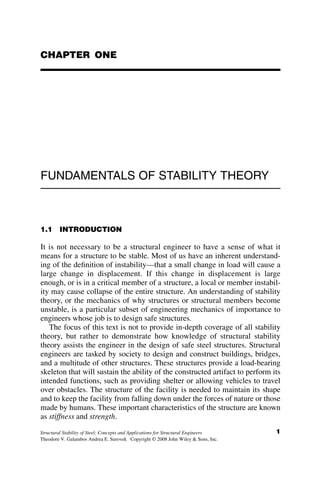
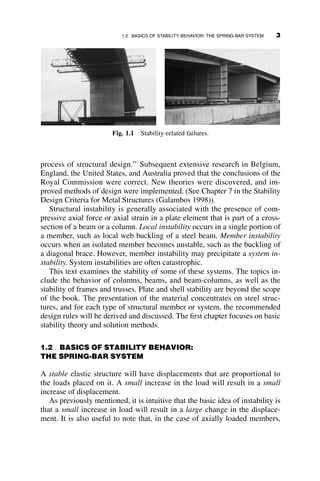
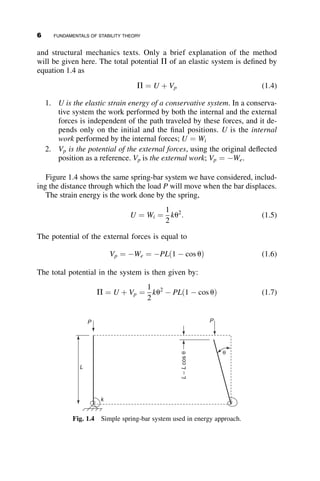
Instability failures are often catastrophic and occur most often during erec-
tion. For example, during the late 1960s and early 1970s, a number of major
steel box-girder bridges collapsed, causing many deaths among erection per-
sonnel. The two photographs in Figure 1.1 were taken by author Galambos in
August 1970 on the site two months before the collapse of a portion of the
Yarra River Crossing in Melbourne, Australia. The left picture in Figure 1.1
shows two halves of the multi-cell box girder before they were jacked into
place on top of the piers (see right photo), where they were connected with
high-strength bolts. One of the 367.5 ft. spans collapsed while the iron-
workers attempted to smooth the local buckles that had formed on the top
surface of the box. Thirty-five workers and engineers perished in the disaster.
There were a number of causes for the collapse, including inexperience
and carelessness, but the Royal Commission (1971), in its report pinpointed
the main problem: ‘‘We find that [the design organization] made assump-
tions about the behavior of box girders which extended beyond the range of
engineering knowledge.’’ The Royal Commission concluded ‘‘ . . . that the
design firm ‘‘failed altogether to give proper and careful regard to the
2 FUNDAMENTALS OF STABILITY THEORY
process of structural design.’’ Subsequent extensive research in Belgium,
England, the United States, and Australia proved that the conclusions of the
Royal Commission were correct. New theories were discovered, and im-
proved methods of design were implemented. (See Chapter 7 in the Stability
Design Criteria for Metal Structures (Galambos 1998)).
Structural instability is generally associated with the presence of com-
pressive axial force or axial strain in a plate element that is part of a cross-
section of a beam or a column. Local instability occurs in a single portion of
a member, such as local web buckling of a steel beam. Member instability
occurs when an isolated member becomes unstable, such as the buckling of
a diagonal brace. However, member instability may precipitate a system in-
stability. System instabilities are often catastrophic.
This text examines the stability of some of these systems. The topics in-
clude the behavior of columns, beams, and beam-columns, as well as the
stability of frames and trusses. Plate and shell stability are beyond the scope
of the book. The presentation of the material concentrates on steel struc-
tures, and for each type of structural member or system, the recommended
design rules will be derived and discussed. The first chapter focuses on basic
stability theory and solution methods.
1.2 BASICS OF STABILITY BEHAVIOR:
THE SPRING-BAR SYSTEM
A stable elastic structure will have displacements that are proportional to
the loads placed on it. A small increase in the load will result in a small
increase of displacement.
As previously mentioned, it is intuitive that the basic idea of instability is
that a small increase in load will result in a large change in the displace-
ment. It is also useful to note that, in the case of axially loaded members,
Fig. 1.1 Stability-related failures.
1.2 BASICS OF STABILITY BEHAVIOR: THE SPRING-BAR SYSTEM 3
the large displacement related to the instability is not in the same direction
as the load causing the instability.
In order to examine the most basic concepts of stability, we will consider
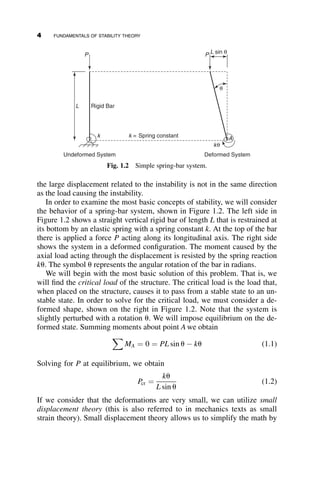
the behavior of a spring-bar system, shown in Figure 1.2. The left side in
Figure 1.2 shows a straight vertical rigid bar of length L that is restrained at
its bottom by an elastic spring with a spring constant k. At the top of the bar
there is applied a force P acting along its longitudinal axis. The right side
shows the system in a deformed configuration. The moment caused by the
axial load acting through the displacement is resisted by the spring reaction
ku. The symbol u represents the angular rotation of the bar in radians.
We will begin with the most basic solution of this problem. That is, we
will find the critical load of the structure. The critical load is the load that,
when placed on the structure, causes it to pass from a stable state to an un-
stable state. In order to solve for the critical load, we must consider a de-
formed shape, shown on the right in Figure 1.2. Note that the system is
slightly perturbed with a rotation u. We will impose equilibrium on the de-
formed state. Summing moments about point A we obtain
X
MA ¼ 0 ¼ PL sin u  ku (1.1)
Solving for P at equilibrium, we obtain
Pcr ¼
ku
L sin u
(1.2)
If we consider that the deformations are very small, we can utilize small
displacement theory (this is also referred to in mechanics texts as small
strain theory). Small displacement theory allows us to simplify the math by
P L sin θ
P
L Rigid Bar
Undeformed System Deformed System
k = Spring constant
kθ
k A
θ
Fig. 1.2 Simple spring-bar system.
4 FUNDAMENTALS OF STABILITY THEORY
recognizing that for very small values of the angle, u, we can use the
simplifications that
sin u ¼ u
tan u ¼ u
cos u ¼ 1
Substituting sin u ¼ u, we determine the critical load Pcr of the spring-bar
model to be:
Pcr ¼
ku
Lu
¼
k
L
(1.3)
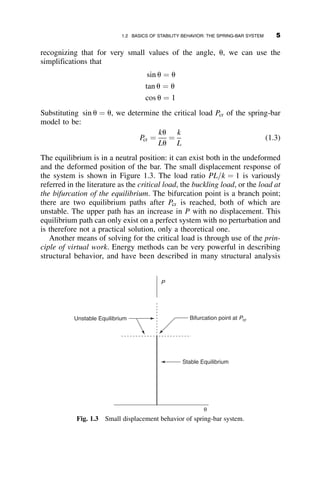
The equilibrium is in a neutral position: it can exist both in the undeformed
and the deformed position of the bar. The small displacement response of
the system is shown in Figure 1.3. The load ratio PL=k ¼ 1 is variously
referred in the literature as the critical load, the buckling load, or the load at
the bifurcation of the equilibrium. The bifurcation point is a branch point;
there are two equilibrium paths after Pcr is reached, both of which are
unstable. The upper path has an increase in P with no displacement. This
equilibrium path can only exist on a perfect system with no perturbation and
is therefore not a practical solution, only a theoretical one.
Another means of solving for the critical load is through use of the prin-
ciple of virtual work. Energy methods can be very powerful in describing
structural behavior, and have been described in many structural analysis
Stable Equilibrium
P
Unstable Equilibrium Bifurcation point at Pcr
θ
Fig. 1.3 Small displacement behavior of spring-bar system.
1.2 BASICS OF STABILITY BEHAVIOR: THE SPRING-BAR SYSTEM 5
and structural mechanics texts. Only a brief explanation of the method
will be given here. The total potential P of an elastic system is defined by
equation 1.4 as
P ¼ U þ Vp (1.4)
1. U is the elastic strain energy of a conservative system. In a conserva-
tive system the work performed by both the internal and the external
forces is independent of the path traveled by these forces, and it de-
pends only on the initial and the final positions. U is the internal
work performed by the internal forces; U ¼ Wi
2. Vp is the potential of the external forces, using the original deflected
position as a reference. Vp is the external work; Vp ¼ We.
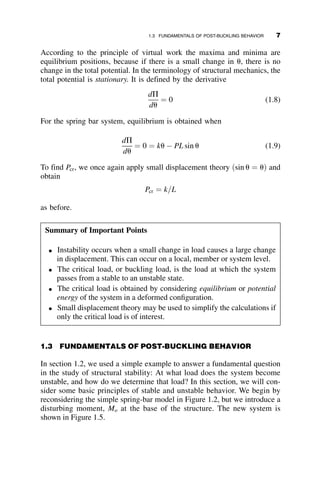
Figure 1.4 shows the same spring-bar system we have considered, includ-
ing the distance through which the load P will move when the bar displaces.
The strain energy is the work done by the spring,
U ¼ Wi ¼
1
2
ku2
: (1.5)
The potential of the external forces is equal to
Vp ¼ We ¼ PLð1  cos uÞ (1.6)
The total potential in the system is then given by:
P ¼ U þ Vp ¼
1
2
ku2
 PLð1  cos uÞ (1.7)
P
P
k
θ
L
–
L
cos
θ
L
Fig. 1.4 Simple spring-bar system used in energy approach.
6 FUNDAMENTALS OF STABILITY THEORY
According to the principle of virtual work the maxima and minima are
equilibrium positions, because if there is a small change in u, there is no
change in the total potential. In the terminology of structural mechanics, the
total potential is stationary. It is defined by the derivative
dP
du
¼ 0 (1.8)
For the spring bar system, equilibrium is obtained when
dP
du
¼ 0 ¼ ku  PL sin u (1.9)
To find Pcr, we once again apply small displacement theory ðsin u ¼ uÞ and
obtain
Pcr ¼ k=L
as before.
Summary of Important Points
 Instability occurs when a small change in load causes a large change
in displacement. This can occur on a local, member or system level.
 The critical load, or buckling load, is the load at which the system
passes from a stable to an unstable state.
 The critical load is obtained by considering equilibrium or potential
energy of the system in a deformed configuration.
 Small displacement theory may be used to simplify the calculations if
only the critical load is of interest.
1.3 FUNDAMENTALS OF POST-BUCKLING BEHAVIOR
In section 1.2, we used a simple example to answer a fundamental question
in the study of structural stability: At what load does the system become
unstable, and how do we determine that load? In this section, we will con-
sider some basic principles of stable and unstable behavior. We begin by
reconsidering the simple spring-bar model in Figure 1.2, but we introduce a
disturbing moment, Mo at the base of the structure. The new system is
shown in Figure 1.5.
1.3 FUNDAMENTALS OF POST-BUCKLING BEHAVIOR 7
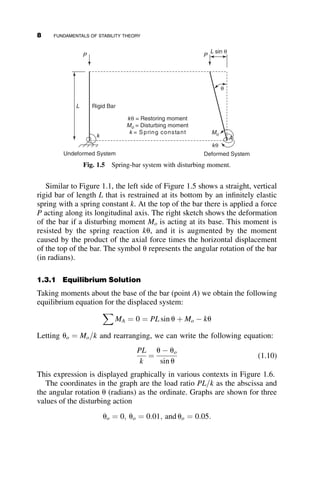
Similar to Figure 1.1, the left side of Figure 1.5 shows a straight, vertical
rigid bar of length L that is restrained at its bottom by an infinitely elastic
spring with a spring constant k. At the top of the bar there is applied a force
P acting along its longitudinal axis. The right sketch shows the deformation
of the bar if a disturbing moment Mo is acting at its base. This moment is
resisted by the spring reaction ku, and it is augmented by the moment
caused by the product of the axial force times the horizontal displacement
of the top of the bar. The symbol u represents the angular rotation of the bar
(in radians).
1.3.1 Equilibrium Solution
Taking moments about the base of the bar (point A) we obtain the following
equilibrium equation for the displaced system:
X
MA ¼ 0 ¼ PL sin u þ Mo  ku
Letting uo ¼ Mo=k and rearranging, we can write the following equation:
PL
k
¼
u  uo
sin u
(1.10)
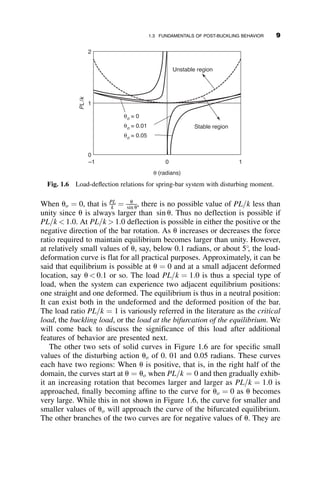
This expression is displayed graphically in various contexts in Figure 1.6.
The coordinates in the graph are the load ratio PL=k as the abscissa and
the angular rotation u (radians) as the ordinate. Graphs are shown for three
values of the disturbing action
uo ¼ 0; uo ¼ 0:01; and uo ¼ 0:05:
L sin θ
P
P
Rigid Bar
kθ
A
Mo
kθ = Restoring moment
Mo = Disturbing moment
k = Spring constant
k
L
θ
Undeformed System Deformed System
Fig. 1.5 Spring-bar system with disturbing moment.
8 FUNDAMENTALS OF STABILITY THEORY
When uo ¼ 0, that is PL
k ¼ u
sin u, there is no possible value of PL=k less than
unity since u is always larger than sin u. Thus no deflection is possible if
PL=k  1:0. At PL=k  1:0 deflection is possible in either the positive or the
negative direction of the bar rotation. As u increases or decreases the force
ratio required to maintain equilibrium becomes larger than unity. However,
at relatively small values of u, say, below 0.1 radians, or about 5
, the load-
deformation curve is flat for all practical purposes. Approximately, it can be
said that equilibrium is possible at u ¼ 0 and at a small adjacent deformed
location, say u  0:1 or so. The load PL=k ¼ 1:0 is thus a special type of
load, when the system can experience two adjacent equilibrium positions:
one straight and one deformed. The equilibrium is thus in a neutral position:
It can exist both in the undeformed and the deformed position of the bar.
The load ratio PL=k ¼ 1 is variously referred in the literature as the critical
load, the buckling load, or the load at the bifurcation of the equilibrium. We
will come back to discuss the significance of this load after additional
features of behavior are presented next.
The other two sets of solid curves in Figure 1.6 are for specific small
values of the disturbing action uo of 0. 01 and 0.05 radians. These curves
each have two regions: When u is positive, that is, in the right half of the
domain, the curves start at u ¼ uo when PL=k ¼ 0 and then gradually exhib-
it an increasing rotation that becomes larger and larger as PL=k ¼ 1:0 is
approached, finally becoming affine to the curve for uo ¼ 0 as u becomes
very large. While this in not shown in Figure 1.6, the curve for smaller and
smaller values of uo will approach the curve of the bifurcated equilibrium.
The other branches of the two curves are for negative values of u. They are
θ (radians)
–1 0 1
PL
/
k
0
1
2
Stable region
Unstable region
θo = 0
θo = 0.01
θo = 0.05
Fig. 1.6 Load-deflection relations for spring-bar system with disturbing moment.
1.3 FUNDAMENTALS OF POST-BUCKLING BEHAVIOR 9
in the left half of the deformation domain and they lie above the curve for
uo ¼ 0. They are in the unstable region for smaller values of u, that is,
they are above the dashed line defining the region between stable and unsta-
ble behavior, and they are in the stable region for larger values of u. (Note:
The stability limit will be derived later.) The curves for u are of little prac-
tical consequence for our further discussion.
The nature of the equilibrium, that is, its stability, is examined by disturb-
ing the already deformed system by an additional small rotation u
, as
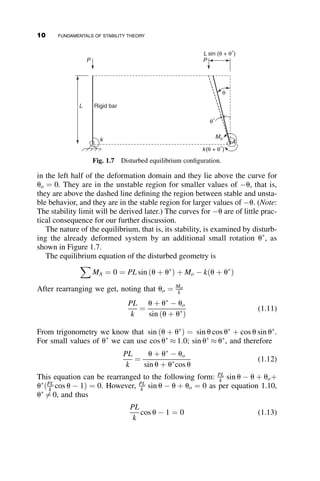
shown in Figure 1.7.
The equilibrium equation of the disturbed geometry is
X
MA ¼ 0 ¼ PL sin ðu þ u
Þ þ Mo  kðu þ u
Þ
After rearranging we get, noting that uo ¼ Mo
k
PL
k
¼
u þ u
 uo
sin ðu þ u
Þ
(1.11)
From trigonometry we know that sin ðu þ u
Þ ¼ sin u cos u
þ cos u sin u
.
For small values of u
we can use cos u
 1:0; sin u
 u
, and therefore
PL
k
¼
u þ u
 uo
sin u þ u
cos u
(1.12)
This equation can be rearranged to the following form: PL
k sin u  u þ uoþ
u
ðPL
k cos u  1Þ ¼ 0. However, PL
k sin u  u þ uo ¼ 0 as per equation 1.10,
u
6¼ 0, and thus
PL
k
cos u  1 ¼ 0 (1.13)
L sin (θ + θ*
)
P
P
Rigid bar
k(θ + θ*
)
Mo
A
k
θ
θ*
L
Fig. 1.7 Disturbed equilibrium configuration.
10 FUNDAMENTALS OF STABILITY THEORY
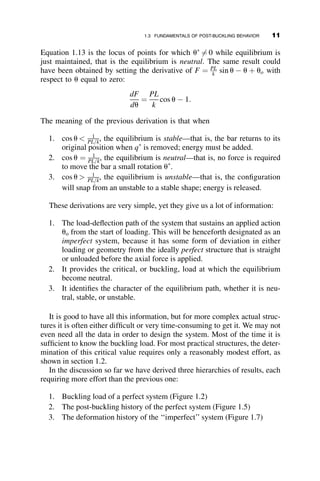
Equation 1.13 is the locus of points for which u
6¼ 0 while equilibrium is
just maintained, that is the equilibrium is neutral. The same result could
have been obtained by setting the derivative of F ¼ PL
k sin u  u þ uo with
respect to u equal to zero:
dF
du
¼
PL
k
cos u  1:
The meaning of the previous derivation is that when
1. cos u  1
PL=k, the equilibrium is stable—that is, the bar returns to its
original position when q
is removed; energy must be added.
2. cos u ¼ 1
PL=k, the equilibrium is neutral—that is, no force is required
to move the bar a small rotation u
.
3. cos u  1
PL=k, the equilibrium is unstable—that is, the configuration
will snap from an unstable to a stable shape; energy is released.
These derivations are very simple, yet they give us a lot of information:
1. The load-deflection path of the system that sustains an applied action
uo from the start of loading. This will be henceforth designated as an
imperfect system, because it has some form of deviation in either
loading or geometry from the ideally perfect structure that is straight
or unloaded before the axial force is applied.
2. It provides the critical, or buckling, load at which the equilibrium
become neutral.
3. It identifies the character of the equilibrium path, whether it is neu-
tral, stable, or unstable.
It is good to have all this information, but for more complex actual struc-
tures it is often either difficult or very time-consuming to get it. We may not
even need all the data in order to design the system. Most of the time it is
sufficient to know the buckling load. For most practical structures, the deter-
mination of this critical value requires only a reasonably modest effort, as
shown in section 1.2.
In the discussion so far we have derived three hierarchies of results, each
requiring more effort than the previous one:
1. Buckling load of a perfect system (Figure 1.2)
2. The post-buckling history of the perfect system (Figure 1.5)
3. The deformation history of the ‘‘imperfect’’ system (Figure 1.7)
1.3 FUNDAMENTALS OF POST-BUCKLING BEHAVIOR 11
In the previous derivations the equilibrium condition was established by
utilizing the statical approach. Equilibrium can, however, be determined by
using the theorem of virtual work. It is sometimes more convenient to use
this method, and the following derivation will feature the development of
this approach for the spring-bar problem.
1.3.2 Virtual Work Solution
We also examine the large displacement behavior of the system using the
energy approach described in section 1.2. The geometry of the system is
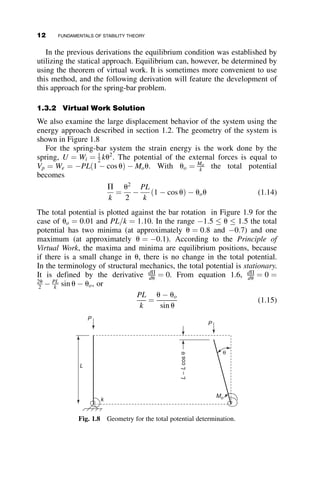
shown in Figure 1.8
For the spring-bar system the strain energy is the work done by the
spring, U ¼ Wi ¼ 1
2 ku2
. The potential of the external forces is equal to
Vp ¼ We ¼ PLð1  cos uÞ  Mou. With uo ¼ Mo
k the total potential
becomes
P
k
¼
u2
2

PL
k
ð1  cos uÞ  uou (1.14)
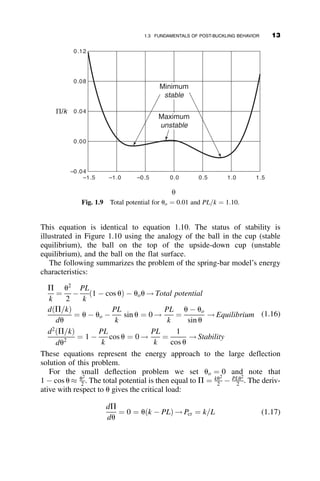
The total potential is plotted against the bar rotation in Figure 1.9 for the
case of uo ¼ 0:01 and PL=k ¼ 1:10. In the range 1:5  u  1:5 the total
potential has two minima (at approximately u ¼ 0:8 and 0:7) and one
maximum (at approximately u ¼ 0:1). According to the Principle of
Virtual Work, the maxima and minima are equilibrium positions, because
if there is a small change in u, there is no change in the total potential.
In the terminology of structural mechanics, the total potential is stationary.
It is defined by the derivative dP
du ¼ 0. From equation 1.6, dP
du ¼ 0 ¼
2u
2  PL
k sin u  uo, or
PL
k
¼
u  uo
sin u
(1.15)
P
P
L
Mo
k
θ
L
–
L
cos
θ
Fig. 1.8 Geometry for the total potential determination.
12 FUNDAMENTALS OF STABILITY THEORY
This equation is identical to equation 1.10. The status of stability is
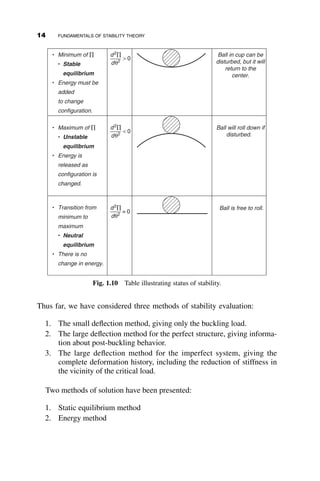
illustrated in Figure 1.10 using the analogy of the ball in the cup (stable
equilibrium), the ball on the top of the upside-down cup (unstable
equilibrium), and the ball on the flat surface.
The following summarizes the problem of the spring-bar model’s energy
characteristics:
P
k
¼
u2
2

PL
k
ð1  cos uÞ  uou ! Total potential
dðP=kÞ
du
¼ u  uo 
PL
k
sin u ¼ 0 !
PL
k
¼
u  uo
sin u
! Equilibrium
d2
ðP=kÞ
du2
¼ 1 
PL
k
cos u ¼ 0 !
PL
k
¼
1
cos u
! Stability
(1.16)
These equations represent the energy approach to the large deflection
solution of this problem.
For the small deflection problem we set uo ¼ 0 and note that
1  cos u  u2
2 . The total potential is then equal to P ¼ ku2
2  PLu2
2 . The deriv-
ative with respect to u gives the critical load:
dP
du
¼ 0 ¼ uðk  PLÞ ! Pcr ¼ k=L (1.17)
–1.5 –1.0 –0.5 0.0 0.5 1.0 1.5
Π/k
–0.04
0.00
0.04
0.08
0.12
Maximum
unstable
Minimum
stable
θ
Fig. 1.9 Total potential for uo ¼ 0:01 and PL=k ¼ 1:10.
1.3 FUNDAMENTALS OF POST-BUCKLING BEHAVIOR 13
Thus far, we have considered three methods of stability evaluation:
1. The small deflection method, giving only the buckling load.
2. The large deflection method for the perfect structure, giving informa-
tion about post-buckling behavior.
3. The large deflection method for the imperfect system, giving the
complete deformation history, including the reduction of stiffness in
the vicinity of the critical load.
Two methods of solution have been presented:
1. Static equilibrium method
2. Energy method
• Minimum of ∏
• Stable
equilibrium
• Energy must be
added
to change
configuration.
d2
∏
dθ2
Ball in cup can be
disturbed, but it will
return to the
center.
• Maximum of ∏
• Unstable
equilibrium
• Energy is
released as
configuration is
changed.
Ball will roll down if
disturbed.
• Transition from
minimum to
maximum
• Neutral
equilibrium
• There is no
change in energy.
Ball is free to roll.
 0
 0
d2
∏
dθ2
= 0
d2
∏
dθ2
Fig. 1.10 Table illustrating status of stability.
14 FUNDAMENTALS OF STABILITY THEORY
Such stability-checking procedures are applied to analytically exact and ap-
proximate methods for real structures in the subsequent portions of this book.
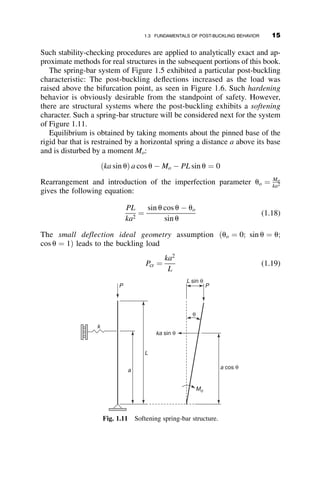
The spring-bar system of Figure 1.5 exhibited a particular post-buckling
characteristic: The post-buckling deflections increased as the load was
raised above the bifurcation point, as seen in Figure 1.6. Such hardening
behavior is obviously desirable from the standpoint of safety. However,
there are structural systems where the post-buckling exhibits a softening
character. Such a spring-bar structure will be considered next for the system
of Figure 1.11.
Equilibrium is obtained by taking moments about the pinned base of the
rigid bar that is restrained by a horizontal spring a distance a above its base
and is disturbed by a moment Mo:
ðka sin uÞ a cos u  Mo  PL sin u ¼ 0
Rearrangement and introduction of the imperfection parameter uo ¼ Mo
ka2
gives the following equation:
PL
ka2
¼
sin u cos u  uo
sin u
(1.18)
The small deflection ideal geometry assumption ðuo ¼ 0; sin u ¼ u;
cos u ¼ 1Þ leads to the buckling load
Pcr ¼
ka2
L
(1.19)
k
a
L
ka sin θ
L sin θ
Mo
a cos θ
P
P
θ
Fig. 1.11 Softening spring-bar structure.
1.3 FUNDAMENTALS OF POST-BUCKLING BEHAVIOR 15
From the large deflection-ideal geometry assumption ðuo ¼ 0Þ we get the
post-buckling strength:
Pcr ¼
ka2
L
cos u (1.20)
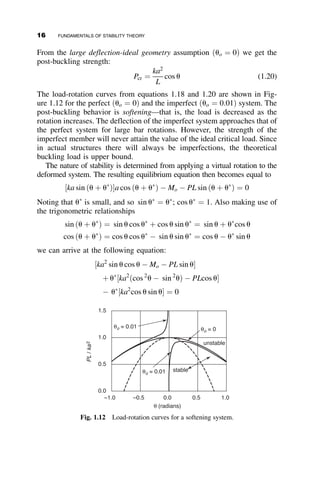
The load-rotation curves from equations 1.18 and 1.20 are shown in Fig-
ure 1.12 for the perfect ðuo ¼ 0Þ and the imperfect ðuo ¼ 0:01Þ system. The
post-buckling behavior is softening—that is, the load is decreased as the
rotation increases. The deflection of the imperfect system approaches that of
the perfect system for large bar rotations. However, the strength of the
imperfect member will never attain the value of the ideal critical load. Since
in actual structures there will always be imperfections, the theoretical
buckling load is upper bound.
The nature of stability is determined from applying a virtual rotation to the
deformed system. The resulting equilibrium equation then becomes equal to
½ka sin ðu þ u
Þa cos ðu þ u
Þ  Mo  PL sin ðu þ u
Þ ¼ 0
Noting that u
is small, and so sin u
¼ u
; cos u
¼ 1. Also making use of
the trigonometric relationships
sin ðu þ u
Þ ¼ sin u cos u
þ cos u sin u
¼ sin u þ u
cos u
cos ðu þ u
Þ ¼ cos u cos u
 sin u sin u
¼ cos u  u
sin u
we can arrive at the following equation:
½ka2
sin u cos u  Mo  PL sin u
þ u
½ka2
ðcos 2
u  sin 2
uÞ  PLcos u
 u
½ka2
cos u sin u ¼ 0
–1.0 –0.5 0.0 0.5 1.0
PL
/
ka
2
0.0
0.5
1.0
1.5
stable
unstable
θo = 0.01
θo = 0.01
θ (radians)
θo = 0
Fig. 1.12 Load-rotation curves for a softening system.
16 FUNDAMENTALS OF STABILITY THEORY
The first line is the equilibrium equation, and it equals zero, as demonstrated
above. The bracket in the third line is multiplied by the square of a small
quantity ðu
	 u2
Þ and so it can be neglected. From the second line
we obtain the stability condition that is shown in Figure 1.12 as a dashed
line:
PL
ka2
¼
cos2
u  sin2
u
cos u
¼
2 cos2
u  1
cos u
(1.21)
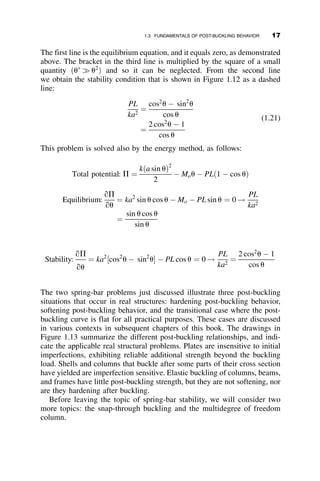
This problem is solved also by the energy method, as follows:
Total potential: P ¼
kða sin uÞ2
2
 Mou  PLð1  cos uÞ
Equilibrium:
qP
qu
¼ ka2
sin u cos u  Mo  PL sin u ¼ 0 !
PL
ka2
¼
sin u cos u
sin u
The two spring-bar problems just discussed illustrate three post-buckling
situations that occur in real structures: hardening post-buckling behavior,
softening post-buckling behavior, and the transitional case where the post-
buckling curve is flat for all practical purposes. These cases are discussed
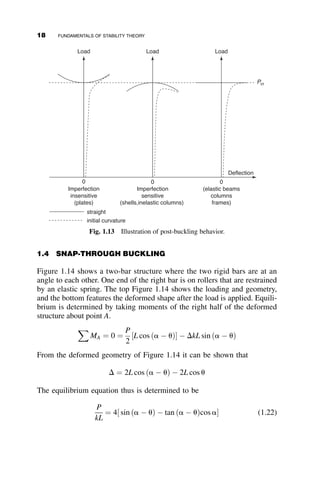
in various contexts in subsequent chapters of this book. The drawings in
Figure 1.13 summarize the different post-buckling relationships, and indi-
cate the applicable real structural problems. Plates are insensitive to initial
imperfections, exhibiting reliable additional strength beyond the buckling
load. Shells and columns that buckle after some parts of their cross section
have yielded are imperfection sensitive. Elastic buckling of columns, beams,
and frames have little post-buckling strength, but they are not softening, nor
are they hardening after buckling.
Before leaving the topic of spring-bar stability, we will consider two
more topics: the snap-through buckling and the multidegree of freedom
column.
Stability:
qP
qu
¼ ka2
½cos2
u  sin2
u  PL cos u ¼ 0 !
PL
ka2
¼
2 cos2
u  1
cos u
1.3 FUNDAMENTALS OF POST-BUCKLING BEHAVIOR 17
1.4 SNAP-THROUGH BUCKLING
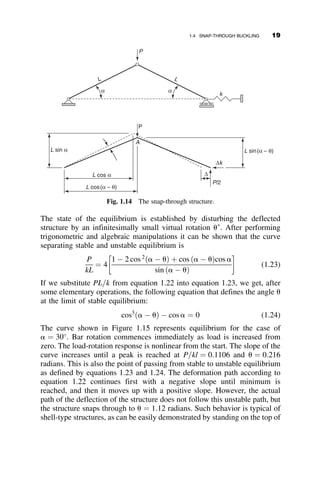
Figure 1.14 shows a two-bar structure where the two rigid bars are at an
angle to each other. One end of the right bar is on rollers that are restrained
by an elastic spring. The top Figure 1.14 shows the loading and geometry,
and the bottom features the deformed shape after the load is applied. Equili-
brium is determined by taking moments of the right half of the deformed
structure about point A.
X
MA ¼ 0 ¼
P
2
½L cos ða  uÞ  DkL sin ða  uÞ
From the deformed geometry of Figure 1.14 it can be shown that
D ¼ 2L cos ða  uÞ  2L cos u
The equilibrium equation thus is determined to be
P
kL
¼ 4½ sin ða  uÞ  tan ða  uÞcos a (1.22)
Load
Load
Load
0
0
0
Deflection
Imperfection
insensitive
(plates)
Imperfection
sensitive
(shells,inelastic columns)
(elastic beams
columns
frames)
straight
initial curvature
Pcr
Fig. 1.13 Illustration of post-buckling behavior.
18 FUNDAMENTALS OF STABILITY THEORY
The state of the equilibrium is established by disturbing the deflected
structure by an infinitesimally small virtual rotation u
. After performing
trigonometric and algebraic manipulations it can be shown that the curve
separating stable and unstable equilibrium is
P
kL
¼ 4
1  2 cos 2
ða  uÞ þ cos ða  uÞcos a
sin ða  uÞ
 
(1.23)
If we substitute PL=k from equation 1.22 into equation 1.23, we get, after
some elementary operations, the following equation that defines the angle u
at the limit of stable equilibrium:
cos3
ða  uÞ  cos a ¼ 0 (1.24)
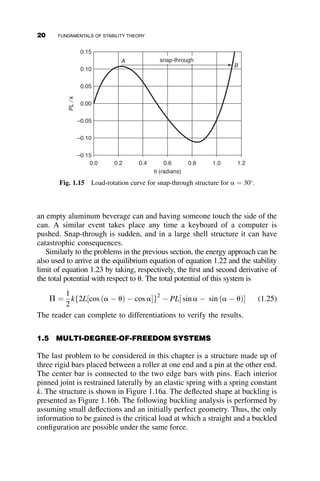
The curve shown in Figure 1.15 represents equilibrium for the case of
a ¼ 30
. Bar rotation commences immediately as load is increased from
zero. The load-rotation response is nonlinear from the start. The slope of the
curve increases until a peak is reached at P=kl ¼ 0:1106 and u ¼ 0:216
radians. This is also the point of passing from stable to unstable equilibrium
as defined by equations 1.23 and 1.24. The deformation path according to
equation 1.22 continues first with a negative slope until minimum is
reached, and then it moves up with a positive slope. However, the actual
path of the deflection of the structure does not follow this unstable path, but
the structure snaps through to u ¼ 1:12 radians. Such behavior is typical of
shell-type structures, as can be easily demonstrated by standing on the top of
α
L
L
k
P
α
A
L cos α
L cos(α – θ)
L sin α L sin(α – θ)
∆
∆k
P
P/2
Fig. 1.14 The snap-through structure.
1.4 SNAP-THROUGH BUCKLING 19
an empty aluminum beverage can and having someone touch the side of the
can. A similar event takes place any time a keyboard of a computer is
pushed. Snap-through is sudden, and in a large shell structure it can have
catastrophic consequences.
Similarly to the problems in the previous section, the energy approach can be
also used to arrive at the equilibrium equation of equation 1.22 and the stability
limit of equation 1.23 by taking, respectively, the first and second derivative of
the total potential with respect to u. The total potential of this system is
P ¼
1
2
kf2L½cos ða  uÞ  cos ag2
 PL½ sin a  sin ða  uÞ (1.25)
The reader can complete to differentiations to verify the results.
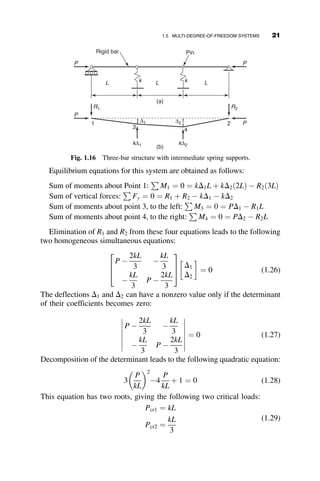
1.5 MULTI-DEGREE-OF-FREEDOM SYSTEMS
The last problem to be considered in this chapter is a structure made up of
three rigid bars placed between a roller at one end and a pin at the other end.
The center bar is connected to the two edge bars with pins. Each interior
pinned joint is restrained laterally by an elastic spring with a spring constant
k. The structure is shown in Figure 1.16a. The deflected shape at buckling is
presented as Figure 1.16b. The following buckling analysis is performed by
assuming small deflections and an initially perfect geometry. Thus, the only
information to be gained is the critical load at which a straight and a buckled
configuration are possible under the same force.
θ (radians)
0.0 0.2 0.4 0.6 0.8 1.0 1.2
PL
/
k
–0.15
–0.10
–0.05
0.00
0.05
0.10
0.15
snap-through
A
B
Fig. 1.15 Load-rotation curve for snap-through structure for a ¼ 30
.
20 FUNDAMENTALS OF STABILITY THEORY
Equilibrium equations for this system are obtained as follows:
Sum of moments about Point 1:
P
M1 ¼ 0 ¼ kD1L þ kD2ð2LÞ  R2ð3LÞ
Sum of vertical forces:
P
Fy ¼ 0 ¼ R1 þ R2  kD1  kD2
Sum of moments about point 3, to the left:
P
M3 ¼ 0 ¼ PD1  R1L
Sum of moments about point 4, to the right:
P
M4 ¼ 0 ¼ PD2  R2L
Elimination of R1 and R2 from these four equations leads to the following
two homogeneous simultaneous equations:
P 
2kL
3

kL
3

kL
3
P 
2kL
3
2
6
4
3
7
5
D1
D2
 
¼ 0 (1.26)
The deflections D1 and D2 can have a nonzero value only if the determinant
of their coefficients becomes zero:
P 
2kL
3

kL
3

kL
3
P 
2kL
3
¼ 0 (1.27)
Decomposition of the determinant leads to the following quadratic equation:
3
P
kL
 2
4
P
kL
þ 1 ¼ 0 (1.28)
This equation has two roots, giving the following two critical loads:
Pcr1 ¼ kL
Pcr2 ¼
kL
3
(1.29)
Pin
Rigid bar
k k
P P
R1 R2
P
P
1 2
3 4
(a)
(b)
L L L
k∆1 k∆2
∆1 ∆2
Fig. 1.16 Three-bar structure with intermediate spring supports.
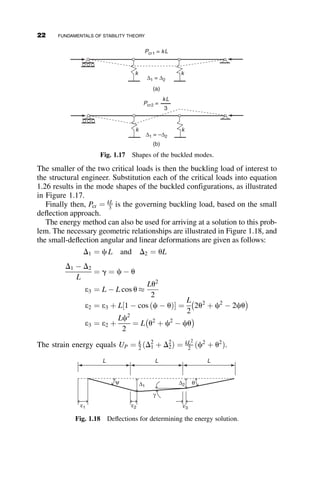
1.5 MULTI-DEGREE-OF-FREEDOM SYSTEMS 21
The smaller of the two critical loads is then the buckling load of interest to
the structural engineer. Substitution each of the critical loads into equation
1.26 results in the mode shapes of the buckled configurations, as illustrated
in Figure 1.17.
Finally then, Pcr ¼ kL
3 is the governing buckling load, based on the small
deflection approach.
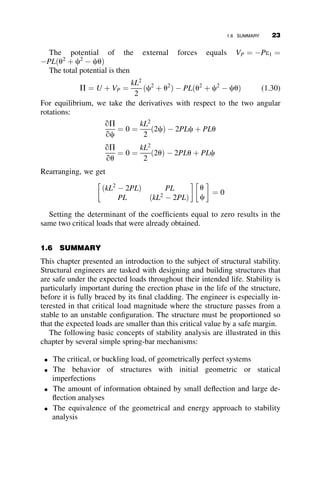
The energy method can also be used for arriving at a solution to this prob-
lem. The necessary geometric relationships are illustrated in Figure 1.18, and
the small-deflection angular and linear deformations are given as follows:
D1 ¼ c L and D2 ¼ uL
D1  D2
L
¼ g ¼ c  u
e3 ¼ L  L cos u 
Lu2
2
e2 ¼ e3 þ L½1  cos ðc  uÞ ¼
L
2
2u2
þ c2
 2cu

e3 ¼ e2 þ
Lc2
2
¼ L u2
þ c2
 cu

The strain energy equals UP ¼ k
2 ðD2
1 þ D2
2Þ ¼ kL2
2 ðc2
þ u2
Þ.
k k
Pcr1 = kL
Pcr2 =
(a)
(b)
k k
3
kL
∆1 = ∆2
∆1 = –∆2
Fig. 1.17 Shapes of the buckled modes.
θ
ε1 ε2 ε3
L L L
∆1
∆2
ψ
γ
Fig. 1.18 Deflections for determining the energy solution.
22 FUNDAMENTALS OF STABILITY THEORY
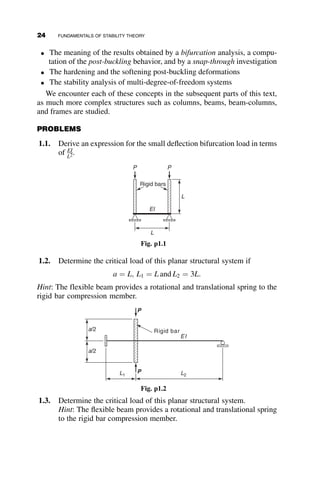
The potential of the external forces equals VP ¼ Pe1 ¼
PLðu2
þ c2
 cuÞ
The total potential is then
P ¼ U þ VP ¼
kL2
2
ðc2
þ u2
Þ  PLðu2
þ c2
 cuÞ (1.30)
For equilibrium, we take the derivatives with respect to the two angular
rotations:
qP
qc
¼ 0 ¼
kL2
2
ð2cÞ  2PLc þ PLu
qP
qu
¼ 0 ¼
kL2
2
ð2uÞ  2PLu þ PLc
Rearranging, we get
ðkL2
 2PLÞ PL
PL ðkL2
 2PLÞ
 
u
c
 
¼ 0
Setting the determinant of the coefficients equal to zero results in the
same two critical loads that were already obtained.
1.6 SUMMARY
This chapter presented an introduction to the subject of structural stability.
Structural engineers are tasked with designing and building structures that
are safe under the expected loads throughout their intended life. Stability is
particularly important during the erection phase in the life of the structure,
before it is fully braced by its final cladding. The engineer is especially in-
terested in that critical load magnitude where the structure passes from a
stable to an unstable configuration. The structure must be proportioned so
that the expected loads are smaller than this critical value by a safe margin.
The following basic concepts of stability analysis are illustrated in this
chapter by several simple spring-bar mechanisms:
 The critical, or buckling load, of geometrically perfect systems
 The behavior of structures with initial geometric or statical
imperfections
 The amount of information obtained by small deflection and large de-
flection analyses
 The equivalence of the geometrical and energy approach to stability
analysis
1.6 SUMMARY 23
The meaning of the results obtained by a bifurcation analysis, a compu-
tation of the post-buckling behavior, and by a snap-through investigation
 The hardening and the softening post-buckling deformations
 The stability analysis of multi-degree-of-freedom systems
We encounter each of these concepts in the subsequent parts of this text,
as much more complex structures such as columns, beams, beam-columns,
and frames are studied.
PROBLEMS
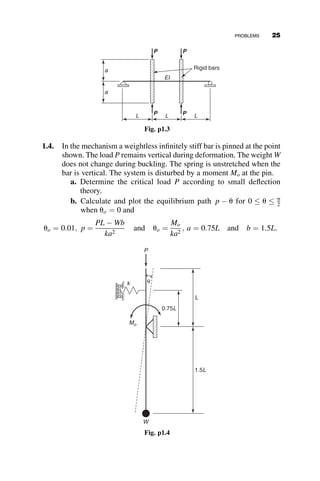
1.1. Derive an expression for the small deflection bifurcation load in terms
of EI
L2.
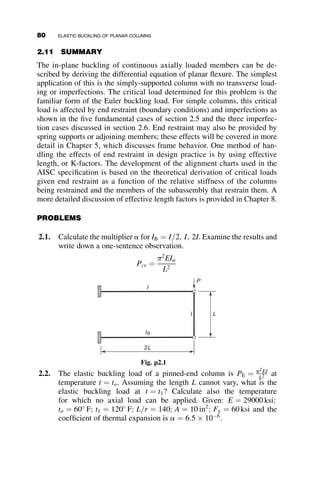
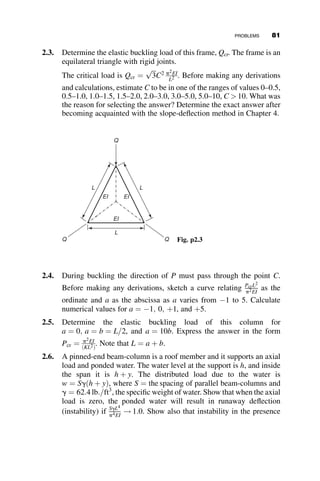
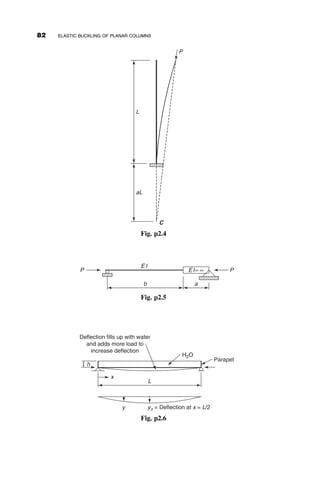
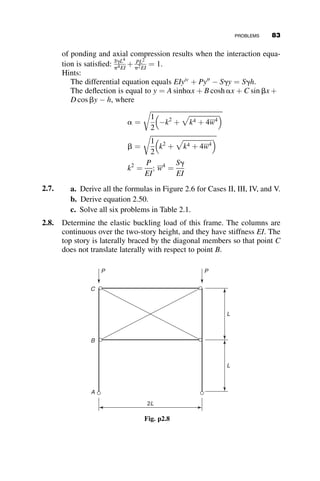
1.2. Determine the critical load of this planar structural system if
a ¼ L; L1 ¼ L and L2 ¼ 3L:
Hint: The flexible beam provides a rotational and translational spring to the
rigid bar compression member.
1.3. Determine the critical load of this planar structural system.
Hint: The flexible beam provides a rotational and translational spring
to the rigid bar compression member.
P P
L
L
EI
Rigid bars
Fig. p1.1
a/2
a/2
L2
L1
P
P
Rigid bar
EI
Fig. p1.2
24 FUNDAMENTALS OF STABILITY THEORY
1.4. In the mechanism a weightless infinitely stiff bar is pinned at the point
shown. The load P remains vertical during deformation. The weight W
does not change during buckling. The spring is unstretched when the
bar is vertical. The system is disturbed by a moment Mo at the pin.
a. Determine the critical load P according to small deflection
theory.
b. Calculate and plot the equilibrium path p  u for 0  u  p
2
when uo ¼ 0 and
uo ¼ 0:01; p ¼
PL  Wb
ka2
and uo ¼
Mo
ka2
; a ¼ 0:75L and b ¼ 1:5L:
a
a
P
P
Rigid bars
EI
P
P
L L L
Fig. p1.3
P
k
L
1.5L
0.75L
Mo
W
θ
Fig. p1.4
PROBLEMS 25
c. Investigate the stability of the equilibrium path.
d. Discuss the problem.
Note: This problem was adapted from Chapter 2, Simitses ‘‘An intro-
duction to the elastic stability of structures’’ (see end of Chapter 2 for
reference details).
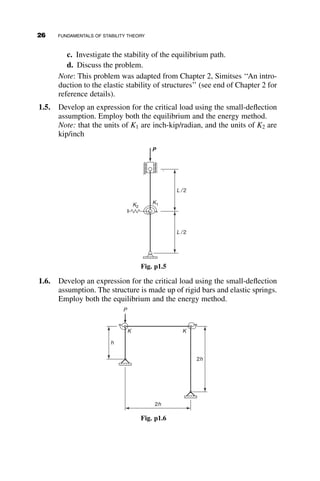
1.5. Develop an expression for the critical load using the small-deflection
assumption. Employ both the equilibrium and the energy method.
Note: that the units of K1 are inch-kip/radian, and the units of K2 are
kip/inch
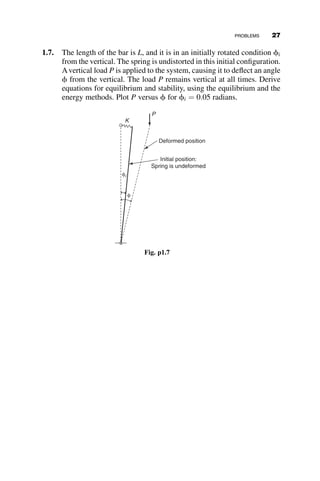
1.6. Develop an expression for the critical load using the small-deflection
assumption. The structure is made up of rigid bars and elastic springs.
Employ both the equilibrium and the energy method.
P
L / 2
L / 2
K1
K2
Fig. p1.5
P
K K
2h
h
2h
Fig. p1.6
26 FUNDAMENTALS OF STABILITY THEORY
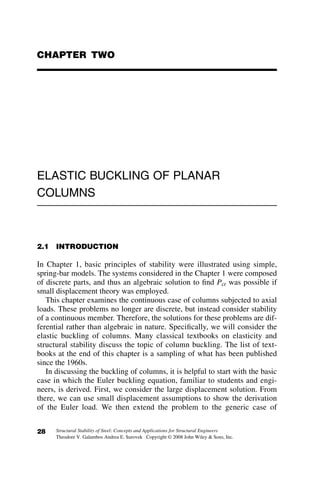
1.7. The length of the bar is L, and it is in an initially rotated condition fi
from the vertical. The spring is undistorted in this initial configuration.
Avertical load P is applied to the system, causing it to deflect an angle
f from the vertical. The load P remains vertical at all times. Derive
equations for equilibrium and stability, using the equilibrium and the
energy methods. Plot P versus f for fi ¼ 0:05 radians.
K
P
Deformed position
Initial position:
Spring is undeformed
φi
φ
Fig. p1.7
PROBLEMS 27
CHAPTER TWO
ELASTIC BUCKLING OF PLANAR
COLUMNS
2.1 INTRODUCTION
In Chapter 1, basic principles of stability were illustrated using simple,
spring-bar models. The systems considered in the Chapter 1 were composed
of discrete parts, and thus an algebraic solution to find Pcr was possible if
small displacement theory was employed.
This chapter examines the continuous case of columns subjected to axial
loads. These problems no longer are discrete, but instead consider stability
of a continuous member. Therefore, the solutions for these problems are dif-
ferential rather than algebraic in nature. Specifically, we will consider the
elastic buckling of columns. Many classical textbooks on elasticity and
structural stability discuss the topic of column buckling. The list of text-
books at the end of this chapter is a sampling of what has been published
since the 1960s.
In discussing the buckling of columns, it is helpful to start with the basic
case in which the Euler buckling equation, familiar to students and engi-
neers, is derived. First, we consider the large displacement solution. From
there, we can use small displacement assumptions to show the derivation
of the Euler load. We then extend the problem to the generic case of
28 Structural Stability of Steel: Concepts and Applications for Structural Engineers
Theodore V. Galambos Andrea E. Surovek Copyright © 2008 John Wiley  Sons, Inc.
planar flexure. This very general case can be used to examine the numerous
parametric variations of the basic problem, such as effects of imperfections
and boundary conditions.
2.2 LARGE-DEFLECTION SOLUTION OF
AN ELASTIC COLUMN
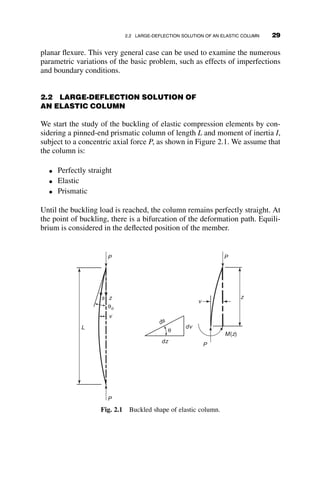
We start the study of the buckling of elastic compression elements by con-
sidering a pinned-end prismatic column of length L and moment of inertia I,
subject to a concentric axial force P, as shown in Figure 2.1. We assume that
the column is:
 Perfectly straight
 Elastic
 Prismatic
Until the buckling load is reached, the column remains perfectly straight. At
the point of buckling, there is a bifurcation of the deformation path. Equili-
brium is considered in the deflected position of the member.
L
P
P
v
s z
θo
ds
dv
θ
dz
P
P
z
v
M(z)
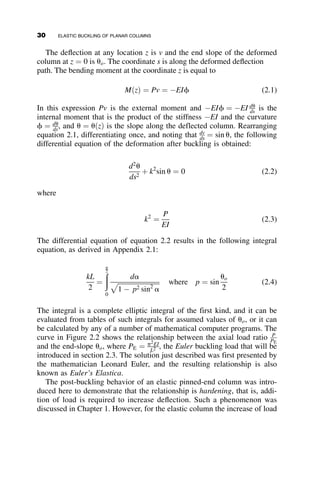
Fig. 2.1 Buckled shape of elastic column.
2.2 LARGE-DEFLECTION SOLUTION OF AN ELASTIC COLUMN 29
The deflection at any location z is v and the end slope of the deformed
column at z ¼ 0 is uo. The coordinate s is along the deformed deflection
path. The bending moment at the coordinate z is equal to
MðzÞ ¼ Pv ¼ EIf (2.1)
In this expression Pv is the external moment and EIf ¼ EI du
ds is the
internal moment that is the product of the stiffness EI and the curvature
f ¼ du
ds, and u ¼ uðzÞ is the slope along the deflected column. Rearranging
equation 2.1, differentiating once, and noting that dv
ds ¼ sin u, the following
differential equation of the deformation after buckling is obtained:
d2
u
ds2
þ k2
sin u ¼ 0 (2.2)
where
k2
¼
P
EI
(2.3)
The differential equation of equation 2.2 results in the following integral
equation, as derived in Appendix 2.1:
kL
2
¼
ð
p
2
0
da
ffiffiffiffiffiffiffiffiffiffiffiffiffiffiffiffiffiffiffiffiffiffiffiffiffiffi
1  p2 sin2
a
p where p ¼ sin
uo
2
(2.4)
The integral is a complete elliptic integral of the first kind, and it can be
evaluated from tables of such integrals for assumed values of uo, or it can
be calculated by any of a number of mathematical computer programs. The
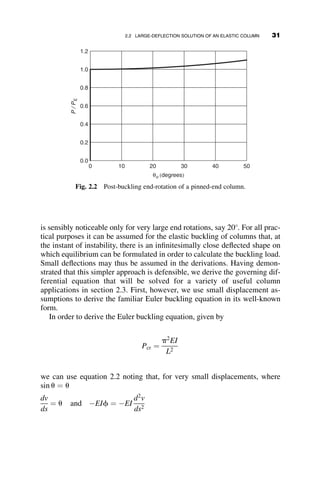
curve in Figure 2.2 shows the relationship between the axial load ratio P
PE
and the end-slope uo, where PE ¼ p2EI
L2 , the Euler buckling load that will be
introduced in section 2.3. The solution just described was first presented by
the mathematician Leonard Euler, and the resulting relationship is also
known as Euler’s Elastica.
The post-buckling behavior of an elastic pinned-end column was intro-
duced here to demonstrate that the relationship is hardening, that is, addi-
tion of load is required to increase deflection. Such a phenomenon was
discussed in Chapter 1. However, for the elastic column the increase of load
30 ELASTIC BUCKLING OF PLANAR COLUMNS
is sensibly noticeable only for very large end rotations, say 20
. For all prac-
tical purposes it can be assumed for the elastic buckling of columns that, at
the instant of instability, there is an infinitesimally close deflected shape on
which equilibrium can be formulated in order to calculate the buckling load.
Small deflections may thus be assumed in the derivations. Having demon-
strated that this simpler approach is defensible, we derive the governing dif-
ferential equation that will be solved for a variety of useful column
applications in section 2.3. First, however, we use small displacement as-
sumptions to derive the familiar Euler buckling equation in its well-known
form.
In order to derive the Euler buckling equation, given by
Pcr ¼
p2
EI
L2
we can use equation 2.2 noting that, for very small displacements, where
sin u ¼ u
dv
ds
¼ u and EIf ¼ EI
d2
v
ds2
θo (degrees)
0 10 20 30 40 50
P
/
P
E
0.0
0.2
0.4
0.6
0.8
1.0
1.2
Fig. 2.2 Post-buckling end-rotation of a pinned-end column.
2.2 LARGE-DEFLECTION SOLUTION OF AN ELASTIC COLUMN 31
The governing differential equation becomes equal to
EI
d2
v
ds2
þ Pv ¼ 0
Remembering that k2
¼ P
EI we obtain
v00
þ k2
v ¼ 0
The general solution for a homogenous differential equation of this form is
given by
v ¼ A sin ks þ B cos ks
for small deflections we can set s ¼ z (see Figure 2.1). We know two
boundary conditions for this column, based on the end restraint
vð0Þ ¼ 0
vðLÞ ¼ 0
From the first condition, we find that B ¼ 0, leaving us with v ¼ A sin kz.
Substituting in the second boundary condition gives this equation:
A sin kL ¼ 0
Since A ¼ 0 is a trivial solution, we know that sin kL ¼ 0. For now, we will
take the first possible solution for which sin kL ¼ 0, namely kL ¼ p.
Substituting in k2
¼ P
EI, we obtain the classic Euler buckling equation:
P ¼
p2
EI
L2
We discuss this solution in more depth in section 2.4.
2.3 DIFFERENTIAL EQUATION OF PLANAR FLEXURE
The solutions presented in section 2.2 are specific to a column that meets the
rather stringent assumptions of that section. In order to consider several pa-
rameters and their effect on the column buckling strength, we derive the
general equation of planar flexure for the beam-column shown in Fig-
ure 2.3a. There are two possible ways to derive the differential equation of
32 ELASTIC BUCKLING OF PLANAR COLUMNS
planar buckling: (1) equilibrium formulation based on the deformed
geometry of an element dx along the length of the member, and (2) using
the calculus of variations approach. The former method is used in the ensu-
ing parts of this section, since it illustrates the physical behavior of the
beam-column more clearly (as all engineers are familiar with the concept of
equilibrium).
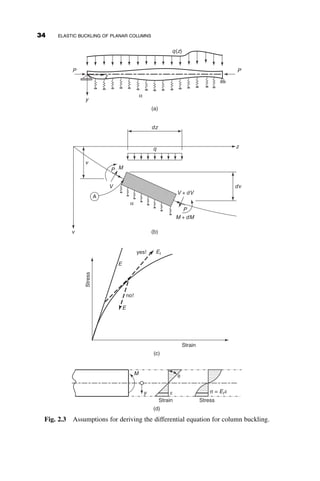
The sketch in Figure 2.3a shows a column member that has a length an
order of magnitude larger than its depth. Following are the 15 conditions
and assumptions of the derivation:
1. The member may have a variation of its cross-sectional and material
properties along its longitudinal axis z.
2. The axial force P acts along the centroidal axis of the column, and it
does not change direction during buckling.
3. The deflection is due to a distributed load q(z) that acts in the z-y
plane.
4. The deflection v is restricted to the z-y plane.
5. The deflection v is resisted by an elastic foundation resulting in a dis-
tributed force av, where a is the foundation modulus. (Such a founda-
tion is known as a Winkler Foundation.)
6. Equilibrium is formulated on the deformed axis of the member.
7. The cross-section is singly or doubly symmetric. That is, the y-axis is
an axis of symmetry. (The cross-section is defined by its conventional
x-y plane.)
8. Deflections are small compared to the depth of the cross-section.
9. The stress-strain law of the material is known.
10. Plane sections before bending will remain plane after bending. (This
is also known as Navier’s hypothesis.)
11. Strains are proportional to the distance from the neutral axis of bend-
ing. That is, the member cannot be strongly curved in its plane of
symmetry, such as, for example, a crane hook.
12. The cross-section does not change shape during deflection. That is,
no local buckling occurs.
13. Shear deformations are neglected.
14. Lateral-torsional buckling is prevented by bracing.
15. Local effects are neglected. For example, Saint Venant’s principle is
a local effect.
The list of assumptions and restrictions is lengthy, but many of them
will eventually be lifted. We start with the derivation by considering the
2.3 DIFFERENTIAL EQUATION OF PLANAR FLEXURE 33
P
(a)
P
y
z
q(z)
α
dz
v
z
q
dv
v
M
V
M + dM
V + dV
P
P
A
α
(b)
Stress
Strain
E
E
Et
yes!
no!
(c)
M
y ε σ = Et ε
Stress
Strain
φ
(d)
Fig. 2.3 Assumptions for deriving the differential equation for column buckling.
34 ELASTIC BUCKLING OF PLANAR COLUMNS
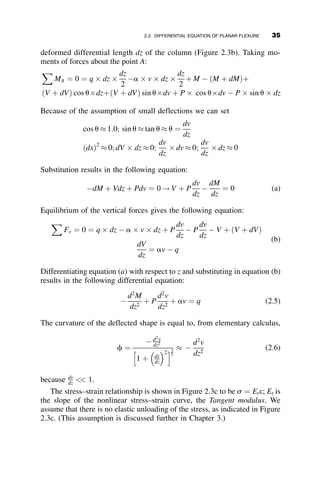
deformed differential length dz of the column (Figure 2.3b). Taking mo-
ments of forces about the point A:
X
MA ¼ 0 ¼ q  dz 
dz
2
a  v  dz 
dz
2
þ M  ðM þ dMÞþ
ðV þ dVÞ cos udzþðV þ dVÞ sin udv þ P  cos udv  P  sin u  dz
Because of the assumption of small deflections we can set
cos u  1:0; sin u  tan u  u ¼
dv
dz
ðdxÞ2
 0; dV  dz  0;
dv
dz
 dv  0;
dv
dz
 dz  0
Substitution results in the following equation:
dM þ Vdz þ Pdv ¼ 0 ! V þ P
dv
dz

dM
dz
¼ 0 (a)
Equilibrium of the vertical forces gives the following equation:
X
Fv ¼ 0 ¼ q  dz  a  v  dz þ P
dv
dz
 P
dv
dz
 V þ ðV þ dVÞ
dV
dz
¼ av  q
(b)
Differentiating equation (a) with respect to z and substituting in equation (b)
results in the following differential equation:

d2
M
dz2
þ P
d2
v
dz2
þ av ¼ q (2.5)
The curvature of the deflected shape is equal to, from elementary calculus,
f ¼
 d2v
dz2
h
1 þ dv
dz
 2i3
2
 
d2
v
dz2
(2.6)
because dv
dz  1.
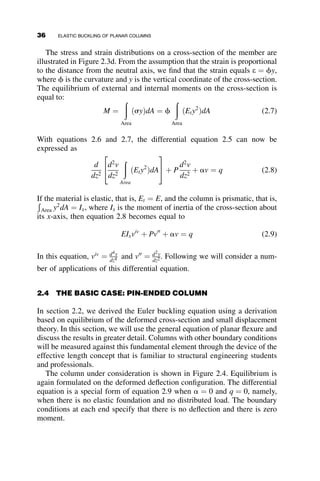
The stress–strain relationship is shown in Figure 2.3c to be s ¼ Ete; Et is
the slope of the nonlinear stress–strain curve, the Tangent modulus. We
assume that there is no elastic unloading of the stress, as indicated in Figure
2.3c. (This assumption is discussed further in Chapter 3.)
2.3 DIFFERENTIAL EQUATION OF PLANAR FLEXURE 35
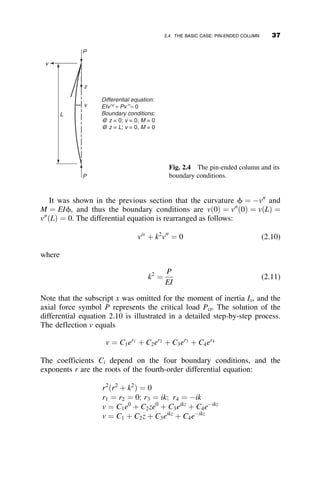
The stress and strain distributions on a cross-section of the member are
illustrated in Figure 2.3d. From the assumption that the strain is proportional
to the distance from the neutral axis, we find that the strain equals e ¼ fy,
where f is the curvature and y is the vertical coordinate of the cross-section.
The equilibrium of external and internal moments on the cross-section is
equal to:
M ¼
ð
Area
ðsyÞdA ¼ f
ð
Area
ðEty2
ÞdA (2.7)
With equations 2.6 and 2.7, the differential equation 2.5 can now be
expressed as
d
dz2
d2
v
dz2
ð
Area
ðEty2
ÞdA
2
4
3
5 þ P
d2
v
dz2
þ av ¼ q (2.8)
If the material is elastic, that is, Et ¼ E, and the column is prismatic, that is,
Ð
Area y2
dA ¼ Ix, where Ix is the moment of inertia of the cross-section about
its x-axis, then equation 2.8 becomes equal to
EIxviv
þ Pv00
þ av ¼ q (2.9)
In this equation, viv
¼ d4v
dz4 and v00
¼ d2v
dz2. Following we will consider a num-
ber of applications of this differential equation.
2.4 THE BASIC CASE: PIN-ENDED COLUMN
In section 2.2, we derived the Euler buckling equation using a derivation
based on equilibrium of the deformed cross-section and small displacement
theory. In this section, we will use the general equation of planar flexure and
discuss the results in greater detail. Columns with other boundary conditions
will be measured against this fundamental element through the device of the
effective length concept that is familiar to structural engineering students
and professionals.
The column under consideration is shown in Figure 2.4. Equilibrium is
again formulated on the deformed deflection configuration. The differential
equation is a special form of equation 2.9 when a ¼ 0 and q ¼ 0, namely,
when there is no elastic foundation and no distributed load. The boundary
conditions at each end specify that there is no deflection and there is zero
moment.
36 ELASTIC BUCKLING OF PLANAR COLUMNS
It was shown in the previous section that the curvature f ¼ v00
and
M ¼ EIf, and thus the boundary conditions are vð0Þ ¼ v00
ð0Þ ¼ vðLÞ ¼
v00
ðLÞ ¼ 0. The differential equation is rearranged as follows:
viv
þ k2
v00
¼ 0 (2.10)
where
k2
¼
P
EI
(2.11)
Note that the subscript x was omitted for the moment of inertia Ix, and the
axial force symbol P represents the critical load Pcr. The solution of the
differential equation 2.10 is illustrated in a detailed step-by-step process.
The deflection v equals
v ¼ C1er1
þ C2er2
þ C3er3
þ C4er4
The coefficients Ci depend on the four boundary conditions, and the
exponents r are the roots of the fourth-order differential equation:
r2
ðr2
þ k2
Þ ¼ 0
r1 ¼ r2 ¼ 0; r3 ¼ ik; r4 ¼ ik
v ¼ C1e0
þ C2ze0
þ C3eikz
þ C4eikz
v ¼ C1 þ C2z þ C3eikz
þ C4eikz
L
P
P
v
z
v
Differential equation:
EIv′v + Pv ′′= 0
Boundary conditions:
@ z = 0; v = 0, M = 0
@ z = L; v = 0, M = 0
Fig. 2.4 The pin-ended column and its
boundary conditions.
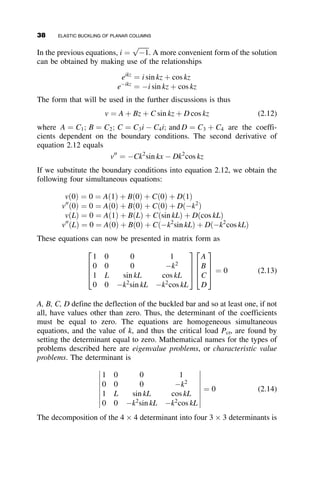
2.4 THE BASIC CASE: PIN-ENDED COLUMN 37
In the previous equations, i ¼
ffiffiffiffiffiffiffi
1
p
. A more convenient form of the solution
can be obtained by making use of the relationships
eikz
¼ i sin kz þ cos kz
eikz
¼ i sin kz þ cos kz
The form that will be used in the further discussions is thus
v ¼ A þ Bz þ C sin kz þ D cos kz (2.12)
where A ¼ C1; B ¼ C2; C ¼ C3i  C4i; and D ¼ C3 þ C4 are the coeffi-
cients dependent on the boundary conditions. The second derivative of
equation 2.12 equals
v00
¼ Ck2
sin kx  Dk2
cos kz
If we substitute the boundary conditions into equation 2.12, we obtain the
following four simultaneous equations:
vð0Þ ¼ 0 ¼ Að1Þ þ Bð0Þ þ Cð0Þ þ Dð1Þ
v00
ð0Þ ¼ 0 ¼ Að0Þ þ Bð0Þ þ Cð0Þ þ Dðk2
Þ
vðLÞ ¼ 0 ¼ Að1Þ þ BðLÞ þ Cðsin kLÞ þ Dðcos kLÞ
v00
ðLÞ ¼ 0 ¼ Að0Þ þ Bð0Þ þ Cðk2
sin kLÞ þ Dðk2
cos kLÞ
These equations can now be presented in matrix form as
1 0 0 1
0 0 0 k2
1 L sin kL cos kL
0 0 k2
sin kL k2
cos kL
2
6
6
4
3
7
7
5
A
B
C
D
2
6
6
4
3
7
7
5 ¼ 0 (2.13)
A, B, C, D define the deflection of the buckled bar and so at least one, if not
all, have values other than zero. Thus, the determinant of the coefficients
must be equal to zero. The equations are homogeneous simultaneous
equations, and the value of k, and thus the critical load Pcr, are found by
setting the determinant equal to zero. Mathematical names for the types of
problems described here are eigenvalue problems, or characteristic value
problems. The determinant is
1 0 0 1
0 0 0 k2
1 L sin kL cos kL
0 0 k2
sin kL k2
cos kL


¼ 0 (2.14)
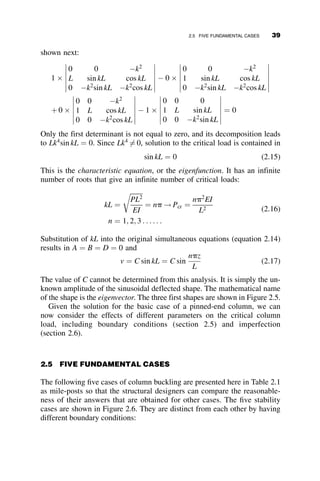
The decomposition of the 4  4 determinant into four 3  3 determinants is
38 ELASTIC BUCKLING OF PLANAR COLUMNS
shown next:
1 
0 0 k2
L sin kL cos kL
0 k2
sin kL k2
cos kL


 0 
0 0 k2
1 sin kL cos kL
0 k2
sin kL k2
cos kL


þ 0 
0 0 k2
1 L cos kL
0 0 k2
cos kL


 1 
0 0 0
1 L sin kL
0 0 k2
sin kL


¼ 0
Only the first determinant is not equal to zero, and its decomposition leads
to Lk4
sin kL ¼ 0. Since Lk4
6¼ 0, solution to the critical load is contained in
sin kL ¼ 0 (2.15)
This is the characteristic equation, or the eigenfunction. It has an infinite
number of roots that give an infinite number of critical loads:
kL ¼
ffiffiffiffiffiffiffiffi
PL2
EI
r
¼ np ! Pcr ¼
np2
EI
L2
n ¼ 1; 2; 3 . . . . . .
(2.16)
Substitution of kL into the original simultaneous equations (equation 2.14)
results in A ¼ B ¼ D ¼ 0 and
v ¼ C sin kL ¼ C sin
npz
L
(2.17)
The value of C cannot be determined from this analysis. It is simply the un-
known amplitude of the sinusoidal deflected shape. The mathematical name
of the shape is the eigenvector. The three first shapes are shown in Figure 2.5.
Given the solution for the basic case of a pinned-end column, we can
now consider the effects of different parameters on the critical column
load, including boundary conditions (section 2.5) and imperfection
(section 2.6).
2.5 FIVE FUNDAMENTAL CASES
The following five cases of column buckling are presented here in Table 2.1
as mile-posts so that the structural designers can compare the reasonable-
ness of their answers that are obtained for other cases. The five stability
cases are shown in Figure 2.6. They are distinct from each other by having
different boundary conditions:
2.5 FIVE FUNDAMENTAL CASES 39
I. Both ends are pinned.
II. One end is pinned, the other end is fixed.
III. Both ends are fixed.
IV. One end is free, the other one is fixed.
V. Both ends are fixed, but one end is not restrained from moving side-
ways.
The definitions of the boundary conditions are as follows:
A. A pinned end has zero deflection and zero moment. That is,
v ¼ v00
¼ 0.
B. A fixed end has zero deflection and zero slope. That is, v ¼ v0
¼ 0.
C. A free end has zero moment ðv00
¼ 0Þ and zero shear. In section 2.3
where the differential equation of planar deflection is derived, it was
shown that
V þ Pv0

dM
dz
¼ V þ Pv0
 EI
dðv00
Þ
dz
V ¼ EIv000
 Pv0
¼ 0
These boundary conditions are shown in the second column of Table 2.1 for
the five cases. The third column shows the determinants of the coefficients
L
v
z
v
n = 1 n = 2 n = 3
L2
π2EI 4π2EI
L2
9π2EI
L2
Fig. 2.5 Mode shapes of buckled column.
40 ELASTIC BUCKLING OF PLANAR COLUMNS
TABLE 2.1 Five Fundamental Cases of Column Bukling
Case
Boundary
Conditions
Buckling
Determinant
Eigenfunction
Eigenvalue
Buckling Load
Effective
Length
Factor
I vð0Þ ¼ v00
ð0Þ ¼ 0
vðLÞ ¼ v00
ðLÞ ¼ 0
1 0 0 1
0 0 0 k2
1 L sin kL cos kL
0 0 k2
sin kL k2
cos kL


sin kL ¼ 0
kL ¼ p
Pcr ¼ PE
1.0
II
vð0Þ ¼ v00
ð0Þ ¼ 0
vðLÞ ¼ v0
ðLÞ ¼ 0
1 0 0 1
0 0 0 k2
1 L sin kL cos kL
0 1 k cos kL k sin kL


tan kl ¼ kl
kl ¼ 4:493
Pcr ¼ 2:045 PE
0.7
III
vð0Þ ¼ v0
ð0Þ ¼ 0
vðLÞ ¼ v0
ðLÞ ¼ 0
1 0 0 1
0 1 k 0
1 L sin kL cos kL
0 1 k cos kL k sin kL


sin
kL
2
¼ 0
kL ¼ 2p
Pcr ¼ 4 PE
0.5
IV v000
ð0Þ þ k2
v0
¼ v00
ð0Þ ¼ 0
vðLÞ ¼ v0
ðLÞ ¼ 0
0 0 0 k2
0 k2
0 0
1 L sin kL cos kL
0 1 k cos kL k sin kL


cos kL ¼ 0
kL ¼
p
2
Pcr ¼
PE
4
2.0
V v000
ð0Þ þ k2
v0
¼ v0
ð0Þ ¼ 0
vðLÞ ¼ v0
ðLÞ ¼ 0
0 1 k 0
0 k2
0 0
1 L sin kL cos kL
0 1 k cos kL k sin kL


sin kL ¼ 0
kL ¼ p
Pcr ¼ PE
1.0
I II III IV V
Fig. 2.6 Elementary buckling cases.
2.5 FIVE FUNDAMENTAL CASES 41
of the undetermined integration constant A, B, C, and D in equation 2.12,
repeated next together with the first through third derivatives:
v ¼ A þ Bz þ C sin kz þ D cos kx
v0
¼ B þ Ck cos kz  Dk sin kz
v00
¼ Ck2
sin kz  Dk2
cos kz
v000
¼ Ck3
cos kz þ Dk3
sin kz
In these equations k ¼
ffiffiffiffiffiffiffiffiffiffiffi
P=EI
p
. Substitution of the respective boundary
conditions results in four simultaneous homogeneous equations. Nontrivial
solutions exist only when the determinant of the coefficients is set to zero,
finally giving P ¼ Pcr, the buckling load. The equation resulting from the
decomposition of the determinant is the eigenfunction. The eigenvalue is the
nondimensional parameter kL that is obtained from solving the eigenfunction.
All three quantities are listed in the fourth column of Table 2.1. The
eigenvalue shown is the smallest value, because higher modes are not relevant
on account of the presence of imperfections that will result in very large
deflections as P approaches the critical value. Except for Case II, the pin-fix
column, the solution of kL from the eigenfunction is straightforward. For Case
II the value of kL ¼ 4:493 is obtained by trial and error, or by using any one of
a number of numerical equation solvers. The buckling load is expressed as a
multiple of the basic pin-pin condition, PE ¼ p2
EI=L2
. The fifth and final
Summary of Important Points—Elastic Column Buckling
 The Euler buckling equation, which should be familiar to structural
engineers and students, is given by
Pcr ¼
p2
EI
L2
This equation can be derived from the differential equation governing the
behavior of a perfectly straight, pinned-end column loaded through the
centroid.
 Higher solutions to the basic differential equation are associated with
buckling modes.
 The derivation of the differential equation of planar flexure, the most
general case, allows the investigation of the impact of many parame-
ters on the buckling behavior of a member.
 The five basic cases illustrate the effects of boundary conditions and
the use of the general equation.
42 ELASTIC BUCKLING OF PLANAR COLUMNS
column in Table 2.1 lists K, the effective length factor. This is a popular arti-
fice that connects any buckling load to the basic pin-pin case:
Pcr ¼
PE
K2
¼
p2
EI
ðKLÞ2
(2.18)
For these elementary cases, one can visualize the effective length as the
distance between points of inflection on the buckled shape of the column, as
illustrated in Figure 2.7. This visualization is sometimes misunderstood
when the effective length is taken as the distance between points of zero
moment on a moment diagram from a first-order elastic analysis.
2.6 THE EFFECT OF IMPERFECTIONS
In any real column there are imperfections that affect the behavior near the
theoretical critical load. These imperfections are small, and their occurrence
is unavoidable. We consider the effects of three such phenomena:
1. Small initial crookedness (or out-of-straightness) of the column axis
2. Small load eccentricity
3. Small lateral load
These imperfections are illustrated in Figure 2.8.
2.6.1 Column with Initial Out-of-straightness
The column is shown in Figure 2.8a. The initial out-of-straightness is as-
sumed to be sinusoidal, and its amplitude at the center of the member is vo.
L
0.7L
0.5L
2L
L
Fig. 2.7 Geometric interpretation of the effective length concept.
2.6 THE EFFECT OF IMPERFECTIONS 43
The assumed initial shape is expressed by the following equation:
vi ¼ vo sin
pz
L
(2.19)
The internal moment at location z along the axis of the column is Mint ¼
EIv00
; and the external moment equals Mext ¼ Pðvi þ vÞ. Equating the
internal and the external moment results in the following differential equation:
EIv00
þ Pv ¼ Pvi
Substitution of equation 2.19 and introducing k2
¼ P
EI leads to the equation
for the deflection due to P:
v00
þ k2
v ¼ k2
vo sin
pz
L
(2.20)
The homogeneous solution, vH, is A sin kz þ B cos kz. The particular
solution, vP, is derived as follows:
vP ¼ C sin
pz
L
þ D cos
pz
L
Substitution into Eq. 2.20 gives
C
p2
L2
sin
pz
L
D
p2
L2
cos
pz
L
þ Ck2
sin
pz
L
þ Dk2
cos
pz
L
¼ k2
vo sin
pz
L
e
P
P
P
P P
P
vo
(a) Initial crookedness, vo (b) Load eccentricity, e (c) Lateral load, q
q
Fig. 2.8 Initial imperfections.
44 ELASTIC BUCKLING OF PLANAR COLUMNS
From which
C k2

p2
L2
 
¼ vo; D ¼ 0
After some algebra and the introduction of the lowest buckling load PE (i.e.,
n ¼ 1) in equation 2.16,
PE ¼
p2
EI
L2
(2.21)
we obtain the following equation for the deflection:
v ¼ vH þ vP ¼ A sin kz þ B cos kz þ
P=PE
1  P=PE
vo sin
pz
L
(2.22)
Substitution of the boundary conditions vð0Þ ¼ vðLÞ ¼ 0 gives A ¼ 0 and
B ¼ 0, and thus
v ¼
P=PE
1  P=PE
vo sin
pz
L
(2.22)
The total deflection is the sum of the original initial deflection (equation
2.19) and the additional deflection due to P
vtotal ¼ vi þ v ¼
vo sin pz
L
1  P=PE
(2.23)
The total deflection at the middle of the column (at z ¼ L=2) becomes then
equal to
vTotal=L ¼
vo=L
1  P=PE
(2.24)
The initial out-of-straightness vo is the fabrication tolerance for straightness in
the rolling mill, and in North American practice it is usually 1/1,000 of the
length. This is a small amount, and it is not detectable by eye. However, as the
ratio P=PE approaches unity, the deflection becomes intolerably high, as can be
observed in the curve shown in Figure 2.9. Since it is practically impossible to
construct a column that has no imperfections, it is not possible to exceed the
first mode of the buckling load; thus, n ¼ 1 gives the governing buckling load
for the pinned-end column that buckles elastically. This critical load, given as
equation 2.21, will be the basic case against which critical loads of columns
with other pinned boundary conditions will be compared. The subscript E thus
denotes elastic, although often in the literature it also stands for Euler after the
Swiss mathematician who first derived the formula in 1754.
In the previous discussion, it was assumed that the initial deformation is a
one-half sine wave. The question is now: What happens if the initial shape
2.6 THE EFFECT OF IMPERFECTIONS 45
has some other form? Assume that the shape is a full sine wave, as shown in
the side-sketch in Figure 2.10. In this case, the initial shape is
vi ¼ vo sin
2pz
L
(2.25)
For this case the differential equation becomes equal to
v00
þ k2
v ¼ k2
vo sin
2pz
L
(2.26)
After differentiating equation 2.26 twice, the differential equation to be
solved, the homogeneous solution and the particular solution are the
following equations:
viv
þ k2
v00
¼ k2
vo
4p2
L2
 	
sin
2pz
L
vH ¼ A þ Bz þ C sin kz þ D cos kz
vP ¼ E sin
2pz
L
þ F cos
2pz
L
The solution is, therefore:
v ¼ A þ Bz þ C sin kz þ D cos kz þ
voðP=PEÞ
4  P=PE
sin
2pz
L
(2.27)
Initial crookedness = one half sine wave
vmax/L
0.00 0.02 0.04 0.06 0.08 0.10
P/P
E
0.0
0.2
0.4
0.6
0.8
1.0
1.2
Fig. 2.9 Initial deflected shape is sinusoidal, vo ¼ L=1; 000.
46 ELASTIC BUCKLING OF PLANAR COLUMNS
For the boundary conditions vð0Þ ¼ vðLÞ ¼ v00
ð0Þ ¼ v00
ðLÞ ¼ 0 one arrives
at four homogeneous simultaneous equation that are identical to equation
2.13:
1 0 0 1
0 0 0 k2
1 L sin kL cos kL
0 0 k2
sin kL k2
cos kL
2
6
6
4
3
7
7
5
A
B
C
D
2
6
6
4
3
7
7
5 ¼ 0
When the constants A, B, C, D are not zero, the determinant of the
coefficients is zero and the resulting equation then leads to the first buckling
mode with PE as the critical value. When A ¼ B ¼ C ¼ D ¼ 0, then the
deflected shape is
v ¼ vo
P=PE
4  P=PE
sin
2pz
L
In this problem, it is more convenient to work with the end-slope
dvð0Þ=dz ¼ uo of the column. The total of the initial and added end-slope is
equal to the following expression:
uo Total ¼
2pvo
L
1
1  P
4PE
!
(2.28)
The relationship between the axial load and the end-slope is shown in Figure
2.10. Equation 2.28 becomes very large when the axial load approaches
S-shaped (full sine wave) initial crookedness
End slope, radians
0.00 0.05 0.10 0.15 0.20
P/P
E
0
1
2
3
4
vo /L = 1/1,000
P/PE = 1.0
P/PE = 4.0
Pcr = PE
Fig. 2.10 Snap-through phenomenon for an initially crooked column with L/1,000
maximum out-of-straightness.
2.6 THE EFFECT OF IMPERFECTIONS 47
4PE. However, the load has no chance of getting there because at P ¼ PE
the deflection of the column snaps from an S-shape into a half sine wave. A
similar problem was also encountered in Chapter 1. The unexpected occu-
rrence of such a snap-through event during the test of a full-sized column in
the laboratory is something not easily forgotten.
2.6.2 Column with Eccentric Load (Figure 2.8b)
The differential equation is determined by equating the internal moment
EIv00
and the external moment Pðe þ vÞ, where e is the eccentricity of the
axial load (see Figure 2.8b) and v is the deflection at the point of interest:
EIv00
¼ Pðe þ vÞ
v00
þ k2
v ¼ k2
e
e is the load eccentricity (Figure 2.8b), v is the deflection at location e, P is
the axial force, and EI is the product of the elastic modulus and the moment
of inertia, respectively. The second line is a rearrangement after introducing
k2
¼
P
EI
The deflection is found from the general solution v ¼ A sin kx þ B cos kx  e
with the boundary conditions vð0Þ ¼ vðLÞ ¼ 0:
v ¼ e cos kz þ
1  cos kL
sin kL
sin kz  1
 	
(2.29)
The maximum deflection occurs at the center at z ¼ L=2 and it is equal to:
vðL=2Þ ¼ e
1  cos kL
2
cos kL
2
!
(2.30)
When
P ¼ PE ¼
p2
EI
L2
; k ¼
p
L
; cos
kL
2
¼ cos
p
2
¼ 0; vðL=2Þ ¼
e
0
! 1
Thus, the deflection is infinite when P equals the elastic buckling load, as
expected.
The center deflection of a beam with a moment M at each end is equal to
(from linear structural analysis):
v1ðL=2Þ ¼
ML2
8EI
¼
PeL2
8EI
¼
p2
8
ðP=PEÞe
48 ELASTIC BUCKLING OF PLANAR COLUMNS
If we divide the deflection of the column (equation 2.30) by the linear beam
deflection above we obtain a magnification factor, MF, that defines the
effect of the reduction of stiffness, and thus the increase of deflection, due to
the axial force:
MF ¼
8
p2ðP=PEÞ
1  cos p
2
ffiffiffiffi
P
PE
q
cos p
2
ffiffiffiffi
P
PE
q
2
6
4
3
7
5 (2.31)
2.6.3 Column with Distributed Load (Figure 2.8c)
A distributed load is not specifically an imperfection; however, the trans-
verse loading on the column creates deflection due to bending and is thus
similar to the imperfection cases described in the previous sections. The dif-
ferential equation for this case is equation 2.9 with the foundation modulus
a ¼ 0:
EIviv
þ Pv00
¼ q (2.32)
This equation is then rearranged and solved for the deflection:
v0v
þ k2
v00
¼
q
EI
v ¼ A þ Bz þ C sin kz þ D cos kz þ
qz2
2P
With the boundary conditions vð0Þ ¼ vðLÞ ¼ v00
ð0Þ ¼ v00
ðLÞ ¼ 0, the
deflection at any location z and at the center of the member is, respectively:
v ¼
q
Pk2
1  cos; kL
sin kL
 	
sin kz þ cos kz þ
ðkzÞ2
2

k2
Lz
2
1
 #
vðL=2Þ ¼
q
Pk2
1
cos kL
2

ðkLÞ2
8
1
! (2.33)
The first-order deflection is 5qL4
384EI, and therefore the magnification factor MF
for this case is equal to
MF ¼
384
5k4L4
1
cos kL
2

ðkLÞ2
8
 1
!
(2.33)
The variations of the magnification factors of equations 2.31 (for the
eccentric axial load) and 2.33 (for the column with a distributed load) are
2.6 THE EFFECT OF IMPERFECTIONS 49
plotted in Figure 2.11 against P/PE. Also plotted is the magnification factor
for the case of initial curvature (equations 2.24):
MF ¼
1
1  P=PE
(2.34)
It is evident from comparing the curves in Figure 2.11 that they are
essentially on top of each other, and thus the simpler equation 2.34 can be
used for all three cases. This fact has been used for many years in design
standards all over the world.
Historically, the idea of assuming an initial out-of-straightness or an acci-
dental load eccentricity was used to arrive at formulas for the design of
columns. They are named, variously, the Rankine formula, or the Perry-
Robertson formula. Since such formulas were used extensively throughout
the last 150 years, it is useful to give a brief derivation at this point.
The common feature of these formulas is the assumption that the maxi-
mum strength of the column is reached when the sum of the axial normal
stress and the flexural normal stress equals the yield stress of the material.
This is a very impractical assumption, of course, as we will show in Chapter
3, but since the initial deflection is calibrated so that the formula predicts the
actual strength obtained by column tests, a useful and simple method of
design is achieved. The derivation of the Rankine formula is given first:
P
A
þ
Pv
S
¼
P
A
1 þ
vA
S
 	
¼ sy
Magnification Factor
0 2 4 6 8 10
P/P
E
0.0
0.2
0.4
0.6
0.8
1.0
1.2
Initial crookedness
Eccentric axial load
Distributed load
Fig. 2.11 Comparison of magnification factors.
50 ELASTIC BUCKLING OF PLANAR COLUMNS
P is the axial load, A is the area and S is the elastic section modulus of the
cross-section. sy is the yield stress and v is the initial deflection at the center
of the column. Note that Av
S ¼ Acv
I ¼ cv
r2 ¼ cv
L2
L
r

 2
, where I is the moment of
inertia, c is the distance from the neutral axis to the outer fiber of the cross-
section, r is the radius of gyration, and L is the column length. The formula
is then in the following form:
scr ¼
P
A
¼
sy
1 þ

 cv
L2

 L
r
2
¼
sy
1 þ a

 L
r
2
(2.35)
The coefficient a is obtained by calibration to test data. For example, the
column formula in the 1923 Specification for steel building structures of
the American Institute of Steel Construction (AISC) was of this form. There
were many variants in use, and there probably are still extant some codes
that use it. In the 1923 AISC Specification, the formula is as follows for a
yield stress of 33 ksi and a factor of safety of 33=18:
scr
FS
¼
18 scr
33
¼
18
1 þ 1
18;000

 L
r
2
 15 ksi (2.36)
The Perry-Robertson formula has been used in many countries, and it is
still in the current Australian steel design standard. It is derived as
follows:
v ¼
vo
1  P=PE
¼
vo
1  scr
sE
¼
vosE
sE  scr
sy ¼ scr 1 þ h
sE
sE  scr
 	
 
Solving for the critical stress, one obtains
scr ¼
1
2
½sy þ sEð1 þ hÞ 
ffiffiffiffiffiffiffiffiffiffiffiffiffiffiffiffiffiffiffiffiffiffiffiffiffiffiffiffiffiffiffiffiffiffiffiffiffiffiffiffiffiffiffiffiffiffiffiffiffiffiffiffiffiffiffiffiffiffiffiffiffi
1
2
sy þ sE 1 þ h
ð Þ
2
sysE
s
(2.37)
Empirically in the Australian code, h ¼ 0:003
L
r
.
2.6 THE EFFECT OF IMPERFECTIONS 51
2.7 STABILITY OF A RIGID FRAME
Next we consider the effect of elastic end-restraint on the critical load of a
column. The structure is shown in Figure 2.12. The column has a pin at its
bottom, and it is restrained at the top by an elastic beam that has a fixed end
at its far end.
The boundary conditions at the bottom of the column at z ¼ L are equal
to vðLÞ ¼ v00
ðLÞ ¼ 0. At the top there is no deflection, and the slope at the
top of the column equals the slope at the end of the beam. The bending mo-
ments oppose each other. From structural analysis it can be determined that
at the end of the beam
MAB ¼
4EIB
LB
uA ¼ auA ¼ av0
ð0Þ
The symbol a is a spring constant that is a ¼ 4EIB
LB
when the far end is fixed,
and a ¼ 3EIB
LB
when the far end is pinned. The moment at the top end of the
A B
C
IB
LB
IC
LC
P
θA
θA
θA
MAB
MAB /2
z
Fig. 2.12 Restrained column.
52 ELASTIC BUCKLING OF PLANAR COLUMNS
column equals
MAC ¼ EICv00
ð0Þ
From the equilibrium condition MAB þ MAC ¼ 0, we then get the fourth
boundary condition. The four boundary conditions are summarized next:
vð0Þ ¼ 0
av0
ð0Þ  EICv00
ð0Þ ¼ 0
vðLCÞ ¼ 0
v00
ðLCÞ ¼ 0
Substitution of the deflection equation v ¼ A þ Bz þ C sin kz þ D cos kz and
its derivatives gives four homogeneous simultaneous equations. Setting the
determinant of the coefficients equal to zero
1 0 0 1
0 a ak P
1 L sin kLC cos kLC
0 0 k2
sin kLC k2
cos kLC


¼ 0
leads to the following eigenfunction:
tan kLC ¼
a kLC
PLC þ a
¼
g kLC
ðkLCÞ2
þ g
g ¼
a LC
EIC
kLC ¼
ffiffiffiffiffiffiffiffiffi
PL2
C
EIC
s
(2.39)
Equation 2.39 is the buckling equation for a column with a pinned end at
one end and an elastic spring at the other end. When IB ¼ a ¼ g ¼ 0, the
end restraint vanishes and we have a pinned-end column; that is, sin kLC ¼
0 ! Pcr ¼ p2
EIC=L2
C. When the top end is fixed, the following holds:
IB ¼ a ¼ g ¼ 1
tan kLC ¼
kLC
ðkLCÞ2
g þ1
¼ kLC
Pcr ¼ 20:19
EIC
L2
C
2.7 STABILITY OF A RIGID FRAME 53
Comparing these extremes to the corresponding cases in Table 2.1 it is seen
that the same answers are obtained. The variation of the critical load with
the spring constant between the two extremes is shown in Figure 2.13.
The upper graph shows that the critical load is PE when g ¼ 0, and it
approaches 2.045PE as the value of the spring constant approaches infinity.
The lower graph illustrates the variation of the effective length factor K from
1.0 (pinned end) to 0.7 (fixed end). There is an important trend that can be
deduced from these curves: On the one hand, when the restraint is small,
large increases of the buckling load result from small increases of the spring
constant a. On the other hand, when a becomes very large, a very small
change in the buckling load results from very large changes in the spring
γ = α LC / EIC
0 20 40 60 80 100
P
/
P
E
1.0
1.2
1.4
1.6
1.8
2.0
2.2
γ = α LC / EIC
0 20 40 60 80 100
Effective
Length
K
0.5
0.6
0.7
0.8
0.9
1.0
Fig. 2.13 Effect of end-restraint.
54 ELASTIC BUCKLING OF PLANAR COLUMNS
constant. A little restraint goes a long way, but complete restraint is not
worth attaining. This principle is a general characteristic of buckling solu-
tions discussed in more detail in Chapter 5.
2.8 END-RESTRAINED COLUMNS
In this section we consider the general case of prismatic columns that are
restrained by elastic springs at their ends. By considering restrained ends,
we can develop a feel for the impact of end restraint on the buckling load
of the column. This situation is similar to a column restrained by beams
of finite stiffness, which is discussed in depth in Chapter 5. We start the
discussion with a compression member whose ends do not translate with
respect to each other (often called a non-sway case) and that have elastic
springs at each end. The column and its end boundary conditions are shown
in Figure 2.14.
Substitution of the four boundary conditions into equation 2.12 results in
four homogeneous simultaneous equations. The determinant of the coeffi-
cients of the constants A, B, C, D is equal to
1 0 0 1
1 L sin kL cos kL
0 aT aT k EIk2
0 aB aBk cos kL þ EIk2
sin kL aBk sin kL þ EIk2
cos kL


¼ 0
v
z
L
P
P
αT
αB
αTv'(0)
αBv'(L)
–EIv''(0)
–EIv''(L)
Boundary conditions:
v(0) = 0
αTv'(0) –EIv''(0) = 0
v(L) = 0
−αBv'(L) –EIv''(L) = 0
Fig. 2.14 The nonsway restrained column.
2.8 END-RESTRAINED COLUMNS 55
Remembering that k ¼
ffiffiffiffi
P
EI
q
and introducing the nondimensional spring
constant ratios
RT ¼
aTL
EI
RB ¼
aBL
EI
(2.40)
the algebraic decomposition of the determinant results in the following
eigenfunction:
2RT RB þ sin kL½RTRBkL  kLðRT þ RBÞ  ðkLÞ3

þcos kL½2RTRB þ ðkLÞ2
ðRT þ RBÞ ¼ 0
(2.41)
Solving equation 2.41 numerically for the smallest kL gives the critical
buckling load. The limiting cases of this equation are the cases of both ends
pinned (aT ¼ aB ¼ 0 ! RT ¼ RB ¼ 0), and of both ends fixed (aT ¼ aB ¼
1 ! RT ¼ RB ¼ 1). After some algebraic and trigonometric manipula-
tions it can be demonstrated the eigenfunction for the pinned end column is
equal to sin kL ¼ 0 and for the fixed end column it equals sin kL
2 ¼ 0. These
are indeed the same functions as are shown in Table 2.1 for Cases I and III.
Thus, equation 2.41 encloses all the intermediate conditions between the
totally pinned ends and the totally fixed ends. The critical load thus varies
from Pcr ¼ PE to 4PE, and the effective length varies from K ¼ 1:0 to 0.5.
The buckling condition of equation 2.41 is directly applicable for the sit-
uation where the elastic rotational spring constants aT and aB are known.
Following, we consider the specialization of the expression for the case of a
planar rigid frame. Such an application is within the everyday task of struc-
tural design engineers. An example is illustrated in Figure 2.15. We assume
that the far ends of the top and bottom beams have the same slope as the
near ends. This is not the correct situation for this given problem, but it is
the assumption that governs the effective length determination in the AISC
Specification (AISC 2005).
The top and bottom spring constants are:
aT ¼
2EIgT
LgT
! RT ¼
2ðIgT=LgT Þ
ðIC=LCÞ
(2.42)
aB ¼
2EIgB
LgB
! RB ¼
2ðIgB=LgBÞ
ðIC=LCÞ
(2.43)
56 ELASTIC BUCKLING OF PLANAR COLUMNS
After considerable trigonometric and algebraic manipulation we arrive at
the following equation:
ðkLÞ2
GTGB
4
 1 þ
GT þ GB
2
1 
kL
tan kL
 	
þ
2 tan kL
2
kL
¼ 0 (2.44)
In this equation
GT ¼
IC=LC
IgT=LgT
GB ¼
IC=LC
IgB=LgB
(2.45)
Equation 2.44 can be rewritten in a nomenclature more familiar to structural
engineers by introducing the effective length factor K, noting that K ¼ p
kL:

 p
K
2
GTGB
4
 1 þ
GT þ GB
2
1 
p
K
tan p
K
 	
þ
2 tan p
2K
p
K
¼ 0 (2.46)
Equation 2.46 is the basis of the nonsway nomograph, also called alignment
chart in the Manual of the American Institute of Steel Construction (AISC
2005). This nomograph is a graphical artifice of connecting GT and GB on
graduated vertical lines by a straight line to read the corresponding effective
length factor K on a third graduated scaled vertical line. Equation 2.46 can
also be solved by numerical equation solvers in computer software.
L
θ
θ
Lc,Ic
LgT,IgT
LgB,IgB
M
M
θ = ML / 2EI
α = M / θ = 2EI/L
Fig. 2.15 Planar rigid-frame
subassembly.
2.8 END-RESTRAINED COLUMNS 57
The frame of Figure 2.15 can be imagined to be a subassemblage in
a rigid frame, as shown in Figure 2.16. In this figure, the column under in-
vestigation is the segment AB. It is assumed that the rotation at the far ends
of the restraining beams are of the same magnitude but of opposite direction
as the rotations at the joint at the top and the bottom of column AB, respec-
tively. It is further assumed that the restraining moments at these joints are
distributed between the two adjoining columns in proportion to the I=L of
the respective columns. The effective length of column AB is then deter-
mined from equation 2.46, with the following new value of the restraint
parameter G:
G ¼
P Icolumn
Lcolumn
P Ibeam
Lbeam
(2.47)
The next expansion of the stability problem will be the study of the general
case of the prismatic column with a rotational and a translational spring
at each end, as shown in Figure 2.17. The following derivation follows from
p. 80 of the text by Simitses (2005).
The boundary conditions are
@ z ¼ 0: EIv000
 Pv0
¼ bTv
EIv00
¼ aTv0
@z ¼ L: EIv000
 Pv0
¼ bBv
EIv00
¼ aBv0
(2.48)
B
C
D
E
F
A
LBL LBR
LCT
LC
LCB
ICT
IC
ICB
IBLT
IBRT
IBLB
IBRB
Fig. 2.16 Nonsway planar rigid frame.
58 ELASTIC BUCKLING OF PLANAR COLUMNS
The following variables are now introduced:
RT ¼
aT L
EI
; RB ¼
aBL
EI
TT ¼
bT L3
EI
; TB ¼
bBL3
EI
k ¼
ffiffiffiffiffi
P
EI
r
(2.49)
The determinant of the coefficients of the undetermined unknowns A, B, C,
D in the deflection equation v ¼ A þ Bz þ C sin kL þ D cos kL is equal to
the following:
TT ðkLÞ2
0 TT
0 RT RTkL ðkLÞ2
TB ½TB  ðkLÞ2
 TBsin kL TBcos kL
0 RB ½RBkL cos kL
 ðkLÞ2
sin kL
½RBkL sin kL
 ðkLÞ2
cos kL


¼ 0 (2.50)
The eigenvalue kL can be obtained by using a suitable automatic equation
solver.
For the AISC no-sway case (Figures 2.15 and 2.16) the translational
spring-constants are assumed to be equal to infinity because both ends of
the column are prevented from moving sideways with respect to each other.
If the first and the third row of equation 2.50 are divided by TT and TB,
respectively, and if the spring-constants are made to approach infinity, then
z
P
P
L
αT
αB
βT
βB
Fig. 2.17 Column with rotational and translational springs.
2.8 END-RESTRAINED COLUMNS 59
the determinant of equation 2.50 becomes equal to equation 2.51:
1 0 0 1
0 RT RT kL ðkLÞ2
1 1 sin kL cos kL
0 RB ½RBkL cos kL
 ðkLÞ2
sin kL
½RBkL sin kL
 ðkLÞ2
cos kL


¼ 0 (2.51)
Performing the decomposition algebraically results in equation 2.41, which
was derived previously.
The AISC Specification recognizes a type of frame subassembly where
the top of the column is able to translate with respect to the bottom. It as-
sumed that the bottom cannot translate, i.e., TB ¼ 1, and there is a zero
translational restraint at the top, TT ¼ 0. The restraining beams are assumed
to be bent in double curvature so that the slope at each far end equals the
slope at the end of the respective column joint, top or bottom. This subas-
sembly is shown in Figure 2.18.
Substituting TT ¼ 0 into the first row of equation 2.50, and dividing each
term in the third row by TB and then equating TB to infinity results in the
following buckling determinant:
0 ðkLÞ2
0 0
0 RT RTkL ðkLÞ2
1 1 sin kL cos kL
0 RB ½RBkL cos kL
 ðkLÞ2
sin kL
½RBkL sin kL
 ðkLÞ2
cos kL


¼ 0 (2.52)
From Figure 2.18 we find the following relationships:
aT ¼
6EIBT
LBT
; aB ¼
6EIBB
LBB
(2.53)
RT ¼
aTLC
EIC
¼
6EIBT
LBT

LC
EIC
¼ 6
IBT=LBT
IC=LC
 	
¼
6
GT
RB ¼
aBLC
EIC
¼
6EIBB
LBB

LC
EIC
¼ 6
IBB=LBB
IC=LC
 	
¼
6
GB
(2.54)
GT ¼
IC=LC
IBT=LBT
; GB ¼
IC=LC
IBB=LBB
(2.55)
60 ELASTIC BUCKLING OF PLANAR COLUMNS
Substitution of RT and RB into the decomposed determinant of equation
2.52, setting the resulting equation equal to zero, will lead, after some alge-
braic manipulation, to the following equation:
kL
tan KL

ðkLÞ2
GT GB  36
6ðGT þ GBÞ
¼ 0 (2.56)
This equation is the basis of the nonsway alignment chart in the AISC
Specification (AISC 2005). This three-bar nomograph relates the flexibility
parameters
GT ¼
P
IC=LC
P
IBT=LBT
; GB ¼
P
IC=LC
P
IBB=LBB
(2.57)
with the effective length K ¼ p
kL of the column under investigation. The
definitions of the geometric terms in equation 2.57 are given in Figure 2.16,
and the sway-permitted frame is illustrated in Figure 2.19. The area
Fig. 2.19 The AISC sway-permitted frame subassembly.
θT
θT
θB
θ
θ
θB
P
M M
M / θ = 6EI / L = α
LBT, IBT
LBB, IBB
LC,IC
Fig. 2.18 Sway permitted subassembly.
2.8 END-RESTRAINED COLUMNS 61
enclosed by the dashed lines defines the members involved in the determina-
tion of the effective length factor. It should be noted that the strict assumption
of the AISC nomograph method assumes that all columns in a story buckle
simultaneously and that, therefore, there is no lateral restraint available.
This assumption, as well as others, is discussed further in Chapter 5.
2.9 RESTRAINED COLUMN EXAMPLES
Following are four examples that illustrate various aspects of the stability of
elastically restrained columns. These problems are also introduced to show
various fallacies one can commit if one does not have a clear picture of the
assumptions of buckling theory.
2.9.1 Example 2.1: Geometry and Loading
The column and its restraining members are shown in Figure 2.20a. The left
column in the rigid frame is loaded by an axial compressive force P. The
other two members of the frame are the restraining elements. The sketch in
Figure 2.20b is the restraining subassembly. If this structure is subjected to a
bending moment M and a lateral force H at the top joint of the column, then
the rotational and translational spring constants are equal to
aT ¼
M
u
¼
40
17
EI
L
bT ¼
H
D
¼
90
7
EI
L3
3L
L
I
2I
3I
M
H
Δ
θ
(a)
(b)
P
Fig. 2.20 Example 2.1 geometry and
loading.
62 ELASTIC BUCKLING OF PLANAR COLUMNS
The statically indeterminate structure of Figure 2.20b was analyzed using
the classical slope-deflection method.
The nondimensional restraint factors are then determined using equation
2.49:
RT ¼
aT LColumn
EIColumn
¼
40
17
EI
L
L
EI
¼
40
17
TT ¼
bT L3
column
EIcolumn
¼
90
7
EI
L3
L3
EI
¼
90
7
The restraint factors at the bottom of the column are those of a pinned end:
RB ¼ 0 and TB ¼ 1. The eigenfunction of a column with rotational and
translational restraints at each end, as shown in Figure 2.17, is equation
2.50. If the third line in the matrix is divided by TB and then TB is set equal
to infinity, the following set of homogeneous simultaneous equations are
obtained:
TT ðkLÞ2
0 TT
0 RT RTkL ðkLÞ2
1 1 sin kL cos kL
0 0 ðkLÞ2
sin kL ðkLÞ2
cos kL


¼ 0 (2.58)
This determinant is now solved numerically in an automatic equation sol-
ver to obtain the eigenvalue kL ¼ 3:381. The effective length factor
K ¼ p
kL ¼ 0:93, and the ratio of the critical load to the basic pinned-end
buckling load equals P
PE
¼ 1:16.
Following, we examine the consequences of making various assumptions
with regard to the boundary conditions at the top end of the column. Table
2.2 lists six stability analyses that were made using equation 2.58. The sol-
ution just presented, using the complete beam and the column as restraints,
is case No. 4. Case 1 is the buckling solution that would result if the strict
assumptions of the AISC sway permitted nomograph method were fol-
lowed: The lateral restraint is ignored, and rotational restraint is provided
only by the beam that has, additionally, the assumption of equal end slopes.
As can be seen the difference between the two solutions gives an order of
magnitude difference, 750 percent. In this particular example, the lateral re-
straint overpowers the rotational restraint, and ignoring it results in very
conservative answers. Lateral restraint is also neglected in case 2 and 3, with
the resulting low values of the critical load. In case 2 the far end of the beam
is fixed against rotation, and in case 3 it is pinned. In case 5 there is no
2.9 RESTRAINED COLUMN EXAMPLES 63
TABLE 2.2 Critical Loads for Example 2.1
Boundary Conditions TT RT kL K Pcr/PE
1
I,L
2I,3L
P
AISC Model
θ
θ
0 4 1.265 2.48 0.16
2
I,L
2I, 3L
P 0 8/3 1.159 2.71 0.14
3
I,L 3I, L
2I, 3L
P 0 2 1.077 2.92 0.12
4
I,L 3I, L
2I, 3L
P
90/7 40/17 3.381 0.93 1.16
5
I,L 3I, L
2I, 3L
P 90/7 0 3.142 1.00 1.00
6
I,L 3I, L
2I, 3L
P 9 0 3.000 1.05 0.91
64 ELASTIC BUCKLING OF PLANAR COLUMNS
assumed rotational restraint, but lateral restraint is provided by both the
beam and the unloaded vertical member on the right. In case 6 only the right
column provides lateral restraint. This problem shows that it is important to
assess the relative importance of the types of available restraint.
2.9.2 Example 2.2: Boundary Conditions
for Bracing Structures
This example explores some aspects of the bracing of structures. The sub-
ject is important enough to deserve a separate chapter in this book
(Chapter 7), but this present problem will introduce the topic. The braced
column and the respective boundary conditions at its top and bottom are
shown in Figure 2.21.
The column of length L and stiffness EI is pinned at its base and is re-
strained from lateral deflection by a linear spring at the top. At the top the
shear is equal to the deflection times the spring constant b. Upon substitu-
tion of the four boundary conditions into the general deflection expression
v ¼ A þ Bz þ C sin kz þ D cos kz, we can derive the following buckling
determinant:
0 0 0 k2
b P 0 b
1 L sin kL cos kL
0 0 k2
sin kL k2
cos kL


¼ 0 (2.59)
In this equation, k2
¼ P
EI. Decomposition of the determinant results in the
following eigenfunction:
k4
ðP  bLÞ sin kL ¼ 0 (2.60)
L
z
P
EI
β
V = βv (0) = –EIv ″′ (0) – Pv ′(0)
v ″(0) = 0
v(L) = v ″ (L) = 0
Fig. 2.21 Example 2.2: Geometry, loading, and boundary conditions.
2.9 RESTRAINED COLUMN EXAMPLES 65
Since k4
is not equal to zero, we get two buckling conditions, and thus two
critical loads:
P  bL ¼ 0 ! P
ð1Þ
cr ¼ bL
sin kL ¼ 0 ! P
ð2Þ
cr ¼
p2
EI
L2
(2.61)
The lowest of these critical loads is the controlling buckling strength. The
relationship between these two buckling loads is given in the graphs in
Figure 2.22, where the ordinate represents the buckling load and the
abscissa is the magnitude of the spring constant b:
The diagonal straight line corresponds to the rigid-body rotation of the
column, when the spring constant is relatively small. However, when the
second buckling load is reached, it governs the strength. Thus, it is not nec-
essary to have a spring stiffness larger than the limiting value when the two
critical loads are equal to each other: blim ¼ p2EI
L3 .
The following example illustrates the concept of minimum lateral bracing
stiffness required to permit the column to reach the basic simply supported
Euler load, PE. Figure 2.23 shows a pinned-end column that is braced by
being laterally connected to a vertical cantilever. When this restraining
member is subjected to a lateral force H, it deflects an amount D ¼ HL3
3EIS
!
b ¼ H
D ¼ 3EIS
L3 . The required stiffness is obtained from equating 3EIS
L3 to
blim ¼ p2EI
L3 . This results in the minimum required moment of inertia
IS ¼ p2I
3 ¼ 3:29I.
Another application is the determination of the required bracing stiffness
of the two-column braced frame in Figure 2.24a.
The frame consists of two pinned-end columns that are connected by a
beam and by diagonal braces. These braces are assumed to be acting in
Pcr
(1)
L2
π2EI
=
Pcr
(2)
= βL
L3
π2EI
βlim =
β
Pcr
Fig. 2.22 The two buckling modes of the column in Figure 2.21.
66 ELASTIC BUCKLING OF PLANAR COLUMNS
tension only. That is, the brace that is in compression, while the top of the
frame moves laterally, will buckle and will not participate in providing stiff-
ness. The spring constant is determined by subjecting the frame to a force
F and calculating the resulting deflection D. The spring constant is then
b ¼ F
D. The tensile force T in the diagonal (see Figure 2.24b) is obtained by
elementary statical equilibrium considerations under the assumption of
small deflections and rotations:
Tensile force in brace T ¼
F
cos u
Length of brace: LBR ¼
LB
cos u
Bar elongation: e ¼
TLBR
EABR
¼
FLB
EABR cos2u
D ¼
e
cos u
¼
FLB
EABRcos3u
¼
F
EABR
ðL2
B þ L2
CÞ
3
2
L2
B
b ¼
EABRL2
B
ðL2
B þ L2
CÞ
3
2
P
L EIC EIS
H
Δ
Fig. 2.23 Bracing of a pinned-end column.
P = PE
P
EI
EI
LB
LC
ABR
(b)
(a)
Δ
F
θ
e
T
θ
Fig. 2.24 Diagonally braced frame.
2.9 RESTRAINED COLUMN EXAMPLES 67
The required brace area needed to provide minimum stiffness so that the
two columns can support the Euler load is obtained by equating the two
critical loads:
X
PE ¼
2p2
EI
L2
C
¼ bLC ¼
EABRL2
BLC
ðL2
B þ L2
CÞ
3
2
ABR 	 2p2
I
ðL2
B þ L2
CÞ
3
2
L2
BL3
C
 # (2.62)
For a frame with several columns in a story, as shown in Figure 2.25, the
required brace area is
ABR 	
X
PE
ðL2
B þ L2
CÞ
3
2
EL2
BLC
 #
(2.63)
2.9.3 Example 2.3: Left Column Acting as Restraining
Lateral Support for Right Column
The next example examines another case of a structure where two types of
buckling modes are possible. The whole frame is shown in Figure 2.26a.
The left column is pinned at the top and fixed at the bottom. The right col-
umn is pinned at both ends. Thus, the left column acts as a restraining lateral
support for the right column. The two columns are connected at their tops
by a horizontal beam. The applied load is located at a distance of aL from
the left corner of the frame, where a is a ratio varying from zero to one. The
axial load in the left column is Pð1  aÞ, and in the right column it is Pa.
The moment of inertia in the left column is I, and in the critical right column
it is bI, where b is the ratio of the two moments of inertia.
The sketch Figure 2.26b shows the free-body of the right, pinned-end
column. It is a member with a hinge at its bottom and a restraining spring at
the top. The spring constant b is provided by the left column. The drawing
Figure 2.26c shows the supporting column. The spring constant is deter-
mined by the ratio b ¼ H
D. What is different from Example 2.1 here is that
P1 P2 P3 P4
Fig. 2.25 Braced frame with multiple
columns.
68 ELASTIC BUCKLING OF PLANAR COLUMNS
the restraining member has an axial load on it. Because of this, the stiffness
is reduced, and a nonlinear analysis must be performed. The deflection is
v ¼ A þ Bz þ C sin kz þ D cos kz, and the boundary conditions are
v00
ð0Þ ¼ 0
H ¼ EIv000
ð0Þ  Fv0
ð0Þ
vðLÞ ¼ 0
v0
ðLÞ ¼ 0
The second boundary condition is the shear equilibrium condition at the top
of the member. Note that these are not homogeneous boundary conditions.
From the substitution of the boundary conditions into deflection equation
we obtain (after some algebraic manipulation) the following expression for
the deflection:
v ¼
HL
F
1 þ
sin kL
kL cos kL
þ
z
L

sin kz
kL cos kL
 	
The deflection at z ¼ 0, and the spring constant b, are, therefore, equal to:
D ¼ vð0Þ ¼
HL
F
sin kL  kL cos kL
kL cos kL
 	
b ¼
H
D
¼
F
L
kL cos kL
sin kL  kL cos kL
 	
aL (1– a)L aP
P
L
β
I bI
aP
(1– a)P aP
(a) (b)
F
H
Δ
(c)
Fig. 2.26 Example 2.3.
2.9 RESTRAINED COLUMN EXAMPLES 69
From Figure 2.26a it is seen that F ¼ ð1  aÞP, and thus
ðkLÞ2
¼
PL2
EI
ð1  aÞ (2.64)
From equation 2.61, in Example 2.2 we know that there are two critical
loads for the column that is restrained by a spring at the top: the rigid-body
rotation mode, and the Euler buckling mode. The axial load in the right
column is aP, as shown in Figure 2.26b. The first buckling load is obtained
from the first of equation 2.61:
ðaPcrÞð1Þ
¼ bL ¼ ð1  aÞP
kL cos kL
sin kL  kL cos kL
 	
(2.65)
The left and right sides of equation 2.65 are rearranged and kL from
equation 2.64 is substituted to result in the following two equations:
aPL2
EI
¼
aPL2
EI
1  a
1  a
¼
a
1  a
ðkLÞ2
ð1  aÞPL2
EI
kL cos kL
sin kL  kL cos kL
 	
¼ ðkLÞ2 kL cos kL
sin kL  kL cos kL
 	
If these are again substituted into equation 2.65, the following buckling
equation results:
a
1  a

kL cos kL
sin kL  kL cos kL
¼ 0 (2.66)
This equation can then be solved for kL by an automatic equation solver
routine. The critical load is then obtained from equation 2.64:
P
ð1Þ
cr ¼
ðkLÞ2
EIð1  aÞ
L2
(2.67)
The second critical load is when the critical right column fails as a pinned-
end member according to the second of equation 2.61:
aP
ð2Þ
cr ¼
p2
EbI
L2
70 ELASTIC BUCKLING OF PLANAR COLUMNS
The symbol b is the ratio of the moments of inertia in the right column to
that in the left member. Rearrangement of this equation results in the
following equation for the second critical load:
P
ð2Þ
cr ¼
p2
EbI
aL2
(2.68)
The limiting values of P
ð1Þ
cr are when a ¼ 0 (i.e., when the force P sits on top
of the left column) and when a ¼ 1 (i. e., when the column sits on top of the
right column). These loads are equal to, respectively:
P
ð1Þ
cr;a¼0 ¼
p2
EI
4L2
P
ð1Þ
cr;a¼1 ¼
3EI
L2
The curves in Figure 2.27 are computed for b ¼ 0:2. Rigid body buckling
occurs for approximately a  0:7, while column buckling governs for
0:7a  1:0.
a = Location of P along the beam, aL
0.0 0.2 0.4 0.6 0.8 1.0
PL
2
/
EI
0
1
2
3
4
5
Fig. 2.27 Two buckling modes for Example 2.3 for the case of b ¼ 0:2.
2.9 RESTRAINED COLUMN EXAMPLES 71
2.9.4 Example 2.4: Buckling Load for a Stepped Column
In this example, we determine the buckling load of a stepped column. The
column is pinned at the top and fixed at the bottom, and it is composed of
two cross-sections (Figure 2.28): The top third of the length has a moment
of inertia of I and the bottom two thirds has a moment of inertia of 2I.
Buckled deflection of the top part (equation 2.12):
y1 ¼ A1 þ B1x þ C1 sin k1x þ D1 cos k1x
Buckled deflection of the bottom part:
y2 ¼ A2 þ B2z þ C2 sin k2z þ D2 cos k2z
In these equations k1 ¼
ffiffiffiffi
P
EI
q
¼ k; k2 ¼
ffiffiffiffiffiffi
2P
2EI
q
¼ k, (equation 2.11).
There are eight unknown coefficients, and thus eight boundary conditions
are required: Each end furnishes two conditions, and compatibility of de-
flection and slope, plus the equilibrium of moment and shear at the location
where the cross-section changes stiffness gives the remaining four:
1. At the top of the column: y1ð0Þ ¼ 0 and y00
1ð0Þ ¼ 0.
2. At the bottom of the column y2ð2L=3Þ ¼ 0, and y00
2ð2L=3Þ ¼ 0.
3. Deflection and slope compatibility at x ¼ L=3 and z ¼ 0: y1ðL=3Þ ¼
y2ð0Þ, and y0
1ðL=3Þ ¼ y0
2ð0Þ.
4. Moment equilibrium at x ¼ L=3 and z ¼ 0: EIy00
1ðL=3Þ ¼ 2EIy00
2ð0Þ.
P
L /3
2L /3
I
2I
P
2P
x
z
Fig. 2.28 Stepped column stability.
72 ELASTIC BUCKLING OF PLANAR COLUMNS
Shear equilibrium at x ¼ L=3 and z ¼ 0: Py0
1ðL=3Þ þ EIy000
1 ðL=3Þ ¼
2Py0
2ð0Þ þ 2EIy000
2 ð0Þ. This relationship can be derived from equation 2.5.
From the two boundary conditions at the top of the column it can be dem-
onstrated that D1 ¼ A1, and thus y1 ¼ B1x þ C1 sin kx. Performing the op-
erations in the remaining six conditions leads to the following homogeneous
simultaneous equations:
A2 þ B2
2L
3
þC2 sin
2kL
3
 	
þ D2 cos
2kL
3
 	
¼ 0
B2L þ C2kL cos
2kL
3
 	
 D2kL sin
2kL
3
 	
¼ 0
B1
L
3
þC1sin
kL
3
 	
 A2  D2 ¼ 0
B1L þ C1kL cos
kL
3
 	
 B2L  C2kL ¼ 0
C1sin
kL
3
 	
þ D2 ¼ 0
B1L  2B2L ¼ 0
Setting the determinant of the coefficients of the unknown deflection
amplitudes equal to zero, shown on the following MATHCAD solver
equation, gives the following eigenvalue for the unknown parameter
kL ¼ 4:712. Since k2
L2
¼ PL2
EI ¼ 22:20, the critical buckling load becomes
equal to Pcr ¼ 22:20 EI
L2 ¼ 22:20
p2
p2EI
L2 ¼ 2:25PE. PE is the Euler load.
Ans ¼ root
0 0 1
2
3
sin
2 
 kL
3
 	
cos
2 
 kL
3
 	
0 0 0 1 kL 
 cos
2 
 kL
3
 	
 kL 
 sin
2 
 kL
3
 	
 	
1
3
sin
kL
3
 	
1 0 0 1
1 kL 
 cos
kL
3
 	
0 1 kL 0
0 sin
kL
3
 	
0 0 0 1
1 0 0 2 0 0
2
6
6
6
6
6
6
6
6
6
6
6
6
6
6
6
6
6
6
6
6
6
4
3
7
7
7
7
7
7
7
7
7
7
7
7
7
7
7
7
7
7
7
7
7
5


; kL
2
6
6
6
6
6
6
6
6
6
6
6
6
6
6
6
6
6
6
6
6
6
4
3
7
7
7
7
7
7
7
7
7
7
7
7
7
7
7
7
7
7
7
7
7
5
2.9 RESTRAINED COLUMN EXAMPLES 73
2.10 CONTINUOUSLY RESTRAINED COLUMNS
The subject of this section is the stability of a column on an elastic founda-
tion. The solution follows from the book Beams on Elastic Foundation
(Hetenyi 1946). The differential equation for this case is given in
equation 2.69:
EIviv
þ Pv00
þ av ¼ 0 (2.69)
In this equation a is the foundation modulus, having units of force/length2
.
The column is shown in Figure 2.29.
By introducing the following two definitions, the differential equation
can be rearranged.
k2
¼
P
EI
l4
¼
a
4EI
(2.70)
viv
þ k2
v00
þ 4l4
v ¼ 0 (2.71)
The four roots of this equation are r1;2;3;4 ¼ 
ffiffiffiffiffiffiffiffiffiffiffiffiffiffiffiffiffiffiffiffiffiffiffiffiffiffiffiffiffiffi
k2
2 
ffiffiffiffiffiffiffiffiffiffiffiffiffiffiffi
k4
4 4l4
q
r
, and
therefore the deflection is equal to
v ¼ C1er1z
þ C2er2z
þ C3er3z
þ C4er4z
(2.72)
There are three possible cases that must be considered:
1.
k4
4
4l4
 0 or P  2
ffiffiffiffiffiffiffiffi
aEI
p
2.
k4
4
4l4
¼ 0 or P ¼ 2
ffiffiffiffiffiffiffiffi
aEI
p
3.
k4
4
4l4
 0 or P  2
ffiffiffiffiffiffiffiffi
aEI
p
EI
α
P
P
L
z
Fig. 2.29 Column on an elastic foundation.
74 ELASTIC BUCKLING OF PLANAR COLUMNS
We consider Case 1 first. The four roots are r1;2;3;4 ¼ 
ffiffiffiffiffiffiffiffiffiffiffiffiffiffiffiffiffiffiffiffiffiffiffiffiffiffiffiffiffiffiffiffi
k2
2 i
ffiffiffiffiffiffiffiffiffiffiffiffiffiffiffi
k4
4 4l4
q
r
,
where i ¼
ffiffiffiffiffiffiffi
1
p
. The following derivation was taken from a text on func-
tions of complex variables (Churchill 1948). A complex space is shown in
Figure 2.30, where for the first root x ¼ k2
2 ; y ¼
ffiffiffiffiffiffiffiffiffiffiffiffiffiffiffiffi
ffi
4l4
 k4
4
q
r1 ¼
ffiffiffiffiffiffiffiffiffiffiffiffi
x þ iy
p
z ¼ x þ iy
jzj ¼ r ¼
ffiffiffiffiffiffiffiffiffiffiffiffiffiffi
x2 þ y2
p
ffiffi
z
p
¼
ffiffi
r
p
cos
u
2
þi sin
u
2
 
cos
u
2
¼
ffiffiffiffiffiffiffiffiffiffiffiffiffiffiffiffiffiffi
1 þ cos u
2
r
; sin
u
2
¼
ffiffiffiffiffiffiffiffiffiffiffiffiffiffiffiffiffiffi
1  cos u
2
r
; cos u ¼
x
r
ffiffi
r
p
cos
u
2
¼
ffiffi
r
p
ffiffiffiffiffiffiffiffiffiffi
r þ x
2r
r
¼
ffiffiffiffiffiffiffiffiffiffi
r þ x
2
r
;
ffiffi
r
p
sin
u
2
¼
ffiffi
r
p
ffiffiffiffiffiffiffiffiffiffi
r  x
2r
r
¼
ffiffiffiffiffiffiffiffiffiffi
r  x
2
r
r1 ¼
ffiffi
z
p
¼
ffiffiffiffiffiffiffiffiffiffi
r þ x
2
r
þ i
ffiffiffiffiffiffiffiffiffiffi
r  x
2
r
¼
ffiffiffiffiffiffiffiffiffiffiffiffiffiffiffiffiffiffiffiffiffiffiffiffiffiffiffi
ffiffiffiffiffiffiffiffiffiffiffiffiffiffi
x2 þ y2
p
þ x
2
s
þ i
ffiffiffiffiffiffiffiffiffiffiffiffiffiffiffiffiffiffiffiffiffiffiffiffiffiffiffi
ffiffiffiffiffiffiffiffiffiffiffiffiffiffi
x2 þ y2
p
 x
2
s
Substitution of x and y from this yields, after some algebra,
r1 ¼
ffiffiffiffiffiffiffiffiffiffiffiffiffiffiffi
l2

k2
4
r
þ i
ffiffiffiffiffiffiffiffiffiffiffiffiffiffiffi
l2
þ
k2
4
r
(2.73)
Finally,
r1;2;3;4 ¼ ðb  iaÞ
a ¼
ffiffiffiffiffiffiffiffiffiffiffiffiffiffiffi
l2
þ
k2
4
r
; b ¼
ffiffiffiffiffiffiffiffiffiffiffiffiffiffiffi
l2

k2
4
r (2.74)
x
y
z
θ
Fig. 2.30 Complex space.
2.10 CONTINUOUSLY RESTRAINED COLUMNS 75
The final equation for the deflection is attained by the steps shown next.
v ¼ C1ebzþaiz
þ C2ebzþaiz
þ C3ebzaiz
þ C4ebzaiz
v ¼ eaiz
ðC1ebz
þ C2ebz
Þ þ eaiz
ðC3ebz
þ C4ebz
Þ
eaiz
¼ i sin az þ cos az; eaiz
¼ i sin az þ cos az
v ¼ cos az½ebz
ðC1 þ C3Þ þ ebz
ðC2 þ C4Þ þ sin az½ebz
ðiC1  iC3Þ
þebz
ðiC2  iC4Þ
v ¼ ðA1ebz
þ A2ebz
Þcos az þ ðA3ebz
þ A4ebz
Þsin az (2.75)
The boundary conditions of the simply supported column are equal to
vð0Þ ¼ vðLÞ ¼ v00
ð0Þ ¼ v00
ðLÞ ¼ 0
The second derivative of equation 2.75 is the following expression:
v00
¼ ½ða2
þ b2
ÞðA1ebz
þ A2ebz
Þ þ 2abðA3ebz
 A4ebz
Þcos az
þ ½2abðA1ebz
þ A2ebz
Þ þ ða2
þ b2
ÞðA3ebz
þ A4ebz
Þsin az
Substitution of the boundary conditions at z ¼ 0 leads to
vð0Þ ¼ A1 þ A2 ¼ 0 ! A2 ¼ A1
v00
ð0Þ ¼ ða2
þ b2
ÞðA1  A1Þ þ 2abðA3  A4Þ ¼ 0 ! A3 ¼ A4
The remaining two boundary conditions at z ¼ L lead to the following two
homogeneous simultaneous equations:
½2 sin hðbLÞcosðaLÞA1 þ ½2 cos hðbLÞ sinðaLÞA3 ¼ 0
½2ða2
 b2
Þ sin hðbLÞ cos ðaLÞ  4 ab cos hðbLÞsinðaLÞ A1þ
½2ða2
 b2
Þ cos hðbLÞ sin ðaLÞ þ 4 ab sin hðbLÞcosðaLÞ A3 ¼ 0
The following substitutions were made in the derivation of the two equa-
tions above:
ebL
 ebL
¼ 2 sin hðbLÞ
ebL
þ ebL
¼ 2 cos hðbLÞ
where sin h, cos h, and tan h are hyperbolic sine, cosine, and tangent
functions.
If we set the determinant of the coefficients of A1 and A3 equal to zero, we
obtain the following buckling condition after performing some algebra:
tan h2
ðbLÞ þ tan2
ðaLÞ ¼ 0 (2.76)
76 ELASTIC BUCKLING OF PLANAR COLUMNS
Since tan hðbLÞ¼ sin hðbLÞ
cos hðbLÞ ¼ 0 if, and only if, b¼0 then, b¼0¼
ffiffiffiffiffiffiffiffiffiffiffiffiffiffi
l2
 k2
4
q
. With
equations 2.70 and 2.74 it can be demonstrated that this can only occur if
P  2
ffiffiffiffiffiffiffiffi
aEI
p
. However, our derivation started with the assumption that
P  2
ffiffiffiffiffiffiffiffi
aEI
p
. Thus, when this is the case there is no possibility of buckling:
the foundation is too stiff and buckling is prevented. To investigate the
situation when buckling does occur, it is necessary to consider Case 3, that
is, P  2
ffiffiffiffiffiffiffiffi
aEI
p
. The limiting case when P ¼ 2
ffiffiffiffiffiffiffiffi
aEI
p
corresponds to the
buckling of an infinitely long column on an elastic foundation (Hetenyi
1946, p. 114).
The roots of the differential equation of buckling, equation 2.71, are
r1;2;3;4 ¼ 
ffiffiffiffiffiffiffiffiffiffiffiffiffiffiffiffiffiffiffiffiffiffiffiffiffiffiffiffiffiffiffiffiffiffiffiffi
k2
2

ffiffiffiffiffiffiffiffiffiffiffiffiffiffiffiffiffi
k4
4
 4l4
r
s
Assume that
ro ¼ ðib  iaÞ
where
b ¼
ffiffiffiffiffiffiffiffiffiffiffiffiffiffi
k2
4
l2
r
; a ¼
ffiffiffiffiffiffiffiffiffiffiffiffiffiffi
k2
4
þl2
r
(2.77)
Squaring the expression for ro leads to r2
o ¼  k2
2 
ffiffiffiffiffiffiffiffiffiffiffiffiffiffiffi
k4
4 4l4
q
. Thus, ro ¼ r
and, therefore, we can use the results of the previous derivation by replacing
b with b. The buckling condition of equation 2.76 becomes, then, equal to
tan h2
ðbLÞ þ tan2
ðaLÞ ¼ 0
or
sin h2
ðibLÞcos2
ðaLÞ þ cos h2
ðibLÞsin2
ðaLÞ ¼ 0 (2.78)
The following algebraic and trigonometric manipulations lead to the final
buckling equation (equation 2.78):
sin hðibLÞ ¼ 
sinðbLÞ
i
; cos hðibLÞ ¼ cosðbLÞ
sin2
ðbLÞcos2
ðaLÞ
i2
þ cosðbLÞsin2
ðaLÞ ¼ 0
sin2
ðbLÞcos2
ðaLÞ þ cos2
ðbLÞsin2
ðaLÞ ¼ 0
tan2
ðaLÞ ¼ tan2
ðbLÞ
tanðaLÞ ¼ tanðbLÞ
sinðaLÞcosðbLÞ ¼ cosðaLÞsinðbLÞ
sinðaL  bLÞ ¼ 0 (2.78)
2.10 CONTINUOUSLY RESTRAINED COLUMNS 77
This condition is possible only when
aL  bL ¼ np (2.79)
Substitution of the expressions for a and b from equation 2.77 gives, after
some algebra, the following equation:
k2
L2
¼
4l4
L4
n2p2
þ n2
p2
Note that n ¼ 1; 2; 3 . . . and therefore it is not possible to determine
beforehand which value of n will furnish the lowest buckling load. If we
now substitute the formulas for k and l from equation 2.70, we arrive at the
following expression for the critical load:
PL2
EI
¼
aL4
n2p2EI
þ n2
p2
(2.80)
Dividing both sides by the Euler load PE ¼ p2EI
L2 and introducing the
nondimensional foundation modulus ratio
a ¼
aL4
p4EI
 	1
4
(2.81)
we arrive at the critical elastic buckling load for a pinned-end column
supported by an elastic foundation (note that the units of the foundation
modulus a are force/unit area, psi or pascal):
Pcr ¼ PE
a4
n2
þ n2
 	
(2.82)
This critical load depends on n, the number of waves that the buckling
deflection develops. The first three modes are presented in Table 2.3.
The relationship between the critical load and the foundation modulus is
also shown in Figure 2.30 for the first three modes n ¼ 1; 2; 3. The curves
represent the variation of P=PE as the abscissa and the nondimensional
foundation modulus a (equation 2.81) as the ordinate. For a 
ffiffiffi
2
p
the first
mode, n ¼ 1, controls, and so forth. The envelope of the lowest critical
loads is shown as a heavy line. As long as a is less than about 0.6, the effect
of the foundation is negligible. However, as the foundation stiffness in-
creases, the buckling load rises rapidly. For the first mode ðn ¼ 1Þ the buck-
ling load is equal to Pcr ¼ PEð1 þ a4
Þ (equation 2.82 with n ¼ 1). For
78 ELASTIC BUCKLING OF PLANAR COLUMNS
higher modes ðn  1Þ it is slightly conservative to assume that the member
has infinite length. The buckling load for this case is
Pcr ¼ 2
ffiffiffiffiffiffiffiffi
aEI
p
¼ 2PEa2
(2.83)
This curve is shown as a thin dash-dot-dot line in Figure 2.30. This
simplification can be utilized in developing the required minimum brace
stiffness in design standards (Winter 1960).
TABLE 2.3 Buckling Loads and Modes
n Pcr=PE Mode
Limits of
Foundation
Modulus
Limits of
critical
Load
1 1 þ a4
0  a4
 4 1  P=PE  5
2 4 þ
a4
4
4  a4
 36 5  P=PE  13
3 9 þ
a4
9
36  a4
 144 13  P=PE  45
etc. etc. etc. etc. etc.
(αL4
/π4
EI)1/4
0 1 2 3 4
P
/
P
E
0
5
10
15
20
n = 1
n = 2
n = 3
L = infinity
Fig. 2.31 Buckling strength of a pinned-end column on an elastic foundation.
2.10 CONTINUOUSLY RESTRAINED COLUMNS 79
2.11 SUMMARY
The in-plane buckling of continuous axially loaded members can be de-
scribed by deriving the differential equation of planar flexure. The simplest
application of this is the simply-supported column with no transverse load-
ing or imperfections. The critical load determined for this problem is the
familiar form of the Euler buckling load. For simple columns, this critical
load is affected by end restraint (boundary conditions) and imperfections as
shown in the five fundamental cases of section 2.5 and the three imperfec-
tion cases discussed in section 2.6. End restraint may also be provided by
spring supports or adjoining members; these effects will be covered in more
detail in Chapter 5, which discusses frame behavior. One method of han-
dling the effects of end restraint in design practice is by using effective
length, or K-factors. The development of the alignment charts used in the
AISC specification is based on the theoretical derivation of critical loads
given end restraint as a function of the relative stiffness of the columns
being restrained and the members of the subassembly that restrain them. A
more detailed discussion of effective length factors is provided in Chapter 8.
PROBLEMS
2.1. Calculate the multiplier a for IB ¼ I=2; I; 2I. Examine the results and
write down a one-sentence observation.
Pcr ¼
p2
EIa
L2
2.2. The elastic buckling load of a pinned-end column is PE ¼ p2EI
L2 at
temperature t ¼ to. Assuming the length L cannot vary, what is the
elastic buckling load at t ¼ t1? Calculate also the temperature
for which no axial load can be applied. Given: E ¼ 29000 ksi;
to ¼ 60
F; t1 ¼ 120
F; L=r ¼ 140; A ¼ 10 in2
; Fy ¼ 60 ksi and the
coefficient of thermal expansion is a ¼ 6:5  106
.
I
IB
I L
P
2L
Fig. p2.1
80 ELASTIC BUCKLING OF PLANAR COLUMNS
2.3. Determine the elastic buckling load of this frame, Qcr. The frame is an
equilateral triangle with rigid joints.
The critical load is Qcr ¼
ffiffiffi
3
p
C2 p2EI
L2 . Before making any derivations
and calculations, estimate C to be in one of the ranges of values 0–0.5,
0.5–1.0, 1.0–1.5, 1.5–2.0, 2.0–3.0, 3.0–5.0, 5.0–10, C  10. What was
the reason for selecting the answer? Determine the exact answer after
becoming acquainted with the slope-deflection method in Chapter 4.
2.4. During buckling the direction of P must pass through the point C.
Before making any derivations, sketch a curve relating PcrL2
p2EI
as the
ordinate and a as the abscissa as a varies from 1 to 5. Calculate
numerical values for a ¼ 1; 0; þ1, and þ5.
2.5. Determine the elastic buckling load of this column for
a ¼ 0; a ¼ b ¼ L=2, and a ¼ 10b. Express the answer in the form
Pcr ¼ p2EI
ðKL2Þ
. Note that L ¼ a þ b.
2.6. A pinned-end beam-column is a roof member and it supports an axial
load and ponded water. The water level at the support is h, and inside
the span it is h þ y. The distributed load due to the water is
w ¼ Sgðh þ yÞ, where S ¼ the spacing of parallel beam-columns and
g ¼ 62:4 lb:=ft3
, the specific weight of water. Show that when the axial
load is zero, the ponded water will result in runaway deflection
(instability) if SgL4
p4EI
! 1:0. Show also that instability in the presence
L
L
L
EI EI
EI
Q Q
Q
Fig. p2.3
PROBLEMS 81
P
L
aL
C
Fig. p2.4
EI= ∞ P
P
b
EI
a
Fig. p2.5
h
L
x
y yo = Deflection at x = L/2
H2O
Deflection fills up with water
and adds more load to
increase deflection
Parapet
Fig. p2.6
82 ELASTIC BUCKLING OF PLANAR COLUMNS
of ponding and axial compression results when the interaction equa-
tion is satisfied: SgL4
p4EI
þ PL2
p2EI
¼ 1.
Hints:
The differential equation equals EIyiv
þ Py00
 Sgy ¼ Sgh.
The deflection is equal to y ¼ A sinhax þ B cosh ax þ C sin bx þ
D cos by  h, where
a ¼
ffiffiffiffiffiffiffiffiffiffiffiffiffiffiffiffiffiffiffiffiffiffiffiffiffiffiffiffiffiffiffiffiffiffiffiffiffiffiffiffiffiffiffiffiffi
1
2
k2
þ
ffiffiffiffiffiffiffiffiffiffiffiffiffiffiffiffiffiffi
k4 þ 4w4
p
 
r
b ¼
ffiffiffiffiffiffiffiffiffiffiffiffiffiffiffiffiffiffiffiffiffiffiffiffiffiffiffiffiffiffiffiffiffiffiffiffiffiffiffiffiffi
1
2
k2
þ
ffiffiffiffiffiffiffiffiffiffiffiffiffiffiffiffiffiffi
k4 þ 4w4
p
 
r
k2
¼
P
EI
; w4
¼
Sg
EI
2.7. a. Derive all the formulas in Figure 2.6 for Cases II, III, IV, and V.
b. Derive equation 2.50.
c. Solve all six problems in Table 2.1.
2.8. Determine the elastic buckling load of this frame. The columns are
continuous over the two-story height, and they have stiffness EI. The
top story is laterally braced by the diagonal members so that point C
does not translate laterally with respect to point B.
C
B
A
L
L
2L
P
P
Fig. p2.8
PROBLEMS 83
2.9. Investigate the critical load on this pile. Find Pcr if lL ¼ 10. Plot kL
versus lL for the range 0  lL  100. Discuss the results.
From ‘‘Beams on Elastic Foundations’’ (Hetenyi 1961, p. 130) for an
elastic half-space:
a ¼
ffiffiffiffiffiffiffiffiffiffiffiffiffiffiffiffi
l2

Q
EI
r
; b ¼
ffiffiffiffiffiffiffiffiffiffiffiffiffiffiffiffi
l2
þ
Q
EI
r
; l ¼
K
4EI
 	1
4
yð0Þ ¼
F
bK
2l2
ð2abÞ
3a2  b2
 
; uð0Þ ¼ 
F
EI
1
3a2  b2
 	
;
Mð0Þ ¼ 0; Vð0Þ ¼ F
P
L
z
v
EI
K = Foundation modulus
Elastic half space
Fig. p2.9a
F
Q
x
y
θ
Fig. p2.9b
84 ELASTIC BUCKLING OF PLANAR COLUMNS
yð0Þ ¼ 
T
EI
1
3a2  b2
 	
; uð0Þ ¼
T
EI
2a
3a2  b2
 	
; Mð0Þ ¼ T;
Vð0Þ ¼ T
4aða2
 b2
Þ
3a2  b2
 	
APPENDIX 2.1
Equation 2.2:
d2
u
ds2
þK2
sin u ¼ 0
Multiply by du and integrate:
Ð d2
u
ds2
du þ K2
ð
sin udu ¼ 0
ð
d2
u
ds2
du
ds
ds þ K2
ð
sin udu ¼ 0
1
2
ð
s
0
d
ds
du
ds
 	2
ds þ K2
ð
u
uo
sin udu ¼ 0 ¼
1
2
du
ds
 	2
 #s
0
K2
½cos uu
uo
at s ¼ 0, the curvature fð0Þ ¼ 0 ¼
du
ds
ð0Þ
;
du
ds
 	2
¼ 2K2
ðcos u  cos uoÞ ¼ 4K2
sin2 uo
2
 sin2 u
2
 	
du
ds
¼ 2K
ffiffiffiffiffiffiffiffiffiffiffiffiffiffiffiffiffiffiffiffiffiffiffiffiffiffiffiffiffiffi
sin2 uo
2
 sin2 u
2
r
Use the negative sign because u decreases from z ¼ 0 to z ¼ L=2
;  2Kds ¼
du
ffiffiffiffiffiffiffiffiffiffiffiffiffiffiffiffiffiffiffiffiffiffiffiffiffiffiffiffi
sin2 uo
2  sin2 u
2
q
Q
x
y
θ
T
Fig. p2.9c
APPENDIX 2.1 85
At z ¼ L=2; u ¼ 0; Integration from s ¼ L=2 to s ¼ 0 leads to
ð
uo
0
du
ffiffiffiffiffiffiffiffiffiffiffiffiffiffiffiffiffiffiffiffiffiffiffiffiffiffiffiffi
sin2 uo
2  sin2 u
2
q ¼
ð
0
L=2
 2Kds ¼ 2K
ð
L=2
0
ds ¼ KL
Let sin u
2 ¼ p sin a, where p ¼ sin uo
2
when u varies from 1 to 0, sin a varies from p
2 to 0 and a varies from p
2 to 0.
u ¼ 2 sin1
ð p sin aÞ; du ¼
2 p cos a da
ffiffiffiffiffiffiffiffiffiffiffiffiffiffiffiffiffiffiffiffiffiffiffiffiffi
1  p2 sin2
a
p
then KL ¼
ð
uo
0
du
ffiffiffiffiffiffiffiffiffiffiffiffiffiffiffiffiffiffiffiffiffiffiffiffiffiffiffi
sin2 uo
2 sin2 u
2
q ¼
ð
p
2
0
2 p cos a da
ffiffiffiffiffiffiffiffiffiffiffiffiffiffiffiffiffiffiffiffiffiffiffiffiffi
1  p2 sin2
a
p ffiffiffiffiffiffiffiffiffiffiffiffiffiffiffiffiffiffiffiffiffiffiffiffiffiffiffiffiffi
p2  p2 sin2
a
p
Finally
KL
2
¼
ð
p
2
0
da
ffiffiffiffiffiffiffiffiffiffiffiffiffiffiffiffiffiffiffiffiffiffiffiffi
1  p2sin2
a
p ;
complete elliptic integral of the first kind
86 ELASTIC BUCKLING OF PLANAR COLUMNS
CHAPTER THREE
INELASTIC COLUMN BUCKLING
Previously, the discussions of buckling loads have focused on columns
exhibiting elastic behavior. In this chapter, we discuss the behavior of col-
umns that buckle inelastically, methods of modeling that behavior, and the
development of column strength curves that establish the critical loads of
both elastic and inelastic columns.
3.1 TANGENT AND REDUCED MODULUS CONCEPTS
In Chapter 2 we showed that a simply supported, symmetric, perfectly
straight, elastic column will buckle when the axial load becomes equal to
the critical load defined by
Pcr ¼
p2
EI
L2
(3.1)
This equation can also be expressed in terms of a critical stress as
scr ¼
P
A
¼
p2
E
ðL=rÞ2
(3.2)
As discussed in Chapter 2, the elastic critical load, Pcr, is the load at which
the column begins to deflect laterally. In the elastic range, no change in load
87
Structural Stability of Steel: Concepts and Applications for Structural Engineers
Theodore V. Galambos Andrea E. Surovek Copyright © 2008 John Wiley  Sons, Inc.
is required to obtain this deflection, and the column can be perfectly straight
and slightly deflected under the same load Pcr. We call this phenomenon the
bifurcation of the equilibrium.
This same reasoning was expanded into the inelastic range in 1889 by
Engesser, who postulated that a homogeneous column made of a material
having a stress-strain curve as shown in Figure 3.1a will experience bifurca-
tion of the equilibrium in the range above the proportional limit when the
average stress P=A is equal to
scr ¼
p2
Et
ðL=rÞ2
(3.3)
In this equation, Et is the slope ds=de of the stress-strain curve at the stress
scr. The axial load corresponding to this stress is called the tangent modulus
load PT and is equal to:
PT ¼
p2
EtI
L2
(3.4)
In equation 3.4 the stress can no longer be computed directly, since Et is also
a function of the stress. Therefore, the computational process is reversed,
that is,
L
r
 
cr
¼ p
ffiffiffiffiffi
Et
s
r
(3.5)
Since it may not be convenient to express the s–e relationship analytically,
a column curve (scr versus L=r curve) can be constructed graphically, as
(a)
0 0
dε
dσ 0
E E
Et
=Et
dε
dσ=Et
(b) (c)
(L/rx)2
(L/rx)2
L
rx
π2Et
π2E
σ σ
σp
σY
σ
σcr =
σcr =
ε
Fig. 3.1 Construction of the tangent modulus column curve.
88 INELASTIC COLUMN BUCKLING
shown in Figure 3.1. From an experimentally determined s–e curve (Fig-
ure 3.1a) we can construct a s–ðds=deÞ curve graphically (Figure 3.1b),
and the column curve is then constructed by choosing a value of s and
computing the critical slenderness ratio from equation 3.5 (Figure 3.1c). For
any given type of material we can thus construct column curves that can be
used directly in design.
Even though Engesser’s tangent-modulus concept is simple to apply, and
the critical loads computed by it usually correspond closely to experimental
results, the theoretical reasoning behind it is incorrect. Engesser stated that
bifurcation occurs without a change in load (Figure 3.2a), and therefore the
sum of the stresses introduced by the bending moment Pvo (Figure 3.2b),
which exist after buckling, must be equal to zero across any section. This
bending moment causes further compression on one side of the cross-
section, and it reduces the stress on the other side (Figure 3.2c). This is no
problem if buckling takes place in the elastic range, since both loading and
unloading of the strains is governed by the elastic modulus E. By extend-
ing the elastic concept into the inelastic range, Engesser in fact assumed
that both loading and unloading are governed by Et in this range also
(Figure 3.3a). In reality, however, materials unload according to the elastic
modulus E, and therefore the real column should be stronger than its
strength predicted by the tangent modulus concept.
The error in Engesser’s reasoning was pointed out in 1895 by Jasinsky,
and in 1898 Engesser corrected his theory to include the effect of elastic
unloading. At the same time, Considere proposed the reduced modulus
theory independently. The theory is referred to as the reduced modulus con-
cept; it is also referred to as the double modulus concept (Timoshenko
1953).
P
(a) (b)
vo
(c)
P
Pr
P
EtΦ
σcr
νo
Fig. 3.2 Engesser’s concept of inelastic column buckling.
3.1 TANGENT AND REDUCED MODULUS CONCEPTS 89
The reduced modulus concept (as it applies to in-plane buckling) is based
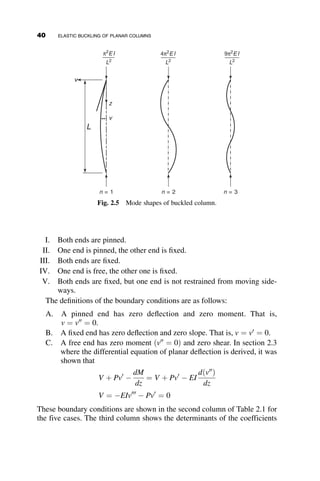
on these assumptions:
 The stress-strain curve of the material is known.
 The displacements are small.
Et
Et
E
C
N.A.
dA
dA
Cross-section
Strains
Stresses
d L
d U
dσL
dσU
y
y
d
(c)
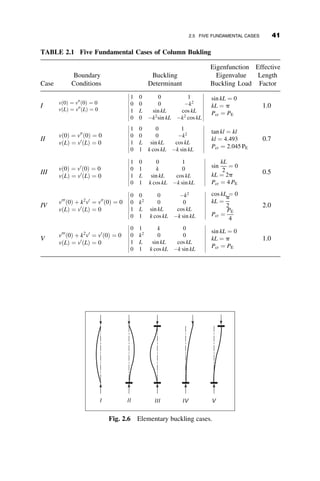
(b)
(a)
(d)
y1 x
PR
A
y
y
σ
σ –
dΦ
Curve
Fig. 3.3 The reduced modulus concept.
90 INELASTIC COLUMN BUCKLING
Plane sections before bending are plane after bending.
 No change of load is associated with bifurcation.
Figure 3.3b shows a cross-section that is symmetric about the y-axis and that
is part of a column that is assumed to buckle at a stress scr ¼ PR=A where
PR is the reduced modulus load.
In the loading (L) portion
dsL ¼ EtdeL (3.6)
In the unloading (U) portion
dsU ¼ EdeU (3.7)
that is, the stress–strain relationship is governed by the elastic modulus E.
From the geometry of the strain distribution we find (Figure 3.3c) that
deL ¼ ½y þ ðy  y1Þdf and deU ¼ ½y  ðy  y1Þdf (3.8)
where y and y1 are defined in Figure 3.3.The curvature df is related to the
deflection of the column v by the formula df ¼ v00
, and therefore the
stresses are
dsL ¼ v00
Etðy  y1 þ yÞ and dsU ¼ v00
Eðy þ y1 þ yÞ (3.9)
According to our assumption, the change in P due to buckling is zero, and
so
dP ¼ 0 ¼
ðy
yy1
dsUdA 
ðyy1
ðdyÞ
dsLdA (3.10)
If we substitute equation 3.9 into equation 3.10, we find that
ES1 ¼ EtS2 (3.11)
where
S1 ¼
ðy
yy1
ðy  y þ y1ÞdA (3.12)
S2 ¼
ðyy1
ðdyÞ
ðy  y1 þ yÞdA (3.13)
3.1 TANGENT AND REDUCED MODULUS CONCEPTS 91
are the statical moments of the areas to the left and to the right of the neutral
axis (N. A. in Figure 3.3) about this axis, respectively. The expression in
equation 3.11 permits the determination of the location of the neutral axis of
the bending stresses.
Equilibrium of the moments due to the bending stresses (Figure 3.3d)
about the neutral axis is expressed as follows:
M ¼ Pv ¼
ðy
yy1
dsUðy  y þ y1ÞdA þ
ðyy1
ðdyÞ
dsLðy  y1 þ y1ÞdA (3.14)
From equation 3.14 we can obtain, after substitution of dsL and dsU from
equation 3.9, the following formula:
Pv ¼ v00
ðEI1 þ EtI2Þ (3.15)
where
I1 ¼
ðy
yy1
ðy  y þ y1Þ2
dA (3.16)
I2 ¼
ðyy1
ðdyÞ
ðy  y1 þ yÞ2
dA (3.17)
are the moments of inertia about the neutral axis of the area to the left and to
the right of this axis, respectively. Rearrangement and differentiation of
equation 3.15 gives the following differential equation:
viv
þ
Pv00
EIx
¼ 0 (3.18)
where
E ¼ E
I1
Ix
 
þ Et
I2
Ix
 
(3.19)
This latter term is the reduced modulus and it is a function of both the
material properties E and Et and the cross-section geometry. The reduced
modulus buckling load follows from the differential equation:
PR ¼
p2
EIx
L2
(3.20)
The load PR is the reduced modulus load. Since E  Et, PR will always be
larger than PT.
92 INELASTIC COLUMN BUCKLING
3.2 SHANLEY’S CONTRIBUTION
For almost 50 years engineers were faced with a dilemma: They were con-
vinced that the reduced modulus concept was correct, but the test results had
an uncomfortable tendency to lie near the tangent modulus load. For this
reason, the tangent modulus concept was used in column design, and the
discrepancy was ascribed to initial out-of-straightness and end eccentricities
of the load that could not be avoided when testing columns.
In order to determine the cause of the discrepancy, Shanley conducted
very careful tests on small aluminum columns (Shanley 1947). He found
that lateral deflection started very near the theoretical tangent modulus
load, but that additional load could be carried until the column began to
unload. At no time could Shanley’s columns support as much load as that
predicted by the reduced modulus theory.
In order to explain the behavior, Shanley developed the model shown in
Figure 3.4. The model is composed of a column made up of two inextensi-
ble bars connected in the center of the column by a deformable cell. Upon
buckling, all deformations take place in the cell, which consists of two
flanges of area A=2; these two flanges are connected by a web of zero area.
P
P
e1
e2
e2
2
2
E1,A/2; E2 A/2
2
P2
P1
d
d
Deformable cell
Rigid bar
Rigid bar
L
L
2
2
θo
θo
νo (a)
2θo
(b)
e1
2
Fig. 3.4 Shanley’s column model.
3.2 SHANLEY’S CONTRIBUTION 93
One flange consists of a material with an elastic modulus E1, and the other
of a material with a modulus E2. The length of the column L is much larger
than the dimensions d of the cell.
In the buckled configuration (Figure 3.4a) the following relationship ex-
ists between the end slope uo, the lateral deflection vo (where vo  d), and
the strains e1 and e2 of the flanges (Figure 3.4b):
vo ¼
uoL
2
and uo ¼
1
2d
e1 þ e2
ð Þ (3.21)
By combining these two equations we eliminate uo, and thus
vo ¼
L
4d
ðe1 þ e2Þ (3.22)
The external moment (e) at the mid-height of the column is
Me ¼ Pvo ¼
PL
4d
ðe1 þ e2Þ (3.23)
The forces in the two flanges due to buckling are
P1 ¼
E1e1A
2d
and P2 ¼
E2e2A
2d
(3.24)
The internal moment (i) is then
Mi ¼
d
2
ðP1 þ P2Þ ¼
A
4
E1e1 þ E2e2
ð Þ (3.25)
With Me ¼ Mi we get an expression for the axial load P:
P ¼
Ad
L
E1e1 þ E2e2
e1 þ e2
 
(3.26)
In case the cell is elastic E1 ¼ E2 ¼ E, and so
PE ¼
AEd
L
(3.27)
For the tangent modulus load E1 ¼ E2 ¼ ET , thus
PT ¼
AEtd
L
(3.28)
94 INELASTIC COLUMN BUCKLING
When we consider the elastic unloading of the tension flange, the E1 ¼ Et
and E2 ¼ E. Thus
P ¼
Ad
L
Ete1 þ Ee2
e1 þ e2
 
(3.29)
Upon substitution of e1 from equation 3.22 and PT from equation 3.28 and
using the abbreviation
t ¼
Et
E
(3.30)
we find that
P ¼ PT 1 þ
Le2
4dvo
1
t
 1
 
 
(3.31)
There are forces P1 and P2 acting on the two flanges if the member is
deflected, and the difference of these two loads is the amount by which P is
increased above the tangent modulus load. That is,
P ¼ PT þ ðP1  P2Þ (3.32)
By employing equations 3.22, 3.24, and 3.30 it can be shown that
P1  P2 ¼
AEt
2d
4vod
L
 1 þ
1
t
 
e2
 
(3.33)
and
P ¼ PT 1 þ
2vo
d

Le2
2d2
1 þ
1
t
 
 
(3.34)
By eliminating e2 from equations 3.31 and 3.34, we obtain the load P to be:
P ¼ PT 1 þ
1
d=2vo þ ð1þtÞ
ð1tÞ
2
4
3
5 (3.35)
If, for example, t ¼ 0:5 and it remains constant after PT is exceeded, then
P
PT
¼ 1 þ
1
d=2vo þ 3
(3.36)
3.2 SHANLEY’S CONTRIBUTION 95
and the curve relating P=PT and vo=d is the solid line in Figure 3.5. This
curve approaches P ¼ 1:333PT asymptotically as vo=d ! 1. In reality, t
will vary with the strain, and as P is increased, it will become progressively
smaller and the curve shown by the dashed line in Figure 3.5 results. This
relationship will have a maximum between PT and 1.333PT.
The reduced modulus concept defines the load at which deflection occurs
without a change in load. Thus in equation 3.33 P1  P2 ¼ 0, and therefore
e2 ¼
4vod
L
1
1 þ 1=t
 
(3.37)
Substituting equation 3.37 into equation 3.34 gives the reduced modulus
load PR
PR ¼ PT 1 þ
1  t
1 þ t
 
(3.38)
that becomes equal to 1.333PT for t ¼ 0:5. PR is the maximum load that can
theoretically be reached if the deflection vo approaches infinity.
Equation 3.35 defines the relationship between the axial load P and the
resulting deflection of the mid-height of the column vo for any constant
value t (Figure 3.5). When vo ¼ 0, this equation gives P ¼ PT, the tangent
modulus load. For any value of vo the axial load is larger than PT, or con-
versely, if P  PT , a deflection vo is necessary for maintaining equilibrium.
vo /d
0.0 0.5 1.0 1.5 2.0
P
/
P
T
0.0
0.2
0.4
0.6
0.8
1.0
1.2
1.4
PR = 1.33PT P = 1.33PT@vo/d
PT
Fig. 3.5 Post-buckling behavior in the inelastic range.
96 INELASTIC COLUMN BUCKLING
The maximum value of P ¼ PR is reached when the deflection vo becomes
infinitely large. This load represents the maximum possible theoretical load.
Because bending after PT is accompanied by further straining of the com-
pression flange of the cell, t is reduced from its initial value and the P  vo
curve therefore reaches a peak below the reduced modulus load (dashed
curve, Figure 3.5).
Although the Shanley model (Figure 3.4) has no resemblance to an actual
column, the conclusions from its analysis apply also to such real members.
These conclusions are
1. The tangent modulus concept gives the maximum load up to which
an initially straight column will remain straight.
2. The actual maximum load exceeds the tangent modulus load, but it
cannot be as large as the reduced modulus load.
3. Any load above PT will cause the column to be laterally deflected.
4. In the load range PT  P  Pmax there is always strain reversal
present.
Shanley resolved the paradox that had existed for half a century, and he
defined the concepts on which a rational inelastic column theory could be
based. Following Shanley, many investigators refined and expanded these
concepts (e.g., Johnston 1961 and 1964). This research has further proved
Shanley’s model, and it has brought out the following additional facts about
column behavior:
1. Theoretically, it is possible to have an infinite number of ‘‘critical’’
loads (i.e., loads at which a column may deflect) between the tangent
modulus load PT and the elastic buckling load (see Figure 3.6). Upon
deflection, the gradient of the load-deflection curve is positive when
PT  P  PR, zero when P ¼ PR, and negative (i.e., deflection is ac-
companied by unloading) when PR  P  PE.
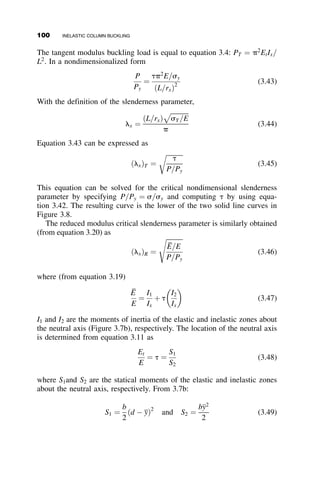
2. In reality, there are no initially straight columns. If the behavior of a
straight column is regarded as the limiting case of an initially
crooked column as the crookedness vanishes (Figure 3.6), then the
only significant critical load among the many theoretical possibilities
is the tangent modulus load.
Shanley’s theory also led to the development of a rational column theory for
ideally straight metal columns, which is discussed in sections 3.4 and 3.5
(Beedle and Tall 1960). The effect of initial out-of-straightness will be dis-
cussed in section 3.6.
3.2 SHANLEY’S CONTRIBUTION 97
3.3 EXAMPLE ILLUSTRATING THE TANGENT MODULUS
AND THE REDUCED MODULUS CONCEPTS
To illustrate the tangent modulus and the reduced modulus concepts, we
determine these two loads for a pinned-end column having a rectangular
cross-section (Figure 3.7a) when buckling is about the x-axis. Let the
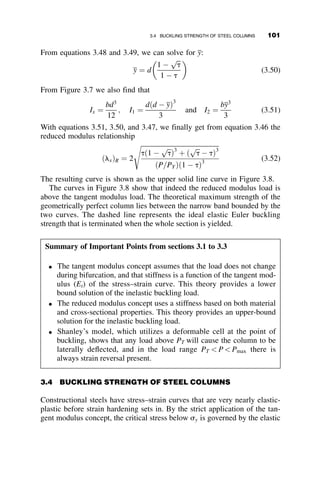
stress–strain relationship be given by the formula
e ¼
s
E
þ
3sy
7E
 
s
sy
 10
(3.39)
This is a special case of a generalized formula suggested for material with a
nonlinear stress–strain curve (Ramberg and Osgood 1943).
Nondimensionalizing this equation by the yield strain ey ¼ sy=E, we get
e
ey
¼
s
sy
þ
3
7
s
sy
 10
(3.40)
PR
Pε
P
P
P
Vo
Vo
Voi = 0
Voi ≠ 0
VoL
Voi = initial deflection
PT
Fig. 3.6 Initial gradient of the load-deflection curve of a column.
98 INELASTIC COLUMN BUCKLING
The curve representing this relationship is shown in the right corner of
Figure 3.8. It is nearly linear almost up to 90 percent of the yield stress.
Beyond this point, the curve bends sharply, but it continues to rise. Such a
stress–strain curve is typical of aluminum and stainless steel alloys.
The tangent modulus Et is obtained by differentiating equation 3.39:
de
ds
¼
1
E
1 þ
30
7
s
sy
 9
 #
(3.41)
t ¼
Et
E
¼
ds=de
E
¼
1
1 þ ð30=7Þðs=syÞ9
(3.42)
N.A.
E
Et
x
y
y
b
d
(b)
(a)
Fig. 3.7 The yielded rectangular cross-section.
P
P
P
L
L 1
r π
Py
Reduced modulus, PR
Tangent modulus, PT
1.0
0.5
0 0.5 1.0 1.5 2.0 2.5
1.5
1.0
0.5
0 5 10
3.0
σy
3.5
E
λ = (—)(—)
εy
σy
ε
σ
Fig. 3.8 Tangent modulus and reduced modulus column curves for rectangular
columns.
3.3 EXAMPLE ILLUSTRATING THE TANGENT MODULUS AND THE REDUCED MODULUS CONCEPTS 99
The tangent modulus buckling load is equal to equation 3.4: PT ¼ p2
EtIx=
L2
. In a nondimensionalized form
P
Py
¼
tp2
E=sy
ðL=rxÞ2
(3.43)
With the definition of the slenderness parameter,
lx ¼
ðL=rxÞ
ffiffiffiffiffiffiffiffiffiffiffi
sY =E
p
p
(3.44)
Equation 3.43 can be expressed as
ðlxÞT ¼
ffiffiffiffiffiffiffiffiffiffi
ffi
t
P=Py
r
(3.45)
This equation can be solved for the critical nondimensional slenderness
parameter by specifying P=Py ¼ s=sy and computing t by using equa-
tion 3.42. The resulting curve is the lower of the two solid line curves in
Figure 3.8.
The reduced modulus critical slenderness parameter is similarly obtained
(from equation 3.20) as
ðlxÞR ¼
ffiffiffiffiffiffiffiffiffiffi
ffi
E=E
P=Py
s
(3.46)
where (from equation 3.19)
E
E
¼
I1
Ix
þ t
I2
Ix
 
(3.47)
I1 and I2 are the moments of inertia of the elastic and inelastic zones about
the neutral axis (Figure 3.7b), respectively. The location of the neutral axis
is determined from equation 3.11 as
Et
E
¼ t ¼
S1
S2
(3.48)
where S1and S2 are the statical moments of the elastic and inelastic zones
about the neutral axis, respectively. From 3.7b:
S1 ¼
b
2
ðd  yÞ2
and S2 ¼
by2
2
(3.49)
100 INELASTIC COLUMN BUCKLING
From equations 3.48 and 3.49, we can solve for y:
y ¼ d
1 
ffiffiffi
t
p
1  t
 
(3.50)
From Figure 3.7 we also find that
Ix ¼
bd3
12
; I1 ¼
dðd  yÞ3
3
and I2 ¼
by3
3
(3.51)
With equations 3.51, 3.50, and 3.47, we finally get from equation 3.46 the
reduced modulus relationship
ðlxÞR ¼ 2
ffiffiffiffiffiffiffiffiffiffiffiffiffiffiffiffiffiffiffiffiffiffiffiffiffiffiffiffiffiffiffiffiffiffiffiffiffiffiffiffiffiffiffiffiffiffiffiffi
tð1 
ffiffiffi
t
p
Þ3
þ ð
ffiffiffi
t
p
 tÞ3
ðP=PY Þð1  tÞ3
s
(3.52)
The resulting curve is shown as the upper solid line curve in Figure 3.8.
The curves in Figure 3.8 show that indeed the reduced modulus load is
above the tangent modulus load. The theoretical maximum strength of the
geometrically perfect column lies between the narrow band bounded by the
two curves. The dashed line represents the ideal elastic Euler buckling
strength that is terminated when the whole section is yielded.
Summary of Important Points from sections 3.1 to 3.3
 The tangent modulus concept assumes that the load does not change
during bifurcation, and that stiffness is a function of the tangent mod-
ulus (Et) of the stress–strain curve. This theory provides a lower
bound solution of the inelastic buckling load.
 The reduced modulus concept uses a stiffness based on both material
and cross-sectional properties. This theory provides an upper-bound
solution for the inelastic buckling load.
 Shanley’s model, which utilizes a deformable cell at the point of
buckling, shows that any load above PT will cause the column to be
laterally deflected, and in the load range PT  P  Pmax there is
always strain reversal present.
3.4 BUCKLING STRENGTH OF STEEL COLUMNS
Constructional steels have stress–strain curves that are very nearly elastic-
plastic before strain hardening sets in. By the strict application of the tan-
gent modulus concept, the critical stress below sy is governed by the elastic
3.4 BUCKLING STRENGTH OF STEEL COLUMNS 101
formula, and the column curve would take the form shown in Figure 3.9.
However, a great number of tests on steel columns have very convincingly
shown that the column strength predicted by the reasoning above is usually
higher than the actual strength if the columns are of intermediate length
(0:3  l  1:4, approximately). The test points in Figure 3.9 illustrate this.
These test results were taken from a test program performed at the Fritz
Engineering Laboratory of Lehigh University. (Beedle and Tall 1960). The
specimens were W8  31 columns of A7 steel. Other tests, notably those on
welded H shapes, show an even larger discrepancy.
The traditional explanation of the apparent scatter of the test points has
been that initial out-of-straightness and unavoidable eccentricity of the load
are the causes for the difference between theory and practice. However,
the tests in Figure 3.9 were performed carefully on well-centered and es-
sentially straight specimens, and the measured amount of initial out-of-
straightness did not account for the low test strengths.
The idea that residual stresses could be held accountable for the lower
strength of steel columns of intermediate length had been advanced as
early as l888, but it was not until 1952 that it was convincingly shown in a
paper by Osgood (1952) that this was the case. At that time extensive re-
search was already in progress at the Fritz Engineering Laboratory of
Lehigh University, where the distribution and the magnitude of residual
stresses, and their effect on column strength was extensively investigated
(Beedle and Tall 1960). Rolled, riveted, and welded columns of various
+
+
+
Stress relieved
As–rolled, strong axis
As–rolled, weak axis
8 W= 31, σY= 40 ksi
P 1.0
0.5
0.5 1.0 1.5 2.0
0
Py
L 1
r π
σy
E
λ = (—)(—)
Fig. 3.9 Scatter of test points for steel columns.
102 INELASTIC COLUMN BUCKLING
shapes and types of steel were tested and their column strength was com-
pared with theoretical values computed from the measured material and
residual stress properties.
This research demonstrated that residual stresses account for a large share
of the deviation of the column strength from the ideal curve predicted from
the stress–strain relationship (Figure 3.9). A new interpretation of the tan-
gent modulus concept that includes the effects of premature yielding due to
residual stresses was introduced (Beedle and Tall 1960). With this modifica-
tion, the strength of ideally straight columns can be predicted very satisfac-
torily. Residual stresses do not, however, account for all effects, as can be
seen in Figure 3.9, where the as-rolled shapes (those containing residual
stresses from uneven cooling after hot rolling) have lower strengths than the
stress-relieved specimens. For these latter columns the deviation can only be
explained by considering initial out-of-straightness.
In the next section of this chapter we illustrate the effects of residual
stresses using the example of a rectangular pinned-end column. section 3.6
discusses the effect of initial out-of-straightness, and section 3.7 pulls all of
this together and discusses the design criteria of actual metal columns.
3.5 ILLUSTRATION OF THE EFFECT OF
RESIDUAL STRESSES ON THE BUCKLING
STRENGTH OF STEEL COLUMNS
A pinned-end column of rectangular cross section (Figure 3.10a) is made of
steel with an ideal elastic-plastic stress–strain relationship and having a re-
sidual stress distribution, as shown in Figure 3.10b. This residual stress pat-
tern is the same in any plane that passes through the cross-section parallel
to the x-axis. The residual stress varies linearly from a tensile stress of sy=2
at the center of the section to a compressive stress of sy=2 at the edges.
(b)
σrc = 0.5σY
σrt = 0.5σY
(a)
y
b
d
x
Fig. 3.10 Residual stress in a rectangular column.
3.5 EFFECT OF RESIDUAL STRESSES ON THE BUCKLING STRENGTH OF STEEL COLUMNS 103
Any stress, s, due to an axial load is evenly distributed across the section
until yielding starts when
s þ sr ¼ sy:
This occurs at x ¼ b=2 when
s þ sY =2 ¼ sy; or s=sy ¼ P=Py ¼ 1=2:
For an increased amount of P, portions of the cross-section are yielded
(cross-hatched area in Figure 3.11a) and the stress distribution is as shown
in Figure 3.11b. From this figure we obtain the following relationship
between the applied stress, s, and the parameter a, that defines the extent of
the elastic core, by using the equilibrium condition P ¼
ð
A
sdA:
P
Py
¼
s
sy

s
sy

1
2
 
1
2
 a
 
(3.53)
From the geometry of similar triangles in Figure 3.11b we can also show
that
s
sy
¼
3
2
 2a (3.54)
(b)
(a)
2
y
σrc
σrt
σY – σrc
αb
αb
x
(c)
σY
dσ
σ
σ
σ
σY
Fig. 3.11 Residual and compression stresses.
104 INELASTIC COLUMN BUCKLING
By combining equations 3.53 and 3.54, we prove that
a ¼
ffiffiffiffiffiffiffiffiffiffiffiffiffiffiffiffiffiffiffiffiffiffiffiffi
1
2
1 
P
Py
 
s
(3.55)
Another way of establishing a is demonstrated next. If an infinitesimally
small increase of stress, ds, is added to the column (Figure 3.11c), then the
increase in P is equal to
ðdPÞ ¼ ðdsÞ  d  2ab ¼ AE  ðdsÞ (3.56)
where AE is the area of the elastic core. The average stress increase is
ðdsÞav ¼ ðdPÞ
A . The symbol A defines the full cross-sectional area. The
increase in the strain is equal to:
ðdeÞ ¼
ðdsÞ
E
¼
ðdPÞ
AEE
(3.57)
When a short length of this column is compressed in a testing machine and
the value of P=A is plotted against e, a so-called stub-column stress–strain
curve is generated. The slope at any location of the stub-column stress–
strain curve is
ðdsÞav
ðdeÞ
¼
ðdPÞ=A
ðdPÞ=AEE
¼
EAE
A
(3.58)
We can think of this slope of the stub-column stress–strain curve as the
tangent modulus of the cross-section Et, and so
Et
E
¼ t ¼
AE
A
(3.59)
In the inelastic region of column behavior, the ratio of the tangent modulus
to the elastic modulus is equal to the ratio of the area of the elastic core to
the area of the whole cross-section. This is in contrast to the tangent
modulus defined previously for the material; the tangent modulus for the
cross-section includes the effect of the residual stresses. It can be calculated
analytically or numerically from the known or measured residual stress
pattern, or it can be obtained experimentally by compressing a short piece of
the column, a stub column, and plotting the average stress P=A versus the
strain curve. This is a routine test, and it has been standardized
internationally (Galambos 1998). The stub column stress–strain curve plays
the same role as the material stress-strain curve for the material in the
calculation of the inelastic buckling load (see Figure 3.1).
3.5 EFFECT OF RESIDUAL STRESSES ON THE BUCKLING STRENGTH OF STEEL COLUMNS 105
In the case of the rectangular cross section of Figure 3.11a,
t ¼
AE
A
¼
2abd
bd
¼ 2a (3.60)
And so, from equation 3.55
t ¼
ffiffiffiffiffiffiffiffiffiffiffiffiffiffiffiffiffiffiffiffiffiffiffiffiffi
2ð1  P=PyÞ
q
(3.61)
It is now possible to develop formulas for the buckling strength of the
rectangular column that include the effects of residual stresses. In the elastic
range ð0  P=Py  0:5Þ, this is equal to
PX ¼
p2
EIx
L2
and PY ¼
p2
EIy
L2
(3.62)
with the abbreviations
lx ¼
ðL=rxÞ
p
ffiffiffiffiffi
sy
E
r
and ly ¼
ðL=ryÞ
p
ffiffiffiffiffi
sy
E
r
(3.63)
We now nondimensionalize equation 3.62 to give
ðlxÞE ¼ ðlyÞE ¼
1
ffiffiffiffiffiffiffiffiffiffi
ffi
P=Py
p (3.64)
Where Py ¼ Asy
The tangent modulus buckling strength is defined by the elastic core,
since E ¼ 0 in the yielded zone; that is,
PT ¼
p2
EIE
L2
(3.65)
In nondimensional form, this equation is
lT ¼
ffiffiffiffiffiffiffiffiffiffiffi
IE=I
P=PY
s
(3.66)
For buckling about the y-axis
IyE ¼
d
12
ð2abÞ3
and Iy ¼
db3
12
(3.67)
106 INELASTIC COLUMN BUCKLING
and for buckling about the x-axis
IxE ¼
d3
12
ð2abÞ and Ix ¼
d3
b
12
(3.68)
Setting equation 3.60 into equations 3.67 and 3.68, and substituting these, in
turn, into equation 3.66, we obtain the following equations for the tangent
modulus loads:
ðlxÞT ¼
ffiffiffiffiffiffiffiffiffiffi
ffi
t
P=Py
r
¼
ffiffiffiffiffiffiffiffiffiffiffiffiffiffiffiffiffiffiffiffiffiffiffiffiffiffiffiffiffiffi
2ð1  P=PyÞ1=2
P=Py
s
ðlyÞT ¼
ffiffiffiffiffiffiffiffiffiffi
ffi
t3
P=Py
s
¼
ffiffiffiffiffiffiffiffiffiffiffiffiffiffiffiffiffiffiffiffiffiffiffiffiffiffiffiffiffiffi
2ð1  P=PyÞ3=2
P=Py
s (3.69)
The curves showing the P=Py versus ðlxÞT and ðlyÞT relationship are shown
as the solid-line curves in Figure 3.12. For y-axis bending, the tangent
modulus is nearly a straight line between P=Py ¼ 1:0, where the whole
cross-section is yielded, and P=Py ¼ 0:5, where yielding commences. The
curve for buckling about the x-axis is considerably above the y-axis curve.
The reason for this is seen from equations 3.67 and 3.68; the moment of
inertia of the elastic core about the y-axis varies as a3
, whereas this property
varies as a about the x-axis. Since
a  1:0; a3
 a;
Tangent modulus
Elastic solution
Reduced modulus
1.0
0.5
λx
λy
P
Py
0 0.5 1.0 1.5
L 1
r π σY/E
λ = (—)(—)
Fig. 3.12 Reduced and tangent modulus column curves for buckling about the
x- and y-axes of a rectangular column.
3.5 EFFECT OF RESIDUAL STRESSES ON THE BUCKLING STRENGTH OF STEEL COLUMNS 107
then it follows that
PTX=Py  PTY=Py:
As the buckling strength of wide-flange shapes is governed principally by
the stiffness of the flanges, and the residual stress distribution in these
flanges is similar to that in our rectangular column, the nondimensional
buckling strength of wide-flange shapes should be larger for strong-axis
buckling than for weak-axis buckling. That this is indeed so has been
verified by numerous experiments on rolled wide-flange steel columns
(Galambos 1998).
Since the reduced modulus strength is only of academic interest, the de-
velopment of the equations will be omitted here. The resulting curves are
included in Figure 3.12 for comparison only. In the next section it will be
demonstrated that for steel columns one must also consider initial out-of-
straightness in determining column strength.
3.6 EFFECT OF INITIAL OUT-OF-STRAIGHTNESS
AND LOAD ECCENTRICITY
The previous portions of the chapter on inelastic column buckling dealt
with the theory of the buckling strength of ideally straight compression
members. Examples were presented to show how strength is determined
for columns made from materials that have a nonlinear stress–strain rela-
tionship, such as aluminum and stainless steel. The effect of residual stress-
es on the inelastic buckling strength of steel columns was also elaborated.
This section introduces the additional effect on column strength that results
from initial out-of-straightness of the member, and from the eccentricity of
the load application. The phenomenon is illustrated on a pinned-end rectan-
gular column made from a material with an ideal-elastic-plastic stress–
strain curve. The final part of this chapter, section 3.7 pulls together the
various ideas that were presented so far in order to explain the origins of
column formulae used in modern design specifications for the design of
metal structures.
Columns have initial deflections as a result of manufacturing and fabrica-
tion. These are small and must be within prescribed tolerances, and they are
thus unavoidable. These ‘‘imperfections’’ may affect the strength of the
compression member, as shown schematically in Figure 3.6. If the material
is infinitely elastic, then the column strength will approach asymptoti-
cally the elastic buckling load of a perfect column, as was demonstrated in
Chapter 2. However, if the material is inelastic, then the attainment of the
maximum capacity necessarily occurs after some part of the column has
108 INELASTIC COLUMN BUCKLING
yielded. Inevitably there is deflection and bending as soon as there is any
load on the member. In order to determine the strength, it is necessary to
consider the nonlinear moment-curvature relationship of the cross-section.
In the following portions of this section, we first derive the moment-curvature
equations, and then we use these relations to find the maximum strength.
3.6.1 Moment-Curvature-Thrust Relations for a
Rectangular Section
It is assumed that the material has an ideal-elastic-plastic stress–strain curve
(Figure 3.18). The cross-section is assumed rectangular with dimensions
b  d. An axial force P is acting at the centroid of the cross-section, and it
is subjected to a bending moment M. It is assumed that plane sections before
bending will remain plane after bending, and therefore the strain varies line-
arly. According to the stress–strain diagram, there are three possible stress
distributions:
 The stresses are all below the yield stress.
 The top of the rectangle is yielded.
 Both top and bottom are yielded.
The cross-section, loading, strain distribution, and the three stress distri-
butions are shown in Figure 3.13.
The relationships between the bending moment M, the curvature f and
the axial force P will be next developed for the three stress distributions
shown in Figure 3.13.
Case I (Figure 3.14)
M
P
b
d
d/2
ε σc  σy
σt  σy σt  σy
σy σy
σy
φ
Strain
Possible stress distributions
Fig. 3.13 Rectangular cross-section. Showing loading, strain distribution, and three
stress distributions.
3.6 EFFECT OF INITIAL OUT-OF-STRAIGHTNESS AND LOAD ECCENTRICITY 109
The equilibrium of the applied forces with the stresses is
P ¼
ð
A
sdA ¼ scbd  ðsc þ stÞ
bd
2
 
¼
sc  st
2
 
bd (3.70)
M ¼
ð
A
sydA ¼ ðsc þ stÞ
bd
2
 
d
6
 
¼ ðsc þ stÞ
bd2
12
 
(3.71)
Assuming small strains, that is tan f ¼ f, we get from the geometry of the
stress block in Figure 3.14:
Ef ¼
st þ sc
d
(3.72)
The following quantities are introduced here for use in the derivations:
Yield forceð‘‘squash load’’Þ: Py ¼ bdsy
Yield moment: My ¼ bd2
sy=6
Yield curvature: fy ¼ 2sy=Ed
Equation 3.70 can be rearranged as follows:
P
Py
¼
1
2
sc
sy

st
sy
 
!
sc
sy
¼ 2
P
Py
þ
st
sy
(3.73)
From equations. 3.72 and 3.73 we get:
st
sy
¼
f
fy

P
Py
sc
sy
¼
f
fy
þ
P
Py
(3.74)
= –
σc
σc
σt σc + σt
Eφ d/2
d/6
Fig. 3.14 Case I stress distribution.
110 INELASTIC COLUMN BUCKLING
Substitution into equation 3.71 finally results in:
M
My
¼
1
2
sc
sy
þ
st
sy
 
¼
f
fy
(3.75)
The upper limit of applicability of this equation is when sc
sy
¼ 1 and f
fy
¼
1  P
Py
Case II (Figure 3.15)
In this case, yielding is in compression; yielding penetrates the top of the
cross-section. From the geometry of the stress blocks in Figure 3.15, the
curvature equals
Ef ¼
st þ sy
d  jd
:
From this we get (after some algebra),
st
sy
¼ 2
f
fy
ð1  jÞ  1:
The equilibrium of the axial stresses
P ¼ sybd 
1
2
ðst þ syÞðd  jdÞb
leads to
P
Py
¼ 1 
1
2
st
sy
þ 1
 
ð1  jÞ:
σy
σt
d/2
ξd
Eφ
Fig. 3.15 Yielding in compression
only.
3.6 EFFECT OF INITIAL OUT-OF-STRAIGHTNESS AND LOAD ECCENTRICITY 111
Substituting st
sy
from above we get
P
Py
¼ 1 
f
fy
ð1  jÞ2
:
From the equation for P
Py
we can now solve the quadratic equation for
j ¼ 1 
ffiffiffiffiffiffiffiffiffiffiffiffi
1  P
Py
f
fy
v
u
u
t
The negative sign controls because j must be less than 1.0. Substituting j
into the equation for st
sy
gives
st
sy
¼ 2
f
fy
ffiffiffiffiffiffiffiffiffiffiffiffi
1  P
Py
f
fy
v
u
u
t  1
The moment equilibrium equation is
M ¼ ðst þ syÞ
1
2
bðd  jdÞ
d
2

d  jd
3
 
:
Substituting j and st, and nondimensionalizing M, we get the following
equation for the ratio M
My
for stress Case II:
M
My
¼ 3ð1 
P
Py
Þ  2
ffiffiffiffiffiffiffiffiffiffiffiffiffiffiffiffiffiffiffiffi
1  P
Py
 3
f
fy
v
u
u
u
t (3.76)
The lower limit of this equation is when
j ¼ 0 ¼ 1 
ffiffiffiffiffiffiffiffiffiffiffiffi
1  P
Py
f
fy
v
u
u
t !
f
fy
¼ 1 
P
Py
The upper limit is when
st
sy
¼ 1 ¼ 2
f
fy
ffiffiffiffiffiffiffiffiffiffiffiffi
1  P
Py
f
fy
v
u
u
t  1 !
f
fy
¼
1
1  P
Py
Case III (Figure 3.16)
112 INELASTIC COLUMN BUCKLING
The curvature is
Ef ¼
2sy
d  hd  jd
Or nondimensionally,
f
fy
¼
1
1  h  j
:
The axial stress equilibrium is
P ¼ sybd  hdbð2syÞ 
1
2
ð2syÞbðd  hd  jdÞ; or
nondimensionalizing, P
Py
¼ j  h.
From the equations for f
fy
and P
Py
we can solve for h and j:
h ¼
1
2
1 
1
f
fy

P
Py
!
j ¼
1
2
1 
1
f
fy
þ
P
Py
!
The moment equilibrium is expressed as follows:
M ¼ 2sybhd
d
2

hd
2
 
þ
1
2
ð2syÞbðd  hd  jdÞ
d
2
 hd 
d  hd  jd
3
 
σy
σy
d/2
ξd
ηδ
Fig. 3.16 Stress distribution for Case III.
3.6 EFFECT OF INITIAL OUT-OF-STRAIGHTNESS AND LOAD ECCENTRICITY 113
After substitution of the previously derived values of h and j we get the
following nondimensional equation for the moment:
M
My
¼
3
2
1 
P
Py
 2

1
3 f
fy
 2
2
6
4
3
7
5 (3.77)
The lower limit is when
h ¼
1
2
1 
1
f
fy

P
Py
!
¼ 0 !
f
fy
¼
1
1  P
Py
The flow-diagram of Figure 3.17 summarizes the moment-curvature-thrust
relationships for the rectangular cross-section. Figure 3.18 recapitulates the
definitions that were used for the loading, the cross-section and the material
stress–strain relationship.
A typical moment-curvature curve is shown in Figure 3.19. When
f ! 1, practically when f 	 10fy, the moment reaches a plateau. This
P
Py
φ
≤ 1 −
φy
φ
=
φy
M
My
1
1−
P
Py
φ
≤
φy
Y
N
Y
N
1− −2
M P
My Py
= 3
3
1−
P
Py
φ
φy
3 1
2
M
My
= −
2
1−
P
Py 2
3
φ
φy
Fig. 3.17 Flow-diagram of moment-curvature thrust formulas for rectangle.
114 INELASTIC COLUMN BUCKLING
maximum moment is defined as the plastic moment in the presence of axial
force, Mpc.
Mpc
My
¼
3
2
1 
P
Py
 2
 #
(3.78)
In case P ¼ 0, that is, bending moment only,
Mp ¼
3
2
My ¼
3
2

bd2
sy
6
¼
bd2
sy
4
(3.79)
and therefore
Mpc
Mp
¼ 1 
P
Py
 2
 #
(3.80)
b
d
M
P
σ = stress
σy
ε = strain
Cross-section Ideal elastic-plastic stress-strain curve
Fig. 3.18 Recapitulation of definitions.
Fig. 3.19 Typical M-f-P curve.
3.6 EFFECT OF INITIAL OUT-OF-STRAIGHTNESS AND LOAD ECCENTRICITY 115
In the following portion of this section we use the M-f-P relationships to
derive the strength of initially crooked axially loaded columns. The
information in Figure 3.20 delineates the regions where elastic and inelastic
behavior controls the deformations of the column.
3.6.2 Maximum Strength of a Column with Initial
Out-of-Straightness
The sketch in Figure 3.21a shows an ideal column that is initially perfectly
straight. In contrast, Figure 3.21b illustrates an actual column that has an
initial bow with an amplitude voi in the middle even before any axial load is
applied. In addition, the load is applied through an eccentricity ei. This rep-
resents the actual case of a compression member in a real structure.
It is assumed that the initial out-of-straightness vi and the additional later-
al deflection v during loading are sinusoidal in shape and given by
vi ¼ voi sin
pz
L
(3.81)
v ¼ vosin
pz
L
(3.82)
The curvature at the center of the column (at z ¼ L=2) is then
fo ¼ v00
ðL=2Þ ¼ vo
p2
L2
 
sin
p
2
¼ vo
p2
L2
 
(3.83)
0 2 4 6 8 10
0
0.5
1
1.5 0
0.2
0.4
0.6
0.8
P
Py
M
My
φ
φy
Diamonds locate start of yielding
Fig. 3.20 Family of M-f curves for values of P=Py.
116 INELASTIC COLUMN BUCKLING
Equation 3.83 is divided by the yield curvature fy ¼
2sy
Ed to obtain the
following nondimensional expression for the curvature fo:
fo
fy
¼ 6
vo
d
  1
l2
 
(3.84)
where
l ¼
1
p
L
r
ffiffiffiffiffi
sy
E
r
(3.85)
The radius of gyration for the rectangular section is r ¼ d
ffiffiffiffi
12
p :
The external moment at z ¼ L=2 is equal to
Me ¼ Pðei þ voi þ voÞ (3.86)
If the expression in equation 3.86 is divided by the yield moment
My ¼
bd2sy
6 , then
Me
My
¼ 6
P
Py
ei
d
þ
voi
d
þ
vo
d
 
(3.87)
where Py ¼ bdsy. The internal moments are determined from the formulas
in the flowchart of Figure 3.17.
P
P
P
P
L
z
0i
ei
voi
(a) Ideal column (b) Actual column
Fig. 3.21 Ideal and actual column.
3.6 EFFECT OF INITIAL OUT-OF-STRAIGHTNESS AND LOAD ECCENTRICITY 117
The maximum value of the axial load P will be attained when the change
in the external moment dMe can no longer be resisted by the change in the
internal moment dMi at the center of the member where the moment is larg-
est. The stability criterion is thus dMe=dvo ¼ dMi=dvo. Nondimensionally
dðMe  MiÞ=My
dðvo=dÞ
(3.88)
The maximum occurs when some portion of the column is yielded. The
load-deflection curve is shown schematically in Figure 3.22. There are two
cases of yielding: compression only (Case II, Figure 3.15) and compression
and tension (Case III, Figure 3.16).
Case II, yielding in compression
The moment-curvature-thrust relationship is equal to (from equa-
tion 3.76):
Mi
My
¼ 3 1 
P
Py
 

2 1  P
Py
 3
2
f
fy
 1
2
(3.89)
With equations 3.87 and 3.84, we obtain the following equation for the
difference between the external and the internal moments:
Me  Mi
My
¼ 6
P
Py
ei
d
þ
voi
d
þ
vo
d
 
 3 1 
P
Py
 
þ
2 1  P
Py
 3
2
f
fy
 1
2
(3.90)
voi + vo
P
Pmax
voi
Fig. 3.22 Sketch of load-deflection
curve.
118 INELASTIC COLUMN BUCKLING
Taking the derivative of this equation with respect to vo=d, setting the
derivative equal to zero, and solving for vo=d, we get
vo
d
¼
1
6
l
ð Þ
2
3
1  P=Py
P=Py
	 
2
3
2
4
3
5 (3.91)
Setting equation 3.91 into the equilibrium relationship Mi ¼ Me, the
following equation is obtained for the interaction between the maximum
axial force and the slenderness ratio:
6
P
Py
 
ei
d
þ
voi
d
 
¼ 3 1 
P
Py
 
1 
P
Py
l2
 1
3
 #
(3.92)
Case III, yielding in compression and tension
In this case, from equation 3.77:
Mi
My
¼
3
2
1 
P
Py
 2
 #

1
2 f
fy
 2
(3.93)
and thus
Me  Mi
My
¼ 6
P
Py
 
ei
d
þ
voi
d
þ
vo
d
 

3
2
1 
P
Py
 2
 #
þ
l4
72
vo
d
 2
(3.94)
Setting the derivative of equation 3.94 with respect to vo=d equal to zero and
solving for vo=d results in
vo
d
¼
l
4
3
6 P
Py
 1
3
(3.95)
Setting equation 3.95 into the equilibrium relationship Mi ¼ Me, the
following equation is obtained for the interaction between the maximum
axial force and the slenderness ratio:
6
P
Py
 
ei
d
þ
voi
d
 
¼
3
2
1 
P
Py
 2
l
4
3
P
Py
 2
3
 #
(3.96)
3.6 EFFECT OF INITIAL OUT-OF-STRAIGHTNESS AND LOAD ECCENTRICITY 119
Equation 3.92 applies in the range 1  P
Py
 f
fy
 1
1 P
Py
.
By substituting equations 3.84 and 3.91, we get the following domain of
applicability:
1  P
Py
 3
P
Py
 l2

1
P
Py
(3.97)
Equation 3.96 applies in the range 1
1 P
Py
 l2
 1. By substituting equations
3.84 and 3.95, we get the following domain of applicability:
0  l2

1  P
Py
 3
P
Py
(3.98)
The interaction equations and their ranges of applicability are summarized
in Figure 3.23.
We use the model for the strength of rectangular steel columns to illustrate
the effects of unavoidable load eccentricity and initial out-of-straightness.
In some steel design codes used during the middle of the twentieth century, it
was customary to assume an unavoidable load eccentricity ratio of
eiA=S ¼ 0:25:
For the rectangle the area A ¼ bd and the elastic section modulus
S ¼ bd2
=6. The ratio ei=d 	 0:04. The initial out-of-straightness is
expressed as a ratio of the length of the column. The average initial out-
of-straightness of the test columns used as the basis of the development of
the column design equation of the AISC (to be presented in section 3.7) is
L=1,500 (Galambos 1998). Other standards use L=1,000. These are small
deflections that are not noticeable by an unaided eye. Based on an L=1,500
out-of-straightness:
voi
d
¼
L
1;500

d
r
ffiffiffiffiffi
12
p 
1
p
ffiffiffiffiffi
sy
E
r

p
d
ffiffiffiffiffi
E
sy
s
¼
p
ffiffiffiffiffi
12
p
ffiffiffiffiffi
E
sy
s
l
1;500
:
For sy ¼ 50 ksi and E ¼ 29; 000 ksi, voi=d ¼ 0:015.
The combined effect of initial out-of-straightness and end eccentricity is
illustrated in Figure 3.23 for
ei ¼
ei
d
¼ 0:04 and ni ¼
vo
d
¼ 0:02:
120 INELASTIC COLUMN BUCKLING
ffiffiffiffiffiffiffiffiffiffiffiffiffiffiffiffiffiffi
ð1  pÞ3
p
s
 l 
1
ffiffiffiffi
p
p
6 pðei þ viÞ  3ð1  pÞ 1  ð pl2
Þ
1
3
 
¼ 0
0  l 
ffiffiffiffiffiffiffiffiffiffiffiffiffiffiffiffiffiffi
ð1  pÞ3
p
s
6 pðei þ viÞ  1:5 1  p2
 l
4
3 p
2
3
 
¼ 0
p ¼
P
Py
; ei ¼
ei
d
; vi ¼
voi
d
; l ¼
1
p
L
r
ffiffiffiffiffi
sy
E
r
Fig. 3.23 Interaction between axial load, slenderness, load eccentricity, and initial out-of-straightness.
121
The comparison with the Euler curve illustrates the reduction of strength,
especially in the region 0:2  l  1:4, where most of the practical-length
columns occur. The effect of the mean initial out-of-straightness of L=1,500
is shown in Figure 3.25. Also shown is a curve representing the strength of
columns according to the specification of the AISC for steel structures. This
curve is discussed in more detail in the next section. The AISC design
column curve is below the curve that only includes the initial out-of-
straightness because the former includes the effects of both the initial
curvature and residual stresses.
λ
0.0 0.2 0.4 0.6 0.8 1.0 1.2 1.4 1.6 1.8 2.0
P/P
y
0.0
0.2
0.4
0.6
0.8
1.0
1.2
ei / d = 0.02, voi / d = 0.02
Euler formula
Fig. 3.24 Effect of initial out-of-straightness and load eccentricity on column
strength.
λ
0.0 0.2 0.4 0.6 0.8 1.0 1.2 1.4 1.6 1.8 2.0
P/P
y
0.0
0.2
0.4
0.6
0.8
1.0
1.2
Initial curvature νi = 0.015
Euler curve
AISC column formula
Fig. 3.25 Column curve for initial out-of-straightness of L=1,500.
122 INELASTIC COLUMN BUCKLING
3.7 DESIGN FORMULAS FOR METAL COLUMNS
In the previous sections of this chapter on the inelastic behavior of axially
loaded compression members, several models of behavior were illustrated
on relatively simple problems. First, the behavior of geometrically perfect,
straight members was considered. The effects of a nonlinear stress–strain
curve on the tangent modulus and the reduced modulus strength were exam-
ined. The paradox between the two idealized theories was resolved by Shan-
ley, and his derivation was explained in detail. Practical tangent modulus
column strengths were solved by using the Ramberg–Osgood equation for
the stress–strain curve. The concept of residual stresses was then introduced
for the solution of the strength of steel columns. Finally, the inelastic behav-
ior of geometrically crooked columns was studied for the simple case of
rectangular members.
Engineers in the design office need formulas that can be employed to
quickly check the strength of many columns in the course of a working day.
The history of column design formulas is a long and interesting study, going
back some 250 years to Leonard Euler. Only a brief overview is given here.
For a more detailed history of column curve development, the reader is re-
ferred to the Guide to Design Criteria for Metal Structures (Galambos 1998).
Engineers have always been aware that the behavior of practical-length
metal columns is not governed by elastic behavior. Basically, three historic
threads for column formulas run through the past 150 years, since the begin-
ning of the extensive use of metal columns in construction:
1. Purely empirical formulas based on laboratory tests of specific types
of cross sections and materials
2. Formulas that were derived theoretically by assuming a fictional or a
measured unavoidable load eccentricity or initial curvature
3. Formulas that are based on the tangent modulus theory
For the past 100 years it was known that column strength is dependent on
the stress–strain curve of the metal, on the locked-in initial residual stresses,
on the shape of the cross-section, on the eccentricity of the applied load, and
on the unavoidable initial out-of-straightness of the erected member. Many
ingenious behavioral models were used to arrive at curves relating critical
stress and slenderness ratio. However, prior to the computer being an indis-
pensable engineering tool, these models had to be simple enough to allow
computation by slide-rule or mechanical calculators.
In North American structural steel specifications of the 1960s and 1970s
the Tangent Modulus concept was used as the basis for column design
3.7 DESIGN FORMULAS FOR METAL COLUMNS 123
equations. The theoretical model assumed geometrically straight members,
and ideal elastic-plastic stress strain diagram for the material, and idealized
residual stresses due to cooling after rolling (Galambos 1998). The residual
stress distribution in the flanges was assumed to vary linearly from a com-
pressive stress at the four flange tips, src, to a tensile residual stress at the
flange-to-web junction, srt. The residual stress in the web was assumed to
be a uniform tensile residual stress, srt. This distribution of residual stresses
is shown in Figure 3.26. The compressive residual stress was assumed to be
equal to src ¼ 0:3Fy, or, 30% of the yield stress. The tensile residual stress
is defined by the condition that the net force on the cross section due to the
residual stresses must equal zero, and thus srt ¼ src
1þdtw
bf tf
1
2tf
d
 . The role of
the initial curvature was acknowledged in the design standards by providing
safety factors that became larger as the column length increased. As dis-
cussed below, this method of designing columns has been abandoned in
modern codes.
Based on the geometry of the wide-flange shape and the distribution of
the residual stress, assuming an ideal elastic-plastic stress-strain diagram,
tangent modulus column equations have been derived. The method is illus-
trated on a rectangular shaped column with residual stress earlier in this
chapter. The resulting column curves for major and minor axis buckling of
wide-flange columns are shown as the dashed curves in Figure 3.27. The
tf
tw
d
bf
σrc
σrt
σrt
Fig. 3.26
124 INELASTIC COLUMN BUCKLING
corresponding equations were thought to be too cumbersome for design of-
fice use, and so a compromise design curve was adopted for the specifica-
tions. This curve is shown as the solid curve in Figure 3.27. It is often
referred to as the Column Research Council column equation, or the CRC
Column Curve (Galambos 1998). The corresponding equations are
P
Py
¼ 1 
l2
4
for
P
Py
 0:5; or l 
ffiffiffi
2
p
(3.99)
P
Py
¼
1
l2
for
P
Py
 0:5; or l 

ffiffiffi
2
p
(3.100)
where
Py ¼ AFy (3.101)
l ¼
L
pr
ffiffiffiffiffi
Fy
E
r
(3.102)
Even though the CRC Column Curve is no longer used directly in design
codes, a tangent modulus equation that is derived from it is defined in
Appendix 7 of AISC Specification (2005) for use in the stability analysis of
steel framed structures. This method of design is presented in Chapter 8 of
this text.
The tangent modulus implicit in equation 3.99 is derived as follows:
define t ¼
Et
E
and p ¼
P
Py
λ
0.0 0.5 1.0 1.5 2.0 2.5
P/
P
y
0.0
0.2
0.4
0.6
0.8
1.0
CRC column curve
X-axis buckling for W8X31
Y-axis buckling for WX31
Fig. 3.27
3.7 DESIGN FORMULAS FOR METAL COLUMNS 125
from equation 3.99: l2
¼ 4 1  p
ð Þ
critical tangent modulus buckling load. p ¼
t
l2
¼
t
4 1  p
ð Þ
t ¼ 4 p 1  p
ð Þ for 0:5  p  1:0 (3.103)
t ¼ 1:0 for p  0:5 (3.104)
These equations will be used later in Chapters 4 and 5 to solve inelastic
column and frame examples.
Starting in 1945, when Shanley removed the intellectual barrier of the
tangent and reduced model paradox, a very intense area of research com-
menced. On the experimental side, reliable data became available on materi-
al properties and residual stress distributions, and careful and coordinated
column tests were performed by many laboratories. It was possible to con-
nect a given column test with the material properties, residual stress distri-
butions, and geometric imperfections of the same specimen. At the same
time, researchers could use computer models that incorporated all the data
of the test column to attempt to predict the total load-deflection behavior,
especially also the strength.
It not unreasonable to state that one can predict with a high degree of
certainty how strong a column is going to be if we know the pertinent
characteristics of material and geometry. This was demonstrated in the
1972 dissertation of Bjorhovde (Bjorhovde 1978), in which 26 column tests
were performed for which initial out-of-straightness, in addition to cross-
sectional measurements, material property distributions across the section,
and residual stresses were carefully determined and reported. The average
test strength-to-predicted strength was reported as 1.03, with a coefficient of
variation of 0.05. This level of accuracy provided confidence in the method
of calculating strength. Of course, the individual details of every column
cannot be determined prior to design, so a more general approach was
required.
In addressing this problem, Bjorhovde found 112 column cross-sections
in the literature for which there was available the complete information on
geometry, material characteristic, and residual stress needed to perform a
numerical analysis of the column strength for the range of practical column
lengths. He produced 112 column curves for initial sinusoidal curvatures of
L=1,000 as the maximum amplitude at the center of the column, the toler-
ance for straightness in the steel industry, and for the amplitude of L=1,470,
the average measured out-of-straightness of tested columns.
The column curves were then grouped into three column categories. For
each category, an average column curve was constructed and an equation
126 INELASTIC COLUMN BUCKLING
was fitted to this average. Coefficients of variation were also determined and
reported so that these statistics could be used in developing the resistance
factors f for the AISC Specification (AISC 2005). The column sections for
each of the three categories is provided in the Column Curve Selection
Table (Figure 3.27 of Galambos 1998) and is reproduced here as Table 3.1.
This table lists the column cross-section types, the specified minimum yield
stress, and the corresponding column category. Current (2007) fabrication
practice uses predominantly steel with a yield stress of 50 ksi or higher.
Only one shape type, namely a heavy welded built-up shape fabricated
from universal mill plate, is in category 3 for the yield stress of 50 ksi.
This method of using universal mill plates is no longer practiced because
built-up shapes are made by welding flame-cut plates together. Thus current
practice, as reflected by the 2005 AISC Specification, requires only the
Category 2 column equation. The same is the case in the Canadian steel
design standard.
The equations developed in the Bjorhovde thesis are also tabulated in the
SSRC Guide (Galambos 1998). They are not reproduced here, but a simple
accurate approximation that was developed for the Canadian steel design
standard S16 (Galambos 1998, equation 3.15), is given as the following
equation:
scr
sy
¼ 1 þ l2n
	 
1
n
(3.105)
where l is the slenderness parameter defined by equation 3.85. The exponent
n ¼ 2:24 for column Curve 1, n ¼ 1:34 for Column Curve 2, and n ¼ 1:00
for Column Curve 3. The three column curves are shown in Figure 3.28.
Studies similar to those performed by Bjorhovde were also executed in
Europe, and these researchers came up with similar curves and equations,
except that the mesh of possibilities was refined to give five column catego-
ries. Details of these curves and the corresponding equations are also pre-
sented in the SSRC Guide. (Galambos 1998)
The modern column formulas used by the world’s structural design stand-
ards are all based on essentially the same data and the same computational
methodology, yet they employ remarkably different formulas, as seen in
Table 3.2.
The diversity of formulas derives from the past history of the standard
development in the different parts of the world. In practice, the designer
uses tables or spreadsheet applications. Despite the different looking formu-
las, the resulting column strength curves are remarkably similar, as seen in
Figure 3.29 that shows the variation of the design strength f scr
sy
¼ f Pcr
Py
with
the slenderness parameter l, where f is the code-specified resistance factor.
3.7 DESIGN FORMULAS FOR METAL COLUMNS 127
TABLE 3.1 Structural Stability Council Column Categories (Figure three.27, Galambos, 1998.)
Column Curve Selection Table
Specified Minimum Yield Stress of Steel (ksi)
Fabrication Details Axis 36 37 to 49 50 to 59 60 to 89 
90
Hot-rolled
W-shapes
Light and medium
W-shapes
Major 2 2 1 1 1
Minor 2 2 2 1 1
Heavy W-shapes
(flange over 2 in.)
Major 3 2 2 2 2
Minor 3 3 2 2 2
Welded
Built-up
H-shapes
Flame-cut plates Major 2 2 2 1 1
Minor 2 2 2 2 1
Universal mill plates Major 3 3 2 2 2
Minor 3 3 3 2 2
Welded
Box shapes
Flame-cut and
universal mill plates
Major 2 2 2 1 1
Minor 2 2 2 1 1
Square and rectangular tubes Cold-formed Major N/A 2 2 2 2
Minor N/A 2 2 2 2
Hot-formed and
Cold-formed heat-treated
Major 1 1 1 1 1
Minor 1 1 1 1 1
Circular tubes Cold-formed N/A 2 2 2 2 2
Hot-formed N/A 1 1 1 1 1
All stress-relieved shapes Major
and
Minor
1 1 1 1 1
128
TABLE 3.2 Modern Column Formulas
Code Authority Resistance Factor f Column formula Pcr
Py
Comments
AISC, AISI,
AASHTOUSA
0.9 0:658l2
0:877
l2
l  1:5
l  1:5
CSA, CANADA,
SOUTH AFRICA
0.9
1 þ l2n
1
n
SSRC Curve n
I 2:24
II 1:34
II 1:00
EC, EUROPE 0.909 1
Q þ
ffiffiffiffiffiffiffiffiffiffiffiffiffiffiffiffi
Q2  l2
p  1:0 Q ¼ 0:5 1 þ a l  0:2
ð Þ þ l2
European Column Curve a
a 0:21
b 0:34
c 0:49
d 0:76
AS, AUSTRALIA 0.9
j 1 
ffiffiffiffiffiffiffiffiffiffiffiffiffiffiffiffiffiffiffiffiffiffi
1 
90
jl
 2
s
 #
l ¼ pl
ffiffiffiffiffiffiffiffi
800
p
h ¼ 0:00326 l  13:5


 0
j ¼
l=90
	 
2
þ1 þ h
2 l=90
	 
2
AIJ, JAPAN 0.9
0:9  0:05
l  0:15
1
ffiffiffiffiffiffiffi
0:6
p 0:15
2
6
6
4
3
7
7
5
0.85
1.0
1:0  0:5
l  0:15
1
ffiffiffiffiffiffiffi
0:6
p 0:15
2
6
6
4
3
7
7
5
1:0
1:2l2
l  0:15
0:15  l 
1
ffiffiffiffiffiffiffi
0:6
p
l 
1
ffiffiffiffiffiffiffi
0:6
p
λ
0.0 0.5 1.0 1.5 2.0 2.5 3.0
P
/
P
y
0.0
0.2
0.4
0.6
0.8
1.0
1.2
Column Curve 1
Column Curve 2
Column Curve 3
Fig. 3.28 The Column Research Council multiple column curves.
3.7 DESIGN FORMULAS FOR METAL COLUMNS 129
The curves are for column category 2, or its equivalent in the various col-
umn standards.
The column design procedures just described pertain to columns of hot-
rolled structural steel shapes. Residual stresses and initial curvatures were
included in the development of the formulas. In contrast, U.S. design stand-
ards for aluminum columns and stainless steel columns assume ideally
straight columns and use either the explicit (stainless steel) or the indirect
application of the Ramberg–Osgood tangent modulus.
In concluding this chapter, it is interesting to note that despite the exten-
sive knowledge of just about everything on the behavior of metal columns,
design engineers use simple curve-fit equations that have a close resem-
blance to the empirical formulas used by designers 150 years ago.
3.8 SUMMARY
This chapter presents three models of column inelastic behavior: the tangent
modulus, reduced modulus, and Shanley models. It discusses the derivation
and limitations of each. In addition, the effects of inelastic behavior, which
can derive from load conditions, residual stresses or both, and column out-
of-straightness are taken into account when considering overall column
strength. The development of the current U.S. column strength curve, as
well as other code-based design curves, is presented to establish how the
theoretical impacts on column strength are implemented in practice.
λ
0.0 0.5 1.0 1.5 2.0 2.5 3.0
P
/
P
y
0.0
0.2
0.4
0.6
0.8
1.0
Fig. 3.29 The column curves compared.
130 INELASTIC COLUMN BUCKLING
PROBLEMS
3.1. Plot the tangent modulus and reduced modulus column curves for a
column of solid circular cross-section of radius R. Use the Ramberg–
Osgood stress–strain relationship for which the tangent modulus ratio
is expressed by the following equation:
Et
E
¼ t ¼
1
1 þ 60 s
sy
 19
Formulas for cross-section properties:
AREA A1
Modulus Et
AREA A2
Modulus Et
Centroid
a a
+
360 – ϕ
R
y
ϕ
ϕ
A ¼
R2
2
ðw  sin wÞ
y ¼
2
3
R3
sin3
ðw=2Þ
A
 
 R cos ðw=2Þ
Im ¼ Ay2
þ
R4
16
ð2w  sin 2wÞ  R4 ð1  cos wÞ3
9ðw  sin w
 #
Fig. P3.1
PROBLEMS 131
3.2. Derive equations for the tangent modulus and the reduced modulus
column strength for a pinned-end column of length L and rectangular
cross section b  d, where b  d. The material stress-strain curve fol-
lows a Ramberg–Osgood model according to the following equation:
Strain: e ¼
s
E
þ
3sy
7E
s
sy
 10
Plot the column curve for the tangent modulus and the reduced
modulus theory on the same plot. Use as the ordinate the
nondimensional strength ratio s
sy
¼ bds
bdsy
¼ P
Py
¼ p and as the abscissa
the nondimensional slenderness parameter l ¼ L
pr
ffiffiffiffi
sy
E
q
. Also draw
separately the stress-strain (p versus e) and the tangent modulus (p
versus t) curves.
ey ¼
sy
E
Hint:
de
ds
¼
1
E
1 þ
30 p9
7
 
t ¼
ds
de
¼
1
1 þ 30 p9
7
d
b
y
x
b/4 b/2 b/4
Fy /4 Comp.
Fy /4 Tens.
Cross-section
Residual stress in any
plane II to x-axis
E
E/2
Fy
Fy/2
Stress
Strain
Stress–strain curve
Fig. P3.3
132 INELASTIC COLUMN BUCKLING
3.3. For the cross-section, residual stress pattern and the stress–strain curve
shown, determine the P
Py
¼ P
bdFy
versus l ¼ L
r
1
p
ffiffiffiffi
Fy
E
q
relationships and
the ranges of application of these equations. Buckling is about the y-
axis or the x-axis. The ends of the column of length L are pinned. In the
inelastic range, calculate the tangent modulus loads only.
3.4.
a. Derive the equations for the reduced modulus theory for the
problem in Figures 3.10 and 3.11.
b. Derive equations in Figure 3.17 and redraw Figure 3.20.
c. Derive the equations in Figure 3.23.
3.5. Calculate fPcr for a 15 foot-long W14X109 Fy ¼ 50 ksi
	 

pin-ended
column buckling about its y-axis, using the five national column
formulas in Table 3.2.
3.6. Determine the Tangent Modulus and Reduced Modulus column curve
of a simply supported axially loaded column for buckling about both
the x-axis and the y-axis
L
r
vs:
P
Py
 
Py ¼ Asy
	 

:
There are no residual stresses.
Given:
d  2t
ð Þw
bt
¼ 1:0
t
d
¼ 0:05
w
t
t y
x d
σy = 50 ksi
E = 30,000 ksi
b
Cross section
σ
ε
E
E
σy
εy =
σy
10εy
40
E
Stress–strain curve of material
Fig. P3.6
PROBLEMS 133
CHAPTER FOUR
BEAM-COLUMNS
4.1 INTRODUCTION
The first three chapters discussed members to which only axial loads were
applied. Although some moment may have been introduced by eccentric
loads, it was presumed that the axial load was dominant and dictated the
primary behavior of the member. Chapters 2 and 3 covered the stability be-
havior of individual columns, and, to a lesser extent, of frames and trusses
that contained axially loaded compression elements. In Chapter 2 the col-
umns were assumed to be elastic, while Chapter 3 expanded the treatment
to inelastic members. This chapter considers members that are subjected to
both axial load and bending moment referred to as beam-columns.
In a practical sense all members in a metal frame or truss are beam-
columns. Axial force, bending moment, shear force and torque are always
present, either by plan or accidentally. For the cases discussed in this chap-
ter, it is assumed that neither the moment nor the axial load dominates to the
extent that the other can be neglected (as is the case with simply supported
beams or columns).
This chapter presents the theory of the behavior of elastic beam-columns,
followed by the behavior of inelastic beam-columns. In the treatment of
elastic behavior expressions for deformations and forces in beam-columns
are developed. Interaction relationships between axial force, bending mo-
ment, and member slenderness are presented for the limit states of stability
134 Structural Stability of Steel: Concepts and Applications for Structural Engineers
Theodore V. Galambos Andrea E. Surovek Copyright © 2008 John Wiley  Sons, Inc.
and first yield. Problems of more complex loading are demonstrated by us-
ing the principle of superposition. Statically indeterminate frames and
trusses are also solved. Flexibility and stiffness approaches, systematic
methods of analyzing structures known to most structural engineers, are de-
rived and used to demonstrate efficient ways of stability analysis.
Metal beam-columns generally reach their ultimate strength after consid-
erable yielding has taken place. Interaction relationships are developed for
rectangular steel beam-columns to illustrate the principles of behavior. In-
teraction curves and equations are then be presented for practical shapes.
The last part of the chapter presents the approaches used in the world’s
structural design specifications. For the sake of ease in understanding, only
in-plane behavior will be discussed in the chapter.
4.2 GENERAL DISCUSSION OF THE BEHAVIOR
OF BEAM-COLUMNS
As previously stated, most frame or truss members are subjected to a num-
ber of types of forces; the extent to which those forces affect the overall
member behavior dictates the classification of the member and how it is
analyzed and designed. Here, we deal with idealizations where the forces
are predominantly due to bending and compression. Beam-columns are im-
portant components of rigid frames (Figure 4.1) and of trusses (Figure 4.2).
In laterally braced frames (as illustrated by the bottom story in the structure
of Figure 4.1) the top of the column remains in the same position, that is, it
does not move laterally with respect to its bottom. The top story of the
frame in Figure 4.1 illustrates that the column-top displaces laterally when
there is no bracing that prevents this motion. This distinction is important
Fig. 4.1 Beam-columns in rigid frame.
4.2 GENERAL DISCUSSION OF THE BEHAVIOR OF BEAM-COLUMNS 135
for the investigation of the stability of frames, as will be shown later in the
chapter. In the case of beam-columns in trusses (Figure 4.2), it is usually
assumed the ends of the member remain in the same position for the pur-
poses of a stability investigation. There are many other structural situations
where beam-columns exist, or where the complicated real condition is ideal-
ized as such a member.
The behavior of beam-columns is different from that of beams or col-
umns. On the one hand, the axial load is smaller than the maximum force
that can be carried by a column, and thus there is a reserve of capacity to
carry some bending moment. On the other hand, the moment that can be
supported is less than the plastic moment that could be supported if there
were no axial force present.
The bending moment inside the span of the beam-column is composed of
the primary moment, or often called the first-order moment, and the addition-
al moment caused by the product of the axial force and the deflection. This is
the second-order moment. It plays an increasingly important role as the de-
flection increases due to an increase in load. The relationship between the
applied loads and the resulting deflections is nonlinear if both axial force
and bending moment increase, even if the material remains elastic. This non-
linearity becomes even more pronounced once a portion of the beam-column
yields. The bending moment demands a larger and larger proportion of the
flexural capacity, until the internal stiffness cannot keep up with the demand
of the external forces. Thus, a maximum moment is reached. Beyond the
deformation at the maximum moment, the moment capacity is reduced. In
case of pure gravity loading, such as under snow load, the attainment of the
maximum capacity will result in immediate collapse of the member, and per-
haps the whole structure. The moment-versus-end slope behavior of a planar
beam-column is illustrated in Figure 4.3.
The solid-line curve in Figure 4.3 represents the in-plane behavior of a
member that is subjected first to an axial force P, less than the critical load
discussed in the previous two chapters. Subsequently, a bending moment Mo
Fig. 4.2 Beam-column in a truss.
136 BEAM-COLUMNS
is applied to each end of the member, resulting in a monotonically increas-
ing end slope u. This order of application of forces (rather than an increase
of the loads at the same time) is called nonproportional loading. The in-
plane moment-rotation curve is linear (if the axial force remains constant)
until the most stressed fiber in the member begins to exceed the yield strain
of the material. The stiffness begins to degrade as the rotation is continued,
first gradually, then more and more until the stiffness is zero as the peak mo-
ment capacity is attained. Further deformation can be sustained only as the
moment is reduced. Eventually the most yielded part of the member will
experience local buckling, resulting in an even steeper descent toward col-
lapse. If the beam-column is not braced laterally, then there is a possibility
of lateral-torsional buckling (discussed in Chapter 6), either in the elastic
range of behavior or in the inelastic range, thus resulting in a reduced max-
imum capacity.
The behavior is further illustrated in Figure 4.4. The curve in this figure
represents an experimentally obtained (Van Kuren and Galambos 1964) mo-
ment rotation curve. In the experiment a steel wide-flange beam-column
was first subjected to a concentric axial force P ¼ 0:49Py. While P was kept
constant, a moment Mo was applied about the major axis of the member at
one end. This moment was applied through rotating the end of the beam-
column by monotonically increasing the rotation uo. The measured relation-
ship between Mo and uo is the curve in Figure 4.4. Lateral bracing was pro-
vided along the length of the member to curb deformation out of the plane
of bending; therefore, the test illustrates in-plane bending only, with failure
by lateral-torsional buckling prevented.
Local buckling
Inelastic
lateral-torsional buckling
Elastic L. T. B.
Elastic limit
End Rotation
End
Moment
P= constant
Mo
Mo
P
θ
In-plane behavior
Fig. 4.3 Moment versus end-rotation behavior of a planar beam-column.
4.2 GENERAL DISCUSSION OF THE BEHAVIOR OF BEAM-COLUMNS 137
4.3 ELASTIC IN-PLANE BEHAVIOR OF BEAM-COLUMNS
The first case considered is a prismatic member of length L that is subjected
at its ends by moments Mo and kMo, where k is the ratio of the two end
moments. The range of values of k is 1  k  þ1, where the value þ1
represents the case where the two end moments cause single curvature de-
flection under uniform moment, as shown in Figure 4.5.
Yielding
8 WF 31
A 36 Steel
P = 0.49PY
Mo
Mo
Mp
Mo
Mo
L = 55rx
L
L
P
κ = o
θo,radians
θo
0.05
0
0.5
Fig. 4.4 Experimental moment-end rotation curve for a beam-column.
P
Mo
κMo
P
θ
z
v
L
Fig. 4.5 Beam-column with end moments.
138 BEAM-COLUMNS
The differential equation of in-plane behavior is given by equation 2.9
with a ¼ q ¼ 0, that is, there is no foundation modulus and no distributed
load:
EIviv
þ Pv00
¼ 0
As in Chapter 2, this formula is rearranged by dividing each term by EI to
get the following equation:
viv
þ k2
v00
¼ 0
where
k2
¼
P
EI
The solution of the differential equation is
v ¼ A þ Bz þ C sin kz þ D cos kz
and the constants of integration are defined by the following boundary
conditions:
vð0Þ ¼ vðLÞ ¼ 0
v00
ð0Þ ¼ 
Mo
EI
; v00
ðLÞ ¼ 
kMo
EI
By solving for the constants, the following formulas are derived for the
deflection and the moment, respectively:
vðzÞ ¼
Mo
P
k  cos kL
sin kL
 
sin kz þ cos kz þ
z
L
ð1  kÞ  1
 
(4.1)
MðzÞ ¼ EIv00
ðzÞ ¼ Mo
k  cos kL
sin kL
 
sin kz þ cos kz
 
(4.2)
Two types of moment distribution along the length of the beam-column are
possible from equation 4.2:
1. The moment is maximum inside the span.
2. The moment is maximum at the end.
4.3 ELASTIC IN-PLANE BEHAVIOR OF BEAM-COLUMNS 139
These two situations are illustrated in Figure 4.6.
The location of the maximum moment along the z-axis is determined by
taking the derivative of the moment (equation 4.2) with respect to z, setting
this expression equal to zero, and solving for the location z of the maximum
moment.
dM
dz
¼ 0 ¼ Mok
k  cos kL
sin kL
 
cos kz  sin kz
 
tan kz ¼
k  cos kL
sin kL
 
The sine and cosine functions are obtained from the triangle relations depicted
in Figure 4.7.
The maximum moment is then obtained by substituting z ¼ z into the mo-
ment equation. After some algebra, the resulting equation is equation 4.3.
Mmax ¼ Mo
ffiffiffiffiffiffiffiffiffiffiffiffiffiffiffiffiffiffiffiffiffiffiffiffiffiffiffiffiffiffiffiffiffiffiffiffiffi
1 þ k2  2k cos kL
p
sin kL
( )
(4.3)
When z ¼ 0 the value of cos kL ¼ k. The maximum moment of the beam-
column with end moments is, finally, equal to
Mmax ¼ Mo if k  cos kL
Mmax ¼ w Mo if k  cos kL
(4.4)
Mmax
Mo = Mmax
κ Mo
κ Mo
Mo
Maximum moment inside the span
Maximum moment at end of member
Fig. 4.6 Possible moment diagrams.
140 BEAM-COLUMNS
where
w ¼
ffiffiffiffiffiffiffiffiffiffiffiffiffiffiffiffiffiffiffiffiffiffiffiffiffiffiffiffiffiffiffiffiffiffiffiffiffi
1 þ k2  2k cos kL
p
sin kL
(4.5)
As we mentioned before, the moment ratio is in the range 1  k  1.
Maximum moment multipliers w are listed for three other loading
conditions in Table 4.1. The first column depicts the structure, while the
second column gives the formula for the maximum moment obtained from
statics for the cases when the axial force is zero. The third column is the
formula for the moment magnification factor. This factor is dependent on
the axial load and the loading condition. The axial load effect is defined by
kL ¼
ffiffiffiffiffiffiffiffi
PL2
EI
r
¼
ffiffiffiffiffiffiffiffiffiffiffiffiffiffiffiffiffiffiffiffiffiffiffiffiffiffiffi
P
PE

p2EI
L2

L2
EI
s
¼ p
ffiffiffiffiffiffi
P
PE
r
(4.6)
Each of the moment amplification factors approaches infinity as the axial
load approaches the Euler load. This signifies that it will not be possible to
exceed the elastic buckling load of a pinned-end column unless additional
restraints are added. Such a case was already discussed in Chapter 2 in
connection with the effects of initial imperfections (see Figure 2.8).
The curves of w versus P=PE for the four cases in Table 4.1 are plotted in
Figure 4.8.
kz
sin kL
κ − cos kL
sin2 kL + (κ – cos kL)2 1+ κ2 – 2κcos kL)
=
Fig. 4.7 Geometry for solving the location of the maximum moment.
4.3 ELASTIC IN-PLANE BEHAVIOR OF BEAM-COLUMNS 141
TABLE 4.1 Moment Amplification Factors
Loading
case
Maximum
First-order
Moment
Moment Amplification
Factor
Mo κMo Mo w ¼ 1:0 if k  cos kL
w ¼
ffiffiffiffiffiffiffiffiffiffiffiffiffiffiffiffiffiffiffiffiffiffiffiffiffiffiffiffiffiffiffiffiffiffiffiffiffi
1 þ k2  2k cos kL
p
sin kL
if k  cos kL
q
Mo ¼
qL2
8
w ¼
8 1  cos
kL
2
 
ðkLÞ2
cos
kL
2
qo
Mo ¼
qoL2
9
ffiffiffi
3
p w ¼
9
ffiffiffi
3
p
ðkLÞ2
ffiffiffiffiffiffiffiffiffiffiffiffiffiffiffiffiffiffiffiffiffiffiffiffiffiffiffiffiffiffi
ðkLÞ2
 sin2
kL
q
kL sin kL

arccos
sin kL
kL
kL
2
6
4
3
7
5
Q
L/2 L/2
Mo ¼
QL
4
w ¼
2 tan
kL
2
kL
P/PE
0.0 0.2 0.4 0.6 0.8 1.0
Magnification
Factor
0
5
10
15
20
Uniform moment
Distributed load
Triangular load
Concentrated load
1/(1–P/
PE)
Fig. 4.8 Relationship between axial load and moment magnifiers for various loading
conditions.
142 BEAM-COLUMNS
It is obvious that the four amplification factors do not differ from each
other a great deal. For practical purposes, the four amplification factors are
adequately represented by the much simpler formula
w ¼
1
1  P=PE
(4.7)
This formula appears to be intuitive, and it was probably so conceived in the
first beam-column interaction equations used in design specifications, but it
also has a mathematical significance, as discussed next.
Assume that the deflected shape of the beam-column is represented by
the series of n sine shapes with amplitudes an, where n ¼ 1; 2; 3; . . .
v ¼
X
n
1
an sin
npz
L
(4.8)
The first and second derivatives of v are equal to
v0
¼
X
n
1
npan
L
cos
npz
L
v00
¼
X
n
1
n2
p2
an
L2
sin
npz
L
The strain energy of bending is equal to
U ¼
1
2
ð
L
0
EIðv00
Þ2
dz ¼
EIp4
2L4

L
2
X
n
1
a2
nn4
because
ð
L
0
sin2 npz
L
dz ¼
L
2
ð
L
0
sin
npz
L
 sin
mpz
L
dz ¼ 0; n 6¼ m
4.3 ELASTIC IN-PLANE BEHAVIOR OF BEAM-COLUMNS 143
The strain energy is thus given by:
U ¼
p4
EI
4L3
X
n
1
a2
nn4
The potential energy of the end-moment is equal to the product of the
applied end-moment and the end-rotation:
VPMo ¼ Mo  v0
ð0Þ þ Mo  v0
ðLÞ
v0
ð0Þ ¼
p
L
X
n
1
ann; v0
ðLÞ ¼
p
L
X
n
1
ann  ð1Þn
VPMo ¼
pMo
L
X
n
1
ann½1  ð1Þn

The potential energy of the axial force is the product of the axial force and
the shortening of the member:
VPP ¼
P
2
ð
L
0
ðv0
Þ2
dz ¼
P
2

p2
L2

L
2
X
n
1
a2
nn2
¼ 
p2
P
4L
X
n
1
a2
nn2
because
ð
L
0
cos2 npz
L
dz ¼
L
2
ð
L
0
cos
npz
L
 cos
mpz
L
dz ¼ 0; n 6¼ m
The total potential is the sum of the strain energy and the potential energy of
the applied loads:
P ¼ U þ VP
¼
p4
EI
4L3
X
n
1
a2
nn4

p Mo
L
X
n
1
ann  ½1  ð1Þn
 
p2
P
4L
X
n
1
a2
nn2
(4.9)
144 BEAM-COLUMNS
According to the principle of virtual work, the derivative of the total
potential with respect to any coefficient ai defines equilibrium for that shape
component:
qP
qai
¼ 0 ¼
p4
EI
4L3
ð2aii4
Þ 
pMo
L
i½1  ð1Þi


p2
P
4L
ð2aii2
Þ
Solving for ai
ai ¼
2MoL2
½1  ð1Þi

p3EIi i2  PL2
p2EI
¼
2MoL2
½1  ð1Þi

p3EIi i2  P
PE

 
The deflection is, therefore
v ¼
2MoL2
p3EI
X
n
1
1  ð1Þn
n n2  P
PE

   sin
npz
L
(4.10)
The maximum deflection occurs at z ¼ L=2:
vmax ¼
2MoL2
p3EI
X
n
1
1  ð1Þn
n n2  P
PE

  (4.11)
The maximum moment also occurs at z ¼ L=2 (see Figure 4.9), and it is
equal to the following:
Mmax ¼ Mo þ Pvmax
Mmax ¼ Mo 1 þ
2PL2
p3EI
X
n
1
ð1  ð1Þn
Þsin np
2
n n2  P
PE

 
2
4
3
5
¼ Mo 1 þ
2P
pPE
X
n
1
½1  ð1Þn
sin np
2
n n2  P
PE

 
2
4
3
5
Mo Mo
P P
L
z
Pvmax
Mo
Moment Diagram
Fig. 4.9 Beam-column under uniform end-moment.
4.3 ELASTIC IN-PLANE BEHAVIOR OF BEAM-COLUMNS 145
Mmax ¼ Mowapprox
wapprox ¼ 1 þ
2P
pPE
X
n
1
½1  ð1Þn
sin
np
2
n n2  P
PE

 
The approximate amplification factor is equal to zero if n is even. Thus
wapprox ¼ 1 þ
4
p

P
PE
1
1  P
PE

1
3ð9  P
PE
Þ
þ
1
5ð25  P
PE
Þ
   
 #
(4.12)
The analytically exact value of the moment amplification factor is given by
equation 4.5. For the case of uniform bending, this becomes equal to
w ¼
ffiffiffiffiffiffiffiffiffiffiffiffiffiffiffiffiffiffiffiffiffiffiffiffiffiffiffi
2ð1  cos kLÞ
p
sin kL
(4.13)
Table 4.2 compares the amplification factors. The values for n ¼ 5 are very
close to the exact ones. The usual approximation of 1=ð1  P=PEÞ is
adequate, however, for most design applications.
It is interesting to note that in the worst case, where P=PE ¼ 0:8, the error
with the approximation is over 17 percent. However, at this point, even a
small moment will be amplified to the extent that the interaction between
axial load and moment will cause failure of the beam-column. Application
of a safety factor to this instance in practical cases makes this level of axial
load in a beam-column unobtainable.
TABLE 4.2 Magnification Factors Compared
P=PE Exact 1=ð1  P=PEÞ n ¼ 1 n ¼ 3 n ¼ 5
0.2 1.310 1.250 1.318 1.309 1.311
0.4 1.832 1.667 1.849 1.849 1.833
0.6 2.884 2.500 2.910 2.880 2.886
0.8 6.058 5.000 6.093 6.052 6.060
146 BEAM-COLUMNS
Summary of Important Points from Sections 4.1–4.3
 Beam columns are members that resist both axial load and moment.
They can resist neither the critical load nor the plastic moment that
the member could resist if only axial load or moment were applied.
 The application of the axial load on the deflected member causes a
second order moment. The maximum moment can be obtained by
multiplying the first order (applied) moment by a moment amplifier.
In double curvature bending, the maximum moment is sometimes
equal to the applied end moment. In transversely loaded members
without applied end moments, the maximum moment will occur
within the span of the beam.
4.4 ELASTIC LIMIT INTERACTION RELATIONSHIPS
In the previous section we discussed the amplification of elastic moments
and deflections in prismatic beam-columns due to the presence of a com-
pressive axial force. Here, we determine the interaction between axial and
flexural loads at the limit when the sum of the elastic stresses due to axial
force and bending moment equals the yield stress, as expressed in the fol-
lowing equation:
s ¼
P
A
þ
Mmax
S
¼ Fy (4.14)
In equation 4.14 s is the normal stress, P is the axial force, and A is the
cross-sectional area. Mmax is the maximum moment on the member, S is the
elastic section modulus, and Fy is the yield stress. (This notation will
be used here rather than the symbol sy.) If the equation is divided by Fy, and
introducing the cross-section limit forces Py ¼ AFy (the squash load) and
My ¼ SFy (the yield moment), also noting that the maximum moment equals
Mmax ¼ wMo, then the following interaction equation is obtained:
P
Py
þ w
Mo
My
¼ 1:0 (4.15)
In the strict sense this equation applies to the case of beam-columns with
end moments. However, it is also generally a good approximation as long as
the amplification factor considers the loading, such as the values listed in
Table 4.1 for three other cases. The interaction equation is conventionally
4.4 ELASTIC LIMIT INTERACTION RELATIONSHIPS 147
plotted with the moment ratio as the abscissa and the axial ratio as the
ordinate, as illustrated in Figure 4.10.
The curves in Figure 4.10a are for the case of a beam-column under equal
end-moments. The exact amplification factor is equation 4.13, and the ap-
proximate amplification factor is equation 4.7. The comparison of the solid
and the dashed lines illustrates that the difference between the two is not
significant, so the simpler equation can be confidently used in everyday de-
sign practice. The symbol l is a length parameter. The larger the value of l,
the less capacity the beam-column has. The formula for l is nondimension-
al, and it is also universal for different material strengths and stiffnesses.
l ¼
1
p

L
r

ffiffiffiffiffi
Fy
E
r
(4.16)
For example, if l ¼ 1:0; Fy ¼ 50 ksi and E ¼ 29;000 ksi, then the
slenderness ratio L=r ¼ 76.
When the axial load is zero, the beam-column is actually a beam and it
can support the full yield moment. When the bending moment is zero, the
axial capacity will either equal the squash load Py or the Euler buckling load
PE, whichever is smaller. The nondimensional buckling load is
PE
Py
¼
p2
EI
L2

1
AFy
¼
p2
E
FyðL
rÞ2
¼
1
l2
(4.17)
The curves in Figure 4.10b show the effect of moment gradient on the yield
limit of beam-columns having a slenderness ratio L=r ¼ 100 and end-moment
M /My
0.0 0.2 0.4 0.6 0.8 1.0
P
/
P
y
0.0
0.2
0.4
0.6
0.8
1.0
“Exact”
“Approximate”
λ =0
0.5
1.0
1.5
2.0
Fig. 4.10a Exact and approximate interaction equations compared for beam-columns
under uniform moment ðk ¼ 1:0Þ.
148 BEAM-COLUMNS
ratios varying from þ1 (equal end-moments causing single curvature
deflection) to 1 (equal end-moments causing an S-shaped deflection curve).
The trend here is that the member becomes stronger as the moment ratio
moves from single-curvature to double-curvature bending. The approximate
curves, shown as dashed lines, are in good agreement with the exact curves.
These latter curves were computed using the amplification factor of equation
4.3. The approximate amplification factor was determined empirically by
Austin (1961). The formula is the following:
wapprox ¼
Cm
1  P
PE
Cm ¼ 0:6 þ 0:4k  0:4
(4.18)
4.5 EXAMPLE PROBLEMS OF BEAM-COLUMN STRENGTH
Three problems are presented that further illustrate the use of the differential
equation approach to solving different loading cases:
1. Example 1 is the solution of a pinned-end beam-column subjected to
a linearly varying distributed load.
M/My
0.0 0.2 0.4 0.6 0.8 1.0
P
/
P
y
0.0
0.2
0.4
0.6
0.8
1.0
“Exact”
“Approximate”
κ =1.0
0.5
0
–0.5
–1.0
Fig. 4.10b Exact and approximate interaction equations compared for beam-columns
of slenderness l ¼ 1:322 ðL=r ¼ 100 for Fy ¼ 50 ksiÞ.
4.5 EXAMPLE PROBLEMS OF BEAM-COLUMN STRENGTH 149
2. Example 2 presents a statically indeterminate member, namely, a
propped cantilever with a uniformly distributed load.
3. Example 3 illustrates the principle of superposition for a beam-
column with multiple loads.
These examples are presented prior to the following sections, where sys-
tematic methods for structural analysis are discussed.
4.5.1 Example 4.1: Amplification factor
for Linearly Varying Bad
In this example, we derive the formula for the moment amplification
factor for a pinned-end beam-column with triangular loading shown in
Figure 4.11.
The distributed load: qðzÞ ¼
qoz
L
The differential equation:
EIviv
þ Pv00
¼ qðzÞ ¼
qoz
L
With k2
¼ P
EI the differential equation is
viv
þ k2
v00
¼
qok2
z
PL
The homogeneous solution is
vH ¼ A þ Bz þ C sin kz þ D cos kz
The particular solution is
vP ¼ C1 þ C2z þ C3z2
þ C4z3
v00
P ¼ 2C3 þ 6C4z
L
z
P
P
qo
Fig. 4.11 Pinned-end beam-column with triangular load.
150 BEAM-COLUMNS
viv
P ¼ 0
viv
P þ k2
v00
P ¼ 0 þ k2
ð2C3 þ 6C4zÞ ¼
qok2
z
PL
C3 ¼ 0; C4 ¼
qo
6PL
vP ¼
qoz3
6PL
The deflection therefore equals
v ¼ A þ Bz þ C  sin kz þ D  cos kz þ
qoz3
6PL
The boundary conditions are
vð0Þ ¼ vðLÞ ¼ v00
ð0Þ ¼ v00
ðLÞ ¼ 0
Substitution of the boundary conditions leads to the following formulas for
the deflection and the bending moment:
vðzÞ ¼ 
qoL
P
1
6
þ
1
ðkLÞ2
!
z þ
qo sin kz
Pk2 sin kL
þ
qoz3
6PL
MðzÞ ¼ EIv00
¼
qo
k2
sin kz
sin kL

z
L
 
The maximum moment occurs at the location z ¼ z, where dM
dz ¼ 0. After
differentiation and rearrangement, the following relationships result:
cos kz ¼
sin kL
kL
kz ¼ arccos
sin kL
kL
 
sin kz ¼
ffiffiffiffiffiffiffiffiffiffiffiffiffiffiffiffiffiffiffiffiffiffiffiffiffiffiffiffiffiffi
ðkLÞ2
 sin2
kL
q
kL
Mmax ¼ MðzÞ ¼
qo
k2
ffiffiffiffiffiffiffiffiffiffiffiffiffiffiffiffiffiffiffiffiffiffiffiffiffiffiffiffiffiffiffi
ðkLÞ2
 sin2
kL
q
kL sin kL

1
kL
arccos
sin kL
kL
 
2
4
3
5
4.5 EXAMPLE PROBLEMS OF BEAM-COLUMN STRENGTH 151
The first-order maximum moment—that is, the maximum moment when
P ¼ 0 can be looked up in the AISC Manual, and it is equal to qoL2
9
ffiffi
3
p . The
second-order maximum moment, that is, P 6¼ 0, is equal to
Mmax ¼
qoL2
9
ffiffiffi
3
p w
where the moment magnification factor is given by
w ¼
9
ffiffiffi
3
p
ðkLÞ2
ffiffiffiffiffiffiffiffiffiffiffiffiffiffiffiffiffiffiffiffiffiffiffiffiffiffiffiffiffiffi
ðkLÞ2
 sin2
kL
q
kL sin kL

1
kL
arccos
sin kL
kL
 
2
4
3
5
An approximation is derived in the following manner from the first-order
maximum moment and the maximum deflection:
Mmax ¼
qoL2
9
ffiffiffi
3
p þ
Pv
ð1Þ
max
1  P
PE
v
ð1Þ
max ¼ 0:00652
qoL4
EI
Mmax ¼
qoL2
9
ffiffiffi
3
p 1 þ
9
ffiffiffi
3
p
qoL2

P
1  P
PE
 0:00652
qoL4
EI

p2
EI
L2

1
PE
 #
¼
1 þ 0:003 P
PE
1  P
PE
ffi
1
1  P
PE
wapproximate ¼
1
1  P
PE
From this problem we learn that the approximate moment amplification
factor is appropriate for the beam-column with a linearly varying load. This
was already demonstrated in connection with Figure 4.8. Thus, the
interaction curves of Figure 4.10 also apply for the triangular load pattern,
as well as for the other loadings in Table 4.1, as long as the first-order
maximum moments listed in that table are used in the elastic limit
interaction equation (equation 4.15).
152 BEAM-COLUMNS
4.5.2 Example 4.2: Propped Cantilever
Example 4.2 describes the derivation of expressions for the moment dia-
gram of a propped cantilever subjected to a uniformly distributed load.
Figure 4.12 illustrates the example problem; Figure 4.13 and Figure 4.14
break the problem into the simply supported case and end-moment case,
respectively.
Step 1: Uniformly Distributed Load Case. The deflection equals
vðzÞ ¼
wL4
EIðkLÞ4
1  cos kL
sin kL
 
sin kz þ cos kz  1 þ
ðkLÞ2
2
z
L

 2

z
L
 
( )
ðkLÞ2
¼
PL2
EI
¼ p2

P
PE
Let b ¼
1  cos kL
sin kL
v0
ðzÞ ¼
wL4
EIðkLÞ4
b  k  cos kz  k  sin kz þ
ðkLÞ2
2
2z
L2

1
L
 
( )
The slope at the left support is
v0
ð0Þ ¼
wL3
EI  ðkLÞ3
b 
kL
2
 
P P
L
w
z
Fig. 4.12 Uniformly loaded propped cantilever.
P P
L
w
z
Fig. 4.13 Uniformly distributed load case.
4.5 EXAMPLE PROBLEMS OF BEAM-COLUMN STRENGTH 153
Step 2: End-Moment Case. The deflection equals
vðzÞ ¼
Mo
P
cos kz 
sin kz
tan kL
þ
z
L
 1
 
v0
ðzÞ ¼
Mo
P
k  sin kz 
k  cos kz
tan kL
þ
1
L
 
The slope at the left support is
v0
ð0Þ ¼
Mo
PL
1 
kL
tan kL
 
For a fixed-end condition, the sum of the two slopes is zero.
wL3
EI  ðkLÞ3
b 
kL
2
 
¼
Mo
PL
1 
kL
tan kL
 
Solving for Mo
Mo
wL
¼
1 þ cos kL þ kL
2 sin kL
kLðsin kL  kL  cos kLÞ
¼ a
Moment at any location z is computed as follows:
From the Distributed Load:
MwðzÞ
wL2
¼ 
EI
wL2
 v00
ðzÞ ¼
1  b  sin kz  cos kz
ðkLÞ2
Mo
P P
L
z
Fig. 4.14 End-moment case.
154 BEAM-COLUMNS
From the Fixed-End-Moment:
The total moment is then
MðzÞ
wL2
¼ a cos kz 
sin kz
tan kL
 
þ
1 þ b  sin kz þ cos kz
ðkLÞ2
This is the analytically exact solution for the second-order moment
diagram. The fixed-end-moment approximation given for this example in
the Commentary to the AISC Specification (2005) is
MF
o ¼
wL2
8
1  0:4 P
PE
1  P
PE
!
The total approximate second-order moment diagram is therefore equal to
MðzÞ
wL2
 
Approx
¼
1  0:4 P
PE
1  P
PE
( )
1
8
z
L
 1

 
þ
1
2
z
L

z2
L2
 
 
The moment diagram, that is, the moment at any location z along the member,
is shown in Figure 4.15a for the exact solution. The nine curves represent the
effect of the axial load as it varies from 0 to 0.9PE. The comparison between
the exact (solid line) and the approximate (dashed line) moment diagrams for
P ¼ 0:2PE, 0.4PE and 0.6PE is given in Figure 4.15b. The approximation is
seen to give larger values of the moment. Thus, the approximation is
conservative. The simpler approximate method is acceptably accurate for the
design office application.
4.5.3 Example 4.3: Superposition of Several Load Effects
In Example 4.3, superposition is used for a beam with multiple transverse
loads shown in Figure 4.16. A beam-column is subjected to an axial force P
at its ends. In addition, there are two concentrated loads and a uniformly
distributed load acting transversely on the member. There is also a moment
applied at the left end of the member. The geometry and loading are shown
later in this chapter. Superposition requires that the total moments are the
MðzÞ
wL2
¼ a cos kz 
sin kz
tan kL
 
4.5 EXAMPLE PROBLEMS OF BEAM-COLUMN STRENGTH 155
z/L
0.0 0.2 0.4 0.6 0.8 1.0
–0.3
–0.2
–0.1
0.0
0.1
0.2
“Exact”
Approximate
0.6PE
0.6PE
P P
L
w
z
M/wL
2
Fig. 4.15b Accuracy of the approximation.
z/L
0.0 0.2 0.4 0.6 0.8 1.0
–0.25
–0.20
–0.15
–0.10
–0.05
0.00
0.05
0.10
0.15
P P
L
w
z
P = 0
P = 0.9PE
M
/w
L
2
Fig. 4.15a The effect of axial force on the bending moment diagram, using the
‘‘exact’’ method.
156 BEAM-COLUMNS
sum of the moments from the four separate loading cases shown in the
sketches below the picture of the beam.
A W14 	 64 section is bent about its x-axis. We determine the value Q
such that the maximum normal stress is equal to the yield stress.
Fy ¼ 50 ksi rx ¼ 5:98 in: i ¼ 0 . . . 120
E ¼ 29;000 ksi A ¼ 17:9 in:2
L ¼ 360 in:
Sx ¼ 92:2 in:2
Ix ¼ 640 in:2
P ¼ 700 kip
zi ¼
i
120
kL ¼
ffiffiffiffiffiffiffiffi
PL2
EIx
s
kL ¼ 2:211
Q ¼ 1 kip w ¼
Q
L
Mo ¼
QL
5
Q Q/2
Mo = QL/5
L
L/3 L/3 L/3
P P
z
+
+
+
w = Q/L
Fig. 4.16 Beam with multiple transverse loads.
4.5 EXAMPLE PROBLEMS OF BEAM-COLUMN STRENGTH 157
Q Acting to the Left of Center
M1i ¼
QL
kL
sin kL  kL
3
sinðkLÞ
sinðkL ziÞ
 
if i  40
QL
kL
sin kL
3
sinðkLÞ
sin½kLð1  ziÞ
 
otherwise


Q/2 Acting to the Right of Center
M2i ¼
QL
2kL
sin kL  2kL
3
sinðkLÞ
sinðkL ziÞ
 
if i  80
QL
2kL
sin 2kL
3
sinðkLÞ
sin kLð1  ziÞ
½ 
 
otherwise


Distributed Load
M3i ¼
wL2
kL2
1  cosðkLÞ
sinðkLÞ
sinðkL ziÞ þ cosðkL ziÞ  1
 
Moment at Left End
M4i ¼ Mo cosðkL ziÞ 
cosðkLÞ sinðkL ziÞ
sinðkLÞ
 
Total Moment
Mi ¼ M1i þ M2i þ M3i  M4i
Mmax ¼ maxðMÞ Mmax ¼ 193:317 kip-in
QT ¼ Fy 
P
A
 
Sx
Mmax
158 BEAM-COLUMNS
QT ¼ 5:196 kip
The value of Q to cause a stress equal to the yield stress is 5.196 kips. The
maximum moment equals 193:317 	 5:196 ¼ 1;004 kip-inches. The mo-
ment diagram is shown in Figure 4.17.
4.6 SYSTEMATIC METHODS OF ANALYSIS:
FLEXIBILITY METHOD
Results from the theory presented in the previous parts of this chapter are
now used to develop systematic methods of structural analysis. These
will be familiar to anyone who has mastered the flexibility and the stiff-
ness methods of linear structural analysis. To practicing engineers the
two methods are known as the three-moment equations and the slope-
deflection methods. We first develop the three-moment equation method.
This type of analysis uses the compatibility of slopes at common joints in
the frame to develop simultaneous equations for the calculation of the
indeterminate moments.
0 50 100 150 200 250 300 350
–500
0
500
1000
1500
Moment Diagram
z (inches)
Moment
(inch-kips)
Fig. 4.17 Moment diagram for Example 4.3.
4.6 SYSTEMATIC METHODS OF ANALYSIS: FLEXIBILITY METHOD 159
The beam-column in Figure 4.18 shows the notations and sign-conventions.
The equations for the end-slopes are equal to
uA ¼
MAL
3EI

3
ðkLÞ2
1 
kL  cos kL
sin kL
 
þ
MBL
6EI

6
ðkLÞ2
1 þ
kL
sin kL
 
uB ¼
MAL
6EI

6
ðkLÞ2
1 þ
kL
sin kL
 
þ
MBL
3EI

3
ðkLÞ2
1 
kL  cos kL
sin kL
 
Introducing the functions c and s to simplify the equations, where
c ¼
1
ðkLÞ2
1 
kL
tan kL
 
(4.19)
s ¼
1
ðkLÞ2
kL
sin kL
 1
 
(4.20)
The end-slopes due to the end-moments are, therefore, equal to
uA ¼
L
EI
ðc  MA þ s  MBÞ (4.21)
uB ¼
L
EI
ðs  MA þ c  MBÞ (4.22)
When the axial force is zero,
kL ! 0; P ! 0; c ¼
1
3
; s ¼
1
6
P P
θB
L
θA
MA
MB
Fig. 4.18 Three-moment equation method sign conventions.
160 BEAM-COLUMNS
resulting in the familiar expressions of linear structural analysis. It should be
pointed out that it takes some mathematical manipulations using
L’Hospital’s theorem to arrive from equations 4.19 and 4.20 to the previous
values. Numerically, it is easy to show this, however, by solving for c and s
using kL ¼ 0:01.
If there are transverse loads on the span (Figure 4.19), the equations for
the end-slopes are
uA ¼
L
EI
ðc  MA þ s  MBÞ þ uoA (4.23)
uB ¼
L
EI
ðs  MA þ c  MBÞ þ uoB (4.24)
The slopes uoA and uoB are due to the loads within the span. Table 4.3 gives a
list of some of the more frequently occurring load types. The slopes shown
are positive. Two consecutive spans are shown in Figure 4.20.
Slope compatibility at the common joint requires that un1 ¼ un, where
un1 ¼ uright
oðn1Þ þ
Ln1
EIn1
ðsn1Mn1 þ cn1MnÞ
un ¼ uleft
oðnÞ þ
Ln
EIn
ðcnMn þ snMnþ1Þ
The three-moment equation for nonmoving supports (Figure 4.20, top
sketch) is, therefore, defined by the following equation:
Mn1
Ln1sn1
EIn1
 
þ Mn
Ln1cn1
EIn1
þ
Lncn
EIn
 
þ Mnþ1
Lnsn
EIn
 
¼ uright
oðn1Þ  uleft
oðnÞ (4.25)
P P
θB
L
θA
MA
MB
wi
Qi
Fig. 4.19 General loading on the beam-column.
4.6 SYSTEMATIC METHODS OF ANALYSIS: FLEXIBILITY METHOD 161
For the case of moving supports (Figure 4.21), replace the right side of
equation 4.25 by
¼ uright
oðn1Þ  uleft
oðnÞ þ rn1  rn (4.26)
Next we illustrate the method of the three-moment equation with two
examples.
TABLE 4.3 End Slopes for Transverse Loads
P P
w
θ θ
L
u ¼
wL3
24 EI
3
ðkL=2Þ3
tan
kL
2

kL
2
 
( )
u ¼
QL2
16 EI
2 1  cos kL
2
kL
2
2
cos kL
2
 #
uA ¼
QL2
EI
sin½kLð1  aÞ
ðkLÞ2
sin kL

1  a
ðkLÞ2
( )
uB ¼
QL2
EI
sin½kLa
ðkLÞ2
sin kL

a
ðkLÞ2
( )
uA ¼
woL3
EI
1
ðkLÞ2
1
kL  sin kL

1
ðkLÞ2

1
6
 #
( )
uB ¼
woL3
EI
1
ðkLÞ2
1
kL  tan kL

1
ðkLÞ2
þ
1
3
 #
( )
P P
Q
θ θ
L
L/2
P P
Q
θA
θB
L
αL
P P
θB
L
θA
wo
Pn – 1
Pn
Pn
Mn – 1 Mn Mn + 1
Pn – 1
Ln
θn – 1
θn
EIn – 1
Ln – 1
EIn
ρn – 1
ρn
Fig. 4.20 Two adjacent spans for developing the three-moment equation.
162 BEAM-COLUMNS
4.6.1 Example 4.4: Stability of a Compression
Chord in a Truss
A truss example is provided here to demonstrate the application of the three-
moment equation. In this example, we determine the elastic buckling load of
the top chord of the truss shown in Figure 4.22.
The truss is symmetric about its center. The dimensions of the centers of
the cross-sections are shown in the drawing: The depth of the truss is d and
the lengths of the top chord panels are 3d, 2d, 2d, 2d, 3d, respectively. All the
panels of the top chord are in compression. The top chord is continuous and
has the same cross-section throughout its length. For the purpose of axial
force analysis, it is appropriate to assume that the panel points act as pins
and that they do not translate. By a statical analysis, the axial forces in the
panels of the top chords can be shown to be equal to the values shown in the
lower part of Figure 4.22. The buckled shape of the top chord is also shown
in this figure. Because of the symmetry of the axial forces about the center,
the buckled shape is symmetrical, and therefore the panel point moments are
also symmetrical. That is, M1 ¼ M6 ¼ 0; M2 ¼ M5, and M3 ¼ M4.
For the purpose of setting up the three-moment equations for panels 1-2-3
and 2-3-4, it is necessary to calculate the stability functions c and s. The
following equations apply for the solution:
ρ
ρ
θA
θB
θB – ρ
θA – ρ
Fig. 4.21 Geometry of moving supports.
3d 3d
2d 2d 2d
d
Q Q Q Q
2Q 2Q
1
2 3 4 5
6
4Q 7Q 7Q 4Q
8Q
Compressive forces in top chord
Fig. 4.22 Example truss.
4.6 SYSTEMATIC METHODS OF ANALYSIS: FLEXIBILITY METHOD 163
kL ¼
ffiffiffiffiffiffiffiffi
PL2
EI
r
; c ¼
1
ðkLÞ2
1 
kL
tan kL
 
; s ¼
1
ðkLÞ2
kL
sin kL
1
 
The specific values for the truss top chord are listed in the table. Note that
Z ¼
ffiffiffiffiffiffiffiffiffiffiffiffiffiffiffiffi
Qd2
=EI
q
.
The three-moment equations for panels 1-2-3 and 2-3-4, respectively, give
the following two simultaneous equations. Since there are no applied loads
between the panel points, the right sides of the equations are zero.
Span 1-2-3: M2
3d  c12
EI
þ
2d  c23
EI
 
þ M3
2d  s23
EI
 
¼ 0
Span 2-3-4: M2
2d  s23
EI
 
þ M3
2d  c23
EI
þ
2d  c34
EI
 
þ M3
2d  s34
EI
 
¼ 0
These equations are homogeneous simultaneous equations in terms of the
unknown buckling load Q for the truss. The determinant of the coefficients
of the two moments M2 and M3 are set equal to zero in order to arrive at the
value of the unknown.
ð3c12 þ 2c23Þ ð2s23Þ
ð2s23Þ 2ðc23 þ c34 þ s34Þ


 ¼ 0
The solution was obtained numerically using MATHCAD, as follows:
Z ¼
ffiffiffiffiffiffiffiffi
Qd2
EI
r
¼ 0:721
TABLE 4.
Panel P kL c s
1–2 4Q 3d
ffiffiffiffiffiffi
4Q
EI
r
¼ 6Z
1
ð6  ZÞ2
1 
6  Z
tanð6  ZÞ
 
1
ð6  ZÞ2
6  Z
sinð6  ZÞ
1
 
2–3 7Q 2d
ffiffiffiffiffiffi
7Q
EI
r
¼ 2
ffiffiffi
7
p
 Z
1
ð2
ffiffiffi
7
p
 ZÞ2
1 
2
ffiffiffi
7
p
 Z
tanð2
ffiffiffi
7
p
 ZÞ
 #
1
ð2
ffiffiffi
7
p
 ZÞ2
2
ffiffiffi
7
p
 Z
sinð2
ffiffiffi
7
p
 ZÞ
1
 #
3–4 8Q 2d
ffiffiffiffiffiffi
8Q
EI
r
¼ 4
ffiffiffi
2
p
 Z
1
ð4
ffiffiffi
2
p
 ZÞ2
1 
4
ffiffiffi
2
p
 Z
tanð4
ffiffiffi
2
p
 ZÞ
 #
1
ð4
ffiffiffi
2
p
 ZÞ2
4
ffiffiffi
2
p
 Z
sinð4
ffiffiffi
2
p
 ZÞ
1
 #
164 BEAM-COLUMNS
Qd2
EI
¼ 0:520
The most compressed panel is the center panel, 3-4, with an axial load of
Pcr ¼ 8Q ¼ 4:158
EI
d2
¼
p2
EI
ðKeff  2dÞ2
Keff ¼
ffiffiffiffiffiffiffiffiffiffiffiffiffiffiffiffiffi
p2
4  4:158
s
¼ 0:77
The effective length factor to be used in the design of the top chord is
thus 0.77.
4.6.2 Example 4.5: Stability of a Rigid Frame
This example illustrates the application of the three-moment equation to a
rigid frame that is subject to a lateral load H and to two equal forces P
applied downward at the tops of the columns, as shown in Figure 4.23. In
this example we do two things:
1. Determine the elastic buckling load.
2. Calculate the joint moments as a function of the axial loads P.
H
P P
LC
LB
IB
IC
A
B C
D
Fig. 4.23 Geometry and loading.
4.6 SYSTEMATIC METHODS OF ANALYSIS: FLEXIBILITY METHOD 165
The equilibrium of the external and internal forces is determined for the
deflected shape, shown in Figure 4.24. In order to simplify the calculations
it will be assumed that the lateral load H is much smaller than the load P.
Therefore, the axial force in the horizontal member will be small enough so
that, for all practical purposes, the stability functions c and s will be equal to
their first-order values: cBC ¼ 1=3 and sBC ¼ 1=6. We assume that the axial
shortening of the members is negligible compared to the flexural deflec-
tions, and thus the deflections D at the two column tops are equal, and the
rotation r is the same for both columns.
In order to solve the problem, it is necessary to apply static equilibrium.
This leads to the following equations:
Summation of vertical forces: RA þ RD ¼ 2P
Summation of horizontal forces: HA þ HD ¼ H
Summation of moments about A: HLC þ PD þ PðLB þ DÞ  RDLB ¼ 0
From these equations we find the following values for the axial loads in the
two columns:
RA ¼ P 
HLC
LB

2PD
LB
RD ¼ P þ
HLC
LB
þ
2PD
LB
∆
ρ
MB MC
P P
H
HA HD
RA RD
Fig. 4.24 Deformed shape of the frame.
166 BEAM-COLUMNS
Two further steps are necessary:
Sum of moments about the top of the left column: RAD þ HALC  MB ¼ 0
Sum of moments about the top of the right column: RDD þ HDLC  MC ¼ 0
Adding these two equations, and noting that RA þ RB ¼ 2P; HA þ HB ¼ H,
and r ¼ D
LC
, the following relationship is obtained for the rotation of the
columns:
r ¼
MB þ MC
2PLC

H
2P
The three-moment equation can now be written for the two spans A-B-C and
B-C-D. For span A-B-C: Mn1 ¼ 0; Mn ¼ MB; Mnþ1 ¼ MC , and there-
fore,
MB
LCcAB
EIC
þ
LBcBC
EIB
 
 MC
LBsBC
EIB
 
¼ r ¼
MB þ MC
2PLC

H
2P
For span B-C-D : Mn1 ¼ MB; Mn ¼ MC; Mnþ1 ¼ 0 , and so
MB
LBsBC
EIB
 
 MC
LBcBC
EIB
þ
LCcCD
EIC
 
¼ r ¼ 
MB þ MC
2PLC
þ
H
2P
These two equations can now be rearranged, with the introduction of these
parameters:
g ¼
LBIC
LCIB
and kLC ¼
ffiffiffiffiffiffiffiffiffi
PL2
C
EIC
s
Also noting that cBC ¼ 1=3 and sBC ¼ 1=6, we get the following two
simultaneous equations:
cAB þ
g
3

1
2ðkLCÞ2
!

g
6
þ
1
2ðkLCÞ2
!
g
6
þ
1
2ðkLCÞ2
!
cCD 
g
3
þ
1
2ðkLCÞ2
!
2
6
6
6
6
6
4
3
7
7
7
7
7
5
MB
MC
 #
¼

HLC
2ðkLCÞ2
HLC
2ðkLCÞ2
2
6
6
6
4
3
7
7
7
5
4.6 SYSTEMATIC METHODS OF ANALYSIS: FLEXIBILITY METHOD 167
The first use of these equations is to determine the elastic buckling load. For
this case, RA ¼ RD ¼ P; cAB ¼ cCD ¼ c; H ¼ 0. The buckling condition
requires that the determinant of the coefficients must equal zero:
c þ
g
3

1
2ðkLCÞ2
!

g
6
þ
1
2ðkLCÞ2
!
g
6
þ
1
2ðkLCÞ2
!
c 
g
3
þ
1
2ðkLCÞ2
!


¼ 0
This determinant is decomposed, and, after some algebra, we obtain the
following buckling condition:
c þ
g
6

1
ðkLCÞ2
¼ 0
From this equation the following final equation is equal to
kLC  tan kLC 
g
6
¼ 0
For the following numerical values IB ¼ 2IC; LB ¼ 3LC, we get
g ¼ 1:5
and the buckling equation becomes equal to
kLC  tan kLC  4 ¼ 0
The lowest value of the eigenvalue from this equation is
ðkLCÞ2
¼ 1:599
Pcr ¼
1:599EIC
L2
C
¼
p2
EIC
ðKeffLCÞ2
Keff ¼
p
ffiffiffiffiffiffiffiffiffiffiffi
1:599
p ¼ 2:48
This same effective length factor is obtained from the AISC sway permitted
nomographs with GTop ¼ 1:5 and GBottom of infinity.
168 BEAM-COLUMNS
The next operation is the calculation of the bending moments at the joints
B and C for the case where
H ¼ P=10
and
P ¼
1:0EIC
L2
C
The stability functions c and s are determined for the actual axial force in
each column. Previously, it was shown that
RA ¼ P 
HLC
LB

2PD
LB
RD ¼ P þ
HLC
LB
þ
2PD
LB
Thus
RAL2
C
EIC
¼
PL2
C
EIC

HL3
C
LBEIC

2PL2
CD
LBEIC
¼
PL2
C
EIC
1 
H
P

LC
LB

2D
LB
 
Since
2D
LB

 1:0 and H ¼ P=10,
RAL2
C
EIC
¼
PL2
C
EIC
1 
H
P

LC
LB

2D
LB
 
¼ 1:0 1 
LC
10  3LC
 
¼ 0:967
RDL2
C
EIC
¼ 1:033
The corresponding values of the applicable stability functions are then
cAB ¼ 0:357 and cCD ¼ 0:359. We now solve the simultaneous equations for
the joint moments, as follows:
0:357 þ
1:5
3

1
2
 

1:5
6
þ
1
2
 
1:5
6
þ
1
2
 
0:359 
1:5
3
þ
1
2
 
2
6
6
6
4
3
7
7
7
5
MB
MC
 #
¼

HLC
2
HLC
2
2
6
6
4
3
7
7
5
The moments are then equal to
MB ¼ 1:276HLC ¼ 0:128PLC
MC ¼ 1:274HLC ¼ 0:127PLC
4.6 SYSTEMATIC METHODS OF ANALYSIS: FLEXIBILITY METHOD 169
The corresponding first-order moments are equal to M
ð1Þ
B ¼ M
ð1Þ
C ¼ 0:5HLC.
The moment amplification due to the presence of the vertical loads is thus
very significant.
4.7 SYSTEMATIC METHODS OF ANALYSIS: THE
STIFFNESS METHOD
The advantages and disadvantages of the two methods of linear structural
analysis have been discussed many times in the literature. With the wide-
spread use of computerized structural calculations, the stiffness method has
been the predominantly used method, and it is the basis of the modern struc-
tural analysis software. This chapter introduces the stiffness method by way
of slope-deflection equations. These are used to solve stability problems; the
commonly applied generalization of the method into the matrix methods of
structural analysis lies outside the scope of this discussion.
The basic structural component used in this discussion is the beam-
column subjected to end-moments and to in-plane forces shown in Figure 4.25.
The member is subjected to end-moments that result in end rotations, u. The
end-moments and end-rotations are positive as shown in the figure: They are
positive if they act and rotate in a clockwise sense.
The relationship between the end-moments and rotations has been devel-
oped in prior parts of this chapter, and they are reproduced next, taking into
account the sign convention already defined:
uA ¼
L
EI
½cMA  sMB þ r
uB ¼
L
EI
½sMA þ cMB þ r
(4.27)
The additional slope due to a clockwise bar-rotation r is also included in
equation 4.27.
P P
MA
MB
θA
θB
L
Fig. 4.25 Slope-deflection sign convention.
170 BEAM-COLUMNS
The functions c and s have been derived previously (equations 4.19 and
4.20), and they are reproduced below:
c ¼
1
ðkLÞ2
1 
kL
tan kL
 
s ¼
1
ðkLÞ2
kL
sin kL
1
  (4.28)
where kL ¼
ffiffiffiffiffiffiffiffiffiffiffiffiffiffiffi
PL2
=EI
q
. Equation 4.27 will be rearranged to define the end-
moments in terms of the bar and joint rotations, and the following slope-
deflection equations result:
MA ¼
EI
L
CuA þ SuB  ½C þ Sr
f g  MF
A
MB ¼
EI
L
SuA þ CuB  ½C þ Sr
f g þ MF
B
(4.29)
The fixed-end moments MF
A and MF
B have been added to account for the
presence of the in-plane loads between the beam-column ends. The
quantities C and S are stability functions that depend on the axial parameter
kL, and they are given by the following equations:
C ¼
c
c2  s2
S ¼
s
c2  s2
(4.30)
It can be shown that in the absence of axial load (when P ¼ 0),
C ¼ 4 and S ¼ 2
Numerically, this can be demonstrated by setting kL ¼ 0:01 and solving for
C and S. Analytically, it will be necessary to invoke L’Hopital’s theorem a
few times. It may sometimes occur that in a frame or in a truss, a member is
under axial tension. In such a case, equations 4.30 still apply, but equations
4.28 are changed into the following expressions:
c ¼ ctension ¼
1
ðkLÞ2
1 
kL
tanhðkLÞ
 
s ¼ stension ¼
1
ðkLÞ2
kL
sinhðkLÞ
1
  (4.31)
4.7 SYSTEMATIC METHODS OF ANALYSIS: THE STIFFNESS METHOD 171
The trigonometric functions are replaced by the corresponding hyperbolic
functions, and the signs are changed. The variation of C and S for the cases
of axial compression and axial tension are shown in Figure 4.26. It can be
observed that for kL less than about 1, or P=PE less than about 0.1, there is
little difference in S and C from S ¼ 2 and C ¼ 4, the values when there is
no axial force present.
The fixed-end moments are derived by superposition of the end slopes
from the intrapanel loads and the moments. For example, the fixed-end mo-
ments for the uniformly distributed load is illustrated in Figure 4.27.
kL
0 1 2 3 4 5
Stability
Function
–4
–2
0
2
4
6
8
Tension
Compression
C
C
S
S
Fig. 4.26 Stability functions S and C.
w
MF
MF
θM
θw
L
Fig. 4.27 Superposition for fixed-end moment.
172 BEAM-COLUMNS
The end-slope for the uniformly distributed simply-supported beam-
column is obtained from Table 4.3.
uw ¼
wL3
24EI
3
ðkL
2 Þ3
tan
kL
2

kL
2
 
( )
The end-slope for the end moment equals (equations 4.23 and using the
definitions of c and s from equations 4.19 and 4.20)
uM ¼
L
EI
c  MF
þ s  MF
 
¼
LMF
EI
1
sin kL  1
tan kL
kL
 
Noting that uw þ uM ¼ 0, we obtain, after some algebraic and trigonometric
manipulations, the following expression for the fixed-end moment for the
case of the uniformly loaded beam-column:
MF
¼ 
wL2
12
12
ðkLÞ2
 #
1 
kL
2  tan kL
2
 #
(4.32)
In this equation, wL2
12 is the fixed-end moment when the axial load is zero.
The rest of the equation is thus a moment-amplification factor. It can be
shown that by setting kL equal to a small number, say 0.01, the
amplification factor is indeed equal to 1.0. It approaches infinity when
kL ¼ 2p, that is, when P ¼ 4PE, the buckling load of a fixed-end column
ðPE ¼ p2EI
L2 Þ. While the bracketed parts of equation 4.32 are not particularly
complicated, an even simpler, and very accurate, approximation is given in
the Commentary of the AISC Specification (2005):
MF
¼
1  0:4ð P
4PE
Þ
1  P
4PE
( )
wL2
12
(4.33)
The curves of the two amplifiers of the first-order fixed-end moment are
essentially on top of each other, so it is not necessary to use the more
complicated equation 4.32. The dashed curve in Figure 4.28 shows the
amplification factor for the case of the uniformly loaded fixed-end beam-
column.
The fixed-end moment for the beam-column with one concentrated load
Q located a distance aL from the left support can be derived to give the
following equation:
4.7 SYSTEMATIC METHODS OF ANALYSIS: THE STIFFNESS METHOD 173
MF
A ¼ QL
c  u1  s  u2
c2  s2

 
MF
B ¼ QL
c  u2  s  u1
c2  s2

  (4.34)
In these equations the subscript A refers to the fixed-end moment at the left
support, and the subscript B to the right support. The terms c and s are
defined by equations 4.28, and (Timoshenko and Gere 1961):
u1 ¼
sin½kLð1  aÞ
ðkLÞ2
sin kL

1  a
ðkLÞ2
u2 ¼
sinðkL  aÞ
ðkLÞ2
sin kL

a
ðkLÞ2
(4.35)
The first-order fixed-end moments are tabulated in the AISC Manual
(2005), and they are equal to the following expressions:
MF
Að1Þ ¼ QL½að1  aÞ2

MF
Bð1Þ ¼ QL½a2
ð1  aÞ
(4.36)
P/PE
0 1 2 3 4
Fixed-end
Moment
Factor
0
1
2
3
4
5
Beam-column with uniformly distributed load
Beam-column with central concentrated load
Fig. 4.28 Fixed-end moment amplification factors.
174 BEAM-COLUMNS
If the concentrated load is in the center (i.e., a ¼ 0:5), then the fixed-end
moments are represented very accurately by
MF ¼
QL
8
1  0:2 P
4PE
1  P
4PE
 #
(4.37)
The bracket in equation 4.37 is the amplification factor given in the
Commentary of the AISC Specification 2005. The first order fixed-end
moment is QL=8. The curve of this amplification factor is shown in Figure 4.28
as the solid curve. When the concentrated load is not in the center, then it is
necessary to use the more complicated equations 4.34. The error is not
significant, however, if Q is within 10 percent of the center of the span on either
side. For other types of loading, as, for example a triangular distributed load, an
expression would need to be derived along the lines already illustrated.
Following are two examples that will illustrate the application of the
slope-deflection equations. There are extensive further applications of these
equations in the chapter on frame stability (Chapter 5).
4.7.1 Example 4.6 Column with a Central Spring
The case studied in Example 4.6 is a column that is simply supported at its
ends, and it has a lateral spring at its center. The geometry, loading, and the
deformed shape are shown in Figure 4.29. In this example, we derive ex-
pressions for the stiffness and strength of the lateral brace required to force
a node of the buckled shape of a column at its center, so the buckling load
will equal the Euler load.
The slope-deflection equations (equations 4.29) are equal to
MAB ¼
EI
L
C  uA þ S  uB  ½C þ S 
D
L
 
¼ 0
MBA ¼
EI
L
S  uA þ C  uB  ½C þ S 
D
L
 
MBC ¼
EI
L
C  uB þ S  uC þ ½C þ S 
D
L
 
MCB ¼
EI
L
S  uB þ C  uC þ ½C þ S 
D
L
 
¼ 0
From the first and last of these equations, we solve for the end-slopes:
4.7 SYSTEMATIC METHODS OF ANALYSIS: THE STIFFNESS METHOD 175
uA ¼ 
S
C
uB þ
C þ S
C

D
L
uC ¼ 
S
C
uB 
C þ S
C

D
L
Substituting these equations into the second and third equation, respectively,
we get
MBA ¼
EI
L
C2
 S2
C
 
uB 
D
L
 
MBC ¼
EI
L
C2
 S2
C
 
uB þ
D
L
 
From equation 4.23, it can be demonstrated that
C2
 S2
C
¼
1
c
¼
ðkLÞ2
1  kL
tan kL
(4.38)
and, therefore
MBA ¼
1
c

EI
L
uB 
D
L
 
MBC ¼
1
c

EI
L
uB þ
D
L
  (4.39)
The next step is to consider equilibrium of the forces acting on the deformed
member, as shown in Figure 4.29. Taking moments about a point just left of
P P
α= spring constant
A B C
L
L
∆
α∆
α∆/2 α∆/2
P P
MBA
MBC
Fig. 4.29 Column with spring restraint at the center.
176 BEAM-COLUMNS
the center spring location, and also taking moments about a point just to the
right of the center, we arrive at the following two equilibrium equations:
P  D 
a  D  L
2
þMBA ¼ 0
P  D 
a  D  L
2
MBA ¼ 0
Substitution of the formulas for the two moments results in the following
two homogeneous simultaneous equations:
EI
cL
PL 
aL2
2

EI
cL

EI
cL
PL 
aL2
2

EI
cL
2
6
6
4
3
7
7
5
uB
D
L
2
4
3
5 ¼ 0
A displacement is only possible if the determinant of their coefficients is
equal to zero:
EI
cL
PL 
aL2
2

EI
cL

EI
cL
PL 
aL2
2

EI
cL


¼ 0
Decomposition of the determinant, rearrangement, and substitution of c
leads to the following equation:
1
c
PL2
2EI

aL3
4EI

1
2c
 
¼ 0
This equation gives two solutions:
1
c
¼
ðkLÞ2
1 
kL
tan kL
¼
ðkLÞ2
tan kL
tan kL  kL
¼ 0 ! tan kL ¼
sin kL
cos kL
¼ 0
sin kL ¼ 0
kL ¼ p
k2
L2
¼
PL2
EI
¼ p2
! Pcr ¼
p2
EI
L2
¼ PE
4.7 SYSTEMATIC METHODS OF ANALYSIS: THE STIFFNESS METHOD 177
One of the critical loads is thus the Euler load. The buckled shape consists
of a complete sine wave, with a node in the center of the column at the
location of the restraining spring. (see Figure 4.29). The other equation
furnishes another critical load:
PL2
2EI

aL3
4EI

1
2c
¼ 0 ! ðkLÞ2

aL3
2EI

ðkLÞ2
1  kL
tan kL
¼ 0
Finally, this buckling condition is equal to
aL3
2EI
½kL  tan kL  ðkLÞ3
¼ 0
Since kL ¼ p
ffiffiffiffiffi
P
PE
q
, the relationship between the nondimensional critical
load and the nondimensional spring constant can be plotted, as shown in
Figure 4.30. When a ¼ 0, the buckling length is equal to 2L. As a increases,
the critical load increases almost linearly until the buckling length is L when
P ¼ PE. There is no advantage of increasing the spring constant beyond
2p2
, because the column will buckle regardless at P ¼ PE. The maximum
necessary spring constant to attain PE is therefore
aideal ¼ aid ¼
2p2
EI
L3
¼
2PE
L
(4.40)
αL3/EI
0 10 20 30 40
0.0
0.2
0.4
0.6
0.8
1.0
1.2
π2EI / 4L2
π2EI / L2
2π2
P/P
E
Fig. 4.30 Buckling strength of restrained column.
178 BEAM-COLUMNS
Since the relationship between P
PE
and aL3
EI is almost linear.
aL3
2EI½kL  tan kL ðkLÞ3
¼ 0 can be replaced by P
PE
¼ 0:55 þ 0:75 a
aid
. In
summary, then, P
PE
¼ 0:55 þ 0:75 a
aid
if a  aid and P
PE
¼ 1 if a  aid, where
aid ¼ 2PE
L and PE ¼ p2EI
L2 . Winter (1958) arrived at the same result in a much
simpler, but more intuitive, manner. The subject of bracing will be elabo-
rated in much more detail in Chapter 7.
The previous discussion found the ideal spring constant necessary to
force the braced column into a buckled mode with a node in the center. The
next question to consider is what the strength of the bracing needs to be in
order to assure that each half of the member will support the Euler load. The
model shown in Figure 4.31 is examined to arrive at the solution. The col-
umn is subjected to a transverse load H at the location of the restraint, and it
also has at that location an initial deflection Di.
Taking moments about both sides of the point of support in the center, we
obtain the following equilibrium equations:
PðD þ DiÞ þ
H  aD
2
 
L þ MBA ¼ 0
PðD þ DiÞ þ
H  aD
2
 
L  MBC ¼ 0
The following equations are developed by repeating the same operations as
before for the buckling analysis:
P P
α = spring constant
A B C
L
L
∆
α∆
∆ + ∆i
(α∆ +H)/2 (α∆ +H)/2
P P
MBA
MBC
∆i
H
H
Fig. 4.31 Column with initial deflection.
4.7 SYSTEMATIC METHODS OF ANALYSIS: THE STIFFNESS METHOD 179
1
c
ðkLÞ2

1
c

aL3
2EI
1
c
ðkLÞ2

1
c

aL3
2EI
2
6
6
6
4
3
7
7
7
5
uB
D
L
2
6
4
3
7
5 ¼

HL2
2EI
þðkLÞ2 Di
L

HL2
2EI
þðkLÞ2 Di
L
2
6
6
6
4
3
7
7
7
5
We are interested in the deflection D at the center of the member when the
critical load is the Euler load (i. e., when kL ¼ p and when H ¼ 0). From
the previous equations, we show that
D
L
¼
p2
 Di
L
p2  aL3
2EI
¼
Di
L
1
1  aL3
2p2EI
 #
Since aid ¼ 2p2EI
L3 ¼ 2PE
L from equation 4.40, the equation above can be
written as
D
L
¼
Di
L
1
a
aid
 1
 #
The spring constant a is the actual spring constant, and it is larger than the
ideal value. The force to be resisted by the spring is
Freq ¼ a  D ¼ Di
aid
1  aid
a
 
(4.41)
This same equation was derived by Winter (1958) by employing a simpler
intuitive model. The models of the determination of the ideal required
bracing stiffness and of the required bracing strength have been used to
derive design criteria in the AISC Specification. There it is assumed that the
actual value of the spring constant is twice the ideal value, a ¼ 2aid. It is
also assumed that the initial deflection is the mill tolerance, Di ¼ L
1;000. Thus
Freq ¼ aid
L
1000ð1  1=2Þ
 
¼ 0:002  Laid
¼ 0:002L 
2PE
L
¼ 0:004PE
180 BEAM-COLUMNS
4.7.2 Example 4.7 Stability of a Stepped Column
Example 4.7 illustrates the determination of the buckling load of a stepped
column. Such members are found often in industrial halls. Design specifica-
tions have little or no guidance on how to handle such a problem. (A similar
problem was solved in Chapter 2 as Example 2.4 by the differential equation
method.) The example illustrates how to solve this problem with the slope-
deflection method. The geometry, loading and deflection of the stepped col-
umn is shown in Figure 4.32. The ends of the column are pinned, and there
is one step, or change in column size, within the column height. An axial
load is applied at the top and another one at the point of the step.
Applying equilibrium, taking moments about point C defines the horizon-
tal reaction R.
X
MC ¼ 0 ¼ R  L  P2  D ! R ¼ P2 
D
L
Next, we take moments about points just above and just below B,
respectively:
P1D þ RL1  MBA ¼ 0
ðP1 þ P2ÞD  RL2 þ MBC ¼ 0
P1 P1
P2
L1
L2
L
E1I1
E2I2
P2
R
MAB
MBC
R
P1+P2
∆
A
B
C
Fig. 4.32 Details of a stepped column.
4.7 SYSTEMATIC METHODS OF ANALYSIS: THE STIFFNESS METHOD 181
It was shown in Example 4.6 that the moments at the end of a member
segment where the other end is pinned are equal to
MBA ¼
E1I1
L1

1
cAB
uB þ
D
L1
 
MBC ¼
E2I2
L2

1
cBC
uB 
D
L2
 
After introducing the following definitions
r ¼
D
L1
b ¼
L1
L
f2
AB ¼
P1L2
1
E1I1
f2
BC ¼
ðP1 þ P2ÞL2
2
E2I2
w1 ¼
P2bL2
1
E1I1
w2 ¼
P2bL2
1
E2I2
We find the following buckling determinant:
1
cAB
 
f2
AB þ w1 
1
cAB
 
1
cBC
 
b
1  b
 
f2
BC 
1
cBC
 
 w2


¼ 0
The buckling load is finally obtained from solving this equation nume-
rically. The procedure is demonstrated in the following numerical example
182 BEAM-COLUMNS
Stepped Column Buckling Analysis (see Figure 4.32)
For both sections of the column:
Fy ¼ 50 ksi
E ¼ 29;000 ksi
P ¼ P and P2 ¼ 2P
Lateral bracing is provided in the out-of-plane direction at the juncture
between the two-column section. The columns are oriented for strong axis
bending in-plane.
Minor Axis Buckling. Because of the lateral-bracing at the joint between
the two sections in the out-of-plane direction, each column segment has an
effective length of L1 and L2, respectively. The strength is determined by the
2005 AISC Specification.
Fe1 ¼
p2
E
L1
ry1

 2
Fcr1y ¼


0:658
Fy
Fe1 Fy if Fe1  0:44Fy
0:877 Fe1 otherwise
P1 cry ¼ A1 Fcr1y P1 cry ¼ 454:233 kip
Fe2 ¼
p2
E
L2
ry2

 2
Fcr2y ¼


0:658
Fy
Fe2 Fy if Fe2  0:44Fy
0:877 Fe2 otherwise
P2 cry ¼ A2 Fcr2 y P2 cry ¼ 1:182 	 103
kip
Axial strength of top column, governed by y-axis buckling: P ¼ 454 kip
Axial strength of bottom column, governed by y-axis buckling: P ¼ 1182=
3 ¼ 394 kip
TABLE 4.
TOP : W8 	 40 BOTTOM : W14 	 109
A1 ¼ 11:7 in:2
A1 ¼ 32:0 in:2
I1 ¼ 146 in:4
I1 ¼ 1; 240 in:4
rx1 ¼ 3:53 in: rx2 ¼ 6:22 in:
ry1 ¼ 2:04 in: ry2 ¼ 3:73 in:
L1 ¼ 10 ft: L2 ¼ 20 ft:
4.7 SYSTEMATIC METHODS OF ANALYSIS: THE STIFFNESS METHOD 183
Major Axis Buckling.
1. Elastic buckling
b ¼
L1
L1 þ L2
Estimate of P for seed value for the iterative analysis: P ¼ 400 kips
P1ðPÞ ¼ P P2ðPÞ ¼ 2P
fABðPÞ ¼
ffiffiffiffiffiffiffiffiffiffiffiffiffiffiffiffiffi
P1ðPÞ L2
1
E I1
s
fBCðPÞ ¼
ffiffiffiffiffiffiffiffiffiffiffiffiffiffiffiffiffiffiffiffiffiffiffiffiffiffiffiffiffiffiffiffiffiffiffiffiffiffi
ðP1ðPÞ þ P2ðPÞÞL2
2
E I2
s
w1ðPÞ ¼
P2ðPÞ b L2
1
E I1
w2ðPÞ ¼
P2ðPÞ b L2
2
E I2
cABðPÞ ¼
1
fABðPÞ2
1 
fABðPÞ
tanðfABðPÞÞ
 
cBCðPÞ ¼
1
fBCðPÞ2
1 
fBCðPÞ
tanðfBCðPÞÞ
 
AnswerðPÞ ¼ root
1
cABðPÞ
fABðPÞ2

1
cABðPÞ
þ w1ðPÞ
1
cBCðPÞ
b
1  b
1
cBCðPÞ
þ fBCðPÞ2
 
 w2ðPÞ
2
6
6
4
3
7
7
5; P


3
7
7
5
2
6
6
4
AnswerðPÞ ¼ 550:06 kip
2. Inelastic buckling
A1Ey ¼ 585 kip A2Fy ¼ 1:6 	 103
kip
P1ðPÞ ¼
P1ðPÞ
A1 Fy
P2ðPÞ ¼
P1ðPÞ þ P2ðPÞ
A2 Fy
The following model of the tangent modulus is introduced at the end of
Chapter 3 (equations 3.103 and 3.104):
t ¼
Et
E
¼ 1:0 for P  0:5Py
t ¼ 4
P
Py
 
1 
P
Py
 
for 0:5 Py  P  Py
184 BEAM-COLUMNS
t1ðPÞ ¼


4 p1ðPÞð1  p1ðPÞÞ if p1ðPÞ  0:5
1:0 otherwise
t2ðPÞ ¼


4 p2ðPÞð1  p2ðPÞÞ if p2ðPÞ  0:5
1:0 otherwise
P1ðPÞ ¼ P P2ðPÞ ¼ 2P
fABðPÞ ¼
ffiffiffiffiffiffiffiffiffiffiffiffiffiffiffiffiffiffiffi
P1ðPÞ L2
1
E I1t1ðPÞ
s
fBCðPÞ ¼
ffiffiffiffiffiffiffiffiffiffiffiffiffiffiffiffiffiffiffiffiffiffiffiffiffiffiffiffiffiffiffiffiffiffiffiffiffiffi
ðP1ðPÞ þ P2ðPÞÞL2
2
E I2t2ðPÞ
s
F1ðPÞ ¼
P2ðPÞ b L2
1
E I1t1ðPÞ
F2ðPÞ ¼
P2ðPÞ b L2
2
E I2t2ðPÞ
cABðPÞ ¼
1
fABðPÞ2
1 
fABðPÞ
tanðfABðPÞÞ
 
cBCðPÞ ¼
1
fBCðPÞ2
1 
fBCðPÞ
tanðfBCðPÞÞ
 
AnswerðPÞ ¼ root
1
cABðPÞ
fABðPÞ2

1
cABðPÞ
þF1ðPÞ
1
cBCðPÞ
b
1  b
1
cBCðPÞ
þfBCðPÞ2
 
 F2ðPÞ
2
6
6
6
4
3
7
7
7
5


P
2
6
6
6
4
3
7
7
7
5
AnswerðPÞ ¼ 421:91 kip
Elastic buckling load in top part of column ¼ 550 kip  585 kip, the yield
load.
Elastic buckling load in bottom part of column ¼ 3 	 550 ¼
1;650 kip  1;600 kip, the yield load.
Inelastic buckling load in top part of column ¼ 422 kip  585 kip, the yield
load.
Inelastic buckling load in bottom part of column ¼ 3 	 422 ¼ 1;266 kip
 1;600 kip
The critical buckling load of the column is P ¼ 394 kip, y-axis buckling
of bottom column
4.7.3 Summary of Elastic Beam-column Behavior
Beam-columns are members whose behavior is dictated by neither axial
load nor moment, but rather by the interaction between the two. Because an
4.7 SYSTEMATIC METHODS OF ANALYSIS: THE STIFFNESS METHOD 185
axial load acts on the deflected shape caused by flexure, second-order mo-
ments are developed that must be considered in the analysis and design of
beam columns. The amplification of the moment may be determined
through the use of a moment amplifier. Although exact formulas for moment
amplifiers vary, depending on the type of loading on the beam, a simplified
formula (equation 4.7) is derived that provides a good approximation for
any general load case. The moment amplification is dependent on the ratio
of the applied load to the Euler buckling load of the column (PE)
Unlike the elastic columns discussed in Chapter 2, beam-columns do not
have a bifurcation point that delineates when failure occurs. The interaction
of axial load and flexure is addressed through the use of interaction equa-
tions. The application of interaction equations in establishing the strength of
beam columns is discussed in greater detail in Chapter 8.
Traditional methods of structural analysis can be employed to determine
the capacity of beam-columns. Two methods have been discussed: the flexi-
bility approach, or three-moment equation method, and the stiffness-based
slope-deflection approach. The latter is the most commonly used based on
its application in matrix-based software algorithms. Both methods utilize
stability functions that are a function of the axial parameter kL. Through
application of equilibrium and these traditional approaches, the buckling
load of beam-columns and simple frames can be determined.
4.8 INELASTIC STRENGTH OF BEAM-COLUMNS
In the previous sections of this chapter, it was assumed that the material is
linearly elastic. The onset of yielding or elastic buckling was considered to be
the limit of strength. It was already discussed in the beginning of the chapter
(see Figure 4.3) that ductile materials, such as steel or aluminum, can carry
forces beyond the yield point. In the case of steel members the presence of
residual stresses can substantially reduce the range of elastic behavior. For
aluminum alloys the stress-strain curve is nonlinear. The schematic curve in
Figure 4.33 illustrates the end moment-versus-end-slope relationship of a
beam-column, of length L and having a given moment ratio k, that is sub-
jected to a constant axial force P. The member has a doubly symmetric cross-
section, and it is bent about one of its principal axes. Lateral bracing is as-
sumed to prevent lateral-torsional and out-of-plane column buckling.
The Mo  uo relationship is linear until the maximum elastic stress in the
member reaches a value equal to the yield stress minus the compressive re-
sidual stress. The stiffness of the beam-column decreases as the end-slope is
further increased, resulting in a nonlinear deformation behavior. The stiff-
ness continues to lessen until it reaches zero, and equilibrium can only be
186 BEAM-COLUMNS
maintained if the end moment is reduced. The maximum strength is the end-
moment at the peak of the curve. Since both the material and the geometry
are nonlinear, the determination of the maximum strength is a complicated
process. In the following we approach the solution by first considering the
plastic strength of cross-sections made from a material with an ideal elastic-
plastic stress-strain curve (Figure 3.18). Next we determine the approximate
strength of a beam-column of rectangular cross section. Finally, we intro-
duce the design interaction equations.
The limits of the strength of a wide-flange cross-section are the yield mo-
ment and the plastic moment, as seen in Figure 4.34. The cross-section is
subjected to a bending moment M and an axial force P. The latter is applied
at the geometrical centroid of the section. It is important to keep this latter
convention in mind, since moving the point of application of P away from
the centroid will introduce an additional moment.
For the wide-flange section shown, the maximum elastic stress is in the
extreme fiber of the top flange. Elastic behavior is terminated when P
A þ M
Sx
¼
Fy  Fr; A is the area, Sx is the elastic section modulus about the major axis,
Fy is the yield stress and Fr is the compressive residual stress at the tip of the
flange. The plastic moment Mpc is reached when the whole cross-section is
yielded in compression and tension.
Onset of yielding
Maximum moment Momax
θo
P
Mo
θo
P
κMo
L
Mo
κ,P,L remain constant
Fig. 4.33 Behavior of a beam-column.
4.8 INELASTIC STRENGTH OF BEAM-COLUMNS 187
For a rectangular cross-section, the plastic moment has been derived
already in Chapter 3 as the limiting case where the curvature approaches
very large values (see Figure 3.18). It will be rederived here again based
on equilibrium of the stress blocks. The location of P and Mpc, the cross-
section and the stress distribution for the plastic moment condition are given
in Figure 4.35.
The total stress distribution can be separated into the contribution due to
the axial force and due to the bending moment.
Yield load: Py ¼ bdFy (4.42)
Plastic moment when P ¼ 0: Mp ¼
bd2
Fy
4
(4.43)
Axial stress equilibrium: P ¼ ð2yp  dÞbFy
P
bdFy
¼
P
Py
¼
2yp
d
1
yp
d
¼
1
2
1 þ
P
Py
 
M
P
Fy – Fr Fy
Fy
d/2
d/2
Yield limit
Plastic moment
Fig. 4.34 Strength limits of the cross-section.
Mpc
P
Fy
Fy
yp
d/2
d/2
d – yp
d – yp
2yp – d
= +
b
Fig. 4.35 Plastic moment of a rectangular cross-section.
188 BEAM-COLUMNS
Moment equilibrium : Mpc ¼ ðd  ypÞbFy 	 d 
2ðd  ypÞ
2
 
Mpc ¼ ðd  ypÞyp 	 bFy ¼
bd2
Fy
4
1 
P
Py
 
1 þ
P
Py
 
Mpc
Mp
¼ 1 
P
Py
 2
(4.44)
Equation 4.44 is the plastic moment in the presence of axial force for a
rectangular cross-section. The formulas for Mpc for other cross-sections are
derived in a similar manner, but they are more complicated, of course,
depending on the cross-sectional geometry. The equations for the plastic
moments for x-axis and y-axis bending of wide-flange shapes are in Table 4.4.
Simpler approximate formulas are also given in the table (Plastic Design in
Steel ASCE 1971). These approximate equations are compared with the
analytically exact formulas in Figure 4.36, where the axial ratio is the ordi-
nate and the bending ratio is the abscissa. The exact formulas were
calculated for the geometry of a W14 	 99 rolled wide-flange shape. The
curves for the approximate formulas are seen to be close enough for practical
purposes.
The approximate formula for a solid circular cross-section of radius R is
given as equation 4.45. This is a very good approximation of a complicated
exact equation.
Mpc
Mp
¼ 1 þ 0:08
P
Py
1:08
P
Py
 2
; Py ¼ pR2
Fy; Mp ¼
4R3
Fy
3
(4.45)
The curves from the analytically exact equations are shown in Figure 4.37,
starting with the top dashed line, of a W14 	 99 wide-flange section bent
about the minor axis, a solid circular section, a rectangular section, and a
W14 	 99 wide-flange section bent about the major axis, respectively.
The solid line represents the lower-bound interaction equation that is the
basis of the AISC Specification for the design of beam-columns. As can
be seen, the AISC equation closely replicates the x-axis interaction
strength of the wide-flange shape. Since the AISC equation is a lower
bound to the most frequent practical situation, it was adopted for use in
the design standard. It should be realized, however, that for other shapes it
can be very conservative. Equation 4.46 is the AISC basic interaction
equation.
4.8 INELASTIC STRENGTH OF BEAM-COLUMNS 189
TABLE 4.4 Plastic Moments for Wide-flange Shapes
Bending about x-axis
for 0 
P
Py

twðd  2t f Þ
A
Mpcx
Mpx
¼ 1 
A2 P
Py
 2
4twZx
for
twðd  2t f Þ
A

P
Py
 1
Mpcx
Mpy
¼
A 1 
P
Py
 
2Zx
d 
A 1 
P
Py
 
2bf
2
6
6
4
3
7
7
5
Approximation:
Mpcx
Mpx
¼ 1:18 1 
P
Py
 
 1:0
Bending about y-axis
for 0 
P
Py

twd
A
Mpc
Mp
¼ 1 
A2 P
Py
 2
4dZy
for
twd
A

P
Py
 1
Mpc
Mp
¼
A2
1 
P
Py
 
8t f Zy
4b f t f
A
 1 
P
Py
 
 
Approximation:
Mpcy
Mpy
¼ 1:19 1 
P
Py
 2
 #
 1:0
bf
Mpx = ZxFy
Mpy = ZyFy
tf
tw
d
x
y
190 BEAM-COLUMNS
1
2
P
Py
þ
Mpc
Mp
¼ 1 if
P
Py
 0:2
P
Py
þ
8
9
Mpc
Mp
¼ 1 if
P
Py
 0:2
(4.46)
The previous discussion above considered the plastic strength of a cross-
section that is subjected to an axial force at its geometric centroid and to a
Mpc /Mp
0.0 0.2 0.4 0.6 0.8 1.0
0.0
0.2
0.4
0.6
0.8
1.0
“Exact”
“Approximate”
P/P
y
Fig. 4.36 Exact and approximate M-P relations for x-axis bending (lower curves) and
y-axis bending (upper curves) of a W14 	 99 wide-flange section.
Mpc /Mp
0.0 0.2 0.4 0.6 0.8 1.0
0.0
0.2
0.4
0.6
0.8
1.0
Wide-flange (x and y), rectangular,
circular cross-sections
AISC interaction equation
P/P
y
Fig. 4.37 Comparison of cross-section interaction curves with AISC interaction
equation.
4.8 INELASTIC STRENGTH OF BEAM-COLUMNS 191
bending moment. Actual beam-columns have a length and the moment
includes a component from the product of the axial force times the deflection.
When some of the material in the beam-column is inelastic, the determination
of the moment-deformation relationship, such as that shown in Figure 4.27,
becomes very laborious, and exact closed form solutions are not available.
Numerical integration methods, approximate simplified models, or empirical
interaction equations are then employed to obtain solutions. (See Chapter 8,
Galambos 1998.)
Numerical integration methods will not be considered here. We first
present a simplified model for beam-columns with rectangular sections
made of a perfectly elastic-plastic material in order to illustrate the types of
solutions that can be achieved. Following that, empirical interaction equa-
tions are presented as a practical design method.
A subset of the rectangular beam-column problem has been solved in
Chapter 3 (section 3.6), where inelastic columns with initial imperfections
and load eccentricities were discussed. The start of the solution involves the
moment-curvature-thrust relationships. The curves representing these rela-
tionships are shown in Figures 3.19 and 3.20. The formulas relating the non-
dimensional axial load, P=Py, bending moment M=My, and curvature f=fy,
are given in the form of a flowchart in Figure 3.17. These will be used in the
ensuing derivations and they will therefore be repeated again here.
Range I: the cross-section is elastic (Figure 3.14)
M
My
¼
f
fy
; for 0 
f
fy
 1 
P
Py
(4.47)
Range II: the cross-section is yielded in compression (Figure 3.15)
M
My
¼ 3 1 
P
Py
 

2ð1  P
Py
Þ
3
2
ffiffiffiffi
f
fy
q ; for 1 
P
Py

f
fy

1
1  P
Py
(4.48)
Range III: the cross-section is yielded in compression and tension
(Figure 3.16)
M
My
¼
3
2
1 
P
Py
 2
 #

1
2ðf
fy
Þ2
; for
f
fy

1
1  P
Py
(4.49)
In these equations Py ¼ bdFy; My ¼
bd2Fy
6 ; fy ¼
2Fy
dE and b is the width and d
the depth of the rectangular section.
The beam-column to be analyzed is shown in the left sketch of Figure
4.38. The member is of length L and it is subjected to an axial load P and to
192 BEAM-COLUMNS
equal end-moments Mo ¼ Pe at each end, causing single-curvature bending.
The central deflection is vo. The other two sketches in this figure show the
two possible stress distributions at the maximum moment: Case 1, yielding
in compression only, and Case 2, yielding in compression and tension. The
Roman numerals (I), (II), and (III) refer to the ranges of the moment
formulas.
We assume that the beam-column will deflect in a sine wave: v ¼
vo sin pz
L .
The curvature is equal to f ¼ v00
¼ voðp
LÞ2
sin pz
L . The maximum curva-
ture occurs at z ¼ L=2 and it is fo ¼ ðp
LÞ2
vo. Dividing by fy ¼
2Fy
dE, noting
that the radius of gyration of a rectangular section is r ¼ d
ffiffiffiffi
12
p and introduc-
ing the slenderness parameter
l ¼
1
p
L
r
ffiffiffiffiffi
Fy
E
r
(4.50)
Mo = Pe
P
z
v
vo
L
e
Mo
P
P
P
(I)
(I)
(II)
(II)
(I)
(II)
(II)
(III)
(I) Elastic
(II) Yielding in compression only
(III) Yielding in compression and tension
Fig. 4.38 Stages of yielding in a beam-column.
4.8 INELASTIC STRENGTH OF BEAM-COLUMNS 193
It can be shown that
fo
fy
¼
6
l2
vo
d
(4.51)
The object of this derivation is to calculate the maximum moment that the
beam-column can support: The end-moment corresponding to the peak of
the curve in Figure 4.33. In order to reach the limiting strength, it is neces-
sary that the beam-column should yield. The two possibilities are depicted
in the two sketches in Figure 4.38. At the top of the moment-deformation
curve (Figure 4.33) the required stiffness equals the available stiffness:
The change in the external moment equals the change in the internal
moment.
The stability criterion is therefore
dMexterior
dvo
¼
dMinterior
dvo
!
dðMexteriorMinterior
My
Þ
dðvo
d Þ
¼ 0
In addition, equilibrium must also be maintained:
Mexterior
My

Minterior
My
¼ 0
1. Yielding in compression only.
The interior moment is given by equation 4.48. With equation 4.51
and the definitions
mo ¼
Mo
My
; p ¼
P
Py
; h ¼
vo
d
Mexterior
My

Minterior
My
¼ 6 ph þ mo  3ð1  pÞ þ
2ð1  pÞ
3
2l
ffiffiffiffiffiffi
6h
p
Setting the derivative with respect to h equal to zero and solving for h:
h ¼
ð1  pÞl
2
3
6 p
2
3
(4.52)
Mexterior ¼ Mo þ Pvo
Mexterior
My
¼
Mo
My
þ
Pvo
bd2Fy=6
¼
Mo
My
þ6 
P
Py

vo
d
194 BEAM-COLUMNS
Equating the external and the internal moment, and substituting h
(equation 4.52) leads to the following interaction equation between
the end-moment, the axial force and the slenderness parameter:
mo ¼ 3ð1  pÞ½1  p
1
3l
2
3 (4.53)
The upper limit of the applicability of equation 4.53 is f
fy
¼ 6h
l2  1
1 p
(equations 4.48 and 4.51) and the lower limit is f
fy
¼ 6h
l2  1  p.
Substitution of h from equation 4.52 leads to the following range of
application of equation 4.53:
ð1  pÞ3
p
 l2

1
p
2. Yielding in compression and tension.
The interior moment is given as equation 4.49.
Mexterior
My
¼ 6 ph þ mo
Minterior
My
¼
3
2
1  p2
1
2
6h
l2
 2
Mexterior
My

Minterior
My
¼ 6 ph þ mo 
3
2
ð1  p2
Þ þ
l4
72h2
Setting the derivative with respect to h equal to zero leads to
h ¼
l
4
3
6 p
1
3
(4.54)
Equating the external and the internal moment, and substituting h from
equation 4.54 leads to the following interaction equation between the
end-moment, the axial force and the slenderness parameter:
mo ¼
3
2
ð1  p2
 p
2
3l
4
3Þ (4.55)
The upper limit of applicability of equation 4.55 is when f
fy
! 1
resulting in l ¼ 0, and the lower limit is when f
fy
¼ 6h
l2  1
1 p. Thus
0  l2

ð1  pÞ3
p
4.8 INELASTIC STRENGTH OF BEAM-COLUMNS 195
In summary, the interaction relationships between the applied end-
moment, the axial force, and the length is shown in Table 4.5, and the result-
ing interaction curves are presented in Figure 4.39. Also shown in this figure
are the results from numerical integration. The approximate curves are close
to the numerically obtained values.
TABLE 4.5 Summary of Equations
Definitions Strengths Ranges
mo ¼
Mo
My
My ¼
bd2
Fy
6
p ¼
P
Py
Py ¼ bdFy
l ¼
L
pr
ffiffiffiffiffi
Fy
E
r
mo ¼ 3ð1  pÞ 1  ð pl2
Þ
1
3
h i
mo ¼
3
2
1  p2
 ð pl2
Þ
2
3

 
ð1  pÞ3
p
 l2

1
p
0  l2

ð1  pÞ3
p
Mo/My
0.0 0.2 0.4 0.6 0.8 1.0 1.2 1.4
0.0
0.2
0.4
0.6
0.8
1.0
Approximate analytical formulas
Numerical integration
λ = 0
= 0.5
= 1.0
= 1.5
= 2.0
P/P
y
Fig. 4.39 Interaction curves for rectangular beam-columns.
196 BEAM-COLUMNS
4.9 DESIGN OF BEAM-COLUMNS
The prediction of the behavior and strength of beam-columns is not trivial.
Even as simple a problem as the determination of the strength of a member
of rectangular section subjected to a concentric axial force and to equal end-
moments involved a complicated set of mathematical manipulations. Be-
cause of this complexity, the study of the beam-columns has attracted the
talents of structural engineering researchers for well over a hundred years.
Literally hundreds of test-reports, theses, journal articles, and books have re-
sulted in very diverse, and often extremely ingenious recommendations for
use by design engineers who have to design beam-columns rapidly and eco-
nomically in their everyday work. This text does not attempt to even scratch
the surface of the history of beam-columns. The readers are referred to the
literature in case of interest. The best place to start is in Chapter 8 ‘‘Beam-
columns’’ of the Structural Stability Research Council (SSRC), ‘‘Guide to
Stability Design Criteria for Metal Structures’’ (Galambos 1998). Further
study could make use of the many classical textbooks on structural stability
theory that were listed at end of Chapter 2. If the interest is in the description
and comparison of design methods in different parts of the world, then the
SSRC ‘‘World View’’ (SSRC 1991) is recommended as a starting point.
In the previous section of this book it was pointed out that metal beam-
columns of practical dimensions always reach their maximum strength after
some parts of the member have undergone some yielding. Except for the
simplest cases, there is no convenient closed-form solution for such nonlin-
ear problems. Many hundreds of variations of numerical or semi-analytical
methods have been advanced, but in today’s world of fast computers there is
no obstacle to using numerical integration to obtain the desired answers.
Perhaps the best summary of such methods is provided in the two-volume
text on beam-columns by Chen and Atsuta (1976). A flow-diagram illustrat-
ing the steps in the numerical scheme is shown in Figure 4.40.
The first numerical integration is performed with the data defining the
material, the geometry and the residual stresses in the cross-section to pro-
duce the cross-section force-versus-strain relationship. The second integra-
tion is performed over the length of the beam-column with the just
computed constitutive information with the forces on the member, its geom-
etry, and its initial deformation. This process results in the force-versus-
deformation relations of the whole beam-column. From this information,
the engineer can extract whatever is needed to define a limiting strength or
limiting deformation. Many such programs have been developed and used
by researchers to compare test results to prediction and to verify less rigor-
ous computations or to test the accuracy of empirical equations. Even
4.9 DESIGN OF BEAM-COLUMNS 197
though the results are usually achieved in the blink of an eye, these pro-
grams are not suitable for general design office use, though they are conven-
ient for studies where ‘‘exact’’ answers are required. In the design office
environment it is as yet more desirable to employ simple formulas, both
from the point of view of efficient design and of control and supervision of
the work by other agencies such as building authorities.
Material
Stress-strain
Relations
Geometry of
Cross-section
Residual
Stress
Integration
over the
Cross-section
Forces on
Beam-Column
Initial
Geometric and
Load Location
Imperfections
Moment-Thrust
Curvature
Relations
Length and
Variation of
Geometry
Along Length
Integration
Along
Longitudinal
Axis
Moment-
Thrust-
Deformation
Relations
Limiting
Strength or
Deformation
Fig. 4.40 Flowchart of numerical procedures and data for beam-column analysis.
198 BEAM-COLUMNS
Many such formulas have been recommended and adopted in design codes
over the years. Some of them were based on the attainment of an allowable
stress based on elastic beam-column theory that contained artificial initial de-
flections so that the results would reproduce test strengths. Some specifica-
tions used tables or charts that were based on numerical or experimental
work, while others adopted curve-fit formulas. Mostly, however, design
standards all over the world use interaction equations that relate the axial
force and the flexural forces such that the sum of ratios must be less than or
equal to unity. There are a great many variations of the interaction equations
over time and around the world. Although a study of this history would be
very interesting, it will not be pursued here. Instead, the scheme that has been
part of the AISC LRFD Specification since 1986, and that is now used in the
2005 AISC Specification for Steel Buildings is presented in Chapter 8.
PROBLEMS
4.1. Calculate the tangent-modulus buckling load of the column shown.
Use the slope-deflection method to formulate the buckling determi-
nant. The lower segment of the column has a moment of inertia twice
that of the upper segment of the column. Use a spread-sheet to obtain
numerical results. Calculate also the buckling load assuming elastic
behavior of the material.
Data: Solid circular aluminum column
Diameter of upper segment ¼ 400
Length of column; L ¼ 10000
Fy ¼ 35 ksi
E ¼ 10; 000 ksi
Ramberg-Osgood parameter; n ¼ 20
l ¼
4
3

L
d1
ffiffiffiffiffi
Fy
E
r
p ¼
P
A1Fy
t1ð pÞ ¼
1
1 þ 0:002 n  E
Fy
 pn1
t2ð pÞ :¼
1
1 þ 0:002 n  E
Fy
ð
ffiffiffi
2
p
 pÞn1
4.2. Calculate the tangent modulus strength of a stepped aluminum column with a
square cross-section and specified Ramberg-Osgood tangent modulus values.
L/3
2L/3
I
2I
P
P
Fig. p4.1
PROBLEMS 199
Data:
E ¼ 10; 000 ksi
Fy ¼ 35 ksi
L ¼ 10 ft:
l1 ¼ 0:3L
Section 1:
d1 ¼ 2:800
A1 ¼ d2
1
Section 2:
d2 ¼ 400
A2 ¼ d2
2
l2 ¼ 0:2L
t ¼
1
1 þ 12ð p19Þ
; p ¼
P
AiFy
Buckling Condition (Timeshenko and Gere 1961)
.
tanðk1l1Þtanðk2l2Þ ¼
k1
k2
k1l1 ¼ l1
ffiffiffiffiffiffiffiffiffiffiffi
P
Et1I1
r
¼ 0:3L
ffiffiffiffiffiffiffiffiffiffiffi
P
Et1I1
r
¼ K1
k2l2 ¼ l1
ffiffiffiffiffiffiffiffiffiffiffi
P
Et2I2
r
¼ 0:2L
ffiffiffiffiffiffiffiffiffiffiffi
P
Et2I2
r
¼ K2
4.3. Develop a spreadsheet program that will calculate the inelastic strength of a
steel stepped column. The dimensions and properties are general. Use the
Column Research Council (CRC) model for the tangent modulus (equations
3.103 and 3.104).
Data:
L ¼ 15 ft:
l1 ¼ 0:2L
l2 ¼ 0:3L
0.3L
A1, l1, τ1
0.4L
A2, l2, τ2
0.3L
A1, l1, τ1
P
Fig. p4.2
200 BEAM-COLUMNS
Fy ¼ 50 ksi
E ¼ 29;000 ksi
Section 1: W8 	 31
Section 2: W8 	 67
4.4. a. Derive the equations in Table 4.1 for
the case of uniformly distributed
load.
b. Derive a formula for exact amplifi-
cation factor for the case shown
c. Derive an expression for the fixed-
end moment for case shown
d. Derive the formulas in Table 4.3.
e. Derive the exact expressions for the
plastic moments Mpcx and Mpcy in
Table 4.4.
f. Derive the equations in Table 4.5.
4.5. Draw the first-order and second-order moment diagrams and discuss
the differences.
A1, l0, τ1
l1
l1
2l2
L A2, l1, τ2
A1, l0, τ1
P
Fig. p4.3
aL
L
P P
Fig. p4.4c
aL
L
P P
Fig. p4.4b
PROBLEMS 201
Given:
W14  145 section
4.6. Determine the equation for elastic buck-
ling of a pinned-end column subject to
concentric axial loads of P applied at the
top of the column and at the midpoint. The
member has constant stiffness EI through-
out its length.
L1 ¼ 180 in:
L2 ¼ 90 in:
L3 ¼ 160 in:
P ¼ 5000 kip
Q ¼ 60 kip
w1 ¼ 0:6 kip=in:
w2 ¼ 1:2 kip=in:
E ¼ 29; 000 ksi
P
Q
w1
w2
P
0.4L1
L1 L2 L3
Fig. p4.5
P
P
2P
L/2
L/2
Fig. p4.6
202 BEAM-COLUMNS
CHAPTER FIVE
FRAME STABILITY
5.1 INTRODUCTION
In earlier chapters, the focus was on single members that failed primarily
due to axial load. Unlike isolated axially loaded members, the primary
means by which framed structures resist applied loads is flexure. The behav-
ior is still affected by the presence of axial load and shear force, however. In
elastic design, the maximum flexural strength (or alternatively, the ultimate
strength) is defined as the condition when the plastic moment of a member
is reached at the point of maximum moment. In plastic design, the maxi-
mum strength of the frame is determined when a plastic mechanism forms
that leads to instability of the system.
In this chapter, the focus is on elastic behavior and the limit state of elas-
tic frame buckling. When frame buckling occurs, it is often during erection
when the structure is most vulnerable because bracing has not been installed
yet; frame buckling also must be considered as one of the possible limit
states in the design of the final structure.
In the following example, in-plane behavior is illustrated. That is, the
structure will not buckle out of the plane of the frame. Two cases are consid-
ered. In the symmetric case, the structure deflects under load in one pattern
of deflection until a critical load is reached (the bifurcation point, as de-
scribed in Chapter 1), and if the structure is not braced, it suddenly assumes
203
Structural Stability of Steel: Concepts and Applications for Structural Engineers
Theodore V. Galambos Andrea E. Surovek Copyright © 2008 John Wiley  Sons, Inc.
another deflection pattern as it fails by sidesway. This case is shown in
Figure 5.1.
In the unsymmetric case, shown in Figure 5.2, the normal pattern of de-
flection is greatly amplified as the critical load is approached. Unlike single
columns or the symmetric case, the unsymmetric case does not have a bifur-
cation point.
The curves in Figure 5.3 illustrate the load-deflection relationships for the
two types of behavior: In the symmetric buckling case, there is no lateral
deflection D until the critical load wcr is reached. Bifurcation takes place at
this load. That is, the frame may be either undeformed, or it may take a
slightly deflected position. The unsymmetric case, by contrast, deflects later-
ally from the start of loading.
Two types of curves are presented for the unsymmetric case. The
linear load-deflection graph represents the first-order response. In first-order
analysis, the load-deflection response is based on the original undeformed
configuration where equilibrium is formulated on the deflected structure; if
the system is elastic, the response is linear. The nonlinear curve represents
second-order response; with each increment of load the incremental deflec-
tion is a little more than in the previous load increment. If the material re-
mains elastic, the load-deflection curve will asymptotically approach the
critical buckling load, a shown in Figure 5.3.
Undeformed structure Primary deflection, w  wcr Sidesway buckling, w = wcr
Fig. 5.1 Symmetric primary deflection and unsymmetric sidesway buckling.
H = f(w)
w
w  wcr
Δ
Fig. 5.2 Sidesway deflection of the unsymmetric case under combined vertical and
lateral load.
204 FRAME STABILITY
This chapter presents various methods whereby buckling behavior is con-
sidered in the analysis of frames. Figure 5.4 illustrates in broad outline the
principles involved.
 In Step 1 the axial forces and the bending moments are determined by
either first- or second-order analysis. For our purposes it is acceptable
to ignore the shear forces and the effects of axial shortening. These are
generally small and can, in most cases, be neglected. We are also ex-
cluding the out-of-plane effects.
 Step 2 involves the determination of the buckling load of the frame
with discrete axial loads applied to the top of the column. This ideal-
ization results in a more tractable analytical exertion as compared to
finding the buckling load of the frame with a distributed load, and it is
only slightly unconservative. The inaccuracy is within the accuracy
most other structural calculations.
 In Step 3, an interaction equation of the form presented in Figure 5.4 is
checked for compliance once Pcr ¼ wcrL has been found. The moment
M
in this equation is the second-order moment found either through a
second-order analysis or by amplifying the first-order moment to appro-
ximate the second order moment. Mp is the plastic moment of the mem-
ber being investigated. This interaction gives the pertinent parameters
w
wcr
Symmetric case
Unsymmetric case
First-order deflection
Second-order deflection
Δ
Fig. 5.3 Load-versus-lateral deflection curves.
5.1 INTRODUCTION 205
for illustration. It is the simplest form of the equation types discussed
in Chapter 4.
In the following sections of this chapter we consider rigorous and approxi-
mate ways of determining the buckling loads of frames loaded by axial forces
applied on the top of the columns.
5.2 TWO-BAY FRAME EXAMPLES
As an illustration of the stability of a rigid frame structure, the two-bay
single-story frame shown in Figure 5.5 is used throughout this chapter. The
influence of change in boundary conditions and the effects of inelasticity are
illustrated in six cases, including:
Case I: Side-sway prevented during buckling (ideally braced)
Case II Side-sway permitted during buckling (no bracing)
H
w
Step 1: Conduct first- or second-order force analysis, P and M
Step 2: Calculate Pcr by frame stability analysis.
Pcr
Pcr
Step 3: Do interaction equation check.
≤ 1.0
P +
Pcr
M*
Mp
Fig. 5.4 Steps for frame stability analysis.
206 FRAME STABILITY
Case III: Frame with base restraint
Case IV: Influence of inelastic behavior
Case V: Sway buckling of frame with a leaner column
Case VI: Buckling of a frame with semi-rigid joints
The slope-deflection functions, or stability functions derived in Chapter 4, are
used frequently in this chapter, and are repeated here:
f2
¼
PL2
C
EIC
(5.1a)
c ¼
1
f2
1 
f
tan f
 
(5.1b)
s ¼
1
f2
f
sin f
 1
 
(5.1c)
C ¼
c
c2  s2
(5.1d)
S ¼
s
c2  s2
(5.1e)
C2
 S2
C
¼
1
c
(5.1f)
The geometric parameters in these equations are defined in Figure 5.5.
The functions refer to the column members, each with an axial load P. The
beams are without axial force, and thus C ¼ 4 and S ¼ 2.
IC IC
IC
LB LB
LC
IB IB
P P P
A
B C E
D F
Fig. 5.5 Example rigid frame.
5.2 TWO-BAY FRAME EXAMPLES 207
5.2.1 Case I: No Side-sway during Buckling
The assumed buckled shape of the frame is given in Figure 5.6. The top
of the frame is prevented from moving laterally with respect to the base
supports by a rigid brace. The rotation of each joint is shown clockwise.
This orientation was assumed to be positive in the derivation of the slope-
deflection equations in Chapter 4.
The slope-deflection equation for joint A in column AB is
MAB ¼
EIC
LC
ðCuA þ SuBÞ ¼ 0
From this equation
uA ¼ 
SuB
C
The corresponding slope-deflection equation for joint B is
MBA ¼
EIC
LC
ðSuA þ CuBÞ
Substitution of uA and making use of the relationship in equation 5.1f, the
following equation is obtained for MBA.
MBA ¼
EIC
cLC
uB
Similarly
MCD ¼
EIC
cLC
uC
MEF ¼
EIC
cLC
uE
θA
θB θc
θD
θE
θF
Fig. 5.6 The sway-prevented buckled shape.
208 FRAME STABILITY
The slope-deflection equations for the beams are given next:
MBC ¼
EIB
LB
ð4uB þ 2uCÞ
MCB ¼
EIB
LB
ð2uB þ 4uCÞ
MCE ¼
EIB
LB
ð4uC þ 2uEÞ
MEC ¼
EIB
LB
ð2uC þ 4uEÞ
There are three unknown slopes, uB; uC; uE, and so three equilibrium equa-
tions are needed. These are provided by summation of moments at joints B, C,
and D:
MBA þ MBC ¼ 0
MCB þ MCD þ MCE ¼ 0
MEC þ MEF ¼ 0
Substitution of the slope-deflection equations into the equilibrium equations
results in three homogeneous simultaneous equations. The buckling load is
obtained by setting the determinant of the coefficients of the slopes equal to zero:
1
c
þ 4g
 
2g 0
2g
1
c
þ8g
 
2g
0 2g
1
c
þ4g


¼ 0
where
g ¼
IBLC
ICLB
(5.2)
Performing the decomposition of the determinant results in the following
characteristic equation, or eigenfunction:
1
c
þ 4g
 
1
c2
þ
12g
c
þ 24g2
 
¼ 0 (5.3)
5.2 TWO-BAY FRAME EXAMPLES 209
Equation 5.3 has three roots:
1
c
 
1
¼ 4g
1
c
 
2
¼ ð6 þ 2
ffiffiffi
3
p
Þg ¼ 2:536g
1
c
 
3
¼ ð6  2
ffiffiffi
3
p
Þg ¼ 9:464g
(5.4)
The limits of equation 5.4 will next be checked to ascertain that no mistake
was made in the derivation. The first limit to be considered is when the res-
training beams have zero stiffness (Figure 5.7). In this case, g ¼ IBLC
ICLC
¼ 0,
and the buckling load should be Pcr ¼ p2EIC
L2
C
. From equations 5.4 we deduce
that
1
c
¼ 0 ¼
f2
tan f
tan f  f
! tan f ¼ 0 ! f2
¼
PL2
C
EIC
¼ p2
Thus, the lower limit of the buckling load is correct. Next, we will ascertain
the validity of the upper limit. This occurs when g ¼ IBLC
ICLC
¼ 1, (Figure 5.8)
IB → 0
γ → 0
Fig. 5.7 Beam with zero stiffness.
IB → ∞
γ → ∞
Fig. 5.8 Beams with infinite stiffness.
210 FRAME STABILITY
and the answer should be Pcr ¼ p2EIC
ð0:70 LCÞ2, or f2
¼ 20:20. From equation 5.5,
it is seen that
c ¼ 0 ¼
1
f2
1 
f
tan f
 
! tan f ¼ f ! f ¼ 4:49 ! f2
¼ 20:20
The buckling load of the frame is, therefore
p2
 f2
¼
PL2
C
EIC
 20:20
The next question to be considered is, which of the equations 5.4 give the
lowest buckling load? In order to obtain the answer, the curves for three
equations are plotted in Figure 5.9. The lowest curve is equation 5.4b,
gcr ¼
1
2:536c
¼ 
0:394
c
¼ 0:394f2 tan f
tan f  f
 
The mode-shape is obtained from the first equilibrium equation:
uB ¼ uC
2g
1
c þ 4g
 #
¼ uC
2g
2:536g þ 4g
 
¼ 1:366uC
Similarly, uE ¼ 1:366 uC. The buckled shape of the frame is shown in
Figure 5.10.
IBLC/ICLB
0 5 10 15 20
PL
C
2
/
EI
C
0
5
10
15
20
25
1/c = –4γ
1/c = –2.536γ smallest: critical
1/c = –9.464γ
Fig. 5.9 Non-sway buckling loads for two-bay frame.
5.2 TWO-BAY FRAME EXAMPLES 211
The critical load can be determined using any solution software. Consider
the following numerical example:
IB ¼ 2IC
LB ¼ 3LC
g ¼
IBLC
ICLB
¼
2
3
1
c
¼
f2
tan f
tan f  f
¼ gð6 þ 2
ffiffiffi
3
p
Þ ¼ 1:691
Solving for the critical load gives f2
¼
PL2
C
EIC
¼ 12:53, or
Pcr ¼
12:53EIC
L2
C
¼
p2
EIC
ð0:89LCÞ2
The effective length factor is thus 0.89.
Next we solve the problem with the AISC alignment chart method. The
features of the solution are given in Figure 5.11.
For the story: 3P ¼ 2 p2EIC
ð0:90LCÞ2
h i
þ p2EIC
ð0:85LCÞ2 ¼ p2EIC
ð0:88LCÞ2. This compares with
an effective length factor of 0.89 obtained by the analytical method.
−1.366θB θC −1.366θE
Fig. 5.10 Mode shape for lowest critical load.
2I, 2L 2I, 2L
I,L I,L I,L
2I/3L
I/L
GT =
GB = ∞
Keff = 0.90
= 3/2
I/L
2 × 2I/3L
= 3/4
∞
0.85
∞
0.90
3/2
Fig. 5.11 Effective length factors using the alignment charts.
212 FRAME STABILITY
5.2.2 Case II: Side-sway Permitted during Buckling
The next case is illustrated in Figure 5.12. It differs from the case in
Figure 5.6 in that the restraint preventing the lateral movement of the top of
the frame is taken away and the frame is free to sway. Whereas in the non-
sway case, the effective length factor could be between 0.5 and 1.0 depend-
ing on the stiffness of the beams, the effective length for the sway-buckling
case can vary from 1.0 to infinity. In the previous case, it is conservative to
simply use Keff ¼ 1:0. There is no such simple estimation of a safe, effec-
tive length factor for the frame in Figure 5.12.
The slope-deflection equations are derived as for the non-sway case. For
the columns:
r ¼
D
LC
MAB ¼ 0 ¼
EIC
LC
½CuA þ SuB  ðC þ SÞr
uA ¼ 
S
CuB
þ
C þ S
C
 
r
MBA ¼
EIC
LC
½CuB þ SuA  ðC þ SÞr
MBA ¼
EIC
LC
C2
 S2
C
 
ðuB  rÞ
MBA ¼
EIC
cLC
ðuB  rÞ
MCD ¼
EIC
cLC
ðuC  rÞ
MEF ¼
EIC
cLC
ðuE  rÞ
A
B C
D
E
F
Δ
P P P
Fig. 5.12 Sway-permitted frame buckling mode shape.
5.2 TWO-BAY FRAME EXAMPLES 213
For the beams:
MBC ¼
EIB
LB
ð4uB þ 2uCÞ
MCB ¼
EIB
LB
ð2uB þ 4uCÞ
MCE ¼
EIB
LB
ð4uC þ 2uEÞ
MEC ¼
EIB
LB
ð2uC þ 4uEÞ
Since there are four unknown displacements, uB; uC; uE; r, we need four
equilibrium equations. The joint equilibrium equations are
MBA þ MBC ¼ 0
MCB þ MCD þ MCE ¼ 0
MEC þ MEF ¼ 0
Since there are only three equilibrium equations and four unknown displa-
cements, a fourth condition is needed. That condition is a story equilibrium
equation, which is obtained from the condition that the sum of the shear
forces at the bases of the columns is zero at the instant of buckling. The
forces are shown on Figure 5.13:
Taking moments about the top of each column, adding the three equa-
tions, and noting that the sum of the shears is zero, gives the fourth equili-
brium equation:
X
MAB ¼ PLCr þ MBA þ HALC ¼ 0
X
MAC ¼ PLCr þ MCD þ HDLC ¼ 0
X
MAF ¼ PLCr þ MEF þ HFLC ¼ 0
3PLCr þ MBA þ MCD þ MEF þ ðHA þ HD þ HFÞLC ¼ 0
HA þ HD þ HF ¼ 0
3PLCr þ MBA þ MCD þ MEF ¼ 0
P
P P
P
P
P
HA HD HF
MBA MCD MEF
Fig. 5.13 Forces on the columns in the buckled frame.
214 FRAME STABILITY
Substitution of the slope-deflection equations into the four equilibrium
equations results in four simultaneous homogeneous equations for the four
unknowns. The determinant of the coefficients of the unknown deformations
contains the critical load under which these deformations are possible (i.e.,
the sidesway buckling load of the frame).
Slope-deflection equations:
MBA ¼
EIC
cLC
ðuB  rÞ
MCD ¼
EIC
cLC
ðuC  rÞ
MEF ¼
EIC
cLC
ðuE  rÞ
MBC ¼
EIB
LB
ð4uB þ 2uCÞ
MCB ¼
EIB
LB
ð2uB þ 4uCÞ
MCE ¼
EIB
LB
ð4uC þ 2uEÞ
MEC ¼
EIB
LB
ð2uC þ 4uEÞ
Equilibrium equations:
MBA þ MBC ¼ 0
MCB þ MCD þ MCE ¼ 0
MEC þ MEF ¼ 0
MBA þ MCD þ MEF þ 3PLCr ¼ 0
Determinant
of the coefficients:
1
c
þ4g 2g 0
1
c
2g
1
c
þ8g 2g
1
c
0 2g
1
c
þ4g
1
c
1
c
1
c
1
c
3 f2

1
c


¼ 0
where
f ¼
ffiffiffiffiffiffiffiffiffi
PL2
C
EIC
s
(5.5)
c ¼
1
f2
1 
f
tan f
 
(5.6)
g ¼
IBLC
ICLB
(5.7)
5.2 TWO-BAY FRAME EXAMPLES 215
Decomposition of the determinant results in the following characteristic
equation:
1
c
þ 4g
 
f2 1
c2
þ
12g
c
þ 24g2
 

8g
c
1
c
þ 3g
 
 
¼ 0 (5.8)
The first bracket is identical to the first equation in equation 5.4. It cor-
responds to a higher mode of the nonsway buckling criterion. The buckling
load appropriate to the sway-buckling mode is, therefore, the second
bracket:
f2 1
c2
þ
12g
c
þ 24g2
 

8g
c
1
c
þ 3g
 
¼ 0 (5.9)
Next we will check if this equation results in the correct upper and lower
limits of the buckling load. When g ¼ 0 ! IB ¼ 0 the critical load should be
zero, and when g ¼ 1 ! IB ¼ 1 the critical load should be Pcr ¼ p2EIC
ð2LCÞ2.
This is indeed so, and thus the critical load is bounded by
0 
PL2
C
EIC

p2
4
as 0 
IBLC
ICLB
 1 (5.10)
The relationship between IBLC
ICLB
and
PL2
C
EIC
is shown in Figure 5.14. The critical
load rises rapidly from zero as the beam stiffness ratio increase by small
γ =IBLC/ICLB
0 5 10 15 20 25
0.0
0.5
1.0
1.5
2.0
2.5
3.0
PL
C
2
/
EI
C
Fig. 5.14 Plot of equation 5.14.
216 FRAME STABILITY
increments. For all practical purposes,
PL2
C
EIC
¼ p2
4 ¼ 2:47, or the effective
length factor is 2.0, when IBLC
ICLB
 20. The relationship between restraint, in
this case from the beam, and the critical load as shown in Figure 5.14 is
typical of stability problems: a little restraint helps a lot, but full rigidity is
not necessary, or even practically attainable.
For g ¼ 2
3 the MATHCAD equation solver gives
f ¼ 1:33 ! f2
¼
PL2
C
EIC
¼ 1:77
This problem will next be solved with the AISC alignment charts. The
flexibility factors and the effective lengths of each of the three columns are
shown in Figure 5.15.
The buckling load for the structure is then the sum of the buckling loads
of each column:
3P ¼
p2
EIC
L2
C
2 
1
2:412
þ
1
2:192
 
¼ 0:5525
p2
EIC
L2
C
PL2
C
EIC
¼ 1:82
The two methods give comparable answers: 1.77 versus 1.82, or story
effective length factors K ¼ 2:36 versus 2.33, respectively, for the exact and
the approximate method.
5.2.3 Case III: Frame with Base Restraints
Next we examine the effect of springs restraining the column bases. The
frame is shown in Figure 5.16. The base of each column is restrained by a
rotational spring with a spring constant a.
I, L I, L I, L
2I, 3L 2I, 3L
Keff = 2.41
3
2
GT =
GB = ∞
Keff = 2.19
3
4
GT =
GB = ∞
Keff = 2.41
3
2
GT =
GB = ∞
Fig. 5.15 Data for using the AISC alignment charts.
5.2 TWO-BAY FRAME EXAMPLES 217
From the previous solutions of this frame it can be assumed that rotations
in the two outside columns are identical: uA ¼ uF and uB ¼ uE. From this it
follows that MAB ¼ MFE and MBA ¼ MEF. The unknown displacements will
then be uA; uB; uC; uD; r. The slope-deflections equations were given in the
previous problem. There are five equilibrium equations:
MAB þ auA ¼ 0
MBA þ MBC ¼ 0
MCB þ MCD þ MCE ¼ 0
MDC þ auD ¼ 0
2MAB þ 2MBA þ MDC þ MCD þ 3PLCr ¼ 0
Substitution of the slope-deflection equations into the equilibrium equations
will give five homogeneous simultaneous equations. The determinant of the
coefficients of the unknown deflections is then equated to zero to obtain the
critical load. Because of the excessive algebra that one would have to
perform, the solution is obtained subsequently by numerical solution with
the MATHCAD program.
C þ
aLC
EIC
S 0 0 ðC þ SÞ
S C þ 4g 2g 0 ðC þ SÞ
0 4g C þ 8g S ðC þ SÞ
0 0 S C þ
aLC
EIC
ðC þ SÞ
2ðC þ SÞ 2ðC þ SÞ ðC þ SÞ ðC þ SÞ 6ðC þ SÞ þ
3PL2
C
EIC


¼ 0
(5.11)
In the AISC alignment charts, the assumption is that all columns in the story
fail at once. This approximation leads to the assumption that uB ¼ uC ¼ uE
A
B C
D
E
F
P P P
α α
α
Fig. 5.16 Frame with base restraints.
218 FRAME STABILITY
and uA ¼ uD ¼ uF. The resulting buckling determinant is then a 3  3
matrix.
C þ 12g S ðC þ SÞ
S C þ
aLC
EIC
ðC þ SÞ
ðC þ SÞ ðC þ SÞ 2ðC þ SÞ þ
PL2
C
EIC


¼ 0 (5.12)
Table 5.1 lists results from the numerical solutions performed by
MATHCAD for the case of g ¼ IBLC
ICLB
¼ 2:0.
This table gives the solutions for the critical elastic buckling loads with
the increase of the base restraint spring constant a.
Pcr ¼
f2
EIC
L2
C
¼
p2
EIC
p
f
LC
 2
¼
p2
EIC
ðKeffLCÞ2
From this tabulation it can be observed that there is little difference between
the results from the two determinants (equations 5.11 and 5.12), where the
only difference is that in the second equation it is assumed, as for the AISC
alignment charts, that the rotations of all joints in the story are identical.
Essentially the same effective length factors can be calculated by using the
TABLE 5.1 Effective Length Factors for base Restrained Frames
aLC
EIC
f Keff f Keff
Gbase
eq. 5.15 eq. 5.15 eq. 5.16 eq. 5.16
0 1.34 2.34 1.39 2.37 1 (theoretical ‘‘pinned’’ base)
0.4 1.62 1.93 1.66 1.88 10 (nominally ‘‘pinned’’ base)
1.0 1.90 1.66 1.96 1.61
2.0 2.17 1.45 2.24 1.41
3.0 2.33 1.35 2.41 1.30
4.0 2.45 1.28 2.53 1.24 1.0 (nominally ‘‘fixed’’ base)
10 2.74 1.15 2.84 1.11
100 3.01 1.04 3.13 1.01
1000 3.05 1.03 3.16 1.00  0 (theoretical ‘‘fixed’’ base)
5.2 TWO-BAY FRAME EXAMPLES 219
AISC alignment charts as the values in column 5 of Table 5.1, with a lot less
effort.
It is also evident by comparing the first and second lines in Table 5.1
that a small amount of restraint increases the strength substantially. By
comparing the last two lines it is again demonstrated that very large in-
creases of restraint yield only small increments of the buckling load, thus
again showing that full rigidity is not worth striving for because one can
get close enough with incomplete fixity. This observation was made by
Galambos (Galambos 1960). The AISC Commentary (AISC 2005) has
since 1963 recommended that a flexibility factor of G ¼ 10 should be
used instead of G ¼ 1 for nominally pinned bases, and G ¼ 1 instead of
G ¼ 0 for nominally fixed bases. If information is available on the actual
base conditions so that a base-restraint spring constant can be estimated,
then a more precise effective length factor can be determined by the me-
thod just presented.
5.2.4 Case IV: Influence of Inelastic Behavior
The following problem is the same as Case II, the sway-buckling solution of
the two-bay frame of Figure 5.5. The previous solution assumed that the
material was elastic. The current problem expands the solution to the case
where the columns can be yielded. The assumptions of the tangent modulus
theory, as presented in Chapter 3, is used in calculating the frame buckling
load.
Since the beams have no axial load, the slope-deflection equations will
not be affected by yielding. From the previous elastic solution it is known
that uB ¼ uE, uA ¼ uF and, therefore
MBC ¼ MEC ¼
EIB
LB
ð4uB þ 2uCÞ
MCB ¼ MCE ¼
EIB
LB
ð2uB þ 4uCÞ
The columns each support the axial load P, and so their stiffness is governed
by the tangent modulus Et ¼ tE. The slope-deflection equations are then
MBA ¼ MAB ¼
tEIC
cLC
ðuB  rÞ
MCD ¼
tEIC
cLC
ðuC  rÞ
220 FRAME STABILITY
With the definitions
g ¼
IBLC
ICLB
f2
¼
PL2
C
tEIC
c ¼
1
f2
1 
f
tan f
 
and the equilibrium equations
MBA þ MBC ¼ 0
2MCB þ MCD ¼ 0
2MBA þ MCD þ 3PLCr ¼ 0
the buckling determinant becomes equal to
t
c
þ4g 2g 
t
c
4g
t
c
þ 8g 
t
c
2t
c
t
c
3PL2
C
EIC

3t
c


¼ 0
The decomposition of this determinant results in the following buckling
equation:
PL2
C
EIC
t
c
 	2
þ
12tg
c
þ 24g2
 

t
c
þ 3g
 	 8tg
c
¼ 0 (5.13)
This equation is identical to equation 5.9 if the tangent modulus t ¼ 1:0.
The tangent modulus that will be used for solving for the inelastic buck-
ling load is t equal to equation 5.14 (same as equations 3.103 and 3.104):
t ¼ 1:0 if 0  p  0:5
t ¼ 4 pð1  pÞ if 0:5  p  1:0
(5.14)
where p ¼
P
Py
5.2 TWO-BAY FRAME EXAMPLES 221
Now, we illustrate the application of the tangent modulus method with an
example solved on the MATHCAD program. The beams are W24  94
shapes, and the columns are W14  99 shapes.
LB ¼ 40 ft:
LC ¼ 20 ft:
IB ¼ 2;700 in4
:
IC ¼ 1;110 in4
: A ¼ 29:1 in2
: rx ¼ 6:17 in:
E ¼ 29;000 ksi Fy ¼ 50 ksi
Py ¼ AFy Py ¼ 1:455  103
kip
g ¼
IBLC
ICLB
g ¼ 1:216
l ¼
LC
prx
ffiffiffiffiffi
Fy
E
r
l ¼ 0:514
p ¼ 0:6
tð pÞ ¼


1:0 if p  0:5
4 pð1  pÞ otherwise
fð pÞ ¼ pl
ffiffiffiffiffiffiffi
p
tð pÞ
q
cð pÞ ¼
1
fð pÞ
tanðfð pÞÞ
fðpÞ2
Fð pÞ ¼ fð pÞ2 1
cð pÞ2
þ
12g
cð pÞtð pÞ
þ 24
g
tð pÞ
 2
 #

8g
cð pÞtð pÞ

1
cð pÞ
þ
3g
tð pÞ
 
Answer ¼ rootðFð pÞ; pÞ Answer ¼ 0:676
Pcr ¼ Answer  Py Pcr ¼ 983:025 kip
For the condition of elastic buckling, t ¼ 1:0, the critical load is
Pcr ¼ 1; 094 kip. The tangent modulus ratio t at the critical inelastic load
of pcr ¼ Pcr
Py
¼ 0:676 is equal to tcr ¼ 4 pcrð1  pprÞ ¼ 4  0:676
ð1 0:676Þ ¼ 0:876. As a result, the frame-buckling capacity of the
structure was reduced by about 10 percent.
The inelastic buckling strength of the frame can be estimated by conven-
tional design office methods using the AISC alignment charts. (Yura, 1971)
ðAssumed value to initiate numerical
solution in the MATHCAD programÞ
222 FRAME STABILITY
5.2.5 Case V: Sway Buckling of Frame with a Leaner Column
The case to be considered next involves a frame that has, in addition to
members with rigidly connected joints, columns that are pinned at their
ends. Such members must support the load placed on them as pinned-end
columns—that is, having an effective length factor of unity. They do not,
however, contribute to the resistance of the frame to side-sway buckling,
since they have no lateral stiffness. In a sense, the loads on these columns
are an extra burden that is leaning on the lateral force-resisting system.
The frame shown in Figure 5.17 shows the effect of the leaning column
on a lateral support column. The axial load on the leaning column decreases
the capacity of the lateral support column by increasing the moment in the
lateral resisting column. It is not uncommon in design practice to lean multi-
ple pinned-end columns on a few lateral force resisting columns, and it is
thus important to understand the effects of the leaning columns on the over-
all frame stability.
The two-bay single story example frame with a single leaning column in
shown in Figure 5.18.
P
P
H
P
H
PΔ/L
PΔ/L
H + PΔ/L
L
HL + PΔ
Δ
Δ
Fig. 5.17 Effects of leaning column on lateral resisting column.
P P P
LB LB
LC
IB IB
IC IC IC
A
B
C
D
E
F
Fig. 5.18 Example frame with leaner column.
5.2 TWO-BAY FRAME EXAMPLES 223
Due to the anti-symmetry of the buckled shape, shown in Figure 5.19,
uB ¼ uE; therefore, MBA ¼ MEF and MBC ¼ MEC. The moments and the
equilibrium equations are
MBA ¼ MEF ¼
EIC
cLC
ðuB  rÞ
MCB ¼ MCE ¼
EIB
LB
ð4uC þ 2uBÞ
MEC ¼ MBC ¼
EIB
LB
ð4uB þ 2uCÞ
MBA þ MBC ¼ 0
MCB þ MCE ¼ 0
MBA þ MEF þ 3PLCr ¼ 0
Substitution of the moment expressions into the equilibrium equations yields
three homogeneous simultaneous equations. The vanishing of the deter-
minants of the coefficients of the unknown deformations will result in an
equation that contains the critical sidesway buckling load.
g ¼
IBLC
ICLB
; f2
¼
PL2
C
EIC
; c ¼
1
f2
1 
f
tan f
 
1
c
þ4g 2g 
1
c
1 2 0
2
c
0 3f2

2
c


¼ 0
3f2 2
c
þ 6g
 

16g
c
¼ 0
For g ¼ 2 the numerical solution gives f ¼ 1:12 and the effective length
then becomes equal to Keff ¼ p
f ¼ 2:81.
The same answer can be obtained with the AISC alignment charts, as
illustrated in the following example.
Fig. 5.19 The buckled shape.
224 FRAME STABILITY
For columns AB and EF,
GTOP ¼
IC=LC
0:5IB=LB
¼
2
g
¼ 1:0; GBottom ¼ 1; Keff ¼ 2:3:
The 0.5 in the denominator is there because the far end of each beam has a
slope in the opposite direction to the slope at the near end. In the derivation of
the flexibility factor G it was assumed that the two end-slopes are in the same
(clockwise) direction, as shown in Figure 5.6. The beams in Figure 5.19 have
half the stiffness that they would have if they were bent in an S-shape.
The buckling load for the story is determined as follows:
3Pcr ¼ 2 
p2
EIC
ð2:3LCÞ2
Pcr ¼
2
3

p2
EIC
ð2:3LCÞ2
¼
p2
EIC
ð2:82LCÞ2
Keff ¼ 2:82
The presence of the load on the leaner member adds to the destabilizing
second-order effect (the PD effect shown in Figure 5.17) by reducing the
elastic critical load by the ratio ð2:30
2:82Þ2
¼ 0:67. In this case, this error would
basically wipe out the factor of safety.
Frames with leaning columns will be discussed in more depth in Chapters
7 and 8.
5.2.6 Case VI: Buckling of a Frame with Partially Restrained
(PR) Joints
In this case, the problem of the stability of a frame with partially restrained
(PR) beam-to-column connections, shown in Figure 5.20, is considered. The
stiffness of the connection is idealized as a rotational spring.
kS
kS
A
B
C
D
E
F
LC
LB LB
P P
P
IC
IC
IC
IB IB
Fig. 5.20 Frame with partially restrained joints.
5.2 TWO-BAY FRAME EXAMPLES 225
PR connections are those that fall between the idealizations of pinned and
fixed connections. Typical moment rotation curves for all three classes of
connection are shown in Figure 5.21. There has been significant research into
the behavior of PR connections, as well as methods for analysis and design.
The stiffness of the connection is dependent on the load level and is given
as the tangent stiffness of the moment rotation curve. For design purposes,
this may be estimated by the secant stiffness determined by a beam line anal-
ysis, as shown in Figure 5.21. The choice of design stiffness or approach is
beyond the scope of this book. The reader is referred to any of the references
presented at the back of the chapter for insight into how to model a PR frame.
For purposes of considering stability, a general rotational spring stiffness
ks is used. The influence of the magnitude of the spring constants on the
buckling load is also examined. In order to perform the frame buckling anal-
ysis it is necessary to derive the relationship between the end-slopes of a
beam and the corresponding end moments. In the interests of simplicity it is
assumed that the spring constants at each end of a beam are the same, and
that there is no axial force in the beams. For most practical purposes these
assumptions are appropriate. The free-body diagram of the beam with end-
restraints is shown on Figure 5.22.
The slopes at the two ends are given by the following expressions:
uA ¼
MAL
3EI

MBL
6EI
þ
MA
ks
uB ¼ 
MAL
6EI
þ
MBL
3EI
þ
MB
ks
(5.15)
Beam line
Secant stiffness, KS
Moment
Rotation, Θ
MF
ΘF
Connection M-Θ curve
Fig. 5.21 Beam line diagram to determine secant stiffness of the connection.
226 FRAME STABILITY
The first two terms represent the end-slopes due to the end moments, the
third term is the contribution of the restraint. The two simultaneous equa-
tions above are solved for the end moments to obtain the slope-deflection
equations. After some algebraic manipulations and the introduction of the
following abbreviations, the slope-deflection equations for beams with end-
restraints are given next.
a ¼
ksL
EI
(5.16)
B ¼
1
a
þ
1
3
 2

1
36
CS ¼
1
a
þ
1
3
 
1
B
(5.17)
SS ¼
1
6B
(5.18)
MA ¼
EI
L
ðCSuA þ SSuBÞ
MA ¼
EI
L
ðSSuA þ CSuBÞ
(5.19)
When ks ¼ a ! 1 it can be shown that CS ¼ 4 and SS ¼ 2. These are the
values used in all the previous cases where the joints between the columns
and the beams were entirely rigid.
In the following derivation the method of obtaining the buckling load of
the two-bay frame of Figure 5.20 is illustrated. From the sway-buckling sol-
ution of the frame with rigid joints, Case II, it is known that the buckling
shape of the frame is antisymmetric and, therefore, uB ¼ uE. The slope-
deflection equations are then the following:
MBC ¼ MEC ¼
EIB
LB
ðCSuB þ SSuCÞ
kS kS
L
EI
MA
θA
θB
MA MB
MB
Fig. 5.22 Beam with semi-rigid connection at its ends.
5.2 TWO-BAY FRAME EXAMPLES 227
MCB ¼ MCE ¼
EIB
LB
ðSSuB þ CSuCÞ
MBA ¼ MEF ¼
tEIC
cLC
ðuB  rÞ
MCD ¼
tEIC
cLC
ðuC  rÞ
(5.20)
In the last two of these equations, the incorporation of the tangent modulus
ratio t is included so that an inelastic analysis can also be performed (as in
Case V).
The equilibrium equations are the following expressions:
MBA þ MBC ¼ 0
MCB þ MCD þ MCE ¼ 0
MBA þ MCD þ MEF þ 3PLCr ¼ 0
(5.21)
Substitution of the slope-deflection equations into the equilibrium equations
will give three simultaneous homogeneous equations. The vanishing of the
determinant of the coefficients of the unknown deformations uB; uC and r
provides the answer to the critical load for the frame.
t
c
þgCS gSS 
t
c
2gSS
t
c
þ2gCS 
t
c
2t
c
t
c
3PL2
C
EIC

3t
c


¼ 0 (5.22)
Following is an example problem solved by MATHCAD:
LB ¼ 40 ft: E ¼ 29;000 ksi A ¼ 29:1 in2
:
LC ¼ 20 ft: Fy ¼ 50 ksi rx ¼ 6:17 in:
kS ¼ 105
in
kip
rad
a ¼
kSLB
EIB
IB ¼ 2;700 in4
:
IC ¼ 1;110 in4
:
Py ¼ AFy Py ¼ 1:455  103
kip
g ¼
IBLC
ICLB
g ¼ 1:216
228 FRAME STABILITY
l ¼
LC
prx
ffiffiffiffiffi
Fy
E
r
l ¼ 0:514
B ¼
1
a
þ
1
3
 2

1
36
CS ¼
1
a
þ
1
3
 
1
B
SS ¼
1
6B
p ¼ 0:5
tð pÞ ¼
1:0 if p  0:5
4 pð1  pÞ otherwise


fð pÞ ¼ pl
ffiffiffiffiffiffiffiffiffi
ffi
p
tð pÞ
r
cð pÞ ¼
1 
fð pÞ
tanðfð pÞÞ
fð pÞ2
Fð pÞ ¼
tð pÞ
cð pÞ
þgCS gSS 
tð pÞ
cð pÞ
2ðgSSÞ
tð pÞ
cð pÞ
þ2gCS 
tð pÞ
cð pÞ
2
tð pÞ
cð pÞ
tð pÞ
cð pÞ
3p2
l2
p  3
tð pÞ
cð pÞ
2
6
6
6
6
6
6
6
4
3
7
7
7
7
7
7
7
5
Answer ð pÞ ¼ rootðjFð pÞj; pÞ Answer ð pÞ ¼ 0:257
Answer ð pÞPy ¼ 373:933 kip
The problem above is for a frame with W24  94 beams and W14  99
columns with yield strength of 50 ksi and a spring constant of
109
inch-kip=radian. This is essentially full rigidity. The same problem
was solved with fully rigid connections in Case Vand the answers are almost
identical: p ¼ Pcr
Py
¼ 0:676 or Pcr ¼ 0:676Py ¼ 0:676AFy ¼ 983 kip. The
effect of changes in the spring constant can be seen in the following table:
Spring constant ks
Pcr
Py
Pcr
inch-kips=radian kip
109
0:676 983
107
0:670 975
106
0:613 892
105
0:257 374
The following data will put the information in this table into perspective:
Chen et al. (1996) use an example of a semi-rigid frame where a W12  45
beam is connected to a W8  40 column with a L6X4  3=3 top and seat
angle connection. The initial stiffness of the joint is given as
ðAssumed value to initiate numerical
solution in the MATHCAD programÞ
5.2 TWO-BAY FRAME EXAMPLES 229
ks ¼ 2:25  106
inch-kips=radian. The treatment herein of the stability of
frames with semi-rigid joints is but an introduction to an important topic of
frame design, and at the end of this chapter there is a list of references for
further study.
5.3 SUMMARY
Concepts of frame stability were presented in this chapter. The vehicle
for demonstrating these concepts was a two-bay, one-story rectangular
frame (Figure 5.5). The bay-widths were equal, the two beams were
equal in size, and the three columns were also equal to each other. The
complicating effects of lateral-torsional and out-of-plane buckling, as
well as the effects of shear deformation and member shortening and bow-
ing, were not included so that the derivations could remain straightfor-
ward. Six cases were examined. The conditions included the frames
where all three beam-to-column joints were fully rigid (Cases I, II, III,
IV,), partially restrained (Case VI), and where the center column was
pinned at both ends (Case V). The column bases were pinned except for
Case III, for which the bases were restrained by elastic springs simulat-
ing the full range from fully pinned to fully fixed ends. The material was
assumed to be elastic in all but Cases IV and VI, where the tangent mod-
ulus concept was employed to obtain the inelastic solution to frame
buckling.
In each of the cases that were examined, the method of approach was
to first develop the expressions for the analytically exact equations that
contained the buckling load. These equations were then solved by nu-
merical routines built into commercial mathematical software programs.
The particular program used in this instance was MATHCAD. Any other
program, such as EXCEL, MATLAB, or MATHEMATICA can also be
used with equal success. Such programs permit the exploration of the
effects of different geometries, material properties and restraint condi-
tions. Once the program is established it is easy to keep solving prob-
lems. For each of the cases, the next step was to solve the problem by
using the AISC alignment chart method. This method was introduced
and derived in Chapter 2. It is a powerful tool that can be very helpful
for solving individual problems. It is also a tool that is familiar to struc-
tural engineers in the design office, and the method is taught to under-
graduate students.
The analytically exact derivations in this chapter were all based on utiliz-
ing the force method of structural analysis. The method is also familiarly
230 FRAME STABILITY
known as the slope-deflection method. This method uses the definitions of the
end-moment on any member in the frame expressed in terms of joint rotations
and bar rotations, as well as member stiffness expressions and the stability
functions. These are dependent on the axial force in the member. Once the
moments at the ends of each member are expressed, these are then substituted
into the equilibrium equations. The number of these is equal to the unknown
deformations. They are formulated on the deformed, or buckled, shape of the
members, including the moments due to the axial force times the deflection.
The small deflection assumptions apply, since in the formulation it is stipu-
lated that there are no deflections before buckling. At buckling, an infinitesi-
mally small adjacent buckled configuration defines the bifurcation of the
equilibrium. The slope-deflection method was used in this chapter because it
is an ‘‘exact’’ method within the assumptions of small deflection buckling and
the tangent modulus theory. The approximation from this method is inherent
only in the algorithm of the mathematical solution routine. The finite element
method could just as well have been used. In daily design office practice this
would be the preferred method because the analyst would not have to formu-
late moment equations and equilibrium relationships. The justification for the
approach used in this chapter is purely for the purpose of demonstrating the
underlying principles in their most basic form.
5.4 SELECTED REFERENCES ON FRAMES WITH PARTIALLY
RESTRAINED JOINTS
AISC-SSRC Ad Hoc Committee on Frame Stability. 2003. ‘‘Background and Illustra-
tive Examples on Proposed Direct Analysis Method for Stability Design of Moment
Frames.’’ Technical White Paper, Technical Committee 10, AISC, 17 pgs.
Ammerman and R. T. Leon. 1989. ‘‘Unbraced Frames with Semi-Rigid Composite Con-
nections.’’ Engineering Journal, AISC, 27(1): 1–11.
Barakat, M., and W. F. Chen. 1991. ‘‘Design Analysis of Semi-Rigid Frames: Evalua-
tion and Implementation.’’ Engineering Journal, AISC, 28(2): 55–64.
Christopher, J. E., and R. Bjorhovde. 1999. ‘‘Semi-Rigid Frame Design Methods for
Practicing Engineers.’’ Engineering Journal, AISC, 36(1): 12–28.
Goverdhan, A.V. 1983. ‘‘A Collection of Experimental Moment-Rotation Curves and
Evaluation of Prediction Equations for Semi-Rigid Connections.’’ M.Sc. Thesis,
Vanderbilt University, Nashville, TN.
Goverdhan, A.V., and S. D. Lindsey. 1996. ‘‘PR Connections in Design Practice.’’ In
Connections in Steel Structures III: Behavior, Strength and Design, Proceedings of
the Third International Workshop, Trento, Italy, ed. R. Bjorhovde, A. Colson, and
J. Stark, Elsevier Science, 505–514.
5.4 SELECTED REFERENCES ON FRAMES WITH PARTIALLY RESTRAINED JOINTS 231
Kishi, N., and W. F. Chen. 1986. Database of Steel Beam-to-Column Connections.
Structural Engineering Report No. CE-STR-86-26, 2 Vols., School of Civil Engineer-
ing, Purdue University, West Lafayette, IN.
Leon, R. T., J. J. Hoffman, and T. Staeger. 1996. Partially Restrained Composite Con-
nections. Steel Design Guide Series 8, AISC, 59 pp.
Surovek, A. E., D. W. White, and R. T. Leon. 2005. ‘‘Direct Analysis for Design Evalu-
ation and Design of Partially-Restrained Steel Framing Systems.’’ Journal of Struc-
tural Engineering. ASCE, September.
Weynand, K., M. Huter, P. A. Kirby, L. A. P. da Silva, and P. J. S. Cruz. 1998.
‘‘SERICON—A Databank for Tests on Semi-Rigid Joints.’’ COST C1: Control of
the Semi-Rigid Behavior of Civil Engineering Structural Connections, Proceedings
of the International Conference. Liege, Belgium, September, pp. 217–228.
PROBLEMS
5.1. Find the elastic effective length factor for each column if the top and
center beams are W27  84 sections, the bottom restraining beam is a
W18  35 section, and the columns are W14  109 sections. Consider
only in-plane buckling. Assume that the buckling deformation is about
the major axis of the sections. The bay width is 240 in. and the story
height is 180 in.
Make an exact frame stability analysis using the slope-deflection
method and compare with the answers obtained by the AISC align-
ment charts for sway-permitted frames. If you have access to a finite
element second-order analysis program (such as MASTAN), check
your work by this program also.
P P
LC
LC
LB
Fig. p5.1
232 FRAME STABILITY
5.2. Determine the design strength of this frame according to Chapter E of
the 2005 AISC Specification. Calculate the effective length using the
alignment charts. Check the critical load with the slope-deflection
method. L ¼ 200 in: and Fy ¼ 50 ksi. The beams are W21  62 sec-
tions, the pinned columns are W8  31 sections, the right frame
column is a W8  58 section, and the two left columns are W8  48
sections. All deflections are about the major axes of the members.
5.3. Determine the elastic side-sway buckling load of this frame with
stepped columns and unsymmetric loading, using the slope-deflection
method. Check your answer by a finite element program, if you have
one available. If you do not, think about how you would prove to
yourself that your answer is reasonable? Make such an evaluation.
(Think upper bounds and lower bounds to the answer!)
L
1.5L 1.5L 0.9L L
P P
P 2P 2P
L
1.5L 1.5L 0.9L L
P P
P 2P 2P
Fig. p5.2
P
P
P
5P
2P
6P
L
L/6
L/3
I
4I
4I
I I
Fig. p5.3
PROBLEMS 233
5.4. Determine the elastic critical load of this rigid frame.
5.5. Determine the elastic critical load of this frame.
8
7
6
5
4
3
2
1
2L
0.8L
0.2L
L L
2I
2I
2I
2I
I
I
P P
P P
Fig. p5.4
P P
L
2L
2I
I I
Fig. p5.5
234 FRAME STABILITY
5.6. Determine the elastic buckling load of this frame.
5.7. Interaction buckling exercise. Determine the elastic buckling load of
this frame for P2 ¼ 0; P1=2 and P1.
A
B
C
D
P
P
L
1.5L
3L
I
I
2I
Fig. p5.6
A
P1
L
D
C
B
3L
I I
P2
P2 P2
3I
Fig. p5.7
PROBLEMS 235
CHAPTER SIX
LATERAL-TORSIONAL BUCKLING
6.1 INTRODUCTION
The preceding chapters dealt with the stability of members and frames
where the loading, the resulting deformation, and the eventual buckled con-
figuration, were all restricted to the same plane, thus the definition in-plane
behavior. This chapter addresses a type of unstable behavior that is called
lateral-torsional buckling. In this type of instability the member is singly or
doubly symmetric, it is loaded by forces in the plane of symmetry, and it
deforms in this plane until, at a critical loading, the member both deflects
out of its plane of symmetry and twists. This behavior is typical of wide-
flange beams that are loaded so that the resulting bending moments act
about the x-axis. Figure 6.1 shows lateral-torsional buckling of a wide-
flange beam, exaggerated as a result of a fire, in a flour-mill building in
Minneapolis, Minnesota.
The emphasis in this chapter is on elastic buckling. Inelastic buckling and
its implications on design rules are covered in the final section of the chap-
ter. Doubly and singly symmetric wide-flange beams and beam-columns are
also considered. Lateral-torsional instability is of particular importance dur-
ing erection, before the lateral bracing system is fully installed. In fact, it is
during the act of installing the braces that many fatal accidents have oc-
curred. Figure 6.2 illustrates the bracing of a curved girder bridge during its
erection.
236 Structural Stability of Steel: Concepts and Applications for Structural Engineers
Theodore V. Galambos Andrea E. Surovek Copyright © 2008 John Wiley  Sons, Inc.
6.2 BASIC CASE: BEAMS SUBJECTED
TO UNIFORM MOMENT
The reference case for lateral-torsional buckling is shown in Figure 6.3.
The basic case is a beam with the following attributes:
 The beam behaves elastically.
 It is simply supported.
 It is subjected to uniform moment about the major principal axis.
Fig. 6.1 Lateral torsional beam buckling exaggerated by fire.
Fig. 6.2 Curved girder bridge erection bracing.
6.2 BASIC CASE: BEAMS SUBJECTED TO UNIFORM MOMENT 237
The cross-section is double symmetric (and thus the centroid and the
shear center coincide).
 Bending occurs about the major axis.
This concept is analogous to the pinned-end column that was the refer-
ence case for axially loaded columns in Chapter 2. The sketch in Figure 6.3
shows the orientation of the x- and y- axes. The z-axis is at the centroid and
it originates at the left end of the beam that has a length L. The end moments
Mo act in the y-z plane. This is also the plane of the web, and thus bending is
about the major axis of the cross section. The moment Mo deforms the beam
in the direction of the y-axis through a deflection v.
The member continues to deflect as Mo is increased from zero, without
any out-of-plane movement, until a critical moment Mocr is reached. This
moment represents the point of bifurcation when equilibrium is possible in
both an unbuckled and in a buckled configuration. Conceptually, this condi-
tion is the same as the buckling of the ideal Euler column presented in
Chapter 2. In case of the pinned-end column, bifurcation is the transition
from a perfectly straight to a laterally deflected geometry. For the beam, the
buckled deflection changes from an in-plane configuration at the critical
moment Mocr to an out-of-plane mode represented by a lateral deflection u
and an angle of twist f. Because the buckled shape includes both a lateral
deflection and an angle of twist, this case of instability is called lateral-
torsional buckling.
Mo Mo
L
x
y
z
x
v
u
y
Fig. 6.3 The basic case of lateral-torsional buckling.
238 LATERAL-TORSIONAL BUCKLING
The lateral deflection is shown on Figure 6.3. The simply supported end
of the beam is the idealized condition when lateral deflection and twist are
prevented, the end is free to rotate laterally, and the end cross-section is free
to warp.
Figure 6.4 illustrates the transition from the unbuckled configuration to
the buckled location of the cross-section at the critical moment. The trans-
lated and rotated cross-section has moved from the pre-buckling state with a
transverse deflection v, to a new location with a lateral deflection u, and an
angle of twist f. The original centroidal coordinates x and y of the cross-
section in the buckled configuration are designated as j and h.
In the following derivation, these conditions are assumed:
 The deflections and angles of twist are small.
 The material is elastic, homogeneous and isotropic.
 There is no local buckling of the flanges and the web.
 There is no distortion of the cross section during buckling.
x
y
u
v
ξ
η
φ
Fig. 6.4 The cross-section before and after buckling.
6.2 BASIC CASE: BEAMS SUBJECTED TO UNIFORM MOMENT 239
The sketch in Figure 6.5 shows the decomposition of the moment Mx at
location z into components in the direction j and h. For the assumed small
displacements cos f  1 and sin f  f.
Mj ¼ Mxcos f  Mx
Mh ¼ Mxsin f   Mxf
From Figure 6.6, it follows that Mx ¼ Mo, and thus
Mj ¼ Mx ¼ Mo
Mh ¼ Mxf ¼ Mof
Equilibrium requires that these moments are equal to the internal mo-
ments, resulting in the following two differential equations for bending
about the x and y axes, respectively:
Mj ¼ EIx
d2
v
dz2
¼ EIxv00
¼ Mo
EIxv00
 Mo ¼ 0
φ
φ
x
y
ξ
η
Mx
Mξ
Mη
Fig. 6.5 Decomposition of Mx.
Mo Mo
Mx
z
y
Fig. 6.6 The moment Mx at location z.
240 LATERAL-TORSIONAL BUCKLING
In this formula, E is the modulus of elasticity and Ix is the moment of inertia
about the x-axis. This equation involves only the in-plane deflection v. It is
of no further interest in the buckling problem.
The second equation defines out-of-plane bending:
Mh ¼ EIyu00
¼ Mof
EIyu00
þ Mof ¼ 0
Iy is the moment of inertia about the y-axis. This differential equation
contains the two buckling deformations u and f. An additional differential
equation is derived from the torsional component of Mx along the displaced
z-axis, shown as z on the sketch in Figure 6.7.
Mz ¼ Mxsin
du
dz
¼ Mosin u0
  Mou0
The internal moment of torsion consists of a warping and a uniform torsion
component. G is the shear modulus, Cw is the warping constant, and J is the
St. Venant’s torsion constant.
ECwf000
 GJf0
¼ Mou0
ECwf000
 GJf0
þ Mou0
¼ 0
The two differential equations involving the lateral-torsional displacements
u and f are then equal to
EIyu00
þ Mof ¼ 0
ECwf000
 GJf0
þ Mou0
¼ 0
(6.1)
du
dz
Mx
du
dz
du
dz
Mζ = Mx sin ≈ Mx
z
x Fig. 6.7 Torsional component.
6.2 BASIC CASE: BEAMS SUBJECTED TO UNIFORM MOMENT 241
From the first of these equations
u00
¼
Mof
EIy
Differentiation of the second equation with respect to z and substitution
results in the following differential equation for the elastic lateral-torsional
buckling of a simply supported prismatic wide-flange beam under a uniform
moment:
ECwfiv
 GJf00

M2
of
EIy
¼ 0 (6.2)
The boundary conditions defining a simply supported end are shown in
Figure 6.8. These are expressed in terms of the deformations u and f as
follows:
uð0Þ ¼ uðLÞ ¼ fð0Þ ¼ fðLÞ ¼ 0
u00
ð0Þ ¼ u00
ðLÞ ¼ f00
ð0Þ ¼ f00
ðLÞ ¼ 0
(6.3)
The first line in equation 6.3 states that the lateral deflection and the angle
of twist equals zero at each end. The first two conditions in the second line
say that there is no moment about the y-axis at the ends, and the third and
fourth conditions mean that the ends of the wide-flange shape are free to
warp.
Once the boundary conditions have been determined, the differential
equations can be solved. The resulting set of homogeneous equations yields
the expression for the critical lateral-torsional buckling moment. Equation
6.2 can be written as
fiv

GJ
ECw
f00

M2
o
E2CwIy
f ¼ 0
Web
Flange
A
A
SECTION AA
Fig. 6.8 Definition of a simple support.
242 LATERAL-TORSIONAL BUCKLING
Let
l1 ¼
GJ
ECw
l2 ¼
M2
o
E2CwIy
(6.4)
The differential equation then becomes equal to
fiv
 l1f00
 l2f ¼ 0
The roots of the differential equation are
f½r4
 l1r2
 l2 ¼ 0
where
r ¼
a1
a1
ia2
ia2
2
6
6
4
3
7
7
5
a1 ¼
ffiffiffiffiffiffiffiffiffiffiffiffiffiffiffiffiffiffiffiffiffiffiffiffiffiffiffiffiffiffiffiffiffi
l1 þ
ffiffiffiffiffiffiffiffiffiffiffiffiffiffiffiffiffiffi
l2
1 þ 4l2
p
2
s
a2 ¼
ffiffiffiffiffiffiffiffiffiffiffiffiffiffiffiffiffiffiffiffiffiffiffiffiffiffiffiffiffiffiffiffiffiffiffiffiffi
l1 þ
ffiffiffiffiffiffiffiffiffiffiffiffiffiffiffiffiffiffi
l2
1 þ 4l2
p
2
s
ð6:5Þ
ð6:6Þ
The expression for the angle of twist can be written in either of the
following two ways:
f ¼ A1ea1z
þ A2ea1z
þ A3eia2z
þ A4eia2z
f ¼ C1 cosh a1z þ C2sinh a1z þ C3 sin a2z þ C4 cos a2z
ð6:7Þ
ð6:8Þ
In these equations, A1; A2; A3; A4 and C1; C2; C3; C4 are constants of
integration dependent on the boundary conditions, and i ¼
ffiffiffiffiffiffiffi
1
p
. It is more
convenient to work with the second equation that uses trigonometric and
hyperbolic functions. If the boundary conditions fð0Þ ¼ fðLÞ ¼ f00
ð0Þ ¼
f00
ðLÞ ¼ 0 are substituted into equation 6.8, then the following four
homogeneous simultaneous equations are obtained:
1 0 0 1
a2
1 0 0 a2
2
cosh a1L sinh a1L sin a2L cos a2L
a2
1 cosh a1L a2
1 sinh a1L a2
2 sin a2L a2
2 cos a2
2
6
6
4
3
7
7
5
C1
C2
C3
C4
8


:
9


=


;
¼ 0
6.2 BASIC CASE: BEAMS SUBJECTED TO UNIFORM MOMENT 243
A nontrivial solution is obtained by setting the determinant of the coeffi-
cients equal to zero. Decomposition of the determinant leads to the following
equation:
ða2
1 þ a2
2Þ sinh a1L  sin a2L ¼ 0
Since the expression before the multiplication sign is not equal to zero, the
eigenvalue must reside in the equation
sin a2L ¼ 0 (6.9)
Equation 6.9 is true if a2L ¼ np, where n ¼ 1; 2; 3; . . .
Substitution of a2 ¼
ffiffiffiffiffiffiffiffiffiffiffiffiffiffiffiffiffiffiffiffiffiffiffiffiffi
l1
ffiffiffiffiffiffiffiffiffiffiffiffi
l2
1
þ4l2
p
2
r
gives the following equation:
l2 ¼
n2
p2
L2
l1 þ
n2
p2
L2
 
The lowest eigenvalue is when n ¼ 1. Substitution of l1 ¼ GJ
ECw
; l2 ¼ M2
o
E2CwIy
into the above expression leads to the following equation for the critical
lateral-torsional buckling moment:
Mocr ¼
p
L
ffiffiffiffiffiffiffiffiffiffiffiffiffi
EIyGJ
p
ffiffiffiffiffiffiffiffiffiffiffiffiffiffiffiffiffiffiffiffiffiffi
1 þ
p2ECw
GJL2
r
(6.10)
Equation 6.10 is the basic equation that is the anchor point of further
generalizations of the lateral-torsional buckling solutions. This equation is,
to repeat, strictly the elastic buckling moment of a simply supported
prismatic wide-flange beam subject to uniform moment about its major axis.
It is analogous to the Euler buckling load of an ideal axially loaded column,
Pcr ¼ p2EI
L2 . The graph relating the critical elastic buckling moment Mcr to the
unbraced length L of the beam between the two end supports is very similar
to the curve relating the buckling load to the length for the pinned-
end column: at a large length the strength tends toward zero, and at very
short length it tends toward infinity. Such beam-buckling curves are shown
in Figure 6.9 for two wide-flange shapes, the W8  31 having a column-
type cross-section (flange width and depth of section are equal), and
the W16  26 with a flange width much smaller than its depth (beam-type
cross-section). The curves have the ratio Mcr=My as the ordinate and the
244 LATERAL-TORSIONAL BUCKLING
minor-axis slenderness ratio L=ry as the abscissa. My ¼ SxFy, the yield
moment, and ry is the minor-axis moment of inertia.
Even though the calculation of the elastic critical moment is a somewhat
more complicated process than the determination of the buckling load of a
column, the formula can be easily programmed on a spreadsheet, as illus-
trated in the printout in Figure 6.10.
The equation for the critical buckling moment of equation 6.10 is valid
for the prediction of the elastic lateral-torsional instability limit state of a
laterally and torsionally simply supported beam with a doubly symmetric
wide-flange cross-section under uniform bending about the major axis. This
basic case is expanded next to include other boundary conditions, other
Elastic Lateral-Torsional Buckling
Fy = 50 ksi
L /ry
M
cr
/
M
y
0 50 100 150 200
0.0
0.2
0.4
0.6
0.8
1.0
1.2
W8 x 31
W16 x 26
Fig. 6.9 Lateral-torsional buckling curves for two wide-flange beams.
W16 x 26
E = 29,000 ksi
G = 11,165 ksi
Fy = 50 ksi
ksi
L = 360 in
Iy = 9.59 in^4
J = 0.262 in^4
Cw = 565 in^6
Sx = 38.4 in^3
Mcr = 297 in-kip
Fcr = 7.74
2
2
1+
Mcr = EIy GJ π ECw
GJL
π
L
Fig. 6.10 Example calculation.
6.2 BASIC CASE: BEAMS SUBJECTED TO UNIFORM MOMENT 245
loading cases, other cross-sections, and it will be generalized to incorporate
buckling in the inelastic range.
6.3 THE EFFECT OF BOUNDARY CONDITIONS
End restraints are considered in the model by the boundary conditions used
in solving the differential equations. By changing the boundary conditions,
we can include the influence of end restraints on the critical moment. First,
it is assumed that the lateral boundary conditions remain pinned,
uð0Þ ¼ uðLÞ ¼ u00
ð0Þ ¼ u00
ðLÞ ¼ 0;
but that the torsional boundary conditions are fixed:
fð0Þ ¼ fðLÞ ¼ f0
ð0Þ ¼ f0
ðLÞ ¼ 0:
This set of boundary conditions implies that the ends of the beam are
prevented from freely warping by a thick end plate, or by a channel stiffener.
An example of this type of restraint is illustrated in Figure 6.11 (Ojalvo and
Chambers 1977). Substitution of the torsional boundary conditions into
equation 6.6 results in four homogeneous simultaneous equations. The
determinant of the matrix of the coefficients is given as
1 0 0 1
0 a1 a2 0
cosh a1L sinh a1L sin a2L cos a2L
a1 sinh a1 a1 cosh a1L a2 cos a2L a2 sin a2L


¼ 0
A A
Section AA
Channel stiffeners
Fig. 6.11 Stiffener arrangement to prevent warping (Figure 5.6, Galambos 1998.)
246 LATERAL-TORSIONAL BUCKLING
Decomposition of this determinant leads to the following transcendental
equation that can only be solved by trial and error to obtain the critical
moment:
cosh a1L  cos a2 L  1 þ
a2
2  a2
1
2a1a2
 
sinh a1L  sina2 L ¼ 0 (6.11)
For example, the critical moment for a 224-inch-long W16  26 beam has a
critical moment of 1050 kip-inches. For this shape
J ¼ 0:262 in:4
; Cw ¼ 565 in:6
; Iy ¼ 9:59 in:4
From this example, it can be seen that the solution to this problem is not
easy, even though a closed-form analytical solution can be obtained. The
need for a computationally difficult trial-and-error solution makes this type
of approach, at best, cumbersome in design. For most other boundary
conditions, obtaining a closed-form analytic solution is either much more
difficult or even impossible. There is a substantial amount of literature on
solving lateral-torsional buckling problems by various numerical methods
(Galambos 1998, Trahair 1993) or using finite element programs.
Approximate formulas based on fitting equations to numerically obtained
values from parametric studies are presented in Chapter 6 of the SSRC
Guide to Stability Design Criteria for Metal Structures (Galambos 1998).
For design office use, however, an extension of the effective length method
is suggested in the Commentary of the 2005 AISC Specification, as
illustrated in the following modification of the basic lateral-torsional
buckling equation (equation 6.10):
Mcr ¼
p
kyL
ffiffiffiffiffiffiffiffiffiffiffiffiffi
EIyGJ
p
ffiffiffiffiffiffiffiffiffiffiffiffiffiffiffiffiffiffiffiffiffiffiffiffiffiffi
1 þ
p2ECw
GJðkzLÞ2
s
(6.12)
In this equation ky is the effective length factor for the lateral buckling
mode, and kz is effective length factor for the torsional buckling mode. For
both ends pinned, k ¼ 1:0, for both ends fixed k ¼ 0:5, and for one end
fixed and the other end pinned, k ¼ 0:7. It should be recognized that for the
case of lateral-torsional buckling, these values are only good approxima-
tions. They are, however, sufficient for the design office. When precise
values are needed, the engineer must consult the literature to see if the
answer is readily available, otherwise a finite element or numerical analysis
procedure can be employed. The effective length procedure is illustrated in
the graphs of Figure 6.12 for a W16  26 beam.
6.3 THE EFFECT OF BOUNDARY CONDITIONS 247
The solid curve represents the basic case, where both ends are simply sup-
ported. This is the lowest buckling strength. The highest buckling strength is
when both ends are fixed. The two intermediate curves are for the cases
where the ends are laterally pinned and torsionally fixed, and where they are
laterally fixed and torsionally pinned, respectively. The black square is the
buckling load that was obtained numerically from equation 6.11:
L=ry ¼
224
1:12
¼ 200
Mcr=My ¼
1050
SxFy
¼
1055
38:4  50
¼ 0:547
Since this value is for the case of torsionally fixed and laterally pinned ends,
the solid rectangular point compares with the dashed curve in Figure 6.12,
indicating that the approximation is conservative.
Further topics related to the effect of the boundary conditions will be
considered after the effect of loading on the elastic lateral-torsional buckling
strength, which is presented next.
200
Ky = 1.0, Kz = 0.5
Ky = 0.5, Kz = 1.0
Ky = 0.5, Kz = 0.5
Analytical solution
torsionally fixed end
Ky = 1.0, Kz = 1.0
Effect of Boundary Conditions
Fy = 50 ksi, W 16 X 26
L /ry
M
cr
/
M
y
250 300
150
100
50
0
1.0
0.8
0.6
0.4
0.2
0.0
Fig. 6.12 Illustration of the effect of boundary conditions on the elastic critical
moment.
248 LATERAL-TORSIONAL BUCKLING
6.4 THE EFFECT OF LOADING CONDITIONS
The basic case of a laterally and torsionally simply supported wide-flange
beam subjected to a uniform moment about its major axis was amenable to
an analytical solution that resulted in a simple formula, equation 6.10, relat-
ing the span L to the critical moment Mcr. This formula will produce a con-
servative result in most cases. However, most beams in a structure are not
subject to uniform moment, and most supports are not simple. The loading
and boundary conditions that are of practical importance have, unfortu-
nately, differential equations that are either too complicated or even impos-
sible to be solved analytically. For the research engineer there are a
multitude of approximate and numerical solutions available, such as a varie-
ty of different energy methods, the finite difference method, the finite inte-
gral method, as well as many modern finite element codes (Trahair 1993).
There are hundreds of papers in the structural mechanics literature that give
results for a great variety of lateral-torsional buckling problems (Galambos
1998). Practicing engineers require more straightforward approaches than
complicated analytical solutions, however. Design standards have dealt with
this dilemma by a multiplier Cb (equation 6.13) of the basic formula to ac-
count for the various possible loading conditions:
Mcr ¼
Cbp
L
ffiffiffiffiffiffiffiffiffiffiffiffiffi
EIyGJ
p
ffiffiffiffiffiffiffiffiffiffiffiffiffiffiffiffiffiffiffiffiffiffi
1 þ
p2ECw
GJL2
r
(6.13)
The first formula for Cb to find its way into structural design codes is the
result of work presented by Salvadori (1955). The formula, and its
interpretation, is given in Figure 6.13. The fundamental assumption for this
formula is that the bending moment diagram between points of lateral
bracing is linear. In the United States, the formula was first used in the AISC
specification for steel buildings (AISC 1963). In the 1993 Load and
Resistance Factor Design (LRFD) edition of this specification (AISC 1993),
this equation was replaced by one based on the maximum moment and on
the values of the moments at the one-fourth points between the lateral brace
locations. This formula is based on the work of Kirby and Nethercot (1979)
and it is presented in Figure 6.14.
Other modern structural steel design standards in the world consider
the effect of loading in essentially the same way: The basic formula is multi-
plied by a factor that is dependent on the shape of the moment diagram.
There is one omission in either of the two formulas just presented: They
do not account for the position of the load on the y-axis of the cross-section.
The situation is illustrated in Figure 6.15. The load at the centroid (Figure
6.15a) is the basis of the original derivation for Mocr and in the development
6.4 THE EFFECT OF LOADING CONDITIONS 249
of Cb. A load applied at the tension flange, as shown in 6.15b, will help
stabilize the beam, and it increases the buckling load. A load placed on the
compression flange will destabilize the beam, and then the buckling load is
reduced. The literature on lateral-torsional buckling provides many ways of
dealing with this case.
One approach takes into account both end restraint and load position.
The procedure was developed by Nethercot and Rockey (1972) and Nether-
cot (1983) by fitting equations to numerically obtained values of the critical
moment, and it is reproduced here from Chapter 5 in the SSRC Guide
(Galambos 1998):
The base critical moment is defined by equation 6.10, rewritten here in
the following abbreviated form:
M κM
M
M
M
M
M
κ = –1; Cb= 1.00
κ = 0; Cb= 1.75
κ = 1; Cb= 2.3
Cb= 1.75 + 1.05K + 0.3K
2
≤ 2.3
Fig. 6.13 Salvadori formula for Cb.
L/4 L/4 L/4 L/4
Lateral brace points
Moment diagram
M1
M2 M3
Mmax
12.5
Cb =
2.5 Mmax M1 M2 M3
+3 +3
+4
Mmax
Fig. 6.14 Kirby and Nethercot formula for Cb.
250 LATERAL-TORSIONAL BUCKLING
Mocr ¼
p
L
ffiffiffiffiffiffiffiffiffiffiffiffiffi
EIyGJ
p ffiffiffiffiffiffiffiffiffiffiffiffiffiffiffi
1 þ W2
p
(6.14)
where
W ¼
p
L
ffiffiffiffiffiffiffiffiffi
ECw
GJ
r
(6.15)
The load condition modifier Cb is equal to:
Cb ¼ AB2y=d
(6.16)
The parameters A and B are given by the formulas in Figure 6.16; d is the
depth of the cross-section and y is the distance from the centroid to the
location where the load is applied. It is positive if the load is applied below
the mid-height, and negative if it is applied above the mid-height. Thus, if
Fig. 6.15 Effect of the location of the load.
Fig. 6.16 Coefficients for beams with simple supports (Figure 5.3, SSRC Guide).
6.4 THE EFFECT OF LOADING CONDITIONS 251
the load is applied at the top flange, y ¼ d=2 and Cb ¼ A=B; if it is located
at the center then y ¼ 0 and Cb ¼ A; and if it is at the bottom flange then is
y ¼ d=2 and Cb ¼ AB. The additional effect of end-restraint on the
coefficients A and B can be obtained from Figures 6.17 and 6.18.
The following three example problems illustrate methods of calculating
elastic lateral-torsional buckling loads for beams. In particular they show
the effects of the load location on the magnitudes of the critical moments.
Fig. 6.17 Idealized end restraints (Figure 5.4, SSRC Guide).
Fig. 6.18 Restraint categories (Figure 5.5, SSRC Guide).
252 LATERAL-TORSIONAL BUCKLING
6.4.1 Example 6.1 Effect of Load Location
Calculate the critical load for different load positions and boundary condi-
tions for a 40 ft. long W24  55 wide-flange beam subjected to a concen-
trated load P at its center.
Initial data
E ¼ 29; 000 ksi
G ¼ 0:385 E
Fy ¼ 50 ksi
L ¼ 40 ft:
Iy ¼ 29:1 in:4
Cw ¼ 3870 in:6
J ¼ 1:18 in:4
Sx ¼ 114 in:3
W ¼
p
L
ffiffiffiffiffiffiffiffiffi
ECw
GJ
r
¼ 0:604
Mocr ¼
p
L
ffiffiffiffiffiffiffiffiffiffiffiffiffi
EIyGJ
p ffiffiffiffiffiffiffiffiffiffiffiffiffiffiffi
1 þ W2
p
¼ 80600
k
Case I: Lateral and torsional simple supports (Figure 6.16).
1. P is applied at the top flange:
A ¼ 1:35
B ¼ 1  0:180W2
þ 0:649W ¼ 1:32
Cb ¼
A
B
Mcr ¼ CbMocr ¼ 82400
k
Pcr ¼
4Mcr
L
¼ 6:8 kip
2. P is applied at the bottom flange:
A ¼ 1:35
B ¼ 1  0:180W2
þ 0:649W ¼ 1:32
Cb ¼ AB ¼ 1:78
Mcr ¼ CbMocr ¼ 143800
k
Pcr ¼
4Mcr
L
¼ 11:9 kip
6.4 THE EFFECT OF LOADING CONDITIONS 253
Case II: Laterally simply supported ends; warping is prevented at the
supports (Case II, Figures 6.17 and 6.18)
1. P is applied at the top flange.
A ¼ 1:43 þ 0:485W2
þ 0:463W ¼ 1:89
B ¼ 1  0:317W2
þ 0:619W ¼ 1:26
Cb ¼
A
B
¼ 1:50
Mcr ¼ CbMocr ¼ 120900
k
Pcr ¼
4Mcr
L
¼ 10:0 kip
2. P is applied at the bottom flange.
A ¼ 1:43 þ 0:485W2
þ 0:463W ¼ 1:89
B ¼ 1  0:317W2
þ 0:619W ¼ 1:26
Cb ¼ AB ¼ 2:37
Mcr ¼ CbMocr ¼ 191400
k
Pcr ¼
4Mcr
L
¼ 15:9 kip
Š
6.4.2 Example 6.2 Stability of a Beam with
An Erector at Its Center
An erector weighing 250 lb. must install a lateral brace at the center during
the erection of a 50 ft. long W16  26 beam, as shown in Figure 6.19. The
erector sits on the top flange of the beam. Derive a formula for the lateral-
torsional buckling of a wide-flange beam loaded at the centroid by its self-
weight w and by an erector whose weight P is applied at the top flange. Use
P
L/2 L/2
w
P
w
a
Fig. 6.19 Example 6.2 beam.
254 LATERAL-TORSIONAL BUCKLING
an approximate energy method in the derivation. Is it safe for the erector to
perform the required job?
1. Derivation of the formula for the elastic critical moment:
The total potential of the virtual work due to the lateral deflection u
and the torsional twist f is equal to
U þ Vp
where U is the elastic strain energy
U ¼
1
2
ðL
0
EIyðu00
Þ2
þ GJðf0
Þ2
þ ECwðf00
Þ2
h i
dz
and Vp is the potential of the external loads
Vp ¼
ðL
0
Mxu00
fdz 
Pa
2
f
L
2
 
 2
The coordinate z has its origin at the left support, and the moment about the
x-axis Mx is equal to
Mw
x ¼
wL2
2
z
L
 
1 
z
L
 
MP
x ¼
PL
2

z
L
for 0 
z
L

L
2
1 
z
L
for
L
2

z
L
 L
8


:
9


=


;
The deformations are assumed to be sinusoidal. The coefficients A and B
are the maximum amplitudes at the center of the beam. The distance a
defines the location of P from the centroid. For top flange loading, it is
equal to d=2, where d is the total depth of the section. Following are the
expressions of the assumed deformations u and f, and their first and second
derivatives with respect to the coordinate z:
u ¼ A sin
pz
L
 
u0
¼ A
p
L
 
cos
pz
L
 
u00
¼ A 
p2
L2
 
sin
pz
L
 
f ¼ Bsin
pz
L
 
f0
¼ B
p
L
 
cos
pz
L
 
f00
¼ B 
p2
L2
 
sin
pz
L
 
6.4 THE EFFECT OF LOADING CONDITIONS 255
The following integrals are needed for the evaluation of the total potential:
ðL
0
sin2 pz
L
 	
dz ¼
ðL
0
cos2 pz
L
 	
dz ¼
L
2
ðL
0
z sin2 pz
L
 	
dz ¼
L2
4
ðL
0
z2
sin2 pz
L
 	
dz ¼
1
6

1
4p2
 
L3
¼ 0:14134L3
ðL
2
0
z sin2 pz
L
 	
dz ¼
1
16
þ
1
4p2
 
L2
¼ 0:08783L2
ðL
L
2
z sin2 pz
L
 	
dz ¼
3
16

1
4p2
 
L2
¼ 0:16217L2
After some algebra, we arrive at the following expression for the total
potential:
U þ Vp ¼ A2 p4
EIy
4L3
 
þ B2 p4
ECw
4L3
þ
p2
GJ
4L

Pa
2
 
 AB 0:5362wL þ 0:8668P
½ 
According to the virtual work theory, the equilibrium of the buckled shape is
obtained by setting the derivatives of the total potential with respect to the
coefficients A and B equal to zero:
q U þ Vp

 
qA
¼ 0 ¼ 2A
p4
EIy
4L3
 
 B 0:5362wL þ 0:8668P
½ 
q U þ Vp

 
qB
¼ 0 ¼ 2B
p4
ECw
4L3
þ
p2
GJ
4L

Pa
2
 
 A 0:5362wL þ 0:8668P
½ 
These are two homogeneous simultaneous equations that will give the
buckling load when the determinant of the coefficients of A and B is equated
to zero:
p4
EIy
2L3
ð0:5362wL þ 0:8668PÞ
p4
ECw
2L3
þ
p2
GJ
2L
Pa


¼ 0
256 LATERAL-TORSIONAL BUCKLING
Decomposition of the determinant gives the following quadratic equation
for the critical load combination of w and P:
p4
EIy
2L3
p4
ECw
2L3
þ
p2
GJ
2L
 Pa
 
¼ ð0:5362wL þ 0:8668PÞ2
Substitution of the basic critical moment expression (equation 6.10)
Mocr ¼
p
L
ffiffiffiffiffiffiffiffiffiffiffiffiffi
EIyGJ
p
ffiffiffiffiffiffiffiffiffiffiffiffiffiffiffiffiffiffiffiffiffiffi
1 þ
p2ECw
GJL2
r
will result, after some algebra, in the following equation:
p4
M2
ocr
4L2
 Pa
p4
EIy
2L3
¼ ð0:5362wL þ 0:8668PÞ2
(6.17)
If a ¼ 0 this equation can be checked for accuracy on problems for which
there are answers in Figure 6.16. When P ¼ 0,
p2
Mocr
2L
¼ 0:5362wL ! Mcr ¼
wL2
8
¼
p2
Mocr
2  8  0:5362
¼ 1:15Mocr
That is, Cb ¼ 1:15; this compares with Cb ¼ 1:12 given in Figure 6.16.
Similarly, when w ¼ 0
p2
Mocr
2L
¼ 0:8668P ! Mcr ¼
PL
4
¼
p2
Mocr
2  4  0:8668
¼ 1:42Mocr
The value of Cb ¼ 1:42 compares with Cb ¼ 1:35 in Figure 6.16. The
approximate derivation thus gives an acceptably accurate equation for
the case of distributed load with a concentrated load at the top of the
flange.
We now return to the problem of the erector at the center of the W1626
beam. For this beam, the self-weight w ¼ 26 lb:=ft. The basic critical moment is
found to be Mocr ¼ 160:40 in-kips from equation 6.10. The location of the
erector above the centroid is a ¼ d=2 ¼ 15:7=2 ¼ 7:85 in: The span is
L ¼ 50 ft: ¼ 600 in: Substitution of these values into equation 6.17 gives the
critical load Pcr ¼ 586 lb: that, when applied at the top of the beam flange, will
cause elastic lateral-torsional buckling. The safety factor of the 250 lb. erector is
thus 586=250 ¼ 2:3.
6.4 THE EFFECT OF LOADING CONDITIONS 257
6.4.1 Example 6.3 Effect of Restraints from Adjacent
Spans on Beam Stability
A simply supported wide-flange beam of length L is under a distributed load
w, as shown in Figure 6.20. There are lateral braces at each third point. The
central braced segment is approximately under uniform moment. The two
other braced segments act as restraining members. Determine the effective
length factor to be used in the equation for the critical moment, equation
6.12. Assume that the lateral and the torsional restraints are the same. The
central segment is the critical length. The approximate procedure is from
Chapter 5 of the SSRC Guide (Galambos 1998), and the original idea is due
to Trahair (1993).
Analogous to the effective length determination for frames in Chapter 5,
the effective length can be obtained for beams also using the AISC align-
ment charts for the sway-prohibited case. The restraint factor G includes an
approximation for the reduction in the stiffness of the restraining beams.
G ¼
am
ar
am ¼
2EIy
Lm
¼
6EIy
L
ar ¼
nEIy
Lr
1 
Mm
cr
Mr
cr
 
¼
3EIy
L=3
1 
Cm
b Mocr
Cr
bMocr
 
¼
9EIy
L
1 
1
1:75
 
G ¼
6
9 1  1
1:75
  ¼ 1:56
L/3 L/3 L/3
Lateral braces
M = wL2
/8
M
M
M M
Cb = 1.0
Cb = 1.75 Cb = 1.75
Fig. 6.20 Beam braced at third points in Example 6.3.
258 LATERAL-TORSIONAL BUCKLING
The letters m and r refer to the restrained and the restraining segments,
respectively. The coefficient n ¼ 3 if the far end of the restraining segment
is pinned, n ¼ 4 if it is fixed, and n ¼ 2 if it is continuous. Here n ¼ 3
applies. The effective length factor from the AISC alignment chart for
GA ¼ GB ¼ G ¼ 1:56 is k ¼ 0:83. The critical lateral-torsional moment is
thus equal to:
Mcr ¼
p
0:83ðL=3Þ
ffiffiffiffiffiffiffiffiffiffiffiffiffi
EIyGJ
p
ffiffiffiffiffiffiffiffiffiffiffiffiffiffiffiffiffiffiffiffiffiffiffiffiffiffiffiffiffiffiffiffiffiffiffiffiffiffiffi
1 
p2ECw
GJ½0:83ðL=3Þ2
s
Š
Summary of Important Points—Elastic LTB of Symmetric
Cross-sections
 As the name suggests, lateral torsional buckling is a phenomenon in-
cluding both out-of plane buckling and twisting of the cross-section;
this leads to a beam displacement that includes contributions from
lateral displacement and the angle of twist.
 The twisting of the cross-section includes components of warping
torsion and St. Venant’s torsion, and the resistance of the cross-
section to this twisting is dependant on Cw, the warping constant, and
J, the St. Venant’s torsion constant and the polar moment of inertia.
 The critical moment of the cross-section will vary based on the end
restraint (both lateral and torsional), the moment gradient, and the
placement of the load.
6.5 LATERAL-TORSIONAL BUCKLING OF SINGLY
SYMMETRIC CROSS-SECTIONS
In the previous three sections we considered the lateral-torsional buckling
behavior of wide-flange beams with a doubly symmetric cross-section. In
this part of Chapter 6, we consider the case of the lateral-torsional buckling
of wide-flange beams with a singly symmetric cross-section. (see Figure
6.21).
The differential equations for the simply supported beam under uniform
moment, as shown in Figure 6.3, are equal to (Timoshenko and Gere 1961,
Galambos 1968, Vlasov 1961):
6.5 LATERAL-TORSIONAL BUCKLING OF SINGLY SYMMETRIC CROSS-SECTIONS 259
EIyu00
þ Mof ¼ 0 (6.18)
ECwf000
 ðGJ þ MobxÞf þ Mou ¼ 0 (6.19)
The first equation is equal to the first equation in 6.1, the second equation
has an additional term Mobx. This term derives from the additional twisting
moment caused by the normal stresses on each of the two differently warped
surfaces on the differential elements dz along the z-axis of the beam.
bx ¼
1
Ix
ð
Area
yðx2
þ y2
ÞdA  2yo (6.20)
is a cross-section property. Ix is the major-axis moment of inertia, x and y are
principal axes, and yo is the distance of the shear center from the centroid, as
shown in Figure 6.21.
For simply supported boundary conditions, u ¼ u00
¼ 0, equation 6.18
can be rearranged to give
u00
¼ 
Mof
EIy
Differentiating equation 6.19 once and substituting u00
will result in the
bf 1
bf 2
tf 1
tf 2
y
y
tw
x
yo
Centroid
Shear center
d
h
Fig. 6.21 The singly symmetric cross-section geometry.
following differential equation for the angle of twist f:
ECwfiv
 ðGJ þ MobxÞf00

Mof
EIy
¼ 0 (6.21)
260 LATERAL-TORSIONAL BUCKLING
The solution of this differential equation follows the same course as the
solution of equation 6.2, resulting finally in the same eigenfunction
sin a2L ¼ 0 (equation 6.9). This expression can only be true if a2L ¼ np.
For the lowest eigenvalue n ¼ 1. From equation 6.6, we get
a2 ¼
ffiffiffiffiffiffiffiffiffiffiffiffiffiffiffiffiffiffiffiffiffiffiffiffiffiffiffiffiffiffiffiffiffi
ffiffiffiffiffiffiffiffiffiffiffiffiffiffiffiffiffiffi
l2
1 þ 4l2
p
 l1
2
s
l1 ¼
GJ þ Mobx
ECw
(6.22)
l2 ¼
M2
o
E2IyCw
The equations for a2 and l2 are identical to the previous equations for the
doubly symmetric wide-flange cross-section; only l1 is different, since it
includes the extra term Mobx.
a2
2L2
¼ p2
¼
1
2
ffiffiffiffiffiffiffiffiffiffiffiffiffiffiffiffiffiffi
l2
1 þ 4l2
q
 l1
 
l2 ¼
p2
L2
l1 þ
p2
L2
 
M2
o
E2IyCw
¼
p2
L2
GJ þ Mobx
ECw
þ
p2
L2
 
Solving the quadratic equation for Mocr results in one or the other of the
following two alternate formulas for the critical moment:
Mocr ¼
p2
EIybx
2L2
1 
ffiffiffiffiffiffiffiffiffiffiffiffiffiffiffiffiffiffiffiffiffiffiffiffiffiffiffiffiffiffiffiffiffiffiffiffiffiffiffiffiffiffiffiffi
1 þ
4
b2
x
GJL2
p2EIy
þ
Cw
Iy
 
s
 #
(6.23)
Mocr ¼
p
L
ffiffiffiffiffiffiffiffiffiffiffiffiffi
EIyGJ
p pbx
2L
ffiffiffiffiffiffiffi
EIy
GJ
r

ffiffiffiffiffiffiffiffiffiffiffiffiffiffiffiffiffiffiffiffiffiffiffiffiffiffiffiffiffiffiffiffiffiffiffiffiffiffiffiffiffiffiffiffiffiffiffiffiffiffiffiffi
1 þ
p2ECw
GJL2
þ
p2b2
x
4L2
EIy
GJ
 
s
 #
(6.24)
The plus sign is for the top flange in compression and the minus sign is for the
top flange in tension. For a doubly symmetric wide-flange section bx ¼ 0.
6.5 LATERAL-TORSIONAL BUCKLING OF SINGLY SYMMETRIC CROSS-SECTIONS 261
Equation 6.24 then becomes equal to
Mocr ¼
p
L
ffiffiffiffiffiffiffiffiffiffiffiffiffi
EIyGJ
p

ffiffiffiffiffiffiffiffiffiffiffiffiffiffiffiffiffiffiffiffiffiffi
1 þ
p2ECw
GJL2
r
 #
This formula is identical to equation 6.10 that was previously derived for
the doubly symmetric cross-section. Equations for the applicable cross
section properties for the singly symmetric wide-flange shape are listed in
Table 6.1.
One of the most commonly used singly symmetric shapes is the T-
section. For this section, (see Figure 6.21 and Table 6.1)
b f2 ¼ a ¼ Cw ¼ 0:
The critical lateral-torsional buckling moment is then (from equation 6.24):
Mocr ¼
p
L
ffiffiffiffiffiffiffiffiffiffiffiffiffi
EIyGJ
p pbx
2L
ffiffiffiffiffiffiffi
EIy
GJ
r

ffiffiffiffiffiffiffiffiffiffiffiffiffiffiffiffiffiffiffiffiffiffiffiffiffiffiffiffiffiffiffiffiffi
1 þ
p2b2
x
4L2
EIy
GJ
 
s
 #
(6.25)
or from equation 6.23:
Mocr ¼
p2
EIybx
2L2
1 
ffiffiffiffiffiffiffiffiffiffiffiffiffiffiffiffiffiffiffiffiffiffiffiffiffiffiffiffiffiffiffiffiffi
1 þ
4
b2
x
GJL2
p2EIy
 
s
 #
(6.26)
If we introduce the cross-section constants
A1 ¼
p2
EIybx
2
(6.27)
A2 ¼
4GJ
p2b2
xEIy
(6.28)
then the critical moment for the T-beam can be written as
Mocr ¼
A1
L2
1 
ffiffiffiffiffiffiffiffiffiffiffiffiffiffiffiffiffiffi
1 þ A2L2
p
 	
(6.29)
The curves in Figure 6.22 illustrate several aspects of the lateral-torsional
stability of T-beams. The cross-section used in the example is the rolled
WT18  67:5 shape. The cross-sectional properties from the AISC Manual
are given below in Table 6.2.
262 LATERAL-TORSIONAL BUCKLING
TABLE 6.1 Formulas for Cross-section Properties for the Shape in Figure 6.21
Area of top flange Af1 ¼ bf1tf1
Area of bottom flange Af2 ¼ bf2tf2
Area of web Aw ¼ htw
Area A ¼ Af1 þ Af2 þ Aw
Distance of centroid from top flange y ¼
1
A
Af1tf1
2
þAw tf1 þ
h
2
 
þ Af2 d 
tf2
2
 
 
Moment of inertia about x-axis Ix ¼
bf1t3
f1 þ h3
tw þ bf2t3
f2
12
þAf1 y 
tf1
2
 2
þAw tf1 þ
h
2
y
 2
þAf2 d 
tf2
2
y
 2
Moment of inertia about y-axis Iy ¼
b3
f1tf1 þ b3
f2tf2 þ ht3
w
12
Distance from centroid to center of top flange y ¼ y 
tf1
2
Distance between flange centers ho ¼ d 
tf1 þ tf2
2
a a ¼
1
1 þ
bf1
bf2
 3
tf1
tf2
 
Distance between centroid and shear center yo ¼ aho  y
bx bx ¼
1
Ix
ho  y
  b3
f2tf2
12
þbf2tf2 ho  y
 2
þ
tw ho  y
 3
4
2
6
4
3
7
5
y
b3
f1tf1
12
þbf1tf1y
2
þ
twy
3
4
!
8


:
9


=


;
 2yo
Warping constant Cw ¼
h2
ob3
f1tf1a
12
The relationship between the critical moment and the length of the mem-
ber is presented in Figure 6.22 in nondimensional form: the critical moment
is the ordinate, and it is divided by the yield moment My; the span length is
the abscissa, and it is divided by the minor-axis slenderness ratio ry. The
usual condition is when the flange of the T-beam is in compression. In this
case, the positive sign in equation 6.29 applies. According to the AISC
Specification Section F9, the nominal moment Mn shall not exceed the less-
er value of Mp, the plastic moment, and 1.6 times the yield moment, My,
when the flange of the beam is in compression. The length at which the
TABLE 6.2 Data for WT18  67:5 T-beam
Handbook Values Material Data Computed Values
b f ¼ 11:95 in:
t f ¼ 0:79 in:
d ¼ 17:78 in:
tw ¼ 0:6 in:
A ¼ 19:9 in:2
Ix ¼ 636 in:4
Sx ¼ 49:7 in:3
Iy ¼ 113 in:4
ry ¼ 2:38 in:
J ¼ 3:48 in:4
y ¼ 4:96 in:
E ¼ 29; 000 ksi
G ¼ 0:385E ¼ 11; 185 ksi
Fy ¼ 65 ksi
My ¼ SxFy ¼ 3230:500
k
Mp ¼ ZxFy ¼ 5856:500
k
Mn ¼ minð1:6My; MpÞ ¼ 5168:800
k
bx ¼ 13:17 in:
A1 ¼ 213  106
kip  in:3
A2 ¼ 2:766  105

1
in:2
A1A2
2
¼ 294900
k
Elastic Lateral-Torsional Buckling of Tee-Beam, WT18 x 67.5,
0 50 100 150 200 250 300
M
ocr
/
M
y
-1.0
-0.5
0.0
0.5
1.0
1.5
Lr - 65
Lr - 50
L/ry
Lr
Fy = 65 ksi Fy = 50 ksi
Local buckling of web at L = 0
Fig. 6.22 T-beam stability curves.
264 LATERAL-TORSIONAL BUCKLING
maximum permissible nominal moment is reached is the point Lr indicated
in Figure 6.22. This length is obtained by setting Mocr ¼ Mn in equation
6.29, resulting in the following equation:
Lr ¼
A1
Mn
ffiffiffiffiffiffiffiffiffiffiffiffiffiffiffiffiffiffiffi
2Mn
A1
þ A2
r
(6.30)
For Fy ¼ 65 ksi; Lr ¼ 360 in: ¼ 30 ft: or L
ry
¼ 151. Also shown in Figure 6.22
in dotted lines is the critical moment curve for a beam with Fy ¼ 50 ksi.
The relations between the critical moment and the length in the negative
region of Figure 6.22 are obtained from equation 6.29 when the negative
sign is used. In this case, the tip of the stem of the T-shape is in compres-
sion. Such a situation is not very common in practice, but it needs to be also
investigated. The AISC (2005) Specification Section F9 prescribes the upper
limit of the nominal moment to be the yield moment, My. Two types of be-
havior are possible: (1) the yield moment is reached, as shown by the dashed
line for Fy ¼ 50 ksi, at a length Lr that can be determined from equation
6.30 by setting Mocr ¼ My into equation 6.29 and solving for
Lr ¼
A1
My
ffiffiffiffiffiffiffiffiffiffiffiffiffiffiffiffiffiffiffi
A2 
2My
A1
r
(6.31)
and (2) the yield moment is not achieved. In this latter case, equation 6.29 is
solved for the critical moment for a zero length member. Substitution results
in Mocr ¼ 0
0, and L’Hospital’s rule from calculus must be used to obtain an
answer, as shown in the next few lines of derivation:
lim Mocr as L ! 0 ¼
d A1 1ðA2L2þ1Þ
1
2
dL
dðL2Þ
dL
¼ 
A1
2
d A2LðA2L2þ1Þ
 1
2
dL
dðLÞ
dL
8


:
9

=

;
¼ 
A1
2
d½A2ðA2L2
þ 1Þ 1
2 
1
2
A2LðA2L2
þ 1Þ 3
2  2A2L
dL
8


:
9

=

;
¼ 
A1A2
2
Thus
6.5 LATERAL-TORSIONAL BUCKLING OF SINGLY SYMMETRIC CROSS-SECTIONS 265
ML ! 0
ocr ¼ 
A1A2
2
¼ 
GJ
bx
(6.32)
For the case of the WT18  67ðFy ¼ 65 ksiÞ the critical moment at zero
length is equal to 2949 in-kip, or 0.913 My. Converting this moment into a
stress acting at the tip of the stem gives scr ¼ Mocr
Sx
¼ 2949
49:7 ¼ 59 ksi  Fy ¼
65 ksi. This stress can be thought of as the elastic local buckling stress of the
stem, and it is designated as such in section F9 of the AISC (2005) Speci-
fication. Table 6.3 summarizes the equations applicable to T-beam lateral-
torsional stability.
In order to avoid the cumbersome calculation of bx with equation 6.20,
Kitipornchai and Trahair (1980) performed an extensive numerical paramet-
ric study, and they proposed the following simple approximate formula:
bAppr:
x ¼ ho 0:9ð2r  1Þ 1 
Iy
Ix
 2
 #
( )
(6.33)
where
r ¼
Iyc
Iy
¼
t fcb3
fc
12Iy
(6.34)
The subscript c refers to the compression flange. This formula is quite
accurate as long as
Iy
Ix
 0:5. We will next consider equation 6.24:
Mocr ¼
p
L
ffiffiffiffiffiffiffiffiffiffiffiffiffi
EIyGJ
p pbx
2L
ffiffiffiffiffiffiffi
EIy
GJ
r

ffiffiffiffiffiffiffiffiffiffiffiffiffiffiffiffiffiffiffiffiffiffiffiffiffiffiffiffiffiffiffiffiffiffiffiffiffiffiffiffiffiffiffiffiffiffiffiffiffiffiffiffi
1 þ
p2ECw
GJL2
þ
p2b2
x
4L2
EIy
GJ
 
s
 #
TABLE 6.3 Summary of Elastic Lateral-torsional Buckling Strength of a T-beam
Flange in compression Mocr ¼
A1
L2
1 þ
ffiffiffiffiffiffiffiffiffiffiffiffiffiffiffiffiffiffi
A2L2 þ 1
p
 	
Lr ¼
A1
Mn
ffiffiffiffiffiffiffiffiffiffiffiffiffiffiffiffiffiffi
2Mn
A1
þA2
r
Web tip in compression Mocr ¼
A1
L2
1 
ffiffiffiffiffiffiffiffiffiffiffiffiffiffiffiffiffiffi
A2L2 þ 1
p
 	
Lr ¼
A1
My
ffiffiffiffiffiffiffiffiffiffiffiffiffiffiffiffiffiffiffiffiffiffi
2My
A1
þA2
r
if My 
GJ
bx
if My 
GJ
bx
; then sweb local buckling
cr ¼
GJ
bxSx
266 LATERAL-TORSIONAL BUCKLING
Consider the first term inside the bracket, and let it be designated as B1
B1 ¼
pbx
2L
ffiffiffiffiffiffiffi
EIy
GJ
r
¼
pho
2L
ffiffiffiffiffiffiffi
EIy
GJ
r
 0:9ð2r  1Þ 1 
Iy
Ix
 2
 #
1 
Iy
Ix
 2
 #
 1:0
0:9p
2
ffiffiffiffiffiffiffiffiffiffiffi
1
0:385
r
 2:25
B1 ¼ 2:25 2
Iyc
Iy
1
 
ho
L
ffiffiffiffi
Iy
L
r
Next let
B2 ¼
p2
ECw
GJL2
Cw ¼ Iycah2
o ¼ rð1  rÞIyh2
o
where a is from Table 6.1 with
b3
1
t1
12 ¼ Iyc, the y-axis moment of inertia of the
compression flange
p2
E
G
¼
p2
0:385
 25
B2 ¼ 25
ho
L
 2
Iyc
J
 
1 
Iyc
Iy
 
The approximate expression for the elastic lateral-torsional buckling
moment of singly symmetric wide-flange beam is
Mocr ¼
p
L
ffiffiffiffiffiffiffiffiffiffiffiffiffi
EIyGJ
p
B1 
ffiffiffiffiffiffiffiffiffiffiffiffiffiffiffiffiffiffiffiffiffiffiffiffi
1 þ B2 þ B2
1
q
 
(6.35)
The exact and the approximate method will be illustrated in Example 6.4.
For the T-beam Cw ¼ B2 ¼ 0;
Iyc
Iy
¼1:0; 1
Iy
Ix
 	2
 1; bx  0:9ho; ho 
0:98d, and B ¼ B1 ¼ 2:3 d
L
ffiffiffi
Iy
J
q
. The approximate elastic lateral-torsional
buckling moment for a T-beam is thus
6.5 LATERAL-TORSIONAL BUCKLING OF SINGLY SYMMETRIC CROSS-SECTIONS 267
Mocr ¼
p
L
ffiffiffiffiffiffiffiffiffiffiffiffiffi
EIyGJ
p
B 
ffiffiffiffiffiffiffiffiffiffiffiffiffiffi
1 þ B2
p
 	
(6.36)
This is the equation used in section F9 of the 2005 AISC Specification. The
resulting curves for the WT18  67:5 beam are shown as dashed lines in
Figure 6.23. Equation 6.36 overestimates the critical moment when the
flange is in compression, and it underestimates it when the tip of the stem is
in compression.
6.5.1 Example 6.4 Stability of Beam with Unequal Flanges
Calculate the elastic lateral-torsional buckling strength of a singly-symmetric
wide-flange beam shown in Figure 6.21. The following dimensions are
given:
Dimensions:
E ¼ 29; 000 ksi
G ¼ 0:385E
Fy ¼ 50 ksi
L ¼ 15 ft:
bf1 ¼ 10 in:
bf2 ¼ 5 in:
h ¼ 25 in:
Elastic Lateral-Torsional Buckling of Tee-Beam,
WT18 x 67.5, Fy = 65 ksi
L / ry
0 50 100 150 200 250 300
-1.0
-0.5
0.0
0.5
1.0
1.5
Exact formula
AISC formula
M
o
cr
/
M
y
Fig. 6.23 Comparison of exact and approximate buckling strength for a T-beam.
268 LATERAL-TORSIONAL BUCKLING
t f1 ¼ 0:75 in:
t f2 ¼ 0:75 in:
tw ¼ 0:5 in:
d ¼ 26:5 in:
Here are the calculated properties:
A ¼ 23:75 in:2
y ¼ 11:22 in: Iy ¼ 70:6 in:4
Ix ¼ 2418 in:4
yo ¼ 7:98 in:
y ¼ 10:84 in: Cw ¼ 4605 in:6
ho ¼ 25:75 in: J ¼ 3:18 in:4
a ¼ 0:111 bx ¼ 18:75 in:
Elastic Critical Moments (equation 6.23)
Case I: top flange in compression
Mocr ¼
p2
EIybx
2L2
1 þ
ffiffiffiffiffiffiffiffiffiffiffiffiffiffiffiffiffiffiffiffiffiffiffiffiffiffiffiffiffiffiffiffiffiffiffiffiffiffiffiffiffiffiffi
1 þ
4
b2
x
Cw
Iy
þ
GJL2
p2EIy
 
s
 #
¼ 14; 88000
k
stop ¼
Mocry
Ix
¼ 69 ksiðcompressionÞ
sbottom ¼
Mocrðd  yÞ
Ix
¼ 94 ksiðtensionÞ
The beam will not fail by elastic lateral-torsional buckling if the top flange
is in compression.
Case II: bottom flange in compression
Mocr ¼
p2
EIybx
2L2
1 
ffiffiffiffiffiffiffiffiffiffiffiffiffiffiffiffiffiffiffiffiffiffiffiffiffiffiffiffiffiffiffiffiffiffiffiffiffiffiffiffiffiffiffi
1 þ
4
b2
x
Cw
Iy
þ
GJL2
p2EIy
 
s
 #
¼ 319200
k
stop ¼
Mocry
Ix
¼ 14:8 ksiðtensionÞ
sbottom ¼
Mocrðd  yÞ
Ix
¼ 20:2 ksiðcompressionÞ
6.5 LATERAL-TORSIONAL BUCKLING OF SINGLY SYMMETRIC CROSS-SECTIONS 269
The beam will fail by elastic lateral-torsional buckling if the bottom flange
is in compression.
Elastic Critical Moment (equation 6.35):
Case I: top flange in compression
Iyc ¼
b3
f1t f1
12
¼ 62:5 in:4
B1 ¼ 2:25 2
Iyc
Iy
1
 
ho
L
ffiffiffiffi
Iy
J
r
¼ 1:17
B2 ¼ 25
ho
L
 2
Iyc
J
1 
Iyc
Iy
 
¼ 1:15
Mocr ¼
p
L
ffiffiffiffiffiffiffiffiffiffiffiffiffi
EIyGJ
p
B1 þ
ffiffiffiffiffiffiffiffiffiffiffiffiffiffiffiffiffiffiffiffiffiffiffiffi
1 þ B2 þ B2
1
q
 
¼ 14; 33000
kðvs: 1488000
kÞ
Case II: bottom flange in compression
Iyc ¼
b3
f2t f2
12
¼ 7:8 in:4
B1 ¼ 2:25 2
Iyc
Iy
1
 
ho
L
ffiffiffiffi
Iy
J
r
¼ 1:18
B2 ¼ 25
ho
L
 2
Iyc
J
1 
Iyc
Iy
 
¼ 1:12
Mocr ¼
p
L
ffiffiffiffiffiffiffiffiffiffiffiffiffi
EIyGJ
p
B1 þ
ffiffiffiffiffiffiffiffiffiffiffiffiffiffiffiffiffiffiffiffiffiffiffiffi
1 þ B2 þ B2
1
q
 
¼ 326300
kðvs: 319200
kÞ
Š
6.6 BEAM-COLUMNS AND COLUMNS
The lateral-torsional stability of doubly and singly symmetric beams was
examined in the previous sections of this chapter. This section will describe
the extension of the theory to include beam-columns and columns. A gener-
al formula that will incorporate the lateral-torsional stability of beams,
columns, and beam-columns will be derived. The loading and geometry are
shown in Figure 6.24. This Figure is the same as Figure 6.3, except that an
axial load that acts through the centroid of the cross-section is added.
270 LATERAL-TORSIONAL BUCKLING
With the addition of the compressive axial load P the differential equa-
tions of lateral-torsional buckling, as previously presented in equations 6.1
for the doubly symmetric cross section and equations 6.18 and 6.19 for the
singly symmetric section, become equal to (Galambos 1968)
EIyuiv
þ Pu00
þ ðMo þ PyoÞf00
¼ 0
ECwfiv
 ðGJ  Pr2
o þ MobxÞf00
þ ðMo þ PyoÞu00
¼ 0
ð6:37Þ
ð6:38Þ
For the case of ‘‘simple’’ supports,
uð0Þ ¼ uðLÞ ¼ fð0Þ ¼ fðLÞ ¼ 0
u00
ð0Þ ¼ u00
ðLÞ ¼ f00
ð0Þ ¼ f00
ðLÞ ¼ 0
the assumed displacements and their derivatives are
u ¼ C1sin
pz
L
f ¼ C2sin
pz
L
u00
¼ C1
p
L
 	2
sin
pz
L
f00
¼ C2
p
L
 	2
sin
pz
L
uiv
¼ C1
p
L
 	4
sin
pz
L
fiv
¼ C2
p
L
 	4
sin
pz
L
Mo Mo
L
x
y
z
x
v
u
y
P
P
P
P
Fig. 6.24 Beam-column loading and geometry.
6.6 BEAM-COLUMNS AND COLUMNS 271
Substitution of these expressions into the previous differential equations,
noting that each term is multiplied by sin pz
L 6¼ 0, which can therefore be
canceled out, results in the two simultaneous equations:
p2
EIy
L2
P
 
 Mo þ Pyo
ð Þ
½ 
 Mo þ Pyo
ð Þ
½ 
p2
ECw
L2
þGJ  Pr2
o þ Mobx
 
2
6
6
4
3
7
7
5
C1
C2
 
¼ 0 (6.39)
In these equations
bx ¼
1
Ix
ð
Area
y x2
þ y2

 
dA  2yo (6.20)
introduced in the previous section, and
r2
o ¼ y2
o þ
Ix þ Iy
A
(6.40)
where yo is the shear center distance from the centroid, as shown in Figure
6.21. Two further definitions will now be given:
The y-axis elastic buckling load of the column
Pey ¼
p2
EIy
L2
(6.41)
and the torsional buckling load of the column
Pez ¼
p2
ECw
L2
þ GJ
 
1
r2
o
(6.42)
The two simultaneous equations 6.39 can now be written as
Pey  P
Mo þ Pyo
ð Þ
½ 
 Mo þ Pyo
ð Þ
½  r2
oPez  Pr2
o þ Mobx
½ 
 #
C1
C2
 #
¼ 0 (6.43)
Since at buckling C1 6¼ 0 and C2 6¼ 0, the determinant of the coefficients in
equation 6.43 must be equal to zero. Thus
Pey  P
Mo þ Pyo
ð Þ
½ 
 Mo þ Pyo
ð Þ
½  r2
oPez  Pr2
o þ Mobx
½ 


¼ 0 (6.44)
272 LATERAL-TORSIONAL BUCKLING
Decomposition of the determinant results in the following characteristic
equation that contains the combination of critical forces that define elastic
lateral-torsional instability of singly or doubly symmetric prismatic simply
supported members loaded by a concentric axial force and/or a uniform
moment acting in the plane of symmetry.
Pey  P

 
r2
oPez  r2
oP þ Mobx

 
 Mo þ Pyo
ð Þ ¼ 0 (6.45)
When P ¼ 0; M2
o  PeybxMo  PeyPezr2
o ¼ 0. From this equation, one can
derive equation 6.23 or 6.24 with a few algebraic manipulations.
Mocr ¼
p2
EIybx
2L2
1 
ffiffiffiffiffiffiffiffiffiffiffiffiffiffiffiffiffiffiffiffiffiffiffiffiffiffiffiffiffiffiffiffiffiffiffiffiffiffiffiffiffiffiffiffi
1 þ
4
b2
x
GJL2
p2EIy
þ
Cw
Iy
 
s
 #
(6.23)
Mocr ¼
p
L
ffiffiffiffiffiffiffiffiffiffiffiffiffi
EIyGJ
p pbx
2L
ffiffiffiffiffiffiffi
EIy
GJ
r

ffiffiffiffiffiffiffiffiffiffiffiffiffiffiffiffiffiffiffiffiffiffiffiffiffiffiffiffiffiffiffiffiffiffiffiffiffiffiffiffiffiffiffiffiffiffiffiffiffiffiffiffi
1 þ
p2ECw
GJL2
þ
p2b2
x
4L2
EIy
GJ
 
s
 #
(6.24)
When Mo ¼ 0, then the following equation is obtained for the flexural-
torsional buckling load of singly symmetric pinned-end column:
Pcr ¼
Pey þ Pez
2H
1 
ffiffiffiffiffiffiffiffiffiffiffiffiffiffiffiffiffiffiffiffiffiffiffiffiffiffiffiffiffiffiffiffiffi
1 
4PeyPezH
Pey þ Pez

 2
s
 #
(6.46)
where
H ¼ 1 
y2
o
r2
o
(6.47)
The term flexural-torsional buckling load and the definition H are the
notations used in the AISC (2005) Specification.
In the case of a doubly symmetric cross-section, equations 6.24 and 6.46
simplify to
MP¼0
ocr ¼
p
L
ffiffiffiffiffiffiffiffiffiffiffiffiffi
EIyGJ
p
ffiffiffiffiffiffiffiffiffiffiffiffiffiffiffiffiffiffiffiffiffiffi
1 þ
p2ECw
GJL2
r
(6.10)
PMo¼0
cr ¼ min Pey; Pez

 
(6.48)
6.6 BEAM-COLUMNS AND COLUMNS 273
because yo ¼ bx ¼ 0. From equation 6.45, one can derive the following
interaction equation:
Mocr ¼
ffiffiffiffiffiffiffiffiffiffiffiffiffiffiffiffiffiffiffiffiffiffiffiffiffiffiffiffiffiffiffiffiffiffiffiffiffiffiffiffiffiffiffiffiffiffiffiffiffiffiffiffiffiffiffiffiffiffi
Ix þ Iy
A
 
Pey  P

 
Pez  P
ð Þ
s
(6.49)
Since
MP¼0
ocr ¼ r2
oPeyPez ¼
p
L
ffiffiffiffiffiffiffiffiffiffiffiffiffi
EIyGJ
p
ffiffiffiffiffiffiffiffiffiffiffiffiffiffiffiffiffiffiffiffiffiffi
1 þ
p2ECw
GJL2
r
(6.50)
another variant of the interaction equation can be derived:
P
Pey
þ
Mocr
MP¼0
ocr
 2

1
1  P
Pez
¼ 1 (6.51)
Equation H1-2 in the AISC (2005) Specification simplifies equation 6.51 by
assuming
1
1  P
Pez
 1
P
Pey
þ
Mocr
MP¼0
ocr
 2
¼ 1 (6.52)
A conservative formula variant is used in many steel design standards by
conservatively omitting the square in the second term on the left of equation
6.52:
P
Pey
þ
Mocr
MP¼0
ocr
¼ 1 (6.53)
The curves relating the interaction between the critical axial load and the
critical moment are illustrated in Figures 6.25 and 6.26.
The curves in Figures 6.25 and 6.26 relate the end-moment Mo (abscissa)
and the axial force P (ordinate) of the beam-column shown in Figure 6.24.
Mo and P are divided by the yield moment My and the squash load Py. The
heavy solid line represents the limit state of yielding
P
Py
þ
Mo
My
¼ 1 (6.54)
274 LATERAL-TORSIONAL BUCKLING
where Py ¼ AFy and My ¼ SxFy. The curves with the thinner lines are for
the limit state of lateral-torsional buckling. The middle curve (solid line) is
labeled Mo
My
 
1
and it represents equation 6.51. This is the lateral-torsional
buckling strength that includes the effect of both the y-axis and the torsional
buckling loads, Pey and Pez. The upper curve (long dashed line) is labeled
Mo
My
 
2
and it is the approximation for which the effect of Pez is ignored
(equation 6.52). It is somewhat on the unconservative side with respect to
equation 6.51. The lowest curve (short dashed line) is labeled Mo
My
 
3
and it
is the straight line approximation of equation 6.53. The curves in Figure
6.25 are for a 20 ft. long W27  84 beam. The governing limit state is
lateral-torsional buckling, well below the yield limit. The curves in Figure
6.26 are for a 15 ft. long beam. In this case, the limit state is a mixed one
between yielding and lateral-torsional buckling.
The representations in Figures 6.25 and 6.26 are for purely elastic behav-
ior. In the next section of this chapter, the modifications made in structural
design standards for the inelastic behavior will be presented.
Lateral-torsional buckling of a beam-column
W27 x 84, L = 20ft, Fy = 50 ksi
0.0 0.2 0.4 0.6 0.8 1.0
0.0
0.2
0.4
0.6
0.8
1.0
(Mo / My)1
(Mo / My)2
(Mo / My)3
Yielding
P
/
P
y
Mo / My
Fig. 6.25 Lateral-torsional buckling is the only limit state.
6.6 BEAM-COLUMNS AND COLUMNS 275
We present one more case in this section: flexural-torsional buckling of
an axially loaded T-column. The curves in Figure 6.27 represent the buck-
ling strength of a pinned-end axially loaded WT5  15 column. The abscis-
sa is the length of the column and the ordinate is the critical stress Fcr ¼ Pcr
A .
The solid curve consists actually of two lines: one for the x-axis and one for
the y-axis buckling stress. The latter is obtained from equation 6.41. The
reason for the overlap is because for this section Ix and Iy are nearly identi-
cal. The dashed curve is the flexural-torsional buckling stress from equation
6.46, and it controls the strength of this member. While the x- and y-axis
elastic buckling curves approach infinity as the length of the column nears
zero, the flexural-torsional curve approaches the torsional buckling stress
obtained from equation 6.42, since the warping constant Cw ¼ 0 for a
T-shape. Since the buckling stress is above the yield stress, inelastic behav-
ior will need to be considered. The critical flexural buckling stresses Fex and
Fey are replaced by the AISC column curve equations (discussed in Chapter
3). The equations are shown next, and the resulting buckling curves are
shown in Figure 6.28. It can be seen that if inelastic behavior is included,
the differences between the flexural and flexural-torsional behavior are
0.0 0.2 0.4 0.6 0.8 1.0 1.2 1.4
0.0
0.2
0.4
0.6
0.8
1.0
Lateral-torsional buckling of a beam-column
W27 x 84, L = 15 ft, Fy = 50 ksi
(Mo / My)1
(Mo / My)2
(Mo / My)3
Yielding
P
/
P
y
Mo / My
Fig. 6.26 Yielding and lateral-torsional buckling limit states.
276 LATERAL-TORSIONAL BUCKLING
Inelastic flexural-torsional buckling
of a WT5 x 15 column Fy = 50 ksi
Length (in.)
0 50 100 150 200 250 300
0
10
20
30
40
50
Buckling about x-axis
Buckling about y-axis
Flexural-torsional buckling
F
cr
(ksi)
Fig. 6.28 Inelastic flexural-torsional buckling of a pinned-end T-column.
Flexural-torsional buckling of a WT5 x 15 column
Length (in.)
0 50 100 150 200 250 300
0
50
100
150
200
Buckling about x-axis
Buckling about y-axis
Flexural-torsional
buckling strength
(Eq.6.46)
F
cr
(ksi)
Fig. 6.27 Elastic flexural-torsional buckling of a pinned-end T-column.
6.6 BEAM-COLUMNS AND COLUMNS 277
greatly reduced. Following are the details of the formulas from the AISC
Specification used in the construction of Figure 6.28
Fex ¼
p2
EIx
AL2
; Fxcr ¼
Fy  0:658
Fy
Fex if Fex 	 0:44Fy
0:877Fex if Fex  0:44Fy
( )
Fey ¼
p2
EIy
AL2
; Fycr ¼
Fy  0:658
Fy
Fey if Fey 	 0:44Fy
0:877Fey if Fey  0:44Fy
( )
Fzcr ¼ Fez ¼
GJ
Ar2
o
Fcr ¼ Min Fxcr;
Fycr þ Fzcr
2H
1 
ffiffiffiffiffiffiffiffiffiffiffiffiffiffiffiffiffiffiffiffiffiffiffiffiffiffiffiffiffiffiffiffiffiffiffi
1 
4FycrFzcrH
Fycr þ Fzcr

 2
s
 #
( )
6.7 INELASTIC LATERAL-TORSIONAL BUCKLING
In Chapter 3, the subject of the elastic buckling theory for axially loaded
members was extended to the cases where portions of the column cross sec-
tion were yielded. The same concepts apply also to the lateral-torsional
buckling of beams. The theoretical relationships between the tangent modu-
lus, the reduced modulus, and the ultimate loads are valid also for perfectly
straight beams, as are the effects of initial imperfections of geometry and of
residual stresses. Because of the more complex geometry and the presence
of both lateral and torsional deformations, the solutions for the inelastic lat-
eral buckling problems for beams are far more difficult than they were for
columns. Nevertheless, there are an abundance of numerical solutions, re-
ports and papers of carefully conducted tests available in the literature. The
solution of this problem is outside the scope of this book, and the reader is
directed for an introduction to inelastic lateral-torsional buckling in the
books and papers by Galambos (1968, 1998) and Trahair (1983, 1993). In
the following, the method of solving the inelastic lateral-torsional buckling
problem will be illustrated on a very simple example.
A simply supported thin rectangular beam of length L is subject to uni-
form bending (Figure 6.3) about its x-axis. The cross-section is shown in
Figure 6.29.
At any cross-section the beam is subject to a bending moment M, as illus-
trated in Figure 6.30. Two stress distributions are shown at the right of this
figure. The first is the stress distribution at the instant when the stress at the
extreme fiber reaches the yield stress Fy. The moment causing this stress
278 LATERAL-TORSIONAL BUCKLING
distribution is the yield moment, My. It is obtained by taking moments of the
stress blocks about the neutral axis:
My ¼ 2t
1
2

d
2
 Fy
 
2
3

d
2
¼
d2
tFy
6
(6.55)
The right stress block represents the case when part of the cross-section is
yielded. It is assumed that the stress–strain diagram is ideally elastic-plastic
(see Figure 3.18). The extent of yielding from the extreme fiber is gd. Tak-
ing moments about the neutral axis results in the following expression for
the inelastic moment:
M ¼ 2t gd
d  gd
2
 
þ
1
2
d  2gd
2
 

2
3
d  2gd
2
 
 
Fy
d
t
x
y
Fig. 6.29 Thin rectangular cross-section of beam that is bent
about the x-axis.
M d/2
d/2
γd
γd
d (1–2γ)/2
d (1–2γ)/2
Fy
Fy Fy
Fy
Fig. 6.30 Stress distributions.
6.7 INELASTIC LATERAL-TORSIONAL BUCKLING 279
After some algebra, we obtain this equation:
M ¼ d2
t
1 þ 2g  2g2
6
 
Fy (6.56)
When g ¼ 0; M ¼ My ¼
d2tFy
6 , the yield moment, and when g ¼ 1
2 the mo-
ment becomes equal to the plastic moment
Mp ¼
d2
tFy
4
(6.57)
Division of equation 6.56 by the plastic moment will result in equation 6.58:
M
Mp
¼
2
3
1 þ 2g 1  g
ð Þ
½  (6.58)
The cross-section available for resisting lateral-torsional buckling will be
the elastic core, as defined by the part of Figure 6.31 that is without cross-
hatching. In this region, the material modulus is E, the elastic modulus. The
cross-hatched region has no material stiffness according to the assumed
stress–strain curve; thus, E ¼ 0. This is also the assumption made in
Chapter 3, where the tangent modulus theory was introduced.
The lateral-torsional elastic buckling moment for a rectangular beam is,
from equation 6.10 because the warping constant Cw  0 for a narrow rec-
tangle, equal to
Mcr ¼
p
L
ffiffiffiffiffiffiffiffiffiffiffiffiffi
EIyGJ
p
(6.59)
γd
γd
d(1–2γ)
t
d
Fig. 6.31 Elastic core of the cross-section.
280 LATERAL-TORSIONAL BUCKLING
In this equation G ¼ 0:385E, and
Iy ¼
t3
d 1  2g
ð Þ
12
; and J ¼
t3
d 1  2g
ð Þ
3
Substitution of the appropriate formulas into equation 6.59 leads to the
following equation for the lateral-torsional buckling moment:
Mcr
Mp
¼ 1:30
E
Fy
 
t
d
 	 1  2g
L
t

  (6.60)
The ratio L=t at the limit of elastic buckling is computed from setting
Mcr
Mp
¼
My
Mp
¼ 2
3:
L
t
 
y
¼ 1:95
E
Fy
 
t
d
 	
(6.61)
The critical moment expressions for the rectangular section are defined in
the domain of the nondimensional parameters Mcr
Mp
and L
t

 
are the following:
Mcr
Mp
¼ 1:30
Fy
E
 
t
d
 	 1
L
t

  if
L
t
	 1:95
Fy
E
 
t
d
 	
(6.62)
Mcr
Mp
¼ 1:30
Fy
E
 
t
d
 	 1  2g
L
t

  if
L
t
 1:95
Fy
E
 
t
d
 	
(6.63)
The value of g to be used in these equations is evaluated from equation 6.58,
and it is equal to
g ¼
1
2
1 
ffiffiffiffiffiffiffiffiffiffiffiffiffiffiffiffiffiffiffi
3  3
Mcr
Mp
s !
(6.64)
Equations 6.64 can then be solved for L=t as shown next:
L
t
¼ 1:30
Fy
E
 
t
d
 	 1
Mcr
Mp
 	 if
Mcr
Mp

2
3
L
t
¼ 1:30
Fy
E
 
t
d
 	
ffiffiffiffiffiffiffiffiffiffiffiffiffiffiffiffiffi
3  3 Mcr
Mp
q
Mcr
Mp
 	 if 1:0 	
Mcr
Mp

2
3
(6.65)
6.7 INELASTIC LATERAL-TORSIONAL BUCKLING 281
For example, if E
Fy
¼ 29;000
50 and d
t ¼ 10, then
L
t
¼
75:4
Mcr
Mp
 	 if
Mcr
Mp

2
3
L
t
¼
75:4
ffiffiffiffiffiffiffiffiffiffiffiffiffiffiffiffiffi
3  3 Mcr
Mp
q
Mcr
Mp
 	 if 1:0 	
Mcr
Mp

2
3
(6.66)
The resulting curve is given in Figure 6.32. In the inelastic region there is a
curve that ends at Mcr ¼ Mp when the length approaches zero, as one should
expect.
The example of the lateral-torsional buckling of the beam with a thin rec-
tangular cross-section was an easy problem. The inelastic lateral-torsional
buckling of a wide-flange beam with residual stresses and having different
loading and boundary conditions, is a much more difficult problem. Never-
theless, many cases have been solved, and accompanying experiments have
provided confidence in the solutions. It is not expected that such calcula-
tions, or even the direct use of the numerical and/or experimental data, will
be used in the daily work in design offices. Structural design codes have
criteria that specify some form of a transition from the end of the elastic
Inelastic and elastic lateral-torsional buckling
of a thin rectangular beam.
Fy = 50 ksi, E = 29,000 ksi, d / t = 10
L / t
M
cr
/
M
p
0 50 100 150 200 250
0.0
0.2
0.4
0.6
0.8
1.0
Inelastic
buckling
Elastic
buckling
Fig. 6.32 Lateral-torsional buckling curve for a narrow rectangular beam.
282 LATERAL-TORSIONAL BUCKLING
region to the plastic moment. One such criterion is the straight-line transi-
tion in the AISC Specification (AISC 1999 and 2005). The method is illus-
trated in Figure 6.33.
The base curve is for the beam under uniform bending, Cb ¼ 1:0, the low-
est curve (solid line) in the Figure. Elastic buckling governs for longer
beams. It terminates at the length designated as Lr. At this length the elastic
critical moment equals the value when the maximum compressive stress due
to the applied load, plus the maximum compressive residual stress equals the
yield stress. The maximum residual stress is assumed to be 30 percent of the
yield stress, and thus the moment corresponding to Lr equals 0.7SxFy. Sx is
the elastic section modulus. It is a well demonstrated experimental and ana-
lytical fact that a full plastic moment Mp can be attained for a finite length
Lp. In the AISC Specification a straight line is prescribed between the points
Lr, 0.7SxFy and Lp, Mp. For the case of nonuniform bending, Cb  1:0, the
transition from elastic to inelastic buckling is still at the same Lr that was
established for the case of uniform bending. The straight line then extends to
a point Lp, CbMp. This point is larger than the plastic moment, and the cross
section obviously cannot attain it. Therefore, the maximum moment is cur-
tailed to be equal to the plastic moment Mp. With this construct it is possible
that beams will be in the elastic range of lateral-torsional buckling right
up to the plastic moment. This assumed behavior can be justified by the fact
that the plastic moment will occur at the end of the unbraced segment that is
under reversed moment while the entire length of the beam is still elastic.
Structural design standards in the modern codes of other nations do not
employ this straight-line method, using instead nonlinear transition
Nominal flexural strength
AISC 2005 Specification
W27 x 84, Fy = 50 ksi
L (ft)
0 10 20 30 40
M
n
(kip-ft)
0
200
400
600
800
1000
1200
Cb = 1.0
Cb = 1.3
Cb = 1.75
Lp Lr
Mp
0.7SxFy
Fig. 6.33 AISC rules for lateral-torsional buckling strength of wide-flange beams.
6.7 INELASTIC LATERAL-TORSIONAL BUCKLING 283
equations. The curves in Figure 6.34 compare the AISC approach with the
design curves of Canada, Australia, and the Eurocode EC3. The applicable
formulas are listed in Table 6.4. Following the table there will be an exam-
ple problem that compares the required moments for the four standards.
6.7.1 Example 6.5 Comparative Designs from
Around the World
Calculate the nominal lateral-torsional buckling moment using the design
criteria from the United States, Canada, Australia, and the European
Community.
The following information is given:
Rolled shape: W27  84
Fy ¼ 50 ksi
E ¼ 29; 000 ksi
G ¼ 0:385 E ¼ 11; 165 ksi
Unbraced length L ¼ 15 ft: ¼ 180 in:
Iy ¼ 106 in:4
J ¼ 2:81 in:4
Cw ¼ 17; 900 in:6
Mp ¼ 12; 20000
k
Sx ¼ 213 in:3
Mocr ¼ 13; 30000
k
Zx ¼ 244 in:4
Lateral-torsional design criteria
W27 x 84, Fy = 50 ksi
0 50 100 150 200 250 300
0.0
0.2
0.4
M
n
/
M
p
0.6
0.8
1.0
AISC
CANADA
AUSTRALIA
EC3
L / ry
Fig. 6.34 Lateral-torsional buckling around the world.
284 LATERAL-TORSIONAL BUCKLING
TABLE 6.4 Lateral-torsional Design Rules around the World
Design Standard Design Formulas
AISC/05, USA Mn ¼
Mp if L  Lp
Mp  ðMp  0:7FySxÞ
L  Lp
Lr  Lp
 
if Lp  L  Lr
Mocr if L  Lr
8


:
9


=


;
CSA S16, Canada Mn ¼
1:15Mp 1 
0:28Mp
Mocr
 
if Mocr 	 0:67Mp
Mocr if Mocr  0:67Mp
8


:
9

=

;
AS9100, Australia Mn ¼ 0:6Mp
ffiffiffiffiffiffiffiffiffiffiffiffiffiffiffiffiffiffiffiffiffiffiffiffi
Mp
Mocr
 2
þ3
s

Mp
Mocr
 #
EC3, European
Community
Mn ¼
Mp
FLT þ
ffiffiffiffiffiffiffiffiffiffiffiffiffiffiffiffiffiffiffiffiffi
F2
LT  l
2
LT
q  Mp
FLT ¼ 0:5 1 þ aLT ðlLT  0:2Þ þ l
2
LT
h i
lLT ¼
ffiffiffiffiffiffiffiffiffi
Mp
Mocr
r
; aLT ¼
0:21 if
d
b f
 2
0:34 if
d
b f
	 2
8


:
9


=


;
Definitions These
formulas apply to
simply supported
rolled wide-flange
beams subjected
to uniform moment.
Mp ¼ FyZx; tabulated in AISC Handbook
Mocr ¼
p
L
ffiffiffiffiffiffiffiffiffiffiffiffiffi
EIyGJ
p
ffiffiffiffiffiffiffiffiffiffiffiffiffiffiffiffiffiffiffiffiffiffi
ffi
1 þ
p2
ECw
GJL2
s
Lp ¼ 1:76ry
ffiffiffiffiffi
E
Fy
s
; tabulated
Lr ¼
ryX1
0:7Fy
ffiffiffiffiffiffiffiffiffiffiffiffiffiffiffiffiffiffiffiffiffiffiffiffiffiffiffiffiffiffiffiffiffiffiffiffiffiffiffiffiffiffiffi
1 þ
ffiffiffiffiffiffiffiffiffiffiffiffiffiffiffiffiffiffiffiffiffiffiffiffiffiffiffiffiffiffi
1 þ X2ð0:7FyÞ2
q
r
; tabulated
X1 ¼
p
Sx
ffiffiffiffiffiffiffiffiffiffiffiffi
EGJA
2
r
; X2 ¼
4Cw
Iy
Sx
GJ
 2
;
6.7 INELASTIC LATERAL-TORSIONAL BUCKLING 285
AISC/05 Specification
Lp ¼ 88 in:; Lr ¼ 250 in:; L ¼ 180 in:
Since Lp  L  Lr
Mn ¼ Mp  Mp  0:7FySx

  L  Lp
Lr  Lp
 
¼ 9; 50000
k
Canadian Specification
0:67Mp ¼ 817400
k
Since 0:67Mp  Mocr ¼ 13; 30000
k
Mn ¼ 1:15Mp 1 
0:28Mp
Mocr
 
¼ 10; 42700
k
Australian Specification
Mn ¼ 0:6Mp
ffiffiffiffiffiffiffiffiffiffiffiffiffiffiffiffiffiffiffiffiffiffiffiffi
Mp
Mocr
 2
þ3
s

Mp
Mocr
2
4
3
5 ¼ 7; 63200
k
European Specification
Since for the W27  84
d
bf
 2; aLT ¼ 0:34
lLT ¼
ffiffiffiffiffiffiffiffiffi
Mp
Mocr
r
¼ 0:958
FLT ¼ 0:5 1 þ aLT lLT  0:2
 	
þ l
2
LT
 
¼ 1:088
Mn ¼
Mp
FLT þ
ffiffiffiffiffiffiffiffiffiffiffiffiffiffiffiffiffiffiffiffiffi
F2
LT þ l
2
LT
q ¼ 7; 61300
k
 Mp ¼ 12; 20000
k ! Mn ¼ 7; 61300
k
TABLE 6.
Country
Nominal lateral-torsional
strength, inch-kips
Nominal lateral-torsional
stress, ksi, f ¼ Mn=Sx
USA 9,500 44.6
Canada 10,430 49.0
Australia 7630 35.8
Europe 7610 35,7
286 LATERAL-TORSIONAL BUCKLING
The summary table and the curves Figure 6.34 show a considerable dif-
ference in the required lateral-torsional buckling strength between the four
regions. In all four jurisdictions the elastic critical moment is the same. The
difference is in the type of transition from the elastic to the inelastic domain.
The two North American standards implicitly assume that the beam has no
initial out-of-straightness. The Australian and the European standards allow
a substantial penalty for the geometric imperfections. In this comparison it
must be mentioned that the four standards have also different load recur-
rence intervals, load factors, and resistance factors (in the Eurocode these
factors are called partial factors). This means that the codes do not necessa-
rily have the same intended reliability of not exceeding a design limit state.
Thus, comparisons have perhaps a limited merit. Example 6.5 was intro-
duced mainly to acquaint the student with the lateral-torsional buckling for-
mulas used in other parts of the world.
One additional item needs to be mentioned here. The formula we have
been using throughout this chapter for the basic elastic critical moment Mocr
that was derived in section 6.2 (equation 6.10) is defined in an apparently
different form in section F2 in the 2005 AISC Specification. The following
derivation, demonstrating that the two equations are exactly the same, is
presented in order to avoid needless head-scratching on the part of the
student. Š
6.7.2 Equation 6.6:
Mocr ¼
p
L
ffiffiffiffiffiffiffiffiffiffiffiffiffi
EIyGJ
p
ffiffiffiffiffiffiffiffiffiffiffiffiffiffiffiffiffiffiffiffiffiffi
1 þ
p2ECw
GJL2
r
can be expressed in terms of a critical stress as follows
Fcr ¼
Mocr
Sx
¼
p2
E
L2
ffiffiffiffiffiffiffiffiffi
CwIy
S2
x
s ffiffiffiffiffiffiffiffiffiffiffiffiffiffiffiffiffiffiffiffiffiffiffiffiffi
1 þ
G
E
JL2
p2Cw
s
Introducing a term rts, that can be thought of as the radius of gyration of a
cross-section composed of the compression flange and one-sixth of the
compressed part of the web, r2
ts ¼
ffiffiffiffiffiffiffi
ffi
IyCw
p
Sx
¼
hoIy
Sx
, then the critical stress
equation can be written as follows (note also that for a doubly-symmetric
wide-flange shape Cw ¼
h2
oIy
4 , where ho is the distance between the centers of
6.7 INELASTIC LATERAL-TORSIONAL BUCKLING 287
the flanges, ho ¼ d  t f ):
Fcr ¼
p2
E
L
rts
 	2
ffiffiffiffiffiffiffiffiffiffiffiffiffiffiffiffiffiffiffiffiffiffiffiffiffiffiffiffiffiffiffiffiffiffiffiffiffiffiffiffiffiffiffiffiffiffiffiffiffiffiffiffiffi
1 þ
2
p2

G
E
 
J
Sxho
L
rts
 2
s
With
2
p2

G
E
 
¼ 0:078, we obtain the AISC/05 equation F2.4:
Fcr ¼
p2
E
L
rts
 	2
ffiffiffiffiffiffiffiffiffiffiffiffiffiffiffiffiffiffiffiffiffiffiffiffiffiffiffiffiffiffiffiffiffiffiffiffiffiffiffiffiffiffiffi
1 þ 0:078
J
Sxho
L
rts
 2
s
(6.67)
6.8 SUMMARY
Lateral torsional buckling differs from the column buckling we had previ-
ously investigated because it occurs as an out-of-plane buckling mode, un-
like the beam column instability we examined in Chapter 4, where the
column buckles in the plane of bending. The basic derivation of the critical
buckling moment is based on a worst-case loading scenario of uniform mo-
ment, loading at the centroid of the cross-section and a simply supported
end condition. Numerous researchers have suggested means by which to ac-
count for deviations from these initial assumptions may be considered when
determining the critical moment.
In the case of singly symmetric beams, the derivation requires considera-
tion of the additional warping stresses that develop due to the lack of sym-
metry about the bending axis. The solution for critical moment is similar in
form to the solution for the basic case of a doubly symmetric section with
the addition of an additional cross-sectional property, bx, which is equal to
zero for doubly symmetric sections.
The discussion of inelastic behavior in beams is similar to that of inelas-
tic behavior of columns introduced in Chapter 3. The concepts of tangent
and reduced moduli and the effects of imperfections and residual stresses
are valid for beams as well as columns. A simple example of a rectangular
beam provides insight into the behavior, but the case of wide-flange beams
is significantly more complicated. In design the behavior of beams that
buckle inelastically is handled using a transition from the plastic moment
capacity to the elastic buckling solution.
288 LATERAL-TORSIONAL BUCKLING
PROBLEMS
6.1. Calculate the elastic torsional-flexural buckling stress Pcr=A
(equation 6.40) for two channel section columns of length L. Compare
the results with the elastic minor axis buckling stress. Experiment with
other channel sections and other lengths. Comment on whether ignor-
ing torsional-flexural buckling for channels is reasonably justified as is
done in common design practice.
Given: The ends are torsionally and flexurally simply supported.
The two channels are MC6  16:3 and MC6  12. E ¼ 29000 ksi and
G ¼ 0:385E.
6.2. Calculate the elastic critical stress of a 200 in. long pinned-end
WT12  88 column. Investigate the flexural buckling about the x-axis
and the flexural-torsional buckling stress.
6.3. Rework Example 6.4, including the calculation of the cross-section
properties.
6.4. Determine the maximum length of a simply supported W21  44
beam erected so that its vertical axis is the y-axis. Use a factor of
safety of 2.5 against elastic lateral-torsional buckling.
PROBLEMS 289
CHAPTER SEVEN
BRACING
7.1 INTRODUCTION
In all of the previous chapters, there has been discussion of braced points
and braced members; however, the actual details of the bracing require-
ments have, for the most part, been omitted. In general, the bracing has been
considered to be ideal—that is, the brace provides perfect restraint to the
member being braced in that it allows no lateral displacement of the braced
point. Ideal bracing is neither possible nor necessary, but the importance
of bracing in maintaining stability of structures cannot be overemphasized.
To aid discussion in the chapter, we use the classification of bracing as
one of four types: discrete, continuous, relative and lean-on, as described
below:
Discrete bracing resists movement only at the location where it is at-
tached to the member it is bracing, as shown in Figure 7.1. It is also referred
to as nodal bracing.
Continuous bracing, such as composite floor decking, is self-explana-
tory; it provides a continuous restraint to lateral movement (see Figure 7.2).
Relative bracing, rather than preventing lateral movement at one point,
controls the relative movement between two braced points, as shown in
Figure 7.3. X-bracing and truss bracing are examples of relative bracing.
290 Structural Stability of Steel: Concepts and Applications for Structural Engineers
Theodore V. Galambos Andrea E. Surovek Copyright © 2008 John Wiley  Sons, Inc.
Fig. 7.1 Discrete bracing.
Fig. 7.3 Relative bracing.
Fig. 7.2 Continuous bracing of beam by decking.
7.1 INTRODUCTION 291
Lean-on bracing defines the case when one member requires the lateral
support of an adjacent member, such as the case of leaning columns (de-
scribed in Chapter 5), as shown in Figure 7.4.
In order to illustrate basic bracing concepts, the next sections provide
examples of columns or frames braced by continuous, lateral, and lean-on
bracing. For more information on continuous bracing of a column flange,
the reader is referred to Chapter 13 of Galambos (1998). Design require-
ments for both column and beam bracing, provided in Appendix 6 of the
AISC Specification (2005) are discussed with examples provided of the ap-
plication of the provisions.
In general, this chapter provides an overview of bracing sufficient to
provide the student or design professional with the background to under-
stand and correctly apply design requirements for stability bracing. A wealth
of literature exists on theoretical development of bracing forces and stiffness
requirements, as well as specific bracing applications. For a more thorough
treatment of the subject, the reader is referred to the suggested reading at the
end of the chapter.
7.2 DISCRETE BRACING
7.2.1 Single Column with Nodal Brace
An example of a column with a discrete brace is shown in Figure 7.5. The
brace is assumed to behave elastically and is modeled as a linear spring with
stiffness b. The respective boundary conditions at the column top and bot-
tom are also shown in Figure 7.5. The column is assumed to be perfectly
vertical and straight.
P P
Fig. 7.4 Lean-on bracing.
292 BRACING
The column of length L and stiffness EI is pinned at its base, and it is
restrained from lateral deflection by a linear spring at the top. At the top,
the shear is equal to the deflection times the spring constant b. Upon substi-
tution of the four boundary conditions into the general deflection expression
v ¼ A þ Bz þ C sin kz þ D cos kz (derived in Chapter 2), we obtain the fol-
lowing buckling determinant:
0 0 0 k2
b P 0 b
1 L sin kL cos kL
0 0 k2
sin kL k2
cos kL


¼ 0 (7.1)
As with solutions presented in Chapter 2, k2
¼ P
EI. Decomposition of the
determinant results in the following eigenfunction:
k4
ðP  bLÞ sin kL ¼ 0 (7.2)
Since k4
is not equal to zero, there are two possible buckling conditions, and
thus two critical loads:
P  bL ¼ 0 ! P
ð1Þ
cr ¼ bL
sin kL ¼ 0 ! P
ð2Þ
cr ¼
p2
EI
L2
L
z
P
EI
β
v ′′ (0) = 0
V = βv (0) = −EIv ′′ (0) − Pv ′ (0)
v (L) = v ′′ (L) = 0
Fig. 7.5 Braced column, loading and boundary conditions.
7.2 DISCRETE BRACING 293
The lowest of these critical loads controls. The relationship between these two
buckling loads is further explored in the graphs in Figure 7.6, which graphs
the relationship between the critical load, Pcr, and the spring constant b:
The diagonal straight line corresponds to the rigid-body rotation of the
column while the spring constant is relatively small. However, when the
second buckling load is reached, it will govern.
The problem illustrates that perfect restraint is not required to provide
adequate bracing to achieve a ‘‘braced’’ buckling mode. In order to prevent
sway buckling, it is only necessary to have a spring stiffness equal to the
limiting value determined when the two critical loads are equal to each
other: blim ¼ p2EI
L3 .
7.2.2 Multi-bay Frame with Nodal Brace
Often, multiple columns may be braced by a single discrete brace, so in this
problem we investigate of the stability of the two-bay single-story rigid
frame when a single linear spring is attached to the top of the structure, as
seen in Figure 7.7.
This case is similar to Case II in Chapter 5, a multibay frame with no
lateral restraint, where the slope deflection equations are given by
MBA ¼
EIC
cLC
ðuB  rÞ
MCD ¼
EIC
cLC
ðuC  rÞ
MEF ¼
EIC
cLC
ðuE  rÞ
L3
π2EI
βlim =
L2
π2EI
P =
β
Pcr
(1)
cr
P = βL
(2)
cr
Fig. 7.6 Two buckling modes of the column in Figure 7.5.
294 BRACING
MBC ¼
EIB
LB
ð4uB þ 2uCÞ
MCB ¼
EIB
LB
ð2uB þ 4uCÞ
MCE ¼
EIB
LB
ð4uC þ 2uEÞ
MEC ¼
EIB
LB
ð2uC þ 4uEÞ
And the equilibrium equations are
MBA þ MBC ¼ 0
MCB þ MCD þ MCE ¼ 0
MEC þ MEF ¼ 0
The fourth equilibrium equation here differs from the frame with no lateral
restraint in Chapter 5, where the fourth equilibrium equation set the sum of
the shears to zero. In this case, the reaction from the spring to the lateral
deflection D ¼ rLC is equal to arLC. The fourth equation, the shear
equilibrium equation is, therefore:
MBA þ MCD þ MEF þ 3PLCr ¼ LCðarLCÞ (7.3)
The following characteristic equation is obtained by substituting the slope-
deflection equations into the four equilibrium equations and setting the
determinant of the coefficients of the unknown rotations equal to zero:
PL2
C
EIC

aL3
C
3EIC
 
1
c2
þ
12g
c
þ 24g2
 

8g
c
1
c
þ 3g
 
¼ 0 (7.4)
Although we could solve for the critical load for a given spring constant a, we
will not. What is of interest is the value of the spring constant a required to
IC IC
IC
LB LB
LC
IB IB
P P P
A
B C E
F
D
α = spring constant
Fig. 7.7 Frame with lateral restraint.
7.2 DISCRETE BRACING 295
force the frame into the non–sway-buckling mode. The governing equation
for this buckling mode is 1
c ¼ 2:536g. Substituting this term into equation 7.4
we can solve for the required spring constant. The resulting equation is:
aL3
C
EIC
¼
3PL2
C
EIC

ð28:25g2
Þ
6:431g2  30:413g2 þ 24g2
¼
3PL2
C
EIC
þ
28:25g2
0
! 1 (7.5)
The required stiffness of the restraining spring is shown to be approaching
infinity as the critical load approaches the value that it would attain for the
non–sway-buckling mode. It is thus not realistic to aspire to reach this load,
although it is possible to come close with a fairly stiff spring. Practically, it is
recommended that one should be satisfied with attaining the Euler buckling
load,
PEL2
C
EIC
¼ f2
¼ p2
. This is one of the bases for the bracing provisions of
the AISC Specification. Substituting this value into equation 7.4, noting that
1
c ¼ f2tan f
tan ff ¼ p2tan p
tan pp ¼ 0, the following value is obtained for the spring stiness
required so that the columns can be designed as pinned-end members:
areq ¼
3PE
LC
(7.6)
It is important to notice that the desired brace stiffness is proportional to the
amount of axial load on the entire system being braced, rather than simply
the adjacent column.
To illustrate the effect of increasing values of the spring stiffness, equa-
tion 7.4 is solved for the critical load and the effective length factor for
g ¼ IBLC
ICLB
¼ 2:0. The results are shown in Table 7.1. This table again proves
that while complete restraint cannot be reached, it is possible to get close
enough for practical purposes.
TABLE 7.1 Critical Load and Effective Length for Varying Degrees of Brace
Stiffness
aL3
C
EIC
PL2
C
EIC
Keff
0 2.13 2.15
p2
4.88 1.42
3p2
9.87 1.00
10p2
15.13 0.81
1 15.32 0.80
296 BRACING
The required spring stiffness can also be found by a much simpler way than
by the method above. Knowing that we want to attain PE ¼ p2EIC
L2
C
, we can as-
sume that the joints are pinned. The structure to be analyzed is then represented
by the free-body-diagram in Figure 7.8. The equilibrium equation is then
3PErLC  arL2
C ¼ 0
areq ¼
3PE
LC
¼
3p2
EIC
L3
C
If there are m columns in the story, then the required spring stiffness is
areq ¼
mPE
LC
(7.7)
In each of the previous examples, a single brace is employed. If multiple
intermediate braces are included, the bracing stiffness requirement increases
(Winter 1960). The design provisions of AISC 2005 for nodal bracing
consider the most conservative case in which multiple intermediate braces
are provided.
7.3 RELATIVE BRACING
7.3.1 Frame with X-bracing
When relative bracing is used, a cut at any point along the braced member
will also pass through the brace. The most recognizable form of relative
bracing of columns is X-bracing, as shown in Figure 7.9.
The frame consists of two pinned-end columns that are connected by a
beam and by diagonal braces. These braces are assumed to be acting in ten-
sion only (i.e., the brace that is in compression will buckle and will not par-
ticipate in providing stiffness). The spring constant is determined by
subjecting the frame to a force F and calculating the resulting deflection D.
The spring constant is then
b ¼
F
D
ρLC
αρLC
Fig. 7.8 Simplified approach for finding required brace stiffness.
7.3 RELATIVE BRACING 297
The tensile force T in the diagonal is obtained by equilibrium considerations
under the assumption of small deflections and rotations.
Tensile force in brace ¼ T ¼
F
cos u
Length of brace: LBR ¼
LB
cos u
Bar elongation: e ¼
TLBR
EABR
¼
FLB
EABR cos 2u
D ¼
e
cos u
¼
FLB
EABR cos 3u
¼
F
EABR
ðL2
B þ L2
CÞ
3
2
L2
B
b ¼
EABRL2
B
ðL2
B þ L2
CÞ
3
2
P = PE
P
EI
EI
LB
LC
ABR
(a)
Δ
F
θ
e
T
θ
(b)
Fig. 7.9 Diagonally braced frame.
298 BRACING
The required brace area needed to provide minimum stiffness so that the two
columns can support the Euler load is obtained by equating the two critical
loads:
X
PE ¼
2p2
EI
L2
C
¼ bLC ¼
EABRL2
BLC
ðL2
B þ L2
CÞ
3
2
ABR  2p2
I
ðL2
B þ L2
CÞ
3
2
L2
BL3
C
 #
For a frame with several columns in a story, as shown in Figure 7.10, the
required brace area is
ABR 
X
PE
ðL2
B þ L2
CÞ
3
2
EL2
BLC
 #
Once again, we see that the required brace force is proportional to the total
load on the system being braced.
7.4 LEAN-ON BRACING
The next example illustrates the concept of minimum lateral bracing stiff-
ness required to permit the column to reach the basic simply supported
Euler load, PE. Figure 7.11 shows a pinned-end column that is braced by
being laterally connected to a vertical cantilever.
When this restraining member is subjected to a lateral force H it deflects
an amount
D ¼
HL3
3EIS
! b ¼
H
D
¼
3EIS
L3
:
P1 P2 P3 P4
Fig. 7.10 Braced frame with multiple columns.
7.4 LEAN-ON BRACING 299
(based on the flexural stiffness of the column). The required stiffness is
obtained from equating
3EIS
L3
to blim ¼
p2
EI
L3
:
This results in the minimum required moment of inertia
IS ¼
p2
EI
3
¼ 3:29EI
The column supporting the leaning column does not only require additional
stiffness, it also requires additional strength. The means for accounting for
leaning columns in determining the required strength of the supporting
columns is discussed in greater detail in Chapter 8 in the discussion of story
and stiffness based K-factors (Section 8.6.5.).
7.5 EFFECTS OF IMPERFECTIONS
The ideal bracing stiffness requirements for relative and nodal bracing dis-
cussed in the previous sections were based on developing the Euler buckling
load in perfectly straight columns. However, Winter (1960) showed that
bracing requirements include both stiffness and strength, and that the brac-
ing force is a function of the initial imperfection in the system. Consider the
relatively braced column of length L in Figure 7.12 with an initial imperfec-
tion modeled by a nonverticality (or out-of-plumbness) of Do, displaced by
an addition amount D.
P
L EIC EIS
H
Δ
Fig. 7.11 Bracing of a pinned-end column.
300 BRACING
Summing moments about the base of the column, we obtain
X
M ¼ 0
PðDo þ DÞ ¼ bDL
In the case of no initial imperfection ðDo ¼ 0Þ, the critical load in the
column (as shown in section 7.2) is given by
Pcr ¼ bL
We identify the ideal brace stiffness as the brace stiffness required to ensure
the column can reach the Euler buckling load, PE. The ideal stiffness is
given by
bi ¼
PE
L
If imperfections are included in the system, the ideal bracing stiffness is
insufficient to force the column into a non–sway-buckling mode, as shown
Δo Δ
P
P
β
βΔ
L
Fig. 7.12 Braced column with initial imperfection.
7.5 EFFECTS OF IMPERFECTIONS 301
in Figure 7.13. It is also obvious from the graphs that the brace force is a
function of the imperfection.
As reported in Yura (1993), early recommendations for bracing pro-
visions did not include the required increase in bracing stiffness due to ini-
tial imperfections. The provisions included in the 2005 AISC Specification
were developed to include the impact of imperfections, as described in
section 7.6.
7.6 COLUMN BRACING PROVISIONS
The 2005 edition of the AISC Specification includes provisions for bracing
strength and stiffness in Appendix 6, ‘‘Stability Bracing for Columns and
Beams.’’ For both beams and columns, bracing requirements depend on
whether the bracing is considered to be relative or nodal (i.e., discrete). Re-
quirements for continuous column bracing are not provided, and lean-on
bracing of columns is handled in member stability provisions as discussed
in Chapter 8.
In all of the provisions for bracing, the brace is assumed to be perpendic-
ular to the member it is bracing. For relative bracing provided by diagonal
bracing or the common X-bracing, the forces and stiffness required need to
be adjusted to account for the angle of the brace. Based on the effects
of imperfections on required bracing force and stiffness (discussed in
section 7.5), the AISC specified provisions require twice the ideal brace
stiffness and assume an initial out-of-plumbness of L=500. This imperfec-
tion corresponds to the maximum out-of-plumbness allowed in the AISC
Code of Standard Practice.
L
P
P
Pbr
1
0.8
0.6
0.4
0.2
0
0 4
(a) (b)
8 12 16 20
Δo = 0.002L
Δ = Δo
Δo
3βi 3βi 2βi
β = βi
β = βi
ΔT / Δo
2βi
P
Pe
1
0.8
0.6
0.4
0.2
0.4% Pe
Pbr (% of P)
0
P
Pe
0.5% 1.0% 1.5% 2.0%
Fig. 7.13 Effects of imperfections on required bracing strength (AISC 2005,
Figure C-A-6.3). Copyright # American Institute of Steel Construction, Inc. Reprinted
with permission. All rights reserved.
302 BRACING
7.6.1 Example 7.4: Relative Column Bracing
In this example, we determine the area required for a tension only X-brace
for the frame shown in Figure 7.14 based on stiffness and strength require-
ments. Minimum stiffness requirement is given as
bbr ¼
1
f
2Pr
Lb
 
(AISC A-6-2)
where Lb ¼ Distance between braces ¼ 15 ft.
For this frame, four columns are restrained by a single X-brace, and Pr ¼
the total axial load on the frame:
Pr ¼ 10P ¼ 1000 kips
f ¼ 0:75
bbr ¼
1
f
2Pr
Lb
 
¼
1
0:75
2ð1000Þ
150ð1200=ft:Þ
 
¼ 14:8 kips=in:
In order to design the brace, it is necessary to determine the stiffness that is
provided by the brace. Since the brace is an axially loaded member, the
stiffness is given by
bbr ¼
P
D
¼
AbE
Lb
cos 2
u ¼
Abð29;000Þ
150ð12Þ
cos 2
arctan
15
35
 
 
¼ 136:1Ab
based on the fact that the force and displacement assumed in the design
requirements are assumed to be perpendicular to the column. The cosine
term comes from the orientation of the brace (and hence, the brace force and
displacement) relative to the assumed orientation perpendicular to the
column.
Fy = 50 ksi
E = 29000 ksi
P = 100 kip 4P
15'
3 @ 35' = 105'
W10
x
49
W27 x 84 W27 x 84 W27 x 84
P = 100 kip
4P
Fig. 7.14 X-bracing design example.
7.6 COLUMN BRACING PROVISIONS 303
Once the provided brace force is calculated, the required area is given by
136:1Ab ¼ 14:8 kips=in:
Ab  0:108 in2
:
Minimum brace strength is given in Appendix 6 as
Pbr ¼ 0:004 Pr ¼ 0:004 ð1000Þ ¼ 4 kips (AISC A-6-1)
The strength of the brace is governed by the design rules for tension
members. Since the connection detail is not provided (and outside the scope
of the example), we determine the area based on the limit state of yield on
gross area:
fPn ¼ fFyAg ¼ 0:9ð50ÞAg  4 kips
Ag  0:089 in2
:
The area required for stiffness controls the design for the stability bracing of
the frame.
7.6.2 Nodal Column Bracing
In order to consider design requirements for nodal bracing, we reconsider
the frame in Example 7.4 with a nodal brace rather than an X-brace as
shown in Figure 7.15. For nodal bracing, the required brace strength is:
Pbr ¼ 0:01Pr
Pbr ¼ 0:01ð1000 kipsÞ ¼ 10 kips
(AISC A-6-3)
And the required brace stiffness is:
bbr ¼
1
f
8Pr
Lb
 
(AISC A-6-4)
At this point, it is useful to remember that the stiffness requirement for
nodal bracing of columns is based on the instances of many nodal braces.
The most conservative instance of nodal bracing was adopted in the
specification rather than providing a more complicated provision that is a
function of the number of braces. The commentary to Appendix 6 provides
304 BRACING
a reduction in the required bracing stiffness to account for the exact number
of braces. The bracing stiffness may be reduced by
Ni
4
where
Ni ¼ 4 
2
n
and n ¼ number of braces:
In this instance, we are only using one brace, so
Ni ¼ 4 
2
1
¼ 2
Ni
4
¼ 1=2
So
bbr ¼
Ni
4
1
f
8Pr
Lb
 
¼
1
2
1
0:75
 
8ð1000Þ
150ð1200=ftÞ
 
 
¼ 29:6 kips=in:
The stiffness provision requires an area of
bbr ¼
P
D
¼
AbE
Lbrace
¼
Abð29;000Þ
50ð1200=ftÞ
¼ 483Ab
Ab  0:06 in2
:
In applying the design provisions, it is useful to remember that Lb ¼
distance between braces. This should not be confused with the length of the
brace itself.
5'
Fy = 50 ksi
E = 29,000 ksi
P = 100 kips 4P
15'
3 @ 35' = 105'
W10
x
49
W27 x 84 W27 x 84 W27 x 84
P = 100 kips
4P
Fig. 7.15 Column nodal bracing design example.
7.6 COLUMN BRACING PROVISIONS 305
In this instance, detailing of the brace will likely by dictated by architec-
tural or functional requirements. A small W section ðW6  12Þ or the small-
est of Square HSS sections (HSS 2  2  1=8) has more than the required
axial compressive strength. For longer braces, or those with larger stiffness
and strength requirements, the axial strength of the brace will need to be
checked using the provisions of Chapter E of the AISC Specification.
7.7 BEAM BRACING
In the previous sections, we were able to develop straightforward closed-
form solutions for the required bracing strength of lateral bracing for col-
umns. From these basic cases, we were able to adjust them (as shown in
Figure 7.13) to include the effects of imperfections and from there examine
the basis for the AISC specification equations.
The topic of beam bracing is substantially more complicated than column
bracing due to the nature of beam instability. Just as lateral torsional buck-
ling of beams is more computationally difficult than the in-plane buckling of
columns, beam bracing is a more difficult topic as prevention of both lateral
and torsion displacements are required by the brace to prevent instability.
Much of the work done on beam bracing is based on experimental investi-
gations and finite element modeling rather than on developing closed form
analytical solutions. In considering beam bracing, we discuss the basic
requirement of such bracing—that it must prevent both lateral displacement
and twisting of the beams. In doing so we discuss the basic attributes that
significantly effect the required strength and stiffness of the bracing. Since
both lateral displacement and twisting must be prevented, we consider beam
bracing in two separate categories: lateral bracing (section 7.7.1) and tor-
sional bracing (section 7.7.2). It is useful to note that some bracing details
prevent both lateral displacement and twist, such as a composite slab on the
compression flange of a beam in positive bending.
7.7.1 Lateral Beam Bracing
As previously mentioned, a well-detailed and positioned lateral brace can
perform double duty; that is, it can resist both lateral displacement and
twisting of the beam. Consequently, the best location for a lateral brace is
to place it in the location that best prevents twisting of the cross-section.
Braces located close to the center of twist are not effective. Consequently,
braces placed at the centroid of a cross-section are significantly less effec-
tive than those placed at the top flange of a simply supported beam. Yura
(1993) demonstrates that for a W16  26 beam with a concentrated load at
306 BRACING
the midspan, the ideal stiffness required by a centroidally located brace is 44
times greater than that of a top flange brace.
In general, the lateral bracing should be attached to the compression
flange. The exception is a cantilever beam, where the more effective location
of the brace is on the top, or tension flange. This is because the center of
twist is located below the compression flange, and a top flange brace provides
better resistance against both lateral displacement and torsion of the beam.
Bracing of beams in double curvature bending presents a more compli-
cated issue. Bracing placed on a single flange does not prevent buckling of
the beam. Also, a common misconception is that the inflection point can be
considered a brace point. This is completely false, as there is no prevention
of lateral movement or twist at this location. Consequently, if bracing is re-
quired it must be provided on both flanges near the point of inflection, and
on the compression flange at relevant locations along the length of the beam.
Similar to column bracing, an increase in the number of braces increases
the ideal bracing requirements. The derived specification equations are de-
veloped for the conservative case of multiple intermediate braces.
7.7.2 Torsional Beam Bracing
Torsional systems are designed and detailed to prevent the twist of the
cross-section rather than the lateral displacement. While lateral braces
are idealized as linear springs, torsional braces are modeled as rotational
springs with a rotational stiffness. The stiffness depends on the mode of
deformation of the bracing system. For example, the stiffnesses of tor-
sional bracing bent in single and double curvature are shown in
Figure 7.16 and Figure 7.17, respectively. Single curvature bending may
be associated with through girders, while double curvature bending is
θ
Lbr
Mbr
2Elbr
Lbr
βb =
Fig. 7.16 Torsional diaphragm stiffness in single curvature bending.
7.7 BEAM BRACING 307
the likely mode of floor decks or diaphragm braces. Torsional bracing
may also be provided by cross-frames.
Work by Taylor and Ojalvo (1966) and Yura ( 1993) indicate that, unlike
lateral beam bracing, torsional bracing stiffness requirements are not signi-
ficantly affected by load location, brace placement, or the overall number
of braces. However, the stiffness is highly dependent on the amount of
cross-sectional distortion that occurs at the point of bracing. The provisions
developed for the AISC specification therefore include the effects of web
distortion of the beam being braced.
For a doubly symmetric beam with continuous bracing, Taylor and
Ojalvo derived the following equation:
Mcr ¼
ffiffiffiffiffiffiffiffiffiffiffiffiffiffiffiffiffiffiffiffiffiffiffiffi
M2
o þ bbEIy
q
where Mo ¼ moment capacity of the unbraced length and bb ¼ torsional
brace stiffness.
Yura (1993) modified the formula to account for the effects of cross-
sectional distortion:
Mcr ¼
ffiffiffiffiffiffiffiffiffiffiffiffiffiffiffiffiffiffiffiffiffiffiffiffiffiffiffiffiffiffiffiffiffiffiffiffiffiffiffiffi
ðCbMoÞ2
þ
C2
bEIybT
2Ctt
s
The first term under the radical represents the strength of the beam in the
absence of a torsional brace. The factor Ctt accounts for the load location,
and bT is the stiffness of the torsional bracing per unit length of the beam.
This equation was used in developing the torsional bracing provisions of the
AISC specification.
7.8 AISC DESIGN PROVISIONS FOR BEAM BRACING
The AISC 2005 design provisions for beam are strongly based on the rec-
ommendations of Yura (1993). As is the case with column bracing, separate
θ
Mbr
6Elbr
Lbr
βb =
Fig. 7.17 Torsional diaphragm stiffness in double curvature bending.
308 BRACING
provisions are provided for nodal and relative lateral braces. Also as in the
case of column bracing, the braces are assumed to be horizontal to the mem-
ber being braced. Provisions are also provided for torsional bracing, based
on the previously referenced works of Taylor and Ojalvo and Yura.
7.8.1 Lateral Beam Bracing Provisions
As reported in the commentary to Appendix 6 of the 2005 AISC Specifica-
tion, the lateral bracing provisions are based on the approach originally de-
veloped by Winter, in which the bracing stiffness is given by:
bbr ¼
2NiðCbPf ÞCtCd
fLb
(AISC C-A-6-3)
where
Ni ¼ 1.0 for relative bracing, 4  2
n for discrete (nodal) bracing
N ¼ number of intermediate braces
Pf ¼ beam compression flange force ¼
p2EIyc
Lb
2
Iyc ¼ out-of-plane moment of inertia of the compression flange
Cb ¼ modification factor for nonuniform moment from Chapter F
Ct ¼ 1:0 for centroidal loading ¼ 1 þ ð1:2/nÞ for top flange loading
Cd ¼ double curvature moment factor ¼ 1 þ ðMS
ML
Þ2
MS ¼ smallest moment causing compression in each flange
ML ¼ largest moment causing compression in each flange
Cd is only applied to the brace closest to the inflection point
Equation C-A-6-3 was simplified to equations A-6-6 and A-6-8 in
Appendix F by conservatively assuming multiple braces and using the
approximation
CbPf ¼
Mu
h
As previously discussed, the stiffness requirements for lateral bracing are
highly sensitive to the location of the brace. For this reason, the provisions
require that bracing be attached as follows:
 Near the compression flange in all beams except cantilevered beams
 On the tension flange in cantilevered beams
 To both flanges in beams subjected to double curvature bending for the
brace located closest to the inflection point
7.8 AISC DESIGN PROVISIONS FOR BEAM BRACING 309
For relative bracing, the required strength and stiffness are given as
follows:
Required brace strength:
Pbr ¼ 0:008Mr
Cd
ho
(AISC A-6-5)
Required brace stiffness:
bbr ¼
1
f
4MrCd
Lbho
 
(AISC A-6-6)
And for nodal bracing, the requirements are given as Required brace
strength:
Pbr ¼ 0:02Mr
Cd
ho
(AISC A-6-7)
Required brace stiffness:
bbr ¼
1
f
10MrCd
Lbho
 
(AISC A-6-8)
where
Mr ¼ Required flexural strength of the braced memberðsÞ
ho ¼ distance between flange centroids ðtabulated in the Design ManualÞ
Cd ¼ 1:0 for single curvature bending
¼ 2:0 for double curvature bending applied to the brace
Lb ¼ Laterally unbraced length of the beam ðin:Þ
7.8.2 Nodal Bracing Example
In this example, we calculate the required bracing stiffness such that a sim-
ply supported W12  79 girder can reach its plastic moment capacity. The
beam is braced by floor beams that frame into the girder in line with the top
flange at third points as shown in Figure 7.18. The floor beams transfer the
load to the girder as shown. We will assume that the floor beams terminate
to a fixed location, such as a shear wall, and that they only brace the beam
shown. The plastic moment capacity of the girder is 5,590 in-kips, and Lp
for the beam is 10.6 ft.
310 BRACING
The required strength of the bracing member is given by
Pbr ¼ 0:02Mr
Cd
ho
¼ 0:02ð5590Þ
1:0
11:6
¼ 9:6 kips
where Cd ¼ 1:0 for single curvature bending, and ho is a tabulated section
property of the beam.
The required bracing stiffness is given by
bbr ¼
1
f
10MrCd
Lbho
 
¼
1
0:75
10ð5590Þð1:0Þ
ð100Þð1200=ftÞð11:6Þ
 
¼ 53:5 kip=in:
Since a nodal brace is being employed, the actual stiffness of the brace is
given by P=D, so the bracing stiffness is equal to
bbr ¼
AE
L
Assuming a brace length of 15 ft. (180 in.), the required brace area would be
A 
53:5ð18000
Þ
29; 000
¼ 0:33 in:2
The bracing member therefore needs to be greater than 0.33 in2
in area with
a compressive strength of 9.6 kips. These criteria can be met by any of a
large number of beam shapes.
The calculated brace stiffness assumes that the framing member, in this
case a beam, is perpendicular to the girder being braced. In the next exam-
ple, we calculate the required strength and stiffness of a relative brace ori-
ented at an angle to the girder being braced.
7.8.3 Relative Beam Bracing Example
Consider the deck support system shown in Figure 7.19. In this instance we
have three W12  72 girders braced by the top flange truss shown. The
30 ft
P P
W12 x 79
Fig. 7.18 Nodal bracing example.
7.8 AISC DESIGN PROVISIONS FOR BEAM BRACING 311
braces are considered to be tension-only. Each truss braces two girders.
Again, we assume that we wish to develop the full plastic moment capacity
of the girders.
For a relative bracing system, the required brace strength is given by
Pbr ¼ 0:008Mr
Cd
ho
(AISC A-6-5)
Since each brace is stabilizing two girders, the required strength is given by
Pbr ¼ 0:008Mr
Cd
ho
¼
0:008ð2Þð5590Þð1Þ
11:6
¼ 7:71 kips
The required brace stiffness is
bbr ¼
1
f
4MrCd
Lbho
 
¼
1
0:75
4ð2Þð5590Þð1:0Þ
80ð1200=ftÞð11:6Þ
 
¼ 53:5 kips=in:
The brace is not perpendicular to the braced element, and that is taken into
account in the calculation of the required area to meet the design criteria. In
this case, the brace meets the girder at an angle equal to
u ¼ arctan
8
10
¼ 38:7
L
=
30
ft.
3@ 8' = 24 ft.
Fig. 7.19 Relative bracing design example.
312 BRACING
The bracing stiffness is then given by
b ¼
P
D
¼
AE
Lb
cos 2
u
And the required area is calculated as
A 
53:5ð8Þð12Þ
29000ðcos 238:7Þ
¼ 0:29 in:2
Based on yielding of the tension brace, the required area to meet the
strength criterion would be
A 
1
0:9
7:71
50
 
¼ 0:17 in:2
7.8.4 Torsional Beam Bracing Provisions
The strength and stiffness requirements of torsional braces were developed
to provide a minimum of twice the ideal stiffness required based on as-
sumed initial out-of-twist equal to 2 percent of the length to depth ratio of
the beam and a torsional brace stiffness (excluding web distortion) equal to
bT ¼
2:4LM2
u
nEIyC2
b
(AISC C-A-6-6)
Algebraic manipulation leads to the required brace moment capacity equal
to
Mbr ¼
0:024MrL
nCbLb
(AISC A-6-9)
And the required cross-frame or diaphragm bracing stiffness
bTb ¼
bT
ð1  bT
bsecÞ
(AISC A-6-10)
where
bT ¼
1
f
2:4LM2
r
nEIyC2
b
 
(AISC A-6-11)
bsec ¼
3:3E
ho
1:5hot3
w
12
þ
tsb3
s
12
 
f ¼ 0:75
(AISC A-6-12)
7.8 AISC DESIGN PROVISIONS FOR BEAM BRACING 313
Because torsional bracing is sensitive to distortion of the cross-section, par-
ticular attention must be paid to web stiffness. If the web distortional stiffness,
given by bsec is less than the brace stiffness, the stiffener will be ineffective.
This is evident in that the equation for required stiffness will be negative if
this occurs. Web stiffeners may be required at torsional bracing locations.
7.9 SUMMARY
The bracing provisions of the 2005 AISC specification are substantially
based on the early work of Winter, who demonstrated that braces require
both minimum strength and stiffness to be effective, and that the brace force
is dependent on the amount of initial imperfection in the system. Bracing
requirements are based on the type of brace being designed, whether it is
nodal or relative, and for beams, whether it is a lateral brace or a torsional
brace.
It is useful to remember that the bracing provisions for columns and lat-
eral beam bracing are conservatively based on the assumption of multiple
braces. Modifications may be made for single brace locations as described
in the Commentary to Appendix 6. In addition, the accurate computation
of brace stiffness is necessary to correctly apply the design equations. In
many instances, the designer may need to refer to a basic textbook in struc-
tural analysis to recall the correct formulation of a brace stiffness, whether
it be lateral, where stiffness ¼ F=D, or torsional, where stiffness ¼ M=u.
Because the provided stiffness is dependent on the detail of the brace, the
specification cannot provide the designer with standard formulae for actual
brace stiffness. Some degree of knowledge of structural response must be
brought to the table in applying the provisions.
Detailing can be essential in the success of bracing in providing stability.
Poorly located or detailed braces can be as ineffective as if no bracing were
provided at all. The provisions provide significant guidance in placement of
bracing. A quick review of bracing literature can also help the designer
avoid poor bracing details. In general, remembering the basic behavior of
bracing and the motion is it intended to prevent can go a long way in help-
ing the designer determine if a brace will be effective.
L ¼ span length
N ¼ fnumber of nodal braced point
bT ¼ brace stiffness excluding web distortion ðkip-in=radÞ
bsec ¼ web distortional stiffness including the effect of web transverse
stiffeners ðkip-rad/inÞ
314 BRACING
SUGGESTED READING
Galambos, T. V. 1998. Guide to Stability Design Criteria For Metal Struc-
tures, (5th ed.). John Wiley and Sons, New York, Chapter 12, ‘‘Bracing.’’
‘‘Is Your Structure Suitably Braced?’’ Proceedings of the 1993 Conference.
Structural Stability Research Council, Milwaukee, WI, April 1993.
PROBLEMS
7.1. Determine the ideal bracing stiffness for the perfectly straight column
shown as a function of PE and Lb, the elastic buckling load of the
column. Plot Pcr versus b
bi
.
7.2. Redo problem 7.1 with an initial out-of-straightness of do ¼ 0:002L.
7.3. Design the relative brace for the frame shown. Consider stability of the
brace in the design.
β
Lb = L/2
P
δ
Fig. p7.1
PROBLEMS 315
7.4. Design the nodal brace for the frame shown. Compare the results of the
design to the design in problem 7.3.
7.5. Determine the required area of the tension only X-bracing.
Given: P ¼ 35 kips
L ¼ 18 ft:
C
15 ft.
B
A 30 ft.
w = 1.5 kip/ft.
10 ft.
Fig. p7.4
2L
L
L L
2I
2I
2I
2I
I
I
P P
P
P
Fig. p7.5
C
15 ft.
B
A 30 ft.
w = 1.5 kip/ft.
10 ft.
Fig. p7.3
316 BRACING
7.6. Determine the required stiffness and strength of the diaphragm brace
for the beam system below. Consider the requirements if it is designed
a. As a lateral brace (attached to a rigid abutment)
b. As a torsional brace between two girders
7.7. Determine the required area of the cross-bracing for the girders shown.
W30 x 99
Channels spaced at 7' o/c.
6'-0
Fig. p7.6a
W30
x
99
W30
x
99
8'-0
Fig. p7.7
Channels spaced at 7' o/c.
W30
x
99
W30
x
99
8'-0
Fig. p7.6b
PROBLEMS 317
CHAPTER EIGHT
SPECIFICATION-BASED APPLICATIONS
OF STABILITY IN STEEL DESIGN
8.1 INTRODUCTION
The previous chapters have discussed the theoretical models that describe
stability behavior of members and framing systems. Obviously, analytically
or numerically deriving the behavior of a system for every design is entirely
impractical, so stability theory has been developed into practical methods of
assessing the strength of real structures. Specification-based approaches all
require some level of generalization or simplification to be applicable to the
wide variety of practical cases that arise, and it is important to understand
the assumptions built into the design equations in order to apply them in a
correct and economical manner. This chapter focuses on the most recent
AISC specification (AISC 2005) and provides discussion of the basis of the
design equations included in the specification as well as examples of their
applications. A brief discussion of international design codes is also in-
cluded. We presume that the reader is familiar with the Load and Resistance
Factor Design (LRFD) philosophy. While allowable stress design (ASD) is
allowed in the current specification, the focus in this chapter is on design
applications using LRFD.
System stability is difficult to assess directly without the assistance of
analysis capabilities that are not often available for design office use.
318 Structural Stability of Steel: Concepts and Applications for Structural Engineers
Theodore V. Galambos Andrea E. Surovek Copyright © 2008 John Wiley  Sons, Inc.
Consequently, in the AISC Specification, system stability is checked on a
member by member basis. If the most critical member in a framing system
is able to meet strength criteria, then the structure is considered to have suf-
ficient strength and stability to withstand the given loading. Framing mem-
bers in this chapter include beams, columns, beam-columns, and bracing
members. The chapter first discusses the three primary equations used to
assess member strength as related to stability: the beam-column interaction
equation (AISC Chapter H), the column strength curve (AISC Chapter E),
and the flexural strength equations (AISC Chapter F). Derivation of the col-
umn and moment equations is discussed in Chapters 2 and 5, respectively,
and are only discussed briefly here. A background on the development of
the beam-column interaction equations is presented in section 8.2; this dis-
cussion gives some insight into the guidelines set forth for developing spec-
ification based equations and why second-order analysis forces and
moments are required when using the equations. Sections 8.3 and 8.4
present the equations for axial strength and flexural strength. Section 8.5
presents the three approaches for addressing frame stability provided in the
specification, as well as an overview of the level of analysis required for
each method. In section 8.6, effective length factors are reviewed, and the
corrections that must be made to the alignment chart–based approach are
presented, along with examples. Section 8.7 provides examples of frame
stability assessment by the three approaches outlined in section 8.5. Finally,
section 8.8 provides an overview of Canadian and European design
requirements.
8.2 DEVELOPMENT OF THE BEAM-COLUMN
INTERACTION EQUATIONS
For structures in which moment connections or moment frames are used,
stability checks are typically governed by the beam-column interaction
check. Current assessment of beam-column strength by the AISC Specifica-
tion involves the determination of the axial strength of the member in the
absence of moment (Pc) and flexural strength of the member in the absence
of axial force (Mc). Once established, these values are used as anchor points
for an equation that models the interaction between axial forces and mo-
ments in the beam-column.
The AISC interaction equations were developed based on the following
series of guidelines (ASCE 1997):
1. The equations should be general and applicable to a wide range of
problems . . .
8.2 DEVELOPMENT OF THE BEAM-COLUMN INTERACTION EQUATIONS 319
2. The equations should be based on the load effects obtained from
second-order elastic analysis . . .
3. The equations should distinguish clearly between the second-order
elastic load effects and the resistances such that the calculation of
second-order forces . . . can be clearly separated from the interpre-
tation and design application of the equations.
4. The equations should predict identical ultimate strengths for prob-
lems in which the strengths are the same . . .
5. The equations should not necessarily be required to consider strength
and stability separately, since in general, all columns of finite length
fail by some combination of inelastic bending and stability effects.
6. The equations should be capable of capturing the limit state of pure
stability under axial load, including the effects of restraint provided
by elastic beam members to the elastic or inelastic columns.
7. The equations should not be more than five percent unconservative
when compared to strengths obtained from ‘‘exact’’ second-order in-
elastic solutions.
The interaction equations were established in large part based on a fit to
‘‘exact’’ second-order inelastic analyses of sensitive benchmark frames de-
veloped by Kanchanalai (1977). In Kanchanalai’s studies, inelastic re-
sponse, including the effects of residual stresses, was explicitly captured,
but geometric imperfections were not considered. The developers of the
AISC LRFD beam-column equations accounted for geometric imperfec-
tions in the manner illustrated in Figure 8.1. Figure 8.1 shows the results for
a perfectly straight W8  31 column bent about the weak-axis in which the
first-order solution, (P/Py vs. M1/Mp, representing the applied loads) is con-
verted to the second-order curve (P/Py vs. M2/Mp, representing the maxi-
mum second order elastic design forces) using an elastic amplification
factor.
The normalized LRFD column axial capacity for this member is
Pn=Py ¼ 0:591; the ‘‘exact’’ solutions provided by a rigorous second-order,
inelastic (or plastic zone) analysis gives a value of P=Py ¼ 0:71. The reduc-
tion in strength is due to the second-order moment caused by initial imperfec-
tions. The first-order imperfection moment is assumed to vary linearly with
the axial load, as shown in Figure 8.1, and the second-order imperfection mo-
ment is established by elastic amplification of the first-order moment. The
moment capacity is established by subtracting these imperfection moments
from the original curves, and the resulting capacities are given by the net
M1/Mp and M2/Mp values. The final curves, including the imperfection effects,
are presented in Figure 8.2. The AISC beam-column equations are based on
320 SPECIFICATION-BASED APPLICATIONS OF STABILITY IN STEEL DESIGN
curve fitting to the lower bound of the net M2/Mp curves based on a large
parametric study of beam columns. Despite response differences in strong
and weak axis bending, a single interaction equation is used to simplify the
design process.
0.1
0.2
0.3
0.4
0.5
0.6
0.7
0.8
0 0.2 0.4 0.6 0.8 1
P
/
P
y
W8 x 31
weak-axis bending
A36 steel
KL/r = 100
P
H
H
P
L
0
0
Pn / Py = 0.591
Net M1 / Mp
Net M2 / Mp
M2 / Mp
M1 / Mp
M1 / Mp or M2 / Mp
Fig. 8.1 Procedure for determining net M1/Mp and M2/Mp curves.
0
0.1
0.2
0.3
0.4
0.5
0.6
0.7
0.8
0 0.2 0.4 0.6 0.8 1
Pn / Py = 0.591
P
/
P
y
Net M2 / MP
M / MP
Net M1 / MP
Fig. 8.2 Curve fit of AISC-LRFD beam-column equations to ‘‘exact’’ strength
curves.
8.2 DEVELOPMENT OF THE BEAM-COLUMN INTERACTION EQUATIONS 321
The current AISC beam-column interaction equations have been simpli-
fied to a bilinear approximation based on the best fit of the curves developed
from the benchmark frames. These equations are provided in Chapter H of
the AISC Specification. The interaction equations produce the bilinear curve
shown in Figure 8.3, and are given by
For
Pr
Pc
 0:2:
Pr
Pc
þ
8
9
Mrx
Mcx
þ
Mry
Mcy
 
 1:0 (AISC H1-1a)
H1-1a
For
Pr
Pc
 0:2 :
Pr
2Pc
þ
Mrx
Mcx
þ
Mry
Mcy
 
 1:0 (AISC H1-1b)
H1-1b
where
Pr ¼ Required second-order axial strength
Pc ¼ Available axial compressive strength
Mr¼ Required second-order flexural strength
Mc¼ Available flexural strength
As previously discussed, application of the interaction equation requires that
the axial capacity (Pc) and moment capacity (Mc) be calculated for the
0
0.2
0.4
0.6
0.8
1
0 0.2 0.4 0.6 0.8 1
Mr /Mc
P
r
/
P
c
Fig. 8.3 AISC interaction curve.
322 SPECIFICATION-BASED APPLICATIONS OF STABILITY IN STEEL DESIGN
individual member. These calculations per the AISC Specification are
discussed in sections 8.3 and 8.4, respectively.
8.3 ASSESSMENT OF COLUMN STRENGTH
Chapter 4 discussed that members rarely are loaded only along their centroi-
dal axis. Most members have some moment, torsion, and/or shear associated
with the axial load. However, the behavior of columns that are laterally sup-
ported by other columns, bracing, or shear walls and are pinned at the ends
are dictated by the axial component. The characterization of their behavior
as axially loaded columns is perfectly appropriate if the strength equation
accounts for those factors that can affect strength, including residual stress-
es, imperfections, and boundary conditions. Determination of the axial ca-
pacity in the absence of moment is also essential to establish one of the
anchor points for the beam-columns interaction equation, as described in
section 8.2.
The development of the curve, based on studies performed at Lehigh Uni-
versity in the 1960s, is discussed in Chapter 3, section 3.7. The curve itself
includes the effects of inelasticity and initial out-of-straightness of the col-
umn. The effects of boundary conditions have traditionally been included
through the calculation of effective length factors, or K-factors (although
the current 2005 AISC Specification provides two additional methods by
which the actual member length may be used in determining column
strength regardless of end condition).
The AISC column curve is divided into two sections. For columns with
high slenderness ratios, the failure mode is based on the elastic bucking
strength. The 0.877 multiplier of the Euler buckling load accounts for the
initial imperfection and is used to establish the nominal column strength.
For shorter columns, the curve is based on both experimental and analytical
results and it includes the effects of both incidental moments caused by ec-
centric loads or initial out-of-straightness and inelasticity due to residual
stresses. The point of transition between the two curves is a function of slen-
derness ratio and yield stress. The curve is described by the following AISC
equations:
For inelastic buckling:
For
KL
r
 4:71
ffiffiffiffiffi
E
Fy
s
Fcr ¼ 0:658
Fy
Fe
h i
Fy (AISC E3-2)
8.3 ASSESSMENT OF COLUMN STRENGTH 323
For elastic buckling:
For
KL
r
 4:71
ffiffiffiffiffi
E
Fy
s
Fcr ¼ 0:877Fe (E3-3)
where
Fe ¼
p2
E
KL
r
 2
(E3-4)
The effective length factor accounts for any variation in end restraint from
the pinned–pinned condition for isolated columns. The K-factor is discussed
in great detail in section 8.6.
For beam-columns, once the column strength is established, it is neces-
sary to determine the moment capacity of the member in order to use the
interaction equations of Chapter H in the Specification. The moment ca-
pacity, including the potential for lateral torsional buckling, is described in
the next section.
8.4 ASSESSMENT OF BEAM STRENGTH
The theoretical development of the elastic critical moment due to lateral tor-
sional buckling is provided in Chapter 6 (equation 6.7). The factors that most
affect the resistance of a beam to LTB include the unsupported length be-
tween brace points (Lb), the cross-sectional properties of the beam, and the
moment gradient. For compact sections, the beam may fail in three ways:
1. The beam experiences elastic lateral torsional buckling.
2. The beam experiences inelastic lateral torsional buckling.
3. The plastic moment capacity of the cross-section is reached.
The three failure modes are described by three portions of the buckling
curve shown in Figure 8.4.
8.4.1 Plastic Moment Capacity
The plastic moment capacity is given by
Mp ¼ FyZx
324 SPECIFICATION-BASED APPLICATIONS OF STABILITY IN STEEL DESIGN
And applies to beams where the unbraced length, Lb  Lp given by
Lp ¼ 1:76ry
ffiffiffiffiffi
E
Fy
s
(AISC F2-5)
8.4.2 Elastic LTB
Equation F2-3 describes elastic lateral torsional buckling, and is given by
Mn ¼ FcrSx  Mp (AISC F2-3)
where the critical stress is given as Fcr:
Fcr ¼
Cbp2
E
Lb
rts
 2
ffiffiffiffiffiffiffiffiffiffiffiffiffiffiffiffiffiffiffiffiffiffiffiffiffiffiffiffiffiffiffiffiffiffiffiffiffiffiffiffiffiffiffi
1 þ 0:078
Jc
Sxho
Lb
rts
 2
s
(AISC F2-4)
This capacity applies to beams where the unbraced length, Lb  Lr, given
by
Lr ¼ 1:95rts
E
0:7Fy
ffiffiffiffiffiffiffiffiffi
Jc
Sxho
r
ffiffiffiffiffiffiffiffiffiffiffiffiffiffiffiffiffiffiffiffiffiffiffiffiffiffiffiffiffiffiffiffiffiffiffiffiffiffiffiffiffiffiffiffiffiffiffiffiffiffiffiffiffiffiffiffiffiffiffiffi
1 þ
ffiffiffiffiffiffiffiffiffiffiffiffiffiffiffiffiffiffiffiffiffiffiffiffiffiffiffiffiffiffiffiffiffiffiffiffiffiffiffiffiffiffiffiffiffiffiffi
1 þ 6:76
0:7Fy
E
Sxho
Jc
 2
s
v
u
u
t
(AISC F2-6)
The value c is dependent on the type of cross-section and is equal to 1 for
doubly symmetric sections.
Elastic range
Unbraced length, Lb
Inelastic
range
Plastic
range
MP
Mx = F2-2 AISC 2005
Moment
Capacity,
M
n
Mn = F2-3 AISC 2005
My
Mn = MP
Lp Lr
Fig. 8.4 The AISC flexural strength curve.
8.4 ASSESSMENT OF BEAM STRENGTH 325
8.4.3 Inelastic LTB
For unbraced lengths that fall between these two limits, the inelastic buckling
strength is given by the linear interpolation of the elastic and plastic regions:
Mn ¼ Cb MP  MP  0:7FySx
  Lb  Lp
Lr  Lp
 
 
 Mp (AISC F3-1)
The 2005 specification includes slight modifications from the 1999 specifica-
tions (AISC 2001) in the elastic buckling equations, by replacing Mcr with the
product of Fcr and Sx, and by eliminating the X1 and X2 from the Lr equations.
Terms were further rearranged and simplified by adding and defining the rts
term
r2
ts ¼
ffiffiffiffiffiffiffiffiffi
IyCw
p
Sx
(AISC F2-7)
and adding the factor c to account for differences between I-sections and
channels. The 2005 and 1999 LTB equations are identical in value when
c ¼ 1:0, which is true for all doubly symmetric sections.
8.4.4 Variations from Initial Assumptions
The previous equations are based on the assumptions built into the deriva-
tion of the elastic moment capacity, namely:
 Simply supported beam (warping is unrestrained)
 Uniform moment gradient
 Compact, doubly symmetric cross-section
 Small in-plane deflections and angles of twist
 No local buckling or distortion of the cross-section
 Load applied at the shear center
As discussed in Chapter 6, a uniform moment is the most conservative load-
ing for lateral torsional buckling. Although numerous researchers have pro-
posed factors to account for moment gradient, the equation developed by
Kirby and Nethercot (1979) is used in the specification since it applies to any
general moment diagram within the unbraced length. The nominal capacity in
the elastic and inelastic buckling ranges is multiplied by Cb, which is given by
Cb ¼
12:5Mmax
2:5Mmax þ 3MA þ 4MB þ 3MC
Rm  3:0 (AISC F1-1)
326 SPECIFICATION-BASED APPLICATIONS OF STABILITY IN STEEL DESIGN
The specification provides no specific modifications for end restraint (in-plane
or torsional) or location of the load on the cross-section. Again, researchers
have proposed different options to account for these deviations from the original
model; some of these have been discussed in Chapter 6. Additional provisions
are provided for noncompact sections. Provisions for beams with noncompact
flanges are given in section F3, and those for noncompact or slender webs are
given in sections F4 and F5, respectively. Coverage of these provisions is
outside the scope of this chapter.
The following example illustrates the application of the three primary
equations that determine stability of members in framing systems, the col-
umn strength, flexural strength, and interaction equations.
8.4.5 Example 8.1: Beam-column Interaction Check for an
Isolated Beam-column
In the following example, we assess the stability of an isolated beam-column.
The beam column shown in Figure 8.5 is subjected to the factored second-
order loads shown. It is not braced along the length in either direction. Be-
cause the section is compact, we do not need to check for failure modes due
to local buckling.
The first step is to determine the axial load capacity using equations E3-2
through E3-4 of the specification. Since the end conditions are the same in
200K
200K
75ft-K
120ft-
K
W8 x 48
L
=
12´
Fig. 8.5 Beam-column strength check example.
8.4 ASSESSMENT OF BEAM STRENGTH 327
either direction, we know that weak-axis buckling governs. First, we must
check whether the column would buckle elastically or inelastically:
KL
r
¼
1:0ð120
Þð12 in:=ft:Þ
2:0800
¼ 69:2  4:71
ffiffiffiffiffi
E
Fy
s
¼ 4:71
ffiffiffiffiffiffiffiffiffiffiffiffiffiffi
29;000
50
r
¼ 113:4
This dictates which equation is used for column strength. The critical stress
is then given by
Fcr ¼ 0:658
Fy
Fe
h i
Fy
Where Fe ¼
p2
E
KL
r
	 
2
¼
p2
ð29; 000Þ
ð69:2Þ2
¼ 59:7 ksi
Fcr ¼ 0:658
50
59:7
ð Þ
h i
50 ksi ¼ 35:2 ksi
The axial capacity is then given by
Pn ¼ FcrAg ¼ 35:2 ksið14:1 in:2
Þ ¼ 496 kips
Next, the moment capacity is determined. The AISC Design Manual
provides tabulated values for many of the variables required in the equations
for flexural capacity; however, for the sake of completeness, we calculate
them here. First, we calculate the values of Lp and Lr:
Lp ¼ 1:76ry
ffiffiffiffiffi
E
Fy
s
¼ 1:76ð2:0800
Þ
ffiffiffiffiffiffiffiffiffiffiffiffiffiffi
29;000
50
r
¼ 88:1600
¼ 7:350
Lr ¼ 1:95rts
E
0:7Fy
ffiffiffiffiffiffiffiffiffi
Jc
Sxho
r
ffiffiffiffiffiffiffiffiffiffiffiffiffiffiffiffiffiffiffiffiffiffiffiffiffiffiffiffiffiffiffiffiffiffiffiffiffiffiffiffiffiffiffiffiffiffiffiffiffiffiffiffiffiffiffiffiffiffiffiffi
1 þ
ffiffiffiffiffiffiffiffiffiffiffiffiffiffiffiffiffiffiffiffiffiffiffiffiffiffiffiffiffiffiffiffiffiffiffiffiffiffiffiffiffiffiffiffiffiffiffi
1 þ 6:76
0:7Fy
E
Sxho
Jc
 2
s
v
u
u
t
¼ 1:95ð2:35Þ
29;000
0:7ð50Þ
ffiffiffiffiffiffiffiffiffiffiffiffiffiffiffiffiffiffiffiffiffiffiffiffiffi
1:69
ð43:2Þð7:82Þ
s

ffiffiffiffiffiffiffiffiffiffiffiffiffiffiffiffiffiffiffiffiffiffiffiffiffiffiffiffiffiffiffiffiffiffiffiffiffiffiffiffiffiffiffiffiffiffiffiffiffiffiffiffiffiffiffiffiffiffiffiffiffiffiffiffiffiffiffiffiffiffiffiffiffiffiffiffiffiffiffiffi
1 þ
ffiffiffiffiffiffiffiffiffiffiffiffiffiffiffiffiffiffiffiffiffiffiffiffiffiffiffiffiffiffiffiffiffiffiffiffiffiffiffiffiffiffiffiffiffiffiffiffiffiffiffiffiffiffiffiffiffiffiffiffiffiffiffiffiffiffiffi
1 þ 6:76
0:7ð50Þ
29000
ð43:2Þð7:82Þ
1:96
 2
s
v
u
u
t
¼ 422:700
¼ 35:20
since Lp  L  Lr
328 SPECIFICATION-BASED APPLICATIONS OF STABILITY IN STEEL DESIGN
The flexural capacity is based on the portion of the curve in which inelastic
LTB occurs, and is given by
Mn ¼ Cb Mp  ðMp  0:7FySxÞ
Lb  Lp
Lr  Lp
 
 
 MP
where
Mp ¼ ZxFy ¼ ð49 in:3
Þð50 ksiÞ ¼ 2450 in:  kip ¼ 204 ft:  k
Remember that the Cb factor takes into account moment gradient. Since the
basis of the formulation is a beam with a uniform moment (and hence
uniform compressive force in the compression flange), this represents the
most conservative solution, Any other load condition proves to be less
conservative. For this loading, the moment diagram is linear, and the
absolute values of the quarter point moments are given by
Mmax ¼ 120
MA ¼ 71:25
MB ¼ 22:5
MC ¼ 26:5
And Rm ¼ 1 for a doubly symmetric member
therefore
Cb ¼
12:5Mmax
2:5Mmax þ 3MA þ 4MB þ 3MC
Rm ¼
12:5ð120Þ
2:5ð120Þ þ 3ð71:25Þ þ 4ð22:5Þ þ 3ð26:5Þ
ð1:0Þ ¼ 2:20
The flexural capacity is then given by
Mn ¼ 2:20 2450  ðð2450  0:7ð50Þð43:2ÞÞ
120
 7:350
35:20  7:350
 
 
¼ 5045 in-kips  Mp
Since the calculated Mn  Mp,
Mn ¼ Mp ¼ 2450 in-kð204 ft:-kipÞ
8.4 ASSESSMENT OF BEAM STRENGTH 329
Once the moment and axial capacities are independently calculated, the
interaction equation can be checked as follows:
Pr
Pc
¼
180
0:9ð496Þ
¼ 0:403  0:2 use AISC Eqation H1  1a
Pr
Pc
þ
8
9
Mrx
Mcx
þ
Mry
Mcy
 
¼ 0:403 þ
8
9
120
0:9ð204Þ
þ 0
 
¼ 0:984  1:0
The column is sufficiently strong to handle the applied loads.
8.5 SPECIFICATION-BASED APPROACHES
FOR STABILITY ASSESSMENT
A significant number of changes were made from previous AISC Specifica-
tions in the way that member and system stability are checked in the 2005
AISC Specification. The most notable of these is the explicit discussion of
analysis requirements for design assessment included in Chapter C, ‘‘Stabil-
ity Analysis and Design.’’ The 2005 AISC specification language states that
any analysis/design procedure is acceptable as long as it takes into account
the following effects:
 Flexural, shear, and axial deformations in members
 Member stiffness reduction from residual stresses
 Geometric imperfections due to initial out-of-plumbness ðDoÞ and out-
of-straightness ðdoÞ
 Second-order effects P  D and P  d, which are the effects of the ax-
ial load (P) acting through the displacement at the member ends ðDÞ
and displacement relative to the member ðdÞ.
The specification presents three approaches that may be used to deter-
mine required strengths of members, connections, and other elements:
1. The second-order analysis approach (AISC C2.2a) described in sec-
tion 8.5.2, also called the critical load or K-factor approach
2. The first-order analysis approach (AISC C2.2b) described in section
8.5.3
3. The direct analysis approach (AISC Appendix 7) described in section
8.5.4
330 SPECIFICATION-BASED APPLICATIONS OF STABILITY IN STEEL DESIGN
The methods differ by the means and the extent to which they directly
model those items that affect the beam-column strength. In addition, the rig-
or of analysis required also varies from method to method. For the first-
order and second-order methods, both have minimum frame stiffness limits
they must meet. These requirements are measured as a ratio of first order to
second-order drift and are used as a measure of the amplification of the
second-order moments and axial forces in the system. The direct analysis
approach is the only method outlined in the specification that has no limit
on frame stiffness. The other principal differences in the approaches include
the method of accounting for the effects of member inelasticity and the
means by which the effects of geometric imperfections due to fabrication
and erection tolerances are included in the strength check.
In section 8.5.1, we discuss the attributes of the three approaches with
some discussion of their development. Section 8.7 includes examples in
which each method is applied.
8.5.1 Analysis Approaches
The solutions for column and frame stability presented in this text are based
on equilibrium of the column or frame on the deformed configuration; these
represent a second-order solutions. Current specification equations require
second-order forces and moments. A brief review of analysis approaches is
presented here.
 In first-order elastic analysis, the material is modeled as linear-elastic,
and equilibrium is only satisfied on the undeformed configuration of
the structure. The relationship between loads and displacements is
linear.
 In second-order elastic analysis, the material is still considered linear-
elastic, but the equilibrium is calculated on the deformed geometry of
the structure. Equilibrium of the deflected shape of a member results in
larger internal moments and forces due to second-order (PD and
Pd) effects.
The second order results may be obtained from one of two approaches:
1. A direct second-order analysis (e.g, using a commercial or academic
software algorithm that directly calculates second-order forces and
moments)
2. The NT–LT approach in which linear elastic analysis results are used
and amplification factors are applied.
8.5 SPECIFICATION-BASED APPROACHES FOR STABILITY ASSESSMENT 331
For the second method, the moments and axial loads should be found
under two conditions: no translation and lateral translation (NT and LT, re-
spectively). Mnt is the maximum moment and Pnt is the maximum axial load
assuming that story sidesway is prevented. Mlt is the maximum moment and
Plt is the maximum axial load caused by sidesway from either lateral loads
or unbalanced gravity loads. The maximum design moment and axial load
are then be found using equations C2-1a and C2-1b:
Mr ¼ B1Mnt þ B2Mlt (AISC C2-1a)
Pr ¼ Pnt þ B2Plt (AISC C2-1b)
The B1 and B2 factors are the second-order amplification factors, which account
for the displaced geometry of the frame. The B1 amplification factor accounts
for amplification of moments due to P– d effects, or the amplification due to
displacements between brace points, and is given by
B1 ¼
Cm
1 
a Pr
Pe1
 1:0 (AISC C2-2)
where
Cm ¼ 0:6  0:4
M1
M2
 
(AISC C2-4)
M1 and M2 are the smaller and larger end moments, respectively, for beam-
columns not subjected to transverse loading between supports. For beam-
columns subjected to transverse loading, Cm may conservatively be taken
equal to 1.0. The moments are calculated from a first-order analysis. The
ratio M1
M2
is positive for double curvature bending and negative for single
curvature bending. Cm is similar to the Cb factor used in calculating
resistance to lateral torsional buckling in that it accounts for the moment
gradient in the beam-columns; the case of a uniform moment, in which
Cb ¼ 1:0, is the most conservative. Other gradients produce values of
Cm  1 and lower amplification factors.
Pe1 is the elastic critical buckling load of the member and is given by
Pe1 ¼
p2
EI
ðK1LÞ2
(AISC C2-5)
There are two important points in calculating Pe1
332 SPECIFICATION-BASED APPLICATIONS OF STABILITY IN STEEL DESIGN
The critical load is calculated in the plane of bending, which is not
necessarily the critical axis in compression.
 K1 is calculated based on the assumption of no sidesway and is less
than or equal to 1.
It is recommended that, unless a smaller value is warranted based on
analysis, K1 should be set equal to 1.
Pr is the required axial strength of the beam-column based on factored
loads. For this reason, a ¼ 1:0 for LRFD analysis and 1.6 if ASD is used.
The reasoning for the 1.6 factor is described in greater detail in section
8.5.3. Although Pr is strictly defined as the required second-order axial ca-
pacity, and under strict interpretation should be equal to Pnt þ B2Plt, the
first-order approximation, Pr ¼ Pnt þ Plt, can be used in the B1 equation.
The B1  B2 approach uncouples the effect of the P---D and P---d effects.
In most frames, this is a perfectly reasonable approximation. However, in
instances where B2 is greater than 1.2, a rigorous second-order analysis is
recommended in the specification. Many methods in commercial software
do not include P---d effects, but are instead based on P---D approximations.
In fact, if a direct second-order algorithm method is used, it is important for
the designer to understand how the commercial software package imple-
ments the second-order analysis (e.g., whether an approximate method or a
rigorous approach is used, and if the former, the limits of the approxima-
tion). Commercial software packages often use approximate second-order
analysis methods than can be sensitive to the type of framing being ana-
lyzed. In general, it is important to understand the methodology for second-
order results that a software package utilizes and verify that the results are
valid prior to assuming that a first-order analysis with amplifiers does not
need to be used.
The B2 factor accounts for amplification of moments due to P---D effects,
and is given by
B2 ¼
1
1 
a
P
Pnt
P
Pe2
 1:0 (AISC C2-3)
X
PNT ¼ Total vertical load supported by the story
X
Pe2 ¼
X p2
EI
ðK2LÞ2
¼ RM
P
HL
DH
X
Pe2 ¼ Elastic critical buckling resistance of the story
(AISC C2-6)
8.5 SPECIFICATION-BASED APPROACHES FOR STABILITY ASSESSMENT 333
It is useful to note that while B1 is based on member properties, B2 is a story-
based stiffness. In moment frames, the sidesway instability is a modeled as a
story phenomenon rather than a member phenomenon. The basis of the
stability provisions for sway frames is that no single column can buckle in a
sidesway mode; instead, all columns in a story buckle simultaneously. Thus
B1 must be calculated for each member, while B2 is calculated at each story
level. Unfortunately, no provisions are given in the specification for buildings
in which the stories do not line up—for example, the frame shown in Figure
8.6. In this type of frame, the B2 factor for the right side column cannot be
easily calculated from the specification approach. In frames such as this, a
direct second-order analysis is typically the more prudent choice.
Since many frames are drift controlled, it is possible to calculate Pe2
based on a target drift limit rather than a first order analysis. For example, if
the target drift is L
D ¼ 500, then Pe2 ¼ 0:85ð500Þ
P
H, which can be used to
approximate B2. Since B2 is a story stiffness, any lateral load may be used to
determine its value in a first-order analysis. It is often convenient to simply
use a predetermined percentage of the total gravity load.
It is important to note that the second-order amplification affects not only
the beam column, but also the moments in any adjoining members and con-
nections as required by equilibrium. Per the commentary to Chapter C:
The associated second-order internal moments in connected members can
be calculated satisfactorily in most cases by amplifying the moments in the
members of the lateral load resisting system, in other words, the columns
and the beams, by their corresponding B1 and B2 values. For beam
members, the larger of the B2 values from the story above or below is used.
While more time-consuming, a better estimate of the moments in adjoining
members can be achieved by considering free body diagrams of the joints,
and appropriate distribution of the amplified moments. In general, the ap-
proximate approach is preferable for design purposes, unless a more
Fig. 8.6 Framing system with nonuniform stories.
334 SPECIFICATION-BASED APPLICATIONS OF STABILITY IN STEEL DESIGN
exacting analysis is required. Of course, in those instances, it may be more
appropriate to simply use a direct second-order approach.
8.5.2 Example 8.2: Second-order Amplified Moments
The simple portal frame shown in Figure 8.7 is used in a number of exam-
ples throughout the chapter to illustrate the application of the stability provi-
sions in the specification. The loads given are the factored loads. We start by
determining the second-order axial forces and moments in the columns from
the NT–LT approach using amplification factors B1 and B2. We then com-
pare these to the second order forces and moments in the system using a
direct second-order analysis.
To begin the NT–LT process, we first analyze the nonsway frame by fix-
ing joint C against translation and applying the factored loads as shown in
Figure 8.8. After a first-order analysis is run, we record the moments and
axial loads in the columns, as well as the reaction at joint C. The forces and
moments are shown in Table 8.1, and the reaction R ¼ 9:42 kips.
C
D
B
A
w = 2.5 kip/ft.
W21 x 50
H = 4.5k
W10 x 33
30 ft.
18 ft.
W10 x 49
Fig. 8.7 Portal frame example.
C
D
B
A
R
H = 4.5k
w = 2.5 kip/ft.
Fig. 8.8 NT analysis model.
8.5 SPECIFICATION-BASED APPROACHES FOR STABILITY ASSESSMENT 335
For the LT analysis, an equal and opposite reaction at C is applied to the
sway permitted model of the frame, as shown in Figure 8.9.
One the analyses are complete, we can calculate the B1 and B2 factors.
B1 is given by
B1 ¼
Cm
1 
aPr
Pe1
 1:0
where
Cm ¼ 0:6  0:4
M1
M2
 
¼ 0:6  0:4 
0
303:8
 
¼ 0:6
and
Pe1 ¼
p2
EI
ðK1LÞ2
¼
p2
 ð29; 000Þð272Þ
½ð1:0Þð18Þð12Þ2
¼ 1;670 kips ðusing K1 ¼ 1:0Þ
For column AB
Pr ¼ Pnt þ Plt ¼ 40:5 þ 5:7 ¼ 34:8 kips
B1 ¼
0:6
1 
ð1:0Þ34:8
1670
¼ 0:61 ! B1 ¼ 1:0
C
D
B
A
R = 9.42k
Fig. 8.9 LT analysis model.
TABLE 8.1 NT–LT Analysis Results
NT Analysis LT Analysis
PNT MNT PLT MLT
(kip) (in-kip) (kip) (in-kip)
Col AB 40:5 1; 063 5.7 2035
Col CD 34:5 0 5:7 0
336 SPECIFICATION-BASED APPLICATIONS OF STABILITY IN STEEL DESIGN
A value of B1  1 indicates that no amplification of the MNT moment is
required.
Next, we determine the second-order amplification of the sway moments
by calculating
B2 ¼
1
1 
a
P
PNT
P
Pe2
 1:0; where a ¼ 1:0 ðfactored loading usedÞ
X
PNT ¼ ð40:5 þ 35:5Þ ¼ 75 kips
X
Pe2 ¼
X p2
EI
ðK2LÞ2
¼ RM
P
HL
DH
where Rm ¼ 0:85 for moment frames
Using the second form of the
P
Pe2 equation based on the LT analysis
results, where DH ¼ 5:87 in:
X
Pe2 ¼
P
HL
DH
¼
0:85ð9:42Þð18
0
Þð12
00
=ft:Þ
5:8700
¼ 295 kips
B2 ¼
1
1 
75
295
¼ 1:34
The final forces are given by
Mr ¼ B1Mnt þ B2Mlt
Pr ¼ Pnt þ B2Plt
and are tabulated in Table 8.2, where it can be seen that, in this case, they
compare conservatively to the direct second-order elastic analysis results.
TABLE 8.2 Second-order Moment and Axial Load Values
B1-B2 Analysis Second-order Analysis
Pr Mr Pr Mr
(kip) (in-kip) (kip) (in-kip)
Col AB 33:4 1664 33 1534
Col CD 42:1 0 42 0
8.5 SPECIFICATION-BASED APPROACHES FOR STABILITY ASSESSMENT 337
8.5.3 Design by Second-order Analysis, the Critical-load
Method (C2.2a)
The critical-load approach should be familiar to designers as the traditional ef-
fective length (K-factor) approach from previous specifications. There are two
differences in the 2005 specification from previous specifications:
1. The ratio of second-order to first-order drift must be less than or
equal to 1.5; that is:
D2=D1  1:5
2. All gravity-only load combinations must include a minimum lateral
load at each level equal to
Ni ¼ 0:002Yi
where
Yi ¼ design gravity load at each level
Physically, the lateral load, often referred to as a notional load, accounts
for the possible out-of-plumbness that may be present in the erected structure
based on the limits set in the AISC Manual of Standard Practice. Philosoph-
ically, it is often considered to be a minimum lateral load to be placed on the
system. Regardless, it provides a small amount of perturbation to a system,
which allows for a more robust solution in the case that a direct second-order
(or nonlinear) analysis algorithm is employed. It also ensures that there is
some amplification of moments in symmetric systems. This amplification ex-
ists in realistic (imperfect) structures, but an analysis would not capture any
of this amplification under gravity load. For example, the beam in the frame
in Figure 8.10 would not have an internal moment if the perfect system were
analyzed, but the imperfection creates a moment of P  D0 as well as beam
shears. The minimum horizontal load ensures that these forces and moments
are accounted for in the design.
Second-order analysis results must be used in this approach. This is re-
gardless of whether the ASD or LRFD philosophy is applied to the design.
Any of the previously discussed means of determining second-order mo-
ments and axial loads is acceptable.
The focus on the examples in this chapter is application of the LRFD
philosophy, although the specification allows design using either ASD or
LRFD. There is one important point to make if the ASD checks are used.
The methods outlined in the 2005 specification have, for the most part, been
338 SPECIFICATION-BASED APPLICATIONS OF STABILITY IN STEEL DESIGN
validated using factored load levels. Because second-order analysis methods
are nonlinear in nature, the system response (or more particularly, the sec-
ond-order amplification) is sensitive to whether factored loads cases or serv-
ice load cases are used. Therefore, for ASD load cases, it is necessary to
follow the requirements of section C2.2a.2:
For design by ASD, analyses shall be carried out using 1.6 times the
ASD load combinations, and the results shall be divided by 1.6 to
obtain the required strengths.
For the second-order method, if D2=D1  1:1, the K-factor may be set
equal to 1.0. Although not explicitly stated in the specification, it is pre-
sumed here that the second-order drift limits must be met at all levels of the
building. That is, a uniform analysis and design check approach should be
used over the entire building or structure and not varied from level to level
based on individual story drift ratios. If the drift ratio is greater than 1.1,
then the K-factor must be calculated to find the axial capacity using equa-
tions E3-2 through E3-4 (section 8.3).
The interaction formulas are then used to check the capacity of the beam-
column in order to ensure that they can withstand the combined load. When
biaxial bending and compression occur and are dependent on the magnitude of
the axial load, equations H1-1a and H1-1b can be used to check the interaction.
When bending occurs along only one axis, equation H1-2 should be used.
The second-order critical load approach can be summarized as follows:
Step 1: Verify that the second- to first-order drift ratio for all stories is less
than 1.5.
Step 2: For the gravity load case(s), calculate the minimum horizontal
loads to be applied at each level, equal to 0.2 percent of the factored
P
P
Lc
Lb
Lb
Lb
M = P∆0
P∆0
P∆0
P∆0
∆
∆0
Fig. 8.10 Second-order moments and shears developed from imperfections.
8.5 SPECIFICATION-BASED APPROACHES FOR STABILITY ASSESSMENT 339
gravity load at each level (for ASD, the factored gravity load ¼ 1:6x the
ASD load combination)
Step 3a (Direct second-order approach): Run a second-order analysis
for each load case, and determine the required axial loads (Pr) and mo-
ments (Mr) for each member.
Step 3b (Approximate second-order approach): Begin by running NT
and LT analyses for the structure and calculate the B1 and B2 factors. Run
all required load cases. Use equations C2-1a and C2-1b to find the re-
quired second-order moments (Mr) and axial loads (Pr).
Step 4: Calculate K-factors for each member (see section 8.6).
Step 5: Determine the member axial and moment capacities of each mem-
ber. Check the capacity of each member versus the required loads.
8.5.4 First-order Elastic Analysis with Amplification
Factors (C2.2b)
The first-order approach is similar to notional load approaches currently al-
lowed in many international specifications (e.g., CSA, Eurocode). The use
of this approach in the AISC specification is limited to stiff framing systems
in which the amplification is less than 10 percent, as established by the first-
to second-order drift ratio:
D2
D1
 1:1
This ratio is similar in magnitude to the B2 amplifier discussed in section 8.5.
In addition, for members in the lateral resisting system, moment amplification
along the length of the member (not captured by a B2 amplification) is limited
by placing a maximum value on the axial load of the column to less than 50
percent of the squash load. This approach also allows for the simplification
that the actual member length may be used in the column strength curve, and
the calculation of K-factors is not required. Specifically, this approach may be
used if the following three criteria are satisfied as described in C2.2b of the
specification:
1. The required axial compressive strength, Pr, must be less than or
equal to one-half of the yield strength, Py, of the member:
a Pr  0:5Py (AISC C2-7)
This relationship needs only to be satisfied by members that
contribute to the lateral stability of the structure.
340 SPECIFICATION-BASED APPLICATIONS OF STABILITY IN STEEL DESIGN
2. All load combinations must include an additional load, Ni, at each
level.
Ni ¼ 2:1
D
L
 
Yi  0:0042Yi (AISC C2-8)
3. The B1 moment amplification factor must be used with the total mo-
ments in order to account for nonsway members. B1 can be calculated
according to equation C2.2.
As previously mentioned, it is not explicitly stated, but is presumed that
the three criteria listed must apply to all members and/or all stories in the
structure. The application of multiple approaches to the same structure is
not allowed.
The first-order approach can be summarized as follows:
Step 1: Verify that the second- to first-order drift ratio for all stories is less
than 1.1.
Step 2: Calculate the minimum horizontal loads to be applied at each
level:
Ni ¼ 2:1
D
L
 
Yi  0:0042Yi
Step 3: Run the first-order analysis, calculate B1 factors, and find the re-
quired axial loads (Pr) and moments ðMr ¼ B1M1Þ.
Step 4: Determine the member axial and moment capacities of each mem-
ber. Check the capacity of each member versus the required loads. Axial
capacities are calculated using the actual member length; that is, K ¼ 1.
As with any method requiring the calculation of story based parameters (in
this case, D2
D1
), it can be difficult to prove satisfaction of the first criterion for
structures in which there is variation in the story heights, such as multiple-
story columns or mismatched floor heights in the same story. However, for
relatively stiff structures with regular geometry, this provides a simple ap-
proach to assess the frame strength.
8.5.5 Direct Analysis (Appendix 7)
The most comprehensive of the three approaches is discussed in Appendix 7
of the AISC Specification. It is applicable to any type of framing system and
for any stiffness of framing (as measured by the second-order to first-order
8.5 SPECIFICATION-BASED APPROACHES FOR STABILITY ASSESSMENT 341
drift ratio), and eliminates the need for the calculation of story-based fac-
tors. The direct analysis approach is based on a simple principle: If the pa-
rameters that affect member and system strength can be directly modeled, to
the extent possible, within an elastic analysis, the overall simplicity and ra-
tionality of the elastic analysis-design calculations is improved. The param-
eters include in the approach are residual stresses, initial geometric
imperfections, and boundary conditions. These are based on the Structural
Stability Research Council Technical Memorandum 5 (Galambos 1998),
which states the stability design of metal structures must account for all the
attributes that ‘‘influence significantly the load-resisting capacity of a frame,
member or element.’’ These include (but are not limited to the following):
1. ‘‘Experimentally determined physical characteristics, such as resid-
ual stresses, material nonlinearities, . . . , rationalized as may be
appropriate.
2. A statistically appropriate combination of acceptable characteristics
that are specified in supply, fabrication, and erection standards, such
as out-of-straightness . . .
3. Effect of boundary conditions, such as restraint applied to the end of
members.’’
Effects that are difficult to model or are not easily captured in the analy-
sis, such as member out-of-straightness, are accounted for in the member
strength equations. Two modifications are made that allow the analysis to
more closely predict the internal forces that would be obtained from a rigor-
ous nonlinear, inelastic analysis. These include a reduction of the member
stiffness and direct modeling of the initial out-of-plumbness. Boundary con-
ditions are captured in the second-order analysis.
The imperfection can either be directly modeled as an L/500 out-of-
plumbness at each story level, or by means of an equivalent notional load,
Ni, at each level given by
Ni ¼ 0:002Yi
This is the same notional load required for gravity load cases in the
critical-load approach.
The reduction in flexural stiffness accounts for both the general yield-
ing that may occur at design load levels, as well as the effects of residual
stresses on column inelasticity. In particular, the reduction due to the resid-
ual stress is handled on a member-by-member basis through the use of
the inelastic stiffness reduction factor, or tau factor. For all members, the
342 SPECIFICATION-BASED APPLICATIONS OF STABILITY IN STEEL DESIGN
stiffness is reduced by 0.8. This can be most easily handled by reducing the
elastic modulus to a value of 0.8E. In general, the flexural stiffness is given
by
EI	
¼ 0:8tbEI (AISC A-7-2)
The inelastic stiffness reduction factor used in this approach is given as
follows:
for
aPr
Py
 0:5; tb ¼ 1:0
for
aPr
Py
 0:5; tb ¼ 4
aPr
Py
1 
aPr
Py
 
 
where a ¼ 1:0 for LRFD and a ¼ 1:6 for ASD.
For most members in lateral load resisting systems, the axial load will be
less than 0.5Py; only in rare instances will a tau factor be required for a specific
member in the lateral resisting system. In reality, only members involved in the
lateral resisting system need to have their flexural stiffness reduced, but it is
usually easier to simply set E ¼ 0:8ð29;000Þ than to apply the reduction on a
member-by-member basis. In the notional load approaches used in many inter-
national specifications, the inelastic stiffness reduction is included through an
increased lateral load rather than applied as-needed on a member-to-member
basis. Although checking the axial load on each beam-column is more labor
intensive, it provides the benefit of only applying the stiffness reduction to the
locations where it is necessary. This provides better accuracy with respect to the
distribution of forces and moments in the system and, on average, less error
than a general notional load approach (Surovek-Maleck and White 2003).
The direct analysis approach can be summarized as follows:
Step 1: For each load case, calculate the minimum horizontal loads to be
applied at each level, equal to 0.2 percent of the factored gravity load at
each level:
Ni ¼ 0:002
X
Yi
Alternatively, model the frame with an H/500 out-of-plumbness.
Step 2: Run a second-order analysis for each load case, and determine the
required axial loads (Pr) and moments (Mr) for each member. Run the
analysis using a reduced stiffness of 0.8EI.
Step 3: Check the axial load levels in the columns. If necessary, calculate
tb and apply an additional reduction of the flexural stiffness of columns
8.5 SPECIFICATION-BASED APPROACHES FOR STABILITY ASSESSMENT 343

STRUCTURAL_STABILITY_OF_STEEL_CONCEPTS_A.pdf

  • 1.
    STRUCTURAL STABILITY OFSTEEL: CONCEPTS AND APPLICATIONS FOR STRUCTURAL ENGINEERS Structural Stability of Steel: Concepts and Applications for Structural Engineers Theodore V. Galambos Andrea E. Surovek Copyright © 2008 John Wiley & Sons, Inc.
  • 2.
    STRUCTURAL STABILITY OF STEEL:CONCEPTS AND APPLICATIONS FOR STRUCTURAL ENGINEERS THEODORE V. GALAMBOS ANDREA E. SUROVEK JOHN WILEY & SONS, INC.
  • 3.
    This book isprinted on acid-free paper. 1 Copyright # 2008 by John Wiley & Sons, Inc. All rights reserved Published by John Wiley & Sons, Inc., Hoboken, New Jersey Published simultaneously in Canada No part of this publication may be reproduced, stored in a retrieval system, or transmitted in any form or by any means, electronic, mechanical, photocopying, recording, scanning, or otherwise, except as permitted under Section 107 or 108 of the 1976 United States Copyright Act, without either the prior written permission of the Publisher, or authorization through payment of the appropriate per-copy fee to the Copyright Clearance Center, 222 Rosewood Drive, Danvers, MA 01923, (978) 750-8400, fax (978) 646-8600, or on the Web at www.copyright.com. Requests to the Publisher for permission should be addressed to the Permissions Department, John Wiley & Sons, Inc., 111 River Street, Hoboken, NJ 07030, (201) 748-6011, fax (201) 748-6008, or online at www.wiley.com/go/permissions. Limit of Liability/Disclaimer of Warranty: While the publisher and the author have used their best efforts in preparing this book, they make no representations or warranties with respect to the accuracy or completeness of the contents of this book and specifically disclaim any implied warranties of merchantability or fitness for a particular purpose. No warranty may be created or extended by sales representatives or written sales materials. The advice and strategies contained herein may not be suitable for your situation. You should consult with a professional where appropriate. Neither the publisher nor the author shall be liable for any loss of profit or any other commercial damages, including but not limited to special, incidental, consequential, or other damages. For general information about our other products and services, please contact our Customer Care Department within the United States at (800) 762-2974, outside the United States at (317) 572-3993 or fax (317) 572-4002. Wiley also publishes its books in a variety of electronic formats. Some content that appears in print may not be available in electronic books. For more information about Wiley products, visit our Web site at www.wiley.com. Library of Congress Cataloging-in-Publication Data: Galambos, T. V. (Theodore V.) Structural stability of steel : concepts and applications for structural engineers / Theodore Galambos, Andrea Surovek. p. cm. Includes bibliographical references and index. ISBN 978-0-470-03778-2 (cloth) 1. Building, Iron and steel–Congresses. 2. Structural stability–Congresses. I. Surovek, Andrea. II. Title. TA684.G26 2005 624.10 821–dc22 2007035514 ISBN: 978-0-470-03778-2 Printed in the United States of America 10 9 8 7 6 5 4 3 2 1
  • 4.
    CONTENTS PREFACE ix CHAPTER 1FUNDAMENTALS OF STABILITY THEORY 1 1.1 Introduction 1 1.2 Basics of Stability Behavior: The Spring-Bar System 3 1.3 Fundamentals of Post-Buckling Behavior 7 1.4 Snap-Through Buckling 18 1.5 Multi-Degree-of-Freedom Systems 20 1.6 Summary 23 Problems 24 CHAPTER 2 ELASTIC BUCKLING OF PLANAR COLUMNS 28 2.1 Introduction 28 2.2 Large-Deflection Solution of an Elastic Column 29 2.3 Differential Equation of Planar Flexure 32 2.4 The Basic Case: Pin-Ended Column 36 2.5 Five Fundamental Cases 39 2.6 The Effect of Imperfections 43 2.7 Stability of a Rigid Frame 52 2.8 End-Restrained Columns 55 2.9 Restrained Column Examples 62 2.10 Continuously Restrained Columns 74 2.11 Summary 80 Problems 80 Appendix 85 CHAPTER 3 INELASTIC COLUMN BUCKLING 87 3.1 Tangent and Reduced Modulus Concepts 87 3.2 Shanley’s Contribution 93 3.3 Example Illustrating the Tangent Modulus and the Reduced Modulus Concepts 98 3.4 Buckling Strength of Steel Columns 101 3.5 Illustration of the Effect of Residual Stresses on the Buckling Strength of Steel Columns 103 v
  • 5.
    3.6 Effect ofInitial Out-of-Straightness and Load Eccentricity 108 3.7 Design Formulas For Metal Columns 123 3.8 Summary 130 Problems 131 CHAPTER 4 BEAM-COLUMNS 134 4.1 Introduction 134 4.2 General Discussion of the Behavior of Beam-Columns 135 4.3 Elastic In-Plane Behavior of Beam-Columns 138 4.4 Elastic Limit Interaction Relationships 147 4.5 Example Problems of Beam-Column Strength 149 4.6 Systematic Methods of Analysis: Flexibility Method 159 4.7 Systematic Methods of Analysis: The Stiffness Method 170 4.8 Inelastic Strength of Beam-Columns 186 4.9 Design of Beam-Columns 197 Problems 199 CHAPTER 5 FRAME STABILITY 203 5.1 Introduction 203 5.2 Two-Bay Frame Examples 206 5.3 Summary 230 5.4 Selected References on Frames with Partially Restrained Joints 231 Problems 232 CHAPTER 6 LATERAL-TORSIONAL BUCKLING 236 6.1 Introduction 236 6.2 Basic Case: Beams Subjected to Uniform Moment 237 6.3 The Effect of Boundary Conditions 246 6.4 The Effect of Loading Conditions 249 6.5 Lateral-Torsional Buckling of Singly-Symmetric Cross-Sections 259 6.6 Beam-Columns and Columns 270 6.7 Inelastic Lateral-Torsional Buckling 278 6.8 Summary 288 Problems 289 vi CONTENTS
  • 6.
    CHAPTER 7 BRACING290 7.1 Introduction 290 7.2 Discrete Bracing 292 7.3 Relative Bracing 297 7.4 Lean-on Bracing 299 7.5 Effects of Imperfections 300 7.6 Column Bracing Provisions 302 7.7 Beam Bracing 306 7.8 AISC Design Provisions for Beam Bracing 308 7.9 Summary 314 Suggested Reading 315 Problems 315 CHAPTER 8 SPECIFICATION-BASED APPLICATIONS OF STABILITY IN STEEL DESIGN 318 8.1 Introduction 318 8.2 Development of the Beam-Column Interaction Equations 319 8.3 Assessment of Column Strength 323 8.4 Assessment of Beam Strength 324 8.5 Specification-Based Approaches for Stability Assessment 330 8.6 Effective Length Factors, K-factors 344 8.7 Design Assessment by Two Approaches 354 8.8 Frame Design Requirements in Canada and Europe 359 8.9 Summary 361 Problems 361 REFERENCES 364 INDEX 369 CONTENTS vii
  • 7.
    PREFACE In order totruly understand the behavior and design of metal structures, an engineer needs to have a fundamental understanding of structural stability. More so than structures designed using other construction materials, steel structures are governed to a great extent on stability limit states. All major international design specifications include provisions based on stability theory. The purpose of this book is to provide students and practicing engi- neers with both the theory governing stability of steel structures and a prac- tical look at how that theory translates into design methodologies currently implemented in steel design specifications. The topics presented in the text pertain to various aspects of elastic buck- ling and inelastic instability. An understanding of stability limits is very im- portant in the design of structures: Catastrophic failures can, and tragically have, resulted from violating fundamental principles of stability in design. Maintaining stability is particularly important during the erection phase of construction, when the structural skeleton is exposed prior to the installation of the final stabilizing features, such as slabs, walls and/or cladding. The book contains a detailed treatment of the elastic and inelastic stabil- ity analysis of columns, beams, beam-columns, and frames. In addition, it provides numerous worked examples. Practice problems are included at the end of each chapter. The first six chapters of this book are based on lecture notes of the first author, used in his teaching of structural engineer- ing graduate courses since 1960, first at Lehigh University in Bethlehem, Pennsylvania, (1960–1965), then at Washington University in St. Louis, Missouri, (1966–1981), and finally at the University of Minnesota in Min- neapolis, Minnesota. The genesis of the course material was in lectures at Lehigh University given by Professors Bruce Johnston, Russell Johnson, and Bruno Thurli- mann in the 1950s. The material in the last two chapters is concerned with the application of stability theory in the practical design of steel structures, with special emphasis on examples based on the 2005 Specification for Structural Steel Buildings of the American Institute of Steel Construction (AISC). Chapter 7 is based heavily on the work performed by Professors Joe Yura and Todd Helwig of the University of Texas in developing Appen- dix 6 of the 2005 AISC Specification. A portion of the material in Chapter 8 is based on the work of the second author and Professor Don White of Geor- gia Tech, as well as verification studies and design examples developed by members of AISC TC 10, chaired by Dr. Shankar Nair. The material in the book is suitable for structural engineering students at the graduate level. It is also useful for design engineers who wish to ix
  • 8.
    understand the backgroundof the stability design criteria in structural speci- fications, or for those who may have a need to investigate special stability problems. Since the fundamental mechanics governing the behavior of beams, columns, beam-columns, and frames is discussed in the book, it is also useful for an international structural engineering constituency. A back- ground in both structural analysis approaches and differential equations is essential in understanding the derivations included in the first six chapters. Chapter 1 is an introduction to the principles of stability theory. The var- ious aspects of behavior at the limits of instability are defined on hand of simple spring-bar examples. Chapter 2 deals with the stability of axially loaded planar elastic systems. Individual columns, simple frames, and sub- assemblies of members are analyzed. The background for the effective length concept of designing metal structures is also presented. Chapter 3 expands the analysis to the nonlinear material behavior. Tangent modulus, reduced modulus, and maximum strength theories are introduced. Deriva- tions are presented that lead to an understanding of modern column design formulas in structural codes. The subject of Chapter 4 is the elastic and in- elastic stability limit of planar beam-columns. Various aspects of the inter- action between axial force and bending moment are presented, and the interaction formulas in design specifications are evaluated. Chapter 5 illus- trates many features of elastic and inelastic instability of planar frames us- ing as example a one-story two-bay structure. In Chapter 6 the out-of-plane lateral-torsional buckling of beams, col- umns, and beam-columns is presented. Since stability of the structure is vi- tally dependent on the strength and stiffness of the bracing systems that are provided during erection and in the final stage of construction, Chapter 7 is devoted entirely to this subject. Modern design standards for structural steel design require an analysis procedure that provides stability through the di- rect inclusion of the destabilizing effects of structural imperfections, such as residual stresses and unavoidable out-of-plumb geometry. The topic of Chapter 8 is the analysis and design of steel frames according to the 2005 Specification of the AISC. x PREFACE
  • 9.
    CHAPTER ONE FUNDAMENTALS OFSTABILITY THEORY 1.1 INTRODUCTION It is not necessary to be a structural engineer to have a sense of what it means for a structure to be stable. Most of us have an inherent understand- ing of the definition of instability—that a small change in load will cause a large change in displacement. If this change in displacement is large enough, or is in a critical member of a structure, a local or member instabil- ity may cause collapse of the entire structure. An understanding of stability theory, or the mechanics of why structures or structural members become unstable, is a particular subset of engineering mechanics of importance to engineers whose job is to design safe structures. The focus of this text is not to provide in-depth coverage of all stability theory, but rather to demonstrate how knowledge of structural stability theory assists the engineer in the design of safe steel structures. Structural engineers are tasked by society to design and construct buildings, bridges, and a multitude of other structures. These structures provide a load-bearing skeleton that will sustain the ability of the constructed artifact to perform its intended functions, such as providing shelter or allowing vehicles to travel over obstacles. The structure of the facility is needed to maintain its shape and to keep the facility from falling down under the forces of nature or those made by humans. These important characteristics of the structure are known as stiffness and strength. 1 Structural Stability of Steel: Concepts and Applications for Structural Engineers Theodore V. Galambos Andrea E. Surovek Copyright © 2008 John Wiley & Sons, Inc.
  • 10.
    This book isconcerned with one aspect of the strength of structures, namely their stability. More precisely, it will examine how and under what loading condition the structure will pass from a stable state to an unstable one. The reason for this interest is that the structural engineer, knowing the circumstances of the limit of stability, can then proportion a structural scheme that will stay well clear of the zone of danger and will have an ad- equate margin of safety against collapse due to instability. In a well- designed structure, the user or occupant will never have to even think of the structure’s existence. Safety should always be a given to the public. Absolute safety, of course, is not an achievable goal, as is well known to structural engineers. The recent tragedy of the World Trade Center collapse provides understanding of how a design may be safe under any expected circumstances, but may become unstable under extreme and unforeseeable circumstances. There is always a small chance of failure of the structure. The term failure has many shades of meaning. Failure can be as obvious and catastrophic as a total collapse, or more subtle, such as a beam that suf- fers excessive deflection, causing floors to crack and doors to not open or close. In the context of this book, failure is defined as the behavior of the structure when it crosses a limit state—that is, when it is at the limit of its structural usefulness. There are many such limit states the structural design engineer has to consider, such as excessive deflection, large rotations at joints, cracking of metal or concrete, corrosion, or excessive vibration under dynamic loads, to name a few. The one limit state that we will consider here is the limit state where the structure passes from a stable to an unstable condition. Instability failures are often catastrophic and occur most often during erec- tion. For example, during the late 1960s and early 1970s, a number of major steel box-girder bridges collapsed, causing many deaths among erection per- sonnel. The two photographs in Figure 1.1 were taken by author Galambos in August 1970 on the site two months before the collapse of a portion of the Yarra River Crossing in Melbourne, Australia. The left picture in Figure 1.1 shows two halves of the multi-cell box girder before they were jacked into place on top of the piers (see right photo), where they were connected with high-strength bolts. One of the 367.5 ft. spans collapsed while the iron- workers attempted to smooth the local buckles that had formed on the top surface of the box. Thirty-five workers and engineers perished in the disaster. There were a number of causes for the collapse, including inexperience and carelessness, but the Royal Commission (1971), in its report pinpointed the main problem: ‘‘We find that [the design organization] made assump- tions about the behavior of box girders which extended beyond the range of engineering knowledge.’’ The Royal Commission concluded ‘‘ . . . that the design firm ‘‘failed altogether to give proper and careful regard to the 2 FUNDAMENTALS OF STABILITY THEORY
  • 11.
    process of structuraldesign.’’ Subsequent extensive research in Belgium, England, the United States, and Australia proved that the conclusions of the Royal Commission were correct. New theories were discovered, and im- proved methods of design were implemented. (See Chapter 7 in the Stability Design Criteria for Metal Structures (Galambos 1998)). Structural instability is generally associated with the presence of com- pressive axial force or axial strain in a plate element that is part of a cross- section of a beam or a column. Local instability occurs in a single portion of a member, such as local web buckling of a steel beam. Member instability occurs when an isolated member becomes unstable, such as the buckling of a diagonal brace. However, member instability may precipitate a system in- stability. System instabilities are often catastrophic. This text examines the stability of some of these systems. The topics in- clude the behavior of columns, beams, and beam-columns, as well as the stability of frames and trusses. Plate and shell stability are beyond the scope of the book. The presentation of the material concentrates on steel struc- tures, and for each type of structural member or system, the recommended design rules will be derived and discussed. The first chapter focuses on basic stability theory and solution methods. 1.2 BASICS OF STABILITY BEHAVIOR: THE SPRING-BAR SYSTEM A stable elastic structure will have displacements that are proportional to the loads placed on it. A small increase in the load will result in a small increase of displacement. As previously mentioned, it is intuitive that the basic idea of instability is that a small increase in load will result in a large change in the displace- ment. It is also useful to note that, in the case of axially loaded members, Fig. 1.1 Stability-related failures. 1.2 BASICS OF STABILITY BEHAVIOR: THE SPRING-BAR SYSTEM 3
  • 12.
    the large displacementrelated to the instability is not in the same direction as the load causing the instability. In order to examine the most basic concepts of stability, we will consider the behavior of a spring-bar system, shown in Figure 1.2. The left side in Figure 1.2 shows a straight vertical rigid bar of length L that is restrained at its bottom by an elastic spring with a spring constant k. At the top of the bar there is applied a force P acting along its longitudinal axis. The right side shows the system in a deformed configuration. The moment caused by the axial load acting through the displacement is resisted by the spring reaction ku. The symbol u represents the angular rotation of the bar in radians. We will begin with the most basic solution of this problem. That is, we will find the critical load of the structure. The critical load is the load that, when placed on the structure, causes it to pass from a stable state to an un- stable state. In order to solve for the critical load, we must consider a de- formed shape, shown on the right in Figure 1.2. Note that the system is slightly perturbed with a rotation u. We will impose equilibrium on the de- formed state. Summing moments about point A we obtain X MA ¼ 0 ¼ PL sin u ku (1.1) Solving for P at equilibrium, we obtain Pcr ¼ ku L sin u (1.2) If we consider that the deformations are very small, we can utilize small displacement theory (this is also referred to in mechanics texts as small strain theory). Small displacement theory allows us to simplify the math by P L sin θ P L Rigid Bar Undeformed System Deformed System k = Spring constant kθ k A θ Fig. 1.2 Simple spring-bar system. 4 FUNDAMENTALS OF STABILITY THEORY
  • 13.
    recognizing that forvery small values of the angle, u, we can use the simplifications that sin u ¼ u tan u ¼ u cos u ¼ 1 Substituting sin u ¼ u, we determine the critical load Pcr of the spring-bar model to be: Pcr ¼ ku Lu ¼ k L (1.3) The equilibrium is in a neutral position: it can exist both in the undeformed and the deformed position of the bar. The small displacement response of the system is shown in Figure 1.3. The load ratio PL=k ¼ 1 is variously referred in the literature as the critical load, the buckling load, or the load at the bifurcation of the equilibrium. The bifurcation point is a branch point; there are two equilibrium paths after Pcr is reached, both of which are unstable. The upper path has an increase in P with no displacement. This equilibrium path can only exist on a perfect system with no perturbation and is therefore not a practical solution, only a theoretical one. Another means of solving for the critical load is through use of the prin- ciple of virtual work. Energy methods can be very powerful in describing structural behavior, and have been described in many structural analysis Stable Equilibrium P Unstable Equilibrium Bifurcation point at Pcr θ Fig. 1.3 Small displacement behavior of spring-bar system. 1.2 BASICS OF STABILITY BEHAVIOR: THE SPRING-BAR SYSTEM 5
  • 14.
    and structural mechanicstexts. Only a brief explanation of the method will be given here. The total potential P of an elastic system is defined by equation 1.4 as P ¼ U þ Vp (1.4) 1. U is the elastic strain energy of a conservative system. In a conserva- tive system the work performed by both the internal and the external forces is independent of the path traveled by these forces, and it de- pends only on the initial and the final positions. U is the internal work performed by the internal forces; U ¼ Wi 2. Vp is the potential of the external forces, using the original deflected position as a reference. Vp is the external work; Vp ¼ We. Figure 1.4 shows the same spring-bar system we have considered, includ- ing the distance through which the load P will move when the bar displaces. The strain energy is the work done by the spring, U ¼ Wi ¼ 1 2 ku2 : (1.5) The potential of the external forces is equal to Vp ¼ We ¼ PLð1 cos uÞ (1.6) The total potential in the system is then given by: P ¼ U þ Vp ¼ 1 2 ku2 PLð1 cos uÞ (1.7) P P k θ L – L cos θ L Fig. 1.4 Simple spring-bar system used in energy approach. 6 FUNDAMENTALS OF STABILITY THEORY
  • 15.
    According to theprinciple of virtual work the maxima and minima are equilibrium positions, because if there is a small change in u, there is no change in the total potential. In the terminology of structural mechanics, the total potential is stationary. It is defined by the derivative dP du ¼ 0 (1.8) For the spring bar system, equilibrium is obtained when dP du ¼ 0 ¼ ku PL sin u (1.9) To find Pcr, we once again apply small displacement theory ðsin u ¼ uÞ and obtain Pcr ¼ k=L as before. Summary of Important Points Instability occurs when a small change in load causes a large change in displacement. This can occur on a local, member or system level. The critical load, or buckling load, is the load at which the system passes from a stable to an unstable state. The critical load is obtained by considering equilibrium or potential energy of the system in a deformed configuration. Small displacement theory may be used to simplify the calculations if only the critical load is of interest. 1.3 FUNDAMENTALS OF POST-BUCKLING BEHAVIOR In section 1.2, we used a simple example to answer a fundamental question in the study of structural stability: At what load does the system become unstable, and how do we determine that load? In this section, we will con- sider some basic principles of stable and unstable behavior. We begin by reconsidering the simple spring-bar model in Figure 1.2, but we introduce a disturbing moment, Mo at the base of the structure. The new system is shown in Figure 1.5. 1.3 FUNDAMENTALS OF POST-BUCKLING BEHAVIOR 7
  • 16.
    Similar to Figure1.1, the left side of Figure 1.5 shows a straight, vertical rigid bar of length L that is restrained at its bottom by an infinitely elastic spring with a spring constant k. At the top of the bar there is applied a force P acting along its longitudinal axis. The right sketch shows the deformation of the bar if a disturbing moment Mo is acting at its base. This moment is resisted by the spring reaction ku, and it is augmented by the moment caused by the product of the axial force times the horizontal displacement of the top of the bar. The symbol u represents the angular rotation of the bar (in radians). 1.3.1 Equilibrium Solution Taking moments about the base of the bar (point A) we obtain the following equilibrium equation for the displaced system: X MA ¼ 0 ¼ PL sin u þ Mo ku Letting uo ¼ Mo=k and rearranging, we can write the following equation: PL k ¼ u uo sin u (1.10) This expression is displayed graphically in various contexts in Figure 1.6. The coordinates in the graph are the load ratio PL=k as the abscissa and the angular rotation u (radians) as the ordinate. Graphs are shown for three values of the disturbing action uo ¼ 0; uo ¼ 0:01; and uo ¼ 0:05: L sin θ P P Rigid Bar kθ A Mo kθ = Restoring moment Mo = Disturbing moment k = Spring constant k L θ Undeformed System Deformed System Fig. 1.5 Spring-bar system with disturbing moment. 8 FUNDAMENTALS OF STABILITY THEORY
  • 17.
    When uo ¼0, that is PL k ¼ u sin u, there is no possible value of PL=k less than unity since u is always larger than sin u. Thus no deflection is possible if PL=k 1:0. At PL=k 1:0 deflection is possible in either the positive or the negative direction of the bar rotation. As u increases or decreases the force ratio required to maintain equilibrium becomes larger than unity. However, at relatively small values of u, say, below 0.1 radians, or about 5 , the load- deformation curve is flat for all practical purposes. Approximately, it can be said that equilibrium is possible at u ¼ 0 and at a small adjacent deformed location, say u 0:1 or so. The load PL=k ¼ 1:0 is thus a special type of load, when the system can experience two adjacent equilibrium positions: one straight and one deformed. The equilibrium is thus in a neutral position: It can exist both in the undeformed and the deformed position of the bar. The load ratio PL=k ¼ 1 is variously referred in the literature as the critical load, the buckling load, or the load at the bifurcation of the equilibrium. We will come back to discuss the significance of this load after additional features of behavior are presented next. The other two sets of solid curves in Figure 1.6 are for specific small values of the disturbing action uo of 0. 01 and 0.05 radians. These curves each have two regions: When u is positive, that is, in the right half of the domain, the curves start at u ¼ uo when PL=k ¼ 0 and then gradually exhib- it an increasing rotation that becomes larger and larger as PL=k ¼ 1:0 is approached, finally becoming affine to the curve for uo ¼ 0 as u becomes very large. While this in not shown in Figure 1.6, the curve for smaller and smaller values of uo will approach the curve of the bifurcated equilibrium. The other branches of the two curves are for negative values of u. They are θ (radians) –1 0 1 PL / k 0 1 2 Stable region Unstable region θo = 0 θo = 0.01 θo = 0.05 Fig. 1.6 Load-deflection relations for spring-bar system with disturbing moment. 1.3 FUNDAMENTALS OF POST-BUCKLING BEHAVIOR 9
  • 18.
    in the lefthalf of the deformation domain and they lie above the curve for uo ¼ 0. They are in the unstable region for smaller values of u, that is, they are above the dashed line defining the region between stable and unsta- ble behavior, and they are in the stable region for larger values of u. (Note: The stability limit will be derived later.) The curves for u are of little prac- tical consequence for our further discussion. The nature of the equilibrium, that is, its stability, is examined by disturb- ing the already deformed system by an additional small rotation u , as shown in Figure 1.7. The equilibrium equation of the disturbed geometry is X MA ¼ 0 ¼ PL sin ðu þ u Þ þ Mo kðu þ u Þ After rearranging we get, noting that uo ¼ Mo k PL k ¼ u þ u uo sin ðu þ u Þ (1.11) From trigonometry we know that sin ðu þ u Þ ¼ sin u cos u þ cos u sin u . For small values of u we can use cos u 1:0; sin u u , and therefore PL k ¼ u þ u uo sin u þ u cos u (1.12) This equation can be rearranged to the following form: PL k sin u u þ uoþ u ðPL k cos u 1Þ ¼ 0. However, PL k sin u u þ uo ¼ 0 as per equation 1.10, u 6¼ 0, and thus PL k cos u 1 ¼ 0 (1.13) L sin (θ + θ* ) P P Rigid bar k(θ + θ* ) Mo A k θ θ* L Fig. 1.7 Disturbed equilibrium configuration. 10 FUNDAMENTALS OF STABILITY THEORY
  • 19.
    Equation 1.13 isthe locus of points for which u 6¼ 0 while equilibrium is just maintained, that is the equilibrium is neutral. The same result could have been obtained by setting the derivative of F ¼ PL k sin u u þ uo with respect to u equal to zero: dF du ¼ PL k cos u 1: The meaning of the previous derivation is that when 1. cos u 1 PL=k, the equilibrium is stable—that is, the bar returns to its original position when q is removed; energy must be added. 2. cos u ¼ 1 PL=k, the equilibrium is neutral—that is, no force is required to move the bar a small rotation u . 3. cos u 1 PL=k, the equilibrium is unstable—that is, the configuration will snap from an unstable to a stable shape; energy is released. These derivations are very simple, yet they give us a lot of information: 1. The load-deflection path of the system that sustains an applied action uo from the start of loading. This will be henceforth designated as an imperfect system, because it has some form of deviation in either loading or geometry from the ideally perfect structure that is straight or unloaded before the axial force is applied. 2. It provides the critical, or buckling, load at which the equilibrium become neutral. 3. It identifies the character of the equilibrium path, whether it is neu- tral, stable, or unstable. It is good to have all this information, but for more complex actual struc- tures it is often either difficult or very time-consuming to get it. We may not even need all the data in order to design the system. Most of the time it is sufficient to know the buckling load. For most practical structures, the deter- mination of this critical value requires only a reasonably modest effort, as shown in section 1.2. In the discussion so far we have derived three hierarchies of results, each requiring more effort than the previous one: 1. Buckling load of a perfect system (Figure 1.2) 2. The post-buckling history of the perfect system (Figure 1.5) 3. The deformation history of the ‘‘imperfect’’ system (Figure 1.7) 1.3 FUNDAMENTALS OF POST-BUCKLING BEHAVIOR 11
  • 20.
    In the previousderivations the equilibrium condition was established by utilizing the statical approach. Equilibrium can, however, be determined by using the theorem of virtual work. It is sometimes more convenient to use this method, and the following derivation will feature the development of this approach for the spring-bar problem. 1.3.2 Virtual Work Solution We also examine the large displacement behavior of the system using the energy approach described in section 1.2. The geometry of the system is shown in Figure 1.8 For the spring-bar system the strain energy is the work done by the spring, U ¼ Wi ¼ 1 2 ku2 . The potential of the external forces is equal to Vp ¼ We ¼ PLð1 cos uÞ Mou. With uo ¼ Mo k the total potential becomes P k ¼ u2 2 PL k ð1 cos uÞ uou (1.14) The total potential is plotted against the bar rotation in Figure 1.9 for the case of uo ¼ 0:01 and PL=k ¼ 1:10. In the range 1:5 u 1:5 the total potential has two minima (at approximately u ¼ 0:8 and 0:7) and one maximum (at approximately u ¼ 0:1). According to the Principle of Virtual Work, the maxima and minima are equilibrium positions, because if there is a small change in u, there is no change in the total potential. In the terminology of structural mechanics, the total potential is stationary. It is defined by the derivative dP du ¼ 0. From equation 1.6, dP du ¼ 0 ¼ 2u 2 PL k sin u uo, or PL k ¼ u uo sin u (1.15) P P L Mo k θ L – L cos θ Fig. 1.8 Geometry for the total potential determination. 12 FUNDAMENTALS OF STABILITY THEORY
  • 21.
    This equation isidentical to equation 1.10. The status of stability is illustrated in Figure 1.10 using the analogy of the ball in the cup (stable equilibrium), the ball on the top of the upside-down cup (unstable equilibrium), and the ball on the flat surface. The following summarizes the problem of the spring-bar model’s energy characteristics: P k ¼ u2 2 PL k ð1 cos uÞ uou ! Total potential dðP=kÞ du ¼ u uo PL k sin u ¼ 0 ! PL k ¼ u uo sin u ! Equilibrium d2 ðP=kÞ du2 ¼ 1 PL k cos u ¼ 0 ! PL k ¼ 1 cos u ! Stability (1.16) These equations represent the energy approach to the large deflection solution of this problem. For the small deflection problem we set uo ¼ 0 and note that 1 cos u u2 2 . The total potential is then equal to P ¼ ku2 2 PLu2 2 . The deriv- ative with respect to u gives the critical load: dP du ¼ 0 ¼ uðk PLÞ ! Pcr ¼ k=L (1.17) –1.5 –1.0 –0.5 0.0 0.5 1.0 1.5 Π/k –0.04 0.00 0.04 0.08 0.12 Maximum unstable Minimum stable θ Fig. 1.9 Total potential for uo ¼ 0:01 and PL=k ¼ 1:10. 1.3 FUNDAMENTALS OF POST-BUCKLING BEHAVIOR 13
  • 22.
    Thus far, wehave considered three methods of stability evaluation: 1. The small deflection method, giving only the buckling load. 2. The large deflection method for the perfect structure, giving informa- tion about post-buckling behavior. 3. The large deflection method for the imperfect system, giving the complete deformation history, including the reduction of stiffness in the vicinity of the critical load. Two methods of solution have been presented: 1. Static equilibrium method 2. Energy method • Minimum of ∏ • Stable equilibrium • Energy must be added to change configuration. d2 ∏ dθ2 Ball in cup can be disturbed, but it will return to the center. • Maximum of ∏ • Unstable equilibrium • Energy is released as configuration is changed. Ball will roll down if disturbed. • Transition from minimum to maximum • Neutral equilibrium • There is no change in energy. Ball is free to roll. 0 0 d2 ∏ dθ2 = 0 d2 ∏ dθ2 Fig. 1.10 Table illustrating status of stability. 14 FUNDAMENTALS OF STABILITY THEORY
  • 23.
    Such stability-checking proceduresare applied to analytically exact and ap- proximate methods for real structures in the subsequent portions of this book. The spring-bar system of Figure 1.5 exhibited a particular post-buckling characteristic: The post-buckling deflections increased as the load was raised above the bifurcation point, as seen in Figure 1.6. Such hardening behavior is obviously desirable from the standpoint of safety. However, there are structural systems where the post-buckling exhibits a softening character. Such a spring-bar structure will be considered next for the system of Figure 1.11. Equilibrium is obtained by taking moments about the pinned base of the rigid bar that is restrained by a horizontal spring a distance a above its base and is disturbed by a moment Mo: ðka sin uÞ a cos u Mo PL sin u ¼ 0 Rearrangement and introduction of the imperfection parameter uo ¼ Mo ka2 gives the following equation: PL ka2 ¼ sin u cos u uo sin u (1.18) The small deflection ideal geometry assumption ðuo ¼ 0; sin u ¼ u; cos u ¼ 1Þ leads to the buckling load Pcr ¼ ka2 L (1.19) k a L ka sin θ L sin θ Mo a cos θ P P θ Fig. 1.11 Softening spring-bar structure. 1.3 FUNDAMENTALS OF POST-BUCKLING BEHAVIOR 15
  • 24.
    From the largedeflection-ideal geometry assumption ðuo ¼ 0Þ we get the post-buckling strength: Pcr ¼ ka2 L cos u (1.20) The load-rotation curves from equations 1.18 and 1.20 are shown in Fig- ure 1.12 for the perfect ðuo ¼ 0Þ and the imperfect ðuo ¼ 0:01Þ system. The post-buckling behavior is softening—that is, the load is decreased as the rotation increases. The deflection of the imperfect system approaches that of the perfect system for large bar rotations. However, the strength of the imperfect member will never attain the value of the ideal critical load. Since in actual structures there will always be imperfections, the theoretical buckling load is upper bound. The nature of stability is determined from applying a virtual rotation to the deformed system. The resulting equilibrium equation then becomes equal to ½ka sin ðu þ u Þa cos ðu þ u Þ Mo PL sin ðu þ u Þ ¼ 0 Noting that u is small, and so sin u ¼ u ; cos u ¼ 1. Also making use of the trigonometric relationships sin ðu þ u Þ ¼ sin u cos u þ cos u sin u ¼ sin u þ u cos u cos ðu þ u Þ ¼ cos u cos u sin u sin u ¼ cos u u sin u we can arrive at the following equation: ½ka2 sin u cos u Mo PL sin u þ u ½ka2 ðcos 2 u sin 2 uÞ PLcos u u ½ka2 cos u sin u ¼ 0 –1.0 –0.5 0.0 0.5 1.0 PL / ka 2 0.0 0.5 1.0 1.5 stable unstable θo = 0.01 θo = 0.01 θ (radians) θo = 0 Fig. 1.12 Load-rotation curves for a softening system. 16 FUNDAMENTALS OF STABILITY THEORY
  • 25.
    The first lineis the equilibrium equation, and it equals zero, as demonstrated above. The bracket in the third line is multiplied by the square of a small quantity ðu u2 Þ and so it can be neglected. From the second line we obtain the stability condition that is shown in Figure 1.12 as a dashed line: PL ka2 ¼ cos2 u sin2 u cos u ¼ 2 cos2 u 1 cos u (1.21) This problem is solved also by the energy method, as follows: Total potential: P ¼ kða sin uÞ2 2 Mou PLð1 cos uÞ Equilibrium: qP qu ¼ ka2 sin u cos u Mo PL sin u ¼ 0 ! PL ka2 ¼ sin u cos u sin u The two spring-bar problems just discussed illustrate three post-buckling situations that occur in real structures: hardening post-buckling behavior, softening post-buckling behavior, and the transitional case where the post- buckling curve is flat for all practical purposes. These cases are discussed in various contexts in subsequent chapters of this book. The drawings in Figure 1.13 summarize the different post-buckling relationships, and indi- cate the applicable real structural problems. Plates are insensitive to initial imperfections, exhibiting reliable additional strength beyond the buckling load. Shells and columns that buckle after some parts of their cross section have yielded are imperfection sensitive. Elastic buckling of columns, beams, and frames have little post-buckling strength, but they are not softening, nor are they hardening after buckling. Before leaving the topic of spring-bar stability, we will consider two more topics: the snap-through buckling and the multidegree of freedom column. Stability: qP qu ¼ ka2 ½cos2 u sin2 u PL cos u ¼ 0 ! PL ka2 ¼ 2 cos2 u 1 cos u 1.3 FUNDAMENTALS OF POST-BUCKLING BEHAVIOR 17
  • 26.
    1.4 SNAP-THROUGH BUCKLING Figure1.14 shows a two-bar structure where the two rigid bars are at an angle to each other. One end of the right bar is on rollers that are restrained by an elastic spring. The top Figure 1.14 shows the loading and geometry, and the bottom features the deformed shape after the load is applied. Equili- brium is determined by taking moments of the right half of the deformed structure about point A. X MA ¼ 0 ¼ P 2 ½L cos ða uÞ DkL sin ða uÞ From the deformed geometry of Figure 1.14 it can be shown that D ¼ 2L cos ða uÞ 2L cos u The equilibrium equation thus is determined to be P kL ¼ 4½ sin ða uÞ tan ða uÞcos a (1.22) Load Load Load 0 0 0 Deflection Imperfection insensitive (plates) Imperfection sensitive (shells,inelastic columns) (elastic beams columns frames) straight initial curvature Pcr Fig. 1.13 Illustration of post-buckling behavior. 18 FUNDAMENTALS OF STABILITY THEORY
  • 27.
    The state ofthe equilibrium is established by disturbing the deflected structure by an infinitesimally small virtual rotation u . After performing trigonometric and algebraic manipulations it can be shown that the curve separating stable and unstable equilibrium is P kL ¼ 4 1 2 cos 2 ða uÞ þ cos ða uÞcos a sin ða uÞ (1.23) If we substitute PL=k from equation 1.22 into equation 1.23, we get, after some elementary operations, the following equation that defines the angle u at the limit of stable equilibrium: cos3 ða uÞ cos a ¼ 0 (1.24) The curve shown in Figure 1.15 represents equilibrium for the case of a ¼ 30 . Bar rotation commences immediately as load is increased from zero. The load-rotation response is nonlinear from the start. The slope of the curve increases until a peak is reached at P=kl ¼ 0:1106 and u ¼ 0:216 radians. This is also the point of passing from stable to unstable equilibrium as defined by equations 1.23 and 1.24. The deformation path according to equation 1.22 continues first with a negative slope until minimum is reached, and then it moves up with a positive slope. However, the actual path of the deflection of the structure does not follow this unstable path, but the structure snaps through to u ¼ 1:12 radians. Such behavior is typical of shell-type structures, as can be easily demonstrated by standing on the top of α L L k P α A L cos α L cos(α – θ) L sin α L sin(α – θ) ∆ ∆k P P/2 Fig. 1.14 The snap-through structure. 1.4 SNAP-THROUGH BUCKLING 19
  • 28.
    an empty aluminumbeverage can and having someone touch the side of the can. A similar event takes place any time a keyboard of a computer is pushed. Snap-through is sudden, and in a large shell structure it can have catastrophic consequences. Similarly to the problems in the previous section, the energy approach can be also used to arrive at the equilibrium equation of equation 1.22 and the stability limit of equation 1.23 by taking, respectively, the first and second derivative of the total potential with respect to u. The total potential of this system is P ¼ 1 2 kf2L½cos ða uÞ cos ag2 PL½ sin a sin ða uÞ (1.25) The reader can complete to differentiations to verify the results. 1.5 MULTI-DEGREE-OF-FREEDOM SYSTEMS The last problem to be considered in this chapter is a structure made up of three rigid bars placed between a roller at one end and a pin at the other end. The center bar is connected to the two edge bars with pins. Each interior pinned joint is restrained laterally by an elastic spring with a spring constant k. The structure is shown in Figure 1.16a. The deflected shape at buckling is presented as Figure 1.16b. The following buckling analysis is performed by assuming small deflections and an initially perfect geometry. Thus, the only information to be gained is the critical load at which a straight and a buckled configuration are possible under the same force. θ (radians) 0.0 0.2 0.4 0.6 0.8 1.0 1.2 PL / k –0.15 –0.10 –0.05 0.00 0.05 0.10 0.15 snap-through A B Fig. 1.15 Load-rotation curve for snap-through structure for a ¼ 30 . 20 FUNDAMENTALS OF STABILITY THEORY
  • 29.
    Equilibrium equations forthis system are obtained as follows: Sum of moments about Point 1: P M1 ¼ 0 ¼ kD1L þ kD2ð2LÞ R2ð3LÞ Sum of vertical forces: P Fy ¼ 0 ¼ R1 þ R2 kD1 kD2 Sum of moments about point 3, to the left: P M3 ¼ 0 ¼ PD1 R1L Sum of moments about point 4, to the right: P M4 ¼ 0 ¼ PD2 R2L Elimination of R1 and R2 from these four equations leads to the following two homogeneous simultaneous equations: P 2kL 3 kL 3 kL 3 P 2kL 3 2 6 4 3 7 5 D1 D2 ¼ 0 (1.26) The deflections D1 and D2 can have a nonzero value only if the determinant of their coefficients becomes zero: P 2kL 3 kL 3 kL 3 P 2kL 3
  • 43.
    ¼ 0 (1.27) Decompositionof the determinant leads to the following quadratic equation: 3 P kL 2 4 P kL þ 1 ¼ 0 (1.28) This equation has two roots, giving the following two critical loads: Pcr1 ¼ kL Pcr2 ¼ kL 3 (1.29) Pin Rigid bar k k P P R1 R2 P P 1 2 3 4 (a) (b) L L L k∆1 k∆2 ∆1 ∆2 Fig. 1.16 Three-bar structure with intermediate spring supports. 1.5 MULTI-DEGREE-OF-FREEDOM SYSTEMS 21
  • 44.
    The smaller ofthe two critical loads is then the buckling load of interest to the structural engineer. Substitution each of the critical loads into equation 1.26 results in the mode shapes of the buckled configurations, as illustrated in Figure 1.17. Finally then, Pcr ¼ kL 3 is the governing buckling load, based on the small deflection approach. The energy method can also be used for arriving at a solution to this prob- lem. The necessary geometric relationships are illustrated in Figure 1.18, and the small-deflection angular and linear deformations are given as follows: D1 ¼ c L and D2 ¼ uL D1 D2 L ¼ g ¼ c u e3 ¼ L L cos u Lu2 2 e2 ¼ e3 þ L½1 cos ðc uÞ ¼ L 2 2u2 þ c2 2cu e3 ¼ e2 þ Lc2 2 ¼ L u2 þ c2 cu The strain energy equals UP ¼ k 2 ðD2 1 þ D2 2Þ ¼ kL2 2 ðc2 þ u2 Þ. k k Pcr1 = kL Pcr2 = (a) (b) k k 3 kL ∆1 = ∆2 ∆1 = –∆2 Fig. 1.17 Shapes of the buckled modes. θ ε1 ε2 ε3 L L L ∆1 ∆2 ψ γ Fig. 1.18 Deflections for determining the energy solution. 22 FUNDAMENTALS OF STABILITY THEORY
  • 45.
    The potential ofthe external forces equals VP ¼ Pe1 ¼ PLðu2 þ c2 cuÞ The total potential is then P ¼ U þ VP ¼ kL2 2 ðc2 þ u2 Þ PLðu2 þ c2 cuÞ (1.30) For equilibrium, we take the derivatives with respect to the two angular rotations: qP qc ¼ 0 ¼ kL2 2 ð2cÞ 2PLc þ PLu qP qu ¼ 0 ¼ kL2 2 ð2uÞ 2PLu þ PLc Rearranging, we get ðkL2 2PLÞ PL PL ðkL2 2PLÞ u c ¼ 0 Setting the determinant of the coefficients equal to zero results in the same two critical loads that were already obtained. 1.6 SUMMARY This chapter presented an introduction to the subject of structural stability. Structural engineers are tasked with designing and building structures that are safe under the expected loads throughout their intended life. Stability is particularly important during the erection phase in the life of the structure, before it is fully braced by its final cladding. The engineer is especially in- terested in that critical load magnitude where the structure passes from a stable to an unstable configuration. The structure must be proportioned so that the expected loads are smaller than this critical value by a safe margin. The following basic concepts of stability analysis are illustrated in this chapter by several simple spring-bar mechanisms: The critical, or buckling load, of geometrically perfect systems The behavior of structures with initial geometric or statical imperfections The amount of information obtained by small deflection and large de- flection analyses The equivalence of the geometrical and energy approach to stability analysis 1.6 SUMMARY 23
  • 46.
    The meaning ofthe results obtained by a bifurcation analysis, a compu- tation of the post-buckling behavior, and by a snap-through investigation The hardening and the softening post-buckling deformations The stability analysis of multi-degree-of-freedom systems We encounter each of these concepts in the subsequent parts of this text, as much more complex structures such as columns, beams, beam-columns, and frames are studied. PROBLEMS 1.1. Derive an expression for the small deflection bifurcation load in terms of EI L2. 1.2. Determine the critical load of this planar structural system if a ¼ L; L1 ¼ L and L2 ¼ 3L: Hint: The flexible beam provides a rotational and translational spring to the rigid bar compression member. 1.3. Determine the critical load of this planar structural system. Hint: The flexible beam provides a rotational and translational spring to the rigid bar compression member. P P L L EI Rigid bars Fig. p1.1 a/2 a/2 L2 L1 P P Rigid bar EI Fig. p1.2 24 FUNDAMENTALS OF STABILITY THEORY
  • 47.
    1.4. In themechanism a weightless infinitely stiff bar is pinned at the point shown. The load P remains vertical during deformation. The weight W does not change during buckling. The spring is unstretched when the bar is vertical. The system is disturbed by a moment Mo at the pin. a. Determine the critical load P according to small deflection theory. b. Calculate and plot the equilibrium path p u for 0 u p 2 when uo ¼ 0 and uo ¼ 0:01; p ¼ PL Wb ka2 and uo ¼ Mo ka2 ; a ¼ 0:75L and b ¼ 1:5L: a a P P Rigid bars EI P P L L L Fig. p1.3 P k L 1.5L 0.75L Mo W θ Fig. p1.4 PROBLEMS 25
  • 48.
    c. Investigate thestability of the equilibrium path. d. Discuss the problem. Note: This problem was adapted from Chapter 2, Simitses ‘‘An intro- duction to the elastic stability of structures’’ (see end of Chapter 2 for reference details). 1.5. Develop an expression for the critical load using the small-deflection assumption. Employ both the equilibrium and the energy method. Note: that the units of K1 are inch-kip/radian, and the units of K2 are kip/inch 1.6. Develop an expression for the critical load using the small-deflection assumption. The structure is made up of rigid bars and elastic springs. Employ both the equilibrium and the energy method. P L / 2 L / 2 K1 K2 Fig. p1.5 P K K 2h h 2h Fig. p1.6 26 FUNDAMENTALS OF STABILITY THEORY
  • 49.
    1.7. The lengthof the bar is L, and it is in an initially rotated condition fi from the vertical. The spring is undistorted in this initial configuration. Avertical load P is applied to the system, causing it to deflect an angle f from the vertical. The load P remains vertical at all times. Derive equations for equilibrium and stability, using the equilibrium and the energy methods. Plot P versus f for fi ¼ 0:05 radians. K P Deformed position Initial position: Spring is undeformed φi φ Fig. p1.7 PROBLEMS 27
  • 50.
    CHAPTER TWO ELASTIC BUCKLINGOF PLANAR COLUMNS 2.1 INTRODUCTION In Chapter 1, basic principles of stability were illustrated using simple, spring-bar models. The systems considered in the Chapter 1 were composed of discrete parts, and thus an algebraic solution to find Pcr was possible if small displacement theory was employed. This chapter examines the continuous case of columns subjected to axial loads. These problems no longer are discrete, but instead consider stability of a continuous member. Therefore, the solutions for these problems are dif- ferential rather than algebraic in nature. Specifically, we will consider the elastic buckling of columns. Many classical textbooks on elasticity and structural stability discuss the topic of column buckling. The list of text- books at the end of this chapter is a sampling of what has been published since the 1960s. In discussing the buckling of columns, it is helpful to start with the basic case in which the Euler buckling equation, familiar to students and engi- neers, is derived. First, we consider the large displacement solution. From there, we can use small displacement assumptions to show the derivation of the Euler load. We then extend the problem to the generic case of 28 Structural Stability of Steel: Concepts and Applications for Structural Engineers Theodore V. Galambos Andrea E. Surovek Copyright © 2008 John Wiley Sons, Inc.
  • 51.
    planar flexure. Thisvery general case can be used to examine the numerous parametric variations of the basic problem, such as effects of imperfections and boundary conditions. 2.2 LARGE-DEFLECTION SOLUTION OF AN ELASTIC COLUMN We start the study of the buckling of elastic compression elements by con- sidering a pinned-end prismatic column of length L and moment of inertia I, subject to a concentric axial force P, as shown in Figure 2.1. We assume that the column is: Perfectly straight Elastic Prismatic Until the buckling load is reached, the column remains perfectly straight. At the point of buckling, there is a bifurcation of the deformation path. Equili- brium is considered in the deflected position of the member. L P P v s z θo ds dv θ dz P P z v M(z) Fig. 2.1 Buckled shape of elastic column. 2.2 LARGE-DEFLECTION SOLUTION OF AN ELASTIC COLUMN 29
  • 52.
    The deflection atany location z is v and the end slope of the deformed column at z ¼ 0 is uo. The coordinate s is along the deformed deflection path. The bending moment at the coordinate z is equal to MðzÞ ¼ Pv ¼ EIf (2.1) In this expression Pv is the external moment and EIf ¼ EI du ds is the internal moment that is the product of the stiffness EI and the curvature f ¼ du ds, and u ¼ uðzÞ is the slope along the deflected column. Rearranging equation 2.1, differentiating once, and noting that dv ds ¼ sin u, the following differential equation of the deformation after buckling is obtained: d2 u ds2 þ k2 sin u ¼ 0 (2.2) where k2 ¼ P EI (2.3) The differential equation of equation 2.2 results in the following integral equation, as derived in Appendix 2.1: kL 2 ¼ ð p 2 0 da ffiffiffiffiffiffiffiffiffiffiffiffiffiffiffiffiffiffiffiffiffiffiffiffiffiffi 1 p2 sin2 a p where p ¼ sin uo 2 (2.4) The integral is a complete elliptic integral of the first kind, and it can be evaluated from tables of such integrals for assumed values of uo, or it can be calculated by any of a number of mathematical computer programs. The curve in Figure 2.2 shows the relationship between the axial load ratio P PE and the end-slope uo, where PE ¼ p2EI L2 , the Euler buckling load that will be introduced in section 2.3. The solution just described was first presented by the mathematician Leonard Euler, and the resulting relationship is also known as Euler’s Elastica. The post-buckling behavior of an elastic pinned-end column was intro- duced here to demonstrate that the relationship is hardening, that is, addi- tion of load is required to increase deflection. Such a phenomenon was discussed in Chapter 1. However, for the elastic column the increase of load 30 ELASTIC BUCKLING OF PLANAR COLUMNS
  • 53.
    is sensibly noticeableonly for very large end rotations, say 20 . For all prac- tical purposes it can be assumed for the elastic buckling of columns that, at the instant of instability, there is an infinitesimally close deflected shape on which equilibrium can be formulated in order to calculate the buckling load. Small deflections may thus be assumed in the derivations. Having demon- strated that this simpler approach is defensible, we derive the governing dif- ferential equation that will be solved for a variety of useful column applications in section 2.3. First, however, we use small displacement as- sumptions to derive the familiar Euler buckling equation in its well-known form. In order to derive the Euler buckling equation, given by Pcr ¼ p2 EI L2 we can use equation 2.2 noting that, for very small displacements, where sin u ¼ u dv ds ¼ u and EIf ¼ EI d2 v ds2 θo (degrees) 0 10 20 30 40 50 P / P E 0.0 0.2 0.4 0.6 0.8 1.0 1.2 Fig. 2.2 Post-buckling end-rotation of a pinned-end column. 2.2 LARGE-DEFLECTION SOLUTION OF AN ELASTIC COLUMN 31
  • 54.
    The governing differentialequation becomes equal to EI d2 v ds2 þ Pv ¼ 0 Remembering that k2 ¼ P EI we obtain v00 þ k2 v ¼ 0 The general solution for a homogenous differential equation of this form is given by v ¼ A sin ks þ B cos ks for small deflections we can set s ¼ z (see Figure 2.1). We know two boundary conditions for this column, based on the end restraint vð0Þ ¼ 0 vðLÞ ¼ 0 From the first condition, we find that B ¼ 0, leaving us with v ¼ A sin kz. Substituting in the second boundary condition gives this equation: A sin kL ¼ 0 Since A ¼ 0 is a trivial solution, we know that sin kL ¼ 0. For now, we will take the first possible solution for which sin kL ¼ 0, namely kL ¼ p. Substituting in k2 ¼ P EI, we obtain the classic Euler buckling equation: P ¼ p2 EI L2 We discuss this solution in more depth in section 2.4. 2.3 DIFFERENTIAL EQUATION OF PLANAR FLEXURE The solutions presented in section 2.2 are specific to a column that meets the rather stringent assumptions of that section. In order to consider several pa- rameters and their effect on the column buckling strength, we derive the general equation of planar flexure for the beam-column shown in Fig- ure 2.3a. There are two possible ways to derive the differential equation of 32 ELASTIC BUCKLING OF PLANAR COLUMNS
  • 55.
    planar buckling: (1)equilibrium formulation based on the deformed geometry of an element dx along the length of the member, and (2) using the calculus of variations approach. The former method is used in the ensu- ing parts of this section, since it illustrates the physical behavior of the beam-column more clearly (as all engineers are familiar with the concept of equilibrium). The sketch in Figure 2.3a shows a column member that has a length an order of magnitude larger than its depth. Following are the 15 conditions and assumptions of the derivation: 1. The member may have a variation of its cross-sectional and material properties along its longitudinal axis z. 2. The axial force P acts along the centroidal axis of the column, and it does not change direction during buckling. 3. The deflection is due to a distributed load q(z) that acts in the z-y plane. 4. The deflection v is restricted to the z-y plane. 5. The deflection v is resisted by an elastic foundation resulting in a dis- tributed force av, where a is the foundation modulus. (Such a founda- tion is known as a Winkler Foundation.) 6. Equilibrium is formulated on the deformed axis of the member. 7. The cross-section is singly or doubly symmetric. That is, the y-axis is an axis of symmetry. (The cross-section is defined by its conventional x-y plane.) 8. Deflections are small compared to the depth of the cross-section. 9. The stress-strain law of the material is known. 10. Plane sections before bending will remain plane after bending. (This is also known as Navier’s hypothesis.) 11. Strains are proportional to the distance from the neutral axis of bend- ing. That is, the member cannot be strongly curved in its plane of symmetry, such as, for example, a crane hook. 12. The cross-section does not change shape during deflection. That is, no local buckling occurs. 13. Shear deformations are neglected. 14. Lateral-torsional buckling is prevented by bracing. 15. Local effects are neglected. For example, Saint Venant’s principle is a local effect. The list of assumptions and restrictions is lengthy, but many of them will eventually be lifted. We start with the derivation by considering the 2.3 DIFFERENTIAL EQUATION OF PLANAR FLEXURE 33
  • 56.
    P (a) P y z q(z) α dz v z q dv v M V M + dM V+ dV P P A α (b) Stress Strain E E Et yes! no! (c) M y ε σ = Et ε Stress Strain φ (d) Fig. 2.3 Assumptions for deriving the differential equation for column buckling. 34 ELASTIC BUCKLING OF PLANAR COLUMNS
  • 57.
    deformed differential lengthdz of the column (Figure 2.3b). Taking mo- ments of forces about the point A: X MA ¼ 0 ¼ q dz dz 2 a v dz dz 2 þ M ðM þ dMÞþ ðV þ dVÞ cos udzþðV þ dVÞ sin udv þ P cos udv P sin u dz Because of the assumption of small deflections we can set cos u 1:0; sin u tan u u ¼ dv dz ðdxÞ2 0; dV dz 0; dv dz dv 0; dv dz dz 0 Substitution results in the following equation: dM þ Vdz þ Pdv ¼ 0 ! V þ P dv dz dM dz ¼ 0 (a) Equilibrium of the vertical forces gives the following equation: X Fv ¼ 0 ¼ q dz a v dz þ P dv dz P dv dz V þ ðV þ dVÞ dV dz ¼ av q (b) Differentiating equation (a) with respect to z and substituting in equation (b) results in the following differential equation: d2 M dz2 þ P d2 v dz2 þ av ¼ q (2.5) The curvature of the deflected shape is equal to, from elementary calculus, f ¼ d2v dz2 h 1 þ dv dz 2i3 2 d2 v dz2 (2.6) because dv dz 1. The stress–strain relationship is shown in Figure 2.3c to be s ¼ Ete; Et is the slope of the nonlinear stress–strain curve, the Tangent modulus. We assume that there is no elastic unloading of the stress, as indicated in Figure 2.3c. (This assumption is discussed further in Chapter 3.) 2.3 DIFFERENTIAL EQUATION OF PLANAR FLEXURE 35
  • 58.
    The stress andstrain distributions on a cross-section of the member are illustrated in Figure 2.3d. From the assumption that the strain is proportional to the distance from the neutral axis, we find that the strain equals e ¼ fy, where f is the curvature and y is the vertical coordinate of the cross-section. The equilibrium of external and internal moments on the cross-section is equal to: M ¼ ð Area ðsyÞdA ¼ f ð Area ðEty2 ÞdA (2.7) With equations 2.6 and 2.7, the differential equation 2.5 can now be expressed as d dz2 d2 v dz2 ð Area ðEty2 ÞdA 2 4 3 5 þ P d2 v dz2 þ av ¼ q (2.8) If the material is elastic, that is, Et ¼ E, and the column is prismatic, that is, Ð Area y2 dA ¼ Ix, where Ix is the moment of inertia of the cross-section about its x-axis, then equation 2.8 becomes equal to EIxviv þ Pv00 þ av ¼ q (2.9) In this equation, viv ¼ d4v dz4 and v00 ¼ d2v dz2. Following we will consider a num- ber of applications of this differential equation. 2.4 THE BASIC CASE: PIN-ENDED COLUMN In section 2.2, we derived the Euler buckling equation using a derivation based on equilibrium of the deformed cross-section and small displacement theory. In this section, we will use the general equation of planar flexure and discuss the results in greater detail. Columns with other boundary conditions will be measured against this fundamental element through the device of the effective length concept that is familiar to structural engineering students and professionals. The column under consideration is shown in Figure 2.4. Equilibrium is again formulated on the deformed deflection configuration. The differential equation is a special form of equation 2.9 when a ¼ 0 and q ¼ 0, namely, when there is no elastic foundation and no distributed load. The boundary conditions at each end specify that there is no deflection and there is zero moment. 36 ELASTIC BUCKLING OF PLANAR COLUMNS
  • 59.
    It was shownin the previous section that the curvature f ¼ v00 and M ¼ EIf, and thus the boundary conditions are vð0Þ ¼ v00 ð0Þ ¼ vðLÞ ¼ v00 ðLÞ ¼ 0. The differential equation is rearranged as follows: viv þ k2 v00 ¼ 0 (2.10) where k2 ¼ P EI (2.11) Note that the subscript x was omitted for the moment of inertia Ix, and the axial force symbol P represents the critical load Pcr. The solution of the differential equation 2.10 is illustrated in a detailed step-by-step process. The deflection v equals v ¼ C1er1 þ C2er2 þ C3er3 þ C4er4 The coefficients Ci depend on the four boundary conditions, and the exponents r are the roots of the fourth-order differential equation: r2 ðr2 þ k2 Þ ¼ 0 r1 ¼ r2 ¼ 0; r3 ¼ ik; r4 ¼ ik v ¼ C1e0 þ C2ze0 þ C3eikz þ C4eikz v ¼ C1 þ C2z þ C3eikz þ C4eikz L P P v z v Differential equation: EIv′v + Pv ′′= 0 Boundary conditions: @ z = 0; v = 0, M = 0 @ z = L; v = 0, M = 0 Fig. 2.4 The pin-ended column and its boundary conditions. 2.4 THE BASIC CASE: PIN-ENDED COLUMN 37
  • 60.
    In the previousequations, i ¼ ffiffiffiffiffiffiffi 1 p . A more convenient form of the solution can be obtained by making use of the relationships eikz ¼ i sin kz þ cos kz eikz ¼ i sin kz þ cos kz The form that will be used in the further discussions is thus v ¼ A þ Bz þ C sin kz þ D cos kz (2.12) where A ¼ C1; B ¼ C2; C ¼ C3i C4i; and D ¼ C3 þ C4 are the coeffi- cients dependent on the boundary conditions. The second derivative of equation 2.12 equals v00 ¼ Ck2 sin kx Dk2 cos kz If we substitute the boundary conditions into equation 2.12, we obtain the following four simultaneous equations: vð0Þ ¼ 0 ¼ Að1Þ þ Bð0Þ þ Cð0Þ þ Dð1Þ v00 ð0Þ ¼ 0 ¼ Að0Þ þ Bð0Þ þ Cð0Þ þ Dðk2 Þ vðLÞ ¼ 0 ¼ Að1Þ þ BðLÞ þ Cðsin kLÞ þ Dðcos kLÞ v00 ðLÞ ¼ 0 ¼ Að0Þ þ Bð0Þ þ Cðk2 sin kLÞ þ Dðk2 cos kLÞ These equations can now be presented in matrix form as 1 0 0 1 0 0 0 k2 1 L sin kL cos kL 0 0 k2 sin kL k2 cos kL 2 6 6 4 3 7 7 5 A B C D 2 6 6 4 3 7 7 5 ¼ 0 (2.13) A, B, C, D define the deflection of the buckled bar and so at least one, if not all, have values other than zero. Thus, the determinant of the coefficients must be equal to zero. The equations are homogeneous simultaneous equations, and the value of k, and thus the critical load Pcr, are found by setting the determinant equal to zero. Mathematical names for the types of problems described here are eigenvalue problems, or characteristic value problems. The determinant is 1 0 0 1 0 0 0 k2 1 L sin kL cos kL 0 0 k2 sin kL k2 cos kL ¼ 0 (2.14) The decomposition of the 4 4 determinant into four 3 3 determinants is 38 ELASTIC BUCKLING OF PLANAR COLUMNS
  • 61.
    shown next: 1 00 k2 L sin kL cos kL 0 k2 sin kL k2 cos kL 0 0 0 k2 1 sin kL cos kL 0 k2 sin kL k2 cos kL þ 0 0 0 k2 1 L cos kL 0 0 k2 cos kL 1 0 0 0 1 L sin kL 0 0 k2 sin kL ¼ 0 Only the first determinant is not equal to zero, and its decomposition leads to Lk4 sin kL ¼ 0. Since Lk4 6¼ 0, solution to the critical load is contained in sin kL ¼ 0 (2.15) This is the characteristic equation, or the eigenfunction. It has an infinite number of roots that give an infinite number of critical loads: kL ¼ ffiffiffiffiffiffiffiffi PL2 EI r ¼ np ! Pcr ¼ np2 EI L2 n ¼ 1; 2; 3 . . . . . . (2.16) Substitution of kL into the original simultaneous equations (equation 2.14) results in A ¼ B ¼ D ¼ 0 and v ¼ C sin kL ¼ C sin npz L (2.17) The value of C cannot be determined from this analysis. It is simply the un- known amplitude of the sinusoidal deflected shape. The mathematical name of the shape is the eigenvector. The three first shapes are shown in Figure 2.5. Given the solution for the basic case of a pinned-end column, we can now consider the effects of different parameters on the critical column load, including boundary conditions (section 2.5) and imperfection (section 2.6). 2.5 FIVE FUNDAMENTAL CASES The following five cases of column buckling are presented here in Table 2.1 as mile-posts so that the structural designers can compare the reasonable- ness of their answers that are obtained for other cases. The five stability cases are shown in Figure 2.6. They are distinct from each other by having different boundary conditions: 2.5 FIVE FUNDAMENTAL CASES 39
  • 62.
    I. Both endsare pinned. II. One end is pinned, the other end is fixed. III. Both ends are fixed. IV. One end is free, the other one is fixed. V. Both ends are fixed, but one end is not restrained from moving side- ways. The definitions of the boundary conditions are as follows: A. A pinned end has zero deflection and zero moment. That is, v ¼ v00 ¼ 0. B. A fixed end has zero deflection and zero slope. That is, v ¼ v0 ¼ 0. C. A free end has zero moment ðv00 ¼ 0Þ and zero shear. In section 2.3 where the differential equation of planar deflection is derived, it was shown that V þ Pv0 dM dz ¼ V þ Pv0 EI dðv00 Þ dz V ¼ EIv000 Pv0 ¼ 0 These boundary conditions are shown in the second column of Table 2.1 for the five cases. The third column shows the determinants of the coefficients L v z v n = 1 n = 2 n = 3 L2 π2EI 4π2EI L2 9π2EI L2 Fig. 2.5 Mode shapes of buckled column. 40 ELASTIC BUCKLING OF PLANAR COLUMNS
  • 63.
    TABLE 2.1 FiveFundamental Cases of Column Bukling Case Boundary Conditions Buckling Determinant Eigenfunction Eigenvalue Buckling Load Effective Length Factor I vð0Þ ¼ v00 ð0Þ ¼ 0 vðLÞ ¼ v00 ðLÞ ¼ 0 1 0 0 1 0 0 0 k2 1 L sin kL cos kL 0 0 k2 sin kL k2 cos kL sin kL ¼ 0 kL ¼ p Pcr ¼ PE 1.0 II vð0Þ ¼ v00 ð0Þ ¼ 0 vðLÞ ¼ v0 ðLÞ ¼ 0 1 0 0 1 0 0 0 k2 1 L sin kL cos kL 0 1 k cos kL k sin kL tan kl ¼ kl kl ¼ 4:493 Pcr ¼ 2:045 PE 0.7 III vð0Þ ¼ v0 ð0Þ ¼ 0 vðLÞ ¼ v0 ðLÞ ¼ 0 1 0 0 1 0 1 k 0 1 L sin kL cos kL 0 1 k cos kL k sin kL sin kL 2 ¼ 0 kL ¼ 2p Pcr ¼ 4 PE 0.5 IV v000 ð0Þ þ k2 v0 ¼ v00 ð0Þ ¼ 0 vðLÞ ¼ v0 ðLÞ ¼ 0 0 0 0 k2 0 k2 0 0 1 L sin kL cos kL 0 1 k cos kL k sin kL cos kL ¼ 0 kL ¼ p 2 Pcr ¼ PE 4 2.0 V v000 ð0Þ þ k2 v0 ¼ v0 ð0Þ ¼ 0 vðLÞ ¼ v0 ðLÞ ¼ 0 0 1 k 0 0 k2 0 0 1 L sin kL cos kL 0 1 k cos kL k sin kL sin kL ¼ 0 kL ¼ p Pcr ¼ PE 1.0 I II III IV V Fig. 2.6 Elementary buckling cases. 2.5 FIVE FUNDAMENTAL CASES 41
  • 64.
    of the undeterminedintegration constant A, B, C, and D in equation 2.12, repeated next together with the first through third derivatives: v ¼ A þ Bz þ C sin kz þ D cos kx v0 ¼ B þ Ck cos kz Dk sin kz v00 ¼ Ck2 sin kz Dk2 cos kz v000 ¼ Ck3 cos kz þ Dk3 sin kz In these equations k ¼ ffiffiffiffiffiffiffiffiffiffiffi P=EI p . Substitution of the respective boundary conditions results in four simultaneous homogeneous equations. Nontrivial solutions exist only when the determinant of the coefficients is set to zero, finally giving P ¼ Pcr, the buckling load. The equation resulting from the decomposition of the determinant is the eigenfunction. The eigenvalue is the nondimensional parameter kL that is obtained from solving the eigenfunction. All three quantities are listed in the fourth column of Table 2.1. The eigenvalue shown is the smallest value, because higher modes are not relevant on account of the presence of imperfections that will result in very large deflections as P approaches the critical value. Except for Case II, the pin-fix column, the solution of kL from the eigenfunction is straightforward. For Case II the value of kL ¼ 4:493 is obtained by trial and error, or by using any one of a number of numerical equation solvers. The buckling load is expressed as a multiple of the basic pin-pin condition, PE ¼ p2 EI=L2 . The fifth and final Summary of Important Points—Elastic Column Buckling The Euler buckling equation, which should be familiar to structural engineers and students, is given by Pcr ¼ p2 EI L2 This equation can be derived from the differential equation governing the behavior of a perfectly straight, pinned-end column loaded through the centroid. Higher solutions to the basic differential equation are associated with buckling modes. The derivation of the differential equation of planar flexure, the most general case, allows the investigation of the impact of many parame- ters on the buckling behavior of a member. The five basic cases illustrate the effects of boundary conditions and the use of the general equation. 42 ELASTIC BUCKLING OF PLANAR COLUMNS
  • 65.
    column in Table2.1 lists K, the effective length factor. This is a popular arti- fice that connects any buckling load to the basic pin-pin case: Pcr ¼ PE K2 ¼ p2 EI ðKLÞ2 (2.18) For these elementary cases, one can visualize the effective length as the distance between points of inflection on the buckled shape of the column, as illustrated in Figure 2.7. This visualization is sometimes misunderstood when the effective length is taken as the distance between points of zero moment on a moment diagram from a first-order elastic analysis. 2.6 THE EFFECT OF IMPERFECTIONS In any real column there are imperfections that affect the behavior near the theoretical critical load. These imperfections are small, and their occurrence is unavoidable. We consider the effects of three such phenomena: 1. Small initial crookedness (or out-of-straightness) of the column axis 2. Small load eccentricity 3. Small lateral load These imperfections are illustrated in Figure 2.8. 2.6.1 Column with Initial Out-of-straightness The column is shown in Figure 2.8a. The initial out-of-straightness is as- sumed to be sinusoidal, and its amplitude at the center of the member is vo. L 0.7L 0.5L 2L L Fig. 2.7 Geometric interpretation of the effective length concept. 2.6 THE EFFECT OF IMPERFECTIONS 43
  • 66.
    The assumed initialshape is expressed by the following equation: vi ¼ vo sin pz L (2.19) The internal moment at location z along the axis of the column is Mint ¼ EIv00 ; and the external moment equals Mext ¼ Pðvi þ vÞ. Equating the internal and the external moment results in the following differential equation: EIv00 þ Pv ¼ Pvi Substitution of equation 2.19 and introducing k2 ¼ P EI leads to the equation for the deflection due to P: v00 þ k2 v ¼ k2 vo sin pz L (2.20) The homogeneous solution, vH, is A sin kz þ B cos kz. The particular solution, vP, is derived as follows: vP ¼ C sin pz L þ D cos pz L Substitution into Eq. 2.20 gives C p2 L2 sin pz L D p2 L2 cos pz L þ Ck2 sin pz L þ Dk2 cos pz L ¼ k2 vo sin pz L e P P P P P P vo (a) Initial crookedness, vo (b) Load eccentricity, e (c) Lateral load, q q Fig. 2.8 Initial imperfections. 44 ELASTIC BUCKLING OF PLANAR COLUMNS
  • 67.
    From which C k2 p2 L2 ¼ vo; D ¼ 0 After some algebra and the introduction of the lowest buckling load PE (i.e., n ¼ 1) in equation 2.16, PE ¼ p2 EI L2 (2.21) we obtain the following equation for the deflection: v ¼ vH þ vP ¼ A sin kz þ B cos kz þ P=PE 1 P=PE vo sin pz L (2.22) Substitution of the boundary conditions vð0Þ ¼ vðLÞ ¼ 0 gives A ¼ 0 and B ¼ 0, and thus v ¼ P=PE 1 P=PE vo sin pz L (2.22) The total deflection is the sum of the original initial deflection (equation 2.19) and the additional deflection due to P vtotal ¼ vi þ v ¼ vo sin pz L 1 P=PE (2.23) The total deflection at the middle of the column (at z ¼ L=2) becomes then equal to vTotal=L ¼ vo=L 1 P=PE (2.24) The initial out-of-straightness vo is the fabrication tolerance for straightness in the rolling mill, and in North American practice it is usually 1/1,000 of the length. This is a small amount, and it is not detectable by eye. However, as the ratio P=PE approaches unity, the deflection becomes intolerably high, as can be observed in the curve shown in Figure 2.9. Since it is practically impossible to construct a column that has no imperfections, it is not possible to exceed the first mode of the buckling load; thus, n ¼ 1 gives the governing buckling load for the pinned-end column that buckles elastically. This critical load, given as equation 2.21, will be the basic case against which critical loads of columns with other pinned boundary conditions will be compared. The subscript E thus denotes elastic, although often in the literature it also stands for Euler after the Swiss mathematician who first derived the formula in 1754. In the previous discussion, it was assumed that the initial deformation is a one-half sine wave. The question is now: What happens if the initial shape 2.6 THE EFFECT OF IMPERFECTIONS 45
  • 68.
    has some otherform? Assume that the shape is a full sine wave, as shown in the side-sketch in Figure 2.10. In this case, the initial shape is vi ¼ vo sin 2pz L (2.25) For this case the differential equation becomes equal to v00 þ k2 v ¼ k2 vo sin 2pz L (2.26) After differentiating equation 2.26 twice, the differential equation to be solved, the homogeneous solution and the particular solution are the following equations: viv þ k2 v00 ¼ k2 vo 4p2 L2 sin 2pz L vH ¼ A þ Bz þ C sin kz þ D cos kz vP ¼ E sin 2pz L þ F cos 2pz L The solution is, therefore: v ¼ A þ Bz þ C sin kz þ D cos kz þ voðP=PEÞ 4 P=PE sin 2pz L (2.27) Initial crookedness = one half sine wave vmax/L 0.00 0.02 0.04 0.06 0.08 0.10 P/P E 0.0 0.2 0.4 0.6 0.8 1.0 1.2 Fig. 2.9 Initial deflected shape is sinusoidal, vo ¼ L=1; 000. 46 ELASTIC BUCKLING OF PLANAR COLUMNS
  • 69.
    For the boundaryconditions vð0Þ ¼ vðLÞ ¼ v00 ð0Þ ¼ v00 ðLÞ ¼ 0 one arrives at four homogeneous simultaneous equation that are identical to equation 2.13: 1 0 0 1 0 0 0 k2 1 L sin kL cos kL 0 0 k2 sin kL k2 cos kL 2 6 6 4 3 7 7 5 A B C D 2 6 6 4 3 7 7 5 ¼ 0 When the constants A, B, C, D are not zero, the determinant of the coefficients is zero and the resulting equation then leads to the first buckling mode with PE as the critical value. When A ¼ B ¼ C ¼ D ¼ 0, then the deflected shape is v ¼ vo P=PE 4 P=PE sin 2pz L In this problem, it is more convenient to work with the end-slope dvð0Þ=dz ¼ uo of the column. The total of the initial and added end-slope is equal to the following expression: uo Total ¼ 2pvo L 1 1 P 4PE ! (2.28) The relationship between the axial load and the end-slope is shown in Figure 2.10. Equation 2.28 becomes very large when the axial load approaches S-shaped (full sine wave) initial crookedness End slope, radians 0.00 0.05 0.10 0.15 0.20 P/P E 0 1 2 3 4 vo /L = 1/1,000 P/PE = 1.0 P/PE = 4.0 Pcr = PE Fig. 2.10 Snap-through phenomenon for an initially crooked column with L/1,000 maximum out-of-straightness. 2.6 THE EFFECT OF IMPERFECTIONS 47
  • 70.
    4PE. However, theload has no chance of getting there because at P ¼ PE the deflection of the column snaps from an S-shape into a half sine wave. A similar problem was also encountered in Chapter 1. The unexpected occu- rrence of such a snap-through event during the test of a full-sized column in the laboratory is something not easily forgotten. 2.6.2 Column with Eccentric Load (Figure 2.8b) The differential equation is determined by equating the internal moment EIv00 and the external moment Pðe þ vÞ, where e is the eccentricity of the axial load (see Figure 2.8b) and v is the deflection at the point of interest: EIv00 ¼ Pðe þ vÞ v00 þ k2 v ¼ k2 e e is the load eccentricity (Figure 2.8b), v is the deflection at location e, P is the axial force, and EI is the product of the elastic modulus and the moment of inertia, respectively. The second line is a rearrangement after introducing k2 ¼ P EI The deflection is found from the general solution v ¼ A sin kx þ B cos kx e with the boundary conditions vð0Þ ¼ vðLÞ ¼ 0: v ¼ e cos kz þ 1 cos kL sin kL sin kz 1 (2.29) The maximum deflection occurs at the center at z ¼ L=2 and it is equal to: vðL=2Þ ¼ e 1 cos kL 2 cos kL 2 ! (2.30) When P ¼ PE ¼ p2 EI L2 ; k ¼ p L ; cos kL 2 ¼ cos p 2 ¼ 0; vðL=2Þ ¼ e 0 ! 1 Thus, the deflection is infinite when P equals the elastic buckling load, as expected. The center deflection of a beam with a moment M at each end is equal to (from linear structural analysis): v1ðL=2Þ ¼ ML2 8EI ¼ PeL2 8EI ¼ p2 8 ðP=PEÞe 48 ELASTIC BUCKLING OF PLANAR COLUMNS
  • 71.
    If we dividethe deflection of the column (equation 2.30) by the linear beam deflection above we obtain a magnification factor, MF, that defines the effect of the reduction of stiffness, and thus the increase of deflection, due to the axial force: MF ¼ 8 p2ðP=PEÞ 1 cos p 2 ffiffiffiffi P PE q cos p 2 ffiffiffiffi P PE q 2 6 4 3 7 5 (2.31) 2.6.3 Column with Distributed Load (Figure 2.8c) A distributed load is not specifically an imperfection; however, the trans- verse loading on the column creates deflection due to bending and is thus similar to the imperfection cases described in the previous sections. The dif- ferential equation for this case is equation 2.9 with the foundation modulus a ¼ 0: EIviv þ Pv00 ¼ q (2.32) This equation is then rearranged and solved for the deflection: v0v þ k2 v00 ¼ q EI v ¼ A þ Bz þ C sin kz þ D cos kz þ qz2 2P With the boundary conditions vð0Þ ¼ vðLÞ ¼ v00 ð0Þ ¼ v00 ðLÞ ¼ 0, the deflection at any location z and at the center of the member is, respectively: v ¼ q Pk2 1 cos; kL sin kL sin kz þ cos kz þ ðkzÞ2 2 k2 Lz 2 1 # vðL=2Þ ¼ q Pk2 1 cos kL 2 ðkLÞ2 8 1 ! (2.33) The first-order deflection is 5qL4 384EI, and therefore the magnification factor MF for this case is equal to MF ¼ 384 5k4L4 1 cos kL 2 ðkLÞ2 8 1 ! (2.33) The variations of the magnification factors of equations 2.31 (for the eccentric axial load) and 2.33 (for the column with a distributed load) are 2.6 THE EFFECT OF IMPERFECTIONS 49
  • 72.
    plotted in Figure2.11 against P/PE. Also plotted is the magnification factor for the case of initial curvature (equations 2.24): MF ¼ 1 1 P=PE (2.34) It is evident from comparing the curves in Figure 2.11 that they are essentially on top of each other, and thus the simpler equation 2.34 can be used for all three cases. This fact has been used for many years in design standards all over the world. Historically, the idea of assuming an initial out-of-straightness or an acci- dental load eccentricity was used to arrive at formulas for the design of columns. They are named, variously, the Rankine formula, or the Perry- Robertson formula. Since such formulas were used extensively throughout the last 150 years, it is useful to give a brief derivation at this point. The common feature of these formulas is the assumption that the maxi- mum strength of the column is reached when the sum of the axial normal stress and the flexural normal stress equals the yield stress of the material. This is a very impractical assumption, of course, as we will show in Chapter 3, but since the initial deflection is calibrated so that the formula predicts the actual strength obtained by column tests, a useful and simple method of design is achieved. The derivation of the Rankine formula is given first: P A þ Pv S ¼ P A 1 þ vA S ¼ sy Magnification Factor 0 2 4 6 8 10 P/P E 0.0 0.2 0.4 0.6 0.8 1.0 1.2 Initial crookedness Eccentric axial load Distributed load Fig. 2.11 Comparison of magnification factors. 50 ELASTIC BUCKLING OF PLANAR COLUMNS
  • 73.
    P is theaxial load, A is the area and S is the elastic section modulus of the cross-section. sy is the yield stress and v is the initial deflection at the center of the column. Note that Av S ¼ Acv I ¼ cv r2 ¼ cv L2 L r 2 , where I is the moment of inertia, c is the distance from the neutral axis to the outer fiber of the cross- section, r is the radius of gyration, and L is the column length. The formula is then in the following form: scr ¼ P A ¼ sy 1 þ cv L2 L r 2 ¼ sy 1 þ a L r 2 (2.35) The coefficient a is obtained by calibration to test data. For example, the column formula in the 1923 Specification for steel building structures of the American Institute of Steel Construction (AISC) was of this form. There were many variants in use, and there probably are still extant some codes that use it. In the 1923 AISC Specification, the formula is as follows for a yield stress of 33 ksi and a factor of safety of 33=18: scr FS ¼ 18 scr 33 ¼ 18 1 þ 1 18;000 L r 2 15 ksi (2.36) The Perry-Robertson formula has been used in many countries, and it is still in the current Australian steel design standard. It is derived as follows: v ¼ vo 1 P=PE ¼ vo 1 scr sE ¼ vosE sE scr sy ¼ scr 1 þ h sE sE scr Solving for the critical stress, one obtains scr ¼ 1 2 ½sy þ sEð1 þ hÞ ffiffiffiffiffiffiffiffiffiffiffiffiffiffiffiffiffiffiffiffiffiffiffiffiffiffiffiffiffiffiffiffiffiffiffiffiffiffiffiffiffiffiffiffiffiffiffiffiffiffiffiffiffiffiffiffiffiffiffiffiffi 1 2 sy þ sE 1 þ h ð Þ
  • 74.
    2 sysE s (2.37) Empirically in theAustralian code, h ¼ 0:003 L r . 2.6 THE EFFECT OF IMPERFECTIONS 51
  • 75.
    2.7 STABILITY OFA RIGID FRAME Next we consider the effect of elastic end-restraint on the critical load of a column. The structure is shown in Figure 2.12. The column has a pin at its bottom, and it is restrained at the top by an elastic beam that has a fixed end at its far end. The boundary conditions at the bottom of the column at z ¼ L are equal to vðLÞ ¼ v00 ðLÞ ¼ 0. At the top there is no deflection, and the slope at the top of the column equals the slope at the end of the beam. The bending mo- ments oppose each other. From structural analysis it can be determined that at the end of the beam MAB ¼ 4EIB LB uA ¼ auA ¼ av0 ð0Þ The symbol a is a spring constant that is a ¼ 4EIB LB when the far end is fixed, and a ¼ 3EIB LB when the far end is pinned. The moment at the top end of the A B C IB LB IC LC P θA θA θA MAB MAB /2 z Fig. 2.12 Restrained column. 52 ELASTIC BUCKLING OF PLANAR COLUMNS
  • 76.
    column equals MAC ¼EICv00 ð0Þ From the equilibrium condition MAB þ MAC ¼ 0, we then get the fourth boundary condition. The four boundary conditions are summarized next: vð0Þ ¼ 0 av0 ð0Þ EICv00 ð0Þ ¼ 0 vðLCÞ ¼ 0 v00 ðLCÞ ¼ 0 Substitution of the deflection equation v ¼ A þ Bz þ C sin kz þ D cos kz and its derivatives gives four homogeneous simultaneous equations. Setting the determinant of the coefficients equal to zero 1 0 0 1 0 a ak P 1 L sin kLC cos kLC 0 0 k2 sin kLC k2 cos kLC ¼ 0 leads to the following eigenfunction: tan kLC ¼ a kLC PLC þ a ¼ g kLC ðkLCÞ2 þ g g ¼ a LC EIC kLC ¼ ffiffiffiffiffiffiffiffiffi PL2 C EIC s (2.39) Equation 2.39 is the buckling equation for a column with a pinned end at one end and an elastic spring at the other end. When IB ¼ a ¼ g ¼ 0, the end restraint vanishes and we have a pinned-end column; that is, sin kLC ¼ 0 ! Pcr ¼ p2 EIC=L2 C. When the top end is fixed, the following holds: IB ¼ a ¼ g ¼ 1 tan kLC ¼ kLC ðkLCÞ2 g þ1 ¼ kLC Pcr ¼ 20:19 EIC L2 C 2.7 STABILITY OF A RIGID FRAME 53
  • 77.
    Comparing these extremesto the corresponding cases in Table 2.1 it is seen that the same answers are obtained. The variation of the critical load with the spring constant between the two extremes is shown in Figure 2.13. The upper graph shows that the critical load is PE when g ¼ 0, and it approaches 2.045PE as the value of the spring constant approaches infinity. The lower graph illustrates the variation of the effective length factor K from 1.0 (pinned end) to 0.7 (fixed end). There is an important trend that can be deduced from these curves: On the one hand, when the restraint is small, large increases of the buckling load result from small increases of the spring constant a. On the other hand, when a becomes very large, a very small change in the buckling load results from very large changes in the spring γ = α LC / EIC 0 20 40 60 80 100 P / P E 1.0 1.2 1.4 1.6 1.8 2.0 2.2 γ = α LC / EIC 0 20 40 60 80 100 Effective Length K 0.5 0.6 0.7 0.8 0.9 1.0 Fig. 2.13 Effect of end-restraint. 54 ELASTIC BUCKLING OF PLANAR COLUMNS
  • 78.
    constant. A littlerestraint goes a long way, but complete restraint is not worth attaining. This principle is a general characteristic of buckling solu- tions discussed in more detail in Chapter 5. 2.8 END-RESTRAINED COLUMNS In this section we consider the general case of prismatic columns that are restrained by elastic springs at their ends. By considering restrained ends, we can develop a feel for the impact of end restraint on the buckling load of the column. This situation is similar to a column restrained by beams of finite stiffness, which is discussed in depth in Chapter 5. We start the discussion with a compression member whose ends do not translate with respect to each other (often called a non-sway case) and that have elastic springs at each end. The column and its end boundary conditions are shown in Figure 2.14. Substitution of the four boundary conditions into equation 2.12 results in four homogeneous simultaneous equations. The determinant of the coeffi- cients of the constants A, B, C, D is equal to 1 0 0 1 1 L sin kL cos kL 0 aT aT k EIk2 0 aB aBk cos kL þ EIk2 sin kL aBk sin kL þ EIk2 cos kL ¼ 0 v z L P P αT αB αTv'(0) αBv'(L) –EIv''(0) –EIv''(L) Boundary conditions: v(0) = 0 αTv'(0) –EIv''(0) = 0 v(L) = 0 −αBv'(L) –EIv''(L) = 0 Fig. 2.14 The nonsway restrained column. 2.8 END-RESTRAINED COLUMNS 55
  • 79.
    Remembering that k¼ ffiffiffiffi P EI q and introducing the nondimensional spring constant ratios RT ¼ aTL EI RB ¼ aBL EI (2.40) the algebraic decomposition of the determinant results in the following eigenfunction: 2RT RB þ sin kL½RTRBkL kLðRT þ RBÞ ðkLÞ3 þcos kL½2RTRB þ ðkLÞ2 ðRT þ RBÞ ¼ 0 (2.41) Solving equation 2.41 numerically for the smallest kL gives the critical buckling load. The limiting cases of this equation are the cases of both ends pinned (aT ¼ aB ¼ 0 ! RT ¼ RB ¼ 0), and of both ends fixed (aT ¼ aB ¼ 1 ! RT ¼ RB ¼ 1). After some algebraic and trigonometric manipula- tions it can be demonstrated the eigenfunction for the pinned end column is equal to sin kL ¼ 0 and for the fixed end column it equals sin kL 2 ¼ 0. These are indeed the same functions as are shown in Table 2.1 for Cases I and III. Thus, equation 2.41 encloses all the intermediate conditions between the totally pinned ends and the totally fixed ends. The critical load thus varies from Pcr ¼ PE to 4PE, and the effective length varies from K ¼ 1:0 to 0.5. The buckling condition of equation 2.41 is directly applicable for the sit- uation where the elastic rotational spring constants aT and aB are known. Following, we consider the specialization of the expression for the case of a planar rigid frame. Such an application is within the everyday task of struc- tural design engineers. An example is illustrated in Figure 2.15. We assume that the far ends of the top and bottom beams have the same slope as the near ends. This is not the correct situation for this given problem, but it is the assumption that governs the effective length determination in the AISC Specification (AISC 2005). The top and bottom spring constants are: aT ¼ 2EIgT LgT ! RT ¼ 2ðIgT=LgT Þ ðIC=LCÞ (2.42) aB ¼ 2EIgB LgB ! RB ¼ 2ðIgB=LgBÞ ðIC=LCÞ (2.43) 56 ELASTIC BUCKLING OF PLANAR COLUMNS
  • 80.
    After considerable trigonometricand algebraic manipulation we arrive at the following equation: ðkLÞ2 GTGB 4 1 þ GT þ GB 2 1 kL tan kL þ 2 tan kL 2 kL ¼ 0 (2.44) In this equation GT ¼ IC=LC IgT=LgT GB ¼ IC=LC IgB=LgB (2.45) Equation 2.44 can be rewritten in a nomenclature more familiar to structural engineers by introducing the effective length factor K, noting that K ¼ p kL: p K 2 GTGB 4 1 þ GT þ GB 2 1 p K tan p K þ 2 tan p 2K p K ¼ 0 (2.46) Equation 2.46 is the basis of the nonsway nomograph, also called alignment chart in the Manual of the American Institute of Steel Construction (AISC 2005). This nomograph is a graphical artifice of connecting GT and GB on graduated vertical lines by a straight line to read the corresponding effective length factor K on a third graduated scaled vertical line. Equation 2.46 can also be solved by numerical equation solvers in computer software. L θ θ Lc,Ic LgT,IgT LgB,IgB M M θ = ML / 2EI α = M / θ = 2EI/L Fig. 2.15 Planar rigid-frame subassembly. 2.8 END-RESTRAINED COLUMNS 57
  • 81.
    The frame ofFigure 2.15 can be imagined to be a subassemblage in a rigid frame, as shown in Figure 2.16. In this figure, the column under in- vestigation is the segment AB. It is assumed that the rotation at the far ends of the restraining beams are of the same magnitude but of opposite direction as the rotations at the joint at the top and the bottom of column AB, respec- tively. It is further assumed that the restraining moments at these joints are distributed between the two adjoining columns in proportion to the I=L of the respective columns. The effective length of column AB is then deter- mined from equation 2.46, with the following new value of the restraint parameter G: G ¼ P Icolumn Lcolumn P Ibeam Lbeam (2.47) The next expansion of the stability problem will be the study of the general case of the prismatic column with a rotational and a translational spring at each end, as shown in Figure 2.17. The following derivation follows from p. 80 of the text by Simitses (2005). The boundary conditions are @ z ¼ 0: EIv000 Pv0 ¼ bTv EIv00 ¼ aTv0 @z ¼ L: EIv000 Pv0 ¼ bBv EIv00 ¼ aBv0 (2.48) B C D E F A LBL LBR LCT LC LCB ICT IC ICB IBLT IBRT IBLB IBRB Fig. 2.16 Nonsway planar rigid frame. 58 ELASTIC BUCKLING OF PLANAR COLUMNS
  • 82.
    The following variablesare now introduced: RT ¼ aT L EI ; RB ¼ aBL EI TT ¼ bT L3 EI ; TB ¼ bBL3 EI k ¼ ffiffiffiffiffi P EI r (2.49) The determinant of the coefficients of the undetermined unknowns A, B, C, D in the deflection equation v ¼ A þ Bz þ C sin kL þ D cos kL is equal to the following: TT ðkLÞ2 0 TT 0 RT RTkL ðkLÞ2 TB ½TB ðkLÞ2 TBsin kL TBcos kL 0 RB ½RBkL cos kL ðkLÞ2 sin kL ½RBkL sin kL ðkLÞ2 cos kL ¼ 0 (2.50) The eigenvalue kL can be obtained by using a suitable automatic equation solver. For the AISC no-sway case (Figures 2.15 and 2.16) the translational spring-constants are assumed to be equal to infinity because both ends of the column are prevented from moving sideways with respect to each other. If the first and the third row of equation 2.50 are divided by TT and TB, respectively, and if the spring-constants are made to approach infinity, then z P P L αT αB βT βB Fig. 2.17 Column with rotational and translational springs. 2.8 END-RESTRAINED COLUMNS 59
  • 83.
    the determinant ofequation 2.50 becomes equal to equation 2.51: 1 0 0 1 0 RT RT kL ðkLÞ2 1 1 sin kL cos kL 0 RB ½RBkL cos kL ðkLÞ2 sin kL ½RBkL sin kL ðkLÞ2 cos kL ¼ 0 (2.51) Performing the decomposition algebraically results in equation 2.41, which was derived previously. The AISC Specification recognizes a type of frame subassembly where the top of the column is able to translate with respect to the bottom. It as- sumed that the bottom cannot translate, i.e., TB ¼ 1, and there is a zero translational restraint at the top, TT ¼ 0. The restraining beams are assumed to be bent in double curvature so that the slope at each far end equals the slope at the end of the respective column joint, top or bottom. This subas- sembly is shown in Figure 2.18. Substituting TT ¼ 0 into the first row of equation 2.50, and dividing each term in the third row by TB and then equating TB to infinity results in the following buckling determinant: 0 ðkLÞ2 0 0 0 RT RTkL ðkLÞ2 1 1 sin kL cos kL 0 RB ½RBkL cos kL ðkLÞ2 sin kL ½RBkL sin kL ðkLÞ2 cos kL ¼ 0 (2.52) From Figure 2.18 we find the following relationships: aT ¼ 6EIBT LBT ; aB ¼ 6EIBB LBB (2.53) RT ¼ aTLC EIC ¼ 6EIBT LBT LC EIC ¼ 6 IBT=LBT IC=LC ¼ 6 GT RB ¼ aBLC EIC ¼ 6EIBB LBB LC EIC ¼ 6 IBB=LBB IC=LC ¼ 6 GB (2.54) GT ¼ IC=LC IBT=LBT ; GB ¼ IC=LC IBB=LBB (2.55) 60 ELASTIC BUCKLING OF PLANAR COLUMNS
  • 84.
    Substitution of RTand RB into the decomposed determinant of equation 2.52, setting the resulting equation equal to zero, will lead, after some alge- braic manipulation, to the following equation: kL tan KL ðkLÞ2 GT GB 36 6ðGT þ GBÞ ¼ 0 (2.56) This equation is the basis of the nonsway alignment chart in the AISC Specification (AISC 2005). This three-bar nomograph relates the flexibility parameters GT ¼ P IC=LC P IBT=LBT ; GB ¼ P IC=LC P IBB=LBB (2.57) with the effective length K ¼ p kL of the column under investigation. The definitions of the geometric terms in equation 2.57 are given in Figure 2.16, and the sway-permitted frame is illustrated in Figure 2.19. The area Fig. 2.19 The AISC sway-permitted frame subassembly. θT θT θB θ θ θB P M M M / θ = 6EI / L = α LBT, IBT LBB, IBB LC,IC Fig. 2.18 Sway permitted subassembly. 2.8 END-RESTRAINED COLUMNS 61
  • 85.
    enclosed by thedashed lines defines the members involved in the determina- tion of the effective length factor. It should be noted that the strict assumption of the AISC nomograph method assumes that all columns in a story buckle simultaneously and that, therefore, there is no lateral restraint available. This assumption, as well as others, is discussed further in Chapter 5. 2.9 RESTRAINED COLUMN EXAMPLES Following are four examples that illustrate various aspects of the stability of elastically restrained columns. These problems are also introduced to show various fallacies one can commit if one does not have a clear picture of the assumptions of buckling theory. 2.9.1 Example 2.1: Geometry and Loading The column and its restraining members are shown in Figure 2.20a. The left column in the rigid frame is loaded by an axial compressive force P. The other two members of the frame are the restraining elements. The sketch in Figure 2.20b is the restraining subassembly. If this structure is subjected to a bending moment M and a lateral force H at the top joint of the column, then the rotational and translational spring constants are equal to aT ¼ M u ¼ 40 17 EI L bT ¼ H D ¼ 90 7 EI L3 3L L I 2I 3I M H Δ θ (a) (b) P Fig. 2.20 Example 2.1 geometry and loading. 62 ELASTIC BUCKLING OF PLANAR COLUMNS
  • 86.
    The statically indeterminatestructure of Figure 2.20b was analyzed using the classical slope-deflection method. The nondimensional restraint factors are then determined using equation 2.49: RT ¼ aT LColumn EIColumn ¼ 40 17 EI L L EI ¼ 40 17 TT ¼ bT L3 column EIcolumn ¼ 90 7 EI L3 L3 EI ¼ 90 7 The restraint factors at the bottom of the column are those of a pinned end: RB ¼ 0 and TB ¼ 1. The eigenfunction of a column with rotational and translational restraints at each end, as shown in Figure 2.17, is equation 2.50. If the third line in the matrix is divided by TB and then TB is set equal to infinity, the following set of homogeneous simultaneous equations are obtained: TT ðkLÞ2 0 TT 0 RT RTkL ðkLÞ2 1 1 sin kL cos kL 0 0 ðkLÞ2 sin kL ðkLÞ2 cos kL ¼ 0 (2.58) This determinant is now solved numerically in an automatic equation sol- ver to obtain the eigenvalue kL ¼ 3:381. The effective length factor K ¼ p kL ¼ 0:93, and the ratio of the critical load to the basic pinned-end buckling load equals P PE ¼ 1:16. Following, we examine the consequences of making various assumptions with regard to the boundary conditions at the top end of the column. Table 2.2 lists six stability analyses that were made using equation 2.58. The sol- ution just presented, using the complete beam and the column as restraints, is case No. 4. Case 1 is the buckling solution that would result if the strict assumptions of the AISC sway permitted nomograph method were fol- lowed: The lateral restraint is ignored, and rotational restraint is provided only by the beam that has, additionally, the assumption of equal end slopes. As can be seen the difference between the two solutions gives an order of magnitude difference, 750 percent. In this particular example, the lateral re- straint overpowers the rotational restraint, and ignoring it results in very conservative answers. Lateral restraint is also neglected in case 2 and 3, with the resulting low values of the critical load. In case 2 the far end of the beam is fixed against rotation, and in case 3 it is pinned. In case 5 there is no 2.9 RESTRAINED COLUMN EXAMPLES 63
  • 87.
    TABLE 2.2 CriticalLoads for Example 2.1 Boundary Conditions TT RT kL K Pcr/PE 1 I,L 2I,3L P AISC Model θ θ 0 4 1.265 2.48 0.16 2 I,L 2I, 3L P 0 8/3 1.159 2.71 0.14 3 I,L 3I, L 2I, 3L P 0 2 1.077 2.92 0.12 4 I,L 3I, L 2I, 3L P 90/7 40/17 3.381 0.93 1.16 5 I,L 3I, L 2I, 3L P 90/7 0 3.142 1.00 1.00 6 I,L 3I, L 2I, 3L P 9 0 3.000 1.05 0.91 64 ELASTIC BUCKLING OF PLANAR COLUMNS
  • 88.
    assumed rotational restraint,but lateral restraint is provided by both the beam and the unloaded vertical member on the right. In case 6 only the right column provides lateral restraint. This problem shows that it is important to assess the relative importance of the types of available restraint. 2.9.2 Example 2.2: Boundary Conditions for Bracing Structures This example explores some aspects of the bracing of structures. The sub- ject is important enough to deserve a separate chapter in this book (Chapter 7), but this present problem will introduce the topic. The braced column and the respective boundary conditions at its top and bottom are shown in Figure 2.21. The column of length L and stiffness EI is pinned at its base and is re- strained from lateral deflection by a linear spring at the top. At the top the shear is equal to the deflection times the spring constant b. Upon substitu- tion of the four boundary conditions into the general deflection expression v ¼ A þ Bz þ C sin kz þ D cos kz, we can derive the following buckling determinant: 0 0 0 k2 b P 0 b 1 L sin kL cos kL 0 0 k2 sin kL k2 cos kL ¼ 0 (2.59) In this equation, k2 ¼ P EI. Decomposition of the determinant results in the following eigenfunction: k4 ðP bLÞ sin kL ¼ 0 (2.60) L z P EI β V = βv (0) = –EIv ″′ (0) – Pv ′(0) v ″(0) = 0 v(L) = v ″ (L) = 0 Fig. 2.21 Example 2.2: Geometry, loading, and boundary conditions. 2.9 RESTRAINED COLUMN EXAMPLES 65
  • 89.
    Since k4 is notequal to zero, we get two buckling conditions, and thus two critical loads: P bL ¼ 0 ! P ð1Þ cr ¼ bL sin kL ¼ 0 ! P ð2Þ cr ¼ p2 EI L2 (2.61) The lowest of these critical loads is the controlling buckling strength. The relationship between these two buckling loads is given in the graphs in Figure 2.22, where the ordinate represents the buckling load and the abscissa is the magnitude of the spring constant b: The diagonal straight line corresponds to the rigid-body rotation of the column, when the spring constant is relatively small. However, when the second buckling load is reached, it governs the strength. Thus, it is not nec- essary to have a spring stiffness larger than the limiting value when the two critical loads are equal to each other: blim ¼ p2EI L3 . The following example illustrates the concept of minimum lateral bracing stiffness required to permit the column to reach the basic simply supported Euler load, PE. Figure 2.23 shows a pinned-end column that is braced by being laterally connected to a vertical cantilever. When this restraining member is subjected to a lateral force H, it deflects an amount D ¼ HL3 3EIS ! b ¼ H D ¼ 3EIS L3 . The required stiffness is obtained from equating 3EIS L3 to blim ¼ p2EI L3 . This results in the minimum required moment of inertia IS ¼ p2I 3 ¼ 3:29I. Another application is the determination of the required bracing stiffness of the two-column braced frame in Figure 2.24a. The frame consists of two pinned-end columns that are connected by a beam and by diagonal braces. These braces are assumed to be acting in Pcr (1) L2 π2EI = Pcr (2) = βL L3 π2EI βlim = β Pcr Fig. 2.22 The two buckling modes of the column in Figure 2.21. 66 ELASTIC BUCKLING OF PLANAR COLUMNS
  • 90.
    tension only. Thatis, the brace that is in compression, while the top of the frame moves laterally, will buckle and will not participate in providing stiff- ness. The spring constant is determined by subjecting the frame to a force F and calculating the resulting deflection D. The spring constant is then b ¼ F D. The tensile force T in the diagonal (see Figure 2.24b) is obtained by elementary statical equilibrium considerations under the assumption of small deflections and rotations: Tensile force in brace T ¼ F cos u Length of brace: LBR ¼ LB cos u Bar elongation: e ¼ TLBR EABR ¼ FLB EABR cos2u D ¼ e cos u ¼ FLB EABRcos3u ¼ F EABR ðL2 B þ L2 CÞ 3 2 L2 B b ¼ EABRL2 B ðL2 B þ L2 CÞ 3 2 P L EIC EIS H Δ Fig. 2.23 Bracing of a pinned-end column. P = PE P EI EI LB LC ABR (b) (a) Δ F θ e T θ Fig. 2.24 Diagonally braced frame. 2.9 RESTRAINED COLUMN EXAMPLES 67
  • 91.
    The required bracearea needed to provide minimum stiffness so that the two columns can support the Euler load is obtained by equating the two critical loads: X PE ¼ 2p2 EI L2 C ¼ bLC ¼ EABRL2 BLC ðL2 B þ L2 CÞ 3 2 ABR 2p2 I ðL2 B þ L2 CÞ 3 2 L2 BL3 C # (2.62) For a frame with several columns in a story, as shown in Figure 2.25, the required brace area is ABR X PE ðL2 B þ L2 CÞ 3 2 EL2 BLC # (2.63) 2.9.3 Example 2.3: Left Column Acting as Restraining Lateral Support for Right Column The next example examines another case of a structure where two types of buckling modes are possible. The whole frame is shown in Figure 2.26a. The left column is pinned at the top and fixed at the bottom. The right col- umn is pinned at both ends. Thus, the left column acts as a restraining lateral support for the right column. The two columns are connected at their tops by a horizontal beam. The applied load is located at a distance of aL from the left corner of the frame, where a is a ratio varying from zero to one. The axial load in the left column is Pð1 aÞ, and in the right column it is Pa. The moment of inertia in the left column is I, and in the critical right column it is bI, where b is the ratio of the two moments of inertia. The sketch Figure 2.26b shows the free-body of the right, pinned-end column. It is a member with a hinge at its bottom and a restraining spring at the top. The spring constant b is provided by the left column. The drawing Figure 2.26c shows the supporting column. The spring constant is deter- mined by the ratio b ¼ H D. What is different from Example 2.1 here is that P1 P2 P3 P4 Fig. 2.25 Braced frame with multiple columns. 68 ELASTIC BUCKLING OF PLANAR COLUMNS
  • 92.
    the restraining memberhas an axial load on it. Because of this, the stiffness is reduced, and a nonlinear analysis must be performed. The deflection is v ¼ A þ Bz þ C sin kz þ D cos kz, and the boundary conditions are v00 ð0Þ ¼ 0 H ¼ EIv000 ð0Þ Fv0 ð0Þ vðLÞ ¼ 0 v0 ðLÞ ¼ 0 The second boundary condition is the shear equilibrium condition at the top of the member. Note that these are not homogeneous boundary conditions. From the substitution of the boundary conditions into deflection equation we obtain (after some algebraic manipulation) the following expression for the deflection: v ¼ HL F 1 þ sin kL kL cos kL þ z L sin kz kL cos kL The deflection at z ¼ 0, and the spring constant b, are, therefore, equal to: D ¼ vð0Þ ¼ HL F sin kL kL cos kL kL cos kL b ¼ H D ¼ F L kL cos kL sin kL kL cos kL aL (1– a)L aP P L β I bI aP (1– a)P aP (a) (b) F H Δ (c) Fig. 2.26 Example 2.3. 2.9 RESTRAINED COLUMN EXAMPLES 69
  • 93.
    From Figure 2.26ait is seen that F ¼ ð1 aÞP, and thus ðkLÞ2 ¼ PL2 EI ð1 aÞ (2.64) From equation 2.61, in Example 2.2 we know that there are two critical loads for the column that is restrained by a spring at the top: the rigid-body rotation mode, and the Euler buckling mode. The axial load in the right column is aP, as shown in Figure 2.26b. The first buckling load is obtained from the first of equation 2.61: ðaPcrÞð1Þ ¼ bL ¼ ð1 aÞP kL cos kL sin kL kL cos kL (2.65) The left and right sides of equation 2.65 are rearranged and kL from equation 2.64 is substituted to result in the following two equations: aPL2 EI ¼ aPL2 EI 1 a 1 a ¼ a 1 a ðkLÞ2 ð1 aÞPL2 EI kL cos kL sin kL kL cos kL ¼ ðkLÞ2 kL cos kL sin kL kL cos kL If these are again substituted into equation 2.65, the following buckling equation results: a 1 a kL cos kL sin kL kL cos kL ¼ 0 (2.66) This equation can then be solved for kL by an automatic equation solver routine. The critical load is then obtained from equation 2.64: P ð1Þ cr ¼ ðkLÞ2 EIð1 aÞ L2 (2.67) The second critical load is when the critical right column fails as a pinned- end member according to the second of equation 2.61: aP ð2Þ cr ¼ p2 EbI L2 70 ELASTIC BUCKLING OF PLANAR COLUMNS
  • 94.
    The symbol bis the ratio of the moments of inertia in the right column to that in the left member. Rearrangement of this equation results in the following equation for the second critical load: P ð2Þ cr ¼ p2 EbI aL2 (2.68) The limiting values of P ð1Þ cr are when a ¼ 0 (i.e., when the force P sits on top of the left column) and when a ¼ 1 (i. e., when the column sits on top of the right column). These loads are equal to, respectively: P ð1Þ cr;a¼0 ¼ p2 EI 4L2 P ð1Þ cr;a¼1 ¼ 3EI L2 The curves in Figure 2.27 are computed for b ¼ 0:2. Rigid body buckling occurs for approximately a 0:7, while column buckling governs for 0:7a 1:0. a = Location of P along the beam, aL 0.0 0.2 0.4 0.6 0.8 1.0 PL 2 / EI 0 1 2 3 4 5 Fig. 2.27 Two buckling modes for Example 2.3 for the case of b ¼ 0:2. 2.9 RESTRAINED COLUMN EXAMPLES 71
  • 95.
    2.9.4 Example 2.4:Buckling Load for a Stepped Column In this example, we determine the buckling load of a stepped column. The column is pinned at the top and fixed at the bottom, and it is composed of two cross-sections (Figure 2.28): The top third of the length has a moment of inertia of I and the bottom two thirds has a moment of inertia of 2I. Buckled deflection of the top part (equation 2.12): y1 ¼ A1 þ B1x þ C1 sin k1x þ D1 cos k1x Buckled deflection of the bottom part: y2 ¼ A2 þ B2z þ C2 sin k2z þ D2 cos k2z In these equations k1 ¼ ffiffiffiffi P EI q ¼ k; k2 ¼ ffiffiffiffiffiffi 2P 2EI q ¼ k, (equation 2.11). There are eight unknown coefficients, and thus eight boundary conditions are required: Each end furnishes two conditions, and compatibility of de- flection and slope, plus the equilibrium of moment and shear at the location where the cross-section changes stiffness gives the remaining four: 1. At the top of the column: y1ð0Þ ¼ 0 and y00 1ð0Þ ¼ 0. 2. At the bottom of the column y2ð2L=3Þ ¼ 0, and y00 2ð2L=3Þ ¼ 0. 3. Deflection and slope compatibility at x ¼ L=3 and z ¼ 0: y1ðL=3Þ ¼ y2ð0Þ, and y0 1ðL=3Þ ¼ y0 2ð0Þ. 4. Moment equilibrium at x ¼ L=3 and z ¼ 0: EIy00 1ðL=3Þ ¼ 2EIy00 2ð0Þ. P L /3 2L /3 I 2I P 2P x z Fig. 2.28 Stepped column stability. 72 ELASTIC BUCKLING OF PLANAR COLUMNS
  • 96.
    Shear equilibrium atx ¼ L=3 and z ¼ 0: Py0 1ðL=3Þ þ EIy000 1 ðL=3Þ ¼ 2Py0 2ð0Þ þ 2EIy000 2 ð0Þ. This relationship can be derived from equation 2.5. From the two boundary conditions at the top of the column it can be dem- onstrated that D1 ¼ A1, and thus y1 ¼ B1x þ C1 sin kx. Performing the op- erations in the remaining six conditions leads to the following homogeneous simultaneous equations: A2 þ B2 2L 3 þC2 sin 2kL 3 þ D2 cos 2kL 3 ¼ 0 B2L þ C2kL cos 2kL 3 D2kL sin 2kL 3 ¼ 0 B1 L 3 þC1sin kL 3 A2 D2 ¼ 0 B1L þ C1kL cos kL 3 B2L C2kL ¼ 0 C1sin kL 3 þ D2 ¼ 0 B1L 2B2L ¼ 0 Setting the determinant of the coefficients of the unknown deflection amplitudes equal to zero, shown on the following MATHCAD solver equation, gives the following eigenvalue for the unknown parameter kL ¼ 4:712. Since k2 L2 ¼ PL2 EI ¼ 22:20, the critical buckling load becomes equal to Pcr ¼ 22:20 EI L2 ¼ 22:20 p2 p2EI L2 ¼ 2:25PE. PE is the Euler load. Ans ¼ root 0 0 1 2 3 sin 2 kL 3 cos 2 kL 3 0 0 0 1 kL cos 2 kL 3 kL sin 2 kL 3 1 3 sin kL 3 1 0 0 1 1 kL cos kL 3 0 1 kL 0 0 sin kL 3 0 0 0 1 1 0 0 2 0 0 2 6 6 6 6 6 6 6 6 6 6 6 6 6 6 6 6 6 6 6 6 6 4 3 7 7 7 7 7 7 7 7 7 7 7 7 7 7 7 7 7 7 7 7 7 5 ; kL 2 6 6 6 6 6 6 6 6 6 6 6 6 6 6 6 6 6 6 6 6 6 4 3 7 7 7 7 7 7 7 7 7 7 7 7 7 7 7 7 7 7 7 7 7 5 2.9 RESTRAINED COLUMN EXAMPLES 73
  • 97.
    2.10 CONTINUOUSLY RESTRAINEDCOLUMNS The subject of this section is the stability of a column on an elastic founda- tion. The solution follows from the book Beams on Elastic Foundation (Hetenyi 1946). The differential equation for this case is given in equation 2.69: EIviv þ Pv00 þ av ¼ 0 (2.69) In this equation a is the foundation modulus, having units of force/length2 . The column is shown in Figure 2.29. By introducing the following two definitions, the differential equation can be rearranged. k2 ¼ P EI l4 ¼ a 4EI (2.70) viv þ k2 v00 þ 4l4 v ¼ 0 (2.71) The four roots of this equation are r1;2;3;4 ¼ ffiffiffiffiffiffiffiffiffiffiffiffiffiffiffiffiffiffiffiffiffiffiffiffiffiffiffiffiffiffi k2 2 ffiffiffiffiffiffiffiffiffiffiffiffiffiffiffi k4 4 4l4 q r , and therefore the deflection is equal to v ¼ C1er1z þ C2er2z þ C3er3z þ C4er4z (2.72) There are three possible cases that must be considered: 1. k4 4 4l4 0 or P 2 ffiffiffiffiffiffiffiffi aEI p 2. k4 4 4l4 ¼ 0 or P ¼ 2 ffiffiffiffiffiffiffiffi aEI p 3. k4 4 4l4 0 or P 2 ffiffiffiffiffiffiffiffi aEI p EI α P P L z Fig. 2.29 Column on an elastic foundation. 74 ELASTIC BUCKLING OF PLANAR COLUMNS
  • 98.
    We consider Case1 first. The four roots are r1;2;3;4 ¼ ffiffiffiffiffiffiffiffiffiffiffiffiffiffiffiffiffiffiffiffiffiffiffiffiffiffiffiffiffiffiffiffi k2 2 i ffiffiffiffiffiffiffiffiffiffiffiffiffiffiffi k4 4 4l4 q r , where i ¼ ffiffiffiffiffiffiffi 1 p . The following derivation was taken from a text on func- tions of complex variables (Churchill 1948). A complex space is shown in Figure 2.30, where for the first root x ¼ k2 2 ; y ¼ ffiffiffiffiffiffiffiffiffiffiffiffiffiffiffiffi ffi 4l4 k4 4 q r1 ¼ ffiffiffiffiffiffiffiffiffiffiffiffi x þ iy p z ¼ x þ iy jzj ¼ r ¼ ffiffiffiffiffiffiffiffiffiffiffiffiffiffi x2 þ y2 p ffiffi z p ¼ ffiffi r p cos u 2 þi sin u 2 cos u 2 ¼ ffiffiffiffiffiffiffiffiffiffiffiffiffiffiffiffiffiffi 1 þ cos u 2 r ; sin u 2 ¼ ffiffiffiffiffiffiffiffiffiffiffiffiffiffiffiffiffiffi 1 cos u 2 r ; cos u ¼ x r ffiffi r p cos u 2 ¼ ffiffi r p ffiffiffiffiffiffiffiffiffiffi r þ x 2r r ¼ ffiffiffiffiffiffiffiffiffiffi r þ x 2 r ; ffiffi r p sin u 2 ¼ ffiffi r p ffiffiffiffiffiffiffiffiffiffi r x 2r r ¼ ffiffiffiffiffiffiffiffiffiffi r x 2 r r1 ¼ ffiffi z p ¼ ffiffiffiffiffiffiffiffiffiffi r þ x 2 r þ i ffiffiffiffiffiffiffiffiffiffi r x 2 r ¼ ffiffiffiffiffiffiffiffiffiffiffiffiffiffiffiffiffiffiffiffiffiffiffiffiffiffiffi ffiffiffiffiffiffiffiffiffiffiffiffiffiffi x2 þ y2 p þ x 2 s þ i ffiffiffiffiffiffiffiffiffiffiffiffiffiffiffiffiffiffiffiffiffiffiffiffiffiffiffi ffiffiffiffiffiffiffiffiffiffiffiffiffiffi x2 þ y2 p x 2 s Substitution of x and y from this yields, after some algebra, r1 ¼ ffiffiffiffiffiffiffiffiffiffiffiffiffiffiffi l2 k2 4 r þ i ffiffiffiffiffiffiffiffiffiffiffiffiffiffiffi l2 þ k2 4 r (2.73) Finally, r1;2;3;4 ¼ ðb iaÞ a ¼ ffiffiffiffiffiffiffiffiffiffiffiffiffiffiffi l2 þ k2 4 r ; b ¼ ffiffiffiffiffiffiffiffiffiffiffiffiffiffiffi l2 k2 4 r (2.74) x y z θ Fig. 2.30 Complex space. 2.10 CONTINUOUSLY RESTRAINED COLUMNS 75
  • 99.
    The final equationfor the deflection is attained by the steps shown next. v ¼ C1ebzþaiz þ C2ebzþaiz þ C3ebzaiz þ C4ebzaiz v ¼ eaiz ðC1ebz þ C2ebz Þ þ eaiz ðC3ebz þ C4ebz Þ eaiz ¼ i sin az þ cos az; eaiz ¼ i sin az þ cos az v ¼ cos az½ebz ðC1 þ C3Þ þ ebz ðC2 þ C4Þ þ sin az½ebz ðiC1 iC3Þ þebz ðiC2 iC4Þ v ¼ ðA1ebz þ A2ebz Þcos az þ ðA3ebz þ A4ebz Þsin az (2.75) The boundary conditions of the simply supported column are equal to vð0Þ ¼ vðLÞ ¼ v00 ð0Þ ¼ v00 ðLÞ ¼ 0 The second derivative of equation 2.75 is the following expression: v00 ¼ ½ða2 þ b2 ÞðA1ebz þ A2ebz Þ þ 2abðA3ebz A4ebz Þcos az þ ½2abðA1ebz þ A2ebz Þ þ ða2 þ b2 ÞðA3ebz þ A4ebz Þsin az Substitution of the boundary conditions at z ¼ 0 leads to vð0Þ ¼ A1 þ A2 ¼ 0 ! A2 ¼ A1 v00 ð0Þ ¼ ða2 þ b2 ÞðA1 A1Þ þ 2abðA3 A4Þ ¼ 0 ! A3 ¼ A4 The remaining two boundary conditions at z ¼ L lead to the following two homogeneous simultaneous equations: ½2 sin hðbLÞcosðaLÞA1 þ ½2 cos hðbLÞ sinðaLÞA3 ¼ 0 ½2ða2 b2 Þ sin hðbLÞ cos ðaLÞ 4 ab cos hðbLÞsinðaLÞ A1þ ½2ða2 b2 Þ cos hðbLÞ sin ðaLÞ þ 4 ab sin hðbLÞcosðaLÞ A3 ¼ 0 The following substitutions were made in the derivation of the two equa- tions above: ebL ebL ¼ 2 sin hðbLÞ ebL þ ebL ¼ 2 cos hðbLÞ where sin h, cos h, and tan h are hyperbolic sine, cosine, and tangent functions. If we set the determinant of the coefficients of A1 and A3 equal to zero, we obtain the following buckling condition after performing some algebra: tan h2 ðbLÞ þ tan2 ðaLÞ ¼ 0 (2.76) 76 ELASTIC BUCKLING OF PLANAR COLUMNS
  • 100.
    Since tan hðbLÞ¼sin hðbLÞ cos hðbLÞ ¼ 0 if, and only if, b¼0 then, b¼0¼ ffiffiffiffiffiffiffiffiffiffiffiffiffiffi l2 k2 4 q . With equations 2.70 and 2.74 it can be demonstrated that this can only occur if P 2 ffiffiffiffiffiffiffiffi aEI p . However, our derivation started with the assumption that P 2 ffiffiffiffiffiffiffiffi aEI p . Thus, when this is the case there is no possibility of buckling: the foundation is too stiff and buckling is prevented. To investigate the situation when buckling does occur, it is necessary to consider Case 3, that is, P 2 ffiffiffiffiffiffiffiffi aEI p . The limiting case when P ¼ 2 ffiffiffiffiffiffiffiffi aEI p corresponds to the buckling of an infinitely long column on an elastic foundation (Hetenyi 1946, p. 114). The roots of the differential equation of buckling, equation 2.71, are r1;2;3;4 ¼ ffiffiffiffiffiffiffiffiffiffiffiffiffiffiffiffiffiffiffiffiffiffiffiffiffiffiffiffiffiffiffiffiffiffiffiffi k2 2 ffiffiffiffiffiffiffiffiffiffiffiffiffiffiffiffiffi k4 4 4l4 r s Assume that ro ¼ ðib iaÞ where b ¼ ffiffiffiffiffiffiffiffiffiffiffiffiffiffi k2 4 l2 r ; a ¼ ffiffiffiffiffiffiffiffiffiffiffiffiffiffi k2 4 þl2 r (2.77) Squaring the expression for ro leads to r2 o ¼ k2 2 ffiffiffiffiffiffiffiffiffiffiffiffiffiffiffi k4 4 4l4 q . Thus, ro ¼ r and, therefore, we can use the results of the previous derivation by replacing b with b. The buckling condition of equation 2.76 becomes, then, equal to tan h2 ðbLÞ þ tan2 ðaLÞ ¼ 0 or sin h2 ðibLÞcos2 ðaLÞ þ cos h2 ðibLÞsin2 ðaLÞ ¼ 0 (2.78) The following algebraic and trigonometric manipulations lead to the final buckling equation (equation 2.78): sin hðibLÞ ¼ sinðbLÞ i ; cos hðibLÞ ¼ cosðbLÞ sin2 ðbLÞcos2 ðaLÞ i2 þ cosðbLÞsin2 ðaLÞ ¼ 0 sin2 ðbLÞcos2 ðaLÞ þ cos2 ðbLÞsin2 ðaLÞ ¼ 0 tan2 ðaLÞ ¼ tan2 ðbLÞ tanðaLÞ ¼ tanðbLÞ sinðaLÞcosðbLÞ ¼ cosðaLÞsinðbLÞ sinðaL bLÞ ¼ 0 (2.78) 2.10 CONTINUOUSLY RESTRAINED COLUMNS 77
  • 101.
    This condition ispossible only when aL bL ¼ np (2.79) Substitution of the expressions for a and b from equation 2.77 gives, after some algebra, the following equation: k2 L2 ¼ 4l4 L4 n2p2 þ n2 p2 Note that n ¼ 1; 2; 3 . . . and therefore it is not possible to determine beforehand which value of n will furnish the lowest buckling load. If we now substitute the formulas for k and l from equation 2.70, we arrive at the following expression for the critical load: PL2 EI ¼ aL4 n2p2EI þ n2 p2 (2.80) Dividing both sides by the Euler load PE ¼ p2EI L2 and introducing the nondimensional foundation modulus ratio a ¼ aL4 p4EI 1 4 (2.81) we arrive at the critical elastic buckling load for a pinned-end column supported by an elastic foundation (note that the units of the foundation modulus a are force/unit area, psi or pascal): Pcr ¼ PE a4 n2 þ n2 (2.82) This critical load depends on n, the number of waves that the buckling deflection develops. The first three modes are presented in Table 2.3. The relationship between the critical load and the foundation modulus is also shown in Figure 2.30 for the first three modes n ¼ 1; 2; 3. The curves represent the variation of P=PE as the abscissa and the nondimensional foundation modulus a (equation 2.81) as the ordinate. For a ffiffiffi 2 p the first mode, n ¼ 1, controls, and so forth. The envelope of the lowest critical loads is shown as a heavy line. As long as a is less than about 0.6, the effect of the foundation is negligible. However, as the foundation stiffness in- creases, the buckling load rises rapidly. For the first mode ðn ¼ 1Þ the buck- ling load is equal to Pcr ¼ PEð1 þ a4 Þ (equation 2.82 with n ¼ 1). For 78 ELASTIC BUCKLING OF PLANAR COLUMNS
  • 102.
    higher modes ðn 1Þ it is slightly conservative to assume that the member has infinite length. The buckling load for this case is Pcr ¼ 2 ffiffiffiffiffiffiffiffi aEI p ¼ 2PEa2 (2.83) This curve is shown as a thin dash-dot-dot line in Figure 2.30. This simplification can be utilized in developing the required minimum brace stiffness in design standards (Winter 1960). TABLE 2.3 Buckling Loads and Modes n Pcr=PE Mode Limits of Foundation Modulus Limits of critical Load 1 1 þ a4 0 a4 4 1 P=PE 5 2 4 þ a4 4 4 a4 36 5 P=PE 13 3 9 þ a4 9 36 a4 144 13 P=PE 45 etc. etc. etc. etc. etc. (αL4 /π4 EI)1/4 0 1 2 3 4 P / P E 0 5 10 15 20 n = 1 n = 2 n = 3 L = infinity Fig. 2.31 Buckling strength of a pinned-end column on an elastic foundation. 2.10 CONTINUOUSLY RESTRAINED COLUMNS 79
  • 103.
    2.11 SUMMARY The in-planebuckling of continuous axially loaded members can be de- scribed by deriving the differential equation of planar flexure. The simplest application of this is the simply-supported column with no transverse load- ing or imperfections. The critical load determined for this problem is the familiar form of the Euler buckling load. For simple columns, this critical load is affected by end restraint (boundary conditions) and imperfections as shown in the five fundamental cases of section 2.5 and the three imperfec- tion cases discussed in section 2.6. End restraint may also be provided by spring supports or adjoining members; these effects will be covered in more detail in Chapter 5, which discusses frame behavior. One method of han- dling the effects of end restraint in design practice is by using effective length, or K-factors. The development of the alignment charts used in the AISC specification is based on the theoretical derivation of critical loads given end restraint as a function of the relative stiffness of the columns being restrained and the members of the subassembly that restrain them. A more detailed discussion of effective length factors is provided in Chapter 8. PROBLEMS 2.1. Calculate the multiplier a for IB ¼ I=2; I; 2I. Examine the results and write down a one-sentence observation. Pcr ¼ p2 EIa L2 2.2. The elastic buckling load of a pinned-end column is PE ¼ p2EI L2 at temperature t ¼ to. Assuming the length L cannot vary, what is the elastic buckling load at t ¼ t1? Calculate also the temperature for which no axial load can be applied. Given: E ¼ 29000 ksi; to ¼ 60 F; t1 ¼ 120 F; L=r ¼ 140; A ¼ 10 in2 ; Fy ¼ 60 ksi and the coefficient of thermal expansion is a ¼ 6:5 106 . I IB I L P 2L Fig. p2.1 80 ELASTIC BUCKLING OF PLANAR COLUMNS
  • 104.
    2.3. Determine theelastic buckling load of this frame, Qcr. The frame is an equilateral triangle with rigid joints. The critical load is Qcr ¼ ffiffiffi 3 p C2 p2EI L2 . Before making any derivations and calculations, estimate C to be in one of the ranges of values 0–0.5, 0.5–1.0, 1.0–1.5, 1.5–2.0, 2.0–3.0, 3.0–5.0, 5.0–10, C 10. What was the reason for selecting the answer? Determine the exact answer after becoming acquainted with the slope-deflection method in Chapter 4. 2.4. During buckling the direction of P must pass through the point C. Before making any derivations, sketch a curve relating PcrL2 p2EI as the ordinate and a as the abscissa as a varies from 1 to 5. Calculate numerical values for a ¼ 1; 0; þ1, and þ5. 2.5. Determine the elastic buckling load of this column for a ¼ 0; a ¼ b ¼ L=2, and a ¼ 10b. Express the answer in the form Pcr ¼ p2EI ðKL2Þ . Note that L ¼ a þ b. 2.6. A pinned-end beam-column is a roof member and it supports an axial load and ponded water. The water level at the support is h, and inside the span it is h þ y. The distributed load due to the water is w ¼ Sgðh þ yÞ, where S ¼ the spacing of parallel beam-columns and g ¼ 62:4 lb:=ft3 , the specific weight of water. Show that when the axial load is zero, the ponded water will result in runaway deflection (instability) if SgL4 p4EI ! 1:0. Show also that instability in the presence L L L EI EI EI Q Q Q Fig. p2.3 PROBLEMS 81
  • 105.
    P L aL C Fig. p2.4 EI= ∞P P b EI a Fig. p2.5 h L x y yo = Deflection at x = L/2 H2O Deflection fills up with water and adds more load to increase deflection Parapet Fig. p2.6 82 ELASTIC BUCKLING OF PLANAR COLUMNS
  • 106.
    of ponding andaxial compression results when the interaction equa- tion is satisfied: SgL4 p4EI þ PL2 p2EI ¼ 1. Hints: The differential equation equals EIyiv þ Py00 Sgy ¼ Sgh. The deflection is equal to y ¼ A sinhax þ B cosh ax þ C sin bx þ D cos by h, where a ¼ ffiffiffiffiffiffiffiffiffiffiffiffiffiffiffiffiffiffiffiffiffiffiffiffiffiffiffiffiffiffiffiffiffiffiffiffiffiffiffiffiffiffiffiffiffi 1 2 k2 þ ffiffiffiffiffiffiffiffiffiffiffiffiffiffiffiffiffiffi k4 þ 4w4 p r b ¼ ffiffiffiffiffiffiffiffiffiffiffiffiffiffiffiffiffiffiffiffiffiffiffiffiffiffiffiffiffiffiffiffiffiffiffiffiffiffiffiffiffi 1 2 k2 þ ffiffiffiffiffiffiffiffiffiffiffiffiffiffiffiffiffiffi k4 þ 4w4 p r k2 ¼ P EI ; w4 ¼ Sg EI 2.7. a. Derive all the formulas in Figure 2.6 for Cases II, III, IV, and V. b. Derive equation 2.50. c. Solve all six problems in Table 2.1. 2.8. Determine the elastic buckling load of this frame. The columns are continuous over the two-story height, and they have stiffness EI. The top story is laterally braced by the diagonal members so that point C does not translate laterally with respect to point B. C B A L L 2L P P Fig. p2.8 PROBLEMS 83
  • 107.
    2.9. Investigate thecritical load on this pile. Find Pcr if lL ¼ 10. Plot kL versus lL for the range 0 lL 100. Discuss the results. From ‘‘Beams on Elastic Foundations’’ (Hetenyi 1961, p. 130) for an elastic half-space: a ¼ ffiffiffiffiffiffiffiffiffiffiffiffiffiffiffiffi l2 Q EI r ; b ¼ ffiffiffiffiffiffiffiffiffiffiffiffiffiffiffiffi l2 þ Q EI r ; l ¼ K 4EI 1 4 yð0Þ ¼ F bK 2l2 ð2abÞ 3a2 b2 ; uð0Þ ¼ F EI 1 3a2 b2 ; Mð0Þ ¼ 0; Vð0Þ ¼ F P L z v EI K = Foundation modulus Elastic half space Fig. p2.9a F Q x y θ Fig. p2.9b 84 ELASTIC BUCKLING OF PLANAR COLUMNS
  • 108.
    yð0Þ ¼ T EI 1 3a2 b2 ; uð0Þ ¼ T EI 2a 3a2 b2 ; Mð0Þ ¼ T; Vð0Þ ¼ T 4aða2 b2 Þ 3a2 b2 APPENDIX 2.1 Equation 2.2: d2 u ds2 þK2 sin u ¼ 0 Multiply by du and integrate: Ð d2 u ds2 du þ K2 ð sin udu ¼ 0 ð d2 u ds2 du ds ds þ K2 ð sin udu ¼ 0 1 2 ð s 0 d ds du ds 2 ds þ K2 ð u uo sin udu ¼ 0 ¼ 1 2 du ds 2 #s 0 K2 ½cos uu uo at s ¼ 0, the curvature fð0Þ ¼ 0 ¼ du ds ð0Þ ; du ds 2 ¼ 2K2 ðcos u cos uoÞ ¼ 4K2 sin2 uo 2 sin2 u 2 du ds ¼ 2K ffiffiffiffiffiffiffiffiffiffiffiffiffiffiffiffiffiffiffiffiffiffiffiffiffiffiffiffiffiffi sin2 uo 2 sin2 u 2 r Use the negative sign because u decreases from z ¼ 0 to z ¼ L=2 ; 2Kds ¼ du ffiffiffiffiffiffiffiffiffiffiffiffiffiffiffiffiffiffiffiffiffiffiffiffiffiffiffiffi sin2 uo 2 sin2 u 2 q Q x y θ T Fig. p2.9c APPENDIX 2.1 85
  • 109.
    At z ¼L=2; u ¼ 0; Integration from s ¼ L=2 to s ¼ 0 leads to ð uo 0 du ffiffiffiffiffiffiffiffiffiffiffiffiffiffiffiffiffiffiffiffiffiffiffiffiffiffiffiffi sin2 uo 2 sin2 u 2 q ¼ ð 0 L=2 2Kds ¼ 2K ð L=2 0 ds ¼ KL Let sin u 2 ¼ p sin a, where p ¼ sin uo 2 when u varies from 1 to 0, sin a varies from p 2 to 0 and a varies from p 2 to 0. u ¼ 2 sin1 ð p sin aÞ; du ¼ 2 p cos a da ffiffiffiffiffiffiffiffiffiffiffiffiffiffiffiffiffiffiffiffiffiffiffiffiffi 1 p2 sin2 a p then KL ¼ ð uo 0 du ffiffiffiffiffiffiffiffiffiffiffiffiffiffiffiffiffiffiffiffiffiffiffiffiffiffiffi sin2 uo 2 sin2 u 2 q ¼ ð p 2 0 2 p cos a da ffiffiffiffiffiffiffiffiffiffiffiffiffiffiffiffiffiffiffiffiffiffiffiffiffi 1 p2 sin2 a p ffiffiffiffiffiffiffiffiffiffiffiffiffiffiffiffiffiffiffiffiffiffiffiffiffiffiffiffiffi p2 p2 sin2 a p Finally KL 2 ¼ ð p 2 0 da ffiffiffiffiffiffiffiffiffiffiffiffiffiffiffiffiffiffiffiffiffiffiffiffi 1 p2sin2 a p ; complete elliptic integral of the first kind 86 ELASTIC BUCKLING OF PLANAR COLUMNS
  • 110.
    CHAPTER THREE INELASTIC COLUMNBUCKLING Previously, the discussions of buckling loads have focused on columns exhibiting elastic behavior. In this chapter, we discuss the behavior of col- umns that buckle inelastically, methods of modeling that behavior, and the development of column strength curves that establish the critical loads of both elastic and inelastic columns. 3.1 TANGENT AND REDUCED MODULUS CONCEPTS In Chapter 2 we showed that a simply supported, symmetric, perfectly straight, elastic column will buckle when the axial load becomes equal to the critical load defined by Pcr ¼ p2 EI L2 (3.1) This equation can also be expressed in terms of a critical stress as scr ¼ P A ¼ p2 E ðL=rÞ2 (3.2) As discussed in Chapter 2, the elastic critical load, Pcr, is the load at which the column begins to deflect laterally. In the elastic range, no change in load 87 Structural Stability of Steel: Concepts and Applications for Structural Engineers Theodore V. Galambos Andrea E. Surovek Copyright © 2008 John Wiley Sons, Inc.
  • 111.
    is required toobtain this deflection, and the column can be perfectly straight and slightly deflected under the same load Pcr. We call this phenomenon the bifurcation of the equilibrium. This same reasoning was expanded into the inelastic range in 1889 by Engesser, who postulated that a homogeneous column made of a material having a stress-strain curve as shown in Figure 3.1a will experience bifurca- tion of the equilibrium in the range above the proportional limit when the average stress P=A is equal to scr ¼ p2 Et ðL=rÞ2 (3.3) In this equation, Et is the slope ds=de of the stress-strain curve at the stress scr. The axial load corresponding to this stress is called the tangent modulus load PT and is equal to: PT ¼ p2 EtI L2 (3.4) In equation 3.4 the stress can no longer be computed directly, since Et is also a function of the stress. Therefore, the computational process is reversed, that is, L r cr ¼ p ffiffiffiffiffi Et s r (3.5) Since it may not be convenient to express the s–e relationship analytically, a column curve (scr versus L=r curve) can be constructed graphically, as (a) 0 0 dε dσ 0 E E Et =Et dε dσ=Et (b) (c) (L/rx)2 (L/rx)2 L rx π2Et π2E σ σ σp σY σ σcr = σcr = ε Fig. 3.1 Construction of the tangent modulus column curve. 88 INELASTIC COLUMN BUCKLING
  • 112.
    shown in Figure3.1. From an experimentally determined s–e curve (Fig- ure 3.1a) we can construct a s–ðds=deÞ curve graphically (Figure 3.1b), and the column curve is then constructed by choosing a value of s and computing the critical slenderness ratio from equation 3.5 (Figure 3.1c). For any given type of material we can thus construct column curves that can be used directly in design. Even though Engesser’s tangent-modulus concept is simple to apply, and the critical loads computed by it usually correspond closely to experimental results, the theoretical reasoning behind it is incorrect. Engesser stated that bifurcation occurs without a change in load (Figure 3.2a), and therefore the sum of the stresses introduced by the bending moment Pvo (Figure 3.2b), which exist after buckling, must be equal to zero across any section. This bending moment causes further compression on one side of the cross- section, and it reduces the stress on the other side (Figure 3.2c). This is no problem if buckling takes place in the elastic range, since both loading and unloading of the strains is governed by the elastic modulus E. By extend- ing the elastic concept into the inelastic range, Engesser in fact assumed that both loading and unloading are governed by Et in this range also (Figure 3.3a). In reality, however, materials unload according to the elastic modulus E, and therefore the real column should be stronger than its strength predicted by the tangent modulus concept. The error in Engesser’s reasoning was pointed out in 1895 by Jasinsky, and in 1898 Engesser corrected his theory to include the effect of elastic unloading. At the same time, Considere proposed the reduced modulus theory independently. The theory is referred to as the reduced modulus con- cept; it is also referred to as the double modulus concept (Timoshenko 1953). P (a) (b) vo (c) P Pr P EtΦ σcr νo Fig. 3.2 Engesser’s concept of inelastic column buckling. 3.1 TANGENT AND REDUCED MODULUS CONCEPTS 89
  • 113.
    The reduced modulusconcept (as it applies to in-plane buckling) is based on these assumptions: The stress-strain curve of the material is known. The displacements are small. Et Et E C N.A. dA dA Cross-section Strains Stresses d L d U dσL dσU y y d (c) (b) (a) (d) y1 x PR A y y σ σ – dΦ Curve Fig. 3.3 The reduced modulus concept. 90 INELASTIC COLUMN BUCKLING
  • 114.
    Plane sections beforebending are plane after bending. No change of load is associated with bifurcation. Figure 3.3b shows a cross-section that is symmetric about the y-axis and that is part of a column that is assumed to buckle at a stress scr ¼ PR=A where PR is the reduced modulus load. In the loading (L) portion dsL ¼ EtdeL (3.6) In the unloading (U) portion dsU ¼ EdeU (3.7) that is, the stress–strain relationship is governed by the elastic modulus E. From the geometry of the strain distribution we find (Figure 3.3c) that deL ¼ ½y þ ðy y1Þdf and deU ¼ ½y ðy y1Þdf (3.8) where y and y1 are defined in Figure 3.3.The curvature df is related to the deflection of the column v by the formula df ¼ v00 , and therefore the stresses are dsL ¼ v00 Etðy y1 þ yÞ and dsU ¼ v00 Eðy þ y1 þ yÞ (3.9) According to our assumption, the change in P due to buckling is zero, and so dP ¼ 0 ¼ ðy yy1 dsUdA ðyy1 ðdyÞ dsLdA (3.10) If we substitute equation 3.9 into equation 3.10, we find that ES1 ¼ EtS2 (3.11) where S1 ¼ ðy yy1 ðy y þ y1ÞdA (3.12) S2 ¼ ðyy1 ðdyÞ ðy y1 þ yÞdA (3.13) 3.1 TANGENT AND REDUCED MODULUS CONCEPTS 91
  • 115.
    are the staticalmoments of the areas to the left and to the right of the neutral axis (N. A. in Figure 3.3) about this axis, respectively. The expression in equation 3.11 permits the determination of the location of the neutral axis of the bending stresses. Equilibrium of the moments due to the bending stresses (Figure 3.3d) about the neutral axis is expressed as follows: M ¼ Pv ¼ ðy yy1 dsUðy y þ y1ÞdA þ ðyy1 ðdyÞ dsLðy y1 þ y1ÞdA (3.14) From equation 3.14 we can obtain, after substitution of dsL and dsU from equation 3.9, the following formula: Pv ¼ v00 ðEI1 þ EtI2Þ (3.15) where I1 ¼ ðy yy1 ðy y þ y1Þ2 dA (3.16) I2 ¼ ðyy1 ðdyÞ ðy y1 þ yÞ2 dA (3.17) are the moments of inertia about the neutral axis of the area to the left and to the right of this axis, respectively. Rearrangement and differentiation of equation 3.15 gives the following differential equation: viv þ Pv00 EIx ¼ 0 (3.18) where E ¼ E I1 Ix þ Et I2 Ix (3.19) This latter term is the reduced modulus and it is a function of both the material properties E and Et and the cross-section geometry. The reduced modulus buckling load follows from the differential equation: PR ¼ p2 EIx L2 (3.20) The load PR is the reduced modulus load. Since E Et, PR will always be larger than PT. 92 INELASTIC COLUMN BUCKLING
  • 116.
    3.2 SHANLEY’S CONTRIBUTION Foralmost 50 years engineers were faced with a dilemma: They were con- vinced that the reduced modulus concept was correct, but the test results had an uncomfortable tendency to lie near the tangent modulus load. For this reason, the tangent modulus concept was used in column design, and the discrepancy was ascribed to initial out-of-straightness and end eccentricities of the load that could not be avoided when testing columns. In order to determine the cause of the discrepancy, Shanley conducted very careful tests on small aluminum columns (Shanley 1947). He found that lateral deflection started very near the theoretical tangent modulus load, but that additional load could be carried until the column began to unload. At no time could Shanley’s columns support as much load as that predicted by the reduced modulus theory. In order to explain the behavior, Shanley developed the model shown in Figure 3.4. The model is composed of a column made up of two inextensi- ble bars connected in the center of the column by a deformable cell. Upon buckling, all deformations take place in the cell, which consists of two flanges of area A=2; these two flanges are connected by a web of zero area. P P e1 e2 e2 2 2 E1,A/2; E2 A/2 2 P2 P1 d d Deformable cell Rigid bar Rigid bar L L 2 2 θo θo νo (a) 2θo (b) e1 2 Fig. 3.4 Shanley’s column model. 3.2 SHANLEY’S CONTRIBUTION 93
  • 117.
    One flange consistsof a material with an elastic modulus E1, and the other of a material with a modulus E2. The length of the column L is much larger than the dimensions d of the cell. In the buckled configuration (Figure 3.4a) the following relationship ex- ists between the end slope uo, the lateral deflection vo (where vo d), and the strains e1 and e2 of the flanges (Figure 3.4b): vo ¼ uoL 2 and uo ¼ 1 2d e1 þ e2 ð Þ (3.21) By combining these two equations we eliminate uo, and thus vo ¼ L 4d ðe1 þ e2Þ (3.22) The external moment (e) at the mid-height of the column is Me ¼ Pvo ¼ PL 4d ðe1 þ e2Þ (3.23) The forces in the two flanges due to buckling are P1 ¼ E1e1A 2d and P2 ¼ E2e2A 2d (3.24) The internal moment (i) is then Mi ¼ d 2 ðP1 þ P2Þ ¼ A 4 E1e1 þ E2e2 ð Þ (3.25) With Me ¼ Mi we get an expression for the axial load P: P ¼ Ad L E1e1 þ E2e2 e1 þ e2 (3.26) In case the cell is elastic E1 ¼ E2 ¼ E, and so PE ¼ AEd L (3.27) For the tangent modulus load E1 ¼ E2 ¼ ET , thus PT ¼ AEtd L (3.28) 94 INELASTIC COLUMN BUCKLING
  • 118.
    When we considerthe elastic unloading of the tension flange, the E1 ¼ Et and E2 ¼ E. Thus P ¼ Ad L Ete1 þ Ee2 e1 þ e2 (3.29) Upon substitution of e1 from equation 3.22 and PT from equation 3.28 and using the abbreviation t ¼ Et E (3.30) we find that P ¼ PT 1 þ Le2 4dvo 1 t 1 (3.31) There are forces P1 and P2 acting on the two flanges if the member is deflected, and the difference of these two loads is the amount by which P is increased above the tangent modulus load. That is, P ¼ PT þ ðP1 P2Þ (3.32) By employing equations 3.22, 3.24, and 3.30 it can be shown that P1 P2 ¼ AEt 2d 4vod L 1 þ 1 t e2 (3.33) and P ¼ PT 1 þ 2vo d Le2 2d2 1 þ 1 t (3.34) By eliminating e2 from equations 3.31 and 3.34, we obtain the load P to be: P ¼ PT 1 þ 1 d=2vo þ ð1þtÞ ð1tÞ 2 4 3 5 (3.35) If, for example, t ¼ 0:5 and it remains constant after PT is exceeded, then P PT ¼ 1 þ 1 d=2vo þ 3 (3.36) 3.2 SHANLEY’S CONTRIBUTION 95
  • 119.
    and the curverelating P=PT and vo=d is the solid line in Figure 3.5. This curve approaches P ¼ 1:333PT asymptotically as vo=d ! 1. In reality, t will vary with the strain, and as P is increased, it will become progressively smaller and the curve shown by the dashed line in Figure 3.5 results. This relationship will have a maximum between PT and 1.333PT. The reduced modulus concept defines the load at which deflection occurs without a change in load. Thus in equation 3.33 P1 P2 ¼ 0, and therefore e2 ¼ 4vod L 1 1 þ 1=t (3.37) Substituting equation 3.37 into equation 3.34 gives the reduced modulus load PR PR ¼ PT 1 þ 1 t 1 þ t (3.38) that becomes equal to 1.333PT for t ¼ 0:5. PR is the maximum load that can theoretically be reached if the deflection vo approaches infinity. Equation 3.35 defines the relationship between the axial load P and the resulting deflection of the mid-height of the column vo for any constant value t (Figure 3.5). When vo ¼ 0, this equation gives P ¼ PT, the tangent modulus load. For any value of vo the axial load is larger than PT, or con- versely, if P PT , a deflection vo is necessary for maintaining equilibrium. vo /d 0.0 0.5 1.0 1.5 2.0 P / P T 0.0 0.2 0.4 0.6 0.8 1.0 1.2 1.4 PR = 1.33PT P = 1.33PT@vo/d PT Fig. 3.5 Post-buckling behavior in the inelastic range. 96 INELASTIC COLUMN BUCKLING
  • 120.
    The maximum valueof P ¼ PR is reached when the deflection vo becomes infinitely large. This load represents the maximum possible theoretical load. Because bending after PT is accompanied by further straining of the com- pression flange of the cell, t is reduced from its initial value and the P vo curve therefore reaches a peak below the reduced modulus load (dashed curve, Figure 3.5). Although the Shanley model (Figure 3.4) has no resemblance to an actual column, the conclusions from its analysis apply also to such real members. These conclusions are 1. The tangent modulus concept gives the maximum load up to which an initially straight column will remain straight. 2. The actual maximum load exceeds the tangent modulus load, but it cannot be as large as the reduced modulus load. 3. Any load above PT will cause the column to be laterally deflected. 4. In the load range PT P Pmax there is always strain reversal present. Shanley resolved the paradox that had existed for half a century, and he defined the concepts on which a rational inelastic column theory could be based. Following Shanley, many investigators refined and expanded these concepts (e.g., Johnston 1961 and 1964). This research has further proved Shanley’s model, and it has brought out the following additional facts about column behavior: 1. Theoretically, it is possible to have an infinite number of ‘‘critical’’ loads (i.e., loads at which a column may deflect) between the tangent modulus load PT and the elastic buckling load (see Figure 3.6). Upon deflection, the gradient of the load-deflection curve is positive when PT P PR, zero when P ¼ PR, and negative (i.e., deflection is ac- companied by unloading) when PR P PE. 2. In reality, there are no initially straight columns. If the behavior of a straight column is regarded as the limiting case of an initially crooked column as the crookedness vanishes (Figure 3.6), then the only significant critical load among the many theoretical possibilities is the tangent modulus load. Shanley’s theory also led to the development of a rational column theory for ideally straight metal columns, which is discussed in sections 3.4 and 3.5 (Beedle and Tall 1960). The effect of initial out-of-straightness will be dis- cussed in section 3.6. 3.2 SHANLEY’S CONTRIBUTION 97
  • 121.
    3.3 EXAMPLE ILLUSTRATINGTHE TANGENT MODULUS AND THE REDUCED MODULUS CONCEPTS To illustrate the tangent modulus and the reduced modulus concepts, we determine these two loads for a pinned-end column having a rectangular cross-section (Figure 3.7a) when buckling is about the x-axis. Let the stress–strain relationship be given by the formula e ¼ s E þ 3sy 7E s sy 10 (3.39) This is a special case of a generalized formula suggested for material with a nonlinear stress–strain curve (Ramberg and Osgood 1943). Nondimensionalizing this equation by the yield strain ey ¼ sy=E, we get e ey ¼ s sy þ 3 7 s sy 10 (3.40) PR Pε P P P Vo Vo Voi = 0 Voi ≠ 0 VoL Voi = initial deflection PT Fig. 3.6 Initial gradient of the load-deflection curve of a column. 98 INELASTIC COLUMN BUCKLING
  • 122.
    The curve representingthis relationship is shown in the right corner of Figure 3.8. It is nearly linear almost up to 90 percent of the yield stress. Beyond this point, the curve bends sharply, but it continues to rise. Such a stress–strain curve is typical of aluminum and stainless steel alloys. The tangent modulus Et is obtained by differentiating equation 3.39: de ds ¼ 1 E 1 þ 30 7 s sy 9 # (3.41) t ¼ Et E ¼ ds=de E ¼ 1 1 þ ð30=7Þðs=syÞ9 (3.42) N.A. E Et x y y b d (b) (a) Fig. 3.7 The yielded rectangular cross-section. P P P L L 1 r π Py Reduced modulus, PR Tangent modulus, PT 1.0 0.5 0 0.5 1.0 1.5 2.0 2.5 1.5 1.0 0.5 0 5 10 3.0 σy 3.5 E λ = (—)(—) εy σy ε σ Fig. 3.8 Tangent modulus and reduced modulus column curves for rectangular columns. 3.3 EXAMPLE ILLUSTRATING THE TANGENT MODULUS AND THE REDUCED MODULUS CONCEPTS 99
  • 123.
    The tangent modulusbuckling load is equal to equation 3.4: PT ¼ p2 EtIx= L2 . In a nondimensionalized form P Py ¼ tp2 E=sy ðL=rxÞ2 (3.43) With the definition of the slenderness parameter, lx ¼ ðL=rxÞ ffiffiffiffiffiffiffiffiffiffiffi sY =E p p (3.44) Equation 3.43 can be expressed as ðlxÞT ¼ ffiffiffiffiffiffiffiffiffiffi ffi t P=Py r (3.45) This equation can be solved for the critical nondimensional slenderness parameter by specifying P=Py ¼ s=sy and computing t by using equa- tion 3.42. The resulting curve is the lower of the two solid line curves in Figure 3.8. The reduced modulus critical slenderness parameter is similarly obtained (from equation 3.20) as ðlxÞR ¼ ffiffiffiffiffiffiffiffiffiffi ffi E=E P=Py s (3.46) where (from equation 3.19) E E ¼ I1 Ix þ t I2 Ix (3.47) I1 and I2 are the moments of inertia of the elastic and inelastic zones about the neutral axis (Figure 3.7b), respectively. The location of the neutral axis is determined from equation 3.11 as Et E ¼ t ¼ S1 S2 (3.48) where S1and S2 are the statical moments of the elastic and inelastic zones about the neutral axis, respectively. From 3.7b: S1 ¼ b 2 ðd yÞ2 and S2 ¼ by2 2 (3.49) 100 INELASTIC COLUMN BUCKLING
  • 124.
    From equations 3.48and 3.49, we can solve for y: y ¼ d 1 ffiffiffi t p 1 t (3.50) From Figure 3.7 we also find that Ix ¼ bd3 12 ; I1 ¼ dðd yÞ3 3 and I2 ¼ by3 3 (3.51) With equations 3.51, 3.50, and 3.47, we finally get from equation 3.46 the reduced modulus relationship ðlxÞR ¼ 2 ffiffiffiffiffiffiffiffiffiffiffiffiffiffiffiffiffiffiffiffiffiffiffiffiffiffiffiffiffiffiffiffiffiffiffiffiffiffiffiffiffiffiffiffiffiffiffiffi tð1 ffiffiffi t p Þ3 þ ð ffiffiffi t p tÞ3 ðP=PY Þð1 tÞ3 s (3.52) The resulting curve is shown as the upper solid line curve in Figure 3.8. The curves in Figure 3.8 show that indeed the reduced modulus load is above the tangent modulus load. The theoretical maximum strength of the geometrically perfect column lies between the narrow band bounded by the two curves. The dashed line represents the ideal elastic Euler buckling strength that is terminated when the whole section is yielded. Summary of Important Points from sections 3.1 to 3.3 The tangent modulus concept assumes that the load does not change during bifurcation, and that stiffness is a function of the tangent mod- ulus (Et) of the stress–strain curve. This theory provides a lower bound solution of the inelastic buckling load. The reduced modulus concept uses a stiffness based on both material and cross-sectional properties. This theory provides an upper-bound solution for the inelastic buckling load. Shanley’s model, which utilizes a deformable cell at the point of buckling, shows that any load above PT will cause the column to be laterally deflected, and in the load range PT P Pmax there is always strain reversal present. 3.4 BUCKLING STRENGTH OF STEEL COLUMNS Constructional steels have stress–strain curves that are very nearly elastic- plastic before strain hardening sets in. By the strict application of the tan- gent modulus concept, the critical stress below sy is governed by the elastic 3.4 BUCKLING STRENGTH OF STEEL COLUMNS 101
  • 125.
    formula, and thecolumn curve would take the form shown in Figure 3.9. However, a great number of tests on steel columns have very convincingly shown that the column strength predicted by the reasoning above is usually higher than the actual strength if the columns are of intermediate length (0:3 l 1:4, approximately). The test points in Figure 3.9 illustrate this. These test results were taken from a test program performed at the Fritz Engineering Laboratory of Lehigh University. (Beedle and Tall 1960). The specimens were W8 31 columns of A7 steel. Other tests, notably those on welded H shapes, show an even larger discrepancy. The traditional explanation of the apparent scatter of the test points has been that initial out-of-straightness and unavoidable eccentricity of the load are the causes for the difference between theory and practice. However, the tests in Figure 3.9 were performed carefully on well-centered and es- sentially straight specimens, and the measured amount of initial out-of- straightness did not account for the low test strengths. The idea that residual stresses could be held accountable for the lower strength of steel columns of intermediate length had been advanced as early as l888, but it was not until 1952 that it was convincingly shown in a paper by Osgood (1952) that this was the case. At that time extensive re- search was already in progress at the Fritz Engineering Laboratory of Lehigh University, where the distribution and the magnitude of residual stresses, and their effect on column strength was extensively investigated (Beedle and Tall 1960). Rolled, riveted, and welded columns of various + + + Stress relieved As–rolled, strong axis As–rolled, weak axis 8 W= 31, σY= 40 ksi P 1.0 0.5 0.5 1.0 1.5 2.0 0 Py L 1 r π σy E λ = (—)(—) Fig. 3.9 Scatter of test points for steel columns. 102 INELASTIC COLUMN BUCKLING
  • 126.
    shapes and typesof steel were tested and their column strength was com- pared with theoretical values computed from the measured material and residual stress properties. This research demonstrated that residual stresses account for a large share of the deviation of the column strength from the ideal curve predicted from the stress–strain relationship (Figure 3.9). A new interpretation of the tan- gent modulus concept that includes the effects of premature yielding due to residual stresses was introduced (Beedle and Tall 1960). With this modifica- tion, the strength of ideally straight columns can be predicted very satisfac- torily. Residual stresses do not, however, account for all effects, as can be seen in Figure 3.9, where the as-rolled shapes (those containing residual stresses from uneven cooling after hot rolling) have lower strengths than the stress-relieved specimens. For these latter columns the deviation can only be explained by considering initial out-of-straightness. In the next section of this chapter we illustrate the effects of residual stresses using the example of a rectangular pinned-end column. section 3.6 discusses the effect of initial out-of-straightness, and section 3.7 pulls all of this together and discusses the design criteria of actual metal columns. 3.5 ILLUSTRATION OF THE EFFECT OF RESIDUAL STRESSES ON THE BUCKLING STRENGTH OF STEEL COLUMNS A pinned-end column of rectangular cross section (Figure 3.10a) is made of steel with an ideal elastic-plastic stress–strain relationship and having a re- sidual stress distribution, as shown in Figure 3.10b. This residual stress pat- tern is the same in any plane that passes through the cross-section parallel to the x-axis. The residual stress varies linearly from a tensile stress of sy=2 at the center of the section to a compressive stress of sy=2 at the edges. (b) σrc = 0.5σY σrt = 0.5σY (a) y b d x Fig. 3.10 Residual stress in a rectangular column. 3.5 EFFECT OF RESIDUAL STRESSES ON THE BUCKLING STRENGTH OF STEEL COLUMNS 103
  • 127.
    Any stress, s,due to an axial load is evenly distributed across the section until yielding starts when s þ sr ¼ sy: This occurs at x ¼ b=2 when s þ sY =2 ¼ sy; or s=sy ¼ P=Py ¼ 1=2: For an increased amount of P, portions of the cross-section are yielded (cross-hatched area in Figure 3.11a) and the stress distribution is as shown in Figure 3.11b. From this figure we obtain the following relationship between the applied stress, s, and the parameter a, that defines the extent of the elastic core, by using the equilibrium condition P ¼ ð A sdA: P Py ¼ s sy s sy 1 2 1 2 a (3.53) From the geometry of similar triangles in Figure 3.11b we can also show that s sy ¼ 3 2 2a (3.54) (b) (a) 2 y σrc σrt σY – σrc αb αb x (c) σY dσ σ σ σ σY Fig. 3.11 Residual and compression stresses. 104 INELASTIC COLUMN BUCKLING
  • 128.
    By combining equations3.53 and 3.54, we prove that a ¼ ffiffiffiffiffiffiffiffiffiffiffiffiffiffiffiffiffiffiffiffiffiffiffiffi 1 2 1 P Py s (3.55) Another way of establishing a is demonstrated next. If an infinitesimally small increase of stress, ds, is added to the column (Figure 3.11c), then the increase in P is equal to ðdPÞ ¼ ðdsÞ d 2ab ¼ AE ðdsÞ (3.56) where AE is the area of the elastic core. The average stress increase is ðdsÞav ¼ ðdPÞ A . The symbol A defines the full cross-sectional area. The increase in the strain is equal to: ðdeÞ ¼ ðdsÞ E ¼ ðdPÞ AEE (3.57) When a short length of this column is compressed in a testing machine and the value of P=A is plotted against e, a so-called stub-column stress–strain curve is generated. The slope at any location of the stub-column stress– strain curve is ðdsÞav ðdeÞ ¼ ðdPÞ=A ðdPÞ=AEE ¼ EAE A (3.58) We can think of this slope of the stub-column stress–strain curve as the tangent modulus of the cross-section Et, and so Et E ¼ t ¼ AE A (3.59) In the inelastic region of column behavior, the ratio of the tangent modulus to the elastic modulus is equal to the ratio of the area of the elastic core to the area of the whole cross-section. This is in contrast to the tangent modulus defined previously for the material; the tangent modulus for the cross-section includes the effect of the residual stresses. It can be calculated analytically or numerically from the known or measured residual stress pattern, or it can be obtained experimentally by compressing a short piece of the column, a stub column, and plotting the average stress P=A versus the strain curve. This is a routine test, and it has been standardized internationally (Galambos 1998). The stub column stress–strain curve plays the same role as the material stress-strain curve for the material in the calculation of the inelastic buckling load (see Figure 3.1). 3.5 EFFECT OF RESIDUAL STRESSES ON THE BUCKLING STRENGTH OF STEEL COLUMNS 105
  • 129.
    In the caseof the rectangular cross section of Figure 3.11a, t ¼ AE A ¼ 2abd bd ¼ 2a (3.60) And so, from equation 3.55 t ¼ ffiffiffiffiffiffiffiffiffiffiffiffiffiffiffiffiffiffiffiffiffiffiffiffiffi 2ð1 P=PyÞ q (3.61) It is now possible to develop formulas for the buckling strength of the rectangular column that include the effects of residual stresses. In the elastic range ð0 P=Py 0:5Þ, this is equal to PX ¼ p2 EIx L2 and PY ¼ p2 EIy L2 (3.62) with the abbreviations lx ¼ ðL=rxÞ p ffiffiffiffiffi sy E r and ly ¼ ðL=ryÞ p ffiffiffiffiffi sy E r (3.63) We now nondimensionalize equation 3.62 to give ðlxÞE ¼ ðlyÞE ¼ 1 ffiffiffiffiffiffiffiffiffiffi ffi P=Py p (3.64) Where Py ¼ Asy The tangent modulus buckling strength is defined by the elastic core, since E ¼ 0 in the yielded zone; that is, PT ¼ p2 EIE L2 (3.65) In nondimensional form, this equation is lT ¼ ffiffiffiffiffiffiffiffiffiffiffi IE=I P=PY s (3.66) For buckling about the y-axis IyE ¼ d 12 ð2abÞ3 and Iy ¼ db3 12 (3.67) 106 INELASTIC COLUMN BUCKLING
  • 130.
    and for bucklingabout the x-axis IxE ¼ d3 12 ð2abÞ and Ix ¼ d3 b 12 (3.68) Setting equation 3.60 into equations 3.67 and 3.68, and substituting these, in turn, into equation 3.66, we obtain the following equations for the tangent modulus loads: ðlxÞT ¼ ffiffiffiffiffiffiffiffiffiffi ffi t P=Py r ¼ ffiffiffiffiffiffiffiffiffiffiffiffiffiffiffiffiffiffiffiffiffiffiffiffiffiffiffiffiffiffi 2ð1 P=PyÞ1=2 P=Py s ðlyÞT ¼ ffiffiffiffiffiffiffiffiffiffi ffi t3 P=Py s ¼ ffiffiffiffiffiffiffiffiffiffiffiffiffiffiffiffiffiffiffiffiffiffiffiffiffiffiffiffiffiffi 2ð1 P=PyÞ3=2 P=Py s (3.69) The curves showing the P=Py versus ðlxÞT and ðlyÞT relationship are shown as the solid-line curves in Figure 3.12. For y-axis bending, the tangent modulus is nearly a straight line between P=Py ¼ 1:0, where the whole cross-section is yielded, and P=Py ¼ 0:5, where yielding commences. The curve for buckling about the x-axis is considerably above the y-axis curve. The reason for this is seen from equations 3.67 and 3.68; the moment of inertia of the elastic core about the y-axis varies as a3 , whereas this property varies as a about the x-axis. Since a 1:0; a3 a; Tangent modulus Elastic solution Reduced modulus 1.0 0.5 λx λy P Py 0 0.5 1.0 1.5 L 1 r π σY/E λ = (—)(—) Fig. 3.12 Reduced and tangent modulus column curves for buckling about the x- and y-axes of a rectangular column. 3.5 EFFECT OF RESIDUAL STRESSES ON THE BUCKLING STRENGTH OF STEEL COLUMNS 107
  • 131.
    then it followsthat PTX=Py PTY=Py: As the buckling strength of wide-flange shapes is governed principally by the stiffness of the flanges, and the residual stress distribution in these flanges is similar to that in our rectangular column, the nondimensional buckling strength of wide-flange shapes should be larger for strong-axis buckling than for weak-axis buckling. That this is indeed so has been verified by numerous experiments on rolled wide-flange steel columns (Galambos 1998). Since the reduced modulus strength is only of academic interest, the de- velopment of the equations will be omitted here. The resulting curves are included in Figure 3.12 for comparison only. In the next section it will be demonstrated that for steel columns one must also consider initial out-of- straightness in determining column strength. 3.6 EFFECT OF INITIAL OUT-OF-STRAIGHTNESS AND LOAD ECCENTRICITY The previous portions of the chapter on inelastic column buckling dealt with the theory of the buckling strength of ideally straight compression members. Examples were presented to show how strength is determined for columns made from materials that have a nonlinear stress–strain rela- tionship, such as aluminum and stainless steel. The effect of residual stress- es on the inelastic buckling strength of steel columns was also elaborated. This section introduces the additional effect on column strength that results from initial out-of-straightness of the member, and from the eccentricity of the load application. The phenomenon is illustrated on a pinned-end rectan- gular column made from a material with an ideal-elastic-plastic stress– strain curve. The final part of this chapter, section 3.7 pulls together the various ideas that were presented so far in order to explain the origins of column formulae used in modern design specifications for the design of metal structures. Columns have initial deflections as a result of manufacturing and fabrica- tion. These are small and must be within prescribed tolerances, and they are thus unavoidable. These ‘‘imperfections’’ may affect the strength of the compression member, as shown schematically in Figure 3.6. If the material is infinitely elastic, then the column strength will approach asymptoti- cally the elastic buckling load of a perfect column, as was demonstrated in Chapter 2. However, if the material is inelastic, then the attainment of the maximum capacity necessarily occurs after some part of the column has 108 INELASTIC COLUMN BUCKLING
  • 132.
    yielded. Inevitably thereis deflection and bending as soon as there is any load on the member. In order to determine the strength, it is necessary to consider the nonlinear moment-curvature relationship of the cross-section. In the following portions of this section, we first derive the moment-curvature equations, and then we use these relations to find the maximum strength. 3.6.1 Moment-Curvature-Thrust Relations for a Rectangular Section It is assumed that the material has an ideal-elastic-plastic stress–strain curve (Figure 3.18). The cross-section is assumed rectangular with dimensions b d. An axial force P is acting at the centroid of the cross-section, and it is subjected to a bending moment M. It is assumed that plane sections before bending will remain plane after bending, and therefore the strain varies line- arly. According to the stress–strain diagram, there are three possible stress distributions: The stresses are all below the yield stress. The top of the rectangle is yielded. Both top and bottom are yielded. The cross-section, loading, strain distribution, and the three stress distri- butions are shown in Figure 3.13. The relationships between the bending moment M, the curvature f and the axial force P will be next developed for the three stress distributions shown in Figure 3.13. Case I (Figure 3.14) M P b d d/2 ε σc σy σt σy σt σy σy σy σy φ Strain Possible stress distributions Fig. 3.13 Rectangular cross-section. Showing loading, strain distribution, and three stress distributions. 3.6 EFFECT OF INITIAL OUT-OF-STRAIGHTNESS AND LOAD ECCENTRICITY 109
  • 133.
    The equilibrium ofthe applied forces with the stresses is P ¼ ð A sdA ¼ scbd ðsc þ stÞ bd 2 ¼ sc st 2 bd (3.70) M ¼ ð A sydA ¼ ðsc þ stÞ bd 2 d 6 ¼ ðsc þ stÞ bd2 12 (3.71) Assuming small strains, that is tan f ¼ f, we get from the geometry of the stress block in Figure 3.14: Ef ¼ st þ sc d (3.72) The following quantities are introduced here for use in the derivations: Yield forceð‘‘squash load’’Þ: Py ¼ bdsy Yield moment: My ¼ bd2 sy=6 Yield curvature: fy ¼ 2sy=Ed Equation 3.70 can be rearranged as follows: P Py ¼ 1 2 sc sy st sy ! sc sy ¼ 2 P Py þ st sy (3.73) From equations. 3.72 and 3.73 we get: st sy ¼ f fy P Py sc sy ¼ f fy þ P Py (3.74) = – σc σc σt σc + σt Eφ d/2 d/6 Fig. 3.14 Case I stress distribution. 110 INELASTIC COLUMN BUCKLING
  • 134.
    Substitution into equation3.71 finally results in: M My ¼ 1 2 sc sy þ st sy ¼ f fy (3.75) The upper limit of applicability of this equation is when sc sy ¼ 1 and f fy ¼ 1 P Py Case II (Figure 3.15) In this case, yielding is in compression; yielding penetrates the top of the cross-section. From the geometry of the stress blocks in Figure 3.15, the curvature equals Ef ¼ st þ sy d jd : From this we get (after some algebra), st sy ¼ 2 f fy ð1 jÞ 1: The equilibrium of the axial stresses P ¼ sybd 1 2 ðst þ syÞðd jdÞb leads to P Py ¼ 1 1 2 st sy þ 1 ð1 jÞ: σy σt d/2 ξd Eφ Fig. 3.15 Yielding in compression only. 3.6 EFFECT OF INITIAL OUT-OF-STRAIGHTNESS AND LOAD ECCENTRICITY 111
  • 135.
    Substituting st sy from abovewe get P Py ¼ 1 f fy ð1 jÞ2 : From the equation for P Py we can now solve the quadratic equation for j ¼ 1 ffiffiffiffiffiffiffiffiffiffiffiffi 1 P Py f fy v u u t The negative sign controls because j must be less than 1.0. Substituting j into the equation for st sy gives st sy ¼ 2 f fy ffiffiffiffiffiffiffiffiffiffiffiffi 1 P Py f fy v u u t 1 The moment equilibrium equation is M ¼ ðst þ syÞ 1 2 bðd jdÞ d 2 d jd 3 : Substituting j and st, and nondimensionalizing M, we get the following equation for the ratio M My for stress Case II: M My ¼ 3ð1 P Py Þ 2 ffiffiffiffiffiffiffiffiffiffiffiffiffiffiffiffiffiffiffiffi 1 P Py 3 f fy v u u u t (3.76) The lower limit of this equation is when j ¼ 0 ¼ 1 ffiffiffiffiffiffiffiffiffiffiffiffi 1 P Py f fy v u u t ! f fy ¼ 1 P Py The upper limit is when st sy ¼ 1 ¼ 2 f fy ffiffiffiffiffiffiffiffiffiffiffiffi 1 P Py f fy v u u t 1 ! f fy ¼ 1 1 P Py Case III (Figure 3.16) 112 INELASTIC COLUMN BUCKLING
  • 136.
    The curvature is Ef¼ 2sy d hd jd Or nondimensionally, f fy ¼ 1 1 h j : The axial stress equilibrium is P ¼ sybd hdbð2syÞ 1 2 ð2syÞbðd hd jdÞ; or nondimensionalizing, P Py ¼ j h. From the equations for f fy and P Py we can solve for h and j: h ¼ 1 2 1 1 f fy P Py ! j ¼ 1 2 1 1 f fy þ P Py ! The moment equilibrium is expressed as follows: M ¼ 2sybhd d 2 hd 2 þ 1 2 ð2syÞbðd hd jdÞ d 2 hd d hd jd 3 σy σy d/2 ξd ηδ Fig. 3.16 Stress distribution for Case III. 3.6 EFFECT OF INITIAL OUT-OF-STRAIGHTNESS AND LOAD ECCENTRICITY 113
  • 137.
    After substitution ofthe previously derived values of h and j we get the following nondimensional equation for the moment: M My ¼ 3 2 1 P Py 2 1 3 f fy 2 2 6 4 3 7 5 (3.77) The lower limit is when h ¼ 1 2 1 1 f fy P Py ! ¼ 0 ! f fy ¼ 1 1 P Py The flow-diagram of Figure 3.17 summarizes the moment-curvature-thrust relationships for the rectangular cross-section. Figure 3.18 recapitulates the definitions that were used for the loading, the cross-section and the material stress–strain relationship. A typical moment-curvature curve is shown in Figure 3.19. When f ! 1, practically when f 10fy, the moment reaches a plateau. This P Py φ ≤ 1 − φy φ = φy M My 1 1− P Py φ ≤ φy Y N Y N 1− −2 M P My Py = 3 3 1− P Py φ φy 3 1 2 M My = − 2 1− P Py 2 3 φ φy Fig. 3.17 Flow-diagram of moment-curvature thrust formulas for rectangle. 114 INELASTIC COLUMN BUCKLING
  • 138.
    maximum moment isdefined as the plastic moment in the presence of axial force, Mpc. Mpc My ¼ 3 2 1 P Py 2 # (3.78) In case P ¼ 0, that is, bending moment only, Mp ¼ 3 2 My ¼ 3 2 bd2 sy 6 ¼ bd2 sy 4 (3.79) and therefore Mpc Mp ¼ 1 P Py 2 # (3.80) b d M P σ = stress σy ε = strain Cross-section Ideal elastic-plastic stress-strain curve Fig. 3.18 Recapitulation of definitions. Fig. 3.19 Typical M-f-P curve. 3.6 EFFECT OF INITIAL OUT-OF-STRAIGHTNESS AND LOAD ECCENTRICITY 115
  • 139.
    In the followingportion of this section we use the M-f-P relationships to derive the strength of initially crooked axially loaded columns. The information in Figure 3.20 delineates the regions where elastic and inelastic behavior controls the deformations of the column. 3.6.2 Maximum Strength of a Column with Initial Out-of-Straightness The sketch in Figure 3.21a shows an ideal column that is initially perfectly straight. In contrast, Figure 3.21b illustrates an actual column that has an initial bow with an amplitude voi in the middle even before any axial load is applied. In addition, the load is applied through an eccentricity ei. This rep- resents the actual case of a compression member in a real structure. It is assumed that the initial out-of-straightness vi and the additional later- al deflection v during loading are sinusoidal in shape and given by vi ¼ voi sin pz L (3.81) v ¼ vosin pz L (3.82) The curvature at the center of the column (at z ¼ L=2) is then fo ¼ v00 ðL=2Þ ¼ vo p2 L2 sin p 2 ¼ vo p2 L2 (3.83) 0 2 4 6 8 10 0 0.5 1 1.5 0 0.2 0.4 0.6 0.8 P Py M My φ φy Diamonds locate start of yielding Fig. 3.20 Family of M-f curves for values of P=Py. 116 INELASTIC COLUMN BUCKLING
  • 140.
    Equation 3.83 isdivided by the yield curvature fy ¼ 2sy Ed to obtain the following nondimensional expression for the curvature fo: fo fy ¼ 6 vo d 1 l2 (3.84) where l ¼ 1 p L r ffiffiffiffiffi sy E r (3.85) The radius of gyration for the rectangular section is r ¼ d ffiffiffiffi 12 p : The external moment at z ¼ L=2 is equal to Me ¼ Pðei þ voi þ voÞ (3.86) If the expression in equation 3.86 is divided by the yield moment My ¼ bd2sy 6 , then Me My ¼ 6 P Py ei d þ voi d þ vo d (3.87) where Py ¼ bdsy. The internal moments are determined from the formulas in the flowchart of Figure 3.17. P P P P L z 0i ei voi (a) Ideal column (b) Actual column Fig. 3.21 Ideal and actual column. 3.6 EFFECT OF INITIAL OUT-OF-STRAIGHTNESS AND LOAD ECCENTRICITY 117
  • 141.
    The maximum valueof the axial load P will be attained when the change in the external moment dMe can no longer be resisted by the change in the internal moment dMi at the center of the member where the moment is larg- est. The stability criterion is thus dMe=dvo ¼ dMi=dvo. Nondimensionally dðMe MiÞ=My dðvo=dÞ (3.88) The maximum occurs when some portion of the column is yielded. The load-deflection curve is shown schematically in Figure 3.22. There are two cases of yielding: compression only (Case II, Figure 3.15) and compression and tension (Case III, Figure 3.16). Case II, yielding in compression The moment-curvature-thrust relationship is equal to (from equa- tion 3.76): Mi My ¼ 3 1 P Py 2 1 P Py 3 2 f fy 1 2 (3.89) With equations 3.87 and 3.84, we obtain the following equation for the difference between the external and the internal moments: Me Mi My ¼ 6 P Py ei d þ voi d þ vo d 3 1 P Py þ 2 1 P Py 3 2 f fy 1 2 (3.90) voi + vo P Pmax voi Fig. 3.22 Sketch of load-deflection curve. 118 INELASTIC COLUMN BUCKLING
  • 142.
    Taking the derivativeof this equation with respect to vo=d, setting the derivative equal to zero, and solving for vo=d, we get vo d ¼ 1 6 l ð Þ 2 3 1 P=Py P=Py 2 3 2 4 3 5 (3.91) Setting equation 3.91 into the equilibrium relationship Mi ¼ Me, the following equation is obtained for the interaction between the maximum axial force and the slenderness ratio: 6 P Py ei d þ voi d ¼ 3 1 P Py 1 P Py l2 1 3 # (3.92) Case III, yielding in compression and tension In this case, from equation 3.77: Mi My ¼ 3 2 1 P Py 2 # 1 2 f fy 2 (3.93) and thus Me Mi My ¼ 6 P Py ei d þ voi d þ vo d 3 2 1 P Py 2 # þ l4 72 vo d 2 (3.94) Setting the derivative of equation 3.94 with respect to vo=d equal to zero and solving for vo=d results in vo d ¼ l 4 3 6 P Py 1 3 (3.95) Setting equation 3.95 into the equilibrium relationship Mi ¼ Me, the following equation is obtained for the interaction between the maximum axial force and the slenderness ratio: 6 P Py ei d þ voi d ¼ 3 2 1 P Py 2 l 4 3 P Py 2 3 # (3.96) 3.6 EFFECT OF INITIAL OUT-OF-STRAIGHTNESS AND LOAD ECCENTRICITY 119
  • 143.
    Equation 3.92 appliesin the range 1 P Py f fy 1 1 P Py . By substituting equations 3.84 and 3.91, we get the following domain of applicability: 1 P Py 3 P Py l2 1 P Py (3.97) Equation 3.96 applies in the range 1 1 P Py l2 1. By substituting equations 3.84 and 3.95, we get the following domain of applicability: 0 l2 1 P Py 3 P Py (3.98) The interaction equations and their ranges of applicability are summarized in Figure 3.23. We use the model for the strength of rectangular steel columns to illustrate the effects of unavoidable load eccentricity and initial out-of-straightness. In some steel design codes used during the middle of the twentieth century, it was customary to assume an unavoidable load eccentricity ratio of eiA=S ¼ 0:25: For the rectangle the area A ¼ bd and the elastic section modulus S ¼ bd2 =6. The ratio ei=d 0:04. The initial out-of-straightness is expressed as a ratio of the length of the column. The average initial out- of-straightness of the test columns used as the basis of the development of the column design equation of the AISC (to be presented in section 3.7) is L=1,500 (Galambos 1998). Other standards use L=1,000. These are small deflections that are not noticeable by an unaided eye. Based on an L=1,500 out-of-straightness: voi d ¼ L 1;500 d r ffiffiffiffiffi 12 p 1 p ffiffiffiffiffi sy E r p d ffiffiffiffiffi E sy s ¼ p ffiffiffiffiffi 12 p ffiffiffiffiffi E sy s l 1;500 : For sy ¼ 50 ksi and E ¼ 29; 000 ksi, voi=d ¼ 0:015. The combined effect of initial out-of-straightness and end eccentricity is illustrated in Figure 3.23 for ei ¼ ei d ¼ 0:04 and ni ¼ vo d ¼ 0:02: 120 INELASTIC COLUMN BUCKLING
  • 144.
    ffiffiffiffiffiffiffiffiffiffiffiffiffiffiffiffiffiffi ð1 pÞ3 p s l 1 ffiffiffiffi p p 6 pðei þ viÞ 3ð1 pÞ 1 ð pl2 Þ 1 3 ¼ 0 0 l ffiffiffiffiffiffiffiffiffiffiffiffiffiffiffiffiffiffi ð1 pÞ3 p s 6 pðei þ viÞ 1:5 1 p2 l 4 3 p 2 3 ¼ 0 p ¼ P Py ; ei ¼ ei d ; vi ¼ voi d ; l ¼ 1 p L r ffiffiffiffiffi sy E r Fig. 3.23 Interaction between axial load, slenderness, load eccentricity, and initial out-of-straightness. 121
  • 145.
    The comparison withthe Euler curve illustrates the reduction of strength, especially in the region 0:2 l 1:4, where most of the practical-length columns occur. The effect of the mean initial out-of-straightness of L=1,500 is shown in Figure 3.25. Also shown is a curve representing the strength of columns according to the specification of the AISC for steel structures. This curve is discussed in more detail in the next section. The AISC design column curve is below the curve that only includes the initial out-of- straightness because the former includes the effects of both the initial curvature and residual stresses. λ 0.0 0.2 0.4 0.6 0.8 1.0 1.2 1.4 1.6 1.8 2.0 P/P y 0.0 0.2 0.4 0.6 0.8 1.0 1.2 ei / d = 0.02, voi / d = 0.02 Euler formula Fig. 3.24 Effect of initial out-of-straightness and load eccentricity on column strength. λ 0.0 0.2 0.4 0.6 0.8 1.0 1.2 1.4 1.6 1.8 2.0 P/P y 0.0 0.2 0.4 0.6 0.8 1.0 1.2 Initial curvature νi = 0.015 Euler curve AISC column formula Fig. 3.25 Column curve for initial out-of-straightness of L=1,500. 122 INELASTIC COLUMN BUCKLING
  • 146.
    3.7 DESIGN FORMULASFOR METAL COLUMNS In the previous sections of this chapter on the inelastic behavior of axially loaded compression members, several models of behavior were illustrated on relatively simple problems. First, the behavior of geometrically perfect, straight members was considered. The effects of a nonlinear stress–strain curve on the tangent modulus and the reduced modulus strength were exam- ined. The paradox between the two idealized theories was resolved by Shan- ley, and his derivation was explained in detail. Practical tangent modulus column strengths were solved by using the Ramberg–Osgood equation for the stress–strain curve. The concept of residual stresses was then introduced for the solution of the strength of steel columns. Finally, the inelastic behav- ior of geometrically crooked columns was studied for the simple case of rectangular members. Engineers in the design office need formulas that can be employed to quickly check the strength of many columns in the course of a working day. The history of column design formulas is a long and interesting study, going back some 250 years to Leonard Euler. Only a brief overview is given here. For a more detailed history of column curve development, the reader is re- ferred to the Guide to Design Criteria for Metal Structures (Galambos 1998). Engineers have always been aware that the behavior of practical-length metal columns is not governed by elastic behavior. Basically, three historic threads for column formulas run through the past 150 years, since the begin- ning of the extensive use of metal columns in construction: 1. Purely empirical formulas based on laboratory tests of specific types of cross sections and materials 2. Formulas that were derived theoretically by assuming a fictional or a measured unavoidable load eccentricity or initial curvature 3. Formulas that are based on the tangent modulus theory For the past 100 years it was known that column strength is dependent on the stress–strain curve of the metal, on the locked-in initial residual stresses, on the shape of the cross-section, on the eccentricity of the applied load, and on the unavoidable initial out-of-straightness of the erected member. Many ingenious behavioral models were used to arrive at curves relating critical stress and slenderness ratio. However, prior to the computer being an indis- pensable engineering tool, these models had to be simple enough to allow computation by slide-rule or mechanical calculators. In North American structural steel specifications of the 1960s and 1970s the Tangent Modulus concept was used as the basis for column design 3.7 DESIGN FORMULAS FOR METAL COLUMNS 123
  • 147.
    equations. The theoreticalmodel assumed geometrically straight members, and ideal elastic-plastic stress strain diagram for the material, and idealized residual stresses due to cooling after rolling (Galambos 1998). The residual stress distribution in the flanges was assumed to vary linearly from a com- pressive stress at the four flange tips, src, to a tensile residual stress at the flange-to-web junction, srt. The residual stress in the web was assumed to be a uniform tensile residual stress, srt. This distribution of residual stresses is shown in Figure 3.26. The compressive residual stress was assumed to be equal to src ¼ 0:3Fy, or, 30% of the yield stress. The tensile residual stress is defined by the condition that the net force on the cross section due to the residual stresses must equal zero, and thus srt ¼ src 1þdtw bf tf 1 2tf d . The role of the initial curvature was acknowledged in the design standards by providing safety factors that became larger as the column length increased. As dis- cussed below, this method of designing columns has been abandoned in modern codes. Based on the geometry of the wide-flange shape and the distribution of the residual stress, assuming an ideal elastic-plastic stress-strain diagram, tangent modulus column equations have been derived. The method is illus- trated on a rectangular shaped column with residual stress earlier in this chapter. The resulting column curves for major and minor axis buckling of wide-flange columns are shown as the dashed curves in Figure 3.27. The tf tw d bf σrc σrt σrt Fig. 3.26 124 INELASTIC COLUMN BUCKLING
  • 148.
    corresponding equations werethought to be too cumbersome for design of- fice use, and so a compromise design curve was adopted for the specifica- tions. This curve is shown as the solid curve in Figure 3.27. It is often referred to as the Column Research Council column equation, or the CRC Column Curve (Galambos 1998). The corresponding equations are P Py ¼ 1 l2 4 for P Py 0:5; or l ffiffiffi 2 p (3.99) P Py ¼ 1 l2 for P Py 0:5; or l ffiffiffi 2 p (3.100) where Py ¼ AFy (3.101) l ¼ L pr ffiffiffiffiffi Fy E r (3.102) Even though the CRC Column Curve is no longer used directly in design codes, a tangent modulus equation that is derived from it is defined in Appendix 7 of AISC Specification (2005) for use in the stability analysis of steel framed structures. This method of design is presented in Chapter 8 of this text. The tangent modulus implicit in equation 3.99 is derived as follows: define t ¼ Et E and p ¼ P Py λ 0.0 0.5 1.0 1.5 2.0 2.5 P/ P y 0.0 0.2 0.4 0.6 0.8 1.0 CRC column curve X-axis buckling for W8X31 Y-axis buckling for WX31 Fig. 3.27 3.7 DESIGN FORMULAS FOR METAL COLUMNS 125
  • 149.
    from equation 3.99:l2 ¼ 4 1 p ð Þ critical tangent modulus buckling load. p ¼ t l2 ¼ t 4 1 p ð Þ t ¼ 4 p 1 p ð Þ for 0:5 p 1:0 (3.103) t ¼ 1:0 for p 0:5 (3.104) These equations will be used later in Chapters 4 and 5 to solve inelastic column and frame examples. Starting in 1945, when Shanley removed the intellectual barrier of the tangent and reduced model paradox, a very intense area of research com- menced. On the experimental side, reliable data became available on materi- al properties and residual stress distributions, and careful and coordinated column tests were performed by many laboratories. It was possible to con- nect a given column test with the material properties, residual stress distri- butions, and geometric imperfections of the same specimen. At the same time, researchers could use computer models that incorporated all the data of the test column to attempt to predict the total load-deflection behavior, especially also the strength. It not unreasonable to state that one can predict with a high degree of certainty how strong a column is going to be if we know the pertinent characteristics of material and geometry. This was demonstrated in the 1972 dissertation of Bjorhovde (Bjorhovde 1978), in which 26 column tests were performed for which initial out-of-straightness, in addition to cross- sectional measurements, material property distributions across the section, and residual stresses were carefully determined and reported. The average test strength-to-predicted strength was reported as 1.03, with a coefficient of variation of 0.05. This level of accuracy provided confidence in the method of calculating strength. Of course, the individual details of every column cannot be determined prior to design, so a more general approach was required. In addressing this problem, Bjorhovde found 112 column cross-sections in the literature for which there was available the complete information on geometry, material characteristic, and residual stress needed to perform a numerical analysis of the column strength for the range of practical column lengths. He produced 112 column curves for initial sinusoidal curvatures of L=1,000 as the maximum amplitude at the center of the column, the toler- ance for straightness in the steel industry, and for the amplitude of L=1,470, the average measured out-of-straightness of tested columns. The column curves were then grouped into three column categories. For each category, an average column curve was constructed and an equation 126 INELASTIC COLUMN BUCKLING
  • 150.
    was fitted tothis average. Coefficients of variation were also determined and reported so that these statistics could be used in developing the resistance factors f for the AISC Specification (AISC 2005). The column sections for each of the three categories is provided in the Column Curve Selection Table (Figure 3.27 of Galambos 1998) and is reproduced here as Table 3.1. This table lists the column cross-section types, the specified minimum yield stress, and the corresponding column category. Current (2007) fabrication practice uses predominantly steel with a yield stress of 50 ksi or higher. Only one shape type, namely a heavy welded built-up shape fabricated from universal mill plate, is in category 3 for the yield stress of 50 ksi. This method of using universal mill plates is no longer practiced because built-up shapes are made by welding flame-cut plates together. Thus current practice, as reflected by the 2005 AISC Specification, requires only the Category 2 column equation. The same is the case in the Canadian steel design standard. The equations developed in the Bjorhovde thesis are also tabulated in the SSRC Guide (Galambos 1998). They are not reproduced here, but a simple accurate approximation that was developed for the Canadian steel design standard S16 (Galambos 1998, equation 3.15), is given as the following equation: scr sy ¼ 1 þ l2n 1 n (3.105) where l is the slenderness parameter defined by equation 3.85. The exponent n ¼ 2:24 for column Curve 1, n ¼ 1:34 for Column Curve 2, and n ¼ 1:00 for Column Curve 3. The three column curves are shown in Figure 3.28. Studies similar to those performed by Bjorhovde were also executed in Europe, and these researchers came up with similar curves and equations, except that the mesh of possibilities was refined to give five column catego- ries. Details of these curves and the corresponding equations are also pre- sented in the SSRC Guide. (Galambos 1998) The modern column formulas used by the world’s structural design stand- ards are all based on essentially the same data and the same computational methodology, yet they employ remarkably different formulas, as seen in Table 3.2. The diversity of formulas derives from the past history of the standard development in the different parts of the world. In practice, the designer uses tables or spreadsheet applications. Despite the different looking formu- las, the resulting column strength curves are remarkably similar, as seen in Figure 3.29 that shows the variation of the design strength f scr sy ¼ f Pcr Py with the slenderness parameter l, where f is the code-specified resistance factor. 3.7 DESIGN FORMULAS FOR METAL COLUMNS 127
  • 151.
    TABLE 3.1 StructuralStability Council Column Categories (Figure three.27, Galambos, 1998.) Column Curve Selection Table Specified Minimum Yield Stress of Steel (ksi) Fabrication Details Axis 36 37 to 49 50 to 59 60 to 89 90 Hot-rolled W-shapes Light and medium W-shapes Major 2 2 1 1 1 Minor 2 2 2 1 1 Heavy W-shapes (flange over 2 in.) Major 3 2 2 2 2 Minor 3 3 2 2 2 Welded Built-up H-shapes Flame-cut plates Major 2 2 2 1 1 Minor 2 2 2 2 1 Universal mill plates Major 3 3 2 2 2 Minor 3 3 3 2 2 Welded Box shapes Flame-cut and universal mill plates Major 2 2 2 1 1 Minor 2 2 2 1 1 Square and rectangular tubes Cold-formed Major N/A 2 2 2 2 Minor N/A 2 2 2 2 Hot-formed and Cold-formed heat-treated Major 1 1 1 1 1 Minor 1 1 1 1 1 Circular tubes Cold-formed N/A 2 2 2 2 2 Hot-formed N/A 1 1 1 1 1 All stress-relieved shapes Major and Minor 1 1 1 1 1 128
  • 152.
    TABLE 3.2 ModernColumn Formulas Code Authority Resistance Factor f Column formula Pcr Py Comments AISC, AISI, AASHTOUSA 0.9 0:658l2 0:877 l2 l 1:5 l 1:5 CSA, CANADA, SOUTH AFRICA 0.9 1 þ l2n
  • 153.
    1 n SSRC Curve n I2:24 II 1:34 II 1:00 EC, EUROPE 0.909 1 Q þ ffiffiffiffiffiffiffiffiffiffiffiffiffiffiffiffi Q2 l2 p 1:0 Q ¼ 0:5 1 þ a l 0:2 ð Þ þ l2
  • 154.
    European Column Curvea a 0:21 b 0:34 c 0:49 d 0:76 AS, AUSTRALIA 0.9 j 1 ffiffiffiffiffiffiffiffiffiffiffiffiffiffiffiffiffiffiffiffiffiffi 1 90 jl 2 s # l ¼ pl ffiffiffiffiffiffiffiffi 800 p h ¼ 0:00326 l 13:5 0 j ¼ l=90 2 þ1 þ h 2 l=90 2 AIJ, JAPAN 0.9 0:9 0:05 l 0:15 1 ffiffiffiffiffiffiffi 0:6 p 0:15 2 6 6 4 3 7 7 5 0.85 1.0 1:0 0:5 l 0:15 1 ffiffiffiffiffiffiffi 0:6 p 0:15 2 6 6 4 3 7 7 5 1:0 1:2l2 l 0:15 0:15 l 1 ffiffiffiffiffiffiffi 0:6 p l 1 ffiffiffiffiffiffiffi 0:6 p λ 0.0 0.5 1.0 1.5 2.0 2.5 3.0 P / P y 0.0 0.2 0.4 0.6 0.8 1.0 1.2 Column Curve 1 Column Curve 2 Column Curve 3 Fig. 3.28 The Column Research Council multiple column curves. 3.7 DESIGN FORMULAS FOR METAL COLUMNS 129
  • 155.
    The curves arefor column category 2, or its equivalent in the various col- umn standards. The column design procedures just described pertain to columns of hot- rolled structural steel shapes. Residual stresses and initial curvatures were included in the development of the formulas. In contrast, U.S. design stand- ards for aluminum columns and stainless steel columns assume ideally straight columns and use either the explicit (stainless steel) or the indirect application of the Ramberg–Osgood tangent modulus. In concluding this chapter, it is interesting to note that despite the exten- sive knowledge of just about everything on the behavior of metal columns, design engineers use simple curve-fit equations that have a close resem- blance to the empirical formulas used by designers 150 years ago. 3.8 SUMMARY This chapter presents three models of column inelastic behavior: the tangent modulus, reduced modulus, and Shanley models. It discusses the derivation and limitations of each. In addition, the effects of inelastic behavior, which can derive from load conditions, residual stresses or both, and column out- of-straightness are taken into account when considering overall column strength. The development of the current U.S. column strength curve, as well as other code-based design curves, is presented to establish how the theoretical impacts on column strength are implemented in practice. λ 0.0 0.5 1.0 1.5 2.0 2.5 3.0 P / P y 0.0 0.2 0.4 0.6 0.8 1.0 Fig. 3.29 The column curves compared. 130 INELASTIC COLUMN BUCKLING
  • 156.
    PROBLEMS 3.1. Plot thetangent modulus and reduced modulus column curves for a column of solid circular cross-section of radius R. Use the Ramberg– Osgood stress–strain relationship for which the tangent modulus ratio is expressed by the following equation: Et E ¼ t ¼ 1 1 þ 60 s sy 19 Formulas for cross-section properties: AREA A1 Modulus Et AREA A2 Modulus Et Centroid a a + 360 – ϕ R y ϕ ϕ A ¼ R2 2 ðw sin wÞ y ¼ 2 3 R3 sin3 ðw=2Þ A R cos ðw=2Þ Im ¼ Ay2 þ R4 16 ð2w sin 2wÞ R4 ð1 cos wÞ3 9ðw sin w # Fig. P3.1 PROBLEMS 131
  • 157.
    3.2. Derive equationsfor the tangent modulus and the reduced modulus column strength for a pinned-end column of length L and rectangular cross section b d, where b d. The material stress-strain curve fol- lows a Ramberg–Osgood model according to the following equation: Strain: e ¼ s E þ 3sy 7E s sy 10 Plot the column curve for the tangent modulus and the reduced modulus theory on the same plot. Use as the ordinate the nondimensional strength ratio s sy ¼ bds bdsy ¼ P Py ¼ p and as the abscissa the nondimensional slenderness parameter l ¼ L pr ffiffiffiffi sy E q . Also draw separately the stress-strain (p versus e) and the tangent modulus (p versus t) curves. ey ¼ sy E Hint: de ds ¼ 1 E 1 þ 30 p9 7 t ¼ ds de ¼ 1 1 þ 30 p9 7 d b y x b/4 b/2 b/4 Fy /4 Comp. Fy /4 Tens. Cross-section Residual stress in any plane II to x-axis E E/2 Fy Fy/2 Stress Strain Stress–strain curve Fig. P3.3 132 INELASTIC COLUMN BUCKLING
  • 158.
    3.3. For thecross-section, residual stress pattern and the stress–strain curve shown, determine the P Py ¼ P bdFy versus l ¼ L r 1 p ffiffiffiffi Fy E q relationships and the ranges of application of these equations. Buckling is about the y- axis or the x-axis. The ends of the column of length L are pinned. In the inelastic range, calculate the tangent modulus loads only. 3.4. a. Derive the equations for the reduced modulus theory for the problem in Figures 3.10 and 3.11. b. Derive equations in Figure 3.17 and redraw Figure 3.20. c. Derive the equations in Figure 3.23. 3.5. Calculate fPcr for a 15 foot-long W14X109 Fy ¼ 50 ksi pin-ended column buckling about its y-axis, using the five national column formulas in Table 3.2. 3.6. Determine the Tangent Modulus and Reduced Modulus column curve of a simply supported axially loaded column for buckling about both the x-axis and the y-axis L r vs: P Py Py ¼ Asy : There are no residual stresses. Given: d 2t ð Þw bt ¼ 1:0 t d ¼ 0:05 w t t y x d σy = 50 ksi E = 30,000 ksi b Cross section σ ε E E σy εy = σy 10εy 40 E Stress–strain curve of material Fig. P3.6 PROBLEMS 133
  • 159.
    CHAPTER FOUR BEAM-COLUMNS 4.1 INTRODUCTION Thefirst three chapters discussed members to which only axial loads were applied. Although some moment may have been introduced by eccentric loads, it was presumed that the axial load was dominant and dictated the primary behavior of the member. Chapters 2 and 3 covered the stability be- havior of individual columns, and, to a lesser extent, of frames and trusses that contained axially loaded compression elements. In Chapter 2 the col- umns were assumed to be elastic, while Chapter 3 expanded the treatment to inelastic members. This chapter considers members that are subjected to both axial load and bending moment referred to as beam-columns. In a practical sense all members in a metal frame or truss are beam- columns. Axial force, bending moment, shear force and torque are always present, either by plan or accidentally. For the cases discussed in this chap- ter, it is assumed that neither the moment nor the axial load dominates to the extent that the other can be neglected (as is the case with simply supported beams or columns). This chapter presents the theory of the behavior of elastic beam-columns, followed by the behavior of inelastic beam-columns. In the treatment of elastic behavior expressions for deformations and forces in beam-columns are developed. Interaction relationships between axial force, bending mo- ment, and member slenderness are presented for the limit states of stability 134 Structural Stability of Steel: Concepts and Applications for Structural Engineers Theodore V. Galambos Andrea E. Surovek Copyright © 2008 John Wiley Sons, Inc.
  • 160.
    and first yield.Problems of more complex loading are demonstrated by us- ing the principle of superposition. Statically indeterminate frames and trusses are also solved. Flexibility and stiffness approaches, systematic methods of analyzing structures known to most structural engineers, are de- rived and used to demonstrate efficient ways of stability analysis. Metal beam-columns generally reach their ultimate strength after consid- erable yielding has taken place. Interaction relationships are developed for rectangular steel beam-columns to illustrate the principles of behavior. In- teraction curves and equations are then be presented for practical shapes. The last part of the chapter presents the approaches used in the world’s structural design specifications. For the sake of ease in understanding, only in-plane behavior will be discussed in the chapter. 4.2 GENERAL DISCUSSION OF THE BEHAVIOR OF BEAM-COLUMNS As previously stated, most frame or truss members are subjected to a num- ber of types of forces; the extent to which those forces affect the overall member behavior dictates the classification of the member and how it is analyzed and designed. Here, we deal with idealizations where the forces are predominantly due to bending and compression. Beam-columns are im- portant components of rigid frames (Figure 4.1) and of trusses (Figure 4.2). In laterally braced frames (as illustrated by the bottom story in the structure of Figure 4.1) the top of the column remains in the same position, that is, it does not move laterally with respect to its bottom. The top story of the frame in Figure 4.1 illustrates that the column-top displaces laterally when there is no bracing that prevents this motion. This distinction is important Fig. 4.1 Beam-columns in rigid frame. 4.2 GENERAL DISCUSSION OF THE BEHAVIOR OF BEAM-COLUMNS 135
  • 161.
    for the investigationof the stability of frames, as will be shown later in the chapter. In the case of beam-columns in trusses (Figure 4.2), it is usually assumed the ends of the member remain in the same position for the pur- poses of a stability investigation. There are many other structural situations where beam-columns exist, or where the complicated real condition is ideal- ized as such a member. The behavior of beam-columns is different from that of beams or col- umns. On the one hand, the axial load is smaller than the maximum force that can be carried by a column, and thus there is a reserve of capacity to carry some bending moment. On the other hand, the moment that can be supported is less than the plastic moment that could be supported if there were no axial force present. The bending moment inside the span of the beam-column is composed of the primary moment, or often called the first-order moment, and the addition- al moment caused by the product of the axial force and the deflection. This is the second-order moment. It plays an increasingly important role as the de- flection increases due to an increase in load. The relationship between the applied loads and the resulting deflections is nonlinear if both axial force and bending moment increase, even if the material remains elastic. This non- linearity becomes even more pronounced once a portion of the beam-column yields. The bending moment demands a larger and larger proportion of the flexural capacity, until the internal stiffness cannot keep up with the demand of the external forces. Thus, a maximum moment is reached. Beyond the deformation at the maximum moment, the moment capacity is reduced. In case of pure gravity loading, such as under snow load, the attainment of the maximum capacity will result in immediate collapse of the member, and per- haps the whole structure. The moment-versus-end slope behavior of a planar beam-column is illustrated in Figure 4.3. The solid-line curve in Figure 4.3 represents the in-plane behavior of a member that is subjected first to an axial force P, less than the critical load discussed in the previous two chapters. Subsequently, a bending moment Mo Fig. 4.2 Beam-column in a truss. 136 BEAM-COLUMNS
  • 162.
    is applied toeach end of the member, resulting in a monotonically increas- ing end slope u. This order of application of forces (rather than an increase of the loads at the same time) is called nonproportional loading. The in- plane moment-rotation curve is linear (if the axial force remains constant) until the most stressed fiber in the member begins to exceed the yield strain of the material. The stiffness begins to degrade as the rotation is continued, first gradually, then more and more until the stiffness is zero as the peak mo- ment capacity is attained. Further deformation can be sustained only as the moment is reduced. Eventually the most yielded part of the member will experience local buckling, resulting in an even steeper descent toward col- lapse. If the beam-column is not braced laterally, then there is a possibility of lateral-torsional buckling (discussed in Chapter 6), either in the elastic range of behavior or in the inelastic range, thus resulting in a reduced max- imum capacity. The behavior is further illustrated in Figure 4.4. The curve in this figure represents an experimentally obtained (Van Kuren and Galambos 1964) mo- ment rotation curve. In the experiment a steel wide-flange beam-column was first subjected to a concentric axial force P ¼ 0:49Py. While P was kept constant, a moment Mo was applied about the major axis of the member at one end. This moment was applied through rotating the end of the beam- column by monotonically increasing the rotation uo. The measured relation- ship between Mo and uo is the curve in Figure 4.4. Lateral bracing was pro- vided along the length of the member to curb deformation out of the plane of bending; therefore, the test illustrates in-plane bending only, with failure by lateral-torsional buckling prevented. Local buckling Inelastic lateral-torsional buckling Elastic L. T. B. Elastic limit End Rotation End Moment P= constant Mo Mo P θ In-plane behavior Fig. 4.3 Moment versus end-rotation behavior of a planar beam-column. 4.2 GENERAL DISCUSSION OF THE BEHAVIOR OF BEAM-COLUMNS 137
  • 163.
    4.3 ELASTIC IN-PLANEBEHAVIOR OF BEAM-COLUMNS The first case considered is a prismatic member of length L that is subjected at its ends by moments Mo and kMo, where k is the ratio of the two end moments. The range of values of k is 1 k þ1, where the value þ1 represents the case where the two end moments cause single curvature de- flection under uniform moment, as shown in Figure 4.5. Yielding 8 WF 31 A 36 Steel P = 0.49PY Mo Mo Mp Mo Mo L = 55rx L L P κ = o θo,radians θo 0.05 0 0.5 Fig. 4.4 Experimental moment-end rotation curve for a beam-column. P Mo κMo P θ z v L Fig. 4.5 Beam-column with end moments. 138 BEAM-COLUMNS
  • 164.
    The differential equationof in-plane behavior is given by equation 2.9 with a ¼ q ¼ 0, that is, there is no foundation modulus and no distributed load: EIviv þ Pv00 ¼ 0 As in Chapter 2, this formula is rearranged by dividing each term by EI to get the following equation: viv þ k2 v00 ¼ 0 where k2 ¼ P EI The solution of the differential equation is v ¼ A þ Bz þ C sin kz þ D cos kz and the constants of integration are defined by the following boundary conditions: vð0Þ ¼ vðLÞ ¼ 0 v00 ð0Þ ¼ Mo EI ; v00 ðLÞ ¼ kMo EI By solving for the constants, the following formulas are derived for the deflection and the moment, respectively: vðzÞ ¼ Mo P k cos kL sin kL sin kz þ cos kz þ z L ð1 kÞ 1 (4.1) MðzÞ ¼ EIv00 ðzÞ ¼ Mo k cos kL sin kL sin kz þ cos kz (4.2) Two types of moment distribution along the length of the beam-column are possible from equation 4.2: 1. The moment is maximum inside the span. 2. The moment is maximum at the end. 4.3 ELASTIC IN-PLANE BEHAVIOR OF BEAM-COLUMNS 139
  • 165.
    These two situationsare illustrated in Figure 4.6. The location of the maximum moment along the z-axis is determined by taking the derivative of the moment (equation 4.2) with respect to z, setting this expression equal to zero, and solving for the location z of the maximum moment. dM dz ¼ 0 ¼ Mok k cos kL sin kL cos kz sin kz tan kz ¼ k cos kL sin kL The sine and cosine functions are obtained from the triangle relations depicted in Figure 4.7. The maximum moment is then obtained by substituting z ¼ z into the mo- ment equation. After some algebra, the resulting equation is equation 4.3. Mmax ¼ Mo ffiffiffiffiffiffiffiffiffiffiffiffiffiffiffiffiffiffiffiffiffiffiffiffiffiffiffiffiffiffiffiffiffiffiffiffiffi 1 þ k2 2k cos kL p sin kL ( ) (4.3) When z ¼ 0 the value of cos kL ¼ k. The maximum moment of the beam- column with end moments is, finally, equal to Mmax ¼ Mo if k cos kL Mmax ¼ w Mo if k cos kL (4.4) Mmax Mo = Mmax κ Mo κ Mo Mo Maximum moment inside the span Maximum moment at end of member Fig. 4.6 Possible moment diagrams. 140 BEAM-COLUMNS
  • 166.
    where w ¼ ffiffiffiffiffiffiffiffiffiffiffiffiffiffiffiffiffiffiffiffiffiffiffiffiffiffiffiffiffiffiffiffiffiffiffiffiffi 1 þk2 2k cos kL p sin kL (4.5) As we mentioned before, the moment ratio is in the range 1 k 1. Maximum moment multipliers w are listed for three other loading conditions in Table 4.1. The first column depicts the structure, while the second column gives the formula for the maximum moment obtained from statics for the cases when the axial force is zero. The third column is the formula for the moment magnification factor. This factor is dependent on the axial load and the loading condition. The axial load effect is defined by kL ¼ ffiffiffiffiffiffiffiffi PL2 EI r ¼ ffiffiffiffiffiffiffiffiffiffiffiffiffiffiffiffiffiffiffiffiffiffiffiffiffiffiffi P PE p2EI L2 L2 EI s ¼ p ffiffiffiffiffiffi P PE r (4.6) Each of the moment amplification factors approaches infinity as the axial load approaches the Euler load. This signifies that it will not be possible to exceed the elastic buckling load of a pinned-end column unless additional restraints are added. Such a case was already discussed in Chapter 2 in connection with the effects of initial imperfections (see Figure 2.8). The curves of w versus P=PE for the four cases in Table 4.1 are plotted in Figure 4.8. kz sin kL κ − cos kL sin2 kL + (κ – cos kL)2 1+ κ2 – 2κcos kL) = Fig. 4.7 Geometry for solving the location of the maximum moment. 4.3 ELASTIC IN-PLANE BEHAVIOR OF BEAM-COLUMNS 141
  • 167.
    TABLE 4.1 MomentAmplification Factors Loading case Maximum First-order Moment Moment Amplification Factor Mo κMo Mo w ¼ 1:0 if k cos kL w ¼ ffiffiffiffiffiffiffiffiffiffiffiffiffiffiffiffiffiffiffiffiffiffiffiffiffiffiffiffiffiffiffiffiffiffiffiffiffi 1 þ k2 2k cos kL p sin kL if k cos kL q Mo ¼ qL2 8 w ¼ 8 1 cos kL 2 ðkLÞ2 cos kL 2 qo Mo ¼ qoL2 9 ffiffiffi 3 p w ¼ 9 ffiffiffi 3 p ðkLÞ2 ffiffiffiffiffiffiffiffiffiffiffiffiffiffiffiffiffiffiffiffiffiffiffiffiffiffiffiffiffiffi ðkLÞ2 sin2 kL q kL sin kL arccos sin kL kL kL 2 6 4 3 7 5 Q L/2 L/2 Mo ¼ QL 4 w ¼ 2 tan kL 2 kL P/PE 0.0 0.2 0.4 0.6 0.8 1.0 Magnification Factor 0 5 10 15 20 Uniform moment Distributed load Triangular load Concentrated load 1/(1–P/ PE) Fig. 4.8 Relationship between axial load and moment magnifiers for various loading conditions. 142 BEAM-COLUMNS
  • 168.
    It is obviousthat the four amplification factors do not differ from each other a great deal. For practical purposes, the four amplification factors are adequately represented by the much simpler formula w ¼ 1 1 P=PE (4.7) This formula appears to be intuitive, and it was probably so conceived in the first beam-column interaction equations used in design specifications, but it also has a mathematical significance, as discussed next. Assume that the deflected shape of the beam-column is represented by the series of n sine shapes with amplitudes an, where n ¼ 1; 2; 3; . . . v ¼ X n 1 an sin npz L (4.8) The first and second derivatives of v are equal to v0 ¼ X n 1 npan L cos npz L v00 ¼ X n 1 n2 p2 an L2 sin npz L The strain energy of bending is equal to U ¼ 1 2 ð L 0 EIðv00 Þ2 dz ¼ EIp4 2L4 L 2 X n 1 a2 nn4 because ð L 0 sin2 npz L dz ¼ L 2 ð L 0 sin npz L sin mpz L dz ¼ 0; n 6¼ m 4.3 ELASTIC IN-PLANE BEHAVIOR OF BEAM-COLUMNS 143
  • 169.
    The strain energyis thus given by: U ¼ p4 EI 4L3 X n 1 a2 nn4 The potential energy of the end-moment is equal to the product of the applied end-moment and the end-rotation: VPMo ¼ Mo v0 ð0Þ þ Mo v0 ðLÞ v0 ð0Þ ¼ p L X n 1 ann; v0 ðLÞ ¼ p L X n 1 ann ð1Þn VPMo ¼ pMo L X n 1 ann½1 ð1Þn The potential energy of the axial force is the product of the axial force and the shortening of the member: VPP ¼ P 2 ð L 0 ðv0 Þ2 dz ¼ P 2 p2 L2 L 2 X n 1 a2 nn2 ¼ p2 P 4L X n 1 a2 nn2 because ð L 0 cos2 npz L dz ¼ L 2 ð L 0 cos npz L cos mpz L dz ¼ 0; n 6¼ m The total potential is the sum of the strain energy and the potential energy of the applied loads: P ¼ U þ VP ¼ p4 EI 4L3 X n 1 a2 nn4 p Mo L X n 1 ann ½1 ð1Þn p2 P 4L X n 1 a2 nn2 (4.9) 144 BEAM-COLUMNS
  • 170.
    According to theprinciple of virtual work, the derivative of the total potential with respect to any coefficient ai defines equilibrium for that shape component: qP qai ¼ 0 ¼ p4 EI 4L3 ð2aii4 Þ pMo L i½1 ð1Þi p2 P 4L ð2aii2 Þ Solving for ai ai ¼ 2MoL2 ½1 ð1Þi p3EIi i2 PL2 p2EI
  • 171.
    ¼ 2MoL2 ½1 ð1Þi p3EIii2 P PE The deflection is, therefore v ¼ 2MoL2 p3EI X n 1 1 ð1Þn n n2 P PE sin npz L (4.10) The maximum deflection occurs at z ¼ L=2: vmax ¼ 2MoL2 p3EI X n 1 1 ð1Þn n n2 P PE (4.11) The maximum moment also occurs at z ¼ L=2 (see Figure 4.9), and it is equal to the following: Mmax ¼ Mo þ Pvmax Mmax ¼ Mo 1 þ 2PL2 p3EI X n 1 ð1 ð1Þn Þsin np 2 n n2 P PE 2 4 3 5 ¼ Mo 1 þ 2P pPE X n 1 ½1 ð1Þn sin np 2 n n2 P PE 2 4 3 5 Mo Mo P P L z Pvmax Mo Moment Diagram Fig. 4.9 Beam-column under uniform end-moment. 4.3 ELASTIC IN-PLANE BEHAVIOR OF BEAM-COLUMNS 145
  • 172.
    Mmax ¼ Mowapprox wapprox¼ 1 þ 2P pPE X n 1 ½1 ð1Þn sin np 2 n n2 P PE The approximate amplification factor is equal to zero if n is even. Thus wapprox ¼ 1 þ 4 p P PE 1 1 P PE 1 3ð9 P PE Þ þ 1 5ð25 P PE Þ # (4.12) The analytically exact value of the moment amplification factor is given by equation 4.5. For the case of uniform bending, this becomes equal to w ¼ ffiffiffiffiffiffiffiffiffiffiffiffiffiffiffiffiffiffiffiffiffiffiffiffiffiffiffi 2ð1 cos kLÞ p sin kL (4.13) Table 4.2 compares the amplification factors. The values for n ¼ 5 are very close to the exact ones. The usual approximation of 1=ð1 P=PEÞ is adequate, however, for most design applications. It is interesting to note that in the worst case, where P=PE ¼ 0:8, the error with the approximation is over 17 percent. However, at this point, even a small moment will be amplified to the extent that the interaction between axial load and moment will cause failure of the beam-column. Application of a safety factor to this instance in practical cases makes this level of axial load in a beam-column unobtainable. TABLE 4.2 Magnification Factors Compared P=PE Exact 1=ð1 P=PEÞ n ¼ 1 n ¼ 3 n ¼ 5 0.2 1.310 1.250 1.318 1.309 1.311 0.4 1.832 1.667 1.849 1.849 1.833 0.6 2.884 2.500 2.910 2.880 2.886 0.8 6.058 5.000 6.093 6.052 6.060 146 BEAM-COLUMNS
  • 173.
    Summary of ImportantPoints from Sections 4.1–4.3 Beam columns are members that resist both axial load and moment. They can resist neither the critical load nor the plastic moment that the member could resist if only axial load or moment were applied. The application of the axial load on the deflected member causes a second order moment. The maximum moment can be obtained by multiplying the first order (applied) moment by a moment amplifier. In double curvature bending, the maximum moment is sometimes equal to the applied end moment. In transversely loaded members without applied end moments, the maximum moment will occur within the span of the beam. 4.4 ELASTIC LIMIT INTERACTION RELATIONSHIPS In the previous section we discussed the amplification of elastic moments and deflections in prismatic beam-columns due to the presence of a com- pressive axial force. Here, we determine the interaction between axial and flexural loads at the limit when the sum of the elastic stresses due to axial force and bending moment equals the yield stress, as expressed in the fol- lowing equation: s ¼ P A þ Mmax S ¼ Fy (4.14) In equation 4.14 s is the normal stress, P is the axial force, and A is the cross-sectional area. Mmax is the maximum moment on the member, S is the elastic section modulus, and Fy is the yield stress. (This notation will be used here rather than the symbol sy.) If the equation is divided by Fy, and introducing the cross-section limit forces Py ¼ AFy (the squash load) and My ¼ SFy (the yield moment), also noting that the maximum moment equals Mmax ¼ wMo, then the following interaction equation is obtained: P Py þ w Mo My ¼ 1:0 (4.15) In the strict sense this equation applies to the case of beam-columns with end moments. However, it is also generally a good approximation as long as the amplification factor considers the loading, such as the values listed in Table 4.1 for three other cases. The interaction equation is conventionally 4.4 ELASTIC LIMIT INTERACTION RELATIONSHIPS 147
  • 174.
    plotted with themoment ratio as the abscissa and the axial ratio as the ordinate, as illustrated in Figure 4.10. The curves in Figure 4.10a are for the case of a beam-column under equal end-moments. The exact amplification factor is equation 4.13, and the ap- proximate amplification factor is equation 4.7. The comparison of the solid and the dashed lines illustrates that the difference between the two is not significant, so the simpler equation can be confidently used in everyday de- sign practice. The symbol l is a length parameter. The larger the value of l, the less capacity the beam-column has. The formula for l is nondimension- al, and it is also universal for different material strengths and stiffnesses. l ¼ 1 p L r ffiffiffiffiffi Fy E r (4.16) For example, if l ¼ 1:0; Fy ¼ 50 ksi and E ¼ 29;000 ksi, then the slenderness ratio L=r ¼ 76. When the axial load is zero, the beam-column is actually a beam and it can support the full yield moment. When the bending moment is zero, the axial capacity will either equal the squash load Py or the Euler buckling load PE, whichever is smaller. The nondimensional buckling load is PE Py ¼ p2 EI L2 1 AFy ¼ p2 E FyðL rÞ2 ¼ 1 l2 (4.17) The curves in Figure 4.10b show the effect of moment gradient on the yield limit of beam-columns having a slenderness ratio L=r ¼ 100 and end-moment M /My 0.0 0.2 0.4 0.6 0.8 1.0 P / P y 0.0 0.2 0.4 0.6 0.8 1.0 “Exact” “Approximate” λ =0 0.5 1.0 1.5 2.0 Fig. 4.10a Exact and approximate interaction equations compared for beam-columns under uniform moment ðk ¼ 1:0Þ. 148 BEAM-COLUMNS
  • 175.
    ratios varying fromþ1 (equal end-moments causing single curvature deflection) to 1 (equal end-moments causing an S-shaped deflection curve). The trend here is that the member becomes stronger as the moment ratio moves from single-curvature to double-curvature bending. The approximate curves, shown as dashed lines, are in good agreement with the exact curves. These latter curves were computed using the amplification factor of equation 4.3. The approximate amplification factor was determined empirically by Austin (1961). The formula is the following: wapprox ¼ Cm 1 P PE Cm ¼ 0:6 þ 0:4k 0:4 (4.18) 4.5 EXAMPLE PROBLEMS OF BEAM-COLUMN STRENGTH Three problems are presented that further illustrate the use of the differential equation approach to solving different loading cases: 1. Example 1 is the solution of a pinned-end beam-column subjected to a linearly varying distributed load. M/My 0.0 0.2 0.4 0.6 0.8 1.0 P / P y 0.0 0.2 0.4 0.6 0.8 1.0 “Exact” “Approximate” κ =1.0 0.5 0 –0.5 –1.0 Fig. 4.10b Exact and approximate interaction equations compared for beam-columns of slenderness l ¼ 1:322 ðL=r ¼ 100 for Fy ¼ 50 ksiÞ. 4.5 EXAMPLE PROBLEMS OF BEAM-COLUMN STRENGTH 149
  • 176.
    2. Example 2presents a statically indeterminate member, namely, a propped cantilever with a uniformly distributed load. 3. Example 3 illustrates the principle of superposition for a beam- column with multiple loads. These examples are presented prior to the following sections, where sys- tematic methods for structural analysis are discussed. 4.5.1 Example 4.1: Amplification factor for Linearly Varying Bad In this example, we derive the formula for the moment amplification factor for a pinned-end beam-column with triangular loading shown in Figure 4.11. The distributed load: qðzÞ ¼ qoz L The differential equation: EIviv þ Pv00 ¼ qðzÞ ¼ qoz L With k2 ¼ P EI the differential equation is viv þ k2 v00 ¼ qok2 z PL The homogeneous solution is vH ¼ A þ Bz þ C sin kz þ D cos kz The particular solution is vP ¼ C1 þ C2z þ C3z2 þ C4z3 v00 P ¼ 2C3 þ 6C4z L z P P qo Fig. 4.11 Pinned-end beam-column with triangular load. 150 BEAM-COLUMNS
  • 177.
    viv P ¼ 0 viv Pþ k2 v00 P ¼ 0 þ k2 ð2C3 þ 6C4zÞ ¼ qok2 z PL C3 ¼ 0; C4 ¼ qo 6PL vP ¼ qoz3 6PL The deflection therefore equals v ¼ A þ Bz þ C sin kz þ D cos kz þ qoz3 6PL The boundary conditions are vð0Þ ¼ vðLÞ ¼ v00 ð0Þ ¼ v00 ðLÞ ¼ 0 Substitution of the boundary conditions leads to the following formulas for the deflection and the bending moment: vðzÞ ¼ qoL P 1 6 þ 1 ðkLÞ2 ! z þ qo sin kz Pk2 sin kL þ qoz3 6PL MðzÞ ¼ EIv00 ¼ qo k2 sin kz sin kL z L The maximum moment occurs at the location z ¼ z, where dM dz ¼ 0. After differentiation and rearrangement, the following relationships result: cos kz ¼ sin kL kL kz ¼ arccos sin kL kL sin kz ¼ ffiffiffiffiffiffiffiffiffiffiffiffiffiffiffiffiffiffiffiffiffiffiffiffiffiffiffiffiffiffi ðkLÞ2 sin2 kL q kL Mmax ¼ MðzÞ ¼ qo k2 ffiffiffiffiffiffiffiffiffiffiffiffiffiffiffiffiffiffiffiffiffiffiffiffiffiffiffiffiffiffiffi ðkLÞ2 sin2 kL q kL sin kL 1 kL arccos sin kL kL 2 4 3 5 4.5 EXAMPLE PROBLEMS OF BEAM-COLUMN STRENGTH 151
  • 178.
    The first-order maximummoment—that is, the maximum moment when P ¼ 0 can be looked up in the AISC Manual, and it is equal to qoL2 9 ffiffi 3 p . The second-order maximum moment, that is, P 6¼ 0, is equal to Mmax ¼ qoL2 9 ffiffiffi 3 p w where the moment magnification factor is given by w ¼ 9 ffiffiffi 3 p ðkLÞ2 ffiffiffiffiffiffiffiffiffiffiffiffiffiffiffiffiffiffiffiffiffiffiffiffiffiffiffiffiffiffi ðkLÞ2 sin2 kL q kL sin kL 1 kL arccos sin kL kL 2 4 3 5 An approximation is derived in the following manner from the first-order maximum moment and the maximum deflection: Mmax ¼ qoL2 9 ffiffiffi 3 p þ Pv ð1Þ max 1 P PE v ð1Þ max ¼ 0:00652 qoL4 EI Mmax ¼ qoL2 9 ffiffiffi 3 p 1 þ 9 ffiffiffi 3 p qoL2 P 1 P PE 0:00652 qoL4 EI p2 EI L2 1 PE # ¼ 1 þ 0:003 P PE 1 P PE ffi 1 1 P PE wapproximate ¼ 1 1 P PE From this problem we learn that the approximate moment amplification factor is appropriate for the beam-column with a linearly varying load. This was already demonstrated in connection with Figure 4.8. Thus, the interaction curves of Figure 4.10 also apply for the triangular load pattern, as well as for the other loadings in Table 4.1, as long as the first-order maximum moments listed in that table are used in the elastic limit interaction equation (equation 4.15). 152 BEAM-COLUMNS
  • 179.
    4.5.2 Example 4.2:Propped Cantilever Example 4.2 describes the derivation of expressions for the moment dia- gram of a propped cantilever subjected to a uniformly distributed load. Figure 4.12 illustrates the example problem; Figure 4.13 and Figure 4.14 break the problem into the simply supported case and end-moment case, respectively. Step 1: Uniformly Distributed Load Case. The deflection equals vðzÞ ¼ wL4 EIðkLÞ4 1 cos kL sin kL sin kz þ cos kz 1 þ ðkLÞ2 2 z L 2 z L ( ) ðkLÞ2 ¼ PL2 EI ¼ p2 P PE Let b ¼ 1 cos kL sin kL v0 ðzÞ ¼ wL4 EIðkLÞ4 b k cos kz k sin kz þ ðkLÞ2 2 2z L2 1 L ( ) The slope at the left support is v0 ð0Þ ¼ wL3 EI ðkLÞ3 b kL 2 P P L w z Fig. 4.12 Uniformly loaded propped cantilever. P P L w z Fig. 4.13 Uniformly distributed load case. 4.5 EXAMPLE PROBLEMS OF BEAM-COLUMN STRENGTH 153
  • 180.
    Step 2: End-MomentCase. The deflection equals vðzÞ ¼ Mo P cos kz sin kz tan kL þ z L 1 v0 ðzÞ ¼ Mo P k sin kz k cos kz tan kL þ 1 L The slope at the left support is v0 ð0Þ ¼ Mo PL 1 kL tan kL For a fixed-end condition, the sum of the two slopes is zero. wL3 EI ðkLÞ3 b kL 2 ¼ Mo PL 1 kL tan kL Solving for Mo Mo wL ¼ 1 þ cos kL þ kL 2 sin kL kLðsin kL kL cos kLÞ ¼ a Moment at any location z is computed as follows: From the Distributed Load: MwðzÞ wL2 ¼ EI wL2 v00 ðzÞ ¼ 1 b sin kz cos kz ðkLÞ2 Mo P P L z Fig. 4.14 End-moment case. 154 BEAM-COLUMNS
  • 181.
    From the Fixed-End-Moment: Thetotal moment is then MðzÞ wL2 ¼ a cos kz sin kz tan kL þ 1 þ b sin kz þ cos kz ðkLÞ2 This is the analytically exact solution for the second-order moment diagram. The fixed-end-moment approximation given for this example in the Commentary to the AISC Specification (2005) is MF o ¼ wL2 8 1 0:4 P PE 1 P PE ! The total approximate second-order moment diagram is therefore equal to MðzÞ wL2 Approx ¼ 1 0:4 P PE 1 P PE ( ) 1 8 z L 1 þ 1 2 z L z2 L2 The moment diagram, that is, the moment at any location z along the member, is shown in Figure 4.15a for the exact solution. The nine curves represent the effect of the axial load as it varies from 0 to 0.9PE. The comparison between the exact (solid line) and the approximate (dashed line) moment diagrams for P ¼ 0:2PE, 0.4PE and 0.6PE is given in Figure 4.15b. The approximation is seen to give larger values of the moment. Thus, the approximation is conservative. The simpler approximate method is acceptably accurate for the design office application. 4.5.3 Example 4.3: Superposition of Several Load Effects In Example 4.3, superposition is used for a beam with multiple transverse loads shown in Figure 4.16. A beam-column is subjected to an axial force P at its ends. In addition, there are two concentrated loads and a uniformly distributed load acting transversely on the member. There is also a moment applied at the left end of the member. The geometry and loading are shown later in this chapter. Superposition requires that the total moments are the MðzÞ wL2 ¼ a cos kz sin kz tan kL 4.5 EXAMPLE PROBLEMS OF BEAM-COLUMN STRENGTH 155
  • 182.
    z/L 0.0 0.2 0.40.6 0.8 1.0 –0.3 –0.2 –0.1 0.0 0.1 0.2 “Exact” Approximate 0.6PE 0.6PE P P L w z M/wL 2 Fig. 4.15b Accuracy of the approximation. z/L 0.0 0.2 0.4 0.6 0.8 1.0 –0.25 –0.20 –0.15 –0.10 –0.05 0.00 0.05 0.10 0.15 P P L w z P = 0 P = 0.9PE M /w L 2 Fig. 4.15a The effect of axial force on the bending moment diagram, using the ‘‘exact’’ method. 156 BEAM-COLUMNS
  • 183.
    sum of themoments from the four separate loading cases shown in the sketches below the picture of the beam. A W14 64 section is bent about its x-axis. We determine the value Q such that the maximum normal stress is equal to the yield stress. Fy ¼ 50 ksi rx ¼ 5:98 in: i ¼ 0 . . . 120 E ¼ 29;000 ksi A ¼ 17:9 in:2 L ¼ 360 in: Sx ¼ 92:2 in:2 Ix ¼ 640 in:2 P ¼ 700 kip zi ¼ i 120 kL ¼ ffiffiffiffiffiffiffiffi PL2 EIx s kL ¼ 2:211 Q ¼ 1 kip w ¼ Q L Mo ¼ QL 5 Q Q/2 Mo = QL/5 L L/3 L/3 L/3 P P z + + + w = Q/L Fig. 4.16 Beam with multiple transverse loads. 4.5 EXAMPLE PROBLEMS OF BEAM-COLUMN STRENGTH 157
  • 184.
    Q Acting tothe Left of Center M1i ¼ QL kL sin kL kL 3
  • 185.
    sinðkLÞ sinðkL ziÞ ifi 40 QL kL sin kL 3
  • 186.
    sinðkLÞ sin½kLð1 ziÞ otherwise Q/2 Acting to the Right of Center M2i ¼ QL 2kL sin kL 2kL 3
  • 187.
    sinðkLÞ sinðkL ziÞ ifi 80 QL 2kL sin 2kL 3
  • 188.
    sinðkLÞ sin kLð1 ziÞ ½ otherwise Distributed Load M3i ¼ wL2 kL2 1 cosðkLÞ sinðkLÞ sinðkL ziÞ þ cosðkL ziÞ 1 Moment at Left End M4i ¼ Mo cosðkL ziÞ cosðkLÞ sinðkL ziÞ sinðkLÞ Total Moment Mi ¼ M1i þ M2i þ M3i M4i Mmax ¼ maxðMÞ Mmax ¼ 193:317 kip-in QT ¼ Fy P A Sx Mmax 158 BEAM-COLUMNS
  • 189.
    QT ¼ 5:196kip The value of Q to cause a stress equal to the yield stress is 5.196 kips. The maximum moment equals 193:317 5:196 ¼ 1;004 kip-inches. The mo- ment diagram is shown in Figure 4.17. 4.6 SYSTEMATIC METHODS OF ANALYSIS: FLEXIBILITY METHOD Results from the theory presented in the previous parts of this chapter are now used to develop systematic methods of structural analysis. These will be familiar to anyone who has mastered the flexibility and the stiff- ness methods of linear structural analysis. To practicing engineers the two methods are known as the three-moment equations and the slope- deflection methods. We first develop the three-moment equation method. This type of analysis uses the compatibility of slopes at common joints in the frame to develop simultaneous equations for the calculation of the indeterminate moments. 0 50 100 150 200 250 300 350 –500 0 500 1000 1500 Moment Diagram z (inches) Moment (inch-kips) Fig. 4.17 Moment diagram for Example 4.3. 4.6 SYSTEMATIC METHODS OF ANALYSIS: FLEXIBILITY METHOD 159
  • 190.
    The beam-column inFigure 4.18 shows the notations and sign-conventions. The equations for the end-slopes are equal to uA ¼ MAL 3EI 3 ðkLÞ2 1 kL cos kL sin kL þ MBL 6EI 6 ðkLÞ2 1 þ kL sin kL uB ¼ MAL 6EI 6 ðkLÞ2 1 þ kL sin kL þ MBL 3EI 3 ðkLÞ2 1 kL cos kL sin kL Introducing the functions c and s to simplify the equations, where c ¼ 1 ðkLÞ2 1 kL tan kL (4.19) s ¼ 1 ðkLÞ2 kL sin kL 1 (4.20) The end-slopes due to the end-moments are, therefore, equal to uA ¼ L EI ðc MA þ s MBÞ (4.21) uB ¼ L EI ðs MA þ c MBÞ (4.22) When the axial force is zero, kL ! 0; P ! 0; c ¼ 1 3 ; s ¼ 1 6 P P θB L θA MA MB Fig. 4.18 Three-moment equation method sign conventions. 160 BEAM-COLUMNS
  • 191.
    resulting in thefamiliar expressions of linear structural analysis. It should be pointed out that it takes some mathematical manipulations using L’Hospital’s theorem to arrive from equations 4.19 and 4.20 to the previous values. Numerically, it is easy to show this, however, by solving for c and s using kL ¼ 0:01. If there are transverse loads on the span (Figure 4.19), the equations for the end-slopes are uA ¼ L EI ðc MA þ s MBÞ þ uoA (4.23) uB ¼ L EI ðs MA þ c MBÞ þ uoB (4.24) The slopes uoA and uoB are due to the loads within the span. Table 4.3 gives a list of some of the more frequently occurring load types. The slopes shown are positive. Two consecutive spans are shown in Figure 4.20. Slope compatibility at the common joint requires that un1 ¼ un, where un1 ¼ uright oðn1Þ þ Ln1 EIn1 ðsn1Mn1 þ cn1MnÞ un ¼ uleft oðnÞ þ Ln EIn ðcnMn þ snMnþ1Þ The three-moment equation for nonmoving supports (Figure 4.20, top sketch) is, therefore, defined by the following equation: Mn1 Ln1sn1 EIn1 þ Mn Ln1cn1 EIn1 þ Lncn EIn þ Mnþ1 Lnsn EIn ¼ uright oðn1Þ uleft oðnÞ (4.25) P P θB L θA MA MB wi Qi Fig. 4.19 General loading on the beam-column. 4.6 SYSTEMATIC METHODS OF ANALYSIS: FLEXIBILITY METHOD 161
  • 192.
    For the caseof moving supports (Figure 4.21), replace the right side of equation 4.25 by ¼ uright oðn1Þ uleft oðnÞ þ rn1 rn (4.26) Next we illustrate the method of the three-moment equation with two examples. TABLE 4.3 End Slopes for Transverse Loads P P w θ θ L u ¼ wL3 24 EI 3 ðkL=2Þ3 tan kL 2 kL 2 ( ) u ¼ QL2 16 EI 2 1 cos kL 2
  • 193.
  • 194.
    2 cos kL 2 # uA¼ QL2 EI sin½kLð1 aÞ ðkLÞ2 sin kL 1 a ðkLÞ2 ( ) uB ¼ QL2 EI sin½kLa ðkLÞ2 sin kL a ðkLÞ2 ( ) uA ¼ woL3 EI 1 ðkLÞ2 1 kL sin kL 1 ðkLÞ2 1 6 # ( ) uB ¼ woL3 EI 1 ðkLÞ2 1 kL tan kL 1 ðkLÞ2 þ 1 3 # ( ) P P Q θ θ L L/2 P P Q θA θB L αL P P θB L θA wo Pn – 1 Pn Pn Mn – 1 Mn Mn + 1 Pn – 1 Ln θn – 1 θn EIn – 1 Ln – 1 EIn ρn – 1 ρn Fig. 4.20 Two adjacent spans for developing the three-moment equation. 162 BEAM-COLUMNS
  • 195.
    4.6.1 Example 4.4:Stability of a Compression Chord in a Truss A truss example is provided here to demonstrate the application of the three- moment equation. In this example, we determine the elastic buckling load of the top chord of the truss shown in Figure 4.22. The truss is symmetric about its center. The dimensions of the centers of the cross-sections are shown in the drawing: The depth of the truss is d and the lengths of the top chord panels are 3d, 2d, 2d, 2d, 3d, respectively. All the panels of the top chord are in compression. The top chord is continuous and has the same cross-section throughout its length. For the purpose of axial force analysis, it is appropriate to assume that the panel points act as pins and that they do not translate. By a statical analysis, the axial forces in the panels of the top chords can be shown to be equal to the values shown in the lower part of Figure 4.22. The buckled shape of the top chord is also shown in this figure. Because of the symmetry of the axial forces about the center, the buckled shape is symmetrical, and therefore the panel point moments are also symmetrical. That is, M1 ¼ M6 ¼ 0; M2 ¼ M5, and M3 ¼ M4. For the purpose of setting up the three-moment equations for panels 1-2-3 and 2-3-4, it is necessary to calculate the stability functions c and s. The following equations apply for the solution: ρ ρ θA θB θB – ρ θA – ρ Fig. 4.21 Geometry of moving supports. 3d 3d 2d 2d 2d d Q Q Q Q 2Q 2Q 1 2 3 4 5 6 4Q 7Q 7Q 4Q 8Q Compressive forces in top chord Fig. 4.22 Example truss. 4.6 SYSTEMATIC METHODS OF ANALYSIS: FLEXIBILITY METHOD 163
  • 196.
    kL ¼ ffiffiffiffiffiffiffiffi PL2 EI r ; c¼ 1 ðkLÞ2 1 kL tan kL ; s ¼ 1 ðkLÞ2 kL sin kL 1 The specific values for the truss top chord are listed in the table. Note that Z ¼ ffiffiffiffiffiffiffiffiffiffiffiffiffiffiffiffi Qd2 =EI q . The three-moment equations for panels 1-2-3 and 2-3-4, respectively, give the following two simultaneous equations. Since there are no applied loads between the panel points, the right sides of the equations are zero. Span 1-2-3: M2 3d c12 EI þ 2d c23 EI þ M3 2d s23 EI ¼ 0 Span 2-3-4: M2 2d s23 EI þ M3 2d c23 EI þ 2d c34 EI þ M3 2d s34 EI ¼ 0 These equations are homogeneous simultaneous equations in terms of the unknown buckling load Q for the truss. The determinant of the coefficients of the two moments M2 and M3 are set equal to zero in order to arrive at the value of the unknown. ð3c12 þ 2c23Þ ð2s23Þ ð2s23Þ 2ðc23 þ c34 þ s34Þ ¼ 0 The solution was obtained numerically using MATHCAD, as follows: Z ¼ ffiffiffiffiffiffiffiffi Qd2 EI r ¼ 0:721 TABLE 4. Panel P kL c s 1–2 4Q 3d ffiffiffiffiffiffi 4Q EI r ¼ 6Z 1 ð6 ZÞ2 1 6 Z tanð6 ZÞ 1 ð6 ZÞ2 6 Z sinð6 ZÞ 1 2–3 7Q 2d ffiffiffiffiffiffi 7Q EI r ¼ 2 ffiffiffi 7 p Z 1 ð2 ffiffiffi 7 p ZÞ2 1 2 ffiffiffi 7 p Z tanð2 ffiffiffi 7 p ZÞ # 1 ð2 ffiffiffi 7 p ZÞ2 2 ffiffiffi 7 p Z sinð2 ffiffiffi 7 p ZÞ 1 # 3–4 8Q 2d ffiffiffiffiffiffi 8Q EI r ¼ 4 ffiffiffi 2 p Z 1 ð4 ffiffiffi 2 p ZÞ2 1 4 ffiffiffi 2 p Z tanð4 ffiffiffi 2 p ZÞ # 1 ð4 ffiffiffi 2 p ZÞ2 4 ffiffiffi 2 p Z sinð4 ffiffiffi 2 p ZÞ 1 # 164 BEAM-COLUMNS
  • 197.
    Qd2 EI ¼ 0:520 The mostcompressed panel is the center panel, 3-4, with an axial load of Pcr ¼ 8Q ¼ 4:158 EI d2 ¼ p2 EI ðKeff 2dÞ2 Keff ¼ ffiffiffiffiffiffiffiffiffiffiffiffiffiffiffiffiffi p2 4 4:158 s ¼ 0:77 The effective length factor to be used in the design of the top chord is thus 0.77. 4.6.2 Example 4.5: Stability of a Rigid Frame This example illustrates the application of the three-moment equation to a rigid frame that is subject to a lateral load H and to two equal forces P applied downward at the tops of the columns, as shown in Figure 4.23. In this example we do two things: 1. Determine the elastic buckling load. 2. Calculate the joint moments as a function of the axial loads P. H P P LC LB IB IC A B C D Fig. 4.23 Geometry and loading. 4.6 SYSTEMATIC METHODS OF ANALYSIS: FLEXIBILITY METHOD 165
  • 198.
    The equilibrium ofthe external and internal forces is determined for the deflected shape, shown in Figure 4.24. In order to simplify the calculations it will be assumed that the lateral load H is much smaller than the load P. Therefore, the axial force in the horizontal member will be small enough so that, for all practical purposes, the stability functions c and s will be equal to their first-order values: cBC ¼ 1=3 and sBC ¼ 1=6. We assume that the axial shortening of the members is negligible compared to the flexural deflec- tions, and thus the deflections D at the two column tops are equal, and the rotation r is the same for both columns. In order to solve the problem, it is necessary to apply static equilibrium. This leads to the following equations: Summation of vertical forces: RA þ RD ¼ 2P Summation of horizontal forces: HA þ HD ¼ H Summation of moments about A: HLC þ PD þ PðLB þ DÞ RDLB ¼ 0 From these equations we find the following values for the axial loads in the two columns: RA ¼ P HLC LB 2PD LB RD ¼ P þ HLC LB þ 2PD LB ∆ ρ MB MC P P H HA HD RA RD Fig. 4.24 Deformed shape of the frame. 166 BEAM-COLUMNS
  • 199.
    Two further stepsare necessary: Sum of moments about the top of the left column: RAD þ HALC MB ¼ 0 Sum of moments about the top of the right column: RDD þ HDLC MC ¼ 0 Adding these two equations, and noting that RA þ RB ¼ 2P; HA þ HB ¼ H, and r ¼ D LC , the following relationship is obtained for the rotation of the columns: r ¼ MB þ MC 2PLC H 2P The three-moment equation can now be written for the two spans A-B-C and B-C-D. For span A-B-C: Mn1 ¼ 0; Mn ¼ MB; Mnþ1 ¼ MC , and there- fore, MB LCcAB EIC þ LBcBC EIB MC LBsBC EIB ¼ r ¼ MB þ MC 2PLC H 2P For span B-C-D : Mn1 ¼ MB; Mn ¼ MC; Mnþ1 ¼ 0 , and so MB LBsBC EIB MC LBcBC EIB þ LCcCD EIC ¼ r ¼ MB þ MC 2PLC þ H 2P These two equations can now be rearranged, with the introduction of these parameters: g ¼ LBIC LCIB and kLC ¼ ffiffiffiffiffiffiffiffiffi PL2 C EIC s Also noting that cBC ¼ 1=3 and sBC ¼ 1=6, we get the following two simultaneous equations: cAB þ g 3 1 2ðkLCÞ2 ! g 6 þ 1 2ðkLCÞ2 ! g 6 þ 1 2ðkLCÞ2 ! cCD g 3 þ 1 2ðkLCÞ2 ! 2 6 6 6 6 6 4 3 7 7 7 7 7 5 MB MC # ¼ HLC 2ðkLCÞ2 HLC 2ðkLCÞ2 2 6 6 6 4 3 7 7 7 5 4.6 SYSTEMATIC METHODS OF ANALYSIS: FLEXIBILITY METHOD 167
  • 200.
    The first useof these equations is to determine the elastic buckling load. For this case, RA ¼ RD ¼ P; cAB ¼ cCD ¼ c; H ¼ 0. The buckling condition requires that the determinant of the coefficients must equal zero: c þ g 3 1 2ðkLCÞ2 ! g 6 þ 1 2ðkLCÞ2 ! g 6 þ 1 2ðkLCÞ2 ! c g 3 þ 1 2ðkLCÞ2 ! ¼ 0 This determinant is decomposed, and, after some algebra, we obtain the following buckling condition: c þ g 6 1 ðkLCÞ2 ¼ 0 From this equation the following final equation is equal to kLC tan kLC g 6 ¼ 0 For the following numerical values IB ¼ 2IC; LB ¼ 3LC, we get g ¼ 1:5 and the buckling equation becomes equal to kLC tan kLC 4 ¼ 0 The lowest value of the eigenvalue from this equation is ðkLCÞ2 ¼ 1:599 Pcr ¼ 1:599EIC L2 C ¼ p2 EIC ðKeffLCÞ2 Keff ¼ p ffiffiffiffiffiffiffiffiffiffiffi 1:599 p ¼ 2:48 This same effective length factor is obtained from the AISC sway permitted nomographs with GTop ¼ 1:5 and GBottom of infinity. 168 BEAM-COLUMNS
  • 201.
    The next operationis the calculation of the bending moments at the joints B and C for the case where H ¼ P=10 and P ¼ 1:0EIC L2 C The stability functions c and s are determined for the actual axial force in each column. Previously, it was shown that RA ¼ P HLC LB 2PD LB RD ¼ P þ HLC LB þ 2PD LB Thus RAL2 C EIC ¼ PL2 C EIC HL3 C LBEIC 2PL2 CD LBEIC ¼ PL2 C EIC 1 H P LC LB 2D LB Since 2D LB 1:0 and H ¼ P=10, RAL2 C EIC ¼ PL2 C EIC 1 H P LC LB 2D LB ¼ 1:0 1 LC 10 3LC ¼ 0:967 RDL2 C EIC ¼ 1:033 The corresponding values of the applicable stability functions are then cAB ¼ 0:357 and cCD ¼ 0:359. We now solve the simultaneous equations for the joint moments, as follows: 0:357 þ 1:5 3 1 2 1:5 6 þ 1 2 1:5 6 þ 1 2 0:359 1:5 3 þ 1 2 2 6 6 6 4 3 7 7 7 5 MB MC # ¼ HLC 2 HLC 2 2 6 6 4 3 7 7 5 The moments are then equal to MB ¼ 1:276HLC ¼ 0:128PLC MC ¼ 1:274HLC ¼ 0:127PLC 4.6 SYSTEMATIC METHODS OF ANALYSIS: FLEXIBILITY METHOD 169
  • 202.
    The corresponding first-ordermoments are equal to M ð1Þ B ¼ M ð1Þ C ¼ 0:5HLC. The moment amplification due to the presence of the vertical loads is thus very significant. 4.7 SYSTEMATIC METHODS OF ANALYSIS: THE STIFFNESS METHOD The advantages and disadvantages of the two methods of linear structural analysis have been discussed many times in the literature. With the wide- spread use of computerized structural calculations, the stiffness method has been the predominantly used method, and it is the basis of the modern struc- tural analysis software. This chapter introduces the stiffness method by way of slope-deflection equations. These are used to solve stability problems; the commonly applied generalization of the method into the matrix methods of structural analysis lies outside the scope of this discussion. The basic structural component used in this discussion is the beam- column subjected to end-moments and to in-plane forces shown in Figure 4.25. The member is subjected to end-moments that result in end rotations, u. The end-moments and end-rotations are positive as shown in the figure: They are positive if they act and rotate in a clockwise sense. The relationship between the end-moments and rotations has been devel- oped in prior parts of this chapter, and they are reproduced next, taking into account the sign convention already defined: uA ¼ L EI ½cMA sMB þ r uB ¼ L EI ½sMA þ cMB þ r (4.27) The additional slope due to a clockwise bar-rotation r is also included in equation 4.27. P P MA MB θA θB L Fig. 4.25 Slope-deflection sign convention. 170 BEAM-COLUMNS
  • 203.
    The functions cand s have been derived previously (equations 4.19 and 4.20), and they are reproduced below: c ¼ 1 ðkLÞ2 1 kL tan kL s ¼ 1 ðkLÞ2 kL sin kL 1 (4.28) where kL ¼ ffiffiffiffiffiffiffiffiffiffiffiffiffiffiffi PL2 =EI q . Equation 4.27 will be rearranged to define the end- moments in terms of the bar and joint rotations, and the following slope- deflection equations result: MA ¼ EI L CuA þ SuB ½C þ Sr f g MF A MB ¼ EI L SuA þ CuB ½C þ Sr f g þ MF B (4.29) The fixed-end moments MF A and MF B have been added to account for the presence of the in-plane loads between the beam-column ends. The quantities C and S are stability functions that depend on the axial parameter kL, and they are given by the following equations: C ¼ c c2 s2 S ¼ s c2 s2 (4.30) It can be shown that in the absence of axial load (when P ¼ 0), C ¼ 4 and S ¼ 2 Numerically, this can be demonstrated by setting kL ¼ 0:01 and solving for C and S. Analytically, it will be necessary to invoke L’Hopital’s theorem a few times. It may sometimes occur that in a frame or in a truss, a member is under axial tension. In such a case, equations 4.30 still apply, but equations 4.28 are changed into the following expressions: c ¼ ctension ¼ 1 ðkLÞ2 1 kL tanhðkLÞ s ¼ stension ¼ 1 ðkLÞ2 kL sinhðkLÞ 1 (4.31) 4.7 SYSTEMATIC METHODS OF ANALYSIS: THE STIFFNESS METHOD 171
  • 204.
    The trigonometric functionsare replaced by the corresponding hyperbolic functions, and the signs are changed. The variation of C and S for the cases of axial compression and axial tension are shown in Figure 4.26. It can be observed that for kL less than about 1, or P=PE less than about 0.1, there is little difference in S and C from S ¼ 2 and C ¼ 4, the values when there is no axial force present. The fixed-end moments are derived by superposition of the end slopes from the intrapanel loads and the moments. For example, the fixed-end mo- ments for the uniformly distributed load is illustrated in Figure 4.27. kL 0 1 2 3 4 5 Stability Function –4 –2 0 2 4 6 8 Tension Compression C C S S Fig. 4.26 Stability functions S and C. w MF MF θM θw L Fig. 4.27 Superposition for fixed-end moment. 172 BEAM-COLUMNS
  • 205.
    The end-slope forthe uniformly distributed simply-supported beam- column is obtained from Table 4.3. uw ¼ wL3 24EI 3 ðkL 2 Þ3 tan kL 2 kL 2 ( ) The end-slope for the end moment equals (equations 4.23 and using the definitions of c and s from equations 4.19 and 4.20) uM ¼ L EI c MF þ s MF ¼ LMF EI 1 sin kL 1 tan kL kL Noting that uw þ uM ¼ 0, we obtain, after some algebraic and trigonometric manipulations, the following expression for the fixed-end moment for the case of the uniformly loaded beam-column: MF ¼ wL2 12 12 ðkLÞ2 # 1 kL 2 tan kL 2 # (4.32) In this equation, wL2 12 is the fixed-end moment when the axial load is zero. The rest of the equation is thus a moment-amplification factor. It can be shown that by setting kL equal to a small number, say 0.01, the amplification factor is indeed equal to 1.0. It approaches infinity when kL ¼ 2p, that is, when P ¼ 4PE, the buckling load of a fixed-end column ðPE ¼ p2EI L2 Þ. While the bracketed parts of equation 4.32 are not particularly complicated, an even simpler, and very accurate, approximation is given in the Commentary of the AISC Specification (2005): MF ¼ 1 0:4ð P 4PE Þ 1 P 4PE ( ) wL2 12 (4.33) The curves of the two amplifiers of the first-order fixed-end moment are essentially on top of each other, so it is not necessary to use the more complicated equation 4.32. The dashed curve in Figure 4.28 shows the amplification factor for the case of the uniformly loaded fixed-end beam- column. The fixed-end moment for the beam-column with one concentrated load Q located a distance aL from the left support can be derived to give the following equation: 4.7 SYSTEMATIC METHODS OF ANALYSIS: THE STIFFNESS METHOD 173
  • 206.
    MF A ¼ QL c u1 s u2 c2 s2 MF B ¼ QL c u2 s u1 c2 s2 (4.34) In these equations the subscript A refers to the fixed-end moment at the left support, and the subscript B to the right support. The terms c and s are defined by equations 4.28, and (Timoshenko and Gere 1961): u1 ¼ sin½kLð1 aÞ ðkLÞ2 sin kL 1 a ðkLÞ2 u2 ¼ sinðkL aÞ ðkLÞ2 sin kL a ðkLÞ2 (4.35) The first-order fixed-end moments are tabulated in the AISC Manual (2005), and they are equal to the following expressions: MF Að1Þ ¼ QL½að1 aÞ2 MF Bð1Þ ¼ QL½a2 ð1 aÞ (4.36) P/PE 0 1 2 3 4 Fixed-end Moment Factor 0 1 2 3 4 5 Beam-column with uniformly distributed load Beam-column with central concentrated load Fig. 4.28 Fixed-end moment amplification factors. 174 BEAM-COLUMNS
  • 207.
    If the concentratedload is in the center (i.e., a ¼ 0:5), then the fixed-end moments are represented very accurately by MF ¼ QL 8 1 0:2 P 4PE 1 P 4PE # (4.37) The bracket in equation 4.37 is the amplification factor given in the Commentary of the AISC Specification 2005. The first order fixed-end moment is QL=8. The curve of this amplification factor is shown in Figure 4.28 as the solid curve. When the concentrated load is not in the center, then it is necessary to use the more complicated equations 4.34. The error is not significant, however, if Q is within 10 percent of the center of the span on either side. For other types of loading, as, for example a triangular distributed load, an expression would need to be derived along the lines already illustrated. Following are two examples that will illustrate the application of the slope-deflection equations. There are extensive further applications of these equations in the chapter on frame stability (Chapter 5). 4.7.1 Example 4.6 Column with a Central Spring The case studied in Example 4.6 is a column that is simply supported at its ends, and it has a lateral spring at its center. The geometry, loading, and the deformed shape are shown in Figure 4.29. In this example, we derive ex- pressions for the stiffness and strength of the lateral brace required to force a node of the buckled shape of a column at its center, so the buckling load will equal the Euler load. The slope-deflection equations (equations 4.29) are equal to MAB ¼ EI L C uA þ S uB ½C þ S D L ¼ 0 MBA ¼ EI L S uA þ C uB ½C þ S D L MBC ¼ EI L C uB þ S uC þ ½C þ S D L MCB ¼ EI L S uB þ C uC þ ½C þ S D L ¼ 0 From the first and last of these equations, we solve for the end-slopes: 4.7 SYSTEMATIC METHODS OF ANALYSIS: THE STIFFNESS METHOD 175
  • 208.
    uA ¼ S C uBþ C þ S C D L uC ¼ S C uB C þ S C D L Substituting these equations into the second and third equation, respectively, we get MBA ¼ EI L C2 S2 C uB D L MBC ¼ EI L C2 S2 C uB þ D L From equation 4.23, it can be demonstrated that C2 S2 C ¼ 1 c ¼ ðkLÞ2 1 kL tan kL (4.38) and, therefore MBA ¼ 1 c EI L uB D L MBC ¼ 1 c EI L uB þ D L (4.39) The next step is to consider equilibrium of the forces acting on the deformed member, as shown in Figure 4.29. Taking moments about a point just left of P P α= spring constant A B C L L ∆ α∆ α∆/2 α∆/2 P P MBA MBC Fig. 4.29 Column with spring restraint at the center. 176 BEAM-COLUMNS
  • 209.
    the center springlocation, and also taking moments about a point just to the right of the center, we arrive at the following two equilibrium equations: P D a D L 2 þMBA ¼ 0 P D a D L 2 MBA ¼ 0 Substitution of the formulas for the two moments results in the following two homogeneous simultaneous equations: EI cL PL aL2 2 EI cL EI cL PL aL2 2 EI cL 2 6 6 4 3 7 7 5 uB D L 2 4 3 5 ¼ 0 A displacement is only possible if the determinant of their coefficients is equal to zero: EI cL PL aL2 2 EI cL EI cL PL aL2 2 EI cL ¼ 0 Decomposition of the determinant, rearrangement, and substitution of c leads to the following equation: 1 c PL2 2EI aL3 4EI 1 2c ¼ 0 This equation gives two solutions: 1 c ¼ ðkLÞ2 1 kL tan kL ¼ ðkLÞ2 tan kL tan kL kL ¼ 0 ! tan kL ¼ sin kL cos kL ¼ 0 sin kL ¼ 0 kL ¼ p k2 L2 ¼ PL2 EI ¼ p2 ! Pcr ¼ p2 EI L2 ¼ PE 4.7 SYSTEMATIC METHODS OF ANALYSIS: THE STIFFNESS METHOD 177
  • 210.
    One of thecritical loads is thus the Euler load. The buckled shape consists of a complete sine wave, with a node in the center of the column at the location of the restraining spring. (see Figure 4.29). The other equation furnishes another critical load: PL2 2EI aL3 4EI 1 2c ¼ 0 ! ðkLÞ2 aL3 2EI ðkLÞ2 1 kL tan kL ¼ 0 Finally, this buckling condition is equal to aL3 2EI ½kL tan kL ðkLÞ3 ¼ 0 Since kL ¼ p ffiffiffiffiffi P PE q , the relationship between the nondimensional critical load and the nondimensional spring constant can be plotted, as shown in Figure 4.30. When a ¼ 0, the buckling length is equal to 2L. As a increases, the critical load increases almost linearly until the buckling length is L when P ¼ PE. There is no advantage of increasing the spring constant beyond 2p2 , because the column will buckle regardless at P ¼ PE. The maximum necessary spring constant to attain PE is therefore aideal ¼ aid ¼ 2p2 EI L3 ¼ 2PE L (4.40) αL3/EI 0 10 20 30 40 0.0 0.2 0.4 0.6 0.8 1.0 1.2 π2EI / 4L2 π2EI / L2 2π2 P/P E Fig. 4.30 Buckling strength of restrained column. 178 BEAM-COLUMNS
  • 211.
    Since the relationshipbetween P PE and aL3 EI is almost linear. aL3 2EI½kL tan kL ðkLÞ3 ¼ 0 can be replaced by P PE ¼ 0:55 þ 0:75 a aid . In summary, then, P PE ¼ 0:55 þ 0:75 a aid if a aid and P PE ¼ 1 if a aid, where aid ¼ 2PE L and PE ¼ p2EI L2 . Winter (1958) arrived at the same result in a much simpler, but more intuitive, manner. The subject of bracing will be elabo- rated in much more detail in Chapter 7. The previous discussion found the ideal spring constant necessary to force the braced column into a buckled mode with a node in the center. The next question to consider is what the strength of the bracing needs to be in order to assure that each half of the member will support the Euler load. The model shown in Figure 4.31 is examined to arrive at the solution. The col- umn is subjected to a transverse load H at the location of the restraint, and it also has at that location an initial deflection Di. Taking moments about both sides of the point of support in the center, we obtain the following equilibrium equations: PðD þ DiÞ þ H aD 2 L þ MBA ¼ 0 PðD þ DiÞ þ H aD 2 L MBC ¼ 0 The following equations are developed by repeating the same operations as before for the buckling analysis: P P α = spring constant A B C L L ∆ α∆ ∆ + ∆i (α∆ +H)/2 (α∆ +H)/2 P P MBA MBC ∆i H H Fig. 4.31 Column with initial deflection. 4.7 SYSTEMATIC METHODS OF ANALYSIS: THE STIFFNESS METHOD 179
  • 212.
    1 c ðkLÞ2 1 c aL3 2EI 1 c ðkLÞ2 1 c aL3 2EI 2 6 6 6 4 3 7 7 7 5 uB D L 2 6 4 3 7 5 ¼ HL2 2EI þðkLÞ2 Di L HL2 2EI þðkLÞ2Di L 2 6 6 6 4 3 7 7 7 5 We are interested in the deflection D at the center of the member when the critical load is the Euler load (i. e., when kL ¼ p and when H ¼ 0). From the previous equations, we show that D L ¼ p2 Di L p2 aL3 2EI ¼ Di L 1 1 aL3 2p2EI # Since aid ¼ 2p2EI L3 ¼ 2PE L from equation 4.40, the equation above can be written as D L ¼ Di L 1 a aid 1 # The spring constant a is the actual spring constant, and it is larger than the ideal value. The force to be resisted by the spring is Freq ¼ a D ¼ Di aid 1 aid a (4.41) This same equation was derived by Winter (1958) by employing a simpler intuitive model. The models of the determination of the ideal required bracing stiffness and of the required bracing strength have been used to derive design criteria in the AISC Specification. There it is assumed that the actual value of the spring constant is twice the ideal value, a ¼ 2aid. It is also assumed that the initial deflection is the mill tolerance, Di ¼ L 1;000. Thus Freq ¼ aid L 1000ð1 1=2Þ ¼ 0:002 Laid ¼ 0:002L 2PE L ¼ 0:004PE 180 BEAM-COLUMNS
  • 213.
    4.7.2 Example 4.7Stability of a Stepped Column Example 4.7 illustrates the determination of the buckling load of a stepped column. Such members are found often in industrial halls. Design specifica- tions have little or no guidance on how to handle such a problem. (A similar problem was solved in Chapter 2 as Example 2.4 by the differential equation method.) The example illustrates how to solve this problem with the slope- deflection method. The geometry, loading and deflection of the stepped col- umn is shown in Figure 4.32. The ends of the column are pinned, and there is one step, or change in column size, within the column height. An axial load is applied at the top and another one at the point of the step. Applying equilibrium, taking moments about point C defines the horizon- tal reaction R. X MC ¼ 0 ¼ R L P2 D ! R ¼ P2 D L Next, we take moments about points just above and just below B, respectively: P1D þ RL1 MBA ¼ 0 ðP1 þ P2ÞD RL2 þ MBC ¼ 0 P1 P1 P2 L1 L2 L E1I1 E2I2 P2 R MAB MBC R P1+P2 ∆ A B C Fig. 4.32 Details of a stepped column. 4.7 SYSTEMATIC METHODS OF ANALYSIS: THE STIFFNESS METHOD 181
  • 214.
    It was shownin Example 4.6 that the moments at the end of a member segment where the other end is pinned are equal to MBA ¼ E1I1 L1 1 cAB uB þ D L1 MBC ¼ E2I2 L2 1 cBC uB D L2 After introducing the following definitions r ¼ D L1 b ¼ L1 L f2 AB ¼ P1L2 1 E1I1 f2 BC ¼ ðP1 þ P2ÞL2 2 E2I2 w1 ¼ P2bL2 1 E1I1 w2 ¼ P2bL2 1 E2I2 We find the following buckling determinant: 1 cAB f2 AB þ w1 1 cAB 1 cBC b 1 b f2 BC 1 cBC w2 ¼ 0 The buckling load is finally obtained from solving this equation nume- rically. The procedure is demonstrated in the following numerical example 182 BEAM-COLUMNS
  • 215.
    Stepped Column BucklingAnalysis (see Figure 4.32) For both sections of the column: Fy ¼ 50 ksi E ¼ 29;000 ksi P ¼ P and P2 ¼ 2P Lateral bracing is provided in the out-of-plane direction at the juncture between the two-column section. The columns are oriented for strong axis bending in-plane. Minor Axis Buckling. Because of the lateral-bracing at the joint between the two sections in the out-of-plane direction, each column segment has an effective length of L1 and L2, respectively. The strength is determined by the 2005 AISC Specification. Fe1 ¼ p2 E L1 ry1 2 Fcr1y ¼ 0:658 Fy Fe1 Fy if Fe1 0:44Fy 0:877 Fe1 otherwise P1 cry ¼ A1 Fcr1y P1 cry ¼ 454:233 kip Fe2 ¼ p2 E L2 ry2 2 Fcr2y ¼ 0:658 Fy Fe2 Fy if Fe2 0:44Fy 0:877 Fe2 otherwise P2 cry ¼ A2 Fcr2 y P2 cry ¼ 1:182 103 kip Axial strength of top column, governed by y-axis buckling: P ¼ 454 kip Axial strength of bottom column, governed by y-axis buckling: P ¼ 1182= 3 ¼ 394 kip TABLE 4. TOP : W8 40 BOTTOM : W14 109 A1 ¼ 11:7 in:2 A1 ¼ 32:0 in:2 I1 ¼ 146 in:4 I1 ¼ 1; 240 in:4 rx1 ¼ 3:53 in: rx2 ¼ 6:22 in: ry1 ¼ 2:04 in: ry2 ¼ 3:73 in: L1 ¼ 10 ft: L2 ¼ 20 ft: 4.7 SYSTEMATIC METHODS OF ANALYSIS: THE STIFFNESS METHOD 183
  • 216.
    Major Axis Buckling. 1.Elastic buckling b ¼ L1 L1 þ L2 Estimate of P for seed value for the iterative analysis: P ¼ 400 kips P1ðPÞ ¼ P P2ðPÞ ¼ 2P fABðPÞ ¼ ffiffiffiffiffiffiffiffiffiffiffiffiffiffiffiffiffi P1ðPÞ L2 1 E I1 s fBCðPÞ ¼ ffiffiffiffiffiffiffiffiffiffiffiffiffiffiffiffiffiffiffiffiffiffiffiffiffiffiffiffiffiffiffiffiffiffiffiffiffiffi ðP1ðPÞ þ P2ðPÞÞL2 2 E I2 s w1ðPÞ ¼ P2ðPÞ b L2 1 E I1 w2ðPÞ ¼ P2ðPÞ b L2 2 E I2 cABðPÞ ¼ 1 fABðPÞ2 1 fABðPÞ tanðfABðPÞÞ cBCðPÞ ¼ 1 fBCðPÞ2 1 fBCðPÞ tanðfBCðPÞÞ AnswerðPÞ ¼ root 1 cABðPÞ fABðPÞ2 1 cABðPÞ þ w1ðPÞ 1 cBCðPÞ b 1 b 1 cBCðPÞ þ fBCðPÞ2 w2ðPÞ 2 6 6 4 3 7 7 5; P 3 7 7 5 2 6 6 4 AnswerðPÞ ¼ 550:06 kip 2. Inelastic buckling A1Ey ¼ 585 kip A2Fy ¼ 1:6 103 kip P1ðPÞ ¼ P1ðPÞ A1 Fy P2ðPÞ ¼ P1ðPÞ þ P2ðPÞ A2 Fy The following model of the tangent modulus is introduced at the end of Chapter 3 (equations 3.103 and 3.104): t ¼ Et E ¼ 1:0 for P 0:5Py t ¼ 4 P Py 1 P Py for 0:5 Py P Py 184 BEAM-COLUMNS
  • 217.
    t1ðPÞ ¼ 4 p1ðPÞð1 p1ðPÞÞ if p1ðPÞ 0:5 1:0 otherwise t2ðPÞ ¼ 4 p2ðPÞð1 p2ðPÞÞ if p2ðPÞ 0:5 1:0 otherwise P1ðPÞ ¼ P P2ðPÞ ¼ 2P fABðPÞ ¼ ffiffiffiffiffiffiffiffiffiffiffiffiffiffiffiffiffiffiffi P1ðPÞ L2 1 E I1t1ðPÞ s fBCðPÞ ¼ ffiffiffiffiffiffiffiffiffiffiffiffiffiffiffiffiffiffiffiffiffiffiffiffiffiffiffiffiffiffiffiffiffiffiffiffiffiffi ðP1ðPÞ þ P2ðPÞÞL2 2 E I2t2ðPÞ s F1ðPÞ ¼ P2ðPÞ b L2 1 E I1t1ðPÞ F2ðPÞ ¼ P2ðPÞ b L2 2 E I2t2ðPÞ cABðPÞ ¼ 1 fABðPÞ2 1 fABðPÞ tanðfABðPÞÞ cBCðPÞ ¼ 1 fBCðPÞ2 1 fBCðPÞ tanðfBCðPÞÞ AnswerðPÞ ¼ root 1 cABðPÞ fABðPÞ2 1 cABðPÞ þF1ðPÞ 1 cBCðPÞ b 1 b 1 cBCðPÞ þfBCðPÞ2 F2ðPÞ 2 6 6 6 4 3 7 7 7 5 P 2 6 6 6 4 3 7 7 7 5 AnswerðPÞ ¼ 421:91 kip Elastic buckling load in top part of column ¼ 550 kip 585 kip, the yield load. Elastic buckling load in bottom part of column ¼ 3 550 ¼ 1;650 kip 1;600 kip, the yield load. Inelastic buckling load in top part of column ¼ 422 kip 585 kip, the yield load. Inelastic buckling load in bottom part of column ¼ 3 422 ¼ 1;266 kip 1;600 kip The critical buckling load of the column is P ¼ 394 kip, y-axis buckling of bottom column 4.7.3 Summary of Elastic Beam-column Behavior Beam-columns are members whose behavior is dictated by neither axial load nor moment, but rather by the interaction between the two. Because an 4.7 SYSTEMATIC METHODS OF ANALYSIS: THE STIFFNESS METHOD 185
  • 218.
    axial load actson the deflected shape caused by flexure, second-order mo- ments are developed that must be considered in the analysis and design of beam columns. The amplification of the moment may be determined through the use of a moment amplifier. Although exact formulas for moment amplifiers vary, depending on the type of loading on the beam, a simplified formula (equation 4.7) is derived that provides a good approximation for any general load case. The moment amplification is dependent on the ratio of the applied load to the Euler buckling load of the column (PE) Unlike the elastic columns discussed in Chapter 2, beam-columns do not have a bifurcation point that delineates when failure occurs. The interaction of axial load and flexure is addressed through the use of interaction equa- tions. The application of interaction equations in establishing the strength of beam columns is discussed in greater detail in Chapter 8. Traditional methods of structural analysis can be employed to determine the capacity of beam-columns. Two methods have been discussed: the flexi- bility approach, or three-moment equation method, and the stiffness-based slope-deflection approach. The latter is the most commonly used based on its application in matrix-based software algorithms. Both methods utilize stability functions that are a function of the axial parameter kL. Through application of equilibrium and these traditional approaches, the buckling load of beam-columns and simple frames can be determined. 4.8 INELASTIC STRENGTH OF BEAM-COLUMNS In the previous sections of this chapter, it was assumed that the material is linearly elastic. The onset of yielding or elastic buckling was considered to be the limit of strength. It was already discussed in the beginning of the chapter (see Figure 4.3) that ductile materials, such as steel or aluminum, can carry forces beyond the yield point. In the case of steel members the presence of residual stresses can substantially reduce the range of elastic behavior. For aluminum alloys the stress-strain curve is nonlinear. The schematic curve in Figure 4.33 illustrates the end moment-versus-end-slope relationship of a beam-column, of length L and having a given moment ratio k, that is sub- jected to a constant axial force P. The member has a doubly symmetric cross- section, and it is bent about one of its principal axes. Lateral bracing is as- sumed to prevent lateral-torsional and out-of-plane column buckling. The Mo uo relationship is linear until the maximum elastic stress in the member reaches a value equal to the yield stress minus the compressive re- sidual stress. The stiffness of the beam-column decreases as the end-slope is further increased, resulting in a nonlinear deformation behavior. The stiff- ness continues to lessen until it reaches zero, and equilibrium can only be 186 BEAM-COLUMNS
  • 219.
    maintained if theend moment is reduced. The maximum strength is the end- moment at the peak of the curve. Since both the material and the geometry are nonlinear, the determination of the maximum strength is a complicated process. In the following we approach the solution by first considering the plastic strength of cross-sections made from a material with an ideal elastic- plastic stress-strain curve (Figure 3.18). Next we determine the approximate strength of a beam-column of rectangular cross section. Finally, we intro- duce the design interaction equations. The limits of the strength of a wide-flange cross-section are the yield mo- ment and the plastic moment, as seen in Figure 4.34. The cross-section is subjected to a bending moment M and an axial force P. The latter is applied at the geometrical centroid of the section. It is important to keep this latter convention in mind, since moving the point of application of P away from the centroid will introduce an additional moment. For the wide-flange section shown, the maximum elastic stress is in the extreme fiber of the top flange. Elastic behavior is terminated when P A þ M Sx ¼ Fy Fr; A is the area, Sx is the elastic section modulus about the major axis, Fy is the yield stress and Fr is the compressive residual stress at the tip of the flange. The plastic moment Mpc is reached when the whole cross-section is yielded in compression and tension. Onset of yielding Maximum moment Momax θo P Mo θo P κMo L Mo κ,P,L remain constant Fig. 4.33 Behavior of a beam-column. 4.8 INELASTIC STRENGTH OF BEAM-COLUMNS 187
  • 220.
    For a rectangularcross-section, the plastic moment has been derived already in Chapter 3 as the limiting case where the curvature approaches very large values (see Figure 3.18). It will be rederived here again based on equilibrium of the stress blocks. The location of P and Mpc, the cross- section and the stress distribution for the plastic moment condition are given in Figure 4.35. The total stress distribution can be separated into the contribution due to the axial force and due to the bending moment. Yield load: Py ¼ bdFy (4.42) Plastic moment when P ¼ 0: Mp ¼ bd2 Fy 4 (4.43) Axial stress equilibrium: P ¼ ð2yp dÞbFy P bdFy ¼ P Py ¼ 2yp d 1 yp d ¼ 1 2 1 þ P Py M P Fy – Fr Fy Fy d/2 d/2 Yield limit Plastic moment Fig. 4.34 Strength limits of the cross-section. Mpc P Fy Fy yp d/2 d/2 d – yp d – yp 2yp – d = + b Fig. 4.35 Plastic moment of a rectangular cross-section. 188 BEAM-COLUMNS
  • 221.
    Moment equilibrium :Mpc ¼ ðd ypÞbFy d 2ðd ypÞ 2 Mpc ¼ ðd ypÞyp bFy ¼ bd2 Fy 4 1 P Py 1 þ P Py Mpc Mp ¼ 1 P Py 2 (4.44) Equation 4.44 is the plastic moment in the presence of axial force for a rectangular cross-section. The formulas for Mpc for other cross-sections are derived in a similar manner, but they are more complicated, of course, depending on the cross-sectional geometry. The equations for the plastic moments for x-axis and y-axis bending of wide-flange shapes are in Table 4.4. Simpler approximate formulas are also given in the table (Plastic Design in Steel ASCE 1971). These approximate equations are compared with the analytically exact formulas in Figure 4.36, where the axial ratio is the ordi- nate and the bending ratio is the abscissa. The exact formulas were calculated for the geometry of a W14 99 rolled wide-flange shape. The curves for the approximate formulas are seen to be close enough for practical purposes. The approximate formula for a solid circular cross-section of radius R is given as equation 4.45. This is a very good approximation of a complicated exact equation. Mpc Mp ¼ 1 þ 0:08 P Py 1:08 P Py 2 ; Py ¼ pR2 Fy; Mp ¼ 4R3 Fy 3 (4.45) The curves from the analytically exact equations are shown in Figure 4.37, starting with the top dashed line, of a W14 99 wide-flange section bent about the minor axis, a solid circular section, a rectangular section, and a W14 99 wide-flange section bent about the major axis, respectively. The solid line represents the lower-bound interaction equation that is the basis of the AISC Specification for the design of beam-columns. As can be seen, the AISC equation closely replicates the x-axis interaction strength of the wide-flange shape. Since the AISC equation is a lower bound to the most frequent practical situation, it was adopted for use in the design standard. It should be realized, however, that for other shapes it can be very conservative. Equation 4.46 is the AISC basic interaction equation. 4.8 INELASTIC STRENGTH OF BEAM-COLUMNS 189
  • 222.
    TABLE 4.4 PlasticMoments for Wide-flange Shapes Bending about x-axis for 0 P Py twðd 2t f Þ A Mpcx Mpx ¼ 1 A2 P Py 2 4twZx for twðd 2t f Þ A P Py 1 Mpcx Mpy ¼ A 1 P Py 2Zx d A 1 P Py 2bf 2 6 6 4 3 7 7 5 Approximation: Mpcx Mpx ¼ 1:18 1 P Py 1:0 Bending about y-axis for 0 P Py twd A Mpc Mp ¼ 1 A2 P Py 2 4dZy for twd A P Py 1 Mpc Mp ¼ A2 1 P Py 8t f Zy 4b f t f A 1 P Py Approximation: Mpcy Mpy ¼ 1:19 1 P Py 2 # 1:0 bf Mpx = ZxFy Mpy = ZyFy tf tw d x y 190 BEAM-COLUMNS
  • 223.
    1 2 P Py þ Mpc Mp ¼ 1 if P Py 0:2 P Py þ 8 9 Mpc Mp ¼ 1 if P Py 0:2 (4.46) The previous discussion above considered the plastic strength of a cross- section that is subjected to an axial force at its geometric centroid and to a Mpc /Mp 0.0 0.2 0.4 0.6 0.8 1.0 0.0 0.2 0.4 0.6 0.8 1.0 “Exact” “Approximate” P/P y Fig. 4.36 Exact and approximate M-P relations for x-axis bending (lower curves) and y-axis bending (upper curves) of a W14 99 wide-flange section. Mpc /Mp 0.0 0.2 0.4 0.6 0.8 1.0 0.0 0.2 0.4 0.6 0.8 1.0 Wide-flange (x and y), rectangular, circular cross-sections AISC interaction equation P/P y Fig. 4.37 Comparison of cross-section interaction curves with AISC interaction equation. 4.8 INELASTIC STRENGTH OF BEAM-COLUMNS 191
  • 224.
    bending moment. Actualbeam-columns have a length and the moment includes a component from the product of the axial force times the deflection. When some of the material in the beam-column is inelastic, the determination of the moment-deformation relationship, such as that shown in Figure 4.27, becomes very laborious, and exact closed form solutions are not available. Numerical integration methods, approximate simplified models, or empirical interaction equations are then employed to obtain solutions. (See Chapter 8, Galambos 1998.) Numerical integration methods will not be considered here. We first present a simplified model for beam-columns with rectangular sections made of a perfectly elastic-plastic material in order to illustrate the types of solutions that can be achieved. Following that, empirical interaction equa- tions are presented as a practical design method. A subset of the rectangular beam-column problem has been solved in Chapter 3 (section 3.6), where inelastic columns with initial imperfections and load eccentricities were discussed. The start of the solution involves the moment-curvature-thrust relationships. The curves representing these rela- tionships are shown in Figures 3.19 and 3.20. The formulas relating the non- dimensional axial load, P=Py, bending moment M=My, and curvature f=fy, are given in the form of a flowchart in Figure 3.17. These will be used in the ensuing derivations and they will therefore be repeated again here. Range I: the cross-section is elastic (Figure 3.14) M My ¼ f fy ; for 0 f fy 1 P Py (4.47) Range II: the cross-section is yielded in compression (Figure 3.15) M My ¼ 3 1 P Py 2ð1 P Py Þ 3 2 ffiffiffiffi f fy q ; for 1 P Py f fy 1 1 P Py (4.48) Range III: the cross-section is yielded in compression and tension (Figure 3.16) M My ¼ 3 2 1 P Py 2 # 1 2ðf fy Þ2 ; for f fy 1 1 P Py (4.49) In these equations Py ¼ bdFy; My ¼ bd2Fy 6 ; fy ¼ 2Fy dE and b is the width and d the depth of the rectangular section. The beam-column to be analyzed is shown in the left sketch of Figure 4.38. The member is of length L and it is subjected to an axial load P and to 192 BEAM-COLUMNS
  • 225.
    equal end-moments Mo¼ Pe at each end, causing single-curvature bending. The central deflection is vo. The other two sketches in this figure show the two possible stress distributions at the maximum moment: Case 1, yielding in compression only, and Case 2, yielding in compression and tension. The Roman numerals (I), (II), and (III) refer to the ranges of the moment formulas. We assume that the beam-column will deflect in a sine wave: v ¼ vo sin pz L . The curvature is equal to f ¼ v00 ¼ voðp LÞ2 sin pz L . The maximum curva- ture occurs at z ¼ L=2 and it is fo ¼ ðp LÞ2 vo. Dividing by fy ¼ 2Fy dE, noting that the radius of gyration of a rectangular section is r ¼ d ffiffiffiffi 12 p and introduc- ing the slenderness parameter l ¼ 1 p L r ffiffiffiffiffi Fy E r (4.50) Mo = Pe P z v vo L e Mo P P P (I) (I) (II) (II) (I) (II) (II) (III) (I) Elastic (II) Yielding in compression only (III) Yielding in compression and tension Fig. 4.38 Stages of yielding in a beam-column. 4.8 INELASTIC STRENGTH OF BEAM-COLUMNS 193
  • 226.
    It can beshown that fo fy ¼ 6 l2 vo d (4.51) The object of this derivation is to calculate the maximum moment that the beam-column can support: The end-moment corresponding to the peak of the curve in Figure 4.33. In order to reach the limiting strength, it is neces- sary that the beam-column should yield. The two possibilities are depicted in the two sketches in Figure 4.38. At the top of the moment-deformation curve (Figure 4.33) the required stiffness equals the available stiffness: The change in the external moment equals the change in the internal moment. The stability criterion is therefore dMexterior dvo ¼ dMinterior dvo ! dðMexteriorMinterior My Þ dðvo d Þ ¼ 0 In addition, equilibrium must also be maintained: Mexterior My Minterior My ¼ 0 1. Yielding in compression only. The interior moment is given by equation 4.48. With equation 4.51 and the definitions mo ¼ Mo My ; p ¼ P Py ; h ¼ vo d Mexterior My Minterior My ¼ 6 ph þ mo 3ð1 pÞ þ 2ð1 pÞ 3 2l ffiffiffiffiffiffi 6h p Setting the derivative with respect to h equal to zero and solving for h: h ¼ ð1 pÞl 2 3 6 p 2 3 (4.52) Mexterior ¼ Mo þ Pvo Mexterior My ¼ Mo My þ Pvo bd2Fy=6 ¼ Mo My þ6 P Py vo d 194 BEAM-COLUMNS
  • 227.
    Equating the externaland the internal moment, and substituting h (equation 4.52) leads to the following interaction equation between the end-moment, the axial force and the slenderness parameter: mo ¼ 3ð1 pÞ½1 p 1 3l 2 3 (4.53) The upper limit of the applicability of equation 4.53 is f fy ¼ 6h l2 1 1 p (equations 4.48 and 4.51) and the lower limit is f fy ¼ 6h l2 1 p. Substitution of h from equation 4.52 leads to the following range of application of equation 4.53: ð1 pÞ3 p l2 1 p 2. Yielding in compression and tension. The interior moment is given as equation 4.49. Mexterior My ¼ 6 ph þ mo Minterior My ¼ 3 2 1 p2
  • 228.
    1 2 6h l2 2 Mexterior My Minterior My ¼ 6ph þ mo 3 2 ð1 p2 Þ þ l4 72h2 Setting the derivative with respect to h equal to zero leads to h ¼ l 4 3 6 p 1 3 (4.54) Equating the external and the internal moment, and substituting h from equation 4.54 leads to the following interaction equation between the end-moment, the axial force and the slenderness parameter: mo ¼ 3 2 ð1 p2 p 2 3l 4 3Þ (4.55) The upper limit of applicability of equation 4.55 is when f fy ! 1 resulting in l ¼ 0, and the lower limit is when f fy ¼ 6h l2 1 1 p. Thus 0 l2 ð1 pÞ3 p 4.8 INELASTIC STRENGTH OF BEAM-COLUMNS 195
  • 229.
    In summary, theinteraction relationships between the applied end- moment, the axial force, and the length is shown in Table 4.5, and the result- ing interaction curves are presented in Figure 4.39. Also shown in this figure are the results from numerical integration. The approximate curves are close to the numerically obtained values. TABLE 4.5 Summary of Equations Definitions Strengths Ranges mo ¼ Mo My My ¼ bd2 Fy 6 p ¼ P Py Py ¼ bdFy l ¼ L pr ffiffiffiffiffi Fy E r mo ¼ 3ð1 pÞ 1 ð pl2 Þ 1 3 h i mo ¼ 3 2 1 p2 ð pl2 Þ 2 3 ð1 pÞ3 p l2 1 p 0 l2 ð1 pÞ3 p Mo/My 0.0 0.2 0.4 0.6 0.8 1.0 1.2 1.4 0.0 0.2 0.4 0.6 0.8 1.0 Approximate analytical formulas Numerical integration λ = 0 = 0.5 = 1.0 = 1.5 = 2.0 P/P y Fig. 4.39 Interaction curves for rectangular beam-columns. 196 BEAM-COLUMNS
  • 230.
    4.9 DESIGN OFBEAM-COLUMNS The prediction of the behavior and strength of beam-columns is not trivial. Even as simple a problem as the determination of the strength of a member of rectangular section subjected to a concentric axial force and to equal end- moments involved a complicated set of mathematical manipulations. Be- cause of this complexity, the study of the beam-columns has attracted the talents of structural engineering researchers for well over a hundred years. Literally hundreds of test-reports, theses, journal articles, and books have re- sulted in very diverse, and often extremely ingenious recommendations for use by design engineers who have to design beam-columns rapidly and eco- nomically in their everyday work. This text does not attempt to even scratch the surface of the history of beam-columns. The readers are referred to the literature in case of interest. The best place to start is in Chapter 8 ‘‘Beam- columns’’ of the Structural Stability Research Council (SSRC), ‘‘Guide to Stability Design Criteria for Metal Structures’’ (Galambos 1998). Further study could make use of the many classical textbooks on structural stability theory that were listed at end of Chapter 2. If the interest is in the description and comparison of design methods in different parts of the world, then the SSRC ‘‘World View’’ (SSRC 1991) is recommended as a starting point. In the previous section of this book it was pointed out that metal beam- columns of practical dimensions always reach their maximum strength after some parts of the member have undergone some yielding. Except for the simplest cases, there is no convenient closed-form solution for such nonlin- ear problems. Many hundreds of variations of numerical or semi-analytical methods have been advanced, but in today’s world of fast computers there is no obstacle to using numerical integration to obtain the desired answers. Perhaps the best summary of such methods is provided in the two-volume text on beam-columns by Chen and Atsuta (1976). A flow-diagram illustrat- ing the steps in the numerical scheme is shown in Figure 4.40. The first numerical integration is performed with the data defining the material, the geometry and the residual stresses in the cross-section to pro- duce the cross-section force-versus-strain relationship. The second integra- tion is performed over the length of the beam-column with the just computed constitutive information with the forces on the member, its geom- etry, and its initial deformation. This process results in the force-versus- deformation relations of the whole beam-column. From this information, the engineer can extract whatever is needed to define a limiting strength or limiting deformation. Many such programs have been developed and used by researchers to compare test results to prediction and to verify less rigor- ous computations or to test the accuracy of empirical equations. Even 4.9 DESIGN OF BEAM-COLUMNS 197
  • 231.
    though the resultsare usually achieved in the blink of an eye, these pro- grams are not suitable for general design office use, though they are conven- ient for studies where ‘‘exact’’ answers are required. In the design office environment it is as yet more desirable to employ simple formulas, both from the point of view of efficient design and of control and supervision of the work by other agencies such as building authorities. Material Stress-strain Relations Geometry of Cross-section Residual Stress Integration over the Cross-section Forces on Beam-Column Initial Geometric and Load Location Imperfections Moment-Thrust Curvature Relations Length and Variation of Geometry Along Length Integration Along Longitudinal Axis Moment- Thrust- Deformation Relations Limiting Strength or Deformation Fig. 4.40 Flowchart of numerical procedures and data for beam-column analysis. 198 BEAM-COLUMNS
  • 232.
    Many such formulashave been recommended and adopted in design codes over the years. Some of them were based on the attainment of an allowable stress based on elastic beam-column theory that contained artificial initial de- flections so that the results would reproduce test strengths. Some specifica- tions used tables or charts that were based on numerical or experimental work, while others adopted curve-fit formulas. Mostly, however, design standards all over the world use interaction equations that relate the axial force and the flexural forces such that the sum of ratios must be less than or equal to unity. There are a great many variations of the interaction equations over time and around the world. Although a study of this history would be very interesting, it will not be pursued here. Instead, the scheme that has been part of the AISC LRFD Specification since 1986, and that is now used in the 2005 AISC Specification for Steel Buildings is presented in Chapter 8. PROBLEMS 4.1. Calculate the tangent-modulus buckling load of the column shown. Use the slope-deflection method to formulate the buckling determi- nant. The lower segment of the column has a moment of inertia twice that of the upper segment of the column. Use a spread-sheet to obtain numerical results. Calculate also the buckling load assuming elastic behavior of the material. Data: Solid circular aluminum column Diameter of upper segment ¼ 400 Length of column; L ¼ 10000 Fy ¼ 35 ksi E ¼ 10; 000 ksi Ramberg-Osgood parameter; n ¼ 20 l ¼ 4 3 L d1 ffiffiffiffiffi Fy E r p ¼ P A1Fy t1ð pÞ ¼ 1 1 þ 0:002 n E Fy pn1 t2ð pÞ :¼ 1 1 þ 0:002 n E Fy ð ffiffiffi 2 p pÞn1 4.2. Calculate the tangent modulus strength of a stepped aluminum column with a square cross-section and specified Ramberg-Osgood tangent modulus values. L/3 2L/3 I 2I P P Fig. p4.1 PROBLEMS 199
  • 233.
    Data: E ¼ 10;000 ksi Fy ¼ 35 ksi L ¼ 10 ft: l1 ¼ 0:3L Section 1: d1 ¼ 2:800 A1 ¼ d2 1 Section 2: d2 ¼ 400 A2 ¼ d2 2 l2 ¼ 0:2L t ¼ 1 1 þ 12ð p19Þ ; p ¼ P AiFy Buckling Condition (Timeshenko and Gere 1961) . tanðk1l1Þtanðk2l2Þ ¼ k1 k2 k1l1 ¼ l1 ffiffiffiffiffiffiffiffiffiffiffi P Et1I1 r ¼ 0:3L ffiffiffiffiffiffiffiffiffiffiffi P Et1I1 r ¼ K1 k2l2 ¼ l1 ffiffiffiffiffiffiffiffiffiffiffi P Et2I2 r ¼ 0:2L ffiffiffiffiffiffiffiffiffiffiffi P Et2I2 r ¼ K2 4.3. Develop a spreadsheet program that will calculate the inelastic strength of a steel stepped column. The dimensions and properties are general. Use the Column Research Council (CRC) model for the tangent modulus (equations 3.103 and 3.104). Data: L ¼ 15 ft: l1 ¼ 0:2L l2 ¼ 0:3L 0.3L A1, l1, τ1 0.4L A2, l2, τ2 0.3L A1, l1, τ1 P Fig. p4.2 200 BEAM-COLUMNS
  • 234.
    Fy ¼ 50ksi E ¼ 29;000 ksi Section 1: W8 31 Section 2: W8 67 4.4. a. Derive the equations in Table 4.1 for the case of uniformly distributed load. b. Derive a formula for exact amplifi- cation factor for the case shown c. Derive an expression for the fixed- end moment for case shown d. Derive the formulas in Table 4.3. e. Derive the exact expressions for the plastic moments Mpcx and Mpcy in Table 4.4. f. Derive the equations in Table 4.5. 4.5. Draw the first-order and second-order moment diagrams and discuss the differences. A1, l0, τ1 l1 l1 2l2 L A2, l1, τ2 A1, l0, τ1 P Fig. p4.3 aL L P P Fig. p4.4c aL L P P Fig. p4.4b PROBLEMS 201
  • 235.
    Given: W14 145section 4.6. Determine the equation for elastic buck- ling of a pinned-end column subject to concentric axial loads of P applied at the top of the column and at the midpoint. The member has constant stiffness EI through- out its length. L1 ¼ 180 in: L2 ¼ 90 in: L3 ¼ 160 in: P ¼ 5000 kip Q ¼ 60 kip w1 ¼ 0:6 kip=in: w2 ¼ 1:2 kip=in: E ¼ 29; 000 ksi P Q w1 w2 P 0.4L1 L1 L2 L3 Fig. p4.5 P P 2P L/2 L/2 Fig. p4.6 202 BEAM-COLUMNS
  • 236.
    CHAPTER FIVE FRAME STABILITY 5.1INTRODUCTION In earlier chapters, the focus was on single members that failed primarily due to axial load. Unlike isolated axially loaded members, the primary means by which framed structures resist applied loads is flexure. The behav- ior is still affected by the presence of axial load and shear force, however. In elastic design, the maximum flexural strength (or alternatively, the ultimate strength) is defined as the condition when the plastic moment of a member is reached at the point of maximum moment. In plastic design, the maxi- mum strength of the frame is determined when a plastic mechanism forms that leads to instability of the system. In this chapter, the focus is on elastic behavior and the limit state of elas- tic frame buckling. When frame buckling occurs, it is often during erection when the structure is most vulnerable because bracing has not been installed yet; frame buckling also must be considered as one of the possible limit states in the design of the final structure. In the following example, in-plane behavior is illustrated. That is, the structure will not buckle out of the plane of the frame. Two cases are consid- ered. In the symmetric case, the structure deflects under load in one pattern of deflection until a critical load is reached (the bifurcation point, as de- scribed in Chapter 1), and if the structure is not braced, it suddenly assumes 203 Structural Stability of Steel: Concepts and Applications for Structural Engineers Theodore V. Galambos Andrea E. Surovek Copyright © 2008 John Wiley Sons, Inc.
  • 237.
    another deflection patternas it fails by sidesway. This case is shown in Figure 5.1. In the unsymmetric case, shown in Figure 5.2, the normal pattern of de- flection is greatly amplified as the critical load is approached. Unlike single columns or the symmetric case, the unsymmetric case does not have a bifur- cation point. The curves in Figure 5.3 illustrate the load-deflection relationships for the two types of behavior: In the symmetric buckling case, there is no lateral deflection D until the critical load wcr is reached. Bifurcation takes place at this load. That is, the frame may be either undeformed, or it may take a slightly deflected position. The unsymmetric case, by contrast, deflects later- ally from the start of loading. Two types of curves are presented for the unsymmetric case. The linear load-deflection graph represents the first-order response. In first-order analysis, the load-deflection response is based on the original undeformed configuration where equilibrium is formulated on the deflected structure; if the system is elastic, the response is linear. The nonlinear curve represents second-order response; with each increment of load the incremental deflec- tion is a little more than in the previous load increment. If the material re- mains elastic, the load-deflection curve will asymptotically approach the critical buckling load, a shown in Figure 5.3. Undeformed structure Primary deflection, w wcr Sidesway buckling, w = wcr Fig. 5.1 Symmetric primary deflection and unsymmetric sidesway buckling. H = f(w) w w wcr Δ Fig. 5.2 Sidesway deflection of the unsymmetric case under combined vertical and lateral load. 204 FRAME STABILITY
  • 238.
    This chapter presentsvarious methods whereby buckling behavior is con- sidered in the analysis of frames. Figure 5.4 illustrates in broad outline the principles involved. In Step 1 the axial forces and the bending moments are determined by either first- or second-order analysis. For our purposes it is acceptable to ignore the shear forces and the effects of axial shortening. These are generally small and can, in most cases, be neglected. We are also ex- cluding the out-of-plane effects. Step 2 involves the determination of the buckling load of the frame with discrete axial loads applied to the top of the column. This ideal- ization results in a more tractable analytical exertion as compared to finding the buckling load of the frame with a distributed load, and it is only slightly unconservative. The inaccuracy is within the accuracy most other structural calculations. In Step 3, an interaction equation of the form presented in Figure 5.4 is checked for compliance once Pcr ¼ wcrL has been found. The moment M in this equation is the second-order moment found either through a second-order analysis or by amplifying the first-order moment to appro- ximate the second order moment. Mp is the plastic moment of the mem- ber being investigated. This interaction gives the pertinent parameters w wcr Symmetric case Unsymmetric case First-order deflection Second-order deflection Δ Fig. 5.3 Load-versus-lateral deflection curves. 5.1 INTRODUCTION 205
  • 239.
    for illustration. Itis the simplest form of the equation types discussed in Chapter 4. In the following sections of this chapter we consider rigorous and approxi- mate ways of determining the buckling loads of frames loaded by axial forces applied on the top of the columns. 5.2 TWO-BAY FRAME EXAMPLES As an illustration of the stability of a rigid frame structure, the two-bay single-story frame shown in Figure 5.5 is used throughout this chapter. The influence of change in boundary conditions and the effects of inelasticity are illustrated in six cases, including: Case I: Side-sway prevented during buckling (ideally braced) Case II Side-sway permitted during buckling (no bracing) H w Step 1: Conduct first- or second-order force analysis, P and M Step 2: Calculate Pcr by frame stability analysis. Pcr Pcr Step 3: Do interaction equation check. ≤ 1.0 P + Pcr M* Mp Fig. 5.4 Steps for frame stability analysis. 206 FRAME STABILITY
  • 240.
    Case III: Framewith base restraint Case IV: Influence of inelastic behavior Case V: Sway buckling of frame with a leaner column Case VI: Buckling of a frame with semi-rigid joints The slope-deflection functions, or stability functions derived in Chapter 4, are used frequently in this chapter, and are repeated here: f2 ¼ PL2 C EIC (5.1a) c ¼ 1 f2 1 f tan f (5.1b) s ¼ 1 f2 f sin f 1 (5.1c) C ¼ c c2 s2 (5.1d) S ¼ s c2 s2 (5.1e) C2 S2 C ¼ 1 c (5.1f) The geometric parameters in these equations are defined in Figure 5.5. The functions refer to the column members, each with an axial load P. The beams are without axial force, and thus C ¼ 4 and S ¼ 2. IC IC IC LB LB LC IB IB P P P A B C E D F Fig. 5.5 Example rigid frame. 5.2 TWO-BAY FRAME EXAMPLES 207
  • 241.
    5.2.1 Case I:No Side-sway during Buckling The assumed buckled shape of the frame is given in Figure 5.6. The top of the frame is prevented from moving laterally with respect to the base supports by a rigid brace. The rotation of each joint is shown clockwise. This orientation was assumed to be positive in the derivation of the slope- deflection equations in Chapter 4. The slope-deflection equation for joint A in column AB is MAB ¼ EIC LC ðCuA þ SuBÞ ¼ 0 From this equation uA ¼ SuB C The corresponding slope-deflection equation for joint B is MBA ¼ EIC LC ðSuA þ CuBÞ Substitution of uA and making use of the relationship in equation 5.1f, the following equation is obtained for MBA. MBA ¼ EIC cLC uB Similarly MCD ¼ EIC cLC uC MEF ¼ EIC cLC uE θA θB θc θD θE θF Fig. 5.6 The sway-prevented buckled shape. 208 FRAME STABILITY
  • 242.
    The slope-deflection equationsfor the beams are given next: MBC ¼ EIB LB ð4uB þ 2uCÞ MCB ¼ EIB LB ð2uB þ 4uCÞ MCE ¼ EIB LB ð4uC þ 2uEÞ MEC ¼ EIB LB ð2uC þ 4uEÞ There are three unknown slopes, uB; uC; uE, and so three equilibrium equa- tions are needed. These are provided by summation of moments at joints B, C, and D: MBA þ MBC ¼ 0 MCB þ MCD þ MCE ¼ 0 MEC þ MEF ¼ 0 Substitution of the slope-deflection equations into the equilibrium equations results in three homogeneous simultaneous equations. The buckling load is obtained by setting the determinant of the coefficients of the slopes equal to zero: 1 c þ 4g 2g 0 2g 1 c þ8g 2g 0 2g 1 c þ4g ¼ 0 where g ¼ IBLC ICLB (5.2) Performing the decomposition of the determinant results in the following characteristic equation, or eigenfunction: 1 c þ 4g 1 c2 þ 12g c þ 24g2 ¼ 0 (5.3) 5.2 TWO-BAY FRAME EXAMPLES 209
  • 243.
    Equation 5.3 hasthree roots: 1 c 1 ¼ 4g 1 c 2 ¼ ð6 þ 2 ffiffiffi 3 p Þg ¼ 2:536g 1 c 3 ¼ ð6 2 ffiffiffi 3 p Þg ¼ 9:464g (5.4) The limits of equation 5.4 will next be checked to ascertain that no mistake was made in the derivation. The first limit to be considered is when the res- training beams have zero stiffness (Figure 5.7). In this case, g ¼ IBLC ICLC ¼ 0, and the buckling load should be Pcr ¼ p2EIC L2 C . From equations 5.4 we deduce that 1 c ¼ 0 ¼ f2 tan f tan f f ! tan f ¼ 0 ! f2 ¼ PL2 C EIC ¼ p2 Thus, the lower limit of the buckling load is correct. Next, we will ascertain the validity of the upper limit. This occurs when g ¼ IBLC ICLC ¼ 1, (Figure 5.8) IB → 0 γ → 0 Fig. 5.7 Beam with zero stiffness. IB → ∞ γ → ∞ Fig. 5.8 Beams with infinite stiffness. 210 FRAME STABILITY
  • 244.
    and the answershould be Pcr ¼ p2EIC ð0:70 LCÞ2, or f2 ¼ 20:20. From equation 5.5, it is seen that c ¼ 0 ¼ 1 f2 1 f tan f ! tan f ¼ f ! f ¼ 4:49 ! f2 ¼ 20:20 The buckling load of the frame is, therefore p2 f2 ¼ PL2 C EIC 20:20 The next question to be considered is, which of the equations 5.4 give the lowest buckling load? In order to obtain the answer, the curves for three equations are plotted in Figure 5.9. The lowest curve is equation 5.4b, gcr ¼ 1 2:536c ¼ 0:394 c ¼ 0:394f2 tan f tan f f The mode-shape is obtained from the first equilibrium equation: uB ¼ uC 2g 1 c þ 4g # ¼ uC 2g 2:536g þ 4g ¼ 1:366uC Similarly, uE ¼ 1:366 uC. The buckled shape of the frame is shown in Figure 5.10. IBLC/ICLB 0 5 10 15 20 PL C 2 / EI C 0 5 10 15 20 25 1/c = –4γ 1/c = –2.536γ smallest: critical 1/c = –9.464γ Fig. 5.9 Non-sway buckling loads for two-bay frame. 5.2 TWO-BAY FRAME EXAMPLES 211
  • 245.
    The critical loadcan be determined using any solution software. Consider the following numerical example: IB ¼ 2IC LB ¼ 3LC g ¼ IBLC ICLB ¼ 2 3 1 c ¼ f2 tan f tan f f ¼ gð6 þ 2 ffiffiffi 3 p Þ ¼ 1:691 Solving for the critical load gives f2 ¼ PL2 C EIC ¼ 12:53, or Pcr ¼ 12:53EIC L2 C ¼ p2 EIC ð0:89LCÞ2 The effective length factor is thus 0.89. Next we solve the problem with the AISC alignment chart method. The features of the solution are given in Figure 5.11. For the story: 3P ¼ 2 p2EIC ð0:90LCÞ2 h i þ p2EIC ð0:85LCÞ2 ¼ p2EIC ð0:88LCÞ2. This compares with an effective length factor of 0.89 obtained by the analytical method. −1.366θB θC −1.366θE Fig. 5.10 Mode shape for lowest critical load. 2I, 2L 2I, 2L I,L I,L I,L 2I/3L I/L GT = GB = ∞ Keff = 0.90 = 3/2 I/L 2 × 2I/3L = 3/4 ∞ 0.85 ∞ 0.90 3/2 Fig. 5.11 Effective length factors using the alignment charts. 212 FRAME STABILITY
  • 246.
    5.2.2 Case II:Side-sway Permitted during Buckling The next case is illustrated in Figure 5.12. It differs from the case in Figure 5.6 in that the restraint preventing the lateral movement of the top of the frame is taken away and the frame is free to sway. Whereas in the non- sway case, the effective length factor could be between 0.5 and 1.0 depend- ing on the stiffness of the beams, the effective length for the sway-buckling case can vary from 1.0 to infinity. In the previous case, it is conservative to simply use Keff ¼ 1:0. There is no such simple estimation of a safe, effec- tive length factor for the frame in Figure 5.12. The slope-deflection equations are derived as for the non-sway case. For the columns: r ¼ D LC MAB ¼ 0 ¼ EIC LC ½CuA þ SuB ðC þ SÞr uA ¼ S CuB þ C þ S C r MBA ¼ EIC LC ½CuB þ SuA ðC þ SÞr MBA ¼ EIC LC C2 S2 C ðuB rÞ MBA ¼ EIC cLC ðuB rÞ MCD ¼ EIC cLC ðuC rÞ MEF ¼ EIC cLC ðuE rÞ A B C D E F Δ P P P Fig. 5.12 Sway-permitted frame buckling mode shape. 5.2 TWO-BAY FRAME EXAMPLES 213
  • 247.
    For the beams: MBC¼ EIB LB ð4uB þ 2uCÞ MCB ¼ EIB LB ð2uB þ 4uCÞ MCE ¼ EIB LB ð4uC þ 2uEÞ MEC ¼ EIB LB ð2uC þ 4uEÞ Since there are four unknown displacements, uB; uC; uE; r, we need four equilibrium equations. The joint equilibrium equations are MBA þ MBC ¼ 0 MCB þ MCD þ MCE ¼ 0 MEC þ MEF ¼ 0 Since there are only three equilibrium equations and four unknown displa- cements, a fourth condition is needed. That condition is a story equilibrium equation, which is obtained from the condition that the sum of the shear forces at the bases of the columns is zero at the instant of buckling. The forces are shown on Figure 5.13: Taking moments about the top of each column, adding the three equa- tions, and noting that the sum of the shears is zero, gives the fourth equili- brium equation: X MAB ¼ PLCr þ MBA þ HALC ¼ 0 X MAC ¼ PLCr þ MCD þ HDLC ¼ 0 X MAF ¼ PLCr þ MEF þ HFLC ¼ 0 3PLCr þ MBA þ MCD þ MEF þ ðHA þ HD þ HFÞLC ¼ 0 HA þ HD þ HF ¼ 0 3PLCr þ MBA þ MCD þ MEF ¼ 0 P P P P P P HA HD HF MBA MCD MEF Fig. 5.13 Forces on the columns in the buckled frame. 214 FRAME STABILITY
  • 248.
    Substitution of theslope-deflection equations into the four equilibrium equations results in four simultaneous homogeneous equations for the four unknowns. The determinant of the coefficients of the unknown deformations contains the critical load under which these deformations are possible (i.e., the sidesway buckling load of the frame). Slope-deflection equations: MBA ¼ EIC cLC ðuB rÞ MCD ¼ EIC cLC ðuC rÞ MEF ¼ EIC cLC ðuE rÞ MBC ¼ EIB LB ð4uB þ 2uCÞ MCB ¼ EIB LB ð2uB þ 4uCÞ MCE ¼ EIB LB ð4uC þ 2uEÞ MEC ¼ EIB LB ð2uC þ 4uEÞ Equilibrium equations: MBA þ MBC ¼ 0 MCB þ MCD þ MCE ¼ 0 MEC þ MEF ¼ 0 MBA þ MCD þ MEF þ 3PLCr ¼ 0 Determinant of the coefficients: 1 c þ4g 2g 0 1 c 2g 1 c þ8g 2g 1 c 0 2g 1 c þ4g 1 c 1 c 1 c 1 c 3 f2 1 c ¼ 0 where f ¼ ffiffiffiffiffiffiffiffiffi PL2 C EIC s (5.5) c ¼ 1 f2 1 f tan f (5.6) g ¼ IBLC ICLB (5.7) 5.2 TWO-BAY FRAME EXAMPLES 215
  • 249.
    Decomposition of thedeterminant results in the following characteristic equation: 1 c þ 4g f2 1 c2 þ 12g c þ 24g2 8g c 1 c þ 3g ¼ 0 (5.8) The first bracket is identical to the first equation in equation 5.4. It cor- responds to a higher mode of the nonsway buckling criterion. The buckling load appropriate to the sway-buckling mode is, therefore, the second bracket: f2 1 c2 þ 12g c þ 24g2 8g c 1 c þ 3g ¼ 0 (5.9) Next we will check if this equation results in the correct upper and lower limits of the buckling load. When g ¼ 0 ! IB ¼ 0 the critical load should be zero, and when g ¼ 1 ! IB ¼ 1 the critical load should be Pcr ¼ p2EIC ð2LCÞ2. This is indeed so, and thus the critical load is bounded by 0 PL2 C EIC p2 4 as 0 IBLC ICLB 1 (5.10) The relationship between IBLC ICLB and PL2 C EIC is shown in Figure 5.14. The critical load rises rapidly from zero as the beam stiffness ratio increase by small γ =IBLC/ICLB 0 5 10 15 20 25 0.0 0.5 1.0 1.5 2.0 2.5 3.0 PL C 2 / EI C Fig. 5.14 Plot of equation 5.14. 216 FRAME STABILITY
  • 250.
    increments. For allpractical purposes, PL2 C EIC ¼ p2 4 ¼ 2:47, or the effective length factor is 2.0, when IBLC ICLB 20. The relationship between restraint, in this case from the beam, and the critical load as shown in Figure 5.14 is typical of stability problems: a little restraint helps a lot, but full rigidity is not necessary, or even practically attainable. For g ¼ 2 3 the MATHCAD equation solver gives f ¼ 1:33 ! f2 ¼ PL2 C EIC ¼ 1:77 This problem will next be solved with the AISC alignment charts. The flexibility factors and the effective lengths of each of the three columns are shown in Figure 5.15. The buckling load for the structure is then the sum of the buckling loads of each column: 3P ¼ p2 EIC L2 C 2 1 2:412 þ 1 2:192 ¼ 0:5525 p2 EIC L2 C PL2 C EIC ¼ 1:82 The two methods give comparable answers: 1.77 versus 1.82, or story effective length factors K ¼ 2:36 versus 2.33, respectively, for the exact and the approximate method. 5.2.3 Case III: Frame with Base Restraints Next we examine the effect of springs restraining the column bases. The frame is shown in Figure 5.16. The base of each column is restrained by a rotational spring with a spring constant a. I, L I, L I, L 2I, 3L 2I, 3L Keff = 2.41 3 2 GT = GB = ∞ Keff = 2.19 3 4 GT = GB = ∞ Keff = 2.41 3 2 GT = GB = ∞ Fig. 5.15 Data for using the AISC alignment charts. 5.2 TWO-BAY FRAME EXAMPLES 217
  • 251.
    From the previoussolutions of this frame it can be assumed that rotations in the two outside columns are identical: uA ¼ uF and uB ¼ uE. From this it follows that MAB ¼ MFE and MBA ¼ MEF. The unknown displacements will then be uA; uB; uC; uD; r. The slope-deflections equations were given in the previous problem. There are five equilibrium equations: MAB þ auA ¼ 0 MBA þ MBC ¼ 0 MCB þ MCD þ MCE ¼ 0 MDC þ auD ¼ 0 2MAB þ 2MBA þ MDC þ MCD þ 3PLCr ¼ 0 Substitution of the slope-deflection equations into the equilibrium equations will give five homogeneous simultaneous equations. The determinant of the coefficients of the unknown deflections is then equated to zero to obtain the critical load. Because of the excessive algebra that one would have to perform, the solution is obtained subsequently by numerical solution with the MATHCAD program. C þ aLC EIC S 0 0 ðC þ SÞ S C þ 4g 2g 0 ðC þ SÞ 0 4g C þ 8g S ðC þ SÞ 0 0 S C þ aLC EIC ðC þ SÞ 2ðC þ SÞ 2ðC þ SÞ ðC þ SÞ ðC þ SÞ 6ðC þ SÞ þ 3PL2 C EIC ¼ 0 (5.11) In the AISC alignment charts, the assumption is that all columns in the story fail at once. This approximation leads to the assumption that uB ¼ uC ¼ uE A B C D E F P P P α α α Fig. 5.16 Frame with base restraints. 218 FRAME STABILITY
  • 252.
    and uA ¼uD ¼ uF. The resulting buckling determinant is then a 3 3 matrix. C þ 12g S ðC þ SÞ S C þ aLC EIC ðC þ SÞ ðC þ SÞ ðC þ SÞ 2ðC þ SÞ þ PL2 C EIC ¼ 0 (5.12) Table 5.1 lists results from the numerical solutions performed by MATHCAD for the case of g ¼ IBLC ICLB ¼ 2:0. This table gives the solutions for the critical elastic buckling loads with the increase of the base restraint spring constant a. Pcr ¼ f2 EIC L2 C ¼ p2 EIC p f LC 2 ¼ p2 EIC ðKeffLCÞ2 From this tabulation it can be observed that there is little difference between the results from the two determinants (equations 5.11 and 5.12), where the only difference is that in the second equation it is assumed, as for the AISC alignment charts, that the rotations of all joints in the story are identical. Essentially the same effective length factors can be calculated by using the TABLE 5.1 Effective Length Factors for base Restrained Frames aLC EIC f Keff f Keff Gbase eq. 5.15 eq. 5.15 eq. 5.16 eq. 5.16 0 1.34 2.34 1.39 2.37 1 (theoretical ‘‘pinned’’ base) 0.4 1.62 1.93 1.66 1.88 10 (nominally ‘‘pinned’’ base) 1.0 1.90 1.66 1.96 1.61 2.0 2.17 1.45 2.24 1.41 3.0 2.33 1.35 2.41 1.30 4.0 2.45 1.28 2.53 1.24 1.0 (nominally ‘‘fixed’’ base) 10 2.74 1.15 2.84 1.11 100 3.01 1.04 3.13 1.01 1000 3.05 1.03 3.16 1.00 0 (theoretical ‘‘fixed’’ base) 5.2 TWO-BAY FRAME EXAMPLES 219
  • 253.
    AISC alignment chartsas the values in column 5 of Table 5.1, with a lot less effort. It is also evident by comparing the first and second lines in Table 5.1 that a small amount of restraint increases the strength substantially. By comparing the last two lines it is again demonstrated that very large in- creases of restraint yield only small increments of the buckling load, thus again showing that full rigidity is not worth striving for because one can get close enough with incomplete fixity. This observation was made by Galambos (Galambos 1960). The AISC Commentary (AISC 2005) has since 1963 recommended that a flexibility factor of G ¼ 10 should be used instead of G ¼ 1 for nominally pinned bases, and G ¼ 1 instead of G ¼ 0 for nominally fixed bases. If information is available on the actual base conditions so that a base-restraint spring constant can be estimated, then a more precise effective length factor can be determined by the me- thod just presented. 5.2.4 Case IV: Influence of Inelastic Behavior The following problem is the same as Case II, the sway-buckling solution of the two-bay frame of Figure 5.5. The previous solution assumed that the material was elastic. The current problem expands the solution to the case where the columns can be yielded. The assumptions of the tangent modulus theory, as presented in Chapter 3, is used in calculating the frame buckling load. Since the beams have no axial load, the slope-deflection equations will not be affected by yielding. From the previous elastic solution it is known that uB ¼ uE, uA ¼ uF and, therefore MBC ¼ MEC ¼ EIB LB ð4uB þ 2uCÞ MCB ¼ MCE ¼ EIB LB ð2uB þ 4uCÞ The columns each support the axial load P, and so their stiffness is governed by the tangent modulus Et ¼ tE. The slope-deflection equations are then MBA ¼ MAB ¼ tEIC cLC ðuB rÞ MCD ¼ tEIC cLC ðuC rÞ 220 FRAME STABILITY
  • 254.
    With the definitions g¼ IBLC ICLB f2 ¼ PL2 C tEIC c ¼ 1 f2 1 f tan f and the equilibrium equations MBA þ MBC ¼ 0 2MCB þ MCD ¼ 0 2MBA þ MCD þ 3PLCr ¼ 0 the buckling determinant becomes equal to t c þ4g 2g t c 4g t c þ 8g t c 2t c t c 3PL2 C EIC 3t c ¼ 0 The decomposition of this determinant results in the following buckling equation: PL2 C EIC t c 2 þ 12tg c þ 24g2 t c þ 3g 8tg c ¼ 0 (5.13) This equation is identical to equation 5.9 if the tangent modulus t ¼ 1:0. The tangent modulus that will be used for solving for the inelastic buck- ling load is t equal to equation 5.14 (same as equations 3.103 and 3.104): t ¼ 1:0 if 0 p 0:5 t ¼ 4 pð1 pÞ if 0:5 p 1:0 (5.14) where p ¼ P Py 5.2 TWO-BAY FRAME EXAMPLES 221
  • 255.
    Now, we illustratethe application of the tangent modulus method with an example solved on the MATHCAD program. The beams are W24 94 shapes, and the columns are W14 99 shapes. LB ¼ 40 ft: LC ¼ 20 ft: IB ¼ 2;700 in4 : IC ¼ 1;110 in4 : A ¼ 29:1 in2 : rx ¼ 6:17 in: E ¼ 29;000 ksi Fy ¼ 50 ksi Py ¼ AFy Py ¼ 1:455 103 kip g ¼ IBLC ICLB g ¼ 1:216 l ¼ LC prx ffiffiffiffiffi Fy E r l ¼ 0:514 p ¼ 0:6 tð pÞ ¼ 1:0 if p 0:5 4 pð1 pÞ otherwise fð pÞ ¼ pl ffiffiffiffiffiffiffi p tð pÞ q cð pÞ ¼ 1 fð pÞ tanðfð pÞÞ fðpÞ2 Fð pÞ ¼ fð pÞ2 1 cð pÞ2 þ 12g cð pÞtð pÞ þ 24 g tð pÞ 2 # 8g cð pÞtð pÞ 1 cð pÞ þ 3g tð pÞ Answer ¼ rootðFð pÞ; pÞ Answer ¼ 0:676 Pcr ¼ Answer Py Pcr ¼ 983:025 kip For the condition of elastic buckling, t ¼ 1:0, the critical load is Pcr ¼ 1; 094 kip. The tangent modulus ratio t at the critical inelastic load of pcr ¼ Pcr Py ¼ 0:676 is equal to tcr ¼ 4 pcrð1 pprÞ ¼ 4 0:676 ð1 0:676Þ ¼ 0:876. As a result, the frame-buckling capacity of the structure was reduced by about 10 percent. The inelastic buckling strength of the frame can be estimated by conven- tional design office methods using the AISC alignment charts. (Yura, 1971) ðAssumed value to initiate numerical solution in the MATHCAD programÞ 222 FRAME STABILITY
  • 256.
    5.2.5 Case V:Sway Buckling of Frame with a Leaner Column The case to be considered next involves a frame that has, in addition to members with rigidly connected joints, columns that are pinned at their ends. Such members must support the load placed on them as pinned-end columns—that is, having an effective length factor of unity. They do not, however, contribute to the resistance of the frame to side-sway buckling, since they have no lateral stiffness. In a sense, the loads on these columns are an extra burden that is leaning on the lateral force-resisting system. The frame shown in Figure 5.17 shows the effect of the leaning column on a lateral support column. The axial load on the leaning column decreases the capacity of the lateral support column by increasing the moment in the lateral resisting column. It is not uncommon in design practice to lean multi- ple pinned-end columns on a few lateral force resisting columns, and it is thus important to understand the effects of the leaning columns on the over- all frame stability. The two-bay single story example frame with a single leaning column in shown in Figure 5.18. P P H P H PΔ/L PΔ/L H + PΔ/L L HL + PΔ Δ Δ Fig. 5.17 Effects of leaning column on lateral resisting column. P P P LB LB LC IB IB IC IC IC A B C D E F Fig. 5.18 Example frame with leaner column. 5.2 TWO-BAY FRAME EXAMPLES 223
  • 257.
    Due to theanti-symmetry of the buckled shape, shown in Figure 5.19, uB ¼ uE; therefore, MBA ¼ MEF and MBC ¼ MEC. The moments and the equilibrium equations are MBA ¼ MEF ¼ EIC cLC ðuB rÞ MCB ¼ MCE ¼ EIB LB ð4uC þ 2uBÞ MEC ¼ MBC ¼ EIB LB ð4uB þ 2uCÞ MBA þ MBC ¼ 0 MCB þ MCE ¼ 0 MBA þ MEF þ 3PLCr ¼ 0 Substitution of the moment expressions into the equilibrium equations yields three homogeneous simultaneous equations. The vanishing of the deter- minants of the coefficients of the unknown deformations will result in an equation that contains the critical sidesway buckling load. g ¼ IBLC ICLB ; f2 ¼ PL2 C EIC ; c ¼ 1 f2 1 f tan f 1 c þ4g 2g 1 c 1 2 0 2 c 0 3f2 2 c ¼ 0 3f2 2 c þ 6g 16g c ¼ 0 For g ¼ 2 the numerical solution gives f ¼ 1:12 and the effective length then becomes equal to Keff ¼ p f ¼ 2:81. The same answer can be obtained with the AISC alignment charts, as illustrated in the following example. Fig. 5.19 The buckled shape. 224 FRAME STABILITY
  • 258.
    For columns ABand EF, GTOP ¼ IC=LC 0:5IB=LB ¼ 2 g ¼ 1:0; GBottom ¼ 1; Keff ¼ 2:3: The 0.5 in the denominator is there because the far end of each beam has a slope in the opposite direction to the slope at the near end. In the derivation of the flexibility factor G it was assumed that the two end-slopes are in the same (clockwise) direction, as shown in Figure 5.6. The beams in Figure 5.19 have half the stiffness that they would have if they were bent in an S-shape. The buckling load for the story is determined as follows: 3Pcr ¼ 2 p2 EIC ð2:3LCÞ2 Pcr ¼ 2 3 p2 EIC ð2:3LCÞ2 ¼ p2 EIC ð2:82LCÞ2 Keff ¼ 2:82 The presence of the load on the leaner member adds to the destabilizing second-order effect (the PD effect shown in Figure 5.17) by reducing the elastic critical load by the ratio ð2:30 2:82Þ2 ¼ 0:67. In this case, this error would basically wipe out the factor of safety. Frames with leaning columns will be discussed in more depth in Chapters 7 and 8. 5.2.6 Case VI: Buckling of a Frame with Partially Restrained (PR) Joints In this case, the problem of the stability of a frame with partially restrained (PR) beam-to-column connections, shown in Figure 5.20, is considered. The stiffness of the connection is idealized as a rotational spring. kS kS A B C D E F LC LB LB P P P IC IC IC IB IB Fig. 5.20 Frame with partially restrained joints. 5.2 TWO-BAY FRAME EXAMPLES 225
  • 259.
    PR connections arethose that fall between the idealizations of pinned and fixed connections. Typical moment rotation curves for all three classes of connection are shown in Figure 5.21. There has been significant research into the behavior of PR connections, as well as methods for analysis and design. The stiffness of the connection is dependent on the load level and is given as the tangent stiffness of the moment rotation curve. For design purposes, this may be estimated by the secant stiffness determined by a beam line anal- ysis, as shown in Figure 5.21. The choice of design stiffness or approach is beyond the scope of this book. The reader is referred to any of the references presented at the back of the chapter for insight into how to model a PR frame. For purposes of considering stability, a general rotational spring stiffness ks is used. The influence of the magnitude of the spring constants on the buckling load is also examined. In order to perform the frame buckling anal- ysis it is necessary to derive the relationship between the end-slopes of a beam and the corresponding end moments. In the interests of simplicity it is assumed that the spring constants at each end of a beam are the same, and that there is no axial force in the beams. For most practical purposes these assumptions are appropriate. The free-body diagram of the beam with end- restraints is shown on Figure 5.22. The slopes at the two ends are given by the following expressions: uA ¼ MAL 3EI MBL 6EI þ MA ks uB ¼ MAL 6EI þ MBL 3EI þ MB ks (5.15) Beam line Secant stiffness, KS Moment Rotation, Θ MF ΘF Connection M-Θ curve Fig. 5.21 Beam line diagram to determine secant stiffness of the connection. 226 FRAME STABILITY
  • 260.
    The first twoterms represent the end-slopes due to the end moments, the third term is the contribution of the restraint. The two simultaneous equa- tions above are solved for the end moments to obtain the slope-deflection equations. After some algebraic manipulations and the introduction of the following abbreviations, the slope-deflection equations for beams with end- restraints are given next. a ¼ ksL EI (5.16) B ¼ 1 a þ 1 3 2 1 36 CS ¼ 1 a þ 1 3 1 B (5.17) SS ¼ 1 6B (5.18) MA ¼ EI L ðCSuA þ SSuBÞ MA ¼ EI L ðSSuA þ CSuBÞ (5.19) When ks ¼ a ! 1 it can be shown that CS ¼ 4 and SS ¼ 2. These are the values used in all the previous cases where the joints between the columns and the beams were entirely rigid. In the following derivation the method of obtaining the buckling load of the two-bay frame of Figure 5.20 is illustrated. From the sway-buckling sol- ution of the frame with rigid joints, Case II, it is known that the buckling shape of the frame is antisymmetric and, therefore, uB ¼ uE. The slope- deflection equations are then the following: MBC ¼ MEC ¼ EIB LB ðCSuB þ SSuCÞ kS kS L EI MA θA θB MA MB MB Fig. 5.22 Beam with semi-rigid connection at its ends. 5.2 TWO-BAY FRAME EXAMPLES 227
  • 261.
    MCB ¼ MCE¼ EIB LB ðSSuB þ CSuCÞ MBA ¼ MEF ¼ tEIC cLC ðuB rÞ MCD ¼ tEIC cLC ðuC rÞ (5.20) In the last two of these equations, the incorporation of the tangent modulus ratio t is included so that an inelastic analysis can also be performed (as in Case V). The equilibrium equations are the following expressions: MBA þ MBC ¼ 0 MCB þ MCD þ MCE ¼ 0 MBA þ MCD þ MEF þ 3PLCr ¼ 0 (5.21) Substitution of the slope-deflection equations into the equilibrium equations will give three simultaneous homogeneous equations. The vanishing of the determinant of the coefficients of the unknown deformations uB; uC and r provides the answer to the critical load for the frame. t c þgCS gSS t c 2gSS t c þ2gCS t c 2t c t c 3PL2 C EIC 3t c ¼ 0 (5.22) Following is an example problem solved by MATHCAD: LB ¼ 40 ft: E ¼ 29;000 ksi A ¼ 29:1 in2 : LC ¼ 20 ft: Fy ¼ 50 ksi rx ¼ 6:17 in: kS ¼ 105 in kip rad a ¼ kSLB EIB IB ¼ 2;700 in4 : IC ¼ 1;110 in4 : Py ¼ AFy Py ¼ 1:455 103 kip g ¼ IBLC ICLB g ¼ 1:216 228 FRAME STABILITY
  • 262.
    l ¼ LC prx ffiffiffiffiffi Fy E r l ¼0:514 B ¼ 1 a þ 1 3 2 1 36 CS ¼ 1 a þ 1 3 1 B SS ¼ 1 6B p ¼ 0:5 tð pÞ ¼ 1:0 if p 0:5 4 pð1 pÞ otherwise fð pÞ ¼ pl ffiffiffiffiffiffiffiffiffi ffi p tð pÞ r cð pÞ ¼ 1 fð pÞ tanðfð pÞÞ fð pÞ2 Fð pÞ ¼ tð pÞ cð pÞ þgCS gSS tð pÞ cð pÞ 2ðgSSÞ tð pÞ cð pÞ þ2gCS tð pÞ cð pÞ 2 tð pÞ cð pÞ tð pÞ cð pÞ 3p2 l2 p 3 tð pÞ cð pÞ 2 6 6 6 6 6 6 6 4 3 7 7 7 7 7 7 7 5 Answer ð pÞ ¼ rootðjFð pÞj; pÞ Answer ð pÞ ¼ 0:257 Answer ð pÞPy ¼ 373:933 kip The problem above is for a frame with W24 94 beams and W14 99 columns with yield strength of 50 ksi and a spring constant of 109 inch-kip=radian. This is essentially full rigidity. The same problem was solved with fully rigid connections in Case Vand the answers are almost identical: p ¼ Pcr Py ¼ 0:676 or Pcr ¼ 0:676Py ¼ 0:676AFy ¼ 983 kip. The effect of changes in the spring constant can be seen in the following table: Spring constant ks Pcr Py Pcr inch-kips=radian kip 109 0:676 983 107 0:670 975 106 0:613 892 105 0:257 374 The following data will put the information in this table into perspective: Chen et al. (1996) use an example of a semi-rigid frame where a W12 45 beam is connected to a W8 40 column with a L6X4 3=3 top and seat angle connection. The initial stiffness of the joint is given as ðAssumed value to initiate numerical solution in the MATHCAD programÞ 5.2 TWO-BAY FRAME EXAMPLES 229
  • 263.
    ks ¼ 2:25 106 inch-kips=radian. The treatment herein of the stability of frames with semi-rigid joints is but an introduction to an important topic of frame design, and at the end of this chapter there is a list of references for further study. 5.3 SUMMARY Concepts of frame stability were presented in this chapter. The vehicle for demonstrating these concepts was a two-bay, one-story rectangular frame (Figure 5.5). The bay-widths were equal, the two beams were equal in size, and the three columns were also equal to each other. The complicating effects of lateral-torsional and out-of-plane buckling, as well as the effects of shear deformation and member shortening and bow- ing, were not included so that the derivations could remain straightfor- ward. Six cases were examined. The conditions included the frames where all three beam-to-column joints were fully rigid (Cases I, II, III, IV,), partially restrained (Case VI), and where the center column was pinned at both ends (Case V). The column bases were pinned except for Case III, for which the bases were restrained by elastic springs simulat- ing the full range from fully pinned to fully fixed ends. The material was assumed to be elastic in all but Cases IV and VI, where the tangent mod- ulus concept was employed to obtain the inelastic solution to frame buckling. In each of the cases that were examined, the method of approach was to first develop the expressions for the analytically exact equations that contained the buckling load. These equations were then solved by nu- merical routines built into commercial mathematical software programs. The particular program used in this instance was MATHCAD. Any other program, such as EXCEL, MATLAB, or MATHEMATICA can also be used with equal success. Such programs permit the exploration of the effects of different geometries, material properties and restraint condi- tions. Once the program is established it is easy to keep solving prob- lems. For each of the cases, the next step was to solve the problem by using the AISC alignment chart method. This method was introduced and derived in Chapter 2. It is a powerful tool that can be very helpful for solving individual problems. It is also a tool that is familiar to struc- tural engineers in the design office, and the method is taught to under- graduate students. The analytically exact derivations in this chapter were all based on utiliz- ing the force method of structural analysis. The method is also familiarly 230 FRAME STABILITY
  • 264.
    known as theslope-deflection method. This method uses the definitions of the end-moment on any member in the frame expressed in terms of joint rotations and bar rotations, as well as member stiffness expressions and the stability functions. These are dependent on the axial force in the member. Once the moments at the ends of each member are expressed, these are then substituted into the equilibrium equations. The number of these is equal to the unknown deformations. They are formulated on the deformed, or buckled, shape of the members, including the moments due to the axial force times the deflection. The small deflection assumptions apply, since in the formulation it is stipu- lated that there are no deflections before buckling. At buckling, an infinitesi- mally small adjacent buckled configuration defines the bifurcation of the equilibrium. The slope-deflection method was used in this chapter because it is an ‘‘exact’’ method within the assumptions of small deflection buckling and the tangent modulus theory. The approximation from this method is inherent only in the algorithm of the mathematical solution routine. The finite element method could just as well have been used. In daily design office practice this would be the preferred method because the analyst would not have to formu- late moment equations and equilibrium relationships. The justification for the approach used in this chapter is purely for the purpose of demonstrating the underlying principles in their most basic form. 5.4 SELECTED REFERENCES ON FRAMES WITH PARTIALLY RESTRAINED JOINTS AISC-SSRC Ad Hoc Committee on Frame Stability. 2003. ‘‘Background and Illustra- tive Examples on Proposed Direct Analysis Method for Stability Design of Moment Frames.’’ Technical White Paper, Technical Committee 10, AISC, 17 pgs. Ammerman and R. T. Leon. 1989. ‘‘Unbraced Frames with Semi-Rigid Composite Con- nections.’’ Engineering Journal, AISC, 27(1): 1–11. Barakat, M., and W. F. Chen. 1991. ‘‘Design Analysis of Semi-Rigid Frames: Evalua- tion and Implementation.’’ Engineering Journal, AISC, 28(2): 55–64. Christopher, J. E., and R. Bjorhovde. 1999. ‘‘Semi-Rigid Frame Design Methods for Practicing Engineers.’’ Engineering Journal, AISC, 36(1): 12–28. Goverdhan, A.V. 1983. ‘‘A Collection of Experimental Moment-Rotation Curves and Evaluation of Prediction Equations for Semi-Rigid Connections.’’ M.Sc. Thesis, Vanderbilt University, Nashville, TN. Goverdhan, A.V., and S. D. Lindsey. 1996. ‘‘PR Connections in Design Practice.’’ In Connections in Steel Structures III: Behavior, Strength and Design, Proceedings of the Third International Workshop, Trento, Italy, ed. R. Bjorhovde, A. Colson, and J. Stark, Elsevier Science, 505–514. 5.4 SELECTED REFERENCES ON FRAMES WITH PARTIALLY RESTRAINED JOINTS 231
  • 265.
    Kishi, N., andW. F. Chen. 1986. Database of Steel Beam-to-Column Connections. Structural Engineering Report No. CE-STR-86-26, 2 Vols., School of Civil Engineer- ing, Purdue University, West Lafayette, IN. Leon, R. T., J. J. Hoffman, and T. Staeger. 1996. Partially Restrained Composite Con- nections. Steel Design Guide Series 8, AISC, 59 pp. Surovek, A. E., D. W. White, and R. T. Leon. 2005. ‘‘Direct Analysis for Design Evalu- ation and Design of Partially-Restrained Steel Framing Systems.’’ Journal of Struc- tural Engineering. ASCE, September. Weynand, K., M. Huter, P. A. Kirby, L. A. P. da Silva, and P. J. S. Cruz. 1998. ‘‘SERICON—A Databank for Tests on Semi-Rigid Joints.’’ COST C1: Control of the Semi-Rigid Behavior of Civil Engineering Structural Connections, Proceedings of the International Conference. Liege, Belgium, September, pp. 217–228. PROBLEMS 5.1. Find the elastic effective length factor for each column if the top and center beams are W27 84 sections, the bottom restraining beam is a W18 35 section, and the columns are W14 109 sections. Consider only in-plane buckling. Assume that the buckling deformation is about the major axis of the sections. The bay width is 240 in. and the story height is 180 in. Make an exact frame stability analysis using the slope-deflection method and compare with the answers obtained by the AISC align- ment charts for sway-permitted frames. If you have access to a finite element second-order analysis program (such as MASTAN), check your work by this program also. P P LC LC LB Fig. p5.1 232 FRAME STABILITY
  • 266.
    5.2. Determine thedesign strength of this frame according to Chapter E of the 2005 AISC Specification. Calculate the effective length using the alignment charts. Check the critical load with the slope-deflection method. L ¼ 200 in: and Fy ¼ 50 ksi. The beams are W21 62 sec- tions, the pinned columns are W8 31 sections, the right frame column is a W8 58 section, and the two left columns are W8 48 sections. All deflections are about the major axes of the members. 5.3. Determine the elastic side-sway buckling load of this frame with stepped columns and unsymmetric loading, using the slope-deflection method. Check your answer by a finite element program, if you have one available. If you do not, think about how you would prove to yourself that your answer is reasonable? Make such an evaluation. (Think upper bounds and lower bounds to the answer!) L 1.5L 1.5L 0.9L L P P P 2P 2P L 1.5L 1.5L 0.9L L P P P 2P 2P Fig. p5.2 P P P 5P 2P 6P L L/6 L/3 I 4I 4I I I Fig. p5.3 PROBLEMS 233
  • 267.
    5.4. Determine theelastic critical load of this rigid frame. 5.5. Determine the elastic critical load of this frame. 8 7 6 5 4 3 2 1 2L 0.8L 0.2L L L 2I 2I 2I 2I I I P P P P Fig. p5.4 P P L 2L 2I I I Fig. p5.5 234 FRAME STABILITY
  • 268.
    5.6. Determine theelastic buckling load of this frame. 5.7. Interaction buckling exercise. Determine the elastic buckling load of this frame for P2 ¼ 0; P1=2 and P1. A B C D P P L 1.5L 3L I I 2I Fig. p5.6 A P1 L D C B 3L I I P2 P2 P2 3I Fig. p5.7 PROBLEMS 235
  • 269.
    CHAPTER SIX LATERAL-TORSIONAL BUCKLING 6.1INTRODUCTION The preceding chapters dealt with the stability of members and frames where the loading, the resulting deformation, and the eventual buckled con- figuration, were all restricted to the same plane, thus the definition in-plane behavior. This chapter addresses a type of unstable behavior that is called lateral-torsional buckling. In this type of instability the member is singly or doubly symmetric, it is loaded by forces in the plane of symmetry, and it deforms in this plane until, at a critical loading, the member both deflects out of its plane of symmetry and twists. This behavior is typical of wide- flange beams that are loaded so that the resulting bending moments act about the x-axis. Figure 6.1 shows lateral-torsional buckling of a wide- flange beam, exaggerated as a result of a fire, in a flour-mill building in Minneapolis, Minnesota. The emphasis in this chapter is on elastic buckling. Inelastic buckling and its implications on design rules are covered in the final section of the chap- ter. Doubly and singly symmetric wide-flange beams and beam-columns are also considered. Lateral-torsional instability is of particular importance dur- ing erection, before the lateral bracing system is fully installed. In fact, it is during the act of installing the braces that many fatal accidents have oc- curred. Figure 6.2 illustrates the bracing of a curved girder bridge during its erection. 236 Structural Stability of Steel: Concepts and Applications for Structural Engineers Theodore V. Galambos Andrea E. Surovek Copyright © 2008 John Wiley Sons, Inc.
  • 270.
    6.2 BASIC CASE:BEAMS SUBJECTED TO UNIFORM MOMENT The reference case for lateral-torsional buckling is shown in Figure 6.3. The basic case is a beam with the following attributes: The beam behaves elastically. It is simply supported. It is subjected to uniform moment about the major principal axis. Fig. 6.1 Lateral torsional beam buckling exaggerated by fire. Fig. 6.2 Curved girder bridge erection bracing. 6.2 BASIC CASE: BEAMS SUBJECTED TO UNIFORM MOMENT 237
  • 271.
    The cross-section isdouble symmetric (and thus the centroid and the shear center coincide). Bending occurs about the major axis. This concept is analogous to the pinned-end column that was the refer- ence case for axially loaded columns in Chapter 2. The sketch in Figure 6.3 shows the orientation of the x- and y- axes. The z-axis is at the centroid and it originates at the left end of the beam that has a length L. The end moments Mo act in the y-z plane. This is also the plane of the web, and thus bending is about the major axis of the cross section. The moment Mo deforms the beam in the direction of the y-axis through a deflection v. The member continues to deflect as Mo is increased from zero, without any out-of-plane movement, until a critical moment Mocr is reached. This moment represents the point of bifurcation when equilibrium is possible in both an unbuckled and in a buckled configuration. Conceptually, this condi- tion is the same as the buckling of the ideal Euler column presented in Chapter 2. In case of the pinned-end column, bifurcation is the transition from a perfectly straight to a laterally deflected geometry. For the beam, the buckled deflection changes from an in-plane configuration at the critical moment Mocr to an out-of-plane mode represented by a lateral deflection u and an angle of twist f. Because the buckled shape includes both a lateral deflection and an angle of twist, this case of instability is called lateral- torsional buckling. Mo Mo L x y z x v u y Fig. 6.3 The basic case of lateral-torsional buckling. 238 LATERAL-TORSIONAL BUCKLING
  • 272.
    The lateral deflectionis shown on Figure 6.3. The simply supported end of the beam is the idealized condition when lateral deflection and twist are prevented, the end is free to rotate laterally, and the end cross-section is free to warp. Figure 6.4 illustrates the transition from the unbuckled configuration to the buckled location of the cross-section at the critical moment. The trans- lated and rotated cross-section has moved from the pre-buckling state with a transverse deflection v, to a new location with a lateral deflection u, and an angle of twist f. The original centroidal coordinates x and y of the cross- section in the buckled configuration are designated as j and h. In the following derivation, these conditions are assumed: The deflections and angles of twist are small. The material is elastic, homogeneous and isotropic. There is no local buckling of the flanges and the web. There is no distortion of the cross section during buckling. x y u v ξ η φ Fig. 6.4 The cross-section before and after buckling. 6.2 BASIC CASE: BEAMS SUBJECTED TO UNIFORM MOMENT 239
  • 273.
    The sketch inFigure 6.5 shows the decomposition of the moment Mx at location z into components in the direction j and h. For the assumed small displacements cos f 1 and sin f f. Mj ¼ Mxcos f Mx Mh ¼ Mxsin f Mxf From Figure 6.6, it follows that Mx ¼ Mo, and thus Mj ¼ Mx ¼ Mo Mh ¼ Mxf ¼ Mof Equilibrium requires that these moments are equal to the internal mo- ments, resulting in the following two differential equations for bending about the x and y axes, respectively: Mj ¼ EIx d2 v dz2 ¼ EIxv00 ¼ Mo EIxv00 Mo ¼ 0 φ φ x y ξ η Mx Mξ Mη Fig. 6.5 Decomposition of Mx. Mo Mo Mx z y Fig. 6.6 The moment Mx at location z. 240 LATERAL-TORSIONAL BUCKLING
  • 274.
    In this formula,E is the modulus of elasticity and Ix is the moment of inertia about the x-axis. This equation involves only the in-plane deflection v. It is of no further interest in the buckling problem. The second equation defines out-of-plane bending: Mh ¼ EIyu00 ¼ Mof EIyu00 þ Mof ¼ 0 Iy is the moment of inertia about the y-axis. This differential equation contains the two buckling deformations u and f. An additional differential equation is derived from the torsional component of Mx along the displaced z-axis, shown as z on the sketch in Figure 6.7. Mz ¼ Mxsin du dz ¼ Mosin u0 Mou0 The internal moment of torsion consists of a warping and a uniform torsion component. G is the shear modulus, Cw is the warping constant, and J is the St. Venant’s torsion constant. ECwf000 GJf0 ¼ Mou0 ECwf000 GJf0 þ Mou0 ¼ 0 The two differential equations involving the lateral-torsional displacements u and f are then equal to EIyu00 þ Mof ¼ 0 ECwf000 GJf0 þ Mou0 ¼ 0 (6.1) du dz Mx du dz du dz Mζ = Mx sin ≈ Mx z x Fig. 6.7 Torsional component. 6.2 BASIC CASE: BEAMS SUBJECTED TO UNIFORM MOMENT 241
  • 275.
    From the firstof these equations u00 ¼ Mof EIy Differentiation of the second equation with respect to z and substitution results in the following differential equation for the elastic lateral-torsional buckling of a simply supported prismatic wide-flange beam under a uniform moment: ECwfiv GJf00 M2 of EIy ¼ 0 (6.2) The boundary conditions defining a simply supported end are shown in Figure 6.8. These are expressed in terms of the deformations u and f as follows: uð0Þ ¼ uðLÞ ¼ fð0Þ ¼ fðLÞ ¼ 0 u00 ð0Þ ¼ u00 ðLÞ ¼ f00 ð0Þ ¼ f00 ðLÞ ¼ 0 (6.3) The first line in equation 6.3 states that the lateral deflection and the angle of twist equals zero at each end. The first two conditions in the second line say that there is no moment about the y-axis at the ends, and the third and fourth conditions mean that the ends of the wide-flange shape are free to warp. Once the boundary conditions have been determined, the differential equations can be solved. The resulting set of homogeneous equations yields the expression for the critical lateral-torsional buckling moment. Equation 6.2 can be written as fiv GJ ECw f00 M2 o E2CwIy f ¼ 0 Web Flange A A SECTION AA Fig. 6.8 Definition of a simple support. 242 LATERAL-TORSIONAL BUCKLING
  • 276.
    Let l1 ¼ GJ ECw l2 ¼ M2 o E2CwIy (6.4) Thedifferential equation then becomes equal to fiv l1f00 l2f ¼ 0 The roots of the differential equation are f½r4 l1r2 l2 ¼ 0 where r ¼ a1 a1 ia2 ia2 2 6 6 4 3 7 7 5 a1 ¼ ffiffiffiffiffiffiffiffiffiffiffiffiffiffiffiffiffiffiffiffiffiffiffiffiffiffiffiffiffiffiffiffiffi l1 þ ffiffiffiffiffiffiffiffiffiffiffiffiffiffiffiffiffiffi l2 1 þ 4l2 p 2 s a2 ¼ ffiffiffiffiffiffiffiffiffiffiffiffiffiffiffiffiffiffiffiffiffiffiffiffiffiffiffiffiffiffiffiffiffiffiffiffiffi l1 þ ffiffiffiffiffiffiffiffiffiffiffiffiffiffiffiffiffiffi l2 1 þ 4l2 p 2 s ð6:5Þ ð6:6Þ The expression for the angle of twist can be written in either of the following two ways: f ¼ A1ea1z þ A2ea1z þ A3eia2z þ A4eia2z f ¼ C1 cosh a1z þ C2sinh a1z þ C3 sin a2z þ C4 cos a2z ð6:7Þ ð6:8Þ In these equations, A1; A2; A3; A4 and C1; C2; C3; C4 are constants of integration dependent on the boundary conditions, and i ¼ ffiffiffiffiffiffiffi 1 p . It is more convenient to work with the second equation that uses trigonometric and hyperbolic functions. If the boundary conditions fð0Þ ¼ fðLÞ ¼ f00 ð0Þ ¼ f00 ðLÞ ¼ 0 are substituted into equation 6.8, then the following four homogeneous simultaneous equations are obtained: 1 0 0 1 a2 1 0 0 a2 2 cosh a1L sinh a1L sin a2L cos a2L a2 1 cosh a1L a2 1 sinh a1L a2 2 sin a2L a2 2 cos a2 2 6 6 4 3 7 7 5 C1 C2 C3 C4 8 : 9 = ; ¼ 0 6.2 BASIC CASE: BEAMS SUBJECTED TO UNIFORM MOMENT 243
  • 277.
    A nontrivial solutionis obtained by setting the determinant of the coeffi- cients equal to zero. Decomposition of the determinant leads to the following equation: ða2 1 þ a2 2Þ sinh a1L sin a2L ¼ 0 Since the expression before the multiplication sign is not equal to zero, the eigenvalue must reside in the equation sin a2L ¼ 0 (6.9) Equation 6.9 is true if a2L ¼ np, where n ¼ 1; 2; 3; . . . Substitution of a2 ¼ ffiffiffiffiffiffiffiffiffiffiffiffiffiffiffiffiffiffiffiffiffiffiffiffiffi l1 ffiffiffiffiffiffiffiffiffiffiffiffi l2 1 þ4l2 p 2 r gives the following equation: l2 ¼ n2 p2 L2 l1 þ n2 p2 L2 The lowest eigenvalue is when n ¼ 1. Substitution of l1 ¼ GJ ECw ; l2 ¼ M2 o E2CwIy into the above expression leads to the following equation for the critical lateral-torsional buckling moment: Mocr ¼ p L ffiffiffiffiffiffiffiffiffiffiffiffiffi EIyGJ p ffiffiffiffiffiffiffiffiffiffiffiffiffiffiffiffiffiffiffiffiffiffi 1 þ p2ECw GJL2 r (6.10) Equation 6.10 is the basic equation that is the anchor point of further generalizations of the lateral-torsional buckling solutions. This equation is, to repeat, strictly the elastic buckling moment of a simply supported prismatic wide-flange beam subject to uniform moment about its major axis. It is analogous to the Euler buckling load of an ideal axially loaded column, Pcr ¼ p2EI L2 . The graph relating the critical elastic buckling moment Mcr to the unbraced length L of the beam between the two end supports is very similar to the curve relating the buckling load to the length for the pinned- end column: at a large length the strength tends toward zero, and at very short length it tends toward infinity. Such beam-buckling curves are shown in Figure 6.9 for two wide-flange shapes, the W8 31 having a column- type cross-section (flange width and depth of section are equal), and the W16 26 with a flange width much smaller than its depth (beam-type cross-section). The curves have the ratio Mcr=My as the ordinate and the 244 LATERAL-TORSIONAL BUCKLING
  • 278.
    minor-axis slenderness ratioL=ry as the abscissa. My ¼ SxFy, the yield moment, and ry is the minor-axis moment of inertia. Even though the calculation of the elastic critical moment is a somewhat more complicated process than the determination of the buckling load of a column, the formula can be easily programmed on a spreadsheet, as illus- trated in the printout in Figure 6.10. The equation for the critical buckling moment of equation 6.10 is valid for the prediction of the elastic lateral-torsional instability limit state of a laterally and torsionally simply supported beam with a doubly symmetric wide-flange cross-section under uniform bending about the major axis. This basic case is expanded next to include other boundary conditions, other Elastic Lateral-Torsional Buckling Fy = 50 ksi L /ry M cr / M y 0 50 100 150 200 0.0 0.2 0.4 0.6 0.8 1.0 1.2 W8 x 31 W16 x 26 Fig. 6.9 Lateral-torsional buckling curves for two wide-flange beams. W16 x 26 E = 29,000 ksi G = 11,165 ksi Fy = 50 ksi ksi L = 360 in Iy = 9.59 in^4 J = 0.262 in^4 Cw = 565 in^6 Sx = 38.4 in^3 Mcr = 297 in-kip Fcr = 7.74 2 2 1+ Mcr = EIy GJ π ECw GJL π L Fig. 6.10 Example calculation. 6.2 BASIC CASE: BEAMS SUBJECTED TO UNIFORM MOMENT 245
  • 279.
    loading cases, othercross-sections, and it will be generalized to incorporate buckling in the inelastic range. 6.3 THE EFFECT OF BOUNDARY CONDITIONS End restraints are considered in the model by the boundary conditions used in solving the differential equations. By changing the boundary conditions, we can include the influence of end restraints on the critical moment. First, it is assumed that the lateral boundary conditions remain pinned, uð0Þ ¼ uðLÞ ¼ u00 ð0Þ ¼ u00 ðLÞ ¼ 0; but that the torsional boundary conditions are fixed: fð0Þ ¼ fðLÞ ¼ f0 ð0Þ ¼ f0 ðLÞ ¼ 0: This set of boundary conditions implies that the ends of the beam are prevented from freely warping by a thick end plate, or by a channel stiffener. An example of this type of restraint is illustrated in Figure 6.11 (Ojalvo and Chambers 1977). Substitution of the torsional boundary conditions into equation 6.6 results in four homogeneous simultaneous equations. The determinant of the matrix of the coefficients is given as 1 0 0 1 0 a1 a2 0 cosh a1L sinh a1L sin a2L cos a2L a1 sinh a1 a1 cosh a1L a2 cos a2L a2 sin a2L ¼ 0 A A Section AA Channel stiffeners Fig. 6.11 Stiffener arrangement to prevent warping (Figure 5.6, Galambos 1998.) 246 LATERAL-TORSIONAL BUCKLING
  • 280.
    Decomposition of thisdeterminant leads to the following transcendental equation that can only be solved by trial and error to obtain the critical moment: cosh a1L cos a2 L 1 þ a2 2 a2 1 2a1a2 sinh a1L sina2 L ¼ 0 (6.11) For example, the critical moment for a 224-inch-long W16 26 beam has a critical moment of 1050 kip-inches. For this shape J ¼ 0:262 in:4 ; Cw ¼ 565 in:6 ; Iy ¼ 9:59 in:4 From this example, it can be seen that the solution to this problem is not easy, even though a closed-form analytical solution can be obtained. The need for a computationally difficult trial-and-error solution makes this type of approach, at best, cumbersome in design. For most other boundary conditions, obtaining a closed-form analytic solution is either much more difficult or even impossible. There is a substantial amount of literature on solving lateral-torsional buckling problems by various numerical methods (Galambos 1998, Trahair 1993) or using finite element programs. Approximate formulas based on fitting equations to numerically obtained values from parametric studies are presented in Chapter 6 of the SSRC Guide to Stability Design Criteria for Metal Structures (Galambos 1998). For design office use, however, an extension of the effective length method is suggested in the Commentary of the 2005 AISC Specification, as illustrated in the following modification of the basic lateral-torsional buckling equation (equation 6.10): Mcr ¼ p kyL ffiffiffiffiffiffiffiffiffiffiffiffiffi EIyGJ p ffiffiffiffiffiffiffiffiffiffiffiffiffiffiffiffiffiffiffiffiffiffiffiffiffiffi 1 þ p2ECw GJðkzLÞ2 s (6.12) In this equation ky is the effective length factor for the lateral buckling mode, and kz is effective length factor for the torsional buckling mode. For both ends pinned, k ¼ 1:0, for both ends fixed k ¼ 0:5, and for one end fixed and the other end pinned, k ¼ 0:7. It should be recognized that for the case of lateral-torsional buckling, these values are only good approxima- tions. They are, however, sufficient for the design office. When precise values are needed, the engineer must consult the literature to see if the answer is readily available, otherwise a finite element or numerical analysis procedure can be employed. The effective length procedure is illustrated in the graphs of Figure 6.12 for a W16 26 beam. 6.3 THE EFFECT OF BOUNDARY CONDITIONS 247
  • 281.
    The solid curverepresents the basic case, where both ends are simply sup- ported. This is the lowest buckling strength. The highest buckling strength is when both ends are fixed. The two intermediate curves are for the cases where the ends are laterally pinned and torsionally fixed, and where they are laterally fixed and torsionally pinned, respectively. The black square is the buckling load that was obtained numerically from equation 6.11: L=ry ¼ 224 1:12 ¼ 200 Mcr=My ¼ 1050 SxFy ¼ 1055 38:4 50 ¼ 0:547 Since this value is for the case of torsionally fixed and laterally pinned ends, the solid rectangular point compares with the dashed curve in Figure 6.12, indicating that the approximation is conservative. Further topics related to the effect of the boundary conditions will be considered after the effect of loading on the elastic lateral-torsional buckling strength, which is presented next. 200 Ky = 1.0, Kz = 0.5 Ky = 0.5, Kz = 1.0 Ky = 0.5, Kz = 0.5 Analytical solution torsionally fixed end Ky = 1.0, Kz = 1.0 Effect of Boundary Conditions Fy = 50 ksi, W 16 X 26 L /ry M cr / M y 250 300 150 100 50 0 1.0 0.8 0.6 0.4 0.2 0.0 Fig. 6.12 Illustration of the effect of boundary conditions on the elastic critical moment. 248 LATERAL-TORSIONAL BUCKLING
  • 282.
    6.4 THE EFFECTOF LOADING CONDITIONS The basic case of a laterally and torsionally simply supported wide-flange beam subjected to a uniform moment about its major axis was amenable to an analytical solution that resulted in a simple formula, equation 6.10, relat- ing the span L to the critical moment Mcr. This formula will produce a con- servative result in most cases. However, most beams in a structure are not subject to uniform moment, and most supports are not simple. The loading and boundary conditions that are of practical importance have, unfortu- nately, differential equations that are either too complicated or even impos- sible to be solved analytically. For the research engineer there are a multitude of approximate and numerical solutions available, such as a varie- ty of different energy methods, the finite difference method, the finite inte- gral method, as well as many modern finite element codes (Trahair 1993). There are hundreds of papers in the structural mechanics literature that give results for a great variety of lateral-torsional buckling problems (Galambos 1998). Practicing engineers require more straightforward approaches than complicated analytical solutions, however. Design standards have dealt with this dilemma by a multiplier Cb (equation 6.13) of the basic formula to ac- count for the various possible loading conditions: Mcr ¼ Cbp L ffiffiffiffiffiffiffiffiffiffiffiffiffi EIyGJ p ffiffiffiffiffiffiffiffiffiffiffiffiffiffiffiffiffiffiffiffiffiffi 1 þ p2ECw GJL2 r (6.13) The first formula for Cb to find its way into structural design codes is the result of work presented by Salvadori (1955). The formula, and its interpretation, is given in Figure 6.13. The fundamental assumption for this formula is that the bending moment diagram between points of lateral bracing is linear. In the United States, the formula was first used in the AISC specification for steel buildings (AISC 1963). In the 1993 Load and Resistance Factor Design (LRFD) edition of this specification (AISC 1993), this equation was replaced by one based on the maximum moment and on the values of the moments at the one-fourth points between the lateral brace locations. This formula is based on the work of Kirby and Nethercot (1979) and it is presented in Figure 6.14. Other modern structural steel design standards in the world consider the effect of loading in essentially the same way: The basic formula is multi- plied by a factor that is dependent on the shape of the moment diagram. There is one omission in either of the two formulas just presented: They do not account for the position of the load on the y-axis of the cross-section. The situation is illustrated in Figure 6.15. The load at the centroid (Figure 6.15a) is the basis of the original derivation for Mocr and in the development 6.4 THE EFFECT OF LOADING CONDITIONS 249
  • 283.
    of Cb. Aload applied at the tension flange, as shown in 6.15b, will help stabilize the beam, and it increases the buckling load. A load placed on the compression flange will destabilize the beam, and then the buckling load is reduced. The literature on lateral-torsional buckling provides many ways of dealing with this case. One approach takes into account both end restraint and load position. The procedure was developed by Nethercot and Rockey (1972) and Nether- cot (1983) by fitting equations to numerically obtained values of the critical moment, and it is reproduced here from Chapter 5 in the SSRC Guide (Galambos 1998): The base critical moment is defined by equation 6.10, rewritten here in the following abbreviated form: M κM M M M M M κ = –1; Cb= 1.00 κ = 0; Cb= 1.75 κ = 1; Cb= 2.3 Cb= 1.75 + 1.05K + 0.3K 2 ≤ 2.3 Fig. 6.13 Salvadori formula for Cb. L/4 L/4 L/4 L/4 Lateral brace points Moment diagram M1 M2 M3 Mmax 12.5 Cb = 2.5 Mmax M1 M2 M3 +3 +3 +4 Mmax Fig. 6.14 Kirby and Nethercot formula for Cb. 250 LATERAL-TORSIONAL BUCKLING
  • 284.
    Mocr ¼ p L ffiffiffiffiffiffiffiffiffiffiffiffiffi EIyGJ p ffiffiffiffiffiffiffiffiffiffiffiffiffiffiffi 1þ W2 p (6.14) where W ¼ p L ffiffiffiffiffiffiffiffiffi ECw GJ r (6.15) The load condition modifier Cb is equal to: Cb ¼ AB2y=d (6.16) The parameters A and B are given by the formulas in Figure 6.16; d is the depth of the cross-section and y is the distance from the centroid to the location where the load is applied. It is positive if the load is applied below the mid-height, and negative if it is applied above the mid-height. Thus, if Fig. 6.15 Effect of the location of the load. Fig. 6.16 Coefficients for beams with simple supports (Figure 5.3, SSRC Guide). 6.4 THE EFFECT OF LOADING CONDITIONS 251
  • 285.
    the load isapplied at the top flange, y ¼ d=2 and Cb ¼ A=B; if it is located at the center then y ¼ 0 and Cb ¼ A; and if it is at the bottom flange then is y ¼ d=2 and Cb ¼ AB. The additional effect of end-restraint on the coefficients A and B can be obtained from Figures 6.17 and 6.18. The following three example problems illustrate methods of calculating elastic lateral-torsional buckling loads for beams. In particular they show the effects of the load location on the magnitudes of the critical moments. Fig. 6.17 Idealized end restraints (Figure 5.4, SSRC Guide). Fig. 6.18 Restraint categories (Figure 5.5, SSRC Guide). 252 LATERAL-TORSIONAL BUCKLING
  • 286.
    6.4.1 Example 6.1Effect of Load Location Calculate the critical load for different load positions and boundary condi- tions for a 40 ft. long W24 55 wide-flange beam subjected to a concen- trated load P at its center. Initial data E ¼ 29; 000 ksi G ¼ 0:385 E Fy ¼ 50 ksi L ¼ 40 ft: Iy ¼ 29:1 in:4 Cw ¼ 3870 in:6 J ¼ 1:18 in:4 Sx ¼ 114 in:3 W ¼ p L ffiffiffiffiffiffiffiffiffi ECw GJ r ¼ 0:604 Mocr ¼ p L ffiffiffiffiffiffiffiffiffiffiffiffiffi EIyGJ p ffiffiffiffiffiffiffiffiffiffiffiffiffiffiffi 1 þ W2 p ¼ 80600 k Case I: Lateral and torsional simple supports (Figure 6.16). 1. P is applied at the top flange: A ¼ 1:35 B ¼ 1 0:180W2 þ 0:649W ¼ 1:32 Cb ¼ A B Mcr ¼ CbMocr ¼ 82400 k Pcr ¼ 4Mcr L ¼ 6:8 kip 2. P is applied at the bottom flange: A ¼ 1:35 B ¼ 1 0:180W2 þ 0:649W ¼ 1:32 Cb ¼ AB ¼ 1:78 Mcr ¼ CbMocr ¼ 143800 k Pcr ¼ 4Mcr L ¼ 11:9 kip 6.4 THE EFFECT OF LOADING CONDITIONS 253
  • 287.
    Case II: Laterallysimply supported ends; warping is prevented at the supports (Case II, Figures 6.17 and 6.18) 1. P is applied at the top flange. A ¼ 1:43 þ 0:485W2 þ 0:463W ¼ 1:89 B ¼ 1 0:317W2 þ 0:619W ¼ 1:26 Cb ¼ A B ¼ 1:50 Mcr ¼ CbMocr ¼ 120900 k Pcr ¼ 4Mcr L ¼ 10:0 kip 2. P is applied at the bottom flange. A ¼ 1:43 þ 0:485W2 þ 0:463W ¼ 1:89 B ¼ 1 0:317W2 þ 0:619W ¼ 1:26 Cb ¼ AB ¼ 2:37 Mcr ¼ CbMocr ¼ 191400 k Pcr ¼ 4Mcr L ¼ 15:9 kip Š 6.4.2 Example 6.2 Stability of a Beam with An Erector at Its Center An erector weighing 250 lb. must install a lateral brace at the center during the erection of a 50 ft. long W16 26 beam, as shown in Figure 6.19. The erector sits on the top flange of the beam. Derive a formula for the lateral- torsional buckling of a wide-flange beam loaded at the centroid by its self- weight w and by an erector whose weight P is applied at the top flange. Use P L/2 L/2 w P w a Fig. 6.19 Example 6.2 beam. 254 LATERAL-TORSIONAL BUCKLING
  • 288.
    an approximate energymethod in the derivation. Is it safe for the erector to perform the required job? 1. Derivation of the formula for the elastic critical moment: The total potential of the virtual work due to the lateral deflection u and the torsional twist f is equal to U þ Vp where U is the elastic strain energy U ¼ 1 2 ðL 0 EIyðu00 Þ2 þ GJðf0 Þ2 þ ECwðf00 Þ2 h i dz and Vp is the potential of the external loads Vp ¼ ðL 0 Mxu00 fdz Pa 2 f L 2 2 The coordinate z has its origin at the left support, and the moment about the x-axis Mx is equal to Mw x ¼ wL2 2 z L 1 z L MP x ¼ PL 2 z L for 0 z L L 2 1 z L for L 2 z L L 8 : 9 = ; The deformations are assumed to be sinusoidal. The coefficients A and B are the maximum amplitudes at the center of the beam. The distance a defines the location of P from the centroid. For top flange loading, it is equal to d=2, where d is the total depth of the section. Following are the expressions of the assumed deformations u and f, and their first and second derivatives with respect to the coordinate z: u ¼ A sin pz L u0 ¼ A p L cos pz L u00 ¼ A p2 L2 sin pz L f ¼ Bsin pz L f0 ¼ B p L cos pz L f00 ¼ B p2 L2 sin pz L 6.4 THE EFFECT OF LOADING CONDITIONS 255
  • 289.
    The following integralsare needed for the evaluation of the total potential: ðL 0 sin2 pz L dz ¼ ðL 0 cos2 pz L dz ¼ L 2 ðL 0 z sin2 pz L dz ¼ L2 4 ðL 0 z2 sin2 pz L dz ¼ 1 6 1 4p2 L3 ¼ 0:14134L3 ðL 2 0 z sin2 pz L dz ¼ 1 16 þ 1 4p2 L2 ¼ 0:08783L2 ðL L 2 z sin2 pz L dz ¼ 3 16 1 4p2 L2 ¼ 0:16217L2 After some algebra, we arrive at the following expression for the total potential: U þ Vp ¼ A2 p4 EIy 4L3 þ B2 p4 ECw 4L3 þ p2 GJ 4L Pa 2 AB 0:5362wL þ 0:8668P ½ According to the virtual work theory, the equilibrium of the buckled shape is obtained by setting the derivatives of the total potential with respect to the coefficients A and B equal to zero: q U þ Vp qA ¼ 0 ¼ 2A p4 EIy 4L3 B 0:5362wL þ 0:8668P ½ q U þ Vp qB ¼ 0 ¼ 2B p4 ECw 4L3 þ p2 GJ 4L Pa 2 A 0:5362wL þ 0:8668P ½ These are two homogeneous simultaneous equations that will give the buckling load when the determinant of the coefficients of A and B is equated to zero: p4 EIy 2L3 ð0:5362wL þ 0:8668PÞ ð0:5362wL þ 0:8668PÞ p4 ECw 2L3 þ p2 GJ 2L Pa ¼ 0 256 LATERAL-TORSIONAL BUCKLING
  • 290.
    Decomposition of thedeterminant gives the following quadratic equation for the critical load combination of w and P: p4 EIy 2L3 p4 ECw 2L3 þ p2 GJ 2L Pa ¼ ð0:5362wL þ 0:8668PÞ2 Substitution of the basic critical moment expression (equation 6.10) Mocr ¼ p L ffiffiffiffiffiffiffiffiffiffiffiffiffi EIyGJ p ffiffiffiffiffiffiffiffiffiffiffiffiffiffiffiffiffiffiffiffiffiffi 1 þ p2ECw GJL2 r will result, after some algebra, in the following equation: p4 M2 ocr 4L2 Pa p4 EIy 2L3 ¼ ð0:5362wL þ 0:8668PÞ2 (6.17) If a ¼ 0 this equation can be checked for accuracy on problems for which there are answers in Figure 6.16. When P ¼ 0, p2 Mocr 2L ¼ 0:5362wL ! Mcr ¼ wL2 8 ¼ p2 Mocr 2 8 0:5362 ¼ 1:15Mocr That is, Cb ¼ 1:15; this compares with Cb ¼ 1:12 given in Figure 6.16. Similarly, when w ¼ 0 p2 Mocr 2L ¼ 0:8668P ! Mcr ¼ PL 4 ¼ p2 Mocr 2 4 0:8668 ¼ 1:42Mocr The value of Cb ¼ 1:42 compares with Cb ¼ 1:35 in Figure 6.16. The approximate derivation thus gives an acceptably accurate equation for the case of distributed load with a concentrated load at the top of the flange. We now return to the problem of the erector at the center of the W1626 beam. For this beam, the self-weight w ¼ 26 lb:=ft. The basic critical moment is found to be Mocr ¼ 160:40 in-kips from equation 6.10. The location of the erector above the centroid is a ¼ d=2 ¼ 15:7=2 ¼ 7:85 in: The span is L ¼ 50 ft: ¼ 600 in: Substitution of these values into equation 6.17 gives the critical load Pcr ¼ 586 lb: that, when applied at the top of the beam flange, will cause elastic lateral-torsional buckling. The safety factor of the 250 lb. erector is thus 586=250 ¼ 2:3. 6.4 THE EFFECT OF LOADING CONDITIONS 257
  • 291.
    6.4.1 Example 6.3Effect of Restraints from Adjacent Spans on Beam Stability A simply supported wide-flange beam of length L is under a distributed load w, as shown in Figure 6.20. There are lateral braces at each third point. The central braced segment is approximately under uniform moment. The two other braced segments act as restraining members. Determine the effective length factor to be used in the equation for the critical moment, equation 6.12. Assume that the lateral and the torsional restraints are the same. The central segment is the critical length. The approximate procedure is from Chapter 5 of the SSRC Guide (Galambos 1998), and the original idea is due to Trahair (1993). Analogous to the effective length determination for frames in Chapter 5, the effective length can be obtained for beams also using the AISC align- ment charts for the sway-prohibited case. The restraint factor G includes an approximation for the reduction in the stiffness of the restraining beams. G ¼ am ar am ¼ 2EIy Lm ¼ 6EIy L ar ¼ nEIy Lr 1 Mm cr Mr cr ¼ 3EIy L=3 1 Cm b Mocr Cr bMocr ¼ 9EIy L 1 1 1:75 G ¼ 6 9 1 1 1:75 ¼ 1:56 L/3 L/3 L/3 Lateral braces M = wL2 /8 M M M M Cb = 1.0 Cb = 1.75 Cb = 1.75 Fig. 6.20 Beam braced at third points in Example 6.3. 258 LATERAL-TORSIONAL BUCKLING
  • 292.
    The letters mand r refer to the restrained and the restraining segments, respectively. The coefficient n ¼ 3 if the far end of the restraining segment is pinned, n ¼ 4 if it is fixed, and n ¼ 2 if it is continuous. Here n ¼ 3 applies. The effective length factor from the AISC alignment chart for GA ¼ GB ¼ G ¼ 1:56 is k ¼ 0:83. The critical lateral-torsional moment is thus equal to: Mcr ¼ p 0:83ðL=3Þ ffiffiffiffiffiffiffiffiffiffiffiffiffi EIyGJ p ffiffiffiffiffiffiffiffiffiffiffiffiffiffiffiffiffiffiffiffiffiffiffiffiffiffiffiffiffiffiffiffiffiffiffiffiffiffiffi 1 p2ECw GJ½0:83ðL=3Þ2 s Š Summary of Important Points—Elastic LTB of Symmetric Cross-sections As the name suggests, lateral torsional buckling is a phenomenon in- cluding both out-of plane buckling and twisting of the cross-section; this leads to a beam displacement that includes contributions from lateral displacement and the angle of twist. The twisting of the cross-section includes components of warping torsion and St. Venant’s torsion, and the resistance of the cross- section to this twisting is dependant on Cw, the warping constant, and J, the St. Venant’s torsion constant and the polar moment of inertia. The critical moment of the cross-section will vary based on the end restraint (both lateral and torsional), the moment gradient, and the placement of the load. 6.5 LATERAL-TORSIONAL BUCKLING OF SINGLY SYMMETRIC CROSS-SECTIONS In the previous three sections we considered the lateral-torsional buckling behavior of wide-flange beams with a doubly symmetric cross-section. In this part of Chapter 6, we consider the case of the lateral-torsional buckling of wide-flange beams with a singly symmetric cross-section. (see Figure 6.21). The differential equations for the simply supported beam under uniform moment, as shown in Figure 6.3, are equal to (Timoshenko and Gere 1961, Galambos 1968, Vlasov 1961): 6.5 LATERAL-TORSIONAL BUCKLING OF SINGLY SYMMETRIC CROSS-SECTIONS 259
  • 293.
    EIyu00 þ Mof ¼0 (6.18) ECwf000 ðGJ þ MobxÞf þ Mou ¼ 0 (6.19) The first equation is equal to the first equation in 6.1, the second equation has an additional term Mobx. This term derives from the additional twisting moment caused by the normal stresses on each of the two differently warped surfaces on the differential elements dz along the z-axis of the beam. bx ¼ 1 Ix ð Area yðx2 þ y2 ÞdA 2yo (6.20) is a cross-section property. Ix is the major-axis moment of inertia, x and y are principal axes, and yo is the distance of the shear center from the centroid, as shown in Figure 6.21. For simply supported boundary conditions, u ¼ u00 ¼ 0, equation 6.18 can be rearranged to give u00 ¼ Mof EIy Differentiating equation 6.19 once and substituting u00 will result in the bf 1 bf 2 tf 1 tf 2 y y tw x yo Centroid Shear center d h Fig. 6.21 The singly symmetric cross-section geometry. following differential equation for the angle of twist f: ECwfiv ðGJ þ MobxÞf00 Mof EIy ¼ 0 (6.21) 260 LATERAL-TORSIONAL BUCKLING
  • 294.
    The solution ofthis differential equation follows the same course as the solution of equation 6.2, resulting finally in the same eigenfunction sin a2L ¼ 0 (equation 6.9). This expression can only be true if a2L ¼ np. For the lowest eigenvalue n ¼ 1. From equation 6.6, we get a2 ¼ ffiffiffiffiffiffiffiffiffiffiffiffiffiffiffiffiffiffiffiffiffiffiffiffiffiffiffiffiffiffiffiffiffi ffiffiffiffiffiffiffiffiffiffiffiffiffiffiffiffiffiffi l2 1 þ 4l2 p l1 2 s l1 ¼ GJ þ Mobx ECw (6.22) l2 ¼ M2 o E2IyCw The equations for a2 and l2 are identical to the previous equations for the doubly symmetric wide-flange cross-section; only l1 is different, since it includes the extra term Mobx. a2 2L2 ¼ p2 ¼ 1 2 ffiffiffiffiffiffiffiffiffiffiffiffiffiffiffiffiffiffi l2 1 þ 4l2 q l1 l2 ¼ p2 L2 l1 þ p2 L2 M2 o E2IyCw ¼ p2 L2 GJ þ Mobx ECw þ p2 L2 Solving the quadratic equation for Mocr results in one or the other of the following two alternate formulas for the critical moment: Mocr ¼ p2 EIybx 2L2 1 ffiffiffiffiffiffiffiffiffiffiffiffiffiffiffiffiffiffiffiffiffiffiffiffiffiffiffiffiffiffiffiffiffiffiffiffiffiffiffiffiffiffiffiffi 1 þ 4 b2 x GJL2 p2EIy þ Cw Iy s # (6.23) Mocr ¼ p L ffiffiffiffiffiffiffiffiffiffiffiffiffi EIyGJ p pbx 2L ffiffiffiffiffiffiffi EIy GJ r ffiffiffiffiffiffiffiffiffiffiffiffiffiffiffiffiffiffiffiffiffiffiffiffiffiffiffiffiffiffiffiffiffiffiffiffiffiffiffiffiffiffiffiffiffiffiffiffiffiffiffiffi 1 þ p2ECw GJL2 þ p2b2 x 4L2 EIy GJ s # (6.24) The plus sign is for the top flange in compression and the minus sign is for the top flange in tension. For a doubly symmetric wide-flange section bx ¼ 0. 6.5 LATERAL-TORSIONAL BUCKLING OF SINGLY SYMMETRIC CROSS-SECTIONS 261
  • 295.
    Equation 6.24 thenbecomes equal to Mocr ¼ p L ffiffiffiffiffiffiffiffiffiffiffiffiffi EIyGJ p ffiffiffiffiffiffiffiffiffiffiffiffiffiffiffiffiffiffiffiffiffiffi 1 þ p2ECw GJL2 r # This formula is identical to equation 6.10 that was previously derived for the doubly symmetric cross-section. Equations for the applicable cross section properties for the singly symmetric wide-flange shape are listed in Table 6.1. One of the most commonly used singly symmetric shapes is the T- section. For this section, (see Figure 6.21 and Table 6.1) b f2 ¼ a ¼ Cw ¼ 0: The critical lateral-torsional buckling moment is then (from equation 6.24): Mocr ¼ p L ffiffiffiffiffiffiffiffiffiffiffiffiffi EIyGJ p pbx 2L ffiffiffiffiffiffiffi EIy GJ r ffiffiffiffiffiffiffiffiffiffiffiffiffiffiffiffiffiffiffiffiffiffiffiffiffiffiffiffiffiffiffiffiffi 1 þ p2b2 x 4L2 EIy GJ s # (6.25) or from equation 6.23: Mocr ¼ p2 EIybx 2L2 1 ffiffiffiffiffiffiffiffiffiffiffiffiffiffiffiffiffiffiffiffiffiffiffiffiffiffiffiffiffiffiffiffiffi 1 þ 4 b2 x GJL2 p2EIy s # (6.26) If we introduce the cross-section constants A1 ¼ p2 EIybx 2 (6.27) A2 ¼ 4GJ p2b2 xEIy (6.28) then the critical moment for the T-beam can be written as Mocr ¼ A1 L2 1 ffiffiffiffiffiffiffiffiffiffiffiffiffiffiffiffiffiffi 1 þ A2L2 p (6.29) The curves in Figure 6.22 illustrate several aspects of the lateral-torsional stability of T-beams. The cross-section used in the example is the rolled WT18 67:5 shape. The cross-sectional properties from the AISC Manual are given below in Table 6.2. 262 LATERAL-TORSIONAL BUCKLING
  • 296.
    TABLE 6.1 Formulasfor Cross-section Properties for the Shape in Figure 6.21 Area of top flange Af1 ¼ bf1tf1 Area of bottom flange Af2 ¼ bf2tf2 Area of web Aw ¼ htw Area A ¼ Af1 þ Af2 þ Aw Distance of centroid from top flange y ¼ 1 A Af1tf1 2 þAw tf1 þ h 2 þ Af2 d tf2 2 Moment of inertia about x-axis Ix ¼ bf1t3 f1 þ h3 tw þ bf2t3 f2 12 þAf1 y tf1 2 2 þAw tf1 þ h 2 y 2 þAf2 d tf2 2 y 2 Moment of inertia about y-axis Iy ¼ b3 f1tf1 þ b3 f2tf2 þ ht3 w 12 Distance from centroid to center of top flange y ¼ y tf1 2 Distance between flange centers ho ¼ d tf1 þ tf2 2 a a ¼ 1 1 þ bf1 bf2 3 tf1 tf2 Distance between centroid and shear center yo ¼ aho y bx bx ¼ 1 Ix ho y b3 f2tf2 12 þbf2tf2 ho y 2 þ tw ho y 3 4 2 6 4 3 7 5 y b3 f1tf1 12 þbf1tf1y 2 þ twy 3 4 ! 8 : 9 = ; 2yo Warping constant Cw ¼ h2 ob3 f1tf1a 12
  • 297.
    The relationship betweenthe critical moment and the length of the mem- ber is presented in Figure 6.22 in nondimensional form: the critical moment is the ordinate, and it is divided by the yield moment My; the span length is the abscissa, and it is divided by the minor-axis slenderness ratio ry. The usual condition is when the flange of the T-beam is in compression. In this case, the positive sign in equation 6.29 applies. According to the AISC Specification Section F9, the nominal moment Mn shall not exceed the less- er value of Mp, the plastic moment, and 1.6 times the yield moment, My, when the flange of the beam is in compression. The length at which the TABLE 6.2 Data for WT18 67:5 T-beam Handbook Values Material Data Computed Values b f ¼ 11:95 in: t f ¼ 0:79 in: d ¼ 17:78 in: tw ¼ 0:6 in: A ¼ 19:9 in:2 Ix ¼ 636 in:4 Sx ¼ 49:7 in:3 Iy ¼ 113 in:4 ry ¼ 2:38 in: J ¼ 3:48 in:4 y ¼ 4:96 in: E ¼ 29; 000 ksi G ¼ 0:385E ¼ 11; 185 ksi Fy ¼ 65 ksi My ¼ SxFy ¼ 3230:500 k Mp ¼ ZxFy ¼ 5856:500 k Mn ¼ minð1:6My; MpÞ ¼ 5168:800 k bx ¼ 13:17 in: A1 ¼ 213 106 kip in:3 A2 ¼ 2:766 105 1 in:2 A1A2 2 ¼ 294900 k Elastic Lateral-Torsional Buckling of Tee-Beam, WT18 x 67.5, 0 50 100 150 200 250 300 M ocr / M y -1.0 -0.5 0.0 0.5 1.0 1.5 Lr - 65 Lr - 50 L/ry Lr Fy = 65 ksi Fy = 50 ksi Local buckling of web at L = 0 Fig. 6.22 T-beam stability curves. 264 LATERAL-TORSIONAL BUCKLING
  • 298.
    maximum permissible nominalmoment is reached is the point Lr indicated in Figure 6.22. This length is obtained by setting Mocr ¼ Mn in equation 6.29, resulting in the following equation: Lr ¼ A1 Mn ffiffiffiffiffiffiffiffiffiffiffiffiffiffiffiffiffiffiffi 2Mn A1 þ A2 r (6.30) For Fy ¼ 65 ksi; Lr ¼ 360 in: ¼ 30 ft: or L ry ¼ 151. Also shown in Figure 6.22 in dotted lines is the critical moment curve for a beam with Fy ¼ 50 ksi. The relations between the critical moment and the length in the negative region of Figure 6.22 are obtained from equation 6.29 when the negative sign is used. In this case, the tip of the stem of the T-shape is in compres- sion. Such a situation is not very common in practice, but it needs to be also investigated. The AISC (2005) Specification Section F9 prescribes the upper limit of the nominal moment to be the yield moment, My. Two types of be- havior are possible: (1) the yield moment is reached, as shown by the dashed line for Fy ¼ 50 ksi, at a length Lr that can be determined from equation 6.30 by setting Mocr ¼ My into equation 6.29 and solving for Lr ¼ A1 My ffiffiffiffiffiffiffiffiffiffiffiffiffiffiffiffiffiffiffi A2 2My A1 r (6.31) and (2) the yield moment is not achieved. In this latter case, equation 6.29 is solved for the critical moment for a zero length member. Substitution results in Mocr ¼ 0 0, and L’Hospital’s rule from calculus must be used to obtain an answer, as shown in the next few lines of derivation: lim Mocr as L ! 0 ¼ d A1 1ðA2L2þ1Þ 1 2
  • 300.
  • 301.
    dL dðLÞ dL 8 : 9 = ; ¼ A1 2 d½A2ðA2L2 þ 1Þ1 2 1 2 A2LðA2L2 þ 1Þ 3 2 2A2L dL 8 : 9 = ; ¼ A1A2 2 Thus 6.5 LATERAL-TORSIONAL BUCKLING OF SINGLY SYMMETRIC CROSS-SECTIONS 265
  • 302.
    ML ! 0 ocr¼ A1A2 2 ¼ GJ bx (6.32) For the case of the WT18 67ðFy ¼ 65 ksiÞ the critical moment at zero length is equal to 2949 in-kip, or 0.913 My. Converting this moment into a stress acting at the tip of the stem gives scr ¼ Mocr Sx ¼ 2949 49:7 ¼ 59 ksi Fy ¼ 65 ksi. This stress can be thought of as the elastic local buckling stress of the stem, and it is designated as such in section F9 of the AISC (2005) Speci- fication. Table 6.3 summarizes the equations applicable to T-beam lateral- torsional stability. In order to avoid the cumbersome calculation of bx with equation 6.20, Kitipornchai and Trahair (1980) performed an extensive numerical paramet- ric study, and they proposed the following simple approximate formula: bAppr: x ¼ ho 0:9ð2r 1Þ 1 Iy Ix 2 # ( ) (6.33) where r ¼ Iyc Iy ¼ t fcb3 fc 12Iy (6.34) The subscript c refers to the compression flange. This formula is quite accurate as long as Iy Ix 0:5. We will next consider equation 6.24: Mocr ¼ p L ffiffiffiffiffiffiffiffiffiffiffiffiffi EIyGJ p pbx 2L ffiffiffiffiffiffiffi EIy GJ r ffiffiffiffiffiffiffiffiffiffiffiffiffiffiffiffiffiffiffiffiffiffiffiffiffiffiffiffiffiffiffiffiffiffiffiffiffiffiffiffiffiffiffiffiffiffiffiffiffiffiffiffi 1 þ p2ECw GJL2 þ p2b2 x 4L2 EIy GJ s # TABLE 6.3 Summary of Elastic Lateral-torsional Buckling Strength of a T-beam Flange in compression Mocr ¼ A1 L2 1 þ ffiffiffiffiffiffiffiffiffiffiffiffiffiffiffiffiffiffi A2L2 þ 1 p Lr ¼ A1 Mn ffiffiffiffiffiffiffiffiffiffiffiffiffiffiffiffiffiffi 2Mn A1 þA2 r Web tip in compression Mocr ¼ A1 L2 1 ffiffiffiffiffiffiffiffiffiffiffiffiffiffiffiffiffiffi A2L2 þ 1 p Lr ¼ A1 My ffiffiffiffiffiffiffiffiffiffiffiffiffiffiffiffiffiffiffiffiffiffi 2My A1 þA2 r if My GJ bx if My GJ bx ; then sweb local buckling cr ¼ GJ bxSx 266 LATERAL-TORSIONAL BUCKLING
  • 303.
    Consider the firstterm inside the bracket, and let it be designated as B1 B1 ¼ pbx 2L ffiffiffiffiffiffiffi EIy GJ r ¼ pho 2L ffiffiffiffiffiffiffi EIy GJ r 0:9ð2r 1Þ 1 Iy Ix 2 # 1 Iy Ix 2 # 1:0 0:9p 2 ffiffiffiffiffiffiffiffiffiffiffi 1 0:385 r 2:25 B1 ¼ 2:25 2 Iyc Iy 1 ho L ffiffiffiffi Iy L r Next let B2 ¼ p2 ECw GJL2 Cw ¼ Iycah2 o ¼ rð1 rÞIyh2 o where a is from Table 6.1 with b3 1 t1 12 ¼ Iyc, the y-axis moment of inertia of the compression flange p2 E G ¼ p2 0:385 25 B2 ¼ 25 ho L 2 Iyc J 1 Iyc Iy The approximate expression for the elastic lateral-torsional buckling moment of singly symmetric wide-flange beam is Mocr ¼ p L ffiffiffiffiffiffiffiffiffiffiffiffiffi EIyGJ p B1 ffiffiffiffiffiffiffiffiffiffiffiffiffiffiffiffiffiffiffiffiffiffiffiffi 1 þ B2 þ B2 1 q (6.35) The exact and the approximate method will be illustrated in Example 6.4. For the T-beam Cw ¼ B2 ¼ 0; Iyc Iy ¼1:0; 1 Iy Ix 2 1; bx 0:9ho; ho 0:98d, and B ¼ B1 ¼ 2:3 d L ffiffiffi Iy J q . The approximate elastic lateral-torsional buckling moment for a T-beam is thus 6.5 LATERAL-TORSIONAL BUCKLING OF SINGLY SYMMETRIC CROSS-SECTIONS 267
  • 304.
    Mocr ¼ p L ffiffiffiffiffiffiffiffiffiffiffiffiffi EIyGJ p B ffiffiffiffiffiffiffiffiffiffiffiffiffiffi 1þ B2 p (6.36) This is the equation used in section F9 of the 2005 AISC Specification. The resulting curves for the WT18 67:5 beam are shown as dashed lines in Figure 6.23. Equation 6.36 overestimates the critical moment when the flange is in compression, and it underestimates it when the tip of the stem is in compression. 6.5.1 Example 6.4 Stability of Beam with Unequal Flanges Calculate the elastic lateral-torsional buckling strength of a singly-symmetric wide-flange beam shown in Figure 6.21. The following dimensions are given: Dimensions: E ¼ 29; 000 ksi G ¼ 0:385E Fy ¼ 50 ksi L ¼ 15 ft: bf1 ¼ 10 in: bf2 ¼ 5 in: h ¼ 25 in: Elastic Lateral-Torsional Buckling of Tee-Beam, WT18 x 67.5, Fy = 65 ksi L / ry 0 50 100 150 200 250 300 -1.0 -0.5 0.0 0.5 1.0 1.5 Exact formula AISC formula M o cr / M y Fig. 6.23 Comparison of exact and approximate buckling strength for a T-beam. 268 LATERAL-TORSIONAL BUCKLING
  • 305.
    t f1 ¼0:75 in: t f2 ¼ 0:75 in: tw ¼ 0:5 in: d ¼ 26:5 in: Here are the calculated properties: A ¼ 23:75 in:2 y ¼ 11:22 in: Iy ¼ 70:6 in:4 Ix ¼ 2418 in:4 yo ¼ 7:98 in: y ¼ 10:84 in: Cw ¼ 4605 in:6 ho ¼ 25:75 in: J ¼ 3:18 in:4 a ¼ 0:111 bx ¼ 18:75 in: Elastic Critical Moments (equation 6.23) Case I: top flange in compression Mocr ¼ p2 EIybx 2L2 1 þ ffiffiffiffiffiffiffiffiffiffiffiffiffiffiffiffiffiffiffiffiffiffiffiffiffiffiffiffiffiffiffiffiffiffiffiffiffiffiffiffiffiffiffi 1 þ 4 b2 x Cw Iy þ GJL2 p2EIy s # ¼ 14; 88000 k stop ¼ Mocry Ix ¼ 69 ksiðcompressionÞ sbottom ¼ Mocrðd yÞ Ix ¼ 94 ksiðtensionÞ The beam will not fail by elastic lateral-torsional buckling if the top flange is in compression. Case II: bottom flange in compression Mocr ¼ p2 EIybx 2L2 1 ffiffiffiffiffiffiffiffiffiffiffiffiffiffiffiffiffiffiffiffiffiffiffiffiffiffiffiffiffiffiffiffiffiffiffiffiffiffiffiffiffiffiffi 1 þ 4 b2 x Cw Iy þ GJL2 p2EIy s # ¼ 319200 k stop ¼ Mocry Ix ¼ 14:8 ksiðtensionÞ sbottom ¼ Mocrðd yÞ Ix ¼ 20:2 ksiðcompressionÞ 6.5 LATERAL-TORSIONAL BUCKLING OF SINGLY SYMMETRIC CROSS-SECTIONS 269
  • 306.
    The beam willfail by elastic lateral-torsional buckling if the bottom flange is in compression. Elastic Critical Moment (equation 6.35): Case I: top flange in compression Iyc ¼ b3 f1t f1 12 ¼ 62:5 in:4 B1 ¼ 2:25 2 Iyc Iy 1 ho L ffiffiffiffi Iy J r ¼ 1:17 B2 ¼ 25 ho L 2 Iyc J 1 Iyc Iy ¼ 1:15 Mocr ¼ p L ffiffiffiffiffiffiffiffiffiffiffiffiffi EIyGJ p B1 þ ffiffiffiffiffiffiffiffiffiffiffiffiffiffiffiffiffiffiffiffiffiffiffiffi 1 þ B2 þ B2 1 q ¼ 14; 33000 kðvs: 1488000 kÞ Case II: bottom flange in compression Iyc ¼ b3 f2t f2 12 ¼ 7:8 in:4 B1 ¼ 2:25 2 Iyc Iy 1 ho L ffiffiffiffi Iy J r ¼ 1:18 B2 ¼ 25 ho L 2 Iyc J 1 Iyc Iy ¼ 1:12 Mocr ¼ p L ffiffiffiffiffiffiffiffiffiffiffiffiffi EIyGJ p B1 þ ffiffiffiffiffiffiffiffiffiffiffiffiffiffiffiffiffiffiffiffiffiffiffiffi 1 þ B2 þ B2 1 q ¼ 326300 kðvs: 319200 kÞ Š 6.6 BEAM-COLUMNS AND COLUMNS The lateral-torsional stability of doubly and singly symmetric beams was examined in the previous sections of this chapter. This section will describe the extension of the theory to include beam-columns and columns. A gener- al formula that will incorporate the lateral-torsional stability of beams, columns, and beam-columns will be derived. The loading and geometry are shown in Figure 6.24. This Figure is the same as Figure 6.3, except that an axial load that acts through the centroid of the cross-section is added. 270 LATERAL-TORSIONAL BUCKLING
  • 307.
    With the additionof the compressive axial load P the differential equa- tions of lateral-torsional buckling, as previously presented in equations 6.1 for the doubly symmetric cross section and equations 6.18 and 6.19 for the singly symmetric section, become equal to (Galambos 1968) EIyuiv þ Pu00 þ ðMo þ PyoÞf00 ¼ 0 ECwfiv ðGJ Pr2 o þ MobxÞf00 þ ðMo þ PyoÞu00 ¼ 0 ð6:37Þ ð6:38Þ For the case of ‘‘simple’’ supports, uð0Þ ¼ uðLÞ ¼ fð0Þ ¼ fðLÞ ¼ 0 u00 ð0Þ ¼ u00 ðLÞ ¼ f00 ð0Þ ¼ f00 ðLÞ ¼ 0 the assumed displacements and their derivatives are u ¼ C1sin pz L f ¼ C2sin pz L u00 ¼ C1 p L 2 sin pz L f00 ¼ C2 p L 2 sin pz L uiv ¼ C1 p L 4 sin pz L fiv ¼ C2 p L 4 sin pz L Mo Mo L x y z x v u y P P P P Fig. 6.24 Beam-column loading and geometry. 6.6 BEAM-COLUMNS AND COLUMNS 271
  • 308.
    Substitution of theseexpressions into the previous differential equations, noting that each term is multiplied by sin pz L 6¼ 0, which can therefore be canceled out, results in the two simultaneous equations: p2 EIy L2 P Mo þ Pyo ð Þ ½ Mo þ Pyo ð Þ ½ p2 ECw L2 þGJ Pr2 o þ Mobx 2 6 6 4 3 7 7 5 C1 C2 ¼ 0 (6.39) In these equations bx ¼ 1 Ix ð Area y x2 þ y2 dA 2yo (6.20) introduced in the previous section, and r2 o ¼ y2 o þ Ix þ Iy A (6.40) where yo is the shear center distance from the centroid, as shown in Figure 6.21. Two further definitions will now be given: The y-axis elastic buckling load of the column Pey ¼ p2 EIy L2 (6.41) and the torsional buckling load of the column Pez ¼ p2 ECw L2 þ GJ 1 r2 o (6.42) The two simultaneous equations 6.39 can now be written as Pey P
  • 309.
    Mo þ Pyo ðÞ ½ Mo þ Pyo ð Þ ½ r2 oPez Pr2 o þ Mobx ½ # C1 C2 # ¼ 0 (6.43) Since at buckling C1 6¼ 0 and C2 6¼ 0, the determinant of the coefficients in equation 6.43 must be equal to zero. Thus Pey P
  • 310.
    Mo þ Pyo ðÞ ½ Mo þ Pyo ð Þ ½ r2 oPez Pr2 o þ Mobx ½ ¼ 0 (6.44) 272 LATERAL-TORSIONAL BUCKLING
  • 311.
    Decomposition of thedeterminant results in the following characteristic equation that contains the combination of critical forces that define elastic lateral-torsional instability of singly or doubly symmetric prismatic simply supported members loaded by a concentric axial force and/or a uniform moment acting in the plane of symmetry. Pey P r2 oPez r2 oP þ Mobx Mo þ Pyo ð Þ ¼ 0 (6.45) When P ¼ 0; M2 o PeybxMo PeyPezr2 o ¼ 0. From this equation, one can derive equation 6.23 or 6.24 with a few algebraic manipulations. Mocr ¼ p2 EIybx 2L2 1 ffiffiffiffiffiffiffiffiffiffiffiffiffiffiffiffiffiffiffiffiffiffiffiffiffiffiffiffiffiffiffiffiffiffiffiffiffiffiffiffiffiffiffiffi 1 þ 4 b2 x GJL2 p2EIy þ Cw Iy s # (6.23) Mocr ¼ p L ffiffiffiffiffiffiffiffiffiffiffiffiffi EIyGJ p pbx 2L ffiffiffiffiffiffiffi EIy GJ r ffiffiffiffiffiffiffiffiffiffiffiffiffiffiffiffiffiffiffiffiffiffiffiffiffiffiffiffiffiffiffiffiffiffiffiffiffiffiffiffiffiffiffiffiffiffiffiffiffiffiffiffi 1 þ p2ECw GJL2 þ p2b2 x 4L2 EIy GJ s # (6.24) When Mo ¼ 0, then the following equation is obtained for the flexural- torsional buckling load of singly symmetric pinned-end column: Pcr ¼ Pey þ Pez 2H 1 ffiffiffiffiffiffiffiffiffiffiffiffiffiffiffiffiffiffiffiffiffiffiffiffiffiffiffiffiffiffiffiffiffi 1 4PeyPezH Pey þ Pez 2 s # (6.46) where H ¼ 1 y2 o r2 o (6.47) The term flexural-torsional buckling load and the definition H are the notations used in the AISC (2005) Specification. In the case of a doubly symmetric cross-section, equations 6.24 and 6.46 simplify to MP¼0 ocr ¼ p L ffiffiffiffiffiffiffiffiffiffiffiffiffi EIyGJ p ffiffiffiffiffiffiffiffiffiffiffiffiffiffiffiffiffiffiffiffiffiffi 1 þ p2ECw GJL2 r (6.10) PMo¼0 cr ¼ min Pey; Pez (6.48) 6.6 BEAM-COLUMNS AND COLUMNS 273
  • 312.
    because yo ¼bx ¼ 0. From equation 6.45, one can derive the following interaction equation: Mocr ¼ ffiffiffiffiffiffiffiffiffiffiffiffiffiffiffiffiffiffiffiffiffiffiffiffiffiffiffiffiffiffiffiffiffiffiffiffiffiffiffiffiffiffiffiffiffiffiffiffiffiffiffiffiffiffiffiffiffiffi Ix þ Iy A Pey P Pez P ð Þ s (6.49) Since MP¼0 ocr ¼ r2 oPeyPez ¼ p L ffiffiffiffiffiffiffiffiffiffiffiffiffi EIyGJ p ffiffiffiffiffiffiffiffiffiffiffiffiffiffiffiffiffiffiffiffiffiffi 1 þ p2ECw GJL2 r (6.50) another variant of the interaction equation can be derived: P Pey þ Mocr MP¼0 ocr 2 1 1 P Pez ¼ 1 (6.51) Equation H1-2 in the AISC (2005) Specification simplifies equation 6.51 by assuming 1 1 P Pez 1 P Pey þ Mocr MP¼0 ocr 2 ¼ 1 (6.52) A conservative formula variant is used in many steel design standards by conservatively omitting the square in the second term on the left of equation 6.52: P Pey þ Mocr MP¼0 ocr ¼ 1 (6.53) The curves relating the interaction between the critical axial load and the critical moment are illustrated in Figures 6.25 and 6.26. The curves in Figures 6.25 and 6.26 relate the end-moment Mo (abscissa) and the axial force P (ordinate) of the beam-column shown in Figure 6.24. Mo and P are divided by the yield moment My and the squash load Py. The heavy solid line represents the limit state of yielding P Py þ Mo My ¼ 1 (6.54) 274 LATERAL-TORSIONAL BUCKLING
  • 313.
    where Py ¼AFy and My ¼ SxFy. The curves with the thinner lines are for the limit state of lateral-torsional buckling. The middle curve (solid line) is labeled Mo My 1 and it represents equation 6.51. This is the lateral-torsional buckling strength that includes the effect of both the y-axis and the torsional buckling loads, Pey and Pez. The upper curve (long dashed line) is labeled Mo My 2 and it is the approximation for which the effect of Pez is ignored (equation 6.52). It is somewhat on the unconservative side with respect to equation 6.51. The lowest curve (short dashed line) is labeled Mo My 3 and it is the straight line approximation of equation 6.53. The curves in Figure 6.25 are for a 20 ft. long W27 84 beam. The governing limit state is lateral-torsional buckling, well below the yield limit. The curves in Figure 6.26 are for a 15 ft. long beam. In this case, the limit state is a mixed one between yielding and lateral-torsional buckling. The representations in Figures 6.25 and 6.26 are for purely elastic behav- ior. In the next section of this chapter, the modifications made in structural design standards for the inelastic behavior will be presented. Lateral-torsional buckling of a beam-column W27 x 84, L = 20ft, Fy = 50 ksi 0.0 0.2 0.4 0.6 0.8 1.0 0.0 0.2 0.4 0.6 0.8 1.0 (Mo / My)1 (Mo / My)2 (Mo / My)3 Yielding P / P y Mo / My Fig. 6.25 Lateral-torsional buckling is the only limit state. 6.6 BEAM-COLUMNS AND COLUMNS 275
  • 314.
    We present onemore case in this section: flexural-torsional buckling of an axially loaded T-column. The curves in Figure 6.27 represent the buck- ling strength of a pinned-end axially loaded WT5 15 column. The abscis- sa is the length of the column and the ordinate is the critical stress Fcr ¼ Pcr A . The solid curve consists actually of two lines: one for the x-axis and one for the y-axis buckling stress. The latter is obtained from equation 6.41. The reason for the overlap is because for this section Ix and Iy are nearly identi- cal. The dashed curve is the flexural-torsional buckling stress from equation 6.46, and it controls the strength of this member. While the x- and y-axis elastic buckling curves approach infinity as the length of the column nears zero, the flexural-torsional curve approaches the torsional buckling stress obtained from equation 6.42, since the warping constant Cw ¼ 0 for a T-shape. Since the buckling stress is above the yield stress, inelastic behav- ior will need to be considered. The critical flexural buckling stresses Fex and Fey are replaced by the AISC column curve equations (discussed in Chapter 3). The equations are shown next, and the resulting buckling curves are shown in Figure 6.28. It can be seen that if inelastic behavior is included, the differences between the flexural and flexural-torsional behavior are 0.0 0.2 0.4 0.6 0.8 1.0 1.2 1.4 0.0 0.2 0.4 0.6 0.8 1.0 Lateral-torsional buckling of a beam-column W27 x 84, L = 15 ft, Fy = 50 ksi (Mo / My)1 (Mo / My)2 (Mo / My)3 Yielding P / P y Mo / My Fig. 6.26 Yielding and lateral-torsional buckling limit states. 276 LATERAL-TORSIONAL BUCKLING
  • 315.
    Inelastic flexural-torsional buckling ofa WT5 x 15 column Fy = 50 ksi Length (in.) 0 50 100 150 200 250 300 0 10 20 30 40 50 Buckling about x-axis Buckling about y-axis Flexural-torsional buckling F cr (ksi) Fig. 6.28 Inelastic flexural-torsional buckling of a pinned-end T-column. Flexural-torsional buckling of a WT5 x 15 column Length (in.) 0 50 100 150 200 250 300 0 50 100 150 200 Buckling about x-axis Buckling about y-axis Flexural-torsional buckling strength (Eq.6.46) F cr (ksi) Fig. 6.27 Elastic flexural-torsional buckling of a pinned-end T-column. 6.6 BEAM-COLUMNS AND COLUMNS 277
  • 316.
    greatly reduced. Followingare the details of the formulas from the AISC Specification used in the construction of Figure 6.28 Fex ¼ p2 EIx AL2 ; Fxcr ¼ Fy 0:658 Fy Fex if Fex 0:44Fy 0:877Fex if Fex 0:44Fy ( ) Fey ¼ p2 EIy AL2 ; Fycr ¼ Fy 0:658 Fy Fey if Fey 0:44Fy 0:877Fey if Fey 0:44Fy ( ) Fzcr ¼ Fez ¼ GJ Ar2 o Fcr ¼ Min Fxcr; Fycr þ Fzcr 2H 1 ffiffiffiffiffiffiffiffiffiffiffiffiffiffiffiffiffiffiffiffiffiffiffiffiffiffiffiffiffiffiffiffiffiffiffi 1 4FycrFzcrH Fycr þ Fzcr 2 s # ( ) 6.7 INELASTIC LATERAL-TORSIONAL BUCKLING In Chapter 3, the subject of the elastic buckling theory for axially loaded members was extended to the cases where portions of the column cross sec- tion were yielded. The same concepts apply also to the lateral-torsional buckling of beams. The theoretical relationships between the tangent modu- lus, the reduced modulus, and the ultimate loads are valid also for perfectly straight beams, as are the effects of initial imperfections of geometry and of residual stresses. Because of the more complex geometry and the presence of both lateral and torsional deformations, the solutions for the inelastic lat- eral buckling problems for beams are far more difficult than they were for columns. Nevertheless, there are an abundance of numerical solutions, re- ports and papers of carefully conducted tests available in the literature. The solution of this problem is outside the scope of this book, and the reader is directed for an introduction to inelastic lateral-torsional buckling in the books and papers by Galambos (1968, 1998) and Trahair (1983, 1993). In the following, the method of solving the inelastic lateral-torsional buckling problem will be illustrated on a very simple example. A simply supported thin rectangular beam of length L is subject to uni- form bending (Figure 6.3) about its x-axis. The cross-section is shown in Figure 6.29. At any cross-section the beam is subject to a bending moment M, as illus- trated in Figure 6.30. Two stress distributions are shown at the right of this figure. The first is the stress distribution at the instant when the stress at the extreme fiber reaches the yield stress Fy. The moment causing this stress 278 LATERAL-TORSIONAL BUCKLING
  • 317.
    distribution is theyield moment, My. It is obtained by taking moments of the stress blocks about the neutral axis: My ¼ 2t 1 2 d 2 Fy 2 3 d 2 ¼ d2 tFy 6 (6.55) The right stress block represents the case when part of the cross-section is yielded. It is assumed that the stress–strain diagram is ideally elastic-plastic (see Figure 3.18). The extent of yielding from the extreme fiber is gd. Tak- ing moments about the neutral axis results in the following expression for the inelastic moment: M ¼ 2t gd d gd 2 þ 1 2 d 2gd 2 2 3 d 2gd 2 Fy d t x y Fig. 6.29 Thin rectangular cross-section of beam that is bent about the x-axis. M d/2 d/2 γd γd d (1–2γ)/2 d (1–2γ)/2 Fy Fy Fy Fy Fig. 6.30 Stress distributions. 6.7 INELASTIC LATERAL-TORSIONAL BUCKLING 279
  • 318.
    After some algebra,we obtain this equation: M ¼ d2 t 1 þ 2g 2g2 6 Fy (6.56) When g ¼ 0; M ¼ My ¼ d2tFy 6 , the yield moment, and when g ¼ 1 2 the mo- ment becomes equal to the plastic moment Mp ¼ d2 tFy 4 (6.57) Division of equation 6.56 by the plastic moment will result in equation 6.58: M Mp ¼ 2 3 1 þ 2g 1 g ð Þ ½ (6.58) The cross-section available for resisting lateral-torsional buckling will be the elastic core, as defined by the part of Figure 6.31 that is without cross- hatching. In this region, the material modulus is E, the elastic modulus. The cross-hatched region has no material stiffness according to the assumed stress–strain curve; thus, E ¼ 0. This is also the assumption made in Chapter 3, where the tangent modulus theory was introduced. The lateral-torsional elastic buckling moment for a rectangular beam is, from equation 6.10 because the warping constant Cw 0 for a narrow rec- tangle, equal to Mcr ¼ p L ffiffiffiffiffiffiffiffiffiffiffiffiffi EIyGJ p (6.59) γd γd d(1–2γ) t d Fig. 6.31 Elastic core of the cross-section. 280 LATERAL-TORSIONAL BUCKLING
  • 319.
    In this equationG ¼ 0:385E, and Iy ¼ t3 d 1 2g ð Þ 12 ; and J ¼ t3 d 1 2g ð Þ 3 Substitution of the appropriate formulas into equation 6.59 leads to the following equation for the lateral-torsional buckling moment: Mcr Mp ¼ 1:30 E Fy t d 1 2g L t (6.60) The ratio L=t at the limit of elastic buckling is computed from setting Mcr Mp ¼ My Mp ¼ 2 3: L t y ¼ 1:95 E Fy t d (6.61) The critical moment expressions for the rectangular section are defined in the domain of the nondimensional parameters Mcr Mp and L t are the following: Mcr Mp ¼ 1:30 Fy E t d 1 L t if L t 1:95 Fy E t d (6.62) Mcr Mp ¼ 1:30 Fy E t d 1 2g L t if L t 1:95 Fy E t d (6.63) The value of g to be used in these equations is evaluated from equation 6.58, and it is equal to g ¼ 1 2 1 ffiffiffiffiffiffiffiffiffiffiffiffiffiffiffiffiffiffiffi 3 3 Mcr Mp s ! (6.64) Equations 6.64 can then be solved for L=t as shown next: L t ¼ 1:30 Fy E t d 1 Mcr Mp if Mcr Mp 2 3 L t ¼ 1:30 Fy E t d ffiffiffiffiffiffiffiffiffiffiffiffiffiffiffiffiffi 3 3 Mcr Mp q Mcr Mp if 1:0 Mcr Mp 2 3 (6.65) 6.7 INELASTIC LATERAL-TORSIONAL BUCKLING 281
  • 320.
    For example, ifE Fy ¼ 29;000 50 and d t ¼ 10, then L t ¼ 75:4 Mcr Mp if Mcr Mp 2 3 L t ¼ 75:4 ffiffiffiffiffiffiffiffiffiffiffiffiffiffiffiffiffi 3 3 Mcr Mp q Mcr Mp if 1:0 Mcr Mp 2 3 (6.66) The resulting curve is given in Figure 6.32. In the inelastic region there is a curve that ends at Mcr ¼ Mp when the length approaches zero, as one should expect. The example of the lateral-torsional buckling of the beam with a thin rec- tangular cross-section was an easy problem. The inelastic lateral-torsional buckling of a wide-flange beam with residual stresses and having different loading and boundary conditions, is a much more difficult problem. Never- theless, many cases have been solved, and accompanying experiments have provided confidence in the solutions. It is not expected that such calcula- tions, or even the direct use of the numerical and/or experimental data, will be used in the daily work in design offices. Structural design codes have criteria that specify some form of a transition from the end of the elastic Inelastic and elastic lateral-torsional buckling of a thin rectangular beam. Fy = 50 ksi, E = 29,000 ksi, d / t = 10 L / t M cr / M p 0 50 100 150 200 250 0.0 0.2 0.4 0.6 0.8 1.0 Inelastic buckling Elastic buckling Fig. 6.32 Lateral-torsional buckling curve for a narrow rectangular beam. 282 LATERAL-TORSIONAL BUCKLING
  • 321.
    region to theplastic moment. One such criterion is the straight-line transi- tion in the AISC Specification (AISC 1999 and 2005). The method is illus- trated in Figure 6.33. The base curve is for the beam under uniform bending, Cb ¼ 1:0, the low- est curve (solid line) in the Figure. Elastic buckling governs for longer beams. It terminates at the length designated as Lr. At this length the elastic critical moment equals the value when the maximum compressive stress due to the applied load, plus the maximum compressive residual stress equals the yield stress. The maximum residual stress is assumed to be 30 percent of the yield stress, and thus the moment corresponding to Lr equals 0.7SxFy. Sx is the elastic section modulus. It is a well demonstrated experimental and ana- lytical fact that a full plastic moment Mp can be attained for a finite length Lp. In the AISC Specification a straight line is prescribed between the points Lr, 0.7SxFy and Lp, Mp. For the case of nonuniform bending, Cb 1:0, the transition from elastic to inelastic buckling is still at the same Lr that was established for the case of uniform bending. The straight line then extends to a point Lp, CbMp. This point is larger than the plastic moment, and the cross section obviously cannot attain it. Therefore, the maximum moment is cur- tailed to be equal to the plastic moment Mp. With this construct it is possible that beams will be in the elastic range of lateral-torsional buckling right up to the plastic moment. This assumed behavior can be justified by the fact that the plastic moment will occur at the end of the unbraced segment that is under reversed moment while the entire length of the beam is still elastic. Structural design standards in the modern codes of other nations do not employ this straight-line method, using instead nonlinear transition Nominal flexural strength AISC 2005 Specification W27 x 84, Fy = 50 ksi L (ft) 0 10 20 30 40 M n (kip-ft) 0 200 400 600 800 1000 1200 Cb = 1.0 Cb = 1.3 Cb = 1.75 Lp Lr Mp 0.7SxFy Fig. 6.33 AISC rules for lateral-torsional buckling strength of wide-flange beams. 6.7 INELASTIC LATERAL-TORSIONAL BUCKLING 283
  • 322.
    equations. The curvesin Figure 6.34 compare the AISC approach with the design curves of Canada, Australia, and the Eurocode EC3. The applicable formulas are listed in Table 6.4. Following the table there will be an exam- ple problem that compares the required moments for the four standards. 6.7.1 Example 6.5 Comparative Designs from Around the World Calculate the nominal lateral-torsional buckling moment using the design criteria from the United States, Canada, Australia, and the European Community. The following information is given: Rolled shape: W27 84 Fy ¼ 50 ksi E ¼ 29; 000 ksi G ¼ 0:385 E ¼ 11; 165 ksi Unbraced length L ¼ 15 ft: ¼ 180 in: Iy ¼ 106 in:4 J ¼ 2:81 in:4 Cw ¼ 17; 900 in:6 Mp ¼ 12; 20000 k Sx ¼ 213 in:3 Mocr ¼ 13; 30000 k Zx ¼ 244 in:4 Lateral-torsional design criteria W27 x 84, Fy = 50 ksi 0 50 100 150 200 250 300 0.0 0.2 0.4 M n / M p 0.6 0.8 1.0 AISC CANADA AUSTRALIA EC3 L / ry Fig. 6.34 Lateral-torsional buckling around the world. 284 LATERAL-TORSIONAL BUCKLING
  • 323.
    TABLE 6.4 Lateral-torsionalDesign Rules around the World Design Standard Design Formulas AISC/05, USA Mn ¼ Mp if L Lp Mp ðMp 0:7FySxÞ L Lp Lr Lp if Lp L Lr Mocr if L Lr 8 : 9 = ; CSA S16, Canada Mn ¼ 1:15Mp 1 0:28Mp Mocr if Mocr 0:67Mp Mocr if Mocr 0:67Mp 8 : 9 = ; AS9100, Australia Mn ¼ 0:6Mp ffiffiffiffiffiffiffiffiffiffiffiffiffiffiffiffiffiffiffiffiffiffiffiffi Mp Mocr 2 þ3 s Mp Mocr # EC3, European Community Mn ¼ Mp FLT þ ffiffiffiffiffiffiffiffiffiffiffiffiffiffiffiffiffiffiffiffiffi F2 LT l 2 LT q Mp FLT ¼ 0:5 1 þ aLT ðlLT 0:2Þ þ l 2 LT h i lLT ¼ ffiffiffiffiffiffiffiffiffi Mp Mocr r ; aLT ¼ 0:21 if d b f 2 0:34 if d b f 2 8 : 9 = ; Definitions These formulas apply to simply supported rolled wide-flange beams subjected to uniform moment. Mp ¼ FyZx; tabulated in AISC Handbook Mocr ¼ p L ffiffiffiffiffiffiffiffiffiffiffiffiffi EIyGJ p ffiffiffiffiffiffiffiffiffiffiffiffiffiffiffiffiffiffiffiffiffiffi ffi 1 þ p2 ECw GJL2 s Lp ¼ 1:76ry ffiffiffiffiffi E Fy s ; tabulated Lr ¼ ryX1 0:7Fy ffiffiffiffiffiffiffiffiffiffiffiffiffiffiffiffiffiffiffiffiffiffiffiffiffiffiffiffiffiffiffiffiffiffiffiffiffiffiffiffiffiffiffi 1 þ ffiffiffiffiffiffiffiffiffiffiffiffiffiffiffiffiffiffiffiffiffiffiffiffiffiffiffiffiffiffi 1 þ X2ð0:7FyÞ2 q r ; tabulated X1 ¼ p Sx ffiffiffiffiffiffiffiffiffiffiffiffi EGJA 2 r ; X2 ¼ 4Cw Iy Sx GJ 2 ; 6.7 INELASTIC LATERAL-TORSIONAL BUCKLING 285
  • 324.
    AISC/05 Specification Lp ¼88 in:; Lr ¼ 250 in:; L ¼ 180 in: Since Lp L Lr Mn ¼ Mp Mp 0:7FySx L Lp Lr Lp ¼ 9; 50000 k Canadian Specification 0:67Mp ¼ 817400 k Since 0:67Mp Mocr ¼ 13; 30000 k Mn ¼ 1:15Mp 1 0:28Mp Mocr ¼ 10; 42700 k Australian Specification Mn ¼ 0:6Mp ffiffiffiffiffiffiffiffiffiffiffiffiffiffiffiffiffiffiffiffiffiffiffiffi Mp Mocr 2 þ3 s Mp Mocr 2 4 3 5 ¼ 7; 63200 k European Specification Since for the W27 84 d bf 2; aLT ¼ 0:34 lLT ¼ ffiffiffiffiffiffiffiffiffi Mp Mocr r ¼ 0:958 FLT ¼ 0:5 1 þ aLT lLT 0:2 þ l 2 LT ¼ 1:088 Mn ¼ Mp FLT þ ffiffiffiffiffiffiffiffiffiffiffiffiffiffiffiffiffiffiffiffiffi F2 LT þ l 2 LT q ¼ 7; 61300 k Mp ¼ 12; 20000 k ! Mn ¼ 7; 61300 k TABLE 6. Country Nominal lateral-torsional strength, inch-kips Nominal lateral-torsional stress, ksi, f ¼ Mn=Sx USA 9,500 44.6 Canada 10,430 49.0 Australia 7630 35.8 Europe 7610 35,7 286 LATERAL-TORSIONAL BUCKLING
  • 325.
    The summary tableand the curves Figure 6.34 show a considerable dif- ference in the required lateral-torsional buckling strength between the four regions. In all four jurisdictions the elastic critical moment is the same. The difference is in the type of transition from the elastic to the inelastic domain. The two North American standards implicitly assume that the beam has no initial out-of-straightness. The Australian and the European standards allow a substantial penalty for the geometric imperfections. In this comparison it must be mentioned that the four standards have also different load recur- rence intervals, load factors, and resistance factors (in the Eurocode these factors are called partial factors). This means that the codes do not necessa- rily have the same intended reliability of not exceeding a design limit state. Thus, comparisons have perhaps a limited merit. Example 6.5 was intro- duced mainly to acquaint the student with the lateral-torsional buckling for- mulas used in other parts of the world. One additional item needs to be mentioned here. The formula we have been using throughout this chapter for the basic elastic critical moment Mocr that was derived in section 6.2 (equation 6.10) is defined in an apparently different form in section F2 in the 2005 AISC Specification. The following derivation, demonstrating that the two equations are exactly the same, is presented in order to avoid needless head-scratching on the part of the student. Š 6.7.2 Equation 6.6: Mocr ¼ p L ffiffiffiffiffiffiffiffiffiffiffiffiffi EIyGJ p ffiffiffiffiffiffiffiffiffiffiffiffiffiffiffiffiffiffiffiffiffiffi 1 þ p2ECw GJL2 r can be expressed in terms of a critical stress as follows Fcr ¼ Mocr Sx ¼ p2 E L2 ffiffiffiffiffiffiffiffiffi CwIy S2 x s ffiffiffiffiffiffiffiffiffiffiffiffiffiffiffiffiffiffiffiffiffiffiffiffiffi 1 þ G E JL2 p2Cw s Introducing a term rts, that can be thought of as the radius of gyration of a cross-section composed of the compression flange and one-sixth of the compressed part of the web, r2 ts ¼ ffiffiffiffiffiffiffi ffi IyCw p Sx ¼ hoIy Sx , then the critical stress equation can be written as follows (note also that for a doubly-symmetric wide-flange shape Cw ¼ h2 oIy 4 , where ho is the distance between the centers of 6.7 INELASTIC LATERAL-TORSIONAL BUCKLING 287
  • 326.
    the flanges, ho¼ d t f ): Fcr ¼ p2 E L rts 2 ffiffiffiffiffiffiffiffiffiffiffiffiffiffiffiffiffiffiffiffiffiffiffiffiffiffiffiffiffiffiffiffiffiffiffiffiffiffiffiffiffiffiffiffiffiffiffiffiffiffiffiffiffi 1 þ 2 p2 G E J Sxho L rts 2 s With 2 p2 G E ¼ 0:078, we obtain the AISC/05 equation F2.4: Fcr ¼ p2 E L rts 2 ffiffiffiffiffiffiffiffiffiffiffiffiffiffiffiffiffiffiffiffiffiffiffiffiffiffiffiffiffiffiffiffiffiffiffiffiffiffiffiffiffiffiffi 1 þ 0:078 J Sxho L rts 2 s (6.67) 6.8 SUMMARY Lateral torsional buckling differs from the column buckling we had previ- ously investigated because it occurs as an out-of-plane buckling mode, un- like the beam column instability we examined in Chapter 4, where the column buckles in the plane of bending. The basic derivation of the critical buckling moment is based on a worst-case loading scenario of uniform mo- ment, loading at the centroid of the cross-section and a simply supported end condition. Numerous researchers have suggested means by which to ac- count for deviations from these initial assumptions may be considered when determining the critical moment. In the case of singly symmetric beams, the derivation requires considera- tion of the additional warping stresses that develop due to the lack of sym- metry about the bending axis. The solution for critical moment is similar in form to the solution for the basic case of a doubly symmetric section with the addition of an additional cross-sectional property, bx, which is equal to zero for doubly symmetric sections. The discussion of inelastic behavior in beams is similar to that of inelas- tic behavior of columns introduced in Chapter 3. The concepts of tangent and reduced moduli and the effects of imperfections and residual stresses are valid for beams as well as columns. A simple example of a rectangular beam provides insight into the behavior, but the case of wide-flange beams is significantly more complicated. In design the behavior of beams that buckle inelastically is handled using a transition from the plastic moment capacity to the elastic buckling solution. 288 LATERAL-TORSIONAL BUCKLING
  • 327.
    PROBLEMS 6.1. Calculate theelastic torsional-flexural buckling stress Pcr=A (equation 6.40) for two channel section columns of length L. Compare the results with the elastic minor axis buckling stress. Experiment with other channel sections and other lengths. Comment on whether ignor- ing torsional-flexural buckling for channels is reasonably justified as is done in common design practice. Given: The ends are torsionally and flexurally simply supported. The two channels are MC6 16:3 and MC6 12. E ¼ 29000 ksi and G ¼ 0:385E. 6.2. Calculate the elastic critical stress of a 200 in. long pinned-end WT12 88 column. Investigate the flexural buckling about the x-axis and the flexural-torsional buckling stress. 6.3. Rework Example 6.4, including the calculation of the cross-section properties. 6.4. Determine the maximum length of a simply supported W21 44 beam erected so that its vertical axis is the y-axis. Use a factor of safety of 2.5 against elastic lateral-torsional buckling. PROBLEMS 289
  • 328.
    CHAPTER SEVEN BRACING 7.1 INTRODUCTION Inall of the previous chapters, there has been discussion of braced points and braced members; however, the actual details of the bracing require- ments have, for the most part, been omitted. In general, the bracing has been considered to be ideal—that is, the brace provides perfect restraint to the member being braced in that it allows no lateral displacement of the braced point. Ideal bracing is neither possible nor necessary, but the importance of bracing in maintaining stability of structures cannot be overemphasized. To aid discussion in the chapter, we use the classification of bracing as one of four types: discrete, continuous, relative and lean-on, as described below: Discrete bracing resists movement only at the location where it is at- tached to the member it is bracing, as shown in Figure 7.1. It is also referred to as nodal bracing. Continuous bracing, such as composite floor decking, is self-explana- tory; it provides a continuous restraint to lateral movement (see Figure 7.2). Relative bracing, rather than preventing lateral movement at one point, controls the relative movement between two braced points, as shown in Figure 7.3. X-bracing and truss bracing are examples of relative bracing. 290 Structural Stability of Steel: Concepts and Applications for Structural Engineers Theodore V. Galambos Andrea E. Surovek Copyright © 2008 John Wiley Sons, Inc.
  • 329.
    Fig. 7.1 Discretebracing. Fig. 7.3 Relative bracing. Fig. 7.2 Continuous bracing of beam by decking. 7.1 INTRODUCTION 291
  • 330.
    Lean-on bracing definesthe case when one member requires the lateral support of an adjacent member, such as the case of leaning columns (de- scribed in Chapter 5), as shown in Figure 7.4. In order to illustrate basic bracing concepts, the next sections provide examples of columns or frames braced by continuous, lateral, and lean-on bracing. For more information on continuous bracing of a column flange, the reader is referred to Chapter 13 of Galambos (1998). Design require- ments for both column and beam bracing, provided in Appendix 6 of the AISC Specification (2005) are discussed with examples provided of the ap- plication of the provisions. In general, this chapter provides an overview of bracing sufficient to provide the student or design professional with the background to under- stand and correctly apply design requirements for stability bracing. A wealth of literature exists on theoretical development of bracing forces and stiffness requirements, as well as specific bracing applications. For a more thorough treatment of the subject, the reader is referred to the suggested reading at the end of the chapter. 7.2 DISCRETE BRACING 7.2.1 Single Column with Nodal Brace An example of a column with a discrete brace is shown in Figure 7.5. The brace is assumed to behave elastically and is modeled as a linear spring with stiffness b. The respective boundary conditions at the column top and bot- tom are also shown in Figure 7.5. The column is assumed to be perfectly vertical and straight. P P Fig. 7.4 Lean-on bracing. 292 BRACING
  • 331.
    The column oflength L and stiffness EI is pinned at its base, and it is restrained from lateral deflection by a linear spring at the top. At the top, the shear is equal to the deflection times the spring constant b. Upon substi- tution of the four boundary conditions into the general deflection expression v ¼ A þ Bz þ C sin kz þ D cos kz (derived in Chapter 2), we obtain the fol- lowing buckling determinant: 0 0 0 k2 b P 0 b 1 L sin kL cos kL 0 0 k2 sin kL k2 cos kL ¼ 0 (7.1) As with solutions presented in Chapter 2, k2 ¼ P EI. Decomposition of the determinant results in the following eigenfunction: k4 ðP bLÞ sin kL ¼ 0 (7.2) Since k4 is not equal to zero, there are two possible buckling conditions, and thus two critical loads: P bL ¼ 0 ! P ð1Þ cr ¼ bL sin kL ¼ 0 ! P ð2Þ cr ¼ p2 EI L2 L z P EI β v ′′ (0) = 0 V = βv (0) = −EIv ′′ (0) − Pv ′ (0) v (L) = v ′′ (L) = 0 Fig. 7.5 Braced column, loading and boundary conditions. 7.2 DISCRETE BRACING 293
  • 332.
    The lowest ofthese critical loads controls. The relationship between these two buckling loads is further explored in the graphs in Figure 7.6, which graphs the relationship between the critical load, Pcr, and the spring constant b: The diagonal straight line corresponds to the rigid-body rotation of the column while the spring constant is relatively small. However, when the second buckling load is reached, it will govern. The problem illustrates that perfect restraint is not required to provide adequate bracing to achieve a ‘‘braced’’ buckling mode. In order to prevent sway buckling, it is only necessary to have a spring stiffness equal to the limiting value determined when the two critical loads are equal to each other: blim ¼ p2EI L3 . 7.2.2 Multi-bay Frame with Nodal Brace Often, multiple columns may be braced by a single discrete brace, so in this problem we investigate of the stability of the two-bay single-story rigid frame when a single linear spring is attached to the top of the structure, as seen in Figure 7.7. This case is similar to Case II in Chapter 5, a multibay frame with no lateral restraint, where the slope deflection equations are given by MBA ¼ EIC cLC ðuB rÞ MCD ¼ EIC cLC ðuC rÞ MEF ¼ EIC cLC ðuE rÞ L3 π2EI βlim = L2 π2EI P = β Pcr (1) cr P = βL (2) cr Fig. 7.6 Two buckling modes of the column in Figure 7.5. 294 BRACING
  • 333.
    MBC ¼ EIB LB ð4uB þ2uCÞ MCB ¼ EIB LB ð2uB þ 4uCÞ MCE ¼ EIB LB ð4uC þ 2uEÞ MEC ¼ EIB LB ð2uC þ 4uEÞ And the equilibrium equations are MBA þ MBC ¼ 0 MCB þ MCD þ MCE ¼ 0 MEC þ MEF ¼ 0 The fourth equilibrium equation here differs from the frame with no lateral restraint in Chapter 5, where the fourth equilibrium equation set the sum of the shears to zero. In this case, the reaction from the spring to the lateral deflection D ¼ rLC is equal to arLC. The fourth equation, the shear equilibrium equation is, therefore: MBA þ MCD þ MEF þ 3PLCr ¼ LCðarLCÞ (7.3) The following characteristic equation is obtained by substituting the slope- deflection equations into the four equilibrium equations and setting the determinant of the coefficients of the unknown rotations equal to zero: PL2 C EIC aL3 C 3EIC 1 c2 þ 12g c þ 24g2 8g c 1 c þ 3g ¼ 0 (7.4) Although we could solve for the critical load for a given spring constant a, we will not. What is of interest is the value of the spring constant a required to IC IC IC LB LB LC IB IB P P P A B C E F D α = spring constant Fig. 7.7 Frame with lateral restraint. 7.2 DISCRETE BRACING 295
  • 334.
    force the frameinto the non–sway-buckling mode. The governing equation for this buckling mode is 1 c ¼ 2:536g. Substituting this term into equation 7.4 we can solve for the required spring constant. The resulting equation is: aL3 C EIC ¼ 3PL2 C EIC ð28:25g2 Þ 6:431g2 30:413g2 þ 24g2 ¼ 3PL2 C EIC þ 28:25g2 0 ! 1 (7.5) The required stiffness of the restraining spring is shown to be approaching infinity as the critical load approaches the value that it would attain for the non–sway-buckling mode. It is thus not realistic to aspire to reach this load, although it is possible to come close with a fairly stiff spring. Practically, it is recommended that one should be satisfied with attaining the Euler buckling load, PEL2 C EIC ¼ f2 ¼ p2 . This is one of the bases for the bracing provisions of the AISC Specification. Substituting this value into equation 7.4, noting that 1 c ¼ f2tan f tan ff ¼ p2tan p tan pp ¼ 0, the following value is obtained for the spring stiness required so that the columns can be designed as pinned-end members: areq ¼ 3PE LC (7.6) It is important to notice that the desired brace stiffness is proportional to the amount of axial load on the entire system being braced, rather than simply the adjacent column. To illustrate the effect of increasing values of the spring stiffness, equa- tion 7.4 is solved for the critical load and the effective length factor for g ¼ IBLC ICLB ¼ 2:0. The results are shown in Table 7.1. This table again proves that while complete restraint cannot be reached, it is possible to get close enough for practical purposes. TABLE 7.1 Critical Load and Effective Length for Varying Degrees of Brace Stiffness aL3 C EIC PL2 C EIC Keff 0 2.13 2.15 p2 4.88 1.42 3p2 9.87 1.00 10p2 15.13 0.81 1 15.32 0.80 296 BRACING
  • 335.
    The required springstiffness can also be found by a much simpler way than by the method above. Knowing that we want to attain PE ¼ p2EIC L2 C , we can as- sume that the joints are pinned. The structure to be analyzed is then represented by the free-body-diagram in Figure 7.8. The equilibrium equation is then 3PErLC arL2 C ¼ 0 areq ¼ 3PE LC ¼ 3p2 EIC L3 C If there are m columns in the story, then the required spring stiffness is areq ¼ mPE LC (7.7) In each of the previous examples, a single brace is employed. If multiple intermediate braces are included, the bracing stiffness requirement increases (Winter 1960). The design provisions of AISC 2005 for nodal bracing consider the most conservative case in which multiple intermediate braces are provided. 7.3 RELATIVE BRACING 7.3.1 Frame with X-bracing When relative bracing is used, a cut at any point along the braced member will also pass through the brace. The most recognizable form of relative bracing of columns is X-bracing, as shown in Figure 7.9. The frame consists of two pinned-end columns that are connected by a beam and by diagonal braces. These braces are assumed to be acting in ten- sion only (i.e., the brace that is in compression will buckle and will not par- ticipate in providing stiffness). The spring constant is determined by subjecting the frame to a force F and calculating the resulting deflection D. The spring constant is then b ¼ F D ρLC αρLC Fig. 7.8 Simplified approach for finding required brace stiffness. 7.3 RELATIVE BRACING 297
  • 336.
    The tensile forceT in the diagonal is obtained by equilibrium considerations under the assumption of small deflections and rotations. Tensile force in brace ¼ T ¼ F cos u Length of brace: LBR ¼ LB cos u Bar elongation: e ¼ TLBR EABR ¼ FLB EABR cos 2u D ¼ e cos u ¼ FLB EABR cos 3u ¼ F EABR ðL2 B þ L2 CÞ 3 2 L2 B b ¼ EABRL2 B ðL2 B þ L2 CÞ 3 2 P = PE P EI EI LB LC ABR (a) Δ F θ e T θ (b) Fig. 7.9 Diagonally braced frame. 298 BRACING
  • 337.
    The required bracearea needed to provide minimum stiffness so that the two columns can support the Euler load is obtained by equating the two critical loads: X PE ¼ 2p2 EI L2 C ¼ bLC ¼ EABRL2 BLC ðL2 B þ L2 CÞ 3 2 ABR 2p2 I ðL2 B þ L2 CÞ 3 2 L2 BL3 C # For a frame with several columns in a story, as shown in Figure 7.10, the required brace area is ABR X PE ðL2 B þ L2 CÞ 3 2 EL2 BLC # Once again, we see that the required brace force is proportional to the total load on the system being braced. 7.4 LEAN-ON BRACING The next example illustrates the concept of minimum lateral bracing stiff- ness required to permit the column to reach the basic simply supported Euler load, PE. Figure 7.11 shows a pinned-end column that is braced by being laterally connected to a vertical cantilever. When this restraining member is subjected to a lateral force H it deflects an amount D ¼ HL3 3EIS ! b ¼ H D ¼ 3EIS L3 : P1 P2 P3 P4 Fig. 7.10 Braced frame with multiple columns. 7.4 LEAN-ON BRACING 299
  • 338.
    (based on theflexural stiffness of the column). The required stiffness is obtained from equating 3EIS L3 to blim ¼ p2 EI L3 : This results in the minimum required moment of inertia IS ¼ p2 EI 3 ¼ 3:29EI The column supporting the leaning column does not only require additional stiffness, it also requires additional strength. The means for accounting for leaning columns in determining the required strength of the supporting columns is discussed in greater detail in Chapter 8 in the discussion of story and stiffness based K-factors (Section 8.6.5.). 7.5 EFFECTS OF IMPERFECTIONS The ideal bracing stiffness requirements for relative and nodal bracing dis- cussed in the previous sections were based on developing the Euler buckling load in perfectly straight columns. However, Winter (1960) showed that bracing requirements include both stiffness and strength, and that the brac- ing force is a function of the initial imperfection in the system. Consider the relatively braced column of length L in Figure 7.12 with an initial imperfec- tion modeled by a nonverticality (or out-of-plumbness) of Do, displaced by an addition amount D. P L EIC EIS H Δ Fig. 7.11 Bracing of a pinned-end column. 300 BRACING
  • 339.
    Summing moments aboutthe base of the column, we obtain X M ¼ 0 PðDo þ DÞ ¼ bDL In the case of no initial imperfection ðDo ¼ 0Þ, the critical load in the column (as shown in section 7.2) is given by Pcr ¼ bL We identify the ideal brace stiffness as the brace stiffness required to ensure the column can reach the Euler buckling load, PE. The ideal stiffness is given by bi ¼ PE L If imperfections are included in the system, the ideal bracing stiffness is insufficient to force the column into a non–sway-buckling mode, as shown Δo Δ P P β βΔ L Fig. 7.12 Braced column with initial imperfection. 7.5 EFFECTS OF IMPERFECTIONS 301
  • 340.
    in Figure 7.13.It is also obvious from the graphs that the brace force is a function of the imperfection. As reported in Yura (1993), early recommendations for bracing pro- visions did not include the required increase in bracing stiffness due to ini- tial imperfections. The provisions included in the 2005 AISC Specification were developed to include the impact of imperfections, as described in section 7.6. 7.6 COLUMN BRACING PROVISIONS The 2005 edition of the AISC Specification includes provisions for bracing strength and stiffness in Appendix 6, ‘‘Stability Bracing for Columns and Beams.’’ For both beams and columns, bracing requirements depend on whether the bracing is considered to be relative or nodal (i.e., discrete). Re- quirements for continuous column bracing are not provided, and lean-on bracing of columns is handled in member stability provisions as discussed in Chapter 8. In all of the provisions for bracing, the brace is assumed to be perpendic- ular to the member it is bracing. For relative bracing provided by diagonal bracing or the common X-bracing, the forces and stiffness required need to be adjusted to account for the angle of the brace. Based on the effects of imperfections on required bracing force and stiffness (discussed in section 7.5), the AISC specified provisions require twice the ideal brace stiffness and assume an initial out-of-plumbness of L=500. This imperfec- tion corresponds to the maximum out-of-plumbness allowed in the AISC Code of Standard Practice. L P P Pbr 1 0.8 0.6 0.4 0.2 0 0 4 (a) (b) 8 12 16 20 Δo = 0.002L Δ = Δo Δo 3βi 3βi 2βi β = βi β = βi ΔT / Δo 2βi P Pe 1 0.8 0.6 0.4 0.2 0.4% Pe Pbr (% of P) 0 P Pe 0.5% 1.0% 1.5% 2.0% Fig. 7.13 Effects of imperfections on required bracing strength (AISC 2005, Figure C-A-6.3). Copyright # American Institute of Steel Construction, Inc. Reprinted with permission. All rights reserved. 302 BRACING
  • 341.
    7.6.1 Example 7.4:Relative Column Bracing In this example, we determine the area required for a tension only X-brace for the frame shown in Figure 7.14 based on stiffness and strength require- ments. Minimum stiffness requirement is given as bbr ¼ 1 f 2Pr Lb (AISC A-6-2) where Lb ¼ Distance between braces ¼ 15 ft. For this frame, four columns are restrained by a single X-brace, and Pr ¼ the total axial load on the frame: Pr ¼ 10P ¼ 1000 kips f ¼ 0:75 bbr ¼ 1 f 2Pr Lb ¼ 1 0:75 2ð1000Þ 150ð1200=ft:Þ ¼ 14:8 kips=in: In order to design the brace, it is necessary to determine the stiffness that is provided by the brace. Since the brace is an axially loaded member, the stiffness is given by bbr ¼ P D ¼ AbE Lb cos 2 u ¼ Abð29;000Þ 150ð12Þ cos 2 arctan 15 35 ¼ 136:1Ab based on the fact that the force and displacement assumed in the design requirements are assumed to be perpendicular to the column. The cosine term comes from the orientation of the brace (and hence, the brace force and displacement) relative to the assumed orientation perpendicular to the column. Fy = 50 ksi E = 29000 ksi P = 100 kip 4P 15' 3 @ 35' = 105' W10 x 49 W27 x 84 W27 x 84 W27 x 84 P = 100 kip 4P Fig. 7.14 X-bracing design example. 7.6 COLUMN BRACING PROVISIONS 303
  • 342.
    Once the providedbrace force is calculated, the required area is given by 136:1Ab ¼ 14:8 kips=in: Ab 0:108 in2 : Minimum brace strength is given in Appendix 6 as Pbr ¼ 0:004 Pr ¼ 0:004 ð1000Þ ¼ 4 kips (AISC A-6-1) The strength of the brace is governed by the design rules for tension members. Since the connection detail is not provided (and outside the scope of the example), we determine the area based on the limit state of yield on gross area: fPn ¼ fFyAg ¼ 0:9ð50ÞAg 4 kips Ag 0:089 in2 : The area required for stiffness controls the design for the stability bracing of the frame. 7.6.2 Nodal Column Bracing In order to consider design requirements for nodal bracing, we reconsider the frame in Example 7.4 with a nodal brace rather than an X-brace as shown in Figure 7.15. For nodal bracing, the required brace strength is: Pbr ¼ 0:01Pr Pbr ¼ 0:01ð1000 kipsÞ ¼ 10 kips (AISC A-6-3) And the required brace stiffness is: bbr ¼ 1 f 8Pr Lb (AISC A-6-4) At this point, it is useful to remember that the stiffness requirement for nodal bracing of columns is based on the instances of many nodal braces. The most conservative instance of nodal bracing was adopted in the specification rather than providing a more complicated provision that is a function of the number of braces. The commentary to Appendix 6 provides 304 BRACING
  • 343.
    a reduction inthe required bracing stiffness to account for the exact number of braces. The bracing stiffness may be reduced by Ni 4 where Ni ¼ 4 2 n and n ¼ number of braces: In this instance, we are only using one brace, so Ni ¼ 4 2 1 ¼ 2 Ni 4 ¼ 1=2 So bbr ¼ Ni 4 1 f 8Pr Lb ¼ 1 2 1 0:75 8ð1000Þ 150ð1200=ftÞ ¼ 29:6 kips=in: The stiffness provision requires an area of bbr ¼ P D ¼ AbE Lbrace ¼ Abð29;000Þ 50ð1200=ftÞ ¼ 483Ab Ab 0:06 in2 : In applying the design provisions, it is useful to remember that Lb ¼ distance between braces. This should not be confused with the length of the brace itself. 5' Fy = 50 ksi E = 29,000 ksi P = 100 kips 4P 15' 3 @ 35' = 105' W10 x 49 W27 x 84 W27 x 84 W27 x 84 P = 100 kips 4P Fig. 7.15 Column nodal bracing design example. 7.6 COLUMN BRACING PROVISIONS 305
  • 344.
    In this instance,detailing of the brace will likely by dictated by architec- tural or functional requirements. A small W section ðW6 12Þ or the small- est of Square HSS sections (HSS 2 2 1=8) has more than the required axial compressive strength. For longer braces, or those with larger stiffness and strength requirements, the axial strength of the brace will need to be checked using the provisions of Chapter E of the AISC Specification. 7.7 BEAM BRACING In the previous sections, we were able to develop straightforward closed- form solutions for the required bracing strength of lateral bracing for col- umns. From these basic cases, we were able to adjust them (as shown in Figure 7.13) to include the effects of imperfections and from there examine the basis for the AISC specification equations. The topic of beam bracing is substantially more complicated than column bracing due to the nature of beam instability. Just as lateral torsional buck- ling of beams is more computationally difficult than the in-plane buckling of columns, beam bracing is a more difficult topic as prevention of both lateral and torsion displacements are required by the brace to prevent instability. Much of the work done on beam bracing is based on experimental investi- gations and finite element modeling rather than on developing closed form analytical solutions. In considering beam bracing, we discuss the basic requirement of such bracing—that it must prevent both lateral displacement and twisting of the beams. In doing so we discuss the basic attributes that significantly effect the required strength and stiffness of the bracing. Since both lateral displacement and twisting must be prevented, we consider beam bracing in two separate categories: lateral bracing (section 7.7.1) and tor- sional bracing (section 7.7.2). It is useful to note that some bracing details prevent both lateral displacement and twist, such as a composite slab on the compression flange of a beam in positive bending. 7.7.1 Lateral Beam Bracing As previously mentioned, a well-detailed and positioned lateral brace can perform double duty; that is, it can resist both lateral displacement and twisting of the beam. Consequently, the best location for a lateral brace is to place it in the location that best prevents twisting of the cross-section. Braces located close to the center of twist are not effective. Consequently, braces placed at the centroid of a cross-section are significantly less effec- tive than those placed at the top flange of a simply supported beam. Yura (1993) demonstrates that for a W16 26 beam with a concentrated load at 306 BRACING
  • 345.
    the midspan, theideal stiffness required by a centroidally located brace is 44 times greater than that of a top flange brace. In general, the lateral bracing should be attached to the compression flange. The exception is a cantilever beam, where the more effective location of the brace is on the top, or tension flange. This is because the center of twist is located below the compression flange, and a top flange brace provides better resistance against both lateral displacement and torsion of the beam. Bracing of beams in double curvature bending presents a more compli- cated issue. Bracing placed on a single flange does not prevent buckling of the beam. Also, a common misconception is that the inflection point can be considered a brace point. This is completely false, as there is no prevention of lateral movement or twist at this location. Consequently, if bracing is re- quired it must be provided on both flanges near the point of inflection, and on the compression flange at relevant locations along the length of the beam. Similar to column bracing, an increase in the number of braces increases the ideal bracing requirements. The derived specification equations are de- veloped for the conservative case of multiple intermediate braces. 7.7.2 Torsional Beam Bracing Torsional systems are designed and detailed to prevent the twist of the cross-section rather than the lateral displacement. While lateral braces are idealized as linear springs, torsional braces are modeled as rotational springs with a rotational stiffness. The stiffness depends on the mode of deformation of the bracing system. For example, the stiffnesses of tor- sional bracing bent in single and double curvature are shown in Figure 7.16 and Figure 7.17, respectively. Single curvature bending may be associated with through girders, while double curvature bending is θ Lbr Mbr 2Elbr Lbr βb = Fig. 7.16 Torsional diaphragm stiffness in single curvature bending. 7.7 BEAM BRACING 307
  • 346.
    the likely modeof floor decks or diaphragm braces. Torsional bracing may also be provided by cross-frames. Work by Taylor and Ojalvo (1966) and Yura ( 1993) indicate that, unlike lateral beam bracing, torsional bracing stiffness requirements are not signi- ficantly affected by load location, brace placement, or the overall number of braces. However, the stiffness is highly dependent on the amount of cross-sectional distortion that occurs at the point of bracing. The provisions developed for the AISC specification therefore include the effects of web distortion of the beam being braced. For a doubly symmetric beam with continuous bracing, Taylor and Ojalvo derived the following equation: Mcr ¼ ffiffiffiffiffiffiffiffiffiffiffiffiffiffiffiffiffiffiffiffiffiffiffiffi M2 o þ bbEIy q where Mo ¼ moment capacity of the unbraced length and bb ¼ torsional brace stiffness. Yura (1993) modified the formula to account for the effects of cross- sectional distortion: Mcr ¼ ffiffiffiffiffiffiffiffiffiffiffiffiffiffiffiffiffiffiffiffiffiffiffiffiffiffiffiffiffiffiffiffiffiffiffiffiffiffiffiffi ðCbMoÞ2 þ C2 bEIybT 2Ctt s The first term under the radical represents the strength of the beam in the absence of a torsional brace. The factor Ctt accounts for the load location, and bT is the stiffness of the torsional bracing per unit length of the beam. This equation was used in developing the torsional bracing provisions of the AISC specification. 7.8 AISC DESIGN PROVISIONS FOR BEAM BRACING The AISC 2005 design provisions for beam are strongly based on the rec- ommendations of Yura (1993). As is the case with column bracing, separate θ Mbr 6Elbr Lbr βb = Fig. 7.17 Torsional diaphragm stiffness in double curvature bending. 308 BRACING
  • 347.
    provisions are providedfor nodal and relative lateral braces. Also as in the case of column bracing, the braces are assumed to be horizontal to the mem- ber being braced. Provisions are also provided for torsional bracing, based on the previously referenced works of Taylor and Ojalvo and Yura. 7.8.1 Lateral Beam Bracing Provisions As reported in the commentary to Appendix 6 of the 2005 AISC Specifica- tion, the lateral bracing provisions are based on the approach originally de- veloped by Winter, in which the bracing stiffness is given by: bbr ¼ 2NiðCbPf ÞCtCd fLb (AISC C-A-6-3) where Ni ¼ 1.0 for relative bracing, 4 2 n for discrete (nodal) bracing N ¼ number of intermediate braces Pf ¼ beam compression flange force ¼ p2EIyc Lb 2 Iyc ¼ out-of-plane moment of inertia of the compression flange Cb ¼ modification factor for nonuniform moment from Chapter F Ct ¼ 1:0 for centroidal loading ¼ 1 þ ð1:2/nÞ for top flange loading Cd ¼ double curvature moment factor ¼ 1 þ ðMS ML Þ2 MS ¼ smallest moment causing compression in each flange ML ¼ largest moment causing compression in each flange Cd is only applied to the brace closest to the inflection point Equation C-A-6-3 was simplified to equations A-6-6 and A-6-8 in Appendix F by conservatively assuming multiple braces and using the approximation CbPf ¼ Mu h As previously discussed, the stiffness requirements for lateral bracing are highly sensitive to the location of the brace. For this reason, the provisions require that bracing be attached as follows: Near the compression flange in all beams except cantilevered beams On the tension flange in cantilevered beams To both flanges in beams subjected to double curvature bending for the brace located closest to the inflection point 7.8 AISC DESIGN PROVISIONS FOR BEAM BRACING 309
  • 348.
    For relative bracing,the required strength and stiffness are given as follows: Required brace strength: Pbr ¼ 0:008Mr Cd ho (AISC A-6-5) Required brace stiffness: bbr ¼ 1 f 4MrCd Lbho (AISC A-6-6) And for nodal bracing, the requirements are given as Required brace strength: Pbr ¼ 0:02Mr Cd ho (AISC A-6-7) Required brace stiffness: bbr ¼ 1 f 10MrCd Lbho (AISC A-6-8) where Mr ¼ Required flexural strength of the braced memberðsÞ ho ¼ distance between flange centroids ðtabulated in the Design ManualÞ Cd ¼ 1:0 for single curvature bending ¼ 2:0 for double curvature bending applied to the brace Lb ¼ Laterally unbraced length of the beam ðin:Þ 7.8.2 Nodal Bracing Example In this example, we calculate the required bracing stiffness such that a sim- ply supported W12 79 girder can reach its plastic moment capacity. The beam is braced by floor beams that frame into the girder in line with the top flange at third points as shown in Figure 7.18. The floor beams transfer the load to the girder as shown. We will assume that the floor beams terminate to a fixed location, such as a shear wall, and that they only brace the beam shown. The plastic moment capacity of the girder is 5,590 in-kips, and Lp for the beam is 10.6 ft. 310 BRACING
  • 349.
    The required strengthof the bracing member is given by Pbr ¼ 0:02Mr Cd ho ¼ 0:02ð5590Þ 1:0 11:6 ¼ 9:6 kips where Cd ¼ 1:0 for single curvature bending, and ho is a tabulated section property of the beam. The required bracing stiffness is given by bbr ¼ 1 f 10MrCd Lbho ¼ 1 0:75 10ð5590Þð1:0Þ ð100Þð1200=ftÞð11:6Þ ¼ 53:5 kip=in: Since a nodal brace is being employed, the actual stiffness of the brace is given by P=D, so the bracing stiffness is equal to bbr ¼ AE L Assuming a brace length of 15 ft. (180 in.), the required brace area would be A 53:5ð18000 Þ 29; 000 ¼ 0:33 in:2 The bracing member therefore needs to be greater than 0.33 in2 in area with a compressive strength of 9.6 kips. These criteria can be met by any of a large number of beam shapes. The calculated brace stiffness assumes that the framing member, in this case a beam, is perpendicular to the girder being braced. In the next exam- ple, we calculate the required strength and stiffness of a relative brace ori- ented at an angle to the girder being braced. 7.8.3 Relative Beam Bracing Example Consider the deck support system shown in Figure 7.19. In this instance we have three W12 72 girders braced by the top flange truss shown. The 30 ft P P W12 x 79 Fig. 7.18 Nodal bracing example. 7.8 AISC DESIGN PROVISIONS FOR BEAM BRACING 311
  • 350.
    braces are consideredto be tension-only. Each truss braces two girders. Again, we assume that we wish to develop the full plastic moment capacity of the girders. For a relative bracing system, the required brace strength is given by Pbr ¼ 0:008Mr Cd ho (AISC A-6-5) Since each brace is stabilizing two girders, the required strength is given by Pbr ¼ 0:008Mr Cd ho ¼ 0:008ð2Þð5590Þð1Þ 11:6 ¼ 7:71 kips The required brace stiffness is bbr ¼ 1 f 4MrCd Lbho ¼ 1 0:75 4ð2Þð5590Þð1:0Þ 80ð1200=ftÞð11:6Þ ¼ 53:5 kips=in: The brace is not perpendicular to the braced element, and that is taken into account in the calculation of the required area to meet the design criteria. In this case, the brace meets the girder at an angle equal to u ¼ arctan 8 10 ¼ 38:7 L = 30 ft. 3@ 8' = 24 ft. Fig. 7.19 Relative bracing design example. 312 BRACING
  • 351.
    The bracing stiffnessis then given by b ¼ P D ¼ AE Lb cos 2 u And the required area is calculated as A 53:5ð8Þð12Þ 29000ðcos 238:7Þ ¼ 0:29 in:2 Based on yielding of the tension brace, the required area to meet the strength criterion would be A 1 0:9 7:71 50 ¼ 0:17 in:2 7.8.4 Torsional Beam Bracing Provisions The strength and stiffness requirements of torsional braces were developed to provide a minimum of twice the ideal stiffness required based on as- sumed initial out-of-twist equal to 2 percent of the length to depth ratio of the beam and a torsional brace stiffness (excluding web distortion) equal to bT ¼ 2:4LM2 u nEIyC2 b (AISC C-A-6-6) Algebraic manipulation leads to the required brace moment capacity equal to Mbr ¼ 0:024MrL nCbLb (AISC A-6-9) And the required cross-frame or diaphragm bracing stiffness bTb ¼ bT ð1 bT bsecÞ (AISC A-6-10) where bT ¼ 1 f 2:4LM2 r nEIyC2 b (AISC A-6-11) bsec ¼ 3:3E ho 1:5hot3 w 12 þ tsb3 s 12 f ¼ 0:75 (AISC A-6-12) 7.8 AISC DESIGN PROVISIONS FOR BEAM BRACING 313
  • 352.
    Because torsional bracingis sensitive to distortion of the cross-section, par- ticular attention must be paid to web stiffness. If the web distortional stiffness, given by bsec is less than the brace stiffness, the stiffener will be ineffective. This is evident in that the equation for required stiffness will be negative if this occurs. Web stiffeners may be required at torsional bracing locations. 7.9 SUMMARY The bracing provisions of the 2005 AISC specification are substantially based on the early work of Winter, who demonstrated that braces require both minimum strength and stiffness to be effective, and that the brace force is dependent on the amount of initial imperfection in the system. Bracing requirements are based on the type of brace being designed, whether it is nodal or relative, and for beams, whether it is a lateral brace or a torsional brace. It is useful to remember that the bracing provisions for columns and lat- eral beam bracing are conservatively based on the assumption of multiple braces. Modifications may be made for single brace locations as described in the Commentary to Appendix 6. In addition, the accurate computation of brace stiffness is necessary to correctly apply the design equations. In many instances, the designer may need to refer to a basic textbook in struc- tural analysis to recall the correct formulation of a brace stiffness, whether it be lateral, where stiffness ¼ F=D, or torsional, where stiffness ¼ M=u. Because the provided stiffness is dependent on the detail of the brace, the specification cannot provide the designer with standard formulae for actual brace stiffness. Some degree of knowledge of structural response must be brought to the table in applying the provisions. Detailing can be essential in the success of bracing in providing stability. Poorly located or detailed braces can be as ineffective as if no bracing were provided at all. The provisions provide significant guidance in placement of bracing. A quick review of bracing literature can also help the designer avoid poor bracing details. In general, remembering the basic behavior of bracing and the motion is it intended to prevent can go a long way in help- ing the designer determine if a brace will be effective. L ¼ span length N ¼ fnumber of nodal braced point bT ¼ brace stiffness excluding web distortion ðkip-in=radÞ bsec ¼ web distortional stiffness including the effect of web transverse stiffeners ðkip-rad/inÞ 314 BRACING
  • 353.
    SUGGESTED READING Galambos, T.V. 1998. Guide to Stability Design Criteria For Metal Struc- tures, (5th ed.). John Wiley and Sons, New York, Chapter 12, ‘‘Bracing.’’ ‘‘Is Your Structure Suitably Braced?’’ Proceedings of the 1993 Conference. Structural Stability Research Council, Milwaukee, WI, April 1993. PROBLEMS 7.1. Determine the ideal bracing stiffness for the perfectly straight column shown as a function of PE and Lb, the elastic buckling load of the column. Plot Pcr versus b bi . 7.2. Redo problem 7.1 with an initial out-of-straightness of do ¼ 0:002L. 7.3. Design the relative brace for the frame shown. Consider stability of the brace in the design. β Lb = L/2 P δ Fig. p7.1 PROBLEMS 315
  • 354.
    7.4. Design thenodal brace for the frame shown. Compare the results of the design to the design in problem 7.3. 7.5. Determine the required area of the tension only X-bracing. Given: P ¼ 35 kips L ¼ 18 ft: C 15 ft. B A 30 ft. w = 1.5 kip/ft. 10 ft. Fig. p7.4 2L L L L 2I 2I 2I 2I I I P P P P Fig. p7.5 C 15 ft. B A 30 ft. w = 1.5 kip/ft. 10 ft. Fig. p7.3 316 BRACING
  • 355.
    7.6. Determine therequired stiffness and strength of the diaphragm brace for the beam system below. Consider the requirements if it is designed a. As a lateral brace (attached to a rigid abutment) b. As a torsional brace between two girders 7.7. Determine the required area of the cross-bracing for the girders shown. W30 x 99 Channels spaced at 7' o/c. 6'-0 Fig. p7.6a W30 x 99 W30 x 99 8'-0 Fig. p7.7 Channels spaced at 7' o/c. W30 x 99 W30 x 99 8'-0 Fig. p7.6b PROBLEMS 317
  • 356.
    CHAPTER EIGHT SPECIFICATION-BASED APPLICATIONS OFSTABILITY IN STEEL DESIGN 8.1 INTRODUCTION The previous chapters have discussed the theoretical models that describe stability behavior of members and framing systems. Obviously, analytically or numerically deriving the behavior of a system for every design is entirely impractical, so stability theory has been developed into practical methods of assessing the strength of real structures. Specification-based approaches all require some level of generalization or simplification to be applicable to the wide variety of practical cases that arise, and it is important to understand the assumptions built into the design equations in order to apply them in a correct and economical manner. This chapter focuses on the most recent AISC specification (AISC 2005) and provides discussion of the basis of the design equations included in the specification as well as examples of their applications. A brief discussion of international design codes is also in- cluded. We presume that the reader is familiar with the Load and Resistance Factor Design (LRFD) philosophy. While allowable stress design (ASD) is allowed in the current specification, the focus in this chapter is on design applications using LRFD. System stability is difficult to assess directly without the assistance of analysis capabilities that are not often available for design office use. 318 Structural Stability of Steel: Concepts and Applications for Structural Engineers Theodore V. Galambos Andrea E. Surovek Copyright © 2008 John Wiley Sons, Inc.
  • 357.
    Consequently, in theAISC Specification, system stability is checked on a member by member basis. If the most critical member in a framing system is able to meet strength criteria, then the structure is considered to have suf- ficient strength and stability to withstand the given loading. Framing mem- bers in this chapter include beams, columns, beam-columns, and bracing members. The chapter first discusses the three primary equations used to assess member strength as related to stability: the beam-column interaction equation (AISC Chapter H), the column strength curve (AISC Chapter E), and the flexural strength equations (AISC Chapter F). Derivation of the col- umn and moment equations is discussed in Chapters 2 and 5, respectively, and are only discussed briefly here. A background on the development of the beam-column interaction equations is presented in section 8.2; this dis- cussion gives some insight into the guidelines set forth for developing spec- ification based equations and why second-order analysis forces and moments are required when using the equations. Sections 8.3 and 8.4 present the equations for axial strength and flexural strength. Section 8.5 presents the three approaches for addressing frame stability provided in the specification, as well as an overview of the level of analysis required for each method. In section 8.6, effective length factors are reviewed, and the corrections that must be made to the alignment chart–based approach are presented, along with examples. Section 8.7 provides examples of frame stability assessment by the three approaches outlined in section 8.5. Finally, section 8.8 provides an overview of Canadian and European design requirements. 8.2 DEVELOPMENT OF THE BEAM-COLUMN INTERACTION EQUATIONS For structures in which moment connections or moment frames are used, stability checks are typically governed by the beam-column interaction check. Current assessment of beam-column strength by the AISC Specifica- tion involves the determination of the axial strength of the member in the absence of moment (Pc) and flexural strength of the member in the absence of axial force (Mc). Once established, these values are used as anchor points for an equation that models the interaction between axial forces and mo- ments in the beam-column. The AISC interaction equations were developed based on the following series of guidelines (ASCE 1997): 1. The equations should be general and applicable to a wide range of problems . . . 8.2 DEVELOPMENT OF THE BEAM-COLUMN INTERACTION EQUATIONS 319
  • 358.
    2. The equationsshould be based on the load effects obtained from second-order elastic analysis . . . 3. The equations should distinguish clearly between the second-order elastic load effects and the resistances such that the calculation of second-order forces . . . can be clearly separated from the interpre- tation and design application of the equations. 4. The equations should predict identical ultimate strengths for prob- lems in which the strengths are the same . . . 5. The equations should not necessarily be required to consider strength and stability separately, since in general, all columns of finite length fail by some combination of inelastic bending and stability effects. 6. The equations should be capable of capturing the limit state of pure stability under axial load, including the effects of restraint provided by elastic beam members to the elastic or inelastic columns. 7. The equations should not be more than five percent unconservative when compared to strengths obtained from ‘‘exact’’ second-order in- elastic solutions. The interaction equations were established in large part based on a fit to ‘‘exact’’ second-order inelastic analyses of sensitive benchmark frames de- veloped by Kanchanalai (1977). In Kanchanalai’s studies, inelastic re- sponse, including the effects of residual stresses, was explicitly captured, but geometric imperfections were not considered. The developers of the AISC LRFD beam-column equations accounted for geometric imperfec- tions in the manner illustrated in Figure 8.1. Figure 8.1 shows the results for a perfectly straight W8 31 column bent about the weak-axis in which the first-order solution, (P/Py vs. M1/Mp, representing the applied loads) is con- verted to the second-order curve (P/Py vs. M2/Mp, representing the maxi- mum second order elastic design forces) using an elastic amplification factor. The normalized LRFD column axial capacity for this member is Pn=Py ¼ 0:591; the ‘‘exact’’ solutions provided by a rigorous second-order, inelastic (or plastic zone) analysis gives a value of P=Py ¼ 0:71. The reduc- tion in strength is due to the second-order moment caused by initial imperfec- tions. The first-order imperfection moment is assumed to vary linearly with the axial load, as shown in Figure 8.1, and the second-order imperfection mo- ment is established by elastic amplification of the first-order moment. The moment capacity is established by subtracting these imperfection moments from the original curves, and the resulting capacities are given by the net M1/Mp and M2/Mp values. The final curves, including the imperfection effects, are presented in Figure 8.2. The AISC beam-column equations are based on 320 SPECIFICATION-BASED APPLICATIONS OF STABILITY IN STEEL DESIGN
  • 359.
    curve fitting tothe lower bound of the net M2/Mp curves based on a large parametric study of beam columns. Despite response differences in strong and weak axis bending, a single interaction equation is used to simplify the design process. 0.1 0.2 0.3 0.4 0.5 0.6 0.7 0.8 0 0.2 0.4 0.6 0.8 1 P / P y W8 x 31 weak-axis bending A36 steel KL/r = 100 P H H P L 0 0 Pn / Py = 0.591 Net M1 / Mp Net M2 / Mp M2 / Mp M1 / Mp M1 / Mp or M2 / Mp Fig. 8.1 Procedure for determining net M1/Mp and M2/Mp curves. 0 0.1 0.2 0.3 0.4 0.5 0.6 0.7 0.8 0 0.2 0.4 0.6 0.8 1 Pn / Py = 0.591 P / P y Net M2 / MP M / MP Net M1 / MP Fig. 8.2 Curve fit of AISC-LRFD beam-column equations to ‘‘exact’’ strength curves. 8.2 DEVELOPMENT OF THE BEAM-COLUMN INTERACTION EQUATIONS 321
  • 360.
    The current AISCbeam-column interaction equations have been simpli- fied to a bilinear approximation based on the best fit of the curves developed from the benchmark frames. These equations are provided in Chapter H of the AISC Specification. The interaction equations produce the bilinear curve shown in Figure 8.3, and are given by For Pr Pc 0:2: Pr Pc þ 8 9 Mrx Mcx þ Mry Mcy 1:0 (AISC H1-1a) H1-1a For Pr Pc 0:2 : Pr 2Pc þ Mrx Mcx þ Mry Mcy 1:0 (AISC H1-1b) H1-1b where Pr ¼ Required second-order axial strength Pc ¼ Available axial compressive strength Mr¼ Required second-order flexural strength Mc¼ Available flexural strength As previously discussed, application of the interaction equation requires that the axial capacity (Pc) and moment capacity (Mc) be calculated for the 0 0.2 0.4 0.6 0.8 1 0 0.2 0.4 0.6 0.8 1 Mr /Mc P r / P c Fig. 8.3 AISC interaction curve. 322 SPECIFICATION-BASED APPLICATIONS OF STABILITY IN STEEL DESIGN
  • 361.
    individual member. Thesecalculations per the AISC Specification are discussed in sections 8.3 and 8.4, respectively. 8.3 ASSESSMENT OF COLUMN STRENGTH Chapter 4 discussed that members rarely are loaded only along their centroi- dal axis. Most members have some moment, torsion, and/or shear associated with the axial load. However, the behavior of columns that are laterally sup- ported by other columns, bracing, or shear walls and are pinned at the ends are dictated by the axial component. The characterization of their behavior as axially loaded columns is perfectly appropriate if the strength equation accounts for those factors that can affect strength, including residual stress- es, imperfections, and boundary conditions. Determination of the axial ca- pacity in the absence of moment is also essential to establish one of the anchor points for the beam-columns interaction equation, as described in section 8.2. The development of the curve, based on studies performed at Lehigh Uni- versity in the 1960s, is discussed in Chapter 3, section 3.7. The curve itself includes the effects of inelasticity and initial out-of-straightness of the col- umn. The effects of boundary conditions have traditionally been included through the calculation of effective length factors, or K-factors (although the current 2005 AISC Specification provides two additional methods by which the actual member length may be used in determining column strength regardless of end condition). The AISC column curve is divided into two sections. For columns with high slenderness ratios, the failure mode is based on the elastic bucking strength. The 0.877 multiplier of the Euler buckling load accounts for the initial imperfection and is used to establish the nominal column strength. For shorter columns, the curve is based on both experimental and analytical results and it includes the effects of both incidental moments caused by ec- centric loads or initial out-of-straightness and inelasticity due to residual stresses. The point of transition between the two curves is a function of slen- derness ratio and yield stress. The curve is described by the following AISC equations: For inelastic buckling: For KL r 4:71 ffiffiffiffiffi E Fy s Fcr ¼ 0:658 Fy Fe h i Fy (AISC E3-2) 8.3 ASSESSMENT OF COLUMN STRENGTH 323
  • 362.
    For elastic buckling: For KL r 4:71 ffiffiffiffiffi E Fy s Fcr ¼ 0:877Fe (E3-3) where Fe ¼ p2 E KL r 2 (E3-4) The effective length factor accounts for any variation in end restraint from the pinned–pinned condition for isolated columns. The K-factor is discussed in great detail in section 8.6. For beam-columns, once the column strength is established, it is neces- sary to determine the moment capacity of the member in order to use the interaction equations of Chapter H in the Specification. The moment ca- pacity, including the potential for lateral torsional buckling, is described in the next section. 8.4 ASSESSMENT OF BEAM STRENGTH The theoretical development of the elastic critical moment due to lateral tor- sional buckling is provided in Chapter 6 (equation 6.7). The factors that most affect the resistance of a beam to LTB include the unsupported length be- tween brace points (Lb), the cross-sectional properties of the beam, and the moment gradient. For compact sections, the beam may fail in three ways: 1. The beam experiences elastic lateral torsional buckling. 2. The beam experiences inelastic lateral torsional buckling. 3. The plastic moment capacity of the cross-section is reached. The three failure modes are described by three portions of the buckling curve shown in Figure 8.4. 8.4.1 Plastic Moment Capacity The plastic moment capacity is given by Mp ¼ FyZx 324 SPECIFICATION-BASED APPLICATIONS OF STABILITY IN STEEL DESIGN
  • 363.
    And applies tobeams where the unbraced length, Lb Lp given by Lp ¼ 1:76ry ffiffiffiffiffi E Fy s (AISC F2-5) 8.4.2 Elastic LTB Equation F2-3 describes elastic lateral torsional buckling, and is given by Mn ¼ FcrSx Mp (AISC F2-3) where the critical stress is given as Fcr: Fcr ¼ Cbp2 E Lb rts 2 ffiffiffiffiffiffiffiffiffiffiffiffiffiffiffiffiffiffiffiffiffiffiffiffiffiffiffiffiffiffiffiffiffiffiffiffiffiffiffiffiffiffiffi 1 þ 0:078 Jc Sxho Lb rts 2 s (AISC F2-4) This capacity applies to beams where the unbraced length, Lb Lr, given by Lr ¼ 1:95rts E 0:7Fy ffiffiffiffiffiffiffiffiffi Jc Sxho r ffiffiffiffiffiffiffiffiffiffiffiffiffiffiffiffiffiffiffiffiffiffiffiffiffiffiffiffiffiffiffiffiffiffiffiffiffiffiffiffiffiffiffiffiffiffiffiffiffiffiffiffiffiffiffiffiffiffiffiffi 1 þ ffiffiffiffiffiffiffiffiffiffiffiffiffiffiffiffiffiffiffiffiffiffiffiffiffiffiffiffiffiffiffiffiffiffiffiffiffiffiffiffiffiffiffiffiffiffiffi 1 þ 6:76 0:7Fy E Sxho Jc 2 s v u u t (AISC F2-6) The value c is dependent on the type of cross-section and is equal to 1 for doubly symmetric sections. Elastic range Unbraced length, Lb Inelastic range Plastic range MP Mx = F2-2 AISC 2005 Moment Capacity, M n Mn = F2-3 AISC 2005 My Mn = MP Lp Lr Fig. 8.4 The AISC flexural strength curve. 8.4 ASSESSMENT OF BEAM STRENGTH 325
  • 364.
    8.4.3 Inelastic LTB Forunbraced lengths that fall between these two limits, the inelastic buckling strength is given by the linear interpolation of the elastic and plastic regions: Mn ¼ Cb MP MP 0:7FySx Lb Lp Lr Lp Mp (AISC F3-1) The 2005 specification includes slight modifications from the 1999 specifica- tions (AISC 2001) in the elastic buckling equations, by replacing Mcr with the product of Fcr and Sx, and by eliminating the X1 and X2 from the Lr equations. Terms were further rearranged and simplified by adding and defining the rts term r2 ts ¼ ffiffiffiffiffiffiffiffiffi IyCw p Sx (AISC F2-7) and adding the factor c to account for differences between I-sections and channels. The 2005 and 1999 LTB equations are identical in value when c ¼ 1:0, which is true for all doubly symmetric sections. 8.4.4 Variations from Initial Assumptions The previous equations are based on the assumptions built into the deriva- tion of the elastic moment capacity, namely: Simply supported beam (warping is unrestrained) Uniform moment gradient Compact, doubly symmetric cross-section Small in-plane deflections and angles of twist No local buckling or distortion of the cross-section Load applied at the shear center As discussed in Chapter 6, a uniform moment is the most conservative load- ing for lateral torsional buckling. Although numerous researchers have pro- posed factors to account for moment gradient, the equation developed by Kirby and Nethercot (1979) is used in the specification since it applies to any general moment diagram within the unbraced length. The nominal capacity in the elastic and inelastic buckling ranges is multiplied by Cb, which is given by Cb ¼ 12:5Mmax 2:5Mmax þ 3MA þ 4MB þ 3MC Rm 3:0 (AISC F1-1) 326 SPECIFICATION-BASED APPLICATIONS OF STABILITY IN STEEL DESIGN
  • 365.
    The specification providesno specific modifications for end restraint (in-plane or torsional) or location of the load on the cross-section. Again, researchers have proposed different options to account for these deviations from the original model; some of these have been discussed in Chapter 6. Additional provisions are provided for noncompact sections. Provisions for beams with noncompact flanges are given in section F3, and those for noncompact or slender webs are given in sections F4 and F5, respectively. Coverage of these provisions is outside the scope of this chapter. The following example illustrates the application of the three primary equations that determine stability of members in framing systems, the col- umn strength, flexural strength, and interaction equations. 8.4.5 Example 8.1: Beam-column Interaction Check for an Isolated Beam-column In the following example, we assess the stability of an isolated beam-column. The beam column shown in Figure 8.5 is subjected to the factored second- order loads shown. It is not braced along the length in either direction. Be- cause the section is compact, we do not need to check for failure modes due to local buckling. The first step is to determine the axial load capacity using equations E3-2 through E3-4 of the specification. Since the end conditions are the same in 200K 200K 75ft-K 120ft- K W8 x 48 L = 12´ Fig. 8.5 Beam-column strength check example. 8.4 ASSESSMENT OF BEAM STRENGTH 327
  • 366.
    either direction, weknow that weak-axis buckling governs. First, we must check whether the column would buckle elastically or inelastically: KL r ¼ 1:0ð120 Þð12 in:=ft:Þ 2:0800 ¼ 69:2 4:71 ffiffiffiffiffi E Fy s ¼ 4:71 ffiffiffiffiffiffiffiffiffiffiffiffiffiffi 29;000 50 r ¼ 113:4 This dictates which equation is used for column strength. The critical stress is then given by Fcr ¼ 0:658 Fy Fe h i Fy Where Fe ¼ p2 E KL r 2 ¼ p2 ð29; 000Þ ð69:2Þ2 ¼ 59:7 ksi Fcr ¼ 0:658 50 59:7 ð Þ h i 50 ksi ¼ 35:2 ksi The axial capacity is then given by Pn ¼ FcrAg ¼ 35:2 ksið14:1 in:2 Þ ¼ 496 kips Next, the moment capacity is determined. The AISC Design Manual provides tabulated values for many of the variables required in the equations for flexural capacity; however, for the sake of completeness, we calculate them here. First, we calculate the values of Lp and Lr: Lp ¼ 1:76ry ffiffiffiffiffi E Fy s ¼ 1:76ð2:0800 Þ ffiffiffiffiffiffiffiffiffiffiffiffiffiffi 29;000 50 r ¼ 88:1600 ¼ 7:350 Lr ¼ 1:95rts E 0:7Fy ffiffiffiffiffiffiffiffiffi Jc Sxho r ffiffiffiffiffiffiffiffiffiffiffiffiffiffiffiffiffiffiffiffiffiffiffiffiffiffiffiffiffiffiffiffiffiffiffiffiffiffiffiffiffiffiffiffiffiffiffiffiffiffiffiffiffiffiffiffiffiffiffiffi 1 þ ffiffiffiffiffiffiffiffiffiffiffiffiffiffiffiffiffiffiffiffiffiffiffiffiffiffiffiffiffiffiffiffiffiffiffiffiffiffiffiffiffiffiffiffiffiffiffi 1 þ 6:76 0:7Fy E Sxho Jc 2 s v u u t ¼ 1:95ð2:35Þ 29;000 0:7ð50Þ ffiffiffiffiffiffiffiffiffiffiffiffiffiffiffiffiffiffiffiffiffiffiffiffiffi 1:69 ð43:2Þð7:82Þ s ffiffiffiffiffiffiffiffiffiffiffiffiffiffiffiffiffiffiffiffiffiffiffiffiffiffiffiffiffiffiffiffiffiffiffiffiffiffiffiffiffiffiffiffiffiffiffiffiffiffiffiffiffiffiffiffiffiffiffiffiffiffiffiffiffiffiffiffiffiffiffiffiffiffiffiffiffiffiffiffi 1 þ ffiffiffiffiffiffiffiffiffiffiffiffiffiffiffiffiffiffiffiffiffiffiffiffiffiffiffiffiffiffiffiffiffiffiffiffiffiffiffiffiffiffiffiffiffiffiffiffiffiffiffiffiffiffiffiffiffiffiffiffiffiffiffiffiffiffiffi 1 þ 6:76 0:7ð50Þ 29000 ð43:2Þð7:82Þ 1:96 2 s v u u t ¼ 422:700 ¼ 35:20 since Lp L Lr 328 SPECIFICATION-BASED APPLICATIONS OF STABILITY IN STEEL DESIGN
  • 367.
    The flexural capacityis based on the portion of the curve in which inelastic LTB occurs, and is given by Mn ¼ Cb Mp ðMp 0:7FySxÞ Lb Lp Lr Lp MP where Mp ¼ ZxFy ¼ ð49 in:3 Þð50 ksiÞ ¼ 2450 in: kip ¼ 204 ft: k Remember that the Cb factor takes into account moment gradient. Since the basis of the formulation is a beam with a uniform moment (and hence uniform compressive force in the compression flange), this represents the most conservative solution, Any other load condition proves to be less conservative. For this loading, the moment diagram is linear, and the absolute values of the quarter point moments are given by Mmax ¼ 120 MA ¼ 71:25 MB ¼ 22:5 MC ¼ 26:5 And Rm ¼ 1 for a doubly symmetric member therefore Cb ¼ 12:5Mmax 2:5Mmax þ 3MA þ 4MB þ 3MC Rm ¼ 12:5ð120Þ 2:5ð120Þ þ 3ð71:25Þ þ 4ð22:5Þ þ 3ð26:5Þ ð1:0Þ ¼ 2:20 The flexural capacity is then given by Mn ¼ 2:20 2450 ðð2450 0:7ð50Þð43:2ÞÞ 120 7:350 35:20 7:350 ¼ 5045 in-kips Mp Since the calculated Mn Mp, Mn ¼ Mp ¼ 2450 in-kð204 ft:-kipÞ 8.4 ASSESSMENT OF BEAM STRENGTH 329
  • 368.
    Once the momentand axial capacities are independently calculated, the interaction equation can be checked as follows: Pr Pc ¼ 180 0:9ð496Þ ¼ 0:403 0:2 use AISC Eqation H1 1a Pr Pc þ 8 9 Mrx Mcx þ Mry Mcy ¼ 0:403 þ 8 9 120 0:9ð204Þ þ 0 ¼ 0:984 1:0 The column is sufficiently strong to handle the applied loads. 8.5 SPECIFICATION-BASED APPROACHES FOR STABILITY ASSESSMENT A significant number of changes were made from previous AISC Specifica- tions in the way that member and system stability are checked in the 2005 AISC Specification. The most notable of these is the explicit discussion of analysis requirements for design assessment included in Chapter C, ‘‘Stabil- ity Analysis and Design.’’ The 2005 AISC specification language states that any analysis/design procedure is acceptable as long as it takes into account the following effects: Flexural, shear, and axial deformations in members Member stiffness reduction from residual stresses Geometric imperfections due to initial out-of-plumbness ðDoÞ and out- of-straightness ðdoÞ Second-order effects P D and P d, which are the effects of the ax- ial load (P) acting through the displacement at the member ends ðDÞ and displacement relative to the member ðdÞ. The specification presents three approaches that may be used to deter- mine required strengths of members, connections, and other elements: 1. The second-order analysis approach (AISC C2.2a) described in sec- tion 8.5.2, also called the critical load or K-factor approach 2. The first-order analysis approach (AISC C2.2b) described in section 8.5.3 3. The direct analysis approach (AISC Appendix 7) described in section 8.5.4 330 SPECIFICATION-BASED APPLICATIONS OF STABILITY IN STEEL DESIGN
  • 369.
    The methods differby the means and the extent to which they directly model those items that affect the beam-column strength. In addition, the rig- or of analysis required also varies from method to method. For the first- order and second-order methods, both have minimum frame stiffness limits they must meet. These requirements are measured as a ratio of first order to second-order drift and are used as a measure of the amplification of the second-order moments and axial forces in the system. The direct analysis approach is the only method outlined in the specification that has no limit on frame stiffness. The other principal differences in the approaches include the method of accounting for the effects of member inelasticity and the means by which the effects of geometric imperfections due to fabrication and erection tolerances are included in the strength check. In section 8.5.1, we discuss the attributes of the three approaches with some discussion of their development. Section 8.7 includes examples in which each method is applied. 8.5.1 Analysis Approaches The solutions for column and frame stability presented in this text are based on equilibrium of the column or frame on the deformed configuration; these represent a second-order solutions. Current specification equations require second-order forces and moments. A brief review of analysis approaches is presented here. In first-order elastic analysis, the material is modeled as linear-elastic, and equilibrium is only satisfied on the undeformed configuration of the structure. The relationship between loads and displacements is linear. In second-order elastic analysis, the material is still considered linear- elastic, but the equilibrium is calculated on the deformed geometry of the structure. Equilibrium of the deflected shape of a member results in larger internal moments and forces due to second-order (PD and Pd) effects. The second order results may be obtained from one of two approaches: 1. A direct second-order analysis (e.g, using a commercial or academic software algorithm that directly calculates second-order forces and moments) 2. The NT–LT approach in which linear elastic analysis results are used and amplification factors are applied. 8.5 SPECIFICATION-BASED APPROACHES FOR STABILITY ASSESSMENT 331
  • 370.
    For the secondmethod, the moments and axial loads should be found under two conditions: no translation and lateral translation (NT and LT, re- spectively). Mnt is the maximum moment and Pnt is the maximum axial load assuming that story sidesway is prevented. Mlt is the maximum moment and Plt is the maximum axial load caused by sidesway from either lateral loads or unbalanced gravity loads. The maximum design moment and axial load are then be found using equations C2-1a and C2-1b: Mr ¼ B1Mnt þ B2Mlt (AISC C2-1a) Pr ¼ Pnt þ B2Plt (AISC C2-1b) The B1 and B2 factors are the second-order amplification factors, which account for the displaced geometry of the frame. The B1 amplification factor accounts for amplification of moments due to P– d effects, or the amplification due to displacements between brace points, and is given by B1 ¼ Cm 1 a Pr Pe1 1:0 (AISC C2-2) where Cm ¼ 0:6 0:4 M1 M2 (AISC C2-4) M1 and M2 are the smaller and larger end moments, respectively, for beam- columns not subjected to transverse loading between supports. For beam- columns subjected to transverse loading, Cm may conservatively be taken equal to 1.0. The moments are calculated from a first-order analysis. The ratio M1 M2 is positive for double curvature bending and negative for single curvature bending. Cm is similar to the Cb factor used in calculating resistance to lateral torsional buckling in that it accounts for the moment gradient in the beam-columns; the case of a uniform moment, in which Cb ¼ 1:0, is the most conservative. Other gradients produce values of Cm 1 and lower amplification factors. Pe1 is the elastic critical buckling load of the member and is given by Pe1 ¼ p2 EI ðK1LÞ2 (AISC C2-5) There are two important points in calculating Pe1 332 SPECIFICATION-BASED APPLICATIONS OF STABILITY IN STEEL DESIGN
  • 371.
    The critical loadis calculated in the plane of bending, which is not necessarily the critical axis in compression. K1 is calculated based on the assumption of no sidesway and is less than or equal to 1. It is recommended that, unless a smaller value is warranted based on analysis, K1 should be set equal to 1. Pr is the required axial strength of the beam-column based on factored loads. For this reason, a ¼ 1:0 for LRFD analysis and 1.6 if ASD is used. The reasoning for the 1.6 factor is described in greater detail in section 8.5.3. Although Pr is strictly defined as the required second-order axial ca- pacity, and under strict interpretation should be equal to Pnt þ B2Plt, the first-order approximation, Pr ¼ Pnt þ Plt, can be used in the B1 equation. The B1 B2 approach uncouples the effect of the P---D and P---d effects. In most frames, this is a perfectly reasonable approximation. However, in instances where B2 is greater than 1.2, a rigorous second-order analysis is recommended in the specification. Many methods in commercial software do not include P---d effects, but are instead based on P---D approximations. In fact, if a direct second-order algorithm method is used, it is important for the designer to understand how the commercial software package imple- ments the second-order analysis (e.g., whether an approximate method or a rigorous approach is used, and if the former, the limits of the approxima- tion). Commercial software packages often use approximate second-order analysis methods than can be sensitive to the type of framing being ana- lyzed. In general, it is important to understand the methodology for second- order results that a software package utilizes and verify that the results are valid prior to assuming that a first-order analysis with amplifiers does not need to be used. The B2 factor accounts for amplification of moments due to P---D effects, and is given by B2 ¼ 1 1 a P Pnt P Pe2 1:0 (AISC C2-3) X PNT ¼ Total vertical load supported by the story X Pe2 ¼ X p2 EI ðK2LÞ2 ¼ RM P HL DH X Pe2 ¼ Elastic critical buckling resistance of the story (AISC C2-6) 8.5 SPECIFICATION-BASED APPROACHES FOR STABILITY ASSESSMENT 333
  • 372.
    It is usefulto note that while B1 is based on member properties, B2 is a story- based stiffness. In moment frames, the sidesway instability is a modeled as a story phenomenon rather than a member phenomenon. The basis of the stability provisions for sway frames is that no single column can buckle in a sidesway mode; instead, all columns in a story buckle simultaneously. Thus B1 must be calculated for each member, while B2 is calculated at each story level. Unfortunately, no provisions are given in the specification for buildings in which the stories do not line up—for example, the frame shown in Figure 8.6. In this type of frame, the B2 factor for the right side column cannot be easily calculated from the specification approach. In frames such as this, a direct second-order analysis is typically the more prudent choice. Since many frames are drift controlled, it is possible to calculate Pe2 based on a target drift limit rather than a first order analysis. For example, if the target drift is L D ¼ 500, then Pe2 ¼ 0:85ð500Þ P H, which can be used to approximate B2. Since B2 is a story stiffness, any lateral load may be used to determine its value in a first-order analysis. It is often convenient to simply use a predetermined percentage of the total gravity load. It is important to note that the second-order amplification affects not only the beam column, but also the moments in any adjoining members and con- nections as required by equilibrium. Per the commentary to Chapter C: The associated second-order internal moments in connected members can be calculated satisfactorily in most cases by amplifying the moments in the members of the lateral load resisting system, in other words, the columns and the beams, by their corresponding B1 and B2 values. For beam members, the larger of the B2 values from the story above or below is used. While more time-consuming, a better estimate of the moments in adjoining members can be achieved by considering free body diagrams of the joints, and appropriate distribution of the amplified moments. In general, the ap- proximate approach is preferable for design purposes, unless a more Fig. 8.6 Framing system with nonuniform stories. 334 SPECIFICATION-BASED APPLICATIONS OF STABILITY IN STEEL DESIGN
  • 373.
    exacting analysis isrequired. Of course, in those instances, it may be more appropriate to simply use a direct second-order approach. 8.5.2 Example 8.2: Second-order Amplified Moments The simple portal frame shown in Figure 8.7 is used in a number of exam- ples throughout the chapter to illustrate the application of the stability provi- sions in the specification. The loads given are the factored loads. We start by determining the second-order axial forces and moments in the columns from the NT–LT approach using amplification factors B1 and B2. We then com- pare these to the second order forces and moments in the system using a direct second-order analysis. To begin the NT–LT process, we first analyze the nonsway frame by fix- ing joint C against translation and applying the factored loads as shown in Figure 8.8. After a first-order analysis is run, we record the moments and axial loads in the columns, as well as the reaction at joint C. The forces and moments are shown in Table 8.1, and the reaction R ¼ 9:42 kips. C D B A w = 2.5 kip/ft. W21 x 50 H = 4.5k W10 x 33 30 ft. 18 ft. W10 x 49 Fig. 8.7 Portal frame example. C D B A R H = 4.5k w = 2.5 kip/ft. Fig. 8.8 NT analysis model. 8.5 SPECIFICATION-BASED APPROACHES FOR STABILITY ASSESSMENT 335
  • 374.
    For the LTanalysis, an equal and opposite reaction at C is applied to the sway permitted model of the frame, as shown in Figure 8.9. One the analyses are complete, we can calculate the B1 and B2 factors. B1 is given by B1 ¼ Cm 1 aPr Pe1 1:0 where Cm ¼ 0:6 0:4 M1 M2 ¼ 0:6 0:4 0 303:8 ¼ 0:6 and Pe1 ¼ p2 EI ðK1LÞ2 ¼ p2 ð29; 000Þð272Þ ½ð1:0Þð18Þð12Þ2 ¼ 1;670 kips ðusing K1 ¼ 1:0Þ For column AB Pr ¼ Pnt þ Plt ¼ 40:5 þ 5:7 ¼ 34:8 kips B1 ¼ 0:6 1 ð1:0Þ34:8 1670 ¼ 0:61 ! B1 ¼ 1:0 C D B A R = 9.42k Fig. 8.9 LT analysis model. TABLE 8.1 NT–LT Analysis Results NT Analysis LT Analysis PNT MNT PLT MLT (kip) (in-kip) (kip) (in-kip) Col AB 40:5 1; 063 5.7 2035 Col CD 34:5 0 5:7 0 336 SPECIFICATION-BASED APPLICATIONS OF STABILITY IN STEEL DESIGN
  • 375.
    A value ofB1 1 indicates that no amplification of the MNT moment is required. Next, we determine the second-order amplification of the sway moments by calculating B2 ¼ 1 1 a P PNT P Pe2 1:0; where a ¼ 1:0 ðfactored loading usedÞ X PNT ¼ ð40:5 þ 35:5Þ ¼ 75 kips X Pe2 ¼ X p2 EI ðK2LÞ2 ¼ RM P HL DH where Rm ¼ 0:85 for moment frames Using the second form of the P Pe2 equation based on the LT analysis results, where DH ¼ 5:87 in: X Pe2 ¼ P HL DH ¼ 0:85ð9:42Þð18 0 Þð12 00 =ft:Þ 5:8700 ¼ 295 kips B2 ¼ 1 1 75 295 ¼ 1:34 The final forces are given by Mr ¼ B1Mnt þ B2Mlt Pr ¼ Pnt þ B2Plt and are tabulated in Table 8.2, where it can be seen that, in this case, they compare conservatively to the direct second-order elastic analysis results. TABLE 8.2 Second-order Moment and Axial Load Values B1-B2 Analysis Second-order Analysis Pr Mr Pr Mr (kip) (in-kip) (kip) (in-kip) Col AB 33:4 1664 33 1534 Col CD 42:1 0 42 0 8.5 SPECIFICATION-BASED APPROACHES FOR STABILITY ASSESSMENT 337
  • 376.
    8.5.3 Design bySecond-order Analysis, the Critical-load Method (C2.2a) The critical-load approach should be familiar to designers as the traditional ef- fective length (K-factor) approach from previous specifications. There are two differences in the 2005 specification from previous specifications: 1. The ratio of second-order to first-order drift must be less than or equal to 1.5; that is: D2=D1 1:5 2. All gravity-only load combinations must include a minimum lateral load at each level equal to Ni ¼ 0:002Yi where Yi ¼ design gravity load at each level Physically, the lateral load, often referred to as a notional load, accounts for the possible out-of-plumbness that may be present in the erected structure based on the limits set in the AISC Manual of Standard Practice. Philosoph- ically, it is often considered to be a minimum lateral load to be placed on the system. Regardless, it provides a small amount of perturbation to a system, which allows for a more robust solution in the case that a direct second-order (or nonlinear) analysis algorithm is employed. It also ensures that there is some amplification of moments in symmetric systems. This amplification ex- ists in realistic (imperfect) structures, but an analysis would not capture any of this amplification under gravity load. For example, the beam in the frame in Figure 8.10 would not have an internal moment if the perfect system were analyzed, but the imperfection creates a moment of P D0 as well as beam shears. The minimum horizontal load ensures that these forces and moments are accounted for in the design. Second-order analysis results must be used in this approach. This is re- gardless of whether the ASD or LRFD philosophy is applied to the design. Any of the previously discussed means of determining second-order mo- ments and axial loads is acceptable. The focus on the examples in this chapter is application of the LRFD philosophy, although the specification allows design using either ASD or LRFD. There is one important point to make if the ASD checks are used. The methods outlined in the 2005 specification have, for the most part, been 338 SPECIFICATION-BASED APPLICATIONS OF STABILITY IN STEEL DESIGN
  • 377.
    validated using factoredload levels. Because second-order analysis methods are nonlinear in nature, the system response (or more particularly, the sec- ond-order amplification) is sensitive to whether factored loads cases or serv- ice load cases are used. Therefore, for ASD load cases, it is necessary to follow the requirements of section C2.2a.2: For design by ASD, analyses shall be carried out using 1.6 times the ASD load combinations, and the results shall be divided by 1.6 to obtain the required strengths. For the second-order method, if D2=D1 1:1, the K-factor may be set equal to 1.0. Although not explicitly stated in the specification, it is pre- sumed here that the second-order drift limits must be met at all levels of the building. That is, a uniform analysis and design check approach should be used over the entire building or structure and not varied from level to level based on individual story drift ratios. If the drift ratio is greater than 1.1, then the K-factor must be calculated to find the axial capacity using equa- tions E3-2 through E3-4 (section 8.3). The interaction formulas are then used to check the capacity of the beam- column in order to ensure that they can withstand the combined load. When biaxial bending and compression occur and are dependent on the magnitude of the axial load, equations H1-1a and H1-1b can be used to check the interaction. When bending occurs along only one axis, equation H1-2 should be used. The second-order critical load approach can be summarized as follows: Step 1: Verify that the second- to first-order drift ratio for all stories is less than 1.5. Step 2: For the gravity load case(s), calculate the minimum horizontal loads to be applied at each level, equal to 0.2 percent of the factored P P Lc Lb Lb Lb M = P∆0 P∆0 P∆0 P∆0 ∆ ∆0 Fig. 8.10 Second-order moments and shears developed from imperfections. 8.5 SPECIFICATION-BASED APPROACHES FOR STABILITY ASSESSMENT 339
  • 378.
    gravity load ateach level (for ASD, the factored gravity load ¼ 1:6x the ASD load combination) Step 3a (Direct second-order approach): Run a second-order analysis for each load case, and determine the required axial loads (Pr) and mo- ments (Mr) for each member. Step 3b (Approximate second-order approach): Begin by running NT and LT analyses for the structure and calculate the B1 and B2 factors. Run all required load cases. Use equations C2-1a and C2-1b to find the re- quired second-order moments (Mr) and axial loads (Pr). Step 4: Calculate K-factors for each member (see section 8.6). Step 5: Determine the member axial and moment capacities of each mem- ber. Check the capacity of each member versus the required loads. 8.5.4 First-order Elastic Analysis with Amplification Factors (C2.2b) The first-order approach is similar to notional load approaches currently al- lowed in many international specifications (e.g., CSA, Eurocode). The use of this approach in the AISC specification is limited to stiff framing systems in which the amplification is less than 10 percent, as established by the first- to second-order drift ratio: D2 D1 1:1 This ratio is similar in magnitude to the B2 amplifier discussed in section 8.5. In addition, for members in the lateral resisting system, moment amplification along the length of the member (not captured by a B2 amplification) is limited by placing a maximum value on the axial load of the column to less than 50 percent of the squash load. This approach also allows for the simplification that the actual member length may be used in the column strength curve, and the calculation of K-factors is not required. Specifically, this approach may be used if the following three criteria are satisfied as described in C2.2b of the specification: 1. The required axial compressive strength, Pr, must be less than or equal to one-half of the yield strength, Py, of the member: a Pr 0:5Py (AISC C2-7) This relationship needs only to be satisfied by members that contribute to the lateral stability of the structure. 340 SPECIFICATION-BASED APPLICATIONS OF STABILITY IN STEEL DESIGN
  • 379.
    2. All loadcombinations must include an additional load, Ni, at each level. Ni ¼ 2:1 D L Yi 0:0042Yi (AISC C2-8) 3. The B1 moment amplification factor must be used with the total mo- ments in order to account for nonsway members. B1 can be calculated according to equation C2.2. As previously mentioned, it is not explicitly stated, but is presumed that the three criteria listed must apply to all members and/or all stories in the structure. The application of multiple approaches to the same structure is not allowed. The first-order approach can be summarized as follows: Step 1: Verify that the second- to first-order drift ratio for all stories is less than 1.1. Step 2: Calculate the minimum horizontal loads to be applied at each level: Ni ¼ 2:1 D L Yi 0:0042Yi Step 3: Run the first-order analysis, calculate B1 factors, and find the re- quired axial loads (Pr) and moments ðMr ¼ B1M1Þ. Step 4: Determine the member axial and moment capacities of each mem- ber. Check the capacity of each member versus the required loads. Axial capacities are calculated using the actual member length; that is, K ¼ 1. As with any method requiring the calculation of story based parameters (in this case, D2 D1 ), it can be difficult to prove satisfaction of the first criterion for structures in which there is variation in the story heights, such as multiple- story columns or mismatched floor heights in the same story. However, for relatively stiff structures with regular geometry, this provides a simple ap- proach to assess the frame strength. 8.5.5 Direct Analysis (Appendix 7) The most comprehensive of the three approaches is discussed in Appendix 7 of the AISC Specification. It is applicable to any type of framing system and for any stiffness of framing (as measured by the second-order to first-order 8.5 SPECIFICATION-BASED APPROACHES FOR STABILITY ASSESSMENT 341
  • 380.
    drift ratio), andeliminates the need for the calculation of story-based fac- tors. The direct analysis approach is based on a simple principle: If the pa- rameters that affect member and system strength can be directly modeled, to the extent possible, within an elastic analysis, the overall simplicity and ra- tionality of the elastic analysis-design calculations is improved. The param- eters include in the approach are residual stresses, initial geometric imperfections, and boundary conditions. These are based on the Structural Stability Research Council Technical Memorandum 5 (Galambos 1998), which states the stability design of metal structures must account for all the attributes that ‘‘influence significantly the load-resisting capacity of a frame, member or element.’’ These include (but are not limited to the following): 1. ‘‘Experimentally determined physical characteristics, such as resid- ual stresses, material nonlinearities, . . . , rationalized as may be appropriate. 2. A statistically appropriate combination of acceptable characteristics that are specified in supply, fabrication, and erection standards, such as out-of-straightness . . . 3. Effect of boundary conditions, such as restraint applied to the end of members.’’ Effects that are difficult to model or are not easily captured in the analy- sis, such as member out-of-straightness, are accounted for in the member strength equations. Two modifications are made that allow the analysis to more closely predict the internal forces that would be obtained from a rigor- ous nonlinear, inelastic analysis. These include a reduction of the member stiffness and direct modeling of the initial out-of-plumbness. Boundary con- ditions are captured in the second-order analysis. The imperfection can either be directly modeled as an L/500 out-of- plumbness at each story level, or by means of an equivalent notional load, Ni, at each level given by Ni ¼ 0:002Yi This is the same notional load required for gravity load cases in the critical-load approach. The reduction in flexural stiffness accounts for both the general yield- ing that may occur at design load levels, as well as the effects of residual stresses on column inelasticity. In particular, the reduction due to the resid- ual stress is handled on a member-by-member basis through the use of the inelastic stiffness reduction factor, or tau factor. For all members, the 342 SPECIFICATION-BASED APPLICATIONS OF STABILITY IN STEEL DESIGN
  • 381.
    stiffness is reducedby 0.8. This can be most easily handled by reducing the elastic modulus to a value of 0.8E. In general, the flexural stiffness is given by EI ¼ 0:8tbEI (AISC A-7-2) The inelastic stiffness reduction factor used in this approach is given as follows: for aPr Py 0:5; tb ¼ 1:0 for aPr Py 0:5; tb ¼ 4 aPr Py 1 aPr Py where a ¼ 1:0 for LRFD and a ¼ 1:6 for ASD. For most members in lateral load resisting systems, the axial load will be less than 0.5Py; only in rare instances will a tau factor be required for a specific member in the lateral resisting system. In reality, only members involved in the lateral resisting system need to have their flexural stiffness reduced, but it is usually easier to simply set E ¼ 0:8ð29;000Þ than to apply the reduction on a member-by-member basis. In the notional load approaches used in many inter- national specifications, the inelastic stiffness reduction is included through an increased lateral load rather than applied as-needed on a member-to-member basis. Although checking the axial load on each beam-column is more labor intensive, it provides the benefit of only applying the stiffness reduction to the locations where it is necessary. This provides better accuracy with respect to the distribution of forces and moments in the system and, on average, less error than a general notional load approach (Surovek-Maleck and White 2003). The direct analysis approach can be summarized as follows: Step 1: For each load case, calculate the minimum horizontal loads to be applied at each level, equal to 0.2 percent of the factored gravity load at each level: Ni ¼ 0:002 X Yi Alternatively, model the frame with an H/500 out-of-plumbness. Step 2: Run a second-order analysis for each load case, and determine the required axial loads (Pr) and moments (Mr) for each member. Run the analysis using a reduced stiffness of 0.8EI. Step 3: Check the axial load levels in the columns. If necessary, calculate tb and apply an additional reduction of the flexural stiffness of columns 8.5 SPECIFICATION-BASED APPROACHES FOR STABILITY ASSESSMENT 343