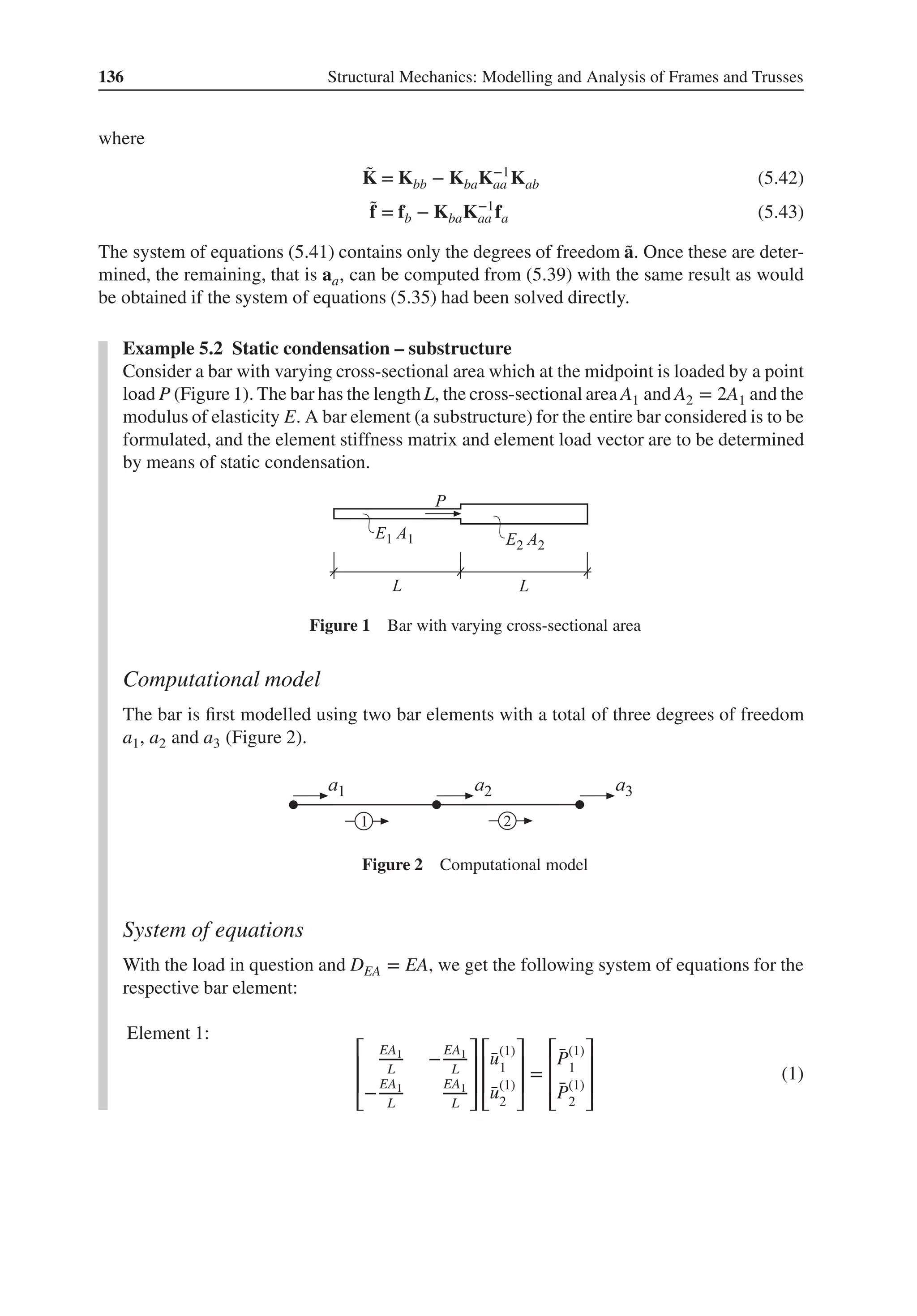
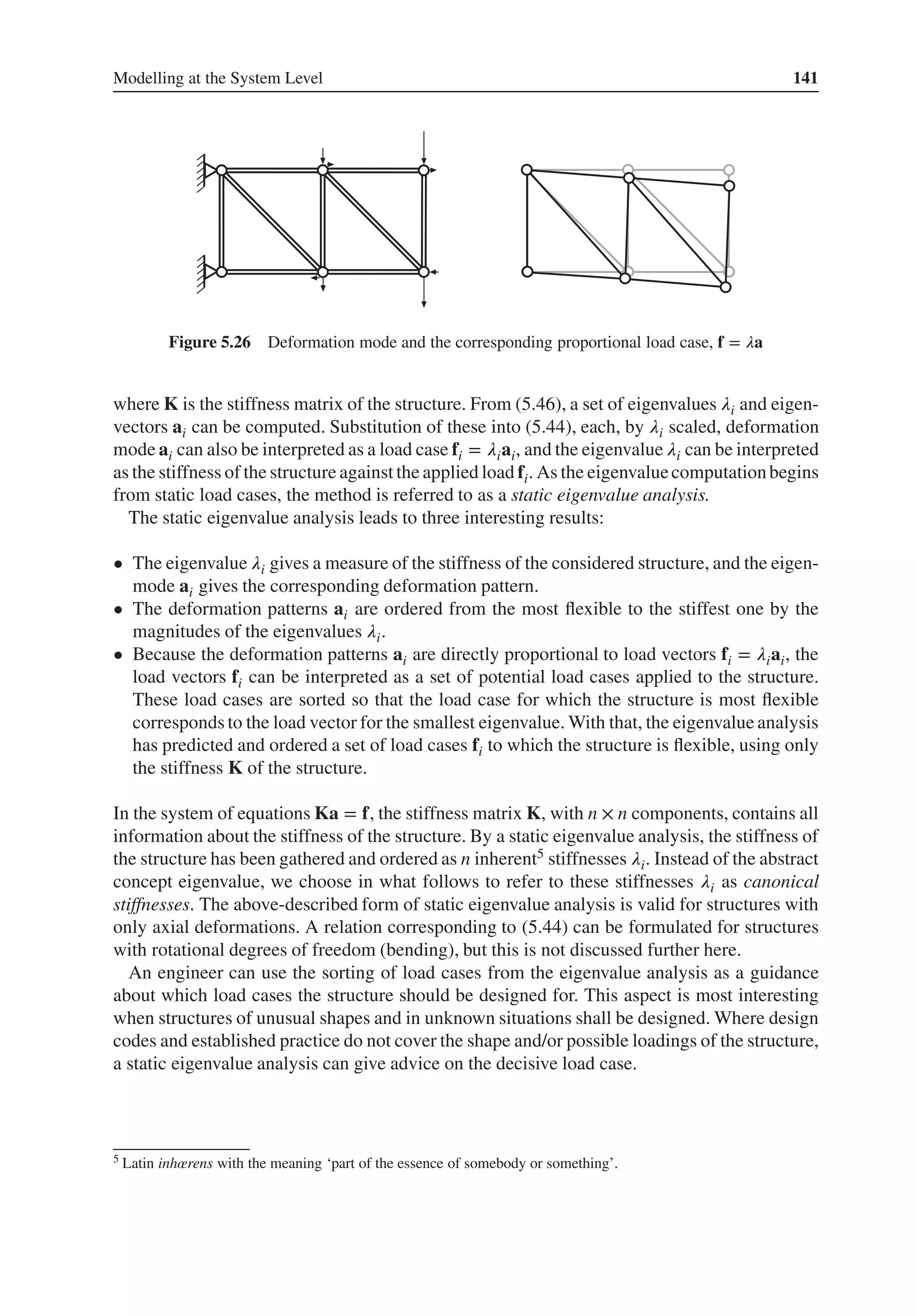
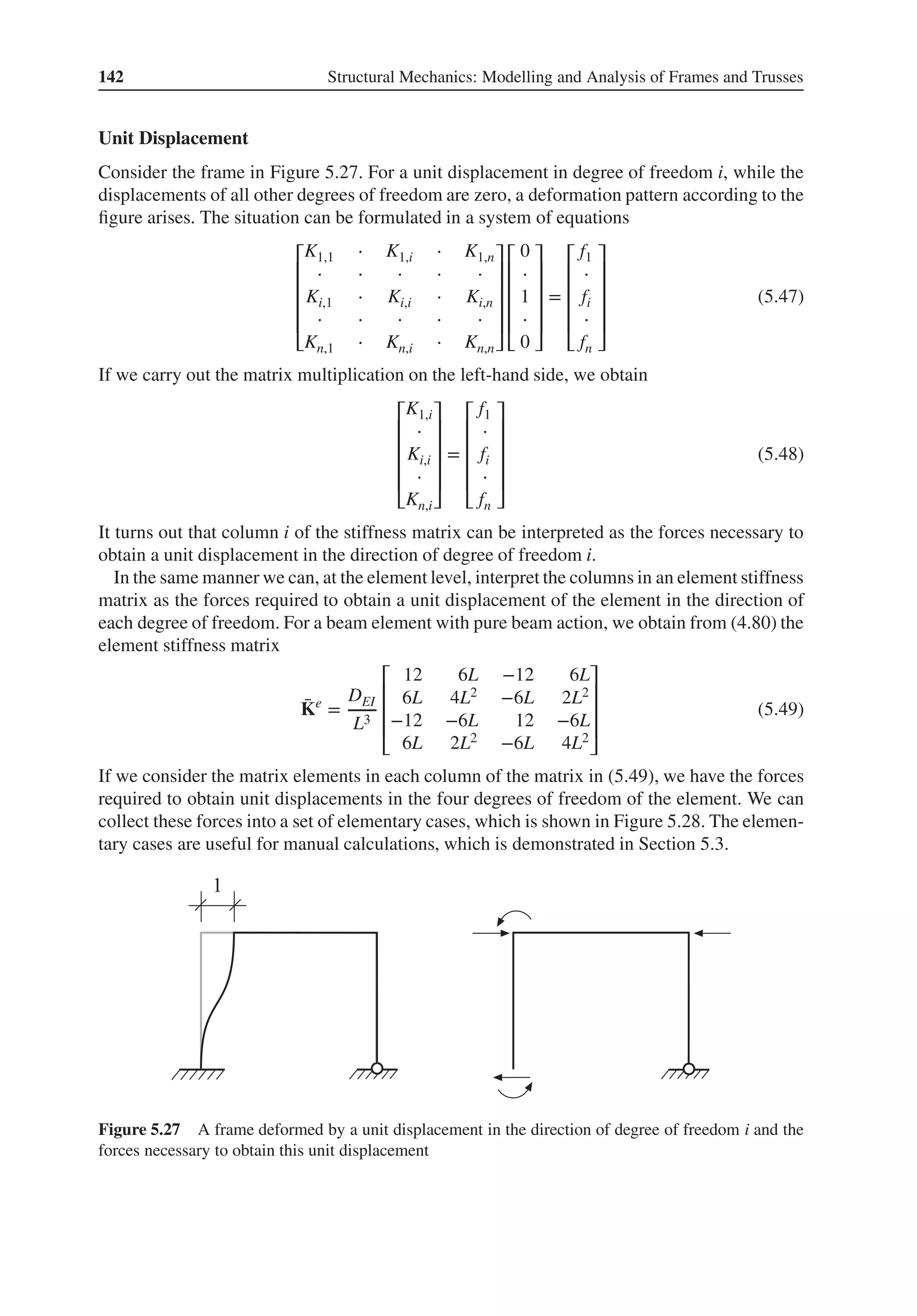
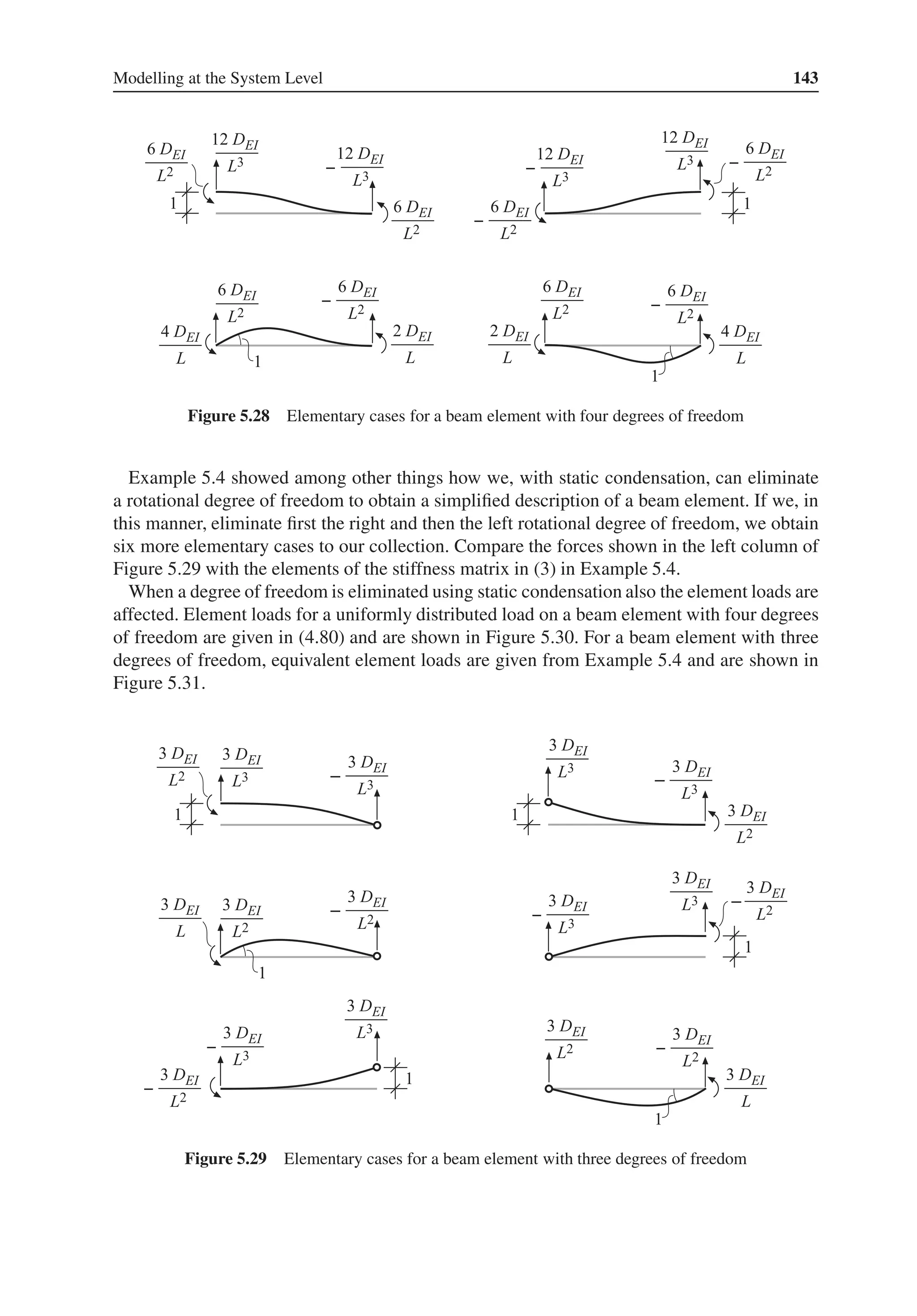
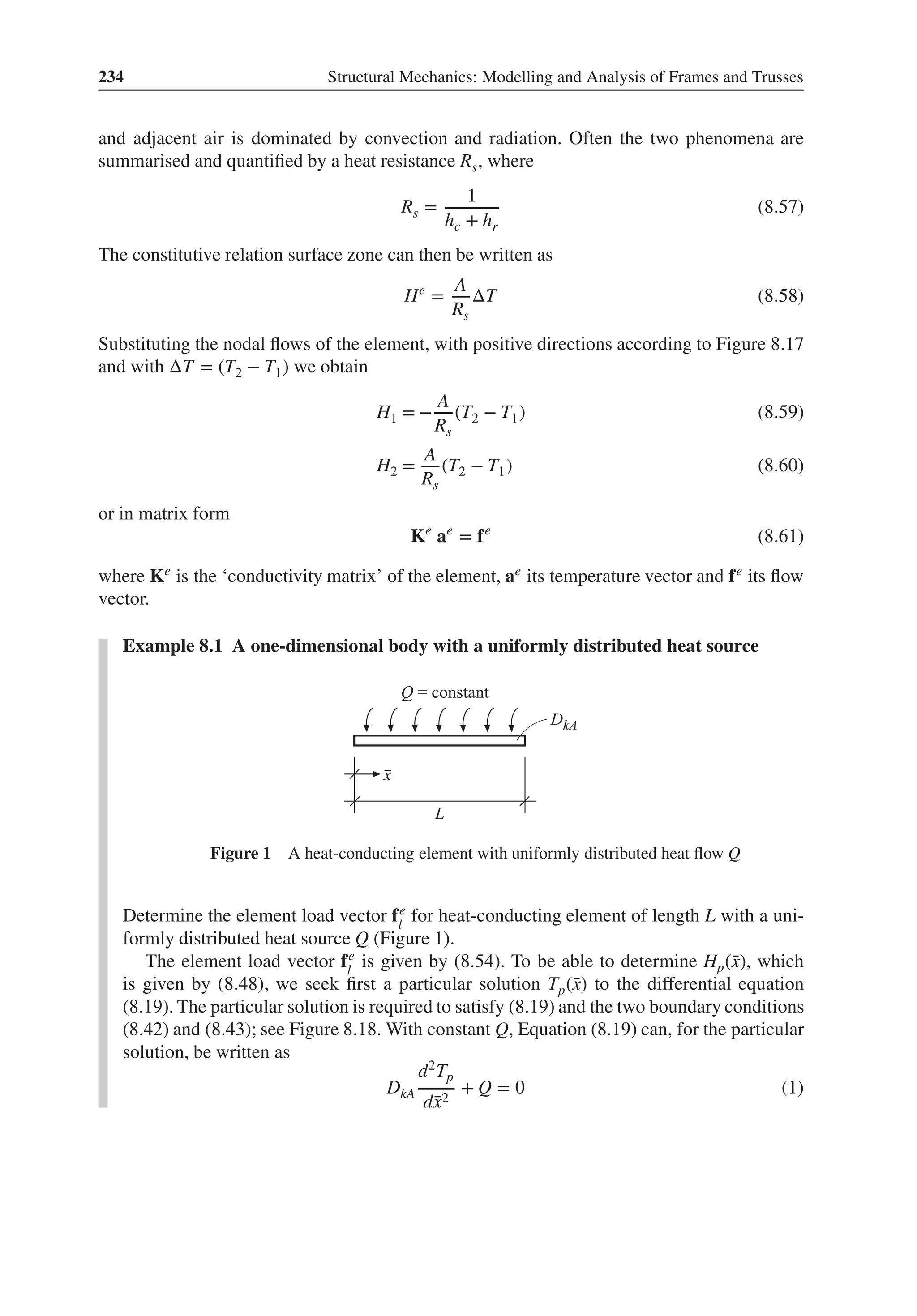
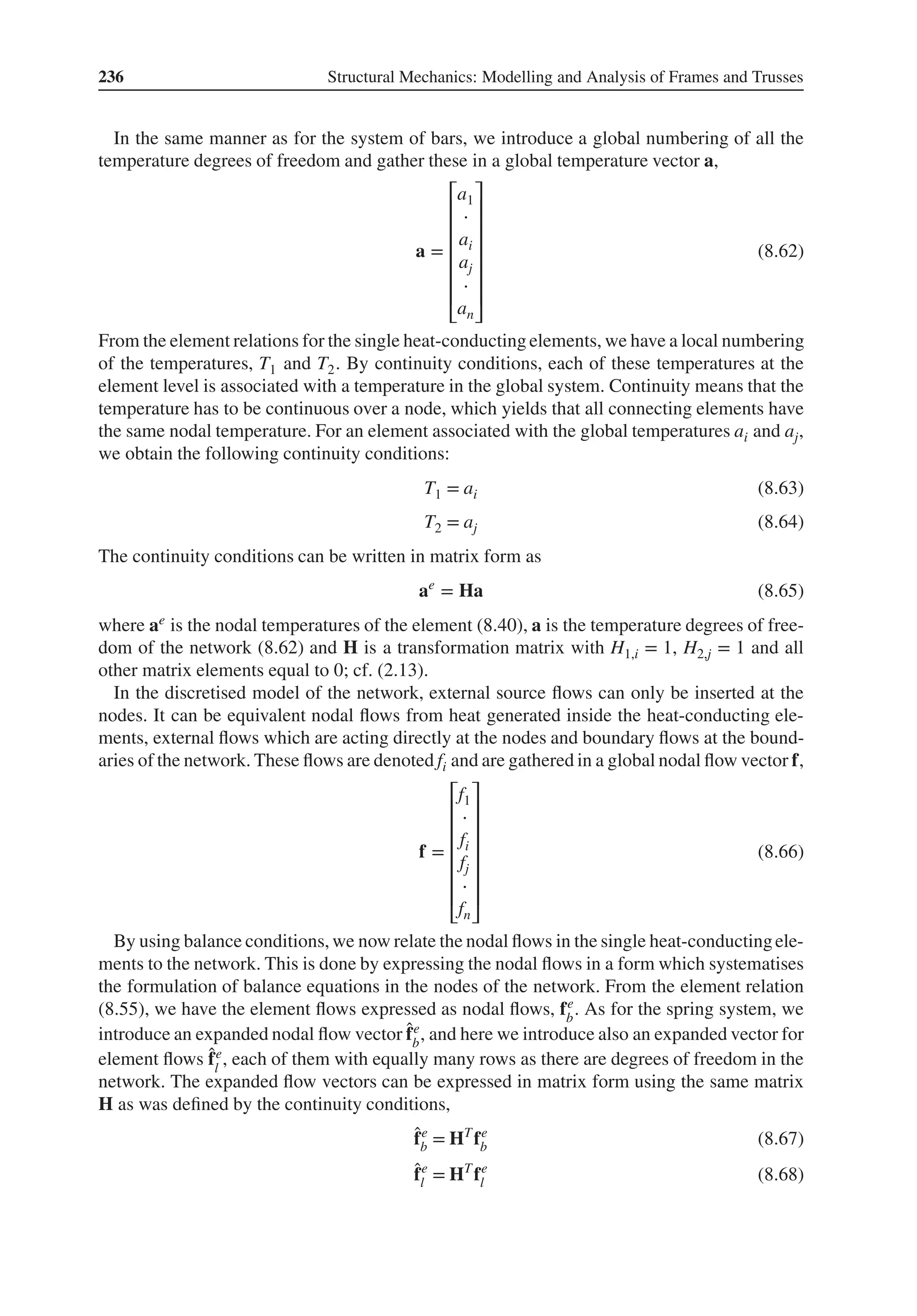
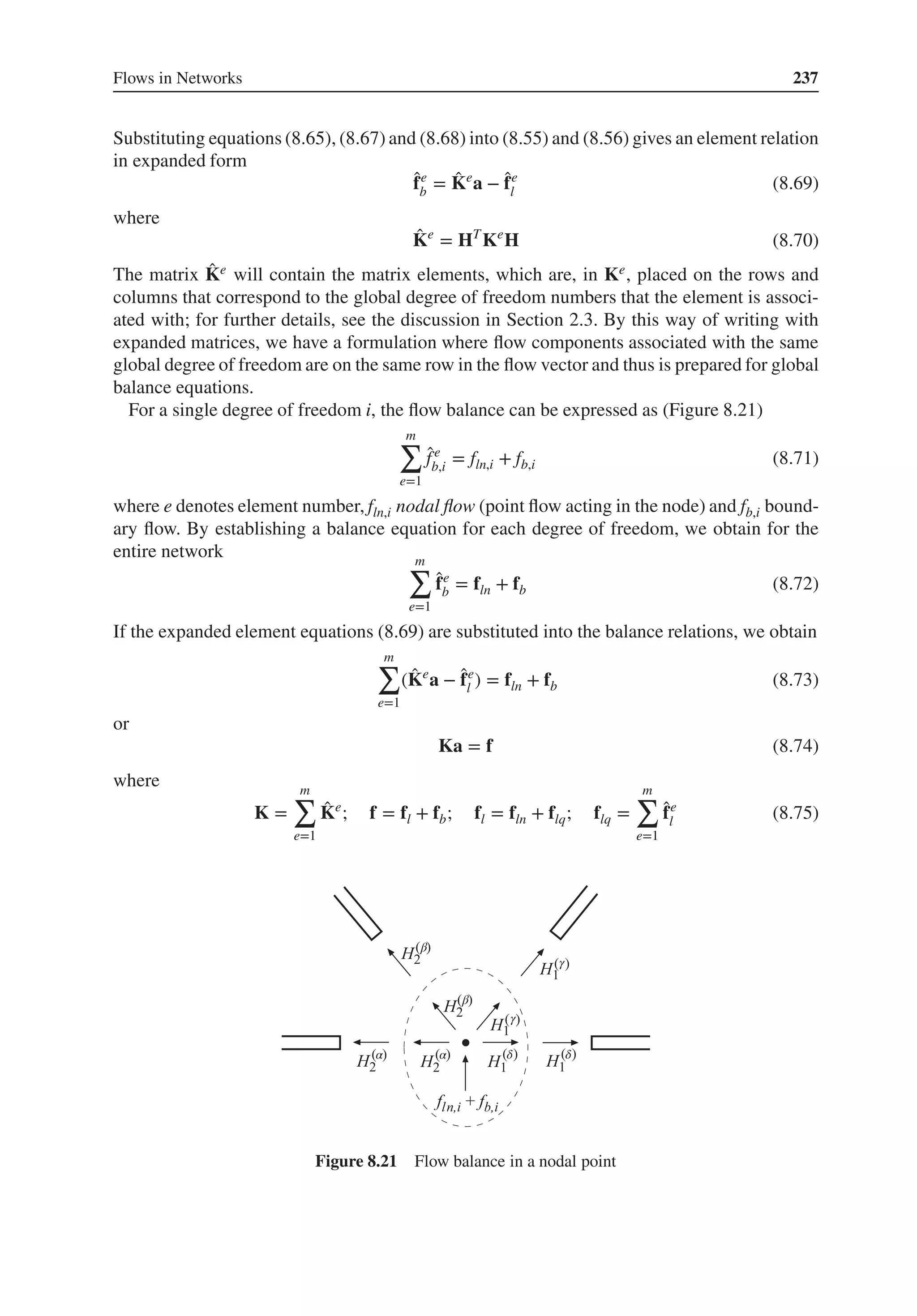
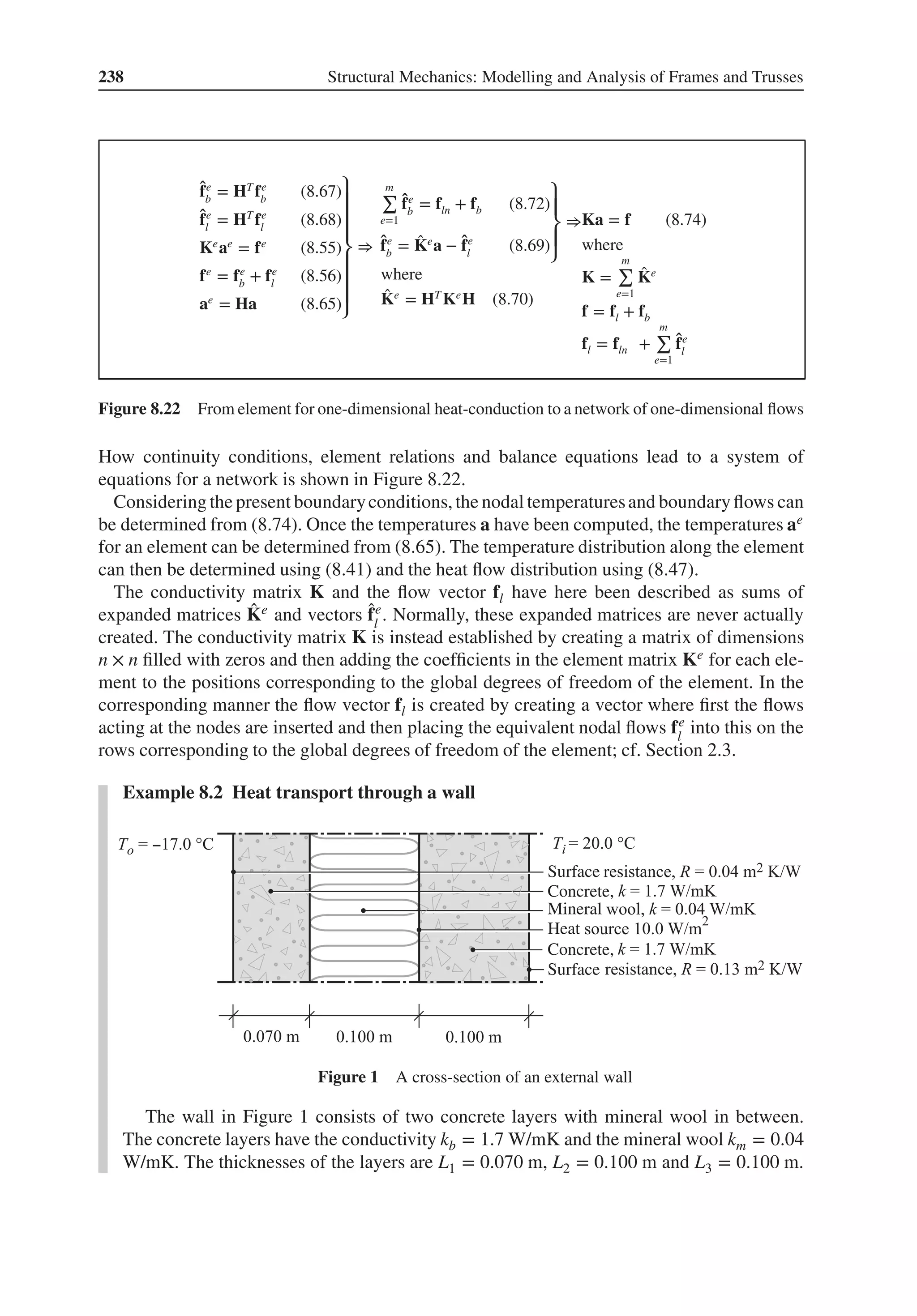
STRUCTURAL
MECHANICS
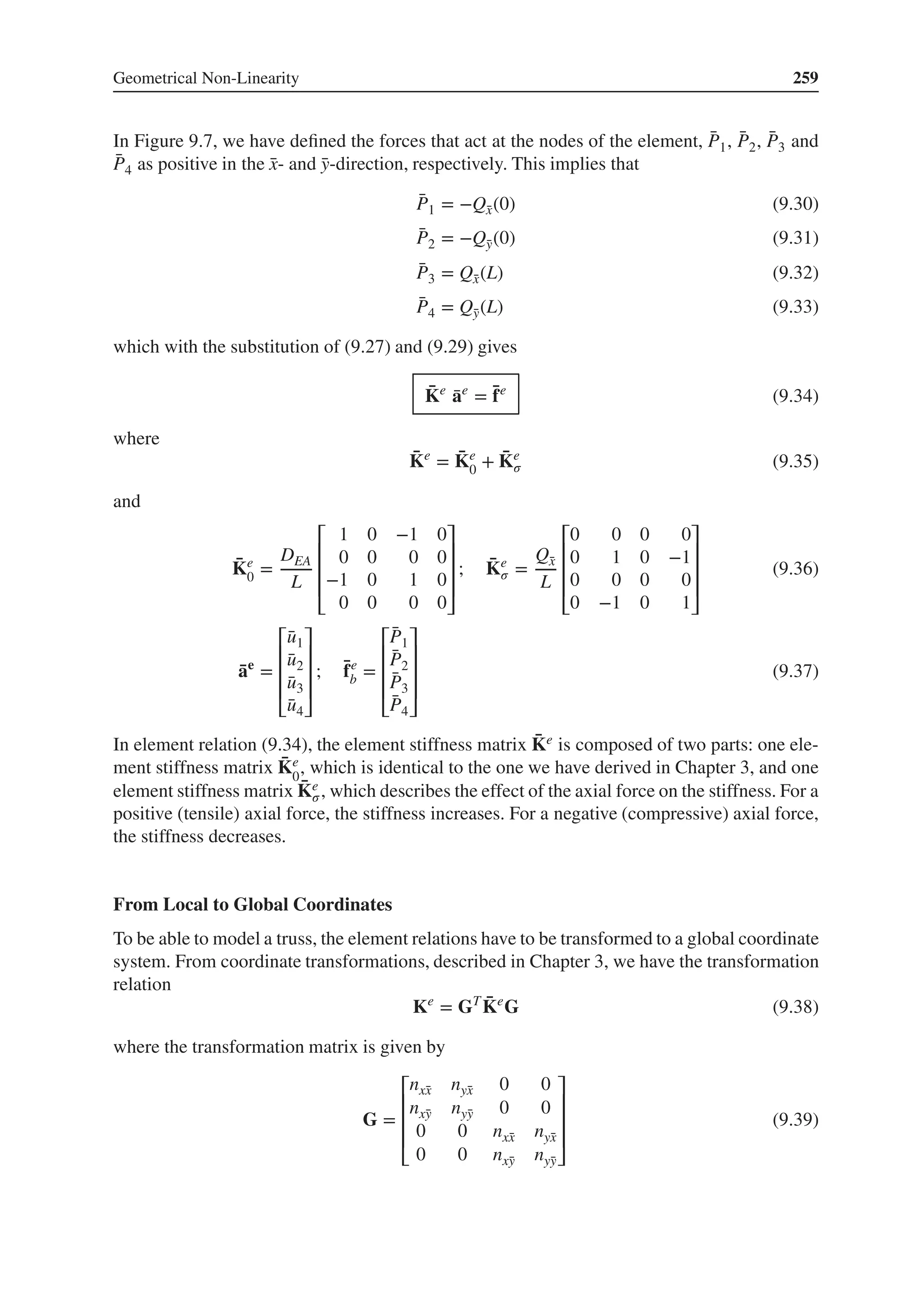
STRUCTURAL
MECHANICS
MODELLING AND ANALYSIS
OF FRAMES AND TRUSSES
Karl-Gunnar Olsson
Chalmers University of Technology, Sweden
Ola Dahlblom
Lund University, Sweden
This edition first published 2016
© 2016 John Wiley & Sons Ltd
Registered office
John Wiley & Sons Ltd, The Atrium, Southern Gate, Chichester, West Sussex, PO19 8SQ, United Kingdom
For details of our global editorial offices, for customer services and for information about how to apply for
permission to reuse the copyright material in this book please see our website at www.wiley.com.
The right of the author to be identified as the author of this work has been asserted in accordance with the Copyright,
Designs and Patents Act 1988.
All rights reserved. No part of this publication may be reproduced, stored in a retrieval system, or transmitted, in any
form or by any means, electronic, mechanical, photocopying, recording or otherwise, except as permitted by the UK
Copyright, Designs and Patents Act 1988, without the prior permission of the publisher.
Wiley also publishes its books in a variety of electronic formats. Some content that appears in print may not be
available in electronic books.
Designations used by companies to distinguish their products are often claimed as trademarks. All brand names and
product names used in this book are trade names, service marks, trademarks or registered trademarks of their
respective owners. The publisher is not associated with any product or vendor mentioned in this book.
Limit of Liability/Disclaimer of Warranty: While the publisher and author have used their best efforts in preparing
this book, they make no representations or warranties with respect to the accuracy or completeness of the contents of
this book and specifically disclaim any implied warranties of merchantability or fitness for a particular purpose. It is
sold on the understanding that the publisher is not engaged in rendering professional services and neither the
publisher nor the author shall be liable for damages arising herefrom. If professional advice or other expert
assistance is required, the services of a competent professional should be sought.
Library of Congress Cataloging-in-Publication Data
Olsson, Karl-Gunnar, author.
Structural mechanics : modelling and analysis of frames and trusses / Karl-Gunnar Olsson, Ola Dahlblom.
pages cm
Includes index.
ISBN 978-1-119-15933-9 (pbk.)
1. Trusses–Design and construction. 2. Structural frames–Design and construction. 3. Trusses–Mathematical
models. 4. Structural frames–Mathematical models. 5. Structural analysis (Engineering)–Mathematics. I. Dahlblom,
Ola, author. II. Title.
TA660.T8O47 2016
624.1′773–dc23
2015028041
A catalogue record for this book is available from the British Library.
Typeset in 10/12pt TimesLTStd by SPi Global, Chennai, India
1 2016
Contents
Preface ix
1 Matrix Algebra 1
1.1 Definitions 1
1.2 Addition and Subtraction 2
1.3 Multiplication 2
1.4 Determinant 3
1.5 Inverse Matrix 3
1.6 Counting Rules 4
1.7 Systems of Equations 4
1.7.1 Systems of Equations with Only Unknown Components in the Vector 𝐚 5
1.7.2 Systems of Equations with Known and Unknown Components in the
Vector 𝐚 6
1.7.3 Eigenvalue Problems 8
Exercises 10
2 Systems of Connected Springs 13
2.1 Spring Relations 16
2.2 Spring Element 16
2.3 Systems of Springs 17
Exercises 30
3 Bars and Trusses 31
3.1 The Differential Equation for Bar Action 33
3.1.1 Definitions 33
3.1.2 The Material Level 35
3.1.3 The Cross-Section Level 38
3.1.4 Bar Action 41
3.2 Bar Element 43
3.2.1 Definitions 43
3.2.2 Solving the Differential Equation 43
3.2.3 From Local to Global Coordinates 51
3.3 Trusses 55
Exercises 66
vi Contents
4 Beams and Frames 71
4.1 The Differential Equation for Beam Action 73
4.1.1 Definitions 73
4.1.2 The Material Level 74
4.1.3 The Cross-Section Level 75
4.1.4 Beam Action 78
4.2 Beam Element 80
4.2.1 Definitions 81
4.2.2 Solving the Differential Equation for Beam Action 81
4.2.3 Beam Element with Six Degrees of Freedom 90
4.2.4 From Local to Global Directions 92
4.3 Frames 95
Exercises 109
5 Modelling at the System Level 115
5.1 Symmetry Properties 116
5.2 The Structure and the System of Equations 120
5.2.1 The Deformations and Displacements of the System 121
5.2.2 The Forces and Equilibria of the System 130
5.2.3 The Stiffness of the System 132
5.3 Structural Design and Simplified Manual Calculations 144
5.3.1 Characterising Structures 144
5.3.2 Axial and Bending Stiffness 145
5.3.3 Reducing the Number of Degrees of Freedom 147
5.3.4 Manual Calculation Using Elementary Cases 149
Exercises 151
6 Flexible Supports 157
6.1 Flexible Supports at Nodes 157
6.2 Foundation on Flexible Support 159
6.2.1 The Constitutive Relations of the Connection Point 159
6.2.2 The Constitutive Relation of the Base Surface 161
6.2.3 Constitutive Relation for the Support Point of the Structure 163
6.3 Bar with Axial Springs 165
6.3.1 The Differential Equation for Bar Action with Axial Springs 165
6.3.2 Bar Element 167
6.4 Beam on Elastic Spring Foundation 171
6.4.1 The Differential Equation for Beam Action with Transverse Springs 171
6.4.2 Beam Element 173
Exercises 180
7 Three-Dimensional Structures 183
7.1 Three-Dimensional Bar Element 186
7.2 Three-Dimensional Trusses 188
7.3 The Differential Equation for Torsional Action 194
Contents vii
7.3.1 Definitions 194
7.3.2 The Material Level 195
7.3.3 The Cross-Section Level 197
7.3.4 Torsional Action 202
7.4 Three-Dimensional Beam Element 203
7.4.1 Element for Torsional Action 204
7.4.2 Beam Element with 12 Degrees of Freedom 205
7.4.3 From Local to Global Directions 206
7.5 Three-Dimensional Frames 209
Exercises 213
8 Flows in Networks 217
8.1 Heat Transport 219
8.1.1 Definitions 219
8.1.2 The Material Level 222
8.1.3 The Cross-Section Level 224
8.1.4 The Equation for Heat Conduction 225
8.1.5 Convection and Radiation 227
8.2 Element for Heat Transport 229
8.2.1 Definitions 230
8.2.2 Solving the Heat Conduction Equation 230
8.3 Networks of One-Dimensional Heat-Conducting Elements 235
8.4 Analogies 242
8.4.1 Diffusion – Fick’s Law 242
8.4.2 Liquid Flow in Porous Media – Darcy’s Law 243
8.4.3 Laminar Pipe Flow – Poiseuille’s Law 244
8.4.4 Electricity – Ohm’s Law 245
8.4.5 Summary 246
Exercises 247
9 Geometrical Non-Linearity 251
9.1 Methods of Calculation 252
9.2 Trusses with Geometrical Non-Linearity Considered 255
9.2.1 The Differential Equation for Bar Action 256
9.2.2 Bar Element 257
9.2.3 Trusses 260
9.3 Frames with Geometrical Non-Linearity Considered 262
9.3.1 The Differential Equation for Beam Action 262
9.3.2 Beam Element 265
9.3.3 Frames 274
9.4 Three-Dimensional Geometric Non-Linearity 277
Exercises 278
10 Material Non-Linearity 281
10.1 Calculation Procedures 282
10.2 Elastic–Perfectly Plastic Material 284
viii Contents
10.3 Trusses with Material Non-Linearity Considered 285
10.4 Frames with Material Non-Linearity Considered 289
Exercises 298
Appendix A Notations 301
Appendix B Answers to the Exercises 303
Index 323
Preface
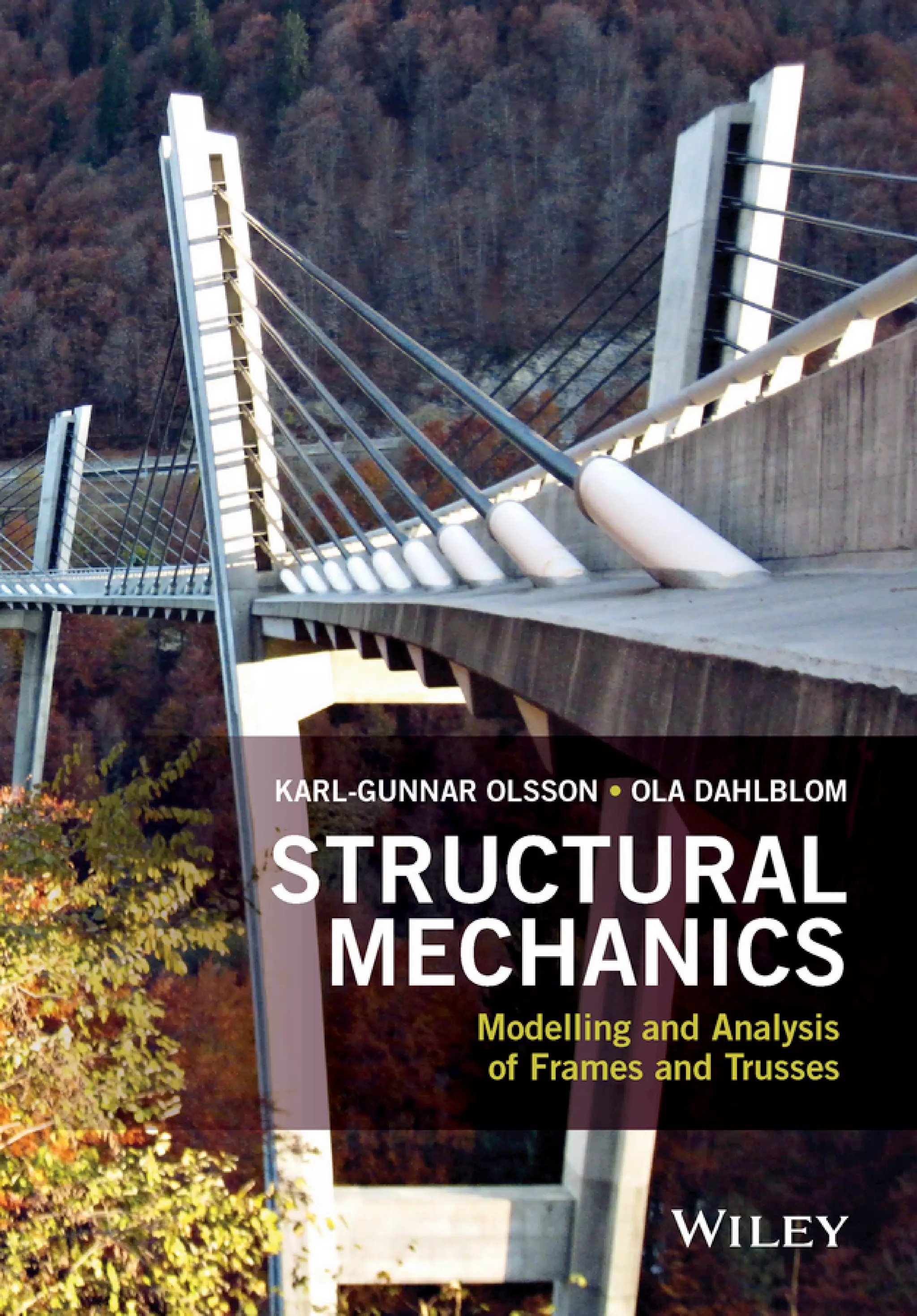
The autumn sun shines on Sunnibergbrücke at Klosters in the canton of Graubünden in
south-western Switzerland. On the cover picture one can sense how the bridge elegantly
migrates through the landscape. The steel and concrete structure and the architecture merge
into one of the most elegant buildings of our time. The engineer who designed the bridge is
named Christian Menn. It is late in October 2009, and a group of Swedish students sketch,
photograph and enthusiastically discuss the shape and the structural behaviour of the bridge.
In a week they will start a course in structural mechanics.
Structural mechanics is the branch of physics that describes how different materials, which
have been shaped and joined together to structures, carry their loads. Knowledge on the modes
of action of these structures can be used in different contexts and for different purposes. The
Roman architect and engineer Vitruvius, who lived during the first century BC summarises
in the work De architectura libri decem (‘Ten books on architecture’) the art of building
with the three classical notions of firmitas, utilitas and venustas (strength, functionality and
beauty). Engineering of our time has basically the same goal. It is about utilising the knowl-
edge and practices of our time in a creative process where sustainable and efficient, functional
and expressive buildings are designed.
At an early design stage a structural engineer needs to be trained to see how to efficiently
use material and shape to provide the construction with stability, stiffness and strength. Using
simple models, structural behaviour can be evaluated and cross-section sizes estimated. As
the design develops the need for precision of the analyses increases. In all this, the ability to
formulate computational models and to carry out simulations is of crucial importance.
A useful computational model should be simple enough to be easily manageable and, simul-
taneously, sufficiently complex to provide an adequate accuracy. In recent years, the finite
element method has become the dominant method for formulating computational models and
conducting analyses. The FE method is based on expressing forces and deformations as dis-
crete entities in a chosen and representative set of degrees of freedom. Between the degrees
of freedom simple bodies (elements) are placed and together they constitute the structure to
be modelled. Each element may describe a unique mode of action and can be given a specific
geometry. In all this, FEM provides opportunities for both accurate analyses of structures with
complex geometry and material behaviour, and for quick estimates in early design stages.
Here, we present a new textbook in structural mechanics, dealing with the modelling
and analysis of trusses and frames. The textbook is based on the finite element method.
Gradually, an understanding of basic elements of structural mechanics – springs, bars, beams,
foundations and so on is built up. Methods for assembling them into complex load-bearing
x Preface
structures are presented, and tools for analysis and simulation are provided. The book has
been limited to treating trusses and frames in two and three dimensions. To demonstrate
the generality of the methodology the book also has a chapter, ‘Flows in Networks’, that
addresses other areas of applied mechanics, including thermal conduction and electrical flow.
The textbook supports three kinds of learning outcome:
• Knowledge of basic theory of structural mechanics. The textbook has a structure that high-
lights the theory as a whole. Different modes of action in structural mechanics are described
in a common format where basic concepts and relationships recur at different scale levels.
One aim is to highlight the mechanisms that determine how structures carry their loads
and how we by this knowledge can manipulate the distribution of internal forces as well as
patterns of deformations.
• Skills in modelling and analysis of structures. Being able to describe a structure by a math-
ematical model and perform computations is one of the most important engineering skills.
The matrix-based presentation of the textbook practices a computation methodology that
is general and can be applied for phenomena and geometries of structural mechanics as
well as for simulations in a variety of engineering areas far beyond the textbook limitations.
Through exercises and with support from the computer program Matlab/CALFEM students
in a course formulate about 30 computer algorithms of their own, each with increasing
complexity.
• Ability to evaluate and optimise designs proposed. Having an eye trained for patterns of
forces and deformations helps to evaluate and improve the efficiency of structural designs.
This facilitates modification of the design of a structure in the desired direction, thus creating
an efficient structural behaviour, for example by reducing bending in the favour of axial only
forces – compression and tension.
The textbook is intended for engineering students at the bachelor level. The presentation
assumes knowledge of calculus in one variable, linear algebra, classical mechanics and basic
solid/structural mechanics. Chapters 1–5 are a unit and should be read in the order they appear,
while Chapters 6–10 are independent of each other and can be read in any order. For a limited
course, we recommend primarily Chapters 1–6.
The Division of Structural Mechanics at Lund University has a long tradition in the devel-
opment of teaching materials in structural mechanics and the finite element method. A key
person behind this development is Hans Petersson who came to the division as a professor
in 1977. Within a few years, a group of young Ph.D. students and teachers gathered around
Hans, taking note of his knowledge and absorbed his enthusiasm about teaching and its tools.
We were two of them. Earlier, the framework of the computer program CALFEM (Computer
Aided Learning of the Finite Element Method) was developed, and based on his concept the
textbook ‘Konstruktionsberäkningar med dator’ (Design calculations using a computer) was
written with Sven Thelandersson as author. In this spirit, the division has continued to develop
teaching materials, and approaches. In more than 30 years time, both ideas and collaborators
spread. CALFEM is today a toolbox to the computerprogramMatlab and is used worldwide. In
Sweden, collaboration between Lund University, Chalmers and KTH Royal Institute of Tech-
nology has been established, and from the site www.structarch.org, CALFEM as well as other
software for structural mechanics analysis and conceptual design can be downloaded free of
charge.
Preface xi
The contents of this textbook have been developed over many years and there are many stu-
dents and colleagues at Lund University, Chalmers and Linnæus University, who contributed
with ideas, suggestions, corrections and translations during the creation of the book. We would
particularly like to mention Professor Per-Erik Austrell, Dr. Henrik Danielsson, Dr. Susanne
Heyden and Professor Kent Persson at Structural Mechanics in Lund, Dr. Mats Ander and
Dr. Peter Möller at Applied Mechanics at Chalmers and Ms. Louise Blyberg and Profes-
sor Anders Olsson at Linnæus University in Växjö. Professor Emeritus Bengt Åkesson at
Chalmers has with great precision and sharpness examined facts of the manuscript and given
us reason to examine and modify the conceptual choices and formulations. Dr. Samar Malek
has thoroughly proofread the English version of the text. Mr. Bo Zadig at Structural Mechanics
in Lund has skilfully drawn the figures. Sincere thanks to all of you for your commitment and
wise observations. And to Professor Göran Sandberg who with his character, his knowledge
and in his role as head of the department has built and continues to build a creative envi-
ronment for the teaching and development of teaching concepts and tools. We want to thank
people at John Wiley & Sons and their partners for cooperation and guidance. In particular we
are grateful to Eric Willner, Anne Hunt, Clive Lawson and Lincy Priya.
The textbook is also available in Swedish, with the reverse order of authors.
Karl-Gunnar Olsson and Ola Dahlblom
Gothenburg and Lund in October 2015
1
Matrix Algebra
The method used in this textbook to formulate computational models is characterised by the
use of matrices. The different quantities – load, section force, stiffness and displacement – are
separated and gathered into groups of numbers. All load values are gathered in a load matrix
and all stiffnesses in a stiffness matrix. This is one of the primary strengths of the method. With
a matrix formulation,the formulae describing the relations between quantities are compact and
easy to view. Physical mechanisms and underlying principles become clear. We begin with a
short summary of the matrix algebra and the notations that are used.
1.1 Definitions
A matrix consists of a set of matrix elements ordered in rows and columns. If the matrix consists
of only one column it is referred to as a column matrix and if it has only one row it is referred
to as a row matrix. Such matrices are one-dimensional and may also be referred to as vectors.
A vector is denoted by a lower case letter set in bold:
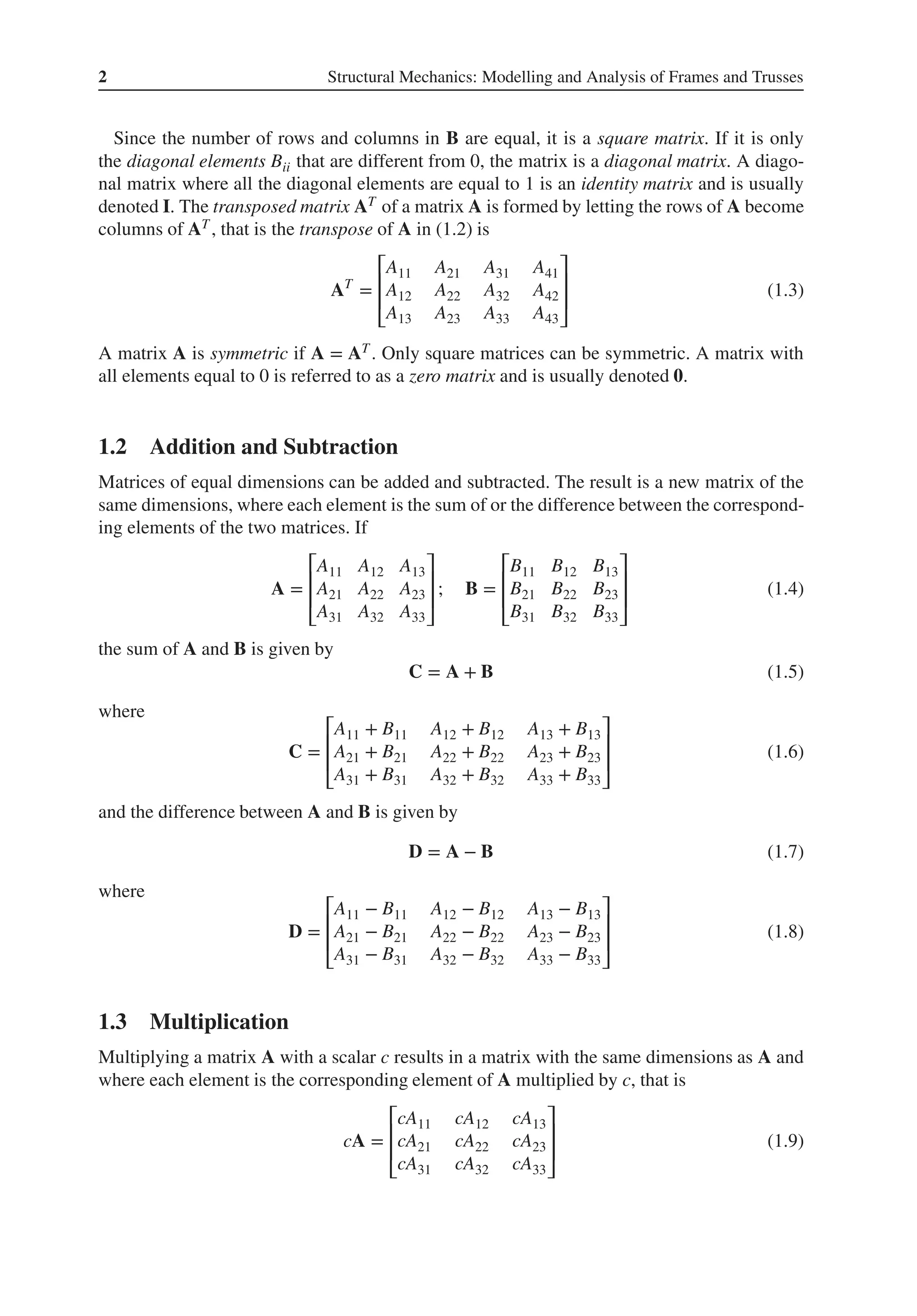
a =
⎡
⎢
⎢
⎣
a1
a2
a3
⎤
⎥
⎥
⎦
(1.1)
where a1, a2 and a3 are the components of the vector. A two-dimensional matrix is denoted by
a capital letter set in bold:
A =
⎡
⎢
⎢
⎢
⎣
A11 A12 A13
A21 A22 A23
A31 A32 A33
A41 A42 A43
⎤
⎥
⎥
⎥
⎦
; B =
⎡
⎢
⎢
⎣
B11 B12 B13
B21 B22 B23
B31 B32 B33
⎤
⎥
⎥
⎦
(1.2)
where A11, A12 and so on are elements of the matrix A. An arbitrary component of a matrix
is denoted Aij, where the first index refers to the row number and the second index to the
column number. The matrix A in (1.2) has the dimensions 4 × 3 and the matrix B has the
dimensions 3 × 3.
Structural Mechanics: Modelling and Analysis of Frames and Trusses, First Edition.
Karl-Gunnar Olsson and Ola Dahlblom.
© 2016 John Wiley & Sons, Ltd. Published 2016 by John Wiley & Sons, Ltd.
2 Structural Mechanics: Modelling and Analysis of Frames and Trusses
Since the number of rows and columns in B are equal, it is a square matrix. If it is only
the diagonal elements Bii that are different from 0, the matrix is a diagonal matrix. A diago-
nal matrix where all the diagonal elements are equal to 1 is an identity matrix and is usually
denoted I. The transposed matrix AT of a matrix A is formed by letting the rows of A become
columns of AT , that is the transpose of A in (1.2) is
AT
=
⎡
⎢
⎢
⎣
A11 A21 A31 A41
A12 A22 A32 A42
A13 A23 A33 A43
⎤
⎥
⎥
⎦
(1.3)
A matrix A is symmetric if A = AT . Only square matrices can be symmetric. A matrix with
all elements equal to 0 is referred to as a zero matrix and is usually denoted 𝟎.
1.2 Addition and Subtraction
Matrices of equal dimensions can be added and subtracted. The result is a new matrix of the
same dimensions, where each element is the sum of or the difference between the correspond-
ing elements of the two matrices. If
A =
⎡
⎢
⎢
⎣
A11 A12 A13
A21 A22 A23
A31 A32 A33
⎤
⎥
⎥
⎦
; B =
⎡
⎢
⎢
⎣
B11 B12 B13
B21 B22 B23
B31 B32 B33
⎤
⎥
⎥
⎦
(1.4)
the sum of A and B is given by
C = A + B (1.5)
where
C =
⎡
⎢
⎢
⎣
A11 + B11 A12 + B12 A13 + B13
A21 + B21 A22 + B22 A23 + B23
A31 + B31 A32 + B32 A33 + B33
⎤
⎥
⎥
⎦
(1.6)
and the difference between A and B is given by
D = A − B (1.7)
where
D =
⎡
⎢
⎢
⎣
A11 − B11 A12 − B12 A13 − B13
A21 − B21 A22 − B22 A23 − B23
A31 − B31 A32 − B32 A33 − B33
⎤
⎥
⎥
⎦
(1.8)
1.3 Multiplication
Multiplying a matrix A with a scalar c results in a matrix with the same dimensions as A and
where each element is the corresponding element of A multiplied by c, that is
cA =
⎡
⎢
⎢
⎣
cA11 cA12 cA13
cA21 cA22 cA23
cA31 cA32 cA33
⎤
⎥
⎥
⎦
(1.9)
Matrix Algebra 3
Multiplication between two matrices
C = AB (1.10)
can be performed only if the number of columns in A equals the number of rows in B. The
element Cij is then computed according to
Cij =
n
∑
k=1
AikBkj (1.11)
For
A =
[
A11 A12
A21 A22
]
; B =
[
B11 B12
B21 B22
]
(1.12)
the product of the matrices, C = AB, is obtained from
C =
[
A11 A12
A21 A22
]
[
B11 B12
B21 B22
]
=
[
A11B11 + A12B21 A11B12 + A12B22
A21B11 + A22B21 A21B12 + A22B22
]
(1.13)
In general,
BA ≠ AB (1.14)
1.4 Determinant
For every quadratic matrix A (n × n), it is possible to compute a scalar value called a determi-
nant. For n = 1,
det A = A11 (1.15)
For n > 1, the determinant det A is computed according to the expression
det A =
n
∑
k=1
(−1)i+k
Aik det Mik (1.16)
where i is an arbitrary row number and det Mik is the determinant of the matrix obtained when
the ith row and the kth column is deleted from the matrix A. For n = 2, this results in
det A = A11A22 − A12A21 (1.17)
and for n = 3
det A = A11A22A33 + A12A23A31 + A13A21A32 − A11A23A32 − A12A21A33 − A13A22A31
(1.18)
1.5 Inverse Matrix
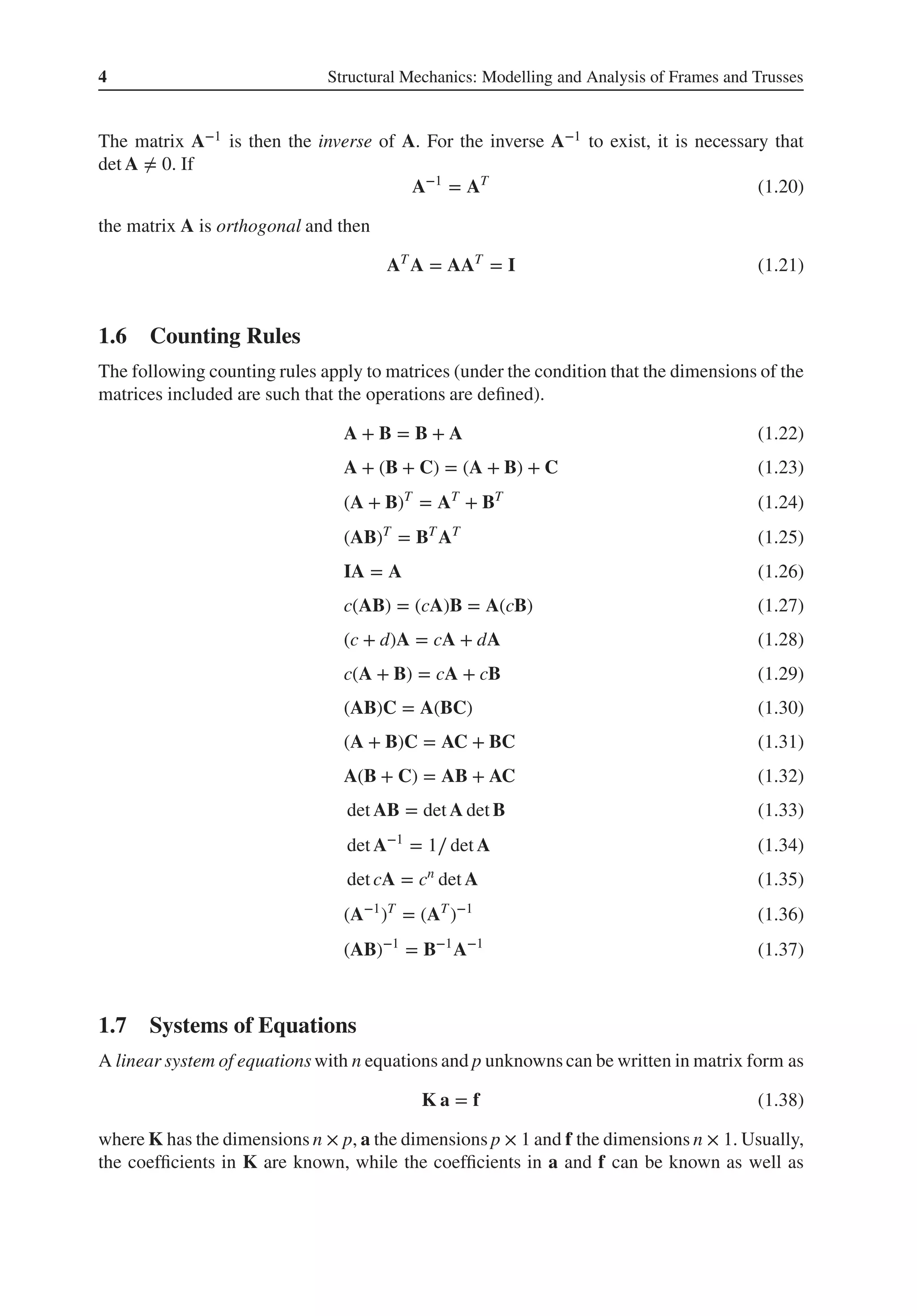
The quadratic matrix A is invertible if there exists a matrix A−1 such that
A−1
A = I (1.19)
4 Structural Mechanics: Modelling and Analysis of Frames and Trusses
The matrix A−1 is then the inverse of A. For the inverse A−1 to exist, it is necessary that
det A ≠ 0. If
A−1
= AT
(1.20)
the matrix A is orthogonal and then
AT
A = AAT
= I (1.21)
1.6 Counting Rules
The following counting rules apply to matrices (under the condition that the dimensions of the
matrices included are such that the operations are defined).
A + B = B + A (1.22)
A + (B + C) = (A + B) + C (1.23)
(A + B)T
= AT
+ BT
(1.24)
(AB)T
= BT
AT
(1.25)
IA = A (1.26)
c(AB) = (cA)B = A(cB) (1.27)
(c + d)A = cA + dA (1.28)
c(A + B) = cA + cB (1.29)
(AB)C = A(BC) (1.30)
(A + B)C = AC + BC (1.31)
A(B + C) = AB + AC (1.32)
det AB = det A det B (1.33)
det A−1
= 1∕ det A (1.34)
det cA = cn
det A (1.35)
(A−1
)T
= (AT
)−1
(1.36)
(AB)−1
= B−1
A−1
(1.37)
1.7 Systems of Equations
A linear system of equations with n equations and p unknowns can be written in matrix form as
K a = f (1.38)
where K has the dimensions n × p, a the dimensions p × 1 and f the dimensions n × 1. Usually,
the coefficients in K are known, while the coefficients in a and f can be known as well as
Matrix Algebra 5
unknown. For the case when all the components of a are unknown and all the components of
f are known, there are three types of systems of equations:
• n = p, the number of equations equals the number of unknowns. The matrix K is quadratic.
Depending on the contents of K and f, four different characteristic cases can be recognised.
These are often indications of different states or behaviours that may be important to notice:
If det K ≠ 0, there is a unique solution.
– For f = 𝟎, this solution is the trivial one, a = 𝟎.
– For f ≠ 𝟎, there is a unique solution, a ≠ 𝟎. In general, this is an indication of a function-
ing physical model.
If det K = 0, there is no unique solution. This may be an indication of an, in some way,
unstable physical model.
– For f = 0, there are infinitely many solutions. This is the case for eigenvalue problems,
which, for example, can be a method to gain knowledge about unstable states of the
model.
– For f ≠ 0, there is either none or infinitely many solutions; there may be elements missing
in the model or the set of boundary conditions may be incomplete.
• n < p, the number of equations is less than the number of unknowns. The system is under-
determined. There are infinitely many solutions.
• n > p, the number of equations exceeds the number of unknowns. The system is overdeter-
mined. In general, there is no solution.
In the following symmetric matrices, K and A are considered which are common in the forth-
coming applications.
1.7.1 Systems of Equations with Only Unknown Components in the Vector a
For the case when det K ≠ 0 and f ≠ 𝟎, the unknowns in the vector a can be determined by
Gaussian elimination. This is shown in the following example.
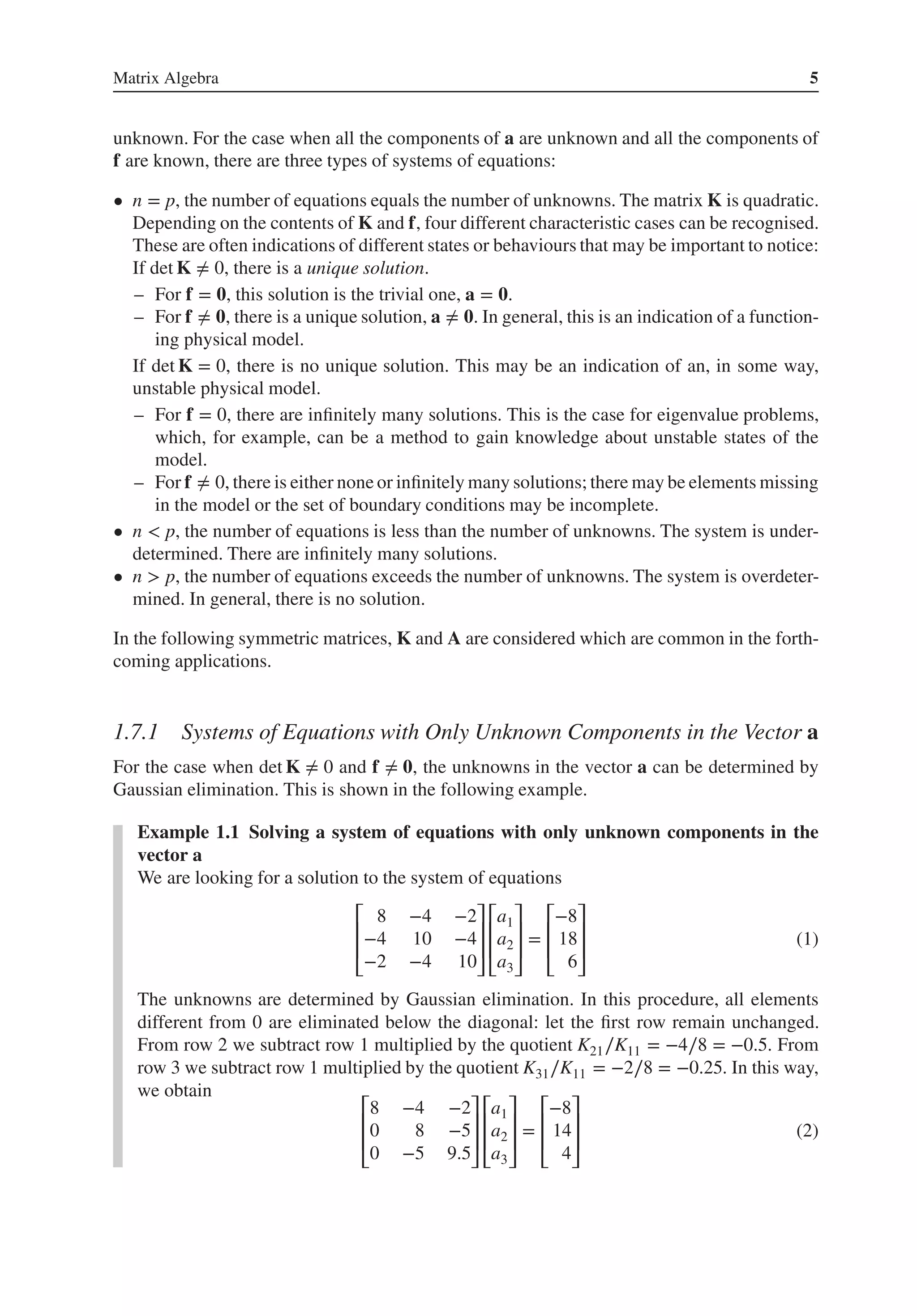
Example 1.1 Solving a system of equations with only unknown components in the
vector a
We are looking for a solution to the system of equations
⎡
⎢
⎢
⎣
8 −4 −2
−4 10 −4
−2 −4 10
⎤
⎥
⎥
⎦
⎡
⎢
⎢
⎣
a1
a2
a3
⎤
⎥
⎥
⎦
=
⎡
⎢
⎢
⎣
−8
18
6
⎤
⎥
⎥
⎦
(1)
The unknowns are determined by Gaussian elimination. In this procedure, all elements
different from 0 are eliminated below the diagonal: let the first row remain unchanged.
From row 2 we subtract row 1 multiplied by the quotient K21∕K11 = −4∕8 = −0.5. From
row 3 we subtract row 1 multiplied by the quotient K31∕K11 = −2∕8 = −0.25. In this way,
we obtain
⎡
⎢
⎢
⎣
8 −4 −2
0 8 −5
0 −5 9.5
⎤
⎥
⎥
⎦
⎡
⎢
⎢
⎣
a1
a2
a3
⎤
⎥
⎥
⎦
=
⎡
⎢
⎢
⎣
−8
14
4
⎤
⎥
⎥
⎦
(2)
6 Structural Mechanics: Modelling and Analysis of Frames and Trusses
In the next step, we let the rows 1 and 2 remain. From row 3 we subtract row 2 multiplied
by the quotient K32∕K22 = −5∕8 = −0.625. We have triangularised the coefficient matrix
K and obtain
⎡
⎢
⎢
⎣
8 −4 −2
0 8 −5
0 0 6.375
⎤
⎥
⎥
⎦
⎡
⎢
⎢
⎣
a1
a2
a3
⎤
⎥
⎥
⎦
=
⎡
⎢
⎢
⎣
−8
14
12.75
⎤
⎥
⎥
⎦
(3)
With the system of equations in this form, we can determine a3, a2 and a1 by
back-substitution
a3 =
12.75
6.375
= 2; a2 =
14 − (−5)a3
8
= 3;
a1 =
−8 − (−4)a2 − (−2)a3
8
= 1 (4)
and with that, we have the solution
⎡
⎢
⎢
⎣
a1
a2
a3
⎤
⎥
⎥
⎦
=
⎡
⎢
⎢
⎣
1
3
2
⎤
⎥
⎥
⎦
(5)
To check the results, we can substitute the solution into the original system of equations
and carry out the matrix multiplication
⎡
⎢
⎢
⎣
8 −4 −2
−4 10 −4
−2 −4 10
⎤
⎥
⎥
⎦
⎡
⎢
⎢
⎣
1
3
2
⎤
⎥
⎥
⎦
which gives
⎡
⎢
⎢
⎣
−8
18
6
⎤
⎥
⎥
⎦
(6)
This is equal to the original right-hand side of the system of equations, that is the solution
found is correct.
1.7.2 Systems of Equations with Known and Unknown Components in the
Vector a
The systems of equations that we consider, in general, has a square matrix K, initially with
det K = 0, and a vector f ≠ 𝟎. Moreover, it is usually the case that some components of a are
known and the corresponding components of f are unknown. One systematic way to solve
such a system of equations begins with a partition of the matrices, which means that they are
divided into submatrices
K =
[
A1 A2
A3
̃
K
]
; a =
[
g
̃
a
]
; f =
[
r
̃
f
]
(1.39)
where the matrices A1, A2, A3, ̃
K, g and ̃
f contain known quantities, while ̃
a and r are unknown.
With use of these submatrices, the system of equations (1.38) can be expressed as
[
A1 A2
A3
̃
K
]
[
g
̃
a
]
=
[
r
̃
f
]
(1.40)
Matrix Algebra 7
The system of equations can be divided into two parts and then be written as
A1g + A2 ̃
a = r (1.41)
A3g + ̃
K̃
a = ̃
f (1.42)
or
̃
K̃
a = ̃
f − A3g (1.43)
r = A1g + A2 ̃
a (1.44)
where the right-hand side of the equation (1.43) consists of known quantities. The purpose of
the partition of the system of equations is to, within the original system of equations, find a
sub-system with det ̃
K ≠ 0, that is a system with a unique solution. The unknowns in ̃
a can then
be computed from (1.43). One way to perform this computation is to use Gaussian elimination.
Once ̃
a has been determined, r can be computed from (1.44).
Example 1.2 Solving a system of equations with both known and unknown compo-
nents in the vector a
In the system of equations
⎡
⎢
⎢
⎢
⎢
⎢
⎢
⎣
20 0 0 0 −20 0
0 15 0 −15 0 0
0 0 16 12 −16 −12
0 −15 12 24 −12 −9
−20 0 −16 −12 36 12
0 0 −12 −9 12 9
⎤
⎥
⎥
⎥
⎥
⎥
⎥
⎦
⎡
⎢
⎢
⎢
⎢
⎢
⎢
⎣
0
0
−3
0
a5
a6
⎤
⎥
⎥
⎥
⎥
⎥
⎥
⎦
=
⎡
⎢
⎢
⎢
⎢
⎢
⎢
⎣
f1
f2
f3
f4
0
−15
⎤
⎥
⎥
⎥
⎥
⎥
⎥
⎦
(1)
the vector a has known and unknown components. The solution can then be systematised
using partitioning (1.40). The auxiliary lines show this partition. The system of equations
is partitioned into two parts according to (1.41) and (1.42):
⎡
⎢
⎢
⎢
⎣
20 0 0 0
0 15 0 −15
0 0 16 12
0 −15 12 24
⎤
⎥
⎥
⎥
⎦
⎡
⎢
⎢
⎢
⎣
0
0
−3
0
⎤
⎥
⎥
⎥
⎦
+
⎡
⎢
⎢
⎢
⎣
−20 0
0 0
−16 −12
−12 −9
⎤
⎥
⎥
⎥
⎦
[
a5
a6
]
=
⎡
⎢
⎢
⎢
⎣
f1
f2
f3
f4
⎤
⎥
⎥
⎥
⎦
(2)
[
−20 0 −16 −12
0 0 −12 −9
]⎡
⎢
⎢
⎢
⎣
0
0
−3
0
⎤
⎥
⎥
⎥
⎦
+
[
36 12
12 9
]
[
a5
a6
]
=
[
0
−15
]
(3)
In the lower system of equations, there are two equations and two unknowns. If the known
terms of the system are gathered on the right-hand side of the equal sign, cf. (1.43), we
obtain
[
36 12
12 9
]
[
a5
a6
]
=
[
0
−15
]
−
[
−20 0 −16 −12
0 0 −12 −9
]⎡
⎢
⎢
⎢
⎣
0
0
−3
0
⎤
⎥
⎥
⎥
⎦
(4)
8 Structural Mechanics: Modelling and Analysis of Frames and Trusses
or [
36 12
12 9
]
[
a5
a6
]
=
[
−48
−51
]
(5)
From this system of equations, the unknown elements can be determined by Gaussian elim-
ination: the first row remains unchanged. From row 2 we subtract row 1 multiplied by the
quotient K21∕K11 = 12∕36 = 0.33333. In this way, we obtain
[
36 12
0 5
]
[
a5
a6
]
=
[
−48
−35
]
(6)
and the unknown a5 and a6 can be determined by back-substitution
a6 =
−35
5
= −7; a5 =
−48 − 12a6
36
= 1 (7)
[
a5
a6
]
=
[
1
−7
]
(8)
With a5 and a6 being known, the unknown coefficients in f can be determined using the
upper system of equations obtained from the partition, cf. (1.44),
⎡
⎢
⎢
⎢
⎣
f1
f2
f3
f4
⎤
⎥
⎥
⎥
⎦
=
⎡
⎢
⎢
⎢
⎣
20 0 0 0
0 15 0 −15
0 0 16 12
0 −15 12 24
⎤
⎥
⎥
⎥
⎦
⎡
⎢
⎢
⎢
⎣
0
0
−3
0
⎤
⎥
⎥
⎥
⎦
+
⎡
⎢
⎢
⎢
⎣
−20 0
0 0
−16 −12
−12 −9
⎤
⎥
⎥
⎥
⎦
[
1
−7
]
=
⎡
⎢
⎢
⎢
⎣
−20
0
20
15
⎤
⎥
⎥
⎥
⎦
(9)
and with that, all the unknowns are determined.
1.7.3 Eigenvalue Problems
At times it is of interest to study the case when det K = 0 and f = 𝟎. Mainly, two different
types of problems appear. A system of equations in the form
(A − 𝜆I)a = 𝟎 (1.45)
is referred to as an eigenvalue problem or sometimes standard eigenvalue problem. For a solu-
tion to exist, it is required that
det(A − 𝜆I) = 0 (1.46)
A system of equations in the form
(A − 𝜆B)a = 𝟎 (1.47)
is referred to as a generalised eigenvalue problem and for a solution to exist it is required that
det(A − 𝜆B) = 0 (1.48)
Solving an eigenvalue problem means that the values of 𝜆, which fulfil Equations (1.46) and
(1.48) are determined, that is the eigenvalues 𝜆i are computed. The number of eigenvalues
Matrix Algebra 9
𝜆i is equal to the number of unknowns in the system of equations. Two or more eigenvalues
may coincide. A symmetric matrix K with real elements has only real eigenvalues. For each
eigenvalue 𝜆i there is an eigenvectorai. The unknowns in the eigenvectorai cannot be uniquely
determined, but their relative magnitude can be computed.
If the product of two vectors bTc = 0, then the vectors b and c are orthogonal. For eigenvec-
tors, we have aT
i
aj = 0 for i ≠ j, that is any two eigenvectors are always orthogonal.
The following example shows how an eigenvalue problem is solved:
Example 1.3 Solving an eigenvalue problem
We want to find a solution to the eigenvalue problem
(A − 𝜆I)a = 𝟎 (1)
where
A =
[
5 −2
−2 8
]
(2)
The determinant of (A − 𝜆I) can be computed as
det(A − 𝜆I) = det
[
5 − 𝜆 −2
−2 8 − 𝜆
]
= (5 − 𝜆)(8 − 𝜆) − 4 = 𝜆2
− 13𝜆 + 36 (3)
When this expression is set to zero, the equation
𝜆2
− 13𝜆 + 36 = 0 (4)
is obtained. The solutions to this equation are the eigenvalues
𝜆1 = 4; 𝜆2 = 9 (5)
By substituting the computed eigenvalues into the first equation in the original system of
equations we obtain
(5 − 4)a1 − 2a2 = 0; a1 = t1
[
2
1
]
(6)
and
(5 − 9)a1 − 2a2 = 0; a2 = t2
[
1
−2
]
(7)
where t1 and t2 are arbitrary scalar multipliers, t1 ≠ 0, t2 ≠ 0. Had we substituted the eigen-
values into the second equation instead, the results would be the same. Computation of the
product of the two eigenvectors yields
aT
1 a2 = t1t2
[
2 1
]
[
1
−2
]
= 0 (8)
The fact that the product is 0 means that the eigenvectors a1 and a2 are orthogonal.
10 Structural Mechanics: Modelling and Analysis of Frames and Trusses
Exercises
1.1 Begin with the matrices
A =
[
2 3 −1
4 8 0
]
; B =
[
0 −2 4
1 0 2
]
; C =
⎡
⎢
⎢
⎣
1 0 3
4 2 1
3 4 1
⎤
⎥
⎥
⎦
and perform the following matrix operations manually.
(a) A + B
(b) ABT
(c) BT A
(d) AC
(e) det C
1.2 Introduce the matrices
A with dimensions 4 × 3
B with dimensions 3 × 6
C with dimensions 1 × 8
D with dimensions 6 × 1
Which of the following operations are possible to perform? For the possible operations,
give the dimensions of E
(a) E = AB
(b) E = BD
(c) E = ABCD
(d) E = ABDC
(e) E = BT AT
1.3 Solve the following system of equations manually. Check the solution.
⎡
⎢
⎢
⎣
20 1 −10
−10 3 10
5 3 5
⎤
⎥
⎥
⎦
⎡
⎢
⎢
⎣
a1
a2
a3
⎤
⎥
⎥
⎦
=
⎡
⎢
⎢
⎣
−2
4
9
⎤
⎥
⎥
⎦
1.4 Solve the following systems of equations manually and check the solutions.
(a) ⎡
⎢
⎢
⎣
4 −2 −2
−2 5 −3
−2 −3 5
⎤
⎥
⎥
⎦
⎡
⎢
⎢
⎣
0
0
a3
⎤
⎥
⎥
⎦
=
⎡
⎢
⎢
⎣
f1
f2
10
⎤
⎥
⎥
⎦
(b) ⎡
⎢
⎢
⎣
6 −4 −2
−4 12 −8
−2 −8 10
⎤
⎥
⎥
⎦
⎡
⎢
⎢
⎣
1
a2
a3
⎤
⎥
⎥
⎦
=
⎡
⎢
⎢
⎣
f1
16
−6
⎤
⎥
⎥
⎦
Matrix Algebra 11
(c) ⎡
⎢
⎢
⎢
⎢
⎣
4 −4 0 0 0
−4 7 −2 −1 0
0 −2 5 −3 0
0 −1 −3 7 −3
0 0 0 −3 3
⎤
⎥
⎥
⎥
⎥
⎦
⎡
⎢
⎢
⎢
⎢
⎣
−3
a2
0
a4
3
⎤
⎥
⎥
⎥
⎥
⎦
=
⎡
⎢
⎢
⎢
⎢
⎣
f1
4
f3
−1
f5
⎤
⎥
⎥
⎥
⎥
⎦
1.5 Begin with the matrices
A =
⎡
⎢
⎢
⎢
⎣
2 1 0 3
6 4 1 −2
0 3 4 1
1 2 −4 6
⎤
⎥
⎥
⎥
⎦
; B =
⎡
⎢
⎢
⎢
⎣
3 4 1 −2
6 8 1 0
2 2 3 −2
1 4 0 4
⎤
⎥
⎥
⎥
⎦
;
C =
⎡
⎢
⎢
⎢
⎣
−4
2
3
1
⎤
⎥
⎥
⎥
⎦
; D =
[
1 4 −3 6
]
and perform the following matrix operations with CALFEM. For the sub-exercises with
more than one matrix operation, compare and comment on the results.
(a) A + B and B + A
(b) AB and BA
(c) (AB)T, (BA)T and BTAT
(d) CD and DC
(e) CTAC
(f) det A, A−1 and AA−1
1.6 Compute the determinant of the matrices in the following systems of equations with
CALFEM. If possible, solve the systems of equations and check the solutions. If any of
the systems is unsolvable, explain why.
(a) ⎡
⎢
⎢
⎢
⎣
−4 3 0 1
1 2 −1 4
0 1 −1 2
2 0 2 2
⎤
⎥
⎥
⎥
⎦
⎡
⎢
⎢
⎢
⎣
a1
a2
a3
a4
⎤
⎥
⎥
⎥
⎦
=
⎡
⎢
⎢
⎢
⎣
−2
−1
−3
2
⎤
⎥
⎥
⎥
⎦
(b) ⎡
⎢
⎢
⎣
4 −4 0
−4 6 −2
0 −2 2
⎤
⎥
⎥
⎦
⎡
⎢
⎢
⎣
a1
a2
a3
⎤
⎥
⎥
⎦
=
⎡
⎢
⎢
⎣
0
0
0
⎤
⎥
⎥
⎦
(c) ⎡
⎢
⎢
⎣
8 −3 −5
−3 5 −2
−5 −2 7
⎤
⎥
⎥
⎦
⎡
⎢
⎢
⎣
a1
a2
a3
⎤
⎥
⎥
⎦
=
⎡
⎢
⎢
⎣
4
2
−6
⎤
⎥
⎥
⎦
1.7 Consider the eigenvalue problem (A − 𝜆I)a = 𝟎, where
A =
[
10 −3
−3 2
]
(a) Compute the eigenvalues.
(b) Compute the eigenvectors and check that they are orthogonal.
2
Systems of Connected Springs
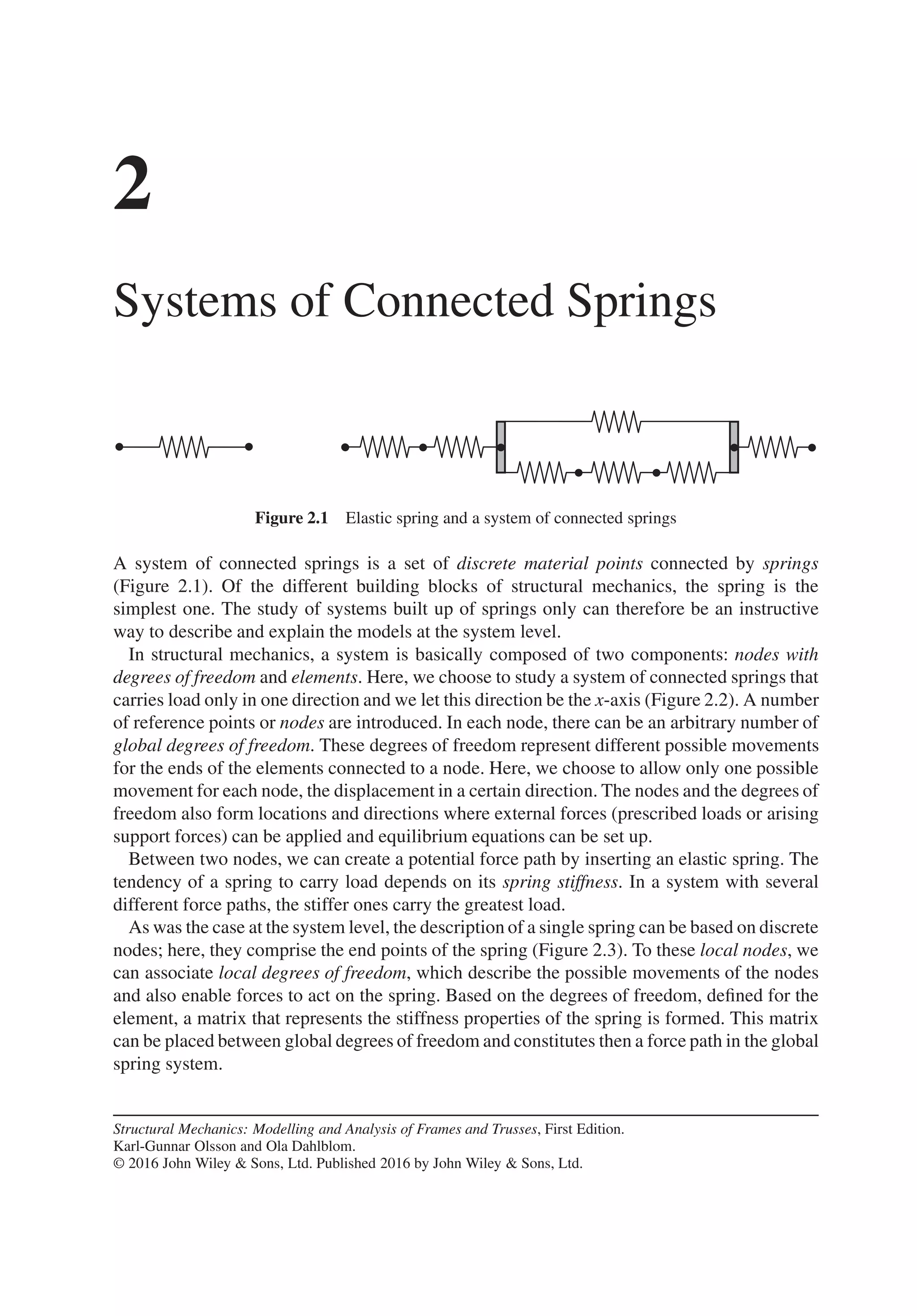
Figure 2.1 Elastic spring and a system of connected springs
A system of connected springs is a set of discrete material points connected by springs
(Figure 2.1). Of the different building blocks of structural mechanics, the spring is the
simplest one. The study of systems built up of springs only can therefore be an instructive
way to describe and explain the models at the system level.
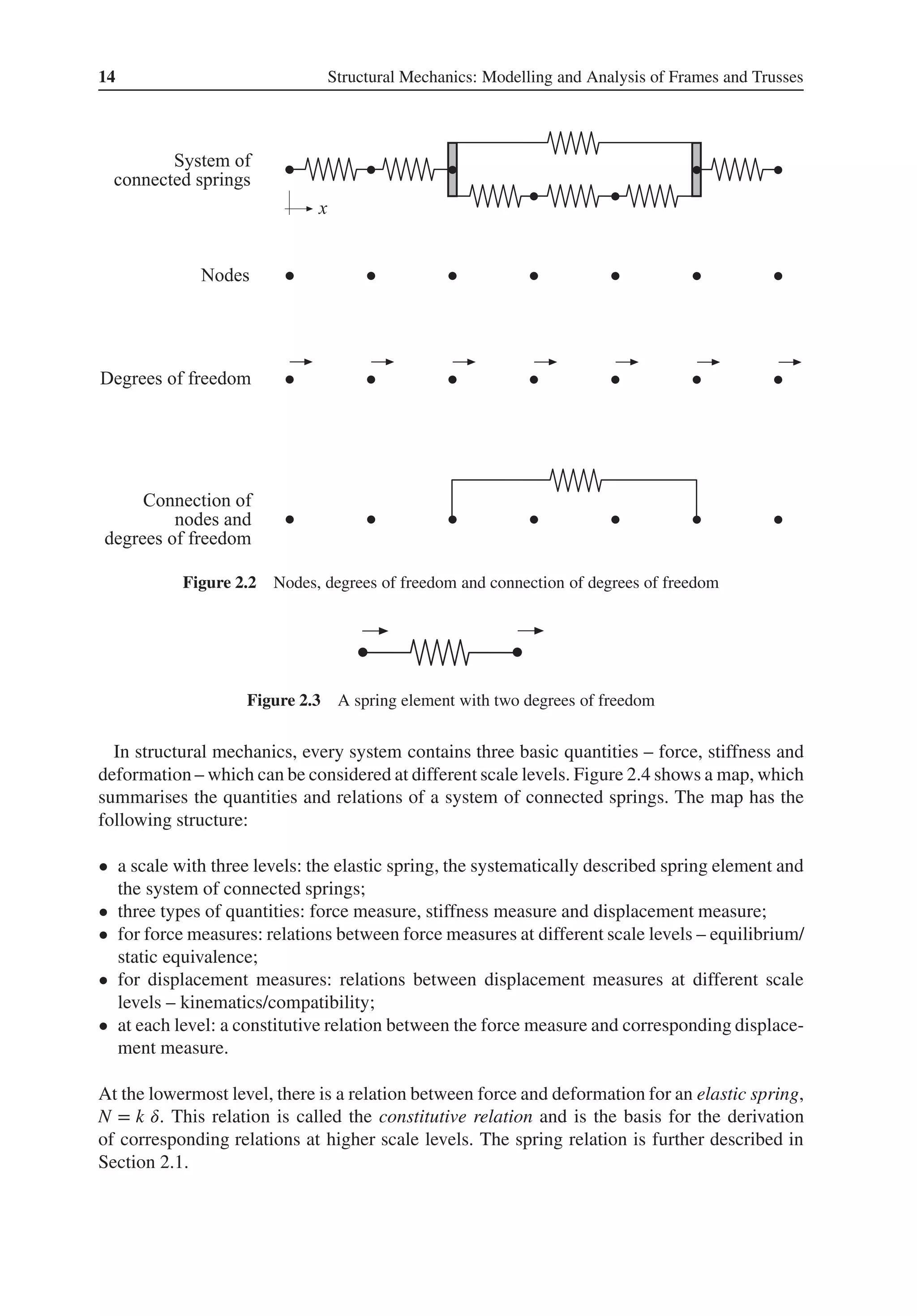
In structural mechanics, a system is basically composed of two components: nodes with
degrees of freedom and elements. Here, we choose to study a system of connected springs that
carries load only in one direction and we let this direction be the x-axis (Figure 2.2). A number
of reference points or nodes are introduced. In each node, there can be an arbitrary number of
global degrees of freedom. These degrees of freedom represent different possible movements
for the ends of the elements connected to a node. Here, we choose to allow only one possible
movement for each node, the displacement in a certain direction. The nodes and the degrees of
freedom also form locations and directions where external forces (prescribed loads or arising
support forces) can be applied and equilibrium equations can be set up.
Between two nodes, we can create a potential force path by inserting an elastic spring. The
tendency of a spring to carry load depends on its spring stiffness. In a system with several
different force paths, the stiffer ones carry the greatest load.
As was the case at the system level, the description of a single spring can be based on discrete
nodes; here, they comprise the end points of the spring (Figure 2.3). To these local nodes, we
can associate local degrees of freedom, which describe the possible movements of the nodes
and also enable forces to act on the spring. Based on the degrees of freedom, defined for the
element, a matrix that represents the stiffness properties of the spring is formed. This matrix
can be placed between global degrees of freedom and constitutes then a force path in the global
spring system.
Structural Mechanics: Modelling and Analysis of Frames and Trusses, First Edition.
Karl-Gunnar Olsson and Ola Dahlblom.
© 2016 John Wiley & Sons, Ltd. Published 2016 by John Wiley & Sons, Ltd.
14 Structural Mechanics: Modelling and Analysis of Frames and Trusses
Figure 2.2 Nodes, degrees of freedom and connection of degrees of freedom
Figure 2.3 A spring element with two degrees of freedom
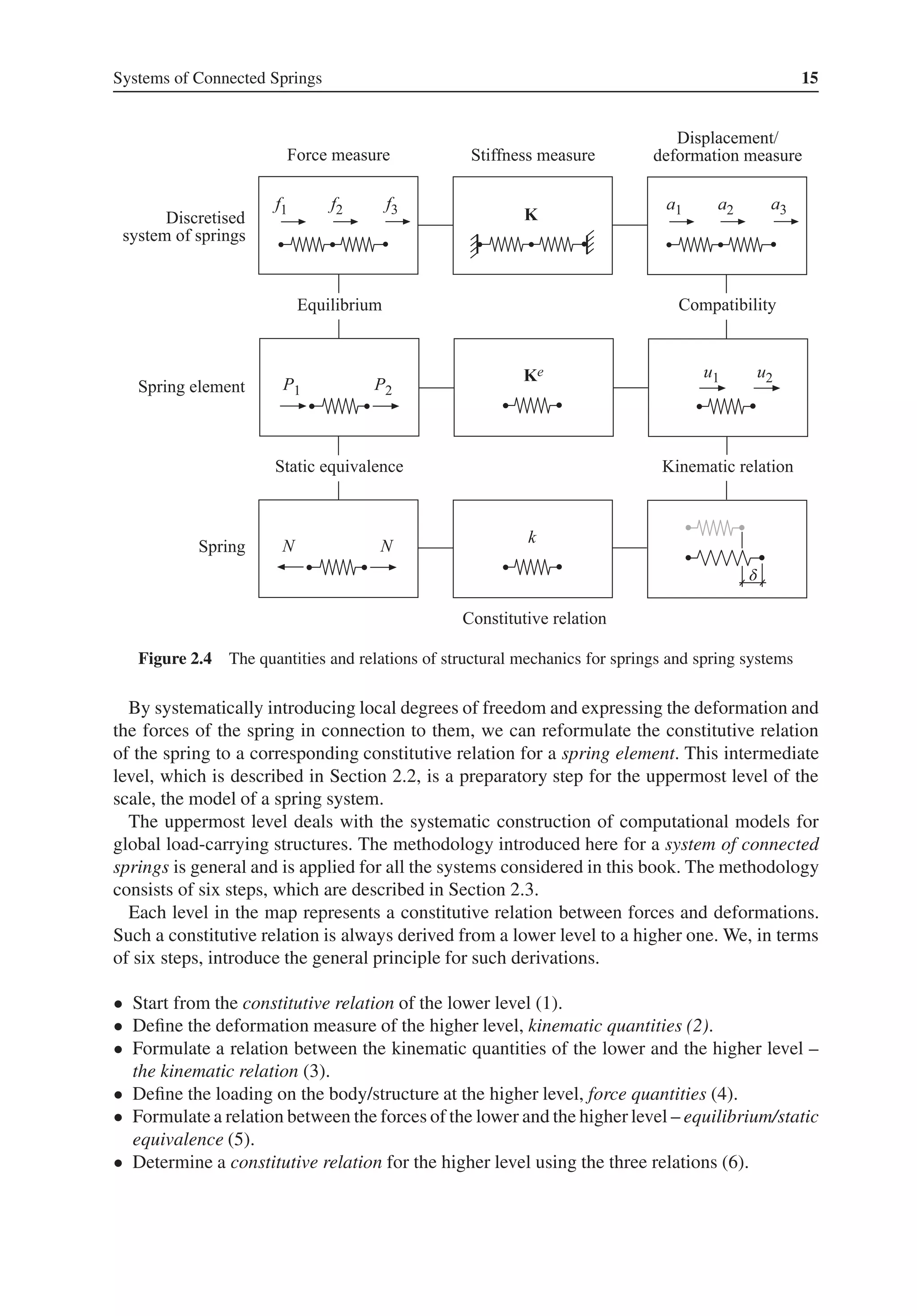
In structural mechanics, every system contains three basic quantities – force, stiffness and
deformation – which can be considered at different scale levels. Figure 2.4 shows a map, which
summarises the quantities and relations of a system of connected springs. The map has the
following structure:
• a scale with three levels: the elastic spring, the systematically described spring element and
the system of connected springs;
• three types of quantities: force measure, stiffness measure and displacement measure;
• for force measures: relations between force measures at different scale levels – equilibrium/
static equivalence;
• for displacement measures: relations between displacement measures at different scale
levels – kinematics/compatibility;
• at each level: a constitutive relation between the force measure and corresponding displace-
ment measure.
At the lowermost level, there is a relation between force and deformation for an elastic spring,
N = k 𝛿. This relation is called the constitutive relation and is the basis for the derivation
of corresponding relations at higher scale levels. The spring relation is further described in
Section 2.1.
Systems of Connected Springs 15
δ
Figure 2.4 The quantities and relations of structural mechanics for springs and spring systems
By systematically introducing local degrees of freedom and expressing the deformation and
the forces of the spring in connection to them, we can reformulate the constitutive relation
of the spring to a corresponding constitutive relation for a spring element. This intermediate
level, which is described in Section 2.2, is a preparatory step for the uppermost level of the
scale, the model of a spring system.
The uppermost level deals with the systematic construction of computational models for
global load-carrying structures. The methodology introduced here for a system of connected
springs is general and is applied for all the systems considered in this book. The methodology
consists of six steps, which are described in Section 2.3.
Each level in the map represents a constitutive relation between forces and deformations.
Such a constitutive relation is always derived from a lower level to a higher one. We, in terms
of six steps, introduce the general principle for such derivations.
• Start from the constitutive relation of the lower level (1).
• Define the deformation measure of the higher level, kinematic quantities (2).
• Formulate a relation between the kinematic quantities of the lower and the higher level –
the kinematic relation (3).
• Define the loading on the body/structure at the higher level, force quantities (4).
• Formulate a relation between the forces of the lower and the higher level – equilibrium/static
equivalence (5).
• Determine a constitutive relation for the higher level using the three relations (6).
16 Structural Mechanics: Modelling and Analysis of Frames and Trusses
In Sections 2.1–2.3, the numbers of these steps recur in the text. Consistently throughout the
textbook, each derivation from a lower to a higher level is concluded with a figure, which
summarises Equations (1), (3) and (5), which lead to the constitutive relation of the higher
level (6).
2.1 Spring Relations
The basic action of a spring is given by the relation
N = k 𝛿 (2.1)
which describes the resistance to deformation of a spring. The spring relation (Figure 2.5)
consists of three types of quantities: the force N acting on the spring, the stiffness k of the
spring and the deformation 𝛿 which arises. Equation (2.1) is the constitutive relation of the
spring (1).
Figure 2.5 A spring with the stiffness k is loaded with the force N and thereby it is elongated by a
distance 𝛿
2.2 Spring Element
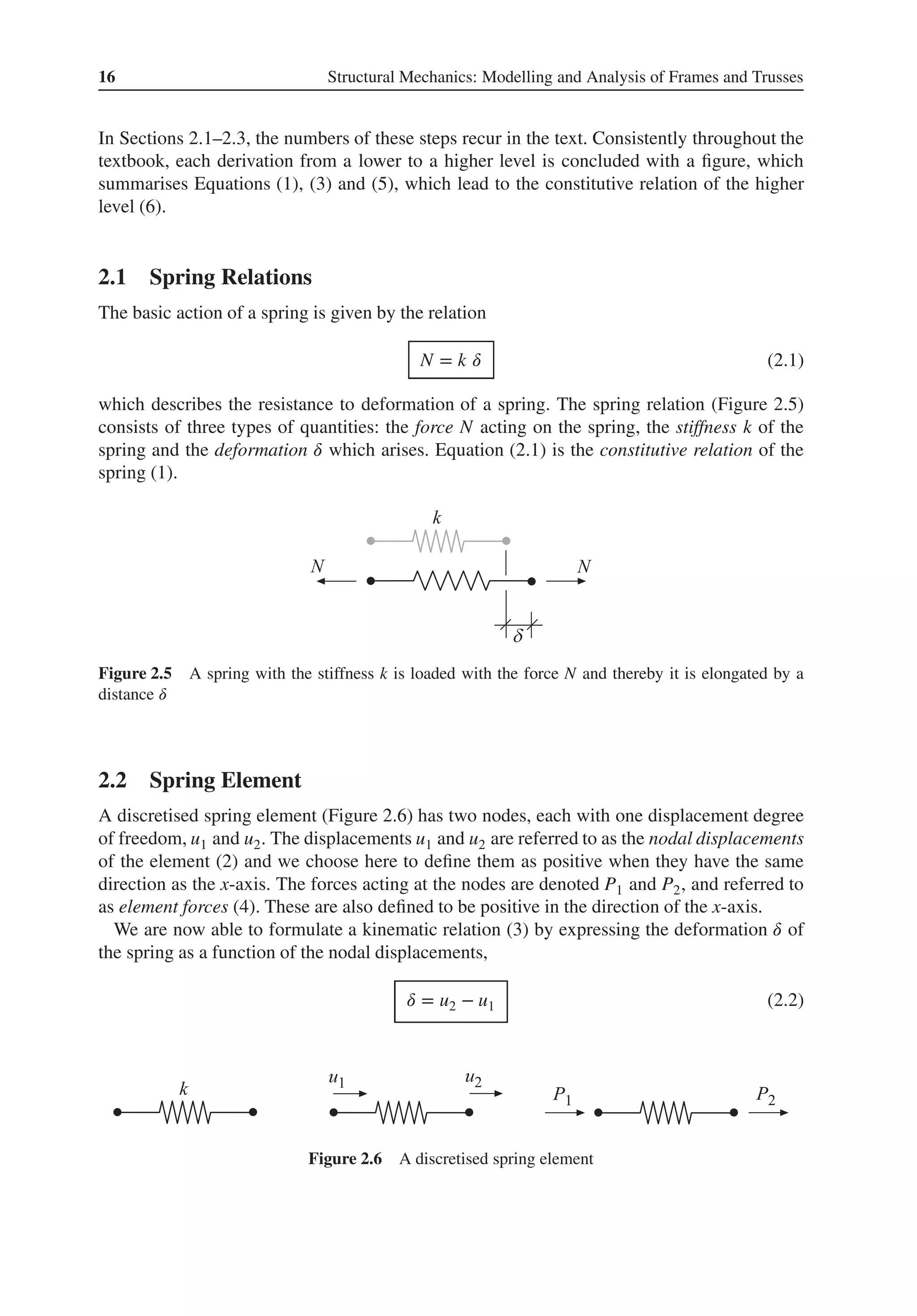
A discretised spring element (Figure 2.6) has two nodes, each with one displacement degree
of freedom, u1 and u2. The displacements u1 and u2 are referred to as the nodal displacements
of the element (2) and we choose here to define them as positive when they have the same
direction as the x-axis. The forces acting at the nodes are denoted P1 and P2, and referred to
as element forces (4). These are also defined to be positive in the direction of the x-axis.
We are now able to formulate a kinematic relation (3) by expressing the deformation 𝛿 of
the spring as a function of the nodal displacements,
𝛿 = u2 − u1 (2.2)
Figure 2.6 A discretised spring element
Systems of Connected Springs 17
P1 = −N (2.4)
P2 = N
N = k 𝛿 (2.1)
𝛿 = u2 − u1 (2.2)
⎫
⎪
⎪
⎬
⎪
⎪
⎭
⇒ Ke
ae
= fe
(2.7)
where
Ke
= k
[
1 −1
−1 1
]
; ae
=
[
u1
u2
]
; fe
=
[
P1
P2
]
Figure 2.7 From spring to spring element
By substituting (2.2) into (2.1), we can express the spring force as
N = k(u2 − u1) (2.3)
For a spring to be in equilibrium, two forces that are equal in magnitude and opposite in
direction must be acting on the spring, one at each end. If we compare the definition of the
spring force N (Figure 2.5) with the definition of the element forces P1 and P2 (Figure 2.6),
we observe (5) that
P1 = −N; P2 = N (2.4)
Substituting (2.4) into (2.3) gives
P1 = −k(u2 − u1) (2.5)
P2 = k(u2 − u1) (2.6)
or, in matrix form
Ke
ae
= fe
(2.7)
where
fe
=
[
P1
P2
]
; Ke
= k
[
1 −1
−1 1
]
; ae
=
[
u1
u2
]
(2.8)
The relation (2.7) is the constitutive relation (6) of the spring and is referred to as the element
equation of the spring where Ke is the element stiffness matrix, ae the element displacement
vector and fe the element force vector. The index e is used to denote that the relation is for a
single element.
A summary of the relations, which lead to the element equation of the spring, is shown in
Figure 2.7.
2.3 Systems of Springs
With the spring element (1) described in (2.7), we can now construct and analyse complex
systems of connected springs (Figure 2.8). The aim is to establish a constitutive relation for
the entire spring system. We begin by defining the degrees of freedom in a global coordinate
18 Structural Mechanics: Modelling and Analysis of Frames and Trusses
Figure 2.8 A system of connected springs
system, and introducing a global numbering of all the degrees of freedom, from 1 to n. These
displacements are gathered in a global displacement vector a (2).
a =
⎡
⎢
⎢
⎢
⎢
⎢
⎢
⎣
a1
⋅
ai
aj
⋅
an
⎤
⎥
⎥
⎥
⎥
⎥
⎥
⎦
(2.9)
The next step is to put each of the spring elements into the global system. In a given global
system, each element has its defined position with defined connections to the degrees of free-
dom of the global system. For example, the local displacements u1 and u2 of the element 𝛽
correspond to the global degrees of freedom ai and aj (Figure 2.9), that is
u1 = ai (2.10)
u2 = aj (2.11)
These relations describe how the spring elements are connected physically in the global
system. The relations are a type of kinematic relations referred to as compatibility
requirements (3). These compatibility requirements can be written in matrix form as
ae
= Ha (2.12)
where ae is defined in (2.8), a in (2.9) and where
H =
[
0 ⋅ 1 0 ⋅ 0
0 ⋅ 0 1 ⋅ 0
]
(2.13)
β
β
Figure 2.9 Global and local displacements
Systems of Connected Springs 19
fi fj
Figure 2.10 External forces at nodes
The elements of the matrix H that are not printed out are zero. Through the matrix form of the
compatibility requirements we have established a matrix H, which describes a transformation
between two different sets of degrees of freedom.
In the global system, external forces can be introduced at the nodes (Figure 2.10); it may
be external loads or support forces that act at the external supports of the system. We choose
to denote these forces by fi, where i is the degree of freedom in which the force acts, and we
gather them as components of a global force vector f (4).
f =
⎡
⎢
⎢
⎢
⎢
⎢
⎢
⎣
f1
⋅
fi
fj
⋅
fn
⎤
⎥
⎥
⎥
⎥
⎥
⎥
⎦
(2.14)
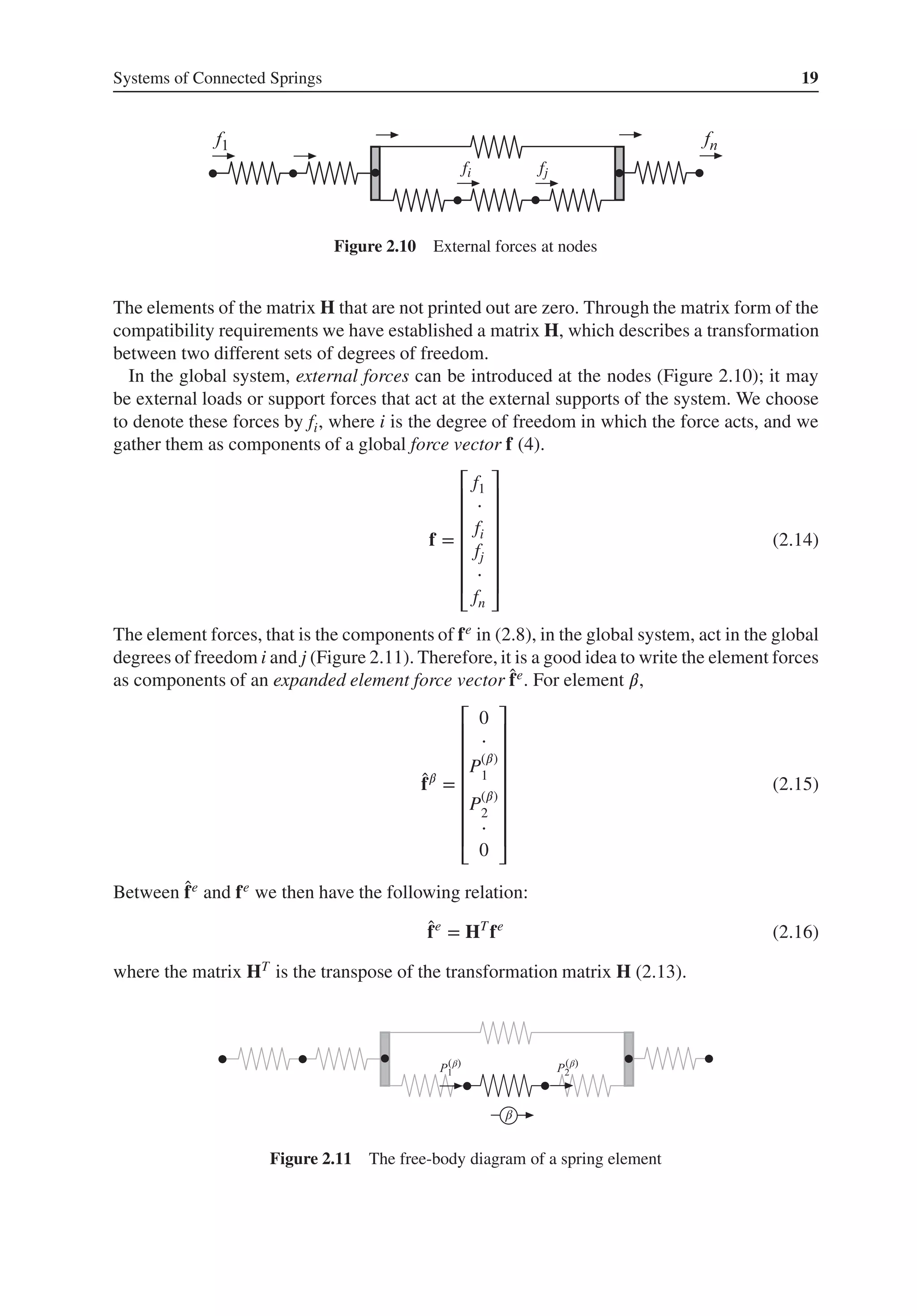
The element forces, that is the components of fe in (2.8), in the global system, act in the global
degrees of freedom i and j (Figure 2.11). Therefore, it is a good idea to write the element forces
as components of an expanded element force vector ̂
fe. For element 𝛽,
̂
f𝛽
=
⎡
⎢
⎢
⎢
⎢
⎢
⎢
⎢
⎣
0
⋅
P(𝛽)
1
P(𝛽)
2
⋅
0
⎤
⎥
⎥
⎥
⎥
⎥
⎥
⎥
⎦
(2.15)
Between ̂
fe and fe we then have the following relation:
̂
fe
= HT
fe
(2.16)
where the matrix HT is the transpose of the transformation matrix H (2.13).
(β) (β)
β
Figure 2.11 The free-body diagram of a spring element
20 Structural Mechanics: Modelling and Analysis of Frames and Trusses
(β)
(β)
(α)
(α)
β
α
Figure 2.12 Equilibrium for degree of freedom i
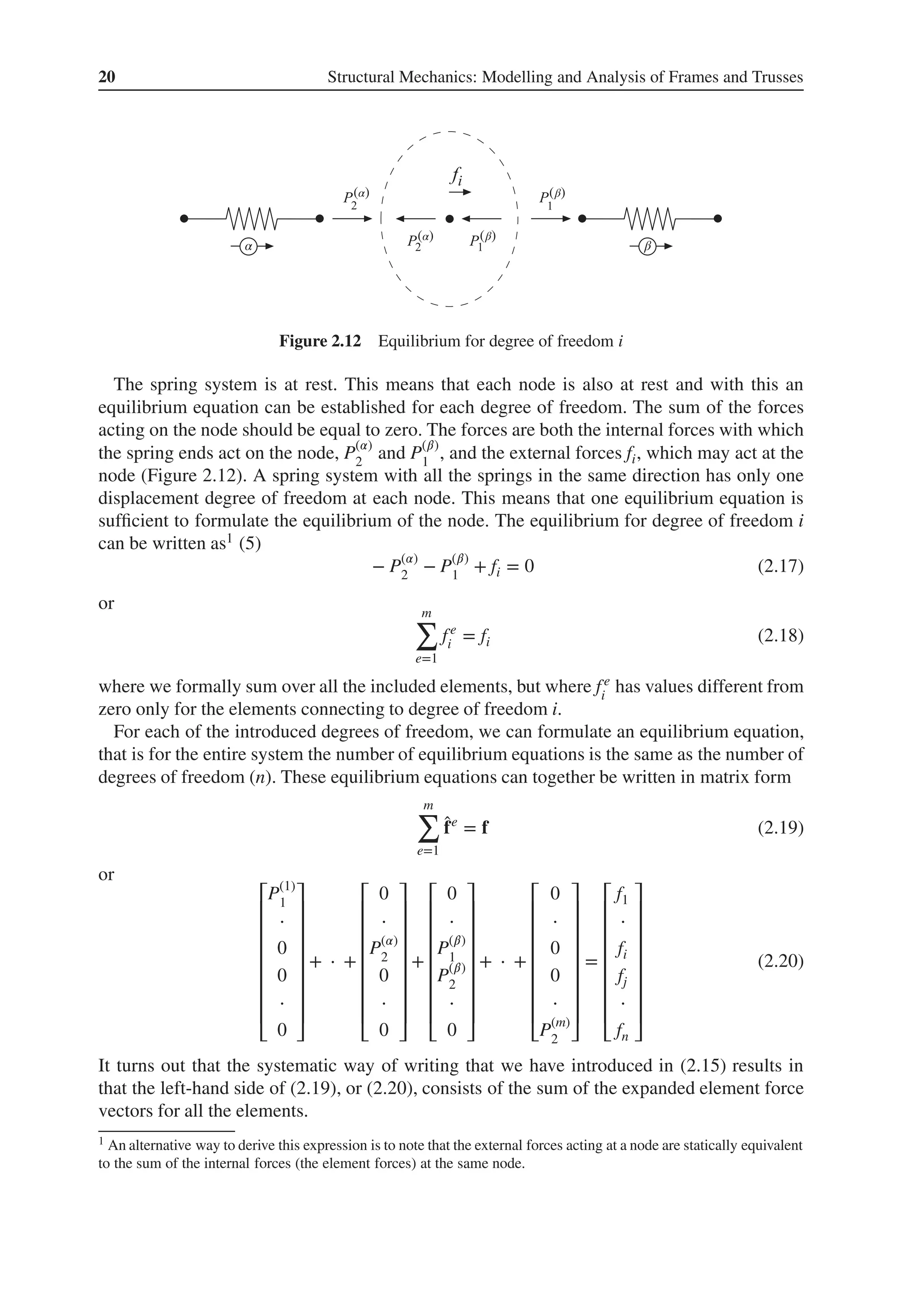
The spring system is at rest. This means that each node is also at rest and with this an
equilibrium equation can be established for each degree of freedom. The sum of the forces
acting on the node should be equal to zero. The forces are both the internal forces with which
the spring ends act on the node, P(𝛼)
2
and P(𝛽)
1
, and the external forces fi, which may act at the
node (Figure 2.12). A spring system with all the springs in the same direction has only one
displacement degree of freedom at each node. This means that one equilibrium equation is
sufficient to formulate the equilibrium of the node. The equilibrium for degree of freedom i
can be written as1 (5)
− P(𝛼)
2
− P(𝛽)
1
+ fi = 0 (2.17)
or m
∑
e=1
fe
i = fi (2.18)
where we formally sum over all the included elements, but where fe
i
has values different from
zero only for the elements connecting to degree of freedom i.
For each of the introduced degrees of freedom, we can formulate an equilibrium equation,
that is for the entire system the number of equilibrium equations is the same as the number of
degrees of freedom (n). These equilibrium equations can together be written in matrix form
m
∑
e=1
̂
fe
= f (2.19)
or
⎡
⎢
⎢
⎢
⎢
⎢
⎢
⎢
⎣
P(1)
1
⋅
0
0
⋅
0
⎤
⎥
⎥
⎥
⎥
⎥
⎥
⎥
⎦
+ ⋅ +
⎡
⎢
⎢
⎢
⎢
⎢
⎢
⎢
⎣
0
⋅
P(𝛼)
2
0
⋅
0
⎤
⎥
⎥
⎥
⎥
⎥
⎥
⎥
⎦
+
⎡
⎢
⎢
⎢
⎢
⎢
⎢
⎢
⎣
0
⋅
P(𝛽)
1
P(𝛽)
2
⋅
0
⎤
⎥
⎥
⎥
⎥
⎥
⎥
⎥
⎦
+ ⋅ +
⎡
⎢
⎢
⎢
⎢
⎢
⎢
⎢
⎣
0
⋅
0
0
⋅
P(m)
2
⎤
⎥
⎥
⎥
⎥
⎥
⎥
⎥
⎦
=
⎡
⎢
⎢
⎢
⎢
⎢
⎢
⎢
⎣
f1
⋅
fi
fj
⋅
fn
⎤
⎥
⎥
⎥
⎥
⎥
⎥
⎥
⎦
(2.20)
It turns out that the systematic way of writing that we have introduced in (2.15) results in
that the left-hand side of (2.19), or (2.20), consists of the sum of the expanded element force
vectors for all the elements.
1 An alternative way to derive this expression is to note that the external forces acting at a node are statically equivalent
to the sum of the internal forces (the element forces) at the same node.
Systems of Connected Springs 21
The expanded element force vector for an element is related to the local element force vector
through (2.16). Substituting the constitutive relation (2.7) and the compatibility requirements
(2.12) into (2.16), we can write the expanded element force vector as
̂
fe
= ̂
Ke
a (2.21)
where
̂
Ke
= HT
Ke
H (2.22)
̂
Ke is referred to as the expanded element stiffness matrix and shows where in a global system
the stiffness of an element should be placed. For a spring element 𝛽, the expanded element
stiffness matrix is obtained from
̂
K𝛽
= k
⎡
⎢
⎢
⎢
⎢
⎢
⎢
⎣
0 0
⋅ ⋅
1 0
0 1
⋅ ⋅
0 0
⎤
⎥
⎥
⎥
⎥
⎥
⎥
⎦
[
1 −1
−1 1
]
[
0 ⋅ 1 0 ⋅ 0
0 ⋅ 0 1 ⋅ 0
]
= k
⎡
⎢
⎢
⎢
⎢
⎢
⎢
⎣
0 ⋅ 0 0 ⋅ 0
⋅ ⋅ ⋅ ⋅ ⋅ ⋅
0 ⋅ 1 −1 ⋅ 0
0 ⋅ −1 1 ⋅ 0
⋅ ⋅ ⋅ ⋅ ⋅ ⋅
0 ⋅ 0 0 ⋅ 0
⎤
⎥
⎥
⎥
⎥
⎥
⎥
⎦
(2.23)
Substituting (2.21) into the equilibrium relation (2.19) gives
m
∑
e=1
̂
Ke
a = f (2.24)
or
Ka = f (2.25)
where
K =
m
∑
e=1
̂
Ke
(2.26)
The sequence of relations, from the local element relation (2.7) to the global relation for the
spring system (2.25), shows a general structure that will appear throughout the textbook. Even
if the contents are different for different types of problems, the same matrix notations are used.
Thus, in summary,
1. We have started from the element relation of the spring (2.7).
2. We have introduced a global displacement vector (2.9).
3. We have related local displacements to global ones using compatibility (2.12).
4. We have introduced a global vector for external loads that act on the nodes of the system
(2.14).
5. With an expanded way of writing (2.16) and using equilibrium conditions, we have related
local internal forces to global external forces (2.19).
6. With the compatibility requirements (2.12), the constitutive relation of the element (2.7)
and the expanded way of writing element forces (2.16), we have derived an expression that
describes a single element in a global system (2.21). By substituting the expanded element
relations (2.21) into the global equilibrium relations (2.19) for all the elements, we derived
a global constitutive relation for the spring system (2.25).
22 Structural Mechanics: Modelling and Analysis of Frames and Trusses
̂
fe
= HT
fe
(2.16)
fe
= Ke
ae
(2.7)
ae
= Ha (2.12)
⎫
⎪
⎬
⎪
⎭
⇒
f =
m
∑
e=1
̂
fe
(2.19)
̂
fe
= ̂
Ke
a (2.21)
⎫
⎪
⎬
⎪
⎭
⇒
where
̂
Ke
= HT
Ke
H
f = Ka (2.25)
where
K =
m
∑
e=1
̂
Ke
Figure 2.13 From element relations to system relations
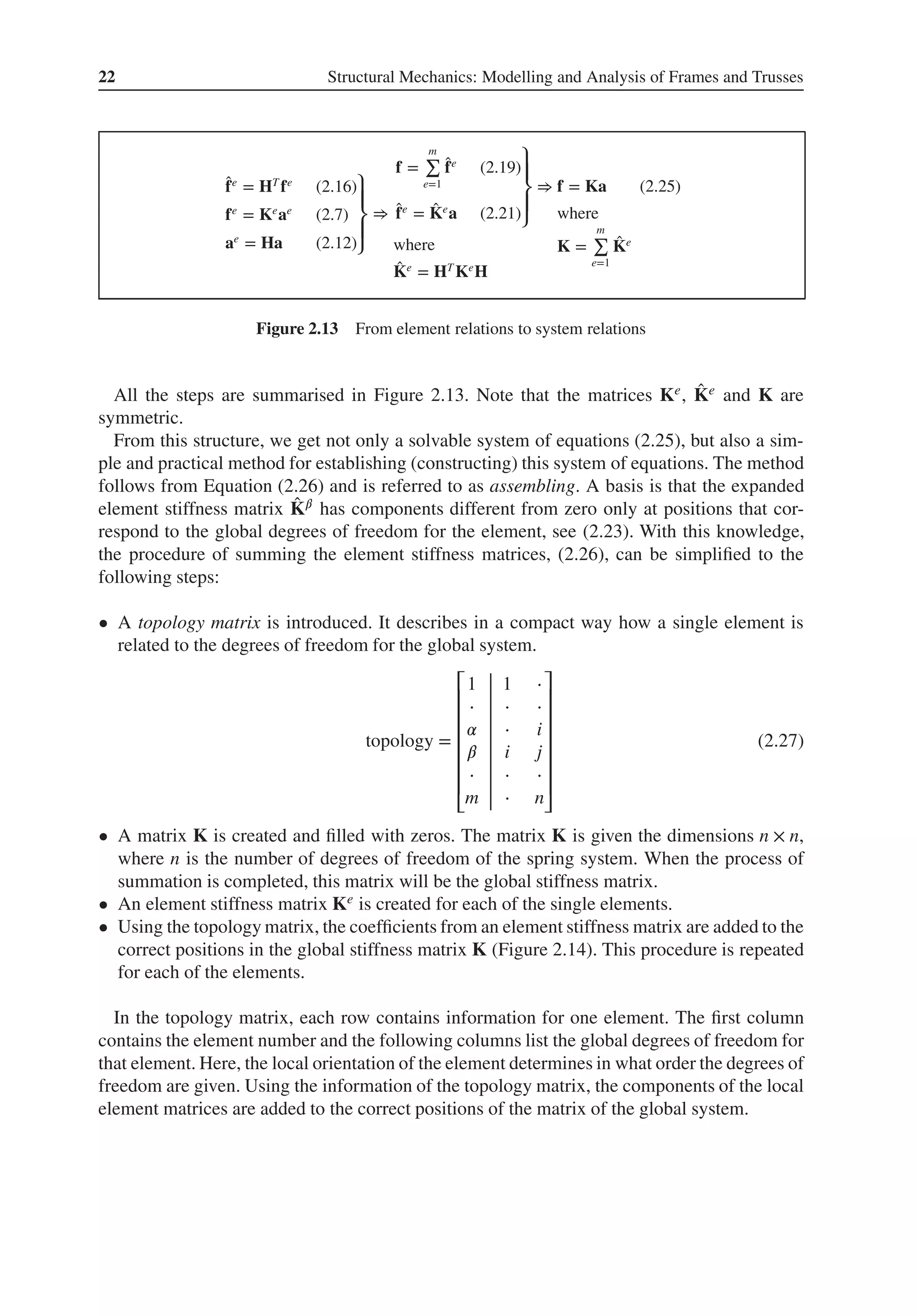
All the steps are summarised in Figure 2.13. Note that the matrices Ke, ̂
Ke and K are
symmetric.
From this structure, we get not only a solvable system of equations (2.25), but also a sim-
ple and practical method for establishing (constructing) this system of equations. The method
follows from Equation (2.26) and is referred to as assembling. A basis is that the expanded
element stiffness matrix ̂
K𝛽 has components different from zero only at positions that cor-
respond to the global degrees of freedom for the element, see (2.23). With this knowledge,
the procedure of summing the element stiffness matrices, (2.26), can be simplified to the
following steps:
• A topology matrix is introduced. It describes in a compact way how a single element is
related to the degrees of freedom for the global system.
topology =
⎡
⎢
⎢
⎢
⎢
⎢
⎢
⎣
1 1 ⋅
⋅ ⋅ ⋅
𝛼 ⋅ i
𝛽 i j
⋅ ⋅ ⋅
m ⋅ n
⎤
⎥
⎥
⎥
⎥
⎥
⎥
⎦
(2.27)
• A matrix K is created and filled with zeros. The matrix K is given the dimensions n × n,
where n is the number of degrees of freedom of the spring system. When the process of
summation is completed, this matrix will be the global stiffness matrix.
• An element stiffness matrix Ke is created for each of the single elements.
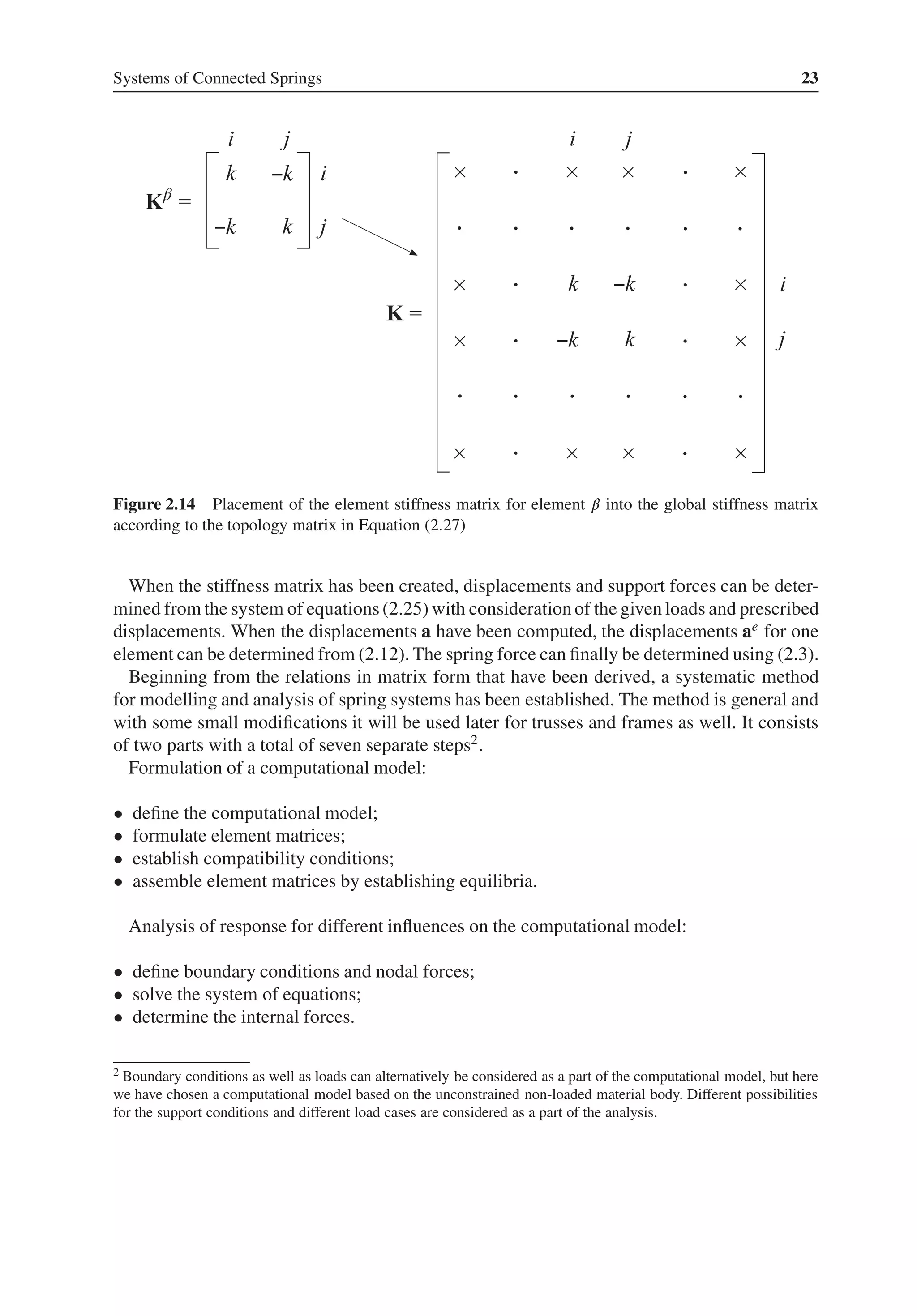
• Using the topology matrix, the coefficients from an element stiffness matrix are added to the
correct positions in the global stiffness matrix K (Figure 2.14). This procedure is repeated
for each of the elements.
In the topology matrix, each row contains information for one element. The first column
contains the element number and the following columns list the global degrees of freedom for
that element. Here, the local orientation of the element determines in what order the degrees of
freedom are given. Using the information of the topology matrix, the components of the local
element matrices are added to the correct positions of the matrix of the global system.
Systems of Connected Springs 23
–k
–k
–k
–k
β
Figure 2.14 Placement of the element stiffness matrix for element 𝛽 into the global stiffness matrix
according to the topology matrix in Equation (2.27)
When the stiffness matrix has been created, displacements and support forces can be deter-
mined from the system of equations (2.25) with consideration of the given loads and prescribed
displacements. When the displacements a have been computed, the displacements ae for one
element can be determined from (2.12). The spring force can finally be determined using (2.3).
Beginning from the relations in matrix form that have been derived, a systematic method
for modelling and analysis of spring systems has been established. The method is general and
with some small modifications it will be used later for trusses and frames as well. It consists
of two parts with a total of seven separate steps2.
Formulation of a computational model:
• define the computational model;
• formulate element matrices;
• establish compatibility conditions;
• assemble element matrices by establishing equilibria.
Analysis of response for different influences on the computational model:
• define boundary conditions and nodal forces;
• solve the system of equations;
• determine the internal forces.
2 Boundary conditions as well as loads can alternatively be considered as a part of the computational model, but here
we have chosen a computational model based on the unconstrained non-loaded material body. Different possibilities
for the support conditions and different load cases are considered as a part of the analysis.
24 Structural Mechanics: Modelling and Analysis of Frames and Trusses
Example 2.1 A system of springs
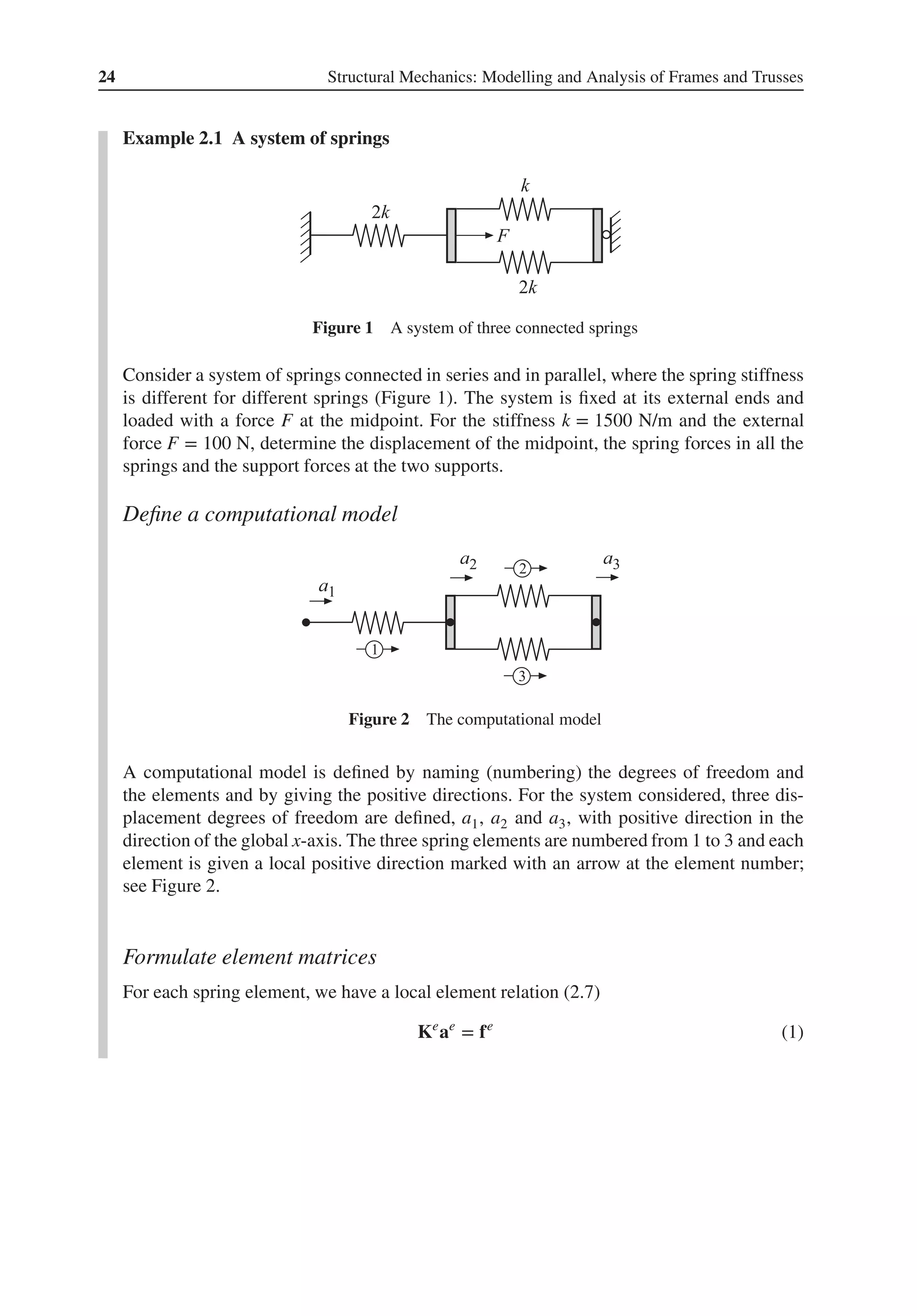
Figure 1 A system of three connected springs
Consider a system of springs connected in series and in parallel, where the spring stiffness
is different for different springs (Figure 1). The system is fixed at its external ends and
loaded with a force F at the midpoint. For the stiffness k = 1500 N/m and the external
force F = 100 N, determine the displacement of the midpoint, the spring forces in all the
springs and the support forces at the two supports.
Define a computational model
Figure 2 The computational model
A computational model is defined by naming (numbering) the degrees of freedom and
the elements and by giving the positive directions. For the system considered, three dis-
placement degrees of freedom are defined, a1, a2 and a3, with positive direction in the
direction of the global x-axis. The three spring elements are numbered from 1 to 3 and each
element is given a local positive direction marked with an arrow at the element number;
see Figure 2.
Formulate element matrices
For each spring element, we have a local element relation (2.7)
Ke
ae
= fe
(1)
Systems of Connected Springs 25
With k = 1500 N/m, we obtain for the three elements:
Element 1: [
P(1)
1
P(1)
2
]
=
[
3000 −3000
−3000 3000
]
[
u(1)
1
u(1)
2
]
(2)
Element 2: [
P(2)
1
P(2)
2
]
=
[
1500 −1500
−1500 1500
]
[
u(2)
1
u(2)
2
]
(3)
Element 3: [
P(3)
1
P(3)
2
]
=
[
3000 −3000
−3000 3000
]
[
u(3)
1
u(3)
2
]
(4)
Compatibility conditions
The spring system has the global displacement vector
a =
⎡
⎢
⎢
⎣
a1
a2
a3
⎤
⎥
⎥
⎦
(5)
The local degrees of freedom for Elements 1–3 correspond to global degrees of freedom
according to the following:
Element 1:
u(1)
1
= a1; u(1)
2
= a2 (6)
Element 2:
u(2)
1
= a2; u(2)
2
= a3 (7)
Element 3:
u(3)
1
= a2; u(3)
2
= a3 (8)
From the compatibility conditions, we have now obtained a description of how the ele-
ments of the spring system are connected to the degrees of freedom for the system. This
description is summarised in a topology matrix
topology =
⎡
⎢
⎢
⎣
1 1 2
2 2 3
3 2 3
⎤
⎥
⎥
⎦
(9)
Using the compatibility conditions (2.12) and the expanded element matrices, (2.7) can be
written in expanded form (2.21). For the three spring elements, the following is obtained:
26 Structural Mechanics: Modelling and Analysis of Frames and Trusses
Element 1:
⎡
⎢
⎢
⎢
⎣
P(1)
1
P(1)
2
0
⎤
⎥
⎥
⎥
⎦
=
⎡
⎢
⎢
⎢
⎣
3000 −3000 0
−3000 3000 0
0 0 0
⎤
⎥
⎥
⎥
⎦
⎡
⎢
⎢
⎢
⎣
a1
a2
a3
⎤
⎥
⎥
⎥
⎦
(10)
Element 2:
⎡
⎢
⎢
⎢
⎣
0
P(2)
1
P(2)
2
⎤
⎥
⎥
⎥
⎦
=
⎡
⎢
⎢
⎢
⎣
0 0 0
0 1500 −1500
0 −1500 1500
⎤
⎥
⎥
⎥
⎦
⎡
⎢
⎢
⎢
⎣
a1
a2
a3
⎤
⎥
⎥
⎥
⎦
(11)
Element 3:
⎡
⎢
⎢
⎢
⎣
0
P(3)
1
P(3)
2
⎤
⎥
⎥
⎥
⎦
=
⎡
⎢
⎢
⎢
⎣
0 0 0
0 3000 −3000
0 −3000 3000
⎤
⎥
⎥
⎥
⎦
⎡
⎢
⎢
⎢
⎣
a1
a2
a3
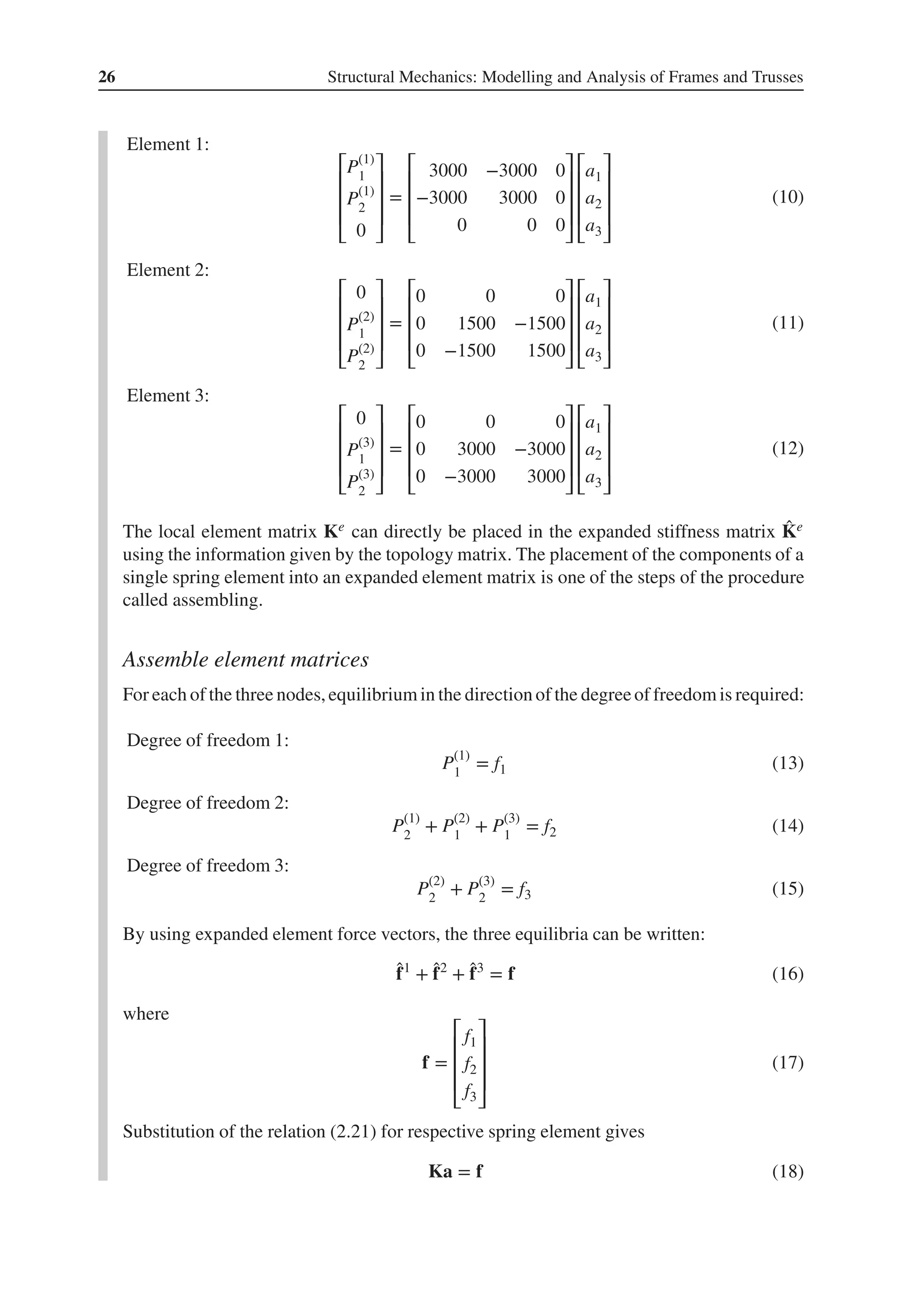
⎤
⎥
⎥
⎥
⎦
(12)
The local element matrix Ke can directly be placed in the expanded stiffness matrix ̂
Ke
using the information given by the topology matrix. The placement of the components of a
single spring element into an expanded element matrix is one of the steps of the procedure
called assembling.
Assemble element matrices
For each of the three nodes,equilibriumin the direction of the degreeof freedomis required:
Degree of freedom 1:
P(1)
1
= f1 (13)
Degree of freedom 2:
P(1)
2
+ P(2)
1
+ P(3)
1
= f2 (14)
Degree of freedom 3:
P(2)
2
+ P(3)
2
= f3 (15)
By using expanded element force vectors, the three equilibria can be written:
̂
f1
+ ̂
f2
+ ̂
f3
= f (16)
where
f =
⎡
⎢
⎢
⎢
⎣
f1
f2
f3
⎤
⎥
⎥
⎥
⎦
(17)
Substitution of the relation (2.21) for respective spring element gives
Ka = f (18)
Systems of Connected Springs 27
where
K = ̂
K1
+ ̂
K2
+ ̂
K3
(19)
With the matrix components printed out, we obtain
K =
⎡
⎢
⎢
⎣
3000 −3000 0
−3000 3000 0
0 0 0
⎤
⎥
⎥
⎦
+
⎡
⎢
⎢
⎣
0 0 0
0 1500 −1500
0 −1500 1500
⎤
⎥
⎥
⎦
+
⎡
⎢
⎢
⎣
0 0 0
0 3000 −3000
0 −3000 3000
⎤
⎥
⎥
⎦
(20)
or
K =
⎡
⎢
⎢
⎣
3000 −3000 0
−3000 7500 −4500
0 −4500 4500
⎤
⎥
⎥
⎦
(21)
By establishing equilibria for all nodes, the stiffness matrix K of the spring system is
obtained as a sum of the expanded element stiffness matrices, (2.26). This summation can
be developed into a systematic process for adding local element matrices to a matrix for
the global system. We can now express the system of equations (18) as
⎡
⎢
⎢
⎢
⎣
3000 −3000 0
−3000 7500 −4500
0 −4500 4500
⎤
⎥
⎥
⎥
⎦
⎡
⎢
⎢
⎢
⎣
a1
a2
a3
⎤
⎥
⎥
⎥
⎦
=
⎡
⎢
⎢
⎢
⎣
f1
f2
f3
⎤
⎥
⎥
⎥
⎦
(22)
Define boundary conditions and loads
So far, the computational model has developed into a complete description of the properties
of the spring system through the fact that the components of the stiffness matrix K are now
determined. The model has also defined a possibility to prescribe different displacements
a and different external loadings f for which the response of the spring system can be
examined. As long as no displacements have been prescribed, the model describes a system
of springs that is not fixed to its surroundings, the system floats freely in a one-dimensional
space. The determinant of the system matrix K is zero. For a computation of displacements
and internal forces, boundary conditions and loads have to be defined. Our spring system
is fixed at its outer ends, that is a1 = 0 and a3 = 0. This can be described by the boundary
condition matrix
boundary conditions (bc) =
[
1 0
3 0
]
(23)
where the first column gives the degree of freedom at which the displacement should be
prescribed and the second column gives the value it should be given. By splitting the force
vector f and expressing it as the sum of two vectors, we can distinguish loads fl (l is an
abbreviation of load) from support forces fb (b is an abbreviation of boundary).
f = fl + fb (24)
At the degrees of freedom where displacement is prescribed, support forces will arise,
which we denote by fb,1 and fb,3. The spring system is loaded with the force 100 N in degree
28 Structural Mechanics: Modelling and Analysis of Frames and Trusses
of freedom 2, that is fl,2 = 100. The two vectors fl and fb are given by
fl =
⎡
⎢
⎢
⎣
0
100
0
⎤
⎥
⎥
⎦
; fb =
⎡
⎢
⎢
⎣
fb,1
0
fb,3
⎤
⎥
⎥
⎦
(25)
Solving the system of equations
With the prescribed displacements, external loads and unknown support forces introduced,
the system of equations can be written as
⎡
⎢
⎢
⎢
⎣
3000 −3000 0
−3000 7500 −4500
0 −4500 4500
⎤
⎥
⎥
⎥
⎦
⎡
⎢
⎢
⎢
⎣
0
a2
0
⎤
⎥
⎥
⎥
⎦
=
⎡
⎢
⎢
⎢
⎣
0
100
0
⎤
⎥
⎥
⎥
⎦
+
⎡
⎢
⎢
⎢
⎣
fb,1
0
fb,3
⎤
⎥
⎥
⎥
⎦
(26)
The system of equations contains three unknowns: the displacement a2 and the support
forces fb,1 and fb,3. When considering the prescribed displacements, the system of equations
can be reduced to
7500 a2 = 100 (27)
and the displacement a2 can now be determined to be
a2 =
100
7500
= 0.01333 (28)
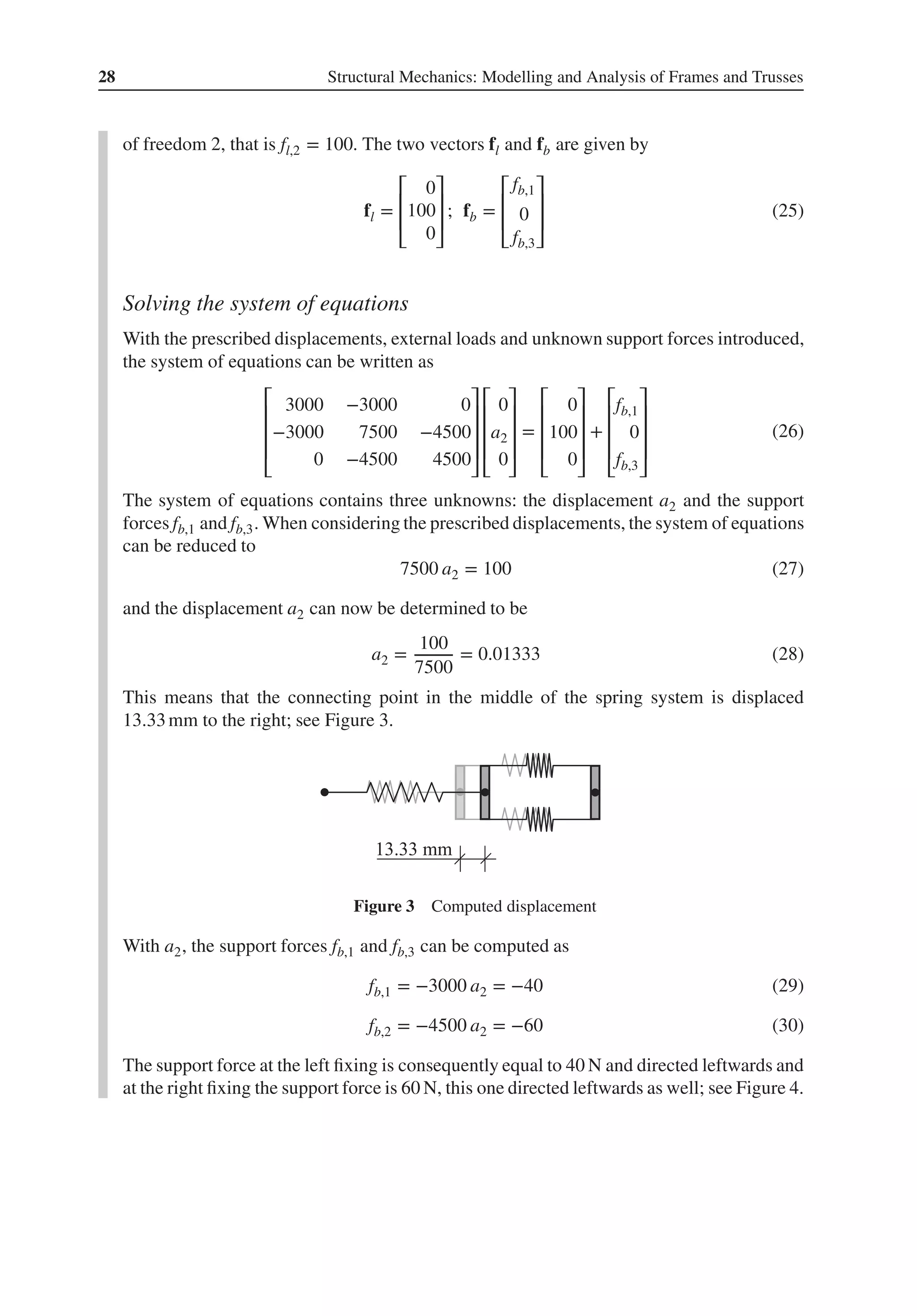
This means that the connecting point in the middle of the spring system is displaced
13.33mm to the right; see Figure 3.
Figure 3 Computed displacement
With a2, the support forces fb,1 and fb,3 can be computed as
fb,1 = −3000 a2 = −40 (29)
fb,2 = −4500 a2 = −60 (30)
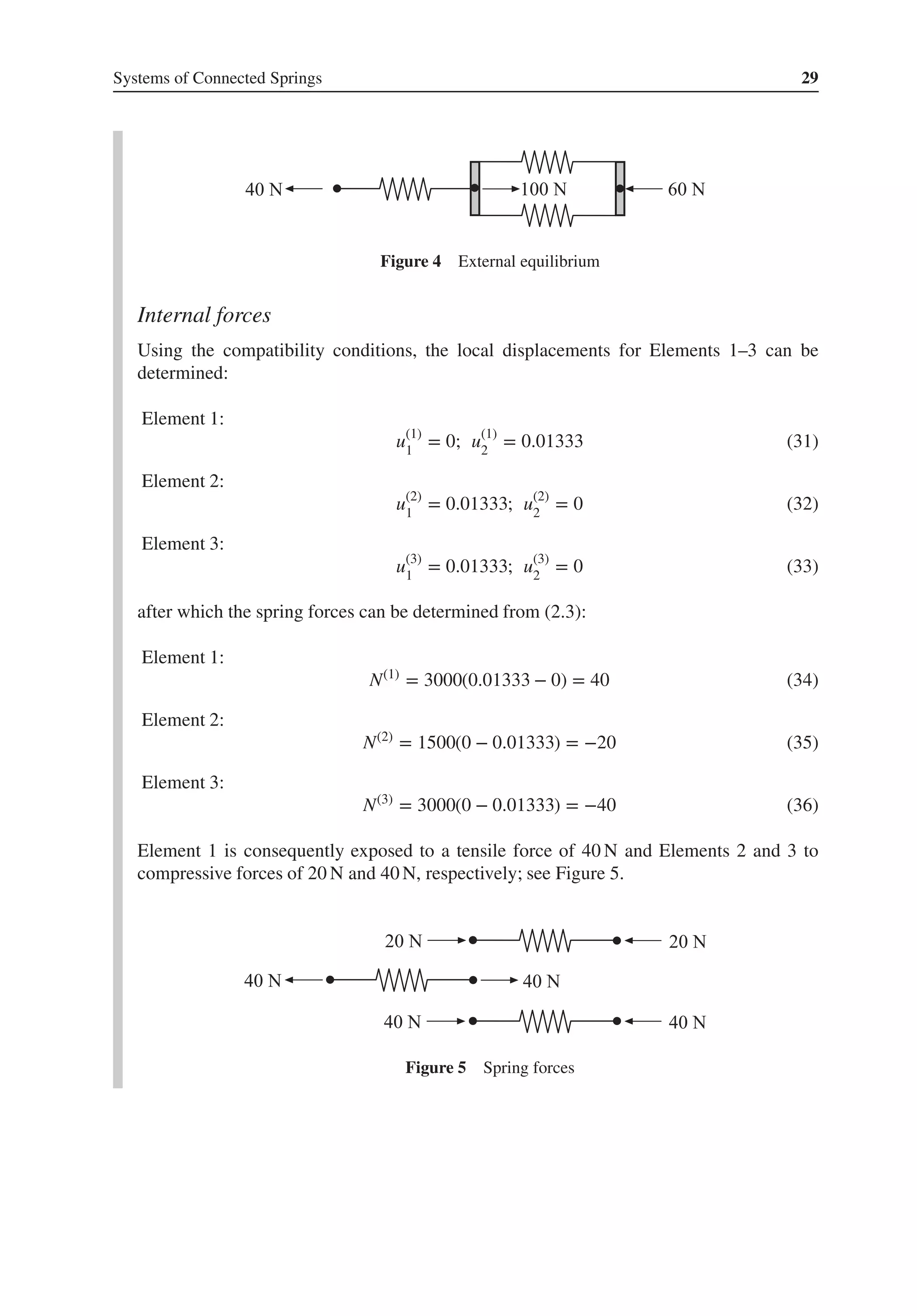
The support force at the left fixing is consequently equal to 40 N and directed leftwards and
at the right fixing the support force is 60 N, this one directed leftwards as well; see Figure 4.
Systems of Connected Springs 29
Figure 4 External equilibrium
Internal forces
Using the compatibility conditions, the local displacements for Elements 1–3 can be
determined:
Element 1:
u(1)
1
= 0; u(1)
2
= 0.01333 (31)
Element 2:
u(2)
1
= 0.01333; u(2)
2
= 0 (32)
Element 3:
u(3)
1
= 0.01333; u(3)
2
= 0 (33)
after which the spring forces can be determined from (2.3):
Element 1:
N(1)
= 3000(0.01333 − 0) = 40 (34)
Element 2:
N(2)
= 1500(0 − 0.01333) = −20 (35)
Element 3:
N(3)
= 3000(0 − 0.01333) = −40 (36)
Element 1 is consequently exposed to a tensile force of 40 N and Elements 2 and 3 to
compressive forces of 20 N and 40 N, respectively; see Figure 5.
Figure 5 Spring forces
30 Structural Mechanics: Modelling and Analysis of Frames and Trusses
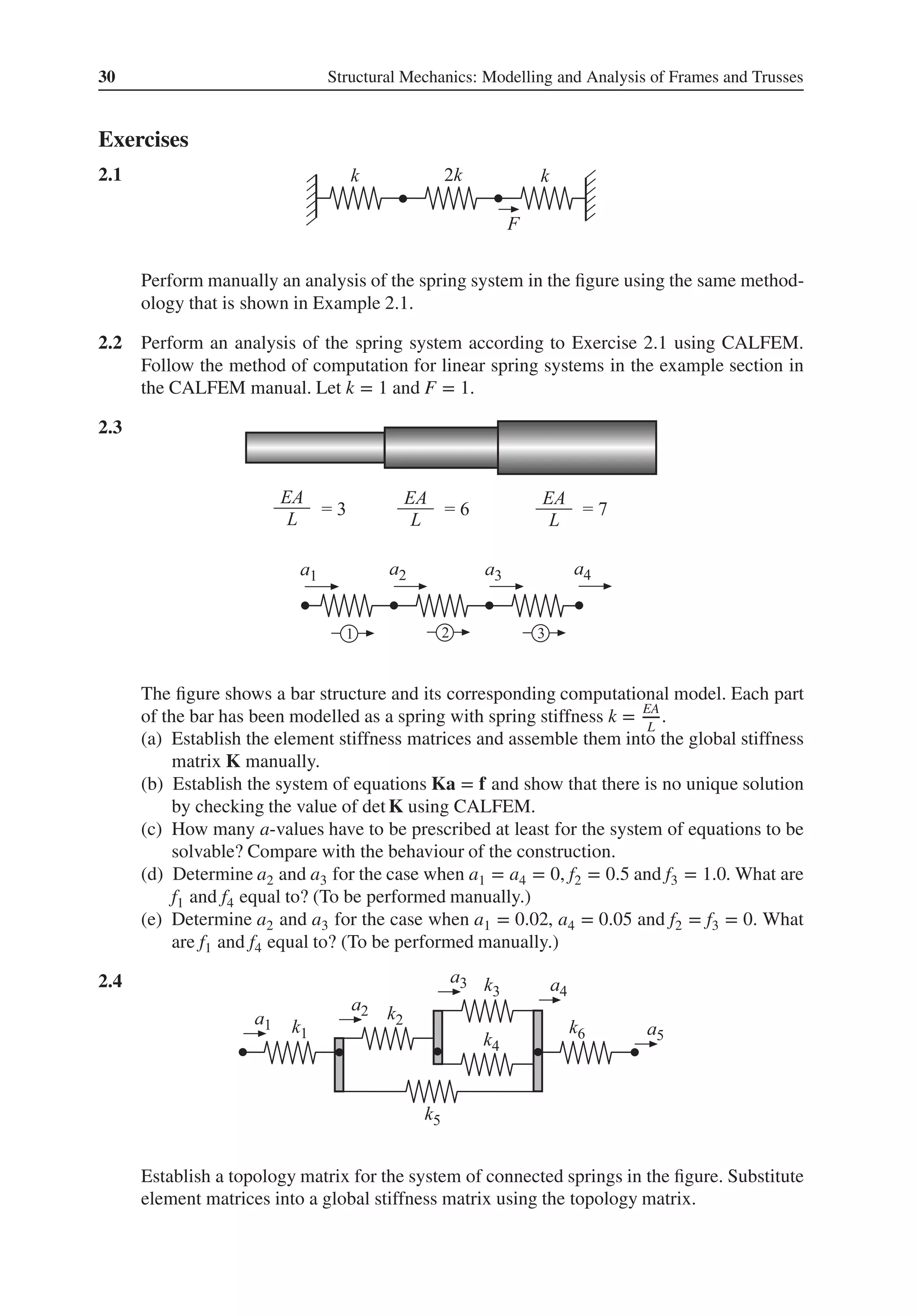
Exercises
2.1 .
Perform manually an analysis of the spring system in the figure using the same method-
ology that is shown in Example 2.1.
2.2 Perform an analysis of the spring system according to Exercise 2.1 using CALFEM.
Follow the method of computation for linear spring systems in the example section in
the CALFEM manual. Let k = 1 and F = 1.
2.3 .
The figure shows a bar structure and its corresponding computational model. Each part
of the bar has been modelled as a spring with spring stiffness k = EA
L
.
(a) Establish the element stiffness matrices and assemble them into the global stiffness
matrix K manually.
(b) Establish the system of equations Ka = f and show that there is no unique solution
by checking the value of det K using CALFEM.
(c) How many a-values have to be prescribed at least for the system of equations to be
solvable? Compare with the behaviour of the construction.
(d) Determine a2 and a3 for the case when a1 = a4 = 0, f2 = 0.5 and f3 = 1.0. What are
f1 and f4 equal to? (To be performed manually.)
(e) Determine a2 and a3 for the case when a1 = 0.02, a4 = 0.05 and f2 = f3 = 0. What
are f1 and f4 equal to? (To be performed manually.)
2.4 .
Establish a topology matrix for the system of connected springs in the figure. Substitute
element matrices into a global stiffness matrix using the topology matrix.
3
Bars and Trusses
Figure 3.1 An axially loaded bar and a two-dimensional (plane) truss
A bar is a long body that carries only axial load (bar action). A truss is a load-carrying
structure consisting of bars connected at frictionless hinges. By these two definitions, we
have introduced the truss as a computational model (Figure 3.1). Here, we limit ourselves
to two-dimensional (plane) trusses.
A map summarising the quantities and relations of structural mechanics for bars and systems
of bars, that is trusses, is shown in Figure 3.2. The map has the following structure:
• a scale with six levels: material level, cross-section level, bar action, bar element – local
coordinates, bar element – global coordinates and truss/system of bars;
• three types of quantities: force measure, stiffness measure and displacement/deformation
measure;
• relations between force measures at different scale levels – equilibrium/static equivalence;
• relations between displacement/deformationmeasures at different scale levels – kinematics/
compatibility;
• at each level: a constitutive relation between force measure and the corresponding displace-
ment/deformation measure.
Structural Mechanics: Modelling and Analysis of Frames and Trusses, First Edition.
Karl-Gunnar Olsson and Ola Dahlblom.
© 2016 John Wiley & Sons, Ltd. Published 2016 by John Wiley & Sons, Ltd.
32 Structural Mechanics: Modelling and Analysis of Frames and Trusses
Figure 3.2 The quantities and relations of structural mechanics for bars and trusses
Bars and Trusses 33
Compare the map for spring systems with three levels (Figure 2.4) with this map. The latter has
six levels, which can be divided into three groups: truss (one level), bar element (two levels)
and bar action (three levels). At the lowermost level, the material level, we have the material
stiffness relating the loading of the material (stress) to its deformation (strain). This relation is
usually referred to as Hooke’s law or the constitutive relation of the material. With kinematic
assumptions and equilibrium/static equivalence, the constitutive relation of the material is
developed to a relation between axial loading and axial deformation – the differential equation
for bar action (3.25). We perform this derivation in Section 3.1.
At the intermediate level of the map, the differential equation for bar action is reformulated
to an element relation written in matrix form, where force and displacement measures are
expressed at the end points of the bar in a systematic manner and where the stiffness of the bar
is related to these measures by the element stiffness matrix. This is a preparation for placing the
bar between discrete nodes in a global system of bars. The reformulation consists of two steps:
first, an element relation in matrix form is established in a local coordinate system oriented
in the direction of the bar (3.60). Then, the relation is transformed so that it is expressed in
the coordinate system of the global system of bars (3.85). Matrix relations for bar elements at
these two levels are discussed in Section 3.2.
The uppermost level concerns the systematics by which we can construct computational
models for global load-carrying structures. The systematics for systems of bars includes the
same six steps that were introduced for systems of springs in Section 2.3. Section 3.3 repeats
this systematics and, with an example, it is shown how general computational models for
trusses can be constructed.
3.1 The Differential Equation for Bar Action
We seek an expression to describe the relation between loading and displacement of a bar
(Figure 3.3). The derivation consists of two steps: from the material level to the cross-section
level and from the cross-section level to bar action. Each step from a lower to a higher level
begins with a definition of the deformation measure of the higher level and is followed by a
kinematic assumption relating the higher level to the lower one (Figure 3.4). Thereafter, the
kinematic relation is substituted into the constitutive relation of the lower level. Finally, the
force measure of the higher level is defined and related to the force measure of the lower
level by equilibrium/static equivalence. By successively repeating this procedure, we enable a
derivation of the constitutive relations for higher and higher levels.
3.1.1 Definitions
A bar is a body that has its main extension in one dimension. Thus, the formulation of a com-
putational model involves simplifying by introducing force measures, displacement measures
and deformation measures that are functions of this single dimension.
To describe the properties of the bar, we introduce a local coordinate system (̄
x, ̄
y, ̄
z), where
̄
x is parallel to, and ̄
y as well as ̄
z is perpendicular to, the longitudinal direction of the bar. The
quantities of bar theory are illustrated in Figure 3.5. On the material level, all the variables are
free to vary in three-dimensional space. We have stress 𝜎̄
x(̄
x, ̄
y, ̄
z), strain 𝜀̄
x(̄
x, ̄
y, ̄
z) and mate-
rial stiffness E(̄
x, ̄
y, ̄
z). The main purpose of the step from the material level to cross-section
level is to introduce restrictions (simplifications), which result in the variables of the theory
34 Structural Mechanics: Modelling and Analysis of Frames and Trusses
ε
ε
σ
σ
Figure 3.3 From the material level to bar action
Figure 3.4 The principle for derivation of the constitutive relation of a higher level
Bars and Trusses 35
σ
ε
ε
( )
( ) ( ) ( )
( )
( )
( )
Figure 3.5 The quantities of bar theory
only vary in one dimension, the ̄
x-direction of the bar. This is accomplished by introducing
the so-called generalised force and deformation measures. The generalised force measure of
the bar cross-section is the normal force N(̄
x), which is the resultant of the stresses of the
cross-section. The generalised deformation measure is the normal strain 𝜀̄
x(̄
x), which describes
how a thin lamella of the bar is stretched and contracted. Beginning from these measures, a
generalised stiffness measure DEA(̄
x) can be derived (3.17). At the level describing bar action,
we introduce an axial loading q̄
x(̄
x) and an axial displacement u(̄
x). At this level, the bar also
has a length L.
The location of the local ̄
x-axis on the surface of the cross-section can in principle be arbi-
trary. The formulation of the bar theory can, however,be simplified considerably if the position
satisfies the conditions ∫AE ̄
y dA = 0 and ∫AE ̄
z dA = 0. For an over the cross-section constant
elastic modulus, E(̄
y, ̄
z) = constant, this means that ∫A ̄
y dA = 0 and ∫Ā
z dA = 0. The latter
conditions are satisfied at the centroid of the bar cross-section. When describing systems of
bars, each bar is usually represented by a system line, which is the local ̄
x-axis of the bar; see
Figure 3.6. For constant E(̄
y, ̄
z), these are located at the centroid of the cross-section.
3.1.2 The Material Level
Strain
The deformation of a material can be described in different ways depending on the charac-
ter of the application. For one-dimensional theories, such as bar theory and beam theory, it is
36 Structural Mechanics: Modelling and Analysis of Frames and Trusses
( ) ( )
Figure 3.6 System lines
( )
( )
( )
( )
Figure 3.7 Displacement and change in length (deformation) of a material fibre
common to interpret a material as three fibres that are perpendicular to each other in space.1
The deformation of the material then consists of two parts: the relative change in length of
the fibres and the relative change in angle of the fibres. The two parts describe how the vol-
ume and the shape of the material are changed, respectively. With the kinematic presumptions
(idealizations), which are introduced later for the bar theory, and in Chapter 4 for the beam
theory, the only interesting deformation measure will be the relative change in length of an
axial fibre.
The deformation of a material fibre can be described using the line AB between two adjacent
points, which in the undeformed state have the coordinates (̄
x, ̄
y, ̄
z) and (̄
x + d̄
x, ̄
y, ̄
z), respec-
tively; see Figure 3.7. It means that the length |AB| of the line AB is
|AB| = d̄
x (3.1)
In a deformed state, the line AB has been moved and its length has been changed, the resulting
new line is denoted A′B′. The material points considered have been moved to the coordinates
(̄
x + u, ̄
y + 𝑣, ̄
z + 𝑤) and (̄
x + d̄
x + u + du, ̄
y + 𝑣 + d𝑣, ̄
z + 𝑤 + d𝑤), respectively. The length
|A′B′| of the line A′B′ is then
|A′
B′
| =
√
(d̄
x + du)2 + (d𝑣)2 + (d𝑤)2 (3.2)
1 For three-dimensional theories, for example geotechnical applications, other deformation measures may be more
relevant. If the deformation measures are based on the same fundamental conditions, there is always a possibility for
translation.
Bars and Trusses 37
With assumption of small displacements, that is du, d𝑣 and d𝑤 are assumed to be small com-
pared with d̄
x, (3.2) can be written as
|A′
B′
| = d̄
x + du (3.3)
A material point has no extension. Therefore, we need to introduce a deformation measure
that is independent of length. Such a measure is the relative change in length of a fibre. This
deformation measure is referred to as normal strain, or just strain, and is denoted 𝜀. For small
relative changes in length (small strains), the change in length |A′B′| − |AB| is usually nor-
malised with respect to the original length |AB|, that is the strain 𝜀̄
x is given as
𝜀̄
x =
|A′B′| − |AB|
|AB|
(3.4)
Substitution of (3.1) and (3.3) into (3.4) gives
𝜀̄
x =
d̄
x + du − d̄
x
d̄
x
(3.5)
that is
𝜀̄
x =
du
d̄
x
(3.6)
This strain measure is often referred to as engineering strain and is positive when the fibre is
lengthened.
Stress
The loading of the material depends on the size of the area over which a loading force can
be distributed. To get a size-independent force measure for a material point, we introduce
a relative force measure – force per unit of area. Here, we can formulate the relative force
measure stress by describing the material as a rectangular cuboid and letting an arbitrarily
directed tensile force act on a section surface dA, with the normal vector n̄
x parallel to the
̄
x-axis (Figure 3.8). The force dP is divided into three components dP̄
x, dP̄
y and dP̄
z. With
stress defined as force per unit of area, we obtain three stress components acting on the
section surface:
𝜎̄
x̄
x =
dP̄
x
dA
; 𝜎̄
x̄
y =
dP̄
y
dA
; 𝜎̄
x̄
z =
dP̄
z
dA
(3.7)
where the first index of the stress component gives the direction of the normal vector of the
section surface dA and the second index gives the direction of the force component and with
σ
σ σ
σ
Figure 3.8 The concept of stress
38 Structural Mechanics: Modelling and Analysis of Frames and Trusses
σ
ε
ε
Figure 3.9 Linear elastic material relation
that also the direction of the stress. From the concept of bar action, we have an assumption of
axial loading. With this and an assumption of isotropic material or orthotropic material with
one principal direction along the local ̄
x-axis, it follows from equilibrium that dP̄
y and dP̄
z
are equal to zero. With that 𝜎̄
x̄
y and 𝜎̄
x̄
z are equal to zero as well; the remaining stress 𝜎̄
x̄
x, in
the longitudinal direction of the bar, is
𝜎̄
x =
dP̄
x
dA
(3.8)
where we have chosen to print only one of the indices ̄
x̄
x. This stress is parallel to the normal
vector of the section surface considered and is referred to as normal stress. For the rectangular
cuboid representing the material to be in equilibrium, two stresses that are equal in magnitude
and opposite in direction have to be acting on the opposite sides of the cuboid. These two
stress components together define the normal stress 𝜎̄
x. Normal stress is defined to be positive
in tension and negative in compression.
The Constitutive Relation of the Material
The material is assumed to be linear elastic. This means that the stress 𝜎̄
x is proportional to
the strain 𝜀̄
x (Figure 3.9), that is
𝜎̄
x(̄
x, ̄
y, ̄
z) = E(̄
x, ̄
y, ̄
z) 𝜀̄
x(̄
x, ̄
y, ̄
z) (3.9)
where E is the elastic modulus, or Young’s modulus, of the material. The material can be
isotropic or orthotropic. For an orthotropic material, E refers to the elastic modulus in the
longitudinal direction of the bar. Equation (3.9) is the constitutive relation of the material and
is referred to as Hooke’s law after the English researcher Robert Hooke, who in the year 1660
formulated a relation for elastic deformation of a spring.
3.1.3 The Cross-Section Level
Kinematics
The description of the kinematics of bar action begins from the reference axis of the bar,
the local ̄
x-axis. Each point on the axis has an original position ̄
x and, when loaded, it gets a
Bars and Trusses 39
( )
Figure 3.10 The displacement u(̄
x) and the deformation du of the reference axis
displacement u(̄
x). The deformation of the bar can be related to the change in displacement,
du, which arises between two adjacent points, originally with distance dx between them
(Figure 3.10). Provided that the rotation of the bar is small (cos 𝜃 ≈ 1), the strain of the
reference axis can be written as
𝜀̄
x(̄
x) =
du
d̄
x
(3.10)
where the same strain definition as in Equation (3.6) is used.
A cross-section lamella is associated with each d̄
x along the reference axis. The lamella has
in its undeformed state the volume A(̄
x) d̄
x. When such a lamella is deformed, it is normally
assumed that deformation occurs only in the direction of the ̄
x-axis, that is in the ̄
y, ̄
z-plane the
shape and size of the cross-section remain unchanged. For deformation in the ̄
x-direction, each
material point (̄
y, ̄
z) on a cross-section lamella positioned at ̄
x has a strain 𝜀̄
x(̄
x, ̄
y, ̄
z) which, with
use of kinematic assumptions, can be written in the form
𝜀̄
x(̄
x, ̄
y, ̄
z) = f(̄
x)g(̄
y, ̄
z) (3.11)
The strains of the cross-section lamella are divided into two parts: a summarising measure of
the strains of the cross-section lamella f(̄
x), referred to as generalised strain, and a description
of the shape of the deformation of the cross-section g(̄
y, ̄
z), which is referred to as strain mode
or deformation mode. Specific shapes of different strain modes are justified by a series of
kinematic assumptions.2 In ordinary bar theory and beam theory, one assumes that each plane
cross-section remains plane during the deformation. In bar action, we also have the assumption
that the cross-section planes remain perpendicular to the system line; see Figure 3.11. For bar
action, this implies that each point on the cross-sectional plane has the same displacement as
the reference axis,
u(̄
x, ̄
y, ̄
z) = u(̄
x) (3.12)
and with that we have
𝜀̄
x(̄
x, ̄
y, ̄
z) = 𝜀̄
x(̄
x) (3.13)
If we compare Equation (3.11) with (3.13), we find that the kinematic assumptions we have
made imply that f(̄
x) = 𝜀̄
x(̄
x) and g(̄
y, ̄
z) = 1. Thereby, we get the normal strain 𝜀̄
x(̄
x) of the
reference axis as the generalised strain measure for bar action.
2 If one wants to understand the relevance of a theory, the understanding of the reasonableness of the present choice
of strain mode is essential. A prescribed strain mode implies a kinematic restriction on the studied body; the body
becomes stiffer and the computed deformations slightly smaller than what would have been the case in a model where
𝜀̄
x(̄
x, ̄
y, ̄
z) can vary freely.
40 Structural Mechanics: Modelling and Analysis of Frames and Trusses
( )
( )
( ) ( ) ( )
( )
( )
ε ε ε
Figure 3.11 Undeformed and deformed cross-section lamella
Force Relations
The force acting on a small part dA of a cross-sectional surface is 𝜎̄
xdA. The resulting normal
force N(̄
x) on the whole cross-section is then the integral (the sum) of the stresses 𝜎̄
x over the
area A of the cross-section (Figure 3.12)
N(̄
x) =
∫A
𝜎̄
x(̄
x, ̄
y, ̄
z) dA (3.14)
From the definition of stress, it follows that the normal force is positive in tension and with the
conditions ∫AĒ
ydA = 0 and ∫AĒ
zdA = 0, the local ̄
x-axis (the system line) will coincide with
the line of action of the normal force.
The Constitutive Relation at the Cross-Section Level
The expression for the resultant (3.14), the kinematic relation (3.13) and the material relation
(3.9) can be combined to a constitutive relation at the cross-section level
N(̄
x) =
∫A
E(̄
x, ̄
y, ̄
z) 𝜀̄
x(̄
x) dA (3.15)
σ ( )
( )
Figure 3.12 Normal stress and normal force
Bars and Trusses 41
The generalised strain 𝜀̄
x(̄
x) describes the strain of the cross-section lamella. It is independent
of ̄
y and ̄
z and can therefore be moved outside the integral, which gives
N(̄
x) = DEA(̄
x)𝜀̄
x(̄
x) (3.16)
where
DEA(̄
x) =
∫A
E(̄
x, ̄
y, ̄
z)dA (3.17)
is the axial stiffness of the cross-section lamella of the bar, which depends on the material
stiffness E and the shape of the cross-section. If the elastic modulus is constant over the
cross-section, that is independent of ̄
y and ̄
z, then
DEA(̄
x) = E(̄
x)A(̄
x) (3.18)
Figure 3.13 gives a summary of the relations for the cross-section level.
N(̄
x) =
∫A
𝜎̄
x(̄
x, ̄
y, ̄
z) dA (3.14)
𝜎̄
x(̄
x, ̄
y, ̄
z) = E(̄
x, ̄
y, ̄
z) 𝜀̄
x(̄
x, ̄
y, ̄
z) (3.9)
𝜀̄
x(̄
x, ̄
y, ̄
z) = 𝜀̄
x(̄
x) (3.13)
⎫
⎪
⎪
⎬
⎪
⎪
⎭
⇒ N(̄
x) = DEA(̄
x) 𝜀̄
x(̄
x) (3.16)
where
DEA(̄
x) =
∫A
E(̄
x, ̄
y, ̄
z) dA
Figure 3.13 From the material level to the cross-section level
3.1.4 Bar Action
Kinematics
The deformation of a bar is described by the axial displacement u(̄
x), which arises along the
̄
x-axis (system line) of the bar. In (3.10), we have a relation between displacement and strain
of the system. Furthermore, in (3.13), we have that this strain measure is the generalised strain
for bar action. This means that (3.10)
𝜀̄
x(̄
x) =
du
d̄
x
(3.19)
is also the kinematic relation between the deformation measure of bar action u(̄
x) and the
deformation measure at the cross-section level 𝜀̄
x(̄
x).
The kinematic assumptions introduced here and in the previous sections can be
summarised to
• small displacements;
• small strains;
• plane cross-sections remain plane and perpendicular to the system line.
42 Structural Mechanics: Modelling and Analysis of Frames and Trusses
Equilibrium
Consider a small part d̄
x of a bar loaded with an external axial load q̄
x(̄
x) according to
Figure 3.14. For the part considered here, the equilibrium relation is
− N(̄
x) + (N(̄
x) + dN) + q̄
x(̄
x)d̄
x = 0 (3.20)
where N(̄
x) is the normal force at ̄
x and N(̄
x) + dN is the normal force at ̄
x + d̄
x. Here, the
equilibrium relation is established for the undeformed position of the bar part. In Chapter 9,
the corresponding equilibrium relation is established for the deformed position of the bar part.
The relation can be simplified to
dN + q̄
x(̄
x)d̄
x = 0 (3.21)
or
dN
d̄
x
+ q̄
x(̄
x) = 0 (3.22)
which is the equilibrium relation relating the loading N(̄
x) of the cross-section lamella to the
loading q̄
x(̄
x) of the bar.
( )
( )
( )
Figure 3.14 Equilibrium for a slice d̄
x of a bar
The Differential Equation for Bar Action
The kinematic relation (3.19) substituted into Equation (3.16) gives
N(̄
x) = DEA(̄
x)
du
d̄
x
(3.23)
Substitution into the equilibrium relation (3.22) leads to
d
d̄
x
(
DEA(̄
x)
du
d̄
x
)
+ q̄
x(̄
x) = 0 (3.24)
This differential equation describes the relation between axial loading q̄
x(̄
x) and axial displace-
ment u(̄
x) for bar action. If the axial stiffness DEA is constant along the bar, the expression can
be rewritten as
DEA
d2u
d̄
x2
+ q̄
x(̄
x) = 0 (3.25)
Bars and Trusses 43
If the elastic modulus is constant over the cross-section, that is independent of ̄
y and ̄
z, the
following expression is obtained by using (3.18):
EA
d2u
d̄
x2
+ q̄
x(̄
x) = 0 (3.26)
where the stiffness of the bar is the product of the elastic modulus E and the area A of the
cross-section. In Figure 3.15, it is shown how to combine the kinematic relation, the constitu-
tive relation and the equilibrium relation to a relation for bar action.
dN
d̄
x
+ q̄
x(̄
x) = 0 (3.22)
N(̄
x) = DEA(̄
x) 𝜀̄
x(̄
x) (3.16)
𝜀̄
x(̄
x) =
du
d̄
x
(3.19)
⎫
⎪
⎪
⎬
⎪
⎪
⎭
⇒ DEA
d2
u
d̄
x2
+ q̄
x(̄
x) = 0 (3.25)
for constant DEA
Figure 3.15 From cross-section level to bar action
For a bar without distributed load (q̄
x = 0), (3.25) becomes the homogeneous equation
DEA
d2u
d̄
x2
= 0 (3.27)
The boundary conditions necessary to solve the differential equation can be prescribed dis-
placement u or prescribed normal force N at the end points of the bar.
3.2 Bar Element
Beginning from the differential equation for bar action (3.25), the relation between forces and
displacements of a bar element can be derived (Figure 3.16). This derivation consists of two
steps. First, a relation in the local coordinate ̄
x is established. Thereafter, a transformation of
coordinates is performed, which allows a bar element to be placed with arbitrary orientation
in a two-dimensional truss.
3.2.1 Definitions
The bar element in Figure 3.17 has two displacement degrees of freedom: ̄
u1 and ̄
u2. These
describe the axial displacement of the nodes of the bar, that is u(̄
x) at ̄
x = 0 and at ̄
x = L. The
forces ̄
P1 and ̄
P2 acting in these points are referred to as nodal forces and are defined to be
positive when they have the same direction as the ̄
x-axis.
3.2.2 Solving the Differential Equation
The general solution u(̄
x) to the differential equation (3.25) can be written as the sum of
the solution uh(̄
x) to the homogeneous differential equation and an arbitrary particular solu-
tion up(̄
x)
u(̄
x) = uh(̄
x) + up(̄
x) (3.28)
44 Structural Mechanics: Modelling and Analysis of Frames and Trusses
Figure 3.16 From bar action to bar element
Figure 3.17 A bar element
The constants of integration are usually determined from the general solution u(̄
x). In order
to establish a systematic procedure to reach a system of equations, we instead determine the
constants of integration from the solution to the homogeneous differential equation uh(̄
x). This
enables us to express the solution as a function of the displacements ̄
u1 and ̄
u2.
If the homogeneous differential equation (3.27) is divided by the stiffness DEA, we obtain
d2u
d̄
x2
= 0 (3.29)
Bars and Trusses 45
Integrating twice gives
uh(̄
x) = 𝛼1 + 𝛼2 ̄
x (3.30)
or in matrix form
uh(̄
x) = ̄
N𝛂 (3.31)
where ̄
N = ̄
N(̄
x) describes how the solution varies along the ̄
x-axis and 𝛂 contains the constants
of integration,
̄
N =
[
1 ̄
x
]
; 𝛂 =
[
𝛼1
𝛼2
]
(3.32)
At the nodes of the bar, at ̄
x = 0 and ̄
x = L, the boundary conditions
uh(0) = ̄
u1 (3.33)
uh(L) = ̄
u2 (3.34)
apply. These conditions when substituted into (3.31) give
̄
u1 = 𝛼1 (3.35)
̄
u2 = 𝛼1 + 𝛼2L (3.36)
or in matrix form
̄
ae
= C𝛂 (3.37)
where
̄
ae
=
[
̄
u1
̄
u2
]
; C =
[
1 0
1 L
]
(3.38)
By inverting C, we can express the constants of integration 𝛂 as functions of the displacement
degrees of freedom of the element ̄
ae, that is as
𝛂 = C−1
̄
ae
(3.39)
where
C−1
=
[
1 0
−1
L
1
L
]
(3.40)
Substituting (3.39) into (3.31), we get the solution uh(̄
x)
uh(̄
x) = N̄
ae
(3.41)
where
N = ̄
NC−1
=
[
1 ̄
x
]
[
1 0
−1
L
1
L
]
=
[
1 − ̄
x
L
̄
x
L
]
(3.42)
46 Structural Mechanics: Modelling and Analysis of Frames and Trusses
With that, we have reformulated uh(̄
x) written as a general polynomial (3.30) to a solution in
the form
uh(̄
x) = N̄
ae
= N1(̄
x)̄
u1 + N2(̄
x)̄
u2 (3.43)
where
N1(̄
x) = 1 −
̄
x
L
(3.44)
N2(̄
x) =
̄
x
L
(3.45)
The functions N1(̄
x) and N2(̄
x) describe how the solution varies with ̄
x and are referred to as
base functions or shape functions.3 We have in (3.43) an expression where the product Ni(̄
x) ̄
ui
contributes to uh(̄
x) from the displacement ̄
ui and where Ni(̄
x) states its shape and ̄
ui its size.
Substitution of (3.43) into the general solution (3.28) gives
u(̄
x) = N̄
ae
+ up(̄
x) (3.46)
where the particular solution up(̄
x) is different for different axial loadings of the bar.
Since we have chosen the constants of integration of the general solution to be equal to the
constants of integration of the solution to the homogeneousequation, there is only one possible
particular solution, namely the one where the solution is unaffected by the displacements of
the nodes, that is these displacements are equal to zero
up(0) = 0 (3.47)
up(L) = 0 (3.48)
With this systematics, the general solution u(̄
x) can be understood as the sum of the displace-
ment uh(̄
x) of a bar displaced at its ends, but otherwise non-loaded and the displacement up(̄
x)
of an axially loaded bar fixed at both ends (Figure 3.18). In Example 3.1, it is shown how to
find the particular solution for a bar with a uniformly distributed load.
Differentiation of (3.46) gives
du
d̄
x
= B̄
ae
+
dup
d̄
x
(3.49)
where
B =
dN
d̄
x
=
d ̄
N
d̄
x
C−1
=
[
0 1
]
[
1 0
−1
L
1
L
]
=
1
L
[
−1 1
]
(3.50)
Substitution of (3.49) into the expression for the normal force of the bar element (3.23) gives
N(̄
x) = DEA
(
B̄
ae
+
dup
d̄
x
)
(3.51)
or
N(̄
x) = DEAB̄
ae
+ Np(̄
x) (3.52)
3 The base functions (shape functions) that are components of the matrix N are denoted N1(̄
x) and N2(̄
x) and should
not be mistaken for the normal force, denoted N(̄
x).
Bars and Trusses 47
( )
( )
( )
Figure 3.18 The solution of the differential equation
where
Np(̄
x) = DEA
dup
d̄
x
(3.53)
The definitions we have introduced for forces acting at the nodes of the element give
̄
P1 = −N(0); ̄
P2 = N(L) (3.54)
Substitution of (3.52) gives the nodal forces
̄
P1 = −DEAB̄
ae
− Np(0) (3.55)
̄
P2 = DEAB̄
ae
+ Np(L) (3.56)
With
̄
fe
b =
[
̄
P1
̄
P2
]
; ̄
Ke
=
DEA
L
[
1 −1
−1 1
]
; ̄
fe
p =
[
−Np(0)
Np(L)
]
(3.57)
the Equations (3.55) and (3.56) can be written in matrix form
̄
fe
b = ̄
Ke
̄
ae
+ ̄
fe
p (3.58)
The left-hand side of the system of equations contains the nodal forces of the element ̄
fe
b
, that
is the normal forces that act on both the ends of the element. On the right-hand side, these
48 Structural Mechanics: Modelling and Analysis of Frames and Trusses
normal forces are divided into two parts. The product ̄
Ke ̄
ae gives the part of the normal forces
that is generated by the displacements of the end points and the vector ̄
fe
p gives the part of the
normal forces that is generated by the axial load q̄
x(̄
x). The division of the normal forces of
the bar into two parts is illustrated in Figure 3.19. Since the particular solution is determined
using the conditions that up(0) = 0 and up(L) = 0, (3.47) and (3.48), the components of ̄
fe
p can
be interpreted as the support forces that arise for a bar clamped at the ends.
To prepare for a systematic handling of loads, we now introduce an element load vector ̄
fe
l
,
̄
fe
l = −̄
fe
p =
[
Np(0)
−Np(L)
]
(3.59)
where the terms of ̄
fe
l
can be interpreted as statically equivalent resulting forces to the axial load
q̄
x(̄
x). These resulting forces act on the free-body nodes at the end points of the bar element
(Figure 3.20).
Thereby, we can write (3.58) as
̄
Ke
̄
ae
= ̄
fe
(3.60)
where
̄
fe
= ̄
fe
b + ̄
fe
l (3.61)
Equation (3.60) is the constitutive relation between forces and displacements of a bar element.
The relation is referred to as the element equation for the bar element and ̄
Ke is the stiffness
matrix of the bar element, ̄
ae its displacement vector and ̄
fe its force vector. A summary of
the relations – kinematics, constitutive relation and equilibrium – which lead to the element
equation of the bar is shown in Figure 3.21.
( )
( )
( )
( )
Figure 3.19 A bar element in equilibrium
Bars and Trusses 49
( )
that
( )
Figure 3.20 Axial load and equivalent element loads
̄
P1 = −N(0) (3.54)
̄
P2 = N(L)
N(̄
x) = DEA(̄
x)
du
d̄
x
(3.23)
u(̄
x) = N̄
ae
+ up(̄
x) (3.46)
⎫
⎪
⎪
⎬
⎪
⎪
⎭
⇒ ̄
Ke
̄
ae
= ̄
fe
(3.60)
where
̄
fe
= ̄
fe
b
+ ̄
fe
l
̄
Ke
=
DEA
L
[
1 −1
−1 1
]
; ̄
ae
=
[
̄
u1
̄
u2
]
̄
fe
b
=
[
̄
P1
̄
P2
]
; ̄
fe
l
=
[
Np(0)
−Np(L)
]
Figure 3.21 From bar action to bar element
For a non-loaded bar element, that is ̄
fe
l
= 𝟎, the displacements are directly given by the
solution to the homogeneous differential equation. A bar element with a uniformly distributed
load is treated in Example 3.1.
Example 3.1 A bar element with uniformly distributed load
Figure 1 A bar with uniformly distributed load
50 Structural Mechanics: Modelling and Analysis of Frames and Trusses
Determine the element load vector ̄
fe
l
for a bar element of length L loaded with a uniformly
distributed load q̄
x (Figure 1).
The element load vector ̄
fe
l
is given by (3.59). To be able to determine Np(̄
x), which is
given by (3.53), we first seek a particular solution up(x) to the differential equation for bar
action (3.25). The particular solution is required to satisfy (3.25) and the two boundary
conditions (3.47) and (3.48); see Figure 3.18. With constant q̄
x, Equation (3.25) can, for
the particular solution, be written as
DEA
d2up
d̄
x2
+ q̄
x = 0 (1)
Integrating twice, where we choose to put a minus sign before the integration constants,
gives
DEA
dup
d̄
x
+ q̄
x ̄
x − C1 = 0 (2)
DEAup(̄
x) + q̄
x
̄
x2
2
− C1 ̄
x − C2 = 0 (3)
or
up(̄
x) =
1
DEA
(
−q̄
x
̄
x2
2
+ C1 ̄
x + C2
)
(4)
Using the boundary conditions (3.47) and (3.48), we obtain
up(0) =
1
DEA
C2 = 0; C2 = 0 (5)
up(L) =
1
DEA
(
−q̄
x
L2
2
+ C1L + C2
)
= 0; C1 = q̄
x
L
2
(6)
Substituting the constants C1 and C2, the particular solution becomes
up(̄
x) = −
q̄
x
DEA
(
̄
x2
2
−
L̄
x
2
)
(7)
Differentiation gives
dup
d̄
x
= −
q̄
x
DEA
(
̄
x −
L
2
)
(8)
which substituted into (3.53) gives
Np(̄
x) = −q̄
x
(
̄
x −
L
2
)
(9)
At the end points of the element, we have
Np(0) = q̄
x
L
2
; Np(L) = −q̄
x
L
2
(10)
Substituting Np(0) and Np(L) into (3.59), we obtain the element load vector
̄
fe
l =
q̄
xL
2
[
1
1
]
(11)
Compare the result in (11) with Figure 3.20.
Bars and Trusses 51
3.2.3 From Local to Global Coordinates
In element relation (3.60), nodal forces ̄
fe
b
, element displacements ̄
ae and element loads ̄
fe
l
are
expressed in the local coordinate system ̄
x of the bar. To be able to place the bar in a truss, we
have to derive a corresponding element relation where forces and displacements are expressed
in the global coordinate system (x, y) of the plane truss. In the global coordinate system, the
bar is described by the displacement degrees of freedom u1, u2, u3 and u4 and by the nodal
forces P1, P2, P3 and P4 (Figure 3.22).
The change of coordinate system requires the displacements and element forces expressed
in the local system to be reformulated to the global system. The concept direction cosine is
essential for this reformulation. For a moment, we use vector algebra and not matrix algebra
to define a direction cosine.
In vector algebra, capitals as well as lower-case letters are set in bold to denote vectors, and
by setting them in italics, we distinguish them from the vectors of matrix algebra. A vector A
in the ̄
x-direction can be expressed as
A = An̄
x (3.62)
where A denotes the magnitude of the vector and n̄
x is a unit vector giving the direction of the
vector (Figure 3.23). The vector A can also be expressed as a sum of the components Ax and
Ay, directed along the x- and y-axis, respectively,
A = Ax + Ay (3.63)
Figure 3.22 A bar element in a global coordinate system
Figure 3.23 Vector components
52 Structural Mechanics: Modelling and Analysis of Frames and Trusses
With unit vectors in the x- and y-direction, these components can be written as
Ax = Axnx; Ay = Ayny (3.64)
where Ax and Ay are the magnitudes of the vectors and nx and ny are referred to as direction
vectors. Moreover, the magnitudes of Ax and Ay can be expressed in terms of the dot products,
Ax = A ⋅ nx; Ay = A ⋅ ny (3.65)
Substitution of (3.62) gives
Ax = An̄
x ⋅ nx; Ay = An̄
x ⋅ ny (3.66)
The dot products between the direction vectors in (3.66) can be written as
n̄
x ⋅ nx = |n̄
x‖nx| cos 𝜃̄
x,x = 1 ⋅ 1 ⋅ n̄
xx = n̄
xx (3.67)
n̄
x ⋅ ny = |n̄
x‖ny| cos 𝜃̄
x,y = 1 ⋅ 1 ⋅ n̄
xy = n̄
xy (3.68)
where n̄
x,x = cos 𝜃̄
x,x and n̄
xy = cos 𝜃̄
x,y are the direction cosines and defined as the dot product
of two direction vectors (Figure 3.24). For the cosine function, the angle may be given either
clockwise or counter-clockwise with equal results, which implies that n̄
xx = nx̄
x and n̄
xy = nȳ
x.
Substituting the direction cosines into (3.66), we obtain
Ax = Anx̄
x; Ay = Anȳ
x (3.69)
where, with the relations (3.69), we have derived scalar expressions for the components of a
vector in a new coordinate system; see Figure 3.23.
If we begin with the vector components Ax and Ay in the coordinate system xy instead, we
can determine the action of these vectors in an arbitrary direction ̄
x (see Figure 3.25) from
Ax̄
x = Ax ⋅ n̄
x = Axnx ⋅ n̄
x; Aȳ
x = Ay ⋅ n̄
x = Ayny ⋅ n̄
x (3.70)
The total action in ̄
x-direction is then
Ā
x = Ax̄
x + Aȳ
x = Axnx ⋅ n̄
x + Ayny ⋅ n̄
x (3.71)
Using the direction cosines defined in (3.67) and (3.68), Equation (3.71) can be written as
Ā
x = Axnx̄
x + Aynȳ
x (3.72)
θ
θ θ
θ
Figure 3.24 Direction cosines
Bars and Trusses 53
Figure 3.25 Total vector action in the ̄
x-direction
The scalar relations (3.69) and (3.72) will be used for the transformations between different
coordinate systems.
With relation (3.72), the displacements ̄
u1 and ̄
u2 in the longitudinal direction of the bar can
be expressed in the global displacement degrees of freedom u1, u2, u3 and u4
̄
u1 = nx̄
xu1 + nȳ
xu2 (3.73)
̄
u2 = nx̄
xu3 + nȳ
xu4 (3.74)
or in matrix form
̄
ae
= Gae
(3.75)
where
̄
ae
=
[
̄
u1
̄
u2
]
; G =
[
nx̄
x nȳ
x 0 0
0 0 nx̄
x nȳ
x
]
; ae
=
⎡
⎢
⎢
⎢
⎣
u1
u2
u3
u4
⎤
⎥
⎥
⎥
⎦
(3.76)
Using the relations (3.69), the components P1, P2, P3 and P4 of the nodal forces ̄
P1 and ̄
P2
can be expressed as
P1 = nx̄
x
̄
P1 (3.77)
P2 = nȳ
x
̄
P1 (3.78)
P3 = nx̄
x
̄
P2 (3.79)
P4 = nȳ
x
̄
P2 (3.80)
or in matrix form
fe
b = GT ̄
fe
b (3.81)
where
fe
b =
⎡
⎢
⎢
⎢
⎣
P1
P2
P3
P4
⎤
⎥
⎥
⎥
⎦
; GT
=
⎡
⎢
⎢
⎢
⎣
nx̄
x 0
nȳ
x 0
0 nx̄
x
0 nȳ
x
⎤
⎥
⎥
⎥
⎦
; ̄
fe
b =
[
̄
P1
̄
P2
]
(3.82)
54 Structural Mechanics: Modelling and Analysis of Frames and Trusses
In the same manner, a relation between the equivalent element loads fe
l
in a global system and
the equivalent element loads ̄
fe
l
in a local system can be written as
fe
l = GT ̄
fe
l (3.83)
where
fe
l =
⎡
⎢
⎢
⎢
⎢
⎣
fe
l1
fe
l2
fe
l3
fe
l4
⎤
⎥
⎥
⎥
⎥
⎦
(3.84)
The matrices G and GT are referred to as transformation matrices and their purpose is to
transform quantities so that they can be expressed in different coordinatesystems. The contents
of a transformation matrix depend on the type of quantity/quantities to be transformed and
between which coordinate systems the transformation is performed.
If we substitute the transformations (3.81), (3.75) and (3.83) into the element relation (3.58),
we get a new element relation, one with its quantities expressed in the directions of the global
coordinate system,
Ke
ae
= fe
(3.85)
where
Ke
= GT ̄
Ke
G; fe
= fe
b + fe
l (3.86)
Figure 3.26 shows how transformations of displacements and forces between different coor-
dinate systems lead to a relation for the bar element in global coordinates.
If the matrix multiplication in Equation (3.86) is performed, we obtain the element stiffness
matrix Ke for a bar element in the global system as
Ke
=
DEA
L
[
C −C
−C C
]
; C =
[
nx̄
xnx̄
x nx̄
xnȳ
x
nȳ
xnx̄
x nȳ
xnȳ
x
]
(3.87)
fe
b
= GT ̄
fe
b
(3.81)
fe
l
= GT ̄
fe
l
(3.83)
̄
Ke
̄
ae
= ̄
fe
(3.60)
̄
fe
= ̄
fe
b
+ ̄
fe
l
(3.61)
̄
ae
= Gae
(3.75)
⎫
⎪
⎪
⎪
⎬
⎪
⎪
⎪
⎭
⇒ Ke
ae
= fe
(3.85)
where
Ke
= GT ̄
Ke
G; fe
= fe
b
+ fe
l
Figure 3.26 From local coordinates to global coordinates
Bars and Trusses 55
3.3 Trusses
A truss consists of bars connected with frictionless hinges. The mathematical representation
of a truss is called computational model. In this model, the bars are represented by their system
lines and the frictionless hinges by nodes (Figure 3.27). The bar element we have formulated
can be used to create a computational model for a truss (Figure 3.28).
For a truss, we introduce, in the same manner as with a spring system, a global number-
ing of all the displacement degrees of freedom and we gather these in a global displacement
vector a,
a =
⎡
⎢
⎢
⎢
⎢
⎢
⎢
⎢
⎢
⎣
a1
⋅
ai
aj
ak
al
⋅
an
⎤
⎥
⎥
⎥
⎥
⎥
⎥
⎥
⎥
⎦
(3.88)
Figure 3.27 A truss and the associated computational model
Figure 3.28 From a bar element to a truss
56 Structural Mechanics: Modelling and Analysis of Frames and Trusses
From the element relation of each single bar, we have a local numbering of the displacements,
u1, u2, u3 and u4. By compatibility conditions, each one of these displacements at the element
level is associated with a displacement in the global system. For an element associated with
the global displacements ai, aj, ak and al (Figure 3.29), we obtain the following compatibility
conditions:
u1 = ai (3.89)
u2 = aj (3.90)
u3 = ak (3.91)
u4 = al (3.92)
The compatibility conditions can be written in matrix form
ae
= Ha (3.93)
where ae is the element nodal displacements in global directions, (3.76), a the displacement
degrees of freedom of the truss (3.88) and H a transformation matrix with H1,i = 1, H2,j = 1,
H3,k = 1, H4,l = 1 and all other elements equal to 0; cf. (2.13).
In the computational model for a truss, external forces can only be introduced at the nodes.
These may be element loads from distributed loads on the bar elements, point loads at the
nodes and support forces at the supports of the truss (Figure 3.30). These forces are denoted
as fi and are gathered in a global force vector f,
f =
⎡
⎢
⎢
⎢
⎢
⎢
⎢
⎢
⎢
⎢
⎣
f1
⋅
fi
fj
fk
fl
⋅
fn
⎤
⎥
⎥
⎥
⎥
⎥
⎥
⎥
⎥
⎥
⎦
(3.94)
By the equilibrium conditions, we now relate the nodal forces of the single bar elements
to the truss (Figure 3.31). This is done by expressing the nodal forces in a form that enables
Figure 3.29 The displacements of the bar element and the displacements of the truss
Bars and Trusses 57
Figure 3.30 External forces that are introduced at the nodes in the computational model
β β
β
β β
β β
β
Figure 3.31 A free-body diagram of a bar element
the equilibrium equations in the nodes of the truss to be established easily. From the element
relation (3.85), we have the normal forces expressed as nodal forces in global coordinates, fe
b
.
As for the spring system, we introduce an expanded nodal force vector ̂
fe
b
, and moreover, we
introduce an expanded vector for element loads ̂
fe
l
; each of the expanded vectors with a number
of rows equal to the number of degrees of freedom in the truss. It turns out that the expanded
force vectors can be expressed in matrix form using the same matrix H as was defined by the
compatibility conditions,4
̂
fe
b = HT
fe
b (3.95)
̂
fe
l = HT
fe
l (3.96)
Substituting Equations (3.93), (3.95) and (3.96) into (3.85) gives an element relation in
expanded form
̂
fe
b = ̂
Ke
a − ̂
fe
l (3.97)
where
̂
Ke
= HT
Ke
H (3.98)
The matrix ̂
Ke will contain the elements of Ke, but placed in rows and columns corresponding
to the global degrees of freedom to which that element is associated. By this expanded way
of writing, we have a formulation where force components associated with the same global
4 This is an expression for one of the basic assumptions of solid mechanics/structural mechanics, formulated for
example by Maxwell’s reciprocity theorem, and which means that strain energy only can be transformed, not created.
58 Structural Mechanics: Modelling and Analysis of Frames and Trusses
β
β
δ
δ
γ
γ
α
α
Figure 3.32 Equilibrium for degree of freedom i
degrees of freedom are on the same row in the force vector and in this way the formulation is
prepared for global equilibrium equations in the directions of the degrees of freedom.
For a single degree of freedom i, the equilibrium of the node in the direction of the degree
of freedom can be written (see Figure 3.32) as
m
∑
e=1
̂
fe
b,i = fln,i + fb,i (3.99)
where e denotes the element number, fln,i is a possible nodal load, that is a point load acting
on the node, and fb,i is a possible support force. By establishing an equilibrium equation for
each degree of freedom, we obtain for the entire truss
m
∑
e=1
̂
fe
b = fln + fb (3.100)
If the expanded element equations (3.97) are substituted into the equilibrium relations, we
obtain m
∑
e=1
(
̂
Ke
a − ̂
fe
l
)
= fln + fb (3.101)
or
Ka = f (3.102)
where
K =
m
∑
e=1
̂
Ke
; f = fl + fb; fl = fln + flq; flq =
m
∑
e=1
̂
fe
l (3.103)
How compatibility conditions, element relations and equilibrium lead to a system of
equations for a truss is shown in Figure 3.33.
When considering the present boundary conditions, the displacements and the support
forces can be determined from (3.102). Once the displacements a have been determined,
the displacements ae for one element can be determined from (3.93). After that, the
displacements ̄
ae in the longitudinal direction of the bar can be determined from (3.75). The
Bars and Trusses 59
̂
fe
b
= HT
fe
b
(3.95)
̂
fe
l
= HT
fe
l
(3.96)
Ke
ae
= fe
(3.85)
fe
= fe
b
+ fe
l
(3.86)
ae
= Ha (3.93)
⎫
⎪
⎪
⎪
⎪
⎬
⎪
⎪
⎪
⎪
⎭
⇒
m
∑
e=1
̂
fe
b
= fln + fb (3.100)
̂
fe
b
= ̂
Ke
a − ̂
fe
l
(3.97)
⎫
⎪
⎬
⎪
⎭
⇒
where
̂
Ke
= HT
Ke
H (3.98)
Ka = f (3.102)
where
K =
m
∑
e=1
̂
Ke
f = fl + fb
fl = fln +
m
∑
e=1
̂
fe
l
Figure 3.33 From bar element to truss
displacement distribution along the bar can then be determined using (3.46), and the normal
force distribution can be determined using (3.52).
Here, the stiffness matrix K and the load vector fl have been described as sums of expanded
matrices ̂
Ke and vectors ̂
fe
l
. Usually, these expanded matrices are not actually created. Instead,
the stiffness matrix K is established directly by defining a matrix with dimensions n × n filled
with zeros after which for each element the coefficients in the element matrix Ke are added
to the positions corresponding to the global degrees of freedom for the element in question.
In the same manner, the load vector fl is created from a vector where at first the loads acting
at the nodes are placed and then the element loads fe
l
are added to the rows corresponding to
the global degrees of freedom of the element (cf. Figure 2.14 and Section 2.3).
Example 3.2 Truss
Figure 1 A plane truss consisting of three bars
60 Structural Mechanics: Modelling and Analysis of Frames and Trusses
The truss in Figure 1 consists of three bars with lengths L1 = 1.6 m, L2 = 1.2 m and
L3 =
√
1.62 + 1.22 = 2.0 m. The cross-sectional areas of the bars are A1 = 6.0 × 10⁻⁴ m2,
A2 = 3.0 × 10⁻⁴ m2 and A3 = 10.0 × 10⁻⁴ m2, respectively. The elastic modulus is
E = 200.0 GPa for all the bars. The load and boundary conditions for the truss are shown
in Figure 1. The displacements at the free node of the truss, the support forces and the
normal forces in the bars of the truss shall be determined.
Computational model
The truss is built up of three bar elements, denoted as 1, 2 and 3 (Figure 2). The model
has the displacement degrees of freedom a1 to a8. The downwards directed force acting in
degree of freedom 6 implies that f6 = −80 kN. In the degrees of freedom a1, a2, a3, a4, a7
and a8, the displacement is prescribed to be zero.
Figure 2 The computational model
Element matrices
For each bar element, an element relation Keae = fe
b
can be established. The element
stiffness matrices Ke for the three elements are given from (3.87).
Element 1:
EA1
L1
=
200.0 × 109 ⋅ 6.0 × 10−4
1.6
= 75.0 × 10⁶
(1)
The local ̄
x-axis coincides with the global x-axis and is perpendicular to the global y-axis.
The direction cosines for the angle between these are, therefore, nx̄
x = cos(x, ̄
x) = 1 and nȳ
x =
cos(y, ̄
x) = 0, which gives the element stiffness matrix
K1
= 75.0 × 10⁶
⎡
⎢
⎢
⎢
⎣
1 0 −1 0
0 0 0 0
−1 0 1 0
0 0 0 0
⎤
⎥
⎥
⎥
⎦
=
⎡
⎢
⎢
⎢
⎣
75 0 −75 0
0 0 0 0
−75 0 75 0
0 0 0 0
⎤
⎥
⎥
⎥
⎦
106
(2)
Bars and Trusses 61
Element 2:
EA2
L2
=
200.0 × 109 ⋅ 3.0 × 10−4
1.2
= 50.0 × 10⁶
(3)
The local ̄
x-axis is perpendicular to the global x-axis and coincides with the global y-axis.
The direction cosines are, therefore, nx̄
x = cos(x, ̄
x) = 0 and nȳ
x = cos( y, ̄
x) = 1, which gives
the element stiffness matrix
K2
= 50.0 × 10⁶
⎡
⎢
⎢
⎢
⎣
0 0 0 0
0 1 0 −1
0 0 0 0
0 −1 0 1
⎤
⎥
⎥
⎥
⎦
=
⎡
⎢
⎢
⎢
⎣
0 0 0 0
0 50 0 −50
0 0 0 0
0 −50 0 50
⎤
⎥
⎥
⎥
⎦
106
(4)
Element 3:
EA3
L3
=
200.0 × 109 ⋅ 10.0 × 10−4
2.0
= 100.0 × 10⁶
(5)
The direction cosines are nx̄
x = cos(x, ̄
x) = 1.6
2.0
= 0.8 and nȳ
x = cos( y, ̄
x) = −1.2
2.0
= −0.6. This
gives the element stiffness matrix
K3
= 100.0 × 10⁶
⎡
⎢
⎢
⎢
⎣
0.64 −0.48 −0.64 0.48
−0.48 0.36 0.48 −0.36
−0.64 0.48 0.64 −0.48
0.48 −0.36 −0.48 0.36
⎤
⎥
⎥
⎥
⎦
=
⎡
⎢
⎢
⎢
⎣
64 −48 −64 48
−48 36 48 −36
−64 48 64 −48
48 −36 −48 36
⎤
⎥
⎥
⎥
⎦
106
(6)
Compatibility conditions
The local displacement degrees of freedom for Elements 1–3 correspond to global degrees
of freedom according to what follows:
Element 1:
u(1)
1
= a1 (7)
u(1)
2
= a2 (8)
u(1)
3
= a5 (9)
u(1)
4
= a6 (10)
Element 2:
u(2)
1
= a5 (11)
u(2)
2
= a6 (12)
u(2)
3
= a7 (13)
u(2)
4
= a8 (14)
62 Structural Mechanics: Modelling and Analysis of Frames and Trusses
Element 3:
u(3)
1
= a3 (15)
u(3)
2
= a4 (16)
u(3)
3
= a5 (17)
u(3)
4
= a6 (18)
which can be summarised in the topology matrix:
topology =
⎡
⎢
⎢
⎣
1 1 2 5 6
2 5 6 7 8
3 3 4 5 6
⎤
⎥
⎥
⎦
(19)
Assembling
The stiffness matrix is established by creating a matrix filled with zeros, after which the
coefficients of the element stiffness matrices are added to the positions in the stiffness
matrix given by the topology matrix. This yields
K =
⎡
⎢
⎢
⎢
⎢
⎢
⎢
⎢
⎢
⎣
75 0 0 0 −75 0 0 0
0 0 0 0 0 0 0 0
0 0 64 −48 −64 48 0 0
0 0 −48 36 48 −36 0 0
−75 0 −64 48 139 −48 0 0
0 0 48 −36 −48 86 0 −50
0 0 0 0 0 0 0 0
0 0 0 0 0 −50 0 50
⎤
⎥
⎥
⎥
⎥
⎥
⎥
⎥
⎥
⎦
106
(20)
Boundary conditions and nodal loads
The only load on the truss is a downwards directed force P = 80 kN acting in degree of
freedom 6. Because the force is directed downwards, it is directed opposite to the positive
y-direction and, therefore, negative. With that, the load vector fl becomes
fl =
⎡
⎢
⎢
⎢
⎢
⎢
⎢
⎢
⎢
⎣
0
0
0
0
0
−80
0
0
⎤
⎥
⎥
⎥
⎥
⎥
⎥
⎥
⎥
⎦
103
(21)
The displacements are prescribed to be zero in the degrees of freedom where the truss is
fixed, that is a1 = 0, a2 = 0, a3 = 0, a4 = 0, a7 = 0 and a8 = 0. This can be described by
Bars and Trusses 63
the boundary condition matrix
boundary conditions =
⎡
⎢
⎢
⎢
⎢
⎢
⎢
⎣
1 0
2 0
3 0
4 0
7 0
8 0
⎤
⎥
⎥
⎥
⎥
⎥
⎥
⎦
(22)
The only degrees of freedom where the displacement is not prescribed are a5 and a6. In the
degrees of freedom where the displacement is prescribed, support forces arise. These are
at present unknown and denoted as fb,1, fb,2, fb,3, fb,4, fb,7 and fb,8. The displacement vector
a and the boundary force vector fb can with that be written as
a =
⎡
⎢
⎢
⎢
⎢
⎢
⎢
⎢
⎢
⎣
0
0
0
0
a5
a6
0
0
⎤
⎥
⎥
⎥
⎥
⎥
⎥
⎥
⎥
⎦
; fb =
⎡
⎢
⎢
⎢
⎢
⎢
⎢
⎢
⎢
⎣
fb,1
fb,2
fb,3
fb,4
0
0
fb,7
fb,8
⎤
⎥
⎥
⎥
⎥
⎥
⎥
⎥
⎥
⎦
(23)
Solving the system of equations
We can now establish a system of equations Ka = fl + fb for the truss,
106
⎡
⎢
⎢
⎢
⎢
⎢
⎢
⎢
⎢
⎣
75 0 0 0 −75 0 0 0
0 0 0 0 0 0 0 0
0 0 64 −48 −64 48 0 0
0 0 −48 36 48 −36 0 0
−75 0 −64 48 139 −48 0 0
0 0 48 −36 −48 86 0 −50
0 0 0 0 0 0 0 0
0 0 0 0 0 −50 0 50
⎤
⎥
⎥
⎥
⎥
⎥
⎥
⎥
⎥
⎦
⎡
⎢
⎢
⎢
⎢
⎢
⎢
⎢
⎢
⎣
0
0
0
0
a5
a6
0
0
⎤
⎥
⎥
⎥
⎥
⎥
⎥
⎥
⎥
⎦
=
⎡
⎢
⎢
⎢
⎢
⎢
⎢
⎢
⎢
⎣
0
0
0
0
0
−80
0
0
⎤
⎥
⎥
⎥
⎥
⎥
⎥
⎥
⎥
⎦
103
+
⎡
⎢
⎢
⎢
⎢
⎢
⎢
⎢
⎢
⎣
fb,1
fb,2
fb,3
fb,4
0
0
fb,7
fb,8
⎤
⎥
⎥
⎥
⎥
⎥
⎥
⎥
⎥
⎦
(24)
The system of equations contains eight equations and eight unknowns; the displacements
a5 and a6 and the support forces fb,1, fb,2, fb,3, fb,4, fb,7 and fb,8. Considering the prescribed
displacements, the system of equations can be reduced to
106
[
139 −48
−48 86
]
[
a5
a6
]
=
[
0
−80
]
103
(25)
and the displacements a5 and a6 be determined
[
a5
a6
]
=
[
−0.3979
−1.1523
]
10−3
(26)
64 Structural Mechanics: Modelling and Analysis of Frames and Trusses
This means that the free node is displaced 0.40 mm leftwards and 1.15 mm downwards.
The displacements are shown in Figure 3.
Figure 3 The computed displacements drawn in a magnified scale
When a5 and a6 have been determined, all nodal displacements are known and the sup-
port forces fb,1, fb,2, fb,3, fb,4, fb,7 and fb,8 can be determined from the global system of
equations,
⎡
⎢
⎢
⎢
⎢
⎢
⎢
⎣
fb,1
fb,2
fb,3
fb,4
fb,7
fb,8
⎤
⎥
⎥
⎥
⎥
⎥
⎥
⎦
= 106
⎡
⎢
⎢
⎢
⎢
⎢
⎢
⎣
−75 0
0 0
−64 48
48 −36
0 0
0 −50
⎤
⎥
⎥
⎥
⎥
⎥
⎥
⎦
[
a5
a6
]
=
⎡
⎢
⎢
⎢
⎢
⎢
⎢
⎣
29.84
0
−29.84
22.38
0
57.62
⎤
⎥
⎥
⎥
⎥
⎥
⎥
⎦
103
(27)
The external load and the support forces computed are shown in Figure 4. We can conclude
that the sum of the horizontal forces as well as the sum of vertical forces is zero. Conse-
quently, equilibria of external forces are fulfilled. By establishing an equation of moments,
we can also show that the equilibrium of moments is fulfilled.
Figure 4 The external load and the computed support forces
Bars and Trusses 65
Compute internal forces
Beginning from the compatibility relations, the displacements for Element 1 can be
determined
a1
=
⎡
⎢
⎢
⎢
⎣
0
0
−0.3979
−1.1523
⎤
⎥
⎥
⎥
⎦
10−3
(28)
Furthermore, using (3.75), the displacements can be expressed in the local coordinate sys-
tem of the element
̄
a1
= Ga1
=
[
1 0 0 0
0 0 1 0
]⎡
⎢
⎢
⎢
⎣
0
0
−0.3979
−1.1523
⎤
⎥
⎥
⎥
⎦
10−3
=
[
0
−0.3979
]
10−3
(29)
and the normal force in the element can be computed from (3.52)
N(1)
= EA1B̄
a1
= 200.0 × 109
⋅ 6.0 × 10−4 1
1.6
[
−1 1
]
[
0
−0.3979
]
10−3
= −29.84 × 10³
(30)
For Element 2, we have in the same manner:
a2
=
⎡
⎢
⎢
⎢
⎣
−0.3979
−1.1523
0
0
⎤
⎥
⎥
⎥
⎦
10−3
(31)
̄
a2
= Ga2
=
[
0 1 0 0
0 0 0 1
]⎡
⎢
⎢
⎢
⎣
−0.3979
−1.1523
0
0
⎤
⎥
⎥
⎥
⎦
10−3
=
[
−1.1523
0
]
10−3
(32)
N(2)
= EA2B̄
a2
= 200.0 × 109
⋅ 3.0 × 10−4 1
1.2
[
−1 1
]
[
−1.1523
0
]
10−3
= 57.62 × 10³
(33)
and for Element 3
a3
=
⎡
⎢
⎢
⎢
⎣
0
0
−0.3979
−1.1523
⎤
⎥
⎥
⎥
⎦
10−3
(34)
66 Structural Mechanics: Modelling and Analysis of Frames and Trusses
̄
a3
= Ga3
=
[
0.8 −0.6 0 0
0 0 0.8 −0.6
] ⎡
⎢
⎢
⎢
⎣
0
0
−0.3979
−1.1523
⎤
⎥
⎥
⎥
⎦
10−3
=
[
0
0.3730
]
10−3
(35)
N(3)
= EA3B̄
a3
= 200.0 × 109
⋅ 10.0 × 10−4 1
2.0
[
−1 1
]
[
0
0.3730
]
10−3
= 37.30 × 10³
(36)
This result means that the normal forces in the three elements are −29.84 kN, 57.62 kN
and 37.30 kN, respectively; see Figure 5.
Figure 5 The normal forces in the bars
Exercises
3.1 . ( ) ( ) ( )
ϕ
Bars and Trusses 67
Among the three cross-sections mentioned here, one is homogeneous and two are
non-homogeneous. The position of the local ̄
x-axis in the respective cross-section is
determined by the condition ∫AE ̄
y dA = 0. With the coordinate systems given in the
figures, this yields the following three expressions, where ̄
y = y − y0
(a)
∫
0.3
0 ∫
0.4
0
30 ̄
y dy dz = 0
(b)
∫
0.3
0 ∫
0.4
0
30 ̄
y dy dz + 4 (210 − 30)
𝜋 0.022
4
(0.05 − y0) = 0
(c)
∫
0.3
0 ∫
0.4
0
(50 y + 20) ̄
y dy dz = 0
Determine y0 for the three cross-sections.
3.2 Consider the cross-sections mentioned in Exercise 3.1. For the locations of the local
̄
x-axes found in the exercise,
(a) determine the stiffness DEA of the cross-section.
(b) determine the normal force N for the generalised strain 𝜀̄
x = 0.001.
3.3 Consider a non-loaded bar of length L = 1. Begin from (3.43) and let the displacements
of the ends of the bar be ̄
u1 = 0.001 and ̄
u2 = 0.002.
(a) Draw the shape functions N1 and N2 as functions of ̄
x.
(b) Draw N1 ̄
u1 and N2 ̄
u2.
(c) Draw uh(̄
x) = N̄
ae = N1 ̄
u1 + N2 ̄
u2. Compare with Figure 3.18.
(d) For DEA = 1.0 × 10⁹, determine the normal force N(̄
x).
3.4 Consider the differential equation (3.25) for linearly varying load q̄
x(̄
x) = q0
̄
x
L
. With the
method mentioned in Example 3.1,
(a) determine the particular solution up(̄
x).
(b) draw up(̄
x) and compare with Figure 3.18.
(c) determine and draw Np(̄
x)
(d) determine element loads ̄
fe
l
.
3.5 . ( )
Consider a bar fixed at its left end and unconstrained at its right. The bar is loaded
with a linearly varying load q̄
x(̄
x) = q0
̄
x
L
. With ̄
fe
l
obtained in Exercise 3.4 and using the
element equation (3.60), determine the displacement of point B.
3.6 For the bar in Exercise 3.5, with DEA = 400 MN, L = 2 m and q0 = 300 kN/m, deter-
mine the displacement distribution u(̄
x) and the distribution of the normal force N(̄
x).
68 Structural Mechanics: Modelling and Analysis of Frames and Trusses
3.7 .
Determine the direction cosines nx̄
x and nȳ
x for the three cases shown in the figure.
3.8 .
The bar element in the figure has the degrees of freedom ̄
u1 and ̄
u2 in a local ̄
x̄
y-system.
Express ̄
u1 and ̄
u2 as functions of u1, u2, u3 and u4 in a global xy-system, that is deter-
mine the coefficients in the matrix G in expression (3.75).
3.9 .
The element equations for Element 8 in the truss in the figure has the form
⎡
⎢
⎢
⎢
⎢
⎣
Ke
11
Ke
12
Ke
13
Ke
14
Ke
21
Ke
22
Ke
23
Ke
24
Ke
31
Ke
32
Ke
33
Ke
34
Ke
41
Ke
42
Ke
43
Ke
44
⎤
⎥
⎥
⎥
⎥
⎦
⎡
⎢
⎢
⎢
⎢
⎣
u1
u2
u3
u4
⎤
⎥
⎥
⎥
⎥
⎦
=
⎡
⎢
⎢
⎢
⎢
⎣
P1
P2
P3
P4
⎤
⎥
⎥
⎥
⎥
⎦
Bars and Trusses 69
Give the position in the stiffness matrix K, where elements Ke
11
, Ke
24
and Ke
32
are added
at the assembling.
3.10 .
For the truss in the figure, A = 1.0 × 10⁻³ m2 and E = 200 GPa. The displacements
a3, a4, a13 and a14 have been computed to a3 = 0.960 mm, a4 = −8.160 mm, a13 =
2.880 mm and a14 = −13.220 mm.
(a) Determine the displacements ̄
u(7)
1
and ̄
u(7)
2
for Element 7.
(b) Determine the axial deformation, the normal force and the stress of the bar.
(c) Draw the bar in its original (undeformed) state and in its deformed state. Draw the
displacements in global and local directions.
3.11 .
a
For the truss in the figure to the left, A = 0.25 × 10⁻³ m2, E = 200 GPa and P = 50 kN.
The figure to the right shows the element subdivision and the definition of the degrees
of freedom. Perform the following tasks manually.
70 Structural Mechanics: Modelling and Analysis of Frames and Trusses
(a) Compute the element stiffness matrix Ke for Element 1 in the global coordinate
system by establishing the matrices ̄
Ke and G and performing the matrix multipli-
cations in (3.86).
(b) Establish the element stiffness matrices Ke for Elements 2 and 3. Use expression
(3.87).
(c) Summarise the compatibility conditions by setting up a topology matrix.
(d) Use the information in the topology matrix to assemble the three element stiffness
matrices to a global stiffness matrix K.
(e) Define boundary conditions and nodal loads.
(f) Compute unknown displacements and support forces by solving the system of
equations. Check the external equilibrium of forces horizontally and vertically,
and check also the equilibrium of moments.
(g) Determine the nodal displacements of the elements in the global coordinate system.
(h) Determine the nodal displacements of each of the three elements in the local coor-
dinate system of the element. Compute also the normal force in each of the three
elements.
3.12 Follow the method of computation for trusses in the example section in the CALFEM
manual and analyse the truss in Exercise 3.11. Print out the matrices and compare with
the corresponding matrices in the computations done manually.
4
Beams and Frames
Figure 4.1 Transversely loaded beam and a two-dimensional (plane) frame
A beam is defined as a long body that can carry axial load by bar action and transverse load
by beam action. By a frame we mean a structure that is built up from several beam members
connected to each other, which can carry load by bar action and beam action; see Figure 4.1.
In Chapter 3, the bar and its mode of action, bar action, were presented. This chapter deals
with the straight two-dimensional beam. It has two modes of action – bar action and beam
action. Figure 4.2 shows the quantities and relations of structural mechanics for beam action
and for two-dimensional beams and frames. In the same manner as for bars and trusses
(Figure 3.2), this map has a scale with six levels divided into three groups. The group ranging
from the material level to beam action leads to the differential equation for beam action, one
of the two differential equations of the beam. The derivation of this differential equation is
performed in Section 4.1. The other differential equation, the one for bar action, has already
been derived in Chapter 3. From the two differential equations of the beam, we can derive
a beam element in global coordinates. This is discussed in Section 4.1. Finally, the beam
element can, in a systematic manner, be placed in a frame. The derivation of this systematics,
which leads to systems of equations for frames, is discussed in Section 4.3.
Structural Mechanics: Modelling and Analysis of Frames and Trusses, First Edition.
Karl-Gunnar Olsson and Ola Dahlblom.
© 2016 John Wiley & Sons, Ltd. Published 2016 by John Wiley & Sons, Ltd.
72 Structural Mechanics: Modelling and Analysis of Frames and Trusses
Figure 4.2 The quantities and relations of structural mechanics for beams and frames
Beams and Frames 73
4.1 The Differential Equation for Beam Action
We seek an expression that describes the relation between load and displacement (deflection)
for beam action (Figure 4.3). In the same manner as for bar action, the basis is a constitutive
relation, or a material relation, which relates strain to stress. Via kinematic relations, we can
establish relations between the strain of the material and the deflection of the beam. Via force
equivalence and equilibrium, the stress acting on the material is related to the external load
that acts on the beam.
σ σ
κ
ε
Figure 4.3 From the material level to beam action
4.1.1 Definitions
The beam has, similar to the bar, its main extension in one dimension, and we let this dimen-
sion be the ̄
x-axis in a local coordinate system (̄
x, ̄
y, ̄
z). The quantities of beam theory are
illustrated in Figure 4.4. We have, at the material level, normal stresses 𝜎̄
x(̄
x, ̄
y, ̄
z) as well as
shear stresses 𝜎̄
x̄
y(̄
x, ̄
y, ̄
z), normal strains 𝜀̄
x(̄
x, ̄
y, ̄
z) and shear strains 𝛾̄
x̄
y(̄
x, ̄
y, ̄
z) and, finally, we
also have a material stiffness E(̄
x, ̄
y, ̄
z). At the cross-section level, we summarise the stresses
and strains of the material to the generalised force and deformation measures. The generalised
forces that act on a cross-section lamella are the bending moment M(̄
x) and the shear force
V(̄
x). The corresponding generalised deformation measures are the curvature 𝜅(̄
x) and shear
74 Structural Mechanics: Modelling and Analysis of Frames and Trusses
σ σ
κ
ε
γ
γ
( )
( ) ( ) ( ) ( ) ( )
( )
( )
( )
( )
( )
( )
Figure 4.4 The quantities of beam theory
𝛾(̄
x) of the cross-section. In the beam theory discussed here, shear deformations are neglected
and with that, the generalised shear 𝛾(̄
x) is neglected as well. On the system line of the beam,
the local ̄
x-axis, a transverse loading q̄
y(̄
x) acts in the ̄
y-direction, which leads to transverse
displacements 𝑣(̄
x). For a material stiffness E(̄
y, ̄
z) constant across the beam cross-section, the
system line of the beam coincides with the centroid of the cross-section; cf. Section 3.1.1. The
two-dimensional (plane) beam action we study here presumes a cross-section with one sym-
metry axis (or two symmetry axes) and that one symmetry axis coincides with the local ̄
y-axis.1
4.1.2 The Material Level
Strain
In (3.5) in Section 3.1.2, the normal strain for a fibre has been defined as
𝜀̄
x =
d̄
x + du − d̄
x
d̄
x
=
du
d̄
x
(4.1)
The definition assumes small strains and small displacements.
Another type of strain, shear strain, arises in beam action, but it has usually a negligible
influence on the transverse displacements 𝑣(̄
x) of the beam. We assume that shear strains
are neglected, which, for rectangular beam cross-sections, is reasonable if the order of magni-
tude of the height/lengthrelation h∕L is less than 1/5 and for I-sectionsif the orderof magnitude
of h∕L is less than 1/10. This beam theory, which assumes that shear strains can be neglected,
is usually referred to as the Bernoulli–Euler beam theory.
1 For other cross-section shapes, a more complex definition of the reference axis of the beam is required. See also the
comment in Section 7.3.1.
Beams and Frames 75
Stress
In Section 3.1.2, the three stress components
𝜎̄
x =
dP̄
x
dA
; 𝜎̄
x̄
y =
dP̄
y
dA
; 𝜎̄
x̄
z =
dP̄
z
dA
(4.2)
have been defined in (3.7). The stress component 𝜎̄
x, directed perpendicular to the considered
section surface is referred to as normal stress. In addition to this, there are two more stress
components in beam action; 𝜎̄
x̄
y and 𝜎̄
x̄
z. These are directed parallel to the section surface and
are referred to as shear stresses.2
The Constitutive Relation of the Material
The material is assumed to be linear elastic. This means that there is a linear relation between
normal stress and normal strain; cf. Equation (3.9) and Figure 3.9
𝜎̄
x(̄
x, ̄
y, ̄
z) = E(̄
x, ̄
y, ̄
z) 𝜀̄
x(̄
x, ̄
y, ̄
z) (4.3)
where E is the elastic modulus. The material can be isotropic or orthotropic. For an orthotropic
material, E denotes the elastic modulus in the longitudinal direction of the beam. Under the
assumption that shear strains are neglected, a material relation for shear stresses is unnecessary.
4.1.3 The Cross-Section Level
Kinematics
The description of the kinematics of beam action is based on the reference axis of the beam,
the local ̄
x-axis. Each point on the axis has an original position ̄
x. A loading of the beam leads
to a displacement 𝑣(̄
x) perpendicular to the axis and a rotation 𝜃(̄
x). The deformation is, in
beam action, related to this rotation, or more specifically to the change in rotation, d𝜃, which
arises between two adjacent points with a distance of d̄
x between them (Figure 4.5). Under
the assumptions that plane cross-sections remain plane and perpendicular to the displaced
reference axis and that the rotation of the beam is small (cos 𝜃 ≈ 1), the displacement du in the
̄
x-direction of a fibre end at an arbitrary position of a cross-section lamella will be determined
from the magnitude of d𝜃 and will be proportional to the distance ̄
y from the reference axis,
du = −d𝜃 ̄
y (4.4)
The strain 𝜀̄
x(̄
x, ̄
y, ̄
z) of a fibre can then be written as
𝜀̄
x(̄
x, ̄
y, ̄
z) =
du
d̄
x
= −
d𝜃
d̄
x
̄
y (4.5)
We introduce the notation 𝜅(̄
x) for the derivative of the rotation
𝜅(̄
x) =
d𝜃
d̄
x
(4.6)
2 Other common notations for the shear stresses are 𝜏̄
x̄
y and 𝜏̄
x̄
z.
76 Structural Mechanics: Modelling and Analysis of Frames and Trusses
θ
θ
θ
θ
θ
( )
( )
( ) ( )
Figure 4.5 The deflection 𝑣(̄
x) of the reference axis
which on substitution into (4.5) gives
𝜀̄
x(̄
x, ̄
y, ̄
z) = −𝜅(̄
x) ̄
y (4.7)
With that, we have that for beam action 𝜀̄
x(̄
x, ̄
y, ̄
z) = f(̄
x) g( ̄
y, ̄
z), where f(̄
x) = 𝜅(̄
x) is the
generalised strain measure, and g( ̄
y, ̄
z) = −̄
y describes the strain mode of beam action. The
generalised strain measure 𝜅(̄
x) is referred to as curvature.
Force Relations
On a small part dA of the cross-sectional area, the forces 𝜎̄
x dA and 𝜎̄
x̄
y dA act, perpendicular
and parallel, respectively, to the cross-sectional surface. The resulting bending moment M(̄
x)
(Figure 4.6) is given by the integral
M(̄
x) = −
∫A
𝜎̄
x(̄
x, ̄
y, ̄
z) ̄
y dA (4.8)
where 𝜎̄
x(̄
x, ̄
y, ̄
z)̄
ydA is the force perpendicular to the cross-sectional surface multiplied by the
distance ̄
y (the moment arm) to the reference axis. The resulting shear force V(̄
x) (Figure 4.7)
is given by the integral
V(̄
x) =
∫A
𝜎̄
x̄
y(̄
x, ̄
y, ̄
z) dA (4.9)
( )
( )
σ
σ
Figure 4.6 Normal stress and bending moment
Beams and Frames 77
σ
σ
( )
( )
Figure 4.7 Shear stress and shear force
The Constitutive Relation at the Cross-Section Level
The material relation (4.3) and the kinematic relation (4.7) substituted into the expression for
the bending moment (4.8) gives
M(̄
x) = −
∫A
E(̄
x, ̄
y, ̄
z) 𝜀̄
x(̄
x, ̄
y, ̄
z) ̄
y dA
= −
∫A
E(̄
x, ̄
y, ̄
z) (−𝜅(̄
x) ̄
y) ̄
y dA (4.10)
Since 𝜅(̄
x) represents the whole cross-section lamella and does not vary with ̄
y or ̄
z, Equation
(4.10) can be written as
M(̄
x) = 𝜅(̄
x)
∫A
E(̄
x, ̄
y, ̄
z) ̄
y2
dA (4.11)
or
M(̄
x) = DEI(̄
x)𝜅(̄
x) (4.12)
where
DEI(̄
x) =
∫A
E(̄
x, ̄
y, ̄
z)̄
y2
dA (4.13)
is the bending stiffness of the cross-section lamella. If the elastic modulus E is assumed to be
constant across the cross-section, then
DEI(̄
x) = E(̄
x)I(̄
x) (4.14)
where I = ∫A ̄
y2dA is the moment of inertia.
In Figure 4.8, the relations for the cross-section are summarised.
M(̄
x) = −
∫A
𝜎̄
x(̄
x, ̄
y, ̄
z)̄
ydA (4.8)
𝜎̄
x(̄
x, ̄
y, ̄
z) = E(̄
x, ̄
y, ̄
z) 𝜀̄
x(̄
x, ̄
y, ̄
z) (4.3)
𝜀̄
x(̄
x, ̄
y, ̄
z) = −𝜅(̄
x)̄
y (4.7)
⎫
⎪
⎪
⎬
⎪
⎪
⎭
⇒M(̄
x) = DEI(̄
x)𝜅(̄
x) (4.12)
where
DEI(̄
x) =
∫A
E(̄
x, ̄
y, ̄
z)̄
y2
dA
Figure 4.8 From the material level to the cross-section level
78 Structural Mechanics: Modelling and Analysis of Frames and Trusses
4.1.4 Beam Action
Kinematics
The deformation of a beam in pure beam action is described by the transverse displacement
𝑣(̄
x) of the system line (Figure 4.5). The inclination d𝑣
d̄
x
of the deformed system line is, for
small angles (tan 𝜃 ≈ 𝜃), also a measure of the rotation 𝜃(̄
x) of the system line
d𝑣
d̄
x
= tan(𝜃(̄
x)) = 𝜃(̄
x) (4.15)
Differentiation of (4.15) with respect to ̄
x and using (4.6) gives
d2𝑣
d̄
x2
=
d𝜃
d̄
x
= 𝜅(̄
x) (4.16)
that is a relation between the deformation measure 𝜅(̄
x) of the cross-section level and the
deflection 𝑣(̄
x) of the beam.
The kinematic assumptions introduced here and in the previous section can be summarised
according to the following:
• small displacements;
• small strains;
• plane cross-sections remain plane and perpendicular to the system line.
Equilibrium
Consider a small part of the undeformed beam of length d̄
x. In this part, forces act according
to the depiction in Figure 4.9. Equilibrium perpendicular to the system line of the beam gives
− V(̄
x) + (V(̄
x) + dV) + q̄
y(̄
x)d̄
x = 0 (4.17)
where V(̄
x) is the shear force at ̄
x, V(̄
x) + dV is the shear force at ̄
x + d̄
x and q̄
y(̄
x)d̄
x is the
distributed load perpendicular to the beam. The expression can be simplified to
dV + q̄
y(̄
x)d̄
x = 0 (4.18)
( )
( )
( )
( )
( )
Figure 4.9 Equilibrium for a small part d̄
x of a beam
Beams and Frames 79
or
dV
d̄
x
+ q̄
y(̄
x) = 0 (4.19)
Moment equilibrium about an axis parallel with the ̄
z-axis at the right end of the beam part in
Figure 4.9 gives
− M(̄
x) + (M(̄
x) + dM) + V(̄
x)d̄
x − q̄
y(̄
x)d̄
x
d̄
x
2
= 0 (4.20)
Simplifying the expression and considering that the last term is negligible compared with the
others give
dM + V(̄
x)d̄
x = 0 (4.21)
or
dM
d̄
x
+ V(̄
x) = 0 (4.22)
The two relations (4.19) and (4.22) can be combined to
d2M
d̄
x2
− q̄
y(̄
x) = 0 (4.23)
With the equilibrium relations (4.19) and (4.23), the force action, V(̄
x) and M(̄
x), on a
cross-section lamella is related to the loading q̄
y(̄
x) of the beam.
The differential equation for beam action
Substituting the kinematic relation (4.16) into (4.12) gives
M(̄
x) = DEI(̄
x)
d2𝑣
d̄
x2
(4.24)
Substitution of (4.24) into (4.22) then gives
V(̄
x) = −DEI(̄
x)
d3𝑣
d̄
x3
(4.25)
Substitution of (4.24) into the equilibrium relation (4.23) then gives
d2
d̄
x2
(
DEI(̄
x)
d2𝑣
d̄
x2
)
− q̄
y(̄
x) = 0 (4.26)
If the bending stiffness DEI is constant along the beam, (4.26) can be written as
DEI
d4𝑣
d̄
x4
− q̄
y(̄
x) = 0 (4.27)
80 Structural Mechanics: Modelling and Analysis of Frames and Trusses
and if the elastic modulus is constant across the cross-section
EI
d4𝑣
d̄
x4
− q̄
y(̄
x) = 0 (4.28)
where the bending stiffness of the beam is the product of the elastic modulus E and the moment
of inertia I. Figure 4.10 shows how the equilibrium relation, the constitutive relation and the
kinematic relation are combined to form a relation for beam action.
d2
M
d̄
x2
− q̄
y(̄
x) = 0 (4.23)
M(̄
x) = DEI(̄
x) 𝜅(̄
x) (4.12)
𝜅(̄
x) =
d2
𝑣
d̄
x2
(4.16)
⎫
⎪
⎪
⎬
⎪
⎪
⎭
⇒ DEI
d4
𝑣
d̄
x4
− q̄
y(̄
x) = 0 (4.27)
for constant DEI
Figure 4.10 From the cross-section level to beam action
For a beam without distributed load (q̄
y = 0), (4.27) becomes the homogeneous equation
DEI
d4𝑣
d̄
x4
= 0 (4.29)
For the differential equation for beam action to be solvable, a total of four boundary condi-
tions are required, two at each end point of the beam. These are translation 𝑣 or shear force V
in combination with rotation 𝜃 or bending moment M.
The two modes of action of the beam, beam action and bar action, can be described as
uncoupled relations only if the location of the system line is chosen such that the condition
∫A E ̄
y dA = 0 is fulfilled.3
4.2 Beam Element
Starting from the two differential equations, (4.27) for beam action and (3.25) for bar action,
the relations between forces and deformations for a beam element will be derived. First, a
relation for a beam element with four degrees of freedom is established in the local coordinates
of the beam ̄
x and ̄
y (Figure 4.11). This is combined with the element for bar action, from
Chapter 3, which yields a beam element with six degrees of freedom. With these six degrees
of freedom, beam action as well as bar action is considered. After that, a transformation of
coordinates is performed, which enables the beam element to be positioned with an arbitrary
orientation in a two-dimensional frame.
3 Normal force caused by beam action is given by N = ∫A 𝜎̄
x dA = −𝜅(̄
x) ∫A E ̄
y dA. With ∫A E ̄
y dA = 0, bending of
the beam does not give rise to any normal force. Bending moment caused by bar action is given by M = −∫A 𝜎̄
x ̄
y dA =
−𝜀̄
x(̄
x) ∫AE ̄
y dA. With ∫A E ̄
y dA = 0, axial strain in the bar does not give rise to any moment. The two differential
equations of the beam can thus be treated independent of each other.
Beams and Frames 81
Figure 4.11 From beam action to a beam element in local coordinates
4.2.1 Definitions
We start by formulating a beam element for pure beam action. Such an element has four dis-
placement degrees of freedom, ̄
u1, ̄
u2, ̄
u3 and ̄
u4, as shown in Figure 4.12. Degrees of freedom
̄
u1 and ̄
u3 describe the translation of the nodes in the ̄
y-direction, that is 𝑣(̄
x) at ̄
x = 0 and ̄
x = L,
respectively, while degrees of freedom ̄
u2 and ̄
u4 describe the rotations of the nodes about the
̄
z-axis, that is d𝑣
d̄
x
at ̄
x = 0 and ̄
x = L, respectively. The forces acting in the ̄
y-direction at ̄
x = 0
and ̄
x = L are denoted as ̄
P1 and ̄
P3, respectively, and are defined to be positive in the direction
of the ̄
y-axis. The moments acting at ̄
x = 0 and ̄
x = L are denoted as ̄
P2 and ̄
P4, respectively,
and are defined to be positive when directed as the rotations ̄
u2 and ̄
u4, that is counterclockwise.
4.2.2 Solving the Differential Equation for Beam Action
The general solution 𝑣(̄
x) to the differential equation (4.27) can be written as the sum of the
solution 𝑣h(̄
x) to the homogeneous equation and an arbitrary particular solution 𝑣p(̄
x)
𝑣(̄
x) = 𝑣h(̄
x) + 𝑣p(̄
x) (4.30)
Figure 4.12 A beam element with four degrees of freedom
82 Structural Mechanics: Modelling and Analysis of Frames and Trusses
We first seek a form of the solution of the homogeneous equation written as a function of the
displacements ̄
u1, ̄
u2, ̄
u3 and ̄
u4.
If the homogeneous differential equation (4.29) is divided by the stiffness DEI, we obtain
d4𝑣
d̄
x4
= 0 (4.31)
Integrating four times gives
𝑣h(̄
x) = 𝛼1 + 𝛼2̄
x + 𝛼3̄
x2
+ 𝛼4 ̄
x3
(4.32)
or in matrix form
𝑣h(̄
x) = ̄
N𝛂 (4.33)
where ̄
N = ̄
N(̄
x) describes how the solution varies along the ̄
x-axis and 𝛂 contains the constants
of integration,
̄
N =
[
1 ̄
x ̄
x2 ̄
x3
]
; 𝛂 =
⎡
⎢
⎢
⎢
⎣
𝛼1
𝛼2
𝛼3
𝛼4
⎤
⎥
⎥
⎥
⎦
(4.34)
At the nodes of the beam, at ̄
x = 0 and ̄
x = L, we have the boundary conditions
𝑣h(0) = ̄
u1 (4.35)
(
d𝑣h
d̄
x
)
̄
x=0
= ̄
u2 (4.36)
𝑣h(L) = ̄
u3 (4.37)
(
d𝑣h
d̄
x
)
̄
x=L
= ̄
u4 (4.38)
Substitution of these conditions into (4.33) gives
̄
u1 = 𝛼1 (4.39)
̄
u2 = 𝛼2 (4.40)
̄
u3 = 𝛼1 + 𝛼2L + 𝛼3L2
+ 𝛼4L3
(4.41)
̄
u4 = 𝛼2 + 2𝛼3L + 3𝛼4L2
(4.42)
or in matrix form
̄
ae
= C𝛂 (4.43)
where
̄
ae
=
⎡
⎢
⎢
⎢
⎣
̄
u1
̄
u2
̄
u3
̄
u4
⎤
⎥
⎥
⎥
⎦
; C =
⎡
⎢
⎢
⎢
⎣
1 0 0 0
0 1 0 0
1 L L2 L3
0 1 2L 3L2
⎤
⎥
⎥
⎥
⎦
(4.44)
Beams and Frames 83
By inverting C, we can express the constants of integration𝛂 as a functions of the displacement
degrees of freedom of the element ̄
ae,
𝛂 = C−1
̄
ae
(4.45)
where
C−1
=
⎡
⎢
⎢
⎢
⎢
⎢
⎣
1 0 0 0
0 1 0 0
− 3
L2 −2
L
3
L2 −1
L
2
L3
1
L2 − 2
L3
1
L2
⎤
⎥
⎥
⎥
⎥
⎥
⎦
(4.46)
Substituting (4.45) into (4.33), we obtain the solution 𝑣h(̄
x) as
𝑣h(̄
x) = N̄
ae
(4.47)
where
N = ̄
NC−1
=
[
1 ̄
x ̄
x2 ̄
x3
]
⎡
⎢
⎢
⎢
⎢
⎢
⎣
1 0 0 0
0 1 0 0
− 3
L2 −2
L
3
L2 −1
L
2
L3
1
L2 − 2
L3
1
L2
⎤
⎥
⎥
⎥
⎥
⎥
⎦
(4.48)
which gives
N =
[
1 − 3 ̄
x2
L2 + 2 ̄
x3
L3 ̄
x − 2 ̄
x2
L
+ ̄
x3
L2 3 ̄
x2
L2 − 2 ̄
x3
L3 − ̄
x2
L
+ ̄
x3
L2
]
(4.49)
With that, we have reformulated 𝑣h(̄
x) written as a general polynomial (4.32) to a solution in
the form
𝑣h(̄
x) = N̄
ae
= N1(̄
x) ̄
u1 + N2(̄
x) ̄
u2 + N3(̄
x) ̄
u3 + N4(̄
x) ̄
u4 (4.50)
where
N1(̄
x) = 1 − 3
̄
x2
L2
+ 2
̄
x3
L3
(4.51)
N2(̄
x) = ̄
x − 2
̄
x2
L
+
̄
x3
L2
(4.52)
N3(̄
x) = 3
̄
x2
L2
− 2
̄
x3
L3
(4.53)
N4(̄
x) = −
̄
x2
L
+
̄
x3
L2
(4.54)
The functions N1(̄
x)–N4(̄
x) describe how the solution varies with ̄
x and are referred to as base
functions or shape functions; cf. Chapter 3. We have in (4.50) an expression where the product
Ni(̄
x) ̄
ui gives the contributionto 𝑣h(̄
x) from the displacement ̄
ui and where Ni(̄
x) states its shape
and ̄
ui its size. Substitution of (4.47) into the general solution of the differential equation (4.30)
gives
𝑣(̄
x) = N̄
ae
+ 𝑣p(̄
x) (4.55)
84 Structural Mechanics: Modelling and Analysis of Frames and Trusses
where the particular solution 𝑣p(̄
x) is different for different shapes of transverse load on
the beam.
Since we have chosen to determine the constants of integration in the general solution from
the homogeneous differential equation, only one possible particular solution 𝑣p(̄
x) remains;
the one where the displacements of the nodes are equal to zero,
𝑣p(0) = 0 (4.56)
(
d𝑣p
d̄
x
)
̄
x=0
= 0 (4.57)
𝑣p(L) = 0 (4.58)
(
d𝑣p
d̄
x
)
̄
x=L
= 0 (4.59)
All other choices for 𝑣p(̄
x) imply that the constants of integration, which are functions of ̄
ae,
Change; cf. (4.45). With the choices we have made, the general solution 𝑣(̄
x) can be under-
stood as the sum of a beam displaced at its end points, but otherwise non-loaded, 𝑣h(̄
x), and a
transversely loaded beam fixed at both ends, 𝑣p(̄
x) (Figure 4.13).
Figure 4.13 The solution of the differential equation
Beams and Frames 85
Differentiating (4.55) three times gives
d𝑣
d̄
x
=
dN
d̄
x
̄
ae
+
d𝑣p
d̄
x
(4.60)
d2𝑣
d̄
x2
= B̄
ae
+
d2𝑣p
d̄
x2
(4.61)
d3𝑣
d̄
x3
=
dB
d̄
x
̄
ae
+
d3𝑣p
d̄
x3
(4.62)
where
dN
d̄
x
=
d ̄
N
d̄
x
C−1
=
[
0 1 2̄
x 3̄
x2
]
⎡
⎢
⎢
⎢
⎢
⎢
⎣
1 0 0 0
0 1 0 0
− 3
L2 −2
L
3
L2 −1
L
2
L3
1
L2 − 2
L3
1
L2
⎤
⎥
⎥
⎥
⎥
⎥
⎦
(4.63)
B =
d2N
d̄
x2
=
d2 ̄
N
d̄
x2
C−1
=
[
0 0 2 6̄
x
]
⎡
⎢
⎢
⎢
⎢
⎢
⎣
1 0 0 0
0 1 0 0
− 3
L2 −2
L
3
L2 −1
L
2
L3
1
L2 − 2
L3
1
L2
⎤
⎥
⎥
⎥
⎥
⎥
⎦
(4.64)
dB
d̄
x
=
d3N
d̄
x3
=
d3 ̄
N
d̄
x3
C−1
=
[
0 0 0 6
]
⎡
⎢
⎢
⎢
⎢
⎢
⎣
1 0 0 0
0 1 0 0
− 3
L2 −2
L
3
L2 −1
L
2
L3
1
L2 − 2
L3
1
L2
⎤
⎥
⎥
⎥
⎥
⎥
⎦
(4.65)
which gives
dN
d̄
x
=
[
−6 ̄
x
L2 + 6 ̄
x2
L3 1 − 4 ̄
x
L
+ 3 ̄
x2
L2 6 ̄
x
L2 − 6 ̄
x2
L3 −2 ̄
x
L
+ 3 ̄
x2
L2
]
(4.66)
B =
[
− 6
L2 + 12 ̄
x
L3 −4
L
+ 6 ̄
x
L2
6
L2 − 12 ̄
x
L3 −2
L
+ 6 ̄
x
L2
]
(4.67)
dB
d̄
x
=
[
12
L3
6
L2 −12
L3
6
L2
]
(4.68)
Substituting (4.55) into (4.24) and (4.22), we obtain expressions for moments and shear forces
as functions of the displacements of the nodes,
M(̄
x) = DEI
(
B̄
ae
+
d2𝑣p
d̄
x2
)
(4.69)
V(̄
x) = −
dM
d̄
x
= −DEI
(
dB
d̄
x
̄
ae
+
d3𝑣p
d̄
x3
)
(4.70)
86 Structural Mechanics: Modelling and Analysis of Frames and Trusses
or
M(̄
x) = DEIB̄
ae
+ Mp(̄
x) (4.71)
V(̄
x) = −
dM
d̄
x
= −DEI
dB
d̄
x
̄
ae
+ Vp(̄
x) (4.72)
where
Mp(̄
x) = DEI
d2𝑣p
d̄
x2
(4.73)
Vp(̄
x) = −DEI
d3𝑣p
d̄
x3
(4.74)
The definitions we have introduced for forces and moments acting at the nodes of the element
give
̄
P1 = −V(0); ̄
P2 = −M(0); ̄
P3 = V(L); ̄
P4 = M(L) (4.75)
Substitution of (4.71) and (4.72) gives the nodal forces
̄
P1 = DEI
(
dB
d̄
x
)
̄
x=0
̄
ae
− Vp(0) (4.76)
̄
P2 = −DEIB̄
x=0 ̄
ae
− Mp(0) (4.77)
̄
P3 = −DEI
(
dB
d̄
x
)
̄
x=L
̄
ae
+ Vp(L) (4.78)
̄
P4 = DEIB̄
x=L ̄
ae
+ Mp(L) (4.79)
The two parts of the nodal forces, corresponding to the solution of the homogeneous differen-
tial equation and the particular solution, are shown in Figure 4.14.
With
̄
fe
b =
⎡
⎢
⎢
⎢
⎢
⎣
̄
P1
̄
P2
̄
P3
̄
P4
⎤
⎥
⎥
⎥
⎥
⎦
; ̄
Ke
=
DEI
L3
⎡
⎢
⎢
⎢
⎣
12 6L −12 6L
6L 4L2 −6L 2L2
−12 −6L 12 −6L
6L 2L2 −6L 4L2
⎤
⎥
⎥
⎥
⎦
; ̄
fe
l =
⎡
⎢
⎢
⎢
⎢
⎣
Vp(0)
Mp(0)
−Vp(L)
−Mp(L)
⎤
⎥
⎥
⎥
⎥
⎦
(4.80)
Equations (4.76)–(4.79) can be written in matrix form
̄
fe
b = ̄
Ke
̄
ae
− ̄
fe
l (4.81)
or
̄
Ke
̄
ae
= ̄
fe
(4.82)
where
̄
fe
= ̄
fe
b + ̄
fe
l (4.83)
Equation (4.82) is the element equation for a beam element in pure beam action. The left-hand
side contains the element stiffness matrix ̄
Ke and the element displacement vector ̄
ae, while
Beams and Frames 87
( )
( )
( )
( )
( )
( )
Figure 4.14 A beam element in equilibrium
( )
( )
Figure 4.15 Transverse load and equivalent element loads
the right-hand side consists of the element force vector ̄
fe. The element force vector ̄
fe is the
sum of nodal forces ̄
fe
b
and element loads ̄
fe
l
of which the latter considers the effect of load
distributed along the beam.
For the particular solution 𝑣p(̄
x), we have assumed that the displacements at the nodes are
zero. Therefore, the element loads with reversed sign can be interpreted as the support forces
for a beam fixed at both ends; cf. the corresponding discussion in Chapter 3. The equivalent
element loads are illustrated in Figure 4.15.
88 Structural Mechanics: Modelling and Analysis of Frames and Trusses
For a non-loaded beam element, that is for ̄
fe
l
= 𝟎, the deformation of the beam element is
described by just the solution to the homogeneous differential equation. The case with uni-
formly distributed load is discussed in Example 4.1.
A summary of the relations – kinematics, constitutive relation and equilibrium – which
lead to the element equation for a beam element with four degrees of freedom is shown in
Figure 4.16.
̄
P1 = −V(0) (4.75)
̄
P3 = V(L)
̄
P2 = −M(0)
̄
P4 = M(L)
M(̄
x) = DEI(̄
x)
d2
𝑣
d̄
x2
(4.24)
V(̄
x) = −DEI(̄
x)
d3
𝑣
d̄
x3
(4.25)
𝑣(̄
x) = N̄
ae
+ 𝑣p(̄
x) (4.55)
⎫
⎪
⎪
⎪
⎪
⎪
⎬
⎪
⎪
⎪
⎪
⎪
⎭
⇒ ̄
Ke
̄
ae
= ̄
fe
(4.82)
where
̄
fe
= ̄
fe
b
+ ̄
fe
l
̄
Ke
=
DEI
L3
⎡
⎢
⎢
⎢
⎢
⎣
12 6L −12 6L
6L 4L2
−6L 2L2
−12 −6L 12 −6L
6L 2L2
−6L 4L2
⎤
⎥
⎥
⎥
⎥
⎦
̄
ae
=
⎡
⎢
⎢
⎢
⎢
⎣
̄
u1
̄
u2
̄
u3
̄
u4
⎤
⎥
⎥
⎥
⎥
⎦
; ̄
fe
b
=
⎡
⎢
⎢
⎢
⎢
⎣
̄
P1
̄
P2
̄
P3
̄
P4
⎤
⎥
⎥
⎥
⎥
⎦
; ̄
fe
l
=
⎡
⎢
⎢
⎢
⎢
⎣
Vp(0)
Mp(0)
−Vp(L)
−Mp(L)
⎤
⎥
⎥
⎥
⎥
⎦
Figure 4.16 From beam action to beam element
Example 4.1 A beam element with a uniformly distributed load
Figure 1 A beam element with a uniformly distributed load
Beams and Frames 89
Consider a beam element of length L loaded with a uniformly distributed load q̄
y
(Figure 4.1) and determine the element load vector ̄
fe
l
for the beam. To be able to determine
Vp(0), Mp(0), Vp(L) and Mp(L) in (4.80), we seek first a particular solution 𝑣p(̄
x) to (4.27).
The particular solution should satisfy the differential equation (4.27) and the boundary
conditions (4.56)–(4.59); see Figure 4.13. With q̄
y constant, (4.27) can be written as
DEI
d4𝑣p
d̄
x4
− q̄
y = 0 (1)
Integrating four times gives
DEI
d3𝑣p
d̄
x3
− q̄
y ̄
x − C1 = 0 (2)
DEI
d2𝑣p
d̄
x2
− q̄
y
̄
x2
2
− C1 ̄
x − C2 = 0 (3)
DEI
d𝑣p
d̄
x
− q̄
y
̄
x3
6
− C1
̄
x2
2
− C2 ̄
x − C3 = 0 (4)
DEI𝑣p(̄
x) − q̄
y
̄
x4
24
− C1
̄
x3
6
− C2
̄
x2
2
− C3 ̄
x − C4 = 0 (5)
or
d𝑣p
d̄
x
=
1
DEI
(
q̄
y
̄
x3
6
+ C1
̄
x2
2
+ C2 ̄
x + C3
)
(6)
𝑣p(̄
x) =
1
DEI
(
q̄
y
̄
x4
24
+ C1
̄
x3
6
+ C2
̄
x2
2
+ C3 ̄
x + C4
)
(7)
The boundary conditions (4.56)–(4.59) give
(
d𝑣p
d̄
x
)
̄
x=0
=
1
DEI
C3 = 0 (8)
(
d𝑣p
d̄
x
)
̄
x=L
=
1
DEI
(
q̄
y
L3
6
+ C1
L2
2
+ C2L + C3
)
= 0 (9)
𝑣p(0) =
1
DEI
C4 = 0 (10)
𝑣p(L) =
1
DEI
(
q̄
y
L4
24
+ C1
L3
6
+ C2
L2
2
+ C3L + C4
)
= 0 (11)
that is
C1 = −q̄
y
L
2
; C2 = q̄
y
L2
12
; C3 = 0; C4 = 0 (12)
90 Structural Mechanics: Modelling and Analysis of Frames and Trusses
Substitution of the constants C1, C2, C3 and C4 gives the particular solution
𝑣p(̄
x) =
q̄
y
DEI
(
̄
x4
24
−
L̄
x3
12
+
L2 ̄
x2
24
)
(13)
Differentiating three times gives
d𝑣p
d̄
x
=
q̄
y
DEI
(
̄
x3
6
−
L̄
x2
4
+
L2 ̄
x
12
)
(14)
d2𝑣p
d̄
x2
=
q̄
y
DEI
(
̄
x2
2
−
L̄
x
2
+
L2
12
)
(15)
d3𝑣p
d̄
x3
=
q̄
y
DEI
(
̄
x −
L
2
)
(16)
Substitution into (4.73) and (4.74) gives
Mp(̄
x) = q̄
y
(
̄
x2
2
−
L̄
x
2
+
L2
12
)
(17)
Vp(̄
x) = −q̄
y
(
̄
x −
L
2
)
(18)
after which (4.80) gives
̄
fe
l = q̄
y
⎡
⎢
⎢
⎢
⎢
⎢
⎢
⎢
⎣
L
2
L2
12
L
2
−L2
12
⎤
⎥
⎥
⎥
⎥
⎥
⎥
⎥
⎦
(19)
Compare the result in (19) with Figure 4.15.
4.2.3 Beam Element with Six Degrees of Freedom
In Section 3.2.2, we have derived the element equations for a bar element with two degrees of
freedom, ̄
u1,bar and ̄
u2,bar (bar action). In the corresponding manner, we have in Section 4.2.2
derived the element equations for a beam element with four degrees of freedom, ̄
u1,beam–̄
u4,beam
(beam action). We have also noted that if the location of the local ̄
x-axis (the system line) is
chosen so that the condition ∫A E ̄
y dA = 0 is satisfied, these two modes of action are inde-
pendent of each other. This enables us to introduce a new beam element with six degrees of
freedom (̄
u1–̄
u6), which includes both bar and beam action (Figure 4.17). This will be the ele-
ment that we will use to model frames. Figure 4.18 shows how the elements for bar action and
beam action are merged to a beam element with six degrees of freedom.
Beams and Frames 91
Figure 4.17 From bar and beam elements in local coordinates to a beam element with six degrees of
freedom in global coordinates
Figure 4.18 A beam element with six degrees of freedom
The merge can be expressed as a kinematic condition (compatibility) and a force relation
(static equivalence),
̄
ae
=
⎡
⎢
⎢
⎢
⎢
⎢
⎢
⎢
⎣
̄
u1
̄
u2
̄
u3
̄
u4
̄
u5
̄
u6
⎤
⎥
⎥
⎥
⎥
⎥
⎥
⎥
⎦
=
⎡
⎢
⎢
⎢
⎢
⎢
⎢
⎢
⎣
̄
u1,bar
̄
u1,beam
̄
u2,beam
̄
u2,bar
̄
u3,beam
̄
u4,beam
⎤
⎥
⎥
⎥
⎥
⎥
⎥
⎥
⎦
(4.84)
92 Structural Mechanics: Modelling and Analysis of Frames and Trusses
̄
fe
=
⎡
⎢
⎢
⎢
⎢
⎢
⎢
⎢
⎣
̄
f1
̄
f2
̄
f3
̄
f4
̄
f5
̄
f6
⎤
⎥
⎥
⎥
⎥
⎥
⎥
⎥
⎦
=
⎡
⎢
⎢
⎢
⎢
⎢
⎢
⎢
⎣
̄
f1,bar
̄
f1,beam
̄
f2,beam
̄
f2,bar
̄
f3,beam
̄
f4,beam
⎤
⎥
⎥
⎥
⎥
⎥
⎥
⎥
⎦
(4.85)
Substituting the relations (3.60) and (4.82) into (4.85) and using (4.84), the element
equations for a beam element with six degrees of freedom are obtained as
̄
Ke
̄
ae
= ̄
fe
(4.86)
where
̄
Ke
=
⎡
⎢
⎢
⎢
⎢
⎢
⎢
⎢
⎢
⎢
⎢
⎢
⎢
⎢
⎢
⎢
⎣
DEA
L
0 0 −
DEA
L
0 0
0
12DEI
L3
6DEI
L2
0 −
12DEI
L3
6DEI
L2
0
6DEI
L2
4DEI
L
0 −
6DEI
L2
2DEI
L
−
DEA
L
0 0
DEA
L
0 0
0 −
12DEI
L3
−
6DEI
L2
0
12DEI
L3
−
6DEI
L2
0
6DEI
L2
2DEI
L
0 −
6DEI
L2
4DEI
L
⎤
⎥
⎥
⎥
⎥
⎥
⎥
⎥
⎥
⎥
⎥
⎥
⎥
⎥
⎥
⎥
⎦
(4.87)
and where
̄
fe
= ̄
fe
b + ̄
fe
l (4.88)
with
̄
fe
b =
⎡
⎢
⎢
⎢
⎢
⎢
⎢
⎣
̄
P1
̄
P2
̄
P3
̄
P4
̄
P5
̄
P6
⎤
⎥
⎥
⎥
⎥
⎥
⎥
⎦
; ̄
fe
l =
⎡
⎢
⎢
⎢
⎢
⎢
⎢
⎣
Np(0)
Vp(0)
Mp(0)
−Np(L)
−Vp(L)
−Mp(L)
⎤
⎥
⎥
⎥
⎥
⎥
⎥
⎦
(4.89)
4.2.4 From Local to Global Directions
In the element relations (4.86)for the beam, the nodal force vector ̄
fe
b
, the element displacement
vector ̄
ae and the element load vector ̄
fe
l
are expressed in the local coordinate system (̄
x, ̄
y) of
the beam. To be able to put the beam element into a frame, we have to establish an element
relation where forces and displacements are expressed in the global coordinate system (x, y)
Beams and Frames 93
of the frame (Figure 4.19). Previously, in Section 3.2.3, we have performed a transformation
of the element relation for a bar, where we have gone from one degree of freedom at each
node of the bar element in a local coordinate system to two degrees of freedom with new
directions for the bar element in a global coordinate system. Here, we go from three degrees
of freedom at each node of the beam element in a local coordinate system to three degrees of
freedom with new directions for the beam element in the global coordinate system.
The transformation of displacements between the local and the global coordinate system is
done separately for each degree of freedom. From (3.72), we know that the displacement ̄
u1
in the direction of the local ̄
x-axis can be written as
̄
u1 = nx̄
xu1 + nȳ
xu2 (4.90)
In the corresponding manner, the displacement ̄
u2 in the direction of the local ̄
y-axis can be
written as
̄
u2 = nx̄
yu1 + nȳ
yu2 (4.91)
The third displacement degree of freedom, which is a rotation, is not affected by the orientation
of the coordinate system, which gives
̄
u3 = u3 (4.92)
For the node at the other end of the beam, the following corresponding relations can be
established:
̄
u4 = nx̄
xu4 + nȳ
xu5 (4.93)
̄
u5 = nx̄
yu4 + nȳ
yu5 (4.94)
̄
u6 = u6 (4.95)
In matrix form, this can be expressed as
̄
ae
= Gae
(4.96)
Figure 4.19 A beam element in a global coordinate system
94 Structural Mechanics: Modelling and Analysis of Frames and Trusses
where
̄
ae
=
⎡
⎢
⎢
⎢
⎢
⎢
⎢
⎣
̄
u1
̄
u2
̄
u3
̄
u4
̄
u5
̄
u6
⎤
⎥
⎥
⎥
⎥
⎥
⎥
⎦
; G =
⎡
⎢
⎢
⎢
⎢
⎢
⎢
⎣
nx̄
x nȳ
x 0 0 0 0
nx̄
y nȳ
y 0 0 0 0
0 0 1 0 0 0
0 0 0 nx̄
x nȳ
x 0
0 0 0 nx̄
y nȳ
y 0
0 0 0 0 0 1
⎤
⎥
⎥
⎥
⎥
⎥
⎥
⎦
; ae
=
⎡
⎢
⎢
⎢
⎢
⎢
⎢
⎣
u1
u2
u3
u4
u5
u6
⎤
⎥
⎥
⎥
⎥
⎥
⎥
⎦
(4.97)
Using the relations (3.69), P1 and P2 can be expressed as
P1 = nx̄
x
̄
P1 + nx̄
y
̄
P2 (4.98)
P2 = nȳ
x
̄
P1 + nȳ
y
̄
P2 (4.99)
and P4 and P5 as
P4 = nx̄
x
̄
P4 + nx̄
y
̄
P5 (4.100)
P5 = nȳ
x
̄
P4 + nȳ
y
̄
P5 (4.101)
For the moments, we have
P3 = ̄
P3 (4.102)
P6 = ̄
P6 (4.103)
In matrix form, these relations can be written as
fe
b = GT ̄
fe
b (4.104)
where
fe
b =
⎡
⎢
⎢
⎢
⎢
⎢
⎢
⎣
P1
P2
P3
P4
P5
P6
⎤
⎥
⎥
⎥
⎥
⎥
⎥
⎦
; GT
=
⎡
⎢
⎢
⎢
⎢
⎢
⎢
⎣
nx̄
x nx̄
y 0 0 0 0
nȳ
x nȳ
y 0 0 0 0
0 0 1 0 0 0
0 0 0 nx̄
x nx̄
y 0
0 0 0 nȳ
x nȳ
y 0
0 0 0 0 0 1
⎤
⎥
⎥
⎥
⎥
⎥
⎥
⎦
; ̄
fe
b =
⎡
⎢
⎢
⎢
⎢
⎢
⎢
⎣
̄
P1
̄
P2
̄
P3
̄
P4
̄
P5
̄
P6
⎤
⎥
⎥
⎥
⎥
⎥
⎥
⎦
(4.105)
The relation between element loads fe
l
in a global system and element loads ̄
fe
l
in a local system
can, in a corresponding manner, be written as
fe
l = GT ̄
fe
l (4.106)
where
fe
l =
⎡
⎢
⎢
⎢
⎢
⎢
⎢
⎢
⎣
fe
l1
fe
l2
fe
l3
fe
l4
fe
l5
fe
l6
⎤
⎥
⎥
⎥
⎥
⎥
⎥
⎥
⎦
(4.107)
Beams and Frames 95
Substitution of the transformations (4.104), (4.96) and (4.106) into the element relation (4.86)
gives an element relation with quantities expressed in the directions of the global coordinate
system
Ke
ae
= fe
(4.108)
where
Ke
= GT ̄
Ke
G; fe
= fe
b + fe
l (4.109)
How transformations of displacements and forces between different coordinate systems lead
to a relation for the beam element in global coordinates is shown in Figure 4.20.
fe
b
= GT ̄
fe
b
(4.104)
fe
l
= GT ̄
fe
l
(4.106)
̄
Ke
̄
ae
= ̄
fe
(4.86)
̄
fe
= ̄
fe
b
+ ̄
fe
l
(4.88)
̄
ae
= Gae
(4.96)
⎫
⎪
⎪
⎪
⎬
⎪
⎪
⎪
⎭
⇒ Ke
ae
= fe
(4.108)
where
Ke
= GT ̄
Ke
G; fe
= fe
b
+ fe
l
Figure 4.20 From local coordinates to global coordinates
4.3 Frames
A frame consists of beam elements connected to each other. In the computational model for
a frame, a beam element is represented by the system line for bar and beam action, and the
joints between the beam elements by nodes (Figure 4.21). We assume that the nodes are located
where the system lines cross. The beam element we have now formulated can be used to model
frames (Figure 4.22).
In the same manner as for the truss, we introduce a global numbering for all displacement
degrees of freedom in the frame. In the element relations for each of the beam elements, a local
numbering of the degrees of freedom is used (u1–u6). Each one of the degrees of freedom at the
element level is related to a degree of freedom at the global level by compatibility conditions.
Figure 4.21 A frame and the associated computational model
96 Structural Mechanics: Modelling and Analysis of Frames and Trusses
Figure 4.22 From beam element to frame
For an element related to the global degrees of freedom ai–an, we obtain the compatibility
conditions
u1 = ai (4.110)
u2 = aj (4.111)
u3 = ak (4.112)
u4 = al (4.113)
u5 = am (4.114)
u6 = an (4.115)
The compatibility conditions can be written as
ae
= Ha (4.116)
where ae is the nodal displacements of the element in global directions (4.97), a is the dis-
placement vector of the frame and H is a matrix where H1,i = 1, H2,j = 1, H3,k = 1, H4,l = 1,
H5,m = 1, H6,n = 1 and all other elements are equal to 0.
To be able to establish equilibrium conditions for the nodes of the frame, we introduce an
expanded element force vector ̂
fe
b
and an expanded element load vector ̂
fe
l
. Both with equally
many rows as there are degrees of freedom in the system,
̂
fe
b = HT
fe
b (4.117)
̂
fe
l = HT
fe
l (4.118)
with H as above. The vectors ̂
fe
l
and ̂
fe
b
contain the vector elements of fe
l
and fe
b
, respectively,
put on the rows which correspond to the global degrees of freedom number that the element
Beams and Frames 97
should be connected to. Substituting the relations (4.116)–(4.118) into (4.108) gives
̂
fe
b = ̂
Ke
a − ̂
fe
l (4.119)
where
̂
Ke
= HT
Ke
H (4.120)
Equation (4.119) is the expanded element relation for a beam element with six degrees of
freedom, where ̂
Ke contains the matrix elements of Ke located in positions corresponding to
the global degrees of freedom.
An equilibrium equation for the forces acting in the direction of degree of freedom i at a
node gives
m
∑
e=1
fe
b,i = fln,i + fb,i (4.121)
where e denotes the element number, fln,i a possible point load acting on the node (a nodal
load) and fb,i a possible support force. By establishing an equilibrium equation for each degree
of freedom, we obtain for the entire frame
m
∑
e=1
̂
fe
b = fln + fb (4.122)
Substituting the expanded element Equations (4.119) into (4.122), we obtain
m
∑
e=1
( ̂
Ke
a − ̂
fe
l ) = fln + fb (4.123)
or
Ka = f (4.124)
where
K =
m
∑
e=1
̂
Ke
; f = fl + fb; fl = fln + flq; flq =
m
∑
e=1
̂
fe
l (4.125)
How compatibility conditions, element relations and equilibrium lead to a system of equations
for a frame is shown in Figure 4.23.
For present boundary conditions, the nodal displacements and the support forces can
be determined from (4.124). When the displacements a have been computed, the element
displacements ae can be determined. After that, displacements and rotations expressed in
the local coordinate system can be computed from (4.96). Bending moment, shear force and
normal force can then be determined using (4.71), (4.72) and (3.52).
The stiffness matrix K and the load vector fl have been described as sums of expanded
matrices ̂
Ke and vectors ̂
fe
l
.
K and fl are in the computational procedure introduced by defining them as matrices initially
filled with zeros. The matrix elements of Ke and fe
l
are then added in the positions of the
98 Structural Mechanics: Modelling and Analysis of Frames and Trusses
global degrees of freedom associated to each element; cf. Figure 2.14. The procedure is called
assembling.
̂
fe
b
= HT
fe
b
(4.117)
̂
fe
l
= HT
fe
l
(4.118)
Ke
ae
= fe
(4.108)
fe
= fe
b
+ fe
l
(4.109)
ae
= Ha (4.116)
⎫
⎪
⎪
⎪
⎬
⎪
⎪
⎪
⎭
⇒
m
∑
e=1
̂
fe
b
= fln + fb (4.122)
̂
fe
b
= ̂
Ke
a − ̂
fe
l
(4.119)
⎫
⎪
⎬
⎪
⎭
⇒
where
̂
Ke
= HT
Ke
H
Ka = f (4.124)
where
K =
m
∑
e=1
̂
Ke
f = fl + fb
fl = fln +
m
∑
e=1
̂
fe
l
Figure 4.23 From beam element to frame
Example 4.2 Frame
Figure 1 Frame
The frame in Figure 1 consists of three beams with lengths L1 = 4.0 m, L2 = 4.0 m and
L3 = 6.0 m. The cross-sectional areas of the beams are A1 = 2.0 × 10⁻³ m2, A2 = 2.0 ×
10−3 m2 and A3 = 6.0 × 10⁻³ m2 and the moments of inertia are I1 = 1.6 × 10⁻⁵ m4, I2 =
1.6 × 10⁻⁵ m4 and I3 = 5.4 × 10⁻⁵ m4. The elastic modulus is E = 200.0 GPa for all the
beams. The frame is loaded with a uniformlydistributed load q0 = 10 kN/m and a point load
P = 2 kN. The structure is rigidly fixed at the left support and hinged at the right support.
The displacements, the support forces and the distribution of internal forces shall be
determined.
Beams and Frames 99
Computational model
Figure 2 Computational model
The frame is modelled with three beam elements, denoted as 1, 2 and 3 (Figure 2). The
system has the displacement degrees of freedom a1, a2, · · · , a12. The translations a1, a2,
a10 and a11 and the rotation a3 are prescribed to be zero.
Element matrices
For each beam element, an element relation Keae = fe
l
+ fe
b
can be established. The element
stiffness matrix in local coordinates ̄
Ke is given by (4.87). The element stiffness matrix in
global coordinates Ke is given by (4.109), where the transformation matrix being G is given
by (4.97). For the three elements we have the following:
Element 1:
With A1, I1, E and L1 known, the element stiffness matrix in local coordinates can be
computed,
̄
K1
=
⎡
⎢
⎢
⎢
⎢
⎢
⎢
⎣
100 0 0 −100 0 0
0 0.6 1.2 0 −0.6 1.2
0 1.2 3.2 0 −1.2 1.6
−100 0 0 100 0 0
0 −0.6 −1.2 0 0.6 −1.2
0 1.2 1.6 0 −1.2 3.2
⎤
⎥
⎥
⎥
⎥
⎥
⎥
⎦
106
(1)
The local ̄
x-axis is oppositely directed compared with the global y-axis and the local
̄
y-axis coincides with the global x-axis. The direction cosines for the angle between
these are, therefore, nx̄
x = cos(x, ̄
x) = 0, nȳ
x = cos(y, ̄
x) = −1, nx̄
y = cos(x, ̄
y) = 1 and
100 Structural Mechanics: Modelling and Analysis of Frames and Trusses
nȳ
y = cos(y, ̄
y) = 0. For this element, the transformation matrix becomes
G1
=
⎡
⎢
⎢
⎢
⎢
⎢
⎢
⎣
0 −1 0 0 0 0
1 0 0 0 0 0
0 0 1 0 0 0
0 0 0 0 −1 0
0 0 0 1 0 0
0 0 0 0 0 1
⎤
⎥
⎥
⎥
⎥
⎥
⎥
⎦
(2)
which gives the element stiffness matrix in global coordinates,
K1
=
⎡
⎢
⎢
⎢
⎢
⎢
⎢
⎣
0.6 0 1.2 −0.6 0 1.2
0 100 0 0 −100 0
1.2 0 3.2 −1.2 0 1.6
−0.6 0 −1.2 0.6 0 −1.2
0 −100 0 0 100 0
1.2 0 1.6 −1.2 0 3.2
⎤
⎥
⎥
⎥
⎥
⎥
⎥
⎦
106
(3)
Element 2:
This element has the same properties and the same direction as Element 1. The ele-
ment stiffness matrix in local coordinates as well as the transformation matrix therefore
become identical for Elements 1 and 2, which gives K2 = K1.
Element 3:
With A3, I3, E and L3 known, the element stiffness matrix in local coordinates can be
computed,
̄
K3
=
⎡
⎢
⎢
⎢
⎢
⎢
⎢
⎣
200 0 0 −200 0 0
0 0.6 1.8 0 −0.6 1.8
0 1.8 7.2 0 −1.8 3.6
−200 0 0 200 0 0
0 −0.6 −1.8 0 0.6 −1.8
0 1.8 3.6 0 −1.8 7.2
⎤
⎥
⎥
⎥
⎥
⎥
⎥
⎦
106
(4)
This element is loaded with a uniformly distributed load qy = −10 kN/m, which gives
rise to an element load vector ̄
fe
l
according to (4.89). From Example 4.1, we obtain
Vp(0) = q̄
y
L
2
, Mp(0) = q̄
y
L2
12
, Vp(L) = q̄
y
(
−L
2
)
and Mp(L) = q̄
y
L2
12
, which give
̄
f3
l =
⎡
⎢
⎢
⎢
⎢
⎢
⎢
⎣
0
−30
−30
0
−30
30
⎤
⎥
⎥
⎥
⎥
⎥
⎥
⎦
103
(5)
The local coordinate system coincides with the global, which gives the direc-
tion cosines nx̄
x = cos(x, ̄
x) = 1.0, nȳ
x = cos(y, ̄
x) = 0.0, nx̄
y = cos(x, ̄
y) = 0.0 and
Beams and Frames 101
nȳ
y = cos(y, ̄
y) = 1.0, and the transformation matrix
G3
=
⎡
⎢
⎢
⎢
⎢
⎢
⎢
⎣
1 0 0 0 0 0
0 1 0 0 0 0
0 0 1 0 0 0
0 0 0 1 0 0
0 0 0 0 1 0
0 0 0 0 0 1
⎤
⎥
⎥
⎥
⎥
⎥
⎥
⎦
(6)
Since the transformation matrix is a unit matrix, the element stiffness matrix and the
load vector in the global coordinate system become equal to the ones in the local
coordinate system, that is K3 = ̄
K3 and f3
l
= ̄
f3
l
.
Compatibility conditions
The relation between the local degrees of freedom and the global degrees of freedom is
described by the topology matrix:
topology =
⎡
⎢
⎢
⎣
1 4 5 6 1 2 3
2 7 8 9 10 11 12
3 4 5 6 7 8 9
⎤
⎥
⎥
⎦
(7)
Assembling
Adding the coefficients of the element stiffness matrices to a global matrix using the topol-
ogy information gives the global stiffness matrix
K =
⎡
⎢
⎢
⎢
⎢
⎢
⎢
⎢
⎢
⎢
⎢
⎢
⎢
⎢
⎢
⎣
0.6 0 −1.2 −0.6 0 −1.2 0 0 0 0 0 0
0 100 0 0 −100 0 0 0 0 0 0 0
−1.2 0 3.2 1.2 0 1.6 0 0 0 0 0 0
−0.6 0 1.2 200.6 0 1.2 −200 0 0 0 0 0
0 −100 0 0 100.6 1.8 0 −0.6 1.8 0 0 0
−1.2 0 1.6 1.2 1.8 10.4 0 −1.8 3.6 0 0 0
0 0 0 −200 0 0 200.6 0 1.2 −0.6 0 1.2
0 0 0 0 −0.6 −1.8 0 100.6 −1.8 0 −100 0
0 0 0 0 1.8 3.6 1.2 −1.8 10.4 −1.2 0 1.6
0 0 0 0 0 0 −0.6 0 −1.2 0.6 0 −1.2
0 0 0 0 0 0 0 −100 0 0 100 0
0 0 0 0 0 0 1.2 0 1.6 −1.2 0 3.2
⎤
⎥
⎥
⎥
⎥
⎥
⎥
⎥
⎥
⎥
⎥
⎥
⎥
⎥
⎥
⎦
106
(8)
The element load vector for Element 3 is added to in a global load vector using the topology
information.The nodalload of 2 kN acting at the upperleft cornerof the frame is also placed
102 Structural Mechanics: Modelling and Analysis of Frames and Trusses
in the global load vector. Altogether, this gives
fl =
⎡
⎢
⎢
⎢
⎢
⎢
⎢
⎢
⎢
⎢
⎢
⎢
⎢
⎢
⎢
⎣
0
0
0
2
−30
−30
0
−30
30
0
0
0
⎤
⎥
⎥
⎥
⎥
⎥
⎥
⎥
⎥
⎥
⎥
⎥
⎥
⎥
⎥
⎦
103
(9)
Boundary conditions
The displacement is prescribed to zero in the degrees of freedom, where the structure is
fixed, that is a1 = 0, a2 = 0, a3 = 0, a10 = 0 and a11 = 0. This is described by the boundary
condition matrix
boundary conditions =
⎡
⎢
⎢
⎢
⎢
⎣
1 0
2 0
3 0
10 0
11 0
⎤
⎥
⎥
⎥
⎥
⎦
(10)
The degrees of freedom where the displacement is not prescribed are a4, a5, a6, a7, a8, a9
and a12. Note that a12 shall not be prescribed, since the hinge allows rotation. In the degrees
of freedom where the displacement is prescribed, support forces arise. These are unknown
for now and denoted as fb,1, fb,2, fb,3, fb,10 and fb,11. The displacement vector a and the
boundary force vector fb can now be written as
a =
⎡
⎢
⎢
⎢
⎢
⎢
⎢
⎢
⎢
⎢
⎢
⎢
⎢
⎢
⎢
⎢
⎢
⎢
⎣
0
0
0
a4
a5
a6
a7
a8
a9
0
0
a12
⎤
⎥
⎥
⎥
⎥
⎥
⎥
⎥
⎥
⎥
⎥
⎥
⎥
⎥
⎥
⎥
⎥
⎥
⎦
; fb =
⎡
⎢
⎢
⎢
⎢
⎢
⎢
⎢
⎢
⎢
⎢
⎢
⎢
⎢
⎢
⎢
⎢
⎢
⎣
fb,1
fb,2
fb,3
0
0
0
0
0
0
fb,10
fb,11
0
⎤
⎥
⎥
⎥
⎥
⎥
⎥
⎥
⎥
⎥
⎥
⎥
⎥
⎥
⎥
⎥
⎥
⎥
⎦
(11)
Beams and Frames 103
Solving the system of equations
By solving the system of equations, we obtain the result
⎡
⎢
⎢
⎢
⎢
⎢
⎢
⎢
⎢
⎢
⎣
a4
a5
a6
a7
a8
a9
a12
⎤
⎥
⎥
⎥
⎥
⎥
⎥
⎥
⎥
⎥
⎦
=
⎡
⎢
⎢
⎢
⎢
⎢
⎢
⎢
⎢
⎢
⎣
7.5357
−0.2874
−5.3735
7.5161
−0.3126
4.6656
−5.1513
⎤
⎥
⎥
⎥
⎥
⎥
⎥
⎥
⎥
⎥
⎦
10−3
(12)
which means that the horizontal part of the frame is displaced 7.5 mm to the right and
0.3 mm downwards. The upper joints rotate 5.4 × 10⁻³ clockwise and 4.7 × 10⁻³ coun-
terclockwise, respectively. At the hinge, the rotation becomes 5.2 × 10⁻³ clockwise. The
computed nodal displacements are shown in Figure 3.
Figure 3 Computed nodal displacements (translations and rotations) drawn in an
exaggerated scale
We also obtain the support forces
⎡
⎢
⎢
⎢
⎢
⎢
⎢
⎣
fb,1
fb,2
fb,3
fb,10
fb,11
⎤
⎥
⎥
⎥
⎥
⎥
⎥
⎦
=
⎡
⎢
⎢
⎢
⎢
⎢
⎢
⎣
1.9268
28.7409
0.4453
−3.9268
31.2591
⎤
⎥
⎥
⎥
⎥
⎥
⎥
⎦
103
(13)
This means that the horizontal support forces are 1.93 kN directed to the right and 3.93 kN
directed to the left. Since the frame is loaded with a horizontal force of 2 kN directed to
the right, the horizontal equilibrium is satisfied. The vertical support forces are 28.74 kN
and 31.26 kN, both directed upwards. The sum of these is 60 kN, which is equal to the
104 Structural Mechanics: Modelling and Analysis of Frames and Trusses
distributed load on Element 3. By establishing a moment equation, we can also conclude
that the external moment equilibrium is satisfied. Figure 4 shows the external load and the
computed support forces.
Figure 4 External load and computed support forces
Displacements and internal forces
With the global node displacements a known, we can, with use of compatibility relations,
find the node displacements for each element. After that, the node displacements for each
element can be transformed to local coordinates using (4.96).
For Element 1, we obtain
̄
a1
= G1
a1
=
⎡
⎢
⎢
⎢
⎢
⎢
⎢
⎣
0 −1 0 0 0 0
1 0 0 0 0 0
0 0 1 0 0 0
0 0 0 0 −1 0
0 0 0 1 0 0
0 0 0 0 0 1
⎤
⎥
⎥
⎥
⎥
⎥
⎥
⎦
⎡
⎢
⎢
⎢
⎢
⎢
⎢
⎣
7.5357
−0.2874
−5.3735
0
0
0
⎤
⎥
⎥
⎥
⎥
⎥
⎥
⎦
10−3
=
⎡
⎢
⎢
⎢
⎢
⎢
⎢
⎣
0.2874
7.5357
−5.3735
0
0
0
⎤
⎥
⎥
⎥
⎥
⎥
⎥
⎦
10−3
(14)
The axial and the transversal displacements along the element are determined by (3.46) and
(4.55) giving
u(1)
(̄
x) =
[
1 −
̄
x
4.0
̄
x
4.0
]
[
0.2874
0
]
10−3
= (0.2874 − 0.0718̄
x) × 10−3
(15)
Beams and Frames 105
𝑣(1)
(̄
x) =
⎡
⎢
⎢
⎢
⎢
⎢
⎢
⎣
1 − 3 ̄
x2
4.02 + 2 ̄
x3
4.03
̄
x − 2 ̄
x2
4.0
+ ̄
x3
4.02
3 ̄
x2
4.02 − 2 ̄
x3
4.03
− ̄
x2
4.0
+ ̄
x3
4.02
⎤
⎥
⎥
⎥
⎥
⎥
⎥
⎦
T
⎡
⎢
⎢
⎢
⎢
⎣
7.5357
−5.3735
0
0
⎤
⎥
⎥
⎥
⎥
⎦
10−3
= (7.5357 − 5.3735̄
x + 1.2738̄
x2
− 0.1004̄
x3
) × 10−3
(16)
Next, we compute the section forces along the beam. For the normal force, we substitute
the displacements directed along the element into (3.52). For Element 1, we then obtain
N(1)
= 400.0 × 10⁶
[
− 1
4.0
1
4.0
][
0.2874
0
]
10−3
= −28.740 × 10³
(17)
For the moment and the shear force, we substitute the displacements directed perpendicular
to the element and the rotations into (4.71) and (4.72), respectively.Since no load acts along
the element, Mp(̄
x) = 0 and Vp(̄
x) = 0, we obtain
V(1)
= −3.2 × 10⁶
⎡
⎢
⎢
⎢
⎢
⎢
⎢
⎣
12
4.03
6
4.02
− 12
4.03
6
4.02
⎤
⎥
⎥
⎥
⎥
⎥
⎥
⎦
T
⎡
⎢
⎢
⎢
⎢
⎢
⎢
⎣
7.5357
−5.3735
0
0
⎤
⎥
⎥
⎥
⎥
⎥
⎥
⎦
10−3
= 1.927 × 10³
(18)
M(1)
(̄
x) = 3.2 × 10⁶
⎡
⎢
⎢
⎢
⎢
⎢
⎢
⎣
− 6
4.02 + 12 ̄
x
4.03
− 4
4.0
+ 6 ̄
x
4.02
6
4.02 − 12 ̄
x
4.03
− 2
4.0
+ 6 ̄
x
4.02
⎤
⎥
⎥
⎥
⎥
⎥
⎥
⎦
T
⎡
⎢
⎢
⎢
⎢
⎢
⎢
⎣
7.5357
−5.3735
0
0
⎤
⎥
⎥
⎥
⎥
⎥
⎥
⎦
10−3
= (8.152 − 1.927̄
x) × 103
(19)
At the end points of the element, the moment is
M(1)
(0) = 8.152 × 10³
(20)
M(1)
(4.0) = 0.445 × 10³
(21)
For Element 2, we obtain
̄
a2
= G2
a2
=
⎡
⎢
⎢
⎢
⎢
⎢
⎢
⎣
0 −1 0 0 0 0
1 0 0 0 0 0
0 0 1 0 0 0
0 0 0 0 −1 0
0 0 0 1 0 0
0 0 0 0 0 1
⎤
⎥
⎥
⎥
⎥
⎥
⎥
⎦
⎡
⎢
⎢
⎢
⎢
⎢
⎢
⎣
7.5161
−0.3126
4.6656
0
0
−5.1513
⎤
⎥
⎥
⎥
⎥
⎥
⎥
⎦
10−3
=
⎡
⎢
⎢
⎢
⎢
⎢
⎢
⎣
0.3126
7.5161
4.6656
0
0
−5.1513
⎤
⎥
⎥
⎥
⎥
⎥
⎥
⎦
10−3
(22)
106 Structural Mechanics: Modelling and Analysis of Frames and Trusses
u(2)
(̄
x) =
[
1 − ̄
x
4.0
̄
x
4.0
] [
0.3126
0
]
10−3
= (0.3126 − 0.0782̄
x) × 10−3
(23)
𝑣(2)
(̄
x) =
⎡
⎢
⎢
⎢
⎢
⎢
⎢
⎣
1 − 3 ̄
x2
4.02 + 2 ̄
x3
4.03
̄
x − 2 ̄
x2
4.0
+ ̄
x3
4.02
3 ̄
x2
4.02 − 2 ̄
x3
4.03
− ̄
x2
4.0
+ ̄
x3
4.02
⎤
⎥
⎥
⎥
⎥
⎥
⎥
⎦
T
⎡
⎢
⎢
⎢
⎣
7.5161
4.6656
0
−5.1513
⎤
⎥
⎥
⎥
⎦
10−3
= (7.5161 + 4.6656̄
x − 2.4542̄
x2
+ 0.2045̄
x3
) × 10−3
(24)
N(2)
= 400.0 × 10⁶
[
− 1
4.0
1
4.0
] [
0.3126
0
]
10−3
= −31.26 × 10³
(25)
V(2)
= −3.2 × 10⁶
⎡
⎢
⎢
⎢
⎢
⎢
⎣
12
4.03
6
4.02
− 12
4.03
6
4.02
⎤
⎥
⎥
⎥
⎥
⎥
⎦
T
⎡
⎢
⎢
⎢
⎣
7.5161
4.6656
0
−5.1513
⎤
⎥
⎥
⎥
⎦
10−3
= −3.927 × 10³
(26)
M(2)
(̄
x) = 3.2 × 10⁶
⎡
⎢
⎢
⎢
⎢
⎢
⎣
− 6
4.02 + 12 ̄
x
4.03
− 4
4.0
+ 6 ̄
x
4.02
6
4.02 − 12 ̄
x
4.03
− 2
4.0
+ 6 ̄
x
4.02
⎤
⎥
⎥
⎥
⎥
⎥
⎦
T
⎡
⎢
⎢
⎢
⎢
⎣
7.5161
4.6656
0
−5.1513
⎤
⎥
⎥
⎥
⎥
⎦
10−3
= (−15.707 + 3.927̄
x) × 103
(27)
At the end points of the element, the moment is
M(2)
(0) = −15.707 × 10³
(28)
M(2)
(4.0) = 0 (29)
For Element 3, we obtain
̄
a3
= G3
a3
=
⎡
⎢
⎢
⎢
⎢
⎢
⎢
⎣
1 0 0 0 0 0
0 1 0 0 0 0
0 0 1 0 0 0
0 0 0 1 0 0
0 0 0 0 1 0
0 0 0 0 0 1
⎤
⎥
⎥
⎥
⎥
⎥
⎥
⎦
⎡
⎢
⎢
⎢
⎢
⎢
⎢
⎣
7.5357
−0.2874
−5.3735
7.5161
−0.3126
4.6656
⎤
⎥
⎥
⎥
⎥
⎥
⎥
⎦
10−3
=
⎡
⎢
⎢
⎢
⎢
⎢
⎢
⎣
7.5357
−0.2874
−5.3735
7.5161
−0.3126
4.6656
⎤
⎥
⎥
⎥
⎥
⎥
⎥
⎦
10−3
(30)
u(3)
(̄
x) =
[
1 − ̄
x
6.0
̄
x
6.0
]
[
7.5357
7.5161
]
10−3
= (7.5357 − 0.0033̄
x) × 10−3
(31)
Beams and Frames 107
𝑣(3)
(̄
x) =
⎡
⎢
⎢
⎢
⎢
⎢
⎣
1 − 3 ̄
x2
6.02 + 2 ̄
x3
6.03
̄
x − 2 ̄
x2
6.0
+ ̄
x3
6.02
3 ̄
x2
6.02 − 2 ̄
x3
6.03
− ̄
x2
6.0
+ ̄
x3
6.02
⎤
⎥
⎥
⎥
⎥
⎥
⎦
T
⎡
⎢
⎢
⎢
⎣
−0.2874
−5.3735
−0.3126
4.6656
⎤
⎥
⎥
⎥
⎦
10−3
+ 𝑣p(̄
x) (32)
N(3)
= 1200.0 × 106
[
− 1
6.0
1
6.0
][
7.5357
7.5161
]
10−3
= −3.927 × 10³
(33)
V(3)
(̄
x) = −10.8 × 10⁶
⎡
⎢
⎢
⎢
⎢
⎢
⎣
12
6.03
6
6.02
− 12
6.03
6
6.02
⎤
⎥
⎥
⎥
⎥
⎥
⎦
T
⎡
⎢
⎢
⎢
⎣
−0.2874
−5.3735
−0.3126
4.6656
⎤
⎥
⎥
⎥
⎦
10−3
+ Vp(̄
x) (34)
M(3)
(̄
x) = 10.8 × 10⁶
⎡
⎢
⎢
⎢
⎢
⎢
⎣
− 6
6.02 + 12 ̄
x
6.03
− 4
6.0
+ 6 ̄
x
6.02
6
6.02 − 12 ̄
x
6.03
− 2
6.0
+ 6 ̄
x
6.02
⎤
⎥
⎥
⎥
⎥
⎥
⎦
T
⎡
⎢
⎢
⎢
⎣
−0.2874
−5.3735
−0.3126
4.6656
⎤
⎥
⎥
⎥
⎦
10−3
+ Mp(̄
x) (35)
with
𝑣p(̄
x) =
−10 × 103
10.8 × 10⁶
(
̄
x4
24
−
̄
x3 ⋅ 6.0
12
+
̄
x2 ⋅ 6.02
24
)
(36)
Vp(̄
x) = −10 × 103
(
−̄
x +
6.0
2
)
(37)
Mp(̄
x) = −10 × 103
(
̄
x2
2
−
̄
x ⋅ 6.0
2
+
6.02
12
)
(38)
that is
𝑣(3)
(̄
x) = (−0.2874 − 5.3735̄
x − 0.3774̄
x2
+ 0.4435̄
x3
− 0.0386̄
x4
) × 10−3
(39)
V(3)
(̄
x) = (−28.74 + 10.0̄
x) × 103
(40)
M(3)
(̄
x) = (−8.152 + 28.741̄
x − 5.0̄
x2
) × 103
(41)
At the end points of the element, the shear force is
V(3)
(0) = −28.740 × 10³
(42)
V(3)
(L) = 31.260 × 10³
(43)
108 Structural Mechanics: Modelling and Analysis of Frames and Trusses
At the end points of the element and at the midpoint, the moment is
M(3)
(0) = −8.152 × 10³
(44)
M(3)
(3.0) = 33.070 × 10³
(45)
M(3)
(6.0) = −15.707 × 10³
(46)
The displacements of the frame are shown in Figure 5.
Figure 5 Displacements drawn in an exaggerated scale
The normal force, shear force and moment distributions in the frame are shown in
Figure 6, where the moment diagram has been drawn at the side of the beam exposed to
tension.
Figure 6 The normal force, shear force and moment distributions
An alternative way to find the section forces at the end points of the element is to deter-
mine the nodal forces ̄
fe
b
using (4.88) and (4.86) and then compare the sign definitions we
have introduced for nodal forces with the ones for section forces. For Element 3, we then
obtain
̄
f3
b = ̄
K3
̄
a3
− ̄
f3
l
=
⎡
⎢
⎢
⎢
⎢
⎢
⎢
⎣
200 0 0 −200 0 0
0 0.6 1.8 0 −0.6 1.8
0 1.8 7.2 0 −1.8 3.6
−200 0 0 200 0 0
0 −0.6 −1.8 0 0.6 −1.8
0 1.8 3.6 0 −1.8 7.2
⎤
⎥
⎥
⎥
⎥
⎥
⎥
⎦
⎡
⎢
⎢
⎢
⎢
⎢
⎢
⎣
7.5357
−0.2874
−5.3735
7.5161
−0.3126
4.6656
⎤
⎥
⎥
⎥
⎥
⎥
⎥
⎦
103
−
⎡
⎢
⎢
⎢
⎢
⎢
⎢
⎣
0
−30
−30
0
−30
30
⎤
⎥
⎥
⎥
⎥
⎥
⎥
⎦
103
(47)
Beams and Frames 109
that is
̄
f3
b =
⎡
⎢
⎢
⎢
⎢
⎢
⎢
⎣
3.927
28.740
8.152
−3.927
31.260
−15.770
⎤
⎥
⎥
⎥
⎥
⎥
⎥
⎦
103
(48)
This corresponds to the section forces at the end points of the element (Figure 7):
N(3)
(0) = −̄
P(3)
1
= −3.927 × 10³
(49)
V(3)
(0) = −̄
P(3)
2
= −28.740 × 10³
(50)
M(3)
(0) = −̄
P(3)
3
= −8.152 × 10³
(51)
N(3)
(L) = ̄
P(3)
4
= −3.927 × 10³
(52)
V(3)
(L) = ̄
P(3)
5
= 31.260 × 10³
(53)
M(3)
(L) = ̄
P(3)
6
= −15.707 × 10³
(54)
Figure 7 The section forces at the end points of Element 3
Exercises
4.1 Consider the cross-sections in Exercise 3.1. For the locations of the local ̄
x-axis found
in that exercise,
(a) determine the stiffness DEI of the cross-section.
(b) determine the bending moment M for the curvature 𝜅̄
x = 0.001.
4.2 Consider a non-loadedbeam of length L = 1. Start from(4.50)and let the displacements
at the ends of the beam be ̄
u1 = 0.001, ̄
u2 = 0.001, ̄
u3 = 0.002 and ̄
u4 = −0.002.
(a) Draw the shape functions N1, N2, N3 and N4 as functions of ̄
x.
(b) Draw N1 ̄
u1, N2 ̄
u2, N3 ̄
u3 and N4 ̄
u4.
(c) Draw 𝑣h(̄
x) = N̄
ae = N1 ̄
u1 + N2 ̄
u2 + N3 ̄
u3 + N4 ̄
u4. Compare with Figure 4.13.
(d) For DEI = 1.0 × 10⁷, determine shear force V(̄
x) and bending moment M(̄
x).
(e) Determine the section forces V(0), M(0), V(L) and M(L) at both ends of the beam.
110 Structural Mechanics: Modelling and Analysis of Frames and Trusses
4.3 Consider the differential equation (4.27) for a linearly varying load q̄
y(̄
x) = q0
̄
x
L
. With
the method applied in Example 4.1,
(a) determine the particular solution 𝑣p(̄
x).
(b) draw 𝑣p(̄
x) and compare with Figure 4.13.
(c) determine and draw Vp(̄
x) and Mp(̄
x).
(d) determine element loads ̄
fe
l
.
4.4 .
Consider a beam rigidly fixed at its left end and with a roller support at its right. The
beam is loaded with a constant load q0. With ̄
fe
l
obtained in Example 4.1 and using
element equation (4.81), determine the rotation of the beam at point B.
4.5 For the beam in Exercise 4.4 and with DEI = 1.0 × 10⁶, L = 1, and q0 = 1.0 × 10³,
determine the displacement, shear force and moment distributions 𝑣(̄
x), V(̄
x) and M(̄
x).
4.6 .
Determine the direction cosines nx̄
x, nȳ
x, nx̄
y and nȳ
y for the three cases in the figure.
4.7 .
The frame in the figure to the left is loaded by a uniformly distributed load q0 and
by a point load P0. To the right is shown a computational model for the frame. An
Beams and Frames 111
analysis of the frame yields the displacements a7 = 8.7296 mm, a8 = −0.6960 mm,
a9 = −13.8747 × 10⁻³, a10 = 8.6325 mm, a11 = −0.7440 mm and a12 = −11.8603 ×
10−3. The element stiffness matrix for Element 1 in local coordinates is
̄
K1
=
⎡
⎢
⎢
⎢
⎢
⎢
⎢
⎣
50.0 0 0 −50.0 0 0
0 0.3 0.6 0 −0.3 0.6
0 0.6 1.6 0 −0.6 0.8
−50.0 0 0 50.0 0 0
0 −0.3 −0.6 0 0.3 −0.6
0 0.6 0.8 0 −0.6 1.6
⎤
⎥
⎥
⎥
⎥
⎥
⎥
⎦
106
(a) Establish a topology matrix for the frame and using this, determine the element
displacement vectors a1, a2 and a3.
(b) Determine for Element 1 the element displacement vector ̄
a1 in local coordinates.
(c) Determine the section forces at the ends of the element.
4.8 .
For the frame in the figure, L = 3.0 m, E = 210.0 GPa, A1 = 3.0 × 10⁻³ m2, I1 = 9.6 ×
10−6 m4, A2 = 4.8 × 10⁻³ m2, I2 = 19.2 × 10⁻⁶ m4, M0 = 15.0 kNm, q0 = 20.0 kN/m.
Perform the following exercises manually.
(a) Establish element relations in a local coordinatesystem for both elements according
to (4.86). Determine ̄
Ke and ̄
fe
l
.
(b) Express the element stiffness matrix and the element load vector in the global coor-
dinate system, Ke and fl
e
.
(c) Assemble the element relations so that a system of equations Ka = fl + fb is
obtained.
(d) Define the boundary conditions.
(e) Determine the unknown nodal displacements a and support forces fb by solving the
system of equations.
(f) Check that the equilibrium is satisfied. Draw the frame in its deformed state and
check whether the result is reasonable.
(g) Determine the element displacement vector ̄
ae using (4.96) and the nodal force
vector ̄
fe
b
using (4.88) and (4.86). (Local coordinates.)
(h) Determine the section force distributions and draw a moment diagram and a shear
force diagram.
112 Structural Mechanics: Modelling and Analysis of Frames and Trusses
4.9 Follow the method of calculation for frames in the example section in the CALFEM
manual and analyse the frame in Exercise 4.8. Print out the matrices and compare with
the corresponding matrices in the calculations done manually.
4.10 .
The beam AB in the figure to the left is rigidly fixed at its left end and suspended
by a wire BC at its right end. The beam is loaded with a uniformly distributed load
q0 = 40.0 kN/m directed downwards. The beam has the properties E1 = 200.0 GPa,
A1 = 8.00 × 10⁻³ m2, I1 = 4.80 × 10⁻⁵ m4 and the wire has the properties E2 = 200.0
GPa, A2 = 1.25 × 10⁻³ m2. In the figure to the right, a computational model is shown
were the wire is modelled as a bar (it is assumed that it is exposed to tension). Using
this computational model yields the stiffness matrix
K =
⎡
⎢
⎢
⎢
⎢
⎢
⎢
⎢
⎢
⎣
400.0 0 0 −400.0 0 0 0 0
0 1.8 3.6 0 −1.8 3.6 0 0
0 3.6 9.6 0 −3.6 4.8 0 0
−400.0 0 0 432.0 −24.0 0 −32.0 24.0
0 −1.8 −3.6 −24.0 19.8 −3.6 24.0 −18.0
0 3.6 4.8 0 −3.6 9.6 0 0
0 0 0 −32.0 24.0 0 32.0 −24.0
0 0 0 24.0 −18.0 0 −24.0 18.0
⎤
⎥
⎥
⎥
⎥
⎥
⎥
⎥
⎥
⎦
106
Compute
(a) the displacements at B (two translations and one rotation)
(b) the moment at A
(c) the tensile stress in the wire BC
4.11 .
Beams and Frames 113
The beam in the figure to the left is clamped at both its ends and has a roller supportat the
midpoint. The figure to the right shows a computational model where only beam-action
is considered. Using this computational model and DEI = 4.5 MNm2
for Element 1 and
DEI = 18.0 MNm2
for Element 2, the following global stiffness matrix is obtained:
K =
⎡
⎢
⎢
⎢
⎢
⎢
⎢
⎣
2.0 3.0 −2.0 3.0 0 0
3.0 6.0 −3.0 3.0 0 0
−2.0 −3.0 10.0 9.0 −8.0 12.0
3.0 3.0 9.0 30.0 −12.0 12.0
0 0 −8.0 −12.0 8.0 −12.0
0 0 12.0 12.0 −12.0 24.0
⎤
⎥
⎥
⎥
⎥
⎥
⎥
⎦
106
Determine all vertical support forces for the following cases:
(a) the left beam part is loaded by a uniformly distributed load q = 40.0 kN/m directed
downwards.
(b) the roller support at the midpoint of the beam is imposed a displacement 𝛿 = 10.0
mm directed downwards.
(c) a combination of the uniformly distributed load in task (a) and the support settle-
ment in task (b).
4.12 .
The frame in the figure is loaded with forces P = 5.0 kN. For the horizontal parts
E1 = 210.0 GPa, A1 = 4.5 × 10⁻³ m2, I1 = 25.0 × 10⁻⁶ m4, L1 = 5.6 m and for the
vertical parts E2 = 210.0 GPa, A2 = 2.5 × 10⁻³ m2, I2 = 6.0 × 10⁻⁶ m4, L2 = 3.2 m.
Determine the moment diagram for the frame using CALFEM.
114 Structural Mechanics: Modelling and Analysis of Frames and Trusses
4.13 .
A beam with the length 12 m is strengthened by a system of bars according to the figure.
The beam has the properties E1 = 210.0 GPa, A1 = 10.0 × 10⁻³ m2 and I1 = 2.0 ×
10−4 m4 and all bars have the properties E2 = 210.0 GPa and A2 = 1.0 × 10⁻³ m2. The
beam is loaded by a uniformly distributed load q = 12.0 kN/m directed downwards.
The system of bars is designed in such a way that the system lines of the bars meet the
system line of the beam at the common nodes.
(a) Compute the maximal normal stress occurring in the system of bars.
(b) Draw a moment diagram for the beam and determine the maximal bending moment.
(c) Repeat (b) for the case when the stiffness of the bars is negligible.
(d) Repeat (b) for the case when the stiffness of the bars is infinitely large.
5
Modelling at the System Level
Bar and beam action Ka = f
Figure 5.1 A computational model
In Chapters 2–4, we have created computational models for different mechanical systems.
With assumptions on the motion patterns of the bodies, assumptions on the characteristics of
the material and with the use of equilibrium, a physical model of the system has been defined.
Simultaneously, a mathematical formulation (a system of equations) has been established by
choosing the locations of local reference axes (system lines), introducing discrete degrees
of freedom, defining the positive directions of quantities, choosing the directions of global
coordinate systems and using the compact way of writing of matrix algebra. Hence, the com-
putational model describing the mechanical system has two sides: the physical model and the
mathematical formulation (Figure 5.1).
While the physical model is general in the sense that its mathematical definition is unspeci-
fied, the computationalmodel is specific and directly connected to a mathematical formulation.
The formulation described here is in its general form referred to as the finite element method
(FEM). A strength of this method is that matrix formulation clearly distinguishes the basics of
the physics: force, deformation and stiffness.
In Chapter 5, we broaden our perspective and discuss how the physical model (the mechan-
ical system) can be interpreted and understood in relation to the mathematical representation
Structural Mechanics: Modelling and Analysis of Frames and Trusses, First Edition.
Karl-Gunnar Olsson and Ola Dahlblom.
© 2016 John Wiley & Sons, Ltd. Published 2016 by John Wiley & Sons, Ltd.
116 Structural Mechanics: Modelling and Analysis of Frames and Trusses
(the system of equations). The purpose is to give an increased understanding of the system
and at the same time introduce some practical modelling aids. In Section 5.1, we discuss
the concept of symmetry and how symmetry at the system level can simplify the system of
equations and reduce the computational effort. Section 5.2 explains the different components
of the system: the displacements and deformations, forces and stiffnesses. Here, we emphasize
different patterns within the system – motion patterns, force patterns and stiffness patterns –
and relate these to manipulations that can be performed on the system of equations, such as
static condensation and the introduction of constraints. In Section 5.3, the general properties
of the mechanical system and its behaviour are discussed. Here, it is discussed how the design
of load-carrying structures affect their mode of action and efficiency. What is necessary to
enable a structure to carry load at all, and how should it be designed to efficiently perform
its tasks? Based on this type of system understanding, it is shown how approximations and
simplifications can be introduced to reduce the computational effort.
5.1 Symmetry Properties
Mechanical systems can be described based on the presence of symmetries. The concept sym-
metry, which means reflection, exists at all scale levels. If a material is completely symmetric, it
is referred to as isotropic. No matter how a section surface through a material point is oriented,
a mirroring about this surface gives equal material properties. This means that the material has
the same properties in all directions. A symmetry that is not equally complete is described by
the concept orthotropy. Here, the material has three principal planes, symmetry planes. A mir-
roring about any of these planes gives equal properties. For isotropic and orthotropic materials,
the number of coefficients that are necessary to describe material properties, such as stiffness
and strength, is reduced compared with anisotropic materials that have no symmetry planes
(Figure 5.2). For the applications we have studied so far, only one material property has been of
interest, the elastic modulus E for a material fibre oriented perpendicular to the cross-sectional
plane of the bar and the beam. It means that structures of both isotropic and orthotropic mate-
rials can be described, but note that for the latter it is required that the cross-sectional plane is
one of the symmetry planes.
Moreover, it is often possible to identify symmetry planes at the system level. For
two-dimensional (plane) applications, these symmetry planes become symmetry lines. Here,
Figure 5.2 Material symmetries
Modelling at the System Level 117
Figure 5.3 Symmetry plane and symmetry line
Figure 5.4 Symmetric structure, symmetric and anti-symmetric load
symmetry means that geometry as well as material properties and boundary conditions, that
is properties that in some sense affect the stiffness matrix, can be mirrored in the symmetry
line (Figure 5.3).
At the system level, the concept of symmetry is basically related to the material and shape
of the structure. However, for load-carrying structures, there are two additional concepts of
symmetry connected to the loading of the structure and the associated modes of action. A sym-
metric structure can be loaded with a symmetric load resulting in a symmetric mode of action,
or with an anti-symmetric load resulting in an anti-symmetric mode of action (Figure 5.4). For
both cases, an analysis of half the structure gives enough information to determine the mode
of action of the entire structure.
A symmetric load gives symmetric deformations and section forces. The results obtained
from an analysis of half the structure can thus, by mirroring, be applied also to the other half.
A symmetric mirroring means that the sign of translations normal to the symmetry line an,
rotations a𝜃 and shear forces V is reversed, while the sign of translations tangential to the
symmetry line at, normal forces N and moments M remains unchanged. To achieve continuity
across the boundary, the boundary conditions of which the sign is reversed have to be zero at
the symmetry line (Figure 5.5), which gives the boundary conditions1
an = 0; a𝜃 = 0; V = 0 (5.1)
1 Here, the notation boundary condition is used in a general sense and includes also conditions at symmetry lines.
118 Structural Mechanics: Modelling and Analysis of Frames and Trusses
θ
θ
Figure 5.5 Symmetric load gives a symmetric mode of action
An anti-symmetric load gives anti-symmetric deformations and section forces. For an
anti-symmetric mirroring, the sign remains unchanged for translations an normal to the
symmetry line, for rotations a𝜃 and for section forces V, while the sign of translations
tangential to the symmetry line at, normal forces N and moments M is reversed. To achieve
continuity across the boundary, the boundary conditions of which the sign is reversed have to
be zero on the symmetry line (Figure 5.6), which gives the boundary conditions
at = 0; N = 0; M = 0 (5.2)
For elements located along a symmetry line (Figure 5.7), it is not obvious which properties
should be given and how the results from the computations should be interpreted. The issue
is how bar action and beam action behave at the symmetry line. In the symmetric case, we
θ
Figure 5.6 Anti-symmetric load gives an anti-symmetric mode of action
Figure 5.7 An element at the symmetry line
Modelling at the System Level 119
Figure 5.8 A simply supported structure with the corresponding boundary conditions at the symmetry
line
have an = a𝜃 = 0, which means that there will be no displacements related to beam action.
Consequently, the stiffness properties for beam action may be arbitrary values, for example
DEI = 0. For bar action, we consider the bar as divided into two halves, one on each side of
the symmetry line. The half included in the computation is modelled with its total stiffness E
and with half its area A∕2. As a result, we get half the normal force N∕2 acting on half the
area of the bar. For the anti-symmetric case, we have at = 0, which means that we will not
have any displacements related to bar action. Consequently, the properties specifically related
to bar action can be given arbitrary values, for example DEA = 0. For beam action, we consider
the whole element with stiffness E but with a halved moment of inertia I∕2.2 As a result, we
obtain half the moment M∕2 acting on a cross-section with a halved moment of inertia.
Another case where it is not obvious how to handle the boundary conditions is the modelling
of a symmetric and ‘simply supported’ structure. ‘Simply supported’ means that the structure
is given two vertical supports and one horizontal. By prescribing an arbitrarily located horizon-
tal support, we avoid creating a computational model that is an external mechanism. If more
horizontal boundary conditions are prescribed, the structure is no longer ‘simply supported’.
We have then instead introduced a horizontal restraint in the model, which is rather rare in
real structures. For a simply supported structure combined with symmetry, this means that the
boundary conditions of the symmetry line an = 0 are sufficient to obtain a ‘simply supported’
structure (Figure 5.8). With additional horizontal supports, the structure is no longer ‘sim-
ply supported’. In the corresponding manner, a ‘simply supported’ structure combined with
anti-symmetry has to be given one horizontal support at some point. This single point is arbi-
trary and can be chosen to lay on the symmetry line. For both symmetry and anti-symmetry,
the horizontal support constitutes a reference point for the horizontal displacements. For the
anti-symmetric case, it can therefore be appropriate to locate the horizontal fixing at one of
the points on the symmetry line.
For structures with a linear mode of action,3 different load cases can be analysed separately,
after which the load cases and the results can be superposed (added to each other). With the
previously made assumptions, primarily the assumptions of linear elastic material and of
equilibrium in the undeformed state of the structure, this linear mode of action will apply
here. For a symmetric structure with an arbitrary load, it is always possible to divide the load
into two parts – one symmetric and one anti-symmetric (Figure 5.9). In this way, an arbitrary
load on a symmetric structure can be analysed with a computational model describing only
half the structure.
2 Note that it is not the height of the cross-section, but the moment of inertia that should be halved.
3 The load and the deformations are proportional in the sense that a doubled load gives doubled deformations.
120 Structural Mechanics: Modelling and Analysis of Frames and Trusses
Figure 5.9 Division of an arbitrary load into a symmetric and an anti-symmetric part
5.2 The Structure and the System of Equations
The systematic method we have used to create computational models for load-carrying
structures has resulted in a description of the load-carrying structure in terms of a system of
equations. The system of equations organises the quantities and fundamental relations of the
load-carrying structure in a way which makes them distinguishable and possible to interpret
directly from the assumed for numbers in the system of equations (Figure 5.10).
We now in a systematic manner consider the different parts of the system of equations, both
to review the contribution of the different parts and to show ways to manipulate the system,
which can affect and control a computational model in a desired way. One purpose may be to
Figure 5.10 The structure and the system of equations
Modelling at the System Level 121
more carefully depict the described structure, another to reduce the computation effort with
maintained exactness. Sometimes errors arise, either because the load-carrying structure has
an inappropriate design or because we have made some mistake when constructing the com-
putational model. A common mistake is that a local degree of freedom is connected to the
wrong global one in the topology matrix. Troubleshooting the system of equations can be
made considerably easier when the inner structure of it is understood.
5.2.1 The Deformations and Displacements of the System
In the derivations of the systems of equations for trusses and frames, we have worked ourselves
from a three-dimensional description at the material level, where each material point has its
own displacement,for example u = u(̄
x, ̄
y, ̄
z), via displacements u(̄
x) and 𝑣(̄
x) of the system line
of the element, to a discrete model of the structure with a displacement vector a containing the
displacements in a certain set of degrees of freedom (Figure 5.11).
On the way, we have made kinematic assumptions implying that we have prescribed defor-
mation patterns (Figure 5.12). At the cross-section level, we have introduced deformation
modes, which limit the possibilities of motion for a cross-section lamella. In Section 4.1.3,
this was formulated by the assumption: ‘plane cross-sections remain plane and perpendicular
to the system line’.
Along the local ̄
x-axis, we have introduced displacement assumptions. So far, we have found
the assumptions u = uh + up and 𝑣 = 𝑣h + 𝑣p, which solve the differential equation exactly;
thus, at this level, no kinematic restriction is introduced. Later on, when the solutions of the
differential equation become more complex, we introduce approximations.
At the system level, we have, by the compatibility requirements, made the choice that all
elements connected to a certain node share the same set of degrees of freedom. This means
that we fix the translations as well as rotations of adjacent elements to each other. When an
equal rotation is assumed for all elements connected at a node, the connection is referred to as
a rigid connection.
For each kinematic restriction we have introduced, the system has become slightly
stiffer.
So far, the computational models that we have constructed have been slightly too stiff. The
computed deformations slightly are too small. The assumption of plane deformation of the
cross-sectional surface gives a negligible increase of the stiffness as long as h∕L is less
( ) ( )
( )
Figure 5.11 The displacement of a material point and the displacement degrees of freedom of the
system
122 Structural Mechanics: Modelling and Analysis of Frames and Trusses
( )
( )
( )
( )
θ
θ
Figure 5.12 Kinematic assumptions
than 1∕5–1∕10, depending on the shape of the cross-section, but the assumption of rigid
connections can give an estimated stiffness that is considerably larger than the actual stiffness
of the structure.
Adding Displacement Degrees of Freedom
In the method of computation that we are using, the degrees of freedom have an essential
importance. The introduction of degrees of freedom implies that we have chosen to represent a
more or less continuous mechanical system with quantities that can be associated with discrete
nodes. A direct interpretation of the degrees of freedom is that they define the possibility to
introduce loading of the system into the computational model and to read the displacements.
But at a more fundamental level it is a matter of two other things: it is in the degrees of freedom
that the equilibrium of the system is satisfied and it is through the degrees of freedom that the
deformation pattern (kinematics) of the system is described. We here discuss the latter.
Displacement degrees of freedom can be understood as a set of possible displacements in
a number of reference points in the system. In each point, several displacements may appear.
It can be translations and rotations, whose number depends on the number of bodies that are
connected at the point and whether these bodies are rigidly connected.
In Figure 5.13a, all elements are modelled as rigidly connected in the node. This means that
one rotational degree of freedom is sufficient to describe the rotation of all the element ends at
the node. By associating two or more element degrees of freedom to the same global degree of
freedom, we have decided that their displacements are equal. This can be difficult to achieve
in practice nor is it always beneficial for an effective mode of action of the system.
A better model of the connection at the node may be to let the translations of the ele-
ment interact while their rotations are independent of each other. This is achieved by intro-
ducing extra rotational degrees of freedom at the node and associating these with different
elements. In Figure 5.13b, the two horizontal elements are rigidly connected, while the two
Modelling at the System Level 123
(a) (b)
Figure 5.13 Nodes with different numbers of displacement degrees of freedom
connecting from above are hinged and consequently have their own rotations. Three rotational
degrees of freedom are therefore required in this model. Something in between rigidly con-
nected and completely independent displacements is accomplished by assembling a rotational
spring between two of the rotational degrees of freedom at the node. This case is discussed in
Chapter 6.
The major kinematic approximations in a frame are rarely those belonging to cross-sections
or elements, but those done when compatibility conditions are formulated for elements to be
linked into a global system.
To introduce extra degrees of freedom at a node makes the system more flexible.
Constraints
By formulating constraints and introducing them into a computational model, it is possible
to link parts in the model together when differing geometries or directions prevent them from
directly being assembled into the chosen frame of reference (chosen global coordinate system,
chosen system lines and chosen positions of nodes). The constraints then become a method
for translating differing locations and directions to common ones.
For example, consider a structure where the connection between two beams is such that
the two system lines do not intersect. Then, the problem of where to place the node of the
global system arises (Figure 5.14). By choosing one of the sets of degrees of freedom am as
the superior (main variables) and the other as as the subordinated (sub-variables)and thereafter
with use of kinematic conditions expressing the latter in terms of the former, the problem is
solved. When both system lines have a cross-sectional surface at their ends perpendicular to
the system line, this surface can be considered to be common. With the kinematic assumption
of the motion pattern of a cross-section, plane cross-sections remain plane and perpendicular
to the system line (Figure 5.15), three kinematic relations can be formulated to connect the
Figure 5.14 Constraints – translation of degrees of freedom
124 Structural Mechanics: Modelling and Analysis of Frames and Trusses
Figure 5.15 Kinematic and static equivalence in the common cross-section
two elements to each other. These kinematic relations between the degrees of freedom in the
nodes to be connected read
as,i = am,i + e am,k (5.3)
as,j = am,j (5.4)
as,k = am,k (5.5)
The relations are referred to as constraints and can be written in matrix form as
⎡
⎢
⎢
⎣
as,i
as,j
as,k
⎤
⎥
⎥
⎦
=
⎡
⎢
⎢
⎣
1 0 e
0 1 0
0 0 1
⎤
⎥
⎥
⎦
⎡
⎢
⎢
⎣
am,i
am,j
am,k
⎤
⎥
⎥
⎦
(5.6)
or
as = C am (5.7)
A constraint can either, as in the present case, follow a previously made kinematic assumption,
which does not affect the stiffness of the system, or it may add another kinematic restraint to
the structure, which then becomes stiffer.
A set of relations formulating static equivalence between forces in the two sets of degrees
of freedom is also associated with the constraint (Figure 5.15).
fm,i = fs,i (5.8)
fm,j = fs,j (5.9)
fm,k = e fs,i + fs,k (5.10)
The relations can be written in matrix form as
⎡
⎢
⎢
⎣
fm,i
fm,j
fm,k
⎤
⎥
⎥
⎦
=
⎡
⎢
⎢
⎣
1 0 0
0 1 0
e 0 1
⎤
⎥
⎥
⎦
⎡
⎢
⎢
⎣
fs,i
fs,j
fs,k
⎤
⎥
⎥
⎦
(5.11)
or
fm = CT
fs (5.12)
Modelling at the System Level 125
Figure 5.16 Beam element before and after translation of degrees of freedom
The constraints can now be introduced into the element equation to relate the degrees of
freedom of the element to the degrees of freedom of a global system (Figure 5.16). If we
partition the system of equations of the element, we obtain
[
Ke
1
Ke
1s
(
Ke
1s
)T
Ke
s
]
[
ae
1
ae
s
]
=
[
fe
1
fe
s
]
(5.13)
where ae
s is the displacement degrees of freedom to be replaced by new degrees of freedom
ae
m. Substitution of the kinematic relation (5.7) into (5.13) gives
[
Ke
1
Ke
1s
C
(
Ke
1s
)T
Ke
sC
]
[
ae
1
ae
m
]
=
[
fe
1
fe
s
]
(5.14)
Left-multiplying the lower part of the system of equations by CT and using the force relation
(5.12) give [
Ke
1
Ke
1s
C
(
Ke
1s
C
)T
CTKe
sC
]
[
ae
1
ae
m
]
=
[
fe
1
fe
m
]
(5.15)
which is the system of equations of the element expressed in the new degrees of freedom. If we
solve the global system of equations, we can obtain the displacements ae
m. If we want to, we
can thereafter, with use of (5.7), determine the displacements for the original set of degrees of
freedom ae
s.
Alternatively, the constraints can be introduced directly at the system level (Figure 5.17).
The constraints (5.7) can then be formulated as
[
am
as
]
=
[
I
C
]
a; f =
[
I CT
]
[
fm
fs
]
(5.16)
Figure 5.17 Constraints introduced at the system level
126 Structural Mechanics: Modelling and Analysis of Frames and Trusses
where am with dimensions (m × 1) are the displacement degrees of freedom of the global sys-
tem, as with dimensions (s × 1) are auxiliary degrees of freedom and C is a transformation
matrix with dimensions (s × m). Partitioning the global system of equations gives
[
Kmm Kms
KT
ms Kss
]
[
am
as
]
=
[
fm
fs
]
(5.17)
Left-multiplication of the left and the right-hand sides in (5.17) with the matrix
[
I CT
]
gives
[
I CT
]
[
Kmm Kms
KT
ms Kss
]
[
am
as
]
=
[
I CT
]
[
fm
fs
]
(5.18)
Substituting (5.16) into (5.18), the following reduced system of equations is obtained
Ka = f (5.19)
where
K = Kmm +
(
KmsC
)T
+ KmsC + CT
KssC (5.20)
Figure 5.18 shows three examples of common situations where constraints are useful: In
panel (a), a structure with an inclined roller support is shown. In panel (b), the case stud-
ied earlier with translation of degrees of freedom along a rigid line is shown, and in panel (c),
a translation of degrees of freedom in connection to a rigid body displacement is shown.
If a constraint follows the kinematic approximations already done, the stiffness of
the system is maintained. If the constraint introduces a rigid connection between
two points, the stiffness increases.
(a) (b) (c)
Figure 5.18 Constraints – rotation of degrees of freedom, of a rigid line and of a rigid body
Modelling at the System Level 127
Example 5.1 Constraints – translation of degrees of freedom
Figure 1 Beam with discontinuous system line
Consider a beam ABC whose cross-section varies so that the system line of the beam is
discontinuous at B (Figure 1). An element relation for the beam part AB with degrees of
freedom that connect to the system line of the right beam part is to be determined. The left
beam part has the modulus of elasticity E, the cross-sectional area A, the moment of inertia
I and the length L. The distance between the system lines of the beam parts is e.
Computational model
Figure 2 Original beam element and beam element with translated degrees of freedom
We begin with a beam element with six degrees of freedom and with element relations
according to (4.86). The degrees of freedom to move are given index s (sub) and the degrees
of freedom to be established are given index m (main) (Figure 1).
Establishment of element relation
The system of equations (5.15) gives the sought element relation as
[
Ke
1
Ke
1s
C
(Ke
1s
C)T CT Ke
sC
]
[
ae
1
ae
m
]
=
[
fe
1
fe
m
]
(1)
We therefore need to determine the matrices Ke
1
, Ke
1s
, Ke
s and C. Partitioning of (4.86) with
respect to the degrees of freedom to move gives
128 Structural Mechanics: Modelling and Analysis of Frames and Trusses
⎡
⎢
⎢
⎢
⎢
⎢
⎢
⎢
⎢
⎢
⎢
⎣
DEA
L
0 0 −
DEA
L
0 0
0
12DEI
L3
6DEI
L2 0 −
12DEI
L3
6DEI
L2
0
6DEI
L2
4DEI
L
0 −
6DEI
L2
2DEI
L
−
DEA
L
0 0
DEA
L
0 0
0 −
12DEI
L3 −
6DEI
L2 0
12DEI
L3 −
6DEI
L2
0
6DEI
L2
2DEI
L
0 −
6DEI
L2
4DEI
L
⎤
⎥
⎥
⎥
⎥
⎥
⎥
⎥
⎥
⎥
⎥
⎦
⎡
⎢
⎢
⎢
⎢
⎢
⎢
⎢
⎢
⎢
⎢
⎣
u1
u2
u3
us,4
us,5
us,6
⎤
⎥
⎥
⎥
⎥
⎥
⎥
⎥
⎥
⎥
⎥
⎦
=
⎡
⎢
⎢
⎢
⎢
⎢
⎢
⎢
⎢
⎢
⎢
⎣
P1
P2
P3
Ps,4
Ps,5
Ps,6
⎤
⎥
⎥
⎥
⎥
⎥
⎥
⎥
⎥
⎥
⎥
⎦
(2)
or
[
Ke
1
Ke
1s
(Ke
1s
)T Ke
s
]
[
ae
1
ae
s
]
=
[
fe
1
fe
s
]
(3)
that is
Ke
1 =
⎡
⎢
⎢
⎢
⎢
⎣
DEA
L
0 0
0
12DEI
L3
6DEI
L2
0
6DEI
L2
4DEI
L
⎤
⎥
⎥
⎥
⎥
⎦
(4)
Ke
1s =
⎡
⎢
⎢
⎢
⎢
⎣
−
DEA
L
0 0
0 −
12DEI
L3
6DEI
L2
0 −
6DEI
L2
2DEI
L
⎤
⎥
⎥
⎥
⎥
⎦
(5)
Ke
s =
⎡
⎢
⎢
⎢
⎢
⎣
DEA
L
0 0
0
12DEI
L3 −
6DEI
L2
0 −
6DEI
L2
4DEI
L
⎤
⎥
⎥
⎥
⎥
⎦
(6)
The matrix C is determined by constraints and/or static equivalence. When the beam
deforms we have the kinematic condition that plane cross-sections remain plane; see
Figure 3a. At the interface B, these conditions can be reformulated as the constraints
Modelling at the System Level 129
(a) (b)
Figure 3 Constraints and static equivalence
⎡
⎢
⎢
⎣
us,4
us,5
us,6
⎤
⎥
⎥
⎦
=
⎡
⎢
⎢
⎣
1 0 e
0 1 0
0 0 1
⎤
⎥
⎥
⎦
⎡
⎢
⎢
⎣
um,4
um,5
um,6
⎤
⎥
⎥
⎦
(7)
or
ae
s = C ae
m (8)
The forces acting at node s can also be expressed as statically equivalent forces at node m
⎡
⎢
⎢
⎣
Pm,4
Pm,5
Pm,6
⎤
⎥
⎥
⎦
=
⎡
⎢
⎢
⎣
1 0 0
0 1 0
e 0 1
⎤
⎥
⎥
⎦
⎡
⎢
⎢
⎣
Ps,4
Ps,5
Ps,6
⎤
⎥
⎥
⎦
(9)
or
fe
m = CT
fe
s (10)
As the matrix C is obtained both from kinematic constraints and static equivalence, there
is an opportunity to compare and check. Substitution of the matrices Ke
1
, Ke
1s
, Ke
s and C in
(1) eventually gives the element relation
⎡
⎢
⎢
⎢
⎢
⎢
⎢
⎢
⎢
⎢
⎢
⎣
DEA
L
0 0 −
DEA
L
0 −
DEA
L
e
0
12DEI
L3
6DEI
L2 0 −
12DEI
L3
6DEI
L2
0
6DEI
L2
4DEI
L
0 −
6DEI
L2
2DEI
L
−
DEA
L
0 0
DEA
L
0
DEA
L
e
0 −
12DEI
L3 −
6DEI
L2 0
12DEI
L3 −
6DEI
L2
−
DEA
L
e
6DEI
L2
2DEI
L
DEA
L
e −
6DEI
L2
4DEI
L
+
DEA
L
e2
⎤
⎥
⎥
⎥
⎥
⎥
⎥
⎥
⎥
⎥
⎥
⎦
⎡
⎢
⎢
⎢
⎢
⎢
⎢
⎢
⎢
⎢
⎢
⎣
u1
u2
u3
um,4
um,5
um,6
⎤
⎥
⎥
⎥
⎥
⎥
⎥
⎥
⎥
⎥
⎥
⎦
=
⎡
⎢
⎢
⎢
⎢
⎢
⎢
⎢
⎢
⎢
⎢
⎣
P1
P2
P3
Pm,4
Pm,5
Pm,6
⎤
⎥
⎥
⎥
⎥
⎥
⎥
⎥
⎥
⎥
⎥
⎦
(11)
130 Structural Mechanics: Modelling and Analysis of Frames and Trusses
Prescribed Displacements
When we prescribe the displacement of a degree of freedom – either to zero or to a non-zero
value – the degree of freedom will be prevented from further displacements. An external load-
ing acting on the structure will perceive the structure as infinitely stiff in the direction of the
prescribed degree of freedom. We have previously, in Equation (1.40), observed that by using
partition we do not have to use the equations that correspond to prescribed degrees of freedom
to solve the system of equations
[
A1 A2
A3
̃
K
]
[
g
̃
a
]
=
[
r
̃
f
]
(5.21)
If the displacements g are prescribed to zero, g = 𝟎, (5.21) can be divided into two parts and
written as
̃
K ̃
a = ̃
f (5.22)
r = A2 ̃
a (5.23)
that is we get the reduced stiffness matrix ̃
K directly by deleting the rows and columns in
K associated with the prescribed displacements g. The support forces r can be determined
by multiplication when the unknown displacements ̃
a have been determined. For prescribed
non-zero displacements, g ≠ 𝟎, we, instead of (5.22) and (5.23), get
̃
K ̃
a = ̃
f − A3 g (5.24)
r = A1 g + A2 ̃
a (5.25)
where A3 g corresponds to the values of the support forces necessary to keep the displacements
at the prescribed values.
When a displacement is prescribed, a global restraint is introduced, which
increases the stiffness of the system.
5.2.2 The Forces and Equilibria of the System
The degrees of freedom of a system are references for the displacements of the structure,
but also references for the internal equilibria of the structure. For each degree of freedom
an internal equilibrium equation can be established (Figure 5.19) and for each node in a plane
frame at least three equilibrium equations can then be established. Rigidly connected elements
contribute with forces to the same equilibria, while bodies with independent displacements
contribute to different equilibrium conditions. The latter implies that two bodies can meet at a
point without transmitting forces between each other.
Figure 5.20 shows a node where two elements are hinged to an otherwise rigidly con-
nected node (see also Figure 5.13). This means that to this node five equilibrium equations
are associated
fi = P(𝛼)
4
+ P(𝛽)
4
+ P(𝛾)
1
+ P(𝛿)
1
(5.26)
fj = P(𝛼)
5
+ P(𝛽)
5
+ P(𝛾)
2
+ P(𝛿)
2
(5.27)
Modelling at the System Level 131
Figure 5.19 To each degree of freedom an internal equilibrium equation is associated
β
δ
γ
α
Figure 5.20 A node with two extra equilibrium equations
fk = P(𝛼)
6
+ P(𝛿)
3
(5.28)
fl = P(𝛾)
3
(5.29)
fm = P(𝛽)
6
(5.30)
where 𝛼, 𝛽, 𝛾 and 𝛿 denote the elements in Figure 5.20. Each equilibrium equation constitutes
one of the rows in the global system of equations.
Besides these internal equilibria, a set of external equilibria have to be fulfilled. For plane
trusses and frames, there are three external equilibria,
∑
i
fix = 0 (5.31)
∑
i
fiy = 0 (5.32)
∑
i
fir + xfiy − yfix = 0 (5.33)
where fix and fiy are the force components and fir is the moment component of the system force
vector f.
In the derivations of the systems of equations for trusses and frames, we have moved from a
three-dimensional description at the material level, where the stresses 𝜎ij at each local material
point balance each other, to a discrete model of the structure based on equilibrium equations in
132 Structural Mechanics: Modelling and Analysis of Frames and Trusses
( )
( )
( )
( )
( )
σ σ
Figure 5.21 Equilibria at different levels
a finite numberof nodes (Figure5.21).On the way, we have gatheredthe stresses of the material
and obtained resulting section forces. Between these section forces and the external loads,
we have established exact equilibrium equations for small slices d̄
x of the elements in their
undeformed state. In the derivation of the element relations, we introduced assumptions which
describe the displacements of the system line. With the assumptions, u = uh + up and 𝑣 =
𝑣h + 𝑣p, which solve the differential equation exactly, the equilibrium conditions are fulfilled
exactly4 for each part d̄
x, that is for the entire element. In the derivation of the systems of
equations, the equilibria are satisfied in the degrees of freedom at the nodes. Also here we
have assumed that these equilibrium conditions are established in the undeformed state of the
structure.
5.2.3 The Stiffness of the System
Designing a structure involves creating stiffness. At the element assembly, stiffness is added
to the structure between the degrees of freedom to which the element to be assembled is con-
nected. More elements, stiffer cross-sectional shape, stiffer material, stiffer connections and
more external supports – all give local contributions to the creation of a stiffer structure. But
the most important aspect of stiffness is not these local contributions, but how the topology of
the system organises the elements of the structure. By an ingeniously organised structure, the
stiffness can be increased significantly.
In the system of equations,the stiffness is the componentsof the stiffness matrix K. By exam-
ining the stiffness matrix, we can in different ways get it to reveal properties of the modelled
structure. It may be anything from examining whether the structure has appropriate properties
for the tasks it should carry out to checking whether the computational model is constructed
correctly. We later study three aspects of a structure, which can be read from the stiffness
matrix:
• how stiffly a degree of freedom is locally connected to its surroundings;
• whether a structure is unstable or stable;
• the inherent flexibility of a structure to different loads.
4 In FEM analysis, there exist derivations where also the assumption made for the particular solution is a cubic equation
for beam action and a linear equation for bar action. This leads to that the equilibrium equations are only approxima-
tively satisfied within the element.
Modelling at the System Level 133
The Diagonal of the Stiffness Matrix
The assembly process means that we build up our structure by putting stiffness coefficients into
the global stiffness matrix. There are two types of stiffness coefficients; diagonal elements Kii
and the other elements Kij, where i ≠ j. When assembling an element between given degrees
of freedom in a structure, we create potential force paths between these degrees of freedom by
the stiffness we introduce. The diagonal elements Kii show how different elements contribute
locally to the stiffness in the direction of a particular degree of freedom, while the rest of the
stiffness coefficients Kij ≠ 0 show that there is a stiffness connected between two degrees of
freedom i and j.
In the diagonal matrix elements, stiffnesses are gathered from different elements, all poten-
tially contribute to counteract an external load in the direction of the degree of freedom in
question. One can consider the magnitude of the diagonal element Kii as a measure of how
stiffly connected degree of freedom i is to its local surroundings (Figure 5.22). One can also,
during the assembly, see how different elements contribute to creating this stiffness. However,
the matrix element Kii does not give an absolute stiffness value for forces acting in the direc-
tion of the degree of freedom since this stiffness is built up from stiffness chains including
all the elements between degree of freedom i and the supports of the structure. To determine
such an absolute stiffness, static condensation can be used. With static condensation all stiff-
nesses along an internal force path can be gathered to a total stiffness (Figure 5.23). In this
manner, stiffness measures for different force paths through the structure can be determined
and compared.
α β
Figure 5.22 Local stiffness Kii =
∑
eKe
ii
in the direction of degree of freedom i
Figure 5.23 By static condensation, all stiffnesses along an internal force path can be gathered to a
total stiffness K∗
ii
134 Structural Mechanics: Modelling and Analysis of Frames and Trusses
If any of the diagonal matrix elements Kii of the system is equal to zero and degree of freedom
i is not fixed with a boundary condition, then this degree of freedom has no stiffness. The
structure is unstable and the system of equations has no unique solution. There are infinitely
many solutions since the displacement of the degree of freedom cannot be given a unique
value. This may arise if one makes a mistake in the construction of the computational model
or if elements are assembled between the wrong degrees of freedom. In both cases, a check of
the diagonal elements of the global stiffness matrix is a good diagnosis method. One gets to
know if and where in the structure stiffness is missing.
The Determinant of the Stiffness Matrix
Besides the case when single degrees of freedom have no stiffness, there are two other cases
where the system of equations has no unique solution. One of these cases is when the internal
structure is constructed in a way which allows motion in the structure (Figure 5.24a). The other
is when the boundary conditions are not sufficient to give the structure the external support that
is necessary (Figure 5.24b). All three cases mean that we have models of unstable structures
and that the determinant of the stiffness matrix is zero
det K = 0 (5.34)
It is not uncommon that computer programs report that a structural model is unstable by
announcing that the determinant of the stiffness matrix is zero.
(a) (b)
Figure 5.24 Unstable structures, det K = 0
Static Condensation
By static condensation the number of degrees of freedom in a system of equations can be
reduced without changing the stiffness described by the system of equations. In Figure 5.25,
two examples of this are shown. One application is to compute the equivalent stiffness of a
structure or a substructure. Using static condensation, a scalar value of the stiffness of the
structure can be determined. The stiffness is computed by condensing all degrees of freedom,
but the ones where a possible load is applied and those at the supports of the system. Another
application is to replace complex structures by simple representations, so-called substructures.
The use of substructures provides a possibility to construct one’s own elements. It may be
Modelling at the System Level 135
Figure 5.25 Examples of applications for static condensation
elements that replace a repeated part of a structure. Such an element is first built as a separate
structure. After that, the internal degrees of freedom are condensed out, so that the remaining
structure only has a few degrees of freedom on the external edge.
In Section 1.7, we have described how a system of equations can be partitioned. The purpose
there was to handle prescribed variables, that is boundary conditions, when solving the system
of equations. To perform a static condensation, we partition the system of equations in the
same manner, that is the system of equations
Ka = f (5.35)
is written as [
Kaa Kab
Kba Kbb
]
[
aa
̃
a
]
=
[
fa
fb
]
(5.36)
or
Kaaaa + Kab ̃
a = fa (5.37)
Kbaaa + Kbb ̃
a = fb (5.38)
We have divided the displacement vector a into two parts aa and ̃
a and we want to eliminate
aa without changing the properties of the computational model. We rewrite (5.37) as
aa = K−1
aa (fa − Kab ̃
a) (5.39)
and substitute this relation into (5.38), which gives
KbaK−1
aa (fa − Kab ̃
a) + Kbb ̃
a = fb (5.40)
or
̃
K̃
a = ̃
f (5.41)
136 Structural Mechanics: Modelling and Analysis of Frames and Trusses
where
̃
K = Kbb − KbaK−1
aa Kab (5.42)
̃
f = fb − KbaK−1
aa fa (5.43)
The system of equations (5.41) contains only the degrees of freedom ̃
a. Once these are deter-
mined, the remaining, that is aa, can be computed from (5.39) with the same result as would
be obtained if the system of equations (5.35) had been solved directly.
Example 5.2 Static condensation – substructure
Consider a bar with varying cross-sectional area which at the midpoint is loaded by a point
load P (Figure 1). The bar has the length L, the cross-sectional area A1 and A2 = 2A1 and the
modulus of elasticity E. A bar element (a substructure) for the entire bar considered is to be
formulated, and the element stiffness matrix and element load vector are to be determined
by means of static condensation.
Figure 1 Bar with varying cross-sectional area
Computational model
The bar is first modelled using two bar elements with a total of three degrees of freedom
a1, a2 and a3 (Figure 2).
Figure 2 Computational model
System of equations
With the load in question and DEA = EA, we get the following system of equations for the
respective bar element:
Element 1:
⎡
⎢
⎢
⎣
EA1
L
−
EA1
L
−
EA1
L
EA1
L
⎤
⎥
⎥
⎦
⎡
⎢
⎢
⎣
̄
u(1)
1
̄
u(1)
2
⎤
⎥
⎥
⎦
=
⎡
⎢
⎢
⎣
̄
P(1)
1
̄
P(1)
2
⎤
⎥
⎥
⎦
(1)
Modelling at the System Level 137
Element 2:
⎡
⎢
⎢
⎣
2EA1
L
−
2EA1
L
−
2EA1
L
2EA1
L
⎤
⎥
⎥
⎦
⎡
⎢
⎢
⎣
̄
u(2)
1
̄
u(2)
2
⎤
⎥
⎥
⎦
=
⎡
⎢
⎢
⎣
̄
P(2)
1
̄
P(2)
2
⎤
⎥
⎥
⎦
(2)
Assembling and introducing the point load P gives the system of equations
⎡
⎢
⎢
⎢
⎢
⎣
EA1
L
−
EA1
L
0
−
EA1
L
3EA1
L
−
2EA1
L
0 −
2EA1
L
2EA1
L
⎤
⎥
⎥
⎥
⎥
⎦
⎡
⎢
⎢
⎢
⎢
⎣
a1
a2
a3
⎤
⎥
⎥
⎥
⎥
⎦
=
⎡
⎢
⎢
⎢
⎢
⎣
f1
P
f3
⎤
⎥
⎥
⎥
⎥
⎦
(3)
Static condensation
A static condensation is based on equation (5.36)
[
Kaa Kab
Kba Kbb
]
[
aa
̃
a
]
=
[
fa
fb
]
(4)
where the rows belonging to the degrees of freedom to be condensed are placed first. This
can in many cases be achieved already at the initial numbering of the degrees of freedom
if one considers giving the degrees of freedom that will condense out the lowest number. If
this has not been done a reordering has to be done. The systematics for such a reordering is
based on change of the sequence of equations, while the sequence of terms in the equations
is changed accordingly. Reordering of (3) and partitioning gives
⎡
⎢
⎢
⎢
⎢
⎣
3EA1
L
−
EA1
L
−
2EA1
L
−
EA1
L
EA1
L
0
−
2EA1
L
0
2EA1
L
⎤
⎥
⎥
⎥
⎥
⎦
⎡
⎢
⎢
⎢
⎢
⎣
a2
a1
a3
⎤
⎥
⎥
⎥
⎥
⎦
=
⎡
⎢
⎢
⎢
⎢
⎣
P
f1
f3
⎤
⎥
⎥
⎥
⎥
⎦
(5)
The stiffness matrix for the new bar element is obtained from (5.42)
̃
K = Kbb − KbaK−1
aa Kab (6)
and a force vector, which takes into account the point load acting in the middle of the bar
is obtained from (5.43)
̃
f = fb − KbaK−1
aa fa (7)
Substituting the components from (5) into (6) and (7), one obtains
̃
K =
⎡
⎢
⎢
⎣
EA1
L
0
0
2EA1
L
⎤
⎥
⎥
⎦
−
⎡
⎢
⎢
⎣
−
EA1
L
−
2EA1
L
⎤
⎥
⎥
⎦
[
3EA1
L
]−1 [
−
EA1
L
−
2EA1
L
]
=
[EA1
L
0
0
2EA1
L
]
−
⎡
⎢
⎢
⎣
EA1
3L
2EA1
3L
2EA1
3L
4EA1
3L
⎤
⎥
⎥
⎦
=
⎡
⎢
⎢
⎣
2EA1
3L
−
2EA1
3L
−
2EA1
3L
2EA1
3L
⎤
⎥
⎥
⎦
(8)
138 Structural Mechanics: Modelling and Analysis of Frames and Trusses
̃
f =
[
f1
f3
]
−
⎡
⎢
⎢
⎣
−
EA1
L
−
2EA1
L
⎤
⎥
⎥
⎦
[
3EA1
L
]−1 [
P
]
=
[
f1
f3
]
+
⎡
⎢
⎢
⎣
P
3
2P
3
⎤
⎥
⎥
⎦
(9)
Note that the components of the element load vector are different. A stiffer element part
carries a larger share of the load. We have earlier in Examples 3.1 and 4.1 computed the
equivalent element load vectors, and then the uniformly distributed load was placed at the
two nodes with equal shares. This has then been based on the assumption of a constant
axial stiffness DEA and a constant bending stiffness DEI.
Example 5.3 Static condensation – equivalent spring stiffness
Consider a console beam that in its free end is loaded by a point load P (Figure 1). The
beam has length L, the moment of inertia I and the modulus of elasticity E. To the right of
the console beam an elastic spring is shown which represents the vertical stiffness of the
beam at the force application point. The value of the spring stiffness k is to be determined
by static condensation.
Figure 1 Console beam with point load
Computational model
Figure 2 Computational model
The console beam is modelled using a beam element with four degrees of freedom
̄
u1 – ̄
u4 (Figure 2). We choose to consider the support conditions of the computational
model in connection to the static condensation. With this strategy, quite complex two- and
three-dimensional support structures may be reduced to a static equivalent spring with the
displacement prescribed at one node; see Figures 5.23 and 5.25.
Modelling at the System Level 139
Systems of equations and static condensation
From (4.80), we have the system of equations for a beam element with four degrees of
freedom. With DEI = EI, we get
EI
L3
⎡
⎢
⎢
⎢
⎣
12 6L −12 6L
6L 4L2 −6L 2L2
−12 −6L 12 −6L
6L 2L2 −6L 4L2
⎤
⎥
⎥
⎥
⎦
⎡
⎢
⎢
⎢
⎣
̄
u1
̄
u2
̄
u3
̄
u4
⎤
⎥
⎥
⎥
⎦
=
⎡
⎢
⎢
⎢
⎣
̄
P1
̄
P2
̄
P3
̄
P4
⎤
⎥
⎥
⎥
⎦
(1)
For the console beam, the translation a1 and the rotation a2 are prescribed to be zero.
According to (5.22), the system of equations (1) may thus directly be reduced to
EI
L3
[
12 −6L
−6L 4L2
]
[
̄
u3
̄
u4
]
=
[
̄
P3
̄
P4
]
(2)
Relocation of the lines of the system of equations and partitioning according to (5.36) gives
EI
L3
[
4L2 −6L
−6L 12
]
[
̄
u4
̄
u3
]
=
[
̄
P4
̄
P3
]
(3)
Equation (5.42) finally gives the spring stiffness as
̃
K =
[
12EI
L3
]
−
[
−6EI
L2
][
4EI
L
]−1 [
−6EI
L2
]
=
[
12EI
L3
]
−
[
9EI
L3
]
=
[
3EI
L3
]
(4)
that is we have the static equivalent spring stiffness k = 3EI
L3 .
Example 5.4 Reduction of a degree of freedom for an elementary case
Figure 1 A beam element with four degrees of freedom and a beam element where degree of
freedom ̄
u4 has been condensed out.
Consider a beam element with four degrees of freedom with a uniformly distributed load.
We need to eliminate the rotation ̄
u4 to obtain a beam element with three degrees of freedom
according to Figure 1. For this element a reduced element stiffness matrix (3 × 3) and a
140 Structural Mechanics: Modelling and Analysis of Frames and Trusses
reduced nodal load vector (3 × 1) for a uniformly distributed load shall be determined.
From (4.81), we have the element relation
DEI
L3
⎡
⎢
⎢
⎢
⎢
⎢
⎢
⎣
12 6L −12 6L
6L 4L2 −6L 2L2
−12 −6L 12 −6L
6L 2L2 −6L 4L2
⎤
⎥
⎥
⎥
⎥
⎥
⎥
⎦
⎡
⎢
⎢
⎢
⎢
⎢
⎢
⎣
̄
u1
̄
u2
̄
u3
̄
u4
⎤
⎥
⎥
⎥
⎥
⎥
⎥
⎦
=
⎡
⎢
⎢
⎢
⎢
⎢
⎢
⎣
̄
P1
̄
P2
̄
P3
̄
P4
⎤
⎥
⎥
⎥
⎥
⎥
⎥
⎦
+ q̄
y
⎡
⎢
⎢
⎢
⎢
⎢
⎢
⎣
L
2
L2
12
L
2
−L2
12
⎤
⎥
⎥
⎥
⎥
⎥
⎥
⎦
(1)
where the components of ̄
fe
l
represent a uniformly distributed load according to Example
4.1. Using Equation (4), the displacement ̄
u4 can be written as
̄
u4 =
L
4DEI
(
̄
P4 −
q̄
yL2
12
)
−
[
3
2L
1
2
− 3
2L
] ⎡
⎢
⎢
⎣
̄
u1
̄
u2
̄
u3
⎤
⎥
⎥
⎦
(2)
Substituting this into the other three equations then gives
DEI
L3
⎡
⎢
⎢
⎢
⎢
⎣
3 3L −3
3L 3L2 −3L
−3 −3L 3
⎤
⎥
⎥
⎥
⎥
⎦
⎡
⎢
⎢
⎢
⎢
⎣
̄
u1
̄
u2
̄
u3
⎤
⎥
⎥
⎥
⎥
⎦
=
⎡
⎢
⎢
⎢
⎢
⎣
̄
P1
̄
P2
̄
P3
⎤
⎥
⎥
⎥
⎥
⎦
+ ̄
P4
⎡
⎢
⎢
⎢
⎢
⎣
− 3
2L
−1
2
3
2L
⎤
⎥
⎥
⎥
⎥
⎦
+ q̄
y
⎡
⎢
⎢
⎢
⎢
⎣
5L
8
L2
8
3L
8
⎤
⎥
⎥
⎥
⎥
⎦
(3)
We have here performed the static condensation without using the systematics of
(5.36)–(5.43). Equation (3) is an element relation for a beam element with three degrees
of freedom. The element can still rotate around the node to the right where the rotational
degree of freedom has been condensed out, but the rotation here cannot be related to
rotations of other connected elements.
Canonical Stiffness
From the stiffness matrix K of a structure, a set of scalar stiffnesses referred to as canonical
stiffnesses can be computed. Such a computation begins from the assumption that there is a set
of displacement modes (deformation patterns) a that are proportional to a corresponding set of
load cases f acting on the structure (Figure 5.26). For structures modelled with only translation
degrees of freedom, such as trusses, this can be described as
f = 𝜆a (5.44)
Thus, the eigenvalues 𝜆i get the dimension [force/length], that is the same dimension as the
stiffness of a spring. The system of equations for the structure can now be written as
Ka = f = 𝜆a (5.45)
or
(K − 𝜆I)a = 𝟎 (5.46)
Modelling at the System Level 141
Figure 5.26 Deformation mode and the corresponding proportional load case, f = 𝜆a
where K is the stiffness matrix of the structure. From (5.46), a set of eigenvalues 𝜆i and eigen-
vectors ai can be computed. Substitution of these into (5.44), each, by 𝜆i scaled, deformation
mode ai can also be interpreted as a load case fi = 𝜆iai, and the eigenvalue 𝜆i can be interpreted
as the stiffness of the structure against the applied load fi. As the eigenvaluecomputationbegins
from static load cases, the method is referred to as a static eigenvalue analysis.
The static eigenvalue analysis leads to three interesting results:
• The eigenvalue 𝜆i gives a measure of the stiffness of the considered structure, and the eigen-
mode ai gives the corresponding deformation pattern.
• The deformation patterns ai are ordered from the most flexible to the stiffest one by the
magnitudes of the eigenvalues 𝜆i.
• Because the deformation patterns ai are directly proportional to load vectors fi = 𝜆iai, the
load vectors fi can be interpreted as a set of potential load cases applied to the structure.
These load cases are sorted so that the load case for which the structure is most flexible
corresponds to the load vector for the smallest eigenvalue. With that, the eigenvalue analysis
has predicted and ordered a set of load cases fi to which the structure is flexible, using only
the stiffness K of the structure.
In the system of equations Ka = f, the stiffness matrix K, with n × n components, contains all
information about the stiffness of the structure. By a static eigenvalue analysis, the stiffness of
the structure has been gathered and ordered as n inherent5 stiffnesses 𝜆i. Instead of the abstract
concept eigenvalue, we choose in what follows to refer to these stiffnesses 𝜆i as canonical
stiffnesses. The above-described form of static eigenvalue analysis is valid for structures with
only axial deformations. A relation corresponding to (5.44) can be formulated for structures
with rotational degrees of freedom (bending), but this is not discussed further here.
An engineer can use the sorting of load cases from the eigenvalue analysis as a guidance
about which load cases the structure should be designed for. This aspect is most interesting
when structures of unusual shapes and in unknown situations shall be designed. Where design
codes and established practice do not cover the shape and/or possible loadings of the structure,
a static eigenvalue analysis can give advice on the decisive load case.
5 Latin inhœrens with the meaning ‘part of the essence of somebody or something’.
142 Structural Mechanics: Modelling and Analysis of Frames and Trusses
Unit Displacement
Consider the frame in Figure 5.27. For a unit displacement in degree of freedom i, while the
displacements of all other degrees of freedom are zero, a deformation pattern according to the
figure arises. The situation can be formulated in a system of equations
⎡
⎢
⎢
⎢
⎢
⎣
K1,1 ⋅ K1,i ⋅ K1,n
⋅ ⋅ ⋅ ⋅ ⋅
Ki,1 ⋅ Ki,i ⋅ Ki,n
⋅ ⋅ ⋅ ⋅ ⋅
Kn,1 ⋅ Kn,i ⋅ Kn,n
⎤
⎥
⎥
⎥
⎥
⎦
⎡
⎢
⎢
⎢
⎢
⎣
0
⋅
1
⋅
0
⎤
⎥
⎥
⎥
⎥
⎦
=
⎡
⎢
⎢
⎢
⎢
⎣
f1
⋅
fi
⋅
fn
⎤
⎥
⎥
⎥
⎥
⎦
(5.47)
If we carry out the matrix multiplication on the left-hand side, we obtain
⎡
⎢
⎢
⎢
⎢
⎣
K1,i
⋅
Ki,i
⋅
Kn,i
⎤
⎥
⎥
⎥
⎥
⎦
=
⎡
⎢
⎢
⎢
⎢
⎣
f1
⋅
fi
⋅
fn
⎤
⎥
⎥
⎥
⎥
⎦
(5.48)
It turns out that column i of the stiffness matrix can be interpreted as the forces necessary to
obtain a unit displacement in the direction of degree of freedom i.
In the same manner we can, at the element level, interpret the columns in an element stiffness
matrix as the forces required to obtain a unit displacement of the element in the direction of
each degree of freedom. For a beam element with pure beam action, we obtain from (4.80) the
element stiffness matrix
̄
Ke
=
DEI
L3
⎡
⎢
⎢
⎢
⎣
12 6L −12 6L
6L 4L2 −6L 2L2
−12 −6L 12 −6L
6L 2L2 −6L 4L2
⎤
⎥
⎥
⎥
⎦
(5.49)
If we consider the matrix elements in each column of the matrix in (5.49), we have the forces
required to obtain unit displacements in the four degrees of freedom of the element. We can
collect these forces into a set of elementary cases, which is shown in Figure 5.28. The elemen-
tary cases are useful for manual calculations, which is demonstrated in Section 5.3.
Figure 5.27 A frame deformed by a unit displacement in the direction of degree of freedom i and the
forces necessary to obtain this unit displacement
Modelling at the System Level 143
Figure 5.28 Elementary cases for a beam element with four degrees of freedom
Example 5.4 showed among other things how we, with static condensation, can eliminate
a rotational degree of freedom to obtain a simplified description of a beam element. If we, in
this manner, eliminate first the right and then the left rotational degree of freedom, we obtain
six more elementary cases to our collection. Compare the forces shown in the left column of
Figure 5.29 with the elements of the stiffness matrix in (3) in Example 5.4.
When a degree of freedom is eliminated using static condensation also the element loads are
affected. Element loads for a uniformly distributed load on a beam element with four degrees
of freedom are given in (4.80) and are shown in Figure 5.30. For a beam element with three
degrees of freedom, equivalent element loads are given from Example 5.4 and are shown in
Figure 5.31.
Figure 5.29 Elementary cases for a beam element with three degrees of freedom
144 Structural Mechanics: Modelling and Analysis of Frames and Trusses
Figure 5.30 Element loads for a beam element with four degrees of freedom
Figure 5.31 Element loads for a beam element with three degrees of freedom
5.3 Structural Design and Simplified Manual Calculations
5.3.1 Characterising Structures
General characteristics of mechanical systems are given by the three conceptsmechanism, stat-
ically determinate and statically indeterminate.6 Usually a distinction is made between how
these concepts are related to the internal structure and to the external supports. Figure 5.24a
is a mechanism with respect to the internal structure and statically determinate with respect
to external boundary conditions. In Figure 5.24b, the circumstances are the opposite. In both
cases, the structures are referred to as mechanisms.
The term mechanism is used to denote a structure that, through its internal structure or its
external supports, does not have a configuration that is sufficient for the structure to be stable.
In order to be stable, such a structure has therefore to be given complementary elements or
supports. However, even the motion patterns of the unstable mechanisms may be of interest in
a design process. They can give a visual guidance to where material must be added to obtain
stability. They can also describe a desirable motion pattern of a structure completely or partly
intended for motion.
A statically determinate structure has an internal structure and a set of external supports
precisely sufficient to obtain stability. A statically determinate construction has the advanta-
geous property that when exposed to an external loading which tries to achieve a change in
shape, for example a temperature or a moisture variation, neither the internal structure nor
the combination of external supports create any restraints that prevent this change in shape.
A disadvantageous property can be that if one single link in the statically determinate system
breaks, the entire system becomes a mechanism – and collapses. Modern design thinking has
6 Sometimes the terms hypostatic, isostatic and hyperstatic are used.
Modelling at the System Level 145
α
α β
β
Figure 5.32 A statically indeterminate system. With k𝛼 ≫ k𝛽 , the major part of the load fi is carried by
the left spring
been dominated by statically determinate solutions for a long time. One of the reasons for this
is that the structure is able to freely expand and contract, which is of interest especially in
changes of temperature. Along with this philosophy comes also that the design process can be
divided and the structural members treated one at a time (as a necessary link in the system).
These can then with high safety be given dimensions sufficient to obtain required stiffness
and strength. However, increased attention has lately been paid in securing the structure with
alternative load paths if the main load path collapses.
Old buildings are as a rule static indeterminate with several different possible load paths.
Uncritically applying current design philosophy on these structures can be downright devas-
tating. Old brickwork buildings are examples of statically indeterminate constructions where
the bearing capacity of the building is based on local flexibility and ability of force redistri-
bution. To formulate statically determinate computational models and reinforce the buildings
with guidance of the results from these computations can give most undesired results.
The statically indeterminate structure is characterised by that the internal structure and
connections of the structure allow an external load to be carried and distributed along different
force paths through the structure. Which load path that becomes active is determined by the
relative stiffness of the load paths – the stiffest load path carries the heavy load (Figure 5.32).
If a main load path begins to break down at a heavy load, this load path becomes more flexible.
This is detected by the structure as a system and it can allow other load paths to successively
take over. The weakness of the statically indeterminate structure is that it can be sensitive
to, for example, temperature-driven changes in shape. When a member is prevented from
expanding by another member undesired stresses can arise. In old constructions, with materi-
als of high deformation capacity, this is rarely a big problem. However, if a new stiff structural
component uncritically is added with the aim to strengthen the structure, this component will,
due to its stiffness, become the main load path and rearrange the force paths of the entire
construction. As a result, unexpected stress concentrations can occur also far away from the
component added.
5.3.2 Axial and Bending Stiffness
So far, two types of stiffness at the cross-section level have been derived. For bar action we
have the axial stiffness DEA and for beam action the bending stiffness DEI. These stiffnesses
can tell how the material and shape of the cross-section contribute to creating stiffness for the
respective modes of action. A corresponding stiffness measure at the element level can also be
derived. Besides material and cross-sectional shape, the length of the element will then also
affect the stiffness. By replacing bar and beam action with equivalent springs, we can obtain
scalar expressions for the stiffnesses at the element level (Figure 5.33).
146 Structural Mechanics: Modelling and Analysis of Frames and Trusses
Figure 5.33 Axial and bending stiffness
Figure 5.34 The influence of the shape, length and mode of action on the stiffness
Figure 5.34 shows how these stiffnesses vary for different cross-sectional shapes and differ-
ent lengths. Two distinct tendencies can be seen:
• For a particular cross-section, the axial stiffness is essentially larger than the bending
stiffness.
• On the bending stiffness, the length has a particularly large effect.
The knowledgethat bar action is more effective than beam action is important in the design of
structures. In building history, there are numerous examples of how structures are designed to
replace beam action (bending) with bar action. Figure 5.35 shows models for two examples of
roof trusses where an inner structure with bar action supports the beams on which the external
load mainly acts. Spanning overthe church of St. Catherine’s monastery on the Sinai Peninsula,
we have the oldest known wooden roof truss, from ca 500 A.D. Of a considerably more recent
date is the type of roof truss which was introduced by the French engineer Camille Polonceau.
This roof truss became very popular among buildings with wide spans in its times. An early
example is the railway station Gare de Saint Lazare in Paris, completed in 1848.
Modelling at the System Level 147
Figure 5.35 The roof truss of the church of St. Catherine’s monastery (ca. 500 A.D.) and the Polonceau
truss
5.3.3 Reducing the Number of Degrees of Freedom
Using symmetry, constraints and static condensation and prescribing displacements, we have
shown differentways to reducethe numberof degrees of freedomin a system of equations.Ear-
lier, these methods were used to limit the size of the system of equations in manualcalculations.
Today, the use of both symmetry and static condensation with introduction of substructures
give a possibility to make computer computations more efficient. A reduced computational
model which describes a structure in terms of a compact system of equations is easy to get a
view of and the elements of the stiffness matrix can be given a clear physical interpretation.
Example 5.5 Reducing systems of equations
Figure 1 A frame structure modelled with 24 degrees of freedom
Consider a frame with the corresponding computational model (Figure 1). We here show
how to reduce the number of degrees of freedom from 24 to 4 with some simple tricks.
Using symmetry, the number of degrees of freedom is reduced from 24 to 15; see Figure 2.
Figure 2 The frame structure according to Figure 1 modelled with consideration taken to the
symmetry. The number of degrees of freedom in the computational model has been reduced to 15
148 Structural Mechanics: Modelling and Analysis of Frames and Trusses
The next reduction is possible because the mode of action of the frame in question is
dominated by beam action. In the previous section, we pointed out differences in stiffness
between structures carrying load by bar action and structures carrying load mainly by beam
action. For the present frame, beam action will dominate the magnitudes of deformations
and internal stresses. With beam action as the dominating mode of action, the axial defor-
mations can be neglected. This can be formulated as constraints where a5, a10, a11 and a13
can be regarded as sub-variables and the other displacements as main variables. Then we
obtain the constraints
a5 = a2; a10 = a4; a11 = a8; a13 = a4 (1)
which can be formulated in matrix form as
[
am
as
]
=
[
I
C
]
a (2)
If the degrees of freedom are written in numerical order and consequently with main and
sub-variables mixed, (2) becomes
⎡
⎢
⎢
⎢
⎢
⎢
⎢
⎢
⎢
⎢
⎢
⎢
⎢
⎢
⎢
⎢
⎢
⎢
⎢
⎣
a1
a2
a3
a4
a5
a6
a7
a8
a9
a10
a11
a12
a13
a14
a15
⎤
⎥
⎥
⎥
⎥
⎥
⎥
⎥
⎥
⎥
⎥
⎥
⎥
⎥
⎥
⎥
⎥
⎥
⎥
⎦
=
⎡
⎢
⎢
⎢
⎢
⎢
⎢
⎢
⎢
⎢
⎢
⎢
⎢
⎢
⎢
⎢
⎢
⎢
⎢
⎣
1 0 0 0 0 0 0 0 0 0 0
0 1 0 0 0 0 0 0 0 0 0
0 0 1 0 0 0 0 0 0 0 0
0 0 0 1 0 0 0 0 0 0 0
0 1 0 0 0 0 0 0 0 0 0
0 0 0 0 1 0 0 0 0 0 0
0 0 0 0 0 1 0 0 0 0 0
0 0 0 0 0 0 1 0 0 0 0
0 0 0 0 0 0 0 1 0 0 0
0 0 0 1 0 0 0 0 0 0 0
0 0 0 0 0 0 1 0 0 0 0
0 0 0 0 0 0 0 0 1 0 0
0 0 0 1 0 0 0 0 0 0 0
0 0 0 0 0 0 0 0 0 1 0
0 0 0 0 0 0 0 0 0 0 1
⎤
⎥
⎥
⎥
⎥
⎥
⎥
⎥
⎥
⎥
⎥
⎥
⎥
⎥
⎥
⎥
⎥
⎥
⎥
⎦
⎡
⎢
⎢
⎢
⎢
⎢
⎢
⎢
⎢
⎢
⎢
⎢
⎢
⎣
a1
a2
a3
a4
a5
a6
a7
a8
a9
a10
a11
⎤
⎥
⎥
⎥
⎥
⎥
⎥
⎥
⎥
⎥
⎥
⎥
⎥
⎦
(3)
where the old numbering of the degrees of freedom is shown in Figure 2 and the new
numbering of the degrees of freedom is shown in Figure 3a. Note that ai on the left hand
side of (3) does not denote the same thing as ai on the right-hand side.
(a) (b)
Figure 3 A computational model with neglected axial deformations (a) and the substituted
boundary conditions (b).
Modelling at the System Level 149
For the reduced frame model, we have the boundary conditions a1 = 0, a2 = 0,
a3 = 0, a6 = 0, a7 = 0 and a8 = 0. Moreover, the anti-symmetric load gives the condition
a10 = 0. When solving the system of equations, these rows can be deleted according to
(5.22). Then there are four degrees of freedom remaining. These are shown in Figure
3b. With the computational model with four degrees of freedom that we have now, the
essential mode of action of the structure can be described.
5.3.4 Manual Calculation Using Elementary Cases
To be able to perform simple estimations, it is a good knowledge to know how to reduce the
degrees of freedom of a structure and after that, manually, find the elements of the reduced
stiffness matrix K and the corresponding load vector f. We here show this with an example.
To our help, we have the elementary cases shown in Figures 5.28 and 5.29.
Example 5.6 Identifying stiffness and element load from elementary cases
Consider the frame in Example 4.2. We have reduced the number of degrees of freedom so
that only three degrees of freedom remain (Figure 1). The deformation pattern shown by
the structure can then be interpreted as a superposition of the three deformation patterns
created by the displacements of these degrees of freedom. Figure 2 shows the deformation
patterns that a unit displacement of respective degree of freedom give rise to and how the
displacements of the elementary cases and the corresponding forces can be identified.
Figure 1 A frame with load and the computational model
150 Structural Mechanics: Modelling and Analysis of Frames and Trusses
Figure 2 Unit displacements and identified elementary cases
From the elementary cases, we can identify the reduced stiffness matrix K as
K =
⎡
⎢
⎢
⎢
⎢
⎣
K(1)
2,2
+ K(3)
2,2
K(1)
2,1
K(3)
2,4
K(1)
1,2
K(1)
1,1
+ K(2)
1,1
K(2)
1,2
K(3)
4,2
K(2)
2,1
K(2)
2,2
+ K(3)
4,4
⎤
⎥
⎥
⎥
⎥
⎦
=
⎡
⎢
⎢
⎢
⎢
⎢
⎣
4EI1
L1
+
4EI3
L3
6EI1
L2
1
2EI3
L3
6EI1
L2
1
12EI1
L3
1
+
3EI2
L3
2
3EI2
L2
2
2EI3
L3
3EI2
L2
2
3EI2
L1
+
4EI3
L3
⎤
⎥
⎥
⎥
⎥
⎥
⎦
=
⎡
⎢
⎢
⎣
10.4 1.2 3.6
1.2 0.75 0.6
3.6 0.6 9.6
⎤
⎥
⎥
⎦
106
(1)
Modelling at the System Level 151
In the reduced computational model, nodal loads are introduced in their respective degrees
of freedom and distributed loads as element loads. With a horizontal point load P = 2 kN in
degree of freedom 2 and with element load for a uniformly distributed load q0 = 10 kN/m
according to the elementary cases in degree of freedom 1 and 3, we obtain
f =
⎡
⎢
⎢
⎢
⎢
⎣
q̄
yL2
3
12
P
−
q̄
yL2
3
12
⎤
⎥
⎥
⎥
⎥
⎦
=
⎡
⎢
⎢
⎢
⎣
−30
2
30
⎤
⎥
⎥
⎥
⎦
103
(2)
Solving the system of equations gives
a =
⎡
⎢
⎢
⎣
−5.3683
7.5216
4.6680
⎤
⎥
⎥
⎦
10−3
(3)
Compared with the results we obtained in Example 4.2, we can observe that the difference
is less than 0.2 %. This means that our simplified model well describes the dominating
deformations of the frame.
Exercises
5.1 .
The frame in the figure is symmetric and loaded by two uniformly distributed loads q1
and q2. To the right, a computational model for the frame is shown. Note that symmetry
has been used.
(a) Assume that the frame is loaded by a symmetric load q1 = q2. For this case, give
the displacements that should be prescribed in the symmetry section.
(b) Assume that the frame is loaded only by the load q1, that is q2 = 0. Divide the load
into a symmetric and an anti-symmetric load case. Show the load cases and give
the displacements that should be prescribed in the symmetry section for each load
case.
152 Structural Mechanics: Modelling and Analysis of Frames and Trusses
5.2 .
In the figure, a symmetric truss and the corresponding computational model are shown.
It is assumed that the truss is loaded by a symmetric load. State the degrees of freedom
to be prescribed and describe how to model the bar element at the symmetry section.
5.3 .
The frame in the figure is constructed with hinges between some of the frame members
at C, D and E. It is clamped at A and hinged at B. It is loaded by a point load P = 20.0 kN
and a uniformly distributed load q = 40.0 kN/m. Analyse the frame using CALFEM.
Give the horizontal and vertical displacement at E. Draw normal force, shear force and
moment diagrams. For the frame L = 3.0 m, A1 = 6.0 × 10⁻³ m2, I1 = 40.0 × 10⁻⁶ m4,
A2 = 10.0 × 10⁻³ m2, I2 = 100.0 × 10⁻⁶ m4 and E = 210 GPa.
Modelling at the System Level 153
5.4 .
The frame in the figure is fixed to the left and has a roller support which is able to move
along a sloping plane to the right. It is loaded with a vertical point load P = 20 kN
above the roller support. The properties of the beams are L = 3.0 m, A = 0.12 m2,
I = 1.6 × 10⁻³ m4 and E = 210 GPa. To be able to model the roller support on
the sloping plane, the computational model has been chosen so that the degrees of
freedom at the roller support are directed parallel to and perpendicular to the sloping
plane.
(a) Establish a kinematic relation as = Cam for Element 2 between the original degrees
of freedom and the new ones.
(b) Express the element stiffness matrix for Element 2 using the new degrees of
freedom.
(c) Assemble the element stiffness matrices and compute displacements and support
forces.
5.5 .
The cantilever beam in the figure consists of three parts with rectangular cross-sections.
The elastic modulus is 20 GPa and the beam width is 0.400m. Determine the maximum
deflection and the support forces.
5.6 .
154 Structural Mechanics: Modelling and Analysis of Frames and Trusses
The rigidly fixed beam in the figure is modelled with six degrees of freedom and
described by the relation
⎡
⎢
⎢
⎢
⎢
⎢
⎢
⎣
96 24 −96 24 0 0
24 8 −24 4 0 0
−96 −24 192 0 −96 24
24 4 0 16 −24 4
0 0 −96 −24 96 −24
0 0 24 4 −24 8
⎤
⎥
⎥
⎥
⎥
⎥
⎥
⎦
⎡
⎢
⎢
⎢
⎢
⎢
⎢
⎣
a1
a2
a3
a4
a5
a6
⎤
⎥
⎥
⎥
⎥
⎥
⎥
⎦
=
⎡
⎢
⎢
⎢
⎢
⎢
⎢
⎣
f1
f2
f3
f4
f5
f6
⎤
⎥
⎥
⎥
⎥
⎥
⎥
⎦
(a) Reduce the system of equations with consideration taken to prescribed displace-
ments and compute manually the displacements a3 and a4.
(b) Return to the original system of equations and let f3 = 1 and f4 = 0. Condense out
the degrees of freedom a3 and a4 by using static condensation. The result is a beam
element with four degrees of freedom where the point load in the middle has been
converted to element load. The condensed stiffness matrix agrees with the element
stiffness matrix according to (4.80). The example shows a method that is useful for
finding element loads for non-continuous load cases.
5.7 Consider the beam system at the top of Figure 5.25 and let the lengths be L, 2L and
L, respectively. Assume that the external load fi acts at the midpoint of the beam in the
middle and that the beam in the middle has its right support at the middle of the beam to
the right. With L = 4, E = 2 × 10¹¹ and I = 4 × 10⁻⁵, determine a statically equivalent
spring stiffness for the system.
5.8 .
Consider the wooden beam reinforced with a steel construction in the figure to the left.
For the wooden beam E1 = 15 GPa, A1 = 1 × 10⁻² m2, I1 = 2 × 10⁻⁴ m4 and for the
steel construction E2 = 210 GPa and the cross-sectional area is A2.
To the right, two computational models are shown, one where the construction carries
load with pure beam action and one where it carries load with pure bar action.
(a) Assume A2 = 1 × 10⁻⁴ m2 and compute equivalent stiffnesses for both of the
load-carrying structures using static condensation.
(b) Assemble the two systems to a common system and determine the moment diagram
for the wooden beam with P = 10 kN for A2 = 1 × 10⁻⁵ m2, A2 = 1 × 10⁻⁴ m2 and
finally for A2 = 1 × 10⁻³ m2.
(c) Compare the results in (b) with the cases infinitely stiff steel construction and
infinitely weak steel construction.
Modelling at the System Level 155
5.9 (a) For a spring element with two degrees of freedom, determine two elementary cases
in analogy with the elementary cases for a beam element according to Figure 5.28.
(b) .
Consider the spring system in Exercise 2.1. For a reduced computational model
according to the figure shown here, determine all matrix elements in the stiffness
matrix using elementary cases according to (a).
5.10 (a) For a bar element with two degrees of freedom, determine two elementary cases in
analogy with the elementary cases for a beam element according to Figure 5.28.
(b) Consider the frame in Exercise 4.8 and determine the matrix elements K4,4, K5,4,
K6,4 and K6,6 in the stiffness matrix using elementary cases.
5.11 .
For the frame in the figure, E = 200 GPa, A = 50.0 × 10⁻⁴ m 2, I1 = 3.0 × 10⁻⁵ m 4,
I2 = 6.0 × 10⁻⁵ m4, L = 3.0 m, q0 = 0.05 MN/m and P0 = 0.1 MN.
(a) Define a simplified computational model where axial deformations are neglected.
(b) Establish the stiffness matrix and load vector of the system using elementary cases.
(c) Determine displacements and draw the frame in its deformed state.
6
Flexible Supports
Figure 6.1 Flexible supports
A structurecan be supportedby its surroundingsin differentmanners.So far,we have modelled
supports by prescribing displacements of the nodes. This approach allows only for two dif-
ferent options – completely fixed or completely free to move. We here study the possibility
to model deformable supports, which we refer to as flexible supports (Figure 6.1). Flexible
supports can exist both at nodes and along elements.
6.1 Flexible Supports at Nodes
The simplest type of flexible supports is obtained by introducing discrete elastic springs at the
nodes of the structure. From Chapter 2, we have the element relation for a spring:
Ke
ae
= fe
(6.1)
where
Ke
= k
[
1 −1
−1 1
]
; ae
=
[
u1
u2
]
; fe
=
[
P1
P2
]
(6.2)
The element displacements ae can be translation as well as rotational degrees of freedom, as
shown in Figure 6.2.
Structural Mechanics: Modelling and Analysis of Frames and Trusses, First Edition.
Karl-Gunnar Olsson and Ola Dahlblom.
© 2016 John Wiley & Sons, Ltd. Published 2016 by John Wiley & Sons, Ltd.
158 Structural Mechanics: Modelling and Analysis of Frames and Trusses
Figure 6.2 Discrete elastic springs
Figure 6.3 A beam on a flexible support
For the beam shown in Figure 6.3, the flexible support can be modelled by assembling a vertical
spring between degrees of freedom 5 and 7. Then, we obtain the global system of equations as
⎡
⎢
⎢
⎢
⎢
⎢
⎢
⎢
⎢
⎣
K1,1 K1,2 K1,3 K1,4 K1,5 K1,6 0
K2,1 K2,2 K2,3 K2,4 K2,5 K2,6 0
K3,1 K3,2 K3,3 K3,4 K3,5 K3,6 0
K4,1 K4,2 K4,3 K4,4 K4,5 K4,6 0
K5,1 K5,2 K5,3 K5,4 K5,5 + k K5,6 −k
K6,1 K6,2 K6,3 K6,4 K6,5 K6,6 0
0 0 0 0 −k 0 k
⎤
⎥
⎥
⎥
⎥
⎥
⎥
⎥
⎥
⎦
⎡
⎢
⎢
⎢
⎢
⎢
⎢
⎢
⎢
⎣
a1
a2
a3
a4
a5
a6
a7
⎤
⎥
⎥
⎥
⎥
⎥
⎥
⎥
⎥
⎦
=
⎡
⎢
⎢
⎢
⎢
⎢
⎢
⎢
⎢
⎣
f1
f2
f3
f4
f5
f6
f7
⎤
⎥
⎥
⎥
⎥
⎥
⎥
⎥
⎥
⎦
(6.3)
where a7 = 0 since the bottom end of the spring is assumed to have a non-deformable support.
By partitioning (6.3), we can divide the system of equations into two parts:
⎡
⎢
⎢
⎢
⎢
⎢
⎢
⎢
⎣
K1,1 K1,2 K1,3 K1,4 K1,5 K1,6
K2,1 K2,2 K2,3 K2,4 K2,5 K2,6
K3,1 K3,2 K3,3 K3,4 K3,5 K3,6
K4,1 K4,2 K4,3 K4,4 K4,5 K4,6
K5,1 K5,2 K5,3 K5,4 K5,5 + k K5,6
K6,1 K6,2 K6,3 K6,4 K6,5 K6,6
⎤
⎥
⎥
⎥
⎥
⎥
⎥
⎥
⎦
⎡
⎢
⎢
⎢
⎢
⎢
⎢
⎢
⎣
a1
a2
a3
a4
a5
a6
⎤
⎥
⎥
⎥
⎥
⎥
⎥
⎥
⎦
=
⎡
⎢
⎢
⎢
⎢
⎢
⎢
⎢
⎣
f1
f2
f3
f4
f5
f6
⎤
⎥
⎥
⎥
⎥
⎥
⎥
⎥
⎦
(6.4)
and
− ka5 = f7 (6.5)
In the system of equations (6.4), the stiffness k of the spring will only contribute by an addition
to the diagonal element K5,5. Once the system of equations (6.4) is solved, the support force
f7 in the spring can be computed separately as the product between the spring stiffness k and
the node displacement a5, according to (6.5). This example illustrates a method for modelling
discrete springs. This method is general and applicable both on translational and rotational
springs.
For the stiffness matrix K in (6.4), we have that det K = 0. According to the discussion
belonging to Equation (5.11), this means that the structure is unstable, which is due to the
Flexible Supports 159
fact that the stiffness matrix considered is not reduced with respect to the present boundary
conditions. The system of equations (6.4) is not solvable until it has been reduced with respect
to the prescribed displacements, here a1 = 0 and a2 = 0.
In Chapter 5, we showed how to use static condensation to represent a structure with nothing
but discrete springs and how one with constraints for example can move nodes. Here, it means
that a flexible support can represent more than just the discrete spring shown and be situated
at another position than the support presented in the model. In Section 6.2, an example of the
latter is given.
6.2 Foundation on Flexible Support
A common type of support is when a structure is supported by a foundation, which in its turn
rests on a flexible support. A reasonable approximation can then be to consider the foundation
as a rigid body and consider only the flexibility of the supports of the foundation. We here
derive a model for this type of flexible supports (Figure 6.4).
Figure 6.4 Foundation on flexible support
The derivation starts from constitutive relations in the connection point between the foun-
dation and its support. By choosing a reference point on the base surface (contact surface) of
the foundation, we can use kinematic and force relations to derive a constitutive relation for
the entire base surface. Finally, we can, by using kinematics (constraints) and force relations,
move the position of the reference point to the node where the structure meets the foundation.
A summary of the quantities and relations of the derivation is shown in Figure 6.5.
6.2.1 The Constitutive Relations of the Connection Point
At an arbitrary point on the contact surface between a foundation and its support we have the
constitutive relations
px′ = kx′ u(x′
) (6.6)
py′ = ky′ 𝑣(x′
) (6.7)
where px′ and py′ are the surface forces acting between the foundation and the support (N/m2),
kx′ and ky′ are the stiffness of the support (N/m3), and u(x′) and 𝑣(x′) are the translations of the
160 Structural Mechanics: Modelling and Analysis of Frames and Trusses
Figure 6.5 From connection point to foundation
Figure 6.6 The stiffness of the connection point
point [m] horizontally and vertically (Figure 6.6). The relations (6.6) and (6.7) can be written
in matrix form as [
px′
py′
]
=
[
kx′ 0
0 ky′
] [
u(x′)
𝑣(x′)
]
(6.8)
Flexible Supports 161
x'
x'
'
u'
u' u'
z'
y'
y'
Figure 6.7 The local coordinate system, degrees of freedom and associated stiffnesses of the contact
surface
6.2.2 The Constitutive Relation of the Base Surface
To be able to formulate a comprehensive constitutive relation for the entire base surface of
the foundation, we have to choose a reference point. This reference point becomes the ori-
gin for a local coordinate system (x′, y′, z′) (Figure 6.7). We restrict ourselves to discuss
only two-dimensional motion of the foundation and for this we introduce three displacement
degrees of freedom u′
1
, u′
2
and u′
3
at the reference point. With that we have created the required
conditions to establish a stiffness matrix K′e
, which summarises the stiffness of the flexible
support of the base surface.
Kinematics
x' x'
x'u'
x'
x' u'
u' u'
u' u'
Figure 6.8 The kinematics of the base surface
For a rigid body motion of the foundation, the following kinematic relations between the
displacements of the reference point and an arbitrary point on the base surface (Figure 6.8)
can be established as
u(x′
) = u′
1 (6.9)
𝑣(x′
) = u′
2 + x′
u′
3 (6.10)
or in matrix form as
[
u(x′)
𝑣(x′)
]
=
[
1 0 0
0 1 x′
] ⎡
⎢
⎢
⎢
⎣
u′
1
u′
2
u′
3
⎤
⎥
⎥
⎥
⎦
(6.11)
162 Structural Mechanics: Modelling and Analysis of Frames and Trusses
Force Relations
P'
P'
P'
px'
x'
py'
Figure 6.9 Resulting forces
If we consider the foundation in its original state, the resulting forces acting on the support at
the reference point of the base surface (Figure 6.9) are obtained as
P′
1 =
∫A
px′ dA (6.12)
P′
2 =
∫A
py′ dA (6.13)
P′
3 =
∫A
x′
py′ dA (6.14)
or in matrix form as
⎡
⎢
⎢
⎢
⎣
P′
1
P′
2
P′
3
⎤
⎥
⎥
⎥
⎦
=
∫A
⎡
⎢
⎢
⎣
1 0
0 1
0 x′
⎤
⎥
⎥
⎦
[
px′
py′
]
dA (6.15)
Constitutive Relation
Substituting (6.8) and (6.11) into (6.15) and keeping in mind that the displacements u′
1
, u′
2
and
u′
3
are quantities that remain unchanged across the cross-section and, therefore, can be moved
outside the integral, we obtain
K′e
a′e
= f′e
(6.16)
where
K′e
=
⎡
⎢
⎢
⎢
⎣
∫Akx′ dA 0 0
0 ∫Aky′ dA ∫Ax′ky′ dA
0 ∫Ax′ky′ dA ∫Ax′2
ky′ dA
⎤
⎥
⎥
⎥
⎦
; a′e
=
⎡
⎢
⎢
⎢
⎣
u′
1
u′
2
u′
3
⎤
⎥
⎥
⎥
⎦
; f′e
=
⎡
⎢
⎢
⎢
⎣
P′
1
P′
2
P′
3
⎤
⎥
⎥
⎥
⎦
(6.17)
Flexible Supports 163
By letting the reference point be where ∫Ax′ky′ dA = 0 we get
K′e
=
⎡
⎢
⎢
⎢
⎣
∫Akx′ dA 0 0
0 ∫Aky′ dA 0
0 0 ∫Ax′2
ky′ dA
⎤
⎥
⎥
⎥
⎦
(6.18)
If the stiffnesses kx′ and ky′ of the contact surface are constant across the surface, the integral
expressions may be simplified and K′e
written as
K′e
=
⎡
⎢
⎢
⎢
⎣
kx′ A 0 0
0 ky′ A 0
0 0 ky′ Iz′
⎤
⎥
⎥
⎥
⎦
(6.19)
where A is the area of the base surface and Iz′ is its moment of inertia with respect to rotation
about the z′-axis and where the reference point becomes the centroid of the base surface.
6.2.3 Constitutive Relation for the Support Point of the Structure
The goal here is to derive a stiffness representing the foundation and its flexible support and
which can be assembled at the degrees of freedom where the global structure meets the foun-
dation (Figure 6.4). This stiffness can be found if we use constraints and static equivalence
to move the reference point to where the foundation meets the system line of the structure
(Figure 6.10).
Figure 6.10 Moving the reference point using constraints
Kinematics
If we again consider the foundation as a rigid body, the relation between the reference
displacements, u′
1
, u′
2
and u′
3
, and the displacements, ̄
u1, ̄
u2 and ̄
u3, of the support point of the
structure can be formulated as a constraint; see Figure 5.14.
a′e
= C̄
ae
(6.20)
164 Structural Mechanics: Modelling and Analysis of Frames and Trusses
where
a′e
=
⎡
⎢
⎢
⎢
⎣
u′
1
u′
2
u′
3
⎤
⎥
⎥
⎥
⎦
; C =
⎡
⎢
⎢
⎣
1 0 h
0 1 e
0 0 1
⎤
⎥
⎥
⎦
; ̄
ae
=
⎡
⎢
⎢
⎣
̄
u1
̄
u2
̄
u3
⎤
⎥
⎥
⎦
(6.21)
Force Relation
By using static equivalence, the forces P′
1
, P′
2
and P′
3
at the reference point can be expressed
in terms of the forces ̄
P1, ̄
P2 and ̄
P3 at the support point. We then obtain the force relation
̄
fe
= CT
f′e
(6.22)
where
̄
fe
=
⎡
⎢
⎢
⎣
̄
P1
̄
P2
̄
P3
⎤
⎥
⎥
⎦
; CT
=
⎡
⎢
⎢
⎣
1 0 0
0 1 0
h e 1
⎤
⎥
⎥
⎦
; f′e
=
⎡
⎢
⎢
⎢
⎣
P′
1
P′
2
P′
3
⎤
⎥
⎥
⎥
⎦
(6.23)
Element Relations in Local and Global Coordinate System
Substituting (6.20) and (6.22) into (6.16), we obtain
̄
Ke
̄
ae
= ̄
fe
(6.24)
where
̄
Ke
= CT
K′e
C (6.25)
or if we perform the matrix multiplication at the right-hand side
̄
Ke
=
⎡
⎢
⎢
⎢
⎣
kx′ A 0 kx′ Ah
0 ky′ A ky′ Ae
kx′ Ah ky′ Ae ky′ Iz′ + kx′ Ah2 + ky′ Ae2
⎤
⎥
⎥
⎥
⎦
(6.26)
If the foundation is oriented in a direction that does not coincide with the global directions
of the structure, a coordinate transformation corresponding to the one in (4.108) can be per-
formed. Then we obtain for the foundation, in global coordinates, an element relation in the
form
Ke
ae
= fe
(6.27)
where
Ke
= GT ̄
Ke
G; fe
= GT ̄
fe
; G =
⎡
⎢
⎢
⎢
⎣
nx̄
x nȳ
x 0
nx̄
y nȳ
y 0
0 0 1
⎤
⎥
⎥
⎥
⎦
(6.28)
Flexible Supports 165
6.3 Bar with Axial Springs
For bar action, axially flexible supports may exist continuously along the longitudinaldirection
of the bar (Figure 6.11). We here derive a spring stiffness matrix Ke
s, which describes the
stiffness of such a continuously flexible support. In the same manner as a discrete spring, k
can be modelled by adding its stiffness to a global stiffness matrix, continuous springs can also
be modelled by assembling a spring stiffness matrix Ke
s into the global stiffness matrix.
The presumptions and manner of the approach discussed here are identical to those in
Sections 3.1 and 3.2 with two exceptions: the equilibrium equation (3.20) is here affected
also by an external force that the deformed spring loads the bar with, and to solve the new
differential equation which arises, we choose to introduce an approximate solution.
Figure 6.11 A bar with axial springs along its longitudinal direction
6.3.1 The Differential Equation for Bar Action with Axial Springs
We consider a bar surrounded by axial springs according to Figure 6.12. Along the bar, a
uniformly distributed load q̄
x(̄
x) acts. Axial springs with the stiffness k̄
x(̄
x) give support in the
longitudinal direction of the bar. The derivation starts from the constitutive relation of the bar
at the cross-section level (3.23)
N(̄
x) = DEA(̄
x)𝜀̄
x(̄
x) (6.29)
Figure 6.12 The quantities of the differential equation
166 Structural Mechanics: Modelling and Analysis of Frames and Trusses
Figure 6.13 Deformed bar element
where N(̄
x) is the normal force, 𝜀̄
x(̄
x) is the generalised strain and DEA(̄
x) is the axial stiffness
DEA(̄
x) =
∫A
E(̄
x, ̄
y, ̄
z)dA (6.30)
Kinematics
If we assume that the spring support gives a support symmetric about the system line of
the bar, it is reasonable to keep the generalised strain 𝜀̄
x(̄
x) of the cross-section lamella as
the strain measure (Figure 6.13). From (3.19), we then have a kinematic relation between
the deformation measure of bar action u(̄
x) and the deformation measure of the cross-section
level 𝜀̄
x(̄
x)
𝜀̄
x(̄
x) =
du
d̄
x
(6.31)
Equilibrium
Consider a small part d̄
x of a bar with deformed axial springs (Figure 6.14). When an axial
spring with stiffness k̄
x(̄
x) is displaced by u(̄
x), a support force
p̄
x(̄
x)d̄
x = k̄
x(̄
x)u(̄
x)d̄
x (6.32)
arises. For the part considered, we have the equilibrium relation
− N(̄
x) + (N(̄
x) + dN) − k̄
x(̄
x)u(̄
x)d̄
x + q̄
x(̄
x)d̄
x = 0 (6.33)
or
dN
d̄
x
− k̄
x(̄
x)u(̄
x) + q̄
x(̄
x) = 0 (6.34)
( )
( )
( )
( )
( )
( )
Figure 6.14 Equilibrium for a part d̄
x of a bar
Flexible Supports 167
The Differential Equation for a Bar with Axial Springs
Substituting the kinematic relation (6.31) into (6.29) gives
N(̄
x) = DEA(̄
x)
du
d̄
x
(6.35)
Substituting (6.35) into the equilibrium relation (6.34) gives
d
d̄
x
(
DEA(̄
x)
du
d̄
x
)
− k̄
x(̄
x)u(̄
x) + q̄
x(̄
x) = 0 (6.36)
With the stiffnesses DEA and k̄
x constant along the bar, we obtain
DEA
d2u
d̄
x2
− k̄
xu(̄
x) + q̄
x(̄
x) = 0 (6.37)
6.3.2 Bar Element
The bar element with axial springs in Figure 6.15 has two displacement degrees of freedom
̄
u1 and ̄
u2 and two nodal forces ̄
P1 and ̄
P2.
Figure 6.15 A bar element with axial springs
Solving the Differential Equation
The homogeneous equation associated with (6.37) is
DEA
d2uh
d̄
x2
− k̄
xuh(̄
x) = 0 (6.38)
This equation can be solved exactly1 and an exact element stiffness matrix can be established,
but we choose here an approximate solution that gives us the possibility to express the stiffness
of the cross-section lamella and the spring stiffness in two separate stiffness matrices. The force
exerted by the springs on the bar according to (6.32) is
p̄
x(̄
x) = k̄
x(̄
x)u(̄
x) (6.39)
Assuming that the spring stiffness k̄
x is constant and that the axial displacement uh(̄
x) varies
linearly with ̄
x, the force in the springs can be expressed as
p̄
x(̄
x) = k̄
xN̄
ae
(6.40)
1 The solution to (6.38) is in the form uh(̄
x) = C1 cosh 𝜆̄
x ̄
x + C2 sinh 𝜆̄
x ̄
x where 𝜆̄
x =
√
k̄
x
DEA
.
168 Structural Mechanics: Modelling and Analysis of Frames and Trusses
where N̄
ae is the displacement of a bar element without springs and without axial load, accord-
ing to Chapter 3. The differential equation (6.37) can, when we use the approximation (6.40),
be written as
DEA
d2u
d̄
x2
− p̄
x(̄
x) + q̄
x(̄
x) = 0 (6.41)
and the homogeneous equation associated with this equation is
DEA
d2uh
d̄
x2
= 0 (6.42)
As we have seen in Chapter 3, the solution to (6.42) is given by (3.41), that is
uh(̄
x) = N̄
ae
(6.43)
where according to (3.42) and (3.38)
N = ̄
NC−1
=
[
1 ̄
x
]
[
1 0
−1
L
1
L
]
=
[
1 − ̄
x
L
̄
x
L
]
; ̄
ae
=
[
̄
u1
̄
u2
]
(6.44)
Differentiation of (6.43) gives
duh
d̄
x
=
[
0 1
]
[
1 0
−1
L
1
L
]
[
̄
u1
̄
u2
]
=
[
−1
L
1
L
][
̄
u1
̄
u2
]
(6.45)
The general solution to (6.41) can be written as
u(̄
x) = uh(̄
x) + up(̄
x) (6.46)
The particular solution is obtained by twice integrating (6.41) with (6.40) substituted. For the
case with a constant load q̄
x, we obtain
up(̄
x) =
k̄
x
DEA
[
̄
x2
2
̄
x3
6
][
1 0
−1
L
1
L
][
̄
u1
̄
u2
]
+
1
DEA
(
−q̄
x
̄
x2
2
+ C1 ̄
x + C2
)
(6.47)
The boundary conditions (3.47) and (3.48) give
C2 = 0 (6.48)
C1 = −k̄
x
[
L
2
L2
6
][
1 0
−1
L
1
L
][
̄
u1
̄
u2
]
+ q̄
x
L
2
(6.49)
that is
up(̄
x) =
k̄
x
DEA
[
̄
x2−L̄
x
2
̄
x3−L2 ̄
x
6
][
1 0
−1
L
1
L
][
̄
u1
̄
u2
]
−
q̄
x
DEA
(
̄
x2
2
−
L̄
x
2
)
(6.50)
Differentiation gives
dup
d̄
x
=
k̄
x
DEA
[
2̄
x−L
2
3̄
x2−L2
6
]
[
1 0
−1
L
1
L
][
̄
u1
̄
u2
]
−
q̄
x
DEA
(
̄
x −
L
2
)
(6.51)
Flexible Supports 169
or
dup
d̄
x
=
k̄
x
DEA
[
− ̄
x2
2L
+ ̄
x − L
3
̄
x2
2L
− L
6
][
̄
u1
̄
u2
]
−
q̄
x
DEA
(
̄
x −
L
2
)
(6.52)
An expression for the normal force N(̄
x) can be determined by substituting (6.46), (6.45) and
(6.52) into (6.35)
N(̄
x) = DEA
[
−1
L
1
L
]
[
̄
u1
̄
u2
]
+k̄
x
[
− ̄
x2
2L
+ ̄
x − L
3
̄
x2
2L
− L
6
]
[
̄
u1
̄
u2
]
−q̄
x
(
̄
x −
L
2
)
(6.53)
For ̄
x = 0 and ̄
x = L, we have
̄
P1 = −N(0) = DEA
[
1
L
−1
L
]
[
̄
u1
̄
u2
]
+ k̄
x
[
L
3
L
6
][
̄
u1
̄
u2
]
− q̄
x
L
2
(6.54)
̄
P2 = N(L) = DEA
[
−1
L
1
L
]
[
̄
u1
̄
u2
]
+ k̄
x
[
L
6
L
3
][
̄
u1
̄
u2
]
− q̄
x
L
2
(6.55)
or
̄
Ke
̄
ae
= ̄
fe
(6.56)
where
̄
Ke
= ̄
Ke
0 + ̄
Ke
s; ̄
fe
= ̄
fe
b + ̄
fe
l (6.57)
̄
Ke
0 =
DEA
L
[
1 −1
−1 1
]
; ̄
Ke
s = k̄
xL
⎡
⎢
⎢
⎣
1
3
1
6
1
6
1
3
⎤
⎥
⎥
⎦
(6.58)
̄
ae
=
[
̄
u1
̄
u2
]
; ̄
fe
b =
[
̄
P1
̄
P2
]
; ̄
fe
l =
q̄
xL
2
[
1
1
]
(6.59)
Equation (6.56) formulates the element relations for a bar with axial springs. The element
stiffness matrix here consists of two parts: one matrix ̄
Ke
0
describing the stiffness of a bar
without springs and a matrix ̄
Ke
s describing the stiffness of the springs.
Example 6.1 Choice of element length for a bar with axial springs
Figure 1 A bar with axial springs
170 Structural Mechanics: Modelling and Analysis of Frames and Trusses
Consider a bar of length L0 and with stiffness DEA supported by axial elastic springs of
stiffness k̄
x (Figure 1). At its left end, the bar is loaded by a force P. We choose to study
a case where the total stiffness of the springs k̄
xL0 is 16 times larger than the stiffness of
the bar
DEA
L0
. The relation between the total spring stiffness k̄
xL0, and the stiffness of the bar
DEA
L0
then is
k̄
xL0
DEA∕L0
= 16 or
√
k̄
x
DEA
L0 = 4. For the bar considered, the displacements u(̄
x)
and the normal forces N(̄
x) can be determined analytically
u(̄
x) =
P
DEA𝜆̄
x
(
cosh 𝜆̄
xL0
sinh 𝜆̄
xL0
cosh 𝜆̄
x ̄
x − sinh 𝜆̄
x ̄
x
)
(1)
N(̄
x) = P
(
cosh 𝜆̄
xL0
sinh 𝜆̄
xL0
sinh 𝜆̄
x ̄
x − cosh 𝜆̄
x ̄
x
)
(2)
where
𝜆̄
x =
√
k̄
x
DEA
(3)
The analytically computed displacement and normal force are shown as solid lines in
Figures 2 and 3.
In Figures 2 and 3, approximate solutions are shown for one, two and four elements. For
four elements, that is with
√
k̄
x
DEA
L = 1, where L is the length of an element, we have an
approximate solution, which is close to the exact one. A rule of thumb is that the error due
to the approximate solution (6.46) is small if the stiffness relation
√
k̄
x
DEA
L ≤ 1 is satisfied.
Notice that using fewer elements gives a stiffer solution (smaller deformations) and com-
pare this with the discussion on kinematic approximations in Section 5.2.1.
Four elements
Two elements
One element
Figure 2 Displacement
Flexible Supports 171
Four elements
Two elements
One element
Figure 3 Normal force
6.4 Beam on Elastic Spring Foundation
For beam action, transverse flexible supports may exist continuously along the beam. In a
manner corresponding to the one for the bar with axial springs we derive a spring stiffness
matrix Ke
s, which describes the stiffness of such a continuously flexible support. The equilib-
rium equation (4.17) will be affected by the external load exerted by the deformed springs, and
similar to that for the bar we introduce an approximate solution to the differential equation.
6.4.1 The Differential Equation for Beam Action with Transverse Springs
We consider a beam resting on a continuous flexible support with the stiffness k̄
y(̄
x) perpen-
dicular to the longitudinal direction of the beam (Figure 6.16). The beam is also loaded by a
distributed load q̄
y(̄
x). The derivation starts from the constitutive relation of beam action at the
cross-section level (4.12)
M(̄
x) = DEI(̄
x)𝜅(̄
x) (6.60)
where M(̄
x) is the bending moment, 𝜅(̄
x) is the curvature and DEI(̄
x) is the bending stiffness
DEI(̄
x) =
∫A
E(̄
x, ̄
y, ̄
z)̄
y2
dA (6.61)
v(x)
qy (x)
Figure 6.16 The quantities of the differential equation
172 Structural Mechanics: Modelling and Analysis of Frames and Trusses
Kinematics
The flexible support is assumed to give a transverse support along the system line of the beam
(Figure 6.17). From (4.16), we have a relation between the deformation measure 𝑣(̄
x) of beam
action and the deformation measure 𝜅(̄
x) of the cross-section level
𝜅(̄
x) =
d2𝑣
d̄
x2
(6.62)
( ) ( )
Figure 6.17 Deformed beam element
Equilibrium
( )
( )
( )
( ) ( ) ( )
( )
( )
Figure 6.18 Equilibrium for a small part d̄
x of a beam
We consider a small part d̄
x of a beam with deformed transverse springs (Figure 6.18). When
a transverse spring of stiffness k̄
y(̄
x) is displaced by 𝑣(̄
x) a support force
p̄
y(̄
x)dx = k̄
y(̄
x)𝑣(̄
x)dx (6.63)
arises. Equilibrium perpendicular to the beam gives
− V(̄
x) + (V(̄
x) + dV) − k̄
y(̄
x)𝑣(̄
x)d̄
x + q̄
y(̄
x)d̄
x = 0 (6.64)
or
dV
d̄
x
− k̄
y(̄
x)𝑣(̄
x) + q̄
y(̄
x) = 0 (6.65)
Moment equilibrium about an axis parallel with the ̄
z-axis at the right end of the beam part in
Figure 6.18 gives
− M(̄
x) + (M(̄
x) + dM) + V(̄
x)d̄
x + k̄
y(̄
x)𝑣(̄
x)d̄
x
d̄
x
2
− q̄
y(̄
x)d̄
x
d̄
x
2
= 0 (6.66)
Flexible Supports 173
or
dM
d̄
x
+ V(̄
x) = 0 (6.67)
The two relations (6.65) and (6.67) can be combined to give
d2M
d̄
x2
+ k̄
y(̄
x)𝑣(̄
x) − q̄
y(̄
x) = 0 (6.68)
The Differential Equation for a Beam with Transverse Springs
Substituting the kinematic relation (6.62) into (6.60) gives
M(̄
x) = DEI(̄
x)
d2𝑣
d̄
x2
(6.69)
Substituting (6.69) into the equilibrium relation (6.68) gives
d2
d̄
x2
(
DEI(̄
x)
d2𝑣
d̄
x2
)
+ k̄
y(̄
x)𝑣(̄
x) − q̄
y(̄
x) = 0 (6.70)
With the stiffnesses DEI and k̄
y constant along the beam, we obtain
DEI
d4𝑣
d̄
x4
+ k̄
y𝑣(̄
x) − q̄
y(̄
x) = 0 (6.71)
6.4.2 Beam Element
The beam element in Figure 6.19 has four displacement degrees of freedom and four nodal
forces.
Figure 6.19 A beam element with transverse springs
Solving the Differential Equation
The homogeneous equation associated with (6.71) is
DEI
d4𝑣h
d̄
x4
+ k̄
y(̄
x)𝑣h(̄
x) = 0 (6.72)
Instead of an exact solution2 we, similar to that for the bar element, introduce an approximate
solution. The force exerted by the springs on the beam according to (6.63) is
p̄
y(̄
x) = k̄
y(̄
x)𝑣(̄
x) (6.73)
2 The solution to (6.72) can be written as 𝑣h(x) = C1 cosh 𝜆̄
y ̄
x cos 𝜆̄
y ̄
x + C2 cosh 𝜆̄
y ̄
x sin 𝜆̄
y ̄
x + C3 sinh 𝜆̄
y ̄
x cos 𝜆̄
y ̄
x +
C4 sinh 𝜆̄
y ̄
x sin 𝜆̄
y ̄
x where 𝜆̄
y = 4
√
k̄
y
4DEI
.
174 Structural Mechanics: Modelling and Analysis of Frames and Trusses
Assuming that the spring stiffness k̄
y is constant and that the transverse displacement can be
described by a polynomial of degree three, the force in the springs can be expressed as
p̄
y(̄
x) = k̄
yN̄
ae
(6.74)
where N̄
ae is the displacement of a beam element without springs and without transverse load,
according to Chapter 4. The differential equation (6.71), using the approximation (6.74), can
be written as
DEI
d4𝑣
d̄
x4
+ p̄
y(̄
x) − q̄
y(̄
x) = 0 (6.75)
and the homogeneous equation associated with this differential equation is
DEI
d4𝑣h
d̄
x4
= 0 (6.76)
The solution to (6.76) is given from (4.47) of Chapter 4,
𝑣h(̄
x) = N̄
ae
(6.77)
where
N = ̄
NC−1
=
[
1 ̄
x ̄
x2 ̄
x3
]
⎡
⎢
⎢
⎢
⎢
⎣
1 0 0 0
0 1 0 0
− 3
L2 −2
L
3
L2 −1
L
2
L3
1
L2 − 2
L3
1
L2
⎤
⎥
⎥
⎥
⎥
⎦
; ̄
ae
=
⎡
⎢
⎢
⎢
⎢
⎣
̄
u1
̄
u2
̄
u3
̄
u4
⎤
⎥
⎥
⎥
⎥
⎦
(6.78)
Differentiating (6.77) gives
d2𝑣h
d̄
x2
= B̄
ae
(6.79)
d3𝑣h
d̄
x3
=
dB
d̄
x
̄
ae
(6.80)
where
B =
d2N
d̄
x2
=
d2 ̄
N
d̄
x2
C−1
=
[
0 0 2 6̄
x
]
⎡
⎢
⎢
⎢
⎢
⎣
1 0 0 0
0 1 0 0
− 3
L2 −2
L
3
L2 −1
L
2
L3
1
L2 − 2
L3
1
L2
⎤
⎥
⎥
⎥
⎥
⎦
(6.81)
dB
d̄
x
=
d3N
d̄
x3
=
d3 ̄
N
d̄
x3
C−1
=
[
0 0 0 6
]
⎡
⎢
⎢
⎢
⎢
⎣
1 0 0 0
0 1 0 0
− 3
L2 −2
L
3
L2 −1
L
2
L3
1
L2 − 2
L3
1
L2
⎤
⎥
⎥
⎥
⎥
⎦
(6.82)
Flexible Supports 175
The general solution to (6.75) can be written as
𝑣(̄
x) = 𝑣h(̄
x) + 𝑣p(̄
x) (6.83)
The particular solution is obtained by integrating (6.75) four times with (6.74) substituted. For
the case with a constant load q̄
y, we obtain
𝑣p(̄
x) = −
k̄
y
DEI
[
̄
x4
24
̄
x5
120
̄
x6
360
̄
x7
840
]
C−1
̄
ae
+
1
DEI
(
q̄
y
̄
x4
24
+ C1
̄
x3
6
+ C2
̄
x2
2
+ C3 ̄
x + C4
)
(6.84)
The boundary conditions (4.56)–(4.59) give
C1 = k̄
y
[
L
2
3L2
20
L3
15
L4
28
]
C−1
̄
ae
− q̄
y
L
2
(6.85)
C2 = −k̄
y
[
L2
12
L3
30
L4
60
L5
105
]
C−1
̄
ae
+ q̄
y
L2
12
(6.86)
C3 = 0 (6.87)
C4 = 0 (6.88)
that is
𝑣p(̄
x) = −
k̄
y
DEI
⎡
⎢
⎢
⎢
⎢
⎢
⎢
⎣
̄
x4−2L̄
x3+L2 ̄
x2
24
̄
x5−3L2 ̄
x3+2L3 ̄
x2
120
̄
x6−4L3 ̄
x3+3L4 ̄
x2
360
̄
x7−5L4 ̄
x3+4L5 ̄
x2
840
⎤
⎥
⎥
⎥
⎥
⎥
⎥
⎦
T
C−1
̄
ae
+
q̄
y
DEI
(
̄
x4
24
−
L̄
x3
12
+
L2 ̄
x2
24
)
(6.89)
d2𝑣p
d̄
x2
= −
k̄
y
DEI
⎡
⎢
⎢
⎢
⎢
⎢
⎢
⎣
6̄
x2−6L̄
x+L2
12
10̄
x3−9L2 ̄
x+2L3
60
5̄
x4−4L3 ̄
x+L4
60
21̄
x5−15L4 ̄
x+4L5
420
⎤
⎥
⎥
⎥
⎥
⎥
⎥
⎦
T
C−1
̄
ae
+
q̄
y
DEI
(
̄
x2
2
−
L̄
x
2
+
L2
12
)
(6.90)
d3𝑣p
d̄
x3
= −
k̄
y
DEI
⎡
⎢
⎢
⎢
⎢
⎢
⎢
⎣
2̄
x−L
2
10̄
x2−3L2
20
5̄
x3−L3
15
7̄
x4−L4
28
⎤
⎥
⎥
⎥
⎥
⎥
⎥
⎦
T
C−1
̄
ae
+
q̄
y
DEI
(
̄
x −
L
2
)
(6.91)
176 Structural Mechanics: Modelling and Analysis of Frames and Trusses
Equation (6.69) together with (6.83) and (6.90) gives an expression for the moment as a
function of ̄
x
M(̄
x) = DEIB̄
ae
+ Mp(̄
x) (6.92)
where
Mp(̄
x) = DEI
d2𝑣p
d̄
x2
(6.93)
or
Mp(̄
x) = −
k̄
y
420L3
⎡
⎢
⎢
⎢
⎢
⎢
⎣
42̄
x5 − 105L̄
x4 + 210L3 ̄
x2 − 156L4 ̄
x + 22L5
21L̄
x5 − 70L2 ̄
x4 + 70L3 ̄
x3 − 22L5 ̄
x + 4L6
−42̄
x5 + 105L̄
x4 − 54L4 ̄
x + 13L5
21L̄
x5 − 35L2 ̄
x4 + 13L5 ̄
x − 3L6
⎤
⎥
⎥
⎥
⎥
⎥
⎦
T
⎡
⎢
⎢
⎢
⎢
⎢
⎣
̄
u1
̄
u2
̄
u3
̄
u4
⎤
⎥
⎥
⎥
⎥
⎥
⎦
+ q̄
y
(
̄
x2
2
−
L̄
x
2
+
L2
12
)
(6.94)
Equation (6.69) together with (6.67), (6.83) and (6.91) gives an expression for the shear force
as a function of ̄
x
V(̄
x) = −
dM
d̄
x
= −DEI
dB
d̄
x
̄
ae
+ Vp(̄
x) (6.95)
where
Vp(̄
x) = −DEI
d3𝑣p
d̄
x3
(6.96)
or
Vp(̄
x) =
k̄
y
420L3
⎡
⎢
⎢
⎢
⎢
⎢
⎣
210̄
x4 − 420L̄
x3 + 420L3 ̄
x − 156L4
105L̄
x4 − 280L2 ̄
x3 + 210L3 ̄
x2 − 22L5
−210̄
x4 + 420L̄
x3 − 54L4
105L̄
x4 − 140L2 ̄
x3 + 13L5
⎤
⎥
⎥
⎥
⎥
⎥
⎦
T
⎡
⎢
⎢
⎢
⎢
⎢
⎣
̄
u1
̄
u2
̄
u3
̄
u4
⎤
⎥
⎥
⎥
⎥
⎥
⎦
− q̄
y
(
̄
x −
L
2
)
(6.97)
For ̄
x = 0, we have
̄
P1 = −V(0) = DEI
⎡
⎢
⎢
⎢
⎢
⎢
⎢
⎣
12
L3
6
L2
−12
L3
6
L2
⎤
⎥
⎥
⎥
⎥
⎥
⎥
⎦
T
⎡
⎢
⎢
⎢
⎢
⎢
⎣
̄
u1
̄
u2
̄
u3
̄
u4
⎤
⎥
⎥
⎥
⎥
⎥
⎦
+
k̄
y
420L3
⎡
⎢
⎢
⎢
⎢
⎢
⎣
156L4
22L5
54L4
−13L5
⎤
⎥
⎥
⎥
⎥
⎥
⎦
T
⎡
⎢
⎢
⎢
⎢
⎢
⎣
̄
u1
̄
u2
̄
u3
̄
u4
⎤
⎥
⎥
⎥
⎥
⎥
⎦
− q̄
y
L
2
(6.98)
In the same manner, we can determine ̄
P2 = −M(0), ̄
P3 = V(L) and ̄
P4 = M(L) and we get the
relation
̄
Ke
̄
ae
= ̄
fe
(6.99)
where
̄
Ke
= ̄
Ke
0 + ̄
Ke
s; ̄
fe
= ̄
fe
b + ̄
fe
l (6.100)
Flexible Supports 177
̄
Ke
0 =
DEI
L3
⎡
⎢
⎢
⎢
⎢
⎣
12 6L −12 6L
6L 4L2 −6L 2L2
−12 −6L 12 −6L
6L 2L2 −6L 4L2
⎤
⎥
⎥
⎥
⎥
⎦
(6.101)
̄
Ke
s =
k̄
yL
420
⎡
⎢
⎢
⎢
⎢
⎣
156 22L 54 −13L
22L 4L2 13L −3L2
54 13L 156 −22L
−13L −3L2 −22L 4L2
⎤
⎥
⎥
⎥
⎥
⎦
(6.102)
̄
ae
=
⎡
⎢
⎢
⎢
⎢
⎢
⎢
⎣
̄
u1
̄
u2
̄
u3
̄
u4
⎤
⎥
⎥
⎥
⎥
⎥
⎥
⎦
; ̄
fe
b =
⎡
⎢
⎢
⎢
⎢
⎢
⎢
⎣
̄
P1
̄
P2
̄
P3
̄
P4
⎤
⎥
⎥
⎥
⎥
⎥
⎥
⎦
; ̄
fe
l = q̄
y
⎡
⎢
⎢
⎢
⎢
⎢
⎢
⎣
L
2
L2
12
L
2
−L2
12
⎤
⎥
⎥
⎥
⎥
⎥
⎥
⎦
(6.103)
In the element relations for a beam on an elastic spring foundation (6.99), the element stiffness
matrix consists of two parts: the element stiffness matrix ̄
Ke
0
for a beam without springs and
the matrix ̄
Ke
s that describes the stiffness of the springs.
A beam element with six degrees of freedom can be obtained by combining the expressions
for the bar element and the beam element. The element relations for the beam with six degrees
of freedom can then also be written in the form (6.99), with ̄
Ke
0
according to (4.87) and
̄
Ke
s =
L
420
⎡
⎢
⎢
⎢
⎢
⎢
⎢
⎢
⎢
⎣
140k̄
x 0 0 70k̄
x 0 0
0 156k̄
y 22k̄
yL 0 54k̄
y −13k̄
yL
0 22k̄
yL 4k̄
yL2 0 13k̄
yL −3k̄
yL2
70k̄
x 0 0 140k̄
x 0 0
0 54k̄
y 13k̄
yL 0 156k̄
y −22k̄
yL
0 −13k̄
yL −3k̄
yL2 0 −22k̄
yL 4k̄
yL2
⎤
⎥
⎥
⎥
⎥
⎥
⎥
⎥
⎥
⎦
(6.104)
Example 6.2 Choice of element length for a beam with transverse springs
Figure 1 A beam with a transverse flexible support
178 Structural Mechanics: Modelling and Analysis of Frames and Trusses
Consider a beam of length L0 and with stiffness DEI supported by transverse elastic
springs of stiffness k̄
y (Figure 1). At its left end, the beam is loaded by a force P. We
choose to study a case where the total stiffness of the springs k̄
yL0 is 65 536 times larger
than the stiffness of the beam
DEI
L3
0
. The relation between the total spring stiffness k̄
yL0
and the stiffness of the beam
DEI
L3
0
then is
k̄
yL0
DEI ∕L3
0
= 65536 or 4
√
k̄
y
DEI
L0 = 16. For the beam
considered, displacements 𝑣(̄
x), moment M(̄
x) and shear forces V(̄
x) can be determined
Analytically
𝑣(̄
x) =
P
2DEI𝜆3
̄
y
(
cos 𝜆̄
yL0 sin 𝜆̄
yL0 − cosh 𝜆̄
yL0 sinh 𝜆̄
yL0
sin2
𝜆̄
yL0 − sinh2
𝜆̄
yL0
cosh 𝜆̄
y ̄
x cos 𝜆̄
y ̄
x
+
sin2
𝜆̄
yL0
sin2
𝜆̄
yL0 − sinh2
𝜆̄
yL0
cosh 𝜆̄
y ̄
x sin 𝜆̄
y ̄
x
+
sinh2
𝜆̄
yL0
sin2
𝜆̄
yL0 − sinh2
𝜆̄
yL0
sinh 𝜆̄
y ̄
x cos 𝜆̄
y ̄
x
)
(1)
M(̄
x) =
P
𝜆̄
y
(
−sinh2
𝜆̄
yL0
sin2
𝜆̄
yL0 − sinh2
𝜆̄
yL0
cosh 𝜆̄
y ̄
x sin 𝜆̄
y ̄
x
+
sin2
𝜆̄
yL0
sin2
𝜆̄
yL0 − sinh2
𝜆̄
yL0
sinh 𝜆̄
y ̄
x cos 𝜆̄
y ̄
x
−
cos 𝜆̄
yL0 sin 𝜆̄
yL0 − cosh 𝜆̄
yL0 sinh 𝜆̄
yL0
sin2
𝜆̄
yL0 − sinh2
𝜆̄
yL0
sinh 𝜆̄
y ̄
x sin 𝜆̄
y ̄
x
)
(2)
V(̄
x) = −P
(
cosh 𝜆̄
y ̄
x cos 𝜆̄
y ̄
x
−
cos 𝜆̄
yL0 sin 𝜆̄
yL0 − cosh 𝜆̄
yL0 sinh 𝜆̄
yL0
sin2
𝜆̄
yL0 − sinh2
𝜆̄
yL0
cosh 𝜆̄
y ̄
x sin 𝜆̄
y ̄
x
−
cos 𝜆̄
yL0 sin 𝜆̄
yL0 − cosh 𝜆̄
yL0 sinh 𝜆̄
yL0
sin2
𝜆̄
yL0 − sinh2
𝜆̄
yL0
sinh 𝜆̄
y ̄
x cos 𝜆̄
y ̄
x
−
sinh2
𝜆̄
yL0 + sin2
𝜆̄
yL0
sin2
𝜆̄
yL0 − sinh2
𝜆̄
yL0
sinh 𝜆̄
y ̄
x sin 𝜆̄
y ̄
x
)
(3)
where
𝜆̄
y =
4
√
k̄
y
4DEI
(4)
Flexible Supports 179
Analytically computed displacement, moment and shear force are shown with solid lines
in Figures 2–4.
Four elements
Two elements
One element
Figure 2 Displacement
In Figures 2–4, approximate solutions are shown for one, two and four elements. For
four elements, that is with 4
√
k̄
y∕DEI L = 4, where L is the length of an element, we have
an approximate solution which is close to the exact one. A rule of thumb is that the error
due to the approximate solution (6.83) is small if the stiffness relation 4
√
k̄
y∕DEIL ≤ 4 is
satisfied. Notice that using fewer elements gives a stiffer solution.
Four elements
Two elements
One element
Figure 3 Moment
180 Structural Mechanics: Modelling and Analysis of Frames and Trusses
Four elements
Two elements
One element
Figure 4 Shear force
Exercises
6.1 Consider the beam in Exercise 4.11 loaded with a uniformly distributed downwards
directed load q = 40.0 kN/m along the left part of the beam. Replace the mid-support
with a spring with stiffness k = 4.0 MN/m. Determine the vertical displacement of the
flexible mid-support and the support force (the spring force). Also, draw the moment
diagram of the beam.
6.2 .
A long base plate is supported by a flexible support with the spring stiffnesses
kx = 10 MN/m3 and ky = 10 MN/m3. The base plate is loaded by distributed loads
qx = 2 kN/m, qy = −20 kN/m and q𝜔 = −4 kNm/m according to the figure. Determine
the displacements horizontally and vertically for points A and B at the base of the
plate.
Flexible Supports 181
6.3 .
A frame with dimensions according to the figure and with the properties E1 = 210 GPa,
A1 = 3.0 × 10⁻³ m2, I1 = 1.0 × 10⁻⁵ m4, E2 = 210 GPa, A2 = 5.0 × 10⁻³ m2 and I2 =
2.0 × 10⁻⁵ m4 is fixed to two base plates and loaded by a point load P = 10 kN and
a uniformly distributed load q = 10 kN/m. Compute the horizontal displacement at C
and draw a moment diagram for the frame assuming
(a) the support at the foundation to be rigid.
(b) the support at the foundation to be flexible and have spring stiffnesses kx′ = 20
MN/m3 and ky′ = 10 MN/m3.
6.4 .
The pile in the figure has axial stiffness DEA and is supported by the surrounding soil.
The support of the soil is modelled as distributed springs with stiffness kx along the
pile. The pile is loaded by a force P at its upper end. The bottom end is free. Using the
analytical expressions for displacement and normal force that are given in Example 6.1,
draw the spring force distribution along the pile for different values of 𝜆xL =
√
kx
DEA
L
(a) 𝜆xL = 1, which means that the spring stiffness is small compared with the axial
stiffness of the pile.
(b) 𝜆xL = 5, which means that the spring stiffness is large compared with the axial
stiffness of the pile.
182 Structural Mechanics: Modelling and Analysis of Frames and Trusses
For E = 1000 MPa, A = 0.04 m2, L = 20 m, kx = 6.0 MN/m2 and P = 0.1 MN:
(c) Determine the displacement u(x) and the normal force N(x) along the pile. Draw
by hand diagrams showing u(x) and N(x).
(d) Model the pile using one element according to (6.56). Use CALFEM to compute
u(0) and u(20).
(e) model the pile with two and four elements and compute u(0), u(10) and u(20).
Compare with the results from (c) and (d). Comment on the differences.
(f) compute, using the model with four elements, the normal force at a depth of 10 m,
N(10).
6.5 .
A 10.0 m long beam with the stiffness DEI = 400.0 MN m2 has a flexible support with
the spring stiffness ky = 100.0 MN/m2. At its left end, the beam is fixed. At its right
end, the beam has a roller support and is loaded by a moment M = 0.8 MN m.
(a) Model the beam with one element and determine the rotation at B.
(b) Determine using the condition L ≤ 4 4
√
DEI
k̄
y
an appropriate element division and
determine using CALFEM the rotation at B.
6.6 .
The pontoon system in the figure consists of a beam with the length L = 50 m resting on
pontoons of width b = 4.0 m perpendicular to the plane shown. The bending stiffness
of the beam is DEI = 4000 kNm2
and the pontoons are handled as a flexible support.
(a) Use 10.0 kN/m3 as the specific weight of water and show by using Archimedes’s
principle that the spring stiffnesses of the pontoons are ky = 40 kN/m2.
(b) For a downwards directed point load P = 60 kN at A and a downwards directed
uniformly distributed load q = 3 kN/m along the entire beam, compute the distri-
bution of displacement and moment. Compare the results from element divisions
of two and four elements with each other.
7
Three-Dimensional Structures
Figure 7.1 Three-dimensional beam and three-dimensional frame
A three-dimensional structure (Figure 7.1) carries load in four different manners:
• bar action
• beam action in the local ̄
x̄
y-plane
• beam action in the local ̄
x̄
z-plane
• torsional action.
These can, with appropriate choices of reference axes, be formulated as four independent
differential equations (Figure 7.2). With constant stiffnesses DEA, DEĪ
z
, DEĪ
y
and DGK, we
have the four differential equations
DEA
d2u
d̄
x2
+ q̄
x(̄
x) = 0 (7.1)
DEĪ
z
d4𝑣
d̄
x4
− q̄
y(̄
x) = 0 (7.2)
DEĪ
y
d4𝑤
d̄
x4
− q̄
z(̄
x) = 0 (7.3)
DGK
d2𝜑
d̄
x2
+ q𝜔(̄
x) = 0 (7.4)
Structural Mechanics: Modelling and Analysis of Frames and Trusses, First Edition.
Karl-Gunnar Olsson and Ola Dahlblom.
© 2016 John Wiley & Sons, Ltd. Published 2016 by John Wiley & Sons, Ltd.
184 Structural Mechanics: Modelling and Analysis of Frames and Trusses
Figure 7.2 Modes of action for a three-dimensional beam element
At the cross-section level, we have four corresponding constitutive relations
N(̄
x) = DEA(̄
x) 𝜀(̄
x) (7.5)
M̄
z(̄
x) = DEĪ
z
(̄
x) 𝜅̄
z(̄
x) (7.6)
M̄
y(̄
x) = DEĪ
y
(̄
x) 𝜅̄
y(̄
x) (7.7)
T(̄
x) = DGK(̄
x) 𝜃(̄
x) (7.8)
From each differential equation, we can derive an element relation in local directions. If we
combine these relations, we obtain a three-dimensional beam element with 12 degrees of free-
dom (Figure 7.3). Here, we have introduced double arrows to represent rotations and moments.
Figure 7.4 shows how a double arrow describes rotation or torque about an arbitrary axis. The
three-dimensional beam element can then be transformed from the local coordinate system to
a global one and be assembled into a general three-dimensional structure (Figure 7.5).
An important special case among three-dimensional structures is the three-dimensional
truss. By allowing only bar action and excluding all other modes of action, we obtain a
Figure 7.3 A three-dimensional beam element
Three-Dimensional Structures 185
Figure 7.4 Different representations of positive rotation and positive torque
Figure 7.5 From the element relation to a three-dimensional structure.
structure with elements that carry load the most efficiently. For a truss, as a computational
model, the external loads can only be applied as axial loads along the bars and as concentrated
loads at the joints. Moreover, the joints are assumed to be frictionless hinges. By the consistent
use of frictionless hinges throughout the entire structure, the elements in the truss will not be
exposed to bending or torsion. Section 7.1 shows how the local bar element from Chapter 3
can be transformed into a global three-dimensional coordinate system, and Section 7.2 shows
how the element is assembled into a three-dimensional truss using the established method
from the previous chapters.
From Chapters 3 and 4, we have bar action (7.5) and beam action in the ̄
x̄
y-plane (7.6) and
by changing the local coordinates we have beam action in the ̄
x̄
z-plane as well (7.7). To fully
186 Structural Mechanics: Modelling and Analysis of Frames and Trusses
establish the three-dimensional beam, we must add torsional action. In Section 7.3, a consti-
tutive relation at the cross-section level (7.8) and the differential equation for torsional action
(7.4) are derived. In Section 7.4, the element relations for the three-dimensional beam element
are formulated. Finally, Section 7.5 shows how a computational model for a three-dimensional
frame is established.
7.1 Three-Dimensional Bar Element
To be able to place the bar element (3.60) in a three-dimensional truss, we have to use forces
and displacements in the global coordinate system (x, y, z) of the truss. Here, the displacements
of the bar are described by the displacement components u1, u2, u3, u4, u5 and u6 and its nodal
forces by the force components P1, P2, P3, P4, P5 and P6 (Figure 7.6).
By using direction cosines, analogous to (3.73) and (3.74), the displacements ̄
u1 and ̄
u2 in
the longitudinal direction of the bar can be expressed in the global displacement components
u1, u2, u3, u4 u5 and u6 according to
̄
u1 = nx̄
xu1 + nȳ
xu2 + nz̄
xu3 (7.9)
̄
u2 = nx̄
xu4 + nȳ
xu5 + nz̄
xu6 (7.10)
or in matrix form
̄
ae
= Gae
(7.11)
where
̄
ae
=
[
̄
u1
̄
u2
]
; G =
[
nx̄
x nȳ
x nz̄
x 0 0 0
0 0 0 nx̄
x nȳ
x nz̄
x
]
; ae
=
⎡
⎢
⎢
⎢
⎢
⎢
⎢
⎣
u1
u2
u3
u4
u5
u6
⎤
⎥
⎥
⎥
⎥
⎥
⎥
⎦
(7.12)
Figure 7.6 Three-dimensional bar element with local and global degrees of freedom
Three-Dimensional Structures 187
The components P1, P2, P3, P4, P5 and P6 of the nodal forces ̄
P1 and ̄
P2, analogous to
(3.77)–(3.80), can be written as
P1 = nx̄
x
̄
P1 (7.13)
P2 = nȳ
x
̄
P1 (7.14)
P3 = nz̄
x
̄
P1 (7.15)
P4 = nx̄
x
̄
P2 (7.16)
P5 = nȳ
x
̄
P2 (7.17)
P6 = nz̄
x
̄
P2 (7.18)
or in matrix form
fe
b = GT ̄
fe
b (7.19)
where
fe
b =
⎡
⎢
⎢
⎢
⎢
⎢
⎢
⎢
⎢
⎣
P1
P2
P3
P4
P5
P6
⎤
⎥
⎥
⎥
⎥
⎥
⎥
⎥
⎥
⎦
; GT
=
⎡
⎢
⎢
⎢
⎢
⎢
⎢
⎢
⎢
⎣
nx̄
x 0
nȳ
x 0
nz̄
x 0
0 nx̄
x
0 nȳ
x
0 nz̄
x
⎤
⎥
⎥
⎥
⎥
⎥
⎥
⎥
⎥
⎦
; ̄
fe
b =
[
̄
P1
̄
P2
]
(7.20)
The relation between equivalent nodal loads fe
l
in a global system and equivalent nodal loads
̄
fe
l
in a local system can in the corresponding manner be written as
fe
l = GT ̄
fe
l (7.21)
An element relation with quantities expressed in the directions of the global coordinate system
is obtained if the transformations (7.19), (7.11) and (7.21) are substituted into the element
relation (3.58)
fe
b = Ke
ae
− fe
l (7.22)
where
Ke
= GT ̄
Ke
G (7.23)
When the matrix multiplication in Equation(7.23)is performed,the componentsof the element
stiffness matrix Ke are obtained for a bar element in the global three-dimensional system
Ke
=
DEA
L
[
C −C
−C C
]
; C =
⎡
⎢
⎢
⎢
⎣
nx̄
xnx̄
x nx̄
xnȳ
x nx̄
xnz̄
x
nȳ
xnx̄
x nȳ
xnȳ
x nȳ
xnz̄
x
nz̄
xnx̄
x nz̄
xnȳ
x nz̄
xnz̄
x
⎤
⎥
⎥
⎥
⎦
(7.24)
188 Structural Mechanics: Modelling and Analysis of Frames and Trusses
7.2 Three-Dimensional Trusses
To define a three-dimensional truss model, we define a set of global displacement degrees of
freedom and gather them in a global displacement vector a. From the element relations for
the separate bar elements, we have element stiffness matrices Ke and element load vectors fe
expressed by six local displacement degrees of freedom in the element displacement vector ae.
Based on compatibility conditions and equilibrium conditions, a stiffness matrix K and a load
vector fl are established in the previously described manner. When considering the present
boundary conditions, the displacements and support forces can be computed and after that the
normal force distribution can be determined.
Example 7.1 Truss
The truss in Figure 1 consists of four bars with the elastic modulus E = 200.0 GPa and with
the cross-sectional areas A1 = 6.0 × 10⁻⁴ m2, A2 = 3.0 × 10⁻⁴ m2, A3 = 4.0 × 10⁻⁴ m2
and A4 = 10.0 × 10⁻⁴ m2. The truss is fixed at four joints and loaded with a force
P = 80 kN directed downwards in the fifth.
Figure 1 A three-dimensional truss consisting of four bars
Computational model
The truss model consists of four bar elements, denoted as 1, 2, 3 and 4 (Figure 2). The model
has the displacement degrees of freedom a1–a15. The downwards directed force acting at
degree of freedom 5 implies that f5 = −80 kN. In degrees of freedom a1, a2, a3, a7, a8, a9,
a10, a11, a12, a13, a14 and a15, the displacement is prescribed to be zero.
Three-Dimensional Structures 189
Figure 2 Computational model
Element matrices
For each bar element, an element relation Keae = fe
b
can be established. The element stiff-
ness matrices Ke for the four elements are given by (7.24).
Element 1:
EA1
L1
=
200.0 × 109 ⋅ 6.0 × 10−4
1.6
= 75.0 × 10⁶
(1)
The local ̄
x-axis coincides with the global x-axis. The direction cosines for the
angles between these are, therefore, nx̄
x = cos(x, ̄
x) = 1, nȳ
x = cos(y, ̄
x) = 0 and
nz̄
x = cos(z, ̄
x) = 0, respectively, which give us the element stiffness matrix
K1
= 75.0 × 10⁶
⎡
⎢
⎢
⎢
⎢
⎢
⎢
⎣
1 0 0 −1 0 0
0 0 0 0 0 0
0 0 0 0 0 0
−1 0 0 1 0 0
0 0 0 0 0 0
0 0 0 0 0 0
⎤
⎥
⎥
⎥
⎥
⎥
⎥
⎦
(2)
Element 2:
EA2
L2
=
200.0 × 109 ⋅ 3.0 × 10−4
1.2
= 50.0 × 10⁶
(3)
The local ̄
x-axis coincides with the global y-axis. The direction cosines are, therefore,
nx̄
x = cos(x, ̄
x) = 0, nȳ
x = cos(y, ̄
x) = 1 and nz̄
x = cos(y, ̄
x) = 0, respectively, which give
us the element stiffness matrix
190 Structural Mechanics: Modelling and Analysis of Frames and Trusses
K2
= 50.0 × 10⁶
⎡
⎢
⎢
⎢
⎢
⎢
⎢
⎣
0 0 0 0 0 0
0 1 0 0 −1 0
0 0 0 0 0 0
0 0 0 0 0 0
0 −1 0 0 1 0
0 0 0 0 0 0
⎤
⎥
⎥
⎥
⎥
⎥
⎥
⎦
(4)
Element 3:
EA3
L3
=
200.0 × 109 ⋅ 4.0 × 10−4
2.0
= 40.0 × 10⁶
(5)
The local ̄
x-axis coincides with the global z-axis. The direction cosines are, therefore,
nx̄
x = cos(x, ̄
x) = 0, nȳ
x = cos(y, ̄
x) = 0 and nz̄
x = cos(z, ̄
x) = 1, respectively, which give
us the element stiffness matrix
K3
= 40.0 × 10⁶
⎡
⎢
⎢
⎢
⎢
⎢
⎢
⎣
0 0 0 0 0 0
0 0 0 0 0 0
0 0 1 0 0 −1
0 0 0 0 0 0
0 0 0 0 0 0
0 0 1 0 0 −1
⎤
⎥
⎥
⎥
⎥
⎥
⎥
⎦
(6)
Element 4:
EA4
L4
=
200.0 × 109 ⋅ 10.0 × 10−4
2.828
= 70.71 × 10⁶
(7)
The element length is L4 =
√
1.62 + 1.22 + 2.02 = 2.828. The direction cosines are
nx̄
x = cos(x, ̄
x) = 1.6∕2.828 = 0.566, nȳ
x = cos(y, ̄
x) = −1.2∕2.828 = −0.424 and
nz̄
x = cos(z, ̄
x) = 2.0∕2.828 = 0.707, respectively. These give us the element stiffness
matrix
K4
= 70.71 × 10⁶
⎡
⎢
⎢
⎢
⎢
⎢
⎢
⎣
0.32 −0.24 0.40 −0.32 0.24 −0.40
−0.24 0.18 −0.30 0.24 −0.18 0.30
0.40 −0.30 0.50 −0.40 0.30 −0.50
−0.32 0.24 −0.40 0.32 −0.24 0.40
0.24 −0.18 0.30 −0.24 0.18 −0.30
−0.40 0.30 −0.50 0.40 −0.30 0.50
⎤
⎥
⎥
⎥
⎥
⎥
⎥
⎦
(8)
Compatibility conditions
The topology matrix shows how the local degrees of freedom for Elements 1–4 correspond
to the global ones,
topology =
⎡
⎢
⎢
⎢
⎣
1 1 2 3 4 5 6
2 4 5 6 7 8 9
3 13 14 15 4 5 6
4 10 11 12 4 5 6
⎤
⎥
⎥
⎥
⎦
(9)
Three-Dimensional Structures 191
Assembling
Assembling the element stiffness matrices according to the topology matrix results in
K =
⎡
⎢
⎢
⎢
⎢
⎢
⎢
⎢
⎢
⎢
⎢
⎢
⎢
⎢
⎢
⎢
⎢
⎢
⎢
⎢
⎢
⎢
⎢
⎣
75.00 0 0 −75.00 0 0 0 0 0 0 0 0 0 0 0
0 0 0 0 0 0 0 0 0 0 0 0 0 0 0
0 0 0 0 0 0 0 0 0 0 0 0 0 0 0
−75.00 0 0 97.63 −16.97 28.28 0 0 0 −22.63 16.97 −28.28 0 0 0
0 0 0 −16.97 62.73 −21.21 0 −50.00 0 16.97 −12.73 21.21 0 0 0
0 0 0 28.28 −21.21 75.36 0 0 0 −28.28 21.21 −35.36 0 0 −40.00
0 0 0 0 0 0 0 0 0 0 0 0 0 0 0
0 0 0 0 −50.00 0 0 50.00 0 0 0 0 0 0 0
0 0 0 0 0 0 0 0 0 0 0 0 0 0 0
0 0 0 −22.63 16.97 −28.28 0 0 0 22.63 −16.97 28.28 0 0 0
0 0 0 16.97 −12.73 21.21 0 0 0 −16.97 12.73 −21.21 0 0 0
0 0 0 −28.28 21.21 −35.36 0 0 0 28.28 −21.21 35.35 0 0 0
0 0 0 0 0 0 0 0 0 0 0 0 0 0 0
0 0 0 0 0 0 0 0 0 0 0 0 0 0 0
0 0 0 0 0 −40.00 0 0 0 0 0 0 0 0 40.00
⎤
⎥
⎥
⎥
⎥
⎥
⎥
⎥
⎥
⎥
⎥
⎥
⎥
⎥
⎥
⎥
⎥
⎥
⎥
⎥
⎥
⎥
⎥
⎦
106
(10)
Boundary conditions and nodal loads
With the present load and boundary conditions (bc) we have
fl =
⎡
⎢
⎢
⎢
⎢
⎢
⎢
⎢
⎢
⎢
⎢
⎢
⎢
⎢
⎢
⎢
⎢
⎢
⎢
⎢
⎢
⎢
⎢
⎢
⎢
⎣
0
0
0
0
−80
0
0
0
0
0
0
0
0
0
0
⎤
⎥
⎥
⎥
⎥
⎥
⎥
⎥
⎥
⎥
⎥
⎥
⎥
⎥
⎥
⎥
⎥
⎥
⎥
⎥
⎥
⎥
⎥
⎥
⎥
⎦
103
; bc =
⎡
⎢
⎢
⎢
⎢
⎢
⎢
⎢
⎢
⎢
⎢
⎢
⎢
⎢
⎢
⎢
⎢
⎢
⎣
1 0
2 0
3 0
7 0
8 0
9 0
10 0
11 0
12 0
13 0
14 0
15 0
⎤
⎥
⎥
⎥
⎥
⎥
⎥
⎥
⎥
⎥
⎥
⎥
⎥
⎥
⎥
⎥
⎥
⎥
⎦
; a =
⎡
⎢
⎢
⎢
⎢
⎢
⎢
⎢
⎢
⎢
⎢
⎢
⎢
⎢
⎢
⎢
⎢
⎢
⎢
⎢
⎢
⎢
⎢
⎢
⎢
⎣
0
0
0
a4
a5
a6
0
0
0
0
0
0
0
0
0
⎤
⎥
⎥
⎥
⎥
⎥
⎥
⎥
⎥
⎥
⎥
⎥
⎥
⎥
⎥
⎥
⎥
⎥
⎥
⎥
⎥
⎥
⎥
⎥
⎥
⎦
; fb =
⎡
⎢
⎢
⎢
⎢
⎢
⎢
⎢
⎢
⎢
⎢
⎢
⎢
⎢
⎢
⎢
⎢
⎢
⎢
⎢
⎢
⎢
⎢
⎢
⎢
⎣
fb,1
fb,2
fb,3
0
0
0
fb,7
fb,8
fb,9
fb,10
fb,11
fb,12
fb,13
fb,14
fb,15
⎤
⎥
⎥
⎥
⎥
⎥
⎥
⎥
⎥
⎥
⎥
⎥
⎥
⎥
⎥
⎥
⎥
⎥
⎥
⎥
⎥
⎥
⎥
⎥
⎥
⎦
(11)
where the load vector fl contains known external loads, the boundary condition matrix
specifies prescribed displacements, the displacement vector a contains both known and
192 Structural Mechanics: Modelling and Analysis of Frames and Trusses
unknown displacements and the boundary force vector fb contains unknown support
(boundary) forces.
Solving the system of equations
Solving the system of equations gives
⎡
⎢
⎢
⎣
a4
a5
a6
⎤
⎥
⎥
⎦
=
⎡
⎢
⎢
⎣
−0.1484
−1.4331
−0.3477
⎤
⎥
⎥
⎦
10−3
;
⎡
⎢
⎢
⎢
⎢
⎢
⎢
⎢
⎢
⎢
⎢
⎢
⎢
⎢
⎢
⎢
⎢
⎢
⎢
⎣
fb,1
fb,2
fb,3
fb,7
fb,8
fb,9
fb,10
fb,11
fb,12
fb,13
fb,14
fb,15
⎤
⎥
⎥
⎥
⎥
⎥
⎥
⎥
⎥
⎥
⎥
⎥
⎥
⎥
⎥
⎥
⎥
⎥
⎥
⎦
=
⎡
⎢
⎢
⎢
⎢
⎢
⎢
⎢
⎢
⎢
⎢
⎢
⎢
⎢
⎢
⎢
⎢
⎢
⎢
⎣
11.13
0
0
0
71.65
0
−11.13
8.35
−13.91
0
0
13.91
⎤
⎥
⎥
⎥
⎥
⎥
⎥
⎥
⎥
⎥
⎥
⎥
⎥
⎥
⎥
⎥
⎥
⎥
⎥
⎦
103
(12)
This implies that the node is displaced 0.15 mm in the negative x-direction, 1.43 mm in
the negative y-direction and 0.35 mm in the negative z-direction. The external load and the
computed support forces are illustrated in Figure 3. We can conclude that the sum of
Figure 3 External load and computed support forces
Three-Dimensional Structures 193
the external forces in the x-, y- and z-direction, respectively, is equal to zero. Thus, the
equilibrium is satisfied.
Internal forces
Using (7.11), the displacements can be expressed in the local coordinate system of the
element. For Element 1, we obtain:
̄
a1
= Ga1
=
[
1 0 0 0 0 0
0 0 0 1 0 0
]
⎡
⎢
⎢
⎢
⎢
⎢
⎢
⎣
0
0
0
−0.1484
−1.4331
−0.3477
⎤
⎥
⎥
⎥
⎥
⎥
⎥
⎦
10−3
=
[
0
−0.1484
]
10−3
(13)
With the local displacements known, the normal force in Element 1 can be computed using
(3.52)
N(1)
= EA1B̄
a1
= 200.0 × 109
× 6.0 × 10−4 1
1.6
[
−1 1
]
[
0
−0.1484
]
10−3
= −11.13 × 10³
(14)
For Elements 2–4 we have, with the corresponding computations
N(2)
= 71.65 × 10³
(15)
N(3)
= −13.91 × 10³
(16)
N(4)
= 19.67 × 10³
(17)
These results imply that the normal forces in the four elements are −11.13, 71.65, −13.91
and 19.67 kN, respectively; see Figure 4.
Figure 4 Normal forces in the bars
194 Structural Mechanics: Modelling and Analysis of Frames and Trusses
7.3 The Differential Equation for Torsional Action
Torsional action is expressed as a relation between torsional loading and the cross-section rota-
tions that arise in a twisted beam (Figure 7.7). In the same manner as for bar action and beam
action, the basis is a constitutive relation that relates strain to stress, but instead of normal strain
and normal stress, shear strain and shear stress arise. Via a kinematic condition and force equiv-
alence, we can derive the constitutive relation of the cross-section. Via another constitutive
relation and with equilibrium, we finally reach the differential equation for torsional action.
θ
φ
σ
σ
Figure 7.7 From material to torsional action
7.3.1 Definitions
The twisted beam has its main extension along the ̄
x-axis of a local coordinate system (̄
x, ̄
y, ̄
z).
The quantities of torsional action are illustrated in Figure 7.8. Shear stresses 𝜎̄
x̄
y(̄
x, ̄
y, ̄
z) and
𝜎̄
x̄
z(̄
x, ̄
y, ̄
z) act on the material and give rise to shear strains 𝛾̄
x̄
y(̄
x, ̄
y, ̄
z) and 𝛾̄
x̄
z(̄
x, ̄
y, ̄
z). The mate-
rial has a shear stiffness G(̄
x, ̄
y, ̄
z). At the cross-section level, the quantities of the material
are summarised to the generalised measures torque T(̄
x) (i.e. torsional moment or twisting
moment) and rate of twist 𝜃(̄
x). Along the system line of the beam, the local ̄
x-axis, a distributed
torsional moment q ̄
𝜔(̄
x) acts and gives rise to a twist angle 𝜑(̄
x).
Three-Dimensional Structures 195
( )
( )
φ
( )
( )
( )
( ) ( ) ( )
( )
( )
θ
σ
σ
ω
Figure 7.8 The quantities of torsional action
The following derivation of the differential equation for torsional action assumes a circular
cross-section, but the differential equation can with some modifications be applied also to other
cross-sectional shapes.
7.3.2 The Material Level
Strain
A material point can be understood as three fibres in space, perpendicular to each other; cf.
Section 3.1.2. The deformation can be divided into two parts: the relative axial deformation
of the fibres and the relative angular deformation of the fibres. So far, only the deformation
measure for the relative length change of an axial fibre has been of interest, but for torsion it
is instead the relative angular deformation that arises. We consider the two lines AB and AC
in a plane parallel to the ̄
x̄
y-plane. The lines are in the undeformed state perpendicular to each
other. In a deformed state, the plane has been translated and deformed so that the lines have
been transformed into A′B′ and A′C′. We seek the angle 𝛾̄
x̄
y, which is the change of the angle
between the lines. The angle 𝛾̄
x̄
y is called shear angle or just shear and is the sum of the two
angles 𝛽1 and 𝛽2,
𝛾̄
x̄
y = 𝛽1 + 𝛽2 (7.25)
With the assumption that the angles are small (sin 𝛽 ≈ 𝛽) this can, using Figure 7.9,
be written as
𝛾̄
x̄
y =
du
|A′C′|
+
d𝑣
|A′B′|
(7.26)
196 Structural Mechanics: Modelling and Analysis of Frames and Trusses
( )
( ) ( )
Figure 7.9 Angular deformation for two material fibres in the cross-section plane, initially perpendic-
ular to each other
Under the assumption that the deformations are small, the lengths of the lines are given by
|A′
B′
| = d̄
x (7.27)
|A′
C′
| = d̄
y (7.28)
The local changes du and d𝑣 of the displacements can by use of the chain rule be written as
du =
𝜕u
𝜕̄
x
d̄
x +
𝜕u
𝜕̄
y
d̄
y +
𝜕u
𝜕̄
z
d̄
z (7.29)
d𝑣 =
𝜕𝑣
𝜕̄
x
d̄
x +
𝜕𝑣
𝜕̄
y
d̄
y +
𝜕𝑣
𝜕̄
z
d̄
z (7.30)
For the fibre AC, we study du along the ̄
y-axis, that is d̄
x = 0 and d̄
z = 0. For the fibre AB we
study d𝑣 along the ̄
x-axis, that is d̄
y = 0 and d̄
z = 0. The changes du and d𝑣 then become
du =
𝜕u
𝜕̄
y
d̄
y (7.31)
d𝑣 =
𝜕𝑣
𝜕̄
x
d̄
x (7.32)
Substituting (7.27), (7.28), (7.31) and (7.32) into (7.26), the shear in the ̄
x̄
y-plane can be
written as
𝛾̄
x̄
y =
𝜕u
𝜕̄
y
+
𝜕𝑣
𝜕̄
x
(7.33)
In the corresponding manner, we can establish the relation
𝛾̄
x̄
z =
𝜕u
𝜕̄
z
+
𝜕𝑤
𝜕̄
x
(7.34)
for shear in the ̄
x̄
z-plane.
Three-Dimensional Structures 197
σ
σ
σ σ σ σ
σ
Figure 7.10 Stress components related to torsion
Stress
In Section 3.1, we have defined the three stress components that act on a sectional surface with
the normal along the ̄
x-axis. For bar action, the stress component present was the normal stress
𝜎̄
x, while the two shear stress components were equal to zero. For torsional action, we have
instead that 𝜎̄
x̄
y and 𝜎̄
x̄
z, defined in (3.8), in general, are different from zero, while the normal
stress is equal to zero.
In Figure 7.10, the material point is represented by an infinitesimally small cuboid with six
sectional surfaces. For the cuboid to be in equilibrium, two stresses equal in magnitude but
oppositely directed must act on opposite sides of the cuboid. For the cuboid to be in moment
equilibrium, two stress components must act on the sectional surfaces with a normal along the
̄
y- and ̄
z-direction, that is 𝜎̄
ȳ
x = 𝜎̄
x̄
y and 𝜎̄
z̄
x = 𝜎̄
x̄
z.
The Constitutive Relations of the Material
The material is assumed to be linear elastic, which means that the stress 𝜎̄
x̄
y is proportional to
the strain 𝛾̄
x̄
y and the stress 𝜎̄
x̄
z is proportional to the strain 𝛾̄
x̄
z
𝜎̄
x̄
y(̄
x, ̄
y, ̄
z) = G(̄
x) 𝛾̄
x̄
y(̄
x, ̄
y, ̄
z) (7.35)
𝜎̄
x̄
z(̄
x, ̄
y, ̄
z) = G(̄
x) 𝛾̄
x̄
z(̄
x, ̄
y, ̄
z) (7.36)
where G is the shear modulus of the material (Figure 7.11). Here, we assume that the shear
modulus is constant over the cross-section, that is G = G(̄
x). The material may be isotropic or
transversely isotropic. For transversely isotropic materials, G denotes the shear modulus for
the ̄
x̄
y- and ̄
x̄
z-planes.
7.3.3 The Cross-Section Level
When a cross-section is loaded by a torque T(̄
x), the torque will be partitioned into two parts,
each of them carried by a separate stress pattern
T(̄
x) = Ts𝑣(̄
x) + T𝑤(̄
x) (7.37)
These are referred to as St. Venant torsion and Vlasov torsion, respectively. St. Venant tor-
sion is associated with shear stresses which build up a torque Ts𝑣(̄
x) by making closed stress
198 Structural Mechanics: Modelling and Analysis of Frames and Trusses
σ σ
γ
γ
γ
γ
Figure 7.11 Linear elastic material relations in shear
Figure 7.12 St. Venant torsion and Vlasov torsion
Figure 7.13 Solid and closed thin-walled cross-sections (St. Venant torsion) and open thin-walled
cross-sections (Vlasov torsion)
trajectories in the cross-section, whereas in Vlasov torsion, the torque T𝑤(̄
x) induces shear
stresses which result in open trajectories; cf. Figure 7.12.
For circular cross-sections, there is only St. Venant torsion. For solid or closed thin-walled
cross-sections, St. Venanttorsion is dominating,whereas Vlasov torsion is dominating foropen
thin-walled cross-sections (Figure 7.13). In what follows, only St. Venant torsion is discussed,
that is we consider only cross-sectional shapes where T(̄
x) ≈ Ts𝑣(̄
x).
Kinematics
For bar and beam action, we assumed that the shape of the cross-section remains unchanged.
We make this assumption also for torsional action. Furthermore, we previously assumed that
Three-Dimensional Structures 199
Figure 7.14 Circular cross-section – plane cross-sectional surfaces remain plane. I-shaped
cross-section – the cross-sectional surface is deformed in the ̄
x-direction (warping)
φ
φ
φ
φ
φ
Figure 7.15 The rotation of the cross-section about the reference axis (twist angle) 𝜑(̄
x) and change of
twist angle d𝜑
plane cross-sections remain plane during deformation. For torsion, this assumption is strictly
fulfilled only if the cross-section is circular. All other cross-sectional shapes cause deforma-
tions perpendicular to the cross-sectional surface (Figure 7.14). Despite this, here, we choose
to formulate the kinematics of the cross-section with the assumption that plane cross-sections
remain plane, which for non-circular cross-sections yields a slightly overestimated stiffness.
The overestimated stiffness can be handled by multiplying the stiffness of the cross-section
with a correction factor, whose magnitude depends on the shape of the cross-section.
The description of the kinematics of torsional action (Figure 7.15) starts with a reference
axis, the local ̄
x-axis. At torsional loading, each cross-section rotates an angle 𝜑(̄
x). This angle
is called twist angle. Between two adjacent points with distance d̄
x between them, the twist
angle 𝜑(̄
x) is changed by d𝜑. This change is referred to as the rate of twist and is denoted 𝜃(̄
x)
𝜃(̄
x) =
d𝜑
d̄
x
(7.38)
We now consider a point P with coordinates (̄
y, ̄
z) on the cross-sectional surface. In the
deformed state, the cross-section is rotated an angle 𝜑(̄
x), thus P is displaced by
𝑣 = −𝜑(̄
x)̄
z (7.39)
𝑤 = 𝜑(̄
x)̄
y (7.40)
Since the cross-section is assumed to remain plane
u = 0 (7.41)
200 Structural Mechanics: Modelling and Analysis of Frames and Trusses
σ ( )
( )
( )
σ
Figure 7.16 Shear stresses and torque
Substituting (7.39) and (7.41) into (7.33) and by using (7.38), we obtain
𝛾̄
x̄
y(̄
x, ̄
y, ̄
z) = −𝜃(̄
x)̄
z (7.42)
Substituting (7.40) and (7.41) into (7.34), we obtain in the corresponding manner
𝛾̄
x̄
z(̄
x, ̄
y, ̄
z) = 𝜃(̄
x)̄
y (7.43)
Equations (7.42) and (7.43) are the kinematic relations that relate the generalised strain of the
cross-section level, the rate of twist 𝜃(̄
x), to the shear strains 𝛾̄
x̄
y and 𝛾̄
x̄
z of the material level.
Force Relations
The forces acting on a small part dA of the cross-sectional surface is 𝜎̄
x̄
y dA and 𝜎̄
x̄
z dA. The
torque of these forces with respect to the reference axis then becomes 𝜎̄
x̄
z ̄
y dA − 𝜎̄
x̄
ȳ
z dA and
the resulting torque T (Figure 7.16) on the whole cross-section becomes
T(̄
x) =
∫A
(𝜎̄
x̄
z(̄
x, ̄
y, ̄
z)̄
y − 𝜎̄
x̄
y(̄
x, ̄
y, ̄
z)̄
z)dA (7.44)
The torque is defined as positive when it turns from ̄
y towards ̄
z.
The Constitutive Relations of the Cross-Section
Substituting the kinematic relations (7.42) and (7.43) as well as the material relations (7.35)
and (7.36) in (7.44), a constitutive relation for the cross-section is obtained
T(̄
x) =
∫A
G(̄
x)(𝜃(̄
x)̄
y2
+ 𝜃(̄
x)̄
z2
)dA (7.45)
The rate of twist 𝜃(̄
x) is independent of ̄
y and ̄
z and can therefore be put outside the integral,
which gives
T(̄
x) = DGK(̄
x)𝜃(̄
x) (7.46)
Three-Dimensional Structures 201
where
DGK(̄
x) =
∫A
G(̄
x)( ̄
y2
+ ̄
z2
)dA (7.47)
DGK is the St. Venant torsion stiffness of the cross-section and is built up from the material stiff-
ness G and the cross-sectional shape. If the shear modulus is constant across the cross-section,
that is independent of ̄
y and ̄
z, we have
DGK = GK𝑣 (7.48)
where K𝑣 is a measure of the portion of the cross-sectional stiffness that is due to the
cross-sectional shape. For a circular cross-section,
K𝑣 = Ip (7.49)
T(̄
x) =
∫A
(
𝜎̄
x̄
z(̄
x, ̄
y, ̄
z) ̄
y − 𝜎̄
x̄
y(̄
x, ̄
y, ̄
z) ̄
z
)
dA (7.44)
𝜎̄
x̄
y(̄
x, ̄
y, ̄
z) = G(̄
x) 𝛾̄
x̄
y(̄
x, ̄
y, ̄
z) (7.35)
𝜎̄
x̄
z(̄
x, ̄
y, ̄
z) = G(̄
x) 𝛾̄
x̄
z(̄
x, ̄
y, ̄
z) (7.36)
𝛾̄
x̄
y(̄
x, ̄
y, ̄
z) = −𝜃(̄
x)̄
z (7.42)
𝛾̄
x̄
z(̄
x, ̄
y, ̄
z) = 𝜃(̄
x)̄
y (7.43)
⎫
⎪
⎪
⎪
⎬
⎪
⎪
⎪
⎭
⇒ T(̄
x) = DGK(̄
x)𝜃(̄
x) (7.46)
where
DGK(̄
x) =
∫A
G(̄
x)(̄
y2
+ ̄
z2
) dA
Figure 7.17 From the material level to the cross-section level
where Ip = ∫Ar2dA is the polar moment of inertia. Here, r is the distance from the centre of
the cross-section, r =
√
̄
y2 + ̄
z2. The polar moment of inertia Ip can be expressed in terms of
the moments of inertia Ī
y and Ī
z as
Ip = Ī
y + Ī
z (7.50)
where Ī
y = ∫Ā
z2dA and Ī
z = ∫A ̄
y2dA. Figure 7.17 shows how kinematic relations, material rela-
tions and a resultant relation together form a relation for the cross-section.
The above-mentioned derivation presumed that plane cross-sections remain plane under
deformation and is therefore strictly valid only for circular cross-sections. The corresponding
derivation for other cross-sectional shapes such as rectangular cross-sections is more com-
plicated to perform. At the corners of a rectangular cross-section, the shear stresses must be
zero and this causes that plane cross-sections do not remain plane but are slightly warped. For
rectangular cross-sections, Table 7.1 gives a correction factor for Ip which compensates for the
overestimated stiffness,
K𝑣 = 𝛼Ip (7.51)
where the coefficient 𝛼 depends on the height–width relation h∕b.
Table 7.1 The coefficient 𝛼 for rectangular massive cross-sections with different height–width
relations h∕b
h∕b 1.0 1.5 2.0 2.5 3.0 4.0 6.0 10.0
𝛼 0.846 0.724 0.550 0.412 0.316 0.198 0.097 0.037
202 Structural Mechanics: Modelling and Analysis of Frames and Trusses
ω( )
T(x) + dT
T(x)
Figure 7.18 Equilibrium for a slice d̄
x of a twisted beam
7.3.4 Torsional Action
Kinematics
The deformation of a twisted beam is described by the rate of twist 𝜃(̄
x), which arises along the
system line of the beam, the ̄
x-axis. From (7.38), we have a relation between the twist angle
𝜑(̄
x) of the cross-section and the rate of twist 𝜃(̄
x)
𝜃(̄
x) =
d𝜑
d̄
x
(7.52)
that is a relation between the deformation measure 𝜑(̄
x) of torsional action and the deformation
measure 𝜃(̄
x) of the cross-section level.
Equilibrium
Consider a thin slice d̄
x of an undeformed beam loaded with an external torsional load q𝜔(̄
x),
according to Figure 7.18. For the part considered, we have the equilibrium relation
− T(̄
x) + (T(̄
x) + dT) + q𝜔(̄
x)d̄
x = 0 (7.53)
where T(̄
x) is the torque at ̄
x and T(̄
x) + dT the torque at ̄
x + d̄
x. The relation can be
simplified to
dT + q𝜔(̄
x)d̄
x = 0 (7.54)
or
dT
d̄
x
+ q𝜔(̄
x) = 0 (7.55)
which is the equilibrium relation relating the loading T(̄
x) on the cross-section to the loading
q𝜔(̄
x) on the beam.
The Differential Equation for Torsional Action
Substituting the kinematic relation (7.52) into Equation (7.46) gives
T(̄
x) = DGK(̄
x)
d𝜑
d̄
x
(7.56)
Three-Dimensional Structures 203
Substitution into the equilibrium relation (7.48) then gives
d
d̄
x
(
DGK(̄
x)
d𝜑
d̄
x
)
+ q𝜔(̄
x) = 0 (7.57)
This differential equation describes the relation between torsional load q𝜔 and the rate of twist
𝜑 for torsional action. If the stiffness DGK is constant along the beam, the expression can be
written as
DGK
d2𝜑
d̄
x2
+ q𝜔(̄
x) = 0 (7.58)
When the shear modulus is constant across the cross-section, that is independent of ̄
y and ̄
z,
we obtain according to (7.48)
GK𝑣
d2𝜑
d̄
x2
+ q𝜔(̄
x) = 0 (7.59)
where the torsional stiffness of the beam is described by the productof the shear modulusG and
the sectional torsion constant K𝑣. Figure 7.19 shows how a kinematic relation, a constitutive
relation and equilibrium relations are combined to a relation for the beam.
dT
d̄
x
+ q𝜔(̄
x) = 0 (7.55)
T(̄
x) = DGK(̄
x) 𝜃(̄
x) (7.46)
𝜃(̄
x) =
d𝜑
d̄
x
(7.52)
⎫
⎪
⎪
⎬
⎪
⎪
⎭
⇒ DGK
d2
𝜑
d̄
x2
+ q𝜔(̄
x) = 0 (7.58)
for constant DGK
Figure 7.19 From the cross-section level to twist action
The boundary conditions necessary to solve the differential equation can be prescribed twist
angle (rotation) 𝜑 or prescribed torque T at the endpoints of the beam.
7.4 Three-Dimensional Beam Element
Based on the differential equations for bar action (3.25), beam action (4.27) and torsional
action (7.52), the relations between forces and displacements for a three-dimensional beam
element are derived. First, a relation for an element with two degrees of freedom is established
for torsional action. This is combined with the elements describing bar action according to
Chapter 3 and the elements describing beam action in bending with respect to two axes, the
local ̄
y-axis and the local ̄
z-axis, according to Chapter 4. A beam element with 12 degrees of
freedom is formed from this combination (Figure 7.20). To enable this beam element to be
placed with arbitrary orientation in a three-dimensional frame, a transformation from the local
coordinate system to a global one is performed. Thereafter, the element is placed in the global
structure by use of compatibility and equilibrium (Figure 7.5).
204 Structural Mechanics: Modelling and Analysis of Frames and Trusses
Figure 7.20 Three-dimensional beam element
Figure 7.21 Element for pure torsional action
7.4.1 Element for Torsional Action
We start by formulating an element for pure torsional action. Such an element has two dis-
placement degrees of freedom, ̄
u1 and ̄
u2 (Figure 7.21). The degrees of freedom describe the
rotation about the ̄
x-axis for ̄
x = 0 and for ̄
x = L. The torques acting at ̄
x = 0 and ̄
x = L are
denoted ̄
P1 and ̄
P2, respectively, and are positive when directed as the rotations ̄
u1 and ̄
u2.
The differential equation for torsional action (7.52) is built in the same manner as the dif-
ferential equation for bar action (3.25), but with different variables and constants. Thus, the
solution is obtained in the same manner. Therefore, we can by using the solution for bar action
establish the solution for torsional action in matrix form as
̄
Ke
̄
ae
= ̄
fe
(7.60)
where
̄
Ke
=
DGK
L
[
1 −1
−1 1
]
(7.61)
̄
ae
=
[
̄
u1
̄
u2
]
(7.62)
̄
fe
= ̄
fe
b + ̄
fe
l (7.63)
̄
fe
b =
[
̄
P1
̄
P2
]
=
[
−T(0)
T(L)
]
(7.64)
̄
fe
l =
[
Tp(0)
−Tp(L)
]
(7.65)
Three-Dimensional Structures 205
7.4.2 Beam Element with 12 Degrees of Freedom
In Section 3.2.2, we have derived the element equations for a bar element with two degrees of
freedom, ̄
u1,bar and ̄
u2,bar (bar action). In the corresponding manner, we have in Section 4.2.2
derived the element equations for a beam element with four degrees of freedom. This can be
used to model bending about the ̄
z-axis as well as about the ̄
y-axis. We have ̄
u1,beam,̄
z − ̄
u4,beam,̄
z
for bending about the ̄
z-axis (beam action) and ̄
u1,beam,̄
y − ̄
u4,beam,̄
y for bending about the ̄
y-axis
(beam action). For the beam element with six degrees of freedom, we concluded that if the
location for the local ̄
x-axis (the system line) is chosen in an appropriate way, then the two
modes of action are independentof each other. In the same manner,the four modes of action for
the three-dimensional beam element with 12 degrees of freedom are independent of each other
if ∫AE ̄
y dA = 0 and ∫AE ̄
z dA = 0 and if the direction of the local ̄
y-axis is chosen such that
∫AE ̄
ȳ
z dA = 0. From Section 7.4.1, we have an element for torsional action with two degrees
of freedom ̄
u1,torsion and ̄
u2,torsion. This collected enables introduction of a new beam element
with 12 degrees of freedom, ̄
u1–̄
u12, which includes bar action, beam action with respect to
two axes and torsional action. Figure 7.3 shows how the elements for bar action, beam action
and torsional action can be combined to a beam element with 12 degrees of freedom. This
combination can be expressed as a kinematic condition (compatibility) and a force relation
(static equivalence),
̄
ae
=
⎡
⎢
⎢
⎢
⎢
⎢
⎢
⎢
⎢
⎢
⎢
⎢
⎢
⎢
⎢
⎢
⎢
⎢
⎢
⎣
̄
u1
̄
u2
̄
u3
̄
u4
̄
u5
̄
u6
̄
u7
̄
u8
̄
u9
̄
u10
̄
u11
̄
u12
⎤
⎥
⎥
⎥
⎥
⎥
⎥
⎥
⎥
⎥
⎥
⎥
⎥
⎥
⎥
⎥
⎥
⎥
⎥
⎦
=
⎡
⎢
⎢
⎢
⎢
⎢
⎢
⎢
⎢
⎢
⎢
⎢
⎢
⎢
⎢
⎢
⎢
⎢
⎢
⎣
̄
u1,bar
̄
u1,beam,̄
z
̄
u1,beam,̄
y
̄
u1,torsion
−̄
u2,beam,̄
y
̄
u2,beam,̄
z
̄
u2,bar
̄
u3,beam,̄
z
̄
u3,beam,̄
y
̄
u2,torsion
−̄
u4,beam,̄
y
̄
u4,beam,̄
z
⎤
⎥
⎥
⎥
⎥
⎥
⎥
⎥
⎥
⎥
⎥
⎥
⎥
⎥
⎥
⎥
⎥
⎥
⎥
⎦
; ̄
fe
=
⎡
⎢
⎢
⎢
⎢
⎢
⎢
⎢
⎢
⎢
⎢
⎢
⎢
⎢
⎢
⎢
⎢
⎢
⎢
⎣
̄
P1
̄
P2
̄
P3
̄
P4
̄
P5
̄
P6
̄
P7
̄
P8
̄
P9
̄
P10
̄
P11
̄
P12
⎤
⎥
⎥
⎥
⎥
⎥
⎥
⎥
⎥
⎥
⎥
⎥
⎥
⎥
⎥
⎥
⎥
⎥
⎥
⎦
=
⎡
⎢
⎢
⎢
⎢
⎢
⎢
⎢
⎢
⎢
⎢
⎢
⎢
⎢
⎢
⎢
⎢
⎢
⎢
⎣
̄
P1,bar
̄
P1,beam,̄
z
̄
P1,beam,̄
y
̄
P1,torsion
−̄
P2,beam,̄
y
̄
P2,beam,̄
z
̄
P2,bar
̄
P3,beam,̄
z
̄
P3,balk,̄
y
̄
P2,torsion
−̄
P4,beam,̄
y
̄
P4,beam,̄
z
⎤
⎥
⎥
⎥
⎥
⎥
⎥
⎥
⎥
⎥
⎥
⎥
⎥
⎥
⎥
⎥
⎥
⎥
⎥
⎦
(7.66)
Combination of the relations (3.60), (4.82), (7.60) and (7.66) gives element
̄
Ke
̄
ae
= ̄
fe
(7.67)
206 Structural Mechanics: Modelling and Analysis of Frames and Trusses
where
̄
Ke
=
⎡
⎢
⎢
⎢
⎢
⎢
⎢
⎢
⎢
⎢
⎢
⎢
⎢
⎢
⎢
⎢
⎢
⎢
⎢
⎢
⎢
⎢
⎢
⎢
⎢
⎢
⎢
⎢
⎣
DEA
L
0 0 0 0 0 −
DEA
L
0 0 0 0 0
0
12DEĪ
z
L3
0 0 0
6DEĪ
z
L2
0 −
12DEĪ
z
L3
0 0 0
6DEĪ
z
L2
0 0
12DEĪ
y
L3
0 −
6DEĪ
y
L2
0 0 0 −
12DEĪ
y
L3
0 −
6DEĪ
y
L2
0
0 0 0
DGK
L
0 0 0 0 0 −
DGK
L
0 0
0 0 −
6DEĪ
y
L2
0
4DEĪ
y
L
0 0 0
6DEĪ
y
L2
0
2DEĪ
y
L
0
0
6DEĪ
z
L2
0 0 0
4DEĪ
z
L
0 −
6DEĪ
z
L2
0 0 0
2DEĪ
z
L
−
DEA
L
0 0 0 0 0
DEA
L
0 0 0 0 0
0 −
12DEĪ
z
L3
0 0 0 −
6DEĪ
z
L2
0
12DEĪ
z
L3
0 0 0 −
6DEĪ
z
L2
0 0 −
12DEĪ
y
L3
0
6DEĪ
y
L2
0 0 0
12DEĪ
y
L3
0
6DEĪ
y
L2
0
0 0 0 −
DGK
L
0 0 0 0 0
DGK
L
0 0
0 0 −
6DEĪ
y
L2
0
2DEĪ
y
L
0 0 0
6DEĪ
y
L2
0
4DEĪ
y
L
0
0
6DEĪ
z
L2
0 0 0
2DEĪ
z
L
0 −
6DEĪ
z
L2
0 0 0
4DEĪ
z
L
⎤
⎥
⎥
⎥
⎥
⎥
⎥
⎥
⎥
⎥
⎥
⎥
⎥
⎥
⎥
⎥
⎥
⎥
⎥
⎥
⎥
⎥
⎥
⎥
⎥
⎥
⎥
⎥
⎦
(7.68)
and where
̄
fe
= ̄
fe
b + ̄
fe
l (7.69)
with
̄
fe
b =
⎡
⎢
⎢
⎢
⎢
⎢
⎢
⎢
⎢
⎢
⎢
⎢
⎢
⎢
⎢
⎢
⎢
⎢
⎢
⎣
̄
P1
̄
P2
̄
P3
̄
P4
̄
P5
̄
P6
̄
P7
̄
P8
̄
P9
̄
P10
̄
P11
̄
P12
⎤
⎥
⎥
⎥
⎥
⎥
⎥
⎥
⎥
⎥
⎥
⎥
⎥
⎥
⎥
⎥
⎥
⎥
⎥
⎦
; ̄
fe
l =
⎡
⎢
⎢
⎢
⎢
⎢
⎢
⎢
⎢
⎢
⎢
⎢
⎢
⎢
⎢
⎢
⎢
⎢
⎢
⎣
Np(0)
V̄
zp(0)
V̄
yp(0)
Tp(0)
−M̄
yp(0)
M̄
zp(0)
−Np(L)
−V̄
zp(L)
−V̄
yp(L)
Tp(L)
M̄
yp(L)
−M̄
zp(L)
⎤
⎥
⎥
⎥
⎥
⎥
⎥
⎥
⎥
⎥
⎥
⎥
⎥
⎥
⎥
⎥
⎥
⎥
⎥
⎦
(7.70)
7.4.3 From Local to Global Directions
In the element relation of the three-dimensional beam (7.67), the nodal force vector ̄
fe
b
,
the element displacement vector ̄
ae and the element load vector ̄
fe
l
are expressed in the
Three-Dimensional Structures 207
local coordinate system of the beam (̄
x, ̄
y, ̄
z). To enable the beam element to be placed
in a three-dimensional frame, we have to establish an element relation where forces and
displacements are expressed in the global coordinate system (x, y, z) of the frame. For the
two-dimensional beam, we have a transformation of the element relation from three degrees
of freedom in each node, local coordinate system, to three degrees of freedom with new
directions for the beam element in the global coordinate system. Here, we go from six degrees
of freedom in each node in a local coordinate system to six degrees of freedom with new
directions for the beam element in the global coordinate system.
The transformation of displacements between local and global coordinate system is per-
formed separately for each degree of freedom. From (7.9), we have that the translation ̄
u1 in
the direction of the local ̄
x-axis can be written as
̄
u1 = nx̄
xu1 + nȳ
xu2 + nz̄
xu3 (7.71)
In the corresponding manner, the translations ̄
u2 in the direction of the local ̄
y-axis and ̄
u3 in
the direction of the local ̄
z-axis can be written as
̄
u2 = nx̄
yu1 + nȳ
yu2 + nz̄
yu3 (7.72)
̄
u3 = nx̄
zu1 + nȳ
zu2 + nz̄
zu3 (7.73)
The rotations ̄
u4, ̄
u5 and ̄
u6 are also transformed in the same manner
̄
u4 = nx̄
xu4 + nȳ
xu5 + nz̄
xu6 (7.74)
̄
u5 = nx̄
yu4 + nȳ
yu5 + nz̄
yu6 (7.75)
̄
u6 = nx̄
zu4 + nȳ
zu5 + nz̄
zu6 (7.76)
For the node in the other end of the bar, the corresponding relations can be established. In
matrix form, this can be expressed as
̄
ae
= Gae
(7.77)
where
̄
ae
=
⎡
⎢
⎢
⎢
⎢
⎢
⎢
⎢
⎢
⎢
⎢
⎢
⎢
⎢
⎢
⎣
̄
u1
̄
u2
̄
u3
̄
u4
̄
u5
̄
u6
̄
u7
̄
u8
̄
u9
̄
u10
̄
u11
̄
u12
⎤
⎥
⎥
⎥
⎥
⎥
⎥
⎥
⎥
⎥
⎥
⎥
⎥
⎥
⎥
⎦
; G =
⎡
⎢
⎢
⎢
⎣
C 0 0 0
0 C 0 0
0 0 C 0
0 0 0 C
⎤
⎥
⎥
⎥
⎦
; ae
=
⎡
⎢
⎢
⎢
⎢
⎢
⎢
⎢
⎢
⎢
⎢
⎢
⎢
⎢
⎢
⎣
u1
u2
u3
u4
u5
u6
u7
u8
u9
u10
u11
u12
⎤
⎥
⎥
⎥
⎥
⎥
⎥
⎥
⎥
⎥
⎥
⎥
⎥
⎥
⎥
⎦
(7.78)
and
C =
⎡
⎢
⎢
⎣
nx̄
x nȳ
x nz̄
x
nx̄
y nȳ
y nz̄
y
nx̄
z nȳ
z nz̄
z
⎤
⎥
⎥
⎦
(7.79)
208 Structural Mechanics: Modelling and Analysis of Frames and Trusses
The components ̄
P1, ̄
P2 and ̄
P3 of the nodal forces P1, P2 and P3 can, using the relations (3.69),
be expressed as
P1 = nx̄
x
̄
P1 + nx̄
y
̄
P2 + nx̄
z
̄
P3 (7.80)
P2 = nȳ
x
̄
P1 + nȳ
y
̄
P2 + nȳ
z
̄
P3 (7.81)
P3 = nz̄
x
̄
P1 + nz̄
y
̄
P2 + nz̄
z
̄
P3 (7.82)
and for the moments we have in the same manner
P4 = nx̄
x
̄
P4 + nx̄
y
̄
P5 + nx̄
z
̄
P6 (7.83)
P5 = nȳ
x
̄
P4 + nȳ
y
̄
P5 + nȳ
z
̄
P6 (7.84)
P6 = nz̄
x
̄
P4 + nz̄
y
̄
P5 + nz̄
z
̄
P6 (7.85)
The corresponding relation is valid also in the other end of the beam. In matrix form, these
relations can be written as
fe
b = GT ̄
fe
b (7.86)
where
fe
b =
⎡
⎢
⎢
⎢
⎢
⎢
⎢
⎢
⎢
⎢
⎢
⎢
⎢
⎢
⎢
⎢
⎢
⎢
⎢
⎣
P1
P2
P3
P4
P5
P6
P7
P8
P9
P10
P11
P12
⎤
⎥
⎥
⎥
⎥
⎥
⎥
⎥
⎥
⎥
⎥
⎥
⎥
⎥
⎥
⎥
⎥
⎥
⎥
⎦
; GT
=
⎡
⎢
⎢
⎢
⎣
CT 0 0 0
0 CT 0 0
0 0 CT 0
0 0 0 CT
⎤
⎥
⎥
⎥
⎦
; ̄
fe
b =
⎡
⎢
⎢
⎢
⎢
⎢
⎢
⎢
⎢
⎢
⎢
⎢
⎢
⎢
⎢
⎢
⎢
⎢
⎢
⎣
̄
P1
̄
P2
̄
P3
̄
P4
̄
P5
̄
P6
̄
P7
̄
P8
̄
P9
̄
P10
̄
P11
̄
P12
⎤
⎥
⎥
⎥
⎥
⎥
⎥
⎥
⎥
⎥
⎥
⎥
⎥
⎥
⎥
⎥
⎥
⎥
⎥
⎦
(7.87)
and GT and CT are the transposes of G and C, respectively, which were defined previously.
The relation between element loads fe
l
in a global system and element nodal loads ̄
fe
l
in a
local system can in the corresponding manner be written as
fe
l = GT ̄
fe
l (7.88)
Substituting the transformations (7.86), (7.77) and (7.88) into the element relation (7.67) gives
an element relation with quantities expressed in the directions of the global coordinate system,
Ke
ae
= fe
(7.89)
where
Ke
= GT ̄
Ke
G; fe
= fe
b + fe
l (7.90)
How transformations of displacements and forces between different coordinate systems lead
to a relation for the beam element in global coordinates is shown in Figure 7.22.
Three-Dimensional Structures 209
fe
b
= GT ̄
fe
b
(7.86)
fe
l
= GT ̄
fe
l
(7.88)
̄
fe
= ̄
Ke
̄
ae
(7.67)
̄
fe
= ̄
fe
b
+ ̄
fe
l
(7.69)
̄
ae
= Gae
(7.77)
⎫
⎪
⎪
⎪
⎬
⎪
⎪
⎪
⎭
⇒ Ke
ae
= fe
(7.89)
where
Ke
= GT ̄
Ke
G; fe
= fe
b
+ fe
l
Figure 7.22 From local coordinates to global coordinates
7.5 Three-Dimensional Frames
We introducea global numberingof all the displacementdegreesof freedomand gather them in
a global displacement vector a. From the element relations for the separate beam elements, we
have a local numbering of the displacements u1 – u12. Based on compatibility and equilibrium
conditions, the stiffness matrix K and the load vector fl are established in the same manner as
in previous chapters. By considering the present boundary conditions, the displacements and
the support forces can be computed and thereafter, the section force distributions determined.
Example 7.2 Frame
Figure 1 Three-dimensional frame with three beams
The frame in Figure 1 is constructed of three beams with the cross-sectional areas
A1 = 2.0 × 10⁻³ m2, A2 = 2.0 × 10⁻³ m2 and A3 = 6.0 × 10⁻³ m2, the moments of
inertia Ī
z,1 = 1.6 × 10⁻⁵ m4, Ī
z,2 = 1.6 × 10⁻⁵ m4, Ī
z,3 = 5.4 × 10⁻⁵ m4 Ī
y,1 = 3.2 × 10⁻⁵
m4, Ī
y,2 = 3.2 × 10⁻⁵ m4 and Ī
y,3 = 5.4 × 10⁻⁵ m4, the sectional torsion constants
K𝑣,1 = 4.0 × 10⁻⁵ m4, K𝑣,2 = 4.0 × 10⁻⁵ m4, K𝑣,3 = 12.0 × 10⁻⁵ m4 and has the modulus
of elasticity E = 200.0 GPa and the shear modulus G = 80.0 GPa. All beams are oriented
such that the local ̄
z-direction coincides with the global z-direction. The lengths of the
beams are L1 = 4.0 m, L2 = 4.0 m and L3 = 6.0 m. Along the horizontal beam, the frame
210 Structural Mechanics: Modelling and Analysis of Frames and Trusses
is loaded by a uniformly distributed load q = 10 kN/m and in the upper left corner a point
load P1 = 2 kN acts in the direction of the x-axis and a point load P2 = 1 kN acts in the
negative z-direction. At the lower left end, the structure has a support that is hinged with
respect to rotation about the x-axis but prevents rotation about the y- and z-axis. At the
lower right end, the structure has a support that is hinged with respect to rotation about the
z-axis but prevents rotation about the x- and y-axis.
Computational model
The frame model is built up by three beam elements, denoted 1, 2 and 3, respectively
(Figure 2). The model has the displacement degrees of freedom a1–a24. The forces that
act at the corner give f7 = 2 kN and f9 = −1 kN. In the degrees of freedom a1, a2, a3, a5,
a6, a19, a20, a21, a22 and a23, the displacements are prescribed to be zero.
Figure 2 Computational model
Element matrices
For each beam element, an element relation Keae = fe
b
can be established. The element
stiffness matrices in local coordinates for the separate elements are given in (7.67) with
quantities for the element properties inserted. The element matrices are transformed to the
global coordinate system with (7.89) where the direction cosines for the elements are given
according to the following:
Element 1:
nx̄
x = 0; nȳ
x = −1; nz̄
x = 0
nx̄
y = 1; nȳ
y = 0; nz̄
y = 0
nx̄
z = 0; nȳ
z = 0; nz̄
z = 1
(1)
Element 2:
nx̄
x = 0; nȳ
x = −1; nz̄
x = 0
nx̄
y = 1; nȳ
y = 0; nz̄
y = 0
nx̄
z = 0; nȳ
z = 0; nz̄
z = 1
(2)
Three-Dimensional Structures 211
Element 3:
nx̄
x = 1; nȳ
x = 0; nz̄
x = 0
nx̄
y = 0; nȳ
y = 1; nz̄
y = 0
nx̄
z = 0; nȳ
z = 0; nz̄
z = 1
(3)
Compatibility conditions and assembling
The topology matrix expresses how the local degrees of freedom for Elements 1–3 are
related to the global degrees of freedom,
topology =
⎡
⎢
⎢
⎣
1 7 8 9 10 11 12 1 2 3 4 5 6
2 13 14 15 16 17 18 19 20 21 22 23 24
3 7 8 9 10 11 12 13 14 15 16 17 18
⎤
⎥
⎥
⎦
(4)
The topology matrix is used to assemble the elementstiffness matrices into a global stiffness
matrix.
Boundary conditions and nodal loads
With the present loads and boundary conditions (bc), we have
fl =
⎡
⎢
⎢
⎢
⎢
⎢
⎢
⎢
⎢
⎢
⎢
⎢
⎢
⎢
⎢
⎢
⎢
⎢
⎢
⎢
⎢
⎢
⎢
⎢
⎢
⎢
⎢
⎢
⎢
⎢
⎢
⎢
⎣
0
0
0
0
0
0
2.0000
−30.0000
−3.4641
0
0
−30.0000
0
−30.0000
0
0
0
30.0000
0
0
0
0
0
0
⎤
⎥
⎥
⎥
⎥
⎥
⎥
⎥
⎥
⎥
⎥
⎥
⎥
⎥
⎥
⎥
⎥
⎥
⎥
⎥
⎥
⎥
⎥
⎥
⎥
⎥
⎥
⎥
⎥
⎥
⎥
⎥
⎦
103
; bc =
⎡
⎢
⎢
⎢
⎢
⎢
⎢
⎢
⎢
⎢
⎢
⎢
⎢
⎣
1 0
2 0
3 0
5 0
6 0
19 0
20 0
21 0
22 0
23 0
⎤
⎥
⎥
⎥
⎥
⎥
⎥
⎥
⎥
⎥
⎥
⎥
⎥
⎦
; a =
⎡
⎢
⎢
⎢
⎢
⎢
⎢
⎢
⎢
⎢
⎢
⎢
⎢
⎢
⎢
⎢
⎢
⎢
⎢
⎢
⎢
⎢
⎢
⎢
⎢
⎢
⎢
⎢
⎢
⎢
⎢
⎢
⎣
0
0
0
a4
0
0
a7
a8
a9
a10
a11
a12
a13
a14
a15
a16
a17
a18
0
0
0
0
0
a24
⎤
⎥
⎥
⎥
⎥
⎥
⎥
⎥
⎥
⎥
⎥
⎥
⎥
⎥
⎥
⎥
⎥
⎥
⎥
⎥
⎥
⎥
⎥
⎥
⎥
⎥
⎥
⎥
⎥
⎥
⎥
⎥
⎦
; fb =
⎡
⎢
⎢
⎢
⎢
⎢
⎢
⎢
⎢
⎢
⎢
⎢
⎢
⎢
⎢
⎢
⎢
⎢
⎢
⎢
⎢
⎢
⎢
⎢
⎢
⎢
⎢
⎢
⎢
⎢
⎢
⎢
⎣
fb,1
fb,2
fb,3
0
fb,5
fb,6
0
0
0
0
0
0
0
0
0
0
0
0
fb,19
fb,20
fb,21
fb,22
fb,23
0
⎤
⎥
⎥
⎥
⎥
⎥
⎥
⎥
⎥
⎥
⎥
⎥
⎥
⎥
⎥
⎥
⎥
⎥
⎥
⎥
⎥
⎥
⎥
⎥
⎥
⎥
⎥
⎥
⎥
⎥
⎥
⎥
⎦
(5)
212 Structural Mechanics: Modelling and Analysis of Frames and Trusses
where the load vector fl contains known external loads and element loads, the bound-
ary condition matrix specifies prescribed degrees of freedom, the displacement vector a
contains both known and unknown displacements and the boundary force vector fb contains
unknown support (boundary) forces.
Solving the system of equations
Solving the system of equations yields
⎡
⎢
⎢
⎢
⎢
⎢
⎢
⎢
⎢
⎢
⎢
⎢
⎢
⎢
⎢
⎢
⎢
⎢
⎢
⎣
a4
a7
a8
a9
a10
a11
a12
a13
a14
a15
a16
a17
a18
a24
⎤
⎥
⎥
⎥
⎥
⎥
⎥
⎥
⎥
⎥
⎥
⎥
⎥
⎥
⎥
⎥
⎥
⎥
⎥
⎦
=
⎡
⎢
⎢
⎢
⎢
⎢
⎢
⎢
⎢
⎢
⎢
⎢
⎢
⎢
⎢
⎢
⎢
⎢
⎢
⎣
−3.9583
7.5357
−0.2874
−14.9305
−3.2812
−1.7188
−5.3735
7.5161
−0.3126
−4.2361
−1.9271
−1.7188
4.6656
−5.1513
⎤
⎥
⎥
⎥
⎥
⎥
⎥
⎥
⎥
⎥
⎥
⎥
⎥
⎥
⎥
⎥
⎥
⎥
⎥
⎦
10−3
;
⎡
⎢
⎢
⎢
⎢
⎢
⎢
⎢
⎢
⎢
⎢
⎢
⎢
⎣
fb,1
fb,2
fb,3
fb,5
fb,6
fb,19
fb,20
fb,21
fb,22
fb,23
⎤
⎥
⎥
⎥
⎥
⎥
⎥
⎥
⎥
⎥
⎥
⎥
⎥
⎦
=
⎡
⎢
⎢
⎢
⎢
⎢
⎢
⎢
⎢
⎢
⎢
⎢
⎢
⎣
1.9268
28.7409
0.5417
1.3750
0.4453
−3.9268
31.2591
0.4583
4.0000
1.3750
⎤
⎥
⎥
⎥
⎥
⎥
⎥
⎥
⎥
⎥
⎥
⎥
⎥
⎦
103
(6)
This implies that in the xy-plane, the frame is deformed in the same manner as in Example
4.2. Moreover, the node loaded in the direction of the z-axis is displaced 14.9 mm in the
direction of the load. Figure 3 shows the external loads and computed support forces. We
can ascertain that the sum of the forces is zero in the x-, y- and z-direction, respectively.
That is, we have force equilibrium in all three directions and moment equilibria about all
three axes are satisfied.
Figure 3 External load and computed support forces
Three-Dimensional Structures 213
Internal forces
Using (7.77), the displacements can be expressed in the local coordinate system of each
element, respectively. Computed section forces are shown in Figure 4.
Figure 4 Section forces in the elements
Exercises
7.1 .
The bar element in the figure has the degrees of freedom ̄
u1 and ̄
u2 along its local ̄
x-axis.
Express ̄
u1 and ̄
u2 as functions of u1, u2, u3, u4, u5 and u6 in a global xyz-system, that is
determine the coefficients in the matrix G in expression (7.11).
214 Structural Mechanics: Modelling and Analysis of Frames and Trusses
7.2 .
For the truss in the figure, L = 3.0 m, A = 1.0 × 10⁻³ m2 and E = 210 GPa. The displace-
ments a10, a11 and a12 have been computed to a10 = 11.464 mm, a11 = −2.857 mm and
a12 = 6.898 mm, respectively
(a) Determine the displacements ̄
u(5)
1
and ̄
u(5)
2
for Element 5.
(b) Determine the axial deformation of the bar and also the normal force and stress in it.
7.3 .
A
D
B
C
For the truss in the figure, A = 4.0 × 10⁻⁴ m2, E = 200 GPa and P = 50 kN. Compute
the displacement at point A in the x-direction, y-direction and z-direction and also the
normal force in each of the three bars.
Three-Dimensional Structures 215
7.4 .
Consider a beam rigidly fixed at its left end and unconstrained at its right end. The beam
is loaded by a constant load q𝜔(̄
x) = q0.
(a) Determine the element loads ̄
fe
l
.
(b) Determine the rotation of point B.
7.5 .
The figure shows a three-dimensional beam element with end point coordinates given in
a global xyz-system. The beam is in a global xy-plane and its local ̄
z-axis coincides with
the global z-axis. Determine the coefficients in the matrix G in expression (7.77).
7.6 .
The frame in the figure to the left is symmetric. The right figure illustrates a computa-
tional model where the symmetry of the frame is considered.
(a) Assume that the frame is loaded by a symmetric load and specify which displace-
ments should be prescribed at the symmetry plane.
(b) Assume that the frame is loaded by an anti-symmetric load and specify which dis-
placements should be prescribed at the symmetry plane.
216 Structural Mechanics: Modelling and Analysis of Frames and Trusses
7.7 .
E
A
B
C
D
The beam grid in the figure is composed of a number of beams with A = 1.5 ×
10−3 m2, Ī
y = Ī
z = 2.0 × 10⁻⁶ m4, K𝑣 = 3.0 × 10⁻⁶ m4, E = 210 GPa and G = 80 GPa.
The length L0 = 1.0 m. The grid is loaded by four downwards directed point loads, each
of magnitude P = 20 kN. The structure is symmetric about both the y- and z-axis and is
rigidly fixed at all ends. Determine the largest vertical displacement of the grid and the
section forces at the supports.
8
Flows in Networks
Figure 8.1 A network of different types of flows
Structural mechanics is part of a greater area called applied mechanics. In applied mechanics,
different causal physical phenomena are studied. Many of them take departure from similar
basic mechanisms and principles, mainly the constitutive relationship and the continuity and
balance conditions. We now take advantage of this and use the systematics introduced in this
textbook to expand the possibilities of creating computational models and perform analyses
to an extended set of fields in applied mechanics (Figure 8.1). Here, we have chosen fields
that have a common mode of action; they describe flows of energy or substance in different
states. We refer to them as flow problems. The similarity is based on the fact that we use con-
stitutive relations at the material level and establish a system description using continuity and
balance conditions similar to the compatibility and equilibrium conditions used in structural
mechanics.
In structural mechanics, we have used the constitutive relation Hooke’s law (3.9) which, with
substitution of the kinematic relation 𝜀 = du
d̄
x
, can be written as
𝜎 = E
du
d̄
x
(8.1)
The relation implies that a displacement gradient, that is a difference in displacement between
two adjacent points, generates a stress and that the magnitude of this stress is proportional to
Structural Mechanics: Modelling and Analysis of Frames and Trusses, First Edition.
Karl-Gunnar Olsson and Ola Dahlblom.
© 2016 John Wiley & Sons, Ltd. Published 2016 by John Wiley & Sons, Ltd.
218 Structural Mechanics: Modelling and Analysis of Frames and Trusses
the elastic modulus of the material. The correspondingconstitutive relation for heat conduction
is Fourier’s law
q = −k
dT
d̄
x
(8.2)
Fourier’s law expresses that a temperature gradient, that is a difference in temperature between
two adjacent points, dT
d̄
x
, generates a heat flow q and that the flow is proportional to the thermal
conductivity k of the material. The minus sign indicates that heat flows from a higher temper-
ature to a lower one. Two further examples of flow problems are diffusion, which is described
by Fick’s law
q = −D
dc
d̄
x
(8.3)
and groundwater flow, which is described by Darcy’s law
q = −k
dh
d̄
x
(8.4)
All these equations give, at the material level, the constitutive relations and they express that
a local difference of potential drives the system. It can be the difference between two adjacent
displacements or between two adjacent temperatures.
To the material level, a balance condition is related as well. The concept of stress is based
on the fact that the stresses acting at a rectangular cuboid keep it in equilibrium. For the flow
through a corresponding rectangular cuboid, we have the corresponding balance: inflow =
outflow (Figure 8.2). While the stress in a material point is illustrated by oppositely directed
stress arrows, the heat flow in the material point has only one direction and can therefore be
represented by one single flow arrow. This flow is called flux and for heat conduction it has the
dimension (W/m2).
If we progress from the material level via the element level to the system level, we have,
within the area of structural mechanics, used kinematics and force relations to link the differ-
ent levels together. The corresponding connections between lower and higher levels for flow
problems will be continuity and flow balance.
The flow problems are usually also termed field problems and the concept field is then associ-
ated with continuous flows in two and three dimensions. We here restrict ourselves to networks
of bodies with extension in one dimension and to systems where the flow is one-dimensional
(Figure 8.3). With heat transfer as an example, we demonstrate the systematics to build com-
putational models for these networks. In Section 8.1, the basic relations for heat conduction,
convectionand radiation are presented.By an appropriatedefinition of the element nodalflows,
a matrix relation between heat flows and nodal temperatures is established in Section 8.2,
analogous to the element relation for a bar element. After that, a global computational model
is built by assembling the local elements into a global network, Section 8.3. The assembling
Figure 8.2 Local equilibrium and local flow balance
Flows in Networks 219
Figure 8.3 One-dimensional heat conduction and electrical circuits are examples of field problems that
can be described as networks of one-dimensional flows
is based on the continuity of temperature and flow balances at the nodes of the network.
Temperature and flow are scalar quantities and thereby independent of direction. The network
can therefore be built without introducing a global coordinate system. Figure 8.4 shows how
computation methods for transport of heat energy can be formulated from the material level to
a network. Finally, in Section 8.4, we give examples of more flow problems – moisture diffu-
sion, electrical networks, groundwater flow and laminar pipe flow – that can be treated using
the same systematics.
8.1 Heat Transport
Heat energy can be transported in three different ways: by conduction, convection and radi-
ation. We start with conduction, which can be handled in direct analogy with bar action. In
Section 8.1.5, we thereafter briefly discuss the two other mechanisms for heat transport: con-
vection and radiation.
For heat transport by heat conduction, we seek a relation between the heat supplied to a
body and the resulting temperatures along the body (Figure 8.5). The derivation consists of
two steps: from the material level to the cross-section level and from the cross-section level to
a body with one-dimensional heat flow.
8.1.1 Definitions
A body with the length L and the cross-sectional area A is conducting heat along a local ̄
x-axis.
The quantities of heat conduction are illustrated in Figure 8.6. At the material level, all quan-
tities are free to vary in three-dimensional space. For one-dimensional heat conduction, the
quantities at the material point level are flux q̄
x(̄
x, ̄
y, ̄
z), temperature gradient dT
d̄
x
(̄
x, ̄
y, ̄
z) and
material conductivity k(̄
x, ̄
y, ̄
z). By presuming that the temperature gradient is constant over
the cross-section, dT
d̄
x
(̄
x, ̄
y, ̄
z) = dT
d̄
x
(̄
x) and by introducing a generalised flow measure H(̄
x), a
generalised conductivity measure k(̄
x) for the cross-section level of heat conduction can be
220 Structural Mechanics: Modelling and Analysis of Frames and Trusses
Q (x)
T (x)
Figure 8.4 The quantities and relations of heat conduction
Flows in Networks 221
( )
( )
Figure 8.5 From the material level to one-dimensional heat conduction
( )
( ) ( )
( )
( )
( )
( ) ( ) ( )
Figure 8.6 The quantities of heat conduction
222 Structural Mechanics: Modelling and Analysis of Frames and Trusses
derived. After that, the one-dimensional equation of heat conduction can be formulated as a
relation between the flow Q(̄
x) supplied along the body and the temperature T(̄
x) of the body.
An appropriate choice for the location of the local ̄
x-axis on the cross-sectional surface is
the point which fulfils the conditions ∫Ak̄
ydA = 0 and ∫Ak̄
zdA = 0. For a temperature gradient
that is constant across the cross-section, dT
d̄
x
= constant, the ̄
x-axis (the system line) will coin-
cide with the centre of gravity of the flux across the cross-section. Also, if the conductivity is
constant across the cross-section, that is k(̄
y, ̄
z) = constant, the system line will coincide with
the centroid of the cross-section. As opposed to the system lines we have considered so far,
we allow the system line of heat conduction to be curved. The length is then considered to be
the length of the curved system line (Figure 8.7).
( ) ( )
Figure 8.7 The system line of heat conduction
8.1.2 The Material Level
Temperature Gradient
One-dimensional heat conduction is driven by a difference ΔT in temperature between two
adjacent material points A and B along a straight or a curved local ̄
x-axis, where point A has
the coordinate ̄
x and point B the coordinate (̄
x + d̄
x). In the limit d̄
x → 0, the length |AB| of
line AB is (Figure 8.8)
|AB| = d̄
x (8.5)
To formulate a constitutive relation for a material point that has no spatial extension, we have
to be able to express a difference in temperature as a length-independent measure. Such a
measure is obtained if we divide the change in temperature ΔT by the distance |AB|, which in
the limit d̄
x → 0 gives
ΔT
|AB|
=
dT
d̄
x
(8.6)
( ) ( )
Figure 8.8 Temperature gradient
Flows in Networks 223
where dT
d̄
x
expresses the change in temperature and is referred to as temperature gradient. The
temperature gradient has the dimension (K/m).
Heat Flux
The amount of heat energy that flows through a material point per unit of area and per unit of
time is referred to as heat flux (Figure 8.9). The heat flux is denoted q̄
x and has the dimension
(W/m2) or (J/m2s). Normally, the heat flux is defined as positive when heat flows in the direc-
tion of the local ̄
x-axis.
Figure 8.9 Heat flux
Material Relation
For many materials and within limited temperature intervals, one can with a good accuracy
assume a linear relation between the temperature gradient and the heat flux, that is
q̄
x(̄
x, ̄
y, ̄
z) = −k(̄
x, ̄
y, ̄
z)
dT
d̄
x
(̄
x, ̄
y, ̄
z) (8.7)
where k is the material conductivity with the dimension (W/mK). The minus sign indicates
that a positive temperature gradient gives a negative heat flux, that is heat flows from warmer
to colder, Figure 8.10. The material can be isotropic or orthotropic. For orthotropic materials,
k denotes the conductivity in the longitudinal direction of the considered body. Equation (8.7)
is the constitutive relation of heat conduction, which is also often referred to as Fourier’s law
after the French mathematician Joseph Fourier (1768–1830).1
Figure 8.10 Heat flows from warmer to colder, linear material relation
1 Fourier formulated the heat equation and its solution in Théorie de la chaleur (1822) and for this, the mathemat-
ical method Fourier analysis is named after him. Among other things, Fourier is also ascribed the discovery of the
greenhouse effect.
224 Structural Mechanics: Modelling and Analysis of Frames and Trusses
8.1.3 The Cross-Section Level
Temperature and Temperature Gradient
For one-dimensional heat conduction, at the cross-section level we need to express both a
temperature and a temperature gradient as functions of ̄
x. This is achieved by letting the tem-
perature T(̄
x) be the temperature mean value of the cross-section
T(̄
x) =
∫A
T(̄
x, ̄
y, ̄
z)dA∕A (8.8)
and by assuming that the temperature gradient is constant across the cross-section
dT
d̄
x
(̄
x, ̄
y, ̄
z) =
dT
d̄
x
(̄
x) (8.9)
where dT
d̄
x
(̄
x) is referred to as the generalised temperature gradient.
Heat Flow
The total amount of heat energy that flows through a cross-section per unit of time is referred
to as heat flow. The heat flow is denoted H and has the dimension (W) or (J/s). The heat
flow is obtained as the integral (sum) of the heat flux q̄
x across the cross-sectional area
(Figure 8.11)
H(̄
x) =
∫A
q̄
x(̄
x, ̄
y, ̄
z)dA (8.10)
( )
( )
Figure 8.11 Heat flows
The Constitutive Relation of the Cross-Section Level
The resultant expression (8.10), the constitutive relation of the material level (8.7) and the
expression for the temperature gradient (8.9) can be combined to
H(̄
x) = −
∫A
k(̄
x, ̄
y, ̄
z)
dT
d̄
x
(̄
x)dA (8.11)
Flows in Networks 225
The generalised temperature gradient dT
d̄
x
(̄
x) is independent of ̄
y and ̄
z, thus it can be moved
outside the integral, which gives
H(̄
x) = −DkA(̄
x)
dT
d̄
x
(̄
x) (8.12)
where
DkA(̄
x) =
∫A
k(̄
x, ̄
y, ̄
z)dA (8.13)
is the conductivity of the cross-section level. If k is constant across the cross-section, that is
independent of ̄
y and ̄
z, then
DkA(̄
x) = k(̄
x)A(̄
x) (8.14)
Figure 8.12 shows a summary of the relations of the cross-section level.
H(̄
x) =
∫A
q̄
x(̄
x, ̄
y, ̄
z)dA (8.10)
q̄
x(̄
x, ̄
y, ̄
z) = −k(̄
x, ̄
y, ̄
z)
dT
d̄
x
(̄
x, ̄
y, ̄
z) (8.7)
dT
d̄
x
(̄
x, ̄
y, ̄
z) =
dT
d̄
x
(̄
x) (8.9)
⎫
⎪
⎪
⎬
⎪
⎪
⎭
⇒H(̄
x) = −DkA(̄
x)
dT
d̄
x
(̄
x) (8.12)
where
DkA(̄
x) =
∫A
k(̄
x, ̄
y, ̄
z)dA
Figure 8.12 From the material level to the cross-section level
8.1.4 The Equation for Heat Conduction
Temperature
The temperature T(̄
x) is taken as the mean value of the temperature across the cross-sections
along the local ̄
x-axis of the body; see (8.8).
Heat Balance (Energy Balance)
Consider a small part d̄
x of a one-dimensionally heat-conducting body, which is supplied with
an external stationary (time-independent)heat flow Q(̄
x) (W/m), Figure 8.13. The external heat
flow is called a heat source. For stationary conditions, the following energy balance can be
established
H(̄
x) + Q(̄
x)d̄
x − (H(̄
x) + dH) = 0 (8.15)
where H(̄
x) is the heat flow at ̄
x and (H(̄
x) + dH) is the heat flow at (̄
x + d̄
x), and where both
flows are defined to be positive in direction of the ̄
x-axis. The balance equation expresses that
the sum of heat energy supplied to the body per unit of time (heat flow) is equal to zero. The
226 Structural Mechanics: Modelling and Analysis of Frames and Trusses
H(x)
Q (x)
H(x) + dH
Figure 8.13 Heat balance (energy balance)
relation can be simplified to
− dH + Q(̄
x)d̄
x = 0 (8.16)
or
dH
d̄
x
− Q(̄
x) = 0 (8.17)
The Differential Equation for Heat Conduction
Substituting (8.12) into (8.17) gives
d
d̄
x
(
DkA(̄
x)
dT
d̄
x
)
+ Q(̄
x) = 0 (8.18)
which is the differential equation for one-dimensional stationary heat conduction. If the con-
ductivity DkA is constant along the body, the expression can be written as
DkA
d2T
d̄
x2
+ Q(̄
x) = 0 (8.19)
Note the similarity between the equation for heat conduction (8.19) and the differential
equation for bar action (3.25)
DEA
d2u
d̄
x2
+ q̄
x(̄
x) = 0 (8.20)
If the material conductivity k is constant across the cross-section, we obtain according to
(8.14)
kA
d2T
d̄
x2
+ Q(̄
x) = 0 (8.21)
where the conductivity of the body is the product between the material conductivity k and the
cross-sectional area A. How the constitutive relation of the cross-section level together with a
flow balance give the differential equation for one-dimensional stationary heat conduction is
shown in Figure 8.14.
For a body that is not supplied with or drained of heat along its extension, we have that
Q(̄
x) = 0 and (8.19) then becomes the homogeneous equation
DkA(̄
x)
d2T
d̄
x2
= 0 (8.22)
Flows in Networks 227
dH
d̄
x
− Q(̄
x) = 0 (8.17)
H(̄
x) = −DkA(̄
x)
dT
d̄
x
(̄
x) (8.12)
⎫
⎪
⎬
⎪
⎭
⇒ DkA
d2
T
d̄
x2
+ Q(̄
x) = 0 (8.19)
at constant DkA
Figure 8.14 From the cross-section level to one-dimensional heat conduction
The boundary conditions of the differential equation can be prescribed temperature T or pre-
scribed flow H at the end points of the body.
8.1.5 Convection and Radiation
Convection
The concept of convection stands in general meaning for movement of molecules in liquids
and gases (fluids). The molecules can move in a liquid or a gas by random, so called Brownian
motion but also by advection where heat energy related to local movements of molecules is
transported by the fact that molecules join the major movement of the fluid. For heat transport
by the movements of liquids and gases, most often the term convection is used as a unified
term for both advection and Brown’s movements of molecules. An example of convective
heat transport is the heat transport that locally takes place between a wall surface and its adja-
cent air. In the interface between wall and air, local air flows take place (Figure 8.15). When
molecules that follow a local air flow touch the wall surface, an exchange of heat energy
takes place. The amount of heat transport is not only due to the temperature difference ΔT
between the wall surface and the adjacent air, but also due to the characteristics of the wall
surface and the local air flow. The latter can be summarised as conductivity over the inter-
face and be expressed as a convective heat transfer coefficient hc (c for convection) with the
unit (W/m2K). We can thereby formulate a local constitutive relation for heat transport by
convection as
q̄
x(̄
y, ̄
z) = −hc(̄
y, ̄
z) ΔT(̄
y, ̄
z) (8.23)
Figure 8.15 Convection and radiation
228 Structural Mechanics: Modelling and Analysis of Frames and Trusses
where the temperature difference ΔT is positive for increasing temperature in the direction of
the local ̄
x-axis.
For a cross-section with the area A, we have the conductive heat flow H given by the integral
of the heat flux q̄
x according to (8.10). With the cross-section temperature T regarded as the
average temperature according to (8.8) and with hc(̄
y, ̄
z) = constant, we have
q̄
x = −hcΔT (8.24)
Substituting (8.24) into (8.10) the constitutive relation at the cross-section level can be writ-
ten as
H = −hc A ΔT (8.25)
Radiation
The third phenomenon for transport of heat energy is radiation. All bodies with a temperature
above absolute zero send out heat radiation. Heat radiation is an electromagnetic radiation
with different spectra of frequencies depending on the temperature of the body. The higher the
temperature is, the higher is the average frequency. It has been shown that the radiated flux is
proportional to the absolute temperature to the power of 4. The local constitutive relation for
heat radiation is formulated by Stefan–Boltzmann’s law as
q̄
x = 𝜀𝜎
(
T4
− T4
0
)
(8.26)
where q̄
x is the total radiated flux. T is the temperature of the radiating surface and T0 is the
temperature of the environment or an opposite surface given in Kelvin (K) (Figure 8.15). The
factor 𝜀 is a constant in the interval [0, 1] which describes the magnitude of the radiation. For
most bodies, the value 𝜀 = 1 is approximately used, which corresponds to an ideal black body.
The factor 𝜎 is called the Stefan–Boltzmann constant and has the value
𝜎 =
2𝜋5k4
B
15c2h3
= 5.67 × 10⁻⁸
(W/m2
K4
) (8.27)
where kB is the Boltzmann constant, c is the speed of light and h is the Planck constant.
By reformulation of the Stefan–Boltzmann law (8.26), we can formulate a constitutive rela-
tion for radiation analogous to Fourier’s law (8.7) and the constitutive relation for convective
heat transport (8.23). We have
(
T4
− T4
0
)
=
(
T2
+ T2
0
) (
T2
− T2
0
)
=
(
T2
+ T2
0
) (
T + T0
) (
T − T0
)
(8.28)
which means that (8.26) can be written as
q̄
x = 𝜀𝜎
(
T2
+ T2
0
) (
T + T0
) (
T − T0
)
(8.29)
or
q̄
x = −hrΔT (8.30)
where
hr = 𝜀𝜎
(
T2
+ T2
0
) (
T + T0
)
(8.31)
and where the temperature difference ΔT is positive for increasing temperature in the direction
of the local ̄
x-axis.
Flows in Networks 229
The factor hr includes the radiation properties of the body as well as the present temperature
levels of the body and the environment. This means that a computation that includes a detailed
modelling of radiation has to be performed using an iterative process where the value of hr is
modified as the computation yields current temperatures.For temperaturesin a limited interval,
such as for buildings at service temperature, one may disregard variations of hr.
The heat flow of the radiation H we have as the integral of the heat flux q̄
x across
the cross-sectional area, according to (8.10). Substituting (8.30) in (8.10) and with the
cross-section temperature T regarded as the average temperature of a cross-section according
to (8.9), the constitutive relation of the cross-section can be written as
H = −hr A ΔT (8.32)
8.2 Element for Heat Transport
We here establish element equations, which can be used for heat conduction as well as for heat
transport by convection and radiation. First, element equations for a heat-conducting element
in analogy with the bar element are formulated. Thereafter, it is shown how element equations
can be established for the parts of a system where convection and/or radiation drives the heat
transport (Figure 8.16).
T(x)
Q (x)
Figure 8.16 From one-dimensional heat conduction to a heat-conducting element
230 Structural Mechanics: Modelling and Analysis of Frames and Trusses
8.2.1 Definitions
The element in Figure 8.17 has the nodal temperatures T1 = T(0) and T2 = T(L). To be able
to the use the systematics of Chapter 3, we introduce an element flow He(̄
x) = −H(̄
x), which
is positive when it is directed as the negative direction of the local ̄
x-axis (Figure 8.17). The
constitutive relations of the cross-section level (8.12) can analogous to (3.23) thereby be writ-
ten as
He
(̄
x) = DkA(̄
x)
dT
d̄
x
(̄
x) (8.33)
with DkA according to (8.14) for heat conduction. Furthermore, (8.25) and (8.32) can be writ-
ten as
He
= DhAΔT (8.34)
with
DhA = hc A (8.35)
for convection and
DhA = hr A (8.36)
for radiation. The heat flows H1 = −He(0) and H2 = He(L) are referred to as nodal flows and
are defined as positive if they are directed into the body. Since nodal temperatures and nodal
flows are independent of element direction, we have here no reason to distinguish local direc-
tions from global ones, that is ̄
ae = ae and ̄
fe = fe.
Figure 8.17 A heat-conducting element
8.2.2 Solving the Heat Conduction Equation
The general solution T(̄
x) of the differential equation for one-dimensional heat conduction
(8.19) can be written as the sum of the solution Th(̄
x) to the homogeneous differential equation
and a particular solution Tp(x)
T(̄
x) = Th(̄
x) + Tp(̄
x) (8.37)
As mentioned earlier, we choose to determine the constants of the integration from the solution
to the homogeneous differential equation. If the homogeneous differential equation (8.22) is
divided by the conductivity DkA, we obtain
d2T
d̄
x2
= 0 (8.38)
Flows in Networks 231
Analogous to the derivation (3.29)–(3.43) we can find a solution Th(̄
x) to the homogeneous
differential equation that expresses the temperature variation along the element as a function
of the nodal temperatures of the element
Th(̄
x) = Nae
= N1(̄
x) T1 + N2(̄
x) T2 (8.39)
where
N =
[
1 − ̄
x
L
̄
x
L
]
; ae
=
[
T1
T2
]
(8.40)
The general solution to the differential equation is given by (8.37). Substituting (8.39) gives
T(̄
x) = Nae
+ Tp(̄
x) (8.41)
where the particular solution Tp(̄
x) is different for different types of supplied heat flow along
the heat-conducting element. The choice to, in (8.41), express the constants of integration as
functions of the nodal temperatures ae gives the condition that the particular solution may not
affect ae, that is
Tp(0) = 0 (8.42)
Tp(L) = 0 (8.43)
With this systematics, the general solution T(̄
x) can be understood as the sum of the temper-
ature distribution created by the nodal temperatures Th(̄
x) of the non-loaded element and the
temperature distribution created by a supplied heat flow along an element with a temperature
T = 0 at both its ends. Example 8.1 shows how the particular solution is obtained for a
heat-conducting element with a supplied heat flow that is constant along the element.
Differentiating (8.41) gives
dT
d̄
x
= Bae
+
dTp
d̄
x
(8.44)
where
B =
dN
d̄
x
=
d ̄
N
d̄
x
C−1
=
[
0 1
]
[
1 0
−1
L
1
L
]
=
1
L
[
−1 1
]
(8.45)
Substituting (8.44) into the expression for element flow (8.33) gives
He
(̄
x) = DkA
(
Bae
+
dTp
dx
)
(8.46)
or
He
(̄
x) = DkABae
+ Hp(̄
x) (8.47)
where
Hp(̄
x) = DkA
dTp
d̄
x
(8.48)
The definitions we have introduced for flows across the element ends (Figure 8.17) give
H1 = −He
(0); H2 = He
(L) (8.49)
232 Structural Mechanics: Modelling and Analysis of Frames and Trusses
Substituting (8.47) gives the nodal flows
He
(0) = DkABae
+ Hp(0) (8.50)
He
(L) = DkABae
+ Hp(L) (8.51)
With
fe
b =
[
H1
H2
]
; Ke
=
DkA
L
[
1 −1
−1 1
]
; fe
p =
[
−Hp(0)
Hp(L)
]
(8.52)
(8.50) and (8.51) can be written in matrix form
fe
b = Ke
ae
+ fe
p (8.53)
The left-hand side of the system of equations contains the nodal flows of the element fe
b
, that
is the flows that act on both the ends of the element. On the right-hand side, these flows are
divided into two parts. The product Keae gives the part of the flows that is generated by the
temperatures of the end points and the vector fe
p gives the part of the flows that is generated by
the along the element supplied heat flow, the heat source Q(̄
x). The division of the flows into
two parts is illustrated in Figure 8.18.
To prepare for a systematic handling of loads, we now introduce an element load vector fe
l
,
fe
l = −fe
p =
[
Hp(0)
−Hp(L)
]
(8.54)
where the components of fe
l
can be interpreted as resulting flows of the heat source Q(̄
x). These
resulting flows act on the nodes at the end points of the element (Figure 8.19).
( )
( )
( )
( )
Figure 8.18 Heat-conducting element in balance
Flows in Networks 233
( )
( )
Figure 8.19 Heat source and equivalent element loads
Thereby, we can write (8.53) as
Ke
ae
= fe
(8.55)
where
̄
fe
= ̄
fe
b + ̄
fe
l (8.56)
Equation (8.55) is the constitutive relation between nodal flows and temperatures for
a heat-conducting element. The relation is referred to as the element equation for a
heat-conducting element and Ke is the conductivity matrix of the element, ae its temperature
vector and fe its flow vector. The relations leading to the relation of the heat-conducting
element are summarised in Figure 8.20.
H1 = −He
(0) (8.49)
H2 = He
(L)
He
(̄
x) = DkA(̄
x)
dT
d̄
x
(8.33)
T(̄
x) = N̄
ae
+ Tp(̄
x) (8.41)
⎫
⎪
⎪
⎬
⎪
⎪
⎭
⇒ Ke
ae
= fe
(8.55)
where
fe
= fe
b
+ fe
l
Ke
=
DkA
L
[
1 −1
−1 1
]
; ae
=
[
T1
T2
]
fe
b
=
[
H1
H2
]
; fe
l
=
[
Hp(0)
−Hp(L)
]
Figure 8.20 From the cross-section level to element for one-dimensional heat-conduction
For a non-loaded element, that is for ̄
fe
l
= 𝟎, the temperature is described by the solution
to the homogeneous equation only. The case when the supplied heat is uniform is treated in
Example 8.1.
For heat transport through walls, the energy flow is modelled as heat conduction in the
solid materials, while the heat transport over air spaces and in the interface between the wall
234 Structural Mechanics: Modelling and Analysis of Frames and Trusses
and adjacent air is dominated by convection and radiation. Often the two phenomena are
summarised and quantified by a heat resistance Rs, where
Rs =
1
hc + hr
(8.57)
The constitutive relation surface zone can then be written as
He
=
A
Rs
ΔT (8.58)
Substituting the nodal flows of the element, with positive directions according to Figure 8.17
and with ΔT = (T2 − T1) we obtain
H1 = −
A
Rs
(T2 − T1) (8.59)
H2 =
A
Rs
(T2 − T1) (8.60)
or in matrix form
Ke
ae
= fe
(8.61)
where Ke is the ‘conductivity matrix’ of the element, ae its temperature vector and fe its flow
vector.
Example 8.1 A one-dimensional body with a uniformly distributed heat source
Figure 1 A heat-conducting element with uniformly distributed heat flow Q
Determine the element load vector fe
l
for heat-conducting element of length L with a uni-
formly distributed heat source Q (Figure 1).
The element load vector fe
l
is given by (8.54). To be able to determine Hp(̄
x), which
is given by (8.48), we seek first a particular solution Tp(̄
x) to the differential equation
(8.19). The particular solution is required to satisfy (8.19) and the two boundary conditions
(8.42) and (8.43); see Figure 8.18. With constant Q, Equation (8.19) can, for the particular
solution, be written as
DkA
d2Tp
d̄
x2
+ Q = 0 (1)
Flows in Networks 235
Integration twice gives
DkA
dTp
d̄
x
+ Q̄
x − C1 = 0 (2)
DkATp(̄
x) + Q
̄
x2
2
− C1 ̄
x − C2 = 0 (3)
or
Tp(̄
x) =
1
DkA
(
−Q
̄
x2
2
+ C1 ̄
x + C2
)
(4)
The boundary conditions (8.42) and (8.43) give
Tp(0) =
1
DkA
C2 = 0; C2 = 0 (5)
Tp(L) =
1
DkA
(
−Q
L2
2
+ C1L + C2
)
= 0; C1 = Q
L
2
(6)
Substituting the constants C1 and C2, we obtain the particular solution
Tp(̄
x) = −
Q
DkA
(
̄
x2
2
−
L̄
x
2
)
(7)
Differentiation gives
dTp
d̄
x
= −
Q
DkA
(
̄
x −
L
2
)
(8)
which substituted into (8.48) gives
Hp(̄
x) = −Q
(
̄
x −
L
2
)
(9)
At the end points of the element, we have
Hp(0) = Q
L
2
; Hp(L) = −Q
L
2
(10)
Substituting Hp(0) and Hp(L) into (8.54), we obtain the element load vector
̄
fe
l =
QL
2
[
1
1
]
(11)
8.3 Networks of One-Dimensional Heat-Conducting Elements
A network consists of several one-dimensionalbodies connectedto each otherat the nodes. The
heat-conducting element we now have formulated is the basis for creation of a computational
model for a network.
236 Structural Mechanics: Modelling and Analysis of Frames and Trusses
In the same manner as for the system of bars, we introduce a global numbering of all the
temperature degrees of freedom and gather these in a global temperature vector a,
a =
⎡
⎢
⎢
⎢
⎢
⎢
⎢
⎣
a1
⋅
ai
aj
⋅
an
⎤
⎥
⎥
⎥
⎥
⎥
⎥
⎦
(8.62)
From the element relations for the single heat-conducting elements, we have a local numbering
of the temperatures, T1 and T2. By continuity conditions, each of these temperatures at the
element level is associated with a temperature in the global system. Continuity means that the
temperature has to be continuous over a node, which yields that all connecting elements have
the same nodal temperature. For an element associated with the global temperatures ai and aj,
we obtain the following continuity conditions:
T1 = ai (8.63)
T2 = aj (8.64)
The continuity conditions can be written in matrix form as
ae
= Ha (8.65)
where ae is the nodal temperatures of the element (8.40), a is the temperature degrees of free-
dom of the network (8.62) and H is a transformation matrix with H1,i = 1, H2,j = 1 and all
other matrix elements equal to 0; cf. (2.13).
In the discretised model of the network, external source flows can only be inserted at the
nodes. It can be equivalent nodal flows from heat generated inside the heat-conducting ele-
ments, external flows which are acting directly at the nodes and boundary flows at the bound-
aries of the network. These flows are denoted fi and are gathered in a global nodal flow vector f,
f =
⎡
⎢
⎢
⎢
⎢
⎢
⎢
⎣
f1
⋅
fi
fj
⋅
fn
⎤
⎥
⎥
⎥
⎥
⎥
⎥
⎦
(8.66)
By using balance conditions, we now relate the nodal flows in the single heat-conductingele-
ments to the network. This is done by expressing the nodal flows in a form which systematises
the formulation of balance equations in the nodes of the network. From the element relation
(8.55), we have the element flows expressed as nodal flows, fe
b
. As for the spring system, we
introduce an expanded nodal flow vector ̂
fe
b
, and here we introduce also an expanded vector for
element flows ̂
fe
l
, each of them with equally many rows as there are degrees of freedom in the
network. The expanded flow vectors can be expressed in matrix form using the same matrix
H as was defined by the continuity conditions,
̂
fe
b = HT
fe
b (8.67)
̂
fe
l = HT
fe
l (8.68)
Flows in Networks 237
Substituting equations (8.65), (8.67) and (8.68) into (8.55) and (8.56) gives an element relation
in expanded form
̂
fe
b = ̂
Ke
a − ̂
fe
l (8.69)
where
̂
Ke
= HT
Ke
H (8.70)
The matrix ̂
Ke will contain the matrix elements, which are, in Ke, placed on the rows and
columns that correspond to the global degree of freedom numbers that the element is associ-
ated with; for further details, see the discussion in Section 2.3. By this way of writing with
expanded matrices, we have a formulation where flow components associated with the same
global degree of freedom are on the same row in the flow vector and thus is prepared for global
balance equations.
For a single degree of freedom i, the flow balance can be expressed as (Figure 8.21)
m
∑
e=1
̂
fe
b,i = fln,i + fb,i (8.71)
where e denotes element number, fln,i nodal flow (point flow acting in the node) and fb,i bound-
ary flow. By establishing a balance equation for each degree of freedom, we obtain for the
entire network m
∑
e=1
̂
fe
b = fln + fb (8.72)
If the expanded element equations (8.69) are substituted into the balance relations, we obtain
m
∑
e=1
( ̂
Ke
a − ̂
fe
l ) = fln + fb (8.73)
or
Ka = f (8.74)
where
K =
m
∑
e=1
̂
Ke
; f = fl + fb; fl = fln + flq; flq =
m
∑
e=1
̂
fe
l (8.75)
( )
δ δ
( )
( )
( )
( )
( )
( )
( )
β
β
γ
γ
α
α
Figure 8.21 Flow balance in a nodal point
238 Structural Mechanics: Modelling and Analysis of Frames and Trusses
̂
fe
b
= HT
fe
b
(8.67)
̂
fe
l
= HT
fe
l
(8.68)
Ke
ae
= fe
(8.55)
fe
= fe
b
+ fe
l
(8.56)
ae
= Ha (8.65)
⎫
⎪
⎪
⎪
⎬
⎪
⎪
⎪
⎭
⇒
m
∑
e=1
̂
fe
b
= fln + fb (8.72)
̂
fe
b
= ̂
Ke
a − ̂
fe
l
(8.69)
⎫
⎪
⎬
⎪
⎭
⇒
where
̂
Ke
= HT
Ke
H (8.70)
Ka = f (8.74)
where
K =
m
∑
e=1
̂
Ke
f = fl + fb
fl = fln +
m
∑
e=1
̂
fe
l
Figure 8.22 From element for one-dimensional heat-conduction to a network of one-dimensional flows
How continuity conditions, element relations and balance equations lead to a system of
equations for a network is shown in Figure 8.22.
Considering the present boundaryconditions,the nodal temperaturesand boundaryflows can
be determined from (8.74). Once the temperatures a have been computed, the temperatures ae
for an element can be determined from (8.65). The temperature distribution along the element
can then be determined using (8.41) and the heat flow distribution using (8.47).
The conductivity matrix K and the flow vector fl have here been described as sums of
expanded matrices ̂
Ke and vectors ̂
fe
l
. Normally, these expanded matrices are never actually
created. The conductivity matrix K is instead established by creating a matrix of dimensions
n × n filled with zeros and then adding the coefficients in the element matrix Ke for each ele-
ment to the positions corresponding to the global degrees of freedom of the element. In the
corresponding manner the flow vector fl is created by creating a vector where first the flows
acting at the nodes are inserted and then placing the equivalent nodal flows fe
l
into this on the
rows corresponding to the global degrees of freedom of the element; cf. Section 2.3.
Example 8.2 Heat transport through a wall
Surface
Surface
Concrete,
Concrete,
Mineral
Heat
Figure 1 A cross-section of an external wall
The wall in Figure 1 consists of two concrete layers with mineral wool in between.
The concrete layers have the conductivity kb = 1.7 W/mK and the mineral wool km = 0.04
W/mK. The thicknesses of the layers are L1 = 0.070 m, L2 = 0.100 m and L3 = 0.100 m.
Flows in Networks 239
The temperature on the outside of the wall is −17.0 ∘C and on the inside 20.0 ∘C. On the
outside, the thermal surface resistance is R = 0.04 m2 K/W and on the inside R = 0.13 m2
K/W. On the boundary between the mineral wool and the interior concrete layer, there is a
heat source that provides 10.0 W/m2. The temperature distribution and the stationary heat
flow through the wall shall be determined.
Computational model
Figure 2 Computational model
We choose to study the flow per m2 of the wall, that is we study 1 m2 wall. The wall is
modelled with five heat-conducting elements, denoted 1, 2, 3, 4 and 5, beginning from
the outside (Figure 2). Element 1 describes the thermal surface resistance on the outside,
Element 2 the exterior concrete layer, Element 3 the mineral wool, Element 4 the interior
concrete layer and Element 5 the interior thermal surface resistance. The model has tem-
perature degrees of freedom a1, a2, a3, a4, a5 and a6. The temperatures given on the outside
and on the inside imply that degrees of freedom a1 and a6 shall be prescribed to be −17
and 20 ∘C, respectively. The heat source inside the wall implies that fl,4 = 10 W/m2.
Element matrices
For each element, an element relation Keae = fe
l
+ fe
b
can be established. The element con-
ductivity matrix Ke is given by (8.52). For the five elements in our model, we have the
following:
Elements 2–4: With A, k and L known,the element conductivity matrix can be computed,
̄
K2
=
kA
L
[
1 −1
−1 1
]
=
1.7 ⋅ 1
0.07
[
1 −1
−1 1
]
= 24.3
[
1 −1
−1 1
]
(1)
̄
K3
=
0.04 ⋅ 1
0.1
[
1 −1
−1 1
]
= 0.4
[
1 −1
−1 1
]
(2)
̄
K4
=
1.7 ⋅ 1
0.1
[
1 −1
−1 1
]
= 17.0
[
1 −1
−1 1
]
(3)
Elements 1 and 5: These elements describe the thermal surface resistance between the wall
and the air.
̄
K1
=
A
Rs
[
1 −1
−1 1
]
=
1
0.04
[
1 −1
−1 1
]
= 25.0
[
1 −1
−1 1
]
(4)
̄
K5
=
1
0.13
[
1 −1
−1 1
]
= 7.7
[
1 −1
−1 1
]
(5)
240 Structural Mechanics: Modelling and Analysis of Frames and Trusses
Continuity conditions
The relation between the local degrees of freedom and the global degrees of freedom is
described by the topology matrix:
topology =
⎡
⎢
⎢
⎢
⎢
⎣
1 1 2
2 2 3
3 3 4
4 4 5
5 5 6
⎤
⎥
⎥
⎥
⎥
⎦
(6)
Assembling
Substituting the element conductivity matrices in a global conductivity matrix is performed
using the topology information,
K =
⎡
⎢
⎢
⎢
⎢
⎢
⎢
⎣
25.0 −25.0 0 0 0 0
−25.0 49.3 −24.3 0 0 0
0 −24.3 24.7 −0.4 0 0
0 0 −0.4 17.4 −17.0 0
0 0 0 −17.0 24.7 −7.7
0 0 0 0.0 −7.7 7.7
⎤
⎥
⎥
⎥
⎥
⎥
⎥
⎦
(7)
The heat source of 10.0 W/m2 inside the wall is placed on position 4 in the global flow
vector,
fl =
⎡
⎢
⎢
⎢
⎢
⎢
⎢
⎣
0
0
0
10.0
0
0
⎤
⎥
⎥
⎥
⎥
⎥
⎥
⎦
(8)
Boundary conditions
The temperature is prescribed in the degrees of freedom where the construction is in contact
with the air outside and with the air inside, that is a1 = −17.0, a6 = 20.0. This is described
by the boundary condition matrix
boundary conditions =
[
1 −17.0
6 20.0
]
(9)
In the degrees of freedom where the temperature is prescribed, boundary flows arise. These
are unknown for now and are denoted fb,1 and fb,6, respectively. The temperature vector a
Flows in Networks 241
and the boundary flow vector fb can now be written as
a =
⎡
⎢
⎢
⎢
⎢
⎢
⎢
⎣
−17.0
a2
a3
a4
a5
20.0
⎤
⎥
⎥
⎥
⎥
⎥
⎥
⎦
; fb =
⎡
⎢
⎢
⎢
⎢
⎢
⎢
⎣
fb,1
0
0
0
0
fb,6
⎤
⎥
⎥
⎥
⎥
⎥
⎥
⎦
(10)
Solving the system of equations
By solving the system of equations, we obtain
⎡
⎢
⎢
⎢
⎣
a2
a3
a4
a5
⎤
⎥
⎥
⎥
⎦
=
⎡
⎢
⎢
⎢
⎣
−16.44
−15.86
19.24
19.48
⎤
⎥
⎥
⎥
⎦
(11)
which means that the temperature at the surface of the wall is −16.44 ∘C and the tempera-
tures at the material boundaries are −15.86 and 19.24 ∘C, respectively, and the temperature
on the inside of the wall is 19.48 ∘C. We also obtain the boundary flows
[
fb,1
fb,6
]
=
[
−14.0
4.0
]
(12)
This means that we have the flow 14.0 W/m2 out of the wall on the outside and 4.0 W/m2
into the wall on the inside. We can conclude that the flows into the wall are −14.0 + 10.0 +
4.0 = 0, that is the external heat balance is satisfied.
Internal heat flows
With the global nodal temperatures a known, we can, using the continuity relations, deter-
mine the temperatures of each element
a1
=
[
−17.00
−16.44
]
(13)
a2
=
[
−16.44
−15.86
]
(14)
a3
=
[
−15.86
19.24
]
(15)
a4
=
[
19.24
19.48
]
(16)
a5
=
[
19.48
20.00
]
(17)
242 Structural Mechanics: Modelling and Analysis of Frames and Trusses
The flow through each element can be computed using (8.46). For Elements 1 and 5, k∕L
shall be replaced by 1∕R.
H(1)
=
1
0.04
[
−1 1
][
−17.00
−16.44
]
= 14.0 W (18)
H(2)
= 1.7
[
− 1
0.07
1
0.07
][
−16.44
−15.86
]
= 14.0 W (19)
H(3)
= 0.04
[
− 1
0.1
1
0.1
][
−15.86
19.24
]
= 14.0 W (20)
H(4)
= 1.7
[
− 1
0.1
1
0.1
][
19.24
19.48
]
= 4.0 W (21)
H(5)
=
1
0.13
[
−1 1
][
19.48
20.00
]
= 4.0 W (22)
8.4 Analogies
The above-described methodology for the analysis of systems of heat-conducting bodies has
several analogous applications and we briefly discuss the following areas: diffusion, laminar
liquid flow in pipes, groundwater flow and electric circuits. The analogies presented have been
limited to a description of steady-state (time-independent) processes.
8.4.1 Diffusion – Fick’s Law
The physical concept of diffusion describes a process where differences in concentration
decrease. The term concentration can refer to the matter itself (particles or molecules) and the
motion of the matter (thermal energy). In Sections 8.1 and 8.2, in the concept of diffusion,
we have studied how thermal energy is transported from hot (high concentration of molecular
motion) to cold (low concentration of molecular motion). In a more limited sense, the concept
of diffusion is used for description of the transport of substances where the transport is driven
by differences in concentration between adjacent regions. With that meaning, Fick’s first law
was formulated in the year 1855 by the German physiologist Adolf Fick (1829–1901)
J = −D
dc
d̄
x
(8.76)
where c denotes a concentration that either can be a density of mass (kg/m3) or an amount of
substance (mol/m3), D is the diffusivity (m2/s) of the material J indicates a flux of matter per
unit of area and unit of time (kg/m2s) or a flux of substance per unit of area and unit of time
(mol/m2s). One common application for buildings is vapour diffusion driven by differences in
concentration of vapour.
During a stationary (independent of time) process, the sum of all matter supplied to a delim-
ited body is equal to zero. No matter is created nor disappears uncontrolled during the process.
If we choose to consider the matter as density of mass and consider, analogous to Figure 8.13,
a one-dimensional body with the length d̄
x and the cross-sectional area A(̄
x), such a balance
Flows in Networks 243
of mass results in the equation
dH
d̄
x
− Q(̄
x) = 0 (8.77)
where H(̄
x) = J(̄
x)A(̄
x) denotes mass flow per unit of time through the body (kg/s) and Q(̄
x)
denotes mass supplied to the body per length unit and time unit (kg/ms); cf. (8.10) and (8.17).
The term Q is sometimes called the source term. Substituting (8.76) into (8.77) gives the dif-
ferential equation for one-dimensional diffusion
DDA
d2c
d̄
x2
+ Q(̄
x) = 0; 0 ≤ ̄
x ≤ L (8.78)
where DDA is the diffusivity of the cross-section.If we assume that the diffusivity of the material
D and the cross-sectional area A are constant in the interval considered 0 ≤ ̄
x ≤ L, then DDA =
DA. The derivation of the element equations for an element for diffusion follows the derivation
in Section 8.2 and leads to the element relation
Ke
ae
= fe
l + fe
b (8.79)
where Ke is the diffusivity matrix of the element, ae the nodal concentrations, fe
l
the element
load vector and fe
b
the nodal flow vector. By assembling, a global computational model is built
up in the same way as for thermal conduction in a network. For moisture diffusion through
a wall (Figure 8.23), typical boundary conditions are the moisture contents cA and cB at the
respective sides of the wall. If the moisture transport is given per m2 wall, the area is set to
A = 1 m2.
Material
Diffusivity
D (m2
/s)
Wood 0.2 × 10⁻⁶
1.5 × 10⁻⁶
4 × 10⁻⁶
5 × 10⁻⁶
15 × 10−6
Concrete
Brickwork
Aerated concrete
Mineral wool
α
β
Figure 8.23 One-dimensional diffusion.
8.4.2 Liquid Flow in Porous Media – Darcy’s Law
Darcy’s law describes how liquids flow in saturated porous media where the liquid flow is
driven by differences in pressure in the region considered. A common application is ground-
water flow. The constitutive relation was formulated in the year 1856 by the Frenchman Henri
Darcy (1803–1858) after different experiments with water flowing through water saturated
sand packings,
𝑣̄
x = −k
dh
d̄
x
(8.80)
where h denotes hydraulic head (m), k is the permeability (m/s) of the material and 𝑣̄
x is the
velocity (m/s) of the flowing water. For a one-dimensional body with the length d̄
x and the
cross-sectional area A(̄
x) a flow balance analogous to (8.17) results in the equation
dH
d̄
x
− Q(̄
x) = 0 (8.81)
244 Structural Mechanics: Modelling and Analysis of Frames and Trusses
where H(̄
x) = 𝑣̄
x(̄
x)A(̄
x) is flow of liquid through the body (m3/s) and Q(̄
x) is an external supply
of liquid per length unit of the body (m3/sm). Substituting (8.81) in (8.80) gives the differential
equation for one-dimensional saturated flow in porous media
DkA
d2h
d̄
x2
+ Q(̄
x) = 0; 0 ≤ ̄
x ≤ L (8.82)
where DkA is the permeability of the cross-section. If we assume the permeability k of the
material and the cross-sectional area A to be constant in the interval considered 0 ≤ ̄
x ≤ L
then we have DkA = kA.
The derivation of the element equations for a flow element follows the derivation in Section
8.2 and leads to the element relation
Ke
ae
= fe
l + fe
b (8.83)
where Ke is the permeability matrix of the element, ae is the hydraulic head of the nodes, fe
l
is
the element load vector and fe
b
is the nodal flow vector. By assembling, a global computational
model is built up in the same manner as heat conduction in a network. Typical boundary con-
ditions is the hydraulic heads hA and hB where the level of a free water surface is example of
a known hydraulic head (Figure 8.24).
Figure 8.24 One-dimensional groundwater flow
8.4.3 Laminar Pipe Flow – Poiseuille’s Law
Poiseuille’s law, sometimes called Hagen–Poiseuille’s law, describes an incompressible,
homogeneous and viscous liquid that flows laminar through a cylindrical pipe with a constant
cross-sectional area. The law was formulated and published in 1840 and 1846, respectively,
by the French scientist Jean Louis Marie Poiseuille (1797–1869). Poiseuille’s law expressed
as a constitutive relation has the form
𝑣̄
x = −k(̄
x)
dp
d̄
x
(8.84)
where
k(̄
x) =
d2
32𝜂
(8.85)
and where p(̄
x) is the pressure (N/m2) of the liquid, k(̄
x) is conductivity created by the diameter
d(̄
x) (m) of the pipe and the dynamic viscosity of the liquid 𝜂 (Ns/m2) or (kg/ms) and 𝑣̄
x is
Flows in Networks 245
mean velocity along the pipe (m/s). For a one-dimensional body with the length d̄
x and the
cross-sectional area A(̄
x) a flow balance equation analogous to (8.17) results in the equation
dH
d̄
x
− Q(̄
x) = 0 (8.86)
where H(̄
x) = 𝑣̄
x(̄
x)A(̄
x) is the flow of liquid along the pipe (m3/s) and Q(̄
x) is the inflow of
liquid per length unit (m3/sm). Substituting (8.84) in (8.86) gives the differential equation for
laminar pipe flow
DkA
d2p
d̄
x2
+ Q(̄
x) = 0; 0 ≤ ̄
x ≤ L (8.87)
where DkA is the conductivity of the cross-section. If we assume that the material conductivity
k and the cross-sectional area A are constant in the interval considered 0 ≤ ̄
x ≤ L, then we have
DkA = kA.
The derivation of the element equations for an element for pipe flow follows the derivation
in Section 8.2 and leads to the element relation
Ke
ae
= fe
l + fe
b (8.88)
where Ke is the conductivity matrix of the element, ae the pressure at the nodes, fe
l
the element
load vector and fe
b
the nodal flow vector. By assembling, a global computational model is built
up in the same way as heat conduction in a network. Typical boundary conditions are known
pressures pA and pB (Figure 8.25). Poiseuille’s law has among other things been applied in the
study of the movement of the blood in arteries and veins (hemodynamics).
Figure 8.25 Network of pipes
8.4.4 Electricity – Ohm’s Law
In the year 1827,the German physicist Georg Ohm (1789–1854)published a series of measure-
ments on elementary electric circuits. By employing these, he was able to establish a relation
between voltage and electric current. Through this pioneering work, he gave name to the con-
stitutive relation for a material conducting electricity, Ohm’s law
J = 𝜎E = −𝜎
dV
d̄
x
(8.89)
where V denotes electric potential (V), E denotes the electric field (V/m), 𝜎 is the electric
conductivity of the material (A/Vm) or (S/m) and J denotes density of current or current per
246 Structural Mechanics: Modelling and Analysis of Frames and Trusses
unit of area (A/m2). A maybe more well-known form of Ohm’s law we have when we go up
in scale and consider a one-dimensional body conducting electricity
I = −
1
R
U (8.90)
where U denotes voltage (V), R is the resistance of the body [Ω] and I denotes electric cur-
rent (A).
An element conducting electricity (resistor) has as nodal variables electric potentials V1 and
V2 and nodal flows (currents) I1 and I2. The voltage U over an element is the difference in
electric potential U = V2 − V1; cf. (2.2). If we introduce Ie = −I (cf. Section 8.2), Ohm’s law
(8.90) for the element can be written as
Ie
=
1
R
(
V2 − V1
)
(8.91)
With the nodal flows of the element substituted and with positive directions according to
Figure 8.17, we get
I1 = −
1
R
(
V2 − V1
)
(8.92)
I2 =
1
R
(
V2 − V1
)
(8.93)
or, in matrix form
Ke
ae
= fe
b (8.94)
where Ke is the conductivity matrix of the element, ae the electric potential of the nodes and fe
b
the nodal flow vector. A global computational model is assembled in the same manner as heat
conduction in a network. Boundary conditions in electric circuits (Figure 8.26) can be known
electric potentials VA and VB and known currents IC. If a node in the circuit is connected to the
ground, this node has electric potential zero, that is the boundary condition VJ = 0.
Figure 8.26 Electric circuit
8.4.5 Summary
In Table 8.1, a summary is given of constitutive relations for the different areas of applied
mechanics, which have been treated.
Flows in Networks 247
Table 8.1 Summary of constitutive relations for different problem areas of applied mechanics
Physical problem Material level Cross-section level Differential equation
Bar Hooke’s law 𝜎̄
x = E du
d̄
x
N(̄
x) = DEA
du
d̄
x
DEA
d2u
d̄
x2
+ q̄
x(̄
x) = 0
Heat conduction Fourier’s law q̄
x = −kdT
d̄
x
H(̄
x) = −DkA
dT
d̄
x
DkA
d2T
d̄
x2
+ Q(x) = 0
Diffusion Fick’s law J = −Ddc
d̄
x
H(̄
x) = −DDA
dc
d̄
x
DDA
d2c
d̄
x2
+ Q(̄
x) = 0
Groundwater flow Darcy’slaw q̄
x = −kdh
d̄
x
H(̄
x) = −DkA
dh
d̄
x
DkA
d2h
d̄
x2
+ Q(̄
x) = 0
Laminar pipe flow Poiseuille’s law 𝑣̄
x = −kdp
d̄
x
H(̄
x) = −DkA
dp
d̄
x
DkA
d2p
d̄
x2
+ Q(̄
x) = 0
Spring N = k𝛿
Electric circuit Ohm’s law J = −𝜎 dV
d̄
x
I = 1
R
U
Exercises
8.1 In the figures, elements for modelling five different physical problems are shown. All of
them can be described by the same type of element matrix
Ke
= K
[
1 −1
−1 1
]
where K denotes the stiffness or conductivity of the element. Give a value of K for each
of the following elements:
(a) Spring
k = 8000 MN/m
(b) Bar
E = 21 GPa
A = 0.04 m2
(c) One-dimensional heat conduction
k = 0 .30 W/mK
(d) Heat resistance at boundary surface
Rs = 0 .04 m2
K/W
248 Structural Mechanics: Modelling and Analysis of Frames and Trusses
(e) Electric resistance
R = 12 Ω
8.2 Consider the wall in Example 8.2, but without internal heat source.
(a) Determine temperature distribution and heat flux through the wall if To = −10 ∘C
and Ti = 20 ∘C.
(b) Determine temperaturedistribution if To = −10 ∘C and the heat flux through the wall
is q = 12 W/m2.
8.3 .
An electric circuit consists of four resistors and a voltage source of 100 V according to
the figure. Establish an appropriate computational model of the circuit and determine the
electric potentials and the current in the different parts of the circuit.
8.4 .
A part of a pipe network for oil is to be analysed. The length and diameter of the pipes
are given in the figure. In the external limits of the network part, the pressures are known:
pA = 200.0 kPa, pB = 100.0 kPa, pC = 100.0 kPa and pD = 100.0 kPa. The oil has the
density 𝜌 = 850 kg/m3 and the dynamic viscosity 𝜂 = 0.01 Ns/m2.
(a) Assume that the flow is laminar and determine the distribution of pressures and flows
in the network.
Flows in Networks 249
(b) Check that the assumption of laminar flow is reasonable by calculating Reynolds
number
Re =
𝜌𝑣̄
xd
𝜂
for all pipes. The flow can be regarded as laminar if Re < 2300.
8.5 .
An external wall shall be checked for risk of condensation.Since water vapourcondenses
if the present vapourconcentrationis abovethe one at the saturation point, which depends
on the temperature, both temperature and diffusion must be computed. The following
thermal conductivities, thermal resistances and vapour transmissions can be assumed:
Rse = 0.04 m2K/W
kbrickwork = 0.58 W/mK Dbrickwork = 50 ×10−7 m2/s
kmineral wool = 0.040W/mK Dmineral wool = 175 ×10−7 m2/s
kaerated concrete = 0.15 W/mK Daerated concrete = 50 ×10−7 m2/s
Rsi = 0.13 m2K/W
(a) Compute the temperature distribution in the wall.
(b) Compute the vapour concentration in the wall and compare at the material bound-
aries to the vapour concentration at saturation point given by the expressions
cs = 625.67
(
1.098 + T
100
)8.02
273.15 + T
(
g/m3
)
; 0 ≤ T ≤ 30 (∘C)
cs = 10.16
(
1.486 + T
100
)12.3
273.15 + T
(
g/m3
)
; −20 ≤ T ≤ 0 (∘C)
In the figure, relative humidity RH = c
cs
in the air at the outside and at the inside of
the wall is given.
(c) If the computed vapour concentration exceeds the vapour concentration at saturation
point at any point, perform a new computation where the vapour concentration at
that point is set equal to the vapour concentration at saturation point. Determine the
amount of water condensed inside the wall during a week.
9
Geometrical Non-Linearity
(a) (b)
Figure 9.1 The effect of axial forces on the stiffness of elements and structures
We have so far established equilibrium equations for cross-section lamellas and for structures
in their undeformed position. This assumption has given us linear systems of equations, which
means that displacements and section forces are directly proportionalto the level of the external
load and the system of equations can be solved in a single computation. For small forces
and small displacements, this is a reasonable assumption. If the forces and/or displacements
successively increase in size, the assumption gives a deteriorating description of the mode of
action of the structure.
Figure 9.1(a) shows a simply supported beam with a point load at the mid-point. The figure
shows how the deflection caused by the point load is affected by a tensile and a compressive
axial force Q̄
x, respectively. When Q̄
x is a tensile force the deflection is reduced and when Q̄
x
is a compressive force the deflection is increased. In the linear computational model, Q̄
x acts
Structural Mechanics: Modelling and Analysis of Frames and Trusses, First Edition.
Karl-Gunnar Olsson and Ola Dahlblom.
© 2016 John Wiley & Sons, Ltd. Published 2016 by John Wiley & Sons, Ltd.
252 Structural Mechanics: Modelling and Analysis of Frames and Trusses
on the initially straight beam and does not affect the deflection. With a more accurate model in
which equilibria instead are established in a deformed position (a deformed geometry), we can
capture the phenomenon. The drawback is that the calculation procedure becomes non-linear
and that a solution must be determined by an iterative process. A calculation procedure that is
based on establishment of equilibria for the bodies and structures in their deformed position
is called geometrically non-linear.
We may in Figure 9.1 make the interpretation that the axial force Q̄
x affects the stiffness of
the beam. A tensile axial force Q̄
x increases the stiffness (decreases the deflection) and a com-
pressive axial force Q̄
x reduces the stiffness (increases the deflection). This is an interpretation
that suits well with the structure of the system of equations, which a geometrically non-linear
computational model generates. The internal axial forces will be a part of the stiffness matrix
of the structure.
If large internal compressiveforces occur in a slender structure, the structure may completely
lose its stiffness and become unstable, as in Figure 9.1(b). Usually, the term buckling is used
to designate such an unstable state.
In general, in structural mechanics, we distinguish between two types of non-linear calcu-
lation procedures – those that are due to large displacements and/or large strains are called
geometrically non-linear and those that are due to a non-linear material behaviour are called
materially non-linear. In Chapter 10, we discuss a simple and very useful procedure for mate-
rial non-linearity.
We also distinguish between two types of geometrically non-linear calculation procedures:
those who belong to the change of the geometric configuration of a structure are called
second-order theory, and those associated with the definition of strain of the material points
(cf. Chapter 3) are called third-order theory. Here, we discuss only second-order theory. In
Section 9.1, geometrically non-linear calculation procedures are described in general terms.
Thereafter, geometrically non-linear computational models are derived in Sections 9.2 and
9.3 for trusses and frames, respectively.
9.1 Methods of Calculation
There are two types of analyses where computational models that include the effect of internal
axial forces are of special interest:
• computation of deformations and internal forces when the effect of internal axial forces on
the stiffness of a structure is considered;
• computation of the risk of buckling (instability) caused by large internal compressive forces
in a structure.
The starting point for both analyses is the system of equations of the structure
K(Q̄
x)a = f (9.1)
where K(Q̄
x) is the stiffness matrix of the structure, which is dependent on the internal axial
forces Q̄
x.
Geometrical Non-Linearity 253
In the first type of analysis, the deformations and internal forces are computed taking into
consideration that internal axial forces affect the stiffness. For a known external load f the
system of equations (9.1) is solved in an iterative calculation procedure. Since the internal
axial forces Q̄
x initially are unknown, the calculation begins with the stiffness K0 = K(Q̄
x,0)
for Q̄
x,0 = 𝟎, that is without considering the axial forces. From the system of equations
K0a0 = f (9.2)
the displacement vector a0 of the first iteration can be determined and the corresponding inter-
nal forces (normal forces, shear forces and moments) can be calculated. With that, we have
determined a set of section forces from which the axial forces Q̄
x,1 of the first iteration can be
determined. We can now establish a new system of equations
K1a1 = f (9.3)
where K1 = K(Q̄
x,1). From this system of equations, a new displacement vector a1 can be
determined and the internal axial forces Q̄
x,2 computed. The procedure is repeated until some
error norm ‖Qx,n − Qx,n−1‖ is sufficiently small. The displacement vector an and the corre-
sponding section forces are then the final approximate solution. The computed stiffness matrix
Kn = K(Q̄
x,n) is called the secant stiffness matrix of the system. In Figure 9.2, the method of
calculation described here is illustrated in a load–displacement diagram.
Large axial forces can result in a total loss of stiffness for the entire structure. In the other
type of analysis it is, from a given load level, estimated how much the load can increase before
the structure has lost all its stiffness and becomes unstable.
Consider a frame loaded by a set of external loads P1, P2, … , Pn (Figure 9.3). The external
loads give rise to internal axial forces Q1, Q2, … , Qm. We let the external loads and the
Figure 9.2 Procedure for solving geometrically non-linear problems
254 Structural Mechanics: Modelling and Analysis of Frames and Trusses
Figure 9.3 Reference state and unstable state
corresponding internal forces be a reference state for the frame. The reference state can for
example be a design load case.
An increase of the load can be formulated by multiplying either the external loads with a
factor 𝛼 > 1, 𝛼P1, 𝛼P2, … , 𝛼Pn, or the internal axial forces with a factor 𝛼 > 1, 𝛼Q1, 𝛼Q2,
… , 𝛼Qm. For large internal compressive forces, an increased load implies that the stiffness
of the frame is reduced. When 𝛼 = 𝛼cr (cr is an abbreviation of critical), all stiffness is lost.
For the reference state, we have 𝛼 = 1 and the value 𝛼cr then becomes a measure of how much
the load can be increased before the frame becomes unstable. The scaling factor 𝛼cr is therefore
referred to as the buckling safety of the frame.
The buckling safety can be expressed either in terms of the external load or in terms of
the internal axial forces. The results differ usually only slightly, but for frames the latter way
gives simpler calculations and the concept of buckling safety can be extended to safety against
instability for a general change in stiffness.1
There are different ways to examine whether a frame is unstable. If all internal stiffness is
lost, we have
det K = 0 (9.4)
where K is the stiffness matrix reduced with consideration taken to prescribed displacements;
cf. (5.11). Instability can also be interpreted as if the structure is deformed without any addi-
tional external load acting on it, which can be written as
K𝝋 = 0 (9.5)
where 𝝋 is a set of possible displacement vectors, that is possible deformation patterns. The
shape of these patterns can be determined, but the magnitude is arbitrary.
If we first apply the factor 𝛼 on the external load, 𝛼P1, 𝛼P2, … , 𝛼Pn, the buckling safety
𝛼cr is determined by a stepwise increase of 𝛼 from the reference state 𝛼 = 1. For every step,
1 We can for example study the effect of reduced modulus of elasticity for increasing temperature or the effect of a
reduced moment of inertia due to a reduced cross-section as a result of fire.
Geometrical Non-Linearity 255
det K is checked. When det K = 0 (with some tolerance for numerical inaccuracies), we have
instability, that is 𝛼 = 𝛼cr.
An alternative way to determine 𝛼cr is to apply the factor on the stiffness matrix. For a
successively increasing load, the stiffness of the frame can be written as
K = K0 + 𝛼(Ka − K0) (9.6)
where K0 is the stiffness matrix from Chapter 4, which is independent of the magnitude of the
load and where Ka is the stiffness matrix of the frame with the effect of internal axial forces
considered. The difference (Ka − K0) is then a measure of the effect of the axial forces on
the stiffness. If we choose an approximate element formulation (9.93), this difference can be
written as (Ka − K0) = K𝜎, and we get
K = K0 + 𝛼K𝜎 (9.7)
For the reference state of the external load 𝛼 = 1, we have from (9.6) that K = Ka. We now
seek a value of 𝛼 for which the structure is unstable. At instability, substituting (9.6) into (9.5)
gives
(K0 + 𝛼(Ka − K0))𝝋 = 𝟎 (9.8)
which can be reformulated to the generalised eigenvalue problem
(Ka − 𝜆K0)𝝋 = 𝟎 (9.9)
where
𝜆 =
𝛼 − 1
𝛼
(9.10)
If we solve the generalised eigenvalue problem, we obtain a set of eigenvalues 𝜆i. From these
eigenvalues, the buckling safety 𝛼cr can be determined as
𝛼cr = min(𝛼i) (9.11)
where
𝛼i =
1
1 − 𝜆i
(9.12)
The number of values 𝛼i obtained is the same as the number of degrees of freedom in the
reduced system of equations, but only the lowest of these is relevant as a measure of buckling
safety.
9.2 Trusses with Geometrical Non-Linearity Considered
We here consider trusses (systems of bars) and in the analysis include how the stiffness of the
truss is affected if the equilibria of the nodes are established in the deformed state of the truss.
In the deformed state, the normal forces N𝛼 and N𝛽 in bar element (𝛼) and (𝛽), respectively,
have two components, Q̄
x and Q̄
y. Figure 9.4 shows how the normal forces are decomposed
into these two components at a node. Both Q̄
x and Q̄
y, therefore, have to be considered in the
derivation of the element relations of the bar element, first in the local coordinate system (̄
x, ̄
y)
and then transformed into a global coordinate system (x, y).
256 Structural Mechanics: Modelling and Analysis of Frames and Trusses
α
α
β
β
Figure 9.4 Equilibrium of a node in the deformed state of the truss
9.2.1 The Differential Equation for Bar Action
We start at the bar action cross-section level and consider a slice d̄
x of a bar, rotated a small
angle 𝜃 from the initial state (Figure 9.5). Since bar action only yields axial deformation all
cross-section lamellas will have rotated the same angle 𝜃. It is assumed that no distributed load
acts along the bar.
θ
Figure 9.5 Displaced and deformed bar element and cross-section lamella d̄
x
The Kinematics and Constitutive Relation of the Cross-Section Level
In Chapter 3, we established a relation (3.19) between the deformation measure u(̄
x) of bar
action and the deformation measure 𝜀̄
x(̄
x) of the cross-section level
𝜀̄
x(̄
x) =
du
d̄
x
(9.13)
and a relation (3.17) between the generalised strain 𝜀̄
x(̄
x) and the normal force N(̄
x).
N(̄
x) = DEA(̄
x) 𝜀̄
x(̄
x) (9.14)
These relations are valid for bar action even when geometrical non-linearity is considered.
Geometrical Non-Linearity 257
Equilibrium
Here, we consider the case without external load, that is q̄
x = 0. The slice of the bar has rotated
an angle 𝜃(̄
x) compared with the initial direction and we decompose the normal force N(̄
x) into
components Q̄
x(̄
x) and Q̄
y(̄
x) parallel to the ̄
x- and ̄
y-axis, respectively; see Figure 9.6
Q̄
x(̄
x) = N(̄
x) cos 𝜃(̄
x) (9.15)
Q̄
y(̄
x) = N(̄
x) sin 𝜃(̄
x) (9.16)
( )
( )
( )
( )
( )
( )
Figure 9.6 A slice of the bar rotated a small angle 𝜃
Since the angle 𝜃(̄
x) is small (sin 𝜃 ≈ tan 𝜃 ≈ 𝜃; cos 𝜃 ≈ 1), expressions (9.15) and (9.16) can
be written as
Q̄
x(̄
x) = N(̄
x) (9.17)
Q̄
y(̄
x) = N(̄
x)𝜃(̄
x) (9.18)
Equilibrium in the ̄
x- and ̄
y-direction give
−Q̄
x(̄
x) + (Q̄
x(̄
x) + dQ̄
x) = 0 (9.19)
−Q̄
y(̄
x) + (Q̄
y(̄
x) + dQ̄
y) = 0 (9.20)
which can be rewritten as
dQ̄
x = 0 (9.21)
dQ̄
y = 0 (9.22)
Substituting (9.14),(9.13)and (9.17) into the equilibrium relation (9.21) and using the assump-
tion that the stiffness DEA is constant along the bar yield
DEA
du
d̄
x
= constant (9.23)
Substituting (9.18) into (9.22) and integrating give
N(̄
x)𝜃(̄
x) = constant (9.24)
9.2.2 Bar Element
For the bar element, we introduce four degrees of freedom. Using these, we can express Q̄
x
and Q̄
y at both ends of the bar (Figure 9.7).
258 Structural Mechanics: Modelling and Analysis of Frames and Trusses
Figure 9.7 Bar element and degrees of freedom
Solving the Differential Equation
From Chapter 3, we know that the solution of (9.23) can be expressed in terms of the nodal
displacements, denoted here by ̄
u1 and ̄
u3,
u(̄
x) = N̄
ae
=
[
1 − ̄
x
L
̄
x
L
][
̄
u1
̄
u3
]
(9.25)
Using (9.13) and substituting into (9.14) enable us to express the normal force using nodal
displacements
N = DEA
[
−1
L
1
L
][
̄
u1
̄
u3
]
(9.26)
Substitution into (9.17) gives the force component in the ̄
x-direction, Q̄
x
Q̄
x = DEA
[
−1
L
1
L
][
̄
u1
̄
u3
]
(9.27)
For pure bar action, the angle 𝜃 is constant along the element and can be expressed as a function
of the nodal displacements, ̄
u2 and ̄
u4, and the length L of the bar; see Figure 9.8
𝜃 ≈ sin 𝜃 =
̄
u4 − ̄
u2
L
(9.28)
With 𝜃 being constant, we obtain from (9.24) that N is constant. When considering this and
substituting (9.28) and (9.17) into (9.18), we obtain the force component in the ̄
y-direction, Q̄
y
Q̄
y = Q̄
x
[
−1
L
1
L
][
̄
u2
̄
u4
]
(9.29)
Figure 9.8 Displaced bar element
Geometrical Non-Linearity 259
In Figure 9.7, we have defined the forces that act at the nodes of the element, ̄
P1, ̄
P2, ̄
P3 and
̄
P4 as positive in the ̄
x- and ̄
y-direction, respectively. This implies that
̄
P1 = −Q̄
x(0) (9.30)
̄
P2 = −Q̄
y(0) (9.31)
̄
P3 = Q̄
x(L) (9.32)
̄
P4 = Q̄
y(L) (9.33)
which with the substitution of (9.27) and (9.29) gives
̄
Ke
̄
ae
= ̄
fe
(9.34)
where
̄
Ke
= ̄
Ke
0 + ̄
Ke
𝜎 (9.35)
and
̄
Ke
0 =
DEA
L
⎡
⎢
⎢
⎢
⎣
1 0 −1 0
0 0 0 0
−1 0 1 0
0 0 0 0
⎤
⎥
⎥
⎥
⎦
; ̄
Ke
𝜎 =
Q̄
x
L
⎡
⎢
⎢
⎢
⎣
0 0 0 0
0 1 0 −1
0 0 0 0
0 −1 0 1
⎤
⎥
⎥
⎥
⎦
(9.36)
̄
ae
=
⎡
⎢
⎢
⎢
⎣
̄
u1
̄
u2
̄
u3
̄
u4
⎤
⎥
⎥
⎥
⎦
; ̄
fe
b =
⎡
⎢
⎢
⎢
⎣
̄
P1
̄
P2
̄
P3
̄
P4
⎤
⎥
⎥
⎥
⎦
(9.37)
In element relation (9.34), the element stiffness matrix ̄
Ke is composed of two parts: one ele-
ment stiffness matrix ̄
Ke
0
, which is identical to the one we have derived in Chapter 3, and one
element stiffness matrix ̄
Ke
𝜎, which describes the effect of the axial force on the stiffness. For a
positive (tensile) axial force, the stiffness increases. For a negative (compressive) axial force,
the stiffness decreases.
From Local to Global Coordinates
To be able to model a truss, the element relations have to be transformed to a global coordinate
system. From coordinate transformations, described in Chapter 3, we have the transformation
relation
Ke
= GT ̄
Ke
G (9.38)
where the transformation matrix is given by
G =
⎡
⎢
⎢
⎢
⎣
nx̄
x nȳ
x 0 0
nx̄
y nȳ
y 0 0
0 0 nx̄
x nȳ
x
0 0 nx̄
y nȳ
y
⎤
⎥
⎥
⎥
⎦
(9.39)
260 Structural Mechanics: Modelling and Analysis of Frames and Trusses
9.2.3 Trusses
The system of equations for a truss is established by assembling the element stiffness matrices
of the bar elements to a global stiffness matrix and defining a load vector and boundary condi-
tions. The stiffness matrix depends on the axial forces in the elements. Since the axial forces
initially are unknown and thus is a result from the calculations, the solution has to be deter-
mined in an iterative process. First, the globalstiffness matrix is established with an assumption
that all axial forces are zero. Then the system of equations is solved and from the computed dis-
placements, the axial forces are computed. After that, the stiffness matrix is recomputed, now
with the computed values of the axial forces inserted, and a new solution can be determined.
The procedure is repeated until the computed axial forces correspond sufficiently well to the
ones assumed when calculating the stiffness matrix, that is until the solution has converged.
Example 9.1 Truss analysis with geometrical non-linearity considered
The truss in Figure 1 consists of two bars hinged at A and C. For the truss, E = 10.0 GPa,
A1 = 4.0 × 10⁻² m2, A2 = 1.0 × 10⁻² m2, L = 1.6 m, P = 10.0 MN and F = 0.2 MN. The
displacements in B and the axial forces in the two bars is to be determined considering
geometrical non-linearity.
The element stiffness matrices are given in local coordinates by (9.35). With the substi-
tution of the values of known quantities, we have
̄
K1
=
⎡
⎢
⎢
⎢
⎣
250 0 −250 0
0 0 0 0
−250 0 250 0
0 0 0 0
⎤
⎥
⎥
⎥
⎦
106
+ Q(1)
̄
x
⎡
⎢
⎢
⎢
⎣
0 0 0 0
0 0.625 0 −0.625
0 0 0 0
0 −0.625 0 0.625
⎤
⎥
⎥
⎥
⎦
(1)
̄
K2
=
⎡
⎢
⎢
⎢
⎣
50 0 −50 0
0 0 0 0
−50 0 50 0
0 0 0 0
⎤
⎥
⎥
⎥
⎦
106
+ Q(2)
̄
x
⎡
⎢
⎢
⎢
⎣
0 0 0 0
0 0.5 0 −0.5
0 0 0 0
0 −0.5 0 0.5
⎤
⎥
⎥
⎥
⎦
(2)
For Element 1, the local coordinate system coincides with the global one, which gives
K1
= ̄
K1
(3)
Figure 1 A truss and a computational model with degrees of freedom
Geometrical Non-Linearity 261
For Element 2 we have the direction cosines nx̄
x = 0.8, nȳ
x = −0.6, nx̄
y = 0.6 and nȳ
y = 0.8.
Substitution into (9.38) this yields
K2
=
⎡
⎢
⎢
⎢
⎣
32 −24 −32 24
−24 18 24 −18
−32 24 32 −24
24 −18 −24 18
⎤
⎥
⎥
⎥
⎦
106
+ Q(2)
̄
x
⎡
⎢
⎢
⎢
⎣
0.18 0.24 −0.18 −0.24
0.24 0.32 −0.24 −0.32
−0.18 −0.24 0.18 0.24
−0.24 −0.32 0.24 0.32
⎤
⎥
⎥
⎥
⎦
(4)
Assembling the element stiffness matrices gives a global stiffness matrix K and substituting
the loads P and F into the load vector f, we obtain a system of equations Ka = f for the
truss. Taking the boundary conditions a1 = 0, a2 = 0, a3 = 0 and a4 = 0 into consideration,
the system of equations can be reduced to
[
282 × 106 + 0.18Q(2)
̄
x −24 × 106 + 0.24Q(2)
̄
x
−24 × 106 + 0.24Q(2)
̄
x 18 × 106 + 0.625Q(1)
̄
x + 0.32Q(2)
̄
x
]
[
a5
a6
]
=
[
−10 × 106
−0.2 × 10⁶
]
(5)
The stiffness matrix depends on the axial forces Q(1)
̄
x and Q(2)
̄
x , which are unknown at the
beginning of the computation. To obtain a solution, we use an iterative procedure. We start
by solving the system of equations with Q(1)
̄
x = 0 and Q(2)
̄
x = 0, which gives
[
a5
a6
]
=
[
−41.067
−65.867
]
10−3
(6)
Transformation of the computed displacements to local coordinates and substitution into
(9.26) give the axial forces
Q(1)
̄
x = −10.2667 × 10⁶
(7)
Q(2)
̄
x = 0.3333 × 10⁶
(8)
The new values of Q(1)
̄
x and Q(2)
̄
x are substituted into the system of equations, then the dis-
placements and thereafter the axial forces are recomputed. The procedure is repeated until
the axial forces computed in a step correspond sufficiently well to the values used to com-
pute the element stiffness matrices in that step. In this example, the solution has converged
after six iterations; see Table 1.
Table 1 Computed displacements and axial forces
Iteration number a5 (mm) a6 (mm) Q(1)
̄
x (MN) Q(2)
̄
x (MN)
1 −41.067 −65.867 −10.2667 0.3333
2 −44.653 −108.477 −11.1632 1.4682
3 −44.569 −109.106 −11.1421 1.4905
4 −44.544 −108.843 −11.1359 1.4835
5 −44.544 −108.833 −11.1360 1.4833
6 −44.544 −108.835 −11.1360 1.4833
The vertical displacement at B is 1.6 times larger than in the linear computation (itera-
tion 1) and the axial force in Element 2 is 4.5 times larger.
262 Structural Mechanics: Modelling and Analysis of Frames and Trusses
So far, we have only studied the effect of geometrical non-linearity that is associated with bar
action. For Example 9.1, this means that we have not considered local instability (local buck-
ling) for individual bars, a phenomenon associated with beam action. Often local instability
is crucial to the load capacity of the truss and it is, therefore, advisable to let a geometrically
non-linear analysis for a truss include both bar and beam action.
9.3 Frames with Geometrical Non-Linearity Considered
With a procedure corresponding to the one for the truss, the starting point for the geometrically
non-linear frame is that the normal and shear forces of the beam element have two components,
Q̄
x and Q̄
y, at the nodes; cf. Figure 9.4. These components are included as section forces in the
derivation of the beam element, first in a local coordinate system (̄
x, ̄
y), and then transformed
into a global coordinate system (x, y).
9.3.1 The Differential Equation for Beam Action
We consider a slice d̄
x of a beam, which has rotated a small angle 𝜃 compared with the initial
state; Figure 9.9. In the ̄
y-direction, the load q̄
y(̄
x) acts on the beam. It is assumed that no
distributed load acts in the ̄
x-direction. Normal force N(̄
x) and shear force V(̄
x) are directed
perpendicular and parallel, respectively, to the cross-section of the beam.
θ
Figure 9.9 A deformed beam element
The Kinematics and Constitutive Relation of the Cross-Section
From Chapters 3 and 4, we have the kinematic relations (3.10), (4.15) and (4.16) between the
cross-section level and the bar level and the beam level, respectively,
𝜀̄
x(̄
x) =
du
d̄
x
(9.40)
d𝑣
d̄
x
= tan(𝜃(̄
x)) = 𝜃(̄
x) (9.41)
d2𝑣
d̄
x2
=
d𝜃
d̄
x
= 𝜅(̄
x) (9.42)
Geometrical Non-Linearity 263
where u(̄
x), 𝑣(̄
x) and 𝜃(̄
x) are the displacements and rotation of the system line and where 𝜀̄
x
and 𝜅(̄
x) are the strain and curvature, respectively, of the cross-section. Moreover, we have the
constitutive relations (3.16) and (4.12)
N(̄
x) = DEA(̄
x) 𝜀̄
x(̄
x) (9.43)
M(̄
x) = DEI(̄
x) 𝜅(̄
x) (9.44)
between the force measures N(̄
x) and M(̄
x) of the cross-section and its deformation measures
𝜀̄
x(̄
x) and 𝜅̄
x(̄
x).
Equilibrium
At the deformed cross-section, normal force N(̄
x) and shear force V(̄
x) act perpendicular
and parallel, respectively, to the cross-sectional surface. When we establish equilibria in the
deformed state, we use the directions of the coordinates ̄
x and ̄
y, thus we obtain the section
forces in these directions as axial force Q̄
x(̄
x) and transverse force Q̄
y(̄
x) (Figure 9.10). Q̄
x(̄
x)
and Q̄
y(̄
x) can also be expressed in normal force N(̄
x) and shear force V(̄
x)
Q̄
x(̄
x) = N(̄
x) cos 𝜃(̄
x) − V(̄
x) sin 𝜃(̄
x) (9.45)
Q̄
y(̄
x) = N(̄
x) sin 𝜃(̄
x) + V(̄
x) cos 𝜃(̄
x) (9.46)
or [
Q̄
x(̄
x)
Q̄
y(̄
x)
]
=
[
cos 𝜃(̄
x) − sin 𝜃(̄
x)
sin 𝜃(̄
x) cos 𝜃(̄
x)
]
[
N(̄
x)
V(̄
x)
]
(9.47)
Inversely, we have [
N(̄
x)
V(̄
x)
]
=
[
cos 𝜃(̄
x) sin 𝜃(̄
x)
− sin 𝜃(̄
x) cos 𝜃(̄
x)
]
[
Q̄
x(̄
x)
Q̄
y(̄
x)
]
(9.48)
Since the angle 𝜃 is small (sin 𝜃 ≈ tan 𝜃 ≈ 𝜃, cos 𝜃 ≈ 1), the expressions (9.47) and (9.48) can
be written as
[
Q̄
x(̄
x)
Q̄
y(̄
x)
]
=
[
1 −𝜃(̄
x)
𝜃(̄
x) 1
]
[
N(̄
x)
V(̄
x)
]
(9.49)
[
N(̄
x)
V(̄
x)
]
=
[
1 𝜃(̄
x)
−𝜃(̄
x) 1
]
[
Q̄
x(̄
x)
Q̄
y(̄
x)
]
(9.50)
θ
Figure 9.10 Section forces in the deformed cross-section and expressed in the ̄
x̄
y-system
264 Structural Mechanics: Modelling and Analysis of Frames and Trusses
( )
( )
( )
( )
( )
( )
θ
Figure 9.11 The forces which act on a slice of the beam
The forceswhich, in the local ̄
x̄
y-system, act on a slice d̄
x are shown in Figure9.11. Equilibrium
in the ̄
x-direction gives
− Q̄
x(̄
x) + (Q̄
x(̄
x) + dQ̄
x) = 0 (9.51)
or
dQ̄
x
d̄
x
= 0 (9.52)
Equilibrium in the ̄
y-direction gives
− Q̄
y(̄
x) + (Q̄
y(̄
x) + dQ̄
y) + q̄
y(̄
x)d̄
x = 0 (9.53)
or
dQ̄
y
d̄
x
+ q̄
y(̄
x) = 0 (9.54)
Moment equilibrium about a point at the right end of the considered slice gives
− M(̄
x) + (M(̄
x) + dM) + Q̄
y(̄
x)d̄
x − Q̄
x(̄
x)d̄
x𝜃(̄
x) + q̄
y(̄
x)d̄
x
d̄
x
2
= 0 (9.55)
or
dM
d̄
x
+ Q̄
y(̄
x) − Q̄
x(̄
x)𝜃(̄
x) = 0 (9.56)
If we combine expressions (9.54), (9.56) and (9.41) and observe that Q̄
x is constant according
to (9.52), we obtain
d2M
d̄
x2
− Q̄
x
d2𝑣
d̄
x2
− q̄
y(̄
x) = 0 (9.57)
Differential Equations for Bar and Beam Action
Substituting (9.43) and (9.40) into (9.52) and also (9.44) and (9.42) into (9.57) along with the
assumption that the stiffnesses DEA and DEI are constant give
DEA
d2u
d̄
x2
= 0 (9.58)
Geometrical Non-Linearity 265
DEI
d4𝑣
d̄
x4
− Q̄
x
d2𝑣
d̄
x2
− q̄
y(̄
x) = 0 (9.59)
These two differential equations describe bar and beam action with equilibria established in the
deformed state. The expressions show that the axial force Q̄
x locally only affects the bending
stiffness and not the axial stiffness.
9.3.2 Beam Element
For the beam element, we have to introduce six degrees of freedom by which we can express
the components of the normal and shear force of the deformed element.
Solving the Differential Equation for Bar Action
From Chapter 3, we know that the solution to (9.58) can be expressed in terms of the nodal
displacements, here denoted ̄
u1 and ̄
u4 according to Figure 9.12,
u(̄
x) = N̄
ae
=
[
1 − ̄
x
L
̄
x
L
][
̄
u1
̄
u4
]
(9.60)
Then, by substituting (9.40) into (9.43), the normal force can be expressed in terms of nodal
displacements
N = DEA
[
−1
L
1
L
][
̄
u1
̄
u4
]
(9.61)
From (9.50), we have
Q̄
x(̄
x) = N(̄
x) + 𝜃(̄
x)Q̄
y(̄
x) (9.62)
But since a geometrically non-linear analysis is only relevant for large normal forces and since
the kinematics of beam action presume small rotations, the term 𝜃(̄
x)Q̄
y(̄
x) can be neglected,
that is
Q̄
x(̄
x) = N(̄
x) (9.63)
Substitution of (9.61) gives
Q̄
x = DEA
[
−1
L
1
L
][
̄
u1
̄
u4
]
(9.64)
Figure 9.12 A beam element with six degrees of freedom
266 Structural Mechanics: Modelling and Analysis of Frames and Trusses
In Figure 9.12,we have defined the forces that act at the nodesof the element. In the ̄
x-direction,
we have ̄
P1 and ̄
P4 that is
̄
P1 = −Q̄
x(0) (9.65)
̄
P4 = Q̄
x(L) (9.66)
Substituting (9.64), the element relations for bar action can be expressed as
̄
fe
b = ̄
Ke
0
̄
ae
(9.67)
where
̄
Ke
0 =
DEA
L
[
1 −1
−1 1
]
; ̄
ae
=
[
̄
u1
̄
u4
]
; ̄
fe
b =
[
̄
P1
̄
P4
]
(9.68)
Approximate Solution of the Differential Equation for Beam Action
For a beam element, an exact solution can be obtained (see later), but analogous to the solution
for a beam on a transverse flexible support (Chapter 6), we introduce an approximate solution
instead. The differential equation (9.59) can be written as
DEI
d4𝑣
d̄
x4
+ p̄
y(̄
x) − q̄
y(̄
x) = 0 (9.69)
where the effect of the axial force Q̄
x on the beam has been interpreted as an effect of a dis-
tributed load
p̄
y(̄
x) = −Q̄
x
d2𝑣
d̄
x2
(9.70)
If we assume that the transverse displacement varies as a third-degree polynomial, the load
p̄
y(̄
x) in the differential equation can be written as
p̄
y(̄
x) = −Q̄
x
d2N
d̄
x2
̄
ae
(9.71)
where N̄
ae is the third-degree polynomial expressed in terms of the nodal displacements of the
beam, according to (4.47). The homogeneous equation corresponding to (9.69) is
DEI
d4𝑣h
d̄
x4
= 0 (9.72)
As we have seen in Chapter 4, the solution of (9.72) is given from (4.47)
𝑣h(̄
x) = N̄
ae
(9.73)
where according to (4.48) and (4.44)
N = ̄
NC−1
=
[
1 ̄
x ̄
x2 ̄
x3
]
⎡
⎢
⎢
⎢
⎢
⎢
⎢
⎣
1 0 0 0
0 1 0 0
− 3
L2 −2
L
3
L2 −1
L
2
L3
1
L2 − 2
L3
1
L2
⎤
⎥
⎥
⎥
⎥
⎥
⎥
⎦
; ̄
ae
=
⎡
⎢
⎢
⎢
⎢
⎢
⎢
⎣
̄
u2
̄
u3
̄
u5
̄
u6
⎤
⎥
⎥
⎥
⎥
⎥
⎥
⎦
(9.74)
Geometrical Non-Linearity 267
The general solution to (9.69) is
𝑣(̄
x) = 𝑣h(̄
x) + 𝑣p(̄
x) (9.75)
Integrating (9.69) four times with the substitution of (9.71) gives for the case with a constant
load q̄
y
𝑣p(̄
x) =
Q̄
x
DEI
[
0 0 ̄
x4
12
̄
x5
20
]
C−1
̄
ae
+
1
DEI
(
q̄
y
̄
x4
24
+ C1
̄
x3
6
+ C2
̄
x2
2
+ C3 ̄
x + C4
)
(9.76)
The boundary conditions (4.56)–(4.59) give the constants of integration
C1 = −Q̄
x
[
0 0 L 9L2
10
]
C−1
̄
ae
− q̄
y
L
2
(9.77)
C2 = Q̄
x
[
0 0 L2
6
L3
5
]
C−1
̄
ae
+ q̄
y
L2
12
(9.78)
C3 = 0 (9.79)
C4 = 0 (9.80)
Substituting C1, C2, C3 and C4, the particular solution can be written as
𝑣p(̄
x) =
Q̄
x
DEI
[
0 0
(
̄
x4
12
− L̄
x3
6
+ L2 ̄
x2
12
) (
̄
x5
20
− 3L2 ̄
x3
20
+ L3 ̄
x2
10
)]
C−1
̄
ae
+
q̄
y
DEI
(
̄
x4
24
−
L̄
x3
12
+
L2 ̄
x2
24
)
(9.81)
d2𝑣p
d ̄
x2
=
Q̄
x
DEI
[
0 0
(
̄
x2 − L̄
x + L2
6
) (
̄
x3 − 9L2 ̄
x
10
+ L3
5
)]
C−1
̄
ae
+
q̄
y
DEI
(
̄
x2
2
−
L̄
x
2
+
L2
12
)
(9.82)
d3𝑣p
d ̄
x3
=
Q̄
x
DEI
[
0 0 (2̄
x − L)
(
3̄
x2 − 9L2
10
)]
C−1
̄
ae
+
q̄
y
DEI
(
̄
x −
L
2
)
(9.83)
Equation (9.44) together with (9.42) and (9.75) gives an expression for the moment as a func-
tion of ̄
x
M(̄
x) = DEIB̄
ae
+ Mp(̄
x) (9.84)
where
Mp(̄
x) = DEI
d2𝑣p
d̄
x2
(9.85)
268 Structural Mechanics: Modelling and Analysis of Frames and Trusses
and with the substitution of (9.82)
Mp(̄
x) = Q̄
x
⎡
⎢
⎢
⎢
⎢
⎢
⎢
⎣
2̄
x3
L3 − 3̄
x2
L2 + 6̄
x
5L
− 1
10
̄
x3
L2 − 2̄
x2
L
+ 11̄
x
10
− 2L
15
−2̄
x3
L3 + 3̄
x2
L2 − 6̄
x
5L
+ 1
10
̄
x3
L2 − ̄
x2
L
+ ̄
x
10
+ L
30
⎤
⎥
⎥
⎥
⎥
⎥
⎥
⎦
T
⎡
⎢
⎢
⎢
⎣
̄
u2
̄
u3
̄
u5
̄
u6
⎤
⎥
⎥
⎥
⎦
+ q̄
y
(
̄
x2
2
−
L̄
x
2
+
L2
12
)
(9.86)
Equation (9.50) together with (9.56), (9.84) and (9.85) gives an expression for the shear force
as a function of ̄
x
V(̄
x) = −
dM
d̄
x
= −DEI
dB
d̄
x
̄
ae
+ Vp(̄
x) (9.87)
where
Vp(̄
x) = −DEI
d3𝑣p
d̄
x3
(9.88)
Substituting (9.83)
Vp(̄
x) = Q̄
x
⎡
⎢
⎢
⎢
⎢
⎢
⎢
⎣
−6̄
x2
L3 + 6̄
x
L2 − 6
5L
−3̄
x2
L2 + 4̄
x
L
− 11
10
6̄
x2
L3 − 6̄
x
L2 + 6
5L
−3̄
x2
L2 + 2̄
x
L
− 1
10
⎤
⎥
⎥
⎥
⎥
⎥
⎥
⎦
T
⎡
⎢
⎢
⎢
⎣
̄
u2
̄
u3
̄
u5
̄
u6
⎤
⎥
⎥
⎥
⎦
− q̄
y
(
̄
x −
L
2
)
(9.89)
From (9.50), we have
Q̄
y(̄
x) = V(̄
x) + Q̄
x(̄
x)𝜃(̄
x) (9.90)
and for ̄
x = 0 we obtain the nodal force ̄
P2 as
̄
P2 = −Q̄
y(0) = −V(0) − Q̄
x(0)𝜃(0) (9.91)
or
̄
P2 = DEI
⎡
⎢
⎢
⎢
⎢
⎢
⎢
⎣
12
L3
6
L2
−12
L3
6
L2
⎤
⎥
⎥
⎥
⎥
⎥
⎥
⎦
T
⎡
⎢
⎢
⎢
⎣
̄
u2
̄
u3
̄
u5
̄
u6
⎤
⎥
⎥
⎥
⎦
+ Q̄
x
⎡
⎢
⎢
⎢
⎢
⎢
⎢
⎣
6
5L
11
10
− 6
5L
1
10
⎤
⎥
⎥
⎥
⎥
⎥
⎥
⎦
T
⎡
⎢
⎢
⎢
⎣
̄
u2
̄
u3
̄
u5
̄
u6
⎤
⎥
⎥
⎥
⎦
+ Q̄
x
⎡
⎢
⎢
⎢
⎣
0
−1
0
0
⎤
⎥
⎥
⎥
⎦
T
⎡
⎢
⎢
⎢
⎣
̄
u2
̄
u3
̄
u5
̄
u6
⎤
⎥
⎥
⎥
⎦
− q̄
y
L
2
(9.92)
In the same manner, we can determine the nodal forces ̄
P3 = −M(0), ̄
P5 = Q̄
y(L) and ̄
P6 =
M(L). If we finally gather the nodal forces in a nodal force vector ̄
fe
b
, we obtain the element
relations for beam action with geometrical non-linearity considered
̄
Ke
̄
ae
= ̄
fe
(9.93)
Geometrical Non-Linearity 269
where
̄
Ke
= ̄
Ke
0 + ̄
Ke
𝜎; ̄
fe
= ̄
fe
b + ̄
fe
l (9.94)
̄
Ke
0 =
DEI
L3
⎡
⎢
⎢
⎢
⎣
12 6L −12 6L
6L 4L2 −6L 2L2
−12 −6L 12 −6L
6L 2L2 −6L 4L2
⎤
⎥
⎥
⎥
⎦
(9.95)
̄
Ke
𝜎 =
Q̄
x
30L
⎡
⎢
⎢
⎢
⎣
36 3L −36 3L
3L 4L2 −3L −L2
−36 −3L 36 −3L
3L −L2 −3L 4L2
⎤
⎥
⎥
⎥
⎦
(9.96)
̄
ae
=
⎡
⎢
⎢
⎢
⎢
⎣
̄
u2
̄
u3
̄
u5
̄
u6
⎤
⎥
⎥
⎥
⎥
⎦
; ̄
fe
b =
⎡
⎢
⎢
⎢
⎢
⎣
̄
P2
̄
P3
̄
P5
̄
P6
⎤
⎥
⎥
⎥
⎥
⎦
; ̄
fe
l = q̄
y
⎡
⎢
⎢
⎢
⎢
⎢
⎢
⎣
L
2
L2
12
L
2
−L2
12
⎤
⎥
⎥
⎥
⎥
⎥
⎥
⎦
(9.97)
where the element stiffness matrix ̄
Ke consists of two parts: one element stiffness matrix ̄
Ke
0
,
which is identical to the one we derived in Chapter 4, and one element stiffness matrix ̄
Ke
𝜎,
which describes the effect of the axial force Q̄
x on the stiffness.
Exact Solution of the Differential Equation for Beam Action
The differential equation for beam action with regard to geometric non-linearity is above
solved approximately. As a complement, an exact solution is given below without derivation.
The homogeneous equation corresponding to (9.59) is
DEI
d4𝑣h
d̄
x4
− Q̄
x
d2𝑣
d̄
x2
= 0 (9.98)
For Q̄
x < 0, the solution can be written as
𝑣h(̄
x) = 𝛼1 + 𝛼2̄
x + 𝛼3 cos 𝜆̄
x + 𝛼4 sin 𝜆̄
x (9.99)
where
𝜆 =
√
−
Q̄
x
DEI
(9.100)
and for Q̄
x > 0 the solution can be written as
𝑣h(̄
x) = 𝛼1 + 𝛼2̄
x + 𝛼3 cosh 𝜆̄
x + 𝛼4 sinh 𝜆̄
x (9.101)
where
𝜆 =
√
Q̄
x
DEI
(9.102)
270 Structural Mechanics: Modelling and Analysis of Frames and Trusses
These solutions give the element stiffness matrix
̄
Ke
=
DEI
L3
⎡
⎢
⎢
⎢
⎣
12𝜙5 6L𝜙2 −12𝜙5 6L𝜙2
6L𝜙2 4L2𝜙3 −6L𝜙2 2L2𝜙4
−12𝜙5 −6L𝜙2 12𝜙5 −6L𝜙2
6L𝜙2 2L2𝜙4 −6L𝜙2 4L2𝜙3
⎤
⎥
⎥
⎥
⎦
(9.103)
where for Q̄
x < 0
𝜙2 =
𝜆2L2
12(1 − 𝜙1)
; 𝜙3 =
𝜙1
4
+
3𝜙2
4
; 𝜙4 = −
𝜙1
2
+
3𝜙2
2
; 𝜙5 = 𝜙1𝜙2 (9.104)
with
𝜙1 =
𝜆L
2
cot
𝜆L
2
(9.105)
and for Q̄
x > 0
𝜙2 = −
𝜆2L2
12(1 − 𝜙1)
; 𝜙3 =
𝜙1
4
+
3𝜙2
4
; 𝜙4 = −
𝜙1
2
+
3𝜙2
2
; 𝜙5 = 𝜙1𝜙2 (9.106)
with
𝜙1 =
𝜆L
2
coth
𝜆L
2
(9.107)
For the case constant load q̄
y, the element load vector can be written as
̄
fe
l = q̄
y
⎡
⎢
⎢
⎢
⎢
⎢
⎢
⎣
L
2
L2
12
𝜓
L
2
−L2
12
𝜓
⎤
⎥
⎥
⎥
⎥
⎥
⎥
⎦
(9.108)
where for Q̄
x < 0
𝜓 =
6
𝜆L
(
2
𝜆L
−
1 + cos 𝜆L
sin 𝜆L
)
(9.109)
and for Q̄
x > 0
𝜓 = −
6
𝜆L
(
2
𝜆L
−
1 + cosh 𝜆L
sinh 𝜆L
)
(9.110)
Geometrically Non-Linear Beam Element with Six Degrees of Freedom
We obtain the element relations for the geometrically non-linear element with six degrees of
freedom if we combine the relations (9.67) and (9.93) in one system of equations
̄
Ke
̄
ae
= ̄
fe
(9.111)
where
̄
Ke
= ̄
Ke
0 + ̄
Ke
𝜎; ̄
fe
= ̄
fe
b + ̄
fe
l (9.112)
Geometrical Non-Linearity 271
̄
Ke
0 =
⎡
⎢
⎢
⎢
⎢
⎢
⎢
⎢
⎢
⎢
⎢
⎣
DEA
L
0 0 −
DEA
L
0 0
0
12DEI
L3
6DEI
L2 0 −
12DEI
L3
6DEI
L2
0
6DEI
L2
4DEI
L
0 −
6DEI
L2
2DEI
L
−
DEA
L
0 0
DEA
L
0 0
0
−12DEI
L3 −
6DEI
L2 0
12DEI
L3 −
6DEI
L2
0
6DEI
L2
2DEI
L
0 −
6DEI
L2
4DEI
L
⎤
⎥
⎥
⎥
⎥
⎥
⎥
⎥
⎥
⎥
⎥
⎦
(9.113)
̄
Ke
𝜎 = Q̄
x
⎡
⎢
⎢
⎢
⎢
⎢
⎢
⎢
⎢
⎢
⎢
⎣
0 0 0 0 0 0
0 6
5L
1
10
0 − 6
5L
1
10
0 1
10
2L
15
0 − 1
10
− L
30
0 0 0 0 0 0
0 − 6
5L
− 1
10
0 6
5L
− 1
10
0 1
10
− L
30
0 − 1
10
2L
15
⎤
⎥
⎥
⎥
⎥
⎥
⎥
⎥
⎥
⎥
⎥
⎦
(9.114)
̄
ae
=
⎡
⎢
⎢
⎢
⎢
⎢
⎢
⎢
⎢
⎢
⎢
⎣
̄
u1
̄
u2
̄
u3
̄
u4
̄
u5
̄
u6
⎤
⎥
⎥
⎥
⎥
⎥
⎥
⎥
⎥
⎥
⎥
⎦
; ̄
fe
b =
⎡
⎢
⎢
⎢
⎢
⎢
⎢
⎢
⎢
⎢
⎢
⎣
̄
P1
̄
P2
̄
P3
̄
P4
̄
P5
̄
P6
⎤
⎥
⎥
⎥
⎥
⎥
⎥
⎥
⎥
⎥
⎥
⎦
; ̄
fe
l = q̄
y
⎡
⎢
⎢
⎢
⎢
⎢
⎢
⎢
⎢
⎢
⎢
⎣
0
L
2
L2
12
0
L
2
−L2
12
⎤
⎥
⎥
⎥
⎥
⎥
⎥
⎥
⎥
⎥
⎥
⎦
(9.115)
The element relations for pure bar action (9.34) can be derived from (9.111) if we let q̄
y = 0
and condense degree of freedom ̄
u3 and ̄
u6. Note that in the element relations for bar action
(9.34) the axial stiffness of the element is not affected by the axial force Q̄
x. The bar system as
a whole is, however, affected since the term
Q̄
x
L
affects the stiffness of the system perpendicular
to a bar element. In the element relations for the beam element (9.111), an axial force gives
both this effect and a local effect on the bending stiffness of the element.
From Local to Global Coordinates
To be able to model a frame, we have to transform the element relation to a global coordinate
system. From coordinate transformations, described in Chapter 4, we have the transformation
relations
Ke
= GT ̄
Ke
G; fe
l = GT ̄
fe
l (9.116)
272 Structural Mechanics: Modelling and Analysis of Frames and Trusses
where the transformation matrix is given by
G =
⎡
⎢
⎢
⎢
⎢
⎢
⎢
⎣
nx̄
x nȳ
x 0 0 0 0
nx̄
y nȳ
y 0 0 0 0
0 0 1 0 0 0
0 0 0 nx̄
x nȳ
x 0
0 0 0 nx̄
y nȳ
y 0
0 0 0 0 0 1
⎤
⎥
⎥
⎥
⎥
⎥
⎥
⎦
(9.117)
Example 9.2 Comparison between exact and approximate solution
By performing comparative computations with the exact and the approximative formula-
tion, we can gain understanding of conditions that must be fulfilled for the approximate
solution to be applicable, that is to get a reasonable accuracy. Consider a beam, hinged at
both ends and loaded by a moment M0 at its left end (Figure 1). The buckling load for a
hinged beam is Q̄
x = 𝜋2 DEI
L2 according to the second of Euler’s buckling cases. This rela-
tion can be reformulated to a quotient between the effect of the axial force on the stiffness
Q̄
x
L
and the bending stiffness
DEI
L3 , that is
Q̄
x
DEI
L2 = 𝜋2 or
√
Q̄
x
DEI
L = 𝜋. Computations have
been performed for the values 0, 1.5, 2.0 and 2.5 of
√
Q̄
x
DEI
L. In Figures 2–4, the results
are shown. Solid lines represent exact solutions and dashed lines the approximative ones.
Largest differences are obtained for the largest axial force. For
√
Q̄
x
DEI
L = 1.5, the difference
between the exact and the approximate solution is negligible.
Figure 1 A beam with an axial force loaded by a moment M0
Figure 2 Displacement 𝑣(̄
x)
Geometrical Non-Linearity 273
Figure 3 Moment M(̄
x)
Figure 4 Shear force V(̄
x)
274 Structural Mechanics: Modelling and Analysis of Frames and Trusses
9.3.3 Frames
Example 9.3 A frame analysis with geometrical non-linearity considered
Consider a frame composed of three beams with the cross-sectional areas A1 = 2.0 ×
10−3 m2, A2 = 2.0 × 10⁻³ m2 and A3 = 6.0 × 10⁻³ m2, the moments of inertia
I1 = 1.6 × 10⁻⁵ m4, I2 = 1.6 × 10⁻⁵ m4 and I3 = 5.4 × 10⁻⁵ m4 and with the modu-
lus of elasticity E = 200.0 GPa (Figure 1). The lengths of the beams are L1 = 4.0 m,
L2 = 4.0 m and L3 = 6.0 m, respectively. Along the horizontal beam, the frame is loaded
by a uniformly distributed load q0 = 50 kN/m and at the upper left corner a horizontal
point load P = 10 kN acts. At the bottom, the structure is rigidly supported at the left end
and hinged at the right end. The frame in this example is the same as the one in Example
4.2, but with a five times larger load.
Figure 1 A frame structure
Computational model
The frame is modelled with three beam elements, denoted 1, 2 and 3; see Figure 2. The
system has the degrees of freedom a1, a2, … , a12. The displacements a1, a2, a10 and a11 as
well as the rotation a3 are prescribed to be zero.
Figure 2 Computational model
Geometrical Non-Linearity 275
Computational procedure
The element stiffness matrices are functions of the axial force Q̄
x acting on respective ele-
ment. Since these forces are a result of the computation, the computational procedure is
iterative. The element stiffness matrices are in the first iteration computed with Q̄
x = 0,
that is in a linear computation. The element stiffness matrices are functions of the axial
force Q̄
x acting on respective element. Since these forces are a result from the computa-
tion, the computational procedure is iterative. The element stiffness matrices are in the first
iteration computed with Q̄
x = 0, that is in a linear computation. From the computation, val-
ues of Q̄
x in the three elements are obtained and these are used to determine new element
stiffness matrices whereupon a new solution is found. The procedure is repeated until the
computed axial forces with a sufficient accuracy agree with the presumed ones. Computed
values are found in Table 1. In this case, the solution has convergedafter four iterations. The
computed displacements and moment distribution are shown with solid lines in Figures 3
and 4, respectively, while the results according to linear theory are shown with dashed lines.
Table 1 Computed displacements and axial forces
Iteration
number
a4 (mm) a5 (mm) a6 (−) Q(1)
̄
x (kN) Q(2)
̄
x (kN) Q(3)
̄
x (kN)
1 37.6785 −1.4370 −2.6867 × 10⁻²
−143.704 −156.296 −19.634
2 45.1286 −1.4241 −2.8102 × 10⁻²
−142.413 −157.587 −18.187
3 45.1366 −1.4242 −2.8097 × 10⁻²
−142.417 −157.583 −18.163
4 45.1364 −1.4242 −2.8097 × 10⁻²
−142.417 −157.583 −18.163
Figure 3 Computed displacements
Figure 4 Computed moment distribution
276 Structural Mechanics: Modelling and Analysis of Frames and Trusses
Compared with a linear computation, the horizontal displacement is about 20 % larger
in the geometrically non-linear solution.
Example 9.4 Buckling safety for a frame
The frame that was treated in Example 9.3 is here analysed with respect to buckling safety.
Figure 1 shows how det K varies with the value of 𝛼. By solving the generalised eigenvalue
problem and computing the value of the buckling safety, we obtain 𝛼cr = 6.89. The corre-
sponding shape of the deformation is given by the eigenvector corresponding to this value
and is shown in Figure 2.
α
Figure 1 Variation of det K
Figure 2 Computed deformation shape at instability
Geometrical Non-Linearity 277
9.4 Three-Dimensional Geometric Non-Linearity
Earlier, we have studied how the internal axial tensile and compressive forces affect
the stiffness of a two-dimensional structure. If we, as discussed in Chapter 7, combine
two-dimensional beam action in the ̄
x̄
y-plane with two-dimensional beam action in the
̄
x̄
z-plane, we can extend the theory to be valid for three-dimensional structures. We can
thereby determine the safety against instability for three-dimensional structures according to
internal axial forces Q̄
x.
In addition to this instability phenomenon, there are two important forms of instability. Both
the phenomena belong to a two-dimensional loading situation (the ̄
x̄
y-plane), but generate
deformations in the third dimension (the ̄
z-direction). The first phenomenon is called lateral
buckling and is associated with the bending moment of beam action. Lateral buckling may
occur in beams which at their supports are prevented from torsion. In Figure 9.13, this is shown
by the fact that the simply supported beam also has two horizontalstruts at its supports.If we, in
the ̄
x̄
y-plane, consider the bending moment as a couple of forces, the compressive force tends
to deform the upper flange of a bent beam in the ̄
x̄
z-plane. Because the beam, at the upper
flange, has horizontal supports in the z-direction, the tensile force at the lower flange of the
beam prevents the lateral buckling of it. This is expressed by the beam rotation in the ̄
ȳ
z-plane.
In Figure 9.14, the same beam is shown but without the upper horizontal strut in the
̄
z-direction. The force patterns that the load causes will then contain a vertical pressure that
tends to get the beam to ‘overturn’ as a rigid body. We call this phenomenon overturning.
Lateral buckling is usually avoided by transversely stabilising the compressed flanges of the
beams. Overturning is avoided for example by web stiffeners. The theory and methodology
for modelling and analysing lateral buckling and overturning are outside the scope of this
textbook.
Figure 9.13 Lateral buckling
278 Structural Mechanics: Modelling and Analysis of Frames and Trusses
Figure 9.14 Overturning
Exercises
9.1 .
The figure to the left shows a model of a bearing structure. The bearing structure consists
of a column-beam system which is connected to a stabilising stairwell. Each column is
loaded by a vertical force P. In addition, the entire bearing structure is loaded by a hori-
zontal force H. The figure to the right shows a simplified model of the bearing structure.
A bar with the load 3P and the cross-sectional stiffness 3DEA represents the three hinged
columns CD, EF and GH, and a spring with stiffness k =
3DEI
L3 represents the cantilevered
beam AB. (Example5.3 shows how a cantilever beam can be represented by a spring with
equivalent stiffness.) The model is based on the assumption that the hinged columns have
a bending stiffness which is large enough for neglection of geometrical non-linearity due
to beam action. Establish a computational model consisting of a geometrically non-linear
bar element and an elastic spring. For the case DEI = 1, L = 1, P = 0.5 and H = 0.15,
determine the force in the spring and the horizontal displacement at B. Compare the force
in the spring with the magnitude of the external horizontal force H and comment on the
result.
Geometrical Non-Linearity 279
9.2 Consider the structure in Example 9.1. Compute the displacements a5 and a6 and also
the forces Q(1)
̄
x and Q(2)
̄
x for the case P = 5.0 MN and F = 0.2 MN in
(a) the linear case
(b) the non-linear case, with one computational step.
Compare with the results from the example.
9.3 Consider the truss in Example 9.1. Use CALFEM to determine the buckling safety.
9.4 Derive the element relation for a bar, (9.34), by starting from the element relation for a
beam when considering geometrical non-linearity, (9.111), and condense out the rota-
tional degrees of freedom.
9.5 .
θ
The column according to the figure is loaded by an axial compressive force
P = 0.4
𝜋2DEI
L2 .
(a) Determine by a linear analysis the rotation at B and the sectional moments at A, B
and x = L
2
.
(b) Determine by a geometrically non-linear analysis the rotation at B and the sectional
moments at A, B and x = L
2
.
(c) Compute how much the load shall be increased for the column to become unstable.
Compare the computed result with Euler’s third case of column buckling.
9.6 .
280 Structural Mechanics: Modelling and Analysis of Frames and Trusses
The frame of Exercise 4.8 but here loaded only by a vertical distributed load q0 =
100 kN/m is to be analysed considering geometric non-linearity. Determine the
horizontal displacement at B and the support moment at A for the following four cases:
(a) linear analysis, clamped at C
(b) geometrical non-linear analysis, clamped at C
(c) linear analysis, roller support at C
(d) geometrical non-linear analysis, roller support at C.
9.7 Consider the frame in Exercise 9.6 for the case where the frame has a roller support at C.
(a) Use Euler’s cases of column buckling to find an estimation of an interval for the
buckling safety 𝛼cr.
(b) Use CALFEM to compute the buckling safety 𝛼cr.
9.8 Consider the frame in Exercise 9.6 for the case where the frame is clamped at C and with
a distributed load q0 = 500 kN/m.
(a) Use Euler’s cases of column buckling to find an estimation of an interval for the
buckling safety 𝛼cr.
(b) If a structure is modelled with few elements it may, due to the assumed deformation
shape of the elements, happen that the model is unable to capture the deformation
mode occurring at buckling and then the computed buckling safety may be incor-
rect. Use CALFEM to compute the buckling safety 𝛼cr using a computational model
according to Exercise 9.6.
(c) Modify the computational model so that part AB is modelled with two elements of
length 0.5L and use CALFEM to compute the buckling safety 𝛼cr.
10
Material Non-Linearity
Figure 10.1 The effect of a non-linear material relation on the stiffness
Until now, we have assumed that Hooke’s law defines the relation between stress and strain
at the material level, that is the stress is proportional to the strain. Such a material relation is
referred to as a linear material relation; cf. Figure 3.9. Since most structural materials under
moderate loading act in accordance with Hooke’s law, this assumption is often reasonable. To
obtain a more exact description of how a structure behaves at high load levels, which cause
material degradation, we extend the description of the constitutive relations of the materials
(Figure 10.1).
A general description of the material behaviour is obtained if we load the material up to
its failure load and record its force versus deformation behaviour in a stress–strain diagram
(Figure 10.2). A typical stress–strain graph consists of three parts: the initial stiffness, the
strength and the softening of the material. The modulus of elasticity, E, refers in most cases to
the initial stiffness of the material. The maximal (ultimate) stress that a material can carry is
referred to as its strength and is denoted 𝜎u (u is an abbreviation of ultimate). With modern test
methods, it is possible to run the test in displacement control and thereby follow the material
behaviour also after the material strength has been reached. The behaviour that the material
then exhibits determines its softening behaviour. If the strength and softening behaviour of
Structural Mechanics: Modelling and Analysis of Frames and Trusses, First Edition.
Karl-Gunnar Olsson and Ola Dahlblom.
© 2016 John Wiley & Sons, Ltd. Published 2016 by John Wiley & Sons, Ltd.
282 Structural Mechanics: Modelling and Analysis of Frames and Trusses
σ
σ
σ
σ
ε ε
– –
Figure 10.2 Stress–strain diagrams
the materials of a structure are known, the load-carrying capacity as well as the behaviour at
failure of the structure can be simulated.
An important special case for the stress–strain graph is an elastic–perfectly plastic material
behaviour (Figure 10.2). This idealisation of the stress–strain graph means that the material
first is linearly elastic and then perfectly plastic. The latter implies that the material is deformed
without any increase in the stress, which can be interpreted as the material yields. The stress
level is called yield stress and is denoted 𝜎Y (where Y is an abbreviation for yield). With this
stress–strain graph, simulations of load-carrying capacity and behaviour at failure can yield
accurate results for structures of e.g. steel, reinforced concrete and aluminium.
When a structure is loaded above a certain load level, zones where the stress approaches the
material strength will arise locally in the structure. In these zones, the internal structure of the
material is damaged.One says that the material yields, which implies that its stiffness decreases
or, for the case of perfect plasticity, completely vanishes. This affects the stiffness matrix K of
the structure; we obtain a stiffness matrix that depends on the magnitude of the internal forces.
These are in turn determined by the present displacements a, which initially are unknown
in the computation, that is K = K(a). Therefore, an incremental calculation procedure has to
be formulated. This procedure is related to the gradual degradation of the material and the
associated stiffness reduction and is therefore referred to as a material non-linear calculation.
For analyses of trusses and frames, the idealised material description elastic–perfectly plastic
material behaviour enables us to use relatively uncomplicated non-linear methods of solution.
Section 10.1 describes one of the most common calculation procedures for material
non-linearity. In Section 10.2, a more thorough description of the idealisation elastic–perfectly
plastic material is given, and Sections 10.3 and 10.4 demonstrate how to use the described
calculation procedure to analyse a truss and a frame, respectively.
10.1 Calculation Procedures
Analogous to geometrical non-linearity, there are two important types of analyses, which take
into account that the materials of a structure yield:
• calculation of deformations and internal forces for a gradually increasing internal load
• limit load analyses where the maximal load-carrying capacity of a structure can be estimated
under the assumption of an elastic–perfectly plastic material behaviour.
Material Non-Linearity 283
Next, we discuss the first type of analysis. The basis for this analysis is the system of equations
K(a)a = f (10.1)
of the structure, where the stiffness matrix K(a) depends on the present displacements a.
A robust method for considering the gradual yielding of a material is to perform the calcu-
lation in small steps using, so called, incremental formulation. This means that the external
loads are divided into a finite number of increments Δfi, according to Figure 10.3,
f =
n
∑
i=1
Δfi
(10.2)
where f is the force vectorand n is the numberof increments.If the problemcontains prescribed
displacements, these are divided into increments in the same manner.
There are different strategies for performing a step in the incremental calculation procedure.
Here, one of the most straightforward strategies will be discussed. This is referred to as the
forward Euler method. Assume that we have reached state i where we have known external
loads fi, known displacements ai and a known stiffness Ki of the structure. In the next calcu-
lation step, the structure is loaded by a load increment Δfi such that the applied load now is
fi+1 = fi + Δfi. To determine the corresponding displacements ai+1 = ai + Δai, we calculate
the displacement increment Δai by solving the system of equations
Ki
Δai
= Δfi
(10.3)
With forward Euler method, we take Ki to be the known stiffness of the structure in state i.
This is commonly referred to as the tangent stiffness and denoted Ki
T
, since it, in a model with
only one degree of freedom represents the tangent stiffness in the present state. The tangent
stiffness Ki
T
is calculated by considering the magnitude of the internal forces, normal forces
Ni and bending moments Mi, in the present state. If it is possible that these change during
Figure 10.3 Calculation procedure for incrementally solving materially non-linear problems
284 Structural Mechanics: Modelling and Analysis of Frames and Trusses
the calculation step, the calculated displacement increment Δai can deviate from the exact
solution. For yielding materials, the assumed stiffness is always larger than the exact stiffness,
since the section forces that determine Ki
T
always are underestimated. This implies that each
calculation step adds a deviation from the exact solution, as shown in Figure 10.3. For forward
Euler, the total deviation can be kept down by using small load increments.
To summarise, a calculation procedure for material non-linearity can be described by the
following points:
For increment i = 1 to n:
• Establish the tangent element stiffness matrices Ke,i
T
at the state i.
• Assemble all Ke,i
T
into a global tangent stiffness matrix Ki
T
.
• Solve the system of equations Ki
T
Δai = Δfi.
• Determine the element displacement increments Δae,i.
• Calculate the stresses/section forces at state i + 1.
• Calculate the total displacements ai+1 = ai + Δai.
• Calculate the total external forces fi+1 = fi + Δfi.
10.2 Elastic–Perfectly Plastic Material
When a material yields, an internal degradation of the material takes place. A stress–strain
graph which deviates from an initially straight line can be an indication of material degrada-
tion. Figure 10.4 shows examples of typical stress–strain graphs for different materials whose
behaviour is characterised by substantial yielding at high stress levels.
To find out how the material yielding affects the behaviour of a structure at high load levels,
a simplified stress–strain graph can be very useful. Figure 10.4 shows how the approximation
of elastic–perfectly plastic material can be done (dashed lines). In the stress–strain graphs,
𝜎Y denotes the yield stress of the material. For an elastic–perfectly plastic material, the stress
cannot exceed this level. It is said that the material yields, which means that its deformation
increases without any increase in the forces on it.
With the idealisation of elastic–perfectly plastic behaviour, there is no limit to how stretched
the material can be. This infinite deformation capacity is of course not realistic; every material
will eventually fail. Therefore, it is common to add to the assumption of elastic–perfectly
plastic material a measure of the deformation capacity, that is the maximal strain that cannot
be exceeded.
σ σ
σ
σ
σ
σ
ε
ε
ε
Figure 10.4 Experimental and idealised stress–strain diagrams for different materials
Material Non-Linearity 285
10.3 Trusses with Material Non-Linearity Considered
The behaviour of a truss at high load levels can be simulated if the model of calculation allows
the material in the bars to yield. Moreover, with such a computational model, the failure load
can be accurately determined. In Section 10.2, it was shown that several of the most common
building materials can be represented by an elastic–perfectly plastic material model. For a
homogeneous cross-section, the stress 𝜎 is constant across the cross-sectional surface of a bar
and the normal force N can according to (3.14) be written as
N =
∫A
𝜎dA = 𝜎A (10.4)
The yield stress 𝜎Y is reached simultaneously across the entire cross-section and correspondsto
a yield force NY = 𝜎YA. For a bar with no externalaxial load and with a constant cross-sectional
area, the stress is the same throughout the entire bar. Thus, yielding will be initiated simulta-
neously in the entire bar.
The calculations become very simple if the analysis of a truss is performed with an
elastic–perfectly plastic material behaviour and by using the forward Euler method. A bar
behaves either elastically or fully plastic. The criterion for when plastic deformations occur
in the bar is N = NY . If N < NY, the bar behaves elastically. There are two different tangent
stiffnesses ET for the material, one for the initial linear-elastic range of action (𝜎 < 𝜎Y)
where ET = E and another one for the plastic range (𝜎 = 𝜎Y) where ET = 0. The incremental
element equation for a bar with elastic–perfectly plastic material can then be written in the
local coordinate system as
ETA
L
[
1 −1
−1 1
]
[
Δu1
Δu2
]
=
[
ΔP1
ΔP2
]
(10.5)
where
ET = E for N < NY
ET = 0 for N = NY (10.6)
How to apply the incremental calculation procedure described in Section 10.1 to the analysis
of a truss by using these relations is shown in Example 10.1.
Example 10.1 Truss analysis with material non-linearity considered
The truss from Example 3.1 is analysed here with an assumption of a non-linear material
behaviour. Each bar is fixed by a hinge in one end and connected to the other bars in a joint
in its other end, as shown in Figure 1. The lengths of the bars are L1 = 1.6 m, L2 = 1.2 m
and L3 =
√
1.62 + 1.22 = 2.0 m, respectively, and the cross-sectional areas are A1 = 6.0 ×
10−4 m2, A2 = 3.0 × 10⁻⁴ m2 and A3 = 10.0 × 10⁻⁴ m2, respectively. The material in the
bars is assumed to be elastic–perfectly plastic with the modulus of elasticity E = 200.0 GPa
and the yield stress 𝜎Y = 400.0 MPa. The truss is loaded by a downwards directed force P
in the free joint and we seek the maximal load Pu that the truss can carry before it becomes
a mechanism due to yielding in the bars and collapses.
286 Structural Mechanics: Modelling and Analysis of Frames and Trusses
Figure 1 A plane truss consisting of three bars
Computational model
The truss model is built up by three bar elements and is given eight degrees of freedom
according to Figure 2. In degree of freedom a1, a2, a3, a4, a7 and a8, the displacement is
prescribed to be zero.
Figure 2 Computational model
Calculation procedure
The external load is applied gradually with small load increment ΔPi. For each new load
increment, a system of equations is established where the assembled element stiffness
matrices depend on the present material stiffnesses ET. The corresponding displacement
increments are computed and the element section forces determined. Then, the displace-
ments and external loads of the truss are updated. This is in accordance with the calculation
procedure for forward Euler described in Section 10.1.
Forward Euler for one load increment
We choose to use a load increment of ΔPi = 4 kN and start the loading. The element stiff-
ness matrices Ke
T
for the three elements are (cf. Example 3.1)
Material Non-Linearity 287
K1
T =
E(1)
T
⋅ 6.0 × 10−4
1.6
⎡
⎢
⎢
⎢
⎣
1 0 −1 0
0 0 0 0
−1 0 1 0
0 0 0 0
⎤
⎥
⎥
⎥
⎦
(1)
K2
T =
E(2)
T
⋅ 3.0 × 10−4
1.2
⎡
⎢
⎢
⎢
⎣
0 0 0 0
0 1 0 −1
0 0 0 0
0 −1 0 1
⎤
⎥
⎥
⎥
⎦
(2)
K3
T =
E(3)
T
⋅ 10.0 × 10−4
2.0
⎡
⎢
⎢
⎢
⎣
0.64 −0.48 −0.64 0.48
−0.48 0.36 0.48 −0.36
−0.64 0.48 0.64 −0.48
0.48 −0.36 −0.48 0.36
⎤
⎥
⎥
⎥
⎦
(3)
where the modulus of elasticity ET is
ET = 200.0 GPa for N < NY (4)
ET = 0 for N = NY (5)
When the element matrices have been assembled and the system of equations has been
reduced considering prescribed displacements, it becomes
10−5
[
37.5E(1)
T
+ 32E(3)
T
−24E(3)
T
−24E(3)
T
25E(2)
T
+ 18E(3)
T
]
[
Δa5
Δa6
]
=
[
0
−ΔPi
]
103
(6)
which initially, with ET = 200 GPa for all the bars and known quantities inserted, gives
106
[
139 −48
−48 86
][
Δa5
Δa6
]
=
[
0
−4
]
103
(7)
which has the solution [
Δa5
Δa6
]
=
[
−19.90
−57.62
]
10−6
(8)
For Element 1, we have initially the element displacement increments
Δ„
a1
= GΔa1
=
[
1 0 0 0
0 0 1 0
]⎡
⎢
⎢
⎢
⎣
0
0
−19.90
−57.62
⎤
⎥
⎥
⎥
⎦
10−6
=
[
0
−19.90
]
10−6
(9)
which give the normal force increment
ΔN(1)
= EA1BΔ„
a1
= 200.0 × 109
⋅ 6.0 × 10−4 1
1.6
[
−1 1
]
[
0
−19.90
]
10−6
= −1.492 × 10³
(10)
288 Structural Mechanics: Modelling and Analysis of Frames and Trusses
For Elements 2 and 3, we can in the same manner determine the initial values of ΔN(2) and
ΔN(3)
ΔN(2)
= 2.881 × 10³
(11)
ΔN(3)
= 1.865 × 10³
(12)
In the end of each load increment, the element normal forces are updated
Ne,i+1
= Ne,i
+ ΔNe
(13)
as well as the displacements of the truss and the external load
ai+1
= ai
+ Δai
(14)
fi+1
= fi
+ Δfi
(15)
Check for yielding and collapse
To determine the material stiffnesses ET in a new calculation step, the present normal force
N is compared with the yield force NY for each element. The three bar elements have the
yield forces
N(1)
Y
= 𝜎YA1 = 240 kN (16)
N(2)
Y
= 𝜎YA2 = 120 kN (17)
N(3)
Y
= 𝜎YA3 = 400 kN (18)
During the first 41 load increments, none of the normal forces reaches the corresponding
yield force; thus, the initial stiffness matrix
KT = 106
[
139 −48
−48 86
]
(19)
can be used throughout all these increments.
At load increment 42, we obtain N(2),42 = 120.99 kN, which exceeds the yield force of
120 kN. A new and reduced stiffness matrix KT is calculated
KT = 106
[
139 −48
−48 36
]
(20)
where the material stiffness for Element 2 has been reduced to E(2)
T
= 0. Thereafter, we first
check whether the plastic flow in bar Element 2 leads to a collapse of the truss, but since
det KT > 0 there is no collapse yet and we can continue the calculation, where we choose
to keep the load increment ΔPi = 4 kN.
After load increment 76, we obtain N(1),76 = −244.00 kN, which exceeds the yield force
of 240 kN. A new reduced stiffness matrix KT for the truss is calculated
KT = 106
[
64 −48
−48 36
]
(21)
where also the material stiffness E(1)
T
= 0. The determinant of the reduced stiffness matrix
det KT = 0, that is we have a mechanism, the truss has collapsed and the calculation is
terminated.
Material Non-Linearity 289
Figure 3 Calculated force P versus displacement of degree of freedom 6
Figure 3 shows the load–displacement relation of degree of freedom 6. Note that the
load when the truss collapses is 1.8 times larger than the load when yielding first occurs in
one element of the truss.
10.4 Frames with Material Non-Linearity Considered
In a truss, the bars carry load by pure bar action. If the external load acts only at the hinges
of the truss, there is a constant normal force in each bar. Moreover, if the cross-sections are
homogeneous and the cross-sectional areas constant along the bars, the computational model
gives simultaneous yielding of the entire bar. The fact that yielding actually will be located at
the weakest zone along the bar will not affect the results of the calculation.
In a frame with pure beam action or with combined bar and beam action, yielding will, in
practise as well as in the computational model, be localised to certain zones. These will arise
where the bending moment has its maxima, which may be at fixed locations such as where
point loads act, at clamps and/or at the corners of the frame, but the maxima can also appear
at locations which depend on where yielding already has occurred. When a zone has attained
fully developed plastic flow, we say that a plastic hinge has arisen. A plastic hinge arises
progressively as the plastic flow extends over an increasingly large part of the cross-section
during the increase of the magnitude of the internal forces, normal force and moment. The
yield stress is first reached at the outermost part of the beam cross-section and then, the plastic
zone grows until plastic flow occurs in the entire cross-section (Figure 10.5).
290 Structural Mechanics: Modelling and Analysis of Frames and Trusses
σ σ σ
σ
σ
σ
Figure 10.5 The development of a plastic hinge
Based on the elastic–perfectly plastic stress–strain relation at material level (Figure 10.2),
we can establish the corresponding diagram, an M–𝜅 diagram, at the cross-section level, where
according to (4.7) and (4.8)
𝜀̄
x(̄
x, ̄
y, ̄
z) = −𝜅(̄
x) ̄
y (10.7)
M(̄
x) = −
∫A
𝜎̄
x(̄
x, ̄
y, ̄
z) ̄
y dA (10.8)
Such a diagram can, among other things, show how different cross-sectional shapes affect the
yielding progress. Figure 10.6 shows two different yielding progresses for pure beam action
and homogeneous cross-sections, one for a rectangular cross-section (dashed line) and one for
an H-shaped cross-section (solid line). Initially, we have an elastic behaviour from A to B,
described by the constitutive relation of the cross-section level according to Equation (4.12)
M = DEI
d2𝑣
dx2
= DEI 𝜅 (10.9)
At B, yielding is initiated in the outermost parts of the cross-section. From B, the plastic
zone grows and at D it is a fully developed plastic hinge. The moment–curvature relations
in Figure 10.6 show that this development is faster for an H-shaped cross-section than for a
rectangular one. The maximal bending moment the cross-section has capacity for is referred
to as its yield moment and is denoted MY. By considering a beam loaded by a point load at
Material Non-Linearity 291
κ
Figure 10.6 Moment–curvature relations at cross-section level
Figure 10.7 The development of a plastic hinge
its midpoint (Figure 10.7), we can follow how a plastic zone is initiated and grows to a fully
developed plastic hinge.
To simplify the materially non-linear analysis of frames, it is often assumed that an
elastic–perfectly plastic moment–curvature relation can be applied at the cross-section level
(Figure 10.8). This assumption implies that the computational model describes a progress
which is slightly stiffer than the one obtained from the original moment–curvature relations
in Figure 10.6.
When a frame is gradually loaded, the section forces will increase elastically up to
the load level where the first plastic hinge develops. With an elastic–perfectly plastic
moment–curvature relation at the cross-section level, this plastic hinge will appear instanta-
neously. At the plastic hinge, the cross-section will continue to deform without any increase
in the bending moment. The criterion for plastic deformations to arise across a cross-section
is M = MY. As long as M < MY , the cross-section behaves elastically.
Different strategies can be employed for the analysis of a frame with the forward Euler
method and elastic–perfectly plastic beam lamellae. The strategy presented here is based on
292 Structural Mechanics: Modelling and Analysis of Frames and Trusses
Figure 10.8 An elastic–perfectly plastic moment–curvature relation at the cross-section level
θ
θ
γ
α
β
Figure 10.9 Modelling of a plastic hinge
that locations where yielding can be expected are predefined in the computational model.
At these locations, a rotational spring is inserted between the adjoining beam elements
(Figure 10.9). A rigid connection between the beam elements can then be modelled by
assigning an infinite stiffness k𝜃 to the inserted springs. In practise, it is appropriate to choose
a k𝜃 that is in an order of magnitude of 104 to 106 times the rotational stiffness of the adjoining
beam elements. This rotational stiffness is
4DEI
L
; cf. K3,3 in (4.87). When yielding occurs, the
plastic hinge is modelled by letting the stiffness of the corresponding rotational spring be
zero, k𝜃 = 0.
Analogous to the bar in a truss, (10.5) and (10.6), an incremental element relation for a
rotational spring can be established.
k𝜃
[
1 −1
−1 1
][
Δu1
Δu2
]
=
[
ΔP1
ΔP2
]
(10.10)
where
k𝜃 = 106
⋅
4DEI
L
for M < MY
k𝜃 = 0 for M = MY (10.11)
Material Non-Linearity 293
How to apply the incremental calculation procedure described in Section 10.1 to the analysis
of a frame by using these relations is shown in Example 10.2.
Example 10.2 Frame analysis with material non-linearity considered
The load-carrying capacity of the frame in Example 4.2 will be determined with material
non-linearity considered. The frame is rigidly fixed in the lower left end and hinged
in the lower right end, according to Figure 1. The lengths of the beams are L1 = 4.0
m, L2 = 4.0 m and L3 = 6.0 m, respectively, the cross-sectional areas are A1 = 2.0 ×
10−3 m2, A2 = 2.0 × 10⁻³ m2 and A3 = 6.0 × 10⁻³ m2, respectively, and the moments of
inertia I1 = 1.6 × 10⁻⁵ m4, I2 = 1.6 × 10⁻⁵ m4 and I3 = 5.4 × 10⁻⁵ m4, respectively. The
beams are made of an elastic–perfectly plastic material with elastic modulus E = 200
GPa and their yield moment are MY,1 = 50 kNm, MY,2 = 50 kNm and MY,3 = 100 kNm,
respectively. The uniformly distributed load q0 in Example 4.2 is here replaced by a
downwards directed point load P1 acting at the midpoint of the horizontal beam. In the
upper left corner, a horizontally directed point load P2 = P1∕10 acts. We seek the maximal
load P1,u that the frame can carry before it becomes a mechanism and collapses.
Figure 1 A frame with an elastic–perfectly plastic material
Computational model
The computational model is built up of four beam elements denoted 1–4 according to
Figure 2. To enable modelling of the plastic hinges of the frame, the four rigid connections
are replaced by rotational springs, denoted 5–8. Initially, these springs are given a very
large stiffness, k𝜃 = 106 ⋅
4DEI
L
= 3.2 × 10⁶ MNm2, such that their effect on the calculation
results is negligible. Once the yield moment is reached at an adjacent beam end, the stiff-
ness of the rotational spring is set to zero, k𝜃 = 0. The beam element with the lowest yield
moment determines when yielding occurs in the rotational spring, thus for the four springs
MY
(5)
= 50 kNm, MY
(6)
= 50 kNm, MY
(7)
= 100 kNm and MY
(8)
= 50 kNm.
A total of 19 degrees of freedom is required for the materially non-linear computational
model. Of these are a1, a2, a3, a17 and a18 prescribed to be zero. With element and degree of
294 Structural Mechanics: Modelling and Analysis of Frames and Trusses
freedom numbering according to Figure 2, we obtain the following two topology matrices
for the frame
topology =
⎡
⎢
⎢
⎢
⎣
1 5 6 7 1 2 4
2 13 14 16 17 18 19
3 5 6 8 9 10 11
4 9 10 12 13 14 15
⎤
⎥
⎥
⎥
⎦
(1)
topology =
⎡
⎢
⎢
⎢
⎣
5 3 4
6 7 8
7 11 12
8 16 15
⎤
⎥
⎥
⎥
⎦
(2)
Figure 2 Computational model
Calculation procedure
The external load is applied gradually with small load increments ΔPi. For each load incre-
ment, a system of equations is established, where the assembled element stiffness matrices
are determined by the present spring stiffnesses k𝜃. Corresponding displacement increment
is calculated, after which the element section forces as well as the displacements and exter-
nal load of the frame are updated according to the calculation procedure for the forward
Euler method described in Section 10.1.
Forward Euler for one load increment
We choose a load increment of ΔP1 = 1.0 kN and begin the loading of the frame. The
incremental load vector becomes
Material Non-Linearity 295
Δfl =
⎡
⎢
⎢
⎢
⎢
⎢
⎢
⎢
⎢
⎢
⎢
⎢
⎢
⎢
⎢
⎢
⎢
⎢
⎢
⎢
⎢
⎢
⎢
⎢
⎣
0
0
0
0
0.1
0
0
0
0
−1.0
0
0
0
0
0
0
0
0
0
⎤
⎥
⎥
⎥
⎥
⎥
⎥
⎥
⎥
⎥
⎥
⎥
⎥
⎥
⎥
⎥
⎥
⎥
⎥
⎥
⎥
⎥
⎥
⎥
⎦
103
(3)
The element stiffness matrices Ke
T
for all the beam and spring elements are established
according to (4.108) and (2.7). These are assembled into a global tangent stiffness matrix
KT, which is reduced, considering the boundary conditions. Thereafter, the incremental
displacements Δa are calculated by solving the system of equations
KTΔa = Δfl (4)
From the calculated incremental displacements, incremental section moments are deter-
mined by using (4.69) and (2.3). The incremental moments in the rotational springs are
initially calculated to
ΔM(5)
= −0.0958 kNm (5)
ΔM(6)
= −0.1334 kNm (6)
ΔM(7)
= 1.2145 kNm (7)
ΔM(8)
= 0.4376 kNm (8)
At the end of each load increment, the element section forces are updated
Ne,i+1
= Ne,i
+ ΔNe
(9)
Ve,i+1
= Ve,i
+ ΔVe
(10)
Me,i+1
= Me,i
+ ΔMe
(11)
296 Structural Mechanics: Modelling and Analysis of Frames and Trusses
as well as the displacements and loading of the frame
ai+1
= ai
+ Δai
(12)
fi+1
= fi
+ Δfi
(13)
Check for yielding and collapse
For each load increment, we check that updated bending moments Me,i+1 do not exceed the
yield moment in any element. After load increment 83 we have the loads P1 = 83 ⋅ 1.0 =
83 kN and P2 = 83 ⋅ 0.1 = 8.3 kN. The moments in the rotational springs are
M(5)
= 83 ⋅ (−0.0958) = −7.95 kNm (14)
M(6)
= 83 ⋅ (−0.1334) = −11.07 kNm (15)
M(7)
= 83 ⋅ 1.2145 = 100.80 kNm (16)
M(8)
= 83 ⋅ 0.4376 = 36.32 kNm (17)
In Element 7, the moment has been calculated to 100.80 kNm, thus it has exceeded the
yield moment of 100 kNm. To check whether the yielding in Element 7 leads to a collapse
of the frame, we calculate a new reduced stiffness matrix KT with the stiffness k(7)
𝜃
= 0.
Since also now det KT > 0 the calculation can continue with new load increments.
We proceed with the same load increment ΔP1 = 1.0 kN which, with the updated stiff-
ness matrix KT, gives new incremental moments in the rotational springs.
ΔM(5)
= 0.1914 kNm (18)
ΔM(6)
= −1.2043 kNm (19)
ΔM(7)
= 0 (20)
ΔM(8)
= 1.7957 kNm (21)
After 91 increments, the loads are P1 = 91 ⋅ 1.0 = 91 kN and P2 = 91 ⋅ 0.1 = 9.1 kN. The
moments in the rotational springs are then
M(5)
= −7.95 + (91 − 83) ⋅ 0.1914 = −6.42 kNm (22)
M(6)
= −11.07 + (91 − 83) ⋅ (−1.2043) = −20.71 kNm (23)
M(7)
= 100.80 + (91 − 83) ⋅ 0 = 100.80 kNm (24)
M(8)
= 36.32 + (91 − 83) ⋅ 1.7957 = 50.69 kNm (25)
In Element 8, we now have a bending moment of 50.69 kNm which exceeds the yield
moment of 50 kNm. To check whether the yielding in Element 8 leads to a collapse of the
Material Non-Linearity 297
frame, we calculate a new reduced stiffness matrix KT with the stiffness k(8)
𝜃
= 0. Since
det KT > 0, the calculation can once again proceed with new load increments.
We keep the load increment of ΔP1 = 1.0 kN which with the updated stiffness matrix
KT gives new incremental moments in the rotational springs
ΔM(5)
= −3.4000 kNm (26)
ΔM(6)
= −3.0000 kNm (27)
ΔM(7)
= 0 (28)
ΔM(8)
= 0 (29)
After 101 increments, the loads are P1 = 101 ⋅ 1.0 = 101 kN and P2 = 101 ⋅ 0.1 = 10.1
kN. The moments in the rotational springs are then
M(5)
= −6.42 + (101 − 91) ⋅ (−3.4000) = −40.42 kNm (30)
M(6)
= −20.71 + (101 − 91) ⋅ (−3.0000) = −50.71 kNm (31)
M(7)
= 100.80 + (101 − 91) ⋅ 0 = 100.80 kNm (32)
M(8)
= 50.69 + (101 − 91) ⋅ 0 = 50.69 kNm (33)
In Element 6, we obtain a bending moment of 50.71 kNm, which exceeds the yielding
moment of 50 kNm. To check whether the yielding in Element 6 leads to a collapse of
the frame, we calculate a new reduced stiffness matrix KT with the stiffness k(6)
𝜃
= 0. The
determinant of the reduced stiffness matrix det KT = 0, that is we have a mechanism, the
frame has collapsed and the calculation is finished.
The calculated displacements after 101 increments are shown in Figure 3 and the
moment distribution after 83, 91 and 101 increments is shown in Figure 4. The load P1
versus displacement of the midpoint of the horizontal beam is shown in the diagram in
Figure 5.
The calculated maximal load is approximately 25% larger than the load where the first
plastic hinge arises.
Figure 3 Calculated displacements after increment 101
298 Structural Mechanics: Modelling and Analysis of Frames and Trusses
Figure 4 Calculated moment distribution after 83, 91 and 101 increments
Figure 5 Calculated relation of the load P1 versus the vertical displacement of the midpoint of the
horizontal beam
Exercises
10.1 .
Material Non-Linearity 299
A truss with dimensions as shown consists of three bars and loaded with a force P,
which is initially 0 and then increases until it reaches the ultimate load, at which the
truss collapses. The material of the bars is elastic–perfectly plastic with E = 200.0 GPa
and 𝜎Y = 200.0 MPa in both tension and compression. All bars have the cross-sectional
area A = 4.0 × 10⁻⁴ m2. Determine a load–displacement relationship for vertical dis-
placement at D and the load. Calculate the maximal load Pu that the truss can carry
before a mechanism arises and the structure collapses.
10.2 .
The frame in the figure is to be analysed considering material non-linearity. To prepare
for a rational calculation procedure rotational springs with high initial stiffness are
placed at the positions where plastic hinges may occur.
(a) Show in a figure an appropriate computational model with elements and degrees of
freedom.
(b) Give the topology of the elements.
(c) Give the degrees of freedom which should be prescribed.
(d) How many plastic hinges are formed at least before a mechanism arises?
(e) How many plastic hinges are formed at the most before a mechanism arises?
10.3 .
The figure shows a clamped beam made of an elastic–perfectly plastic material with
E = 10,000 and MY = 1. The beam is loaded with a point load 𝛼P where P = 1.
For A = 100, I = 1, and L = 1, determine the ultimate load 𝛼crP for which the beam
collapses. Describe the load–displacement relationship for vertical displacement at B
and give the rotation at C.
300 Structural Mechanics: Modelling and Analysis of Frames and Trusses
10.4 The frame in Exercise 10.2 is constructed of beams made of an elastic–perfectly plastic
material with the properties E = 12 GPa, MY = 100 kNm and with the plastic rotational
capacity 𝜙cr = 30 × 10−3. For all beams A = 0.12 m2 and I = 1.6 × 10⁻³ m4, and for
the in the figure given measures of length L = 1.5 m. Start from a state where the frame
is loaded by a vertical load P and a horizontal load P∕5 according to the figure and
where P = 100 kN. At this condition, we have the load factor 𝛼 = 1. From this state the
load is increased gradually.
(a) Determine the moment diagram of the frame, the load factor 𝛼 and the magnitude
of the horizontal displacement at B when the first plastic hinge arises.
(b) Determine the moment diagram of the frame, the load factor 𝛼cr and the magnitude
of the horizontal displacement at B when the structure becomes a mechanism and
collapses.
(c) Describe the load–displacement relationship for horizontal displacement at B.
(d) The plastic rotation for a plastic hinge is obtained as the difference in rotation
between the two connecting rotational degrees of freedom of the plastic hinge.
Determine the maximum plastic rotation that arises in any of the plastic hinges
and check that the specified rotation capacity is not exceeded.
(e) Assume that we consider the material to be linearly elastic and do not allow any
plastic flow. What yield moment MY would the frame have to be designed for if it
is exposed to the load 𝛼crP according to (b)?
Appendix A
Notations
f force vector
fe element force vector
̂
fe expanded element force vector
̄
fe element force vector in local coordinates
fb boundary force vector
fe
b
nodal force vector
̂
fe
b
expanded nodal force vector
̄
fe
b
nodal force vector in local coordinates
fl load vector
fln nodal load vector
flq equivalent nodal load vector
fe
l
element load vector
̂
fe
l
expanded element load vector
̄
fe
l
element load vector in local coordinates
a displacement vector
ae element displacement vector
̄
ae element displacement vector in local coordinates
Structural Mechanics: Modelling and Analysis of Frames and Trusses, First Edition.
Karl-Gunnar Olsson and Ola Dahlblom.
© 2016 John Wiley & Sons, Ltd. Published 2016 by John Wiley & Sons, Ltd.
302 Appendix A: Notations
K stiffness matrix
Ke element stiffness matrix
̂
Ke expanded element stiffness matrix
̄
Ke element stiffness matrix in local coordinates
𝛂 vector with constants of integration
C matrix with constants
̄
N matrix with variables
N matrix with variables arranged to form shape functions
B differentiated N-matrix
G matrix for transformation between different coordinate systems
H matrix for transformation between different sets of degrees of freedom
Appendix B
Answers to the Exercises
1.1 .
(a)
[
2 1 3
5 8 2
]
(b)
[
−10 0
−16 4
]
(c) ⎡
⎢
⎢
⎣
4 8 0
−4 −6 2
16 28 −4
⎤
⎥
⎥
⎦
(d)
[
11 2 8
36 16 20
]
(e) 28
1.2 .
(a) 4 × 6
(b) 3 × 1
(c) it is not possible to perform this operation
(d) 4 × 8
(e) 6 × 4
1.3 ⎡
⎢
⎢
⎣
a1
a2
a3
⎤
⎥
⎥
⎦
=
⎡
⎢
⎢
⎣
1
−2
2
⎤
⎥
⎥
⎦
1.4 .
(a) a3 = 2, f1 = −4, f2 = −6
(b) a2 = 3, a3 = 2, f1 = −10
(c) a2 = −1, a4 = 1, f1 = −8, f3 = −1, f5 = 6
1.5 .
(a) A + B = B + A
(b) AB ≠ BA
Structural Mechanics: Modelling and Analysis of Frames and Trusses, First Edition.
Karl-Gunnar Olsson and Ola Dahlblom.
© 2016 John Wiley & Sons, Ltd. Published 2016 by John Wiley & Sons, Ltd.
304 Appendix B: Answers to the Exercises
(c) (AB)T = BTAT , (BA)T ≠ BT AT
(d) CD 4 × 4-matrix, DC 1 × 1-matrix
(e) CTAC 1 × 1-matrix
(f) det A = 416, AA−1 = I
1.6 .
(a) ⎡
⎢
⎢
⎢
⎣
a1
a2
a3
a4
⎤
⎥
⎥
⎥
⎦
=
⎡
⎢
⎢
⎢
⎣
4
6
1
−4
⎤
⎥
⎥
⎥
⎦
(b) infinitely many solutions, det K = 𝟎, f = 𝟎
(c) there is no unique solution, det K = 𝟎, f ≠ 𝟎
1.7 .
(a) 𝜆1 = 1, 𝜆2 = 11
(b)
a1 = t1
[
1
3
]
, a2 = t2
[
3
−1
]
2.1 a2 = 0.4F
k
, a3 = 0.6F
k
, f1 = −0.4F, f4 = −0.6F, N(1) = 0.4F, N(2) = 0.4F,
N(3) = −0.6F
2.2 a2 = 0.4, a3 = 0.6, f1 = −0.4, f4 = −0.6, N(1) = 0.4, N(2) = 0.4, N(3) = −0.6
2.3 .
(a)
K1 =
[
3 −3
−3 3
]
; K2 =
[
6 −6
−6 6
]
; K3 =
[
7 −7
−7 7
]
; topology =
⎡
⎢
⎢
⎣
1 1 2
2 2 3
3 3 4
⎤
⎥
⎥
⎦
;
K =
⎡
⎢
⎢
⎢
⎣
3 −3 0 0
−3 9 −6 0
0 −6 13 −7
0 0 −7 7
⎤
⎥
⎥
⎥
⎦
(b) det K = 0, there is no unique solution. Boundary conditions not defined, rigid
body motion is not prevented
(c) one
(d) a2 = 0.1543, a3 = 0.1481, f1 = −0.4630, f4 = −1.0370
(e) a2 = 0.0356, a3 = 0.0433, f1 = −0.0467, f4 = 0.0467
2.4
topology =
⎡
⎢
⎢
⎢
⎢
⎢
⎢
⎣
1 1 2
2 2 3
3 3 4
4 3 4
5 2 4
6 4 5
⎤
⎥
⎥
⎥
⎥
⎥
⎥
⎦
K =
⎡
⎢
⎢
⎢
⎢
⎣
k1 −k1 0 0 0
−k1 k1 + k2 + k5 −k2 −k5 0
0 −k2 k2 + k3 + k4 −k3 − k4 0
0 −k5 −k3 − k4 k3 + k4 + k5 + k6 −k6
0 0 0 −k6 k6
⎤
⎥
⎥
⎥
⎥
⎦
Appendix B: Answers to the Exercises 305
3.1 .
(a) y0 = 0.200 m
(b) y0 = 0.191 m
(c) y0 = 0.222 m
3.2 .
(a) DEA = 3.6 GN, DEA = 3.83 GN, DEA = 3.6 GN
(b) N = 3.6 MN, N = 3.83 MN, N = 3.6 MN
3.3 .
(a) .
(b) .
(c) .
(d) .N(̄
x) = 1.0 × 10⁶
3.4 .
(a) up(̄
x) =
q0L
6DEA
(
̄
x − ̄
x3
L2
)
306 Appendix B: Answers to the Exercises
(b) .
(c) Np(̄
x) =
q0L
6
(
1 − 3̄
x2
L2
)
0.2
–0.2
–0.4
(d) ̄
fe
l
=
q0L
6
[
1
2
]
3.5 uB =
q0L2
3DEA
3.6 u(̄
x) = 7.5 × 10⁻⁴̄
x − 6.25 × 10⁻⁵̄
x3, N(̄
x) = 3.0 × 10⁵ − 7.5 × 10⁴̄
x2
3.7 .
(a) nx̄
x =
√
3
2
= 0.866, nȳ
x = 0.5
(b) nx̄
x = 1
√
10
= 0.316, nȳ
x = 3
√
10
= 0.948
(c) nx̄
x = − 1
√
10
= −0.316, nȳ
x = 3
√
10
= 0.948
3.8
G =
[
0.894 0.447 0 0
0 0 0.894 0.447
]
3.9 Ke
11
: K7,7, Ke
24
: K8,16, Ke
32
: K15,8
3.10 .
(a) ̄
u(7)
1
= −4.128 mm, ̄
u(7)
2
= −5.628 mm
(b) 𝛿 = −1.500 mm, N = −120 kN, 𝜎 = −120 MPa
Note that the displacements have been drawn in exaggerated scale.
Appendix B: Answers to the Exercises 307
3.11 .
(a)
K1 =
⎡
⎢
⎢
⎢
⎣
3.60 4.80 −3.60 −4.80
4.80 6.40 −4.80 −6.40
−3.60 −4.80 3.60 4.80
−4.80 −6.40 4.80 6.40
⎤
⎥
⎥
⎥
⎦
106
(b)
K2 =
⎡
⎢
⎢
⎢
⎣
0 0 0 0
0 12.50 0 −12.50
0 0 0 0
0 −12.50 0 12.50
⎤
⎥
⎥
⎥
⎦
106; K3 =
⎡
⎢
⎢
⎢
⎣
3.60 −4.80 −3.60 4.80
−4.80 6.40 4.80 −6.40
−3.60 4.80 3.60 −4.80
4.80 −6.40 −4.80 6.40
⎤
⎥
⎥
⎥
⎦
106
(c)
topology =
⎡
⎢
⎢
⎣
1 7 8 5 6
2 7 8 3 4
3 1 2 7 8
⎤
⎥
⎥
⎦
(d)
K =
⎡
⎢
⎢
⎢
⎢
⎢
⎢
⎢
⎢
⎣
3.60 −4.80 0 0 0 0 −3.60 4.80
−4.80 6.40 0 0 0 0 4.80 −6.40
0 0 0 0 0 0 0 0
0 0 0 12.50 0 0 0 −12.50
0 0 0 0 3.60 4.80 −3.60 −4.80
0 0 0 0 4.80 6.40 −4.80 −6.40
−3.60 4.80 0 0 −3.60 −4.80 7.20 0
4.80 −6.40 0 −12.50 −4.80 −6.40 0 25.30
⎤
⎥
⎥
⎥
⎥
⎥
⎥
⎥
⎥
⎦
106
(e)
boundary conditions =
⎡
⎢
⎢
⎢
⎢
⎢
⎢
⎣
1 0
2 0
3 0
4 0
5 0
6 0
⎤
⎥
⎥
⎥
⎥
⎥
⎥
⎦
; fl =
⎡
⎢
⎢
⎢
⎢
⎢
⎢
⎢
⎢
⎣
0
0
0
0
0
0
40
−30
⎤
⎥
⎥
⎥
⎥
⎥
⎥
⎥
⎥
⎦
103
(f) a7 = 5.556 mm, a8 = −1.186 mm, fb,1 = −25.69 kN, fb,2 = 34.26 kN, fb,3 = 0,
fb,4 = 14.82 kN, fb,5 = −14.31 kN, fb,6 = −19.08 kN
(g) N(1) = −23.85 kN, N(2) = 14.82 kN, N(3) = 42.82 kN
(h)
a1 =
⎡
⎢
⎢
⎢
⎣
5.556
−1.186
0
0
⎤
⎥
⎥
⎥
⎦
10−3; a2 =
⎡
⎢
⎢
⎢
⎣
5.556
−1.186
0
0
⎤
⎥
⎥
⎥
⎦
10−3; a3 =
⎡
⎢
⎢
⎢
⎣
0
0
5.556
−1.186
⎤
⎥
⎥
⎥
⎦
10−3
4.1 .
(a) DEI = 48.0 MNm2, DEI = 52.8 MNm2, DEI = 46.1 MNm2
(b) M = 48.0 kNm, M = 52.8 kNm, M = 46.1 kNm
308 Appendix B: Answers to the Exercises
4.2 .
(a) .
–1.0
(b) .
Appendix B: Answers to the Exercises 309
(c) .
(d) V(̄
x) = 180 kN, M(̄
x) = 60 − 180̄
x kNm
(e) V(0) = 180 kN, V(L) = 180 kN, M(0) = 60 kNm, M(L) = −120 kNm
4.3 .
(a) 𝑣p(̄
x) =
q0
120DEI
(
2L2 ̄
x2 − 3L̄
x3 + ̄
x5
L
)
(b) .
(c) Mp (̄
x) =
q0
60
(
2L2 − 9L̄
x + 10 ̄
x3
L
)
, Vp(̄
x) =
q0
20
(
3L − 10 ̄
x2
L
)
–0.2
0
0.2
–0.4
0
0.02
0.04
0.06
–0.02
4.4 a4 = −
q0L3
48EI
310 Appendix B: Answers to the Exercises
4.5 𝑣(̄
x) = 4.167 × 10⁻⁵ ̄
x4 − 1.042 × 10⁻⁴̄
x3 + 6.25 × 10⁻⁵̄
x2, M(̄
x) = 500̄
x2 − 625̄
x +
125, V(̄
x) = −1000̄
x + 625
–100
1 × 10⁻⁶
0
2 × 10⁻⁶
3 × 10⁻⁶
4 × 10⁻⁶
5 × 10⁻⁶
–400
400
600
–200
200
0
–50
0
50
100
4.6 .
(a) nx̄
x =
√
3
2
= 0.866, nȳ
x = 0.5, nx̄
y = −0.5, nȳ
y =
√
3
2
= 0.866
(b) nx̄
x = 1
√
10
= 0.316, nȳ
x = 3
√
10
= 0.948, nx̄
y = − 3
√
10
= −0.948,
nȳ
y = 1
√
10
= 0.316
(c) nx̄
x = − 1
√
10
= −0.316, nȳ
x = 3
√
10
= 0.948, nx̄
y = − 3
√
10
= −0.948,
nȳ
y = − 1
√
10
= −0.316
4.7 .
(a)
a1 =
⎡
⎢
⎢
⎢
⎢
⎢
⎢
⎣
0.0000
0.0000
0.0000
8.7296
−0.6960
−13.8747
⎤
⎥
⎥
⎥
⎥
⎥
⎥
⎦
10−3; a2 =
⎡
⎢
⎢
⎢
⎢
⎢
⎢
⎣
0.0000
0.0000
0.0000
8.6325
−0.7440
−11.8603
⎤
⎥
⎥
⎥
⎥
⎥
⎥
⎦
10−3; a3 =
⎡
⎢
⎢
⎢
⎢
⎢
⎢
⎣
8.7296
−0.6960
−13.8747
8.6325
−0.7440
−11.8603
⎤
⎥
⎥
⎥
⎥
⎥
⎥
⎦
10−3
Appendix B: Answers to the Exercises 311
(b)
̄
a1 =
⎡
⎢
⎢
⎢
⎢
⎢
⎢
⎣
0.0000
0.0000
0.0000
−0.6960
−8.7296
−13.8747
⎤
⎥
⎥
⎥
⎥
⎥
⎥
⎦
10−3
(c) N(1)(0) = −34.801 kN, V(1)(0) = 5.706 kN, M(1)(0) = 5.862 kNm,
N(1)(L) = −34.801 kN, V(1)(L) = 5.706 kN, M(1)(L) = −16.962 kNm
4.8 .
(a)
̄
K1 =
⎡
⎢
⎢
⎢
⎢
⎢
⎢
⎣
210 0 0 −210 0 0
0 0.896 1.344 0 −0.896 1.344
0 1.344 2.688 0 −1.344 1.344
−210 0 0 210 0 0
0 −0.896 −1.344 0 0.896 −1.344
0 1.344 1.344 0 −1.344 2.688
⎤
⎥
⎥
⎥
⎥
⎥
⎥
⎦
106;
̄
f1
l
=
⎡
⎢
⎢
⎢
⎢
⎢
⎢
⎣
0
15
7.5
0
15
−7.5
⎤
⎥
⎥
⎥
⎥
⎥
⎥
⎦
103
̄
K2 =
⎡
⎢
⎢
⎢
⎢
⎢
⎢
⎣
210 0 0 −210 0 0
0 0.4375 1.05 0 −0.4375 1.05
0 1.05 3.36 0 −1.05 1.68
−210 0 0 210 0 0
0 −0.4375 −1.05 0 0.4375 −1.05
0 1.05 1.68 0 −1.05 3.36
⎤
⎥
⎥
⎥
⎥
⎥
⎥
⎦
106;
̄
f2
l
=
⎡
⎢
⎢
⎢
⎢
⎢
⎢
⎣
0
−48.0
−38.4
0
−48.0
38.4
⎤
⎥
⎥
⎥
⎥
⎥
⎥
⎦
103
(b)
K1 =
⎡
⎢
⎢
⎢
⎢
⎢
⎢
⎣
0.896 0 1.344 −0.896 0 1.344
0 210 0 0 −210 0
1.344 0 2.688 −1.344 0 1.344
−0.896 0 −1.344 0.896 0 −1.344
0 −210 0 0 210 0
1.344 0 1.344 −1.344 0 2.688
⎤
⎥
⎥
⎥
⎥
⎥
⎥
⎦
106;
312 Appendix B: Answers to the Exercises
f1
l
=
⎡
⎢
⎢
⎢
⎢
⎢
⎢
⎣
15.0
0
7.5
15.0
0
−7.5
⎤
⎥
⎥
⎥
⎥
⎥
⎥
⎦
103
K2 =
⎡
⎢
⎢
⎢
⎢
⎢
⎢
⎣
210 0 0 −210 0 0
0 0.4375 1.05 0 −0.4375 1.05
0 1.05 3.36 0 −1.05 1.68
−210 0 0 210 0 0
0 −0.4375 −1.05 0 0.4375 −1.05
0 1.05 1.68 0 −1.05 3.36
⎤
⎥
⎥
⎥
⎥
⎥
⎥
⎦
106;
f2
l
=
⎡
⎢
⎢
⎢
⎢
⎢
⎢
⎣
0
−48.0
−38.4
0
−48.0
38.4
⎤
⎥
⎥
⎥
⎥
⎥
⎥
⎦
103
(c)
K =
⎡
⎢
⎢
⎢
⎢
⎢
⎢
⎢
⎢
⎢
⎢
⎢
⎢
⎣
0.896 0 −1.344 −0.896 0 −1.344 0 0 0
0 210 0 0 −210 0 0 0 0
−1.344 0 2.688 1.344 0 1.344 0 0 0
−0.896 0 1.344 210.896 0 1.344 −210 0 0
0 −210 0 0 210.4375 1.05 0 −0.4375 1.05
−1.344 0 1.344 1.344 1.05 6.048 0 −1.05 1.68
0 0 0 −210 0 0 210 0 0
0 0 0 0 −0.4375 −1.05 0 0.4375 −1.05
0 0 0 0 1.05 1.68 0 −1.05 3.36
⎤
⎥
⎥
⎥
⎥
⎥
⎥
⎥
⎥
⎥
⎥
⎥
⎥
⎦
106
fl =
⎡
⎢
⎢
⎢
⎢
⎢
⎢
⎢
⎢
⎢
⎢
⎣
15
0
−7.5
15
−48
−15.9
0
−48
38.4
⎤
⎥
⎥
⎥
⎥
⎥
⎥
⎥
⎥
⎥
⎥
⎦
103
(d)
boundary conditions =
⎡
⎢
⎢
⎢
⎢
⎢
⎢
⎣
1 0
2 0
3 0
7 0
8 0
9 0
⎤
⎥
⎥
⎥
⎥
⎥
⎥
⎦
Appendix B: Answers to the Exercises 313
(e) a4 = 0.0878 mm, a5 = −0.2151 mm, a6 = −2.611 × 10⁻³, fb,1 = −11.57
kN, fb,2 = 45.16 kN, fb,3 = 4.109 kNm, fb,7 = −18.43 kN, fb,8 = 50.84 kN,
fb,9 = −43.013 kNm.
(f) .
2.61× 1.0–3
(g)
̄
a1 =
⎡
⎢
⎢
⎢
⎢
⎢
⎢
⎣
0.2151
0.0878
−2.6111
0
0
0
⎤
⎥
⎥
⎥
⎥
⎥
⎥
⎦
10−3; ̄
f1
b
=
⎡
⎢
⎢
⎢
⎢
⎢
⎢
⎣
45.164
−18.431
−14.401
−45.164
−11.569
4.109
⎤
⎥
⎥
⎥
⎥
⎥
⎥
⎦
103
̄
a2 =
⎡
⎢
⎢
⎢
⎢
⎢
⎢
⎣
0.0878
−0.2151
−2.6111
0
0
0
⎤
⎥
⎥
⎥
⎥
⎥
⎥
⎦
10−3; ̄
f2
b
=
⎡
⎢
⎢
⎢
⎢
⎢
⎢
⎣
18.431
45.164
29.401
−18.431
50.836
−43.013
⎤
⎥
⎥
⎥
⎥
⎥
⎥
⎦
103
(h) M(1)(̄
x) = (14.401 − 18.431̄
x + 5̄
x2) × 103
V(1)(̄
x) = (18.431 − 10̄
x) × 103
M(2)(̄
x) = (−29.401 + 45.164̄
x − 10̄
x2) × 103
V(2)(̄
x) = (−45.164 + 20̄
x) × 103
4.10 .
(a) a4 = −0.195 mm, a5 = −3.505 mm, a6 = 4.241 × 10⁻³
(b) fb,3 = 86.310 kNm
(c) 𝜎 = 77.90 MPa
314 Appendix B: Answers to the Exercises
4.11 .
(a) fb,1 = 63 kN, fb,3 = 69 kN, fb,5 = −12 kN
(b) fb,1 = 29 kN, fb,3 = −73 kN, fb,5 = 44 kN
(c) fb,1 = 92 kN, fb,3 = −4 kN, fb,5 = 32 kN
4.12 .
4.13 Maximum stress in bar −70.7 MPa (the leaning bar to the left), maximum bending
moment in the beam 22.1 kNm, bending moment 4 m from the left support −7.9 kNm,
bending moment 8 m from the left support −3.9 kNm.
The difference in the support moment occurs because the axial stiffness of the beam
is finite.
5.1 .
(a) a13 = 0, a15 = 0
(b) Symmetric: a13 = 0, a15 = 0, Anti-symmetric: a14 = 0
5.2 a2 = 0, a11 = 0, a13 = 0 (note that a1 shall not be prescribed)
Appendix B: Answers to the Exercises 315
5.3 Horizontal displacement at E: 4.97 mm, vertical displacement at E: −1.27 mm.
–123
–116
–161
–107
–161
5.4 a4 = −0.1031 mm, a5 = −0.0006 mm, a6 = 0.0183, a7 = −0.1305 mm, a9 =
−0.0480, fb,1 = 11.283 kN, fb,2 = 4.956 kN, fb,3 = −18.979 kNm, fb,8 = 18.804 kN
5.5 Vertical deflection at the right end: 0.237m (downwards). Support forces: 2.8 MN to
the right, 0.05 MN upwards, 0.715 MNm moment.
5.6 .
(a) a3 = 5.2083 × 10⁻³, a4 = 0
(b) ⎡
⎢
⎢
⎢
⎣
12 6 −12 6
6 4 −6 2
−12 −6 12 −6
6 2 −6 4
⎤
⎥
⎥
⎥
⎦
⎡
⎢
⎢
⎢
⎣
a1
a2
a5
a6
⎤
⎥
⎥
⎥
⎦
=
⎡
⎢
⎢
⎢
⎣
f1
f2
f5
f6
⎤
⎥
⎥
⎥
⎦
+
⎡
⎢
⎢
⎢
⎣
0.5
0.125
0.5
−0.125
⎤
⎥
⎥
⎥
⎦
5.7 k = 4.8980 × 10⁵
5.8 .
(a) beam: k = 0.66667 × 10⁶ N/m, bar: k = 1.12291 × 10⁶ N/m
(b) A2 = 1 × 10⁻⁵: Mmid-point = 12.6551 kNm, A2 = 1 × 10⁻⁴: Mmid-point = 5.5879
kNm, A2 = 1 × 10⁻³: Mmid-point = 1.5274 kNm.
5.9 .
(a) . k –k –k k
(b) K1,1 = 3k, K2,1 = −2k, K1,2 = −2k, K2,2 = 3k
5.10 .
(a) .
(b) K4,4 = 210.896 MN/m, K5,4 = 0, K6,4 = 1.344 MN, K6,6 = 6.048 MNm
316 Appendix B: Answers to the Exercises
5.11 Horizontal displacement of BDE 0.107 m, rotation at B −0.0166, rotation at D
−0.0050.
6.1 a3 = −6.11 mm N = −24.42 kN
6.2 uA = uB = 0.20 mm, 𝑣A = 1.12 mm, 𝑣B = −5.12 mm, 𝜃A = 𝜃B = −6.24 × 10⁻³
6.3 .
(a) 𝛿C = 8.37 mm
(b) 𝛿C = 15.41 mm
6.4 .
(a) kxu(0) = 1.313P
L
, kxu(L) = 0.851P
L
(b) kxu(0) = 5.00P
L
, kxu(L) = 0.067P
L
(c) u(0) = 6.46 mm, u(10) = 0.134 mm, u(20) = 5.58 × 10⁻³ mm, N(0) = −100 kN,
N(10) = −2.079 kN, N(20) = 0
(d) u(0) = 2.92 mm, u(20) = −1.25 mm
(e) u(0) = 4.31 mm, u(10) = −0.556 mm, u(20) = 0.139 mm. If the number of ele-
ments is increased, the solution approaches the exact one.
(f) u(0) = 5.63 mm, u(10) = 0.040 mm, u(20) = 0.559 × 10⁻³ mm, N(10) =
−0.70 kN
6.5 .
(a) 𝜃B = 0.719 × 10⁻³
(b) Two elements give 𝜃B = 1.849 × 10⁻³
6.6 .
(b) .
–0.4
0
–0.8
Four elements
Two elements
Appendix B: Answers to the Exercises 317
Four elements
Two elements
7.1
G =
[
0.81111 0.32444 −0.48666 0 0 0
0 0 0 0.81111 0.32444 −0.48666
]
7.2 .
(a) ̄
u(5)
1
= 4.286 mm, ̄
u(5)
2
= 0
(b) change in length = −4.286 mm, N(5) = −173.2 kN, 𝜎(5) = −173.2 MPa
7.3 uA,x = −1.115 mm, uA,y = −6.233 mm, uA,z = 0.874 mm, NAB = 63.74 kN,
NAC = −19.76 kN, NAD = −26.52 kN
7.4 .
(a)
̄
fe
l
=
q𝜔L
2
[
1
1
]
(b) uB =
q0L2
2DGK
7.5
G =
⎡
⎢
⎢
⎢
⎣
C 0 0 0
0 C 0 0
0 0 C 0
0 0 0 C
⎤
⎥
⎥
⎥
⎦
; C =
⎡
⎢
⎢
⎣
0.89443 0.44722 0
−0.44722 0.89443 0
0 0 1.00000
⎤
⎥
⎥
⎦
7.6 .
(a) a13 = 0, a17 = 0, a18 = 0
(b) a14 = 0, a15 = 0, a16 = 0
7.7 Largest vertical displacement at E = 4.541 mm (downwards); Section forces at B:
shear force = 7.014 kN, torque = 0.966 kNm, bending moment = 4.799 kNm (tension
at upper edge); Section forces at C: shear force = 12.986 kN, torque = 0.923 kNm,
bending moment M = 7.308 kNm (tension at upper edge)
8.1 .
(a) K = 8000 MN/m
(b) K = 420 MN/m
(c) K = 2.5 W/m2K
(d) K = 25 W/m2K
(e) K = 0.0833 Ω−1
318 Appendix B: Answers to the Exercises
8.2 .
(a) Temperature distribution: −10.0, −9.6, −9.1, 18.0, 18.6, 20.0 ∘C, Heat flux:
10.8 W/m2
(b) Temperature distribution: −10.0, −9.5, −9.0, 21.0, 21.7, 23.2 ∘C
8.3 aB = 80.5 V, aC = 57.5 V, Ie,(AB) = −1.95 A, Ie,(BC) = −1.15 A, Ie,(BD) = −0.80 A,
Ie,(CD) = −1.15 A, IA = 1.95 A, ID = −1.95 A
8.4 pE = 187.8 kPa, pF = 136.1 kPa, pG = 140.8 kPa, pH = 128.2 kPa, HAE = 149.2
cm3/s, HEF = 52.9 cm3/s, HFB = 36.9 cm3/s, HEG = 96.2 cm3/s, HFH = 16.0 cm3/s,
HGH = 12.8 cm3/s, HHD = 28.9 cm3/s, HGC = 83.4 cm3/s. For D = 0.005 m the flow
is laminar if H < 106.3 cm3/s, and for D = 0.010 m if H < 212.5 cm3/s, that is
laminar in all pipes.
8.5 .
(a) Temperature between brick work and mineral wool = −7.64 ∘C.
(b) Vapour concentration between brick work and mineral wool = 4.60 × 10⁻³
kg/m3 > 2.61 × 10⁻³ kg/m3.
(c) Amount of water condensed = 0.11 kg/m2/week.
9.1 Force in spring = 2H = 0.3, Horizontal displacement = 0.1. The horizontal force H
results in a slight misalignment of the hinged columns. In the deformed state this
misalignment causes a tensile force in the spring of 2H. This means that the stairwell
needs to be designed for a horizontal force that includes both the horizontal load H
and an equally large additional force due to the misalignment of the hinged columns.
9.2 .
(a) a5 = −21.07 mm, a6 = −39.20 mm, Q(1)
̄
x = −5.268 MN,
Q(2)
̄
x = 0.333 MN
(b) a5 = −21.87 mm, a6 = −48.81 mm, Q(1)
̄
x = −5.468 MN,
Q(2)
̄
x = 0.590 MN
9.3 𝛼cr = 2.48
9.5 .
(a) 𝜃B = 0.250
M0L
EI
, MA = −0.500M0, MB = M0, M
(
L
2
)
= 0.250M0
(b) 𝜃B = 0.288
M0L
EI
, MA = −0.614M0, MB = M0, M
(
L
2
)
= 0.335M0
(c) 𝛼cr = 7.6, Euler’s third buckling case 𝛼cr = 5.1
9.6 Horizontal displacement at B (mm)
Clamped at C Roller support at C
Linear 0.20 135.04
Geometrically nonlinear 0.20 162.72
Appendix B: Answers to the Exercises 319
Support moment at A (kNm)
Clamped at C Roller support at C
Linear −42.23 60.50
Geometrically nonlinear −43.68 80.14
9.7 .
(a) 2.2 < 𝛼cr < 8.9
(b) 𝛼cr = 5.90
9.8 .
(a) 4.4 < 𝛼cr < 8.7
(b) 𝛼cr = 11.08
(c) 𝛼cr = 6.28
10.1 Pu = 77.3 kN
P (kN) 𝛿D (mm)
0 0
69.5 2.10
77.3 4.97
10.2 .
(a) Proposed model:
(b)
topology =
⎡
⎢
⎢
⎢
⎢
⎣
1 1 2 3 4 5 6
2 4 5 7 8 9 10
3 8 9 11 12 13 14
4 12 13 15 18 19 20
5 21 22 23 12 13 16
⎤
⎥
⎥
⎥
⎥
⎦
; topology =
⎡
⎢
⎢
⎢
⎢
⎢
⎢
⎣
6 6 7
7 10 11
8 14 17
9 15 17
10 16 17
11 23 24
⎤
⎥
⎥
⎥
⎥
⎥
⎥
⎦
320 Appendix B: Answers to the Exercises
(c) a1 = a2 = a19 = a21 = a22 = a24 = 0
(d) Three plastic hinges, for example
(e) Four plastic hinges (threefold statically indeterminate structure), for example
10.3 𝛼crP = 1.667, 𝜃C = 4.17 × 10⁻⁵.
𝛼P −a6
0 0
1.389 0.800 × 10⁻⁴
1.620 1.083 × 10⁻⁴
1.667 1.500 × 10⁻⁴
10.4 .
(a) 𝛼 = 2.01, 𝛿B = 4.34 mm
Appendix B: Answers to the Exercises 321
(b) 𝛼cr = 2.50, 𝛿B = 15.42 mm
(c) .
𝛼P (kN) 𝛿B (mm)
0 0
201.1 4.34
206.8 4.54
246.9 12.78
250.0 15.42
(d) At the mid-point of beam BD: 𝜙 = 22.78 × 10⁻³ < 𝜙cr
(e) MY = 124.3 kNm
Index
add degrees of freedom, 122
addition, 2
advection, 227
analogies, 242
anti-symmetry, 117
applied mechanics, 217
assembling, 22
axial force, 251
axial stiffness, 41, 145
balance of mass, 243
bar, 31
bar action, 31, 35, 41
bar action, differential equation, 33, 42
bar element, 43
bar element, geometric non-linearity, 257
bar element, three-dimensional, 186
bar, axial springs, 165
bar, axial springs, example, 170
bar, example, 50
base function, 46, 83
beam, 71
beam action, 71, 78
beam action, differential equation, 73, 79
beam element, 80
beam element, geometric non-linearity, 265
beam element, three-dimensional, 204
beam, example, 88
beam, transverse springs, 171
beam, transverse springs, example, 178
Structural Mechanics: Modelling and Analysis of Frames and Trusses, First Edition.
Karl-Gunnar Olsson and Ola Dahlblom.
© 2016 John Wiley & Sons, Ltd. Published 2016 by John Wiley & Sons, Ltd.
bending stiffness, 77, 145
Brownian motion, 227
buckling, 252
buckling safety, 254
canonical stiffness, 140, 141
characterising structures, 144
column, 1
column matrix, 1
compatibility requirement, 18
computational model, 31
concentration, 242
conduction, 219
conductivity matrix, 233, 245
conductivity, cross-section, 225
constitutive relation, 14–17, 33
constraint, 123, 124
constraints, example, 127
continuity, 218
convection, 219, 227
convective heat transfer coefficient, 227
counting rules for matrices, 4
curvature, 76
Darcy’s law, 218, 243
deformation, 16
deformation capacity, 284
deformation mode, 39
degree of freedom, 17
density of current, 245
324 Index
determinant, 3
determinant of stiffness matrix, 134
diagonal element, 2
diagonal matrix, 2
diagonal of stiffness matrix, 133
diffusion, 218, 242
diffusivity, 242, 243
diffusivity matrix, 243
dimension, 1
direction cosine, 51, 52
direction vector, 52
discrete material point, 13
displacement, 33
displacement vector, 18
eigenvalue problem, 8
eigenvalue problem, example, 9
elastic spring, 14
elastic–perfectly plastic material, 282, 284
electric conductivity, 245
electric field, 245
electric potential, 245
electricity, 245
element, 13
element displacement vector, 17
element equation, 17
element flow, 230
element force, 16
element force vector, 17
element load vector, 48, 232
element stiffness matrix, 17
elementary cases, example, 149
energy balance, 225
engineering strain, 37
equilibrium, 15
equivalent stiffness, 134
estimative calculation, 144
expanded element force vector, 19
expanded element stiffness matrix, 21
external equilibrium, 131
external force, 19
Fick’s law, 218, 242
field problem, 218
finite element method, 115
flexible support, 157
flow, 244
flow balance, 218, 243
flow problems, 217
flow vector, 233
flow, network, 235
flow, network, example, 238
flows, 217
flux, 218, 242
force, 16
force quantity, 15
force vector, 19
forward Euler, 283
foundation, flexible support, 159
Fourier’s law, 218
frame, 71, 95
frame, buckling safety, example, 276
frame, example, 98
frame, geometric non-linearity, example,
274
frame, geometric non-linearity, 262, 274
frame, material non-linearity, example, 293
frame, material non-linearity, 289
frame, three-dimensional, 209
frame, three-dimensional, example, 209
generalised deformation measure, 35
generalised eigenvalue problem, 8
generalised force measure, 35
generalised strain, 39
generalised temperature gradient, 224
geometrical non-linearity, 251, 252
global degree of freedom, 13
groundwater flow, 218, 243
heat, 219
heat conduction, 218
heat conduction equation, 225
heat flow, 224
heat flux, 223
heat source, 225
heat transport, 219
heat transport through wall, example, 238
heat transport, element, 229
heat transport, example, 234
Hooke’s law, 33, 38
hydraulic head, 243
Index 325
identity matrix, 2
incremental formulation, 283
initial stiffness, 281
internal equilibrium, 130
inverse, 4
inverse matrix, 3
invertible, 3
isotropic material, 38
isotropy, 116
kinematic quantities, 15
kinematic relation, 15
lateral buckling, 277
linear elastic, 38
linear material relation, 281
linear system of equations, 4
liquid flow, porous media, 243
load, 27, 48, 232
loading, 33
local coordinate system, 33
local degree of freedom, 13
local node, 13
manual calculation using elementary cases,
149
mass flow, 243
material non-linear, 282
material non-linearity, 281
mathematical formulation, 115
matrix algebra, 1
matrix element, 1
mean velocity, 245
mechanism, 144
multiplication, 2
nodal displacement, 16
nodal flow, 230, 237
nodal force, 43
nodal load, 58
nodal temperature, 230
node, 13, 43
node with degree of freedom, 13
non-linearity, geometrical, 251
non-linearity, material, 281
normal strain, 37, 39
normal stress, 38
Ohm’s law, 245
one-dimensional matrix, 1
orthogonal, 4
orthotropic material, 38
orthotropy, 116
overturning, 277
partitioning, 6
permeability, 243, 244
permeability matrix, 244
physical model, 115
pipe flow, 244
plastic hinge, 289
Poiseuille’s law, 244
prescribed displacement, 130
pressure, 244
radiation, 219, 228
rate of twist, 194, 199
reducing number of degrees of freedom, 147
reducing, example, 147
rigid connection, 121
row, 1
row matrix, 1
second order theory, 252
shape function, 46, 83
shear, 195
shear angle, 195
shear strain, 74
small displacements, 37
small strains, 37
softening behaviour, 281
source term, 243
spring, 13
spring element, 15, 16
spring relation, 16
spring stiffness, 13
square matrix, 2
St. Venant torsion, 197
standard eigenvalue problem, 8
static condensation, 133, 134
static condensation, example, 136, 138, 139
326 Index
static eigenvalue analysis, 141
static equivalence, 15
statically determinate, 144
statically indeterminate, 144
stiffness, 16
strain, 37
strain mode, 39
strength, 281
stress, 37
stress–strain diagram, 281
structural design, 144
structure and system of equations, 120
submatrix, 6
substructure, 134
subtraction, 2
support force, 27
symmetric, 117
symmetric matrix, 2
symmetry, 116
symmetry line, 116
symmetry plane, 116
system level, 115
system line, 35
system of equations, 4
system of equations, example, 5, 7
system of springs, example, 24
systems of springs, 13, 15, 17
tangent stiffness, 283
temperature, 219, 224
temperature gradient, 218, 223
temperature mean value, 224
temperature vector, 233
thermal conductivity, 218
third order theory, 252
three-dimensional structure, 183
topology matrix, 22
torque, 194
torsional action, 194
transpose, 2
transposed matrix, 2
truss, 31, 55
truss, example, 59
truss, geometric non-linear, 260
truss, geometric non-linearity, example, 260
truss, geometric non-linearity, 255
truss, material non-linearity, example, 285
truss, material non-linearity, 285
truss, three-dimensional, 188
truss, three-dimensional, example, 188
twist angle, 199
two-dimensional matrix, 1
unique solution, 5
unit displacement, 142
unstable, 252, 253
vector, 1
velocity, 243
Vlasov torsion, 197
yield force, 285
yield stress, 284
yielding, 282
zero matrix, 2
WILEY END USER LICENSE AGREEMENT
Go to www.wiley.com/go/eula to access Wiley’s ebook EULA.

Structural mechanics _ modelling and analysis of frames and trusses ( PDFDrive ).pdf

  • 3.
  • 5.
    STRUCTURAL MECHANICS MODELLING AND ANALYSIS OFFRAMES AND TRUSSES Karl-Gunnar Olsson Chalmers University of Technology, Sweden Ola Dahlblom Lund University, Sweden
  • 6.
    This edition firstpublished 2016 © 2016 John Wiley & Sons Ltd Registered office John Wiley & Sons Ltd, The Atrium, Southern Gate, Chichester, West Sussex, PO19 8SQ, United Kingdom For details of our global editorial offices, for customer services and for information about how to apply for permission to reuse the copyright material in this book please see our website at www.wiley.com. The right of the author to be identified as the author of this work has been asserted in accordance with the Copyright, Designs and Patents Act 1988. All rights reserved. No part of this publication may be reproduced, stored in a retrieval system, or transmitted, in any form or by any means, electronic, mechanical, photocopying, recording or otherwise, except as permitted by the UK Copyright, Designs and Patents Act 1988, without the prior permission of the publisher. Wiley also publishes its books in a variety of electronic formats. Some content that appears in print may not be available in electronic books. Designations used by companies to distinguish their products are often claimed as trademarks. All brand names and product names used in this book are trade names, service marks, trademarks or registered trademarks of their respective owners. The publisher is not associated with any product or vendor mentioned in this book. Limit of Liability/Disclaimer of Warranty: While the publisher and author have used their best efforts in preparing this book, they make no representations or warranties with respect to the accuracy or completeness of the contents of this book and specifically disclaim any implied warranties of merchantability or fitness for a particular purpose. It is sold on the understanding that the publisher is not engaged in rendering professional services and neither the publisher nor the author shall be liable for damages arising herefrom. If professional advice or other expert assistance is required, the services of a competent professional should be sought. Library of Congress Cataloging-in-Publication Data Olsson, Karl-Gunnar, author. Structural mechanics : modelling and analysis of frames and trusses / Karl-Gunnar Olsson, Ola Dahlblom. pages cm Includes index. ISBN 978-1-119-15933-9 (pbk.) 1. Trusses–Design and construction. 2. Structural frames–Design and construction. 3. Trusses–Mathematical models. 4. Structural frames–Mathematical models. 5. Structural analysis (Engineering)–Mathematics. I. Dahlblom, Ola, author. II. Title. TA660.T8O47 2016 624.1′773–dc23 2015028041 A catalogue record for this book is available from the British Library. Typeset in 10/12pt TimesLTStd by SPi Global, Chennai, India 1 2016
  • 7.
    Contents Preface ix 1 MatrixAlgebra 1 1.1 Definitions 1 1.2 Addition and Subtraction 2 1.3 Multiplication 2 1.4 Determinant 3 1.5 Inverse Matrix 3 1.6 Counting Rules 4 1.7 Systems of Equations 4 1.7.1 Systems of Equations with Only Unknown Components in the Vector 𝐚 5 1.7.2 Systems of Equations with Known and Unknown Components in the Vector 𝐚 6 1.7.3 Eigenvalue Problems 8 Exercises 10 2 Systems of Connected Springs 13 2.1 Spring Relations 16 2.2 Spring Element 16 2.3 Systems of Springs 17 Exercises 30 3 Bars and Trusses 31 3.1 The Differential Equation for Bar Action 33 3.1.1 Definitions 33 3.1.2 The Material Level 35 3.1.3 The Cross-Section Level 38 3.1.4 Bar Action 41 3.2 Bar Element 43 3.2.1 Definitions 43 3.2.2 Solving the Differential Equation 43 3.2.3 From Local to Global Coordinates 51 3.3 Trusses 55 Exercises 66
  • 8.
    vi Contents 4 Beamsand Frames 71 4.1 The Differential Equation for Beam Action 73 4.1.1 Definitions 73 4.1.2 The Material Level 74 4.1.3 The Cross-Section Level 75 4.1.4 Beam Action 78 4.2 Beam Element 80 4.2.1 Definitions 81 4.2.2 Solving the Differential Equation for Beam Action 81 4.2.3 Beam Element with Six Degrees of Freedom 90 4.2.4 From Local to Global Directions 92 4.3 Frames 95 Exercises 109 5 Modelling at the System Level 115 5.1 Symmetry Properties 116 5.2 The Structure and the System of Equations 120 5.2.1 The Deformations and Displacements of the System 121 5.2.2 The Forces and Equilibria of the System 130 5.2.3 The Stiffness of the System 132 5.3 Structural Design and Simplified Manual Calculations 144 5.3.1 Characterising Structures 144 5.3.2 Axial and Bending Stiffness 145 5.3.3 Reducing the Number of Degrees of Freedom 147 5.3.4 Manual Calculation Using Elementary Cases 149 Exercises 151 6 Flexible Supports 157 6.1 Flexible Supports at Nodes 157 6.2 Foundation on Flexible Support 159 6.2.1 The Constitutive Relations of the Connection Point 159 6.2.2 The Constitutive Relation of the Base Surface 161 6.2.3 Constitutive Relation for the Support Point of the Structure 163 6.3 Bar with Axial Springs 165 6.3.1 The Differential Equation for Bar Action with Axial Springs 165 6.3.2 Bar Element 167 6.4 Beam on Elastic Spring Foundation 171 6.4.1 The Differential Equation for Beam Action with Transverse Springs 171 6.4.2 Beam Element 173 Exercises 180 7 Three-Dimensional Structures 183 7.1 Three-Dimensional Bar Element 186 7.2 Three-Dimensional Trusses 188 7.3 The Differential Equation for Torsional Action 194
  • 9.
    Contents vii 7.3.1 Definitions194 7.3.2 The Material Level 195 7.3.3 The Cross-Section Level 197 7.3.4 Torsional Action 202 7.4 Three-Dimensional Beam Element 203 7.4.1 Element for Torsional Action 204 7.4.2 Beam Element with 12 Degrees of Freedom 205 7.4.3 From Local to Global Directions 206 7.5 Three-Dimensional Frames 209 Exercises 213 8 Flows in Networks 217 8.1 Heat Transport 219 8.1.1 Definitions 219 8.1.2 The Material Level 222 8.1.3 The Cross-Section Level 224 8.1.4 The Equation for Heat Conduction 225 8.1.5 Convection and Radiation 227 8.2 Element for Heat Transport 229 8.2.1 Definitions 230 8.2.2 Solving the Heat Conduction Equation 230 8.3 Networks of One-Dimensional Heat-Conducting Elements 235 8.4 Analogies 242 8.4.1 Diffusion – Fick’s Law 242 8.4.2 Liquid Flow in Porous Media – Darcy’s Law 243 8.4.3 Laminar Pipe Flow – Poiseuille’s Law 244 8.4.4 Electricity – Ohm’s Law 245 8.4.5 Summary 246 Exercises 247 9 Geometrical Non-Linearity 251 9.1 Methods of Calculation 252 9.2 Trusses with Geometrical Non-Linearity Considered 255 9.2.1 The Differential Equation for Bar Action 256 9.2.2 Bar Element 257 9.2.3 Trusses 260 9.3 Frames with Geometrical Non-Linearity Considered 262 9.3.1 The Differential Equation for Beam Action 262 9.3.2 Beam Element 265 9.3.3 Frames 274 9.4 Three-Dimensional Geometric Non-Linearity 277 Exercises 278 10 Material Non-Linearity 281 10.1 Calculation Procedures 282 10.2 Elastic–Perfectly Plastic Material 284
  • 10.
    viii Contents 10.3 Trusseswith Material Non-Linearity Considered 285 10.4 Frames with Material Non-Linearity Considered 289 Exercises 298 Appendix A Notations 301 Appendix B Answers to the Exercises 303 Index 323
  • 11.
    Preface The autumn sunshines on Sunnibergbrücke at Klosters in the canton of Graubünden in south-western Switzerland. On the cover picture one can sense how the bridge elegantly migrates through the landscape. The steel and concrete structure and the architecture merge into one of the most elegant buildings of our time. The engineer who designed the bridge is named Christian Menn. It is late in October 2009, and a group of Swedish students sketch, photograph and enthusiastically discuss the shape and the structural behaviour of the bridge. In a week they will start a course in structural mechanics. Structural mechanics is the branch of physics that describes how different materials, which have been shaped and joined together to structures, carry their loads. Knowledge on the modes of action of these structures can be used in different contexts and for different purposes. The Roman architect and engineer Vitruvius, who lived during the first century BC summarises in the work De architectura libri decem (‘Ten books on architecture’) the art of building with the three classical notions of firmitas, utilitas and venustas (strength, functionality and beauty). Engineering of our time has basically the same goal. It is about utilising the knowl- edge and practices of our time in a creative process where sustainable and efficient, functional and expressive buildings are designed. At an early design stage a structural engineer needs to be trained to see how to efficiently use material and shape to provide the construction with stability, stiffness and strength. Using simple models, structural behaviour can be evaluated and cross-section sizes estimated. As the design develops the need for precision of the analyses increases. In all this, the ability to formulate computational models and to carry out simulations is of crucial importance. A useful computational model should be simple enough to be easily manageable and, simul- taneously, sufficiently complex to provide an adequate accuracy. In recent years, the finite element method has become the dominant method for formulating computational models and conducting analyses. The FE method is based on expressing forces and deformations as dis- crete entities in a chosen and representative set of degrees of freedom. Between the degrees of freedom simple bodies (elements) are placed and together they constitute the structure to be modelled. Each element may describe a unique mode of action and can be given a specific geometry. In all this, FEM provides opportunities for both accurate analyses of structures with complex geometry and material behaviour, and for quick estimates in early design stages. Here, we present a new textbook in structural mechanics, dealing with the modelling and analysis of trusses and frames. The textbook is based on the finite element method. Gradually, an understanding of basic elements of structural mechanics – springs, bars, beams, foundations and so on is built up. Methods for assembling them into complex load-bearing
  • 12.
    x Preface structures arepresented, and tools for analysis and simulation are provided. The book has been limited to treating trusses and frames in two and three dimensions. To demonstrate the generality of the methodology the book also has a chapter, ‘Flows in Networks’, that addresses other areas of applied mechanics, including thermal conduction and electrical flow. The textbook supports three kinds of learning outcome: • Knowledge of basic theory of structural mechanics. The textbook has a structure that high- lights the theory as a whole. Different modes of action in structural mechanics are described in a common format where basic concepts and relationships recur at different scale levels. One aim is to highlight the mechanisms that determine how structures carry their loads and how we by this knowledge can manipulate the distribution of internal forces as well as patterns of deformations. • Skills in modelling and analysis of structures. Being able to describe a structure by a math- ematical model and perform computations is one of the most important engineering skills. The matrix-based presentation of the textbook practices a computation methodology that is general and can be applied for phenomena and geometries of structural mechanics as well as for simulations in a variety of engineering areas far beyond the textbook limitations. Through exercises and with support from the computer program Matlab/CALFEM students in a course formulate about 30 computer algorithms of their own, each with increasing complexity. • Ability to evaluate and optimise designs proposed. Having an eye trained for patterns of forces and deformations helps to evaluate and improve the efficiency of structural designs. This facilitates modification of the design of a structure in the desired direction, thus creating an efficient structural behaviour, for example by reducing bending in the favour of axial only forces – compression and tension. The textbook is intended for engineering students at the bachelor level. The presentation assumes knowledge of calculus in one variable, linear algebra, classical mechanics and basic solid/structural mechanics. Chapters 1–5 are a unit and should be read in the order they appear, while Chapters 6–10 are independent of each other and can be read in any order. For a limited course, we recommend primarily Chapters 1–6. The Division of Structural Mechanics at Lund University has a long tradition in the devel- opment of teaching materials in structural mechanics and the finite element method. A key person behind this development is Hans Petersson who came to the division as a professor in 1977. Within a few years, a group of young Ph.D. students and teachers gathered around Hans, taking note of his knowledge and absorbed his enthusiasm about teaching and its tools. We were two of them. Earlier, the framework of the computer program CALFEM (Computer Aided Learning of the Finite Element Method) was developed, and based on his concept the textbook ‘Konstruktionsberäkningar med dator’ (Design calculations using a computer) was written with Sven Thelandersson as author. In this spirit, the division has continued to develop teaching materials, and approaches. In more than 30 years time, both ideas and collaborators spread. CALFEM is today a toolbox to the computerprogramMatlab and is used worldwide. In Sweden, collaboration between Lund University, Chalmers and KTH Royal Institute of Tech- nology has been established, and from the site www.structarch.org, CALFEM as well as other software for structural mechanics analysis and conceptual design can be downloaded free of charge.
  • 13.
    Preface xi The contentsof this textbook have been developed over many years and there are many stu- dents and colleagues at Lund University, Chalmers and Linnæus University, who contributed with ideas, suggestions, corrections and translations during the creation of the book. We would particularly like to mention Professor Per-Erik Austrell, Dr. Henrik Danielsson, Dr. Susanne Heyden and Professor Kent Persson at Structural Mechanics in Lund, Dr. Mats Ander and Dr. Peter Möller at Applied Mechanics at Chalmers and Ms. Louise Blyberg and Profes- sor Anders Olsson at Linnæus University in Växjö. Professor Emeritus Bengt Åkesson at Chalmers has with great precision and sharpness examined facts of the manuscript and given us reason to examine and modify the conceptual choices and formulations. Dr. Samar Malek has thoroughly proofread the English version of the text. Mr. Bo Zadig at Structural Mechanics in Lund has skilfully drawn the figures. Sincere thanks to all of you for your commitment and wise observations. And to Professor Göran Sandberg who with his character, his knowledge and in his role as head of the department has built and continues to build a creative envi- ronment for the teaching and development of teaching concepts and tools. We want to thank people at John Wiley & Sons and their partners for cooperation and guidance. In particular we are grateful to Eric Willner, Anne Hunt, Clive Lawson and Lincy Priya. The textbook is also available in Swedish, with the reverse order of authors. Karl-Gunnar Olsson and Ola Dahlblom Gothenburg and Lund in October 2015
  • 15.
    1 Matrix Algebra The methodused in this textbook to formulate computational models is characterised by the use of matrices. The different quantities – load, section force, stiffness and displacement – are separated and gathered into groups of numbers. All load values are gathered in a load matrix and all stiffnesses in a stiffness matrix. This is one of the primary strengths of the method. With a matrix formulation,the formulae describing the relations between quantities are compact and easy to view. Physical mechanisms and underlying principles become clear. We begin with a short summary of the matrix algebra and the notations that are used. 1.1 Definitions A matrix consists of a set of matrix elements ordered in rows and columns. If the matrix consists of only one column it is referred to as a column matrix and if it has only one row it is referred to as a row matrix. Such matrices are one-dimensional and may also be referred to as vectors. A vector is denoted by a lower case letter set in bold: a = ⎡ ⎢ ⎢ ⎣ a1 a2 a3 ⎤ ⎥ ⎥ ⎦ (1.1) where a1, a2 and a3 are the components of the vector. A two-dimensional matrix is denoted by a capital letter set in bold: A = ⎡ ⎢ ⎢ ⎢ ⎣ A11 A12 A13 A21 A22 A23 A31 A32 A33 A41 A42 A43 ⎤ ⎥ ⎥ ⎥ ⎦ ; B = ⎡ ⎢ ⎢ ⎣ B11 B12 B13 B21 B22 B23 B31 B32 B33 ⎤ ⎥ ⎥ ⎦ (1.2) where A11, A12 and so on are elements of the matrix A. An arbitrary component of a matrix is denoted Aij, where the first index refers to the row number and the second index to the column number. The matrix A in (1.2) has the dimensions 4 × 3 and the matrix B has the dimensions 3 × 3. Structural Mechanics: Modelling and Analysis of Frames and Trusses, First Edition. Karl-Gunnar Olsson and Ola Dahlblom. © 2016 John Wiley & Sons, Ltd. Published 2016 by John Wiley & Sons, Ltd.
  • 16.
    2 Structural Mechanics:Modelling and Analysis of Frames and Trusses Since the number of rows and columns in B are equal, it is a square matrix. If it is only the diagonal elements Bii that are different from 0, the matrix is a diagonal matrix. A diago- nal matrix where all the diagonal elements are equal to 1 is an identity matrix and is usually denoted I. The transposed matrix AT of a matrix A is formed by letting the rows of A become columns of AT , that is the transpose of A in (1.2) is AT = ⎡ ⎢ ⎢ ⎣ A11 A21 A31 A41 A12 A22 A32 A42 A13 A23 A33 A43 ⎤ ⎥ ⎥ ⎦ (1.3) A matrix A is symmetric if A = AT . Only square matrices can be symmetric. A matrix with all elements equal to 0 is referred to as a zero matrix and is usually denoted 𝟎. 1.2 Addition and Subtraction Matrices of equal dimensions can be added and subtracted. The result is a new matrix of the same dimensions, where each element is the sum of or the difference between the correspond- ing elements of the two matrices. If A = ⎡ ⎢ ⎢ ⎣ A11 A12 A13 A21 A22 A23 A31 A32 A33 ⎤ ⎥ ⎥ ⎦ ; B = ⎡ ⎢ ⎢ ⎣ B11 B12 B13 B21 B22 B23 B31 B32 B33 ⎤ ⎥ ⎥ ⎦ (1.4) the sum of A and B is given by C = A + B (1.5) where C = ⎡ ⎢ ⎢ ⎣ A11 + B11 A12 + B12 A13 + B13 A21 + B21 A22 + B22 A23 + B23 A31 + B31 A32 + B32 A33 + B33 ⎤ ⎥ ⎥ ⎦ (1.6) and the difference between A and B is given by D = A − B (1.7) where D = ⎡ ⎢ ⎢ ⎣ A11 − B11 A12 − B12 A13 − B13 A21 − B21 A22 − B22 A23 − B23 A31 − B31 A32 − B32 A33 − B33 ⎤ ⎥ ⎥ ⎦ (1.8) 1.3 Multiplication Multiplying a matrix A with a scalar c results in a matrix with the same dimensions as A and where each element is the corresponding element of A multiplied by c, that is cA = ⎡ ⎢ ⎢ ⎣ cA11 cA12 cA13 cA21 cA22 cA23 cA31 cA32 cA33 ⎤ ⎥ ⎥ ⎦ (1.9)
  • 17.
    Matrix Algebra 3 Multiplicationbetween two matrices C = AB (1.10) can be performed only if the number of columns in A equals the number of rows in B. The element Cij is then computed according to Cij = n ∑ k=1 AikBkj (1.11) For A = [ A11 A12 A21 A22 ] ; B = [ B11 B12 B21 B22 ] (1.12) the product of the matrices, C = AB, is obtained from C = [ A11 A12 A21 A22 ] [ B11 B12 B21 B22 ] = [ A11B11 + A12B21 A11B12 + A12B22 A21B11 + A22B21 A21B12 + A22B22 ] (1.13) In general, BA ≠ AB (1.14) 1.4 Determinant For every quadratic matrix A (n × n), it is possible to compute a scalar value called a determi- nant. For n = 1, det A = A11 (1.15) For n > 1, the determinant det A is computed according to the expression det A = n ∑ k=1 (−1)i+k Aik det Mik (1.16) where i is an arbitrary row number and det Mik is the determinant of the matrix obtained when the ith row and the kth column is deleted from the matrix A. For n = 2, this results in det A = A11A22 − A12A21 (1.17) and for n = 3 det A = A11A22A33 + A12A23A31 + A13A21A32 − A11A23A32 − A12A21A33 − A13A22A31 (1.18) 1.5 Inverse Matrix The quadratic matrix A is invertible if there exists a matrix A−1 such that A−1 A = I (1.19)
  • 18.
    4 Structural Mechanics:Modelling and Analysis of Frames and Trusses The matrix A−1 is then the inverse of A. For the inverse A−1 to exist, it is necessary that det A ≠ 0. If A−1 = AT (1.20) the matrix A is orthogonal and then AT A = AAT = I (1.21) 1.6 Counting Rules The following counting rules apply to matrices (under the condition that the dimensions of the matrices included are such that the operations are defined). A + B = B + A (1.22) A + (B + C) = (A + B) + C (1.23) (A + B)T = AT + BT (1.24) (AB)T = BT AT (1.25) IA = A (1.26) c(AB) = (cA)B = A(cB) (1.27) (c + d)A = cA + dA (1.28) c(A + B) = cA + cB (1.29) (AB)C = A(BC) (1.30) (A + B)C = AC + BC (1.31) A(B + C) = AB + AC (1.32) det AB = det A det B (1.33) det A−1 = 1∕ det A (1.34) det cA = cn det A (1.35) (A−1 )T = (AT )−1 (1.36) (AB)−1 = B−1 A−1 (1.37) 1.7 Systems of Equations A linear system of equations with n equations and p unknowns can be written in matrix form as K a = f (1.38) where K has the dimensions n × p, a the dimensions p × 1 and f the dimensions n × 1. Usually, the coefficients in K are known, while the coefficients in a and f can be known as well as
  • 19.
    Matrix Algebra 5 unknown.For the case when all the components of a are unknown and all the components of f are known, there are three types of systems of equations: • n = p, the number of equations equals the number of unknowns. The matrix K is quadratic. Depending on the contents of K and f, four different characteristic cases can be recognised. These are often indications of different states or behaviours that may be important to notice: If det K ≠ 0, there is a unique solution. – For f = 𝟎, this solution is the trivial one, a = 𝟎. – For f ≠ 𝟎, there is a unique solution, a ≠ 𝟎. In general, this is an indication of a function- ing physical model. If det K = 0, there is no unique solution. This may be an indication of an, in some way, unstable physical model. – For f = 0, there are infinitely many solutions. This is the case for eigenvalue problems, which, for example, can be a method to gain knowledge about unstable states of the model. – For f ≠ 0, there is either none or infinitely many solutions; there may be elements missing in the model or the set of boundary conditions may be incomplete. • n < p, the number of equations is less than the number of unknowns. The system is under- determined. There are infinitely many solutions. • n > p, the number of equations exceeds the number of unknowns. The system is overdeter- mined. In general, there is no solution. In the following symmetric matrices, K and A are considered which are common in the forth- coming applications. 1.7.1 Systems of Equations with Only Unknown Components in the Vector a For the case when det K ≠ 0 and f ≠ 𝟎, the unknowns in the vector a can be determined by Gaussian elimination. This is shown in the following example. Example 1.1 Solving a system of equations with only unknown components in the vector a We are looking for a solution to the system of equations ⎡ ⎢ ⎢ ⎣ 8 −4 −2 −4 10 −4 −2 −4 10 ⎤ ⎥ ⎥ ⎦ ⎡ ⎢ ⎢ ⎣ a1 a2 a3 ⎤ ⎥ ⎥ ⎦ = ⎡ ⎢ ⎢ ⎣ −8 18 6 ⎤ ⎥ ⎥ ⎦ (1) The unknowns are determined by Gaussian elimination. In this procedure, all elements different from 0 are eliminated below the diagonal: let the first row remain unchanged. From row 2 we subtract row 1 multiplied by the quotient K21∕K11 = −4∕8 = −0.5. From row 3 we subtract row 1 multiplied by the quotient K31∕K11 = −2∕8 = −0.25. In this way, we obtain ⎡ ⎢ ⎢ ⎣ 8 −4 −2 0 8 −5 0 −5 9.5 ⎤ ⎥ ⎥ ⎦ ⎡ ⎢ ⎢ ⎣ a1 a2 a3 ⎤ ⎥ ⎥ ⎦ = ⎡ ⎢ ⎢ ⎣ −8 14 4 ⎤ ⎥ ⎥ ⎦ (2)
  • 20.
    6 Structural Mechanics:Modelling and Analysis of Frames and Trusses In the next step, we let the rows 1 and 2 remain. From row 3 we subtract row 2 multiplied by the quotient K32∕K22 = −5∕8 = −0.625. We have triangularised the coefficient matrix K and obtain ⎡ ⎢ ⎢ ⎣ 8 −4 −2 0 8 −5 0 0 6.375 ⎤ ⎥ ⎥ ⎦ ⎡ ⎢ ⎢ ⎣ a1 a2 a3 ⎤ ⎥ ⎥ ⎦ = ⎡ ⎢ ⎢ ⎣ −8 14 12.75 ⎤ ⎥ ⎥ ⎦ (3) With the system of equations in this form, we can determine a3, a2 and a1 by back-substitution a3 = 12.75 6.375 = 2; a2 = 14 − (−5)a3 8 = 3; a1 = −8 − (−4)a2 − (−2)a3 8 = 1 (4) and with that, we have the solution ⎡ ⎢ ⎢ ⎣ a1 a2 a3 ⎤ ⎥ ⎥ ⎦ = ⎡ ⎢ ⎢ ⎣ 1 3 2 ⎤ ⎥ ⎥ ⎦ (5) To check the results, we can substitute the solution into the original system of equations and carry out the matrix multiplication ⎡ ⎢ ⎢ ⎣ 8 −4 −2 −4 10 −4 −2 −4 10 ⎤ ⎥ ⎥ ⎦ ⎡ ⎢ ⎢ ⎣ 1 3 2 ⎤ ⎥ ⎥ ⎦ which gives ⎡ ⎢ ⎢ ⎣ −8 18 6 ⎤ ⎥ ⎥ ⎦ (6) This is equal to the original right-hand side of the system of equations, that is the solution found is correct. 1.7.2 Systems of Equations with Known and Unknown Components in the Vector a The systems of equations that we consider, in general, has a square matrix K, initially with det K = 0, and a vector f ≠ 𝟎. Moreover, it is usually the case that some components of a are known and the corresponding components of f are unknown. One systematic way to solve such a system of equations begins with a partition of the matrices, which means that they are divided into submatrices K = [ A1 A2 A3 ̃ K ] ; a = [ g ̃ a ] ; f = [ r ̃ f ] (1.39) where the matrices A1, A2, A3, ̃ K, g and ̃ f contain known quantities, while ̃ a and r are unknown. With use of these submatrices, the system of equations (1.38) can be expressed as [ A1 A2 A3 ̃ K ] [ g ̃ a ] = [ r ̃ f ] (1.40)
  • 21.
    Matrix Algebra 7 Thesystem of equations can be divided into two parts and then be written as A1g + A2 ̃ a = r (1.41) A3g + ̃ K̃ a = ̃ f (1.42) or ̃ K̃ a = ̃ f − A3g (1.43) r = A1g + A2 ̃ a (1.44) where the right-hand side of the equation (1.43) consists of known quantities. The purpose of the partition of the system of equations is to, within the original system of equations, find a sub-system with det ̃ K ≠ 0, that is a system with a unique solution. The unknowns in ̃ a can then be computed from (1.43). One way to perform this computation is to use Gaussian elimination. Once ̃ a has been determined, r can be computed from (1.44). Example 1.2 Solving a system of equations with both known and unknown compo- nents in the vector a In the system of equations ⎡ ⎢ ⎢ ⎢ ⎢ ⎢ ⎢ ⎣ 20 0 0 0 −20 0 0 15 0 −15 0 0 0 0 16 12 −16 −12 0 −15 12 24 −12 −9 −20 0 −16 −12 36 12 0 0 −12 −9 12 9 ⎤ ⎥ ⎥ ⎥ ⎥ ⎥ ⎥ ⎦ ⎡ ⎢ ⎢ ⎢ ⎢ ⎢ ⎢ ⎣ 0 0 −3 0 a5 a6 ⎤ ⎥ ⎥ ⎥ ⎥ ⎥ ⎥ ⎦ = ⎡ ⎢ ⎢ ⎢ ⎢ ⎢ ⎢ ⎣ f1 f2 f3 f4 0 −15 ⎤ ⎥ ⎥ ⎥ ⎥ ⎥ ⎥ ⎦ (1) the vector a has known and unknown components. The solution can then be systematised using partitioning (1.40). The auxiliary lines show this partition. The system of equations is partitioned into two parts according to (1.41) and (1.42): ⎡ ⎢ ⎢ ⎢ ⎣ 20 0 0 0 0 15 0 −15 0 0 16 12 0 −15 12 24 ⎤ ⎥ ⎥ ⎥ ⎦ ⎡ ⎢ ⎢ ⎢ ⎣ 0 0 −3 0 ⎤ ⎥ ⎥ ⎥ ⎦ + ⎡ ⎢ ⎢ ⎢ ⎣ −20 0 0 0 −16 −12 −12 −9 ⎤ ⎥ ⎥ ⎥ ⎦ [ a5 a6 ] = ⎡ ⎢ ⎢ ⎢ ⎣ f1 f2 f3 f4 ⎤ ⎥ ⎥ ⎥ ⎦ (2) [ −20 0 −16 −12 0 0 −12 −9 ]⎡ ⎢ ⎢ ⎢ ⎣ 0 0 −3 0 ⎤ ⎥ ⎥ ⎥ ⎦ + [ 36 12 12 9 ] [ a5 a6 ] = [ 0 −15 ] (3) In the lower system of equations, there are two equations and two unknowns. If the known terms of the system are gathered on the right-hand side of the equal sign, cf. (1.43), we obtain [ 36 12 12 9 ] [ a5 a6 ] = [ 0 −15 ] − [ −20 0 −16 −12 0 0 −12 −9 ]⎡ ⎢ ⎢ ⎢ ⎣ 0 0 −3 0 ⎤ ⎥ ⎥ ⎥ ⎦ (4)
  • 22.
    8 Structural Mechanics:Modelling and Analysis of Frames and Trusses or [ 36 12 12 9 ] [ a5 a6 ] = [ −48 −51 ] (5) From this system of equations, the unknown elements can be determined by Gaussian elim- ination: the first row remains unchanged. From row 2 we subtract row 1 multiplied by the quotient K21∕K11 = 12∕36 = 0.33333. In this way, we obtain [ 36 12 0 5 ] [ a5 a6 ] = [ −48 −35 ] (6) and the unknown a5 and a6 can be determined by back-substitution a6 = −35 5 = −7; a5 = −48 − 12a6 36 = 1 (7) [ a5 a6 ] = [ 1 −7 ] (8) With a5 and a6 being known, the unknown coefficients in f can be determined using the upper system of equations obtained from the partition, cf. (1.44), ⎡ ⎢ ⎢ ⎢ ⎣ f1 f2 f3 f4 ⎤ ⎥ ⎥ ⎥ ⎦ = ⎡ ⎢ ⎢ ⎢ ⎣ 20 0 0 0 0 15 0 −15 0 0 16 12 0 −15 12 24 ⎤ ⎥ ⎥ ⎥ ⎦ ⎡ ⎢ ⎢ ⎢ ⎣ 0 0 −3 0 ⎤ ⎥ ⎥ ⎥ ⎦ + ⎡ ⎢ ⎢ ⎢ ⎣ −20 0 0 0 −16 −12 −12 −9 ⎤ ⎥ ⎥ ⎥ ⎦ [ 1 −7 ] = ⎡ ⎢ ⎢ ⎢ ⎣ −20 0 20 15 ⎤ ⎥ ⎥ ⎥ ⎦ (9) and with that, all the unknowns are determined. 1.7.3 Eigenvalue Problems At times it is of interest to study the case when det K = 0 and f = 𝟎. Mainly, two different types of problems appear. A system of equations in the form (A − 𝜆I)a = 𝟎 (1.45) is referred to as an eigenvalue problem or sometimes standard eigenvalue problem. For a solu- tion to exist, it is required that det(A − 𝜆I) = 0 (1.46) A system of equations in the form (A − 𝜆B)a = 𝟎 (1.47) is referred to as a generalised eigenvalue problem and for a solution to exist it is required that det(A − 𝜆B) = 0 (1.48) Solving an eigenvalue problem means that the values of 𝜆, which fulfil Equations (1.46) and (1.48) are determined, that is the eigenvalues 𝜆i are computed. The number of eigenvalues
  • 23.
    Matrix Algebra 9 𝜆iis equal to the number of unknowns in the system of equations. Two or more eigenvalues may coincide. A symmetric matrix K with real elements has only real eigenvalues. For each eigenvalue 𝜆i there is an eigenvectorai. The unknowns in the eigenvectorai cannot be uniquely determined, but their relative magnitude can be computed. If the product of two vectors bTc = 0, then the vectors b and c are orthogonal. For eigenvec- tors, we have aT i aj = 0 for i ≠ j, that is any two eigenvectors are always orthogonal. The following example shows how an eigenvalue problem is solved: Example 1.3 Solving an eigenvalue problem We want to find a solution to the eigenvalue problem (A − 𝜆I)a = 𝟎 (1) where A = [ 5 −2 −2 8 ] (2) The determinant of (A − 𝜆I) can be computed as det(A − 𝜆I) = det [ 5 − 𝜆 −2 −2 8 − 𝜆 ] = (5 − 𝜆)(8 − 𝜆) − 4 = 𝜆2 − 13𝜆 + 36 (3) When this expression is set to zero, the equation 𝜆2 − 13𝜆 + 36 = 0 (4) is obtained. The solutions to this equation are the eigenvalues 𝜆1 = 4; 𝜆2 = 9 (5) By substituting the computed eigenvalues into the first equation in the original system of equations we obtain (5 − 4)a1 − 2a2 = 0; a1 = t1 [ 2 1 ] (6) and (5 − 9)a1 − 2a2 = 0; a2 = t2 [ 1 −2 ] (7) where t1 and t2 are arbitrary scalar multipliers, t1 ≠ 0, t2 ≠ 0. Had we substituted the eigen- values into the second equation instead, the results would be the same. Computation of the product of the two eigenvectors yields aT 1 a2 = t1t2 [ 2 1 ] [ 1 −2 ] = 0 (8) The fact that the product is 0 means that the eigenvectors a1 and a2 are orthogonal.
  • 24.
    10 Structural Mechanics:Modelling and Analysis of Frames and Trusses Exercises 1.1 Begin with the matrices A = [ 2 3 −1 4 8 0 ] ; B = [ 0 −2 4 1 0 2 ] ; C = ⎡ ⎢ ⎢ ⎣ 1 0 3 4 2 1 3 4 1 ⎤ ⎥ ⎥ ⎦ and perform the following matrix operations manually. (a) A + B (b) ABT (c) BT A (d) AC (e) det C 1.2 Introduce the matrices A with dimensions 4 × 3 B with dimensions 3 × 6 C with dimensions 1 × 8 D with dimensions 6 × 1 Which of the following operations are possible to perform? For the possible operations, give the dimensions of E (a) E = AB (b) E = BD (c) E = ABCD (d) E = ABDC (e) E = BT AT 1.3 Solve the following system of equations manually. Check the solution. ⎡ ⎢ ⎢ ⎣ 20 1 −10 −10 3 10 5 3 5 ⎤ ⎥ ⎥ ⎦ ⎡ ⎢ ⎢ ⎣ a1 a2 a3 ⎤ ⎥ ⎥ ⎦ = ⎡ ⎢ ⎢ ⎣ −2 4 9 ⎤ ⎥ ⎥ ⎦ 1.4 Solve the following systems of equations manually and check the solutions. (a) ⎡ ⎢ ⎢ ⎣ 4 −2 −2 −2 5 −3 −2 −3 5 ⎤ ⎥ ⎥ ⎦ ⎡ ⎢ ⎢ ⎣ 0 0 a3 ⎤ ⎥ ⎥ ⎦ = ⎡ ⎢ ⎢ ⎣ f1 f2 10 ⎤ ⎥ ⎥ ⎦ (b) ⎡ ⎢ ⎢ ⎣ 6 −4 −2 −4 12 −8 −2 −8 10 ⎤ ⎥ ⎥ ⎦ ⎡ ⎢ ⎢ ⎣ 1 a2 a3 ⎤ ⎥ ⎥ ⎦ = ⎡ ⎢ ⎢ ⎣ f1 16 −6 ⎤ ⎥ ⎥ ⎦
  • 25.
    Matrix Algebra 11 (c)⎡ ⎢ ⎢ ⎢ ⎢ ⎣ 4 −4 0 0 0 −4 7 −2 −1 0 0 −2 5 −3 0 0 −1 −3 7 −3 0 0 0 −3 3 ⎤ ⎥ ⎥ ⎥ ⎥ ⎦ ⎡ ⎢ ⎢ ⎢ ⎢ ⎣ −3 a2 0 a4 3 ⎤ ⎥ ⎥ ⎥ ⎥ ⎦ = ⎡ ⎢ ⎢ ⎢ ⎢ ⎣ f1 4 f3 −1 f5 ⎤ ⎥ ⎥ ⎥ ⎥ ⎦ 1.5 Begin with the matrices A = ⎡ ⎢ ⎢ ⎢ ⎣ 2 1 0 3 6 4 1 −2 0 3 4 1 1 2 −4 6 ⎤ ⎥ ⎥ ⎥ ⎦ ; B = ⎡ ⎢ ⎢ ⎢ ⎣ 3 4 1 −2 6 8 1 0 2 2 3 −2 1 4 0 4 ⎤ ⎥ ⎥ ⎥ ⎦ ; C = ⎡ ⎢ ⎢ ⎢ ⎣ −4 2 3 1 ⎤ ⎥ ⎥ ⎥ ⎦ ; D = [ 1 4 −3 6 ] and perform the following matrix operations with CALFEM. For the sub-exercises with more than one matrix operation, compare and comment on the results. (a) A + B and B + A (b) AB and BA (c) (AB)T, (BA)T and BTAT (d) CD and DC (e) CTAC (f) det A, A−1 and AA−1 1.6 Compute the determinant of the matrices in the following systems of equations with CALFEM. If possible, solve the systems of equations and check the solutions. If any of the systems is unsolvable, explain why. (a) ⎡ ⎢ ⎢ ⎢ ⎣ −4 3 0 1 1 2 −1 4 0 1 −1 2 2 0 2 2 ⎤ ⎥ ⎥ ⎥ ⎦ ⎡ ⎢ ⎢ ⎢ ⎣ a1 a2 a3 a4 ⎤ ⎥ ⎥ ⎥ ⎦ = ⎡ ⎢ ⎢ ⎢ ⎣ −2 −1 −3 2 ⎤ ⎥ ⎥ ⎥ ⎦ (b) ⎡ ⎢ ⎢ ⎣ 4 −4 0 −4 6 −2 0 −2 2 ⎤ ⎥ ⎥ ⎦ ⎡ ⎢ ⎢ ⎣ a1 a2 a3 ⎤ ⎥ ⎥ ⎦ = ⎡ ⎢ ⎢ ⎣ 0 0 0 ⎤ ⎥ ⎥ ⎦ (c) ⎡ ⎢ ⎢ ⎣ 8 −3 −5 −3 5 −2 −5 −2 7 ⎤ ⎥ ⎥ ⎦ ⎡ ⎢ ⎢ ⎣ a1 a2 a3 ⎤ ⎥ ⎥ ⎦ = ⎡ ⎢ ⎢ ⎣ 4 2 −6 ⎤ ⎥ ⎥ ⎦ 1.7 Consider the eigenvalue problem (A − 𝜆I)a = 𝟎, where A = [ 10 −3 −3 2 ] (a) Compute the eigenvalues. (b) Compute the eigenvectors and check that they are orthogonal.
  • 27.
    2 Systems of ConnectedSprings Figure 2.1 Elastic spring and a system of connected springs A system of connected springs is a set of discrete material points connected by springs (Figure 2.1). Of the different building blocks of structural mechanics, the spring is the simplest one. The study of systems built up of springs only can therefore be an instructive way to describe and explain the models at the system level. In structural mechanics, a system is basically composed of two components: nodes with degrees of freedom and elements. Here, we choose to study a system of connected springs that carries load only in one direction and we let this direction be the x-axis (Figure 2.2). A number of reference points or nodes are introduced. In each node, there can be an arbitrary number of global degrees of freedom. These degrees of freedom represent different possible movements for the ends of the elements connected to a node. Here, we choose to allow only one possible movement for each node, the displacement in a certain direction. The nodes and the degrees of freedom also form locations and directions where external forces (prescribed loads or arising support forces) can be applied and equilibrium equations can be set up. Between two nodes, we can create a potential force path by inserting an elastic spring. The tendency of a spring to carry load depends on its spring stiffness. In a system with several different force paths, the stiffer ones carry the greatest load. As was the case at the system level, the description of a single spring can be based on discrete nodes; here, they comprise the end points of the spring (Figure 2.3). To these local nodes, we can associate local degrees of freedom, which describe the possible movements of the nodes and also enable forces to act on the spring. Based on the degrees of freedom, defined for the element, a matrix that represents the stiffness properties of the spring is formed. This matrix can be placed between global degrees of freedom and constitutes then a force path in the global spring system. Structural Mechanics: Modelling and Analysis of Frames and Trusses, First Edition. Karl-Gunnar Olsson and Ola Dahlblom. © 2016 John Wiley & Sons, Ltd. Published 2016 by John Wiley & Sons, Ltd.
  • 28.
    14 Structural Mechanics:Modelling and Analysis of Frames and Trusses Figure 2.2 Nodes, degrees of freedom and connection of degrees of freedom Figure 2.3 A spring element with two degrees of freedom In structural mechanics, every system contains three basic quantities – force, stiffness and deformation – which can be considered at different scale levels. Figure 2.4 shows a map, which summarises the quantities and relations of a system of connected springs. The map has the following structure: • a scale with three levels: the elastic spring, the systematically described spring element and the system of connected springs; • three types of quantities: force measure, stiffness measure and displacement measure; • for force measures: relations between force measures at different scale levels – equilibrium/ static equivalence; • for displacement measures: relations between displacement measures at different scale levels – kinematics/compatibility; • at each level: a constitutive relation between the force measure and corresponding displace- ment measure. At the lowermost level, there is a relation between force and deformation for an elastic spring, N = k 𝛿. This relation is called the constitutive relation and is the basis for the derivation of corresponding relations at higher scale levels. The spring relation is further described in Section 2.1.
  • 29.
    Systems of ConnectedSprings 15 δ Figure 2.4 The quantities and relations of structural mechanics for springs and spring systems By systematically introducing local degrees of freedom and expressing the deformation and the forces of the spring in connection to them, we can reformulate the constitutive relation of the spring to a corresponding constitutive relation for a spring element. This intermediate level, which is described in Section 2.2, is a preparatory step for the uppermost level of the scale, the model of a spring system. The uppermost level deals with the systematic construction of computational models for global load-carrying structures. The methodology introduced here for a system of connected springs is general and is applied for all the systems considered in this book. The methodology consists of six steps, which are described in Section 2.3. Each level in the map represents a constitutive relation between forces and deformations. Such a constitutive relation is always derived from a lower level to a higher one. We, in terms of six steps, introduce the general principle for such derivations. • Start from the constitutive relation of the lower level (1). • Define the deformation measure of the higher level, kinematic quantities (2). • Formulate a relation between the kinematic quantities of the lower and the higher level – the kinematic relation (3). • Define the loading on the body/structure at the higher level, force quantities (4). • Formulate a relation between the forces of the lower and the higher level – equilibrium/static equivalence (5). • Determine a constitutive relation for the higher level using the three relations (6).
  • 30.
    16 Structural Mechanics:Modelling and Analysis of Frames and Trusses In Sections 2.1–2.3, the numbers of these steps recur in the text. Consistently throughout the textbook, each derivation from a lower to a higher level is concluded with a figure, which summarises Equations (1), (3) and (5), which lead to the constitutive relation of the higher level (6). 2.1 Spring Relations The basic action of a spring is given by the relation N = k 𝛿 (2.1) which describes the resistance to deformation of a spring. The spring relation (Figure 2.5) consists of three types of quantities: the force N acting on the spring, the stiffness k of the spring and the deformation 𝛿 which arises. Equation (2.1) is the constitutive relation of the spring (1). Figure 2.5 A spring with the stiffness k is loaded with the force N and thereby it is elongated by a distance 𝛿 2.2 Spring Element A discretised spring element (Figure 2.6) has two nodes, each with one displacement degree of freedom, u1 and u2. The displacements u1 and u2 are referred to as the nodal displacements of the element (2) and we choose here to define them as positive when they have the same direction as the x-axis. The forces acting at the nodes are denoted P1 and P2, and referred to as element forces (4). These are also defined to be positive in the direction of the x-axis. We are now able to formulate a kinematic relation (3) by expressing the deformation 𝛿 of the spring as a function of the nodal displacements, 𝛿 = u2 − u1 (2.2) Figure 2.6 A discretised spring element
  • 31.
    Systems of ConnectedSprings 17 P1 = −N (2.4) P2 = N N = k 𝛿 (2.1) 𝛿 = u2 − u1 (2.2) ⎫ ⎪ ⎪ ⎬ ⎪ ⎪ ⎭ ⇒ Ke ae = fe (2.7) where Ke = k [ 1 −1 −1 1 ] ; ae = [ u1 u2 ] ; fe = [ P1 P2 ] Figure 2.7 From spring to spring element By substituting (2.2) into (2.1), we can express the spring force as N = k(u2 − u1) (2.3) For a spring to be in equilibrium, two forces that are equal in magnitude and opposite in direction must be acting on the spring, one at each end. If we compare the definition of the spring force N (Figure 2.5) with the definition of the element forces P1 and P2 (Figure 2.6), we observe (5) that P1 = −N; P2 = N (2.4) Substituting (2.4) into (2.3) gives P1 = −k(u2 − u1) (2.5) P2 = k(u2 − u1) (2.6) or, in matrix form Ke ae = fe (2.7) where fe = [ P1 P2 ] ; Ke = k [ 1 −1 −1 1 ] ; ae = [ u1 u2 ] (2.8) The relation (2.7) is the constitutive relation (6) of the spring and is referred to as the element equation of the spring where Ke is the element stiffness matrix, ae the element displacement vector and fe the element force vector. The index e is used to denote that the relation is for a single element. A summary of the relations, which lead to the element equation of the spring, is shown in Figure 2.7. 2.3 Systems of Springs With the spring element (1) described in (2.7), we can now construct and analyse complex systems of connected springs (Figure 2.8). The aim is to establish a constitutive relation for the entire spring system. We begin by defining the degrees of freedom in a global coordinate
  • 32.
    18 Structural Mechanics:Modelling and Analysis of Frames and Trusses Figure 2.8 A system of connected springs system, and introducing a global numbering of all the degrees of freedom, from 1 to n. These displacements are gathered in a global displacement vector a (2). a = ⎡ ⎢ ⎢ ⎢ ⎢ ⎢ ⎢ ⎣ a1 ⋅ ai aj ⋅ an ⎤ ⎥ ⎥ ⎥ ⎥ ⎥ ⎥ ⎦ (2.9) The next step is to put each of the spring elements into the global system. In a given global system, each element has its defined position with defined connections to the degrees of free- dom of the global system. For example, the local displacements u1 and u2 of the element 𝛽 correspond to the global degrees of freedom ai and aj (Figure 2.9), that is u1 = ai (2.10) u2 = aj (2.11) These relations describe how the spring elements are connected physically in the global system. The relations are a type of kinematic relations referred to as compatibility requirements (3). These compatibility requirements can be written in matrix form as ae = Ha (2.12) where ae is defined in (2.8), a in (2.9) and where H = [ 0 ⋅ 1 0 ⋅ 0 0 ⋅ 0 1 ⋅ 0 ] (2.13) β β Figure 2.9 Global and local displacements
  • 33.
    Systems of ConnectedSprings 19 fi fj Figure 2.10 External forces at nodes The elements of the matrix H that are not printed out are zero. Through the matrix form of the compatibility requirements we have established a matrix H, which describes a transformation between two different sets of degrees of freedom. In the global system, external forces can be introduced at the nodes (Figure 2.10); it may be external loads or support forces that act at the external supports of the system. We choose to denote these forces by fi, where i is the degree of freedom in which the force acts, and we gather them as components of a global force vector f (4). f = ⎡ ⎢ ⎢ ⎢ ⎢ ⎢ ⎢ ⎣ f1 ⋅ fi fj ⋅ fn ⎤ ⎥ ⎥ ⎥ ⎥ ⎥ ⎥ ⎦ (2.14) The element forces, that is the components of fe in (2.8), in the global system, act in the global degrees of freedom i and j (Figure 2.11). Therefore, it is a good idea to write the element forces as components of an expanded element force vector ̂ fe. For element 𝛽, ̂ f𝛽 = ⎡ ⎢ ⎢ ⎢ ⎢ ⎢ ⎢ ⎢ ⎣ 0 ⋅ P(𝛽) 1 P(𝛽) 2 ⋅ 0 ⎤ ⎥ ⎥ ⎥ ⎥ ⎥ ⎥ ⎥ ⎦ (2.15) Between ̂ fe and fe we then have the following relation: ̂ fe = HT fe (2.16) where the matrix HT is the transpose of the transformation matrix H (2.13). (β) (β) β Figure 2.11 The free-body diagram of a spring element
  • 34.
    20 Structural Mechanics:Modelling and Analysis of Frames and Trusses (β) (β) (α) (α) β α Figure 2.12 Equilibrium for degree of freedom i The spring system is at rest. This means that each node is also at rest and with this an equilibrium equation can be established for each degree of freedom. The sum of the forces acting on the node should be equal to zero. The forces are both the internal forces with which the spring ends act on the node, P(𝛼) 2 and P(𝛽) 1 , and the external forces fi, which may act at the node (Figure 2.12). A spring system with all the springs in the same direction has only one displacement degree of freedom at each node. This means that one equilibrium equation is sufficient to formulate the equilibrium of the node. The equilibrium for degree of freedom i can be written as1 (5) − P(𝛼) 2 − P(𝛽) 1 + fi = 0 (2.17) or m ∑ e=1 fe i = fi (2.18) where we formally sum over all the included elements, but where fe i has values different from zero only for the elements connecting to degree of freedom i. For each of the introduced degrees of freedom, we can formulate an equilibrium equation, that is for the entire system the number of equilibrium equations is the same as the number of degrees of freedom (n). These equilibrium equations can together be written in matrix form m ∑ e=1 ̂ fe = f (2.19) or ⎡ ⎢ ⎢ ⎢ ⎢ ⎢ ⎢ ⎢ ⎣ P(1) 1 ⋅ 0 0 ⋅ 0 ⎤ ⎥ ⎥ ⎥ ⎥ ⎥ ⎥ ⎥ ⎦ + ⋅ + ⎡ ⎢ ⎢ ⎢ ⎢ ⎢ ⎢ ⎢ ⎣ 0 ⋅ P(𝛼) 2 0 ⋅ 0 ⎤ ⎥ ⎥ ⎥ ⎥ ⎥ ⎥ ⎥ ⎦ + ⎡ ⎢ ⎢ ⎢ ⎢ ⎢ ⎢ ⎢ ⎣ 0 ⋅ P(𝛽) 1 P(𝛽) 2 ⋅ 0 ⎤ ⎥ ⎥ ⎥ ⎥ ⎥ ⎥ ⎥ ⎦ + ⋅ + ⎡ ⎢ ⎢ ⎢ ⎢ ⎢ ⎢ ⎢ ⎣ 0 ⋅ 0 0 ⋅ P(m) 2 ⎤ ⎥ ⎥ ⎥ ⎥ ⎥ ⎥ ⎥ ⎦ = ⎡ ⎢ ⎢ ⎢ ⎢ ⎢ ⎢ ⎢ ⎣ f1 ⋅ fi fj ⋅ fn ⎤ ⎥ ⎥ ⎥ ⎥ ⎥ ⎥ ⎥ ⎦ (2.20) It turns out that the systematic way of writing that we have introduced in (2.15) results in that the left-hand side of (2.19), or (2.20), consists of the sum of the expanded element force vectors for all the elements. 1 An alternative way to derive this expression is to note that the external forces acting at a node are statically equivalent to the sum of the internal forces (the element forces) at the same node.
  • 35.
    Systems of ConnectedSprings 21 The expanded element force vector for an element is related to the local element force vector through (2.16). Substituting the constitutive relation (2.7) and the compatibility requirements (2.12) into (2.16), we can write the expanded element force vector as ̂ fe = ̂ Ke a (2.21) where ̂ Ke = HT Ke H (2.22) ̂ Ke is referred to as the expanded element stiffness matrix and shows where in a global system the stiffness of an element should be placed. For a spring element 𝛽, the expanded element stiffness matrix is obtained from ̂ K𝛽 = k ⎡ ⎢ ⎢ ⎢ ⎢ ⎢ ⎢ ⎣ 0 0 ⋅ ⋅ 1 0 0 1 ⋅ ⋅ 0 0 ⎤ ⎥ ⎥ ⎥ ⎥ ⎥ ⎥ ⎦ [ 1 −1 −1 1 ] [ 0 ⋅ 1 0 ⋅ 0 0 ⋅ 0 1 ⋅ 0 ] = k ⎡ ⎢ ⎢ ⎢ ⎢ ⎢ ⎢ ⎣ 0 ⋅ 0 0 ⋅ 0 ⋅ ⋅ ⋅ ⋅ ⋅ ⋅ 0 ⋅ 1 −1 ⋅ 0 0 ⋅ −1 1 ⋅ 0 ⋅ ⋅ ⋅ ⋅ ⋅ ⋅ 0 ⋅ 0 0 ⋅ 0 ⎤ ⎥ ⎥ ⎥ ⎥ ⎥ ⎥ ⎦ (2.23) Substituting (2.21) into the equilibrium relation (2.19) gives m ∑ e=1 ̂ Ke a = f (2.24) or Ka = f (2.25) where K = m ∑ e=1 ̂ Ke (2.26) The sequence of relations, from the local element relation (2.7) to the global relation for the spring system (2.25), shows a general structure that will appear throughout the textbook. Even if the contents are different for different types of problems, the same matrix notations are used. Thus, in summary, 1. We have started from the element relation of the spring (2.7). 2. We have introduced a global displacement vector (2.9). 3. We have related local displacements to global ones using compatibility (2.12). 4. We have introduced a global vector for external loads that act on the nodes of the system (2.14). 5. With an expanded way of writing (2.16) and using equilibrium conditions, we have related local internal forces to global external forces (2.19). 6. With the compatibility requirements (2.12), the constitutive relation of the element (2.7) and the expanded way of writing element forces (2.16), we have derived an expression that describes a single element in a global system (2.21). By substituting the expanded element relations (2.21) into the global equilibrium relations (2.19) for all the elements, we derived a global constitutive relation for the spring system (2.25).
  • 36.
    22 Structural Mechanics:Modelling and Analysis of Frames and Trusses ̂ fe = HT fe (2.16) fe = Ke ae (2.7) ae = Ha (2.12) ⎫ ⎪ ⎬ ⎪ ⎭ ⇒ f = m ∑ e=1 ̂ fe (2.19) ̂ fe = ̂ Ke a (2.21) ⎫ ⎪ ⎬ ⎪ ⎭ ⇒ where ̂ Ke = HT Ke H f = Ka (2.25) where K = m ∑ e=1 ̂ Ke Figure 2.13 From element relations to system relations All the steps are summarised in Figure 2.13. Note that the matrices Ke, ̂ Ke and K are symmetric. From this structure, we get not only a solvable system of equations (2.25), but also a sim- ple and practical method for establishing (constructing) this system of equations. The method follows from Equation (2.26) and is referred to as assembling. A basis is that the expanded element stiffness matrix ̂ K𝛽 has components different from zero only at positions that cor- respond to the global degrees of freedom for the element, see (2.23). With this knowledge, the procedure of summing the element stiffness matrices, (2.26), can be simplified to the following steps: • A topology matrix is introduced. It describes in a compact way how a single element is related to the degrees of freedom for the global system. topology = ⎡ ⎢ ⎢ ⎢ ⎢ ⎢ ⎢ ⎣ 1 1 ⋅ ⋅ ⋅ ⋅ 𝛼 ⋅ i 𝛽 i j ⋅ ⋅ ⋅ m ⋅ n ⎤ ⎥ ⎥ ⎥ ⎥ ⎥ ⎥ ⎦ (2.27) • A matrix K is created and filled with zeros. The matrix K is given the dimensions n × n, where n is the number of degrees of freedom of the spring system. When the process of summation is completed, this matrix will be the global stiffness matrix. • An element stiffness matrix Ke is created for each of the single elements. • Using the topology matrix, the coefficients from an element stiffness matrix are added to the correct positions in the global stiffness matrix K (Figure 2.14). This procedure is repeated for each of the elements. In the topology matrix, each row contains information for one element. The first column contains the element number and the following columns list the global degrees of freedom for that element. Here, the local orientation of the element determines in what order the degrees of freedom are given. Using the information of the topology matrix, the components of the local element matrices are added to the correct positions of the matrix of the global system.
  • 37.
    Systems of ConnectedSprings 23 –k –k –k –k β Figure 2.14 Placement of the element stiffness matrix for element 𝛽 into the global stiffness matrix according to the topology matrix in Equation (2.27) When the stiffness matrix has been created, displacements and support forces can be deter- mined from the system of equations (2.25) with consideration of the given loads and prescribed displacements. When the displacements a have been computed, the displacements ae for one element can be determined from (2.12). The spring force can finally be determined using (2.3). Beginning from the relations in matrix form that have been derived, a systematic method for modelling and analysis of spring systems has been established. The method is general and with some small modifications it will be used later for trusses and frames as well. It consists of two parts with a total of seven separate steps2. Formulation of a computational model: • define the computational model; • formulate element matrices; • establish compatibility conditions; • assemble element matrices by establishing equilibria. Analysis of response for different influences on the computational model: • define boundary conditions and nodal forces; • solve the system of equations; • determine the internal forces. 2 Boundary conditions as well as loads can alternatively be considered as a part of the computational model, but here we have chosen a computational model based on the unconstrained non-loaded material body. Different possibilities for the support conditions and different load cases are considered as a part of the analysis.
  • 38.
    24 Structural Mechanics:Modelling and Analysis of Frames and Trusses Example 2.1 A system of springs Figure 1 A system of three connected springs Consider a system of springs connected in series and in parallel, where the spring stiffness is different for different springs (Figure 1). The system is fixed at its external ends and loaded with a force F at the midpoint. For the stiffness k = 1500 N/m and the external force F = 100 N, determine the displacement of the midpoint, the spring forces in all the springs and the support forces at the two supports. Define a computational model Figure 2 The computational model A computational model is defined by naming (numbering) the degrees of freedom and the elements and by giving the positive directions. For the system considered, three dis- placement degrees of freedom are defined, a1, a2 and a3, with positive direction in the direction of the global x-axis. The three spring elements are numbered from 1 to 3 and each element is given a local positive direction marked with an arrow at the element number; see Figure 2. Formulate element matrices For each spring element, we have a local element relation (2.7) Ke ae = fe (1)
  • 39.
    Systems of ConnectedSprings 25 With k = 1500 N/m, we obtain for the three elements: Element 1: [ P(1) 1 P(1) 2 ] = [ 3000 −3000 −3000 3000 ] [ u(1) 1 u(1) 2 ] (2) Element 2: [ P(2) 1 P(2) 2 ] = [ 1500 −1500 −1500 1500 ] [ u(2) 1 u(2) 2 ] (3) Element 3: [ P(3) 1 P(3) 2 ] = [ 3000 −3000 −3000 3000 ] [ u(3) 1 u(3) 2 ] (4) Compatibility conditions The spring system has the global displacement vector a = ⎡ ⎢ ⎢ ⎣ a1 a2 a3 ⎤ ⎥ ⎥ ⎦ (5) The local degrees of freedom for Elements 1–3 correspond to global degrees of freedom according to the following: Element 1: u(1) 1 = a1; u(1) 2 = a2 (6) Element 2: u(2) 1 = a2; u(2) 2 = a3 (7) Element 3: u(3) 1 = a2; u(3) 2 = a3 (8) From the compatibility conditions, we have now obtained a description of how the ele- ments of the spring system are connected to the degrees of freedom for the system. This description is summarised in a topology matrix topology = ⎡ ⎢ ⎢ ⎣ 1 1 2 2 2 3 3 2 3 ⎤ ⎥ ⎥ ⎦ (9) Using the compatibility conditions (2.12) and the expanded element matrices, (2.7) can be written in expanded form (2.21). For the three spring elements, the following is obtained:
  • 40.
    26 Structural Mechanics:Modelling and Analysis of Frames and Trusses Element 1: ⎡ ⎢ ⎢ ⎢ ⎣ P(1) 1 P(1) 2 0 ⎤ ⎥ ⎥ ⎥ ⎦ = ⎡ ⎢ ⎢ ⎢ ⎣ 3000 −3000 0 −3000 3000 0 0 0 0 ⎤ ⎥ ⎥ ⎥ ⎦ ⎡ ⎢ ⎢ ⎢ ⎣ a1 a2 a3 ⎤ ⎥ ⎥ ⎥ ⎦ (10) Element 2: ⎡ ⎢ ⎢ ⎢ ⎣ 0 P(2) 1 P(2) 2 ⎤ ⎥ ⎥ ⎥ ⎦ = ⎡ ⎢ ⎢ ⎢ ⎣ 0 0 0 0 1500 −1500 0 −1500 1500 ⎤ ⎥ ⎥ ⎥ ⎦ ⎡ ⎢ ⎢ ⎢ ⎣ a1 a2 a3 ⎤ ⎥ ⎥ ⎥ ⎦ (11) Element 3: ⎡ ⎢ ⎢ ⎢ ⎣ 0 P(3) 1 P(3) 2 ⎤ ⎥ ⎥ ⎥ ⎦ = ⎡ ⎢ ⎢ ⎢ ⎣ 0 0 0 0 3000 −3000 0 −3000 3000 ⎤ ⎥ ⎥ ⎥ ⎦ ⎡ ⎢ ⎢ ⎢ ⎣ a1 a2 a3 ⎤ ⎥ ⎥ ⎥ ⎦ (12) The local element matrix Ke can directly be placed in the expanded stiffness matrix ̂ Ke using the information given by the topology matrix. The placement of the components of a single spring element into an expanded element matrix is one of the steps of the procedure called assembling. Assemble element matrices For each of the three nodes,equilibriumin the direction of the degreeof freedomis required: Degree of freedom 1: P(1) 1 = f1 (13) Degree of freedom 2: P(1) 2 + P(2) 1 + P(3) 1 = f2 (14) Degree of freedom 3: P(2) 2 + P(3) 2 = f3 (15) By using expanded element force vectors, the three equilibria can be written: ̂ f1 + ̂ f2 + ̂ f3 = f (16) where f = ⎡ ⎢ ⎢ ⎢ ⎣ f1 f2 f3 ⎤ ⎥ ⎥ ⎥ ⎦ (17) Substitution of the relation (2.21) for respective spring element gives Ka = f (18)
  • 41.
    Systems of ConnectedSprings 27 where K = ̂ K1 + ̂ K2 + ̂ K3 (19) With the matrix components printed out, we obtain K = ⎡ ⎢ ⎢ ⎣ 3000 −3000 0 −3000 3000 0 0 0 0 ⎤ ⎥ ⎥ ⎦ + ⎡ ⎢ ⎢ ⎣ 0 0 0 0 1500 −1500 0 −1500 1500 ⎤ ⎥ ⎥ ⎦ + ⎡ ⎢ ⎢ ⎣ 0 0 0 0 3000 −3000 0 −3000 3000 ⎤ ⎥ ⎥ ⎦ (20) or K = ⎡ ⎢ ⎢ ⎣ 3000 −3000 0 −3000 7500 −4500 0 −4500 4500 ⎤ ⎥ ⎥ ⎦ (21) By establishing equilibria for all nodes, the stiffness matrix K of the spring system is obtained as a sum of the expanded element stiffness matrices, (2.26). This summation can be developed into a systematic process for adding local element matrices to a matrix for the global system. We can now express the system of equations (18) as ⎡ ⎢ ⎢ ⎢ ⎣ 3000 −3000 0 −3000 7500 −4500 0 −4500 4500 ⎤ ⎥ ⎥ ⎥ ⎦ ⎡ ⎢ ⎢ ⎢ ⎣ a1 a2 a3 ⎤ ⎥ ⎥ ⎥ ⎦ = ⎡ ⎢ ⎢ ⎢ ⎣ f1 f2 f3 ⎤ ⎥ ⎥ ⎥ ⎦ (22) Define boundary conditions and loads So far, the computational model has developed into a complete description of the properties of the spring system through the fact that the components of the stiffness matrix K are now determined. The model has also defined a possibility to prescribe different displacements a and different external loadings f for which the response of the spring system can be examined. As long as no displacements have been prescribed, the model describes a system of springs that is not fixed to its surroundings, the system floats freely in a one-dimensional space. The determinant of the system matrix K is zero. For a computation of displacements and internal forces, boundary conditions and loads have to be defined. Our spring system is fixed at its outer ends, that is a1 = 0 and a3 = 0. This can be described by the boundary condition matrix boundary conditions (bc) = [ 1 0 3 0 ] (23) where the first column gives the degree of freedom at which the displacement should be prescribed and the second column gives the value it should be given. By splitting the force vector f and expressing it as the sum of two vectors, we can distinguish loads fl (l is an abbreviation of load) from support forces fb (b is an abbreviation of boundary). f = fl + fb (24) At the degrees of freedom where displacement is prescribed, support forces will arise, which we denote by fb,1 and fb,3. The spring system is loaded with the force 100 N in degree
  • 42.
    28 Structural Mechanics:Modelling and Analysis of Frames and Trusses of freedom 2, that is fl,2 = 100. The two vectors fl and fb are given by fl = ⎡ ⎢ ⎢ ⎣ 0 100 0 ⎤ ⎥ ⎥ ⎦ ; fb = ⎡ ⎢ ⎢ ⎣ fb,1 0 fb,3 ⎤ ⎥ ⎥ ⎦ (25) Solving the system of equations With the prescribed displacements, external loads and unknown support forces introduced, the system of equations can be written as ⎡ ⎢ ⎢ ⎢ ⎣ 3000 −3000 0 −3000 7500 −4500 0 −4500 4500 ⎤ ⎥ ⎥ ⎥ ⎦ ⎡ ⎢ ⎢ ⎢ ⎣ 0 a2 0 ⎤ ⎥ ⎥ ⎥ ⎦ = ⎡ ⎢ ⎢ ⎢ ⎣ 0 100 0 ⎤ ⎥ ⎥ ⎥ ⎦ + ⎡ ⎢ ⎢ ⎢ ⎣ fb,1 0 fb,3 ⎤ ⎥ ⎥ ⎥ ⎦ (26) The system of equations contains three unknowns: the displacement a2 and the support forces fb,1 and fb,3. When considering the prescribed displacements, the system of equations can be reduced to 7500 a2 = 100 (27) and the displacement a2 can now be determined to be a2 = 100 7500 = 0.01333 (28) This means that the connecting point in the middle of the spring system is displaced 13.33mm to the right; see Figure 3. Figure 3 Computed displacement With a2, the support forces fb,1 and fb,3 can be computed as fb,1 = −3000 a2 = −40 (29) fb,2 = −4500 a2 = −60 (30) The support force at the left fixing is consequently equal to 40 N and directed leftwards and at the right fixing the support force is 60 N, this one directed leftwards as well; see Figure 4.
  • 43.
    Systems of ConnectedSprings 29 Figure 4 External equilibrium Internal forces Using the compatibility conditions, the local displacements for Elements 1–3 can be determined: Element 1: u(1) 1 = 0; u(1) 2 = 0.01333 (31) Element 2: u(2) 1 = 0.01333; u(2) 2 = 0 (32) Element 3: u(3) 1 = 0.01333; u(3) 2 = 0 (33) after which the spring forces can be determined from (2.3): Element 1: N(1) = 3000(0.01333 − 0) = 40 (34) Element 2: N(2) = 1500(0 − 0.01333) = −20 (35) Element 3: N(3) = 3000(0 − 0.01333) = −40 (36) Element 1 is consequently exposed to a tensile force of 40 N and Elements 2 and 3 to compressive forces of 20 N and 40 N, respectively; see Figure 5. Figure 5 Spring forces
  • 44.
    30 Structural Mechanics:Modelling and Analysis of Frames and Trusses Exercises 2.1 . Perform manually an analysis of the spring system in the figure using the same method- ology that is shown in Example 2.1. 2.2 Perform an analysis of the spring system according to Exercise 2.1 using CALFEM. Follow the method of computation for linear spring systems in the example section in the CALFEM manual. Let k = 1 and F = 1. 2.3 . The figure shows a bar structure and its corresponding computational model. Each part of the bar has been modelled as a spring with spring stiffness k = EA L . (a) Establish the element stiffness matrices and assemble them into the global stiffness matrix K manually. (b) Establish the system of equations Ka = f and show that there is no unique solution by checking the value of det K using CALFEM. (c) How many a-values have to be prescribed at least for the system of equations to be solvable? Compare with the behaviour of the construction. (d) Determine a2 and a3 for the case when a1 = a4 = 0, f2 = 0.5 and f3 = 1.0. What are f1 and f4 equal to? (To be performed manually.) (e) Determine a2 and a3 for the case when a1 = 0.02, a4 = 0.05 and f2 = f3 = 0. What are f1 and f4 equal to? (To be performed manually.) 2.4 . Establish a topology matrix for the system of connected springs in the figure. Substitute element matrices into a global stiffness matrix using the topology matrix.
  • 45.
    3 Bars and Trusses Figure3.1 An axially loaded bar and a two-dimensional (plane) truss A bar is a long body that carries only axial load (bar action). A truss is a load-carrying structure consisting of bars connected at frictionless hinges. By these two definitions, we have introduced the truss as a computational model (Figure 3.1). Here, we limit ourselves to two-dimensional (plane) trusses. A map summarising the quantities and relations of structural mechanics for bars and systems of bars, that is trusses, is shown in Figure 3.2. The map has the following structure: • a scale with six levels: material level, cross-section level, bar action, bar element – local coordinates, bar element – global coordinates and truss/system of bars; • three types of quantities: force measure, stiffness measure and displacement/deformation measure; • relations between force measures at different scale levels – equilibrium/static equivalence; • relations between displacement/deformationmeasures at different scale levels – kinematics/ compatibility; • at each level: a constitutive relation between force measure and the corresponding displace- ment/deformation measure. Structural Mechanics: Modelling and Analysis of Frames and Trusses, First Edition. Karl-Gunnar Olsson and Ola Dahlblom. © 2016 John Wiley & Sons, Ltd. Published 2016 by John Wiley & Sons, Ltd.
  • 46.
    32 Structural Mechanics:Modelling and Analysis of Frames and Trusses Figure 3.2 The quantities and relations of structural mechanics for bars and trusses
  • 47.
    Bars and Trusses33 Compare the map for spring systems with three levels (Figure 2.4) with this map. The latter has six levels, which can be divided into three groups: truss (one level), bar element (two levels) and bar action (three levels). At the lowermost level, the material level, we have the material stiffness relating the loading of the material (stress) to its deformation (strain). This relation is usually referred to as Hooke’s law or the constitutive relation of the material. With kinematic assumptions and equilibrium/static equivalence, the constitutive relation of the material is developed to a relation between axial loading and axial deformation – the differential equation for bar action (3.25). We perform this derivation in Section 3.1. At the intermediate level of the map, the differential equation for bar action is reformulated to an element relation written in matrix form, where force and displacement measures are expressed at the end points of the bar in a systematic manner and where the stiffness of the bar is related to these measures by the element stiffness matrix. This is a preparation for placing the bar between discrete nodes in a global system of bars. The reformulation consists of two steps: first, an element relation in matrix form is established in a local coordinate system oriented in the direction of the bar (3.60). Then, the relation is transformed so that it is expressed in the coordinate system of the global system of bars (3.85). Matrix relations for bar elements at these two levels are discussed in Section 3.2. The uppermost level concerns the systematics by which we can construct computational models for global load-carrying structures. The systematics for systems of bars includes the same six steps that were introduced for systems of springs in Section 2.3. Section 3.3 repeats this systematics and, with an example, it is shown how general computational models for trusses can be constructed. 3.1 The Differential Equation for Bar Action We seek an expression to describe the relation between loading and displacement of a bar (Figure 3.3). The derivation consists of two steps: from the material level to the cross-section level and from the cross-section level to bar action. Each step from a lower to a higher level begins with a definition of the deformation measure of the higher level and is followed by a kinematic assumption relating the higher level to the lower one (Figure 3.4). Thereafter, the kinematic relation is substituted into the constitutive relation of the lower level. Finally, the force measure of the higher level is defined and related to the force measure of the lower level by equilibrium/static equivalence. By successively repeating this procedure, we enable a derivation of the constitutive relations for higher and higher levels. 3.1.1 Definitions A bar is a body that has its main extension in one dimension. Thus, the formulation of a com- putational model involves simplifying by introducing force measures, displacement measures and deformation measures that are functions of this single dimension. To describe the properties of the bar, we introduce a local coordinate system (̄ x, ̄ y, ̄ z), where ̄ x is parallel to, and ̄ y as well as ̄ z is perpendicular to, the longitudinal direction of the bar. The quantities of bar theory are illustrated in Figure 3.5. On the material level, all the variables are free to vary in three-dimensional space. We have stress 𝜎̄ x(̄ x, ̄ y, ̄ z), strain 𝜀̄ x(̄ x, ̄ y, ̄ z) and mate- rial stiffness E(̄ x, ̄ y, ̄ z). The main purpose of the step from the material level to cross-section level is to introduce restrictions (simplifications), which result in the variables of the theory
  • 48.
    34 Structural Mechanics:Modelling and Analysis of Frames and Trusses ε ε σ σ Figure 3.3 From the material level to bar action Figure 3.4 The principle for derivation of the constitutive relation of a higher level
  • 49.
    Bars and Trusses35 σ ε ε ( ) ( ) ( ) ( ) ( ) ( ) ( ) Figure 3.5 The quantities of bar theory only vary in one dimension, the ̄ x-direction of the bar. This is accomplished by introducing the so-called generalised force and deformation measures. The generalised force measure of the bar cross-section is the normal force N(̄ x), which is the resultant of the stresses of the cross-section. The generalised deformation measure is the normal strain 𝜀̄ x(̄ x), which describes how a thin lamella of the bar is stretched and contracted. Beginning from these measures, a generalised stiffness measure DEA(̄ x) can be derived (3.17). At the level describing bar action, we introduce an axial loading q̄ x(̄ x) and an axial displacement u(̄ x). At this level, the bar also has a length L. The location of the local ̄ x-axis on the surface of the cross-section can in principle be arbi- trary. The formulation of the bar theory can, however,be simplified considerably if the position satisfies the conditions ∫AE ̄ y dA = 0 and ∫AE ̄ z dA = 0. For an over the cross-section constant elastic modulus, E(̄ y, ̄ z) = constant, this means that ∫A ̄ y dA = 0 and ∫Ā z dA = 0. The latter conditions are satisfied at the centroid of the bar cross-section. When describing systems of bars, each bar is usually represented by a system line, which is the local ̄ x-axis of the bar; see Figure 3.6. For constant E(̄ y, ̄ z), these are located at the centroid of the cross-section. 3.1.2 The Material Level Strain The deformation of a material can be described in different ways depending on the charac- ter of the application. For one-dimensional theories, such as bar theory and beam theory, it is
  • 50.
    36 Structural Mechanics:Modelling and Analysis of Frames and Trusses ( ) ( ) Figure 3.6 System lines ( ) ( ) ( ) ( ) Figure 3.7 Displacement and change in length (deformation) of a material fibre common to interpret a material as three fibres that are perpendicular to each other in space.1 The deformation of the material then consists of two parts: the relative change in length of the fibres and the relative change in angle of the fibres. The two parts describe how the vol- ume and the shape of the material are changed, respectively. With the kinematic presumptions (idealizations), which are introduced later for the bar theory, and in Chapter 4 for the beam theory, the only interesting deformation measure will be the relative change in length of an axial fibre. The deformation of a material fibre can be described using the line AB between two adjacent points, which in the undeformed state have the coordinates (̄ x, ̄ y, ̄ z) and (̄ x + d̄ x, ̄ y, ̄ z), respec- tively; see Figure 3.7. It means that the length |AB| of the line AB is |AB| = d̄ x (3.1) In a deformed state, the line AB has been moved and its length has been changed, the resulting new line is denoted A′B′. The material points considered have been moved to the coordinates (̄ x + u, ̄ y + 𝑣, ̄ z + 𝑤) and (̄ x + d̄ x + u + du, ̄ y + 𝑣 + d𝑣, ̄ z + 𝑤 + d𝑤), respectively. The length |A′B′| of the line A′B′ is then |A′ B′ | = √ (d̄ x + du)2 + (d𝑣)2 + (d𝑤)2 (3.2) 1 For three-dimensional theories, for example geotechnical applications, other deformation measures may be more relevant. If the deformation measures are based on the same fundamental conditions, there is always a possibility for translation.
  • 51.
    Bars and Trusses37 With assumption of small displacements, that is du, d𝑣 and d𝑤 are assumed to be small com- pared with d̄ x, (3.2) can be written as |A′ B′ | = d̄ x + du (3.3) A material point has no extension. Therefore, we need to introduce a deformation measure that is independent of length. Such a measure is the relative change in length of a fibre. This deformation measure is referred to as normal strain, or just strain, and is denoted 𝜀. For small relative changes in length (small strains), the change in length |A′B′| − |AB| is usually nor- malised with respect to the original length |AB|, that is the strain 𝜀̄ x is given as 𝜀̄ x = |A′B′| − |AB| |AB| (3.4) Substitution of (3.1) and (3.3) into (3.4) gives 𝜀̄ x = d̄ x + du − d̄ x d̄ x (3.5) that is 𝜀̄ x = du d̄ x (3.6) This strain measure is often referred to as engineering strain and is positive when the fibre is lengthened. Stress The loading of the material depends on the size of the area over which a loading force can be distributed. To get a size-independent force measure for a material point, we introduce a relative force measure – force per unit of area. Here, we can formulate the relative force measure stress by describing the material as a rectangular cuboid and letting an arbitrarily directed tensile force act on a section surface dA, with the normal vector n̄ x parallel to the ̄ x-axis (Figure 3.8). The force dP is divided into three components dP̄ x, dP̄ y and dP̄ z. With stress defined as force per unit of area, we obtain three stress components acting on the section surface: 𝜎̄ x̄ x = dP̄ x dA ; 𝜎̄ x̄ y = dP̄ y dA ; 𝜎̄ x̄ z = dP̄ z dA (3.7) where the first index of the stress component gives the direction of the normal vector of the section surface dA and the second index gives the direction of the force component and with σ σ σ σ Figure 3.8 The concept of stress
  • 52.
    38 Structural Mechanics:Modelling and Analysis of Frames and Trusses σ ε ε Figure 3.9 Linear elastic material relation that also the direction of the stress. From the concept of bar action, we have an assumption of axial loading. With this and an assumption of isotropic material or orthotropic material with one principal direction along the local ̄ x-axis, it follows from equilibrium that dP̄ y and dP̄ z are equal to zero. With that 𝜎̄ x̄ y and 𝜎̄ x̄ z are equal to zero as well; the remaining stress 𝜎̄ x̄ x, in the longitudinal direction of the bar, is 𝜎̄ x = dP̄ x dA (3.8) where we have chosen to print only one of the indices ̄ x̄ x. This stress is parallel to the normal vector of the section surface considered and is referred to as normal stress. For the rectangular cuboid representing the material to be in equilibrium, two stresses that are equal in magnitude and opposite in direction have to be acting on the opposite sides of the cuboid. These two stress components together define the normal stress 𝜎̄ x. Normal stress is defined to be positive in tension and negative in compression. The Constitutive Relation of the Material The material is assumed to be linear elastic. This means that the stress 𝜎̄ x is proportional to the strain 𝜀̄ x (Figure 3.9), that is 𝜎̄ x(̄ x, ̄ y, ̄ z) = E(̄ x, ̄ y, ̄ z) 𝜀̄ x(̄ x, ̄ y, ̄ z) (3.9) where E is the elastic modulus, or Young’s modulus, of the material. The material can be isotropic or orthotropic. For an orthotropic material, E refers to the elastic modulus in the longitudinal direction of the bar. Equation (3.9) is the constitutive relation of the material and is referred to as Hooke’s law after the English researcher Robert Hooke, who in the year 1660 formulated a relation for elastic deformation of a spring. 3.1.3 The Cross-Section Level Kinematics The description of the kinematics of bar action begins from the reference axis of the bar, the local ̄ x-axis. Each point on the axis has an original position ̄ x and, when loaded, it gets a
  • 53.
    Bars and Trusses39 ( ) Figure 3.10 The displacement u(̄ x) and the deformation du of the reference axis displacement u(̄ x). The deformation of the bar can be related to the change in displacement, du, which arises between two adjacent points, originally with distance dx between them (Figure 3.10). Provided that the rotation of the bar is small (cos 𝜃 ≈ 1), the strain of the reference axis can be written as 𝜀̄ x(̄ x) = du d̄ x (3.10) where the same strain definition as in Equation (3.6) is used. A cross-section lamella is associated with each d̄ x along the reference axis. The lamella has in its undeformed state the volume A(̄ x) d̄ x. When such a lamella is deformed, it is normally assumed that deformation occurs only in the direction of the ̄ x-axis, that is in the ̄ y, ̄ z-plane the shape and size of the cross-section remain unchanged. For deformation in the ̄ x-direction, each material point (̄ y, ̄ z) on a cross-section lamella positioned at ̄ x has a strain 𝜀̄ x(̄ x, ̄ y, ̄ z) which, with use of kinematic assumptions, can be written in the form 𝜀̄ x(̄ x, ̄ y, ̄ z) = f(̄ x)g(̄ y, ̄ z) (3.11) The strains of the cross-section lamella are divided into two parts: a summarising measure of the strains of the cross-section lamella f(̄ x), referred to as generalised strain, and a description of the shape of the deformation of the cross-section g(̄ y, ̄ z), which is referred to as strain mode or deformation mode. Specific shapes of different strain modes are justified by a series of kinematic assumptions.2 In ordinary bar theory and beam theory, one assumes that each plane cross-section remains plane during the deformation. In bar action, we also have the assumption that the cross-section planes remain perpendicular to the system line; see Figure 3.11. For bar action, this implies that each point on the cross-sectional plane has the same displacement as the reference axis, u(̄ x, ̄ y, ̄ z) = u(̄ x) (3.12) and with that we have 𝜀̄ x(̄ x, ̄ y, ̄ z) = 𝜀̄ x(̄ x) (3.13) If we compare Equation (3.11) with (3.13), we find that the kinematic assumptions we have made imply that f(̄ x) = 𝜀̄ x(̄ x) and g(̄ y, ̄ z) = 1. Thereby, we get the normal strain 𝜀̄ x(̄ x) of the reference axis as the generalised strain measure for bar action. 2 If one wants to understand the relevance of a theory, the understanding of the reasonableness of the present choice of strain mode is essential. A prescribed strain mode implies a kinematic restriction on the studied body; the body becomes stiffer and the computed deformations slightly smaller than what would have been the case in a model where 𝜀̄ x(̄ x, ̄ y, ̄ z) can vary freely.
  • 54.
    40 Structural Mechanics:Modelling and Analysis of Frames and Trusses ( ) ( ) ( ) ( ) ( ) ( ) ( ) ε ε ε Figure 3.11 Undeformed and deformed cross-section lamella Force Relations The force acting on a small part dA of a cross-sectional surface is 𝜎̄ xdA. The resulting normal force N(̄ x) on the whole cross-section is then the integral (the sum) of the stresses 𝜎̄ x over the area A of the cross-section (Figure 3.12) N(̄ x) = ∫A 𝜎̄ x(̄ x, ̄ y, ̄ z) dA (3.14) From the definition of stress, it follows that the normal force is positive in tension and with the conditions ∫AĒ ydA = 0 and ∫AĒ zdA = 0, the local ̄ x-axis (the system line) will coincide with the line of action of the normal force. The Constitutive Relation at the Cross-Section Level The expression for the resultant (3.14), the kinematic relation (3.13) and the material relation (3.9) can be combined to a constitutive relation at the cross-section level N(̄ x) = ∫A E(̄ x, ̄ y, ̄ z) 𝜀̄ x(̄ x) dA (3.15) σ ( ) ( ) Figure 3.12 Normal stress and normal force
  • 55.
    Bars and Trusses41 The generalised strain 𝜀̄ x(̄ x) describes the strain of the cross-section lamella. It is independent of ̄ y and ̄ z and can therefore be moved outside the integral, which gives N(̄ x) = DEA(̄ x)𝜀̄ x(̄ x) (3.16) where DEA(̄ x) = ∫A E(̄ x, ̄ y, ̄ z)dA (3.17) is the axial stiffness of the cross-section lamella of the bar, which depends on the material stiffness E and the shape of the cross-section. If the elastic modulus is constant over the cross-section, that is independent of ̄ y and ̄ z, then DEA(̄ x) = E(̄ x)A(̄ x) (3.18) Figure 3.13 gives a summary of the relations for the cross-section level. N(̄ x) = ∫A 𝜎̄ x(̄ x, ̄ y, ̄ z) dA (3.14) 𝜎̄ x(̄ x, ̄ y, ̄ z) = E(̄ x, ̄ y, ̄ z) 𝜀̄ x(̄ x, ̄ y, ̄ z) (3.9) 𝜀̄ x(̄ x, ̄ y, ̄ z) = 𝜀̄ x(̄ x) (3.13) ⎫ ⎪ ⎪ ⎬ ⎪ ⎪ ⎭ ⇒ N(̄ x) = DEA(̄ x) 𝜀̄ x(̄ x) (3.16) where DEA(̄ x) = ∫A E(̄ x, ̄ y, ̄ z) dA Figure 3.13 From the material level to the cross-section level 3.1.4 Bar Action Kinematics The deformation of a bar is described by the axial displacement u(̄ x), which arises along the ̄ x-axis (system line) of the bar. In (3.10), we have a relation between displacement and strain of the system. Furthermore, in (3.13), we have that this strain measure is the generalised strain for bar action. This means that (3.10) 𝜀̄ x(̄ x) = du d̄ x (3.19) is also the kinematic relation between the deformation measure of bar action u(̄ x) and the deformation measure at the cross-section level 𝜀̄ x(̄ x). The kinematic assumptions introduced here and in the previous sections can be summarised to • small displacements; • small strains; • plane cross-sections remain plane and perpendicular to the system line.
  • 56.
    42 Structural Mechanics:Modelling and Analysis of Frames and Trusses Equilibrium Consider a small part d̄ x of a bar loaded with an external axial load q̄ x(̄ x) according to Figure 3.14. For the part considered here, the equilibrium relation is − N(̄ x) + (N(̄ x) + dN) + q̄ x(̄ x)d̄ x = 0 (3.20) where N(̄ x) is the normal force at ̄ x and N(̄ x) + dN is the normal force at ̄ x + d̄ x. Here, the equilibrium relation is established for the undeformed position of the bar part. In Chapter 9, the corresponding equilibrium relation is established for the deformed position of the bar part. The relation can be simplified to dN + q̄ x(̄ x)d̄ x = 0 (3.21) or dN d̄ x + q̄ x(̄ x) = 0 (3.22) which is the equilibrium relation relating the loading N(̄ x) of the cross-section lamella to the loading q̄ x(̄ x) of the bar. ( ) ( ) ( ) Figure 3.14 Equilibrium for a slice d̄ x of a bar The Differential Equation for Bar Action The kinematic relation (3.19) substituted into Equation (3.16) gives N(̄ x) = DEA(̄ x) du d̄ x (3.23) Substitution into the equilibrium relation (3.22) leads to d d̄ x ( DEA(̄ x) du d̄ x ) + q̄ x(̄ x) = 0 (3.24) This differential equation describes the relation between axial loading q̄ x(̄ x) and axial displace- ment u(̄ x) for bar action. If the axial stiffness DEA is constant along the bar, the expression can be rewritten as DEA d2u d̄ x2 + q̄ x(̄ x) = 0 (3.25)
  • 57.
    Bars and Trusses43 If the elastic modulus is constant over the cross-section, that is independent of ̄ y and ̄ z, the following expression is obtained by using (3.18): EA d2u d̄ x2 + q̄ x(̄ x) = 0 (3.26) where the stiffness of the bar is the product of the elastic modulus E and the area A of the cross-section. In Figure 3.15, it is shown how to combine the kinematic relation, the constitu- tive relation and the equilibrium relation to a relation for bar action. dN d̄ x + q̄ x(̄ x) = 0 (3.22) N(̄ x) = DEA(̄ x) 𝜀̄ x(̄ x) (3.16) 𝜀̄ x(̄ x) = du d̄ x (3.19) ⎫ ⎪ ⎪ ⎬ ⎪ ⎪ ⎭ ⇒ DEA d2 u d̄ x2 + q̄ x(̄ x) = 0 (3.25) for constant DEA Figure 3.15 From cross-section level to bar action For a bar without distributed load (q̄ x = 0), (3.25) becomes the homogeneous equation DEA d2u d̄ x2 = 0 (3.27) The boundary conditions necessary to solve the differential equation can be prescribed dis- placement u or prescribed normal force N at the end points of the bar. 3.2 Bar Element Beginning from the differential equation for bar action (3.25), the relation between forces and displacements of a bar element can be derived (Figure 3.16). This derivation consists of two steps. First, a relation in the local coordinate ̄ x is established. Thereafter, a transformation of coordinates is performed, which allows a bar element to be placed with arbitrary orientation in a two-dimensional truss. 3.2.1 Definitions The bar element in Figure 3.17 has two displacement degrees of freedom: ̄ u1 and ̄ u2. These describe the axial displacement of the nodes of the bar, that is u(̄ x) at ̄ x = 0 and at ̄ x = L. The forces ̄ P1 and ̄ P2 acting in these points are referred to as nodal forces and are defined to be positive when they have the same direction as the ̄ x-axis. 3.2.2 Solving the Differential Equation The general solution u(̄ x) to the differential equation (3.25) can be written as the sum of the solution uh(̄ x) to the homogeneous differential equation and an arbitrary particular solu- tion up(̄ x) u(̄ x) = uh(̄ x) + up(̄ x) (3.28)
  • 58.
    44 Structural Mechanics:Modelling and Analysis of Frames and Trusses Figure 3.16 From bar action to bar element Figure 3.17 A bar element The constants of integration are usually determined from the general solution u(̄ x). In order to establish a systematic procedure to reach a system of equations, we instead determine the constants of integration from the solution to the homogeneous differential equation uh(̄ x). This enables us to express the solution as a function of the displacements ̄ u1 and ̄ u2. If the homogeneous differential equation (3.27) is divided by the stiffness DEA, we obtain d2u d̄ x2 = 0 (3.29)
  • 59.
    Bars and Trusses45 Integrating twice gives uh(̄ x) = 𝛼1 + 𝛼2 ̄ x (3.30) or in matrix form uh(̄ x) = ̄ N𝛂 (3.31) where ̄ N = ̄ N(̄ x) describes how the solution varies along the ̄ x-axis and 𝛂 contains the constants of integration, ̄ N = [ 1 ̄ x ] ; 𝛂 = [ 𝛼1 𝛼2 ] (3.32) At the nodes of the bar, at ̄ x = 0 and ̄ x = L, the boundary conditions uh(0) = ̄ u1 (3.33) uh(L) = ̄ u2 (3.34) apply. These conditions when substituted into (3.31) give ̄ u1 = 𝛼1 (3.35) ̄ u2 = 𝛼1 + 𝛼2L (3.36) or in matrix form ̄ ae = C𝛂 (3.37) where ̄ ae = [ ̄ u1 ̄ u2 ] ; C = [ 1 0 1 L ] (3.38) By inverting C, we can express the constants of integration 𝛂 as functions of the displacement degrees of freedom of the element ̄ ae, that is as 𝛂 = C−1 ̄ ae (3.39) where C−1 = [ 1 0 −1 L 1 L ] (3.40) Substituting (3.39) into (3.31), we get the solution uh(̄ x) uh(̄ x) = N̄ ae (3.41) where N = ̄ NC−1 = [ 1 ̄ x ] [ 1 0 −1 L 1 L ] = [ 1 − ̄ x L ̄ x L ] (3.42)
  • 60.
    46 Structural Mechanics:Modelling and Analysis of Frames and Trusses With that, we have reformulated uh(̄ x) written as a general polynomial (3.30) to a solution in the form uh(̄ x) = N̄ ae = N1(̄ x)̄ u1 + N2(̄ x)̄ u2 (3.43) where N1(̄ x) = 1 − ̄ x L (3.44) N2(̄ x) = ̄ x L (3.45) The functions N1(̄ x) and N2(̄ x) describe how the solution varies with ̄ x and are referred to as base functions or shape functions.3 We have in (3.43) an expression where the product Ni(̄ x) ̄ ui contributes to uh(̄ x) from the displacement ̄ ui and where Ni(̄ x) states its shape and ̄ ui its size. Substitution of (3.43) into the general solution (3.28) gives u(̄ x) = N̄ ae + up(̄ x) (3.46) where the particular solution up(̄ x) is different for different axial loadings of the bar. Since we have chosen the constants of integration of the general solution to be equal to the constants of integration of the solution to the homogeneousequation, there is only one possible particular solution, namely the one where the solution is unaffected by the displacements of the nodes, that is these displacements are equal to zero up(0) = 0 (3.47) up(L) = 0 (3.48) With this systematics, the general solution u(̄ x) can be understood as the sum of the displace- ment uh(̄ x) of a bar displaced at its ends, but otherwise non-loaded and the displacement up(̄ x) of an axially loaded bar fixed at both ends (Figure 3.18). In Example 3.1, it is shown how to find the particular solution for a bar with a uniformly distributed load. Differentiation of (3.46) gives du d̄ x = B̄ ae + dup d̄ x (3.49) where B = dN d̄ x = d ̄ N d̄ x C−1 = [ 0 1 ] [ 1 0 −1 L 1 L ] = 1 L [ −1 1 ] (3.50) Substitution of (3.49) into the expression for the normal force of the bar element (3.23) gives N(̄ x) = DEA ( B̄ ae + dup d̄ x ) (3.51) or N(̄ x) = DEAB̄ ae + Np(̄ x) (3.52) 3 The base functions (shape functions) that are components of the matrix N are denoted N1(̄ x) and N2(̄ x) and should not be mistaken for the normal force, denoted N(̄ x).
  • 61.
    Bars and Trusses47 ( ) ( ) ( ) Figure 3.18 The solution of the differential equation where Np(̄ x) = DEA dup d̄ x (3.53) The definitions we have introduced for forces acting at the nodes of the element give ̄ P1 = −N(0); ̄ P2 = N(L) (3.54) Substitution of (3.52) gives the nodal forces ̄ P1 = −DEAB̄ ae − Np(0) (3.55) ̄ P2 = DEAB̄ ae + Np(L) (3.56) With ̄ fe b = [ ̄ P1 ̄ P2 ] ; ̄ Ke = DEA L [ 1 −1 −1 1 ] ; ̄ fe p = [ −Np(0) Np(L) ] (3.57) the Equations (3.55) and (3.56) can be written in matrix form ̄ fe b = ̄ Ke ̄ ae + ̄ fe p (3.58) The left-hand side of the system of equations contains the nodal forces of the element ̄ fe b , that is the normal forces that act on both the ends of the element. On the right-hand side, these
  • 62.
    48 Structural Mechanics:Modelling and Analysis of Frames and Trusses normal forces are divided into two parts. The product ̄ Ke ̄ ae gives the part of the normal forces that is generated by the displacements of the end points and the vector ̄ fe p gives the part of the normal forces that is generated by the axial load q̄ x(̄ x). The division of the normal forces of the bar into two parts is illustrated in Figure 3.19. Since the particular solution is determined using the conditions that up(0) = 0 and up(L) = 0, (3.47) and (3.48), the components of ̄ fe p can be interpreted as the support forces that arise for a bar clamped at the ends. To prepare for a systematic handling of loads, we now introduce an element load vector ̄ fe l , ̄ fe l = −̄ fe p = [ Np(0) −Np(L) ] (3.59) where the terms of ̄ fe l can be interpreted as statically equivalent resulting forces to the axial load q̄ x(̄ x). These resulting forces act on the free-body nodes at the end points of the bar element (Figure 3.20). Thereby, we can write (3.58) as ̄ Ke ̄ ae = ̄ fe (3.60) where ̄ fe = ̄ fe b + ̄ fe l (3.61) Equation (3.60) is the constitutive relation between forces and displacements of a bar element. The relation is referred to as the element equation for the bar element and ̄ Ke is the stiffness matrix of the bar element, ̄ ae its displacement vector and ̄ fe its force vector. A summary of the relations – kinematics, constitutive relation and equilibrium – which lead to the element equation of the bar is shown in Figure 3.21. ( ) ( ) ( ) ( ) Figure 3.19 A bar element in equilibrium
  • 63.
    Bars and Trusses49 ( ) that ( ) Figure 3.20 Axial load and equivalent element loads ̄ P1 = −N(0) (3.54) ̄ P2 = N(L) N(̄ x) = DEA(̄ x) du d̄ x (3.23) u(̄ x) = N̄ ae + up(̄ x) (3.46) ⎫ ⎪ ⎪ ⎬ ⎪ ⎪ ⎭ ⇒ ̄ Ke ̄ ae = ̄ fe (3.60) where ̄ fe = ̄ fe b + ̄ fe l ̄ Ke = DEA L [ 1 −1 −1 1 ] ; ̄ ae = [ ̄ u1 ̄ u2 ] ̄ fe b = [ ̄ P1 ̄ P2 ] ; ̄ fe l = [ Np(0) −Np(L) ] Figure 3.21 From bar action to bar element For a non-loaded bar element, that is ̄ fe l = 𝟎, the displacements are directly given by the solution to the homogeneous differential equation. A bar element with a uniformly distributed load is treated in Example 3.1. Example 3.1 A bar element with uniformly distributed load Figure 1 A bar with uniformly distributed load
  • 64.
    50 Structural Mechanics:Modelling and Analysis of Frames and Trusses Determine the element load vector ̄ fe l for a bar element of length L loaded with a uniformly distributed load q̄ x (Figure 1). The element load vector ̄ fe l is given by (3.59). To be able to determine Np(̄ x), which is given by (3.53), we first seek a particular solution up(x) to the differential equation for bar action (3.25). The particular solution is required to satisfy (3.25) and the two boundary conditions (3.47) and (3.48); see Figure 3.18. With constant q̄ x, Equation (3.25) can, for the particular solution, be written as DEA d2up d̄ x2 + q̄ x = 0 (1) Integrating twice, where we choose to put a minus sign before the integration constants, gives DEA dup d̄ x + q̄ x ̄ x − C1 = 0 (2) DEAup(̄ x) + q̄ x ̄ x2 2 − C1 ̄ x − C2 = 0 (3) or up(̄ x) = 1 DEA ( −q̄ x ̄ x2 2 + C1 ̄ x + C2 ) (4) Using the boundary conditions (3.47) and (3.48), we obtain up(0) = 1 DEA C2 = 0; C2 = 0 (5) up(L) = 1 DEA ( −q̄ x L2 2 + C1L + C2 ) = 0; C1 = q̄ x L 2 (6) Substituting the constants C1 and C2, the particular solution becomes up(̄ x) = − q̄ x DEA ( ̄ x2 2 − L̄ x 2 ) (7) Differentiation gives dup d̄ x = − q̄ x DEA ( ̄ x − L 2 ) (8) which substituted into (3.53) gives Np(̄ x) = −q̄ x ( ̄ x − L 2 ) (9) At the end points of the element, we have Np(0) = q̄ x L 2 ; Np(L) = −q̄ x L 2 (10) Substituting Np(0) and Np(L) into (3.59), we obtain the element load vector ̄ fe l = q̄ xL 2 [ 1 1 ] (11) Compare the result in (11) with Figure 3.20.
  • 65.
    Bars and Trusses51 3.2.3 From Local to Global Coordinates In element relation (3.60), nodal forces ̄ fe b , element displacements ̄ ae and element loads ̄ fe l are expressed in the local coordinate system ̄ x of the bar. To be able to place the bar in a truss, we have to derive a corresponding element relation where forces and displacements are expressed in the global coordinate system (x, y) of the plane truss. In the global coordinate system, the bar is described by the displacement degrees of freedom u1, u2, u3 and u4 and by the nodal forces P1, P2, P3 and P4 (Figure 3.22). The change of coordinate system requires the displacements and element forces expressed in the local system to be reformulated to the global system. The concept direction cosine is essential for this reformulation. For a moment, we use vector algebra and not matrix algebra to define a direction cosine. In vector algebra, capitals as well as lower-case letters are set in bold to denote vectors, and by setting them in italics, we distinguish them from the vectors of matrix algebra. A vector A in the ̄ x-direction can be expressed as A = An̄ x (3.62) where A denotes the magnitude of the vector and n̄ x is a unit vector giving the direction of the vector (Figure 3.23). The vector A can also be expressed as a sum of the components Ax and Ay, directed along the x- and y-axis, respectively, A = Ax + Ay (3.63) Figure 3.22 A bar element in a global coordinate system Figure 3.23 Vector components
  • 66.
    52 Structural Mechanics:Modelling and Analysis of Frames and Trusses With unit vectors in the x- and y-direction, these components can be written as Ax = Axnx; Ay = Ayny (3.64) where Ax and Ay are the magnitudes of the vectors and nx and ny are referred to as direction vectors. Moreover, the magnitudes of Ax and Ay can be expressed in terms of the dot products, Ax = A ⋅ nx; Ay = A ⋅ ny (3.65) Substitution of (3.62) gives Ax = An̄ x ⋅ nx; Ay = An̄ x ⋅ ny (3.66) The dot products between the direction vectors in (3.66) can be written as n̄ x ⋅ nx = |n̄ x‖nx| cos 𝜃̄ x,x = 1 ⋅ 1 ⋅ n̄ xx = n̄ xx (3.67) n̄ x ⋅ ny = |n̄ x‖ny| cos 𝜃̄ x,y = 1 ⋅ 1 ⋅ n̄ xy = n̄ xy (3.68) where n̄ x,x = cos 𝜃̄ x,x and n̄ xy = cos 𝜃̄ x,y are the direction cosines and defined as the dot product of two direction vectors (Figure 3.24). For the cosine function, the angle may be given either clockwise or counter-clockwise with equal results, which implies that n̄ xx = nx̄ x and n̄ xy = nȳ x. Substituting the direction cosines into (3.66), we obtain Ax = Anx̄ x; Ay = Anȳ x (3.69) where, with the relations (3.69), we have derived scalar expressions for the components of a vector in a new coordinate system; see Figure 3.23. If we begin with the vector components Ax and Ay in the coordinate system xy instead, we can determine the action of these vectors in an arbitrary direction ̄ x (see Figure 3.25) from Ax̄ x = Ax ⋅ n̄ x = Axnx ⋅ n̄ x; Aȳ x = Ay ⋅ n̄ x = Ayny ⋅ n̄ x (3.70) The total action in ̄ x-direction is then Ā x = Ax̄ x + Aȳ x = Axnx ⋅ n̄ x + Ayny ⋅ n̄ x (3.71) Using the direction cosines defined in (3.67) and (3.68), Equation (3.71) can be written as Ā x = Axnx̄ x + Aynȳ x (3.72) θ θ θ θ Figure 3.24 Direction cosines
  • 67.
    Bars and Trusses53 Figure 3.25 Total vector action in the ̄ x-direction The scalar relations (3.69) and (3.72) will be used for the transformations between different coordinate systems. With relation (3.72), the displacements ̄ u1 and ̄ u2 in the longitudinal direction of the bar can be expressed in the global displacement degrees of freedom u1, u2, u3 and u4 ̄ u1 = nx̄ xu1 + nȳ xu2 (3.73) ̄ u2 = nx̄ xu3 + nȳ xu4 (3.74) or in matrix form ̄ ae = Gae (3.75) where ̄ ae = [ ̄ u1 ̄ u2 ] ; G = [ nx̄ x nȳ x 0 0 0 0 nx̄ x nȳ x ] ; ae = ⎡ ⎢ ⎢ ⎢ ⎣ u1 u2 u3 u4 ⎤ ⎥ ⎥ ⎥ ⎦ (3.76) Using the relations (3.69), the components P1, P2, P3 and P4 of the nodal forces ̄ P1 and ̄ P2 can be expressed as P1 = nx̄ x ̄ P1 (3.77) P2 = nȳ x ̄ P1 (3.78) P3 = nx̄ x ̄ P2 (3.79) P4 = nȳ x ̄ P2 (3.80) or in matrix form fe b = GT ̄ fe b (3.81) where fe b = ⎡ ⎢ ⎢ ⎢ ⎣ P1 P2 P3 P4 ⎤ ⎥ ⎥ ⎥ ⎦ ; GT = ⎡ ⎢ ⎢ ⎢ ⎣ nx̄ x 0 nȳ x 0 0 nx̄ x 0 nȳ x ⎤ ⎥ ⎥ ⎥ ⎦ ; ̄ fe b = [ ̄ P1 ̄ P2 ] (3.82)
  • 68.
    54 Structural Mechanics:Modelling and Analysis of Frames and Trusses In the same manner, a relation between the equivalent element loads fe l in a global system and the equivalent element loads ̄ fe l in a local system can be written as fe l = GT ̄ fe l (3.83) where fe l = ⎡ ⎢ ⎢ ⎢ ⎢ ⎣ fe l1 fe l2 fe l3 fe l4 ⎤ ⎥ ⎥ ⎥ ⎥ ⎦ (3.84) The matrices G and GT are referred to as transformation matrices and their purpose is to transform quantities so that they can be expressed in different coordinatesystems. The contents of a transformation matrix depend on the type of quantity/quantities to be transformed and between which coordinate systems the transformation is performed. If we substitute the transformations (3.81), (3.75) and (3.83) into the element relation (3.58), we get a new element relation, one with its quantities expressed in the directions of the global coordinate system, Ke ae = fe (3.85) where Ke = GT ̄ Ke G; fe = fe b + fe l (3.86) Figure 3.26 shows how transformations of displacements and forces between different coor- dinate systems lead to a relation for the bar element in global coordinates. If the matrix multiplication in Equation (3.86) is performed, we obtain the element stiffness matrix Ke for a bar element in the global system as Ke = DEA L [ C −C −C C ] ; C = [ nx̄ xnx̄ x nx̄ xnȳ x nȳ xnx̄ x nȳ xnȳ x ] (3.87) fe b = GT ̄ fe b (3.81) fe l = GT ̄ fe l (3.83) ̄ Ke ̄ ae = ̄ fe (3.60) ̄ fe = ̄ fe b + ̄ fe l (3.61) ̄ ae = Gae (3.75) ⎫ ⎪ ⎪ ⎪ ⎬ ⎪ ⎪ ⎪ ⎭ ⇒ Ke ae = fe (3.85) where Ke = GT ̄ Ke G; fe = fe b + fe l Figure 3.26 From local coordinates to global coordinates
  • 69.
    Bars and Trusses55 3.3 Trusses A truss consists of bars connected with frictionless hinges. The mathematical representation of a truss is called computational model. In this model, the bars are represented by their system lines and the frictionless hinges by nodes (Figure 3.27). The bar element we have formulated can be used to create a computational model for a truss (Figure 3.28). For a truss, we introduce, in the same manner as with a spring system, a global number- ing of all the displacement degrees of freedom and we gather these in a global displacement vector a, a = ⎡ ⎢ ⎢ ⎢ ⎢ ⎢ ⎢ ⎢ ⎢ ⎣ a1 ⋅ ai aj ak al ⋅ an ⎤ ⎥ ⎥ ⎥ ⎥ ⎥ ⎥ ⎥ ⎥ ⎦ (3.88) Figure 3.27 A truss and the associated computational model Figure 3.28 From a bar element to a truss
  • 70.
    56 Structural Mechanics:Modelling and Analysis of Frames and Trusses From the element relation of each single bar, we have a local numbering of the displacements, u1, u2, u3 and u4. By compatibility conditions, each one of these displacements at the element level is associated with a displacement in the global system. For an element associated with the global displacements ai, aj, ak and al (Figure 3.29), we obtain the following compatibility conditions: u1 = ai (3.89) u2 = aj (3.90) u3 = ak (3.91) u4 = al (3.92) The compatibility conditions can be written in matrix form ae = Ha (3.93) where ae is the element nodal displacements in global directions, (3.76), a the displacement degrees of freedom of the truss (3.88) and H a transformation matrix with H1,i = 1, H2,j = 1, H3,k = 1, H4,l = 1 and all other elements equal to 0; cf. (2.13). In the computational model for a truss, external forces can only be introduced at the nodes. These may be element loads from distributed loads on the bar elements, point loads at the nodes and support forces at the supports of the truss (Figure 3.30). These forces are denoted as fi and are gathered in a global force vector f, f = ⎡ ⎢ ⎢ ⎢ ⎢ ⎢ ⎢ ⎢ ⎢ ⎢ ⎣ f1 ⋅ fi fj fk fl ⋅ fn ⎤ ⎥ ⎥ ⎥ ⎥ ⎥ ⎥ ⎥ ⎥ ⎥ ⎦ (3.94) By the equilibrium conditions, we now relate the nodal forces of the single bar elements to the truss (Figure 3.31). This is done by expressing the nodal forces in a form that enables Figure 3.29 The displacements of the bar element and the displacements of the truss
  • 71.
    Bars and Trusses57 Figure 3.30 External forces that are introduced at the nodes in the computational model β β β β β β β β Figure 3.31 A free-body diagram of a bar element the equilibrium equations in the nodes of the truss to be established easily. From the element relation (3.85), we have the normal forces expressed as nodal forces in global coordinates, fe b . As for the spring system, we introduce an expanded nodal force vector ̂ fe b , and moreover, we introduce an expanded vector for element loads ̂ fe l ; each of the expanded vectors with a number of rows equal to the number of degrees of freedom in the truss. It turns out that the expanded force vectors can be expressed in matrix form using the same matrix H as was defined by the compatibility conditions,4 ̂ fe b = HT fe b (3.95) ̂ fe l = HT fe l (3.96) Substituting Equations (3.93), (3.95) and (3.96) into (3.85) gives an element relation in expanded form ̂ fe b = ̂ Ke a − ̂ fe l (3.97) where ̂ Ke = HT Ke H (3.98) The matrix ̂ Ke will contain the elements of Ke, but placed in rows and columns corresponding to the global degrees of freedom to which that element is associated. By this expanded way of writing, we have a formulation where force components associated with the same global 4 This is an expression for one of the basic assumptions of solid mechanics/structural mechanics, formulated for example by Maxwell’s reciprocity theorem, and which means that strain energy only can be transformed, not created.
  • 72.
    58 Structural Mechanics:Modelling and Analysis of Frames and Trusses β β δ δ γ γ α α Figure 3.32 Equilibrium for degree of freedom i degrees of freedom are on the same row in the force vector and in this way the formulation is prepared for global equilibrium equations in the directions of the degrees of freedom. For a single degree of freedom i, the equilibrium of the node in the direction of the degree of freedom can be written (see Figure 3.32) as m ∑ e=1 ̂ fe b,i = fln,i + fb,i (3.99) where e denotes the element number, fln,i is a possible nodal load, that is a point load acting on the node, and fb,i is a possible support force. By establishing an equilibrium equation for each degree of freedom, we obtain for the entire truss m ∑ e=1 ̂ fe b = fln + fb (3.100) If the expanded element equations (3.97) are substituted into the equilibrium relations, we obtain m ∑ e=1 ( ̂ Ke a − ̂ fe l ) = fln + fb (3.101) or Ka = f (3.102) where K = m ∑ e=1 ̂ Ke ; f = fl + fb; fl = fln + flq; flq = m ∑ e=1 ̂ fe l (3.103) How compatibility conditions, element relations and equilibrium lead to a system of equations for a truss is shown in Figure 3.33. When considering the present boundary conditions, the displacements and the support forces can be determined from (3.102). Once the displacements a have been determined, the displacements ae for one element can be determined from (3.93). After that, the displacements ̄ ae in the longitudinal direction of the bar can be determined from (3.75). The
  • 73.
    Bars and Trusses59 ̂ fe b = HT fe b (3.95) ̂ fe l = HT fe l (3.96) Ke ae = fe (3.85) fe = fe b + fe l (3.86) ae = Ha (3.93) ⎫ ⎪ ⎪ ⎪ ⎪ ⎬ ⎪ ⎪ ⎪ ⎪ ⎭ ⇒ m ∑ e=1 ̂ fe b = fln + fb (3.100) ̂ fe b = ̂ Ke a − ̂ fe l (3.97) ⎫ ⎪ ⎬ ⎪ ⎭ ⇒ where ̂ Ke = HT Ke H (3.98) Ka = f (3.102) where K = m ∑ e=1 ̂ Ke f = fl + fb fl = fln + m ∑ e=1 ̂ fe l Figure 3.33 From bar element to truss displacement distribution along the bar can then be determined using (3.46), and the normal force distribution can be determined using (3.52). Here, the stiffness matrix K and the load vector fl have been described as sums of expanded matrices ̂ Ke and vectors ̂ fe l . Usually, these expanded matrices are not actually created. Instead, the stiffness matrix K is established directly by defining a matrix with dimensions n × n filled with zeros after which for each element the coefficients in the element matrix Ke are added to the positions corresponding to the global degrees of freedom for the element in question. In the same manner, the load vector fl is created from a vector where at first the loads acting at the nodes are placed and then the element loads fe l are added to the rows corresponding to the global degrees of freedom of the element (cf. Figure 2.14 and Section 2.3). Example 3.2 Truss Figure 1 A plane truss consisting of three bars
  • 74.
    60 Structural Mechanics:Modelling and Analysis of Frames and Trusses The truss in Figure 1 consists of three bars with lengths L1 = 1.6 m, L2 = 1.2 m and L3 = √ 1.62 + 1.22 = 2.0 m. The cross-sectional areas of the bars are A1 = 6.0 × 10⁻⁴ m2, A2 = 3.0 × 10⁻⁴ m2 and A3 = 10.0 × 10⁻⁴ m2, respectively. The elastic modulus is E = 200.0 GPa for all the bars. The load and boundary conditions for the truss are shown in Figure 1. The displacements at the free node of the truss, the support forces and the normal forces in the bars of the truss shall be determined. Computational model The truss is built up of three bar elements, denoted as 1, 2 and 3 (Figure 2). The model has the displacement degrees of freedom a1 to a8. The downwards directed force acting in degree of freedom 6 implies that f6 = −80 kN. In the degrees of freedom a1, a2, a3, a4, a7 and a8, the displacement is prescribed to be zero. Figure 2 The computational model Element matrices For each bar element, an element relation Keae = fe b can be established. The element stiffness matrices Ke for the three elements are given from (3.87). Element 1: EA1 L1 = 200.0 × 109 ⋅ 6.0 × 10−4 1.6 = 75.0 × 10⁶ (1) The local ̄ x-axis coincides with the global x-axis and is perpendicular to the global y-axis. The direction cosines for the angle between these are, therefore, nx̄ x = cos(x, ̄ x) = 1 and nȳ x = cos(y, ̄ x) = 0, which gives the element stiffness matrix K1 = 75.0 × 10⁶ ⎡ ⎢ ⎢ ⎢ ⎣ 1 0 −1 0 0 0 0 0 −1 0 1 0 0 0 0 0 ⎤ ⎥ ⎥ ⎥ ⎦ = ⎡ ⎢ ⎢ ⎢ ⎣ 75 0 −75 0 0 0 0 0 −75 0 75 0 0 0 0 0 ⎤ ⎥ ⎥ ⎥ ⎦ 106 (2)
  • 75.
    Bars and Trusses61 Element 2: EA2 L2 = 200.0 × 109 ⋅ 3.0 × 10−4 1.2 = 50.0 × 10⁶ (3) The local ̄ x-axis is perpendicular to the global x-axis and coincides with the global y-axis. The direction cosines are, therefore, nx̄ x = cos(x, ̄ x) = 0 and nȳ x = cos( y, ̄ x) = 1, which gives the element stiffness matrix K2 = 50.0 × 10⁶ ⎡ ⎢ ⎢ ⎢ ⎣ 0 0 0 0 0 1 0 −1 0 0 0 0 0 −1 0 1 ⎤ ⎥ ⎥ ⎥ ⎦ = ⎡ ⎢ ⎢ ⎢ ⎣ 0 0 0 0 0 50 0 −50 0 0 0 0 0 −50 0 50 ⎤ ⎥ ⎥ ⎥ ⎦ 106 (4) Element 3: EA3 L3 = 200.0 × 109 ⋅ 10.0 × 10−4 2.0 = 100.0 × 10⁶ (5) The direction cosines are nx̄ x = cos(x, ̄ x) = 1.6 2.0 = 0.8 and nȳ x = cos( y, ̄ x) = −1.2 2.0 = −0.6. This gives the element stiffness matrix K3 = 100.0 × 10⁶ ⎡ ⎢ ⎢ ⎢ ⎣ 0.64 −0.48 −0.64 0.48 −0.48 0.36 0.48 −0.36 −0.64 0.48 0.64 −0.48 0.48 −0.36 −0.48 0.36 ⎤ ⎥ ⎥ ⎥ ⎦ = ⎡ ⎢ ⎢ ⎢ ⎣ 64 −48 −64 48 −48 36 48 −36 −64 48 64 −48 48 −36 −48 36 ⎤ ⎥ ⎥ ⎥ ⎦ 106 (6) Compatibility conditions The local displacement degrees of freedom for Elements 1–3 correspond to global degrees of freedom according to what follows: Element 1: u(1) 1 = a1 (7) u(1) 2 = a2 (8) u(1) 3 = a5 (9) u(1) 4 = a6 (10) Element 2: u(2) 1 = a5 (11) u(2) 2 = a6 (12) u(2) 3 = a7 (13) u(2) 4 = a8 (14)
  • 76.
    62 Structural Mechanics:Modelling and Analysis of Frames and Trusses Element 3: u(3) 1 = a3 (15) u(3) 2 = a4 (16) u(3) 3 = a5 (17) u(3) 4 = a6 (18) which can be summarised in the topology matrix: topology = ⎡ ⎢ ⎢ ⎣ 1 1 2 5 6 2 5 6 7 8 3 3 4 5 6 ⎤ ⎥ ⎥ ⎦ (19) Assembling The stiffness matrix is established by creating a matrix filled with zeros, after which the coefficients of the element stiffness matrices are added to the positions in the stiffness matrix given by the topology matrix. This yields K = ⎡ ⎢ ⎢ ⎢ ⎢ ⎢ ⎢ ⎢ ⎢ ⎣ 75 0 0 0 −75 0 0 0 0 0 0 0 0 0 0 0 0 0 64 −48 −64 48 0 0 0 0 −48 36 48 −36 0 0 −75 0 −64 48 139 −48 0 0 0 0 48 −36 −48 86 0 −50 0 0 0 0 0 0 0 0 0 0 0 0 0 −50 0 50 ⎤ ⎥ ⎥ ⎥ ⎥ ⎥ ⎥ ⎥ ⎥ ⎦ 106 (20) Boundary conditions and nodal loads The only load on the truss is a downwards directed force P = 80 kN acting in degree of freedom 6. Because the force is directed downwards, it is directed opposite to the positive y-direction and, therefore, negative. With that, the load vector fl becomes fl = ⎡ ⎢ ⎢ ⎢ ⎢ ⎢ ⎢ ⎢ ⎢ ⎣ 0 0 0 0 0 −80 0 0 ⎤ ⎥ ⎥ ⎥ ⎥ ⎥ ⎥ ⎥ ⎥ ⎦ 103 (21) The displacements are prescribed to be zero in the degrees of freedom where the truss is fixed, that is a1 = 0, a2 = 0, a3 = 0, a4 = 0, a7 = 0 and a8 = 0. This can be described by
  • 77.
    Bars and Trusses63 the boundary condition matrix boundary conditions = ⎡ ⎢ ⎢ ⎢ ⎢ ⎢ ⎢ ⎣ 1 0 2 0 3 0 4 0 7 0 8 0 ⎤ ⎥ ⎥ ⎥ ⎥ ⎥ ⎥ ⎦ (22) The only degrees of freedom where the displacement is not prescribed are a5 and a6. In the degrees of freedom where the displacement is prescribed, support forces arise. These are at present unknown and denoted as fb,1, fb,2, fb,3, fb,4, fb,7 and fb,8. The displacement vector a and the boundary force vector fb can with that be written as a = ⎡ ⎢ ⎢ ⎢ ⎢ ⎢ ⎢ ⎢ ⎢ ⎣ 0 0 0 0 a5 a6 0 0 ⎤ ⎥ ⎥ ⎥ ⎥ ⎥ ⎥ ⎥ ⎥ ⎦ ; fb = ⎡ ⎢ ⎢ ⎢ ⎢ ⎢ ⎢ ⎢ ⎢ ⎣ fb,1 fb,2 fb,3 fb,4 0 0 fb,7 fb,8 ⎤ ⎥ ⎥ ⎥ ⎥ ⎥ ⎥ ⎥ ⎥ ⎦ (23) Solving the system of equations We can now establish a system of equations Ka = fl + fb for the truss, 106 ⎡ ⎢ ⎢ ⎢ ⎢ ⎢ ⎢ ⎢ ⎢ ⎣ 75 0 0 0 −75 0 0 0 0 0 0 0 0 0 0 0 0 0 64 −48 −64 48 0 0 0 0 −48 36 48 −36 0 0 −75 0 −64 48 139 −48 0 0 0 0 48 −36 −48 86 0 −50 0 0 0 0 0 0 0 0 0 0 0 0 0 −50 0 50 ⎤ ⎥ ⎥ ⎥ ⎥ ⎥ ⎥ ⎥ ⎥ ⎦ ⎡ ⎢ ⎢ ⎢ ⎢ ⎢ ⎢ ⎢ ⎢ ⎣ 0 0 0 0 a5 a6 0 0 ⎤ ⎥ ⎥ ⎥ ⎥ ⎥ ⎥ ⎥ ⎥ ⎦ = ⎡ ⎢ ⎢ ⎢ ⎢ ⎢ ⎢ ⎢ ⎢ ⎣ 0 0 0 0 0 −80 0 0 ⎤ ⎥ ⎥ ⎥ ⎥ ⎥ ⎥ ⎥ ⎥ ⎦ 103 + ⎡ ⎢ ⎢ ⎢ ⎢ ⎢ ⎢ ⎢ ⎢ ⎣ fb,1 fb,2 fb,3 fb,4 0 0 fb,7 fb,8 ⎤ ⎥ ⎥ ⎥ ⎥ ⎥ ⎥ ⎥ ⎥ ⎦ (24) The system of equations contains eight equations and eight unknowns; the displacements a5 and a6 and the support forces fb,1, fb,2, fb,3, fb,4, fb,7 and fb,8. Considering the prescribed displacements, the system of equations can be reduced to 106 [ 139 −48 −48 86 ] [ a5 a6 ] = [ 0 −80 ] 103 (25) and the displacements a5 and a6 be determined [ a5 a6 ] = [ −0.3979 −1.1523 ] 10−3 (26)
  • 78.
    64 Structural Mechanics:Modelling and Analysis of Frames and Trusses This means that the free node is displaced 0.40 mm leftwards and 1.15 mm downwards. The displacements are shown in Figure 3. Figure 3 The computed displacements drawn in a magnified scale When a5 and a6 have been determined, all nodal displacements are known and the sup- port forces fb,1, fb,2, fb,3, fb,4, fb,7 and fb,8 can be determined from the global system of equations, ⎡ ⎢ ⎢ ⎢ ⎢ ⎢ ⎢ ⎣ fb,1 fb,2 fb,3 fb,4 fb,7 fb,8 ⎤ ⎥ ⎥ ⎥ ⎥ ⎥ ⎥ ⎦ = 106 ⎡ ⎢ ⎢ ⎢ ⎢ ⎢ ⎢ ⎣ −75 0 0 0 −64 48 48 −36 0 0 0 −50 ⎤ ⎥ ⎥ ⎥ ⎥ ⎥ ⎥ ⎦ [ a5 a6 ] = ⎡ ⎢ ⎢ ⎢ ⎢ ⎢ ⎢ ⎣ 29.84 0 −29.84 22.38 0 57.62 ⎤ ⎥ ⎥ ⎥ ⎥ ⎥ ⎥ ⎦ 103 (27) The external load and the support forces computed are shown in Figure 4. We can conclude that the sum of the horizontal forces as well as the sum of vertical forces is zero. Conse- quently, equilibria of external forces are fulfilled. By establishing an equation of moments, we can also show that the equilibrium of moments is fulfilled. Figure 4 The external load and the computed support forces
  • 79.
    Bars and Trusses65 Compute internal forces Beginning from the compatibility relations, the displacements for Element 1 can be determined a1 = ⎡ ⎢ ⎢ ⎢ ⎣ 0 0 −0.3979 −1.1523 ⎤ ⎥ ⎥ ⎥ ⎦ 10−3 (28) Furthermore, using (3.75), the displacements can be expressed in the local coordinate sys- tem of the element ̄ a1 = Ga1 = [ 1 0 0 0 0 0 1 0 ]⎡ ⎢ ⎢ ⎢ ⎣ 0 0 −0.3979 −1.1523 ⎤ ⎥ ⎥ ⎥ ⎦ 10−3 = [ 0 −0.3979 ] 10−3 (29) and the normal force in the element can be computed from (3.52) N(1) = EA1B̄ a1 = 200.0 × 109 ⋅ 6.0 × 10−4 1 1.6 [ −1 1 ] [ 0 −0.3979 ] 10−3 = −29.84 × 10³ (30) For Element 2, we have in the same manner: a2 = ⎡ ⎢ ⎢ ⎢ ⎣ −0.3979 −1.1523 0 0 ⎤ ⎥ ⎥ ⎥ ⎦ 10−3 (31) ̄ a2 = Ga2 = [ 0 1 0 0 0 0 0 1 ]⎡ ⎢ ⎢ ⎢ ⎣ −0.3979 −1.1523 0 0 ⎤ ⎥ ⎥ ⎥ ⎦ 10−3 = [ −1.1523 0 ] 10−3 (32) N(2) = EA2B̄ a2 = 200.0 × 109 ⋅ 3.0 × 10−4 1 1.2 [ −1 1 ] [ −1.1523 0 ] 10−3 = 57.62 × 10³ (33) and for Element 3 a3 = ⎡ ⎢ ⎢ ⎢ ⎣ 0 0 −0.3979 −1.1523 ⎤ ⎥ ⎥ ⎥ ⎦ 10−3 (34)
  • 80.
    66 Structural Mechanics:Modelling and Analysis of Frames and Trusses ̄ a3 = Ga3 = [ 0.8 −0.6 0 0 0 0 0.8 −0.6 ] ⎡ ⎢ ⎢ ⎢ ⎣ 0 0 −0.3979 −1.1523 ⎤ ⎥ ⎥ ⎥ ⎦ 10−3 = [ 0 0.3730 ] 10−3 (35) N(3) = EA3B̄ a3 = 200.0 × 109 ⋅ 10.0 × 10−4 1 2.0 [ −1 1 ] [ 0 0.3730 ] 10−3 = 37.30 × 10³ (36) This result means that the normal forces in the three elements are −29.84 kN, 57.62 kN and 37.30 kN, respectively; see Figure 5. Figure 5 The normal forces in the bars Exercises 3.1 . ( ) ( ) ( ) ϕ
  • 81.
    Bars and Trusses67 Among the three cross-sections mentioned here, one is homogeneous and two are non-homogeneous. The position of the local ̄ x-axis in the respective cross-section is determined by the condition ∫AE ̄ y dA = 0. With the coordinate systems given in the figures, this yields the following three expressions, where ̄ y = y − y0 (a) ∫ 0.3 0 ∫ 0.4 0 30 ̄ y dy dz = 0 (b) ∫ 0.3 0 ∫ 0.4 0 30 ̄ y dy dz + 4 (210 − 30) 𝜋 0.022 4 (0.05 − y0) = 0 (c) ∫ 0.3 0 ∫ 0.4 0 (50 y + 20) ̄ y dy dz = 0 Determine y0 for the three cross-sections. 3.2 Consider the cross-sections mentioned in Exercise 3.1. For the locations of the local ̄ x-axes found in the exercise, (a) determine the stiffness DEA of the cross-section. (b) determine the normal force N for the generalised strain 𝜀̄ x = 0.001. 3.3 Consider a non-loaded bar of length L = 1. Begin from (3.43) and let the displacements of the ends of the bar be ̄ u1 = 0.001 and ̄ u2 = 0.002. (a) Draw the shape functions N1 and N2 as functions of ̄ x. (b) Draw N1 ̄ u1 and N2 ̄ u2. (c) Draw uh(̄ x) = N̄ ae = N1 ̄ u1 + N2 ̄ u2. Compare with Figure 3.18. (d) For DEA = 1.0 × 10⁹, determine the normal force N(̄ x). 3.4 Consider the differential equation (3.25) for linearly varying load q̄ x(̄ x) = q0 ̄ x L . With the method mentioned in Example 3.1, (a) determine the particular solution up(̄ x). (b) draw up(̄ x) and compare with Figure 3.18. (c) determine and draw Np(̄ x) (d) determine element loads ̄ fe l . 3.5 . ( ) Consider a bar fixed at its left end and unconstrained at its right. The bar is loaded with a linearly varying load q̄ x(̄ x) = q0 ̄ x L . With ̄ fe l obtained in Exercise 3.4 and using the element equation (3.60), determine the displacement of point B. 3.6 For the bar in Exercise 3.5, with DEA = 400 MN, L = 2 m and q0 = 300 kN/m, deter- mine the displacement distribution u(̄ x) and the distribution of the normal force N(̄ x).
  • 82.
    68 Structural Mechanics:Modelling and Analysis of Frames and Trusses 3.7 . Determine the direction cosines nx̄ x and nȳ x for the three cases shown in the figure. 3.8 . The bar element in the figure has the degrees of freedom ̄ u1 and ̄ u2 in a local ̄ x̄ y-system. Express ̄ u1 and ̄ u2 as functions of u1, u2, u3 and u4 in a global xy-system, that is deter- mine the coefficients in the matrix G in expression (3.75). 3.9 . The element equations for Element 8 in the truss in the figure has the form ⎡ ⎢ ⎢ ⎢ ⎢ ⎣ Ke 11 Ke 12 Ke 13 Ke 14 Ke 21 Ke 22 Ke 23 Ke 24 Ke 31 Ke 32 Ke 33 Ke 34 Ke 41 Ke 42 Ke 43 Ke 44 ⎤ ⎥ ⎥ ⎥ ⎥ ⎦ ⎡ ⎢ ⎢ ⎢ ⎢ ⎣ u1 u2 u3 u4 ⎤ ⎥ ⎥ ⎥ ⎥ ⎦ = ⎡ ⎢ ⎢ ⎢ ⎢ ⎣ P1 P2 P3 P4 ⎤ ⎥ ⎥ ⎥ ⎥ ⎦
  • 83.
    Bars and Trusses69 Give the position in the stiffness matrix K, where elements Ke 11 , Ke 24 and Ke 32 are added at the assembling. 3.10 . For the truss in the figure, A = 1.0 × 10⁻³ m2 and E = 200 GPa. The displacements a3, a4, a13 and a14 have been computed to a3 = 0.960 mm, a4 = −8.160 mm, a13 = 2.880 mm and a14 = −13.220 mm. (a) Determine the displacements ̄ u(7) 1 and ̄ u(7) 2 for Element 7. (b) Determine the axial deformation, the normal force and the stress of the bar. (c) Draw the bar in its original (undeformed) state and in its deformed state. Draw the displacements in global and local directions. 3.11 . a For the truss in the figure to the left, A = 0.25 × 10⁻³ m2, E = 200 GPa and P = 50 kN. The figure to the right shows the element subdivision and the definition of the degrees of freedom. Perform the following tasks manually.
  • 84.
    70 Structural Mechanics:Modelling and Analysis of Frames and Trusses (a) Compute the element stiffness matrix Ke for Element 1 in the global coordinate system by establishing the matrices ̄ Ke and G and performing the matrix multipli- cations in (3.86). (b) Establish the element stiffness matrices Ke for Elements 2 and 3. Use expression (3.87). (c) Summarise the compatibility conditions by setting up a topology matrix. (d) Use the information in the topology matrix to assemble the three element stiffness matrices to a global stiffness matrix K. (e) Define boundary conditions and nodal loads. (f) Compute unknown displacements and support forces by solving the system of equations. Check the external equilibrium of forces horizontally and vertically, and check also the equilibrium of moments. (g) Determine the nodal displacements of the elements in the global coordinate system. (h) Determine the nodal displacements of each of the three elements in the local coor- dinate system of the element. Compute also the normal force in each of the three elements. 3.12 Follow the method of computation for trusses in the example section in the CALFEM manual and analyse the truss in Exercise 3.11. Print out the matrices and compare with the corresponding matrices in the computations done manually.
  • 85.
    4 Beams and Frames Figure4.1 Transversely loaded beam and a two-dimensional (plane) frame A beam is defined as a long body that can carry axial load by bar action and transverse load by beam action. By a frame we mean a structure that is built up from several beam members connected to each other, which can carry load by bar action and beam action; see Figure 4.1. In Chapter 3, the bar and its mode of action, bar action, were presented. This chapter deals with the straight two-dimensional beam. It has two modes of action – bar action and beam action. Figure 4.2 shows the quantities and relations of structural mechanics for beam action and for two-dimensional beams and frames. In the same manner as for bars and trusses (Figure 3.2), this map has a scale with six levels divided into three groups. The group ranging from the material level to beam action leads to the differential equation for beam action, one of the two differential equations of the beam. The derivation of this differential equation is performed in Section 4.1. The other differential equation, the one for bar action, has already been derived in Chapter 3. From the two differential equations of the beam, we can derive a beam element in global coordinates. This is discussed in Section 4.1. Finally, the beam element can, in a systematic manner, be placed in a frame. The derivation of this systematics, which leads to systems of equations for frames, is discussed in Section 4.3. Structural Mechanics: Modelling and Analysis of Frames and Trusses, First Edition. Karl-Gunnar Olsson and Ola Dahlblom. © 2016 John Wiley & Sons, Ltd. Published 2016 by John Wiley & Sons, Ltd.
  • 86.
    72 Structural Mechanics:Modelling and Analysis of Frames and Trusses Figure 4.2 The quantities and relations of structural mechanics for beams and frames
  • 87.
    Beams and Frames73 4.1 The Differential Equation for Beam Action We seek an expression that describes the relation between load and displacement (deflection) for beam action (Figure 4.3). In the same manner as for bar action, the basis is a constitutive relation, or a material relation, which relates strain to stress. Via kinematic relations, we can establish relations between the strain of the material and the deflection of the beam. Via force equivalence and equilibrium, the stress acting on the material is related to the external load that acts on the beam. σ σ κ ε Figure 4.3 From the material level to beam action 4.1.1 Definitions The beam has, similar to the bar, its main extension in one dimension, and we let this dimen- sion be the ̄ x-axis in a local coordinate system (̄ x, ̄ y, ̄ z). The quantities of beam theory are illustrated in Figure 4.4. We have, at the material level, normal stresses 𝜎̄ x(̄ x, ̄ y, ̄ z) as well as shear stresses 𝜎̄ x̄ y(̄ x, ̄ y, ̄ z), normal strains 𝜀̄ x(̄ x, ̄ y, ̄ z) and shear strains 𝛾̄ x̄ y(̄ x, ̄ y, ̄ z) and, finally, we also have a material stiffness E(̄ x, ̄ y, ̄ z). At the cross-section level, we summarise the stresses and strains of the material to the generalised force and deformation measures. The generalised forces that act on a cross-section lamella are the bending moment M(̄ x) and the shear force V(̄ x). The corresponding generalised deformation measures are the curvature 𝜅(̄ x) and shear
  • 88.
    74 Structural Mechanics:Modelling and Analysis of Frames and Trusses σ σ κ ε γ γ ( ) ( ) ( ) ( ) ( ) ( ) ( ) ( ) ( ) ( ) ( ) ( ) Figure 4.4 The quantities of beam theory 𝛾(̄ x) of the cross-section. In the beam theory discussed here, shear deformations are neglected and with that, the generalised shear 𝛾(̄ x) is neglected as well. On the system line of the beam, the local ̄ x-axis, a transverse loading q̄ y(̄ x) acts in the ̄ y-direction, which leads to transverse displacements 𝑣(̄ x). For a material stiffness E(̄ y, ̄ z) constant across the beam cross-section, the system line of the beam coincides with the centroid of the cross-section; cf. Section 3.1.1. The two-dimensional (plane) beam action we study here presumes a cross-section with one sym- metry axis (or two symmetry axes) and that one symmetry axis coincides with the local ̄ y-axis.1 4.1.2 The Material Level Strain In (3.5) in Section 3.1.2, the normal strain for a fibre has been defined as 𝜀̄ x = d̄ x + du − d̄ x d̄ x = du d̄ x (4.1) The definition assumes small strains and small displacements. Another type of strain, shear strain, arises in beam action, but it has usually a negligible influence on the transverse displacements 𝑣(̄ x) of the beam. We assume that shear strains are neglected, which, for rectangular beam cross-sections, is reasonable if the order of magni- tude of the height/lengthrelation h∕L is less than 1/5 and for I-sectionsif the orderof magnitude of h∕L is less than 1/10. This beam theory, which assumes that shear strains can be neglected, is usually referred to as the Bernoulli–Euler beam theory. 1 For other cross-section shapes, a more complex definition of the reference axis of the beam is required. See also the comment in Section 7.3.1.
  • 89.
    Beams and Frames75 Stress In Section 3.1.2, the three stress components 𝜎̄ x = dP̄ x dA ; 𝜎̄ x̄ y = dP̄ y dA ; 𝜎̄ x̄ z = dP̄ z dA (4.2) have been defined in (3.7). The stress component 𝜎̄ x, directed perpendicular to the considered section surface is referred to as normal stress. In addition to this, there are two more stress components in beam action; 𝜎̄ x̄ y and 𝜎̄ x̄ z. These are directed parallel to the section surface and are referred to as shear stresses.2 The Constitutive Relation of the Material The material is assumed to be linear elastic. This means that there is a linear relation between normal stress and normal strain; cf. Equation (3.9) and Figure 3.9 𝜎̄ x(̄ x, ̄ y, ̄ z) = E(̄ x, ̄ y, ̄ z) 𝜀̄ x(̄ x, ̄ y, ̄ z) (4.3) where E is the elastic modulus. The material can be isotropic or orthotropic. For an orthotropic material, E denotes the elastic modulus in the longitudinal direction of the beam. Under the assumption that shear strains are neglected, a material relation for shear stresses is unnecessary. 4.1.3 The Cross-Section Level Kinematics The description of the kinematics of beam action is based on the reference axis of the beam, the local ̄ x-axis. Each point on the axis has an original position ̄ x. A loading of the beam leads to a displacement 𝑣(̄ x) perpendicular to the axis and a rotation 𝜃(̄ x). The deformation is, in beam action, related to this rotation, or more specifically to the change in rotation, d𝜃, which arises between two adjacent points with a distance of d̄ x between them (Figure 4.5). Under the assumptions that plane cross-sections remain plane and perpendicular to the displaced reference axis and that the rotation of the beam is small (cos 𝜃 ≈ 1), the displacement du in the ̄ x-direction of a fibre end at an arbitrary position of a cross-section lamella will be determined from the magnitude of d𝜃 and will be proportional to the distance ̄ y from the reference axis, du = −d𝜃 ̄ y (4.4) The strain 𝜀̄ x(̄ x, ̄ y, ̄ z) of a fibre can then be written as 𝜀̄ x(̄ x, ̄ y, ̄ z) = du d̄ x = − d𝜃 d̄ x ̄ y (4.5) We introduce the notation 𝜅(̄ x) for the derivative of the rotation 𝜅(̄ x) = d𝜃 d̄ x (4.6) 2 Other common notations for the shear stresses are 𝜏̄ x̄ y and 𝜏̄ x̄ z.
  • 90.
    76 Structural Mechanics:Modelling and Analysis of Frames and Trusses θ θ θ θ θ ( ) ( ) ( ) ( ) Figure 4.5 The deflection 𝑣(̄ x) of the reference axis which on substitution into (4.5) gives 𝜀̄ x(̄ x, ̄ y, ̄ z) = −𝜅(̄ x) ̄ y (4.7) With that, we have that for beam action 𝜀̄ x(̄ x, ̄ y, ̄ z) = f(̄ x) g( ̄ y, ̄ z), where f(̄ x) = 𝜅(̄ x) is the generalised strain measure, and g( ̄ y, ̄ z) = −̄ y describes the strain mode of beam action. The generalised strain measure 𝜅(̄ x) is referred to as curvature. Force Relations On a small part dA of the cross-sectional area, the forces 𝜎̄ x dA and 𝜎̄ x̄ y dA act, perpendicular and parallel, respectively, to the cross-sectional surface. The resulting bending moment M(̄ x) (Figure 4.6) is given by the integral M(̄ x) = − ∫A 𝜎̄ x(̄ x, ̄ y, ̄ z) ̄ y dA (4.8) where 𝜎̄ x(̄ x, ̄ y, ̄ z)̄ ydA is the force perpendicular to the cross-sectional surface multiplied by the distance ̄ y (the moment arm) to the reference axis. The resulting shear force V(̄ x) (Figure 4.7) is given by the integral V(̄ x) = ∫A 𝜎̄ x̄ y(̄ x, ̄ y, ̄ z) dA (4.9) ( ) ( ) σ σ Figure 4.6 Normal stress and bending moment
  • 91.
    Beams and Frames77 σ σ ( ) ( ) Figure 4.7 Shear stress and shear force The Constitutive Relation at the Cross-Section Level The material relation (4.3) and the kinematic relation (4.7) substituted into the expression for the bending moment (4.8) gives M(̄ x) = − ∫A E(̄ x, ̄ y, ̄ z) 𝜀̄ x(̄ x, ̄ y, ̄ z) ̄ y dA = − ∫A E(̄ x, ̄ y, ̄ z) (−𝜅(̄ x) ̄ y) ̄ y dA (4.10) Since 𝜅(̄ x) represents the whole cross-section lamella and does not vary with ̄ y or ̄ z, Equation (4.10) can be written as M(̄ x) = 𝜅(̄ x) ∫A E(̄ x, ̄ y, ̄ z) ̄ y2 dA (4.11) or M(̄ x) = DEI(̄ x)𝜅(̄ x) (4.12) where DEI(̄ x) = ∫A E(̄ x, ̄ y, ̄ z)̄ y2 dA (4.13) is the bending stiffness of the cross-section lamella. If the elastic modulus E is assumed to be constant across the cross-section, then DEI(̄ x) = E(̄ x)I(̄ x) (4.14) where I = ∫A ̄ y2dA is the moment of inertia. In Figure 4.8, the relations for the cross-section are summarised. M(̄ x) = − ∫A 𝜎̄ x(̄ x, ̄ y, ̄ z)̄ ydA (4.8) 𝜎̄ x(̄ x, ̄ y, ̄ z) = E(̄ x, ̄ y, ̄ z) 𝜀̄ x(̄ x, ̄ y, ̄ z) (4.3) 𝜀̄ x(̄ x, ̄ y, ̄ z) = −𝜅(̄ x)̄ y (4.7) ⎫ ⎪ ⎪ ⎬ ⎪ ⎪ ⎭ ⇒M(̄ x) = DEI(̄ x)𝜅(̄ x) (4.12) where DEI(̄ x) = ∫A E(̄ x, ̄ y, ̄ z)̄ y2 dA Figure 4.8 From the material level to the cross-section level
  • 92.
    78 Structural Mechanics:Modelling and Analysis of Frames and Trusses 4.1.4 Beam Action Kinematics The deformation of a beam in pure beam action is described by the transverse displacement 𝑣(̄ x) of the system line (Figure 4.5). The inclination d𝑣 d̄ x of the deformed system line is, for small angles (tan 𝜃 ≈ 𝜃), also a measure of the rotation 𝜃(̄ x) of the system line d𝑣 d̄ x = tan(𝜃(̄ x)) = 𝜃(̄ x) (4.15) Differentiation of (4.15) with respect to ̄ x and using (4.6) gives d2𝑣 d̄ x2 = d𝜃 d̄ x = 𝜅(̄ x) (4.16) that is a relation between the deformation measure 𝜅(̄ x) of the cross-section level and the deflection 𝑣(̄ x) of the beam. The kinematic assumptions introduced here and in the previous section can be summarised according to the following: • small displacements; • small strains; • plane cross-sections remain plane and perpendicular to the system line. Equilibrium Consider a small part of the undeformed beam of length d̄ x. In this part, forces act according to the depiction in Figure 4.9. Equilibrium perpendicular to the system line of the beam gives − V(̄ x) + (V(̄ x) + dV) + q̄ y(̄ x)d̄ x = 0 (4.17) where V(̄ x) is the shear force at ̄ x, V(̄ x) + dV is the shear force at ̄ x + d̄ x and q̄ y(̄ x)d̄ x is the distributed load perpendicular to the beam. The expression can be simplified to dV + q̄ y(̄ x)d̄ x = 0 (4.18) ( ) ( ) ( ) ( ) ( ) Figure 4.9 Equilibrium for a small part d̄ x of a beam
  • 93.
    Beams and Frames79 or dV d̄ x + q̄ y(̄ x) = 0 (4.19) Moment equilibrium about an axis parallel with the ̄ z-axis at the right end of the beam part in Figure 4.9 gives − M(̄ x) + (M(̄ x) + dM) + V(̄ x)d̄ x − q̄ y(̄ x)d̄ x d̄ x 2 = 0 (4.20) Simplifying the expression and considering that the last term is negligible compared with the others give dM + V(̄ x)d̄ x = 0 (4.21) or dM d̄ x + V(̄ x) = 0 (4.22) The two relations (4.19) and (4.22) can be combined to d2M d̄ x2 − q̄ y(̄ x) = 0 (4.23) With the equilibrium relations (4.19) and (4.23), the force action, V(̄ x) and M(̄ x), on a cross-section lamella is related to the loading q̄ y(̄ x) of the beam. The differential equation for beam action Substituting the kinematic relation (4.16) into (4.12) gives M(̄ x) = DEI(̄ x) d2𝑣 d̄ x2 (4.24) Substitution of (4.24) into (4.22) then gives V(̄ x) = −DEI(̄ x) d3𝑣 d̄ x3 (4.25) Substitution of (4.24) into the equilibrium relation (4.23) then gives d2 d̄ x2 ( DEI(̄ x) d2𝑣 d̄ x2 ) − q̄ y(̄ x) = 0 (4.26) If the bending stiffness DEI is constant along the beam, (4.26) can be written as DEI d4𝑣 d̄ x4 − q̄ y(̄ x) = 0 (4.27)
  • 94.
    80 Structural Mechanics:Modelling and Analysis of Frames and Trusses and if the elastic modulus is constant across the cross-section EI d4𝑣 d̄ x4 − q̄ y(̄ x) = 0 (4.28) where the bending stiffness of the beam is the product of the elastic modulus E and the moment of inertia I. Figure 4.10 shows how the equilibrium relation, the constitutive relation and the kinematic relation are combined to form a relation for beam action. d2 M d̄ x2 − q̄ y(̄ x) = 0 (4.23) M(̄ x) = DEI(̄ x) 𝜅(̄ x) (4.12) 𝜅(̄ x) = d2 𝑣 d̄ x2 (4.16) ⎫ ⎪ ⎪ ⎬ ⎪ ⎪ ⎭ ⇒ DEI d4 𝑣 d̄ x4 − q̄ y(̄ x) = 0 (4.27) for constant DEI Figure 4.10 From the cross-section level to beam action For a beam without distributed load (q̄ y = 0), (4.27) becomes the homogeneous equation DEI d4𝑣 d̄ x4 = 0 (4.29) For the differential equation for beam action to be solvable, a total of four boundary condi- tions are required, two at each end point of the beam. These are translation 𝑣 or shear force V in combination with rotation 𝜃 or bending moment M. The two modes of action of the beam, beam action and bar action, can be described as uncoupled relations only if the location of the system line is chosen such that the condition ∫A E ̄ y dA = 0 is fulfilled.3 4.2 Beam Element Starting from the two differential equations, (4.27) for beam action and (3.25) for bar action, the relations between forces and deformations for a beam element will be derived. First, a relation for a beam element with four degrees of freedom is established in the local coordinates of the beam ̄ x and ̄ y (Figure 4.11). This is combined with the element for bar action, from Chapter 3, which yields a beam element with six degrees of freedom. With these six degrees of freedom, beam action as well as bar action is considered. After that, a transformation of coordinates is performed, which enables the beam element to be positioned with an arbitrary orientation in a two-dimensional frame. 3 Normal force caused by beam action is given by N = ∫A 𝜎̄ x dA = −𝜅(̄ x) ∫A E ̄ y dA. With ∫A E ̄ y dA = 0, bending of the beam does not give rise to any normal force. Bending moment caused by bar action is given by M = −∫A 𝜎̄ x ̄ y dA = −𝜀̄ x(̄ x) ∫AE ̄ y dA. With ∫A E ̄ y dA = 0, axial strain in the bar does not give rise to any moment. The two differential equations of the beam can thus be treated independent of each other.
  • 95.
    Beams and Frames81 Figure 4.11 From beam action to a beam element in local coordinates 4.2.1 Definitions We start by formulating a beam element for pure beam action. Such an element has four dis- placement degrees of freedom, ̄ u1, ̄ u2, ̄ u3 and ̄ u4, as shown in Figure 4.12. Degrees of freedom ̄ u1 and ̄ u3 describe the translation of the nodes in the ̄ y-direction, that is 𝑣(̄ x) at ̄ x = 0 and ̄ x = L, respectively, while degrees of freedom ̄ u2 and ̄ u4 describe the rotations of the nodes about the ̄ z-axis, that is d𝑣 d̄ x at ̄ x = 0 and ̄ x = L, respectively. The forces acting in the ̄ y-direction at ̄ x = 0 and ̄ x = L are denoted as ̄ P1 and ̄ P3, respectively, and are defined to be positive in the direction of the ̄ y-axis. The moments acting at ̄ x = 0 and ̄ x = L are denoted as ̄ P2 and ̄ P4, respectively, and are defined to be positive when directed as the rotations ̄ u2 and ̄ u4, that is counterclockwise. 4.2.2 Solving the Differential Equation for Beam Action The general solution 𝑣(̄ x) to the differential equation (4.27) can be written as the sum of the solution 𝑣h(̄ x) to the homogeneous equation and an arbitrary particular solution 𝑣p(̄ x) 𝑣(̄ x) = 𝑣h(̄ x) + 𝑣p(̄ x) (4.30) Figure 4.12 A beam element with four degrees of freedom
  • 96.
    82 Structural Mechanics:Modelling and Analysis of Frames and Trusses We first seek a form of the solution of the homogeneous equation written as a function of the displacements ̄ u1, ̄ u2, ̄ u3 and ̄ u4. If the homogeneous differential equation (4.29) is divided by the stiffness DEI, we obtain d4𝑣 d̄ x4 = 0 (4.31) Integrating four times gives 𝑣h(̄ x) = 𝛼1 + 𝛼2̄ x + 𝛼3̄ x2 + 𝛼4 ̄ x3 (4.32) or in matrix form 𝑣h(̄ x) = ̄ N𝛂 (4.33) where ̄ N = ̄ N(̄ x) describes how the solution varies along the ̄ x-axis and 𝛂 contains the constants of integration, ̄ N = [ 1 ̄ x ̄ x2 ̄ x3 ] ; 𝛂 = ⎡ ⎢ ⎢ ⎢ ⎣ 𝛼1 𝛼2 𝛼3 𝛼4 ⎤ ⎥ ⎥ ⎥ ⎦ (4.34) At the nodes of the beam, at ̄ x = 0 and ̄ x = L, we have the boundary conditions 𝑣h(0) = ̄ u1 (4.35) ( d𝑣h d̄ x ) ̄ x=0 = ̄ u2 (4.36) 𝑣h(L) = ̄ u3 (4.37) ( d𝑣h d̄ x ) ̄ x=L = ̄ u4 (4.38) Substitution of these conditions into (4.33) gives ̄ u1 = 𝛼1 (4.39) ̄ u2 = 𝛼2 (4.40) ̄ u3 = 𝛼1 + 𝛼2L + 𝛼3L2 + 𝛼4L3 (4.41) ̄ u4 = 𝛼2 + 2𝛼3L + 3𝛼4L2 (4.42) or in matrix form ̄ ae = C𝛂 (4.43) where ̄ ae = ⎡ ⎢ ⎢ ⎢ ⎣ ̄ u1 ̄ u2 ̄ u3 ̄ u4 ⎤ ⎥ ⎥ ⎥ ⎦ ; C = ⎡ ⎢ ⎢ ⎢ ⎣ 1 0 0 0 0 1 0 0 1 L L2 L3 0 1 2L 3L2 ⎤ ⎥ ⎥ ⎥ ⎦ (4.44)
  • 97.
    Beams and Frames83 By inverting C, we can express the constants of integration𝛂 as a functions of the displacement degrees of freedom of the element ̄ ae, 𝛂 = C−1 ̄ ae (4.45) where C−1 = ⎡ ⎢ ⎢ ⎢ ⎢ ⎢ ⎣ 1 0 0 0 0 1 0 0 − 3 L2 −2 L 3 L2 −1 L 2 L3 1 L2 − 2 L3 1 L2 ⎤ ⎥ ⎥ ⎥ ⎥ ⎥ ⎦ (4.46) Substituting (4.45) into (4.33), we obtain the solution 𝑣h(̄ x) as 𝑣h(̄ x) = N̄ ae (4.47) where N = ̄ NC−1 = [ 1 ̄ x ̄ x2 ̄ x3 ] ⎡ ⎢ ⎢ ⎢ ⎢ ⎢ ⎣ 1 0 0 0 0 1 0 0 − 3 L2 −2 L 3 L2 −1 L 2 L3 1 L2 − 2 L3 1 L2 ⎤ ⎥ ⎥ ⎥ ⎥ ⎥ ⎦ (4.48) which gives N = [ 1 − 3 ̄ x2 L2 + 2 ̄ x3 L3 ̄ x − 2 ̄ x2 L + ̄ x3 L2 3 ̄ x2 L2 − 2 ̄ x3 L3 − ̄ x2 L + ̄ x3 L2 ] (4.49) With that, we have reformulated 𝑣h(̄ x) written as a general polynomial (4.32) to a solution in the form 𝑣h(̄ x) = N̄ ae = N1(̄ x) ̄ u1 + N2(̄ x) ̄ u2 + N3(̄ x) ̄ u3 + N4(̄ x) ̄ u4 (4.50) where N1(̄ x) = 1 − 3 ̄ x2 L2 + 2 ̄ x3 L3 (4.51) N2(̄ x) = ̄ x − 2 ̄ x2 L + ̄ x3 L2 (4.52) N3(̄ x) = 3 ̄ x2 L2 − 2 ̄ x3 L3 (4.53) N4(̄ x) = − ̄ x2 L + ̄ x3 L2 (4.54) The functions N1(̄ x)–N4(̄ x) describe how the solution varies with ̄ x and are referred to as base functions or shape functions; cf. Chapter 3. We have in (4.50) an expression where the product Ni(̄ x) ̄ ui gives the contributionto 𝑣h(̄ x) from the displacement ̄ ui and where Ni(̄ x) states its shape and ̄ ui its size. Substitution of (4.47) into the general solution of the differential equation (4.30) gives 𝑣(̄ x) = N̄ ae + 𝑣p(̄ x) (4.55)
  • 98.
    84 Structural Mechanics:Modelling and Analysis of Frames and Trusses where the particular solution 𝑣p(̄ x) is different for different shapes of transverse load on the beam. Since we have chosen to determine the constants of integration in the general solution from the homogeneous differential equation, only one possible particular solution 𝑣p(̄ x) remains; the one where the displacements of the nodes are equal to zero, 𝑣p(0) = 0 (4.56) ( d𝑣p d̄ x ) ̄ x=0 = 0 (4.57) 𝑣p(L) = 0 (4.58) ( d𝑣p d̄ x ) ̄ x=L = 0 (4.59) All other choices for 𝑣p(̄ x) imply that the constants of integration, which are functions of ̄ ae, Change; cf. (4.45). With the choices we have made, the general solution 𝑣(̄ x) can be under- stood as the sum of a beam displaced at its end points, but otherwise non-loaded, 𝑣h(̄ x), and a transversely loaded beam fixed at both ends, 𝑣p(̄ x) (Figure 4.13). Figure 4.13 The solution of the differential equation
  • 99.
    Beams and Frames85 Differentiating (4.55) three times gives d𝑣 d̄ x = dN d̄ x ̄ ae + d𝑣p d̄ x (4.60) d2𝑣 d̄ x2 = B̄ ae + d2𝑣p d̄ x2 (4.61) d3𝑣 d̄ x3 = dB d̄ x ̄ ae + d3𝑣p d̄ x3 (4.62) where dN d̄ x = d ̄ N d̄ x C−1 = [ 0 1 2̄ x 3̄ x2 ] ⎡ ⎢ ⎢ ⎢ ⎢ ⎢ ⎣ 1 0 0 0 0 1 0 0 − 3 L2 −2 L 3 L2 −1 L 2 L3 1 L2 − 2 L3 1 L2 ⎤ ⎥ ⎥ ⎥ ⎥ ⎥ ⎦ (4.63) B = d2N d̄ x2 = d2 ̄ N d̄ x2 C−1 = [ 0 0 2 6̄ x ] ⎡ ⎢ ⎢ ⎢ ⎢ ⎢ ⎣ 1 0 0 0 0 1 0 0 − 3 L2 −2 L 3 L2 −1 L 2 L3 1 L2 − 2 L3 1 L2 ⎤ ⎥ ⎥ ⎥ ⎥ ⎥ ⎦ (4.64) dB d̄ x = d3N d̄ x3 = d3 ̄ N d̄ x3 C−1 = [ 0 0 0 6 ] ⎡ ⎢ ⎢ ⎢ ⎢ ⎢ ⎣ 1 0 0 0 0 1 0 0 − 3 L2 −2 L 3 L2 −1 L 2 L3 1 L2 − 2 L3 1 L2 ⎤ ⎥ ⎥ ⎥ ⎥ ⎥ ⎦ (4.65) which gives dN d̄ x = [ −6 ̄ x L2 + 6 ̄ x2 L3 1 − 4 ̄ x L + 3 ̄ x2 L2 6 ̄ x L2 − 6 ̄ x2 L3 −2 ̄ x L + 3 ̄ x2 L2 ] (4.66) B = [ − 6 L2 + 12 ̄ x L3 −4 L + 6 ̄ x L2 6 L2 − 12 ̄ x L3 −2 L + 6 ̄ x L2 ] (4.67) dB d̄ x = [ 12 L3 6 L2 −12 L3 6 L2 ] (4.68) Substituting (4.55) into (4.24) and (4.22), we obtain expressions for moments and shear forces as functions of the displacements of the nodes, M(̄ x) = DEI ( B̄ ae + d2𝑣p d̄ x2 ) (4.69) V(̄ x) = − dM d̄ x = −DEI ( dB d̄ x ̄ ae + d3𝑣p d̄ x3 ) (4.70)
  • 100.
    86 Structural Mechanics:Modelling and Analysis of Frames and Trusses or M(̄ x) = DEIB̄ ae + Mp(̄ x) (4.71) V(̄ x) = − dM d̄ x = −DEI dB d̄ x ̄ ae + Vp(̄ x) (4.72) where Mp(̄ x) = DEI d2𝑣p d̄ x2 (4.73) Vp(̄ x) = −DEI d3𝑣p d̄ x3 (4.74) The definitions we have introduced for forces and moments acting at the nodes of the element give ̄ P1 = −V(0); ̄ P2 = −M(0); ̄ P3 = V(L); ̄ P4 = M(L) (4.75) Substitution of (4.71) and (4.72) gives the nodal forces ̄ P1 = DEI ( dB d̄ x ) ̄ x=0 ̄ ae − Vp(0) (4.76) ̄ P2 = −DEIB̄ x=0 ̄ ae − Mp(0) (4.77) ̄ P3 = −DEI ( dB d̄ x ) ̄ x=L ̄ ae + Vp(L) (4.78) ̄ P4 = DEIB̄ x=L ̄ ae + Mp(L) (4.79) The two parts of the nodal forces, corresponding to the solution of the homogeneous differen- tial equation and the particular solution, are shown in Figure 4.14. With ̄ fe b = ⎡ ⎢ ⎢ ⎢ ⎢ ⎣ ̄ P1 ̄ P2 ̄ P3 ̄ P4 ⎤ ⎥ ⎥ ⎥ ⎥ ⎦ ; ̄ Ke = DEI L3 ⎡ ⎢ ⎢ ⎢ ⎣ 12 6L −12 6L 6L 4L2 −6L 2L2 −12 −6L 12 −6L 6L 2L2 −6L 4L2 ⎤ ⎥ ⎥ ⎥ ⎦ ; ̄ fe l = ⎡ ⎢ ⎢ ⎢ ⎢ ⎣ Vp(0) Mp(0) −Vp(L) −Mp(L) ⎤ ⎥ ⎥ ⎥ ⎥ ⎦ (4.80) Equations (4.76)–(4.79) can be written in matrix form ̄ fe b = ̄ Ke ̄ ae − ̄ fe l (4.81) or ̄ Ke ̄ ae = ̄ fe (4.82) where ̄ fe = ̄ fe b + ̄ fe l (4.83) Equation (4.82) is the element equation for a beam element in pure beam action. The left-hand side contains the element stiffness matrix ̄ Ke and the element displacement vector ̄ ae, while
  • 101.
    Beams and Frames87 ( ) ( ) ( ) ( ) ( ) ( ) Figure 4.14 A beam element in equilibrium ( ) ( ) Figure 4.15 Transverse load and equivalent element loads the right-hand side consists of the element force vector ̄ fe. The element force vector ̄ fe is the sum of nodal forces ̄ fe b and element loads ̄ fe l of which the latter considers the effect of load distributed along the beam. For the particular solution 𝑣p(̄ x), we have assumed that the displacements at the nodes are zero. Therefore, the element loads with reversed sign can be interpreted as the support forces for a beam fixed at both ends; cf. the corresponding discussion in Chapter 3. The equivalent element loads are illustrated in Figure 4.15.
  • 102.
    88 Structural Mechanics:Modelling and Analysis of Frames and Trusses For a non-loaded beam element, that is for ̄ fe l = 𝟎, the deformation of the beam element is described by just the solution to the homogeneous differential equation. The case with uni- formly distributed load is discussed in Example 4.1. A summary of the relations – kinematics, constitutive relation and equilibrium – which lead to the element equation for a beam element with four degrees of freedom is shown in Figure 4.16. ̄ P1 = −V(0) (4.75) ̄ P3 = V(L) ̄ P2 = −M(0) ̄ P4 = M(L) M(̄ x) = DEI(̄ x) d2 𝑣 d̄ x2 (4.24) V(̄ x) = −DEI(̄ x) d3 𝑣 d̄ x3 (4.25) 𝑣(̄ x) = N̄ ae + 𝑣p(̄ x) (4.55) ⎫ ⎪ ⎪ ⎪ ⎪ ⎪ ⎬ ⎪ ⎪ ⎪ ⎪ ⎪ ⎭ ⇒ ̄ Ke ̄ ae = ̄ fe (4.82) where ̄ fe = ̄ fe b + ̄ fe l ̄ Ke = DEI L3 ⎡ ⎢ ⎢ ⎢ ⎢ ⎣ 12 6L −12 6L 6L 4L2 −6L 2L2 −12 −6L 12 −6L 6L 2L2 −6L 4L2 ⎤ ⎥ ⎥ ⎥ ⎥ ⎦ ̄ ae = ⎡ ⎢ ⎢ ⎢ ⎢ ⎣ ̄ u1 ̄ u2 ̄ u3 ̄ u4 ⎤ ⎥ ⎥ ⎥ ⎥ ⎦ ; ̄ fe b = ⎡ ⎢ ⎢ ⎢ ⎢ ⎣ ̄ P1 ̄ P2 ̄ P3 ̄ P4 ⎤ ⎥ ⎥ ⎥ ⎥ ⎦ ; ̄ fe l = ⎡ ⎢ ⎢ ⎢ ⎢ ⎣ Vp(0) Mp(0) −Vp(L) −Mp(L) ⎤ ⎥ ⎥ ⎥ ⎥ ⎦ Figure 4.16 From beam action to beam element Example 4.1 A beam element with a uniformly distributed load Figure 1 A beam element with a uniformly distributed load
  • 103.
    Beams and Frames89 Consider a beam element of length L loaded with a uniformly distributed load q̄ y (Figure 4.1) and determine the element load vector ̄ fe l for the beam. To be able to determine Vp(0), Mp(0), Vp(L) and Mp(L) in (4.80), we seek first a particular solution 𝑣p(̄ x) to (4.27). The particular solution should satisfy the differential equation (4.27) and the boundary conditions (4.56)–(4.59); see Figure 4.13. With q̄ y constant, (4.27) can be written as DEI d4𝑣p d̄ x4 − q̄ y = 0 (1) Integrating four times gives DEI d3𝑣p d̄ x3 − q̄ y ̄ x − C1 = 0 (2) DEI d2𝑣p d̄ x2 − q̄ y ̄ x2 2 − C1 ̄ x − C2 = 0 (3) DEI d𝑣p d̄ x − q̄ y ̄ x3 6 − C1 ̄ x2 2 − C2 ̄ x − C3 = 0 (4) DEI𝑣p(̄ x) − q̄ y ̄ x4 24 − C1 ̄ x3 6 − C2 ̄ x2 2 − C3 ̄ x − C4 = 0 (5) or d𝑣p d̄ x = 1 DEI ( q̄ y ̄ x3 6 + C1 ̄ x2 2 + C2 ̄ x + C3 ) (6) 𝑣p(̄ x) = 1 DEI ( q̄ y ̄ x4 24 + C1 ̄ x3 6 + C2 ̄ x2 2 + C3 ̄ x + C4 ) (7) The boundary conditions (4.56)–(4.59) give ( d𝑣p d̄ x ) ̄ x=0 = 1 DEI C3 = 0 (8) ( d𝑣p d̄ x ) ̄ x=L = 1 DEI ( q̄ y L3 6 + C1 L2 2 + C2L + C3 ) = 0 (9) 𝑣p(0) = 1 DEI C4 = 0 (10) 𝑣p(L) = 1 DEI ( q̄ y L4 24 + C1 L3 6 + C2 L2 2 + C3L + C4 ) = 0 (11) that is C1 = −q̄ y L 2 ; C2 = q̄ y L2 12 ; C3 = 0; C4 = 0 (12)
  • 104.
    90 Structural Mechanics:Modelling and Analysis of Frames and Trusses Substitution of the constants C1, C2, C3 and C4 gives the particular solution 𝑣p(̄ x) = q̄ y DEI ( ̄ x4 24 − L̄ x3 12 + L2 ̄ x2 24 ) (13) Differentiating three times gives d𝑣p d̄ x = q̄ y DEI ( ̄ x3 6 − L̄ x2 4 + L2 ̄ x 12 ) (14) d2𝑣p d̄ x2 = q̄ y DEI ( ̄ x2 2 − L̄ x 2 + L2 12 ) (15) d3𝑣p d̄ x3 = q̄ y DEI ( ̄ x − L 2 ) (16) Substitution into (4.73) and (4.74) gives Mp(̄ x) = q̄ y ( ̄ x2 2 − L̄ x 2 + L2 12 ) (17) Vp(̄ x) = −q̄ y ( ̄ x − L 2 ) (18) after which (4.80) gives ̄ fe l = q̄ y ⎡ ⎢ ⎢ ⎢ ⎢ ⎢ ⎢ ⎢ ⎣ L 2 L2 12 L 2 −L2 12 ⎤ ⎥ ⎥ ⎥ ⎥ ⎥ ⎥ ⎥ ⎦ (19) Compare the result in (19) with Figure 4.15. 4.2.3 Beam Element with Six Degrees of Freedom In Section 3.2.2, we have derived the element equations for a bar element with two degrees of freedom, ̄ u1,bar and ̄ u2,bar (bar action). In the corresponding manner, we have in Section 4.2.2 derived the element equations for a beam element with four degrees of freedom, ̄ u1,beam–̄ u4,beam (beam action). We have also noted that if the location of the local ̄ x-axis (the system line) is chosen so that the condition ∫A E ̄ y dA = 0 is satisfied, these two modes of action are inde- pendent of each other. This enables us to introduce a new beam element with six degrees of freedom (̄ u1–̄ u6), which includes both bar and beam action (Figure 4.17). This will be the ele- ment that we will use to model frames. Figure 4.18 shows how the elements for bar action and beam action are merged to a beam element with six degrees of freedom.
  • 105.
    Beams and Frames91 Figure 4.17 From bar and beam elements in local coordinates to a beam element with six degrees of freedom in global coordinates Figure 4.18 A beam element with six degrees of freedom The merge can be expressed as a kinematic condition (compatibility) and a force relation (static equivalence), ̄ ae = ⎡ ⎢ ⎢ ⎢ ⎢ ⎢ ⎢ ⎢ ⎣ ̄ u1 ̄ u2 ̄ u3 ̄ u4 ̄ u5 ̄ u6 ⎤ ⎥ ⎥ ⎥ ⎥ ⎥ ⎥ ⎥ ⎦ = ⎡ ⎢ ⎢ ⎢ ⎢ ⎢ ⎢ ⎢ ⎣ ̄ u1,bar ̄ u1,beam ̄ u2,beam ̄ u2,bar ̄ u3,beam ̄ u4,beam ⎤ ⎥ ⎥ ⎥ ⎥ ⎥ ⎥ ⎥ ⎦ (4.84)
  • 106.
    92 Structural Mechanics:Modelling and Analysis of Frames and Trusses ̄ fe = ⎡ ⎢ ⎢ ⎢ ⎢ ⎢ ⎢ ⎢ ⎣ ̄ f1 ̄ f2 ̄ f3 ̄ f4 ̄ f5 ̄ f6 ⎤ ⎥ ⎥ ⎥ ⎥ ⎥ ⎥ ⎥ ⎦ = ⎡ ⎢ ⎢ ⎢ ⎢ ⎢ ⎢ ⎢ ⎣ ̄ f1,bar ̄ f1,beam ̄ f2,beam ̄ f2,bar ̄ f3,beam ̄ f4,beam ⎤ ⎥ ⎥ ⎥ ⎥ ⎥ ⎥ ⎥ ⎦ (4.85) Substituting the relations (3.60) and (4.82) into (4.85) and using (4.84), the element equations for a beam element with six degrees of freedom are obtained as ̄ Ke ̄ ae = ̄ fe (4.86) where ̄ Ke = ⎡ ⎢ ⎢ ⎢ ⎢ ⎢ ⎢ ⎢ ⎢ ⎢ ⎢ ⎢ ⎢ ⎢ ⎢ ⎢ ⎣ DEA L 0 0 − DEA L 0 0 0 12DEI L3 6DEI L2 0 − 12DEI L3 6DEI L2 0 6DEI L2 4DEI L 0 − 6DEI L2 2DEI L − DEA L 0 0 DEA L 0 0 0 − 12DEI L3 − 6DEI L2 0 12DEI L3 − 6DEI L2 0 6DEI L2 2DEI L 0 − 6DEI L2 4DEI L ⎤ ⎥ ⎥ ⎥ ⎥ ⎥ ⎥ ⎥ ⎥ ⎥ ⎥ ⎥ ⎥ ⎥ ⎥ ⎥ ⎦ (4.87) and where ̄ fe = ̄ fe b + ̄ fe l (4.88) with ̄ fe b = ⎡ ⎢ ⎢ ⎢ ⎢ ⎢ ⎢ ⎣ ̄ P1 ̄ P2 ̄ P3 ̄ P4 ̄ P5 ̄ P6 ⎤ ⎥ ⎥ ⎥ ⎥ ⎥ ⎥ ⎦ ; ̄ fe l = ⎡ ⎢ ⎢ ⎢ ⎢ ⎢ ⎢ ⎣ Np(0) Vp(0) Mp(0) −Np(L) −Vp(L) −Mp(L) ⎤ ⎥ ⎥ ⎥ ⎥ ⎥ ⎥ ⎦ (4.89) 4.2.4 From Local to Global Directions In the element relations (4.86)for the beam, the nodal force vector ̄ fe b , the element displacement vector ̄ ae and the element load vector ̄ fe l are expressed in the local coordinate system (̄ x, ̄ y) of the beam. To be able to put the beam element into a frame, we have to establish an element relation where forces and displacements are expressed in the global coordinate system (x, y)
  • 107.
    Beams and Frames93 of the frame (Figure 4.19). Previously, in Section 3.2.3, we have performed a transformation of the element relation for a bar, where we have gone from one degree of freedom at each node of the bar element in a local coordinate system to two degrees of freedom with new directions for the bar element in a global coordinate system. Here, we go from three degrees of freedom at each node of the beam element in a local coordinate system to three degrees of freedom with new directions for the beam element in the global coordinate system. The transformation of displacements between the local and the global coordinate system is done separately for each degree of freedom. From (3.72), we know that the displacement ̄ u1 in the direction of the local ̄ x-axis can be written as ̄ u1 = nx̄ xu1 + nȳ xu2 (4.90) In the corresponding manner, the displacement ̄ u2 in the direction of the local ̄ y-axis can be written as ̄ u2 = nx̄ yu1 + nȳ yu2 (4.91) The third displacement degree of freedom, which is a rotation, is not affected by the orientation of the coordinate system, which gives ̄ u3 = u3 (4.92) For the node at the other end of the beam, the following corresponding relations can be established: ̄ u4 = nx̄ xu4 + nȳ xu5 (4.93) ̄ u5 = nx̄ yu4 + nȳ yu5 (4.94) ̄ u6 = u6 (4.95) In matrix form, this can be expressed as ̄ ae = Gae (4.96) Figure 4.19 A beam element in a global coordinate system
  • 108.
    94 Structural Mechanics:Modelling and Analysis of Frames and Trusses where ̄ ae = ⎡ ⎢ ⎢ ⎢ ⎢ ⎢ ⎢ ⎣ ̄ u1 ̄ u2 ̄ u3 ̄ u4 ̄ u5 ̄ u6 ⎤ ⎥ ⎥ ⎥ ⎥ ⎥ ⎥ ⎦ ; G = ⎡ ⎢ ⎢ ⎢ ⎢ ⎢ ⎢ ⎣ nx̄ x nȳ x 0 0 0 0 nx̄ y nȳ y 0 0 0 0 0 0 1 0 0 0 0 0 0 nx̄ x nȳ x 0 0 0 0 nx̄ y nȳ y 0 0 0 0 0 0 1 ⎤ ⎥ ⎥ ⎥ ⎥ ⎥ ⎥ ⎦ ; ae = ⎡ ⎢ ⎢ ⎢ ⎢ ⎢ ⎢ ⎣ u1 u2 u3 u4 u5 u6 ⎤ ⎥ ⎥ ⎥ ⎥ ⎥ ⎥ ⎦ (4.97) Using the relations (3.69), P1 and P2 can be expressed as P1 = nx̄ x ̄ P1 + nx̄ y ̄ P2 (4.98) P2 = nȳ x ̄ P1 + nȳ y ̄ P2 (4.99) and P4 and P5 as P4 = nx̄ x ̄ P4 + nx̄ y ̄ P5 (4.100) P5 = nȳ x ̄ P4 + nȳ y ̄ P5 (4.101) For the moments, we have P3 = ̄ P3 (4.102) P6 = ̄ P6 (4.103) In matrix form, these relations can be written as fe b = GT ̄ fe b (4.104) where fe b = ⎡ ⎢ ⎢ ⎢ ⎢ ⎢ ⎢ ⎣ P1 P2 P3 P4 P5 P6 ⎤ ⎥ ⎥ ⎥ ⎥ ⎥ ⎥ ⎦ ; GT = ⎡ ⎢ ⎢ ⎢ ⎢ ⎢ ⎢ ⎣ nx̄ x nx̄ y 0 0 0 0 nȳ x nȳ y 0 0 0 0 0 0 1 0 0 0 0 0 0 nx̄ x nx̄ y 0 0 0 0 nȳ x nȳ y 0 0 0 0 0 0 1 ⎤ ⎥ ⎥ ⎥ ⎥ ⎥ ⎥ ⎦ ; ̄ fe b = ⎡ ⎢ ⎢ ⎢ ⎢ ⎢ ⎢ ⎣ ̄ P1 ̄ P2 ̄ P3 ̄ P4 ̄ P5 ̄ P6 ⎤ ⎥ ⎥ ⎥ ⎥ ⎥ ⎥ ⎦ (4.105) The relation between element loads fe l in a global system and element loads ̄ fe l in a local system can, in a corresponding manner, be written as fe l = GT ̄ fe l (4.106) where fe l = ⎡ ⎢ ⎢ ⎢ ⎢ ⎢ ⎢ ⎢ ⎣ fe l1 fe l2 fe l3 fe l4 fe l5 fe l6 ⎤ ⎥ ⎥ ⎥ ⎥ ⎥ ⎥ ⎥ ⎦ (4.107)
  • 109.
    Beams and Frames95 Substitution of the transformations (4.104), (4.96) and (4.106) into the element relation (4.86) gives an element relation with quantities expressed in the directions of the global coordinate system Ke ae = fe (4.108) where Ke = GT ̄ Ke G; fe = fe b + fe l (4.109) How transformations of displacements and forces between different coordinate systems lead to a relation for the beam element in global coordinates is shown in Figure 4.20. fe b = GT ̄ fe b (4.104) fe l = GT ̄ fe l (4.106) ̄ Ke ̄ ae = ̄ fe (4.86) ̄ fe = ̄ fe b + ̄ fe l (4.88) ̄ ae = Gae (4.96) ⎫ ⎪ ⎪ ⎪ ⎬ ⎪ ⎪ ⎪ ⎭ ⇒ Ke ae = fe (4.108) where Ke = GT ̄ Ke G; fe = fe b + fe l Figure 4.20 From local coordinates to global coordinates 4.3 Frames A frame consists of beam elements connected to each other. In the computational model for a frame, a beam element is represented by the system line for bar and beam action, and the joints between the beam elements by nodes (Figure 4.21). We assume that the nodes are located where the system lines cross. The beam element we have now formulated can be used to model frames (Figure 4.22). In the same manner as for the truss, we introduce a global numbering for all displacement degrees of freedom in the frame. In the element relations for each of the beam elements, a local numbering of the degrees of freedom is used (u1–u6). Each one of the degrees of freedom at the element level is related to a degree of freedom at the global level by compatibility conditions. Figure 4.21 A frame and the associated computational model
  • 110.
    96 Structural Mechanics:Modelling and Analysis of Frames and Trusses Figure 4.22 From beam element to frame For an element related to the global degrees of freedom ai–an, we obtain the compatibility conditions u1 = ai (4.110) u2 = aj (4.111) u3 = ak (4.112) u4 = al (4.113) u5 = am (4.114) u6 = an (4.115) The compatibility conditions can be written as ae = Ha (4.116) where ae is the nodal displacements of the element in global directions (4.97), a is the dis- placement vector of the frame and H is a matrix where H1,i = 1, H2,j = 1, H3,k = 1, H4,l = 1, H5,m = 1, H6,n = 1 and all other elements are equal to 0. To be able to establish equilibrium conditions for the nodes of the frame, we introduce an expanded element force vector ̂ fe b and an expanded element load vector ̂ fe l . Both with equally many rows as there are degrees of freedom in the system, ̂ fe b = HT fe b (4.117) ̂ fe l = HT fe l (4.118) with H as above. The vectors ̂ fe l and ̂ fe b contain the vector elements of fe l and fe b , respectively, put on the rows which correspond to the global degrees of freedom number that the element
  • 111.
    Beams and Frames97 should be connected to. Substituting the relations (4.116)–(4.118) into (4.108) gives ̂ fe b = ̂ Ke a − ̂ fe l (4.119) where ̂ Ke = HT Ke H (4.120) Equation (4.119) is the expanded element relation for a beam element with six degrees of freedom, where ̂ Ke contains the matrix elements of Ke located in positions corresponding to the global degrees of freedom. An equilibrium equation for the forces acting in the direction of degree of freedom i at a node gives m ∑ e=1 fe b,i = fln,i + fb,i (4.121) where e denotes the element number, fln,i a possible point load acting on the node (a nodal load) and fb,i a possible support force. By establishing an equilibrium equation for each degree of freedom, we obtain for the entire frame m ∑ e=1 ̂ fe b = fln + fb (4.122) Substituting the expanded element Equations (4.119) into (4.122), we obtain m ∑ e=1 ( ̂ Ke a − ̂ fe l ) = fln + fb (4.123) or Ka = f (4.124) where K = m ∑ e=1 ̂ Ke ; f = fl + fb; fl = fln + flq; flq = m ∑ e=1 ̂ fe l (4.125) How compatibility conditions, element relations and equilibrium lead to a system of equations for a frame is shown in Figure 4.23. For present boundary conditions, the nodal displacements and the support forces can be determined from (4.124). When the displacements a have been computed, the element displacements ae can be determined. After that, displacements and rotations expressed in the local coordinate system can be computed from (4.96). Bending moment, shear force and normal force can then be determined using (4.71), (4.72) and (3.52). The stiffness matrix K and the load vector fl have been described as sums of expanded matrices ̂ Ke and vectors ̂ fe l . K and fl are in the computational procedure introduced by defining them as matrices initially filled with zeros. The matrix elements of Ke and fe l are then added in the positions of the
  • 112.
    98 Structural Mechanics:Modelling and Analysis of Frames and Trusses global degrees of freedom associated to each element; cf. Figure 2.14. The procedure is called assembling. ̂ fe b = HT fe b (4.117) ̂ fe l = HT fe l (4.118) Ke ae = fe (4.108) fe = fe b + fe l (4.109) ae = Ha (4.116) ⎫ ⎪ ⎪ ⎪ ⎬ ⎪ ⎪ ⎪ ⎭ ⇒ m ∑ e=1 ̂ fe b = fln + fb (4.122) ̂ fe b = ̂ Ke a − ̂ fe l (4.119) ⎫ ⎪ ⎬ ⎪ ⎭ ⇒ where ̂ Ke = HT Ke H Ka = f (4.124) where K = m ∑ e=1 ̂ Ke f = fl + fb fl = fln + m ∑ e=1 ̂ fe l Figure 4.23 From beam element to frame Example 4.2 Frame Figure 1 Frame The frame in Figure 1 consists of three beams with lengths L1 = 4.0 m, L2 = 4.0 m and L3 = 6.0 m. The cross-sectional areas of the beams are A1 = 2.0 × 10⁻³ m2, A2 = 2.0 × 10⁻³ m2 and A3 = 6.0 × 10⁻³ m2 and the moments of inertia are I1 = 1.6 × 10⁻⁵ m4, I2 = 1.6 × 10⁻⁵ m4 and I3 = 5.4 × 10⁻⁵ m4. The elastic modulus is E = 200.0 GPa for all the beams. The frame is loaded with a uniformlydistributed load q0 = 10 kN/m and a point load P = 2 kN. The structure is rigidly fixed at the left support and hinged at the right support. The displacements, the support forces and the distribution of internal forces shall be determined.
  • 113.
    Beams and Frames99 Computational model Figure 2 Computational model The frame is modelled with three beam elements, denoted as 1, 2 and 3 (Figure 2). The system has the displacement degrees of freedom a1, a2, · · · , a12. The translations a1, a2, a10 and a11 and the rotation a3 are prescribed to be zero. Element matrices For each beam element, an element relation Keae = fe l + fe b can be established. The element stiffness matrix in local coordinates ̄ Ke is given by (4.87). The element stiffness matrix in global coordinates Ke is given by (4.109), where the transformation matrix being G is given by (4.97). For the three elements we have the following: Element 1: With A1, I1, E and L1 known, the element stiffness matrix in local coordinates can be computed, ̄ K1 = ⎡ ⎢ ⎢ ⎢ ⎢ ⎢ ⎢ ⎣ 100 0 0 −100 0 0 0 0.6 1.2 0 −0.6 1.2 0 1.2 3.2 0 −1.2 1.6 −100 0 0 100 0 0 0 −0.6 −1.2 0 0.6 −1.2 0 1.2 1.6 0 −1.2 3.2 ⎤ ⎥ ⎥ ⎥ ⎥ ⎥ ⎥ ⎦ 106 (1) The local ̄ x-axis is oppositely directed compared with the global y-axis and the local ̄ y-axis coincides with the global x-axis. The direction cosines for the angle between these are, therefore, nx̄ x = cos(x, ̄ x) = 0, nȳ x = cos(y, ̄ x) = −1, nx̄ y = cos(x, ̄ y) = 1 and
  • 114.
    100 Structural Mechanics:Modelling and Analysis of Frames and Trusses nȳ y = cos(y, ̄ y) = 0. For this element, the transformation matrix becomes G1 = ⎡ ⎢ ⎢ ⎢ ⎢ ⎢ ⎢ ⎣ 0 −1 0 0 0 0 1 0 0 0 0 0 0 0 1 0 0 0 0 0 0 0 −1 0 0 0 0 1 0 0 0 0 0 0 0 1 ⎤ ⎥ ⎥ ⎥ ⎥ ⎥ ⎥ ⎦ (2) which gives the element stiffness matrix in global coordinates, K1 = ⎡ ⎢ ⎢ ⎢ ⎢ ⎢ ⎢ ⎣ 0.6 0 1.2 −0.6 0 1.2 0 100 0 0 −100 0 1.2 0 3.2 −1.2 0 1.6 −0.6 0 −1.2 0.6 0 −1.2 0 −100 0 0 100 0 1.2 0 1.6 −1.2 0 3.2 ⎤ ⎥ ⎥ ⎥ ⎥ ⎥ ⎥ ⎦ 106 (3) Element 2: This element has the same properties and the same direction as Element 1. The ele- ment stiffness matrix in local coordinates as well as the transformation matrix therefore become identical for Elements 1 and 2, which gives K2 = K1. Element 3: With A3, I3, E and L3 known, the element stiffness matrix in local coordinates can be computed, ̄ K3 = ⎡ ⎢ ⎢ ⎢ ⎢ ⎢ ⎢ ⎣ 200 0 0 −200 0 0 0 0.6 1.8 0 −0.6 1.8 0 1.8 7.2 0 −1.8 3.6 −200 0 0 200 0 0 0 −0.6 −1.8 0 0.6 −1.8 0 1.8 3.6 0 −1.8 7.2 ⎤ ⎥ ⎥ ⎥ ⎥ ⎥ ⎥ ⎦ 106 (4) This element is loaded with a uniformly distributed load qy = −10 kN/m, which gives rise to an element load vector ̄ fe l according to (4.89). From Example 4.1, we obtain Vp(0) = q̄ y L 2 , Mp(0) = q̄ y L2 12 , Vp(L) = q̄ y ( −L 2 ) and Mp(L) = q̄ y L2 12 , which give ̄ f3 l = ⎡ ⎢ ⎢ ⎢ ⎢ ⎢ ⎢ ⎣ 0 −30 −30 0 −30 30 ⎤ ⎥ ⎥ ⎥ ⎥ ⎥ ⎥ ⎦ 103 (5) The local coordinate system coincides with the global, which gives the direc- tion cosines nx̄ x = cos(x, ̄ x) = 1.0, nȳ x = cos(y, ̄ x) = 0.0, nx̄ y = cos(x, ̄ y) = 0.0 and
  • 115.
    Beams and Frames101 nȳ y = cos(y, ̄ y) = 1.0, and the transformation matrix G3 = ⎡ ⎢ ⎢ ⎢ ⎢ ⎢ ⎢ ⎣ 1 0 0 0 0 0 0 1 0 0 0 0 0 0 1 0 0 0 0 0 0 1 0 0 0 0 0 0 1 0 0 0 0 0 0 1 ⎤ ⎥ ⎥ ⎥ ⎥ ⎥ ⎥ ⎦ (6) Since the transformation matrix is a unit matrix, the element stiffness matrix and the load vector in the global coordinate system become equal to the ones in the local coordinate system, that is K3 = ̄ K3 and f3 l = ̄ f3 l . Compatibility conditions The relation between the local degrees of freedom and the global degrees of freedom is described by the topology matrix: topology = ⎡ ⎢ ⎢ ⎣ 1 4 5 6 1 2 3 2 7 8 9 10 11 12 3 4 5 6 7 8 9 ⎤ ⎥ ⎥ ⎦ (7) Assembling Adding the coefficients of the element stiffness matrices to a global matrix using the topol- ogy information gives the global stiffness matrix K = ⎡ ⎢ ⎢ ⎢ ⎢ ⎢ ⎢ ⎢ ⎢ ⎢ ⎢ ⎢ ⎢ ⎢ ⎢ ⎣ 0.6 0 −1.2 −0.6 0 −1.2 0 0 0 0 0 0 0 100 0 0 −100 0 0 0 0 0 0 0 −1.2 0 3.2 1.2 0 1.6 0 0 0 0 0 0 −0.6 0 1.2 200.6 0 1.2 −200 0 0 0 0 0 0 −100 0 0 100.6 1.8 0 −0.6 1.8 0 0 0 −1.2 0 1.6 1.2 1.8 10.4 0 −1.8 3.6 0 0 0 0 0 0 −200 0 0 200.6 0 1.2 −0.6 0 1.2 0 0 0 0 −0.6 −1.8 0 100.6 −1.8 0 −100 0 0 0 0 0 1.8 3.6 1.2 −1.8 10.4 −1.2 0 1.6 0 0 0 0 0 0 −0.6 0 −1.2 0.6 0 −1.2 0 0 0 0 0 0 0 −100 0 0 100 0 0 0 0 0 0 0 1.2 0 1.6 −1.2 0 3.2 ⎤ ⎥ ⎥ ⎥ ⎥ ⎥ ⎥ ⎥ ⎥ ⎥ ⎥ ⎥ ⎥ ⎥ ⎥ ⎦ 106 (8) The element load vector for Element 3 is added to in a global load vector using the topology information.The nodalload of 2 kN acting at the upperleft cornerof the frame is also placed
  • 116.
    102 Structural Mechanics:Modelling and Analysis of Frames and Trusses in the global load vector. Altogether, this gives fl = ⎡ ⎢ ⎢ ⎢ ⎢ ⎢ ⎢ ⎢ ⎢ ⎢ ⎢ ⎢ ⎢ ⎢ ⎢ ⎣ 0 0 0 2 −30 −30 0 −30 30 0 0 0 ⎤ ⎥ ⎥ ⎥ ⎥ ⎥ ⎥ ⎥ ⎥ ⎥ ⎥ ⎥ ⎥ ⎥ ⎥ ⎦ 103 (9) Boundary conditions The displacement is prescribed to zero in the degrees of freedom, where the structure is fixed, that is a1 = 0, a2 = 0, a3 = 0, a10 = 0 and a11 = 0. This is described by the boundary condition matrix boundary conditions = ⎡ ⎢ ⎢ ⎢ ⎢ ⎣ 1 0 2 0 3 0 10 0 11 0 ⎤ ⎥ ⎥ ⎥ ⎥ ⎦ (10) The degrees of freedom where the displacement is not prescribed are a4, a5, a6, a7, a8, a9 and a12. Note that a12 shall not be prescribed, since the hinge allows rotation. In the degrees of freedom where the displacement is prescribed, support forces arise. These are unknown for now and denoted as fb,1, fb,2, fb,3, fb,10 and fb,11. The displacement vector a and the boundary force vector fb can now be written as a = ⎡ ⎢ ⎢ ⎢ ⎢ ⎢ ⎢ ⎢ ⎢ ⎢ ⎢ ⎢ ⎢ ⎢ ⎢ ⎢ ⎢ ⎢ ⎣ 0 0 0 a4 a5 a6 a7 a8 a9 0 0 a12 ⎤ ⎥ ⎥ ⎥ ⎥ ⎥ ⎥ ⎥ ⎥ ⎥ ⎥ ⎥ ⎥ ⎥ ⎥ ⎥ ⎥ ⎥ ⎦ ; fb = ⎡ ⎢ ⎢ ⎢ ⎢ ⎢ ⎢ ⎢ ⎢ ⎢ ⎢ ⎢ ⎢ ⎢ ⎢ ⎢ ⎢ ⎢ ⎣ fb,1 fb,2 fb,3 0 0 0 0 0 0 fb,10 fb,11 0 ⎤ ⎥ ⎥ ⎥ ⎥ ⎥ ⎥ ⎥ ⎥ ⎥ ⎥ ⎥ ⎥ ⎥ ⎥ ⎥ ⎥ ⎥ ⎦ (11)
  • 117.
    Beams and Frames103 Solving the system of equations By solving the system of equations, we obtain the result ⎡ ⎢ ⎢ ⎢ ⎢ ⎢ ⎢ ⎢ ⎢ ⎢ ⎣ a4 a5 a6 a7 a8 a9 a12 ⎤ ⎥ ⎥ ⎥ ⎥ ⎥ ⎥ ⎥ ⎥ ⎥ ⎦ = ⎡ ⎢ ⎢ ⎢ ⎢ ⎢ ⎢ ⎢ ⎢ ⎢ ⎣ 7.5357 −0.2874 −5.3735 7.5161 −0.3126 4.6656 −5.1513 ⎤ ⎥ ⎥ ⎥ ⎥ ⎥ ⎥ ⎥ ⎥ ⎥ ⎦ 10−3 (12) which means that the horizontal part of the frame is displaced 7.5 mm to the right and 0.3 mm downwards. The upper joints rotate 5.4 × 10⁻³ clockwise and 4.7 × 10⁻³ coun- terclockwise, respectively. At the hinge, the rotation becomes 5.2 × 10⁻³ clockwise. The computed nodal displacements are shown in Figure 3. Figure 3 Computed nodal displacements (translations and rotations) drawn in an exaggerated scale We also obtain the support forces ⎡ ⎢ ⎢ ⎢ ⎢ ⎢ ⎢ ⎣ fb,1 fb,2 fb,3 fb,10 fb,11 ⎤ ⎥ ⎥ ⎥ ⎥ ⎥ ⎥ ⎦ = ⎡ ⎢ ⎢ ⎢ ⎢ ⎢ ⎢ ⎣ 1.9268 28.7409 0.4453 −3.9268 31.2591 ⎤ ⎥ ⎥ ⎥ ⎥ ⎥ ⎥ ⎦ 103 (13) This means that the horizontal support forces are 1.93 kN directed to the right and 3.93 kN directed to the left. Since the frame is loaded with a horizontal force of 2 kN directed to the right, the horizontal equilibrium is satisfied. The vertical support forces are 28.74 kN and 31.26 kN, both directed upwards. The sum of these is 60 kN, which is equal to the
  • 118.
    104 Structural Mechanics:Modelling and Analysis of Frames and Trusses distributed load on Element 3. By establishing a moment equation, we can also conclude that the external moment equilibrium is satisfied. Figure 4 shows the external load and the computed support forces. Figure 4 External load and computed support forces Displacements and internal forces With the global node displacements a known, we can, with use of compatibility relations, find the node displacements for each element. After that, the node displacements for each element can be transformed to local coordinates using (4.96). For Element 1, we obtain ̄ a1 = G1 a1 = ⎡ ⎢ ⎢ ⎢ ⎢ ⎢ ⎢ ⎣ 0 −1 0 0 0 0 1 0 0 0 0 0 0 0 1 0 0 0 0 0 0 0 −1 0 0 0 0 1 0 0 0 0 0 0 0 1 ⎤ ⎥ ⎥ ⎥ ⎥ ⎥ ⎥ ⎦ ⎡ ⎢ ⎢ ⎢ ⎢ ⎢ ⎢ ⎣ 7.5357 −0.2874 −5.3735 0 0 0 ⎤ ⎥ ⎥ ⎥ ⎥ ⎥ ⎥ ⎦ 10−3 = ⎡ ⎢ ⎢ ⎢ ⎢ ⎢ ⎢ ⎣ 0.2874 7.5357 −5.3735 0 0 0 ⎤ ⎥ ⎥ ⎥ ⎥ ⎥ ⎥ ⎦ 10−3 (14) The axial and the transversal displacements along the element are determined by (3.46) and (4.55) giving u(1) (̄ x) = [ 1 − ̄ x 4.0 ̄ x 4.0 ] [ 0.2874 0 ] 10−3 = (0.2874 − 0.0718̄ x) × 10−3 (15)
  • 119.
    Beams and Frames105 𝑣(1) (̄ x) = ⎡ ⎢ ⎢ ⎢ ⎢ ⎢ ⎢ ⎣ 1 − 3 ̄ x2 4.02 + 2 ̄ x3 4.03 ̄ x − 2 ̄ x2 4.0 + ̄ x3 4.02 3 ̄ x2 4.02 − 2 ̄ x3 4.03 − ̄ x2 4.0 + ̄ x3 4.02 ⎤ ⎥ ⎥ ⎥ ⎥ ⎥ ⎥ ⎦ T ⎡ ⎢ ⎢ ⎢ ⎢ ⎣ 7.5357 −5.3735 0 0 ⎤ ⎥ ⎥ ⎥ ⎥ ⎦ 10−3 = (7.5357 − 5.3735̄ x + 1.2738̄ x2 − 0.1004̄ x3 ) × 10−3 (16) Next, we compute the section forces along the beam. For the normal force, we substitute the displacements directed along the element into (3.52). For Element 1, we then obtain N(1) = 400.0 × 10⁶ [ − 1 4.0 1 4.0 ][ 0.2874 0 ] 10−3 = −28.740 × 10³ (17) For the moment and the shear force, we substitute the displacements directed perpendicular to the element and the rotations into (4.71) and (4.72), respectively.Since no load acts along the element, Mp(̄ x) = 0 and Vp(̄ x) = 0, we obtain V(1) = −3.2 × 10⁶ ⎡ ⎢ ⎢ ⎢ ⎢ ⎢ ⎢ ⎣ 12 4.03 6 4.02 − 12 4.03 6 4.02 ⎤ ⎥ ⎥ ⎥ ⎥ ⎥ ⎥ ⎦ T ⎡ ⎢ ⎢ ⎢ ⎢ ⎢ ⎢ ⎣ 7.5357 −5.3735 0 0 ⎤ ⎥ ⎥ ⎥ ⎥ ⎥ ⎥ ⎦ 10−3 = 1.927 × 10³ (18) M(1) (̄ x) = 3.2 × 10⁶ ⎡ ⎢ ⎢ ⎢ ⎢ ⎢ ⎢ ⎣ − 6 4.02 + 12 ̄ x 4.03 − 4 4.0 + 6 ̄ x 4.02 6 4.02 − 12 ̄ x 4.03 − 2 4.0 + 6 ̄ x 4.02 ⎤ ⎥ ⎥ ⎥ ⎥ ⎥ ⎥ ⎦ T ⎡ ⎢ ⎢ ⎢ ⎢ ⎢ ⎢ ⎣ 7.5357 −5.3735 0 0 ⎤ ⎥ ⎥ ⎥ ⎥ ⎥ ⎥ ⎦ 10−3 = (8.152 − 1.927̄ x) × 103 (19) At the end points of the element, the moment is M(1) (0) = 8.152 × 10³ (20) M(1) (4.0) = 0.445 × 10³ (21) For Element 2, we obtain ̄ a2 = G2 a2 = ⎡ ⎢ ⎢ ⎢ ⎢ ⎢ ⎢ ⎣ 0 −1 0 0 0 0 1 0 0 0 0 0 0 0 1 0 0 0 0 0 0 0 −1 0 0 0 0 1 0 0 0 0 0 0 0 1 ⎤ ⎥ ⎥ ⎥ ⎥ ⎥ ⎥ ⎦ ⎡ ⎢ ⎢ ⎢ ⎢ ⎢ ⎢ ⎣ 7.5161 −0.3126 4.6656 0 0 −5.1513 ⎤ ⎥ ⎥ ⎥ ⎥ ⎥ ⎥ ⎦ 10−3 = ⎡ ⎢ ⎢ ⎢ ⎢ ⎢ ⎢ ⎣ 0.3126 7.5161 4.6656 0 0 −5.1513 ⎤ ⎥ ⎥ ⎥ ⎥ ⎥ ⎥ ⎦ 10−3 (22)
  • 120.
    106 Structural Mechanics:Modelling and Analysis of Frames and Trusses u(2) (̄ x) = [ 1 − ̄ x 4.0 ̄ x 4.0 ] [ 0.3126 0 ] 10−3 = (0.3126 − 0.0782̄ x) × 10−3 (23) 𝑣(2) (̄ x) = ⎡ ⎢ ⎢ ⎢ ⎢ ⎢ ⎢ ⎣ 1 − 3 ̄ x2 4.02 + 2 ̄ x3 4.03 ̄ x − 2 ̄ x2 4.0 + ̄ x3 4.02 3 ̄ x2 4.02 − 2 ̄ x3 4.03 − ̄ x2 4.0 + ̄ x3 4.02 ⎤ ⎥ ⎥ ⎥ ⎥ ⎥ ⎥ ⎦ T ⎡ ⎢ ⎢ ⎢ ⎣ 7.5161 4.6656 0 −5.1513 ⎤ ⎥ ⎥ ⎥ ⎦ 10−3 = (7.5161 + 4.6656̄ x − 2.4542̄ x2 + 0.2045̄ x3 ) × 10−3 (24) N(2) = 400.0 × 10⁶ [ − 1 4.0 1 4.0 ] [ 0.3126 0 ] 10−3 = −31.26 × 10³ (25) V(2) = −3.2 × 10⁶ ⎡ ⎢ ⎢ ⎢ ⎢ ⎢ ⎣ 12 4.03 6 4.02 − 12 4.03 6 4.02 ⎤ ⎥ ⎥ ⎥ ⎥ ⎥ ⎦ T ⎡ ⎢ ⎢ ⎢ ⎣ 7.5161 4.6656 0 −5.1513 ⎤ ⎥ ⎥ ⎥ ⎦ 10−3 = −3.927 × 10³ (26) M(2) (̄ x) = 3.2 × 10⁶ ⎡ ⎢ ⎢ ⎢ ⎢ ⎢ ⎣ − 6 4.02 + 12 ̄ x 4.03 − 4 4.0 + 6 ̄ x 4.02 6 4.02 − 12 ̄ x 4.03 − 2 4.0 + 6 ̄ x 4.02 ⎤ ⎥ ⎥ ⎥ ⎥ ⎥ ⎦ T ⎡ ⎢ ⎢ ⎢ ⎢ ⎣ 7.5161 4.6656 0 −5.1513 ⎤ ⎥ ⎥ ⎥ ⎥ ⎦ 10−3 = (−15.707 + 3.927̄ x) × 103 (27) At the end points of the element, the moment is M(2) (0) = −15.707 × 10³ (28) M(2) (4.0) = 0 (29) For Element 3, we obtain ̄ a3 = G3 a3 = ⎡ ⎢ ⎢ ⎢ ⎢ ⎢ ⎢ ⎣ 1 0 0 0 0 0 0 1 0 0 0 0 0 0 1 0 0 0 0 0 0 1 0 0 0 0 0 0 1 0 0 0 0 0 0 1 ⎤ ⎥ ⎥ ⎥ ⎥ ⎥ ⎥ ⎦ ⎡ ⎢ ⎢ ⎢ ⎢ ⎢ ⎢ ⎣ 7.5357 −0.2874 −5.3735 7.5161 −0.3126 4.6656 ⎤ ⎥ ⎥ ⎥ ⎥ ⎥ ⎥ ⎦ 10−3 = ⎡ ⎢ ⎢ ⎢ ⎢ ⎢ ⎢ ⎣ 7.5357 −0.2874 −5.3735 7.5161 −0.3126 4.6656 ⎤ ⎥ ⎥ ⎥ ⎥ ⎥ ⎥ ⎦ 10−3 (30) u(3) (̄ x) = [ 1 − ̄ x 6.0 ̄ x 6.0 ] [ 7.5357 7.5161 ] 10−3 = (7.5357 − 0.0033̄ x) × 10−3 (31)
  • 121.
    Beams and Frames107 𝑣(3) (̄ x) = ⎡ ⎢ ⎢ ⎢ ⎢ ⎢ ⎣ 1 − 3 ̄ x2 6.02 + 2 ̄ x3 6.03 ̄ x − 2 ̄ x2 6.0 + ̄ x3 6.02 3 ̄ x2 6.02 − 2 ̄ x3 6.03 − ̄ x2 6.0 + ̄ x3 6.02 ⎤ ⎥ ⎥ ⎥ ⎥ ⎥ ⎦ T ⎡ ⎢ ⎢ ⎢ ⎣ −0.2874 −5.3735 −0.3126 4.6656 ⎤ ⎥ ⎥ ⎥ ⎦ 10−3 + 𝑣p(̄ x) (32) N(3) = 1200.0 × 106 [ − 1 6.0 1 6.0 ][ 7.5357 7.5161 ] 10−3 = −3.927 × 10³ (33) V(3) (̄ x) = −10.8 × 10⁶ ⎡ ⎢ ⎢ ⎢ ⎢ ⎢ ⎣ 12 6.03 6 6.02 − 12 6.03 6 6.02 ⎤ ⎥ ⎥ ⎥ ⎥ ⎥ ⎦ T ⎡ ⎢ ⎢ ⎢ ⎣ −0.2874 −5.3735 −0.3126 4.6656 ⎤ ⎥ ⎥ ⎥ ⎦ 10−3 + Vp(̄ x) (34) M(3) (̄ x) = 10.8 × 10⁶ ⎡ ⎢ ⎢ ⎢ ⎢ ⎢ ⎣ − 6 6.02 + 12 ̄ x 6.03 − 4 6.0 + 6 ̄ x 6.02 6 6.02 − 12 ̄ x 6.03 − 2 6.0 + 6 ̄ x 6.02 ⎤ ⎥ ⎥ ⎥ ⎥ ⎥ ⎦ T ⎡ ⎢ ⎢ ⎢ ⎣ −0.2874 −5.3735 −0.3126 4.6656 ⎤ ⎥ ⎥ ⎥ ⎦ 10−3 + Mp(̄ x) (35) with 𝑣p(̄ x) = −10 × 103 10.8 × 10⁶ ( ̄ x4 24 − ̄ x3 ⋅ 6.0 12 + ̄ x2 ⋅ 6.02 24 ) (36) Vp(̄ x) = −10 × 103 ( −̄ x + 6.0 2 ) (37) Mp(̄ x) = −10 × 103 ( ̄ x2 2 − ̄ x ⋅ 6.0 2 + 6.02 12 ) (38) that is 𝑣(3) (̄ x) = (−0.2874 − 5.3735̄ x − 0.3774̄ x2 + 0.4435̄ x3 − 0.0386̄ x4 ) × 10−3 (39) V(3) (̄ x) = (−28.74 + 10.0̄ x) × 103 (40) M(3) (̄ x) = (−8.152 + 28.741̄ x − 5.0̄ x2 ) × 103 (41) At the end points of the element, the shear force is V(3) (0) = −28.740 × 10³ (42) V(3) (L) = 31.260 × 10³ (43)
  • 122.
    108 Structural Mechanics:Modelling and Analysis of Frames and Trusses At the end points of the element and at the midpoint, the moment is M(3) (0) = −8.152 × 10³ (44) M(3) (3.0) = 33.070 × 10³ (45) M(3) (6.0) = −15.707 × 10³ (46) The displacements of the frame are shown in Figure 5. Figure 5 Displacements drawn in an exaggerated scale The normal force, shear force and moment distributions in the frame are shown in Figure 6, where the moment diagram has been drawn at the side of the beam exposed to tension. Figure 6 The normal force, shear force and moment distributions An alternative way to find the section forces at the end points of the element is to deter- mine the nodal forces ̄ fe b using (4.88) and (4.86) and then compare the sign definitions we have introduced for nodal forces with the ones for section forces. For Element 3, we then obtain ̄ f3 b = ̄ K3 ̄ a3 − ̄ f3 l = ⎡ ⎢ ⎢ ⎢ ⎢ ⎢ ⎢ ⎣ 200 0 0 −200 0 0 0 0.6 1.8 0 −0.6 1.8 0 1.8 7.2 0 −1.8 3.6 −200 0 0 200 0 0 0 −0.6 −1.8 0 0.6 −1.8 0 1.8 3.6 0 −1.8 7.2 ⎤ ⎥ ⎥ ⎥ ⎥ ⎥ ⎥ ⎦ ⎡ ⎢ ⎢ ⎢ ⎢ ⎢ ⎢ ⎣ 7.5357 −0.2874 −5.3735 7.5161 −0.3126 4.6656 ⎤ ⎥ ⎥ ⎥ ⎥ ⎥ ⎥ ⎦ 103 − ⎡ ⎢ ⎢ ⎢ ⎢ ⎢ ⎢ ⎣ 0 −30 −30 0 −30 30 ⎤ ⎥ ⎥ ⎥ ⎥ ⎥ ⎥ ⎦ 103 (47)
  • 123.
    Beams and Frames109 that is ̄ f3 b = ⎡ ⎢ ⎢ ⎢ ⎢ ⎢ ⎢ ⎣ 3.927 28.740 8.152 −3.927 31.260 −15.770 ⎤ ⎥ ⎥ ⎥ ⎥ ⎥ ⎥ ⎦ 103 (48) This corresponds to the section forces at the end points of the element (Figure 7): N(3) (0) = −̄ P(3) 1 = −3.927 × 10³ (49) V(3) (0) = −̄ P(3) 2 = −28.740 × 10³ (50) M(3) (0) = −̄ P(3) 3 = −8.152 × 10³ (51) N(3) (L) = ̄ P(3) 4 = −3.927 × 10³ (52) V(3) (L) = ̄ P(3) 5 = 31.260 × 10³ (53) M(3) (L) = ̄ P(3) 6 = −15.707 × 10³ (54) Figure 7 The section forces at the end points of Element 3 Exercises 4.1 Consider the cross-sections in Exercise 3.1. For the locations of the local ̄ x-axis found in that exercise, (a) determine the stiffness DEI of the cross-section. (b) determine the bending moment M for the curvature 𝜅̄ x = 0.001. 4.2 Consider a non-loadedbeam of length L = 1. Start from(4.50)and let the displacements at the ends of the beam be ̄ u1 = 0.001, ̄ u2 = 0.001, ̄ u3 = 0.002 and ̄ u4 = −0.002. (a) Draw the shape functions N1, N2, N3 and N4 as functions of ̄ x. (b) Draw N1 ̄ u1, N2 ̄ u2, N3 ̄ u3 and N4 ̄ u4. (c) Draw 𝑣h(̄ x) = N̄ ae = N1 ̄ u1 + N2 ̄ u2 + N3 ̄ u3 + N4 ̄ u4. Compare with Figure 4.13. (d) For DEI = 1.0 × 10⁷, determine shear force V(̄ x) and bending moment M(̄ x). (e) Determine the section forces V(0), M(0), V(L) and M(L) at both ends of the beam.
  • 124.
    110 Structural Mechanics:Modelling and Analysis of Frames and Trusses 4.3 Consider the differential equation (4.27) for a linearly varying load q̄ y(̄ x) = q0 ̄ x L . With the method applied in Example 4.1, (a) determine the particular solution 𝑣p(̄ x). (b) draw 𝑣p(̄ x) and compare with Figure 4.13. (c) determine and draw Vp(̄ x) and Mp(̄ x). (d) determine element loads ̄ fe l . 4.4 . Consider a beam rigidly fixed at its left end and with a roller support at its right. The beam is loaded with a constant load q0. With ̄ fe l obtained in Example 4.1 and using element equation (4.81), determine the rotation of the beam at point B. 4.5 For the beam in Exercise 4.4 and with DEI = 1.0 × 10⁶, L = 1, and q0 = 1.0 × 10³, determine the displacement, shear force and moment distributions 𝑣(̄ x), V(̄ x) and M(̄ x). 4.6 . Determine the direction cosines nx̄ x, nȳ x, nx̄ y and nȳ y for the three cases in the figure. 4.7 . The frame in the figure to the left is loaded by a uniformly distributed load q0 and by a point load P0. To the right is shown a computational model for the frame. An
  • 125.
    Beams and Frames111 analysis of the frame yields the displacements a7 = 8.7296 mm, a8 = −0.6960 mm, a9 = −13.8747 × 10⁻³, a10 = 8.6325 mm, a11 = −0.7440 mm and a12 = −11.8603 × 10⁻³. The element stiffness matrix for Element 1 in local coordinates is ̄ K1 = ⎡ ⎢ ⎢ ⎢ ⎢ ⎢ ⎢ ⎣ 50.0 0 0 −50.0 0 0 0 0.3 0.6 0 −0.3 0.6 0 0.6 1.6 0 −0.6 0.8 −50.0 0 0 50.0 0 0 0 −0.3 −0.6 0 0.3 −0.6 0 0.6 0.8 0 −0.6 1.6 ⎤ ⎥ ⎥ ⎥ ⎥ ⎥ ⎥ ⎦ 106 (a) Establish a topology matrix for the frame and using this, determine the element displacement vectors a1, a2 and a3. (b) Determine for Element 1 the element displacement vector ̄ a1 in local coordinates. (c) Determine the section forces at the ends of the element. 4.8 . For the frame in the figure, L = 3.0 m, E = 210.0 GPa, A1 = 3.0 × 10⁻³ m2, I1 = 9.6 × 10⁻⁶ m4, A2 = 4.8 × 10⁻³ m2, I2 = 19.2 × 10⁻⁶ m4, M0 = 15.0 kNm, q0 = 20.0 kN/m. Perform the following exercises manually. (a) Establish element relations in a local coordinatesystem for both elements according to (4.86). Determine ̄ Ke and ̄ fe l . (b) Express the element stiffness matrix and the element load vector in the global coor- dinate system, Ke and fl e . (c) Assemble the element relations so that a system of equations Ka = fl + fb is obtained. (d) Define the boundary conditions. (e) Determine the unknown nodal displacements a and support forces fb by solving the system of equations. (f) Check that the equilibrium is satisfied. Draw the frame in its deformed state and check whether the result is reasonable. (g) Determine the element displacement vector ̄ ae using (4.96) and the nodal force vector ̄ fe b using (4.88) and (4.86). (Local coordinates.) (h) Determine the section force distributions and draw a moment diagram and a shear force diagram.
  • 126.
    112 Structural Mechanics:Modelling and Analysis of Frames and Trusses 4.9 Follow the method of calculation for frames in the example section in the CALFEM manual and analyse the frame in Exercise 4.8. Print out the matrices and compare with the corresponding matrices in the calculations done manually. 4.10 . The beam AB in the figure to the left is rigidly fixed at its left end and suspended by a wire BC at its right end. The beam is loaded with a uniformly distributed load q0 = 40.0 kN/m directed downwards. The beam has the properties E1 = 200.0 GPa, A1 = 8.00 × 10⁻³ m2, I1 = 4.80 × 10⁻⁵ m4 and the wire has the properties E2 = 200.0 GPa, A2 = 1.25 × 10⁻³ m2. In the figure to the right, a computational model is shown were the wire is modelled as a bar (it is assumed that it is exposed to tension). Using this computational model yields the stiffness matrix K = ⎡ ⎢ ⎢ ⎢ ⎢ ⎢ ⎢ ⎢ ⎢ ⎣ 400.0 0 0 −400.0 0 0 0 0 0 1.8 3.6 0 −1.8 3.6 0 0 0 3.6 9.6 0 −3.6 4.8 0 0 −400.0 0 0 432.0 −24.0 0 −32.0 24.0 0 −1.8 −3.6 −24.0 19.8 −3.6 24.0 −18.0 0 3.6 4.8 0 −3.6 9.6 0 0 0 0 0 −32.0 24.0 0 32.0 −24.0 0 0 0 24.0 −18.0 0 −24.0 18.0 ⎤ ⎥ ⎥ ⎥ ⎥ ⎥ ⎥ ⎥ ⎥ ⎦ 106 Compute (a) the displacements at B (two translations and one rotation) (b) the moment at A (c) the tensile stress in the wire BC 4.11 .
  • 127.
    Beams and Frames113 The beam in the figure to the left is clamped at both its ends and has a roller supportat the midpoint. The figure to the right shows a computational model where only beam-action is considered. Using this computational model and DEI = 4.5 MNm2 for Element 1 and DEI = 18.0 MNm2 for Element 2, the following global stiffness matrix is obtained: K = ⎡ ⎢ ⎢ ⎢ ⎢ ⎢ ⎢ ⎣ 2.0 3.0 −2.0 3.0 0 0 3.0 6.0 −3.0 3.0 0 0 −2.0 −3.0 10.0 9.0 −8.0 12.0 3.0 3.0 9.0 30.0 −12.0 12.0 0 0 −8.0 −12.0 8.0 −12.0 0 0 12.0 12.0 −12.0 24.0 ⎤ ⎥ ⎥ ⎥ ⎥ ⎥ ⎥ ⎦ 106 Determine all vertical support forces for the following cases: (a) the left beam part is loaded by a uniformly distributed load q = 40.0 kN/m directed downwards. (b) the roller support at the midpoint of the beam is imposed a displacement 𝛿 = 10.0 mm directed downwards. (c) a combination of the uniformly distributed load in task (a) and the support settle- ment in task (b). 4.12 . The frame in the figure is loaded with forces P = 5.0 kN. For the horizontal parts E1 = 210.0 GPa, A1 = 4.5 × 10⁻³ m2, I1 = 25.0 × 10⁻⁶ m4, L1 = 5.6 m and for the vertical parts E2 = 210.0 GPa, A2 = 2.5 × 10⁻³ m2, I2 = 6.0 × 10⁻⁶ m4, L2 = 3.2 m. Determine the moment diagram for the frame using CALFEM.
  • 128.
    114 Structural Mechanics:Modelling and Analysis of Frames and Trusses 4.13 . A beam with the length 12 m is strengthened by a system of bars according to the figure. The beam has the properties E1 = 210.0 GPa, A1 = 10.0 × 10⁻³ m2 and I1 = 2.0 × 10⁻⁴ m4 and all bars have the properties E2 = 210.0 GPa and A2 = 1.0 × 10⁻³ m2. The beam is loaded by a uniformly distributed load q = 12.0 kN/m directed downwards. The system of bars is designed in such a way that the system lines of the bars meet the system line of the beam at the common nodes. (a) Compute the maximal normal stress occurring in the system of bars. (b) Draw a moment diagram for the beam and determine the maximal bending moment. (c) Repeat (b) for the case when the stiffness of the bars is negligible. (d) Repeat (b) for the case when the stiffness of the bars is infinitely large.
  • 129.
    5 Modelling at theSystem Level Bar and beam action Ka = f Figure 5.1 A computational model In Chapters 2–4, we have created computational models for different mechanical systems. With assumptions on the motion patterns of the bodies, assumptions on the characteristics of the material and with the use of equilibrium, a physical model of the system has been defined. Simultaneously, a mathematical formulation (a system of equations) has been established by choosing the locations of local reference axes (system lines), introducing discrete degrees of freedom, defining the positive directions of quantities, choosing the directions of global coordinate systems and using the compact way of writing of matrix algebra. Hence, the com- putational model describing the mechanical system has two sides: the physical model and the mathematical formulation (Figure 5.1). While the physical model is general in the sense that its mathematical definition is unspeci- fied, the computationalmodel is specific and directly connected to a mathematical formulation. The formulation described here is in its general form referred to as the finite element method (FEM). A strength of this method is that matrix formulation clearly distinguishes the basics of the physics: force, deformation and stiffness. In Chapter 5, we broaden our perspective and discuss how the physical model (the mechan- ical system) can be interpreted and understood in relation to the mathematical representation Structural Mechanics: Modelling and Analysis of Frames and Trusses, First Edition. Karl-Gunnar Olsson and Ola Dahlblom. © 2016 John Wiley & Sons, Ltd. Published 2016 by John Wiley & Sons, Ltd.
  • 130.
    116 Structural Mechanics:Modelling and Analysis of Frames and Trusses (the system of equations). The purpose is to give an increased understanding of the system and at the same time introduce some practical modelling aids. In Section 5.1, we discuss the concept of symmetry and how symmetry at the system level can simplify the system of equations and reduce the computational effort. Section 5.2 explains the different components of the system: the displacements and deformations, forces and stiffnesses. Here, we emphasize different patterns within the system – motion patterns, force patterns and stiffness patterns – and relate these to manipulations that can be performed on the system of equations, such as static condensation and the introduction of constraints. In Section 5.3, the general properties of the mechanical system and its behaviour are discussed. Here, it is discussed how the design of load-carrying structures affect their mode of action and efficiency. What is necessary to enable a structure to carry load at all, and how should it be designed to efficiently perform its tasks? Based on this type of system understanding, it is shown how approximations and simplifications can be introduced to reduce the computational effort. 5.1 Symmetry Properties Mechanical systems can be described based on the presence of symmetries. The concept sym- metry, which means reflection, exists at all scale levels. If a material is completely symmetric, it is referred to as isotropic. No matter how a section surface through a material point is oriented, a mirroring about this surface gives equal material properties. This means that the material has the same properties in all directions. A symmetry that is not equally complete is described by the concept orthotropy. Here, the material has three principal planes, symmetry planes. A mir- roring about any of these planes gives equal properties. For isotropic and orthotropic materials, the number of coefficients that are necessary to describe material properties, such as stiffness and strength, is reduced compared with anisotropic materials that have no symmetry planes (Figure 5.2). For the applications we have studied so far, only one material property has been of interest, the elastic modulus E for a material fibre oriented perpendicular to the cross-sectional plane of the bar and the beam. It means that structures of both isotropic and orthotropic mate- rials can be described, but note that for the latter it is required that the cross-sectional plane is one of the symmetry planes. Moreover, it is often possible to identify symmetry planes at the system level. For two-dimensional (plane) applications, these symmetry planes become symmetry lines. Here, Figure 5.2 Material symmetries
  • 131.
    Modelling at theSystem Level 117 Figure 5.3 Symmetry plane and symmetry line Figure 5.4 Symmetric structure, symmetric and anti-symmetric load symmetry means that geometry as well as material properties and boundary conditions, that is properties that in some sense affect the stiffness matrix, can be mirrored in the symmetry line (Figure 5.3). At the system level, the concept of symmetry is basically related to the material and shape of the structure. However, for load-carrying structures, there are two additional concepts of symmetry connected to the loading of the structure and the associated modes of action. A sym- metric structure can be loaded with a symmetric load resulting in a symmetric mode of action, or with an anti-symmetric load resulting in an anti-symmetric mode of action (Figure 5.4). For both cases, an analysis of half the structure gives enough information to determine the mode of action of the entire structure. A symmetric load gives symmetric deformations and section forces. The results obtained from an analysis of half the structure can thus, by mirroring, be applied also to the other half. A symmetric mirroring means that the sign of translations normal to the symmetry line an, rotations a𝜃 and shear forces V is reversed, while the sign of translations tangential to the symmetry line at, normal forces N and moments M remains unchanged. To achieve continuity across the boundary, the boundary conditions of which the sign is reversed have to be zero at the symmetry line (Figure 5.5), which gives the boundary conditions1 an = 0; a𝜃 = 0; V = 0 (5.1) 1 Here, the notation boundary condition is used in a general sense and includes also conditions at symmetry lines.
  • 132.
    118 Structural Mechanics:Modelling and Analysis of Frames and Trusses θ θ Figure 5.5 Symmetric load gives a symmetric mode of action An anti-symmetric load gives anti-symmetric deformations and section forces. For an anti-symmetric mirroring, the sign remains unchanged for translations an normal to the symmetry line, for rotations a𝜃 and for section forces V, while the sign of translations tangential to the symmetry line at, normal forces N and moments M is reversed. To achieve continuity across the boundary, the boundary conditions of which the sign is reversed have to be zero on the symmetry line (Figure 5.6), which gives the boundary conditions at = 0; N = 0; M = 0 (5.2) For elements located along a symmetry line (Figure 5.7), it is not obvious which properties should be given and how the results from the computations should be interpreted. The issue is how bar action and beam action behave at the symmetry line. In the symmetric case, we θ Figure 5.6 Anti-symmetric load gives an anti-symmetric mode of action Figure 5.7 An element at the symmetry line
  • 133.
    Modelling at theSystem Level 119 Figure 5.8 A simply supported structure with the corresponding boundary conditions at the symmetry line have an = a𝜃 = 0, which means that there will be no displacements related to beam action. Consequently, the stiffness properties for beam action may be arbitrary values, for example DEI = 0. For bar action, we consider the bar as divided into two halves, one on each side of the symmetry line. The half included in the computation is modelled with its total stiffness E and with half its area A∕2. As a result, we get half the normal force N∕2 acting on half the area of the bar. For the anti-symmetric case, we have at = 0, which means that we will not have any displacements related to bar action. Consequently, the properties specifically related to bar action can be given arbitrary values, for example DEA = 0. For beam action, we consider the whole element with stiffness E but with a halved moment of inertia I∕2.2 As a result, we obtain half the moment M∕2 acting on a cross-section with a halved moment of inertia. Another case where it is not obvious how to handle the boundary conditions is the modelling of a symmetric and ‘simply supported’ structure. ‘Simply supported’ means that the structure is given two vertical supports and one horizontal. By prescribing an arbitrarily located horizon- tal support, we avoid creating a computational model that is an external mechanism. If more horizontal boundary conditions are prescribed, the structure is no longer ‘simply supported’. We have then instead introduced a horizontal restraint in the model, which is rather rare in real structures. For a simply supported structure combined with symmetry, this means that the boundary conditions of the symmetry line an = 0 are sufficient to obtain a ‘simply supported’ structure (Figure 5.8). With additional horizontal supports, the structure is no longer ‘sim- ply supported’. In the corresponding manner, a ‘simply supported’ structure combined with anti-symmetry has to be given one horizontal support at some point. This single point is arbi- trary and can be chosen to lay on the symmetry line. For both symmetry and anti-symmetry, the horizontal support constitutes a reference point for the horizontal displacements. For the anti-symmetric case, it can therefore be appropriate to locate the horizontal fixing at one of the points on the symmetry line. For structures with a linear mode of action,3 different load cases can be analysed separately, after which the load cases and the results can be superposed (added to each other). With the previously made assumptions, primarily the assumptions of linear elastic material and of equilibrium in the undeformed state of the structure, this linear mode of action will apply here. For a symmetric structure with an arbitrary load, it is always possible to divide the load into two parts – one symmetric and one anti-symmetric (Figure 5.9). In this way, an arbitrary load on a symmetric structure can be analysed with a computational model describing only half the structure. 2 Note that it is not the height of the cross-section, but the moment of inertia that should be halved. 3 The load and the deformations are proportional in the sense that a doubled load gives doubled deformations.
  • 134.
    120 Structural Mechanics:Modelling and Analysis of Frames and Trusses Figure 5.9 Division of an arbitrary load into a symmetric and an anti-symmetric part 5.2 The Structure and the System of Equations The systematic method we have used to create computational models for load-carrying structures has resulted in a description of the load-carrying structure in terms of a system of equations. The system of equations organises the quantities and fundamental relations of the load-carrying structure in a way which makes them distinguishable and possible to interpret directly from the assumed for numbers in the system of equations (Figure 5.10). We now in a systematic manner consider the different parts of the system of equations, both to review the contribution of the different parts and to show ways to manipulate the system, which can affect and control a computational model in a desired way. One purpose may be to Figure 5.10 The structure and the system of equations
  • 135.
    Modelling at theSystem Level 121 more carefully depict the described structure, another to reduce the computation effort with maintained exactness. Sometimes errors arise, either because the load-carrying structure has an inappropriate design or because we have made some mistake when constructing the com- putational model. A common mistake is that a local degree of freedom is connected to the wrong global one in the topology matrix. Troubleshooting the system of equations can be made considerably easier when the inner structure of it is understood. 5.2.1 The Deformations and Displacements of the System In the derivations of the systems of equations for trusses and frames, we have worked ourselves from a three-dimensional description at the material level, where each material point has its own displacement,for example u = u(̄ x, ̄ y, ̄ z), via displacements u(̄ x) and 𝑣(̄ x) of the system line of the element, to a discrete model of the structure with a displacement vector a containing the displacements in a certain set of degrees of freedom (Figure 5.11). On the way, we have made kinematic assumptions implying that we have prescribed defor- mation patterns (Figure 5.12). At the cross-section level, we have introduced deformation modes, which limit the possibilities of motion for a cross-section lamella. In Section 4.1.3, this was formulated by the assumption: ‘plane cross-sections remain plane and perpendicular to the system line’. Along the local ̄ x-axis, we have introduced displacement assumptions. So far, we have found the assumptions u = uh + up and 𝑣 = 𝑣h + 𝑣p, which solve the differential equation exactly; thus, at this level, no kinematic restriction is introduced. Later on, when the solutions of the differential equation become more complex, we introduce approximations. At the system level, we have, by the compatibility requirements, made the choice that all elements connected to a certain node share the same set of degrees of freedom. This means that we fix the translations as well as rotations of adjacent elements to each other. When an equal rotation is assumed for all elements connected at a node, the connection is referred to as a rigid connection. For each kinematic restriction we have introduced, the system has become slightly stiffer. So far, the computational models that we have constructed have been slightly too stiff. The computed deformations slightly are too small. The assumption of plane deformation of the cross-sectional surface gives a negligible increase of the stiffness as long as h∕L is less ( ) ( ) ( ) Figure 5.11 The displacement of a material point and the displacement degrees of freedom of the system
  • 136.
    122 Structural Mechanics:Modelling and Analysis of Frames and Trusses ( ) ( ) ( ) ( ) θ θ Figure 5.12 Kinematic assumptions than 1∕5–1∕10, depending on the shape of the cross-section, but the assumption of rigid connections can give an estimated stiffness that is considerably larger than the actual stiffness of the structure. Adding Displacement Degrees of Freedom In the method of computation that we are using, the degrees of freedom have an essential importance. The introduction of degrees of freedom implies that we have chosen to represent a more or less continuous mechanical system with quantities that can be associated with discrete nodes. A direct interpretation of the degrees of freedom is that they define the possibility to introduce loading of the system into the computational model and to read the displacements. But at a more fundamental level it is a matter of two other things: it is in the degrees of freedom that the equilibrium of the system is satisfied and it is through the degrees of freedom that the deformation pattern (kinematics) of the system is described. We here discuss the latter. Displacement degrees of freedom can be understood as a set of possible displacements in a number of reference points in the system. In each point, several displacements may appear. It can be translations and rotations, whose number depends on the number of bodies that are connected at the point and whether these bodies are rigidly connected. In Figure 5.13a, all elements are modelled as rigidly connected in the node. This means that one rotational degree of freedom is sufficient to describe the rotation of all the element ends at the node. By associating two or more element degrees of freedom to the same global degree of freedom, we have decided that their displacements are equal. This can be difficult to achieve in practice nor is it always beneficial for an effective mode of action of the system. A better model of the connection at the node may be to let the translations of the ele- ment interact while their rotations are independent of each other. This is achieved by intro- ducing extra rotational degrees of freedom at the node and associating these with different elements. In Figure 5.13b, the two horizontal elements are rigidly connected, while the two
  • 137.
    Modelling at theSystem Level 123 (a) (b) Figure 5.13 Nodes with different numbers of displacement degrees of freedom connecting from above are hinged and consequently have their own rotations. Three rotational degrees of freedom are therefore required in this model. Something in between rigidly con- nected and completely independent displacements is accomplished by assembling a rotational spring between two of the rotational degrees of freedom at the node. This case is discussed in Chapter 6. The major kinematic approximations in a frame are rarely those belonging to cross-sections or elements, but those done when compatibility conditions are formulated for elements to be linked into a global system. To introduce extra degrees of freedom at a node makes the system more flexible. Constraints By formulating constraints and introducing them into a computational model, it is possible to link parts in the model together when differing geometries or directions prevent them from directly being assembled into the chosen frame of reference (chosen global coordinate system, chosen system lines and chosen positions of nodes). The constraints then become a method for translating differing locations and directions to common ones. For example, consider a structure where the connection between two beams is such that the two system lines do not intersect. Then, the problem of where to place the node of the global system arises (Figure 5.14). By choosing one of the sets of degrees of freedom am as the superior (main variables) and the other as as the subordinated (sub-variables)and thereafter with use of kinematic conditions expressing the latter in terms of the former, the problem is solved. When both system lines have a cross-sectional surface at their ends perpendicular to the system line, this surface can be considered to be common. With the kinematic assumption of the motion pattern of a cross-section, plane cross-sections remain plane and perpendicular to the system line (Figure 5.15), three kinematic relations can be formulated to connect the Figure 5.14 Constraints – translation of degrees of freedom
  • 138.
    124 Structural Mechanics:Modelling and Analysis of Frames and Trusses Figure 5.15 Kinematic and static equivalence in the common cross-section two elements to each other. These kinematic relations between the degrees of freedom in the nodes to be connected read as,i = am,i + e am,k (5.3) as,j = am,j (5.4) as,k = am,k (5.5) The relations are referred to as constraints and can be written in matrix form as ⎡ ⎢ ⎢ ⎣ as,i as,j as,k ⎤ ⎥ ⎥ ⎦ = ⎡ ⎢ ⎢ ⎣ 1 0 e 0 1 0 0 0 1 ⎤ ⎥ ⎥ ⎦ ⎡ ⎢ ⎢ ⎣ am,i am,j am,k ⎤ ⎥ ⎥ ⎦ (5.6) or as = C am (5.7) A constraint can either, as in the present case, follow a previously made kinematic assumption, which does not affect the stiffness of the system, or it may add another kinematic restraint to the structure, which then becomes stiffer. A set of relations formulating static equivalence between forces in the two sets of degrees of freedom is also associated with the constraint (Figure 5.15). fm,i = fs,i (5.8) fm,j = fs,j (5.9) fm,k = e fs,i + fs,k (5.10) The relations can be written in matrix form as ⎡ ⎢ ⎢ ⎣ fm,i fm,j fm,k ⎤ ⎥ ⎥ ⎦ = ⎡ ⎢ ⎢ ⎣ 1 0 0 0 1 0 e 0 1 ⎤ ⎥ ⎥ ⎦ ⎡ ⎢ ⎢ ⎣ fs,i fs,j fs,k ⎤ ⎥ ⎥ ⎦ (5.11) or fm = CT fs (5.12)
  • 139.
    Modelling at theSystem Level 125 Figure 5.16 Beam element before and after translation of degrees of freedom The constraints can now be introduced into the element equation to relate the degrees of freedom of the element to the degrees of freedom of a global system (Figure 5.16). If we partition the system of equations of the element, we obtain [ Ke 1 Ke 1s ( Ke 1s )T Ke s ] [ ae 1 ae s ] = [ fe 1 fe s ] (5.13) where ae s is the displacement degrees of freedom to be replaced by new degrees of freedom ae m. Substitution of the kinematic relation (5.7) into (5.13) gives [ Ke 1 Ke 1s C ( Ke 1s )T Ke sC ] [ ae 1 ae m ] = [ fe 1 fe s ] (5.14) Left-multiplying the lower part of the system of equations by CT and using the force relation (5.12) give [ Ke 1 Ke 1s C ( Ke 1s C )T CTKe sC ] [ ae 1 ae m ] = [ fe 1 fe m ] (5.15) which is the system of equations of the element expressed in the new degrees of freedom. If we solve the global system of equations, we can obtain the displacements ae m. If we want to, we can thereafter, with use of (5.7), determine the displacements for the original set of degrees of freedom ae s. Alternatively, the constraints can be introduced directly at the system level (Figure 5.17). The constraints (5.7) can then be formulated as [ am as ] = [ I C ] a; f = [ I CT ] [ fm fs ] (5.16) Figure 5.17 Constraints introduced at the system level
  • 140.
    126 Structural Mechanics:Modelling and Analysis of Frames and Trusses where am with dimensions (m × 1) are the displacement degrees of freedom of the global sys- tem, as with dimensions (s × 1) are auxiliary degrees of freedom and C is a transformation matrix with dimensions (s × m). Partitioning the global system of equations gives [ Kmm Kms KT ms Kss ] [ am as ] = [ fm fs ] (5.17) Left-multiplication of the left and the right-hand sides in (5.17) with the matrix [ I CT ] gives [ I CT ] [ Kmm Kms KT ms Kss ] [ am as ] = [ I CT ] [ fm fs ] (5.18) Substituting (5.16) into (5.18), the following reduced system of equations is obtained Ka = f (5.19) where K = Kmm + ( KmsC )T + KmsC + CT KssC (5.20) Figure 5.18 shows three examples of common situations where constraints are useful: In panel (a), a structure with an inclined roller support is shown. In panel (b), the case stud- ied earlier with translation of degrees of freedom along a rigid line is shown, and in panel (c), a translation of degrees of freedom in connection to a rigid body displacement is shown. If a constraint follows the kinematic approximations already done, the stiffness of the system is maintained. If the constraint introduces a rigid connection between two points, the stiffness increases. (a) (b) (c) Figure 5.18 Constraints – rotation of degrees of freedom, of a rigid line and of a rigid body
  • 141.
    Modelling at theSystem Level 127 Example 5.1 Constraints – translation of degrees of freedom Figure 1 Beam with discontinuous system line Consider a beam ABC whose cross-section varies so that the system line of the beam is discontinuous at B (Figure 1). An element relation for the beam part AB with degrees of freedom that connect to the system line of the right beam part is to be determined. The left beam part has the modulus of elasticity E, the cross-sectional area A, the moment of inertia I and the length L. The distance between the system lines of the beam parts is e. Computational model Figure 2 Original beam element and beam element with translated degrees of freedom We begin with a beam element with six degrees of freedom and with element relations according to (4.86). The degrees of freedom to move are given index s (sub) and the degrees of freedom to be established are given index m (main) (Figure 1). Establishment of element relation The system of equations (5.15) gives the sought element relation as [ Ke 1 Ke 1s C (Ke 1s C)T CT Ke sC ] [ ae 1 ae m ] = [ fe 1 fe m ] (1) We therefore need to determine the matrices Ke 1 , Ke 1s , Ke s and C. Partitioning of (4.86) with respect to the degrees of freedom to move gives
  • 142.
    128 Structural Mechanics:Modelling and Analysis of Frames and Trusses ⎡ ⎢ ⎢ ⎢ ⎢ ⎢ ⎢ ⎢ ⎢ ⎢ ⎢ ⎣ DEA L 0 0 − DEA L 0 0 0 12DEI L3 6DEI L2 0 − 12DEI L3 6DEI L2 0 6DEI L2 4DEI L 0 − 6DEI L2 2DEI L − DEA L 0 0 DEA L 0 0 0 − 12DEI L3 − 6DEI L2 0 12DEI L3 − 6DEI L2 0 6DEI L2 2DEI L 0 − 6DEI L2 4DEI L ⎤ ⎥ ⎥ ⎥ ⎥ ⎥ ⎥ ⎥ ⎥ ⎥ ⎥ ⎦ ⎡ ⎢ ⎢ ⎢ ⎢ ⎢ ⎢ ⎢ ⎢ ⎢ ⎢ ⎣ u1 u2 u3 us,4 us,5 us,6 ⎤ ⎥ ⎥ ⎥ ⎥ ⎥ ⎥ ⎥ ⎥ ⎥ ⎥ ⎦ = ⎡ ⎢ ⎢ ⎢ ⎢ ⎢ ⎢ ⎢ ⎢ ⎢ ⎢ ⎣ P1 P2 P3 Ps,4 Ps,5 Ps,6 ⎤ ⎥ ⎥ ⎥ ⎥ ⎥ ⎥ ⎥ ⎥ ⎥ ⎥ ⎦ (2) or [ Ke 1 Ke 1s (Ke 1s )T Ke s ] [ ae 1 ae s ] = [ fe 1 fe s ] (3) that is Ke 1 = ⎡ ⎢ ⎢ ⎢ ⎢ ⎣ DEA L 0 0 0 12DEI L3 6DEI L2 0 6DEI L2 4DEI L ⎤ ⎥ ⎥ ⎥ ⎥ ⎦ (4) Ke 1s = ⎡ ⎢ ⎢ ⎢ ⎢ ⎣ − DEA L 0 0 0 − 12DEI L3 6DEI L2 0 − 6DEI L2 2DEI L ⎤ ⎥ ⎥ ⎥ ⎥ ⎦ (5) Ke s = ⎡ ⎢ ⎢ ⎢ ⎢ ⎣ DEA L 0 0 0 12DEI L3 − 6DEI L2 0 − 6DEI L2 4DEI L ⎤ ⎥ ⎥ ⎥ ⎥ ⎦ (6) The matrix C is determined by constraints and/or static equivalence. When the beam deforms we have the kinematic condition that plane cross-sections remain plane; see Figure 3a. At the interface B, these conditions can be reformulated as the constraints
  • 143.
    Modelling at theSystem Level 129 (a) (b) Figure 3 Constraints and static equivalence ⎡ ⎢ ⎢ ⎣ us,4 us,5 us,6 ⎤ ⎥ ⎥ ⎦ = ⎡ ⎢ ⎢ ⎣ 1 0 e 0 1 0 0 0 1 ⎤ ⎥ ⎥ ⎦ ⎡ ⎢ ⎢ ⎣ um,4 um,5 um,6 ⎤ ⎥ ⎥ ⎦ (7) or ae s = C ae m (8) The forces acting at node s can also be expressed as statically equivalent forces at node m ⎡ ⎢ ⎢ ⎣ Pm,4 Pm,5 Pm,6 ⎤ ⎥ ⎥ ⎦ = ⎡ ⎢ ⎢ ⎣ 1 0 0 0 1 0 e 0 1 ⎤ ⎥ ⎥ ⎦ ⎡ ⎢ ⎢ ⎣ Ps,4 Ps,5 Ps,6 ⎤ ⎥ ⎥ ⎦ (9) or fe m = CT fe s (10) As the matrix C is obtained both from kinematic constraints and static equivalence, there is an opportunity to compare and check. Substitution of the matrices Ke 1 , Ke 1s , Ke s and C in (1) eventually gives the element relation ⎡ ⎢ ⎢ ⎢ ⎢ ⎢ ⎢ ⎢ ⎢ ⎢ ⎢ ⎣ DEA L 0 0 − DEA L 0 − DEA L e 0 12DEI L3 6DEI L2 0 − 12DEI L3 6DEI L2 0 6DEI L2 4DEI L 0 − 6DEI L2 2DEI L − DEA L 0 0 DEA L 0 DEA L e 0 − 12DEI L3 − 6DEI L2 0 12DEI L3 − 6DEI L2 − DEA L e 6DEI L2 2DEI L DEA L e − 6DEI L2 4DEI L + DEA L e2 ⎤ ⎥ ⎥ ⎥ ⎥ ⎥ ⎥ ⎥ ⎥ ⎥ ⎥ ⎦ ⎡ ⎢ ⎢ ⎢ ⎢ ⎢ ⎢ ⎢ ⎢ ⎢ ⎢ ⎣ u1 u2 u3 um,4 um,5 um,6 ⎤ ⎥ ⎥ ⎥ ⎥ ⎥ ⎥ ⎥ ⎥ ⎥ ⎥ ⎦ = ⎡ ⎢ ⎢ ⎢ ⎢ ⎢ ⎢ ⎢ ⎢ ⎢ ⎢ ⎣ P1 P2 P3 Pm,4 Pm,5 Pm,6 ⎤ ⎥ ⎥ ⎥ ⎥ ⎥ ⎥ ⎥ ⎥ ⎥ ⎥ ⎦ (11)
  • 144.
    130 Structural Mechanics:Modelling and Analysis of Frames and Trusses Prescribed Displacements When we prescribe the displacement of a degree of freedom – either to zero or to a non-zero value – the degree of freedom will be prevented from further displacements. An external load- ing acting on the structure will perceive the structure as infinitely stiff in the direction of the prescribed degree of freedom. We have previously, in Equation (1.40), observed that by using partition we do not have to use the equations that correspond to prescribed degrees of freedom to solve the system of equations [ A1 A2 A3 ̃ K ] [ g ̃ a ] = [ r ̃ f ] (5.21) If the displacements g are prescribed to zero, g = 𝟎, (5.21) can be divided into two parts and written as ̃ K ̃ a = ̃ f (5.22) r = A2 ̃ a (5.23) that is we get the reduced stiffness matrix ̃ K directly by deleting the rows and columns in K associated with the prescribed displacements g. The support forces r can be determined by multiplication when the unknown displacements ̃ a have been determined. For prescribed non-zero displacements, g ≠ 𝟎, we, instead of (5.22) and (5.23), get ̃ K ̃ a = ̃ f − A3 g (5.24) r = A1 g + A2 ̃ a (5.25) where A3 g corresponds to the values of the support forces necessary to keep the displacements at the prescribed values. When a displacement is prescribed, a global restraint is introduced, which increases the stiffness of the system. 5.2.2 The Forces and Equilibria of the System The degrees of freedom of a system are references for the displacements of the structure, but also references for the internal equilibria of the structure. For each degree of freedom an internal equilibrium equation can be established (Figure 5.19) and for each node in a plane frame at least three equilibrium equations can then be established. Rigidly connected elements contribute with forces to the same equilibria, while bodies with independent displacements contribute to different equilibrium conditions. The latter implies that two bodies can meet at a point without transmitting forces between each other. Figure 5.20 shows a node where two elements are hinged to an otherwise rigidly con- nected node (see also Figure 5.13). This means that to this node five equilibrium equations are associated fi = P(𝛼) 4 + P(𝛽) 4 + P(𝛾) 1 + P(𝛿) 1 (5.26) fj = P(𝛼) 5 + P(𝛽) 5 + P(𝛾) 2 + P(𝛿) 2 (5.27)
  • 145.
    Modelling at theSystem Level 131 Figure 5.19 To each degree of freedom an internal equilibrium equation is associated β δ γ α Figure 5.20 A node with two extra equilibrium equations fk = P(𝛼) 6 + P(𝛿) 3 (5.28) fl = P(𝛾) 3 (5.29) fm = P(𝛽) 6 (5.30) where 𝛼, 𝛽, 𝛾 and 𝛿 denote the elements in Figure 5.20. Each equilibrium equation constitutes one of the rows in the global system of equations. Besides these internal equilibria, a set of external equilibria have to be fulfilled. For plane trusses and frames, there are three external equilibria, ∑ i fix = 0 (5.31) ∑ i fiy = 0 (5.32) ∑ i fir + xfiy − yfix = 0 (5.33) where fix and fiy are the force components and fir is the moment component of the system force vector f. In the derivations of the systems of equations for trusses and frames, we have moved from a three-dimensional description at the material level, where the stresses 𝜎ij at each local material point balance each other, to a discrete model of the structure based on equilibrium equations in
  • 146.
    132 Structural Mechanics:Modelling and Analysis of Frames and Trusses ( ) ( ) ( ) ( ) ( ) σ σ Figure 5.21 Equilibria at different levels a finite numberof nodes (Figure5.21).On the way, we have gatheredthe stresses of the material and obtained resulting section forces. Between these section forces and the external loads, we have established exact equilibrium equations for small slices d̄ x of the elements in their undeformed state. In the derivation of the element relations, we introduced assumptions which describe the displacements of the system line. With the assumptions, u = uh + up and 𝑣 = 𝑣h + 𝑣p, which solve the differential equation exactly, the equilibrium conditions are fulfilled exactly4 for each part d̄ x, that is for the entire element. In the derivation of the systems of equations, the equilibria are satisfied in the degrees of freedom at the nodes. Also here we have assumed that these equilibrium conditions are established in the undeformed state of the structure. 5.2.3 The Stiffness of the System Designing a structure involves creating stiffness. At the element assembly, stiffness is added to the structure between the degrees of freedom to which the element to be assembled is con- nected. More elements, stiffer cross-sectional shape, stiffer material, stiffer connections and more external supports – all give local contributions to the creation of a stiffer structure. But the most important aspect of stiffness is not these local contributions, but how the topology of the system organises the elements of the structure. By an ingeniously organised structure, the stiffness can be increased significantly. In the system of equations,the stiffness is the componentsof the stiffness matrix K. By exam- ining the stiffness matrix, we can in different ways get it to reveal properties of the modelled structure. It may be anything from examining whether the structure has appropriate properties for the tasks it should carry out to checking whether the computational model is constructed correctly. We later study three aspects of a structure, which can be read from the stiffness matrix: • how stiffly a degree of freedom is locally connected to its surroundings; • whether a structure is unstable or stable; • the inherent flexibility of a structure to different loads. 4 In FEM analysis, there exist derivations where also the assumption made for the particular solution is a cubic equation for beam action and a linear equation for bar action. This leads to that the equilibrium equations are only approxima- tively satisfied within the element.
  • 147.
    Modelling at theSystem Level 133 The Diagonal of the Stiffness Matrix The assembly process means that we build up our structure by putting stiffness coefficients into the global stiffness matrix. There are two types of stiffness coefficients; diagonal elements Kii and the other elements Kij, where i ≠ j. When assembling an element between given degrees of freedom in a structure, we create potential force paths between these degrees of freedom by the stiffness we introduce. The diagonal elements Kii show how different elements contribute locally to the stiffness in the direction of a particular degree of freedom, while the rest of the stiffness coefficients Kij ≠ 0 show that there is a stiffness connected between two degrees of freedom i and j. In the diagonal matrix elements, stiffnesses are gathered from different elements, all poten- tially contribute to counteract an external load in the direction of the degree of freedom in question. One can consider the magnitude of the diagonal element Kii as a measure of how stiffly connected degree of freedom i is to its local surroundings (Figure 5.22). One can also, during the assembly, see how different elements contribute to creating this stiffness. However, the matrix element Kii does not give an absolute stiffness value for forces acting in the direc- tion of the degree of freedom since this stiffness is built up from stiffness chains including all the elements between degree of freedom i and the supports of the structure. To determine such an absolute stiffness, static condensation can be used. With static condensation all stiff- nesses along an internal force path can be gathered to a total stiffness (Figure 5.23). In this manner, stiffness measures for different force paths through the structure can be determined and compared. α β Figure 5.22 Local stiffness Kii = ∑ eKe ii in the direction of degree of freedom i Figure 5.23 By static condensation, all stiffnesses along an internal force path can be gathered to a total stiffness K∗ ii
  • 148.
    134 Structural Mechanics:Modelling and Analysis of Frames and Trusses If any of the diagonal matrix elements Kii of the system is equal to zero and degree of freedom i is not fixed with a boundary condition, then this degree of freedom has no stiffness. The structure is unstable and the system of equations has no unique solution. There are infinitely many solutions since the displacement of the degree of freedom cannot be given a unique value. This may arise if one makes a mistake in the construction of the computational model or if elements are assembled between the wrong degrees of freedom. In both cases, a check of the diagonal elements of the global stiffness matrix is a good diagnosis method. One gets to know if and where in the structure stiffness is missing. The Determinant of the Stiffness Matrix Besides the case when single degrees of freedom have no stiffness, there are two other cases where the system of equations has no unique solution. One of these cases is when the internal structure is constructed in a way which allows motion in the structure (Figure 5.24a). The other is when the boundary conditions are not sufficient to give the structure the external support that is necessary (Figure 5.24b). All three cases mean that we have models of unstable structures and that the determinant of the stiffness matrix is zero det K = 0 (5.34) It is not uncommon that computer programs report that a structural model is unstable by announcing that the determinant of the stiffness matrix is zero. (a) (b) Figure 5.24 Unstable structures, det K = 0 Static Condensation By static condensation the number of degrees of freedom in a system of equations can be reduced without changing the stiffness described by the system of equations. In Figure 5.25, two examples of this are shown. One application is to compute the equivalent stiffness of a structure or a substructure. Using static condensation, a scalar value of the stiffness of the structure can be determined. The stiffness is computed by condensing all degrees of freedom, but the ones where a possible load is applied and those at the supports of the system. Another application is to replace complex structures by simple representations, so-called substructures. The use of substructures provides a possibility to construct one’s own elements. It may be
  • 149.
    Modelling at theSystem Level 135 Figure 5.25 Examples of applications for static condensation elements that replace a repeated part of a structure. Such an element is first built as a separate structure. After that, the internal degrees of freedom are condensed out, so that the remaining structure only has a few degrees of freedom on the external edge. In Section 1.7, we have described how a system of equations can be partitioned. The purpose there was to handle prescribed variables, that is boundary conditions, when solving the system of equations. To perform a static condensation, we partition the system of equations in the same manner, that is the system of equations Ka = f (5.35) is written as [ Kaa Kab Kba Kbb ] [ aa ̃ a ] = [ fa fb ] (5.36) or Kaaaa + Kab ̃ a = fa (5.37) Kbaaa + Kbb ̃ a = fb (5.38) We have divided the displacement vector a into two parts aa and ̃ a and we want to eliminate aa without changing the properties of the computational model. We rewrite (5.37) as aa = K−1 aa (fa − Kab ̃ a) (5.39) and substitute this relation into (5.38), which gives KbaK−1 aa (fa − Kab ̃ a) + Kbb ̃ a = fb (5.40) or ̃ K̃ a = ̃ f (5.41)
  • 150.
    136 Structural Mechanics:Modelling and Analysis of Frames and Trusses where ̃ K = Kbb − KbaK−1 aa Kab (5.42) ̃ f = fb − KbaK−1 aa fa (5.43) The system of equations (5.41) contains only the degrees of freedom ̃ a. Once these are deter- mined, the remaining, that is aa, can be computed from (5.39) with the same result as would be obtained if the system of equations (5.35) had been solved directly. Example 5.2 Static condensation – substructure Consider a bar with varying cross-sectional area which at the midpoint is loaded by a point load P (Figure 1). The bar has the length L, the cross-sectional area A1 and A2 = 2A1 and the modulus of elasticity E. A bar element (a substructure) for the entire bar considered is to be formulated, and the element stiffness matrix and element load vector are to be determined by means of static condensation. Figure 1 Bar with varying cross-sectional area Computational model The bar is first modelled using two bar elements with a total of three degrees of freedom a1, a2 and a3 (Figure 2). Figure 2 Computational model System of equations With the load in question and DEA = EA, we get the following system of equations for the respective bar element: Element 1: ⎡ ⎢ ⎢ ⎣ EA1 L − EA1 L − EA1 L EA1 L ⎤ ⎥ ⎥ ⎦ ⎡ ⎢ ⎢ ⎣ ̄ u(1) 1 ̄ u(1) 2 ⎤ ⎥ ⎥ ⎦ = ⎡ ⎢ ⎢ ⎣ ̄ P(1) 1 ̄ P(1) 2 ⎤ ⎥ ⎥ ⎦ (1)
  • 151.
    Modelling at theSystem Level 137 Element 2: ⎡ ⎢ ⎢ ⎣ 2EA1 L − 2EA1 L − 2EA1 L 2EA1 L ⎤ ⎥ ⎥ ⎦ ⎡ ⎢ ⎢ ⎣ ̄ u(2) 1 ̄ u(2) 2 ⎤ ⎥ ⎥ ⎦ = ⎡ ⎢ ⎢ ⎣ ̄ P(2) 1 ̄ P(2) 2 ⎤ ⎥ ⎥ ⎦ (2) Assembling and introducing the point load P gives the system of equations ⎡ ⎢ ⎢ ⎢ ⎢ ⎣ EA1 L − EA1 L 0 − EA1 L 3EA1 L − 2EA1 L 0 − 2EA1 L 2EA1 L ⎤ ⎥ ⎥ ⎥ ⎥ ⎦ ⎡ ⎢ ⎢ ⎢ ⎢ ⎣ a1 a2 a3 ⎤ ⎥ ⎥ ⎥ ⎥ ⎦ = ⎡ ⎢ ⎢ ⎢ ⎢ ⎣ f1 P f3 ⎤ ⎥ ⎥ ⎥ ⎥ ⎦ (3) Static condensation A static condensation is based on equation (5.36) [ Kaa Kab Kba Kbb ] [ aa ̃ a ] = [ fa fb ] (4) where the rows belonging to the degrees of freedom to be condensed are placed first. This can in many cases be achieved already at the initial numbering of the degrees of freedom if one considers giving the degrees of freedom that will condense out the lowest number. If this has not been done a reordering has to be done. The systematics for such a reordering is based on change of the sequence of equations, while the sequence of terms in the equations is changed accordingly. Reordering of (3) and partitioning gives ⎡ ⎢ ⎢ ⎢ ⎢ ⎣ 3EA1 L − EA1 L − 2EA1 L − EA1 L EA1 L 0 − 2EA1 L 0 2EA1 L ⎤ ⎥ ⎥ ⎥ ⎥ ⎦ ⎡ ⎢ ⎢ ⎢ ⎢ ⎣ a2 a1 a3 ⎤ ⎥ ⎥ ⎥ ⎥ ⎦ = ⎡ ⎢ ⎢ ⎢ ⎢ ⎣ P f1 f3 ⎤ ⎥ ⎥ ⎥ ⎥ ⎦ (5) The stiffness matrix for the new bar element is obtained from (5.42) ̃ K = Kbb − KbaK−1 aa Kab (6) and a force vector, which takes into account the point load acting in the middle of the bar is obtained from (5.43) ̃ f = fb − KbaK−1 aa fa (7) Substituting the components from (5) into (6) and (7), one obtains ̃ K = ⎡ ⎢ ⎢ ⎣ EA1 L 0 0 2EA1 L ⎤ ⎥ ⎥ ⎦ − ⎡ ⎢ ⎢ ⎣ − EA1 L − 2EA1 L ⎤ ⎥ ⎥ ⎦ [ 3EA1 L ]−1 [ − EA1 L − 2EA1 L ] = [EA1 L 0 0 2EA1 L ] − ⎡ ⎢ ⎢ ⎣ EA1 3L 2EA1 3L 2EA1 3L 4EA1 3L ⎤ ⎥ ⎥ ⎦ = ⎡ ⎢ ⎢ ⎣ 2EA1 3L − 2EA1 3L − 2EA1 3L 2EA1 3L ⎤ ⎥ ⎥ ⎦ (8)
  • 152.
    138 Structural Mechanics:Modelling and Analysis of Frames and Trusses ̃ f = [ f1 f3 ] − ⎡ ⎢ ⎢ ⎣ − EA1 L − 2EA1 L ⎤ ⎥ ⎥ ⎦ [ 3EA1 L ]−1 [ P ] = [ f1 f3 ] + ⎡ ⎢ ⎢ ⎣ P 3 2P 3 ⎤ ⎥ ⎥ ⎦ (9) Note that the components of the element load vector are different. A stiffer element part carries a larger share of the load. We have earlier in Examples 3.1 and 4.1 computed the equivalent element load vectors, and then the uniformly distributed load was placed at the two nodes with equal shares. This has then been based on the assumption of a constant axial stiffness DEA and a constant bending stiffness DEI. Example 5.3 Static condensation – equivalent spring stiffness Consider a console beam that in its free end is loaded by a point load P (Figure 1). The beam has length L, the moment of inertia I and the modulus of elasticity E. To the right of the console beam an elastic spring is shown which represents the vertical stiffness of the beam at the force application point. The value of the spring stiffness k is to be determined by static condensation. Figure 1 Console beam with point load Computational model Figure 2 Computational model The console beam is modelled using a beam element with four degrees of freedom ̄ u1 – ̄ u4 (Figure 2). We choose to consider the support conditions of the computational model in connection to the static condensation. With this strategy, quite complex two- and three-dimensional support structures may be reduced to a static equivalent spring with the displacement prescribed at one node; see Figures 5.23 and 5.25.
  • 153.
    Modelling at theSystem Level 139 Systems of equations and static condensation From (4.80), we have the system of equations for a beam element with four degrees of freedom. With DEI = EI, we get EI L3 ⎡ ⎢ ⎢ ⎢ ⎣ 12 6L −12 6L 6L 4L2 −6L 2L2 −12 −6L 12 −6L 6L 2L2 −6L 4L2 ⎤ ⎥ ⎥ ⎥ ⎦ ⎡ ⎢ ⎢ ⎢ ⎣ ̄ u1 ̄ u2 ̄ u3 ̄ u4 ⎤ ⎥ ⎥ ⎥ ⎦ = ⎡ ⎢ ⎢ ⎢ ⎣ ̄ P1 ̄ P2 ̄ P3 ̄ P4 ⎤ ⎥ ⎥ ⎥ ⎦ (1) For the console beam, the translation a1 and the rotation a2 are prescribed to be zero. According to (5.22), the system of equations (1) may thus directly be reduced to EI L3 [ 12 −6L −6L 4L2 ] [ ̄ u3 ̄ u4 ] = [ ̄ P3 ̄ P4 ] (2) Relocation of the lines of the system of equations and partitioning according to (5.36) gives EI L3 [ 4L2 −6L −6L 12 ] [ ̄ u4 ̄ u3 ] = [ ̄ P4 ̄ P3 ] (3) Equation (5.42) finally gives the spring stiffness as ̃ K = [ 12EI L3 ] − [ −6EI L2 ][ 4EI L ]−1 [ −6EI L2 ] = [ 12EI L3 ] − [ 9EI L3 ] = [ 3EI L3 ] (4) that is we have the static equivalent spring stiffness k = 3EI L3 . Example 5.4 Reduction of a degree of freedom for an elementary case Figure 1 A beam element with four degrees of freedom and a beam element where degree of freedom ̄ u4 has been condensed out. Consider a beam element with four degrees of freedom with a uniformly distributed load. We need to eliminate the rotation ̄ u4 to obtain a beam element with three degrees of freedom according to Figure 1. For this element a reduced element stiffness matrix (3 × 3) and a
  • 154.
    140 Structural Mechanics:Modelling and Analysis of Frames and Trusses reduced nodal load vector (3 × 1) for a uniformly distributed load shall be determined. From (4.81), we have the element relation DEI L3 ⎡ ⎢ ⎢ ⎢ ⎢ ⎢ ⎢ ⎣ 12 6L −12 6L 6L 4L2 −6L 2L2 −12 −6L 12 −6L 6L 2L2 −6L 4L2 ⎤ ⎥ ⎥ ⎥ ⎥ ⎥ ⎥ ⎦ ⎡ ⎢ ⎢ ⎢ ⎢ ⎢ ⎢ ⎣ ̄ u1 ̄ u2 ̄ u3 ̄ u4 ⎤ ⎥ ⎥ ⎥ ⎥ ⎥ ⎥ ⎦ = ⎡ ⎢ ⎢ ⎢ ⎢ ⎢ ⎢ ⎣ ̄ P1 ̄ P2 ̄ P3 ̄ P4 ⎤ ⎥ ⎥ ⎥ ⎥ ⎥ ⎥ ⎦ + q̄ y ⎡ ⎢ ⎢ ⎢ ⎢ ⎢ ⎢ ⎣ L 2 L2 12 L 2 −L2 12 ⎤ ⎥ ⎥ ⎥ ⎥ ⎥ ⎥ ⎦ (1) where the components of ̄ fe l represent a uniformly distributed load according to Example 4.1. Using Equation (4), the displacement ̄ u4 can be written as ̄ u4 = L 4DEI ( ̄ P4 − q̄ yL2 12 ) − [ 3 2L 1 2 − 3 2L ] ⎡ ⎢ ⎢ ⎣ ̄ u1 ̄ u2 ̄ u3 ⎤ ⎥ ⎥ ⎦ (2) Substituting this into the other three equations then gives DEI L3 ⎡ ⎢ ⎢ ⎢ ⎢ ⎣ 3 3L −3 3L 3L2 −3L −3 −3L 3 ⎤ ⎥ ⎥ ⎥ ⎥ ⎦ ⎡ ⎢ ⎢ ⎢ ⎢ ⎣ ̄ u1 ̄ u2 ̄ u3 ⎤ ⎥ ⎥ ⎥ ⎥ ⎦ = ⎡ ⎢ ⎢ ⎢ ⎢ ⎣ ̄ P1 ̄ P2 ̄ P3 ⎤ ⎥ ⎥ ⎥ ⎥ ⎦ + ̄ P4 ⎡ ⎢ ⎢ ⎢ ⎢ ⎣ − 3 2L −1 2 3 2L ⎤ ⎥ ⎥ ⎥ ⎥ ⎦ + q̄ y ⎡ ⎢ ⎢ ⎢ ⎢ ⎣ 5L 8 L2 8 3L 8 ⎤ ⎥ ⎥ ⎥ ⎥ ⎦ (3) We have here performed the static condensation without using the systematics of (5.36)–(5.43). Equation (3) is an element relation for a beam element with three degrees of freedom. The element can still rotate around the node to the right where the rotational degree of freedom has been condensed out, but the rotation here cannot be related to rotations of other connected elements. Canonical Stiffness From the stiffness matrix K of a structure, a set of scalar stiffnesses referred to as canonical stiffnesses can be computed. Such a computation begins from the assumption that there is a set of displacement modes (deformation patterns) a that are proportional to a corresponding set of load cases f acting on the structure (Figure 5.26). For structures modelled with only translation degrees of freedom, such as trusses, this can be described as f = 𝜆a (5.44) Thus, the eigenvalues 𝜆i get the dimension [force/length], that is the same dimension as the stiffness of a spring. The system of equations for the structure can now be written as Ka = f = 𝜆a (5.45) or (K − 𝜆I)a = 𝟎 (5.46)
  • 155.
    Modelling at theSystem Level 141 Figure 5.26 Deformation mode and the corresponding proportional load case, f = 𝜆a where K is the stiffness matrix of the structure. From (5.46), a set of eigenvalues 𝜆i and eigen- vectors ai can be computed. Substitution of these into (5.44), each, by 𝜆i scaled, deformation mode ai can also be interpreted as a load case fi = 𝜆iai, and the eigenvalue 𝜆i can be interpreted as the stiffness of the structure against the applied load fi. As the eigenvaluecomputationbegins from static load cases, the method is referred to as a static eigenvalue analysis. The static eigenvalue analysis leads to three interesting results: • The eigenvalue 𝜆i gives a measure of the stiffness of the considered structure, and the eigen- mode ai gives the corresponding deformation pattern. • The deformation patterns ai are ordered from the most flexible to the stiffest one by the magnitudes of the eigenvalues 𝜆i. • Because the deformation patterns ai are directly proportional to load vectors fi = 𝜆iai, the load vectors fi can be interpreted as a set of potential load cases applied to the structure. These load cases are sorted so that the load case for which the structure is most flexible corresponds to the load vector for the smallest eigenvalue. With that, the eigenvalue analysis has predicted and ordered a set of load cases fi to which the structure is flexible, using only the stiffness K of the structure. In the system of equations Ka = f, the stiffness matrix K, with n × n components, contains all information about the stiffness of the structure. By a static eigenvalue analysis, the stiffness of the structure has been gathered and ordered as n inherent5 stiffnesses 𝜆i. Instead of the abstract concept eigenvalue, we choose in what follows to refer to these stiffnesses 𝜆i as canonical stiffnesses. The above-described form of static eigenvalue analysis is valid for structures with only axial deformations. A relation corresponding to (5.44) can be formulated for structures with rotational degrees of freedom (bending), but this is not discussed further here. An engineer can use the sorting of load cases from the eigenvalue analysis as a guidance about which load cases the structure should be designed for. This aspect is most interesting when structures of unusual shapes and in unknown situations shall be designed. Where design codes and established practice do not cover the shape and/or possible loadings of the structure, a static eigenvalue analysis can give advice on the decisive load case. 5 Latin inhœrens with the meaning ‘part of the essence of somebody or something’.
  • 156.
    142 Structural Mechanics:Modelling and Analysis of Frames and Trusses Unit Displacement Consider the frame in Figure 5.27. For a unit displacement in degree of freedom i, while the displacements of all other degrees of freedom are zero, a deformation pattern according to the figure arises. The situation can be formulated in a system of equations ⎡ ⎢ ⎢ ⎢ ⎢ ⎣ K1,1 ⋅ K1,i ⋅ K1,n ⋅ ⋅ ⋅ ⋅ ⋅ Ki,1 ⋅ Ki,i ⋅ Ki,n ⋅ ⋅ ⋅ ⋅ ⋅ Kn,1 ⋅ Kn,i ⋅ Kn,n ⎤ ⎥ ⎥ ⎥ ⎥ ⎦ ⎡ ⎢ ⎢ ⎢ ⎢ ⎣ 0 ⋅ 1 ⋅ 0 ⎤ ⎥ ⎥ ⎥ ⎥ ⎦ = ⎡ ⎢ ⎢ ⎢ ⎢ ⎣ f1 ⋅ fi ⋅ fn ⎤ ⎥ ⎥ ⎥ ⎥ ⎦ (5.47) If we carry out the matrix multiplication on the left-hand side, we obtain ⎡ ⎢ ⎢ ⎢ ⎢ ⎣ K1,i ⋅ Ki,i ⋅ Kn,i ⎤ ⎥ ⎥ ⎥ ⎥ ⎦ = ⎡ ⎢ ⎢ ⎢ ⎢ ⎣ f1 ⋅ fi ⋅ fn ⎤ ⎥ ⎥ ⎥ ⎥ ⎦ (5.48) It turns out that column i of the stiffness matrix can be interpreted as the forces necessary to obtain a unit displacement in the direction of degree of freedom i. In the same manner we can, at the element level, interpret the columns in an element stiffness matrix as the forces required to obtain a unit displacement of the element in the direction of each degree of freedom. For a beam element with pure beam action, we obtain from (4.80) the element stiffness matrix ̄ Ke = DEI L3 ⎡ ⎢ ⎢ ⎢ ⎣ 12 6L −12 6L 6L 4L2 −6L 2L2 −12 −6L 12 −6L 6L 2L2 −6L 4L2 ⎤ ⎥ ⎥ ⎥ ⎦ (5.49) If we consider the matrix elements in each column of the matrix in (5.49), we have the forces required to obtain unit displacements in the four degrees of freedom of the element. We can collect these forces into a set of elementary cases, which is shown in Figure 5.28. The elemen- tary cases are useful for manual calculations, which is demonstrated in Section 5.3. Figure 5.27 A frame deformed by a unit displacement in the direction of degree of freedom i and the forces necessary to obtain this unit displacement
  • 157.
    Modelling at theSystem Level 143 Figure 5.28 Elementary cases for a beam element with four degrees of freedom Example 5.4 showed among other things how we, with static condensation, can eliminate a rotational degree of freedom to obtain a simplified description of a beam element. If we, in this manner, eliminate first the right and then the left rotational degree of freedom, we obtain six more elementary cases to our collection. Compare the forces shown in the left column of Figure 5.29 with the elements of the stiffness matrix in (3) in Example 5.4. When a degree of freedom is eliminated using static condensation also the element loads are affected. Element loads for a uniformly distributed load on a beam element with four degrees of freedom are given in (4.80) and are shown in Figure 5.30. For a beam element with three degrees of freedom, equivalent element loads are given from Example 5.4 and are shown in Figure 5.31. Figure 5.29 Elementary cases for a beam element with three degrees of freedom
  • 158.
    144 Structural Mechanics:Modelling and Analysis of Frames and Trusses Figure 5.30 Element loads for a beam element with four degrees of freedom Figure 5.31 Element loads for a beam element with three degrees of freedom 5.3 Structural Design and Simplified Manual Calculations 5.3.1 Characterising Structures General characteristics of mechanical systems are given by the three conceptsmechanism, stat- ically determinate and statically indeterminate.6 Usually a distinction is made between how these concepts are related to the internal structure and to the external supports. Figure 5.24a is a mechanism with respect to the internal structure and statically determinate with respect to external boundary conditions. In Figure 5.24b, the circumstances are the opposite. In both cases, the structures are referred to as mechanisms. The term mechanism is used to denote a structure that, through its internal structure or its external supports, does not have a configuration that is sufficient for the structure to be stable. In order to be stable, such a structure has therefore to be given complementary elements or supports. However, even the motion patterns of the unstable mechanisms may be of interest in a design process. They can give a visual guidance to where material must be added to obtain stability. They can also describe a desirable motion pattern of a structure completely or partly intended for motion. A statically determinate structure has an internal structure and a set of external supports precisely sufficient to obtain stability. A statically determinate construction has the advanta- geous property that when exposed to an external loading which tries to achieve a change in shape, for example a temperature or a moisture variation, neither the internal structure nor the combination of external supports create any restraints that prevent this change in shape. A disadvantageous property can be that if one single link in the statically determinate system breaks, the entire system becomes a mechanism – and collapses. Modern design thinking has 6 Sometimes the terms hypostatic, isostatic and hyperstatic are used.
  • 159.
    Modelling at theSystem Level 145 α α β β Figure 5.32 A statically indeterminate system. With k𝛼 ≫ k𝛽 , the major part of the load fi is carried by the left spring been dominated by statically determinate solutions for a long time. One of the reasons for this is that the structure is able to freely expand and contract, which is of interest especially in changes of temperature. Along with this philosophy comes also that the design process can be divided and the structural members treated one at a time (as a necessary link in the system). These can then with high safety be given dimensions sufficient to obtain required stiffness and strength. However, increased attention has lately been paid in securing the structure with alternative load paths if the main load path collapses. Old buildings are as a rule static indeterminate with several different possible load paths. Uncritically applying current design philosophy on these structures can be downright devas- tating. Old brickwork buildings are examples of statically indeterminate constructions where the bearing capacity of the building is based on local flexibility and ability of force redistri- bution. To formulate statically determinate computational models and reinforce the buildings with guidance of the results from these computations can give most undesired results. The statically indeterminate structure is characterised by that the internal structure and connections of the structure allow an external load to be carried and distributed along different force paths through the structure. Which load path that becomes active is determined by the relative stiffness of the load paths – the stiffest load path carries the heavy load (Figure 5.32). If a main load path begins to break down at a heavy load, this load path becomes more flexible. This is detected by the structure as a system and it can allow other load paths to successively take over. The weakness of the statically indeterminate structure is that it can be sensitive to, for example, temperature-driven changes in shape. When a member is prevented from expanding by another member undesired stresses can arise. In old constructions, with materi- als of high deformation capacity, this is rarely a big problem. However, if a new stiff structural component uncritically is added with the aim to strengthen the structure, this component will, due to its stiffness, become the main load path and rearrange the force paths of the entire construction. As a result, unexpected stress concentrations can occur also far away from the component added. 5.3.2 Axial and Bending Stiffness So far, two types of stiffness at the cross-section level have been derived. For bar action we have the axial stiffness DEA and for beam action the bending stiffness DEI. These stiffnesses can tell how the material and shape of the cross-section contribute to creating stiffness for the respective modes of action. A corresponding stiffness measure at the element level can also be derived. Besides material and cross-sectional shape, the length of the element will then also affect the stiffness. By replacing bar and beam action with equivalent springs, we can obtain scalar expressions for the stiffnesses at the element level (Figure 5.33).
  • 160.
    146 Structural Mechanics:Modelling and Analysis of Frames and Trusses Figure 5.33 Axial and bending stiffness Figure 5.34 The influence of the shape, length and mode of action on the stiffness Figure 5.34 shows how these stiffnesses vary for different cross-sectional shapes and differ- ent lengths. Two distinct tendencies can be seen: • For a particular cross-section, the axial stiffness is essentially larger than the bending stiffness. • On the bending stiffness, the length has a particularly large effect. The knowledgethat bar action is more effective than beam action is important in the design of structures. In building history, there are numerous examples of how structures are designed to replace beam action (bending) with bar action. Figure 5.35 shows models for two examples of roof trusses where an inner structure with bar action supports the beams on which the external load mainly acts. Spanning overthe church of St. Catherine’s monastery on the Sinai Peninsula, we have the oldest known wooden roof truss, from ca 500 A.D. Of a considerably more recent date is the type of roof truss which was introduced by the French engineer Camille Polonceau. This roof truss became very popular among buildings with wide spans in its times. An early example is the railway station Gare de Saint Lazare in Paris, completed in 1848.
  • 161.
    Modelling at theSystem Level 147 Figure 5.35 The roof truss of the church of St. Catherine’s monastery (ca. 500 A.D.) and the Polonceau truss 5.3.3 Reducing the Number of Degrees of Freedom Using symmetry, constraints and static condensation and prescribing displacements, we have shown differentways to reducethe numberof degrees of freedomin a system of equations.Ear- lier, these methods were used to limit the size of the system of equations in manualcalculations. Today, the use of both symmetry and static condensation with introduction of substructures give a possibility to make computer computations more efficient. A reduced computational model which describes a structure in terms of a compact system of equations is easy to get a view of and the elements of the stiffness matrix can be given a clear physical interpretation. Example 5.5 Reducing systems of equations Figure 1 A frame structure modelled with 24 degrees of freedom Consider a frame with the corresponding computational model (Figure 1). We here show how to reduce the number of degrees of freedom from 24 to 4 with some simple tricks. Using symmetry, the number of degrees of freedom is reduced from 24 to 15; see Figure 2. Figure 2 The frame structure according to Figure 1 modelled with consideration taken to the symmetry. The number of degrees of freedom in the computational model has been reduced to 15
  • 162.
    148 Structural Mechanics:Modelling and Analysis of Frames and Trusses The next reduction is possible because the mode of action of the frame in question is dominated by beam action. In the previous section, we pointed out differences in stiffness between structures carrying load by bar action and structures carrying load mainly by beam action. For the present frame, beam action will dominate the magnitudes of deformations and internal stresses. With beam action as the dominating mode of action, the axial defor- mations can be neglected. This can be formulated as constraints where a5, a10, a11 and a13 can be regarded as sub-variables and the other displacements as main variables. Then we obtain the constraints a5 = a2; a10 = a4; a11 = a8; a13 = a4 (1) which can be formulated in matrix form as [ am as ] = [ I C ] a (2) If the degrees of freedom are written in numerical order and consequently with main and sub-variables mixed, (2) becomes ⎡ ⎢ ⎢ ⎢ ⎢ ⎢ ⎢ ⎢ ⎢ ⎢ ⎢ ⎢ ⎢ ⎢ ⎢ ⎢ ⎢ ⎢ ⎢ ⎣ a1 a2 a3 a4 a5 a6 a7 a8 a9 a10 a11 a12 a13 a14 a15 ⎤ ⎥ ⎥ ⎥ ⎥ ⎥ ⎥ ⎥ ⎥ ⎥ ⎥ ⎥ ⎥ ⎥ ⎥ ⎥ ⎥ ⎥ ⎥ ⎦ = ⎡ ⎢ ⎢ ⎢ ⎢ ⎢ ⎢ ⎢ ⎢ ⎢ ⎢ ⎢ ⎢ ⎢ ⎢ ⎢ ⎢ ⎢ ⎢ ⎣ 1 0 0 0 0 0 0 0 0 0 0 0 1 0 0 0 0 0 0 0 0 0 0 0 1 0 0 0 0 0 0 0 0 0 0 0 1 0 0 0 0 0 0 0 0 1 0 0 0 0 0 0 0 0 0 0 0 0 0 1 0 0 0 0 0 0 0 0 0 0 0 1 0 0 0 0 0 0 0 0 0 0 0 1 0 0 0 0 0 0 0 0 0 0 0 1 0 0 0 0 0 0 1 0 0 0 0 0 0 0 0 0 0 0 0 0 1 0 0 0 0 0 0 0 0 0 0 0 0 1 0 0 0 0 0 1 0 0 0 0 0 0 0 0 0 0 0 0 0 0 0 0 1 0 0 0 0 0 0 0 0 0 0 0 1 ⎤ ⎥ ⎥ ⎥ ⎥ ⎥ ⎥ ⎥ ⎥ ⎥ ⎥ ⎥ ⎥ ⎥ ⎥ ⎥ ⎥ ⎥ ⎥ ⎦ ⎡ ⎢ ⎢ ⎢ ⎢ ⎢ ⎢ ⎢ ⎢ ⎢ ⎢ ⎢ ⎢ ⎣ a1 a2 a3 a4 a5 a6 a7 a8 a9 a10 a11 ⎤ ⎥ ⎥ ⎥ ⎥ ⎥ ⎥ ⎥ ⎥ ⎥ ⎥ ⎥ ⎥ ⎦ (3) where the old numbering of the degrees of freedom is shown in Figure 2 and the new numbering of the degrees of freedom is shown in Figure 3a. Note that ai on the left hand side of (3) does not denote the same thing as ai on the right-hand side. (a) (b) Figure 3 A computational model with neglected axial deformations (a) and the substituted boundary conditions (b).
  • 163.
    Modelling at theSystem Level 149 For the reduced frame model, we have the boundary conditions a1 = 0, a2 = 0, a3 = 0, a6 = 0, a7 = 0 and a8 = 0. Moreover, the anti-symmetric load gives the condition a10 = 0. When solving the system of equations, these rows can be deleted according to (5.22). Then there are four degrees of freedom remaining. These are shown in Figure 3b. With the computational model with four degrees of freedom that we have now, the essential mode of action of the structure can be described. 5.3.4 Manual Calculation Using Elementary Cases To be able to perform simple estimations, it is a good knowledge to know how to reduce the degrees of freedom of a structure and after that, manually, find the elements of the reduced stiffness matrix K and the corresponding load vector f. We here show this with an example. To our help, we have the elementary cases shown in Figures 5.28 and 5.29. Example 5.6 Identifying stiffness and element load from elementary cases Consider the frame in Example 4.2. We have reduced the number of degrees of freedom so that only three degrees of freedom remain (Figure 1). The deformation pattern shown by the structure can then be interpreted as a superposition of the three deformation patterns created by the displacements of these degrees of freedom. Figure 2 shows the deformation patterns that a unit displacement of respective degree of freedom give rise to and how the displacements of the elementary cases and the corresponding forces can be identified. Figure 1 A frame with load and the computational model
  • 164.
    150 Structural Mechanics:Modelling and Analysis of Frames and Trusses Figure 2 Unit displacements and identified elementary cases From the elementary cases, we can identify the reduced stiffness matrix K as K = ⎡ ⎢ ⎢ ⎢ ⎢ ⎣ K(1) 2,2 + K(3) 2,2 K(1) 2,1 K(3) 2,4 K(1) 1,2 K(1) 1,1 + K(2) 1,1 K(2) 1,2 K(3) 4,2 K(2) 2,1 K(2) 2,2 + K(3) 4,4 ⎤ ⎥ ⎥ ⎥ ⎥ ⎦ = ⎡ ⎢ ⎢ ⎢ ⎢ ⎢ ⎣ 4EI1 L1 + 4EI3 L3 6EI1 L2 1 2EI3 L3 6EI1 L2 1 12EI1 L3 1 + 3EI2 L3 2 3EI2 L2 2 2EI3 L3 3EI2 L2 2 3EI2 L1 + 4EI3 L3 ⎤ ⎥ ⎥ ⎥ ⎥ ⎥ ⎦ = ⎡ ⎢ ⎢ ⎣ 10.4 1.2 3.6 1.2 0.75 0.6 3.6 0.6 9.6 ⎤ ⎥ ⎥ ⎦ 106 (1)
  • 165.
    Modelling at theSystem Level 151 In the reduced computational model, nodal loads are introduced in their respective degrees of freedom and distributed loads as element loads. With a horizontal point load P = 2 kN in degree of freedom 2 and with element load for a uniformly distributed load q0 = 10 kN/m according to the elementary cases in degree of freedom 1 and 3, we obtain f = ⎡ ⎢ ⎢ ⎢ ⎢ ⎣ q̄ yL2 3 12 P − q̄ yL2 3 12 ⎤ ⎥ ⎥ ⎥ ⎥ ⎦ = ⎡ ⎢ ⎢ ⎢ ⎣ −30 2 30 ⎤ ⎥ ⎥ ⎥ ⎦ 103 (2) Solving the system of equations gives a = ⎡ ⎢ ⎢ ⎣ −5.3683 7.5216 4.6680 ⎤ ⎥ ⎥ ⎦ 10−3 (3) Compared with the results we obtained in Example 4.2, we can observe that the difference is less than 0.2 %. This means that our simplified model well describes the dominating deformations of the frame. Exercises 5.1 . The frame in the figure is symmetric and loaded by two uniformly distributed loads q1 and q2. To the right, a computational model for the frame is shown. Note that symmetry has been used. (a) Assume that the frame is loaded by a symmetric load q1 = q2. For this case, give the displacements that should be prescribed in the symmetry section. (b) Assume that the frame is loaded only by the load q1, that is q2 = 0. Divide the load into a symmetric and an anti-symmetric load case. Show the load cases and give the displacements that should be prescribed in the symmetry section for each load case.
  • 166.
    152 Structural Mechanics:Modelling and Analysis of Frames and Trusses 5.2 . In the figure, a symmetric truss and the corresponding computational model are shown. It is assumed that the truss is loaded by a symmetric load. State the degrees of freedom to be prescribed and describe how to model the bar element at the symmetry section. 5.3 . The frame in the figure is constructed with hinges between some of the frame members at C, D and E. It is clamped at A and hinged at B. It is loaded by a point load P = 20.0 kN and a uniformly distributed load q = 40.0 kN/m. Analyse the frame using CALFEM. Give the horizontal and vertical displacement at E. Draw normal force, shear force and moment diagrams. For the frame L = 3.0 m, A1 = 6.0 × 10⁻³ m2, I1 = 40.0 × 10⁻⁶ m4, A2 = 10.0 × 10⁻³ m2, I2 = 100.0 × 10⁻⁶ m4 and E = 210 GPa.
  • 167.
    Modelling at theSystem Level 153 5.4 . The frame in the figure is fixed to the left and has a roller support which is able to move along a sloping plane to the right. It is loaded with a vertical point load P = 20 kN above the roller support. The properties of the beams are L = 3.0 m, A = 0.12 m2, I = 1.6 × 10⁻³ m4 and E = 210 GPa. To be able to model the roller support on the sloping plane, the computational model has been chosen so that the degrees of freedom at the roller support are directed parallel to and perpendicular to the sloping plane. (a) Establish a kinematic relation as = Cam for Element 2 between the original degrees of freedom and the new ones. (b) Express the element stiffness matrix for Element 2 using the new degrees of freedom. (c) Assemble the element stiffness matrices and compute displacements and support forces. 5.5 . The cantilever beam in the figure consists of three parts with rectangular cross-sections. The elastic modulus is 20 GPa and the beam width is 0.400m. Determine the maximum deflection and the support forces. 5.6 .
  • 168.
    154 Structural Mechanics:Modelling and Analysis of Frames and Trusses The rigidly fixed beam in the figure is modelled with six degrees of freedom and described by the relation ⎡ ⎢ ⎢ ⎢ ⎢ ⎢ ⎢ ⎣ 96 24 −96 24 0 0 24 8 −24 4 0 0 −96 −24 192 0 −96 24 24 4 0 16 −24 4 0 0 −96 −24 96 −24 0 0 24 4 −24 8 ⎤ ⎥ ⎥ ⎥ ⎥ ⎥ ⎥ ⎦ ⎡ ⎢ ⎢ ⎢ ⎢ ⎢ ⎢ ⎣ a1 a2 a3 a4 a5 a6 ⎤ ⎥ ⎥ ⎥ ⎥ ⎥ ⎥ ⎦ = ⎡ ⎢ ⎢ ⎢ ⎢ ⎢ ⎢ ⎣ f1 f2 f3 f4 f5 f6 ⎤ ⎥ ⎥ ⎥ ⎥ ⎥ ⎥ ⎦ (a) Reduce the system of equations with consideration taken to prescribed displace- ments and compute manually the displacements a3 and a4. (b) Return to the original system of equations and let f3 = 1 and f4 = 0. Condense out the degrees of freedom a3 and a4 by using static condensation. The result is a beam element with four degrees of freedom where the point load in the middle has been converted to element load. The condensed stiffness matrix agrees with the element stiffness matrix according to (4.80). The example shows a method that is useful for finding element loads for non-continuous load cases. 5.7 Consider the beam system at the top of Figure 5.25 and let the lengths be L, 2L and L, respectively. Assume that the external load fi acts at the midpoint of the beam in the middle and that the beam in the middle has its right support at the middle of the beam to the right. With L = 4, E = 2 × 10¹¹ and I = 4 × 10⁻⁵, determine a statically equivalent spring stiffness for the system. 5.8 . Consider the wooden beam reinforced with a steel construction in the figure to the left. For the wooden beam E1 = 15 GPa, A1 = 1 × 10⁻² m2, I1 = 2 × 10⁻⁴ m4 and for the steel construction E2 = 210 GPa and the cross-sectional area is A2. To the right, two computational models are shown, one where the construction carries load with pure beam action and one where it carries load with pure bar action. (a) Assume A2 = 1 × 10⁻⁴ m2 and compute equivalent stiffnesses for both of the load-carrying structures using static condensation. (b) Assemble the two systems to a common system and determine the moment diagram for the wooden beam with P = 10 kN for A2 = 1 × 10⁻⁵ m2, A2 = 1 × 10⁻⁴ m2 and finally for A2 = 1 × 10⁻³ m2. (c) Compare the results in (b) with the cases infinitely stiff steel construction and infinitely weak steel construction.
  • 169.
    Modelling at theSystem Level 155 5.9 (a) For a spring element with two degrees of freedom, determine two elementary cases in analogy with the elementary cases for a beam element according to Figure 5.28. (b) . Consider the spring system in Exercise 2.1. For a reduced computational model according to the figure shown here, determine all matrix elements in the stiffness matrix using elementary cases according to (a). 5.10 (a) For a bar element with two degrees of freedom, determine two elementary cases in analogy with the elementary cases for a beam element according to Figure 5.28. (b) Consider the frame in Exercise 4.8 and determine the matrix elements K4,4, K5,4, K6,4 and K6,6 in the stiffness matrix using elementary cases. 5.11 . For the frame in the figure, E = 200 GPa, A = 50.0 × 10⁻⁴ m 2, I1 = 3.0 × 10⁻⁵ m 4, I2 = 6.0 × 10⁻⁵ m4, L = 3.0 m, q0 = 0.05 MN/m and P0 = 0.1 MN. (a) Define a simplified computational model where axial deformations are neglected. (b) Establish the stiffness matrix and load vector of the system using elementary cases. (c) Determine displacements and draw the frame in its deformed state.
  • 171.
    6 Flexible Supports Figure 6.1Flexible supports A structurecan be supportedby its surroundingsin differentmanners.So far,we have modelled supports by prescribing displacements of the nodes. This approach allows only for two dif- ferent options – completely fixed or completely free to move. We here study the possibility to model deformable supports, which we refer to as flexible supports (Figure 6.1). Flexible supports can exist both at nodes and along elements. 6.1 Flexible Supports at Nodes The simplest type of flexible supports is obtained by introducing discrete elastic springs at the nodes of the structure. From Chapter 2, we have the element relation for a spring: Ke ae = fe (6.1) where Ke = k [ 1 −1 −1 1 ] ; ae = [ u1 u2 ] ; fe = [ P1 P2 ] (6.2) The element displacements ae can be translation as well as rotational degrees of freedom, as shown in Figure 6.2. Structural Mechanics: Modelling and Analysis of Frames and Trusses, First Edition. Karl-Gunnar Olsson and Ola Dahlblom. © 2016 John Wiley & Sons, Ltd. Published 2016 by John Wiley & Sons, Ltd.
  • 172.
    158 Structural Mechanics:Modelling and Analysis of Frames and Trusses Figure 6.2 Discrete elastic springs Figure 6.3 A beam on a flexible support For the beam shown in Figure 6.3, the flexible support can be modelled by assembling a vertical spring between degrees of freedom 5 and 7. Then, we obtain the global system of equations as ⎡ ⎢ ⎢ ⎢ ⎢ ⎢ ⎢ ⎢ ⎢ ⎣ K1,1 K1,2 K1,3 K1,4 K1,5 K1,6 0 K2,1 K2,2 K2,3 K2,4 K2,5 K2,6 0 K3,1 K3,2 K3,3 K3,4 K3,5 K3,6 0 K4,1 K4,2 K4,3 K4,4 K4,5 K4,6 0 K5,1 K5,2 K5,3 K5,4 K5,5 + k K5,6 −k K6,1 K6,2 K6,3 K6,4 K6,5 K6,6 0 0 0 0 0 −k 0 k ⎤ ⎥ ⎥ ⎥ ⎥ ⎥ ⎥ ⎥ ⎥ ⎦ ⎡ ⎢ ⎢ ⎢ ⎢ ⎢ ⎢ ⎢ ⎢ ⎣ a1 a2 a3 a4 a5 a6 a7 ⎤ ⎥ ⎥ ⎥ ⎥ ⎥ ⎥ ⎥ ⎥ ⎦ = ⎡ ⎢ ⎢ ⎢ ⎢ ⎢ ⎢ ⎢ ⎢ ⎣ f1 f2 f3 f4 f5 f6 f7 ⎤ ⎥ ⎥ ⎥ ⎥ ⎥ ⎥ ⎥ ⎥ ⎦ (6.3) where a7 = 0 since the bottom end of the spring is assumed to have a non-deformable support. By partitioning (6.3), we can divide the system of equations into two parts: ⎡ ⎢ ⎢ ⎢ ⎢ ⎢ ⎢ ⎢ ⎣ K1,1 K1,2 K1,3 K1,4 K1,5 K1,6 K2,1 K2,2 K2,3 K2,4 K2,5 K2,6 K3,1 K3,2 K3,3 K3,4 K3,5 K3,6 K4,1 K4,2 K4,3 K4,4 K4,5 K4,6 K5,1 K5,2 K5,3 K5,4 K5,5 + k K5,6 K6,1 K6,2 K6,3 K6,4 K6,5 K6,6 ⎤ ⎥ ⎥ ⎥ ⎥ ⎥ ⎥ ⎥ ⎦ ⎡ ⎢ ⎢ ⎢ ⎢ ⎢ ⎢ ⎢ ⎣ a1 a2 a3 a4 a5 a6 ⎤ ⎥ ⎥ ⎥ ⎥ ⎥ ⎥ ⎥ ⎦ = ⎡ ⎢ ⎢ ⎢ ⎢ ⎢ ⎢ ⎢ ⎣ f1 f2 f3 f4 f5 f6 ⎤ ⎥ ⎥ ⎥ ⎥ ⎥ ⎥ ⎥ ⎦ (6.4) and − ka5 = f7 (6.5) In the system of equations (6.4), the stiffness k of the spring will only contribute by an addition to the diagonal element K5,5. Once the system of equations (6.4) is solved, the support force f7 in the spring can be computed separately as the product between the spring stiffness k and the node displacement a5, according to (6.5). This example illustrates a method for modelling discrete springs. This method is general and applicable both on translational and rotational springs. For the stiffness matrix K in (6.4), we have that det K = 0. According to the discussion belonging to Equation (5.11), this means that the structure is unstable, which is due to the
  • 173.
    Flexible Supports 159 factthat the stiffness matrix considered is not reduced with respect to the present boundary conditions. The system of equations (6.4) is not solvable until it has been reduced with respect to the prescribed displacements, here a1 = 0 and a2 = 0. In Chapter 5, we showed how to use static condensation to represent a structure with nothing but discrete springs and how one with constraints for example can move nodes. Here, it means that a flexible support can represent more than just the discrete spring shown and be situated at another position than the support presented in the model. In Section 6.2, an example of the latter is given. 6.2 Foundation on Flexible Support A common type of support is when a structure is supported by a foundation, which in its turn rests on a flexible support. A reasonable approximation can then be to consider the foundation as a rigid body and consider only the flexibility of the supports of the foundation. We here derive a model for this type of flexible supports (Figure 6.4). Figure 6.4 Foundation on flexible support The derivation starts from constitutive relations in the connection point between the foun- dation and its support. By choosing a reference point on the base surface (contact surface) of the foundation, we can use kinematic and force relations to derive a constitutive relation for the entire base surface. Finally, we can, by using kinematics (constraints) and force relations, move the position of the reference point to the node where the structure meets the foundation. A summary of the quantities and relations of the derivation is shown in Figure 6.5. 6.2.1 The Constitutive Relations of the Connection Point At an arbitrary point on the contact surface between a foundation and its support we have the constitutive relations px′ = kx′ u(x′ ) (6.6) py′ = ky′ 𝑣(x′ ) (6.7) where px′ and py′ are the surface forces acting between the foundation and the support (N/m2), kx′ and ky′ are the stiffness of the support (N/m3), and u(x′) and 𝑣(x′) are the translations of the
  • 174.
    160 Structural Mechanics:Modelling and Analysis of Frames and Trusses Figure 6.5 From connection point to foundation Figure 6.6 The stiffness of the connection point point [m] horizontally and vertically (Figure 6.6). The relations (6.6) and (6.7) can be written in matrix form as [ px′ py′ ] = [ kx′ 0 0 ky′ ] [ u(x′) 𝑣(x′) ] (6.8)
  • 175.
    Flexible Supports 161 x' x' ' u' u'u' z' y' y' Figure 6.7 The local coordinate system, degrees of freedom and associated stiffnesses of the contact surface 6.2.2 The Constitutive Relation of the Base Surface To be able to formulate a comprehensive constitutive relation for the entire base surface of the foundation, we have to choose a reference point. This reference point becomes the ori- gin for a local coordinate system (x′, y′, z′) (Figure 6.7). We restrict ourselves to discuss only two-dimensional motion of the foundation and for this we introduce three displacement degrees of freedom u′ 1 , u′ 2 and u′ 3 at the reference point. With that we have created the required conditions to establish a stiffness matrix K′e , which summarises the stiffness of the flexible support of the base surface. Kinematics x' x' x'u' x' x' u' u' u' u' u' Figure 6.8 The kinematics of the base surface For a rigid body motion of the foundation, the following kinematic relations between the displacements of the reference point and an arbitrary point on the base surface (Figure 6.8) can be established as u(x′ ) = u′ 1 (6.9) 𝑣(x′ ) = u′ 2 + x′ u′ 3 (6.10) or in matrix form as [ u(x′) 𝑣(x′) ] = [ 1 0 0 0 1 x′ ] ⎡ ⎢ ⎢ ⎢ ⎣ u′ 1 u′ 2 u′ 3 ⎤ ⎥ ⎥ ⎥ ⎦ (6.11)
  • 176.
    162 Structural Mechanics:Modelling and Analysis of Frames and Trusses Force Relations P' P' P' px' x' py' Figure 6.9 Resulting forces If we consider the foundation in its original state, the resulting forces acting on the support at the reference point of the base surface (Figure 6.9) are obtained as P′ 1 = ∫A px′ dA (6.12) P′ 2 = ∫A py′ dA (6.13) P′ 3 = ∫A x′ py′ dA (6.14) or in matrix form as ⎡ ⎢ ⎢ ⎢ ⎣ P′ 1 P′ 2 P′ 3 ⎤ ⎥ ⎥ ⎥ ⎦ = ∫A ⎡ ⎢ ⎢ ⎣ 1 0 0 1 0 x′ ⎤ ⎥ ⎥ ⎦ [ px′ py′ ] dA (6.15) Constitutive Relation Substituting (6.8) and (6.11) into (6.15) and keeping in mind that the displacements u′ 1 , u′ 2 and u′ 3 are quantities that remain unchanged across the cross-section and, therefore, can be moved outside the integral, we obtain K′e a′e = f′e (6.16) where K′e = ⎡ ⎢ ⎢ ⎢ ⎣ ∫Akx′ dA 0 0 0 ∫Aky′ dA ∫Ax′ky′ dA 0 ∫Ax′ky′ dA ∫Ax′2 ky′ dA ⎤ ⎥ ⎥ ⎥ ⎦ ; a′e = ⎡ ⎢ ⎢ ⎢ ⎣ u′ 1 u′ 2 u′ 3 ⎤ ⎥ ⎥ ⎥ ⎦ ; f′e = ⎡ ⎢ ⎢ ⎢ ⎣ P′ 1 P′ 2 P′ 3 ⎤ ⎥ ⎥ ⎥ ⎦ (6.17)
  • 177.
    Flexible Supports 163 Byletting the reference point be where ∫Ax′ky′ dA = 0 we get K′e = ⎡ ⎢ ⎢ ⎢ ⎣ ∫Akx′ dA 0 0 0 ∫Aky′ dA 0 0 0 ∫Ax′2 ky′ dA ⎤ ⎥ ⎥ ⎥ ⎦ (6.18) If the stiffnesses kx′ and ky′ of the contact surface are constant across the surface, the integral expressions may be simplified and K′e written as K′e = ⎡ ⎢ ⎢ ⎢ ⎣ kx′ A 0 0 0 ky′ A 0 0 0 ky′ Iz′ ⎤ ⎥ ⎥ ⎥ ⎦ (6.19) where A is the area of the base surface and Iz′ is its moment of inertia with respect to rotation about the z′-axis and where the reference point becomes the centroid of the base surface. 6.2.3 Constitutive Relation for the Support Point of the Structure The goal here is to derive a stiffness representing the foundation and its flexible support and which can be assembled at the degrees of freedom where the global structure meets the foun- dation (Figure 6.4). This stiffness can be found if we use constraints and static equivalence to move the reference point to where the foundation meets the system line of the structure (Figure 6.10). Figure 6.10 Moving the reference point using constraints Kinematics If we again consider the foundation as a rigid body, the relation between the reference displacements, u′ 1 , u′ 2 and u′ 3 , and the displacements, ̄ u1, ̄ u2 and ̄ u3, of the support point of the structure can be formulated as a constraint; see Figure 5.14. a′e = C̄ ae (6.20)
  • 178.
    164 Structural Mechanics:Modelling and Analysis of Frames and Trusses where a′e = ⎡ ⎢ ⎢ ⎢ ⎣ u′ 1 u′ 2 u′ 3 ⎤ ⎥ ⎥ ⎥ ⎦ ; C = ⎡ ⎢ ⎢ ⎣ 1 0 h 0 1 e 0 0 1 ⎤ ⎥ ⎥ ⎦ ; ̄ ae = ⎡ ⎢ ⎢ ⎣ ̄ u1 ̄ u2 ̄ u3 ⎤ ⎥ ⎥ ⎦ (6.21) Force Relation By using static equivalence, the forces P′ 1 , P′ 2 and P′ 3 at the reference point can be expressed in terms of the forces ̄ P1, ̄ P2 and ̄ P3 at the support point. We then obtain the force relation ̄ fe = CT f′e (6.22) where ̄ fe = ⎡ ⎢ ⎢ ⎣ ̄ P1 ̄ P2 ̄ P3 ⎤ ⎥ ⎥ ⎦ ; CT = ⎡ ⎢ ⎢ ⎣ 1 0 0 0 1 0 h e 1 ⎤ ⎥ ⎥ ⎦ ; f′e = ⎡ ⎢ ⎢ ⎢ ⎣ P′ 1 P′ 2 P′ 3 ⎤ ⎥ ⎥ ⎥ ⎦ (6.23) Element Relations in Local and Global Coordinate System Substituting (6.20) and (6.22) into (6.16), we obtain ̄ Ke ̄ ae = ̄ fe (6.24) where ̄ Ke = CT K′e C (6.25) or if we perform the matrix multiplication at the right-hand side ̄ Ke = ⎡ ⎢ ⎢ ⎢ ⎣ kx′ A 0 kx′ Ah 0 ky′ A ky′ Ae kx′ Ah ky′ Ae ky′ Iz′ + kx′ Ah2 + ky′ Ae2 ⎤ ⎥ ⎥ ⎥ ⎦ (6.26) If the foundation is oriented in a direction that does not coincide with the global directions of the structure, a coordinate transformation corresponding to the one in (4.108) can be per- formed. Then we obtain for the foundation, in global coordinates, an element relation in the form Ke ae = fe (6.27) where Ke = GT ̄ Ke G; fe = GT ̄ fe ; G = ⎡ ⎢ ⎢ ⎢ ⎣ nx̄ x nȳ x 0 nx̄ y nȳ y 0 0 0 1 ⎤ ⎥ ⎥ ⎥ ⎦ (6.28)
  • 179.
    Flexible Supports 165 6.3Bar with Axial Springs For bar action, axially flexible supports may exist continuously along the longitudinaldirection of the bar (Figure 6.11). We here derive a spring stiffness matrix Ke s, which describes the stiffness of such a continuously flexible support. In the same manner as a discrete spring, k can be modelled by adding its stiffness to a global stiffness matrix, continuous springs can also be modelled by assembling a spring stiffness matrix Ke s into the global stiffness matrix. The presumptions and manner of the approach discussed here are identical to those in Sections 3.1 and 3.2 with two exceptions: the equilibrium equation (3.20) is here affected also by an external force that the deformed spring loads the bar with, and to solve the new differential equation which arises, we choose to introduce an approximate solution. Figure 6.11 A bar with axial springs along its longitudinal direction 6.3.1 The Differential Equation for Bar Action with Axial Springs We consider a bar surrounded by axial springs according to Figure 6.12. Along the bar, a uniformly distributed load q̄ x(̄ x) acts. Axial springs with the stiffness k̄ x(̄ x) give support in the longitudinal direction of the bar. The derivation starts from the constitutive relation of the bar at the cross-section level (3.23) N(̄ x) = DEA(̄ x)𝜀̄ x(̄ x) (6.29) Figure 6.12 The quantities of the differential equation
  • 180.
    166 Structural Mechanics:Modelling and Analysis of Frames and Trusses Figure 6.13 Deformed bar element where N(̄ x) is the normal force, 𝜀̄ x(̄ x) is the generalised strain and DEA(̄ x) is the axial stiffness DEA(̄ x) = ∫A E(̄ x, ̄ y, ̄ z)dA (6.30) Kinematics If we assume that the spring support gives a support symmetric about the system line of the bar, it is reasonable to keep the generalised strain 𝜀̄ x(̄ x) of the cross-section lamella as the strain measure (Figure 6.13). From (3.19), we then have a kinematic relation between the deformation measure of bar action u(̄ x) and the deformation measure of the cross-section level 𝜀̄ x(̄ x) 𝜀̄ x(̄ x) = du d̄ x (6.31) Equilibrium Consider a small part d̄ x of a bar with deformed axial springs (Figure 6.14). When an axial spring with stiffness k̄ x(̄ x) is displaced by u(̄ x), a support force p̄ x(̄ x)d̄ x = k̄ x(̄ x)u(̄ x)d̄ x (6.32) arises. For the part considered, we have the equilibrium relation − N(̄ x) + (N(̄ x) + dN) − k̄ x(̄ x)u(̄ x)d̄ x + q̄ x(̄ x)d̄ x = 0 (6.33) or dN d̄ x − k̄ x(̄ x)u(̄ x) + q̄ x(̄ x) = 0 (6.34) ( ) ( ) ( ) ( ) ( ) ( ) Figure 6.14 Equilibrium for a part d̄ x of a bar
  • 181.
    Flexible Supports 167 TheDifferential Equation for a Bar with Axial Springs Substituting the kinematic relation (6.31) into (6.29) gives N(̄ x) = DEA(̄ x) du d̄ x (6.35) Substituting (6.35) into the equilibrium relation (6.34) gives d d̄ x ( DEA(̄ x) du d̄ x ) − k̄ x(̄ x)u(̄ x) + q̄ x(̄ x) = 0 (6.36) With the stiffnesses DEA and k̄ x constant along the bar, we obtain DEA d2u d̄ x2 − k̄ xu(̄ x) + q̄ x(̄ x) = 0 (6.37) 6.3.2 Bar Element The bar element with axial springs in Figure 6.15 has two displacement degrees of freedom ̄ u1 and ̄ u2 and two nodal forces ̄ P1 and ̄ P2. Figure 6.15 A bar element with axial springs Solving the Differential Equation The homogeneous equation associated with (6.37) is DEA d2uh d̄ x2 − k̄ xuh(̄ x) = 0 (6.38) This equation can be solved exactly1 and an exact element stiffness matrix can be established, but we choose here an approximate solution that gives us the possibility to express the stiffness of the cross-section lamella and the spring stiffness in two separate stiffness matrices. The force exerted by the springs on the bar according to (6.32) is p̄ x(̄ x) = k̄ x(̄ x)u(̄ x) (6.39) Assuming that the spring stiffness k̄ x is constant and that the axial displacement uh(̄ x) varies linearly with ̄ x, the force in the springs can be expressed as p̄ x(̄ x) = k̄ xN̄ ae (6.40) 1 The solution to (6.38) is in the form uh(̄ x) = C1 cosh 𝜆̄ x ̄ x + C2 sinh 𝜆̄ x ̄ x where 𝜆̄ x = √ k̄ x DEA .
  • 182.
    168 Structural Mechanics:Modelling and Analysis of Frames and Trusses where N̄ ae is the displacement of a bar element without springs and without axial load, accord- ing to Chapter 3. The differential equation (6.37) can, when we use the approximation (6.40), be written as DEA d2u d̄ x2 − p̄ x(̄ x) + q̄ x(̄ x) = 0 (6.41) and the homogeneous equation associated with this equation is DEA d2uh d̄ x2 = 0 (6.42) As we have seen in Chapter 3, the solution to (6.42) is given by (3.41), that is uh(̄ x) = N̄ ae (6.43) where according to (3.42) and (3.38) N = ̄ NC−1 = [ 1 ̄ x ] [ 1 0 −1 L 1 L ] = [ 1 − ̄ x L ̄ x L ] ; ̄ ae = [ ̄ u1 ̄ u2 ] (6.44) Differentiation of (6.43) gives duh d̄ x = [ 0 1 ] [ 1 0 −1 L 1 L ] [ ̄ u1 ̄ u2 ] = [ −1 L 1 L ][ ̄ u1 ̄ u2 ] (6.45) The general solution to (6.41) can be written as u(̄ x) = uh(̄ x) + up(̄ x) (6.46) The particular solution is obtained by twice integrating (6.41) with (6.40) substituted. For the case with a constant load q̄ x, we obtain up(̄ x) = k̄ x DEA [ ̄ x2 2 ̄ x3 6 ][ 1 0 −1 L 1 L ][ ̄ u1 ̄ u2 ] + 1 DEA ( −q̄ x ̄ x2 2 + C1 ̄ x + C2 ) (6.47) The boundary conditions (3.47) and (3.48) give C2 = 0 (6.48) C1 = −k̄ x [ L 2 L2 6 ][ 1 0 −1 L 1 L ][ ̄ u1 ̄ u2 ] + q̄ x L 2 (6.49) that is up(̄ x) = k̄ x DEA [ ̄ x2−L̄ x 2 ̄ x3−L2 ̄ x 6 ][ 1 0 −1 L 1 L ][ ̄ u1 ̄ u2 ] − q̄ x DEA ( ̄ x2 2 − L̄ x 2 ) (6.50) Differentiation gives dup d̄ x = k̄ x DEA [ 2̄ x−L 2 3̄ x2−L2 6 ] [ 1 0 −1 L 1 L ][ ̄ u1 ̄ u2 ] − q̄ x DEA ( ̄ x − L 2 ) (6.51)
  • 183.
    Flexible Supports 169 or dup d̄ x = k̄ x DEA [ −̄ x2 2L + ̄ x − L 3 ̄ x2 2L − L 6 ][ ̄ u1 ̄ u2 ] − q̄ x DEA ( ̄ x − L 2 ) (6.52) An expression for the normal force N(̄ x) can be determined by substituting (6.46), (6.45) and (6.52) into (6.35) N(̄ x) = DEA [ −1 L 1 L ] [ ̄ u1 ̄ u2 ] +k̄ x [ − ̄ x2 2L + ̄ x − L 3 ̄ x2 2L − L 6 ] [ ̄ u1 ̄ u2 ] −q̄ x ( ̄ x − L 2 ) (6.53) For ̄ x = 0 and ̄ x = L, we have ̄ P1 = −N(0) = DEA [ 1 L −1 L ] [ ̄ u1 ̄ u2 ] + k̄ x [ L 3 L 6 ][ ̄ u1 ̄ u2 ] − q̄ x L 2 (6.54) ̄ P2 = N(L) = DEA [ −1 L 1 L ] [ ̄ u1 ̄ u2 ] + k̄ x [ L 6 L 3 ][ ̄ u1 ̄ u2 ] − q̄ x L 2 (6.55) or ̄ Ke ̄ ae = ̄ fe (6.56) where ̄ Ke = ̄ Ke 0 + ̄ Ke s; ̄ fe = ̄ fe b + ̄ fe l (6.57) ̄ Ke 0 = DEA L [ 1 −1 −1 1 ] ; ̄ Ke s = k̄ xL ⎡ ⎢ ⎢ ⎣ 1 3 1 6 1 6 1 3 ⎤ ⎥ ⎥ ⎦ (6.58) ̄ ae = [ ̄ u1 ̄ u2 ] ; ̄ fe b = [ ̄ P1 ̄ P2 ] ; ̄ fe l = q̄ xL 2 [ 1 1 ] (6.59) Equation (6.56) formulates the element relations for a bar with axial springs. The element stiffness matrix here consists of two parts: one matrix ̄ Ke 0 describing the stiffness of a bar without springs and a matrix ̄ Ke s describing the stiffness of the springs. Example 6.1 Choice of element length for a bar with axial springs Figure 1 A bar with axial springs
  • 184.
    170 Structural Mechanics:Modelling and Analysis of Frames and Trusses Consider a bar of length L0 and with stiffness DEA supported by axial elastic springs of stiffness k̄ x (Figure 1). At its left end, the bar is loaded by a force P. We choose to study a case where the total stiffness of the springs k̄ xL0 is 16 times larger than the stiffness of the bar DEA L0 . The relation between the total spring stiffness k̄ xL0, and the stiffness of the bar DEA L0 then is k̄ xL0 DEA∕L0 = 16 or √ k̄ x DEA L0 = 4. For the bar considered, the displacements u(̄ x) and the normal forces N(̄ x) can be determined analytically u(̄ x) = P DEA𝜆̄ x ( cosh 𝜆̄ xL0 sinh 𝜆̄ xL0 cosh 𝜆̄ x ̄ x − sinh 𝜆̄ x ̄ x ) (1) N(̄ x) = P ( cosh 𝜆̄ xL0 sinh 𝜆̄ xL0 sinh 𝜆̄ x ̄ x − cosh 𝜆̄ x ̄ x ) (2) where 𝜆̄ x = √ k̄ x DEA (3) The analytically computed displacement and normal force are shown as solid lines in Figures 2 and 3. In Figures 2 and 3, approximate solutions are shown for one, two and four elements. For four elements, that is with √ k̄ x DEA L = 1, where L is the length of an element, we have an approximate solution, which is close to the exact one. A rule of thumb is that the error due to the approximate solution (6.46) is small if the stiffness relation √ k̄ x DEA L ≤ 1 is satisfied. Notice that using fewer elements gives a stiffer solution (smaller deformations) and com- pare this with the discussion on kinematic approximations in Section 5.2.1. Four elements Two elements One element Figure 2 Displacement
  • 185.
    Flexible Supports 171 Fourelements Two elements One element Figure 3 Normal force 6.4 Beam on Elastic Spring Foundation For beam action, transverse flexible supports may exist continuously along the beam. In a manner corresponding to the one for the bar with axial springs we derive a spring stiffness matrix Ke s, which describes the stiffness of such a continuously flexible support. The equilib- rium equation (4.17) will be affected by the external load exerted by the deformed springs, and similar to that for the bar we introduce an approximate solution to the differential equation. 6.4.1 The Differential Equation for Beam Action with Transverse Springs We consider a beam resting on a continuous flexible support with the stiffness k̄ y(̄ x) perpen- dicular to the longitudinal direction of the beam (Figure 6.16). The beam is also loaded by a distributed load q̄ y(̄ x). The derivation starts from the constitutive relation of beam action at the cross-section level (4.12) M(̄ x) = DEI(̄ x)𝜅(̄ x) (6.60) where M(̄ x) is the bending moment, 𝜅(̄ x) is the curvature and DEI(̄ x) is the bending stiffness DEI(̄ x) = ∫A E(̄ x, ̄ y, ̄ z)̄ y2 dA (6.61) v(x) qy (x) Figure 6.16 The quantities of the differential equation
  • 186.
    172 Structural Mechanics:Modelling and Analysis of Frames and Trusses Kinematics The flexible support is assumed to give a transverse support along the system line of the beam (Figure 6.17). From (4.16), we have a relation between the deformation measure 𝑣(̄ x) of beam action and the deformation measure 𝜅(̄ x) of the cross-section level 𝜅(̄ x) = d2𝑣 d̄ x2 (6.62) ( ) ( ) Figure 6.17 Deformed beam element Equilibrium ( ) ( ) ( ) ( ) ( ) ( ) ( ) ( ) Figure 6.18 Equilibrium for a small part d̄ x of a beam We consider a small part d̄ x of a beam with deformed transverse springs (Figure 6.18). When a transverse spring of stiffness k̄ y(̄ x) is displaced by 𝑣(̄ x) a support force p̄ y(̄ x)dx = k̄ y(̄ x)𝑣(̄ x)dx (6.63) arises. Equilibrium perpendicular to the beam gives − V(̄ x) + (V(̄ x) + dV) − k̄ y(̄ x)𝑣(̄ x)d̄ x + q̄ y(̄ x)d̄ x = 0 (6.64) or dV d̄ x − k̄ y(̄ x)𝑣(̄ x) + q̄ y(̄ x) = 0 (6.65) Moment equilibrium about an axis parallel with the ̄ z-axis at the right end of the beam part in Figure 6.18 gives − M(̄ x) + (M(̄ x) + dM) + V(̄ x)d̄ x + k̄ y(̄ x)𝑣(̄ x)d̄ x d̄ x 2 − q̄ y(̄ x)d̄ x d̄ x 2 = 0 (6.66)
  • 187.
    Flexible Supports 173 or dM d̄ x +V(̄ x) = 0 (6.67) The two relations (6.65) and (6.67) can be combined to give d2M d̄ x2 + k̄ y(̄ x)𝑣(̄ x) − q̄ y(̄ x) = 0 (6.68) The Differential Equation for a Beam with Transverse Springs Substituting the kinematic relation (6.62) into (6.60) gives M(̄ x) = DEI(̄ x) d2𝑣 d̄ x2 (6.69) Substituting (6.69) into the equilibrium relation (6.68) gives d2 d̄ x2 ( DEI(̄ x) d2𝑣 d̄ x2 ) + k̄ y(̄ x)𝑣(̄ x) − q̄ y(̄ x) = 0 (6.70) With the stiffnesses DEI and k̄ y constant along the beam, we obtain DEI d4𝑣 d̄ x4 + k̄ y𝑣(̄ x) − q̄ y(̄ x) = 0 (6.71) 6.4.2 Beam Element The beam element in Figure 6.19 has four displacement degrees of freedom and four nodal forces. Figure 6.19 A beam element with transverse springs Solving the Differential Equation The homogeneous equation associated with (6.71) is DEI d4𝑣h d̄ x4 + k̄ y(̄ x)𝑣h(̄ x) = 0 (6.72) Instead of an exact solution2 we, similar to that for the bar element, introduce an approximate solution. The force exerted by the springs on the beam according to (6.63) is p̄ y(̄ x) = k̄ y(̄ x)𝑣(̄ x) (6.73) 2 The solution to (6.72) can be written as 𝑣h(x) = C1 cosh 𝜆̄ y ̄ x cos 𝜆̄ y ̄ x + C2 cosh 𝜆̄ y ̄ x sin 𝜆̄ y ̄ x + C3 sinh 𝜆̄ y ̄ x cos 𝜆̄ y ̄ x + C4 sinh 𝜆̄ y ̄ x sin 𝜆̄ y ̄ x where 𝜆̄ y = 4 √ k̄ y 4DEI .
  • 188.
    174 Structural Mechanics:Modelling and Analysis of Frames and Trusses Assuming that the spring stiffness k̄ y is constant and that the transverse displacement can be described by a polynomial of degree three, the force in the springs can be expressed as p̄ y(̄ x) = k̄ yN̄ ae (6.74) where N̄ ae is the displacement of a beam element without springs and without transverse load, according to Chapter 4. The differential equation (6.71), using the approximation (6.74), can be written as DEI d4𝑣 d̄ x4 + p̄ y(̄ x) − q̄ y(̄ x) = 0 (6.75) and the homogeneous equation associated with this differential equation is DEI d4𝑣h d̄ x4 = 0 (6.76) The solution to (6.76) is given from (4.47) of Chapter 4, 𝑣h(̄ x) = N̄ ae (6.77) where N = ̄ NC−1 = [ 1 ̄ x ̄ x2 ̄ x3 ] ⎡ ⎢ ⎢ ⎢ ⎢ ⎣ 1 0 0 0 0 1 0 0 − 3 L2 −2 L 3 L2 −1 L 2 L3 1 L2 − 2 L3 1 L2 ⎤ ⎥ ⎥ ⎥ ⎥ ⎦ ; ̄ ae = ⎡ ⎢ ⎢ ⎢ ⎢ ⎣ ̄ u1 ̄ u2 ̄ u3 ̄ u4 ⎤ ⎥ ⎥ ⎥ ⎥ ⎦ (6.78) Differentiating (6.77) gives d2𝑣h d̄ x2 = B̄ ae (6.79) d3𝑣h d̄ x3 = dB d̄ x ̄ ae (6.80) where B = d2N d̄ x2 = d2 ̄ N d̄ x2 C−1 = [ 0 0 2 6̄ x ] ⎡ ⎢ ⎢ ⎢ ⎢ ⎣ 1 0 0 0 0 1 0 0 − 3 L2 −2 L 3 L2 −1 L 2 L3 1 L2 − 2 L3 1 L2 ⎤ ⎥ ⎥ ⎥ ⎥ ⎦ (6.81) dB d̄ x = d3N d̄ x3 = d3 ̄ N d̄ x3 C−1 = [ 0 0 0 6 ] ⎡ ⎢ ⎢ ⎢ ⎢ ⎣ 1 0 0 0 0 1 0 0 − 3 L2 −2 L 3 L2 −1 L 2 L3 1 L2 − 2 L3 1 L2 ⎤ ⎥ ⎥ ⎥ ⎥ ⎦ (6.82)
  • 189.
    Flexible Supports 175 Thegeneral solution to (6.75) can be written as 𝑣(̄ x) = 𝑣h(̄ x) + 𝑣p(̄ x) (6.83) The particular solution is obtained by integrating (6.75) four times with (6.74) substituted. For the case with a constant load q̄ y, we obtain 𝑣p(̄ x) = − k̄ y DEI [ ̄ x4 24 ̄ x5 120 ̄ x6 360 ̄ x7 840 ] C−1 ̄ ae + 1 DEI ( q̄ y ̄ x4 24 + C1 ̄ x3 6 + C2 ̄ x2 2 + C3 ̄ x + C4 ) (6.84) The boundary conditions (4.56)–(4.59) give C1 = k̄ y [ L 2 3L2 20 L3 15 L4 28 ] C−1 ̄ ae − q̄ y L 2 (6.85) C2 = −k̄ y [ L2 12 L3 30 L4 60 L5 105 ] C−1 ̄ ae + q̄ y L2 12 (6.86) C3 = 0 (6.87) C4 = 0 (6.88) that is 𝑣p(̄ x) = − k̄ y DEI ⎡ ⎢ ⎢ ⎢ ⎢ ⎢ ⎢ ⎣ ̄ x4−2L̄ x3+L2 ̄ x2 24 ̄ x5−3L2 ̄ x3+2L3 ̄ x2 120 ̄ x6−4L3 ̄ x3+3L4 ̄ x2 360 ̄ x7−5L4 ̄ x3+4L5 ̄ x2 840 ⎤ ⎥ ⎥ ⎥ ⎥ ⎥ ⎥ ⎦ T C−1 ̄ ae + q̄ y DEI ( ̄ x4 24 − L̄ x3 12 + L2 ̄ x2 24 ) (6.89) d2𝑣p d̄ x2 = − k̄ y DEI ⎡ ⎢ ⎢ ⎢ ⎢ ⎢ ⎢ ⎣ 6̄ x2−6L̄ x+L2 12 10̄ x3−9L2 ̄ x+2L3 60 5̄ x4−4L3 ̄ x+L4 60 21̄ x5−15L4 ̄ x+4L5 420 ⎤ ⎥ ⎥ ⎥ ⎥ ⎥ ⎥ ⎦ T C−1 ̄ ae + q̄ y DEI ( ̄ x2 2 − L̄ x 2 + L2 12 ) (6.90) d3𝑣p d̄ x3 = − k̄ y DEI ⎡ ⎢ ⎢ ⎢ ⎢ ⎢ ⎢ ⎣ 2̄ x−L 2 10̄ x2−3L2 20 5̄ x3−L3 15 7̄ x4−L4 28 ⎤ ⎥ ⎥ ⎥ ⎥ ⎥ ⎥ ⎦ T C−1 ̄ ae + q̄ y DEI ( ̄ x − L 2 ) (6.91)
  • 190.
    176 Structural Mechanics:Modelling and Analysis of Frames and Trusses Equation (6.69) together with (6.83) and (6.90) gives an expression for the moment as a function of ̄ x M(̄ x) = DEIB̄ ae + Mp(̄ x) (6.92) where Mp(̄ x) = DEI d2𝑣p d̄ x2 (6.93) or Mp(̄ x) = − k̄ y 420L3 ⎡ ⎢ ⎢ ⎢ ⎢ ⎢ ⎣ 42̄ x5 − 105L̄ x4 + 210L3 ̄ x2 − 156L4 ̄ x + 22L5 21L̄ x5 − 70L2 ̄ x4 + 70L3 ̄ x3 − 22L5 ̄ x + 4L6 −42̄ x5 + 105L̄ x4 − 54L4 ̄ x + 13L5 21L̄ x5 − 35L2 ̄ x4 + 13L5 ̄ x − 3L6 ⎤ ⎥ ⎥ ⎥ ⎥ ⎥ ⎦ T ⎡ ⎢ ⎢ ⎢ ⎢ ⎢ ⎣ ̄ u1 ̄ u2 ̄ u3 ̄ u4 ⎤ ⎥ ⎥ ⎥ ⎥ ⎥ ⎦ + q̄ y ( ̄ x2 2 − L̄ x 2 + L2 12 ) (6.94) Equation (6.69) together with (6.67), (6.83) and (6.91) gives an expression for the shear force as a function of ̄ x V(̄ x) = − dM d̄ x = −DEI dB d̄ x ̄ ae + Vp(̄ x) (6.95) where Vp(̄ x) = −DEI d3𝑣p d̄ x3 (6.96) or Vp(̄ x) = k̄ y 420L3 ⎡ ⎢ ⎢ ⎢ ⎢ ⎢ ⎣ 210̄ x4 − 420L̄ x3 + 420L3 ̄ x − 156L4 105L̄ x4 − 280L2 ̄ x3 + 210L3 ̄ x2 − 22L5 −210̄ x4 + 420L̄ x3 − 54L4 105L̄ x4 − 140L2 ̄ x3 + 13L5 ⎤ ⎥ ⎥ ⎥ ⎥ ⎥ ⎦ T ⎡ ⎢ ⎢ ⎢ ⎢ ⎢ ⎣ ̄ u1 ̄ u2 ̄ u3 ̄ u4 ⎤ ⎥ ⎥ ⎥ ⎥ ⎥ ⎦ − q̄ y ( ̄ x − L 2 ) (6.97) For ̄ x = 0, we have ̄ P1 = −V(0) = DEI ⎡ ⎢ ⎢ ⎢ ⎢ ⎢ ⎢ ⎣ 12 L3 6 L2 −12 L3 6 L2 ⎤ ⎥ ⎥ ⎥ ⎥ ⎥ ⎥ ⎦ T ⎡ ⎢ ⎢ ⎢ ⎢ ⎢ ⎣ ̄ u1 ̄ u2 ̄ u3 ̄ u4 ⎤ ⎥ ⎥ ⎥ ⎥ ⎥ ⎦ + k̄ y 420L3 ⎡ ⎢ ⎢ ⎢ ⎢ ⎢ ⎣ 156L4 22L5 54L4 −13L5 ⎤ ⎥ ⎥ ⎥ ⎥ ⎥ ⎦ T ⎡ ⎢ ⎢ ⎢ ⎢ ⎢ ⎣ ̄ u1 ̄ u2 ̄ u3 ̄ u4 ⎤ ⎥ ⎥ ⎥ ⎥ ⎥ ⎦ − q̄ y L 2 (6.98) In the same manner, we can determine ̄ P2 = −M(0), ̄ P3 = V(L) and ̄ P4 = M(L) and we get the relation ̄ Ke ̄ ae = ̄ fe (6.99) where ̄ Ke = ̄ Ke 0 + ̄ Ke s; ̄ fe = ̄ fe b + ̄ fe l (6.100)
  • 191.
    Flexible Supports 177 ̄ Ke 0= DEI L3 ⎡ ⎢ ⎢ ⎢ ⎢ ⎣ 12 6L −12 6L 6L 4L2 −6L 2L2 −12 −6L 12 −6L 6L 2L2 −6L 4L2 ⎤ ⎥ ⎥ ⎥ ⎥ ⎦ (6.101) ̄ Ke s = k̄ yL 420 ⎡ ⎢ ⎢ ⎢ ⎢ ⎣ 156 22L 54 −13L 22L 4L2 13L −3L2 54 13L 156 −22L −13L −3L2 −22L 4L2 ⎤ ⎥ ⎥ ⎥ ⎥ ⎦ (6.102) ̄ ae = ⎡ ⎢ ⎢ ⎢ ⎢ ⎢ ⎢ ⎣ ̄ u1 ̄ u2 ̄ u3 ̄ u4 ⎤ ⎥ ⎥ ⎥ ⎥ ⎥ ⎥ ⎦ ; ̄ fe b = ⎡ ⎢ ⎢ ⎢ ⎢ ⎢ ⎢ ⎣ ̄ P1 ̄ P2 ̄ P3 ̄ P4 ⎤ ⎥ ⎥ ⎥ ⎥ ⎥ ⎥ ⎦ ; ̄ fe l = q̄ y ⎡ ⎢ ⎢ ⎢ ⎢ ⎢ ⎢ ⎣ L 2 L2 12 L 2 −L2 12 ⎤ ⎥ ⎥ ⎥ ⎥ ⎥ ⎥ ⎦ (6.103) In the element relations for a beam on an elastic spring foundation (6.99), the element stiffness matrix consists of two parts: the element stiffness matrix ̄ Ke 0 for a beam without springs and the matrix ̄ Ke s that describes the stiffness of the springs. A beam element with six degrees of freedom can be obtained by combining the expressions for the bar element and the beam element. The element relations for the beam with six degrees of freedom can then also be written in the form (6.99), with ̄ Ke 0 according to (4.87) and ̄ Ke s = L 420 ⎡ ⎢ ⎢ ⎢ ⎢ ⎢ ⎢ ⎢ ⎢ ⎣ 140k̄ x 0 0 70k̄ x 0 0 0 156k̄ y 22k̄ yL 0 54k̄ y −13k̄ yL 0 22k̄ yL 4k̄ yL2 0 13k̄ yL −3k̄ yL2 70k̄ x 0 0 140k̄ x 0 0 0 54k̄ y 13k̄ yL 0 156k̄ y −22k̄ yL 0 −13k̄ yL −3k̄ yL2 0 −22k̄ yL 4k̄ yL2 ⎤ ⎥ ⎥ ⎥ ⎥ ⎥ ⎥ ⎥ ⎥ ⎦ (6.104) Example 6.2 Choice of element length for a beam with transverse springs Figure 1 A beam with a transverse flexible support
  • 192.
    178 Structural Mechanics:Modelling and Analysis of Frames and Trusses Consider a beam of length L0 and with stiffness DEI supported by transverse elastic springs of stiffness k̄ y (Figure 1). At its left end, the beam is loaded by a force P. We choose to study a case where the total stiffness of the springs k̄ yL0 is 65 536 times larger than the stiffness of the beam DEI L3 0 . The relation between the total spring stiffness k̄ yL0 and the stiffness of the beam DEI L3 0 then is k̄ yL0 DEI ∕L3 0 = 65536 or 4 √ k̄ y DEI L0 = 16. For the beam considered, displacements 𝑣(̄ x), moment M(̄ x) and shear forces V(̄ x) can be determined Analytically 𝑣(̄ x) = P 2DEI𝜆3 ̄ y ( cos 𝜆̄ yL0 sin 𝜆̄ yL0 − cosh 𝜆̄ yL0 sinh 𝜆̄ yL0 sin2 𝜆̄ yL0 − sinh2 𝜆̄ yL0 cosh 𝜆̄ y ̄ x cos 𝜆̄ y ̄ x + sin2 𝜆̄ yL0 sin2 𝜆̄ yL0 − sinh2 𝜆̄ yL0 cosh 𝜆̄ y ̄ x sin 𝜆̄ y ̄ x + sinh2 𝜆̄ yL0 sin2 𝜆̄ yL0 − sinh2 𝜆̄ yL0 sinh 𝜆̄ y ̄ x cos 𝜆̄ y ̄ x ) (1) M(̄ x) = P 𝜆̄ y ( −sinh2 𝜆̄ yL0 sin2 𝜆̄ yL0 − sinh2 𝜆̄ yL0 cosh 𝜆̄ y ̄ x sin 𝜆̄ y ̄ x + sin2 𝜆̄ yL0 sin2 𝜆̄ yL0 − sinh2 𝜆̄ yL0 sinh 𝜆̄ y ̄ x cos 𝜆̄ y ̄ x − cos 𝜆̄ yL0 sin 𝜆̄ yL0 − cosh 𝜆̄ yL0 sinh 𝜆̄ yL0 sin2 𝜆̄ yL0 − sinh2 𝜆̄ yL0 sinh 𝜆̄ y ̄ x sin 𝜆̄ y ̄ x ) (2) V(̄ x) = −P ( cosh 𝜆̄ y ̄ x cos 𝜆̄ y ̄ x − cos 𝜆̄ yL0 sin 𝜆̄ yL0 − cosh 𝜆̄ yL0 sinh 𝜆̄ yL0 sin2 𝜆̄ yL0 − sinh2 𝜆̄ yL0 cosh 𝜆̄ y ̄ x sin 𝜆̄ y ̄ x − cos 𝜆̄ yL0 sin 𝜆̄ yL0 − cosh 𝜆̄ yL0 sinh 𝜆̄ yL0 sin2 𝜆̄ yL0 − sinh2 𝜆̄ yL0 sinh 𝜆̄ y ̄ x cos 𝜆̄ y ̄ x − sinh2 𝜆̄ yL0 + sin2 𝜆̄ yL0 sin2 𝜆̄ yL0 − sinh2 𝜆̄ yL0 sinh 𝜆̄ y ̄ x sin 𝜆̄ y ̄ x ) (3) where 𝜆̄ y = 4 √ k̄ y 4DEI (4)
  • 193.
    Flexible Supports 179 Analyticallycomputed displacement, moment and shear force are shown with solid lines in Figures 2–4. Four elements Two elements One element Figure 2 Displacement In Figures 2–4, approximate solutions are shown for one, two and four elements. For four elements, that is with 4 √ k̄ y∕DEI L = 4, where L is the length of an element, we have an approximate solution which is close to the exact one. A rule of thumb is that the error due to the approximate solution (6.83) is small if the stiffness relation 4 √ k̄ y∕DEIL ≤ 4 is satisfied. Notice that using fewer elements gives a stiffer solution. Four elements Two elements One element Figure 3 Moment
  • 194.
    180 Structural Mechanics:Modelling and Analysis of Frames and Trusses Four elements Two elements One element Figure 4 Shear force Exercises 6.1 Consider the beam in Exercise 4.11 loaded with a uniformly distributed downwards directed load q = 40.0 kN/m along the left part of the beam. Replace the mid-support with a spring with stiffness k = 4.0 MN/m. Determine the vertical displacement of the flexible mid-support and the support force (the spring force). Also, draw the moment diagram of the beam. 6.2 . A long base plate is supported by a flexible support with the spring stiffnesses kx = 10 MN/m3 and ky = 10 MN/m3. The base plate is loaded by distributed loads qx = 2 kN/m, qy = −20 kN/m and q𝜔 = −4 kNm/m according to the figure. Determine the displacements horizontally and vertically for points A and B at the base of the plate.
  • 195.
    Flexible Supports 181 6.3. A frame with dimensions according to the figure and with the properties E1 = 210 GPa, A1 = 3.0 × 10⁻³ m2, I1 = 1.0 × 10⁻⁵ m4, E2 = 210 GPa, A2 = 5.0 × 10⁻³ m2 and I2 = 2.0 × 10⁻⁵ m4 is fixed to two base plates and loaded by a point load P = 10 kN and a uniformly distributed load q = 10 kN/m. Compute the horizontal displacement at C and draw a moment diagram for the frame assuming (a) the support at the foundation to be rigid. (b) the support at the foundation to be flexible and have spring stiffnesses kx′ = 20 MN/m3 and ky′ = 10 MN/m3. 6.4 . The pile in the figure has axial stiffness DEA and is supported by the surrounding soil. The support of the soil is modelled as distributed springs with stiffness kx along the pile. The pile is loaded by a force P at its upper end. The bottom end is free. Using the analytical expressions for displacement and normal force that are given in Example 6.1, draw the spring force distribution along the pile for different values of 𝜆xL = √ kx DEA L (a) 𝜆xL = 1, which means that the spring stiffness is small compared with the axial stiffness of the pile. (b) 𝜆xL = 5, which means that the spring stiffness is large compared with the axial stiffness of the pile.
  • 196.
    182 Structural Mechanics:Modelling and Analysis of Frames and Trusses For E = 1000 MPa, A = 0.04 m2, L = 20 m, kx = 6.0 MN/m2 and P = 0.1 MN: (c) Determine the displacement u(x) and the normal force N(x) along the pile. Draw by hand diagrams showing u(x) and N(x). (d) Model the pile using one element according to (6.56). Use CALFEM to compute u(0) and u(20). (e) model the pile with two and four elements and compute u(0), u(10) and u(20). Compare with the results from (c) and (d). Comment on the differences. (f) compute, using the model with four elements, the normal force at a depth of 10 m, N(10). 6.5 . A 10.0 m long beam with the stiffness DEI = 400.0 MN m2 has a flexible support with the spring stiffness ky = 100.0 MN/m2. At its left end, the beam is fixed. At its right end, the beam has a roller support and is loaded by a moment M = 0.8 MN m. (a) Model the beam with one element and determine the rotation at B. (b) Determine using the condition L ≤ 4 4 √ DEI k̄ y an appropriate element division and determine using CALFEM the rotation at B. 6.6 . The pontoon system in the figure consists of a beam with the length L = 50 m resting on pontoons of width b = 4.0 m perpendicular to the plane shown. The bending stiffness of the beam is DEI = 4000 kNm2 and the pontoons are handled as a flexible support. (a) Use 10.0 kN/m3 as the specific weight of water and show by using Archimedes’s principle that the spring stiffnesses of the pontoons are ky = 40 kN/m2. (b) For a downwards directed point load P = 60 kN at A and a downwards directed uniformly distributed load q = 3 kN/m along the entire beam, compute the distri- bution of displacement and moment. Compare the results from element divisions of two and four elements with each other.
  • 197.
    7 Three-Dimensional Structures Figure 7.1Three-dimensional beam and three-dimensional frame A three-dimensional structure (Figure 7.1) carries load in four different manners: • bar action • beam action in the local ̄ x̄ y-plane • beam action in the local ̄ x̄ z-plane • torsional action. These can, with appropriate choices of reference axes, be formulated as four independent differential equations (Figure 7.2). With constant stiffnesses DEA, DEĪ z , DEĪ y and DGK, we have the four differential equations DEA d2u d̄ x2 + q̄ x(̄ x) = 0 (7.1) DEĪ z d4𝑣 d̄ x4 − q̄ y(̄ x) = 0 (7.2) DEĪ y d4𝑤 d̄ x4 − q̄ z(̄ x) = 0 (7.3) DGK d2𝜑 d̄ x2 + q𝜔(̄ x) = 0 (7.4) Structural Mechanics: Modelling and Analysis of Frames and Trusses, First Edition. Karl-Gunnar Olsson and Ola Dahlblom. © 2016 John Wiley & Sons, Ltd. Published 2016 by John Wiley & Sons, Ltd.
  • 198.
    184 Structural Mechanics:Modelling and Analysis of Frames and Trusses Figure 7.2 Modes of action for a three-dimensional beam element At the cross-section level, we have four corresponding constitutive relations N(̄ x) = DEA(̄ x) 𝜀(̄ x) (7.5) M̄ z(̄ x) = DEĪ z (̄ x) 𝜅̄ z(̄ x) (7.6) M̄ y(̄ x) = DEĪ y (̄ x) 𝜅̄ y(̄ x) (7.7) T(̄ x) = DGK(̄ x) 𝜃(̄ x) (7.8) From each differential equation, we can derive an element relation in local directions. If we combine these relations, we obtain a three-dimensional beam element with 12 degrees of free- dom (Figure 7.3). Here, we have introduced double arrows to represent rotations and moments. Figure 7.4 shows how a double arrow describes rotation or torque about an arbitrary axis. The three-dimensional beam element can then be transformed from the local coordinate system to a global one and be assembled into a general three-dimensional structure (Figure 7.5). An important special case among three-dimensional structures is the three-dimensional truss. By allowing only bar action and excluding all other modes of action, we obtain a Figure 7.3 A three-dimensional beam element
  • 199.
    Three-Dimensional Structures 185 Figure7.4 Different representations of positive rotation and positive torque Figure 7.5 From the element relation to a three-dimensional structure. structure with elements that carry load the most efficiently. For a truss, as a computational model, the external loads can only be applied as axial loads along the bars and as concentrated loads at the joints. Moreover, the joints are assumed to be frictionless hinges. By the consistent use of frictionless hinges throughout the entire structure, the elements in the truss will not be exposed to bending or torsion. Section 7.1 shows how the local bar element from Chapter 3 can be transformed into a global three-dimensional coordinate system, and Section 7.2 shows how the element is assembled into a three-dimensional truss using the established method from the previous chapters. From Chapters 3 and 4, we have bar action (7.5) and beam action in the ̄ x̄ y-plane (7.6) and by changing the local coordinates we have beam action in the ̄ x̄ z-plane as well (7.7). To fully
  • 200.
    186 Structural Mechanics:Modelling and Analysis of Frames and Trusses establish the three-dimensional beam, we must add torsional action. In Section 7.3, a consti- tutive relation at the cross-section level (7.8) and the differential equation for torsional action (7.4) are derived. In Section 7.4, the element relations for the three-dimensional beam element are formulated. Finally, Section 7.5 shows how a computational model for a three-dimensional frame is established. 7.1 Three-Dimensional Bar Element To be able to place the bar element (3.60) in a three-dimensional truss, we have to use forces and displacements in the global coordinate system (x, y, z) of the truss. Here, the displacements of the bar are described by the displacement components u1, u2, u3, u4, u5 and u6 and its nodal forces by the force components P1, P2, P3, P4, P5 and P6 (Figure 7.6). By using direction cosines, analogous to (3.73) and (3.74), the displacements ̄ u1 and ̄ u2 in the longitudinal direction of the bar can be expressed in the global displacement components u1, u2, u3, u4 u5 and u6 according to ̄ u1 = nx̄ xu1 + nȳ xu2 + nz̄ xu3 (7.9) ̄ u2 = nx̄ xu4 + nȳ xu5 + nz̄ xu6 (7.10) or in matrix form ̄ ae = Gae (7.11) where ̄ ae = [ ̄ u1 ̄ u2 ] ; G = [ nx̄ x nȳ x nz̄ x 0 0 0 0 0 0 nx̄ x nȳ x nz̄ x ] ; ae = ⎡ ⎢ ⎢ ⎢ ⎢ ⎢ ⎢ ⎣ u1 u2 u3 u4 u5 u6 ⎤ ⎥ ⎥ ⎥ ⎥ ⎥ ⎥ ⎦ (7.12) Figure 7.6 Three-dimensional bar element with local and global degrees of freedom
  • 201.
    Three-Dimensional Structures 187 Thecomponents P1, P2, P3, P4, P5 and P6 of the nodal forces ̄ P1 and ̄ P2, analogous to (3.77)–(3.80), can be written as P1 = nx̄ x ̄ P1 (7.13) P2 = nȳ x ̄ P1 (7.14) P3 = nz̄ x ̄ P1 (7.15) P4 = nx̄ x ̄ P2 (7.16) P5 = nȳ x ̄ P2 (7.17) P6 = nz̄ x ̄ P2 (7.18) or in matrix form fe b = GT ̄ fe b (7.19) where fe b = ⎡ ⎢ ⎢ ⎢ ⎢ ⎢ ⎢ ⎢ ⎢ ⎣ P1 P2 P3 P4 P5 P6 ⎤ ⎥ ⎥ ⎥ ⎥ ⎥ ⎥ ⎥ ⎥ ⎦ ; GT = ⎡ ⎢ ⎢ ⎢ ⎢ ⎢ ⎢ ⎢ ⎢ ⎣ nx̄ x 0 nȳ x 0 nz̄ x 0 0 nx̄ x 0 nȳ x 0 nz̄ x ⎤ ⎥ ⎥ ⎥ ⎥ ⎥ ⎥ ⎥ ⎥ ⎦ ; ̄ fe b = [ ̄ P1 ̄ P2 ] (7.20) The relation between equivalent nodal loads fe l in a global system and equivalent nodal loads ̄ fe l in a local system can in the corresponding manner be written as fe l = GT ̄ fe l (7.21) An element relation with quantities expressed in the directions of the global coordinate system is obtained if the transformations (7.19), (7.11) and (7.21) are substituted into the element relation (3.58) fe b = Ke ae − fe l (7.22) where Ke = GT ̄ Ke G (7.23) When the matrix multiplication in Equation(7.23)is performed,the componentsof the element stiffness matrix Ke are obtained for a bar element in the global three-dimensional system Ke = DEA L [ C −C −C C ] ; C = ⎡ ⎢ ⎢ ⎢ ⎣ nx̄ xnx̄ x nx̄ xnȳ x nx̄ xnz̄ x nȳ xnx̄ x nȳ xnȳ x nȳ xnz̄ x nz̄ xnx̄ x nz̄ xnȳ x nz̄ xnz̄ x ⎤ ⎥ ⎥ ⎥ ⎦ (7.24)
  • 202.
    188 Structural Mechanics:Modelling and Analysis of Frames and Trusses 7.2 Three-Dimensional Trusses To define a three-dimensional truss model, we define a set of global displacement degrees of freedom and gather them in a global displacement vector a. From the element relations for the separate bar elements, we have element stiffness matrices Ke and element load vectors fe expressed by six local displacement degrees of freedom in the element displacement vector ae. Based on compatibility conditions and equilibrium conditions, a stiffness matrix K and a load vector fl are established in the previously described manner. When considering the present boundary conditions, the displacements and support forces can be computed and after that the normal force distribution can be determined. Example 7.1 Truss The truss in Figure 1 consists of four bars with the elastic modulus E = 200.0 GPa and with the cross-sectional areas A1 = 6.0 × 10⁻⁴ m2, A2 = 3.0 × 10⁻⁴ m2, A3 = 4.0 × 10⁻⁴ m2 and A4 = 10.0 × 10⁻⁴ m2. The truss is fixed at four joints and loaded with a force P = 80 kN directed downwards in the fifth. Figure 1 A three-dimensional truss consisting of four bars Computational model The truss model consists of four bar elements, denoted as 1, 2, 3 and 4 (Figure 2). The model has the displacement degrees of freedom a1–a15. The downwards directed force acting at degree of freedom 5 implies that f5 = −80 kN. In degrees of freedom a1, a2, a3, a7, a8, a9, a10, a11, a12, a13, a14 and a15, the displacement is prescribed to be zero.
  • 203.
    Three-Dimensional Structures 189 Figure2 Computational model Element matrices For each bar element, an element relation Keae = fe b can be established. The element stiff- ness matrices Ke for the four elements are given by (7.24). Element 1: EA1 L1 = 200.0 × 109 ⋅ 6.0 × 10−4 1.6 = 75.0 × 10⁶ (1) The local ̄ x-axis coincides with the global x-axis. The direction cosines for the angles between these are, therefore, nx̄ x = cos(x, ̄ x) = 1, nȳ x = cos(y, ̄ x) = 0 and nz̄ x = cos(z, ̄ x) = 0, respectively, which give us the element stiffness matrix K1 = 75.0 × 10⁶ ⎡ ⎢ ⎢ ⎢ ⎢ ⎢ ⎢ ⎣ 1 0 0 −1 0 0 0 0 0 0 0 0 0 0 0 0 0 0 −1 0 0 1 0 0 0 0 0 0 0 0 0 0 0 0 0 0 ⎤ ⎥ ⎥ ⎥ ⎥ ⎥ ⎥ ⎦ (2) Element 2: EA2 L2 = 200.0 × 109 ⋅ 3.0 × 10−4 1.2 = 50.0 × 10⁶ (3) The local ̄ x-axis coincides with the global y-axis. The direction cosines are, therefore, nx̄ x = cos(x, ̄ x) = 0, nȳ x = cos(y, ̄ x) = 1 and nz̄ x = cos(y, ̄ x) = 0, respectively, which give us the element stiffness matrix
  • 204.
    190 Structural Mechanics:Modelling and Analysis of Frames and Trusses K2 = 50.0 × 10⁶ ⎡ ⎢ ⎢ ⎢ ⎢ ⎢ ⎢ ⎣ 0 0 0 0 0 0 0 1 0 0 −1 0 0 0 0 0 0 0 0 0 0 0 0 0 0 −1 0 0 1 0 0 0 0 0 0 0 ⎤ ⎥ ⎥ ⎥ ⎥ ⎥ ⎥ ⎦ (4) Element 3: EA3 L3 = 200.0 × 109 ⋅ 4.0 × 10−4 2.0 = 40.0 × 10⁶ (5) The local ̄ x-axis coincides with the global z-axis. The direction cosines are, therefore, nx̄ x = cos(x, ̄ x) = 0, nȳ x = cos(y, ̄ x) = 0 and nz̄ x = cos(z, ̄ x) = 1, respectively, which give us the element stiffness matrix K3 = 40.0 × 10⁶ ⎡ ⎢ ⎢ ⎢ ⎢ ⎢ ⎢ ⎣ 0 0 0 0 0 0 0 0 0 0 0 0 0 0 1 0 0 −1 0 0 0 0 0 0 0 0 0 0 0 0 0 0 1 0 0 −1 ⎤ ⎥ ⎥ ⎥ ⎥ ⎥ ⎥ ⎦ (6) Element 4: EA4 L4 = 200.0 × 109 ⋅ 10.0 × 10−4 2.828 = 70.71 × 10⁶ (7) The element length is L4 = √ 1.62 + 1.22 + 2.02 = 2.828. The direction cosines are nx̄ x = cos(x, ̄ x) = 1.6∕2.828 = 0.566, nȳ x = cos(y, ̄ x) = −1.2∕2.828 = −0.424 and nz̄ x = cos(z, ̄ x) = 2.0∕2.828 = 0.707, respectively. These give us the element stiffness matrix K4 = 70.71 × 10⁶ ⎡ ⎢ ⎢ ⎢ ⎢ ⎢ ⎢ ⎣ 0.32 −0.24 0.40 −0.32 0.24 −0.40 −0.24 0.18 −0.30 0.24 −0.18 0.30 0.40 −0.30 0.50 −0.40 0.30 −0.50 −0.32 0.24 −0.40 0.32 −0.24 0.40 0.24 −0.18 0.30 −0.24 0.18 −0.30 −0.40 0.30 −0.50 0.40 −0.30 0.50 ⎤ ⎥ ⎥ ⎥ ⎥ ⎥ ⎥ ⎦ (8) Compatibility conditions The topology matrix shows how the local degrees of freedom for Elements 1–4 correspond to the global ones, topology = ⎡ ⎢ ⎢ ⎢ ⎣ 1 1 2 3 4 5 6 2 4 5 6 7 8 9 3 13 14 15 4 5 6 4 10 11 12 4 5 6 ⎤ ⎥ ⎥ ⎥ ⎦ (9)
  • 205.
    Three-Dimensional Structures 191 Assembling Assemblingthe element stiffness matrices according to the topology matrix results in K = ⎡ ⎢ ⎢ ⎢ ⎢ ⎢ ⎢ ⎢ ⎢ ⎢ ⎢ ⎢ ⎢ ⎢ ⎢ ⎢ ⎢ ⎢ ⎢ ⎢ ⎢ ⎢ ⎢ ⎣ 75.00 0 0 −75.00 0 0 0 0 0 0 0 0 0 0 0 0 0 0 0 0 0 0 0 0 0 0 0 0 0 0 0 0 0 0 0 0 0 0 0 0 0 0 0 0 0 −75.00 0 0 97.63 −16.97 28.28 0 0 0 −22.63 16.97 −28.28 0 0 0 0 0 0 −16.97 62.73 −21.21 0 −50.00 0 16.97 −12.73 21.21 0 0 0 0 0 0 28.28 −21.21 75.36 0 0 0 −28.28 21.21 −35.36 0 0 −40.00 0 0 0 0 0 0 0 0 0 0 0 0 0 0 0 0 0 0 0 −50.00 0 0 50.00 0 0 0 0 0 0 0 0 0 0 0 0 0 0 0 0 0 0 0 0 0 0 0 0 0 −22.63 16.97 −28.28 0 0 0 22.63 −16.97 28.28 0 0 0 0 0 0 16.97 −12.73 21.21 0 0 0 −16.97 12.73 −21.21 0 0 0 0 0 0 −28.28 21.21 −35.36 0 0 0 28.28 −21.21 35.35 0 0 0 0 0 0 0 0 0 0 0 0 0 0 0 0 0 0 0 0 0 0 0 0 0 0 0 0 0 0 0 0 0 0 0 0 0 0 −40.00 0 0 0 0 0 0 0 0 40.00 ⎤ ⎥ ⎥ ⎥ ⎥ ⎥ ⎥ ⎥ ⎥ ⎥ ⎥ ⎥ ⎥ ⎥ ⎥ ⎥ ⎥ ⎥ ⎥ ⎥ ⎥ ⎥ ⎥ ⎦ 106 (10) Boundary conditions and nodal loads With the present load and boundary conditions (bc) we have fl = ⎡ ⎢ ⎢ ⎢ ⎢ ⎢ ⎢ ⎢ ⎢ ⎢ ⎢ ⎢ ⎢ ⎢ ⎢ ⎢ ⎢ ⎢ ⎢ ⎢ ⎢ ⎢ ⎢ ⎢ ⎢ ⎣ 0 0 0 0 −80 0 0 0 0 0 0 0 0 0 0 ⎤ ⎥ ⎥ ⎥ ⎥ ⎥ ⎥ ⎥ ⎥ ⎥ ⎥ ⎥ ⎥ ⎥ ⎥ ⎥ ⎥ ⎥ ⎥ ⎥ ⎥ ⎥ ⎥ ⎥ ⎥ ⎦ 103 ; bc = ⎡ ⎢ ⎢ ⎢ ⎢ ⎢ ⎢ ⎢ ⎢ ⎢ ⎢ ⎢ ⎢ ⎢ ⎢ ⎢ ⎢ ⎢ ⎣ 1 0 2 0 3 0 7 0 8 0 9 0 10 0 11 0 12 0 13 0 14 0 15 0 ⎤ ⎥ ⎥ ⎥ ⎥ ⎥ ⎥ ⎥ ⎥ ⎥ ⎥ ⎥ ⎥ ⎥ ⎥ ⎥ ⎥ ⎥ ⎦ ; a = ⎡ ⎢ ⎢ ⎢ ⎢ ⎢ ⎢ ⎢ ⎢ ⎢ ⎢ ⎢ ⎢ ⎢ ⎢ ⎢ ⎢ ⎢ ⎢ ⎢ ⎢ ⎢ ⎢ ⎢ ⎢ ⎣ 0 0 0 a4 a5 a6 0 0 0 0 0 0 0 0 0 ⎤ ⎥ ⎥ ⎥ ⎥ ⎥ ⎥ ⎥ ⎥ ⎥ ⎥ ⎥ ⎥ ⎥ ⎥ ⎥ ⎥ ⎥ ⎥ ⎥ ⎥ ⎥ ⎥ ⎥ ⎥ ⎦ ; fb = ⎡ ⎢ ⎢ ⎢ ⎢ ⎢ ⎢ ⎢ ⎢ ⎢ ⎢ ⎢ ⎢ ⎢ ⎢ ⎢ ⎢ ⎢ ⎢ ⎢ ⎢ ⎢ ⎢ ⎢ ⎢ ⎣ fb,1 fb,2 fb,3 0 0 0 fb,7 fb,8 fb,9 fb,10 fb,11 fb,12 fb,13 fb,14 fb,15 ⎤ ⎥ ⎥ ⎥ ⎥ ⎥ ⎥ ⎥ ⎥ ⎥ ⎥ ⎥ ⎥ ⎥ ⎥ ⎥ ⎥ ⎥ ⎥ ⎥ ⎥ ⎥ ⎥ ⎥ ⎥ ⎦ (11) where the load vector fl contains known external loads, the boundary condition matrix specifies prescribed displacements, the displacement vector a contains both known and
  • 206.
    192 Structural Mechanics:Modelling and Analysis of Frames and Trusses unknown displacements and the boundary force vector fb contains unknown support (boundary) forces. Solving the system of equations Solving the system of equations gives ⎡ ⎢ ⎢ ⎣ a4 a5 a6 ⎤ ⎥ ⎥ ⎦ = ⎡ ⎢ ⎢ ⎣ −0.1484 −1.4331 −0.3477 ⎤ ⎥ ⎥ ⎦ 10−3 ; ⎡ ⎢ ⎢ ⎢ ⎢ ⎢ ⎢ ⎢ ⎢ ⎢ ⎢ ⎢ ⎢ ⎢ ⎢ ⎢ ⎢ ⎢ ⎢ ⎣ fb,1 fb,2 fb,3 fb,7 fb,8 fb,9 fb,10 fb,11 fb,12 fb,13 fb,14 fb,15 ⎤ ⎥ ⎥ ⎥ ⎥ ⎥ ⎥ ⎥ ⎥ ⎥ ⎥ ⎥ ⎥ ⎥ ⎥ ⎥ ⎥ ⎥ ⎥ ⎦ = ⎡ ⎢ ⎢ ⎢ ⎢ ⎢ ⎢ ⎢ ⎢ ⎢ ⎢ ⎢ ⎢ ⎢ ⎢ ⎢ ⎢ ⎢ ⎢ ⎣ 11.13 0 0 0 71.65 0 −11.13 8.35 −13.91 0 0 13.91 ⎤ ⎥ ⎥ ⎥ ⎥ ⎥ ⎥ ⎥ ⎥ ⎥ ⎥ ⎥ ⎥ ⎥ ⎥ ⎥ ⎥ ⎥ ⎥ ⎦ 103 (12) This implies that the node is displaced 0.15 mm in the negative x-direction, 1.43 mm in the negative y-direction and 0.35 mm in the negative z-direction. The external load and the computed support forces are illustrated in Figure 3. We can conclude that the sum of Figure 3 External load and computed support forces
  • 207.
    Three-Dimensional Structures 193 theexternal forces in the x-, y- and z-direction, respectively, is equal to zero. Thus, the equilibrium is satisfied. Internal forces Using (7.11), the displacements can be expressed in the local coordinate system of the element. For Element 1, we obtain: ̄ a1 = Ga1 = [ 1 0 0 0 0 0 0 0 0 1 0 0 ] ⎡ ⎢ ⎢ ⎢ ⎢ ⎢ ⎢ ⎣ 0 0 0 −0.1484 −1.4331 −0.3477 ⎤ ⎥ ⎥ ⎥ ⎥ ⎥ ⎥ ⎦ 10−3 = [ 0 −0.1484 ] 10−3 (13) With the local displacements known, the normal force in Element 1 can be computed using (3.52) N(1) = EA1B̄ a1 = 200.0 × 109 × 6.0 × 10−4 1 1.6 [ −1 1 ] [ 0 −0.1484 ] 10−3 = −11.13 × 10³ (14) For Elements 2–4 we have, with the corresponding computations N(2) = 71.65 × 10³ (15) N(3) = −13.91 × 10³ (16) N(4) = 19.67 × 10³ (17) These results imply that the normal forces in the four elements are −11.13, 71.65, −13.91 and 19.67 kN, respectively; see Figure 4. Figure 4 Normal forces in the bars
  • 208.
    194 Structural Mechanics:Modelling and Analysis of Frames and Trusses 7.3 The Differential Equation for Torsional Action Torsional action is expressed as a relation between torsional loading and the cross-section rota- tions that arise in a twisted beam (Figure 7.7). In the same manner as for bar action and beam action, the basis is a constitutive relation that relates strain to stress, but instead of normal strain and normal stress, shear strain and shear stress arise. Via a kinematic condition and force equiv- alence, we can derive the constitutive relation of the cross-section. Via another constitutive relation and with equilibrium, we finally reach the differential equation for torsional action. θ φ σ σ Figure 7.7 From material to torsional action 7.3.1 Definitions The twisted beam has its main extension along the ̄ x-axis of a local coordinate system (̄ x, ̄ y, ̄ z). The quantities of torsional action are illustrated in Figure 7.8. Shear stresses 𝜎̄ x̄ y(̄ x, ̄ y, ̄ z) and 𝜎̄ x̄ z(̄ x, ̄ y, ̄ z) act on the material and give rise to shear strains 𝛾̄ x̄ y(̄ x, ̄ y, ̄ z) and 𝛾̄ x̄ z(̄ x, ̄ y, ̄ z). The mate- rial has a shear stiffness G(̄ x, ̄ y, ̄ z). At the cross-section level, the quantities of the material are summarised to the generalised measures torque T(̄ x) (i.e. torsional moment or twisting moment) and rate of twist 𝜃(̄ x). Along the system line of the beam, the local ̄ x-axis, a distributed torsional moment q ̄ 𝜔(̄ x) acts and gives rise to a twist angle 𝜑(̄ x).
  • 209.
    Three-Dimensional Structures 195 () ( ) φ ( ) ( ) ( ) ( ) ( ) ( ) ( ) ( ) θ σ σ ω Figure 7.8 The quantities of torsional action The following derivation of the differential equation for torsional action assumes a circular cross-section, but the differential equation can with some modifications be applied also to other cross-sectional shapes. 7.3.2 The Material Level Strain A material point can be understood as three fibres in space, perpendicular to each other; cf. Section 3.1.2. The deformation can be divided into two parts: the relative axial deformation of the fibres and the relative angular deformation of the fibres. So far, only the deformation measure for the relative length change of an axial fibre has been of interest, but for torsion it is instead the relative angular deformation that arises. We consider the two lines AB and AC in a plane parallel to the ̄ x̄ y-plane. The lines are in the undeformed state perpendicular to each other. In a deformed state, the plane has been translated and deformed so that the lines have been transformed into A′B′ and A′C′. We seek the angle 𝛾̄ x̄ y, which is the change of the angle between the lines. The angle 𝛾̄ x̄ y is called shear angle or just shear and is the sum of the two angles 𝛽1 and 𝛽2, 𝛾̄ x̄ y = 𝛽1 + 𝛽2 (7.25) With the assumption that the angles are small (sin 𝛽 ≈ 𝛽) this can, using Figure 7.9, be written as 𝛾̄ x̄ y = du |A′C′| + d𝑣 |A′B′| (7.26)
  • 210.
    196 Structural Mechanics:Modelling and Analysis of Frames and Trusses ( ) ( ) ( ) Figure 7.9 Angular deformation for two material fibres in the cross-section plane, initially perpendic- ular to each other Under the assumption that the deformations are small, the lengths of the lines are given by |A′ B′ | = d̄ x (7.27) |A′ C′ | = d̄ y (7.28) The local changes du and d𝑣 of the displacements can by use of the chain rule be written as du = 𝜕u 𝜕̄ x d̄ x + 𝜕u 𝜕̄ y d̄ y + 𝜕u 𝜕̄ z d̄ z (7.29) d𝑣 = 𝜕𝑣 𝜕̄ x d̄ x + 𝜕𝑣 𝜕̄ y d̄ y + 𝜕𝑣 𝜕̄ z d̄ z (7.30) For the fibre AC, we study du along the ̄ y-axis, that is d̄ x = 0 and d̄ z = 0. For the fibre AB we study d𝑣 along the ̄ x-axis, that is d̄ y = 0 and d̄ z = 0. The changes du and d𝑣 then become du = 𝜕u 𝜕̄ y d̄ y (7.31) d𝑣 = 𝜕𝑣 𝜕̄ x d̄ x (7.32) Substituting (7.27), (7.28), (7.31) and (7.32) into (7.26), the shear in the ̄ x̄ y-plane can be written as 𝛾̄ x̄ y = 𝜕u 𝜕̄ y + 𝜕𝑣 𝜕̄ x (7.33) In the corresponding manner, we can establish the relation 𝛾̄ x̄ z = 𝜕u 𝜕̄ z + 𝜕𝑤 𝜕̄ x (7.34) for shear in the ̄ x̄ z-plane.
  • 211.
    Three-Dimensional Structures 197 σ σ σσ σ σ σ Figure 7.10 Stress components related to torsion Stress In Section 3.1, we have defined the three stress components that act on a sectional surface with the normal along the ̄ x-axis. For bar action, the stress component present was the normal stress 𝜎̄ x, while the two shear stress components were equal to zero. For torsional action, we have instead that 𝜎̄ x̄ y and 𝜎̄ x̄ z, defined in (3.8), in general, are different from zero, while the normal stress is equal to zero. In Figure 7.10, the material point is represented by an infinitesimally small cuboid with six sectional surfaces. For the cuboid to be in equilibrium, two stresses equal in magnitude but oppositely directed must act on opposite sides of the cuboid. For the cuboid to be in moment equilibrium, two stress components must act on the sectional surfaces with a normal along the ̄ y- and ̄ z-direction, that is 𝜎̄ ȳ x = 𝜎̄ x̄ y and 𝜎̄ z̄ x = 𝜎̄ x̄ z. The Constitutive Relations of the Material The material is assumed to be linear elastic, which means that the stress 𝜎̄ x̄ y is proportional to the strain 𝛾̄ x̄ y and the stress 𝜎̄ x̄ z is proportional to the strain 𝛾̄ x̄ z 𝜎̄ x̄ y(̄ x, ̄ y, ̄ z) = G(̄ x) 𝛾̄ x̄ y(̄ x, ̄ y, ̄ z) (7.35) 𝜎̄ x̄ z(̄ x, ̄ y, ̄ z) = G(̄ x) 𝛾̄ x̄ z(̄ x, ̄ y, ̄ z) (7.36) where G is the shear modulus of the material (Figure 7.11). Here, we assume that the shear modulus is constant over the cross-section, that is G = G(̄ x). The material may be isotropic or transversely isotropic. For transversely isotropic materials, G denotes the shear modulus for the ̄ x̄ y- and ̄ x̄ z-planes. 7.3.3 The Cross-Section Level When a cross-section is loaded by a torque T(̄ x), the torque will be partitioned into two parts, each of them carried by a separate stress pattern T(̄ x) = Ts𝑣(̄ x) + T𝑤(̄ x) (7.37) These are referred to as St. Venant torsion and Vlasov torsion, respectively. St. Venant tor- sion is associated with shear stresses which build up a torque Ts𝑣(̄ x) by making closed stress
  • 212.
    198 Structural Mechanics:Modelling and Analysis of Frames and Trusses σ σ γ γ γ γ Figure 7.11 Linear elastic material relations in shear Figure 7.12 St. Venant torsion and Vlasov torsion Figure 7.13 Solid and closed thin-walled cross-sections (St. Venant torsion) and open thin-walled cross-sections (Vlasov torsion) trajectories in the cross-section, whereas in Vlasov torsion, the torque T𝑤(̄ x) induces shear stresses which result in open trajectories; cf. Figure 7.12. For circular cross-sections, there is only St. Venant torsion. For solid or closed thin-walled cross-sections, St. Venanttorsion is dominating,whereas Vlasov torsion is dominating foropen thin-walled cross-sections (Figure 7.13). In what follows, only St. Venant torsion is discussed, that is we consider only cross-sectional shapes where T(̄ x) ≈ Ts𝑣(̄ x). Kinematics For bar and beam action, we assumed that the shape of the cross-section remains unchanged. We make this assumption also for torsional action. Furthermore, we previously assumed that
  • 213.
    Three-Dimensional Structures 199 Figure7.14 Circular cross-section – plane cross-sectional surfaces remain plane. I-shaped cross-section – the cross-sectional surface is deformed in the ̄ x-direction (warping) φ φ φ φ φ Figure 7.15 The rotation of the cross-section about the reference axis (twist angle) 𝜑(̄ x) and change of twist angle d𝜑 plane cross-sections remain plane during deformation. For torsion, this assumption is strictly fulfilled only if the cross-section is circular. All other cross-sectional shapes cause deforma- tions perpendicular to the cross-sectional surface (Figure 7.14). Despite this, here, we choose to formulate the kinematics of the cross-section with the assumption that plane cross-sections remain plane, which for non-circular cross-sections yields a slightly overestimated stiffness. The overestimated stiffness can be handled by multiplying the stiffness of the cross-section with a correction factor, whose magnitude depends on the shape of the cross-section. The description of the kinematics of torsional action (Figure 7.15) starts with a reference axis, the local ̄ x-axis. At torsional loading, each cross-section rotates an angle 𝜑(̄ x). This angle is called twist angle. Between two adjacent points with distance d̄ x between them, the twist angle 𝜑(̄ x) is changed by d𝜑. This change is referred to as the rate of twist and is denoted 𝜃(̄ x) 𝜃(̄ x) = d𝜑 d̄ x (7.38) We now consider a point P with coordinates (̄ y, ̄ z) on the cross-sectional surface. In the deformed state, the cross-section is rotated an angle 𝜑(̄ x), thus P is displaced by 𝑣 = −𝜑(̄ x)̄ z (7.39) 𝑤 = 𝜑(̄ x)̄ y (7.40) Since the cross-section is assumed to remain plane u = 0 (7.41)
  • 214.
    200 Structural Mechanics:Modelling and Analysis of Frames and Trusses σ ( ) ( ) ( ) σ Figure 7.16 Shear stresses and torque Substituting (7.39) and (7.41) into (7.33) and by using (7.38), we obtain 𝛾̄ x̄ y(̄ x, ̄ y, ̄ z) = −𝜃(̄ x)̄ z (7.42) Substituting (7.40) and (7.41) into (7.34), we obtain in the corresponding manner 𝛾̄ x̄ z(̄ x, ̄ y, ̄ z) = 𝜃(̄ x)̄ y (7.43) Equations (7.42) and (7.43) are the kinematic relations that relate the generalised strain of the cross-section level, the rate of twist 𝜃(̄ x), to the shear strains 𝛾̄ x̄ y and 𝛾̄ x̄ z of the material level. Force Relations The forces acting on a small part dA of the cross-sectional surface is 𝜎̄ x̄ y dA and 𝜎̄ x̄ z dA. The torque of these forces with respect to the reference axis then becomes 𝜎̄ x̄ z ̄ y dA − 𝜎̄ x̄ ȳ z dA and the resulting torque T (Figure 7.16) on the whole cross-section becomes T(̄ x) = ∫A (𝜎̄ x̄ z(̄ x, ̄ y, ̄ z)̄ y − 𝜎̄ x̄ y(̄ x, ̄ y, ̄ z)̄ z)dA (7.44) The torque is defined as positive when it turns from ̄ y towards ̄ z. The Constitutive Relations of the Cross-Section Substituting the kinematic relations (7.42) and (7.43) as well as the material relations (7.35) and (7.36) in (7.44), a constitutive relation for the cross-section is obtained T(̄ x) = ∫A G(̄ x)(𝜃(̄ x)̄ y2 + 𝜃(̄ x)̄ z2 )dA (7.45) The rate of twist 𝜃(̄ x) is independent of ̄ y and ̄ z and can therefore be put outside the integral, which gives T(̄ x) = DGK(̄ x)𝜃(̄ x) (7.46)
  • 215.
    Three-Dimensional Structures 201 where DGK(̄ x)= ∫A G(̄ x)( ̄ y2 + ̄ z2 )dA (7.47) DGK is the St. Venant torsion stiffness of the cross-section and is built up from the material stiff- ness G and the cross-sectional shape. If the shear modulus is constant across the cross-section, that is independent of ̄ y and ̄ z, we have DGK = GK𝑣 (7.48) where K𝑣 is a measure of the portion of the cross-sectional stiffness that is due to the cross-sectional shape. For a circular cross-section, K𝑣 = Ip (7.49) T(̄ x) = ∫A ( 𝜎̄ x̄ z(̄ x, ̄ y, ̄ z) ̄ y − 𝜎̄ x̄ y(̄ x, ̄ y, ̄ z) ̄ z ) dA (7.44) 𝜎̄ x̄ y(̄ x, ̄ y, ̄ z) = G(̄ x) 𝛾̄ x̄ y(̄ x, ̄ y, ̄ z) (7.35) 𝜎̄ x̄ z(̄ x, ̄ y, ̄ z) = G(̄ x) 𝛾̄ x̄ z(̄ x, ̄ y, ̄ z) (7.36) 𝛾̄ x̄ y(̄ x, ̄ y, ̄ z) = −𝜃(̄ x)̄ z (7.42) 𝛾̄ x̄ z(̄ x, ̄ y, ̄ z) = 𝜃(̄ x)̄ y (7.43) ⎫ ⎪ ⎪ ⎪ ⎬ ⎪ ⎪ ⎪ ⎭ ⇒ T(̄ x) = DGK(̄ x)𝜃(̄ x) (7.46) where DGK(̄ x) = ∫A G(̄ x)(̄ y2 + ̄ z2 ) dA Figure 7.17 From the material level to the cross-section level where Ip = ∫Ar2dA is the polar moment of inertia. Here, r is the distance from the centre of the cross-section, r = √ ̄ y2 + ̄ z2. The polar moment of inertia Ip can be expressed in terms of the moments of inertia Ī y and Ī z as Ip = Ī y + Ī z (7.50) where Ī y = ∫Ā z2dA and Ī z = ∫A ̄ y2dA. Figure 7.17 shows how kinematic relations, material rela- tions and a resultant relation together form a relation for the cross-section. The above-mentioned derivation presumed that plane cross-sections remain plane under deformation and is therefore strictly valid only for circular cross-sections. The corresponding derivation for other cross-sectional shapes such as rectangular cross-sections is more com- plicated to perform. At the corners of a rectangular cross-section, the shear stresses must be zero and this causes that plane cross-sections do not remain plane but are slightly warped. For rectangular cross-sections, Table 7.1 gives a correction factor for Ip which compensates for the overestimated stiffness, K𝑣 = 𝛼Ip (7.51) where the coefficient 𝛼 depends on the height–width relation h∕b. Table 7.1 The coefficient 𝛼 for rectangular massive cross-sections with different height–width relations h∕b h∕b 1.0 1.5 2.0 2.5 3.0 4.0 6.0 10.0 𝛼 0.846 0.724 0.550 0.412 0.316 0.198 0.097 0.037
  • 216.
    202 Structural Mechanics:Modelling and Analysis of Frames and Trusses ω( ) T(x) + dT T(x) Figure 7.18 Equilibrium for a slice d̄ x of a twisted beam 7.3.4 Torsional Action Kinematics The deformation of a twisted beam is described by the rate of twist 𝜃(̄ x), which arises along the system line of the beam, the ̄ x-axis. From (7.38), we have a relation between the twist angle 𝜑(̄ x) of the cross-section and the rate of twist 𝜃(̄ x) 𝜃(̄ x) = d𝜑 d̄ x (7.52) that is a relation between the deformation measure 𝜑(̄ x) of torsional action and the deformation measure 𝜃(̄ x) of the cross-section level. Equilibrium Consider a thin slice d̄ x of an undeformed beam loaded with an external torsional load q𝜔(̄ x), according to Figure 7.18. For the part considered, we have the equilibrium relation − T(̄ x) + (T(̄ x) + dT) + q𝜔(̄ x)d̄ x = 0 (7.53) where T(̄ x) is the torque at ̄ x and T(̄ x) + dT the torque at ̄ x + d̄ x. The relation can be simplified to dT + q𝜔(̄ x)d̄ x = 0 (7.54) or dT d̄ x + q𝜔(̄ x) = 0 (7.55) which is the equilibrium relation relating the loading T(̄ x) on the cross-section to the loading q𝜔(̄ x) on the beam. The Differential Equation for Torsional Action Substituting the kinematic relation (7.52) into Equation (7.46) gives T(̄ x) = DGK(̄ x) d𝜑 d̄ x (7.56)
  • 217.
    Three-Dimensional Structures 203 Substitutioninto the equilibrium relation (7.48) then gives d d̄ x ( DGK(̄ x) d𝜑 d̄ x ) + q𝜔(̄ x) = 0 (7.57) This differential equation describes the relation between torsional load q𝜔 and the rate of twist 𝜑 for torsional action. If the stiffness DGK is constant along the beam, the expression can be written as DGK d2𝜑 d̄ x2 + q𝜔(̄ x) = 0 (7.58) When the shear modulus is constant across the cross-section, that is independent of ̄ y and ̄ z, we obtain according to (7.48) GK𝑣 d2𝜑 d̄ x2 + q𝜔(̄ x) = 0 (7.59) where the torsional stiffness of the beam is described by the productof the shear modulusG and the sectional torsion constant K𝑣. Figure 7.19 shows how a kinematic relation, a constitutive relation and equilibrium relations are combined to a relation for the beam. dT d̄ x + q𝜔(̄ x) = 0 (7.55) T(̄ x) = DGK(̄ x) 𝜃(̄ x) (7.46) 𝜃(̄ x) = d𝜑 d̄ x (7.52) ⎫ ⎪ ⎪ ⎬ ⎪ ⎪ ⎭ ⇒ DGK d2 𝜑 d̄ x2 + q𝜔(̄ x) = 0 (7.58) for constant DGK Figure 7.19 From the cross-section level to twist action The boundary conditions necessary to solve the differential equation can be prescribed twist angle (rotation) 𝜑 or prescribed torque T at the endpoints of the beam. 7.4 Three-Dimensional Beam Element Based on the differential equations for bar action (3.25), beam action (4.27) and torsional action (7.52), the relations between forces and displacements for a three-dimensional beam element are derived. First, a relation for an element with two degrees of freedom is established for torsional action. This is combined with the elements describing bar action according to Chapter 3 and the elements describing beam action in bending with respect to two axes, the local ̄ y-axis and the local ̄ z-axis, according to Chapter 4. A beam element with 12 degrees of freedom is formed from this combination (Figure 7.20). To enable this beam element to be placed with arbitrary orientation in a three-dimensional frame, a transformation from the local coordinate system to a global one is performed. Thereafter, the element is placed in the global structure by use of compatibility and equilibrium (Figure 7.5).
  • 218.
    204 Structural Mechanics:Modelling and Analysis of Frames and Trusses Figure 7.20 Three-dimensional beam element Figure 7.21 Element for pure torsional action 7.4.1 Element for Torsional Action We start by formulating an element for pure torsional action. Such an element has two dis- placement degrees of freedom, ̄ u1 and ̄ u2 (Figure 7.21). The degrees of freedom describe the rotation about the ̄ x-axis for ̄ x = 0 and for ̄ x = L. The torques acting at ̄ x = 0 and ̄ x = L are denoted ̄ P1 and ̄ P2, respectively, and are positive when directed as the rotations ̄ u1 and ̄ u2. The differential equation for torsional action (7.52) is built in the same manner as the dif- ferential equation for bar action (3.25), but with different variables and constants. Thus, the solution is obtained in the same manner. Therefore, we can by using the solution for bar action establish the solution for torsional action in matrix form as ̄ Ke ̄ ae = ̄ fe (7.60) where ̄ Ke = DGK L [ 1 −1 −1 1 ] (7.61) ̄ ae = [ ̄ u1 ̄ u2 ] (7.62) ̄ fe = ̄ fe b + ̄ fe l (7.63) ̄ fe b = [ ̄ P1 ̄ P2 ] = [ −T(0) T(L) ] (7.64) ̄ fe l = [ Tp(0) −Tp(L) ] (7.65)
  • 219.
    Three-Dimensional Structures 205 7.4.2Beam Element with 12 Degrees of Freedom In Section 3.2.2, we have derived the element equations for a bar element with two degrees of freedom, ̄ u1,bar and ̄ u2,bar (bar action). In the corresponding manner, we have in Section 4.2.2 derived the element equations for a beam element with four degrees of freedom. This can be used to model bending about the ̄ z-axis as well as about the ̄ y-axis. We have ̄ u1,beam,̄ z − ̄ u4,beam,̄ z for bending about the ̄ z-axis (beam action) and ̄ u1,beam,̄ y − ̄ u4,beam,̄ y for bending about the ̄ y-axis (beam action). For the beam element with six degrees of freedom, we concluded that if the location for the local ̄ x-axis (the system line) is chosen in an appropriate way, then the two modes of action are independentof each other. In the same manner,the four modes of action for the three-dimensional beam element with 12 degrees of freedom are independent of each other if ∫AE ̄ y dA = 0 and ∫AE ̄ z dA = 0 and if the direction of the local ̄ y-axis is chosen such that ∫AE ̄ ȳ z dA = 0. From Section 7.4.1, we have an element for torsional action with two degrees of freedom ̄ u1,torsion and ̄ u2,torsion. This collected enables introduction of a new beam element with 12 degrees of freedom, ̄ u1–̄ u12, which includes bar action, beam action with respect to two axes and torsional action. Figure 7.3 shows how the elements for bar action, beam action and torsional action can be combined to a beam element with 12 degrees of freedom. This combination can be expressed as a kinematic condition (compatibility) and a force relation (static equivalence), ̄ ae = ⎡ ⎢ ⎢ ⎢ ⎢ ⎢ ⎢ ⎢ ⎢ ⎢ ⎢ ⎢ ⎢ ⎢ ⎢ ⎢ ⎢ ⎢ ⎢ ⎣ ̄ u1 ̄ u2 ̄ u3 ̄ u4 ̄ u5 ̄ u6 ̄ u7 ̄ u8 ̄ u9 ̄ u10 ̄ u11 ̄ u12 ⎤ ⎥ ⎥ ⎥ ⎥ ⎥ ⎥ ⎥ ⎥ ⎥ ⎥ ⎥ ⎥ ⎥ ⎥ ⎥ ⎥ ⎥ ⎥ ⎦ = ⎡ ⎢ ⎢ ⎢ ⎢ ⎢ ⎢ ⎢ ⎢ ⎢ ⎢ ⎢ ⎢ ⎢ ⎢ ⎢ ⎢ ⎢ ⎢ ⎣ ̄ u1,bar ̄ u1,beam,̄ z ̄ u1,beam,̄ y ̄ u1,torsion −̄ u2,beam,̄ y ̄ u2,beam,̄ z ̄ u2,bar ̄ u3,beam,̄ z ̄ u3,beam,̄ y ̄ u2,torsion −̄ u4,beam,̄ y ̄ u4,beam,̄ z ⎤ ⎥ ⎥ ⎥ ⎥ ⎥ ⎥ ⎥ ⎥ ⎥ ⎥ ⎥ ⎥ ⎥ ⎥ ⎥ ⎥ ⎥ ⎥ ⎦ ; ̄ fe = ⎡ ⎢ ⎢ ⎢ ⎢ ⎢ ⎢ ⎢ ⎢ ⎢ ⎢ ⎢ ⎢ ⎢ ⎢ ⎢ ⎢ ⎢ ⎢ ⎣ ̄ P1 ̄ P2 ̄ P3 ̄ P4 ̄ P5 ̄ P6 ̄ P7 ̄ P8 ̄ P9 ̄ P10 ̄ P11 ̄ P12 ⎤ ⎥ ⎥ ⎥ ⎥ ⎥ ⎥ ⎥ ⎥ ⎥ ⎥ ⎥ ⎥ ⎥ ⎥ ⎥ ⎥ ⎥ ⎥ ⎦ = ⎡ ⎢ ⎢ ⎢ ⎢ ⎢ ⎢ ⎢ ⎢ ⎢ ⎢ ⎢ ⎢ ⎢ ⎢ ⎢ ⎢ ⎢ ⎢ ⎣ ̄ P1,bar ̄ P1,beam,̄ z ̄ P1,beam,̄ y ̄ P1,torsion −̄ P2,beam,̄ y ̄ P2,beam,̄ z ̄ P2,bar ̄ P3,beam,̄ z ̄ P3,balk,̄ y ̄ P2,torsion −̄ P4,beam,̄ y ̄ P4,beam,̄ z ⎤ ⎥ ⎥ ⎥ ⎥ ⎥ ⎥ ⎥ ⎥ ⎥ ⎥ ⎥ ⎥ ⎥ ⎥ ⎥ ⎥ ⎥ ⎥ ⎦ (7.66) Combination of the relations (3.60), (4.82), (7.60) and (7.66) gives element ̄ Ke ̄ ae = ̄ fe (7.67)
  • 220.
    206 Structural Mechanics:Modelling and Analysis of Frames and Trusses where ̄ Ke = ⎡ ⎢ ⎢ ⎢ ⎢ ⎢ ⎢ ⎢ ⎢ ⎢ ⎢ ⎢ ⎢ ⎢ ⎢ ⎢ ⎢ ⎢ ⎢ ⎢ ⎢ ⎢ ⎢ ⎢ ⎢ ⎢ ⎢ ⎢ ⎣ DEA L 0 0 0 0 0 − DEA L 0 0 0 0 0 0 12DEĪ z L3 0 0 0 6DEĪ z L2 0 − 12DEĪ z L3 0 0 0 6DEĪ z L2 0 0 12DEĪ y L3 0 − 6DEĪ y L2 0 0 0 − 12DEĪ y L3 0 − 6DEĪ y L2 0 0 0 0 DGK L 0 0 0 0 0 − DGK L 0 0 0 0 − 6DEĪ y L2 0 4DEĪ y L 0 0 0 6DEĪ y L2 0 2DEĪ y L 0 0 6DEĪ z L2 0 0 0 4DEĪ z L 0 − 6DEĪ z L2 0 0 0 2DEĪ z L − DEA L 0 0 0 0 0 DEA L 0 0 0 0 0 0 − 12DEĪ z L3 0 0 0 − 6DEĪ z L2 0 12DEĪ z L3 0 0 0 − 6DEĪ z L2 0 0 − 12DEĪ y L3 0 6DEĪ y L2 0 0 0 12DEĪ y L3 0 6DEĪ y L2 0 0 0 0 − DGK L 0 0 0 0 0 DGK L 0 0 0 0 − 6DEĪ y L2 0 2DEĪ y L 0 0 0 6DEĪ y L2 0 4DEĪ y L 0 0 6DEĪ z L2 0 0 0 2DEĪ z L 0 − 6DEĪ z L2 0 0 0 4DEĪ z L ⎤ ⎥ ⎥ ⎥ ⎥ ⎥ ⎥ ⎥ ⎥ ⎥ ⎥ ⎥ ⎥ ⎥ ⎥ ⎥ ⎥ ⎥ ⎥ ⎥ ⎥ ⎥ ⎥ ⎥ ⎥ ⎥ ⎥ ⎥ ⎦ (7.68) and where ̄ fe = ̄ fe b + ̄ fe l (7.69) with ̄ fe b = ⎡ ⎢ ⎢ ⎢ ⎢ ⎢ ⎢ ⎢ ⎢ ⎢ ⎢ ⎢ ⎢ ⎢ ⎢ ⎢ ⎢ ⎢ ⎢ ⎣ ̄ P1 ̄ P2 ̄ P3 ̄ P4 ̄ P5 ̄ P6 ̄ P7 ̄ P8 ̄ P9 ̄ P10 ̄ P11 ̄ P12 ⎤ ⎥ ⎥ ⎥ ⎥ ⎥ ⎥ ⎥ ⎥ ⎥ ⎥ ⎥ ⎥ ⎥ ⎥ ⎥ ⎥ ⎥ ⎥ ⎦ ; ̄ fe l = ⎡ ⎢ ⎢ ⎢ ⎢ ⎢ ⎢ ⎢ ⎢ ⎢ ⎢ ⎢ ⎢ ⎢ ⎢ ⎢ ⎢ ⎢ ⎢ ⎣ Np(0) V̄ zp(0) V̄ yp(0) Tp(0) −M̄ yp(0) M̄ zp(0) −Np(L) −V̄ zp(L) −V̄ yp(L) Tp(L) M̄ yp(L) −M̄ zp(L) ⎤ ⎥ ⎥ ⎥ ⎥ ⎥ ⎥ ⎥ ⎥ ⎥ ⎥ ⎥ ⎥ ⎥ ⎥ ⎥ ⎥ ⎥ ⎥ ⎦ (7.70) 7.4.3 From Local to Global Directions In the element relation of the three-dimensional beam (7.67), the nodal force vector ̄ fe b , the element displacement vector ̄ ae and the element load vector ̄ fe l are expressed in the
  • 221.
    Three-Dimensional Structures 207 localcoordinate system of the beam (̄ x, ̄ y, ̄ z). To enable the beam element to be placed in a three-dimensional frame, we have to establish an element relation where forces and displacements are expressed in the global coordinate system (x, y, z) of the frame. For the two-dimensional beam, we have a transformation of the element relation from three degrees of freedom in each node, local coordinate system, to three degrees of freedom with new directions for the beam element in the global coordinate system. Here, we go from six degrees of freedom in each node in a local coordinate system to six degrees of freedom with new directions for the beam element in the global coordinate system. The transformation of displacements between local and global coordinate system is per- formed separately for each degree of freedom. From (7.9), we have that the translation ̄ u1 in the direction of the local ̄ x-axis can be written as ̄ u1 = nx̄ xu1 + nȳ xu2 + nz̄ xu3 (7.71) In the corresponding manner, the translations ̄ u2 in the direction of the local ̄ y-axis and ̄ u3 in the direction of the local ̄ z-axis can be written as ̄ u2 = nx̄ yu1 + nȳ yu2 + nz̄ yu3 (7.72) ̄ u3 = nx̄ zu1 + nȳ zu2 + nz̄ zu3 (7.73) The rotations ̄ u4, ̄ u5 and ̄ u6 are also transformed in the same manner ̄ u4 = nx̄ xu4 + nȳ xu5 + nz̄ xu6 (7.74) ̄ u5 = nx̄ yu4 + nȳ yu5 + nz̄ yu6 (7.75) ̄ u6 = nx̄ zu4 + nȳ zu5 + nz̄ zu6 (7.76) For the node in the other end of the bar, the corresponding relations can be established. In matrix form, this can be expressed as ̄ ae = Gae (7.77) where ̄ ae = ⎡ ⎢ ⎢ ⎢ ⎢ ⎢ ⎢ ⎢ ⎢ ⎢ ⎢ ⎢ ⎢ ⎢ ⎢ ⎣ ̄ u1 ̄ u2 ̄ u3 ̄ u4 ̄ u5 ̄ u6 ̄ u7 ̄ u8 ̄ u9 ̄ u10 ̄ u11 ̄ u12 ⎤ ⎥ ⎥ ⎥ ⎥ ⎥ ⎥ ⎥ ⎥ ⎥ ⎥ ⎥ ⎥ ⎥ ⎥ ⎦ ; G = ⎡ ⎢ ⎢ ⎢ ⎣ C 0 0 0 0 C 0 0 0 0 C 0 0 0 0 C ⎤ ⎥ ⎥ ⎥ ⎦ ; ae = ⎡ ⎢ ⎢ ⎢ ⎢ ⎢ ⎢ ⎢ ⎢ ⎢ ⎢ ⎢ ⎢ ⎢ ⎢ ⎣ u1 u2 u3 u4 u5 u6 u7 u8 u9 u10 u11 u12 ⎤ ⎥ ⎥ ⎥ ⎥ ⎥ ⎥ ⎥ ⎥ ⎥ ⎥ ⎥ ⎥ ⎥ ⎥ ⎦ (7.78) and C = ⎡ ⎢ ⎢ ⎣ nx̄ x nȳ x nz̄ x nx̄ y nȳ y nz̄ y nx̄ z nȳ z nz̄ z ⎤ ⎥ ⎥ ⎦ (7.79)
  • 222.
    208 Structural Mechanics:Modelling and Analysis of Frames and Trusses The components ̄ P1, ̄ P2 and ̄ P3 of the nodal forces P1, P2 and P3 can, using the relations (3.69), be expressed as P1 = nx̄ x ̄ P1 + nx̄ y ̄ P2 + nx̄ z ̄ P3 (7.80) P2 = nȳ x ̄ P1 + nȳ y ̄ P2 + nȳ z ̄ P3 (7.81) P3 = nz̄ x ̄ P1 + nz̄ y ̄ P2 + nz̄ z ̄ P3 (7.82) and for the moments we have in the same manner P4 = nx̄ x ̄ P4 + nx̄ y ̄ P5 + nx̄ z ̄ P6 (7.83) P5 = nȳ x ̄ P4 + nȳ y ̄ P5 + nȳ z ̄ P6 (7.84) P6 = nz̄ x ̄ P4 + nz̄ y ̄ P5 + nz̄ z ̄ P6 (7.85) The corresponding relation is valid also in the other end of the beam. In matrix form, these relations can be written as fe b = GT ̄ fe b (7.86) where fe b = ⎡ ⎢ ⎢ ⎢ ⎢ ⎢ ⎢ ⎢ ⎢ ⎢ ⎢ ⎢ ⎢ ⎢ ⎢ ⎢ ⎢ ⎢ ⎢ ⎣ P1 P2 P3 P4 P5 P6 P7 P8 P9 P10 P11 P12 ⎤ ⎥ ⎥ ⎥ ⎥ ⎥ ⎥ ⎥ ⎥ ⎥ ⎥ ⎥ ⎥ ⎥ ⎥ ⎥ ⎥ ⎥ ⎥ ⎦ ; GT = ⎡ ⎢ ⎢ ⎢ ⎣ CT 0 0 0 0 CT 0 0 0 0 CT 0 0 0 0 CT ⎤ ⎥ ⎥ ⎥ ⎦ ; ̄ fe b = ⎡ ⎢ ⎢ ⎢ ⎢ ⎢ ⎢ ⎢ ⎢ ⎢ ⎢ ⎢ ⎢ ⎢ ⎢ ⎢ ⎢ ⎢ ⎢ ⎣ ̄ P1 ̄ P2 ̄ P3 ̄ P4 ̄ P5 ̄ P6 ̄ P7 ̄ P8 ̄ P9 ̄ P10 ̄ P11 ̄ P12 ⎤ ⎥ ⎥ ⎥ ⎥ ⎥ ⎥ ⎥ ⎥ ⎥ ⎥ ⎥ ⎥ ⎥ ⎥ ⎥ ⎥ ⎥ ⎥ ⎦ (7.87) and GT and CT are the transposes of G and C, respectively, which were defined previously. The relation between element loads fe l in a global system and element nodal loads ̄ fe l in a local system can in the corresponding manner be written as fe l = GT ̄ fe l (7.88) Substituting the transformations (7.86), (7.77) and (7.88) into the element relation (7.67) gives an element relation with quantities expressed in the directions of the global coordinate system, Ke ae = fe (7.89) where Ke = GT ̄ Ke G; fe = fe b + fe l (7.90) How transformations of displacements and forces between different coordinate systems lead to a relation for the beam element in global coordinates is shown in Figure 7.22.
  • 223.
    Three-Dimensional Structures 209 fe b =GT ̄ fe b (7.86) fe l = GT ̄ fe l (7.88) ̄ fe = ̄ Ke ̄ ae (7.67) ̄ fe = ̄ fe b + ̄ fe l (7.69) ̄ ae = Gae (7.77) ⎫ ⎪ ⎪ ⎪ ⎬ ⎪ ⎪ ⎪ ⎭ ⇒ Ke ae = fe (7.89) where Ke = GT ̄ Ke G; fe = fe b + fe l Figure 7.22 From local coordinates to global coordinates 7.5 Three-Dimensional Frames We introducea global numberingof all the displacementdegreesof freedomand gather them in a global displacement vector a. From the element relations for the separate beam elements, we have a local numbering of the displacements u1 – u12. Based on compatibility and equilibrium conditions, the stiffness matrix K and the load vector fl are established in the same manner as in previous chapters. By considering the present boundary conditions, the displacements and the support forces can be computed and thereafter, the section force distributions determined. Example 7.2 Frame Figure 1 Three-dimensional frame with three beams The frame in Figure 1 is constructed of three beams with the cross-sectional areas A1 = 2.0 × 10⁻³ m2, A2 = 2.0 × 10⁻³ m2 and A3 = 6.0 × 10⁻³ m2, the moments of inertia Ī z,1 = 1.6 × 10⁻⁵ m4, Ī z,2 = 1.6 × 10⁻⁵ m4, Ī z,3 = 5.4 × 10⁻⁵ m4 Ī y,1 = 3.2 × 10⁻⁵ m4, Ī y,2 = 3.2 × 10⁻⁵ m4 and Ī y,3 = 5.4 × 10⁻⁵ m4, the sectional torsion constants K𝑣,1 = 4.0 × 10⁻⁵ m4, K𝑣,2 = 4.0 × 10⁻⁵ m4, K𝑣,3 = 12.0 × 10⁻⁵ m4 and has the modulus of elasticity E = 200.0 GPa and the shear modulus G = 80.0 GPa. All beams are oriented such that the local ̄ z-direction coincides with the global z-direction. The lengths of the beams are L1 = 4.0 m, L2 = 4.0 m and L3 = 6.0 m. Along the horizontal beam, the frame
  • 224.
    210 Structural Mechanics:Modelling and Analysis of Frames and Trusses is loaded by a uniformly distributed load q = 10 kN/m and in the upper left corner a point load P1 = 2 kN acts in the direction of the x-axis and a point load P2 = 1 kN acts in the negative z-direction. At the lower left end, the structure has a support that is hinged with respect to rotation about the x-axis but prevents rotation about the y- and z-axis. At the lower right end, the structure has a support that is hinged with respect to rotation about the z-axis but prevents rotation about the x- and y-axis. Computational model The frame model is built up by three beam elements, denoted 1, 2 and 3, respectively (Figure 2). The model has the displacement degrees of freedom a1–a24. The forces that act at the corner give f7 = 2 kN and f9 = −1 kN. In the degrees of freedom a1, a2, a3, a5, a6, a19, a20, a21, a22 and a23, the displacements are prescribed to be zero. Figure 2 Computational model Element matrices For each beam element, an element relation Keae = fe b can be established. The element stiffness matrices in local coordinates for the separate elements are given in (7.67) with quantities for the element properties inserted. The element matrices are transformed to the global coordinate system with (7.89) where the direction cosines for the elements are given according to the following: Element 1: nx̄ x = 0; nȳ x = −1; nz̄ x = 0 nx̄ y = 1; nȳ y = 0; nz̄ y = 0 nx̄ z = 0; nȳ z = 0; nz̄ z = 1 (1) Element 2: nx̄ x = 0; nȳ x = −1; nz̄ x = 0 nx̄ y = 1; nȳ y = 0; nz̄ y = 0 nx̄ z = 0; nȳ z = 0; nz̄ z = 1 (2)
  • 225.
    Three-Dimensional Structures 211 Element3: nx̄ x = 1; nȳ x = 0; nz̄ x = 0 nx̄ y = 0; nȳ y = 1; nz̄ y = 0 nx̄ z = 0; nȳ z = 0; nz̄ z = 1 (3) Compatibility conditions and assembling The topology matrix expresses how the local degrees of freedom for Elements 1–3 are related to the global degrees of freedom, topology = ⎡ ⎢ ⎢ ⎣ 1 7 8 9 10 11 12 1 2 3 4 5 6 2 13 14 15 16 17 18 19 20 21 22 23 24 3 7 8 9 10 11 12 13 14 15 16 17 18 ⎤ ⎥ ⎥ ⎦ (4) The topology matrix is used to assemble the elementstiffness matrices into a global stiffness matrix. Boundary conditions and nodal loads With the present loads and boundary conditions (bc), we have fl = ⎡ ⎢ ⎢ ⎢ ⎢ ⎢ ⎢ ⎢ ⎢ ⎢ ⎢ ⎢ ⎢ ⎢ ⎢ ⎢ ⎢ ⎢ ⎢ ⎢ ⎢ ⎢ ⎢ ⎢ ⎢ ⎢ ⎢ ⎢ ⎢ ⎢ ⎢ ⎢ ⎣ 0 0 0 0 0 0 2.0000 −30.0000 −3.4641 0 0 −30.0000 0 −30.0000 0 0 0 30.0000 0 0 0 0 0 0 ⎤ ⎥ ⎥ ⎥ ⎥ ⎥ ⎥ ⎥ ⎥ ⎥ ⎥ ⎥ ⎥ ⎥ ⎥ ⎥ ⎥ ⎥ ⎥ ⎥ ⎥ ⎥ ⎥ ⎥ ⎥ ⎥ ⎥ ⎥ ⎥ ⎥ ⎥ ⎥ ⎦ 103 ; bc = ⎡ ⎢ ⎢ ⎢ ⎢ ⎢ ⎢ ⎢ ⎢ ⎢ ⎢ ⎢ ⎢ ⎣ 1 0 2 0 3 0 5 0 6 0 19 0 20 0 21 0 22 0 23 0 ⎤ ⎥ ⎥ ⎥ ⎥ ⎥ ⎥ ⎥ ⎥ ⎥ ⎥ ⎥ ⎥ ⎦ ; a = ⎡ ⎢ ⎢ ⎢ ⎢ ⎢ ⎢ ⎢ ⎢ ⎢ ⎢ ⎢ ⎢ ⎢ ⎢ ⎢ ⎢ ⎢ ⎢ ⎢ ⎢ ⎢ ⎢ ⎢ ⎢ ⎢ ⎢ ⎢ ⎢ ⎢ ⎢ ⎢ ⎣ 0 0 0 a4 0 0 a7 a8 a9 a10 a11 a12 a13 a14 a15 a16 a17 a18 0 0 0 0 0 a24 ⎤ ⎥ ⎥ ⎥ ⎥ ⎥ ⎥ ⎥ ⎥ ⎥ ⎥ ⎥ ⎥ ⎥ ⎥ ⎥ ⎥ ⎥ ⎥ ⎥ ⎥ ⎥ ⎥ ⎥ ⎥ ⎥ ⎥ ⎥ ⎥ ⎥ ⎥ ⎥ ⎦ ; fb = ⎡ ⎢ ⎢ ⎢ ⎢ ⎢ ⎢ ⎢ ⎢ ⎢ ⎢ ⎢ ⎢ ⎢ ⎢ ⎢ ⎢ ⎢ ⎢ ⎢ ⎢ ⎢ ⎢ ⎢ ⎢ ⎢ ⎢ ⎢ ⎢ ⎢ ⎢ ⎢ ⎣ fb,1 fb,2 fb,3 0 fb,5 fb,6 0 0 0 0 0 0 0 0 0 0 0 0 fb,19 fb,20 fb,21 fb,22 fb,23 0 ⎤ ⎥ ⎥ ⎥ ⎥ ⎥ ⎥ ⎥ ⎥ ⎥ ⎥ ⎥ ⎥ ⎥ ⎥ ⎥ ⎥ ⎥ ⎥ ⎥ ⎥ ⎥ ⎥ ⎥ ⎥ ⎥ ⎥ ⎥ ⎥ ⎥ ⎥ ⎥ ⎦ (5)
  • 226.
    212 Structural Mechanics:Modelling and Analysis of Frames and Trusses where the load vector fl contains known external loads and element loads, the bound- ary condition matrix specifies prescribed degrees of freedom, the displacement vector a contains both known and unknown displacements and the boundary force vector fb contains unknown support (boundary) forces. Solving the system of equations Solving the system of equations yields ⎡ ⎢ ⎢ ⎢ ⎢ ⎢ ⎢ ⎢ ⎢ ⎢ ⎢ ⎢ ⎢ ⎢ ⎢ ⎢ ⎢ ⎢ ⎢ ⎣ a4 a7 a8 a9 a10 a11 a12 a13 a14 a15 a16 a17 a18 a24 ⎤ ⎥ ⎥ ⎥ ⎥ ⎥ ⎥ ⎥ ⎥ ⎥ ⎥ ⎥ ⎥ ⎥ ⎥ ⎥ ⎥ ⎥ ⎥ ⎦ = ⎡ ⎢ ⎢ ⎢ ⎢ ⎢ ⎢ ⎢ ⎢ ⎢ ⎢ ⎢ ⎢ ⎢ ⎢ ⎢ ⎢ ⎢ ⎢ ⎣ −3.9583 7.5357 −0.2874 −14.9305 −3.2812 −1.7188 −5.3735 7.5161 −0.3126 −4.2361 −1.9271 −1.7188 4.6656 −5.1513 ⎤ ⎥ ⎥ ⎥ ⎥ ⎥ ⎥ ⎥ ⎥ ⎥ ⎥ ⎥ ⎥ ⎥ ⎥ ⎥ ⎥ ⎥ ⎥ ⎦ 10−3 ; ⎡ ⎢ ⎢ ⎢ ⎢ ⎢ ⎢ ⎢ ⎢ ⎢ ⎢ ⎢ ⎢ ⎣ fb,1 fb,2 fb,3 fb,5 fb,6 fb,19 fb,20 fb,21 fb,22 fb,23 ⎤ ⎥ ⎥ ⎥ ⎥ ⎥ ⎥ ⎥ ⎥ ⎥ ⎥ ⎥ ⎥ ⎦ = ⎡ ⎢ ⎢ ⎢ ⎢ ⎢ ⎢ ⎢ ⎢ ⎢ ⎢ ⎢ ⎢ ⎣ 1.9268 28.7409 0.5417 1.3750 0.4453 −3.9268 31.2591 0.4583 4.0000 1.3750 ⎤ ⎥ ⎥ ⎥ ⎥ ⎥ ⎥ ⎥ ⎥ ⎥ ⎥ ⎥ ⎥ ⎦ 103 (6) This implies that in the xy-plane, the frame is deformed in the same manner as in Example 4.2. Moreover, the node loaded in the direction of the z-axis is displaced 14.9 mm in the direction of the load. Figure 3 shows the external loads and computed support forces. We can ascertain that the sum of the forces is zero in the x-, y- and z-direction, respectively. That is, we have force equilibrium in all three directions and moment equilibria about all three axes are satisfied. Figure 3 External load and computed support forces
  • 227.
    Three-Dimensional Structures 213 Internalforces Using (7.77), the displacements can be expressed in the local coordinate system of each element, respectively. Computed section forces are shown in Figure 4. Figure 4 Section forces in the elements Exercises 7.1 . The bar element in the figure has the degrees of freedom ̄ u1 and ̄ u2 along its local ̄ x-axis. Express ̄ u1 and ̄ u2 as functions of u1, u2, u3, u4, u5 and u6 in a global xyz-system, that is determine the coefficients in the matrix G in expression (7.11).
  • 228.
    214 Structural Mechanics:Modelling and Analysis of Frames and Trusses 7.2 . For the truss in the figure, L = 3.0 m, A = 1.0 × 10⁻³ m2 and E = 210 GPa. The displace- ments a10, a11 and a12 have been computed to a10 = 11.464 mm, a11 = −2.857 mm and a12 = 6.898 mm, respectively (a) Determine the displacements ̄ u(5) 1 and ̄ u(5) 2 for Element 5. (b) Determine the axial deformation of the bar and also the normal force and stress in it. 7.3 . A D B C For the truss in the figure, A = 4.0 × 10⁻⁴ m2, E = 200 GPa and P = 50 kN. Compute the displacement at point A in the x-direction, y-direction and z-direction and also the normal force in each of the three bars.
  • 229.
    Three-Dimensional Structures 215 7.4. Consider a beam rigidly fixed at its left end and unconstrained at its right end. The beam is loaded by a constant load q𝜔(̄ x) = q0. (a) Determine the element loads ̄ fe l . (b) Determine the rotation of point B. 7.5 . The figure shows a three-dimensional beam element with end point coordinates given in a global xyz-system. The beam is in a global xy-plane and its local ̄ z-axis coincides with the global z-axis. Determine the coefficients in the matrix G in expression (7.77). 7.6 . The frame in the figure to the left is symmetric. The right figure illustrates a computa- tional model where the symmetry of the frame is considered. (a) Assume that the frame is loaded by a symmetric load and specify which displace- ments should be prescribed at the symmetry plane. (b) Assume that the frame is loaded by an anti-symmetric load and specify which dis- placements should be prescribed at the symmetry plane.
  • 230.
    216 Structural Mechanics:Modelling and Analysis of Frames and Trusses 7.7 . E A B C D The beam grid in the figure is composed of a number of beams with A = 1.5 × 10⁻³ m2, Ī y = Ī z = 2.0 × 10⁻⁶ m4, K𝑣 = 3.0 × 10⁻⁶ m4, E = 210 GPa and G = 80 GPa. The length L0 = 1.0 m. The grid is loaded by four downwards directed point loads, each of magnitude P = 20 kN. The structure is symmetric about both the y- and z-axis and is rigidly fixed at all ends. Determine the largest vertical displacement of the grid and the section forces at the supports.
  • 231.
    8 Flows in Networks Figure8.1 A network of different types of flows Structural mechanics is part of a greater area called applied mechanics. In applied mechanics, different causal physical phenomena are studied. Many of them take departure from similar basic mechanisms and principles, mainly the constitutive relationship and the continuity and balance conditions. We now take advantage of this and use the systematics introduced in this textbook to expand the possibilities of creating computational models and perform analyses to an extended set of fields in applied mechanics (Figure 8.1). Here, we have chosen fields that have a common mode of action; they describe flows of energy or substance in different states. We refer to them as flow problems. The similarity is based on the fact that we use con- stitutive relations at the material level and establish a system description using continuity and balance conditions similar to the compatibility and equilibrium conditions used in structural mechanics. In structural mechanics, we have used the constitutive relation Hooke’s law (3.9) which, with substitution of the kinematic relation 𝜀 = du d̄ x , can be written as 𝜎 = E du d̄ x (8.1) The relation implies that a displacement gradient, that is a difference in displacement between two adjacent points, generates a stress and that the magnitude of this stress is proportional to Structural Mechanics: Modelling and Analysis of Frames and Trusses, First Edition. Karl-Gunnar Olsson and Ola Dahlblom. © 2016 John Wiley & Sons, Ltd. Published 2016 by John Wiley & Sons, Ltd.
  • 232.
    218 Structural Mechanics:Modelling and Analysis of Frames and Trusses the elastic modulus of the material. The correspondingconstitutive relation for heat conduction is Fourier’s law q = −k dT d̄ x (8.2) Fourier’s law expresses that a temperature gradient, that is a difference in temperature between two adjacent points, dT d̄ x , generates a heat flow q and that the flow is proportional to the thermal conductivity k of the material. The minus sign indicates that heat flows from a higher temper- ature to a lower one. Two further examples of flow problems are diffusion, which is described by Fick’s law q = −D dc d̄ x (8.3) and groundwater flow, which is described by Darcy’s law q = −k dh d̄ x (8.4) All these equations give, at the material level, the constitutive relations and they express that a local difference of potential drives the system. It can be the difference between two adjacent displacements or between two adjacent temperatures. To the material level, a balance condition is related as well. The concept of stress is based on the fact that the stresses acting at a rectangular cuboid keep it in equilibrium. For the flow through a corresponding rectangular cuboid, we have the corresponding balance: inflow = outflow (Figure 8.2). While the stress in a material point is illustrated by oppositely directed stress arrows, the heat flow in the material point has only one direction and can therefore be represented by one single flow arrow. This flow is called flux and for heat conduction it has the dimension (W/m2). If we progress from the material level via the element level to the system level, we have, within the area of structural mechanics, used kinematics and force relations to link the differ- ent levels together. The corresponding connections between lower and higher levels for flow problems will be continuity and flow balance. The flow problems are usually also termed field problems and the concept field is then associ- ated with continuous flows in two and three dimensions. We here restrict ourselves to networks of bodies with extension in one dimension and to systems where the flow is one-dimensional (Figure 8.3). With heat transfer as an example, we demonstrate the systematics to build com- putational models for these networks. In Section 8.1, the basic relations for heat conduction, convectionand radiation are presented.By an appropriatedefinition of the element nodalflows, a matrix relation between heat flows and nodal temperatures is established in Section 8.2, analogous to the element relation for a bar element. After that, a global computational model is built by assembling the local elements into a global network, Section 8.3. The assembling Figure 8.2 Local equilibrium and local flow balance
  • 233.
    Flows in Networks219 Figure 8.3 One-dimensional heat conduction and electrical circuits are examples of field problems that can be described as networks of one-dimensional flows is based on the continuity of temperature and flow balances at the nodes of the network. Temperature and flow are scalar quantities and thereby independent of direction. The network can therefore be built without introducing a global coordinate system. Figure 8.4 shows how computation methods for transport of heat energy can be formulated from the material level to a network. Finally, in Section 8.4, we give examples of more flow problems – moisture diffu- sion, electrical networks, groundwater flow and laminar pipe flow – that can be treated using the same systematics. 8.1 Heat Transport Heat energy can be transported in three different ways: by conduction, convection and radi- ation. We start with conduction, which can be handled in direct analogy with bar action. In Section 8.1.5, we thereafter briefly discuss the two other mechanisms for heat transport: con- vection and radiation. For heat transport by heat conduction, we seek a relation between the heat supplied to a body and the resulting temperatures along the body (Figure 8.5). The derivation consists of two steps: from the material level to the cross-section level and from the cross-section level to a body with one-dimensional heat flow. 8.1.1 Definitions A body with the length L and the cross-sectional area A is conducting heat along a local ̄ x-axis. The quantities of heat conduction are illustrated in Figure 8.6. At the material level, all quan- tities are free to vary in three-dimensional space. For one-dimensional heat conduction, the quantities at the material point level are flux q̄ x(̄ x, ̄ y, ̄ z), temperature gradient dT d̄ x (̄ x, ̄ y, ̄ z) and material conductivity k(̄ x, ̄ y, ̄ z). By presuming that the temperature gradient is constant over the cross-section, dT d̄ x (̄ x, ̄ y, ̄ z) = dT d̄ x (̄ x) and by introducing a generalised flow measure H(̄ x), a generalised conductivity measure k(̄ x) for the cross-section level of heat conduction can be
  • 234.
    220 Structural Mechanics:Modelling and Analysis of Frames and Trusses Q (x) T (x) Figure 8.4 The quantities and relations of heat conduction
  • 235.
    Flows in Networks221 ( ) ( ) Figure 8.5 From the material level to one-dimensional heat conduction ( ) ( ) ( ) ( ) ( ) ( ) ( ) ( ) ( ) Figure 8.6 The quantities of heat conduction
  • 236.
    222 Structural Mechanics:Modelling and Analysis of Frames and Trusses derived. After that, the one-dimensional equation of heat conduction can be formulated as a relation between the flow Q(̄ x) supplied along the body and the temperature T(̄ x) of the body. An appropriate choice for the location of the local ̄ x-axis on the cross-sectional surface is the point which fulfils the conditions ∫Ak̄ ydA = 0 and ∫Ak̄ zdA = 0. For a temperature gradient that is constant across the cross-section, dT d̄ x = constant, the ̄ x-axis (the system line) will coin- cide with the centre of gravity of the flux across the cross-section. Also, if the conductivity is constant across the cross-section, that is k(̄ y, ̄ z) = constant, the system line will coincide with the centroid of the cross-section. As opposed to the system lines we have considered so far, we allow the system line of heat conduction to be curved. The length is then considered to be the length of the curved system line (Figure 8.7). ( ) ( ) Figure 8.7 The system line of heat conduction 8.1.2 The Material Level Temperature Gradient One-dimensional heat conduction is driven by a difference ΔT in temperature between two adjacent material points A and B along a straight or a curved local ̄ x-axis, where point A has the coordinate ̄ x and point B the coordinate (̄ x + d̄ x). In the limit d̄ x → 0, the length |AB| of line AB is (Figure 8.8) |AB| = d̄ x (8.5) To formulate a constitutive relation for a material point that has no spatial extension, we have to be able to express a difference in temperature as a length-independent measure. Such a measure is obtained if we divide the change in temperature ΔT by the distance |AB|, which in the limit d̄ x → 0 gives ΔT |AB| = dT d̄ x (8.6) ( ) ( ) Figure 8.8 Temperature gradient
  • 237.
    Flows in Networks223 where dT d̄ x expresses the change in temperature and is referred to as temperature gradient. The temperature gradient has the dimension (K/m). Heat Flux The amount of heat energy that flows through a material point per unit of area and per unit of time is referred to as heat flux (Figure 8.9). The heat flux is denoted q̄ x and has the dimension (W/m2) or (J/m2s). Normally, the heat flux is defined as positive when heat flows in the direc- tion of the local ̄ x-axis. Figure 8.9 Heat flux Material Relation For many materials and within limited temperature intervals, one can with a good accuracy assume a linear relation between the temperature gradient and the heat flux, that is q̄ x(̄ x, ̄ y, ̄ z) = −k(̄ x, ̄ y, ̄ z) dT d̄ x (̄ x, ̄ y, ̄ z) (8.7) where k is the material conductivity with the dimension (W/mK). The minus sign indicates that a positive temperature gradient gives a negative heat flux, that is heat flows from warmer to colder, Figure 8.10. The material can be isotropic or orthotropic. For orthotropic materials, k denotes the conductivity in the longitudinal direction of the considered body. Equation (8.7) is the constitutive relation of heat conduction, which is also often referred to as Fourier’s law after the French mathematician Joseph Fourier (1768–1830).1 Figure 8.10 Heat flows from warmer to colder, linear material relation 1 Fourier formulated the heat equation and its solution in Théorie de la chaleur (1822) and for this, the mathemat- ical method Fourier analysis is named after him. Among other things, Fourier is also ascribed the discovery of the greenhouse effect.
  • 238.
    224 Structural Mechanics:Modelling and Analysis of Frames and Trusses 8.1.3 The Cross-Section Level Temperature and Temperature Gradient For one-dimensional heat conduction, at the cross-section level we need to express both a temperature and a temperature gradient as functions of ̄ x. This is achieved by letting the tem- perature T(̄ x) be the temperature mean value of the cross-section T(̄ x) = ∫A T(̄ x, ̄ y, ̄ z)dA∕A (8.8) and by assuming that the temperature gradient is constant across the cross-section dT d̄ x (̄ x, ̄ y, ̄ z) = dT d̄ x (̄ x) (8.9) where dT d̄ x (̄ x) is referred to as the generalised temperature gradient. Heat Flow The total amount of heat energy that flows through a cross-section per unit of time is referred to as heat flow. The heat flow is denoted H and has the dimension (W) or (J/s). The heat flow is obtained as the integral (sum) of the heat flux q̄ x across the cross-sectional area (Figure 8.11) H(̄ x) = ∫A q̄ x(̄ x, ̄ y, ̄ z)dA (8.10) ( ) ( ) Figure 8.11 Heat flows The Constitutive Relation of the Cross-Section Level The resultant expression (8.10), the constitutive relation of the material level (8.7) and the expression for the temperature gradient (8.9) can be combined to H(̄ x) = − ∫A k(̄ x, ̄ y, ̄ z) dT d̄ x (̄ x)dA (8.11)
  • 239.
    Flows in Networks225 The generalised temperature gradient dT d̄ x (̄ x) is independent of ̄ y and ̄ z, thus it can be moved outside the integral, which gives H(̄ x) = −DkA(̄ x) dT d̄ x (̄ x) (8.12) where DkA(̄ x) = ∫A k(̄ x, ̄ y, ̄ z)dA (8.13) is the conductivity of the cross-section level. If k is constant across the cross-section, that is independent of ̄ y and ̄ z, then DkA(̄ x) = k(̄ x)A(̄ x) (8.14) Figure 8.12 shows a summary of the relations of the cross-section level. H(̄ x) = ∫A q̄ x(̄ x, ̄ y, ̄ z)dA (8.10) q̄ x(̄ x, ̄ y, ̄ z) = −k(̄ x, ̄ y, ̄ z) dT d̄ x (̄ x, ̄ y, ̄ z) (8.7) dT d̄ x (̄ x, ̄ y, ̄ z) = dT d̄ x (̄ x) (8.9) ⎫ ⎪ ⎪ ⎬ ⎪ ⎪ ⎭ ⇒H(̄ x) = −DkA(̄ x) dT d̄ x (̄ x) (8.12) where DkA(̄ x) = ∫A k(̄ x, ̄ y, ̄ z)dA Figure 8.12 From the material level to the cross-section level 8.1.4 The Equation for Heat Conduction Temperature The temperature T(̄ x) is taken as the mean value of the temperature across the cross-sections along the local ̄ x-axis of the body; see (8.8). Heat Balance (Energy Balance) Consider a small part d̄ x of a one-dimensionally heat-conducting body, which is supplied with an external stationary (time-independent)heat flow Q(̄ x) (W/m), Figure 8.13. The external heat flow is called a heat source. For stationary conditions, the following energy balance can be established H(̄ x) + Q(̄ x)d̄ x − (H(̄ x) + dH) = 0 (8.15) where H(̄ x) is the heat flow at ̄ x and (H(̄ x) + dH) is the heat flow at (̄ x + d̄ x), and where both flows are defined to be positive in direction of the ̄ x-axis. The balance equation expresses that the sum of heat energy supplied to the body per unit of time (heat flow) is equal to zero. The
  • 240.
    226 Structural Mechanics:Modelling and Analysis of Frames and Trusses H(x) Q (x) H(x) + dH Figure 8.13 Heat balance (energy balance) relation can be simplified to − dH + Q(̄ x)d̄ x = 0 (8.16) or dH d̄ x − Q(̄ x) = 0 (8.17) The Differential Equation for Heat Conduction Substituting (8.12) into (8.17) gives d d̄ x ( DkA(̄ x) dT d̄ x ) + Q(̄ x) = 0 (8.18) which is the differential equation for one-dimensional stationary heat conduction. If the con- ductivity DkA is constant along the body, the expression can be written as DkA d2T d̄ x2 + Q(̄ x) = 0 (8.19) Note the similarity between the equation for heat conduction (8.19) and the differential equation for bar action (3.25) DEA d2u d̄ x2 + q̄ x(̄ x) = 0 (8.20) If the material conductivity k is constant across the cross-section, we obtain according to (8.14) kA d2T d̄ x2 + Q(̄ x) = 0 (8.21) where the conductivity of the body is the product between the material conductivity k and the cross-sectional area A. How the constitutive relation of the cross-section level together with a flow balance give the differential equation for one-dimensional stationary heat conduction is shown in Figure 8.14. For a body that is not supplied with or drained of heat along its extension, we have that Q(̄ x) = 0 and (8.19) then becomes the homogeneous equation DkA(̄ x) d2T d̄ x2 = 0 (8.22)
  • 241.
    Flows in Networks227 dH d̄ x − Q(̄ x) = 0 (8.17) H(̄ x) = −DkA(̄ x) dT d̄ x (̄ x) (8.12) ⎫ ⎪ ⎬ ⎪ ⎭ ⇒ DkA d2 T d̄ x2 + Q(̄ x) = 0 (8.19) at constant DkA Figure 8.14 From the cross-section level to one-dimensional heat conduction The boundary conditions of the differential equation can be prescribed temperature T or pre- scribed flow H at the end points of the body. 8.1.5 Convection and Radiation Convection The concept of convection stands in general meaning for movement of molecules in liquids and gases (fluids). The molecules can move in a liquid or a gas by random, so called Brownian motion but also by advection where heat energy related to local movements of molecules is transported by the fact that molecules join the major movement of the fluid. For heat transport by the movements of liquids and gases, most often the term convection is used as a unified term for both advection and Brown’s movements of molecules. An example of convective heat transport is the heat transport that locally takes place between a wall surface and its adja- cent air. In the interface between wall and air, local air flows take place (Figure 8.15). When molecules that follow a local air flow touch the wall surface, an exchange of heat energy takes place. The amount of heat transport is not only due to the temperature difference ΔT between the wall surface and the adjacent air, but also due to the characteristics of the wall surface and the local air flow. The latter can be summarised as conductivity over the inter- face and be expressed as a convective heat transfer coefficient hc (c for convection) with the unit (W/m2K). We can thereby formulate a local constitutive relation for heat transport by convection as q̄ x(̄ y, ̄ z) = −hc(̄ y, ̄ z) ΔT(̄ y, ̄ z) (8.23) Figure 8.15 Convection and radiation
  • 242.
    228 Structural Mechanics:Modelling and Analysis of Frames and Trusses where the temperature difference ΔT is positive for increasing temperature in the direction of the local ̄ x-axis. For a cross-section with the area A, we have the conductive heat flow H given by the integral of the heat flux q̄ x according to (8.10). With the cross-section temperature T regarded as the average temperature according to (8.8) and with hc(̄ y, ̄ z) = constant, we have q̄ x = −hcΔT (8.24) Substituting (8.24) into (8.10) the constitutive relation at the cross-section level can be writ- ten as H = −hc A ΔT (8.25) Radiation The third phenomenon for transport of heat energy is radiation. All bodies with a temperature above absolute zero send out heat radiation. Heat radiation is an electromagnetic radiation with different spectra of frequencies depending on the temperature of the body. The higher the temperature is, the higher is the average frequency. It has been shown that the radiated flux is proportional to the absolute temperature to the power of 4. The local constitutive relation for heat radiation is formulated by Stefan–Boltzmann’s law as q̄ x = 𝜀𝜎 ( T4 − T4 0 ) (8.26) where q̄ x is the total radiated flux. T is the temperature of the radiating surface and T0 is the temperature of the environment or an opposite surface given in Kelvin (K) (Figure 8.15). The factor 𝜀 is a constant in the interval [0, 1] which describes the magnitude of the radiation. For most bodies, the value 𝜀 = 1 is approximately used, which corresponds to an ideal black body. The factor 𝜎 is called the Stefan–Boltzmann constant and has the value 𝜎 = 2𝜋5k4 B 15c2h3 = 5.67 × 10⁻⁸ (W/m2 K4 ) (8.27) where kB is the Boltzmann constant, c is the speed of light and h is the Planck constant. By reformulation of the Stefan–Boltzmann law (8.26), we can formulate a constitutive rela- tion for radiation analogous to Fourier’s law (8.7) and the constitutive relation for convective heat transport (8.23). We have ( T4 − T4 0 ) = ( T2 + T2 0 ) ( T2 − T2 0 ) = ( T2 + T2 0 ) ( T + T0 ) ( T − T0 ) (8.28) which means that (8.26) can be written as q̄ x = 𝜀𝜎 ( T2 + T2 0 ) ( T + T0 ) ( T − T0 ) (8.29) or q̄ x = −hrΔT (8.30) where hr = 𝜀𝜎 ( T2 + T2 0 ) ( T + T0 ) (8.31) and where the temperature difference ΔT is positive for increasing temperature in the direction of the local ̄ x-axis.
  • 243.
    Flows in Networks229 The factor hr includes the radiation properties of the body as well as the present temperature levels of the body and the environment. This means that a computation that includes a detailed modelling of radiation has to be performed using an iterative process where the value of hr is modified as the computation yields current temperatures.For temperaturesin a limited interval, such as for buildings at service temperature, one may disregard variations of hr. The heat flow of the radiation H we have as the integral of the heat flux q̄ x across the cross-sectional area, according to (8.10). Substituting (8.30) in (8.10) and with the cross-section temperature T regarded as the average temperature of a cross-section according to (8.9), the constitutive relation of the cross-section can be written as H = −hr A ΔT (8.32) 8.2 Element for Heat Transport We here establish element equations, which can be used for heat conduction as well as for heat transport by convection and radiation. First, element equations for a heat-conducting element in analogy with the bar element are formulated. Thereafter, it is shown how element equations can be established for the parts of a system where convection and/or radiation drives the heat transport (Figure 8.16). T(x) Q (x) Figure 8.16 From one-dimensional heat conduction to a heat-conducting element
  • 244.
    230 Structural Mechanics:Modelling and Analysis of Frames and Trusses 8.2.1 Definitions The element in Figure 8.17 has the nodal temperatures T1 = T(0) and T2 = T(L). To be able to the use the systematics of Chapter 3, we introduce an element flow He(̄ x) = −H(̄ x), which is positive when it is directed as the negative direction of the local ̄ x-axis (Figure 8.17). The constitutive relations of the cross-section level (8.12) can analogous to (3.23) thereby be writ- ten as He (̄ x) = DkA(̄ x) dT d̄ x (̄ x) (8.33) with DkA according to (8.14) for heat conduction. Furthermore, (8.25) and (8.32) can be writ- ten as He = DhAΔT (8.34) with DhA = hc A (8.35) for convection and DhA = hr A (8.36) for radiation. The heat flows H1 = −He(0) and H2 = He(L) are referred to as nodal flows and are defined as positive if they are directed into the body. Since nodal temperatures and nodal flows are independent of element direction, we have here no reason to distinguish local direc- tions from global ones, that is ̄ ae = ae and ̄ fe = fe. Figure 8.17 A heat-conducting element 8.2.2 Solving the Heat Conduction Equation The general solution T(̄ x) of the differential equation for one-dimensional heat conduction (8.19) can be written as the sum of the solution Th(̄ x) to the homogeneous differential equation and a particular solution Tp(x) T(̄ x) = Th(̄ x) + Tp(̄ x) (8.37) As mentioned earlier, we choose to determine the constants of the integration from the solution to the homogeneous differential equation. If the homogeneous differential equation (8.22) is divided by the conductivity DkA, we obtain d2T d̄ x2 = 0 (8.38)
  • 245.
    Flows in Networks231 Analogous to the derivation (3.29)–(3.43) we can find a solution Th(̄ x) to the homogeneous differential equation that expresses the temperature variation along the element as a function of the nodal temperatures of the element Th(̄ x) = Nae = N1(̄ x) T1 + N2(̄ x) T2 (8.39) where N = [ 1 − ̄ x L ̄ x L ] ; ae = [ T1 T2 ] (8.40) The general solution to the differential equation is given by (8.37). Substituting (8.39) gives T(̄ x) = Nae + Tp(̄ x) (8.41) where the particular solution Tp(̄ x) is different for different types of supplied heat flow along the heat-conducting element. The choice to, in (8.41), express the constants of integration as functions of the nodal temperatures ae gives the condition that the particular solution may not affect ae, that is Tp(0) = 0 (8.42) Tp(L) = 0 (8.43) With this systematics, the general solution T(̄ x) can be understood as the sum of the temper- ature distribution created by the nodal temperatures Th(̄ x) of the non-loaded element and the temperature distribution created by a supplied heat flow along an element with a temperature T = 0 at both its ends. Example 8.1 shows how the particular solution is obtained for a heat-conducting element with a supplied heat flow that is constant along the element. Differentiating (8.41) gives dT d̄ x = Bae + dTp d̄ x (8.44) where B = dN d̄ x = d ̄ N d̄ x C−1 = [ 0 1 ] [ 1 0 −1 L 1 L ] = 1 L [ −1 1 ] (8.45) Substituting (8.44) into the expression for element flow (8.33) gives He (̄ x) = DkA ( Bae + dTp dx ) (8.46) or He (̄ x) = DkABae + Hp(̄ x) (8.47) where Hp(̄ x) = DkA dTp d̄ x (8.48) The definitions we have introduced for flows across the element ends (Figure 8.17) give H1 = −He (0); H2 = He (L) (8.49)
  • 246.
    232 Structural Mechanics:Modelling and Analysis of Frames and Trusses Substituting (8.47) gives the nodal flows He (0) = DkABae + Hp(0) (8.50) He (L) = DkABae + Hp(L) (8.51) With fe b = [ H1 H2 ] ; Ke = DkA L [ 1 −1 −1 1 ] ; fe p = [ −Hp(0) Hp(L) ] (8.52) (8.50) and (8.51) can be written in matrix form fe b = Ke ae + fe p (8.53) The left-hand side of the system of equations contains the nodal flows of the element fe b , that is the flows that act on both the ends of the element. On the right-hand side, these flows are divided into two parts. The product Keae gives the part of the flows that is generated by the temperatures of the end points and the vector fe p gives the part of the flows that is generated by the along the element supplied heat flow, the heat source Q(̄ x). The division of the flows into two parts is illustrated in Figure 8.18. To prepare for a systematic handling of loads, we now introduce an element load vector fe l , fe l = −fe p = [ Hp(0) −Hp(L) ] (8.54) where the components of fe l can be interpreted as resulting flows of the heat source Q(̄ x). These resulting flows act on the nodes at the end points of the element (Figure 8.19). ( ) ( ) ( ) ( ) Figure 8.18 Heat-conducting element in balance
  • 247.
    Flows in Networks233 ( ) ( ) Figure 8.19 Heat source and equivalent element loads Thereby, we can write (8.53) as Ke ae = fe (8.55) where ̄ fe = ̄ fe b + ̄ fe l (8.56) Equation (8.55) is the constitutive relation between nodal flows and temperatures for a heat-conducting element. The relation is referred to as the element equation for a heat-conducting element and Ke is the conductivity matrix of the element, ae its temperature vector and fe its flow vector. The relations leading to the relation of the heat-conducting element are summarised in Figure 8.20. H1 = −He (0) (8.49) H2 = He (L) He (̄ x) = DkA(̄ x) dT d̄ x (8.33) T(̄ x) = N̄ ae + Tp(̄ x) (8.41) ⎫ ⎪ ⎪ ⎬ ⎪ ⎪ ⎭ ⇒ Ke ae = fe (8.55) where fe = fe b + fe l Ke = DkA L [ 1 −1 −1 1 ] ; ae = [ T1 T2 ] fe b = [ H1 H2 ] ; fe l = [ Hp(0) −Hp(L) ] Figure 8.20 From the cross-section level to element for one-dimensional heat-conduction For a non-loaded element, that is for ̄ fe l = 𝟎, the temperature is described by the solution to the homogeneous equation only. The case when the supplied heat is uniform is treated in Example 8.1. For heat transport through walls, the energy flow is modelled as heat conduction in the solid materials, while the heat transport over air spaces and in the interface between the wall
  • 248.
    234 Structural Mechanics:Modelling and Analysis of Frames and Trusses and adjacent air is dominated by convection and radiation. Often the two phenomena are summarised and quantified by a heat resistance Rs, where Rs = 1 hc + hr (8.57) The constitutive relation surface zone can then be written as He = A Rs ΔT (8.58) Substituting the nodal flows of the element, with positive directions according to Figure 8.17 and with ΔT = (T2 − T1) we obtain H1 = − A Rs (T2 − T1) (8.59) H2 = A Rs (T2 − T1) (8.60) or in matrix form Ke ae = fe (8.61) where Ke is the ‘conductivity matrix’ of the element, ae its temperature vector and fe its flow vector. Example 8.1 A one-dimensional body with a uniformly distributed heat source Figure 1 A heat-conducting element with uniformly distributed heat flow Q Determine the element load vector fe l for heat-conducting element of length L with a uni- formly distributed heat source Q (Figure 1). The element load vector fe l is given by (8.54). To be able to determine Hp(̄ x), which is given by (8.48), we seek first a particular solution Tp(̄ x) to the differential equation (8.19). The particular solution is required to satisfy (8.19) and the two boundary conditions (8.42) and (8.43); see Figure 8.18. With constant Q, Equation (8.19) can, for the particular solution, be written as DkA d2Tp d̄ x2 + Q = 0 (1)
  • 249.
    Flows in Networks235 Integration twice gives DkA dTp d̄ x + Q̄ x − C1 = 0 (2) DkATp(̄ x) + Q ̄ x2 2 − C1 ̄ x − C2 = 0 (3) or Tp(̄ x) = 1 DkA ( −Q ̄ x2 2 + C1 ̄ x + C2 ) (4) The boundary conditions (8.42) and (8.43) give Tp(0) = 1 DkA C2 = 0; C2 = 0 (5) Tp(L) = 1 DkA ( −Q L2 2 + C1L + C2 ) = 0; C1 = Q L 2 (6) Substituting the constants C1 and C2, we obtain the particular solution Tp(̄ x) = − Q DkA ( ̄ x2 2 − L̄ x 2 ) (7) Differentiation gives dTp d̄ x = − Q DkA ( ̄ x − L 2 ) (8) which substituted into (8.48) gives Hp(̄ x) = −Q ( ̄ x − L 2 ) (9) At the end points of the element, we have Hp(0) = Q L 2 ; Hp(L) = −Q L 2 (10) Substituting Hp(0) and Hp(L) into (8.54), we obtain the element load vector ̄ fe l = QL 2 [ 1 1 ] (11) 8.3 Networks of One-Dimensional Heat-Conducting Elements A network consists of several one-dimensionalbodies connectedto each otherat the nodes. The heat-conducting element we now have formulated is the basis for creation of a computational model for a network.
  • 250.
    236 Structural Mechanics:Modelling and Analysis of Frames and Trusses In the same manner as for the system of bars, we introduce a global numbering of all the temperature degrees of freedom and gather these in a global temperature vector a, a = ⎡ ⎢ ⎢ ⎢ ⎢ ⎢ ⎢ ⎣ a1 ⋅ ai aj ⋅ an ⎤ ⎥ ⎥ ⎥ ⎥ ⎥ ⎥ ⎦ (8.62) From the element relations for the single heat-conducting elements, we have a local numbering of the temperatures, T1 and T2. By continuity conditions, each of these temperatures at the element level is associated with a temperature in the global system. Continuity means that the temperature has to be continuous over a node, which yields that all connecting elements have the same nodal temperature. For an element associated with the global temperatures ai and aj, we obtain the following continuity conditions: T1 = ai (8.63) T2 = aj (8.64) The continuity conditions can be written in matrix form as ae = Ha (8.65) where ae is the nodal temperatures of the element (8.40), a is the temperature degrees of free- dom of the network (8.62) and H is a transformation matrix with H1,i = 1, H2,j = 1 and all other matrix elements equal to 0; cf. (2.13). In the discretised model of the network, external source flows can only be inserted at the nodes. It can be equivalent nodal flows from heat generated inside the heat-conducting ele- ments, external flows which are acting directly at the nodes and boundary flows at the bound- aries of the network. These flows are denoted fi and are gathered in a global nodal flow vector f, f = ⎡ ⎢ ⎢ ⎢ ⎢ ⎢ ⎢ ⎣ f1 ⋅ fi fj ⋅ fn ⎤ ⎥ ⎥ ⎥ ⎥ ⎥ ⎥ ⎦ (8.66) By using balance conditions, we now relate the nodal flows in the single heat-conductingele- ments to the network. This is done by expressing the nodal flows in a form which systematises the formulation of balance equations in the nodes of the network. From the element relation (8.55), we have the element flows expressed as nodal flows, fe b . As for the spring system, we introduce an expanded nodal flow vector ̂ fe b , and here we introduce also an expanded vector for element flows ̂ fe l , each of them with equally many rows as there are degrees of freedom in the network. The expanded flow vectors can be expressed in matrix form using the same matrix H as was defined by the continuity conditions, ̂ fe b = HT fe b (8.67) ̂ fe l = HT fe l (8.68)
  • 251.
    Flows in Networks237 Substituting equations (8.65), (8.67) and (8.68) into (8.55) and (8.56) gives an element relation in expanded form ̂ fe b = ̂ Ke a − ̂ fe l (8.69) where ̂ Ke = HT Ke H (8.70) The matrix ̂ Ke will contain the matrix elements, which are, in Ke, placed on the rows and columns that correspond to the global degree of freedom numbers that the element is associ- ated with; for further details, see the discussion in Section 2.3. By this way of writing with expanded matrices, we have a formulation where flow components associated with the same global degree of freedom are on the same row in the flow vector and thus is prepared for global balance equations. For a single degree of freedom i, the flow balance can be expressed as (Figure 8.21) m ∑ e=1 ̂ fe b,i = fln,i + fb,i (8.71) where e denotes element number, fln,i nodal flow (point flow acting in the node) and fb,i bound- ary flow. By establishing a balance equation for each degree of freedom, we obtain for the entire network m ∑ e=1 ̂ fe b = fln + fb (8.72) If the expanded element equations (8.69) are substituted into the balance relations, we obtain m ∑ e=1 ( ̂ Ke a − ̂ fe l ) = fln + fb (8.73) or Ka = f (8.74) where K = m ∑ e=1 ̂ Ke ; f = fl + fb; fl = fln + flq; flq = m ∑ e=1 ̂ fe l (8.75) ( ) δ δ ( ) ( ) ( ) ( ) ( ) ( ) ( ) β β γ γ α α Figure 8.21 Flow balance in a nodal point
  • 252.
    238 Structural Mechanics:Modelling and Analysis of Frames and Trusses ̂ fe b = HT fe b (8.67) ̂ fe l = HT fe l (8.68) Ke ae = fe (8.55) fe = fe b + fe l (8.56) ae = Ha (8.65) ⎫ ⎪ ⎪ ⎪ ⎬ ⎪ ⎪ ⎪ ⎭ ⇒ m ∑ e=1 ̂ fe b = fln + fb (8.72) ̂ fe b = ̂ Ke a − ̂ fe l (8.69) ⎫ ⎪ ⎬ ⎪ ⎭ ⇒ where ̂ Ke = HT Ke H (8.70) Ka = f (8.74) where K = m ∑ e=1 ̂ Ke f = fl + fb fl = fln + m ∑ e=1 ̂ fe l Figure 8.22 From element for one-dimensional heat-conduction to a network of one-dimensional flows How continuity conditions, element relations and balance equations lead to a system of equations for a network is shown in Figure 8.22. Considering the present boundaryconditions,the nodal temperaturesand boundaryflows can be determined from (8.74). Once the temperatures a have been computed, the temperatures ae for an element can be determined from (8.65). The temperature distribution along the element can then be determined using (8.41) and the heat flow distribution using (8.47). The conductivity matrix K and the flow vector fl have here been described as sums of expanded matrices ̂ Ke and vectors ̂ fe l . Normally, these expanded matrices are never actually created. The conductivity matrix K is instead established by creating a matrix of dimensions n × n filled with zeros and then adding the coefficients in the element matrix Ke for each ele- ment to the positions corresponding to the global degrees of freedom of the element. In the corresponding manner the flow vector fl is created by creating a vector where first the flows acting at the nodes are inserted and then placing the equivalent nodal flows fe l into this on the rows corresponding to the global degrees of freedom of the element; cf. Section 2.3. Example 8.2 Heat transport through a wall Surface Surface Concrete, Concrete, Mineral Heat Figure 1 A cross-section of an external wall The wall in Figure 1 consists of two concrete layers with mineral wool in between. The concrete layers have the conductivity kb = 1.7 W/mK and the mineral wool km = 0.04 W/mK. The thicknesses of the layers are L1 = 0.070 m, L2 = 0.100 m and L3 = 0.100 m.
  • 253.
    Flows in Networks239 The temperature on the outside of the wall is −17.0 ∘C and on the inside 20.0 ∘C. On the outside, the thermal surface resistance is R = 0.04 m2 K/W and on the inside R = 0.13 m2 K/W. On the boundary between the mineral wool and the interior concrete layer, there is a heat source that provides 10.0 W/m2. The temperature distribution and the stationary heat flow through the wall shall be determined. Computational model Figure 2 Computational model We choose to study the flow per m2 of the wall, that is we study 1 m2 wall. The wall is modelled with five heat-conducting elements, denoted 1, 2, 3, 4 and 5, beginning from the outside (Figure 2). Element 1 describes the thermal surface resistance on the outside, Element 2 the exterior concrete layer, Element 3 the mineral wool, Element 4 the interior concrete layer and Element 5 the interior thermal surface resistance. The model has tem- perature degrees of freedom a1, a2, a3, a4, a5 and a6. The temperatures given on the outside and on the inside imply that degrees of freedom a1 and a6 shall be prescribed to be −17 and 20 ∘C, respectively. The heat source inside the wall implies that fl,4 = 10 W/m2. Element matrices For each element, an element relation Keae = fe l + fe b can be established. The element con- ductivity matrix Ke is given by (8.52). For the five elements in our model, we have the following: Elements 2–4: With A, k and L known,the element conductivity matrix can be computed, ̄ K2 = kA L [ 1 −1 −1 1 ] = 1.7 ⋅ 1 0.07 [ 1 −1 −1 1 ] = 24.3 [ 1 −1 −1 1 ] (1) ̄ K3 = 0.04 ⋅ 1 0.1 [ 1 −1 −1 1 ] = 0.4 [ 1 −1 −1 1 ] (2) ̄ K4 = 1.7 ⋅ 1 0.1 [ 1 −1 −1 1 ] = 17.0 [ 1 −1 −1 1 ] (3) Elements 1 and 5: These elements describe the thermal surface resistance between the wall and the air. ̄ K1 = A Rs [ 1 −1 −1 1 ] = 1 0.04 [ 1 −1 −1 1 ] = 25.0 [ 1 −1 −1 1 ] (4) ̄ K5 = 1 0.13 [ 1 −1 −1 1 ] = 7.7 [ 1 −1 −1 1 ] (5)
  • 254.
    240 Structural Mechanics:Modelling and Analysis of Frames and Trusses Continuity conditions The relation between the local degrees of freedom and the global degrees of freedom is described by the topology matrix: topology = ⎡ ⎢ ⎢ ⎢ ⎢ ⎣ 1 1 2 2 2 3 3 3 4 4 4 5 5 5 6 ⎤ ⎥ ⎥ ⎥ ⎥ ⎦ (6) Assembling Substituting the element conductivity matrices in a global conductivity matrix is performed using the topology information, K = ⎡ ⎢ ⎢ ⎢ ⎢ ⎢ ⎢ ⎣ 25.0 −25.0 0 0 0 0 −25.0 49.3 −24.3 0 0 0 0 −24.3 24.7 −0.4 0 0 0 0 −0.4 17.4 −17.0 0 0 0 0 −17.0 24.7 −7.7 0 0 0 0.0 −7.7 7.7 ⎤ ⎥ ⎥ ⎥ ⎥ ⎥ ⎥ ⎦ (7) The heat source of 10.0 W/m2 inside the wall is placed on position 4 in the global flow vector, fl = ⎡ ⎢ ⎢ ⎢ ⎢ ⎢ ⎢ ⎣ 0 0 0 10.0 0 0 ⎤ ⎥ ⎥ ⎥ ⎥ ⎥ ⎥ ⎦ (8) Boundary conditions The temperature is prescribed in the degrees of freedom where the construction is in contact with the air outside and with the air inside, that is a1 = −17.0, a6 = 20.0. This is described by the boundary condition matrix boundary conditions = [ 1 −17.0 6 20.0 ] (9) In the degrees of freedom where the temperature is prescribed, boundary flows arise. These are unknown for now and are denoted fb,1 and fb,6, respectively. The temperature vector a
  • 255.
    Flows in Networks241 and the boundary flow vector fb can now be written as a = ⎡ ⎢ ⎢ ⎢ ⎢ ⎢ ⎢ ⎣ −17.0 a2 a3 a4 a5 20.0 ⎤ ⎥ ⎥ ⎥ ⎥ ⎥ ⎥ ⎦ ; fb = ⎡ ⎢ ⎢ ⎢ ⎢ ⎢ ⎢ ⎣ fb,1 0 0 0 0 fb,6 ⎤ ⎥ ⎥ ⎥ ⎥ ⎥ ⎥ ⎦ (10) Solving the system of equations By solving the system of equations, we obtain ⎡ ⎢ ⎢ ⎢ ⎣ a2 a3 a4 a5 ⎤ ⎥ ⎥ ⎥ ⎦ = ⎡ ⎢ ⎢ ⎢ ⎣ −16.44 −15.86 19.24 19.48 ⎤ ⎥ ⎥ ⎥ ⎦ (11) which means that the temperature at the surface of the wall is −16.44 ∘C and the tempera- tures at the material boundaries are −15.86 and 19.24 ∘C, respectively, and the temperature on the inside of the wall is 19.48 ∘C. We also obtain the boundary flows [ fb,1 fb,6 ] = [ −14.0 4.0 ] (12) This means that we have the flow 14.0 W/m2 out of the wall on the outside and 4.0 W/m2 into the wall on the inside. We can conclude that the flows into the wall are −14.0 + 10.0 + 4.0 = 0, that is the external heat balance is satisfied. Internal heat flows With the global nodal temperatures a known, we can, using the continuity relations, deter- mine the temperatures of each element a1 = [ −17.00 −16.44 ] (13) a2 = [ −16.44 −15.86 ] (14) a3 = [ −15.86 19.24 ] (15) a4 = [ 19.24 19.48 ] (16) a5 = [ 19.48 20.00 ] (17)
  • 256.
    242 Structural Mechanics:Modelling and Analysis of Frames and Trusses The flow through each element can be computed using (8.46). For Elements 1 and 5, k∕L shall be replaced by 1∕R. H(1) = 1 0.04 [ −1 1 ][ −17.00 −16.44 ] = 14.0 W (18) H(2) = 1.7 [ − 1 0.07 1 0.07 ][ −16.44 −15.86 ] = 14.0 W (19) H(3) = 0.04 [ − 1 0.1 1 0.1 ][ −15.86 19.24 ] = 14.0 W (20) H(4) = 1.7 [ − 1 0.1 1 0.1 ][ 19.24 19.48 ] = 4.0 W (21) H(5) = 1 0.13 [ −1 1 ][ 19.48 20.00 ] = 4.0 W (22) 8.4 Analogies The above-described methodology for the analysis of systems of heat-conducting bodies has several analogous applications and we briefly discuss the following areas: diffusion, laminar liquid flow in pipes, groundwater flow and electric circuits. The analogies presented have been limited to a description of steady-state (time-independent) processes. 8.4.1 Diffusion – Fick’s Law The physical concept of diffusion describes a process where differences in concentration decrease. The term concentration can refer to the matter itself (particles or molecules) and the motion of the matter (thermal energy). In Sections 8.1 and 8.2, in the concept of diffusion, we have studied how thermal energy is transported from hot (high concentration of molecular motion) to cold (low concentration of molecular motion). In a more limited sense, the concept of diffusion is used for description of the transport of substances where the transport is driven by differences in concentration between adjacent regions. With that meaning, Fick’s first law was formulated in the year 1855 by the German physiologist Adolf Fick (1829–1901) J = −D dc d̄ x (8.76) where c denotes a concentration that either can be a density of mass (kg/m3) or an amount of substance (mol/m3), D is the diffusivity (m2/s) of the material J indicates a flux of matter per unit of area and unit of time (kg/m2s) or a flux of substance per unit of area and unit of time (mol/m2s). One common application for buildings is vapour diffusion driven by differences in concentration of vapour. During a stationary (independent of time) process, the sum of all matter supplied to a delim- ited body is equal to zero. No matter is created nor disappears uncontrolled during the process. If we choose to consider the matter as density of mass and consider, analogous to Figure 8.13, a one-dimensional body with the length d̄ x and the cross-sectional area A(̄ x), such a balance
  • 257.
    Flows in Networks243 of mass results in the equation dH d̄ x − Q(̄ x) = 0 (8.77) where H(̄ x) = J(̄ x)A(̄ x) denotes mass flow per unit of time through the body (kg/s) and Q(̄ x) denotes mass supplied to the body per length unit and time unit (kg/ms); cf. (8.10) and (8.17). The term Q is sometimes called the source term. Substituting (8.76) into (8.77) gives the dif- ferential equation for one-dimensional diffusion DDA d2c d̄ x2 + Q(̄ x) = 0; 0 ≤ ̄ x ≤ L (8.78) where DDA is the diffusivity of the cross-section.If we assume that the diffusivity of the material D and the cross-sectional area A are constant in the interval considered 0 ≤ ̄ x ≤ L, then DDA = DA. The derivation of the element equations for an element for diffusion follows the derivation in Section 8.2 and leads to the element relation Ke ae = fe l + fe b (8.79) where Ke is the diffusivity matrix of the element, ae the nodal concentrations, fe l the element load vector and fe b the nodal flow vector. By assembling, a global computational model is built up in the same way as for thermal conduction in a network. For moisture diffusion through a wall (Figure 8.23), typical boundary conditions are the moisture contents cA and cB at the respective sides of the wall. If the moisture transport is given per m2 wall, the area is set to A = 1 m2. Material Diffusivity D (m2 /s) Wood 0.2 × 10⁻⁶ 1.5 × 10⁻⁶ 4 × 10⁻⁶ 5 × 10⁻⁶ 15 × 10−6 Concrete Brickwork Aerated concrete Mineral wool α β Figure 8.23 One-dimensional diffusion. 8.4.2 Liquid Flow in Porous Media – Darcy’s Law Darcy’s law describes how liquids flow in saturated porous media where the liquid flow is driven by differences in pressure in the region considered. A common application is ground- water flow. The constitutive relation was formulated in the year 1856 by the Frenchman Henri Darcy (1803–1858) after different experiments with water flowing through water saturated sand packings, 𝑣̄ x = −k dh d̄ x (8.80) where h denotes hydraulic head (m), k is the permeability (m/s) of the material and 𝑣̄ x is the velocity (m/s) of the flowing water. For a one-dimensional body with the length d̄ x and the cross-sectional area A(̄ x) a flow balance analogous to (8.17) results in the equation dH d̄ x − Q(̄ x) = 0 (8.81)
  • 258.
    244 Structural Mechanics:Modelling and Analysis of Frames and Trusses where H(̄ x) = 𝑣̄ x(̄ x)A(̄ x) is flow of liquid through the body (m3/s) and Q(̄ x) is an external supply of liquid per length unit of the body (m3/sm). Substituting (8.81) in (8.80) gives the differential equation for one-dimensional saturated flow in porous media DkA d2h d̄ x2 + Q(̄ x) = 0; 0 ≤ ̄ x ≤ L (8.82) where DkA is the permeability of the cross-section. If we assume the permeability k of the material and the cross-sectional area A to be constant in the interval considered 0 ≤ ̄ x ≤ L then we have DkA = kA. The derivation of the element equations for a flow element follows the derivation in Section 8.2 and leads to the element relation Ke ae = fe l + fe b (8.83) where Ke is the permeability matrix of the element, ae is the hydraulic head of the nodes, fe l is the element load vector and fe b is the nodal flow vector. By assembling, a global computational model is built up in the same manner as heat conduction in a network. Typical boundary con- ditions is the hydraulic heads hA and hB where the level of a free water surface is example of a known hydraulic head (Figure 8.24). Figure 8.24 One-dimensional groundwater flow 8.4.3 Laminar Pipe Flow – Poiseuille’s Law Poiseuille’s law, sometimes called Hagen–Poiseuille’s law, describes an incompressible, homogeneous and viscous liquid that flows laminar through a cylindrical pipe with a constant cross-sectional area. The law was formulated and published in 1840 and 1846, respectively, by the French scientist Jean Louis Marie Poiseuille (1797–1869). Poiseuille’s law expressed as a constitutive relation has the form 𝑣̄ x = −k(̄ x) dp d̄ x (8.84) where k(̄ x) = d2 32𝜂 (8.85) and where p(̄ x) is the pressure (N/m2) of the liquid, k(̄ x) is conductivity created by the diameter d(̄ x) (m) of the pipe and the dynamic viscosity of the liquid 𝜂 (Ns/m2) or (kg/ms) and 𝑣̄ x is
  • 259.
    Flows in Networks245 mean velocity along the pipe (m/s). For a one-dimensional body with the length d̄ x and the cross-sectional area A(̄ x) a flow balance equation analogous to (8.17) results in the equation dH d̄ x − Q(̄ x) = 0 (8.86) where H(̄ x) = 𝑣̄ x(̄ x)A(̄ x) is the flow of liquid along the pipe (m3/s) and Q(̄ x) is the inflow of liquid per length unit (m3/sm). Substituting (8.84) in (8.86) gives the differential equation for laminar pipe flow DkA d2p d̄ x2 + Q(̄ x) = 0; 0 ≤ ̄ x ≤ L (8.87) where DkA is the conductivity of the cross-section. If we assume that the material conductivity k and the cross-sectional area A are constant in the interval considered 0 ≤ ̄ x ≤ L, then we have DkA = kA. The derivation of the element equations for an element for pipe flow follows the derivation in Section 8.2 and leads to the element relation Ke ae = fe l + fe b (8.88) where Ke is the conductivity matrix of the element, ae the pressure at the nodes, fe l the element load vector and fe b the nodal flow vector. By assembling, a global computational model is built up in the same way as heat conduction in a network. Typical boundary conditions are known pressures pA and pB (Figure 8.25). Poiseuille’s law has among other things been applied in the study of the movement of the blood in arteries and veins (hemodynamics). Figure 8.25 Network of pipes 8.4.4 Electricity – Ohm’s Law In the year 1827,the German physicist Georg Ohm (1789–1854)published a series of measure- ments on elementary electric circuits. By employing these, he was able to establish a relation between voltage and electric current. Through this pioneering work, he gave name to the con- stitutive relation for a material conducting electricity, Ohm’s law J = 𝜎E = −𝜎 dV d̄ x (8.89) where V denotes electric potential (V), E denotes the electric field (V/m), 𝜎 is the electric conductivity of the material (A/Vm) or (S/m) and J denotes density of current or current per
  • 260.
    246 Structural Mechanics:Modelling and Analysis of Frames and Trusses unit of area (A/m2). A maybe more well-known form of Ohm’s law we have when we go up in scale and consider a one-dimensional body conducting electricity I = − 1 R U (8.90) where U denotes voltage (V), R is the resistance of the body [Ω] and I denotes electric cur- rent (A). An element conducting electricity (resistor) has as nodal variables electric potentials V1 and V2 and nodal flows (currents) I1 and I2. The voltage U over an element is the difference in electric potential U = V2 − V1; cf. (2.2). If we introduce Ie = −I (cf. Section 8.2), Ohm’s law (8.90) for the element can be written as Ie = 1 R ( V2 − V1 ) (8.91) With the nodal flows of the element substituted and with positive directions according to Figure 8.17, we get I1 = − 1 R ( V2 − V1 ) (8.92) I2 = 1 R ( V2 − V1 ) (8.93) or, in matrix form Ke ae = fe b (8.94) where Ke is the conductivity matrix of the element, ae the electric potential of the nodes and fe b the nodal flow vector. A global computational model is assembled in the same manner as heat conduction in a network. Boundary conditions in electric circuits (Figure 8.26) can be known electric potentials VA and VB and known currents IC. If a node in the circuit is connected to the ground, this node has electric potential zero, that is the boundary condition VJ = 0. Figure 8.26 Electric circuit 8.4.5 Summary In Table 8.1, a summary is given of constitutive relations for the different areas of applied mechanics, which have been treated.
  • 261.
    Flows in Networks247 Table 8.1 Summary of constitutive relations for different problem areas of applied mechanics Physical problem Material level Cross-section level Differential equation Bar Hooke’s law 𝜎̄ x = E du d̄ x N(̄ x) = DEA du d̄ x DEA d2u d̄ x2 + q̄ x(̄ x) = 0 Heat conduction Fourier’s law q̄ x = −kdT d̄ x H(̄ x) = −DkA dT d̄ x DkA d2T d̄ x2 + Q(x) = 0 Diffusion Fick’s law J = −Ddc d̄ x H(̄ x) = −DDA dc d̄ x DDA d2c d̄ x2 + Q(̄ x) = 0 Groundwater flow Darcy’slaw q̄ x = −kdh d̄ x H(̄ x) = −DkA dh d̄ x DkA d2h d̄ x2 + Q(̄ x) = 0 Laminar pipe flow Poiseuille’s law 𝑣̄ x = −kdp d̄ x H(̄ x) = −DkA dp d̄ x DkA d2p d̄ x2 + Q(̄ x) = 0 Spring N = k𝛿 Electric circuit Ohm’s law J = −𝜎 dV d̄ x I = 1 R U Exercises 8.1 In the figures, elements for modelling five different physical problems are shown. All of them can be described by the same type of element matrix Ke = K [ 1 −1 −1 1 ] where K denotes the stiffness or conductivity of the element. Give a value of K for each of the following elements: (a) Spring k = 8000 MN/m (b) Bar E = 21 GPa A = 0.04 m2 (c) One-dimensional heat conduction k = 0 .30 W/mK (d) Heat resistance at boundary surface Rs = 0 .04 m2 K/W
  • 262.
    248 Structural Mechanics:Modelling and Analysis of Frames and Trusses (e) Electric resistance R = 12 Ω 8.2 Consider the wall in Example 8.2, but without internal heat source. (a) Determine temperature distribution and heat flux through the wall if To = −10 ∘C and Ti = 20 ∘C. (b) Determine temperaturedistribution if To = −10 ∘C and the heat flux through the wall is q = 12 W/m2. 8.3 . An electric circuit consists of four resistors and a voltage source of 100 V according to the figure. Establish an appropriate computational model of the circuit and determine the electric potentials and the current in the different parts of the circuit. 8.4 . A part of a pipe network for oil is to be analysed. The length and diameter of the pipes are given in the figure. In the external limits of the network part, the pressures are known: pA = 200.0 kPa, pB = 100.0 kPa, pC = 100.0 kPa and pD = 100.0 kPa. The oil has the density 𝜌 = 850 kg/m3 and the dynamic viscosity 𝜂 = 0.01 Ns/m2. (a) Assume that the flow is laminar and determine the distribution of pressures and flows in the network.
  • 263.
    Flows in Networks249 (b) Check that the assumption of laminar flow is reasonable by calculating Reynolds number Re = 𝜌𝑣̄ xd 𝜂 for all pipes. The flow can be regarded as laminar if Re < 2300. 8.5 . An external wall shall be checked for risk of condensation.Since water vapourcondenses if the present vapourconcentrationis abovethe one at the saturation point, which depends on the temperature, both temperature and diffusion must be computed. The following thermal conductivities, thermal resistances and vapour transmissions can be assumed: Rse = 0.04 m2K/W kbrickwork = 0.58 W/mK Dbrickwork = 50 ×10−7 m2/s kmineral wool = 0.040W/mK Dmineral wool = 175 ×10−7 m2/s kaerated concrete = 0.15 W/mK Daerated concrete = 50 ×10−7 m2/s Rsi = 0.13 m2K/W (a) Compute the temperature distribution in the wall. (b) Compute the vapour concentration in the wall and compare at the material bound- aries to the vapour concentration at saturation point given by the expressions cs = 625.67 ( 1.098 + T 100 )8.02 273.15 + T ( g/m3 ) ; 0 ≤ T ≤ 30 (∘C) cs = 10.16 ( 1.486 + T 100 )12.3 273.15 + T ( g/m3 ) ; −20 ≤ T ≤ 0 (∘C) In the figure, relative humidity RH = c cs in the air at the outside and at the inside of the wall is given. (c) If the computed vapour concentration exceeds the vapour concentration at saturation point at any point, perform a new computation where the vapour concentration at that point is set equal to the vapour concentration at saturation point. Determine the amount of water condensed inside the wall during a week.
  • 265.
    9 Geometrical Non-Linearity (a) (b) Figure9.1 The effect of axial forces on the stiffness of elements and structures We have so far established equilibrium equations for cross-section lamellas and for structures in their undeformed position. This assumption has given us linear systems of equations, which means that displacements and section forces are directly proportionalto the level of the external load and the system of equations can be solved in a single computation. For small forces and small displacements, this is a reasonable assumption. If the forces and/or displacements successively increase in size, the assumption gives a deteriorating description of the mode of action of the structure. Figure 9.1(a) shows a simply supported beam with a point load at the mid-point. The figure shows how the deflection caused by the point load is affected by a tensile and a compressive axial force Q̄ x, respectively. When Q̄ x is a tensile force the deflection is reduced and when Q̄ x is a compressive force the deflection is increased. In the linear computational model, Q̄ x acts Structural Mechanics: Modelling and Analysis of Frames and Trusses, First Edition. Karl-Gunnar Olsson and Ola Dahlblom. © 2016 John Wiley & Sons, Ltd. Published 2016 by John Wiley & Sons, Ltd.
  • 266.
    252 Structural Mechanics:Modelling and Analysis of Frames and Trusses on the initially straight beam and does not affect the deflection. With a more accurate model in which equilibria instead are established in a deformed position (a deformed geometry), we can capture the phenomenon. The drawback is that the calculation procedure becomes non-linear and that a solution must be determined by an iterative process. A calculation procedure that is based on establishment of equilibria for the bodies and structures in their deformed position is called geometrically non-linear. We may in Figure 9.1 make the interpretation that the axial force Q̄ x affects the stiffness of the beam. A tensile axial force Q̄ x increases the stiffness (decreases the deflection) and a com- pressive axial force Q̄ x reduces the stiffness (increases the deflection). This is an interpretation that suits well with the structure of the system of equations, which a geometrically non-linear computational model generates. The internal axial forces will be a part of the stiffness matrix of the structure. If large internal compressiveforces occur in a slender structure, the structure may completely lose its stiffness and become unstable, as in Figure 9.1(b). Usually, the term buckling is used to designate such an unstable state. In general, in structural mechanics, we distinguish between two types of non-linear calcu- lation procedures – those that are due to large displacements and/or large strains are called geometrically non-linear and those that are due to a non-linear material behaviour are called materially non-linear. In Chapter 10, we discuss a simple and very useful procedure for mate- rial non-linearity. We also distinguish between two types of geometrically non-linear calculation procedures: those who belong to the change of the geometric configuration of a structure are called second-order theory, and those associated with the definition of strain of the material points (cf. Chapter 3) are called third-order theory. Here, we discuss only second-order theory. In Section 9.1, geometrically non-linear calculation procedures are described in general terms. Thereafter, geometrically non-linear computational models are derived in Sections 9.2 and 9.3 for trusses and frames, respectively. 9.1 Methods of Calculation There are two types of analyses where computational models that include the effect of internal axial forces are of special interest: • computation of deformations and internal forces when the effect of internal axial forces on the stiffness of a structure is considered; • computation of the risk of buckling (instability) caused by large internal compressive forces in a structure. The starting point for both analyses is the system of equations of the structure K(Q̄ x)a = f (9.1) where K(Q̄ x) is the stiffness matrix of the structure, which is dependent on the internal axial forces Q̄ x.
  • 267.
    Geometrical Non-Linearity 253 Inthe first type of analysis, the deformations and internal forces are computed taking into consideration that internal axial forces affect the stiffness. For a known external load f the system of equations (9.1) is solved in an iterative calculation procedure. Since the internal axial forces Q̄ x initially are unknown, the calculation begins with the stiffness K0 = K(Q̄ x,0) for Q̄ x,0 = 𝟎, that is without considering the axial forces. From the system of equations K0a0 = f (9.2) the displacement vector a0 of the first iteration can be determined and the corresponding inter- nal forces (normal forces, shear forces and moments) can be calculated. With that, we have determined a set of section forces from which the axial forces Q̄ x,1 of the first iteration can be determined. We can now establish a new system of equations K1a1 = f (9.3) where K1 = K(Q̄ x,1). From this system of equations, a new displacement vector a1 can be determined and the internal axial forces Q̄ x,2 computed. The procedure is repeated until some error norm ‖Qx,n − Qx,n−1‖ is sufficiently small. The displacement vector an and the corre- sponding section forces are then the final approximate solution. The computed stiffness matrix Kn = K(Q̄ x,n) is called the secant stiffness matrix of the system. In Figure 9.2, the method of calculation described here is illustrated in a load–displacement diagram. Large axial forces can result in a total loss of stiffness for the entire structure. In the other type of analysis it is, from a given load level, estimated how much the load can increase before the structure has lost all its stiffness and becomes unstable. Consider a frame loaded by a set of external loads P1, P2, … , Pn (Figure 9.3). The external loads give rise to internal axial forces Q1, Q2, … , Qm. We let the external loads and the Figure 9.2 Procedure for solving geometrically non-linear problems
  • 268.
    254 Structural Mechanics:Modelling and Analysis of Frames and Trusses Figure 9.3 Reference state and unstable state corresponding internal forces be a reference state for the frame. The reference state can for example be a design load case. An increase of the load can be formulated by multiplying either the external loads with a factor 𝛼 > 1, 𝛼P1, 𝛼P2, … , 𝛼Pn, or the internal axial forces with a factor 𝛼 > 1, 𝛼Q1, 𝛼Q2, … , 𝛼Qm. For large internal compressive forces, an increased load implies that the stiffness of the frame is reduced. When 𝛼 = 𝛼cr (cr is an abbreviation of critical), all stiffness is lost. For the reference state, we have 𝛼 = 1 and the value 𝛼cr then becomes a measure of how much the load can be increased before the frame becomes unstable. The scaling factor 𝛼cr is therefore referred to as the buckling safety of the frame. The buckling safety can be expressed either in terms of the external load or in terms of the internal axial forces. The results differ usually only slightly, but for frames the latter way gives simpler calculations and the concept of buckling safety can be extended to safety against instability for a general change in stiffness.1 There are different ways to examine whether a frame is unstable. If all internal stiffness is lost, we have det K = 0 (9.4) where K is the stiffness matrix reduced with consideration taken to prescribed displacements; cf. (5.11). Instability can also be interpreted as if the structure is deformed without any addi- tional external load acting on it, which can be written as K𝝋 = 0 (9.5) where 𝝋 is a set of possible displacement vectors, that is possible deformation patterns. The shape of these patterns can be determined, but the magnitude is arbitrary. If we first apply the factor 𝛼 on the external load, 𝛼P1, 𝛼P2, … , 𝛼Pn, the buckling safety 𝛼cr is determined by a stepwise increase of 𝛼 from the reference state 𝛼 = 1. For every step, 1 We can for example study the effect of reduced modulus of elasticity for increasing temperature or the effect of a reduced moment of inertia due to a reduced cross-section as a result of fire.
  • 269.
    Geometrical Non-Linearity 255 detK is checked. When det K = 0 (with some tolerance for numerical inaccuracies), we have instability, that is 𝛼 = 𝛼cr. An alternative way to determine 𝛼cr is to apply the factor on the stiffness matrix. For a successively increasing load, the stiffness of the frame can be written as K = K0 + 𝛼(Ka − K0) (9.6) where K0 is the stiffness matrix from Chapter 4, which is independent of the magnitude of the load and where Ka is the stiffness matrix of the frame with the effect of internal axial forces considered. The difference (Ka − K0) is then a measure of the effect of the axial forces on the stiffness. If we choose an approximate element formulation (9.93), this difference can be written as (Ka − K0) = K𝜎, and we get K = K0 + 𝛼K𝜎 (9.7) For the reference state of the external load 𝛼 = 1, we have from (9.6) that K = Ka. We now seek a value of 𝛼 for which the structure is unstable. At instability, substituting (9.6) into (9.5) gives (K0 + 𝛼(Ka − K0))𝝋 = 𝟎 (9.8) which can be reformulated to the generalised eigenvalue problem (Ka − 𝜆K0)𝝋 = 𝟎 (9.9) where 𝜆 = 𝛼 − 1 𝛼 (9.10) If we solve the generalised eigenvalue problem, we obtain a set of eigenvalues 𝜆i. From these eigenvalues, the buckling safety 𝛼cr can be determined as 𝛼cr = min(𝛼i) (9.11) where 𝛼i = 1 1 − 𝜆i (9.12) The number of values 𝛼i obtained is the same as the number of degrees of freedom in the reduced system of equations, but only the lowest of these is relevant as a measure of buckling safety. 9.2 Trusses with Geometrical Non-Linearity Considered We here consider trusses (systems of bars) and in the analysis include how the stiffness of the truss is affected if the equilibria of the nodes are established in the deformed state of the truss. In the deformed state, the normal forces N𝛼 and N𝛽 in bar element (𝛼) and (𝛽), respectively, have two components, Q̄ x and Q̄ y. Figure 9.4 shows how the normal forces are decomposed into these two components at a node. Both Q̄ x and Q̄ y, therefore, have to be considered in the derivation of the element relations of the bar element, first in the local coordinate system (̄ x, ̄ y) and then transformed into a global coordinate system (x, y).
  • 270.
    256 Structural Mechanics:Modelling and Analysis of Frames and Trusses α α β β Figure 9.4 Equilibrium of a node in the deformed state of the truss 9.2.1 The Differential Equation for Bar Action We start at the bar action cross-section level and consider a slice d̄ x of a bar, rotated a small angle 𝜃 from the initial state (Figure 9.5). Since bar action only yields axial deformation all cross-section lamellas will have rotated the same angle 𝜃. It is assumed that no distributed load acts along the bar. θ Figure 9.5 Displaced and deformed bar element and cross-section lamella d̄ x The Kinematics and Constitutive Relation of the Cross-Section Level In Chapter 3, we established a relation (3.19) between the deformation measure u(̄ x) of bar action and the deformation measure 𝜀̄ x(̄ x) of the cross-section level 𝜀̄ x(̄ x) = du d̄ x (9.13) and a relation (3.17) between the generalised strain 𝜀̄ x(̄ x) and the normal force N(̄ x). N(̄ x) = DEA(̄ x) 𝜀̄ x(̄ x) (9.14) These relations are valid for bar action even when geometrical non-linearity is considered.
  • 271.
    Geometrical Non-Linearity 257 Equilibrium Here,we consider the case without external load, that is q̄ x = 0. The slice of the bar has rotated an angle 𝜃(̄ x) compared with the initial direction and we decompose the normal force N(̄ x) into components Q̄ x(̄ x) and Q̄ y(̄ x) parallel to the ̄ x- and ̄ y-axis, respectively; see Figure 9.6 Q̄ x(̄ x) = N(̄ x) cos 𝜃(̄ x) (9.15) Q̄ y(̄ x) = N(̄ x) sin 𝜃(̄ x) (9.16) ( ) ( ) ( ) ( ) ( ) ( ) Figure 9.6 A slice of the bar rotated a small angle 𝜃 Since the angle 𝜃(̄ x) is small (sin 𝜃 ≈ tan 𝜃 ≈ 𝜃; cos 𝜃 ≈ 1), expressions (9.15) and (9.16) can be written as Q̄ x(̄ x) = N(̄ x) (9.17) Q̄ y(̄ x) = N(̄ x)𝜃(̄ x) (9.18) Equilibrium in the ̄ x- and ̄ y-direction give −Q̄ x(̄ x) + (Q̄ x(̄ x) + dQ̄ x) = 0 (9.19) −Q̄ y(̄ x) + (Q̄ y(̄ x) + dQ̄ y) = 0 (9.20) which can be rewritten as dQ̄ x = 0 (9.21) dQ̄ y = 0 (9.22) Substituting (9.14),(9.13)and (9.17) into the equilibrium relation (9.21) and using the assump- tion that the stiffness DEA is constant along the bar yield DEA du d̄ x = constant (9.23) Substituting (9.18) into (9.22) and integrating give N(̄ x)𝜃(̄ x) = constant (9.24) 9.2.2 Bar Element For the bar element, we introduce four degrees of freedom. Using these, we can express Q̄ x and Q̄ y at both ends of the bar (Figure 9.7).
  • 272.
    258 Structural Mechanics:Modelling and Analysis of Frames and Trusses Figure 9.7 Bar element and degrees of freedom Solving the Differential Equation From Chapter 3, we know that the solution of (9.23) can be expressed in terms of the nodal displacements, denoted here by ̄ u1 and ̄ u3, u(̄ x) = N̄ ae = [ 1 − ̄ x L ̄ x L ][ ̄ u1 ̄ u3 ] (9.25) Using (9.13) and substituting into (9.14) enable us to express the normal force using nodal displacements N = DEA [ −1 L 1 L ][ ̄ u1 ̄ u3 ] (9.26) Substitution into (9.17) gives the force component in the ̄ x-direction, Q̄ x Q̄ x = DEA [ −1 L 1 L ][ ̄ u1 ̄ u3 ] (9.27) For pure bar action, the angle 𝜃 is constant along the element and can be expressed as a function of the nodal displacements, ̄ u2 and ̄ u4, and the length L of the bar; see Figure 9.8 𝜃 ≈ sin 𝜃 = ̄ u4 − ̄ u2 L (9.28) With 𝜃 being constant, we obtain from (9.24) that N is constant. When considering this and substituting (9.28) and (9.17) into (9.18), we obtain the force component in the ̄ y-direction, Q̄ y Q̄ y = Q̄ x [ −1 L 1 L ][ ̄ u2 ̄ u4 ] (9.29) Figure 9.8 Displaced bar element
  • 273.
    Geometrical Non-Linearity 259 InFigure 9.7, we have defined the forces that act at the nodes of the element, ̄ P1, ̄ P2, ̄ P3 and ̄ P4 as positive in the ̄ x- and ̄ y-direction, respectively. This implies that ̄ P1 = −Q̄ x(0) (9.30) ̄ P2 = −Q̄ y(0) (9.31) ̄ P3 = Q̄ x(L) (9.32) ̄ P4 = Q̄ y(L) (9.33) which with the substitution of (9.27) and (9.29) gives ̄ Ke ̄ ae = ̄ fe (9.34) where ̄ Ke = ̄ Ke 0 + ̄ Ke 𝜎 (9.35) and ̄ Ke 0 = DEA L ⎡ ⎢ ⎢ ⎢ ⎣ 1 0 −1 0 0 0 0 0 −1 0 1 0 0 0 0 0 ⎤ ⎥ ⎥ ⎥ ⎦ ; ̄ Ke 𝜎 = Q̄ x L ⎡ ⎢ ⎢ ⎢ ⎣ 0 0 0 0 0 1 0 −1 0 0 0 0 0 −1 0 1 ⎤ ⎥ ⎥ ⎥ ⎦ (9.36) ̄ ae = ⎡ ⎢ ⎢ ⎢ ⎣ ̄ u1 ̄ u2 ̄ u3 ̄ u4 ⎤ ⎥ ⎥ ⎥ ⎦ ; ̄ fe b = ⎡ ⎢ ⎢ ⎢ ⎣ ̄ P1 ̄ P2 ̄ P3 ̄ P4 ⎤ ⎥ ⎥ ⎥ ⎦ (9.37) In element relation (9.34), the element stiffness matrix ̄ Ke is composed of two parts: one ele- ment stiffness matrix ̄ Ke 0 , which is identical to the one we have derived in Chapter 3, and one element stiffness matrix ̄ Ke 𝜎, which describes the effect of the axial force on the stiffness. For a positive (tensile) axial force, the stiffness increases. For a negative (compressive) axial force, the stiffness decreases. From Local to Global Coordinates To be able to model a truss, the element relations have to be transformed to a global coordinate system. From coordinate transformations, described in Chapter 3, we have the transformation relation Ke = GT ̄ Ke G (9.38) where the transformation matrix is given by G = ⎡ ⎢ ⎢ ⎢ ⎣ nx̄ x nȳ x 0 0 nx̄ y nȳ y 0 0 0 0 nx̄ x nȳ x 0 0 nx̄ y nȳ y ⎤ ⎥ ⎥ ⎥ ⎦ (9.39)
  • 274.
    260 Structural Mechanics:Modelling and Analysis of Frames and Trusses 9.2.3 Trusses The system of equations for a truss is established by assembling the element stiffness matrices of the bar elements to a global stiffness matrix and defining a load vector and boundary condi- tions. The stiffness matrix depends on the axial forces in the elements. Since the axial forces initially are unknown and thus is a result from the calculations, the solution has to be deter- mined in an iterative process. First, the globalstiffness matrix is established with an assumption that all axial forces are zero. Then the system of equations is solved and from the computed dis- placements, the axial forces are computed. After that, the stiffness matrix is recomputed, now with the computed values of the axial forces inserted, and a new solution can be determined. The procedure is repeated until the computed axial forces correspond sufficiently well to the ones assumed when calculating the stiffness matrix, that is until the solution has converged. Example 9.1 Truss analysis with geometrical non-linearity considered The truss in Figure 1 consists of two bars hinged at A and C. For the truss, E = 10.0 GPa, A1 = 4.0 × 10⁻² m2, A2 = 1.0 × 10⁻² m2, L = 1.6 m, P = 10.0 MN and F = 0.2 MN. The displacements in B and the axial forces in the two bars is to be determined considering geometrical non-linearity. The element stiffness matrices are given in local coordinates by (9.35). With the substi- tution of the values of known quantities, we have ̄ K1 = ⎡ ⎢ ⎢ ⎢ ⎣ 250 0 −250 0 0 0 0 0 −250 0 250 0 0 0 0 0 ⎤ ⎥ ⎥ ⎥ ⎦ 106 + Q(1) ̄ x ⎡ ⎢ ⎢ ⎢ ⎣ 0 0 0 0 0 0.625 0 −0.625 0 0 0 0 0 −0.625 0 0.625 ⎤ ⎥ ⎥ ⎥ ⎦ (1) ̄ K2 = ⎡ ⎢ ⎢ ⎢ ⎣ 50 0 −50 0 0 0 0 0 −50 0 50 0 0 0 0 0 ⎤ ⎥ ⎥ ⎥ ⎦ 106 + Q(2) ̄ x ⎡ ⎢ ⎢ ⎢ ⎣ 0 0 0 0 0 0.5 0 −0.5 0 0 0 0 0 −0.5 0 0.5 ⎤ ⎥ ⎥ ⎥ ⎦ (2) For Element 1, the local coordinate system coincides with the global one, which gives K1 = ̄ K1 (3) Figure 1 A truss and a computational model with degrees of freedom
  • 275.
    Geometrical Non-Linearity 261 ForElement 2 we have the direction cosines nx̄ x = 0.8, nȳ x = −0.6, nx̄ y = 0.6 and nȳ y = 0.8. Substitution into (9.38) this yields K2 = ⎡ ⎢ ⎢ ⎢ ⎣ 32 −24 −32 24 −24 18 24 −18 −32 24 32 −24 24 −18 −24 18 ⎤ ⎥ ⎥ ⎥ ⎦ 106 + Q(2) ̄ x ⎡ ⎢ ⎢ ⎢ ⎣ 0.18 0.24 −0.18 −0.24 0.24 0.32 −0.24 −0.32 −0.18 −0.24 0.18 0.24 −0.24 −0.32 0.24 0.32 ⎤ ⎥ ⎥ ⎥ ⎦ (4) Assembling the element stiffness matrices gives a global stiffness matrix K and substituting the loads P and F into the load vector f, we obtain a system of equations Ka = f for the truss. Taking the boundary conditions a1 = 0, a2 = 0, a3 = 0 and a4 = 0 into consideration, the system of equations can be reduced to [ 282 × 106 + 0.18Q(2) ̄ x −24 × 106 + 0.24Q(2) ̄ x −24 × 106 + 0.24Q(2) ̄ x 18 × 106 + 0.625Q(1) ̄ x + 0.32Q(2) ̄ x ] [ a5 a6 ] = [ −10 × 106 −0.2 × 10⁶ ] (5) The stiffness matrix depends on the axial forces Q(1) ̄ x and Q(2) ̄ x , which are unknown at the beginning of the computation. To obtain a solution, we use an iterative procedure. We start by solving the system of equations with Q(1) ̄ x = 0 and Q(2) ̄ x = 0, which gives [ a5 a6 ] = [ −41.067 −65.867 ] 10−3 (6) Transformation of the computed displacements to local coordinates and substitution into (9.26) give the axial forces Q(1) ̄ x = −10.2667 × 10⁶ (7) Q(2) ̄ x = 0.3333 × 10⁶ (8) The new values of Q(1) ̄ x and Q(2) ̄ x are substituted into the system of equations, then the dis- placements and thereafter the axial forces are recomputed. The procedure is repeated until the axial forces computed in a step correspond sufficiently well to the values used to com- pute the element stiffness matrices in that step. In this example, the solution has converged after six iterations; see Table 1. Table 1 Computed displacements and axial forces Iteration number a5 (mm) a6 (mm) Q(1) ̄ x (MN) Q(2) ̄ x (MN) 1 −41.067 −65.867 −10.2667 0.3333 2 −44.653 −108.477 −11.1632 1.4682 3 −44.569 −109.106 −11.1421 1.4905 4 −44.544 −108.843 −11.1359 1.4835 5 −44.544 −108.833 −11.1360 1.4833 6 −44.544 −108.835 −11.1360 1.4833 The vertical displacement at B is 1.6 times larger than in the linear computation (itera- tion 1) and the axial force in Element 2 is 4.5 times larger.
  • 276.
    262 Structural Mechanics:Modelling and Analysis of Frames and Trusses So far, we have only studied the effect of geometrical non-linearity that is associated with bar action. For Example 9.1, this means that we have not considered local instability (local buck- ling) for individual bars, a phenomenon associated with beam action. Often local instability is crucial to the load capacity of the truss and it is, therefore, advisable to let a geometrically non-linear analysis for a truss include both bar and beam action. 9.3 Frames with Geometrical Non-Linearity Considered With a procedure corresponding to the one for the truss, the starting point for the geometrically non-linear frame is that the normal and shear forces of the beam element have two components, Q̄ x and Q̄ y, at the nodes; cf. Figure 9.4. These components are included as section forces in the derivation of the beam element, first in a local coordinate system (̄ x, ̄ y), and then transformed into a global coordinate system (x, y). 9.3.1 The Differential Equation for Beam Action We consider a slice d̄ x of a beam, which has rotated a small angle 𝜃 compared with the initial state; Figure 9.9. In the ̄ y-direction, the load q̄ y(̄ x) acts on the beam. It is assumed that no distributed load acts in the ̄ x-direction. Normal force N(̄ x) and shear force V(̄ x) are directed perpendicular and parallel, respectively, to the cross-section of the beam. θ Figure 9.9 A deformed beam element The Kinematics and Constitutive Relation of the Cross-Section From Chapters 3 and 4, we have the kinematic relations (3.10), (4.15) and (4.16) between the cross-section level and the bar level and the beam level, respectively, 𝜀̄ x(̄ x) = du d̄ x (9.40) d𝑣 d̄ x = tan(𝜃(̄ x)) = 𝜃(̄ x) (9.41) d2𝑣 d̄ x2 = d𝜃 d̄ x = 𝜅(̄ x) (9.42)
  • 277.
    Geometrical Non-Linearity 263 whereu(̄ x), 𝑣(̄ x) and 𝜃(̄ x) are the displacements and rotation of the system line and where 𝜀̄ x and 𝜅(̄ x) are the strain and curvature, respectively, of the cross-section. Moreover, we have the constitutive relations (3.16) and (4.12) N(̄ x) = DEA(̄ x) 𝜀̄ x(̄ x) (9.43) M(̄ x) = DEI(̄ x) 𝜅(̄ x) (9.44) between the force measures N(̄ x) and M(̄ x) of the cross-section and its deformation measures 𝜀̄ x(̄ x) and 𝜅̄ x(̄ x). Equilibrium At the deformed cross-section, normal force N(̄ x) and shear force V(̄ x) act perpendicular and parallel, respectively, to the cross-sectional surface. When we establish equilibria in the deformed state, we use the directions of the coordinates ̄ x and ̄ y, thus we obtain the section forces in these directions as axial force Q̄ x(̄ x) and transverse force Q̄ y(̄ x) (Figure 9.10). Q̄ x(̄ x) and Q̄ y(̄ x) can also be expressed in normal force N(̄ x) and shear force V(̄ x) Q̄ x(̄ x) = N(̄ x) cos 𝜃(̄ x) − V(̄ x) sin 𝜃(̄ x) (9.45) Q̄ y(̄ x) = N(̄ x) sin 𝜃(̄ x) + V(̄ x) cos 𝜃(̄ x) (9.46) or [ Q̄ x(̄ x) Q̄ y(̄ x) ] = [ cos 𝜃(̄ x) − sin 𝜃(̄ x) sin 𝜃(̄ x) cos 𝜃(̄ x) ] [ N(̄ x) V(̄ x) ] (9.47) Inversely, we have [ N(̄ x) V(̄ x) ] = [ cos 𝜃(̄ x) sin 𝜃(̄ x) − sin 𝜃(̄ x) cos 𝜃(̄ x) ] [ Q̄ x(̄ x) Q̄ y(̄ x) ] (9.48) Since the angle 𝜃 is small (sin 𝜃 ≈ tan 𝜃 ≈ 𝜃, cos 𝜃 ≈ 1), the expressions (9.47) and (9.48) can be written as [ Q̄ x(̄ x) Q̄ y(̄ x) ] = [ 1 −𝜃(̄ x) 𝜃(̄ x) 1 ] [ N(̄ x) V(̄ x) ] (9.49) [ N(̄ x) V(̄ x) ] = [ 1 𝜃(̄ x) −𝜃(̄ x) 1 ] [ Q̄ x(̄ x) Q̄ y(̄ x) ] (9.50) θ Figure 9.10 Section forces in the deformed cross-section and expressed in the ̄ x̄ y-system
  • 278.
    264 Structural Mechanics:Modelling and Analysis of Frames and Trusses ( ) ( ) ( ) ( ) ( ) ( ) θ Figure 9.11 The forces which act on a slice of the beam The forceswhich, in the local ̄ x̄ y-system, act on a slice d̄ x are shown in Figure9.11. Equilibrium in the ̄ x-direction gives − Q̄ x(̄ x) + (Q̄ x(̄ x) + dQ̄ x) = 0 (9.51) or dQ̄ x d̄ x = 0 (9.52) Equilibrium in the ̄ y-direction gives − Q̄ y(̄ x) + (Q̄ y(̄ x) + dQ̄ y) + q̄ y(̄ x)d̄ x = 0 (9.53) or dQ̄ y d̄ x + q̄ y(̄ x) = 0 (9.54) Moment equilibrium about a point at the right end of the considered slice gives − M(̄ x) + (M(̄ x) + dM) + Q̄ y(̄ x)d̄ x − Q̄ x(̄ x)d̄ x𝜃(̄ x) + q̄ y(̄ x)d̄ x d̄ x 2 = 0 (9.55) or dM d̄ x + Q̄ y(̄ x) − Q̄ x(̄ x)𝜃(̄ x) = 0 (9.56) If we combine expressions (9.54), (9.56) and (9.41) and observe that Q̄ x is constant according to (9.52), we obtain d2M d̄ x2 − Q̄ x d2𝑣 d̄ x2 − q̄ y(̄ x) = 0 (9.57) Differential Equations for Bar and Beam Action Substituting (9.43) and (9.40) into (9.52) and also (9.44) and (9.42) into (9.57) along with the assumption that the stiffnesses DEA and DEI are constant give DEA d2u d̄ x2 = 0 (9.58)
  • 279.
    Geometrical Non-Linearity 265 DEI d4𝑣 d̄ x4 −Q̄ x d2𝑣 d̄ x2 − q̄ y(̄ x) = 0 (9.59) These two differential equations describe bar and beam action with equilibria established in the deformed state. The expressions show that the axial force Q̄ x locally only affects the bending stiffness and not the axial stiffness. 9.3.2 Beam Element For the beam element, we have to introduce six degrees of freedom by which we can express the components of the normal and shear force of the deformed element. Solving the Differential Equation for Bar Action From Chapter 3, we know that the solution to (9.58) can be expressed in terms of the nodal displacements, here denoted ̄ u1 and ̄ u4 according to Figure 9.12, u(̄ x) = N̄ ae = [ 1 − ̄ x L ̄ x L ][ ̄ u1 ̄ u4 ] (9.60) Then, by substituting (9.40) into (9.43), the normal force can be expressed in terms of nodal displacements N = DEA [ −1 L 1 L ][ ̄ u1 ̄ u4 ] (9.61) From (9.50), we have Q̄ x(̄ x) = N(̄ x) + 𝜃(̄ x)Q̄ y(̄ x) (9.62) But since a geometrically non-linear analysis is only relevant for large normal forces and since the kinematics of beam action presume small rotations, the term 𝜃(̄ x)Q̄ y(̄ x) can be neglected, that is Q̄ x(̄ x) = N(̄ x) (9.63) Substitution of (9.61) gives Q̄ x = DEA [ −1 L 1 L ][ ̄ u1 ̄ u4 ] (9.64) Figure 9.12 A beam element with six degrees of freedom
  • 280.
    266 Structural Mechanics:Modelling and Analysis of Frames and Trusses In Figure 9.12,we have defined the forces that act at the nodesof the element. In the ̄ x-direction, we have ̄ P1 and ̄ P4 that is ̄ P1 = −Q̄ x(0) (9.65) ̄ P4 = Q̄ x(L) (9.66) Substituting (9.64), the element relations for bar action can be expressed as ̄ fe b = ̄ Ke 0 ̄ ae (9.67) where ̄ Ke 0 = DEA L [ 1 −1 −1 1 ] ; ̄ ae = [ ̄ u1 ̄ u4 ] ; ̄ fe b = [ ̄ P1 ̄ P4 ] (9.68) Approximate Solution of the Differential Equation for Beam Action For a beam element, an exact solution can be obtained (see later), but analogous to the solution for a beam on a transverse flexible support (Chapter 6), we introduce an approximate solution instead. The differential equation (9.59) can be written as DEI d4𝑣 d̄ x4 + p̄ y(̄ x) − q̄ y(̄ x) = 0 (9.69) where the effect of the axial force Q̄ x on the beam has been interpreted as an effect of a dis- tributed load p̄ y(̄ x) = −Q̄ x d2𝑣 d̄ x2 (9.70) If we assume that the transverse displacement varies as a third-degree polynomial, the load p̄ y(̄ x) in the differential equation can be written as p̄ y(̄ x) = −Q̄ x d2N d̄ x2 ̄ ae (9.71) where N̄ ae is the third-degree polynomial expressed in terms of the nodal displacements of the beam, according to (4.47). The homogeneous equation corresponding to (9.69) is DEI d4𝑣h d̄ x4 = 0 (9.72) As we have seen in Chapter 4, the solution of (9.72) is given from (4.47) 𝑣h(̄ x) = N̄ ae (9.73) where according to (4.48) and (4.44) N = ̄ NC−1 = [ 1 ̄ x ̄ x2 ̄ x3 ] ⎡ ⎢ ⎢ ⎢ ⎢ ⎢ ⎢ ⎣ 1 0 0 0 0 1 0 0 − 3 L2 −2 L 3 L2 −1 L 2 L3 1 L2 − 2 L3 1 L2 ⎤ ⎥ ⎥ ⎥ ⎥ ⎥ ⎥ ⎦ ; ̄ ae = ⎡ ⎢ ⎢ ⎢ ⎢ ⎢ ⎢ ⎣ ̄ u2 ̄ u3 ̄ u5 ̄ u6 ⎤ ⎥ ⎥ ⎥ ⎥ ⎥ ⎥ ⎦ (9.74)
  • 281.
    Geometrical Non-Linearity 267 Thegeneral solution to (9.69) is 𝑣(̄ x) = 𝑣h(̄ x) + 𝑣p(̄ x) (9.75) Integrating (9.69) four times with the substitution of (9.71) gives for the case with a constant load q̄ y 𝑣p(̄ x) = Q̄ x DEI [ 0 0 ̄ x4 12 ̄ x5 20 ] C−1 ̄ ae + 1 DEI ( q̄ y ̄ x4 24 + C1 ̄ x3 6 + C2 ̄ x2 2 + C3 ̄ x + C4 ) (9.76) The boundary conditions (4.56)–(4.59) give the constants of integration C1 = −Q̄ x [ 0 0 L 9L2 10 ] C−1 ̄ ae − q̄ y L 2 (9.77) C2 = Q̄ x [ 0 0 L2 6 L3 5 ] C−1 ̄ ae + q̄ y L2 12 (9.78) C3 = 0 (9.79) C4 = 0 (9.80) Substituting C1, C2, C3 and C4, the particular solution can be written as 𝑣p(̄ x) = Q̄ x DEI [ 0 0 ( ̄ x4 12 − L̄ x3 6 + L2 ̄ x2 12 ) ( ̄ x5 20 − 3L2 ̄ x3 20 + L3 ̄ x2 10 )] C−1 ̄ ae + q̄ y DEI ( ̄ x4 24 − L̄ x3 12 + L2 ̄ x2 24 ) (9.81) d2𝑣p d ̄ x2 = Q̄ x DEI [ 0 0 ( ̄ x2 − L̄ x + L2 6 ) ( ̄ x3 − 9L2 ̄ x 10 + L3 5 )] C−1 ̄ ae + q̄ y DEI ( ̄ x2 2 − L̄ x 2 + L2 12 ) (9.82) d3𝑣p d ̄ x3 = Q̄ x DEI [ 0 0 (2̄ x − L) ( 3̄ x2 − 9L2 10 )] C−1 ̄ ae + q̄ y DEI ( ̄ x − L 2 ) (9.83) Equation (9.44) together with (9.42) and (9.75) gives an expression for the moment as a func- tion of ̄ x M(̄ x) = DEIB̄ ae + Mp(̄ x) (9.84) where Mp(̄ x) = DEI d2𝑣p d̄ x2 (9.85)
  • 282.
    268 Structural Mechanics:Modelling and Analysis of Frames and Trusses and with the substitution of (9.82) Mp(̄ x) = Q̄ x ⎡ ⎢ ⎢ ⎢ ⎢ ⎢ ⎢ ⎣ 2̄ x3 L3 − 3̄ x2 L2 + 6̄ x 5L − 1 10 ̄ x3 L2 − 2̄ x2 L + 11̄ x 10 − 2L 15 −2̄ x3 L3 + 3̄ x2 L2 − 6̄ x 5L + 1 10 ̄ x3 L2 − ̄ x2 L + ̄ x 10 + L 30 ⎤ ⎥ ⎥ ⎥ ⎥ ⎥ ⎥ ⎦ T ⎡ ⎢ ⎢ ⎢ ⎣ ̄ u2 ̄ u3 ̄ u5 ̄ u6 ⎤ ⎥ ⎥ ⎥ ⎦ + q̄ y ( ̄ x2 2 − L̄ x 2 + L2 12 ) (9.86) Equation (9.50) together with (9.56), (9.84) and (9.85) gives an expression for the shear force as a function of ̄ x V(̄ x) = − dM d̄ x = −DEI dB d̄ x ̄ ae + Vp(̄ x) (9.87) where Vp(̄ x) = −DEI d3𝑣p d̄ x3 (9.88) Substituting (9.83) Vp(̄ x) = Q̄ x ⎡ ⎢ ⎢ ⎢ ⎢ ⎢ ⎢ ⎣ −6̄ x2 L3 + 6̄ x L2 − 6 5L −3̄ x2 L2 + 4̄ x L − 11 10 6̄ x2 L3 − 6̄ x L2 + 6 5L −3̄ x2 L2 + 2̄ x L − 1 10 ⎤ ⎥ ⎥ ⎥ ⎥ ⎥ ⎥ ⎦ T ⎡ ⎢ ⎢ ⎢ ⎣ ̄ u2 ̄ u3 ̄ u5 ̄ u6 ⎤ ⎥ ⎥ ⎥ ⎦ − q̄ y ( ̄ x − L 2 ) (9.89) From (9.50), we have Q̄ y(̄ x) = V(̄ x) + Q̄ x(̄ x)𝜃(̄ x) (9.90) and for ̄ x = 0 we obtain the nodal force ̄ P2 as ̄ P2 = −Q̄ y(0) = −V(0) − Q̄ x(0)𝜃(0) (9.91) or ̄ P2 = DEI ⎡ ⎢ ⎢ ⎢ ⎢ ⎢ ⎢ ⎣ 12 L3 6 L2 −12 L3 6 L2 ⎤ ⎥ ⎥ ⎥ ⎥ ⎥ ⎥ ⎦ T ⎡ ⎢ ⎢ ⎢ ⎣ ̄ u2 ̄ u3 ̄ u5 ̄ u6 ⎤ ⎥ ⎥ ⎥ ⎦ + Q̄ x ⎡ ⎢ ⎢ ⎢ ⎢ ⎢ ⎢ ⎣ 6 5L 11 10 − 6 5L 1 10 ⎤ ⎥ ⎥ ⎥ ⎥ ⎥ ⎥ ⎦ T ⎡ ⎢ ⎢ ⎢ ⎣ ̄ u2 ̄ u3 ̄ u5 ̄ u6 ⎤ ⎥ ⎥ ⎥ ⎦ + Q̄ x ⎡ ⎢ ⎢ ⎢ ⎣ 0 −1 0 0 ⎤ ⎥ ⎥ ⎥ ⎦ T ⎡ ⎢ ⎢ ⎢ ⎣ ̄ u2 ̄ u3 ̄ u5 ̄ u6 ⎤ ⎥ ⎥ ⎥ ⎦ − q̄ y L 2 (9.92) In the same manner, we can determine the nodal forces ̄ P3 = −M(0), ̄ P5 = Q̄ y(L) and ̄ P6 = M(L). If we finally gather the nodal forces in a nodal force vector ̄ fe b , we obtain the element relations for beam action with geometrical non-linearity considered ̄ Ke ̄ ae = ̄ fe (9.93)
  • 283.
    Geometrical Non-Linearity 269 where ̄ Ke =̄ Ke 0 + ̄ Ke 𝜎; ̄ fe = ̄ fe b + ̄ fe l (9.94) ̄ Ke 0 = DEI L3 ⎡ ⎢ ⎢ ⎢ ⎣ 12 6L −12 6L 6L 4L2 −6L 2L2 −12 −6L 12 −6L 6L 2L2 −6L 4L2 ⎤ ⎥ ⎥ ⎥ ⎦ (9.95) ̄ Ke 𝜎 = Q̄ x 30L ⎡ ⎢ ⎢ ⎢ ⎣ 36 3L −36 3L 3L 4L2 −3L −L2 −36 −3L 36 −3L 3L −L2 −3L 4L2 ⎤ ⎥ ⎥ ⎥ ⎦ (9.96) ̄ ae = ⎡ ⎢ ⎢ ⎢ ⎢ ⎣ ̄ u2 ̄ u3 ̄ u5 ̄ u6 ⎤ ⎥ ⎥ ⎥ ⎥ ⎦ ; ̄ fe b = ⎡ ⎢ ⎢ ⎢ ⎢ ⎣ ̄ P2 ̄ P3 ̄ P5 ̄ P6 ⎤ ⎥ ⎥ ⎥ ⎥ ⎦ ; ̄ fe l = q̄ y ⎡ ⎢ ⎢ ⎢ ⎢ ⎢ ⎢ ⎣ L 2 L2 12 L 2 −L2 12 ⎤ ⎥ ⎥ ⎥ ⎥ ⎥ ⎥ ⎦ (9.97) where the element stiffness matrix ̄ Ke consists of two parts: one element stiffness matrix ̄ Ke 0 , which is identical to the one we derived in Chapter 4, and one element stiffness matrix ̄ Ke 𝜎, which describes the effect of the axial force Q̄ x on the stiffness. Exact Solution of the Differential Equation for Beam Action The differential equation for beam action with regard to geometric non-linearity is above solved approximately. As a complement, an exact solution is given below without derivation. The homogeneous equation corresponding to (9.59) is DEI d4𝑣h d̄ x4 − Q̄ x d2𝑣 d̄ x2 = 0 (9.98) For Q̄ x < 0, the solution can be written as 𝑣h(̄ x) = 𝛼1 + 𝛼2̄ x + 𝛼3 cos 𝜆̄ x + 𝛼4 sin 𝜆̄ x (9.99) where 𝜆 = √ − Q̄ x DEI (9.100) and for Q̄ x > 0 the solution can be written as 𝑣h(̄ x) = 𝛼1 + 𝛼2̄ x + 𝛼3 cosh 𝜆̄ x + 𝛼4 sinh 𝜆̄ x (9.101) where 𝜆 = √ Q̄ x DEI (9.102)
  • 284.
    270 Structural Mechanics:Modelling and Analysis of Frames and Trusses These solutions give the element stiffness matrix ̄ Ke = DEI L3 ⎡ ⎢ ⎢ ⎢ ⎣ 12𝜙5 6L𝜙2 −12𝜙5 6L𝜙2 6L𝜙2 4L2𝜙3 −6L𝜙2 2L2𝜙4 −12𝜙5 −6L𝜙2 12𝜙5 −6L𝜙2 6L𝜙2 2L2𝜙4 −6L𝜙2 4L2𝜙3 ⎤ ⎥ ⎥ ⎥ ⎦ (9.103) where for Q̄ x < 0 𝜙2 = 𝜆2L2 12(1 − 𝜙1) ; 𝜙3 = 𝜙1 4 + 3𝜙2 4 ; 𝜙4 = − 𝜙1 2 + 3𝜙2 2 ; 𝜙5 = 𝜙1𝜙2 (9.104) with 𝜙1 = 𝜆L 2 cot 𝜆L 2 (9.105) and for Q̄ x > 0 𝜙2 = − 𝜆2L2 12(1 − 𝜙1) ; 𝜙3 = 𝜙1 4 + 3𝜙2 4 ; 𝜙4 = − 𝜙1 2 + 3𝜙2 2 ; 𝜙5 = 𝜙1𝜙2 (9.106) with 𝜙1 = 𝜆L 2 coth 𝜆L 2 (9.107) For the case constant load q̄ y, the element load vector can be written as ̄ fe l = q̄ y ⎡ ⎢ ⎢ ⎢ ⎢ ⎢ ⎢ ⎣ L 2 L2 12 𝜓 L 2 −L2 12 𝜓 ⎤ ⎥ ⎥ ⎥ ⎥ ⎥ ⎥ ⎦ (9.108) where for Q̄ x < 0 𝜓 = 6 𝜆L ( 2 𝜆L − 1 + cos 𝜆L sin 𝜆L ) (9.109) and for Q̄ x > 0 𝜓 = − 6 𝜆L ( 2 𝜆L − 1 + cosh 𝜆L sinh 𝜆L ) (9.110) Geometrically Non-Linear Beam Element with Six Degrees of Freedom We obtain the element relations for the geometrically non-linear element with six degrees of freedom if we combine the relations (9.67) and (9.93) in one system of equations ̄ Ke ̄ ae = ̄ fe (9.111) where ̄ Ke = ̄ Ke 0 + ̄ Ke 𝜎; ̄ fe = ̄ fe b + ̄ fe l (9.112)
  • 285.
    Geometrical Non-Linearity 271 ̄ Ke 0= ⎡ ⎢ ⎢ ⎢ ⎢ ⎢ ⎢ ⎢ ⎢ ⎢ ⎢ ⎣ DEA L 0 0 − DEA L 0 0 0 12DEI L3 6DEI L2 0 − 12DEI L3 6DEI L2 0 6DEI L2 4DEI L 0 − 6DEI L2 2DEI L − DEA L 0 0 DEA L 0 0 0 −12DEI L3 − 6DEI L2 0 12DEI L3 − 6DEI L2 0 6DEI L2 2DEI L 0 − 6DEI L2 4DEI L ⎤ ⎥ ⎥ ⎥ ⎥ ⎥ ⎥ ⎥ ⎥ ⎥ ⎥ ⎦ (9.113) ̄ Ke 𝜎 = Q̄ x ⎡ ⎢ ⎢ ⎢ ⎢ ⎢ ⎢ ⎢ ⎢ ⎢ ⎢ ⎣ 0 0 0 0 0 0 0 6 5L 1 10 0 − 6 5L 1 10 0 1 10 2L 15 0 − 1 10 − L 30 0 0 0 0 0 0 0 − 6 5L − 1 10 0 6 5L − 1 10 0 1 10 − L 30 0 − 1 10 2L 15 ⎤ ⎥ ⎥ ⎥ ⎥ ⎥ ⎥ ⎥ ⎥ ⎥ ⎥ ⎦ (9.114) ̄ ae = ⎡ ⎢ ⎢ ⎢ ⎢ ⎢ ⎢ ⎢ ⎢ ⎢ ⎢ ⎣ ̄ u1 ̄ u2 ̄ u3 ̄ u4 ̄ u5 ̄ u6 ⎤ ⎥ ⎥ ⎥ ⎥ ⎥ ⎥ ⎥ ⎥ ⎥ ⎥ ⎦ ; ̄ fe b = ⎡ ⎢ ⎢ ⎢ ⎢ ⎢ ⎢ ⎢ ⎢ ⎢ ⎢ ⎣ ̄ P1 ̄ P2 ̄ P3 ̄ P4 ̄ P5 ̄ P6 ⎤ ⎥ ⎥ ⎥ ⎥ ⎥ ⎥ ⎥ ⎥ ⎥ ⎥ ⎦ ; ̄ fe l = q̄ y ⎡ ⎢ ⎢ ⎢ ⎢ ⎢ ⎢ ⎢ ⎢ ⎢ ⎢ ⎣ 0 L 2 L2 12 0 L 2 −L2 12 ⎤ ⎥ ⎥ ⎥ ⎥ ⎥ ⎥ ⎥ ⎥ ⎥ ⎥ ⎦ (9.115) The element relations for pure bar action (9.34) can be derived from (9.111) if we let q̄ y = 0 and condense degree of freedom ̄ u3 and ̄ u6. Note that in the element relations for bar action (9.34) the axial stiffness of the element is not affected by the axial force Q̄ x. The bar system as a whole is, however, affected since the term Q̄ x L affects the stiffness of the system perpendicular to a bar element. In the element relations for the beam element (9.111), an axial force gives both this effect and a local effect on the bending stiffness of the element. From Local to Global Coordinates To be able to model a frame, we have to transform the element relation to a global coordinate system. From coordinate transformations, described in Chapter 4, we have the transformation relations Ke = GT ̄ Ke G; fe l = GT ̄ fe l (9.116)
  • 286.
    272 Structural Mechanics:Modelling and Analysis of Frames and Trusses where the transformation matrix is given by G = ⎡ ⎢ ⎢ ⎢ ⎢ ⎢ ⎢ ⎣ nx̄ x nȳ x 0 0 0 0 nx̄ y nȳ y 0 0 0 0 0 0 1 0 0 0 0 0 0 nx̄ x nȳ x 0 0 0 0 nx̄ y nȳ y 0 0 0 0 0 0 1 ⎤ ⎥ ⎥ ⎥ ⎥ ⎥ ⎥ ⎦ (9.117) Example 9.2 Comparison between exact and approximate solution By performing comparative computations with the exact and the approximative formula- tion, we can gain understanding of conditions that must be fulfilled for the approximate solution to be applicable, that is to get a reasonable accuracy. Consider a beam, hinged at both ends and loaded by a moment M0 at its left end (Figure 1). The buckling load for a hinged beam is Q̄ x = 𝜋2 DEI L2 according to the second of Euler’s buckling cases. This rela- tion can be reformulated to a quotient between the effect of the axial force on the stiffness Q̄ x L and the bending stiffness DEI L3 , that is Q̄ x DEI L2 = 𝜋2 or √ Q̄ x DEI L = 𝜋. Computations have been performed for the values 0, 1.5, 2.0 and 2.5 of √ Q̄ x DEI L. In Figures 2–4, the results are shown. Solid lines represent exact solutions and dashed lines the approximative ones. Largest differences are obtained for the largest axial force. For √ Q̄ x DEI L = 1.5, the difference between the exact and the approximate solution is negligible. Figure 1 A beam with an axial force loaded by a moment M0 Figure 2 Displacement 𝑣(̄ x)
  • 287.
    Geometrical Non-Linearity 273 Figure3 Moment M(̄ x) Figure 4 Shear force V(̄ x)
  • 288.
    274 Structural Mechanics:Modelling and Analysis of Frames and Trusses 9.3.3 Frames Example 9.3 A frame analysis with geometrical non-linearity considered Consider a frame composed of three beams with the cross-sectional areas A1 = 2.0 × 10⁻³ m2, A2 = 2.0 × 10⁻³ m2 and A3 = 6.0 × 10⁻³ m2, the moments of inertia I1 = 1.6 × 10⁻⁵ m4, I2 = 1.6 × 10⁻⁵ m4 and I3 = 5.4 × 10⁻⁵ m4 and with the modu- lus of elasticity E = 200.0 GPa (Figure 1). The lengths of the beams are L1 = 4.0 m, L2 = 4.0 m and L3 = 6.0 m, respectively. Along the horizontal beam, the frame is loaded by a uniformly distributed load q0 = 50 kN/m and at the upper left corner a horizontal point load P = 10 kN acts. At the bottom, the structure is rigidly supported at the left end and hinged at the right end. The frame in this example is the same as the one in Example 4.2, but with a five times larger load. Figure 1 A frame structure Computational model The frame is modelled with three beam elements, denoted 1, 2 and 3; see Figure 2. The system has the degrees of freedom a1, a2, … , a12. The displacements a1, a2, a10 and a11 as well as the rotation a3 are prescribed to be zero. Figure 2 Computational model
  • 289.
    Geometrical Non-Linearity 275 Computationalprocedure The element stiffness matrices are functions of the axial force Q̄ x acting on respective ele- ment. Since these forces are a result of the computation, the computational procedure is iterative. The element stiffness matrices are in the first iteration computed with Q̄ x = 0, that is in a linear computation. The element stiffness matrices are functions of the axial force Q̄ x acting on respective element. Since these forces are a result from the computa- tion, the computational procedure is iterative. The element stiffness matrices are in the first iteration computed with Q̄ x = 0, that is in a linear computation. From the computation, val- ues of Q̄ x in the three elements are obtained and these are used to determine new element stiffness matrices whereupon a new solution is found. The procedure is repeated until the computed axial forces with a sufficient accuracy agree with the presumed ones. Computed values are found in Table 1. In this case, the solution has convergedafter four iterations. The computed displacements and moment distribution are shown with solid lines in Figures 3 and 4, respectively, while the results according to linear theory are shown with dashed lines. Table 1 Computed displacements and axial forces Iteration number a4 (mm) a5 (mm) a6 (−) Q(1) ̄ x (kN) Q(2) ̄ x (kN) Q(3) ̄ x (kN) 1 37.6785 −1.4370 −2.6867 × 10⁻² −143.704 −156.296 −19.634 2 45.1286 −1.4241 −2.8102 × 10⁻² −142.413 −157.587 −18.187 3 45.1366 −1.4242 −2.8097 × 10⁻² −142.417 −157.583 −18.163 4 45.1364 −1.4242 −2.8097 × 10⁻² −142.417 −157.583 −18.163 Figure 3 Computed displacements Figure 4 Computed moment distribution
  • 290.
    276 Structural Mechanics:Modelling and Analysis of Frames and Trusses Compared with a linear computation, the horizontal displacement is about 20 % larger in the geometrically non-linear solution. Example 9.4 Buckling safety for a frame The frame that was treated in Example 9.3 is here analysed with respect to buckling safety. Figure 1 shows how det K varies with the value of 𝛼. By solving the generalised eigenvalue problem and computing the value of the buckling safety, we obtain 𝛼cr = 6.89. The corre- sponding shape of the deformation is given by the eigenvector corresponding to this value and is shown in Figure 2. α Figure 1 Variation of det K Figure 2 Computed deformation shape at instability
  • 291.
    Geometrical Non-Linearity 277 9.4Three-Dimensional Geometric Non-Linearity Earlier, we have studied how the internal axial tensile and compressive forces affect the stiffness of a two-dimensional structure. If we, as discussed in Chapter 7, combine two-dimensional beam action in the ̄ x̄ y-plane with two-dimensional beam action in the ̄ x̄ z-plane, we can extend the theory to be valid for three-dimensional structures. We can thereby determine the safety against instability for three-dimensional structures according to internal axial forces Q̄ x. In addition to this instability phenomenon, there are two important forms of instability. Both the phenomena belong to a two-dimensional loading situation (the ̄ x̄ y-plane), but generate deformations in the third dimension (the ̄ z-direction). The first phenomenon is called lateral buckling and is associated with the bending moment of beam action. Lateral buckling may occur in beams which at their supports are prevented from torsion. In Figure 9.13, this is shown by the fact that the simply supported beam also has two horizontalstruts at its supports.If we, in the ̄ x̄ y-plane, consider the bending moment as a couple of forces, the compressive force tends to deform the upper flange of a bent beam in the ̄ x̄ z-plane. Because the beam, at the upper flange, has horizontal supports in the z-direction, the tensile force at the lower flange of the beam prevents the lateral buckling of it. This is expressed by the beam rotation in the ̄ ȳ z-plane. In Figure 9.14, the same beam is shown but without the upper horizontal strut in the ̄ z-direction. The force patterns that the load causes will then contain a vertical pressure that tends to get the beam to ‘overturn’ as a rigid body. We call this phenomenon overturning. Lateral buckling is usually avoided by transversely stabilising the compressed flanges of the beams. Overturning is avoided for example by web stiffeners. The theory and methodology for modelling and analysing lateral buckling and overturning are outside the scope of this textbook. Figure 9.13 Lateral buckling
  • 292.
    278 Structural Mechanics:Modelling and Analysis of Frames and Trusses Figure 9.14 Overturning Exercises 9.1 . The figure to the left shows a model of a bearing structure. The bearing structure consists of a column-beam system which is connected to a stabilising stairwell. Each column is loaded by a vertical force P. In addition, the entire bearing structure is loaded by a hori- zontal force H. The figure to the right shows a simplified model of the bearing structure. A bar with the load 3P and the cross-sectional stiffness 3DEA represents the three hinged columns CD, EF and GH, and a spring with stiffness k = 3DEI L3 represents the cantilevered beam AB. (Example5.3 shows how a cantilever beam can be represented by a spring with equivalent stiffness.) The model is based on the assumption that the hinged columns have a bending stiffness which is large enough for neglection of geometrical non-linearity due to beam action. Establish a computational model consisting of a geometrically non-linear bar element and an elastic spring. For the case DEI = 1, L = 1, P = 0.5 and H = 0.15, determine the force in the spring and the horizontal displacement at B. Compare the force in the spring with the magnitude of the external horizontal force H and comment on the result.
  • 293.
    Geometrical Non-Linearity 279 9.2Consider the structure in Example 9.1. Compute the displacements a5 and a6 and also the forces Q(1) ̄ x and Q(2) ̄ x for the case P = 5.0 MN and F = 0.2 MN in (a) the linear case (b) the non-linear case, with one computational step. Compare with the results from the example. 9.3 Consider the truss in Example 9.1. Use CALFEM to determine the buckling safety. 9.4 Derive the element relation for a bar, (9.34), by starting from the element relation for a beam when considering geometrical non-linearity, (9.111), and condense out the rota- tional degrees of freedom. 9.5 . θ The column according to the figure is loaded by an axial compressive force P = 0.4 𝜋2DEI L2 . (a) Determine by a linear analysis the rotation at B and the sectional moments at A, B and x = L 2 . (b) Determine by a geometrically non-linear analysis the rotation at B and the sectional moments at A, B and x = L 2 . (c) Compute how much the load shall be increased for the column to become unstable. Compare the computed result with Euler’s third case of column buckling. 9.6 .
  • 294.
    280 Structural Mechanics:Modelling and Analysis of Frames and Trusses The frame of Exercise 4.8 but here loaded only by a vertical distributed load q0 = 100 kN/m is to be analysed considering geometric non-linearity. Determine the horizontal displacement at B and the support moment at A for the following four cases: (a) linear analysis, clamped at C (b) geometrical non-linear analysis, clamped at C (c) linear analysis, roller support at C (d) geometrical non-linear analysis, roller support at C. 9.7 Consider the frame in Exercise 9.6 for the case where the frame has a roller support at C. (a) Use Euler’s cases of column buckling to find an estimation of an interval for the buckling safety 𝛼cr. (b) Use CALFEM to compute the buckling safety 𝛼cr. 9.8 Consider the frame in Exercise 9.6 for the case where the frame is clamped at C and with a distributed load q0 = 500 kN/m. (a) Use Euler’s cases of column buckling to find an estimation of an interval for the buckling safety 𝛼cr. (b) If a structure is modelled with few elements it may, due to the assumed deformation shape of the elements, happen that the model is unable to capture the deformation mode occurring at buckling and then the computed buckling safety may be incor- rect. Use CALFEM to compute the buckling safety 𝛼cr using a computational model according to Exercise 9.6. (c) Modify the computational model so that part AB is modelled with two elements of length 0.5L and use CALFEM to compute the buckling safety 𝛼cr.
  • 295.
    10 Material Non-Linearity Figure 10.1The effect of a non-linear material relation on the stiffness Until now, we have assumed that Hooke’s law defines the relation between stress and strain at the material level, that is the stress is proportional to the strain. Such a material relation is referred to as a linear material relation; cf. Figure 3.9. Since most structural materials under moderate loading act in accordance with Hooke’s law, this assumption is often reasonable. To obtain a more exact description of how a structure behaves at high load levels, which cause material degradation, we extend the description of the constitutive relations of the materials (Figure 10.1). A general description of the material behaviour is obtained if we load the material up to its failure load and record its force versus deformation behaviour in a stress–strain diagram (Figure 10.2). A typical stress–strain graph consists of three parts: the initial stiffness, the strength and the softening of the material. The modulus of elasticity, E, refers in most cases to the initial stiffness of the material. The maximal (ultimate) stress that a material can carry is referred to as its strength and is denoted 𝜎u (u is an abbreviation of ultimate). With modern test methods, it is possible to run the test in displacement control and thereby follow the material behaviour also after the material strength has been reached. The behaviour that the material then exhibits determines its softening behaviour. If the strength and softening behaviour of Structural Mechanics: Modelling and Analysis of Frames and Trusses, First Edition. Karl-Gunnar Olsson and Ola Dahlblom. © 2016 John Wiley & Sons, Ltd. Published 2016 by John Wiley & Sons, Ltd.
  • 296.
    282 Structural Mechanics:Modelling and Analysis of Frames and Trusses σ σ σ σ ε ε – – Figure 10.2 Stress–strain diagrams the materials of a structure are known, the load-carrying capacity as well as the behaviour at failure of the structure can be simulated. An important special case for the stress–strain graph is an elastic–perfectly plastic material behaviour (Figure 10.2). This idealisation of the stress–strain graph means that the material first is linearly elastic and then perfectly plastic. The latter implies that the material is deformed without any increase in the stress, which can be interpreted as the material yields. The stress level is called yield stress and is denoted 𝜎Y (where Y is an abbreviation for yield). With this stress–strain graph, simulations of load-carrying capacity and behaviour at failure can yield accurate results for structures of e.g. steel, reinforced concrete and aluminium. When a structure is loaded above a certain load level, zones where the stress approaches the material strength will arise locally in the structure. In these zones, the internal structure of the material is damaged.One says that the material yields, which implies that its stiffness decreases or, for the case of perfect plasticity, completely vanishes. This affects the stiffness matrix K of the structure; we obtain a stiffness matrix that depends on the magnitude of the internal forces. These are in turn determined by the present displacements a, which initially are unknown in the computation, that is K = K(a). Therefore, an incremental calculation procedure has to be formulated. This procedure is related to the gradual degradation of the material and the associated stiffness reduction and is therefore referred to as a material non-linear calculation. For analyses of trusses and frames, the idealised material description elastic–perfectly plastic material behaviour enables us to use relatively uncomplicated non-linear methods of solution. Section 10.1 describes one of the most common calculation procedures for material non-linearity. In Section 10.2, a more thorough description of the idealisation elastic–perfectly plastic material is given, and Sections 10.3 and 10.4 demonstrate how to use the described calculation procedure to analyse a truss and a frame, respectively. 10.1 Calculation Procedures Analogous to geometrical non-linearity, there are two important types of analyses, which take into account that the materials of a structure yield: • calculation of deformations and internal forces for a gradually increasing internal load • limit load analyses where the maximal load-carrying capacity of a structure can be estimated under the assumption of an elastic–perfectly plastic material behaviour.
  • 297.
    Material Non-Linearity 283 Next,we discuss the first type of analysis. The basis for this analysis is the system of equations K(a)a = f (10.1) of the structure, where the stiffness matrix K(a) depends on the present displacements a. A robust method for considering the gradual yielding of a material is to perform the calcu- lation in small steps using, so called, incremental formulation. This means that the external loads are divided into a finite number of increments Δfi, according to Figure 10.3, f = n ∑ i=1 Δfi (10.2) where f is the force vectorand n is the numberof increments.If the problemcontains prescribed displacements, these are divided into increments in the same manner. There are different strategies for performing a step in the incremental calculation procedure. Here, one of the most straightforward strategies will be discussed. This is referred to as the forward Euler method. Assume that we have reached state i where we have known external loads fi, known displacements ai and a known stiffness Ki of the structure. In the next calcu- lation step, the structure is loaded by a load increment Δfi such that the applied load now is fi+1 = fi + Δfi. To determine the corresponding displacements ai+1 = ai + Δai, we calculate the displacement increment Δai by solving the system of equations Ki Δai = Δfi (10.3) With forward Euler method, we take Ki to be the known stiffness of the structure in state i. This is commonly referred to as the tangent stiffness and denoted Ki T , since it, in a model with only one degree of freedom represents the tangent stiffness in the present state. The tangent stiffness Ki T is calculated by considering the magnitude of the internal forces, normal forces Ni and bending moments Mi, in the present state. If it is possible that these change during Figure 10.3 Calculation procedure for incrementally solving materially non-linear problems
  • 298.
    284 Structural Mechanics:Modelling and Analysis of Frames and Trusses the calculation step, the calculated displacement increment Δai can deviate from the exact solution. For yielding materials, the assumed stiffness is always larger than the exact stiffness, since the section forces that determine Ki T always are underestimated. This implies that each calculation step adds a deviation from the exact solution, as shown in Figure 10.3. For forward Euler, the total deviation can be kept down by using small load increments. To summarise, a calculation procedure for material non-linearity can be described by the following points: For increment i = 1 to n: • Establish the tangent element stiffness matrices Ke,i T at the state i. • Assemble all Ke,i T into a global tangent stiffness matrix Ki T . • Solve the system of equations Ki T Δai = Δfi. • Determine the element displacement increments Δae,i. • Calculate the stresses/section forces at state i + 1. • Calculate the total displacements ai+1 = ai + Δai. • Calculate the total external forces fi+1 = fi + Δfi. 10.2 Elastic–Perfectly Plastic Material When a material yields, an internal degradation of the material takes place. A stress–strain graph which deviates from an initially straight line can be an indication of material degrada- tion. Figure 10.4 shows examples of typical stress–strain graphs for different materials whose behaviour is characterised by substantial yielding at high stress levels. To find out how the material yielding affects the behaviour of a structure at high load levels, a simplified stress–strain graph can be very useful. Figure 10.4 shows how the approximation of elastic–perfectly plastic material can be done (dashed lines). In the stress–strain graphs, 𝜎Y denotes the yield stress of the material. For an elastic–perfectly plastic material, the stress cannot exceed this level. It is said that the material yields, which means that its deformation increases without any increase in the forces on it. With the idealisation of elastic–perfectly plastic behaviour, there is no limit to how stretched the material can be. This infinite deformation capacity is of course not realistic; every material will eventually fail. Therefore, it is common to add to the assumption of elastic–perfectly plastic material a measure of the deformation capacity, that is the maximal strain that cannot be exceeded. σ σ σ σ σ σ ε ε ε Figure 10.4 Experimental and idealised stress–strain diagrams for different materials
  • 299.
    Material Non-Linearity 285 10.3Trusses with Material Non-Linearity Considered The behaviour of a truss at high load levels can be simulated if the model of calculation allows the material in the bars to yield. Moreover, with such a computational model, the failure load can be accurately determined. In Section 10.2, it was shown that several of the most common building materials can be represented by an elastic–perfectly plastic material model. For a homogeneous cross-section, the stress 𝜎 is constant across the cross-sectional surface of a bar and the normal force N can according to (3.14) be written as N = ∫A 𝜎dA = 𝜎A (10.4) The yield stress 𝜎Y is reached simultaneously across the entire cross-section and correspondsto a yield force NY = 𝜎YA. For a bar with no externalaxial load and with a constant cross-sectional area, the stress is the same throughout the entire bar. Thus, yielding will be initiated simulta- neously in the entire bar. The calculations become very simple if the analysis of a truss is performed with an elastic–perfectly plastic material behaviour and by using the forward Euler method. A bar behaves either elastically or fully plastic. The criterion for when plastic deformations occur in the bar is N = NY . If N < NY, the bar behaves elastically. There are two different tangent stiffnesses ET for the material, one for the initial linear-elastic range of action (𝜎 < 𝜎Y) where ET = E and another one for the plastic range (𝜎 = 𝜎Y) where ET = 0. The incremental element equation for a bar with elastic–perfectly plastic material can then be written in the local coordinate system as ETA L [ 1 −1 −1 1 ] [ Δu1 Δu2 ] = [ ΔP1 ΔP2 ] (10.5) where ET = E for N < NY ET = 0 for N = NY (10.6) How to apply the incremental calculation procedure described in Section 10.1 to the analysis of a truss by using these relations is shown in Example 10.1. Example 10.1 Truss analysis with material non-linearity considered The truss from Example 3.1 is analysed here with an assumption of a non-linear material behaviour. Each bar is fixed by a hinge in one end and connected to the other bars in a joint in its other end, as shown in Figure 1. The lengths of the bars are L1 = 1.6 m, L2 = 1.2 m and L3 = √ 1.62 + 1.22 = 2.0 m, respectively, and the cross-sectional areas are A1 = 6.0 × 10⁻⁴ m2, A2 = 3.0 × 10⁻⁴ m2 and A3 = 10.0 × 10⁻⁴ m2, respectively. The material in the bars is assumed to be elastic–perfectly plastic with the modulus of elasticity E = 200.0 GPa and the yield stress 𝜎Y = 400.0 MPa. The truss is loaded by a downwards directed force P in the free joint and we seek the maximal load Pu that the truss can carry before it becomes a mechanism due to yielding in the bars and collapses.
  • 300.
    286 Structural Mechanics:Modelling and Analysis of Frames and Trusses Figure 1 A plane truss consisting of three bars Computational model The truss model is built up by three bar elements and is given eight degrees of freedom according to Figure 2. In degree of freedom a1, a2, a3, a4, a7 and a8, the displacement is prescribed to be zero. Figure 2 Computational model Calculation procedure The external load is applied gradually with small load increment ΔPi. For each new load increment, a system of equations is established where the assembled element stiffness matrices depend on the present material stiffnesses ET. The corresponding displacement increments are computed and the element section forces determined. Then, the displace- ments and external loads of the truss are updated. This is in accordance with the calculation procedure for forward Euler described in Section 10.1. Forward Euler for one load increment We choose to use a load increment of ΔPi = 4 kN and start the loading. The element stiff- ness matrices Ke T for the three elements are (cf. Example 3.1)
  • 301.
    Material Non-Linearity 287 K1 T= E(1) T ⋅ 6.0 × 10−4 1.6 ⎡ ⎢ ⎢ ⎢ ⎣ 1 0 −1 0 0 0 0 0 −1 0 1 0 0 0 0 0 ⎤ ⎥ ⎥ ⎥ ⎦ (1) K2 T = E(2) T ⋅ 3.0 × 10−4 1.2 ⎡ ⎢ ⎢ ⎢ ⎣ 0 0 0 0 0 1 0 −1 0 0 0 0 0 −1 0 1 ⎤ ⎥ ⎥ ⎥ ⎦ (2) K3 T = E(3) T ⋅ 10.0 × 10−4 2.0 ⎡ ⎢ ⎢ ⎢ ⎣ 0.64 −0.48 −0.64 0.48 −0.48 0.36 0.48 −0.36 −0.64 0.48 0.64 −0.48 0.48 −0.36 −0.48 0.36 ⎤ ⎥ ⎥ ⎥ ⎦ (3) where the modulus of elasticity ET is ET = 200.0 GPa for N < NY (4) ET = 0 for N = NY (5) When the element matrices have been assembled and the system of equations has been reduced considering prescribed displacements, it becomes 10−5 [ 37.5E(1) T + 32E(3) T −24E(3) T −24E(3) T 25E(2) T + 18E(3) T ] [ Δa5 Δa6 ] = [ 0 −ΔPi ] 103 (6) which initially, with ET = 200 GPa for all the bars and known quantities inserted, gives 106 [ 139 −48 −48 86 ][ Δa5 Δa6 ] = [ 0 −4 ] 103 (7) which has the solution [ Δa5 Δa6 ] = [ −19.90 −57.62 ] 10−6 (8) For Element 1, we have initially the element displacement increments Δ„ a1 = GΔa1 = [ 1 0 0 0 0 0 1 0 ]⎡ ⎢ ⎢ ⎢ ⎣ 0 0 −19.90 −57.62 ⎤ ⎥ ⎥ ⎥ ⎦ 10−6 = [ 0 −19.90 ] 10−6 (9) which give the normal force increment ΔN(1) = EA1BΔ„ a1 = 200.0 × 109 ⋅ 6.0 × 10−4 1 1.6 [ −1 1 ] [ 0 −19.90 ] 10−6 = −1.492 × 10³ (10)
  • 302.
    288 Structural Mechanics:Modelling and Analysis of Frames and Trusses For Elements 2 and 3, we can in the same manner determine the initial values of ΔN(2) and ΔN(3) ΔN(2) = 2.881 × 10³ (11) ΔN(3) = 1.865 × 10³ (12) In the end of each load increment, the element normal forces are updated Ne,i+1 = Ne,i + ΔNe (13) as well as the displacements of the truss and the external load ai+1 = ai + Δai (14) fi+1 = fi + Δfi (15) Check for yielding and collapse To determine the material stiffnesses ET in a new calculation step, the present normal force N is compared with the yield force NY for each element. The three bar elements have the yield forces N(1) Y = 𝜎YA1 = 240 kN (16) N(2) Y = 𝜎YA2 = 120 kN (17) N(3) Y = 𝜎YA3 = 400 kN (18) During the first 41 load increments, none of the normal forces reaches the corresponding yield force; thus, the initial stiffness matrix KT = 106 [ 139 −48 −48 86 ] (19) can be used throughout all these increments. At load increment 42, we obtain N(2),42 = 120.99 kN, which exceeds the yield force of 120 kN. A new and reduced stiffness matrix KT is calculated KT = 106 [ 139 −48 −48 36 ] (20) where the material stiffness for Element 2 has been reduced to E(2) T = 0. Thereafter, we first check whether the plastic flow in bar Element 2 leads to a collapse of the truss, but since det KT > 0 there is no collapse yet and we can continue the calculation, where we choose to keep the load increment ΔPi = 4 kN. After load increment 76, we obtain N(1),76 = −244.00 kN, which exceeds the yield force of 240 kN. A new reduced stiffness matrix KT for the truss is calculated KT = 106 [ 64 −48 −48 36 ] (21) where also the material stiffness E(1) T = 0. The determinant of the reduced stiffness matrix det KT = 0, that is we have a mechanism, the truss has collapsed and the calculation is terminated.
  • 303.
    Material Non-Linearity 289 Figure3 Calculated force P versus displacement of degree of freedom 6 Figure 3 shows the load–displacement relation of degree of freedom 6. Note that the load when the truss collapses is 1.8 times larger than the load when yielding first occurs in one element of the truss. 10.4 Frames with Material Non-Linearity Considered In a truss, the bars carry load by pure bar action. If the external load acts only at the hinges of the truss, there is a constant normal force in each bar. Moreover, if the cross-sections are homogeneous and the cross-sectional areas constant along the bars, the computational model gives simultaneous yielding of the entire bar. The fact that yielding actually will be located at the weakest zone along the bar will not affect the results of the calculation. In a frame with pure beam action or with combined bar and beam action, yielding will, in practise as well as in the computational model, be localised to certain zones. These will arise where the bending moment has its maxima, which may be at fixed locations such as where point loads act, at clamps and/or at the corners of the frame, but the maxima can also appear at locations which depend on where yielding already has occurred. When a zone has attained fully developed plastic flow, we say that a plastic hinge has arisen. A plastic hinge arises progressively as the plastic flow extends over an increasingly large part of the cross-section during the increase of the magnitude of the internal forces, normal force and moment. The yield stress is first reached at the outermost part of the beam cross-section and then, the plastic zone grows until plastic flow occurs in the entire cross-section (Figure 10.5).
  • 304.
    290 Structural Mechanics:Modelling and Analysis of Frames and Trusses σ σ σ σ σ σ Figure 10.5 The development of a plastic hinge Based on the elastic–perfectly plastic stress–strain relation at material level (Figure 10.2), we can establish the corresponding diagram, an M–𝜅 diagram, at the cross-section level, where according to (4.7) and (4.8) 𝜀̄ x(̄ x, ̄ y, ̄ z) = −𝜅(̄ x) ̄ y (10.7) M(̄ x) = − ∫A 𝜎̄ x(̄ x, ̄ y, ̄ z) ̄ y dA (10.8) Such a diagram can, among other things, show how different cross-sectional shapes affect the yielding progress. Figure 10.6 shows two different yielding progresses for pure beam action and homogeneous cross-sections, one for a rectangular cross-section (dashed line) and one for an H-shaped cross-section (solid line). Initially, we have an elastic behaviour from A to B, described by the constitutive relation of the cross-section level according to Equation (4.12) M = DEI d2𝑣 dx2 = DEI 𝜅 (10.9) At B, yielding is initiated in the outermost parts of the cross-section. From B, the plastic zone grows and at D it is a fully developed plastic hinge. The moment–curvature relations in Figure 10.6 show that this development is faster for an H-shaped cross-section than for a rectangular one. The maximal bending moment the cross-section has capacity for is referred to as its yield moment and is denoted MY. By considering a beam loaded by a point load at
  • 305.
    Material Non-Linearity 291 κ Figure10.6 Moment–curvature relations at cross-section level Figure 10.7 The development of a plastic hinge its midpoint (Figure 10.7), we can follow how a plastic zone is initiated and grows to a fully developed plastic hinge. To simplify the materially non-linear analysis of frames, it is often assumed that an elastic–perfectly plastic moment–curvature relation can be applied at the cross-section level (Figure 10.8). This assumption implies that the computational model describes a progress which is slightly stiffer than the one obtained from the original moment–curvature relations in Figure 10.6. When a frame is gradually loaded, the section forces will increase elastically up to the load level where the first plastic hinge develops. With an elastic–perfectly plastic moment–curvature relation at the cross-section level, this plastic hinge will appear instanta- neously. At the plastic hinge, the cross-section will continue to deform without any increase in the bending moment. The criterion for plastic deformations to arise across a cross-section is M = MY. As long as M < MY , the cross-section behaves elastically. Different strategies can be employed for the analysis of a frame with the forward Euler method and elastic–perfectly plastic beam lamellae. The strategy presented here is based on
  • 306.
    292 Structural Mechanics:Modelling and Analysis of Frames and Trusses Figure 10.8 An elastic–perfectly plastic moment–curvature relation at the cross-section level θ θ γ α β Figure 10.9 Modelling of a plastic hinge that locations where yielding can be expected are predefined in the computational model. At these locations, a rotational spring is inserted between the adjoining beam elements (Figure 10.9). A rigid connection between the beam elements can then be modelled by assigning an infinite stiffness k𝜃 to the inserted springs. In practise, it is appropriate to choose a k𝜃 that is in an order of magnitude of 104 to 106 times the rotational stiffness of the adjoining beam elements. This rotational stiffness is 4DEI L ; cf. K3,3 in (4.87). When yielding occurs, the plastic hinge is modelled by letting the stiffness of the corresponding rotational spring be zero, k𝜃 = 0. Analogous to the bar in a truss, (10.5) and (10.6), an incremental element relation for a rotational spring can be established. k𝜃 [ 1 −1 −1 1 ][ Δu1 Δu2 ] = [ ΔP1 ΔP2 ] (10.10) where k𝜃 = 106 ⋅ 4DEI L for M < MY k𝜃 = 0 for M = MY (10.11)
  • 307.
    Material Non-Linearity 293 Howto apply the incremental calculation procedure described in Section 10.1 to the analysis of a frame by using these relations is shown in Example 10.2. Example 10.2 Frame analysis with material non-linearity considered The load-carrying capacity of the frame in Example 4.2 will be determined with material non-linearity considered. The frame is rigidly fixed in the lower left end and hinged in the lower right end, according to Figure 1. The lengths of the beams are L1 = 4.0 m, L2 = 4.0 m and L3 = 6.0 m, respectively, the cross-sectional areas are A1 = 2.0 × 10⁻³ m2, A2 = 2.0 × 10⁻³ m2 and A3 = 6.0 × 10⁻³ m2, respectively, and the moments of inertia I1 = 1.6 × 10⁻⁵ m4, I2 = 1.6 × 10⁻⁵ m4 and I3 = 5.4 × 10⁻⁵ m4, respectively. The beams are made of an elastic–perfectly plastic material with elastic modulus E = 200 GPa and their yield moment are MY,1 = 50 kNm, MY,2 = 50 kNm and MY,3 = 100 kNm, respectively. The uniformly distributed load q0 in Example 4.2 is here replaced by a downwards directed point load P1 acting at the midpoint of the horizontal beam. In the upper left corner, a horizontally directed point load P2 = P1∕10 acts. We seek the maximal load P1,u that the frame can carry before it becomes a mechanism and collapses. Figure 1 A frame with an elastic–perfectly plastic material Computational model The computational model is built up of four beam elements denoted 1–4 according to Figure 2. To enable modelling of the plastic hinges of the frame, the four rigid connections are replaced by rotational springs, denoted 5–8. Initially, these springs are given a very large stiffness, k𝜃 = 106 ⋅ 4DEI L = 3.2 × 10⁶ MNm2, such that their effect on the calculation results is negligible. Once the yield moment is reached at an adjacent beam end, the stiff- ness of the rotational spring is set to zero, k𝜃 = 0. The beam element with the lowest yield moment determines when yielding occurs in the rotational spring, thus for the four springs MY (5) = 50 kNm, MY (6) = 50 kNm, MY (7) = 100 kNm and MY (8) = 50 kNm. A total of 19 degrees of freedom is required for the materially non-linear computational model. Of these are a1, a2, a3, a17 and a18 prescribed to be zero. With element and degree of
  • 308.
    294 Structural Mechanics:Modelling and Analysis of Frames and Trusses freedom numbering according to Figure 2, we obtain the following two topology matrices for the frame topology = ⎡ ⎢ ⎢ ⎢ ⎣ 1 5 6 7 1 2 4 2 13 14 16 17 18 19 3 5 6 8 9 10 11 4 9 10 12 13 14 15 ⎤ ⎥ ⎥ ⎥ ⎦ (1) topology = ⎡ ⎢ ⎢ ⎢ ⎣ 5 3 4 6 7 8 7 11 12 8 16 15 ⎤ ⎥ ⎥ ⎥ ⎦ (2) Figure 2 Computational model Calculation procedure The external load is applied gradually with small load increments ΔPi. For each load incre- ment, a system of equations is established, where the assembled element stiffness matrices are determined by the present spring stiffnesses k𝜃. Corresponding displacement increment is calculated, after which the element section forces as well as the displacements and exter- nal load of the frame are updated according to the calculation procedure for the forward Euler method described in Section 10.1. Forward Euler for one load increment We choose a load increment of ΔP1 = 1.0 kN and begin the loading of the frame. The incremental load vector becomes
  • 309.
    Material Non-Linearity 295 Δfl= ⎡ ⎢ ⎢ ⎢ ⎢ ⎢ ⎢ ⎢ ⎢ ⎢ ⎢ ⎢ ⎢ ⎢ ⎢ ⎢ ⎢ ⎢ ⎢ ⎢ ⎢ ⎢ ⎢ ⎢ ⎣ 0 0 0 0 0.1 0 0 0 0 −1.0 0 0 0 0 0 0 0 0 0 ⎤ ⎥ ⎥ ⎥ ⎥ ⎥ ⎥ ⎥ ⎥ ⎥ ⎥ ⎥ ⎥ ⎥ ⎥ ⎥ ⎥ ⎥ ⎥ ⎥ ⎥ ⎥ ⎥ ⎥ ⎦ 103 (3) The element stiffness matrices Ke T for all the beam and spring elements are established according to (4.108) and (2.7). These are assembled into a global tangent stiffness matrix KT, which is reduced, considering the boundary conditions. Thereafter, the incremental displacements Δa are calculated by solving the system of equations KTΔa = Δfl (4) From the calculated incremental displacements, incremental section moments are deter- mined by using (4.69) and (2.3). The incremental moments in the rotational springs are initially calculated to ΔM(5) = −0.0958 kNm (5) ΔM(6) = −0.1334 kNm (6) ΔM(7) = 1.2145 kNm (7) ΔM(8) = 0.4376 kNm (8) At the end of each load increment, the element section forces are updated Ne,i+1 = Ne,i + ΔNe (9) Ve,i+1 = Ve,i + ΔVe (10) Me,i+1 = Me,i + ΔMe (11)
  • 310.
    296 Structural Mechanics:Modelling and Analysis of Frames and Trusses as well as the displacements and loading of the frame ai+1 = ai + Δai (12) fi+1 = fi + Δfi (13) Check for yielding and collapse For each load increment, we check that updated bending moments Me,i+1 do not exceed the yield moment in any element. After load increment 83 we have the loads P1 = 83 ⋅ 1.0 = 83 kN and P2 = 83 ⋅ 0.1 = 8.3 kN. The moments in the rotational springs are M(5) = 83 ⋅ (−0.0958) = −7.95 kNm (14) M(6) = 83 ⋅ (−0.1334) = −11.07 kNm (15) M(7) = 83 ⋅ 1.2145 = 100.80 kNm (16) M(8) = 83 ⋅ 0.4376 = 36.32 kNm (17) In Element 7, the moment has been calculated to 100.80 kNm, thus it has exceeded the yield moment of 100 kNm. To check whether the yielding in Element 7 leads to a collapse of the frame, we calculate a new reduced stiffness matrix KT with the stiffness k(7) 𝜃 = 0. Since also now det KT > 0 the calculation can continue with new load increments. We proceed with the same load increment ΔP1 = 1.0 kN which, with the updated stiff- ness matrix KT, gives new incremental moments in the rotational springs. ΔM(5) = 0.1914 kNm (18) ΔM(6) = −1.2043 kNm (19) ΔM(7) = 0 (20) ΔM(8) = 1.7957 kNm (21) After 91 increments, the loads are P1 = 91 ⋅ 1.0 = 91 kN and P2 = 91 ⋅ 0.1 = 9.1 kN. The moments in the rotational springs are then M(5) = −7.95 + (91 − 83) ⋅ 0.1914 = −6.42 kNm (22) M(6) = −11.07 + (91 − 83) ⋅ (−1.2043) = −20.71 kNm (23) M(7) = 100.80 + (91 − 83) ⋅ 0 = 100.80 kNm (24) M(8) = 36.32 + (91 − 83) ⋅ 1.7957 = 50.69 kNm (25) In Element 8, we now have a bending moment of 50.69 kNm which exceeds the yield moment of 50 kNm. To check whether the yielding in Element 8 leads to a collapse of the
  • 311.
    Material Non-Linearity 297 frame,we calculate a new reduced stiffness matrix KT with the stiffness k(8) 𝜃 = 0. Since det KT > 0, the calculation can once again proceed with new load increments. We keep the load increment of ΔP1 = 1.0 kN which with the updated stiffness matrix KT gives new incremental moments in the rotational springs ΔM(5) = −3.4000 kNm (26) ΔM(6) = −3.0000 kNm (27) ΔM(7) = 0 (28) ΔM(8) = 0 (29) After 101 increments, the loads are P1 = 101 ⋅ 1.0 = 101 kN and P2 = 101 ⋅ 0.1 = 10.1 kN. The moments in the rotational springs are then M(5) = −6.42 + (101 − 91) ⋅ (−3.4000) = −40.42 kNm (30) M(6) = −20.71 + (101 − 91) ⋅ (−3.0000) = −50.71 kNm (31) M(7) = 100.80 + (101 − 91) ⋅ 0 = 100.80 kNm (32) M(8) = 50.69 + (101 − 91) ⋅ 0 = 50.69 kNm (33) In Element 6, we obtain a bending moment of 50.71 kNm, which exceeds the yielding moment of 50 kNm. To check whether the yielding in Element 6 leads to a collapse of the frame, we calculate a new reduced stiffness matrix KT with the stiffness k(6) 𝜃 = 0. The determinant of the reduced stiffness matrix det KT = 0, that is we have a mechanism, the frame has collapsed and the calculation is finished. The calculated displacements after 101 increments are shown in Figure 3 and the moment distribution after 83, 91 and 101 increments is shown in Figure 4. The load P1 versus displacement of the midpoint of the horizontal beam is shown in the diagram in Figure 5. The calculated maximal load is approximately 25% larger than the load where the first plastic hinge arises. Figure 3 Calculated displacements after increment 101
  • 312.
    298 Structural Mechanics:Modelling and Analysis of Frames and Trusses Figure 4 Calculated moment distribution after 83, 91 and 101 increments Figure 5 Calculated relation of the load P1 versus the vertical displacement of the midpoint of the horizontal beam Exercises 10.1 .
  • 313.
    Material Non-Linearity 299 Atruss with dimensions as shown consists of three bars and loaded with a force P, which is initially 0 and then increases until it reaches the ultimate load, at which the truss collapses. The material of the bars is elastic–perfectly plastic with E = 200.0 GPa and 𝜎Y = 200.0 MPa in both tension and compression. All bars have the cross-sectional area A = 4.0 × 10⁻⁴ m2. Determine a load–displacement relationship for vertical dis- placement at D and the load. Calculate the maximal load Pu that the truss can carry before a mechanism arises and the structure collapses. 10.2 . The frame in the figure is to be analysed considering material non-linearity. To prepare for a rational calculation procedure rotational springs with high initial stiffness are placed at the positions where plastic hinges may occur. (a) Show in a figure an appropriate computational model with elements and degrees of freedom. (b) Give the topology of the elements. (c) Give the degrees of freedom which should be prescribed. (d) How many plastic hinges are formed at least before a mechanism arises? (e) How many plastic hinges are formed at the most before a mechanism arises? 10.3 . The figure shows a clamped beam made of an elastic–perfectly plastic material with E = 10,000 and MY = 1. The beam is loaded with a point load 𝛼P where P = 1. For A = 100, I = 1, and L = 1, determine the ultimate load 𝛼crP for which the beam collapses. Describe the load–displacement relationship for vertical displacement at B and give the rotation at C.
  • 314.
    300 Structural Mechanics:Modelling and Analysis of Frames and Trusses 10.4 The frame in Exercise 10.2 is constructed of beams made of an elastic–perfectly plastic material with the properties E = 12 GPa, MY = 100 kNm and with the plastic rotational capacity 𝜙cr = 30 × 10−3. For all beams A = 0.12 m2 and I = 1.6 × 10⁻³ m4, and for the in the figure given measures of length L = 1.5 m. Start from a state where the frame is loaded by a vertical load P and a horizontal load P∕5 according to the figure and where P = 100 kN. At this condition, we have the load factor 𝛼 = 1. From this state the load is increased gradually. (a) Determine the moment diagram of the frame, the load factor 𝛼 and the magnitude of the horizontal displacement at B when the first plastic hinge arises. (b) Determine the moment diagram of the frame, the load factor 𝛼cr and the magnitude of the horizontal displacement at B when the structure becomes a mechanism and collapses. (c) Describe the load–displacement relationship for horizontal displacement at B. (d) The plastic rotation for a plastic hinge is obtained as the difference in rotation between the two connecting rotational degrees of freedom of the plastic hinge. Determine the maximum plastic rotation that arises in any of the plastic hinges and check that the specified rotation capacity is not exceeded. (e) Assume that we consider the material to be linearly elastic and do not allow any plastic flow. What yield moment MY would the frame have to be designed for if it is exposed to the load 𝛼crP according to (b)?
  • 315.
    Appendix A Notations f forcevector fe element force vector ̂ fe expanded element force vector ̄ fe element force vector in local coordinates fb boundary force vector fe b nodal force vector ̂ fe b expanded nodal force vector ̄ fe b nodal force vector in local coordinates fl load vector fln nodal load vector flq equivalent nodal load vector fe l element load vector ̂ fe l expanded element load vector ̄ fe l element load vector in local coordinates a displacement vector ae element displacement vector ̄ ae element displacement vector in local coordinates Structural Mechanics: Modelling and Analysis of Frames and Trusses, First Edition. Karl-Gunnar Olsson and Ola Dahlblom. © 2016 John Wiley & Sons, Ltd. Published 2016 by John Wiley & Sons, Ltd.
  • 316.
    302 Appendix A:Notations K stiffness matrix Ke element stiffness matrix ̂ Ke expanded element stiffness matrix ̄ Ke element stiffness matrix in local coordinates 𝛂 vector with constants of integration C matrix with constants ̄ N matrix with variables N matrix with variables arranged to form shape functions B differentiated N-matrix G matrix for transformation between different coordinate systems H matrix for transformation between different sets of degrees of freedom
  • 317.
    Appendix B Answers tothe Exercises 1.1 . (a) [ 2 1 3 5 8 2 ] (b) [ −10 0 −16 4 ] (c) ⎡ ⎢ ⎢ ⎣ 4 8 0 −4 −6 2 16 28 −4 ⎤ ⎥ ⎥ ⎦ (d) [ 11 2 8 36 16 20 ] (e) 28 1.2 . (a) 4 × 6 (b) 3 × 1 (c) it is not possible to perform this operation (d) 4 × 8 (e) 6 × 4 1.3 ⎡ ⎢ ⎢ ⎣ a1 a2 a3 ⎤ ⎥ ⎥ ⎦ = ⎡ ⎢ ⎢ ⎣ 1 −2 2 ⎤ ⎥ ⎥ ⎦ 1.4 . (a) a3 = 2, f1 = −4, f2 = −6 (b) a2 = 3, a3 = 2, f1 = −10 (c) a2 = −1, a4 = 1, f1 = −8, f3 = −1, f5 = 6 1.5 . (a) A + B = B + A (b) AB ≠ BA Structural Mechanics: Modelling and Analysis of Frames and Trusses, First Edition. Karl-Gunnar Olsson and Ola Dahlblom. © 2016 John Wiley & Sons, Ltd. Published 2016 by John Wiley & Sons, Ltd.
  • 318.
    304 Appendix B:Answers to the Exercises (c) (AB)T = BTAT , (BA)T ≠ BT AT (d) CD 4 × 4-matrix, DC 1 × 1-matrix (e) CTAC 1 × 1-matrix (f) det A = 416, AA−1 = I 1.6 . (a) ⎡ ⎢ ⎢ ⎢ ⎣ a1 a2 a3 a4 ⎤ ⎥ ⎥ ⎥ ⎦ = ⎡ ⎢ ⎢ ⎢ ⎣ 4 6 1 −4 ⎤ ⎥ ⎥ ⎥ ⎦ (b) infinitely many solutions, det K = 𝟎, f = 𝟎 (c) there is no unique solution, det K = 𝟎, f ≠ 𝟎 1.7 . (a) 𝜆1 = 1, 𝜆2 = 11 (b) a1 = t1 [ 1 3 ] , a2 = t2 [ 3 −1 ] 2.1 a2 = 0.4F k , a3 = 0.6F k , f1 = −0.4F, f4 = −0.6F, N(1) = 0.4F, N(2) = 0.4F, N(3) = −0.6F 2.2 a2 = 0.4, a3 = 0.6, f1 = −0.4, f4 = −0.6, N(1) = 0.4, N(2) = 0.4, N(3) = −0.6 2.3 . (a) K1 = [ 3 −3 −3 3 ] ; K2 = [ 6 −6 −6 6 ] ; K3 = [ 7 −7 −7 7 ] ; topology = ⎡ ⎢ ⎢ ⎣ 1 1 2 2 2 3 3 3 4 ⎤ ⎥ ⎥ ⎦ ; K = ⎡ ⎢ ⎢ ⎢ ⎣ 3 −3 0 0 −3 9 −6 0 0 −6 13 −7 0 0 −7 7 ⎤ ⎥ ⎥ ⎥ ⎦ (b) det K = 0, there is no unique solution. Boundary conditions not defined, rigid body motion is not prevented (c) one (d) a2 = 0.1543, a3 = 0.1481, f1 = −0.4630, f4 = −1.0370 (e) a2 = 0.0356, a3 = 0.0433, f1 = −0.0467, f4 = 0.0467 2.4 topology = ⎡ ⎢ ⎢ ⎢ ⎢ ⎢ ⎢ ⎣ 1 1 2 2 2 3 3 3 4 4 3 4 5 2 4 6 4 5 ⎤ ⎥ ⎥ ⎥ ⎥ ⎥ ⎥ ⎦ K = ⎡ ⎢ ⎢ ⎢ ⎢ ⎣ k1 −k1 0 0 0 −k1 k1 + k2 + k5 −k2 −k5 0 0 −k2 k2 + k3 + k4 −k3 − k4 0 0 −k5 −k3 − k4 k3 + k4 + k5 + k6 −k6 0 0 0 −k6 k6 ⎤ ⎥ ⎥ ⎥ ⎥ ⎦
  • 319.
    Appendix B: Answersto the Exercises 305 3.1 . (a) y0 = 0.200 m (b) y0 = 0.191 m (c) y0 = 0.222 m 3.2 . (a) DEA = 3.6 GN, DEA = 3.83 GN, DEA = 3.6 GN (b) N = 3.6 MN, N = 3.83 MN, N = 3.6 MN 3.3 . (a) . (b) . (c) . (d) .N(̄ x) = 1.0 × 10⁶ 3.4 . (a) up(̄ x) = q0L 6DEA ( ̄ x − ̄ x3 L2 )
  • 320.
    306 Appendix B:Answers to the Exercises (b) . (c) Np(̄ x) = q0L 6 ( 1 − 3̄ x2 L2 ) 0.2 –0.2 –0.4 (d) ̄ fe l = q0L 6 [ 1 2 ] 3.5 uB = q0L2 3DEA 3.6 u(̄ x) = 7.5 × 10⁻⁴̄ x − 6.25 × 10⁻⁵̄ x3, N(̄ x) = 3.0 × 10⁵ − 7.5 × 10⁴̄ x2 3.7 . (a) nx̄ x = √ 3 2 = 0.866, nȳ x = 0.5 (b) nx̄ x = 1 √ 10 = 0.316, nȳ x = 3 √ 10 = 0.948 (c) nx̄ x = − 1 √ 10 = −0.316, nȳ x = 3 √ 10 = 0.948 3.8 G = [ 0.894 0.447 0 0 0 0 0.894 0.447 ] 3.9 Ke 11 : K7,7, Ke 24 : K8,16, Ke 32 : K15,8 3.10 . (a) ̄ u(7) 1 = −4.128 mm, ̄ u(7) 2 = −5.628 mm (b) 𝛿 = −1.500 mm, N = −120 kN, 𝜎 = −120 MPa Note that the displacements have been drawn in exaggerated scale.
  • 321.
    Appendix B: Answersto the Exercises 307 3.11 . (a) K1 = ⎡ ⎢ ⎢ ⎢ ⎣ 3.60 4.80 −3.60 −4.80 4.80 6.40 −4.80 −6.40 −3.60 −4.80 3.60 4.80 −4.80 −6.40 4.80 6.40 ⎤ ⎥ ⎥ ⎥ ⎦ 106 (b) K2 = ⎡ ⎢ ⎢ ⎢ ⎣ 0 0 0 0 0 12.50 0 −12.50 0 0 0 0 0 −12.50 0 12.50 ⎤ ⎥ ⎥ ⎥ ⎦ 106; K3 = ⎡ ⎢ ⎢ ⎢ ⎣ 3.60 −4.80 −3.60 4.80 −4.80 6.40 4.80 −6.40 −3.60 4.80 3.60 −4.80 4.80 −6.40 −4.80 6.40 ⎤ ⎥ ⎥ ⎥ ⎦ 106 (c) topology = ⎡ ⎢ ⎢ ⎣ 1 7 8 5 6 2 7 8 3 4 3 1 2 7 8 ⎤ ⎥ ⎥ ⎦ (d) K = ⎡ ⎢ ⎢ ⎢ ⎢ ⎢ ⎢ ⎢ ⎢ ⎣ 3.60 −4.80 0 0 0 0 −3.60 4.80 −4.80 6.40 0 0 0 0 4.80 −6.40 0 0 0 0 0 0 0 0 0 0 0 12.50 0 0 0 −12.50 0 0 0 0 3.60 4.80 −3.60 −4.80 0 0 0 0 4.80 6.40 −4.80 −6.40 −3.60 4.80 0 0 −3.60 −4.80 7.20 0 4.80 −6.40 0 −12.50 −4.80 −6.40 0 25.30 ⎤ ⎥ ⎥ ⎥ ⎥ ⎥ ⎥ ⎥ ⎥ ⎦ 106 (e) boundary conditions = ⎡ ⎢ ⎢ ⎢ ⎢ ⎢ ⎢ ⎣ 1 0 2 0 3 0 4 0 5 0 6 0 ⎤ ⎥ ⎥ ⎥ ⎥ ⎥ ⎥ ⎦ ; fl = ⎡ ⎢ ⎢ ⎢ ⎢ ⎢ ⎢ ⎢ ⎢ ⎣ 0 0 0 0 0 0 40 −30 ⎤ ⎥ ⎥ ⎥ ⎥ ⎥ ⎥ ⎥ ⎥ ⎦ 103 (f) a7 = 5.556 mm, a8 = −1.186 mm, fb,1 = −25.69 kN, fb,2 = 34.26 kN, fb,3 = 0, fb,4 = 14.82 kN, fb,5 = −14.31 kN, fb,6 = −19.08 kN (g) N(1) = −23.85 kN, N(2) = 14.82 kN, N(3) = 42.82 kN (h) a1 = ⎡ ⎢ ⎢ ⎢ ⎣ 5.556 −1.186 0 0 ⎤ ⎥ ⎥ ⎥ ⎦ 10−3; a2 = ⎡ ⎢ ⎢ ⎢ ⎣ 5.556 −1.186 0 0 ⎤ ⎥ ⎥ ⎥ ⎦ 10−3; a3 = ⎡ ⎢ ⎢ ⎢ ⎣ 0 0 5.556 −1.186 ⎤ ⎥ ⎥ ⎥ ⎦ 10−3 4.1 . (a) DEI = 48.0 MNm2, DEI = 52.8 MNm2, DEI = 46.1 MNm2 (b) M = 48.0 kNm, M = 52.8 kNm, M = 46.1 kNm
  • 322.
    308 Appendix B:Answers to the Exercises 4.2 . (a) . –1.0 (b) .
  • 323.
    Appendix B: Answersto the Exercises 309 (c) . (d) V(̄ x) = 180 kN, M(̄ x) = 60 − 180̄ x kNm (e) V(0) = 180 kN, V(L) = 180 kN, M(0) = 60 kNm, M(L) = −120 kNm 4.3 . (a) 𝑣p(̄ x) = q0 120DEI ( 2L2 ̄ x2 − 3L̄ x3 + ̄ x5 L ) (b) . (c) Mp (̄ x) = q0 60 ( 2L2 − 9L̄ x + 10 ̄ x3 L ) , Vp(̄ x) = q0 20 ( 3L − 10 ̄ x2 L ) –0.2 0 0.2 –0.4 0 0.02 0.04 0.06 –0.02 4.4 a4 = − q0L3 48EI
  • 324.
    310 Appendix B:Answers to the Exercises 4.5 𝑣(̄ x) = 4.167 × 10⁻⁵ ̄ x4 − 1.042 × 10⁻⁴̄ x3 + 6.25 × 10⁻⁵̄ x2, M(̄ x) = 500̄ x2 − 625̄ x + 125, V(̄ x) = −1000̄ x + 625 –100 1 × 10⁻⁶ 0 2 × 10⁻⁶ 3 × 10⁻⁶ 4 × 10⁻⁶ 5 × 10⁻⁶ –400 400 600 –200 200 0 –50 0 50 100 4.6 . (a) nx̄ x = √ 3 2 = 0.866, nȳ x = 0.5, nx̄ y = −0.5, nȳ y = √ 3 2 = 0.866 (b) nx̄ x = 1 √ 10 = 0.316, nȳ x = 3 √ 10 = 0.948, nx̄ y = − 3 √ 10 = −0.948, nȳ y = 1 √ 10 = 0.316 (c) nx̄ x = − 1 √ 10 = −0.316, nȳ x = 3 √ 10 = 0.948, nx̄ y = − 3 √ 10 = −0.948, nȳ y = − 1 √ 10 = −0.316 4.7 . (a) a1 = ⎡ ⎢ ⎢ ⎢ ⎢ ⎢ ⎢ ⎣ 0.0000 0.0000 0.0000 8.7296 −0.6960 −13.8747 ⎤ ⎥ ⎥ ⎥ ⎥ ⎥ ⎥ ⎦ 10−3; a2 = ⎡ ⎢ ⎢ ⎢ ⎢ ⎢ ⎢ ⎣ 0.0000 0.0000 0.0000 8.6325 −0.7440 −11.8603 ⎤ ⎥ ⎥ ⎥ ⎥ ⎥ ⎥ ⎦ 10−3; a3 = ⎡ ⎢ ⎢ ⎢ ⎢ ⎢ ⎢ ⎣ 8.7296 −0.6960 −13.8747 8.6325 −0.7440 −11.8603 ⎤ ⎥ ⎥ ⎥ ⎥ ⎥ ⎥ ⎦ 10−3
  • 325.
    Appendix B: Answersto the Exercises 311 (b) ̄ a1 = ⎡ ⎢ ⎢ ⎢ ⎢ ⎢ ⎢ ⎣ 0.0000 0.0000 0.0000 −0.6960 −8.7296 −13.8747 ⎤ ⎥ ⎥ ⎥ ⎥ ⎥ ⎥ ⎦ 10−3 (c) N(1)(0) = −34.801 kN, V(1)(0) = 5.706 kN, M(1)(0) = 5.862 kNm, N(1)(L) = −34.801 kN, V(1)(L) = 5.706 kN, M(1)(L) = −16.962 kNm 4.8 . (a) ̄ K1 = ⎡ ⎢ ⎢ ⎢ ⎢ ⎢ ⎢ ⎣ 210 0 0 −210 0 0 0 0.896 1.344 0 −0.896 1.344 0 1.344 2.688 0 −1.344 1.344 −210 0 0 210 0 0 0 −0.896 −1.344 0 0.896 −1.344 0 1.344 1.344 0 −1.344 2.688 ⎤ ⎥ ⎥ ⎥ ⎥ ⎥ ⎥ ⎦ 106; ̄ f1 l = ⎡ ⎢ ⎢ ⎢ ⎢ ⎢ ⎢ ⎣ 0 15 7.5 0 15 −7.5 ⎤ ⎥ ⎥ ⎥ ⎥ ⎥ ⎥ ⎦ 103 ̄ K2 = ⎡ ⎢ ⎢ ⎢ ⎢ ⎢ ⎢ ⎣ 210 0 0 −210 0 0 0 0.4375 1.05 0 −0.4375 1.05 0 1.05 3.36 0 −1.05 1.68 −210 0 0 210 0 0 0 −0.4375 −1.05 0 0.4375 −1.05 0 1.05 1.68 0 −1.05 3.36 ⎤ ⎥ ⎥ ⎥ ⎥ ⎥ ⎥ ⎦ 106; ̄ f2 l = ⎡ ⎢ ⎢ ⎢ ⎢ ⎢ ⎢ ⎣ 0 −48.0 −38.4 0 −48.0 38.4 ⎤ ⎥ ⎥ ⎥ ⎥ ⎥ ⎥ ⎦ 103 (b) K1 = ⎡ ⎢ ⎢ ⎢ ⎢ ⎢ ⎢ ⎣ 0.896 0 1.344 −0.896 0 1.344 0 210 0 0 −210 0 1.344 0 2.688 −1.344 0 1.344 −0.896 0 −1.344 0.896 0 −1.344 0 −210 0 0 210 0 1.344 0 1.344 −1.344 0 2.688 ⎤ ⎥ ⎥ ⎥ ⎥ ⎥ ⎥ ⎦ 106;
  • 326.
    312 Appendix B:Answers to the Exercises f1 l = ⎡ ⎢ ⎢ ⎢ ⎢ ⎢ ⎢ ⎣ 15.0 0 7.5 15.0 0 −7.5 ⎤ ⎥ ⎥ ⎥ ⎥ ⎥ ⎥ ⎦ 103 K2 = ⎡ ⎢ ⎢ ⎢ ⎢ ⎢ ⎢ ⎣ 210 0 0 −210 0 0 0 0.4375 1.05 0 −0.4375 1.05 0 1.05 3.36 0 −1.05 1.68 −210 0 0 210 0 0 0 −0.4375 −1.05 0 0.4375 −1.05 0 1.05 1.68 0 −1.05 3.36 ⎤ ⎥ ⎥ ⎥ ⎥ ⎥ ⎥ ⎦ 106; f2 l = ⎡ ⎢ ⎢ ⎢ ⎢ ⎢ ⎢ ⎣ 0 −48.0 −38.4 0 −48.0 38.4 ⎤ ⎥ ⎥ ⎥ ⎥ ⎥ ⎥ ⎦ 103 (c) K = ⎡ ⎢ ⎢ ⎢ ⎢ ⎢ ⎢ ⎢ ⎢ ⎢ ⎢ ⎢ ⎢ ⎣ 0.896 0 −1.344 −0.896 0 −1.344 0 0 0 0 210 0 0 −210 0 0 0 0 −1.344 0 2.688 1.344 0 1.344 0 0 0 −0.896 0 1.344 210.896 0 1.344 −210 0 0 0 −210 0 0 210.4375 1.05 0 −0.4375 1.05 −1.344 0 1.344 1.344 1.05 6.048 0 −1.05 1.68 0 0 0 −210 0 0 210 0 0 0 0 0 0 −0.4375 −1.05 0 0.4375 −1.05 0 0 0 0 1.05 1.68 0 −1.05 3.36 ⎤ ⎥ ⎥ ⎥ ⎥ ⎥ ⎥ ⎥ ⎥ ⎥ ⎥ ⎥ ⎥ ⎦ 106 fl = ⎡ ⎢ ⎢ ⎢ ⎢ ⎢ ⎢ ⎢ ⎢ ⎢ ⎢ ⎣ 15 0 −7.5 15 −48 −15.9 0 −48 38.4 ⎤ ⎥ ⎥ ⎥ ⎥ ⎥ ⎥ ⎥ ⎥ ⎥ ⎥ ⎦ 103 (d) boundary conditions = ⎡ ⎢ ⎢ ⎢ ⎢ ⎢ ⎢ ⎣ 1 0 2 0 3 0 7 0 8 0 9 0 ⎤ ⎥ ⎥ ⎥ ⎥ ⎥ ⎥ ⎦
  • 327.
    Appendix B: Answersto the Exercises 313 (e) a4 = 0.0878 mm, a5 = −0.2151 mm, a6 = −2.611 × 10⁻³, fb,1 = −11.57 kN, fb,2 = 45.16 kN, fb,3 = 4.109 kNm, fb,7 = −18.43 kN, fb,8 = 50.84 kN, fb,9 = −43.013 kNm. (f) . 2.61× 1.0–3 (g) ̄ a1 = ⎡ ⎢ ⎢ ⎢ ⎢ ⎢ ⎢ ⎣ 0.2151 0.0878 −2.6111 0 0 0 ⎤ ⎥ ⎥ ⎥ ⎥ ⎥ ⎥ ⎦ 10−3; ̄ f1 b = ⎡ ⎢ ⎢ ⎢ ⎢ ⎢ ⎢ ⎣ 45.164 −18.431 −14.401 −45.164 −11.569 4.109 ⎤ ⎥ ⎥ ⎥ ⎥ ⎥ ⎥ ⎦ 103 ̄ a2 = ⎡ ⎢ ⎢ ⎢ ⎢ ⎢ ⎢ ⎣ 0.0878 −0.2151 −2.6111 0 0 0 ⎤ ⎥ ⎥ ⎥ ⎥ ⎥ ⎥ ⎦ 10−3; ̄ f2 b = ⎡ ⎢ ⎢ ⎢ ⎢ ⎢ ⎢ ⎣ 18.431 45.164 29.401 −18.431 50.836 −43.013 ⎤ ⎥ ⎥ ⎥ ⎥ ⎥ ⎥ ⎦ 103 (h) M(1)(̄ x) = (14.401 − 18.431̄ x + 5̄ x2) × 103 V(1)(̄ x) = (18.431 − 10̄ x) × 103 M(2)(̄ x) = (−29.401 + 45.164̄ x − 10̄ x2) × 103 V(2)(̄ x) = (−45.164 + 20̄ x) × 103 4.10 . (a) a4 = −0.195 mm, a5 = −3.505 mm, a6 = 4.241 × 10⁻³ (b) fb,3 = 86.310 kNm (c) 𝜎 = 77.90 MPa
  • 328.
    314 Appendix B:Answers to the Exercises 4.11 . (a) fb,1 = 63 kN, fb,3 = 69 kN, fb,5 = −12 kN (b) fb,1 = 29 kN, fb,3 = −73 kN, fb,5 = 44 kN (c) fb,1 = 92 kN, fb,3 = −4 kN, fb,5 = 32 kN 4.12 . 4.13 Maximum stress in bar −70.7 MPa (the leaning bar to the left), maximum bending moment in the beam 22.1 kNm, bending moment 4 m from the left support −7.9 kNm, bending moment 8 m from the left support −3.9 kNm. The difference in the support moment occurs because the axial stiffness of the beam is finite. 5.1 . (a) a13 = 0, a15 = 0 (b) Symmetric: a13 = 0, a15 = 0, Anti-symmetric: a14 = 0 5.2 a2 = 0, a11 = 0, a13 = 0 (note that a1 shall not be prescribed)
  • 329.
    Appendix B: Answersto the Exercises 315 5.3 Horizontal displacement at E: 4.97 mm, vertical displacement at E: −1.27 mm. –123 –116 –161 –107 –161 5.4 a4 = −0.1031 mm, a5 = −0.0006 mm, a6 = 0.0183, a7 = −0.1305 mm, a9 = −0.0480, fb,1 = 11.283 kN, fb,2 = 4.956 kN, fb,3 = −18.979 kNm, fb,8 = 18.804 kN 5.5 Vertical deflection at the right end: 0.237m (downwards). Support forces: 2.8 MN to the right, 0.05 MN upwards, 0.715 MNm moment. 5.6 . (a) a3 = 5.2083 × 10⁻³, a4 = 0 (b) ⎡ ⎢ ⎢ ⎢ ⎣ 12 6 −12 6 6 4 −6 2 −12 −6 12 −6 6 2 −6 4 ⎤ ⎥ ⎥ ⎥ ⎦ ⎡ ⎢ ⎢ ⎢ ⎣ a1 a2 a5 a6 ⎤ ⎥ ⎥ ⎥ ⎦ = ⎡ ⎢ ⎢ ⎢ ⎣ f1 f2 f5 f6 ⎤ ⎥ ⎥ ⎥ ⎦ + ⎡ ⎢ ⎢ ⎢ ⎣ 0.5 0.125 0.5 −0.125 ⎤ ⎥ ⎥ ⎥ ⎦ 5.7 k = 4.8980 × 10⁵ 5.8 . (a) beam: k = 0.66667 × 10⁶ N/m, bar: k = 1.12291 × 10⁶ N/m (b) A2 = 1 × 10⁻⁵: Mmid-point = 12.6551 kNm, A2 = 1 × 10⁻⁴: Mmid-point = 5.5879 kNm, A2 = 1 × 10⁻³: Mmid-point = 1.5274 kNm. 5.9 . (a) . k –k –k k (b) K1,1 = 3k, K2,1 = −2k, K1,2 = −2k, K2,2 = 3k 5.10 . (a) . (b) K4,4 = 210.896 MN/m, K5,4 = 0, K6,4 = 1.344 MN, K6,6 = 6.048 MNm
  • 330.
    316 Appendix B:Answers to the Exercises 5.11 Horizontal displacement of BDE 0.107 m, rotation at B −0.0166, rotation at D −0.0050. 6.1 a3 = −6.11 mm N = −24.42 kN 6.2 uA = uB = 0.20 mm, 𝑣A = 1.12 mm, 𝑣B = −5.12 mm, 𝜃A = 𝜃B = −6.24 × 10⁻³ 6.3 . (a) 𝛿C = 8.37 mm (b) 𝛿C = 15.41 mm 6.4 . (a) kxu(0) = 1.313P L , kxu(L) = 0.851P L (b) kxu(0) = 5.00P L , kxu(L) = 0.067P L (c) u(0) = 6.46 mm, u(10) = 0.134 mm, u(20) = 5.58 × 10⁻³ mm, N(0) = −100 kN, N(10) = −2.079 kN, N(20) = 0 (d) u(0) = 2.92 mm, u(20) = −1.25 mm (e) u(0) = 4.31 mm, u(10) = −0.556 mm, u(20) = 0.139 mm. If the number of ele- ments is increased, the solution approaches the exact one. (f) u(0) = 5.63 mm, u(10) = 0.040 mm, u(20) = 0.559 × 10⁻³ mm, N(10) = −0.70 kN 6.5 . (a) 𝜃B = 0.719 × 10⁻³ (b) Two elements give 𝜃B = 1.849 × 10⁻³ 6.6 . (b) . –0.4 0 –0.8 Four elements Two elements
  • 331.
    Appendix B: Answersto the Exercises 317 Four elements Two elements 7.1 G = [ 0.81111 0.32444 −0.48666 0 0 0 0 0 0 0.81111 0.32444 −0.48666 ] 7.2 . (a) ̄ u(5) 1 = 4.286 mm, ̄ u(5) 2 = 0 (b) change in length = −4.286 mm, N(5) = −173.2 kN, 𝜎(5) = −173.2 MPa 7.3 uA,x = −1.115 mm, uA,y = −6.233 mm, uA,z = 0.874 mm, NAB = 63.74 kN, NAC = −19.76 kN, NAD = −26.52 kN 7.4 . (a) ̄ fe l = q𝜔L 2 [ 1 1 ] (b) uB = q0L2 2DGK 7.5 G = ⎡ ⎢ ⎢ ⎢ ⎣ C 0 0 0 0 C 0 0 0 0 C 0 0 0 0 C ⎤ ⎥ ⎥ ⎥ ⎦ ; C = ⎡ ⎢ ⎢ ⎣ 0.89443 0.44722 0 −0.44722 0.89443 0 0 0 1.00000 ⎤ ⎥ ⎥ ⎦ 7.6 . (a) a13 = 0, a17 = 0, a18 = 0 (b) a14 = 0, a15 = 0, a16 = 0 7.7 Largest vertical displacement at E = 4.541 mm (downwards); Section forces at B: shear force = 7.014 kN, torque = 0.966 kNm, bending moment = 4.799 kNm (tension at upper edge); Section forces at C: shear force = 12.986 kN, torque = 0.923 kNm, bending moment M = 7.308 kNm (tension at upper edge) 8.1 . (a) K = 8000 MN/m (b) K = 420 MN/m (c) K = 2.5 W/m2K (d) K = 25 W/m2K (e) K = 0.0833 Ω−1
  • 332.
    318 Appendix B:Answers to the Exercises 8.2 . (a) Temperature distribution: −10.0, −9.6, −9.1, 18.0, 18.6, 20.0 ∘C, Heat flux: 10.8 W/m2 (b) Temperature distribution: −10.0, −9.5, −9.0, 21.0, 21.7, 23.2 ∘C 8.3 aB = 80.5 V, aC = 57.5 V, Ie,(AB) = −1.95 A, Ie,(BC) = −1.15 A, Ie,(BD) = −0.80 A, Ie,(CD) = −1.15 A, IA = 1.95 A, ID = −1.95 A 8.4 pE = 187.8 kPa, pF = 136.1 kPa, pG = 140.8 kPa, pH = 128.2 kPa, HAE = 149.2 cm3/s, HEF = 52.9 cm3/s, HFB = 36.9 cm3/s, HEG = 96.2 cm3/s, HFH = 16.0 cm3/s, HGH = 12.8 cm3/s, HHD = 28.9 cm3/s, HGC = 83.4 cm3/s. For D = 0.005 m the flow is laminar if H < 106.3 cm3/s, and for D = 0.010 m if H < 212.5 cm3/s, that is laminar in all pipes. 8.5 . (a) Temperature between brick work and mineral wool = −7.64 ∘C. (b) Vapour concentration between brick work and mineral wool = 4.60 × 10⁻³ kg/m3 > 2.61 × 10⁻³ kg/m3. (c) Amount of water condensed = 0.11 kg/m2/week. 9.1 Force in spring = 2H = 0.3, Horizontal displacement = 0.1. The horizontal force H results in a slight misalignment of the hinged columns. In the deformed state this misalignment causes a tensile force in the spring of 2H. This means that the stairwell needs to be designed for a horizontal force that includes both the horizontal load H and an equally large additional force due to the misalignment of the hinged columns. 9.2 . (a) a5 = −21.07 mm, a6 = −39.20 mm, Q(1) ̄ x = −5.268 MN, Q(2) ̄ x = 0.333 MN (b) a5 = −21.87 mm, a6 = −48.81 mm, Q(1) ̄ x = −5.468 MN, Q(2) ̄ x = 0.590 MN 9.3 𝛼cr = 2.48 9.5 . (a) 𝜃B = 0.250 M0L EI , MA = −0.500M0, MB = M0, M ( L 2 ) = 0.250M0 (b) 𝜃B = 0.288 M0L EI , MA = −0.614M0, MB = M0, M ( L 2 ) = 0.335M0 (c) 𝛼cr = 7.6, Euler’s third buckling case 𝛼cr = 5.1 9.6 Horizontal displacement at B (mm) Clamped at C Roller support at C Linear 0.20 135.04 Geometrically nonlinear 0.20 162.72
  • 333.
    Appendix B: Answersto the Exercises 319 Support moment at A (kNm) Clamped at C Roller support at C Linear −42.23 60.50 Geometrically nonlinear −43.68 80.14 9.7 . (a) 2.2 < 𝛼cr < 8.9 (b) 𝛼cr = 5.90 9.8 . (a) 4.4 < 𝛼cr < 8.7 (b) 𝛼cr = 11.08 (c) 𝛼cr = 6.28 10.1 Pu = 77.3 kN P (kN) 𝛿D (mm) 0 0 69.5 2.10 77.3 4.97 10.2 . (a) Proposed model: (b) topology = ⎡ ⎢ ⎢ ⎢ ⎢ ⎣ 1 1 2 3 4 5 6 2 4 5 7 8 9 10 3 8 9 11 12 13 14 4 12 13 15 18 19 20 5 21 22 23 12 13 16 ⎤ ⎥ ⎥ ⎥ ⎥ ⎦ ; topology = ⎡ ⎢ ⎢ ⎢ ⎢ ⎢ ⎢ ⎣ 6 6 7 7 10 11 8 14 17 9 15 17 10 16 17 11 23 24 ⎤ ⎥ ⎥ ⎥ ⎥ ⎥ ⎥ ⎦
  • 334.
    320 Appendix B:Answers to the Exercises (c) a1 = a2 = a19 = a21 = a22 = a24 = 0 (d) Three plastic hinges, for example (e) Four plastic hinges (threefold statically indeterminate structure), for example 10.3 𝛼crP = 1.667, 𝜃C = 4.17 × 10⁻⁵. 𝛼P −a6 0 0 1.389 0.800 × 10⁻⁴ 1.620 1.083 × 10⁻⁴ 1.667 1.500 × 10⁻⁴ 10.4 . (a) 𝛼 = 2.01, 𝛿B = 4.34 mm
  • 335.
    Appendix B: Answersto the Exercises 321 (b) 𝛼cr = 2.50, 𝛿B = 15.42 mm (c) . 𝛼P (kN) 𝛿B (mm) 0 0 201.1 4.34 206.8 4.54 246.9 12.78 250.0 15.42 (d) At the mid-point of beam BD: 𝜙 = 22.78 × 10⁻³ < 𝜙cr (e) MY = 124.3 kNm
  • 337.
    Index add degrees offreedom, 122 addition, 2 advection, 227 analogies, 242 anti-symmetry, 117 applied mechanics, 217 assembling, 22 axial force, 251 axial stiffness, 41, 145 balance of mass, 243 bar, 31 bar action, 31, 35, 41 bar action, differential equation, 33, 42 bar element, 43 bar element, geometric non-linearity, 257 bar element, three-dimensional, 186 bar, axial springs, 165 bar, axial springs, example, 170 bar, example, 50 base function, 46, 83 beam, 71 beam action, 71, 78 beam action, differential equation, 73, 79 beam element, 80 beam element, geometric non-linearity, 265 beam element, three-dimensional, 204 beam, example, 88 beam, transverse springs, 171 beam, transverse springs, example, 178 Structural Mechanics: Modelling and Analysis of Frames and Trusses, First Edition. Karl-Gunnar Olsson and Ola Dahlblom. © 2016 John Wiley & Sons, Ltd. Published 2016 by John Wiley & Sons, Ltd. bending stiffness, 77, 145 Brownian motion, 227 buckling, 252 buckling safety, 254 canonical stiffness, 140, 141 characterising structures, 144 column, 1 column matrix, 1 compatibility requirement, 18 computational model, 31 concentration, 242 conduction, 219 conductivity matrix, 233, 245 conductivity, cross-section, 225 constitutive relation, 14–17, 33 constraint, 123, 124 constraints, example, 127 continuity, 218 convection, 219, 227 convective heat transfer coefficient, 227 counting rules for matrices, 4 curvature, 76 Darcy’s law, 218, 243 deformation, 16 deformation capacity, 284 deformation mode, 39 degree of freedom, 17 density of current, 245
  • 338.
    324 Index determinant, 3 determinantof stiffness matrix, 134 diagonal element, 2 diagonal matrix, 2 diagonal of stiffness matrix, 133 diffusion, 218, 242 diffusivity, 242, 243 diffusivity matrix, 243 dimension, 1 direction cosine, 51, 52 direction vector, 52 discrete material point, 13 displacement, 33 displacement vector, 18 eigenvalue problem, 8 eigenvalue problem, example, 9 elastic spring, 14 elastic–perfectly plastic material, 282, 284 electric conductivity, 245 electric field, 245 electric potential, 245 electricity, 245 element, 13 element displacement vector, 17 element equation, 17 element flow, 230 element force, 16 element force vector, 17 element load vector, 48, 232 element stiffness matrix, 17 elementary cases, example, 149 energy balance, 225 engineering strain, 37 equilibrium, 15 equivalent stiffness, 134 estimative calculation, 144 expanded element force vector, 19 expanded element stiffness matrix, 21 external equilibrium, 131 external force, 19 Fick’s law, 218, 242 field problem, 218 finite element method, 115 flexible support, 157 flow, 244 flow balance, 218, 243 flow problems, 217 flow vector, 233 flow, network, 235 flow, network, example, 238 flows, 217 flux, 218, 242 force, 16 force quantity, 15 force vector, 19 forward Euler, 283 foundation, flexible support, 159 Fourier’s law, 218 frame, 71, 95 frame, buckling safety, example, 276 frame, example, 98 frame, geometric non-linearity, example, 274 frame, geometric non-linearity, 262, 274 frame, material non-linearity, example, 293 frame, material non-linearity, 289 frame, three-dimensional, 209 frame, three-dimensional, example, 209 generalised deformation measure, 35 generalised eigenvalue problem, 8 generalised force measure, 35 generalised strain, 39 generalised temperature gradient, 224 geometrical non-linearity, 251, 252 global degree of freedom, 13 groundwater flow, 218, 243 heat, 219 heat conduction, 218 heat conduction equation, 225 heat flow, 224 heat flux, 223 heat source, 225 heat transport, 219 heat transport through wall, example, 238 heat transport, element, 229 heat transport, example, 234 Hooke’s law, 33, 38 hydraulic head, 243
  • 339.
    Index 325 identity matrix,2 incremental formulation, 283 initial stiffness, 281 internal equilibrium, 130 inverse, 4 inverse matrix, 3 invertible, 3 isotropic material, 38 isotropy, 116 kinematic quantities, 15 kinematic relation, 15 lateral buckling, 277 linear elastic, 38 linear material relation, 281 linear system of equations, 4 liquid flow, porous media, 243 load, 27, 48, 232 loading, 33 local coordinate system, 33 local degree of freedom, 13 local node, 13 manual calculation using elementary cases, 149 mass flow, 243 material non-linear, 282 material non-linearity, 281 mathematical formulation, 115 matrix algebra, 1 matrix element, 1 mean velocity, 245 mechanism, 144 multiplication, 2 nodal displacement, 16 nodal flow, 230, 237 nodal force, 43 nodal load, 58 nodal temperature, 230 node, 13, 43 node with degree of freedom, 13 non-linearity, geometrical, 251 non-linearity, material, 281 normal strain, 37, 39 normal stress, 38 Ohm’s law, 245 one-dimensional matrix, 1 orthogonal, 4 orthotropic material, 38 orthotropy, 116 overturning, 277 partitioning, 6 permeability, 243, 244 permeability matrix, 244 physical model, 115 pipe flow, 244 plastic hinge, 289 Poiseuille’s law, 244 prescribed displacement, 130 pressure, 244 radiation, 219, 228 rate of twist, 194, 199 reducing number of degrees of freedom, 147 reducing, example, 147 rigid connection, 121 row, 1 row matrix, 1 second order theory, 252 shape function, 46, 83 shear, 195 shear angle, 195 shear strain, 74 small displacements, 37 small strains, 37 softening behaviour, 281 source term, 243 spring, 13 spring element, 15, 16 spring relation, 16 spring stiffness, 13 square matrix, 2 St. Venant torsion, 197 standard eigenvalue problem, 8 static condensation, 133, 134 static condensation, example, 136, 138, 139
  • 340.
    326 Index static eigenvalueanalysis, 141 static equivalence, 15 statically determinate, 144 statically indeterminate, 144 stiffness, 16 strain, 37 strain mode, 39 strength, 281 stress, 37 stress–strain diagram, 281 structural design, 144 structure and system of equations, 120 submatrix, 6 substructure, 134 subtraction, 2 support force, 27 symmetric, 117 symmetric matrix, 2 symmetry, 116 symmetry line, 116 symmetry plane, 116 system level, 115 system line, 35 system of equations, 4 system of equations, example, 5, 7 system of springs, example, 24 systems of springs, 13, 15, 17 tangent stiffness, 283 temperature, 219, 224 temperature gradient, 218, 223 temperature mean value, 224 temperature vector, 233 thermal conductivity, 218 third order theory, 252 three-dimensional structure, 183 topology matrix, 22 torque, 194 torsional action, 194 transpose, 2 transposed matrix, 2 truss, 31, 55 truss, example, 59 truss, geometric non-linear, 260 truss, geometric non-linearity, example, 260 truss, geometric non-linearity, 255 truss, material non-linearity, example, 285 truss, material non-linearity, 285 truss, three-dimensional, 188 truss, three-dimensional, example, 188 twist angle, 199 two-dimensional matrix, 1 unique solution, 5 unit displacement, 142 unstable, 252, 253 vector, 1 velocity, 243 Vlasov torsion, 197 yield force, 285 yield stress, 284 yielding, 282 zero matrix, 2
  • 341.
    WILEY END USERLICENSE AGREEMENT Go to www.wiley.com/go/eula to access Wiley’s ebook EULA.