STRUCTURAL
ENGINEERING
Presentation By:-
Ns.Moinuddin
INTRODUCTION TO STRUCTURAL
ENGINEERING
Structural engineering is the science and art of
designing and making, with economy and
elegance, buildings, bridges, frameworks, and
other structures so that they can safely resist
the forces to which they may be subjected
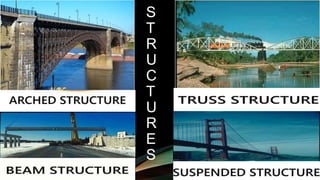
TYPES OF STRUCTURES
• Arched Structure
•Beam/Girder Structure
•Cable Suspended Structure
•Planar Truss Structure
S
T
R
U
C
T
U
R
E
S
ARCHED STRUCTURE
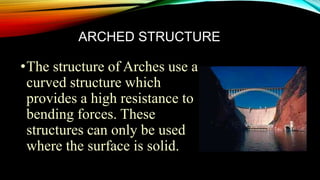
•The structure of Arches use a
curved structure which
provides a high resistance to
bending forces. These
structures can only be used
where the surface is solid.
BEAM & GIRDER STRUCTURE
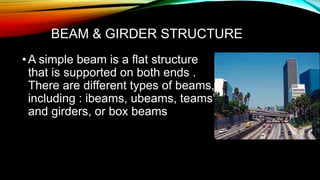
•A simple beam is a flat structure
that is supported on both ends .
There are different types of beams,
including : ibeams, ubeams, teams'
and girders, or box beams
SUSPENDED STRUCTURE
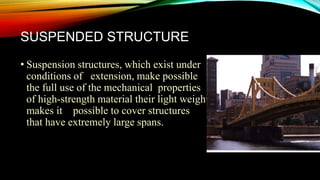
• Suspension structures, which exist under
conditions of extension, make possible
the full use of the mechanical properties
of high-strength material their light weight
makes it possible to cover structures
that have extremely large spans.
PLANAR TRUSS
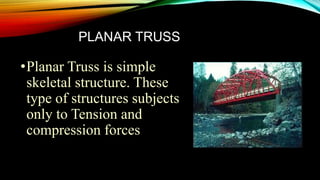
•Planar Truss is simple
skeletal structure. These
type of structures subjects
only to Tension and
compression forces
TYPES OF FORCES ACTING ON AN
STRUCTURE
•Internal Forces
1. Compression
2. Tension
3. Torsion
4. Shear
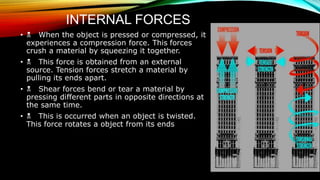
INTERNAL FORCES
• N When the object is pressed or compressed, it
experiences a compression force. This forces
crush a material by squeezing it together.
• N This force is obtained from an external
source. Tension forces stretch a material by
pulling its ends apart.
• N Shear forces bend or tear a material by
pressing different parts in opposite directions at
the same time.
• N This is occurred when an object is twisted.
This force rotates a object from its ends
EXTERNAL FORCE
•Load :-
• load is an external force on a structure.
1. Static Load
2. Dynamic Load
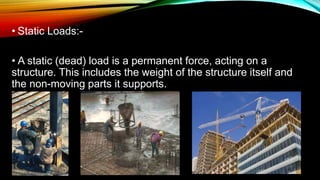
• Static Loads:-
• A static (dead) load is a permanent force, acting on a
structure. This includes the weight of the structure itself and
the non-moving parts it supports.
DYNAMIC LOADS
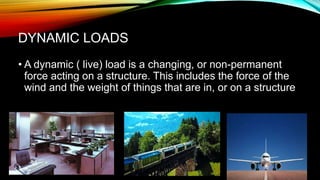
• A dynamic ( live) load is a changing, or non-permanent
force acting on a structure. This includes the force of the
wind and the weight of things that are in, or on a structure
BURJ KHALIFA
CONCLUSION:-
• Structural Engineering is a creative profession that
makes a significant contribution to infrastructure,
industry, as well as residential and recreational
developments which also includes the development
of buildings, dams, bridges etc., It also considers
the technical, economic, environmental, aesthetic
and social aspects of Structures.
Structural eng.

Structural eng.

  • 1.
  • 2.
    INTRODUCTION TO STRUCTURAL ENGINEERING Structuralengineering is the science and art of designing and making, with economy and elegance, buildings, bridges, frameworks, and other structures so that they can safely resist the forces to which they may be subjected
  • 3.
    TYPES OF STRUCTURES •Arched Structure •Beam/Girder Structure •Cable Suspended Structure •Planar Truss Structure
  • 4.
  • 5.
    ARCHED STRUCTURE •The structureof Arches use a curved structure which provides a high resistance to bending forces. These structures can only be used where the surface is solid.
  • 6.
    BEAM & GIRDERSTRUCTURE •A simple beam is a flat structure that is supported on both ends . There are different types of beams, including : ibeams, ubeams, teams' and girders, or box beams
  • 7.
    SUSPENDED STRUCTURE • Suspensionstructures, which exist under conditions of extension, make possible the full use of the mechanical properties of high-strength material their light weight makes it possible to cover structures that have extremely large spans.
  • 8.
    PLANAR TRUSS •Planar Trussis simple skeletal structure. These type of structures subjects only to Tension and compression forces
  • 9.
    TYPES OF FORCESACTING ON AN STRUCTURE •Internal Forces 1. Compression 2. Tension 3. Torsion 4. Shear
  • 10.
    INTERNAL FORCES • NWhen the object is pressed or compressed, it experiences a compression force. This forces crush a material by squeezing it together. • N This force is obtained from an external source. Tension forces stretch a material by pulling its ends apart. • N Shear forces bend or tear a material by pressing different parts in opposite directions at the same time. • N This is occurred when an object is twisted. This force rotates a object from its ends
  • 11.
    EXTERNAL FORCE •Load :- •load is an external force on a structure. 1. Static Load 2. Dynamic Load
  • 12.
    • Static Loads:- •A static (dead) load is a permanent force, acting on a structure. This includes the weight of the structure itself and the non-moving parts it supports.
  • 13.
    DYNAMIC LOADS • Adynamic ( live) load is a changing, or non-permanent force acting on a structure. This includes the force of the wind and the weight of things that are in, or on a structure
  • 14.
  • 15.
    CONCLUSION:- • Structural Engineeringis a creative profession that makes a significant contribution to infrastructure, industry, as well as residential and recreational developments which also includes the development of buildings, dams, bridges etc., It also considers the technical, economic, environmental, aesthetic and social aspects of Structures.