

Dr. Naveed Anwar
Executive Director, AIT Consulting
Affiliated Faculty, Structural Engineering
Director, ACECOMS
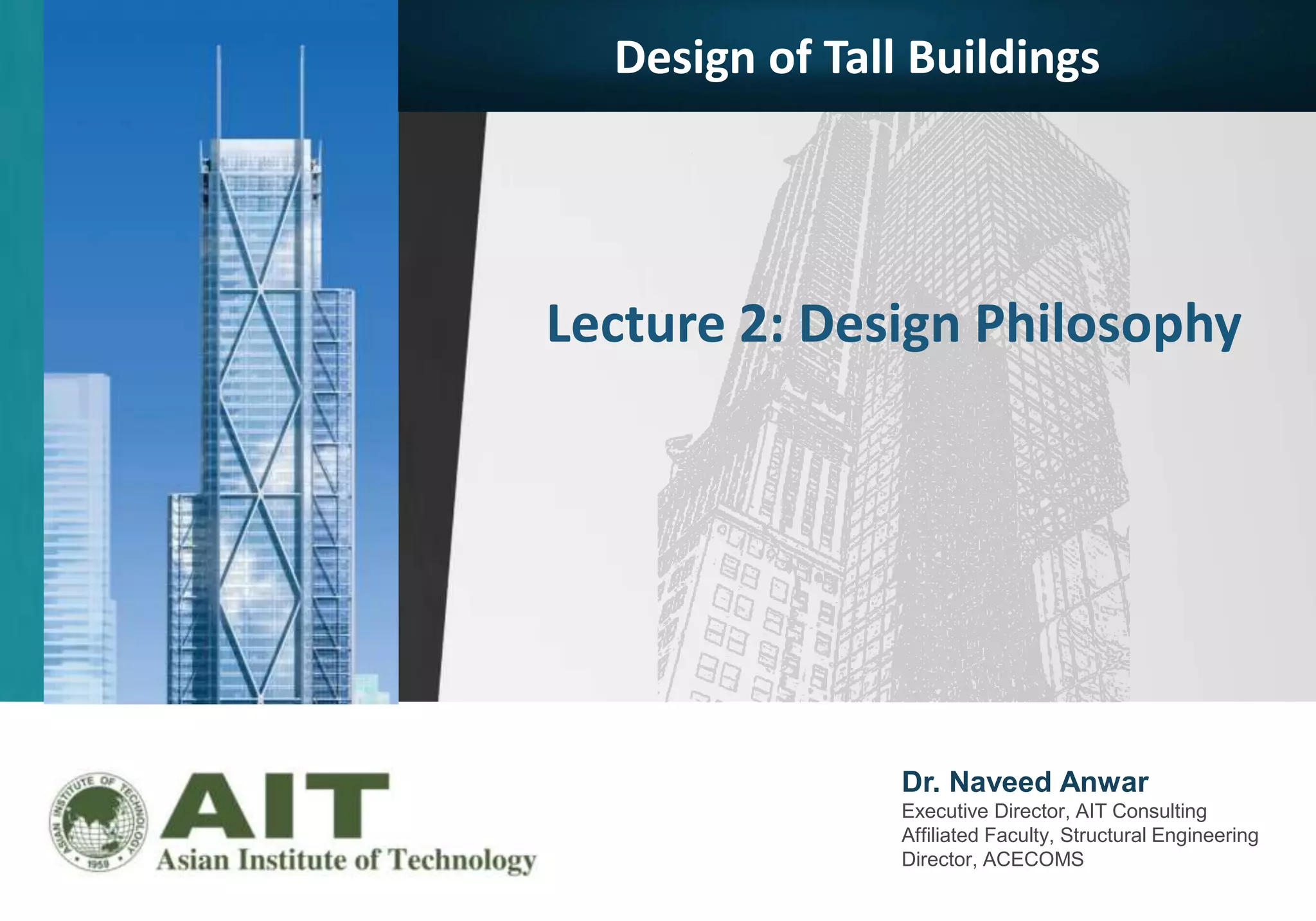
Design of Tall Buildings
Hybrid Learning System
Dr. Naveed Anwar
Executive Director, AIT Consulting
Affiliated Faculty, Structural Engineering
Director, ACECOMS
Lecture 2: Design Philosophy
Design of Tall Buildings
Dr. Naveed Anwar
Design Process
3
Dr. Naveed Anwar
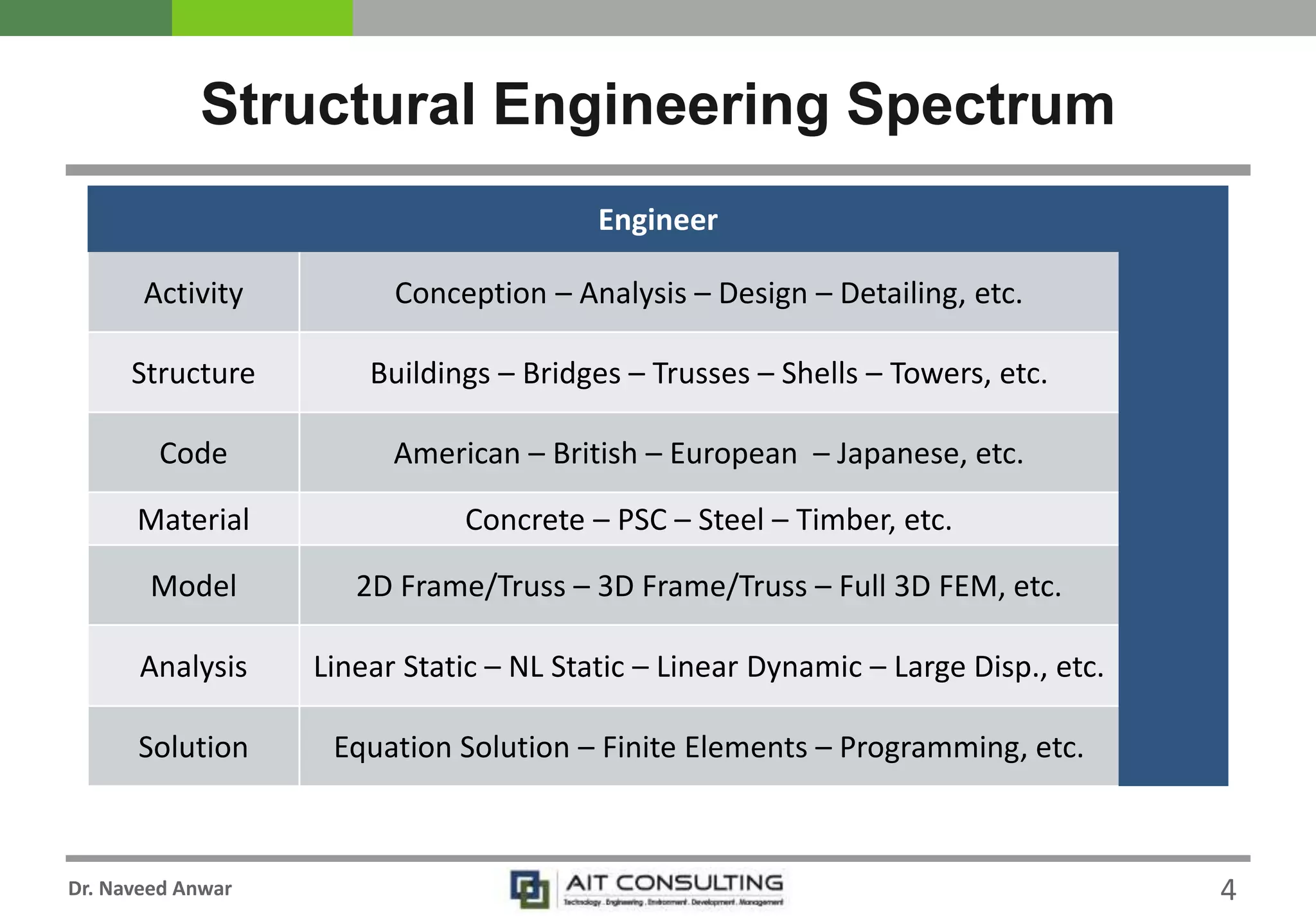
Structural Engineering Spectrum
Engineer
Activity Conception – Analysis – Design – Detailing, etc.
Structure Buildings – Bridges – Trusses – Shells – Towers, etc.
Code American – British – European – Japanese, etc.
Material Concrete – PSC – Steel – Timber, etc.
Model 2D Frame/Truss – 3D Frame/Truss – Full 3D FEM, etc.
Analysis Linear Static – NL Static – Linear Dynamic – Large Disp., etc.
Solution Equation Solution – Finite Elements – Programming, etc.
4
Dr. Naveed Anwar
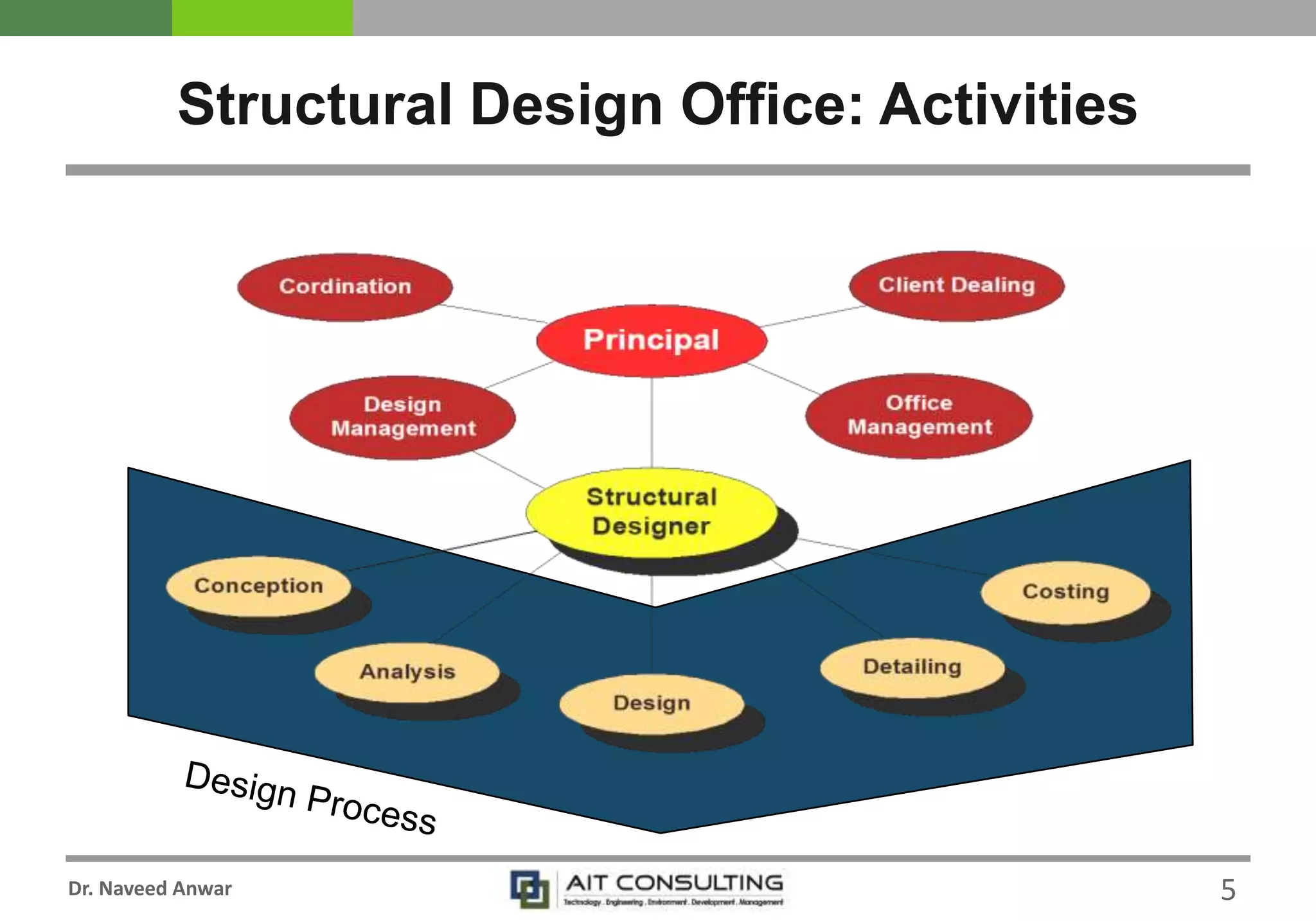
Structural Design Office: Activities
5
Dr. Naveed Anwar
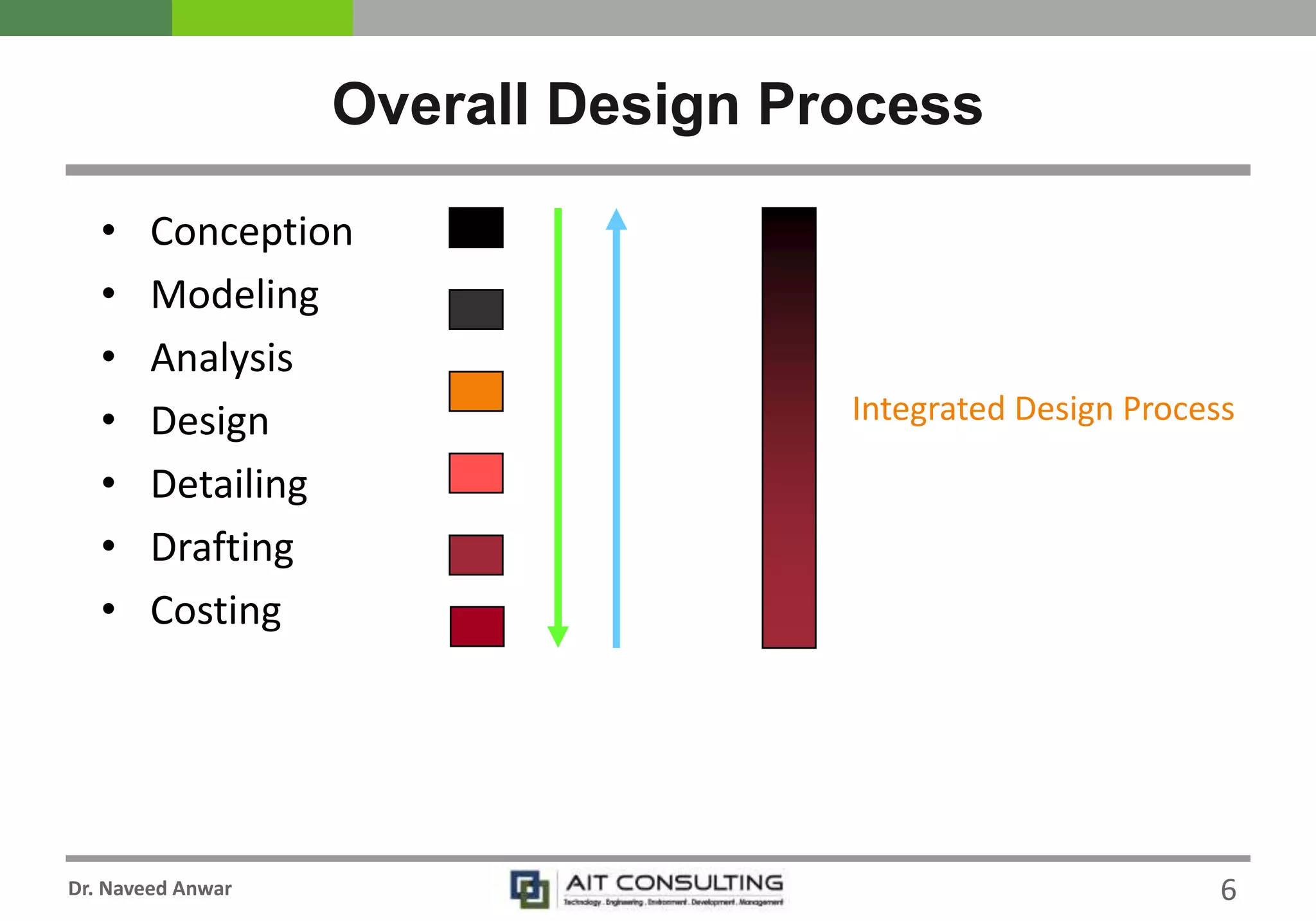
Overall Design Process
• Conception
• Modeling
• Analysis
• Design
• Detailing
• Drafting
• Costing
Integrated Design Process
6
Dr. Naveed Anwar
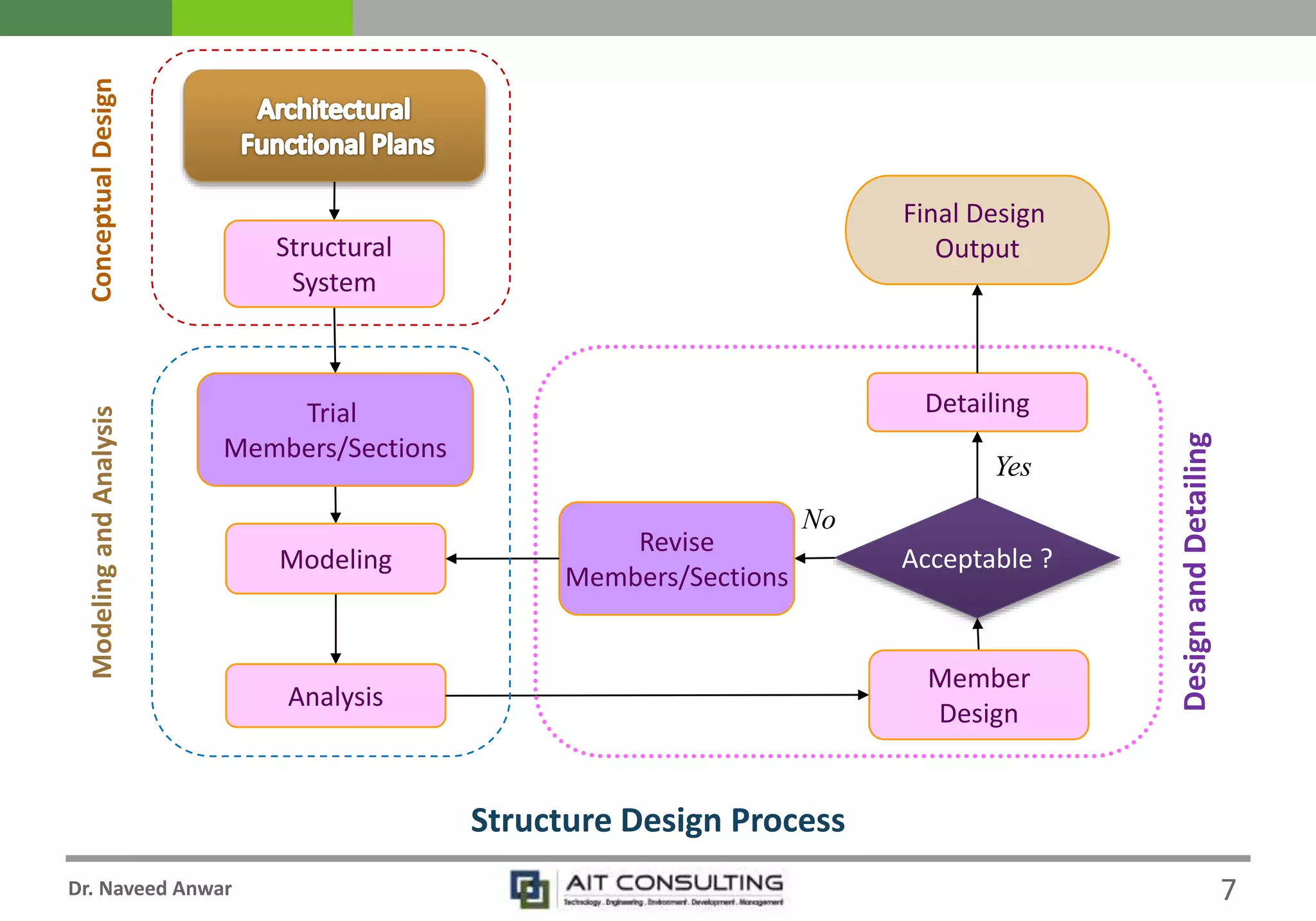
Final Design
Output
Acceptable ?
Trial
Members/Sections
Revise
Members/Sections
Structural
System
Modeling
Analysis
Member
Design
Detailing
No
Yes
Structure Design Process
7
Dr. Naveed Anwar
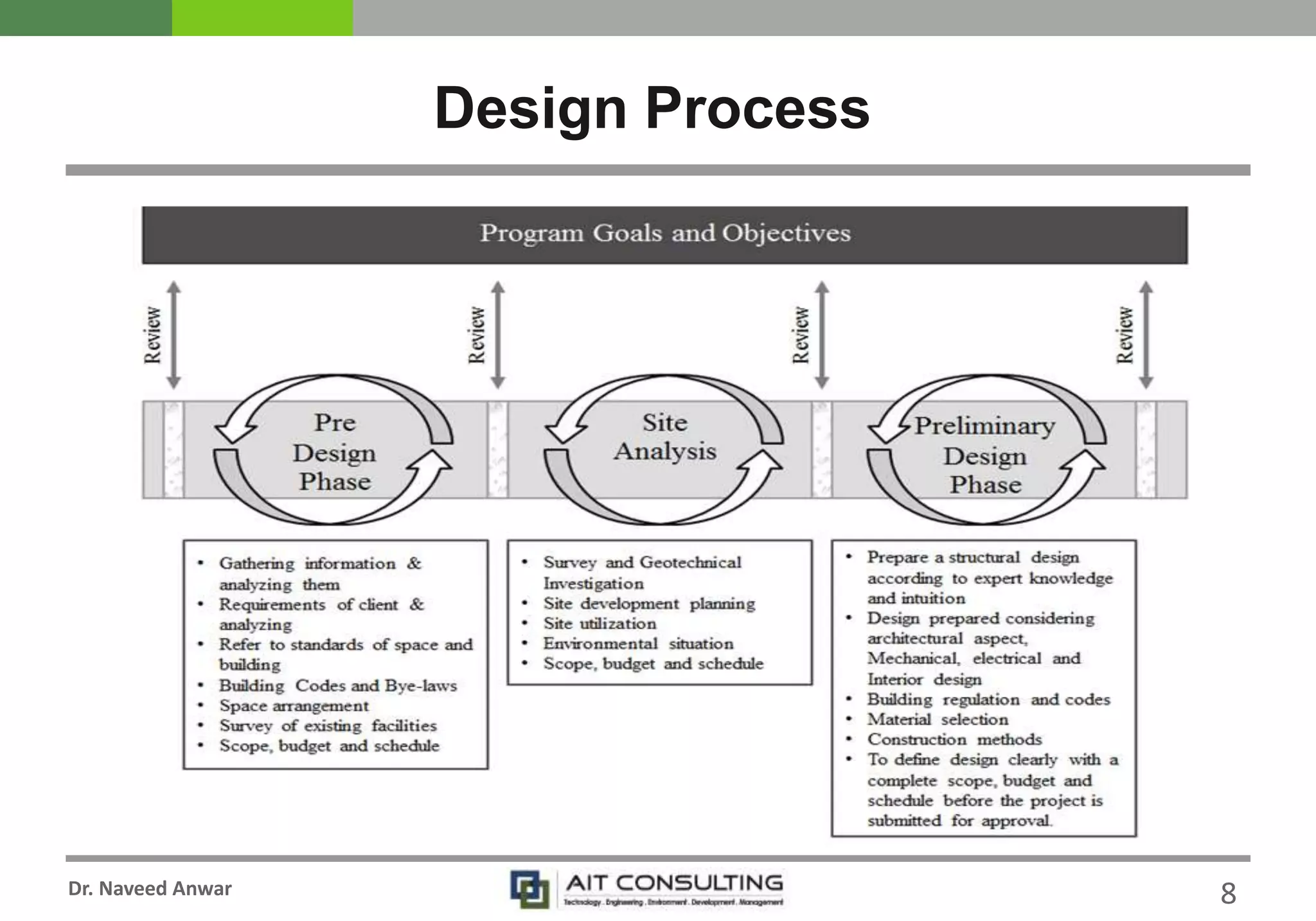
Design Process
8
Dr. Naveed Anwar
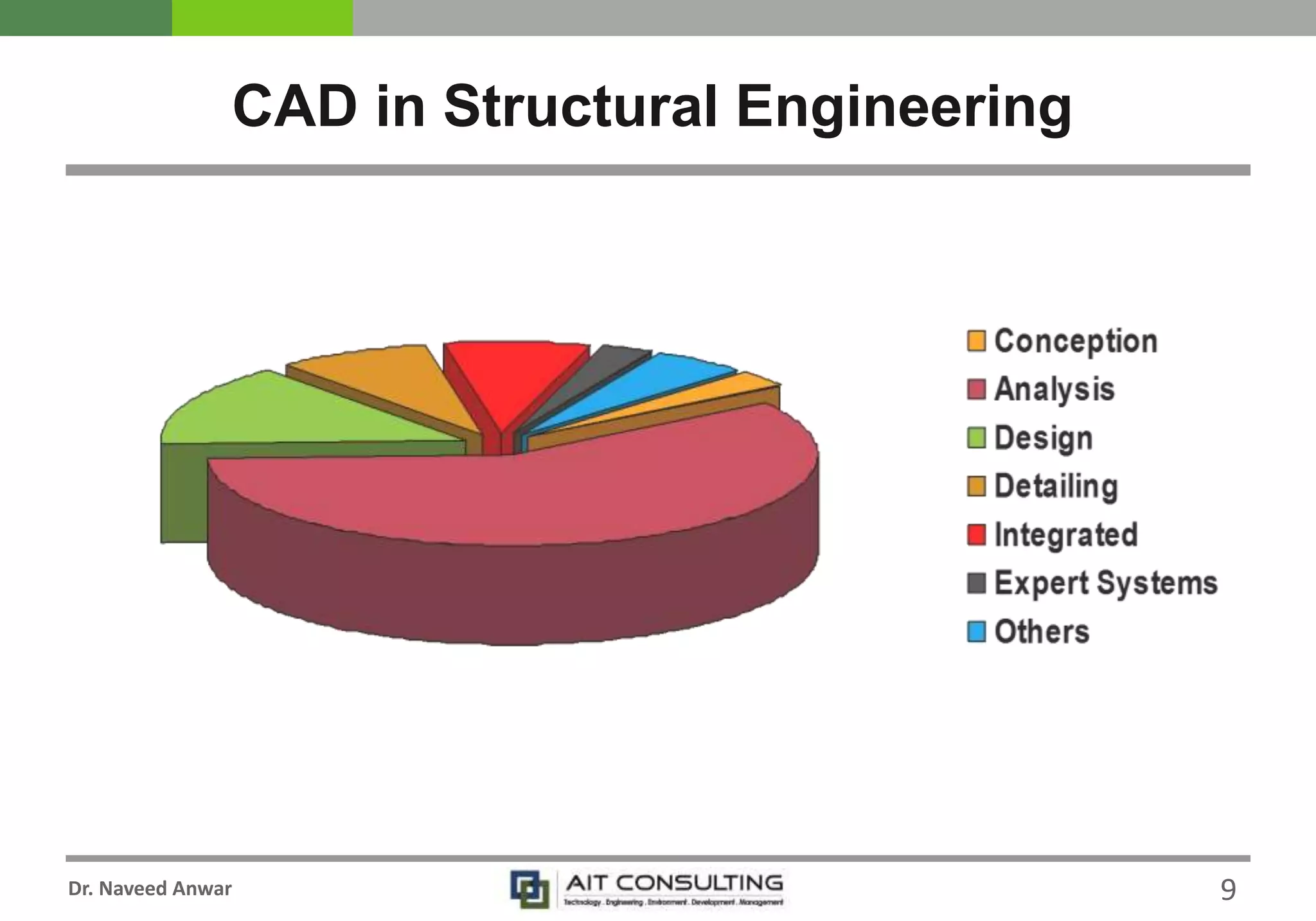
CAD in Structural Engineering
9
Dr. Naveed Anwar
Structural Design Concepts
10
Dr. Naveed Anwar
Design Philosophy and Process
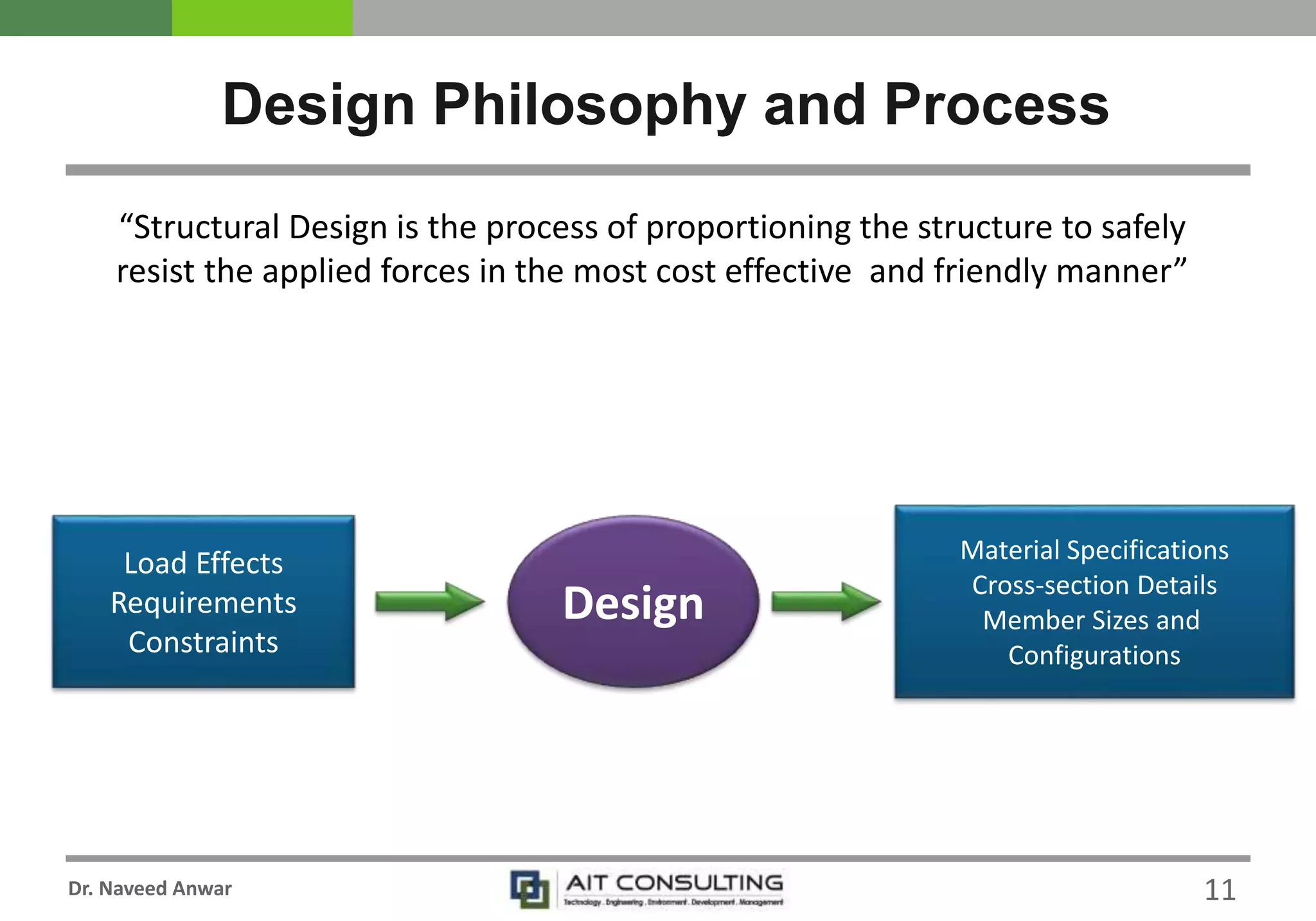
“Structural Design is the process of proportioning the structure to safely
resist the applied forces in the most cost effective and friendly manner”
Load Effects
Requirements
Constraints
Design
Material Specifications
Cross-section Details
Member Sizes and
Configurations
11
Dr. Naveed Anwar
• Structural idealization into load bearing frame elements for analysis and
design
• Estimation of loads
• Structural analysis
• Design of sections and reinforcement for beams, column, slabs, etc.
• Production of arrangement and detail drawings and bar schedules
Structural Design
12
Dr. Naveed Anwar
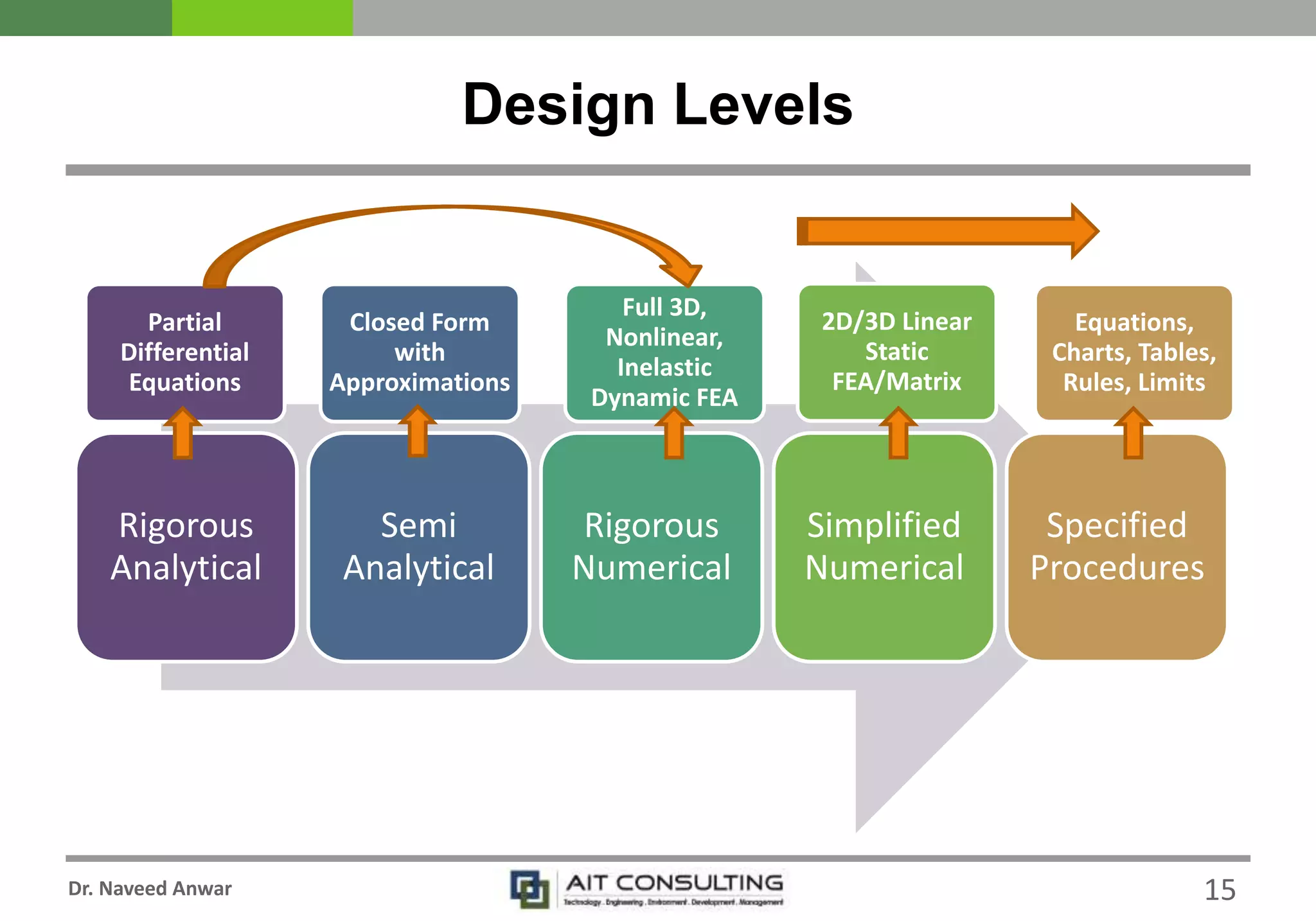
• Structural design can be based on:
– Rigorous Analytical Theories
– Semi-Analytical, Semi-Numerical Solutions
– Rigorous Numerical Solutions
– Simplified Numerical and Empirical Solutions
– Specified Design Procedures
Design Levels
13
Dr. Naveed Anwar
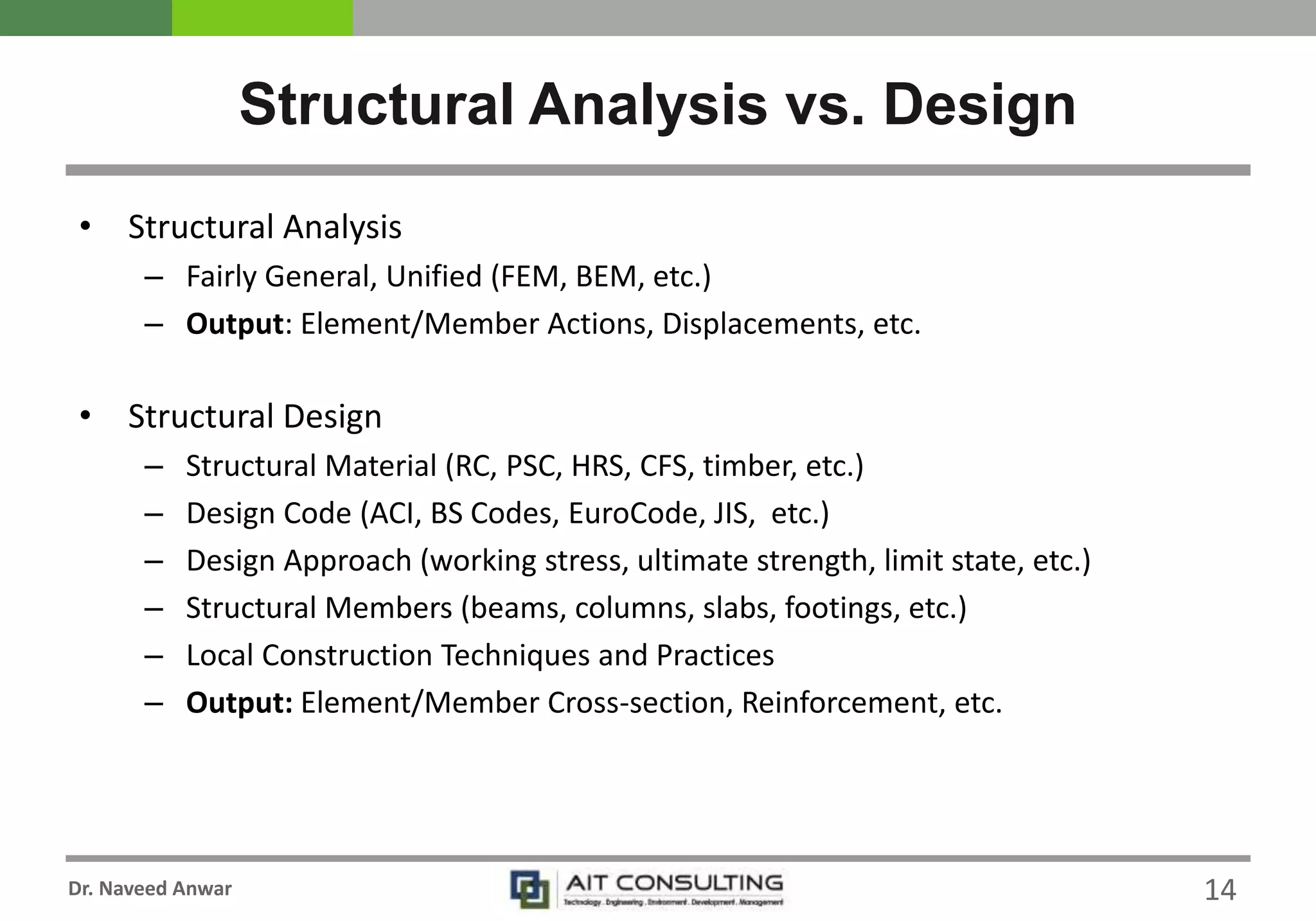
• Structural Analysis
– Fairly General, Unified (FEM, BEM, etc.)
– Output: Element/Member Actions, Displacements, etc.
• Structural Design
– Structural Material (RC, PSC, HRS, CFS, timber, etc.)
– Design Code (ACI, BS Codes, EuroCode, JIS, etc.)
– Design Approach (working stress, ultimate strength, limit state, etc.)
– Structural Members (beams, columns, slabs, footings, etc.)
– Local Construction Techniques and Practices
– Output: Element/Member Cross-section, Reinforcement, etc.
Structural Analysis vs. Design
14
Dr. Naveed Anwar
Rigorous
Analytical
Semi
Analytical
Rigorous
Numerical
Simplified
Numerical
Specified
Procedures
Design Levels
Partial
Differential
Equations
Closed Form
with
Approximations
Full 3D,
Nonlinear,
Inelastic
Dynamic FEA
2D/3D Linear
Static
FEA/Matrix
Equations,
Charts, Tables,
Rules, Limits
15
Dr. Naveed Anwar
Design Methodologies and
Technologies
16
Dr. Naveed Anwar
Evolution of Design Approaches
17
Dr. Naveed Anwar
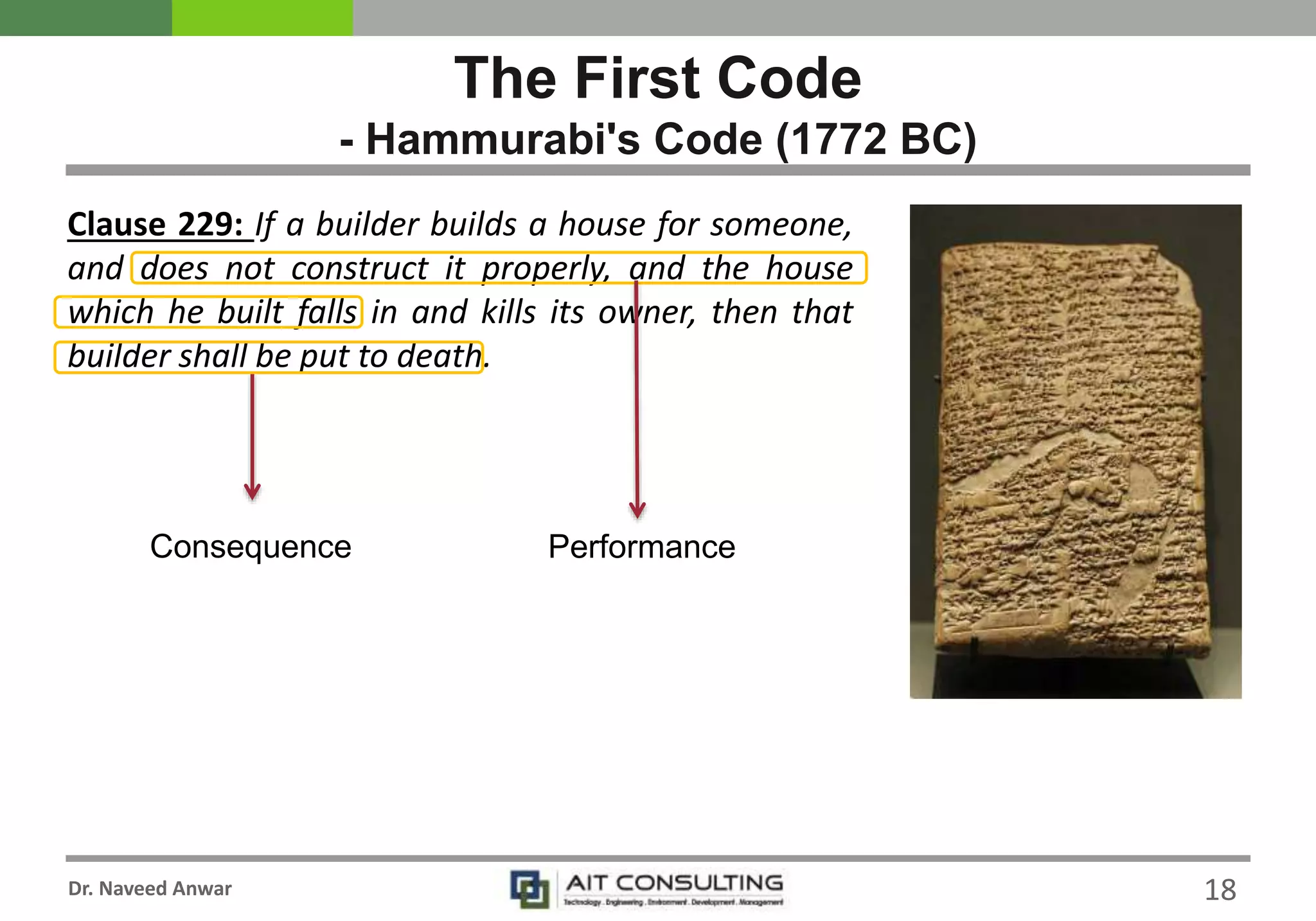
The First Code
- Hammurabi's Code (1772 BC)
Clause 229: If a builder builds a house for someone,
and does not construct it properly, and the house
which he built falls in and kills its owner, then that
builder shall be put to death.
PerformanceConsequence
18
Dr. Naveed Anwar
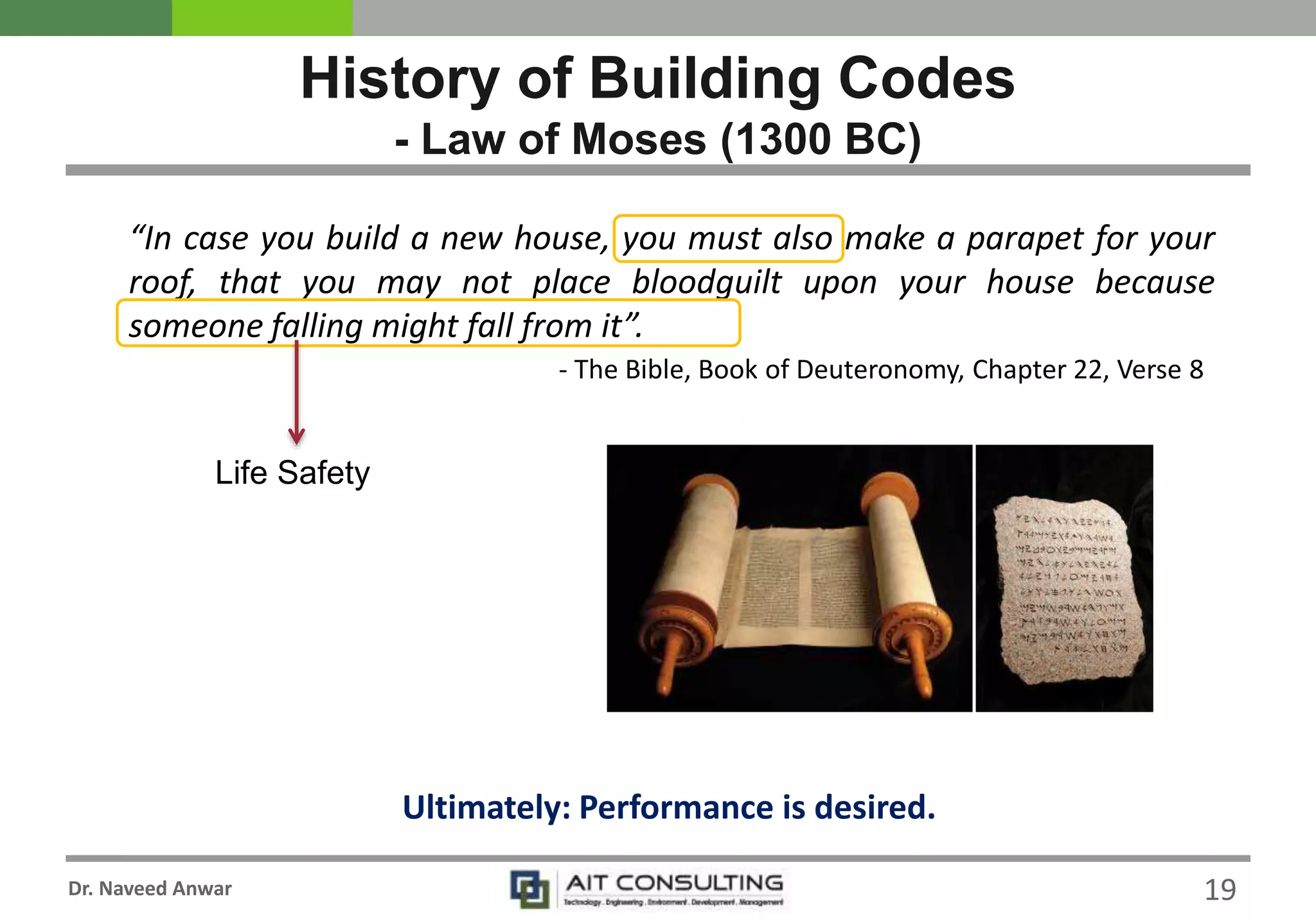
History of Building Codes
- Law of Moses (1300 BC)
“In case you build a new house, you must also make a parapet for your
roof, that you may not place bloodguilt upon your house because
someone falling might fall from it”.
- The Bible, Book of Deuteronomy, Chapter 22, Verse 8
Life Safety
Ultimately: Performance is desired.
19
Dr. Naveed Anwar
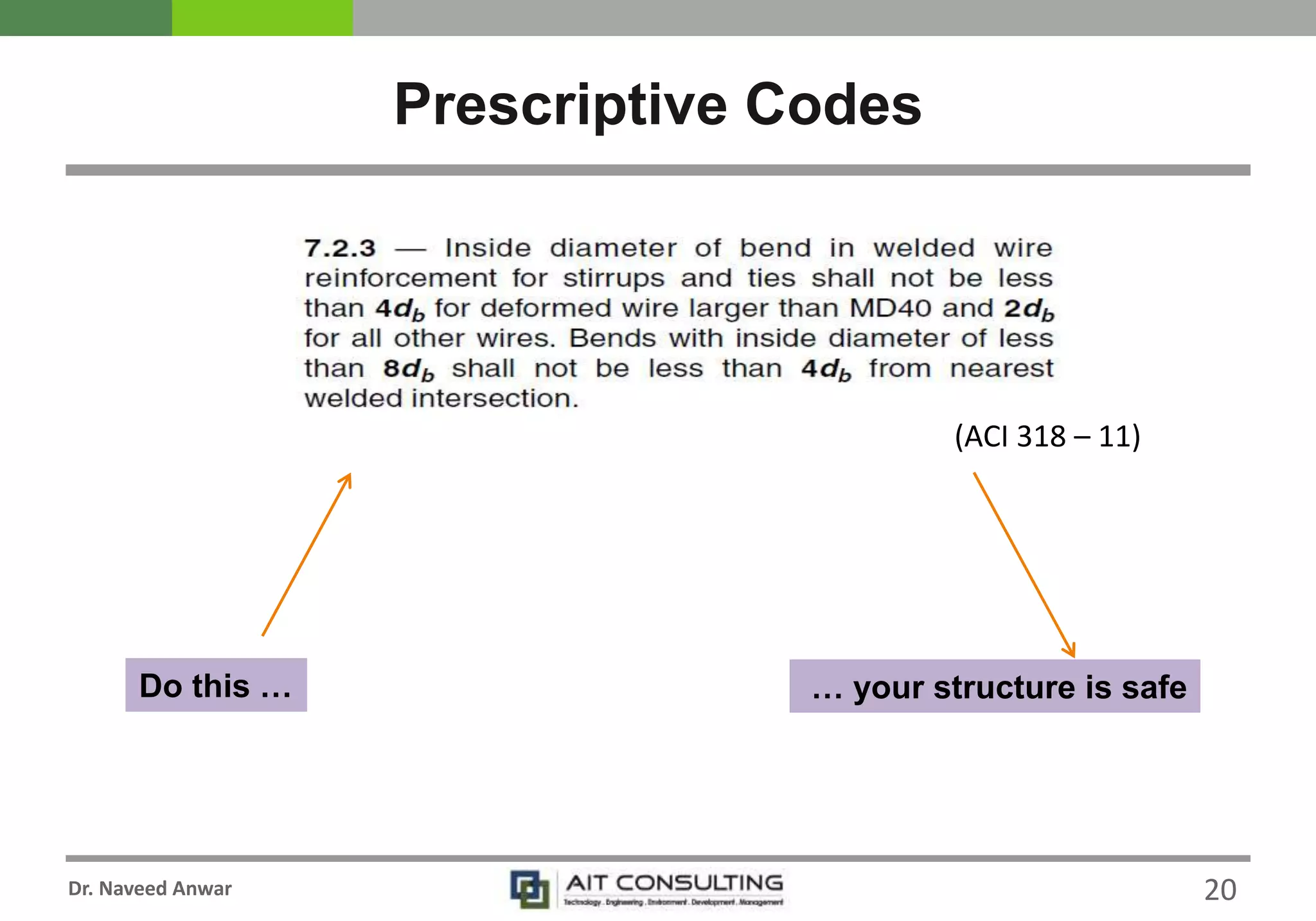
Prescriptive Codes
(ACI 318 – 11)
Do this … … your structure is safe
20
Dr. Naveed Anwar 21
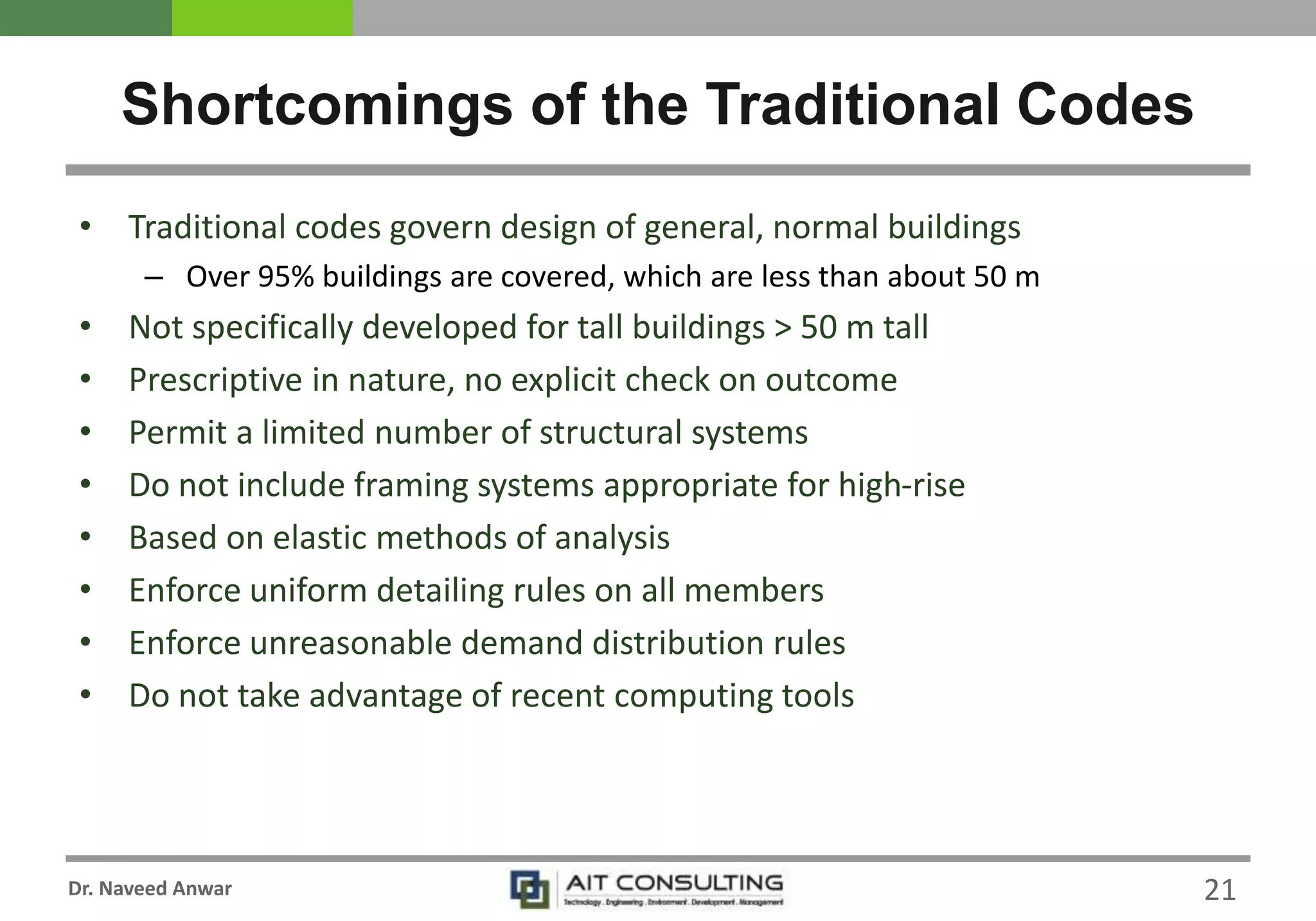
• Traditional codes govern design of general, normal buildings
– Over 95% buildings are covered, which are less than about 50 m
• Not specifically developed for tall buildings > 50 m tall
• Prescriptive in nature, no explicit check on outcome
• Permit a limited number of structural systems
• Do not include framing systems appropriate for high-rise
• Based on elastic methods of analysis
• Enforce uniform detailing rules on all members
• Enforce unreasonable demand distribution rules
• Do not take advantage of recent computing tools
Shortcomings of the Traditional Codes
Dr. Naveed Anwar
• Implicit Performance Objective
– Resist minor earthquake without damage, which is anticipated to occur
several times during the life of a building, without damage to structural and
non-structural components
– Resist the design level of earthquake with damage without causing loss of life
– Resist strongest earthquake with substantial damage but a very low
probability of collapse
• Explicit verification not specified or required
Unsuitability of Traditional Design Codes
22
Dr. Naveed Anwar
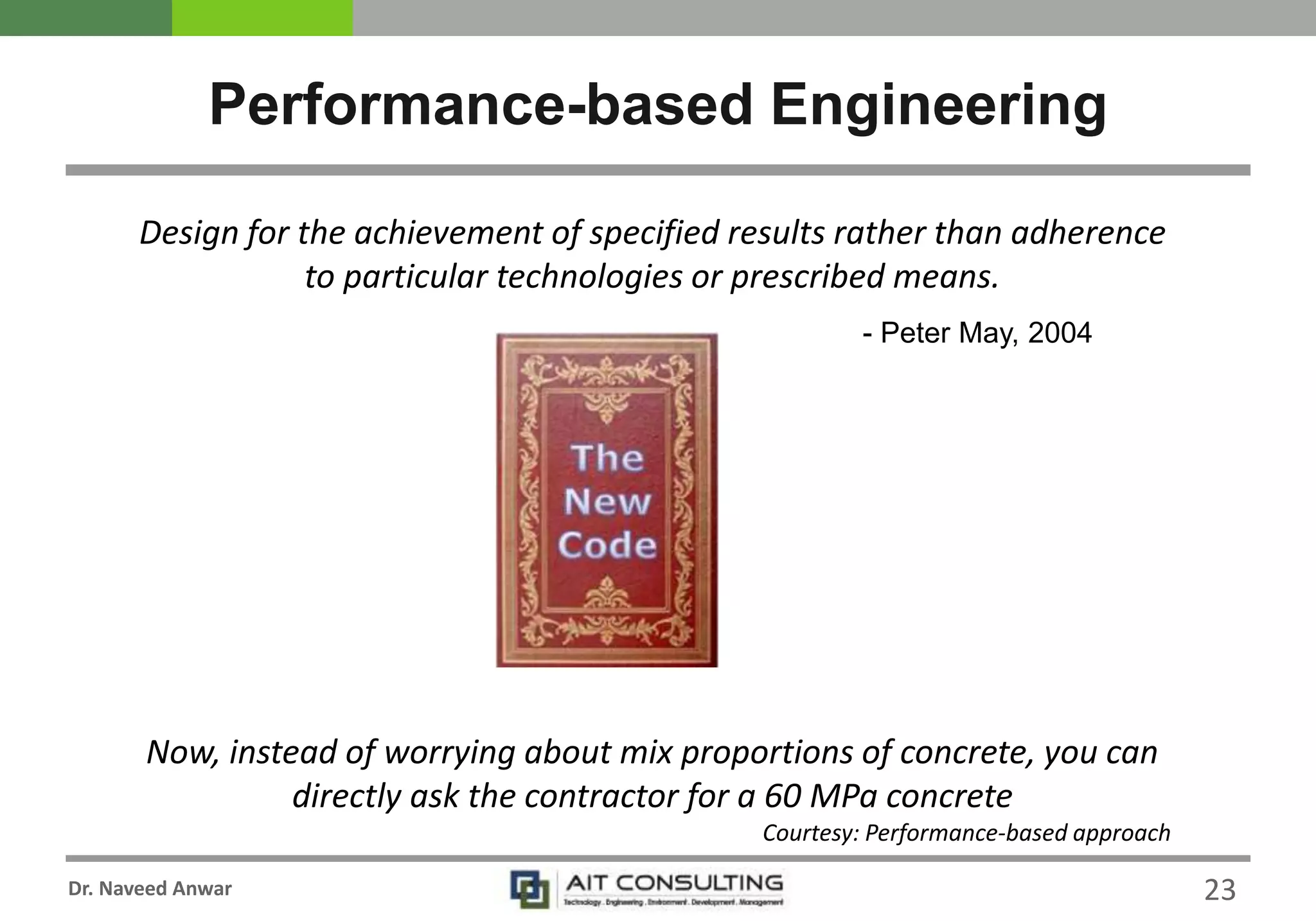
Performance-based Engineering
Design for the achievement of specified results rather than adherence
to particular technologies or prescribed means.
- Peter May, 2004
Now, instead of worrying about mix proportions of concrete, you can
directly ask the contractor for a 60 MPa concrete
Courtesy: Performance-based approach
23
Dr. Naveed Anwar
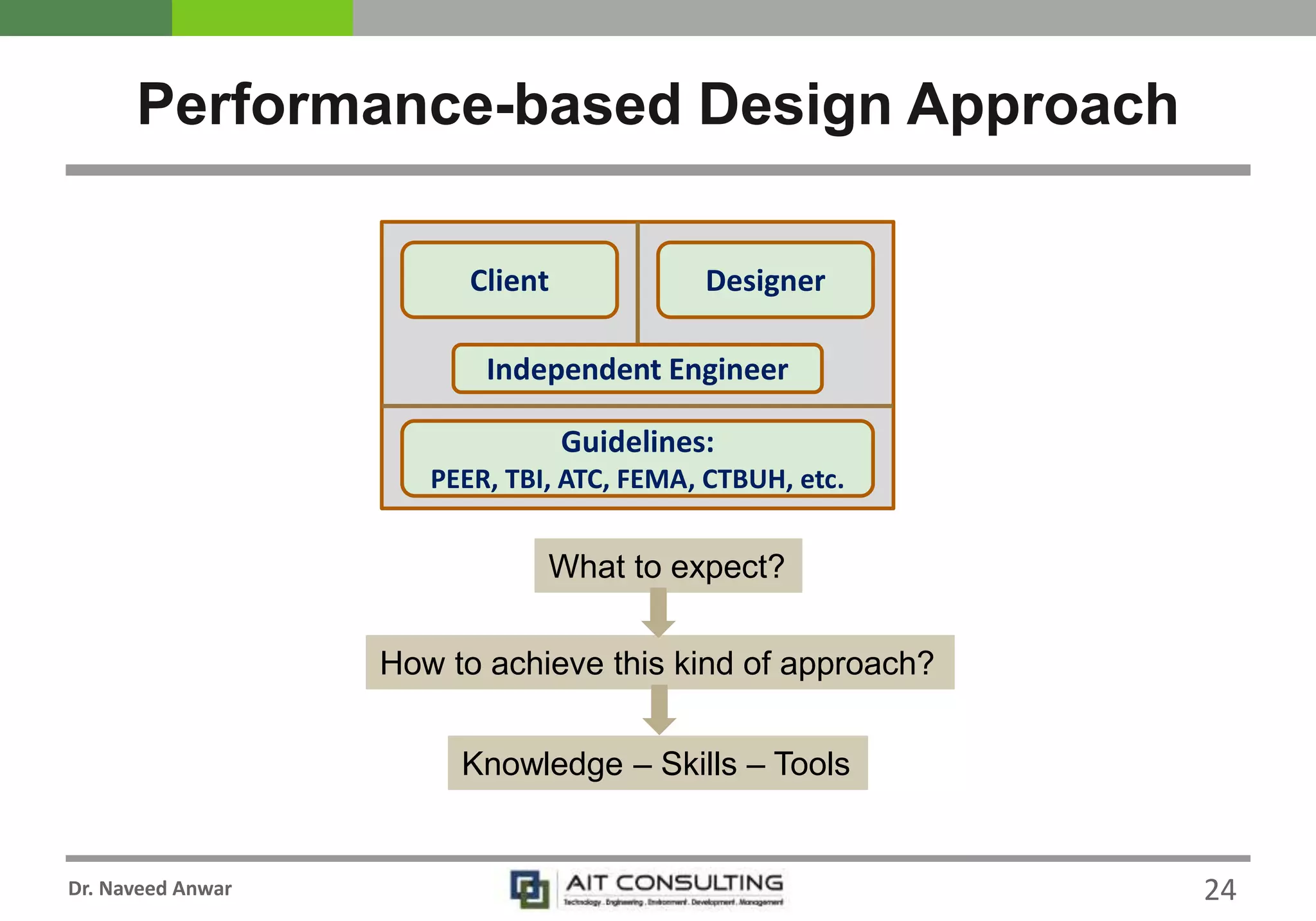
Performance-based Design Approach
Client Designer
Independent Engineer
Guidelines:
PEER, TBI, ATC, FEMA, CTBUH, etc.
What to expect?
How to achieve this kind of approach?
Knowledge – Skills – Tools
24
Dr. Naveed Anwar
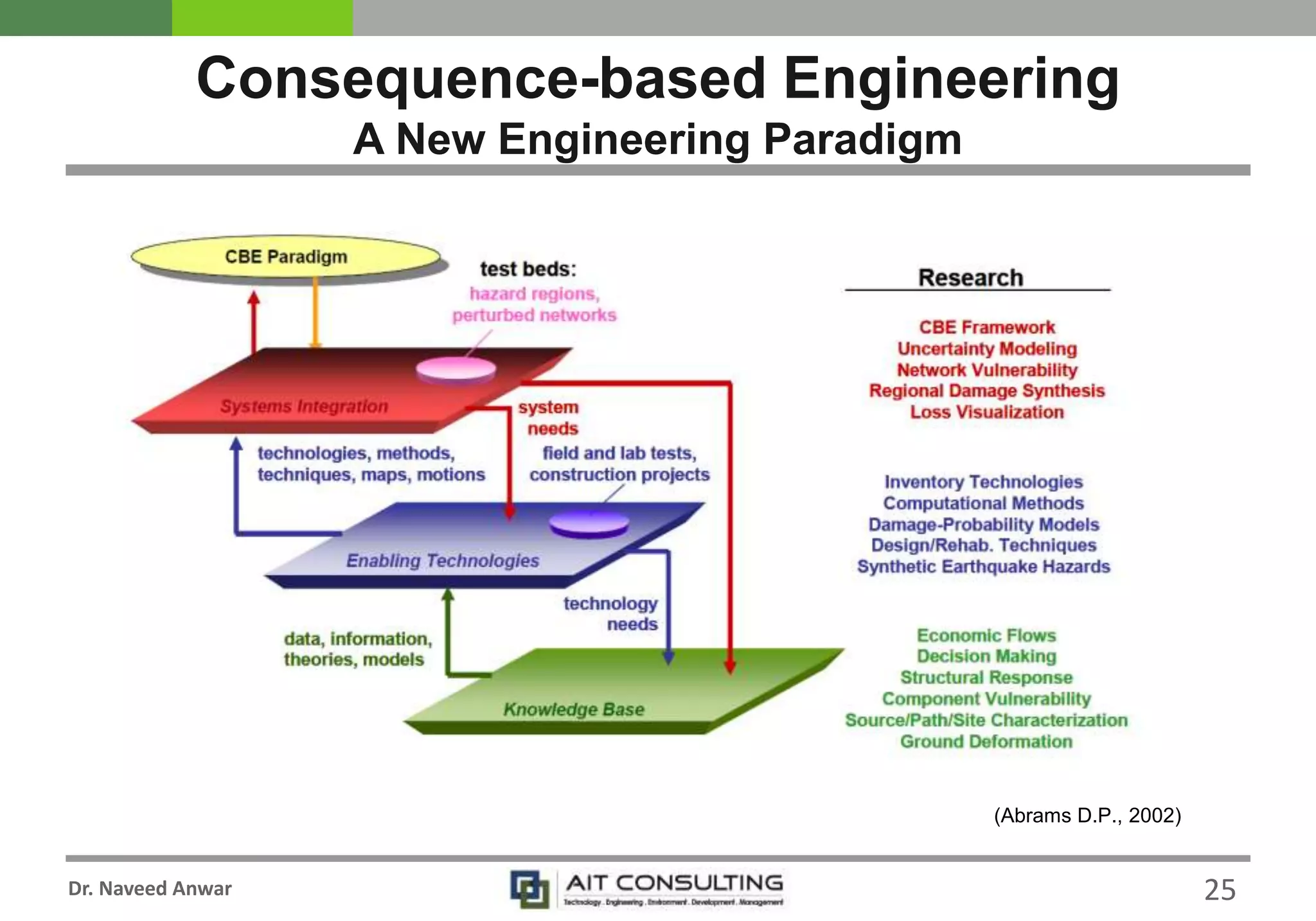
Consequence-based Engineering
A New Engineering Paradigm
(Abrams D.P., 2002)
25
Dr. Naveed Anwar
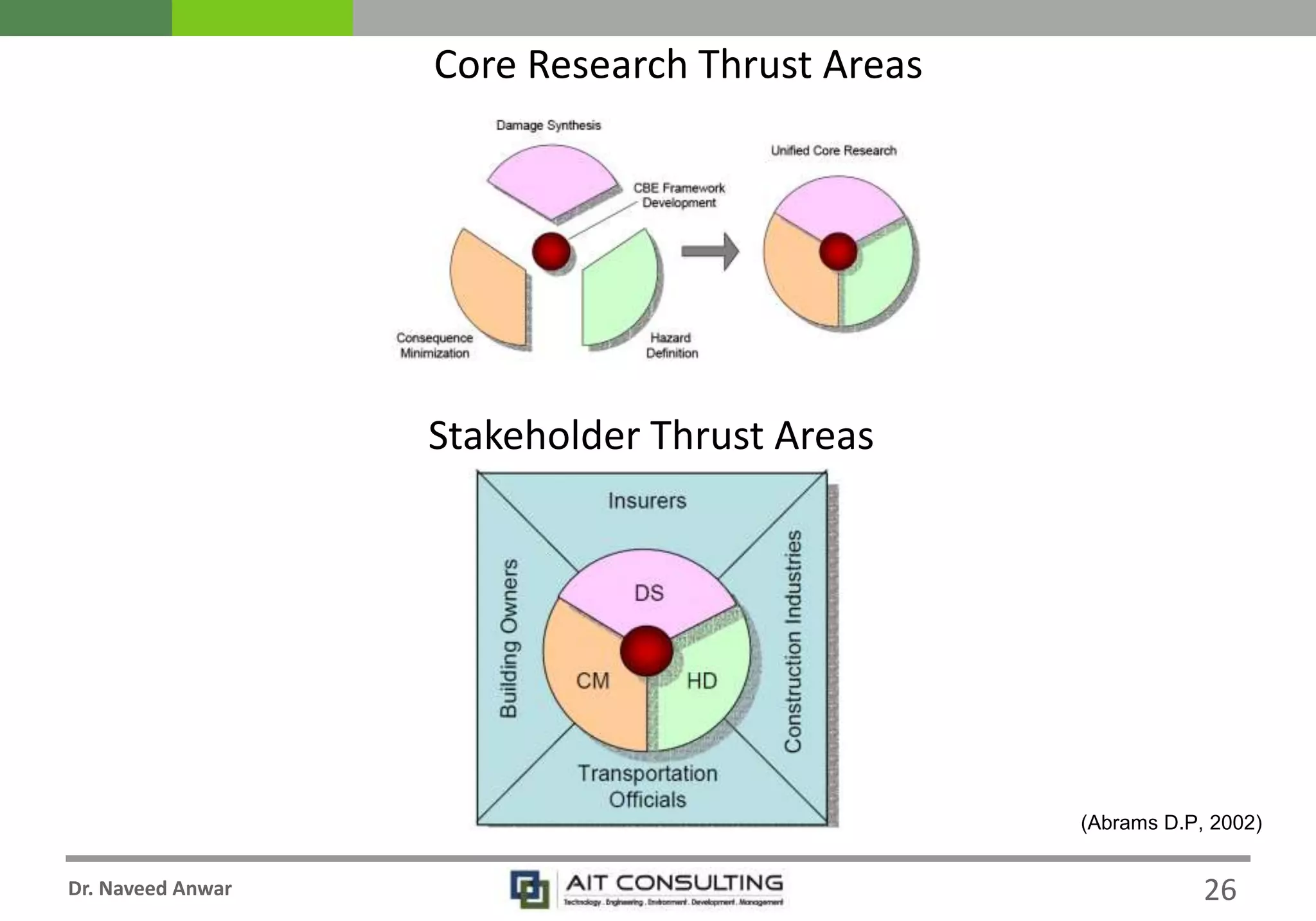
Core Research Thrust Areas
(Abrams D.P, 2002)
Stakeholder Thrust Areas
26
Dr. Naveed Anwar
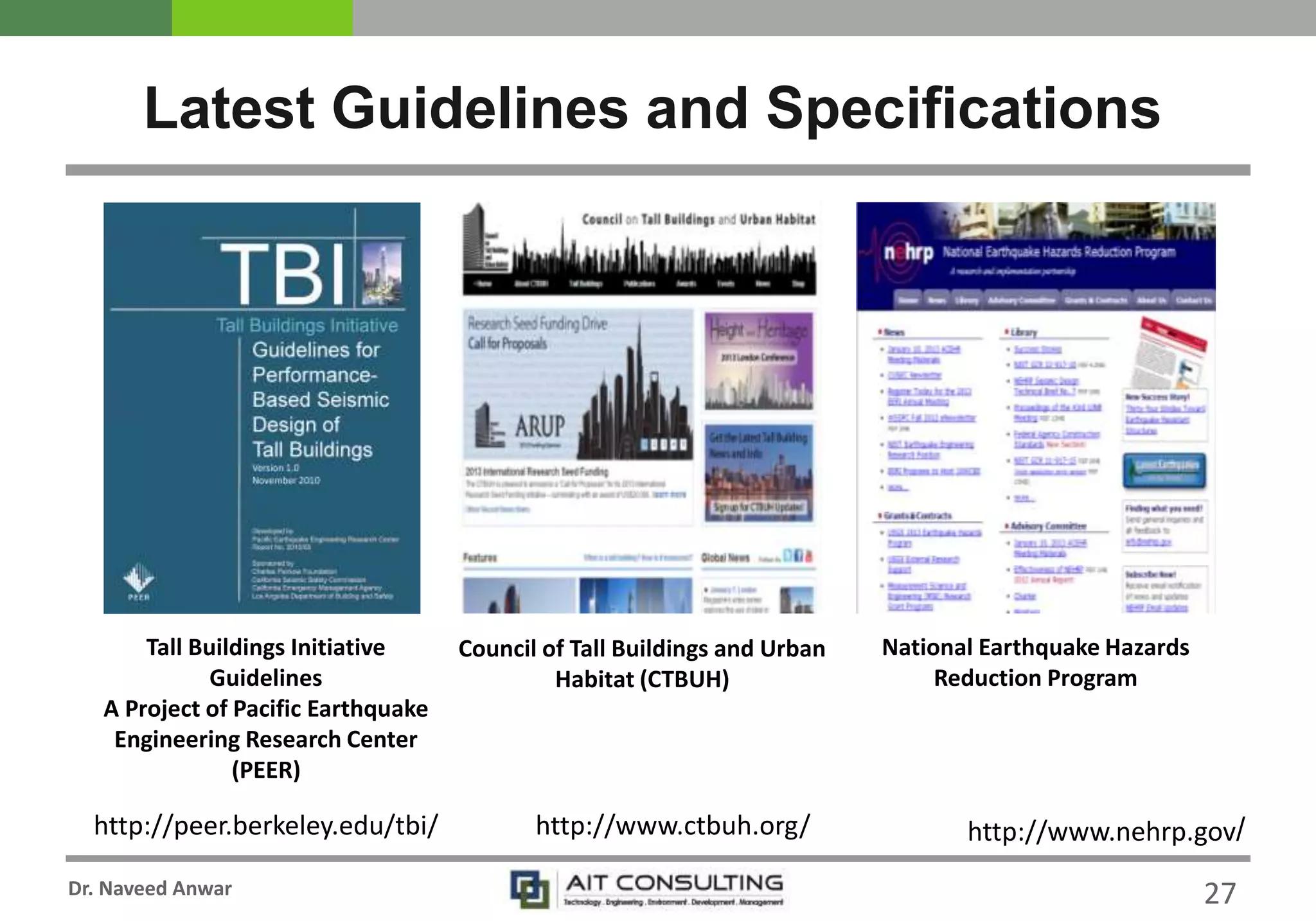
Latest Guidelines and Specifications
27
http://peer.berkeley.edu/tbi/
Tall Buildings Initiative
Guidelines
A Project of Pacific Earthquake
Engineering Research Center
(PEER)
Council of Tall Buildings and Urban
Habitat (CTBUH)
http://www.ctbuh.org/
National Earthquake Hazards
Reduction Program
http://www.nehrp.gov/
Dr. Naveed Anwar
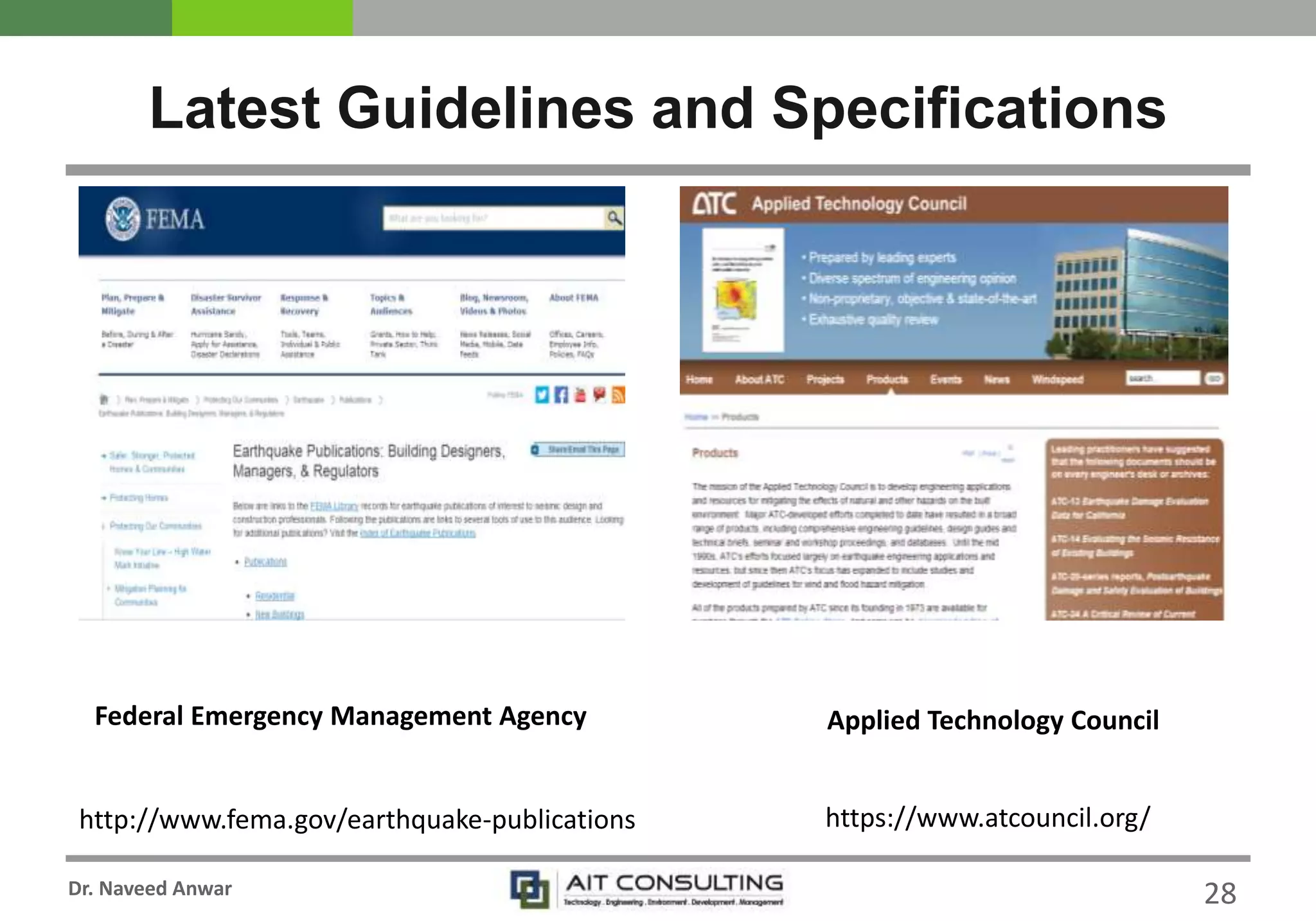
Latest Guidelines and Specifications
28
Federal Emergency Management Agency
http://www.fema.gov/earthquake-publications
Applied Technology Council
https://www.atcouncil.org/
Dr. Naveed Anwar
Traditional Design Methods
29
Dr. Naveed Anwar
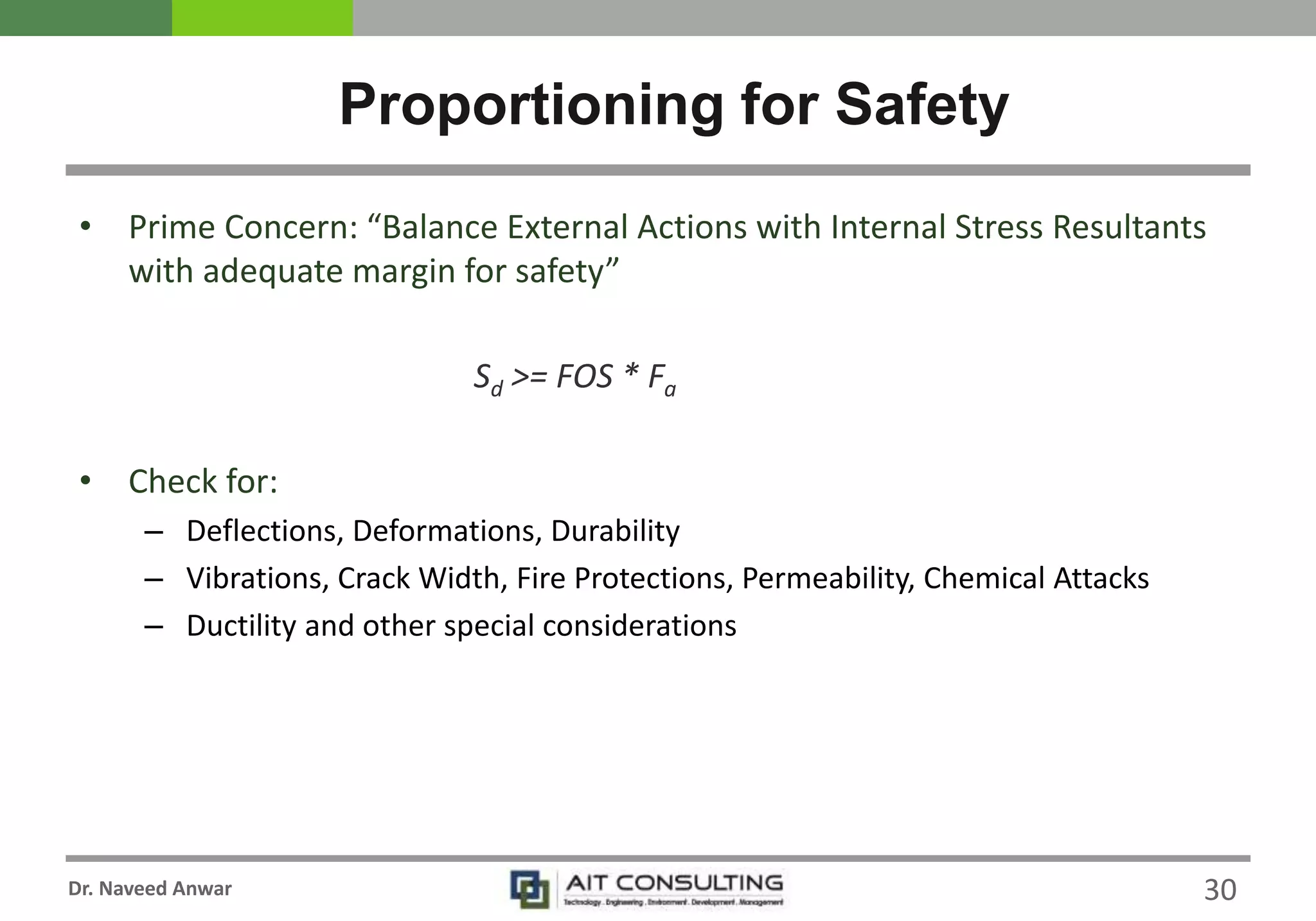
• Prime Concern: “Balance External Actions with Internal Stress Resultants
with adequate margin for safety”
Sd >= FOS * Fa
• Check for:
– Deflections, Deformations, Durability
– Vibrations, Crack Width, Fire Protections, Permeability, Chemical Attacks
– Ductility and other special considerations
Proportioning for Safety
30
Dr. Naveed Anwar
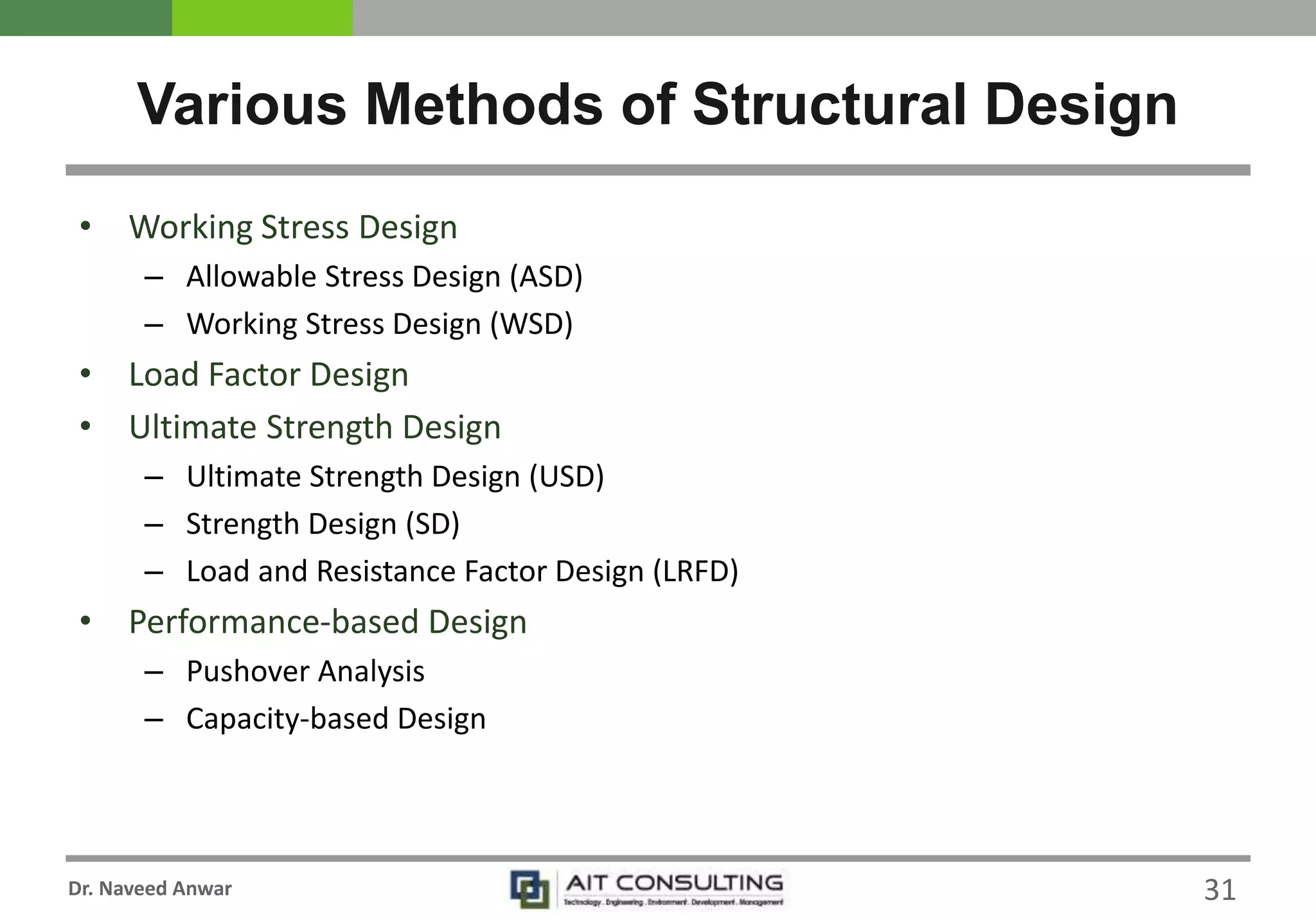
• Working Stress Design
– Allowable Stress Design (ASD)
– Working Stress Design (WSD)
• Load Factor Design
• Ultimate Strength Design
– Ultimate Strength Design (USD)
– Strength Design (SD)
– Load and Resistance Factor Design (LRFD)
• Performance-based Design
– Pushover Analysis
– Capacity-based Design
Various Methods of Structural Design
31
Dr. Naveed Anwar
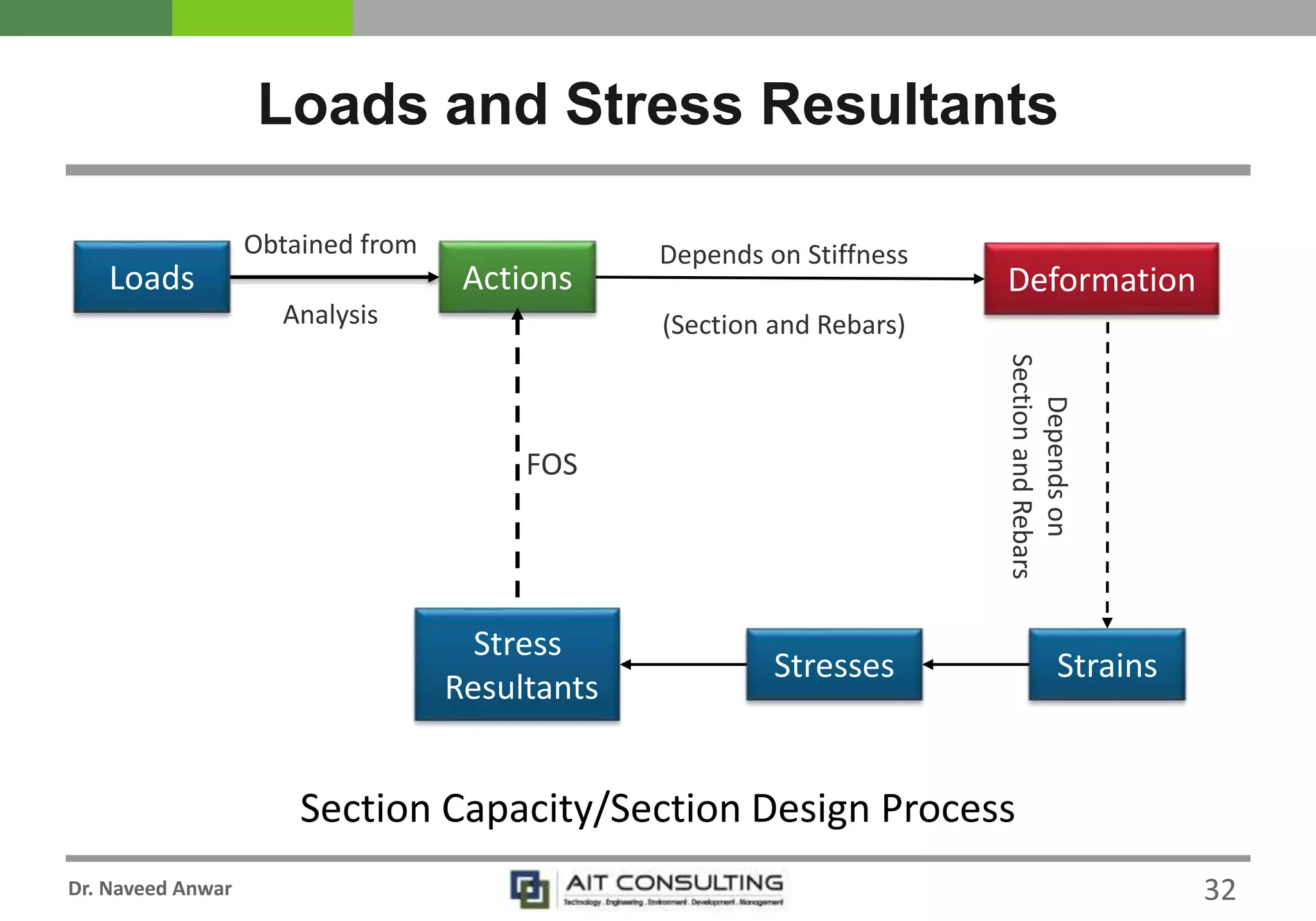
Obtained from
Analysis
Actions
Loads and Stress Resultants
Section Capacity/Section Design Process
Loads
Stresses
Stress
Resultants
Deformation
Depends on Stiffness
(Section and Rebars)
Strains
Dependson
SectionandRebars
FOS
32
Dr. Naveed Anwar
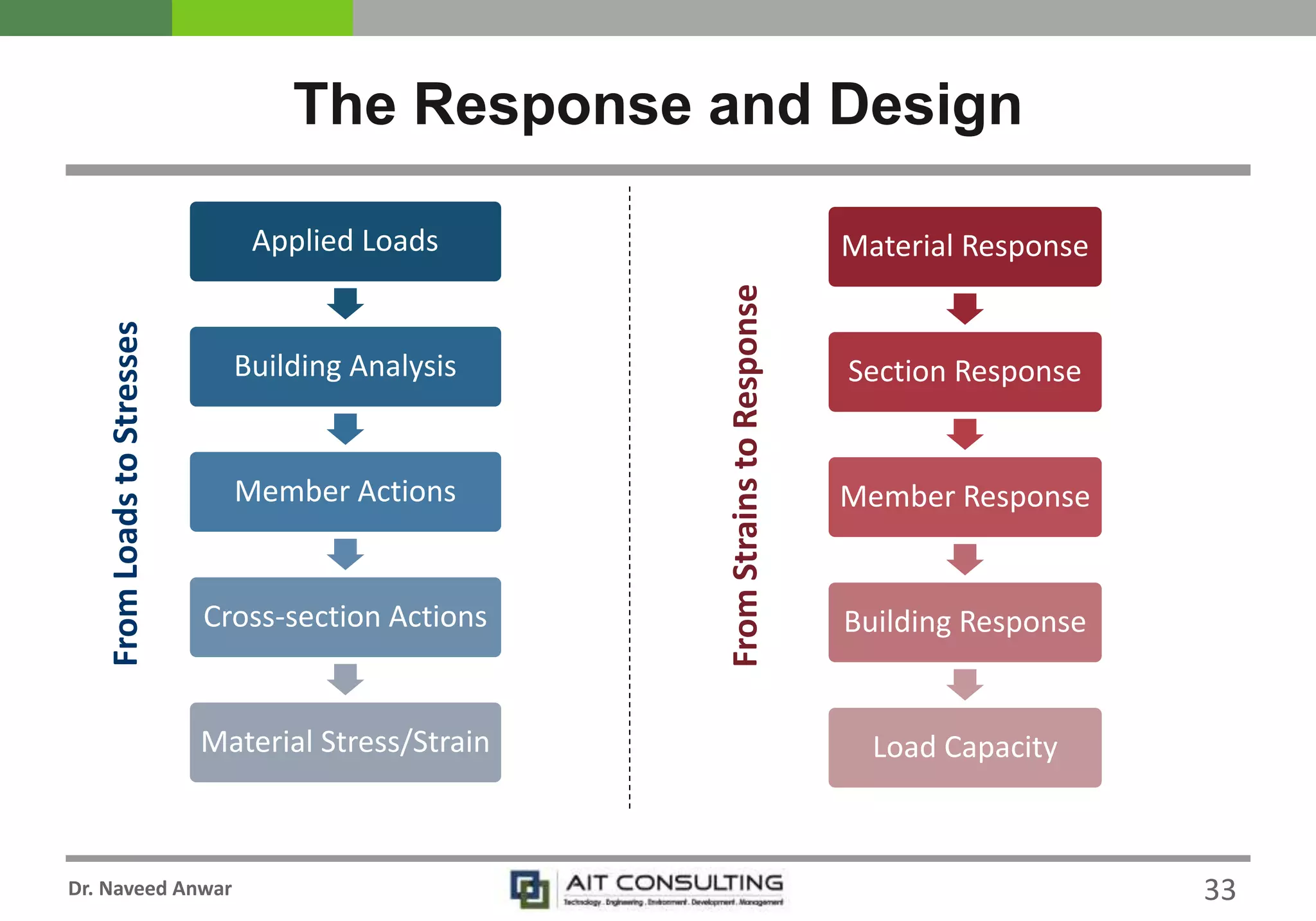
The Response and DesignFromLoadstoStresses
FromStrainstoResponse
Applied Loads
Building Analysis
Member Actions
Cross-section Actions
Material Stress/Strain
Material Response
Section Response
Member Response
Building Response
Load Capacity
33
Dr. Naveed Anwar
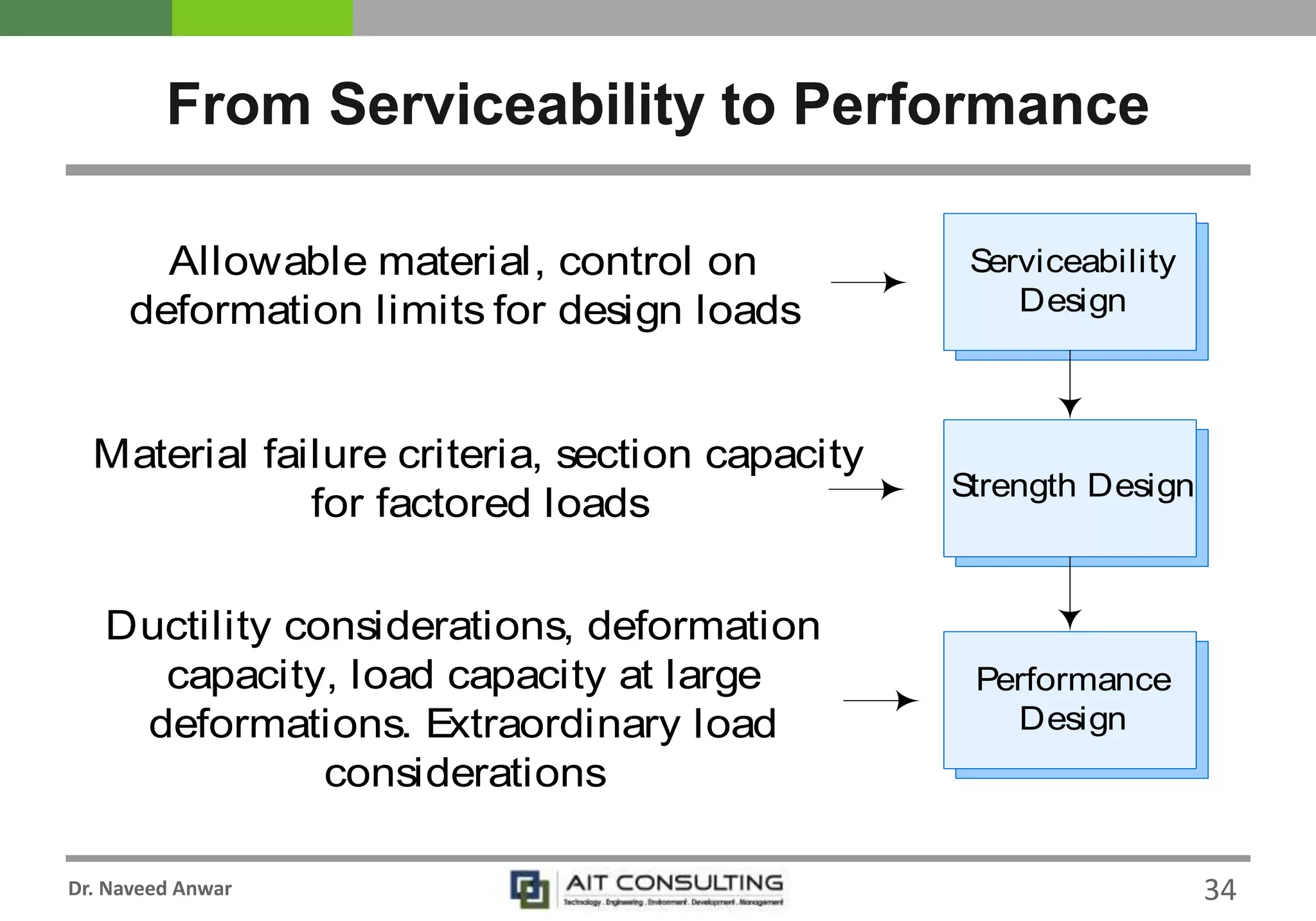
From Serviceability to Performance
Serviceability
Design
Strength Design
Performance
Design
Allowable material, control on
deformation limits for design loads
Material failure criteria, section capacity
for factored loads
Ductility considerations, deformation
capacity, load capacity at large
deformations. Extraordinary load
considerations
34
Dr. Naveed Anwar
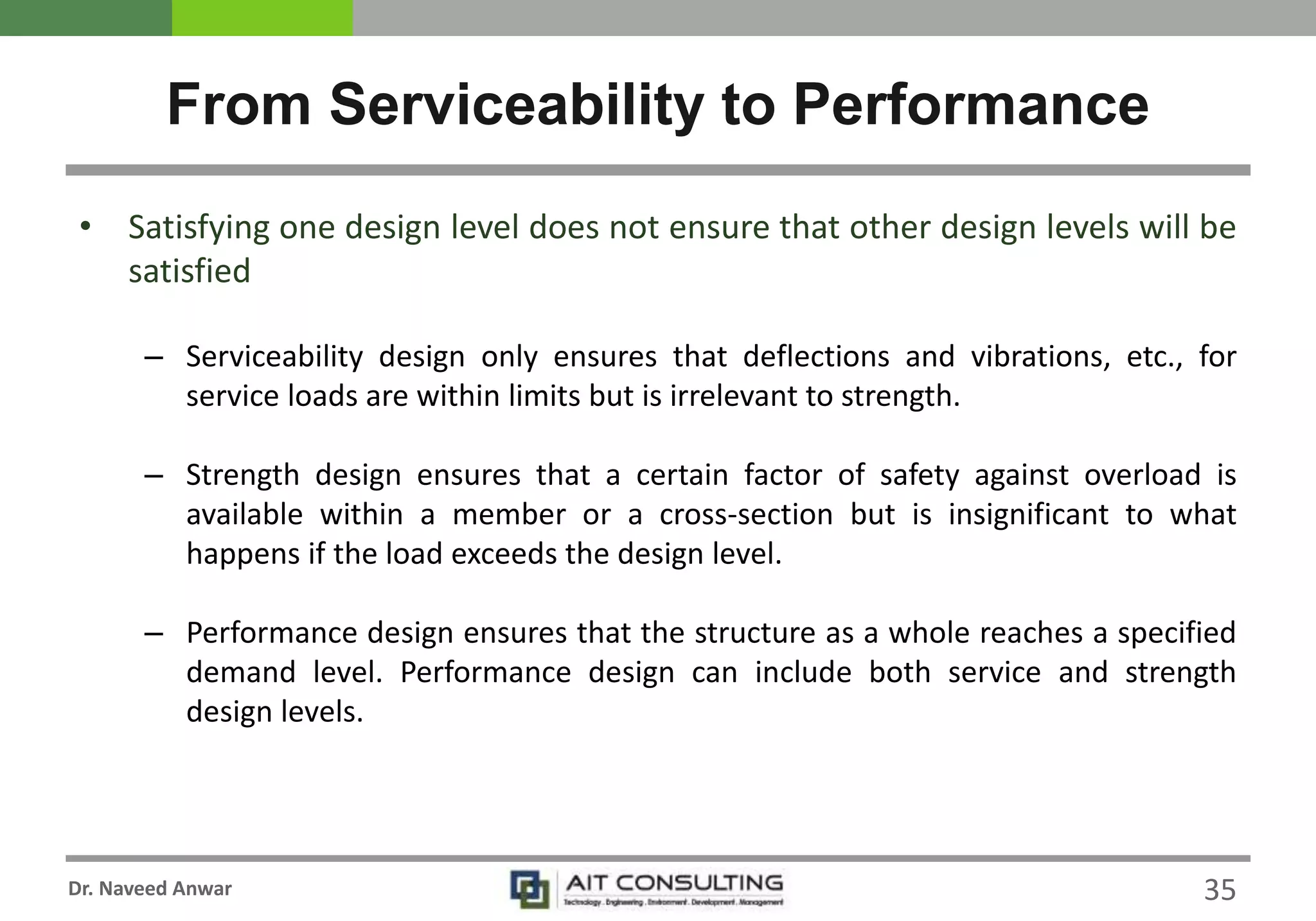
• Satisfying one design level does not ensure that other design levels will be
satisfied
– Serviceability design only ensures that deflections and vibrations, etc., for
service loads are within limits but is irrelevant to strength.
– Strength design ensures that a certain factor of safety against overload is
available within a member or a cross-section but is insignificant to what
happens if the load exceeds the design level.
– Performance design ensures that the structure as a whole reaches a specified
demand level. Performance design can include both service and strength
design levels.
From Serviceability to Performance
35
Dr. Naveed Anwar
Limit State Design Concept
36
Dr. Naveed Anwar
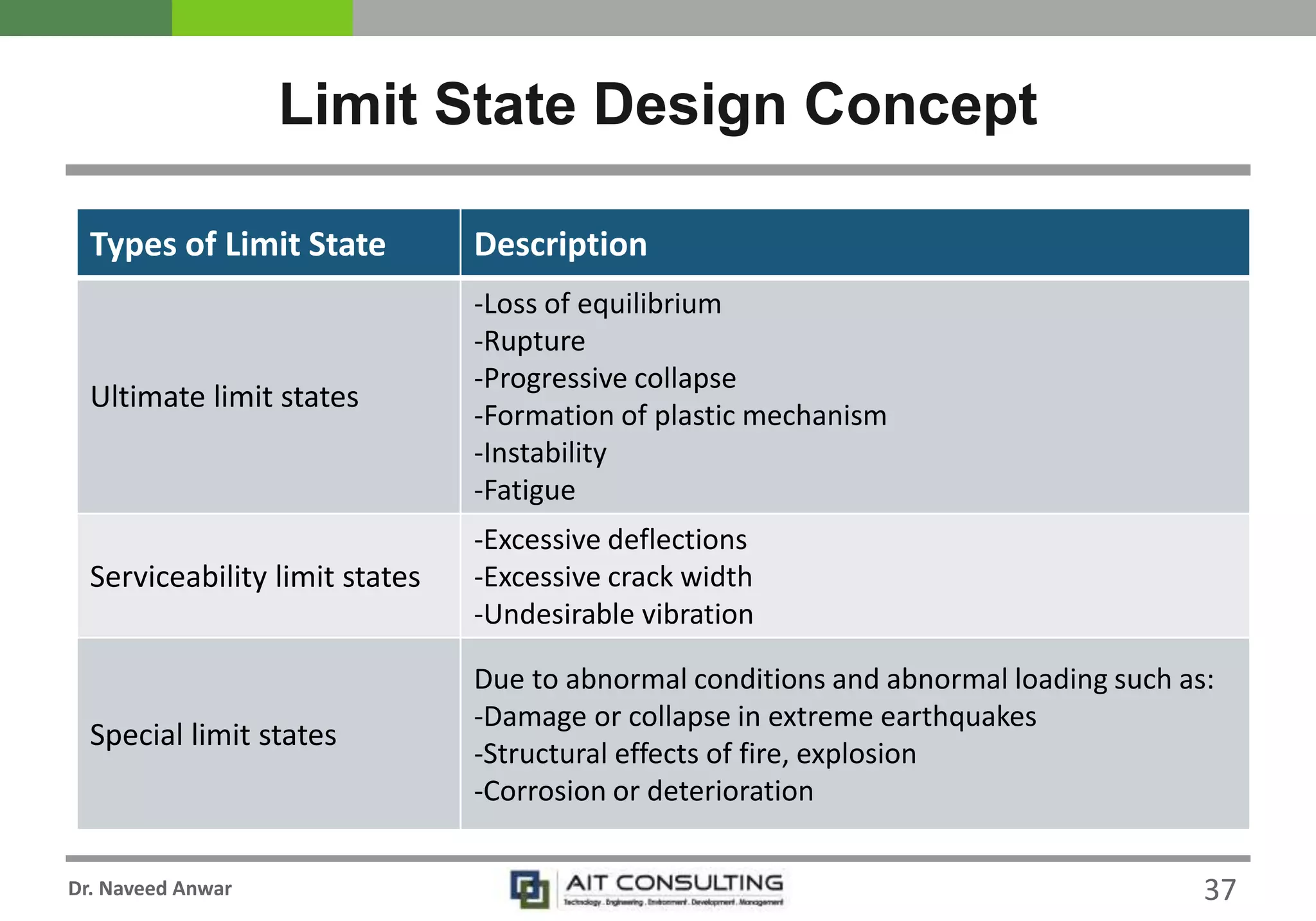
Limit State Design Concept
Types of Limit State Description
Ultimate limit states
-Loss of equilibrium
-Rupture
-Progressive collapse
-Formation of plastic mechanism
-Instability
-Fatigue
Serviceability limit states
-Excessive deflections
-Excessive crack width
-Undesirable vibration
Special limit states
Due to abnormal conditions and abnormal loading such as:
-Damage or collapse in extreme earthquakes
-Structural effects of fire, explosion
-Corrosion or deterioration
37
Dr. Naveed Anwar
• Limit state design involves:
– Identification of all potential modes of failure
(i.e. identify significant limit states)
– Determination of acceptable levels of safety against occurrence of
each limit state
– Consideration by the designer of significant limit states
Limit State Design Concept
38
Dr. Naveed Anwar
Limit State Design Concept
• Safety Factors
– Material Safety Factor γm
– Member Factor γb
– Load Factor γf
– Structural Analysis Factor γa
– Structure Factor γi
39
Dr. Naveed Anwar
Limit State Design Concept
Safety Factors for Performance Verification
Characteristic value of
material basic strength
Design strength
γm
Design member
capacity
Characteristic value of
load
Design load
γf
Design member
capacity
γa
Verification γi
γb
40
Dr. Naveed Anwar
Limit State Design Concept
Material/Stress Type γm
Reinforcement 1.15
Concrete in flexure or axial load 1.50
Concrete shear strength without shear
reinforcement
1.25
Concrete bond strength 1.40
Concrete other >1.50
Values of γm (BS8110)
41
Dr. Naveed Anwar
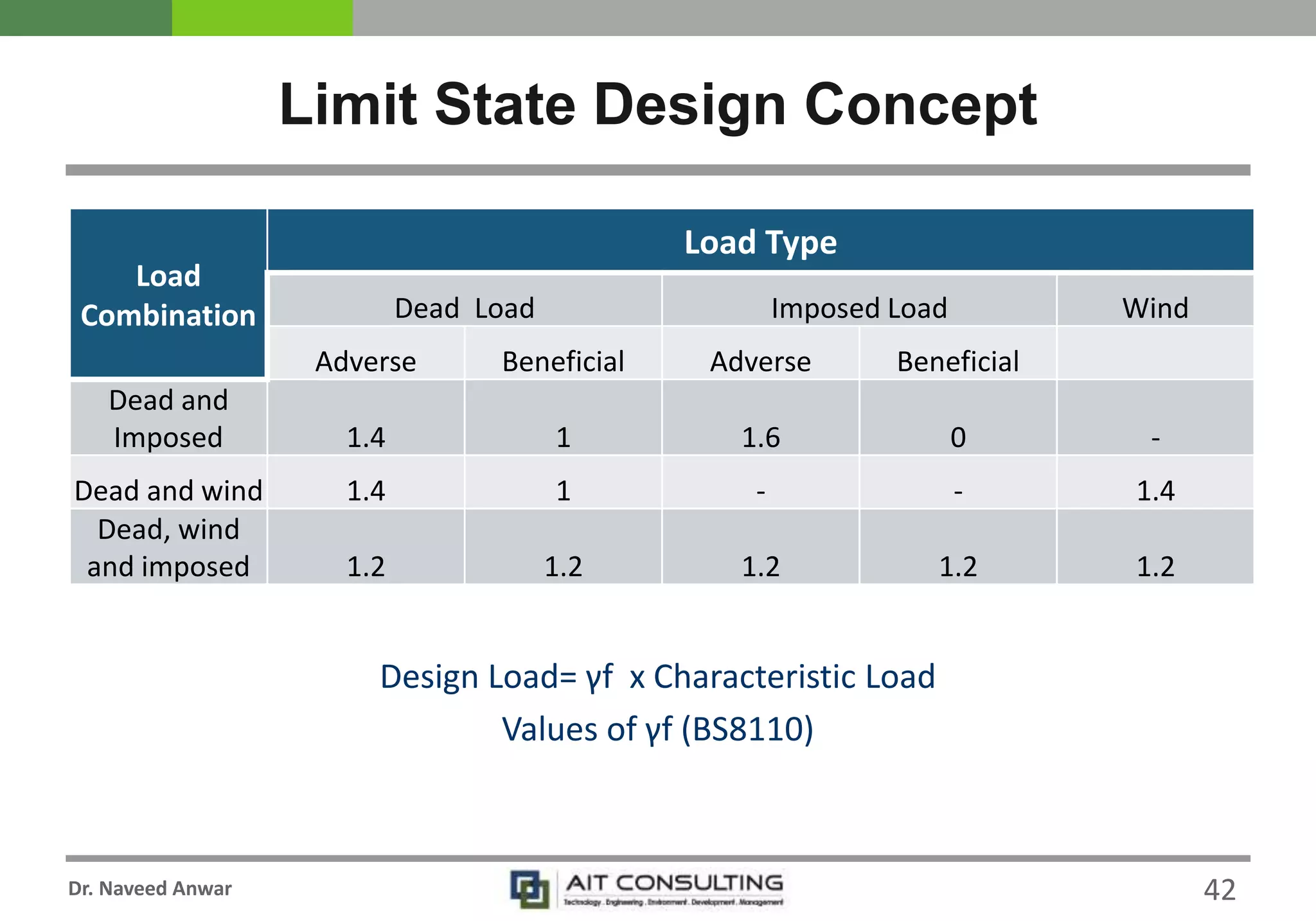
Limit State Design Concept
Load
Combination
Load Type
Dead Load Imposed Load Wind
Adverse Beneficial Adverse Beneficial
Dead and
Imposed 1.4 1 1.6 0 -
Dead and wind 1.4 1 - - 1.4
Dead, wind
and imposed 1.2 1.2 1.2 1.2 1.2
Design Load= γf x Characteristic Load
Values of γf (BS8110)
42
Dr. Naveed Anwar
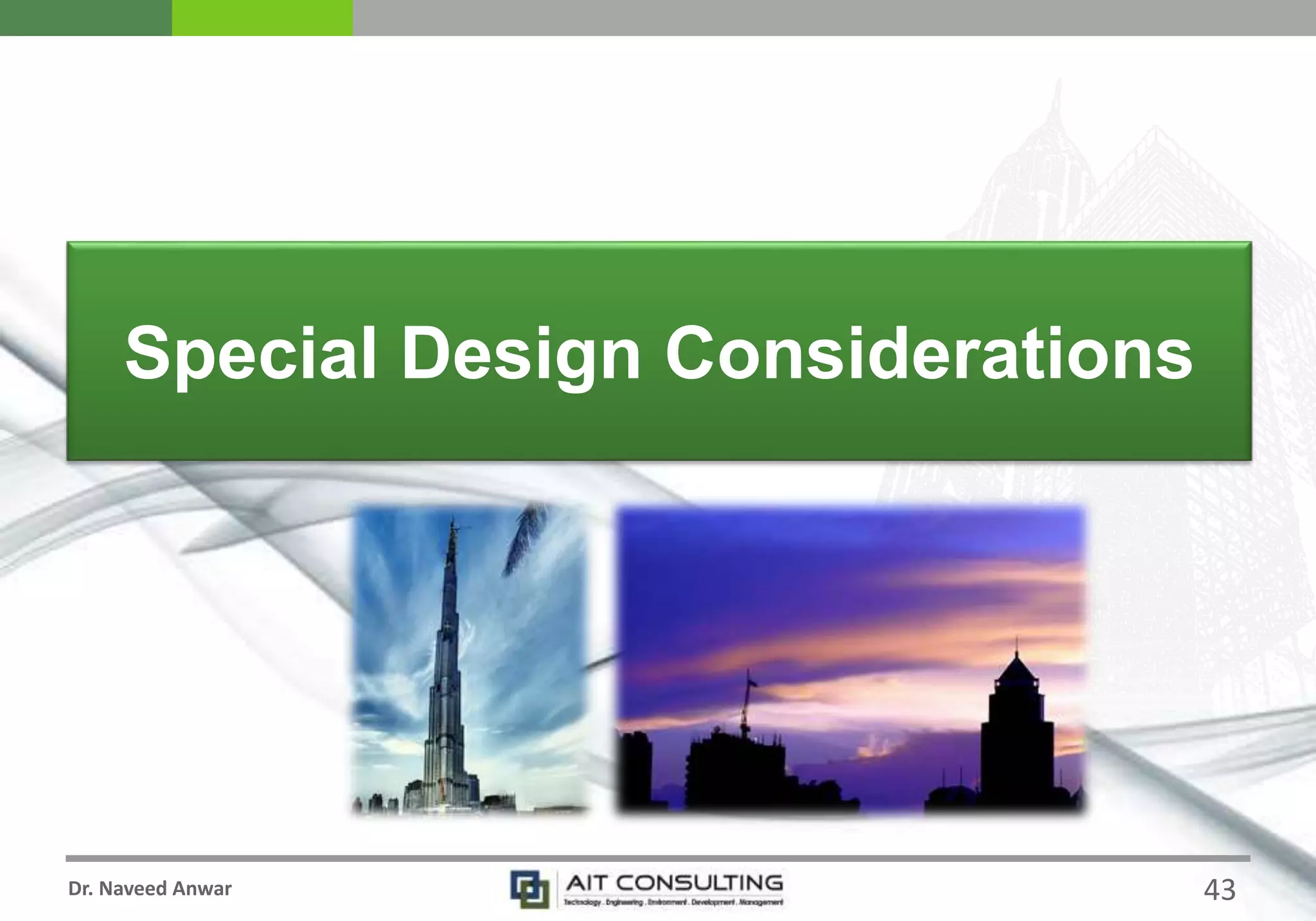
Special Design Considerations
43
Dr. Naveed Anwar
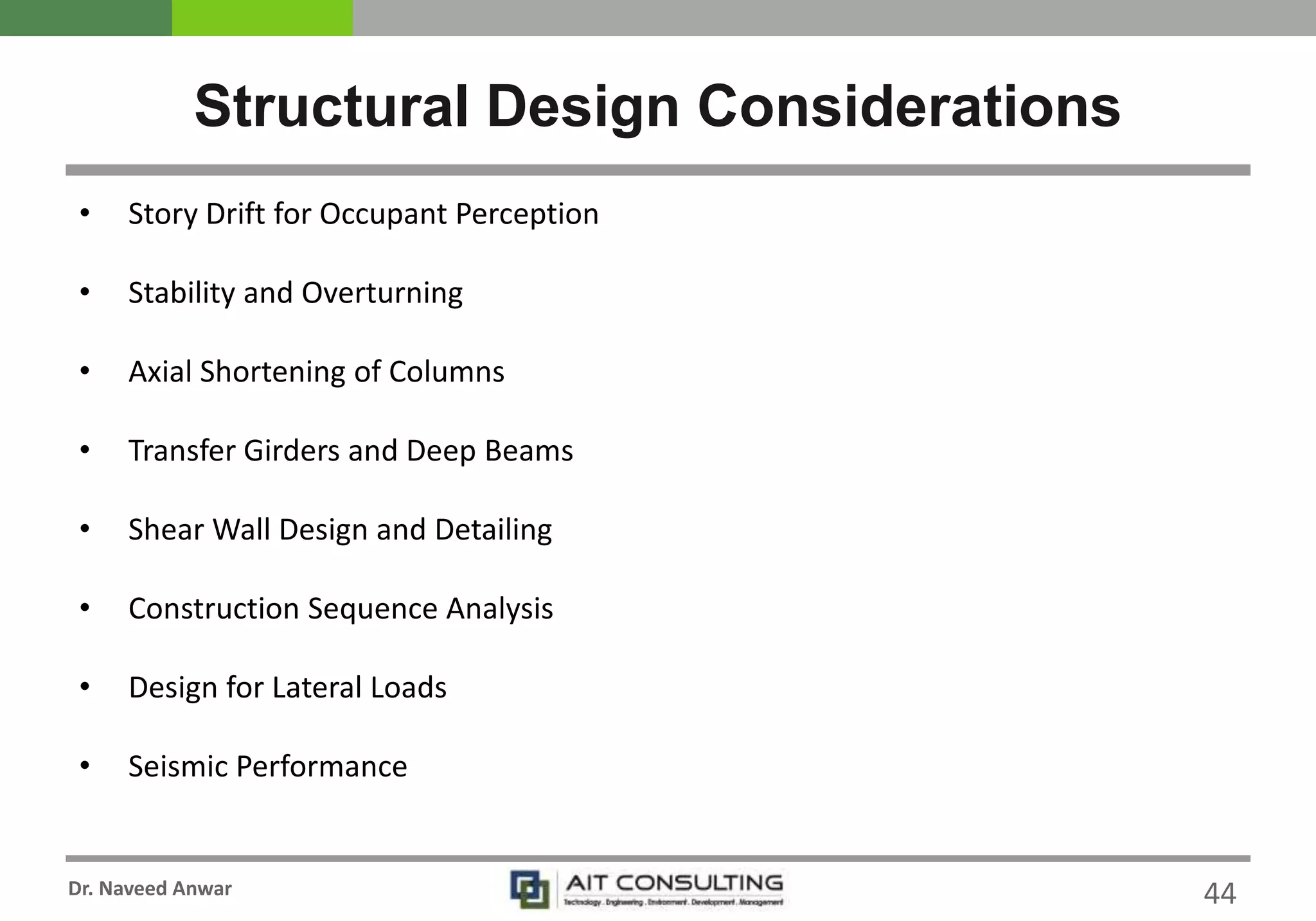
Structural Design Considerations
44
• Story Drift for Occupant Perception
• Stability and Overturning
• Axial Shortening of Columns
• Transfer Girders and Deep Beams
• Shear Wall Design and Detailing
• Construction Sequence Analysis
• Design for Lateral Loads
• Seismic Performance
Dr. Naveed Anwar
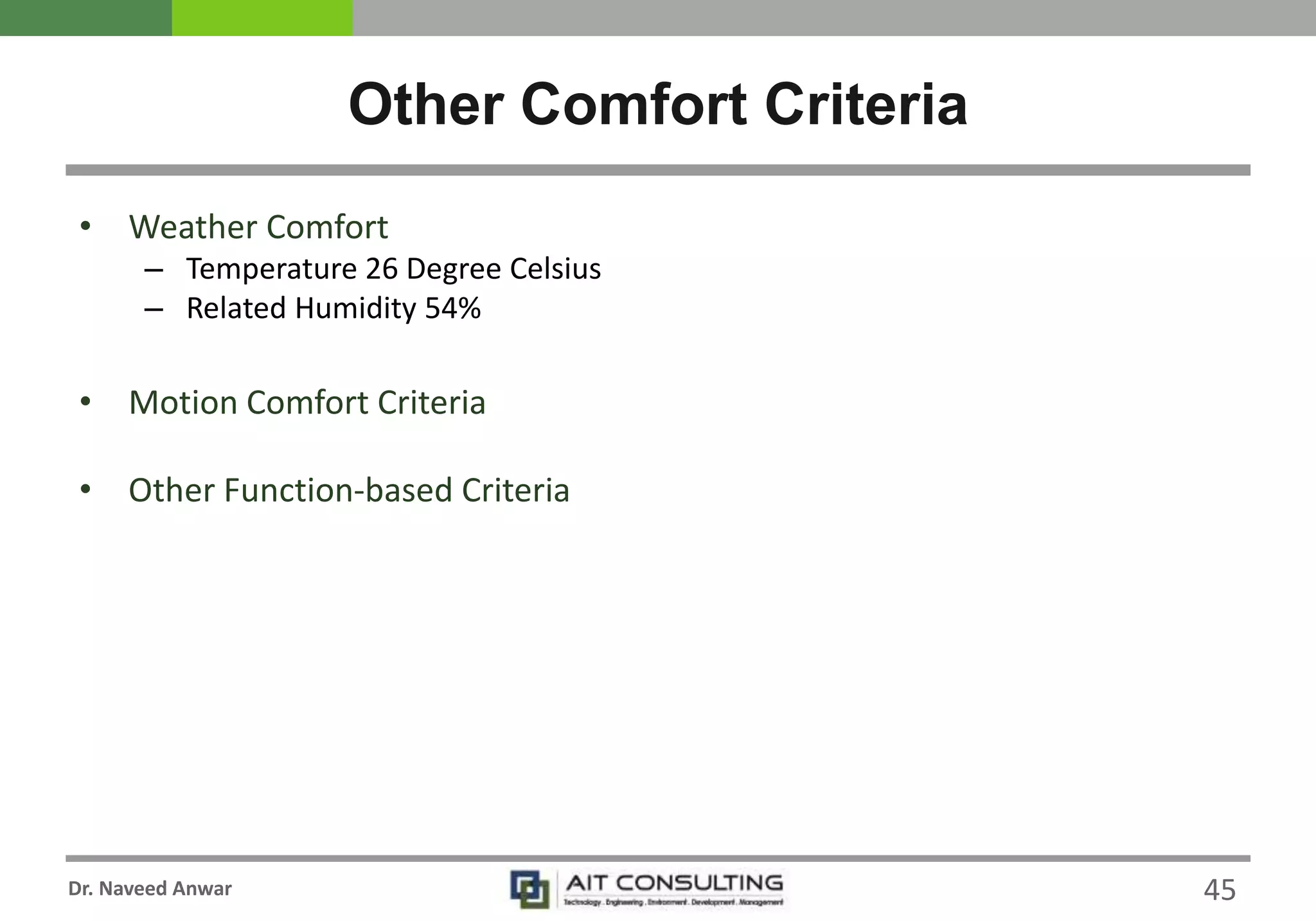
• Weather Comfort
– Temperature 26 Degree Celsius
– Related Humidity 54%
• Motion Comfort Criteria
• Other Function-based Criteria
Other Comfort Criteria
45
Dr. Naveed Anwar
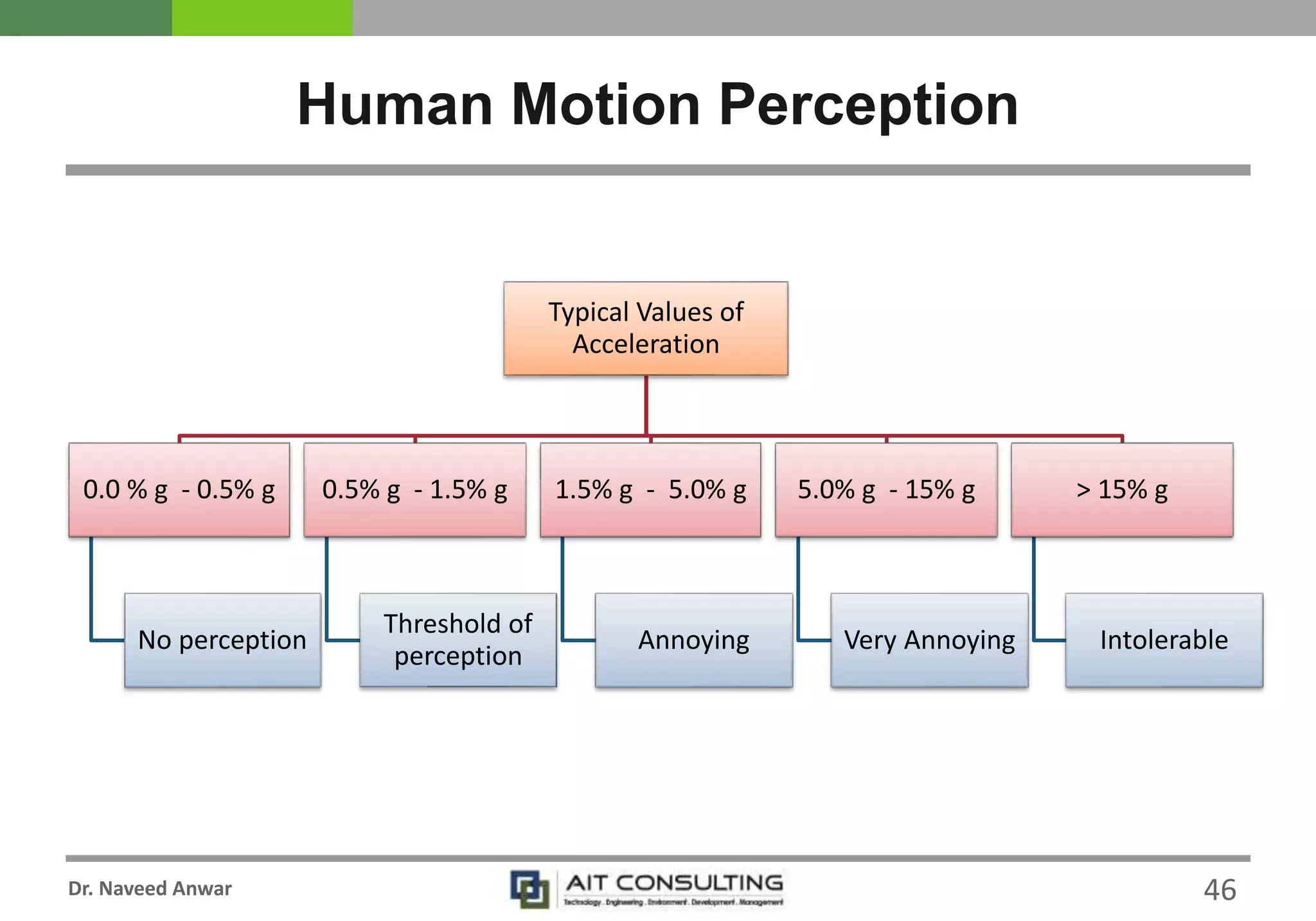
Human Motion Perception
Typical Values of
Acceleration
0.0 % g - 0.5% g
No perception
0.5% g - 1.5% g
Threshold of
perception
1.5% g - 5.0% g
Annoying
5.0% g - 15% g
Very Annoying
> 15% g
Intolerable
46
Dr. Naveed Anwar
• Taranath, B.S. (2010). Reinforced Concrete Design of Tall Buildings. Taylor and
Francis Group, LLC.
• Fintel, M. (1986). Handbook of Concrete Engineering. CBS Publishers.
• Kong, F.K., Evans, R.H., Cohen, E., Roll, F. (1983). Handbook of Structural Concrete.
McGraw-Hill Book Co.
• Workshop Notes from ACECOMS
References
47
Dr. Naveed Anwar
Executive Director, AIT Consulting
Affiliated Faculty, Structural Engineering
Director, ACECOMS
Thank You

CE 72.32 (January 2016 Semester) Lecture 2 - Design Philosophy

  • 1.
    Dr. Naveed Anwar ExecutiveDirector, AIT Consulting Affiliated Faculty, Structural Engineering Director, ACECOMS Design of Tall Buildings Hybrid Learning System
  • 2.
    Dr. Naveed Anwar ExecutiveDirector, AIT Consulting Affiliated Faculty, Structural Engineering Director, ACECOMS Lecture 2: Design Philosophy Design of Tall Buildings
  • 3.
  • 4.
    Dr. Naveed Anwar StructuralEngineering Spectrum Engineer Activity Conception – Analysis – Design – Detailing, etc. Structure Buildings – Bridges – Trusses – Shells – Towers, etc. Code American – British – European – Japanese, etc. Material Concrete – PSC – Steel – Timber, etc. Model 2D Frame/Truss – 3D Frame/Truss – Full 3D FEM, etc. Analysis Linear Static – NL Static – Linear Dynamic – Large Disp., etc. Solution Equation Solution – Finite Elements – Programming, etc. 4
  • 5.
    Dr. Naveed Anwar StructuralDesign Office: Activities 5
  • 6.
    Dr. Naveed Anwar OverallDesign Process • Conception • Modeling • Analysis • Design • Detailing • Drafting • Costing Integrated Design Process 6
  • 7.
    Dr. Naveed Anwar FinalDesign Output Acceptable ? Trial Members/Sections Revise Members/Sections Structural System Modeling Analysis Member Design Detailing No Yes Structure Design Process 7
  • 8.
  • 9.
    Dr. Naveed Anwar CADin Structural Engineering 9
  • 10.
    Dr. Naveed Anwar StructuralDesign Concepts 10
  • 11.
    Dr. Naveed Anwar DesignPhilosophy and Process “Structural Design is the process of proportioning the structure to safely resist the applied forces in the most cost effective and friendly manner” Load Effects Requirements Constraints Design Material Specifications Cross-section Details Member Sizes and Configurations 11
  • 12.
    Dr. Naveed Anwar •Structural idealization into load bearing frame elements for analysis and design • Estimation of loads • Structural analysis • Design of sections and reinforcement for beams, column, slabs, etc. • Production of arrangement and detail drawings and bar schedules Structural Design 12
  • 13.
    Dr. Naveed Anwar •Structural design can be based on: – Rigorous Analytical Theories – Semi-Analytical, Semi-Numerical Solutions – Rigorous Numerical Solutions – Simplified Numerical and Empirical Solutions – Specified Design Procedures Design Levels 13
  • 14.
    Dr. Naveed Anwar •Structural Analysis – Fairly General, Unified (FEM, BEM, etc.) – Output: Element/Member Actions, Displacements, etc. • Structural Design – Structural Material (RC, PSC, HRS, CFS, timber, etc.) – Design Code (ACI, BS Codes, EuroCode, JIS, etc.) – Design Approach (working stress, ultimate strength, limit state, etc.) – Structural Members (beams, columns, slabs, footings, etc.) – Local Construction Techniques and Practices – Output: Element/Member Cross-section, Reinforcement, etc. Structural Analysis vs. Design 14
  • 15.
    Dr. Naveed Anwar Rigorous Analytical Semi Analytical Rigorous Numerical Simplified Numerical Specified Procedures DesignLevels Partial Differential Equations Closed Form with Approximations Full 3D, Nonlinear, Inelastic Dynamic FEA 2D/3D Linear Static FEA/Matrix Equations, Charts, Tables, Rules, Limits 15
  • 16.
    Dr. Naveed Anwar DesignMethodologies and Technologies 16
  • 17.
    Dr. Naveed Anwar Evolutionof Design Approaches 17
  • 18.
    Dr. Naveed Anwar TheFirst Code - Hammurabi's Code (1772 BC) Clause 229: If a builder builds a house for someone, and does not construct it properly, and the house which he built falls in and kills its owner, then that builder shall be put to death. PerformanceConsequence 18
  • 19.
    Dr. Naveed Anwar Historyof Building Codes - Law of Moses (1300 BC) “In case you build a new house, you must also make a parapet for your roof, that you may not place bloodguilt upon your house because someone falling might fall from it”. - The Bible, Book of Deuteronomy, Chapter 22, Verse 8 Life Safety Ultimately: Performance is desired. 19
  • 20.
    Dr. Naveed Anwar PrescriptiveCodes (ACI 318 – 11) Do this … … your structure is safe 20
  • 21.
    Dr. Naveed Anwar21 • Traditional codes govern design of general, normal buildings – Over 95% buildings are covered, which are less than about 50 m • Not specifically developed for tall buildings > 50 m tall • Prescriptive in nature, no explicit check on outcome • Permit a limited number of structural systems • Do not include framing systems appropriate for high-rise • Based on elastic methods of analysis • Enforce uniform detailing rules on all members • Enforce unreasonable demand distribution rules • Do not take advantage of recent computing tools Shortcomings of the Traditional Codes
  • 22.
    Dr. Naveed Anwar •Implicit Performance Objective – Resist minor earthquake without damage, which is anticipated to occur several times during the life of a building, without damage to structural and non-structural components – Resist the design level of earthquake with damage without causing loss of life – Resist strongest earthquake with substantial damage but a very low probability of collapse • Explicit verification not specified or required Unsuitability of Traditional Design Codes 22
  • 23.
    Dr. Naveed Anwar Performance-basedEngineering Design for the achievement of specified results rather than adherence to particular technologies or prescribed means. - Peter May, 2004 Now, instead of worrying about mix proportions of concrete, you can directly ask the contractor for a 60 MPa concrete Courtesy: Performance-based approach 23
  • 24.
    Dr. Naveed Anwar Performance-basedDesign Approach Client Designer Independent Engineer Guidelines: PEER, TBI, ATC, FEMA, CTBUH, etc. What to expect? How to achieve this kind of approach? Knowledge – Skills – Tools 24
  • 25.
    Dr. Naveed Anwar Consequence-basedEngineering A New Engineering Paradigm (Abrams D.P., 2002) 25
  • 26.
    Dr. Naveed Anwar CoreResearch Thrust Areas (Abrams D.P, 2002) Stakeholder Thrust Areas 26
  • 27.
    Dr. Naveed Anwar LatestGuidelines and Specifications 27 http://peer.berkeley.edu/tbi/ Tall Buildings Initiative Guidelines A Project of Pacific Earthquake Engineering Research Center (PEER) Council of Tall Buildings and Urban Habitat (CTBUH) http://www.ctbuh.org/ National Earthquake Hazards Reduction Program http://www.nehrp.gov/
  • 28.
    Dr. Naveed Anwar LatestGuidelines and Specifications 28 Federal Emergency Management Agency http://www.fema.gov/earthquake-publications Applied Technology Council https://www.atcouncil.org/
  • 29.
  • 30.
    Dr. Naveed Anwar •Prime Concern: “Balance External Actions with Internal Stress Resultants with adequate margin for safety” Sd >= FOS * Fa • Check for: – Deflections, Deformations, Durability – Vibrations, Crack Width, Fire Protections, Permeability, Chemical Attacks – Ductility and other special considerations Proportioning for Safety 30
  • 31.
    Dr. Naveed Anwar •Working Stress Design – Allowable Stress Design (ASD) – Working Stress Design (WSD) • Load Factor Design • Ultimate Strength Design – Ultimate Strength Design (USD) – Strength Design (SD) – Load and Resistance Factor Design (LRFD) • Performance-based Design – Pushover Analysis – Capacity-based Design Various Methods of Structural Design 31
  • 32.
    Dr. Naveed Anwar Obtainedfrom Analysis Actions Loads and Stress Resultants Section Capacity/Section Design Process Loads Stresses Stress Resultants Deformation Depends on Stiffness (Section and Rebars) Strains Dependson SectionandRebars FOS 32
  • 33.
    Dr. Naveed Anwar TheResponse and DesignFromLoadstoStresses FromStrainstoResponse Applied Loads Building Analysis Member Actions Cross-section Actions Material Stress/Strain Material Response Section Response Member Response Building Response Load Capacity 33
  • 34.
    Dr. Naveed Anwar FromServiceability to Performance Serviceability Design Strength Design Performance Design Allowable material, control on deformation limits for design loads Material failure criteria, section capacity for factored loads Ductility considerations, deformation capacity, load capacity at large deformations. Extraordinary load considerations 34
  • 35.
    Dr. Naveed Anwar •Satisfying one design level does not ensure that other design levels will be satisfied – Serviceability design only ensures that deflections and vibrations, etc., for service loads are within limits but is irrelevant to strength. – Strength design ensures that a certain factor of safety against overload is available within a member or a cross-section but is insignificant to what happens if the load exceeds the design level. – Performance design ensures that the structure as a whole reaches a specified demand level. Performance design can include both service and strength design levels. From Serviceability to Performance 35
  • 36.
    Dr. Naveed Anwar LimitState Design Concept 36
  • 37.
    Dr. Naveed Anwar LimitState Design Concept Types of Limit State Description Ultimate limit states -Loss of equilibrium -Rupture -Progressive collapse -Formation of plastic mechanism -Instability -Fatigue Serviceability limit states -Excessive deflections -Excessive crack width -Undesirable vibration Special limit states Due to abnormal conditions and abnormal loading such as: -Damage or collapse in extreme earthquakes -Structural effects of fire, explosion -Corrosion or deterioration 37
  • 38.
    Dr. Naveed Anwar •Limit state design involves: – Identification of all potential modes of failure (i.e. identify significant limit states) – Determination of acceptable levels of safety against occurrence of each limit state – Consideration by the designer of significant limit states Limit State Design Concept 38
  • 39.
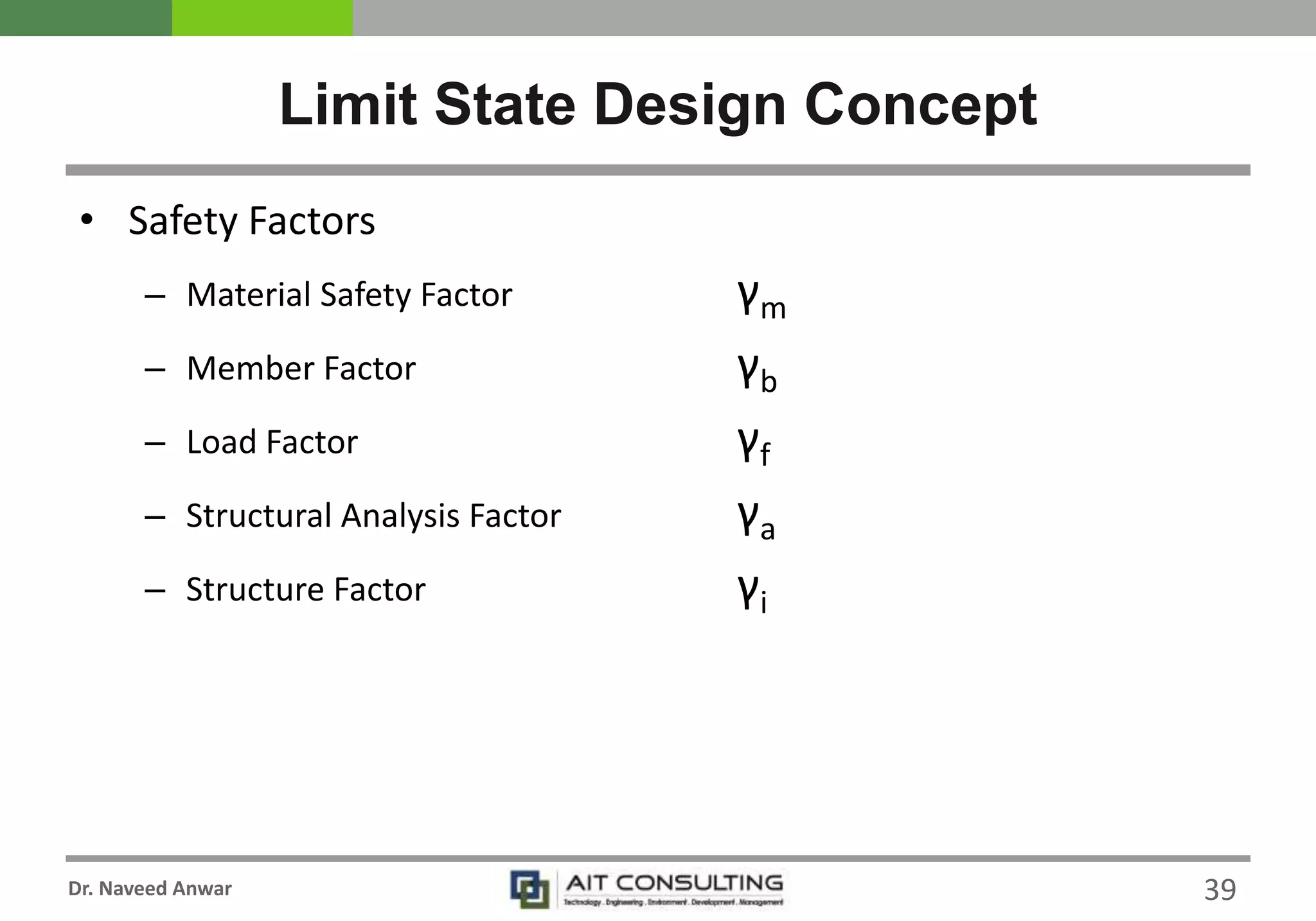
    Dr. Naveed Anwar LimitState Design Concept • Safety Factors – Material Safety Factor γm – Member Factor γb – Load Factor γf – Structural Analysis Factor γa – Structure Factor γi 39
  • 40.
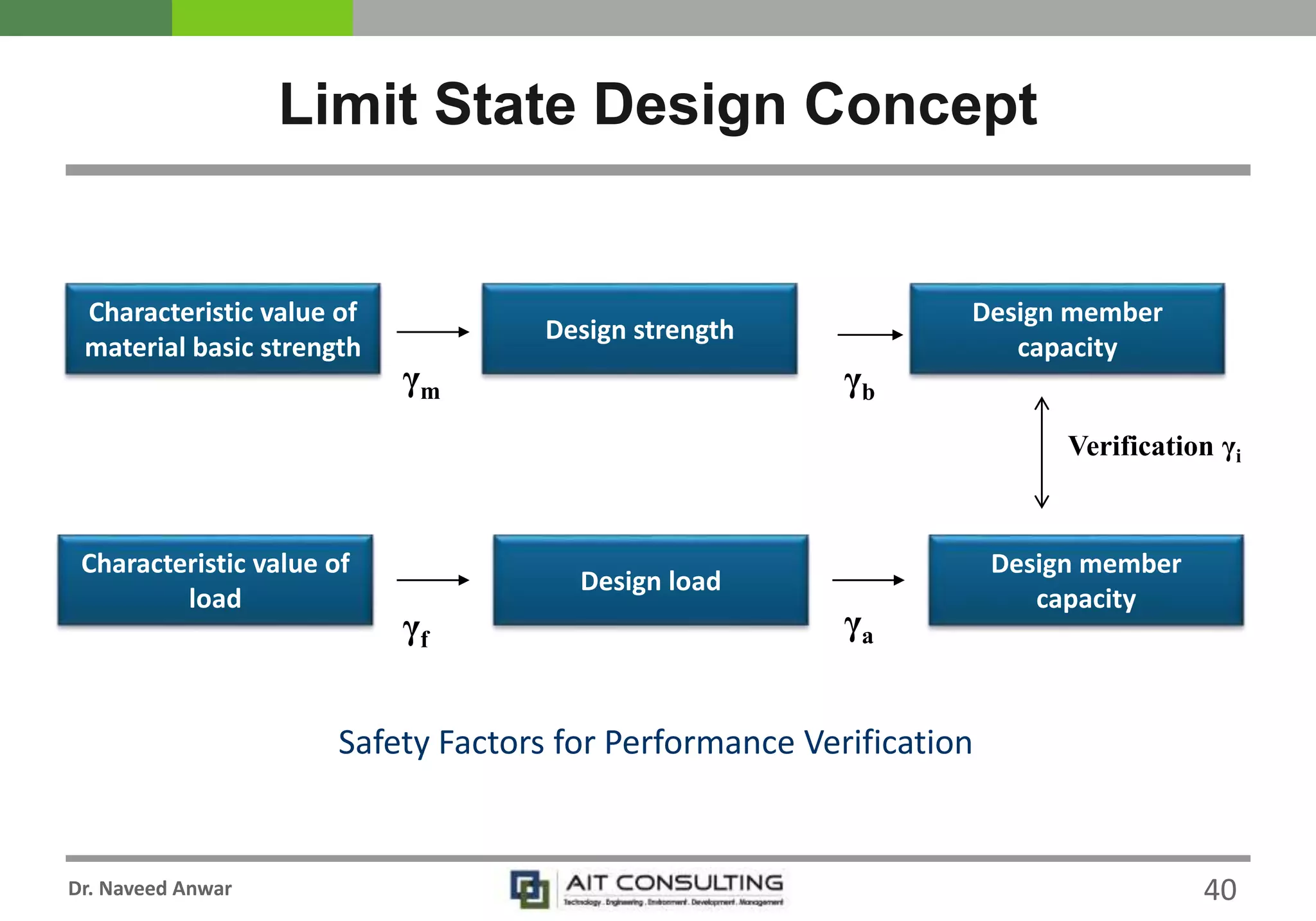
    Dr. Naveed Anwar LimitState Design Concept Safety Factors for Performance Verification Characteristic value of material basic strength Design strength γm Design member capacity Characteristic value of load Design load γf Design member capacity γa Verification γi γb 40
  • 41.
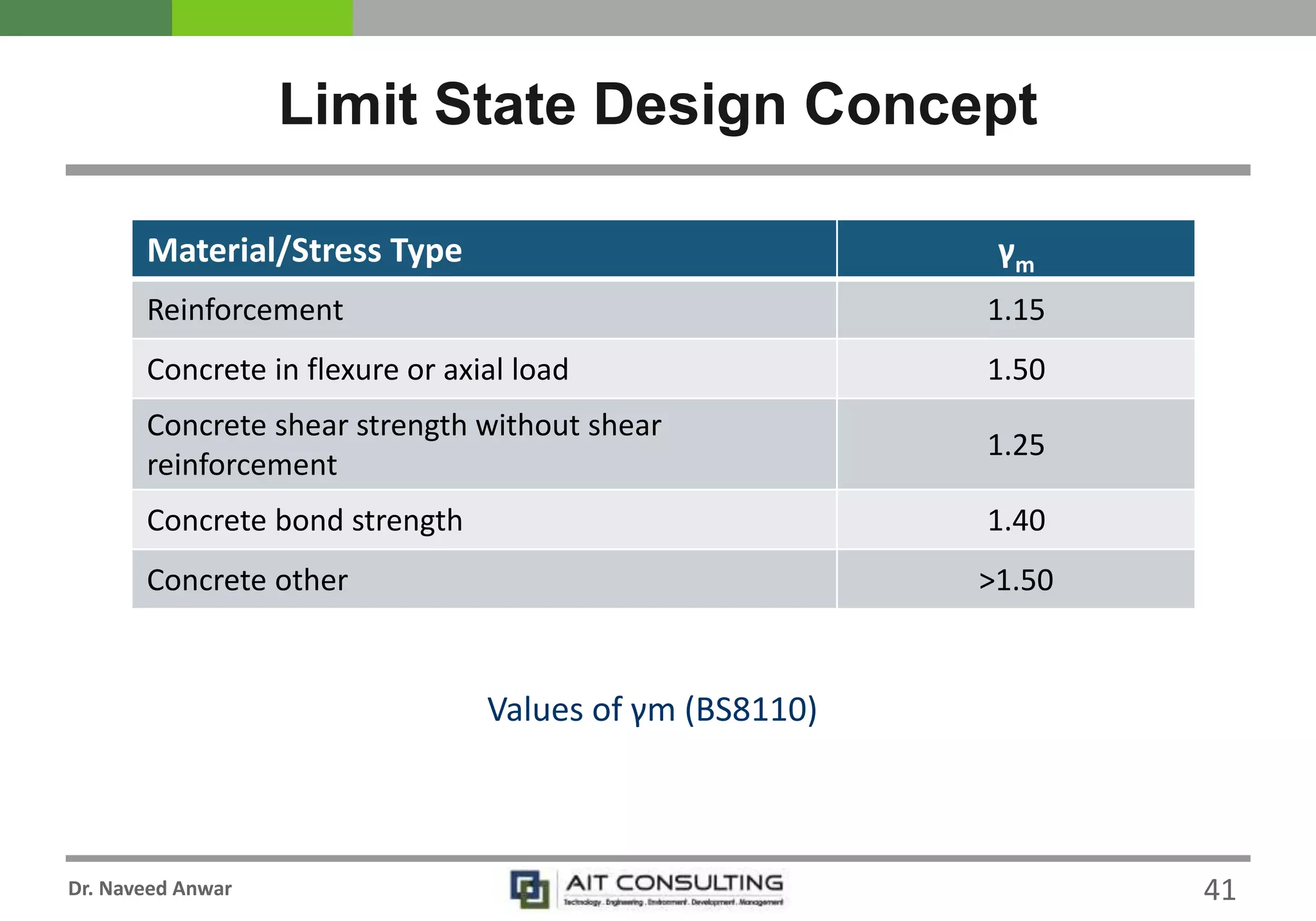
    Dr. Naveed Anwar LimitState Design Concept Material/Stress Type γm Reinforcement 1.15 Concrete in flexure or axial load 1.50 Concrete shear strength without shear reinforcement 1.25 Concrete bond strength 1.40 Concrete other >1.50 Values of γm (BS8110) 41
  • 42.
    Dr. Naveed Anwar LimitState Design Concept Load Combination Load Type Dead Load Imposed Load Wind Adverse Beneficial Adverse Beneficial Dead and Imposed 1.4 1 1.6 0 - Dead and wind 1.4 1 - - 1.4 Dead, wind and imposed 1.2 1.2 1.2 1.2 1.2 Design Load= γf x Characteristic Load Values of γf (BS8110) 42
  • 43.
    Dr. Naveed Anwar SpecialDesign Considerations 43
  • 44.
    Dr. Naveed Anwar StructuralDesign Considerations 44 • Story Drift for Occupant Perception • Stability and Overturning • Axial Shortening of Columns • Transfer Girders and Deep Beams • Shear Wall Design and Detailing • Construction Sequence Analysis • Design for Lateral Loads • Seismic Performance
  • 45.
    Dr. Naveed Anwar •Weather Comfort – Temperature 26 Degree Celsius – Related Humidity 54% • Motion Comfort Criteria • Other Function-based Criteria Other Comfort Criteria 45
  • 46.
    Dr. Naveed Anwar HumanMotion Perception Typical Values of Acceleration 0.0 % g - 0.5% g No perception 0.5% g - 1.5% g Threshold of perception 1.5% g - 5.0% g Annoying 5.0% g - 15% g Very Annoying > 15% g Intolerable 46
  • 47.
    Dr. Naveed Anwar •Taranath, B.S. (2010). Reinforced Concrete Design of Tall Buildings. Taylor and Francis Group, LLC. • Fintel, M. (1986). Handbook of Concrete Engineering. CBS Publishers. • Kong, F.K., Evans, R.H., Cohen, E., Roll, F. (1983). Handbook of Structural Concrete. McGraw-Hill Book Co. • Workshop Notes from ACECOMS References 47
  • 48.
    Dr. Naveed Anwar ExecutiveDirector, AIT Consulting Affiliated Faculty, Structural Engineering Director, ACECOMS Thank You