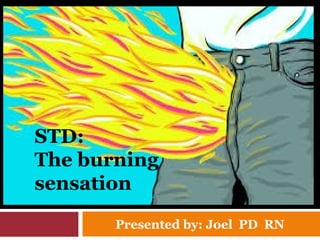
STD:
The burning
sensation
Presented by: Joel PD RN
OVERVIEW
 Sexually transmitted diseases (STDs), or
sexually transmitted infections (STIs), are
generally acquired by sexual contact. The
organisms that cause sexually transmitted
diseases may pass from person to person in
blood, semen, or vaginal and other bodily fluids.
 Sometimes these infections can be transmitted
nonsexually, such as from mother to infant
during pregnancy or childbirth, or through
blood transfusions or shared needles.
OVERVIEW
 It's possible to contract sexually
transmitted diseases from people who
seem perfectly healthy, and who may
not even be aware of the infection. STDs
don't always cause symptoms, which is
one of the reasons experts prefer the
term "sexually transmitted infections"
to "sexually transmitted diseases."
SIGNS & SYMPTOMS
 Sexually transmitted infections (STIs)
can have a range of signs and
symptoms, including no symptoms.
That's why they may go unnoticed until
complications occur or a partner is
diagnosed
SIGNS & SYMPTOMS
 Signs and symptoms may appear a few
days after exposure, or it may take years
before you have any noticeable
problems, depending on the organism
SIGNS & SYMPTOMS
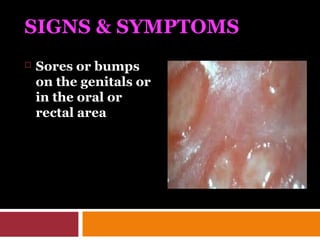
 Sores or bumps
on the genitals or
in the oral or
rectal area
SIGNS & SYMPTOMS
 Painful or
burning urination
SIGNS & SYMPTOMS
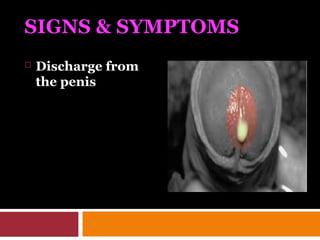
 Discharge from
the penis
SIGNS & SYMPTOMS
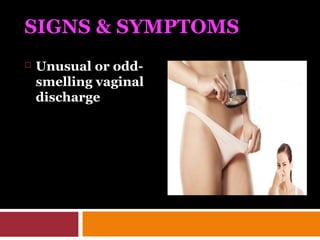
 Unusual or odd-
smelling vaginal
discharge
SIGNS & SYMPTOMS
 Unusual vaginal
bleeding
SIGNS & SYMPTOMS
 Pain during sex
SIGNS & SYMPTOMS
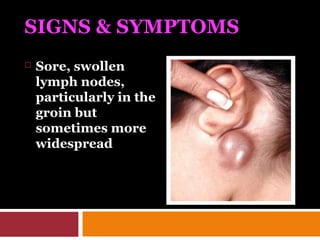
 Sore, swollen
lymph nodes,
particularly in the
groin but
sometimes more
widespread
SIGNS & SYMPTOMS
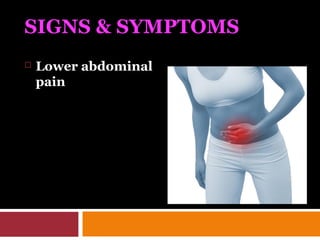
 Lower abdominal
pain
SIGNS & SYMPTOMS
 Fever
SIGNS & SYMPTOMS
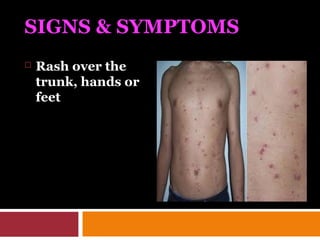
 Rash over the
trunk, hands or
feet
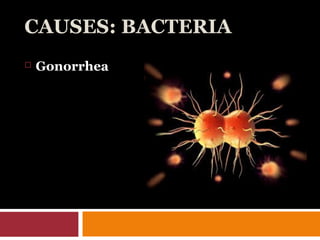
CAUSES: BACTERIA
 Gonorrhea
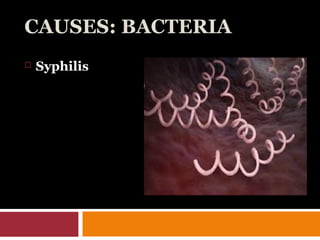
CAUSES: BACTERIA
 Syphilis
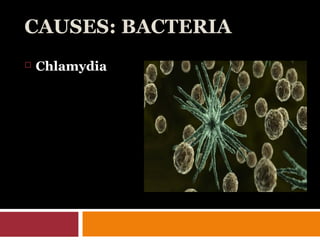
CAUSES: BACTERIA
 Chlamydia
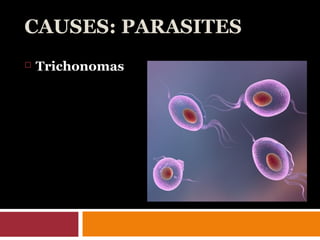
CAUSES: PARASITES
 Trichonomas
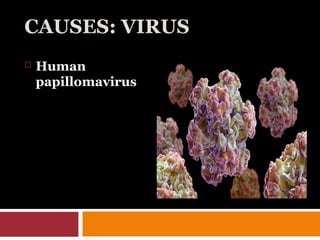
CAUSES: VIRUS
 Human
papillomavirus
CAUSES: VIRUS
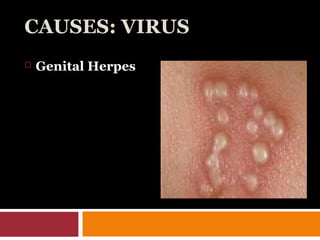
 Genital Herpes
CAUSES: VIRUS
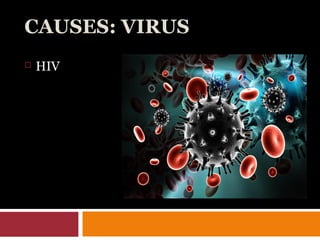
 HIV
RISK FACTORS
 Having unprotected sex. Vaginal or anal
penetration by an infected partner who isn't wearing
a latex condom significantly increases the risk of
getting an STI. Improper or inconsistent use of
condoms can also increase your risk.
 Oral sex may be less risky, but infections can still be
transmitted without a latex condom or dental dam.
Dental dams — thin, square pieces of rubber made
with latex or silicone — prevent skin-to-skin
contact.
RISK FACTORS
 Having sexual contact with multiple
partners. The more people you have sexual
contact with, the greater your risk. This is true
for concurrent partners as well as
monogamous consecutive relationships.
RISK FACTORS
 Having a history of STIs. Having one STI
makes it much easier for another STI to take
hold.
RISK FACTORS
 Anyone forced to have sexual
intercourse or sexual activity. Dealing
with rape or assault can be difficult, but
it's important to be seen as soon as
possible. Screening, treatment and
emotional support can be offered.
RISK FACTORS
 Abusing alcohol or using recreational
drugs. Substance abuse can inhibit your
judgment, making you more willing to
participate in risky behaviors
RISK FACTORS
 Injecting drugs. Needle sharing spreads
many serious infections, including HIV,
hepatitis B and hepatitis C
RISK FACTORS
 Being young. Half of STIs occur in
people between the ages of 15 and 24.
RISK FACTORS
 Men who request prescriptions for
drugs to treat erectile dysfunction. Men
who ask their doctors for prescriptions
for certain drugs — such as sildenafil
(Viagra), tadalafil (Cialis) and
vardenafil (Levitra) — have higher rates
of STIs. Be sure you are up to date on
safe sex practices if you ask your doctor
for one of these medications.
COMPLICATIONS
 Pelvic pain
 Pregnancy complications
 Eye inflammation
 Arthritis
COMPLICATIONS
 Pelvic inflammatory disease
 Infertility
 Heart disease
 Certain cancers, such as
HPV-associated cervical and
rectal cancers
DIAGNOSIS
 Blood tests. Blood tests can confirm the
diagnosis of HIV or later stages of
syphilis.
 Urine samples. Some STIs can be
confirmed with a urine sample
DIAGNOSIS
 Fluid samples. If you have active genital
sores, testing fluid and samples from
the sores may be done to diagnose the
type of infection. Laboratory tests of
material from a genital sore or
discharge are used to diagnose some
STIs.
SCREENING
 Testing for a disease in someone who
doesn't have symptoms is called
screening. Most of the time, STI
screening is not a routine part of health
care, but there are exceptions.
SCREENING
 Everyone born between 1945 and 1965.
There's a high incidence of hepatitis C in
people born between 1945 and 1965.
Since the disease often causes no
symptoms until it's advanced, experts
recommend that everyone in that age
group be screened for hepatitis C.
SCREENING
 Pregnant women. Screening for HIV,
hepatitis B, chlamydia and syphilis
generally takes place at the first
prenatal visit for all pregnant women.
Gonorrhea and hepatitis C screening
tests are recommended at least once
during pregnancy for women at high
risk of these infections.
SCREENING
 Women age 21 and older. The Pap test
screens for cervical abnormalities,
including inflammation, precancerous
changes and cancer, which is often
caused by certain strains of human
papillomavirus (HPV).
SCREENING
 Women under age 25 who are
sexually active. All sexually active
women under age 25 should be
tested for chlamydia infection.
SCREENING
 Men who have sex with men. Compared
with other groups, men who have sex
with men run a higher risk of acquiring
STIs. Many public health groups
recommend annual or more frequent
STI screening for these men
SCREENING
 People with HIV. If you have HIV, it
dramatically raises your risk of catching
other STIs. Experts recommend
immediate testing for syphilis,
gonorrhea, chlamydia and herpes after
being diagnosed with HIV. People with
HIV should also be screened for
hepatitis C
SCREENING
 People who have a new partner. Before
having vaginal or anal intercourse with
new partners, be sure you've both been
tested for STIs. Keep in mind that
human papillomavirus (HPV) screening
isn't available for men.
TREATMENT
 Antibiotics. Antibiotics, often in a single
dose, can cure many sexually
transmitted bacterial and parasitic
infections, including gonorrhea,
syphilis, chlamydia and trichomoniasis.
Typically, you'll be treated for
gonorrhea and chlamydia at the same
time because the two infections often
appear together
TREATMENT
 Antiviral drugs. You'll have fewer herpes
recurrences if you take daily suppressive
therapy with a prescription antiviral drug.
Antiviral drugs lessen the risk of infection,
but it's still possible to give your partner
herpes.
 Antiviral drugs can keep HIV infection in
check for many years. But the virus persists
and can still be transmitted, though the risk
is lower.
PREVENTION
 Abstain. The most effective way to avoid
STIs is to abstain from sex.
PREVENTION
 Stay with one uninfected partner.
Another reliable way of avoiding STIs is
to stay in a long-term mutually
monogamous relationship with a
partner who isn't infected.
PREVENTION
 Wait and verify. Avoid vaginal and anal
intercourse with new partners until you
have both been tested for STIs. Oral sex
is less risky, but use a latex condom or
dental dam — a thin, square piece of
rubber made with latex or silicone — to
prevent direct contact between the oral
and genital mucous membranes
PREVENTION
 Get vaccinated. Getting vaccinated
early, before sexual exposure, is also
effective in preventing certain types of
STIs. Vaccines are available to prevent
human papillomavirus (HPV), hepatitis
A and hepatitis B
PREVENTION
 Use condoms and dental dams
consistently and correctly. Use a new
latex condom or dental dam for each sex
act, whether oral, vaginal or anal. Never
use an oil-based lubricant, such as
petroleum jelly, with a latex condom or
dental dam.
PREVENTION
 Don't drink alcohol excessively or use
drugs. If you're under the influence,
you're more likely to take sexual risks
PREVENTION
 Communicate. Before any serious
sexual contact, communicate with your
partner about practicing safer sex.
Reach an explicit agreement about what
activities will and won't be OK
PREVENTION
 Consider male circumcision. There's
evidence that male circumcision can
help reduce a man's risk of acquiring
HIV from an infected woman
(heterosexual transmission) by as much
as 60 percent. Male circumcision may
also help prevent transmission of
genital HPV and genital herpes
PREVENTION
 Consider the drug Truvada. The Food
and Drug Administration approved the
use of the combination drug
emtricitabine-tenofovir (Truvada) to
reduce the risk of sexually transmitted
HIV infection in those who are at high
risk. Truvada is also used as an HIV
treatment along with other medications
COPING & SUPPORTCOPING & SUPPORT
 t's traumatic to find out you have an STI. You
might be angry if you feel you've been betrayed
or ashamed if there's a chance you infected
others. At worst, an STI can cause chronic
illness and death, even with the best care in the
world.
 Between those extremes is a host of other
potential losses — trust between partners, plans
to have children, and the joyful embrace of your
sexuality and its expression.
COPING & SUPPORTCOPING & SUPPORT
 Put blame on hold. Don't jump to the
conclusion that your partner has been
unfaithful to you. One (or both) of you
may have been infected by a past
partner.
COPING & SUPPORTCOPING & SUPPORT
 Be candid with health care workers.
Their job is not to judge you, but to stop
STIs from spreading. Anything you tell
them remains confidential.
COPING & SUPPORTCOPING & SUPPORT
 Contact your health department.
Although they may not have the staff
and funds to offer comprehensive
services, local health departments
maintain STI programs that provide
confidential testing, treatment and
partner services.
RESOURCES
 WWW.MAYOCLINIC.ORG
 GOOGLE PICS
THANK YOU

STD

  • 1.
  • 2.
    OVERVIEW  Sexually transmitteddiseases (STDs), or sexually transmitted infections (STIs), are generally acquired by sexual contact. The organisms that cause sexually transmitted diseases may pass from person to person in blood, semen, or vaginal and other bodily fluids.  Sometimes these infections can be transmitted nonsexually, such as from mother to infant during pregnancy or childbirth, or through blood transfusions or shared needles.
  • 3.
    OVERVIEW  It's possibleto contract sexually transmitted diseases from people who seem perfectly healthy, and who may not even be aware of the infection. STDs don't always cause symptoms, which is one of the reasons experts prefer the term "sexually transmitted infections" to "sexually transmitted diseases."
  • 4.
    SIGNS & SYMPTOMS Sexually transmitted infections (STIs) can have a range of signs and symptoms, including no symptoms. That's why they may go unnoticed until complications occur or a partner is diagnosed
  • 5.
    SIGNS & SYMPTOMS Signs and symptoms may appear a few days after exposure, or it may take years before you have any noticeable problems, depending on the organism
  • 6.
    SIGNS & SYMPTOMS Sores or bumps on the genitals or in the oral or rectal area
  • 7.
    SIGNS & SYMPTOMS Painful or burning urination
  • 8.
    SIGNS & SYMPTOMS Discharge from the penis
  • 9.
    SIGNS & SYMPTOMS Unusual or odd- smelling vaginal discharge
  • 10.
    SIGNS & SYMPTOMS Unusual vaginal bleeding
  • 11.
    SIGNS & SYMPTOMS Pain during sex
  • 12.
    SIGNS & SYMPTOMS Sore, swollen lymph nodes, particularly in the groin but sometimes more widespread
  • 13.
    SIGNS & SYMPTOMS Lower abdominal pain
  • 14.
  • 15.
    SIGNS & SYMPTOMS Rash over the trunk, hands or feet
  • 16.
  • 17.
  • 18.
  • 19.
  • 20.
  • 21.
  • 22.
  • 23.
    RISK FACTORS  Havingunprotected sex. Vaginal or anal penetration by an infected partner who isn't wearing a latex condom significantly increases the risk of getting an STI. Improper or inconsistent use of condoms can also increase your risk.  Oral sex may be less risky, but infections can still be transmitted without a latex condom or dental dam. Dental dams — thin, square pieces of rubber made with latex or silicone — prevent skin-to-skin contact.
  • 24.
    RISK FACTORS  Havingsexual contact with multiple partners. The more people you have sexual contact with, the greater your risk. This is true for concurrent partners as well as monogamous consecutive relationships.
  • 25.
    RISK FACTORS  Havinga history of STIs. Having one STI makes it much easier for another STI to take hold.
  • 26.
    RISK FACTORS  Anyoneforced to have sexual intercourse or sexual activity. Dealing with rape or assault can be difficult, but it's important to be seen as soon as possible. Screening, treatment and emotional support can be offered.
  • 27.
    RISK FACTORS  Abusingalcohol or using recreational drugs. Substance abuse can inhibit your judgment, making you more willing to participate in risky behaviors
  • 28.
    RISK FACTORS  Injectingdrugs. Needle sharing spreads many serious infections, including HIV, hepatitis B and hepatitis C
  • 29.
    RISK FACTORS  Beingyoung. Half of STIs occur in people between the ages of 15 and 24.
  • 30.
    RISK FACTORS  Menwho request prescriptions for drugs to treat erectile dysfunction. Men who ask their doctors for prescriptions for certain drugs — such as sildenafil (Viagra), tadalafil (Cialis) and vardenafil (Levitra) — have higher rates of STIs. Be sure you are up to date on safe sex practices if you ask your doctor for one of these medications.
  • 31.
    COMPLICATIONS  Pelvic pain Pregnancy complications  Eye inflammation  Arthritis
  • 32.
    COMPLICATIONS  Pelvic inflammatorydisease  Infertility  Heart disease  Certain cancers, such as HPV-associated cervical and rectal cancers
  • 33.
    DIAGNOSIS  Blood tests.Blood tests can confirm the diagnosis of HIV or later stages of syphilis.  Urine samples. Some STIs can be confirmed with a urine sample
  • 34.
    DIAGNOSIS  Fluid samples.If you have active genital sores, testing fluid and samples from the sores may be done to diagnose the type of infection. Laboratory tests of material from a genital sore or discharge are used to diagnose some STIs.
  • 35.
    SCREENING  Testing fora disease in someone who doesn't have symptoms is called screening. Most of the time, STI screening is not a routine part of health care, but there are exceptions.
  • 36.
    SCREENING  Everyone bornbetween 1945 and 1965. There's a high incidence of hepatitis C in people born between 1945 and 1965. Since the disease often causes no symptoms until it's advanced, experts recommend that everyone in that age group be screened for hepatitis C.
  • 37.
    SCREENING  Pregnant women.Screening for HIV, hepatitis B, chlamydia and syphilis generally takes place at the first prenatal visit for all pregnant women. Gonorrhea and hepatitis C screening tests are recommended at least once during pregnancy for women at high risk of these infections.
  • 38.
    SCREENING  Women age21 and older. The Pap test screens for cervical abnormalities, including inflammation, precancerous changes and cancer, which is often caused by certain strains of human papillomavirus (HPV).
  • 39.
    SCREENING  Women underage 25 who are sexually active. All sexually active women under age 25 should be tested for chlamydia infection.
  • 40.
    SCREENING  Men whohave sex with men. Compared with other groups, men who have sex with men run a higher risk of acquiring STIs. Many public health groups recommend annual or more frequent STI screening for these men
  • 41.
    SCREENING  People withHIV. If you have HIV, it dramatically raises your risk of catching other STIs. Experts recommend immediate testing for syphilis, gonorrhea, chlamydia and herpes after being diagnosed with HIV. People with HIV should also be screened for hepatitis C
  • 42.
    SCREENING  People whohave a new partner. Before having vaginal or anal intercourse with new partners, be sure you've both been tested for STIs. Keep in mind that human papillomavirus (HPV) screening isn't available for men.
  • 43.
    TREATMENT  Antibiotics. Antibiotics,often in a single dose, can cure many sexually transmitted bacterial and parasitic infections, including gonorrhea, syphilis, chlamydia and trichomoniasis. Typically, you'll be treated for gonorrhea and chlamydia at the same time because the two infections often appear together
  • 44.
    TREATMENT  Antiviral drugs.You'll have fewer herpes recurrences if you take daily suppressive therapy with a prescription antiviral drug. Antiviral drugs lessen the risk of infection, but it's still possible to give your partner herpes.  Antiviral drugs can keep HIV infection in check for many years. But the virus persists and can still be transmitted, though the risk is lower.
  • 45.
    PREVENTION  Abstain. Themost effective way to avoid STIs is to abstain from sex.
  • 46.
    PREVENTION  Stay withone uninfected partner. Another reliable way of avoiding STIs is to stay in a long-term mutually monogamous relationship with a partner who isn't infected.
  • 47.
    PREVENTION  Wait andverify. Avoid vaginal and anal intercourse with new partners until you have both been tested for STIs. Oral sex is less risky, but use a latex condom or dental dam — a thin, square piece of rubber made with latex or silicone — to prevent direct contact between the oral and genital mucous membranes
  • 48.
    PREVENTION  Get vaccinated.Getting vaccinated early, before sexual exposure, is also effective in preventing certain types of STIs. Vaccines are available to prevent human papillomavirus (HPV), hepatitis A and hepatitis B
  • 49.
    PREVENTION  Use condomsand dental dams consistently and correctly. Use a new latex condom or dental dam for each sex act, whether oral, vaginal or anal. Never use an oil-based lubricant, such as petroleum jelly, with a latex condom or dental dam.
  • 50.
    PREVENTION  Don't drinkalcohol excessively or use drugs. If you're under the influence, you're more likely to take sexual risks
  • 51.
    PREVENTION  Communicate. Beforeany serious sexual contact, communicate with your partner about practicing safer sex. Reach an explicit agreement about what activities will and won't be OK
  • 52.
    PREVENTION  Consider malecircumcision. There's evidence that male circumcision can help reduce a man's risk of acquiring HIV from an infected woman (heterosexual transmission) by as much as 60 percent. Male circumcision may also help prevent transmission of genital HPV and genital herpes
  • 53.
    PREVENTION  Consider thedrug Truvada. The Food and Drug Administration approved the use of the combination drug emtricitabine-tenofovir (Truvada) to reduce the risk of sexually transmitted HIV infection in those who are at high risk. Truvada is also used as an HIV treatment along with other medications
  • 54.
    COPING & SUPPORTCOPING& SUPPORT  t's traumatic to find out you have an STI. You might be angry if you feel you've been betrayed or ashamed if there's a chance you infected others. At worst, an STI can cause chronic illness and death, even with the best care in the world.  Between those extremes is a host of other potential losses — trust between partners, plans to have children, and the joyful embrace of your sexuality and its expression.
  • 55.
    COPING & SUPPORTCOPING& SUPPORT  Put blame on hold. Don't jump to the conclusion that your partner has been unfaithful to you. One (or both) of you may have been infected by a past partner.
  • 56.
    COPING & SUPPORTCOPING& SUPPORT  Be candid with health care workers. Their job is not to judge you, but to stop STIs from spreading. Anything you tell them remains confidential.
  • 57.
    COPING & SUPPORTCOPING& SUPPORT  Contact your health department. Although they may not have the staff and funds to offer comprehensive services, local health departments maintain STI programs that provide confidential testing, treatment and partner services.
  • 58.
  • 59.