LECTURE NOTES
FEM 120
STROKE
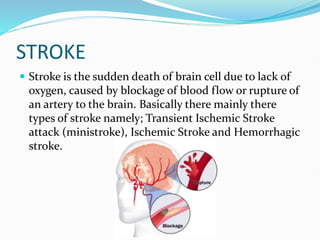
 Stroke is the sudden death of brain cell due to lack of
oxygen, caused by blockage of blood flow or rupture of
an artery to the brain. Basically there mainly there
types of stroke namely; Transient Ischemic Stroke
attack (ministroke), Ischemic Stroke and Hemorrhagic
stroke.
TYPES OF STROKE
 Transient Ischemic Attack: it is also called ministroke.
Anything that temporarily blocks blood flow to your brain
causes a TIA.The blood clot and TIA symptoms last for a
short period of time.
 Ischemic Stroke: It occur when a blood clot keeps blood
fromflowing to your brain. The blood clot is often due to
atherosclerosis, which is a buildup of fatty deposits on the
inner lining of a blood vessel. A portion of these fatty
deposits can break off and block blood flow in your brain.
An ischemic stroke can be embolic, meaning the blood clot
travels from another part of your body to your brain.
TYPES OF STROKE Cont’d
 Hemorrhagic Stroke: It results when bloodvessel in
your brainruptures or break, spilling blood into the
surrounding tissues. There are three main types
ohemorrhagicstroke: the first is an aneurysm, which
causes a portion of the weakened blood vessel to
balloon outward and sometimes rupture. The other is
an arteriovenous malfunction, which involves
abnormally formed blood vessels. If such blood vessel
ruptures, it can cause a hemorrhagic stroke. Lastly,
very high blood pressure can cause weakening of the
small blood vessel in the brain and result in bleeding
into the brain as well.
PREDIPOSITIONS
 Genetic factors likely play some role in high blood pressure,
stroke and other related conditions. Several genetic disorders can
cause a stroke, including sickle cell disease. People with a family
history of stroke are also likely to share common environments
and other potential factors that increase their risk.
 The chances for stroke can increase even more when heredity
combines with unhealthy lifestyle choices, such as smoking
cigarettes and eating an unhealthy diet.
 Age: the older you are, the more likely you are to have a stroke.
The chance of having a stroke doubles every 10 years after the age
of 55.
 Sex: Stroke is more common in women than men, and women of
all ages are likely than men to die from stroke. Pregnancy and
use of birth control pills pose special stroke risks for women.
SIGNS AND SYMPTOMS
 Muscular: difficulty walking, instability, paralysis with weak
muscles, problems with coordination, stiff muscle, overactive
reflexes, or paralysis of side of the body.
 Visual: blurred vision, double vision, sudden visual loss, or
temporary loss of vision in one eye.
 Speech: difficulty speaking, slurred speed, or speech loss.
 Whole body: Fatigue, light-headedness, or vertigo.
 Limb: numbness or weakness
 Sensory: pins and needles or reduced sensation of touch.
 Facial: muscle weakness or numbness
 Other common sign and symptoms: difficulty swallowing,
headache, inability to understand, mental confusion, or
nystagmus.
INVESTIGATIONS
 Physical scan: the physician will carry out a number of physical examinations
such as checking of blood pressure, listening to the heart sounds and also
conducting a neurological exam to see how a potential stroke is affecting the
patient’s neuron system
 Blood tests:
 blood tests will be carried out to check the patient’s blood sugar levels whether
they are high or low.
 A full blood count to assess how fast the blood clots.
 Check whether the patient has infections or not.
 Computerized tomography (CT) scan: a CT scan will be able to show if there
is bleeding in the brain, an ischemic stroke, a tumor or other conditions.
 Magnetic resonance imaging (MRI): An MRI can detect the extent of brain
tissue damaged by an ischemic stroke and brain hemorrhages.
 Echocardiogram: An echocardiogram uses sound waves to create detailed
images of the heart. It can find a source of clots in the patient’s heart that may
have travelled from the heart to the brain leading to the stroke.
MANAGEMENT
 Intravenous Access and Cardiac Monitoring
 Patients with acute stroke require IV access and cardiac monitoring in
the emergency department (ED). Patients with acute stroke are at risk
for cardiac arrhythmias. In addition, atrial fibrillation may be
associated with acute stroke as either the cause (embolic disease) or as
a complication.
 Blood Glucose Control: Severe hyperglycemia appears to be
independently associated with poor outcome and reduced reperfusion
in thrombolysis, as well as extension of the infracted territory.
 Patient Positioning: Studies have previously shown that cerebral
perfusion pressure is maximized when patients are maintained in a
supine position. However, lying flat may serve to increase ICP.
 Cardiac monitor: Continuous monitoring for ischemic changes or
atrial fibrillation
 Temperature: Avoid hyperthermia; use oral or rectal acetaminophen
and cooling blankets as needed
COMPLICATIONS
 Blood clots or deep vein thrombosis (DVT): When you are in the hospital or
immobile for a long time, you are at risk of developing a blood clot. Depending on what
caused your stroke, you may have a greater risk of blood clots.Symptoms of DVT include
swelling in a leg or arm, sometimes with accompanying pain, redness and warm skin.
 Depression and other mood changes: After a stroke, you may have memory lapses,
difficulty sleeping and you may struggle to resume enjoyable activities alone or with your
family and friends. These factors all may contribute to feelings of sadness, worthlessness
and lack of energy.You may also experience irritability, apathy and uncontrolled
expressions of emotions.
 Aphasia and other speech disorders: Damage to parts of the brain responsible for
language may cause aphasia. This impairs the expression and understanding of language
as well as reading and writing. Aphasia may occur along with other speech disorders
 Involuntary muscle tightening or spasticity: You may develop muscle tightness and
pain in your leg or arm muscles soon after your stroke or months later.
 Chronic headaches: This complication is more common in those who have had a
hemorrhagic stroke, as blood from the hemorrhage may irritate the brain. You may
encounter other complications after your stroke, including swallowing difficulties, bed
sores and falling.

CONCLUSION
Stroke rehabilitation to the prototype rehabilitation effort
involving nearl yall common rehabilitation problems and
requiring effort of all members of interdiscplinary
rehabilitation team.
New scietintific evidence on necessity of rehabilitation
interventions for neural re-organization and functional
recovery has set a foundation for stroke rehabilitation
research in coming generations
Application of physical exercise and newer modalities, as
well as pharmacology, surgery, cortical brain stimulation,
and robotics, is now under clinical investigation.
REFERENCES
 Bradberry JC (2000) Pharmacotherapy Handbook, 2nd
Edition.
 Bradberry JC, Fagan SC (2002) Stroke:
Pharmacotherapy, 5th Edition.
 Lacy CF (2003) Drug Information Handbook, 10th
Edition
 Deshan Kumar (2012) Stroke Rehabilitation

STROKE PRESENTATION NOTES IN POWERPOINT.

  • 1.
  • 2.
    STROKE  Stroke isthe sudden death of brain cell due to lack of oxygen, caused by blockage of blood flow or rupture of an artery to the brain. Basically there mainly there types of stroke namely; Transient Ischemic Stroke attack (ministroke), Ischemic Stroke and Hemorrhagic stroke.
  • 3.
    TYPES OF STROKE Transient Ischemic Attack: it is also called ministroke. Anything that temporarily blocks blood flow to your brain causes a TIA.The blood clot and TIA symptoms last for a short period of time.  Ischemic Stroke: It occur when a blood clot keeps blood fromflowing to your brain. The blood clot is often due to atherosclerosis, which is a buildup of fatty deposits on the inner lining of a blood vessel. A portion of these fatty deposits can break off and block blood flow in your brain. An ischemic stroke can be embolic, meaning the blood clot travels from another part of your body to your brain.
  • 4.
    TYPES OF STROKECont’d  Hemorrhagic Stroke: It results when bloodvessel in your brainruptures or break, spilling blood into the surrounding tissues. There are three main types ohemorrhagicstroke: the first is an aneurysm, which causes a portion of the weakened blood vessel to balloon outward and sometimes rupture. The other is an arteriovenous malfunction, which involves abnormally formed blood vessels. If such blood vessel ruptures, it can cause a hemorrhagic stroke. Lastly, very high blood pressure can cause weakening of the small blood vessel in the brain and result in bleeding into the brain as well.
  • 5.
    PREDIPOSITIONS  Genetic factorslikely play some role in high blood pressure, stroke and other related conditions. Several genetic disorders can cause a stroke, including sickle cell disease. People with a family history of stroke are also likely to share common environments and other potential factors that increase their risk.  The chances for stroke can increase even more when heredity combines with unhealthy lifestyle choices, such as smoking cigarettes and eating an unhealthy diet.  Age: the older you are, the more likely you are to have a stroke. The chance of having a stroke doubles every 10 years after the age of 55.  Sex: Stroke is more common in women than men, and women of all ages are likely than men to die from stroke. Pregnancy and use of birth control pills pose special stroke risks for women.
  • 6.
    SIGNS AND SYMPTOMS Muscular: difficulty walking, instability, paralysis with weak muscles, problems with coordination, stiff muscle, overactive reflexes, or paralysis of side of the body.  Visual: blurred vision, double vision, sudden visual loss, or temporary loss of vision in one eye.  Speech: difficulty speaking, slurred speed, or speech loss.  Whole body: Fatigue, light-headedness, or vertigo.  Limb: numbness or weakness  Sensory: pins and needles or reduced sensation of touch.  Facial: muscle weakness or numbness  Other common sign and symptoms: difficulty swallowing, headache, inability to understand, mental confusion, or nystagmus.
  • 7.
    INVESTIGATIONS  Physical scan:the physician will carry out a number of physical examinations such as checking of blood pressure, listening to the heart sounds and also conducting a neurological exam to see how a potential stroke is affecting the patient’s neuron system  Blood tests:  blood tests will be carried out to check the patient’s blood sugar levels whether they are high or low.  A full blood count to assess how fast the blood clots.  Check whether the patient has infections or not.  Computerized tomography (CT) scan: a CT scan will be able to show if there is bleeding in the brain, an ischemic stroke, a tumor or other conditions.  Magnetic resonance imaging (MRI): An MRI can detect the extent of brain tissue damaged by an ischemic stroke and brain hemorrhages.  Echocardiogram: An echocardiogram uses sound waves to create detailed images of the heart. It can find a source of clots in the patient’s heart that may have travelled from the heart to the brain leading to the stroke.
  • 8.
    MANAGEMENT  Intravenous Accessand Cardiac Monitoring  Patients with acute stroke require IV access and cardiac monitoring in the emergency department (ED). Patients with acute stroke are at risk for cardiac arrhythmias. In addition, atrial fibrillation may be associated with acute stroke as either the cause (embolic disease) or as a complication.  Blood Glucose Control: Severe hyperglycemia appears to be independently associated with poor outcome and reduced reperfusion in thrombolysis, as well as extension of the infracted territory.  Patient Positioning: Studies have previously shown that cerebral perfusion pressure is maximized when patients are maintained in a supine position. However, lying flat may serve to increase ICP.  Cardiac monitor: Continuous monitoring for ischemic changes or atrial fibrillation  Temperature: Avoid hyperthermia; use oral or rectal acetaminophen and cooling blankets as needed
  • 9.
    COMPLICATIONS  Blood clotsor deep vein thrombosis (DVT): When you are in the hospital or immobile for a long time, you are at risk of developing a blood clot. Depending on what caused your stroke, you may have a greater risk of blood clots.Symptoms of DVT include swelling in a leg or arm, sometimes with accompanying pain, redness and warm skin.  Depression and other mood changes: After a stroke, you may have memory lapses, difficulty sleeping and you may struggle to resume enjoyable activities alone or with your family and friends. These factors all may contribute to feelings of sadness, worthlessness and lack of energy.You may also experience irritability, apathy and uncontrolled expressions of emotions.  Aphasia and other speech disorders: Damage to parts of the brain responsible for language may cause aphasia. This impairs the expression and understanding of language as well as reading and writing. Aphasia may occur along with other speech disorders  Involuntary muscle tightening or spasticity: You may develop muscle tightness and pain in your leg or arm muscles soon after your stroke or months later.  Chronic headaches: This complication is more common in those who have had a hemorrhagic stroke, as blood from the hemorrhage may irritate the brain. You may encounter other complications after your stroke, including swallowing difficulties, bed sores and falling. 
  • 10.
    CONCLUSION Stroke rehabilitation tothe prototype rehabilitation effort involving nearl yall common rehabilitation problems and requiring effort of all members of interdiscplinary rehabilitation team. New scietintific evidence on necessity of rehabilitation interventions for neural re-organization and functional recovery has set a foundation for stroke rehabilitation research in coming generations Application of physical exercise and newer modalities, as well as pharmacology, surgery, cortical brain stimulation, and robotics, is now under clinical investigation.
  • 11.
    REFERENCES  Bradberry JC(2000) Pharmacotherapy Handbook, 2nd Edition.  Bradberry JC, Fagan SC (2002) Stroke: Pharmacotherapy, 5th Edition.  Lacy CF (2003) Drug Information Handbook, 10th Edition  Deshan Kumar (2012) Stroke Rehabilitation